


Abstract
A large number of low-resistivity and low-permeability reservoirs have been discovered in the deep Paleogene strata of the Wenchang Sag. These reservoirs are characterized by complex porosity–permeability relationships and difficulties in fluid property identification, which restrict the progress of exploration and development operations. However, existing reservoir studies mostly focus on either low-permeability or low-resistivity reservoirs, with relatively few investigations targeting this specific type. Using petrological analysis and physical property testing as the main methods, combined with sedimentary and diagenetic studies, this paper examines the characteristics and genesis of low-resistivity and low-permeability reservoirs in the Paleogene of the Wenchang Sag. The results show that the Paleogene reservoirs are dominated by lithic quartz sandstones, with secondary pores as the main reservoir space, consisting of medium–small pores and fine throats. Samples of the same grain size exhibit a favorable porosity–permeability correlation. Based on capillary pressure curve morphology, the reservoirs can be classified into three types: high mercury intrusion saturation with low displacement pressure, medium mercury intrusion saturation with medium displacement pressure, and medium mercury intrusion saturation with medium–high displacement pressure. The low porosity and permeability are mainly attributed to the fact that the reservoir rocks are primarily deposited in near-source braided fluvial delta underwater distributary channels, resulting in low compositional and textural maturity of sandstones. Strong compaction resistance leads to a significant reduction in primary pores during burial, and intergranular cement filling further deteriorates physical properties. On the other hand, rapid lithological changes and complex pore structures give rise to abundant isolated pores and poor connectivity, leading to high irreducible water saturation. Coupled with high formation water salinity, these factors collectively give rise to low-resistivity reservoirs in the study area. This study clarifies the formation mechanism of low-permeability and low-resistivity reservoirs in the Paleogene of the Wenchang Sag, providing guidance for reservoir evaluation in subsequent oil and gas exploration and serving as a reference for analogous areas.
1. Introduction
Low-permeability reservoirs refer to reservoirs with extremely low permeability. Under the geological condition where the reservoir is generally tight, accurately identifying and characterizing “sweet spot” intervals with relatively superior physical properties is the core task in the exploration and research of low-permeability reservoirs [1]. The geological genesis of low-permeability reservoirs is highly diverse and can be mainly divided into three categories: the first is shallow primary low-permeability reservoirs dominated by fine-grained deposition and high shale content; the second is deep transformed low-permeability reservoirs jointly controlled by strong compaction and strong cementation [2,3,4]; the third is secondary low-permeability reservoirs formed by tectonic reworking under a strongly diagenetically tight background.
Low-resistivity reservoirs usually specifically refer to low-resistivity hydrocarbon-bearing reservoirs [5,6], whose formation is controlled by the coupling of multiple factors, including sedimentary conditions, hydrocarbon accumulation evolution, diagenesis, hydrodynamic conditions and drilling fluid invasion. Owing to the small resistivity difference between low-resistivity hydrocarbon reservoirs and adjacent water-bearing zones, as well as the complex oil-gas-water contact relationship, the identification of reservoir fluid properties is considerably difficult, leading to frequent contradictions between logging interpretation results and formation testing conclusions, such as “water production from oil zones” and “oil production from water zones”.
The Wenchang Sag in the Pearl River Mouth Basin is an important petroliferous sag on the northern continental margin of the South China Sea. The Paleogene serves as the main exploration interval in this area, where clastic reservoirs dominated by lacustrine and braided river delta deposits are developed. In recent years, with the continuous deepening of exploration maturity, low-permeability and low-resistivity reservoirs have gradually become key targets for hydrocarbon exploration in this area [7,8,9]. The genetic mechanism of Paleogene low-permeability and low-resistivity reservoirs in the Wenchang Sag is extremely complex. It is affected not only by primary factors controlled by sedimentary environments such as fine-grained deposition and argillaceous mixing, but also by secondary reworking via diagenesis including compaction, cementation and dissolution. Meanwhile, it is comprehensively constrained by factors such as hydrocarbon charging intensity and formation water salinity, resulting in strong heterogeneity in the physical and electrical properties of the reservoirs. This significantly increases the difficulty of reservoir identification and evaluation, and severely restricts breakthroughs in hydrocarbon exploration and effective development of reserves in this area.
At present, scholars worldwide have carried out extensive research on low-permeability and low-resistivity reservoirs and proposed various identification methods and genetic interpretation models [10,11]. For the Paleogene in the Pearl River Mouth Basin, some scholars have established a new permeability prediction method for low-permeability sandstones in the Zhuhai Formation using machine learning [12], analyzed the mechanical characteristics of tight reservoirs in the Lufeng Sag and put forward a new reservoir fracability evaluation model [13]. Other scholars hold that the reservoir-controlling factors in the adjacent Lufeng Sag are the sedimentary environment and hydrocarbon charging [14]. Studies on diagenetic alterations of the Zhuhai Formation reservoirs in the Wenchang Sag caused by natural gas charging have revealed that the influx of CO2-rich fluids can improve permeability [15]. Existing studies mostly focus on pore structure characteristics [16], reservoir sensitivity [17] and other aspects. However, due to differences in geological settings among different basins and stratigraphic intervals, current research findings are difficult to directly apply to Paleogene reservoirs in the Wenchang Sag.
Two deficiencies still exist in the research on reservoir formation mechanisms. First, studies on the coupling relationship between low-permeability and low-resistivity characteristics of reservoirs are relatively insufficient, and the intrinsic correlation mechanism between the two has not been clarified. Second, there is a lack of systematic analysis on the genetic and evolutionary processes of low-permeability and low-resistivity reservoirs under multi-factor coupled control, especially the unclear understanding of the synergistic controlling mechanism of sedimentary environment and diagenesis.
This paper takes Paleogene low-permeability and low-resistivity reservoirs in the Wenchang Sag, Pearl River Mouth Basin as the research object, systematically analyzes their petrological, physical and electrical properties, and deeply reveals the genetic mechanism of their low permeability and low resistivity. It is expected to provide a theoretical basis and technical support for the evaluation of low-permeability and low-resistivity reservoirs during regional exploration, and also offer a reference for reservoir research in similar areas.
2. Geographical Overview
The Pearl River Mouth Basin is one of the major oil- and gas-producing regions in the South China Sea. It was developed on a complex folded basement of the Mesozoic and is a typical terrigenous extensional basin [18,19]. Since the Cenozoic, the basin has undergone multi-stage tectonic movements, and its main tectonic evolution can be divided into three key stages: the Eocene rifting stage, the Oligocene–Middle Miocene sag stage, and the block-fault tectonic reactivation stage from the Late Miocene to the present. During the Cenozoic, at least several major tectonic events occurred in the basin, including the Zhuqiong Movement, South China Sea Movement, Baiyun Movement and Dongsha Movement [20,21,22], which exerted a profound influence on the tectonic evolution and hydrocarbon accumulation of the basin.
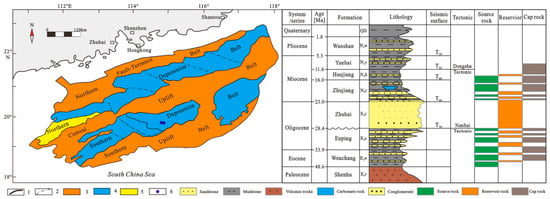
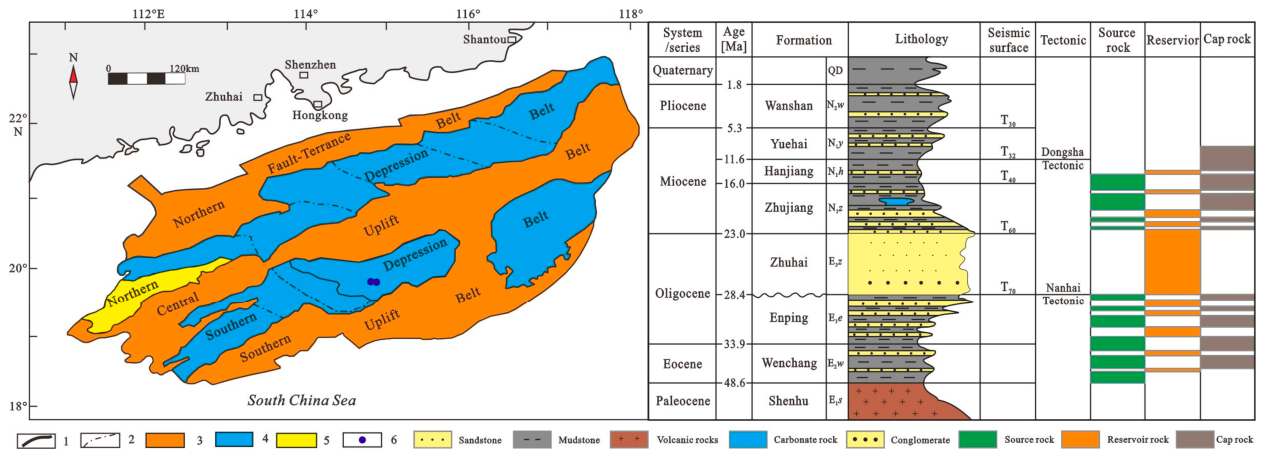
The Wenchang Sag is located in the western part of the Pearl River Mouth Basin, with a planar area of approximately 9000 km2 and distinct tectonic boundaries. It is bounded by the Yangjiang Low Uplift to the north and east, adjacent to the Shenhu Uplift to the south, and connected to the Qionghai Uplift and Qionghai Sag to the west. The interior of the sag generally exhibits a half-graben faulted depression pattern characterized by faulting in the south and onlapping in the north. The Cenozoic sedimentary strata, from bottom to top, consist of the Wenchang Formation, Enping Formation, Zhuhai Formation, Zhujiang Formation, Hanjiang Formation, Yuehai Formation and Wanshan Formation (Figure 1). Among them, the Wenchang Formation is widely developed with a set of deep lacustrine facies deposits intercalated with deltaic sandy and muddy sediments. This depositional system provides an important material foundation for regional hydrocarbon accumulation and serves as the key target horizon for oil and gas exploration in the study area.
Figure 1.
Structural position of the Wenchang Depression Area: 1 boundary of first-order tectonic unit, 2 boundary of second-order tectonic unit, 3 forward direction structure, 4 Negative direction structure, 5 Location of study area.
3. Experimental Samples and Methods
3.1. Experimental Sample
All the experimental samples in this study were collected from the Paleogene drilling core intervals of four exploration wells within the study area, with lithologies dominated by siltstone, fine-grained sandstone, medium-grained sandstone and coarse-grained sandstone. To ensure the reliability and representativeness of the experimental results, the screening principle of “no obvious fractures, no traces of secondary dissolution alteration, and uniform oil-bearing grade” was strictly followed during the coring process of the full-diameter cores and subsamples. After eliminating unqualified cores with natural fractures, drilling fluid invasion contamination and abnormal mineral compositions, the final selected experimental samples were all obtained from intervals with relatively homogeneous reservoir physical properties, which can truly reflect the pore structure characteristics of the Paleogene reservoirs.
Before the experiment, all core samples were subjected to strict pretreatment procedures in accordance with industrial standards. First, the cores were dried in a constant-temperature environment at 60 °C for 48 h to completely remove free water from the pores. Subsequently, toluene (produced by Shandong Yulong Petrochemical) was used for extraction for 72 h to thoroughly eliminate residual hydrocarbons inside the cores. Finally, the cores were placed in a vacuum drying oven for secondary drying for 24 h to ensure the samples reached a stable dry state.
After pretreatment, the cores were quickly packed into sealed bags and stored in a desiccator to prevent irreversible impacts on reservoir pore structure caused by changes in ambient humidity and temperature, laying a foundation for the smooth implementation of subsequent mercury intrusion porosimetry experiments.
3.2. Experimental Method
In this experiment, a variety of testing methods were combined to systematically investigate the pore structure and permeability-porosity characteristics of the reservoir. Specifically, the tests included casting thin section analysis, physical property measurement, and high-pressure mercury intrusion experiments. In addition, test results of clay minerals for these samples were collected.
First, 50 representative core samples were selected to prepare casting thin sections. Blue epoxy resin (produced by Guangdong Keliao New Materials Co., Ltd.) was used to fill the pores. A polarizing microscope was employed to systematically observe the pore types, areal porosity, and pore connectivity of the reservoir, clarifying the development characteristics and distribution rules of major pores such as intergranular pores, intragranular dissolved pores, intercrystalline pores, and microfractures.
Among samples with different pore development characteristics, 32 cores covering all intervals were chosen for physical property testing. All experiments were conducted at the CNOOC Shenzhen Experimental Center using a Poro PDP-200 overburden porosity-permeability analyzer manufactured by Core Laboratories Inc., USA. The instrument has a porosity measurement range of 0.01–40% and a permeability range of 0.00001 mD–10 mD. Porosity was measured using the helium injection method: the pore volume of each sample was determined with a helium porosimeter, and porosity was calculated accordingly. Repeated tests were performed on the same sample, with an absolute deviation of no more than 0.5%. Permeability testing followed a similar procedure to porosity testing.
Based on the physical property distribution, 12 cores were separately selected for high-pressure mercury intrusion experiments using an Autopore 9620 instrument manufactured by Guangzhou Beituo Science and Technology Co., Ltd., with a maximum mercury intrusion pressure of 200 MPa. Sample mass ranged from 10 to 26 g. Pressure was applied according to a preset program, and variations in pressure, mercury saturation, and mercury flow were recorded to calculate parameters including pore size distribution, porosity, and permeability.
Clay mineral test data were collected from experiments conducted on a D8AA25 X-ray diffractometer manufactured by Bruker Corporation, with a maximum output power of 3.0 kW and a 2θ scanning range of −10° to 168°.
4. Rock and Pore Characteristics
4.1. Rockological Characteristics
Based on the collected thin-section samples, systematic microscopic observation and statistical analysis were conducted on a total of 104 conventional and cast thin-section samples from 12 wells of the Paleogene strata in the study area. The results show that the Paleogene reservoir is dominated by lithic quartz sandstone, followed by feldspathic quartz sandstone and lithic sandstone, with calcareous lithic quartz sandstone locally developed in individual areas. The content of interstitial materials is generally less than 10%. The overall grain size of the sandstone is relatively coarse, with moderate sorting and poor to moderate roundness. Grain contacts are dominated by line contacts, with concavo-convex–line contacts observed in some samples, and the cementation type is mainly pressure-fitted cementation.
4.2. Physical Properties Characteristics
- (1)
- Pore type
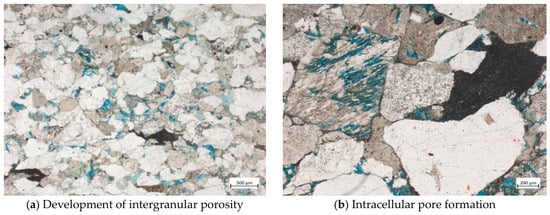
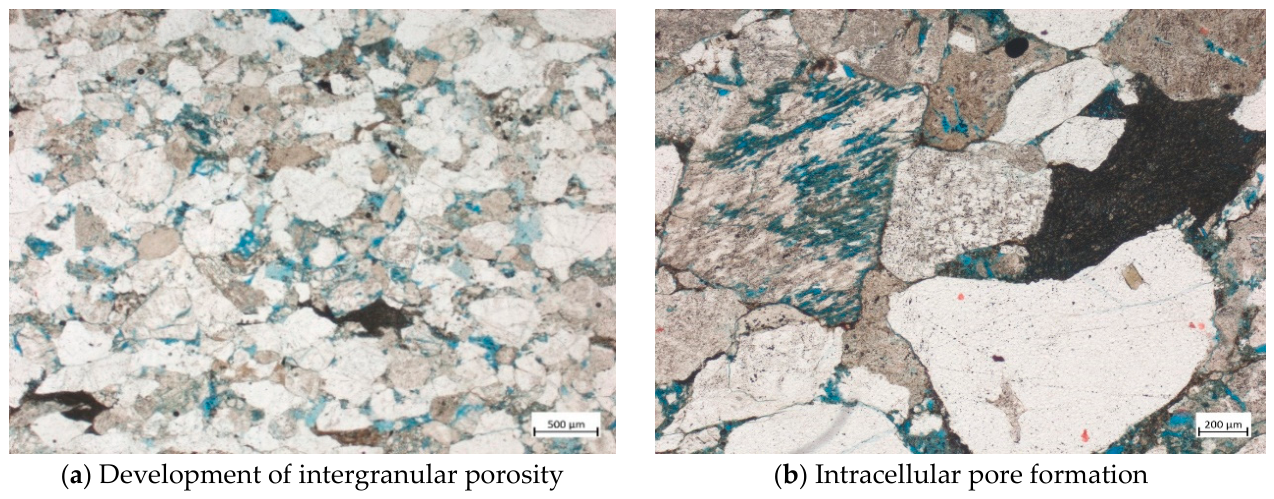
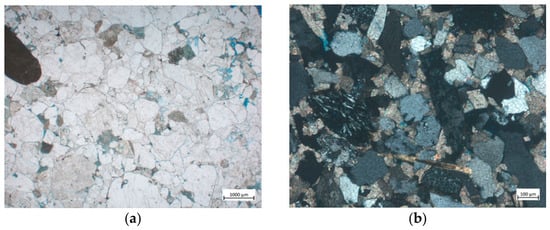
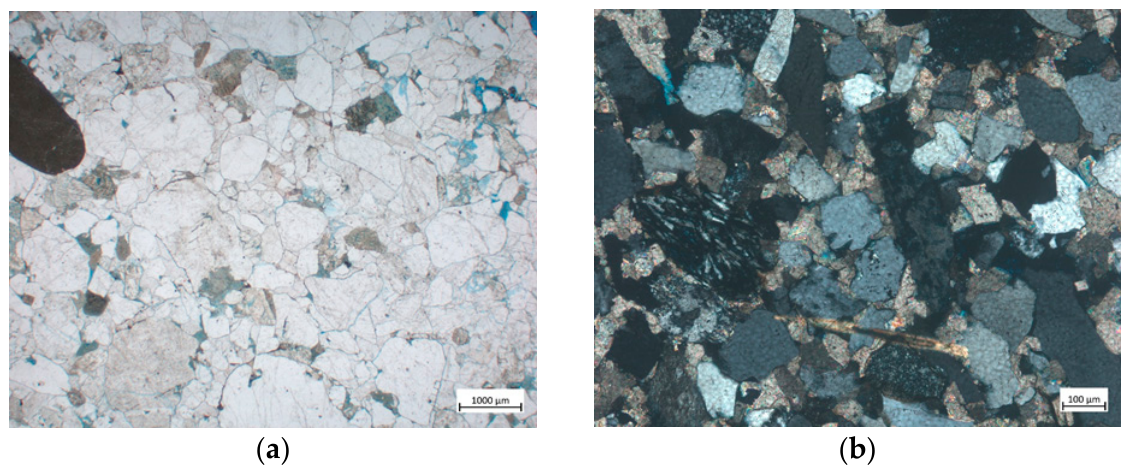
Based on the microscopic analysis of the cast thin sections, the pores of the Paleogene reservoir sandstones in the study area are dominated by secondary pores, accounting for more than 95%. Most of them are intergranular dissolved pores (Figure 2a), followed by feldspar dissolved pores and lithic dissolved pores (Figure 2b). Microfractures are developed in a small number of the samples.
Figure 2.
Microscopic pore characteristics of the Guqinian Formation Reservoirs.
- (2)
- Permeability characteristics
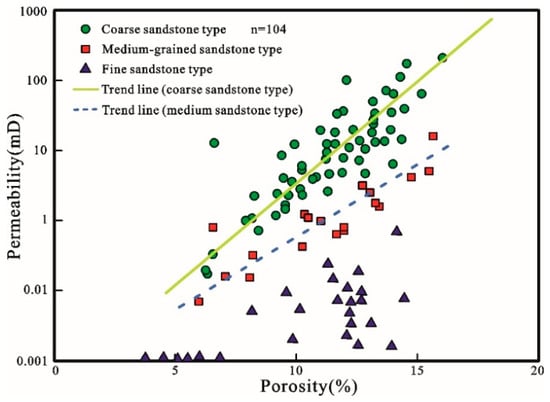
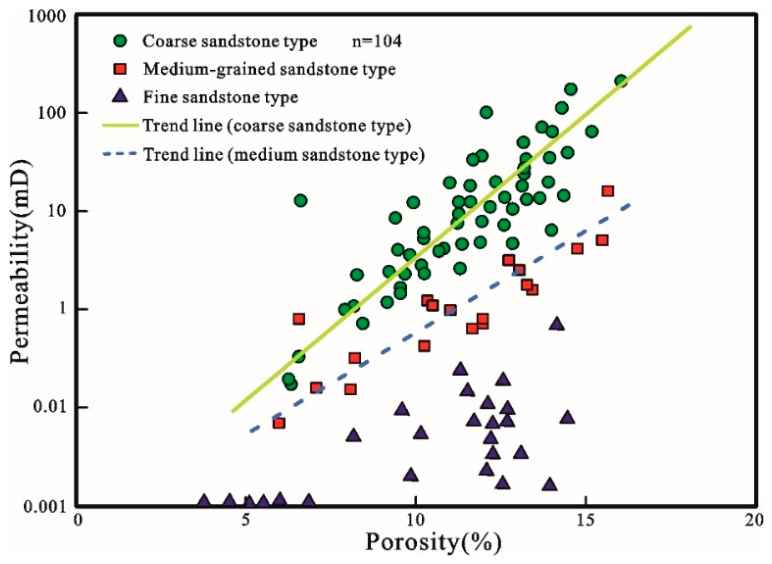
Reservoir physical property analysis of the study area shows that porosity ranges from 3% to 18% with an average of 11.5%, and permeability ranges from 0.0001 mD to 347 mD with an average of 8.9 mD. The reservoir is generally characterized as medium-porosity and low-permeability. Combined with core observation and thin-section identification, a statistical analysis was performed on the grain size types of the experimental samples: there are 59 samples of pebbly coarse sandstone and coarse sandstone, 19 samples of pebbly medium sandstone and medium sandstone, and 26 samples of fine sandstone and siltstone. Porosity–permeability cross-plots were constructed and analyzed for the above three grain-size categories. The results indicate that the overall correlation between porosity and permeability of the reservoir samples in the study area is weak, whereas the samples within the same grain-size class show a good positive correlation between porosity and permeability (Figure 3).
Figure 3.
Analysis Results of Porosity and Permeability of the Guqinian Formation Reservoirs.
- (3)
- Pore structure characteristics
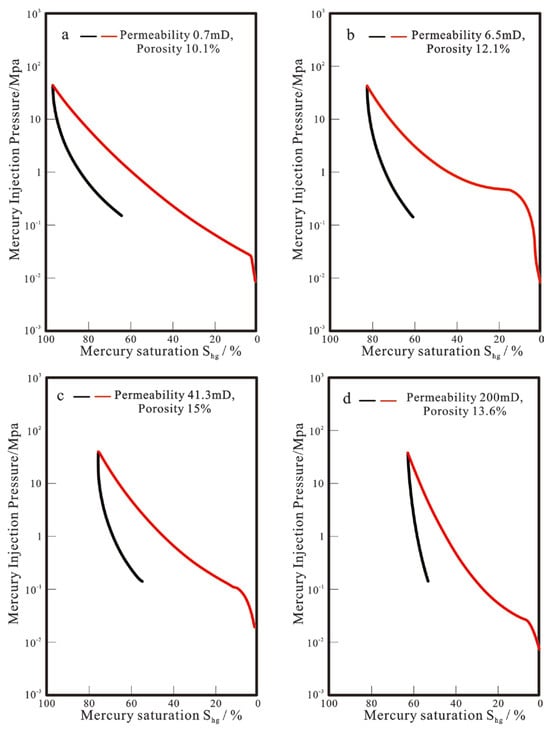
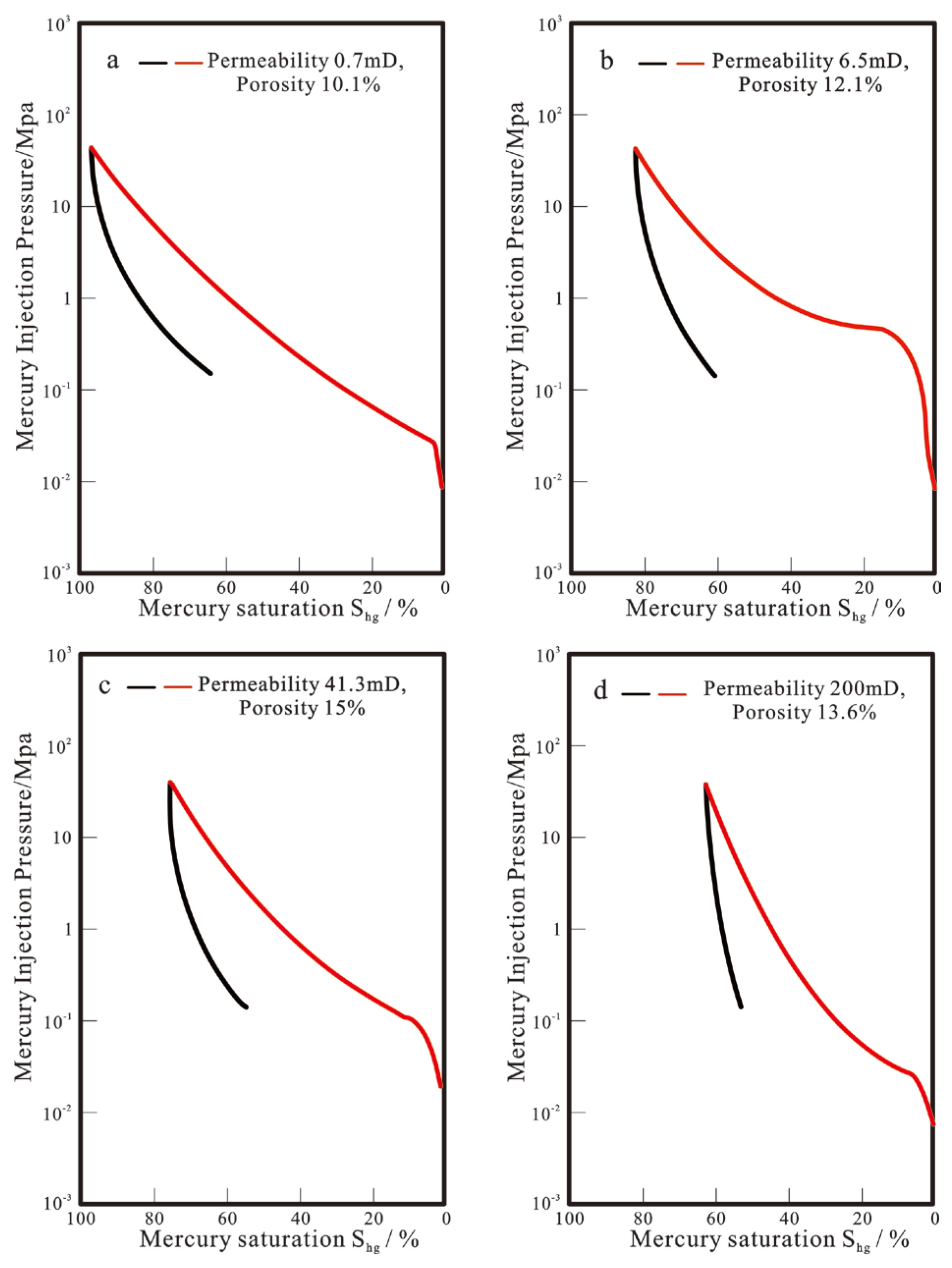
The typical mercury injection curves of 19 sandstone samples from the Paleogene were analyzed (Figure 4). The results show that the distribution characteristics of reservoir pore throats are dominated by a single peak, and the displacement pressure is generally low (universally lower than 0.1 MPa). However, the mercury injection curves are generally steep, with poor integrity of mercury withdrawal curves and low mercury withdrawal efficiency (universally lower than 20%). This indicates that the pore structure of the reservoirs in the study area is dominated by medium-to-small pores and fine-throat types. According to the morphological characteristics of the capillary pressure curves, they can be divided into the following three categories (Table 1):
Figure 4.
Characteristics of mercury pressure curves of the Guqinian Formation sandstones.
Table 1.
Classification and statistical table of capillary pressure curves of Guqinian Formation Reservoirs.
Type I represents capillary pressure curves characterized by high mercury injection saturation and low displacement pressure. Such curves exhibit high mercury injection saturation (>85%) and low displacement pressure (<0.01 MPa), with a prominent plateau segment. After reaching the displacement pressure, mercury injection saturation increases rapidly with rising pressure (Figure 4a). Curves of this type correspond to reservoirs with excellent pore structure, favorable pore-throat connectivity and uniform distribution, as well as superior storage and percolation capacities. Oil testing typically indicates high-production oil layers.
Type II refers to capillary pressure curves with moderate mercury injection saturation and moderate displacement pressure. The curves show moderate mercury injection saturation (47–85%) and displacement pressure ranging from 0.47 to 3.4 MPa, with a short plateau segment and distinct inflection point characteristics (Figure 4b). This reflects reservoirs with favorable pore structure, relatively coarse rock grains, moderate pore-throat connectivity and moderate storage properties, which generally meet the industrial oil flow standard in oil testing.
Type III corresponds to capillary pressure curves featuring moderate mercury injection saturation and medium–high displacement pressure. Such curves have relatively low mercury injection saturation (<50%) and medium–high displacement pressure (>1 MPa), presenting an overall ramp-like shape with indistinct double inflection points (Figure 4c,d). This indicates reservoirs with poor pore structure, weak pore-throat connectivity, and unsatisfactory storage and percolation capacities, which mostly show low productivity or no productivity in oil testing.
5. The Causes of Low Permeability in Reservoirs
The evolution of reservoir physical properties is affected by various factors such as sedimentary conditions, diagenesis, tectonic movement, hydrocarbon charging and overpressure [23]. Under most geological settings, sedimentary conditions and diagenesis are the dominant factors controlling reservoir physical properties. This paper conducts an in-depth analysis of the genesis of low permeability in the Paleogene reservoirs in the study area from two core aspects: sedimentation and diagenesis.
5.1. The Influence of Sedimentation Process
The Paleogene strata mainly develop sedimentary systems including shore-shallow lacustrine, medium-deep lacustrine and braided river delta. The sedimentary microfacies of the drilled sand bodies are dominated by shore-shallow lacustrine beach-bar and subaqueous distributary channel in the braided river delta front.
- (1)
- The pore and permeability characteristics of different sedimentary microfacies
A statistical analysis was performed on conventional logging and electrical imaging logging interpretation results of a total of 90 sandstone layers from four wells in the Paleogene. Among them, 70 layers are sand bodies of the underwater distributary channel microfacies in the braided river delta front, with a cumulative thickness of 390 m, accounting for 87% of the total sandstone thickness; six layers belong to the interdistributary bay microfacies, with a thickness of 11 m, accounting for 2.5%; six layers are of the distal bar microfacies, with a thickness of 24 m, accounting for 5.25%; and eight layers are sand bodies of the shallow lacustrine beach-bar microfacies, with a cumulative thickness of 25 m, accounting for 5.5%.
Combined with statistical results of reservoir physical properties, significant differences exist in the physical properties of sand bodies among different sedimentary microfacies. Sand bodies of underwater distributary channels in the braided river delta front exhibit the best physical properties, with porosity ranging from 11% to 15% and a main peak distributed at 10–12%. Sand bodies of interdistributary bays show moderate physical properties, with porosity generally less than 15% and a main peak at 10–13%. Distal bar sand bodies display the poorest physical properties, with porosity mostly below 10%, and oil testing results are dominated by poor oil layers and dry layers. Physical properties of shallow lacustrine beach-bar sand bodies are relatively dispersed, with a main porosity peak of 10–14%, and the single-layer thickness is relatively thin, generally less than 4 m.
- (2)
- The pore structure characteristics of different sedimentary microfacies
Based on the experimental analysis, logging data and oil testing results, the Paleogene reservoir quality is classified into three categories:
Type I reservoirs possess the best physical properties and pore structure, and are mainly developed in the sedimentary environment of subaqueous distributary channels in the braided river delta front. Lithologically, they are dominated by glutenite and coarse-grained sandstone. Microscopic observation shows well-developed pores and relatively thick throats, and these reservoirs exhibit high productivity in oil testing. Type II reservoirs have medium physical properties and pore structure. They are still dominated by subaqueous distributary channel deposits of the braided river delta front, with finer lithology compared to Type I reservoirs and relatively poor pore connectivity. They are also developed in shallow lacustrine beach-bar sedimentary environments, and show medium oil production in testing. Type III reservoirs are characterized by poor physical properties and pore structure with weak pore-throat connectivity. They are mainly developed in interdistributary bay and distal bar microfacies of the braided river delta front, and mostly yield low or no production in oil testing.
Overall, reservoirs in the study area were mainly formed in a subaqueous distributary channel setting of a proximal braided river delta. The sedimentary background adjacent to the provenance area resulted in low compositional maturity and textural maturity of the sandstones, with inherently complex pore structures, laying the foundation for the development of low permeability characteristics in the reservoirs.
5.2. The Controlling Role of Diagenesis
Diagenesis is a key factor responsible for the reduction in primary pores and further deterioration of physical properties in the Paleogene reservoirs of the study area. Among them, compaction and cementation are the main destructive diagenetic processes, whereas dissolution, as a constructive diagenetic process, has a limited effect on the improvement of reservoir physical properties.
- (1)
- Compaction is the dominant factor responsible for the reduction in primary porosity in deep reservoirs [24]. Sandstones of the Paleogene in the study area are characterized by low compositional maturity. Under continuous vertical loading of overlying strata, sediment particles undergo preferred orientation and intense compression during deep burial (Figure 5a), resulting in tight grain-contact relationships and substantial loss of primary porosity, which constitutes the primary cause for the reduction in reservoir porosity.Figure 5. Microscopic characteristics of diagenesis in the Guqinian Formation Reservoirs: (a) The particles are closely in contact and the compaction effect is strong. (b) The development of cementitious material.
- (2)
- Cement types of the reservoir sandstones in the study area mainly include siliceous cementation, carbonate cementation and clay mineral cementation. Siliceous cementation is characterized by typical quartz overgrowth, carbonate cementation is dominated by calcite, and clay minerals are principally illite, with occasional cements such as dolomite, pyrite and siderite (content < 1%) (Figure 5b). On the whole, the content of sandstone matrix is relatively low. The calcite content ranges from 1% to 6%, mostly occurring as fine- to medium-grained crystals filling intergranular pores; the clay mineral content is 1% to 4%, which mainly fills intergranular pores.
Microscopic observations reveal that in the samples with well-developed pores, calcite is characterized by partial filling of intergranular spaces, resulting in deteriorated pore connectivity. Under scanning electron microscopy (SEM), filamentous and flaky illite and quartz overgrowth rims are observed to fill the intergranular pores, while pyrite occurs as microspherical aggregates within the intergranular spaces. In samples with poorly developed pores, calcite forms continuous crystalline grain cementation, and argillaceous materials fill the intergranular spaces as matrix. Consequently, both the development degree and connectivity of pores are relatively poor. Thin-section observations show that intergranular pores in such samples are relatively uniformly distributed; however, the intergranular spaces are further filled with authigenic minerals, including authigenic quartz, sulfate minerals, authigenic kaolinite, and flaky illite, which further reduces the seepage capacity of the reservoirs.
- (3)
- Partial feldspar grains in the study area have undergone dissolution, forming intragranular dissolved pores (Figure 2a). Some grains are even completely dissolved to form moldic pores. Authigenic clay minerals such as kaolinite precipitated during the dissolution process. Feldspar dissolution contributed a certain amount of secondary pores to the reservoir (Figure 2b), alleviating the deterioration of reservoir physical properties caused by compaction and cementation to a certain extent. However, limited by the low overall content of soluble components in the reservoir sandstones of the study area, the pore-increasing effect of dissolution is limited, and its improvement on reservoir physical properties is not significant.
In summary, the formation of low-permeability characteristics of the Paleogene reservoirs in the study area is jointly controlled by sedimentation and diagenesis. Sedimentary conditions determine the foundation of reservoir physical properties; proximal sedimentation resulted in low sandstone maturity and complex pore structure. Diagenesis constitutes the core cause of low permeability in the reservoirs. Intense compaction led to a substantial reduction in primary pores, and intergranular filling by cements, including siliceous, carbonate and clay minerals, further reduced reservoir porosity and permeability. In contrast, the constructive modification of dissolution is limited and cannot effectively improve reservoir physical properties.
6. The Causes of Low Resistivity in Reservoirs
The genesis of typical low-resistivity oil reservoirs can be mainly classified into six categories, namely lithologic factors, formation water salinity factors, high irreducible water saturation factors, clay mineral factors, salt-based drilling fluid invasion factors and conductive mineral factors [25,26,27]. Logging while drilling (LWD) resistivity logging is adopted for all wells drilled in the study area, which is weakly affected by drilling fluid invasion. Identification results under thin-section microscopy show that the content of conductive minerals in the reservoirs is extremely low. Therefore, the controlling effects of drilling fluid invasion and conductive minerals on the low-resistivity characteristics of oil reservoirs in the study area can be basically excluded. This paper systematically analyzes the genesis of Paleogene low-resistivity oil reservoirs in the study area from four key aspects: lithology, formation water salinity, irreducible water saturation and clay minerals.
6.1. Rock Composition Influence
There exists an obvious intrinsic correlation between reservoir oil-bearing property and lithology as well as physical properties (Table 2). The coarser the reservoir lithology, the better the physical properties, and the corresponding reservoir oil-bearing property also shows an improving trend. Siltstone exhibits relatively poor reservoir physical properties and oil-bearing properties. The oil-bearing property of coarse sandstone is dominated by oil stain and fluorescence. Although the proportion of coarse sandstone with oil immersion grade is low, it is much higher than that of fine sandstone and siltstone. The oil-bearing property of fine sandstone is dominated by fluorescence and non-oil-bearing, with an extremely low proportion of oil immersion and oil patch grades. Siltstone is basically free of oil immersion and oil patch grades, and is dominated by fluorescence and non-oil-bearing. The variation in lithologic grain size results in differences in reservoir porosity and permeability, which further affect hydrocarbon charging and occurrence. Fine-grained lithology provides a lithologic basis for the formation of low-resistivity oil reservoirs.
Table 2.
Relationship between reservoir oil content and rock type, physical properties (1). Relationship between reservoir oil content and rock type, physical properties (2).
6.2. Mineralization Degree of Formation Water
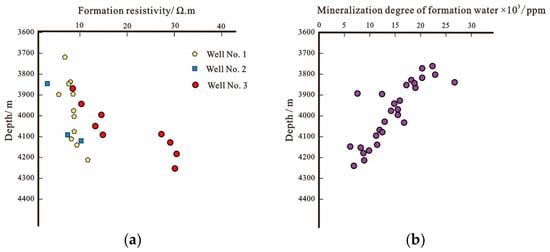
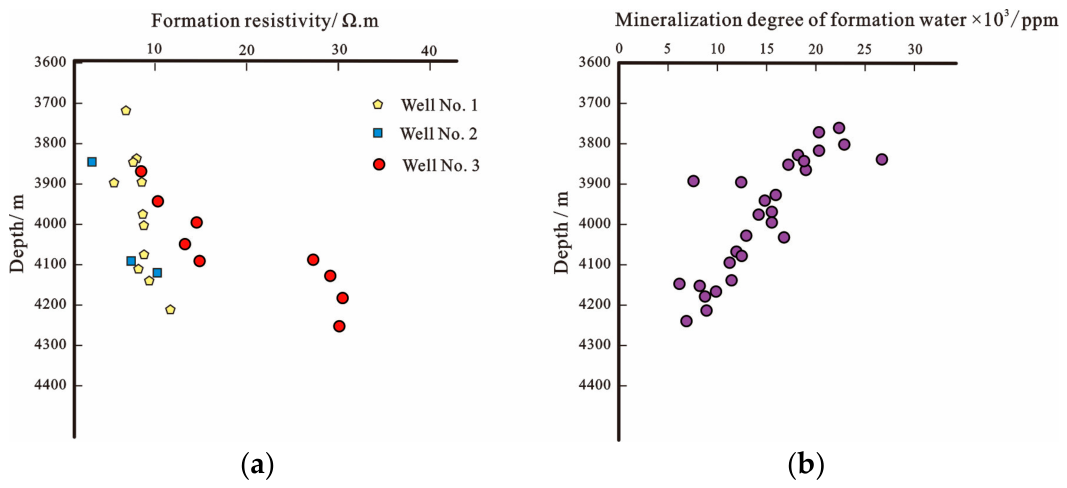
To analyze the effect of formation water salinity on reservoir resistivity, a total of three wells in the Paleogene of the study area were selected for formation water sampling and analysis. The sampling depth ranges from 3700 m to 4300 m, and the measured chloride ion content is between 2.479 g/L and 6.325 g/L. After water sample purity correction, the recalculated chloride ion content ranges from 4.825 g/L to 20.010 g/L. Systematic errors caused by solid particles, oil phases, impurities, dilution water and environmental factors in drilling fluid filtrate were eliminated through four steps: blank test, filtrate purity correction, filtrate volume correction, and temperature/pH correction, so as to ensure that the titration results truly reflect the chloride ion content of formation water. For detailed procedures, refer to API-RP-13B-1. Resistivity values of typical water-bearing zones at different depths were read and cross-plotted. The results show that formation water resistivity of the Paleogene is positively correlated with burial depth (Figure 6a). After conversion using the salinity-resistivity relationship, it is shown that formation water salinity of the Paleogene tends to decrease with increasing burial depth (Figure 6b). The burial depth of the Paleogene in the Wenchang Sag is generally greater than 3500 m. Compared with the normal formation water salinity of less than 4.879 g/L at this depth within the basin [28,29,30], the formation water salinity of the Paleogene in the study area is at a relatively high level. High-salinity formation water enhances the electrical conductivity of the reservoir, which is an important direct factor leading to the reduction in reservoir resistivity.
Figure 6.
Distribution characteristics of Paleogene strata water with depth: (a) The relationship between the electrical resistivity of the Paleogene strata and their depth. (b) The relationship between the mineralization degree of the Paleogene strata water and depth.
6.3. Bound Water Saturation
The capillary pressure curves obtained from high-pressure mercury injection experiments serve as an effective method for characterizing the spatial distribution characteristics of microscopic pore throats in reservoirs. For the core samples from low-resistivity oil layers in the study area, the mercury withdrawal efficiency is only 16%, indicating a complex microscopic pore structure with a high proportion of fine pores. Combined with the thin-section microscopic analysis, it can be concluded that secondary isolated pores formed by feldspar dissolution, as well as disconnected pore throats caused by pore-throat filling by clay minerals, provide favorable conditions for the formation of reservoirs with high irreducible water saturation. In contrast, the oil-layer samples with relatively better physical properties and significant resistivity contrast between oil and water exhibit mercury withdrawal efficiencies all above 30%, with a maximum of 37.2%. Polarizing microscopy observations show that such reservoirs are characterized by good pore connectivity and a significant reduction in the number of isolated pores.
Further analysis of mercury injection capillary pressure curves of Paleogene reservoirs reveals that the core samples corresponding to low-contrast oil layers exhibit relatively low maximum mercury injection saturation and mercury withdrawal efficiency. It can therefore be inferred that reservoirs with relatively complex pore structures are featured by more developed isolated pores and poor inter-pore connectivity, leading to lower mercury withdrawal efficiency of the samples. This microscopic characteristic is conducive to the formation of high irreducible water saturation in reservoirs. Coupled with the influence of low-salinity continental freshwater in the original sedimentary environment, it has contributed to the development of low-contrast oil layers to a certain extent. High irreducible water saturation enhances the overall electrical conductivity of reservoirs and acts as the key controlling factor for the low-resistivity characteristics of reservoirs in the study area.
6.4. Clay Minerals
To analyze the influence of clay minerals on reservoir resistivity, the X-ray diffraction (XRD) results of a total of 69 bulk rock samples from the Paleogene were statistically analyzed. The results show that clay mineral contents in the reservoirs of the study area are generally low, with most samples having clay contents below 10%. Therefore, the origin of low reservoir resistivity caused by excessively high clay mineral content can be ruled out.
Based on comprehensive macro- and micro-analyses, including the well log characteristics and core experimental results in the study area, the development of Paleogene low-resistivity oil reservoirs is the result of the synergistic effect of multiple factors. The reservoir lithology varies drastically both laterally and vertically, with complex microscopic pore structures, well-developed isolated pores and poor pore connectivity, which consequently lead to relatively high irreducible water saturation in the reservoirs. Meanwhile, the high salinity of deep formation water further enhances the electrical conductivity of the reservoirs and intensifies the manifestation of low-resistivity characteristics. The combined effect of the above factors ultimately results in the widespread development of Paleogene low-resistivity oil reservoirs.
7. Conclusions
- (1)
- The Paleogene reservoirs in the Wenchang Sag are dominated by lithic quartz sandstones with low interstitial matrix content. The sandstones are relatively coarse-grained, with moderate sorting and moderate to poor rounding, and the main cementation type is pressure-contact cementation. Reservoir space is dominated by secondary pores. Generally, the correlation between porosity and permeability of the samples is weak, but samples of similar grain size show a good positive correlation between porosity and permeability.
- (2)
- Reservoir pore-throat distribution is dominated by a single peak, and pore structure is characterized by medium-to-small pores and fine throats. Based on the morphology of capillary pressure curves, three types are identified: high mercury injection saturation with low displacement pressure, moderate mercury injection saturation with moderate displacement pressure, and moderate mercury injection saturation with moderate to high displacement pressure. These correspond to high productivity, industrial productivity, and non-productive intervals in formation testing, respectively.
- (3)
- Reservoirs are mainly developed in proximal braided river delta underwater distributary channels. Proximity to the provenance results in low compositional maturity and textural maturity of sandstones, leading to complex pore structures. Compaction caused a significant reduction in primary pores, and intergranular filling by cements and authigenic clay minerals further deteriorated physical properties. Therefore, sedimentary conditions form the foundation for reservoir quality, while diagenesis is the main cause of low porosity and low permeability in the study area.
- (4)
- Abundant isolated pores and poor pore connectivity result in high irreducible water saturation. In addition, the high salinity of formation water favors the development of low-contrast oil pay zones in the study area.
Author Contributions
Conceptualization, S.L. and Y.L.; Methodology, S.L. and C.X. (Chao Xiang); Software, P.N. and J.S.; Validation, C.X. (Changmin Xu), P.N. and X.W.; Formal analysis, S.L., L.C. and C.X. (Chao Xiang); Investigation, C.X. (Changmin Xu), L.C., D.L. and X.W.; Resources, D.L. and J.S.; Data curation, C.X. (Changmin Xu), L.C., D.L. and X.W.; Writing—original draft, S.L.; Writing—review & editing, Y.L.; Visualization, P.N. and J.S.; Supervision, Y.L. and C.X. (Chao Xiang); Funding acquisition, Y.L. All authors have read and agreed to the published version of the manuscript.
Funding
This research received no external funding.
Data Availability Statement
The original contributions presented in this study are included in the article. Further inquiries can be directed to the corresponding author. This research received no external funding.
Conflicts of Interest
Authors Shibin Liu, Changmin Xu, Pengbo Ni, Dadong Li, Chao Xiang and Xin Wang are employed by China-French Bohai Geoservices Co., Ltd. The remaining authors declare that the research was conducted in the absence of any commercial or financial relationships that could be construed as a potential conflict of interest.
References
- Martyushev, D.A.; Ponomareva, I.N.; Chernykh, V.I.; Davoodi, S.; Kazemzadeh, Y.; Ma, T. Impacts of interactions with low-mineralized water on permeability and pore behavior of carbonate reservoirs. Energy Geosci. 2024, 5, 100340. [Google Scholar] [CrossRef] [Scilit]
- Fang, T.; Wang, M.; Gao, Y.; Zhang, Y.; Yan, Y.; Zhang, J. Enhanced oil recovery with CO2/N2 slug in low permeability reservoir: Molecular Dynamics Simulation. Chem. Eng. Sci. 2018, 6, 197. [Google Scholar] [CrossRef] [Scilit]
- Alhuraishawy, A.K.; Bai, B.; Wei, M.; Geng, J.; Pu, J. Mineral dissolution and fine migration effect on oil recovery factor by low-salinity water flooding in low-permeability sandstone reservoir. Fuel 2018, 220, 898–907. [Google Scholar] [CrossRef] [Scilit]
- Tyukavkina, O.V.; Shelepov, V.V.; Shuster, V.L.; Kapitonova, I.L. The Results of Geological Modeling of Low-Permeability Reservoirs Based on the Example of Deposits of the Ob River Region. Mosc. Univ. Geol. Bull. 2025, 80, 363–369. [Google Scholar] [CrossRef] [Scilit]
- Morrow, C.; Lockner, D.A.; Hickman, S. Low resistivity and permeability in actively deforming shear zones on the San Andreas Fault at SAFOD. J. Geophys. Res. Solid Earth 2015, 120, 8240–8258. [Google Scholar] [CrossRef] [Scilit]
- Wang, J.; Zhang, S. Pore structure differences of the extra-low permeability sandstone reservoirs and the causes of low resistivity oil layers: A case study of Block Yanwumao in the middle of Ordos Basin, NW China. Pet. Explor. Dev. 2018, 45, 273–280. [Google Scholar] [CrossRef] [Scilit]
- Kang, X.; Tan, J.; Hu, W.; Jin, J.; Hu, R.; Cao, J. Differences in reservoir formation mechanisms across the whole petroleum system in the Mahu Sag, Junggar Basin. Oil Gas Geol. 2025, 46, 1250–1266. [Google Scholar]
- Hu, S.; Wang, T. Formation Mechanism of Deep Reservoir. In Deep-Buried Large Hydrocarbon Fields Onshore China: Formation and Distribution; Springer: Berlin/Heidelberg, Germany, 2021; Volume 42, pp. 22–35. [Google Scholar] [CrossRef] [Scilit]
- Hu, H. Deep hydrocarbon reservoir formation mechanism survey. Pet. Geol. Oilfield Dev. Daqing 2006, 25, 24–26. Available online: https://kns.cnki.net/verify/home?captchaType=clickWord&ident=bc397c&captchaId=95f22292-d114-4e8a-9a7c-98b083735b1b&returnUrl=iECBDnhr716Qd6pbb7El10nguP5Sbm9UQxpzsYxSAM-JuReIJajXtOQ-w-NwrpJ7xMgMqx6t4PEuQ0DRjev_RmGL7WMGdaWJkPnnp-kXlCFVfSy5UYurwNYksipU-B9yWS8lEWcd9hJnETP4nD3qdWXBZt7xkUwekQDMt7zDvLCBZBUFRxLbrW7jp2ocF0sWS-FPBZs0qE4E21gXp-2T81f7kuIEHfLcJ41dYumfez8c5uJ5R13mMWhozsOD4dx5zzWbkXvmdCJWFCsDx9flFDdzlx-FSMRFrzK7BbtVAuAV1QyoArMv2QGYUMCr5kwnQnoONjgz9ApZQFEnJlpuj3rZCF0uDTGw (accessed on 14 April 2026).
- Clarkson, C.R.; Vahedian, A.; Ghanizadeh, A.; Song, C. A new low-permeability reservoir core analysis method based on rate- transient analysis theory. Fuel 2019, 235, 1530–1543. [Google Scholar] [CrossRef] [Scilit]
- Iqbal, O.; Salazar, J.P.; Papa, A.R.; Rabe, C. A Novel Approach to Predict Permeability from Resistivity Logs in Carbonate Formations. SSRN Electron. J. 2022, 13, 14–22. [Google Scholar] [CrossRef] [Scilit]
- Zhao, X.; Chen, X.; Huang, Q.; Lan, Z.; Wang, X.; Yao, G. Logging-data-driven permeability prediction in low-permeable sandstones based on machine learning with pattern visualization: A case study in Wenchang A Sag, Pearl River Mouth Basin. J. Pet. Sci. Eng. 2022, 214, 110517. [Google Scholar] [CrossRef] [Scilit]
- Peng, C.; Zhou, J.; Wu, J.; Jiang, M.; Zhang, H.; Yin, B.; Liu, S.; Zhang, Y. Evaluation of Tight Sandstone Mechanical Properties and Fracability: An Experimental Study of Reservoir Sand-Stones from Lufeng Sag, Pearl River Mouth Basin, Northern South China Sea. Processes 2023, 11, 2135. [Google Scholar] [CrossRef] [Scilit]
- Sun, P.; Jiang, S.; Zhang, L.; Jia, L.; Rao, H.; Fang, H.; Yi, Z.; He, T.; Zhu, S.; Bao, L. Impacts of Sedimentation and Diagenesis on Deeply Buried Reservoir Quality of a Rift Basin: A Case Study of Wenchang Formation in the Lufeng Depression, Pearl River Mouth Basin, China. Geofluids 2022, 2022, 8625005. [Google Scholar] [CrossRef] [Scilit]
- Duan, W.; Luo, C.; Lou, Z.; Liu, J.; Jin, A.; Zhu, R. Diagenetic differences caused by the charging of natural gases with various compositions-a case study on the lower Zhuhai Formation clastic reservoirs in the WC-A sag, the Pearl River Mouth Basin. Mar. Pet. Geol. 2017, 81, 149–168. [Google Scholar] [CrossRef] [Scilit]
- Zhang, G.; Niu, J.; Yang, Z.; Zang, Q.; Zhang, Q.; Liu, H.; Yasin, Q.; Sun, M. Pore Structure Characteristics and Genesis of Low-Permeability Sandstone Reservoirs in the Eocene Wenchang Formation, Huizhou Sag, Pearl River Mouth Basin, Northern South China Sea. J. Mar. Sci. Eng. 2025, 13, 1620. [Google Scholar] [CrossRef] [Scilit]
- Li, H.; Ding, L.; Zang, Q.; Wu, Q.; Ma, Y.; Wang, Y.; Zhou, S.; Cheng, Q.; Tian, X.; Niu, J.; et al. Study on Sensitivity Mechanism of Low-Permeability Sandstone Reservoir in Huilu Area of Pearl River Mouth Basin. J. Mar. Sci. Eng. 2024, 12, 888. [Google Scholar] [CrossRef] [Scilit]
- Liu, D.; Zhang, Z.; Xu, L.; Xiao, Z.; Liu, X.; Guo, J.; Zhang, X. Rock physics modeling method for dual-porosity overpressured reservoirs and its application in the Pearl River Mouth Basin. J. Appl. Geophys. 2026, 249, 106181. [Google Scholar] [CrossRef] [Scilit]
- Pinglu, L.; Chuntao, R. Tectonic characteristics and evolution history of the Pearl river mouth basin. Tectonophysics 1994, 235, 13–25. [Google Scholar] [CrossRef] [Scilit]
- Nie, F.; Li, S.; Wang, H.; Xie, X.; Wu, K.; Jiang, M. Lateral migration pathways of petroleum in the Zhu III subbasin, Pearl River Mouth basin, South China Sea. Mar. Pet. Geol. 2001, 18, 561–575. [Google Scholar] [CrossRef] [Scilit]
- Zhang, C.; Li, S.; Yang, J.; Yang, S.; Wang, J. Petroleum migration and mixing in the Pearl River Mouth Basin, South China Sea. Mar. Pet. Geol. 2004, 21, 215–224. [Google Scholar] [CrossRef] [Scilit]
- Zhang, S.; Liang, D.; Gong, Z.; Wu, K.; Li, M.; Song, F.; Song, Z.; Zhang, D.; Wang, P. Geochemistry of petroleum systems in the eastern Pearl River Mouth Basin: Evidence for mixed oils. Org. Geochem. 2003, 34, 971–991. [Google Scholar] [CrossRef] [Scilit]
- Lai, F.; Li, Z.; Wei, Q.; Zhang, T.; Zhao, Q. Experimental investigation of spontaneous imbibition in a tight reservoir with nuclear magnetic resonance testing. Energy Fuels 2016, 30, 8932–8940. [Google Scholar] [CrossRef] [Scilit]
- Fouda, M.; Taher, A.; Fateh, A.; Kumar, A. Understanding Lateral Permeability Variations in Heterogeneous Carbonate Reservoirs Using Logging-While-Drilling NMR, Microresistivity Imaging, and Azimuthally Oriented Formation Testing. Petrophysics 2024, 65, 17. [Google Scholar] [CrossRef] [Scilit]
- Martyushev, D.A.; Davoodi, S.; Kadkhodaie, A.; Riazi, M.; Kazemzadeh, Y.; Ma, T. Multiscale and diverse spatial heterogeneity analysis of void structures in reef carbonate reservoirs. Geoenergy Sci. Eng. 2024, 233, 212569. [Google Scholar] [CrossRef] [Scilit]
- Alvarez, J.O.; Schechter, D.S. Improving oil recovery in the Wolfcamp unconventional liquid reservoir using surfactants in completion fluids. J. Pet. Sci. Eng. 2017, 157, 806–815. [Google Scholar] [CrossRef] [Scilit]
- Saafan, M.; Mohyaldinn, M.; Elraies, K. Obtaining capillary pressure curves from resistivity measurements in low-permeability sandstone. J. Pet. Sci. Eng. 2023, 221, 111297. [Google Scholar] [CrossRef] [Scilit]
- You, L.; Zhang, Y.; Li, C.; Zhang, S.; Zhao, Z. Based on analysis of sedimentary-diagenetic reservoir facies to determine “SweetSpot” distribution in low permneability from Wenchang 9 Area. J. Jilin Univ. Earth Sci. Ed. 2014, 44, 1432–1440. [Google Scholar] [CrossRef]
- Zou, Q.; Lv, F.; Chen, Z.; Li, Q.; Zhao, J.; Ran, Q.; Li, Q. Effect of initial fracture angle on the failure pattern and gas flow channel of sandstone under multistage loading. J. Rock Mech. Geotech. Eng. 2025, 18, 2142–2157. [Google Scholar] [CrossRef] [Scilit]
- Chen, Z.; Zou, Q.; Lv, F.; Ran, Q.; Sun, X.; Heng, X. Quantitative characterization of fracture surface undulations and gas-guiding patterns in fractured rocks under steady loading. Int. J. Min. Sci. Technol. 2025, 35, 1753–1773. [Google Scholar] [CrossRef] [Scilit]

Disclaimer/Publisher’s Note: The statements, opinions and data contained in all publications are solely those of the individual author(s) and contributor(s) and not of MDPI and/or the editor(s). MDPI and/or the editor(s) disclaim responsibility for any injury to people or property resulting from any ideas, methods, instructions or products referred to in the content. |
© 2026 by the authors. Licensee MDPI, Basel, Switzerland. This article is an open access article distributed under the terms and conditions of the Creative Commons Attribution (CC BY) license.