


Abstract
The development of modern society has intensified fossil fuel consumption, resulting in the depletion of oil resources and rising greenhouse gas emissions. In this context, the promotion of renewable alternatives in the transport sector has become essential, with Hydrotreated Vegetable Oil (HVO) emerging as a promising transitional fuel due to its compatibility with conventional diesel engines. To ensure proper engine operation and performance, the physical properties and chemical structure of HVO must be accurately characterized. Gas chromatography is commonly used for this purpose. While dedicated gas chromatography methods for HVO are available on specialized equipment, this study proposes a chromatographic method applicable to conventional gas chromatograph systems equipped with a flame ionization detector, enabling the analysis of HVO using commonly available laboratory equipment. The method was developed using commercially available HVO and pure n-alkanes (C5–C18) as reference compounds for component identification. The proposed approach enabled the estimation of carbon and hydrogen atom numbers in the analyzed fuel fractions and the determination of the stoichiometric air. The calculated values show good agreement with the literature data, confirming the reliability and applicability of the proposed boiling-point-based chromatographic method.
1. Introduction
One of the major problems facing humanity today is ensuring energy needs, considering economic and social development, with increased attention and in close connection with policies regarding environmental conservation in the medium and long term. In this regard, two aspects must be highlighted: the depletion of fossil resources and the increase in greenhouse gas (GHG) emissions with consequences for global warming.
According to statistics from the Energy Institute [1], in 2024, globally, more than 80% of total energy consumption is derived from fossil fuels, with oil accounting for over 30% of this amount. The International Energy Agency (IEA) reports oil production of over 35 billion barrels for 2024 [2]. Organization of the Petroleum Exporting Countries (OPEC), in its 2024 report [3], states that crude oil proven reserves, at the end of 2023, are around 1.570 billion barrels. Doing a quick calculation, it results that proven reserves of crude oil would still cover approximately 4 decades.
According to the European Environment Agency (EEA), statements made in 2025 [4], the decade 2015–2024 was the warmest in the period for which credible measurements were made. The global average temperature in this decade was about 1.2 °C higher than the pre-industrial level (1850–1900). At the European level, the average increase is more than 2 °C, and it is estimated that, without global coherent policies to reduce GHG emissions, the 2 degrees limit will be reached before 2050.
Given the presented context, the European Union (EU) proposes appropriate strategies. The European Green Deal is a wide strategy that sets the EU’s goal of climate neutrality by 2050. “Fit for 55” [5] (a part of it) is an ambitious legislative package of the EU that aims to reduce net GHG emissions by at least 55% by 2030 compared to 1990 levels. The package contains proposals to revise existing regulations and proposes new laws to accelerate the energy transition and decarbonize the main sectors responsible for these emissions.
Regarding the transport sector, the European Commission (EC) in its report [6] states that it is responsible for around 25 percent of total GHG emissions in the EU, being the sector with the slowest contribution to the carbon neutrality EU objective. Thus, the strategy was issued to reduce GHG from transport by 90% by 2050.
Road transport is a major source of GHG emissions. Road freight transport accounted for about 25% of total emissions in Europe in 2022–2023 [7], and passenger road transport accounted for about 72% [8]. The same source shows that the percentage of new passenger diesel cars registered in 2023 was 18% [8]. Worldwide, there are a considerable number of vehicles powered by diesel engines in circulation today, around 300 million (as of 2024) [9]. It is estimated that these cars will remain on the road for a long time.
EU legislation through Directive (UE) 2023/2413 [10] also called RED III (Renewable Energy Directive III) does not mandate the immediate elimination of internal combustion (IC) engines, i.e., it does not regulate the engine, but regulates the fuel. Thus, blends of fossil fuel with biofuels can become “greener” for a transitional period. The recommendation is to use advanced biofuels obtained from various urban, agricultural, forestry and other waste and residues (not from edible biomass), e.g., Hydrotreated Vegetable Oil (HVO). In the longer term, the use of Renewable Fuels of Non-Biological Origin (RFNBO) like renewable hydrogen or synthetic fuels obtained by hydrogenating carbon dioxide (CO2) captured from various sources can be a solution to decarbonize transport.
In conclusion, given that the complete electrification of the mobility sector will require several more years, millions of vehicles powered by IC engines will continue to operate worldwide. Consequently, mitigating the environmental impact of the existing vehicle fleet remains a critical challenge. In this context, the development of environmentally friendly alternative fuels to replace fossil-based fuels, together with the advancement of technologies consistent with carbon neutrality strategies, represents a key priority for modern society. To enable a smoother and more cost-effective transition, the physicochemical properties of emerging fuels must be compatible with current engine technologies and aligned with the performance expectations of end users, while avoiding major and costly modifications to existing IC engines. Thus, a very important aspect is the chemical structure of the new fuel, and it is also important to understand the influence of each fuel component on its properties, so that it can be adjusted to ultimately obtain the desired product. Consequently, optimal performance and efficiency are achieved through the precise optimization of both the engine and fuel, as well as their effective integration.
Fuels with distinct characteristics can be produced using biomass as a feedstock, preferably non-edible biomass, and applying different conversion technologies (hence, the name biofuels). In particular, the transesterification of vegetable oils yields Fatty Acid Methyl Esters (FAME), a fuel for compression ignition (CI) engines commonly referred to as biodiesel. This fuel can be used in blends with fossil diesel, typically up to 30% by volume. However, due to its relatively low volatility, high viscosity, and poor cold-flow properties, biodiesel often requires additional additives, for example, alcohols, to improve its fuel performance, as also shown in papers [11,12].
On the other hand, hydrotreatment processes applied to vegetable oils result in the production of HVO (hydrotreated vegetable oil), which is also known as Hydroprocessed Esters and Fatty Acids (HEFA), a high-quality IC engine fuel. This process leads to the formation of oxygen-free paraffinic hydrocarbons. Consequently, HVO can be stored over long periods without significant changes in its properties [13].
The fact that HVO consists predominantly of linear or branched hydrocarbons, while the content of aromatic hydrocarbons is negligible and tends toward zero, makes this fuel fully compatible with diesel engines [14,15].
Hydrotreated vegetable oil (HVO) and fatty acid methyl esters (FAME) are among the most widely used renewable alternatives to fossil diesel fuel, exhibiting significantly different physicochemical properties due to their distinct chemical structures. HVO consists of paraffinic hydrocarbons (n-alkanes and iso-alkanes) and is characterized by a high cetane number, low density, and absence of oxygen, whereas FAME contains oxygenated compounds, leading to higher density, higher viscosity, and lower cetane number [16].
The chemical composition of a fuel determines its properties, and the properties of a fuel determine the engine’s performance, such as power output, specific fuel consumption, emissions, component durability, cold starting, and overall engine behavior [17,18,19,20]. The effect of fuel characteristics is also found in physical processes such as atomization, evaporation and mixing of the fuel in the engine cylinder [21].
In relation to HVO, it is essential to examine the properties of both n-paraffins and i-paraffins. Thus, n-paraffins, also called n-alkanes, are straight-chain, unbranched saturated hydrocarbons with the general formula CnH2n+2. The shorter the chain of these hydrocarbons the lower the oxidation stability and the higher the calorific value [22]. They influence fuel characteristics as follows: the longer the chain, the lower the octane number (ON), and the higher the CN; thus, reducing the ignition delay time [22] and reducing fuel consumption; the lower the number of carbon atoms (the case of light paraffins), the higher the volatility [18]; the low-temperature properties deteriorate as the carbon atoms increase [22] and produce less particulate matter (PM), hydrocarbons (HC), carbon monoxide (CO), and nitrogen oxide (NO) emissions due to the increasing fuel volatility [23]. Iso-paraffins, also called iso-alkanes, are saturated, branched-chain hydrocarbons with the formula CnH2n+2. Even though they have the same formula as n-paraffins, they have different properties. They have (1) high ON [17,22,24], hence a high resistance to detonation, (2) high calorific value [22], greater than 44 MJ/kg [25], (3) an increased volatility with a lower number of carbon (the light iso-paraffins) [18], (4) lower boiling points compared with n-paraffins for an equivalent molecular weight [26], resulting in higher volatility than n-paraffins.
On the other hand, the absence of aromatic hydrocarbons in the composition of HVO makes this fuel suitable for use in CI engines. Aromatics, also called arenes, are hydrocarbons that contain one or more benzene rings (C6H6) in the molecule, called mononuclear aromatics or polynuclear/polycyclic aromatics (PNA). These significantly influence the characteristics of fuels as follows: increasing the ON [17,19,24], decreasing the CN, which leads to longer ignition delay, and incomplete combustion of aromatics leads to the formation of black carbon, which contributes to the formation of deposits in the combustion chamber [17,19,20,22,27]. High concentrations of heavy aromatics worsen fuel volatility [18]. Regarding pollutant emissions, a higher aromatic content reduces combustion efficiency, leading to high increases in HC, CO, THC, PM and soot. For diesel engines, soot emissions are significant for aromatic concentrations up to 14–15%; at higher concentrations, the increase in emissions becomes insignificant. Also, the increase in HC, polycyclic aromatic hydrocarbons and PM emissions is high at aromatic hydrocarbon concentrations up to 14%. Regarding NOx and CO emissions, a slight increase is observed with the increase in total aromatic content [17,23].
As a conclusion, HVO generally promotes shorter ignition delay and more efficient combustion due to its higher CN, while FAME tends to increase ignition delay and can affect spray characteristics because of its higher viscosity and surface tension [28,29]. From an emissions perspective, HVO reduces PM, CO, and HC, owing to its paraffinic nature and cleaner combustion, whereas FAME may lead to increased NOx emissions under certain operating conditions due to its oxygen content and combustion temperature effects [13,28]. In addition, significant differences are observed in cold-flow behavior, which directly affect engine operability at low temperatures. HVO exhibits superior low-temperature properties, including a lower cloud point and cold filter plugging point (CFPP), enabling improved fuel flow, atomization, and reliable engine start under cold conditions. In contrast, FAME is more prone to crystallization and wax formation at low temperatures, which can lead to fuel filter clogging, poor atomization, and starting difficulties and this limitation may negatively impact engine performance, particularly during cold start and transient operation [16].
One major advantage of these two fuels is that they can be used in CI engines without major modifications. However, the comparative analysis of HVO and FAME highlights the trade-off between oxygenated and paraffinic renewable fuels in terms of combustion behavior, emissions formation, engine performance, and low-temperature operability.
Furthermore, in order to support the above statements, according to the European Standards [30,31,32], Table 1 comparatively highlights the limits for the physicochemical properties of the three fuels: fossil diesel, FAME, and HVO.
Table 1.
Specifications for Fossil diesel, HVO and FAME.
Owing to its chemical structure, which is similar to that of fossil diesel, but also to similar physical properties, as stated, HVO can be used directly in existing diesel engines without requiring engine modifications or blending with fossil diesel [33].
As previously stated, HVO consists predominantly of n-paraffins and iso-paraffins, while the absence of aromatic and polar compounds results in reduced lubricity when HVO is used in neat form compared to fossil diesel. Therefore, the use of blends in various proportions between the two fuels (fossil and bio) may improve lubricity. Hubert Kuszewski et al. [34] reported that a 25% HVO content in fossil diesel contributes to maximum lubricity, whereas further increasing the HVO proportion no longer follows this trend. Fuel lubricity is a critical parameter, given its direct impact on the durability and reliability of the fuel injection system.
Also, due to its lower viscosity and good cold-flow properties, HVO also enhances the performance of FAME blends, resulting in superior fuel for CI engines.
Consequently, blending HVO with fossil diesel or FAME leads to improved fuel quality [33].
Another important aspect related to the use of HVO is its higher price compared with fossil diesel, which makes the use of HVO in blends with fossil diesel a more economically attractive option. The most significant component of the cost of biofuel production is attributed to feedstocks [35], with the amount of vegetable oil—particularly for HVO—being considerable [36]. According to the paper [37], sunflower, soybean, rapeseed, and palm oils are among the most suitable plant-derived feedstocks for HVO production. The same paper argues that the use of these oils can substantially reduce pretreatment unit costs, as they require less processing than waste cooking oils [37].
In conclusion, the use of HVO in diesel engines is considered a viable pathway toward achieving carbon neutrality, particularly when sustainable feedstocks are employed (e.g., waste materials), hydrogen is produced via water electrolysis, and the electricity used is also derived from renewable sources (e.g., wind, solar). The adoption of this sustainable fuel enables existing diesel-based stationary power plants for electricity generation and non-road agricultural equipment to operate in an environmentally responsible manner, effectively extending their service life while reducing emissions.
In this study, the authors propose an original method for analyzing the chemical structure of HVO using gas chromatographic (GC) analysis. The proposed method is implemented on a standard GC system available in the laboratory of Fuels and Lubricants of the Pitesti University Centre from the National University of Science and Technology “POLITEHNICA” Bucharest. Although there are instruments equipped with dedicated methods for analyzing the chemical structure of HVO, these systems are very expensive and are not easily accessible. The novelty of this study lies in the fact that the proposed method can be applied using standard GC equipment available in laboratories worldwide.
With this being the context, the remainder of the paper is organized as follows: after this introduction outlining this application’s relevance in the current societal context, the paper proceeds with the presentation of the novel method for determining the chemical composition of HVO and then the results are discussed. Finally, the key findings and conclusions drawn from this research are examined.
2. Materials and Methods
The question that was at the very beginning of our research was whether, with a standard Flame Ionization Detector (FID)-based GC system (i.e., not specially fitted for the determination of HVO structure), the determination of the chemical composition of HVO is possible?
Accordingly, the scope of the paper is to present a method for obtaining the chemical composition of HVO, which employs standard FID-based GC equipment–Agilent™ 6890 (Santa Clara, CA, USA), equipped with a non-polar column (100% dimethylpolysiloxane), available in laboratories worldwide.
A similar approach was already used for assessing FAME volatility [38]: as in this case, it involved the usage of a standard GC equipped with a non-polar column to determine the FAME distillation curve, allowing the components to elute according to their increasing boiling points.
For the experimental work, the following materials were used: helium was selected as the carrier gas; for the FID, hydrogen was used as fuel gas and compressed air as the oxidant. All gases were of 5.0 grade, with a purity of 99.999%. Reference materials consisted of pure n-alkanes (C4 … C18) supplied by Merck Sigma-Aldrich™, Germany.
In addition, for method development, a commercially available HVO product (named in the paper HVO_1) purchased from the German market in 2024 was used. For the verification and validation of the method, the analysis was also repeated on another HVO sample, also sourced from the German market but purchased from a different supplier in 2022, referred to in this study as HVO_2.
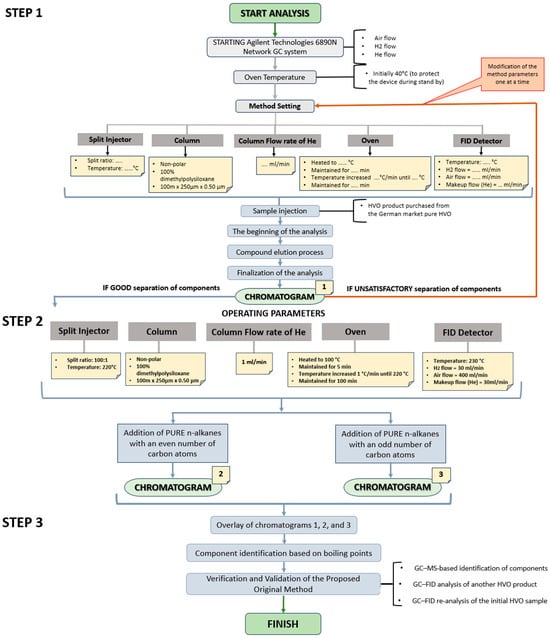
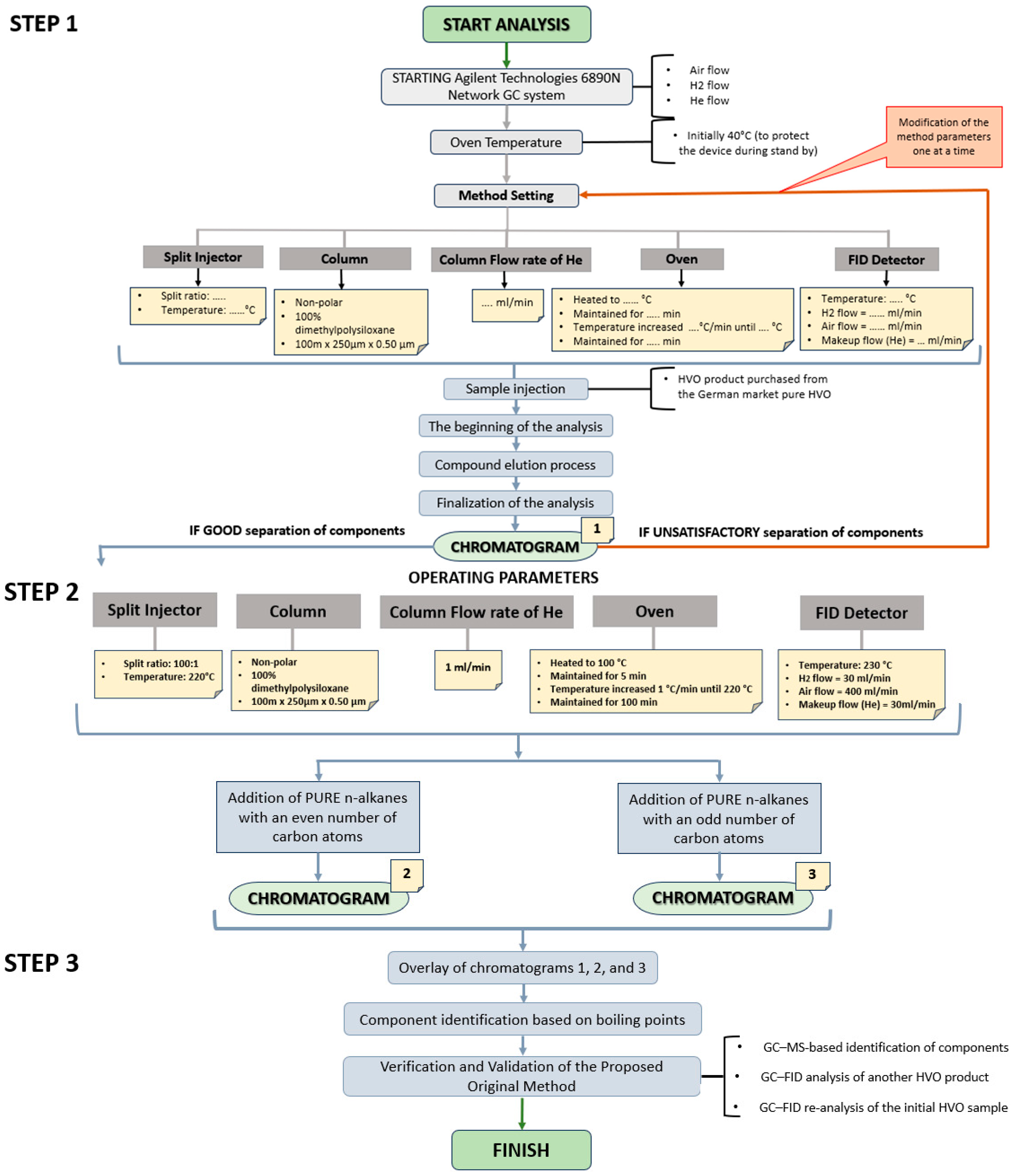
The method is developed in three steps presented in Figure 1: step 1 presents generically the inherent iterations needed to obtain good results; as seen below, the condition to exit the iterations loop is the good separation of the components; the operating parameters which produced a good separation of the components are presented at step 2; then with these parameters, two chromatograms are obtained by adding pure n-alkanes with even and odd number of carbon atoms; step 3 reflects the outcome of the method, which results after overlaying the three resulted chromatograms: components identification based on boiling points.
Figure 1.
The workflow of the original method (verification and validation included).
To verify the accuracy of component identification, the HVO_1 sample was analyzed by gas chromatography coupled with mass spectrometry (GC–MS). The GC-MS equipment was calibrated utilizing the same pure substances as the FID-based GC (n-alkanes).
In addition, duplicate GC–FID analyses were performed for each HVO product (HVO_1 and HVO_2).
The temperature program and operating conditions were selected to achieve the best possible separation of the components, even at the expense of a longer analysis time. Moreover, to ensure that subsequent analyses were not affected by residues from the previous run, the total analysis time was extended to allow complete elution of all compounds and proper reconditioning of the chromatographic column prior to the next injection. To increase the readability of the method, the operating parameters are also presented in Table 2.
Table 2.
Working conditions for standard FID-based GC equipment–Agilent™ 6890.
3. Results and Discussion
As previously stated, using the original method described above, an analysis was first performed with a FID-based GC on HVO_1. For the verification and validation of the proposed original method, with respect to the correct identification and elution order of n-alkanes, the same sample was then analyzed by GC–MS using an Agilent 7890 A GC-MS/MS TRIPLE QUAD system from the National Institute of Research and Development on Chemistry, ICECHIM, Bucharest, Romania. A DB-5MS Agilent capillary column (30 m length, 0.25 mm internal diameter, 0.25 μm film thickness) was employed, with helium as the carrier gas at a flow rate of 1.2 mL/min. Mass spectrometric detection was performed in electron ionization (EI) mode at 70 eV, with a mass scan range of m/z 10–1050. The US National Institute of Standards and Technology (NIST) Mass Spectral Library database was used to facilitate peak identification in the analyzed samples [16].
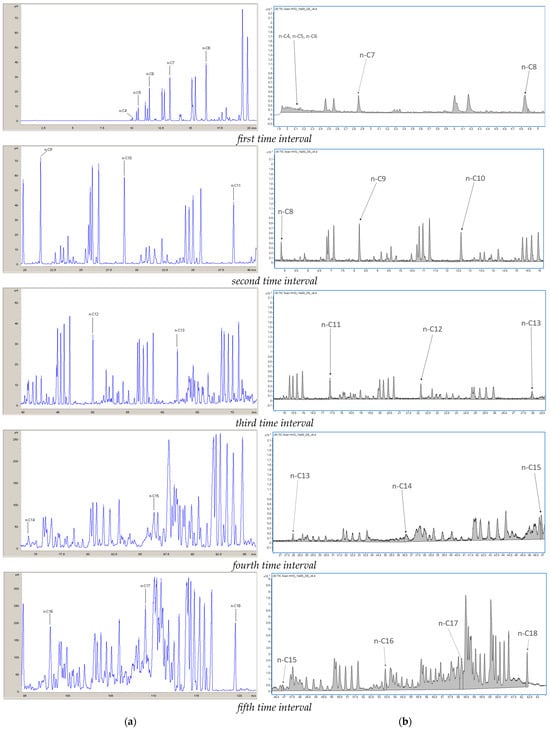
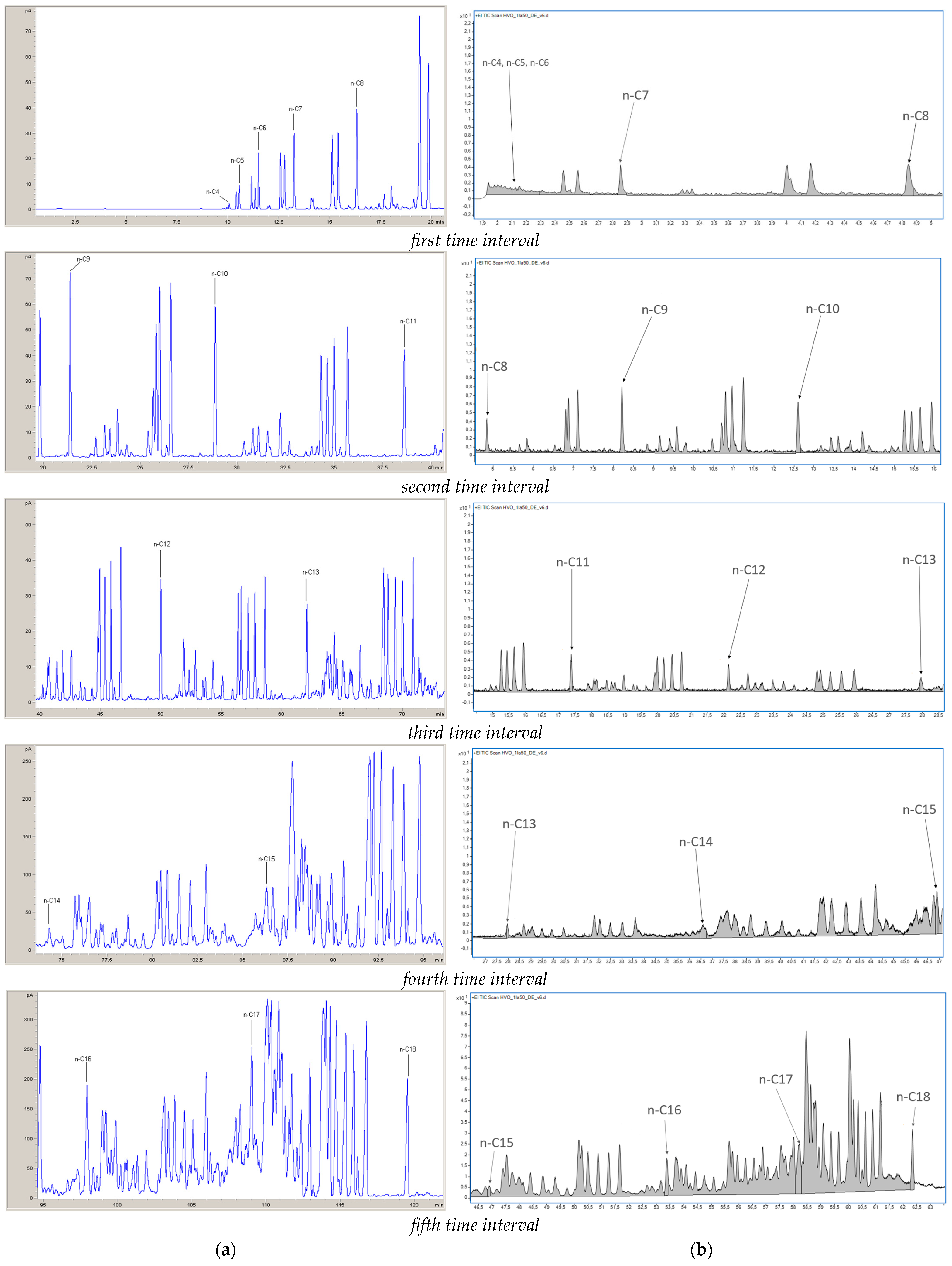
The resulting chromatograms are shown side-by-side in Figure 2a,b. Given the long analysis time (130 min), the chromatograms were divided into five sections to improve readability.
Figure 2.
Chromatograms obtained using the HVO_1 sample. (a) GC-FID using the original method; (b) GC-MS used for validation of the original method.
Regarding the FID-based GC (Figure 2a), under normal conditions, n-alkanes (nC4 … nC18) and their isomers eluted according to their boiling points, appearing sequentially on the chromatogram in increasing order of carbon number, as reported in [39]. For the identification of n-alkanes, pure n-alkane standards (C4 … C18) were used.
The side-by-side comparison could not be made using the retention times because of the different length columns. Consequently, the validation was made visually by the identification of the peaks which eluted successively, i.e., the components elute with both equipment in the same order (Figure 2a,b); hence, one may say that there is a clear correlation with the identification of n-alkanes.
Table 3 summarizes the retention times of the n-alkanes, which were used as reference compounds for correlation between boiling point and chromatographic elution behavior.
Table 3.
The retention times of the n-alkanes, which were used as reference compounds.
The last five n-alkanes were difficult to identify due to the increasing number of iso-alkanes, which rises with the carbon number of the corresponding n-alkanes (e.g., n-C17 has more isomers than n-C12). Iso-alkanes with higher carbon numbers may elute before the preceding n-alkane; for example, iso-alkanes corresponding to n-C16 may elute both before and after n-C15 and prior to n-C16, as some of them have boiling points lower than that of n-C15, as shown in Table 4, which presents the boiling points of n-alkanes and their corresponding isomers exhibiting the minimum and maximum degree of branching.
Table 4.
Boiling points of n-alkanes and their corresponding isomers exhibiting the minimum and maximum degree of branching.
This behavior complicates the correct identification of n-C15. Therefore, the addition (spiking) technique was employed. This technique involves the gradual addition of small amounts of pure n-alkanes to the analyzed sample, enabling the identification of unknown chromatographic components by comparison with the added n-alkanes under identical analytical conditions.
For the accurate identification of the isomers, it was also necessary to arrange the boiling points in ascending order, corresponding to the sequence in which the compounds elute from the chromatographic column (Table 4).
Identifying the most highly branched isomers of n-alkanes larger than n-C17 is challenging because the number of possible constitutional isomers increases rapidly with chain length. In addition, estimating the exact boiling point of the most branched isomer depends on molecular size and structure. Increased branching reduces molecular surface area, which weakens dispersion forces and results in lower boiling points. Even without exact numerical values, it is well established that highly branched isomers have lower boiling points than their corresponding n-alkanes [44].
In practice, the experimental procedure was carried out as follows (Figure 1):
- First, a chromatographic analysis of the HVO_1 sample was performed.
- Subsequently, a known amount of pure odd-carbon-number n-alkanes was added to the HVO_1 sample, followed by a second chromatographic analysis.
- Then, in a separate HVO_1 sample, pure even-carbon-number n-alkanes were added, and a third chromatographic analysis was performed.
- Finally, by overlaying the chromatograms using Agilent software ChemStation Plus, 2004, the positions of the n-alkanes in the HVO_1 sample were identified.
This approach provided clear reference points for both the chromatographic positions of the n-alkanes and their corresponding retention times.
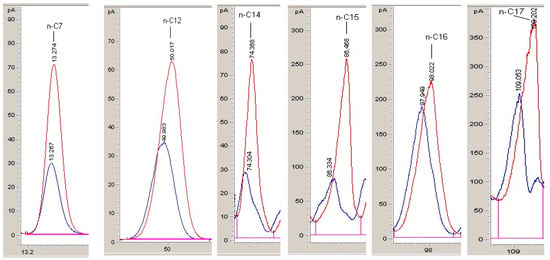
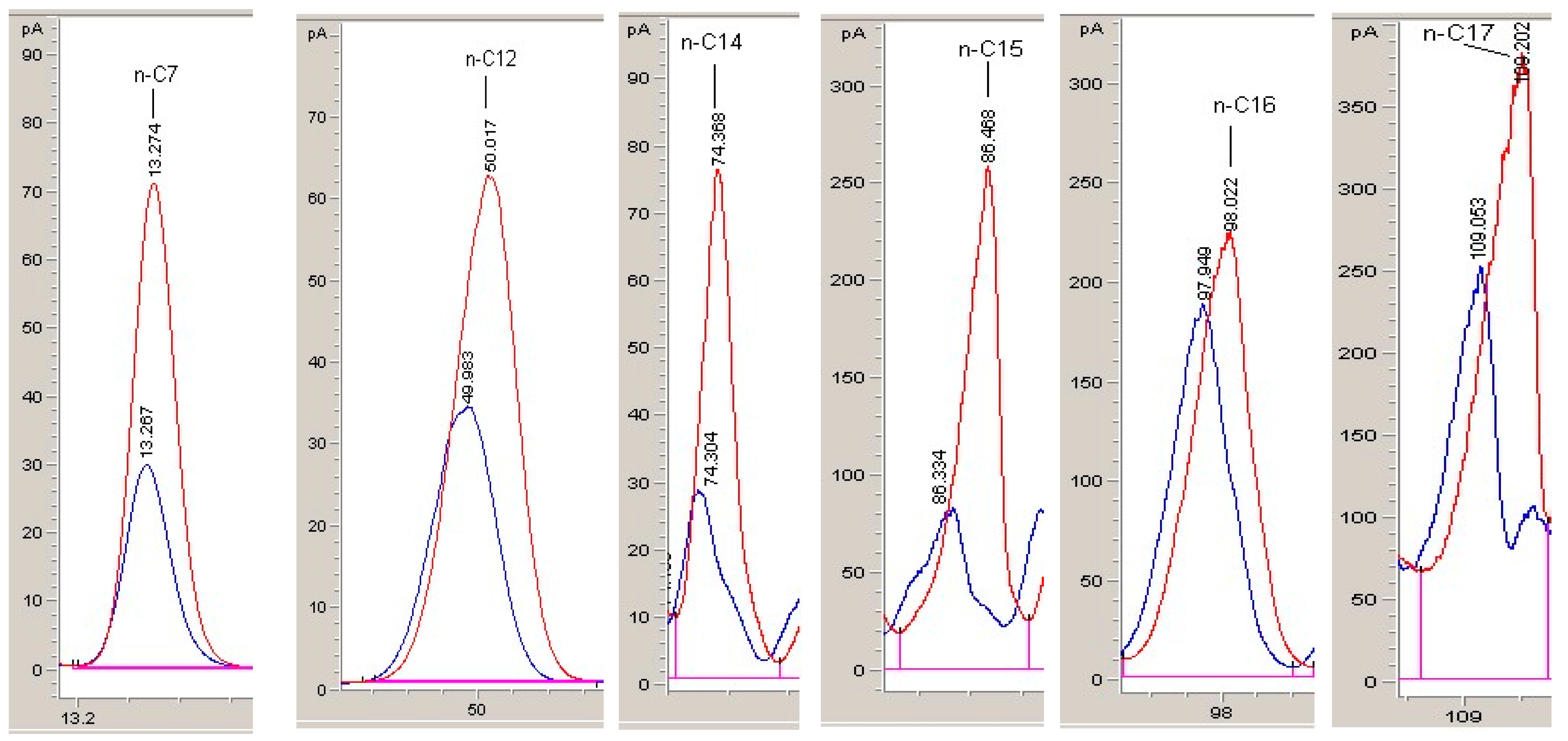
Figure 3 presents some peaks of the n-alkanes identified by overlaying the FID-based chromatograms (see step 2 from Figure 1). To improve image readability, the chromatogram was enlarged (zoomed). Consequently, minor shifts on the order of hundredths of a second can be observed; however, these differences fall within the experimental uncertainty and are therefore negligible. Accordingly, the identification of the n-alkanes can be considered reliable.
Figure 3.
Examples of n-alkanes identified by overlaying the chromatograms. Legend: Red—Gas chromatogram of the sample containing the reference n-alkane mixture. Blue—Gas chromatogram of the sample analyzed without the addition of reference compounds.
Following the method presented in the previous section, another sample named HVO_2 obtained from another source was analyzed (using the same standard FID-based GC system, Agilent 6890) by another human operator.
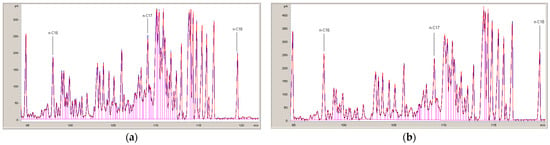
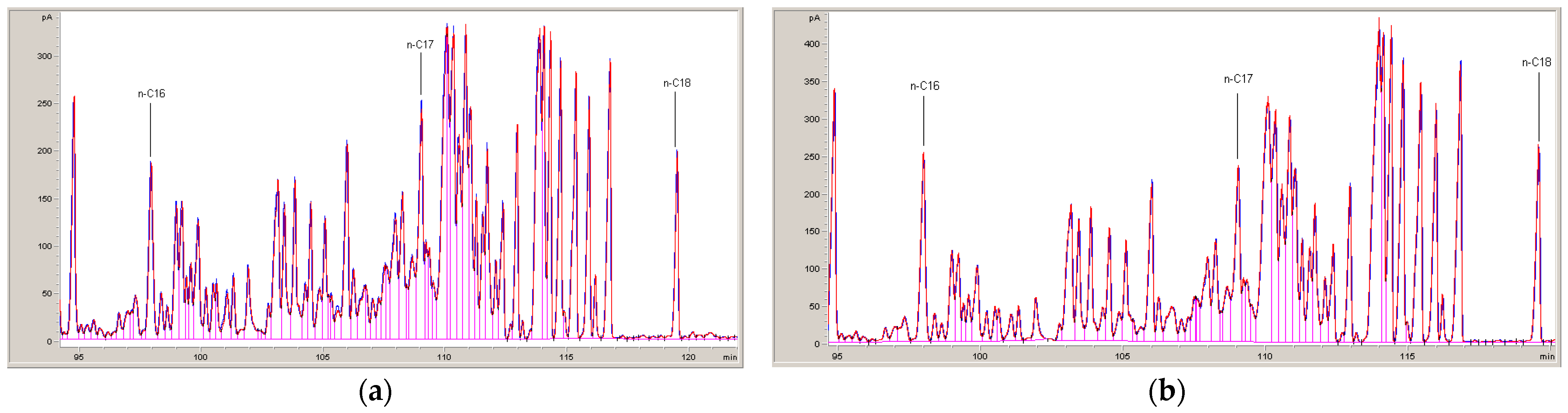
Figure 4 presents the resulting chromatograms overlaid one on another. To avoid redundancy, in this figure, only the fifth time interval is presented. It can be observed that the n-alkanes preserved both their elution order and retention times, providing further evidence supporting the validity of the proposed method.
Figure 4.
The chromatograms obtained using both samples of HVO, each analyzed two times (the fifth time interval). (a) HVO_1.1 vs. HVO_1.2; (b) HVO_2.1 vs. HVO_2.2.
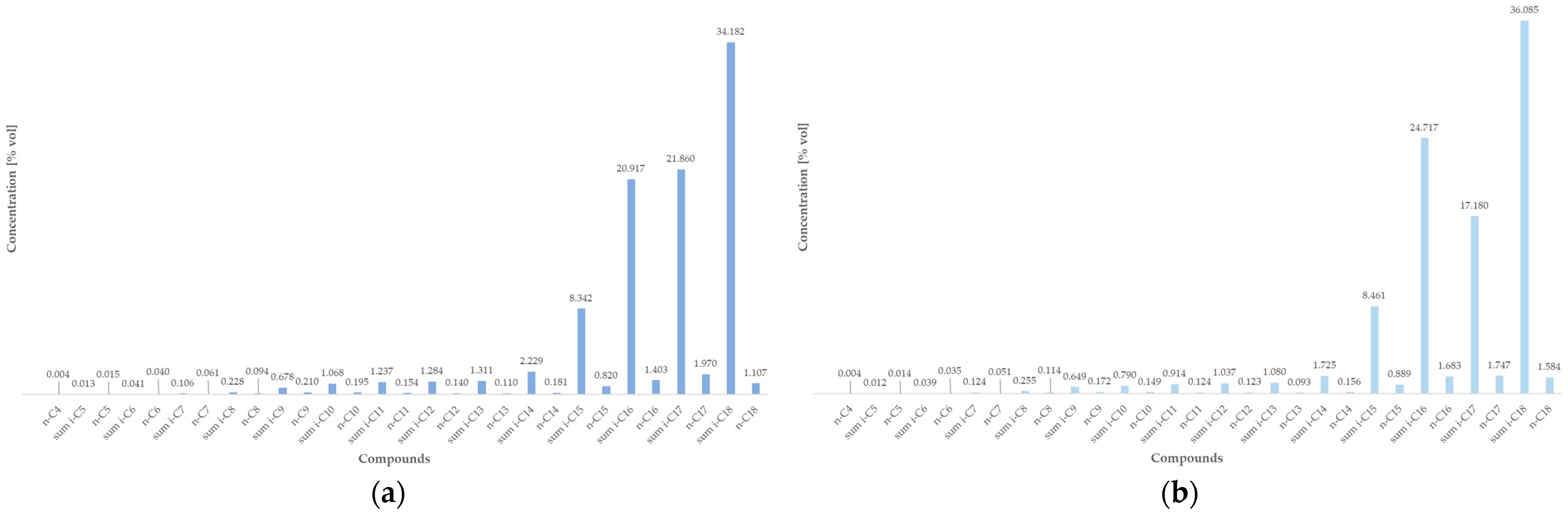
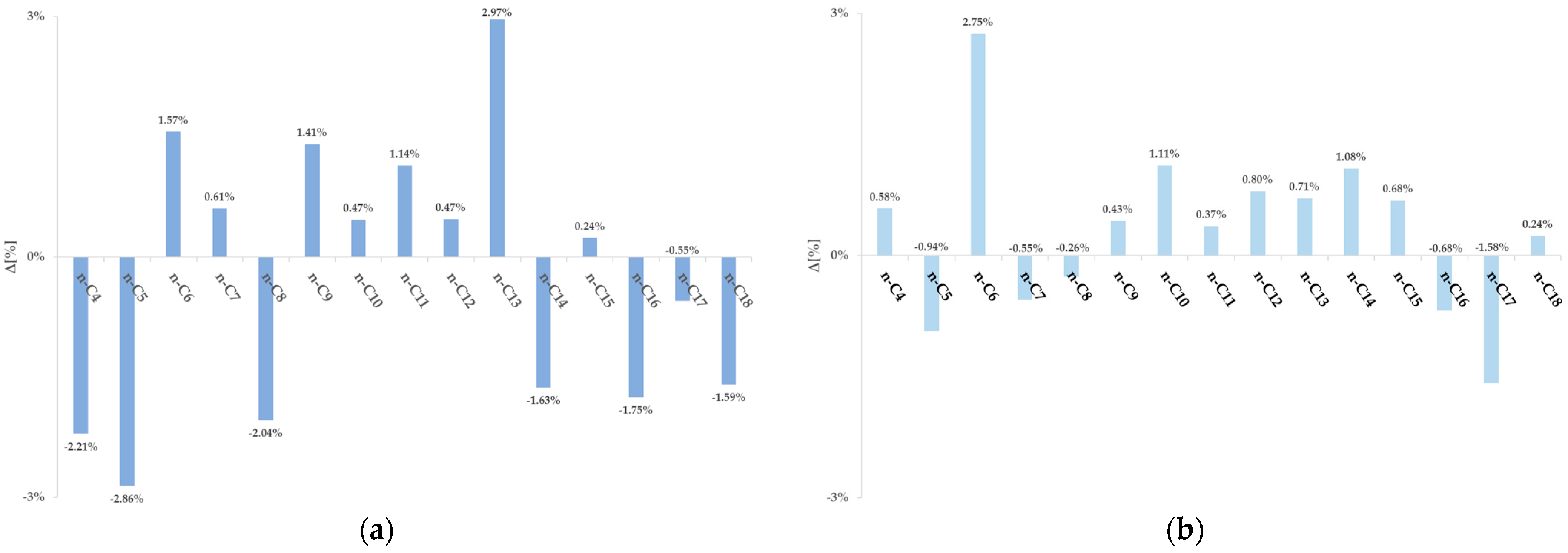
Figure 5 illustrates the concentrations of various compounds identified in the analyzed HVOs using the proposed method. Figure 6 provides a comparison of the relative differences in n-alkane concentrations, focusing exclusively on these compounds to prevent overly complex graphical representations.
Figure 5.
Concentration of different compounds identified with the original method. (a) HVO_1; (b) HVO_2.
Figure 6.
Relative differences between the two FID-based GCs for each of the two HVO samples (only n-alkanes). (a) HVO_1.1 vs. HVO_1.2; (b) HVO_2.1 vs. HVO_2.2.
With the data from Figure 5, the numbers of carbon (C) and hydrogen (H) atoms were calculated for the analyzed HVOs, which allowed the determination of the stoichiometric air (i.e., the minimum air mass needed for the theoretical complete combustion of 1 kg of fuel) based on stoichiometric oxidation reactions. The results are given in Table 5 and show very good results supporting the validity of the novel method proposed. The stoichiometric air values calculated (Table 5) are close to the ones found in the literature for fossil diesel (produced by Orlean Lietuva, Lithuania), HVO produced by Neste Finland and HVO manufactured from pure soybean oil by Universal Oil Products (UOP): 14.79 kg air/kg fossil diesel, respectively, 15.18 kg air/kg HVO Neste [45] and 14.99 kg air/kg HVO UOP [16].
Table 5.
The resulting data about the analyzed HVOs.
4. Summary and Final Conclusions
In the framework of the European Union’s objective to achieve climate neutrality by 2050, sustainable mobility has become a critical research and policy priority. Advanced biofuels represent a key transitional pathway, with HVO emerging as a viable drop-in alternative to conventional diesel fuel.
In this study, an original analytical approach is proposed for analyzing HVO composition by standard FID-based GC, relying on the separation of components according to their boiling-point distribution.
The significance of this method for both current and future contexts was demonstrated by the precise and comprehensive results obtained via conventional FID-based GC equipment, enabling others to replicate and build upon these findings.
The main results of this work are summarized below:
- The method was proven to be repeatable and reproducible thanks to its application on two HVO samples, which were each analyzed two times on different days with different human operators.
- The method revealed reliable chemical compounds as the stoichiometric air calculated based on these show good agreement with the values reported in the literature; consequently, the reliability of the proposed boiling-point-based chromatographic method is supported.
The presented method enables cost-effective compositional analysis while expanding the functional capabilities of existing instrumentation. Consequently, the proposed approach contributes not only to fuel characterization but also to enhancing the sustainability of research infrastructure.
Author Contributions
Conceptualization, M.N. and M.O.; methodology, M.N., M.O., R.N., A.C. and G.V.; validation, M.N., M.O., R.N., A.C., G.V. and A.L.M.; formal analysis, M.N., M.O., R.N., A.C., G.V., A.L.M. and A.M.A.; investigation, M.N., M.O., A.L.M. and A.M.A.; writing—original draft preparation, M.O., R.N., A.C. and G.V.; writing—review and editing: R.N., A.C. and G.V.; project administration, R.N. and A.C. All authors have read and agreed to the published version of the manuscript.
Funding
This research received no external funding.
Data Availability Statement
The original contributions presented in this study are included in the article. Further inquiries can be directed to the corresponding author.
Acknowledgments
The authors want to acknowledge the support of their institutions, which supported the development of this collaborative work. The authors also acknowledge the support of the PN 23.06 Core Program—ChemNewDeal within the National Plan for Research, Development, and Innovation 2022–2027, developed with the support of the Ministry of Research, Innovation, and Digitization, project no. PN 23.06.02.01 (InteGral), which allowed our collaboration.
Conflicts of Interest
The authors declare no conflicts of interest.
Abbreviations
The following abbreviations are used in this manuscript:
| C | Carbon |
| CI | Compression Ignition |
| CN | Cetane Number |
| CO2 | Carbon Dioxide |
| CO | Carbon Monoxide |
| EEA | European Environment Agency |
| EGR | Exhaust Gas Recirculation |
| EU | European Union |
| FAME | Fatty Acid Methyl Esters |
| FID | Flame Ionization Detector |
| GC | Gas Chromatograph |
| H | Hydrogen |
| HC | Hydrocarbons |
| HEFA | Hydroprocessed Esters and Fatty Acids |
| HVO | Hydrotreated Vegetable Oil |
| IC | Internal Combustion |
| IUPAC | International Union of Pure and Applied Chemistry |
| LPG | Liquefied Petroleum Gas |
| LTC | Low-Temperature Diesel Combustion |
| NIST | National Institute for Standards and Technology |
| NOx | Nitrogen Oxides |
| ON | Octan Number |
| OPEC | Petroleum Exporting Countries |
| PM | Particulate Matter |
| PNA | Polynuclear/Polycyclic Aromatics |
| RED III | Renewable Energy Directive III |
| RFNBO | Renewable Fuels of Non-Biological Origin |
| THC | Total Hydrocarbons OPEC Digital Publications-Annual Statistical Bulletin |
| UOP | Universal Oil Products |
| US | United States |
References
- Energy Institute. Statistical Review of World Energy, 74th ed.; Energy Institute: London, UK, 2025; Available online: https://www.energyinst.org/statistical-review (accessed on 12 April 2026).
- International Energy Agency. Oil Market Report; International Energy Agency: Paris, France, 2024; Available online: https://www.iea.org/reports/oil-market-report-may-2024 (accessed on 12 April 2026).
- OPEC. OPEC Annual Statistical Bulletin, 59th ed.; OPEC: Vienna, Austria, 2024; Available online: https://publications.opec.org/asb/archive/123 (accessed on 12 April 2026).
- European Environment Agency. Global and European Temperatures; European Environment Agency: Copenhagen, Denmark, 2025; Available online: https://www.eea.europa.eu/en/analysis/indicators/global-and-european-temperatures?utm=&activeAccordion=309c5ef9-de09-4759-bc02-802370dfa366 (accessed on 12 April 2026).
- European Council. Fit for 55. 2025. Available online: https://www.consilium.europa.eu/en/policies/fit-for-55/?utm (accessed on 12 April 2026).
- European Commission. Communication from the Commission to the European Parliament, the Council, the European Economic and Social Committee and the Committee of the Regions. Sustainable and Smart Mobility Strategy–Putting European Transport on Track for the Future. 2020. Available online: https://climate.ec.europa.eu/eu-action/transport-decarbonisation/overview_en#documentation (accessed on 12 April 2026).
- EUROSTAT. Most Goods Transported by Sea Within the EU in 2023. 2025. Available online: https://ec.europa.eu/eurostat/web/products-eurostat-news/w/ddn-20250416-1?utm (accessed on 12 April 2026).
- EUROSTAT. Key Figures on European Transport. 2024. Available online: https://ec.europa.eu/eurostat/web/products-key-figures/w/ks-01-24-021 (accessed on 12 April 2026).
- GADGETING CAR. How Many Cars Will Be on the Road in the World in 2025? 2025. Available online: https://gadgetingcar.com/en/how-many-cars-will-there-be-in-the-world-in-2025-global-data-and-trends/?utm (accessed on 12 April 2026).
- Directive (EU) 2023/2413 of the European Parliament and of the Council. 2023. Available online: https://eur-lex.europa.eu/eli/dir/2023/2413/oj/eng?eliuri=eli%3Adir%3A2023%3A2413%3Aoj&locale=nl (accessed on 12 April 2026).
- Niculescu, R.; Clenci, A.; Iorga-Simăn, V. Review on the Use of Diesel–Biodiesel–Alcohol Blends in Compression Ignition Engines. Energies 2019, 12, 1194. [Google Scholar] [CrossRef] [Scilit]
- Clenci, A.; Niculescu, R.; Danlos, A.; Iorga-Simăn, V.; Trică, A. Impact of biodiesel blends and Di-Ethyl-Ether on the cold starting performance of a compression ignition engine. Energies 2016, 9, 284. [Google Scholar] [CrossRef] [Scilit]
- Ile Kauppila. HVO Making It Big. Oils & Fats International. 2018. Available online: https://www.ofimagazine.com/content-images/news/HVO2.pdf (accessed on 12 April 2026).
- Burton, J. Hydrogenated Vegetable Oil (Hvo)–Composition and Behaviour Assessment; ISAS Tech. Bull.: San Angelo, TX, USA, 2022. [Google Scholar]
- GCxGC Use for Renewable Fuels & Pyrolysis Oils. Available online: https://www.paclp.com (accessed on 24 November 2025).
- Lapuerta, M.; Villajos, M.; Agudelo, J.R.; Boehman, A.L. Key properties and blending strategies of hydrotreated vegetable oil as biofuel for diesel engines. Fuel Process. Technol. 2011, 92, 2406–2411. [Google Scholar] [CrossRef] [Scilit]
- Pazmiño-Viteri, K.; Cabezas-Terán, K.; Echeverría, D.; Cabrera, M.; Taco-Vásquez, S. verage Carbon Number Analysis and Relationship with Octane Number and PIONA Analysis of Premium and Regular Gasoline Expended in Ecuador. Processes 2024, 12, 1706. [Google Scholar] [CrossRef] [Scilit]
- Na, L.; Xin, G.; Zhiping, T.; Jun, L. Composition distribution and characteristic of a typical commercial gasoline in market. Int. J. Smart Grid Clean Energy 2016, 5, 182–187. [Google Scholar] [CrossRef] [Scilit]
- Kalghatgi, G. Fuel/Engine Interactions. In Automotive Fuels Reference Book, 3rd ed.; SAE International: Warrendale, PA, USA, 2014; pp. 33–62. [Google Scholar] [CrossRef] [Scilit]
- Mueller, C.J.; Cannella, W.J.; Kalghatgi, G.T. Fuels and the Impact of Fuel Composition on Engine Performance. 2012. Available online: https://www.osti.gov/servlets/purl/1649893 (accessed on 12 April 2026).
- Han, M. The effects of synthetically designed diesel fuel properties—Cetane number, aromatic content, distillation temperature, on low-temperature diesel combustion. Fuel 2013, 109, 512–519. [Google Scholar] [CrossRef] [Scilit]
- Biernat, K. Criteria for the Quality Assessment of Engine Fuels in Storage and Operating Conditions. In Storage Stability of Fuels; IntechOpen: London, UK, 2015. [Google Scholar] [CrossRef] [Scilit]
- Zannis, T.C.; Yfantis, E.A.; Hountalas, D.T.; Papagiannakis, R.G.; Levendis, Y.A. Critical Review of the Effects of Diesel Fuel Composition and Properties on Engine Performance and Pollutant Emissions. In Diesel Fuels—Characteristics, Performances and Environmental Impacts, 1st ed.; Nova Publishers: New York, NY, USA, 2013. [Google Scholar]
- Makhlouf, B.; Abdelsadek, Z.; Hamada, B.; Masset, P.J. Improvement of the octane number of petroleum naphtha using a molten salt based thermo-catalytic process. S. Afr. J. Chem. Eng. 2025, 52, 170–182. [Google Scholar] [CrossRef] [Scilit]
- Heat of Combustion. Available online: https://en.wikipedia.org/wiki/Heat_of_combustion (accessed on 12 April 2026).
- Boiling Point. Available online: https://en.wikipedia.org/wiki/Boiling_point (accessed on 12 April 2026).
- Skolniak, M.; Bukrejewski, P.; Frydrych, J. Analysis of Changes in the Properties of Selected Chemical Compounds and Motor Fuels Taking Place During Oxidation Processes. In Storage Stability of Fuels; BoD: Hamburg, Germany, 2015. [Google Scholar] [CrossRef] [Scilit]
- Niculescu, R.; Clenci, A.; Iorga-Siman, V.; Zaharia, C. Review on the Use of Bioethanol/Biomethanol—Gasoline Blends in Spark Ignition Engine; Scientific Bulletin, Automotive Series, Year XXII, No. 26; University of Pitesti: Pitești, Romania, 2018. [Google Scholar]
- Garraín, D.; Herrera, I.; Lago, C.; Lechón, Y.; Sáez, R. Renewable Diesel Fuel from Processing of Vegetable Oil in Hydrotreatment Units: Theoretical Compliance with European Directive 2009/28/EC and Ongoing Projects in Spain. Smart Grid Renew. Energy 2010, 1, 70–73. [Google Scholar] [CrossRef]
- EN_590; Automotive Fuels—Diesel—Requirements and Test Methods. European Committee for Standardization: Bruxelles, Belgium, 2009.
- EN 15940-2023; Automotive Fuels—Paraffinic Diesel Fuel from Synthesis or Hydrotreatment-Requirements and Test Methods. European Committee for Standardization: Bruxelles, Belgium, 2023.
- EN 14214-2012; Liquid Petroleum Products-Fatty Acid Methyl Esters (FAME) for Use in Diesel Engines and Heating Applications-Requirements and Test Methods. European Committee for Standardization: Bruxelles, Belgium, 2012.
- Safety Data Sheet-HVO–Hydrotreated Vegetable Oil. Available online: https://www.greenergy.com/userfiles/media/greenergy/pdf%20uploads/hvo__renewable_diesel_sds_gfl_v2.pdf (accessed on 12 April 2026).
- Kuszewski, H.; Jaworski, A.; Szpica, D. Comparative Study of the Lubricity of Hydrotreated Vegetable Oil, Diesel, and Their Blends Using Four-Ball Testing: Focus on Scuffing Load. Energies 2025, 18, 3141. [Google Scholar] [CrossRef] [Scilit]
- Aransiola, E.F.; Ojumu, T.V.; Oyekola, O.O.; Madzimbamuto, T.F.; Ikhu-Omoregbe, D.I.O. Madzimbamuto, A review of current technology for biodiesel production: State of the art. Biomass Bioenergy 2014, 61, 276–297. [Google Scholar] [CrossRef] [Scilit]
- Glisic, S.B.; Pajnik, J.M.; Orlović, A.M. Process and techno-economic analysis of green diesel production from waste vegetable oil and the comparison with ester type biodiesel production. Appl. Energy 2016, 170, 176–185. [Google Scholar] [CrossRef] [Scilit]
- Kuronen, M.; Mikkonen, S.; Aakko, P.; Murtonen, T. Hydrotreated Vegetable Oil as Fuel for Heavy Duty Diesel Engines. SAE Technical Paper. 2007. Available online: www.sae.org (accessed on 12 April 2026).
- Niculescu, R.; Năstase, M.; Clenci, A. On the determination of the distillation curve of fatty acid methyl esters by gas chromatography. Fuel 2022, 314, 123143. [Google Scholar] [CrossRef] [Scilit]
- Gas Chromatography (GC) Column Selection Guide. 2026. Available online: https://www.sigmaaldrich.com/RO/en/technical-documents/technical-article/analytical-chemistry/gas-chromatography/gc-column-selection-guide?utm (accessed on 12 April 2026).
- Chemistry. Available online: https://en.wikipedia.org/wiki/Chemistry (accessed on 12 April 2026).
- Tables for Organic Chemistry. Available online: https://www.stenutz.eu/chem/ (accessed on 12 April 2026).
- ChemicalBook. Available online: https://m.chemicalbook.com/ (accessed on 12 April 2026).
- The Good Scents Company. Available online: https://www.thegoodscentscompany.com (accessed on 12 April 2026).
- Brown, W.H.; Foote, C.S.; Iverson, B.L.; Anslyn, E.V.; Novak, B.M. Organic Chemistry, 8th ed.; Cengage Learning: Boston, MA, USA, 2018; ISBN 978-1-305-58035-0. [Google Scholar]
- Valeika, G.; Matijošius, J.; Krzysztof, G.; Rimkus, A. A Study of Energy and Environmental Parameters of a Diesel Engine Running on Hydrogenated Vegetable Oil (HVO) with Addition of Biobutanol and Castor Oil. Energies 2021, 14, 3939. [Google Scholar] [CrossRef] [Scilit]

Disclaimer/Publisher’s Note: The statements, opinions and data contained in all publications are solely those of the individual author(s) and contributor(s) and not of MDPI and/or the editor(s). MDPI and/or the editor(s) disclaim responsibility for any injury to people or property resulting from any ideas, methods, instructions or products referred to in the content. |
© 2026 by the authors. Licensee MDPI, Basel, Switzerland. This article is an open access article distributed under the terms and conditions of the Creative Commons Attribution (CC BY) license.