


Abstract
Heat and mass transfer behaviour of frozen cylindrical potato croquettes was investigated during the deep-fat frying process at different oil temperatures (150, 160, 170, and 180 °C) and times (540, 420, 300, and 240 s), using the product’s actual geometry to better represent real frying conditions. The apparent effective heat transfer coefficient (he), effective moisture diffusivity (De), and effective mass transfer coefficient (ke) were estimated experimentally. Increasing oil temperature led to a gradual decrease in he, whereas De and ke increased consistently across the investigated range. The calculated he values ranged from 82.980 to 119.86 W m−2 °C−1, while De and ke varied between 1.237 × 10⁻⁶–1.331 × 10⁻⁶ m2s−1 and 6.189 × 10⁻⁶–13.312 × 10⁻⁶ m s−1, respectively. The time-dependent behaviour of the transport parameters was further analyzed using pseudo-first-order (PFO) and pseudo-second-order (PSO) kinetic models. Statistical evaluation based on R2 and RMSE showed that PFO best described he, whereas PSO provided superior agreement for De and ke. These results demonstrate that heat and mass transport during frying are dynamic processes that can be quantitatively characterized using simplified kinetic formulations, offering a practical engineering tool for process prediction and optimization.
1. Introduction
Deep-fat frying is one of the most widely used thermal processing methods in the preparation of frozen and ready-to-eat foods because it enables rapid cooking while providing desirable sensory characteristics such as a crispy texture, an appealing colour, a characteristic flavour and aroma. The global production of frying oils has been estimated at approximately 20 million tonnes annually and continues to increase, reflecting the steadily growing worldwide consumption of fried food products [1,2,3,4].
Despite its extensive industrial application, deep-fat frying remains a complex thermophysical operation influenced by multiple interacting factors, including oil properties, temperature–time combinations, equipment design, and the geometric structure of the food material [5,6]. During deep-fat frying, heat and mass transfer occur simultaneously and are strongly coupled. Heat is transferred from the hot oil to the product surface by convection and then conducted toward the interior, while internal moisture evaporates and migrates outward through diffusion and capillary mechanisms [7,8]. Shortly after the product is immersed in the oil, the surface temperature rapidly approaches the boiling point of water, leading to intense evaporation of free surface moisture. As frying continues, the evaporation front gradually moves inward, and a crust layer forms at the surface, altering thermal conductivity, porosity, and internal heat and moisture behaviour of the product [9,10]. These coupled phenomena directly influence product structure, final quality, and overall process efficiency. In addition to physical transfer processes, frying oil is simultaneously exposed to high temperatures and moisture released from the product, promoting chemical reactions such as hydrolysis, oxidation, and polymerization [11,12]. These reactions lead to the formation of volatile and non-volatile degradation compounds that may negatively affect nutritional and sensory quality. For this reason, monitoring and modelling temperature–moisture profiles during frying are essential for improving process control and maintaining product quality [13].
Previous frying studies have generally examined heat and mass transfer separately and have often relied on simplified geometries or lumped approaches, sometimes using high-conductivity metal objects instead of real food materials [7,14,15,16,17]. In parallel, finite-element and computational models have been used to simulate transient temperature and moisture profiles in various fried products, emphasizing the importance of geometry and boundary conditions in determining apparent transport parameters [5,14,18]. However, such simplified assumptions may not fully represent the behaviour of structured ready-to-eat foods with finite three-dimensional geometries.
Experimental studies using real food dimensions have reported temperature-dependent variations in effective heat transfer coefficient (he), effective moisture diffusivity (De), and effective mass transfer coefficient (ke). For instance, decreases in apparent he and concurrent increases in De and ke with increasing frying temperature have been observed in potato-based and dough-based systems [19,20,21]. These findings highlight the dynamic and geometry-dependent nature of transport parameters during frying.
Although previous studies have widely investigated heat and mass transfer parameters during frying, most have focused on calculating these values rather than examining how they change over time. Moreover, real ready-to-eat food products have been examined less often than simple model geometries like slabs or cylinders. Therefore, combining experimentally obtained transfer parameters with basic kinetic modelling may provide a clearer insight into how frying progresses in real food systems. However, many studies treat transport coefficients as temperature-dependent but time-independent, assuming they stay the same during frying. In structured ready-to-eat products, progressive crust formation, pore development, and internal vapour generation continuously alter internal resistances and boundary conditions. As a result, effective transport parameters should be considered as evolving system descriptors rather than fixed material properties. To address this limitation, the present study examines the time-dependent kinetic evolution of effective heat and mass transfer coefficients under real three-dimensional product geometries. This approach proposes a dynamic framework that links transient transport behaviour with process modelling and optimization.
In the present study, the deep-fat frying process was approached using a realistic framework rather than simplified assumptions. The actual geometric dimensions of a cylindrical potato croquette were preserved, enabling the simultaneous evaluation of heat and mass transfer phenomena throughout frying. Transfer parameters were derived from time-dependent dimensionless temperature and concentration ratios obtained from temperature and dry-matter changes experimentally, and these parameters were subsequently used analytically for the kinetic modelling of the frying process. The application of pseudo-first-order (PFO) and pseudo-second-order (PSO) kinetic models to transfer parameters goes beyond simple curve fitting and provides a practical way to interpret how transport resistance evolves during frying. While PFO reflects a more rapid stabilization behaviour, PSO, which often gives a better fit for mass transfer parameters, indicates a more gradual and complex response over time. This distinction helps to better understand the different dynamic behaviour of heat and mass transfer processes and their interaction with structural changes during frying.
This integrated experimental–analytical methodology provides a numerical approach to systematically comparing transport behaviour under different frying conditions. Although the time-dependent nature of transport coefficients has been acknowledged in the literature, their systematic modelling and interpretation using kinetic approaches remain limited. Consequently, the proposed model may serve as a practical engineering tool for process prediction, optimization, and the design of industrial frozen and ready-to-eat food production systems.
The main objective of this study is to investigate the time-dependent evolution of effective heat and mass transfer parameters during deep-fat frying of potato croquettes and to provide a kinetic interpretation of their dynamic behaviour under realistic processing conditions.
2. Materials and Methods
2.1. Materials
The potato croquettes used in this study (Ø = 20 mm, L = 60 mm) were commercially obtained frozen products. Their composition was determined experimentally, and the main components, including moisture (70.51%), fat (4.22%), protein (2.14%), and ash (1.44%) content, were considered in the analysis. Sunflower oil used as the frying medium was purchased from a local market.
Deep-fat frying experiments were conducted using an electric fryer (Angelo Po, Grandi Cucine S.p.A., Carpi, Italy) with a capacity of 5 L and a maximum operating temperature of 200 °C. Temperature changes at the geometric centre of the samples during frying were monitored using K-type thermocouples connected to a data logger (Sper Scientific 80024, Scottsdale, AZ, USA), and the recorded data were transferred to a computer using the SE309 software (Sper Scientific 80024, Scottsdale, AZ, USA), package.
2.2. Determination of Thermophysical Properties
The determination of he required the estimation of density, specific heat capacity, and other thermophysical properties of the potato croquettes, which were assumed to remain constant during frying. These properties were calculated analytically using the equations given below (Equations (1)–(4)) [22,23]. These parameters were presented in Table 1.
C, P, F, A, and W refer to carbohydrate, protein, fat, ash, and moisture, respectively. The moisture, protein, crude fat, carbohydrate, and ash contents required for these calculations were determined according to AOAC standard methods [24].
Table 1.
Thermophysical properties of potato croquette.
Although thermophysical properties were assumed constant, it is acknowledged that deep-fat frying is a dynamic process involving moisture loss, crust formation, and oil uptake, which may affect these properties over time. Therefore, the reported values should be interpreted as effective parameters representing the overall behaviour of the system.
2.3. Experimental Determination of Temperature–Time Profiles During Frying
To monitor internal temperature variations during frying, 1 mm diameter K-type thermocouples (Omega Engineering Inc., OM-CP-OCTTEMP, Norwalk, CT, USA) were inserted toward the geometric centre of each potato croquette from opposite ends at equal distances. An additional thermocouple was placed in the frying oil to record oil temperature fluctuations throughout the process. Temperature data were collected at 1 s intervals using a data logger (Sper Scientific 80024, Scottsdale, AZ, USA) and transferred to a computer via SE309 software (Sper Scientific 80024, Scottsdale, AZ, USA).
Frying experiments were carried out in sunflower oil at 150, 160, 170, and 180 °C, with three independent replicates performed at each temperature.
2.4. Experimental Determination of Moisture Content-Time Profiles During Frying
The initial moisture content of the potato croquettes was determined according to the AOAC method [24]. To monitor moisture changes during frying, each sample was immersed individually in hot oil, and samples were withdrawn at 30 s intervals during the first 180 s of frying, followed by 60 s intervals thereafter. Frying experiments were performed at 150, 160, 170 and 180 °C for total durations of 540, 420, 300, and 240 s, respectively. After frying, excess surface oil was removed using absorbent paper, and the moisture content of each sample was determined. All experiments were conducted in triplicate, and the resulting data were used to calculate effective moisture diffusivity and mass transfer coefficients [25].
2.5. Determination of Heat and Mass Transfer Coefficient
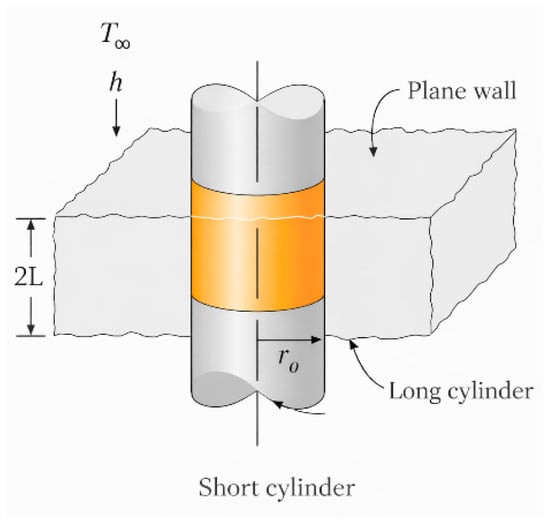
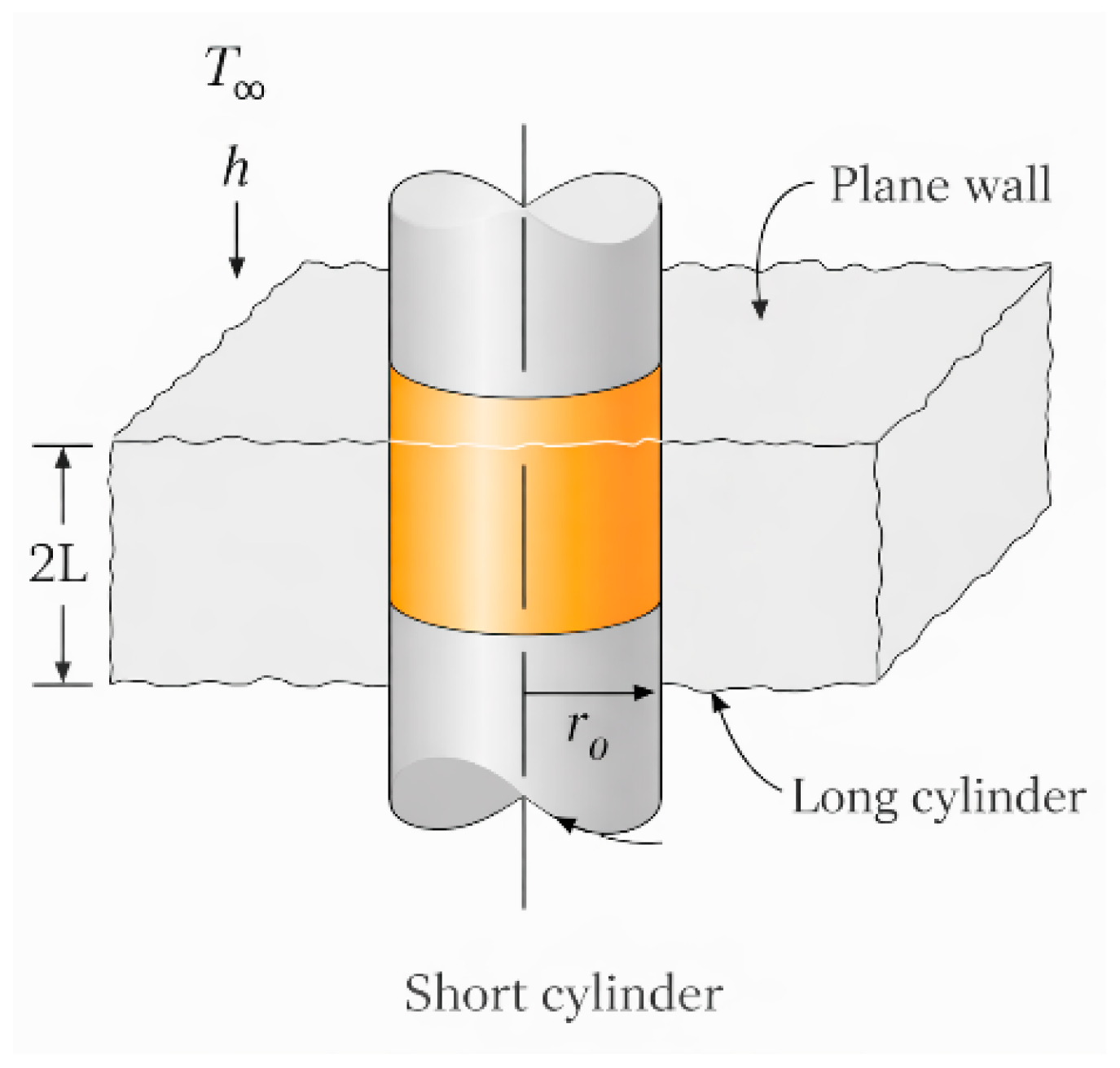
The he was calculated assuming constant thermophysical properties throughout frying, uniform initial temperature within the sample, and negligible energy contributions from chemical reactions, oil absorption, dimensional changes, and crust resistance. To represent the geometry of the potato croquettes, a short cylinder with radius r0 and height 2L was considered. For multidimensional geometries, the analytical solution can be obtained by combining one-dimensional solutions corresponding to each principal direction [26]. Accordingly, the Newman technique was applied, in which a short cylinder is treated as the intersection of a plane wall of thickness 2L and a long cylinder of radius r0, as illustrated in Figure 1.
Figure 1.
Short cylindrical geometry [26]. Here, represents the oil temperature (°C), is the convective heat transfer coefficient (W m−2 °C−1), is the cylinder radius (m), and is the total height (length) of the cylinder (m).
For one-dimensional heat conduction in the axial (z) direction, the Fourier equation for an infinite slab with constant thermophysical properties was used (Equation (5)). Applying the corresponding initial and boundary conditions (Equation (6)) yields the analytical series solution given in Equation (7).
For the infinite cylinder geometry, the Fourier equation was formulated considering only radial heat conduction and neglecting angular heat transfer, while assuming constant thermophysical properties (Equation (8)). By applying the corresponding initial and boundary conditions (Equation (9)), the analytical series solution presented in Equation (10) was obtained.
Because potato croquettes have finite geometry, the infinite slab and cylinder solutions were combined using the Newman method to obtain the dimensionless temperature relation at the geometric centre (Equation (11)). Its logarithmic form (Equation (12)) yields a linear relationship when plotted against time. The characteristic roots (μ1, β1) were taken from literature tables [26,27], and the effective heat transfer coefficient was calculated using the corresponding Biot number relations (Equations (13) and (14)).
It should be emphasized that the calculated he represents an apparent effective heat transfer coefficient (he) derived from the transient centre temperature response. This parameter does not correspond solely to the external convective film coefficient, but reflects the combined influence of external convection, internal conduction resistance, and structural evolution such as crust formation during frying.
To determine the De of potato croquettes from the experimentally obtained moisture–time data, Fick’s second law for an infinite slab was used as the governing equation (Equation (15)).
When Fick’s second equation, given in Equation (15), is solved using the initial and boundary conditions given in Equation (16), the infinite series equation given in Equation (17) is obtained.
For radial moisture transfer in an infinite cylinder, Fick’s second law was used (Equation (18)), and its analytical series solution was obtained by applying the corresponding initial and boundary conditions (Equations (19) and (20)). Since potato croquettes have finite geometry, the infinite slab and cylinder solutions were combined using the Newman method to derive the dimensionless moisture relation at the geometric centre (Equation (21)).
Equation (22) is obtained by taking the natural logarithm of both sides of Equation (21).
Plotting ln (C0zr − C∞) versus time using Equation (22) yields a linear relationship, where the slope corresponds to Equation (23) and the intercept corresponds to Equation (24).
In the present system, C∞ represents the moisture concentration in the surrounding oil phase and is expected to be very low due to the limited solubility of water in oil.
The De was determined using Biot number correlations available in the literature [26,27] and the ke was subsequently calculated from Equations (25) and (26).
2.6. Kinetic Modelling of Heat and Mass Transfer
The kinetics of the heat and mass transfer parameters were evaluated by considering both frying temperature and processing time. For each frying temperature, he, ke, and De were determined at different processing times, allowing their variation during frying to be examined. The experimentally obtained transport coefficients were fitted to pseudo-first-order (PFO) and pseudo-second-order (PSO) kinetic models (Equations (27) and (28)). The transport parameters were extracted from the time-dependent temperature and moisture data using dimensionless formulations and fitting of the analytical solutions. These models were used as empirical fitting tools to describe the time-dependent evolution of transport parameters, rather than representing specific physicochemical mechanisms. Model parameters were estimated by nonlinear regression analysis using IBM SPSS Statistics 20.0 (IBM SPSS v20.0 for Mac; SPSS Inc., Chicago, IL, USA) and model selection was based on R2 and NRMSE (%).
1/q = 1/q0 ± k2t
In these equations, q is a quality parameter, q0 is the value of this quality parameter at its initial state, t is the frying time (min), and k1–k2 are the kinetic constants (min−1). Where (+) and (−) indicate formation and degradation of the quality parameters, respectively.
3. Results and Discussion
3.1. Experimental and Mathematical Evaluation of Heat Transfer Coefficients
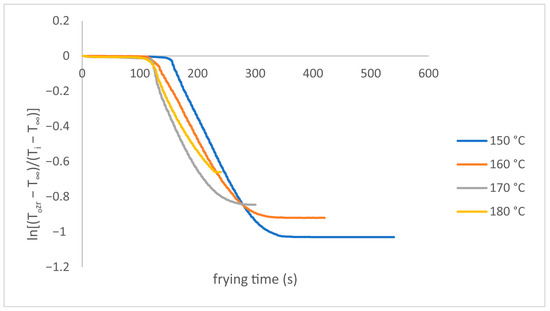
The semi-logarithmic plot of ln ((T0zr − T∞)/(Ti − T∞)) versus time, constructed from the experimentally obtained temperature–time data at frying temperatures (150, 160, 170 and 180 °C) is presented in Figure 2.
Figure 2.
Semi-logarithmic plots of ln [(T − T∞)/(Ti − T∞)] versus time during frying of potato croquettes at different oil temperatures.
All curves follow a similar trend, with a nearly linear region after the initial stage. Around 250–300 s, a gradual decrease in slope can be observed, which indicates a reduction in the temperature difference between the surface and the centre of the croquette during frying, and a crust layer begins to form. The slopes of the linear parts of these curves were used to calculate the Biot numbers and the he, and the calculated values are presented in Table 2.
Table 2.
Biot numbers and effective heat transfer coefficients (he) at different frying oil temperatures.
Table 2 shows that both the Biot numbers and the he values decreased as the frying oil temperature increased. This trend indicates that, although the external oil temperature becomes higher, the internal resistance to heat transfer within the croquette gradually becomes more dominant. In practical terms, the temperature difference between the surface and the geometric centre of the product decreases more rapidly at higher oil temperatures, which results in lower calculated he [17,28]. Similar behaviour has been reported in previous studies on various fried foods. For instance, the he of gulab jamun decreased from 122.34 to 94.10 W m−2 °C−1 as frying temperature increased from 135 to 155 °C [7]. Yıldız et al. [19] reported that the he of potato slices decreased from 286.7 to 181.3 W m−2 °C−1 as the frying temperature increased from 150 to 170 °C, together with a parallel reduction in Biot numbers. Erim Köse and Doğan [18] calculated he of 182.40, 167.62, 140.99 and 125.71 W m−2 °C−1 for tulumba dough fried at 150–180 °C, respectively, showing a clear downward trend with increasing temperature. Erim Köse [20] also observed an exponential decrease in both Biot numbers and he during the frying of churro dough, again emphasizing that higher oil temperatures do not necessarily lead to higher effective heat transfer inside structured dough systems. Li et al. [17] indicated that higher frying temperatures accelerated heat transfer at the initial stage; however, the he declined over time due to crust formation. However, this decreasing trend contrasts with other studies reporting an increase in he with increasing oil temperature [14,28,29,30,31]. These differences are mostly related to the methodological variations. In many of those studies, heat transfer was evaluated independently from moisture migration, simplified or idealized geometries were adopted, or metal probes and lumped-capacity assumptions were used instead of real food materials. In contrast, when real food geometry, simultaneous heat–mass transfer, and actual moisture loss are considered together—as in the present work—the calculated he tends to reflect the evolving internal structure of the product rather than only the external oil conditions.
In summary, lower Biot numbers and he should not be evaluated as weaker heating, but rather as indicators of internal changes in the product, such as crust formation and moisture loss during frying.
3.2. Experimental and Mathematical Evaluation of Mass Transfer Coefficients
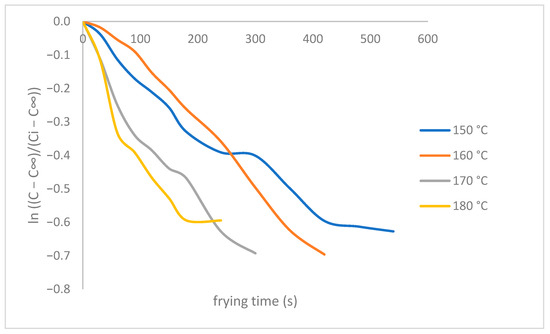
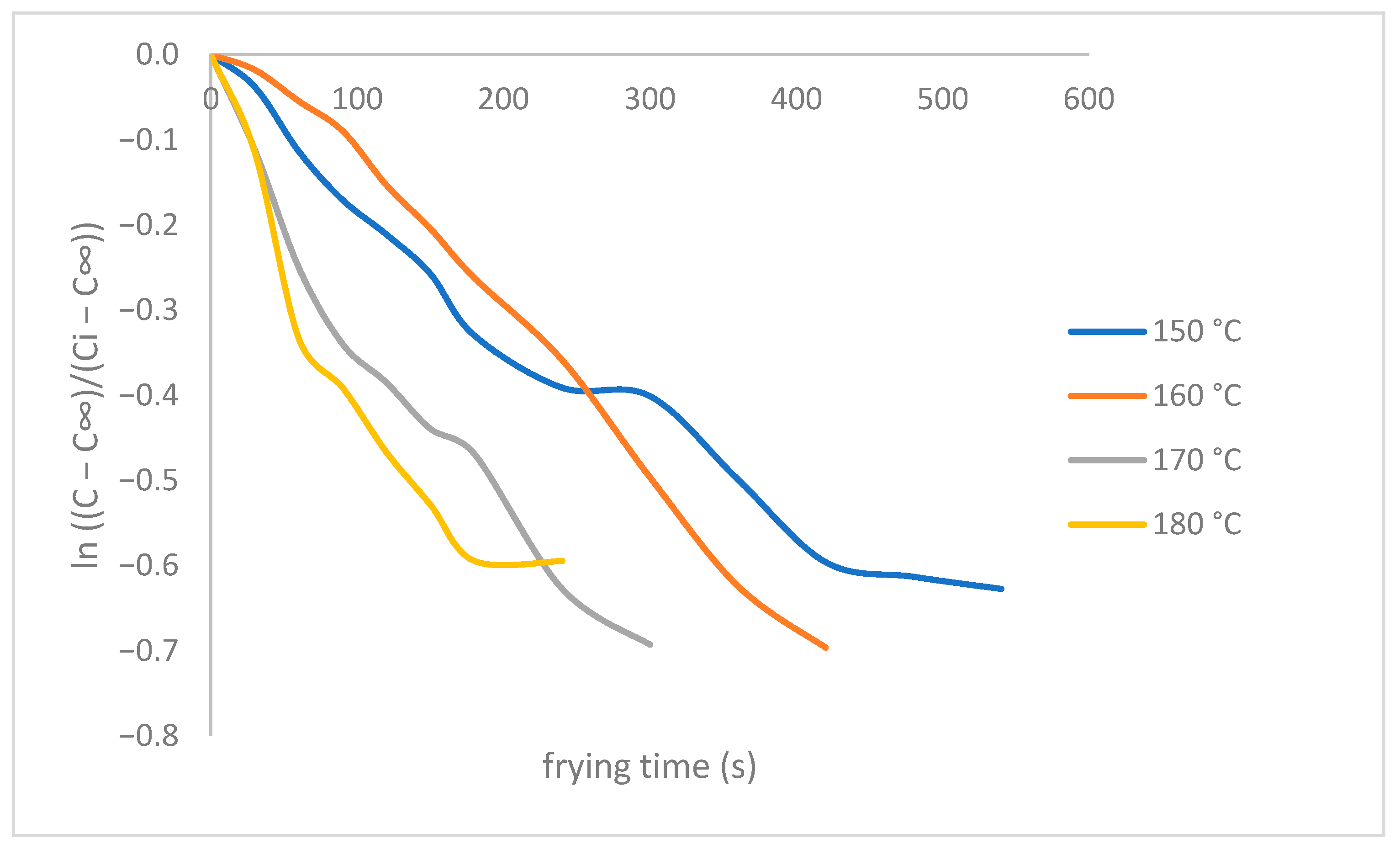
The semi-logarithmic plot of ln ((C − C∞)/(Ci − C∞)) versus time, constructed from the experimentally obtained moisture–time data at frying temperatures (150, 160, 170 and 180 °C) is presented in Figure 3.
Figure 3.
Semi-logarithmic plots of ln ((C − C∞)/(Ci − C∞)) versus time during frying of potato croquettes at different oil temperatures.
All curves show a rapid decrease at the early stage of frying, followed by a gradual slowing trend as frying progresses. This behaviour suggests that surface moisture evaporates rapidly once the croquette is immersed in hot oil, while the subsequent formation and thickening of a crust layer reduces the rate of moisture loss at later stages [32]. The linear regions of these curves were used to determine the Biot numbers, De, and ke values and the corresponding values are summarized in Table 3.
Table 3.
Biot number, moisture diffusivity (De) and mass transfer (ke) values for different frying oil temperatures.
As demonstrated in Table 3, an increase in oil temperature resulted in a consistent rise in the Biot numbers, De, and ke. When these results are considered together with the he in Table 2, it becomes clear that heat and mass transfer occur simultaneously during deep-fat frying, and should therefore be evaluated together rather than as separate phenomena. In frozen potato croquettes, a large part of the supplied thermal energy is spent on moisture evapouration (latent heat), which limits the rise in internal temperature. As a result, the De increases with increasing oil temperature, while mass transfer becomes stronger and moisture-related parameters increase. This phenomenon enhances surface boiling and allows moisture inside the product to move outward more quickly, leading to faster water removal, stronger moisture gradients, and consequently higher De and ke. Furthermore, structural changes such as pore formation and the development of vapour channels can further facilitate moisture escape, supporting the increase in mass transfer parameters.
Deep-fat frying is a coupled process in which moisture loss and oil uptake occur simultaneously, driven by internal pressure gradients and pore formation. Although the present study focuses on heat and moisture transfer, these phenomena are inherently linked to oil absorption behaviour. The development of the crust, as reflected by the evolution of transport coefficients, plays a key role in limiting oil penetration into the product.
The observed increase in mass transfer parameters is consistent with the findings of studies conducted on other fried foods. Several studies have demonstrated that both De and ke increase with frying temperature. For instance, Farinu and Baik [33] reported that ke of sweet potatoes increased within the range of 4 × 10⁻⁶–7.2 × 10⁻⁶ m s−1. Erim Köse and Doğan [18] observed an exponential increase in De and a linear increase in ke in tulumba dough over the same temperature range. Comparable trends were also reported for gulab jamun [7] and breaded shrimp nuggets [34], where higher temperatures led to enhanced moisture diffusion and mass transfer rates. Studies have confirmed that temperature-driven increases in transport parameters occur in different fried products [35,36,37,38].
3.3. Kinetic Modelling of Transport Parameters
The time-dependent changes in he, De and ke parameters were modelled using pseudo-first (PFO) and pseudo-second order (PSO) kinetics at frying temperatures of 150–180 °C, as presented in Table 4. Although both models demonstrated statistically acceptable goodness-of-fit, a distinct parameter-specific trend was observed. The PFO model consistently produced higher R2 together with markedly lower RMSE for he, whereas the PSO model demonstrated superior fit for both De and ke over the range of temperatures. This difference is not merely statistical; it also reflects the complex physical nature of transport mechanisms during frying.
Table 4.
Fitting parameters of PFO and PSO models for transport kinetics.
For he, the estimated first-order rate constants (k1) increased gradually with temperature, indicating a faster approach to steady-state heat transfer conditions at higher oil temperatures. This behaviour is generally attributed to the predominantly interface-controlled nature of heat transfer during deep-fat frying. Thermal exchange is largely governed by convective heat transfer at the oil–food surface, followed by conductive heating within the product matrix, as discussed in recent reviews on frying heat and mass transfer modelling [6,21,38]. After crust formation starts, the temperature gradient between the oil and the product gradually decreases in a more uniform way, making first-order kinetics suitable to describe this behaviour. Similar trends have been reported for potato and coated products, where heat transfer during frying is mainly controlled by surface convection and gradual crust formation [39,40]. In this context, the lower PSO performance for he indicates that second-order kinetics may be overly complex for a primarily heat-driven process, particularly in cylindrical geometries where temperature gradients stabilize quickly after the initial heating period. In contrast, the moisture-related parameters exhibited a distinctly different kinetic character. Both De and ke showed a stronger fit with PSO fittings, supported by higher R2 and reduced RMSE. The second-order rate constants (k2) increased noticeably with frying temperature, which can be related to higher internal vapour pressure, expanding pores, and gradual structural softening within the starch–protein matrix [41,42]. Unlike heat transfer, moisture transport during deep-fat frying is more complex and strongly influenced by product structure. It involves several processes at the same time, such as diffusion, capillary movement, internal boiling, and oil–water exchange. Because these mechanisms occur together and change as frying continues, second-order kinetics often describe moisture behaviour better than simple first-order models. Recent frying studies also report that moisture loss cannot be explained by a single diffusion mechanism, especially in three-dimensional or restructured foods where pore formation and crust development continuously modify effective diffusivity [43,44,45].
Overall, the kinetic results indicate that transport behaviour during deep-fat frying depends on the parameter considered rather than being controlled by a single reaction order. Heat transfer generally follows a first-order trend mainly influenced by surface convection and thermal equilibrium, whereas moisture diffusion and mass transfer show more complex behaviour that is better represented by second-order models. This difference helps explain the statistical trends observed in the study and supports the view that transport coefficients in frying are dynamic and geometry-dependent rather than fixed temperature values. By combining experimentally determined transport parameters with simple kinetic models, the present approach provides a practical and physically meaningful basis for predicting and optimizing industrial frying processes, particularly for structured ready-to-eat products.
4. Conclusions
This study investigated the simultaneous heat and mass transfer behaviour of frozen cylindrical potato croquettes during deep-fat frying at oil temperatures between 150 and 180 °C. An integrated experimental and analytical framework was used to determine effective heat and mass transfer parameters and to evaluate their time-dependent behaviour through kinetic modelling.
The results indicated that the effective heat transfer coefficient decreased with increasing oil temperature, mainly due to progressive crust formation reducing surface heat exchange. In contrast, effective moisture diffusivity and mass transfer coefficients increased with temperature, reflecting intensified internal vapour generation and pore development within the product structure. Kinetic analysis showed that heat transfer followed predominantly first-order behaviour, whereas moisture-related parameters were better represented by second-order trends, confirming that mass transport adjusts more rapidly and is more sensitive to temperature variation than thermal transfer.
Overall, the combined analytical–kinetic approach presented here provides a practical basis for predictive modelling and process optimization in industrial frying operations. The ability to estimate transport behaviour in advance may contribute to reducing energy use, shortening processing time, and supporting more sustainable production practices. The obtained parameters may also be applied to geometrically similar food products to numerically describe product–environment interactions during frying.
Consequently, the combination of kinetic interpretation and analytical modelling establishes a substantial foundation for future advancements in predictive and data-driven food process engineering.
Author Contributions
Conceptualization, M.D. and Y.E.K.; methodology, Y.E.K.; formal analysis, Y.E.K.; investigation, M.D.; data curation, M.D.; software, Y.E.K.; visualization, M.D. and Y.E.K.; writing—original draft preparation, M.D.; writing—review and editing, Y.E.K.; supervision, Y.E.K.; project administration, Y.E.K. All authors have read and agreed to the published version of the manuscript.
Funding
This research was funded by the Scientific Research Projects Coordination Unit of Van Yuzuncu Yil University, Turkey (Project No: FYL-2022-9930).
Data Availability Statement
The data presented in this study are available on request from the corresponding author.
Conflicts of Interest
The authors declare no conflicts of interest.
Abbreviations
The following abbreviations are used in this manuscript:
| 0 | Geometric centre |
| α | Thermal diffusivity (m2 s−1) |
| β | Characteristic root |
| Bi | Biot number (–) |
| C | Moisture concentration (g moisture g−1 dry matter) |
| C∞ | Moisture concentration in the frying medium (g moisture g−1 dry matter) |
| Ci | Initial moisture concentration (g moisture g−1 dry matter) |
| C(z,t) | Moisture concentration at any position and time in an infinite slab |
| C(r,t) | Moisture concentration at any position and time in an infinite cylinder |
| C(r,z,t) | Moisture concentration at any position and time within the potato croquette geometry |
| C(0,z,r) | Moisture concentration at the central axis of a finite cylinder |
| Cp | Specific heat capacity (J kg−1 °C−1) |
| De | Effective moisture diffusivity (m2 s−1) |
| h | Heat transfer coefficient (W m−2 °C−1) |
| he | Effective heat transfer coefficient (W m−2 °C−1) |
| J0 | Bessel function of the first kind, zero order |
| J1 | Bessel function of the first kind, first order |
| k | Thermal conductivity (W m−1 °C−1) |
| ke | Effective mass transfer coefficient (m s−1) |
| ki | Thermal conductivity of individual pure components (W m−1 °C−1) |
| L | Length (m) |
| R | Radius (m) |
| R2 | Coefficient of determination (–) |
| r | Radial position (m) |
| t | Time (s) |
| T | Temperature (°C) |
| T∞ | Frying oil temperature (°C) |
| Ti | Initial temperature (°C) |
| T(z,t) | Temperature at any position and time in an infinite slab (°C) |
| T(r,t) | Temperature at any position and time in an infinite cylinder (°C) |
| T(r,z,t) | Temperature at any position and time within the potato croquette geometry (°C) |
| T(0,z,r) | Temperature at the central axis of a finite cylinder (°C) |
| x | Mass fraction of component (–) |
| XVi | Volume fraction of component (–) |
| Y | Dimensionless temperature (–) |
| z | Axial position (m) |
| ρ | Density (kg m−3) |
| ρi | Density of individual component (kg m−3) |
| ∞ | Surrounding medium |
References
- Negara, B.F.S.P.; Lee, M.-J.; Tirtawijaya, G.; Cho, W.-H.; Sohn, J.-H.; Kim, J.-S.; Choi, J.-S. Application of Deep, Vacuum, and Air Frying Methods to Fry Chub Mackerel (Scomber Japonicus). Processes 2021, 9, 1225. [Google Scholar] [CrossRef] [Scilit]
- López, P.L.; Juncos, N.S.; Grosso, N.R.; Olmedo, R.H. Determination in the Efficiency of the Use of Essential Oils of Oregano and Hop as Antioxidants in Deep Frying Processes. Eur. J. Lipid Sci. Technol. 2024, 126, 2300145. [Google Scholar] [CrossRef] [Scilit]
- Huang, J.; Zhao, N.; Wang, L.; He, H.; Song, Z.; Wang, X. Effect of Amino Acids on the Formation and Distribution of Volatile Aldehydes in High Oleic Sunflower Oil during Frying. Food Res. Int. 2024, 192, 114749. [Google Scholar] [CrossRef] [Scilit]
- Bazina, N.; Ahmed, T.; Almdaaf, M.; Abu Hallalah, H.M.O.; Jibia, S. Chemical Changes in Deep-Fat Frying: Reaction Mechanisms, Oil Degradation, and Health Implications. Food Sci. Nutr. 2025, 13, e70969. [Google Scholar] [CrossRef] [Scilit]
- Ghaderi, A.; Dehghannya, J.; Ghanbarzadeh, B. Momentum, Heat and Mass Transfer Enhancement during Deep-Fat Frying Process of Potato Strips: Influence of Convective Oil Temperature. Int. J. Therm. Sci. 2018, 134, 485–499. [Google Scholar] [CrossRef] [Scilit]
- Safari, A.; Salamat, R.; Baik, O.-D. A Review on Heat and Mass Transfer Coefficients during Deep-Fat Frying: Determination Methods and Influencing Factors. J. Food Eng. 2018, 230, 114–123. [Google Scholar] [CrossRef] [Scilit]
- Franklin, M.E.E.; Pushpadass, H.A.; Ravindra Menon, R.; Rao, K.J.; Nath, B.S. Modeling the Heat and Mass Transfer during Frying of Gulab Jamun. J. Food Process. Preserv. 2014, 38, 1939–1947. [Google Scholar] [CrossRef] [Scilit]
- Alam, T.; Takhar, P.S. Microstructural Characterization of Fried Potato Disks Using X-ray Micro Computed Tomography. J. Food Sci. 2016, 81, E651–E664. [Google Scholar] [CrossRef] [Scilit] [PubMed]
- Al Faruq, A.; Khatun, M.H.A.; Azam, S.M.R.; Sarker, M.S.H.; Mahomud, M.S.; Jin, X. Recent Advances in Frying Processes for Plant-Based Foods. Food Chem. Adv. 2022, 1, 100086. [Google Scholar] [CrossRef] [Scilit]
- Jamali, M.A.; Wang, Z.; Zhu, Y.; Zhang, Y. Novel Water–Oil Mixed Frying: Fried Oil Quality and the Formation of Heterocyclic Amines and Trans Fatty Acids in Fried Duck. Foods 2022, 11, 626. [Google Scholar] [CrossRef] [Scilit] [PubMed]
- Shahidi, F.; Hossain, A. Role of Lipids in Food Flavor Generation. Molecules 2022, 27, 5014. [Google Scholar] [CrossRef] [Scilit]
- Rani, L.; Kumar, M.; Kaushik, D.; Kaur, J.; Kumar, A.; Oz, F.; Proestos, C.; Oz, E. A Review on the Frying Process: Methods, Models and Their Mechanism and Application in the Food Industry. Food Res. Int. 2023, 172, 113176. [Google Scholar] [CrossRef] [Scilit]
- Erim Köse, Y. Kinetic Study of Color, Texture and Exergy Analysis of Halloumi Cheese During Deep-Fat Frying Process. Processes 2025, 14, 39. [Google Scholar] [CrossRef] [Scilit]
- Neethu, K.C.; Sharma, A.K.; Pushpadass, H.A.; Emerald, F.M.E.; Manjunatha, M. Prediction of Convective Heat Transfer Coefficient during Deep-Fat Frying of Pantoa Using Neurocomputing Approaches. Innov. Food Sci. Emerg. Technol. 2016, 34, 275–284. [Google Scholar] [CrossRef] [Scilit]
- Mondal, I.H.; Dash, K.K. Textural, Color Kinetics, and Heat and Mass Transfer Modeling during Deep Fat Frying of Chhena Jhili. J. Food Process. Preserv. 2017, 41, e12828. [Google Scholar] [CrossRef] [Scilit]
- Gholamibozanjani, G.; Leong, S.Y.; Oey, I.; Bremer, P.; Silcock, P.; Farid, M. Heat and Mass Transfer Modeling to Predict Temperature Distribution during Potato Frying after Pre-Treatment with Pulsed Electric Field. Foods 2021, 10, 1679. [Google Scholar] [CrossRef] [Scilit] [PubMed]
- Li, Y.; Guo, Q.; Wang, K.; Nverjiang, M.; Wu, K.; Wang, X.; Xia, X. Monitoring the Changes in Heat Transfer and Water Evaporation of French Fries during Frying to Analyze Its Oil Uptake and Quality. Foods 2022, 11, 3473. [Google Scholar] [CrossRef] [Scilit] [PubMed]
- Dash, K.K.; Sharma, M.; Tiwari, A. Heat and Mass Transfer Modeling and Quality Changes during Deep Fat Frying: A Comprehensive Review. J. Food Process Eng. 2022, 45, e13999. [Google Scholar] [CrossRef] [Scilit]
- Erim Kose, Y.; Dogan, I.S. Determination of Simultaneous Heat and Mass Transfer Parameters of Tulumba Dessert during Deep-fat Frying. J. Food Process. Preserv. 2017, 41, e13082. [Google Scholar] [CrossRef] [Scilit]
- Yıldız, A.; Palazoğlu, T.K.; Erdoğdu, F. Determination of Heat and Mass Transfer Parameters during Frying of Potato Slices. J. Food Eng. 2007, 79, 11–17. [Google Scholar] [CrossRef] [Scilit]
- Köse, Y.E. Kinetic Modeling of Heat and Mass Transfer During Deep Fat Frying of Churro. Bilge Int. J. Sci. Technol. Res. 2025, 6, 46–51. [Google Scholar] [CrossRef] [Scilit]
- Rahman, M.S. Food Properties Handbook; CRC Press: Boca Raton, FL, USA, 2009; ISBN 0429191235. [Google Scholar]
- Singh, R.P.; Heldman, D.R. Heat Transfer in Food Processing. Introd. Food Eng. 2014, 5, 265–417. [Google Scholar]
- Helrich, K.C. Official Methods of Analysis of the AOAC; Association of Official Analytical Chemists (AOAC): Arlington, VA, USA, 1990; Volume 2, ISBN 0935584420. [Google Scholar]
- Crank, J. The Mathematics of Diffusion; Oxford University Press: Oxford, UK, 1979; ISBN 0198534116. [Google Scholar]
- Cengel, Y.A. Heat and Mass Transfer (A Practical Approach), 3rd ed.; McGraw-Hill: New York, NY, USA, 2007. [Google Scholar]
- Carslaw, H.S.; Jaeger, J.C. Conduction of Heat in Solids, 2nd ed.; Clarendon: Oxford, UK, 1959. [Google Scholar]
- Adeyanju, J.A.; Olajide, J.O.; Oke, E.O.; Hussein, J.B.; Ude, C.J. Prediction of the Thermo-Physical Properties of Deep-Fat Frying Plantain Chips (Ipekere) Using Artificial Neural Network. Acta Univ. Cinbinesis Ser. E Food Technol. 2021, 25, 253–260. [Google Scholar] [CrossRef] [Scilit]
- Sandhu, J.; Parikh, A.; Takhar, P.S. Experimental Determination of Convective Heat Transfer Coefficient during Controlled Frying of Potato Discs. LWT 2016, 65, 180–184. [Google Scholar] [CrossRef] [Scilit]
- Asefı, N.; Roufegarınejad, L. Modeling of Mass and Heat Transfer in Deep Fat Frying Process and Evaluation in Potato Food Model. Iran. J. Food Sci. Technol. 2021, 18, 345–360. [Google Scholar]
- Keshavarziyan, F.; Mirzaei, H.; Firouz, M.S.; Mahonak, A.S.; Khanali, M.; Shamsabadi, H.A.T. Optimization and Analysis of Heat and Mass Transfer Parameters during Hot Air Frying of Chicken Fillet. Appl. Food Res. 2025, 5, 100818. [Google Scholar] [CrossRef] [Scilit]
- Lalam, S.; Sandhu, J.S.; Takhar, P.S.; Thompson, L.D.; Alvarado, C. Experimental Study on Transport Mechanisms during Deep Fat Frying of Chicken Nuggets. LWT-Food Sci. Technol. 2013, 50, 110–119. [Google Scholar] [CrossRef] [Scilit]
- Farinu, A.; Baik, O.-D. Convective Mass Transfer Coefficients in Finite Element Simulations of Deep Fat Frying of Sweetpotato. J. Food Eng. 2008, 89, 187–194. [Google Scholar] [CrossRef] [Scilit]
- Nasiri, F.D.; Mohebbi, M.; Yazdi, F.T.; Khodaparast, M.H.H. Kinetic Modeling of Mass Transfer during Deep Fat Frying of Shrimp Nugget Prepared without a Pre-Frying Step. Food Bioprod. Process. 2011, 89, 241–247. [Google Scholar] [CrossRef] [Scilit]
- Pandey, M.C.; Jayathilakan, K.; Mallika Manral, M.M.; Radhakrishna, K.; Bawa, A.S. Heat and Mass Transfer Kinetics of Catla Catla Fish during Frying. J. Indian Fish. Assoc. 2008, 35, 45–52. [Google Scholar]
- Moyano, P.C.; Berna, A.Z. Modeling Water Loss during Frying of Potato Strips: Effect of Solute Impregnation. Dry. Technol. 2002, 20, 1303–1318. [Google Scholar] [CrossRef] [Scilit]
- Gamble, M.H.; Rice, P.; Selman, J.D. Relationship between Oil Uptake and Moisture Loss during Frying of Potato Slices from Cv Record UK Tubers. Int. J. Food Sci. Technol. 1987, 22, 233–241. [Google Scholar] [CrossRef] [Scilit]
- Gupta, P.; Mondal, I.H.; Dash, K.K.; Geetika; Suthar, T.; Ramzan, K.; Harsanyi, E.; Shaikh, A.M.; Béla, K. Deep Fat Frying Characteristics of Malpoa: Kinetics, Heat, and Mass Transfer Modeling. Processes 2024, 12, 2662. [Google Scholar] [CrossRef] [Scilit]
- Krokida, M.K.; Oreopoulou, V.; Maroulis, Z.B.; Marinos-Kouris, D. Colour Changes during Deep Fat Frying. J. Food Eng. 2001, 48, 219–225. [Google Scholar] [CrossRef] [Scilit]
- Ananey-Obiri, D.; Matthews, L.; Azahrani, M.H.; Ibrahim, S.A.; Galanakis, C.M.; Tahergorabi, R. Application of Protein-Based Edible Coatings for Fat Uptake Reduction in Deep-Fat Fried Foods with an Emphasis on Muscle Food Proteins. Trends Food Sci. Technol. 2018, 80, 167–174. [Google Scholar] [CrossRef] [Scilit]
- Riley, I.M.; Delcour, J.; Nicolai, B. Understanding Frying-Induced Water Loss and Oil Uptake Dynamics in Porous Food Systems in Relation to Their Starch and Protein Constituents. Food Res. Int. 2024, 222, 117800. [Google Scholar] [CrossRef] [Scilit]
- Ziaiifar, A.M.; Achir, N.; Courtois, F.; Trezzani, I.; Trystram, G. Review of Mechanisms, Conditions, and Factors Involved in the Oil Uptake Phenomenon during the Deep-Fat Frying Process. Int. J. Food Sci. Technol. 2008, 43, 1410–1423. [Google Scholar] [CrossRef] [Scilit]
- Sumnu, S.G.; Sahin, S. Advances in Deep-Fat Frying of Foods; CRC Press: Boca Raton, FL, USA, 2008; ISBN 0429138814. [Google Scholar]
- Xu, Z.; Leong, S.Y.; Farid, M.; Silcock, P.; Bremer, P.; Oey, I. Understanding the Frying Process of Plant-Based Foods Pretreated with Pulsed Electric Fields Using Frying Models. Foods 2020, 9, 949. [Google Scholar] [CrossRef] [Scilit]
- Dehghannya, J.; Ngadi, M. Recent Advances in Microstructure Characterization of Fried Foods: Different Frying Techniques and Process Modeling. Trends Food Sci. Technol. 2021, 116, 786–801. [Google Scholar] [CrossRef] [Scilit]

Disclaimer/Publisher’s Note: The statements, opinions and data contained in all publications are solely those of the individual author(s) and contributor(s) and not of MDPI and/or the editor(s). MDPI and/or the editor(s) disclaim responsibility for any injury to people or property resulting from any ideas, methods, instructions or products referred to in the content. |
© 2026 by the authors. Licensee MDPI, Basel, Switzerland. This article is an open access article distributed under the terms and conditions of the Creative Commons Attribution (CC BY) license.