


Abstract
Expanded polystyrene (EPS) waste poses a major environmental concern due to its high volume, low density, and resistance to biodegradation. In this study, post-consumer EPS was reprocessed into continuous microfibers by Air Jet Spinning (AJS) using chloroform and chloroform/D-limonene as solvent systems. The effects of polymer concentration, air pressure, and solvent ratio on fiber formation were systematically investigated through rheological and surface tension analyses. The incorporation of 10 vol. % D-limonene improved jet stability and reduced bead formation, attributed to its lower volatility and favorable solubility with EPS, as supported by Hansen solubility parameters. SEM analysis confirmed uniform microfiber formation within a defined processing window. FTIR spectra indicated preservation of the polystyrene chemical structure, while TGA and DSC analyses were used to evaluate thermal behavior and assess potential residual solvent retention, particularly related to D-limonene. The results elucidate the interplay between solvent volatility, solution properties, and fiber morphology, establishing a sustainable processing framework for converting EPS waste into value-added fibrous materials via AJS. This work contributes to the United National Sustainable Development Goals, particularly SDG 12 (Responsible Consumption and Production) by promoting EPS waste valorization, and SDG 13 (Climate Action) through the partial replacement of conventional solvents with sustainable alternative.
1. Introduction
Expanded polystyrene (EPS) is a lightweight thermoplastic widely used in packaging, insulation, and disposable products because of its favorable specific mechanical properties, thermal insulation, and low cost [1]. However, its extensive use and poor biodegradability have made EPS one of the most problematic polymer waste streams [2]. Because EPS consists of more than 90% air and has a very low density, its collection, transport, and recycling are economically challenging, leading to its accumulation in landfills and natural environments, where it persists for decades and contributes to microplastic pollution [3,4].
To mitigate these environmental impacts, several recycling strategies have been explored, including mechanical densification, chemical depolymerization, and dissolution–reprecipitation methods [5,6,7]. However, these approaches often require high energy inputs, complex processing routes, or hazardous solvents. In this context, converting EPS waste into high-value materials through simple, scalable processing techniques is an attractive alternative from both environmental and economic perspectives.
Among the various valorization routes, fiber formation has emerged as a particularly promising strategy for recycled polymers [8]. By transforming polymer waste into fibrous mats or filaments, new materials can be produced for applications such as composite reinforcement, filtration membranes, and thermal and acoustic insulation layers. Most studies have employed electrospinning (ES) to produce fibers from recycled EPS [9,10,11]. Although electrospinning enables the fabrication of continuous fibers with controlled morphology, it requires high voltages (typically 10–30 kV), conductive collectors, and strict environmental control, which may limit its scalability and industrial applicability [12].
Gas-assisted spinning techniques, such as Solution Blow Spinning (SBS) and Air Jet Spinning (AJS), have recently gained attention as simpler, versatile, and potentially more scalable alternatives to electrospinning for fiber production [13,14,15,16]. Both techniques rely on aerodynamic forces to stretch a polymer solution into fine fibers. However, SBS typically employs a syringe pump to precisely control the flow rate, whereas AJS uses simplified systems, such as airbrushes or spray guns, where the flow rate is governed by air drag forces and nozzle geometry [17,18,19,20]. Despite offering less precise flow control, AJS enables higher throughput, reduced system complexity, and in situ fiber deposition onto diverse substrates, making it particularly attractive for large-area applications and recycling-driven processes. Compared to SBS, AJS presents a simpler configuration, eliminating the need for syringe pumps and allowing higher throughput with reduced system complexity. These features make AJS particularly attractive for scalable processes and recycling-driven applications.
Recycling EPS into micro- and submicrometric structures has been widely reported using chlorinated solvents such as chloroform and dichloromethane, which have high solvation capacity [5,11,21]. However, reliance on these solvents raises significant environmental and occupational concerns, including toxicity, volatility, and hazardous waste generation. In line with sustainable materials processing and circular economy principles, replacing chlorinated solvents with bio-based alternatives is increasingly necessary. Among these, D-limonene, a naturally occurring terpene derived from citrus residues, has been identified as a promising green solvent that effectively dissolves polystyrene while reducing environmental burden [22,23]. Previous studies have demonstrated the feasibility of dissolving EPS in limonene-rich systems and highlighted its relevance to volume reduction and resource recovery strategies. Therefore, beyond solvent selection, understanding how processing parameters and solvent properties interact during fiber formation is essential to define stable spinning conditions.
In parallel, SBS and AJS have emerged as scalable methods for producing micro- and sub-micrometer fibers from polymer solutions, where solvent volatility, solution rheology, and aerodynamic forces critically govern jet stability and fiber morphology [24,25,26]. It is well established that fiber formation in solution-based spinning processes depends on the balance between polymer chain entanglement and solvent evaporation kinetics, which directly influence bead formation, diameter uniformity, and the structural integrity of the resulting mats [27,28]. However, despite growing interest in bio-modified solvent systems, the combined effects of solvent volatility and polymer–solvent interactions on the processing window and residual solvent removal in recycled EPS fibers remain insufficiently understood.
In recent years, increasing attention has been given to the replacement of conventional organic solvents with more sustainable and bio-based alternatives in polymer processing. Green solvent selection frameworks, such as those proposed by Byrne et al. (2016) and Prat et al. (2016), highlight the importance of reducing toxicity, environmental impact, and reliance on fossil-derived chemicals [29,30]. In this context, bio-based solvents such as ethyl lactate, terpenes, and other renewable compounds have emerged as promising alternatives due to their lower toxicity and renewability [31]. Among these, D-limonene, a terpene obtained from citrus peel waste, has attracted particular attention due to its strong affinity for hydrophobic polymers, combined with its low toxicity and reduced environmental footprint [32]. Compared to conventional chlorinated solvents, D-limonene presents a significantly lower vapor pressure, which influences solvent evaporation dynamics and can be advantageous in fiber formation processes [32,33]. Previous studies have demonstrated the effectiveness of D-limonene in the dissolution and recycling of polystyrene, supported by Hansen solubility parameter analysis, indicating strong affinity between the solvent and polymer chains [10]. Despite these advances, the application of bio-based solvent systems in fiber formation processes, particularly in AJS, remains limited and not fully understood, especially in the context of recycled EPS materials.
In this context, the present study goes beyond partially incorporating a bio-based solvent into recycled EPS systems and instead proposes a rational solvent-engineering framework for Air Jet Spinning (AJS). By systematically correlating rheological behavior, surface tension, Hansen solubility parameters, and solvent evaporation kinetics with jet stability and fiber morphology, this work defines a processing window for the controlled production of EPS microfibers from post-consumer waste. A comparative analysis of a high-volatility reference system (CHCl3) and a partially bio-based system (CHCl3/D-limonene 90:10 v/v) elucidates how solvent volatility and polymer–solvent affinity govern fiber formation dynamics and residual solvent behavior. This integrated approach establishes a scalable, technically grounded route for the valorization of EPS waste into functional fibrous materials
2. Materials and Methods
2.1. Materials
Recycled expanded polystyrene (EPS) was obtained from locally collected post-consumer food packaging. The material was washed with tap water and neutral detergent to remove residual foods contaminants, thoroughly rinsed with water, and air-dried at room temperature for 24 h. After, it was pre-cut into small fragments, and mechanically fragmented (approximate, 5 mm) using a high-speed rotational blade system (Oster—600 W, Oster Inc., Boca Raton, FL, USA) to facilitate dissolution. Then, the material was dried at room temperature before use. Chloroform P.A. (CHCl3) was purchased from Êxodo Cientifica (São Paulo, Brazil), and D-limonene was supplied by Quimisul Química (Joinville, Santa Catarina, Brazil). All reagents were used as received, without purification [34,35].
2.2. Solution Preparation
The solutions used in this study were prepared at three polymer concentrations: 15.0; 17.5; and 20.0 wt.% EPS, dissolved in three solvent systems with volumetric ratios 100/00; 90/10; and 80/20 (chloroform/D-limonene). All solutions were prepared under magnetic stirring at room temperature for 30 min or until translucent solutions were obtained.
2.3. Air Jet Spinning (AJS) Processes
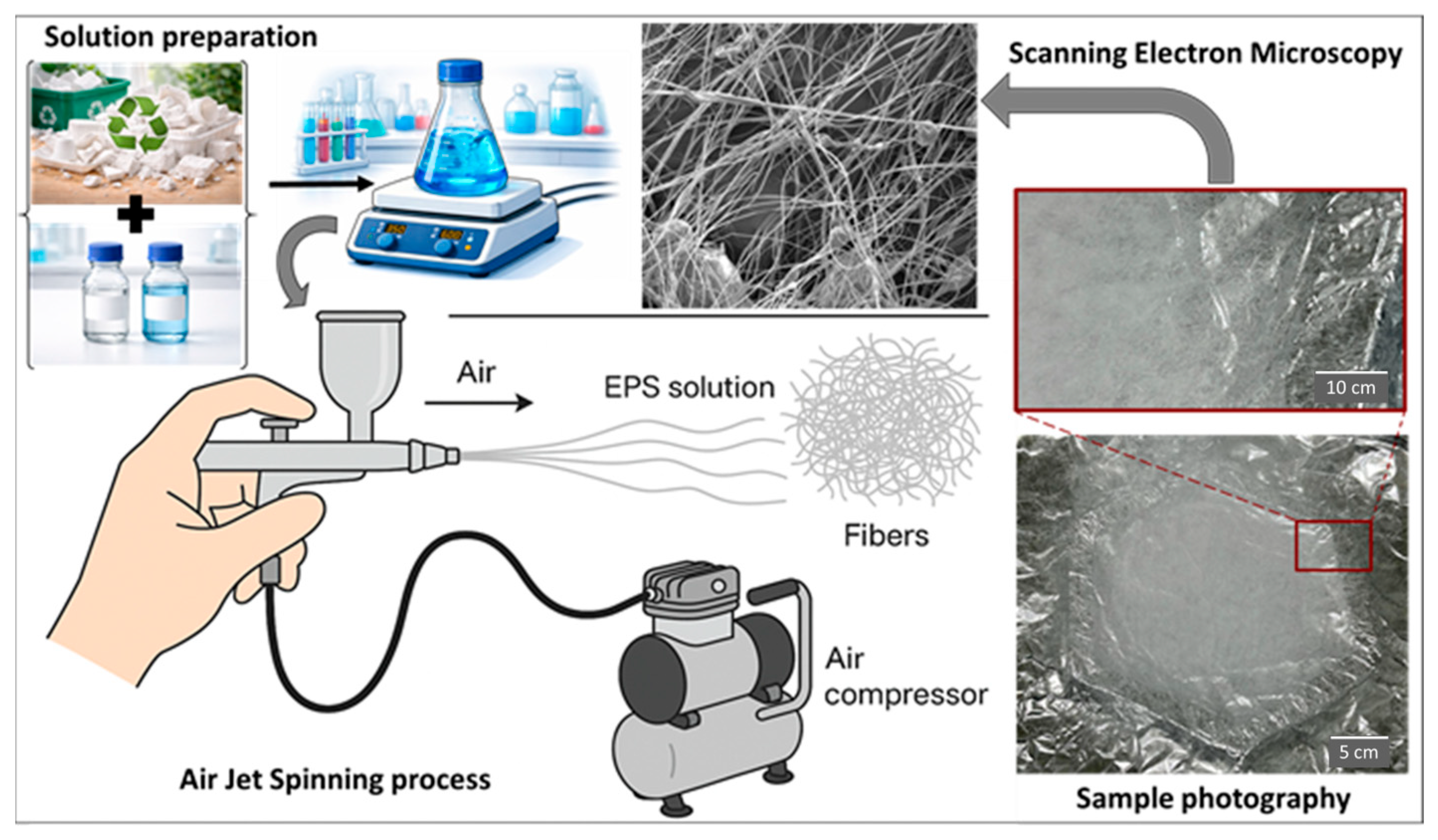
The spinning process in this study used an airbrush-type injection device coupled to a commercial compressed-air source (TKA12 kit, Trato, São Paulo, SP, Brazil), as illustrated in Figure 1. The spinning setup was equipped with an injection needle with an internal diameter of 0.5 mm. A volume of 10 mL of the EPS solution was loaded into the airbrush reservoir, and air pressures of 0.10, 0.14, and 0.17 MPa were applied, as monitored by a pressure gauge coupled to the system. The solution flow rate () was measured directly at the injection device by recording the dispensed volume as a function of time, yielding flow rates of 40 to 50 mL/h (Equation (1)).
where denotes the solution volume and represents the time required to dispense and spin the corresponding volume [36]. The processing conditions adopted in this study are summarized in Table 1.
Figure 1.
Graphical representation of experimental design in Air Jet Spinning process used in this project for produced EPS microfibers from solution with chloroform and D-Limonene as solvent system (Chl/D-Lim).
Table 1.
Operational condition for each solvent system using chloroform and D-Limonene.
The operational conditions summarized in Table 1 were selected based on preliminary trials and literature reports on gas-assisted spinning techniques. The investigated polymer concentration range (15–20 wt.%) was chosen to ensure sufficient chain entanglement while maintaining spinnability. The applied air pressure (0.10–0.17 MPa) was selected to provide adequate aerodynamic force for jet stretching without inducing excessive instability. The working distance (35 cm) was fixed to allow sufficient time for solvent evaporation and fiber solidification. The flow rate range (30–50 mL/h) was determined according to the operational characteristics of the airbrush system and adjusted to ensure continuous and stable fiber formation.
2.4. Characterization
2.4.1. EPS Solution
- Viscosity.
The viscosity of the EPS solutions, as a function of polymer concentration and the volumetric ratio of chloroform and D-limonene, was determined using a rotational viscometer (Anton Paar Trading Co., Shanghai, China) equipped with a CC18 spindle. Viscosity measurements were performed as a function as shear rate. For this purpose, 10 mL of each EPS solution was analyzed at room temperature (~25 °C).
- Surface tension.
The surface tension of each EPS solution in the chloroform/D-Limonene solvent system was evaluated using the drop method described in previous works [37,38]. For this, 50 drops of each solution were weighed on an analytical balance (Gehaka AG200, São Paulo, Brazil). The surface tension value () was calculated using Equation 2, based on a comparative from of the drop weight method using water as a reference fluid, as described by Lee, Ravindra, and Chan (2009) [39]. In this approach, the surface tension is estimated from the ratio between the mass of the solution droplets and that of water, assuming similar drop formation conditions.
where is the water tension (0.072 N/m), is the weight of the EPS solution and is the weight of water.
- Evaporation solvent systems.
The rate of solvent evaporation from EPS solutions with 15.0, 17.5, and 20.0 wt.% polymer concentrations was measured using the methods described by Teixeira et al. (2022) [38]. Briefly, 20 mL of each polymeric solution was kept in an enclosed chamber. Weight measurements were recorded every 15 min at 40% relative humidity. The evaporation rate for each polymer solution was determined from the slope of the mass–loss curve for each solvent
2.4.2. Morphological Evaluation by SEM
The morphology of the EPS fibers spun by AJS was assessed using a scanning electron microscope (SEM—Tescan VEGA3) with 10 kV acceleration. For the surface evaluation of EPS microfibers was used SEM equipment (EVO MA 25, ZEIZZ). All samples were gold-coated before analysis by 120 s. The SEM images were processed using the Size Meter 1.1 software to quantify the fiber diameter. For this was measured 50 fibers by sample.
2.4.3. Gel Permeation Chromatography (GPC)
The molecular weights variations of EPS were determined using GPC on a Shimadzu chromatograph apparatus (UFLC, Japan). The chromatograph was equipped with a refractive index detector and a GPC column for chloroform. The analysis was performed at 30 °C using 6 mg of each sample of EPS spun in diluted solution with chloroform. The number-average molecular weight (Mn), weight-average molecular weight (Mw), and dispersity index (Mw/Mn) were determined using a calibration curve with polystyrene standards (PS) in the range 700—2.2 × 10⁶ [40]. A total of 6 mg of each sample was analyzed.
2.4.4. Porosity Evaluation
The percentage porosity was estimated as the ratio of the pore volume within the electrospun mats, , and the mats volume, , by following the ASTM F245018 standard Guide [41] Equation (3):
The total mat’s volume, , was calculated using Equation (4), based on the diameter (d) and height (h), while the pore volume, , was obtained using Equation (5), where is the mass and is the density of EPS spun mat [42].
Archimedes’ principle was used to determine the density of the mats, . An analytic balance (AY220, Shimadzu Brazil Ltd., São Paulo, Brazil) was used to measure the dry mass () and the apparent mass mats after immersion in ethanol (). Density () was calculated by Equation (6) and the density of ethanol () at room temperature.
2.4.5. Wettability
A contact angle analysis was performed to evaluate the wettability of the EPS mats with and without D-Limonene as the spinning solvent. For this, a Ramé-Hart NRL A 100-00 goniometer was used with distilled water. A ~4 µL drop of water was deposited on the surface of each mat at room temperature. The contact angle of each EPS mat was measured in triplicate (N = 3).
2.4.6. Chemical and Structural Characterization by FTIR
The composition of the mats and potential chemical interaction between EPS and solvents (chloroform and D-Limonene) were evaluated using Fourier Transform Infrared (FTIR) spectroscopy. A PerkinElmer Spectrum Series Frontier spectrophotometer (Norwalk, CT, USA) with an attenuated total reflectance (ATR) accessory and a germanium (Ge) crystal detector was used. The analysis was performed in the region of 4000 to 700 cm−1 with 64 scans and a resolution of 4 cm−1.
2.4.7. Thermal Behavior by TGA and DSC
The thermal behavior and weight loss of EPS spun samples were assessed using thermogravimetry analysis (TGA) with a NETZSCH TG 209F3 instrument operating from 25 °C to 700 °C at a heating rate of 10 °C/min under an N2 atmosphere.
The thermal transition of the EPS samples was investigated using Differential Scanning Calorimetry (DSC) on a NETZSCH DSC 204F1 Phoenix equipment. Approximately 10 mg of each sample was analyzed at a heating rate of 10 °C/min under a nitrogen atmosphere at a flow rate of 50 mL/min. The analysis comprised two heating cycles: the first from 25 °C to 200 °C, followed by a cooling cycle to 0 °C, and then a second heating cycle to 200 °C.
2.4.8. Statistical Analysis
Statistical analysis was performed using one-way ANOVA to compare mean fiber diameters among different variables. Homogeneity of variances using Levene’s test. A significance level of p < 0.05 was adopted [42].
3. Results and Discussion
3.1. EPS Solution Evaluation
To initiate this study on EPS fibers spinning via AJS, preliminary investigation of the polymer solution and polymer-solvent interactions were required. This is because intra—and intermolecular forces in polymer solutions promote chain entanglement, enabling plastic deformation of the polymer mass under aerodynamic forces, which in turn allows the formation of continuous fibers without breakup into droplets, a phenomenon that characterizes AJS processes [18,26]. For this reason, variables related to the polymer-solvent interaction, as well as solvent evaporation capability, were initially investigated. Accordingly, the polymer solutions were characterized in terms of viscosity and surface tension, the corresponding results are presented in Table 2.
Table 2.
Mean and standard deviation results of Viscosity and Surface tension of EPS solutions at different polymeric concentrations and chloroform/D-Limonene (Chl/D-Lim) volumetric ratios, along with the calculated Molar Mass for each solvent system.
Table 2 summarizes the viscosity and surface tension of the EPS solutions investigated in this study, with the aim of evaluating polymer-solvent interactions and their influence on the elongational behavior observed during the AJS process. These variables play a critical role in determining jet stability, fiber continuity, and the suppression of droplet formation under aerodynamic stretching.
Initially, the viscosity results show a strong dependence on polymer concentration across all solvent systems investigated (15.0, 17.5, and 20.0 wt. % EPS). As expected, increasing EPS concentration substantially raised solution viscosity, yielding an overall increase of approximately 80% between the lowest and highest concentrations. This behavior is consistent with a transition from the dilute to the semi-dilute regime, in which polymer chain overlap and entanglement become significant, enabling the formation of continuous fibers under elongation flow [43,44]. Similar viscosity-driven transitions have been reported for other polymer systems processed by gas assisted spinning techniques, where the onset of efficient chain entanglement is a prerequisite for dimensional fiber stability [45].
The incorporation of D-limonene into the solvent system results in a systematic reduction in solution viscosity compared with the pure chloroform solution (EPS-100) at equivalent polymer concentrations. This effect suggests that D-limonene acts as a lubricant and solvating agent, promoting enhanced molecular mobility and improved chain organization in solution, a behavior observed in polymeric solution when another essential oil is added [37,42]. Consequently, EPS solutions prepared with chl/D-lim mixtures exhibit lower resistance to elongation deformations, which favors jet stretching and contributes to reduced bead formation during AJS.
Surface tension measurements further complement this analysis. Solution containing D-limonene generally exhibited lower surface tension than pure chloroform, reducing the capillary forces that oppose jet elongation and favor droplet formation [38]. In AJS, where fiber formation relies on the balance between aerodynamic stretching and capillary-driven instability, the combination of moderate viscosity and reduced surface tension is essential to maintain a stable jet. Excessively low viscosity, even with reduced surface tension, may still lead to atomization, whereas overly viscous solutions can limit jet thinning [4,10].
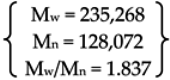
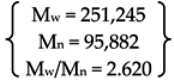
Gel permeation chromatography results indicate that the molecular weight distribution of EPS remained within comparable ranges after processing, suggesting that the observed variations in solution behavior are primarily governed by formulation effects rather than polymer degradation. This observation supports the interpretations that the effects are due to concentration rather than alterations in the polymer backbone [42,46].
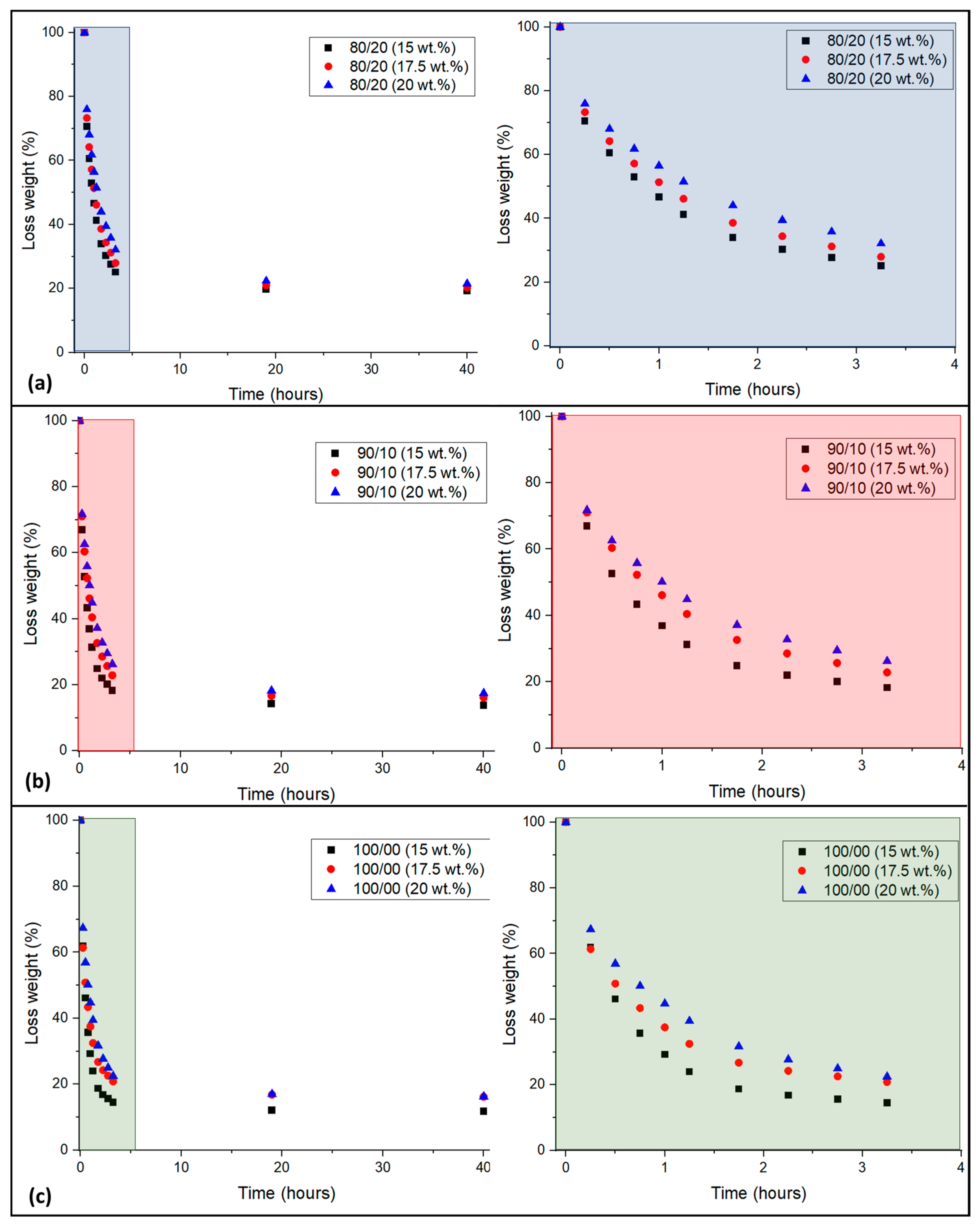
Figure 2 presents the solvent evaporation profiles of the EPS solution over time at different polymer concentration and solvent composition. All formulations exhibit a two-stage evaporation behavior, characterized by a rapid initial mass loss (<5 h) followed by a slower evaporation regime. The initial stage is dominated by the volatilization of chloroform, while the second stage reflects the contribution of D-limonene, which possesses a significantly lower vapor pressure [47].
Figure 2.
Solvent evaporation behavior for different CHCl3/D-limonene systems at varying EPS concentrations: (a) 80/20, (b) 90/10, and (c) 100/00 (v/v). Left panels show the full evaporation range (0–40 h), while right panels highlight the initial stage (0–4 h). Data are presented as discrete markers to reflect experimental measurements.
The solvent composition strongly influences evaporation kinetics. Solutions prepared with pure chloroform (100/00 EPS) show the fastest evaporation velocity, leading to early solidification of the polymer jet [5]. Although rapid solvent removal can promote fiber formation, it may also limit the time available for aerodynamic stretching during AJS. Conversely, formulations with higher D-limonene contents (80/20 EPS) exhibit delayed evaporation, maintaining the jet in a semi-liquid state for extended periods and increasing susceptibility to jet instability and droplet formation [48].
An intermediate evaporation profile is observed in the 90/10 EPS formulations, indicating better synchronization between jet elongation and solvent removal. This controlled evaporation profile provides sufficient time for aerodynamic stretching before solidification, thereby improving fiber continuity and morphological uniformity. Polymer concentration further modulates evaporation behavior, with higher EPS content resulting in slower mass loss due to increased viscosity and reduced solvent diffusion.
To quantitatively support the discussion on polymer–solvent affinity, Hansen solubility parameters (HSP) for the solvent mixtures used in this study were estimated using a volume-fraction weighted approach (the calculus is described in Material Supplementary, Table S1) [49,50]. The calculated Hansen distances (Ra) relative to polystyrene were 4.15 MPa1/2 for pure chloroform 100/00, 3.58 MPa1/2 for the 90/10 (v/v) CHCl3/D-limonene system, and 3.54 MPa1/2 for the 80/20 (v/v) mixture. These results indicate that both mixed solvent systems remain within a favorable solubility range for EPS, with slightly reduced Hansen distance compared to pure chloroform, as shown in the literature [49]. Therefore, the morphological instability observed at higher D-limonene contents cannot be attributed to insufficient thermodynamic compatibility, but rather to changes in solvent volatility and evaporation kinetics, which directly affect jet solidification dynamics during AJS. This quantitative analysis reinforces that solvent engineering in this system primarily modulates processing behavior rather than polymer–solvent affinity.
Overall, the combined analysis of viscosity, surface tension, molecular weight stability, Hansen solubility parameters, and solvent evaporation kinetics shows that successful EPS fiber formation by AJS requires a compromise between polymer–solvent affinity and processing dynamics. The CHCl3/D-limonene (90/10 v/v) system at intermediate polymer concentrations provides this balance, defining a processing window conducive to stable jet formation and continuous microfiber production.
3.2. Morphological Analysis by SEM
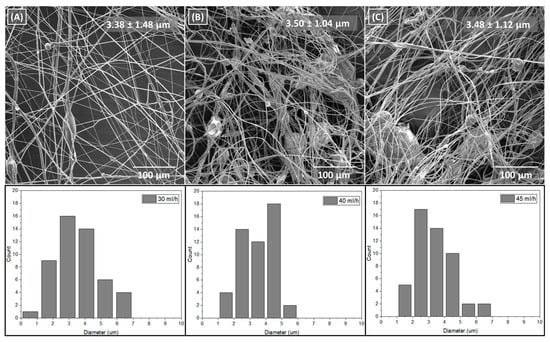
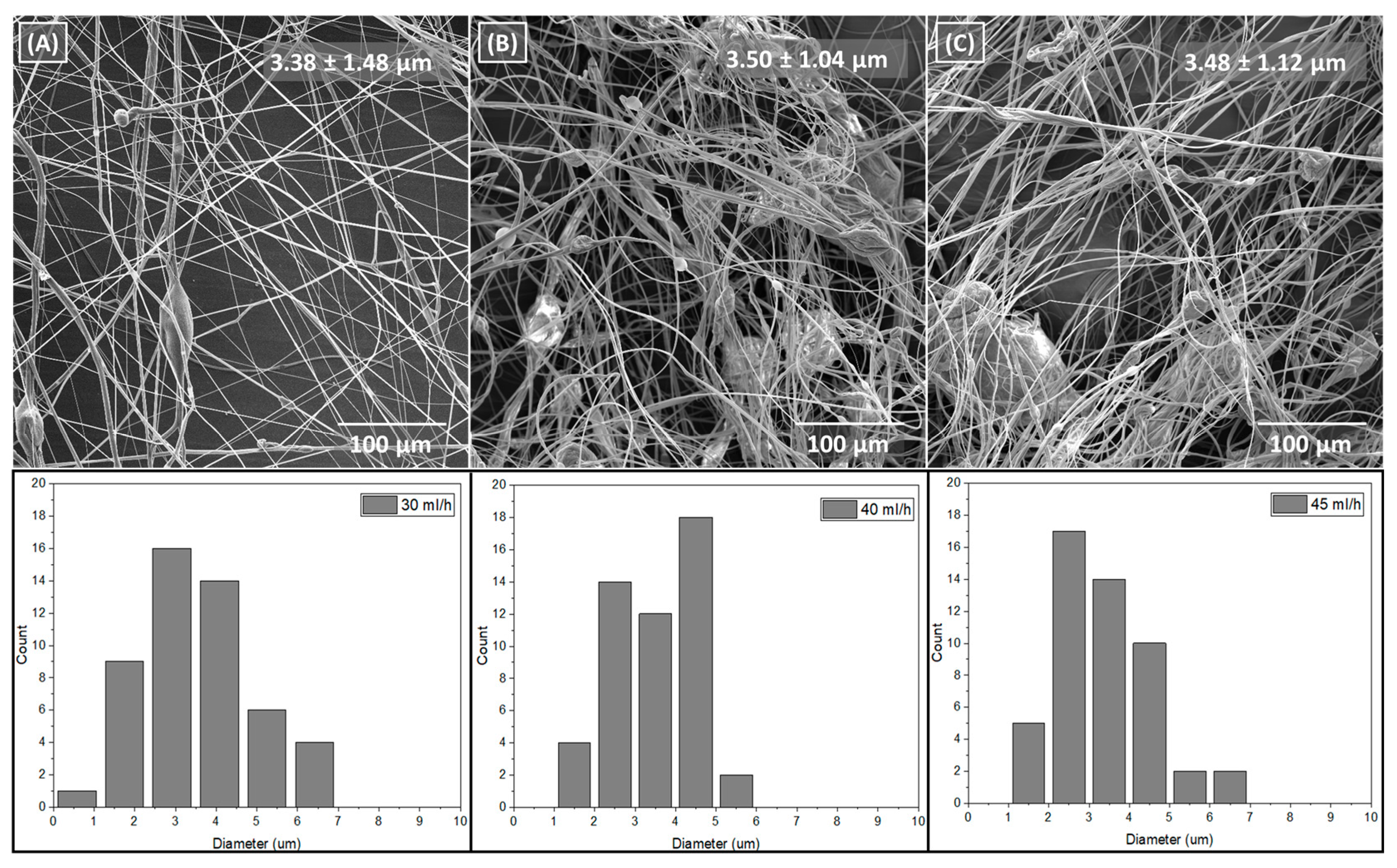
To investigate the main factors influencing the morphology of fibers produced by AJS, the variables were selected based on previous studies reported in the literature for SBS applied to different polymers [37,49,50,51]. Accordingly, parameters such as solution flow rate, air pressure, EPS concentration, and solvent volumetric ratio were evaluated. The parametric study was first assessed based on the morphology and quality of the produced fibers using SEM, as shown in Figure 3, Figure 4 and Figure 5. The relationship between the variables and the diameter values, along with their corresponding standard deviations are summarized in Table 3.
Figure 3.
SEM images and fiber diameter distribution showing the influence of solution flow rate on the morphology and quality of EPS microfiber produced from EPS/chloroform solution. (A) 30 mL/h; (B) 40 mL/h; and (C) 45 mL/h. Spinning conditions: tip-to-collector distance of 35 cm and air pressure of 0.17 MPa.
Figure 4.
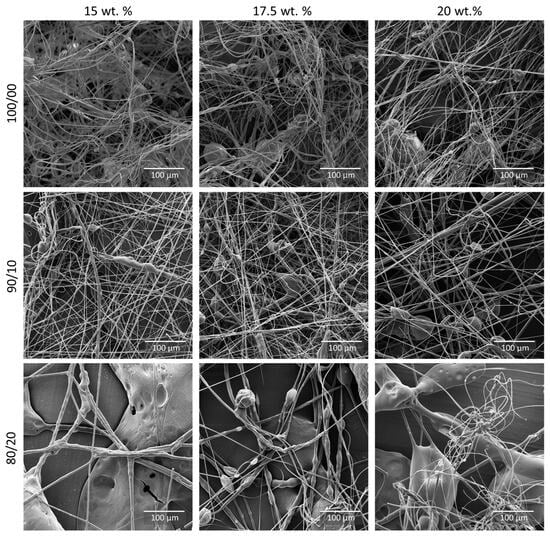
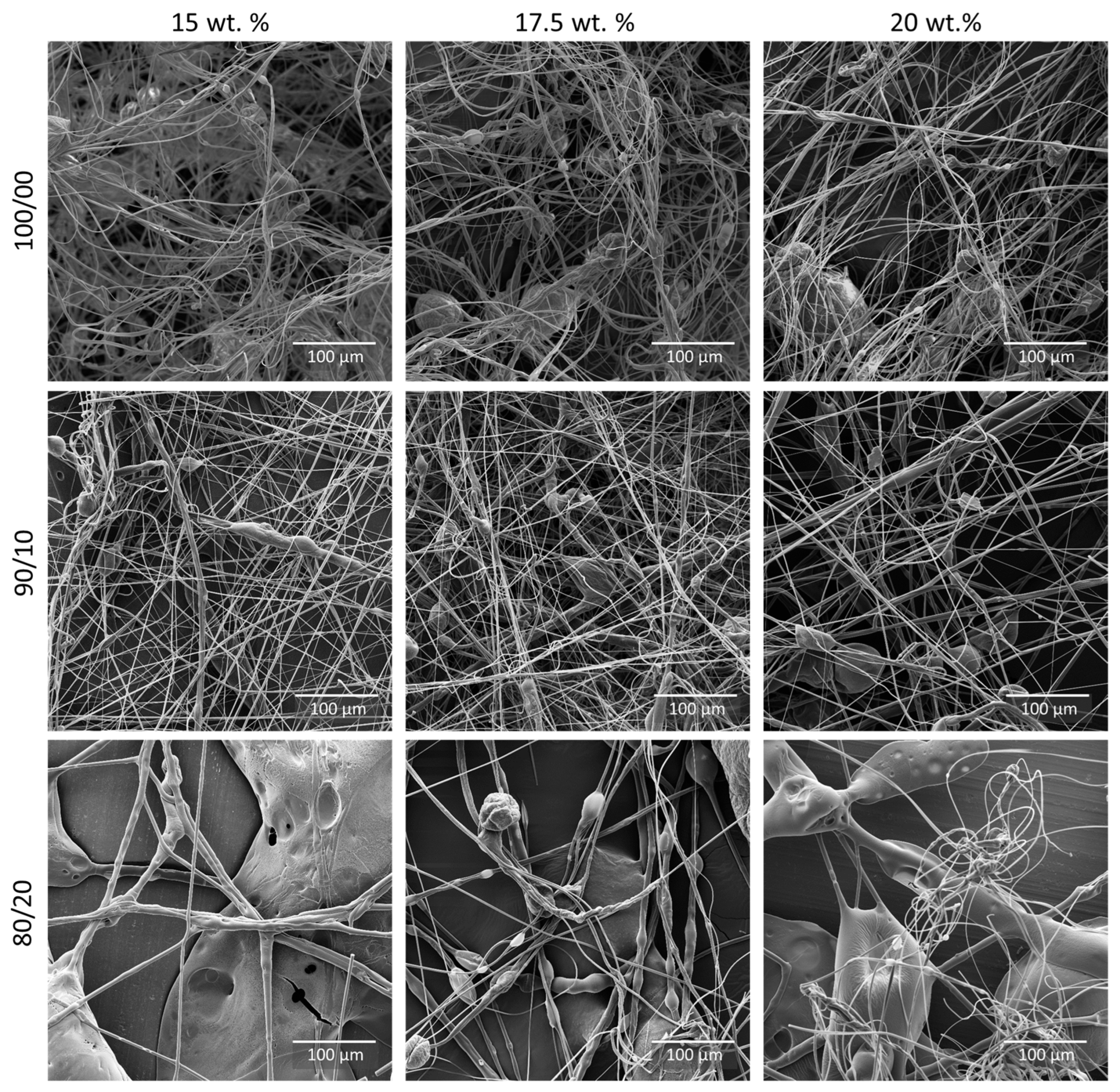
SEM micrographs showing the influence of EPS concentration on fiber morphology as a function of D-Limonene incorporation in the solvent system (Chl/D-Lim). Flow rate: 45 mL/h, tip-to-collector distance: 35 cm, and air pressure 0.17 MPa.
Figure 5.
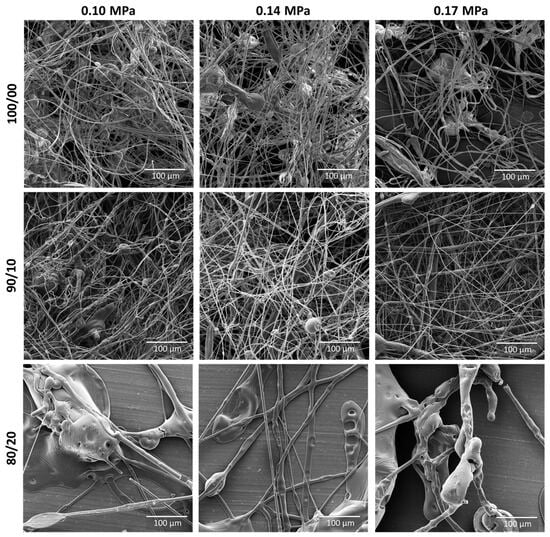
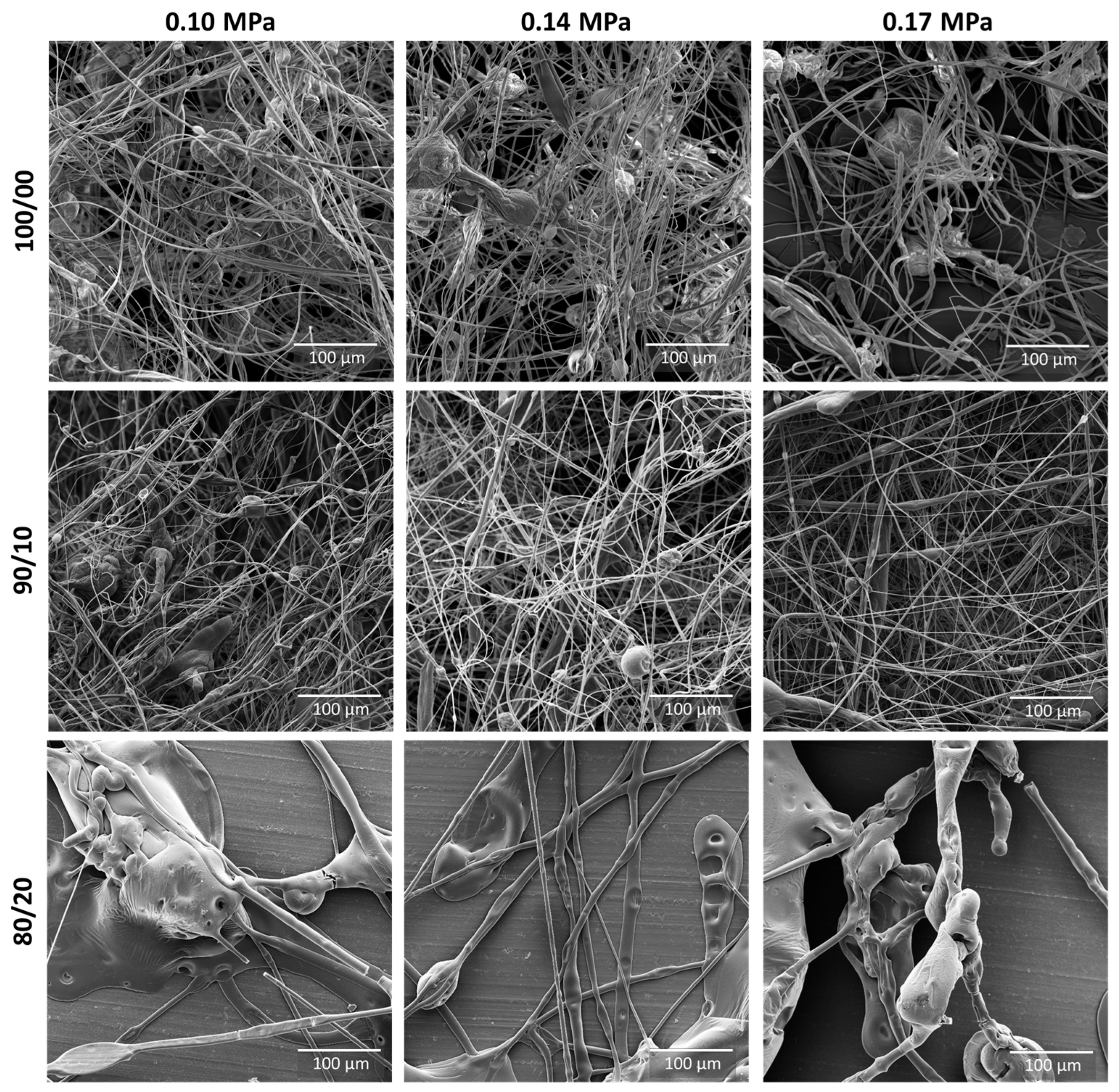
Influence of air pressure on fiber morphology as a function of the volumetric ratio of D-Limonene in the solvent system (Chl/D-Lim). EPS concentration: 17.5 wt. %, flow rate: 45 mL/h, and tip-to-collector distance: 35 cm.
Table 3.
Values of parameters and diameters for different conditions for spinning by AJS, varying the polymeric concentration, air pressure, and volumetric relation between chloroform and D-Limonene (Chl/D-Lim).
Initially, the effect of the solution flow rate on fibers morphology was evaluated. For this, three flow rates, 30, 40, and 45 mL/h, approximately, were studied (n = 3) and analyzed by SEM. The corresponding diameter distributions are presented as histogram graphs in Figure 3.
Figure 3 shows the morphology of EPS microfibers produced by AJS as a function of the solution flow rate at an EPS concentration of 15 wt. % in chloroform. The results indicate that changes in flow rate did not produce significant changes in overall fiber morphology (p > 0.05), as confirmed by quantitative analysis of the diameter measurements. However, differences were observed in the scatter of the diameter distributions. In particular, the 40 mL/h condition exhibited increased variability compared to 30 and 45 mL/h, as reflected by a higher standard deviation and coefficient of variation. This broader distribution suggests enhanced process instability under this flow regime. Such behavior can be attributed to hydrodynamic instabilities at the nozzle tip, where the balance between polymer feed rate and aerodynamic stretching may enter a transitional regime, promoting intermittent jet formation and reduced uniformity in fiber stretching. [5,52]
In contrast, the higher flow rate of 45 mL/h resulted in a narrower and more homogeneous fiber diameter distribution. This behavior is attributed to the increased polymer mass supply at the needle tip, which improves the balance between solvent evaporation, polymer jet stability, and aerodynamic drag forces, thereby promoting a more continuous spinning process. These observations are consistent with previous reports on gas-assisted spinning techniques, where fiber formation is strongly governed by the interplay between the available polymer mass and the driving aerodynamic forces responsible for jet stretching and refinement [53].
Given these results and the experimental difficulty of precisely controlling low flow rates with an airbrush-based AJS system, a flow rate of 45 mL/h was selected for the subsequent investigation of solution concentration and applied air pressure.
Figure 4 presents the SEM micrographs of EPS fibers produced by AJS at a fixed flow rate (45 mL/h), tip-to-collector distance (35 cm), and air pressure (0.17 MPa), while varying polymer concentration (15–20 wt.%) and solvent composition (100/00, 90/10, and 80/20 Chl/D-Lim) varied.
In the pure chloroform system (100/00), increasing the EPS concentration from 15 to 20 wt.% increased the solution viscosity from 223.8 ± 0.7 mPa·s to 449.6 ± 1.4 mPa·s (Table 2), approximately doubling it. Despite this significant rheological change, the average fiber diameter remained relatively stable, ranging from 3.01 ± 0.88 µm (S1) to 3.32 ± 1.23 µm (S3), with coefficients of variation ranging from 29% to 37% (Table 3). Considering the relatively high dispersion of the measurements, these differences are within experimental variability, suggesting that under the investigated AJS conditions, aerodynamic stretching effects prevail over viscous resistance in determining the final fiber diameters. This behavior is consistent with previous reports on gas-assisted sinning systems [16,54].
However, the standard deviation increased from ±0.88 µm to ±1.23 µm, indicating reduced morphological uniformity at higher concentrations. Similar viscosity-dependent broadening of the diameter distribution has been observed in solution blow and electrospinning processes when excessive viscous resistance limits homogeneous elongational thinning [38,42]. This behavior can be attributed to earlier jet solidification caused by the high volatility of chloroform (Figure 2), which limits elongational thinning and increases susceptibility to local instabilities [37].
When D-limonene was incorporated at 10 vol.% (90/10 system), solution viscosity decreased substantially at equivalent polymer concentrations. For example, at 17.5 wt.% EPS, viscosity decreased from 328.8 mPa·s (100/00) to 124.3 mPa·s (90/10), a 62% reduction. Simultaneously, evaporation kinetics slowed (Figure 2), thereby extending the jet-stretching time, consistent with previous studies on solvent-controlled spinning behavior [38].
Under these conditions, fiber diameters increased slightly (from 2.99 ± 0.96 µm to 3.20 ± 1.06 µm), and morphological uniformity improved qualitatively, with fewer entanglements and more homogeneous deposition. Adequate molecular entanglement, coupled with synchronized solvent removal, is essential for suppressing capillary-driven breakup during elongational flow [16,35]. The reduced volatility of the mixed solvent system likely delayed polymer vitrification, allowing more controlled aerodynamic thinning before solidification.
In contrast, increasing the D-limonene content to 20 vol.% (80/20 system) caused pronounced morphological instability. At 17.5 wt.% EPS, the average fiber diameter increased to 3.95 ± 1.77 µm, and at 20 wt.% EPS to 4.36 ± 2.18 µm. The higher standard deviation (up to 2.18 µm) indicated a broader diameter distribution and intermittent jet formation. This behavior is consistent with excessively delayed solvent evaporation, which keeps the jet in a semi-liquid state over longer distances, thereby increasing sensitivity to capillary-driven perturbations and aerodynamic fluctuations, as described for gas-dynamic virtual-nozzle systems [55].
Overall, these results indicate that fiber morphology in AJS is governed by a dynamic balance between viscous forces (μ), surface tension, and solvent evaporation rate. The 90/10 solvent system at 17.5 wt.% EPS provides an intermediate rheological–evaporation regime in which jet stretching and solidification occur synchronously, resulting in improved process stability and fiber continuity [16].
The observed behavior can be interpreted in light of the competition between aerodynamic stress and capillary instability during jet formation. In gas-assisted spinning processes, stable fiber formation occurs when viscous forces are sufficient to suppress Rayleigh–Plateau breakup, and when solvent evaporation proceeds at a rate compatible with jet stretching [55]. Excessively rapid evaporation (100/00 system) promotes early solidification and limited thinning, whereas excessively slow evaporation (80/20 system) increases jet instability. Therefore, the 90/10 system represents an optimal balance between elongational flow time and solvent removal kinetics.
Figure 5 shows how applied air pressure (0.10, 0.14, and 0.17 MPa) influences fiber morphology at a constant polymer concentration (17.5 wt.%), flow rate (45 mL/h), and tip-to-collector distance (35 cm) across different solvent systems. Air pressure directly affects the aerodynamic stress on the polymer jet, which governs elongational deformation and final fiber diameter [14,52]. For the 100/00 solvent system, increasing pressure from 0.10 to 0.17 MPa resulted in a progressive reduction in fiber diameter (see Table 3), consistent with enhanced aerodynamic stretching [53].
However, excessive pressure may also increase jet instability. At 0.17 MPa, although thinner fibers were obtained, the diameter distribution broadened in some cases, indicating increased perturbation amplitude during flight. This effect can be attributed to higher-Reynolds-number conditions, in which turbulent air–jet interaction intensifies jet oscillations and perturbation growth in gas-assisted spinning systems [55].
In the 90/10 system, increased pressure produced a more controlled reduction in diameter than in the pure chloroform system. The moderated solvent evaporation rate in this formulation likely sustained elongational flow over a longer distance, enabling more efficient diameter refinement under aerodynamic forces [31,53]. As a result, fiber morphology showed improved uniformity even at higher pressures.
In contrast, the 80/20 system exhibited poor fiber formation at low pressures (0.10 MPa), where insufficient aerodynamic stress and delayed solvent evaporation prevented stable jet stretching, resulting in bead formation or incomplete fiber (S16–S18). This suggests that, in this regime, viscous and capillary forces dominate over aerodynamic forces, suppressing continuous fiber formation [16,53].
Analysis of the values in Table 3, together with the morphological observations in Figure 4 and Figure 5, shows that fiber formation in AJS is governed not only by average diameter but also by diameter dispersion, which reflects jet stability (Figures S1 and S2). The importance of diameter dispersion as an indicator of spinnability and morphological stability has been emphasized in previous studies [42,54].
For the pure chloroform system (100/00) at 0.17 MPa, increasing EPS concentration from 15 to 20 wt.% produced a modest increase in average diameter (3.01 to 3.32 µm, ≈10%). However, the coefficient of variation (CV) rose from 29% to 37%, indicating reduced diameter uniformity at higher polymer loadings. Similar trends have been reported when viscous resistance increased beyond the optimal entanglement regime [42,44].
For the 90/10 system, reduction CV to 33% at 17.5 wt.% confirms improved jet stability within an optimal rheological window. At higher concentrations (20 wt.%), CV increased to 55%, indicating greater instability likely caused by excessive viscous resistance and delayed solvent evaporation, consistent with previously reported aerodynamic–viscous competition mechanisms [55].
The 80/20 system showed the greatest instability overall. No fiber formation was achieved at 15 wt.% EPS, confirming that below a critical viscosity–evaporation threshold, aerodynamic forces are insufficient to sustain continuous jet formation [16,56].
Combined quantitative evaluation of viscosity (Table 2), evaporation kinetics (Figure 2), and diameter dispersion (Table 3) supports the existence of a defined processing window for EPS microfiber formation via AJS. Stable fiber production occurs within an intermediate regime in which solution viscosity ensures sufficient chain entanglement while solvent evaporation remains synchronized with aerodynamic stretching consistent with spinnability frameworks for gas-assisted spinning techniques [42,54]. Outside this window, either premature solidification (100/00) or excessive jet instability (80/20) dominates, leading to increased morphological dispersion.
After defining the optimal spinning conditions based on morphological analysis (Figure 4 and Figure 5) and evaluating how flow rate and air pressure affect jet stability, two formulations were selected for full-volume spinning (10 mL of solution). The samples were designated EPS_100 (17.5 wt.% in pure chloroform) and EPS_90 (17.5 wt.% in 90/10 Chl/D-Lim), representing, respectively, a high-volatility reference system and the formulation identified within the optimal rheological–evaporation processing window.
Figure 6 presents the fiber mats obtained via AJS, including macroscopic photographs, SEM micrographs, and water contact angle measurements, enabling correlation of fiber morphology with the surface properties of the resulting membranes. After defining the optimal spinning parameters, fibrous mats were produced from 17.5 wt.% EPS solutions using the two solvent systems, denoted as EPS_100 (chloroform) and EPS_90 (chloroform/D-limonene 90/10).
Figure 6.
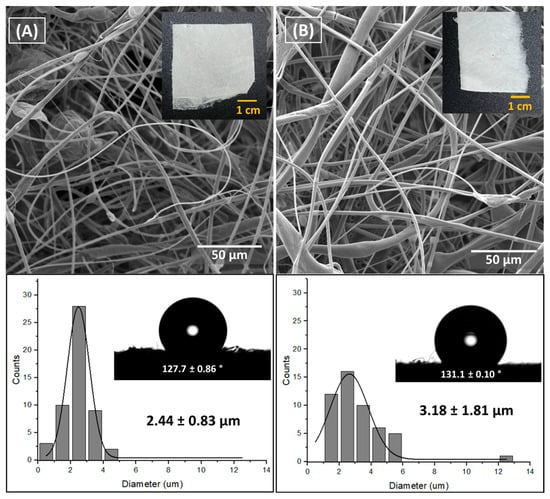
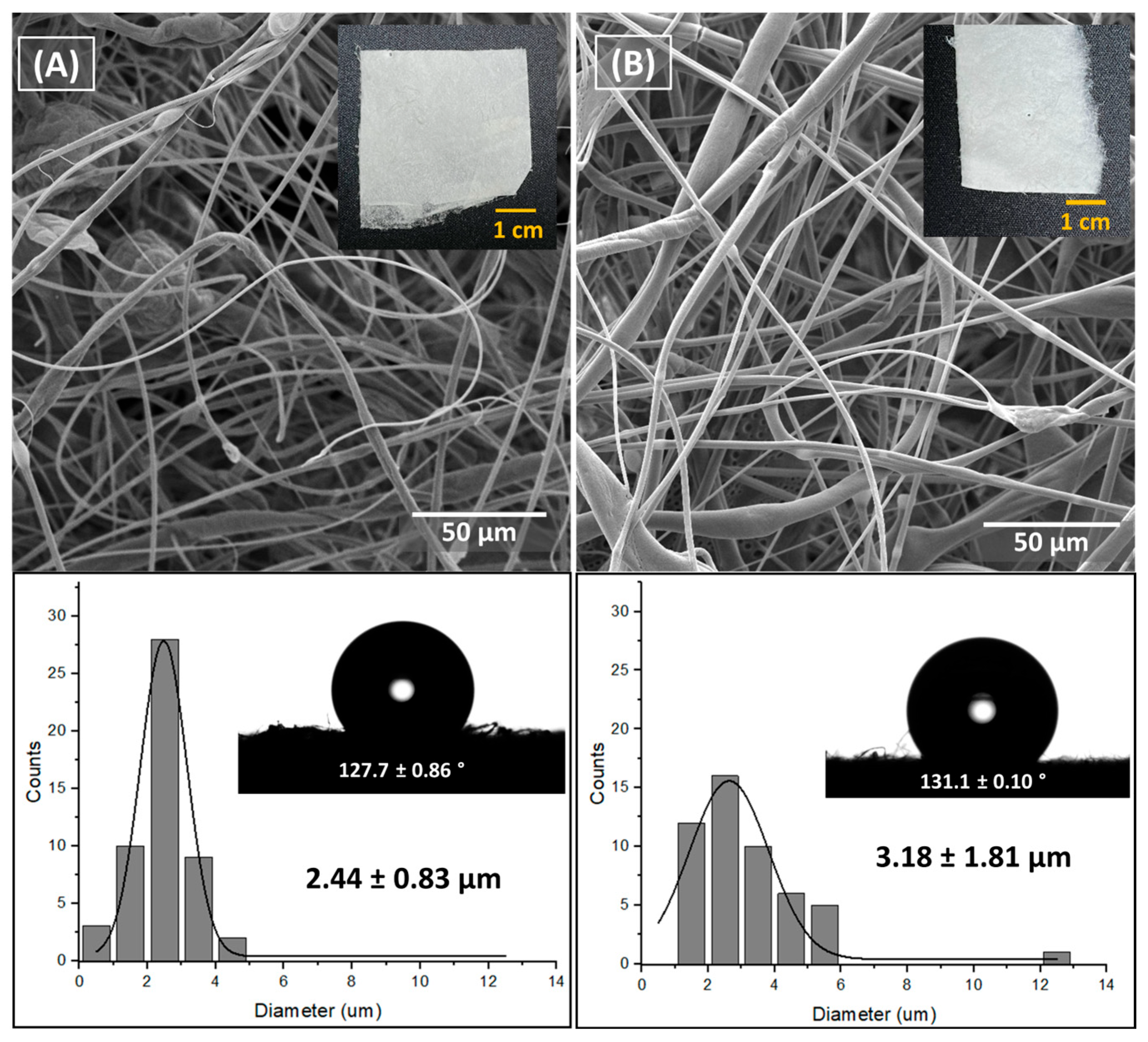
Images of EPS fibrous mats produced via Air Jet Spinning from 10 mL of polymer solution using two solvent systems, together with the correspondence SEM micrographs, histograms, and water angle measurements. (A) EPS_100 (pure Chloroform) and (B) EPS_90 (Chloroform/D-Limonene, 90:10 v/v).
A total of 10 mL of each solution was spun to obtain representative mats (photographs shown in Figure 6. SEM analysis confirmed the formation of continuous microfibers, with average diameters of 2.44 ± 0.83 µm and 3.18 ± 1.81 µm for EPS_100 and EPS_90, respectively. Although the average diameters are comparable, EPS_100 exhibited a narrower diameter distribution, whereas EPS_90 presented broader dispersion and the presence of occasional thicker fibers (~12 µm), as observed in Figure 6B.
The broader distribution observed for EPS_90 may be associated with differences in solvent evaporation dynamics and solution stability, as discussed previously. The incorporation of D-limonene, which presents a significantly lower vapor pressure than to chloroform, can slow solvent evaporation during jet stretching, potentially promoting localized fiber coalescence or partial collapse before complete solidification. This behavior may explain the presence of fused or thickened fibers and the higher scatter observed in the diameter histogram.
Wettability analysis revealed high hydrophobicity for both mats, with contact angles of 127° and 131° for EPS_100 and EPS_90, respectively. These values substantially exceed those typically reported for flat polystyrene surfaces (~90°), confirming that the fibrous architecture amplifies hydrophobic behavior through surface roughness effects [57]. According to the Cassie–Baxter wetting model, air pockets trapped within the porous microfibrous structure increases the apparent contact angle, leading to enhanced water repellency. Therefore, the small difference between the two samples is more plausibly attributed to variations in fiber packing density and surface morphology rather than chemical modifications resulting from D-limonene incorporation. Similar behavior has been reported for electrospun EPS mats, where increased surface roughness produced contact angles exceeding 115° even without chemical modification [11].
To quantitatively correlate morphological differences with bulk structural properties, the real porosity of the AJS-spun mats was determined using the Archimedes method. The resulting pore volume and porosity values for EPS_100 and EPS_90 are reported in Table 4.
Table 4.
Calculation of real porosity of EPS spun via AJS as a function of morphology in mats using chloroform and D-Limonene (Chl/D-Lim) solvent systems.
Table 4 summarizes the calculated real porosity of the EPS mats produced from pure chloroform (EPS_100) and the chloroform/D-limonene system (EPS_90). Both samples exhibited high porosity values (>98%), which are consistent with highly porous fibrous structures typically reported for air-assisted spinning techniques [38,58]. EPS_100 showed slightly higher porosity (99.2%) than EPS_90 (97.4%), indicating a more open fiber network when pure chloroform was used.
Real porosity values calculated via the Archimedes method (Table 4) were 99.2% and 97.4% for EPS_100 and EPS_90, respectively. The slightly lower porosity observed for EPS_90 is consistent with the improved fiber packing and localized fiber coalescence identified in SEM images. The slower evaporation rate associated with D-limonene may contribute to enhanced fiber mobility upon deposition, favoring denser stacking and occasional inter-fiber fusion. These findings corroborate the morphological analysis and reinforce the influence of solvent system selection on mat architecture.
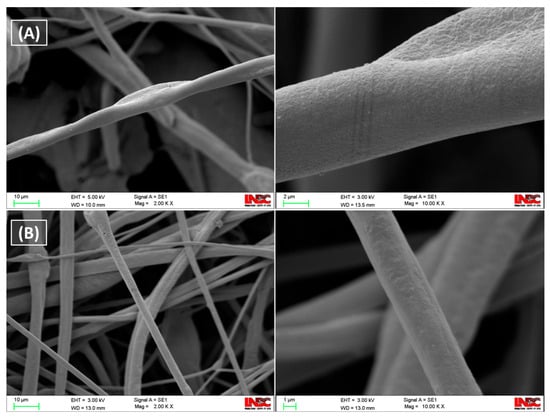
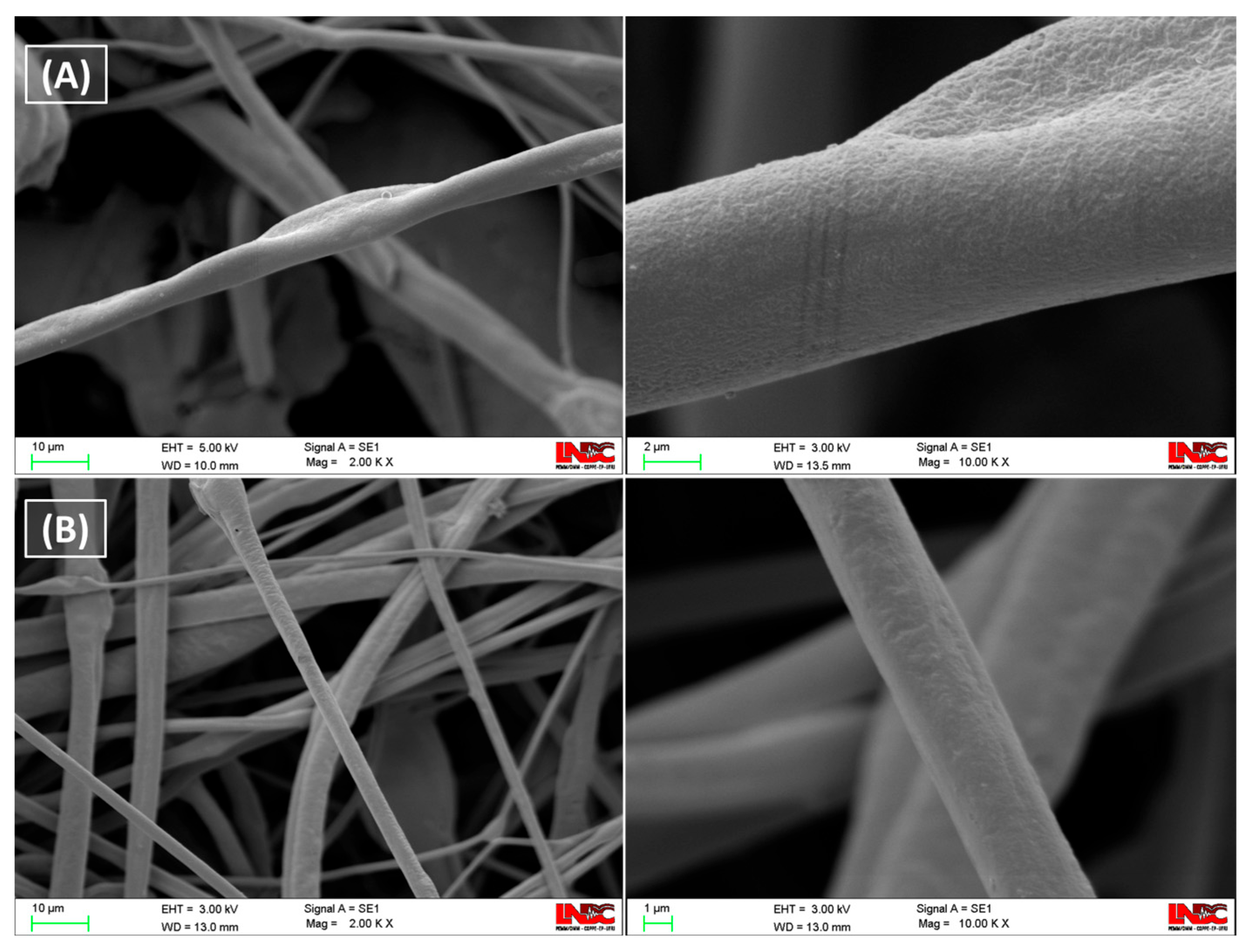
To further investigate the origin of the measured porosity, high-magnification SEM images of individual fibers (10,000×, Figure 7) were analyzed. The fibers exhibited smooth and continuous surfaces, with no evidence of intrinsic porosity. This indicated that the high porosity values obtained are primarily associated with inter-fiber voids within the fibrous network, rather than pores within the fibers themselves.
Figure 7.
SEM micrographs of EPS fibrous mats produced via Air Jet Spinning under optimized conditions showing both low (2000×) and high magnification (10,000×) imagen. (A) EPS_100 (pure chloroform) and (B) EPS_90 (chloroform/D-limonene 90:10 v/v).
This difference aligns well with the SEM observations, in which EPS_100 showed a more uniform fiber distribution and less evidence of fiber coalescence. In contrast, EPS_90 exhibited localized fiber thickening and occasional fused structures, as highlighted in Figure 6B, including fibers with diameters around ~12 µm formed by partial collapse or merging of adjacent filaments. Such behavior may be associated with the slower evaporation rate of D-limonene compared to chloroform, which can delay complete solvent removal during jet stretching and deposition. The prolonged plastic-like state of the fibers upon reaching the collector may increase inter-fiber contact and promote denser stacking or localized fusion, ultimately reducing the apparent porosity of the mat.
In addition, although no intrinsic porosity was observed, subtle differences in fiber surface morphology were identified. Fibers produced from the EPS_90 system exhibited slightly increased surface roughness compared to the smoother morphology of EPS_100 fibers. This behavior may be attributed to the reduced volatility of D-limonene, which prolongs solvent evaporation and may induce minor surface instabilities during fiber solidification [58]. It is important to note that, unlike electrospinning processes, where phase reparation can lead to porous fibers structures, gas-assisted spinning technique such as Air Jet Spinning typically produce dense fibers [59,60,61]. Therefore, the differences are associated with surface roughness rather than the formation of intrinsic pores.
Therefore, the slight decrease in porosity observed for EPS_90 reinforces the morphological analysis and supports the interpretation that solvent volatility plays a critical role in defining fiber packing density and final mat architecture.
3.3. Chemical and Structural Analysis of EPS Mats by FTIR
To evaluate the chemical composition of the fibers produced in this study, as well as the presence of D-limonene in the spun EPS fibers, pure EPS (EPS_100) and EPS containing 10% (v/v) D-limonene (EPS_90) were characterized by FTIR-ATR.
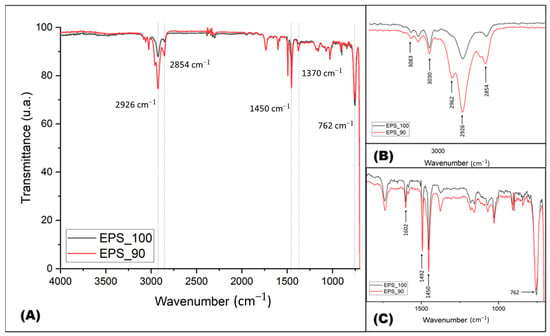
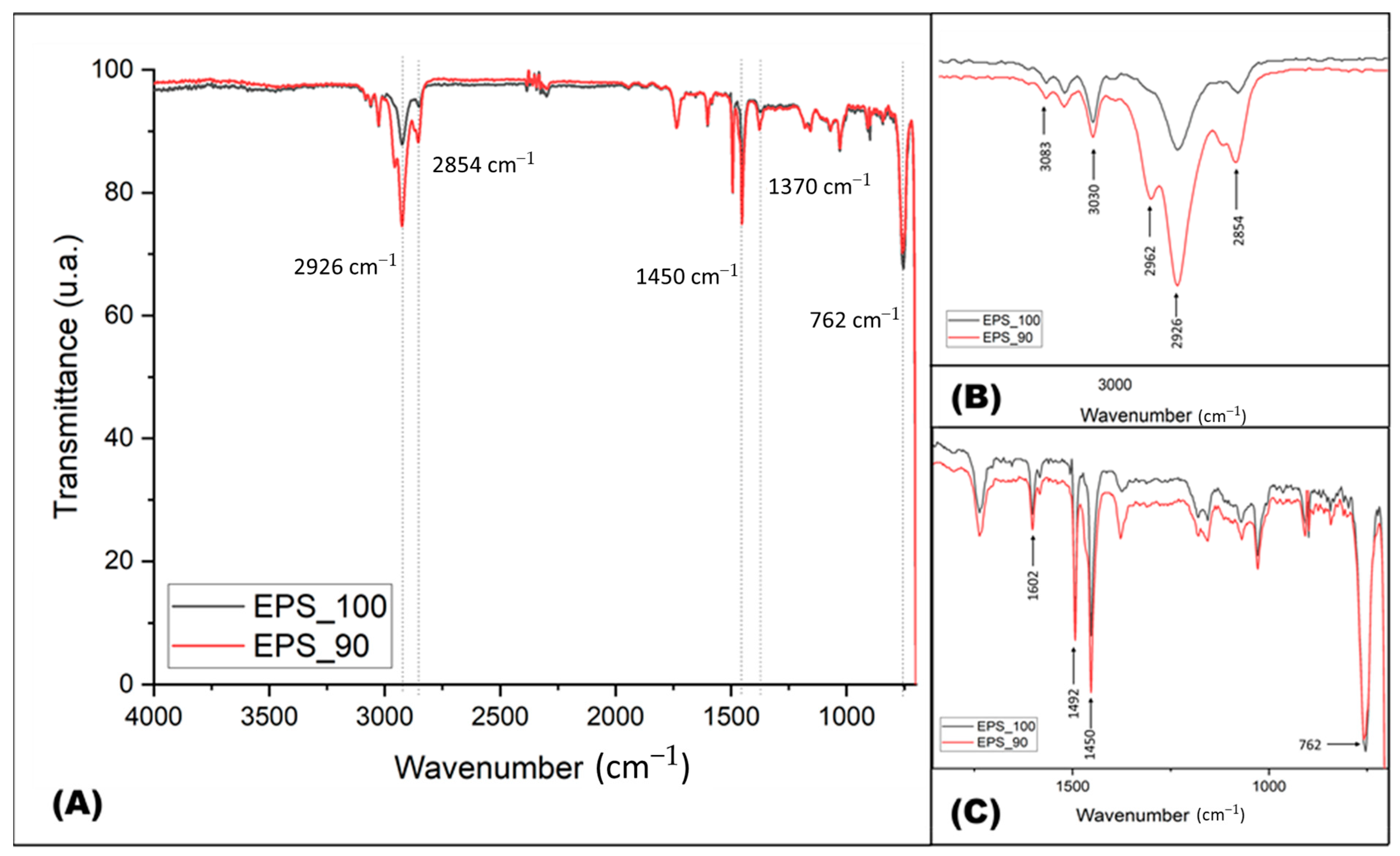
Figure 8 shows the FTIR-ATR spectra of the EPS_100 and EPS_90 fibrous mats across 4000–700 cm−1, together with two magnified regions highlighting key polystyrene absorptions. The first zoomed window, Figure 8A (3000–2500 cm−1) shows the characteristic C–H stretching vibrations, including aromatic C–H stretching in the 3030–3083 cm−1 region and aliphatic C–H stretching bands at ~2926 and ~2854 cm−1 [10]. The second magnified region, Figure 8B (2000–700 cm−1) shows typical aromatic ring vibrations of polystyrene, with bands at ~1602 cm−1 (aromatic C=C stretching) and ~1492 and ~1450 cm−1 (ring vibrations/CH bending), as well as absorptions in the ~1020–1060 cm−1 range. Importantly, the diagnostic out-of-plane aromatic C–H bending bands at ~762 and ~698 cm−1, characteristic of monosubstituted benzene rings in polystyrene, were clearly observed in both samples [62]. Overall, the close overlap of the normalized spectra indicates that the PS backbone was preserved after AJS processing, with no evidence of chemical degradation or oxidation induced by the different solvent systems.
Figure 8.
FTIR-ATR spectrum of EPS microfibers produced by air jet spun for EPS-17.5 concentration (17.5 wt.%) using 100/00 and 90/10 solvent system Chl/D-Lim (A). Subfigures show magnified regions of the spectra in the ranges of (B) 3100–2800 cm−1, and (C) 1800–700 cm−1, to highlight specific spectral features.
In contrast, EPS_90 exhibited an additional absorption band centered at ~2962 cm−1 that was not observed in EPS_100. According to FTIR literature on D-limonene and related terpene, bands in the 2960–2970 cm−1 region are assigned to asymmetric CH3 stretching vibrations [63,64]. The persistence of this feature after spectral normalization suggests the possible presence of trace residual D-limonene in the spun fibers. Although the C–H stretching region partially overlaps with polystyrene contributions and is therefore not fully specific, the absence of this band in EPS_100 strengthens its association with the bio-based solvent. Other characteristic limonene absorptions, such as alkene C=C stretching near 1640–1670 cm−1, were not distinctly observed, indicating that if present, residual solvent content remains low [64]. Thermal analyses were therefore conducted to further assess solvent removal and its potential influence on the material’s stability.
3.4. Thermal Behavior of EPS Microfibers
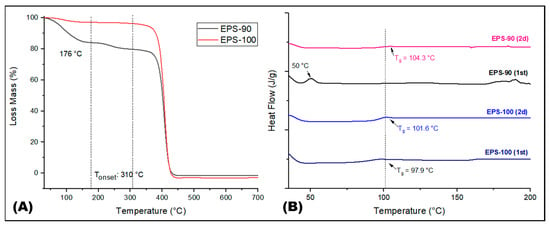
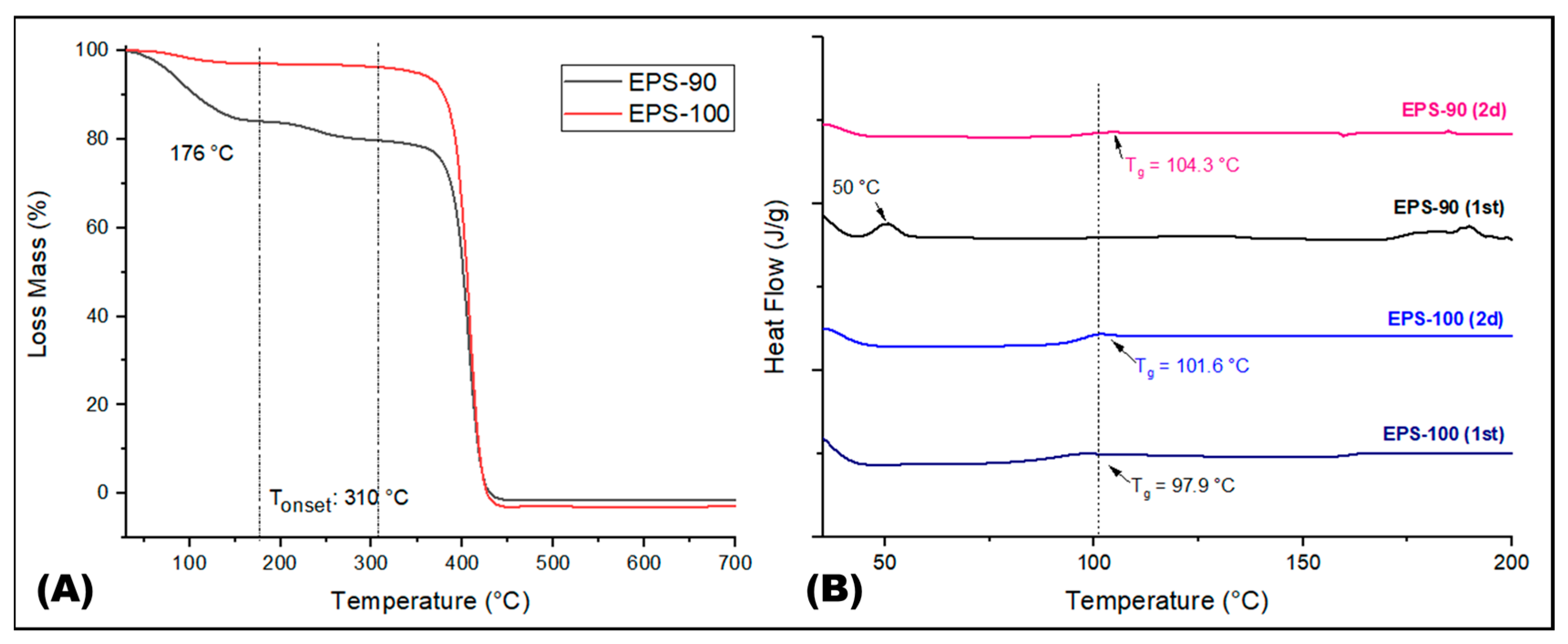
The thermal behavior of the EPS fibrous mats produced from pure chloroform (EPS_100) and the chloroform/D-limonene system (EPS_90) was evaluated by TGA and DSC, as shown in Figure 9 and summarized in Table 5 and Table 6, respectively. The thermal parameters obtained from TGA include Tonset (onset degradation temperature), Tmax (temperature at maximum degradation rate), Tendset (endset degradation temperature), and mass loss associated with each degradation event.
Figure 9.
TGA and DSC thermograms for two EPS mats produced by air jet described in Figure 6 varying the solvent system 100/00 (EPS_100) and 90/10 (EPS_90) solvent system Chl/D-Lim. (A) TGA, and (B) DSC analysis (two cycles heating, Exo up).
Table 5.
Thermal characteristics of EPS fibrous mats produced with different solvent systems.
Table 6.
Thermal transitions of EPS microfibrous mats produced by AJS using DSC.
The TGA thermogram in Figure 9A and Table 5 reveals distinct thermal degradation profiles for EPS_100 and EPS_90. The EPS_100 sample exhibited a single main degradation event (Tmax = 406 °C) with an onset temperature (Tonset) of approximately 310 °C and a finished degradation event (Tendset) in 455 °C, approximately, with a total mass loss of ~99%, characteristic of polystyrene depolymerization via chain scission and monomer release. This behavior is consistent with reports in the literature on thermally stable PS systems [64,65].
In contrast, EPS_90 exhibited a multi-step degradation profile. An initial mass loss of approximately 14% occurred below 176 °C, followed by a secondary event between 178 and 241 °C (~6% mass loss), and a major degradation stage from 310 to 400 °C (~79% mass loss), corresponding to decomposition of the EPS backbone. The early mass loss below 176 °C is attributed to the volatilization of physically retained D-limonene and low-molecular-weight aromatic components associated with the essential oil fraction. This interpretation is supported by the absence of new chemical bands in the FTIR spectra, indicating that D-limonene is not chemically bonded but physically encapsulated within the fiber bulk [66].
Importantly, the primary degradation stage of EPS_90 occurs within the same temperature range as EPS_100, indicating that the incorporation of D-limonene does not compromise the polystyrene matrix’s intrinsic thermal stability.
DSC thermograms (Figure 9B) further clarify the thermal transitions of the spun fibers (Table 6). EPS_100 exhibited a glass transition temperature (Tg) between 98 and 101 °C in both heating cycles, consistent with typical Tg values reported for polystyrene. For EPS_90, a slightly higher Tg (~104 °C in the second heating cycle) was observed. Additionally, an endothermic event around 50 °C was detected during the first heating cycle, (Table 6). This event disappears in the second heating cycle, confirming that it is associated with solvent evaporation rather than a structural transition of the polymer [67].
The slight shift in Tg may be attributed to morphological differences and fiber packing density, both induced by solvent-controlled jet dynamics. The delayed evaporation of D-limonene during AJS may promote more uniform chain arrangement and altered microstructural confinement within the fibrous mat, leading to subtle Tg variations.
The absence of Tg depression after the second heating cycle indicates that D-limonene does not function as a permanent plasticizer, further supporting the interpretation of physical encapsulation rather than molecular interaction with the EPS backbone.
Finally, the combined thermal and morphological analyses show that addition 10 vol.% D-limonene primarily affects processing dynamics rather than polymer chemistry. Early thermal events confirm the presence of physically retained solvent, while the preserved degradation onset (~310 °C) and stable Tg values indicate that the structural integrity of recycled EPS remains intact. Therefore, D-limonene acts as a transient processing modifier, modulating evaporation kinetics and fiber formation without compromising the long-term thermal stability of the resulting fibrous mats.
4. Conclusions
This study demonstrated that solvent engineering plays a critical role in the production of recycled EPS microfibers via Air Jet Spinning (AJS). The incorporation of 10 vol.% D-limonene improved jet stability, as evidenced by reduced diameter dispersion (CV = 33%) and enhanced morphological uniformity compared to non-optimized conditions.
The results show that fiber formation is primarily governed by the interplay between solution viscosity, surface tension, and solvent evaporation kinetics, rather than by processing parameters alone. The CHCl3/D-limonene (90:10 v/v) system provided an optimal balance between elongational flow and solvent removal, enabling continuous microfibers formation with improved structural consistency.
High-magnification SEM analysis confirmed that fibers are predominantly dense, with no significant intra-fiber porosity, and that the measured porosity is associated with the fibrous network architecture. The thermal and spectroscopy analyses further indicated that D-limonene is physically retained during processing but does not alter the chemical structure or intrinsic thermal stability of the polymer.
Overall, this work establishes a technically grounded and scalable strategy for EPS waste valorization, demonstrating that partially bio-based solvent systems can be effectively used to modulate processing behavior without compromising material integrity. These finding contribute to the development of more sustainable polymer processing routes, particularly for gas-assisted spinning techniques.
Supplementary Materials
The following supporting information can be downloaded at: https://www.mdpi.com/article/10.3390/pr14071106/s1, Table S1 Hansen solubility parameters (HSP) for polystyrene (PS), chloroform, and D-limonene, and calculated Hansen distance (Ra) relative to PS. Figure S1 Histogram of morphologies by air jet spun microfibers from Figure 3 (in manuscript) varying EPS con-centration vs. volumetric relation between chloroform/D-limonene. Figure S2 Histogram of morphologies microfibers from Figure 4 (in manuscript) evaluation relationship between air pressure and volume ratio of solvent systems.
Author Contributions
Conceptualization, J.M.A.-M. and H.G.K.; methodology, J.M.A.-M. and R.d.O.S.d.C.; validation, J.M.A.-M., R.d.O.S.d.C. and D.G.C.; formal analysis, J.M.A.-M., R.d.O.S.d.C. and D.G.C.; investigation, J.M.A.-M. and R.d.O.S.d.C.; resources, H.G.K.; data curation, J.M.A.-M., R.d.O.S.d.C. and D.G.C.; writing—original draft preparation, J.M.A.-M.; writing—review and editing, M.F.d.C. and H.G.K.; visualization, J.M.A.-M.; supervision, M.F.d.C. and H.G.K.; project administration, H.G.K.; funding acquisition, M.F.d.C. and H.G.K. All authors have read and agreed to the published version of the manuscript.
Funding
This study was financed in part by the Coordination for the Improvement of Higher Education Personnel (Coordenação de Aperfeiçoamento de Pessoal de Nível Superior—CAPES)—Finance Code 001, Brazil, National Council for Scientific and Technological Development (Conselho Nacional de Desenvolvimento Científico e Tecnológico—CNPq), Brazil, and the Carlos Chagas Filho Foundation for Research Support of the State of Rio de Janeiro (Fundação Carlos Chagas Filho de Amparo à Pesquisa do Estado do Rio de Janeiro—FAPERJ), Brazil.
Data Availability Statement
The data that support the finding of this study are available from corresponding authors upon reasonable request.
Acknowledgments
The authors wound like to express the gratitude to the Electron Microscopy Nucleus of COPPE, and the Laboratorio de Ensaios não Destrutivos, Corrosão e Soldagem (LNDC/PEMM/COPPE) both at Federal University of Rio de Janeiro (UFRJ), Rio de Janeiro, Brazil for their support with the use of the microscopes. To the Thermal Analysis and Rheology Laboratory, Center of Biofuels, Petroleum and its Derivates (EQ/UFRJ) for the FTIR analysis, to the Biopolymer and Bioengineer Laboratory, BioPoli of PEMM/UFRJ for the solution characterization, and to the Surface Modification and Characterization Laboratory, LabAFM of PEMM/UFRJ for the contact angle measurements.
Conflicts of Interest
The authors declare no conflicts of interest.
Abbreviations
The following abbreviations are used in this manuscript:
| AJS | Air Jet Spinning |
| Chl | Chloroform |
| D-Lim | D-limonene |
| DSC | Differential Scanning Calorimetry |
| EPS | Expanded polystyrene |
| ES | Electrospinning |
| FTIR | Fourier transform infrared spectroscopy |
| GPC | Gel permeation chromatography |
| PS | Polystyrene |
| SBS | Solution Blow Spinning |
| SEM | Scanning electron microscopy |
| Tg | Glass transition temperature |
| TGA | Thermogravimetric Analysis |
References
- Sulong, N.H.R.; Mustafa, S.A.S.; Rashid, M.K.A. Application of expanded polystyrene (EPS) in buildings and constructions: A review. J. Appl. Polym. Sci. 2019, 136, 47529. [Google Scholar] [CrossRef] [Scilit]
- Tkalčić, D.; Vukadin, J.; Milovanović, B.; Pečur, I.B. Performance assessment of mechanical recycled EPS. Materials 2025, 18, 4547. [Google Scholar] [CrossRef] [Scilit]
- Cunha, R.S.; Mumbach, D.; Machado, R.A.F.; Bolzan, A. A comprehensive investigation of waste expanded polystyrene recycling by dissolution technique combined with nanoprecipitation. Environ. Nanotech. Monit. Manag. 2021, 16, 100470. [Google Scholar] [CrossRef] [Scilit]
- Da Silveira, K.P.; Crespo, J.S.; Catafesta, J.; Giovanela, M.; Takimi, A.S.; Tubino, R.M.C. Production of polystyrene nanofibers for adsorption of mineral oils derived from petroleum. J. Cell. Plastic. 2025, 61, 183–202. [Google Scholar] [CrossRef] [Scilit]
- Paganotto, G.F.R.; de Barros, G.D.; Marques, V.G.; Takimi, A.S. Production of recycled EPS fibers by centrifugal spinning. Matéria (Rio J.) 2021, 26, e12954. [Google Scholar] [CrossRef] [Scilit]
- Rajak, A.; HApidin, D.A.; Iskandar, F.; Munir, M.M.; Khairurrijal, K. Electrospun nanofiber from various source of expanded polystyrene (EPS) waste and their characterization as potential air filter media. Waste Manag. 2020, 103, 76–86. [Google Scholar] [CrossRef] [Scilit] [PubMed]
- Schleier, J.; Walther, G. Strategic network design for recycling of EPS insulation material—Insights from a German case study. Int. J. Product. Res. 2024, 62, 5878–5904. [Google Scholar] [CrossRef] [Scilit]
- Li, X.; Peng, Y.; Deng, Y.; Ye, F.; Zhang, C.; Hu, X.; Liu, Y.; Zhang, D. Recycling and reutilizing polymer waste via electrospun micro/nanofibers: A review. Nanomaterials 2022, 12, 1663. [Google Scholar] [CrossRef] [Scilit]
- Rajak, A.; Hapidin, D.A.; Iskandar, F.; Munir, M.M.; Khairurrijal, K. Controlled morphology of electrospun nanofibers from waste expanded polystyrene for aerosol filtration. Nanotechnology 2019, 30, 425602. [Google Scholar] [CrossRef] [Scilit] [PubMed]
- Da Silva, M.F.B.; Quadros, P.S.T.; de Campos, A.; Ferreira, D.C.; Rocha, V.C.; Lemo, D.A.; Poleto, C.; Gonçalves, J.C.S.I.; da Luz, M.S. Expanded polystyrene (EPS) recycling: An Environment friendly process to recovery of dissolved polystyrene (PS) using waste cooking soybean oil. An. 7° Simp. Sobre Sist. Sustentáveis 2023, 266–272. Available online: https://lume.ufrgs.br/bitstream/handle/10183/296007/001189857.pdf?sequence=1 (accessed on 26 February 2026).
- Uddin, N.; Desai, F.J.; Asmatulu, E. Biomimetic electrospun nanocomposite fibers from recycled polystyrene foams exhibiting superhydrophobicity. Energy Ecol. Environ. 2020, 5, 1–11. [Google Scholar] [CrossRef] [Scilit]
- Al Saif, Y.; Cselkó, R. Revolutionizing electrospinning: A review al alternating current and pulsed voltage techniques for nanofiber production. Processes 2025, 13, 2048. [Google Scholar] [CrossRef] [Scilit]
- Xu, G.; Chen, X.; Zhu, Z.; Wu, P.; Wang, H.; Chen, X.; Gao, W.; Liu, Z. Pulse gas-assisted multi-needle electrospinning of nanofibers. Adv. Compos. Hybrid Mater. 2020, 3, 98–113. [Google Scholar] [CrossRef] [Scilit]
- Elnabawy, E.; Sun, D.; Shearer, N.; Shyha, I. The effect of electro blow spinning parameters on the characteristics of polylactic acid nanofibers: Towards green development of high-performance biodegradable membrane. Polymer 2024, 311, 127553. [Google Scholar] [CrossRef] [Scilit]
- Heggendon, F.L.; Dos Santos, E.; Viana, M.E.S.; Fernandes, P.L.; De Miranda, A.H.V.; Picciani, P.H.S. Application of solution blow spinning (SBS) through airbrush pen for in situ generation of barrier membranes. J. Calif. Dent. Assoc. 2024, 52, 2386089. [Google Scholar] [CrossRef] [Scilit]
- Abdal-Hay, A.; Sheikh, F.A.; Lim, J.K. Air jet spinning of hydroxyapatite/poly(lactic acid) hybrid nanocomposite membrane mats for bone tissue engineering. Colloids Surf. B Biointerfaces 2013, 102, 635–643. [Google Scholar] [CrossRef] [Scilit]
- Khan, M.K.R.; Hassan, M.N. Solution blow spinning (SBS): A promising spinning system for submicron/nanofibre production. Text. Leather Rev. 2021, 4, 181–200. [Google Scholar] [CrossRef] [Scilit]
- Daristotle, J.L.; Behrens, A.M.; Sandler, A.D.; Kofinas, P. A review of the fundamental principles and applications od solution blow spinning. ACS Appl. Mater. Interfaces 2016, 8, 34951–34963. [Google Scholar] [CrossRef] [Scilit]
- Prahaladan, V.; Poluri, N.; Napoli, M.; Castro, M.; Castro, C.; Yildiz, K.; Berry-White, B.A.; Lu, P.; Salas-de la Cruz, D.; Hu, X. Protein and polysaccharide fibers via air jet spinning: Emerging techniques for biomedical and sustainable applications. Int. J. Mol. Sci. 2024, 25, 13282. [Google Scholar] [CrossRef] [Scilit]
- Araújo, F.A.; Pereira-Junior, A.A.M.; Weber, R.P. Production and characterization of blow-spun recycled polycarbonate nanofibers using the airbrush system. Mater. Res. 2023, 26, e20230044. [Google Scholar] [CrossRef] [Scilit]
- Melo, G.H.F.; Sundararaj, U. Influence of mixed solvent in the morphology and hydrophobicity of electrospun polystyrene porous fibers. Macromol. Rapid Commun. 2024, 45, 2400403. [Google Scholar] [CrossRef] [Scilit]
- Mollehuara, M.A.; Cuadrado, A.R.; Vidal, V.L.; Camargo, S.D. Systematic review: Analysis of the use of D-limonene to reduce the environmental impact of discarded expanded polystyrene (EPS). IOP Conf. Ser. Earth Environ. Sci. 2022, 1048, 012003. [Google Scholar] [CrossRef] [Scilit]
- Hearon, K.; Nash, L.D.; Rodríguez, J.N.; Lonnecker, A.T.; Raymond, J.E.; Wilson, T.S.; Wooley, K.L.; Maitland, D.J. A high-performance by the synthesis of renewable poly(thioether) networks derived from D-limonene. Adv. Mater. 2014, 26, 1552–1558. [Google Scholar] [CrossRef] [Scilit] [PubMed]
- Medeiros, E.S.; Glenn, G.M.; Klamczynski, A.P.; Orts, W.J.; Mattoso, L.H.C. Solutions blow spinning: A new method to produce micro- and nanofibers from polymer solutions. J. Appl. Polym. Sci. 2009, 113, 2322–2330. [Google Scholar] [CrossRef] [Scilit]
- Dadol, G.C.; Kilic, A.; Tijing, L.D.; Lim, K.J.A.; Cabatingan, L.K.; Tan, N.P.B.; Stojanovska, E.; Polat, Y. Solution blow spinning (SBS) and SBS-spun nanofibers: Materials, methods, and applications. Mater. Today Comm. 2020, 25, 101656. [Google Scholar] [CrossRef] [Scilit]
- Hell, A.F.; Simbara, M.M.O.; Rodrigues, P.; KaKazu, D.A.; Malmonge, S.M. Production of fibrous polymer scaffolds for tissue engineering using an automated solution blow spinning system. Res. Biomed. Eng. 2018, 34, 273–278. [Google Scholar] [CrossRef] [Scilit]
- Anaya-Mancipe, J.M.; Carlos, A.L.M.; Bastos, J.V.D.A.; Ambel, E.M.T.; Velasco-Díez, G.; Fialho, R.L.; Thiré, R.M.S.M. Solution blow spun mats with beaded-fiber morphologies as a drug delivery system with potential use for skin wound dressing. ACS Appl. Mater. Interfaces 2025, 17, 23466–23483. [Google Scholar] [CrossRef] [Scilit]
- Lee, M.W.; Yoon, S.S.; Yarin, A.L. Solution-blow core-shell self-healing nano- and microfibers. ACS Appl. Mater. Interfaces 2016, 8, 4955–4962. [Google Scholar] [CrossRef] [Scilit]
- Byrne, F.B.; Jin, S.; Paggiola, G.; Petchey, T.H.M.; Clark, J.H.; Farmer, T.J.; Hunt, A.J.; McElroy, C.R.; Sherwood, J. Tool and techniques for solvent selection: Green solvent selection guides. Sustain. Chem. Process. 2016, 4, 7. [Google Scholar] [CrossRef] [Scilit]
- Prat, D.; Wells, A.; Hayler, J.; Sneddon, H.; McElroy, C.R.; Abou-Shehada, S.; Dunn, P.J. CHEM21 selection guide of classical- and classical-solvents. Green Chem. 2016, 18, 288–296. [Google Scholar] [CrossRef] [Scilit]
- Clarke, C.J.; Tu, W.C.; Levers, O.; Bröhl, A.; Hallett, J.P. Green and sustainable solvents in chemical processes. Chem. Rev. 2018, 118, 747–800. [Google Scholar] [CrossRef] [Scilit] [PubMed]
- Ciriminna, R.; Lomeli-Rodríguez, M.; Cara, P.D.; Lopez-Sanchez, J.A.; Pagliaro, M. Limonene: A versatile chemical of the bioeconomy. Chem. Commun. 2014, 50, 15288–15296. [Google Scholar] [CrossRef] [Scilit]
- D’Orazio, G.; Ragone, R.; Rizzuti, A.; Abatematteo, F.S.; Ciampa, A.; Ghisa, G.; Casini, M.; Latronico, M.; Gallo, V.; Mastririlli, P.; et al. dl-Limonene as an alternative sustainable solvent to xylenes for the industrial preparation of release formulations. ChemistryOpen 2025, 14, E202400259. [Google Scholar] [CrossRef] [Scilit] [PubMed]
- Êxodo Cientifica: Clorofórmio PA ACS 1L. Available online: https://exodocientifica.com.br/produto/cloroformio-pa-acs-1l/ (accessed on 26 February 2026).
- Quimsul Química SC. Produtos Químicos e Laboratório. Brazil. Available online: https://quimisulsc.com.br/produto/d-limoneno-puro-1-litro/?srsltid=AfmBOoolrI64rF-mpJAXCIWZXlxuyuWp9hHNTFVbcN7Llyg1NWJBOyLv (accessed on 26 February 2026).
- Mazzini Junior, E.G. Nanofibras Fluorescentes à Base de Policaprolactona e Derivados de Dansila Para Revelação de Impressões Digitais Latentes; Universidade Federal de Alagoas: Maceió, Brazil, 2020. [Google Scholar]
- Anaya-Mancipe, J.M.; Anaya-Mancipe, J.A.; da Conceição, M.N.; Thiré, R.M.S.M. Effect of the incorporation a commercial Ricinus communis extract on the morphology and properties of poly(lactic acid) electrospun mats. Ing. Investig. 2025, 45, e116685. [Google Scholar]
- Teixeira, B.N.; Anaya-Mancipe, J.M.; Thiré, R.M.S.M. Evaluation of polycaprolactone nanofibers’ spinning using green solvent systems by solution blow spinning (SBS). Nanotechnology 2023, 34, 505707. [Google Scholar] [CrossRef] [Scilit] [PubMed]
- Lee, B.B.; Ravindra, P.; Chan, E.S. New drop weight analysis for surface tension determination of liquids. Colloids Surf. A 2009, 332, 112–120. [Google Scholar] [CrossRef] [Scilit]
- De Paula, L.G.A.; Porto, G.A.; Machado, E.L.A.; Dias, M.L. Effect of acid comonomer on the morphology, thermal, mechanical and solvent stability properties of electrospun membranes of poly(acrylonitrile-co-methacrylic acid). Mater. Res. 2024, 27, e20230378. [Google Scholar] [CrossRef] [Scilit]
- ASTM F2450-18; Standard Guide for Assessing Microstructure of Polymeric Scaffolds for Use in Tissue-Engineered Medical Products. ASTM International: West Conshohocken, PA, USA, 2018.
- Anaya-Mancipe, J.M.; de Figueiredo, A.C.; Rabello, L.G.; Dias, M.L.; Thiré, R.M.S.M. Evaluation of the polycaprolactone hydrolytic degradation in acid solvent and tis influence on the electrospinning process. J. Appl. Polym. Sci. 2024, 142, e55662. [Google Scholar] [CrossRef] [Scilit]
- Czarnecka, K.; Wojasiński, M.; Ciach, T.; Sajkiewicz, P. Solution blow spinning of polycaprolactone-rheological determination of spinnability and the effect of processing conditions on fiber diameter and alignment. Materials 2021, 14, 1463. [Google Scholar] [CrossRef] [Scilit]
- Barata, T.R.A.; Paul, R.; Belino, N.J. Effect of solution concentration, process parameters and a second electric field on electrospun polyamide-11 fibers. J. Ind. Text. 2025, 55, 15280837241299694. [Google Scholar] [CrossRef] [Scilit]
- Rabello, L.G.; Alvares, M.R.N.; Ribeiro, R.C.C.; Jardim, P.M.; Thiré, R.M.S.M. Correlation between solution relative viscosity and the microstructural properties of the poly(3-hydroxybutyrate-co-3-hydroxyvalerate)—PHBV solution blow spinning mats. Express Polym. Lett. 2023, 17, 1239–1256. [Google Scholar] [CrossRef] [Scilit]
- Gupta, P.; Elkins, C.; Long, T.E.; Wilkes, G.L. Electrospinning of linear homopolymers of poly(methyl methacrylate): Exploring relationships between fiber formation, viscosity, molecular weight and concentration in a good solvent. Polymer 2005, 46, 4799–4810. [Google Scholar] [CrossRef] [Scilit]
- Alvares, M.R.N.; Queiroz, V.M.; Jardim, P.M.; Thiré, R.M.S.M. High-throughput fabrication of antimicrobial PHBV fiber via UV-assisted in situ silver nanoparticle synthesis. Colloid. Surf. A Physicochem. Eng. Asp. 2026, 736, 139668. [Google Scholar] [CrossRef] [Scilit]
- Atif, R.; Combrinck, M.; Khaliq, J.; Martin, J.; Hassanin, A.H.; Shehata, N.; Elnabawy, E.; Shyha, I. Study of air pressure and velocity por solution blow spinning of polyvinylidene fluoride nanofibers. Processes 2021, 9, 1014. [Google Scholar] [CrossRef] [Scilit]
- Zhu, Y.; Chen, Z.; Yang, Y.; Cai, P.; Chen, J.; Li, Y.; Yang, W.; Peng, J.; Cao, Y. Using d-limonene as the non-aromatic and non-chlorinated solvent for the fabrications of high performance polymer light-emitting diodes and field-effect transistors. Org. Electron. 2015, 23, 193–198. [Google Scholar] [CrossRef] [Scilit]
- Hansen, C.M. Hansen Solubility Parameters: A User’s Handbook, 2nd ed.; CRC Press: Boca Raton, FL, USA, 2007. [Google Scholar]
- Covarrubias-Rivera, L.; Ragazzo-Sánchez, J.A.; Calderón-Santoyo, M. Bioformulation of Yamadazma mexicana: Encapsulation through solution blow spraying and control of Colletotrichum gloesporioides in avocado fruits. Physiol. Mol. Plant Pathol. 2025, 139, 102848. [Google Scholar] [CrossRef] [Scilit]
- Zhang, B.; Li, Z.; Cheng, Z.; Li, L.; Yang, C.; Wang, H.; Wu, H. Double-stretching as an effective and generalizable strategy towards thinner nanofibers in solution blow spinning. Nano Res. 2023, 16, 5709–5714. [Google Scholar] [CrossRef] [Scilit]
- Carlos, A.L.M.; Mancipe, J.M.A.; Dias, M.L.; Thiré, R.M.S.M. Poly(3-hydroxybutyrate-co-3-hydroxyvalerate) core-shell spun fibers produced by solution blow spinning for bioactive agent’s encapsulation. J. Appl. Polym. Sci. 2022, 139, 52081. [Google Scholar] [CrossRef] [Scilit]
- Guembe-Michel, N.; Nguewa, P.; Gonzaléz-Gaitano, G. Pentimidine-functionalized polycaprolactone nanofibers produced by solution blow spinning for controlled release in cutaneous leishmaniasis treatment. Polymers 2026, 18, 170. [Google Scholar] [CrossRef] [Scilit]
- Zhang, R.; Zhang, X.; Sun, J.; Huang, S.; Zhang, X.; Lin, G.; Wang, Z.; Long, J.; Shu, W. Study on the core-shell structure of gas-assisted coaxial electrospinning fibers: Implications for semiconductor material design. Micromachines 2026, 17, 20. [Google Scholar] [CrossRef] [Scilit] [PubMed]
- Anaya-Mancipe, J.M.; da Silva, V.F.; Becerra-Lovera, A.Y.; Dias, M.L.; Thiré, R.M.S.M. Spinnability and morphological stability of carboxymethyl cellulose and poly(vinyl alcohol) blends by electrospinning. Processes 2024, 12, 2759. [Google Scholar] [CrossRef] [Scilit]
- Vasireddi, R.; Kruse, J.; Vakili, M.; Kulkani, S.; Keller, T.F.; Monteiro, D.C.F.; Trebbin, M. Solution blow spinning of polymer/nanocomposite micro-/nanofibers with tunable diameters and morphologies using a gas dynamic virtual nozzle. Sci. Rep. 2019, 9, 14297. [Google Scholar] [CrossRef] [Scilit]
- Natarelli, C.V.L.; de Barros, H.E.A.; Freitas, H.R.; Bufalo, T.C.; Dias, E.S.; de Oliveira, J.E.; Marconcini, J.M. PVA/Zein nanofibers obtained by solution blow spinning. J. Mater. Sci. 2023, 58, 13518–13529. [Google Scholar] [CrossRef] [Scilit]
- Borowczak, M.; Sobczyk, K.; Leluk, K. The influence of multi-solvent systems on the electrospinning process. Sci. Rep. 2026, 16, 8666. [Google Scholar] [CrossRef] [Scilit] [PubMed]
- Azmoon, P.; Farhadai, M.; Pendahteh, A.; Navarchian, A.H. Fabrication of porous and conductive polystyrene/polyaniline fibers via electrospinning method: Adsorption and selective of oil. J. Polym. Res. 2025, 32, 88. [Google Scholar] [CrossRef] [Scilit]
- Rabello, L.G.; Ribeiro, R.C.C.; Thiré, R.M.S.M. Solution blow spinning of heterostructured poly(3-hydrybutyrate-co-3-hydroxyvalerate)/clay fibers for advanced air filtration. Surf. Interfaces 2025, 72, 107283. [Google Scholar] [CrossRef] [Scilit]
- Alayande, S.O.; Dare, E.O.; Msagati, T.A.M.; Akinlabi, A.K.; Aiyedun, P.O. Superhydrophobic and superoleophillic surface of porous beaded electrospun polystyrene and polystyrene-zeolite fiber for crude oil-water separation. Phys. Chem. Earth Parts A/B/C 2016, 92, 7–13. [Google Scholar] [CrossRef] [Scilit]
- Niculaescu, C.; Olar, L.; Stefan, R.; Todica, M.; Pop, C.V. XRD and IR investigation of some commercial polystyrene samples thermal degraded. Stud. Univ. Babeș-Bolyai Chem. 2018, LXII, 63–70. [Google Scholar]
- Padiya, V.D.; Narkhede, B.; Kavimendan, B.R. Volume reduction of expanded polystyrene with limonene. Int. J. Adv. Res. Sci. Comm. Techonol. 2025, 5, 735–743. [Google Scholar] [CrossRef] [Scilit]
- Draca, I.; Ungur, N.; Lupascu, T.; Petuhov, O. Comparative kinetics study of the thermal and thermo-oxidative degradation of a polystyrene-clay nanocomposite by TGA and DSC. Chem. J. Moldova. 2010, 5, 68–72. [Google Scholar] [CrossRef] [Scilit]
- Qin, Z.; Jiang, Q.; Zou, Y.; Chen, M.; Li, J.; Li, Y.; Zhang, H. Synthesis of nanosized γ-Cyclodextrin metal-organic framework as carriers of limonene for fresh-cut fruit preservation based on polycaprolactone nanofibers. Small 2024, 20, 2400399. [Google Scholar] [CrossRef] [Scilit] [PubMed]
- Lewczyk, D.C.; Cohan, J.W.; Goetz, M.L.; Trafford, B.L.; Fuller, R.L.; Sparks, J.R. Kinetic treatment of evaporation via thermogravimetric analysis: The case of D-limonene. Ind. Eng. Chem. Res. 2020, 59, 1569–15074. [Google Scholar] [CrossRef] [Scilit]

Disclaimer/Publisher’s Note: The statements, opinions and data contained in all publications are solely those of the individual author(s) and contributor(s) and not of MDPI and/or the editor(s). MDPI and/or the editor(s) disclaim responsibility for any injury to people or property resulting from any ideas, methods, instructions or products referred to in the content. |
© 2026 by the authors. Licensee MDPI, Basel, Switzerland. This article is an open access article distributed under the terms and conditions of the Creative Commons Attribution (CC BY) license.