


Abstract
Landfill leachate, a byproduct of municipal solid waste treatment, typically contains hazardous substances such as toxic metals (e.g., lead) and eutrophication agents (e.g., phosphate). This study addresses the pressing challenge of polishing complex wastewater, such as landfill leachate, through the development of a novel ternary layered double hydroxide (LDH). As CaFe-LDHs are known to have an affinity for anions, and CoFe-LDHs have shown an affinity for toxic metal cations, CoCaFe-LDH was proposed to integrate both functionalities. The LDH was anchored on activated biochar to synthetize the novel composite adsorbent CoCaFe-LAB. Key operational parameters (including initial pH, adsorbent dosage, contact time, initial adsorbate concentration, presence of coexisting ions, and regeneration capability) were systematically evaluated. Kinetic and equilibrium analyses revealed that Elovich and Sips models, respectively, best described the adsorption behavior of Pb2+ and PO43−, indicating a heterogeneous adsorption system. Maximum adsorption capacities in synthetic solutions reached 140.81 mg Pb2+ g−1 and 25.19 mg PO43− g−1 at 45 °C. The CoCaFe-LAB composite proved highly effective, particularly for lead removal. In real effluent tests, the adsorbent achieved complete phosphate removal (100%) from electro-oxidized landfill leachate at a dosage of 2.0 g L−1, confirming its practical applicability and efficiency.
1. Introduction
Generation of municipal solid waste (MSW) has become a pressing issue due to the rapid expansion of urban areas. One of the most commonly adopted waste management strategies is landfilling [1]. While landfilling offers several advantages, it also presents significant environmental risks, particularly due to the production of leachate. This leachate can contaminate both surface water and groundwater, as it contains a wide range of pollutants, including organic compounds (e.g., humic acids, pharmaceuticals), eutrophication agents (e.g., phosphate, nitrate), and toxic metal ions [1].
Toxic metals in leachate often originate from the degradation of electronic waste (such as light bulbs, batteries, and thermometers) by organic acids produced during the decomposition of organic matter [1,2]. To mitigate these risks, several treatment technologies have been implemented, including anaerobic and aerobic biological processes, anammox [3], and electro-oxidation [4,5]. Although effective, these methods may not consistently meet the discharge standards set by local regulations [6].
Adsorption is a cost-effective and operationally simple technique that can be integrated into landfill leachate treatment systems, either as a primary method or as a polishing step [3,7,8] A wide array of adsorbent materials has been developed, including biochar [9], zeolites [10], layered double hydroxides (LDHs) [11], and various composites [12,13,14].
LDHs are a class of anionic clays with a structure similar to brucite. They consist of divalent (M2+) and trivalent (M3+) metal cations arranged in a lamellar hydroxide matrix. The positive charge of the layers is balanced by interlayer anions, resulting in the general formula [M2+(1−x)M3+x (OH)2]x+[An−]x/n·yH2O], where (An−) represents anions such as Cl−, NO3−, or CO32−, and x is the molar ratio of M2+ to M3+ [15].
LDHs have gained attention for their ability to adsorb heavy metals [11], dyes [15], phosphate [16], and nitrate [17], and even act as photocatalysts for pharmaceutical degradation [18]. Despite their versatility, LDHs tend to agglomerate, which can reduce their effectiveness. This issue can be addressed by forming composites with other materials [19].
Composites are engineered by combining two distinct material classes, often to enhance performance. Embedding LDHs into a solid matrix like biochar increases their reactive surface area and improves their capacity to adsorb oxyanions [19]. These composites have shown promising results in removing dyes, heavy metals, and eutrophication agents [19,20].
Even after advanced treatments like electro-oxidation, landfill leachate may still contain inorganic anions, dissolved metals, and organic compounds [5,21]. Studies have shown that CaFe-based LDHs and their composites are effective in adsorbing phosphate [13,16,22,23], chloride, and sulfate ions [24]. Meanwhile, CoFe-based LDHs are better suited for capturing toxic metals and organic pollutants [25,26,27,28,29].
To harness the strengths of both materials, a ternary LDH composition (CoCaFe-LDH) was proposed to simultaneously target inorganic anions and toxic metals. When combined with activated biochar, this composite also enhances the adsorption of organic compounds commonly found in landfill leachate.
This study aims to synthesize a novel activated biochar/LDH composite, CoCaFe-LAB, and evaluate its adsorption performance for pre-treated landfill leachate using synthetic solutions. The composite was characterized using: X-ray diffraction (XRD) for crystallinity; Fourier-transform infrared spectroscopy (FT-IR) for surface chemistry; Brunauer–Emmett–Teller (BET) analysis for porosity; and Scanning electron microscopy (SEM) for morphology. FT-IR and SEM were also used to assess changes after three adsorption cycles.
Initial adsorption experiments focused on lead (Pb2+), a common toxic metal, and phosphate (PO43−), a key eutrophication agent. Parameters such as initial pH, adsorbent dosage, contact time, coexisting ions, and recyclability were evaluated. Kinetic data were modeled using pseudo-first-order (PFO), pseudo-second-order (PSO), and Elovich equations. Isotherm studies were conducted at 25 °C, 35 °C, and 45 °C, with data fitted to Langmuir, Freundlich, and Sips models. Thermodynamic parameters—Gibbs free energy (ΔG0), enthalpy (ΔH0), and entropy (ΔS0)—were calculated to understand the adsorption process. Finally, the CoCaFe-LAB composite was tested on real electro-oxidized landfill leachate to assess its polishing capabilities.
2. Materials and Methods
2.1. Characterization of the Composites
The synthetized CoCaFe-LAB composite was analyzed by X-ray powder diffractometry (XRD) to investigate the crystallography of the samples (Rigaku, Miniflex 300, Tokyo, Japan); Fourier transform infrared spectroscopy (FT-IR) was performed in the range of 400–4400 cm−1 to identify functional groups (Shimadzu, Prestige 21, Kyoto, Japan). SEM imaging was performed, at an acceleration of 10 kV with gold coating treatment (TESCAN, Brno, Czech Republic), to observe the morphology of the pristine composite and after three cycles of adsorption. The BET method (New Win, Quantachrome, Rockville, MD, USA), using N2 and adsorption isotherms at 77 K, was used to determine the surface area. Biochar activated with CO2 and the CoCaFe-LDH was analyzed through DRX and FT-IR in order to compare their structures with the composite.
2.2. Preparation of Biochar Derived from Sawdust and Its Activation
Biochar was prepared by pyrolysis and activated by CO2 in a tube furnace (Sanchis, Porto Alegre, Rio Grande do Sul, Brazil), within a 310 stainless reactor with an intern volume of 0.03 m3, under an inert atmosphere of nitrogen [30]. Sawdust was kindly donated by Madeireira Haas (Venâncio Aires, Rio Grande do Sul, Brazil), as residues from processed Eucalyptus saligna. Firstly, sawdust was subjected to pyrolysis (550 °C for 120 min, heating rate of 15 °C min−1, under N2 atmosphere) and then physically activated. After pyrolysis, the N2 atmosphere was kept, and the temperature was elevated to 900 °C (heating rate of 25 °C min−1). Once this temperature was reached, a CO2 flow was admitted into the furnace, maintaining the N2 atmosphere. After 180 min, the carbon dioxide flow was stopped, and the activation process was complete. The furnace was cooled to ambient temperature under a N2 atmosphere. The activated biochar was then washed with reverse-osmosis water until pH 6, dried, sieved and stored for later use.
2.3. Synthesis of CoCaFe-LDH/Activated Biochar Composites
The CoCaFe-LDH/activated biochar (CoCaFe-LAB) composite was synthesized by coprecipitation [30,31]. For this, a precursor solution is typically obtained by mixing 7.5 mmol of each of the precursor salts (1.1026 g CaCl2·2H2O, 1.7845 g CoCl2·6H2O, and 2.0272 g FeCl3·6H2O) into 100 mL of reverse-osmosis water. After complete dissolution, the liquid was poured into a triple-neck round-bottom flask. Then, 5 g of the previously prepared CO2-activated biochar (Section 2.2) was added to the flask, and the mixture was stirred for 30 min. A pH meter probe was set to control the solution pH, and a burette was set to drip NaOH 3 M solution into the flask, under constant magnetic stirring. Once pH 10 was reached, the burette was closed, the pH probe was removed, and the three necks were closed with silicon corks. The solution was matured by 24 h under magnetic stirring. The obtained sludge-like solution was vacuum-washed in a Buchner’s funnel in order to remove any unreacted compounds, first with anhydro-ethanol and then with reverse-osmosis water. The material was dried in a drying oven overnight, sieved and stored in a glass desiccator for later use. A pure CoCaFe-LDH was obtained through a similar process, but without the addition of biochar.
2.4. Adsorption Experiments
The adsorption experiment methodology is supplied in the Supplementary Materials (Section S1). It is composed of the following steps: initial pH influence and dosage of adsorbent; kinetic studies; equilibrium studies; thermodynamic studies; coexisting ions; regeneration experiments and real effluent tests.
3. Results
3.1. Materials Characterization
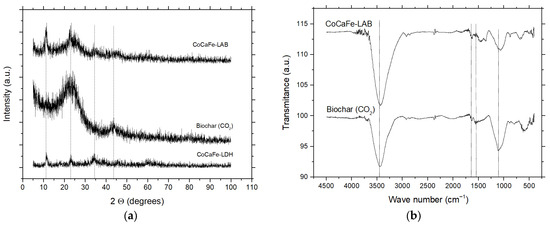
Figure 1a depicts the XRD patterns of CoCaFe-LAB, CoCaFe-LDH and biochar (CO2). The biochar XRD pattern depicts two peaks around 25° and 43°, which are related to graphitic disordered layers [32]. It noteworthy that the peaks around 11.28, 23.09 and 34.52°, present in the pure LDH, are also present in the CoCaFe-LAB composite. These peaks are characteristic of LDH, which suggests that the CoCaFe-LDH has been successfully incorporated into the biochar [33].
Figure 1.
(a) XRD patterns of the CoCaFe-LDH, biochar (CO2), and pristine composite; (b) FT-IR spectra of the biochar (CO2) and pristine composite. Dashed lines compares the peaks present in the materials.
The FT-IR spectra of the biochar and composite are depicted in Figure 1b. A broad valley at around 3400 cm−1, in each of the materials’ spectra, is attributed to free lattice water [34,35]. The valleys at around 1630 cm−1 are commonly assigned to -OH bending. The peak around 1550 cm−1, which appears in both spectra but with less intensity in the pristine composite, may be attributed to aromatic -CH, -COOH and/or C=C/C=O [36]. A collection of peaks from 1486 to 1373 cm−1 suggests the formation of carbonates [22,33]. The peaks around 1100 cm−1 may correlate to -C=O, -C-H and -C-O [35]. At around 680 and 500 cm−1, there is a valley in the biochar and composite spectra. This can be attributed to C-Cl and M-Cl ligations [34]. The collection of peaks around 470 to 400 cm−1, which are deeper for the pristine composite, may be attributed to O-M-O, M-O-M and M-O ligations (M = Ca, Co and Fe) [30]. The diminished signals observed at 1550 and 1100 cm−1 after coprecipitation suggest that the corresponding carbon functional groups participated in the anchoring of LDH to the biochar matrix. The growth in intensity observed around 3400 and 1630 cm−1 indicates that more -OH groups are present in the composite, which suggests the formation of hydroxyl groups and the presence of interlayer water molecules on the LDH.
Surface data from BET analysis are depicted in Table 1 for biochar (CO2) and CoCaFe-LAB. Following LDH deposition, the surface area and pore volume grew, while the pore diameter diminished. This indicates that LDH coverage may be ascribed to a uniform distribution over the biochar surface, while some of the biochar pores may have been covered with LDH. Other studies have drawn similar conclusions [36,37].
Table 1.
Surface data from BET analysis.
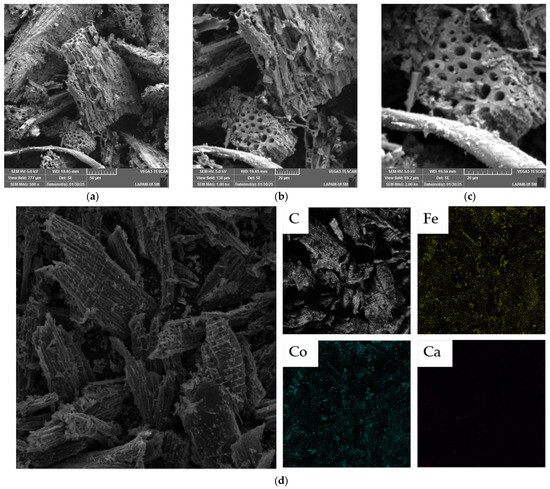
The morphology of pristine CoCaFe-LAB is depicted in Figure 2, at magnifications of 500, 1000 and 2000×. The images denote a heterogeneous surface. The well-distributed pores are a result of activation with CO2. Plates of LDH inside the pores and on the surface of the biochar are notable, which indicates a composition between the LDH and the activated biochar. Also, Figure 2d shows how the elements were dispersed in the pristine composite. It is noticeable that both Co, Ca and Fe are well distributed in the carbon matrix.
Figure 2.
SEM images of pristine composite at magnifications of (a) 500, (b) 1000 and (c) 2000×. (d) EDX mapping of CoCaFe at magnification of 500×.
3.2. Adsorption Experiments
3.2.1. Effect of Initial pH and Adsorbent Dosage on Adsorption
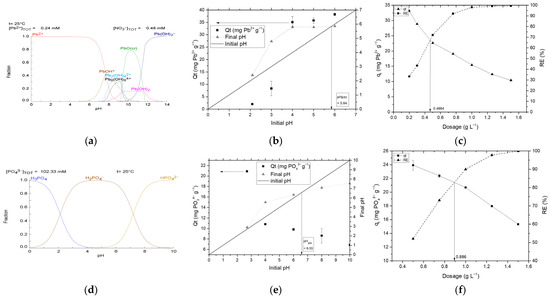
pH is a crucial parameter for adsorption studies. A change in this parameter tends to influence how the adsorbent and adsorbate interacts, especially due to the adsorbent’s pHpzc and the adsorbate’s pKa and speciation. Figure 3a,d depict the speciation of Pb2+ and PO34− in the studied pH range. Results of the pH influence on the adsorption of Pb2+ and PO43−, as well as the pHpzc in each system, are depicted in Figure 3b,e.
Figure 3.
Speciation graphic of (a) lead and (d) phosphate. Source: SPANA (available on: www.kth.se/che/medusa, accessed on 12 December 2025). pH influence on the capacity of adsorption and removal efficiency (RE) of (b) lead (experimental conditions: T = 25 °C, adsorbent dosage = 0.5 g/L, contact time: 4 h, C0 = 50 mg/L, V = 50 mL) and (e) phosphate (experimental conditions: T = 25 °C, adsorbent dosage = 1 g/L, contact time: 18 h, C0 = 25 mg/L, V = 25 mL). Dosage studies for (c) lead (experimental conditions: T = 25 °C, pH 5, contact time: 4 h, C0 = 50 mg/L, V = 50 mL) and (f) phosphate (experimental conditions: T = 25 °C, pH 2.5, contact time: 4 h, C0 = 25 mg/L, V = 25 mL).
Figure 3b indicates that the composite has a pHpzc of around 5.94 in Pb2+ solutions. Low adsorption capacity under acidic pHs (2.1 and 3) may happen due to competition between H+ and lead ions for active sites. The highest capacity of adsorption (38.19 mg Pb2+ g−1, 68.92%) occurred around pH 6, where the adsorbent has a negative induced charge, while Pb2+, PbNO3+ and Pb(NO3)2 are the dominant species. pH 5 was chosen, as the capacity and remotion under this condition (qt 37.76 mg Pb2+ g−1) were close to those at pH 6. This was done in order to avoid solution precipitation while correcting the pH in the next steps.
Figure 3e shows that the pHpzc in phosphate solution was around 6.55. The lowest adsorption capacity happened at pH 8 and 10. In this range, the majority of the adsorbate is speciated in the HPO42− form, the adsorbent has a negative induced charge, and there is probably site competition with OH− [38]. As the pH becomes less alkaline, the speciation shifts from HPO42− to H2PO4−, while the capacity slowly increases until pH 4 (qt. 10.81 mg PO43− g−1). The highest capacity was at pH 2.5 (20.89 mg PO43− g−1), where the major species is H2PO4−, but H3PO4 coexists. pH 2.5 was maintained for the next steps.
The influence of dosage results is depicted in Figure 3c,f for Pb2+ and PO43− adsorption, respectively. A common trend is observed: as the dosage increases, the removal efficiency rises and capacity decreases. The results show that a smaller dosage is needed to adsorb Pb2+ than PO34−, as the former reached 100% RE earlier. The ideal dosage is considered the point where adsorption capacity and removal trends intercept [8]. The intercept is at 0.48 g/L for Pb2+ and 0.886 g/L for PO43−. The dosages of CoCaFe-LAB were fixed at 0.5 g/L for lead adsorption and 0.88 g/L for phosphate adsorption.
3.2.2. Kinetic Studies
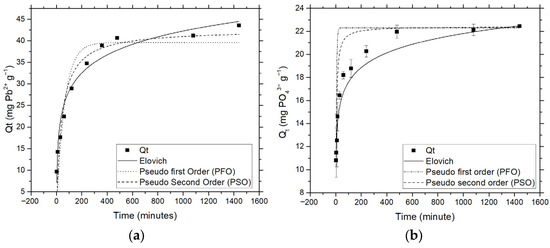
The kinetic data are depicted in Figure 4a,b, and the parameters of the fitted models for lead and phosphate adsorption, respectively, are shown in Table 2. According to the data shown, the best fitted kinetic model was Elovich in both scenarios. This suggests a heterogeneously distributed adsorption energy through the systems and that chemisorption may occur in both systems [39,40]. The value of α indicates how fast initial adsorption occurs [41] and denotes a faster initial rate for phosphate adsorption than for lead (6.56 mg Pb2+ g−1 min−1 and 271.10 mg PO43− g−1 min−1). As the system did not find a complete equilibrium through the range of time tested, the contact times of 18 h for Pb2+ and 8 h for PO43− were chosen due to the small change in adsorption capacity and removal efficiency after such times.
Figure 4.
Kinetic curves for the adsorption of (a) lead (experimental conditions: T = 25 °C, adsorbent dosage = 0.5 g/L, pH 5, C0 = 50 mg/L, V = 50 mL) and (b) phosphate (experimental conditions: T = 25 °C, adsorbent dosage = 0.88 g/L, pH 2.5, C0 = 25 mg/L, V = 25 mL).
Table 2.
Kinetic parameter data calculated for the adsorption of Pb2+ and PO34− on to the composite. The adjusted models were pseudo-first-order (PFO), pseudo-second-order (PSO) and Elovich.
3.2.3. Equilibrium Studies
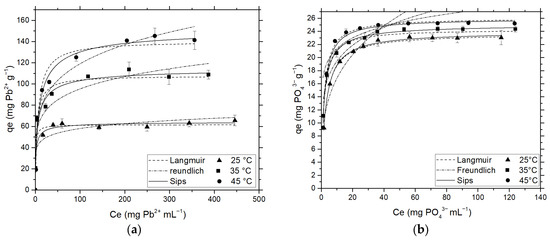
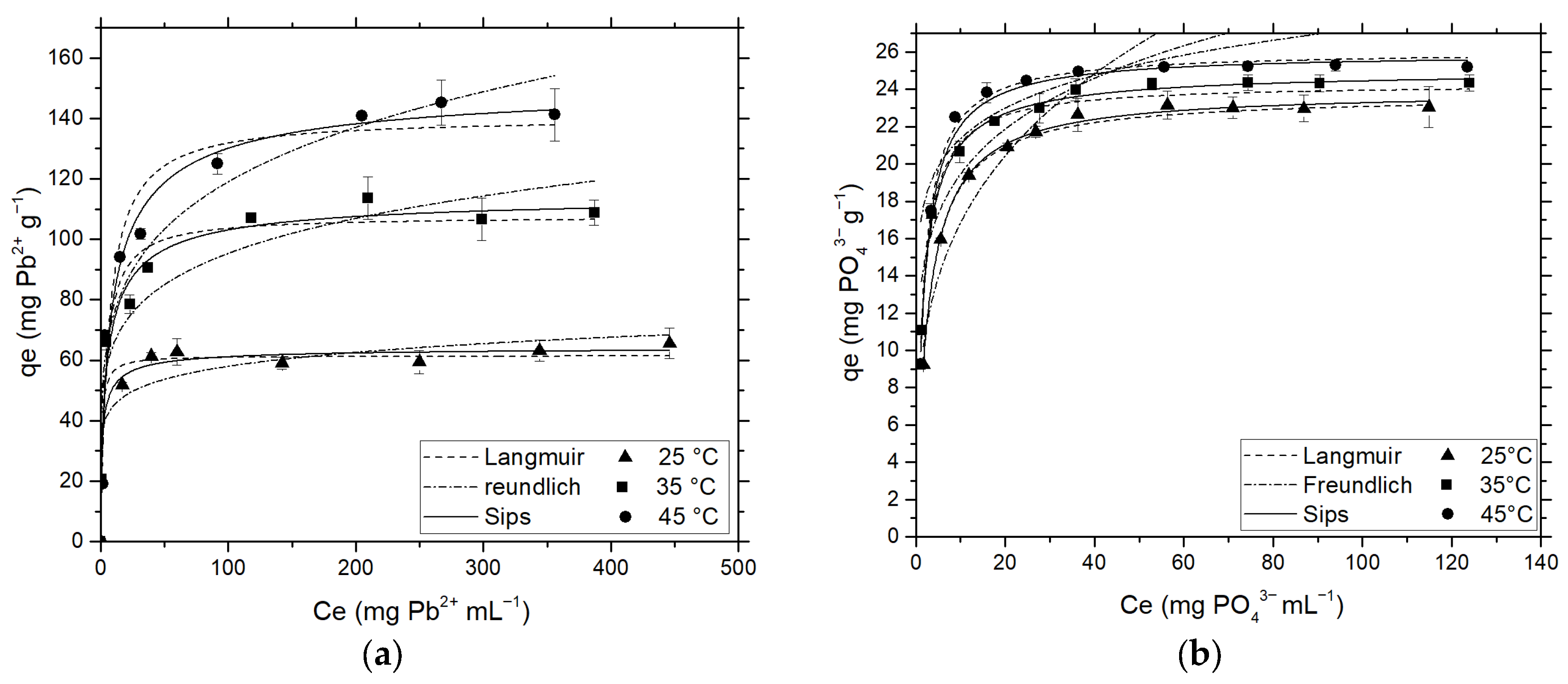
Equilibrium data for lead adsorption and phosphate adsorption are depicted in Figure 5a and Figure 5b, respectively. The fitted model parameters for lead and phosphate, respectively, are in Table 3 and Table 4. Both systems show good affinity for the adsorbate, especially in the low-concentration range. As the initial concentration rises, the lead system seems to get closer to a constant equilibrium capacity, which is found in the phosphate system. The best-fitted models were those with R2adj values closest to unity and the smallest chi-square [42,43] and ARE [8]. Numerically, both systems were better fitted with the Sips isotherm.
Figure 5.
Equilibrium isotherms for (a) lead (experimental conditions: T = 35 °C, adsorbent dosage = 0.5 g/L, pH 5, contact time: 18 h, C0 = 20–500 mg/L, V = 50 mL) and (b) phosphate (experimental conditions: T = 35 °C, adsorbent dosage = 0.88 g/L, contact time: 8h, C0 = 5–150 mg/L, V = 25 mL).
Table 3.
Lead adsorption isotherm parameters for the composite. Adjustments made to Langmuir, Freundlich and Sips models.
Table 4.
Phosphate adsorption isotherm parameters for the composite. Adjustments made to Langmuir, Freundlich and Sips models.
The lead system had a maximum calculated adsorption capacity (qmS) of 66.50, 119.30 and 147.42 mg Pb2+ g−1 at 25, 35 and 45 °C, respectively, while the maximum capacity observed (qmexp) was 140.81 mg Pb2+ g−1 at 45 °C. The nS values calculated at 25, 35 and 45 °C were 0.58, 0.77 and 0.81, which implies that the adsorption system goes from a more heterogeneous to a more homogeneous one (as the Sips model tends to the Langmuir model when nS tends to 1). Also, the Sips isotherm constant (KS) changes from 0.74 to 0.22 and, finally, 0.20 within the same temperature range. This may suggest that the system tends to have more high-energy sites at higher temperatures, as the Sips model gets closer to the Freundlich model when KS tends to 0. This analysis may imply chemical adsorption in a multilayer fashion, but not one that rises infinitely.
In the case of phosphate, the qmS values were 23.97, 24.72 and 26.04 mg PO43− g−1 at 25, 35 and 45 °C, respectively, while the qmexp value was 25.19 mg PO43− g−1. The nS calculated in the temperature range was very close to 1, which indicates that the system has a behavior similar to that of a system fitted to the Langmuir model. Also, KS goes from a lower value (0.38, at 25 °C) to a higher one (0.62, at 45 °C), which too suggests a system closer to Langmuir than to Freundlich. These findings suggest chemical adsorption, with specific sites for phosphate to interact.
A comparison between lead and phosphate adsorption capacities with other materials and studies is depicted in Table 5. The material shows good adsorption performance for both adsorbates but is clearly more efficient for lead removal.
Table 5.
Comparative table of maximum capacity calculated to other materials/authors.
3.2.4. Thermodynamic Studies
The thermodynamic data for the adsorption of lead and phosphate are depicted in Table 6. Both systems were better fitted to the Sips model, so Equation (S12) was used to transform KS [(L mg−1)nS] into Ke0 (dimensionless); then the parameters were calculated with Equation (S10) and the Van ’t Hoff equation (Equation (S11)) (see Section S1.4 in the Supplementary Materials).
Table 6.
Thermodynamic parameters calculated for the adsorption of lead and phosphate onto the composite.
Data show that both systems have negative ΔG0 values across the entire temperature range, which implies their spontaneity. ΔG0 also suggests the nature of adsorption, with physisorption in the range of −20 to 0 kJ mol−1, while chemisorption has ΔG0 in the range of −80 to −400 kJ mol−1 [51]. As both of ΔG0 values are between those ranges, it is possible to say that the systems seem to be stronger than physisorption, but weaker than chemisorption.
For lead adsorption, ΔH0 (=−59.23 kJ mol−1) indicates an exothermic reaction, while phosphate adsorption seems endothermic (ΔH0 = 19.17 kJ/mol−1). ΔH0 can also be used to investigate adsorption mechanisms [52]. Ligand-exchange and/or ion-bonding phenomena usually have ΔH0 around 40 kJ mol−1, hydrogen bonds around 2–40 kJ mol−1, dipole–dipole interactions around 2–29 kJ mol−1, and chemisorption around 15–20 kJ mol−1. This suggests that Pb2+ adsorption may occur through ligand exchange and/or ion bonding, while phosphate adsorption may occur through hydrogen bonding, dipole–dipole interactions or chemisorption [52]. As for ΔS0, lead adsorption seems to diminish neighborhood randomness (ΔS0 < 0), while phosphate adsorption augments this randomness (ΔS0 > 0). Although a positive value of ΔS0 is not common, this may be explained if one molecule of phosphate displaces one or more water molecules during the adsorption process [53], which may be the case for the interlayers of LDH.
3.2.5. Coexisting Ions
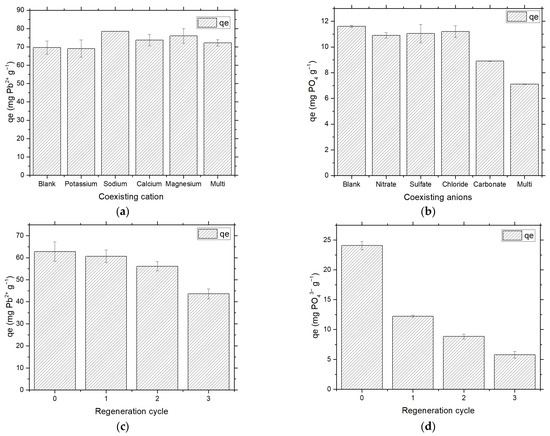
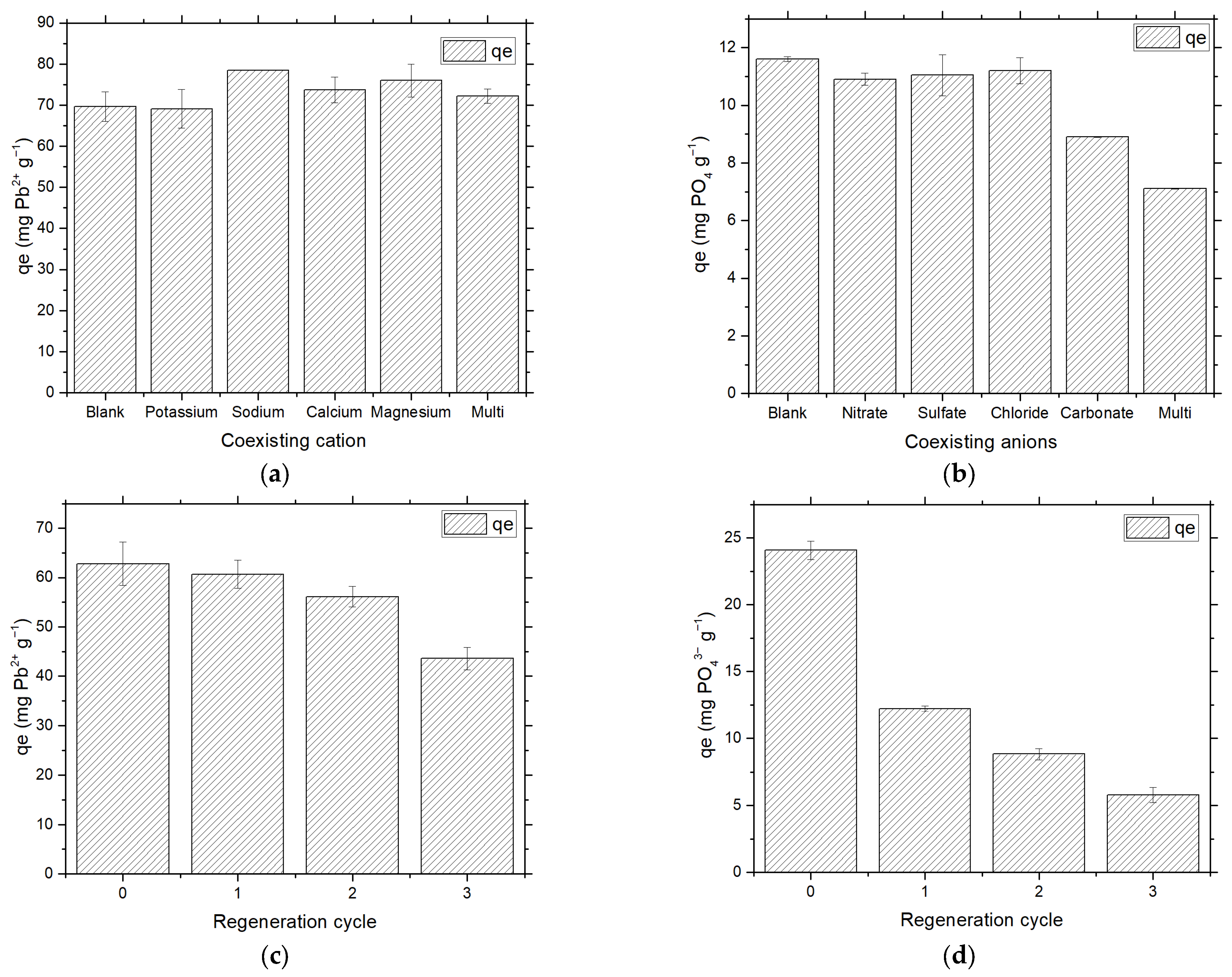
When disposed of in nature, wastewater commonly has a more complex constitution than a single ion solution. In an effort to emulate the conditions of real effluent and study the selectiveness of the adsorbent, a set of experiments was conducted in multi-ion solutions. For the adsorption of lead, potassium (K+), sodium (Na+), calcium (Ca2+), and magnesium (Mg2+) were studied. For phosphate, the anions were nitrate (NO3−), sulfate (SO42−), chloride (Cl−) and carbonate (CO32−). In both scenarios, a mixed solution of cations or anions was also studied, with all the cations or anions included (labeled as “multi”). The results are depicted in Figure 6a for lead and Figure 6b for phosphate.
Figure 6.
(a) Coexisting cation on lead adsorption (100 ppm of each cation, 25 °C, pH 5, 18 h, 0.5 g L−1, 50 mL); (b) coexisting anions on phosphate adsorption (50 ppm of each anion, 25 °C, natural pH, 8 h, 0.88 g L−1, 25 mL); the effect of regeneration cycles on (c) lead and (d) phosphate.
The presence of other cations on lead adsorption did not diminish the adsorption capacity of lead, and a small increment was observed for all cations except potassium. A possible explanation for this effect is that the presence of lighter metals and salts may activate active sites, such as carboxyl groups, enhancing adsorption [14]. However, this may not be the case for potassium, which is an ion with a radius greater than Pb2+ and may thus have lower priority in competition.
As for the phosphate systems, a small decrease was observed for the single coexisting anions, and carbonate had a bigger decrease. As for the multi-system, the capacity for phosphate was the smallest. This may have happened due to competition for the sites on the lamella of LDH, as carbonate is usually better adsorbed than phosphate in these materials [15]. A hypothesis for this observation is the influence of the ionic radii of the competitive ions. Studies pointed out that smaller anions are prone to be better adsorbed by the adsorbents [54]. The order for the studied radii is CO32− (0.189 nm) < Cl− (0.191 nm) < NO3− (0.200 nm) < SO42− (0.218 nm) [54] < H2PO42− (< 0.269 nm) [55]. The ionic order seems to explain the small negative effects of all anions, and the greater effect of carbonate presence. Also, it suggests that in greater anionic concentrations, as seen in the multi-anion system, this competition intensifies.
3.2.6. Recyclability of CoCaFe-LAB
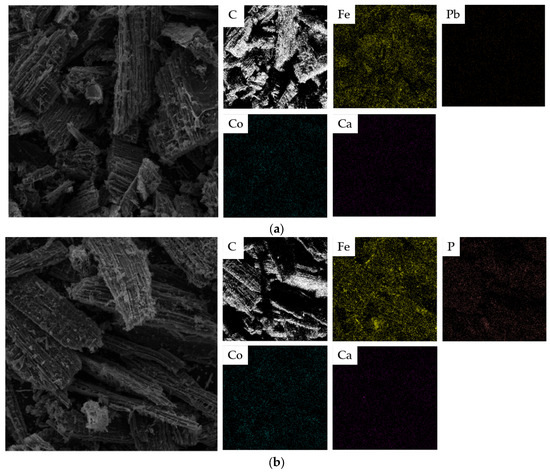
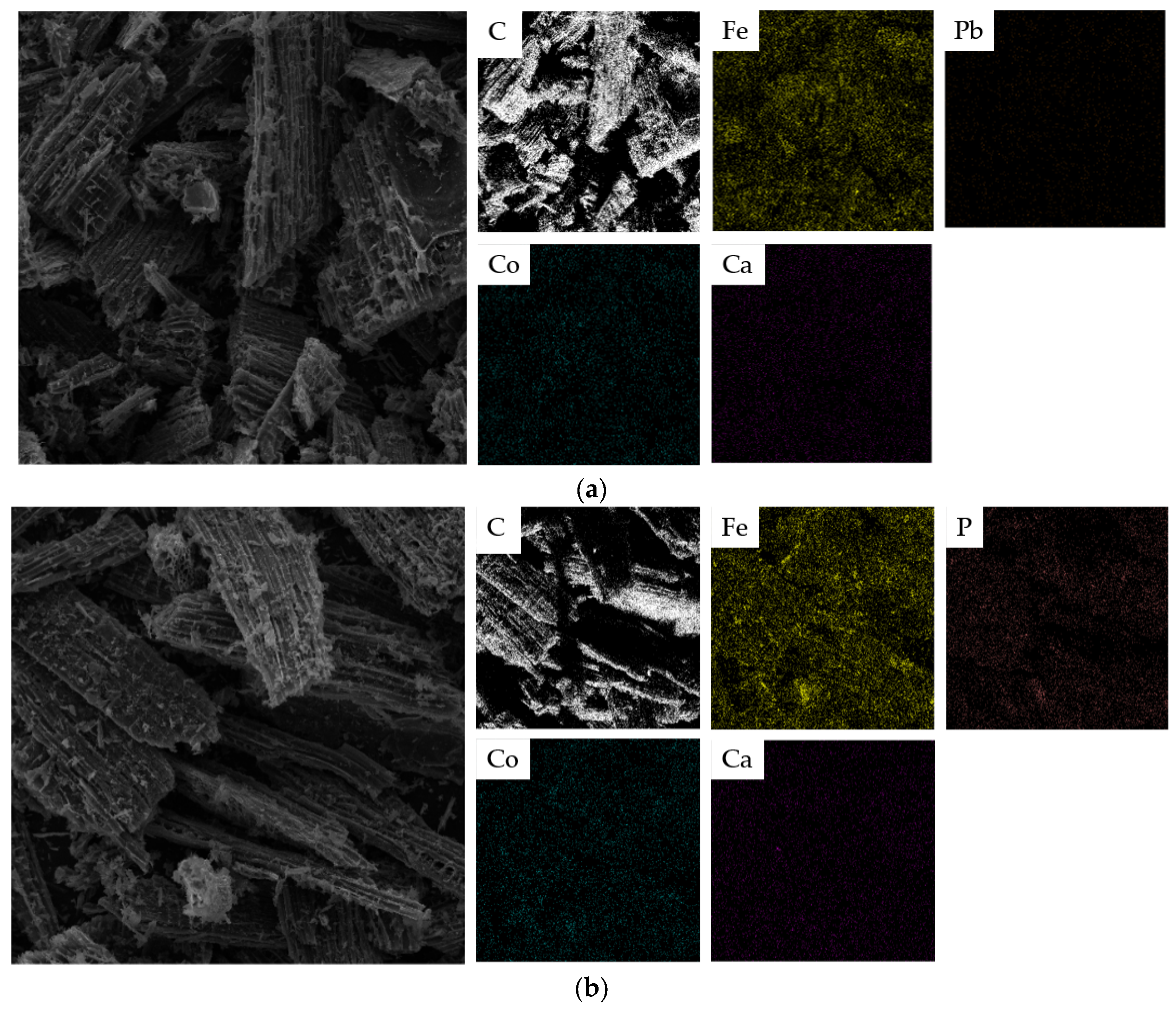
Recyclability is an important factor to adsorbents. The ability to retain part of its original adsorption capacity when desorbed is of economic importance, as it enables its usage in more than just one cycle. In this study, NaOH 1 M solution was chosen as eluent for both adsorbates, as some other studies have found this solution useful for this purpose [8,44]. Figure 6c depicts the effect of recycling on Pb2+ adsorption, while Figure 6d depicts that of PO43−. One can see that in both cases, recyclability had an impact on adsorption, and that this effect was more evident for phosphate adsorption. After the third cycle, Pb2+ adsorption represented 70.5% of its original value, while the phosphate adsorption was 24%. LDH composites are prone to exfoliation, which may address part of the observed loss [30,31]. Figure 7 shows the morphology of the composites after the third desorption–adsorption and depicts the exfoliation of the LDH composite. Analyzing the EDX mapping in Figure 7, it is noticeable that both ions are well dispersed in the composite matrix, even after a third round of adsorption. As for phosphate adsorption, it is possible that the regeneration process was not enough to desorb all the adsorbed anions, which would lead to filled sites in the next cycle of adsorption.
Figure 7.
SEM-EDX mapping images of composites after three cycles of desorption–adsorption of (a) Pb2+ and (b) PO43−. The images have magnification of 500×.
3.2.7. Mechanisms of Adsorption
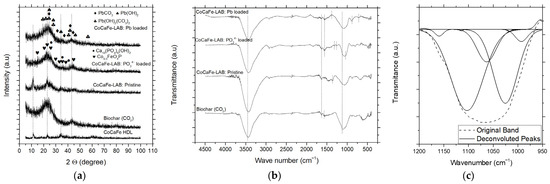
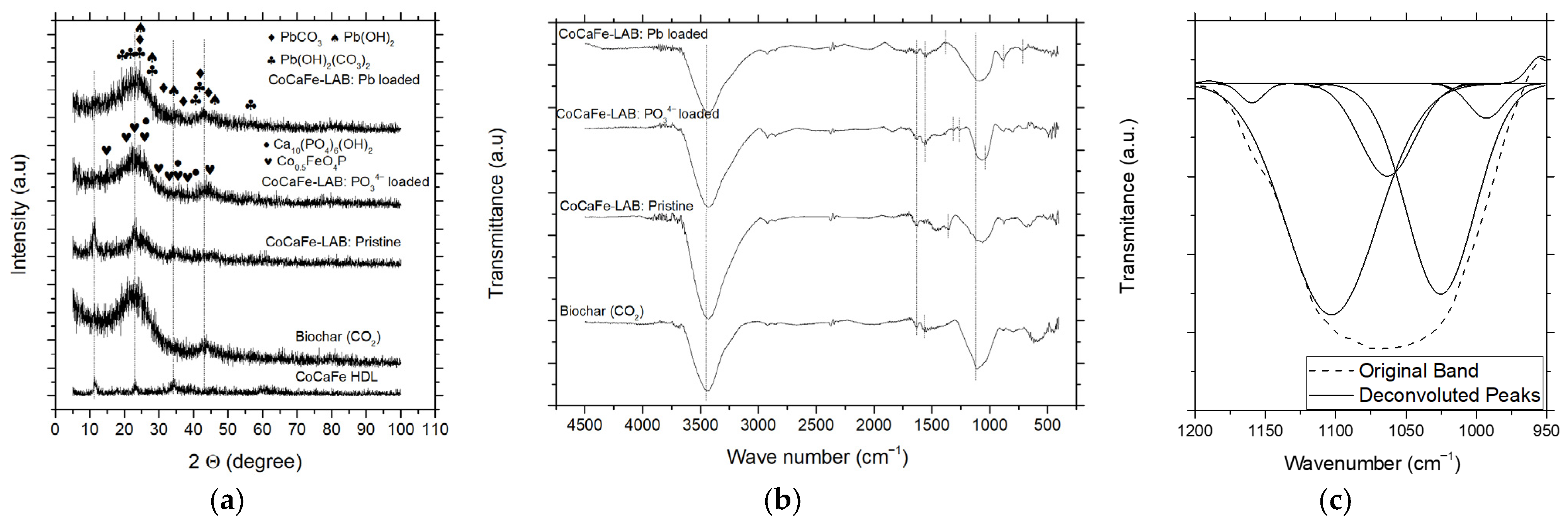
To investigate the mechanism involved in the adsorption of either lead or phosphate onto the composite, information on the materials after three cycles of desorption–adsorption cycle was used: a diffractogram (Figure 8a) and a FT-IR spectra (Figure 8b). Also, thermodynamic data (Section 3.2.4) were used as reference. FT-IR spectra after lead adsorption shows some changes when compared to the pristine composite. The band around 3460 cm−1, assigned to -OH, lost intensity and got wider. This may suggest that -OH participated in the formation of complexes with Pb2+ [56]. The peaks at 2928 and 2841 cm−1, assigned to -C-H asymmetrical and symmetrical vibration, gained some intensity. This may suggest that π–cation interactions happened after adsorption. A new series of peaks emerged at wavelengths between 2721 and 2240 cm−1. This range may be assigned to carboxylates [35], also suggesting complexation of carboxylic acids with Pb2+. The peaks around 2333 and 2319 cm−1 may be assigned to C=C and also increased. This too may suggest π–cation interaction after Pb2+ adsorption. There was formation of a new valley between 1350 and 940 cm−1, followed by a second, smaller valley between 946 and 815 cm−1. The first valley formed in a region with C-O stretching (1205–1087 cm−1) and may indicate carbonate formation. The second valley is associated with C-H twisting and wagging (1350 to 1150 cm−1) [35], which again suggests π–cation interactions. A small peak at 1380, followed by peaks around 880 and 715 cm−1, is attributed to Pb2+ in its nitrate form [33] and may indicate that lead was adsorbed by the composite. Another valley, between 930 and 830 cm−1, may indicate the formation of new -O-M-O, M-O-M, and O-M bonds, which are assigned between 1000 and 500 cm−1 [8].
Figure 8.
(a) Diffractogram and (b) FT-IR spectra of the pure HDL, pure biochar, pristine composite and composites after three cycles of desorption and adsorption with phosphate or lead. The deconvolution of the valley between 950 and 1200 cm−1 on the spectra of phosphate adsorption is presented in (c).
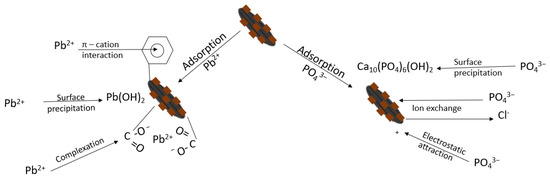
Analyses of XRD patterns after Pb adsorption (Figure 8a) give more insights into the mechanism of lead adsorption onto the composite. The marked signs are PbCO3, Pb(OH)2, and Pb3(OH)2(CO3)2 (from JCPDS charts No. 47-1734, 11-0270 and 13-0131) [57]. The patterns seem to indicate that surface precipitation is one of the mechanisms, and it also corroborates the hypothesis of carbonate formation. Thermodynamic studies, through the heat of adsorption, suggest that ligand exchange and/or ion bonding may occur in the system. In summary, π–cation interactions, surface precipitation and surface complexation seem to be the major mechanisms of lead adsorption onto the composite. These conclusions are similar to those of other studies with similar materials [12,33,45,56,58].
As for phosphate, Figure 8b also depicts some changes in the FT-IR spectra after phosphate adsorption. The valley around 3430 cm−1, assigned to -OH, shifted to a lower intensity and got broader. This may suggest that -OH participated in phosphate adsorption. The small peaks around 2930 and 2845 cm−1 shifted to 2911 and 2848 cm- 1 and grew in intensity. This suggests that -C-H groups were somehow excited after phosphate adsorption. The peak around 1630, also assigned to -OH, lost intensity after adsorption. This too suggests that -OH participates in the adsorption of phosphate. The small peaks around 1300 and 1250, which are attributed to P-OH, as well as enlargement at 1040 cm−1, attributed to P-O-P, appear after PO34−, indicating that phosphate was adsorbed onto the composite [35]. A valley is seen between 1200 and 960 cm−1. This wavelength range is known to accommodate most signals for phosphate and its species, so this peak was deconvoluted. The results of deconvolution are seen in Figure 8c. Five peaks were deconvoluted at 1160, 1103, 1061, 1024 and 993 cm−1. These are related to phosphate reacting with the metallic phase, asymmetric vibration of PO32−, symmetrical vibration of PO32− [22], aliphatic P-O-C interactions and P-O-P interactions [35], respectively. Also, the absence of the valley attributed to M-Cl and C-Cl (between 680 and 500 cm−1) suggests that chloride was dislocated during adsorption, which may address ionic exchange.
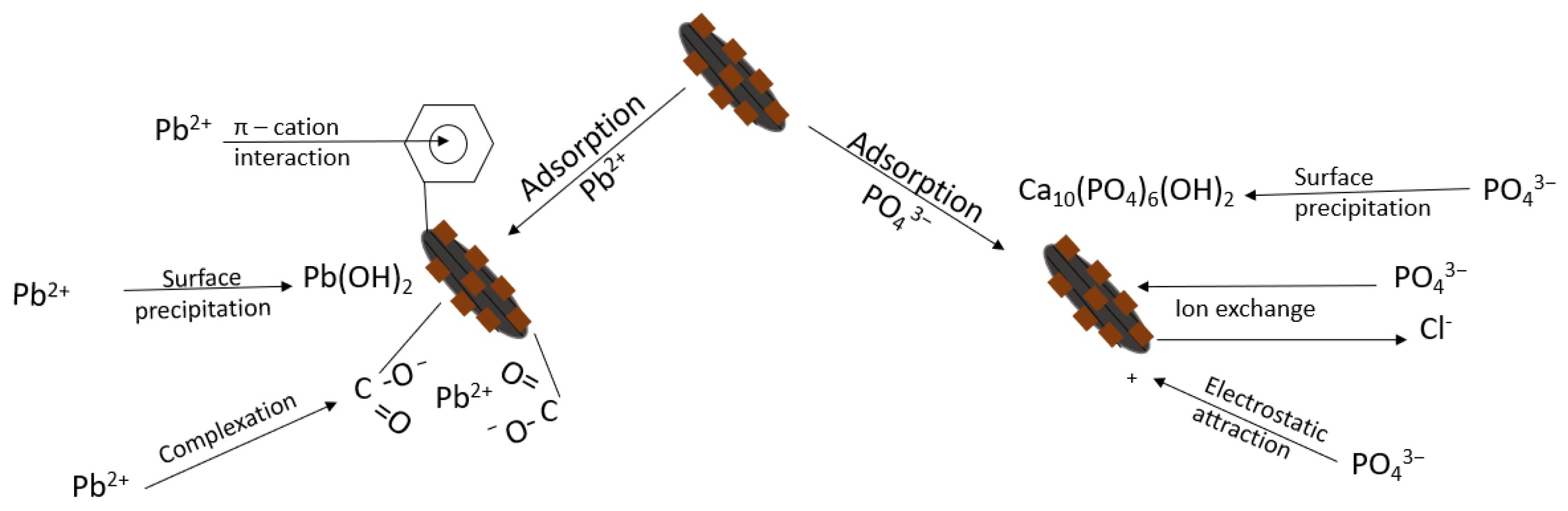
The XRD pattern of the composite after the adsorption of phosphate (Figure 8a) suggests that Ca10(PO4)6(OH)2 and Co0.5FePO4 formed on the surface. Also, the pH studies (Section 3.2.1) suggest that electrostatic attraction may occur at this pH (pH = 2.5). These findings suggest that superficial precipitation, electrostatic attraction and ion exchange are some of the adsorption mechanisms for the phosphate system. Other authors have also suggested similar mechanisms for phosphate adsorption [13,16,22,23,59]. Figure 9 shows an illustrative representation of the main mechanisms discussed.
Figure 9.
Illustrative representation of adsorption mechanism of lead and phosphate onto the composite.
3.2.8. Real Effluents Tests
Part of real effluent characterization, containing most of the inorganic anions, chemical oxygen demand (COD) and total organic carbon (TOC), is depicted in Table 7. Complete characterization can be found in the literature [5]. One can notice that the concentrations of sulfate and chloride are much higher than that of phosphate. Nitrate is also at a higher concentration than phosphate, but not as high as sulfate. Also, a myriad of organic compounds were identified, which are related to COD and TOC.
Table 7.
Concentration of inorganic anions, chemical oxygen demand (COD) and total organic carbon (TOC) in DSA and BBD effluents.
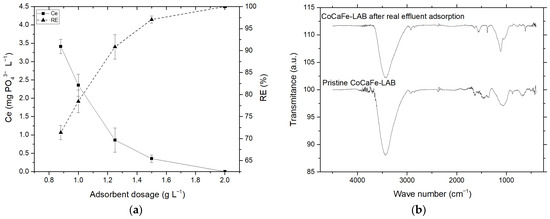
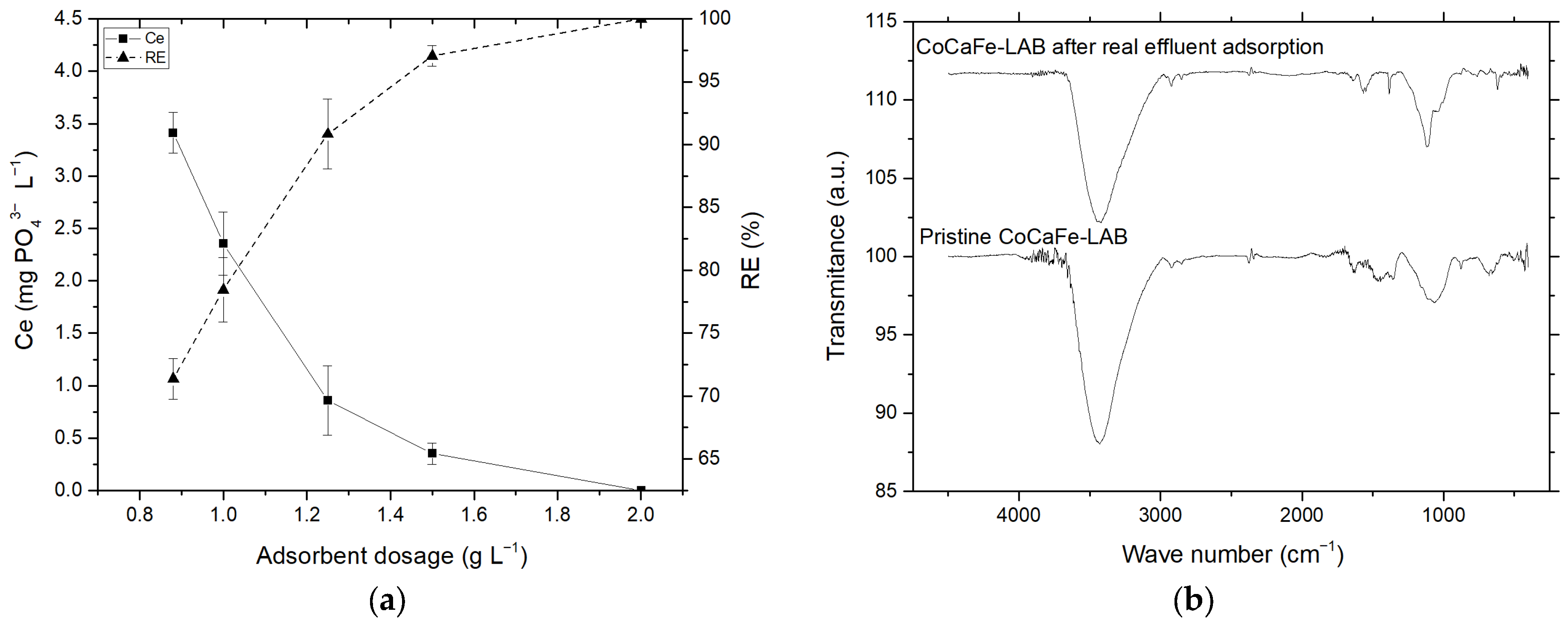
The results of adsorption in real effluent, expressed as the final concentration (Ce) and phosphate removal efficiency (RE), are depicted in Figure 10a. The initial phosphate concentration of BBD effluent solution was 12.28 mg PO43− L−1. As the adsorbent dosage rose, phosphate removal increased, and the final concentration decreased. Brazilian legislation sets a maximum value for phosphorus emission of 0.1 mg P L−1 in lotic environments (around 0.31 mg PO43− L−1 if all the phosphorus is in phosphate form). At an adsorbent dosage of 1.5 g L−1, the final concentration is 0.35 mg PO43− L−1, which represents a phosphate removal rate of 97.06%. Complete removal is observed at a dosage of 2.0 g L−1. By observing the information from isotherms, a lower adsorbent dosage should be necessary to achieve such final concentrations. To explain these observations, characterization of the effluent (Table 7) [5] and FT-IR spectra of the adsorbent after adsorption (Figure 10b) was evaluated.
Figure 10.
(a) Final concentration (Ce) and removal efficiency (RE) of phosphate from real effluent and (b) FT-IR spectra of adsorbents post real effluent adsorption.
From Table 7, one can assume that the observed adsorption of phosphate may be assigned to the high concentration of other anions, as sulfate and chloride are present at much higher concentrations than phosphate. The post-adsorption composite FT-IR spectra, depicted in Figure 10b, give more information on this matter. The presence of sulfate in the adsorbent post adsorption may be assigned to the wavelengths of 1116, 1109 [60] and 605 cm−1 [61], while nitrate has a wavelength around 1390 and 1380 [62,63,64].
Ionic competition experiments (Section 3.2.5) showed that the anions studied had a small decreasing effect on the adsorption of phosphate. The thesis that ionic radii influence the decrease in adsorption capacity over phosphate seems stronger here. The concentration of such anions (sulfate, nitrate and chloride) is much higher than that of phosphate, seemingly making the ionic competition increase. Therefore, facing the complex media of real effluents, the phosphate adsorption observed by CoCaFe-LAB is satisfactory. Other differences in the post-adsorption FT-IR spectra may be assigned to a myriad of organic compounds found in these solutions, which are correlated with COD and TOC. This indicates that the proposed adsorbent is efficient toward inorganic anions, as well as heavy metals (as suggested by the lead adsorption tests), and there are hints of effectiveness in the removal of some organic compounds (as suggested by the FT-IR spectra after real solution essays), making it a good candidate for use in this type of effluent.
4. Conclusions
This study investigated the synthesis and characterization of the CoCaFe-LAB composite using XRD, FT-IR, SEM, and BET techniques. The material demonstrated effective adsorption of phosphate and lead ions individually in synthetic media. Following optimization studies, the ideal conditions for lead adsorption were determined to be pH 5 and an adsorbent dosage of 0.5 g·L−1, while phosphate adsorption was optimized at pH 2.5 with a dosage of 0.88 g·L−1. These results indicate that lead requires a lower adsorbent dosage compared to phosphate.
Kinetic and equilibrium analyses revealed that the Elovich model best described the adsorption kinetics, while the Sips model provided the best fit for equilibrium data in both systems. Equilibrium times were established as 18 h for lead and 8 h for phosphate. The experimentally observed maximum adsorption capacities were 140.81 mg·g−1 for lead (Pb2+) (0.5 g·L−1, 18 h, pH 5) and 25.19 mg·g−1 for phosphate (PO43−) (0.88 g·L−1, 8 h, pH 2.5). Predictions from the Sips model closely matched these values, estimating capacities of 136.855 mg·g−1 for lead and 26.031 mg·g−1 for phosphate. Thermodynamic analysis confirmed that the adsorption processes were spontaneous for both ions. Lead adsorption was exothermic, resulting in decreased system disorder, whereas phosphate adsorption was endothermic, increasing system disorder.
Experiments with coexisting ions showed that lead adsorption remained nearly unaffected by the presence of other cations. In contrast, phosphate adsorption capacity decreased in the presence of carbonate and in multi-anion systems. Reusability assessments revealed that the adsorbent retained 70% of its original lead adsorption capacity after three cycles, while phosphate retention dropped to 24%. Mechanistic insights suggest that lead adsorption occurs via surface precipitation, surface complexation, and π–cation interactions. Phosphate adsorption likely involves surface precipitation, electrostatic attraction, and ion exchange. In real effluent applications, CoCaFe-LAB achieved up to 100% removal efficiency for lead in electro-oxidized landfill leachate at a dosage of 2.0 g·L−1, despite strong competition from sulfate and chloride ions.
Overall, CoCaFe-LAB shows promising dual-functionality for removing both a toxic metal cation (lead) and an inorganic anion (phosphate), making it a strong candidate for use in the polishing stage of landfill leachate treatment. Additionally, the constituent cations of the composite can be sustainably sourced from electronic waste.
Supplementary Materials
The following supporting information can be downloaded at: https://www.mdpi.com/article/10.3390/pr14060897/s1, Section S1: Adsorption experiments. References [65,66,67,68,69,70] are cited in the Supplementary Materials.
Author Contributions
Conceptualization, E.C., M.A.S.R., A.M.B., E.H.T. and D.A.B.; methodology, E.C., E.H.T. and D.A.B.; formal analysis, E.C.; investigation, E.C. and S.B.; writing—original draft, E.C.; writing—review and editing, E.C., E.H.T. and D.A.B.; supervision, D.A.B. and E.H.T. All authors have read and agreed to the published version of the manuscript.
Funding
The authors would like to thank the following agencies for providing financial support: CNPq (National Council of Science and Technological Development), CAPES (Coordination for the Improvement of Higher Education Personnel), FAPERGS (Research Support Foundation of the State of Rio Grande do Sul) (INOVA TECHNOLOGICAL CLUSTERS—Grant Agreement 22/2551-0000833-0; INOVA AGRO—Grant Agreement 67936.729.19326.20102022), and SDECT (Secretary of Economic Development, Science and Technology of the State of Rio Grande do Sul).
Data Availability Statement
The raw data supporting the conclusions of this article will be made available by the authors on request.
Conflicts of Interest
The authors declare no conflicts of interest.
References
- Li, Y.-J.; Yuan, Y.; Tan, W.-B.; Xi, B.-D.; Wang, H.; Hui, K.-L.; Chen, J.-B.; Zhang, Y.-F.; Wang, L.-F.; Li, R.-F. Antibiotic Resistance Genes and Heavy Metals in Landfill: A Review. J. Hazard. Mater. 2024, 464, 132395. [Google Scholar] [CrossRef] [Scilit]
- Remmas, N.; Manfe, N.; Zerva, I.; Melidis, P.; Raga, R.; Ntougias, S. A Critical Review on the Microbial Ecology of Landfill Leachate Treatment Systems. Sustainability 2023, 15, 949. [Google Scholar] [CrossRef] [Scilit]
- Omar, H.; Rohani, S. Treatment of Landfill Waste, Leachate and Landfill Gas: A Review. Front. Chem. Sci. Eng. 2015, 9, 15–32. [Google Scholar] [CrossRef] [Scilit]
- Bashir, M.J.K.; Aziz, H.A.; Aziz, S.Q.; Abu Amr, S.S. An Overview of Electro-Oxidation Processes Performance in Stabilized Landfill Leachate Treatment. Desalination Water Treat. 2013, 51, 2170–2184. [Google Scholar] [CrossRef] [Scilit]
- Illi, J.; Giacobbo, A.; da Silva, S.W.; Stefens, J.L.; Bernardes, A.M.; Siqueira Rodrigues, M.A. Advanced Electrochemical Oxidation and Membrane Distillation for the Treatment of Landfill Leachate Concentrated by Reverse Osmosis. Sep. Purif. Technol. 2025, 370, 133229. [Google Scholar] [CrossRef] [Scilit]
- Renou, S.; Givaudan, J.G.; Poulain, S.; Dirassouyan, F.; Moulin, P. Landfill Leachate Treatment: Review and Opportunity. J. Hazard. Mater. 2008, 150, 468–493. [Google Scholar] [CrossRef] [Scilit]
- Mojiri, A.; Zhou, J.L.; Ratnaweera, H.; Ohashi, A.; Ozaki, N.; Kindaichi, T.; Asakura, H. Treatment of Landfill Leachate with Different Techniques: An Overview. J. Water Reuse Desalination 2021, 11, 66–96. [Google Scholar] [CrossRef] [Scilit]
- Missau, J.; Rodrigues, M.A.S.; Bertuol, D.A.; Tanabe, E.H. Phosphate Adsorption Improvement Using a Novel Adsorbent by CaFe/LDH Supported onto CO2 Activated Biochar. Water Sci. Technol. 2022, 86, 2396–2414. [Google Scholar] [CrossRef] [Scilit]
- Chen, Y.; Wang, H.; Zhao, W.; Huang, S. Four Different Kinds of Peels as Adsorbents for the Removal of Cd (II) from Aqueous Solution: Kinetics, Isotherm and Mechanism. J. Taiwan Inst. Chem. Eng. 2018, 88, 146–151. [Google Scholar] [CrossRef] [Scilit]
- Sannino, F.; Ruocco, S.; Marocco, A.; Esposito, S.; Pansini, M. Cyclic Process of Simazine Removal from Waters by Adsorption on Zeolite H-Y and Its Regeneration by Thermal Treatment. J. Hazard. Mater. 2012, 229–230, 354–360. [Google Scholar] [CrossRef] [Scilit]
- Dong, Y.; Kong, X.; Luo, X.; Wang, H. Adsorptive Removal of Heavy Metal Anions from Water by Layered Double Hydroxide: A Review. Chemosphere 2022, 303, 134685. [Google Scholar] [CrossRef] [Scilit]
- Zhang, J.W.; Nur’aini, A.D.; Wang, Y.C.; Hai, N.D.; Van Minh, D.; Chao, H.P. Multiple Pollutants Removal by Carbon Sphere and Layered Double Hydroxide Composites: Adsorption Behavior and Mechanisms. J. Environ. Chem. Eng. 2022, 10, 108014. [Google Scholar] [CrossRef] [Scilit]
- Buates, J.; Imai, T. Biochar Functionalization with Layered Double Hydroxides Composites: Preparation, Characterization, and Application for Effective Phosphate Removal. J. Water Process Eng. 2020, 37, 101508. [Google Scholar] [CrossRef] [Scilit]
- Feng, X.; Long, R.; Wang, L.; Liu, C.; Bai, Z.; Liu, X. A Review on Heavy Metal Ions Adsorption from Water by Layered Double Hydroxide and Its Composites. Sep. Purif. Technol. 2022, 284, 120099. [Google Scholar] [CrossRef] [Scilit]
- Mittal, J. Recent Progress in the Synthesis of Layered Double Hydroxides and Their Application for the Adsorptive Removal of Dyes: A Review. J. Environ. Manage. 2021, 295, 113017. [Google Scholar] [CrossRef] [Scilit] [PubMed]
- Park, J.Y.; Lee, J.; Go, G.M.; Jang, B.; Cho, H.B.; Choa, Y.H. Removal Performance and Mechanism of Anti-Eutrophication Anions of Phosphate by CaFe Layered Double Hydroxides. Appl. Surf. Sci. 2021, 548, 149157. [Google Scholar] [CrossRef] [Scilit]
- Tamahrajah, J.; Goncharova, I.; Pytskii, I.; Shiryaev, A.A.; Averin, A.A.; Kiselev, M.R.; Shaphigulina, A.; Basirun, W.J.; Buryak, A.K.; Pethukova, G.A.; et al. X-Ray Coupled Laser Desorption Ionization Assessment of Layered Double Hydroxides for Nitrate Adsorption Based on Ion Size, Affinity and Compromised Layer Height. Appl. Clay Sci. 2017, 143, 134–141. [Google Scholar] [CrossRef] [Scilit]
- Bobde, P.; Sharma, A.K.; Panchal, D.; Sharma, A.K.; Patel, R.K.; Dhodapkar, R.S.; Pal, S. Layered Double Hydroxides (LDHs)-Based Photocatalysts for Dye Degradation: A Review. Int. J. Environ. Sci. Technol. 2022, 20, 5733–5752. [Google Scholar] [CrossRef] [Scilit]
- Fang, Q.; Ye, S.; Yang, H.; Yang, K.; Zhou, J.; Gao, Y.; Lin, Q.; Tan, X.; Yang, Z. Application of Layered Double Hydroxide-Biochar Composites in Wastewater Treatment: Recent Trends, Modification Strategies, and Outlook. J. Hazard. Mater. 2021, 420, 126569. [Google Scholar] [CrossRef] [Scilit]
- dos Santos, G.E.d.S.; Lins, P.V.d.S.; Oliveira, L.M.T.d.M.; Silva, E.O.d.; Anastopoulos, I.; Erto, A.; Giannakoudakis, D.A.; Almeida, A.R.F.d.; Duarte, J.L.d.S.; Meili, L. Layered Double Hydroxides/Biochar Composites as Adsorbents for Water Remediation Applications: Recent Trends and Perspectives. J. Clean. Prod. 2021, 284, 124755. [Google Scholar] [CrossRef] [Scilit]
- İskurt, Ç.; Aliyev, E.; Gengec, E.; Kobya, M.; Khataee, A. Electrochemical Oxidation of Pretreated Landfill Leachate Nanofiltration Concentrate in Terms of Pollutants Removal and Formation of By-Products. Chemosphere 2022, 307, 135954. [Google Scholar] [CrossRef] [Scilit] [PubMed]
- Wu, Y.; Yu, Y.; Zhou, J.Z.; Liu, J.; Chi, Y.; Xu, Z.P.; Qian, G. Effective Removal of Pyrophosphate by Ca-Fe-LDH and Its Mechanism. Chem. Eng. J. 2012, 179, 72–79. [Google Scholar] [CrossRef] [Scilit]
- Xu, Y.; Hou, H.; Liu, Q.; Liu, J.; Dou, L.; Qian, G. Removal Behavior Research of Orthophosphate by CaFe-Layered Double Hydroxides. Desalination Water Treat. 2016, 57, 7918–7925. [Google Scholar] [CrossRef] [Scilit]
- Diao, S.; Ma, W.Q.; Chen, Y.; Wang, Y.; Zhao, X.; Zhang, F.; Lei, X. Selective Separation of Sulfate and Chloride Ions from Industrial Wastewater by In Situ Generation of CaFe-Layered Double Hydroxides and the Related Resource Utilization. Ind. Eng. Chem. Res. 2023, 62, 21862–21870. [Google Scholar] [CrossRef] [Scilit]
- Ge, X.; Gu, C.D.; Wang, X.L.; Tu, J.P. Spinel Type CoFe Oxide Porous Nanosheets as Magnetic Adsorbents with Fast Removal Ability and Facile Separation. J. Colloid Interface Sci. 2015, 454, 134–143. [Google Scholar] [CrossRef] [Scilit]
- Zheng, D.; Wu, M.; Zheng, E.; Wang, Y.; Feng, C.; Zou, J.; Juan, M.; Bai, X.; Wang, T.; Shi, Y. Adsorption and Oxidation of Ciprofloxacin by a Novel Layered Double Hydroxides Modified Sludge Biochar. J. Colloid Interface Sci. 2022, 625, 596–605. [Google Scholar] [CrossRef] [Scilit] [PubMed]
- Chen, F.; Wu, X.; Bu, R.; Yang, F. Co-Fe Hydrotalcites for Efficient Removal of Dye Pollutants: Via Synergistic Adsorption and Degradation. RSC Adv. 2017, 7, 41945–41954. [Google Scholar] [CrossRef] [Scilit]
- Ling, F.; Fang, L.; Lu, Y.; Gao, J.; Wu, F.; Zhou, M.; Hu, B. A Novel CoFe Layered Double Hydroxides Adsorbent: High Adsorption Amount for Methyl Orange Dye and Fast Removal of Cr(VI). Microporous Mesoporous Mater. 2016, 234, 230–238. [Google Scholar] [CrossRef] [Scilit]
- Bao, S.; Shi, Y.; Zhang, Y.; He, L.; Yu, W.; Chen, Z.; Wu, Y.; Li, L. Study on the Efficient Removal of Azo Dyes by Heterogeneous Photo-Fenton Process with 3D Flower-like Layered Double Hydroxide. Water Sci. Technol. 2020, 81, 2368–2380. [Google Scholar] [CrossRef] [Scilit]
- Missau, J.; Bertuol, D.A.; Tanabe, E.H. Highly Efficient Adsorbent for Removal of Crystal Violet Dye from Aqueous Solution by CaAl/LDH Supported on Biochar. Appl. Clay Sci. 2021, 214, 106297. [Google Scholar] [CrossRef] [Scilit]
- Meili, L.; Lins, P.V.; Zanta, C.L.P.S.; Soletti, J.I.; Ribeiro, L.M.O.; Dornelas, C.B.; Silva, T.L.; Vieira, M.G.A. MgAl-LDH/Biochar Composites for Methylene Blue Removal by Adsorption. Appl. Clay Sci. 2019, 168, 11–20. [Google Scholar] [CrossRef] [Scilit]
- Wu, J.; Yang, J.; Feng, P.; Huang, G.; Xu, C.; Lin, B. High-Efficiency Removal of Dyes from Wastewater by Fully Recycling Litchi Peel Biochar. Chemosphere 2020, 246, 125734. [Google Scholar] [CrossRef] [Scilit]
- Mahmoudi, S.; Chemat-Djenni, Z.; Bouguettoucha, A.; Guediri, A.; Chebli, D.; Gil, A. Removal of Pb (II) from Aqueous Solutions by New Layered Double Hydroxides Adsorbent MgCuCaAl-LDH: Free Gibbs Energy, Entropy and Internal Energy Studies. Inorg. Chem. Commun. 2022, 144, 109910. [Google Scholar] [CrossRef] [Scilit]
- Socrates, G. Infrared And Raman Characteristic Group Frequencies: Tables and Charts, 3rd ed.; J. Wiley & Sons: Chichester, UK, 2001. [Google Scholar]
- Silverstein, R.M.; Webster, F.X.; Kiemle, D.J. Spectrometric Identification of Organic Compounds; Wiley: Hoboken, NJ, USA, 2005. [Google Scholar]
- Li, L.; Cheng, M.; Qin, L.; Almatrafi, E.; Yang, X.; Yang, L.; Tang, C.; Liu, S.; Yi, H.; Zhang, M.; et al. Enhancing Hydrogen Peroxide Activation of Cu−Co Layered Double Hydroxide by Compositing with Biochar: Performance and Mechanism. Sci. Total Environ. 2022, 828, 154188. [Google Scholar] [CrossRef] [Scilit] [PubMed]
- Yang, F.; Zhang, S.; Sun, Y.; Tsang, D.C.W.; Cheng, K.; Ok, Y.S. Assembling Biochar with Various Layered Double Hydroxides for Enhancement of Phosphorus Recovery. J. Hazard. Mater. 2019, 365, 665–673. [Google Scholar] [CrossRef] [Scilit] [PubMed]
- Priya, A.; Hait, S. Comprehensive Characterization of Printed Circuit Boards of Various End-of-Life Electrical and Electronic Equipment for Beneficiation Investigation. Waste Manag. 2018, 75, 103–123. [Google Scholar] [CrossRef] [Scilit]
- Alberti, G.; Amendola, V.; Pesavento, M.; Biesuz, R. Beyond the Synthesis of Novel Solid Phases: Review on Modelling of Sorption Phenomena. Coord. Chem. Rev. 2012, 256, 28–45. [Google Scholar] [CrossRef] [Scilit]
- Wang, J.; Guo, X. Adsorption Isotherm Models: Classification, Physical Meaning, Application and Solving Method. Chemosphere 2020, 258, 127279. [Google Scholar] [CrossRef] [Scilit]
- Zhang, Y.; Wang, Y.; Zhang, H.; Li, Y.; Zhang, Z.; Zhang, W. Recycling Spent Lithium-Ion Battery as Adsorbents to Remove Aqueous Heavy Metals: Adsorption Kinetics, Isotherms, and Regeneration Assessment. Resour. Conserv. Recycl. 2020, 156, 104688. [Google Scholar] [CrossRef] [Scilit]
- Lima, É.C.; Adebayo, M.A.; Machado, F.M. Kinetic and Equilibrium Models of Adsorption. In Carbon Nanomaterials as Adsorbents for Environmental and Biological Applications; Carbon Nanostructures; Springer International Publishing: Cham, Switzerland, 2015. [Google Scholar]
- Chatterjee, S.; Lee, M.W.; Wooa, S.H. Adsorption of Congo Red by Chitosan Hydrogel Beads Impregnated with Carbon Nanotubes. Bioresour. Technol. 2010, 101, 1800–1806. [Google Scholar] [CrossRef] [Scilit] [PubMed]
- Martins, T.R.; Costa, P.S.; Bertuol, D.A.; Aguiar, M.L.; Tanabe, E.H. Development of Recycled Expanded Polystyrene Nanofibers Modified by Chitosan for the Removal of Lead(II) from Water. Metals 2022, 12, 1334. [Google Scholar] [CrossRef] [Scilit]
- Cheng, X.; Deng, J.; Li, X.; Wei, X.; Shao, Y.; Zhao, Y. Layered Double Hydroxides Loaded Sludge Biochar Composite for Adsorptive Removal of Benzotriazole and Pb(II) from Aqueous Solution. Chemosphere 2022, 287, 131966. [Google Scholar] [CrossRef] [Scilit] [PubMed]
- Zheng, Z.; Wang, S.; Yang, F.; Pan, J. Controlled Surface Multifunctional Groups over Halloysite Nanotube Enabling Reinforced Lead Adsorption in Vitro. Sep. Purif. Technol. 2024, 339, 126632. [Google Scholar] [CrossRef] [Scilit]
- Gao, L.; Li, Z.; Yi, W.; Li, Y.; Zhang, P.; Zhang, A.; Wang, L. Impacts of Pyrolysis Temperature on Lead Adsorption by Cotton Stalk-Derived Biochar and Related Mechanisms. J. Environ. Chem. Eng. 2021, 9, 105602. [Google Scholar] [CrossRef] [Scilit]
- Jiang, D.; Long, X.; Xiang, M.; Gan, X.; Pu, Q.; Chen, Y.; Qi, N.; Wang, X. Evaluation of Magnetic Calcium Silicate Hydrate Derived from Halloysite Clay for Efficient Phosphate Capture. J. Environ. Chem. Eng. 2024, 12, 112233. [Google Scholar] [CrossRef] [Scilit]
- Tang, F.; Bai, H.; Chen, Y.; Shi, C.; Wang, D.; Zhang, Y.; Liu, W.; Yang, L.; Hu, L. CoAl-LDH Decorated with Cerium Oxide as an Efficient Adsorbent for Restoring Low-Concentration Phosphate in Wastewater. RSC Adv. 2024, 14, 10056–10069. [Google Scholar] [CrossRef] [Scilit]
- Chen, H.; Wu, Y.; Guo, H.; Li, S.; Cheng, H.; Wen, C.; Zhao, Z.; Lu, X. Characteristic and Mechanism of Efficient Phosphate Removal by Portland Cement/Slag Powder/Coal Ash-Hydrate (PC/SP/CA-H). J. Environ. Chem. Eng. 2024, 12, 112372. [Google Scholar] [CrossRef] [Scilit]
- Ejaz, U.; Wasim, A.A.; Khan, M.N.; Alzahrani, O.M.; Mahmoud, S.F.; El-Bahy, Z.M.; Sohail, M. Use of Ionic Liquid Pretreated and Fermented Sugarcane Bagasse as an Adsorbent for Congo Red Removal. Polymers 2021, 13, 3943. [Google Scholar] [CrossRef] [Scilit]
- Yon Oepen, B.; Kördel, W.; Klein, W. Sorption of Nonpolar and Polar Compounds to Soils: Processes, Measurements and Experience with the Applicability of the Modified OECD-Guideline 106. Chemosphere 1991, 22, 285–304. [Google Scholar] [CrossRef] [Scilit]
- Anastopoulos, I.; Kyzas, G.Z. Are the Thermodynamic Parameters Correctly Estimated in Liquid-Phase Adsorption Phenomena? J. Mol. Liq. 2016, 218, 174–185. [Google Scholar] [CrossRef] [Scilit]
- Li, J.; Zhang, Y.; Zhou, Y.; Fang, F.; Li, X. Tailored Metal-Organic Frameworks Facilitate the Simultaneously High-Efficient Sorption of UO22+ and ReO4− in Water. Sci. Total Environ. 2021, 799, 149468. [Google Scholar] [CrossRef] [Scilit]
- Ruf, A.; Kanawati, B.; Schmitt-Kopplin, P. Dihydrogen Phosphate Anion Boosts the Detection of Sugars in Electrospray Ionization Mass Spectrometry: A Combined Experimental and Computational Investigation. Rapid Commun. Mass Spectrom. 2022, 36, e9283. [Google Scholar] [CrossRef] [Scilit]
- Zhang, X.; Liu, T.; Zhang, J.; Zhu, L. Potential Mechanism of Long-Term Immobilization of Pb/Cd by Layered Double Hydroxide Doped Chicken-Manure Biochar. Int. J. Environ. Res. Public Health 2023, 20, 867. [Google Scholar] [CrossRef] [Scilit]
- Zhou, H.; Jiang, Z.; Wei, S. A New Hydrotalcite-like Absorbent FeMnMg-LDH and Its Adsorption Capacity for Pb2+ Ions in Water. Appl. Clay Sci. 2018, 153, 29–37. [Google Scholar] [CrossRef] [Scilit]
- Wang, H.; Wang, S.; Chen, Z.; Zhou, X.; Wang, J.; Chen, Z. Engineered Biochar with Anisotropic Layered Double Hydroxide Nanosheets to Simultaneously and Efficiently Capture Pb2+ and CrO42− from Electroplating Wastewater. Bioresour. Technol. 2020, 306, 123118. [Google Scholar] [CrossRef] [Scilit]
- Rahman, S.; Navarathna, C.M.; Krishna Das, N.; Alchouron, J.; Reneau, P.; Stokes, S.; Thirumalai, R.V.K.G.; Perez, F.; Barbary Hassan, E.; Mohan, D.; et al. High Capacity Aqueous Phosphate Reclamation Using Fe/Mg-Layered Double Hydroxide (LDH) Dispersed on Biochar. J. Colloid Interface Sci. 2021, 597, 182–195. [Google Scholar] [CrossRef] [Scilit]
- Guimarães, D.; Da Rocha, N.C.M.; De Morais, R.A.P.; Resende, A.D.L.; Lima, R.M.F.; Da Costa, G.M.; Leão, V.A. Precipitation of a Layered Double Hydroxide Comprising Mg2+ and Al3+ to Remove Sulphate Ions from Aqueous Solutions. J. Environ. Chem. Eng. 2019, 7, 102815. [Google Scholar] [CrossRef] [Scilit]
- Besharatlou, S.; Anbia, M.; Salehi, S. Optimization of Sulfate Removal from Aqueous Media by Surfactant-Modified Layered Double Hydroxide Using Response Surface Methodology. Mater. Chem. Phys. 2021, 262, 124322. [Google Scholar] [CrossRef] [Scilit]
- Wang, Y.; Song, X.; Xu, Z.; Cao, X.; Song, J.; Huang, W.; Ge, X.; Wang, H. Adsorption of Nitrate and Ammonium from Water Simultaneously Using Composite Adsorbents Constructed with Functionalized Biochar and Modified Zeolite. Water Air Soil. Pollut. 2021, 232, 198. [Google Scholar] [CrossRef] [Scilit]
- Yang, L.; Chen, M.; Lu, Z.; Huang, Y.; Wang, J.; Lu, L.; Cheng, X. Synthesis of CaFeAl Layered Double Hydroxides 2D Nanosheets and the Adsorption Behaviour of Chloride in Simulated Marine Concrete. Cem. Concr. Compos. 2020, 114, 103817. [Google Scholar] [CrossRef] [Scilit]
- Chu, L.; Zhang, C.; Yu, J.; Sun, X.; Zhou, X.; Zhang, Y. Adsorption of Nitrate from Interflow by the Mg/Fe Calcined Layered Double Hydroxides. Water Sci. Technol. 2022, 86, 511–529. [Google Scholar] [CrossRef] [Scilit]
- Lipps, W.; Baxter, T.; Braun-Howland, E. 4500-P PHOSPHORUS. In Standard Methods For the Examination of Water and Wastewater; APHA Press: Washington, DC, USA, 2017. [Google Scholar]
- Lozano-Calero, D.; Martìn-Palomeque, P.; Madueño-Loriguillo, S. Determination of Phosphorus in Cola Drinks. J. Chem. Educ. 1996, 73, 1173. [Google Scholar] [CrossRef] [Scilit]
- Santos, E.T.; Power, N.P.; Krishnamurthy, S.; Bertuol, D.A.; Tanabe, E.H. Application of layered Nickel/Indium double hydroxide in the highly efficient removal of crystal violet dye from textile effluent. J. Environ. Chem. Eng. 2024, 12, 113952. [Google Scholar] [CrossRef] [Scilit]
- Sips, R. On the structure of a catalyst surface. J. Chem. Phys. 1948, 16, 490–495. [Google Scholar] [CrossRef] [Scilit]
- Tran, H.N.; Lima, E.C.; Juang, R.S.; Bollinger, J.C.; Chao, H.P. Thermodynamic parameters of liquid–phase adsorption process calculated from different equilibrium constants related to adsorption isotherms: A comparison study. J. Environ. Chem. Eng. 2021, 9, 106674. [Google Scholar] [CrossRef] [Scilit]
- Tran, H.N.; You, S.J.; Hosseini-Bandegharaei, A.; Chao, H.P. Mistakes and inconsistencies regarding adsorption of contaminants from aqueous solutions: A critical review. Water Res. 2017, 120, 88–116. [Google Scholar] [CrossRef] [Scilit]

Disclaimer/Publisher’s Note: The statements, opinions and data contained in all publications are solely those of the individual author(s) and contributor(s) and not of MDPI and/or the editor(s). MDPI and/or the editor(s) disclaim responsibility for any injury to people or property resulting from any ideas, methods, instructions or products referred to in the content. |
© 2026 by the authors. Licensee MDPI, Basel, Switzerland. This article is an open access article distributed under the terms and conditions of the Creative Commons Attribution (CC BY) license.