Article

Catalytic Conversion of Lignin for the Selective Preparation of Valuable Compounds

Department of Wood, Pulp and Paper, Institute of Natural and Synthetic Polymers, Faculty of Chemical and Food Technology, Slovak University of Technology in Bratislava, Radlinského 9, 812 37 Bratislava, Slovakia
*
Author to whom correspondence should be addressed.
Processes 2026, 14(6), 894; https://doi.org/10.3390/pr14060894
Submission received: 3 February 2026 / Revised: 6 March 2026 / Accepted: 7 March 2026 / Published: 11 March 2026
(This article belongs to the Special Issue Kinetic Modeling of Biomass Pyrolysis Processes (2nd Edition))

Abstract

Lignin valorization is a central objective of modern biorefinery research. This study investigates the catalytic depolymerization of two technical lignins, kraft lignin from beech hardwood and natron lignin from annual plants, via two complementary routes: analytical catalytic pyrolysis (Py-GC/MS, 300–600 °C) and hydrogenolysis (250–310 °C, Ru/C, isopropanol/H2). In Py-GC/MS experiments, noble-metal catalysts on carbon supports (Ru/C, Pd/C, RuPd/C) were screened. Relative compound distributions revealed phenolic derivatives as the dominant products, with Ru/C yielding the highest conversion for lignin from annual plants at 500 °C and Pd/C proving most selective for hardwood lignin at 400 °C. Hydrogenolysis was optimized through a five-level, three-factor central composite design, varying temperature, residence time, and catalyst loading. Lignin conversion ranged from 64 to 83 wt% and bio-oil yield from 69 to 89 wt%. A regression model identified optimal conditions at 295 °C, 32 min, and 17 wt% Ru/C. Catalyst regeneration via solvent washing, H2O2 oxidation, and controlled thermal treatment resulted in only an 8% decrease in lignin conversion. The results demonstrate that lignin origin, catalyst type, and depolymerization pathway jointly govern product selectivity, highlighting clear strategies for targeted phenolic compound production.

1. Introduction

Due to the need to reduce fossil consumption because of their possible depletion and with the increasing level of environmental protection, renewable resources have become the focus of research interest worldwide, as well as the interest of industry in general. Lignocellulosic materials have come to the forefront of scientific interest due to their favorable properties (abundance, inedible nature, carbon neutrality, and cost effectiveness) and thus represent promising raw materials for renewable energy production and are suitable alternatives for the production of biofuels, biomaterials, and valuable biochemicals [1,2]. Traditionally, lignocellulosic material fractionation has focused primarily on the extraction of valuable products from carbohydrate fractions (cellulose and hemicellulose), while lignin is often burned for heat and energy production, thereby wasting resources that could be used more comprehensively and are essential to ensure the economic viability and energy efficiency of biomass processing [1,2,3]. However, lignin, the largest reserve of renewable aromatic polymers in nature, is a source of aromatic carbon that provides alternative and, in particular, attractive and sustainable platforms for fuels, chemicals, and materials [2,3,4]. Lignin, with its rich aromatic structure, has significant potential for conversion into valuable high-value chemical compounds such as phenols, aldehydes, acids, and alcohols, which have wide applications in various industrial sectors (chemical, food, and pharmaceutical) [3,4,5].
The interest in lignin depolymerization is motivated by the possibility of obtaining high-value chemicals such as aromatic compounds (including biologically active phenolic and flavonoid compounds). As a result, interest in lignin depolymerization is growing, and current research is increasingly focusing on the complete conversion of biomass, with a special focus on lignin to increase the overall efficiency of biomass utilization [6]. The mechanism of lignin depolymerization itself is influenced by many factors: lignin type, reaction temperature and time, catalyst concentration, and reaction medium [5,6,7]. Understanding these relationships is a fundamental prerequisite for the development of accurate kinetic models. While traditional kinetic studies often focus on global mass loss rates, the distribution of specific phenolic intermediates provides critical data for multi-step kinetic modeling of bond cleavage and secondary repolymerization reactions [3,4,5,6,7]. These factors ultimately affect the composition of the resulting product and the bond cleavage mechanism in lignin [6,7,8,9]. However, lignin depolymerization is a complex thermochemical process due to the intricate structure of lignin, the low probability of forming some condensed structures, and the low selectivity of products toward monomers [6,7]. Therefore, due to the complexity and variability of lignin, achieving efficient and selective depolymerization to produce usable products remains a long-term challenge. Overcoming the inherent resistance of lignocellulosic structures requires the development of efficient catalytic methods and innovative biorefining processes [7,8,9,10].
Lignin depolymerization is typically carried out via three main routes: hydrogenolysis, solvolysis, and pyrolysis [11]. While pyrolysis is an established thermal process for the decomposition of lignocellulosic biomass into gaseous products and bio-oils rich in aromatic monomers, hydrogenolysis and solvolysis offer certain process advantages. Due to the ability to operate at temperatures up to 350 °C, these methods generate phenols and hydrocarbons more efficiently while minimizing the undesirable formation of coke [8,12]. However, the efficiency of pyrolysis itself can be significantly increased by integrating catalysts or hydrogen donors, which suppress reverse polymerization and maximize the recovery of valuable substances [13]. Catalysts are crucial for efficient lignin degradation, as they enable the cleavage of strong bonds at lower temperatures and pressures. By lowering the activation energy, they not only accelerate the process, but also suppress the formation of undesirable by-products and direct the reaction towards the desired composition [13,14,15]. Lignin conversion is based on two fundamental chemical pathways that define the nature of the resulting products: oxidative and reductive depolymerization. Reductive depolymerization of lignin is commonly performed using various supported metal catalysts (e.g., Ru/Al2O3, Ru/C, Ru/TiO2, Pd/C, Pt/C) in combination with a reducing agent (usually hydrogen) and a solvent [16,17,18,19].
Recent studies have investigated the selective catalytic depolymerization of catechol lignin using commercial Pd/C under hydrogen-free conditions. It was shown that Pd/C can effectively catalyze the cleavage of the Cα–O, Cβ–O and Cβ–Cγ bonds in catechol lignin. By optimizing the reaction parameters, a yield of 80.7 mol% of catechol monomers was achieved and the selectivity reached 69% for ethyl catechol [19]. Colina et al. investigated the effect of Pd-based catalysts on the pyrolysis of kraft lignin in the absence of an external hydrogen source, focusing on the evaluation of the selectivity of monoaromatic compounds. The results show that Pd/C and Pd/Al2O3 are promising catalysts for the conversion of bio-oil to valuable chemicals and biofuels [20].
The main objective of this work is to systematically monitor the thermochemical changes in two structurally different lignins (hardwood and annual plants lignin) during their catalytic conversion. The scientific contribution of this study lies in the direct comparison of two complementary depolymerization pathways—analytical catalytic pyrolysis and hydrogenolysis—using identical noble metal-based active centers. This approach fills an existing knowledge gap by allowing us to isolate the effect of the reaction mode (presence vs. absence of external hydrogen) on the stability of reactive intermediates and the repolymerization rate. An innovative aspect is the use of kraft and natron lignin within a unified experimental framework, which allows us to monitor the influence of the chemical prehistory of the feedstock (especially the sulfur content and degree of condensation) on the efficiency of ether bond cleavage and subsequent catalyst deactivation. This study thus defines clear criteria for the targeted selection of the thermochemical process depending on the origin of the feedstock and the desired spectrum of monomeric phenols.

2. Materials and Methods

2.1. Chemicals and Materials

In the experimental part, two types of black liquor were used as raw materials: first originated from hardwood–beech (H) and the kraft process, while the second originated from annual plants–hemp (AP) and the non-sulfur process (natron process). Table 1 shows the basic characteristics of the black liquors. All lignin isolation experiments were performed using a minimum of three independent replicates. Hydrogenolysis experiments, analytical pyrolysis of lignin samples, and catalyst regeneration procedures were likewise conducted at least in triplicate, unless stated otherwise. For each lignin sample, elemental analysis, thermogravimetric analysis (TGA), and gas chromatography–mass spectrometry (GC–MS) measurements were performed at least in triplicate. Data are reported as mean and standard deviation, and the number of replicates is stated for each dataset where applicable.
Lignin was isolated from black liquors through acidic precipitation. These lignins were used as raw materials for further experiments and analysis. Their basic characteristics are shown in Table 2. Sulfuric acid 72% (w/w), isopropanol 99.7% (w/w), and dichloromethane 99.7% (w/w) were purchased from Centralchem s.r.o (Bratislava; Slovakia). Catalysts used for the depolymerization of lignins—Ru/C 5% (w/w), Pd/C 5% (w/w), and RuPd/C containing 5% Ru and 0.25% Pd (w/w)—were obtained from Merck/Sigma-Aldrich (Bratislava; Slovakia). Different gases, such as helium and nitrogen, were supplied by Messer Tatragas (Bratislava; Slovakia).

2.2. Procedures and Methods

2.2.1. Characteristics of Raw Materials

The different characteristics of the black liquors (solid and ash content, density) were determined according to STN 50 0542: Analysis of sulfate liquors [21].
The determination of moisture content in lignins was performed according to ISO 287: Determination of the moisture content of a lot—Oven drying method [22]. The exact amount of the sample was dried in the oven for 4 h at 105 ± 5 °C. The moisture content was calculated according to the following Equation (1):
v l i g wt % = ( m B m A ) ( m C m A ) m B m A × 100
where m A represents the weight of the weighing glass (g), m B represents the weight of weighing glass with the sample before drying (g), and m C represents the weight of the weighing glass with the sample after drying (g).
The ash content was determined according to T211 om-02: Ash in wood, pulp, paper, and paperboard: combustion at 525 °C [23]. This method specifies the ash as a solid inorganic content, which is obtained by perfect combustion at 575 °C in a Muffle oven for 4 h. The ash content was calculated according to the following Equation (2):
P l i g wt % = m A m B × 100
where m A represents the weight of the sample after combustion (g) and m B represents the weight of the sample before combustion (g).

2.2.2. Isolation of Lignins

The conditions of lignin precipitation were selected according to the work of Helander et al. [24] to obtain lignins with the highest possible molecular weight. Lignin samples were recovered from kraft black liquor and natron (hemp) liquor by acidification-induced precipitation. The black liquor suspension was heated to an initial temperature of 90 °C. Precipitation was initiated by acidifying the diluted liquor to the target pH using a 20% (w/w) sulfuric acid solution under continuous stirring while monitoring the pH until the setpoint (pH 5.0 ± 0.3) was reached. The resulting lignin suspension was separated by vacuum filtration using a Büchner funnel fitted with filter paper. The obtained lignin was lyophilized at 35 °C for 24 h to constant mass and subsequently homogenized.

2.2.3. Elemental Analysis

Elemental analysis (EA) is used for the identification and quantification of basic elements (C, H, N, S). The principle of this method is that the sample is added to a valve where the carrier gas, helium, prevents the presence of atmospheric nitrogen. In the second part, the sample is combusted in the combustion tube in the presence of an oxygen-enriched carrier gas. The released gases (CO2, H2O, N2, NOx, SO2, SO3, halogens) are directed to the reduction tube, where the reduction reactions are in progress (NOx to N2; SO3 to SO2). Next, the gases (except for N2, which is directly conductive to the thermally conductive detector) are separated and absorbed inside the preheated column. In the final phase, gases are desorbed and analyzed using the thermally conductive detector [25]. Elemental analysis of the elements (C, H, N, and S) in lignins was performed using a varioMACROcobe (Elementar, Hanau, Germany). Helium (purity 4.6) was used as the carrier gas with flow 600 mL/min, the combustion atmosphere is oxygen (purity 4.5). The temperature of the combustion tube was 1150 °C, and the reduction tube was 850 °C. Approximately 20–30 mg of the sample was used for each measurement. Every sample was measured four times. Sulfonamide was used as a standard. Elemental analysis was performed to determine the sulfur content, which can cause partial deactivation of the catalyst.

2.2.4. Thermogravimetric Analysis

Thermogravimetric analysis (TGA) was used to determine the thermal behavior of selected lignin samples. Based on the TGA results, the temperatures for pyrolysis were adjusted. The TGA of the lignins was performed using a Metler Toledo TGA/DSC equipped with STARe data acquisition and evaluation software in a nitrogen inert atmosphere (purity 3.0) and flow 50 mL/min. Nitrogen also serves as a protection gas in the balance area. The measurement was carried out at temperatures between 25 and 800 °C in three phases. First, the sample was stabilized for 3 min at 25 °C. Second, the temperature was increased by 10 °C/min until the final temperature was reached. Third, the final temperature (800 °C) was maintained for 3 min. The TG and DTG data were evaluated using the STARe (STARe Excellence; version V11.00) thermal analysis software package (Mettler Toledo, Greifensee, Switzerland).

2.2.5. Gas Chromatography and Mass Spectroscopy

Gas chromatography (GC) was used for the separation and analysis of the catalytic products obtained from the experiments. Approximately 20 mg of bio-oil was dissolved in 1 mL of dichloromethane and filtered through syringe filters (0.45 μm). The prepared sample was then analyzed using Agilent Technologies 7890A GC/MS (Agilent Technologies, Santa Clara, CA, USA). The separation of compounds was carried out on a capillary column HP-5MS (length 30 m, diameter 250 μm, thickness 0.25 μm). The stationary phase is 5% phenyl–methylpolysiloxane, as the carrier gas is helium (purity 5.0) with flow 2 mL/min. The injector temperature was maintained at 280 °C. The GC oven was programmed as follows: temperature 40 °C for 2 min, then heating to 200 °C at 10 °C/min for 4 min, and finally to 300 °C at 15 °C/min for 10 min. The total running time was 38.67 min.
The end of the capillary column is connected to the MS Agilent Technologies 5975C mass spectrometer (MS) with an electron ionizer (70 eV) and a quadrupole analyzer. The range of measured mass (m/z) is 29 to 600 amu. Compounds were identified based on agreement with the NIST library of mass spectra (NIST-National Institute of Standards and Technology). Semi-quantitative determination of different compounds was performed through peak area A i , where the percentage representation of compounds x i is expressed as ratio of peak area of selected compound ( A i ) and total peak area ( A i ) , according to the following equation:
x i % = A i A i × 100

2.2.6. Analytical Pyrolysis

Analytical pyrolysis was performed with the goal of determining the pyrolytic products without using large amounts of samples. There are two possible approaches for catalytic pyrolysis. In our case, in situ pyrolysis was used, where the catalyst was mixed directly with the sample. Conversely, it is possible to perform ex situ catalytic pyrolysis, where the catalyst and sample are separated from each other by, for example, quartz wool [26]. In the work of Ryu et al. [27], Kraft lignin was used for catalytic pyrolysis, but with different catalysts. It is also possible to use low-cost catalysts, such as activated carbon, red mud, or bentonite [28]. All the works mentioned above provide promising results for further research.
The analytical pyrolysis of the samples was performed with a CDS Pyroprobe 5150 pyrolyzer (CDS Analytical, Oxford, PA, USA) connected to Agilent Technologies gas chromatography GC 7890A and Agilent Technologies model 5975C mass spectrometry (MSD). During the experiment, samples of lignins were mixed with catalysts (Ru/C, Pd/C, RuPd/C) in a 10:1 ratio. In order to compare the distribution of products of catalytic pyrolysis, lignins without the addition of a catalyst were also pyrolyzed. For every experiment, approximately 1 mg of the substance was used, which was added to the quartz tube and covered on both sides with quartz wool. The prepared sample was inserted into the platinum coil, which provided heating.
The experiment was carried out in the temperature range between 330 and 600 °C for 15 s after the final temperature was reached. Heating was performed at 10 °C/ms. The GC oven was heated from 60 °C to 280 °C by 15 °C/min, and the final temperature was maintained for 2 min. The duration of the entire method was 17.66 min. The injector temperature was 280 °C.
Chromatographic separation was performed through the HP-5MS capillary column; the stationary phase consisted of 5% phenyl–methylpolysiloxane. Helium (purity 5.0) was used as the mobile phase with a flow of 2 mL/min. Mass spectra were recorded in electron ionization (70 eV) with m/z in the range of 29–600 amu. The mass source temperature was maintained at 250 °C and the quadrupole temperature at 150 °C. Identification of different peaks of the mass spectra was carried out with the help of NIST mass spectral library.
Py-GC/MS is convenient for the identification of pyrolysis products; it does not allow for direct quantitative analysis but does offer semi-quantitative analysis. For each measurement, the weight loss of lignin was determined ( Δ m l i g ), from which the amount of identified compound ( m i ) was calculated using the percentage representation of the compound ( x i ) according to the following formula:
m i g = Δ m l i g × x i 100

2.2.7. Hydrogenolysis

Hydrogenolysis is a thermochemical process for obtaining liquid products from, for example, biomass in the presence of hydrogen. Hydrogenolysis was carried out under milder operating conditions than pyrolysis, which was performed at 250–450 °C and 5–20 MPa. In comparison to pyrolysis, the conditions are less drastic. The hydrogenation reaction is supported by Ru/C as the catalyst. Similar work, but on already pyrolyzed lignin, was performed by Figueiredo et al. [29]; they also used different metallic catalysts such as Pd/C, Ru/C, Pt/C etc. Additionally, Yin et al. [30] used this approach for hydrotreatment of pyrolyzed lignin.
Description of the Design of the Experiment
To find the optimal conditions, the 5-level 3-factor design of the experiment (DOE) was used. The second-order rotatable design belongs to the most developed models, which are using the regression function as a complete quadratic model. During the experiment, k factors were observed in five coded levels, e.g., −α, −1, 0, 1, α.
The whole experiment can be divided into three segments:
Core plan: Composed of coded levels −1, 1, and 0; number of tests Nc = 2k.
Star points: Their position on the coordinates axes is at the distance α from the center of the plan; the condition must be met α = 2k/4; number of trials Ns = 2k.
Central points: In the middle of the experiment, where the number of repeated measurements (Nz) must satisfy the condition of regularity of the matrix of coefficients of the equation.
The number of DOE measurements is shown in Table 3.
The selection of factors and the determination of their ranges were made based on a review of the current literature [31,32,33]. Most significant factors are determinations of the temperature (T), time (t), and concentration of the catalyst (Ccat). The range of the experiments was defined so that the real influence of the different factors could be determined from the measured data and so that the system response could be described by a quadratic regression model. The highest temperature is limited by the maximum operating temperature of the reactor (Tmax = 310 °C). The real influence of these independent variables on the final value was investigated, which in this case is the conversion of lignin (Xlignin). Based on the following mathematical equation, the coded levels were converted to the real values:
x i , R = x i , R S + I i × x i , K
where x i , R represents the real value of the i-th factor, x i , R S represents the central real value of the i-th factor, I i is the unit step of the i-th factor, and x i , K is the corresponding coded level of the i-th factor. The calculated codes and the real levels of the individual variables are shown in Table 4, and a description of the whole DOE is shown in Table 5.
The hydrogenolysis of the lignins was performed in a 300 mL mini bench-top pressure reactor (Parr, Moline, IL, USA), Parr 4560 (Pmax = 20 MPa, Tmax = 310 °C), equipped with a heating mantle (400 W), stirrer, pressure, and temperature sensors, and PID regulator (model 4835).
Isopropyl alcohol was used as the appropriate donor solvent of H (in mass ratio lignin to isopropyl alcohol 1:62.5) and Ru/C was used as catalyst. During individual measurements, it is especially important that the conditions remain identical, because different conditions lead to an increase in experimental error. Significant emphasis is also placed on maintaining the constant conditions not included in the DOE in order to reduce the high level of residual scatter.
In the reactor, 2 g of lignin, 160 mL of isopropanol, and the appropriate amount of catalyst were added. In the center of the experimental area (280 °C, 35 min, 13% catalyst), the process was also carried out without using the catalyst (280 °C, 160 mL of isopropanol) for better repeatability of the results. Redundant air was removed from the reactor, and the system was pressurized to 20 bar (at 25 °C) with hydrogen (purity 3.0), which represents an additional form of H-donor. Subsequently, the stirring was turned on (75 rpm) and the heating was controlled using a PID regulator (P = 10, I = 20, D = 0) to avoid temperature overshooting and to reach the desired temperature in the shortest possible time. The reaction time was measured after the final temperature was reached. During the reaction, the temperature and pressure were recorded, and their graphical representation for measurement number 4 is shown in Figure 1. The pressure during the measurement ranged between 20 and 130 bar due to work safety requirements.
After a predetermined residence time, the heating mantle is removed, and the reactor body is cooled with water and ice until a temperature of 100 °C is reached. For an additional cooling process, the reactor cooling circuit connected to the source of cold water is used. Cooling continues until the pressure returns to the starting point (20 bar) in order to reduce the possibility of loss of the liquid phase. This cooling procedure reduced the reactor temperature between 15 and 20 min, depending on the maximum temperature. The unprocessed hydrogen and formed gases were collected in the Erlenmeyer flask containing isopropanol and cooled with the mixture of water and ice. The residual liquid and solid phases were semi-quantitatively transferred to the flask with isopropanol, and then the two phases were separated. The solid phase, after drying in the oven (105 °C), was weighed, and the conversion of lignin ( X l i g n i n ) was calculated according to the following relation:
X l i g n i n % = m t p m c a t m l i g n i n × 100
where m t p is the mass of solid phase (g), m c a t is the mass of catalyst (g), and m l i g is the initial weight of lignin (g).
In the liquid phase, 20 mL of dichloromethane was added to determine whether it contained the water phase. Since none of the experiments showed the presence of a water phase, we assumed that the bio-oil contained an internally organic phase, which is confirmed also after the identification of the bio-oil composition. Next, using a vacuum rotary evaporator, the solvents were removed, and the final weight of the obtained bio-oil was recorded ( m b i o o i l ), from which the bio-oil yield ( Y b i o o i l ) was calculated according to the following equation:
Y b i o o i l   % = m b i o o i l m l i g × 100
Regeneration of Catalyst
The design of a 3-step regeneration of the Ru/C catalyst and purification from the solid residue was developed based on a literature search [34,35]. In the first stage, the solid portion from all experiments was washed with organic solvents (300 mL dimethylsulfoxide and 300 mL tetrahydrofuran). After drying, the material was treated with a 3% aqueous solution of H2O2 for 20 min at a temperature of 75 °C, with a mass ratio of the solid residue and hydrogen of 1:10. The final stage of regeneration consisted of controlled thermal treatment at 410 °C for 30 min in a nitrogen atmosphere using TGA.

3. Results and Discussion

Two lignin samples were selected for the study of catalytic depolymerization of lignin, namely lignin from hardwood–beech (hereafter referred to as HL) and lignin from annual plants–hemp (hereafter referred to as APL). These lignin samples were obtained by acid precipitation of the respective black liquors. The selected characteristics of the black liquors and isolated lignins are given in Table 1 and Table 2. The nature of the input raw materials, in our case the input lignins, namely HL and APL, is presented in Figure 2.
Two methods were chosen to study the depolymerization of lignins: analytical pyrolysis (Py-GC/MS) in the presence of Ru/C, Pd/C, and RuPd/C, and hydrogenolysis in the presence of isopropanol, hydrogen gas, and Ru/C as a catalyst.

3.1. Thermogravimetric Analysis of Lignins

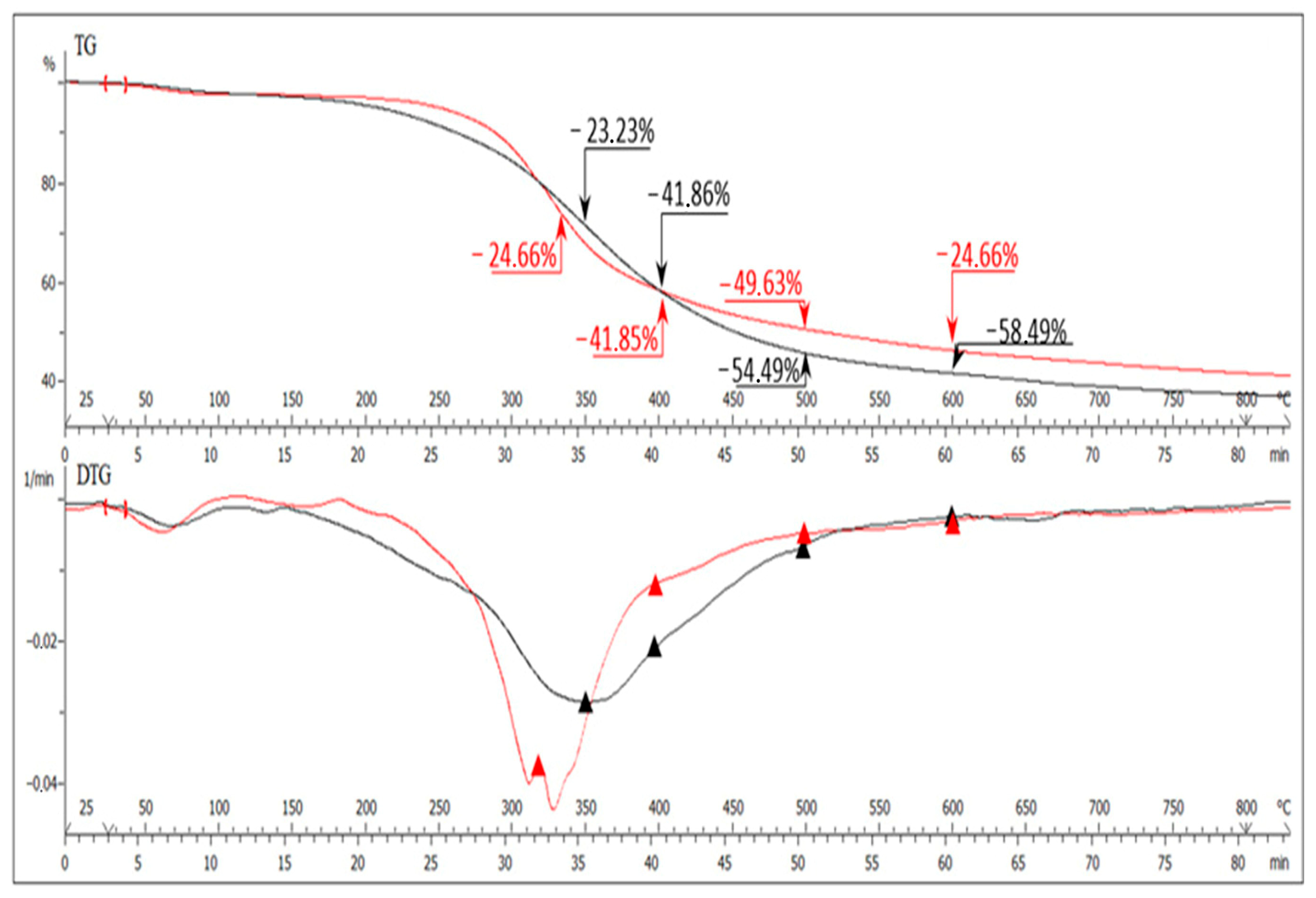
To describe the thermal behavior of the lignins, TGA was performed in a nitrogen atmosphere in the temperature range of 25–800 °C at a heating rate of 10 °C/min. The results of TGA in a nitrogen atmosphere served as an indication for selecting suitable conditions for lignin depolymerization, especially analytical pyrolysis temperatures. A description of the thermal stability of lignins in a nitrogen atmosphere is shown in Figure 3. The DTG curve shows selected pyrolysis temperatures, and the TG curve shows the percentage mass losses of lignins at a given temperature.
The pyrolysis temperatures chosen for HL were 330 °C, 400 °C, 500 °C, and 600 °C, and for APL were 350 °C, 400 °C, 500 °C, and 600 °C. The TG and DTG curves show that HL contained 2.16% moisture (APL: 2.17%); during thermal stress up to 800 °C, 62.92% of the solid fraction was lost and converted into volatile compounds (APL: 58.89%). The fastest thermal degradation of HL was in the temperature range of 239–471 °C (APL: 212–503 °C).
The TG curves (Figure 3) show the cumulative mass loss of both lignins as a function of temperature under nitrogen atmosphere. For HL, an initial mass loss of 2.16% was observed below 120 °C, attributable to moisture evaporation. The main thermal degradation region extended from 239 to 471 °C (APL: 212–503 °C), in which the majority of the volatile fraction was released through cleavage of ether bonds, depolymerization of side chains, and decomposition of aliphatic structures. By 800 °C, the total volatile fraction was 62.92% for HL and 58.89% for APL, yielding solid residues of 37.08% and 41.11%, respectively. The lower volatile fraction of APL is attributed to its higher inorganic content and the greater proportion of condensed aromatic structures.
The DTG curves display the rate of mass loss as a function of temperature. The broad, asymmetric DTG peaks observed for both lignins are characteristic of technical lignins, reflecting the heterogeneous nature of bond dissociation energies across the polymer. The triangle markers (▼) in Figure 3 denote the specific pyrolysis temperatures selected for Py-GC/MS experiments (330, 400, 500, and 600 °C for HL; 350, 400, 500, and 600 °C for APL). These temperatures were chosen to span the onset of decomposition, the maximum decomposition rate, and the high-temperature repolymerization regime, enabling a systematic evaluation of temperature effects on product distribution.
Thermogravimetric analysis revealed distinct but broadly similar thermal behavior for both lignin samples (Figure 3). The degradation process proceeded in three stages, consistent with the known thermal decomposition mechanism of technical lignins [36,37,38,39,40,41,42]. In Stage I (25–120 °C), minor mass losses of 2.16% (HL) and 2.17% (APL) were recorded, corresponding to the evaporation of adsorbed moisture. In Stage II (120–600 °C), the primary depolymerization reactions occurred, including homolytic cleavage of the β-O-4 aryl ether bonds, dealkylation of side chains, and demethoxylation of guaiacyl and syringyl units to yield volatile phenolic fragments [37,38,39,40,41]. Stage III (600–800 °C) was characterized by the slow release of residual volatiles and progressive condensation of the remaining aromatic char structure. The broad DTG peaks, with maxima at approximately 350 °C (HL) and 320 °C (APL), reflect the polydisperse nature of the lignin polymer and the wide range of bond dissociation energies present. The slightly lower onset temperature and broader DTG peak of APL compared to HL indicate that natron hemp lignin contains a greater proportion of labile ester bonds (p-coumarate and ferulate linkages), which dissociate at lower temperatures than the carbon–carbon and aryl ether bonds predominant in kraft beech lignin. This is consistent with literature reports on soda and natron lignins from herbaceous feedstocks [39,40,41,42]. The higher residual mass of APL at 800 °C (41.1% vs. 37.1% for HL) reflects its elevated ash content and the greater condensation tendency of its char, attributable to the higher proportion of p-hydroxyphenyl units and the sodium-catalyzed formation of thermally stable polynuclear aromatic structures [40,41,42].

3.2. Analytical Pyrolysis of Lignin Samples

Pyrolysis is a complex thermochemical process that affects several factors, such as the type of raw material, the temperature, the residence time, and various additives (catalysts). One of the objectives of this work was to evaluate the effects of factors (type of raw material, temperature, catalyst) on pyrolysis products. The first factor that affects pyrolysis is the type of raw material. This work investigates the effect of lignin isolated from black liquor, which was obtained by processing hardwood (beech) by the kraft process (HL) and lignin isolated from black liquor obtained by sulfur-free (natron) technology from annual plants (APL). The selection of pyrolysis temperatures was based on the study of the thermal behavior of lignins (Figure 3). The samples were pyrolyzed at 330 °C (350 °C APL), 400 °C, 500 °C, and 600 °C. In the experimental part, transition metal catalysts (Ru, Pd) dispersed on activated carbon were selected to study the reaction mechanisms. The advantage of these catalysts (Ru/C, Pd/C, RuPd/C) include high reactivity at relatively low temperatures, stabilization of intermediates, and strong deoxygenation and hydrogenation activity [16,17,18,19,20].
In the case of the RuPd/C catalyst, the synergistic effect of both transition metals was investigated. To compare the mechanism and distribution of catalytic pyrolysis products, we pyrolyzed lignins without a catalyst at specified temperatures in the first step. During individual experiments, the mass loss of lignin was monitored, from which the percentage of solid fraction was subsequently calculated. In the case of uncatalyzed pyrolysis, the solid fraction reached an average value of 23 wt%, and this value decreased in the presence of a catalyst. Its amount is largely affected by temperature. By increasing the temperature from 500 °C to 600 °C, the solid fraction increased from 25% to 38%. The reason for this is that, at higher temperatures, repolymerization reactions occur, or rather the combination of the secondary radicals formed into more thermally stable compounds [36,37].
The result of analytical pyrolysis (Py-GC/MS) is a pyrogram in which changes in the proportion and distribution of products can be observed as a result of temperature changes or the addition of a catalyst.
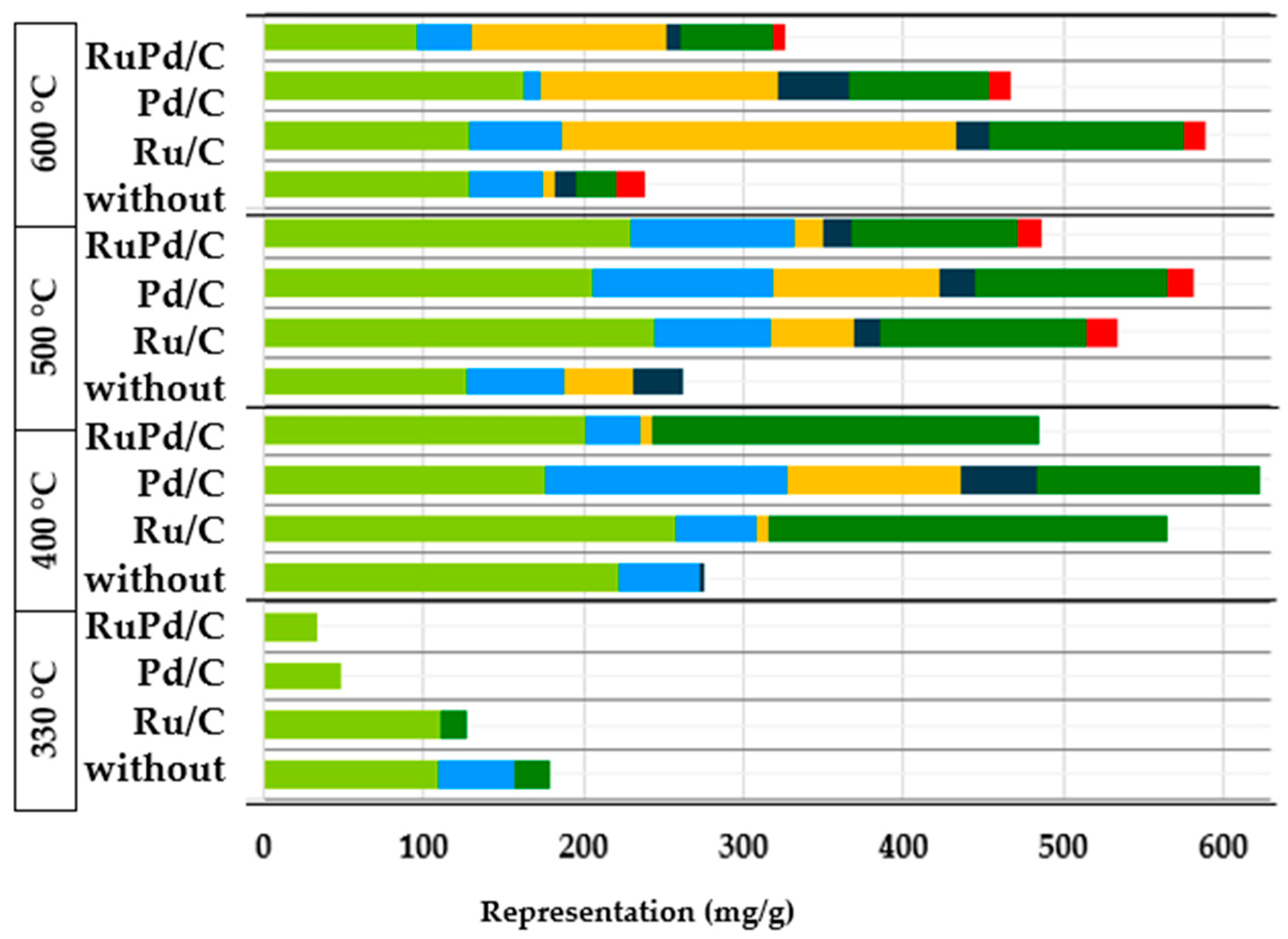
The resulting pyrolysis products were divided into several groups of compounds: guaiacol derivatives (creosol, vanillin), syringol derivatives (4-allylsyringol, 4-propenylsyringol), other phenols (catechols, cresols), benzene derivatives (toluene, xylenes, anisoles), aliphatic hydrocarbons (C4-C9 hydrocarbons), and carboxylic acids (acetic acid). Changes in the representation of these groups of compounds under individual pyrolysis conditions can be observed in the case of HL in Figure 4 and in the case of APL in Figure 5. For better comparison, the yields were converted to a uniform basis (mg/g), the mass of the identified compound (mg) obtained from 1 g of lignin.
The addition of the catalyst resulted in increased lignin conversion and a broader spectrum of products (Figure 4 and Figure 5). The highest conversion was achieved by Ru/C-catalyzed pyrolysis of APL at 500 °C, producing 729 mg/g of compounds, of which 76% were phenol derivatives, 5% benzene derivatives, 17% aliphatic hydrocarbons, and 2% carboxylic acids. For uncatalyzed pyrolysis, the most effective decomposition temperature was 400 °C, at which the minimum occurrence of secondary reactions was observed and the highest selectivity toward phenolic compounds was achieved.
When comparing changes in the resulting pyrolysis products across individual measurements, a synergistic effect of temperature and catalyst was observed. Increasing the pyrolysis temperature had a positive effect on yields up to 600 °C, after which a decreasing trend in the yields of individual compound groups was observed.
The exception is the pyrolysis of HL catalyzed by Ru/C, where an increase in lignin conversion was observed in the entire temperature range. The reason for this is the close connection between temperature and dissociation energy of bonds or competition between fragmentation and repolymerization [36]. With increasing temperature, the conversion of lignin (the number of cleaved bonds) increases, but only to a certain extent [36,37,38]. Because the concentration of radicals also increases with increasing temperature, and thus the probability of repolymerization reactions, this leads to the formation of a solid residue and a decrease in conversion [37,38,39]. The pyrolysis of lignins at 330 °C or 350 °C produced the smallest solid fraction but also limited spectrum of compounds.
The dominant compound was CO2, which accounted for 80–85% of all substances. Most compounds in the case of HL are guaiacol derivatives, and the assumption of the formation of these derivatives is based on the origin of the raw material, since it is a sample representing lignin from beech wood. The consistently occurring guaiacol derivatives included mainly creosol, 4-vinylguaiacol, and 4-ethylguaiacol. More complex compounds such as vanillin, apocynin, and butylpyrogallol were obtained only in the presence of catalysts at higher pyrolysis temperatures (500 °C, 600 °C). In the presence of Ru/C, in terms of yield, the most significant increase was observed in the case of guaiacol at 400 °C, but with increasing temperature, its yield showed a decreasing trend. Pd/C was found to be the most selective toward syringol at 400 °C. The synergistic effect in the case of RuPd/C was not observed.
Due to the different origins, and therefore the structure of APL, significant changes can be observed in the mechanisms of thermal cracking and in the distribution of the resulting products. Pyrolysis of APL achieved 11% lower conversions, the reason for this being the different representation of individual lignin building blocks and the proportion of inorganic substances that reduce the activity of the catalyst.
Of the entire spectrum of compounds obtained, guaiacol has the highest yield, which indicates the origin of the lignin or a higher proportion of guaiacyl structures. From the point of view of the yield of pyrolysis, an increasing trend was observed for all groups of compounds with increasing temperature. This trend does not apply to individual compounds, where the increase in yields was observed only up to a certain temperature range (400–500 °C). Pyrolysis of APL in the low temperature range (330–400 °C) does not achieve high conversions, and a smaller spectrum of compounds is obtained. However, the significant selectivity of some substances was observed, which suggests a simpler separation of products. For example, the proportion of 4-vinylguaiacol at 330 °C, RuPd/C represented 43% of all compounds and, in the case of Ru/C at 330 °C, a slightly lower yield, namely 33%. Pyrolysis at higher temperatures (500–600 °C) resulted in higher yields (by 68%), but also in a wider spectrum of substances. These conditions lead to the formation of more unique compounds that did not occur under previous conditions. For example, acetic acid, apocynin, and phenol occurred only in the case of pyrolysis at 500 °C, 600 °C. Isoeugenol was identified in pyrolysis catalyzed by Pd/C, RuPd/C at 500 °C and 600 °C, vanillin at 600 °C without a catalyst, and in the presence of Ru/C. The highest degree of conversion was achieved by pyrolysis at 500 °C in the presence of Ru/C, which allowed for 759 mg of compounds to be obtained from 1 g of lignin, of which 76% were phenol derivatives, 5% benzene derivatives, 17% aliphatic hydrocarbons, and 2% carboxylic acids.

3.2.1. The Ru/C Activity and Its Effect on Lignin Conversion

The activity of Ru/C was reflected in a smaller proportion of carbon residue and increased lignin conversion compared to that of other catalysts. The reason for this is the suppression of repolymerization reactions and the intrinsic activity of the catalyst at higher temperatures. It is known from the literature that, in experiments focused on catalyst pretreatment, the induction time of the catalyst decreases at a high temperature, which is associated with an increase in its activity. This may be due to an increase in the number of active sites of the catalyst, which leads to a decrease in the induction time or a faster reduction in the surface oxides and hydrogenation of lignin [39,40,41].
The greatest effect was observed in the case of HL pyrolysis, when the conversion increased over the entire temperature range. Compared to uncatalyzed pyrolysis, a 47–59% increase in monomeric phenols was recorded, indicating an increase in the degree of cracking and deoxygenation, during which the decomposition of ether bonds occurred. Particularly significant are phenols, which have a structure similar to lignin monomer units, with a side chain consisting of C2-C3 and the formation of by-products. In the case of HL, the activity of the catalyst became evident at higher temperatures (500 °C, 600 °C), while the cleavage and reformation of the side chains and the elimination of short substituents in the aromatic structures were observed. Compared to the uncatalyzed reaction, the presence of guaiacol derivatives increased by 52%. A significant increase was recorded for guaiacol, 4-ethylguaiacol, 4-vinylguaiacol, and creosol. The most significant change was observed at a temperature of 600 °C, when the number of substances identified exceeded 60. Significant changes occurred in the case of phenol derivatives, where the presence of guaiacol derivatives decreased by 47%, syringol by 19%, and a sharp 79% increase in other phenol derivatives. The majority of other phenol derivatives were catechols and cresols. This trend of decreasing guaiacols and increasing catechols is probably caused by demethoxylation reactions [40,41,42,43].
In the case of catechol derivatives, the dominant compounds were 3-methoxycatechol (41 mg/g), 3-methylcatechol (14 mg/g), and 4-ethylcatechol (21 mg/g) (Figure 6). While 3-methoxycatechol is a decomposition product of syringol and 3-methylcatechol, 4-ethylcatechol of the respective guaiacol derivatives. However, phenol derivatives can be formed, especially 4-ethylphenol (3 mg/g). The dominant compound of the cresol derivatives was p-cresol. One of the possible mechanisms of formation is creosol cracking (4-methylguaiacol), while 4-methylphenol can also be formed, but this compound was not identified up to 600 °C. Unique guaiacol derivatives, such as vanillin and apocynin, have also been identified, the formation of which is conditioned by the presence of a hydroxyl group at Cα and the breakdown of the Cα-Cβ bond.
In the case of APL, the opposite trend is observed, as in the case of catalytic pyrolysis of HL. In uncatalyzed pyrolysis, the proportion of phenols increases with increasing temperature; however, in the presence of Ru/C, an increase is observed up to 500 °C and a sharp decrease is observed with a subsequent increase in temperature by 100 °C. The change was observed mainly in the case of syringols and other derivatives, which were identified only at 500 °C. At 600 °C, a similar trend is observed, as in the case of HL pyrolysis, a decrease in guaiacols and syringols at the expense of an increase in methylated phenols. However, the formation of 4-ethylphenol prevails over that of 4-ethylcatechol. Furthermore, substances were not been identified before they were formed. At 500 °C, significant compounds such as vanillin, apocynin, isoeugenol, and acetic acid were formed.
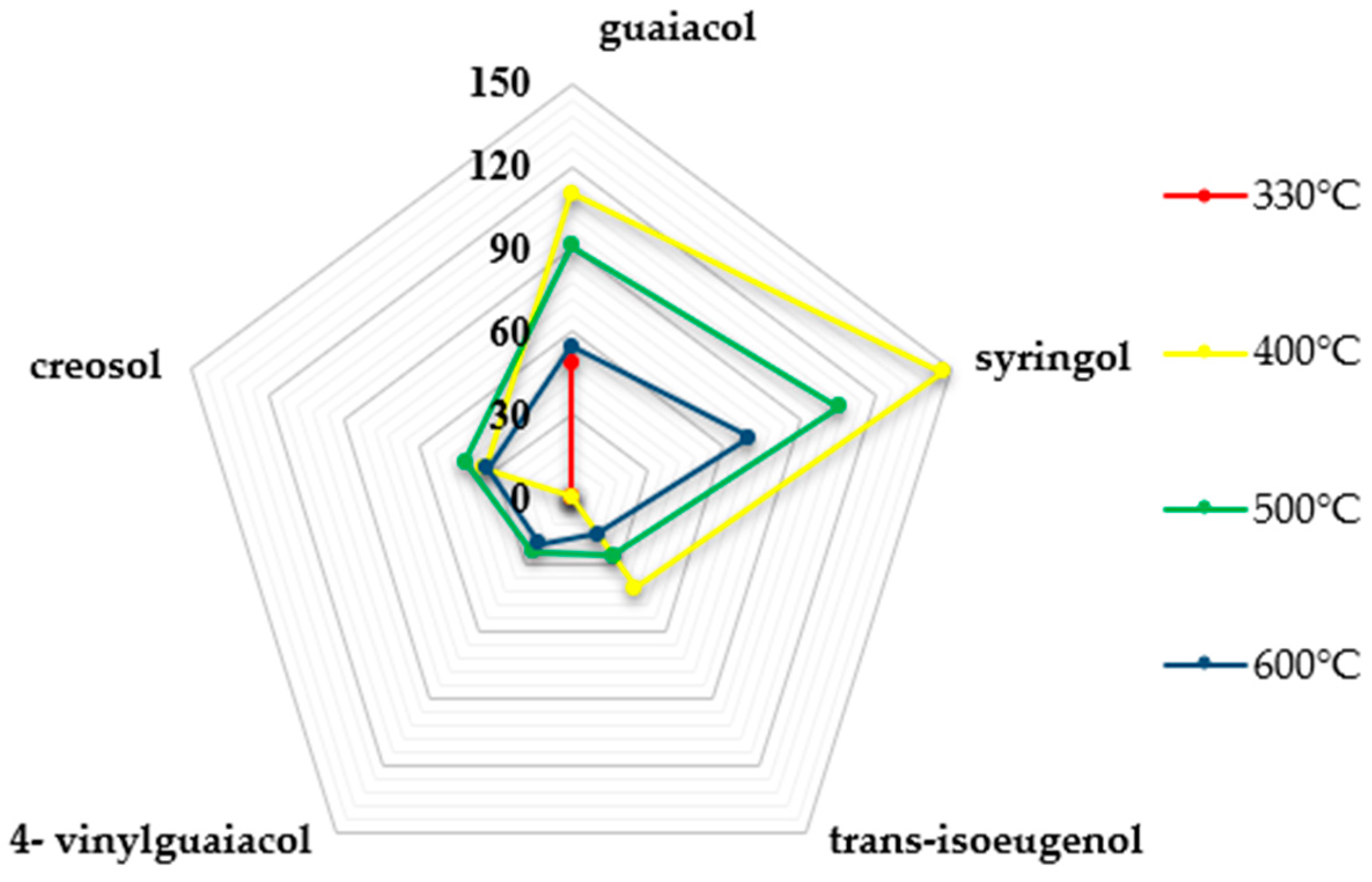
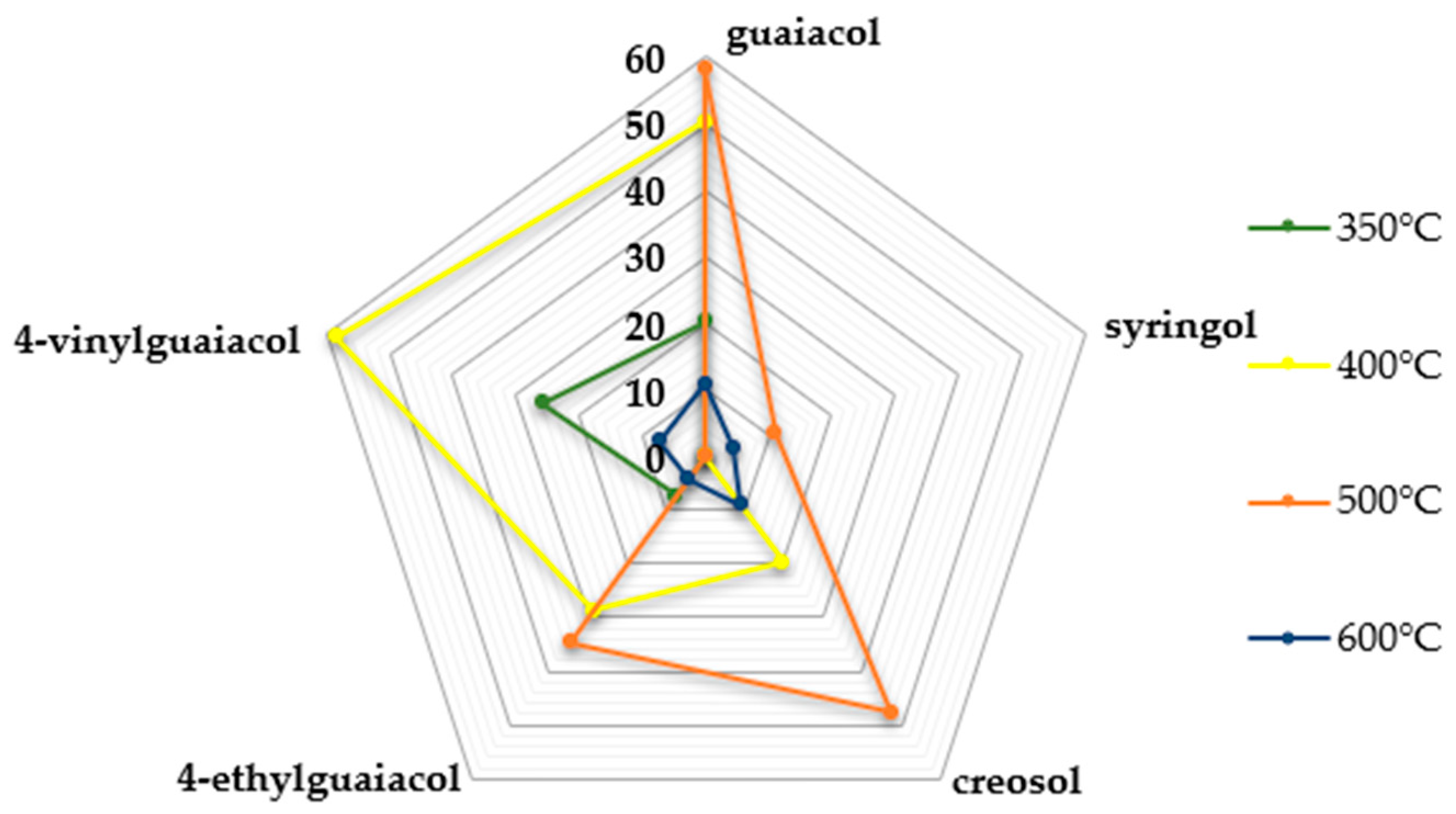
A further increase of 100 °C resulted in the formation of aromatics such as benzene, toluene, xylene and also a smaller amount (18%) of C7-C13 aliphatic hydrocarbons. Ruthenium demonstrates high selectivity at 400 °C, maximizing the yield of compounds and eliminating by-products, thus reducing the costs of any separation. In the case of HL, it is highly selective towards guaiacol, which constitutes 67% of all phenols (148 mg/g). APL was characterized by selectivity towards syringol, yielding 143 mg/g, which constitutes 25% of all phenols (Figure 7). Compared to Pd/C, it is characterized by a lower incidence of dehydroxylation and deoxygenation reactions at elevated temperatures, but with better Cγ = O hydrogenation.

3.2.2. Effect of Pd/C on the Conversion of Lignin Samples

Pd/C-catalyzed pyrolysis is characterized by a higher proportion of phenolic compounds (53–59%), of which guaiacol derivatives and other phenols predominate. In the case of phenolic compounds, an increasing trend is observed up to 500 ° C and a decrease with a subsequent increase in temperature. The highest phenol yield (535 mg/g) is obtained by APL pyrolysis at 500 °C, of which 67% were guaiacols, 4% are syringols, and 28% other phenols. This trend is closely related to the formation of a solid fraction, which increases with increasing temperature. The most significant substances at 400 °C were guaiacol (110 mg/g) and syringol (146 mg/g). One of the possible mechanisms of the formation of these compounds is the cleavage of the most widespread aryl–alkyl–aryl bond or the elimination of side chains of lignin monomers [40,41,42,43].
The thermal decomposition of HL at 500 °C identified most of 4-vinylguaiacol, 4-ethylguaiacol, and isoeugenol (Figure 8). These compounds originate from the direct depolymerization of lignin guaiacol units, while relatively complex functional groups on the side chains are preserved. Compared to the uncatalyzed reaction, an increase in the formation of other phenols, especially cresols and catechols, was observed in both samples in the temperature range of 330–500 °C. However, at 600 °C, the proportion of alkylphenols decreased and the derivatives of benzene increased (especially methoxybenzenes and toluene) due to demethylation and dehydroxylation. The high reactivity of the Caromat-OH and Caromat-OCH3 bonds was also observed in uncatalyzed pyrolysis, but at lower temperatures of 400–500 °C. This trend is due to the absence of the stabilizing effect of the catalyst, which allows for the transition to the mentioned products, which are stable end-products from the point of view of the pyrolysis process.
In the case of APL, demethoxylation reactions are observed, but at lower temperatures (500 °C) compared to Ru/C-catalyzed pyrolysis. The reason for this is the higher 4-ethylphenol (24 mg/g) and p-cresol (25 mg/g) yields and a sharp decrease in syringol and guaiacol at 500 °C (Figure 9). In comparison to Ru/C-catalyzed pyrolysis, higher yields of phenols and selectivity toward syringol are achieved. This trend indicates a higher degree of deoxygenation and a lower incidence of demethylation reactions. Catalysis with Pd/C can lead to the catalytic hydrogenation of lignin, which means that carboxyls can be deoxygenated to aliphatic hydroxyl groups. At the same time, degradation of the ether bond, an increase in the number of hydroxyl groups on the phenols, and a decrease in the number of methoxyl groups can also occur. The disadvantage of Pd/C is the high solid content (~30%) at higher temperatures of 400–500 °C compared to Ru/C. The reason for this is the different sintering (deactivation) temperatures of the catalysts. Although the decrease in catalytic activity in the case of Ru/C begins at 484 °C, Pd/C has the lowest sintering temperature among all platinum-group metals, namely 275 °C.

3.2.3. The Influence of RuPd/C on Lignin Conversion

In the case of RuPd/C, no increase in lignin conversion was confirmed compared to the pyrolysis catalyzed by Ru/C and Pd/C. Compared to the uncatalyzed reaction, the diversity of compounds and the amount of phenols increased by 21–34%. The highest monomeric phenol yield was obtained from APL at 500 °C (529 mg/g), of which 45% were guaiacol derivatives, 2% syringol derivatives, and 53% other phenols.
Pyrolysis of HL at 500 °C yielded a slightly lower amount (350 mg/g) with a different composition: 6% guaiacol derivatives, 29% syringol derivatives, and only 5% other phenols (Figure 10). The dominant compounds were guaiacol derivatives and aliphatic compounds (acetaldehyde, methanethiol). In the case of HL, an increase in phenols was recorded up to 500 °C, followed by a decrease with increasing temperature, which is partially caused by repolymerization reactions and cleavage of oxygen-containing functional groups in the benzene ring. This behavior is supported by the proposed mechanism involving cleavage of bonds between the benzene core and methoxyl groups (–OCH3) in the predominant sinapyl alcohol units of the lignin used.
The catalyst activity was more pronounced in the pyrolysis of APL, when the phenol content increased by 78% when the temperature went from 400 °C to 500 °C. Most of the compound groups were benzene derivatives (stilbene, trimethoxy benzene) and other phenols (methylphenols) (Figure 11). Only a minimal amount (11 mg/g) of syringol derivatives was formed across the entire temperature range. Their absence can be explained by the low dissociation energy of the O-CH3 bond and the suppression of reactions that could cause the rearrangement and possible binding of functional groups at positions 2 and 6 of the aromatic nucleus.
The products of homolytic cleavage of these syringol bonds include 3-methoxycatechol, catechol, 2-methoxy-6-methylphenol, and guaiacol. Although ruthenium was the main element of the bifunctional catalyst at 600 °C, it was not possible to suppress repolymerization reactions, as in the case of Ru/C. Compared to Pd/C-catalyzed pyrolysis, fewer other phenols were identified in the resulting products, especially cresol and catechol derivatives. In HL pyrolysis using RuPd/C at 400 °C, a significant selectivity toward guaiacol was observed, representing up to 79% of all phenols. In the case of APL, selectivity was observed towards 4-vinylguaiacol at 400 °C, when it represented 37% of all phenols.
The differences in catalytic behavior in our study result from the different affinity of metals for the functional groups of lignin:
(a)
Role of Ru/C: Ru is known for its excellent ability to hydrogenate unsaturated side chains and stabilize reactive intermediates. In our experiments, Ru/C showed the highest activity in the cleavage of β-O-4 ether bonds and subsequent hydrogenation, which led to higher conversion and the formation of stable alkylphenols. Ru is also more effective in suppressing repolymerization (char formation) [36,37,38,39,40,41,42,43].
(b)
Role of Pd/C: Pd in our system showed high selectivity towards deoxygenation and demethoxylation reactions, which was reflected in the distribution of monomers with shorter side chains. However, Pd is more prone to faster deactivation in the presence of sulfur (in Kraft lignin) and shows a lower overall conversion rate compared to Ru, which explains the differences in quantitative yields [38,39,40,41,42].
(c)
Absence of synergistic effect (RuPd/C): The expected synergistic effect in the RuPd/C bimetallic catalyst was not observed, probably due to surface segregation of metals or the formation of alloy phases, which led to a decrease in the number of free active sites for the adsorption of bulky lignin molecules. It was shown that, under the selected conditions (temperature and pressure), the metals acted competitively rather than cooperatively. Moreover, synergy is often conditioned by the specific morphology of the nanoparticles, which cannot always be achieved without special pretreatment when simply deposited on a carbon support [39,40,41,42,43,44].

3.3. The Process of Hydrogenolysis of Lignin Samples

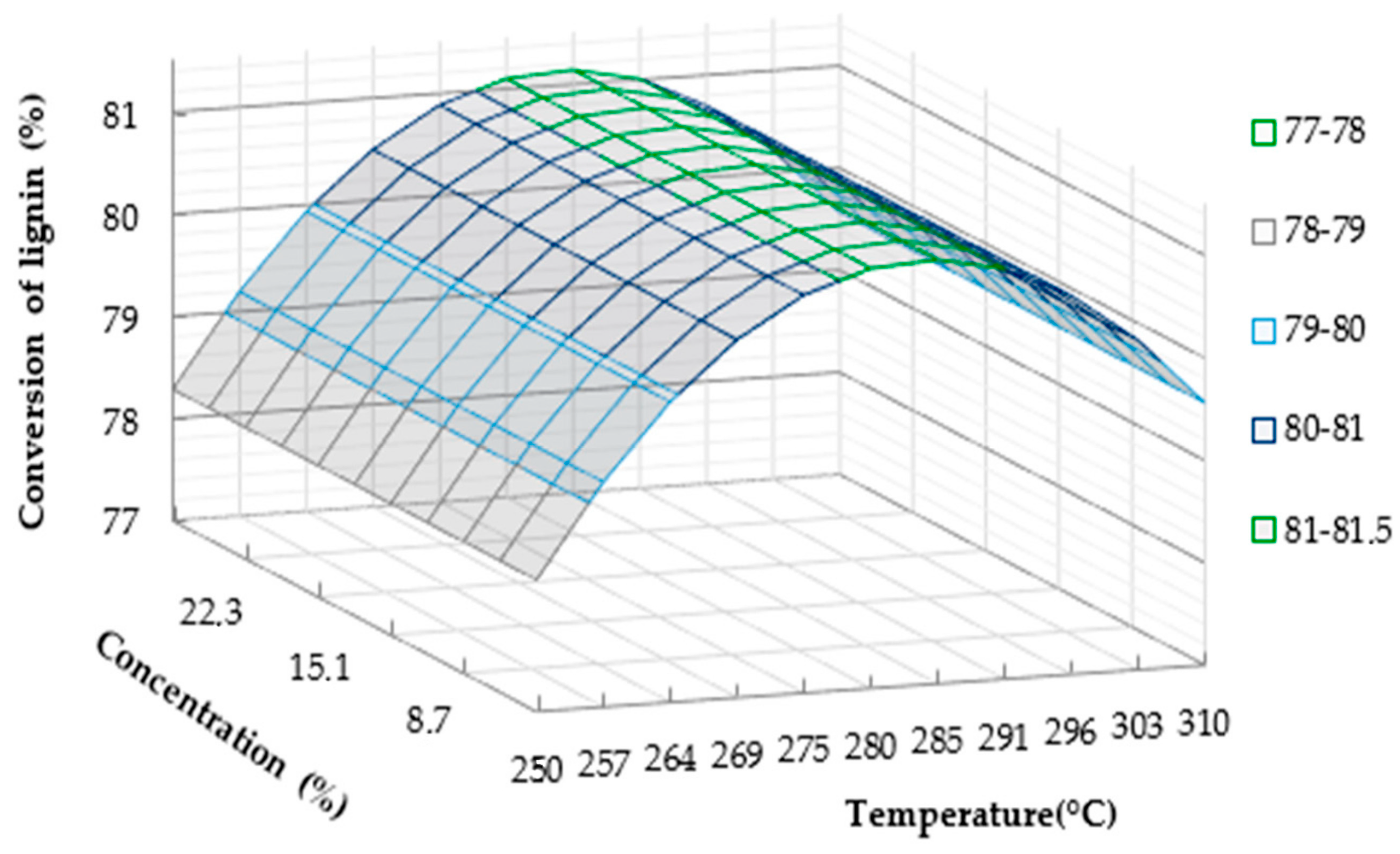
Hydrogenolysis is an effective method for obtaining information about the chemical structure of lignin, but also for producing high yields of monolignols. The yield and quality of bio-oil are influenced by many variables, such as temperature, pressure, time, type of catalyst, mass ratio of lignin to catalyst, and the nature of the feedstock itself. Based on a literature search [43,44,45,46,47], three significant factors were selected: temperature, time, and catalyst mass concentration. The temperature range (250–310 °C) was selected on the basis of TGA and the maximum operating temperature of the reactor. The ranges of other factors were selected based on the above-mentioned literature. To determine the optimal conditions, a five-level three-factor experimental design was chosen; the structure is given in Table 5. In this work, isopropyl alcohol was used as a suitable solvent, which has a good H-donor capacity, which is reflected in high bio-oil yields. Under the selected conditions, isopropanol was in a supercritical state (Tc = 235 °C, Pc = 47 bar). If a sufficient amount of hydrogen is available during the reaction, the primary lignin decomposition products are stabilized, leading to the increased formation of a liquid phase (composed mainly of alkyl-substituted phenols) and reduced formation of carbon residue [39,40,41,42,43]. This effect of suppressing repolymerization reactions and stabilizing phenols was further supported by the addition of hydrogen gas to the system. Ru/C was chosen as the catalyst as a result of several advantages. It is tolerant to most solvents, characterized by a low reaction time, high selectivity toward 4-propyl-substituted phenols, effectively suppresses repolymerization reactions, and can be regenerated and reused with minimal yield losses [42,43,44]. The disadvantage is the occurrence of hydrodeoxygenation and hydrogenation reactions under more serve operating conditions, resulting in degradation of phenols to cycloalkanes and alkanes [45,46,47]. When comparing the conversion of both lignin types, it was found that the selected conditions were not suitable for the hydrogenolysis of APL. The conversion values of experiments 9 and 15 did not exceed 50 wt%. The reason is the different representation of monomer units in annual-plant lignin, particularly the higher proportion of p-coumaryl alcohol units and the high inorganic fraction (especially sodium). Based on these findings, the effect of hydrogenolysis was evaluated only for HL. To compare the effect of the catalyst, a measurement was performed without catalyst addition. For better reproducibility, this measurement was carried out at the center point of the experimental design. Under conditions of 280 °C and 35 min, a lignin conversion of 66 wt% was achieved. The results of the rotational experiment, in which the effects of temperature (T), time (t), and Ru/C catalyst concentration (Ccat) on lignin conversion (Xlignin) were observed, are shown in Table 6.
By regression processing of the measured results, the coefficients of the quadratic equation, their respective critical values, and mean square errors were obtained, which are presented in Table 7. All data were calculated for a 95% confidence interval. When the coefficients of the equation were compared with their critical values, it was possible to determine the statistically significant factors influencing lignin conversion. Of the independent variables analyzed, temperature showed the highest influence, especially in the linear region. Another influencing factor was the catalyst concentration, where the magnitude of the effects in the quadratic and linear parts was the same. Time had the lowest influence. All three factors exhibited an increasing trend in the linear region and a decreasing trend in the quadratic region. Figure 12 shows a graphical representation of the influence of the two most statistically significant factors—temperature and catalyst concentration—on lignin conversion. Based on the statistical model, the maximum predicted conversion was 83.63% at 295.18 °C, 32.03 min, and 16.74% catalyst concentration. These values were obtained using the Solver function in MS Excel. Statistical processing of the results, or rather analysis of variance, yielded experimental variability (sE = ±1.297), residual variability (sR = ±1.072), and the variability component describing the adequacy of the regression equation (sLF = 0.784). Experimental variability was determined from six repeated measurements in the center of the experimental space. Its value indicates relatively high measurement accuracy, or rather a low incidence of random errors. The low value of residual variability indicates that the influence of factors not included in the experiment was not observed during the measurement. Accordingly, the observed property—lignin conversion—was influenced only by the factors selected in this study. Based on the adequacy test of the regression model, it can be concluded that the regression model used describes the experimental dependence sufficiently accurately.
During the experiment, the yields of bio-oils and solid residue were also recorded. In the experiment without a catalyst, the bio-oil yield was 67 wt% and the solid residue was 29 wt%. During the measurements based on the rotational experiment, bio-oil yields ranged from 69 to 89 wt% (Figure 13) and the solid residue ranged from 10 to 27 wt%. The highest bio-oil yield of 83.5 wt% and the lowest proportion of solid residue (10 wt%) were obtained under the conditions of 298 °C, 29 min, and 20 wt% catalyst. The content of solid residue increases with decreasing temperature and catalyst concentration. The reason for this is the synergistic effect of Ru/C and temperature, which results in slower hydrogen release from isopropyl alcohol and thus a lower occurrence of transfer reactions in the liquid phase. This leads to a lower hydrogenolysis reaction rate and consequently to the formation of a larger solid fraction.

3.3.1. Analysis of Bio-Oils Obtained

Identification of the composition of bio-oils obtained from hydrogenolysis was carried out by GC/MS. The chromatogram of experiment 1 is shown in Figure 14 and the prepared bio-oil samples in Figure 15. For better comparison, the yields were converted to a uniform basis (mg/g), i.e., the mass of the identified compound (mg) obtained from 1 g of bio-oil.
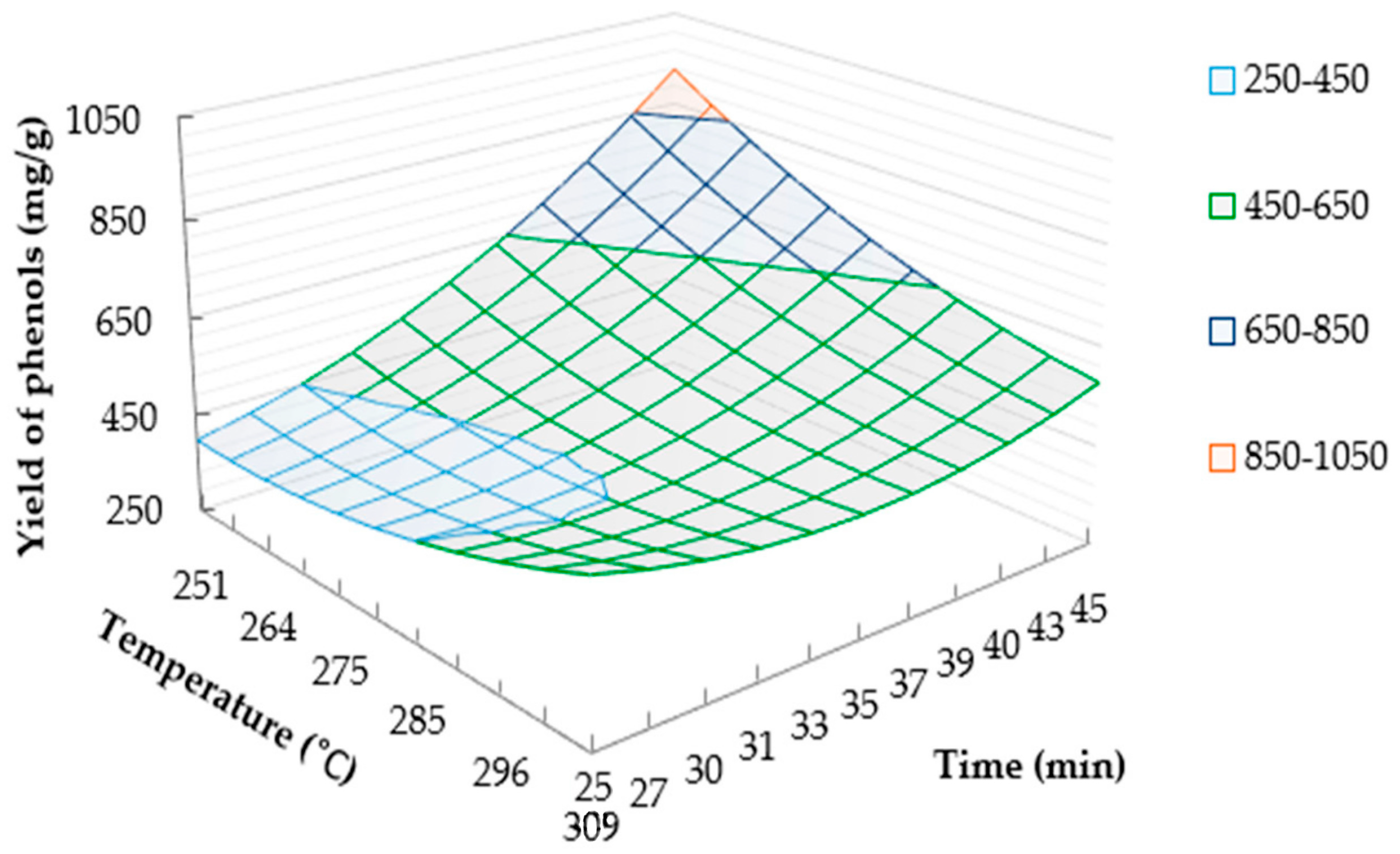
Phenols formed the main part of the bio-oils and originated from the cracking of HL monomers. The bio-oil from the uncatalyzed reaction at 280 °C, 35 min contained 42% phenols. In the presence of Ru/C, an increase in phenol yield was recorded; the highest value (683 mg/g) was obtained under conditions of 262 °C, 41 min, 6 wt% catalyst. The most abundant compounds were syringol (16%), butylpyrogallol (14%), 4-hydroxy-3,5-dimethoxyphenyl-1-ethanone (11%), and 4-ethylguaiacol (8%). The most significant influence on the yield of phenols was exerted by catalyst concentration and temperature. However, the yield as a function of concentration and temperature showed a decreasing trend.
The reason for the decrease in yield is that, with increasing temperature, phenols are converted to aromatic compounds, and, with increasing catalyst concentration, their transformation into cycloalkanes occurs. The third factor, the reaction time, has a positive effect, but only to a certain extent. At a low catalyst concentration, the yield of phenols also increases with increasing time (Figure 16). For the formation of bio-oil, whose main components are phenolic compounds, a relatively low temperature (275 °C), a low catalyst concentration (1%), and a longer reaction time (45 min) are required.
Of the phenolic compounds, the most significant were (Figure 17) as follows: acetosyringone, syringol, guaiacol, 4-ethylguaiacol and 4-allylsyringol; their yields increased significantly with reaction time in the presence of Ru/C. The origin of these compounds can be explained by the deoxygenation activity of the catalyst or the stabilization of the primary products by hydrogen supplied via isopropanol. Among the aromatic hydrocarbons, the most significant compounds were p-xylene, o-xylene, ethylbenzene, and 1,3-diethylbenzene, whose yields increased with increasing temperature and catalyst concentration.
This indicates that the catalyst affects the trans-alkylation of methoxy groups or the demethoxylation and dehydration of phenols to aromatic hydrocarbons. From a detailed analysis of the GC/MS spectra, it was found that reactive functional groups (especially vinyl and allyl) were reduced with increasing temperature and time due to hydrogenation. These substances are primary products of the thermochemical depolymerization of lignin and are stabilized by hydrogenation reactions with alkylphenols. A further increase in reaction severity, especially temperature and catalyst concentration, leads to hydrogenation of the benzene ring and the formation of cycloalkanes. Kloekhorst et al. [32] reported that, with increasing reaction severity, the proportion of hydrogenation products—cycloalkanes and cyclohexanols—increases sharply. However, only a small amount of cycloalkanes (up to 3%) was identified in the bio-oils obtained. A possible explanation for this is that, within the investigated range of conditions, the catalytic hydrogenation of phenols stopped at aromatic hydrocarbons, and further dehydrogenation and dehydration to cyclohexanes and cyclohexenes did not occur.

3.3.2. Evaluation of Catalyst Regeneration

The conclusion of the experimental work dealt with the regeneration of the catalyst. Catalyst deactivation during hydrogenolysis is caused by chemical, mechanical, and thermal factors, which reduce catalytic efficiency. During hydrogenolysis, substances (thermally stable compounds and inorganic metals, especially sulfur) are chemisorbed onto the catalyst surface, and sintering occurs [34,35,36,37,38,39,40,41,42,43,44,45,46,47,48]. Reactivation of Ru/C can be ensured by washing with suitable solvents, oxidizing agents, or controlled combustion in a nitrogen atmosphere (Ru/C is pyrophoric), while the temperature must not exceed 484 °C to avoid sintering [34,35,36]. Based on a review of the literature [34,35], a modification of the three-step recycling of deactivated Ru/C was proposed.
Reactivation of the solid fraction with organic solvents (THF, DMSO), removing unreacted lignin residues;
Oxidation with a 3% aqueous H2O2 solution to remove sulfur and carbon residue from the catalyst surface without damaging the support;
Controlled thermal treatment at 410 °C in a nitrogen atmosphere using TGA, removing remaining polymeric materials absorbed on the support.
Elemental analysis of the regenerated catalyst revealed that it contained 47% C, 34% H, 0.2% N, 0.6% S, and 48% O. The presence of sulfur—one of the causes of catalyst deactivation—was significant, while regeneration reduced its content by up to 64%. The regenerated catalyst was used for hydrogenolysis, and, for better comparison, the experiment was carried out at 280 °C, 35 min, 13% catalyst (central points); the reported values correspond to the average of measurements for samples 15–20.
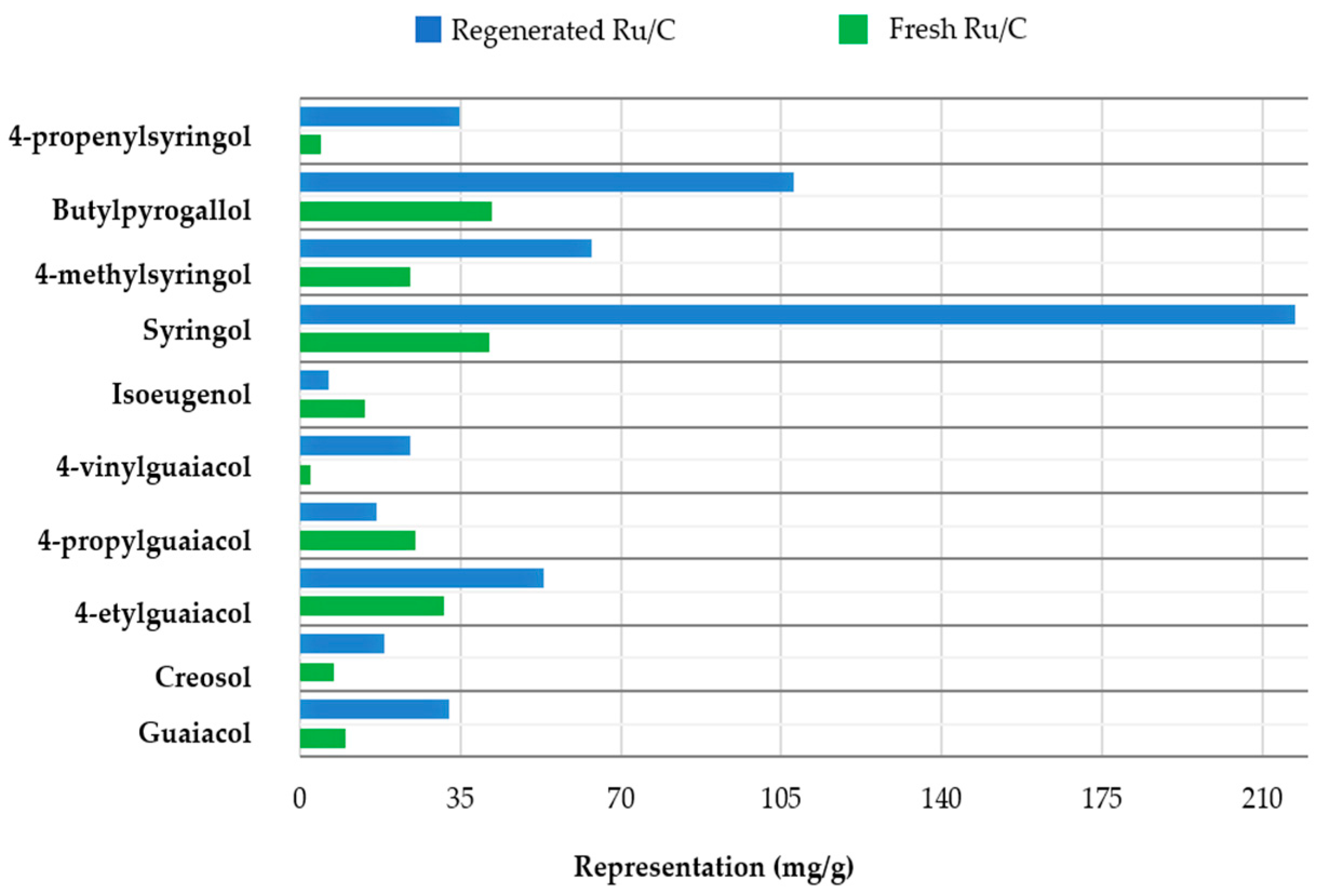
After regeneration, the resulting conversion of lignin was 73%, compared to the reaction in the presence of a fresh catalyst, where the conversion decreased by only 8% (Figure 18). Comparing the composition of the bio-oils obtained with the fresh and regenerated catalyst under identical conditions, a smaller spectrum of compounds was recorded, along with an increase in monomeric phenols from 305 mg/g to 716 mg/g and a decrease in aliphatic hydrocarbons from 70 mg/g to 22 mg/g. The composition of individual monomeric phenols also changed. A significant increase in yield was recorded for syringol (81%), 4-propenylsyringol (86%), and 4-vinylguaiacol (90%). These changes and the marked selectivity toward monomeric phenols, especially those with unsaturated side chains, could be partly due to the oxidation of Ru/C to RuO2/C during regeneration with H2O2 (as confirmed by elemental analysis) or to an increase in active sites during catalyst treatment. Under real conditions, ruthenium catalysts consist of a (partially) oxidized surface layer on which water is adsorbed.
This phenomenon can be significantly affected during regeneration using hydrogen peroxide. Therefore, we must consider the equilibrium achieved by water adsorption on the catalyst surface, while the hydrophilic character of the solvent decreases [48]. Especially in hydrocarbon solvents such as isopropyl alcohol, the presence of water (either from humidity or from the reduction of oxides on the catalyst surface) can block catalytic activity. Based on this idea, it follows that the chosen regeneration method slows the reduction of ruthenium oxides, making hydrogen adsorption on the hydroxylated surface more difficult, which in turn favors reactions producing phenol derivatives and phenol.

3.4. Comparison of the Depolymerization Methods of Lignins

The work investigated pyrolysis in the presence of noble metals (Ru/C, Pd/C, RuPd/C) in the temperature range of 300–600 °C in an inert atmosphere and at atmospheric pressure, as well as hydrogenolysis in the presence of Ru/C, isopropanol, and hydrogen gas in the temperature range of 250–310 °C and pressure of 20–140 bar.
Hydrogenolysis achieved a higher lignin conversion (65–83%) than pyrolysis (67–74%), the reason for this being the suppression of repolymerization reactions due to the stabilization of reactive phenols by hydrogen. From a kinetic modeling perspective, these findings quantify the competition between depolymerization and char-forming pathways, allowing for more precise estimation of rate constants for individual reaction steps under varying hydrogen availability. Pyrolysis proved to be a more selective method towards phenolic compounds. In terms of conversion, pyrolysis yielded 120–580 mg of monomeric phenols from 1 g of lignin, while hydrogenolysis yielded 195–440 mg/g of lignin. In addition to the yields, a significant difference in the final products was also observed.
Although hydrogenolysis yielded a broader spectrum of compounds with a higher molar mass (150–180 g·mol−1), pyrolysis fragmented the lignin macromolecule into substances with a lower molar mass (130–150 g·mol−1).
During the depolymerization of both types of samples, guaiacol derivatives were the majority group of phenolic compounds, a fact partly attributable to the origin and composition of the feedstock. It was found that APL is not suitable for hydrogenolysis under the given conditions because of the low lignin conversion and the high formation of solid residue, which led to rapid catalyst deactivation and low yield of monomeric phenols. This type of feedstock proved to be suitable for pyrolysis at 500 °C, at which the highest yields of compounds (600–720 mg/g) were obtained and a high selectivity toward monomeric phenols was recorded.
The main pyrolysis products of both samples were guaiacol, syringol, creosol, 4–ethylguaiacol and 4–vinylguaiacol. More unique compounds such as isoeugenol, vanillin, apocynin, or butylpyrogallol occurred only at higher temperatures (500–600 °C). Reactions occurring under pyrolysis conditions can generally be classified as dehydration, fragmentation, condensation, repolymerization, and molecular rearrangement. During pyrolysis, the ether bonds of lignin are first cleaved, and later the C-C bonds are cleaved, resulting in the formation of phenolic products (guaiacol, syringol derivatives).
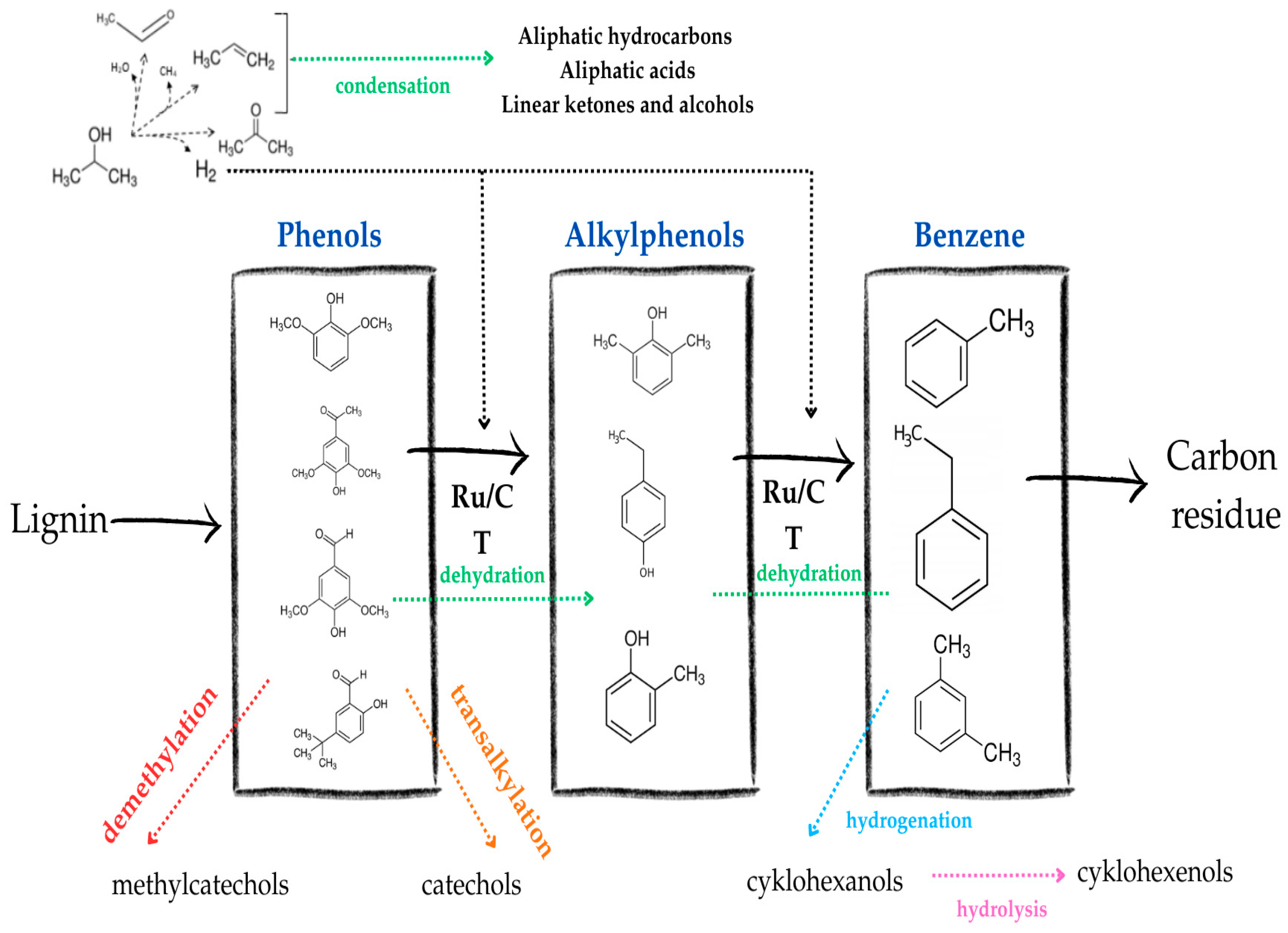
Finally, the side chains of monolignols are homolytically cleaved by radical reactions (formation of catechols and cresols). At elevated temperatures, dehydroxylation reactions can also occur, leading to the formation of benzene derivatives (Figure 19).
In the case of hydrogenolysis, the most abundant compounds were butylpyrogallol, syringol, p-xylene, and 1-(3-hydroxy-4-methoxyphenyl)-ethanone. In addition, significant carboxylic acids (acetic, homovanillic, and alkyl alcohol) and acid derivatives (succinic, and palmitic acid) were also formed. Hydrogenolysis under the given conditions showed the greatest selectivity toward syringol.
Hydrogenolysis depolymerizes the lignin polymer due to the cleavage of the ether and aliphatic Cα–Cβ bonds of lignin, while the aromatic rings are not cleaved. During the process, thermal decomposition of isopropanol occurs to form propene by dehydration, acetone by dehydrogenation, and acetaldehyde by demethylation (Figure 20). Part of the aliphatic hydrocarbons, acids, ketones, and alcohols are formed through condensation reactions (ketones-aldol condensation) of these isopropanol decomposition products.
At a low temperature and catalyst concentration, compounds such as syringol, acetosyringone, 4-propylguaiacol, 4-ethylguaiacol, and butylpyrogallol were identified. With an increasing temperature and catalyst concentration, dehydration reactions leading to benzene end-products -(1,3-dimethylbenzene, p-xylene, o-xylene, and ethylbenzene) were observed. Furthermore, a small amount of catechols (especially 3-methoxycatechol) were identified, whose formation can be attributed to demethylation or transalkylation of phenols. Recombination of reactive phenolic fragments was also detected, resulting in the formation of dimeric phenols such as 2,2-diphenylethanol and 4-propyl-1,1-diphenyl.


4. Conclusions

Lignin, as a promising renewable carbon source, has significant potential to serve as a sustainable platform for valuable chemical compounds. However, the depolymerization of lignin is a demanding thermochemical process due to its complex structure of lignin and the wide distribution of substances. The selective conversion of lignin into valuable chemicals is still a relatively unexplored area. Nevertheless, this work proposes several potential strategies for the fragmentation of lignin into simple structures that can be isolated in the future and used as raw material for the synthesis of other substances. The aim of the work is to highlight the useful substances obtained from lignin and demonstrate its extensive applicability, especially in the pharmaceutical industry, where lignin-derived compounds are used as components of drugs against various diseases (from influenza to neurodegenerative diseases to cancer). A major advantage is that, in addition to their high economic value, these compounds are produced from a renewable source and are economically competitive with petrochemical processes.
The experimental part of the work demonstrates the possibility of recovering lignin from waste sources in the pulp and paper industry using two depolymerization techniques: analytical pyrolysis and hydrogenolysis. Analytical pyrolysis investigates the catalytic behavior of noble metals on carbon support, which have proven to be effective catalysts due to their high reactivity at relatively low residence times, high lignin conversion, and stabilization of intermediates (especially Ru/C). The detailed product distributions reported in this study serve as essential validation data for predictive kinetic models of lignin conversion, helping to bridge the gap between empirical observations and theoretical reaction engineering in biorefinery processes. By studying the mechanism of catalyzed pyrolysis and the distribution of the resulting products, the following reactions were observed:
Deoxygenation reactions (Pd/C > Ru/C > RuPd/C) from 400 °C;
Hydrogenation reactions (RuPd/C > Ru/C > Pd/C) from 400 °C;
Dealkylation reactions (Pd/C > Ru/C > RuPd/C) from 400 °C in the case of HL and APL and from 500 °C;
Demethoxylation reactions (Ru/C > Pd/C > RuPd/C) from 500 °C;
Dehydroxylation reactions (Pd/C > Ru/C > RuPd/C) from 500 °C in the case of HL and APL and from 600 °C.
Temperature had a positive effect on increasing the conversion, but only up to 500 °C, after which a decrease in yields was observed due to the higher incidence of repolymerization reactions. The highest yield of compounds was obtained by Ru/C-catalyzed APL pyrolysis at 500 °C, 729 mg/g. For both lignin samples, the guaiacol derivatives were the dominant compounds. Frequently occurring compounds included guaiacol, syringol, 4-ethylguaiacol, 4-vinylguaiacol, and creosol. Unique compounds with promising applications in the cosmetic, food, chemical, agricultural, and pharmaceutical industries were also identified. These include vanillin (600 °C, Ru/C), apocynin (500–600 °C with all catalysts), eugenol (600 °C, Pd/C), and isoeugenol (500–600 °C, Pd/C, RuPd/C). When the resulting pyrograms were compared, significant catalyst selectivity was observed. In HL pyrolysis with Ru/C at 400 °C, selectivity toward guaiacol was recorded, with a yield of 148 mg/g, representing 67% of all phenols. HL pyrolysis catalyzed by Pd/C at 400 °C was selective toward syringol, yielding 146 mg/g (34% of all phenols). Significant selectivity toward 4-vinylguaiacol was observed in RuPd/C-catalyzed pyrolysis at 330 °C, where the yield of this compound (44 mg/g) accounted for 43% of all phenols.
The second method studied was hydrogenolysis, where the effect of the Ru/C catalyst increased lignin conversion from 66 wt% (uncatalyzed) to 64–83 wt%. Temperature and catalyst concentration had the greatest influence, significantly affecting the occurrence of deoxygenation, demethylation, and hydrogenation reactions. The maximum conversion (83 wt%) was achieved at 298 °C, 29 min, and 20% catalyst concentration. Based on the regression equation, the highest possible conversion (84 wt%) was calculated at 295 °C, 32 min, and 17% catalyst concentration. Bio-oil yields reached 69–89 wt%, with monomeric phenols (164–440 mg/g) being the main compounds. The most abundant compounds included syringol, syringaldehyde, butylpyrogallol, and 4-ethylguaiacol. Furthermore, significant vanillin derivatives such as apocynin, homovanillic acid, and ethyl vanillic acid—widely used in the cosmetic, food, and especially pharmaceutical industries—were identified. This work also addresses the possibility of catalyst regeneration, with the regenerated catalyst showing only an 8% decrease in lignin conversion, but a 57% increase in the yield of phenolic compounds.

Author Contributions

Conceptualization, V.J. and A.H.; methodology, N.H. and M.M.; software, V.J. and M.J.; validation, V.J., N.H. and A.H.; formal analysis, V.J. and N.H.; investigation, N.H.; resources, V.J. and M.M.; data curation, V.J.; writing—original draft preparation, V.J. and N.H.; writing—review and editing, V.J. and A.H.; visualization, V.J., M.J., M.M. and A.H.; supervision, A.H.; project administration, A.H.; funding acquisition, A.H. All authors have read and agreed to the published version of the manuscript.

Funding

This work was supported by the Slovak Research and Development Agency under the contracts Nos. APVV-22-0034, APVV-22-0388, and VEGA Grant 1/0743/24. The authors would like to thank the financial assistance from the STU Grant support schemes for Young researchers under the contract No. 1334 (LIGNEX). This work was supported by a call for doctoral students and young researchers of the STU in Bratislava within the Grant scheme for supporting Excellent Teams of Young Researchers under the contract No. 1665 (LIGNOVATE).

Data Availability Statement

The original contributions presented in this study are included in the article. Further inquiries can be directed to the corresponding author.

Conflicts of Interest

The authors declare no conflicts of interest.

References

  1. Deng, H.; Wang, S.; Shi, J.; Zhang, D.; Xu, W. Efficient conversion of lignin fractions in lignocellulose using multifunctional polyoxometalate catalysts. Int. J. Biol. Macromol. 2025, 306, 141613. [Google Scholar] [CrossRef] [PubMed]
  2. Wu, Y.; Xu, Y.; Zeng, X.; Lu, L.; Jiang, J. Research progress in catalytic conversion of lignin do produce liquid fuels. J. Fuel Chem. Technol. 2025, 53, 994–1008. [Google Scholar] [CrossRef]
  3. Wang, S.; Li, X.; Ma, R.; Song, G. Catalytic hydrogenolysis of lignin into serviceable products. Acc. Chem. Res. 2025, 58, 529–542. [Google Scholar] [CrossRef]
  4. Pang, J.; Zhang, B.; Jiang, Y.; Zhao, Y.; Li, C.; Zheng, M.; Zhang, T. Complete conversion of lignocellulosic biomass to mixed organic acids and ethylene glycol via cascade steps. Green Chem. 2021, 23, 2427–2436. [Google Scholar] [CrossRef]
  5. Liu, Z.H.; Li, B.Z.; Yuan, J.S.; Yuan, Y.J. Creative biological lignin conversion routes toward lignin valorization. Trends Biotechnol. 2022, 40, 1550–1566. [Google Scholar] [CrossRef]
  6. Cao, M.; Ma, Y.; Ruan, T.; Li, L.; Chen, B.; Qiu, X.; Ouyang, X. Highly efficient hydrogenolysis of lignin into monophenol over an atomically dispersed platinum catalyst. Chem. Eng. J. 2024, 485, 150020. [Google Scholar] [CrossRef]
  7. Sun, Z.; Cheng, J.; Wang, D.; Yuan, T.Q.; Song, G.; Barta, K. Downstream processing strategies for lignin-first biorefinery. ChemSusChem 2020, 13, 5199–5212. [Google Scholar] [CrossRef]
  8. Roy, R.; Rahman, M.S.; Amit, T.A.; Jadhav, B. Recent advances in lignin depolymerization techniques: A comparative overview of traditional and greener approaches. Biomass 2022, 2, 130–154. [Google Scholar] [CrossRef]
  9. Zhou, N.; Thilakarathna, W.W.; He, Q.S.; Rupasinghe, H.V. A review: Depolymerization of lignin to generate high-value bio-products: Opportunities, challenges, and prospects. Front. Energy Res. 2022, 9, 758744. [Google Scholar] [CrossRef]
  10. Wu, Z.; Jiang, Y.; Wang, X.; Xu, J.; Hu, L. A review on the separation of lignin depolymerized products. Biomass Convers. Biorefinery 2023, 13, 16667–16683. [Google Scholar] [CrossRef]
  11. Shanmugam, R.; Basha, A.C.; Kumar, V.; Shanmugam, S.R.; Sriariyanun, M.; Venkatachalam, P. Selective catalytic depolymerization of lignin for Biorenewable fuels and Chemicals: Opportunities and challenges. Fuel 2026, 412, 138111. [Google Scholar] [CrossRef]
  12. Chio, C.; Sain, M.; Qin, W. Lignin utilization: A review of lignin depolymerization from various aspects. Renew. Sustain. Energy Rev. 2019, 107, 232–249. [Google Scholar] [CrossRef]
  13. Radhika, N.L.; Sachdeva, S.; Kumar, M. Lignin depolymerization and biotransformation to industrially important chemicals/biofuels. Fuel 2022, 312, 122935. [Google Scholar] [CrossRef]
  14. Wang, Y.; Wei, L.; Hou, Q.; Mo, Z.; Liu, X.; Li, W. A review on catalytic depolymerization of lignin towards high-value chemicals: Solvent and catalyst. Fermentation 2023, 9, 386. [Google Scholar] [CrossRef]
  15. Wan, Z.; Zhang, H.; Guo, Y.; Li, H. Advances in catalytic depolymerization of lignin. Chem. Sel. 2022, 7, e202202582. [Google Scholar] [CrossRef]
  16. Zhang, C.; Shen, X.; Jin, Y.; Cheng, J.; Cai, C.; Wang, F. Catalytic strategies and mechanism analysis orbiting the center of critical intermediates in lignin depolymerization. Chem. Rev. 2023, 123, 4510–4601. [Google Scholar] [CrossRef]
  17. Zhao, Y.; Li, H.; Chen, G.; Huang, H.; Sun, E.; Chen, L.; Qu, P. Catalytic depolymerization of lignin by metal and metal oxide: A review. Environ. Pollut. Bioavailab. 2023, 35, 2263168. [Google Scholar] [CrossRef]
  18. Yu, Z.; Kong, W.; Liang, W.; Guo, Y.; Cui, J.; Hu, Y.; Xu, F. Heterogeneously Catalyzed Reductive Depolymerization of Lignin to Value-Added Chemicals. ChemSusChem 2025, 18, e202401399. [Google Scholar] [CrossRef]
  19. Li, X.; Wang, S.; Song, G. Selective catalytic depolymerisation of C-lignin into ethylcatechol using commercial Pd/C under hydrogen-free conditions. Green Chem. 2025, 27, 5184–5192. [Google Scholar] [CrossRef]
  20. Colina, J.R.; Ortega, M.; Norambuena-Contreras, J.; Ghysels, S.; Ronsse, F.; Arteaga-Pérez, L.E. Thermo-catalytic depolymerization of lignin over Pd-based catalysts: Role of catalyst support on monoaromatics selectivity. Biomass Bioenergy 2025, 193, 107547. [Google Scholar] [CrossRef]
  21. STN EN ISO 50 0542; Control Methods in the Production of Pulp. Analysis of Sulfate Liquors. Slovak Office of Standards, Metrology and Testing: Bratislava, Slovakia, 1996.
  22. ISO 287:2017; Paper and board. Determination of Moisture Content of a Lot. Oven-Drying Method. International Organization for Standardization (ISO): Geneva, Switzerland, 2017.
  23. TAPPI T211 om-12; Ash in Wood, Pulp, Paper, and Paperboard: Combustion at 525 °C. TAPPI Press: Atlanta, GA, USA, 2012.
  24. Helander, M.; Theliander, H.; Lawoko, M.; Henriksson, G.; Zhang, L.; Lindström, M.E. Fractionation of technical lignin: Molecular mass and pH effects. BioResources 2013, 8, 2270–2282. [Google Scholar] [CrossRef]
  25. Meier, D.; Faix, O. Pyrolysis-gas chromatography-mass spectrometry. In Methods in Lignin Chemistry; Springer: Berlin/Heidelberg, Germany, 1992; pp. 177–199. [Google Scholar] [CrossRef]
  26. Duan, D.; Lei, H.; Wang, Y.; Ruan, R.; Liu, Y.; Ding, L.; Liu, L. Renewable phenol production from lignin with acid pretreatment and ex-situ catalytic pyrolysis. J. Clean. Prod. 2019, 231, 331–340. [Google Scholar] [CrossRef]
  27. Ryu, H.W.; Lee, H.W.; Jae, J.; Park, Y.K. Catalytic pyrolysis of lignin for the production of aromatic hydrocarbons: Effect of magnesium oxide catalyst. Energy 2019, 179, 669–675. [Google Scholar] [CrossRef]
  28. Han, T.; Ding, S.; Yang, W.; Jönsson, P. Catalytic pyrolysis of lignin using low-cost materials with different acidities and textural properties as catalysts. Chem. Eng. J. 2019, 373, 846–856. [Google Scholar] [CrossRef]
  29. Figueirêdo, M.B.; Jotic, Z.; Deuss, P.J.; Venderbosch, R.H.; Heeres, H.J. Hydrotreatment of pyrolytic lignins to aromatics and phenolics using heterogeneous catalysts. Fuel Process. Technol. 2019, 189, 28–38. [Google Scholar] [CrossRef]
  30. Yin, W.; Alekseeva, M.V.; Venderbosch, R.H.; Yakovlev, V.A.; Heeres, H.J. Catalytic hydrotreatment of the pyrolytic sugar and pyrolytic lignin fractions of fast pyrolysis liquids using nickel based catalysts. Energies 2020, 13, 285. [Google Scholar] [CrossRef]
  31. Kloekhorst, A.; Heeres, H.J. Catalytic hydrotreatment of alcell lignin using supported Ru, Pd, and Cu catalysts. ACS Sustain. Chem. Eng. 2015, 3, 1905–1914. [Google Scholar] [CrossRef]
  32. Chen, H. Chemical composition and structure of natural lignocellulose. In Biotechnology of Lignocellulose: Theory and Practice; Springer: Dordrecht, The Netherlands, 2014; pp. 25–71. [Google Scholar] [CrossRef]
  33. Luo, H.; Abu-Omar, M.M. Chemicals from lignin. In Encyclopedia of Sustainable Technologies; Elsevier: Amsterdam, The Netherlands, 2017; Volume 3, pp. 573–585. [Google Scholar] [CrossRef]
  34. Triantafyllidis, K.; Lappas, A.; Stöcker, M. The Role of Catalysis for the Sustainable Production of Bio-Fuels and Bio-Chemicals; Elsevier: Amsterdam, The Netherlands, 2013. [Google Scholar] [CrossRef]
  35. Chen, W.; Luo, Z.; Yu, C.; Li, G.; Yang, Y.; Zhang, H. Upgrading of bio-oil in supercritical ethanol: Catalysts screening, solvent recovery and catalyst stability study. J. Supercrit. Fluids 2014, 95, 387–393. [Google Scholar] [CrossRef]
  36. Lu, X.; Gu, X. A review on lignin pyrolysis: Pyrolytic behavior, mechanism, and relevant upgrading for improving process efficiency. Biotechnol. Biofuels Bioprod. 2022, 15, 106. [Google Scholar] [CrossRef]
  37. Figueirêdo, M.B.; Hita, I.; Deuss, P.J.; Venderbosch, R.H.; Heeres, H.J. Pyrolytic lignin: A promising biorefinery feedstock for the production of fuels and valuable chemicals. Green Chem. 2022, 24, 4680–4702. [Google Scholar] [CrossRef]
  38. Wang, C.; Xia, S.; Cui, C.; Kang, S.; Zheng, A.; Yu, Z.; Zhao, Z. Investigation into the correlation between the chemical structure of lignin and its temperature-dependent pyrolytic product evolution. Fuel 2022, 329, 125215. [Google Scholar] [CrossRef]
  39. Zhan, W.; Li, K.; Liang, Z.; Bu, Y.; Sun, Z.; Jiang, C.; Ren, S. Thermal conversion studies of lignin pyrolysis and the catalytic effect of fe: A reactive molecular dynamics study. J. Energy Inst. 2024, 117, 101795. [Google Scholar] [CrossRef]
  40. Shen, D.; Liu, G.; Zhao, J.; Xue, J.; Guan, S.; Xiao, R. Thermo-chemical conversion of lignin to aromatic compounds: Effect of lignin source and reaction temperature. J. Anal. Appl. Pyrolysis 2015, 112, 56–65. [Google Scholar] [CrossRef]
  41. Jiang, G.; Nowakowski, D.J.; Bridgwater, A.V. Effect of the temperature on the composition of lignin pyrolysis products. Energy Fuels 2010, 24, 4470–4475. [Google Scholar] [CrossRef]
  42. Kawamoto, H. Lignin pyrolysis reactions. J. Wood Sci. 2017, 63, 117–132. [Google Scholar] [CrossRef]
  43. Manrique, R.; Terrell, E.; Kostetskyy, P.; Chejne, F.; Olarte, M.; Broadbelt, L.; Garcia-Perez, M. Elucidating biomass-derived pyrolytic lignin structures from demethylation reactions through density functional theory calculations. Energy Fuels 2023, 37, 5189–5205. [Google Scholar] [CrossRef]
  44. Laurichesse, S.; Avérous, L. Chemical modification of lignins: Towards biobased polymers. Prog. Polym. Sci. 2014, 39, 1266–1290. [Google Scholar] [CrossRef]
  45. Joffres, B.; Laurenti, D.; Charon, N.; Daudin, A.; Quignard, A.; Geantet, C. Thermochemical conversion of lignin for fuels and chemicals: A review. Oil Gas Sci. Technol. 2013, 68, 753–763. [Google Scholar] [CrossRef]
  46. Xu, C.; Arancon, R.A.D.; Labidi, J.; Luque, R. Lignin depolymerisation strategies: Towards valuable chemicals and fuels. Chem. Soc. Rev. 2014, 43, 7485–7500. [Google Scholar] [CrossRef]
  47. Wildschut, J.; Melian-Cabrera, I.; Heeres, H.J. Catalyst studies on the hydrotreatment of fast pyrolysis oil. Appl. Catal. B Environ. 2010, 99, 298–306. [Google Scholar] [CrossRef]
  48. Hamidi, N.H. Enzymatic Depolymerization of Lignin by Laccases. Ph.D. Thesis, University of Nottingham, Nottingham, UK, 2013. [Google Scholar]
Figure 1. Course of measurement of experiment number 4 (298 °C; 41 min; 6%—green/pressure; blue—temperature).
Processes 14 00894 g001
Figure 2. Input raw materials: (A) HL, (B) APL.
Processes 14 00894 g002
Figure 3. TG and DTG curves of lignins (HL = red curve; APL = black curve) in a reducing atmosphere.
Processes 14 00894 g003
Figure 4. Comparison of the resulting composition of individual pyrolysis of HL (without—uncatalyzed pyrolysis); green—guaiacol derivates, blue—syringol derivates, yellow—other phenols, dark blue—benzene derivates, dark green—aliphatic hydrocarbons, red—carboxylic acids).
Processes 14 00894 g004
Figure 5. Comparison of the resulting composition of individual pyrolysis of APL (without—uncatalyzed pyrolysis); green—guaiacol derivates, blue—syringol derivates, yellow—other phenols, dark blue—benzene derivates, dark green—aliphatic hydrocarbons, red—carboxylic acids).
Processes 14 00894 g005
Figure 6. Yields of compounds (mg/g) obtained by pyrolysis of the HL, Ru/C catalyst.
Processes 14 00894 g006
Figure 7. Yields of compounds (mg/g) obtained by pyrolysis of the APL, Ru/C catalyst.
Processes 14 00894 g007
Figure 8. Yields of compounds (mg/g) obtained by pyrolysis of the HL, Pd/C catalyst.
Processes 14 00894 g008
Figure 9. Yields of compounds (mg/g) obtained by pyrolysis of the APL and the Pd/C catalyst.
Processes 14 00894 g009
Figure 10. Yields of compounds (mg/g) obtained by pyrolysis of the HL, RuPd/C catalyst.
Processes 14 00894 g010
Figure 11. Yields of compounds (mg/g) obtained by pyrolysis of the APL and RuPd/C catalyst.
Processes 14 00894 g011
Figure 12. Effect of temperature and catalyst concentration on lignin conversion at a reaction time of 35 min.
Processes 14 00894 g012
Figure 13. Effect of temperature and catalyst concentration at a reaction time of 30 min on the yield of bio-oil.
Processes 14 00894 g013
Figure 14. Chromatogram of the bio-oil obtained in experiment 1 (262 °C, 29 min, 6%).
Processes 14 00894 g014
Figure 15. Bio-oil samples obtained within individual measurements of the rotary experiment.
Processes 14 00894 g015
Figure 16. Temperature- and time-dependence of the phenol yield at 1% Ru/C concentration.
Processes 14 00894 g016
Figure 17. Representation of selected phenols in the bio-oil samples obtained.
Processes 14 00894 g017
Figure 18. Comparison of the composition of bio-oil obtained with a fresh and regenerated catalyst (Ru/C).
Processes 14 00894 g018
Figure 19. Description of the analytical pyrolysis of lignin.
Processes 14 00894 g019
Figure 20. Description of the hydrogenolysis process of lignin.
Processes 14 00894 g020
Table 1. Basic characteristics of black liquors.
Parameter +Black Liquor (H)Black Liquor (AP)
Solid content (%)62.71 ± 0.1636.27 ± 0.19
Ash content (%)41.55 ± 0.3463.50 ± 0.42
Density + (g/cm3)1.40 ± 0.101.29 ± 0.11
pH *9.33 ± 0.1113.44 ± 0.12
* At 20 °C; + according to STN 50 0542 [21].
Table 2. Basic characteristics of lignins.
ParameterLignin (H)Lignin (AP)
Humidity content (%)0.10 ± 0.024.29 ± 0.24
Ash content (%)1.33 ± 0.373.89 ± 0.29
Elemental Analysis
C (%)61.29 ± 0.4862.68 ± 0.14
H (%)5.82 ± 0.186.36 ± 0.58
N (%)0.18 ± 0.011.14 ± 0.02
S (%)1.73 ± 0.070.19 ± 0.11
O (%) *30.98 ± 0.6629.63 ± 0.36
* Additional calculation to 100%.
Table 3. Number of experiments for individual segments of the experiment.
N *NcNsNzα
208661.682
* Number of all measurements.
Table 4. Calculation of real and coded levels of factors.
FactorCoded Levels
−α−101α
T (°C)250262280298310
t (min)2529354045
Ccat (%)16132025
Table 5. DOE schedule.
Number
of Experiments
Coded LevelsExperimental Values
X1X2X3T (°C)t (min)Ccat (%)
1.−1−1−1262296
2.1−1−1298296
3.−11−1262416
4.11−1298416
5.−1−112622920
6.1−112982920
7.−1112624120
8.1112984120
9.−α002503513
10.α003103513
11.0−α02802513
12.0α02804513
13.00−α280351
14.00α2803525
15.0002803513
16.0002803513
17.0002803513
18.0002803513
19.0002803513
20.0002803513
Table 6. Rotary experiment schedule and resulting lignin conversion.
Number of ExperimentsCoded LevelsExperimental ValuesXlignin (%)
X1X2X3T (°C)t (min)Ccat (%)
1.−1−1−126229665.8
2.1−1−129829677.9
3.−11−126241671.0
4.11−129841679.2
5.−1−11262292072.2
6.1−11298292083.5
7.−111262412074.3
8.111298412078.5
9.−α00250351363.9
10.α00310351381.3
11.0−α0280251378.1
12.0α0280451379.7
13.00−α28035172.3
14.00α280352579.2
15.000280351382.9
16.000280351379.9
17.000280351382.3
18.000280351380.9
19.000280351379.6
20.000280351380.8
Table 7. Results of regression processing.
Regression Equation Form
Xlignin (%) = b0 + b1x1 + b2x2 + b3x3 + b12x1x2 + b13x1x3 + b23x2x3 + b11x12 + b22x22 + b33x32
Equation CoefficientsCritical Coefficient Values
* b0 =81.08bk0 =1.36
* b1 =4.76bki =0.90
b2 =0.47bkii =0.88
* b3 =1.92bkij =1.18
* b11 =−3.02Root Mean Square Errors
* b12 =−1.37
b13 =−0.59sb0 =±0.53
b22 =−0.78sbi =±0.35
* b23 =−1.18sbii =±0.34
* b33 =−1.91sbij =±0.46
* Coefficients statistically effecting conversion.
Disclaimer/Publisher’s Note: The statements, opinions and data contained in all publications are solely those of the individual author(s) and contributor(s) and not of MDPI and/or the editor(s). MDPI and/or the editor(s) disclaim responsibility for any injury to people or property resulting from any ideas, methods, instructions or products referred to in the content.