


Abstract
Ultrasound has emerged as a versatile and promising tool to enhance and speed up traditional processing operations used by the food industry or to be used as an alternative food-processing method. This review provides an overview of the fundamental principles of sonication and its diverse applications in food processing. The core concepts of acoustic cavitation and the influence of power on processing outcomes are discussed in detail. The design and operation of different ultrasound systems, including direct-contact probe and indirect-contact bath systems, and their respective advantages were reviewed. Furthermore, a wide array of applications were explored, namely extraction, homogenization, degassing and deodorizing, pasteurization and vegetable blanching, drying and dehydration, freezing and thawing, brining and hydration, and cutting, highlighting how ultrasound waves can enhance process efficiency and improve product quality. The review also provides a critical analysis of the challenges and limitations associated with scaling up the technology for industrial use, including potential impacts on food quality, safety considerations, and economic viability. Finally, future perspectives and potential areas for further research are outlined to encourage the broader adoption of this technology in the food sector.
1. Introduction
The application of ultrasound in scientific research has a history spanning over a century, with early investigations into cavitation dating back to Thornycroft’s 1895 study of air-filled cavities produced by ship propellers [1]. The theoretical understanding of this phenomenon was significantly advanced by Lord Rayleigh in 1917, who proposed a model based on the collapse of spherical voids in liquids [1]. Subsequent research by Plesset, Nolting, and Neppiras further refined the knowledge of cavitation, laying the groundwork for its practical applications [1]. The field of sonochemistry, which explores the chemical effects of ultrasound, first found its way into food science in 1931 with studies on protein coagulation in egg albumin solutions [1]. One of the earliest industrial applications of ultrasonic cavitation was in the emulsification of oils, a process that was being developed as early as the 1960s [1,2].
Food processing encompasses a wide range of unit operations designed to convert raw agricultural materials into safe, stable, and palatable food products. In recent years, ultrasound has garnered significant interest as a non-thermal processing technology that offers numerous advantages over conventional methods. These benefits include improved energy efficiency, increased throughput, reduced operational costs, and enhanced product quality [3,4]. As an environmentally friendly technology, sonication aligns with the growing demand for sustainable food production practices, serving as a non-thermal alternative to conventional heat-based processing methods [3,5]. The global market for food ultrasound technology reflects this growing interest, with a valuation of USD 305.4 million in 2024 and projected growth to USD 455.7 million by 2030, indicating a significant upward trend in its adoption [6].
While several reviews have examined specific ultrasound applications in food processing, there remains a need for a unified overview that bridges the fundamental science of ultrasound and acoustic cavitation with the full spectrum of food processing applications and the practical challenges of industrial-scale adoption. This review aimed to provide an overview of the principles of ultrasound and its applications in the food industry. Fundamental concepts of acoustic cavitation and sonochemistry were covered, and the different types of ultrasound systems and their modes of operation were discussed. Then, a variety of food processing applications where ultrasound has been successfully implemented, including extraction, homogenization, degassing and deodorizing, pasteurization and vegetable blanching, drying and dehydration, freezing and thawing, brining and hydration and cutting were explored. Finally, this review provides a critical analysis of the challenges and limitations facing the industrial-scale implementation of this technology.
2. Sonication Fundamentals
2.1. Sound Waves and Cavitation
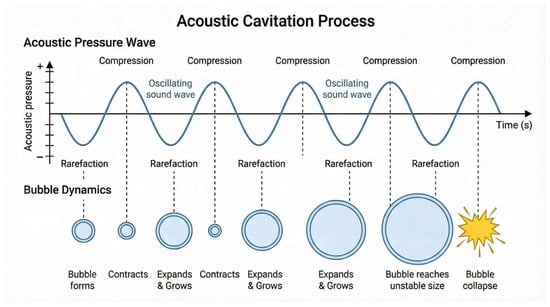
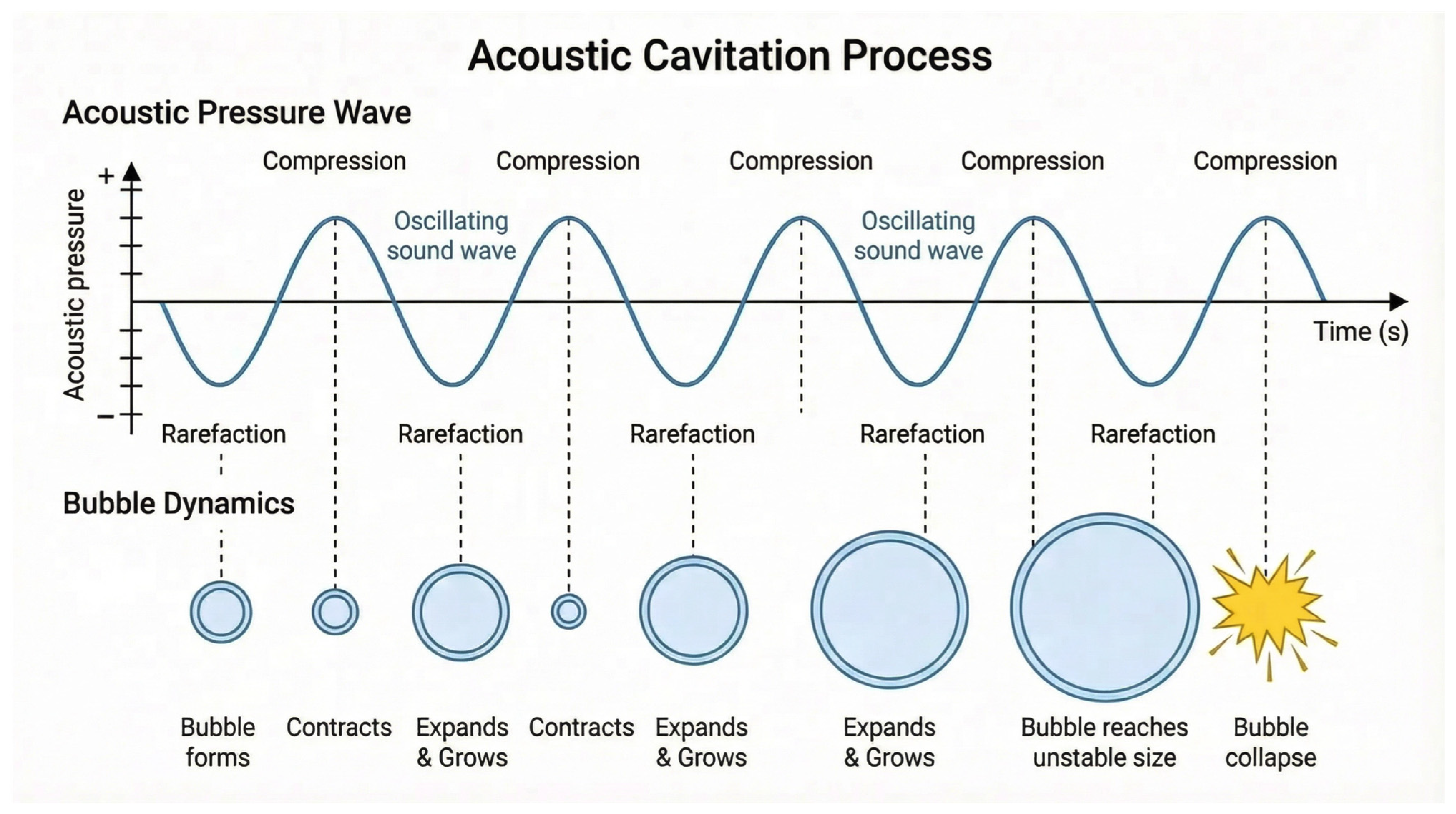
Ultrasound is defined as sound waves with frequencies that exceed the upper limit of human hearing, which is approximately 20 kHz for young, healthy adults. While sharing the same physical properties as audible sound, ultrasound is imperceptible to the human ear. The ultrasonic spectrum is vast, with applications utilizing frequencies from 20 kHz up to several gigahertz [7]. The primary mechanism behind these effects is acoustic cavitation, which involves the formation, growth, and implosive collapse of microscopic bubbles or cavities within a liquid [8]. As the ultrasound waves propagate, they create alternating cycles of high and low pressure. During the low-pressure (rarefaction) phase, the liquid is pulled apart, forming vacuum bubbles. These bubbles grow during subsequent cycles until they reach a critical size and violently collapse during the high-pressure (compression) phase. This implosion generates localized hot spots with extreme temperatures and pressures, leading to the observed effects of sonication (Figure 1).
Figure 1.
The mechanism of acoustic cavitation, illustrating bubble growth and collapse.
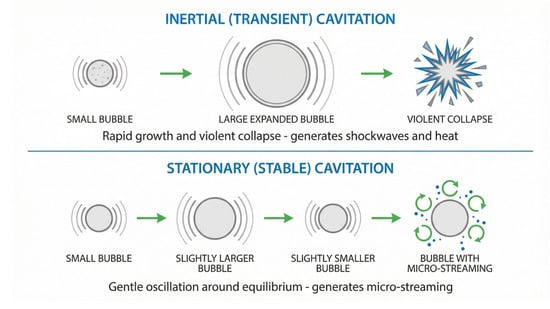
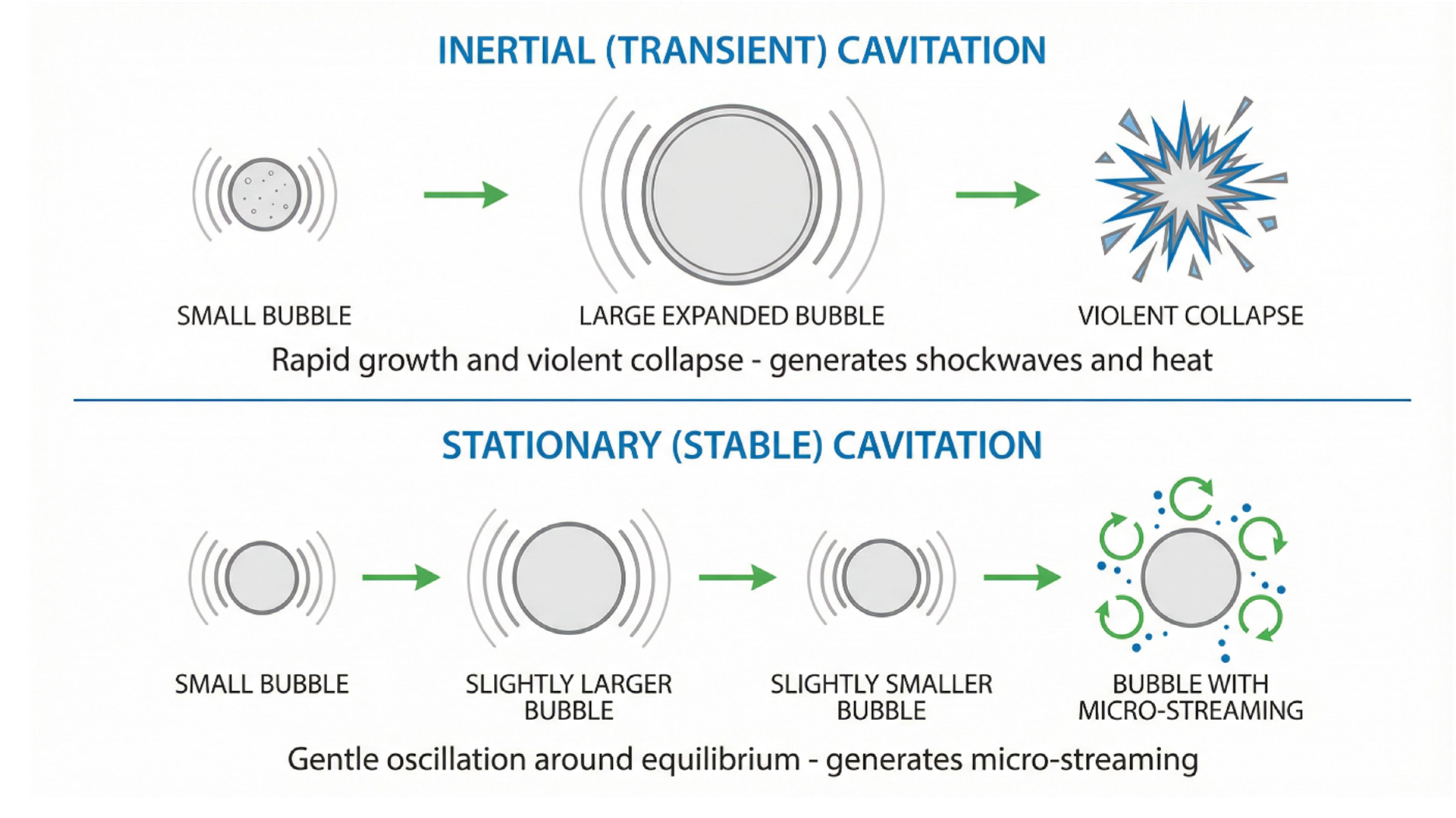
Cavitation can be further classified as stationary (stable) or transient (inertial) [9,10]. Stationary cavitation involves bubbles that oscillate for many acoustic cycles, inducing micro-streaming in the surrounding liquid, which can enhance mass transfer (at ultrasound intensity of 1–3 W/cm2). Transient cavitation, on the other hand, involves the rapid growth and violent collapse of bubbles, generating shockwaves and intense localized energy (at intensity > 10 W/cm2), which is responsible for most of the disruptive effects of ultrasound (Figure 2).
Figure 2.
A diagram illustrating the difference between stationary (stable) and transient (inertial) cavitation.
2.2. Classification of Ultrasound According Wave Frequency and Power
The frequency of the acoustic wave is a critical parameter in ultrasonic processing. For food processing applications, such as emulsification and extraction, low frequencies in the range of 20 to 40 kHz combined with high power are typically used [11,12]. This is often referred to as “power ultrasound” due to the intense shear fields it generates. Low-frequency, high-power ultrasound has a destructive effect, transmitting significant acoustic energy that can induce physical, mechanical, and chemical changes in the treated medium. Low-frequency, high-power (10–1000 W/cm2) ultrasound is known for its disruptive effects on the physical, biological, and mechanical properties of food products [12]. This is primarily due to the intense cavitation it induces. The collapse of cavitation bubbles releases substantial energy, leading to a wide range of applications, including emulsification, defoaming, extraction of nutrients and flavors, and modification of food texture [12,13]. It is also used to enhance the efficiency of various unit operations such as freezing, drying, and meat tenderization [13].
Conversely, high-frequency (>1 MHz), low-power (<1 W/cm2) ultrasound, also known as diagnostic ultrasound, is a non-invasive and non-destructive technique used for food analysis and quality control [13]. It provides detailed information about the structure, size, and composition of food products by analyzing the interaction of the sound waves with the food/beverage material. The attenuation of the ultrasound signal, which occurs through absorption and scattering, provides insights into the physicochemical properties of the food [14]. For example, it can determine the fat and bone content in meat, as it does not cause damage to the food components [15,16]. This type of ultrasound induces molecular vibrations without altering the food or beverage chemical and mechanical properties. For example, ultrasound-based spectroscopy equipment can be used for rapid milk analysis and milk quality control [14], measuring the milk macronutrients and physical parameters such as density and freezing point.
The amplitude of the wave, a parameter selected for ultrasound treatment, is directly proportional to the power applied. The energy delivered by the transducer is quantified in terms of acoustic power (W) and acoustic power intensity (API, W/cm2). Acoustic power density (APD) is quantified for liquid products sonication (W/mL lab scale or kW/L for larger scale sonication) or specific acoustic power for weighable semi-solid or viscous products (W/g for lab-scale or kW/kg for larger-scale operations). These parameters can be determined calorimetrically using the following equations:
where P is the acoustic power, d is the diameter of the sonotrode, and V is the volume of the treated liquid. The acoustic power (P) is estimated through the heat transferred to the food/liquid during the ultrasound operation using the sensible heat equation m × Cp × (dT/dt), where m is the mass of the food/liquid being sonicated, Cp is its specific heat capacity, and dT/dt is the initial rate of temperature change during sonication. It is important to note that the effectiveness of the treatment can vary with the distance from the probe, as the acoustic intensity diminishes with increasing distance. The vibration or wave generated is dispersed in the medium, losing intensity as it moves away from the source due to wave absorption by the medium.
2.3. Types of Ultrasound Transducers
The core component responsible for generating ultrasound is the transducer, a device that converts electrical energy into high-frequency acoustic energy [12,17]. The two primary types of transducers employed for this purpose are magnetostrictive and piezoelectric transducers.
2.3.1. Piezoelectric Transducers
Piezoelectric transducers are based on the piezoelectric effect, where certain crystalline materials, such as quartz, generate an electric charge in response to applied mechanical stress. Conversely, when an electric field is applied to these materials, they deform, creating the mechanical vibrations that produce ultrasound waves [12]. Piezoelectric transducers are highly efficient, with conversion efficiencies reaching up to 95%, allowing them to operate at high power levels with minimal energy loss [18,19]. Despite their high efficiency, they still generate some heat during operation, which must be dissipated to prevent damage to the transducer. Typically, these transducers are air-cooled, which can make them susceptible to environmental factors such as humidity, potentially leading to electrical arcing. Therefore, the cooling air must be clean and dry, requiring special conditioning and careful maintenance to ensure reliable operation [18].
2.3.2. Magnetostrictive Transducers
Magnetostrictive transducers operate on the principle of magnetostriction, a property of ferromagnetic materials, such as nickel, to change their shape or dimensions in response to a magnetic field. When a magnetic field is applied, the material undergoes a slight change in length, either contracting or elongating, which generates the ultrasonic waves [19]. Historically, these transducers were favored for high-power liquid processing applications due to their robustness and the ability to be water-cooled, which prevents overheating during continuous operation [19]. However, a significant drawback of magnetostrictive transducers is their low electroacoustic conversion efficiency, which is typically less than 40%. This inefficiency leads to substantial heat generation, energy loss, and increased operational costs, as the power supply must compensate for the energy dissipated as heat [19].
2.4. Ultrasound Food Transmission Systems
The method by which ultrasonic energy is delivered to the food material is a critical aspect of the system design. The two primary configurations for ultrasound transmission are direct contact and indirect contact systems.
2.4.1. Direct-Contact Probe Ultrasound
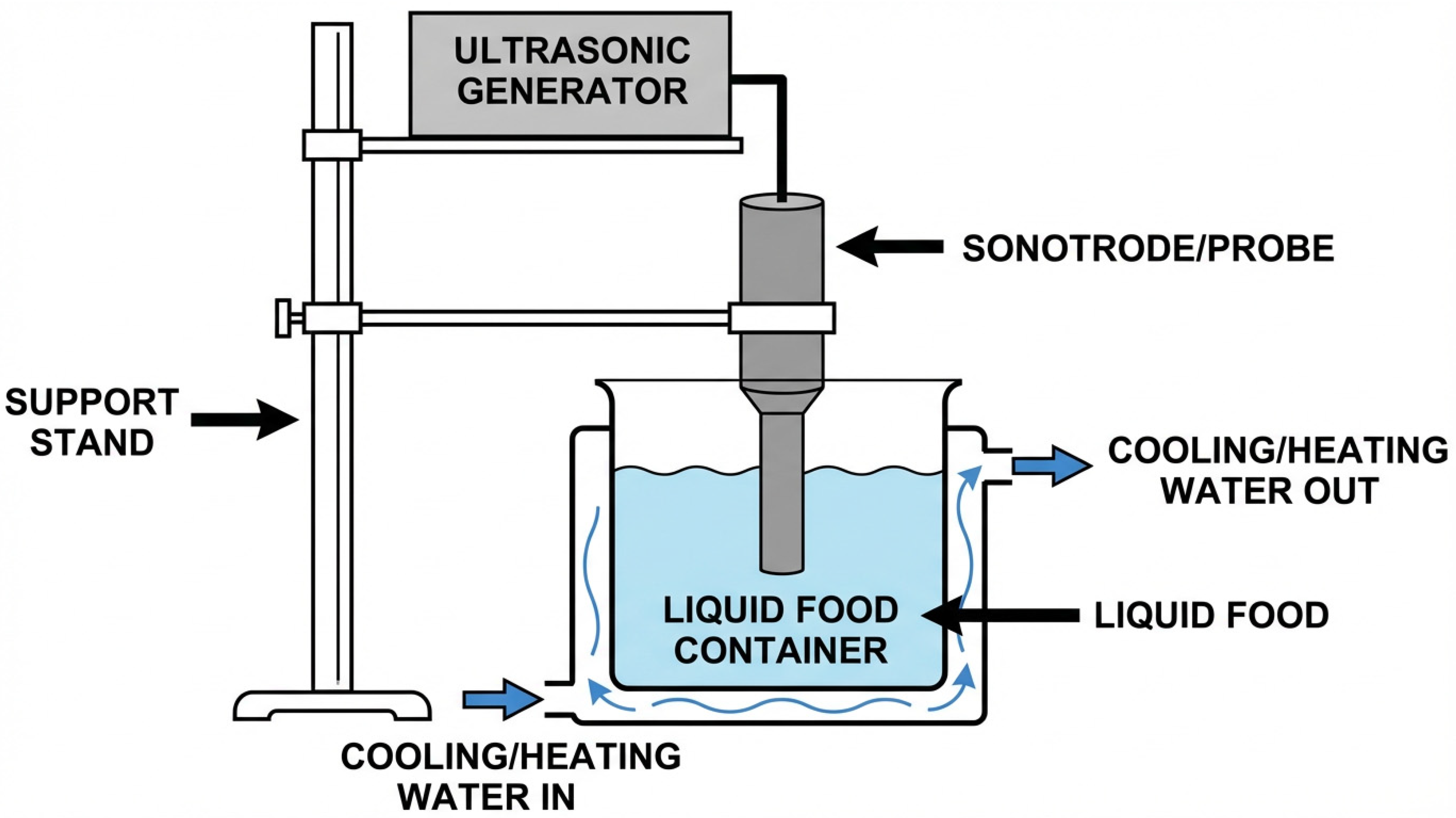
In a direct contact system, the transducer is connected to a sonotrode or probe, which is immersed directly into the liquid or semi-solid food being treated (Figure 3). These probes, typically fabricated from high-strength titanium alloys (such as Ti-6Al-4V) or other durable acoustic materials like stainless steel, are designed to transmit high-intensity ultrasonic energy directly into the processing medium with minimal energy loss and high fatigue resistance [3,20]. This configuration is characteristic of high-power ultrasound applications, operating at low frequencies (20–40 kHz). A key consideration with direct contact systems is the potential for significant heat generation. As ultrasonic energy is absorbed by the medium, a portion of it is converted into heat, which lead to a rise in the product’s temperature [21,22]. This temperature increase, if not controlled, can be detrimental to the quality of heat-sensitive food products, causing degradation of nutrients like ascorbic acid, color pigments such as anthocyanins and carotenoids, and flavors [13,23]. To mitigate this thermal effect, direct-contact systems are often equipped with cooling jackets, heat exchangers, or operated in a pulsed mode (alternating ON/OFF cycles) to allow for heat dissipation [24]. A major advantage of this setup is its suitability for continuous processing, where the liquid food can be pumped through a closed flow-cell containing the ultrasonic probe, enabling efficient and consistent treatment on a larger scale.
Figure 3.
Direct contact ultrasound system (probe-type).
2.4.2. Indirect-Contact Bath Ultrasound
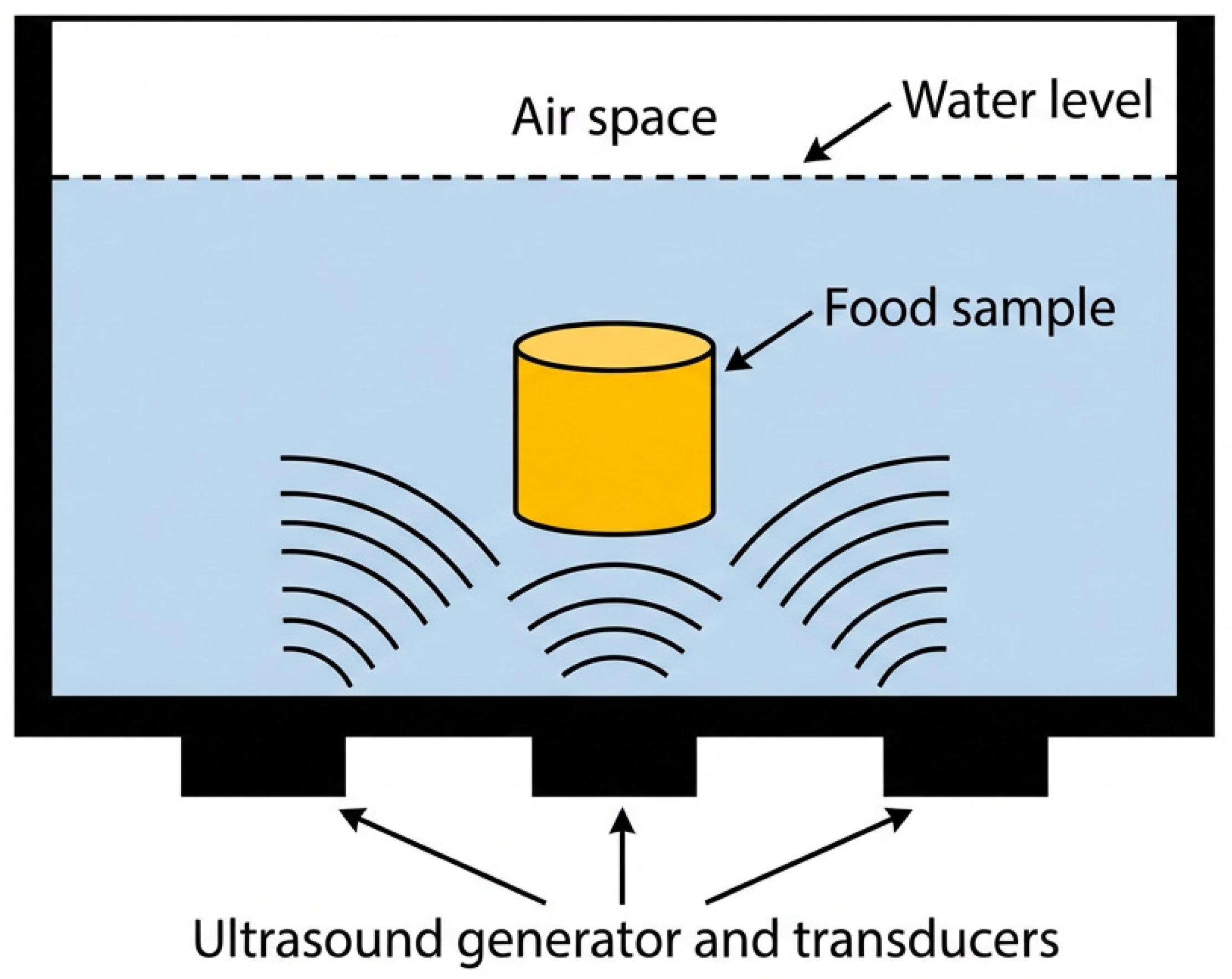
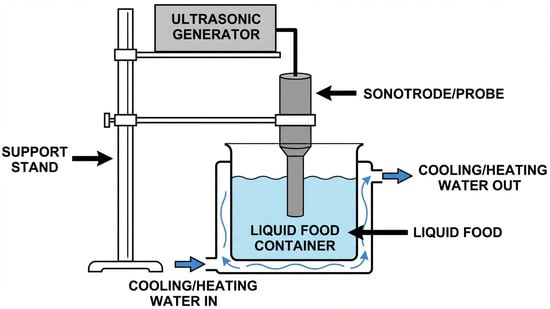
Indirect-contact systems, commonly known as ultrasonic baths, are used for applications such as cleaning and sanitation in the food industry [25]. In this configuration, the transducer is mounted on the exterior of a tank, typically at the bottom. The tank is filled with a liquid medium, usually water, which serves to transmit the ultrasonic waves to the food product or equipment submerged within it. The transducer generates high-intensity waves that propagate through the liquid, inducing cavitation throughout the bath (Figure 4). The implosion of these cavitation bubbles releases significant energy, which is effective in dislodging dirt and microorganisms from the surfaces of the immersed items, such as knives and conveyor belts [26,27].
The ultrasonic bath system is also a highly effective method for blanching of whole vegetables and fruits, a pre-treatment commonly applied to this class of frozen products. Sonication enhances the inactivation of undesirable enzymes, such as peroxidase, promoting better retention of vegetable and fruit color, flavor, and nutritional quality during storage [28,29].
While this method avoids direct contact between the sonotrode and the food, the energy distribution within the bath can be non-uniform. The intensity of the ultrasound decreases with distance from the transducer, meaning that the effectiveness of the treatment can vary depending on the position of the sample within the bath. Therefore, for consistent results, it is crucial to maintain a standardized sample placement and liquid level during processing.
Figure 4.
Indirect contact ultrasound system used in the water ultrasonic bath.
3. Applications of Ultrasound to Promote Food Processing Operations
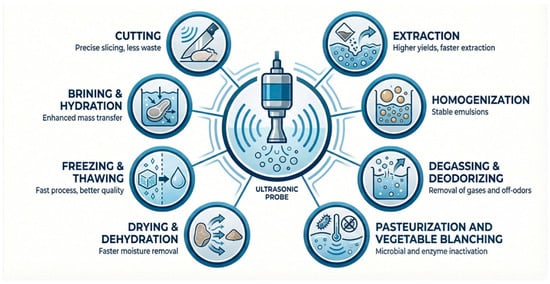
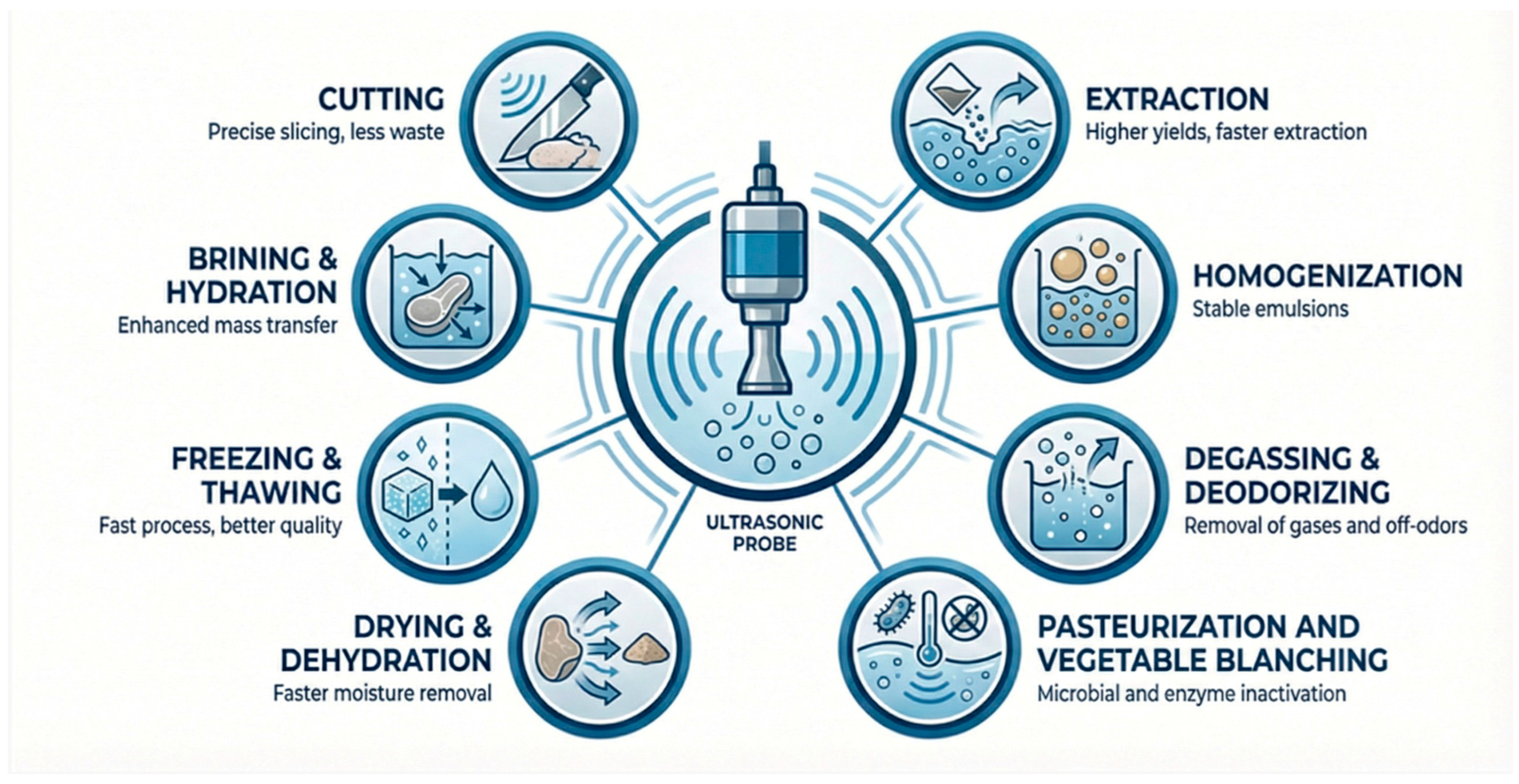
The versatility of ultrasound technology has led to its application in a wide range of food processing operations. By harnessing the physical and chemical effects of acoustic cavitation, sonication can be used to enhance existing processes or enable new ones, often with significant improvements in efficiency and product quality (Figure 5).
Figure 5.
An overview of the various applications of ultrasound in the food industry.
3.1. Extraction of Bioactive Compounds and Valuable Food Ingredients
Ultrasound-assisted extraction (UAE) is a highly efficient method for recovering bioactive compounds, such as polyphenols, antioxidants, and essential oils, from plant materials, foods, and food waste or by-products [30,31]. The cavitation bubbles generated by ultrasound can disrupt the cell walls of the plant material, facilitating the release of the target compounds into the solvent, leading to higher extraction yields and shorter extraction times compared to conventional methods [30,31]. The implosion of the cavitation bubbles near the cell surfaces generates powerful micro-jets and shockwaves. This intense, localized mechanical stress is responsible for eroding and rupturing the cell walls and membranes, thereby creating micro-channels that significantly improve the penetration of the solvent into the plant matrix and the subsequent diffusion of intracellular compounds into the bulk solvent [31,32]. Therefore, UAE is a promising technique for enhancing yields and preserving the quality of extracted compounds [33].
The optimization of UAE processes using methodologies like Response Surface Methodology is also an active area of research, as demonstrated in recent studies on the extraction of bioactive compounds from goji berries [34] and spicy food ingredients from chili pepper sauces waste [31]. As the applications of UAE expand, so too does the importance of ensuring the safety of the extracted ingredients, with recent reviews calling for a greater focus on the toxicity assessment of compounds obtained through this method [35]. Ultrasound can also enhance the extraction operation required to prepare soy, rice and almond beverages.
3.2. Homogenization and Emulsification
Homogenization is a critical process in the food industry, particularly for creating stable emulsions and improving the texture and consistency of liquid products. Ultrasound has proven to be a highly effective tool for homogenization, a process often referred to as ultrasonic homogenization, which is why the equipment is commonly known as an ultrasonic homogenizer. The efficacy of this technology stems from the phenomenon of acoustic cavitation—the formation, growth, and violent collapse of microscopic bubbles in a liquid medium when subjected to high-intensity sound waves [36]. The implosion of these cavitation bubbles generates extreme localized conditions, including intense shear forces, high-speed micro-jets, and shock waves, which effectively disrupt and disperse particles and droplets [36,37].
In dairy processing, sonication is a prime example of this application, where it is used to reduce the size of fat globules in milk. This process significantly enhances the emulsion’s stability, prevents creaming, and improves sensory attributes like mouthfeel and appearance [38]. For instance, research has demonstrated that applying ultrasound at an intensity of 1.0 kJ/mL can reduce the average fat globule size in whole milk to as small as 0.22 µm, a significant improvement over the typical 1.2 µm found in commercially processed milk [39]. This reduction in particle size leads to a more uniform and stable emulsion that maintains its quality even after subsequent pasteurization treatments.
Furthermore, when compared to conventional high-pressure shear homogenization, ultrasonic methods have shown distinct advantages. A study found that while both methods could achieve a similar fat globule size distribution, ultrasonication retained a greater number of native Milk Fat Globule Membrane proteins [40]. The preservation of these proteins is crucial as they play a vital role in the nutritional and functional properties of dairy products. Therefore, ultrasonic homogenization not only achieves the primary goal of particle size reduction but does so with greater energy efficiency and better preservation of the food matrix’s natural components [36].
Recent advancements in ultrasound-based emulsification, particularly in combination with protein–polysaccharide complexes, have shown immense potential for creating stable, clean-label emulsions. Ultrasound facilitates the formation of fine, stable emulsions by reducing droplet size and modifying protein conformation through acoustic cavitation [41]. These changes enhance the rheological and emulsifying properties of the system, enabling the design of sustainable and health-promoting colloidal systems for a variety of food applications, including dairy, meat, and beverages [41].
3.3. Beverages Degassing and Deodorization of Food and Food By-Products
Ultrasound can be used to remove dissolved gases from liquids through a process known as degassing, which is particularly useful in the beverage industry where dissolved gases can negatively affect product quality and stability. The mechanism underlying ultrasonic degassing involves acoustic cavitation, wherein the intense ultrasonic waves generate cavitation bubbles that act as nucleation sites for dissolved gases [42]. When these cavitation bubbles form and collapse in a liquid medium containing dissolved gases, the gases coalesce around the bubble surfaces, grow in size, and subsequently rise to the surface of the liquid and released. This process is significantly more efficient than passive degassing methods because the cavitation bubbles create high partial-pressure gradients that dramatically enhance the volumetric liquid–gas mass transfer coefficient [42]. For instance, ultrasonic degassing is applied to remove oxygen from fruit and vegetable juices to prevent oxidative degradation reactions [43], as well as to remove excess carbon dioxide from carbonated beverages, such as beer and sparkling wine, a process often termed ‘fobbing’ or defoaming, which is critical for quality control and bottling consistency [44,45]. A study comparing various degassing methods demonstrated that high-power ultrasonic degassing treatment resulted in the largest mass transfer enhancement overall, further improved with liquid agitation [42].
The deodorization capability of ultrasound extends to various aquatic products, particularly aquatic products and food by-products. Contrary to the mechanism of breaking down off-flavor molecules, the primary role of ultrasonically induced cavitation in deodorization is to promote the diffusion and release of volatile compounds from the food matrix [46,47]. This capability is particularly valuable for seafood, where off-flavor compounds such as trimethylamine (TMA), dimethyl disulfide, and other volatile nitrogenous and sulfur derivatives create characteristic fishy odors, as well as geosmin (GSM) and 2-methylisoborneol (MIB), which are responsible for earthy and musty odors in aquaculture products [48]. The mechanical and thermal effects of cavitation accelerate the transfer of these volatile molecules across phase boundaries, effectively stripping them from the product and significantly improving the sensory quality of the final product [46].
3.4. Pasteurization and Whole-Vegetable Blanching: Enzyme and Microbial Inactivation
Thermal pasteurization, while effective, can often lead to undesirable changes in the nutritional and sensory properties of food products [23]. Ultrasound, combined with heat (thermosonication), has emerged as a promising alternative for more rapid enzyme and microbial inactivation, with shorter exposure to heat.
Studies by Silva and Sulaiman have revealed the benefit of thermosonication to inactivate endogenous deteriorative enzymes such as polyphenoloxidase, responsible for fruit products browning (e.g., juices, concentrates, purees, pulps), as it can denaturate the enzymes (proteins) causing loss of functionality [49,50,51]. Whole-vegetable ultrasound-assisted blanching is another important food application, as ultrasound potentiates the denaturation and inactivation of spoilage enzymes naturally present in vegetables. This is particularly relevant for indirect-contact bath ultrasound applications. Successful results have been obtained with ultrasound-assisted blanching of various vegetables, including carrots [29], onions [52], broccoli [53], and sweet potatoes [54]. The application of ultrasound enhances mass transfer and facilitates the penetration of heat, leading to increased enzyme inactivation, better drying and preservation of vegetable physiochemical properties compared to conventional blanching methods.
Research has further solidified the potential of thermosonication as a viable microbial inactivation method. The microbial inactivation effect of ultrasound is attributed to the thinning of cell membranes and localized heating caused by cavitation [24]. Studies have demonstrated the efficacy of thermosonication against a diverse range of foodborne pathogens and spoilage organisms, including Escherichia coli and Listeria monocytogenes [55] and Pseudomonas fluorescens [56]. Furthermore, recent work supports the application of pulsed thermosonication for the inactivation of Listeria innocua in blueberry juice [57] and the expansion of ultrasound-assisted pasteurization to new product categories, such as plant-based beverages like Brazil nut milk [58]. In addition, Evelyn et al. (2017) demonstrated that thermosonication increased the inactivation of spores, namely Clostridium perftingens in beef slurry, Alicyclobacillus acidoterrestris in orange juice and Saccharomyces cerevisae in beer [59].
3.5. Drying or Dehydration
Ultrasound-assisted drying is another promising application of sonication in the food industry [60]. The application of ultrasound as a pre-treatment or during drying can significantly reduce the drying time and improve the quality of the final product. The mechanical effects of ultrasound, such as the creation of micro-channels and the “sponge effect,” can enhance water removal from the food matrix [61]. Additionally, the thermal effects of ultrasound can increase the vapor pressure of water at the surface of the product, further accelerating the drying process [62,63]. Ultrasound-assisted drying has a positive impact on both drying efficiency and the quality of fruits and vegetables [64]. Recent studies with wine cap mushroom and snow ear fungus (used in Asian cuisine) have further elucidated the mechanisms behind this enhancement, demonstrating that ultrasound pretreatment can improve moisture migration and reduce the loss of quality related compounds during drying [65,66].
3.6. Freezing and Thawing
Ultrasound can be effectively used to enhance the freezing process by promoting nucleation and controlling ice crystal growth, resulting in significant improvements to both processing efficiency and final product quality. The application of ultrasound during freezing leads to faster and more uniform cooling, which facilitates the formation of smaller, more numerous ice crystals [67,68]. This is highly beneficial for preserving the texture and quality of frozen foods, as smaller ice crystals cause considerably less damage to the cellular structure of the product compared to the large, irregular crystals formed during conventional freezing [68]. The mechanism underlying this improvement involves the cavitation bubbles generated by ultrasound, which act as nucleation sites and initiate the formation of ice crystals at a higher temperature, thereby reducing the degree of supercooling and promoting more controlled crystallization [69]. Additionally, the micro-streaming and eddies created by stable cavitation bubbles significantly enhance heat and mass transfer throughout the product, further accelerating the freezing process and ensuring more uniform temperature distribution [41]. Research has demonstrated that ultrasound-assisted freezing can substantially reduce freezing time while simultaneously improving textural properties, water-holding capacity, and overall sensory quality of frozen foods including meat, fish, and vegetables, making it a valuable technology for the food processing industry seeking to maintain product quality while improving operational efficiency [70].
Ultrasound can be effectively used to accelerate the thawing of frozen foods, representing a non-thermal and environmentally friendly alternative to traditional thawing methods. The application of ultrasound during thawing can significantly reduce thawing time and improve the quality of the final product through a combination of mechanical and thermal effects. When ultrasonic waves pass through frozen foods, the vibration energy is partially converted into heat, which promotes the thawing process, while the physical effects generated by acoustic cavitation produce micro-jets and shock waves that enhance heat and mass transfer at the ice-liquid interface, thereby reducing the resistance to heat transfer and promoting the melting of ice crystals [71]. Research has demonstrated that ultrasonic-assisted thawing can reduce thawing time by 15.7% to 45.4% compared to conventional flowing water thawing, with even more dramatic reductions at higher power densities—for example, at 40 W/L ultrasonic power density, the thawing time of frozen pork was reduced by 69% compared to water thawing without ultrasound [72]. Furthermore, ultrasound powers ranging from 200 W to 600 W have been shown to shorten thawing time by 31% to 55% [73]. Beyond efficiency improvements, ultrasound-assisted thawing also preserves product quality better than traditional methods. At optimal power levels (such as 400 W for duck meat), ultrasonic thawing significantly reduces thawing loss, improves water-holding capacity, enhances meat tenderness, and reduces off-flavor compounds by inhibiting lipid oxidation and amino acid degradation [73]. The mechanical effects of ultrasound also help maintain the structural integrity of muscle fibers and myofibrils, resulting in a more uniform thawing process that prevents the formation of large ice crystals that would otherwise damage tissue microstructure. These combined benefits—rapid thawing, reduced quality loss, and improved sensory attributes—make ultrasound-assisted thawing a promising technology for the frozen food industry, particularly for meat and seafood products where maintaining quality during thawing is critical [74].
3.7. Hydration, Brining, and Pickling
Ultrasound technology can be effectively utilized to accelerate the hydration of dried legumes (e.g., beans, chickpeas) and dried cereal grains (e.g., rice, wheat), which is a critical step in both domestic and industrial food preparation. The application of high-power ultrasound during the soaking process significantly reduces hydration time by enhancing water penetration through the food matrix via acoustic cavitation and the “sponge effect” [75]. For instance, studies have demonstrated that ultrasonic treatment can reduce the soaking time of chickpeas by approximately 40% while simultaneously improving the texture and reducing the subsequent cooking time [76,77]. Furthermore, ultrasound-assisted hydration has been shown to improve the quality of the final product by facilitating the removal of anti-nutritional factors and potentially allowing for the fortification of grains with essential nutrients during the soaking phase [78]. While traditional hydration is often a time-consuming bottleneck in food processing, ultrasound represents a promising emerging application for improving operational efficiency and product functionality in the legume and cereal industries [79].
Ultrasound can accelerate the mass transfer of salt and other solutes into food products during brining and pickling. The acoustic streaming and micro-streaming generated by ultrasound can enhance the diffusion of the brine into the food matrix, reducing the processing time and improving the uniformity of the final product. This has been demonstrated in the brining of meat and cheese, where ultrasound-assisted brining resulted in faster salt uptake and a more consistent product [80,81].
3.8. Cutting and Slicing
Ultrasonic cutting technology utilizes a high-frequency vibrating blade to slice through food products with significantly reduced friction and mechanical pressure. This technology reduces the waste generated and is particularly well-suited for delicate, sticky, or heterogeneous foods (i.e., cakes, cheeses, and cereal bars), where conventional cutting methods often result in product deformation or sticking [82]. The high-frequency vibrations (typically 20–40 kHz) create a nearly frictionless cutting surface, resulting in clean, precise cuts with minimal waste and superior esthetic quality [10]. Original research has demonstrated that ultrasonic excitation significantly reduces the cutting force and work required to separate various food materials. For instance, Zahn et al. (2006) showed that cutting malted bread at a velocity of 0.167 cm/s reduced the maximum force required for cut from 11.3 N without excitation to 2.2 N with high-amplitude ultrasonic vibration [83]. This reduction in force is primarily attributed to the rapid longitudinal vibration of the blade, which prevents product adhesion and reduces the effective contact area between the blade and the food matrix [83,84]. Furthermore, the nearly frictionless interface minimizes the mechanical stress applied to the product, preserving its structural integrity and reducing the accumulation of food residues on the blade. This not only enhances cutting performance but also improves industrial hygiene by mitigating the risk of microbial growth associated with food residue buildup [84].
The versatility of ultrasonic cutting is further highlighted by its application in non-invasive texture and quality analysis, where it can be used to assess the mechanical properties of food products during the cutting process [41]. Industrial implementations from leading manufacturers such as Branson (Emerson), Dukane, Sonics & Materials, and Cheersonic continue to expand the range of applications to include a wide variety of edibles, from confectionery to meat products. For instance, Dukane has specialized in ultrasonic food cutting for nearly 30 years, providing components that are widely used for portioning cheese, cakes, and sandwiches [85]. Similarly, Sonics & Materials offers specialized equipment designed to reduce downtime and improve sanitation in high-volume production environments [86]. These industrial solutions, along with those from Telsonic Ultrasonics (2024), ensure consistent portioning and high-quality presentation across the global food industry [82].
4. Challenges, Future Perspectives of Ultrasound-Assisted Food Processes and Conclusions
Ultrasound technology presents a significant opportunity to advance food processing, offering a versatile and powerful tool to enhance a wide range of unit operations. The principles of sonication, from the physics of acoustic cavitation to the design of various ultrasonic systems, have been explored in this review, highlighting the potential of ultrasound to improve process efficiency, enhance product quality, and promote sustainability within the food industry. Extraction, homogenization, degassing and deodorizing, pasteurization and vegetable blanching, drying, freezing and thawing, brining and hydration, and cutting, demonstrate the spectrum of ultrasound applications. However, for the potential of ultrasound to be fully realized, it is crucial to address substantial limitations that currently hinder its widespread adoption.
4.1. Challenges
A primary challenge lies in the scalability of the technology from laboratory to industrial-scale production, and also the transition from batch to continuous operations. The non-uniformity of the acoustic field in larger systems can lead to inconsistent processing, a critical flaw in an industry that demands high product consistency [20,41]. Furthermore, the high-intensity ultrasound required for many applications can generate localized heat, leading to the thermal degradation of thermolabile nutrients, flavors, and pigments [3,41]. The sonochemical effects of cavitation can also induce lipid oxidation and the formation of off-flavors, particularly in foods with a high fat content. While these issues can be mitigated through precise process control and sophisticated cooling systems, such measures add to the complexity and cost of the equipment, raising questions about its economic feasibility for many producers [1,2]. The energy requirements for some applications can also be substantial, potentially negating the technology’s “green” credentials and limiting its economic viability [87]. A 2025 study on the adoption of ultrasound in Latin America highlights the significant gap between laboratory-scale successes and industrial applications, a disconnect that is also reflected in global patent analyses that point to persistent scale-up difficulties [88,89].
In addition, much of the existing research has focused on the positive aspects of ultrasound without adequately addressing the economic and practical limitations to implementation. The food industry’s reluctance to adopt new technologies is often attributed to a lack of understanding or high investment costs, but this overlooks valid concerns regarding the reliability, maintenance, and return on investment (ROI) of novel processing equipment. An emerging alternative, hydrodynamic cavitation, is gaining attention for its potential energy efficiency and lower thermal impact, but it is still in the early stages of development for many food applications and faces its own set of scale-up challenges [90]. While it shows promise in areas like food waste pretreatment and biomass conversion, it is not yet a universal solution for the broader food industry [91].
4.2. Future Perspectives
Looking to the future, a shift in research focus is necessary. There is a notable lack of studies on the long-term effects of sonication on the nutritional and toxicological profiles of processed foods. While short-term studies often show promising results, more extensive research on the potential for the formation of undesirable or even toxic compounds due to sonochemical reactions is needed [1]. Future research must therefore move beyond demonstrating the potential of ultrasound to providing the robust, long-term data and economic analyses that the industry requires for investment decisions. A greater focus on the synergistic effects of combining ultrasound with other emerging technologies, such as pulsed electric fields and high-pressure processing, may offer a more practical path forward, with a critical assessment of the added complexity and cost. In addition, the design of new reactors and sonotrodes with different materials and configurations is also needed for specific food and beverage applications.
The integration of Artificial Intelligence (AI) and machine learning (ML) offers a particularly promising avenue for overcoming current limitations. Instead of relying on empirical, trial-and-error optimization, AI can be used to predict the outcomes of ultrasonic processes with greater accuracy. For example, Artificial Neural Networks (ANNs) have already proven effective in modeling and optimizing the ultrasound-assisted extraction (UAE) of bioactive compounds, successfully mapping the complex, non-linear relationships between process variables (e.g., ultrasound intensity, time, temperature) and extraction yields [92]. Such models can predict the optimal processing parameters to maximize yield while minimizing the degradation of target compounds. Similarly, ML algorithms like Support Vector Machines (SVMs) have been used to reliably predict acoustic cavitation thresholds in different fluids, providing a powerful tool for designing more efficient and predictable sonication systems [93]. In the future, one can envision AI-driven systems that use real-time sensor data (e.g., acoustic, thermal, chemical) to create a digital twin of the food product. This model would then predict how the product’s quality attributes are changing and adaptively adjust ultrasound parameters on the fly to ensure consistent results and minimize energy consumption, moving the technology from a static process to a dynamic, intelligent one.
4.3. Conclusions
In summary, while sonication is poised to play an increasingly important role in the food industry’s search for greener and more efficient manufacturing processes, its successful adoption will require a more realistic appraisal of its limitations. Further collaboration between academia and industry is essential to translate the successes achieved in the laboratory into robust, economically viable industrial-scale applications that can deliver tangible benefits to both producers and consumers. The development of standardized protocols, global regulatory standards, and the integration of advanced control systems like those enabled by AI will be critical for the successful adoption of ultrasound into the food industry.
Author Contributions
Conceptualization, A.S. and F.V.M.S.; formal analysis, A.S. and F.V.M.S.; writing—original draft preparation, A.S.; writing—review and editing, F.V.M.S.; visualization, A.S. and F.V.M.S. All authors have read and agreed to the published version of the manuscript.
Funding
Funding from FCT—Fundação para a Ciência e a Tecnologia, I.P.—through project reference UID/04129/2025 is acknowledged.
Data Availability Statement
No new data were created or analyzed in this study. Data sharing is not applicable to this article.
Acknowledgments
The figures presented in this manuscript were generated using the Generative AI tool, Manus (Version 1.6). The workflow involved creating initial figure drafts as templates in Microsoft PowerPoint. These templates were subsequently exported as images and provided as image prompts to the AI. Text prompts were used to direct the final artistic style and content; for example: “Generate a scientific illustration in the style of a journal publication diagram, depicting the sonication process arrangement”. All AI-generated figures were manually reviewed and edited by the authors to ensure scientific accuracy and clarity.
Conflicts of Interest
The authors declare no conflict of interest.
References
- Bermúdez-Aguirre, D. Sonochemistry of foods. In Ultrasound: Advances for Food Processing and Preservation; Academic Press: New York, NY, USA, 2017; pp. 131–143. [Google Scholar]
- Mason, T.J. Trends in sonochemistry and ultrasonic processing. In AIP Conference Proceedings, Proceedings of the International Congress in Ultrasonics, Gdańsk, Poland, 5–8 September 2011; American Institute of Physics: College Park, MD, USA, 2012; Volume 1433, pp. 21–26. [Google Scholar]
- Bhargava, N.; Mor, R.S.; Kumar, K.; Sharanagat, V.S. Advances in application of ultrasound in food processing: A review. Ultrason. Sonochem. 2021, 70, 105293. [Google Scholar] [CrossRef] [Scilit]
- Chemat, F.; Khan, M.K. Applications of ultrasound in food technology: Processing, preservation and extraction. Ultrason. Sonochem. 2011, 18, 813–835. [Google Scholar] [CrossRef] [Scilit]
- Jambrak, A.R.; Da Cruz, A.G.; Chen, J. Ultrasonic food processing as a green and sustainable technology. Ultrason. Sonochem. 2024, 99, 106547. [Google Scholar] [CrossRef] [Scilit]
- Strategic Market Research. Food Ultrasound Market by Application, Frequency, End User, and Geography: Segment Revenue Estimation and Forecast, 2024–2030. Available online: https://www.strategicmarketresearch.com/market-report/food-ultrasound-market (accessed on 2 February 2026).
- Carrillo-Lopez, L.M.; Alarcon-Rojo, A.D.; Luna-Rodríguez, L.; Reyes-Villagrana, R. Modification of food systems by ultrasound. J. Food Qual. 2017, 2017, 5794931. [Google Scholar] [CrossRef] [Scilit]
- Sulaiman, A.; Silva, F.V.M. Principles of sonication and its equipment in the food industry. In Unit Operations and Processing Equipment in the Food Industry, Non-thermal Food Processing Operations; Jafari, S.M., Therdthai, N., Eds.; Woodhead Publishing: Cambridge, UK, 2023; Volume 13, pp. 435–464. [Google Scholar]
- Mondal, J.; Lakkaraju, R.; Ghosh, P.; Ashokkumar, M. Acoustic cavitation-induced shear: A mini-review. Biophys. Rev. 2021, 13, 1229–1243. [Google Scholar] [CrossRef] [Scilit]
- Chavan, P.; Sharma, P.; Sharma, S.R.; Mittal, T.C.; Jaiswal, A.K. Application of high-intensity ultrasound to improve food processing efficiency: A review. Foods 2022, 11, 122. [Google Scholar] [CrossRef] [Scilit]
- De Prados, M.; Fulladosa, E.; Gou, P.; Muñoz, I.; Garcia-Perez, J.V.; Benedito, J. Non-destructive determination of fat content in green hams using ultrasound and X-rays. Meat Sci. 2015, 104, 37–43. [Google Scholar] [CrossRef] [Scilit] [PubMed]
- Feng, H.; Yang, W. Ultrasonic processing. In Nonthermal Processing Technologies for Food; Wiley-Blackwell: Hoboken, NJ, USA, 2011; pp. 135–154. [Google Scholar]
- Arvanitoyannis, I.S.; Kotsanopoulos, K.V.; Savva, A.G. Use of ultrasounds in the food industry–Methods and effects on quality, safety, and organoleptic characteristics of foods: A review. Crit. Rev. Food Sci. Nutr. 2017, 57, 109–128. [Google Scholar] [CrossRef] [Scilit] [PubMed]
- Dukhin, A.S.; Goetz, P.J.; Travers, B. Use of ultrasound for characterizing dairy products. J. Dairy Sci. 2005, 88, 1320–1334. [Google Scholar] [CrossRef] [Scilit] [PubMed]
- Wieja, K.; Kiełczyński, P.; Szymański, P.; Szalewski, M.; Balcerzak, A.; Ptasznik, S. Identification and investigation of mechanically separated meat (MSM) with an innovative ultrasonic method. Food Chem. 2021, 348, 128907. [Google Scholar] [CrossRef] [Scilit]
- Awad, T.S.; Moharram, H.A.; Shaltout, O.E.; Asker, D.Y.M.M.; Youssef, M.M. Applications of ultrasound in analysis, processing and quality control of food: A review. Food Res. Int. 2012, 48, 410–427. [Google Scholar] [CrossRef] [Scilit]
- Peshkovsky, A.S.; Peshkovsky, S.L. Acoustic cavitation theory and equipment design principles for industrial applications of high-intensity ultrasound. In Physics Research and Technology; Nova Science Publishers: New York, NY, USA, 2010. [Google Scholar]
- Bermúdez-Aguirre, D.; Mobbs, T.; Barbosa-Cánovas, G.V. Ultrasound applications in food processing. In Ultrasound Technologies for Food and Bioprocessing; Springer: Berlin/Heidelberg, Germany, 2011; pp. 65–105. [Google Scholar]
- Graff, K.F. Power ultrasonic transducers: Principles and design. In Power Ultrasonics; Woodhead Publishing: Cambridge, UK, 2015; pp. 127–158. [Google Scholar]
- Peshkovsky, A.S. From research to production: Overcoming scale-up limitations of ultrasonic processing. In Ultrasound: Advances for Food Processing and Preservation; Academic Press: New York, NY, USA, 2017; pp. 409–423. [Google Scholar]
- Schössler, K.; Jäger, H.; Knorr, D. Effect of continuous and intermittent ultrasound on drying time and effective diffusivity during convective drying of apple and red bell pepper. J. Food Eng. 2012, 108, 103–110. [Google Scholar] [CrossRef] [Scilit]
- Sulaiman, A.; Farid, M.; Silva, F.V.M. Strawberry puree processed by thermal, high pressure, or power ultrasound: Process energy requirements and quality modeling during storage. Food Sci. Technol. Int. 2017, 23, 293–309. [Google Scholar] [CrossRef] [Scilit] [PubMed]
- Silva, F.M.; Sims, C.; Balaban, M.O.; Silva, C.L.M.; O’Keefe, S. Kinetics of flavour and aroma changes in thermally processed cupuaçu (Theobroma grandiflorum) pulp. J. Sci. Food Agric. 2000, 80, 783–787. [Google Scholar] [CrossRef] [Scilit]
- Milani, E.A.; Silva, F.V.M. Ultrasound assisted thermal pasteurization of beers with different alcohol levels: Inactivation of Saccharomyces cerevisiae ascospores. J. Food Eng. 2017, 198, 45–53. [Google Scholar] [CrossRef] [Scilit]
- Baboli, Z.M.; Williams, L.; Chen, G. Design of a batch ultrasonic reactor for rapid pasteurization of juices. J. Food Eng. 2020, 268, 109736. [Google Scholar] [CrossRef] [Scilit]
- Brasil, C.C.; Barin, J.S.; Jacob-Lopes, E.; Menezes, C.R.; Zepka, L.Q.; Wagner, R.; Campagnol, P.C.; Cichoski, A.J. Single step non-thermal cleaning/sanitation of knives used in meat industry with ultrasound. Food Res. Int. 2017, 91, 133–139. [Google Scholar] [CrossRef] [Scilit]
- Oulahal-Lagsir, N.; Martial-Gros, A.; Boistier, E.; Blum, L.J.; Bonneau, M. The development of an ultrasonic apparatus for the non-invasive and repeatable removal of fouling in food processing equipment. Lett. Appl. Microbiol. 2000, 30, 47–52. [Google Scholar] [CrossRef] [Scilit]
- Cruz, R.M.S.; Vieira, M.; Silva, C.L.M. Effect of heat and thermosonication treatments on peroxidase inactivation kinetics in watercress (Nasturtium officinale). J. Food Eng. 2006, 72, 8–15. [Google Scholar] [CrossRef] [Scilit]
- Gamboa-Santos, J.; Montilla, A.; Soria, A.C.; Villamiel, M. Effects of conventional and ultrasound blanching on enzyme inactivation and carbohydrate content of carrots. Eur. Food Res. Technol. 2012, 234, 1071–1079. [Google Scholar] [CrossRef] [Scilit]
- Majid, H.; Silva, F.V.M. Optimisation of ultrasound assisted extraction of antiacetylcholinesterase and antioxidant compounds from manuka (Leptospermum scoparium) for use as a phytomedicine against Alzheimer’s disease. N. Z. J. For. Sci. 2020, 50. [Google Scholar] [CrossRef] [Scilit]
- Toscano, A.; Silva, A.F.R.; Ramos, M.P.; Komora, N.; Silva, F.V.M.; Fradinho, P. Spicy food ingredient from red habanero by-product obtained by ultrasound-assisted extraction. Foods 2025, 14, 1407. [Google Scholar] [CrossRef] [Scilit]
- Mushtaq, M.; Amin, Q.A.; Wani, T.A.; Hussain, S.Z.; Bhat, T.A.; Parveen, S.; Chaudhary, A.A.; Ali, M.A.; Qadri, T.; Amin, I. Cavitation-driven extraction: How ultrasound-induced acoustic cavitation maximizes bioactive compound recovery from S. costus roots. Ultrason. Sonochem. 2025, 122, 107643. [Google Scholar] [CrossRef] [Scilit]
- Kariyappa, P.B.; Sethi, S.; Arora, B. Extraction and characterization of plant-based proteins from agro-processing by-products—A review. Food Biomacromol. 2025, 2, 403–417. [Google Scholar] [CrossRef] [Scilit]
- Teixeira, F.; Silva, A.M.; Sut, S.; Dall’Acqua, S.; Ramos, O.L.; Ribeiro, A.B.; Ferraz, R.; Delerue-Matos, C.; Rodrigues, F. Ultrasound-assisted extraction of bioactive compounds from goji berries: Optimization, bioactivity, and intestinal permeability assessment. Food Res. Int. 2024, 188, 114502. [Google Scholar] [CrossRef] [Scilit] [PubMed]
- Demesa, A.G.; Saavala, S.; Pöysä, M.; Koiranen, T. Overview and toxicity assessment of ultrasound-assisted extraction of natural ingredients from plants. Foods 2024, 13, 3066. [Google Scholar] [CrossRef] [Scilit] [PubMed]
- Taha, A.; Ahmed, E.; Ismaiel, A.; Ashokkumar, M.; Xu, X.; Pan, S.; Hu, H. Ultrasonic emulsification: An overview on the preparation of different emulsifiers-stabilized emulsions. Trends Food Sci. Technol. 2020, 105, 363–377. [Google Scholar] [CrossRef] [Scilit]
- Qayum, A.; Rashid, A.; Liang, Q.; Wu, Y.; Cheng, Y.; Kang, L.; Liu, Y.; Zhou, C.; Hussain, M.; Ren, X.; et al. Ultrasonic and homogenization: An overview of the preparation of an edible protein–polysaccharide complex emulsion. Compr. Rev. Food Sci. Food Saf. 2023, 22, 4242–4281. [Google Scholar] [CrossRef] [Scilit]
- Yaakub, N.M.; Kamal, S.M.M.; Ling, C.N.; Julmohammad, N.; Therdthai, N.; Silva, F.V.M.; Sulaiman, A. Exploring the impact of sonication, thermal, and combined treatments on dairy milk: A review. Int. J. Food Eng. 2026, 22, 51–65. [Google Scholar] [CrossRef] [Scilit]
- Astráin-Redín, L.; Skipnes, D.; Cebrián, G.; Álvarez, I.; Rode, T.M. Effect of the application of ultrasound to homogenize milk and the subsequent pasteurization by pulsed electric field, high hydrostatic pressure, and microwaves. Foods 2023, 12, 1457. [Google Scholar] [CrossRef] [Scilit]
- Liu, Y.; Boeren, S.; Zhang, L.; Zhou, P.; Hettinga, K. Ultrasonication retains more milk fat globule membrane proteins compared to equivalent shear-homogenization. Innov. Food Sci. Emerg. Technol. 2021, 70, 102703. [Google Scholar] [CrossRef] [Scilit]
- Prempeh, N.Y.A.; Nunekpeku, X.; Murugeson, A.; Li, H. Ultrasound in the Food Industry: Mechanisms and Applications for Non-Invasive Texture and Quality Analysis. Foods 2025, 14, 2057. [Google Scholar] [CrossRef] [Scilit] [PubMed]
- Kuhn, W.L.; Hihn, J.Y.; Solemslie, B.W.; Dahlhaug, O.G. Comparing and combining methods that enhance liquid–gas mass transfer in a batch reactor: Ultrasonic degassing, aeration by gas bubbling, and liquid agitation. Ultrason. Sonochem. 2025, 119, 107389. [Google Scholar] [CrossRef] [Scilit] [PubMed]
- Chen, Y.; Zhang, M.; Mujumdar, A.S.; Liu, Y. Study on the regulation of browning of concentrated orange juice by ultrasonic-vacuum combined with high-pressure CO2 during storage. Food Bioprocess Technol. 2024, 17, 2407–2420. [Google Scholar] [CrossRef] [Scilit]
- Constant, M.D.; Collier, J.E. Alternative techniques for beer decarbonation. J. Am. Soc. Brew. Chem. 1993, 51, 29–35. [Google Scholar] [CrossRef]
- Gallego-Juárez, J.A.; Rodríguez, G.; Riera, E.; Cardoni, A. Ultrasonic defoaming and debubbling in food processing and other applications. In Power Ultrasonics; Woodhead Publishing: Cambridge, UK, 2015; pp. 793–814. [Google Scholar]
- Wang, Y.; Ge, W.; Sun, H.; Chen, J.; Hu, Z.; Fang, G.; Lv, W.; Wang, H. Deodorization of Oviductus ranae: Establishment of ultrasound-composite natural products method. Food Nutr. 2025, 1, 100022. [Google Scholar] [CrossRef] [Scilit]
- Cadena-Cadena, F.; Arias-Moscoso, J.L.; Argentel-Martínez, L.; Velazquez, J.R.T.; Cuevas-Acuña, D.A.; Cantua, N.E.B.; Concha-Frías, B. Effect of ultrasonic pretreatment on the extraction process of essential oils from grapefruit (Citrus paradisi) by-products. BioTech 2025, 14, 59. [Google Scholar] [CrossRef] [Scilit]
- Wu, T.; Wang, M.; Wang, P.; Tian, H.; Zhan, P. Advances in the formation and control methods of undesirable flavors in fish. Foods 2022, 11, 2504. [Google Scholar] [CrossRef] [Scilit]
- Sulaiman, A.; Soo, M.J.; Farid, M.; Silva, F.V.M. Thermosonication for polyphenoloxidase inactivation in fruits: Modeling the ultrasound and thermal kinetics in pear, apple and strawberry purees at different temperatures. J. Food Eng. 2015, 165, 133–140. [Google Scholar] [CrossRef] [Scilit]
- Silva, F.V.M.; Sulaiman, A. Advances in thermosonication for the inactivation of endogenous enzymes in foods. In Ultrasound: Advances in Food Processing and Preservation; Academic Press: New York, NY, USA, 2017; pp. 101–130. [Google Scholar]
- Silva, F.V.M.; Sulaiman, A. Polyphenoloxidase in fruit and vegetables: Inactivation by thermal and non-thermal processes. In Encyclopedia of Food Chemistry; Elsevier: Amsterdam, The Netherlands, 2019. [Google Scholar]
- Ren, F.; Perussello, C.A.; Zhang, Z.; Kerry, J.P.; Tiwari, B.K. Impact of ultrasound and blanching on functional properties of hot-air dried and freeze dried onions. LWT 2018, 87, 102–111. [Google Scholar] [CrossRef] [Scilit]
- Mahn, A.; Quintero, J.; Castillo, N.; Comett, R. Effect of ultrasound-assisted blanching on myrosinase activity and sulforaphane content in broccoli florets. Catalysts 2020, 10, 616. [Google Scholar] [CrossRef] [Scilit]
- Xu, H.; Guan, Y.; Shan, C.; Xiao, W.; Wu, M. Development of thermoultrasound assisted blanching to improve enzyme inactivation efficiency, drying characteristics, energy consumption, and physiochemical properties of sweet potatoes. Ultrason. Sonochem. 2023, 101, 106670. [Google Scholar] [CrossRef] [Scilit] [PubMed]
- Iorio, M.C.; Bevilacqua, A.; Corbo, M.R.; Campaniello, D.; Speranza, B.; Sinigaglia, M. A case study on the use of ultrasound for the inhibition of Escherichia coli O157:H7 and Listeria monocytogenes. Ultrason. Sonochem. 2019, 52, 477–483. [Google Scholar] [CrossRef] [Scilit] [PubMed]
- Su, Y.; Jiang, L.; Chen, D.; Yu, H.; Yang, F.; Guo, Y.; Xie, Y.; Yao, W. In vitro and in silico approaches to investigate antimicrobial and biofilm removal efficacies of combined ultrasonic and mild thermal treatment against Pseudomonas fluorescens. Ultrason. Sonochem. 2022, 83, 105930. [Google Scholar] [CrossRef] [Scilit]
- Panaro, E.; Brandão, T.R.; Silva, C.L.; Miller, F.A. The Power of Thermosonication on Quality Preservation and Listeria innocua Inactivation in Blueberry Juice. Foods 2024, 13, 3564. [Google Scholar] [CrossRef] [Scilit]
- Alvarado-López, D.A.; Parralejo-Sanz, S.; Lobo, M.G.; Cano, M.P. Ultrasound pasteurization of Brazil nut beverage enriched with Opuntia stricta var. dillenii extract. LWT 2025, 228, 118055. [Google Scholar] [CrossRef] [Scilit]
- Evelyn; Milani, E.; Silva, F.V.M. Comparing high pressure thermal processing and thermosonication with thermal processing for the inactivation of bacteria, moulds, and yeasts spores in foods. J. Food Eng. 2017, 214, 90–96. [Google Scholar] [CrossRef] [Scilit]
- Fernandes, F.A.N.; Rodrigues, S. Ultrasound applications in drying of fruits from a sustainable development goals perspective. Ultrason. Sonochem. 2023, 96, 106430. [Google Scholar] [CrossRef] [Scilit]
- Tekin, Z.H.; Başlar, M.; Karasu, S.; Kilicli, M. Dehydration of green beans using ultrasound-assisted vacuum drying as a novel technique: Drying kinetics and quality parameters. J. Food Process. Preserv. 2017, 41, e13227. [Google Scholar] [CrossRef] [Scilit]
- Zhang, Y.; Abatzoglou, N. Fundamentals, applications and potentials of ultrasound-assisted drying. Chem. Eng. Res. Des. 2020, 154, 21–46. [Google Scholar] [CrossRef] [Scilit]
- Huang, D.; Men, K.; Li, D.; Wen, T.; Gong, Z.; Sunden, B.; Wu, Z. Application of ultrasound technology in the drying of food products. Ultrason. Sonochem. 2020, 63, 104950. [Google Scholar] [CrossRef] [Scilit]
- Zhou, S.; Chen, W.; Chitrakar, B.; Fan, K. Ultrasound technology for enhancing drying efficiency and quality of fruits and vegetables: A review. Food Bioprocess Technol. 2024, 17, 4506–4536. [Google Scholar] [CrossRef] [Scilit]
- Cao, Y.; Wu, L.; Liu, J.; Xia, Q.; Deng, W.; Guo, Y.; Li, Y. Effect of ultrasound pretreatment on the drying characteristics and quality of Tremella fuciformis under heat pump drying. Ultrason. Sonochem. 2025, 121, 107553. [Google Scholar] [CrossRef] [Scilit]
- Zhong, L.; Wu, S.; Zhao, F.; Zhang, Z.; Li, X.; Ai, C.; Liu, L.; Zhao, G. Improving of the drying characteristics, moisture migration and quality attributes by ultrasound pretreatment for convective dried Stropharia rugosoannulata slices. Food Res. Int. 2025, 211, 116465. [Google Scholar] [CrossRef] [Scilit] [PubMed]
- Fu, X.; Belwal, T.; Cravotto, G.; Luo, Z. Sono-physical and sono-chemical effects of ultrasound: Primary applications in extraction and freezing operations and influence on food components. Ultrason. Sonochem. 2020, 60, 104726. [Google Scholar] [CrossRef] [Scilit] [PubMed]
- Cheng, X.F.; Zhang, M.; Adhikari, B.; Islam, M.N.; Xu, B.G. Effect of ultrasound irradiation on some freezing parameters of ultrasound-assisted immersion freezing of strawberries. Int. J. Refrig. 2014, 44, 49–55. [Google Scholar] [CrossRef] [Scilit]
- Saclier, M.; Peczalski, R.; Andrieu, J. Effect of ultrasonically induced nucleation on ice crystals’ size and shape during freezing in vials. Chem. Eng. Sci. 2010, 65, 3064–3071. [Google Scholar] [CrossRef] [Scilit]
- Jia, G.; Chen, Y.; Sun, A.; Orlien, V. Control of ice crystal nucleation and growth during the food freezing process. Compr. Rev. Food Sci. Food Saf. 2022, 21, 2433–2454. [Google Scholar] [CrossRef] [Scilit]
- Wu, B.; Qiu, C.; Guo, Y.; Zhang, C.; Guo, X.; Bouhile, Y.; Ma, H. Ultrasonic-assisted flowing water thawing of frozen beef with different frequency modes: Effects on thawing efficiency, quality characteristics and microstructure. Food Res. Int. 2022, 157, 111484. [Google Scholar] [CrossRef] [Scilit]
- Ouyang, N.; Guo, L.; Wang, Y.; Wang, Y.; Lu, F.; Tuly, J.; Ma, H. Effect of ultrasonic rapid thawing on the quality of frozen pork and numerical simulation. J. Food Eng. 2025, 377, 111903. [Google Scholar] [CrossRef] [Scilit]
- Sun, H.; Zhao, Y.; Zhao, J.; Sun, J. Ultrasound thawing for improving the eating quality and off-flavor of frozen duck meat and its possible mechanisms. LWT 2023, 187, 115314. [Google Scholar] [CrossRef] [Scilit]
- Yu, H.; Mei, J.; Xie, J. New ultrasonic assisted technology of freezing, cooling and thawing in solid food processing: A review. Ultrason. Sonochem. 2022, 90, 106185. [Google Scholar] [CrossRef] [Scilit] [PubMed]
- Miano, A.C.; Pereira, J.D.C.; Castanha, N.; Júnior, M.D.D.M.; Augusto, P.E.D. Enhancing mung bean hydration using the ultrasound technology: Description of mechanisms and impact on its germination and main components. Sci. Rep. 2016, 6, 38996. [Google Scholar] [CrossRef] [Scilit] [PubMed]
- Öner, M.; Yıldırım, A.; Bayram, M. Modeling of water absorption of ultrasound applied chickpeas (Cicer arietinum L.) using Peleg’s equation. J. Agric. Sci. 2010, 16, 278–286. [Google Scholar]
- Pasumarthi, P.; Sindhu, S.; Manickavasagan, A. Ultrasound-assisted extraction and modification of pulse starches: A review. Cereal Chem. 2025, 102, 266–289. [Google Scholar] [CrossRef] [Scilit]
- Miano, A.C.; Augusto, P.E.D. The ultrasound assisted hydration as an opportunity to incorporate nutrients into grains. Food Res. Int. 2018, 106, 928–935. [Google Scholar] [CrossRef] [Scilit]
- Kumar, G.; Hooper, J.F.; Li, E.; Devkota, L.; Dhital, S. Ultrasound-assisted hydration offers a novel approach to anneal in-situ pinto bean starch. Carbohydr. Polym. 2025, 360, 123602. [Google Scholar] [CrossRef] [Scilit]
- Sánchez, E.S.; Simal, S.; Femenia, A.; Rosselló, C. Effect of acoustic brining on the transport of sodium chloride and water in Mahon cheese. Eur. Food Res. Technol. 2000, 212, 39–43. [Google Scholar] [CrossRef] [Scilit]
- Zhao, X.; Sun, Y.; Zhou, Y.; Leng, Y. Effect of ultrasonic-assisted brining on mass transfer of beef. J. Food Process Eng. 2019, 42, e13257. [Google Scholar] [CrossRef] [Scilit]
- Telsonic Ultrasonics. Application Finder: Edibles. 2026. Available online: https://www.telsonic.com/en/application-finder/#edibles (accessed on 2 February 2026).
- Zahn, S.; Schneider, Y.; Rohm, H. Ultrasonic cutting of foods: Effects of excitation magnitude and cutting velocity on the reduction of cutting work. Innov. Food Sci. Emerg. Technol. 2006, 7, 288–293. [Google Scholar] [CrossRef] [Scilit]
- Majid, I.; Nayik, G.A.; Nanda, V. Ultrasonication and food technology: A review. Cogent Food Agric. 2015, 1, 1071022. [Google Scholar] [CrossRef] [Scilit]
- Dukane. Ultrasonic Food Cutting Products. 2026. Available online: https://www.dukane.com/products/ultrasonic-welding-products/ultrasonic-cutting-solutions/ultrasonic-food-cutting-products (accessed on 2 February 2026).
- Sonics & Materials, Inc. Ultrasonic Food Cutting Equipment. 2026. Available online: https://www.sonics.com/food-cutting/ (accessed on 2 February 2026).
- Zawawi, N.A.F.; Hazmi, N.A.M.; How, M.S.; Kantono, K.; Silva, F.V.M.; Sulaiman, A. Thermal, High Pressure, and Ultrasound Inactivation of Various Fruit Cultivars’ Polyphenol Oxidase: Kinetic Inactivation Models and Estimation of Treatment Energy Requirement. Appl. Sci. 2022, 12, 1864. [Google Scholar] [CrossRef] [Scilit]
- Rocha-Mendoza, M.A.; Isiordia-Lachica, P.C.; Ozuna, C. The difficult task of scaling up ultrasound use in the food sector of Latin America: A topic of research, development, and innovation. Food Humanit. 2025, 5, 100699. [Google Scholar] [CrossRef] [Scilit]
- Andrade, I.H.P.; Nascimento, J.C.N.; Assis, D.d.J.; Andrade, R.C.; Camilloto, G.P.; Cruz, R.S. Innovation waves: Analysis and modeling of patents on ultrasound applications in food processing. J. Food Process Eng. 2024, 47, e14647. [Google Scholar] [CrossRef] [Scilit]
- Zoglopiti, E.; Roufou, S.; Psakis, G.; Okafor, E.T.; Dasenaki, M.; Gatt, R.; Valdramidis, V.P. Unravelling the Hydrodynamic Cavitation Potential in Food Processing: Underlying Mechanisms, Crucial Parameters, and Antimicrobial Efficacy. Food Eng. Rev. 2025, 17, 994–1035. [Google Scholar] [CrossRef] [Scilit]
- Zhou, P.; Zhong, K.; Hu, X.; Zhu, Y. Hydrodynamic cavitation pretreatment of food waste: Physicochemical modifications and biogas production enhancement. J. Environ. Chem. Eng. 2025, 13, 117775. [Google Scholar] [CrossRef] [Scilit]
- Chakraborty, S.; Das, M.; Ghosh, T.; Dash, K.K. Application of Artificial Neural Network (ANN) in Ultrasound-Assisted Extraction of Bioactive Compounds. J. Food Process Eng. 2025, 48, e70028. [Google Scholar] [CrossRef] [Scilit]
- Yakupov, B.; Smirnov, I. Application of Machine Learning to Predict the Acoustic Cavitation Threshold of Fluids. Fluids 2023, 8, 168. [Google Scholar] [CrossRef] [Scilit]
Disclaimer/Publisher’s Note: The statements, opinions and data contained in all publications are solely those of the individual author(s) and contributor(s) and not of MDPI and/or the editor(s). MDPI and/or the editor(s) disclaim responsibility for any injury to people or property resulting from any ideas, methods, instructions or products referred to in the content. |
© 2026 by the authors. Licensee MDPI, Basel, Switzerland. This article is an open access article distributed under the terms and conditions of the Creative Commons Attribution (CC BY) license.