


Abstract
Advanced oxidation technology utilizing ozone as the oxidant shows great potential for the efficient purification of wastewater. However, the efficiency of ozone decomposition remains a significant bottleneck limiting the performance of ozone-based advanced oxidation processes. Catalytic ozone decomposition technology is a highly effective approach to enhancing ozone utilization efficiency; nevertheless, the competing adsorption of water molecules results in low catalytic reaction efficiency and catalyst deactivation. In this study, NiFe layered double hydroxide (LDH) was prepared successfully through the hydrothermal method. In situ DRIFTS with isotope labeling revealed that ozone combines with surface H atoms to produce H2O, whereas the oxidation of high-valence metals destroys H2O, producing H atoms that return to the surface of NiFe LDH. The unique structure of NiFe LDH allows water to participate in the surface H atom cycle process, and the charge exchange between Ni and Fe atoms accelerates the recovery of surface H atoms, which avoids the deactivation of the active site caused by competitive adsorption of water molecules, achieving a catalytic ozone decomposition efficiency of 99% for 80 h and 59.0% for simulated wastewater containing polyacrylamide as a model pollutant. This work presents a fresh insight into surface H cycling of LDH materials to improve the wet resistance of the catalysts.
1. Introduction
Advanced oxidation processes (AOPs) that utilize ozone as an oxidant possess several advantages, such as high efficiency and the absence of secondary pollution, which has led to their widespread application in environmental remediation [1,2,3]. This technology can oxidize harmful substances in wastewater or exhaust gases into harmless small molecules or completely mineralize them into CO2 and H2O. It is particularly effective in purifying difficult-to-treat pollutants, such as microplastics, pharmaceutical waste and fracturing flowback wastewater [4,5]. However, in practical applications, direct ozonation has selectivity; ozone will preferentially react with pollutants that have faster reaction rates, and some refractory substances and small molecular organic acids typically cannot be removed through direct ozonation processes [6]. Moreover, although ozone is unstable, its half-life is still relatively long, and unreacted gaseous ozone can lead to ozone off-gas pollution, affecting the health of the surrounding environment [7]. Through ozone decomposition technology, gaseous ozone can be broken down to form reactive oxygen species, such as hydroxyl radicals and superoxide radicals, which have strong reactivity, fast reaction speeds, and can initiate chain reactions that lead to the complete degradation of organic compounds [8,9]. This not only helps to enhance the efficiency of catalytic oxidation but also avoids the pollution caused by residual ozone off-gas. Traditionally, methods to enhance ozone decomposition efficiency are primarily achieved through physical or chemical means, such as ultrasonic waves, heating, or the addition of chemicals, which can present issues such as high energy consumption and the risk of secondary pollution [10]. Catalytic ozone decomposition technology boasts advantages such as low energy consumption and wide applicability, making it one of the ideal techniques for enhancing ozone decomposition efficiency [11]. However, in strong oxidative environments and due to competitive adsorption from other components in the environment, particularly water molecules, this often results in lower ozone decomposition efficiency and stability, which remains a pressing issue to be addressed.
Currently, strategies for improving the moisture resistance of catalysts primarily focus on two aspects: on the one hand, water adsorption at the active site is weakened by constructing hydrophobic structures; on the other hand, the number of active sites is increased to delay active site inactivation [12,13,14]. However, because of the severe oxidation of ozone and the competitive adsorption of water molecules, the previous two techniques cannot prevent the active site from becoming inactivated. As a result, new moisture resistance strategies must be developed to ensure the catalyst’s long-term stability. Recently, layered double hydroxides (LDHs) have been widely used in a range of catalytic processes due to their customizable spatial structure and element composition [15,16,17]. The transition metals and the intrinsic hydroxyl group in LDH has a significant contact force, resulting in its insolubility in water and a natural shielding effect on water molecules. Furthermore, the rich transition metal combination in LDH can attain outstanding REDOX capacity; recent studies have demonstrated the potential of LDH-based materials in gas-phase VOC degradation, where bimetallic synergy facilitates the generation of reactive oxygen species and promotes deep oxidation [18]. Moreover, NiFe LDH has been shown to achieve stable ozone decomposition via NiOOH transformation, highlighting the critical role of surface redox dynamics in gas–solid reactions [19]. A preliminary comparison of various catalysts for ozone decomposition (Table S1, Supplementary Materials) reveals that LDH-based materials, particularly those containing multivalent transition metals, exhibit promising catalytic performance. Among them, NiFe LDH has attracted considerable attention due to the synergy between Ni2+/Ni3+ and Fe2+/Fe3+ redox couples, which enables excellent reactivity in hydrogen and oxygen evolution reactions (HER and OER) [20,21,22]. The above analysis predicts that the intrinsic hydroxyl group of NiFe LDH can shield the competitive adsorption of water, and various valence states of Ni and Fe can coordinate the decomposition of H2O to form active substances, which may be conducive to improving the catalyst’s ozone decomposition activity and moisture resistance.
Inspired by the preceding discussion, NiFe LDH was synthesized using a one-step hydrothermal process. We discovered that the hydrogen atoms on the surface of NiFe LDH underwent a gain/loss cycle during gaseous ozone decomposition. That is, surface H atoms engaged in the process of ozone decomposition to generate H2O, and the formed H2O or H2O molecules in the environment were oxidized by the high-value metals (Ni3+ or Fe3+) to give H atoms, allowing H atoms on the catalyst surface to be recovered. NiFe LDH’s unique surface structure hinders water adsorption and introduces water to participate in the active sites cycling process, attaining close to 100% ozone decomposition activity for more than 80 h and 59.0% for the purification efficiency of fracturing flowback wastewater. Our research gives a novel conceptual approach to improving the moisture resistance of ozone decomposition catalysts for environmental remediation.
2. Materials and Methods
2.1. Materials
CH3CH2OH, Ni(NO3)2·6H2O, Fe(NO3)2·9H2O are from Chengdu Kelong Chemical Reagent Factory (Chengdu, China), and (NH2)2CO is from Tianjin Comio Chemical Reagent Company (Tianjin, China). The chemical reagents employed in the synthesis procedure were all analytical grade.
2.2. The Fabrication of Samples
The following procedures were used to produce NiFe LDH materials with different precursor ratios using a hydrothermal technique: a total of 30 mmol of urea and 4 mmol of different molar ratios of Ni and Fe precursors (nitrate) is dissolved in 40 mL of deionized water for each small reactor. After 30 min of magnetic force stirring, the aqueous mixture is moved to an autoclave reactor, which is lined with polytertrafluoroethylene (PTFE) and has a volume of 50 mL. After heating at 120 °C for 16 h and cooling, the product is cleaned four times by centrifugation using a combination of deionized water and ethanol. The obtained samples are dried in an oven at 60 °C for 24 h. Unless otherwise stated, NiFe LDH in our work refers to NiFe LDH with a Ni and Fe ratio of 1:1.
2.3. Characterization
The crystal structure of the catalysts was characterized using an X-ray diffractometer (XRD, X’Pert PRO, PANalytical, Almelo, The Netherlands) with Cu Kα radiation at 40 kV and a 40 mA current. An X-ray photoelectron spectrometer (XPS, Thermo Fisher Scientific ESCALAB 250Xi, Waltham, MA, USA) was employed to measure the chemical state of the materials. An EVO MA15 scanning electron microscope from Carl Zeiss (Carl Zeiss Oberkochen, Germany) was used at 20 kV to examine the micro-morphology and structure of the sample, and a JEM-2100F transmission electron microscope (TEM) (FEI, Hillsboro, OR, USA) (Lausanne, Switzerland) was used to examine the microstructures of the materials. Using Fourier transform infrared spectroscopy (FTIR, Thermo Nicolet 6700, Madison, WI, USA) in the 600–4000 cm−1 range, the surface chemical composition of the catalysts was ascertained. Micromeritics’ ASAP 2460 specific surface area and pore size analyzer (Micromeritics, Norcross, GA, USA)was used in a nitrogen environment to determine the materials’ pore structure.
2.4. Catalytic Test
2.4.1. Gaseous Ozone Decomposition Test
The catalytic ozone decomposition performance was evaluated in a gas–solid phase reaction system to simulate the process of ozone conversion into reactive oxygen species on the catalyst surface. Humidity was introduced to investigate the competitive adsorption of water molecules on active sites. All experiments were conducted under the following conditions: temperature of 25 °C, ozone concentration of 40 ppm, gas flow rate of 2 L/min, catalyst mass of 0.1 g, and relative humidity (RH) ranging from 20% to 80%. The corresponding gas hourly space velocity (GHSV) was calculated as 1200 L·g−1·h−1. A schematic diagram of the experimental setup is shown in Figure S1.
The test procedure was as follows: First, a cylindrical melamine sponge (3 cm × 3 cm, Jiaozuo, Henan, China) was immersed in a catalyst suspension (10 mL, containing 0.1 g of catalyst dispersed in deionized water). After drying at 50 °C, the catalyst-coated sponge was placed in the reaction vessel. Ozone was then introduced into the reaction chamber, and the outlet ozone concentration was continuously monitored using an ozone analyzer (Ozone Monitor, 106-L, 2B Technologies, Boulder, CO, USA). The ozone decomposition efficiency was calculated based on the inlet and outlet concentrations.
2.4.2. Simulated Wastewater Treatment by Catalytic Ozonation
The catalytic degradation performance for organic pollutants was evaluated using simulated wastewater prepared with polyacrylamide (PAM) as a model pollutant. Specifically, polyacrylamide (0.3 wt‰) was dissolved in 1 L of ultra-pure water to prepare the simulated wastewater.
The catalytic ozonation experiment was conducted in a homemade batch reactor. In a typical run, 50 mL of the simulated wastewater was mixed with 0.2 g of catalyst. Ozone at a concentration of 100 ppm was continuously bubbled into the solution at a flow rate of 0.5 L/min. The mixture was stirred at room temperature (25 °C) for 1.5 h. After the reaction, samples were collected and filtered for COD analysis. The COD removal efficiency was calculated by comparing the COD values before and after treatment.
To identify the degradation intermediates, the treated solution was analyzed by liquid chromatography–mass spectrometry (LC-MS) using an Agilent 1260 Infinity II liquid chromatography system (Agilent Technologies, Santa Clara, CA, USA) coupled with an Agilent 6120 quadrupole mass spectrometer (Agilent Technologies, Santa Clara, CA, USA).
2.5. Theoretical Calculation Method
Calculations were performed using the Cambridge Sequential Total Energy Package (CASTEP) code. To optimize sample structures before analysis, the Perdew-Burke-Ernzerhof (PBE) method’s generalized gradient approximation (GGA) was used. The parameters are references to prior work. In the following calculation, a 2 × 1 supercell of Ni(OH)2 and FeOOH was built.
where E(adsorbate + slab) represents the total energy of the Ni(OH)2 or FeOOH surface and the adsorbed species, and E(slab) and E(adsorbate), respectively, represent the total energies of the Ni(OH)2 or FeOOH surface and the adsorbed species.
Eads = E(adsorbate + slab) − [E(slab) + E(adsorbate)]
2.6. In Situ DRIFTS
In situ DRIFTS were employed to investigate the surface reaction of catalysts during ozone decomposition. An in situ diffuse reflectance cell (Harrick), an infrared spectrometer (Bruker TENSOR II, Billerica, MA, USA), and an airflow pipeline were used in the experiment. The test was carried out as follows: First, Ar was injected for two hours of purging to remove contaminants from the reactor and the entire gas path while maintaining a dry gas path. Following UV light exposure, oxygen (which contains 20% oxygen in Ar) was injected to produce ozone. The samples were then treated with ozone (50 mL/min) or a mixture of ozone and water in the reactor. Data were collected every few minutes during the ozone decomposition process.
The following is how the isotope labeling experiment was carried out: First, the sample was placed in the Harrick reaction and heated at 100 °C for 1 h with Ar flow to remove contaminants from the reactor, the entire gas path, and the sample surface. The baseline was then recorded at room temperature. The reaction gas path was filled with ozone. Following that, the oxygen adsorbed on the sample’s surface was removed using an Ar purge at 100 °C. After cooling to room temperature, deuterium oxide (D2O) was introduced into the reaction gas path to replace lost surface H or to exchange protons with the sample’s surface H. After removing the adsorbed D2O over the sample with an Ar purge at 100 °C, the baseline was recorded after cooling to room temperature. Finally, the reaction gas path was exposed to ozone with data collected every few minutes.
3. Results and Discussions
3.1. Structure and Microstructure
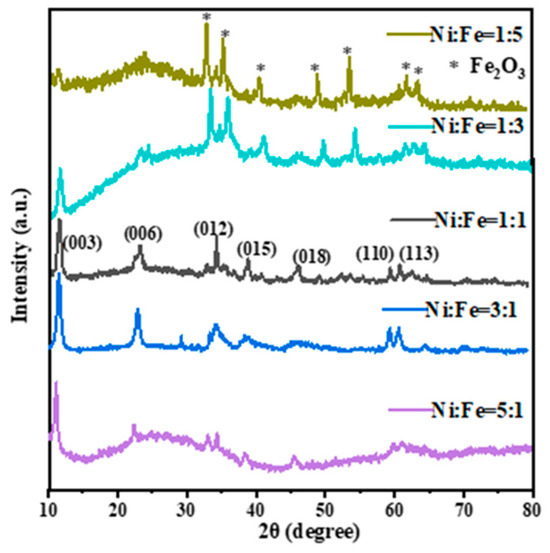
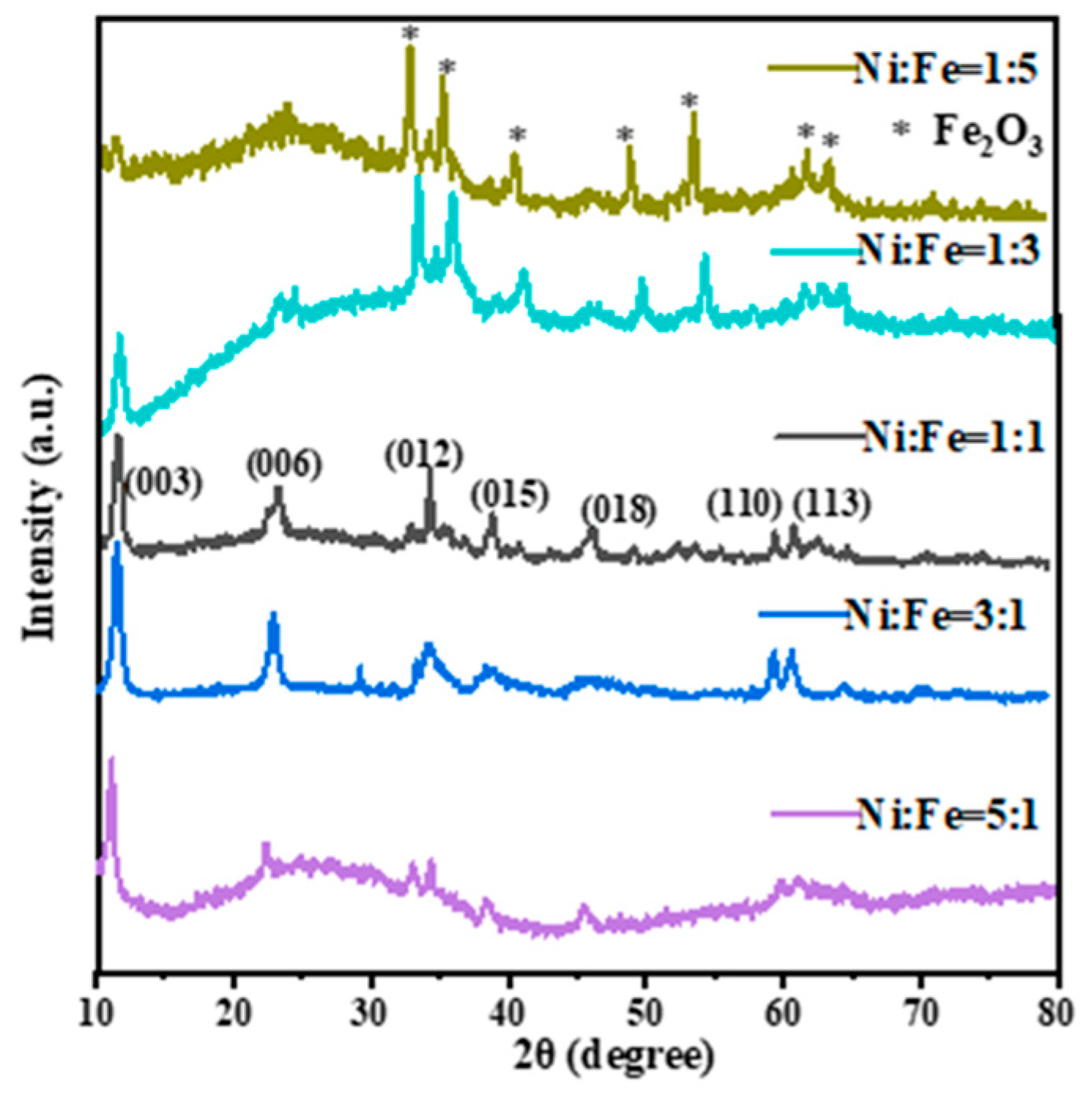
XRD patterns of different samples are displayed in Figure 1. Five diffraction peaks at 11.5, 23.3, 34.6, 60.3 and 61.3° of the sample prepared with a 1:1 ratio of Ni/Fe precursor represent the (003), (006), (012), (110), and (113) crystal faces of NiFe LDH (PDF card: 49-0188), confirming the successful synthesis of NiFe LDH [23,24]. When the content of Ni precursor is increased, the sample retains the NiFe LDH diffraction peak but changes to Ni(HCO3)2 when the precursor is iron-free (Figure S2). Moreover, the diffraction peaks of Fe2O3 appear in the sample as the content of Fe precursor increases (Figure S2). The aforementioned findings confirm that the prepared sample is NiFe LDH when the Ni/Fe precursor ratio is 1:1.
Figure 1.
XRD patterns of different ratios of NiFe precursors (* indicates the diffraction peaks of Fe2O3).
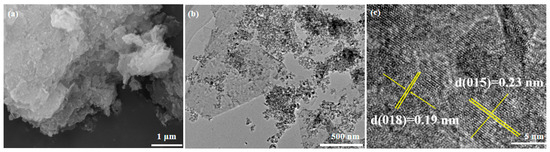
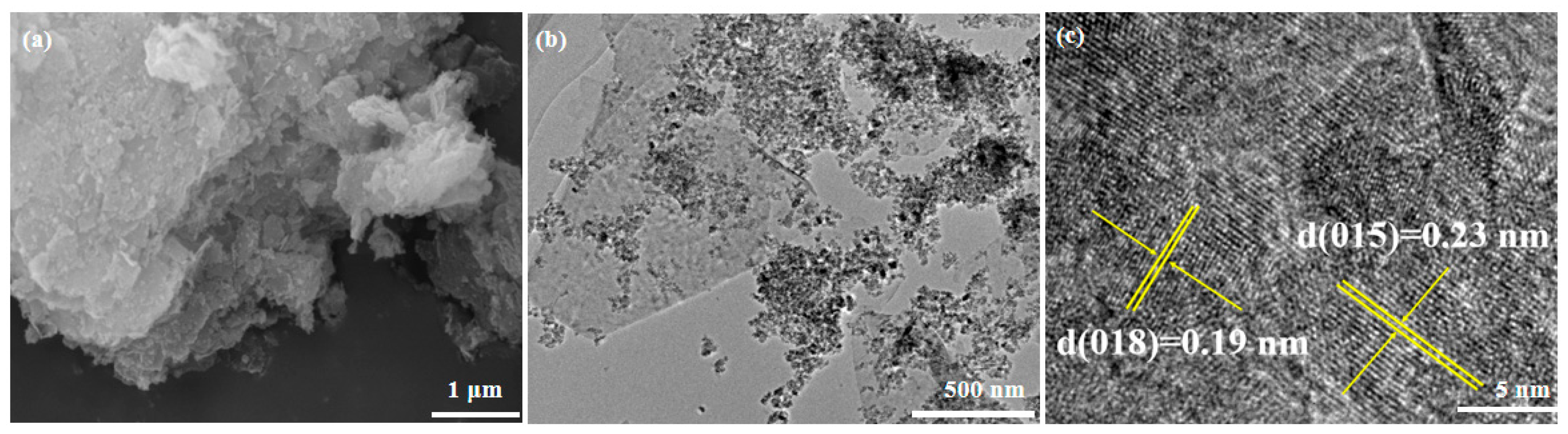
The morphologies and microstructures of samples were investigated by SEM and TEM (Figure 2). NiFe LDH showed a blocky morphology formed by stacking sheets (Figure 2a), and the elements Ni and Fe were evenly distributed (Figure S3). Further observation shows that there are many nanosheets, which could potentially aid in the active site’s exposure (Figure 2b). The observed lattice fringes with interlayer distances of 0.19 and 0.23 nm in the HRTEM image (Figure 2c) indicate the (018) and (015) planes of NiFe LDH, as demonstrated in the XRD patterns, confirming the successful preparation of NiFe LDH.
Figure 2.
SEM (a) and TEM (b) images of NiFe LDH; (c) HRTEM image of NiFe LDH (arrows indicating the lattice fringe spacing).
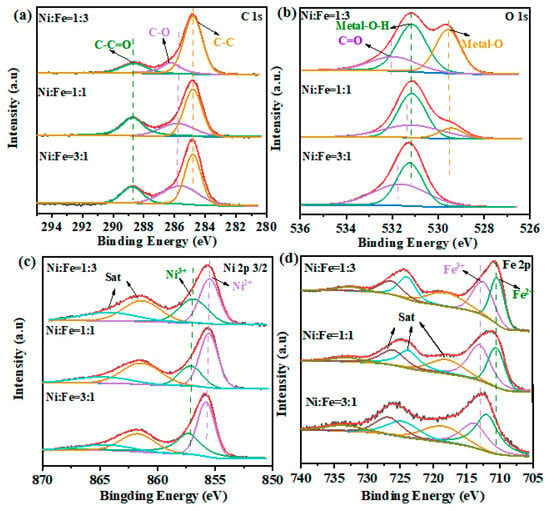
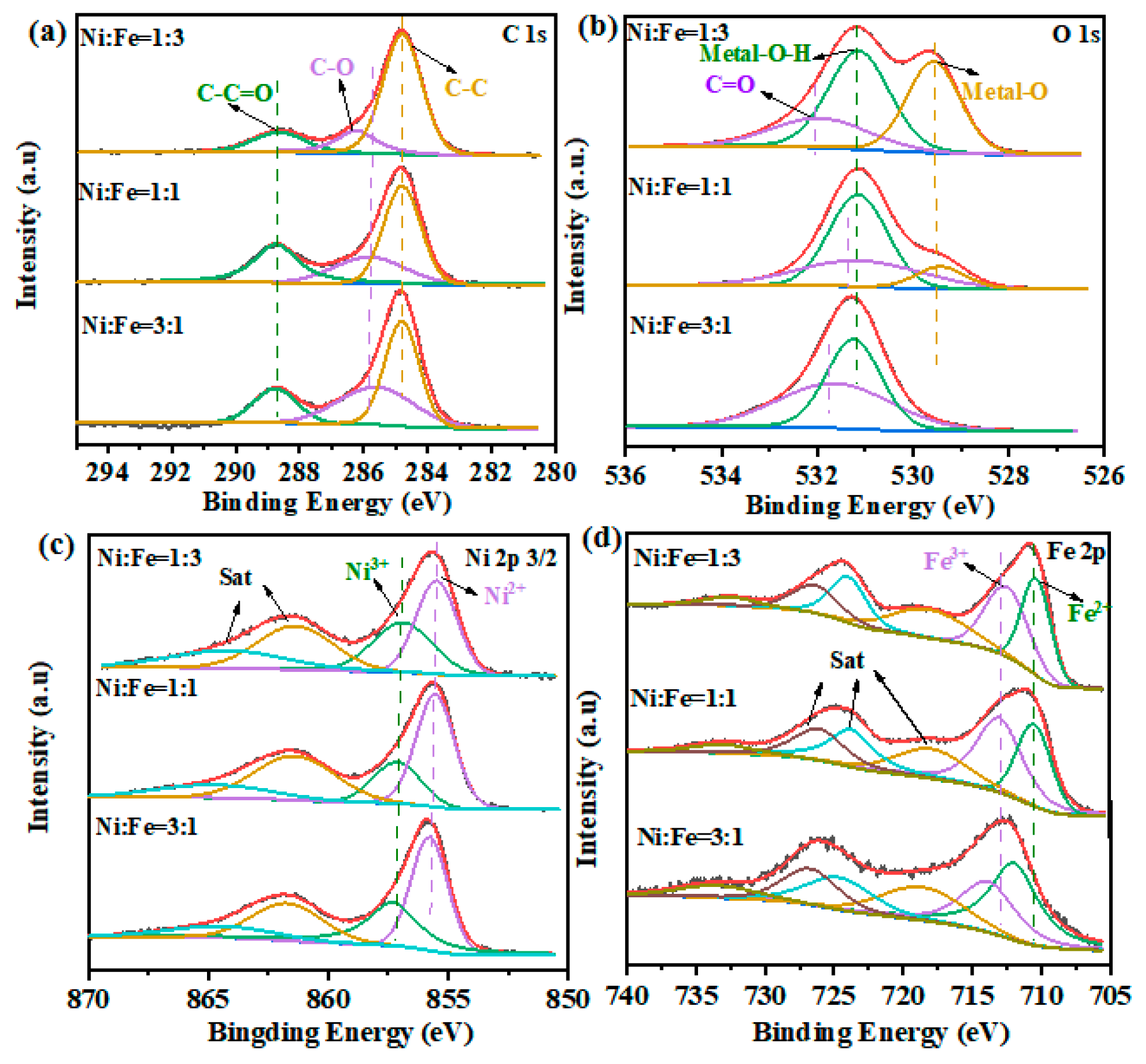
The changes in the chemical states of samples with various precursor ratios were investigated using XPS (Figure 3). In Figure 3a, the peaks of C 1s at 285.8 and 288.8 eV are ascribed to C-O and O-C=O in carbonate [25,26]. While the C 1s peaks shift in the direction of higher binding energy when the precursor’s Fe content rises, the opposite occurs when the precursor’s Ni content rises. The three peaks of O 1s at 529.4, 531.1 and 532.0 eV correspond to metal-O, metal-OH and C=O bonds [27,28]. Apart from the shift in peak position, there is an increase in the metal-O bond when the Fe precursor content rises, and a decrease when the Ni precursor content rises. This could be due to the creation of Fe2O3 from Fe precursors. Furthermore, the two Ni 2p peaks at 855.5 and 857.1 eV are indexed to Ni2+ and Ni3+, whereas the Fe 2p peaks at 710.5 and 713.0 eV are indexed to Fe2+ and Fe3+ [29,30,31,32]. The Fe 2p peaks shift toward low binding energy as the Fe precursor content increases, while these shift toward high binding energy as the Fe precursor content decreases. The amount of Fe precursor has no effect on the position of the Ni 2p peak. It is worth noting that the Ni3+/Ni2+ and Fe3+/Fe2+ ratios in the NiFe LDH (1:1) sample are 0.44 and 1.53, respectively. When the proportion of Fe precursor is varied, the proportion of Ni3+ increases while the proportion of Fe3+ decreases. According to the results of the above analysis, there is charge exchange between Ni and Fe atoms that changes the valence states of Ni and Fe atoms and may affect catalytic activity. Moreover, the changes in the surface functional groups of samples synthesized with various precursor ratios were examined using FTIR (Figure S4). The three peaks at 1378, 1644 and 3458 cm−1 are ascribed to C-O, H2O and O-H bonds [33,34], respectively, which may result from NiFe LDH interlayer ions. There is some variation in the peaks of the various samples, which could be caused by the interlayer ions being affected by the variations in in-plane structure. These findings suggest that the ratio of nickel and iron precursors influences sample structure and, as a result, catalytic activity.
Figure 3.
XPS of samples with different precursor ratios: (a) C 1s, (b) O 1s, (c) Ni 2p, (d) Fe 2p.
3.2. Catalytic Ozone Decomposition and Fracking Wastewater Purification
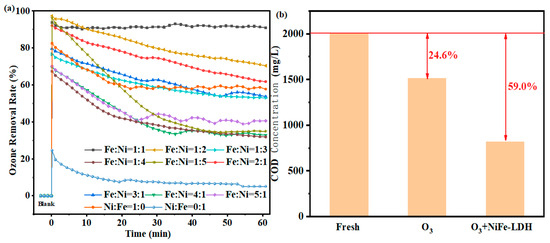
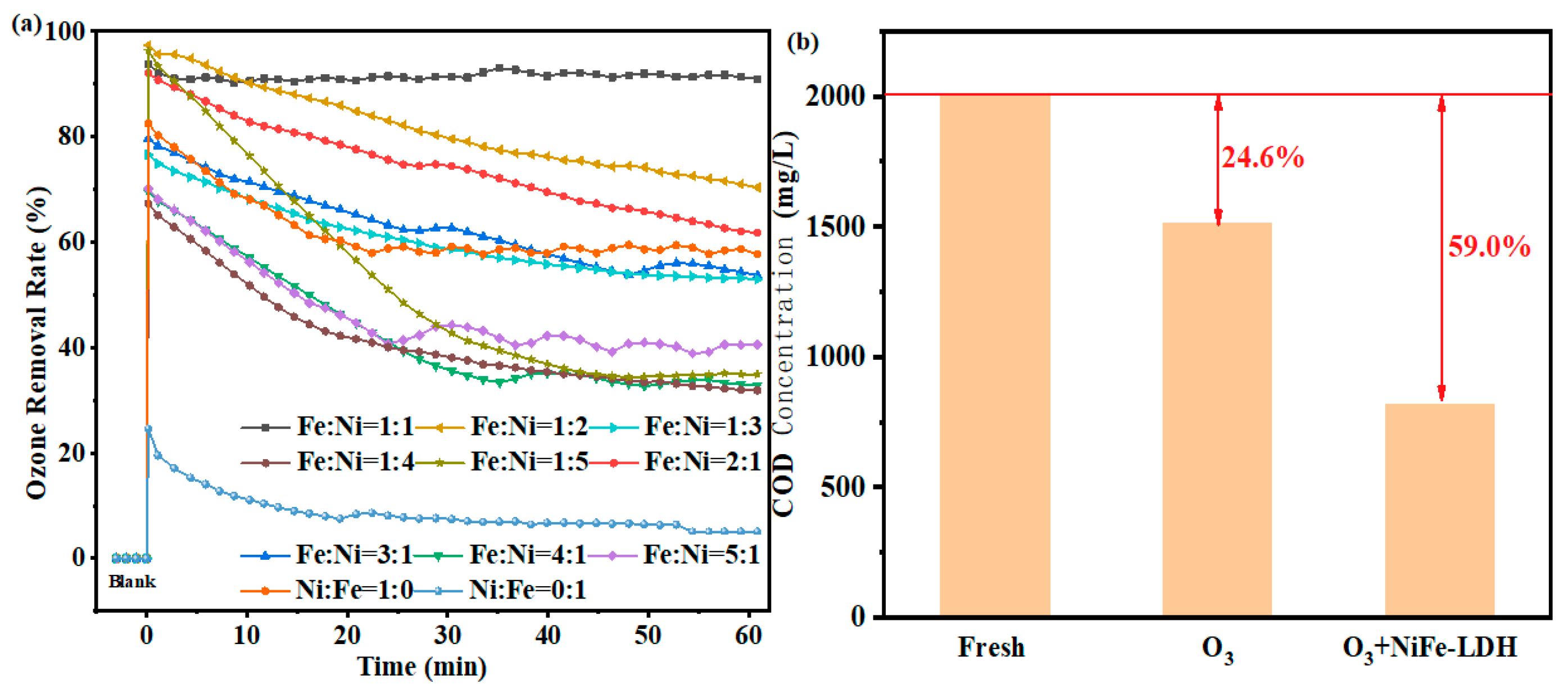
During the process of ozone oxidation of pollutants, due to the limited solubility of ozone in water, a portion of the ozone escapes from the solution in gaseous form, leading to a decrease in ozone utilization efficiency and causing ozone pollution. Therefore, the focus of catalytic ozone decomposition lies in completely decomposing gaseous ozone. We evaluated the impact of the catalyst on ozone decomposition performance using a self-made reactor and simultaneously introduced water vapor to investigate the effect of water molecules on the active sites of the catalyst. Figure 4 depicts the catalytic activity of ozone decomposition across a variety of samples. As seen in Figure 4a, the maximum efficiency of ozone decomposition is achieved at the Ni/Fe precursor ratio of 1:1, maintaining around 90% removal ratio at a RH of 80%, which remains high when compared to earlier studies [35,36,37,38,39,40,41] (Table S1), while increasing the quantity of Ni or Fe precursors would result in a reduction in activity. Furthermore, the long-term stability of ozone decomposition catalyzed by NiFe LDH is displayed in Figure S5. The catalyst exhibits good stability as evidenced by its continued 99% activity after 80 h of catalytic reaction at 60% RH. To further demonstrate that NiFe LDH promotes the decomposition of gaseous ozone molecules, we investigated the catalytic ozone synergistic purification of simulated wastewater with polyacrylamide as the model pollutant using NiFe LDH. As shown in Figure 4b, the COD (chemical oxygen demand) of the fracturing flowback water was reduced by only 24.6% through ozone purification, indicating that a large amount of gaseous ozone did not participate in the reaction process. After introducing NiFe LDH, however, the COD was reduced by 59.0%, suggesting that NiFe LDH promoted the decomposition of ozone and effectively decreased the COD value of the fracturing flowback water. Moreover, the types of substances in the solution after the reaction were analyzed using an LC-MS. As shown in Figure S6, different degradation pathways were observed under different conditions. After ozone treatment alone, a peak at m/z 335.1 appeared, which is attributed to low molecular weight polymer fragments generated from the initial chain scission of polyacrylamide. Following catalytic ozonation with NiFe LDH, an additional peak at m/z 91 emerged, which is attributed to the cycloheptatrienyl cation ([C7H7]+)—a typical aromatic intermediate formed during the deep oxidation of polyacrylamide. The appearance of the m/z 91 peak only in the presence of NiFe LDH indicates that the catalyst promotes the generation of reactive oxygen species, thereby altering the degradation pathway. These findings suggest the excellent catalytic ozone decomposition activity of NiFe LDH.
Figure 4.
(a) Catalytic gases ozone decomposition activity test of NiFe LDH with different precursor ratios (Condition: Catalyst mass: 0.1 g; Temperature: 25 °C; O3 concentration: 40 ppm; Relative humidity: 80%; GHSV: 1200 L g−1 h−1). (b) Catalytic ozone synergistic purification of simulated wastewater (polyacrylamide as model pollutant) (Condition: Catalyst mass: 0.2 g; Temperature: 25 °C; O3 concentration: 100 ppm; COD concentration: 2000 mg/L; Reaction time: 1.5 h).
3.3. Reaction Mechanism of Catalytic Ozone Decomposition
Catalytic ozone decomposition frequently involves the processes of adsorption, reaction, and desorption. Among these, the specific surface area of the catalyst greatly influences the adsorption and desorption of reactants [42,43]. Figure S7 shows the N2 adsorption and desorption isotherm of different samples. All the samples exhibit typical isotherms of IV with hysteresis line of H3, indicating that the synthesized samples are typical mesoporous materials [44]. The specific surface area and average pore diameter increase in proportion to the Fe content (Table S2). Given the difference in activity and the presence of Fe2O3 after the content of the Fe precursor is greater than 50%, the catalytic active site is on the surface of NiFe LDH rather than Fe2O3. Therefore, before the iron precursor content reached 50%, the addition of Fe precursor increased the specific surface area, the material’s capacity to adsorb reactants, and the density of the surface reactive site, while the presence of Fe2O3 inhibits the exposure of the active site and reduces the catalytic activity.
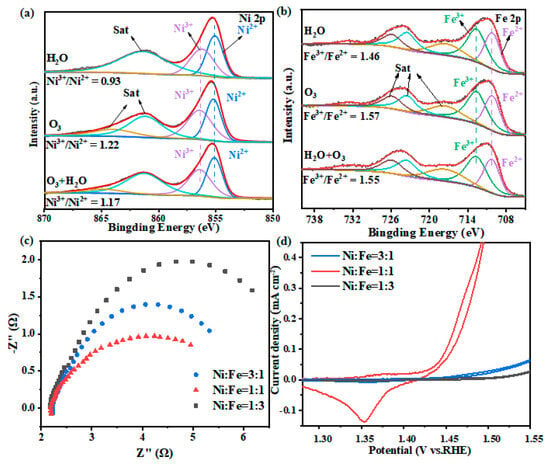
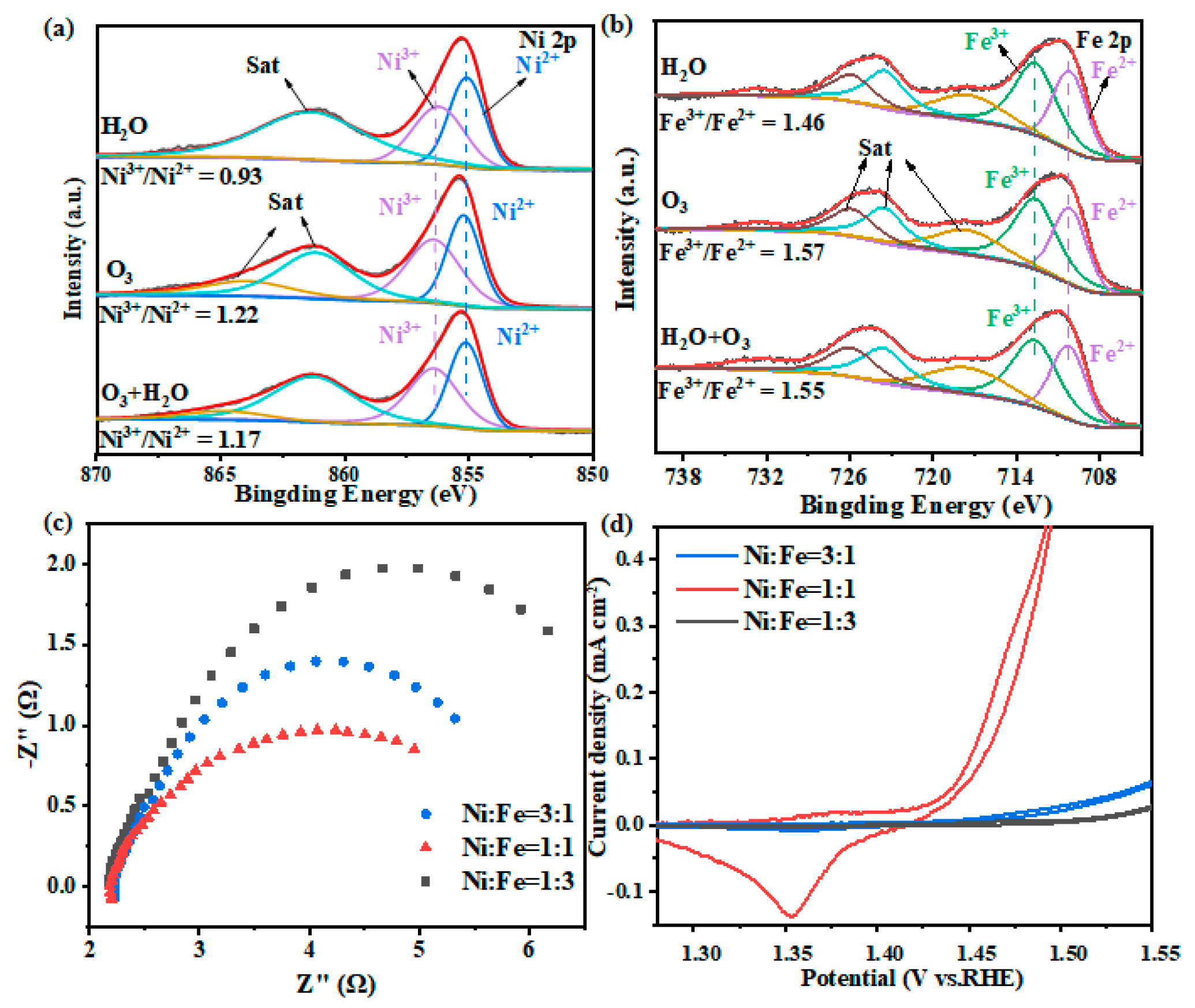
In order to investigate the active sites of NiFe LDH, XPS analysis was performed on samples treated under various reaction conditions (Figure 5). The ratio of Ni3+/Ni2+ increased from 0.44 in the fresh sample to 1.22 after O3 treatment, while it slightly decreased to 1.17 upon subsequent H2O exposure. The proportion of Fe3+ followed a similar trend, albeit with less variation. Given the inherent uncertainties in XPS fitting (approximately ±5%) [45], these modest variations should be interpreted as a consistent trend rather than absolute proof: Ni3+ content increased after O3 treatment and decreased after H2O exposure, suggesting a reversible redox process [46]. Surprisingly, the proportion of Ni3+ increased while the proportion of Fe3+ decreased in the water-treated samples. Given that Fe3+ easily reacts with water to form strongly oxidizing hydroxyl radicals [47,48], the increase in Ni3+ might be attributed to oxidation by these radicals. Although XPS alone cannot provide definitive evidence, the observed trends suggest charge transfer between Ni and Fe sites involving surface hydrogen species—a behavior consistent with other LDH systems where multivalent metal redox couples synergistically drive ozone activation (e.g., Co3+/Co2+ and Fe3+/Fe2+ in CoAl-LDH) [49]. The results above indicate that ozone decomposition occurs at Ni sites while water adsorption is more likely at Fe sites, consistent with theoretical adsorption energies (Figure S8). Moreover, the shift in metal valence may be connected to the gain and loss of surface H atoms, given the structural distinctions between Ni(OH)2 and NiOOH. Realizing this hypothesis requires excellent electrical conductivity and redox capability. Therefore, we compared the EIS and CV curves of different samples. As shown in Figure 5c, the 1:1 sample displays the lowest impedance radius, indicating rapid electron migration that facilitates redox conversion between Ni and Fe. The CV curves also show that the 1:1 sample has the best redox capability (Figure 5d). This multi-technique approach—combining XPS, EIS, and CV—provides reliable mechanistic insight [50]. The combined results suggest that during surface H atom cycling, the 1:1 sample participates most effectively in O3 decomposition and surface H restoration. In other words, H atom cycling on LDH surfaces is integral to catalytic ozone decomposition.
Figure 5.
Ni 2p (a) and Fe 2p (b) XPS spectra of NiFe LDH after different reaction conditions. Electrochemical impedance spectroscopy (c) and cyclic voltammetry (d) of different samples.
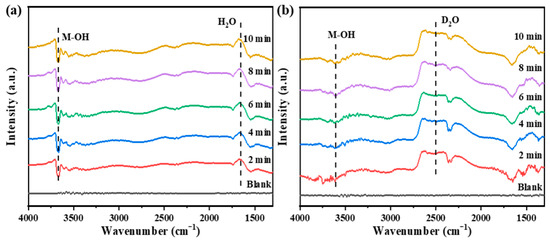
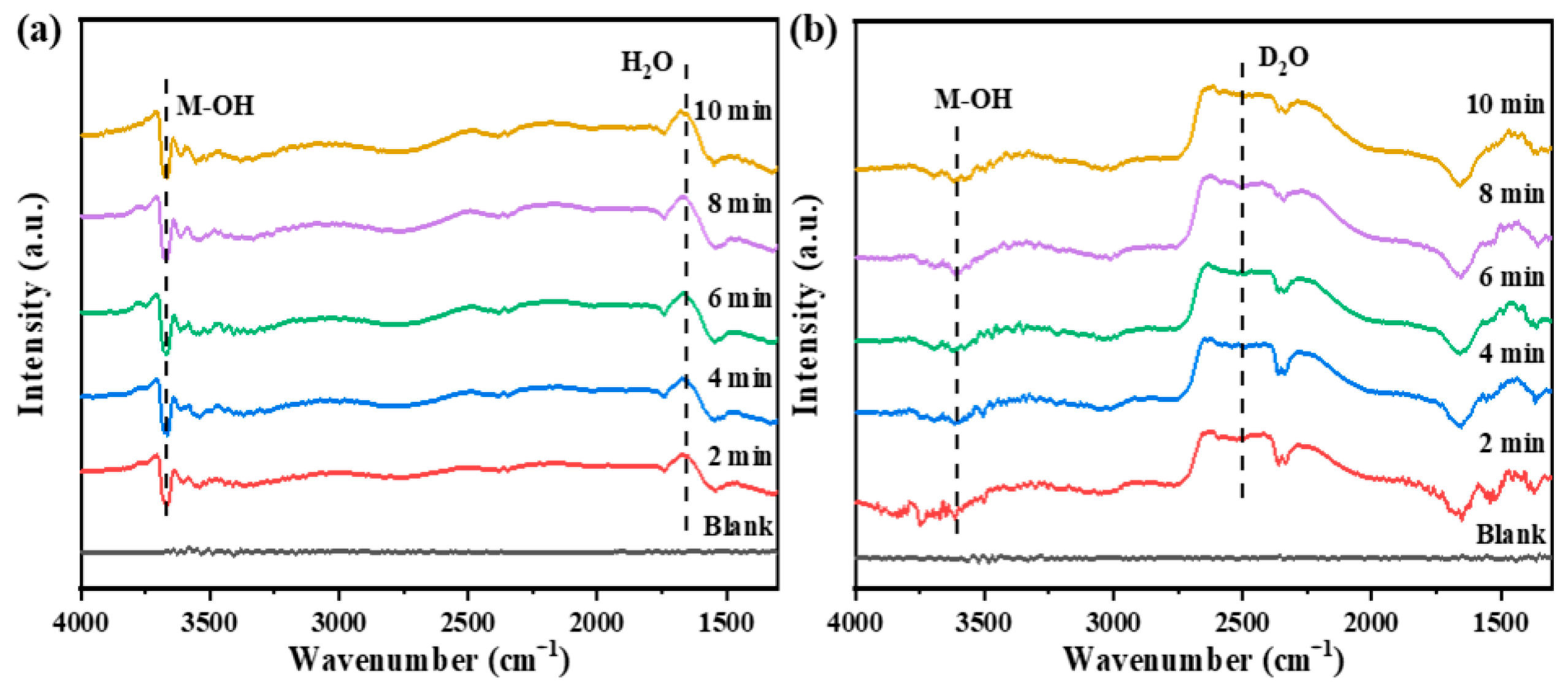
In order to better understand the mechanism of catalytic ozone decomposition, in situ DRIFTS was measured. The inverse peak at 3700 cm−1 corresponds to the LDH eigenvalue’s -OH bond (Figure 6a), implying that the H atom on the surface of NiFe LDH is separated during catalytic ozone decomposition, whereas the enhanced peak near 1660 cm−1 corresponds to the hydroxyl group in water [51], implying that the separated H atom and the oxygen atom of ozone form H2O. The 3700 cm−1 of the inverted peak does not appear during the water participation process (Figure S9), indicating that H2O can fill the lost H atoms on the surface of NiFe LDH. In addition, an isotope labeling experiment using in situ DRIFTS was carried out (Figure 6b). The H atom on the surface of NiFe LDH is replaced by deuterium after treatment with D2O. The wide peak near 2500 cm−1 represents D2O [52,53], which confirms that the interaction between the H atom on the surface of the NiFe LDH and the oxygen atom formed by the decomposition of ozone produces H2O.
Figure 6.
In situ IR spectra of NiFe LDH (a) reaction with ozone only (b) reaction with ozone after D2O labeling.
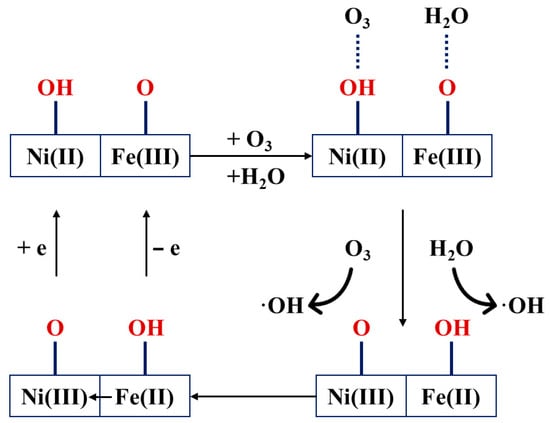
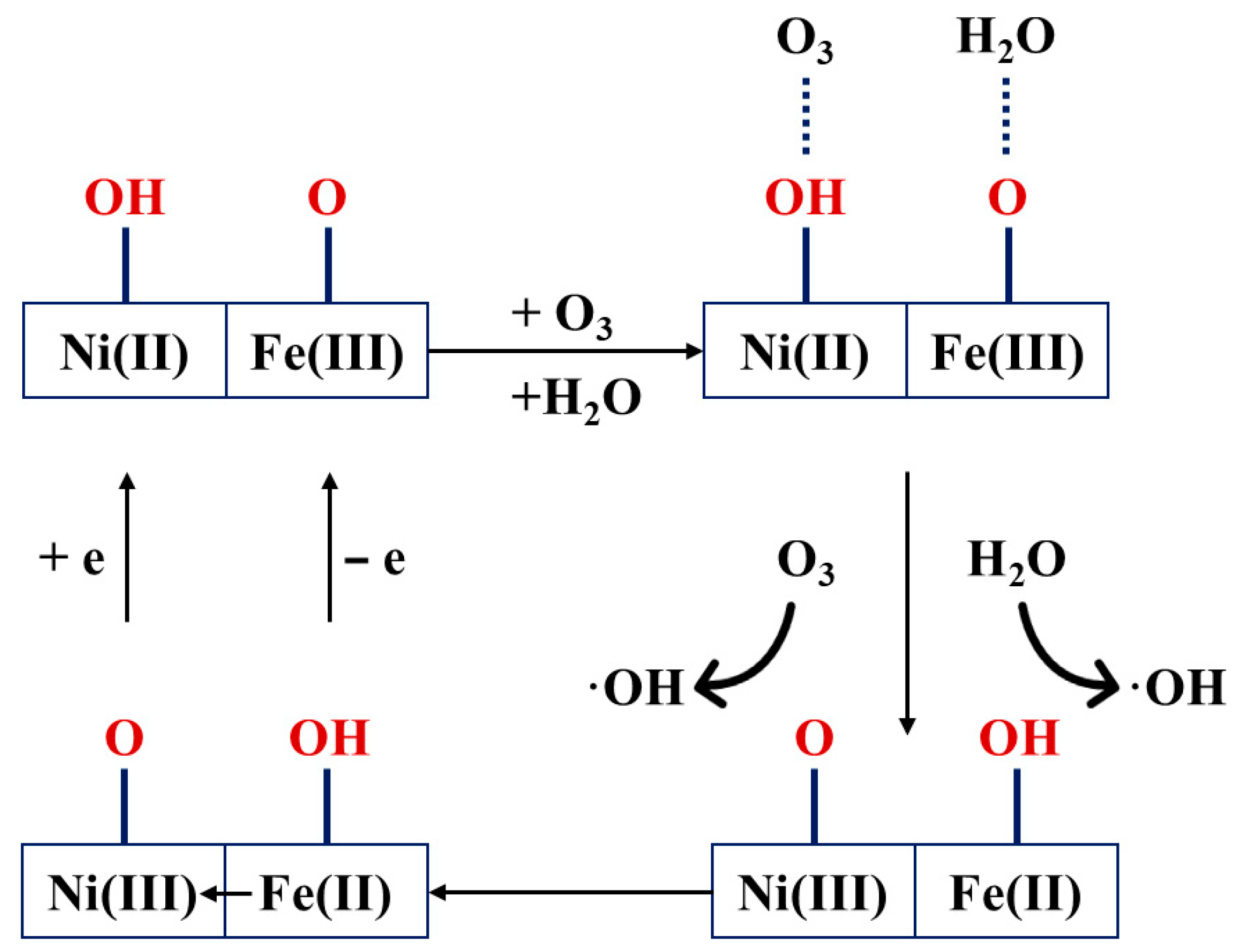
Based on the analysis previously presented, the following illustrates a potential reaction process of catalytic ozone decomposition over NiFe LDH under humidity conditions (Figure 7). First, ozone and water are adsorbed at the Ni2+-OH and Fe3+-O sites, respectively. Secondly, the interaction of surface H atoms with ozone converts Ni2+-OH to Ni3+-O and decomposes ozone to form oxygen and -OH, while water is oxidized by Fe3+ to form Fe2+-OH and -OH. Because Ni and Fe have different electronegativities, there is an electron exchange between the Ni and Fe atoms, resulting in the conversion of Ni3+-O and Fe2+-OH to Ni2+-OH and Fe3+-O. The XRD analysis of the samples before and after the reaction revealed that the structure of NiFe LDH did not change significantly (Figure S10), and the relative amounts of the various valence metals did not alter as noticeably as in the XPS analysis. In addition, the formed -OH reacted with O3 to generate O2 and H2O [54]. Therefore, during the catalytic ozone decomposition process over NiFe LDH, water participates in the surface H atom recycling, and the cycle of surface H atoms is accelerated by the charge exchange between Ni and Fe atoms, which not only hindered the competitive adsorption of H2O but also ensured the cyclic stability of the catalyst surface structure and enhanced the catalytic ozone decomposition performance and stability.
Figure 7.
A possible reaction process over NiFe LDH during humid conditions.
4. Conclusions
In summary, we reported that NiFe LDH synthesized using a hydrothermal procedure had an outstanding catalytic ozone decomposition rate of 99% for 80 h and a purification efficiency of 59.0% for simulated wastewater containing polyacrylamide. The inherent hydroxyl structure on the surface of NiFe LDH protects against water adsorption, while the polyvalent Ni and Fe work together to promote H2O breakdown. We found that the H atom on the surface of NiFe LDH promotes the ozone decomposition process and participates in the formation of H2O, while H2O is decomposed by NiFe LDH and provides the H atom to complete the structural recovery of the NiFe LDH surface. We propose a conceptually different moisture-resistance strategy in which water participates in the active-site cycle to enhance catalytic ozone decomposition efficiency for environmental remediation.
Supplementary Materials
The following supporting information can be downloaded at: https://www.mdpi.com/article/10.3390/pr14060880/s1, Figure S1: Schematic diagram for evaluation of catalytic decomposition of ozone; Figure S2: XRD of pure Ni or Fe precursor synthesized materials; Figure S3: EDS energy spectrum mapping of NiFe LDH materials; Figure S4: FTIR spectra of samples with different precursor ratios; Figure S5: the long-term stability of ozone decomposition catalyzed by NiFe LDH; Figure S6 LC-MS data of LC-MS data of simulated wastewater (polyacrylamide solution) treated by different condition; Figure S7: (a) Nitrogen adsorption and desorption isotherm and (b) Pore size distribution curves of samples with different precursor ratios; Figure S8: Adsorption energy of O3 and H2O over Ni(OH)2 and FeOOH. Figure S9: In situ DRIFTS of O3 and H2O adsorption over NiFe LDH. Figure S10: XRD patterns of NiFe LDH before and after ozone decomposition process, Table S1: Comparison of the performance of different catalysts, Table S2: Physical properties of NiFe LDH with different samples.
Author Contributions
Conceptualization, Y.Z.; methodology, Y.Z., R.Z. and H.Z.; validation, R.Z., H.Z. and R.H.; formal analysis, Y.Z., R.Z., H.Z. and R.H.; investigation, R.Z., H.Z. and R.H.; resources, Y.Z.; data curation, H.Z. and R.H.; writing—original draft preparation, R.Z. and H.Z.; writing—review and editing, Y.Z.; visualization, R.Z. and H.Z.; supervision, Y.Z.; project administration, Y.Z.; funding acquisition, Y.Z. All authors have read and agreed to the published version of the manuscript.
Funding
This research was funded by the National Natural Science Foundation of China (grant numbers 52325401, 22206159), the Sichuan Financial Education (grant number [2022] 106), and the Scientific Research Project of SWPU (2021QHZ015, 2022SCNLZHYCC003, XTGG004).
Data Availability Statement
The original contributions presented in this study are included in the article/Supplementary Materials. Further inquiries can be directed to the corresponding author.
Acknowledgments
We acknowledge the computation help provided by the National Supercomputing Center in Shenzhen.
Conflicts of Interest
The authors declare no conflicts of interest.
References
- Rekhate, C.V.; Srivastava, J. Recent advances in ozone-based advanced oxidation processes for treatment of wastewater-A review. Chem. Eng. J. Adv. 2020, 3, 100031. [Google Scholar] [CrossRef] [Scilit]
- Li, J.; Yang, T.; Zeng, G.; An, L.; Jiang, J.; Ao, Z.; Ma, J. Ozone- and hydroxyl radical-induced degradation of micropollutants in a novel UVA-LED-activated periodate advanced oxidation process. Environ. Sci. Technol. 2023, 57, 18607–18616. [Google Scholar] [CrossRef] [Scilit]
- Liu, Z.; Demeestere, K.; Van Hulle, S. Comparison and performance assessment of ozone-based AOPs in view of trace organic contaminants abatement in water and wastewater: A review. J. Environ. Chem. Eng. 2021, 9, 105599. [Google Scholar] [CrossRef] [Scilit]
- Dos Santos, N.d.O.; Busquets, R.; Campos, L.C. Insights into the removal of microplastics and microfibres by Advanced Oxidation Processes. Sci. Total Environ. 2023, 861, 160665. [Google Scholar] [CrossRef] [Scilit] [PubMed]
- Pandis, P.K.; Kalogirou, C.; Kanellou, E.; Vaitsis, C.; Savvidou, M.G.; Sourkouni, G.; Zorpas, A.A.; Argirusis, C. Key points of advanced oxidation processes (AOPs) for wastewater, organic pollutants and pharmaceutical waste treatment: A mini review. ChemEngineering 2022, 6, 8. [Google Scholar] [CrossRef] [Scilit]
- Zhang, H.; Li, S.; Zhang, C.; Ren, X.; Zhou, M. A critical review of ozone-based electrochemical advanced oxidation processes for water treatment: Fundamentals, stability evaluation, and application. Chemosphere 2024, 365, 143330. [Google Scholar] [CrossRef] [Scilit] [PubMed]
- Kakaei, K.; Padervand, M.; Akinay, Y.; Dawi, E.; Ashames, A.; Saleem, L.; Wang, C. A critical mini-review on challenge of gaseous O3 toward removal of viral bioaerosols from indoor air based on collision theory. Environ. Sci. Pollut. Res. 2023, 30, 84918–84932. [Google Scholar] [CrossRef] [Scilit] [PubMed]
- Yu, G.; Wang, Y.; Cao, H.; Zhao, H.; Xie, Y. Reactive oxygen species and catalytic active sites in heterogeneous catalytic ozonation for water purification. Environ. Sci. Technol. 2020, 54, 5931–5946. [Google Scholar] [CrossRef] [Scilit]
- Guo, Y.; Long, J.; Huang, J.; Yu, G.; Wang, Y. Can the commonly used quenching method really evaluate the role of reactive oxygen species in pollutant abatement during catalytic ozonation? Water Res. 2022, 215, 118275. [Google Scholar] [CrossRef] [Scilit]
- Li, X.; Ma, J.; He, H. Recent advances in catalytic decomposition of ozone. J. Environ. Sci. 2020, 94, 14–31. [Google Scholar] [CrossRef] [Scilit]
- Hong, W.; Ma, J.; Zhu, T.; He, H.; Wang, H.; Sun, Y.; Shen, F.; Li, X. To enhance water resistance for catalytic ozone decomposition by fabricating H2O adsorption-site in OMS-2 tunnels. Appl. Catal. B Environ. 2021, 297, 120466. [Google Scholar] [CrossRef] [Scilit]
- Dong, C.; Yang, J.; Xie, L.; Cui, G.; Fang, W.; Li, J. Catalytic ozone decomposition and adsorptive VOCs removal in bimetallic metal-organic frameworks. Nat. Commun. 2022, 13, 4991. [Google Scholar] [CrossRef] [Scilit]
- Sun, Z.; Si, Y.; Zhao, S.; Wang, Q.; Zang, S. Ozone decomposition by a manganese-organic framework over the entire humidity range. J. Am. Chem. Soc. 2021, 143, 5150–5157. [Google Scholar] [CrossRef] [Scilit]
- Xu, Z.; Yang, W.; Si, W.; Chen, J.; Peng, Y.; Li, J. A novel γ-like MnO2 catalyst for ozone decomposition in high humidity conditions. J. Hazard. Mater. 2021, 420, 126641. [Google Scholar] [CrossRef] [Scilit]
- Boumeriame, H.; Da Silva, E.S.; Cherevan, A.S.; Chafik, T.; Faria, J.L.; Eder, D. Layered double hydroxide (LDH)-based materials: A mini-review on strategies to improve the performance for photocatalytic water splitting. J. Energy Chem. 2022, 64, 406–431. [Google Scholar] [CrossRef] [Scilit]
- Bodhankar, P.M.; Sarawade, P.B.; Singh, G.; Vinu, A.; Dhawale, D.S. Recent advances in highly active nanostructured NiFe LDH catalyst for electrochemical water splitting. J. Mater. Chem. A 2021, 9, 3180–3208. [Google Scholar] [CrossRef] [Scilit]
- Li, M.; Song, Y.; Wan, X.; Li, Y.; Luo, Y.; He, Y.; Xia, B.; Zhou, H.; Shao, M. Nickel-Vanadium Layered Double Hydroxides for Efficient and Scalable Electrooxidation of 5-Hydroxymethylfurfural Coupled with Hydrogen Generation. Acta Phys.-Chim. Sin. 2024, 40, 2306007. [Google Scholar] [CrossRef] [Scilit]
- Liu, B.; Zhang, J.; Li, Z.; Liu, B.; Zhang, B.; Dai, W.; Li, H.; Li, M.; Leung, M.K.H.; Zhang, Y.; et al. Synergistic doping and interfacial engineering for tuning surface electronic structure in C@ZnSn LDH toward enhanced photocatalytic oxidation of aromatic VOCs. Chem. Eng. J. 2025, 519, 164903. [Google Scholar] [CrossRef] [Scilit]
- Li, J.; Ma, Y.; Li, F.; Zeng, Z.; Zhu, H.; Wang, C.; Wang, L.; Li, K.; Wang, X.; Ning, P.; et al. Stable O3 Decomposition by Layered Double Hydroxides: The Pivotal Role of NiOOH Transformation. Environ. Sci. Technol. 2024, 58, 10696–10705. [Google Scholar] [CrossRef] [Scilit]
- Lin, Y.; Wang, H.; Peng, C.; Bu, L.; Chiang, C.; Tian, K.; Zhao, Y.; Zhao, J.; Lin, Y.; Lee, J. Co-induced electronic optimization of hierarchical NiFe LDH for oxygen evolution. Small 2020, 16, 2002426. [Google Scholar] [CrossRef] [Scilit]
- Hu, L.; Zeng, X.; Wei, X.; Wang, H.; Wu, Y.; Gu, W.; Shi, L.; Zhu, C. Interface engineering for enhancing electrocatalytic oxygen evolution of NiFe LDH/NiTe heterostructures. Appl. Catal. B Environ. 2020, 273, 119014. [Google Scholar] [CrossRef] [Scilit]
- Li, J.; Chen, F.; Zhang, L.; Wang, L.; Zhang, L.; Chen, H.; Xue, C.; Xu, L. Peroxymonosulfate Activation by CoFe2O4/MgAl-LDH Catalyst for the Boosted Degradation of Antibiotic. J. Inorg. Mater. 2025, 40, 440–448. [Google Scholar] [CrossRef] [Scilit]
- Liu, S.; Zhang, H.; Hu, E.; Zhu, T.; Zhou, C.; Huang, Y.; Ling, M.; Gao, X.; Lin, Z. Boosting oxygen evolution activity of NiFe-LDH using oxygen vacancies and morphological engineering. J. Mater. Chem. A 2021, 9, 23697–23702. [Google Scholar] [CrossRef] [Scilit]
- Liu, F.; Guo, X.; Hou, Y.; Wang, F.; Zou, C.; Yang, H. Hydrothermal combined with electrodeposition construction of a stable Co9S8/Ni3S2@NiFe-LDH heterostructure electrocatalyst for overall water splitting. Sustain. Energy Fuels 2021, 5, 1429–1438. [Google Scholar] [CrossRef] [Scilit]
- Yan, L.; Xu, Z.; Liu, X.; Mahmood, S.; Shen, J.; Ning, J.; Li, S.; Zhong, Y.; Hu, Y. Integrating trifunctional Co@NC-CNTs@NiFe-LDH electrocatalysts with arrays of porous triangle carbon plates for high-power-density rechargeable Zn-air batteries and self-powered water splitting. Chem. Eng. J. 2022, 446, 137049. [Google Scholar] [CrossRef] [Scilit]
- Wen, X. NiFe-LDH/MWCNTs/NF nanohybrids as a high-performance bifunctional electrocatalyst for overall urea electrolysis. Int. J. Hydrogen Energy 2020, 45, 14660–14668. [Google Scholar] [CrossRef] [Scilit]
- Yang, H.; Wang, C.; Zhang, Y.; Wang, Q. Green synthesis of NiFe LDH/Ni foam at room temperature for highly efficient electrocatalytic oxygen evolution reaction. Sci. China-Mater. 2019, 62, 681–689. [Google Scholar]
- Tang, Y.; Liu, Q.; Dong, L.; Wu, H.B.; Yu, X. Activating the hydrogen evolution and overall water splitting performance of NiFe LDH by cation doping and plasma reduction. Appl. Catal. B Environ. 2020, 266, 118627. [Google Scholar] [CrossRef] [Scilit]
- Zhou, S.; He, H.; Li, J.; Ye, Z.; Liu, Z.; Shi, J.; Hu, Y.; Cai, W. Regulating the band structure of Ni active sites in few-layered NiFe-LDH by in situ adsorbed borate for ampere-level oxygen evolution. Adv. Funct. Mater. 2023, 34, 2313770. [Google Scholar] [CrossRef] [Scilit]
- Feng, X.; Jiao, Q.; Dai, Z.; Dang, Y.; Suib, S.L.; Zhang, J.; Zhao, Y.; Li, H.; Feng, C.; Li, A. Revealing the effect of interfacial electron transfer in heterostructured Co9S8@NiFe LDH for enhanced electrocatalytic oxygen evolution. J. Mater. Chem. A 2021, 9, 12244–12254. [Google Scholar] [CrossRef] [Scilit]
- Liu, Z.; Liang, X.; Ma, F.X.; Xiong, Y.X.; Zhang, G.; Chen, G.; Zhen, L.; Xu, C.Y. Decoration of NiFe-LDH nanodots endows lower Fe-d band center of Fe1-N-C hollow nanorods as bifunctional oxygen electrocatalysts with small overpotential gap. Adv. Energy Mater. 2023, 13, 2203609. [Google Scholar] [CrossRef] [Scilit]
- Nie, J.; Hong, M.; Zhang, X.; Huang, J.; Meng, Q.; Du, C.; Chen, J. 3D amorphous NiFe LDH nanosheets electrodeposited on in situ grown NiCoP@NC on nickel foam for remarkably enhanced OER electrocatalytic performance. Dalton Trans. 2020, 49, 4896–4903. [Google Scholar] [CrossRef] [Scilit] [PubMed]
- Zhang, R.; Wang, Y.; Ou, B.; Zhou, Y. α-Ni(OH)2 surface hydroxyls synergize Ni3+ sites for catalytic formaldehyde oxidation. J. Inorg. Mater. 2023, 38, 1216–1222. [Google Scholar] [CrossRef] [Scilit]
- Yang, H.; Zhang, G.; Sun, Y.; Zhou, H.; Pang, H. Bimetallic zeolitic imidazolate framework derived hollow layered double hydroxide with tailorable interlayer spacing for nickel-zinc batteries. Chin. Chem. Lett. 2025, 36, 110016. [Google Scholar] [CrossRef] [Scilit]
- Zhu, G.; Zhu, W.; Lou, Y.; Ma, J.; Yao, W.; Zong, R.; Zhu, Y. Encapsulate α-MnO2 nanofiber within graphene layer to tune surface electronic structure for efficient ozone decomposition. Nat. Commun. 2021, 12, 4152. [Google Scholar] [CrossRef] [Scilit]
- Dai, W.; Zhang, B.; Ji, J.; Liu, B.; Xie, R.; Gan, Y.; Xie, X.; Zhang, J.; Huang, P.; Huang, H. Exceptional ozone decomposition over δ-MnO2/AC under an entire humidity environment. Environ. Sci. Technol. 2023, 57, 17727–17736. [Google Scholar] [CrossRef] [Scilit]
- Ma, J.; Chen, Y.; He, G.; He, H. A robust H-transfer redox mechanism determines the high-efficiency catalytic performance of layered double hydroxides. Appl. Catal. B Environ. 2021, 285, 119806. [Google Scholar] [CrossRef] [Scilit]
- Wang, Z.; Chen, Y.; Li, X.; He, G.; Ma, J.; He, H. Layered double hydroxide catalysts for ozone decomposition: The synergic role of M2+ and M3+. Environ. Sci. Technol. 2021, 56, 1386–1394. [Google Scholar] [CrossRef] [Scilit]
- Liu, B.; Zhang, M.; Yang, J.; Zhu, M. Efficient ozone decomposition over bifunctional Co3Mn-layered double hydroxide with strong electronic interaction. Chin. Chem. Lett. 2022, 33, 4679–4682. [Google Scholar] [CrossRef] [Scilit]
- Zhang, B.; Ji, J.; Liu, B.; Zhang, D.; Liu, S.; Huang, H. Highly efficient ozone decomposition against harsh environments over long-term stable amorphous MnOx catalysts. Appl. Catal. B Environ. 2022, 315, 121552. [Google Scholar] [CrossRef] [Scilit]
- Wang, S.; Zhu, Y.; Zhang, Y.; Wang, B.; Yan, H.; Liu, W.; Lin, Y. Manganese-based layered double hydroxide nanoparticles as highly efficient ozone decomposition catalysts with tunable valence state. Nanoscale 2020, 12, 12817–12823. [Google Scholar] [CrossRef] [Scilit] [PubMed]
- Sun, S.; Li, H.; Xu, Z.J. Impact of surface area in evaluation of catalyst activity. Joule 2018, 2, 1024–1027. [Google Scholar] [CrossRef] [Scilit]
- Wei, C.; Sun, S.; Mandler, D.; Wang, X.; Qiao, S.; Xu, Z.J. Approaches for measuring the surface areas of metal oxide electrocatalysts for determining their intrinsic electrocatalytic activity. Chem. Soc. Rev. 2019, 48, 2518–2534. [Google Scholar] [CrossRef] [Scilit]
- Marjani, A.; Soltani, R.; Pishnamazi, M.; Rezakazemi, M.; Shirazian, S. Functionalized pollen-like mesoporous silica. Microporous Mesoporous Mater. 2021, 310, 110531. [Google Scholar] [CrossRef] [Scilit]
- Greczynski, G.; Hultman, L. X-ray photoelectron spectroscopy: Towards reliable binding energy referencing. Prog. Mater. Sci. 2020, 107, 100591. [Google Scholar] [CrossRef] [Scilit]
- Biesinger, M.C.; Lau, L.W.M.; Gerson, A.R.; Smart, R.S.C. Resolving surface chemical states in XPS analysis of first row transition metals, oxides and hydroxides. Appl. Surf. Sci. 2011, 257, 2717–2730. [Google Scholar] [CrossRef] [Scilit]
- Zhou, H.; Peng, J.; Duan, X.; Yin, H.; Huang, B.; Zhou, C.; Zhong, S.; Zhang, H.; Zhou, P.; Xiong, Z. Redox-active polymers as robust electron-shuttle co-catalysts for fast Fe3+/Fe2+ circulation and green fenton oxidation. Environ. Sci. Technol. 2023, 57, 3334–3344. [Google Scholar] [CrossRef] [Scilit]
- Li, D.; Yu, J.; Jia, J.; He, H.; Shi, W.; Zheng, T.; Ma, J. Coupling electrode aeration and hydroxylamine for the enhanced Electro-Fenton degradation of organic contaminant: Improving H2O2 generation, Fe3+/Fe2+ cycle and N2 selectivity. Water Res. 2022, 214, 118167. [Google Scholar] [CrossRef] [Scilit]
- Tang, D.; Zhong, D.; Zhou, Y.; Liu, X.; Wang, L.; Zhang, J.; Li, C.; Chen, H. Catalytic Ozone Degradation of Dye Wastewater by CoAl-LDH@K-NSBC Modified with Magnetic CuFe2O4. Langmuir 2025, 41, 17295–17310. [Google Scholar] [CrossRef] [Scilit]
- Mefford, J.T.; Rong, X.; Abakumov, A.M.; Hardin, W.G.; Dai, S.; Kolpak, A.M.; Johnston, K.P.; Stevenson, K.J. Correlative operando characterization of oxygen evolution reaction catalysts. Nat. Mater. 2020, 19, 753–761. [Google Scholar]
- Kyriienko, P.I.; Larina, O.V.; Balakin, D.Y.; Stetsuk, A.O.; Nychiporuk, Y.M.; Soloviev, S.O.; Orlyk, S.M. 1, 3-Butadiene production from aqueous ethanol over ZnO/MgO-SiO2 catalysts: Insight into H2O effect on catalytic performance. Appl. Catal. A Gen. 2021, 616, 118081. [Google Scholar] [CrossRef] [Scilit]
- De Marco, L.; Carpenter, W.; Liu, H.; Biswas, R.; Bowman, J.M.; Tokmakoff, A. Differences in the vibrational dynamics of H2O and D2O: Observation of symmetric and antisymmetric stretching vibrations in heavy water. J. Phys. Chem. Lett. 2016, 7, 1769–1774. [Google Scholar] [CrossRef] [Scilit] [PubMed]
- Malferrari, M.; Venturoli, G.; Francia, F.; Mezzetti, A. A new method for D2O/H2O exchange in infrared spectroscopy of proteins. Spectrosc. Int. J. 2012, 27, 337–342. [Google Scholar] [CrossRef] [Scilit]
- Wang, H.; Rassu, P.; Wang, X.; Li, H.; Wang, X.; Wang, X.; Feng, X.; Yin, A.; Li, P.; Jin, X. An iron-containing metal–organic framework as a highly efficient catalyst for ozone decomposition. Angew. Chem. Int. Ed. 2018, 57, 16416–16420. [Google Scholar] [CrossRef] [Scilit] [PubMed]
Disclaimer/Publisher’s Note: The statements, opinions and data contained in all publications are solely those of the individual author(s) and contributor(s) and not of MDPI and/or the editor(s). MDPI and/or the editor(s) disclaim responsibility for any injury to people or property resulting from any ideas, methods, instructions or products referred to in the content. |
© 2026 by the authors. Licensee MDPI, Basel, Switzerland. This article is an open access article distributed under the terms and conditions of the Creative Commons Attribution (CC BY) license.