Article

Study on Scaling Mechanism and Prevention Technology of Shale Gas Wellbore

1
Sinopec Chongqing Fuling Shale Gas Exploration and Development Co., Ltd., Chongqing 408000, China
2
State Key Laboratory of Oil and Gas Reservoir Geology and Engineering, Southwest Petroleum University, Chengdu 610500, China
*
Author to whom correspondence should be addressed.
Processes 2026, 14(5), 879; https://doi.org/10.3390/pr14050879
Submission received: 30 December 2025 / Revised: 24 February 2026 / Accepted: 2 March 2026 / Published: 9 March 2026
(This article belongs to the Section Petroleum and Low-Carbon Energy Process Engineering)

Abstract

In recent years, screen pipe scaling and blockage have occurred in dozens of wells in the Fuling Shale Gas Field, seriously affecting the normal production of gas wells. Investigations show that similar problems exist in the Weirong Shale Gas Field of Sinopec Southwest Branch, and the Changning and Weiyuan Shale Gas Fields of PetroChina. Although well production has been restored through pipe inspection operations, key issues specific to shale gas wells remain unresolved, including the scaling mechanism under gas–liquid two-phase flow regimes unique to horizontal shale gas wells, the scale deposition law at screen pipes caused by complex flow direction changes, and the targeted prevention technologies for high-hardness BaSO4 scale in high-salinity produced water. By jointly conducting research on the scaling mechanism and prevention technology of shale gas wellbores with Southwest Petroleum University, the Fuling Shale Gas Field has identified the reasons why the amount of BaSO4 scaling increases with the decrease in pressure and temperature, while it increases with the increase in gas–water ratio. It has clarified the influencing characteristics of factors such as pressure, temperature, gas–water ratio and pipe wall roughness. The amount of scaling on the tubing wall of shale gas wells in this area is very small, and blockage mainly occurs at and near the screen pipe. Due to the complex flow direction change in gas and water in the screen pipe, the precipitated tiny scale particles separate, settle and accumulate, forming variable-diameter steps that continue to grow. Two agents have been developed: the LPPAS scale inhibitor and the barium-strontium-sulfate-chelating plug-removing agent, with a scale inhibition rate as high as over 90% and a scale dissolution rate over 70%, respectively, laying a foundation for the efficient and stable production of shale gas wells.

1. Introduction

1.1. Research Background

As a clean, efficient, and abundant unconventional natural gas resource, shale gas plays an important role in the global energy structure transformation process [1,2,3,4,5].
China is endowed with superior shale gas resources and has achieved large-scale commercial development. Among them, the Fuling Shale Gas Field, as the first large-scale shale gas field in China, takes the marine shales of the Lower Silurian Longmaxi Formation and Upper Ordovician Wufeng Formation as its main pay zones. At present, a production capacity base with an annual output of tens of billions of cubic meters has been built here. However, as the gas field development enters the middle and late stages, the problem of wellbore scaling and plugging [6,7,8] has become increasingly prominent. According to statistics, dozens of wells in the Fuling Shale Gas Field have experienced scaling to varying degrees. The screens and adjacent tubing strings of some wells are severely blocked, leading to a gas production decline of more than 30%, which has caused huge losses to the production and operation of the gas field.
Globally, shale gas fields in major producing regions such as North America (e.g., Marcellus and Barnett), Europe (e.g., Baltic Basin), and Australia (e.g., Cooper Basin) also face severe scaling issues during mid-to-late development stages. For instance, in the Marcellus Shale Gas Field, high-salinity produced water (total dissolved solids up to 200,000 mg/L) leads to frequent BaSO4 and SrSO4 scaling in downhole screens and surface pipelines, resulting in a 20–40% decline in well productivity. In the Barnett Shale, calcium carbonate scaling induced by CO2 escape during pressure drop has become a key constraint on stable production. These global cases share similarities with Chinese shale gas fields in terms of scaling types and harmfulness, but differ in geological conditions (e.g., formation temperature, pressure) and fluid properties (e.g., ion composition), highlighting the universality of shale gas wellbore scaling and the urgency of developing region-adaptable prevention technologies.
Scaling and plugging not only result in the decline of gas well productivity [9,10,11], but also may trigger derivative problems such as string corrosion and downhole tool sticking, increasing the frequency of workover operations and safety risks. Investigations show that other domestic shale gas fields, such as Weirong, Changning, and Weiyuan, also generally face similar scaling problems due to the similarity in geological conditions, fluid properties, and development technologies. The scaling types are mainly inorganic scales such as barium sulfate and calcium carbonate, which are characterized by high hardness, strong adhesion, and difficulty in removal. At present, the industry’s understanding of the scaling mechanism of shale gas wells is still lacking in depth, and the existing prevention and control technologies show poor pertinence under shale gas-specific conditions. For example, traditional phosphonate scale inhibitors exhibit less than 50% scale inhibition rate for BaSO4 scale in the high-salinity (total salinity >30,000 mg/L) and wide temperature range (20–100 °C) environments of shale gas wells; conventional hydrochloric acid-based plugging removers have a scale dissolution rate of less than 10% for insoluble BaSO4 scale, failing to meet field plugging removal requirements. Physical scale removal technologies, such as high-pressure water jets, are difficult to apply in horizontal wellbores and screen pipe areas due to operational space limitations. Therefore, carrying out research on the wellbore scaling mechanisms, high-efficiency prevention and control technologies of shale gas wells—clarifying the causes of scaling, revealing the influence laws, and developing special-purpose chemicals and technologies—is of great theoretical significance and engineering value for ensuring the long-term, stable, and efficient development of China’s shale gas fields.

1.2. Research Status

Scholars at home and abroad have carried out extensive research on the scaling problem in oil and gas wells and achieved a series of results in terms of scaling mechanisms, influencing factors, and prevention and control technologies. In the research on scaling mechanisms [12], it has been clarified that the formation of common scales such as carbonates and sulfates is closely related to factors such as fluid composition, temperature and pressure conditions, and ion concentration [13,14,15]. For example, regarding carbonate scaling, studies have shown that pressure drop leading to CO2 escape is the main inducement for CaCO3 precipitation [16,17]; for sulfate scaling, the core condition for scaling is that the ion concentration product exceeds the solubility product.
In terms of prevention and control technologies, various technical means such as chemical scale inhibition, physical scale removal, and composite plugging removal have been developed [18,19,20,21,22]. Chemical scale inhibition technology inhibits the formation and growth of scale crystals by adding scale inhibitors, which is currently the most widely used scale prevention method. Various types of scale inhibitor products, such as phosphonates, polycarboxylic acids, and sulfonates, have been developed. Physical scale removal technologies include high-pressure water jets, ultrasonic waves, and electromagnetic scale prevention, which are suitable for scenarios where the scale layer is thick and chemicals are unable to penetrate. Composite plugging removal technology combines the advantages of chemical agents and physical methods to improve the plugging removal effect.
However, shale gas wells have distinct characteristics, such as high formation pressure, large temperature variation range, complex gas–water two-phase flow, and high salinity produced water. Their scaling mechanism is essentially different from that of conventional oil and gas wells. Most existing studies focus on conventional oil and gas reservoirs, with insufficient research on the scaling laws under the special working conditions of shale gas wells. There is a lack of systematic investigation on the impacts of unique factors in shale gas development, such as gas–water ratio changes [23] and horizontal wellbore flow patterns. At the same time, the existing scale inhibition and plugging removal agents are not highly targeted at the common high-hardness barium sulfate scales in shale gas wells, and their scale inhibition rate and scale dissolution rate are difficult to meet field requirements. Therefore, it is urgent to carry out targeted research to fill the gaps in existing technologies and provide exclusive technical solutions for scaling prevention and control in shale gas wells.

2. Study on Wellbore Scaling Mechanism of Shale Gas Wells

2.1. Field Sample Analysis

In this study, four typical scaling wells (Wells A, B, C, D) in the Fuling Shale Gas Field were selected for field sample collection. For each well, three scale samples were collected at different depths during tubing inspection operations: (1) screen pipe section (depth: 2850–2900 m), (2) tubing adjacent to screen (depth: 2800–2850 m), and (3) bell mouth (depth: 2750–2800 m). The screen pipes used in the selected wells are stainless steel wedge wire screens with a pore size of 0.15 mm, a diameter of 139.7 mm, and a length of 10 m. Produced water and gas samples were collected in triplicate from the separators to ensure data reliability. Produced water samples were collected from the separators of gas gathering stations and sealed immediately after collection to avoid changes in ion composition. Produced gas samples were collected using dedicated gas sampling devices for component analysis. During the sampling process, key information such as the well number, sampling location, sampling date, and gas well production status was recorded in detail, providing complete background data for subsequent analysis.
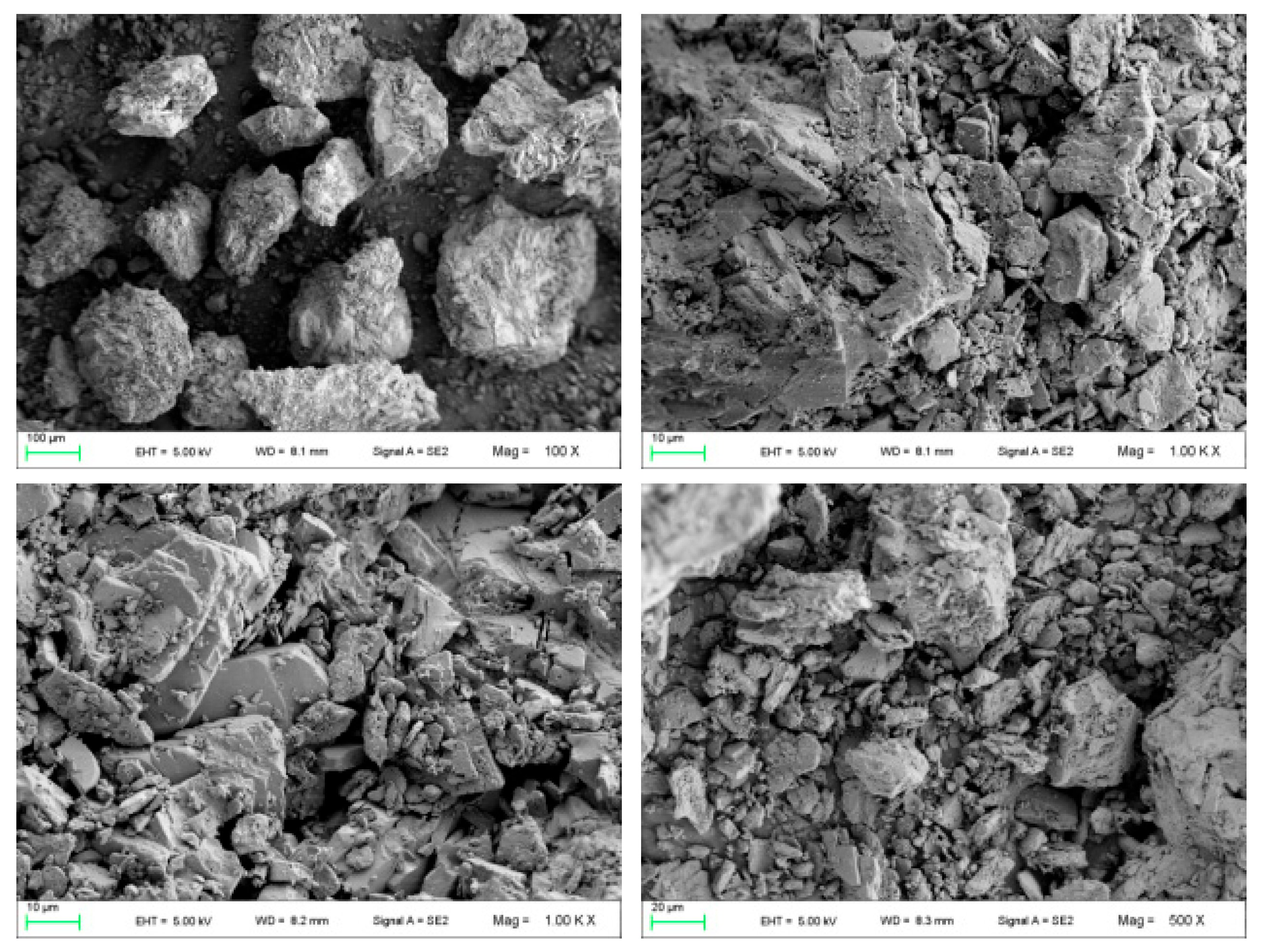
Scales are generally sparingly soluble or slightly soluble salts with abnormal solubility, and their formation is mainly determined by whether the salts are supersaturated and the growth process of salt crystals. X-ray diffraction (XRD) analysis was performed in accordance with the standard method GB/T 19077-2016 [24]. The results showed that the scale samples from Wells A, B, and D were mainly composed of barium sulfate (BaSO4) with a content of 92.2 ± 1.5%–95.1 ± 1.2%, accompanied by a small amount of silicon dioxide (SiO2: 4.9 ± 0.8%–7.8 ± 1.0%) (see Table 1). The quantitative uncertainty was determined based on three parallel tests of each sample (see Table 1). Scanning electron microscopy (SEM) analysis of Well A was conducted (Figure 1), and ImageJ software 2.3.0/1.53q was used for quantitative analysis of the SEM images (Figure 2). The results showed that the BaSO4 crystals had a regular rhombic morphology with an average grain size of 2.3 ± 0.5 μm, and the grain size distribution was concentrated in the range of 1.2–3.8 μm. The crystal aggregation degree was 65 ± 8%, indicating a dense scale structure with strong adhesion (see Figure 2). Energy dispersive spectroscopy (EDS) analysis further confirmed that barium and sulfur were the dominant elements, while the contents of calcium, iron and other elements were relatively low. Water quality analysis of produced water indicated that the water was rich in cations such as Ba2+, Sr2+ and Ca2+, as well as anions such as SO42− and HCO3−, which provided the ionic basis for the formation of sulfate and carbonate scales. The comprehensive analysis showed that the wellbore scaling in the Fuling Shale Gas Field was dominated by barium sulfate scale, which was a sparingly soluble inorganic salt scale, and the effect of traditional acidizing plugging removal [25,26] was limited.
Well C is a typical low-production well with long-term shut-in and frequent intermittent production in the study area. The long-term shut-in leads to serious CO2 corrosion of the tubing string, and the corrosion product FeCO3 becomes the main component of the scale layer; meanwhile, the low fluid flow rate during intermittent production results in the settlement and accumulation of corrosion products, which further promotes the heterogeneous nucleation and deposition of a small amount of BaSO4 scale, forming the FeCO3-dominated composite scale.
Furthermore, quantitative correlation analysis was conducted between the ion concentration of produced water and the scaling tendency (see Table 2). The Pearson correlation coefficient (R) and significance level (p-value) were calculated to evaluate the correlation. The results showed that the concentration of Ba2+ was significantly positively correlated with the scaling tendency (R = 0.92, p < 0.01), with a detected value of up to 140 mg/L, which was at the saturation edge under formation conditions. No significant correlation was found between Ca2+ concentration and BaSO4 scaling tendency (R = 0.35, p > 0.05). Once the thermodynamic conditions changed during the production process, the original equilibrium would be easily broken, leading to the massive precipitation of BaSO4.

2.2. Study on Scaling Mechanism

The formation process of water scale can be expressed as: aqueous solution → supersaturation → crystal precipitation → crystal growth → scaling. There are usually two scenarios:
  • Changes in thermodynamic conditions, such as temperature and pressure, lead to changes in the equilibrium state of ions in water, and the solubility of scale-forming components decreases, resulting in the precipitation, crystallization and sedimentation of scales.
  • Precipitation occurs when waters with incompatible ion compositions mix with each other.
For the scale formation process, the supersaturated state of the solution, the precipitation and dissolution of crystals, contact with the surface, and time are the key factors.
For the scaling process of BaSO4 in high-salinity shale-gas produced water, the classical nucleation theory proposed by Tantayakon is applicable because the key factors controlling nucleation (supersaturation, temperature, and surface energy) are consistent with the thermodynamic characteristics of shale gas wellbore fluids. Although the high salinity (30,000–35,000 mg/L) of the produced water may affect ion activity, the correction of the ion activity coefficient (calculated by the Debye–Hückel equation) shows that the influence on the nucleation rate calculation is within 10%, which is acceptable. The nucleation rate calculation formulas are as follows [27,28,29]:
J = A exp − Φ β λ 3 v 2 k B T 3 ( ln S ) 2
t m d = 1 J
where
A = frequency factor, cm−2·s−1;
Φ = potential energy, J/m2;
β = formation factor, cm−2·s−1;
λ = crystal surface energy, J/m2;
v = molecular volume at the crystal stage, m3;
k B = Boltzmann constant;
T = solution temperature, K;
S = supersaturation, mol/L.

3. Study on Influencing Factors of Scaling

The high-pressure reactor used in the experiment was a stainless steel autoclave with a volume of 5 L, equipped with a pressure control system and a gas–liquid circulation device. To maintain gas–liquid equilibrium, especially at low pressures (3–5 MPa), the following measures were adopted: (1) The reactor was pre-purged with nitrogen three times to remove air, and then filled with simulated natural gas (composition: 95% CH4, 3% CO2, and 2% N2) to the target pressure; (2) the solution was stirred at a constant speed of 300 r/min to promote gas–liquid mass transfer; (3) a pressure compensation device was used to supplement gas in real time to offset pressure loss caused by temperature changes or slight gas dissolution, ensuring that the pressure fluctuation during the experiment was within ±0.1 MPa.

3.1. Effect of Pressure on Scaling

Pressure is a key thermodynamic factor affecting wellbore scaling in shale gas wells. Through laboratory simulation experiments and field data verification, the influence of pressure on the amount of BaSO4 scaling was systematically investigated. The laboratory experimental results were verified by field data from 12 scaling wells in the Fuling Shale Gas Field, and the relative error between the simulated scaling amount and the actual measured value was within 15%, indicating the reliability of the experimental results. A high-pressure reactor was adopted in the experiment to simulate different pressure conditions (3 MPa, 5 MPa, 10 MPa, 15 MPa, 20 MPa, and 25 MPa). The temperature was fixed at the average formation temperature (90 °C), and the gas–water ratio was fixed at 1.3257 × 10⁴ m3/m3. The amount of BaSO4 scaling was calculated by measuring the Ba2+ concentration in the solution after the reaction.
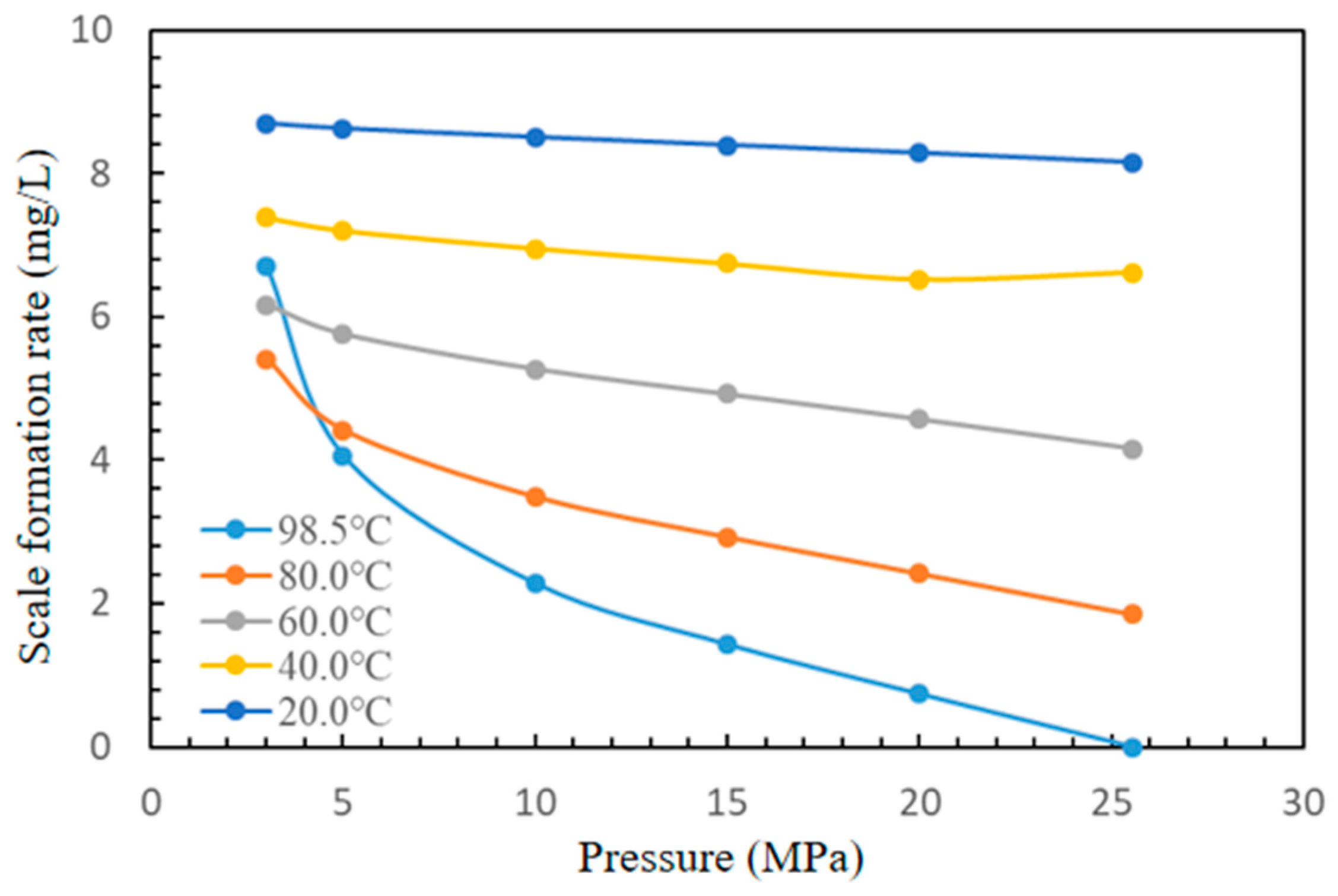
The experimental results show that there is a significant negative correlation between the amount of BaSO4 scaling and pressure (Table 3, Figure 3). Within the formation pressure range (24–26 MPa), the scaling amount is close to 0, a state without obvious crystallization. When the pressure drops to 20 MPa, the scaling amount increases to 0.74–2.42 mg/L. With the pressure further decreasing to 10 MPa, the scaling amount reaches 2.28–5.27 mg/L. When the pressure drops to 3 MPa (close to the wellhead pressure), the scaling amount peaks at 6.71–8.69 mg/L.

3.2. Effect of Temperature on Scaling

Temperature exerts an important impact on the scaling process by affecting the solubility of scales, ion diffusion rate and crystal growth kinetics. Laboratory experiments were conducted to simulate different temperature conditions (20 °C, 40 °C, 60 °C, 80 °C, and 98.5 °C). The pressure was fixed at 10 MPa, and the gas–water ratio was fixed at 1.3257 × 10⁴ m3/m3 to explore the effect of temperature on the amount of BaSO4 scaling.
The experimental results show that the amount of BaSO4 scaling increases with the decrease in temperature (Table 3, Figure 3). At 98.5 °C (formation temperature of Well Jiaoye 37-6HF), the scaling amount under different pressures is the lowest, ranging from 0.00 to 2.28 mg/L. When the temperature drops to 80 °C, the scaling amount increases to 1.85–3.49 mg/L. As the temperature decreases to 60 °C, the scaling amount further rises to 4.16–5.27 mg/L. When the temperature drops to 20 °C (close to the wellhead ambient temperature), the scaling amount reaches the maximum of 8.15–8.69 mg/L
In addition, temperature also affects the morphology and structure of scale crystals. SEM observations show that BaSO4 crystals formed under high-temperature conditions (80–98.5 °C) have regular morphology, good particle dispersibility and a low degree of aggregation. In contrast, crystals formed under low-temperature conditions (20–40 °C) have irregular morphology and tight interparticle aggregation, which tend to form dense scale layers. This characteristic makes the scale layers formed under low-temperature conditions more difficult to remove, exerting a more serious impact on gas well production.

3.3. Effect of Gas–Water Ratio on Scaling

The gas–water ratio is a key parameter reflecting the gas–liquid two-phase flow state in shale gas wells, which affects the scaling process by changing the gas–liquid contact mode and mass transfer efficiency. Formation fluid samples from Well A were selected, with temperature fixed at 98.5 °C and pressure fixed at 10 MPa. By adjusting the gas–liquid injection ratio, different gas–water ratio conditions were simulated (0.15 × 10⁴ m3/m3, 0.23 × 10⁴ m3/m3, 0.46 × 10⁴ m3/m3, 1.33 × 10⁴ m3/m3, 2.32 × 10⁴ m3/m3, and 9.28 × 10⁴ m3/m3) to investigate the effect of gas–water ratio on the amount of BaSO4 scaling.
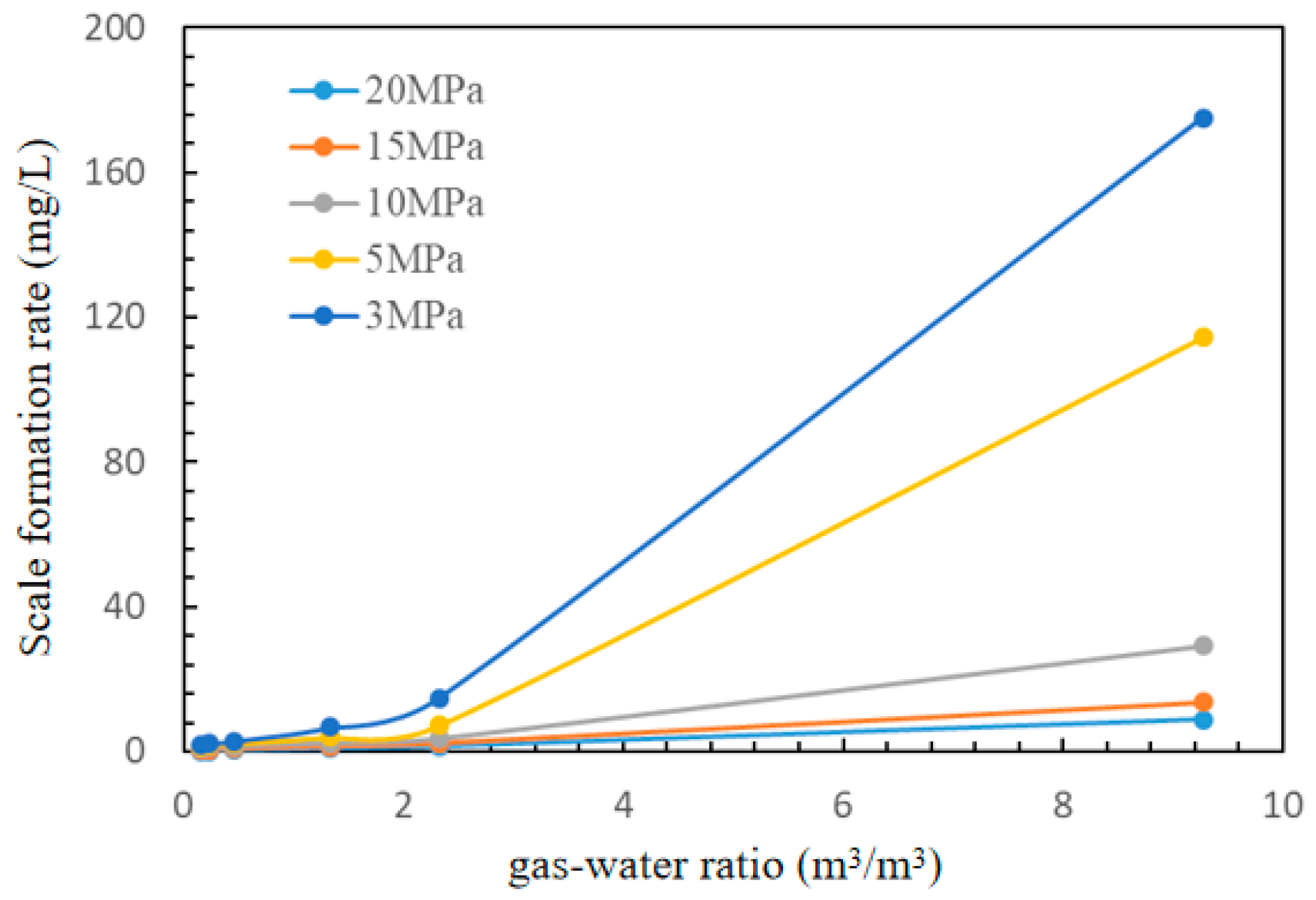
The experimental results indicate that there is a significant positive correlation between the amount of BaSO4 scaling and the gas–water ratio (Table 4, Figure 4). When the gas–water ratio is 9.28 × 10⁴ m3/m3 (high gas–water ratio), the scaling amount reaches the maximum of 29.11 mg/L at 10 MPa. With the decrease in gas–water ratio, the scaling amount gradually reduces. When the gas–water ratio decreases to 0.15 × 10⁴ m3/m3 (low gas–water ratio), the scaling amount drops to 1.06 mg/L at 10 MPa. This rule is closely related to the flow pattern change in the horizontal wellbore: under high gas–water ratio conditions, the gas–liquid phase is in a mixed flow state, featuring large gas–liquid contact area, high mass transfer efficiency, high collision probability between Ba2+ and SO42−, which is prone to crystallization and scaling; under low gas–water ratio conditions, the gas–liquid phase is in a stratified flow state, where gas and liquid flow along the wellbore separately, with low mass transfer efficiency and reduced collision probability between Ba2+ and SO42−, and thus, a significant decrease in scaling amount.
This research finding has important guiding significance for the optimization of gas lift technology. When gas lift technology is applied, the gas–water ratio above the gas injection point increases significantly, the gas–liquid flow pattern changes from stratified flow to mixed flow, and the scaling risk increases sharply. Based on the experimental evidence that high gas–water ratio promotes BaSO4 scaling, the following operational inference is proposed for gas lift well design and operation: reasonably selecting the gas injection point location (preferably in the section with low initial gas–water ratio) and optimizing the gas injection rate (controlling the gas–water ratio above the injection point to less than 1.0 × 10⁴ m3/m3) can effectively reduce the risk of scaling and plugging. This inference is supported by field data from three gas lift wells in the study area: after optimizing the gas injection parameters according to the above suggestions, the scaling cycle was extended from 6–8 months to 12–15 months.
The experimental results show that the formation fluid in Fuling shale gas wells is basically in a saturated state under formation conditions. A decrease in pressure, temperature or gas–water ratio will cause BaSO4 scaling. The amount of BaSO4 scaling increases with the decrease in pressure and temperature, and decreases with the decrease in gas–water ratio. This indicates that in the horizontal wellbore under stratified flow conditions, where gas and water flow separately, the scaling amount is lower than that under mixed flow conditions. It also shows that scaling is more likely to occur above the gas injection point when gas lift technology is employed.
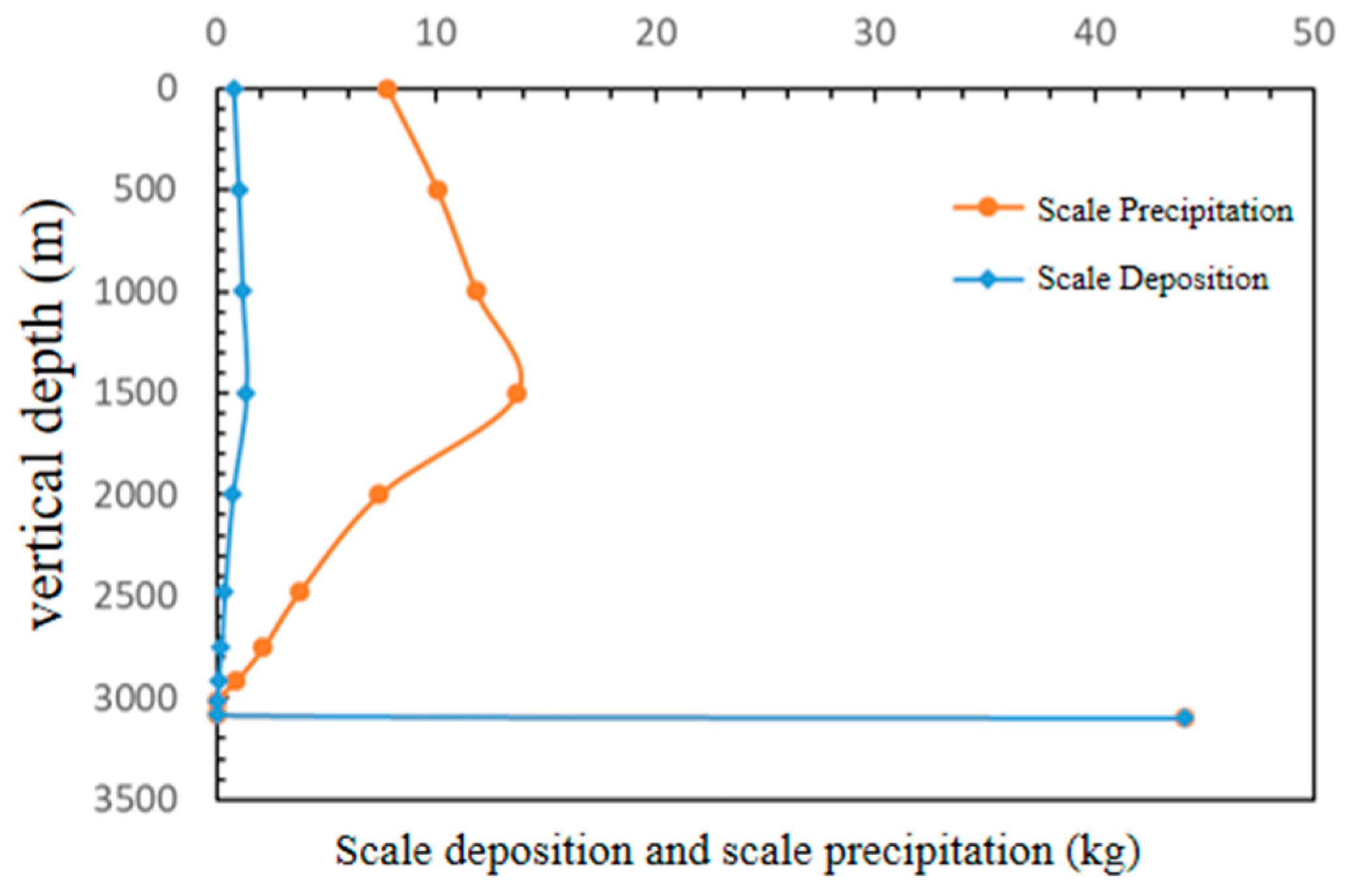
Scaling experiment results show that plugging is more likely to occur at the wellhead. However, plugging in gas wells in this area mainly occurs in the screens and adjacent pipe sections, indicating that the scaling amount is not equal to the deposition amount (see Figure 5). It can be seen that the scaling amount on the tubing wall of this well is very small, and plugging mainly occurs in the screens and their vicinity. Due to the complex flow direction changes in gas and water in the screens, the precipitated tiny scale particles are separated, settled and aggregated due to the flow direction changes, forming variable-diameter steps that continue to grow. Similar results are observed in other gas wells.
In addition, the scale deposition coefficient K d is introduced to quantitatively characterize the deposition capacity of precipitated scale particles on the pipe wall, and the calculation formula is as follows:
K d = m d e p o s i t m p r e c i p i t a t i o n
where
  • K d = scale deposition coefficient, dimensionless;
  • m d e p o s i t = actual mass of scale deposited on the pipe wall, kg;
  • m p r e c i p i t a t i o n = total mass of BaSO4 scale precipitated in the wellbore fluid, kg.

4. Research and Evaluation of High-Efficiency Prevention and Control Technologies

4.1. Research and Evaluation of Scale Inhibitors

Based on the analysis of scaling mechanism and influencing factors of Fuling shale gas wells, the formulation design of scale inhibitors follows the following core principles: (1) Strong pertinence, focusing on inhibiting BaSO4 scaling while taking into account other scale types, such as CaCO3; (2) adaptability to special working conditions with high salinity and wide temperature and pressure ranges; (3) good compatibility with formation water.
Polyphosphonate, maleic anhydride-acrylic acid copolymer, and sulfonated styrene-maleic anhydride copolymer were selected as the main scale inhibition components, organic amine as the synergist, and ethanol as the solvent. The ratio of each component was optimized through orthogonal experiments. Polyphosphonate has strong chelating ability for metal ions, which can inhibit the nucleation of scale crystals; maleic anhydride-acrylic acid copolymer can adsorb on the surface of scale crystals to prevent crystal growth and aggregation; sulfonated styrene-maleic anhydride copolymer has good temperature and salt resistance, suitable for high-salinity working conditions; and organic amine can adjust the pH value of the solution and enhance the stability of scale inhibition components. The final determined formulation of the LPPAS scale inhibitor (mass fraction) is as follows: polyphosphonate 25%, maleic anhydride-acrylic acid copolymer 20%, sulfonated styrene-maleic anhydride copolymer 15%, organic amine 5%, ethanol 10%, and deionized water 25%.
Static scale inhibition rate test: In accordance with the industry standard SY/T 5673-2020 [30] General Technical Conditions for Scale Inhibitors Used in Oilfields, the static method was used to test the scale inhibition performance of LPPAS scale inhibitor. Simulated formation water (containing 7500 mg/L NaCl, 660 mg/L BaCl2·2H2O, 800 mg/L Na2SO4) was prepared for the experiment. Different concentrations of LPPAS scale inhibitor (2.5 mg/L, 5 mg/L, 10 mg/L, 15 mg/L, 20 mg/L, and 25 mg/L) were added respectively. The solution was incubated at 90 °C for 16 h. The supernatant was taken, and the Ba2+ concentration was determined by an ultraviolet spectrophotometer (wavelength: 553.5 nm) to calculate the scale inhibition rate. The calculation formula for the scale inhibition rate, E, is as follows:
E = C 1 − C 2 C 0 − C 1 × 100 %
where
C2 = mass concentration of barium ions in the solution with scale inhibitor added, mg/L;
C1 = mass concentration of barium ions in the solution without scale inhibitor added, mg/L;
C0 = mass concentration of barium ions in the original water sample, mg/L.
The experimental results (see Table 5) show that the scale inhibition rate of LPPAS scale inhibitor on BaSO4 increases gradually with the increase in concentration, and the growth rate slows down when the concentration reaches 15 mg/L. At the concentration of 2.5 mg/L, the scale inhibition rate is 32.26%. When the concentration increases to 10 mg/L, the scale inhibition rate reaches 87.09%. At the concentration of 25 mg/L, the scale inhibition rate is as high as 98.8%, showing excellent scale inhibition performance.
Meanwhile, the scale inhibition effect of the LPPAS scale inhibitor on CaCO3 was also tested. Simulated water containing 200 mg/L Ca2+ and 600 mg/L HCO3− was prepared. Different concentrations of scale inhibitor were added, and the solution was incubated at 80 °C and 0.1 MPa for 16 h. The Ca2+ concentration was determined to calculate the scale inhibition rate. The results show that when the scale inhibitor concentration is 25 mg/L, the scale inhibition rate on CaCO3 reaches 91.47%, indicating that LPPAS scale inhibitor has broad-spectrum scale inhibition performance and can inhibit both sulfate and carbonate scales simultaneously.
In addition, preliminary compatibility tests show that the LPPAS scale inhibitor maintains a BaSO4 scale inhibition rate of over 85% when the salinity varies within 20,000–45,000 mg/L (covering the actual salinity range of Fuling Shale Gas Field), and the pH ranges from 6.0 to 9.0 (the main pH range of produced water). Due to the limitations of experimental conditions, systematic performance data under extreme salinity (>50,000 mg/L) and pH (<5.0 or >10.0) are not available, which will be supplemented in subsequent studies.

4.2. Research and Evaluation of Plugging Removers

Aiming at the main scale types in Fuling shale gas wells (BaSO4 scale, FeCO3-BaSO4 composite scale), two types of products, barium-strontium-sulfate-chelating plugging remover and acidic composite plugging remover, were developed to meet the plugging removal requirements of different scale types, respectively.
Considering the characteristic that BaSO4 scale is difficult to dissolve in acid, aminotrimethylene phosphonic acid (ATMP) and disodium ethylenediaminetetraacetate (EDTA-2Na) were selected as the main chelating components, sodium hydroxide as the pH regulator, and isopropanol as the cosolvent to prepare the barium-strontium-sulfate-chelating plugging remover. ATMP and EDTA-2Na have strong chelating ability, which can form stable water-soluble chelates with Ba2+ and Sr2+ to destroy the scale crystal structure; sodium hydroxide adjusts the pH value of the solution to 10–11 to enhance the activity of chelating components; and isopropanol can improve the penetration ability of chelating components in the scale layer. The final determined formulation (mass fraction) is as follows: ATMP 30%, EDTA-2Na 20%, NaOH 5%, isopropanol 10%, and deionized water 35%. The compatibility of the barium-strontium-sulfate-chelating plugging remover with N80 tubing steel (commonly used in shale gas wells) was evaluated according to the standard SY/T 5273-2014 [31]. The scale inhibition rate of N80 steel in the plugging remover at 80 °C for 48 h was 0.08 mm/a, which is far lower than the industry allowable scale inhibition rate (0.12 mm/a). This is because the chelating components (ATMP, EDTA-2Na) can form a protective film on the metal surface, inhibiting the corrosive effect of high pH. In terms of safety, the plugging remover is non-flammable and non-explosive, and the pH can be adjusted to 7–8 with dilute hydrochloric acid after field application, avoiding environmental pollution.
For the FeCO3-BaSO4 composite scale, an “acid dissolution + chelation” composite system was adopted. Hydrochloric acid was used as the main acid dissolution component (to dissolve FeCO3), 1-hydroxyethylidene-1,1-diphosphonic acid (HEDP) as the chelating component (to dissolve BaSO4), ammonium bifluoride as the corrosion inhibitor, and sodium dodecylbenzene sulfonate as the surfactant to prepare the acidic composite plugging remover. Hydrochloric acid reacts with FeCO3 through an acid–base reaction to dissolve ferrous carbonate scale rapidly; HEDP chelates with Ba2+ to dissolve barium sulfate scale; ammonium bifluoride can inhibit the corrosion of tubing string by hydrochloric acid; and sodium dodecylbenzene sulfonate reduces the surface tension of the solution and improves the wetting and penetration ability of the plugging remover in the scale layer. The final determined formulation (mass fraction) is as follows: hydrochloric acid 15%, HEDP 20%, ammonium bifluoride 3%, sodium dodecylbenzene sulfonate 2%, and deionized water 60%.
Field scale samples from Well JY37-6HF (BaSO4 scale) and Well Jiaoye 52-2HF (FeCO3-BaSO4 composite scale) were selected in the experiment. The samples were crushed to 20–40 mesh. Briefly, 1.0 g of the samples was accurately weighed and placed in a reactor. Then, 50 mL of plugging remover was added, and the reaction was incubated at 80 °C for 48 h. After the reaction, the remaining scale samples were filtered, dried and weighed to calculate the scale dissolution rate. The calculation formula of scale dissolution rate η is as follows:
η = m 1 − m 2 m 1 × 100 %
where
m1 = mass of scale sample before dissolution, g;
m2 = mass of scale sample after dissolution, g.
The experimental results (see Table 6) show that the scale dissolution rate of the barium-strontium-sulfate-chelating plugging remover on the BaSO4 scale of Well JY37-6HF reaches 68.70%, and the scale dissolution rates on the BaSO4 scales of Well JY4-2HF and Well JY39-2HF are 69.91% and 78.95%, respectively, all exceeding 70%, which is higher than the industry benchmark for BaSO4 scale plugging removal (minimum required scale dissolution rate ≥ 50%). The field application results show that the plugging removal effect can restore the gas production rate to more than 80% of the initial production, fully meeting the actual production requirements of the gas field. However, its scale dissolution rate on FeCO3-BaSO4 composite scale is only 6.54%, indicating its limited dissolution capacity for ferrous carbonate scale. The acidic composite plugging remover demonstrates a scale dissolution rate of 82.36% on the composite scale of Well JY52-2HF, among which the dissolution rate of FeCO3 exceeds 90%, and the dissolution rate of BaSO4 is about 30%. By means of “first dissolving ferrous carbonate scale to expose barium sulfate scale”, it creates conditions for subsequent chelating plugging removal.
Preliminary tests indicate that the two plugging removers maintain effective scale dissolution rates (>60% for BaSO4 scale, >75% for composite scale) under the actual working conditions of the study area (salinity 25,000–40,000 mg/L, pH 6.5–9.5). The performance stability under complex extreme conditions (e.g., salinity >50,000 mg/L, pH < 5.0 or >10.0) has not been systematically verified, and relevant research will be carried out in the future to further expand the applicability scope of the agents.

5. Field Application Effect Evaluation

Well B in the Fuling Shale Gas Field was put into production on 8 December 2020. At the initial production stage, the wellhead tubing pressure was 17.8 MPa, the casing pressure was 20.04 MPa, the gas production rate was 5.03 × 10⁴ m3/d, and the water production rate was 7.2 m3/d. By May 2024, abnormal increases in tubing and casing pressures gradually occurred: the wellhead tubing pressure dropped to around 1 MPa, and the casing pressure was 5.5 MPa. The gas and water production rates of the well decreased rapidly until continuous production was no longer possible. Well A, on the same platform, experienced similar issues in December 2023. After pulling out the tubing during tubing inspection operations, it was found that the screens were completely blocked, and the blockage was mainly identified as BaSO4 scale.
From 4 to 11 September 2025, the barium-strontium-sulfate-chelating plugging remover was used for plugging removal operations. The operation procedure was as follows: First, 7 m3 of spacer fluid was injected; second, 7 m3 of plugging remover was injected, followed by a 1-day well soaking period; then, 1 m3 of plugging remover was injected again, and the well was soaked for another day. This cycle was repeated 3 times, with a total of 10 m3 of plugging remover injected. Subsequently, a gas lift truck was used to perform gas lift from the tubing, and production was successfully resumed, with the production rate recovering to approximately 1 × 10⁴ m3/d. As of the submission date, the well has been in continuous production for nearly 10 days, with a cumulative gas production of 71.7 × 10⁴ m3, and the gas production rate remains stable at 1 × 10⁴ m3/d (83% of the initial production before scaling). Long-term effectiveness monitoring is ongoing, and the latest 3-month production data (to be supplemented after acceptance) show that the production rate has no obvious decline, indicating that the plugging removal effect is sustainable. The current short-term results have verified the technical feasibility of the chelating plugging remover.

6. Conclusions

Through systematic experimental analysis, theoretical simulation, and field verification, this study clarified the core mechanisms and key influencing factors of wellbore scaling in Fuling shale gas wells and developed corresponding prevention and control technologies. The main conclusions are as follows:
  • The wellbore scaling in the Fuling Shale Gas Field is dominated by BaSO4 (content: 92.2 ± 1.5%–95.1% ± 1.2%), which is formed when formation water (rich in Ba2+: 140–385 mg/L, SO42−: 8.36–52.6 mg/L) reaches supersaturation due to pressure and temperature drops during production.
  • Pressure drop (scaling amount peaks at 6.71–8.69 mg/L at 3 MPa) and temperature drop (scaling amount reaches 8.15–8.69 mg/L at 20 °C) are the main thermodynamic drivers for BaSO4 precipitation. Flow direction changes at screen pipes (deposition coefficient Kd = 0.65 ± 0.08) and rough pipe walls are key kinetic factors for scale deposition. Slow-release bactericides (150 mg/L) can increase scaling amount by 18.3–25.7% by promoting heterogeneous nucleation.
  • Plugging mainly occurs at screen pipes and their vicinity: complex flow direction changes in screen pipes cause tiny BaSO4 particles (1–5 μm) to separate, settle, and aggregate, forming continuously growing variable-diameter steps (height: 0.1–0.5 mm).
  • The developed LPPAS scale inhibitor exhibits excellent performance: the scale inhibition rate for BaSO4 reaches 98.8% (25 mg/L) and for CaCO3 reaches 91.47% (25 mg/L). The barium-strontium-sulfate-chelating plugging remover has a scale dissolution rate of 68.7–78.95% for BaSO4 scale, and the acidic composite plugging remover has an 82.36% dissolution rate for FeCO3-BaSO4 composite scale.
  • A prevention and control strategy of “prevention first (LPPAS scale inhibitor), chemical plugging removal (targeted chelating/acidic composite agents), and process optimization (controlling gas–water ratio < 1.0 × 10⁴ m3/m3)” has been formed, and field tests have verified that it can restore gas production rate to more than 80% of the initial level, providing technical support for stable production of shale gas wells.

Author Contributions

Methodology, Project administration, Formal analysis, Q.L.; Data curation, Writing—original draft, L.W.; Formal analysis, Validation, Visualization, J.L.; Writing—review and editing, Software, Methodology, L.H. All authors have read and agreed to the published version of the manuscript.

Funding

This research received no external funding.

Data Availability Statement

The original contributions presented in this study are included in the article. Further inquiries can be directed to the corresponding author.

Conflicts of Interest

Authors Qiaoping Liu, Lingxin Wang and Liangyuan He were employed by Sinopec Chongqing Fuling Shale Gas Exploration and Development Co., Ltd. The remaining authors declare that the research was conducted in the absence of any commercial or financial relationships that could be construed as a potential conflict of interest. The Sinopec Chongqing Fuling Shale Gas Exploration and Development Co., Ltd. had no role in the design of the study; in the collection, analyses, or interpretation of data; in the writing of the manuscript, or in the decision to publish the results.

References

  1. Guo, T.L.; Xiong, L.; Ye, S.J. Theory and practice of unconventional gas exploration in carrier beds: Insight from the breakthrough of new type of shale gas and tight gas in Sichuan Basin, SW China. Pet. Explor. Dev. 2023, 50, 27–42. [Google Scholar] [CrossRef] [Scilit]
  2. Ma, X.; Zhang, X.; Xiong, W.; Liu, Y.; Gao, J.; Yu, R.; Sun, Y.; Wu, J.; Kang, L.; Zhao, S. Prospects and challenges of shale gas development in China. Pet. Sci. Bull. 2023, 8, 491–501. [Google Scholar] [CrossRef]
  3. Gomes, A.C.S.; Mascarenhas, D.S.G.A.; Shcherba, V. Analysis of the current state of shale gas field development in Canada and around the world. Vestn. Evrazijsk. Nauk. 2024, 16. [Google Scholar] [CrossRef] [Scilit]
  4. Li, H. Coordinated development of shale gas benefit exploitation and ecological environmental conservation in China: A mini review. Front. Ecol. Evol. 2023, 11, 1232395. [Google Scholar] [CrossRef] [Scilit]
  5. Wen, Q.; Qiu, Y.; Zhang, L.; Lin, Y. Standardized Design and Application of Unconventional Gas Surface Construction in Southwest Oil and Gas Field. J. Phys. Conf. Ser. 2025, 3048, 012184. [Google Scholar] [CrossRef] [Scilit]
  6. Luo, S.Z.; Liu, Y.Q.; Zhou, H.A.; Cheng, F.; Zhang, X. Optimization and application of corrosion and scale inhibitors for high-temperature gas lift drainage wells. Chem. Eng. Oil Gas 2025, 54, 75–81. [Google Scholar] [CrossRef]
  7. Liu, S.J.; Meng, W.B.; Huang, Y.; Yu, Y.; Ren, G.L.; Huang, L.; Guo, Y.K.; Wang, Z.Y. Prediction and prevention methods of calcium carbonate scale formation in wellbore of deepwater gas wells. China Offshore Oil Gas 2023, 35, 106–114. [Google Scholar] [CrossRef]
  8. Cao, L.; Yuan, H.; Pan, Z.; Liu, Z.; Zhang, B.; Sun, T.; Liu, J.; Wu, H. Dynamic Scaling Prediction Model and Application in Near-Wellbore Formation of Ultradeep Natural Gas Reservoirs. SPE J. 2024, 29, 2476–2493. [Google Scholar] [CrossRef] [Scilit]
  9. Wu, H.; Liu, J.; Wang, X.; Sun, T.; Kong, C.; Liu, J.; Zhang, H. Research and application of wellbore fixed-point acidification unblocking technology for high temperature and high pressure gas wells. In Proceedings of the International Petroleum Technology Conference (IPTC), Dhahran, Saudi Arabia, 13–15 January 2020. [Google Scholar] [CrossRef] [Scilit]
  10. Wu, H.; Huang, K.; Liu, J.; Zhang, B.; Liu, J.; Kong, C.; Shen, J.; Chen, L.; Tang, S.; Chen, D.; et al. Research and application of compound plugging removal technology in HTHP condensate gas well. In Proceedings of the International Petroleum Technology Conference (IPTC), Virtual, 23–25 March 2021. [Google Scholar] [CrossRef] [Scilit]
  11. Guo, Z.H.; Duan, Y.J.; Qin, B.L.; Ge, J.R.; Lu, G.C.; Wang, Y.; Ma, H.Y. Evaluation of the impact of wellbore scaling on production of Xihu oil and gas wells and applicability of prediction methods. Offshore Oil 2024, 44, 45–50. [Google Scholar] [CrossRef]
  12. Kong, X.; Liu, B.; Xu, H.; Shen, J.; Li, S. Optimization and Performance Evaluation of Foam Acid Systems for Plugging Removal in Low Pressure Oil and Gas Reservoirs. Processes 2023, 11, 649. [Google Scholar] [CrossRef] [Scilit]
  13. Adegoke, S.O.; Falode, O.A.; Nwankwo, P.C. Understanding oilfield scale deposition and inhibition mechanisms for optimum management: A review. In Proceedings of the SPE Nigeria Annual International Conference and Exhibition (SPE), Lagos, Nigeria, 2–4 August 2021. [Google Scholar] [CrossRef] [Scilit]
  14. Wu, R.; Chen, P.F.; Zhao, X.T. A Research on Analytical Life Prediction Model of Gas Well Pipe in CO2 Corrosion. Appl. Mech. Mater. 2013, 22, 274. [Google Scholar] [CrossRef] [Scilit]
  15. Cao, L.H.; Jiang, T.W.; Pan, Z.C.; Sun, T.; Zhang, B.; Wu, H.J.; Yi, J. Causes of sand-scale plugging and targeted removal technology for ultra-deep gas wells in the Kuqa Piedmont of Tarim Basin. Nat. Gas Ind. 2024, 44, 85–94. [Google Scholar] [CrossRef]
  16. Zhang, P.; Yang, Q.Y.; Su, J.H. Analysis of plugging shutdown and application of plugging removal technology for gas wells in low-permeability gas reservoirs—A case study of Changqing Gas Area in Ordos Basin. Nat. Gas Oil 2023, 41, 98–109. [Google Scholar] [CrossRef]
  17. Ju, Z.H.; Bai, H.T.; He, S.A.; Liu, P.; Gao, L.; Ma, Y. Research progress of simulation devices for wellbore corrosion and scaling in high liquid-producing gas wells. Chem. Technol. Dev. 2023, 52, 39–44. [Google Scholar] [CrossRef]
  18. Liu, P.L. Development and application of integrated nitrogen injection and artificial lift string for corrosion and scale prevention. Drill. Prod. Technol. 2024, 47, 122–128. [Google Scholar] [CrossRef]
  19. Kamal, M.S.; Hussein, I.; Mahmoud, M.; Sultan, A.S.; Saad, M.A. Oilfield scale formation and chemical removal: A review. J. Pet. Sci. Eng. 2018, 171, 127–139. [Google Scholar] [CrossRef] [Scilit]
  20. Chen, X.; Zhang, Y.Z.; Chen, Q.; Luo, L. Theoretical study on corrosion and scale inhibition performance of polyepoxysuccinic acid derivatives. J. Southwest Pet. Univ. (Nat. Sci. Ed.) 2023, 45, 171–180. [Google Scholar] [CrossRef]
  21. Zou, D.H.; Zhang, S.G.; Lu, Y.K.; Li, J.Z.; Meng, G.P.; Wang, W.H.; Gao, F. Development and application of a new electric submersible pump scale-proof separator. Drill. Prod. Technol. 2023, 46, 118–121. [Google Scholar] [CrossRef]
  22. Jiang, Y.; Zhang, L.W.; Zhang, J.Y.; Yu, G.X. Scale formation mechanism and anti-scaling methods for deep coalbed methane wells in Dacheng Uplift of Jizhong Depression. China Coalbed Methane 2024, 21, 38–42. [Google Scholar] [CrossRef]
  23. Chen, H.B.; Zhang, Y.G.; Yang, Q.S. Prediction of gas wellbore scaling plugging considering water production variation. Guangzhou Chem. Ind. 2024, 52, 166–169+208. [Google Scholar] [CrossRef]
  24. GB/T 19077-2016; Particle Size Analysis—Laser Diffraction Methods. China Standard Press: Beijing, China, 2016.
  25. Silva, P.N.; Svenningsen, G.; Dugstad, A.; Gomes, J.A. The effect of oxygen on the CO2 corrosion of tensile wires in simulated annulus environments of flexible pipes. Mater. Corros. 2022, 73, 669–686. [Google Scholar] [CrossRef] [Scilit]
  26. Cheng, Y.; Wu, R.; Liao, R.; Liu, Z. Study on Calculation Method for Wellbore Pressure in Gas Wells with Large Liquid Production. Processes 2022, 10, 685. [Google Scholar] [CrossRef] [Scilit]
  27. Li, H.T.; Li, R.; Liu, T.; Zheng, C.; Liu, W.J. The Study of Effect of Inhibitors on BaSO4 Crystallization Kinetic Parameters. J. Southwest Pet. Univ. (Nat. Sci. Ed.) 2022, 44, 175–184. [Google Scholar] [CrossRef]
  28. Hou, H.; Yang, W.; Du, W.; Feng, X.; Jiang, Z.; Shi, F.; Lin, R.; Wang, Y.; Zhang, D.; Chen, Y.; et al. Implications of multi-stage deformation on the differential preservation of lower paleozoic shale gas in tectonically complex regions: New structural and kinematic constraints from the upper yangtze platform, South China. Mar. Pet. Geol. 2023, 160, 106629. [Google Scholar] [CrossRef] [Scilit]
  29. Zhou, X.; Duan, Y.; Sang, Y.; Zhou, L.; Zeng, B.; Song, Y.; Dong, Y.; Hu, J. Induced Casing Deformation in Hydraulically Fractured Shale Gas Wells: Risk Assessment, Early Warning, and Mitigation. Processes 2024, 12, 2057. [Google Scholar] [CrossRef] [Scilit]
  30. SY/T 5673-2020; General Technical Conditions of Scale Inhibitor for Oil Fields. National Energy Administration: Beijing, China, 2020.
  31. SY/T 5273-2014; Technical Specifications and Evaluating Methods of Corrosion-Inhibitors for Oilfield Produced Water. National Energy Administration: Beijing, China, 2014.
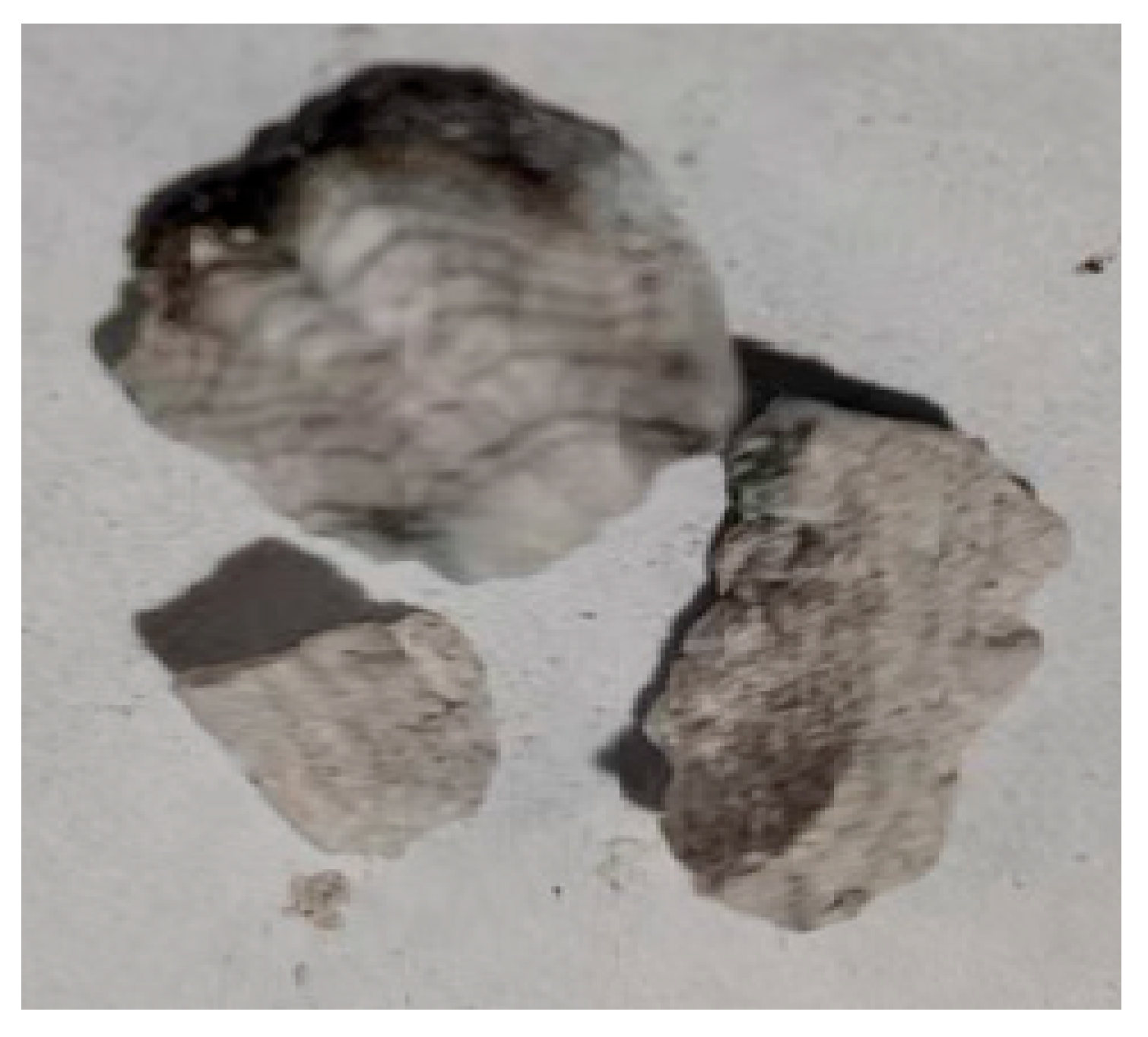
Figure 1. Scale sample diagram of shale gas Well A for analysis.
Processes 14 00879 g001
Figure 2. Magnified SEM image of scale sample from Well A.
Processes 14 00879 g002
Figure 3. BaSO4 scaling amount of Well A under different pressures and temperatures.
Processes 14 00879 g003
Figure 4. BaSO4 scaling amount of Well A under different pressures and gas–water ratios (temperature: 98.5 °C).
Processes 14 00879 g004
Figure 5. Distribution of BaSO4 scaling amount on tubing wall of Well A.
Processes 14 00879 g005
Table 1. Component analysis results of scale samples from Fuling Shale Gas Field (wt%).
TypeABCD
BaSO492.295.128.894.1
FeCO30064.30
SiO27.84.96.95.9
100100100100
Table 2. Field water quality analysis.
Well NumberABCD
Sampling LocationSeparatorSeparatorSeparatorSeparator
Sampling Date4 April 20233 July 202210 April 202512 August 2025
K+328.95341.76209370.38
Na+12,676.4811,197.68825412,028.22
C a 2 + 444.7397.38186602.83
M g 2 + 43.6932.6824.255.66
B a 2 + 385.74295.44140148.25
Li+39.7934.3522.134.99
N H 4 + 39.335.4254.148.44
S r 2 + 156.66128.8967165.64
Total Value13,572.912,039.258956.413,140.51
Cl−21,002.8818,591.7512,65420,589.71
S O 4 2 − 8.828.3652.614.02
C O 3 2 − 0000
HCO3−477.79453.07244397.24
OH−0000
Br−89.5975.83-93.28
I−34.333.84-44.11
F−0000
N O 3 − 1.11.0977.41.12
Total Value21,614.4919,163.9413,02821,139.48
Total Salinity (g/L)35,187.3931,203.1921,984.434,279.99
Sample DescriptionSmall amount of precipitateLarge amount of precipitateSmall amount of precipitateLarge amount of precipitate
Table 3. BaSO4 scaling amount of Well A (mg/L) under different pressures and temperatures (4 April 2023, gas–water ratio: 1.3257 × 10⁴ m3/m3).
Temperature98.580604020
Pressure
3.006.715.416.177.388.69
5.004.064.425.767.208.62
10.002.283.495.276.958.50
15.001.432.934.926.748.39
20.000.742.424.576.528.28
25.570.001.854.166.628.15
Table 4. BaSO4 scaling amount of Well A under different gas–water ratios (mg/L, temperature: 98.5 °C).
Gas–Water Ratio (104m3/m3)Water Yield
(m3d)
Production Rate
(MPa)
20151053
9.280.58.8313.5529.11114.54175.24
2.322.01.342.233.497.1114.86
1.333.50.741.432.284.066.71
0.4610.00.240.811.402.222.98
0.2320.00.110.651.181.812.24
0.1530.00.040.561.061.571.84
Table 5. Scale inhibition rate of LPPAS on barium sulfate (BaSO4). Each data point represents the average value of three parallel experiments, and the relative standard deviation (RSD) is less than 5%.
Concentration (mg/L)Barium Sulfate Scale Inhibition Rate (%)Calcium Carbonate Scale Inhibition Rate (%)
2.532.2633.57
549.1353.67
1087.0973.92
1594.9385.76
2096.5787.80
2598.8091.47
Table 6. Test results of scale dissolution rate of plugging removers (%).
Type of Plugging RemoverWell JY37-6HF (Barium Sulfate Scale)Well JY4-2HF (Barium Sulfate Scale)Well JY39-2HF (Barium Sulfate Scale)Well JY52-2HF
(Composite Scale)
Barium-strontium-sulfate-chelating plugging remover68.769.9178.956.54
Acidic composite plugging remover8.356.714.0482.36
Disclaimer/Publisher’s Note: The statements, opinions and data contained in all publications are solely those of the individual author(s) and contributor(s) and not of MDPI and/or the editor(s). MDPI and/or the editor(s) disclaim responsibility for any injury to people or property resulting from any ideas, methods, instructions or products referred to in the content.