


Abstract
Economic gas recovery from shale reservoirs is inherently difficult because of the extremely low permeability of these formations. To overcome this challenge, horizontal wells are drilled and subjected to multi-stage hydraulic fracturing treatments, which generate high-conductivity flow pathways. The adoption of these technologies has significantly boosted the economic recovery of gas from shale formations, particularly the Marcellus Shale, which stands as the most productive shale gas play in the United States. The effectiveness of a fracturing treatment in enabling economic gas production from shale reservoirs is governed by the characteristics of the fractures it creates. The propagation of initial fracture, during multi-stage hydraulic fracturing, modifies the initial stress conditions in the surrounding area, commonly referred to as a “stress shadow.” The stress shadow restricts the initiation and subsequent propagation of later fracture stages, leading to the development of less favorable fracture properties. As a result, the uneven contribution of individual fracture stages to gas flow ultimately diminishes overall gas recovery from the horizontal well. For efficient gas drainage from the shale, the fracture stages are often closely spaced. When fracture stages are placed in close proximity, the stress shadow effect can be intensified. Thus, accounting for the stress shadow is essential in the design of hydraulic fracture treatments. This study investigates how fracture spacing, injected fluid volume, and fluid type influence the magnitude of the stress shadow effect, its impact on fracture properties, and the resulting gas recovery from the Marcellus Shale. The goal is to facilitate the optimization of the hydraulic fracture design to mitigate the stress shadow impact and enhance gas production. Data from several Marcellus Shale horizontal wells, along with published findings, were compiled and analyzed to determine the petrophysical and geomechanical characteristics of the formation. These results were then used to construct a reservoir model representative of a Marcellus Shale horizontal well. Fracture properties, altered by the stress shadow, were assessed through hydraulic fracturing simulations and incorporated into the model. Ultimately, the reservoir model was employed to predict the production performance. The results of the investigation confirmed that close stage spacing intensifies the impact of the stress shadow. The stress shadow was found to impair fracture conductivity which negatively impacted gas recovery. The negative impact of the stress shadow on gas recovery was observed to gradually diminish as the production rate declined over time. The volume and type of the fluid injected during fracturing treatment can amplify the stress shadow’s impact.
1. Introduction
Commercial gas recovery from shale formations, owing to their ultra-low permeability, necessitates the deployment of advanced engineering technologies. In the United States, substantial improvements in gas recovery from shale plays have been realized through the application of two pivotal technologies: horizontal drilling and hydraulic fracturing. Horizontal wells are generally completed with multiple transverse hydraulic fractures, forming a high-conductivity fracture network that enhances gas flow to the wellbore. The success of a fracturing treatment is dictated by the characteristics of the induced fractures—such as their conductivity and length—as well as the degree of production enhancement achieved after treatment. To effectively drain the extremely-low-permeability shale formations, closely spaced hydraulic fracture stages are often necessary. Studies have shown that the different fracture stages do not contribute evenly to the production [1,2] from the horizontal shale wells. This uneven production is caused by a number of factors including shale’s heterogeneity and anisotropy as well as the interference between the fracture stages.
The geometry, orientation, and conductivity of fractures are strongly influenced by the in situ stress state, the mechanical properties of the rock, and the distribution of natural fractures. During multi-stage hydraulic fracturing, the propagation of an initial fracture elevates the local stress in the surrounding formation, which may restrict or even inhibit the growth of subsequent fractures. This phenomenon is known as the stress shadow. When fracture stages are placed in close proximity, the stress shadow can markedly influence fracture properties and, in turn, gas recovery. The severity of this effect is governed by both the number and characteristics of the hydraulic fractures as well as the mechanical properties of the shale. Achieving maximum economic recovery requires accurate prediction of gas production from horizontal wells with multiple fracture stages. Yet, the role of the stress shadow in altering fracture behavior and its subsequent impact on shale gas recovery remains poorly understood and is frequently overlooked in production modeling. This underscores the need for a thorough investigation of the factors that contribute to the magnitude of the stress shadow impact on shale gas production.
Access to advanced technical data from the Marcellus Shale Energy and Environment Laboratory (MSEEL), a collaborative field site, enabled a comprehensive analysis to better understand the stress shadow and its influence on gas recovery from the Marcellus Shale. Owing to its mechanical properties, the Marcellus Shale is particularly sensitive to stress variations. Therefore, accounting for stress shadow effects is essential for accurately forecasting the production performance of horizontal wells with multi-stage hydraulic fractures. The objective of this study was to integrate fracture properties, stress shadow effects, and shale characteristics to investigate the factors that influence the intensity of the stress shadow impact on gas recovery from the Marcellus Shale.
2. Background
The Marcellus Shale is the most significant and prolific natural gas-producing formation in the United States. It is a fine-grained sedimentary rock created through compaction of silt and clay-sized mineral particles. Spanning roughly 95,000 square miles across the Appalachian Basin, the formation lies at depths between 4000 and 8500 feet. Its total organic carbon (TOC) content ranges from 2 to 20 percent [3], while its thickness varies from 50 to 200 feet. Natural gas is stored both within the limited pore spaces of the shale and adsorbed onto the organic matter, or kerogen, due to its extensive surface area and strong affinity for gas [4,5]. Estimates suggest that the Marcellus play may contain up to 500 trillion cubic feet of gas in place [6]. The Marcellus Shale is a naturally fractured formation characterized by low porosity and extremely low permeability. Its natural fractures typically contribute little to production prior to stimulation. However, the application of horizontal drilling and hydraulic fracturing technologies has effectively unlocked substantial reserves of natural gas within the Marcellus Shale.
The effects of multi-stage hydraulic fracturing on gas production from horizontal shale wells have been examined extensively by numerous researchers [7,8,9,10,11,12,13,14]. The number and the location of the hydraulic fracture clusters can appreciably increase production from the unconventional shale gas reservoirs [15]. However, the impact of the stress shadow on gas production was neglected in these studies. Soliman et al. [16] demonstrated that generating a hydraulic fracture alters the in situ stress within its surroundings. Roussel and Sharma [17] concluded that closely spaced hydraulic fractures could increase the stress shadow throughout the formation. Singh and Miskimins [18] determined that the breakdown pressure required for initiation of the subsequent hydraulic fractures was higher when the fractures were spaced closely. Roussel et al. [19] determined that the propagation of any hydraulic fracture occurs against a closure stress, the magnitude of which is influenced by the cumulative stress shadow generated by all preceding fractures. Deploying downhole geophones to monitor microseismic events associated with multi-stage hydraulic fracturing, Dohmen et al. [20] concluded that per-stage production along the lateral was diminished by the interactions between a growing hydraulic fracture and the previously created fractures. The intensity of the stress shadow is influenced by the stage spacing, fracturing treatment parameters, as well as the formation’s geomechanical properties. The impact of the stress shadow on gas recovery from the Marcellus Shale can be significant because of its sensitivity to stress. Therefore, it is necessary to investigate the factors that influence the intensity of the stress shadow impact on gas recovery from the Marcellus Shale.
3. Objective and Methodology
The aim of this study was to examine how fracturing treatment parameters influence the stress shadow impact and, in turn, affect gas recovery from horizontal wells with multiple hydraulic fractures in the Marcellus Shale. To achieve this objective, the following steps, outlined in the subsequent sections, were undertaken.
- Data Collection and Analysis to determine the petrophysical and geomechanical properties of Marcellus Shale and to estimate the hydraulic fracture properties.
- Reservoir Model Development to predict gas recovery from the Marcellus Shale horizontal wells based on different sets of hydraulic fracture properties.
- Investigation of the factors that influence the intensity of the stress shadow impact on the hydraulic fractures’ properties and gas recovery from the Marcellus Shale.
4. Data Collection and Analysis
The data for this study were obtained from the Marcellus Shale Energy and Environment Laboratory (MSEEL), located in the core play area of the Marcellus Shale in Morgantown, West Virginia (USA). The MSEEL is a multidisciplinary research facility established to enhance gas recovery efficiency and reduce the environmental footprint of Marcellus Shale development through the application of advanced geoscientific, environmental, and engineering technologies [21]. The initial site, situated within the Morgantown Industrial Park (MIP), comprised four horizontal wells (MIP-3H, 4H, 5H, and 6H) drilled between 2011 and 2015, along with a vertical well (MIP-SW) dedicated to obtaining scientific information and microseismic monitoring. In 2019, the MSEEL was expanded to a new location, where six additional horizontal wells (Boggess-1H, 3H, 5H, 9H, 13H, and 17H) were drilled.
A significant amount of advanced technical information has been accumulated from various wells including traditional well log and core samples, high-quality image logs, diagnostic fracture injection test (DFIT), fiber optic and microseismic recording during the fracturing treatment, fracturing treatment data, and production data. For the purposes of this study, four horizontal wells, MIP-3H, MIP-6H, Boggess 3H, and Boggess 5H were selected to perform the analysis for gaining insight relative to the impact of the stress shadow on the hydraulic fracture properties and gas recovery from the Marcellus Shale. The collected data and the results of the analysis for each well are described below.
4.1. Well MIP-3H
MIP-3H, drilled and completed in 2015, has a lateral length of 5800 feet and was hydraulically fractured in 28 stages. A comprehensive suite of well logs from the vertical section of the well including gamma-ray, resistivity, density, neutron, acoustic, and formation micro imager (FMI) as well as the sonic and image logs from the lateral section of the well were available. In addition, the results of a diagnostic fracture injection test (DFIT), fracture treatment parameters for 28 stages, and production data were collected. The results of the measurements on core plugs and microseismic recordings from the science well (MIP-SW) were also utilized.
The petrophysical properties of the Marcellus Shale were determined from the results of the measurements on core plugs obtained from the MIP-SW well [22]. The adsorption (Langmuir) constants were obtained from the results of the isotherm test performed on the crushed samples from the Bogges-17H well. The mechanical properties of the Marcellus Shale were estimated from the sonic log measurements [23]. The density and distribution of the natural fractures were estimated from the analysis of the FMI and the image logs [23]. The essential fracturing parameters including instantaneous shut-in pressure, closure pressure, process zone stress, and the leak-off coefficient were estimated from the interpretation of the DFIT data [24]. The DFIT analysis concluded that the leak-off coefficient was pressure-dependent, confirming that the hydraulic fracture had intersected the fissures in the formation.
To evaluate hydraulic fracture properties, this study utilized the software package GOHFER 3D [25], widely regarded as one of the most accurate fracture simulation tools in the industry. GOHFER integrates a comprehensive suite of capabilities for completion design, analysis, and optimization of wells developed in unconventional formations. The intensity of the stress shadow impact in GOHFER can be controlled by a parameter referred to as the transverse exponent. This parameter governs how the increase in minimum horizontal stress, caused by neighboring fractures, decays perpendicular to the fracture [26]. Lower values (less than 2) produce slowly decaying stress leading to greater fracture interference, whereas values approaching 2 are consistent with the ideal linear–elastic limit in which stress perturbations decay relatively rapidly and interference between fracture fractures is minimal.
The well log data, from both the vertical and lateral sections of the well were entered into the GOHFER software. To correctly place the lateral in the formation, the geosteering tool in GOHFER was employed. The fracturing parameters including the minimum horizontal stress and the process zone stress were adjusted to match the results of the DFIT analysis. Based on microseismic interpretations [27], most fracture stages exhibited a pronounced upward growth with only limited downward extension. Consequently, the minimum horizontal stress in the formation beneath the Marcellus Shale (Onondaga Limestone) was adjusted to align the model predictions with the observed fracture propagation.
The fracture treatment data for each stage were incorporated into the GOHFER simulation package, where design parameters, such as the friction factor and discharge coefficient, were systematically adjusted to reproduce the observed treating pressures. This process ensured that the simulated fracture behavior closely reflected field conditions, thereby enhancing the reliability of the predicted fracture properties. The GOHFER output provided the fracture properties, including fracture half-length, height, width, and conductivity. The predicted fracture growth remained within the lateral and vertical extent indicated by the microseismic interpretation. The comprehensive results for all the stages are published elsewhere [23]. To investigate the impact of the stress shadow on the properties of the hydraulic fracture, two sets of fracture properties were generated as follows:
- Setting the transverse exponent to 1.2 (stress shadow), which generates a strong intra-stage stress interference, consistent with observed behavior in tightly spaced multi-stage Marcellus Shale completions. This value results in a clearly distinguishable, yet physically realistic, strong stress shadow case for Marcellus Shale [20].
- Setting the exponent to 2 (no stress shadow), which is the recommended upper limit for an ideal linear–elastic, fully coupled response, thus approximating a case with negligible fracture-to-fracture interaction.
Using these two exponents allows us to isolate the impact of stress shadow intensity while maintaining other reservoir and completion parameters unchanged.
4.2. Well MIP-6H
The MIP-6H well, drilled and completed in 2011, has a lateral length of 2380 feet and was hydraulically fractured in eight stages. This well, because of its wider fracture stage spacing, was selected to investigate the impact of fracture spacing on the intensity of the stress shadow. The fracture treatment parameters for eight stages and the production data were the only available data from this well. Due to a lack of well log data from this well, the petrophysical and well log data from MIP-3H, because of its close proximity, were utilized. The fracture treatment data for each stage was then entered into GOHFER, and the fracture properties were predicted [28]. The influence of the stress shadow was evaluated by generating hydraulic fracture properties for two scenarios: no stress shadow and stress shadow. To gain insight into the impact of stage spacing on the intensity of the stress shadow impact, the hydraulic fracture properties for a case with 12 uniformly spaced hydraulic fracture stages, assuming the same treatment design parameters as the original design, were predicted. The stage spacing for this case would be similar to the stage spacing in MIP-3H. Similarly, two sets of hydraulic fracture properties, no stress shadow and stress shadow, were predicted for this case.
4.3. Boggess 3H
Boggess-3H, drilled and completed in 2019, has a lateral length of 12,474 feet and was hydraulically fractured in 66 stages. The fracture treatment parameters for all stages and the production data were available from this well. Additionally, well logs including gamma-ray, resistivity, density, neutron, and acoustic as well as the results of the mechanical and isotherm tests performed on the core plugs from the pilot well (vertical section) were collected. The pore pressure gradients, overburden stress, and shale mechanical properties were estimated from the log data and were then calibrated against the values obtained from the triaxial compression and multiple stress path comparison tests performed on core plugs. The adsorption (Langmuir) constants were obtained from the results of the isotherm tests performed on crushed core plug samples. The acoustic logs were analyzed to determine the natural fracture density around the well. Geosteering techniques were used to accurately position the lateral within the designated zone. The fracture treatment data for each stage was then entered into GOHFER, and design parameters were modified to match the pressures during the treatment. The GOHFER output provided the fracture properties, including fracture half-length, height, width, and conductivity. The simulation results indicated that the fracture growth remained contained within the lateral and vertical extent suggested by the microseismic data.
The comprehensive results for all the stages are published elsewhere [29]. Two sets of hydraulic fracture properties, no stress shadow and stress shadow, were predicted to investigate the impact of stress shadow intensity.
4.4. Boggess 5H
Boggess-5H, drilled and completed in 2019, has a lateral length of 11,559 feet and was hydraulically fractured in 56 stages. The fracture treatment parameters for all stages and the production data were available from this well. The petrophysical and mechanical properties as well as the natural fracture density were assumed to be the same as the Boggess-3H well. The lateral was placed in the correct zone with the aid of the geosteering tool in GOHFER. The fracture treatment data for each stage were entered into GOHFER and the fracture properties including fracture half-length, height, width, and conductivity were predicted. The predicted fracture growth was confined to the lateral and vertical limits delineated by the microseismic interpretation. The comprehensive results are published elsewhere [30]. To investigate the impact of the stress shadow, two sets of hydraulic fracture properties, no stress shadow and stress shadow, were predicted.
5. Reservoir Model
To predict the production performance of the wells under study, a base model was developed employing the leading reservoir simulation software for unconventional reservoir modeling, CMG-GEM, 2022 [31]. Several approaches have been advanced for the numerical modeling of naturally fractured reservoirs. In this investigation, a solution framework integrating dual permeability with multi-interacting continua [7,10] was adopted. This approach provides a rigorous and efficient representation of transient gas flow from an ultra-low-permeability matrix into high-conductivity hydraulic fractures. The hydraulic fractures were explicitly modeled using localized grid refinement. The matrix block dimensions were expanded logarithmically with increasing distance from the fracture to capture flow heterogeneity. Gas transport within the hydraulic fractures was modeled under non-Darcy flow conditions, thereby reflecting the complex dynamics of fracture conductivity and ensuring fidelity to observed reservoir behavior. The shale’s petrophysical and geomechanical properties obtained from data analysis, as described previously, were used as inputs to develop the model. In shale gas reservoirs, hydrocarbons are stored through dual mechanisms: as free gas occupying the pore spaces of the matrix and natural fractures, and as adsorbed gas bound to the surfaces of organic-rich shale. This dual storage system reflects both the limited pore volume available in the formation and the strong sorptive capacity of kerogen, which collectively govern the reservoir’s production potential. To account for the presence of the adsorbed gas, the Langmuir constants for the Marcellus Shale estimated from the isotherm tests were included in the model. The predicted hydraulic fracture properties including fracture half-length, width, height and conductivity for each well were imported into the reservoir model.
As the gas is produced from the reservoir, the net stress on the formation increases leading to formation compaction [32]. Due to its mechanical properties, the Marcellus Shale is prone to significant compaction, which leads to reductions in both matrix and fracture permeability as well as hydraulic fracture conductivity, thereby accelerating the decline in gas production. Compaction was incorporated in the model by introducing previously developed permeability multipliers (for matrix and fissures) and conductivity multipliers (for hydraulic fractures) as functions of reservoir pressure [33]. The permeability multipliers were derived from core plug permeability measurements conducted under varying confining stresses [22]. The conductivity multipliers were derived from published measurements of fracture conductivity [34]. The wellbore pressures, calculated from the tubing pressures, were used as constraints in the simulation model. Table 1 summarizes the model parameters for each well. Finally, to investigate the impact of the stress shadow on gas recovery, two production profiles were simulated for each well. One is based on the predicted hydraulic fracture properties with no stress shadow, and the other one was based on the predicted hydraulic fracture properties with the stress shadow.
Table 1.
Model Parameters.
6. Impact of the Stress Shadow
The impact of the stress shadow on the fracture properties can be deemed by comparing the predicted fracture properties for two cases, no stress shadow and stress shadow. When stress shadow effects are neglected, variations in fracture properties among stages still arise due to shale heterogeneity and anisotropy. However, these disparities become more pronounced once the stress shadow impact is incorporated. To facilitate a clear comparison and maintain analytical focus, an average value for each fracture property was computed from the predicted values across all stages within each well. The reduction in these properties was then quantified by contrasting the averaged results from the two scenarios: without the stress shadow and with the stress shadow. Although per-stage statistics can provide additional insight into intra-stage variability, the intent of this study was to evaluate the aggregate influence of the stress shadow on fracture properties rather than to characterize detailed inter-stage differences.
Table 2 summarizes the reductions in the hydraulic fracture’s average width, length, height, and conductivity in each well under study. The results in Table 2 indicate that the stress shadow can impair the properties of the hydraulic fracture particularly when the stages are closely spaced. The reduction in fracture width is pronounced. The reduction in fracture height caused by the stress shadow appears to be different for the MIP and Boggess wells. This can be attributed to the stress contrast between the upper and lower Marcellus. For MIP wells, the stress contrast is low, leading to an upward fracture growth, as confirmed by the microseismic results. The stress shadow limits the height growth because it increases the in situ stress. For Boggess wells, the stress contrast is high, and the fractures do not achieve a high vertical growth. Consequently, the stress shadow impact on fracture height is rather insignificant. At the same time, the stress shadow appears to have a more pronounced impact on the fracture width in Boggess wells. The stress shadow leads to non-uniform proppant distribution within the fracture which significantly reduces fracture conductivity. The impairment of fracture conductivity can significantly impact gas production, particularly during the early production period when the flow rates are high.
Table 2.
Percent reduction in fracture properties due to stress shadow.
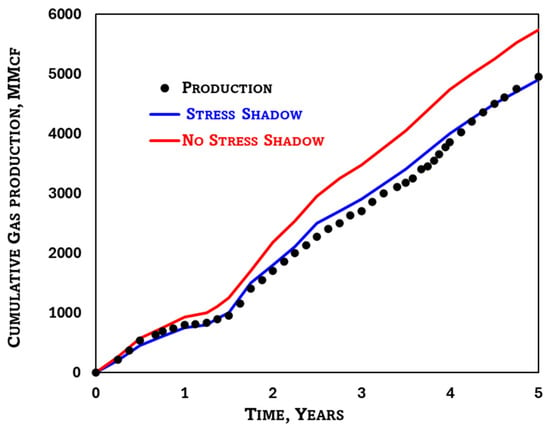
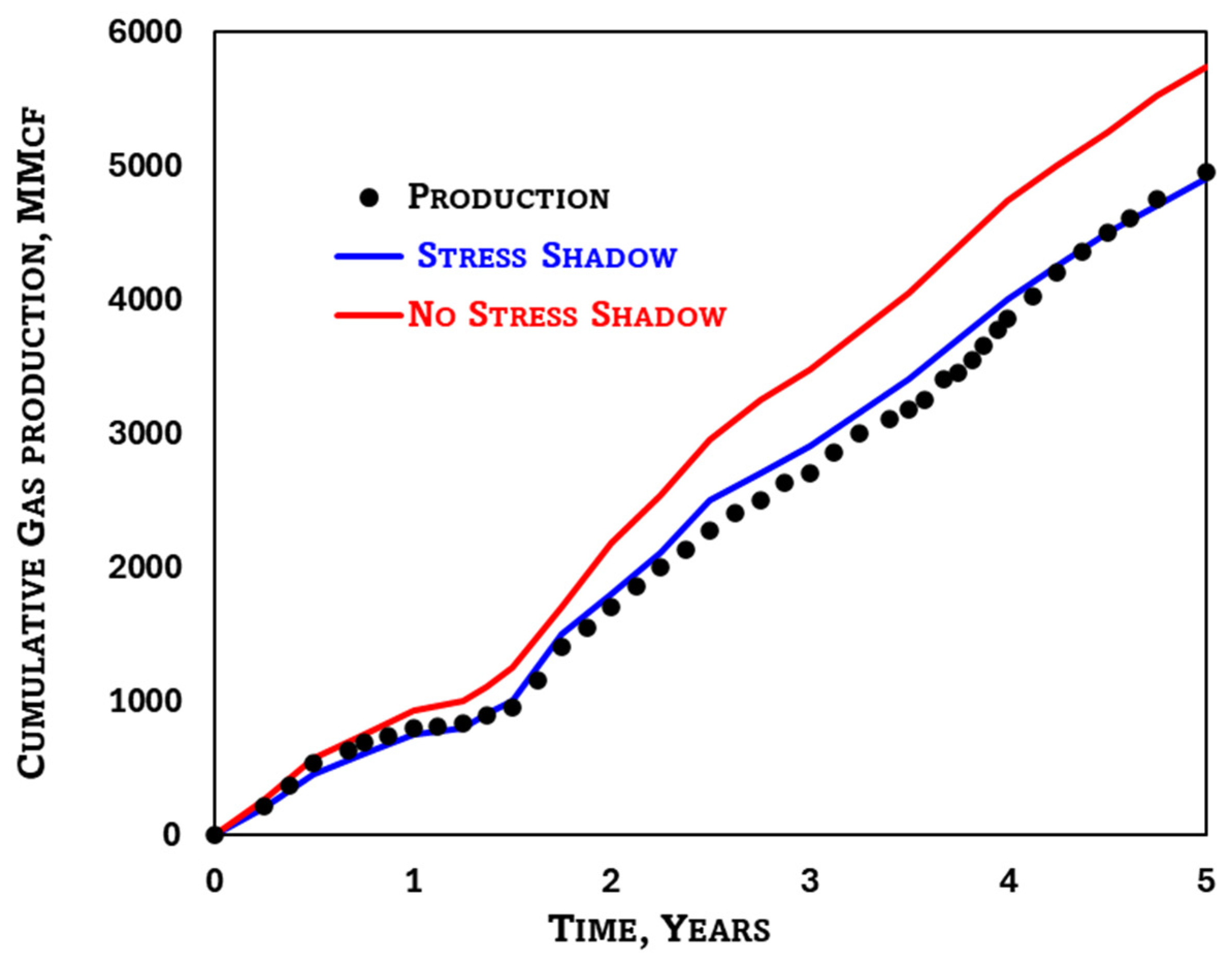
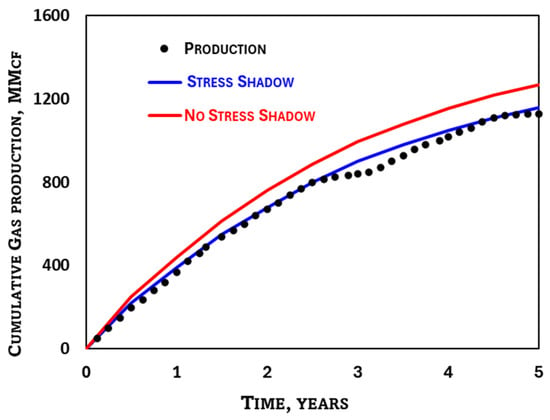
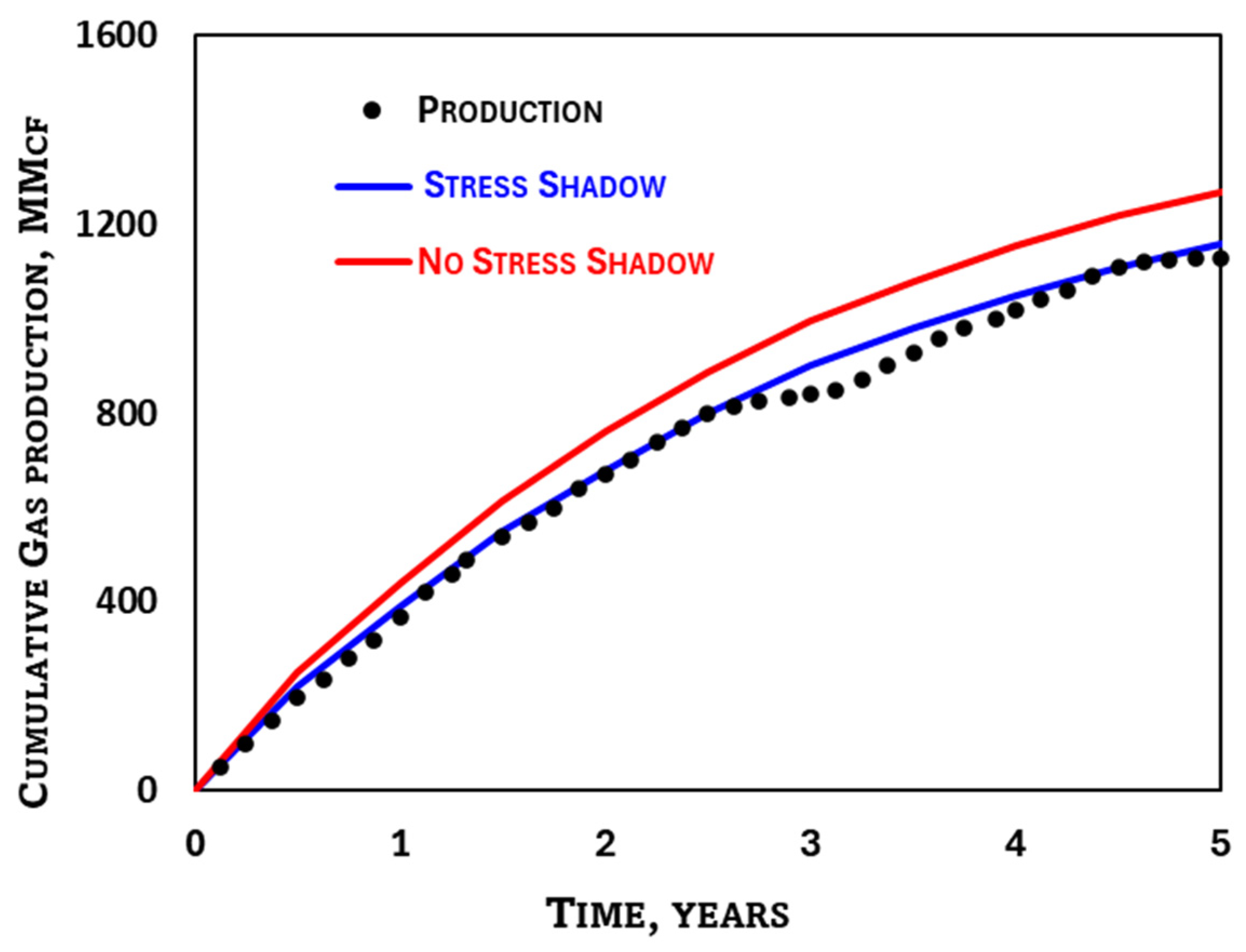
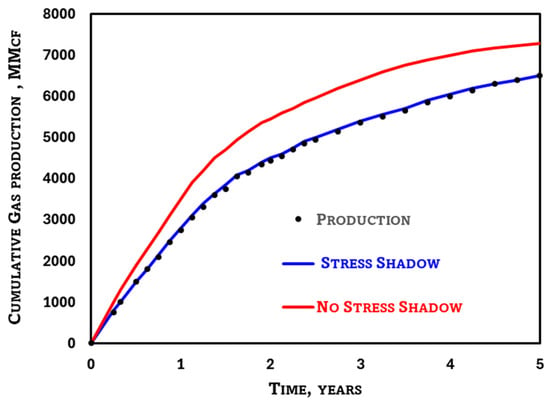
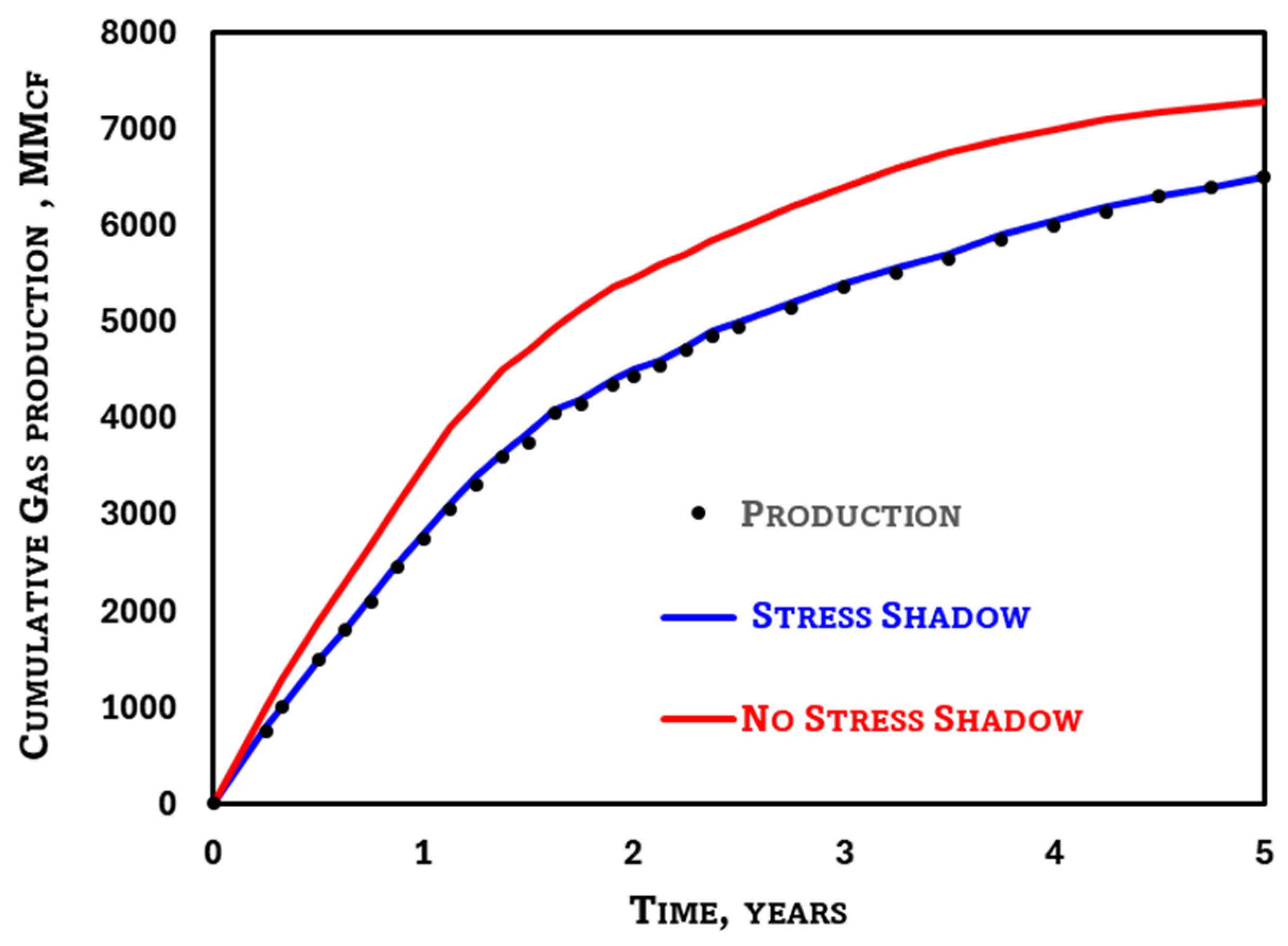
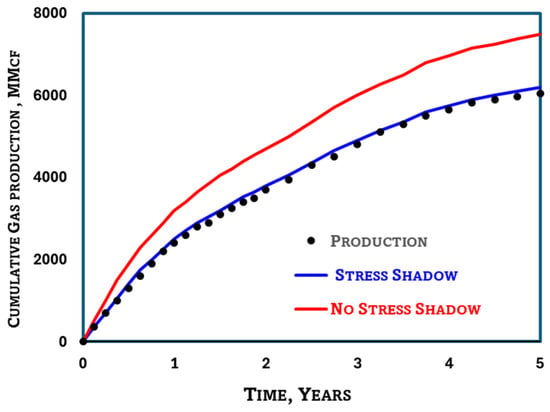
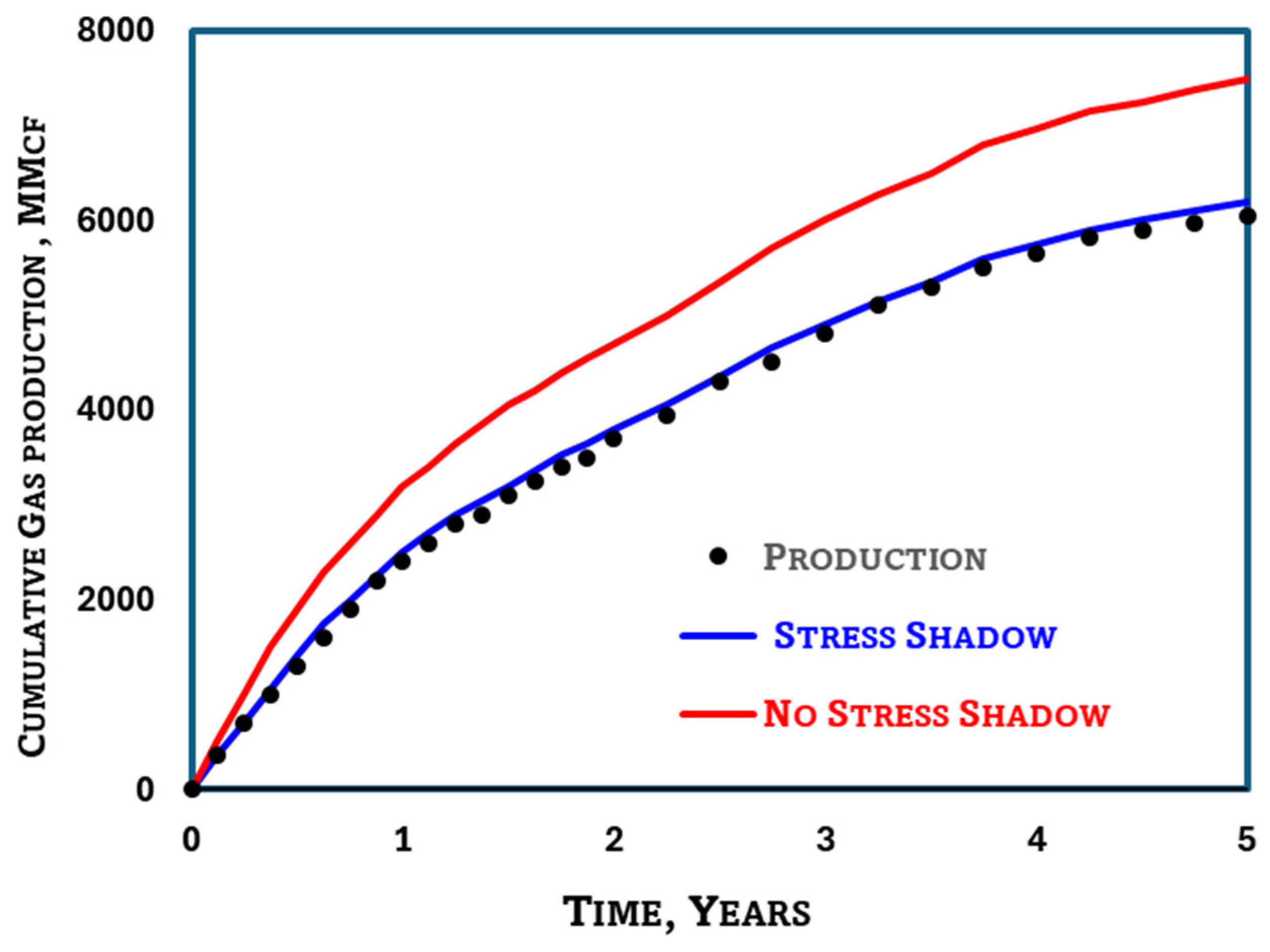
As mentioned previously, two production profiles were simulated for each well, one using the predicted hydraulic fracture properties with no stress shadow and the other one with the stress shadow. Figure 1, Figure 2, Figure 3 and Figure 4 illustrate the two profiles for the different wells in this study. The impact of the stress shadow on gas recovery can be gleaned by comparing the two profiles. As can be observed from these figures, the stress shadow negatively impacts gas recovery. The production data for each well is also included in each figure. The close agreement between the predicted production profile with the stress shadow and the production data for different wells is a clear indication that the stress shadow impact must be included for an accurate production prediction and gas recovery estimation.
Figure 1.
The predicted production profiles and production data for the MIP-3H well.
Figure 2.
The predicted production profiles and production data for the MIP-6H well.
Figure 3.
The predicted production profiles and production data for the Boggess-3H well.
Figure 4.
The predicted production profiles and production data for the Boggess-5H well.
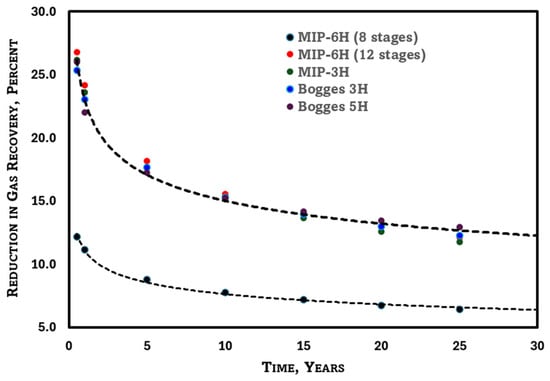
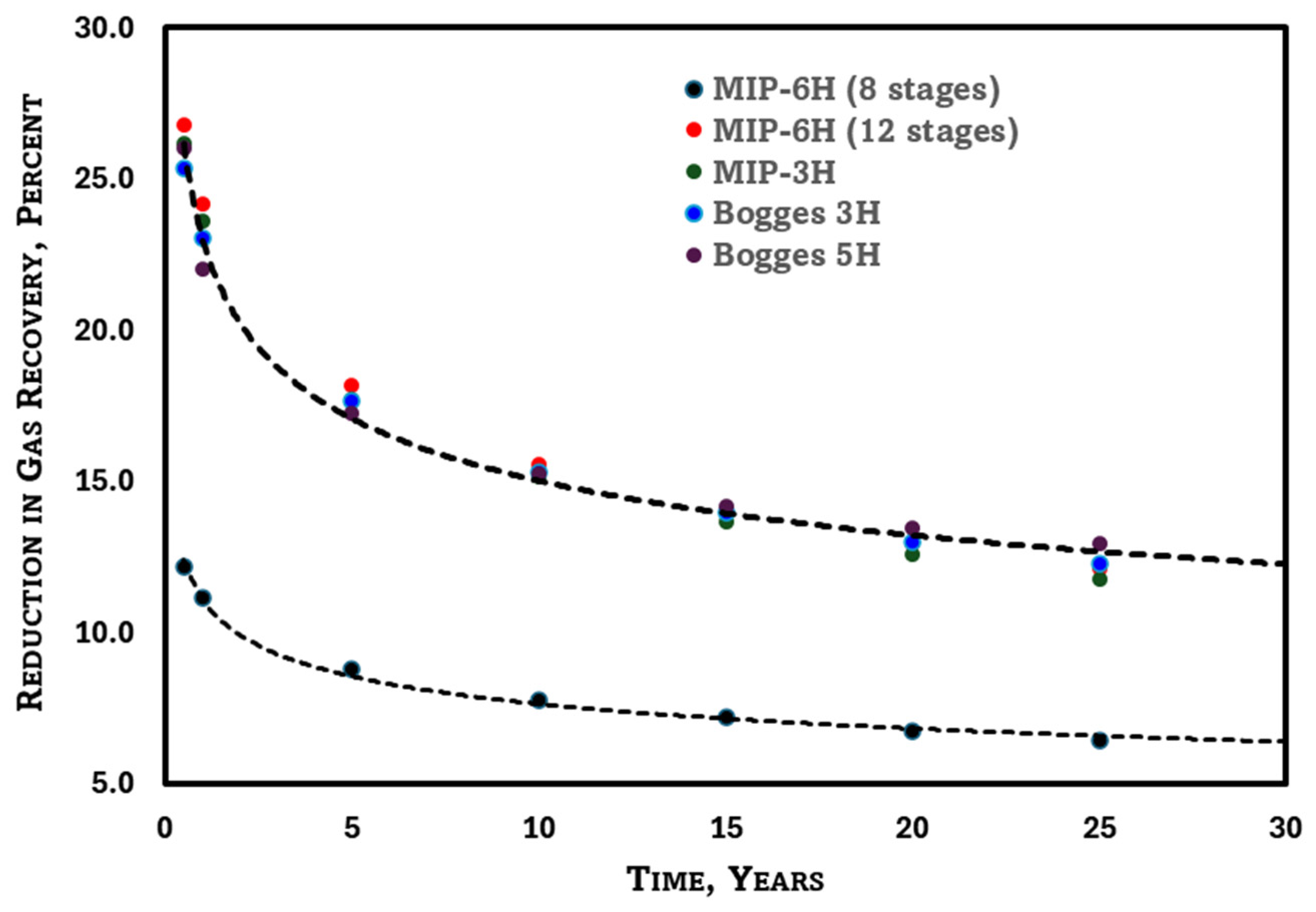
Figure 5 illustrates the percent reduction in gas recovery caused by the stress shadow for each well. The general decline patterns are illustrated by the dashed curves in this figure. As can be observed, the stress shadow impact is more pronounced during early production and diminishes over time due to the decline in production rates. The decline in the stress shadow impact over time appears to follow similar patterns for wells MIP-3H, Boggess 3H, and Boggess 5H since the stage spacing in these wells are very similar. The MIP-6H well, due to its wider stage spacing, exhibits a different pattern for stress shadow decline. To illustrate the impact of the stage spacing, the percent reduction in gas recovery for the MIP-6H well was also predicted to have a similar spacing as the other three wells (12 stages as compared to the original eight stages). Increasing the number of stages significantly increases gas recovery but at the same time it amplifies the stress shadow impact. The pattern of decline for this case, which is similar to the other three wells, is also included in Figure 5. This clearly illustrates that the intensity of the stress shadow impact is controlled mainly by the stage spacing.
Figure 5.
Percent reduction in gas recovery due to stress shadow.
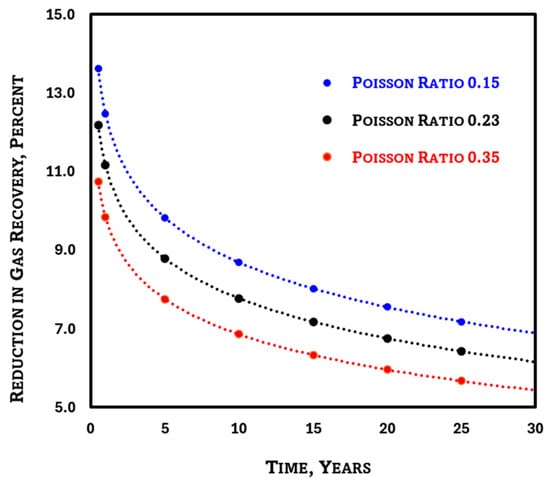
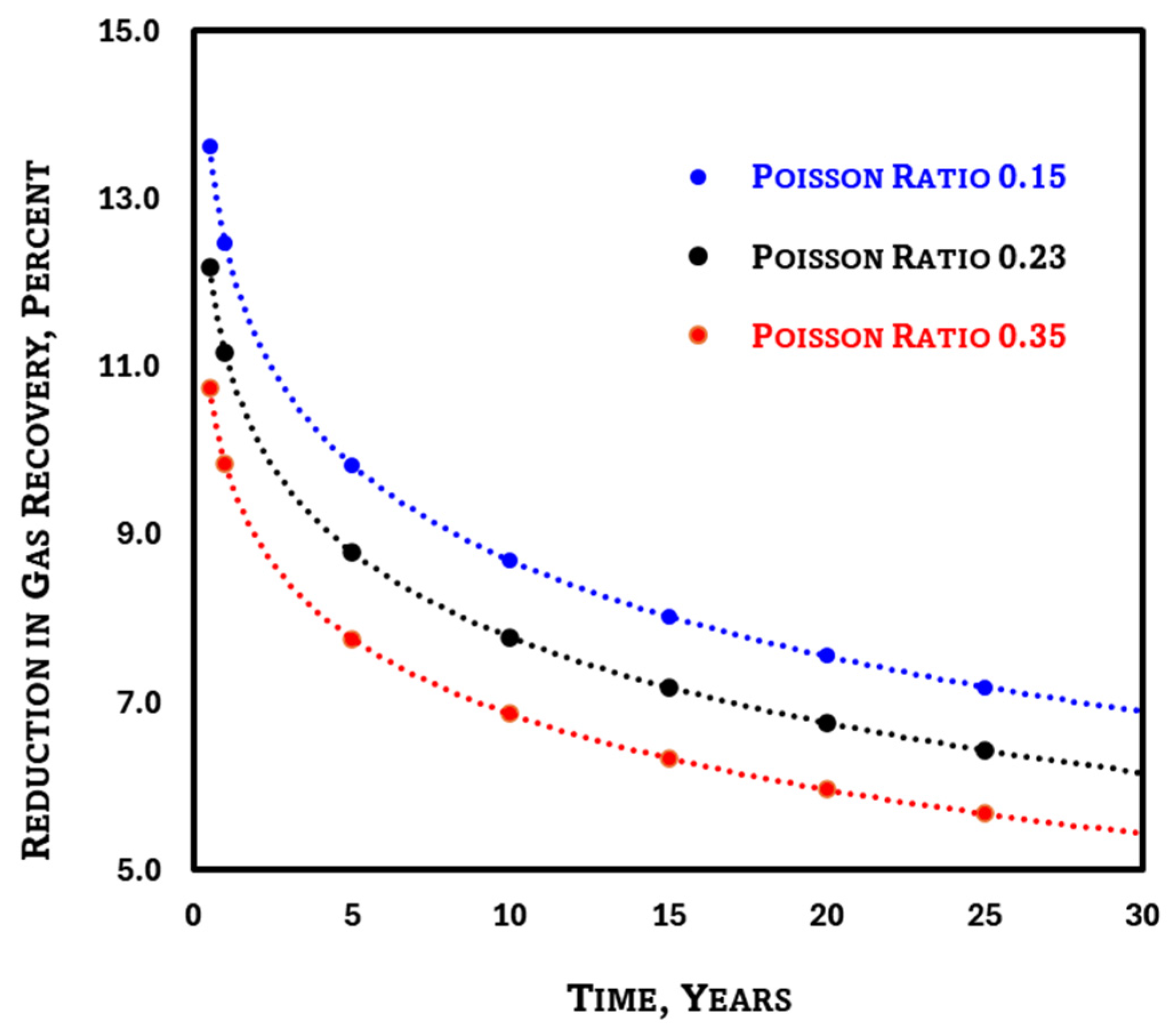
The mechanical properties of the shale, particularly the minimum horizontal stress, can influence the magnitude of the stress shadow impact. The minimum horizontal stress is directly related to Poisson’s ratio. The production profiles for two different values of Poisson’s ratio, 0.15 and 0.35, in addition to its original value (0.23) in the model, were simulated using the fracture simulation package and the reservoir model for the MIP-6H well. The impacts of the stress shadow on fracture properties and gas recovery were then analyzed. Figure 6 illustrates the percent reduction in gas recovery caused by the stress shadow for different values of Poisson’s ratio. The general decline patterns are illustrated by the dashed curves in this figure. As can be observed, the intensity of the stress shadow increases as Poisson’s ratio decreases. The lower values of Poisson’s ratio led to improved fracture properties and consequently higher gas recovery. This is because the stress contrast between the shale and the upper zone, which acts as a barrier to the vertical growth of the fracture, is amplified as the Poisson’s ratio for the shale decreases. However, the intensity of the stress shadow and its impact on gas recovery also increases as Poisson’s ratio decreases.
Figure 6.
Impact of Poisson’s ratio on gas recovery reduction due to stress shadow in the MIP-6H well.
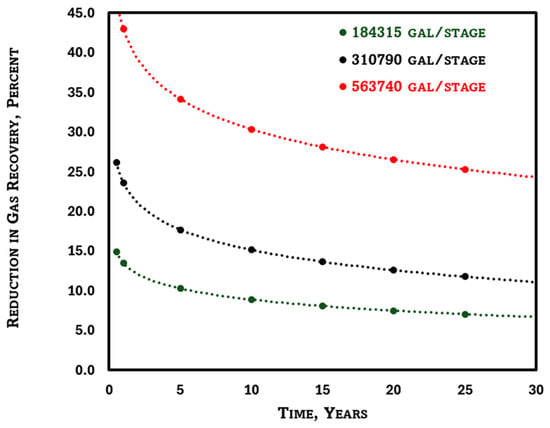
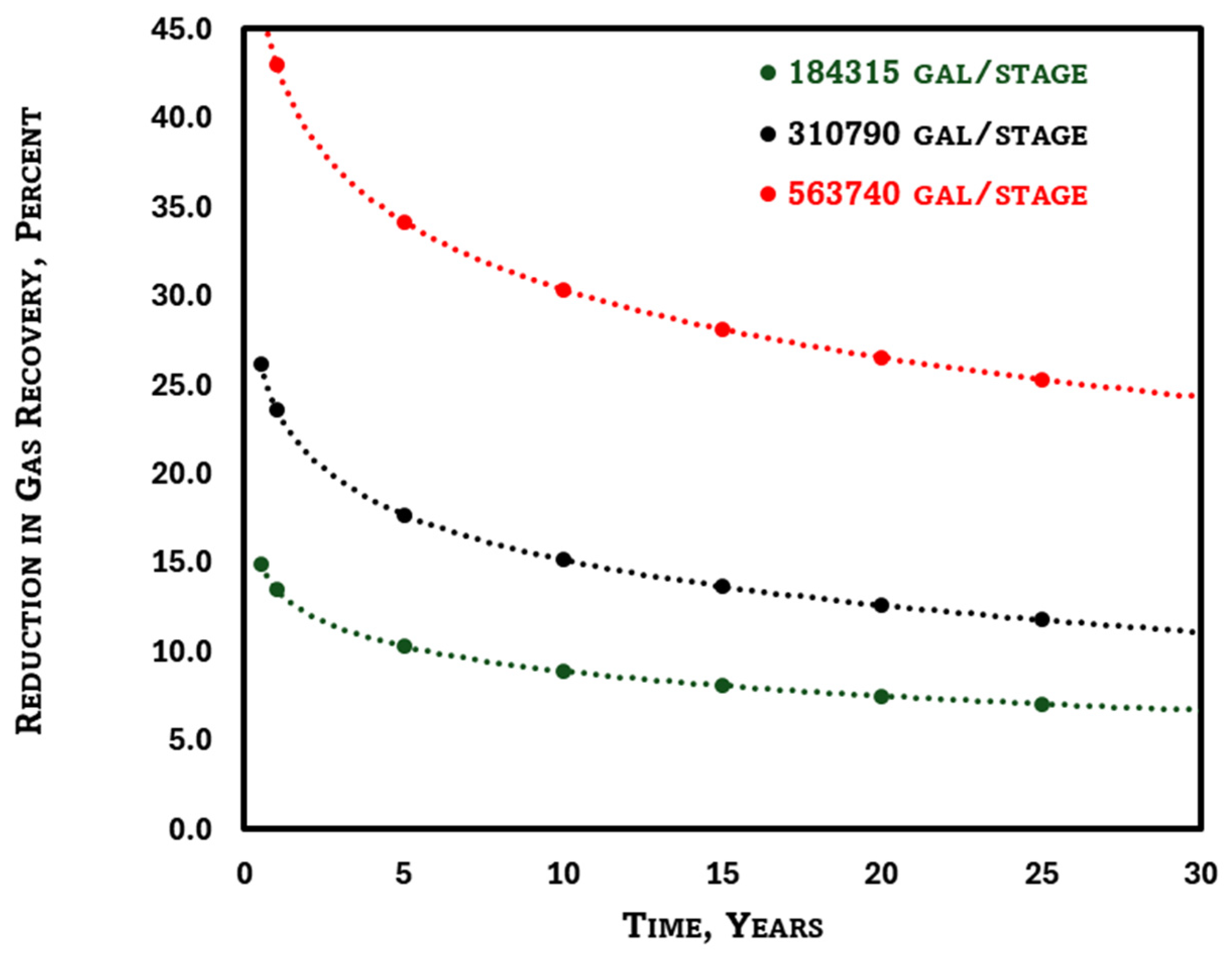
To investigate the impact of fracture treatment design on the intensity of the stress shadow, several parameters including the fluid injection rate, injected fluid volume, and fluid type were considered. The impact of the injection rate on stress shadow intensity was found to be insignificant. To investigate the impact of fluid volume on the stress shadow, the fracture properties and the production profiles for two different volumes of Slickwater per stage, including 184,315 and 563,740 gallons in addition to its original value (310,790), were simulated using the fracture simulation package and the reservoir model for MIP-3H. These volumes were selected to successfully create fractures using the same pump rate, proppant concentration, and proppant type as the original design. Figure 7 illustrates the percent reduction in gas recovery caused by the stress shadow for each fluid volume. The general decline patterns are illustrated by the dashed curves in this figure. It is evident that stress shadow intensity is amplified as the treatment volume increases. Again, as the treatment volume increased, the fracture properties and gas recovery improved but the intensity of the stress shadow also increased.
Figure 7.
Impact of fluid volume injected on gas recovery reduction due to stress shadow in the MIP-3H Well.
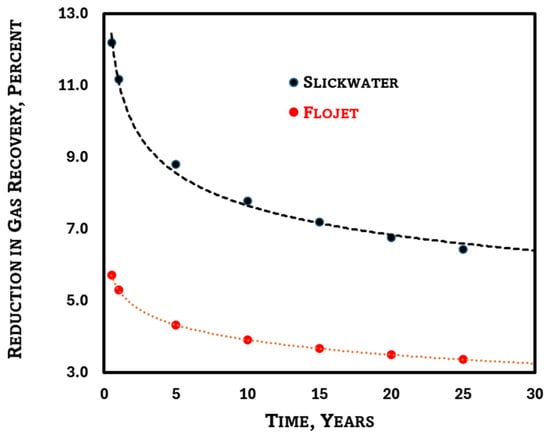
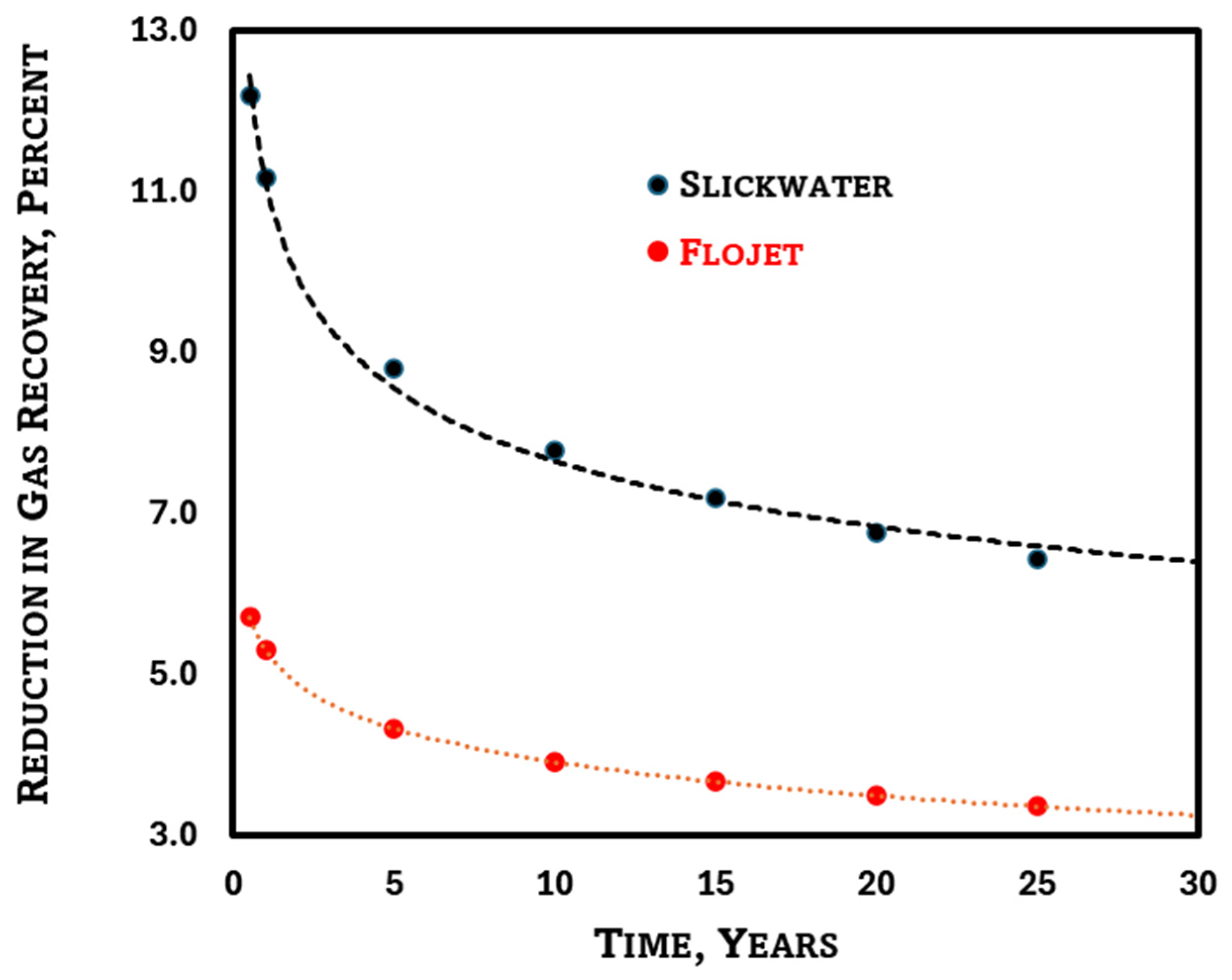
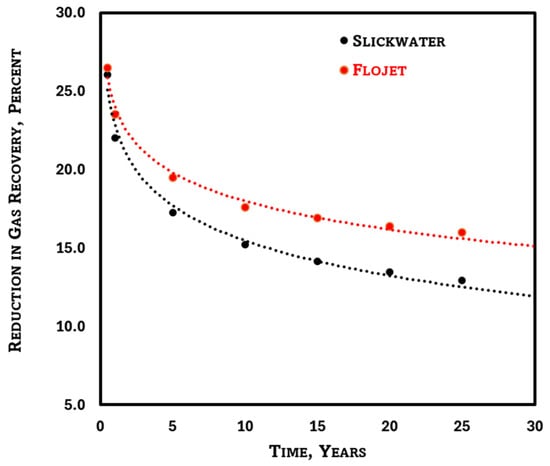
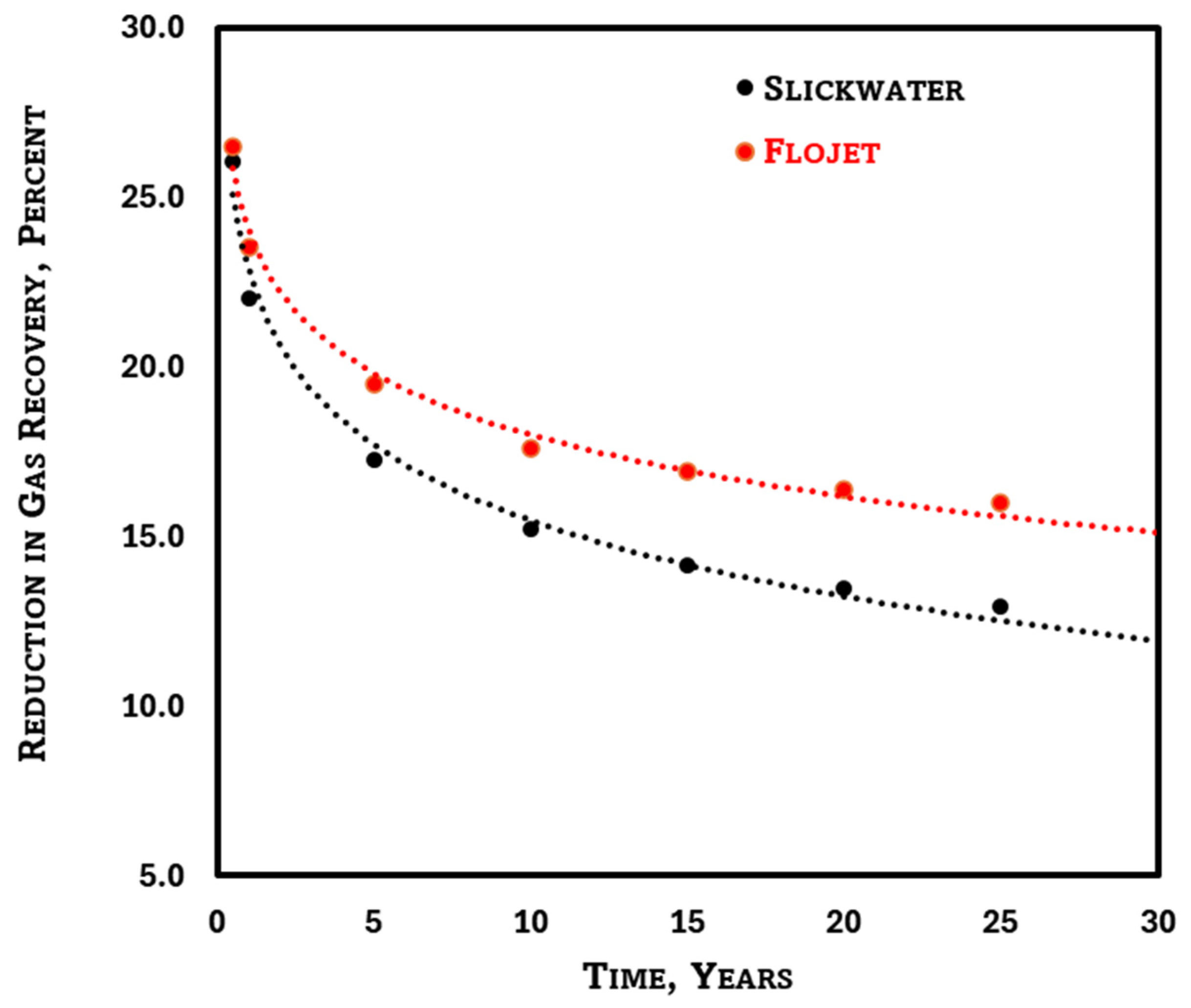
To investigate the impact of the fluid type on the stress shadow, a high-viscosity fluid was considered in this study. The low-viscosity Slickwater is the most prevalent fluid presently used in the hydraulic fracturing of shale formations because of its cost-effectiveness and lower damage potential [35]. However, the fractures created by Slickwater are narrow in width. Therefore, small-sized proppants and lower proppant concentrations are more common in Slickwater treatments. Due to the low viscosity of the Slickwater, the proppants tend to settle at the bottom of the fracture, leading to non-uniform and low fracture conductivity. High-viscosity fracturing fluids can keep the proppants suspended and ensure more uniform distribution of proppant throughout the fractures [36]. For the purpose of this study, the MIP-6H and Bogges 5H wells were selected to investigate the impact of high-viscosity fracturing fluid on stress shadow intensity and gas recovery. The properties of the hydraulic fractures created by a high-viscosity fracturing fluid (Flojet) were predicted in both wells by the GOHFER fracturing simulation package. To investigate the impact of the stress shadow, two sets of fracture properties, including no stress shadow and the stress shadow cases, were predicted. The reservoir models for MIP-6H and Bogges 5H were then employed to predict gas recovery for each case. Figure 8 illustrates the percent reduction in gas recovery due to the stress shadow for MIP-6H. For comparison purposes, the percent reduction in gas recovery due to the stress shadow for Slickwater (the original case) is also included in this figure. Similarly, Figure 9 illustrates the results for Bogges 5H. The general decline patterns are illustrated by the dashed curves in these figure.
Figure 8.
Impact of fluid type on gas recovery reduction due to stress shadow in the MIP-6H well.
Figure 9.
Impact of fluid type on gas recovery reduction due to stress shadow in the Boggess-5H well.
Fractures generated using Slickwater exhibit greater lateral extension due to its low viscosity, resulting in a comparatively limited vertical growth. In contrast, the higher viscosity of Flojet promotes lower lateral propagation and increased the vertical fracture growth. In the MIP-6H well, the vertical growth induced by Flojet extended into formations above the Marcellus Shale because of the low stress contrast, leading to out-of-zone fracture propagation. This behavior diminished treatment effectiveness, reduced gas recovery, and diminished the stress shadow effects. When Slickwater was applied in the same well, the fractures remained confined within the shale interval, producing more effective stimulation. However, because the induced stresses were contained within the shale, the resulting stress shadow intensity increased. In contrast, the Boggess 5H well exhibits a substantially higher stress contrast between the lower and upper Marcellus intervals. Under these conditions, Slickwater-induced fractures remained within the lower Marcellus. Flojet, however, was able to overcome the stress contrast, enabling upward fracture extension into the upper Marcellus and promoting more uniform proppant placement throughout the fracture. This led to improved gas recovery, although it also amplified stress shadow intensity and its impacts on production.
7. Conclusions
The findings of this study support the following conclusions:
- Stress shadow interference adversely influences gas recovery from the Marcellus Shale due to its stress sensitivity.
- Incorporating stress shadow interference is essential for accurately forecasting production from horizontal wells with multi-stage fractures in Marcellus wells.
- The detrimental influence of the stress shadow on gas recovery is more pronounced under high-gas-flow conditions.
- Stress shadow intensity increases as the spacing between fracture stages decreases.
- The mechanical properties of the shale influence the magnitude of stress shadow interference.
- Larger fracture treatment volumes can enhance gas recovery but simultaneously amplify the negative impact of the stress shadow on production performance.
- High-viscosity fracturing fluids, under high vertical stress contrast, generate higher-conductivity fractures and improve gas recovery, yet they also intensify stress shadow effects.
- High-viscosity fracturing fluids, under low vertical stress contrast, produce fractures that do not remain confined within the shale, thereby diminishing gas recovery.
Author Contributions
Conceptualization, K.A.; Software, M.E.S.; Formal analysis, M.E.S.; Investigation, M.E.S.; Resources, S.A.; Writing—original draft, K.A.; Writing—review and editing, K.A.; Supervision, K.A.; Project administration, S.A. All authors have read and agreed to the published version of the manuscript.
Funding
This research received no external funding.
Data Availability Statement
Data is contained within the article.
Conflicts of Interest
The authors declare no conflict of interest.
References
- Fisher, M.K.; Heinze, J.R.; Harris, C.D.; Davidson, B.M.; Wright, K.P. Optimizing Horizontal Completion Techniques in the Barnett Shale Using Microseismic Fracture Mapping. In Proceedings of the SPE Annual Technology Conference and Exhibition, Houston, TX, USA, 26–29 September 2004. [Google Scholar] [CrossRef]
- Molenaar, M.; Hill, D.; Koelman, V. Downhole Tests Show Benefits of Distributed Acoustic Sensing. Oil Gas. J. 2011, 109, 82–85. [Google Scholar]
- Yildirim, O.; Wang, J.Y.; Elsworth, D. Petrophysical evaluation of shale gas reservoirs: A field case study of Marcellus shale. In Proceedings of the Abu Dhabi International Petroleum Exhibition & Conference, Abu Dhabi, United Arab Emirates, 11–14 November 2019. [Google Scholar] [CrossRef] [Scilit]
- Curtis, M.E.; Ambrose, R.J.; Sondergeld, C.H.; Rai, C.S. Investigation of the Relationship between Organic Porosity and Thermal Maturity in the Marcellus Shale. In Proceedings of the North American Unconventional Gas Conference and Exhibition, The Woodlands, TX, USA, 14–16 June 2011. [Google Scholar] [CrossRef] [Scilit]
- Loucks, R.G.; Ruppel, S.; Reed, R.; Hammes, U. Origin and Classification of Pores in Mudstones from Shale-Gas Systems. In Proceedings of the AAPG International Conference and Exhibition, Milan, Italy, 23–26 October 2011. [Google Scholar]
- Lash, G.G.; Englander, T. The Middle Devonian Marcellus Shale—A Record of Eustacy and Basin Dynamics. In Proceedings of the AAPG Annual Convention, Denver, CO, USA, 7–10 June 2009. [Google Scholar]
- Cipolla, C.L.; Lolon, E.P.; Erdle, J.C.; Rubin, B. Reservoir Modeling in Shale-Gas Reservoirs. SPE Reserv. Eval. Eng. 2010, 13, 638–653. [Google Scholar] [CrossRef] [Scilit]
- Weng, X.; Kresse, O.; Chuprakov, D.; Cohen, C.; Prioul, R.; Ganguly, U. Applying complex fracture model and integrated workflow in unconventional reservoirs. J. Pet. Sci. Eng. 2014, 124, 468–483. [Google Scholar] [CrossRef] [Scilit]
- Nejadi, S.; Leung, J.; Trivedi, J.; Virues, C. Integrated characterization of hydraulically fractured shale-gas reservoirs-production history matching. SPE Reserv. Eval. Eng. 2015, 18, 481–494. [Google Scholar] [CrossRef] [Scilit]
- Yu, W.; Hu, X.; Wu, K.; Sepehrnoori, K.; Olson, J. Coupled Fracture-Propagation and Semianalytical Models to Optimize Shale Gas Production. SPE Reserv. Eval. Eng. 2017, 20, 1004–1019. [Google Scholar] [CrossRef] [Scilit]
- Ajisafe, F.; Shan, D.; Alimahomed, F.; Lati, S.; Ejofodomi, E. An integrated workflow for completion and stimulation design optimization in the Avalon Shale, Permian Basin. In Proceedings of the SPE Western Regional Meeting, Bakersfield, CA, USA, 23–27 April 2017. [Google Scholar] [CrossRef] [Scilit]
- Xu, S.; Feng, Q.; Li, Y.; Wang, S. An integrated workflow for fracture propagation and reservoir simulation in tight oil. J. Pet. Sci. Eng. 2019, 179, 1159–1172. [Google Scholar] [CrossRef] [Scilit]
- Izadi, G.; Guises, R.; Barton, C. Advanced integrated subsurface 3D reservoir model for multistage full-physic hydraulic fracturing simulation. In Proceedings of the International Petroleum Technology Conference, Dhahran, Saudi Arabia, 13–15 January 2020. [Google Scholar] [CrossRef] [Scilit]
- Liu, X.; Wang, J.; Singh, A.; Rijken, M.; Chrusch, L.; Wehunt, D.; Ahmad, F.; Miskimins, J. Achieving perfect fluid and proppant placement in multi-stage fractured horizontal wells: A CFD modeling approach. In Proceedings of the SPE Hydraulic Fracturing Technology Conference and Exhibition, Virtual, 4–6 May 2021. [Google Scholar] [CrossRef] [Scilit]
- Cheng, Y. Boundary Element Analysis of the Stress Distribution around Multiple Fractures: Implications for the Spacing of Perforation Clusters of Hydraulically Fractured Horizontal Wells, SPE 125769. In Proceedings of the SPE Eastern Regional Meeting, Charleston, WV, USA, 23–25 September 2009. [Google Scholar]
- Soliman, M.Y.; East, L.; Adams, D. Geomechanics Aspects of Multiple Fracturing of Horizontal and Vertical Wells. SPE Drill. Complet. 2004, 23, 217–228. [Google Scholar] [CrossRef] [Scilit]
- Roussel, N.P.; Sharma, M. Optimizing Fracture Spacing and Sequencing in Horizontal-Well Fracturing. SPE Prod. Oper. 2011, 26, 32–36. [Google Scholar] [CrossRef] [Scilit]
- Singh, J.L.; Miskimins, J. A numerical study of the effects of packer-induced stresses and stress shadowing on fracture initiation and stimulation of horizontal wells. In Proceedings of the Canadian Unconventional Resources and International Petroleum Conference, Calgary, AB, Canada, 19–21 October 2010. [Google Scholar] [CrossRef] [Scilit]
- Roussel, N.; Manchanda, R.; Sharma, M. Implications of Fracturing Pressure Data Recorded during a Horizontal Completion on Stage Spacing Design. In Proceedings of the SPE Hydraulic Fracturing Technology Conference, The Woodlands, TX, USA, 6–8 February 2012. [Google Scholar] [CrossRef] [Scilit]
- Dohmen, T.; Zhang, J.; Blangy, J.P. Measurement and Analysis of 3D Stress Shadowing Related to the Spacing of Hydraulic Fracturing in Unconventional Reservoirs. In Proceedings of the SPE Annual Technical Conference and Exhibition, Amsterdam, The Netherlands, 27–29 October 2014. [Google Scholar] [CrossRef] [Scilit]
- Carr, T.; Ghahfarokhi, P.; Carney, B.; Hewitt, J.; Vagnetti, R. Marcellus Shale Energy and Environmental Laboratory (MSEEL) Results and Plans: Improved Subsurface Reservoir Characterization and Engineered Completions. In Proceedings of the SPE/AAPG/SEG Unconventional Resources Technology Conference, Denver, CO, USA, 22–24 July 2019. [Google Scholar] [CrossRef] [Scilit]
- Elsaig, M.; Aminian, K.; Ameri, S.; Zamirian, M. Study Analyzes Marcellus Shale Petrophysics. Am. Oil Gas. Report. 2016, 59, 63–65. [Google Scholar]
- El Sgher, M.; Aminian, K.; Ameri, S. Evaluation of Hydraulic Fracturing Treatment with Microseismic Data Analysis in A Marcellus Shale Horizontal Well. In Proceedings of the SPE Western Regional Meeting, Bakersfield, CA, USA, 20–22 April 2021. [Google Scholar]
- El Sgher, M.; Aminian, K.; Ameri, S. The Stress Shadowing Impact on the Production Performance of Marcellus Shale. In Proceedings of the SPE Annual Technical Conference and Exhibition, Calgary, AB, Canada, 30 September–2 October 2019. [Google Scholar]
- GOHFER 3D. GOHFER Fracture Modeling Software, Version 9.1; Halliburton: Houston, TX, USA, 2018.
- Barree, R.D. Stress Shadowing and Fracture Interference in GOHFER Software; White Paper; Halliburton: Houston, TX, USA, 2019; Available online: https://www.halliburton.com/en/resources/gohfer-stress-shadowing-white-paper (accessed on 4 February 2025).
- MSEEL. MSEEL MIP Microseismic Data; EDX U.S., Department of Energy: Morgantown, WV, USA, 2021. Available online: https://edx.netl.doe.gov/dataset/mseel-mip-microseismic-data (accessed on 5 May 2025).
- El Sgher, M.; Aminian, K.; Ameri, S. Contribution of Hydraulic Fracture Stage on Gas Recovery from the Marcellus Shale. In Proceedings of the SPE Eastern Regional Meeting, Pittsburgh, PA, USA, 7–11 October 2018. [Google Scholar]
- Al Jassasi, A.; Sattari, A.; Aminian, K.; El Sgher, M.; Matey-Korley, V.; Ameri, S. Workflow for Integrating Geomechanics, Hydraulic Fracturing, and Reservoir Simulation to Determine Marcellus Shale Horizontal Well Production Potential. In Proceedings of the SPE Western Regional Meeting, Anchorage, AK, USA, 22–25 May 2023. [Google Scholar]
- Matey-Korley, V.G. The Effect of Different Fracturing Fluids on the Productivity of Multi-Staged Fractured Marcellus Shale Horizontal Wells. Master’s Thesis, West Virginia University, Morgantown, WV, USA, 2023. [Google Scholar]
- CMG-GEM. Unconventional Reservoir Simulator and Geomechanics in CMG; Computer Modelling Group Ltd.: Calgary, AB, Canada, 2022. [Google Scholar]
- Zoback, M.D. Reservoir Geomechanics: Earth Stress and Rock Mechanics Applied to Exploration, Production and Wellbore Stability; Cambridge University Press: Cambridge, UK, 2007. [Google Scholar]
- El Sgher, M.; Aminian, K.; Ameri, S. Impact of Shale Compaction on Productivity of Marcellus Shale Horizontal Well with Multiple Hydraulic Fractures. Adv. Min. Miner. Eng. 2025, 1, 1–11. [Google Scholar] [CrossRef]
- McGinley, M.; Zhu, D.; Hill, A.D. The effects of fracture orientation and anisotropy on hydraulic fracture conductivity in the Marcellus Shale. In Proceedings of the SPE Annual Technical Conference and Exhibition, Houston, TX, USA, 28–30 September 2015. [Google Scholar]
- Palisch, T.T.; Vincent, M.C.; Handren, P.J. Slickwater fracturing: Food for thought. SPE Prod. Oper. 2010, 25, 327–344. [Google Scholar] [CrossRef] [Scilit]
- Barati, R.; Liang, J.T. A review of fracturing fluid systems used for hydraulic fracturing of oil and gas wells. J. Appl. Polym. Sci. 2014, 131, 40735. [Google Scholar] [CrossRef] [Scilit]

Disclaimer/Publisher’s Note: The statements, opinions and data contained in all publications are solely those of the individual author(s) and contributor(s) and not of MDPI and/or the editor(s). MDPI and/or the editor(s) disclaim responsibility for any injury to people or property resulting from any ideas, methods, instructions or products referred to in the content. |
© 2026 by the authors. Licensee MDPI, Basel, Switzerland. This article is an open access article distributed under the terms and conditions of the Creative Commons Attribution (CC BY) license.