Article

Valorization of Fatty Acid by Catalytic Sugar Derivatization: Lipase Versus Layered Double Hydroxide


by
Alan José Corrêa Manso
1,
Ana Gabriela R. A. Soares
1,
Gabriel F. S. Silva
2,
Mayllon S. Oliveira
1,
Gizele C. F. Sant’Ana
1,
Luiz F. B. Malta
2,*,
Ivana L. M. Ferreira
1 and
Jaqueline D. Senra
1
1
Chemistry Institute, Rio de Janeiro State University, Pavilhão Haroldo Lisboa da Cunha, São Francisco Xavier St., 524, Maracanã, Rio de Janeiro 20550-013, Brazil
2
Chemistry Institute, Universidade Federal do Rio de Janeiro, 149—Technology Center, Block A, Av. Athos da Silveira Ramos, University City, Rio de Janeiro 21941-909, Brazil
*
Author to whom correspondence should be addressed.
Processes 2026, 14(4), 584; https://doi.org/10.3390/pr14040584
Submission received: 1 December 2025 / Revised: 30 January 2026 / Accepted: 4 February 2026 / Published: 7 February 2026

Abstract

Sugar fatty acid esters represent promising scaffolds for technological applications. These compounds are low-cost and allow rapid modulation of their properties. In this study, we have shown that lipase obtained from solid fermentation from Aspergillus niger (hydrolytic activity of 8.32 × 10⁶ U/g) can promote a selective route towards the 2,5-dissubstituted D-mannitol laurate. Indeed, the lipase hydrolytic activity allowed the yield of 80% in DMF (P.A.) at 55 °C and 6 h. Finally, Mg/Al layered double hydroxides (LDH) were compared towards the selectivity of the expected dissubstituted product. The data obtained through the comparative analysis allows establishing some variables such as solvent (DMF), temperature (55 °C) and solvent dehydration degree for obtaining these molecules for future application studies in supramolecular gelation systems.

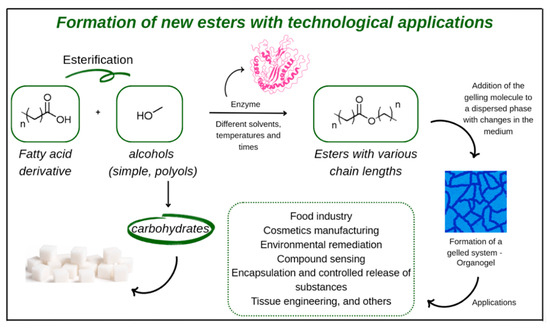
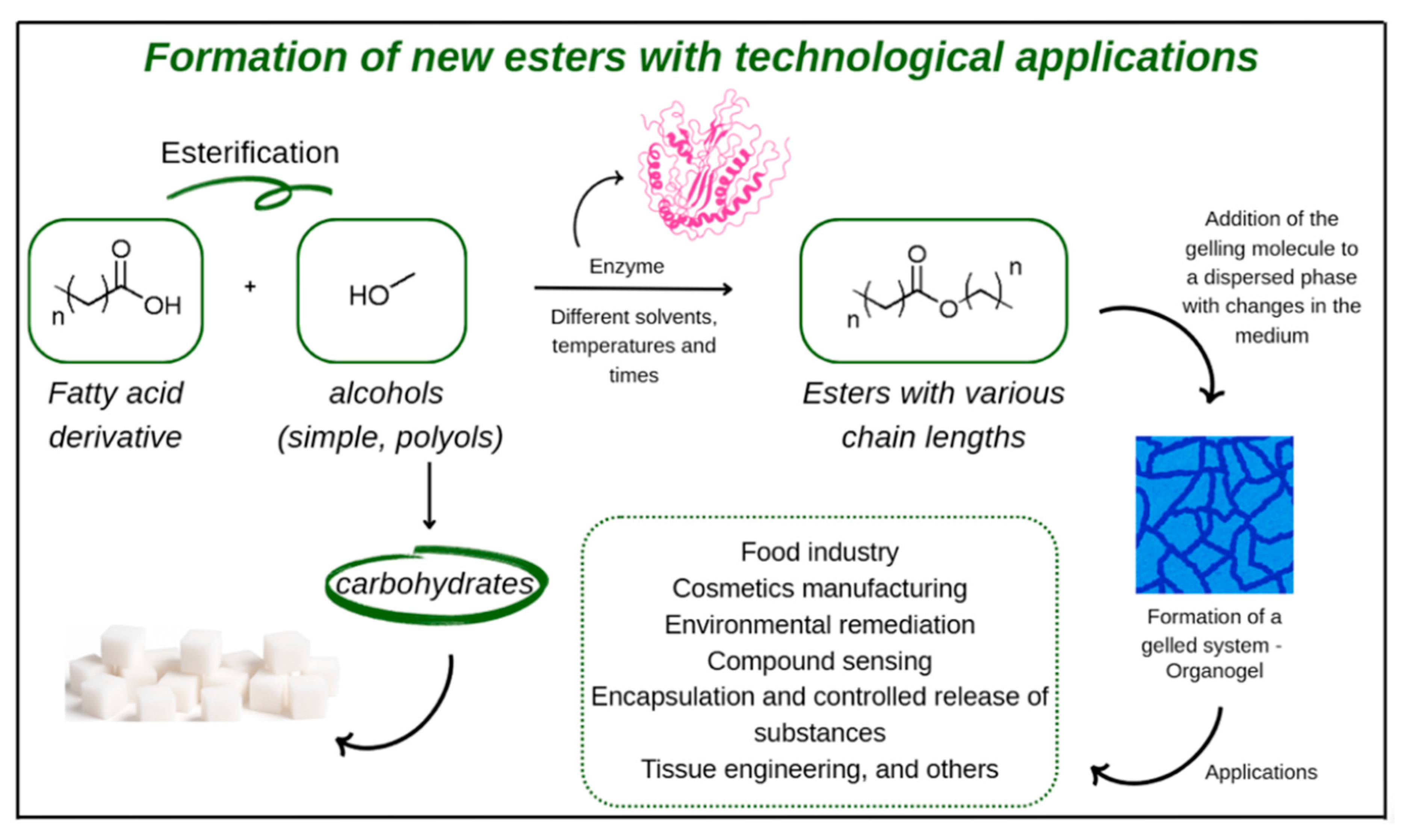
Graphical Abstract

1. Introduction

Esters based on carbohydrates and fatty acid derivatives (classically termed sugar fatty acid esters—SFAEs) have gained attention because of their diverse and extensive applications as bio-emulsifiers, mostly due to advantages related to biocompatibility and the ability to rapidly modulate gelling properties by altering pH, chirality, and minor structural features [1,2,3]. In fact, these amphiphilic systems represent a class with privileged structural properties given the possibility of multiple intermolecular interactions. Despite their utility, the classical synthesis of these surfactants is generally constrained by multiple factors, including exhaustive purification processes and prohibitive production expenses especially due to the polyfunctionalization. However, the mature integration between biocatalysis and organic synthesis has facilitated the selective synthesis of carbohydrate-derived surfactants [4].
Carbohydrate derivatization can be an efficient strategy to expand its chemical functionality, allowing for control of physicochemical properties such as amphiphilicity, solubility and self-organization. In this context, the enzymatic esterification or transesterification reaction of polyhydroxylated sugars with fatty acid derivatives represents a good synthetic model since mild reaction conditions are required. Thus, finding efficient ways to obtain this class of amphiphiles with high selectivity is a promising and sustainable loop for the development of biocompatible smart organic materials [5,6,7,8,9].
Lipases (triacylglycerol hydrolases—E.C. 3.1.1.3) are enzymes belonging to the hydrolase class that catalyze the hydrolysis of triglycerides into glycerol and free fatty acids. In a reaction medium with reduced water content, these enzymes catalyze esterification, interesterification, and transesterification reactions [10]. Among biocatalysts, lipases stand out for their wide range of applications, being used in the detergent, pharmaceutical and drug input, food and beverage, textile, paper and pulp, tannery, cosmetics, and oleochemical industries, as well as in wastewater treatment. Furthermore, they exhibit great biotechnological potential mainly due to characteristics such as stability in relation to temperature, pH and the presence of organic solvents, in addition to chemo-, regio-, and enantioselectivity [10]. These enzymes can be of animal, plant and microbial origin, and their properties vary according to the source. Filamentous fungi are especially valued because the enzymes they produce are generally extracellular, which facilitates their recovery from the fermentation medium, and also because most fungi are not harmful to human health [11].
Lipase production can be carried out by submerged fermentation (SF) or solid-state fermentation (SSF). The first process is carried out in a liquid culture medium, while the second involves the growth and metabolism of microorganisms in the absence or near absence of free water, using a solid substrate or support. SSF is a more advantageous process compared to SF because it requires less energy, has higher productivity, uses simpler and lower-cost media (such as agro-industrial byproducts) and it is similar to the habitat of filamentous fungi, which are able to grow in low concentrations of water, minimizing the risk of contamination in the process. In addition, aeration is simplified due to the porosity of the material and the biocatalyst is generally produced in a more concentrated form, which facilitates its recovery from the culture medium [12].
At the same time, layered double hydroxides (LDHs) are versatile, sustainable and highly fine-tuned catalysts that can enhance the efficiency and environmental profile of esterification processes, particularly in biodiesel production [13]. The LDH selectivity in the esterification or transesterification reactions remains a challenge, however.
In this work, we reported the SSF production of lipases from the filamentous fungus Aspergillus niger and their application in the selective synthesis of a disubstituted D-mannitol-derived fatty acid ester. The selective formation of the ester was carried out without any protection of the sugar precursor or co-catalysts through esterification/transesterification reactions conducted by using lauric acid (C12) as a substrate. As a comparison, Mg/Al LDH, a classical heterogeneous basic catalyst for esterification and transesterification, was used for the evaluation of activity under these conditions.

2. Experimental Part

2.1. General Remarks

All reactions were performed under air using conventional reflux glassware (Laborglas®, São Paulo, Brazil). All chemicals were purchased at the highest commercial grade and used as received.

2.2. Microorganism

For lipase production, the mutant strain of the filamentous fungus Aspergillus niger 11T53A14 was used as a fermentation agent, provided from the collection of Embrapa Agroindústria of Alimentos, Rio de Janeiro, Brazil. The solid-phase fermentation methodology was previously established by the group. Thus, the crude extract was acquired for confirmation of the solvent and temperature tests.

2.3. Determination of Enzymatic Activity

Lipase activity was determined by the titrimetric method [14], with minor modifications.
To determine the activity, an emulsion was first prepared consisting of gum arabic (Vetec®, Rio de Janeiro, Brazil), water and extra-virgin olive oil (Andorinha®, São Paulo (Sovena), Brazil) in a 1:1 ratio (48 mL of distilled water, 48 mL of extra-virgin olive oil and 7 g of gum arabic). Then, a reaction mixture was made in plastic bottles, containing 5 mL of the emulsion, 4 mL of 0.1 M sodium citrate buffer pH 5.0 and 1 mL of the crude extract of each assay. The prepared samples were kept in a water bath at 35 °C and under agitation for 15 min of reaction, which was interrupted after this time with the addition of 10 mL of an acetone/ethanol/water solution in a 1:1:1 ratio.
The fatty acids formed by the hydrolysis of triacylglycerols present in the emulsion were quantified using an automatic titrator model T50 (Mettler Toledo, São Paulo, Brazil) with 0.05 M NaOH until a final pH of 11.0 was reached, where the change in volume of sodium hydroxide used in the neutralization of these acids determined the lipase activity. Samples were prepared in triplicate, and blanks were prepared in duplicate. For the blanks, 1 mL of the enzymatic extract was added only at the time of titration. One unit of lipase activity was defined as the amount of enzyme that produces 1 μmol of fatty acids per minute under standard assay conditions. The enzyme activity value in U/mL was calculated according to Equations (1)–(3).
A L = ( V a V b ) × C × 1000 V × T
where AL = Lipase activity (U/mL); Va = Average volume of 0.05 M NaOH solution used to titrate the fatty acids of the enzymatic reaction (mL); Vb = Average volume of 0.05 M NaOH solution used to titrate the sample blank (mL); C = Concentration of NaOH (0.05 M); V = Volume of enzymatic extract used in the reaction (mL); T = Reaction time (minutes).
M A = Q M × U 100
A L m s = A L × V t Q M M A
where MA = Mass of water in the sample (g); QM = Total mass used in fermentation (g); U = Moisture content of the fermentation medium (%); ALms = Dry mass lipase activity (U/g); AL = Lipase activity (U/mL); Vt = Volume of buffer solution (mL).

2.4. Effects of Different Solvents on Hydrolytic Activity

The effect of different types of organic solvents on the lipolytic activity of the enzymatic extract was tested. The solvents isopropanol, dry and wet DMF (N,N-dimethylformamide), hexane, glycerol, methanol, ethanol, acetonitrile and acetone were added to the hydrolysis reaction at a concentration of 9% (v/v) [15]. A control was performed without the addition of organic solvents. For each reaction blank, an equivalent volume of distilled water (9% v/v) was used to that of the solvents evaluated. The drying of DMF was performed through a vacuum double short-path distillation apparatus. After that, the solvent was kept in a sealed round flask.

2.5. Effect of Temperature on Hydrolytic Activity

The enzymatic activity determination reaction, described above, was performed using different temperatures (30, 35, 40, 45, 50 and 55 °C), following the same procedure [14]. The reaction was conducted for 15 min at pH 5.0.

2.6. Synthesis of Ester Derived from Lauric Acid and 1-Propanol

The assay allows the determination of enzymatic activity through the synthesis of propyl laurate formed by enzymatic esterification of lauric acid and 1-propanol. One unit corresponds to the amount of enzyme that produces 1 µmol of propyl laurate in one minute at 55 °C without solvent.
In a vial of 20 mL, 1.2 g of lauric acid and 0.36 g of 1-propanol were added. The reaction mixture was thermostated at 55 °C and mixed at 250 rpm in order to allow the melting of lauric acid. A withdrawal of 0.1 mL was diluted in 1.3 mL of hexane. A total of 0.2 mL of this solution was added to 1.6 mL of hexane. The reaction was started by adding 40–50 mg of biocatalyst to the main solution and maintained under continuous stirring at 250 rpm. Withdrawals were performed at different times.
Figure S1 shows the proposed scheme for the esterification between lauric acid and 1-propanol.
Equation (4) was used to determine enzyme activity.
A E e = ( V o V t ) . M . 1000 . V f ) t . m R M . V a
where AEe = µmol of acid (min.mg catalyst) or U/mg catalyst; V0 = volume of 0.008 mol/L NaOH used in the titration of the sample taken at time zero (mL); Vt = volume of 0.008 mol/L NaOH used in the titration of the sample taken at time t (mL); M = molarity; Vf = final volume of the reaction medium (mL); t = reaction time (min); mRM = mass of lipase (g); Va = volume of the aliquot collected (mL).

2.7. Synthesis of Diesters Derived from Lauric Acid and D-Mannitol

The esterification reactions between lauric acid and D-mannitol were carried out under conventional reflux at 55 °C. A 2:1 ratio of fatty acid derivative (0.5 mmol) and carbohydrate (0.25 mmol) was maintained. For this purpose, lipase was tested for 6 h, using dry DMF as solvent, when indicated.
For all these reaction models presented, after the reaction time, liquid–liquid extraction was performed with the organic phase separated using hexane and ethyl acetate in a 3:1 ratio and a saturated NaCl solution, which is followed by the previous process of removing the residue by filtration. The organic phase was dried with anhydrous sodium sulfate and the extracted liquid was rotary evaporated (55 °C, 150 rpm) under vacuum to evaporate the solvent. The product obtained was analyzed by NMR 1H to verify the studied conditions.
Figure S2 shows the proposed scheme for the esterification between lauric acid and D-mannitol.
Mg/Al LDH was previously prepared according to [16]. Reactions were carried out with 0.05 mmol (30% catalyst relative to the limiting reagent) in dry DMF (when indicated), under the same conditions described for that one with lipases. In addition to the respective fatty acid, methyl laurate was also used as substrate to verify its performance.
Analyses of the reaction medium were carried out by HPLC-MS. The reaction mixtures were filtered through a membrane filter (0.22 μm). Then, 20 μL of each sample was analyzed by HPLC using a C18 column, following the chromatographic conditions described in [17].

3. Results and Discussion

3.1. Lipase Activity in Different Solvents

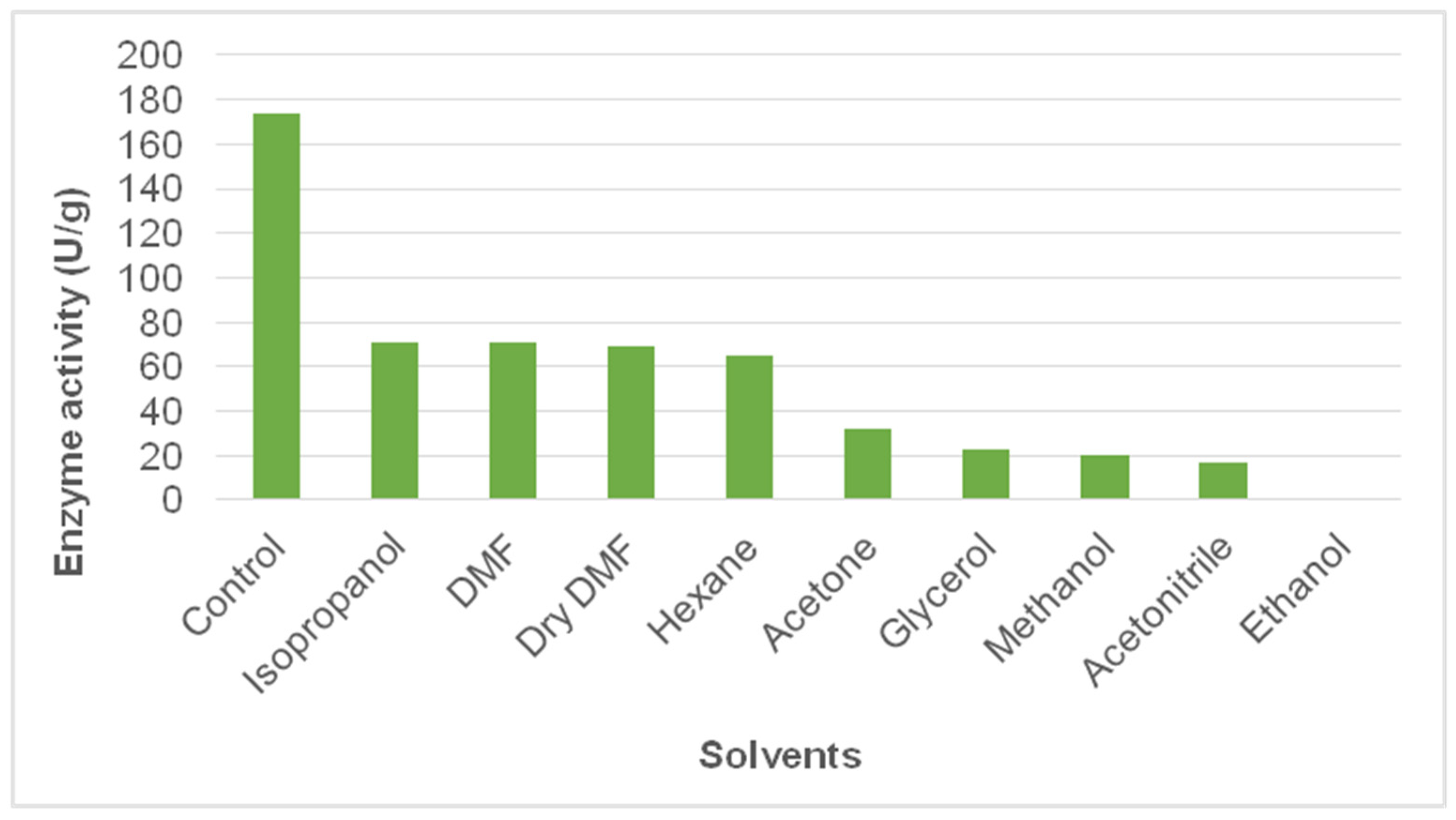
The lipase hydrolytic activity using different organic solvents can be seen in Figure 1. Firstly, it can be seen that the solvents caused a decrease in enzyme activity when compared to the control (water, 173.9 U/g), reaching a complete deactivation in ethanol.
By comparing the organic solvents tested, isopropanol (71.3 U/g) and DMF (71 U/g) showed the second-best enzyme activity values in relation to hexane, acetone, glycerol, methanol and acetonitrile. Enzymatic activity was also evaluated in dry DMF. No significant difference was observed compared to the assay performed on wet DMF, showing a difference of approximately 2.8%. The slight reduction in activity observed in dry DMF may be associated with lower enzyme hydration, which could subtly affect its hydrolytic activity.
Previous studies were conducted to evaluate enzymatic activity in different solvents and temperature ranges, allowing for the rational definition of the operating conditions used in esterification/transesterification assays [18]. Indeed, these solvents were chosen by considering the subsequent esterification/transesterification reaction. In the case of solvents, DMF was also chosen because it is described in the literature for this class of reactions [19,20] and allowed for a moderate yield towards the hydrolysis when compared to other polar solvents tested.
It has been known that water molecules that bind to the protein through hydrogen bonds play a crucial role in the enzyme function, as they are an integral part of its configuration. When exposed to organic solvents, this hydration layer is displaced by the solvent, causing significant changes in the protein structure. This change results in the deformation of the active site, leading to the expected loss in activity. Unlike DMSO, acetonitrile has been shown to decrease lipase activity [21]. Recent studies have shown that the interaction between enzymes and organic solvents exerts a direct influence on their catalytic activity and structural stability, especially in systems applied to biocatalysis. Even though the complete reasons for solvent effects in lipase activity are unclear, the physical nature like viscosity and density of the solvent cannot be ruled out. The literature indicates that different lipases strongly depend on the physicochemical properties of the solvents [22,23,24]. In addition, it was also shown for DMF, either by reducing solvation-induced denaturation or by preserving the layer essential to activity and other factors. In spite of the decrease in activity, DMF was chosen as solvent for the reaction.

3.2. Lipase Activity in Different Temperatures

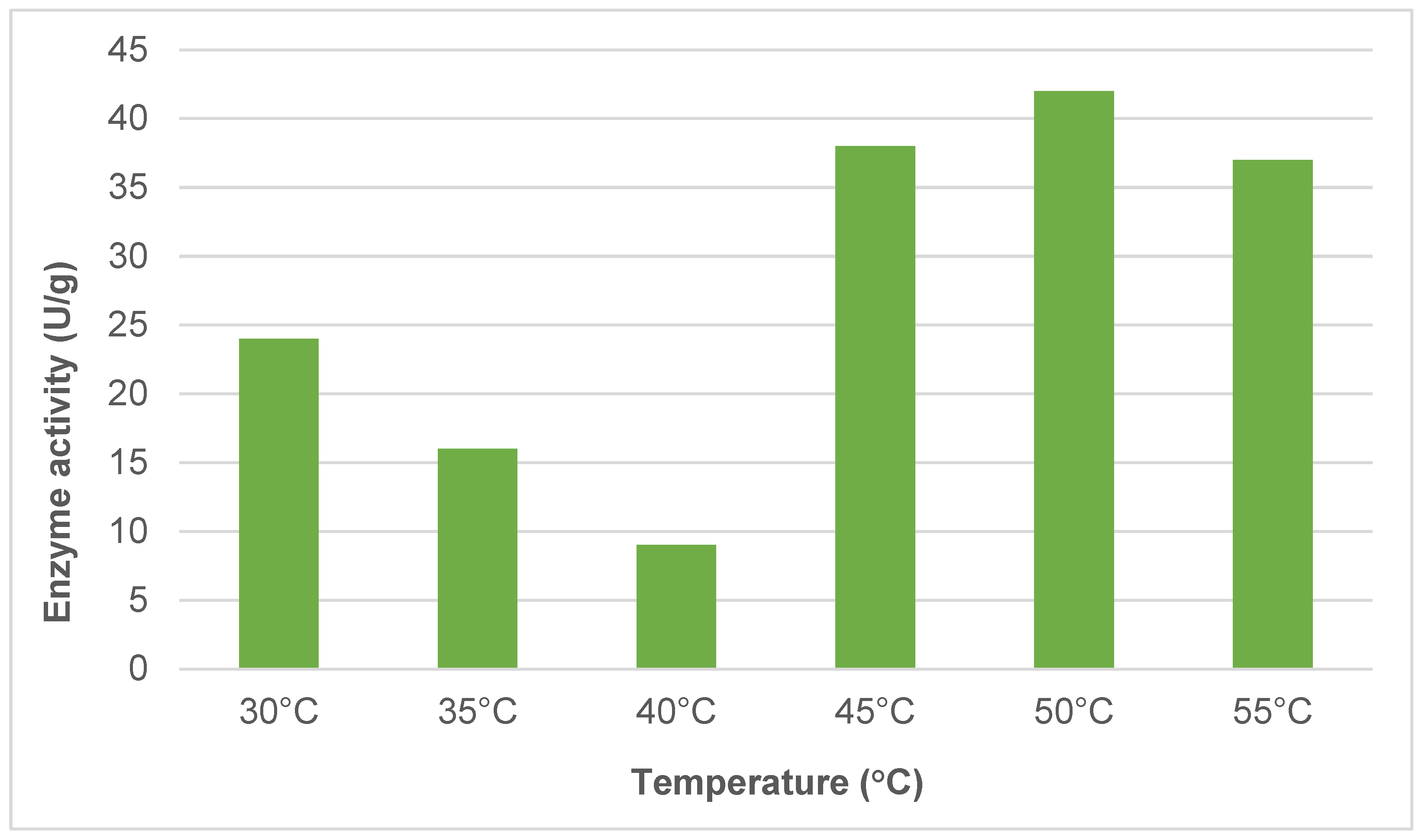
Lipase activity was also tested at different temperatures (Figure 2). By considering the 30 °C to 55 °C range, the results showed that temperatures above 45 °C led to improved enzymatic activity, as expected by considering the usual activation energies involved in hydrolysis [25]. However, at very high temperatures, the native structure of the protein can be compromised, leading to denaturation and, consequently, the loss of its activity. Evaluating the effect of temperature on the lipase activity of an enzyme extract produced by fungi [26] observed that although the enzyme extract showed high activity throughout the temperature range evaluated (35 °C to 50 °C), the maximum lipase activity was when incubated at 40 °C. Indeed, temperatures of 50 °C and 35 °C followed the sequence of highest activities, indicating this range as an interesting temperature range to work with these biocatalysts. Results by [27] also showed the highest conversion towards isoamyl gallate when using lipase from Pseudomonas fluorescens. In this case, the temperature range between 55 and 60 °C showed higher conversion (above 50%) when compared to the conversion at temperatures of 35 °C.
The carbohydrate substrate aimed for in the second step of this work demanded the use of mild reaction conditions in order to avoid substrate decomposition (e.g., dehydration) along with lipase denaturation. Recent studies also show that very high temperatures can lead to thermal denaturation of enzymes, including lipases, with consequent irreversible loss of catalytic activity. Inactivation studies of B. cepacia and R. miehei showed that, in the range of 40 to 70 °C, increasing the temperature accelerates inactivation, with a marked reduction at higher temperatures [28]. Complementarily, studies involving lipases produced by species of the genus Bacillus [29] demonstrate that these enzymes can exhibit high thermal tolerance, reaching high activity under elevated conditions, such as pH 7.0 and 80 °C. However, despite this high performance at high temperatures, the same study shows that catalytic activity decreases in strongly alkaline environments and also suffers a marked drop when the temperature exceeds 90 °C.

3.3. Evaluation of the Ester Derived from Lauric Acid: Reactions with 1-Propanol and D-Mannitol

In the reaction between lauric acid (dodecanoic acid) and 1-propanol, propyl dodecanoate (or propyl laurate) is expected to form via an esterification reaction, as shown in Figure S1. The A. niger lipase stood out with the value of 8.32 × 10⁶ U/g, demonstrating its high catalytic efficiency. In addition, the conversion of the lauric acid was followed at each 5 min (Figure S3). The final conversion of lauric acid was near 100% after 1 h.
Recent studies [30,31] have consistently demonstrated that A. niger exhibits excellent performance in esterification reactions, standing out as efficient biocatalysts in ester synthesis. These studies highlight the high catalytic activity, versatility with different substrates, and stability of these enzymes, reinforcing their potential for industrial applications, especially in the production of esters of interest.
However, the application of the same lipase for the esterification with D-mannitol in DMF did not show significant conversion rates to the desired product (Table 1, Entry 1). In the proposed mechanism (Figure S17), it is expected that the hydroxyl groups of the carbohydrate, activated by enzymes, will act as selective nucleophiles. Since D-mannitol has six free hydroxyl groups, the stoichiometry used (2:1) reinforces the presumption in favor of the dissubstituted product. Nevertheless, the LCMS results did not point out the formation of the substituted product.
In the 1H NMR results of the product obtained (Figure S15), it is possible to observe peaks related to the lauric acid (2.1–0.8 ppm), along with the acidic hydrogen signal (11.9 ppm, s) which confirmed the quite low reagent conversion. However, the spectrum did not present the corresponding peaks of the carbohydrate. In the analyzed 1H NMR spectrum in DMSO-d6, the highly hydrophilic unconverted D-mannitol tends to remain preferentially in the aqueous phase during the work up, preventing the detection of its characteristic signals (4.4–3.3 ppm). Thus, the spectrum reveals mostly signals of residual lauric acid, indicating that the conversion was minimal and that the conditions used were not effective in promoting the formation of the desired ester, as expected by the mechanistic process of the nucleophilic substitution reaction. Finally, we believe that the water content present in the DMF slowed down the reagent conversion.
On the other hand, the evaluated conditions in dry DMF medium led to the good conversion (Table 1, Entry 2). This more pronounced response (Figure S16) suggests the dry solvent DMF favors the efficiency of the process, possibly by improving the reagents or the accessibility to the active site. Some recent conditions for esterification generally require high temperatures and often the use of an acid catalyst in order to increase the reaction rate [32,33,34]. It is important to note that the water generated during the reaction can harm the process, favoring the hydrolysis of the ester. It is also worth noting that the ideal temperature depends on the physicochemical properties of the reactants and the specific conditions of the reaction system. In addition, 13C NMR (Figure S14) revealed the formation of a different isomer when compared to the expected 1,6-O-lauroyl-D-mannitol [35]. Since there are few NMR signals, a symmetrical scaffold is conceivable. In this case, the conclusion was that 2,5-di-O-lauroyl-D-mannitol or 3,4-di-O-lauroyl-D-mannitol could be the products. Using an algorithm’s accuracy [36], we compared the simulated and obtained spectra and assigned the 2,5-di-O-lauroyl-D-mannitol as the isomer. Additionally, the error was near 5% with the 1,6-di-O-lauroyl-D-mannitol as reference [35].
The same reaction condition was also tested in the presence of Mg/Al LDH (dry DMF, 55 °C, 6 h). In this case, the observed result did not reveal catalytic conversion of lauric acid (Table 1, entry 3). We presume that the slightly acidic conditions led to a partial decomposition of the catalyst. However, the same catalytic system was applied in the reaction with methyl laurate indicating that the LDH was able to catalyze a transesterification with a good conversion (Table 1, entry 4).
In terms of the selectivity, a different pattern was observed between lipase from A. niger and Mg/Al LDH. In both cases, the dissubstituted product was observed but the trissubstituted product also formed in good yields, in the case of the basic catalyst. This result showed the strong and superior activity/selectivity of lipase, suggesting that the reaction conditions can be fine-tuned to allow for the selective hydroxyl activation.
The observed differences in the catalytic behavior of lipase and Mg/Al LDH may be related to the different activation modes involved in each system. In the case of lipase, it is plausible that the presence of a structured active site contributes to a preferential orientation of D-mannitol during the reaction, favoring the selective activation of certain hydroxyl groups and, consequently, the predominant formation of the disubstituted product in dry DMF. On the other hand, Mg/Al LDH acts as a heterogeneous catalyst of a basic nature, in which the active sites are distributed on the surface of the material, which may result in a less specific activation of the carbohydrate functional groups. This lack of spatial control may facilitate successive substitution reactions, leading to the formation of products with a higher degree of substitution. Furthermore, the low efficiency of LDH in direct esterification with lauric acid may be associated with partial carboxylate formation and intercalation [37], while transesterification appears to occur more beneficially under these conditions. Taken together, these aspects suggest that enzymatic pathway systems tend to offer greater selectivity control in carbohydrate derivatization reactions when compared to basic inorganic catalysts. In this context, controlling the catalytic system and reaction conditions can allow modulation of structural pattern of product.
In conclusion, the results obtained also indicate the possibility of exploring higher temperatures in future studies, aiming to optimize catalytic performance and ester yield. However, it is crucial to consider that increased temperature can favor secondary reactions, especially due to the physicochemical characteristics of the reagents involved and the fact that the process was conducted in a simple benchtop setup, susceptible to limitations in thermal control and byproduct removal. These factors must be carefully evaluated, as they can directly influence the beneficial attributes proposed in this study and the conditions necessary for its application on a larger scale.

4. Conclusions

Evaluating the influence of solvents on enzymatic activity proved essential, since lipase will be the biocatalyst used in the future transesterification reaction between vinyl decanoate and polyols, as proposed in this project for the synthesis of new organogels. Enzymatic activity assays indicated that isopropanol and DMFs, as well as temperatures in the range of 45–55 °C, constitute favorable media for activity. The investigation of the effect of other solvents and additives, such as EDTA, will be conducted in the next stages of the study, along with the analysis of higher temperatures, aiming to determine the most suitable reaction conditions for the catalytic step.
In the initial esterification reactions, high enzymatic activity was observed for biocatalysis mediated by A. niger in the conversion of the lauric acid derivative with 1-propanol. However, the need to explore more rigorous reaction conditions for esterification involving carbohydrates was verified, given the lower efficiency observed under these preliminary conditions. In addition, the differences in selectivity when using Mg/Al LDH—a classical heterogeneous catalyst for esterification/transesterification—revealed that the presence of basic sites can limit the fine-tuning control of the selectivity in this reaction. Studies with the use of LDHs are underway for these reactions.

Supplementary Materials

The following supporting information can be downloaded at: https://www.mdpi.com/article/10.3390/pr14040584/s1.

Author Contributions

Conceptualization, G.C.F.S., I.L.M.F., L.F.B.M. and J.D.S.; Methodology, A.J.C.M., A.G.R.A.S., G.F.S.S. and M.S.O.; Validation, A.J.C.M., A.G.R.A.S. and G.F.S.S.; Formal analysis, A.J.C.M. and A.G.R.A.S.; Investigation, A.J.C.M.; Data curation, A.J.C.M., A.G.R.A.S., G.F.S.S. and M.S.O.; Resources, G.C.F.S., I.L.M.F., L.F.B.M. and J.D.S.; Writing—original draft, A.J.C.M.; Writing—review and editing, G.C.F.S., I.L.M.F., L.F.B.M. and J.D.S.; Project administration, G.C.F.S., L.F.B.M. and J.D.S.; Visualization, G.C.F.S., I.L.M.F., L.F.B.M. and J.D.S.; Supervision, J.D.S. All authors have read and agreed to the published version of the manuscript.

Funding

This research was funded by Fundação de Amparo à Pesquisa do Estado do Rio de Janeiro, grant number FAPERJ, APQ1 2019 E-26/210.990/2019, and Coordenação de Aperfeiçoamento de Pessoal de Nível Superior (CAPES) for the scholarship of A.J.C.M., grant number Financing code 001.

Data Availability Statement

The original contributions presented in this study are included in the article. Further inquiries can be directed to the corresponding author.

Acknowledgments

We acknowledge the Central Analítica Fernanda Coutinho (Chemistry Institute, UERJ) for the 1H and 13C NMR analyses.

Conflicts of Interest

The authors declare no conflicts of interest.

References

  1. Shakeel, A.; Farooq, U.; Gabriele, D.; Marangoni, A.G.; Lupi, F.R. Bigels and multi-component organogels: An overview from rheological perspective. Food Hydrocoll. 2021, 111, 106190–106214. [Google Scholar] [CrossRef]
  2. Tyagi, R.; Singh, K.; Srivastava, N.; Sagar, R. Recent advances in carbohydrate-based gelators. Mater. Adv. 2023, 4, 3929–3950. [Google Scholar] [CrossRef]
  3. Snoch, W.; Jarek, E.; Milivojevic, D.; Nikodinovic-Runic, J.; Guzik, M. Physico-chemical studies of novel sugar fatty acid esters based on (R)-3-hydroxylated acids derived from bacterial polyhydroxyalkanoates and their potential environmental impact. Front. Bioeng. Biotechnol. 2023, 11, 1112053. [Google Scholar] [CrossRef]
  4. Fryszkowska, A.; Devine, P.N. Biocatalysis in drug discovery and development. Curr. Opin. Chem. Biol. 2020, 55, 151–160. [Google Scholar] [CrossRef] [PubMed]
  5. Saharan, Y.; Singh, J.; Goyat, R.; Umar, A.; Akbar, S.; Ibrahim, A.A.; Baskoutas, S. Novel supramolecular organo-oil gelators for fast and effective oil trapping: Mechanism and applications. J. Hazard. Mater. 2023, 442, 129977–129989. [Google Scholar] [CrossRef]
  6. Eftekhari-Sis, B.; Bagheri, A.; Araghi, H.Y.; Akbari, A.; Paige, M.F. Supramolecular self-assembly of oleylamide into organogels and hydrogels: A simple approach in phase selective gelation of oil spills. Soft Mater. 2019, 18, 55–66. [Google Scholar] [CrossRef]
  7. Han, Q.; Wang, Q.; Gao, A.; Ge, X.; Wan, R.; Cao, X. Fluorescent quinoline-based supramolecular gel for selective and ratiometric sensing zinc ion with multi-modes. Gels 2022, 8, 605. [Google Scholar] [CrossRef]
  8. Alkhaldi, H.; Alharthi, S.; Alharthi, S.; Alghamdi, H.A.; Alzahrani, Y.M.; Mahmoud, S.A.; Amin, L.G.; Al-Shaalan, N.H.; Boraie, W.E.; Attia, M.S.; et al. Sustainable polymeric adsorbents for adsorption-based water remediation and pathogen deactivation: A review. RSC Adv. 2024, 14, 33143–33190. [Google Scholar] [CrossRef]
  9. Liu, Z.; Shi, B.; Yang, R.; Yang, Z.; Zhang, D.; Duan, J.; Wang, J.; Zhang, A.; Liu, Y. Advances in molecularly imprinted materials for selective adsorption of phenolic pollutants from the water environment: Synthesis, applications, and improvement. Sci. Total Environ. 2024, 927, 172309. [Google Scholar] [CrossRef]
  10. Javed, S.; Azeem, F.; Hussain, S.; Rasul, I.; Siddique, M.H.; Riaz, M.; Afzal, M.; Kouser, A.; Nadeem, H. Bacterial lipases: A review on purification and characterization. Prog. Biophys. Mol. Biol. 2018, 132, 23–34. [Google Scholar] [CrossRef] [PubMed]
  11. Carvalho, P.O.; Calafatti, S.A.; Marassi, M.; Silva, D.M.; Contesini, F.J.; Bizaco, R.; Macedo, G.A. Potencial de biocatálise enantiosseletiva de lipases microbianas. Quim. Nova. 2005, 28, 614–621. [Google Scholar] [CrossRef][Green Version]
  12. Colla, L.M.; Rizzardi, J.; Pinto, M.H.; Reinehr, C.O.; Bertolin, T.E.; Costa, J.A.V. Simultaneous production of lipases and biosurfactants by submerged and solid-state bioprocesses. Bioresour. Technol. 2010, 101, 8308–8314. [Google Scholar] [CrossRef] [PubMed]
  13. Farhan, A.; Khalid, A.; Maqsood, N.; Iftekhar, S.; Sharif, H.M.A.; Qi, F.; Sillanpaa, M.; Asif, M.B. Progress in layered double hydroxides (LDHs): Synthesis and application in adsorption, catalysis and photoreduction. Sci. Total Environ. 2024, 912, 169160. [Google Scholar] [CrossRef]
  14. Pereira, E.B.; Castro, H.F.; Moraes, F.F.; Zanin, G.M. Kinetic studies of lipase from Candida rugosa: A comparative study between free and immobilized enzyme onto porous chitosan beads. Appl. Biochem. Biotechnol. 2001, 91, 739–752. [Google Scholar] [CrossRef] [PubMed]
  15. Lorenzo, B.; Fernández, L.; Ortega, J.; Domínguez, L. Improvements in the modeling and kinetics processes of the enzymatic synthesis of pentyl acetate. Processes 2023, 11, 1640. [Google Scholar] [CrossRef]
  16. Senra, J.D.; Silva, A.C.; Santos, R.V.; Malta, L.F.B.; Simas, A.B.C. Palladium on layered double hydroxide: A heterogeneous system for the enol phosphate carbon-oxygen bond activation in aqueous media. J. Chem. 2017, 2017, 8418939. [Google Scholar] [CrossRef]
  17. Zhang, X.; Yang, C.; Li, J.; Meng, Q.; Raza, H.; Zhang, L. Enzymatic synthesis of mannitol dioctanoate and its utilisation in the preparation of structured edible oil. Int. J. Food Sci. Technol. 2016, 51, 588–594. [Google Scholar] [CrossRef]
  18. Lima, L.G.R.; Golçalves, M.M.M.; Couri, S.; Melo, V.F.; Sant’Ana, G.C.F.; Costa, A.C.A. Lipase Production by Aspergillus niger C by Submerged Fermentation. Braz. Arch. Biol. Technol. 2019, 62, e19180113. [Google Scholar] [CrossRef]
  19. Qian, J.; Zhu, H.; Shi, B.; Huang, A.; Gou, L. Catalytic synthesis of sucrose-6-acetate by lipase in DMF composite solvent. J. Chem. Technol. Biotech. 2023, 98, 381–386. [Google Scholar] [CrossRef]
  20. Heinze, T.; Liebert, T.; Koschella, A. Esterification of Polysaccharides; Springer: Berlin/Heidelberg, Germany, 2006. [Google Scholar] [CrossRef]
  21. Ingenbosch, K.N.; Vieyto-Nuñez, J.C.; Ruiz-Blanco, Y.B.; Mayer, C.; Hoffmann-Jacobsen, K.; Sanchez-Garcia, E. Effect of organic solvents on the structure and activity of a minimal lipase. J. Org. Chem. 2022, 87, 1669–1678. [Google Scholar] [CrossRef]
  22. Leykun, S.; Johansson, E.; Vetukuri, R.R.; Ceresino, E.B.; Gessesse, A. A thermostable organic solvent-tolerant lipase from Brevibacillus sp.: Production and integrated downstream processing using an alcohol-salt-based aqueous two-phase system. Front. Microbiol. 2023, 14, 1270270. [Google Scholar] [CrossRef] [PubMed]
  23. Ghori, M.I.; Iqbal, M.J.; Hameed, A. Characterization of a novel lipase from Bacillus sp. isolated from tannery wastes. Braz. J. Microbiol. 2011, 42, 22–29. [Google Scholar] [CrossRef]
  24. Ji, Q.; Xiao, S.; He, B.; Liu, X. Purification and characterization of an organic solvent-tolerant lipase from Pseudomonas aeruginosa LX1 and its application for biodiesel production. J. Mol. Catal. B Enzym. 2010, 66, 264–269. [Google Scholar] [CrossRef]
  25. Márquez, M.C.; Vázquez, M.A. Modeling of enzymatic protein hydrolysis. Process Biochem. 1999, 35, 111–117. [Google Scholar] [CrossRef]
  26. Rodrigues, J.G.C.; Cardoso, F.V.; Santos, C.C.; Matias, R.R.; Machado, N.T.; Duvoisin, S., Jr.; Albuquerque, P.M. Biocatalyzed transesterification of waste cooking oil for biodiesel production using lipase from the Amazonian fungus Endomelanconiopsis endophytica. Energies 2023, 16, 6937. [Google Scholar] [CrossRef]
  27. Passari, G.J.; Passari, F.A.; Mendes, A.A.; Pereira, E.B. Efeito da fonte de lipase na produção de um éster de ácido gálico por esterificação em meio de solvente. Holos 2022, 5, e13663. [Google Scholar] [CrossRef]
  28. Ortega, N.; Sáez, L.; Palacios, D.; Busto, M.D. Kinetic modeling, thermodynamic approach and molecular dynamics simulation of thermal inactivation of lipases from Burkholderia cepacia and Rhizomucor miehei. Int. J. Mol. Sci. 2022, 23, 6828. [Google Scholar] [CrossRef]
  29. Barbosa, J.M.P.; Souza, R.L.; Melo, C.M.; Fricks, A.T.; Soares, C.M.F.; Lima, Á.S. Biochemical characterisation of lipase from a new strain of Bacillus sp. ITP-001. Quim. Nova 2012, 35, 1173–1178. [Google Scholar] [CrossRef]
  30. Ceccoli, R.D.; Bianchi, D.A.; Zocchi, S.B.; Rial, D.V. Mapping the field of aroma ester biosynthesis: A review and bibliometric analysis. Process Biochem. 2024, 146, 587–600. [Google Scholar] [CrossRef]
  31. Cong, S.; Tian, K.; Zhang, X.; Lu, F.; Singh, S.; Prior, B.; Wang, Z.-X. Synthesis of flavor esters by a novel lipase from Aspergillus niger in a soybean-solvent system. 3 Biotech 2019, 9, 244. [Google Scholar] [CrossRef]
  32. Kumar, A.; Verma, V.; Dubey, V.K.; Srivastava, A.; Garg, S.K.; Singh, V.P.; Arora, P.K. Industrial applications of fungal lipases: A review. Front. Microbiol. 2023, 14, 1142536. [Google Scholar] [CrossRef] [PubMed]
  33. Yusuff, A.S. Kinetic and thermodynamic study on the esterification of oleic acid over SO3H-functionalized eucalyptus tree bark biochar catalyst. Sci. Rep. 2022, 12, 8653. [Google Scholar] [CrossRef] [PubMed]
  34. Zhang, B.; Wang, X.; Tang, W.; Wu, C.; Wang, Q.; Sun, X. Carbon-based solid acid catalyzed esterification of soybean saponin-acidified oil with methanol vapor for biodiesel synthesis. Sustainability 2023, 15, 13670. [Google Scholar] [CrossRef]
  35. Salis, A.; Pinna, M.C.; Murgia, S.; Monduzzi, M. Novel mannitol based non-ionic surfactants from biocatalysis. J. Mol. Catal. B Enzym. 2004, 27, 139–146. [Google Scholar] [CrossRef]
  36. Banfi, D.; Patiny, L. www.nmrdb.org: Resurrecting and processing NMR spectra on-line. Chimia 2008, 62, 280–281. [Google Scholar] [CrossRef]
  37. Gerds, N.; Katiyar, V.; Koch, C.B.; Risbo, J.; Plackett, D.; Hansen, H.C.B. Synthesis and characterization of laurate-intercalated Mg–Al layered double hydroxide prepared by coprecipitation. Appl. Clay Sci. 2012, 65–66, 143–151. [Google Scholar] [CrossRef]
Figure 1. Lipase hydrolytic activity in different solvents.
Processes 14 00584 g001
Figure 2. Lipase activity at different temperatures.
Processes 14 00584 g002
Table 1. Catalytic conversion and selectivities observed for the reaction between lauric acid and D-mannitol.
Processes 14 00584 i001
Conversion and Selectivities (%) a
EntryCatalystConversion (%)MDTriTet
1Lipase (A. niger) c<5----
2Lipase (A. niger) d80-80--
3Mg/Al LDH b,d-----
4Mg/Al LDH b,d,e71-4031-
a Reaction conditions: lauric acid (0.5 mmol), D-mannitol (0.25 mmol), 1 mL of the crude extract, DMF (dry or P.A.), 55 °C, 6 h. b Mg/Al LDH (30% in relation to the limiting substrate). c Wet DMF. d Dry DMF. e Reaction with methyl laurate (transesterification). The abbreviations indicate the degree of substitution: M (monosubstituted), D (disubstituted), Tri (trisubstituted), and Tet (tetrasubstituted).
Disclaimer/Publisher’s Note: The statements, opinions and data contained in all publications are solely those of the individual author(s) and contributor(s) and not of MDPI and/or the editor(s). MDPI and/or the editor(s) disclaim responsibility for any injury to people or property resulting from any ideas, methods, instructions or products referred to in the content.