


Abstract
Capillary tubes are widely used as essential expansion devices in small refrigeration and air-conditioning systems. Accurate prediction of mass flow rate through adiabatic capillaries is a critical aspect of system design and optimization. While there are currently numerous models capable of predicting mass flow through capillaries, most rely on experimental data containing uncertainties, resulting in suboptimal generalization performance. Unlike previous ANN models and empirical correlations that rely on experimental data, this study addresses this limitation by introducing neural networks based on the homogeneous equilibrium model (HEM) of adiabatic capillaries. Two neural networks—a traditional multi-layer perceptron (MLP) and a deep residual network (ResNet)—are developed using a dataset generated by the HEM. The models are subsequently validated and compared against established models using experimental data for various refrigerants and operating conditions collected from the open literature. The results demonstrate that both neural networks exhibit exceptional generalization ability. The average deviations on the experimental dataset are 5.2% for the MLP and 4.5% for the ResNet, outperforming existing models. Their performance across different refrigerants is stable, with the ResNet demonstrating superior overall performance. Furthermore, the trained neural networks achieve a computational speed substantially superior to that of the HEM.
1. Introduction
The expansion device is a critical component of the vapor compression systems. As one of the expansion devices, the capillary tube is widely used in small and medium-sized refrigeration equipment such as refrigerators and small air conditioners due to its simple structure and low cost.
The selection of different capillary tubes will affect the overall performance of the system. Therefore, it is necessary to study the mass flow characteristics of capillary tubes. Despite the simple geometry of adiabatic capillary tubes, the refrigerant flow behavior inside them is inherently complex. The homogeneous equilibrium model (HEM) is a physics-based model that depicts the movement of refrigerant within an adiabatic capillary tube, and has also been demonstrated to serve as an excellent theoretical approximation model [1]. At present, the HEM is extensively utilized in the simulation of capillary tubes. Under standard design and operational conditions, it has acceptable accuracy and is applicable to different refrigerants. However, the solution process of the HEM tend to be relatively complicated. It requires multiple iterative calculations to get an accurate result, leading to a relatively slow computational speed.
To achieve a simple and accurate calculation of capillary flow characteristics for engineering applications, extensive research has been conducted on empirical models for the flow characteristics of adiabatic capillary tubes. Choi et al. [2] proposed a relatively simple power-law empirical correlation that is capable of predicting the mass flow rate through capillary tubes for R12, R22, R134a, R152a, R407C, and R410A. Rasti and Jeong [3] developed an empirical correlation for a variety of refrigerants, which solves the issue that the previous correlations are discontinuous at zero subcooling or vapor quality. Dubba and Kumar [4] investigated the effect of two-phase inlet states on the mass flow rate for R134a and proposed a power-law empirical correlation specifically designed for predicting the mass flow rate under two-phase inlet states. Yang and Zhang [5] proposed a “local” power-law correlation applicable to both adiabatic capillary and short tube, demonstrating significantly improved accuracy than the previous power-law correlation. Jeon et al. [6] developed an empirical correlation model for predicting the mass flow rate of nonadiabatic capillary tubes considering both subcooled liquid and non-equilibrium two-phase states. In recent years, the accuracy of various dimensionless empirical correlations for the prediction of new refrigerants has also been specifically analyzed and evaluated [7]. Similarly, De Lara et al. [8] assessed several mass flow prediction models for HFC-134a. The power-law empirical correlation is a relatively simple nonlinear model. However, there is no conclusive evidence to demonstrate that power functions are the optimal form for correlation.
In this regard, an artificial neural network (ANN) model has been proposed for predicting capillary flow characteristics. The artificial neural network is a type of computational model composed of numerous interconnected nodes (or neurons), which can be used for modeling physical systems without an explicit mathematical representation. ANN is characterized by good accuracy and strong nonlinearity. When applying neural networks to predict the flow characteristics through a capillary, the entering refrigerant states and tube geometries are typically utilized as inputs to the network, and the mass flow rate serves as the output. Zhang [9], in order to express the nonlinear relationship between the mass flow rate and the related parameters, employed an artificial neural network as a generalized function approximator and proposed to use a set of dimensionless parameters as inputs and outputs of the neural network. This neural network was subsequently extended to be capable of calculating the mass flow rate of refrigerants under both subcooled inlet and two-phase inlet conditions [10]. Yang and Zhang [11] further improved the above model to additionally cover both subcritical and transcritical throttling processes. Heimel et al. [12] developed an ANN model for non-adiabatic capillary tubes that can simultaneously predict the mass flow rate of capillary tubes under multiple scenarios of capillary congestion, non-congestion, subcooled liquid inlet, and two-phase inlet conditions. Gill and Singh [13] developed an ANN model to predict the mass flow rate of a mixed refrigerant through both straight and helical adiabatic capillary tubes. Although deep learning has been widely utilized in various fields and achieved good results in recent years [14,15], previous studies on neural networks for the mass flow characteristics of adiabatic capillary tubes used simple neural network architectures due to the limited datasets and computing capacity.
Previous empirical models, such as power-law correlations and neural networks proposed in the open literature, primarily relied on experimental data from different sources. Such data are affected by factors such as the deviations of capillary geometries and measurement uncertainties, which could lead to considerable bias in the mass flow rate. For example, studies proved that different roughness inside the capillary tube will affect the mass flow of refrigerant and model prediction accuracy [16,17], but the roughness of different capillary tubes is hard to measure accurately. Dubba and Kumar [18] and Torres Martins Rocha et al. [19] studied the mass flow characteristics of refrigerants in coiled capillary tubes, proving that the curvature of capillary tubes can affect the mass flow of refrigerant. Meanwhile, most of the experimental data were collected for the refrigerant—compressor oil mixtures. The presence of oil can influence the mass flow rate. So, datasets composed of experimental data tend to exhibit considerable uncertainties. Shao et al. [20] conducted a comprehensive review of various empirical models from previous literature. Eleven models were selected, and experimental data gathered from the latest independent studies were used to perform thorough tests and comparisons for each model to assess their accuracy and generalizability. Based on the results, it was found that the performance of previous models varied significantly across data of different refrigerants, and they had very high prediction deviations at some data points, indicating poor generalization performance. The possible reason for this phenomenon is that the existing empirical models were trained on a relatively small amount of experimental data with considerable uncertainties.
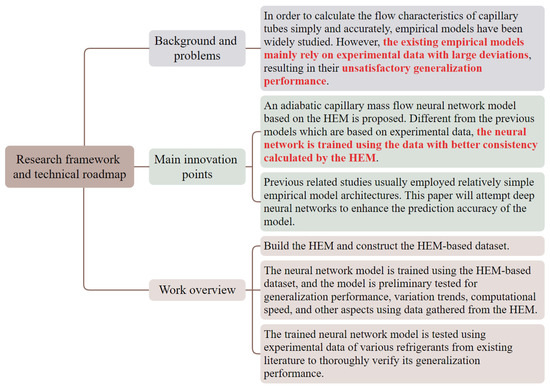
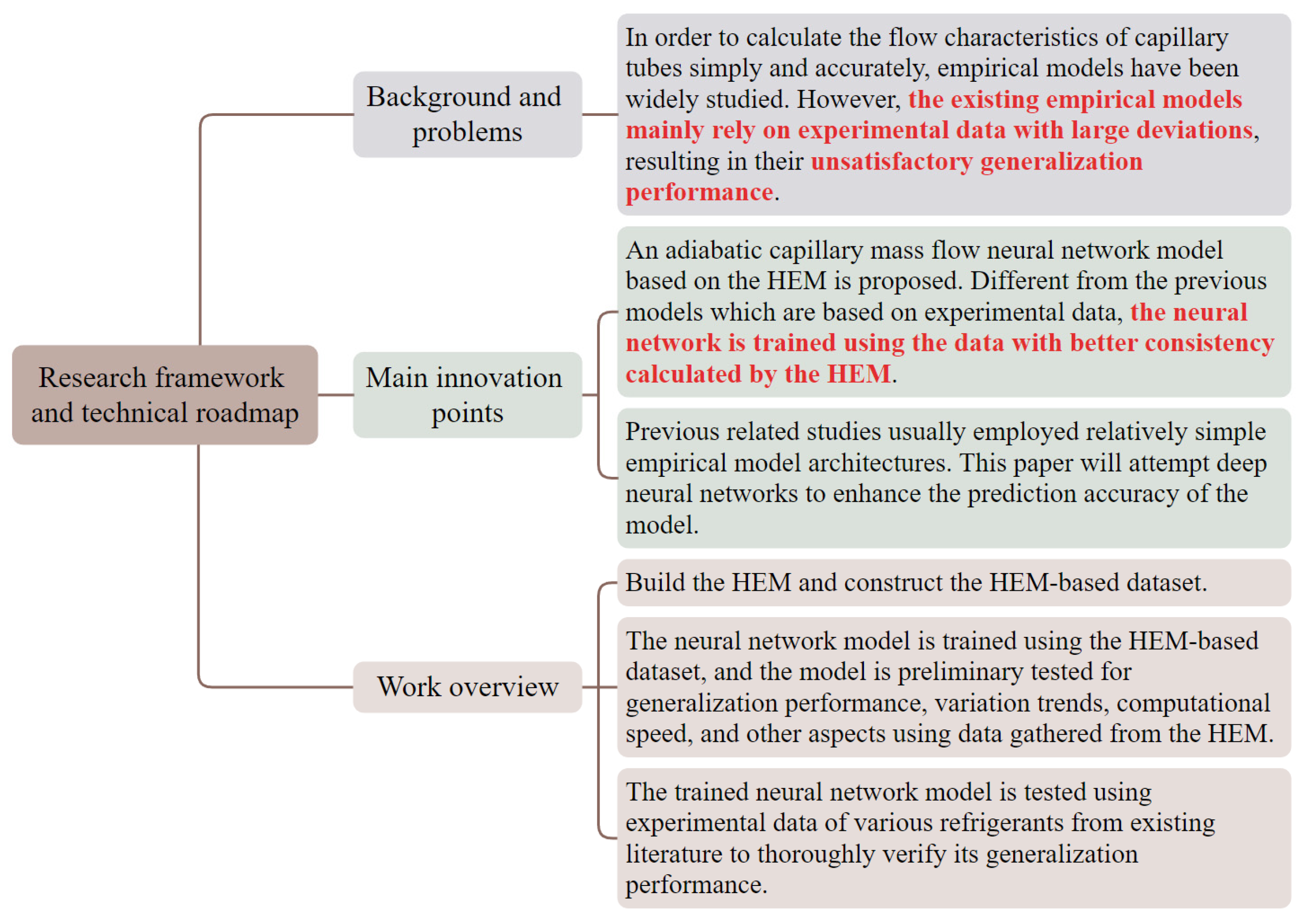
Overall, the generalization performance of existing empirical models and ANNs remains substantially limited, primarily stemming from their reliance on experimental data that contain inherent uncertainties and experimental scatter. Furthermore, the relatively simple model architectures typically adopted in previous studies may have further constrained the predictive capability. To address the above issues, neural networks for predicting the mass flow rate of adiabatic capillary tubes based on the HEM are proposed in this paper. Unlike the existing models that relied on experimental data, this paper trains the neural networks using a comprehensive dataset generated from the HEM, since the physics-based HEM demonstrates high accuracy and generality. Subsequently, the trained neural networks are compared against multiple existing empirical models. In addition to the traditional neural network, this paper also employs a deep neural network to improve the prediction performance. The overall research framework and technical roadmap of this article are shown in Figure 1.
Figure 1.
Research framework and technical roadmap.
2. HEM-Based Neural Networks
2.1. Dataset Based on the HEM
The governing equations of the HEM include the continuity equation, energy equation, and momentum equation. Namely,
where is the mass flow rate. is the specific enthalpy. is the pressure. is a constant. is the specific volume. is the mass flux of the fluid. is the inner diameter. is the length of the capillary tube. is the friction factor. Moreover, after comparing several calculation methods of the friction coefficient [21], Equations (4)–(6) are recommended for calculating the friction factor of the tube [22].
where the Reynolds number Specifically, for the two-phase state, and . is the viscosity. is the density. Subscripts g and f denote saturated vapor and liquid, respectively.
It should be noted that when the refrigerant pressure at the outlet of the capillary tube drops to a certain value, the flow velocity of the refrigerant at the outlet will reach the local speed of sound. At this point, further changes in the outlet pressure will no longer affect the flow and pressure distribution of the refrigerant in the tube. In other words, the refrigerant flow in the tube will become choked. The HEM needs to make a judgment on whether the outlet is choked. Since there is no heat exchange or work between the capillary tube and the outside, the adiabatic flow with friction of the refrigerant inside the tube is an entropy-increasing process. According to the Fanno curve of adiabatic flow with friction, the entropy increase is 0 when the flow velocity of the refrigerant at the outlet reaches the local speed of sound. Therefore, the criterion for choked flow is
However, directly using Equation (7) for judgment would increase the computational load due to additional calculation of entropy. Therefore, by combining Equations (2) and (3) with the fundamental thermodynamic relation , we can have
where is the temperature. Then, by combining Equation (7) with Equation (8), another criterion for judgment of choked flow can be obtained.
The flow of refrigerant in a tube can be divided into several elements with the same pressure drop. Then in each element, Equations (1)–(3) can be written as
where subscripts in, out, and m represent the inlet parameter, the outlet parameter, and the average parameter of each element, respectively.
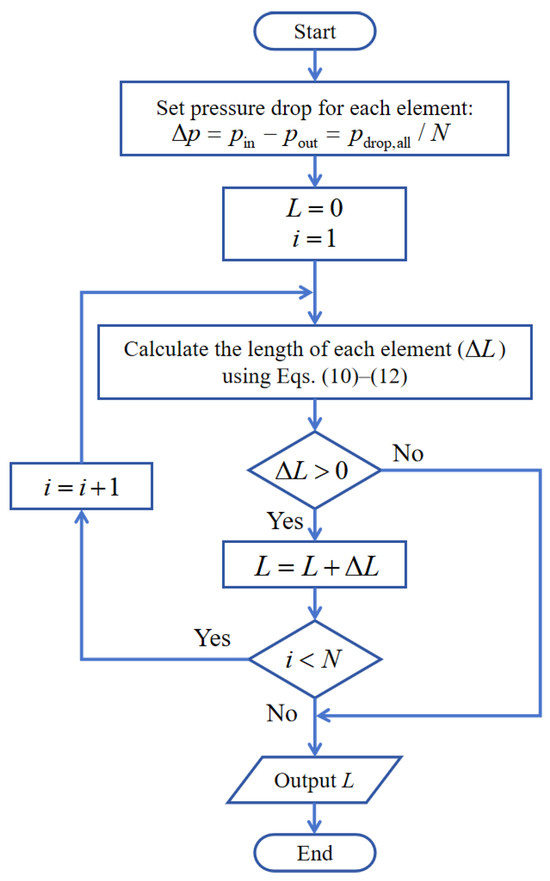
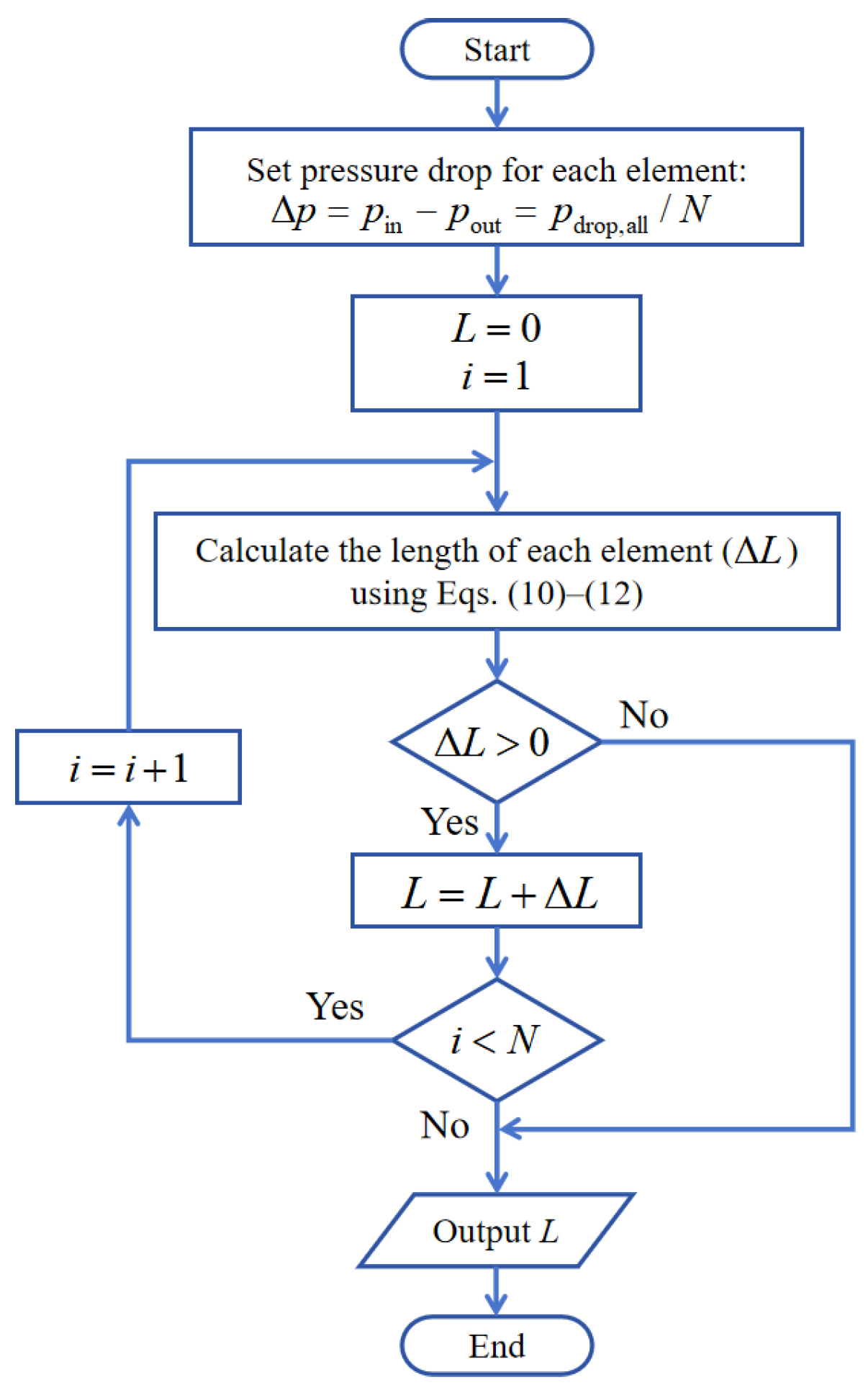
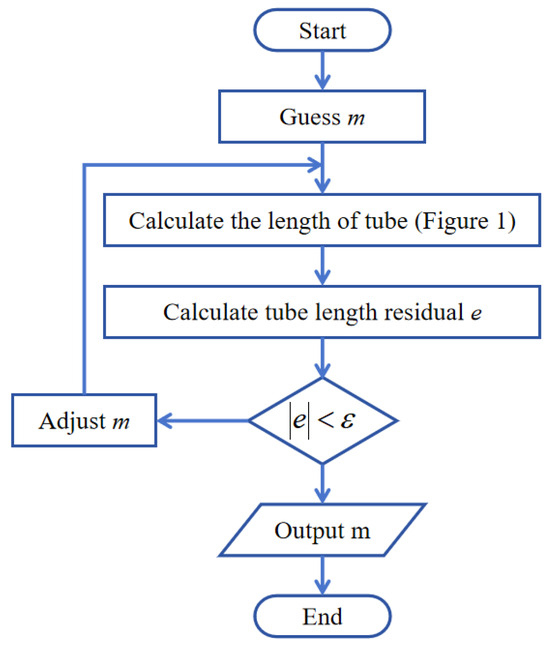
According to Equations (10)–(12), the length of each element of the capillary can be sequentially calculated when the inlet and outlet states of refrigerant, mass flow rate, and diameter of the tube are known. Then the overall length can be determined. The specific flow chart for calculating tube length is shown in Figure 2. Furthermore, the mass flow rate of refrigerant can also be calculated inversely when the inlet and outlet states of refrigerant, the length, and the diameter of the capillary tube are known. The specific flow chart for calculating mass flow rate is shown in Figure 3.
Figure 2.
Flow chart of calculating tube length.
Figure 3.
Flow chart of calculating mass flow rate.
The HEM is a two-phase flow model that assumes the vapor and liquid phases are uniformly mixed, sharing the same temperature and velocity. It solves the fluid state inside the tubes based on the fundamental conservation equations. Under normal design and operating conditions, the HEM can provide predictions with acceptable accuracy. However, it also has certain limitations, such as its inapplicability to coiled or non-adiabatic capillary tubes and a lack of accuracy guarantee under non-standard operating conditions.
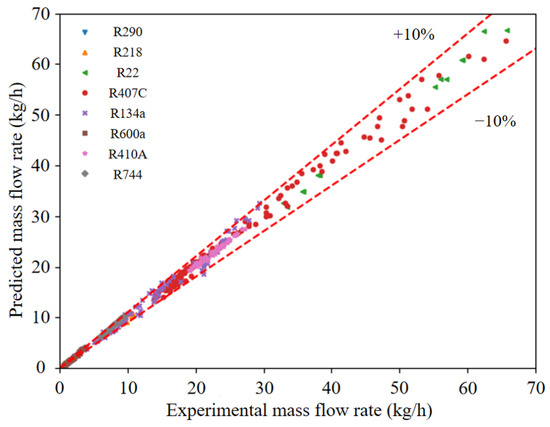
To validate the performance of HEM, we collected 417 sets of experimental data of eight refrigerants passing through a straight adiabatic capillary tube from previous literature (Table 1). Figure 4 shows the comparison of measured data and predictions from the HEM. Among them, 94.5% of the predictions are within the ±10% margin of deviation. The HEM performs excellently and stably on the experimental data, demonstrating good prediction accuracy and generalization performance.
Table 1.
Experimental data used for validation.
Figure 4.
Comparison of measured and predicted mass flow rates by the HEM.
Based on the HEM, mass flow rates of five refrigerants are calculated according to the given inlet state and capillary size, within which the dataset is constructed. The dataset encompasses three distinct refrigerant inlet states: subcooled, two-phase, and supercritical. The inlet states and capillary geometries are randomly selected within their ranges. Table 2 lists the specific value ranges. The selected ranges, detailed in Table 2, are defined to ensure comprehensive coverage. The geometric parameters of tubes (inner diameter and length) span the commonly applied size range for capillary tubes as expansion devices. The inlet state parameters of refrigerant (pressure, subcooling, and vapor quality) are chosen to encompass the majority of operating conditions encountered in small refrigeration systems, with their specific bounds appropriately adjusted according to the thermodynamic properties of each refrigerant. A uniform random sampling strategy is applied across these ranges to achieve broad and unbiased coverage of the parameter space without stratification. All the refrigerant properties are evaluated by REFPROP 10.0 [29]. As most studies have done, in this paper, refrigerant mass flow rates are calculated in the choked state, so the outlet state of the capillary is not considered. There are 37,300 data points in the dataset. The whole dataset is divided into two sets, the training set and the test set, according to the ratio of 7:3. The training set serves to train the neural network, and the test set is used to independently test the prediction ability of the neural network after training.
Table 2.
Dataset based on the HEM.
2.2. Neural Networks
At present, neural networks are widely used in the field of thermodynamics because of their powerful data fitting and modeling capabilities. Many studies have been conducted using neural networks to model capillary tubes and achieved good results. However, previous studies primarily focused on the application of simple neural network architectures. In recent years, with the improvement of computational ability and the reduction in the difficulty of data acquisition, deep learning has made great progress. It can adopt more complex network structures to deal with more difficult modeling tasks. Based on the collected dataset, this paper trains a shallow network model and a deep network model, respectively, and compares their performance.
In the previous evaluation of various input and output parameters of capillary models [20], the dimensionless parameter group proposed by Yang and Zhang [11] based on the HEM was proved to be highly reasonable and versatile, and could be applied to sub-cooled, two-phase, and supercritical inlet states. In this work, this dimensionless parameter group is selected as input and output parameters for both shallow and deep networks. Table 3 shows the specific definition and range of parameters. It should be specifically noted that (1) both and are calculated based on the saturation state corresponding to the inlet temperature of the capillary tube; and (2) for the supercritical inlet condition, psat represents the intersection of the isotherm of the inlet temperature and the maximum specific heat capacity line, and π3 = 1.
Table 3.
Dimensionless parameter group.
Therefore, the dimensionless mass flow rate can be expressed as follows:
where represents a function that will subsequently be approximated by a neural network.
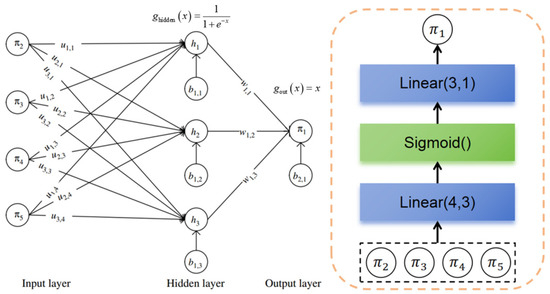
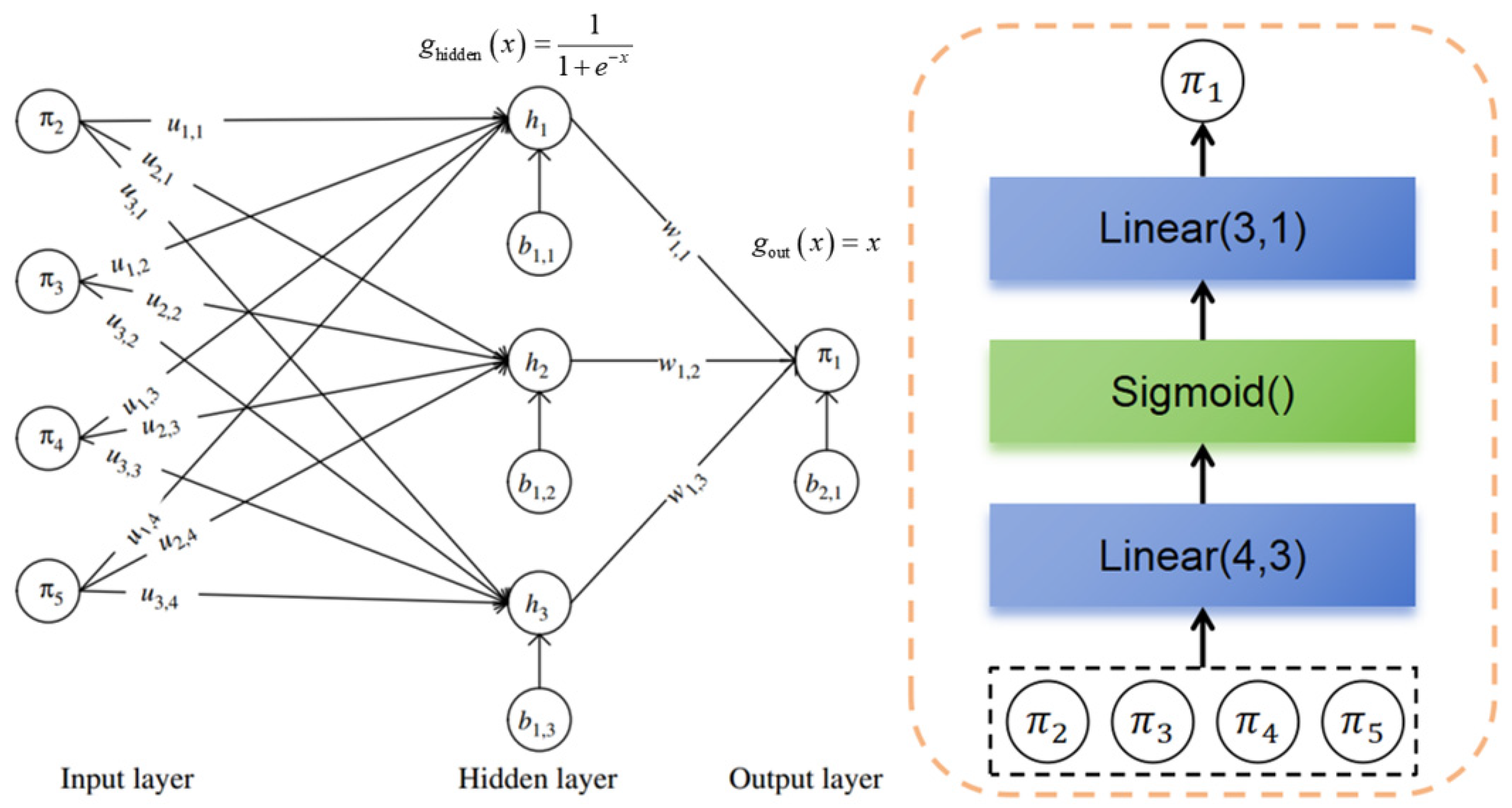
In this study, the shallow neural network utilizes the multi-layer perceptron architecture (MLP). This model features four inputs and one output. A single hidden layer comprising three neurons is positioned between the input and output layers. Each layer is fully connected. Additionally, the logarithmic Sigmoid function is employed as the activation function. The specific architecture is shown in Figure 5. Its mathematical expression is shown in Equation (14).
Figure 5.
Multi-layer perceptron.
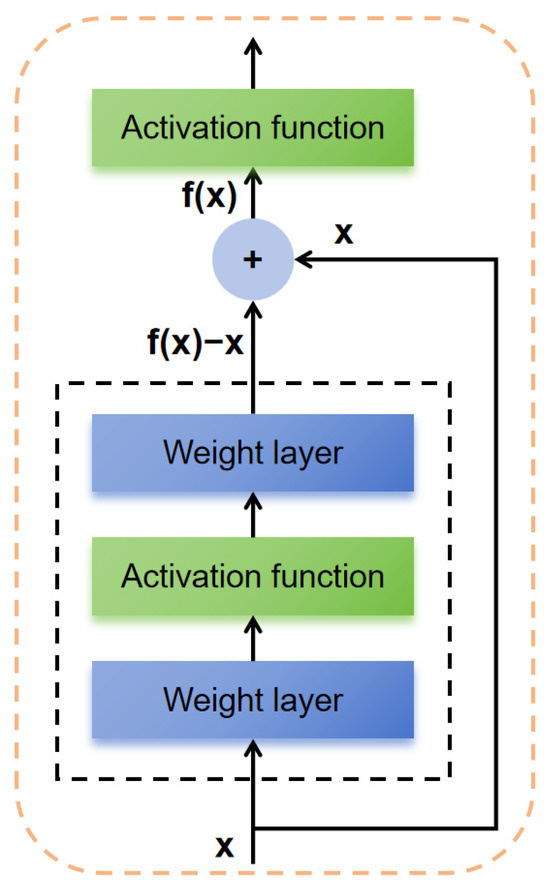
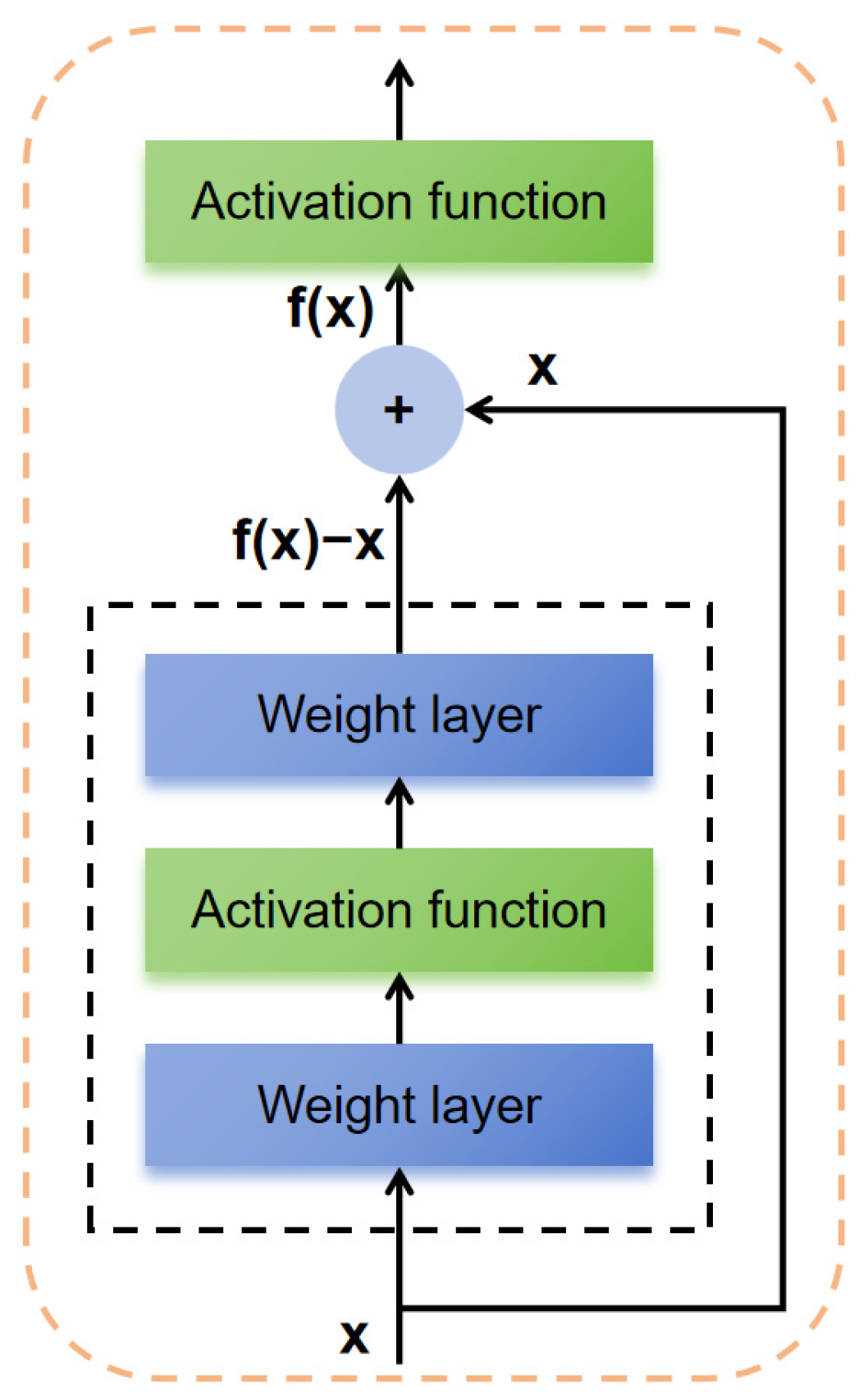
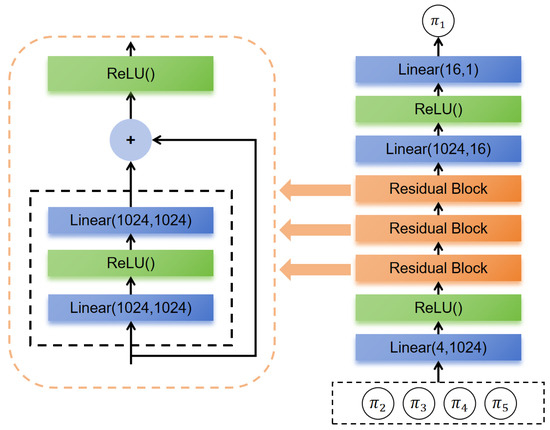
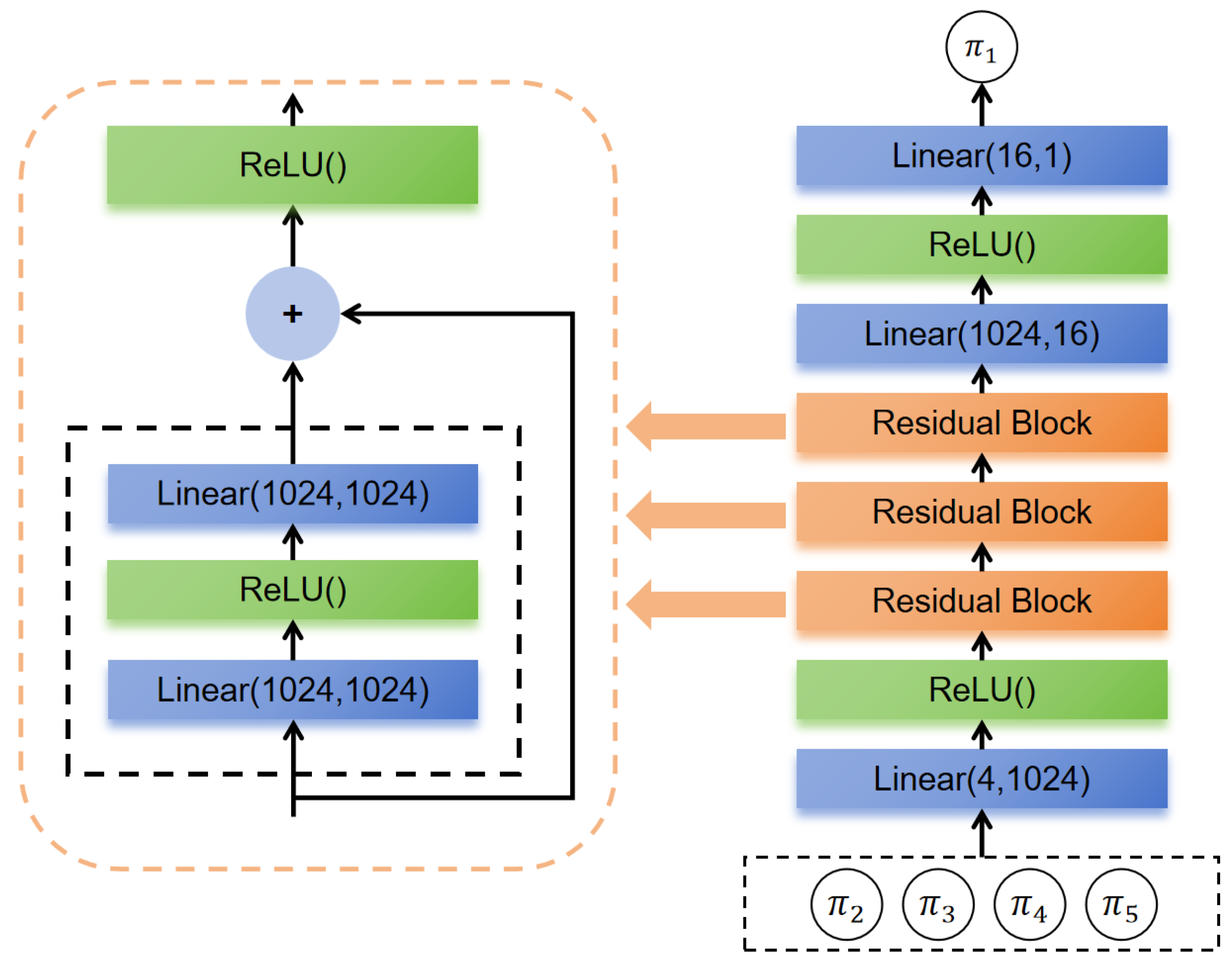
The residual network (ResNet) was proposed by He et al. [30]. At present, it is widely used in deep learning and has a profound impact on the design of deep neural networks. For deep neural networks, merely increasing the number of layers does not necessarily enhance the model’s ability to efficiently approximate the objective function. However, if newly added layers can be trained as an approximate identity mapping, then it ensures that augmenting the number of network layers does not degrade the fitting performance of the overall model. Based on this concept, the design of a residual block is introduced into the residual network. The specific architecture is shown in Figure 6. In practice, f(x) can be approximated to an identity mapping by simply setting the weight of the weight layers to 0. In this study, the deep neural network adopts the residual network architecture. Three residual blocks are implemented, where each residual block contains two linear layers with 1024 neurons. Additionally, to effectively integrate the input and output with the residual blocks, three supplementary linear layers are incorporated, with 1024 neurons, 16 neurons, and 1 neuron, respectively. In total, the deep residual network comprises 9 layers. Furthermore, in order to mitigate the vanishing gradient problem, the ReLU function is selected as the activation function. The specific network architecture is shown in Figure 7.
Figure 6.
Residual block.
Figure 7.
Residual network.
3. Results and Discussion
In this section, two neural networks are first trained using the dataset based on the HEM, and then tested using data of various refrigerants generated by the HEM. Subsequently, the prediction accuracies of the proposed neural networks and existing empirical models from the literature on real experimental data are compared to validate their generalization performance. The types and uses of refrigerants involved are shown in Table 4.
Table 4.
Types and uses of the refrigerants involved.
3.1. Training and Evaluation of Neural Networks
Based on the simulation data of R134a, R410A, R407C, R600a, and R744 generated by the HEM, a traditional multi-layer perceptron (MLP) and a deep residual network (ResNet) are trained, respectively. Two networks are trained for 5000 epochs using stochastic gradient descent (SGD) with a learning rate of 0.001 and a batch size of 64. The relative square error (RSE) is selected as the loss function. In order to facilitate the training of the network, parameters in the training dataset are standardized. The average values and standard deviations of each parameter are shown in Table 5. The weights of MLP are initialized using the Xavier uniform method, and the weights of ResNet are initialized using the Kaiming initialization. As an example, the weights and biases of the trained MLP are given in Table 6 (the architecture of the model is shown in Figure 5 and Equation (14)). Due to the complexity of the ResNet model, its specific parameters are not listed here.
Table 5.
Average value and standard deviation of dimensionless parameters.
Table 6.
Weights and biases of the trained MLP.
Table 7 presents the average and maximum deviations observed in both the training dataset and test dataset after training. The definitions of deviation used in Table 7 are as follows.
Table 7.
Neural network training and testing deviations.
The average deviation:
The maximum deviation:
Table 7 demonstrates that the average deviations are relatively low, with no significant difference between performance on the training and test datasets, indicating that both models have effectively captured the underlying data patterns. By comparison, the ResNet outperforms the MLP, which can be attributed to its deeper architecture and greater number of neurons, enabling it to more accurately capture the complex physical features and nonlinear relationships embedded in the HEM. On the test set, the average deviation of the ResNet is 2.3%, which is superior to that of the MLP (3.3%).
As shown in Table 2, the dataset used for training the neural networks only included data for five refrigerants: R410A, R134a, R407C, R600a, and R744. To observe the performance of the two networks on untrained refrigerants and validate their generalization ability, 2000 additional sets of data for R22, R290, R32, and R1234yf are calculated based on the HEM for supplementary testing. As shown in Table 8, the performance of the two networks is satisfactory, with no significant difference from the results of the test set in Table 7. This result demonstrates that both neural network structures possess good generalization performance and are capable of extrapolating beyond the range of the training data.
Table 8.
Refrigerant supplementary test.
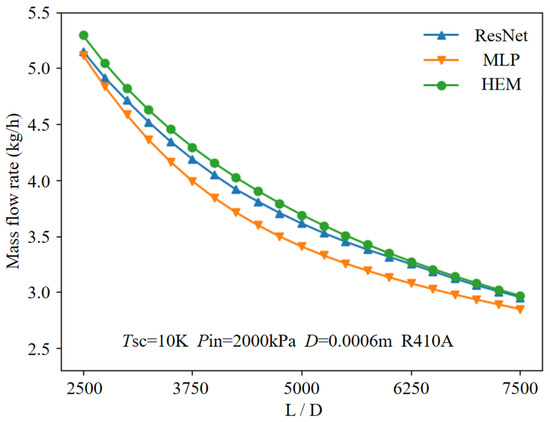
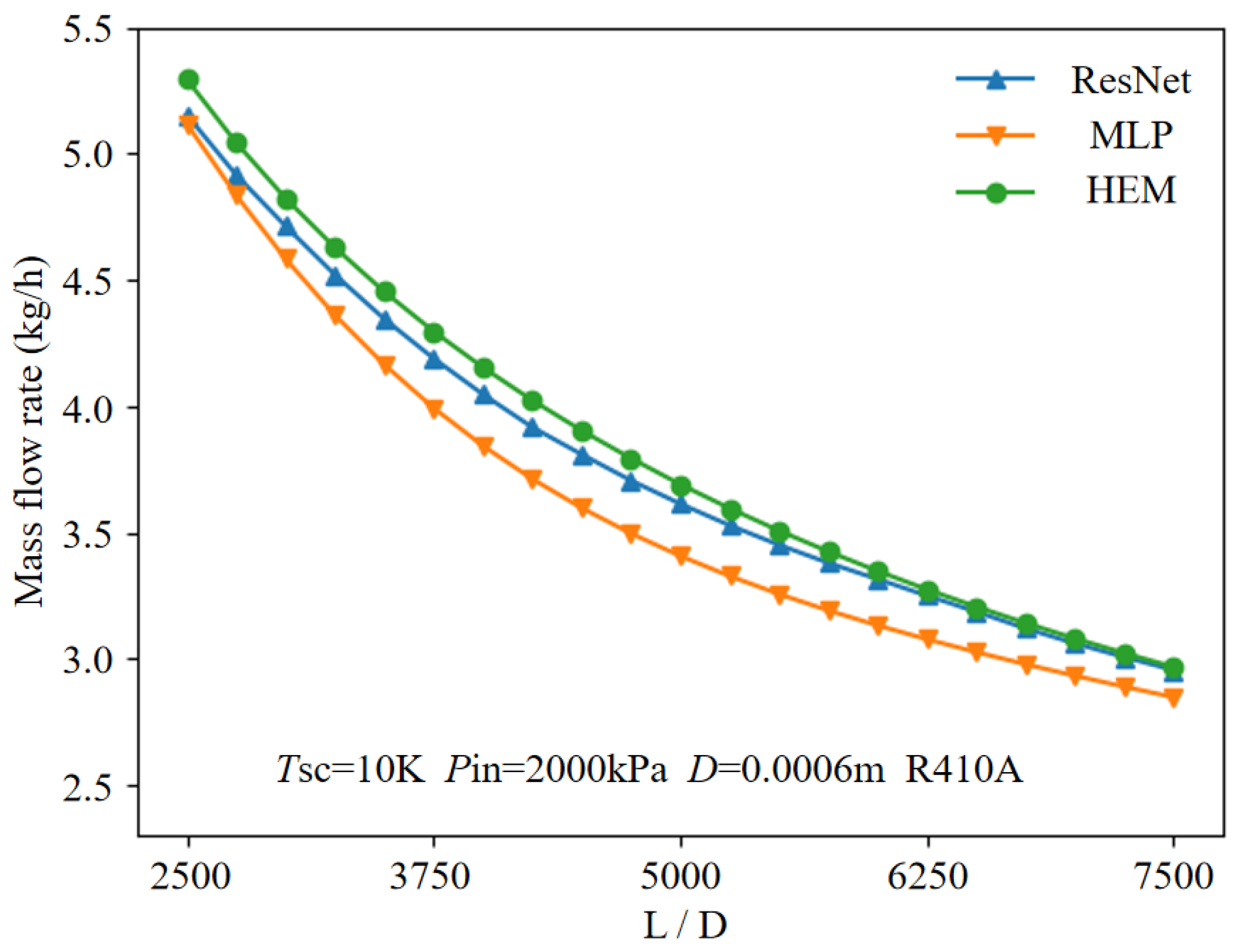
To further investigate the predictive performance of the two neural networks, we conduct a parametric analysis, observing how the mass flow rate varies with different inlet conditions. Figure 8 illustrates how the mass flow rates calculated by the HEM and two neural networks vary with the capillary length. As shown in Figure 8, different length-to-diameter ratios of the capillary tube can significantly affect the mass flow rate. Both neural networks conduct qualitative predictions well. Among them, the ResNet performs better. Its overall prediction curve aligns more closely with the HEM, keeping the maximum deviation within 3%. This indicates that ResNet captures the physical characteristics of the HEM more effectively than the MLP, thus exhibiting enhanced generalization performance.
Figure 8.
Mass flow rates vary with length-to-diameter ratio.
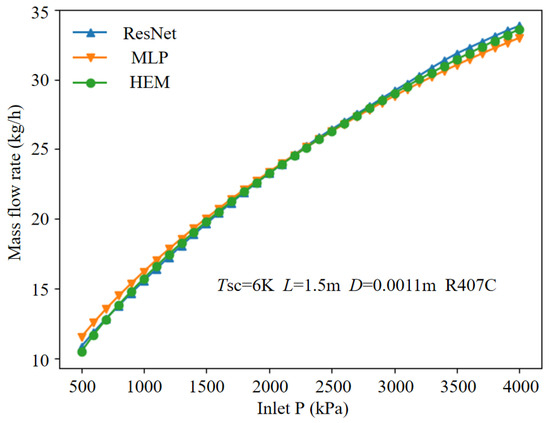
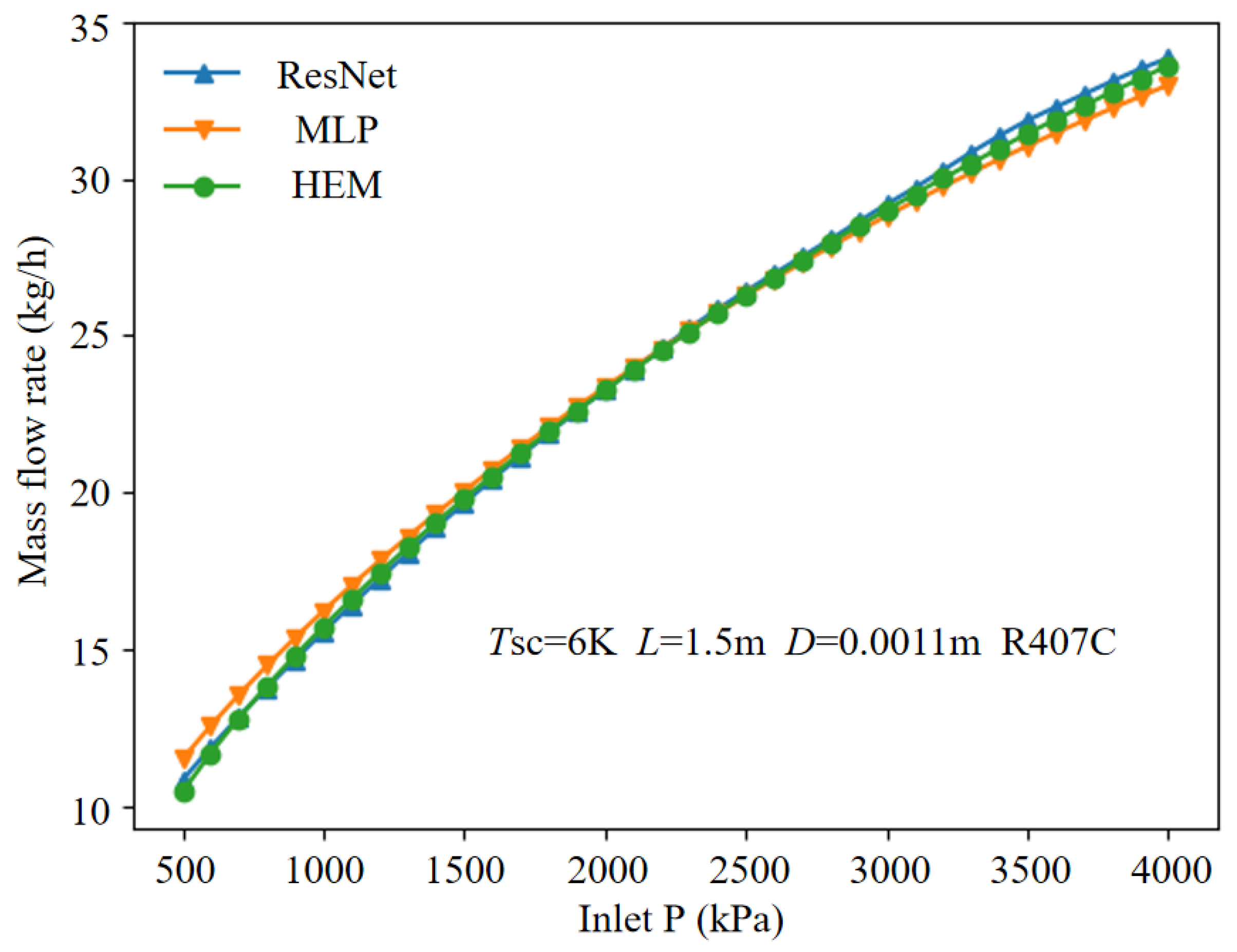
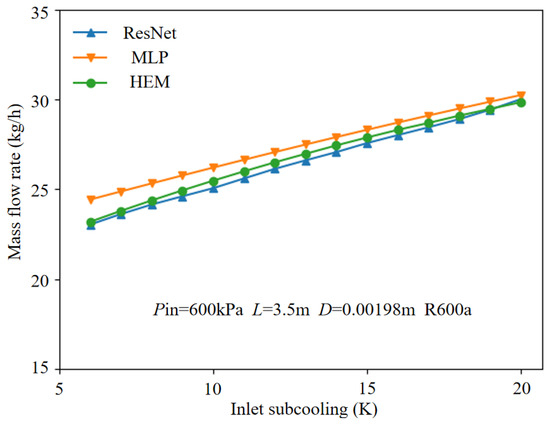
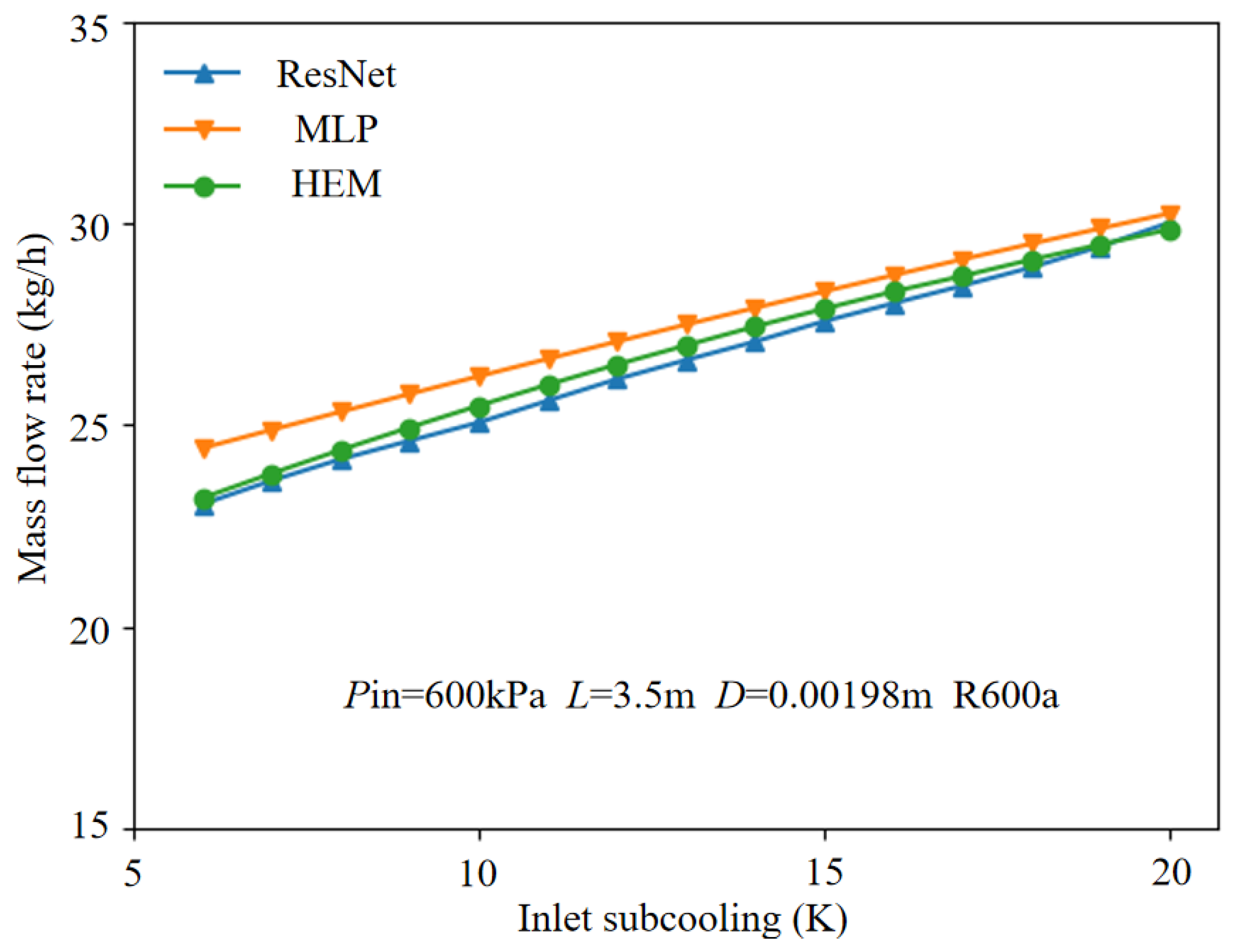
Similarly, Figure 9 illustrates how the mass flow rate varies with the inlet pressure. With the drop in inlet pressure, the mass flow rate decreases as the pressure drop becomes smaller. Figure 10 illustrates how the mass flow rate varies with the inlet subcooling. With the decrease in subcooling, the liquid region in the tube becomes smaller, the overall flow resistance turns greater, and the mass flow rate goes down. As seen, both neural networks behave well close to the HEM. By comparison, the ResNet performs somewhat better than the MLP.
Figure 9.
Mass flow rates vary with inlet pressure.
Figure 10.
Mass flow rates vary with inlet subcooling.
The above results indicate that both the MLP and ResNet have relatively low average deviations on the test set. Their prediction results are highly consistent with the HEM in the vast majority of working conditions. At the same time, two models exhibit good generalization ability for untrained refrigerant types. In addition, the parametric analysis shows that both neural networks can correctly capture how the mass flow rate varies with important parameters, indicating that the overall rationality of the two models is strong. The ResNet with a more complex architecture demonstrates stronger learning capabilities during training on the HEM dataset. Its average deviation and maximum deviation on the test set are both lower than those of the MLP (average deviation: 2.3% for the ResNet and 3.3% for the MLP; maximum deviation: 7.1% for the ResNet and 13.5% for the MLP), demonstrating its superior generalization capabilities.
In practical engineering applications, simulation models often need to calculate the refrigerant mass flow rate in capillary tubes across hundreds or even thousands of operating points, where computational efficiency becomes critical. To further analyze the performance differences between the HEM and two neural networks, the computational speeds of the three models are compared using 1800 data points across nine refrigerants (200 data points per refrigerant). Specific results are shown in Table 9. The computation times for the HEM and two neural networks on the 1800 data points are 648.9 s, 9.0 s, and 18.5 s, respectively. Compared to the HEM, the trained neural network models demonstrate significantly faster computational speeds, proving their advantage in computationally intensive scenarios. Among them, the MLP exhibits superior computational efficiency—approximately twice as fast as ResNet—due to its simpler architecture.
Table 9.
Computation time of three models.
3.2. Validation with Experimental Data
To deeply validate the generalization performance of the trained neural networks, 417 sets of experimental data from open literature (Table 1) are used for testing. Moreover, based on the previous evaluation of empirical correlation and neural networks [20], four models with good performance in the literature (Table 10) are selected for comparative analysis by comprehensively considering factors such as prediction accuracy, generalization ability, and continuity. Results are given in Table 11.
Table 10.
Models for comparison.
Table 11.
Evaluation of models.
First of all, the HEM exhibits exceptional generalization performance, achieving the highest prediction accuracy on the collected experimental data. In terms of overall performance across all collected experimental data, both MLP and ResNet based on the HEM, demonstrate much smaller average and maximum deviations than those grounded on the experimental data. Their average deviations are 5.2% and 4.5%, respectively, which are close to that of the HEM. Meanwhile, due to its enhanced learning capacity during training, the ResNet achieves higher overall prediction accuracy for experimental data compared to the MLP.
The dataset used for neural network training consists of data from five refrigerants: R410A, R134a, R407C, R600a, and R744. Both neural networks perform well on the experimental data of these five refrigerants. Meanwhile, they also have excellent prediction accuracy for untrained refrigerant types. For R22, R218, and R290, the average deviations of MLP are 3.1%, 2.9%, and 3.2%, respectively, while the average deviations of ResNet are 1.8%, 3.2%, and 3.2%, respectively. The neural networks based on the HEM show stable performance across different refrigerants. Two models have high prediction accuracy for both trained and untrained refrigerant types, further demonstrating their excellent generalization performance.
In contrast, the models from the literature show significant volatility in prediction accuracy across experimental data of different refrigerants. The maximum deviations of previous models are much higher than those of the neural networks based on the HEM, which proves their lack of robust generalization performance and stability.
4. Conclusions
In this paper, neural networks based on the homogeneous equilibrium model (HEM) are proposed to predict the refrigerant mass flow rate through adiabatic capillary tubes. The HEM can generate a substantial amount of high-quality data, and neural networks trained with this data outperform those models developed using limited experimental data containing uncertainties. Neural networks with two architectures are trained and compared with the existing empirical models. The main conclusions are summarized as follows.
The average deviations of the multi-layer perceptron (MLP) and deep residual network (ResNet) trained on the HEM-based dataset are 3.1% and 2.0% for the training set and 3.3% and 2.3% for the test set, respectively. In addition, the trained neural networks are applicable to various refrigerants, demonstrating excellent generalization ability across different working fluids. Compared to the MLP of a relatively simple structure, the ResNet exhibits superior learning ability and generalization performance. Additionally, the neural network models demonstrate significantly superior computational speed compared to the HEM—the computation time for the HEM can exceed more than 30 times that of the two neural networks when processing 1800 data points.
On the experimental data of various refrigerants from literature, the two HEM-based neural networks exhibit excellent prediction accuracy, with average deviations of 5.2% and 4.5%, respectively, both outperforming the existing models and again showing superior generalization performance.
While the proposed HEM-based neural networks demonstrate strong performance, several limitations inherent to the current framework should be acknowledged. The training and performance of the developed neural networks are intrinsically tied to the HEM, and deviations persist between the neural network predictions and the HEM itself. Furthermore, these networks are only applicable to straight, adiabatic capillary tubes. These constraints outline clear directions for future work: (1) establishing a more accurate and efficient method to generate training data, and (2) extending the framework to coiled and non-adiabatic tubes.
Author Contributions
Conceptualization, L.S.; methodology, Y.L.; software, Y.L.; validation, Y.L.; formal analysis, Y.L.; investigation, Y.L.; resources, L.S.; data curation, Y.L.; writing—original draft preparation, Y.L.; writing—review and editing, L.S.; visualization, Y.L.; supervision, L.S. All authors have read and agreed to the published version of the manuscript.
Funding
This research received no external funding.
Data Availability Statement
The original contributions presented in this study are included in the article. Further inquiries can be directed to the corresponding author.
Conflicts of Interest
The author declares no conflicts of interest.
Nomenclature
The following nomenclatures are used in this manuscript:
| Nomenclatures | |
| D | Inner diameter of capillary tube (m) |
| f | Friction coefficient |
| G | Mass flux (kg/(m2∙s)) |
| h | Enthalpy (J/kg) |
| L | Length of capillary tube (m) |
| m | Mass flow rate (kg/s) |
| p | Pressure (kPa) |
| Re | Reynolds number |
| s | Entropy (kJ/(kg∙K)) |
| T | Temperature (°C) |
| Tsc | Inlet subcooling (°C) |
| v | Velocity (m/s) |
| x | Vapor quality |
| υ | Specific volume (m3/kg) |
| μ | Viscosity (Pa∙s) |
| ρ | Density (kg/m3) |
| ε | Roughness (m) |
| Subscripts | |
| g | Saturated vapor |
| f | Saturated liquid |
| m | Average |
| sat | Saturation |
| in | Inlet |
| out | Outlet |
References
- Park, C.; Lee, S.; Kang, H.; Kim, Y. Experimentation and Modeling of Refrigerant Flow through Coiled Capillary Tubes. Int. J. Refrig. 2007, 30, 1168–1175. [Google Scholar] [CrossRef] [Scilit]
- Choi, J.; Kim, Y.; Chung, J.T. An Empirical Correlation and Rating Charts for the Performance of Adiabatic Capillary Tubes with Alternative Refrigerants. Appl. Therm. Eng. 2004, 24, 29–41. [Google Scholar] [CrossRef] [Scilit]
- Rasti, M.; Jeong, J.H. A Generalized Continuous Empirical Correlation for the Refrigerant Mass Flow Rate through Adiabatic Straight and Helically Coiled Capillary Tubes. Appl. Therm. Eng. 2018, 143, 450–460. [Google Scholar] [CrossRef] [Scilit]
- Dubba, S.K.; Kumar, R. Flow of Partially Condensed R-134a Vapour through an Adiabatic Capillary Tube. Flow Meas. Instrum. 2018, 59, 1–7. [Google Scholar] [CrossRef] [Scilit]
- Yang, L.; Zhang, C.-L. A Generalized Dimensionless Local Power-Law Correlation for Refrigerant Flow through Adiabatic Capillary Tubes and Short Tube Orifices. Int. J. Refrig. 2014, 46, 69–76. [Google Scholar] [CrossRef] [Scilit]
- Jeon, S.; Ko, J.; Lee, H.; Jeong, J.H. Advanced Model for a Non-Adiabatic Capillary Tube Considering Both Subcooled Liquid and Non-Equilibrium Two-Phase States of R-600a. Int. J. Refrig. 2025, 169, 140–151. [Google Scholar] [CrossRef] [Scilit]
- Moosbrugger, M.; Marchi, D.; Brüggemann, P.A.; Krimmel, A.; Hermes, C.J.L. Adiabatic Capillary Tube Flows of N-Butane and Isobutane. Int. J. Refrig. 2024, 158, 378–384. [Google Scholar] [CrossRef] [Scilit]
- De Lara, J.F.P.; Melo, C.; Boeng, J.; Hermes, C.J.L. Experimental Analysis of HFC-134a Expansion through Small-Bore Adiabatic Capillary Tubes. Int. J. Refrig. 2020, 112, 37–43. [Google Scholar] [CrossRef] [Scilit]
- Zhang, C.-L. Generalized Correlation of Refrigerant Mass Flow Rate through Adiabatic Capillary Tubes Using Artificial Neural Network. Int. J. Refrig. 2005, 28, 506–514. [Google Scholar] [CrossRef] [Scilit]
- Zhang, C.-L.; Zhao, L.-X. Model-Based Neural Network Correlation for Refrigerant Mass Flow Rates through Adiabatic Capillary Tubes. Int. J. Refrig. 2007, 30, 690–698. [Google Scholar] [CrossRef] [Scilit]
- Yang, L.; Zhang, C.-L. Modified Neural Network Correlation of Refrigerant Mass Flow Rates through Adiabatic Capillary and Short Tubes: Extension to CO2 Transcritical Flow. Int. J. Refrig. 2009, 32, 1293–1301. [Google Scholar] [CrossRef] [Scilit]
- Heimel, M.; Lang, W.; Almbauer, R. Performance Predictions Using Artificial Neural Network for Isobutane Flow in Non-Adiabatic Capillary Tubes. Int. J. Refrig. 2014, 38, 281–289. [Google Scholar] [CrossRef] [Scilit]
- Gill, J.; Singh, J. Use of Artificial Neural Network Approach for Depicting Mass Flow Rate of R134a/LPG Refrigerant through Straight and Helical Coiled Adiabatic Capillary Tubes of Vapor Compression Refrigeration System. Int. J. Refrig. 2018, 86, 228–238. [Google Scholar] [CrossRef] [Scilit]
- Liang, P.; Wang, W.; Yuan, X.; Liu, S.; Zhang, L.; Cheng, Y. Intelligent Fault Diagnosis of Rolling Bearing Based on Wavelet Transform and Improved ResNet under Noisy Labels and Environment. Eng. Appl. Artif. Intell. 2022, 115, 105269. [Google Scholar] [CrossRef] [Scilit]
- Ma, C.; Zhang, T.; Zheng, H.; Yang, J.; Chen, R.; Fang, C. Measurement Method for Live Chicken Shank Length Based on Improved ResNet and Fused Multi-Source Information. Comput. Electron. Agric. 2024, 221, 108965. [Google Scholar] [CrossRef] [Scilit]
- Lorbek, L.; Katrašnik, T.; Kitanovski, A. Impact of Neglecting the Variations in the Relative Surface Roughnesses of Capillary Tubes on the Accuracy of a Capillary Tube Model. Int. J. Refrig. 2021, 129, 194–203. [Google Scholar] [CrossRef] [Scilit]
- Rocha, T.T.M.; De Paula, C.H.; Cangussu, V.M.; Maia, A.A.T.; De Oliveira, R.N. Effect of Surface Roughness on the Mass Flow Rate Predictions for Adiabatic Capillary Tubes. Int. J. Refrig. 2020, 118, 269–278. [Google Scholar] [CrossRef] [Scilit]
- Dubba, S.K.; Kumar, R. Adiabatic Flow Characteristics of R-600a inside a Helically Coiled Capillary Tube. Appl. Therm. Eng. 2018, 132, 500–507. [Google Scholar] [CrossRef] [Scilit]
- Torres Martins Rocha, T.; Henrique De Paula, C.; Jose Garcia Pabon, J.; De Freitas Paulino, T.; Nunes De Oliveira, R. Algebraic Solution and Experimental Validation for Adiabatic Coiled Capillary Tubes Operating in Transcritical CO2 Cycle. Appl. Therm. Eng. 2020, 181, 115930. [Google Scholar] [CrossRef] [Scilit]
- Shao, L.-L.; Wang, J.-C.; Jin, X.-C.; Zhang, C.-L. Assessment of Existing Dimensionless Correlations of Refrigerant Flow through Adiabatic Capillary Tubes. Int. J. Refrig. 2013, 36, 270–278. [Google Scholar] [CrossRef] [Scilit]
- Melo, C.; Ferreira, R.T.S.; Neto, C.B.; Gonçalves, J.M.; Mezavila, M.M. An Experimental Analysis of Adiabatic Capillary Tubes. Appl. Therm. Eng. 1999, 19, 669–684. [Google Scholar] [CrossRef] [Scilit]
- Churchill, S.W. Friction-factor Equation Spans All Fluid-flow Regimes. Chem. Eng. 1977, 84, 91–92. [Google Scholar]
- Vinš, V.; Vacek, V. Mass Flow Rate Correlation for Two-Phase Flow of R218 through a Capillary Tube. Appl. Therm. Eng. 2009, 29, 2816–2823. [Google Scholar] [CrossRef] [Scilit]
- Choi, J.; Kim, Y.; Kim, H.Y. A Generalized Correlation for Refrigerant Mass Flow Rate through Adiabatic Capillary Tubes. Int. J. Refrig. 2003, 26, 881–888. [Google Scholar] [CrossRef] [Scilit]
- Khan, M.K.; Kumar, R.; Sahoo, P.K. An Experimental Study of the Flow of R-134a inside an Adiabatic Spirally Coiled Capillary Tube. Int. J. Refrig. 2008, 31, 970–978. [Google Scholar] [CrossRef] [Scilit]
- Augusto Sanzovo Fiorelli, F.; Alberto Silva Huerta, A.; De Mattos Silvares, O. Experimental Analysis of Refrigerant Mixtures Flow through Adiabatic Capillary Tubes. Exp. Therm. Fluid Sci. 2002, 26, 499–512. [Google Scholar] [CrossRef] [Scilit]
- Schenk, M.; Oellrich, L.R. Experimental Investigation of the Refrigerant Flow of Isobutane (R600a) through Adiabatic Capillary Tubes. Int. J. Refrig. 2014, 38, 275–280. [Google Scholar] [CrossRef] [Scilit]
- Cecchinato, L.; Corradi, M.; Fornasieri, E.; Schiochet, G.; Zilio, C. Assessment on the Use of Common Correlations to Predict the Mass-Flow Rate of Carbon Dioxide through Capillary Tubes in Transcritical Cycles. Int. J. Refrig. 2009, 32, 1041–1048. [Google Scholar] [CrossRef] [Scilit]
- Lemmon, E.W.; Bell, I.H.; Huber, M.L.; McLinden, M.O. NIST Standard Reference Database 23: Reference Fluid Thermodynamic and Transport Properties-REFPROP, version 10.0; National Institute of Standards and Technology: Washington, DC, USA, 2018. [Google Scholar]
- He, K.; Zhang, X.; Ren, S.; Sun, J. Delving Deep into Rectifiers: Surpassing Human-Level Performance on ImageNet Classification. arXiv 2015, arXiv:1502.01852. [Google Scholar]

Disclaimer/Publisher’s Note: The statements, opinions and data contained in all publications are solely those of the individual author(s) and contributor(s) and not of MDPI and/or the editor(s). MDPI and/or the editor(s) disclaim responsibility for any injury to people or property resulting from any ideas, methods, instructions or products referred to in the content. |
© 2026 by the authors. Licensee MDPI, Basel, Switzerland. This article is an open access article distributed under the terms and conditions of the Creative Commons Attribution (CC BY) license.