Optimization of the Design and Manufacturing Processes for Metal Additive Manufacturing Through Digital Twin

Abstract
1. Introduction
2. Design for Additive Manufacturing
2.1. Motion Analysis of the Control Arm
2.2. Structural Analysis and Optimization
2.3. Fatigue Analysis
3. Additive Manufacturing Process
3.1. Define Orientation and Support Structures
3.2. Thermomechanical Process Simulation
4. Optimization of AM Parameters
5. Discussion
6. Conclusions
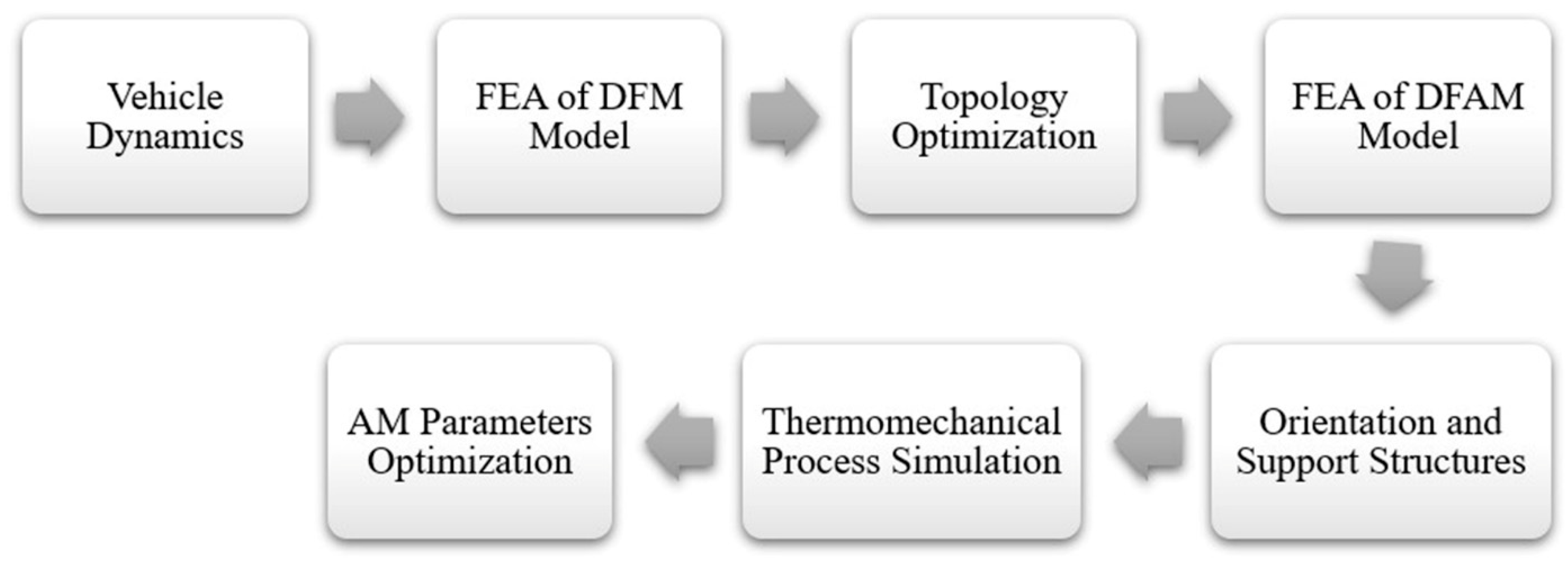
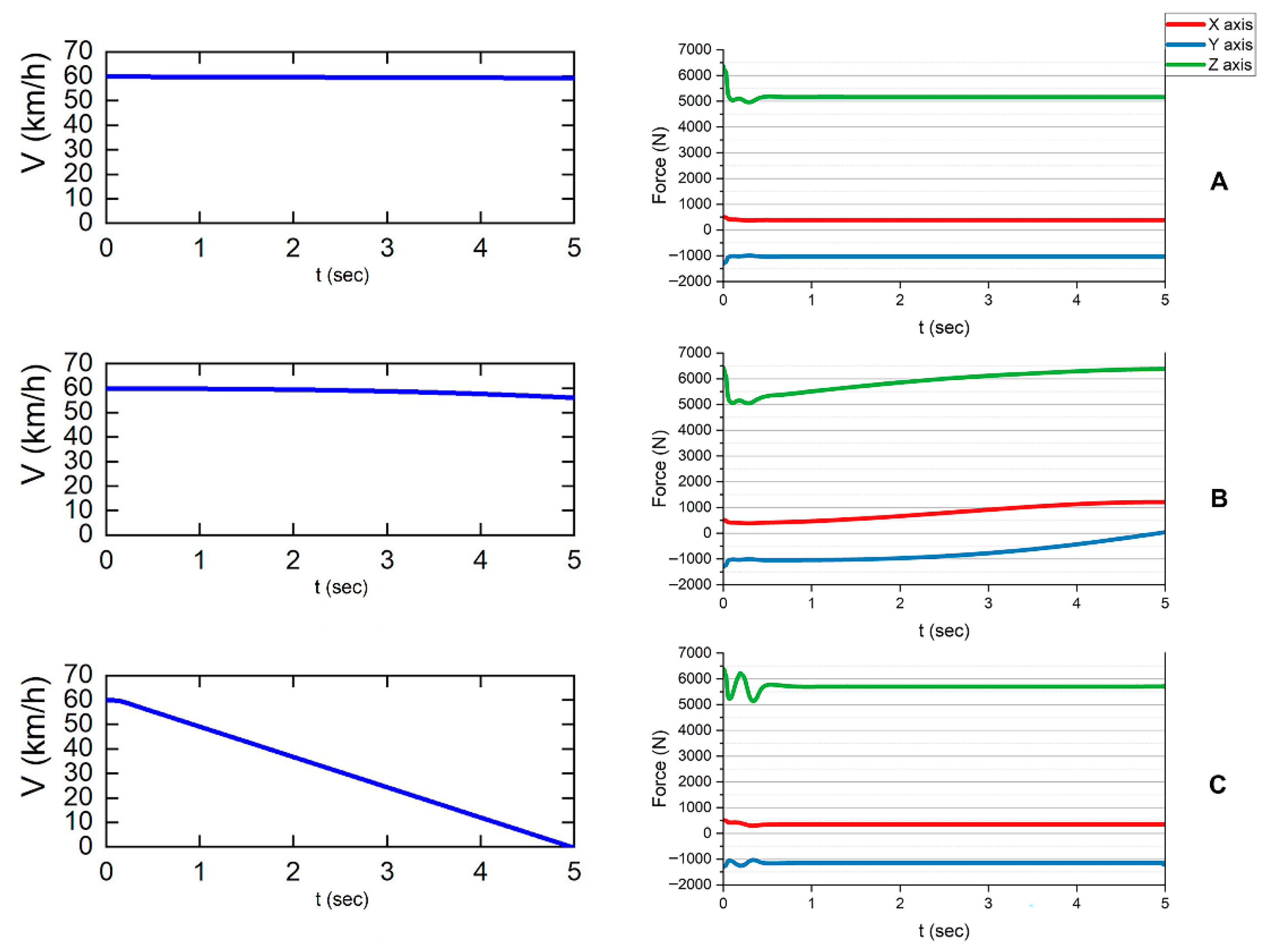
- From the three motion simulations (driving at a constant speed of 60 km/h, climbing a 30° ramp at a constant speed of 60 km/h, and braking to a stop from a speed of 60 km/h within 5 s), it was calculated that the highest force affected the lower wishbone during the ramp climbing motion.
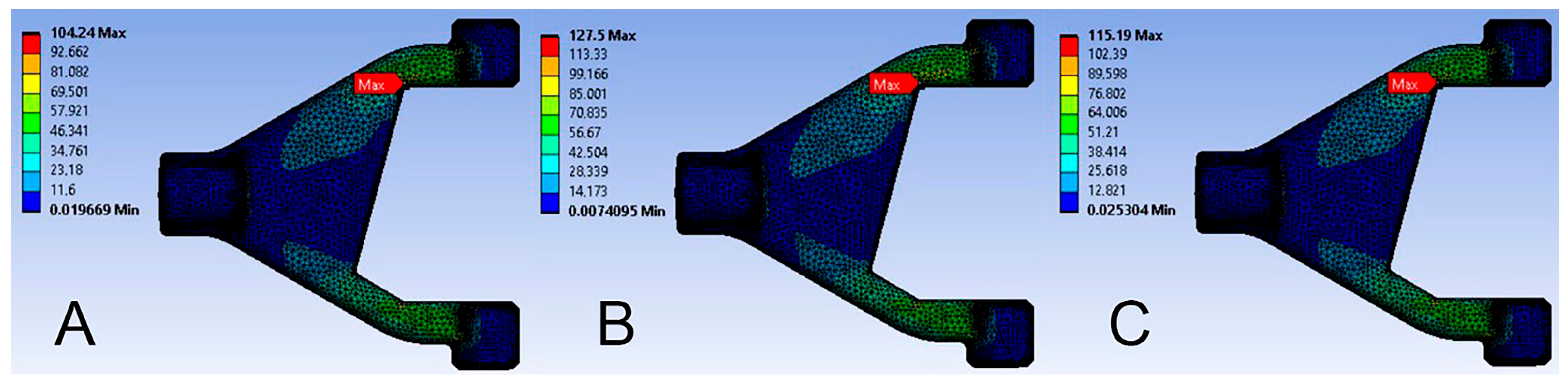
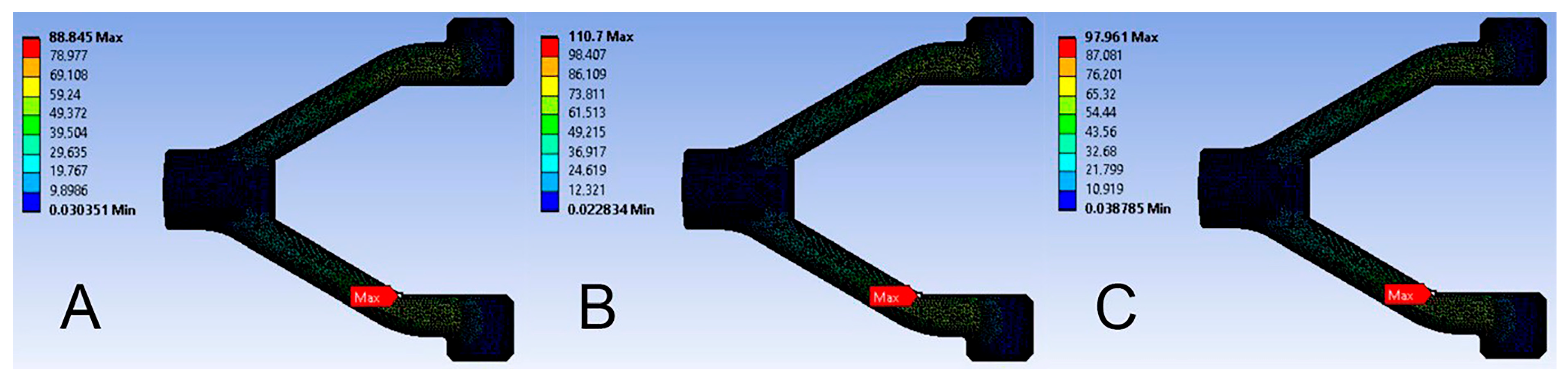
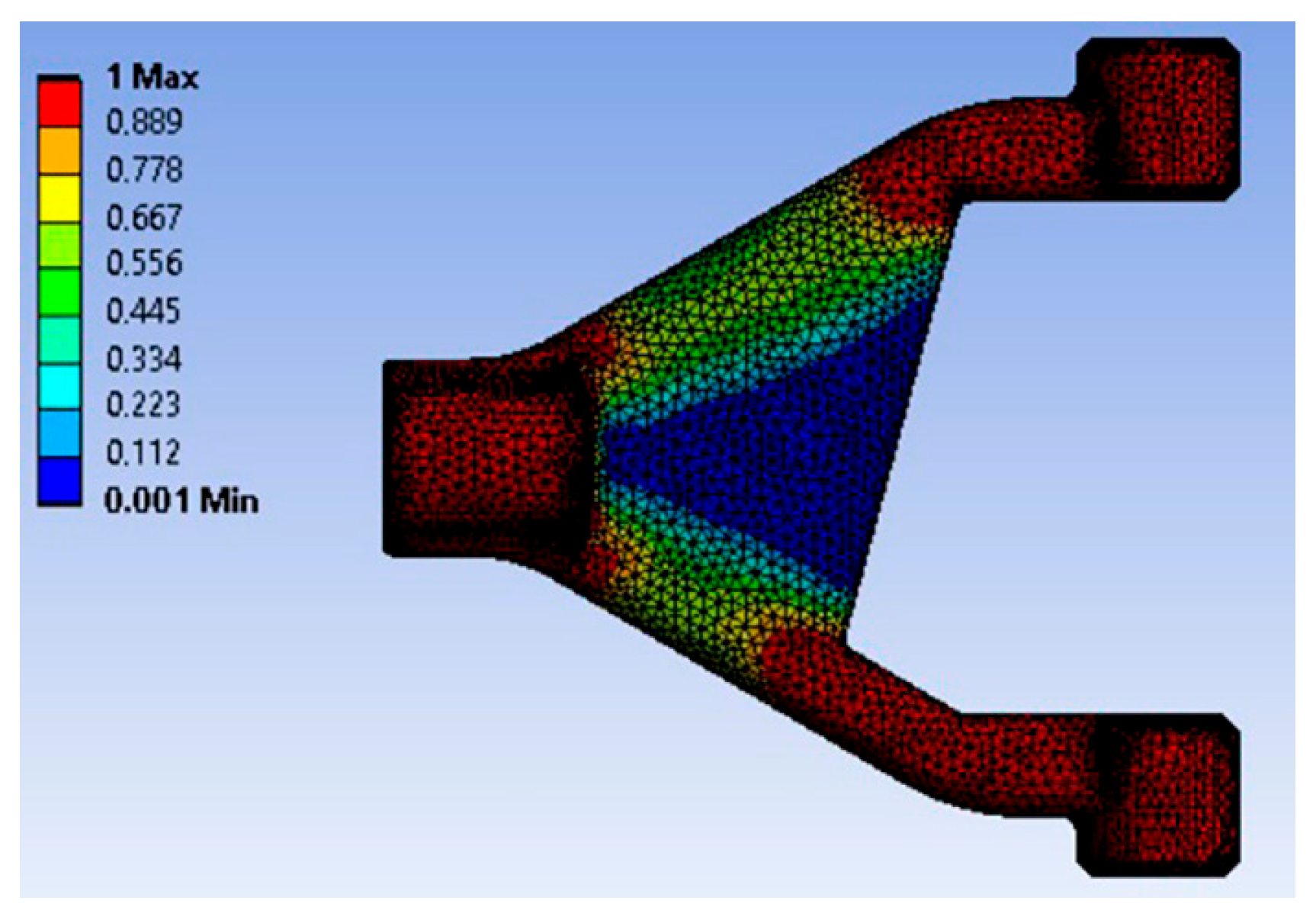
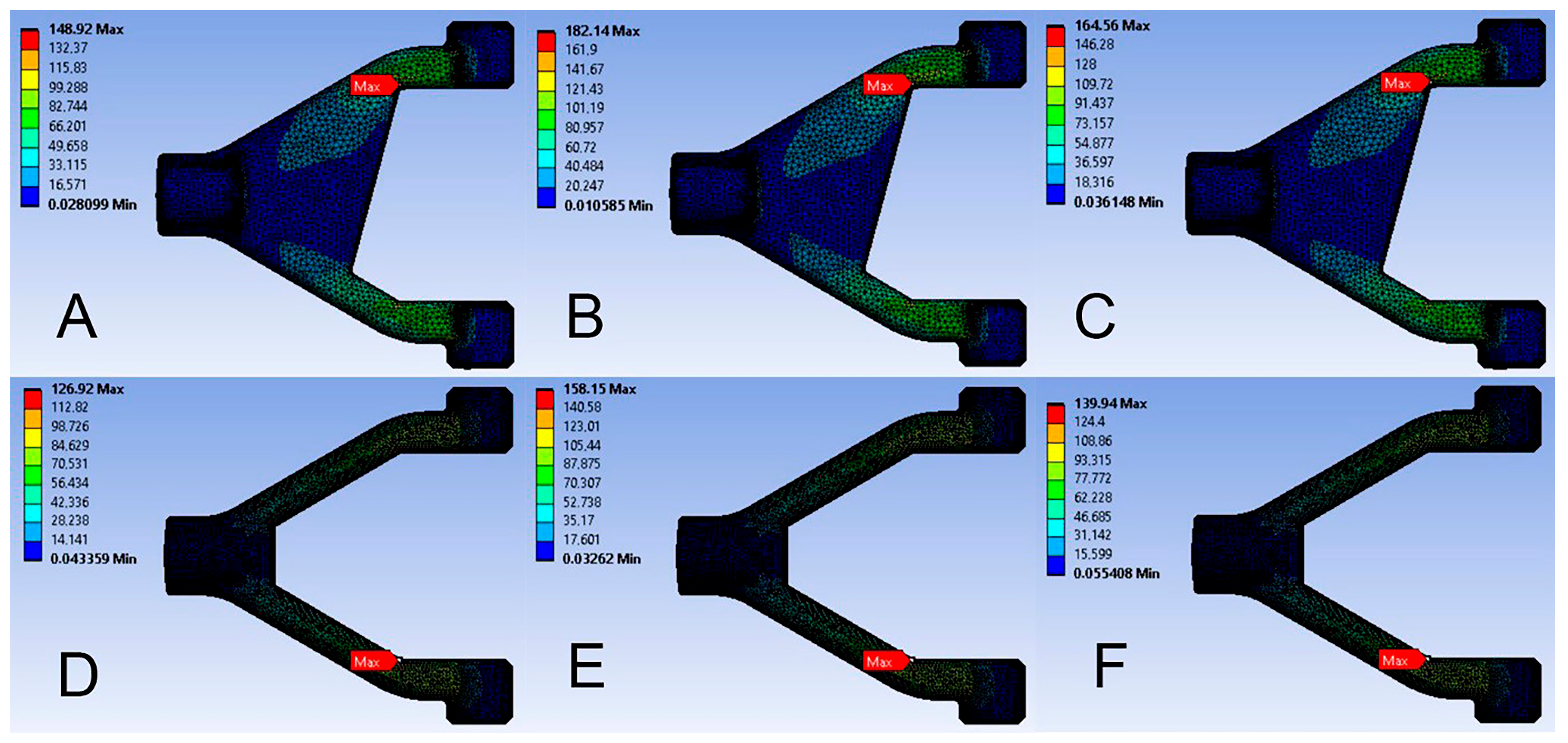
- Optimization was performed for lower von Mises stress, higher natural frequencies, and a more fatigue-safe topology. The emerging part was revised to a smoother geometry, resulting in a 28.5% mass reduction.
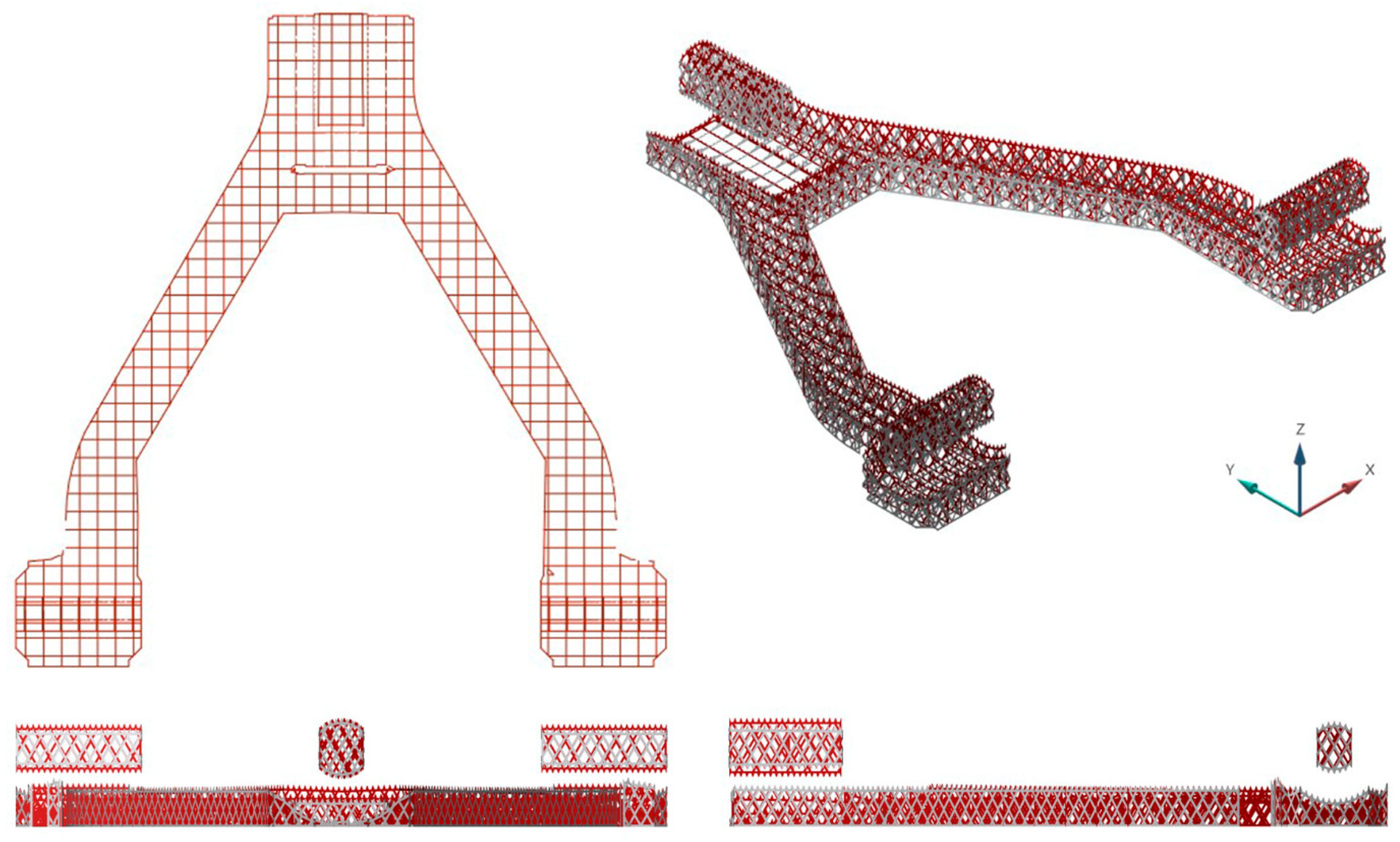
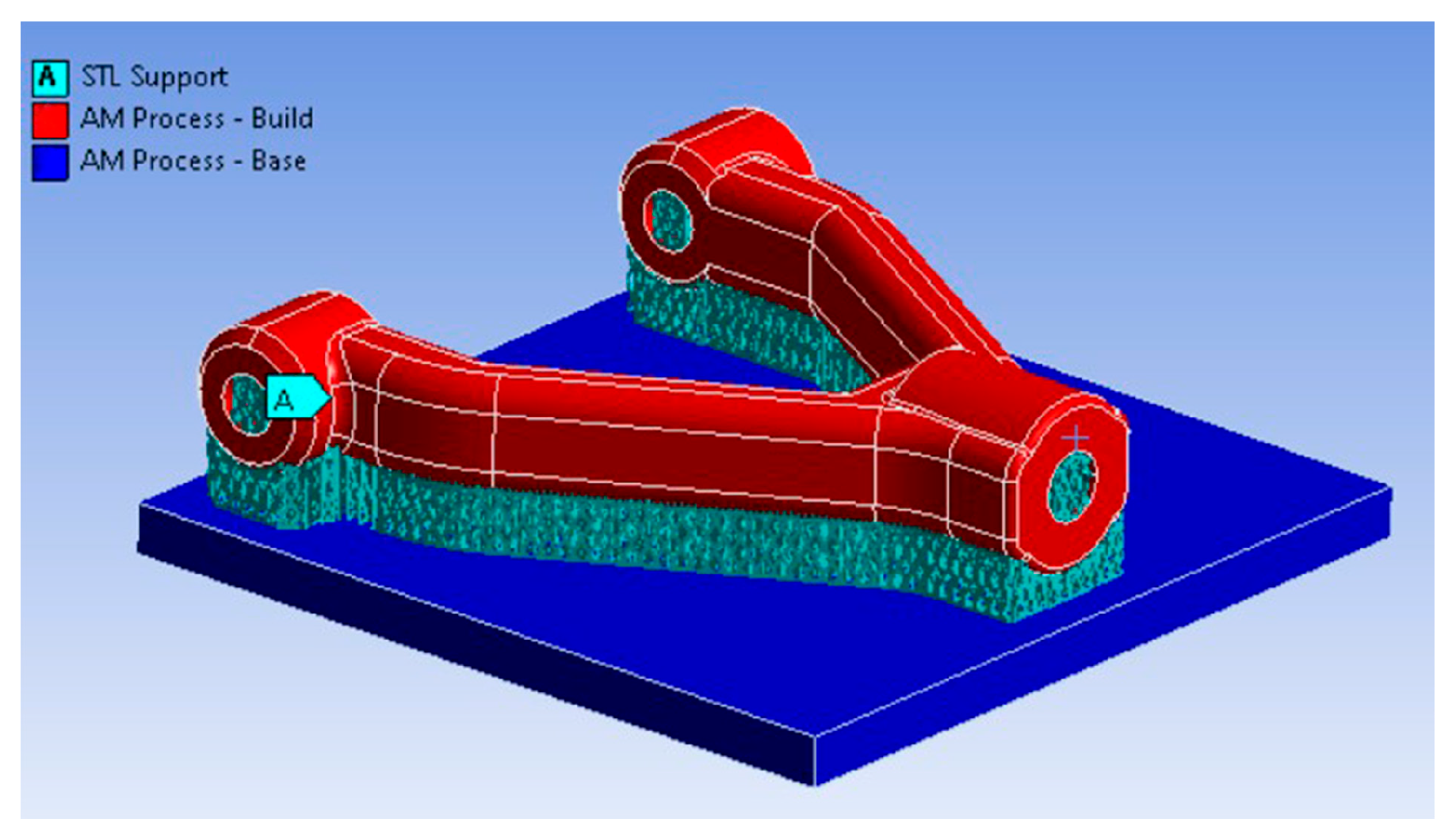
- The production orientation and support structure generation were designed to minimize production time without negatively impacting post-production strength values. By setting the production orientation horizontally along the Z axis and using a 45° overhang angle, the minimum material quantity was achieved. This resulted in a support structure of 204,084 mm3.
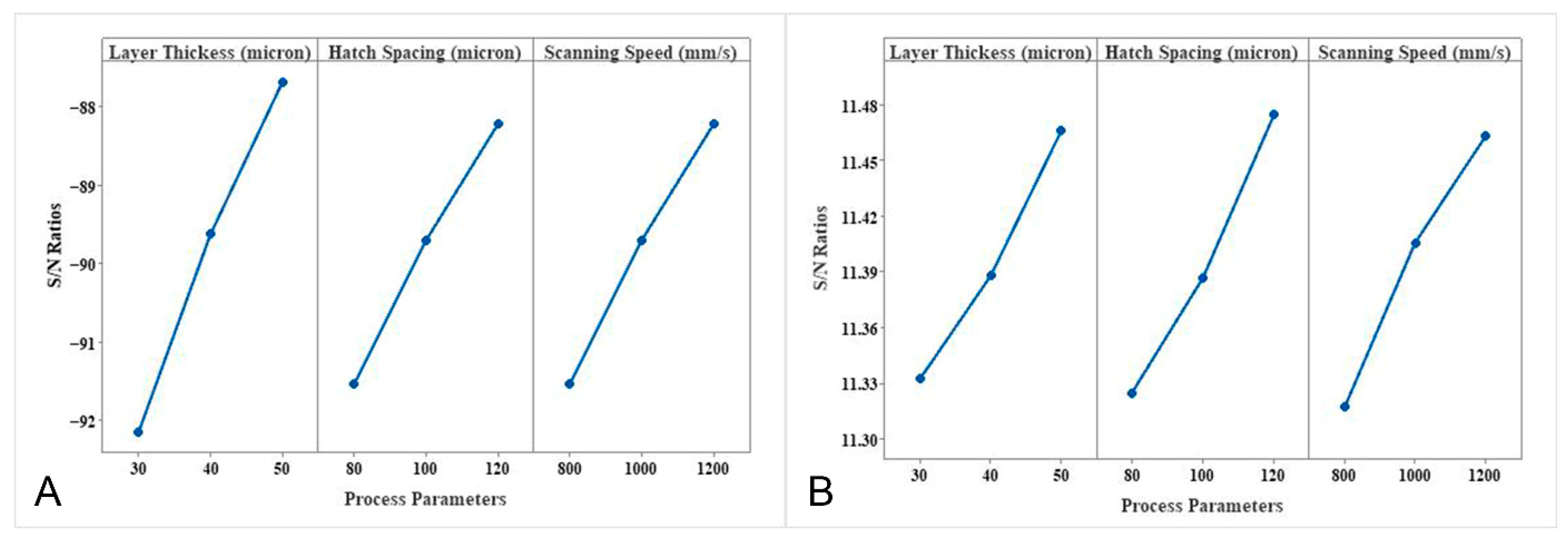
- Process simulations in the framework of DOE were performed using an ANOVA with a 95% confidence level. Taguchi analysis revealed optimum parameters for layer thickness, hatch spacing, and scanning speed as 50 µm, 120 µm, and 1200 mm/s, respectively. The simulation using these parameters yielded a build time and total strain of 16,833 s and 0.25, respectively.
- In the parameter optimization, it was established that the maximum value for all factors produced better results. Nevertheless, employing values exceeding the current three levels could not be considered beneficial for enhancing the results. The parameters, comprising three elements and three levels, were carefully chosen from experimental studies to prevent defects like porous structures and poor surface properties.
Author Contributions
Funding
Data Availability Statement
Conflicts of Interest
References
- Guiggiani, M. The Science of Vehicle Dynamics: Handling, Braking, and Ride of Road and Race Cars; Springer: Berlin/Heidelberg, Germany, 2018. [Google Scholar]
- Rill, G. Road Vehicle Dynamics: Fundamentals and Modeling; CRC Press: Boca Raton, FL, USA, 2011. [Google Scholar]
- Jazar, R.N. Vehicle Dynamics: Theory and Application; Springer: Berlin/Heidelberg, Germany, 2017. [Google Scholar]
- Bastow, D.; Howard, G.; Whitehead, J.P. Car Suspension and Handling; SAE International Warrendale: Warrendale, PA, USA, 2004. [Google Scholar]
- Kharrazi, S.; Augusto, B.; Fröjd, N. Vehicle Dynamics Testing in Motion Based Driving Simulators. Veh. Syst. Dyn. 2020, 58, 92–107. [Google Scholar] [CrossRef]
- Pappalardo, C.M.; Manca, A.G.; Guida, D. A Combined Use of the Multibody System Approach and the Finite Element Analysis for the Structural Redesign and the Topology Optimization of the Latching Component of an Aircraft Hatch Door. IAENG Int. J. Appl. Math. 2021, 51, 175–191. [Google Scholar]
- Patil, R.V.; Lande, P.R.; Reddy, Y.P.; Sahasrabudhe, A.V. Optimization of Three Wheeler Chassis by Linear Static Analysis. Mater. Today Proc. 2017, 4, 8806–8815. [Google Scholar] [CrossRef]
- Bhat, A.; Gupta, V.; Aulakh, S.S.; Elsen, R.S. Generative Design and Analysis of a Double-Wishbone Suspension Assembly: A Methodology for Developing Constraint Oriented Solutions for Optimum Material Distribution. J. Eng. Des. Technol. 2021, 21, 927–942. [Google Scholar] [CrossRef]
- Kulkarni, V.; Jadhav, A.; Basker, P. Finite Element Analysis and Topology Optimization of Lower Arm of Double Wishbone Suspension Using Radioss and Optistruct. Int. J. Sci. Res. 2014, 3, 639–643. [Google Scholar]
- Lin, Y.; Guo, S. Study on Lightweight Optimization of Low Control Arm for Vehicle Suspension Based on Kinematic Envelope Analysis. In Proceedings of the Society of Automotive Engineers (SAE)-China Congress; Springer: Berlin/Heidelberg, Germany, 2017; pp. 467–476. [Google Scholar]
- Shi, C.; Dietrich, S.; Schulze, V. Parameter Optimization and Mechanical Properties of 42CrMo4 Manufactured by Laser Powder Bed Fusion. Int. J. Adv. Manuf. Technol. 2022, 121, 1899–1913. [Google Scholar] [CrossRef]
- Promoppatum, P.; Rollett, A.D. Physics-Based and Phenomenological Plasticity Models for Thermomechanical Simulation in Laser Powder Bed Fusion Additive Manufacturing: A Comprehensive Numerical Comparison. Mater. Des. 2021, 204, 109658. [Google Scholar] [CrossRef]
- Chen, Z.; Surendraarcharyagie, K.; Granland, K.; Chen, C.; Xu, X.; Xiong, Y.; Davies, C.; Tang, Y. Service Oriented Digital Twin for Additive Manufacturing Process. J. Manuf. Syst. 2024, 74, 762–776. [Google Scholar] [CrossRef]
- Gunasegaram, D.R.; Murphy, A.B.; Barnard, A.; DebRoy, T.; Matthews, M.J.; Ladani, L.; Gu, D. Towards Developing Multiscale-Multiphysics Models and Their Surrogates for Digital Twins of Metal Additive Manufacturing. Addit. Manuf. 2021, 46, 102089. [Google Scholar] [CrossRef]
- Ben Amor, S.; Elloumi, N.; Eltaief, A.; Louhichi, B.; Alrasheedi, N.H.; Seibi, A. Digital Twin Implementation in Additive Manufacturing: A Comprehensive Review. Processes 2024, 12, 1062. [Google Scholar] [CrossRef]
- Mohajer, N.; Abdi, H.; Nelson, K.; Nahavandi, S. Vehicle Motion Simulators, a Key Step towards Road Vehicle Dynamics Improvement. Veh. Syst. Dyn. 2015, 53, 1204–1226. [Google Scholar] [CrossRef]
- Shuklinov, S.; Leontiev, D.; Makarov, V.; Verbitskiy, V.; Hubin, A. Theoretical Studies of the Rectilinear Motion of the Axis of the Locked Wheel After Braking the Vehicle on the Uphill. In Proceedings of the Mathematical Modeling and Simulation of Systems (MODS’2020); Shkarlet, S., Morozov, A., Palagin, A., Eds.; Springer International Publishing: Cham, Switzerland, 2021; pp. 69–81. [Google Scholar]
- Akçay, H.; Türkay, S. Influence of Tire Damping on Actively Controlled Quarter-Car Suspensions. J. Vib. Acoust. 2011, 133, 054501. [Google Scholar] [CrossRef]
- Tuan Hung, T. A Simulation Approach to Determine Dynamic Rollover Threshold of a Tractor Semi-Trailer Vehicle during Turning Maneuvers. J. Vib. Eng. Technol. 2024, 12, 63–78. [Google Scholar] [CrossRef]
- Buhairi, M.A.; Foudzi, F.M.; Jamhari, F.I.; Sulong, A.B.; Radzuan, N.A.M.; Muhamad, N.; Mohamed, I.F.; Azman, A.H.; Harun, W.S.W.; Al-Furjan, M.S.H. Review on Volumetric Energy Density: Influence on Morphology and Mechanical Properties of Ti6Al4V Manufactured via Laser Powder Bed Fusion. Prog. Addit. Manuf. 2023, 8, 265–283. [Google Scholar] [CrossRef]
- Sanjaya, Y.; Prabowo, A.R.; Imaduddin, F.; Binti Nordin, N.A. Design and Analysis of Mesh Size Subjected to Wheel Rim Convergence Using Finite Element Method. Procedia Struct. Integr. 2021, 33, 51–58. [Google Scholar] [CrossRef]
- Kyun Sung, M.; Schwerin, M.; Badhe, Y.; Porter, D. Influence of Topology Optimization Parameters on the Mechanical Response of an Additively Manufactured Test Structure. J. Mech. Behav. Biomed. Mater. 2023, 142, 105844. [Google Scholar] [CrossRef]
- Deng, Z.; Liang, Y.; Cheng, G. Discrete Variable Topology Optimization for Maximizing Single/Multiple Natural Frequencies and Frequency Gaps Considering the Topological Constraint. Int. J. Numer. Methods Eng. 2024, 125, e7449. [Google Scholar] [CrossRef]
- Kınacı, B.F.; Botsalı, H.; Özarpa, C.; Esen, İ.; Ahlatçı, H. Investigation of Fatigue Life of Draw Hook Equipment Used in Freight Wagon: Miscellaneous Result. Eng. Fail. Anal. 2024, 155, 107757. [Google Scholar] [CrossRef]
- Bhandari, L.; Gaur, V. A Study on Defect-Induced Fatigue Failures in SLM Ti6Al4V Alloy. Procedia Struct. Integr. 2022, 42, 529–536. [Google Scholar] [CrossRef]
- Parenti, P.; Puccio, D.; Semeraro, Q.; Colosimo, B.M. A Techno-Economic Approach for Decision-Making in Metal Additive Manufacturing: Metal Extrusion versus Single and Multiple Laser Powder Bed Fusion. Prog. Addit. Manuf. 2024, 9, 185–210. [Google Scholar] [CrossRef]
- Qin, Y.; Qi, Q.; Shi, P.; Scott, P.J.; Jiang, X. Automatic Determination of Part Build Orientation for Laser Powder Bed Fusion. Virtual Phys. Prototyp. 2021, 16, 29–49. [Google Scholar] [CrossRef]
- Viale, V.; Stavridis, J.; Salmi, A.; Bondioli, F.; Saboori, A. Optimisation of Downskin Parameters to Produce Metallic Parts via Laser Powder Bed Fusion Process: An Overview. Int. J. Adv. Manuf. Technol. 2022, 123, 2159–2182. [Google Scholar] [CrossRef]
- Javidrad, H.R.; Javidrad, F. Review of State-of-the-Art Research on the Design and Manufacturing of Support Structures for Powder-Bed Fusion Additive Manufacturing. Prog. Addit. Manuf. 2023, 8, 1517–1542. [Google Scholar] [CrossRef]
- Irwin, J.E.; Wang, Q.; Michaleris, P.; Nassar, A.R.; Ren, Y.; Stutzman, C.B. Iterative Simulation-Based Techniques for Control of Laser Powder Bed Fusion Additive Manufacturing. Addit. Manuf. 2021, 46, 102078. [Google Scholar] [CrossRef]
- Abrami, M.B.; Tocci, M.; Obeidi, M.A.; Brabazon, D.; Pola, A. Prediction of Microstructure for AISI316L Steel from Numerical Simulation of Laser Powder Bed Fusion. Met. Mater. Int. 2022, 28, 2735–2746. [Google Scholar] [CrossRef]
- Liang, X.; Hayduke, D.; To, A.C. An Enhanced Layer Lumping Method for Accelerating Simulation of Metal Components Produced by Laser Powder Bed Fusion. Addit. Manuf. 2021, 39, 101881. [Google Scholar] [CrossRef]
- Nagarjun, J.; Senthil Vel, M.; Swaminathan, G.; Saravanakumar, N.; John Rozario Jegaraj, J.; Yoganand, G.; Mastanaiah, P. Effects of High-Temperature Deformation and Welding on Microstructure and Thermomechanical Properties of Ti-6Al-4V. J. Materi Eng. Perform. 2025, 34, 23010–23018. [Google Scholar] [CrossRef]
- Pimenov, D.Y.; Berti, L.F.; Pintaude, G.; Peres, G.X.; Chaurasia, Y.; Khanna, N.; Giasin, K. Influence of Selective Laser Melting Process Parameters on the Surface Integrity of Difficult-to-Cut Alloys: Comprehensive Review and Future Prospects. Int. J. Adv. Manuf. Technol. 2023, 127, 1071–1102. [Google Scholar] [CrossRef]
- Oyesola, M.; Mpofu, K.; Mathe, N.; Fatoba, S.; Hoosain, S.; Daniyan, I. Optimization of Selective Laser Melting Process Parameters for Surface Quality Performance of the Fabricated Ti6Al4V. Int. J. Adv. Manuf. Technol. 2021, 114, 1585–1599. [Google Scholar] [CrossRef]
- Xiao, Z.; Chen, C.; Zhu, H.; Hu, Z.; Nagarajan, B.; Guo, L.; Zeng, X. Study of Residual Stress in Selective Laser Melting of Ti6Al4V. Mater. Des. 2020, 193, 108846. [Google Scholar] [CrossRef]
- Shah, S.W.A.; Ali, S.; Ullah, H.; Saad, M.; Mubashar, A.; Ud Din, E. Material Characterization of Ti6Al4V Alloy Additively Manufactured Using Selective Laser Melting Technique. J. Mater. Res. Technol. 2024, 33, 1756–1763. [Google Scholar] [CrossRef]
- Lu, C.; Shi, J. Simultaneous Consideration of Relative Density, Energy Consumption, and Build Time for Selective Laser Melting of Inconel 718: A Multi-Objective Optimization Study on Process Parameter Selection. J. Clean. Prod. 2022, 369, 133284. [Google Scholar] [CrossRef]
- De Baere, D.; Van Cauwenbergh, P.; Bayat, M.; Mohanty, S.; Thorborg, J.; Thijs, L.; Van Hooreweder, B.; Vanmeensel, K.; Hattel, J.H. Thermo-Mechanical Modelling of Stress Relief Heat Treatments after Laser-Based Powder Bed Fusion. Addit. Manuf. 2021, 38, 101818. [Google Scholar] [CrossRef]
- Mohammadtaheri, H.; Sedaghati, R.; Molavi-Zarandi, M. Inherent Strain Approach to Estimate Residual Stress and Deformation in the Laser Powder Bed Fusion Process for Metal Additive Manufacturing—A State-of-the-Art Review. Int. J. Adv. Manuf. Technol. 2022, 122, 2187–2202. [Google Scholar] [CrossRef]
- Sen, M.; Eryilmaz, O.; Bakir, B. Multi-Objective Process Optimization of Micro-Drilling Parameters on Carbon and Carbon–Aramid (Hybrid) Fabric Composites. Arab. J. Sci. Eng. 2025, 50, 9535–9552. [Google Scholar] [CrossRef]
- Trembach, B.; Grin, A.; Turchanin, M.; Makarenko, N.; Markov, O.; Trembach, I. Application of Taguchi Method and ANOVA Analysis for Optimization of Process Parameters and Exothermic Addition (CuO-Al) Introduction in the Core Filler during Self-Shielded Flux-Cored Arc Welding. Int. J. Adv. Manuf. Technol. 2021, 114, 1099–1118. [Google Scholar] [CrossRef]
- Lin, X.; Lu, R.; Mao, J.; Zhu, K. Machine Learning and Digital Twin Assisted Temperature Prediction during Additive Manufacturing Process. Digit. Twin 2025, 2533863. [Google Scholar] [CrossRef]
- Alvares, A.J.; Rodriguez, E.; Figueroa, B. Digital-Twin-Enabled Process Monitoring for a Robotic Additive Manufacturing Cell Using Wire-Based Laser Metal Deposition. Processes 2025, 13, 2335. [Google Scholar] [CrossRef]
- Malik, A.W.; Mahmood, M.A.; Liou, F. Digital Twin–Driven Optimization of Laser Powder Bed Fusion Processes: A Focus on Lack-of-Fusion Defects. Rapid Prototyp. J. 2024, 30, 1977–1988. [Google Scholar] [CrossRef]
- Liravi, F.; Soo, S.; Toorandaz, S.; Taherkhani, K.; Habibnejad-Korayem, M.; Toyserkani, E. Tailoring Laser Powder Bed Fusion Process Parameters for Standard and Off-Size Ti6Al4V Metal Powders: A Machine Learning Approach Enhanced by Photodiode-Based Melt Pool Monitoring. Inventions 2024, 9, 87. [Google Scholar] [CrossRef]
- Martins Freitas, B.J.; Yuuki Koga, G.; Arneitz, S.; Bolfarini, C.; de Traglia Amancio-Filho, S. Optimizing LPBF-Parameters by Box-Behnken Design for Printing Crack-Free and Dense High-Boron Alloyed Stainless Steel Parts. Addit. Manuf. Lett. 2024, 9, 100206. [Google Scholar] [CrossRef]
- Qin, Y.; Lou, S.; Shi, P.; Qi, Q.; Zeng, W.; Scott, P.J.; Jiang, X. Optimisation of Process Parameters for Improving Surface Quality in Laser Powder Bed Fusion. Int. J. Adv. Manuf. Technol. 2024, 130, 2833–2845. [Google Scholar] [CrossRef]




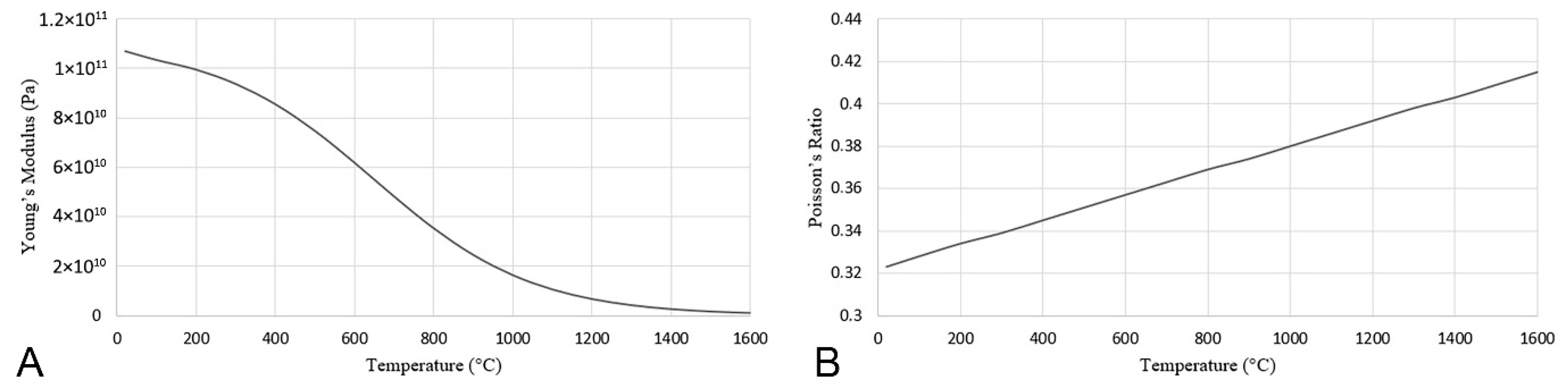


| Young’s Modulus | Poisson’s Ratio | Yield Strength | Tensile Strength |
|---|---|---|---|
| 107 GPa | 0.323 | 1098 MPa | 1200 MPa |
| Mode | Frequency (Hz) | |
|---|---|---|
| Non-Optimized Model | Optimized Model | |
| 1 | 396.27 | 406.92 |
| 2 | 1547.10 | 1276.50 |
| 3 | 1998.60 | 1896.70 |
| 4 | 2190.80 | 2310.70 |
| 5 | 2868.70 | 3083.30 |
| 6 | 3415.20 | 3203.00 |
| Level | Layer Thickness (Micron) | Hatch Spacing (Micron) | Scanning Speed (mm/s) |
|---|---|---|---|
| Level 1 | 30 | 80 | 800 |
| Level 2 | 40 | 100 | 1000 |
| Level 3 | 50 | 120 | 1200 |
| Runs | Layer Thickness (Micron) | Hatch Spacing (Micron) | Scanning Speed (mm/s) |
|---|---|---|---|
| 1 | 30 | 80 | 800 |
| 2 | 30 | 100 | 1000 |
| 3 | 30 | 120 | 1200 |
| 4 | 40 | 80 | 1000 |
| 5 | 40 | 100 | 1200 |
| 6 | 40 | 120 | 800 |
| 7 | 50 | 80 | 1200 |
| 8 | 50 | 100 | 800 |
| 9 | 50 | 120 | 1000 |
Disclaimer/Publisher’s Note: The statements, opinions and data contained in all publications are solely those of the individual author(s) and contributor(s) and not of MDPI and/or the editor(s). MDPI and/or the editor(s) disclaim responsibility for any injury to people or property resulting from any ideas, methods, instructions or products referred to in the content. |
© 2026 by the authors. Licensee MDPI, Basel, Switzerland. This article is an open access article distributed under the terms and conditions of the Creative Commons Attribution (CC BY) license.
Share and Cite
Botsalı, H.; Özarpa, C. Optimization of the Design and Manufacturing Processes for Metal Additive Manufacturing Through Digital Twin. Processes 2026, 14, 571. https://doi.org/10.3390/pr14030571
Botsalı H, Özarpa C. Optimization of the Design and Manufacturing Processes for Metal Additive Manufacturing Through Digital Twin. Processes. 2026; 14(3):571. https://doi.org/10.3390/pr14030571
Chicago/Turabian StyleBotsalı, Hüseyin, and Cevat Özarpa. 2026. "Optimization of the Design and Manufacturing Processes for Metal Additive Manufacturing Through Digital Twin" Processes 14, no. 3: 571. https://doi.org/10.3390/pr14030571
APA StyleBotsalı, H., & Özarpa, C. (2026). Optimization of the Design and Manufacturing Processes for Metal Additive Manufacturing Through Digital Twin. Processes, 14(3), 571. https://doi.org/10.3390/pr14030571