


Abstract
Acid mine drainage (AMD) and acid-generating mine wastes exhibit low pH, high sulfate levels, and complex multi-metal loads that strain conventional treatment. Thermoacidophilic red algae of the order Cyanidiales, particularly Galdieria sulphuraria (G. sulphuraria), have attracted interest as a biological option because they tolerate extreme acidity and elevated temperatures, grow under low light in mixotrophic or heterotrophic modes, and display rapid metal binding at the cell surface. This review synthesizes about two decades of peer-reviewed work to clarify how G. sulphuraria can be deployed as a practical module within mine water treatment trains. We examine the mechanisms of biosorption and bioaccumulation and show how they map onto two distinct configurations. Processed freeze-dried biomass functions as a regenerable sorbent for rare earth elements (REEs) and selected transition metals in packed beds with acid elution for recovery. Living cultures serve as polishing units for divalent metals and, when present, nutrients or dissolved organics under low light. We define realistic operating windows centered on pH 2–5 and temperatures of approximately 25–45 °C, and we identify matrix effects that govern success, including competition from ferric iron and aluminum, turbidity and fouling risks, ionic strength from sulfate, and suppression of REE uptake by phosphate in living systems. Building on laboratory studies, industrial leachate tests, and ecosystem observations, we propose placing G. sulphuraria upstream of bulk neutralization and outline reporting practices that enable cross-site comparison. The goal is an actionable framework that reduces reagent use and sludge generation while enabling metal capture and potential recovery of valuable metals from mine-influenced waters.
1. Introduction
AMD and acid-generating mine wastes persist as some of the most difficult legacies of resource extraction because they combine strong acidity with complex, evolving mixtures of dissolved metals and sulfate that respond to changing hydrology, redox conditions, temperatures, and mineral surfaces across space and time [1]. In typical field settings, these waters exhibit pH values below 4, ionic strengths far above those of most natural freshwaters, and substantial concentrations of ferric iron and aluminum, whose hydrolysis products control both speciation and particle formation as the water mixes and ages. They set the boundary conditions that determine which reactions are feasible, which materials foul rapidly, which organisms can function, and how much chemical addition is needed to meet discharge standards. In the conventional active approach, operators add alkalinity, oxidants, and coagulants to force precipitation, then settle and dewater the resulting solids. The method is robust and very familiar, but it requires ongoing purchase and transport of reagents, generates large volumes of metal-rich sludges, and tends to dissipate potentially valuable solutes that might otherwise be recovered if captured in a more selective way [1,2,3]. Passive systems, such as anoxic limestone drains and planted wetlands, reduce operational intensity but require large footprints, are sensitive to loading fluctuations and temperature swings, and have limited ability to concentrate metals in recoverable forms. On many sites, therefore, the overall objective is not only compliance but also the reduction in chemical use and waste volumes while preserving options for resource recovery when the chemistry allows [2,3].
These realities have motivated renewed attention to metal capture and polishing steps that can operate on the acid side of the treatment train before wholesale neutralization. If even a portion of the most problematic or most valuable metals can be removed while the stream remains acidic, downstream alkali dosing can be reduced, hydroxide sludge generation can be minimized, and the recovered metals can be managed as a concentrated eluate rather than a diffuse mixture trapped in bulk precipitate. Selective acidic capture modules, such as those based on G. sulphuraria, can remove problematic or valuable metals upstream, improving overall treatment efficiency while complementing, rather than replacing, bulk neutralization. Comparative technology assessments and sustainability-oriented reviews increasingly frame treatment choices in this integrative fashion, linking chemistry to cost, logistics, and life-cycle impacts and emphasizing hybrid trains in which targeted capture precedes bulk pH adjustments [4,5,6]. Within this broad search for acid-tolerant biological options, thermoacidophilic red algae of the order Cyanidiales, particularly G. sulphuraria, have emerged as unusual candidates that deserve careful process-level study. G. sulphuraria tolerates very low pH and elevated temperatures; it can grow under limited illumination in mixotrophic and heterotrophic modes, and it exhibits surface chemistries that rapidly bind many metals, even in acidic matrices [7,8]. These traits align with the need to operate in turbid, iron-rich waters where conventional freshwater algae struggle, and they suggest that an algal unit can be placed to capture solutes before they are partitioned into neutralization sludges.
The purpose of this review is to synthesize approximately two decades of peer-reviewed work on G. sulphuraria-based remediation relevant to AMD and to translate that evidence into process windows, configuration choices, and practical guidance for engineers and scientists planning pilot studies or scale-up. The review progresses from the hydrochemistry and ecology that define AMD, through the cellular and surface-level mechanisms by which G. sulphuraria interacts with metals and nutrients, and finally to an evidence landscape spanning model solutions, complex industrial leachates, and mine-related suspensions [1,2,3]. The emphasis is on actionable design questions: where in the treatment train a G. sulphuraria module should be placed; which pH and temperature windows are realistic under field conditions; when living cultures should be favored versus when processed biomasses provide superior performance; how ion competition, phosphate availability and iron colloids influence removal efficiency and hydraulic behavior; and how regeneration should be carried out, including what preliminary sustainability analyses imply for overall life-cycle performance. By organizing the literature around these decisions rather than solely on organismal cataloging, the review seeks to connect laboratory evidence to field realities, thereby shortening the path to informative pilot studies and enabling transparent comparisons with conventional baselines [4,5,9,10,11].
2. Acid Mine Drainage Context and Rationale for G. sulphuraria
AMD forms when sulfide minerals such as pyrite and pyrrhotite are exposed to oxygenated water during mining, waste handling, and post-closure weathering. The resulting oxidation reactions generate sulfuric acid and release ferrous iron, which can be further oxidized to ferric iron, that, in turn, hydrolyzes and precipitates amorphous oxyhydroxides as pH rises slightly during mixing with other waters [1,12]. The same cycles of oxidation and hydrolysis also control the mobility of many trace metals and metalloids, which are either co-released from mineral matrices or subsequently complexed by sulfate and other ligands. At many discharge points, untreated AMD remains highly acidic and metal-rich, conditions that severely constrain biological treatment options [3,12]. High proton activity and ionic strength further suppress electrostatic binding mechanisms relied upon by many conventional biosorbents [13]. In addition, ferric iron and aluminum form fine particles that increase turbidity, coat surfaces, and reduce light penetration through even shallow water columns [1,3]. These constraints eliminate most biological treatment systems from consideration at the acid side of treatment trains. As a result, only organisms capable of functioning under low light, high turbidity, and strong metal competition are viable candidates. For these reasons, it is more realistic to use biological options as polishing or recovery modules that target specific solutes than as primary neutralizers that are asked to carry the full compliance burden [12,14].
The physiological traits of G. sulphuraria align with untreated AMD conditions, enabling survival and metal interaction where conventional microorganisms fail [7,10]. The cell envelope contains functional groups that bind cations, and the organism has repeatedly been shown to remove divalent metals such as cadmium, lead, nickel, and zinc from acidic matrices [15,16,17]. Importantly, multiple groups have documented a strong affinity of G. sulphuraria for selected REE and have demonstrated fast uptake and regenerability when the biomass is used in processed form [14]. These capabilities naturally translate into two complementary roles in acidic treatment sequences, depending on whether the biomass is used live or processed. The processed G. sulphuraria biomass is most suitable for REE recovery in packed-bed systems, whereas living cultures act as polishing units for divalent metals and nutrients [14,15,18]. Further discussion of these biomass-specific roles is provided in the following section.
From a material and energy perspective, early-stage metal capture can improve overall treatment efficiency. Within the acid-side capture framework outlined above, early removal of specific metals modifies downstream material balances rather than replacing neutralization. The relevance of G. sulphuraria lies in its ability to function as a selective upstream module under acidic conditions [4,12,19]. Early sustainability assessments of acid-adapted microalgal systems suggest that when chemical consumption and sludge management dominate environmental burdens, an acid-side selective capture unit can lower the embodied energy and carbon footprint of the overall train [5,12]. These benefits do not hold automatically. They depend on matching biological capability to the actual chemistry of the water; on controlling iron particulates that foul surfaces and shade cultures; on managing phosphate, which suppresses REE sorption by living cells; and on choosing reactor configurations that align with the kinetics and hydraulics documented in the literature. For these reasons, a mechanistic treatment is needed to relate cellular behavior and surface chemistry to unit operation choices and to clearly defined operating windows [4,13,20].
3. Mechanisms of Removal and Implications for Reactor Design
Removal of metals by G. sulphuraria in acidic matrices proceeds through two broad classes of processes whose relative contributions depend on metal identity, the physiological state of the biomass, and the surrounding aqueous chemistry [15]. The first class is biosorption, which is the non-metabolic binding of metal cations to functional groups located on the cell wall and associated extracellular polymeric substances. In G. sulphuraria, these binding sites include carboxyl, phosphoryl, hydroxyl, amine, amide, sulfhydryl, and carbonyl moieties associated with polysaccharides, proteins, and glycoproteins. Different metals exhibit preferential affinities for specific groups: divalent cations such as Cd2+ and Pb2+ bind primarily to carboxyl and sulfhydryl groups via ion exchange and surface complexation, whereas trivalent REEs such as Y3+, Ce3+, and Eu3+ coordinate preferentially with phosphoryl and carboxyl groups, forming strong inner-sphere complexes [16,17]. Relative binding preference can be expressed by conditional stability constants (log K); for example, Cd2+ binds to carboxyl groups with log K ≈ 3–5, Pb2+ ≈ 5–6, and REE–phosphate interactions typically exhibit higher log K values (≈6–9). These higher stability constants indicate a thermodynamic preference of REEs for phosphate-rich binding sites under moderately acidic conditions. However, the overall biosorption capacity is primarily governed by the abundance and accessibility of these functional groups rather than binding strength alone [15,16,17,21,22].
Metal retention occurs through a combination of ion exchange, inner- and outer-sphere surface complexation, chelation, and localized micro-precipitation at the biomass–solution interface [23]. The availability and strength of these interactions are controlled by pH and ionic strength through their influence on functional-group protonation and metal activity [24]. Aqueous speciation further governs biosorption efficiency: at low pH, extensive protonation of functional groups reduces electrostatic binding; high sulfate or phosphate concentrations sequester metals as soluble or insoluble complexes (e.g., REE–SO4 or REE–PO4), limiting free-ion availability; and ferric iron competes for surface sites and promotes colloid formation, which can foul biosorbents [8,11,14,15,16,17,21]. Geochemical modeling tools such as PHREEQC, Visual MINTEQ, and surface complexation models are therefore essential for distinguishing true surface binding from coincident precipitation and for defining chemically feasible operating windows [15,16,17,21].
Biosorption is typically rapid and often approaches equilibrium within minutes to a few hours, depending on metal identity, biomass dose, and solution chemistry. Because it does not require metabolism, it is robust to short-term environmental fluctuations and survives processing steps that preserve structural integrity while eliminating cellular activity [15,16,17]. This explains why freeze-dried G. sulphuraria biomass functions as a reproducible sorbent material that can be packed into fixed beds and regenerated repeatedly without loss of performance [21]. For divalent transition metals such as cadmium and lead, early-time removal is dominated by rapid surface complexation and ion-exchange reactions, scaling with available surface area and biomass loading. Increasing pH enhances removal primarily through deprotonation of surface functional groups, which increases the density of negatively charged binding sites. However, at higher pH values, aqueous metal speciation may shift toward hydrolyzed or precipitated forms, potentially reducing the activity of free Cd2+ and Pb2+ [14,15,20,25].
The second class of processes is bioaccumulation, which requires active transport across the plasma membrane followed by intracellular sequestration. Bioaccumulation is slower than biosorption because it is constrained by membrane transport kinetics and cellular metabolic state, and it becomes important only in living cultures operated at longer contact times [7,21]. Once internalized, metals are detoxified through a combination of compartmentalization and biochemical chelation. Acidophilic algae such as G. sulphuraria sequester metals within vacuoles and other organelles and synthesize intracellular ligands, including metallothioneins, phytochelatins, and glutathione, to maintain low cytosolic free-ion activity [8]. Active efflux systems further regulate intracellular concentrations by exporting non-essential or toxic cations back into the extracellular environment. These mechanisms enable survival under elevated metal loads and support polishing applications where extended operation allows continued uptake beyond the initial biosorption phase [15,16,17]. The balance between biosorption and bioaccumulation therefore functions as a design lever selected according to water chemistry, residence time, and performance objectives.
The case of REE illustrates why the choice between living cultures and processed biomass is consequential, and why matrix composition should be explicitly considered. Multiple laboratories report that freeze-dried G. sulphuraria biomass binds elements such as Yttrium, Cerium, and Europium. Removal is strong between about pH 2.5 and 4.5, and capacity can be regenerated repeatedly with acid rinses that produce metal-rich eluates [22]. These properties make the processed material well-suited for fixed-bed operation and for recovery-oriented flowsheets that mirror ion-exchange logic while remaining compatible with acidic matrices. In contrast, living cells often bind REEs weakly at very low pH, and the presence of phosphate in the water sharply depresses sorption, likely through competition for sites or through precipitation and complexation reactions that limit bioavailability [17]. Uptake by living cells improves markedly as pH approaches 5 under phosphate-free conditions, but such conditions are not representative of raw AMD. The practical conclusion is that processed G. sulphuraria biomass should be the default chassis for REE capture in acidic waters, while living cells may be considered only when the site can operate near pH 5 with explicit phosphate control or when the goal is not recovery but rather general polishing of co-contaminants [20,22].
In acidic, multi-metal matrices, solution chemistry does not merely influence uptake efficiency but directly determines which biosorption configurations are viable. Rather than functioning as tunable variables, parameters such as acidity, competing anions, and iron and aluminum loading act as boundary conditions that select between living-culture and processed-biomass implementations [17,20]. Where the objective is recovery of REEs or other high-value metals under acidic conditions, the literature consistently supports the use of processed G. sulphuraria biomass in packed or fixed-bed systems, coupled with upstream iron management and downstream regeneration [11,20]. Conversely, applications targeting polishing of divalent metals or nutrients favor living cultures operated at longer residence times, provided that hydraulic fouling and light attenuation are controlled [7,8]. These configuration-level distinctions arise from the differing balances between rapid surface-mediated binding and slower metabolically driven uptake, rather than from organismal tolerance alone.
4. Evidence Base for G. sulphuraria in Acidic Matrices
In natural ecosystems, G. sulphuraria is often abundant and sometimes dominant among phototrophs in acidic geothermal habitats. These include hot, sulfur-rich springs, acidic soils, fumarolic zones, volcanic terrains, and anthropogenically disturbed acidic sites such as AMD areas or burning coal spoil heaps [26]. In such locations, it frequently forms conspicuous deep blue-green biomats on surrounding rocks and sediment surfaces. Field dominance of G. sulphuraria in acidic geothermal and mine-impacted habitats demonstrates that the physiological traits outlined above translate into sustained activity under combined thermal, acidic, and metal stress [7,17]. Laboratory studies mirror these ecological observations. Axenic cultures of multiple G. sulphuraria strains, including G. sulphuraria 074W, CCMEE 5587.1, and both diploid and cell-wall–less haploid forms of G. partita, are routinely maintained in media acidified to pH 1.0–2.5 using sulfuric acid [21]. These conditions not only support optimal growth but also prevent contamination by less acid-tolerant microbes, highlighting a bioprocessing advantage inherent to this genus. The newly identified haploid state of G. partita, for example, is cultivated at pH 1.0 specifically to suppress self-diploidization, demonstrating both experimental tractability and physiological resilience [9].
This resilience under extreme conditions supports its use for REE recovery and phycoremediation in AMD-relevant waste streams. This physiological resilience reflects adaptation to extreme environments, including sulfur springs, where high metal loads and low pH prevail [15,20]. Consequently, G. sulphuraria has been widely investigated for phycoremediation and resource recovery applications. Multiple studies have demonstrated that living cells or freeze-dried biomass of G. sulphuraria can biosorb or bioaccumulate metal ions such as Cd(II), Pb(II), Ni(II), and Zn(II) under strongly acidic conditions, typically at pH 1.5–2.5. For example, living cells of the extremophilic strain G. sulphuraria CCMEE 5587.1 grown in Cyanidium medium at pH 2.5 were shown to tolerate and remove Cd and Pb in both single- and mixed-metal systems, while another Cd removal study employed cultures maintained at an initial pH of 1.5 adjusted using sulfuric acid [11,15,16,17]. Notably, G. sulphuraria has been reported to remove more than 90% of REEs from dilute acidic solutions [19], and biosorption experiments using freeze-dried biomass have been conducted at pH 2.5 and 4.5. In some cases, increased cellular association of lanthanoids has been observed at even lower pH (1.0–1.5), whereas the absence of La(III) biosorption at pH 1.5 under nutrient-replete conditions suggests regulatory constraints on metal binding at extreme acidity [22].
Although G. sulphuraria is often discussed as a single functional entity, reported remediation performance varies substantially across strains, even under broadly similar experimental conditions [7,16]. For example, cadmium and lead removal efficiencies differ by factors of two to four among strains such as CCMEE 5587.1, IPPAS P-513, and related isolates [15,16,17], and REE uptake reported for early sulfothermophilic strains at pH 1.5–2.5 has not been consistently reproduced in later studies using strains such as SAG 21.92, where uptake improved only at higher pH [20,21]. These discrepancies indicate that while extremophilic tolerance is conserved at the species level, quantitative performance metrics, including metal uptake capacity, removal efficiency, and pH optima, are strongly strain-dependent and sensitive to cultivation history and physiological state [7,10]. Accordingly, results reported in the literature should be interpreted as strain-specific unless validated across multiple isolates under comparable conditions [15,16,20].
To contextualize reported performance across heterogeneous experimental conditions, biosorption by G. sulphuraria must be interpreted against the extreme ionic competition characteristic of AMD-relevant matrices [27]. In typical AMD and industrial acidic leachates, target REEs are present at sub-mg L−1 levels, whereas competing major cations such as Fe3+, Al3+, Mn2+, Ca2+, and Mg2+ frequently occur at concentrations that are 102–104 times higher. Under these conditions, proton activity represents the dominant competitor for surface binding sites. Consistent with this constraint, total REE uptake in quaternary systems (Y, Ce, Eu, Tb) increased from approximately 850 ± 92 µmol g−1 (120.9 mg g−1) dry biomass at pH 2.5 to 1441 ± 137 µmol g−1 (210.7 mg g−1) at pH 4.5 (Table 1), demonstrating the quantitative suppression of biosorption by H+ at lower pH. Within the same multi-metal systems and identical solution conditions, individual REE uptake followed a consistent order (Tb > Eu > Ce > Y), indicating preferential binding of heavier lanthanides despite overwhelming background competition [22,28].
Table 1.
Biosorption capacities reported for G. sulphuraria under acidic conditions.
In complex matrices such as spent fluorescent lamp leachates, total metal recovery reached 41.6 mg g−1, with yttrium accounting for 82.9% of the recovered REE mass, diverging from its higher fractional abundance in the source solution. This divergence confirms that uptake does not simply mirror solution composition but reflects differential affinity under competitive loading. Capacities reported for precious and heavy metals span a wider range (Table 1), reflecting differences in oxidation state, speciation, and competition; nevertheless, measurable uptake persists even under highly acidic, sulfate-rich conditions [14]. In this review, selectivity is therefore discussed in terms of relative uptake preferences observed within multi-metal systems under identical chemical conditions, rather than formal selectivity coefficients or separation factors, which are not consistently reported across the primary literature.
Furthermore, G. sulphuraria exhibits notable metal selectivity; for instance, preferential adsorption of Au from a 2 M HCl solution in the presence of competing metals has been reported, highlighting a nuanced interplay between pH, physiological state, and metal-binding pathways that underpins its promise for REE recovery in harsh acidic environments [20,22]. Comparative analyses further underscore the suitability of G. sulphuraria for acidic matrices. While green algae used for metal removal typically require near-neutral pH, G. sulphuraria maintains viability and metal uptake at pH values that inhibit or denature most microorganisms. This confers a major operational advantage: biological metal recovery or AMD remediation can occur without neutralization steps, potentially reducing costs and minimizing secondary chemical waste [16].
Overall, the ecological distribution, physiological extremophile, and demonstrated performance of G. sulphuraria in both natural and engineered acidic environments provide a strong evidence base for its use as a biological tool in acidic matrices [22]. Functionally, the alga acts as a specialized cleanup system, one particularly adapted to highly corrosive conditions, capable of performing bioremediation and metal recovery in settings where conventional biological agents cannot survive.
5. Process-Window Map and Matrix Effects
In biosorption research with G. sulphuraria, process-window mapping identifies the physicochemical conditions under which REE recovery is feasible, reproducible, and scalable [14]. While G. sulphuraria tolerates extreme acidity, the effective operational window for REE biosorption is narrower than the organism’s physiological growth limits, being constrained primarily by solution chemistry [20,21].
Phosphate concentration is a key boundary condition. At environmentally relevant levels, lanthanides precipitate as sparingly soluble phosphates above pH ~2–3, removing REEs from solution and making them unavailable for biological uptake. This creates a fundamental trade-off: phosphate is essential for metabolism but must be limited during biosorption. Consequently, living G. sulphuraria is most effective in phosphate-limited or phosphate-free systems, whereas non-living biomass can still adsorb REEs via surface-mediated interactions [20].
pH defines a second critical axis. While G. sulphuraria thrives under highly acidic conditions, optimal REE biosorption occurs at mildly acidic to subneutral pH. Experiments with living cultures showed that increasing pH from 1.5–2.5 to ~5.0 under phosphate-free conditions increased REE uptake by up to 24-fold, whereas no lanthanum biosorption occurred at pH 1.5 under any growth condition. These results indicate that mineral chemistry and aqueous speciation, rather than biological tolerance alone, determine the effective biosorption regime [14,20].
Operational parameters such as biosorbent dosage and contact time further refine the usable process window. Studies using freeze-dried G. sulphuraria biomass for REE recovery from luminophore wastes identified effective ranges of 0.5–5 mg mL−1 biomass and 5–60 min contact time. Across these systems, the highest uptake capacities were consistently observed at lower biomass dosages. Higher concentrations reduced uptake efficiency, likely due to aggregation of binding sites and diffusional limitations, a trend also seen with living cultures [14]. Among all variables, solution pH exerted the strongest control over adsorption performance by influencing both biosorbent surface charge and REE speciation, with optimal removal typically near pH 4.5 [14,21].
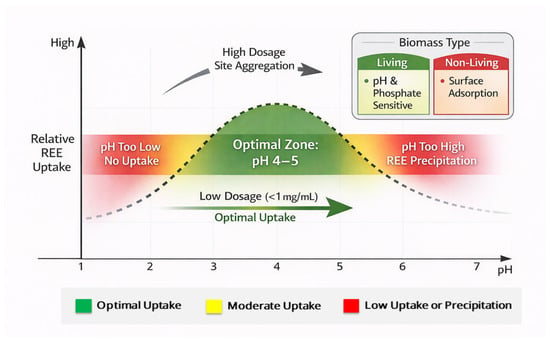
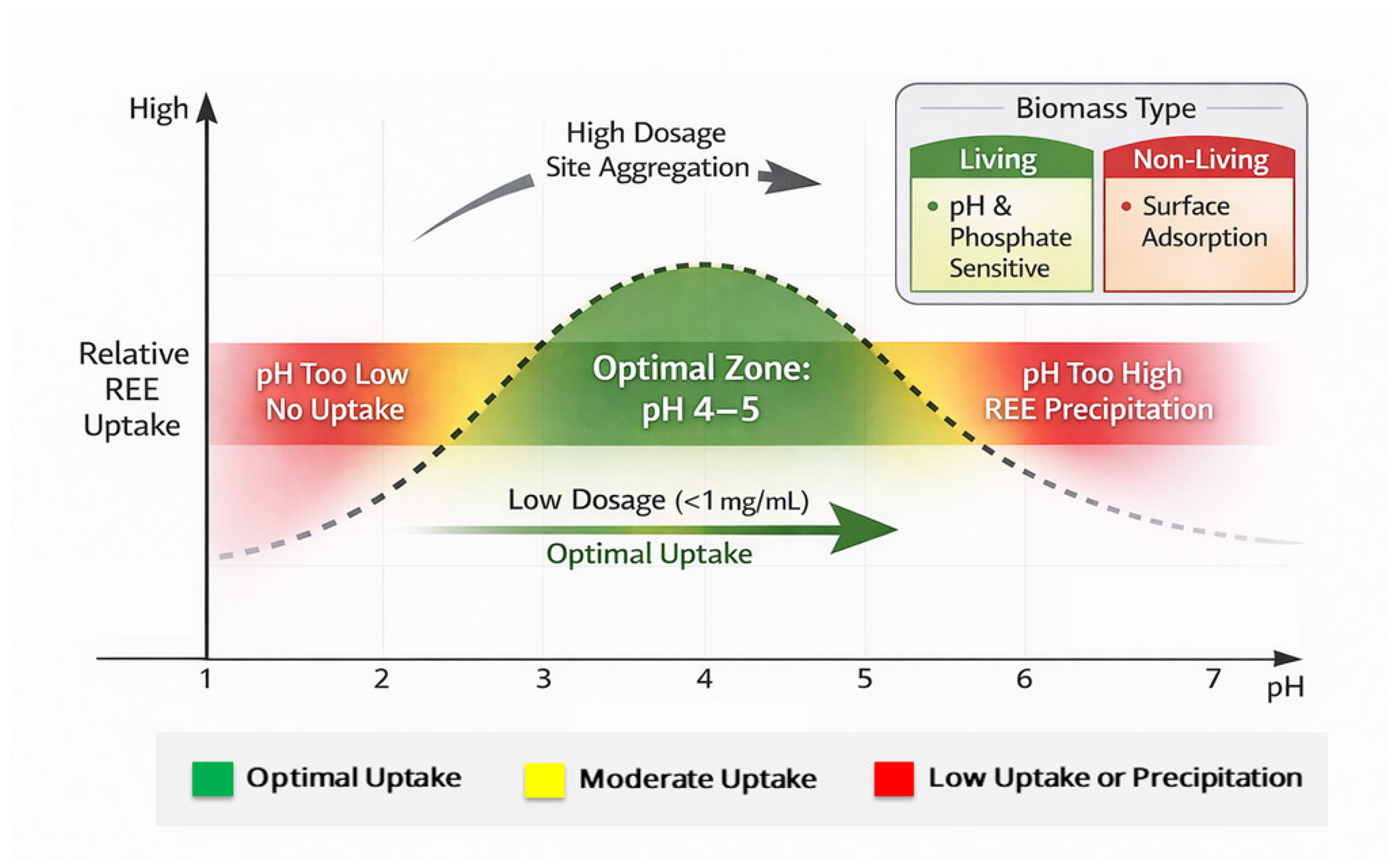
Taken together, the literature defines a constrained but actionable process window for REE biosorption using G. sulphuraria: mildly acidic to subneutral pH (~4–5), phosphate-limited or phosphate-free solutions, moderate ionic strength with stabilizing ligands, low biosorbent dosages (<1 mg mL−1), and short contact times (≤60 min). Outside this window, chemical speciation and precipitation dominate, limiting the contribution of biological uptake. The key relationships between pH, phosphate availability, biosorbent dosage, contact time, and the distinction between living and non-living biomass performance are summarized in Figure 1, providing a visual process-window map for effective REE recovery.
Figure 1.
Process-window map for REE biosorption with G. sulphuraria.
6. Treatment-Train Placement and Reactor Choices
Effective remediation of AMD relies on the deliberate sequencing of treatment units under acidic, metal-loaded influent conditions. No single reactor accommodates the full transition from strongly acidic, metal-rich influent to compliant discharge; instead, treatment trains progressively transform water chemistry while minimizing reagent consumption, sludge generation, and operational risk [2,29]. Consistent with established AMD treatment logic, metal-removal units are most effective prior to bulk pH adjustment. Competing ions and colloid-forming species impose well-established chemical constraints on upstream metal-capture units [11,12,13,20]. This compatibility with acidic influent enables placement upstream of neutralization units, maximizing recovery of REEs before precipitation into hydroxide sludges [4,5,11,13].
In typical AMD treatment trains, highly acidic influent is routed through units that generate alkalinity or manage iron and aluminum loads, such as open limestone channels (OLCs), anoxic limestone drains (ALDs), limestone leach beds (LLBs), and vertical flow wetlands (VFWs) [2,30,31,32]. As pH rises and redox conditions evolve, aerobic wetlands and manganese removal beds provide final polishing under near-neutral conditions [33]. Assuming upstream deployment prior to bulk neutralization, G. sulphuraria modules can be integrated into AMD treatment trains without disrupting established alkalinity-generation and polishing sequences [11,13].
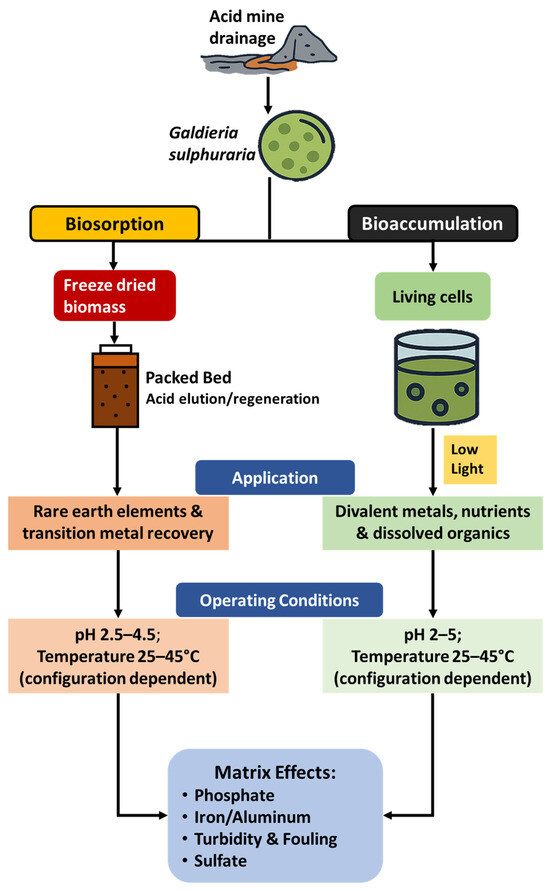
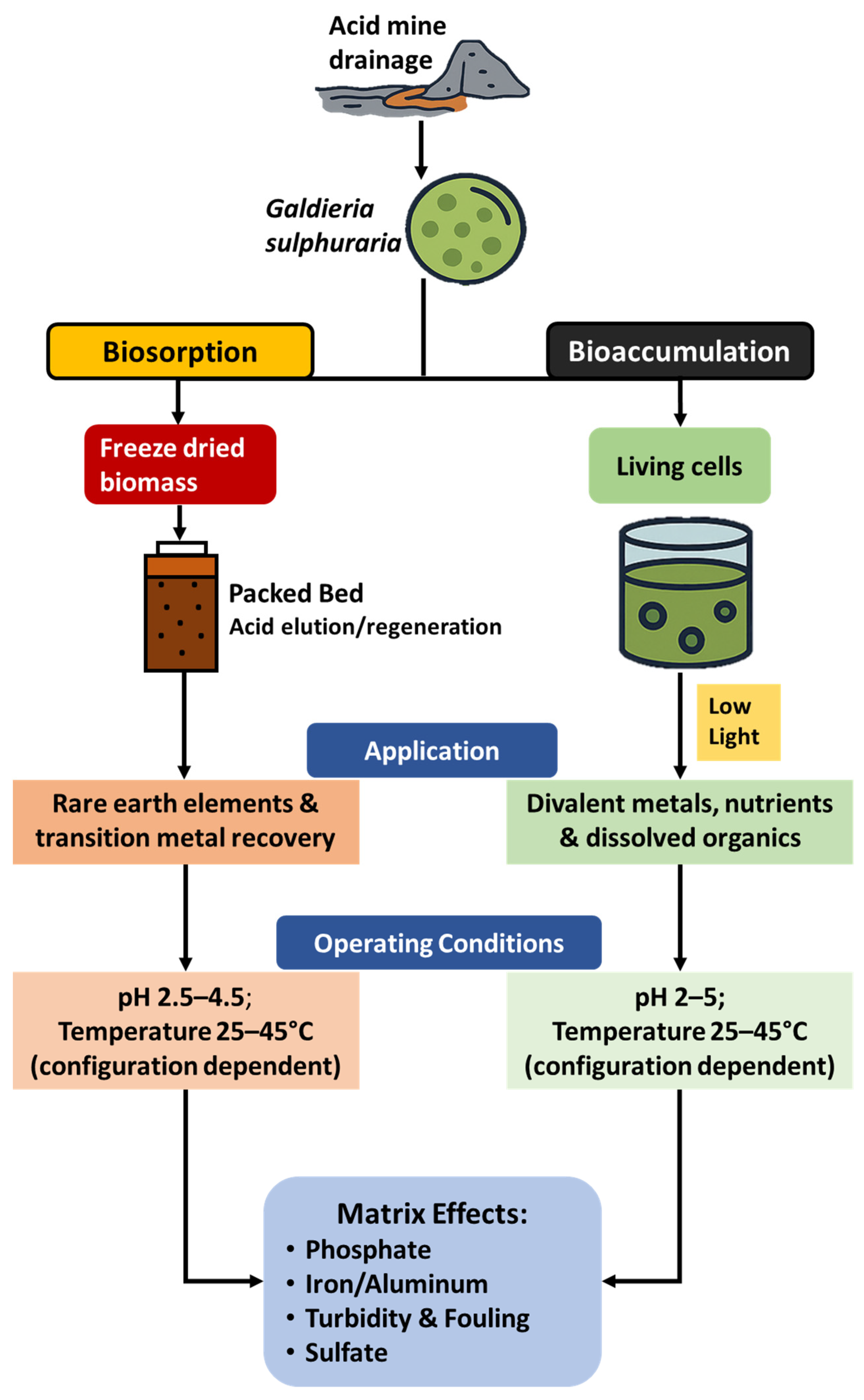
Two distinct deployment configurations emerge, aligned with different treatment objectives and governed by the metal uptake mechanisms discussed in Section 3: processed biomass for metal recovery and living cultures for polishing divalent metals and nutrients. Figure 2 illustrates these conceptual placements within AMD treatment trains, highlighting G. sulphuraria can be integrated upstream to exploit its unique biosorption and bioaccumulation capabilities.
Figure 2.
Conceptual placement of G. sulphuraria within AMD treatment trains.
Comparison with established AMD remediation technologies clarifies the specific operational niche occupied by G. sulphuraria. Conventional active neutralization processes are effective for bulk metal removal but generate large volumes of metal-laden sludge requiring downstream handling and disposal. Passive treatment systems offer lower operational costs but are kinetically slow, land-intensive, and poorly suited for highly acidic, metal-rich effluents. Acid-stable ion-exchange resins provide high uptake capacities; however, their performance is frequently compromised by fouling, limited selectivity in multi-metal systems, and high regeneration costs. Non-living biosorbents such as biochar and chitosan are inexpensive and readily available, but their sorption efficiency declines sharply at low pH, restricting applicability in untreated AMD. Sulfate-reducing bioreactors enable effective metal precipitation but are highly sensitive to metal toxicity and require substantial pH conditioning prior to operation [6,13,22]. In contrast, G. sulphuraria combines extreme acid tolerance with metal uptake, enabling recovery of REEs and other valuable metals upstream of neutralization while maintaining operational stability in complex AMD matrices. While absolute removal capacities may be lower than engineered resins under ideal conditions, G. sulphuraria performs reliably under conditions that compromise conventional systems, defining a clear operational niche for metal recovery in highly acidic, metal-rich streams [4,6,10,12,22,25].
Despite these advantages, several recurring failure modes constrain applicability and must be considered explicitly in system design. Influent matrix chemistry exerts first-order control: elevated ferric iron and aluminum loads can outcompete target metals for binding sites and generate fine oxyhydroxide particulates that foul packed beds, reduce hydraulic conductivity, and shade living cultures unless managed upstream [20]. Additional biological limitations include growth inhibition at high metal loadings, reduced removal efficiency above concentration thresholds, active efflux of non-essential cations, and electrostatic repulsion at the cell membrane that limits intracellular accumulation. At elevated biomass concentrations, cell agglomeration reduces effective surface area, while prolonged exposure to toxic metals can cause cellular injury and partial release of previously accumulated metals [15,16,17]. Operational challenges further shape feasibility: light limitation in phototrophic systems, energy-intensive harvesting of fine biomass, and risks associated with downstream handling of contaminated biomass [7,9,10]. Configuration mismatch is therefore a dominant failure mode. Deployment downstream of bulk neutralization eliminates selectivity through hydroxide precipitation, while expectations of bulk metal removal exceed the mass-specific capacities of biological sorbents [20]. G. sulphuraria modules are most likely to fail when applied as stand-alone treatments, when iron and phosphate are not controlled, or when recovery objectives are misaligned with biosorption and bioaccumulation mechanisms.
Table 2 summarizes commonly deployed passive AMD treatment units, emphasizing geochemical conditions that determine whether a G. sulphuraria module can precede or follow each system. In nearly all cases, deployment upstream under acidic conditions is chemically feasible. Once target metals are reduced or valuable solutes are recovered, downstream units follow standard design logic: pH adjustment, iron/aluminum removal, and final polishing in wetlands or manganese beds [2,30]. In this integrated framework, G. sulphuraria modifies the material balance of the treatment train without disrupting established operational logic, reducing chemical demand and sludge production while preserving opportunities for metal recovery.
Table 2.
Common passive AMD treatment systems and their possible placement relative to G. sulphuraria modules.
7. Minimal Reporting Standards for AMD—Relevant G. sulphuraria Studies
Across the growing body of research exploring the capacity of G. sulphuraria species, particularly G. sulphuraria, to remediate AMD environments or recover metals from highly acidic solutions, a set of implicit but recurring reporting requirements has emerged. Although no publication defines a formal minimal reporting standard for AMD, many studies highlight essential parameters, controls, and methodological considerations for reproducibility, cross-study comparison, and mechanistic interpretation. Together, these elements form the foundation of what should be considered minimal reporting practice for AMD-relevant G. sulphuraria investigations.
A primary requirement concerns the use of appropriate controls and explicit documentation of matrix effects. Because AMD and AMD-analog media are chemically complex, biosorption and bioaccumulation assays must distinguish biological uptake from abiotic metal removal pathways, including precipitation and complexation. Studies should therefore report the inclusion of positive controls (metal solutions without biomass) and negative controls (biomass without metals), as well as procedures used to evaluate supersaturation and competing-ion effects [15,17,20]. In REE-focused studies, particular attention must be given to how phosphate addition for biomass maintenance was managed or decoupled from the biosorption phase, as phosphate-driven removal can otherwise confound mechanistic interpretation. Explicit reporting of these design choices is essential to avoid misattribution of removal mechanisms [15,17,20,22].
In parallel, operational and physicochemical parameters must be documented with sufficient resolution to permit comparison across studies. Parameters such as pH, temperature, biosorbent dosage, contact time, and biomass state directly influence reported uptake capacities and kinetics and therefore require explicit reporting. For pH-sensitive systems, authors should report pH values prior to sterilization, at experiment initiation, and at termination to confirm stability [20,22]. Reporting of tested ranges—for example, biosorbent dosages between 0.5 and 5 mg mL−1 and contact times of 5–60 min—is necessary to contextualize reported optima and to support scaling assessments. Uptake metrics, including capacity (Q) and removal efficiency, should be accompanied by clearly defined initial and equilibrium concentrations, solution volumes, and biomass dry weights [14,20,22].
Clear reporting of cultivation procedures and strain-specific details is also fundamental, as physiological responses and biosorption capacities vary notably among G. sulphuraria strains and growth conditions. Publications should specify the exact strain used (e.g., ACUF 427, CCMEE 5587.1, and SAG 21.92), the composition of growth media (Allen, Cyanidium or the G. sulphuraria medium), and any modifications such as pH adjustments with sulfuric acid or supplementation with organic carbon sources like saccharose or glucose. Cultivation parameters, such as temperature, photoperiod or continuous illumination, photon flux density, and availability of CO2, must be detailed to contextualize physiological states. For studies employing inactive or pretreated biomass, methods such as washing, freeze-drying, or chemical treatment (e.g., exposure to 0.5 M sulfuric acid) should be fully disclosed. When live biomass is used, quantifying biomass concentration is crucial, ideally using ash-free dry weight (AFDW) calibrated against optical density (OD750) to ensure consistency in biomass-based comparisons [14,15,16,17,20,22].
Quantitative determination of metal concentrations should be reported with explicit identification of the analytical platform (e.g., ICP-MS or ICP-AES), including relevant calibration procedures, digestion methods, and quality controls Where metal-binding mechanisms or environmental relevance are assessed, fractionation analyses (e.g., exchangeable, carbonate-bound, Fe–Mn oxide-bound, organic/sulfide-bound, residual) provide critical insight into metal speciation and interaction with G. sulphuraria under AMD-relevant conditions [36]. Such reporting supports mechanistic interpretation and enables meaningful cross-study comparison. Collectively, these elements, robust controls, thorough documentation of physicochemical parameters, detailed cultivation and biomass preparation methods, and standardized analytical reporting, constitute the de facto minimal reporting standards for AMD-relevant G. sulphuraria research. Adhering to these emerging expectations may improve reproducibility, strengthen mechanistic interpretations, and accelerate the application of G. sulphuraria species in AMD remediation and metal recovery technologies.
8. Research Gaps and Agenda
Despite substantial progress in microalgal biotechnology and AMD treatment, several critical research gaps remain that limit the optimization, scalability, and sustainability of current technologies. These gaps differ in urgency and in the time horizon required to address them. Some represent short-term barriers that constrain pilot-scale implementation and cross-study comparison, while others constitute longer-term research needs linked to system optimization, integration, and sustainability.
Among the most urgent short-term priorities is improving fundamental understanding of G. sulphuraria biochemical utilization. Although this extremophilic alga shows promise for biomass generation, protein production, pigment synthesis, and heterotrophic growth, critical knowledge gaps remain regarding amino acid digestibility, nutrient assimilation, and the functional quality of proteins derived from G. sulphuraria biomass. Addressing these gaps is essential for evaluating biomass valorization pathways and can be achieved through controlled laboratory-scale studies. In parallel, optimization of mixotrophic and heterotrophic cultivation systems represents a near-term research need, including assessment of industrial crude glycerol as a low-cost carbon source and mitigation of pigment contamination during oil extraction [10].
A second urgent research gap concerns metal biosorption behavior in G. sulphuraria. Current studies are limited by incomplete understanding of biosorption kinetics, mechanistic pathways, and the influence of environmental variables such as pH, temperature, organic matter, and competing ions. Priority should be given to controlled experiments that clearly distinguish biosorption from precipitation and elucidate the true fate of metals and REEs in algal systems [15,17]. Addressing solution matrix effects, supersaturation phenomena, and the decoupling of nutrient supply (e.g., phosphate) from biosorption assays is particularly critical to avoid confounding reactions. Furthermore, the predominance of studies on green algae highlights a broader taxonomic gap and underscores the need for systematic exploration of extremophilic red algae for metal recovery applications [20].
In the context of AMD treatment, short-term research priorities also include performance evaluation under real wastewater conditions and pilot-scale validation. Many passive and semi-passive systems exhibit declining acid-removal efficiency over time, indicating the need for improved system designs, reduced maintenance burdens, and more durable reactive materials. Technologies such as permeable reactive barriers (PRBs) would benefit from innovative media formulations and optimized deployment strategies, while microbial treatment processes require pilot-scale verification to demonstrate reliability and facilitate industrial uptake [2,6,12].
Longer-term research directions should focus on system optimization, integration, and sustainability. This includes the development of robust algal–bacterial–biochar consortia, which have demonstrated potential for enhanced metal removal but currently lack standardized preparation and operational protocols to prevent inhibition or clogging [4,10,21]. Life cycle assessment tools, including Life Cycle Sustainability Assessment (LCSA) and Life Cycle Assessment Methodology (LCAM), also require refinement to incorporate missing environmental, economic, and operational factors and to provide reliable decision-support frameworks for technology selection [6].
From a sustainability perspective, future research should prioritize low-cost, circular, and energy-efficient treatment approaches, with particular emphasis on resource recovery. This includes REE extraction, metal recycling from treatment sludges, and the advancement of hybrid systems that integrate biological, chemical, and physical processes. The application of nanoparticles and modified materials represents a longer-term opportunity but requires thorough investigation of environmental safety, long-term performance, and ecotoxicological impacts [13]. Pilot-scale demonstrations and transnational collaborations will be critical for validating these technologies across diverse environmental and regulatory contexts.
Finally, a major long-term research gap lies in the integration of algae, biochar, and bacteria into unified AMD treatment platforms. Although this triadic consortium offers significant potential to improve metal removal, recovery efficiency, and system resilience, key challenges remain, including algal inhibition at low pH, uncertain temperature–removal relationships, secondary contamination from spent biochar, and sustained electron donor requirements for bacterial processes. Addressing these challenges will require targeted experimentation focused on strain selection or genetic modification to enhance algal tolerance, biochar functionalization to improve recyclability, and the development of slow-release or alternative electron donors. Immobilized bacterial systems may further mitigate metal toxicity and improve long-term effectiveness [4]. Overall, these prioritized research directions represent essential steps toward advancing AMD treatment technologies that are robust, sustainable, and industrially deployable.
9. Conclusions
G. sulphuraria represents a particularly suitable biological tool for metal recovery and remediation in AMD and other acidic, mine-influenced waters. Its extremophilic physiology, tolerance to extreme low pH values (≤1), tolerance to elevated temperatures, low-light growth, and mixotrophic/heterotrophic metabolism allow it to function in chemical and hydraulic regimes that challenge conventional biological systems. Two complementary configurations emerge as practical solutions: processed freeze-dried biomass for regenerable recovery of REEs and selected transition metals in packed beds and living cultures as acid-tolerant polishing units for divalent metals and dissolved organics. Strategic placement upstream of bulk neutralization can maximize operational benefits, reducing chemical reagent use, lowering sludge generation, and producing concentrated eluates for potential resource recovery. Laboratory, pilot, and field studies highlight the importance of accounting for matrix effects, including ferric iron, aluminum, sulfate, and phosphate, that influence biosorption and bioaccumulation efficiency. Defining realistic process windows (pH 2–5, 25–45 °C) and carefully reporting operational and chemical parameters are essential for reproducibility and scale-up. Looking forward, integrating G. sulphuraria modules into hybrid AMD treatment trains offers a design-forward pathway to more sustainable, circular, and resource-conscious operations. Further research should focus on optimizing biomass production, refining process configurations, addressing matrix limitations, and validating system performance under industrial conditions. By connecting mechanistic understanding to practical engineering, G. sulphuraria can move from laboratory curiosity to an actionable component within mine water management strategies, enabling REE recovery while mitigating environmental impacts.
Author Contributions
Conceptualization, T.S.; formal analysis, T.S., S.S. and K.S.; resources, T.S., S.S. and K.S.; data curation, T.S., S.S., K.S., M.S. and S.N.; writing—original draft preparation, T.S. and S.S.; writing—review and editing, T.S., S.S., K.S., M.S. and S.N.; supervision, T.S.; funding acquisition, T.S. All authors have read and agreed to the published version of the manuscript.
Funding
This research received no external funding.
Data Availability Statement
The data supporting this study are available from the corresponding author upon reasonable request.
Acknowledgments
The authors would like to acknowledge the use of Grammarly and ChatGPT-4o for their assistance in editing and enhancing the readability of the final manuscript.
Conflicts of Interest
The authors declare no conflicts of interest.
Abbreviations
The following abbreviations are used in this manuscript:
| AMD | Acid Mine Drainage |
| REE | Rare Earth Element |
| OLC | Open Limestone Channels |
| ALD | Anoxic Limestone Drains |
| LLB | Limestone Leach Beds |
| VFW | Vertical Flow Wetlands |
| MRB | Manganese Removal Bed |
| PRB | Permeable Reactive Barrier |
| LCSA | Life Cycle Sustainability Assessment |
| LCAM | Life Cycle Assessment Methodology |
| ZLD | Zero Liquid Discharge |
| CME | Carrier Microencapsulation |
References
- Nordstrom, D.K.; Blowes, D.W.; Ptacek, C.J. Hydrogeochemistry and microbiology of mine drainage: An update. Appl. Geochem. 2015, 57, 3–16. [Google Scholar] [CrossRef] [Scilit]
- Skousen, J.; Zipper, C.E.; Rose, A.; Ziemkiewicz, P.F.; Nairn, R.; McDonald, L.M.; Kleinmann, R.L. Review of Passive Systems for Acid Mine Drainage Treatment. Mine Water Environ. 2016, 36, 133–153. [Google Scholar] [CrossRef] [Scilit]
- Pat-Espadas, A.M.; Portales, R.L.; Amabilis-Sosa, L.E.; Gómez, G.; Vidal, G. Review of Constructed Wetlands for Acid Mine Drainage Treatment. Water 2018, 10, 1685. [Google Scholar] [CrossRef] [Scilit]
- Du, T.; Bogush, A.; Mašek, O.; Purton, S.; Campos, L.C. Algae, biochar and bacteria for acid mine drainage (AMD) remediation: A review. Chemosphere 2022, 304, 135284. [Google Scholar] [CrossRef] [Scilit] [PubMed]
- Praveen, K.; Abinandan, S.; Venkateswarlu, K.; Megharaj, M. Sustainability Evaluation of Immobilized Acid-Adapted Microalgal Technology in Acid Mine Drainage Remediation following Emergy and Carbon Footprint Analysis. Molecules 2022, 27, 1015. [Google Scholar] [CrossRef] [Scilit]
- Nguegang, B.; Ambushe, A.A. Sustainable acid mine drainage treatment: A comprehensive review of passive, combined, and emerging technologies. Environ. Eng. Res. 2024, 30, 240592. [Google Scholar] [CrossRef] [Scilit]
- Curien, G.; Lyska, D.; Guglielmino, E.; Westhoff, P.; Janetzko, J.; Tardif, M.; Hallopeau, C.; Brugière, S.; Bo, D.D.; Decelle, J.; et al. Mixotrophic growth of the extremophile Galdieria sulphuraria reveals the flexibility of its carbon assimilation metabolism. New Phytol. 2021, 231, 326–338. [Google Scholar] [CrossRef] [Scilit]
- Salbitani, G.; Perrone, A.; Rosati, L.; Laezza, C.; Carfagna, S. Sulfur Starvation in Extremophilic Microalga Galdieria sulphuraria: Can Glutathione Contribute to Stress Tolerance? Plants 2022, 11, 481. [Google Scholar] [CrossRef] [Scilit]
- Hirooka, S.; Itabashi, T.; Ichinose, T.M.; Onuma, R.; Fujiwara, T.; Yamashita, S.; Jong, L.W.; Tomita, R.; Iwane, A.H.; Miyagishima, S.-Y. Life cycle and functional genomics of the unicellular red alga Galdieria for elucidating algal and plant evolution and industrial use. Proc. Natl. Acad. Sci. USA 2022, 119, e2210665119. [Google Scholar] [CrossRef] [Scilit]
- Abiusi, F.; Fernández, P.M.; Canziani, S.; Janssen, M.; Wijffels, R.H.; Barbosa, M. Mixotrophic cultivation of Galdieria sulphuraria for C-phycocyanin and protein production. Algal Res. 2022, 61, 102603. [Google Scholar] [CrossRef] [Scilit]
- Minoda, A.; Sawada, H.; Suzuki, S.; Miyashita, S.-I.; Inagaki, K.; Yamamoto, T.; Tsuzuki, M. Recovery of rare earth elements from the sulfothermophilic red alga Galdieria sulphuraria using aqueous acid. Appl. Microbiol. Biotechnol. 2015, 99, 1513–1519. [Google Scholar] [CrossRef] [Scilit]
- Yang, Y.; Li, B.; Li, T.; Liu, P.; Zhang, B.; Che, L. A review of treatment technologies for acid mine drainage and sustainability assessment. J. Water Process. Eng. 2023, 55, 10421355. [Google Scholar] [CrossRef] [Scilit]
- Dube, V.; Phiri, Z.; Kuvarega, A.T.; Mamba, B.B.; de Kock, L.-A. Exploring acid mine drainage treatment through adsorption: A bibliometric analysis. Environ. Sci. Pollut. Res. 2024, 31, 59659–59680. [Google Scholar] [CrossRef] [Scilit]
- Iovinella, M.; Palmieri, M.; Papa, S.; Auciello, C.; Ventura, R.; Lombardo, F.; Race, M.; Lubritto, C.; di Cicco, M.; Davis, S.; et al. Biosorption of rare earth elements from luminophores by G. sulphuraria (Cyanidiophytina, Rhodophyta). Environ. Res. 2023, 239, 117281. [Google Scholar] [CrossRef] [Scilit]
- Kharel, H.L.; Jha, L.; Tan, M.; Selvaratnam, T. Removal of Cadmium (II) from Aqueous Solution Using Galdieria sulphuraria CCMEE 5587.1. BioTech 2024, 13, 28. [Google Scholar] [CrossRef] [Scilit] [PubMed]
- Kharel, H.L.; Shrestha, I.; Tan, M.; Selvaratnam, T. Removal of Cadmium and Lead from Synthetic Wastewater Using Galdieria sulphuraria. Environments 2023, 10, 174. [Google Scholar] [CrossRef] [Scilit]
- Kharel, H.L.; Tan, M.; Jha, L.; Selvaratnam, T. Removal of cadmium (II), lead (II), nickel (II), and zinc (II) from synthetic medium by extremophile red alga Galdieria sulphuraria: Investigating single and mixed metal systems. Algal Res. 2024, 83, 1083699. [Google Scholar] [CrossRef] [Scilit]
- Dean, A.P.; Hartley, A.; McIntosh, O.A.; Smith, A.; Feord, H.K.; Holmberg, N.H.; King, T.; Yardley, E.; White, K.N.; Pittman, J.K. Metabolic adaptation of a Chlamydomonas acidophila strain isolated from acid mine drainage ponds with low eukaryotic diversity. Sci. Total. Environ. 2019, 647, 75–87. [Google Scholar] [CrossRef] [Scilit] [PubMed]
- Fecteau, K.M.; Boyd, E.S.; Lindsay, M.R.; Amenabar, M.J.; Robinson, K.J.; Debes, R.V.; Shock, E.L. Cyanobacteria and Algae Meet at the Limits of Their Habitat Ranges in Moderately Acidic Hot Springs. J. Geophys. Res. Biogeosciences 2021, 127, e2021JG006446. [Google Scholar] [CrossRef] [Scilit]
- Kastenhofer, J.; Spadiut, O.; Papangelakis, V.G.; Allen, D.G. Roles of pH and phosphate in rare earth element biosorption with living acidophilic microalgae. Appl. Microbiol. Biotechnol. 2024, 108, 1–9. [Google Scholar] [CrossRef] [Scilit]
- Saura, P.P.; Chabi, M.; Corato, A.; Cardol, P.; Remacle, C. Cell adaptation of the extremophilic red microalga Galdieria sulphuraria to the availability of carbon sources. Front. Plant Sci. 2022, 13, 978246. [Google Scholar] [CrossRef] [Scilit]
- Palmieri, M.; Iovinella, M.; Davis, S.J.; di Cicco, M.R.; Lubritto, C.; Race, M.; Papa, S.; Fabbricino, M.; Ciniglia, C. Galdieria sulphuraria ACUF427 Freeze-Dried Biomass as Novel Biosorbent for Rare Earth Elements. Microorganisms 2022, 10, 2138. [Google Scholar] [CrossRef] [Scilit]
- Davis, T.A.; Volesky, B.; Mucci, A. A review of the biochemistry of heavy metal biosorption by brown algae. Water Res. 2003, 37, 4311–4330. [Google Scholar] [CrossRef] [Scilit] [PubMed]
- Osman, A.I.; El-Monaem, E.M.A.; Elgarahy, A.M.; Aniagor, C.O.; Hosny, M.; Farghali, M.; Rashad, E.; Ejimofor, M.I.; López-Maldonado, E.A.; Ihara, I.; et al. Methods to prepare biosorbents and magnetic sorbents for water treatment: A review. Environ. Chem. Lett. 2023, 21, 2337–2398. [Google Scholar] [CrossRef] [Scilit]
- Manfredi, C.; Amoruso, A.J.; Ciniglia, C.; Giarra, A.; Iovinella, M.; Lombardo, F.; Marano, A.; Mondillo, N.; Pinto, G.; de Ballesteros, O.R.; et al. Rare earth elements recovery from bauxite by biosorption onto Galdieria sulphuraria: A challenging case of study. J. Environ. Chem. Eng. 2025, 13, 1177813. [Google Scholar] [CrossRef] [Scilit]
- Pleissner, D.; Händel, N.; Schönfelder, S.; Petrusan, J.-I.; Silva, B.Q.; Schröder, J.; Müller, J.; Cowan, K.; Smetana, S. Long-term heterotrophic cultivation of Galdieria sulphuraria at technical scale under non-sterile conditions. Sustain. Chem. One World 2025, 8, 100116. [Google Scholar] [CrossRef] [Scilit]
- Lingamdinne, L.P.; Chang, Y.-Y.; Yang, J.-K.; Singh, J.; Choi, E.-H.; Shiratani, M.; Koduru, J.R.; Attri, P. Biogenic reductive preparation of magnetic inverse spinel iron oxide nanoparticles for the adsorption removal of heavy metals. Chem. Eng. J. 2017, 307, 74–84. [Google Scholar] [CrossRef] [Scilit]
- Verma, A.; Kumar, S.; Kumar, S. Biosorption of lead ions from the aqueous solution by Sargassum filipendula: Equilibrium and kinetic studies. J. Environ. Chem. Eng. 2016, 4, 4587–4599. [Google Scholar] [CrossRef] [Scilit]
- Hedin, R.S.; Watzlaf, G.R.; Nairn, R.W. Passive Treatment of Acid Mine Drainage with Limestone. J. Environ. Qual. 1994, 23, 1338–1345. [Google Scholar] [CrossRef] [Scilit]
- Skousen, J.; Ziemkiewicz, P. Performance of 116 passive treatment systems for acid mine drainage. J. Am. Soc. Min. Reclam. 2005, 2005, 1100–1133. [Google Scholar] [CrossRef] [Scilit]
- Watzlaf, G.R.; Schroeder, K.T.; Kairies, C.L. Long-term performance of anoxic limestone drains. Mine Water Environ. 2000, 19, 98–110. [Google Scholar] [CrossRef] [Scilit]
- Rose, A.W. Vertical Flow Systems—Effects of Time and Acidity Relations. J. Am. Soc. Min. Reclam. 2004, 2004, 1595–1616. [Google Scholar] [CrossRef] [Scilit]
- Rose, A.W. Long-term performance of vertical flow ponds-an update. J. Am. Soc. Min. Reclam. 2006, 2006, 1704–1716. [Google Scholar] [CrossRef] [Scilit]
- Means, B.; Rose, A.W. Rate of manganese removal in limestone bed systems. J. Am. Soc. Min. Reclam. 2005, 2005, 702–717. [Google Scholar] [CrossRef] [Scilit]
- Neculita, C.M.; Zagury, G.J. Biological treatment of highly contaminated acid mine drainage in batch reactors: Long-term treatment and reactive mixture characterization. J. Hazard. Mater. 2008, 157, 358–366. [Google Scholar] [CrossRef] [Scilit]
- Chen, H.; Jia, Y.; Li, J.; Ai, Y.; Zhang, W.; Han, L.; Chen, M. Enhanced efficiencies on purifying acid mine drainage in constructed wetlands based on synergistic adsorption of attapulgite-soda residue composites and microbial sulfate reduction. J. Hazard. Mater. 2024, 470, 134221. [Google Scholar] [CrossRef] [Scilit]

Disclaimer/Publisher’s Note: The statements, opinions and data contained in all publications are solely those of the individual author(s) and contributor(s) and not of MDPI and/or the editor(s). MDPI and/or the editor(s) disclaim responsibility for any injury to people or property resulting from any ideas, methods, instructions or products referred to in the content. |
© 2026 by the authors. Licensee MDPI, Basel, Switzerland. This article is an open access article distributed under the terms and conditions of the Creative Commons Attribution (CC BY) license.