


Abstract
The increase in the number of traditional ground-mounted and rooftop photovoltaic installations in recent decades has been driven not only by falling technology costs, but also by growing public awareness of renewable energy sources and other global and geopolitical factors. However, the rapid development of this technology has also enabled the emergence of a wide range of applications that differ to a greater or lesser extent from traditional ones and that address the main issues associated with ground-mounted installations, namely the use of (agricultural) land. This article provides a comprehensive overview of these non-traditional photovoltaic applications, including floating PV power plants, agrivoltaics, building-integrated PV, photovoltaic noise barriers, solar-powered vehicles and urban street furniture. The overview summarizes their technical, energy, economic, and environmental aspects, together with the discovery, emergence, or development of individual solutions. The article devotes special attention to the importance of advanced simulation methods, such as CFD, FEM, and radiation and energy modeling, in the design and optimization of the examined applications, as well as to the justification for their use. The conclusion of the article identifies research gaps and limits to further development. The article highlights the growing importance of non-traditional photovoltaic applications as part of sustainable energy and infrastructure solutions, along with their potential to reduce dependence on fossil fuel imports from critical regions.
1. Introduction
Given the current critical global security situation and the associated energy crisis, the need to reduce dependence on fossil fuels and to seek autonomous and independent energy sources has become even more apparent. In addition, the increasing frequency of extreme weather events attributed to climate change further underlines the need to decarbonize energy systems. This situation has accelerated the integration of alternative and renewable energy sources into the global energy mix, particularly in European and some Asian countries. The fastest growing source of electricity is photovoltaics: the global installed capacity doubled from 1 TW in 2022 to 2 TW in 2024 [1], and solar generation grew by about 30% in 2024 alone, the largest absolute increase of any source [2].
Despite critical views on the fundamental physical limits of the technology [3], research into photovoltaics is by no means on the decline; on the contrary, its development in recent years demonstrates that it could be a major asset in the fight against climate change, affordable, and applicable in various sectors, such as water bodies, roadways, and agriculture, and thus become one of the cornerstones of low-carbon energy systems.
The construction of traditional ground-mounted and rooftop photovoltaic power plants, and their rapidly increasing numbers, are placing pressure on available space, as suitable areas are often limited by urban development, agricultural activities, or landscape conservation. This situation creates opportunities for the emergence and development of non-traditional photovoltaic applications, which are designed to maximize the use of existing areas and infrastructure while often reducing the need for additional land compared with conventional ground-mounted PV. This criterion is met by applications such as floating PV power plants, building-integrated PV, agrivoltaic systems, and PV applications in transportation and urban areas, which often combine electricity generation with other functions (crop protection, reduced water evaporation, noise reduction, etc.) [4,5,6].
Two other trends are expanding the scope of these applications: first, methods based on data and artificial intelligence (AI), and second, vehicle-integrated photovoltaics (VIPV). Artificial intelligence is increasingly being used for yield forecasting, fault detection, and adaptive energy management in photovoltaic systems, and is beginning to complement physical simulations in the planning of charging infrastructure for electric vehicles integrated with photovoltaic systems [7]. VIPV directly links the photovoltaic sector with electromobility, where the output of the on-board photovoltaic system must be controlled in conjunction with the traction battery [8]. Both topics are addressed in this review only to the extent that they relate to the design and simulation of the photovoltaic application itself; control strategies and charging network planning are outside its scope.
These unconventional systems operate under different conditions than traditional ground-mounted and rooftop installations, which are not typically exposed to multiple forces such as wind, water, mechanical stress, and microclimatic effects. Therefore, advanced simulation methods, such as computational fluid dynamics (CFD), the finite element method (FEM), as well as radiation and energy modeling, are an important part of the design and optimization of non-traditional applications [9].
Several recent reviews examine individual applications in detail: floating photovoltaic systems [4,9,10], agrivoltaics [11,12], BIPV [13,14,15], or photovoltaic noise barriers [16,17]; however, these reviews are limited to a single application and treat simulation as only a secondary topic. This review study differs from them in three respects: (i) it compares five categories of non-traditional applications, along with ground-mounted and rooftop PV as conventional reference systems, using a consistent set of indicators (power density, carbon footprint, specific costs, and limitations), and also clearly defines the reference areas and system boundaries on which these indicators are based; (ii) it assigns numerical methods (CFD, FEM, and modeling of radiation, energy, acoustics, microclimate, and multiphysics) to the applications for which they are essential or supportive; and (iii) it identifies where simulation results have been validated against operational data and where they have not. The aim of this article is therefore to provide a comprehensive overview of selected non-traditional photovoltaic applications, focusing on their technical, environmental, and economic aspects, while also emphasizing the role of numerical simulations in the design process.
2. Methods
This contribution is a narrative review article that focuses on non-traditional applications of photovoltaic systems and provides a systematic summary of the current state of knowledge. The aim of the methodology was to identify the main technological approaches, economic and environmental aspects, together with their analysis and mutual comparison. An important sub-objective was to recognize the role of simulation methods in the design and optimization of these non-traditional PV systems.
2.1. Literature Search and Selection
The literature examined was retrieved from Scopus, Web of Science, and ScienceDirect, supplemented by technical reports of IEA PVPS, NREL, Fraunhofer ISE, and TNO. The search combined the terms “photovoltaic” OR “PV” with “floating”, “agrivoltaic*”, “building-integrated”, “noise barrier”, “vehicle-integrated”, “solar vehicle”, “street furniture” and “solar pavement” and, for Section 4, with “CFD”, “finite element”, “ray tracing”, “energy yield model”, “microclimate” and “acoustic model”. The initial identification of relevant publications involved bibliographic databases, publisher platforms, citation tracking, and AI-assisted tools used to support literature discovery and prioritization.
The search covered publications from 2005 through October 2025 and was updated in April and September 2026 prior to submission; older works were included only as primary sources documenting the historical origins of the application in question. Records from the three databases (Scopus, ScienceDirect, Web of Science) were first screened for duplicates (identical DOI or title), next reviewed based on title and abstract, and finally evaluated based on the full text. To identify the most suitable sources, the database search was complemented by generative AI-based literature-discovery tools (Claude (Anthropic,https://claude.ai/, accessed on 27 October 2026), ChatGPT (OpenAI,https://chatgpt.com/, accessed on 27 October 2026) and Consensus (https://consensus.app/, accessed on 27 October 2026), which were used only to suggest candidate publications and reports and not as evidence. Every source suggested in this way, as well as every record from the databases, was opened and read by the authors, who checked that it is suitable for this review and that it contains the information required for the article; sources that did not meet these conditions were discarded. The inclusion criteria were the following: (i) the study addresses a photovoltaic application outside the scope of conventional ground-mounted or rooftop installations, or a numerical method applied to such an application; (ii) quantitative data (yield, costs, carbon footprint, simulation results) are provided along with their boundary conditions; (iii) the document is a peer-reviewed article, conference paper, patent, standard or technical report from a recognized institution; preprints, a doctoral dissertation and a university project report were used only as supporting sources. Works lacking a clearly defined methodology, containing unverifiable data, duplicate reports on the same project, and promotional materials were excluded from the quantitative comparison. The selection process can be summarized approximately as follows: records identified in three databases and in reports from the listed institutions: 25,737; duplicates removed: 14,054; records screened with AI-tools by title and abstract: 11,683; excluded at this stage according to AI-tools (out of scope, missing quantitative data, promotional content): 5430; relevant text according to title and abstract after AI-tools selection: 6253; ambiguous text according to AI-tools: 5191; designed for disposal by AI-tools: 239; excluded after full-text assessment by AI-tools: 5774 (no clearly defined methodology or unverifiable data or no quantitative data with boundary conditions: exact number for each reason of exclusion is not possible to state, decision of AI-tools without explaining); recommended full texts for assessment based on a selection made by AI-tools: 479; priority reading suggested for 103 texts; full texts assessed: 479; excluded after full-text assessment: 333; records included from the database screening: 146. In addition, 59 sources that did not pass through the database screening were included directly: patents and standards, technical reports of the institutions listed above, and manufacturer or project websites used for historical dates, product specifications and list prices; each of them was opened and read by the authors. Because the number of records excluded at the title/abstract stage was not recorded, a PRISMA flow diagram is not provided; the review is a narrative review without a registered protocol. The reconciliation 146 + 59 = 205 is given here so that the final count can be verified. The review finally includes 205 sources, namely 146 peer-reviewed journal and conference papers, 6 patents and standards, 19 technical reports (e.g., IEA PVPS, NREL, DOE, Fraunhofer ISE, TNO, ICCT, JRC, World Bank, Caltrans, Ember), 4 non-peer-reviewed academic works (two preprints, a doctoral dissertation and a university project report) and 30 manufacturer, press or project websites. The last group was used mainly for historical dates, product specifications and list prices, and these sources are identified as such in the reference list (publisher name in place of author). Individual types of applications were compared from several perspectives:
- Technological maturity;
- Energy parameters;
- Investment costs;
- Carbon footprint;
- Technical limitations.
The article is prepared in the form of a qualitative synthesis with a focus on identifying advantages, disadvantages, limits, research opportunities and potential for the development of other non-traditional applications of photovoltaics.
2.2. Definitions of the Indicators Used in the Comparison
The indicators used in Section 3 and Section 5 are taken from the cited studies and were not recalculated by the authors. To make clear what each quoted value means, their definitions, the usual calculation procedure, and the reference boundaries are summarized here:
Power density Pd (W/m2) is the peak (STC) power of the PV generator related to a reference area:
where Aref is the module area for all applications except agrivoltaics, for which the technical literature typically specifies the area of cultivated land. Values based on module area reflect module efficiency and are comparable across different applications; values based on land area, by contrast, also account for row spacing and the proportion of the land allocated for other uses.
Pd = Ppeak/Aref
The land equivalent ratio (LER) quantifies the land-use efficiency of a dual-use site (agrivoltaics):
where Ycrop,AV and Ycrop,ref are the crop yields under the PV system and in a sole-crop reference plot, and EAV and EPV,ref are the electricity yields of the dual-use plot and of a PV-only reference plant occupying the same area. LER > 1 means that the dual-use plot produces more crop and electricity in total than the same area split between the two uses. LER depends on the crop, the year (drought years give higher values, Section 3.4) and the choice of reference plant; measured and modeled LER values are therefore distinguished in the text.
LER = Ycrop,AV/Ycrop,ref + EAV/EPV,ref
The carbon footprint CF (g CO2-eq/kWh) is the life-cycle greenhouse gas emission related to the electricity generated over the lifetime of the system:
where Gman, Gtra, Gins, GO&M and GEoL are the emissions of manufacturing (including balance-of-system components and, where present, batteries), transport, installation, operation and maintenance, and end-of-life treatment; E1 is the first-year electricity yield, δ the annual degradation rate and T the service life. A cradle-to-gate boundary omits GO&M and GEoL; a cradle-to-grave boundary includes them. The IEA PVPS Task 12 methodology guidelines are used as the reference framework, and values obtained with other boundaries, irradiation levels or service lives are marked as not directly comparable.
CF = (Gman + Gtra + Gins + GO&M + GEoL)/Elife, Elife = Σt=1…T E1 (1 − δ)t−1
The levelized cost of electricity (LCOE, €/kWh) relates the discounted lifetime costs to the discounted lifetime electricity generation:
where CAPEX is the specific investment cost (€/kWp), OPEXt the operating cost in year t, Et the electricity generated in year t (including degradation) and r the discount rate. LCOE values quoted from the literature are reported together with the discount rate and service life used in the source where these are stated; because r, T and the irradiation differ among studies, LCOE values are compared only within one study and are not tabulated across applications.
LCOE = [CAPEX + Σt=1…T OPEXt/(1 + r)t]/[Σt=1…T Et/(1 + r)t]
Finally, to distinguish the strength of the evidence behind the main claims, key statements in Section 3, Section 4 and Section 5 are labeled (F) if they rely on field or experimental data from operating installations, (N) if they are based on numerical predictions, and (T) if they represent theoretical expectations not yet confirmed by measurement.
3. Non-Traditional Applications of Photovoltaics—Basic Division
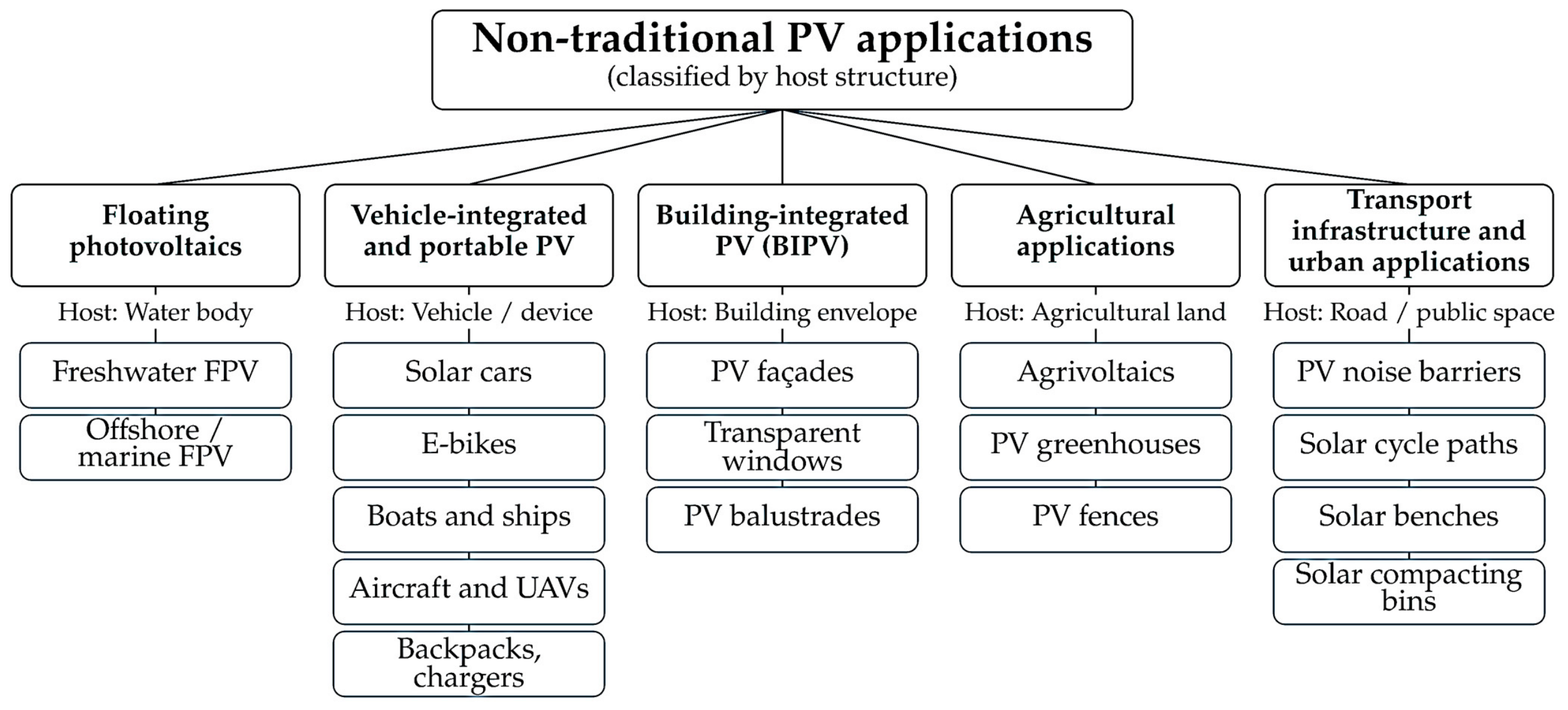
There are currently many non-traditional applications of photovoltaics, so they have been divided into five basic categories according to the structure that hosts the PV modules—a water body, a vehicle or portable device, a building envelope, agricultural land, or transport and public-space infrastructure. Mobile applications thus comprise PV carried by the vehicle itself, whereas transport infrastructure comprises stationary PV on roads, railways and cycle paths:
- Floating photovoltaics;
- Vehicle-integrated and portable PV;
- Building integrations;
- Agricultural applications;
- Transport infrastructure and urban elements.
The individual categories (Figure 1) are described in the following subsections, proceeding from the more widespread applications to those that are still under development.
Figure 1.
Classification of non-traditional photovoltaic applications used in this review, based on the structure that hosts the PV modules (authors’ own elaboration).
3.1. Floating Photovoltaics
One of the unconventional applications is floating photovoltaic (FPV) power plants, where the panels are installed directly on the water surface, whether seas, lakes or other bodies of water. This technology has several advantages: they do not occupy fertile land, achieve higher yields due to constant cooling (F), require less maintenance and, under certain conditions, reduce water evaporation (F/N). The main disadvantage is maintaining safety during maintenance, as well as ensuring and protecting against adverse weather conditions such as storms and typhoons, or the impact on ecological systems around such an installation [10]. Patents for this technology have been registered in several countries (e.g., USA, Denmark, France), but the first installation was carried out in 2007 in Japan with an output of 20 kWp [5]. At the end of 2023 the global installed FPV capacity reached 7.7 GW, of which almost 90% was located in Asia (China alone about 50%) [9]; some larger projects have also been carried out in France or the Netherlands. The capacity of individual installations varies, from tens to hundreds of megawatts; the largest inland plants are in China, e.g., the 320 MW Dezhou Dingzhuang plant on a reservoir in Shandong province (2021) [18], and the largest offshore plant (373 MW) was commissioned in 2024 in Changhua, Taiwan [19]. It is understandable that the costs of such an installation will be higher than that of a ground-mounted plant of the same capacity: the NREL benchmark for a 10 MWdc fixed-tilt FPV system on an artificial water body (USA, Q1) gives a premium of 0.26 USD/Wdc, i.e., about 25% [20] attributable mainly to the floats, anchoring and mooring; the higher energy yield partially compensates for this. A life-cycle assessment—covering everything from raw material extraction to disposal—comparing two operational European flotaing photovoltaic (FPV) systems against a ground-mounted system with an east-west orientation revealed that FPV systems have a carbon footprint approximately 15 % higher [21];this factor, therefore, cannot be directly equated with the higher capital expenditure. For freshwater installations, the price can be from 110 to 300 €/m2; for marine installations it can be from 200 to 1000 €/m2, sometimes even more [19,20]. According to the first international life-cycle assessment for FPV systems, the carbon footprint was calculated at ~50 g CO2e/kWh, which is comparable to a traditional application, but the results are significantly influenced by the technology used and the specific modules and their degradation rate [21].
3.2. Vehicle-Integrated and Portable PV (VIPV)
This category includes various means of transport such as cars, bicycles, boats, airplanes, but also devices such as traffic lights, backpacks, mobile chargers and parking meters that are directly powered or recharged with electricity from photovoltaic cells. The aim of these applications is to reduce fossil fuel consumption and carbon emissions, and on the contrary, increase mobility and availability of electricity without restrictions on movement or wired connection to the grid.
The first solar car, the “Sunmobile”, was introduced in 1955 by William G. Cobb in Chicago, and since then the development of these vehicles has been progressing, but they are still prototypes used mainly in racing (Bridgestone World Solar Challenge, Adelaide, Australia) rather than in regular use in transport [22]. In series production, the Hyundai Sonata Hybrid (2020) is equipped with a solar roof of approximately 200 W [23]; a Toyota/NEDO/Sharp demonstrator (2019) tested cells with an efficiency of about 34% on a Prius PHV [24]. However, the costs of these vehicles are still very high: the range of 35,000–250,000 euros spans from production hybrids with solar roof (Hyundai Sonata Hybrid, Toyota Prius PHV) at its lower end to purpose-built solar cars produced in small series or as demonstrators (e.g., Lightyear 0) at its upper end [24,25]. Another means of transport that can be charged using PV are bicycles and electric bicycles. The first patents appeared in the USA in 1895 and 1897 (electric bicycles) [26,27] and in 1994 (solar charging, US 5,316,101) [28]. These bicycles are mainly used for long-distance cycling, as the PV is located in the bicycle frame itself, or as an accessory—a folding set (200–400 W for 80–160 km/day). There is no need to look for charging shelters, which also simplifies trip planning [29]. The prices of these bicycles are higher than for classic versions, usually from €2000 upward (in Europe) [30]. In terms of carbon footprint, a petrol car has approximately 235 g CO2e/km (including production), a solar car has 52–63 g CO2e/km, and a solar bicycle has approximately 13–22 g CO2e/km [31,32,33].
In terms of water transport, photovoltaics has been applied on board ships and boats, from where they drive electric motors. The first documented solar-powered boat was presented as part of the British Solar Craft 1 project by A.T. Freeman in 1975. Since then, the technology has advanced so much that in 2010–2012 the catamaran MS Tûranor PlanetSolar (launched in 2010) completed the first circumnavigation of the globe, with the sole source of energy being solar energy, which was used by photovoltaic cells with an area of 537 m2 and a peak power of 93–94 kW [34]. Other projects are currently ongoing, such as the Energy Observer, which uses photovoltaics on board to produce hydrogen to power the catamaran during the voyage. Commercial use of solar boats is mainly in ecotourism around the world. It has been calculated that the carbon footprint of a solar ship shows a 34 to 52% reduction in global warming potential (GWP) compared to gasoline/diesel ships, although the production of such a ship is still carbon-intensive [35].
Solar-powered aircraft and drones were first tested as unmanned experiments in 1974 (AstroFlight Sunrise) and later in 1979 a manned flight (Mauro Solar Riser) was carried out in the USA [36,37]. The development of performance is also demonstrated by the fact that in 2015–2016 the Solar Impulse 2 aircraft with a photovoltaic cell area of 269.5 m2 and a maximum power of 66 kW flew around the globe. Today’s versions of these vehicles are mainly used for ground observation and communication services, but also security surveillance or mapping, with some types being able to fly continuously for more than 81 h (AtlantikSolar, 2015) [38,39,40].
Another type of device where photovoltaics is justified is the solar backpack and chargers for mobile devices. This involves integrating a PV system into luggage or a foldable set of panels, which can be used to directly charge phones, tablets or other small electronics. The solar backpack was first introduced in 2004 in the USA by Voltaic Systems, while the hybrid solar chargers Solio by Better Energy Systems, founded in 2001 in London, became known, combining PV and a battery into one product [41,42,43,44]. The use of this unconventional application of photovoltaics is very practical, especially for outdoor activities, but also in crisis situations in places with interrupted electricity supply, or for military purposes in the field (recharging radios and batteries). The rated power of solar backpacks is approximately 5–6 W, and that of commercially available foldable kits is typically 20–30 W [45] (manufacturer specifications [44]), which is sufficient for charging smartphones, GPS receivers, and similar devices during the day; the measured power output under field conditions is discussed in [46,47].
3.3. Building-Integrated Photovoltaics (BIPV)
This subsection focuses on photovoltaic systems that are integrated directly into the building envelope, including windows or other elements. Unlike the traditional installation in the form of panels on the roof, these systems represent an innovation in PV applications. This way, it is possible to increase the area producing electricity while architecturally enriching the building with an interesting and modern design.
The first implementation of a PV façade was in Germany in 1991, as described by Benemann [48]. Since then, this application method has spread across Europe and Asia, whether it concerns administrative buildings, educational institutions and others, also in the context of reconstructions. The coordination of the development of this application is also ensured by the IEA-PVPS program within Task 15, whose members are aware that BIPV is not only about photovoltaics, but also about a combination of electrical engineering, construction, aesthetics, environmental science, safety and economic efficiency, as well as the overall multifunctionality of the building envelope [13,48]. An interesting example is the Beit Havered building with a PV façade in Israel, where the aesthetic design of the architecture was combined with energy efficiency [49]. The performance of the façade depends on the technology used, most often it is in the interval 50–150 W/m2, which is also related to the price (approximately from 300 to 1300 €/m2) [14,50,51]. The life-cycle carbon footprint of BIPV electricity is of the same order as that of conventional PV systems (median below 50 g CO2-eq/kWh [52]); when the displaced building material is credited, the footprint of the façade element itself can be 30–50% lower than that of a conventional façade combined with a separate PV system [51,52,53].
In an effort to utilize as much of a building’s surface area as possible for electricity generation, the IEA-PVPS group has developed the idea of semi-transparent and transparent photovoltaic windows or glass walls that allow some of the sunlight to enter the building and convert some into energy. There are three ways to achieve this:
- Thin-film/microcrystalline cells;
- Luminescent solar collectors;
- Organic or perovskite transparent cells.
The areal power density of such panels is usually lower (tens of W/m2) compared to classic PV panels, while ensuring not only sufficient light transmission but also thermal comfort in the building. The price depends on the technology used [15,54].
A specific subgroup of BIPV comprises balcony railings and balustrades, in which PV replaces safety glass or other conventional infill materials, allowing these building elements to generate electricity and increasing the building’s energy efficiency. The first concepts were patented in 2005, but their use spread worldwide only later, after 2010 [55]. The power density of PV on the railing depends on the density of the cells and their transparency, but ranges from 60 to 125 W/m2 [56,57]. The price of BIPV glass for balustrades alone (without the railing mounting system) ranges from ~300 to 1300 €/m2, which is comparable to more expensive modern glazed façades [14]. The carbon footprint is like that of conventional PV systems, i.e., approximately 20–50 g CO2e/kWh, depending on the technology used and the specific design solution; these values are in line with the IEA PVPS Task 12 reviews [58,59]. As safety is paramount, the use of laminated safety glass and testing must be in accordance with EN 12600/EN 14449 [60,61].
3.4. Agricultural Applications (APV)
One of the aspects for which PV power plants are often criticized is its land occupation, sometimes even fertile land [62]. However, some PV applications can be beneficial for agriculture, and this is what this subsection is devoted to.
An innovative approach to traditional photovoltaics is certainly agrivoltaics, which combines electricity production using PV panels with crop protection from direct sunlight, adverse weather and increased evaporation of water from the soil. Because the PV can be adjusted, sufficient plant illumination is ensured and at the same time the optimal angle of incidence of the sun’s rays, and therefore the total yields of electricity and crops can be higher from such an installation (F for the measured LER of the Heggelbach plant below; N for the modeled LER discussed in Section 4). The concept of agrivoltaics was designed in Germany in 1981–1982, but the first prototype of this modern application was not installed until 2016 as part of the APV-RESOLA pilot project [63,64]. This technology was quickly adopted in the USA, Asia and other European countries, where the diversity of systems expanded. APV-RESOLA measurements (194 kWp on about one-third of a hectare, Heggelbach, Germany) demonstrated a specific production of approximately 713 MWh/ha/year and a measured land equivalent ratio (LER, the sum of the relative crop and electricity outputs of the dual-use plot compared with separate cultivation and a ground-mounted plant on the same area) of 160% in 2017 and 186% in the dry year 2018 [65]. These measured values should not be confused with the modeled LER of 1.35–1.73 reported for Montpellier by Dupraz et al. and discussed in Section 4, which was obtained for a different climate, crop (durum wheat) and module density. The AV installation in Germany also demonstrated a reduction in emissions of approximately 573 t CO2-eq by replacing fossil energy sources, but there is a higher material requirement for metal structures [11,12,66].
Similar to windows in building integrations, the potential of PV in agricultural buildings, especially greenhouses, has been recognized for replacing conventional materials with semi-transparent PV elements embedded in the roof or walls. In the Netherlands, pioneering prototypes of this technology have already demonstrated in 2010–2011 that such integration is functional and has a positive impact on the microclimate and cultivation [67,68]. Solar greenhouses are currently used mainly in southern Europe, Japan, China and other regions with a similar geographical location [69]. According to [70], when installing PV on 20–40% of the roof area, the annual electricity production was between 24.5 kWh/m2 and 47.5 kWh/m2. The cost of the installations depends greatly on the location and configuration of the greenhouse, but a payback in units of years (e.g., 9) has been demonstrated, while variability in shading can improve crop yields [71].
Another application involves fences, which would otherwise serve only one function but can also be used for electricity generation through the incorporation of PV. This concept was formulated only recently, in 2023, when ref. [72] proposed to use existing fences of a livestock farm as a vertical PV carrier. Subsequently, piles with built-in bifacial PV panels were installed in rice fields and salt deposits in Korea, with an installed capacity of 51 kW (rice field) with 120 modules and 48.45 kW (salt deposit) with 114 modules. The levelized cost of electricity (LCOE) in this study was approximately 0.10–0.11 €/kWh [73]. This application has been implemented in the USA and Europe, especially in places where minimal land use and passability are a priority, while such fences are also used to protect against snow avalanches on roads or as barriers for animals. Soil quality monitoring did not detect any excess of heavy metals or other pollution in the vicinity of this PV application [74,75,76].
3.5. Transport Infrastructure and Urban Elements (TIPV/UEPV)
In this subsection, we focus on PV applications integrated into transport infrastructure (noise barriers, cycle paths) and into public spaces of cities (street furniture) in various forms around the world.
A very interesting application of PV is its integration into acoustic barriers along roads or railways (PVNB). The first installation was built in 1989 along the A13 motorway near Chur, Switzerland [77,78]. The original system had an installed capacity of approximately 100 kWp (103 kWp) and a specific yield of 1000–1200 kWh/kWp per year, i.e., an annual output of approximately 100–120 MWh [78]; following the modernization in 2019, the installed capacity increased to 262 kWp and annual production to more than 300 MWh [77]. Since then, this application has also taken hold in other countries such as the USA, China, the Netherlands, etc. [77,79]. Modern design proposals, such as the “zig-zag”/cassette design or bifacial solutions, try to optimize the capacity per meter of barrier length. The costs per Wp were initially higher, approximately 16 €/Wp; later in the 1990s they decreased to ~7 €/Wp, and today the payback is estimated at 6–10 years (N), depending on the configuration and the level of tariffs [16,17,78,79,80]. PVNB offers several important advantages. Like floating PV, it does not occupy land but instead uses an area that would otherwise only block noise, so PV multiplies the usefulness of this area, which is relatively large and in almost every country in the world. In addition, the energy produced can be consumed immediately on-site, whether by lighting or traffic signs/signaling, and PV in barriers has only a minimal visual impact. The disadvantages are reduced performance due to the orientation and angle of incidence of sunlight or shading, reduced noise efficiency, the risk of glare and higher costs compared to a regular noise barrier. However, with a properly planned project, this application can provide a net benefit [78,81].
Another interesting application of PV is solar benches, where the PV is integrated directly into the object and can be used to charge devices such as mobile phones and tablets, but can also be a source of energy for Wi-Fi, sensors or lighting [82]. Pilot projects such as Strawberry Energy in London in 2015 or Include/Steora in Croatia have started the mass production of these “smart” benches, and this technology can currently be found in hundreds of cities in Europe, Australia and North America [83,84,85]. The installed power of solar benches is most often 80–110 Wp and the price ranges from 900 to 7000 €. The carbon footprint of the electricity produced in this way is about 12–59 g CO2e/kWh, with an integrated battery it can be up to 98–149 g CO2e/kWh [86,87,88,89]. The advantages of these benches include quick and relatively easy installation without the need for earthworks or modifications; the possibility of installing various sensors to measure air purity, temperature, humidity, traffic, and noise, as well as providing an SOS alarm; and increased safety through lighting, without a substantial increase in operating costs. The disadvantages of this application are reduced performance due to shading or damage due to weather, higher acquisition costs, and the need for regular cleaning.
Another use of PV in the city is solar bins, which use the electricity generated by PV cells integrated in the bin body to compact waste and at the same time for communication. Compressing reduces the volume of waste, and therefore the number of trips needed to empty it, thereby helping to reduce the carbon footprint of waste collection and maintaining cleanliness in the area. Solar bins can also have various integrated sensors, like the aforementioned solar benches, making them an important “smart” element. The pioneer of this technology was the company Bigbelly from the USA, with the first solar bin installed in 2005 [90,91]. This element gradually took hold in countries in Europe, Asia, and the Middle East [92]. The PV output on the bins ranges from 22 to 55 Wp, and owing to the pressing, the capacity of these bins is 5–8 times higher than that of conventional bins, which is also associated with a higher purchase price (3000–4200 € per unit), depending on additional equipment and service. The carbon footprint is similar to that of solar benches [93,94,95].
In the context of urban decarbonization, PV technology integrated into a solar cycle path has great potential. The pilot project was the Dutch SolaRoad in Krommenie (2014), a 72 m long section of embedded PV tiles that produced about 9800 kWh in its first year of operation [96]; the top layer, however, suffered repeated damage and the pilot was removed in 2020 [97]. This PV application has two alternative uses, the first is directly embedded PV tiles in the ground (in the Netherlands, estimated energy yield 70–90 kWh/m2·year), or the second alternative is roofing the cycle paths with PV shelters (Korea, 8.8 km between Daejeon and Sejong, with production of about 2200 MWh/year). The price of PV tiles can be around 1700–2500 €/m2 (Wattway project), but it can also be much higher (almost 10,000 €/m2, Solar Roadways); the price of roofing varies from 600–900 €/m2 and more [98,99,100]. It should be emphasized that these two alternatives are compared here only for illustrative purposes: the published data come from projects of very different scales (tens of meters versus kilometers), measurement durations (one year versus several years), and cost frameworks (pilot projects, including research costs, versus commercial rooftop systems), and comparable installed capacities and effective module areas are not provided for all of them. The advantages of roof tiles include their use of existing roof space, their aesthetic appeal, and that lighting can be connected to the PV pavement, one of the “smart” elements. The disadvantages are the high price; lower yield due to frequent shading, dirt, poorer mechanical resistance; more complex maintenance; and increased risk of slipping for pedestrians or cyclists. In contrast, PV roofing provides high energy yield and low price per kWp and per m2, protects cyclists from adverse weather, reduces the risk of slipping, and involves easy maintenance. The disadvantage is mainly the need for construction and space, but based on the available data, it currently appears that covering bike paths is a simpler and more cost-effective option [97,98,101].
The degree of technological sophistication, economic return and environmental impacts of the individual applications mentioned vary considerably in the scientific literature, but their common feature is the effort to maximize the use of existing spaces and areas with no occupation of agricultural land. A comparison of other technical, economic and environmental aspects of non-traditional PV applications is elaborated in more detail in the Discussion.
4. Use of Simulations in the Field of Non-Traditional Photovoltaics
As with other renewable energy sources, the importance and significance of using modeling and simulations have been demonstrated in photovoltaics, both in traditional ground-based installations, where modeling of irradiation and analysis of energy yield achieved under various climatic conditions and panel settings is essential, and the use of advanced numerical tools is even more essential in non-traditional photovoltaic applications, where additional factors are added (surface reflection, waves, etc.).
The first ideas for the use of more advanced modeling appeared in the 1990s in connection with building-integrated photovoltaics, where Benemann pointed out the need to model heat flow and ventilation in buildings with PV façades to determine their efficiency and thermal loads [48]. Later, from 2010, when transparent PV windows, bifacial façades and balustrades began to be developed, simulations began to be used, for example, for radiation transmission into the building interior and analysis of wind effects on vertical PV [56,102]. Similar applications of simulations have been made to noise barriers where advanced CFD (high wind speeds and turbulence) was required, particularly focusing on acoustics and noise analysis of traffic corridors (aerodynamic vibrations) as well as simulating energy yield at different module tilt angles [103].
Around the same time, the first attempts at simulations of solar vehicles appeared. Craparo and Thacher [104] developed a TRNSYS-based solar-electric vehicle simulation code that models the road, the vehicle subsystems and the weather; they used it to compare two cell configurations and to quantify the effect of average vehicle speed on the battery depth of discharge. Later, vehicle simulations increasingly focused on the aerodynamics themselves, the shape of the body, the energy yield of PV in various installations, etc. After 2010, there was a significant development of simulations of other means of transport, such as solar boats, unmanned drones, and solar aircraft, mainly for profiling the flow around the wings, optimizing the distribution of PV on the wing or deck area, and battery stability simulations [105,106,107].
With the first floating PV installation in Aichi, Japan, in 2007 [5], another area was opened where simulations became necessary, since several risks emerged with the placement of PV on the water surface, namely the impact of wind and water on the modules, as well as the dynamic behavior of the surface and the formation of waves. FPV models have gradually developed along with the increase in the complexity of individual projects, especially in Asia. In the years 2015–2024 according to [9], CFD was mainly used in the design of PV anchorages in extreme wind gusts.
In the field of agrivoltaics, simulations appeared a little later, when Dupraz et al. [108] in 2011 coupled a radiative transfer model of the PV array with the STICS crop model to simulate light availability at different positions and heights under the modules and the resulting crop response; the modeled land equivalent ratio of the combined system reached 1.35–1.73 for full- and half-density arrays in the climate of Montpellier, i.e., the same land produced 35–73% more (electricity plus crops) than if it were used for one purpose only; these values are model predictions, whereas the 160–186% reported for APV-RESOLA in Section 3.4 are field measurements. Another example of the use of simulations in agrivoltaics was the APV-RESOLA projects from 2016, where a series of simulations included radiation (shading and diffuse radiation), microclimate changes and also evapotranspiration, thus defining a simulation framework that is still used today. It was also one of the few installations of bifacial panels at that time, which posed a challenge for the simulation. Nevertheless, the simulation results were in good agreement with actual measurements (F, the simulated reduction in light beneath the panels, calculated using the shading model, was 25–28% compared with approx. 30% in reality; similarly, the simulated electricity production was 1200 kWh/kWp, compared with an actual value of 1266 kWh/kWp) [65,66,109].
According to IEA-PVPS [7], large floating power plants cannot be designed to current safety standards without CFD-based wind and wave load analysis; the same applies to PV noise barriers, where coupled CFD–FEM analyses are used to verify the structural response to wind- and traffic-induced loads [103,110].
4.1. Simulation Methods and Software Used in Non-Traditional Photovoltaic Applications
Compared to traditional rooftop and ground-mounted installations, non-traditional photovoltaic applications present a much more diverse environment (water bodies, building-integrated components, transportation corridors) and phenomena such as fluid flow, mechanical stress, acoustics, and microclimate, which cannot be simulated within traditional energy models. Therefore, a wide range of simulation tools is used in their design and optimization; the most important of these are summarized in this section.
4.1.1. Computational Fluid Dynamics—CFD
CFD modeling is one of the most important methods, not only for non-traditional photovoltaic applications, but also for many other technologies and phenomena (wind turbines, heat pumps, battery energy storage, etc.). This tool allows for the modeling of both air and water flow (integrated and floating PV), turbulent effects and aerodynamic loads (noise barriers, solar vehicles), and convective cooling (floating PV, solar vehicles). The advantages of this method include the ability to accurately analyze wind forces acting on floating PV systems [111,112,113], the ability to model turbulence and aerodynamic-acoustic loads on noise barriers [16,81,110], and the ability to optimize the aerodynamics of solar vehicles while accounting for weather changes and, where applicable, changes in the vehicle’s battery usage due to operational variations [104,105,114]. At the same time, we can compare land-based systems with floating ones, particularly the temperature differences among individual PV modules, and thus assess the impact of the environment on performance [115]. However, it is not possible to directly infer service life from this without additional data, since degradation is influenced not only by temperature but also by humidity, thermal cycles, UV radiation, wind, salinity, materials, and module design [116]. However, high-quality results from detailed CFD and multiphysics models are associated with high computational complexity, which is also related to the need to set detailed boundary conditions, use a dense computational mesh, and perform experimental calibration [117].
4.1.2. Finite Element Method—FEM
The FEM method is one of the fundamental numerical techniques and is used to analyze the properties of materials and structures, particularly their mechanical, vibrational, thermal, and structural characteristics [118]. Examples include the evaluation of mechanical stability, deformations, material fatigue, and the strength and elasticity of PV structure components, which are often subjected to a combination of multiple forces—wind, vibrations, mechanical stress, or thermal loads [119]. FEM is an excellent solution for modeling these complex and highly detailed internal processes, thereby ensuring, above all, the safety of structures; it also allows for determining the service life of materials under specific operating conditions [120]. For even better results, it is possible to combine CFD with FEM, particularly for systems exposed to wind loads and the dynamic response of the structure [121]. The disadvantages are like those of CFD, namely high computational complexity, dependence on the quality of input data, and incorrect material parameters, which can significantly distort the results [122].
4.1.3. Radiation Modeling
Radiation modeling is a fundamental tool for the design and optimization of non-traditional PV applications in which solar radiation interacts with complex geometries, such as water, vegetation, transparent materials, tilted and unusually oriented PV surfaces, or various urban structures [123]. In these cases, simple geometric or empirical modeling would not suffice; therefore, the development of radiation simulation techniques continues to advance so that analyses of radiation flux, shading, reflectance, absorption, and light transmission can be more accurate and better understood [124].
Examples of phenomena that can be modeled using radiation simulation and that are related to non-traditional PV applications include:
- Quantifying the impact of solar radiation on a PV module under various conditions [125];
- Optimizing the orientation and tilt of modules to achieve maximum yield [126];
- Simulating shading of PV modules, whether by buildings, vegetation, or other elements [127];
- Determining the albedo effect [128];
- Modeling light transmission through transparent PV materials [129];
- Evaluating PAR (photosynthetically active radiation), which is important for agrivoltaics [129].
Depending on the area that a given model can address, radiation modeling methods can be divided into five groups:
- Impact and geometric shadow models
As the name suggests, this model is used to simulate the shadow footprint, partial shading, and changes in the Sun’s position throughout the day and across the seasons [130]. The advantage of this model is its speed and low computational complexity [131]. It is particularly suitable for integrated PV and agrivoltaics, although this model is insufficient for transparent materials and multiple reflections [127].
- Ray-tracing models
These models (e.g., Radiance, Honeybee, DIVA) enable highly detailed modeling of light interaction with surfaces, whether it involves light transmission, reflections, or transparent materials, and making them suitable for building-integrated photovoltaics (BIPV) as well as photovoltaic canopies, bus shelters, and vertical photovoltaic films. Their primary advantage is their exceptional accuracy and the ability to model even complex structures (cities, glass, multiple layers), provided that a very detailed description of the materials’ optical properties is entered; however, this increases simulation times [132,133].
- Albedo models
These models are used primarily for floating solar power plants because the water surface has a variable albedo, making it essential to account for dynamic reflections and diffuse radiation when designing such plants. According to the available literature, the difference in temperature and energy yield between modules in floating and land-based PV plants is also related to this phenomenon [134,135,136].
- PAR models
As mentioned, these models are used primarily in agrivoltaics because they allow for the simulation of the impact of radiation on crop growth [137], evaluate the so-called shading ratio—that is, what percentage of the area is shaded by PV panels during the day [138]—thereby allowing for the appropriate placement of PV panels above the crops and, consequently, optimizing crop yield [139]. Their use is limited in other applications, though PV fences around crop fields are another possibility [140].
- Thermal–radiative models
These models typically combine CFD (fluid flow) + FEM (thermal expansion, stress) + ray tracing (solar radiation) to enable a more comprehensive analysis [141]; for example, in the case of building-integrated PV, a thermal–radiative model allows us to determine the greenhouse effect behind the panels, as well as façade overheating [142,143], or, in the case of floating PV, to assess the convective cooling of the modules while determining the radiation balance [144].
4.1.4. Energy Modeling
Another important aspect of PV design and optimization—whether for conventional or non-conventional applications—is energy modeling, the primary goal of which is to predict the electricity generation of a specific PV system over a defined period [145]. In non-traditional applications, however, this modeling is more complex because such systems operate under conditions that are often outside standard parameters [109], whether due to uneven shading, changes in albedo, a different temperature balance, or even due to different module orientations [146] or microclimatic differences compared to traditional PV installations [147].
In this case, energy modeling can help answer some important questions regarding:
- Electricity generation under given climatic conditions [148];
- Changes in power output when the orientation of the modules is altered [149];
- Impact of shading on system output [150];
- Total financial return and the system’s LCOE [151];
- Changes in output due to system overheating or overcooling [152];
- Impact of degradation on production over the long term [153].
Empirical and semi-empirical, physical, and hybrid models are used to obtain answers. Empirical models utilize relationships derived from actual power measurements, such as empirical loss coefficients—whether for thermal, shading, or cable losses [154]. The advantage is speed and good validation of results, making them more suitable for preliminary designs of integrated PV, agrivoltaics, and floating PV. The disadvantage is limited accuracy when microclimatic phenomena are combined and inaccuracy for extreme configurations. Physical models are based on physical processes such as optics, the electrical properties of the panel, humidity, and wind speed, among others. They offer higher accuracy for non-traditional applications and can be integrated with CFD modeling; however, detailed data is again required, which results in slower calculations. Hybrid models combine empirical and physical approaches; this approach is most commonly used in PVsyst, SAM, and Helioscope [155,156,157].
4.1.5. Urban Microclimate Models
This specific group of simulation tools is used to evaluate the relationships between solar radiation, wind, humidity, heat fluxes, and structures; however, unlike traditional PV models that rely primarily on meteorological data from weather stations, these models simulate microclimatic processes occurring in urban environments [158], where PV applications are significantly influenced by building geometry, heat islands, shadows, and similar factors. Therefore, these models are most commonly used to model building-integrated PV [159], along with PV canopies, benches, bike paths with PV elements, and agrivoltaics in urban environments [160,161].
The main types of models in this category include:
- ENVI-met
It is the most widely used microclimate model in urban planning, in part because it can simulate multiple processes such as air temperature, humidity, airflow, radiation, vegetation and evaporation from vegetation, albedo, and shading. It is frequently used in building-integrated photovoltaics (BIPV) and urban agrivoltaics. Its advantage lies in the complexity of the multiphysics model, which results in longer simulation times; however, the accuracy of turbulence modeling is lower than in CFD simulations [158,162].
- OpenFOAM Urban Module
It is most commonly used to simulate the effects of wind and aerodynamic loads on PV components in urban areas; it is highly accurate but computationally intensive [163,164].
- Ladybug Tools (Honeybee, Dragonfly)
This type of model utilizes integration with Rhino/Grasshopper and allows for the simulation of solar radiation, shading, daylight, thermal comfort in buildings, and ventilation within them; therefore, it is suitable for designing PV canopies, integrated PV façades, and transparent PV solutions [165,166].
4.1.6. Acoustic Modeling
In non-traditional PV applications, acoustic modeling is used primarily in the design and optimization of noise-reducing PV barriers, where the panels serve not only an energy-generating function but also an acoustic one, which can be influenced by their optical or material properties [167]. PV panels have a smooth, hard surface, vary in weight and stiffness, and are oriented in different ways (vertically, at various tilt angles) [168], and generally have lower absorption capacity; therefore, to prevent undesirable effects such as increased noise reflection, acoustic hotspots, or insufficient shading efficiency [167], the following acoustic models are integrated into the design process for noise-reducing PV barriers: geometric models (suitable for estimating sound reflection), models based on wave acoustics (BEM, FEM-A, interaction of sound waves with the panel surface) [169,170,171], and hybrid models (which combine both previous approaches and are used primarily for long barriers) [172]. The advantage of this modeling is that it allows for the optimization of the noise-reducing PV barrier design even before construction begins and enables an accurate assessment of its effectiveness. It is also possible to identify weak points in the barrier; however, modeling can be challenging for complex surfaces, the input material data must be accurate, and in the presence of turbulent effects, it is more appropriate to combine the acoustic model with CFD [173].
4.1.7. Multiphysics Modeling
Multiphysics modeling involves the integration of multiple physical processes into a single simulation framework; most commonly, this involves a combination of CFD, FEM, thermal models, radiation calculations, and the electrical characteristics of a PV module [102,174,175,176,177]. The advantage of such models is their high accuracy even for critical structures, the ability to simulate extreme scenarios, and the capability to realistically evaluate stress over the installation’s life cycle [175]. However, all of this results in extremely high computational demands; the input data must be accurate, detailed, and complete, and the results of such simulations are relatively difficult to interpret. It is important to mention two practical aspects here. First, the coupling is rarely performed within a single software package: the fluid domain is typically solved in a CFD package (ANSYS Fluent, OpenFOAM, STAR-CCM+), the structural response in an FEM package (Abaqus, ANSYS Mechanical), and the electrical/thermal behavior in a system-level tool (PVsyst, SAM, MATLAB/Simulink), with data exchange taking place via co-simulation interfaces or by transferring loads and temperatures as files. Interoperability is limited by differing requirements for meshing, time steps, and data formats, so unidirectional (sequential) coupling is used much more frequently than fully bidirectional coupling [174,175,176,177]. Second, computational complexity increases approximately with the product of the resolutions of the coupled domains: a transient bidirectional CFD–FEM analysis of a floating photovoltaic array or a noise barrier subjected to gusty winds typically requires significantly more processor time than separate analyses, which is why such models are reserved for the final verification of critical load cases, while design iterations are performed using reduced-order models or separate models [110,112,113,175,176,177].
Figure 2 summarizes which simulation methods are essential, and which are supporting for each application, and Table 1 provides an overview of the corresponding simulation software. A method is classified as essential if at least one of the following two criteria is met: (a) the analysis is essential for safety or to comply with regulatory design requirements—e.g., CFD/FEM analysis of the loads on floats and mooring systems of floating photovoltaic installations due to wind and waves [9,111,112,113], structural analysis using the FEM method for elevated agrivoltaic structures or noise barriers, and acoustic verification of noise barriers in accordance with EN 1793 [16,169,170,171,172,173]—or (b) the method is used for primary design in most of the case studies evaluated in Section 4.1.1, Section 4.1.2, Section 4.1.3, Section 4.1.4, Section 4.1.5, Section 4.1.6 and Section 4.1.7 (e.g., radiation and energy yield modeling for BIPV and agrivoltaic systems [108,109,111,135,136,137,138,139,140,141,142,143,144,145]). A method is classified as supportive if it is used to optimize performance or to assess secondary effects (module cooling, microclimate, visual comfort) and the design can be completed without it. The classification therefore combines design and safety requirements with common practice in technical literature; in cases where these two criteria did not align, the authors’ engineering judgment was applied, which is indicated by open symbols; the criterion met for each application and the supporting references are listed in the caption of Figure 2.
Figure 2.
The role of individual simulation methods in the design of non-traditional photovoltaic applications: filled-in symbols indicate methods that are essential (required for safety reasons or to verify compliance with regulations, or used for primary sizing in most of the reviewed design studies), empty symbols denote supplementary analyses used for performance optimization (authors’ own compilation based on [102,103,104,105,106,107,108,109,110,111,112,113,114,115,116,117,118,119,120,121,122,123,124,125,126,127,128,129,130,131,132,133,134,135,136,137,138,139,140,141,142,143,144,145,146,147,148,149,150,151,152,153,154,155,156,157,158,159,160,161,162,163,164,165,166,167,168,169,170,171,172,173,174,175,176,177,178,179,180,181,182,183,184,185,186,187,188,189,190,191,192]; classification criteria are provided in the text). The criteria met are specified for each application: floating photovoltaic (PV) systems—CFD and FEM methods are required under criterion (a) [9,111,112,113], with radiation/energy modeling under criterion (b); BIPV and transparent PV systems—radiation/energy modeling under criterion (b) [108,109,135,136,137,138,139,140,141,142,143,144,145], supplemented by CFD methods and microclimate analysis; agrivoltaics—radiation/energy modeling under criterion (b) [111,135,136,137,138,139,140,141,142,143,144,145], with the FEM method applied under criterion (a) for elevated structures; PV noise barriers—acoustics under criterion (a) (standard EN 1793) [16,169,170,171,172,173] and the FEM method under criterion (a), supplemented by CFD methods; vehicle-integrated PV systems—the CFD method under criterion (b) [104,105,106,107,114]; urban elements—radiation/energy modeling under criterion (b), supplemented by microclimate analysis. Classifications based on the authors’ judgment apply to instances where criteria (a) and (b) did not align (Section 4.1).
Table 1.
Simulation methods and representative software used in the design of non-traditional PV applications (compiled from [103,104,105,106,107,108,109,110,111,112,113,114,115,116,117,118,119,120,121,122,123,124,125,126,127,128,129,130,131,132,133,134,135,136,137,138,139,140,141,142,143,144,145,146,147,148,149,150,151,152,153,154,155,156,157,158,159,160,161,162,163,164,165,166,167,168,169,170,171,172,173,174,175,176,177,178,179]).
Given the complexity of non-traditional PV applications, modeling and simulation are important part of the design process and, for the load cases discussed above, are required by design standards; their use is justified on technical, economic, environmental, and safety grounds, although experimental validation of the models is still limited for several applications, as noted in Section 4.1.1 and Section Advantages and Disadvantages of Modeling and Simulation in Non-Traditional PV Applications.
5. Discussion
This article shows that photovoltaics is developing dynamically and adapting to society’s needs in real time, primarily by expanding the range of applications from ground-mounted and rooftop installations to non-traditional applications in transportation, architecture, agriculture, and urban planning—a comprehensive analysis of which is not common in the currently available literature. There is a significant difference in the level of technological maturity among individual non-traditional PV applications, and they also differ significantly in terms of economic and environmental aspects, which can have a direct impact on their societal acceptance and the speed of their implementation into the current energy mix. Since these applications differ fundamentally from traditional installations in the conditions under which they operate—whether structural, physical, or environmental—their design and optimization require advanced simulation methods such as CFD, FEM, and others. This intersection of photovoltaics and simulation still has gaps in research, but given its potential, it certainly should not be neglected.
5.1. Complexity of Non-Traditional Photovoltaic Applications
The complexity of non-traditional PV systems lies in the fact that they are multifunctional, meaning that, in addition to generating electricity, they also serve another purpose—or that their operation is unique in that they are in motion and conditions change very rapidly. Floating PV systems, for example, are significantly affected by the fact that they are located on the water’s surface. Their primary function is to generate electricity, but they also help reduce evaporation and may help mitigate the overheating of the sea surface; conversely, because they are continuously cooled, their measured energy yield is higher than that of comparable land-based systems (F), whereas an extended service life is expected from the lower module temperature but has not yet been confirmed by long-term operational data (T; see also Section 4.1.1) [177,180]. Agrivoltaics also serves a shading function, thereby affecting crop yields; however, the choice of technology, location, and installation must consider the needs of the specific crops being grown [139]. For building-integrated photovoltaics (BIPV), functional and aesthetic requirements are equally important, as they can affect light transmission into the building, thermal comfort, acoustics, and so on [181]. Noise-reducing PV barriers combine energy-generating and acoustic functions while utilizing otherwise unused spaces; as a result, compared to ground-mounted installations, they may gain greater support even from opponents of PV who cite the encroachment on agricultural land [182]. PV applications in transportation, such as solar-powered cars and boats, have the potential to reduce the carbon footprint of these vehicles, but the operating conditions in these cases are very specific and variable, which is why their development is slower compared to other non-traditional applications [183,184,185]. Urban elements such as solar-powered benches, trash cans, and bike paths are also good examples of the multifunctionality of this group of PV systems [186,187].
The development of additional PV applications usable in various fields is a multidisciplinary task and will require collaboration among experts from a wide range of disciplines (energy, mechanics, acoustics, architecture, economics, urban planning, medicine, etc.).
Given the complexity of these applications, technical, environmental, and economic aspects were analyzed (power density, carbon footprint and specific investment cost). Table 2a–c highlight significant differences in the efficiency of individual systems; while conventional ground-mounted and rooftop PV power plants achieve the highest power density values at relatively low unit costs and carbon footprints, non-traditional applications exhibit greater variability in these indicators.
Table 2.
(a) Power density of PV applications (indicative values; the reference area is stated for each value; notes a–d follow (c)). Comparison of PV applications in terms of power density, carbon footprint and specific investment cost. (b) Life-cycle carbon footprint of electricity from PV applications (indicative values; system boundary and scale stated for each value; values with different boundaries are not directly comparable, note d). (c) Specific investment cost of PV applications (indicative values; project scale, market and price year stated for each value).
In terms of power density, floating PV power plants are comparable to ground-mounted installations, but their capital costs are higher; on the other hand, agrivoltaic systems and building-integrated PV have lower energy yields per unit area, but this is offset by synergistic effects and the multifunctionality of the applications.
The comparability of the indicators in Table 2 is limited, and the values should be viewed as indicative rather than as a ranking; for this reason the three indicators are presented in Table 2a–c, each with the reference basis of every value, rather than side by side. Power density refers to the module area in all applications, except for agrivoltaics, where the technical literature reports it per unit of cultivated land; currently, both values are listed. Carbon footprint values are derived from life-cycle studies with varying system boundaries (from production to delivery versus from production to disposal), various locations and levels of solar irradiance, different years of assessment, and thus also varying module efficiencies and the composition of electricity sources used in production; the methodological guidelines of IEA PVPS Task 12 [188] provide a common framework, but only a minority of the cited studies fully adhere to them. Similarly, specific costs are derived from projects of varying scales (ranging from pilot projects in the kWp range to hundreds of MWp), from different years, and from different markets. The mobile applications in Section 3.2 use a different functional unit (g CO2 eq. per km, which includes the vehicle, battery, and battery replacement) and are therefore not included in Table 2. A consistent comparison across different applications would require LCA studies with a harmonized functional unit, time horizon, and system boundaries that explicitly include manufacturing, batteries (if present), maintenance, component replacement, and end-of-life waste management; as noted in Section 5.3, such studies do not yet exist for most non-traditional applications. Even taking these limitations into account, however, Table 2 shows that the non-traditional applications have lower power density, a higher specific cost or a higher carbon footprint per kWh than conventional installations. Their value therefore lies mainly in avoiding additional land use and in providing a second function of the host structure, which the three indicators in Table 2 do not capture; quantifying this benefit requires harmonized LCA studies and multifunctional indicators such as LER (Section 2.2).
Based on a comprehensive review of the technical literature, the authors created Table 3. Some of the limitations listed depend on the context—for example, floating photovoltaic systems can be installed in urban areas only where water reservoirs are available, and the visual impact of building-integrated photovoltaic systems (BIPV) or noise barriers depends on their design—and these cases are marked as conditional. Floating photovoltaic systems are not considered a solution to landscape-related constraints, as panels on visible lakes and reservoirs raise mild concerns from an aesthetic standpoint and in terms of public acceptance [9,10]; agrivoltaics is classified as conditional because elevated structures remain visible in open landscapes, whereas rooftop photovoltaic systems and urban elements are integrated into already built-up environments. The table shows that while ground-mounted photovoltaic installations face multiple constraints that result in lower social acceptance compared to rooftop installations, non-traditional PV applications address these limitations and, moreover, typically fulfill an additional function beyond their energy-generation role, creating a synergistic effect that should not be overlooked.
Table 3.
Limitations of ground-mounted PV and whether they are overcome by other PV applications (✓—limitation does not apply or is overcome; (✓)—overcome only under the condition given in the text; ✗—limitation applies; (author’s own elaboration)).
Table 4 provides a qualitative summary of the positive and negative technical, economic, and environmental aspects of individual photovoltaic applications—both conventional and unconventional—together with their benefits and limitations. The entries are qualitative and conditional on the local context (irradiation, land and water availability, grid access, tariffs); the quantitative indicators behind them are those of Table 2 and Section 3, with the limitations discussed above.
Table 4.
Comparison of photovoltaic applications in terms of their technical, environmental and economic aspects (author’s own elaboration).
5.2. Simulations as an Essential Part in the Development of Non-Traditional PV Applications
Based on Section 4 as well, we can conclude that modeling and simulation are now an important and, for safety verification, often normatively required part of design in the field of photovoltaics, since while simple energy modeling does allow for the optimization of panel power output, orientation, and spacing, it is certainly not sufficient to account for all the factors, processes, and phenomena that occur during the operation of non-traditional applications.
The studies reviewed vary considerably in the extent to which the simulations have been verified and validated, a factor that should be considered when comparing their claims regarding accuracy. Studies of grid independence (grid convergence) are reported in most articles on CFD and FEM related to floating photovoltaic installations and noise barriers [110,111,112,113,122,123], but they are rarely found in studies on radiation and microclimate. Experimental validation is strongest for energy yield and radiation models: yield predictions for conventional power plants are validated with typical deviations in the range of a few percent [121], and in the case of agrivoltaics, APV-RESOLA simulations (25–28% shading, 1200 kWh/kWp) matched measured values (30%, 1266 kWh/kWp) with a deviation of approximately 5% [65,111,112,113]. The operating temperatures of modules in floating photovoltaic systems were compared with field measurements, with deviations ranging from 1 to 3 K [115,117], whereas wind and wave loads obtained from CFD were verified primarily based on experiments in wind tunnels and wave tanks, rather than on monitoring under real-world conditions [110,112,113]. Sensitivity analyses are common for energy models (tilt, albedo, row spacing) but rare for structural models, and formal quantification of uncertainty is reported in only a few recent studies [113,196]. Lifetime and degradation predictions are the least well-validated: they rely on accelerated aging correlations and temperature histories from simulations, and none of the reviewed studies compared the predicted lifetime with the observed degradation of a non-conventional installation over a period of more than a few years [116,117]. Claims regarding the model’s accuracy and service life should therefore be understood as subject to this level of validation.
Advantages and Disadvantages of Modeling and Simulation in Non-Traditional PV Applications
The positive and negative aspects of using simulations in non-conventional photovoltaics can be divided into four groups. The main advantages of modeling and simulation include:
- Design Optimization Prior to Implementation
One of the main reasons for using simulations is the ability to optimize the design and operational parameters of systems even before their physical implementation; for example, energy and radiation models help evaluate the impact of slope, orientation, spacing, shading, and other parameters on energy yield even before crops are planted, thereby reducing the risk of project failure [109]. CFD and FEM simulations make it possible to optimize the aerodynamic and mechanical properties of a structure; this approach significantly reduces the risk of design errors as well as the need for system repairs after installation [121]. For floating photovoltaic systems, simulations can be used to evaluate the effect of the water surface on module cooling, the albedo effect, and the structural stability during severe weather events—such as storms with strong winds—when the load on the system increases [178,179].
- Analysis of System Safety and Reliability
Simulations play a key role in the analysis of system safety, with a wide range of applications, whether in mechanical, aerodynamic, acoustic, or thermal safety, which underscores the relevance and necessity of simulations in this sector. As mentioned earlier, CFD simulations are commonly used in floating photovoltaic systems, not only to optimize the system’s energy yield but also to analyze loads under extreme weather conditions; thus, the goal is not merely to improve the design for higher efficiency but, above all, to ensure safe operation even in adverse weather [178,179]. Similarly, CFD is also used for noise-reducing PV barriers, where acoustic simulations are incorporated to prevent unwanted noise reflections and reduced barrier efficiency due to improper design [167,168]. FEM analyses help assess deformations, vibrations, and fatigue loads on supporting structures throughout the system’s lifespan and can be applied to most non-traditional PV applications [197]. Thermal-radiation simulations are crucial for building-integrated photovoltaics, as they analyze the greenhouse effect within the building beneath the panels, as well as the risk of overheating and degradation of structural materials [198].
- Reducing costs and investment risk
From an economic perspective, a major advantage of the mathematical representation of the model is undoubtedly the ability to test a wide variety of designs at minimal cost, while simultaneously reducing operational and investment risk, which is particularly important for investors in these non-traditional PV applications, which, compared to traditional installations, are more expensive but often have lower or comparable energy yields. Energy modeling is most commonly used; based on its results, it is possible to calculate the LCOE, payback period, operating costs, and so on [199]. Long-term predictive simulations can also be used to estimate the rate of component degradation (N)—and thus the need for replacement or service intervals—which directly affects the project’s economic sustainability and provides important information about its future costs. However, the accuracy of these calculations depends on the quality and precision of the input data, which sometimes complicates the computational analyses [200].
- Promoting sustainability and reducing environmental impacts
Numerical solutions for non-traditional PV applications are not only used to analyze the impact of the environment on the technology, but also vice versa; that is, they allow for an assessment of the interaction between the PV system and its surroundings, with an emphasis on the environmental impact of the installation. A good example is agrivoltaics, where it is important to predict the impact of shading on crop photosynthesis, evapotranspiration, and the associated soil water regime [201]. In the case of floating photovoltaics, it is necessary to analyze the effects on the water surface temperature, light penetration between the panels, and the aquatic ecosystem. Numerical experiments make it possible to assess these effects before the system is installed, thereby reducing its potential environmental impact [202]. Inappropriate design and layout of urban elements or building-integrated photovoltaics (BIPV) can lead to the formation of an urban heat island and overheating at the installation site; therefore, it is important to perform microclimatic simulations to optimize thermal comfort in the urban environment [203].
Despite the advantages mentioned above, simulations and modeling have certain disadvantages and limitations, which can also be divided into four groups, as follows:
- Uncertainty in results due to system simplification
When creating a simulation model, the real-world system is inevitably simplified; therefore, achieving the highest possible accuracy in the results depends heavily on the quality of the input data, the level of detail in the material parameters, and the model’s boundary conditions. Such detailed configuration can be very complicated in some cases; for example, with floating photovoltaics, it is extremely challenging to simultaneously simulate the effects of wind, waves, humidity, unwanted growth of marine organisms on module surfaces, corrosion, and other factors. In such cases, simulation results may represent a qualified estimate rather than an exact prediction [204].
- High demands on computing power and expertise
The complexity of projects involving non-traditional PV applications require multiphysics numerical solutions, which in turn place high demands on computing power, thereby extending simulation time and, consequently, the overall system design process [202]. Furthermore, CFD, FEM, and radiation, thermal, acoustic, and microclimatic simulations almost always require specialized software, whose licenses can significantly increase project costs, and personnel who know how to work with these applications and interpret their results—which, in turn, requires larger research teams with interdisciplinary expertise [205].
- Limitations of experimental validation
Currently, there is a lack of results from long-term experiments on non-traditional PV applications; therefore, the verification of simulation results in this area is insufficient, and the uncertainty in real-world projects—particularly for large-scale floating PV systems, agrivoltaics, and noise barriers—is higher than for traditional ground-mounted and rooftop installations [206,207,208].
Concerning the simulation results discussed in Section 4, experimental validation against operating installations has been published for module temperature and energy yield of floating PV (F), for shading and crop response in agrivoltaics (F, APV-RESOLA), for the strain of a vertical bifacial noise-barrier demonstrator (F), and for the energy yield of BIPV façades (F). By contrast, wind and wave loads on floating arrays under extreme events, aerodynamic and acoustic loads on noise barriers, long-term thermal effects of BIPV on building energy demand, and the energy balance of solar vehicles rest mainly on numerical predictions (N) or prototype measurements over short periods; the corresponding claims in this review should be read accordingly.
- Risk of overestimating the accuracy of model outputs
In connection with the previous point—namely, the lack of validation data—but also as a result of incorrect interpretation of results or the use of idealized input data, there is a risk of overestimating the accuracy of model outputs, which can lead to an overestimation of energy yield, an underestimation of safety risks, or a failure to monitor system behavior under extreme operating conditions. For this reason, simulation outputs should always be combined with experimental verification and monitoring of systems over an extended period of time [204,206].
Numerical experimentation, including modeling and simulation, has become an important tool for decision-making in non-traditional PV applications, from both technical and economic and environmental perspectives. Its advantages (design optimization, a wide range of settings, increased safety, reduced economic risk of the project, and analysis of environmental impacts) outweigh the disadvantages, which can be mitigated by a critical approach to the results and thorough validation using experimental data, thereby preventing oversimplification and incorrect conclusions.
5.3. Research Gaps in Non-Traditional PV Applications and Their Simulation
Given the level of technological development described in the previous sections and the current state of knowledge, it was possible to identify research gaps based on a synthesis of the publications reviewed. The rapid technological development of individual applications is accompanied by technical, environmental, economic, and methodological aspects that raise questions and, at the same time, limit the widespread adoption of these applications in practice, despite the growing number of non-traditional PV projects.
A key issue with floating PV power plants is long-term degradation not only of the materials but also of the structural mechanics themselves, particularly the mooring systems in an aquatic environment. However, most available studies provide assessments of only short-term operation; experimental data on material fatigue, corrosion phenomena, or the effects of extreme weather conditions on system stability over longer observation periods are not available. Data on the impact of floating PV systems on aquatic ecosystems—whether in terms of biodiversity, algae growth, or changes in thermal conditions—are also lacking.
In the field of agrivoltaics, there is a lack of systematic comparisons and a unified methodology for evaluating the energy-agricultural efficiency of systems, as most existing studies focus on selected crops or specific climatic conditions. This complicates the comparability of results and limits the formulation of generally applicable recommendations for specific designs.
For building-integrated PV systems, as with floating PV power plants, there is a lack of long-term monitoring data, which leads to uncertainties in quantifying the thermal-technical impacts on the energy performance of buildings. It is therefore not possible to reliably assess solar gains and their relationship to structural overheating, ventilation, and module degradation, nor the impact of all these aspects on the overall primary energy consumption of buildings. The optimization of the trade-off between aesthetic requirements and the electrical output of transparent PV elements also remains an open question.
Photovoltaic systems, which are used in mobile and transportation applications, face a particular research challenge related to their low energy density relative to the energy consumption of vehicles; thus far, they cannot function without batteries or conventional energy sources, partly due to the lack of comprehensive system analyses of the overall energy balance.
There remains a lack of long-term operational data on reliability, failure rates, and actual environmental benefits even around urban elements and public infrastructure, such as solar benches, trash cans, bike paths, and shelters. Currently, the available data for these elements comes mainly from short-term pilot projects, which is insufficient for a systematic assessment of economic return on investment and life-cycle analysis.
To objectively compare the environmental performance of the systems, it is necessary to conduct comparative LCA studies using a uniform methodology, with the same time horizon and system boundaries—an aspect that does not currently exist and represents a significant research gap.
In many countries, there is a lack of integration between technical solutions and the legislative and planning frameworks, which limits and slows the practical implementation of non-traditional PV applications.
The final issue related to the content of this article is the insufficient integration of simulation tools, particularly their comprehensive integration into a unified multiphysics framework, since many current studies use only partial models—energy, aerodynamic, mechanical, or radiative. The reliability of predicting the behavior of non-traditional PV systems under actual operating conditions is therefore limited.
These issues represent the main directions for further research and potential areas for expanding the current state of knowledge.
Finally, the limitations of this review itself should be acknowledged. The synthesis is narrative rather than systematic: although the search and screening steps are described in Section 2, no formal protocol was registered, no risk-of-bias assessment of the individual studies was performed, and the classification in Figure 2 and Table 3 and Table 4 involves the authors’ judgment. The search was restricted to publications in English, so that national reports and project documentation in other languages (notably Chinese, Japanese and German, where many floating PV and agrivoltaic installations are located) may be under-represented. Peer-reviewed sources were deliberately complemented by gray literature—technical reports of IEA PVPS, NREL, Fraunhofer ISE and TNO, but also manufacturer pages, press releases and a world-record database—because for several applications (solar vehicles, aircraft, urban elements) no peer-reviewed source exists for the historical facts and prices reported; such sources were used only for those purposes, but they are not independently verified and introduce a risk of selection bias in favor of successful or well-publicized projects. The field is also developing rapidly, so that the quantitative values in Table 2, Table 3 and Table 4 reflect the state of the literature up to 2026 and are subject to recency bias toward the most recently published studies.
6. Conclusions
This article focuses on non-traditional applications of photovoltaics—that is, technology beyond traditional ground-mounted and rooftop installations, which have been sufficiently described in scientific literature. The article emphasizes the flexibility of photovoltaic technology, which is gradually being implemented in various forms and across different sectors—from floating PV power plants to building-integrated photovoltaics, urban elements such as solar benches or bike paths, to agrivoltaics and noise-reducing PV barriers, together with solar-powered vehicles. Unlike traditional installations, these new applications often create a synergistic effect and combine the energy function with another function of the structure in which the PV system is installed, such as noise protection, crop protection, or reduced water evaporation.
The value of this study lies in its comprehensive comparison of individual applications from multiple perspectives—technological, economic, and environmental—including power density, carbon footprint, and investment costs. Based on this comparison, it is possible to assess which applications are viable alternatives to ground-mounted and rooftop installations, and which, due to their limitations—whether in terms of return on investment, safety, or sustainability— are currently unfeasible but have the potential for future use, provided there are further technological, legislative, and material advancements. It should be noted, based in part on the information in this paper, that many solutions are already at the stage of implemented pilot or commercial projects—not merely in the experimental phase—and are widespread in various parts of the world.
The article also highlights the key role of advanced simulation methods—ranging from CFD and FEM to radiation, acoustic, energy, urban planning, and microclimatic modeling—which are systematically used in the design and optimization of individual PV applications, since conventional energy-based system sizing is insufficient for these technologies. The study shows that simulations help ensure the safety, investment certainty, positive environmental impact, and reliability of the proposed system.
From a research perspective, the article helps identify challenges for specific types of applications, whether they involve a lack of data on material degradation under extreme operating conditions at the water’s surface or a limited number of LCA studies. Also lacking is a single, unified computational framework for energy, mechanical, acoustic, and microclimatic aspects, along with a need for better integration of technical solutions with urban planning and agricultural policy.
In conclusion, this paper emphasizes the need for multidisciplinary collaboration among experts from various fields, whether for numerical calculations or for the actual implementation of individual non-traditional PV projects, upon which the pace of further technological development and the complexity of practical implementation depend. The integration of non-traditional photovoltaic applications and simulations—specifically, the direct comparison of simulation and experimental data from actual installations—remains insufficiently documented at present, despite the enormous potential this field offers. In our opinion, this is the most significant limitation of the current state of the art: long-term operational data from non-traditional installations are scarce; most design and degradation models have been validated only on the basis of laboratory or short-term field data; and there is a real risk that the accuracy of simulations—and thus the projected lifespan, yield, and return on investment—is overestimated. Systematic monitoring programs and open datasets from pilot and commercial facilities are therefore an essential prerequisite for the next step in the design of these systems.
Author Contributions
Conceptualization, Ľ.G. and D.K.; methodology, S.R.; investigation and resources, Ľ.G. and J.L.; writing—original draft preparation, Ľ.G.; writing—review and editing, D.K., J.L. and M.B.; visualization, S.R.; supervision, D.K.; project administration, D.K.; funding acquisition, D.K. All authors have read and agreed to the published version of the manuscript.
Funding
This research was funded by KEGA: 056TUKE–4/2024: A platform for the effective creation, evaluation, and transfer of innovations, and the efficient management of university research outputs with a practical orientation.
Data Availability Statement
No new data were created or analyzed in this study. Data sharing is not applicable to this article.
Acknowledgments
In preparing this manuscript, the authors used generative artificial intelligence (AI) tools (ChatGPT (OpenAI, https://chatgpt.com/, accessed on 27 October 2026), Claude (Anthropic, https://claude.ai/, accessed on 27 October 2026), Consensus (https://consensus.app/, accessed on 27 October 2026), Gemini (Google, https://gemini.google.com/, accessed on 27 October 2026)) for language editing and to improve the readability and structure of the text, as well as to assist in finding the most appropriate sources, which were subsequently reviewed personally. The authors reviewed and edited the final text and bear full responsibility for the content of this publication.
Conflicts of Interest
The authors declare no conflicts of interest.
References
- Yamaguchi, M. Current Status and Future Direction of Photovoltaics. Appl. Sci. 2025, 15, 9416. [Google Scholar] [CrossRef] [Scilit]
- Ember. Global Electricity Review 2025; Ember: London, UK, 2025; Available online: https://ember-energy.org/app/uploads/2025/04/Report-Global-Electricity-Review-2025.pdf (accessed on 11 April 2026).
- Mango, E.; Pinheiro, M.J.; Lobo, R.F.M. Limitations of Solar Cell Technology: The Fundamental Constraint of Solar Power. Preprints 2025, 2025092295. [Google Scholar] [CrossRef] [Scilit]
- Trapani, K.; Redón Santafé, M. A Review of Floating Photovoltaic Installations: 2007–2013. Prog. Photovolt. Res. Appl. 2015, 23, 524–532. [Google Scholar] [CrossRef] [Scilit]
- IEEE Spectrum. Japan Building World’s Largest Floating Solar Power Plant. 2016. Available online: https://spectrum.ieee.org/japan-building-worlds-largest-floating-solar-power-plant (accessed on 22 October 2025).
- World Bank. India: Unlocking the Potential of Floating Solar Power. 2024. Available online: https://blogs.worldbank.org/en/energy/india-unlocking-potential-floating-solar-power (accessed on 22 October 2025).
- Hu, J.; Lim, B.-H.; Tian, X.; Wang, K.; Xu, D.; Zhang, F.; Zhang, Y. A Comprehensive Review of Artificial Intelligence Applications in the Photovoltaics Systems. CAAI Artif. Intell. Res. 2024, 3, 9150031. [Google Scholar] [CrossRef] [Scilit]
- Samadi, H.; Ala, G.; Lo Brano, V.; Romano, P.; Viola, F. Investigation of Effective Factors on Vehicles Integrated Photovoltaic (VIPV) Performance: A Review. World Electr. Veh. J. 2023, 14, 154. [Google Scholar] [CrossRef] [Scilit]
- IEA PVPS Task 13. In Floating Photovoltaic Power Plants: A Review of Energy Yield, Reliability, and Maintenance; Report No. T13-31:2025; IEA PVPS: Federal, Australia, 2025; Available online: https://iea-pvps.org/wp-content/uploads/2025/04/IEA-PVPS-T13-31-2025-REPORT-Floating-PV-Plants.pdf (accessed on 22 October 2025).
- Kumar, N.; Pachauri, R.K.; Kuchhal, P.; Nkenyereye, L. Floating photovoltaic system based electrical power generation study in Indian context. Renew. Sustain. Energy Rev. 2025, 212, 115442. [Google Scholar] [CrossRef] [Scilit]
- Al Mamun, M.A.A.; Dargusch, P.; Wadley, D.; Zulkarnain, N.A.; Aziz, A.A. A Review of Research on Agrivoltaic Systems. Renew. Sustain. Energy Rev. 2022, 161, 112351. [Google Scholar] [CrossRef] [Scilit]
- Schindele, S.; Trommsdorff, M.; Schlaak, A.; Obergfell, T.; Bopp, G.; Reise, C.; Braun, C.; Weselek, A.; Bauerle, A.; Högy, P.; et al. Implementation of Agrophotovoltaics: Techno-Economic Analysis of the Price-Performance Ratio and Its Policy Implications. Appl. Energy 2020, 265, 114737. [Google Scholar] [CrossRef] [Scilit]
- IEA PVPS Task 15. Enabling Framework for the Development of BIPV (Workplan 2024–2027). IEA-PVPS. 2024. Available online: https://iea-pvps.org/research-tasks/enabling-framework-for-the-development-of-bipv/ (accessed on 11 April 2026).
- BUILD, U.P. OVERVIEW|Building Integrated Photovoltaics (BIPV) as a Viable Option Among Renewables. Available online: https://build-up.ec.europa.eu/en/resources-and-tools/articles/overview-building-integrated-photovoltaics-bipv-viable-option-among (accessed on 11 April 2026).
- IEA PVPS Task 15. In Categorization of BIPV Applications Breakdown and Classification of Main Individual Parts of Building Skin Including BIPV Elements; Report T15-12:2021; IEA PVPS: Federal, Australia, 2021; Available online: https://iea-pvps.org/wp-content/uploads/2021/09/IEA-PVPS-T15-12_2021_BIPV-categorization_report.pdf (accessed on 22 October 2025).
- Forster, J.; Tsutskiridze, G.; Kohlhauer, R.; Herr, C.; Basler, F.; Neuhaus, D.H.; Heinrich, M. Photovoltaic Noise Barriers as Energy Generating Infrastructure: Functional Overview about Five Solutions. In Proceedings of the 40th European Photovoltaic Solar Energy Conference and Exhibition, Lisbon, Portugal, 18–22 September 2023; Available online: https://www.ise.fraunhofer.de/content/dam/ise/de/documents/publications/conference-paper/40th-eupvsec-2023/Forster_4DO52.pdf (accessed on 23 October 2025).
- Zdyb, A.; Żelazna, A.; Krawczak, E. Photovoltaic System Integrated into the Noise Barrier—Energy Performance and Life Cycle Assessment. J. Ecol. Eng. 2019, 20, 183–188. [Google Scholar] [CrossRef] [Scilit]
- Huang, G.; Tang, Y.; Chen, X.; Chen, M.; Jiang, Y. A Comprehensive Review of Floating Solar Plants and Potentials for Offshore Applications. J. Mar. Sci. Eng. 2023, 11, 2064. [Google Scholar] [CrossRef] [Scilit]
- Offshore Energy. HEXA Renewables Commissions ‘World’s Largest’ Offshore Floating Solar Plant in Taiwan. 4 November 2024. Available online: https://www.offshore-energy.biz/hexa-renewables-commissions-worlds-largest-offshore-floating-solar-plant-in-taiwan-video/ (accessed on 22 October 2025).
- Ramasamy, V.; Margolis, R. Floating Photovoltaic System Cost Benchmark: Q1 2021; NREL/TP-6A20-80695; National Renewable Energy Laboratory: Golden, CO, USA, 2021. Available online: https://research-hub.nlr.gov/en/publications/floating-photovoltaic-system-cost-benchmark-q1-2021-installations/ (accessed on 22 October 2025).
- IEA PVPS Task 12. In Carbon Footprint Analysis of Floating PV Systems; Report No. T12-29:2024; IEA PVPS: Federal, Australia, 2024; Available online: https://iea-pvps.org/wp-content/uploads/2024/07/IEA-PVPS-T12-29-2024-REPORT-Floating-PV-Carbon-Footprint.pdf (accessed on 22 October 2025).
- Mollasalehi, A.; Farhadi, A. Solar Cars: A Comprehensive Review. arXiv 2026, arXiv:2605.09086. [Google Scholar] [CrossRef] [Scilit]
- Hyundai Motor Group. Everything About the Sonata Hybrid’s Solar Roof. 3 January 2020. Available online: https://www.hyundaimotorgroup.com/en/story/CONT0000000000091508 (accessed on 22 October 2025).
- Toyota Motor Corporation. NEDO, Sharp, and Toyota to Begin Public Road Trials of Electrified Vehicles Equipped with High-Efficiency Solar Batteries. Press Release. 4 July 2019. Available online: https://global.toyota/en/newsroom/corporate/28787347.html (accessed on 27 October 2026).
- An, T. Study of a New Type of Electric Car: Solar-Powered Car. IOP Conf. Ser. Earth Environ. Sci. 2021, 631, 012118. [Google Scholar] [CrossRef] [Scilit]
- Bolton, O., Jr. Electrical Bicycle. U.S. Patent 552,271, 31 December 1895. Available online: https://patents.google.com/patent/US552271A/en (accessed on 27 October 2026).
- Libbey, H.W. Libbey—Electric Bicycle. U.S. Patent 596,272, 28 December 1897. Available online: https://patents.google.com/patent/US596272A/en (accessed on 22 October 2025).
- Gannon, H.M. Electric and Pedal-Driven Bicycle with Solar Charging. U.S. Patent 5,316,101, 31 May 1994. Available online: https://patents.google.com/patent/US5316101A/en (accessed on 22 October 2025).
- Sharma, S.; Kumar, A.; Gyawali, K.; Bhandari, D.; Chaudhary, B. Design and Fabrication of Foldable Electric and Solar Powered Bike; Jain (Deemed-to-be) University: Bangalore, India, 2024; Available online: https://www.researchgate.net/publication/380822029_Design_and_fabrication_of_foldable_electric_and_solar_powered_bike (accessed on 11 April 2026).
- Bike-EU (Onlinemagazine). General Market Overview (Average Retail Price > €2,000 in Most Countries). 2023. Available online: https://onlinemagazine.bike-eu.com/en/edition-june-2023/general-market-overview (accessed on 22 October 2025).
- Negri, M.; Bieker, G. Life-Cycle Greenhouse Gas Emissions from Passenger Cars in the European Union; ICCT Report; International Council on Clean Transportation: Washington, DC, USA, 2025; Available online: https://theicct.org/wp-content/uploads/2025/07/ID-392-%E2%80%93-Life-cycle-GHG_report_final.pdf (accessed on 22 October 2025).
- Polytechnique Insights. What Is the Carbon Footprint of Electric Bikes? 2023. Available online: https://www.polytechnique-insights.com/en/columns/energy/what-is-the-carbon-footprint-of-electric-bikes/ (accessed on 22 October 2025).
- McQueen, M.; MacArthur, J.; Cherry, C. The E-Bike Potential: Estimating Regional E-Bike Impacts on Vehicle Miles Traveled and Greenhouse Gas Emissions. Transp. Res. D 2020, 87, 102482. [Google Scholar] [CrossRef] [Scilit]
- Minak, G. Solar Energy-Powered Boats: State of the Art and Perspectives. J. Mar. Sci. Eng. 2023, 11, 1519. [Google Scholar] [CrossRef] [Scilit]
- Bordbar, A.; Moutik, B.; Kyte, A.; Ussher, S.; Collins, K.; Roszkowski, M.; Wilson, T.; Fear, S. Life Cycle Assessment Comparing Electric and Petrol RIBs. J. Clean. Prod. 2025, 341, 1226. [Google Scholar] [CrossRef] [Scilit]
- AstroFlight Sunrise. First Aircraft to Fly on Solar Power. Guinness World Records, 2025 Update. Available online: https://www.guinnessworldrecords.com/world-records/108186-first-aircraft-to-fly-on-solar-power (accessed on 22 October 2025).
- Guinness World Records. First manned flight by combined solar- and battery-powered aircraft. Available online: https://www.guinnessworldrecords.com/world-records/108184-first-manned-flight-by-combined-solar-and-battery-powered-aircraft (accessed on 22 October 2025).
- ETH Zürich ASL. Solar-powered 81-hours flight successful: A new endurance world record! AtlantikSolar; AtlantikSolar, 20 July 2015. Available online: https://www.atlantiksolar.ethz.ch/post_670.html (accessed on 22 October 2025).
- Solar Impulse. Our Adventure. Available online: https://aroundtheworld.solarimpulse.com/adventure (accessed on 22 October 2025).
- Airport Technology. Solar Impulse 2 (HB-SIB) Solar Airplane. 2016. Available online: https://www.airport-technology.com/projects/solar-impulse-2-hb-sib-solar-airplane/ (accessed on 22 October 2025).
- Voltaic Systems. Solar Backpacks & Bags—Product Page (Incl. Brand History and Pricing). 2025. Available online: https://voltaicsystems.com/solar-backpacks/ (accessed on 22 October 2025).
- Roof.info. Solio Solar Panel History (Better Energy Systems, Founded 2001, London). 2012–2025. Available online: https://www.roof.info/solar-panels/brands/solio.html (accessed on 22 October 2025).
- Fowler, D. The Solio Classic—Creating an Industry. Available online: https://www.davidfowler.design/solio/solioclassic-f5w4d-hr85a (accessed on 22 October 2025).
- OutdoorGearLab. Anker PowerPort 21 W Review (Foldable Panel Class, Measured Performance Context). 2018. Available online: https://www.outdoorgearlab.com/reviews/camping-and-hiking/solar-power-bank/anker-powerport-21w (accessed on 22 October 2025).
- Wijaya, W.S.; Ramadhani, M.R.; Nurcahyanie, Y.D.; Jumali, M.A. Design and Implementation of Hiking Bags with Renewable Energy Systems Using Thin Film Solar Panels. J. Tek. Elektro Dan Komput. TRIAC 2025, 12, 56–60. [Google Scholar] [CrossRef] [Scilit]
- Tyner, J.; Coates, M.; Holloway, D.; Goldsmith, K.; Daniels, C.; Vranicar, T.; Roling, J.; Jensen, D.; Mundy, A.; Peterson, B. The Design of a Portable and Deployable Solar Energy System for Deployed Military Applications. In Proceedings of the 2011 IEEE Systems and Information Engineering Design Symposium (SIEDS), Charlottesville, VA, USA, 29 April 2011. [Google Scholar] [CrossRef] [Scilit]
- Rehman, A.; Alblushi, I.G.M.; Zia, M.F.; Khalid, H.M.; Inayat, U.; Benbouzid, M.; Muyeen, S.M.; Hussain, G.A. A solar-powered multi-functional portable charging device (SPMFPCD) with internet-of-things (IoT)-based real-time monitoring—An innovative scheme towards energy access and management. Green Technol. Sustain. 2025, 3, 100134. [Google Scholar] [CrossRef] [Scilit]
- Benemann, J.; Chehab, O.; Shaar-Gabriel, E. Building-integrated PV modules. Sol. Energy Mater. Sol. Cells 2001, 67, 345–354. [Google Scholar] [CrossRef] [Scilit]
- WBDG. Building-Integrated Photovoltaics (BIPV)—Case Study Beit Havered, Israel. Whole Building Design Guide. Available online: https://legacy.wbdg.org/resources/building-integrated-photovoltaics-bipv (accessed on 11 April 2026).
- U.S. DOE SETO. Building-Integrated Photovoltaics: Market Research Report (May 2021). Available online: https://science.osti.gov/-/media/sbir/pdf/Market-Research/SETO---Building-Integrated-Photovoltaics-July-2021-Public.pdf (accessed on 11 April 2026).
- Luu, L.Q.; Cellura, M.; Guarino, F.; Longo, S. Eco-Design of Emerging BIPV Modules Based on LCA and LCC. Energy 2025, 333, 137500. [Google Scholar] [CrossRef] [Scilit]
- NREL. Life Cycle Greenhouse Gas Emissions from Solar Photovoltaics. NREL/FS-6A20-56487; 2012. Available online: https://docs.nlr.gov/docs/fy13osti/56487.pdf (accessed on 11 April 2026).
- Amoruso, F.M.; Schuetze, T. Carbon Life Cycle Assessment and Costing of Building Integrated Photovoltaic Systems for Deep Low-Carbon Renovation. Sustainability 2023, 15, 9460. [Google Scholar] [CrossRef] [Scilit]
- Li, Z.; Zhang, W.; Xie, L.; Wang, W.; Tian, H.; Chen, M.; Li, J. Life Cycle Assessment of Semi-Transparent Photovoltaic Window Applied on Building. J. Clean. Prod. 2021, 295, 126403. [Google Scholar] [CrossRef] [Scilit]
- World Intellectual Property Organization. Solar Rail or Railing System. International Patent Application No. WO2005048356A1, 26 May 2005. Available online: https://patents.google.com/patent/WO2005048356A1/en (accessed on 22 October 2025).
- Yadav, S.; Hachem-Vermette, C. Performance Evaluation of Semitransparent PV Window Systems Employing Periodic Thermal Model. Appl. Energy 2024, 353, 122076. [Google Scholar] [CrossRef] [Scilit]
- Onyx Solar. Technical Guide—Photovoltaic Glass for Building Integration. Available online: https://onyxsolar.com/images/3.resources/Technical_guide_EN-ES_231218.pdf (accessed on 11 April 2026).
- BIPVBOOST Consortium. D8.11: Public Report Summarizing Lessons Learnt, Approaches, Actions, Results and Experiences Of The Demonstration Activities. 2025. Available online: https://bipvboost.eu/public-reports/download/b%27lessons-learnt-approaches-actions-results-and-expe.pdf%27_%3B%20filename_%3DUTF-8%27%27lessons-learnt-approaches-actions-results-and-expe.pdf (accessed on 22 October 2025).
- IEA PVPS Task 12. Methodology Guidelines on Life Cycle Assessment of Photovoltaic Electricity. 2020. Available online: https://iea-pvps.org/wp-content/uploads/2020/07/IEA_Task12_LCA_Guidelines.pdf (accessed on 22 October 2025).
- EN 12600; Glass in Building—Pendulum Test—Impact Test Method and Classification. European Committee for Standardization: Brussels, Belgium, 2004. Available online: https://cdn.standards.iteh.ai/samples/4083/c81457284c3845cfbfb7ca77f6bc4648/SIST-EN-12600-2004.pdf (accessed on 11 April 2026).
- EN 14449; Glass in Building—Laminated Glass and Laminated Safety Glass. European Committee for Standardization: Brussels, Belgium, 2005. Available online: https://www.mornglass.com/wp-content/uploads/2020/03/EN-14449-2005-Glass-in-building-Laminated-glass-and-laminated-safety-glass.pdf (accessed on 11 April 2026).
- Goldberg, Z.A. Solar energy development on farmland: Three prevalent perspectives of conflict, synergy and compromise in the United States. Energy Res. Soc. Sci. 2023, 101, 103145. (accessed on 11 April 2026). [Google Scholar] [CrossRef] [Scilit]
- Goetzberger, A.; Zastrow, A. On the Coexistence of Solar-Energy Conversion and Plant Cultivation. Int. J. Sol. Energy 1982, 1, 55–69. [Google Scholar] [CrossRef] [Scilit]
- Fraunhofer ISE. Photovoltaics and Photosynthesis: Pilot Plant at Lake Constance Combines Electricity and Crop Production. Press Release, 2016. Available online: https://www.ise.fraunhofer.de/en/press-media/press-releases/2016/photovoltaics-and-photosynthesis-pilot-plant-at-lake-constance-combines-electricity-and-crop-production.html (accessed on 11 April 2026).
- Fraunhofer ISE. Agrophotovoltaics: High Harvesting Yield in Hot Summer of 2018. Press Release, 2019. Available online: https://www.ise.fraunhofer.de/en/press-media/press-releases/2019/agrophotovoltaics-hight-harvesting-yield-in-hot-summer-of-2018.html (accessed on 11 April 2026).
- Wagner, M.; Lask, J.; Kiesel, A.; Lewandowski, I.; Weselek, A.; Högy, P.; Trommsdorff, M.; Schnaiker, M.-A.; Bauerle, A. Agrivoltaics: The Environmental Impacts of Combining Food Crop Cultivation and Solar Energy Generation. Agronomy 2023, 13, 299. [Google Scholar] [CrossRef] [Scilit]
- Sonneveld, P.J.; Swinkels, G.L.A.M.; van Tuijl, B.A.J.; Janssen, H.J.J.; Campen, J.; Bot, G.P.A. Performance of a concentrated photovoltaic energy system with static linear Fresnel lenses. Sol. Energy 2011, 85, 432–442. [Google Scholar] [CrossRef] [Scilit]
- Sonneveld, P.J.; Swinkels, G.L.A.M.; Campen, J.B.; van Tuijl, B.A.J.; Janssen, H.J.J.; Bot, G.P.A. Performance Results of a Solar Greenhouse Combining Electrical and Thermal Energy Production. Biosyst. Eng. 2010, 106, 48–57. [Google Scholar] [CrossRef] [Scilit]
- IEA PVPS Task 13. In Dual Land Use for Agriculture and Solar Power Production; Report T13-29:2025; International Energy Agency: Paris, France, 2025; Available online: https://iea-pvps.org/wp-content/uploads/2025/03/IEA-PVPS-T13-29-2025-REPORT-Dual-Land-Use.pdf (accessed on 11 April 2026).
- Hassanien, R.H.E.; Li, M.; Yin, F. The Integration of Semi-Transparent Photovoltaics on Greenhouse Roof for Energy and Plant Production. Renew. Energy 2018, 121, 377–388. [Google Scholar] [CrossRef] [Scilit]
- Yano, A.; Cossu, M. Energy Sustainable Greenhouse Crop Cultivation Using Photovoltaic Technologies. Renew. Sustain. Energy Rev. 2019, 109, 116–137. [Google Scholar] [CrossRef] [Scilit]
- Masna, S.; Morse, S.M.; Hayibo, K.S.; Pearce, J.M. The Potential for Fencing to Be Used as Low-Cost Solar Photovoltaic Racking. Sol. Energy 2023, 253, 30–46. [Google Scholar] [CrossRef] [Scilit]
- Hwang, K.W.; Lee, C.-Y. Estimating the Deterministic and Stochastic Levelized Cost of the Energy of Fence-Type Agrivoltaics. Energies 2024, 17, 1932. [Google Scholar] [CrossRef] [Scilit]
- Bista, N.; Yuan, F.; Yu, Y.; Miao, R.; Hu, X.; Yang, M. Parameter Study of Financial Analysis for Implementing Solar Photovoltaics Structural Snow Fences. Sustainability 2023, 15, 1599. [Google Scholar] [CrossRef] [Scilit]
- Krexner, T.; Bauer, A.; Gronauer, A.; Mikovits, C.; Schmidt, J.; Kral, I. Environmental Life Cycle Assessment of a Stilted and Vertical Bifacial Crop-Based Agrivoltaic Multi Land-Use System and Comparison with a Mono Land-Use of Agricultural Land. Renew. Sustain. Energy Rev. 2024, 196, 114321. [Google Scholar] [CrossRef] [Scilit]
- Yousuf, H.; Bakr, M.; Shoaib, M.; Naeem, M.; Saeed, A.; Al-Ansari, T.; Al-Shamary, A.; Al-Kuwari, M.; Al-Sulaiti, A.; Al-Maadeed, M. Assessing Soil Pollution Concerns in Proximity to Fence-Type Solar PV System Installations on Agricultural Soil. Heliyon 2024, 10, e34062. [Google Scholar] [CrossRef] [Scilit]
- PVresources. Photovoltaic Noise Barriers Along A13 in Switzerland. Available online: https://www.pvresources.com/en/pvpowerplants/noisebarriers.php (accessed on 23 October 2025).
- Nordmann, T. PV on Noise Barriers. TNC Consulting, 2004. Available online: https://www.tnc.ch/wp-content/uploads/2017/10/PV_on_noise_barriers.pdf (accessed on 23 October 2025).
- Poe, C. Highway Renewable Energy: Photovoltaic Noise Barriers. U.S. DOT—FHWA, 2017. Available online: https://rosap.ntl.bts.gov/view/dot/32521 (accessed on 23 October 2025).
- de Jong, M. Solar Highways Benchmark Study: An Overview and Evaluation of Existing Photovoltaic Noise Barriers. SEAC/TNO, 2015. Available online: https://publications.tno.nl/publication/34635191/1lFYqp/jong-2015-solar.pdf (accessed on 23 October 2025).
- Hwang, H.S.; Kim, H.S.; Lee, S.H.; Lee, D. Numerical Analysis on the Cooling and Electrical Performance of Photovoltaic Noise Barriers. Appl. Therm. Eng. 2023, 235, 121361. [Google Scholar] [CrossRef] [Scilit]
- Marshall, N.; Bishop, K.; Rahmat, H.; Thompson, S.; Steinmetz-Weiss, C. Smart Street Furniture: User and Non-User Perspectives of the ChillOUT Hub. Land 2024, 13, 2084. [Google Scholar] [CrossRef] [Scilit]
- Cities Today. Smart Benches Unveiled in London. Cities Today. 2015. Available online: https://cities-today.com/smart-benches-launched-in-london/ (accessed on 23 October 2025).
- Include. Steora Smart Benches—Global Deployments (2000+ in 550+ Cities). Available online: https://include.eu/steora-smart-bench/ (accessed on 23 October 2025).
- Strawberry Energy. Strawberry Smart Benches premiered in London. 16 October 2015. Available online: https://medium.com/strawberry-energy/strawberry-pametne-klupe-premijerno-postavljene-u-londonu-563597fed9f7 (accessed on 23 October 2025).
- Alotaibi, B.S.; Youssef, M.S.; Kamal, K.R.M.; Algahtani, M.; Al-Tamimi, N.; Alameen, A.; Al-Duais, Y.; Alshenaifi, M.; Algamadi, M.; Abuhussain, M.A. Integrating Renewable-Based Solar Energy into Sustainable and Resilient Urban Furniture Coupled with a Logical Multi-Comparison Study of Cyprus and Saudi Arabia. Processes 2023, 11, 2887. [Google Scholar] [CrossRef] [Scilit]
- Muteri, V.; Cellura, M.; Curto, D.; Franzitta, V.; Longo, S.; Mistretta, M.; Parisi, M.L. Review on Life Cycle Assessment of Solar Photovoltaic Panels. Energies 2020, 13, 252. [Google Scholar] [CrossRef] [Scilit]
- Mehedi, T.H.; Gemechu, E.; Kumar, A. Life cycle greenhouse gas emissions and energy footprints of stand-alone PV-battery systems. Appl. Energy 2022, 314, 118923. [Google Scholar] [CrossRef] [Scilit]
- EnGoPlanet. What Is the Real Price for Smart Solar Powered Bench? 2019. Available online: https://www.engoplanet.com/single-post/what-is-price-for-smart-solar-powered-bench (accessed on 23 October 2025).
- Bigbelly. About Us. Available online: https://bigbelly.com/about-us (accessed on 23 October 2025).
- Wired. BigBelly Has Appetite for Trash. 2005. Available online: https://www.wired.com/2005/03/bigbelly-has-appetite-for-trash (accessed on 23 October 2025).
- Pardini, K.; Rodrigues, J.J.; Diallo, O.; Das, A.K.; de Albuquerque, V.H.C.; Kozlov, S.A. A Smart Waste Management Solution Geared towards Citizens. Sensors 2020, 20, 2380. [Google Scholar] [CrossRef] [Scilit]
- Coleman, P.J.; Nghiem, L.D. Solar-Powered Compaction Garbage Bins in Public Areas: A Preliminary Economic and Environmental Evaluation. Sustainability 2010, 2, 524–532. [Google Scholar] [CrossRef] [Scilit]
- Ecube Labs. CleanCUBE—Solar-Powered Trash Compactor. Available online: https://www.ecubelabs.com/solar-powered-trash-compactor/ (accessed on 12 April 2026).
- Bigbelly. Smart Trash Cans and Recycling Bins. Available online: https://bigbelly.com/ (accessed on 12 April 2026).
- Dingil, A.E. Socio-Technical Factors Fostering Sustainability in Urban Transportation: A Worldwide Analysis. Doctoral Dissertation, Kaunas University of Technology, Kaunas, Lithuania, 2019. Available online: https://amsdottorato.unibo.it/id/eprint/9491/1/AliEnesDingilDoubleDegreeDoctoralDissertation.pdf (accessed on 12 April 2026).
- Hu, H.; Vizzari, D.; Zha, X.; Roberts, R. Solar pavements: A critical review. Renew. Sustain. Energy Rev. 2021, 152, 111708. [Google Scholar] [CrossRef] [Scilit]
- Lee, S.; Mazarei Saadabadi, K. Shifting Gears to Sustainability: A Deep-Dive into Solar-Powered Bike Pathways. National Center for Sustainable Transportation (NCST) (UTC), 2025. Available online: https://rosap.ntl.bts.gov/view/dot/86366#tabs-2 (accessed on 23 October 2025).
- Rahman, M.; Mabrouk, G.; Dessouky, S. Development of a Photovoltaic-Based Module for Harvesting Solar Energy from Pavement: A Lab and Field Assessment. Energies 2023, 16, 3338. [Google Scholar] [CrossRef] [Scilit]
- Allahdadi, H.; Allahdadi, M.; Tavana Amlashi, A.; Walubita, L.F.; Dessouky, S. Eco-friendly pathways: Exploring the potential of remote-controlled photovoltaic pavement in pedestrian sidewalks. Renew. Energy 2025, 239, 122–127. [Google Scholar] [CrossRef] [Scilit]
- Kurz, D.; Bugała, A.; Głuchy, D.; Kasprzyk, L.; Szymenderski, J.; Tomczewski, A.; Trzmiel, G. The Use of Renewable Energy Sources in Road Construction and Public Transport: A Review. Energies 2024, 17, 2141. [Google Scholar] [CrossRef] [Scilit]
- Gonçalves, J.E.; Montazeri, H.; van Hooff, T.; Saelens, D. Performance of Building Integrated Photovoltaic Facades: Impact of Exterior Convective Heat Transfer. Appl. Energy 2021, 287, 116538. [Google Scholar] [CrossRef] [Scilit]
- Colberts, F.; Colberts, F.; Bouguerra, S.; Wieclawski, A.; Casasola Paesa, M.; Brand, W.; Mullenders, S.; Ahmed, H.; de Jong, R.; Vavilkin, T.; et al. Performance Study and LCA of a ZigZag PV Noise Barrier: Towards Mass-Customization of IIPV Applications. Appl. Energy 2025, 378, 124724. [Google Scholar] [CrossRef] [Scilit]
- Craparo, J.C.; Thacher, E.F. A Solar-Electric Vehicle Simulation Code. Sol. Energy 1995, 55, 221–234. [Google Scholar] [CrossRef] [Scilit]
- Mateja, K.; Skarka, W.; Peciak, M.; Niestrój, R.; Gude, M. Energy Autonomy Simulation Model of Solar Powered UAV. Energies 2023, 16, 479. [Google Scholar] [CrossRef] [Scilit]
- Makhsoos, A.; Mousazadeh, H.; Mohtasebi, S.S.; Abdollahzadeh, M.; Jafarbiglu, H.; Omrani, E.; Salmani, Y.; Kiapey, A. Design, Simulation and Experimental Evaluation of Energy System for an Unmanned Surface Vehicle. Energy 2018, 148, 362–372. [Google Scholar] [CrossRef] [Scilit]
- Wang, S.; Ma, D.; Yang, M.; Zhang, L.; Li, G. Flight Strategy Optimization for High-Altitude Long-Endurance Solar-Powered Aircraft Based on Gauss Pseudo-Spectral Method. Chin. J. Aeronaut. 2019, 32, 2286–2298. [Google Scholar] [CrossRef] [Scilit]
- Dupraz, C.; Marrou, H.; Talbot, G.; Dufour, L.; Nogier, A.; Ferard, Y. Combining solar photovoltaic panels and food crops for optimising land use: Towards new agrivoltaic schemes. Renew. Energy 2011, 36, 2725–2732. [Google Scholar] [CrossRef] [Scilit]
- Zainali, S.; Lu, S.M.; Fernández-Solas, Á.; Cruz-Escabias, A.; Fernández, E.F.; Zidane, T.E.K.; Honningdalsnes, E.H.; Nygård, M.M.; Leloux, J.; Berwind, M.; et al. Modelling, simulation, and optimisation of agrivoltaic systems: A comprehensive review. Appl. Energy 2025, 386, 12558. [Google Scholar] [CrossRef] [Scilit]
- Casasola, M.; Engelen, T.; Kyranaki, N.; Vandoren, B.; Poortmans, J.; Daenen, M. Numerical Simulation and Experimental Comparison of Strain Measurements within a Vertical Bifacial Photovoltaic Noise Barrier Demonstrator. Sol. Energy Mater. Sol. Cells 2026, 305, 114438. [Google Scholar] [CrossRef] [Scilit]
- Lee, G.H.; Choi, J.-W.; Kim, J.; Seo, J.-H.; Ha, H. Numerical Simulations of Wind Loading on the Floating Photovoltaic Systems. J. Vis. 2021, 24, 471–484. [Google Scholar] [CrossRef] [Scilit]
- Choi, S.M.; Lee, G.R.; Park, C.D.; Cho, S.H.; Lim, B.J. Wind Load on the Solar Panel Array of a Floating Photovoltaic System under Extreme Hurricane Conditions. Sustain. Energy Technol. Assess. 2021, 48, 101616. [Google Scholar] [CrossRef] [Scilit]
- Debnath, K.; Hsieh, C.-C.; Huang, C.-Y.; Kuo, C.-F.J. Numerical and Experimental Analysis of Aerodynamic Forces on Floating Photovoltaic Systems: Insights into Design Optimization and Economic Feasibility. Results Eng. 2025, 25, 104435. [Google Scholar] [CrossRef] [Scilit]
- Oluwalana, O.J.; Grzesik, K. Solar-Powered Electric Vehicles: Comprehensive Review of Technology Advancements, Challenges, and Future Prospects. Energies 2025, 18, 3650. [Google Scholar] [CrossRef] [Scilit]
- Nisar, H.; Janjua, A.K.; Hafeez, H.; Shakir, S.; Shahzad, N.; Waqas, A. Thermal and Electrical Performance of Solar Floating PV System Compared to On-Ground PV System—An Experimental Investigation. Sol. Energy 2022, 241, 231–247. [Google Scholar] [CrossRef] [Scilit]
- Roosloot, N.; Lindholm, D.; Adhikari, S.; Clayer, F.; DeGasperi, C.L.; Denfeld, B.A.; Verburg, P.; Yao, H.; Rusak, J.A.; Desai, A.R.; et al. Comparison of Humidity-Induced Stress Levels between Floating and Ground-Mounted Photovoltaics. Sol. Energy 2026, 316, 114923. [Google Scholar] [CrossRef] [Scilit]
- Nysted, V.S.; Lindholm, D.; Selj, J.; Kjeldstad, T. Floating Photovoltaics: Modelled and Experimental Operating Temperatures and the Impact of Wind Speed and Direction. EPJ Photovolt. 2024, 15, 23. [Google Scholar] [CrossRef] [Scilit]
- Beinert, A.J.; Romer, P.; Heinrich, M.; Aktaa, J.; Neuhaus, H. Thermomechanical Design Rules for Photovoltaic Modules. Prog. Photovolt. Res. Appl. 2023, 31, 1181–1193. [Google Scholar] [CrossRef] [Scilit]
- Wittwer, A.R.; Podestá, J.M.; Castro, H.G.; Mroginski, J.L.; Marighetti, J.O.; De Bortoli, M.E.; Paz, R.R.; Mateo, F. Wind Loading and Its Effects on Photovoltaic Modules: An Experimental–Computational Study to Assess the Stress on Structures. Sol. Energy 2022, 240, 315–328. [Google Scholar] [CrossRef] [Scilit]
- Papargyri, L.; Papanastasiou, P.; Georghiou, G.E. Sequential Thermomechanical Stress and Cracking Analysis of Photovoltaic Modules with Full and Half-Cut Cells. Sol. Energy Mater. Sol. Cells 2024, 278, 113166. [Google Scholar] [CrossRef] [Scilit]
- Debnath, K.; Barman, J.; Hsieh, C.-C.; Huang, C.-Y.; Juang, R.-C.; Chiu, C.-W.; Kuo, C.-F.J. Wind Pressure Characterization on Ground-Mounted Solar PV Systems: A Combined Experimental and Numerical Study. Case Stud. Therm. Eng. 2025, 73, 106501. [Google Scholar] [CrossRef] [Scilit]
- Adhikari, S.; Bhattacharya, S. Analytical Framework for Structural Failure Analysis of Solar Panels Subjected to Wind Loads. Acad. Green Energy 2026, 3, 1. [Google Scholar] [CrossRef] [Scilit]
- Kujawa, A.; Hanrieder, N.; Wilbert, S.; Solas, Á.F.; Rodríguez, S.G.; Alonso-García, M.d.C.; Polo, J.; Carballo, J.A.; López-Díaz, G.; Cornaro, C.; et al. A Ray-Tracing-Based Irradiance Model for Agrivoltaic Greenhouses: Development and Application. Agronomy 2025, 15, 665. [Google Scholar] [CrossRef] [Scilit]
- Rayegan, S.; Mortezazadeh, M.; Zhan, D.; Katal, A.; Wang, L.L.; Zmeureanu, R.; Eicker, U.; Ranjbar, S. Development of a 3D Ray Tracing-Based Direct Solar Shading Model for Urban Building Energy Simulation. Renew. Energy 2026, 256, 123883. [Google Scholar] [CrossRef] [Scilit]
- Tamoor, M.; Bhatti, A.R.; Farhan, M.; Rasool, A.; Sherefa, A. Optimizing Tilt Angle of PV Modules for Different Locations Using Isotropic and Anisotropic Models to Maximize Power Output. Sci. Rep. 2024, 14, 30197. [Google Scholar] [CrossRef] [Scilit]
- Lin, O.Z.; Štěpanec, L.; Koutroulis, E.; Juchelkova, D.; Aye, H.Y. Optimizing Monthly Solar PV Tilt Angles and Energy Yield across Global Climate Zones: A Hybrid Machine Learning and PVLib Approach. Renew. Energy 2026, 260, 125163. [Google Scholar] [CrossRef] [Scilit]
- Calin, J.P.; Levrat, J.; Faes, A.; Mujovi, F.; Rémondeau, P.; Nicolet-Dit-Félix, K.; Bonnet-Eymard, B.; Dalmazzone, D.; Hessler-Wyser, A.; Ballif, C. Modeling Partial Shading at the Cell Level on Photovoltaic Modules. EPJ Photovolt. 2026, 17, 23, Corrigendum in EPJ Photovolt. 2026, 17, 29. [Google Scholar] [CrossRef] [Scilit]
- Al Garni, H.Z. A Performance Modeling and Optimal Orientation of Bifacial PV Modules: A Case Study from Saudi Arabia. Results Eng. 2026, 29, 109175. [Google Scholar] [CrossRef] [Scilit]
- Asa’a, S.N.; van der Heide, A.; Bosco, G.B.F.; Sivaramakrishnan Radhakrishnan, H.; Poortmans, J.; Daenen, M. Design and Light Transmittance Distribution Measurements of Semitransparent c-Si PV Modules for Agrivoltaic Systems. Sol. Energy 2026, 311, 114507. [Google Scholar] [CrossRef] [Scilit]
- Teneta, J.; Kreft, W.; Janowski, M. Partial Shading of Photovoltaic Modules with Thin Linear Objects: Modelling in MATLAB Environment and Measurement Experiments. Energies 2024, 17, 3546. [Google Scholar] [CrossRef] [Scilit]
- Neubert, A.; Hamer, M.; Lopez-Lorente, J. Shading in Utility-Scale Photovoltaic Plants: A Hemicube Approach for Efficient Shading Calculations. Sol. RRL 2023, 7, 2300473. [Google Scholar] [CrossRef] [Scilit]
- Honningdalsnes, E.H.; Marstein, E.S.; Nygård, M.M.; Wiig, M.S.; Riise, H.N. Benchmarking Irradiation Models for Photovoltaic Applications: A Comparative Analysis of Radiance-Based Tools. Sol. Energy 2025, 296, 113566. [Google Scholar] [CrossRef] [Scilit]
- Kim, B.; Kang, I.; Jang, E.; Jang, H.; Hwang, S.; Lee, H.; Shin, M. Accurate Energy Yield Simulation of a Carport System Using the Ray-Tracing Method. J. Power Sources Adv. 2025, 31, 100164. [Google Scholar] [CrossRef] [Scilit]
- Golroodbari, S.; van Sark, W. On the Effect of Dynamic Albedo on Performance Modelling of Offshore Floating Photovoltaic Systems. Sol. Energy Adv. 2022, 2, 100016. [Google Scholar] [CrossRef] [Scilit]
- Patel, S.S.; Rix, A.J. The Impact of Water Surface Albedo on Incident Solar Insolation of a Collector Surface. In Proceedings of the 2020 International SAUPEC/RobMech/PRASA Conference, Cape Town, South Africa, 29–31 January 2020; IEEE: New York, NY, USA, 2020; pp. 1–6. [Google Scholar] [CrossRef] [Scilit]
- Dörenkämper, M.; Wahed, A.; Kumar, A.; de Jong, M.; Kroon, J.; Reindl, T. The Cooling Effect of Floating PV in Two Different Climate Zones: A Comparison of Field Test Data from the Netherlands and Singapore. Sol. Energy 2021, 214, 239–247. [Google Scholar] [CrossRef] [Scilit]
- Ma Lu, S.; Zainali, S.; Stridh, B.; Avelin, A.; Amaducci, S.; Colauzzi, M.; Campana, P. Photosynthetically Active Radiation Decomposition Models for Agrivoltaic Systems Applications. Sol. Energy 2022, 244, 536–549. [Google Scholar] [CrossRef] [Scilit]
- Prakash, V.; Lunagaria, M.M.; Trivedi, A.; Upadhyaya, A.; Kumar, R.; Das, A.; Gupta, A.K.; Kumar, Y. Shading and PAR under Different Density Agrivoltaic Systems, Their Simulation and Effect on Wheat Productivity. Eur. J. Agron. 2023, 149, 126922. [Google Scholar] [CrossRef] [Scilit]
- Renno, C.; Di Marino, O. Agrivoltaics Across Crops and Technologies: A Systematic Review of Experimental Tests on Yield, Microclimate, and Energy Performance. Energies 2026, 19, 539. [Google Scholar] [CrossRef] [Scilit]
- Szarek, M.; Jouttijärvi, S.; Karttunen, L.; Hynnä, T.; Ranta, S.; Miettunen, K. Performance Evaluation of High Latitude Agrivoltaic Systems with Vertically Mounted Bifacial Panels. Appl. Energy 2026, 402, 127022. [Google Scholar] [CrossRef] [Scilit]
- Wang, X.; Luo, S.; Tang, T.; Liu, X.; He, Y. A MCRT-FVM-FEM Coupled Simulation for Optical-Thermal-Structural Analysis of Parabolic Trough Solar Collectors. Energy Procedia 2019, 158, 477–482. [Google Scholar] [CrossRef] [Scilit]
- Maadi, S.R.; Khatibi, M.; Ebrahimnia-Bajestan, E.; Wood, D. Coupled Thermal-Optical Numerical Modeling of PV/T Module—Combining CFD Approach and Two-Band Radiation DO Model. Energy Convers. Manag. 2019, 198, 111781. [Google Scholar] [CrossRef] [Scilit]
- Saadon, S.; Gaillard, L.; Giroux-Julien, S.; Ménézo, C. Simulation Study of a Naturally-Ventilated Building Integrated Photovoltaic/Thermal (BIPV/T) Envelope. Renew. Energy 2016, 87, 517–531. [Google Scholar] [CrossRef] [Scilit]
- Kaul, A.; Nobelen, N.v.D.; Golroodbari, S.; van Sark, W.G.J.H.M. Analysis of Thermal Dynamics of Floating Photovoltaic Systems. Sol. RRL 2026, 10, e202500588. [Google Scholar] [CrossRef] [Scilit]
- Müller, B.; Hardt, L.; Armbruster, A.; Kiefer, K.; Reise, C. Yield Predictions for Photovoltaic Power Plants: Empirical Validation, Recent Advances and Remaining Uncertainties. Prog. Photovolt. Res. Appl. 2016, 24, 570–583. [Google Scholar] [CrossRef] [Scilit]
- Russell, A.C.J.; Valdivia, C.E.; Bohemier, C.; Haysom, J.E.; Hinzer, K. DUET: A Novel Energy Yield Model With 3-D Shading for Bifacial Photovoltaic Systems. IEEE J. Photovolt. 2022, 12, 1576–1585. [Google Scholar] [CrossRef] [Scilit]
- Liu, Z.; Ma, C.; Yang, Y.; Li, X.; Gou, H.; Folkard, A.M. Water Temperature and Energy Balance of Floating Photovoltaic Construction Water Area—Field Study and Modelling. J. Environ. Manag. 2024, 365, 121494. [Google Scholar] [CrossRef] [Scilit]
- Okpaneje, O.T.; Emmanuel, N.I.; Gabriel, U.E.; Nduka, O.A. Climate-Stratified Evaluation of NASA POWER and PVGIS Solar Irradiance Products and Their Propagation into Photovoltaic Yield Uncertainty. Int. J. Innov. Sci. Res. Technol. 2026, 11, 3455. [Google Scholar] [CrossRef] [Scilit]
- Ascione, F.; de Rossi, F.; Iozzino, F.; Mauro, G.M. A European Photovoltaic Atlas: Technology-Specific Yield Analysis by Tilt and Azimuth. Buildings 2026, 16, 553. [Google Scholar] [CrossRef] [Scilit]
- Sarkar, S.; Rao, K.U.; Prema, V.; Bhaskar, M.; Padmanaban, S.; Bhargav, J. A Model for Effect of Partial Shading on PV Panels with Experimental Validation. Energy Rep. 2024, 12, 3460–3469. [Google Scholar] [CrossRef] [Scilit]
- Ademola, A.S.; AlKassem, A. Analytical Design and Hybrid Techno-Economic Assessment of Grid-Connected PV System for Sustainable Development. Processes 2025, 13, 3412. [Google Scholar] [CrossRef] [Scilit]
- Ocłoń, P.; Cisek, P.; Kozak-Jagieła, E.; Taler, J.; Taler, D.; Skrzyniowska, D.; Fedorczak-Cisak, M. Modeling and Experimental Validation and Thermal Performance Assessment of a Sun-Tracked and Cooled PVT System under Low Solar Irradiation. Energy Convers. Manag. 2020, 222, 113289. [Google Scholar] [CrossRef] [Scilit]
- Guerra, G.; Mercade-Ruiz, P.; Anamiati, G.; Landberg, L. Long-Term PV System Modelling and Degradation Using Neural Networks. EPJ Photovolt. 2023, 14, 30. [Google Scholar] [CrossRef] [Scilit]
- Liu, J.; Wu, Y. A Novel One-Diode Model for Enhanced Performance Modelling of Photovoltaic Systems. Renew. Energy 2026, 264, 125542. [Google Scholar] [CrossRef] [Scilit]
- Kichou, S.; Skandalos, N.; Wolf, P. Floating Photovoltaics Performance Simulation Approach. Heliyon 2022, 8, e11896. [Google Scholar] [CrossRef] [Scilit]
- de Oliveira Santos, L.; AlSkaif, T.; Barroso, G.C.; de Carvalho, P.C.M. Photovoltaic Power Estimation and Forecast Models Integrating Physics and Machine Learning: A Review on Hybrid Techniques. Sol. Energy 2024, 284, 113044. [Google Scholar] [CrossRef] [Scilit]
- Harrison, A. PILoN: Physics-Informed Logistic Nonlinear Model for Photovoltaic Performance Modelling. Energy Rep. 2026, 15, 109026. [Google Scholar] [CrossRef] [Scilit]
- Rodrigues, A.; Oliveira, A.C.; Palmero-Marrero, A.I. Integration of PV Systems into the Urban Environment: A Review of Their Effects and Energy Models. Urban Sci. 2024, 8, 215. [Google Scholar] [CrossRef] [Scilit]
- Bian, C.; Cheung, K.L.; Chen, X.; Lee, C.C. Integrating Microclimate Modelling with Building Energy Simulation and Solar Photovoltaic Potential Estimation: The Parametric Analysis and Optimization of Urban Design. Appl. Energy 2025, 380, 125062. [Google Scholar] [CrossRef] [Scilit]
- Jiang, T.; Krayenhoff, E.S.; Martilli, A.; Nazarian, N.; Stone, B.; Voogt, J.A. Prioritizing Urban Heat Adaptation Infrastructure Based on Multiple Outcomes: Comfort, Health, and Energy. Proc. Natl. Acad. Sci. USA 2025, 122, e2411144122. [Google Scholar] [CrossRef] [Scilit]
- Teng, J.W.C.; Soh, C.B.; Devihosur, S.C.; Tay, R.H.S.; Jusuf, S.K. Effects of Agrivoltaic Systems on the Surrounding Rooftop Microclimate. Sustainability 2022, 14, 7089. [Google Scholar] [CrossRef] [Scilit]
- Perini, K.; Magliocco, A. Effects of Vegetation, Urban Density, Building Height, and Atmospheric Conditions on Local Temperatures and Thermal Comfort. Urban For. Urban Green. 2014, 13, 495–506. [Google Scholar] [CrossRef] [Scilit]
- Ricci, A. Review of OpenFOAM Applications in the Computational Wind Engineering: From Wind Environment to Wind Structural Engineering. Meccanica 2025, 60, 1695–1735. [Google Scholar] [CrossRef] [Scilit]
- Aly, A.M.; Clarke, J. Wind Design of Solar Panels for Resilient and Green Communities: CFD with Machine Learning. Sustain. Cities Soc. 2023, 94, 104529. [Google Scholar] [CrossRef] [Scilit]
- Yang, R.J.; Zhao, Y.; Jayakumari, S.D.S.; Schneider, A.; Rajan, S.P.; Leloux, J.; Alamy, P.; Raharjo, G.P.; Rende, F.; Samarasinghalage, T.; et al. Digitalising BIPV Energy Simulation: A Cross Tool Investigation. Energy Build. 2024, 318, 114484. [Google Scholar] [CrossRef] [Scilit]
- Li, C.; Zhang, W.; Liu, F.; Li, X.; Wang, J.; Li, C. Multi-Objective Optimization of Bifacial Photovoltaic Sunshade: Towards Better Optical, Electrical and Economical Performance. Sustainability 2024, 16, 5977. [Google Scholar] [CrossRef] [Scilit]
- Bouguerra, S.; De Jong, R.; Le, P.; Di Giusto, F.; Colberts, F.; Kaaya, I.; Kyranaki, N.; Paesa, M.C.; Deckers, E.; Morlier, A.; et al. Performance of Zigzag Photovoltaic Noise Barriers near a Belgian Highway. Sol. RRL 2024, 8, 2400519. [Google Scholar] [CrossRef] [Scilit]
- Hasmaden, F.; Gedik, G.Z.; Akdağ, N.Y. An Approach to the Design of Photovoltaic Noise Barriers and a Case Study from Istanbul, Turkey. Environ. Sci. Pollut. Res. 2022, 29, 33609–33626. [Google Scholar] [CrossRef] [Scilit]
- Kulkina, V.; Komkin, A. Study of Acoustic Characteristics of Noise Barriers. MATEC Web Conf. 2020, 320, 00030. [Google Scholar] [CrossRef] [Scilit]
- Reiter, P.; Wehr, R.; Ziegelwanger, H. Simulation and Measurement of Noise Barrier Sound-Reflection Properties. Appl. Acoust. 2017, 123, 133–142. [Google Scholar] [CrossRef] [Scilit]
- Zhao, A.; Lei, G.; Jiang, J.; Ming, H.; Liu, K. Design of Absorbing Material Distribution for Noise Barrier via Accelerated BEM and Optimality Criteria Method. Sci. Prog. 2026, 109, 368504261480232. [Google Scholar] [CrossRef] [Scilit]
- Fakhraei, J.; Arcos, R.; Pàmies, T.; Liravi, H.; Godinho, L.; Romeu, J. A Novel Hybrid SBM-MFS Methodology for Acoustic Wave Propagation Problems. J. Sound Vib. 2024, 586, 118500. [Google Scholar] [CrossRef] [Scilit]
- Vallati, A.; Vollaro, R.d.L.; Tallini, A.; Cedola, L. Photovoltaics Noise Barrier: Acoustic and Energetic Study. Energy Procedia 2015, 82, 716–723. [Google Scholar] [CrossRef] [Scilit]
- Sutanto, B.; Iacovides, H.; Nasser, A.; Cioncolini, A.; Afgan, I. Three-Dimensional Multi-Physics Modelling and Optimisation of a Hybrid of Radiation Filtering and Passive Cooling Strategy for Floating Photovoltaic Systems. Sci. Rep. 2025, 15, 27112. [Google Scholar] [CrossRef] [Scilit]
- Li, F.; Wu, W. Coupled Electrical-Thermal Performance Estimation of Photovoltaic Devices: A Transient Multiphysics Framework with Robust Parameter Extraction and 3-D Thermal Analysis. Appl. Energy 2022, 319, 119249. [Google Scholar] [CrossRef] [Scilit]
- Ahmad, W.; D’Angola, A.; Malgaroli, G.; Spertino, F.; Ciocia, A.; Shahzad, N. Comprehensive Analysis of Thermal–Electrical Models for PV Module: A Review of Current Approaches and Challenges. Energies 2026, 19, 1179. [Google Scholar] [CrossRef] [Scilit]
- Blom, Y.; Vogt, M.R.; Isabella, O.; Santbergen, R. Improving the Comprehensive Modeling Framework for Energy Yield Simulations of Various Novel Photovoltaic Systems. Adv. Theory Simul. 2026, 9, e01793. [Google Scholar] [CrossRef] [Scilit]
- Xu, P.; Zhang, Z.; Li, S.; Song, Q.; Liu, W. Numerical Investigation into the Dynamic Responses of Floating Photovoltaic Platform and Mooring Line Structures under Freak Waves. J. Mar. Sci. Eng. 2024, 12, 96. [Google Scholar] [CrossRef] [Scilit]
- Choi, S.M.; Park, C.D.; Cho, S.H.; Lim, B.J. Effects of Various Inlet Angle of Wind and Wave Loads on Floating Photovoltaic System Considering Stress Distributions. J. Clean. Prod. 2023, 387, 135876. [Google Scholar] [CrossRef] [Scilit]
- Oeishee, M.H.; Rahman, M.M. A Review of Floating Photovoltaic Systems: Prospects, Challenges, and Sustainability Considerations. Glob. Chall. 2026, 10, e00581. [Google Scholar] [CrossRef] [Scilit]
- Batista, F.; Guimarães, A.S.; Palmero-Marrero, A.I. Building Integrated Photovoltaics: A Multi-Level Design Review for Optimized Implementation. Renew. Sustain. Energy Rev. 2025, 220, 115837. [Google Scholar] [CrossRef] [Scilit]
- Soares, L.; Wang, H. Sustainability Impact of Photovoltaic Noise Barriers with Different Design Configurations. Transp. Res. Part D Transp. Environ. 2023, 116, 103624. [Google Scholar] [CrossRef] [Scilit]
- Smitheram, M.; Gatavi, E. Feasibility Analysis and Optimisation of Vehicle-Integrated Photovoltaic (VIPV) Systems for Sustainable Transportation. World Electr. Veh. J. 2025, 16, 610. [Google Scholar] [CrossRef] [Scilit]
- Pochont, N.R.; Sekhar, Y.R. Recent Trends in Photovoltaic Technologies for Sustainable Transportation in Passenger Vehicles—A Review. Renew. Sustain. Energy Rev. 2023, 181, 113317. [Google Scholar] [CrossRef] [Scilit]
- de Jong, D.; Ziar, H. Photovoltaic Potential of the Dutch Inland Shipping Fleet: An Experimentally Validated Method to Simulate the Power Series from Vessel-Integrated Photovoltaics. Sol. RRL 2023, 7, 2200642. [Google Scholar] [CrossRef] [Scilit]
- Premier, A. Smart Solar Urban Furniture: Design, Application, Limits and Potentials. In Proceedings of the 54th International Conference of the Architectural Science Association (ANZAScA 2020): Imaginable Futures—Design Thinking, and the Scientific Method, Auckland, New Zealand, 26–27 November 2020; pp. 966–975. Available online: https://archscience.org/paper/smart-solar-urban-furniture-design-application-limits-and-potentials/ (accessed on 12 September 2026).
- Yandem, G.; Willner, J.; Jabłońska-Czapla, M. Integrating Photovoltaic Technologies in Smart Cities: Benefits, Risks and Environmental Impacts with a Focus on Future Prospects in Poland. Energy Rep. 2025, 13, 2697–2710. [Google Scholar] [CrossRef] [Scilit]
- IEA-PVPS Task 12. Environmental Life Cycle Assessment of Electricity from PV Systems, 2024 Update; International Energy Agency Photovoltaic Power Systems Programme: Paris, France, 2024; Available online: https://iea-pvps.org/key-topics/life-cycle-assessment/ (accessed on 26 November 2025).
- Cazzaniga, R.; Cicu, M.; Rosa-Clot, M.; Rosa-Clot, P.; Tina, G.M.; Ventura, C. Floating photovoltaic plants: Performance analysis and design solutions. Renew. Sustain. Energy Rev. 2018, 81, 1730–1741. [Google Scholar] [CrossRef] [Scilit]
- Chatzipanagi, A.; Taylor, N.; Jaeger-Waldau, A. Overview of the Potential and Challenges for Agri-Photovoltaics in the European Union; EUR 31482 EN; JRC132879; Publications Office of the European Union: Luxembourg, 2023; Available online: https://op.europa.eu/en/publication-detail/-/publication/77fc10d0-de63-11ed-a05c-01aa75ed71a1/language-en (accessed on 11 November 2026).
- Ali Khan Niazi, K.; Victoria, M. Comparative Analysis of Photovoltaic Configurations for Agrivoltaic Systems in Europe. Prog. Photovolt. Res. Appl. 2023, 31, 1101–1113. [Google Scholar] [CrossRef] [Scilit]
- Zhang, T.; Wang, M.; Yang, H. A Review of the Energy Performance and Life-Cycle Assessment of Building-Integrated Photovoltaic (BIPV) Systems. Energies 2018, 11, 3157. [Google Scholar] [CrossRef] [Scilit]
- Corti, P.; Bonomo, P.; Frontini, F.; Bigaila, E.; Giusti, L.; Battaglia, G.; Van Overstraeten, J.; Mace, P.; Van Rechem, A.; Vega de Seoane, J.M. Building Integrated Photovoltaics: A Practical Handbook for Solar Buildings’ Stakeholders; SUPSI/Becquerel Institute: Mendrisio, Switzerland, 2024; Available online: https://aris.supsi.ch/entities/publication/b56be833-1946-4391-b75f-e9e9c74a70a3 (accessed on 20 November 2026).
- Agostini, A.; Colauzzi, M.; Amaducci, S. Innovative agrivoltaic systems to produce sustainable energy: An economic and environmental assessment. Appl. Energy 2021, 281, 116102. [Google Scholar] [CrossRef] [Scilit]
- Chrysochoidis-Antsos, N. Integrating Wind Turbines with Highway Infrastructures. Ph.D. Thesis, Delft University of Technology, Delft, The Netherlands, 2024. [Google Scholar] [CrossRef]
- Bekbolatova, Z.; Grigoryev, D.; Minazhova, S.; Bekbayev, A.; Dauletkhanova, A.; Sarsenbayev, Y. Advanced Computational Modelling of Photovoltaic Module Cooling for Improved Temperature and Efficiency Profiles. Eng. Sci. 2025, 38, 1984. [Google Scholar] [CrossRef] [Scilit]
- Ye, X.; Luo, M.; Zou, H.; Zhu, Z.; Hong, R.; Cui, Y.; Zhao, J. Numerical Analysis of Deformation Behavior in the Double-Layer Flexible Photovoltaic Support Structure. Eng 2026, 7, 27. [Google Scholar] [CrossRef] [Scilit]
- Jhumka, H.; Yang, S.; Gorse, C.; Wilkinson, S.; Yang, R.; He, B.-J.; Prasad, D.; Fiorito, F. Assessing Heat Transfer Characteristics of Building Envelope Deployed BIPV and Resultant Building Energy Consumption in a Tropical Climate. Energy Build. 2023, 298, 113540. [Google Scholar] [CrossRef] [Scilit]
- Park, M.; Yoon, S.; Kim, M.; Lee, K.; Ruiz, S.; Sainz, O.; Lee, S.; Lee, D. Techno-Economic Assessment of Modular Offshore Floating Photovoltaic Systems Using Deterministic and Probabilistic LCOE Analysis. Energies 2026, 19, 4154. [Google Scholar] [CrossRef] [Scilit]
- Almas; Sundaram, S.; Dwivedi, U.D. Predictive Analysis of Power Degradation Rate in Solar PV Systems Emphasizing Hot Spots and Visual Effects-Based Failure Modes. Renew. Energy 2024, 228, 120684. [Google Scholar] [CrossRef] [Scilit]
- Jiang, S.; Tang, D.; Zhao, L.; Liang, C.; Cui, N.; Gong, D.; Wang, Y.; Feng, Y.; Hu, X.; Peng, Y. Effects of Different Photovoltaic Shading Levels on Kiwifruit Growth, Yield and Water Productivity under “Agrivoltaic” System in Southwest China. Agric. Water Manag. 2022, 269, 107675. [Google Scholar] [CrossRef] [Scilit]
- Yang, P.; Chua, L.H.C.; Irvine, K.N.; Nguyen, M.T.; Low, E.W. Impacts of a Floating Photovoltaic System on Temperature and Water Quality in a Shallow Tropical Reservoir. Limnology 2022, 23, 441–454. [Google Scholar] [CrossRef] [Scilit]
- Fassbender, E.; Rott, J.; Hemmerle, C. Impacts of Photovoltaic Façades on the Urban Thermal Microclimate and Outdoor Thermal Comfort: Simulation-Based Analysis. Buildings 2024, 14, 923. [Google Scholar] [CrossRef] [Scilit]
- Manoj Kumar, N.; Chakraborty, S.; Kumar Yadav, S.; Singh, J.; Chopra, S.S. Advancing Simulation Tools Specific to Floating Solar Photovoltaic Systems—Comparative Analysis of Field-Measured and Simulated Energy Performance. Sustain. Energy Technol. Assess. 2022, 52, 102168. [Google Scholar] [CrossRef] [Scilit]
- Łach, Ł.; Svyetlichnyy, D. Advances in Numerical Modeling for Heat Transfer and Thermal Management: A Review of Computational Approaches and Environmental Impacts. Energies 2025, 18, 1302. [Google Scholar] [CrossRef] [Scilit]
- Gadzanku, S.; Mirletz, H.; Lee, N.; Daw, J.; Warren, A. Benefits and Critical Knowledge Gaps in Determining the Role of Floating Photovoltaics in the Energy-Water-Food Nexus. Sustainability 2021, 13, 4317. [Google Scholar] [CrossRef] [Scilit]
- Caglayan, N.; Celik, H.K.; Öktüren Asri, F.; Rennie, A.E.W. Experimental Validation and Performance Benchmarking of a Grid-Connected Rooftop Photovoltaic System Using Measured and Simulated Data. Energies 2026, 19, 1468. [Google Scholar] [CrossRef] [Scilit]
- Deville, L.; Anderson, K.S.; Sutterlueti, J.; Chambers, T.L.; De Brabandere, K.; Cicala, F.P.; Lopez-Lorente, J.; Mirletz, B.; Neubert, A.; Nikam, M.; et al. Feature Review of Photovoltaic Modeling Software Utilizing Blind Performance Assessment. Sol. Energy 2026, 304, 114207. [Google Scholar] [CrossRef] [Scilit]
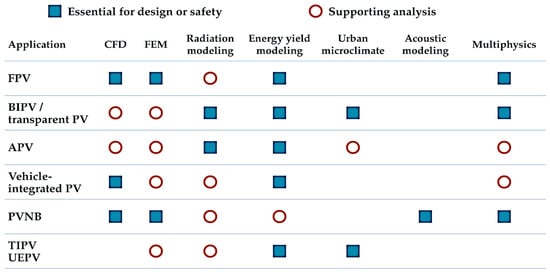

Disclaimer/Publisher’s Note: The statements, opinions and data contained in all publications are solely those of the individual author(s) and contributor(s) and not of MDPI and/or the editor(s). MDPI and/or the editor(s) disclaim responsibility for any injury to people or property resulting from any ideas, methods, instructions or products referred to in the content. |
© 2026 by the authors. Licensee MDPI, Basel, Switzerland. This article is an open access article distributed under the terms and conditions of the Creative Commons Attribution (CC BY) license.