


Abstract
The Pinghu Slope Belt in the Xihu Sag represents a prolific hydrocarbon province in the East China Sea Shelf Basin, where light oils are primarily sourced from the coal-bearing strata of the Eocene Pinghu Formation. However, the Pinghu Formation comprises a heterogeneous assemblage of mudstones, carbonaceous mudstones, and coals, and the differential contribution of these lithologies to the accumulated hydrocarbons remains poorly constrained. This study presents an integrated geochemical investigation of crude oils and source-rock samples from the Pinghu Slope Belt, Xihu Sag. Source rocks were analyzed by Rock-Eval pyrolysis and gas chromatography–mass spectrometry (GC–MS), whereas crude oils were examined for bulk physical properties, whole-oil stable carbon isotopes, and GC–MS. A total of 58 source-rock samples were collected and subjected to Rock-Eval pyrolysis, comprising 44 mudstones, 14 carbonaceous mudstones, and 8 coals. Of these, 12 mudstones, 5 carbonaceous mudstones, and 8 coals were analyzed by GC–MS and used for the oil–source comparison. The eight coal samples are part of the 58 collected source-rock samples and also serve as the coal end-member reference; no additional reference coal samples were used. The light oils are characterized by low density, low sulfur content, low wax content, and a low pour point, with relatively high thermal maturity (calculated Rc = 0.79–1.15%) and heavy whole-oil δ13C values (−26.92‰ to −26.33‰). Diagnostic biomarker assemblages, including high Pr/Ph ratios (8.0–10.73), elevated C30/C29 Ts and hopane/sterane ratios, abundant diterpenoids and oleanane, pronounced C29 sterane predominance, high 1,2,5-trimethylnaphthalene content, and marked enrichment of dibenzofuran over dibenzothiophene, collectively indicate a strongly terrestrial organic-matter source deposited under relatively oxidizing, low-salinity, swamp-related conditions within a broader marine–terrestrial transitional setting. These parameters are not uniquely diagnostic of freshwater conditions, and the freshwater interpretation is therefore applied to local coal-forming swamp facies rather than to the entire Pinghu Formation. Among the three source-rock lithologies, coals exhibit the highest organic-matter richness (average TOC: 50.45%), followed by carbonaceous mudstones (average TOC: 21.25%) and mudstones (average TOC: 2.92%). Although all three lithologies were deposited under relatively oxidizing, low-salinity conditions, their biomarker profiles are systematically distinct. Mudstones display a bimodal n-alkane distribution, measurable gammacerane, and an asymmetric V-shaped C27–C28–C29 sterane pattern, indicating mixed aquatic–terrigenous input and relatively higher water salinity. Carbonaceous mudstones show a rear-peak n-alkane profile with a moderate short-chain contribution, high oleanane, low gammacerane, and a reverse L-shaped sterane pattern with a minor C27 component. Coals are distinguished by a pronounced rear-peak n-alkane distribution, exceptionally low gammacerane, and strong C29 sterane dominance with negligible C27 and C28 homologues, reflecting predominant higher-plant input with substantial angiosperm contribution. Oil–source correlation based on multiple biomarker parameters indicates that the light oils show the strongest affinity with the coal-bearing source-rock assemblage of the Pinghu Formation, in which coal is a major end-member; a subordinate contribution from carbonaceous mudstone cannot be excluded. The correlation with mudstone is poor. Because the biomarker parameters of the oils, carbonaceous mudstones, and coals partly overlap, and because no independent statistical discrimination is available, the correlation is interpreted as indicating a general coal-bearing, terrestrial, oxidizing, swamp-related source affinity rather than as uniquely discriminating coal from carbonaceous mudstone. This refined understanding of source-rock affinity provides a geochemical framework for guiding future exploration strategies in the Xihu Sag.
1. Introduction
The Pinghu Slope Belt in the Xihu Sag is a key exploration area within the East China Sea Shelf Basin, where numerous hydrocarbon-bearing structures have been discovered over nearly five decades of exploration [1,2]. Extensive prior geochemical investigations have established that crude oils from this region are predominantly light oils originating from the coal-measure source rocks of the Middle-Upper Eocene Pinghu Formation [3,4,5]. Nevertheless, the source rock succession exhibits considerable stratigraphic complexity and pronounced lithological heterogeneity, contributing to an ongoing debate concerning the precise origin of the accumulated oils [6,7]. Specifically, the transitional marine-terrestrial depositional environment of the Pinghu Formation causes rapid vertical and lateral variations in organic matter input and preservation conditions [8,9,10]. This inherent complexity poses a significant challenge to conventional oil–source correlation techniques.
Various genetic models have been proposed to account for the observed petroleum distributions [11,12]. Some researchers propose a primary derivation from the coal seams within the Pinghu Formation, emphasizing the high generative potential of this lithotype in a deltaic setting [12]. Conversely, others advocate for a mixed contribution from both coal and interbedded mudstones, citing variable biomarker signatures indicative of a composite source [13,14,15]. With continued exploration, the coal-measure source rocks have been further categorized into three distinct lithofacies: coal, carbonaceous mudstone, and mudstone [16,17]. Although previous studies have examined the bulk properties of these lithofacies, a definitive geochemical distinction between coal and carbonaceous mudstone has remained elusive [18]. This ambiguity arises from their macroscopic similarity and overlapping thermal maturity ranges, which often obscure the subtle biomarker variations required for precise differentiation [19,20]. Consequently, the relative contribution of each source-rock lithofacies to the hydrocarbon accumulations remains poorly constrained, hindering accurate resource prediction and the identification of subtle stratigraphic traps [21,22]. Recent studies have investigated the origin of oils in the Xihu Sag using biomarkers and carbon isotopes [14] and the geochemical characteristics and origin of crude oils in the Pingbei area of the Pinghu Slope Belt [22]. However, the relative source contribution of coal, carbonaceous mudstone, and mudstone within the Pinghu Formation remains poorly constrained.
Building upon this foundation, this study presents a systematic investigation of crude oil geochemistry from the Pinghu Slope Belt and a comprehensive analysis of the bulk properties and biomarker compositions of the three distinct source-rock lithofacies (mudstone, carbonaceous mudstone, and coal). This study differs from previous work by integrating bulk petroleum properties, Rock-Eval pyrolysis, whole-oil carbon isotopes, saturated and aromatic hydrocarbon biomarkers, and a multi-proxy oil–source correlation for the Pinghu Slope Belt. Compared with Huang et al. [14], who used biomarkers and carbon isotopes to investigate the origin of terrigenous-marine oils in the Xihu Sag, and Zhang et al. [22], who discussed the geochemical characteristics and origin of crude oils in the Pingbei area of the Pinghu Slope Belt, the specific new contributions of this study are: (1) a lithofacies-level comparison of coal, carbonaceous mudstone, and mudstone within the Pinghu Formation using a single analytical protocol, and (2) a multi-proxy oil–source correlation based on the biomarker ratios and C27–C29 sterane proportions reported in this study. Multivariate statistical discrimination was not performed, and no statistical discrimination between coal and carbonaceous mudstone is claimed. Emphasis is placed on the application of aromatic hydrocarbon fingerprints and diterpenoid distributions to evaluate terrestrial higher-plant input among the coal and carbonaceous mudstone end-members. By delineating the geochemical distinctions among these lithofacies and performing a detailed oil-source rock correlation, this study aims to constrain the origin of the hydrocarbons and provide a geochemical framework for guiding future exploration strategies in the region.
2. Geological Setting
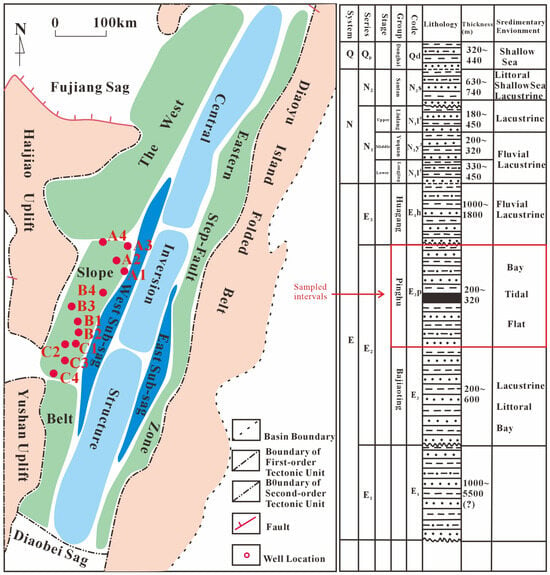
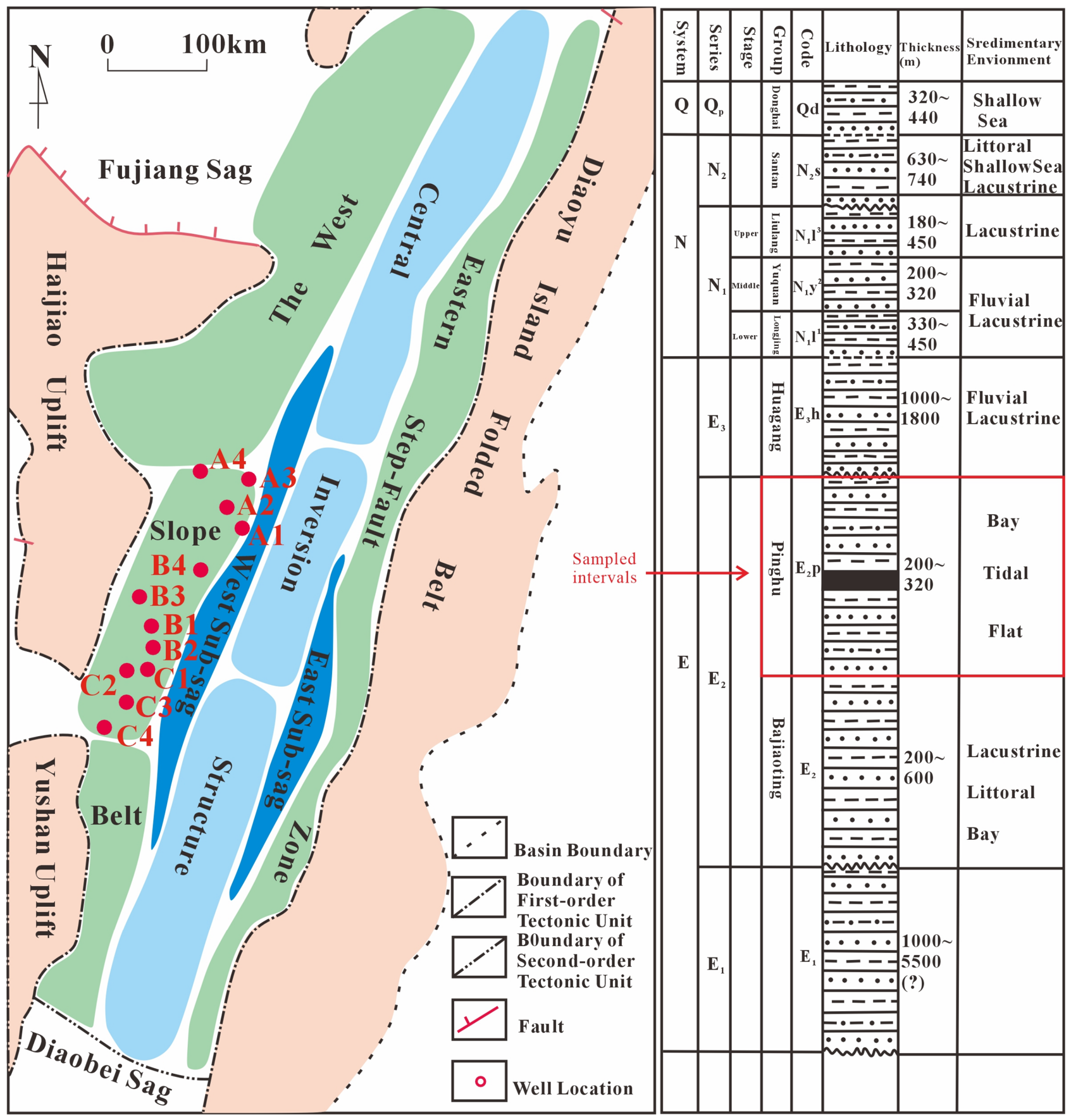
The Xihu Sag is located in the northeastern part of the East China Sea Shelf Basin (Figure 1) [23,24]. It is bounded by the Haijiao and Yushan Uplifts to the east, the Diaoyudao Folded-Uplift Zone to the west, and adjoins the Diaobei Sag to the south and the Fujiang Sag to the north [25,26]. Oriented in an overall NNE direction, the sag covers a total area of approximately 5.9 × 10⁴ km2 (Figure 1) [27]. Tectonically, the Xihu Sag is characterized by an “E-W zonation and N-S block-faulting” structural framework and can be subdivided into five secondary tectonic units: the Western Slope Belt, the Western Sub-sag, the Central Inversion Tectonic Belt, the Eastern Sub-sag, and the Eastern Fault-Step Belt (Figure 1) [28,29]. Since the early 1970s, the successive discoveries of several oil and gas fields (e.g., Pinghu, Baoyunting, Kongqueting, and Chunxiao) and numerous hydrocarbon-bearing structures (e.g., Yuquan, Gushan, and Huxinting) have established the Xihu Sag as the largest hydrocarbon-rich sag in the East China Sea region (Figure 1) [30].
Figure 1.
Tectonic framework of the Xihu Sag and comprehensive stratigraphic column of the study area. Well labels are enlarged for legibility. Sampled Pinghu Formation intervals are indicated by colored bars or symbols on the stratigraphic column and are listed in the sample inventory.
The Pinghu Slope Belt is situated in the central part of the western slope zone of the Xihu Sag, flanked by the Haijiao Uplift to the east and the Western Sub-sag to the west, with a total exploration area of approximately 3500 km2 (Figure 1) [31]. Following three tectonic evolution phases, rifting, depression, and regional subsidence, a sequence of Cenozoic clastic strata was deposited in the Pinghu Slope Belt (Figure 1) [32]. In ascending order, this stratigraphic sequence comprises the Eocene Bajiaoting (E2) and Pinghu (E2p) Formations; the Oligocene Huagang Formation (E3h); the Miocene Longjing (N1l1), Yuquan (N1y2), and Liulang (N1l3) Formations; the Pliocene Santan Formation (N2s); and the Pleistocene Donghai Group (Qd). The target interval of this study is the Eocene Pinghu Formation. The Pinghu Formation was deposited in a marine–terrestrial transitional setting, including bay, tidal-flat, and deltaic environments [33]. Within this regional setting, the coal-bearing intervals record local swamp and delta-plain conditions. The biomarker-based low-salinity interpretation in this study should therefore be understood as characterizing local coal-forming swamp facies rather than the entire Pinghu Formation [34]. This distinction is important because the Pinghu Formation contains a heterogeneous assemblage of mudstone, carbonaceous mudstone, and coal, and these lithologies may record different subenvironments and salinity conditions within the broader transitional system [35,36].
3. Samples and Method
For this study, 11 crude oil samples and 58 source-rock samples were collected from the Pinghu Slope Belt. The 58 source-rock samples comprise 44 mudstones, 14 carbonaceous mudstones, and 8 coals (44 + 14 + 8 = 58). The 8 coal samples are part of the 58 collected source-rock samples and also serve as the coal end-member reference for the oil-source comparison; no additional reference coal samples were used. After quality screening, all 58 source-rock samples were subjected to Rock-Eval pyrolysis. For GC–MS analysis and oil–source correlation, 12 mudstones, 5 carbonaceous mudstones, and 8 coals were selected; these are the same samples plotted in Figure 1 and used for the oil–source correlation in Section 4.5. All analytical experiments were conducted at the State Key Laboratory of Petroleum Resources and Prospecting, China University of Petroleum (Beijing).
3.1. Extraction of Soluble Organic Matter
The extraction method employed was Soxhlet extraction. An appropriate amount of pulverized source-rock sample was placed into a pre-extracted filter paper thimble and then inserted into the Soxhlet apparatus. The bottom flask was filled to one-third of its capacity with dichloromethane, and the sample was continuously extracted in a constant-temperature water bath for 24 h. Upon completion, the extract was concentrated using a rotary evaporator and transferred to a pre-weighed weighing bottle. Procedural blanks were analyzed with each batch to monitor contamination.
3.2. Crude Oils and Extract Separation
An appropriate amount of the soluble organic matter from source rocks and crude oil was weighed into a glass-stoppered conical flask. After adding petroleum ether with continuous agitation and allowing the mixture to stand for over 12 h to ensure complete precipitation of asphaltenes, the solution was transferred to a chromatographic column packed with alumina and silica gel (in a mass ratio of 2:3). The saturated, aromatic, and non-hydrocarbon (NSO) fractions were then sequentially eluted using petroleum ether (6 times), a mixture of dichloromethane and petroleum ether (2:1, v/v, 4 times), and a mixture of methanol and dichloromethane (1:9, v/v, 1 time), respectively.
3.3. GC–MS Analysis
GC–MS analysis was performed on an Agilent 6890-5975I instrument (Agilent Technologies, Santa Clara, CA, USA) equipped with an HP-5MS capillary column (30 m × 0.25 mm × 0.25 μm). Helium was used as carrier gas at a constant flow rate of 1.0 mL/min. The ion source and quadrupole temperatures were 230 °C and 150 °C, respectively, with an electron ionization energy of 70 eV. Saturated hydrocarbon fractions were analyzed in full-scan mode (m/z 50–600) and in selected ion monitoring (SIM) mode using diagnostic ions m/z 191, 177, 217, 218, 259, and 231. Aromatic hydrocarbons were analyzed using m/z 128, 142, 156, 170, 184, 198, 178, 192, 206, 166, 180, 194, 208, and 234. Compound identification was based on comparison of retention times and mass spectra with published data and reference standards where available. Peak integration was performed using Agilent ChemStation software (Version B.04.03; Agilent Technologies, Santa Clara, CA, USA). The naphthalene series includes naphthalene, methylnaphthalenes, ethylnaphthalenes, dimethylnaphthalenes, trimethylnaphthalenes, tetramethylnaphthalenes, and pentamethylnaphthalenes. The relative abundance of 1,2,5-trimethylnaphthalene (1,2,5-TMN) is expressed as a percentage of the total naphthalene series: 1,2,5-TMN (%) = [peak area of 1,2,5-TMN/sum of peak areas of all naphthalene-series compounds] × 100. The tri-fluorene parameters are defined as ΣSF/(ΣSF + ΣF) and ΣOF/(ΣOF + ΣF), where F, OF, and SF represent the fluorene, dibenzofuran, and dibenzothiophene series, respectively. These parameters are interpreted within a multi-proxy framework and are not treated as independent environmental classifiers. The oven temperature program for saturated hydrocarbons was as follows: an initial temperature of 100 °C held for 1 min, ramped to 300 °C at 4 °C/min, and then held at the final temperature for 15–20 min. For aromatic hydrocarbons, the program started at 80 °C (held for 1 min), ramped to 300 °C at 3 °C/min, and was held for 15–20 min. Analytical reproducibility was monitored by repeated analysis of a laboratory oil standard; the relative standard deviations for major biomarker ratios were generally <5%.
3.4. Rock-Eval Pyrolysis of Source Rocks and Stable Carbon Isotope Analysis of Whole Oils
Rock-Eval pyrolysis was performed using a Vinci Technologies Rock-Eval 6 analyzer. Approximately 60–100 mg of pulverized sample was heated in a helium atmosphere. The program was as follows: initial temperature 300 °C for 3 min, then ramped to 650 °C at 25 °C/min. The flame ionization detector and thermal conductivity detector were calibrated using the IFP 160000 standard. Repeated analyses of standard samples gave relative standard deviations of <5% for TOC, S1, and S2.
Stable carbon isotope analysis of whole oils was carried out using a Thermo Finnigan Delta Plus XP isotope ratio mass spectrometer coupled to a Flash EA 1112 elemental analyzer. Carbon isotope values are reported in δ notation relative to VPDB. Repeated analyses of reference standards gave a standard deviation of <0.2‰.
3.5. Statistical Analysis
Multivariate statistical analysis, including principal component analysis (PCA) and hierarchical cluster analysis (HCA), was not performed. The oil–source correlation presented in this study is based on biomarker cross-plots and range comparisons, as reported in Section 4.5. The biomarker parameters are interpreted within a multi-proxy framework, and no statistical discrimination between coal and carbonaceous mudstone is claimed.
4. Results and Discussions
4.1. Basic Geochemical Characteristics of Crude Oil
Based on the physical property analysis, the specific gravity of crude oils from the Pinghu Slope Belt does not exceed 0.80, indicating that they are predominantly light oils. With sulfur contents of 0.05~0.07%, wax contents of 7.34~7.72%, and pour points of 1.52~7.21 °C, the oils are collectively characterized by low density, low sulfur content, low wax content, and a low pour point (Table 1). Vertically, from deep to shallow strata, the saturated hydrocarbon content of the crude oils decreases, whereas the NSO plus asphaltene content increases. This trend may reflect biodegradation and enhanced microbial activity at shallower burial depths, but bulk group composition alone is not diagnostic of biodegradation. Diagnostic molecular evidence, such as preferential removal of n-alkanes, development of an unresolved complex mixture (UCM), or alteration of biodegradation-sensitive biomarkers, is required to confirm this process. In the absence of such evidence, biodegradation is considered a possible explanation rather than a demonstrated process.
Table 1.
Physical properties and group composition of crude oils from the Pinghu Slope Belt. Values are averages of available oil samples, except for Pinghu M1 (n = 1), for which values are individual measurements. n = number of contributing oil samples. For Pinghu M2 (n = 6) and Pinghu M3 (n = 4), dispersion is reported as standard deviation or minimum–maximum range.
The stable carbon isotopic composition of crude oils is largely inherited from their source organic matter. However, isotopic fractionation can occur during hydrocarbon generation and expulsion. The effect of thermal maturity on this fractionation is generally limited, but whole-oil δ13C is also controlled by organic-matter source, kerogen type, depositional setting, and generation/expulsion history. A fixed 2–3‰ difference should not be treated as a universally diagnostic threshold for source-rock lithology. The narrow δ13C range of the studied oils indicates isotopic similarity and is consistent with a predominantly terrestrial source, but it does not independently demonstrate derivation from the same source-rock lithology [37]. Because the main objective is to evaluate the relative source affinity of coal, carbonaceous mudstone, and mudstone, comparison with the δ13C compositions of these source-rock lithologies would provide a stronger constraint. However, in the absence of a complete lithology-specific δ13C dataset, whole-oil δ13C is used here only as a general terrestrial-source indicator and not as a lithology-specific discriminator.
Duplicate analyses of the whole-oil carbon isotopic composition for 11 crude oil samples from the Pinghu Slope Belt yielded differences between replicates of only 0.02–0.21‰, which falls within acceptable analytical error and confirms the reliability of the data. The whole-oil δ13C values range from −26.92‰ to −26.33‰. These relatively heavy carbon isotopic compositions are characteristic of typical terrestrial oils. The narrow range of δ13C values suggests that the main body of crude oils is isotopically similar and consistent with a common terrestrial source affinity, although it does not independently identify the source-rock lithology (Table 2).
Table 2.
Stable carbon isotope compositions (δ13C, ‰) of whole oils from the Pinghu Slope Belt.
4.2. Maturity of Crude Oil
The maturity of crude oils in the Xihu Sag has been extensively investigated, but conclusions vary significantly depending on the parameters used. For example, Su et al. suggested that the oils are mainly mature based on n-heptane and isoheptane ratios [38], whereas Zhang et al. concluded that oils in the Pingbei area span the mature to high-maturity stage based on the paraffin index [39]. Jiang et al. employed light hydrocarbon temperature parameters and determined that Pinghu Slope Belt oils are generally mature, with a maturity range of 0.79–0.92% Rc [40]. To address this discrepancy, this study employs and critically evaluates multiple maturity parameters to provide a more robust assessment.
The Ts/Tm ratio is a commonly used maturity indicator. As shown in Table 3, the Ts/Tm values of the studied oils range from 0.17 to 0.73, with the majority falling below 0.50. These low values would conventionally suggest an immature oil character, which starkly contradicts the findings of previous studies [40]. However, the Ts/Tm ratio is influenced not only by thermal maturity but also by source facies, lithology, mineralogy, and depositional environment. The low Ts/Tm values in the studied oils should therefore not be interpreted simply as an indication of immaturity. A possible explanation is the relatively low clay-mineral content of the coal-bearing Pinghu Formation source rocks, which may inhibit the clay-catalyzed conversion of Tm to Ts. However, this explanation requires mineralogical confirmation and is presented here as a possible control rather than a demonstrated cause. The Ts/Tm ratio is therefore treated as an auxiliary parameter rather than a standalone maturity indicator in this study [38].
Table 3.
Biomarker compound data for crude oils from the Pinghu slope belt.
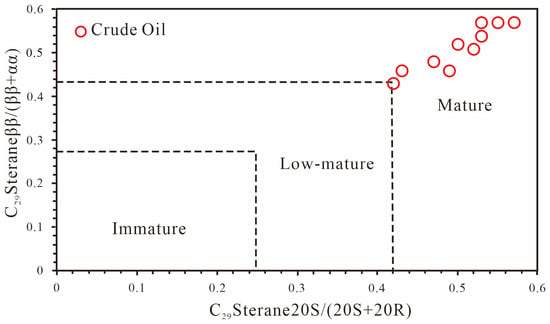
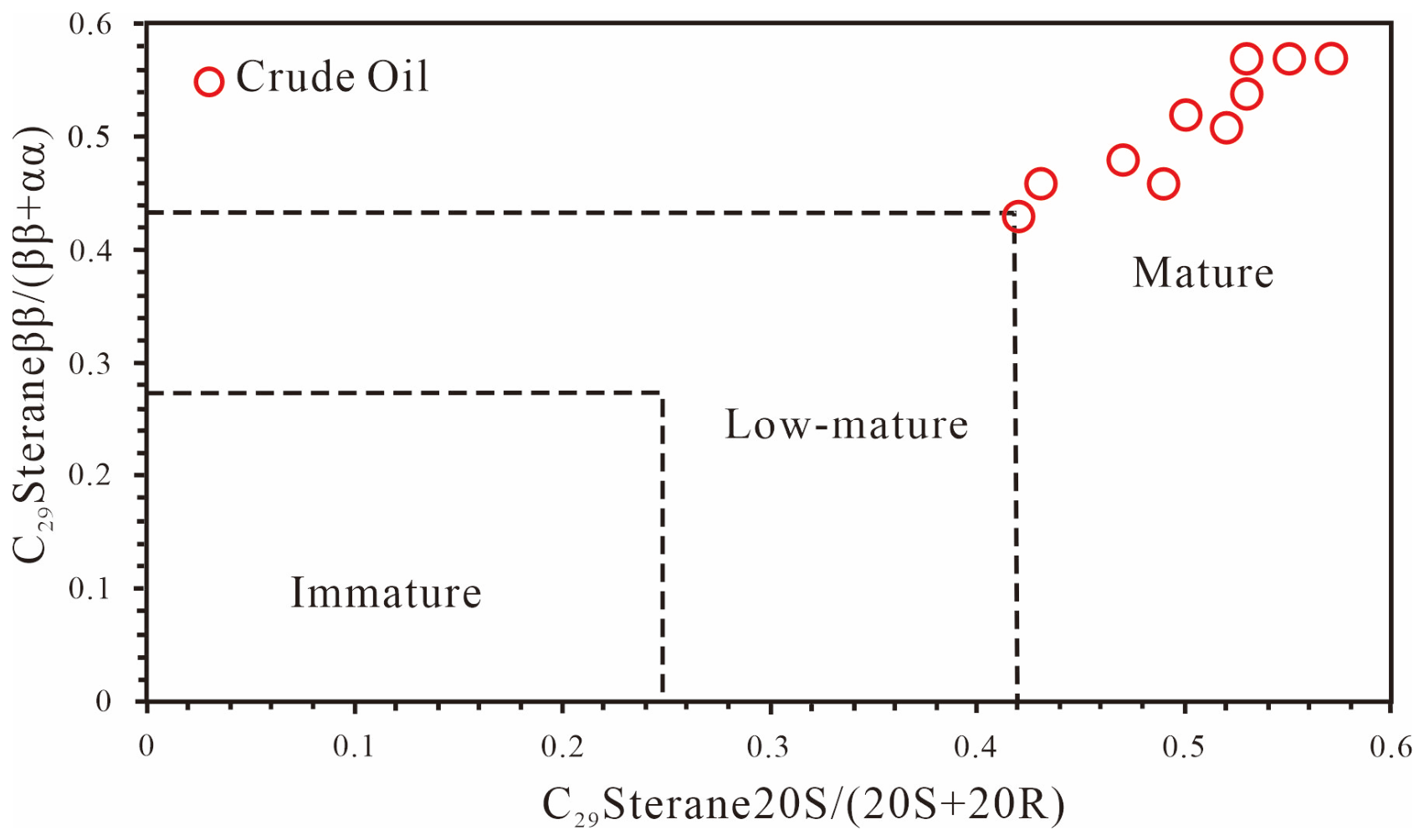
Sterane maturity parameters, specifically the C29 ααα20S/(20S + 20R) and C29 αββ/(ααα + αββ) ratios, are widely used indicators of thermal evolution [41]. A cross-plot of these two parameters is particularly effective for assessing the maturity of source rocks and crude oils [41]. A cross-plot of these two ratios for the studied oils indicates that all samples have entered the mature stage (Figure 2). Because these ratios approach equilibrium at high maturity, they are used together with other maturity parameters rather than as standalone indicators. Their approach-to-equilibrium behavior also means that they are more sensitive in the low- to moderate-maturity range than in the late-maturity range.
Figure 2.
Cross-plot of C29 sterane 20S/(20S + 20R) versus C29 sterane ββ/(αα + ββ) ratios for crude oil samples.
In addition to saturated hydrocarbon parameters, the isomerization ratios of certain methylated aromatic hydrocarbons have been developed as maturity indicators. Radke et al. proposed that the Methylphenanthrene Index (MPI-1) serves an analogous function to vitrinite reflectance (Ro) in evaluating the thermal maturity of crude oils [42]. Based on studies of multiple oil fields, Radke and Welte established a regression equation linking MPI-1 to calculated vitrinite reflectance (Rc):
Rc = 0.60 × MPI-1 + 0.4
Applying this equation to the 11 crude oil samples gives MPI-1 values of 0.65–1.25 and calculated equivalent vitrinite reflectance (Rc) values of 0.79–1.15%. These values represent calculated equivalent vitrinite reflectance, not measured vitrinite reflectance (Ro). The Radke calibration was originally developed for marine and lacustrine oils and may carry uncertainty when applied to terrestrial coal-bearing systems. In particular, the aromatic maturity response of coal-derived oils can differ from that of marine oils because of differences in precursor composition, kerogen structure, and generation/expulsion history. The Rc values obtained here are therefore considered consistent with mature to late mature oil generation rather than precisely defining the peak oil-generation window (Table 3).
Overall, the combined maturity parameters indicate that the Pinghu Slope Belt oils are mature to late mature. The Ts/Tm ratio is not reliable as a standalone maturity indicator in this coal-bearing setting, whereas the C29 sterane isomerization ratios and MPI-1-derived Rc values provide a broadly consistent maturity assessment when their respective limitations are taken into account.
4.3. Molecular Marker Characteristics of Crude Oil
4.3.1. N-Alkanes and Isoprenoids
Pristane (Pr) and phytane (Ph) are both derived from phytol, and their ratio (Pr/Ph) is widely used as an indicator of redox conditions and salinity in depositional environments [43]. A low Pr/Ph ratio (<0.8) is typically associated with hypersaline and reducing environments, such as saline lakes. Moderate Pr/Ph ratios (0.8–3), which indicate a pristane–phytane equilibrium, are characteristic of low-salinity, sub-reducing freshwater lacustrine settings. A strong pristane dominance (Pr/Ph > 3) suggests deposition in a relatively oxidizing environment, commonly found in swamp settings. A prominent feature of the studied crude oils is their exceptionally high Pr/Ph ratio, ranging from 8.0 to 10.73. This strong pristane dominance is consistent with a relatively oxidizing, low-salinity depositional environment. However, high Pr/Ph is not uniquely diagnostic of freshwater conditions, and Pr/n-C17 and Ph/n-C18 can also be affected by maturity and biodegradation. These parameters are therefore interpreted together with other biomarker evidence rather than as independent environmental classifiers.
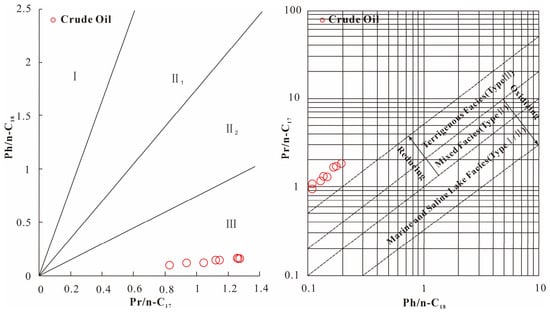
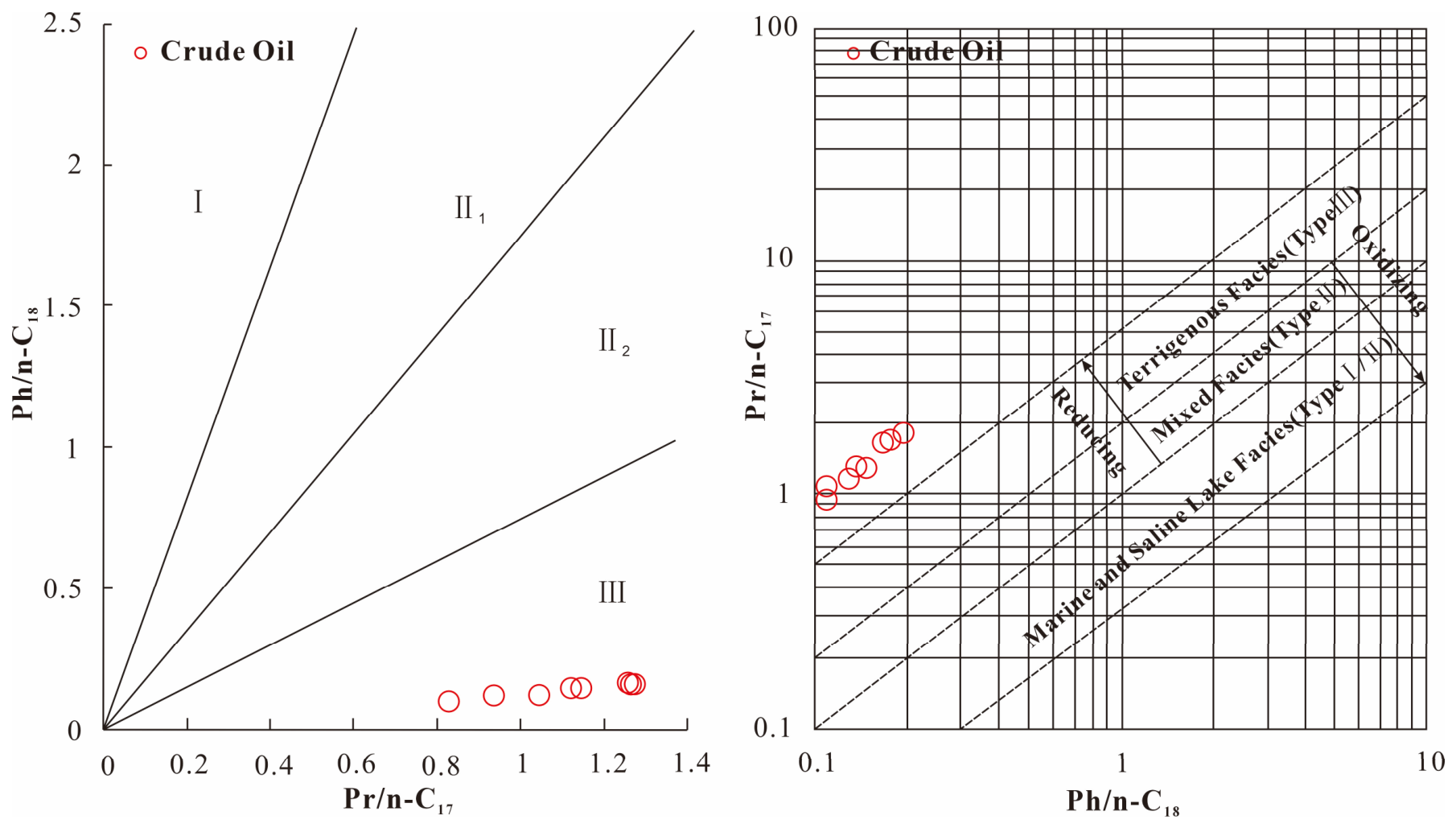
The cross-plot of Pr/n-C17 versus Ph/n-C18 is widely applied to infer depositional settings [44,45]. Generally, a Pr/n-C17 ratio < 0.5 reflects an open-water environment, whereas a ratio >1 indicates an inland swamp setting. In this study, all crude oil samples exhibit Pr/n-C17 values greater than 0.5, and with a few exceptions, the majority exceed 1.0. This pattern suggests that the oils were predominantly sourced from a swamp-dominated paleoenvironment. It is noteworthy that, besides depositional environment, the Pr/n-C17 ratio is also influenced by thermal maturity, generally decreasing with increasing maturation. This effect is evident in the two samples from wells A1 and A2, which exhibit the highest maturity and correspondingly the lowest Pr/n-C17 values (Table 3). A cross-plot of Pr/n-C17 versus Ph/n-C18 shows that all crude oil samples cluster within the oxidizing-environment field, with an organic-matter type predominantly corresponding to Type III kerogen. This supports a genetic link to coal-bearing organic matter (Figure 3).
Figure 3.
Cross-plot of pristane/n-C17 versus phytane/n-C18 ratios for crude oil samples.
4.3.2. Diterpenoids
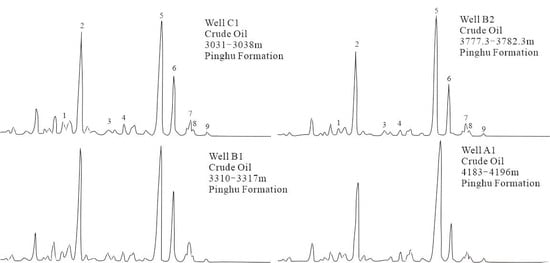
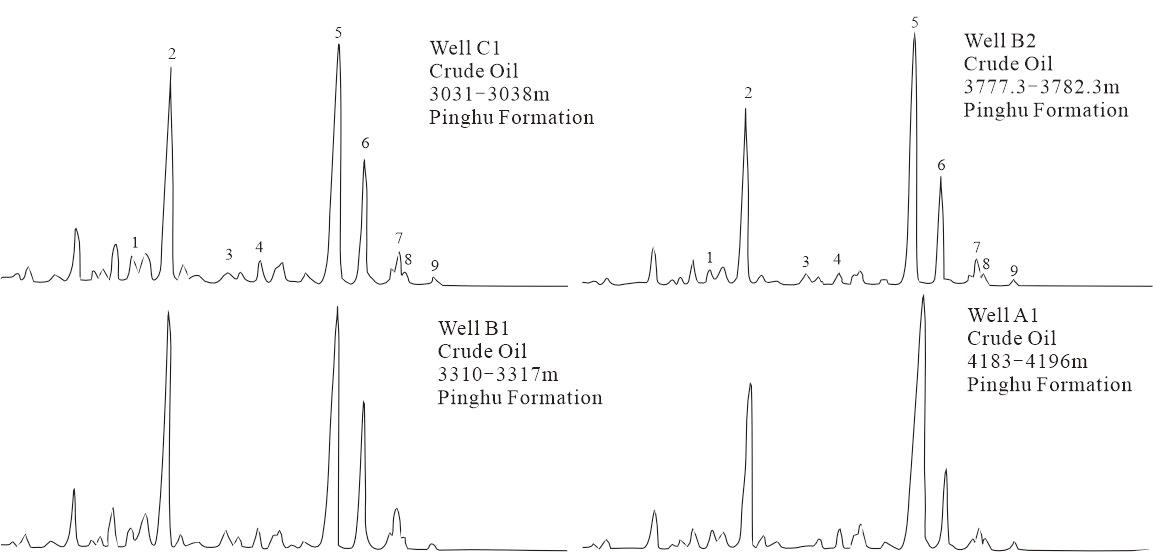
High concentrations of diterpenoids were detected in all crude oil samples. Diterpenoids are generally recognized as biomarkers derived from plant resins, and because the precursor resin bodies originate from higher plants, they serve as robust indicators of terrestrial higher-plant input [46,47,48,49]. The diterpenoid distributions of the 11 analyzed crude oils are very similar, all exhibiting a dominant peak of either 4β(H)-19-norisopimarane (Peak 2) or isopimarane (Peak 5) (Figure 4). This supports a predominant contribution from higher terrestrial plants to the organic-matter source. Phyllocladane is typically associated with the leaf resins of conifers belonging to the Podocarpaceae and Dacrydium families, and its relative abundance reflects the degree of conifer contribution. Phyllocladane exists as two stereoisomers: 16α(H)- and 16β(H)-phyllocladane. With increasing thermal maturity, the less stable 16α(H) isomer progressively converts to the more stable 16β(H) isomer. The detection of high phyllocladane content in all crude oils indicates a significant conifer contribution. The markedly higher relative abundance of 16β(H)-phyllocladane (Peak 6) compared to 16α(H)-phyllocladane (Peak 8) is consistent with high thermal maturity, corroborating the maturity assessment presented in the previous section. These diterpenoid parameters support terrestrial higher-plant input and a coal-bearing source affinity, but they do not by themselves uniquely discriminate coal from carbonaceous mudstone.
Figure 4.
Distribution of diterpenoids in crude oil samples. Legend: 1, 8β(H)-labdane; 2, 4β(H)-19-norisopimarane; 3, fichtelite; 4, 17-nortetracyclic diterpane; 5, isopimarane; 6, 16β(H)-phyllocladane; 7, 16β(H)-kaurane; 8, 16α(H)-phyllocladane; 9, 16α(H)-kaurane.
4.3.3. Pentacyclic Triterpanes
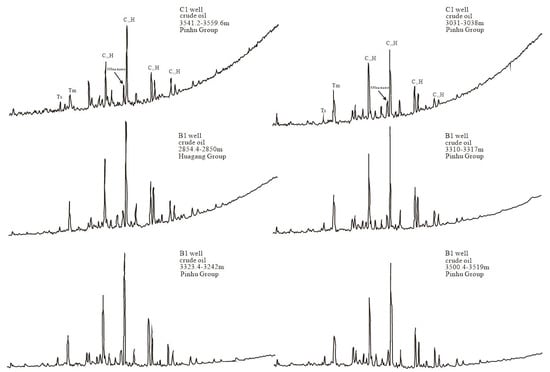
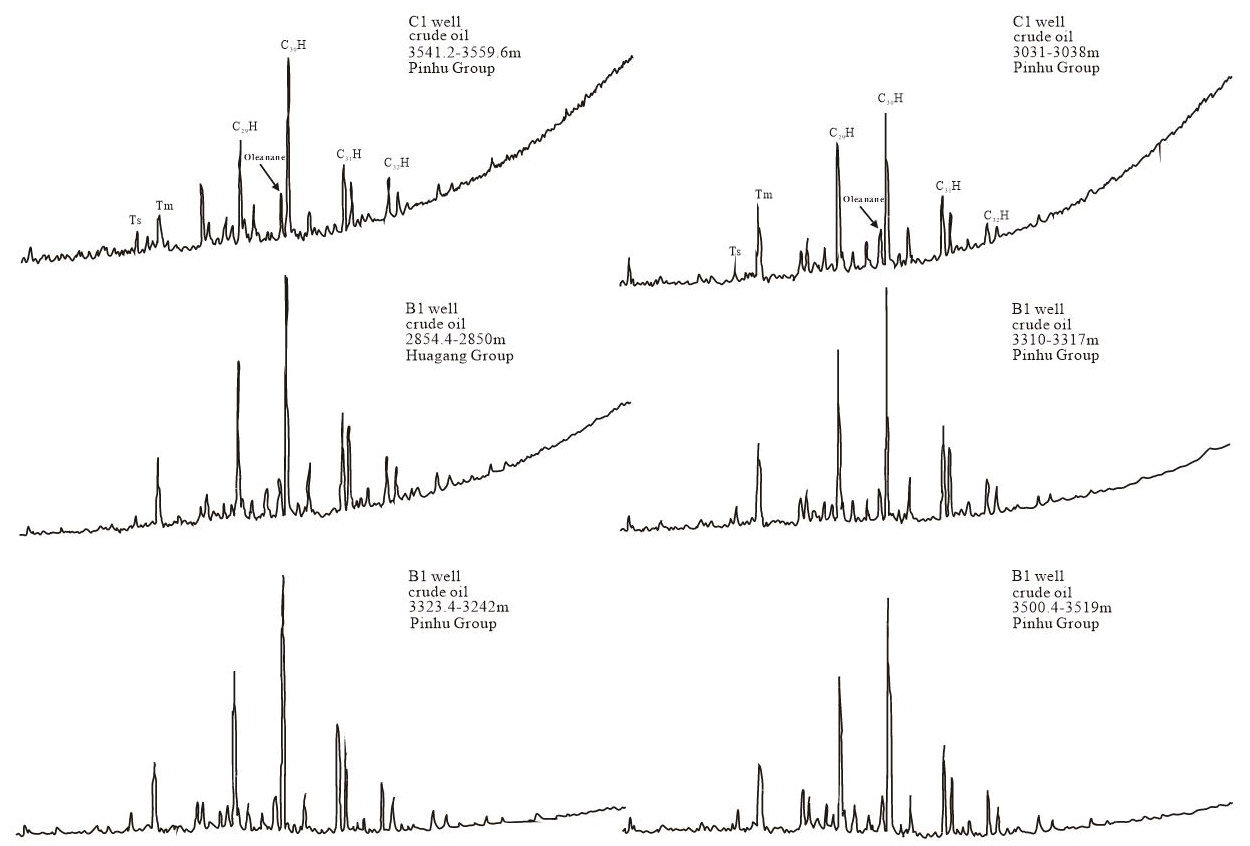
The pentacyclic triterpane series comprises both hopanoids and non-hopanoid compounds. Hopanoids are ubiquitous biomarkers in source rocks and crude oils and are primarily indicative of bacterial input [50]. Consequently, their distribution patterns provide valuable information on both organic-matter source and paleodepositional environment [51]. The crude oil samples contain abundant hopanoids with relatively high hopane/sterane ratios, ranging from 1.15 to 3.63. This biomarker composition is characteristic of organic matter deposited in a terrestrial setting. As shown in Figure 5, the C31–C35 homohopanes exhibit a systematically decreasing stepwise distribution, a pattern indicative of sub-oxic bottom-water conditions during deposition. Furthermore, a notable abundance of 17α-diahopane (C30) was detected. The C30/C29 Ts ratio is closely linked to the redox conditions of the depositional environment [51], with oils from oxic to sub-oxic settings typically exhibiting high values. The calculated C30/C29 Ts ratios for the studied oils are relatively high, ranging from 0.85 to 1.50 with an average of 1.23, further supporting their formation in an oxic to sub-oxic environment (Table 3).
Figure 5.
Distribution of pentacyclic triterpenoids in crude oil samples.
The principal non-hopanoid compounds are oleanane and gammacerane. Oleanane is a biomarker for terrestrial angiosperms, and its relative abundance is commonly expressed as the oleanane index (oleanane/C30 hopane), where higher values signify a greater contribution from higher terrestrial plants [52]. Gammacerane originates from tetrahymanol and is an indicator of water-column stratification and salinity; a higher gammacerane/C30 hopane ratio typically reflects elevated salinity during deposition [53]. All crude oils contain a noticeable amount of oleanane (oleanane index: 0.22–0.46, mean 0.33) and only trace levels of gammacerane (gammacerane index: 0.02–0.05, mean 0.04). These characteristics collectively indicate an organic-matter source dominated by higher terrestrial plants and deposited under relatively low-salinity, oxidizing conditions. Low gammacerane is consistent with the absence of strong water-column stratification or hypersaline conditions, but it does not independently prove freshwater deposition (Table 3, Figure 5).
4.3.4. Steranes
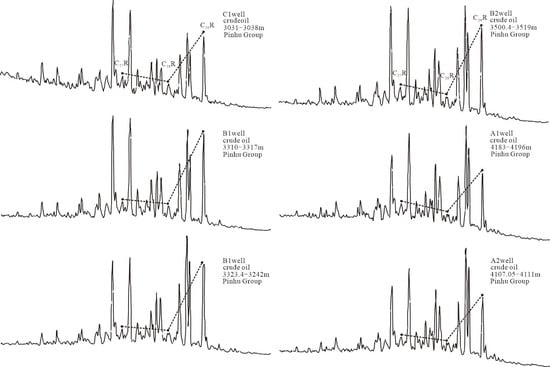
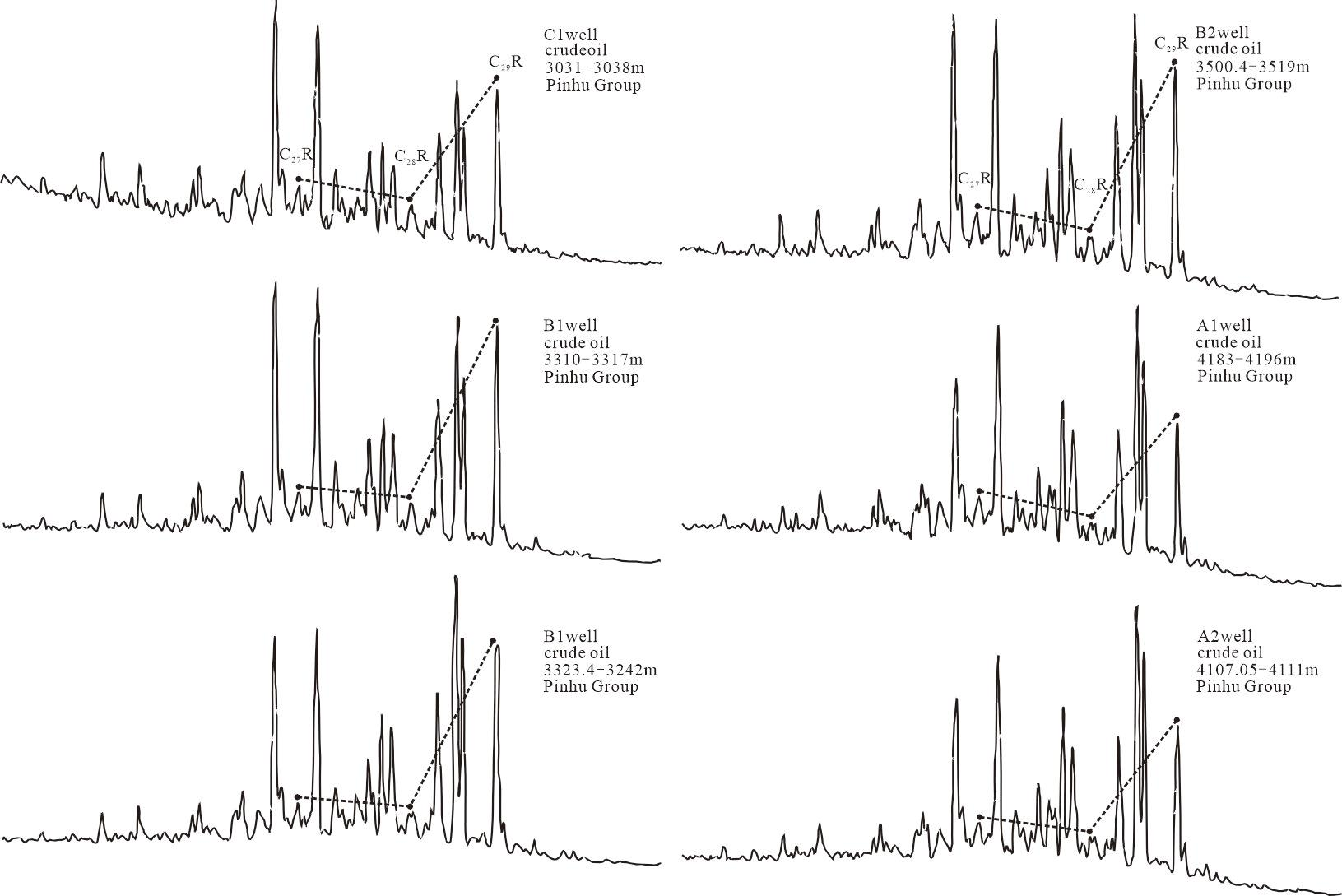
The C27–C28–C29 regular steranes are commonly used to infer the biological source of organic matter in crude oils. A predominance of C27 steranes typically indicates an origin from lower aquatic organisms, whereas C29 sterane dominance suggests a primary input from higher terrestrial plants [54]. The sterane distributions in the studied oils are characterized by an overwhelming predominance of C29 regular steranes over negligible amounts of C27 and C28 homologues, displaying a pronounced reverse L-shaped profile (Figure 6). This pattern strongly supports a predominant higher terrestrial plant source for the oil-forming organic matter. However, C29 sterane dominance indicates terrestrial higher-plant input and does not by itself uniquely discriminate coal from carbonaceous mudstone.
Figure 6.
Distribution of steranes in crude oil samples.
4.3.5. Aromatic Hydrocarbons
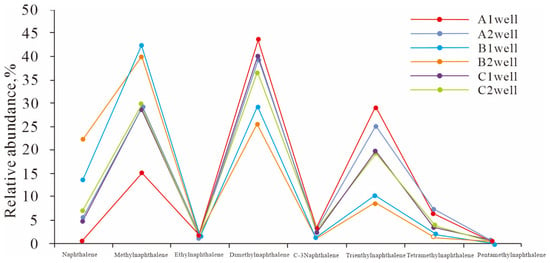
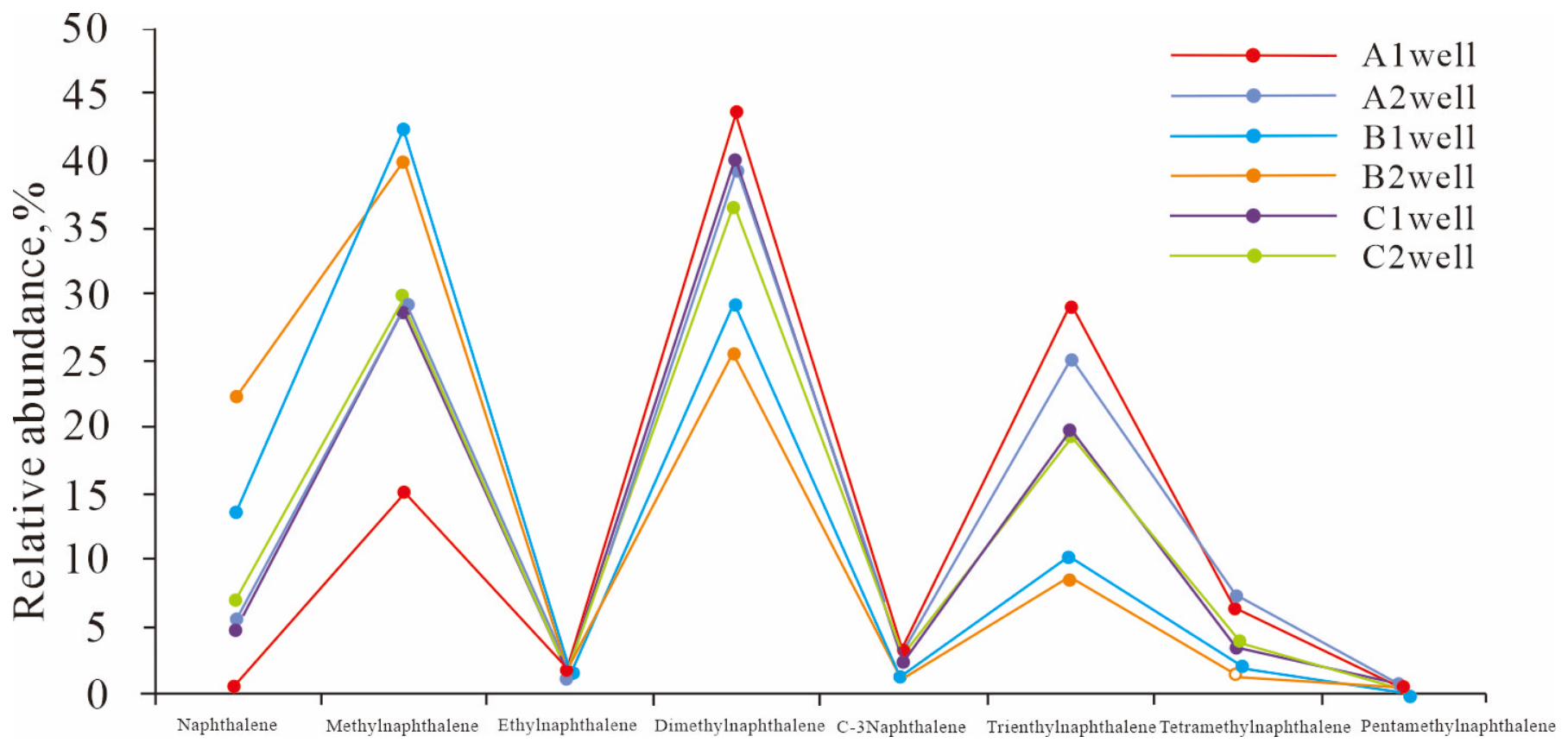
A suite of aromatic hydrocarbon series was identified in the crude oils, including naphthalene, phenanthrene, chrysene, fluorene, biphenyl, dibenzofuran, and dibenzothiophene series. Quantitatively, the naphthalene, phenanthrene, and biphenyl series collectively account for an average of 88.21% of the total aromatic biomarkers, with the naphthalene series alone constituting the dominant fraction at an average of 60.26% (Figure 7). The naphthalene series encompasses naphthalene, methylnaphthalenes, ethylnaphthalenes, and di- to pentamethylnaphthalenes. As illustrated in Figure 7, the distributions are broadly similar across all samples. Methyl-, dimethyl-, and trimethylnaphthalenes are relatively abundant, whereas ethylnaphthalene, C3-naphthalene, and tetra- and pentamethylnaphthalenes are present in lower concentrations. Notably, 1,2,5-trimethylnaphthalene (1,2,5-TMN) has been proposed to originate from higher-plant triterpenoid precursors and to be particularly enriched in plant resins [55,56]. In the studied oils, 1,2,5-TMN accounts for 1.76–6.47% of the total naphthalene series. This is consistent with a substantial higher-plant contribution. However, 1,2,5-TMN is not a unique indicator of coal versus carbonaceous mudstone, and its interpretation is therefore integrated with other biomarker parameters rather than used as a standalone discriminator [57,58]. The calculation and normalization of 1,2,5-TMN are defined in Section 3.3.
Figure 7.
Composition and distribution of naphthalene series compounds in crude oil samples.
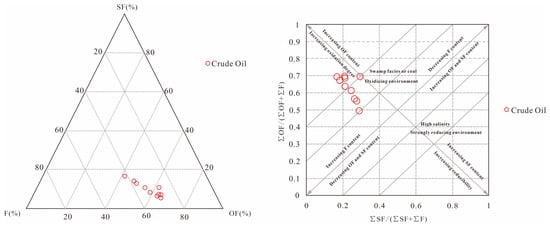
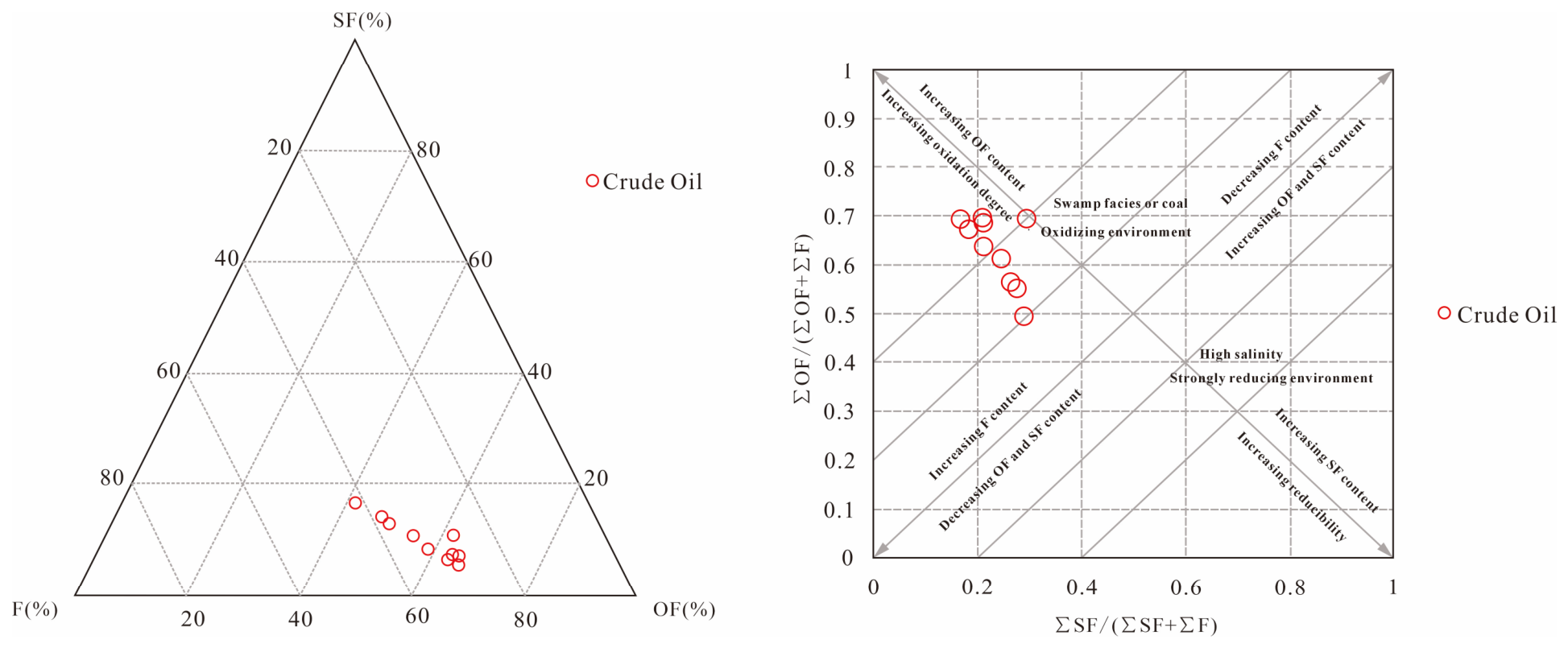
The fluorene (F), dibenzofuran (OF), and dibenzothiophene (SF) series, collectively termed the “tri-fluorene” series, are common aromatic compounds in crude oils, and their relative abundance is an effective proxy for depositional environment. Generally, high SF content is associated with strongly reducing marine or saline lacustrine environments, high OF content with oxidizing deltaic or swamp settings, and high F content with freshwater to brackish lacustrine conditions [59]. On the ternary diagram of tri-fluorene relative composition, the studied oils plot in a region characterized by the highest OF content, followed by F, and the lowest SF content, indicating deposition under strongly oxidizing conditions (Figure 8). Li et al. proposed a cross-plot of ΣSF/(ΣSF + ΣF) versus ΣOF/(ΣOF + ΣF) to further discriminate depositional environments [59]. In this plot, all crude oil samples fall within the field for swamp or coal-related oxidizing settings (Figure 8), which is in close agreement with the conclusions drawn from saturated hydrocarbon biomarkers. These tri-fluorene parameters are interpreted here as part of an integrated multi-proxy framework rather than as independent environmental classifiers or as discriminators between coal and carbonaceous mudstone.
Figure 8.
Ternary diagram of fluorene, dibenzofuran, and dibenzothiophene in crude oil samples, showing depositional environment discrimination.
4.4. Source Rock Geochemistry
The source rocks of the Pinghu Formation in the Pinghu Slope Belt can be lithologically subdivided into three types: mudstone, carbonaceous mudstone, and coal. In this study, 58 source-rock samples were collected, comprising 44 mudstones, 14 carbonaceous mudstones, and 8 coals (44 + 14 + 8 = 58). All 58 samples were subjected to Rock-Eval pyrolysis. For GC–MS analysis and oil–source correlation, 12 mudstones, 5 carbonaceous mudstones, and 8 coals were selected. The 8 coal samples are part of the 58 collected source-rock samples and also serve as the coal end-member reference for the oil–source comparison. No additional reference coal samples were used. These 12 mudstone, 5 carbonaceous mudstone, and 8 coal samples are the same samples plotted in Figure 12 and used for the oil–source correlation.
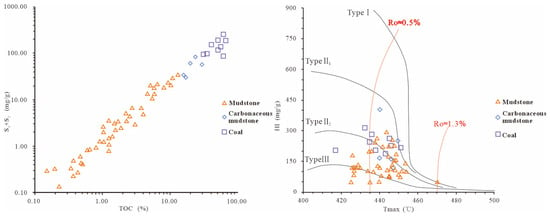
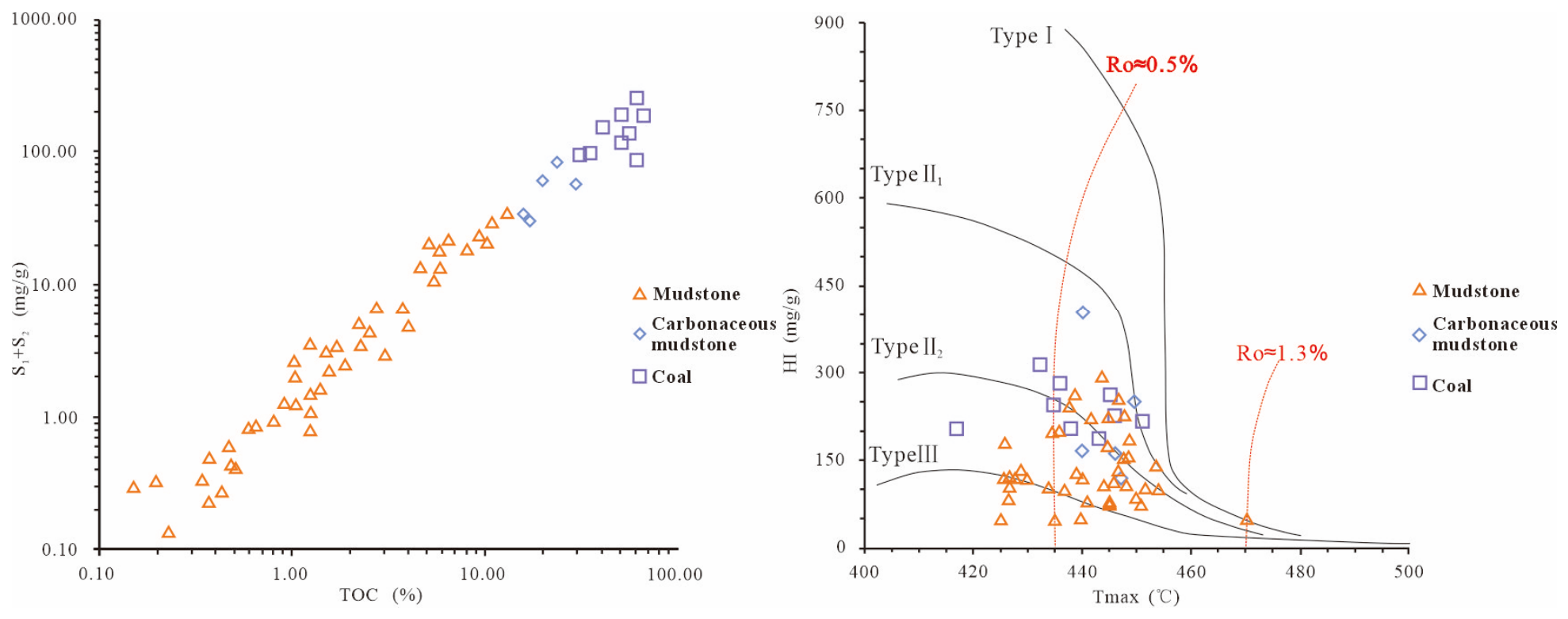
Rock-Eval pyrolysis results show a strong positive correlation between total organic carbon (TOC) content and genetic potential (S1 + S2). Coals exhibit the highest organic-matter richness, with an average TOC of 50.45%, followed by carbonaceous mudstones (average TOC: 21.25%) and mudstones, which have the lowest abundance (average TOC: 2.92%). The organic matter is predominantly of Type II–III kerogen. The hydrogen index (HI) of coals and carbonaceous mudstones is generally higher than that of mudstones, classifying their organic matter as Type II–II and indicating a higher relative abundance of hydrogen-rich components (Figure 9).
Figure 9.
Organic matter abundance and types of source rocks from the Pinghu Formation.
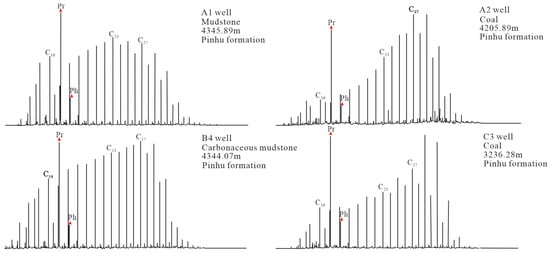
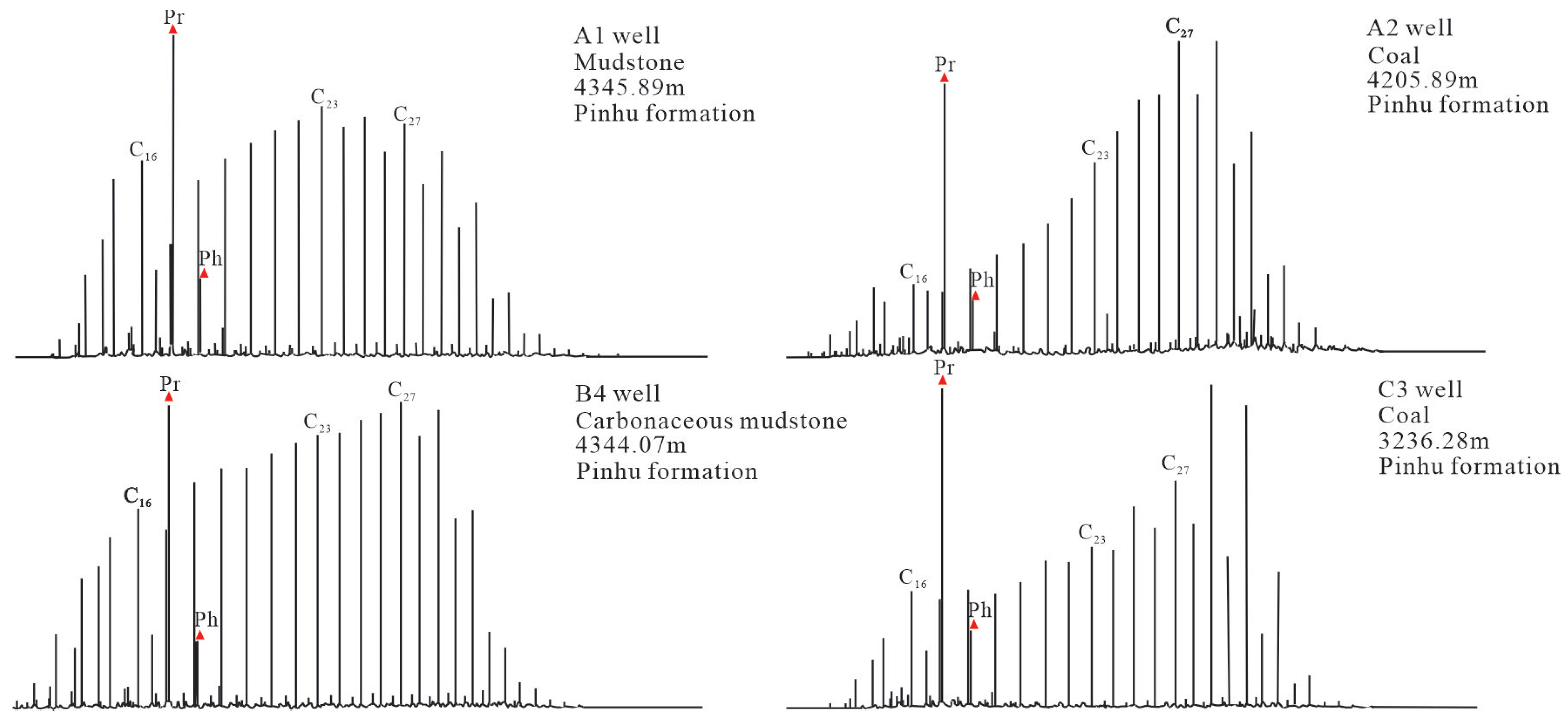
Gas chromatographic analysis of saturated hydrocarbons reveals an unimpaired, full distribution of n-alkanes (typically nC12–nC35) with a flat baseline, indicating no significant biodegradation. Mudstones display a bimodal n-alkane distribution profile, suggesting a mixed input from both lower aquatic organisms and higher terrestrial plants. Coals exhibit a rear-peak (high molecular weight) profile dominated by long-chain n-alkanes with a low relative abundance of short-chain homologues (<nC20), reflecting a predominant origin from higher terrestrial plants. Carbonaceous mudstones, although also showing a rear-peak profile, contain a higher proportion of short-chain n-alkanes relative to coals, indicating a measurable contribution from lower aquatic organisms. Furthermore, all three source-rock types exhibit a marked pristane dominance, consistent with deposition under relatively oxidizing, low-salinity conditions (Figure 10). Box plots showing the distribution of Pr/Ph and n-alkane parameters for each lithology are provided in Figure 10.
Figure 10.
Distribution of n-alkanes in source rocks from the Pinghu Formation.
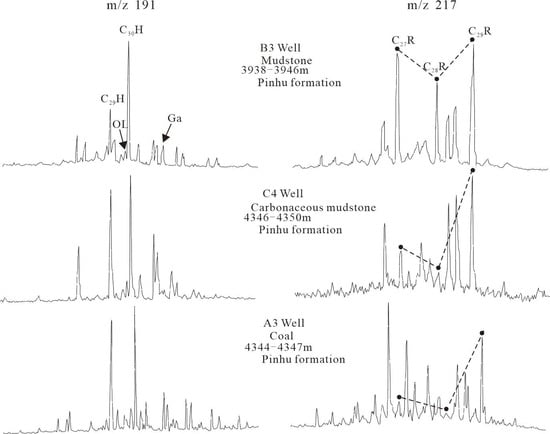
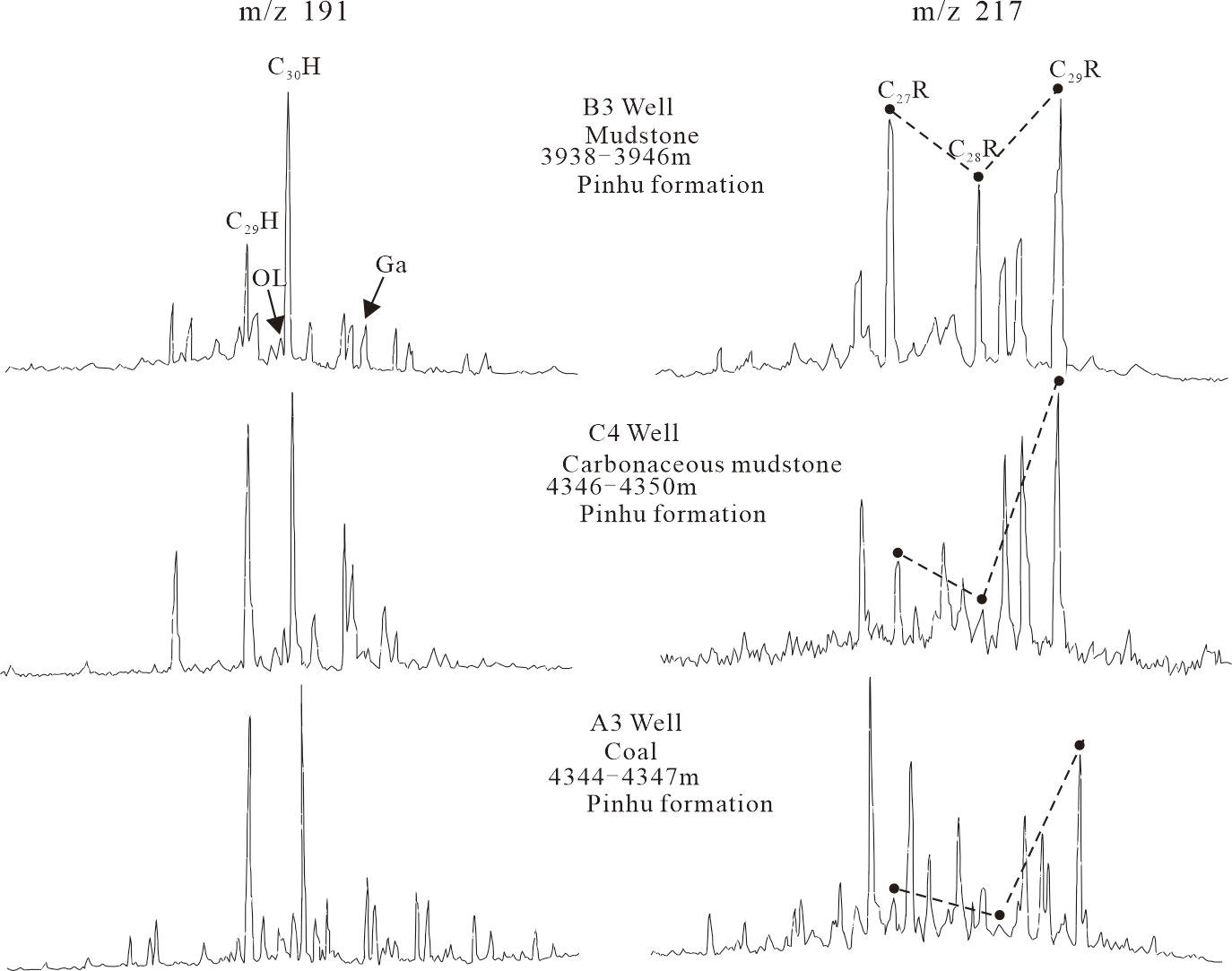
The distribution of hopane series compounds shows that homohopane concentrations in all three source-rock types decrease sharply with increasing carbon number, a pattern consistent with an oxidizing depositional setting (Figure 11). Compared with coals and carbonaceous mudstones, mudstones have a lower oleanane/C30 hopane ratio, indicating a lesser contribution from angiosperms to their organic-matter source. Notably, the extremely low gammacerane content in carbonaceous mudstones and coals, which is nearly below the detection limit, serves as an effective criterion for distinguishing these two lithologies from mudstones, which contain a demonstrably higher relative abundance of this compound and thus reflect a higher depositional water salinity [60]. Box plots showing the distribution of oleanane and gammacerane indices for each lithology are provided in Figure 11. These plots demonstrate that the proposed differences are reproducible across the respective sample populations rather than being characteristics of selected examples.
Figure 11.
Comparison of saturated hydrocarbon mass chromatograms between crude oils and source rocks from the Pinghu slope belt.
Sterane distributions further differentiate the source-rock lithologies. Mudstones exhibit an asymmetric “V”-shaped C27-C28-C29 regular sterane pattern (C28 < C27 < C29) with a significant C27 sterane content, confirming a mixed organic-matter source [56]. Coal samples display a reverse “L”-shaped profile with extremely low C27 and C28 sterane contents, indicating a predominance of higher terrestrial plant input. Carbonaceous mudstones also exhibit a reverse “L”-shaped profile but possess a relatively higher C27 sterane content than coals, signifying a minor but detectable contribution from lower aquatic organisms [56]. This distinction is observed in the studied sample set, but because the ranges partly overlap, it is used as a lithofacies-level indicator rather than as a unique discriminator.
4.5. Oil–Source Correlation
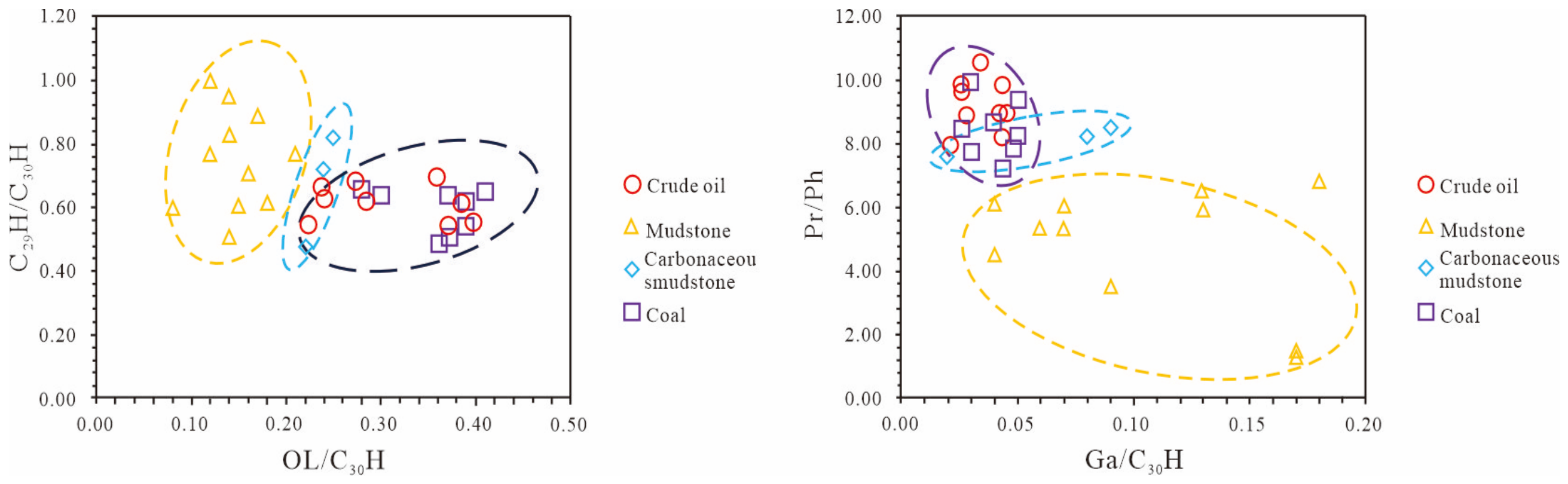
Oil–source correlation was performed using the 12 mudstone, 5 carbonaceous mudstone, and 8 coal samples analyzed by GC-MS, together with the 11 crude oil samples. These are the same samples plotted in Figure 12, and the GC-MS dataset used here corresponds exactly to the sample-accounting table in Section 3. The correlation uses the biomarker ratios and C27-C29 regular sterane proportions reported in Table 2 and Table 3 and illustrated in Figure 2, Figure 3, Figure 4, Figure 5, Figure 6, Figure 7, Figure 8, Figure 9, Figure 10, Figure 11 and Figure 12.
Figure 12.
Oil–source correlation based on multiple biomarker parameters, using the 12 mudstone, 5 carbonaceous mudstone, and 8 coal samples analyzed by GC–MS, together with the 11 crude oil samples. The dashed envelopes are manually drawn visual guides based on the observed data ranges and do not represent statistical confidence intervals. No multivariate statistical analysis was performed, and the envelopes are not used to claim statistical discrimination between coal and carbonaceous mudstone. The coal samples plotted here are the 8 coal samples collected in this study; no additional reference coal samples were plotted.
The oils are characterized by high Pr/Ph (8.00–10.73), high Pr/n-C17 (0.83–1.66) and Ph/n-C18 (0.09–0.20), high C30/C29 Ts (0.85–1.50), high hopane/sterane (1.15–3.63), moderate oleanane/C30 hopane (0.22–0.46), very low gammacerane/C30 hopane (0.02–0.05), and pronounced C29 sterane dominance with negligible C27 and C28 homologues (Table 3, Figure 12).
The source-rock samples show overlapping but systematically different biomarker ranges. Mudstones have generally lower Pr/Ph, higher gammacerane/C30 hopane, and a more prominent C27 sterane component than coals and carbonaceous mudstones. Carbonaceous mudstones and coals both have high Pr/Ph, low gammacerane/C30 hopane, and C29-dominated sterane distributions, but carbonaceous mudstones tend to have a higher C27 sterane content and a higher short-chain n-alkane contribution than coals. The oils plot closest to the coal and carbonaceous mudstone fields in the cross-plots of C29/C30 hopane versus oleanane/C30 hopane and Pr/Ph versus gammacerane/C30 hopane (Figure 12). However, the fields for coal and carbonaceous mudstone partly overlap, especially in Pr/Ph, oleanane/C30 hopane, and gammacerane/C30 hopane.
Multivariate statistical analysis was not performed, and the sample-level datasets required for such analysis cannot be provided. The oil–source correlation is therefore based on the cross-plots and range comparisons presented above. The oils plot closest to the coal and carbonaceous mudstone fields, but the fields for coal and carbonaceous mudstone partly overlap. These results support a general coal-bearing, terrestrial, oxidizing, swamp-related source affinity for the oils, but they do not uniquely discriminate coal from carbonaceous mudstone.
Accordingly, the oil–source correlation is interpreted as follows: the light oils in the Pinghu Slope Belt show the strongest affinity with the coal-bearing source-rock assemblage of the Pinghu Formation, in which coal is a major end-member; a subordinate contribution from carbonaceous mudstone cannot be excluded. The correlation with mudstone is poor. This interpretation is consistent with the bulk properties, carbon isotopes, saturated biomarkers, and aromatic biomarkers, but the lithology-specific attribution remains partly non-unique because of the overlap between coal and carbonaceous mudstone. A coal-bearing source-rock association is therefore more defensible than a uniquely coal-only attribution.
5. Conclusions
This study presents an integrated geochemical investigation of 11 light oils and 58 source-rock samples from the Pinghu Slope Belt, Xihu Sag. A total of 58 source-rock samples were collected and subjected to Rock-Eval pyrolysis (44 mudstones, 14 carbonaceous mudstones, and 8 coals), of which 12 mudstones, 5 carbonaceous mudstones, and 8 coals were analyzed by GC–MS and used for the oil–source correlation. The eight coal samples are part of the 58 collected source-rock samples and also serve as the coal end-member reference; no additional reference coal samples were used. The principal conclusions are as follows.
(1) The light oils from the Pinghu Slope Belt are characterized by low density, low sulfur content, low wax content, and a low pour point, with relatively high thermal maturity (calculated Rc = 0.79–1.15%) and heavy whole-oil δ13C values (−26.92‰ to −26.33‰). Diagnostic biomarker assemblages, including high Pr/Ph ratios (8.0–10.73), elevated C30/C29 Ts and hopane/sterane ratios, abundant diterpenoids and oleanane, pronounced C29 sterane predominance, high 1,2,5-trimethylnaphthalene content, and marked enrichment of dibenzofuran over dibenzothiophene, are consistent with a strongly terrestrial, relatively oxidizing, low-salinity, swamp-related source facies. However, these parameters are not uniquely diagnostic of freshwater conditions, and the low-salinity interpretation is therefore applied to local coal-forming swamp facies within the broader marine-terrestrial transitional setting of the Pinghu Formation rather than to the entire formation.
(2) The three source-rock lithologies display systematic differences in organic-matter richness and biomarker profiles. Coals have the highest organic-matter richness (average TOC: 50.45%), followed by carbonaceous mudstones (average TOC: 21.25%) and mudstones (average TOC: 2.92%). Mudstones show a bimodal n-alkane distribution, measurable gammacerane, and an asymmetric V-shaped C27-C28-C29 sterane pattern, indicating mixed aquatic-terrigenous input and relatively higher water salinity. Carbonaceous mudstones show a rear-peak n-alkane profile with a moderate short-chain contribution, high oleanane, low gammacerane, and a reverse L-shaped sterane pattern with a minor C27 component. Coals are distinguished by a pronounced rear-peak n-alkane distribution, exceptionally low gammacerane, and strong C29 sterane dominance with negligible C27 and C28 homologues, reflecting predominant higher-plant input with substantial angiosperm contribution.
(3) Oil–source correlation based on multiple biomarker parameters indicates that the light oils show the strongest affinity with the coal-bearing source-rock assemblage of the Pinghu Formation, in which coal is a major end-member, whereas the correlation with mudstones is poor. A subordinate contribution from carbonaceous mudstone cannot be excluded. The biomarker parameters of the crude oils, carbonaceous mudstones, and coals partly overlap, especially in Pr/Ph, oleanane index, and gammacerane index. These parameters are therefore used here to indicate a general coal-bearing, terrestrial, oxidizing, swamp-related source affinity rather than to uniquely discriminate coal from carbonaceous mudstone. Multivariate statistical analysis was not performed, and no statistical discrimination between coal and carbonaceous mudstone is claimed. A coal-bearing source-rock association is therefore the more defensible conclusion.
Author Contributions
Conceptualization, K.L. and Y.T.; methodology, K.L.; validation, H.D., Q.Y. and Z.X.; formal analysis, H.D. and Q.Y.; investigation, K.L.; resources, Y.T.; data curation, H.D., Q.Y. and Z.X.; writing—original draft preparation, K.L.; writing—review and editing, Y.T.; supervision, Y.T.; project administration, H.D. and Q.Y. All authors have read and agreed to the published version of the manuscript.
Funding
This work was supported by the Hubei Province Outstanding Research Group Project (Grant No. 2026AFA007) and the CNOOC (China) Co., Ltd. Shanghai Branch Research Project (Contract No. CCL2023SHPS007RS).
Institutional Review Board Statement
Not applicable.
Informed Consent Statement
Not applicable.
Data Availability Statement
All data and materials are available on request from the corresponding author. The data are not publicly available due to ongoing research using a part of the data.
Conflicts of Interest
Hui Diao and Qing Yu were employed by the Shanghai Branch, CNOOC, Shanghai 200335, China. The remaining authors declare that the research was conducted in the absence of any commercial or financial relationships that could be construed as potential conflicts of interest.
References
- Yang, Y.; Xie, X.; Li, Y.; Guo, G.; Xi, X.; Ding, W. Formation and Distribution of Coal Measure Source Rocks in the Eocene Pinghu Formation in the Pinghu Slope of the Xihu Depression, East China Sea Shelf Basin. Acta Oceanol. Sin. 2023, 42, 254–269. [Google Scholar] [CrossRef] [Scilit]
- Yan, B.; Yuan, H.-Q.; Li, N.; Zou, W.; Sun, P.; Li, M.; Zhao, Y.-Y.; Zhao, Q. Differences in Hydrocarbon Accumulation and Controlling Factors of Slope Belt in Graben Basin: A Case Study of Pinghu Slope Belt in the Xihu Sag of the East China Sea Shelf Basin (ECSSB). Pet. Sci. 2024, 21, 2901–2926. [Google Scholar] [CrossRef] [Scilit]
- Jiang, Y.; Guo, R.; Hou, D.; Cheng, X. Classification of Crude Oil and Its Correlation with Terrestrial Plant Inputs Across Different Areas in the Xihu Depression, East China Sea Shelf Basin: Insights from Organic Geochemical Evidence. Front. Earth Sci. 2025, 13, 1627767. [Google Scholar] [CrossRef] [Scilit]
- Wang, Y.; Chen, J.; Pang, X.; Zhang, T.; Zhu, X.; Liu, K. Hydrocarbon Generation and Expulsion of Tertiary Coaly Source Rocks and Hydrocarbon Accumulation in the Xihu Sag of the East China Sea Shelf Basin, China. J. Asian Earth Sci. 2022, 229, 105170. [Google Scholar] [CrossRef] [Scilit]
- Jiang, S.; Li, S.; Chen, X.; Zhang, H.; Wang, G. Simulation of Oil-Gas Migration and Accumulation in the East China Sea Continental Shelf Basin: A Case Study from the Xihu Depression. Geol. J. 2016, 51, 157–174. [Google Scholar] [CrossRef] [Scilit]
- Chen, Q.; Pu, R.; Xue, X.; Han, M.; Wang, Y.; Cheng, X.; Wu, H. Controlling Effect of Wave-Dominated Delta Sedimentary Facies on Unconventional Reservoirs: A Case Study of Pinghu Tectonic Belt in Xihu Sag, East China Sea Basin. Geofluids 2022, 2022, 8163011. [Google Scholar] [CrossRef] [Scilit]
- Zheng, F.; Zeng, H.; Wang, J.; Chang, Y.; Liu, J.; Zhang, X.; Ma, S.; Zhang, S. Conditions and Major Controlling Factors for Hydrocarbon Accumulation in the Eocene Pinghu Formation in the Near-Sag Zone of the Pinghu Slope, Xihu Sag, East China Sea Shelf Basin. Oil Gas Geol. 2026, 47, 1293–1313. [Google Scholar] [CrossRef]
- Cheng, C.; Lu, Y.; Chen, B.; Xu, B.; Song, G.; Huo, H. Reservoir Heterogeneity and Genetic Mechanisms of the Oligocene Huagang Formation in Southern Xihu Sag: Implications for Deep Hydrocarbon Exploration and Development. Front. Earth Sci. 2026, 14, 1808173. [Google Scholar] [CrossRef] [Scilit]
- Qin, L.; Xu, J.; Xu, D.; Liu, H.; Cai, K. Paleogeomorphology Reconstruction and Its Control on Sand Dispersal Systems: A Case Study from the Pinghu Formation in the Hangzhou Slope Belt, Xihu Sag, East China Sea Shelf Basin. Front. Earth Sci. 2025, 13, 1626431. [Google Scholar] [CrossRef] [Scilit]
- Cheng, X.; Hou, D.; Zhou, X.; Liu, J.; Diao, H.; Wei, L. Geochemical Characterization of the Eocene Coal-Bearing Source Rocks, Xihu Sag, East China Sea Shelf Basin, China: Implications for Origin and Depositional Environment of Organic Matter and Hydrocarbon Potential. Minerals 2021, 11, 909. [Google Scholar] [CrossRef] [Scilit]
- Wang, D.; Zhang, L.; Ma, Q.; Wang, W.; Li, S.; Diao, H.; Dai, J.; Meng, Q. Reassessment of Origin and Secondary Alterations for Petroleum and Its Accumulation Processes in the Northern Part of Pinghu Slope of the Xihu Sag, the East China Sea Shelf Basin. Org. Geochem. 2026, 221, 105296. [Google Scholar] [CrossRef] [Scilit]
- Li, S.; Shao, L.; Liu, J.; Qin, L.; Kang, S.; Eriksson, K.A.; Chen, X.; Yu, Z.; Liu, J. Oil Generation Model of the Liptinite-Rich Coals: Palaeogene in the Xihu Sag, East China Sea Shelf Basin. J. Pet. Sci. Eng. 2022, 209, 109844. [Google Scholar] [CrossRef] [Scilit]
- Ye, J.; Qing, H.; Bend, S.L.; Gu, H. Petroleum Systems in the Offshore Xihu Basin on the Continental Shelf of the East China Sea. AAPG Bull. 2007, 91, 1167–1188. [Google Scholar] [CrossRef] [Scilit]
- Li, W.; Chen, J.; Liu, K.; Fu, R.; Chen, C.; Wang, Y.; Zhu, X.; Chen, X.; Zhang, T.; He, L. Studies on the Source and Phase Characteristics of Oil and Gas: Evidence from Hydrocarbon Geochemistry in the Pingbei Area of Xihu Sag, the East China Sea Shelf Basin, China. Energies 2023, 16, 6529. [Google Scholar] [CrossRef] [Scilit]
- Cheng, X.; Hou, D.; Zhou, X.; Liu, J.; Diao, H.; Jiang, Y.; Yu, Z. Organic Geochemistry and Kinetics for Natural Gas Generation from Mudstone and Coal in the Xihu Sag, East China Sea Shelf Basin, China. Mar. Pet. Geol. 2020, 118, 104405. [Google Scholar] [CrossRef] [Scilit]
- Liu, M.; Ma, H.; Li, K.; Zhu, B.; Zhang, C.; Xing, L.; Wang, J.; Zheng, X. Development Pattern of Coal-Measure Source Rocks and Division of Hydrocarbon Accumulation Units: A Case Study of Paleogene Pinghu Formation in Guoxi Subsag, Xihu Sag, East China Sea Basin. Pet. Geol. Exp. 2026, 48, 337–350. [Google Scholar] [CrossRef]
- Liu, Y.; Zeng, Z.; Yang, C.; Li, W.; Hu, H.; Chen, J.; Wei, M.; Guo, W. Fluid Properties, Charging Stages, and Hydrocarbon Accumulation Process in the Pinghu Oil and Gas Field, Xihu Sag, East China Sea Shelf Basin. J. Mar. Sci. Eng. 2025, 13, 1730. [Google Scholar] [CrossRef] [Scilit]
- Kang, S.; Shao, L.; Qin, L.; Li, S.; Liu, J.; Shen, W.; Chen, X.; Eriksson, K.A.; Zhou, Q. Hydrocarbon Generation Potential and Depositional Setting of Eocene Oil-Prone Coaly Source Rocks in the Xihu Sag, East China Sea Shelf Basin. ACS Omega 2020, 5, 32267–32285. [Google Scholar] [CrossRef] [Scilit]
- Cao, Q.; Song, Z.; Zhou, X.; Liang, S.; Wang, L. Geochemical Characteristics and Source of Crude Oil in Xihu Sag, East China Sea Shelf Basin. Pet. Geol. Exp. 2019, 41, 251–259. [Google Scholar] [CrossRef]
- Ding, F.; Liu, J.; Zhao, H.; Chen, X.; Yu, Z. Distribution and Controlling Factors of High Waxy Crude Oil in Xihu Sag, East China Sea Basin. J. Chengdu Univ. Technol. (Sci. Technol. Ed.) 2021, 48, 457–465. [Google Scholar] [CrossRef]
- Yue, S.; Quan, Y.; Du, X.; Jiang, Y.; Zhao, K.; Wu, Y. Hydrocarbon Generation Potential and Oil Source Comparison of Source Rocks in the Central and Western Regions of Xihu Depression. Bull. Geol. Sci. Technol. 2024, 43, 87–98. [Google Scholar] [CrossRef]
- Zhang, T.; Jiang, Y.; Li, N.; Qin, J.; Shi, G.; Cai, K.; Xu, D.; Xu, B.; Zhang, Y. Geochemical Characteristics and Origin of Crude Oil in Pingbei Area of Pinghu Slope Belt, Xihu Sag. Acta Pet. Sin 2026, 47, 375–393. [Google Scholar]
- Xu, F.; Xu, G.; Liu, Y.; Zhang, W. Factors Controlling the Development of Tight Sandstone Reservoirs in the Huagang Formation of the Central Inverted Structural Belt in Xihu Sag, East China Sea Basin. Pet. Explor. Dev. 2020, 47, 101–113. [Google Scholar] [CrossRef] [Scilit]
- Cheng, Y.; Wu, Z.; Xu, B.; Zhang, J.; Chu, Y.; Dai, Y.; Xu, L.; Sun, W.; Ma, S. Structural Characteristics and Genetic Mechanism of Transfer Zones in an Extensional Rift Zone: An Example from the Xihu Sag, East China Sea Basin. Tectonophysics 2023, 856, 229852. [Google Scholar] [CrossRef] [Scilit]
- Wang, Q.; Li, S.; Guo, L.; Suo, Y.; Dai, L. Analogue Modelling and Mechanism of Tectonic Inversion of the Xihu Sag, East China Sea Shelf Basin. J. Asian Earth Sci. 2017, 139, 129–141. [Google Scholar] [CrossRef] [Scilit]
- Jiang, Y.; Zheng, J.; Tang, X.; He, X.; Wu, Z.; Wu, Q.; Cheng, Y. Developmental Characteristics of Fault System and Its Basin-Controlling Effects in Xihu Sag. Earth Sci. 2026, 51, 2663–2681. [Google Scholar] [CrossRef] [Scilit]
- Yu, J.; Yu, F.; Chen, Z.; Liu, C.; Qi, Y.; Liu, X.; Yang, C. A New Genetic and Evolutionary Model for the Ningbo Structure in the Xihu Sag, East China Sea Shelf Basin: Insights from Seismic Interpretation and Analogue Modeling. J. Mar. Sci. Eng. 2026, 14, 764. [Google Scholar] [CrossRef] [Scilit]
- Zhao, R.; Liu, H.; Qin, L.; Li, S.; Wang, H.; Chen, H. Study on “Fault-Sag” Coupling Process of the Eocene in Western Slope Belt of Xihu Sag, East China Sea Shelf Basin. J. Palaeogeogr. (Chin. Ed.) 2026, 28, 1005–1020. [Google Scholar] [CrossRef]
- Yu, J.; Yu, F.; Chen, Z.; Liu, C.; Qi, Y.; Liu, X. Structural Evolution Characteristics and Analogue Modelling of the Arcuate Fault Zone in the Western Slope of Xihu Sag, East China Sea Shelf Basin. Chin. J. Geol. 2026, 61, 606–621. [Google Scholar] [CrossRef]
- Zhang, G.; Qu, H.; Chen, G.; Zhao, C.; Zhang, F.; Yang, H.; Zhao, Z.; Ma, M. Giant Discoveries of Oil and Gas Fields in Global Deepwaters in the Past 40 Years and the Prospect of Exploration. J. Nat. Gas Geosci. 2019, 4, 1–28. [Google Scholar] [CrossRef] [Scilit]
- Su, A.; Chen, H.; Lei, M.; Li, Q.; Wang, C. Paleo-Pressure Evolution and Its Origin in the Pinghu Slope Belt of the Xihu Depression, East China Sea Basin. Mar. Pet. Geol. 2019, 107, 198–213. [Google Scholar] [CrossRef] [Scilit]
- Chen, Z.; Du, X.; Li, S. Distributional Signatures of Depositional System of Pinghu Formation, Pinghu Slope, Xihu Sag, East China Sea Shelf Basin. Pet. Geol. Exp. 2022, 44, 780–789. [Google Scholar] [CrossRef]
- Yu, X.; Li, S.; Cao, B.; Hou, G.; Wang, Y.; Huangfu, Z. Oligocene Sequence Stratigraphic Framework and Sedimentary Filling Response in Xihu Sag. Acta Sedimentol. Sin. 2017, 35, 299–314. [Google Scholar] [CrossRef]
- Zhang, J.; Lu, Y.; Krijgsman, W.; Liu, J.; Li, X.; Du, X.; Wang, C.; Liu, X.; Feng, L.; Wei, W.; et al. Source to Sink Transport in the Oligocene Huagang Formation of the Xihu Depression, East China Sea Shelf Basin. Mar. Pet. Geol. 2018, 98, 733–745. [Google Scholar] [CrossRef] [Scilit]
- Abbas, A.; Zhu, H.; Zeng, Z.; Zhou, X. Sedimentary Facies Analysis Using Sequence Stratigraphy and Seismic Sedimentology in the Paleogene Pinghu Formation, Xihu Depression, East China Sea Shelf Basin. Mar. Pet. Geol. 2018, 93, 287–297. [Google Scholar] [CrossRef] [Scilit]
- Tian, Y.; Ye, J.; Lei, C.; Wu, K.; Liu, Y. Development Model for Source Rock of Marine-Continental Transitional Face in Faulted Basins: A Case Study of Pinghu Formation in Xihu Sag. Earth Sci. 2019, 44, 898–908. [Google Scholar] [CrossRef] [Scilit]
- Holman, A.I.; Grice, K. δ13C of Aromatic Compounds in Sediments, Oils and Atmospheric Emissions: A Review. Org. Geochem. 2018, 123, 27–37. [Google Scholar] [CrossRef] [Scilit]
- Su, A.; Chen, H.; Wang, C.; Li, P.; Zhang, H.; Xiong, W.; Lei, M. Genesis and Maturity Identification of Oil and Gas in the Xihu Sag, East China Sea Basin. Pet. Explor. Dev. 2013, 40, 558–565. [Google Scholar] [CrossRef] [Scilit]
- Tan, S.; Hou, K.; Qin, J.; Tang, R.; Yang, M. Differences in Pyrolysis Hydrocarbon Generation and Hydrocarbon Exploration of Different Coal-Measures Source Rocks in Pinghu Formation. Xihu Sag. J. Jilin Univ. (Earth Sci. Ed.) 2020, 50, 968–978. [Google Scholar]
- Jiang, Y.; Huang, Q.; Diao, H.; Cheng, X.; Xu, J.; Wang, W.; Yu, J.; Yu, Z.; Ding, F. Geochemical Characteristics of Source Rocks and Petroleum Accumulation in the Hangzhou Slope Belt, Xihu Sag, East China Sea Shelf Basin. Nat. Gas Geosci. 2026, 37, 1032–1044. [Google Scholar] [CrossRef]
- Moldowan, J.M.; Sundararaman, P.; Schoell, M. Sensitivity of Biomarker Properties to Depositional Environment and/or Source Input in the Lower Toarcian of SW-Germany. Org. Geochem. 1986, 10, 915–926. [Google Scholar] [CrossRef] [Scilit]
- Radke, M. Application of Aromatic Compounds as Maturity Indicators in Source Rocks and Crude Oils. Mar. Pet. Geol. 1988, 5, 224–236. [Google Scholar] [CrossRef] [Scilit]
- Yang, X.; Yang, F.; Zhang, S.; Qiu, R.; Tang, Y.; Tang, S. Differential Enrichment of Organic Matter in the Da’anzhai Member of the Sichuan Basin: A Response to the Toarcian Oceanic Anoxic Event. ACS Omega 2026, 11, 26814–26825. [Google Scholar] [CrossRef] [Scilit]
- Shanmugam, G. Significance of Coniferous Rain Forests and Related Organic Matter in Generating Commercial Quantities of Oil, Gippsland Basin, Australia. AAPG Bull. 1985, 69, 1241–1254. [Google Scholar] [CrossRef] [Scilit]
- Peters, K.E.; Walters, C.C.; Moldowan, J.M. The Biomarker Guide. In Biomarkers and Isotopes in Petroleum Systems and Earth History, 2nd ed.; Cambridge University Press: Cambridge, UK, 2005; Volume 2. [Google Scholar] [CrossRef] [Scilit]
- Yang, X.; Tang, Y.; Yang, Y.; Yang, H.; Wang, F.; Li, X. Impact of Biodegradation on Methyltrimethyltridecylchromans (MTTCs) in Crude Oils from the Bohai Bay Basin, China. Org. Geochem. 2023, 184, 104669. [Google Scholar] [CrossRef] [Scilit]
- Yang, X.; Tang, Y.; Sun, P.; Hu, Y.; Yang, H.; Wang, F. Aryl Isoprenoids in Severely Biodegraded Oils from the Miaoxi Depression, Bohai Bay Basin. Org. Geochem. 2025, 207, 105014. [Google Scholar] [CrossRef] [Scilit]
- Killops, S.D.; Bishop, A.N.; Tegelaar, E.W.; Urdal, K.; Ghammari, M.R.K.; Weijers, J.W.H. Sedimentary Diterpane Origins—Inferences from Oils of Varying Source Depositional Environment and Age. Front. Geochem. 2023, 1, 1241784. [Google Scholar] [CrossRef] [Scilit]
- You, J.; Yang, X.; Lei, M.; Liang, G.; Wang, Z. The Characteristics and Significance of Cheilanthane Tricyclic Terpanes and Bicyclic Sesquiterpanes in Source Rocks and Oils Under Different Depositional Environments in Zhu III Depression, Pearl River Mouth Basin. Nat. Gas Geosci. 2020, 31, 904–914. [Google Scholar] [CrossRef]
- Rohmer, M.; Bouvier-Nave, P.; Ourisson, G. Distribution of Hopanoid Triterpenes in Prokaryotes. J. Gen. Microbiol. 1984, 130, 1137–1150. [Google Scholar] [CrossRef] [Scilit]
- Killops, S.D.; Howell, V.J. Complex Series of Pentacyclic Triterpanes in a Lacustrine Sourced Oil from Korea Bay Basin. Chem. Geol. 1991, 91, 65–79. [Google Scholar] [CrossRef] [Scilit]
- Lu, X.; Li, M.; Li, Y.; Yang, Y.; Wang, N.; Ran, Z.; Fu, Y.; Ali, S. Rearranged Oleananes in Tertiary Oils from the Baiyun Sag, Pearl River Mouth Basin, South China Sea: Identification, Distribution and Geochemical Significance. Org. Geochem. 2023, 175, 104525. [Google Scholar] [CrossRef] [Scilit]
- Sinninghe Damsté, J.S.; Kenig, F.; Koopmans, M.P.; Köster, J.; Schouten, S.; Hayes, J.M.; de Leeuw, J.W. Evidence for Gammacerane as an Indicator of Water Column Stratification. Geochim. Cosmochim. Acta 1995, 59, 1895–1900. [Google Scholar] [CrossRef] [Scilit]
- Seifert, W.K.; Moldowan, J.M. Applications of Steranes, Terpanes and Monoaromatics to the Maturation, Migration and Source of Crude Oils. Geochim. Cosmochim. Acta 1978, 42, 77–95. [Google Scholar] [CrossRef] [Scilit]
- van Aarssen, B.G.K.; Alexander, R.; Kagi, R.I. Higher Plant Biomarkers in Crude Oils: A Review. Org. Geochem. 1999, 30, 1231–1240. [Google Scholar]
- Bastow, T.P.; Alexander, R.; Sosrowidjojo, I.B.; Kagi, R.I. Pentamethylnaphthalenes and Related Aromatic Steroids in a Severely Biodegraded Crude Oil. Org. Geochem. 2000, 31, 283–297. [Google Scholar]
- Alexander, R.; Bastow, T.P.; Fisher, S.J.; Kagi, R.I. Geosynthesis of Organic Compounds: II. Methylation of Phenanthrene and Alkylphenanthrenes. Geochim. Cosmochim. Acta 1995, 59, 4259–4266. [Google Scholar] [CrossRef] [Scilit]
- Ma, Z.; Zhang, Y.; Wang, Y.; Liu, Y. Geochemical Characteristic and Source Correlation of Biodegraded Oils from the Western Halaalate Area of Junggar Basin. Geofluids 2024, 2024, 4832039. [Google Scholar] [CrossRef] [Scilit]
- Li, S.; He, S. Environmental Indication of Three Fluorene Series Compounds in Aromatic Hydrocarbons of Crude Oil. Geochimica 2008, 37, 45–50. [Google Scholar] [CrossRef]
- Liu, Y.; Yue, H.; Li, R.; Liu, X. Correlation Between Chang-9 Crude Oil and Potential Source Rocks, Upper Triassic Yanchang Formation, Middle Area of Ordos Basin. Geofluids 2024, 2024, 4861384. [Google Scholar] [CrossRef] [Scilit]

Disclaimer/Publisher’s Note: The statements, opinions and data contained in all publications are solely those of the individual author(s) and contributor(s) and not of MDPI and/or the editor(s). MDPI and/or the editor(s) disclaim responsibility for any injury to people or property resulting from any ideas, methods, instructions or products referred to in the content. |
© 2026 by the authors. Licensee MDPI, Basel, Switzerland. This article is an open access article distributed under the terms and conditions of the Creative Commons Attribution (CC BY) license.