


Abstract
Lost circulation in fractured deep coal-measure strata is a major drilling challenge that severely impedes unconventional gas development. This issue is acute in the Hannan Block, where natural fractures with 1–5 mm apertures abound. Conventional gel-based lost-circulation materials (LCMs) often degrade thermally and fail to reconcile injectability with downhole retention. We developed a multiply cross-linked polymer gel with dynamic boron–nitrogen (B–N) bonds, synthesized via in situ free-radical copolymerization of poly(vinyl alcohol) (PVA), acrylamide (AM), 3-acrylamidophenylboronic acid (3-APBA), polyethyleneimine (PEI), and N,N-dimethylaminoethyl methacrylate (DMAEMA). Structural analyses were consistent with dynamic B–N coordination as the primary reversible cross-linking site. Rheological tests at 25 °C showed pronounced shear-thinning: over a shear-rate range of 0.1–1000 s−1, the apparent viscosity dropped from 86,500 to 115 mPa·s, i.e., by more than two orders of magnitude. After severe structural disruption at 150% strain, the storage modulus recovered to 6880 Pa within 120 s, i.e., 83.9% of its initial value (8200 Pa), demonstrating excellent thixotropic recovery. In contrast to conventional gels, this material exhibited a distinctive thermo-activated strengthening effect: after hydrothermal aging at 205 °C for 16.5 h (the upper bound of the target downhole temperature range), tensile strength reached 3.68 MPa and elongation at break rose to 720%, compared with 1.85 MPa and 320% in the unaged state. Plugging experiments performed at 140 °C (the representative bottomhole temperature of the Hannan Block) yielded breakthrough pressures of 7.3 MPa (3 mm parallel fracture) and 7.9 MPa (3 mm wedge fracture), and exceeded 11 MPa in a 30 cm sand-packed tube. Encapsulation of rigid CaCO3 particles further raised the breakthrough pressure in the 3 mm parallel fracture to 8.8 MPa, a 20.5% improvement over the gel alone. Microstructural imaging revealed strong adhesion to fracture surfaces via mechanical interlocking and cationic electrostatic interactions, together with the formation of an integrated gel–particle plug. Collectively, these results suggest that dynamic B–N bond-mediated network rearrangement offers a viable route to achieve both pumpability and high-temperature plugging, underscoring its potential for combating severe lost circulation in deep coal-measure formations.
1. Introduction
Deep coal-measure strata in China have become a key target for unconventional gas reserve growth and production [1,2,3,4]. However, deeper and more structurally complex drilling has aggravated lost circulation. In fracture-developed blocks, the problem often escalates to total or severe loss, prolonging non-productive time and raising costs [5,6,7,8]. A case in point is the Hannan Block (Shaanxi Coal), where three wells (Shanzhenye 1, 1HF, and 1-1HF) lost 5016 m3 of mud cumulatively, with >400 h of lost time per well. Losses there follow a distinct “strong shallow, weak deep” pattern: the primary thief zones—the Canglangpu, Shipai, Xiannvdong, and Shilongdong Formations above 2050 m—contain natural fractures with apertures predominantly in the 1–5 mm range. Critically, the current drilling fluid’s solid-phase D50 is only ~6 μm, far from the “one-third to two-thirds fracture width” bridging criterion of Abrams’ rule [9,10,11,12]. Thus, conventional bridging agents and gel-based LCMs cannot achieve durable retention or sufficient pressure-bearing capacity downhole [13,14,15]. Nor is this problem confined to the Hannan Block: similar high-temperature (≥140 °C), large-fracture, dynamically propagating fracture environments occur in the marine-coal superimposed zones of western Sichuan and western Hubei, where conventional materials consistently fail to balance low pumping friction against high downhole strength [16,17].
Various strategies have been developed to mitigate lost circulation, including bridging particles [18,19], high-fluid-loss cement slurries, superabsorbent resins, and polymer gels. Bridging agents—walnut shells, calcium carbonate, and fiber composites—rely on rigid particle gradation and mechanical bridging. Although effective for regular, static, narrow fractures, they are largely inadequate for 1–5 mm structural fractures: particles either pass through unimpeded or are re-sheared and fragmented, causing high recurrent-loss rates. Polymer gels, which gel in situ and conform to irregular voids, are widely considered a more promising alternative [20,21,22,23]. Sun [24] reviewed the application prospects of dynamic bond-based gels for lost-circulation control, wellbore strengthening, and fluid loss reduction, citing their intelligent responsiveness as a key advantage for next-generation drilling fluids. However, most existing gel LCMs use static or weakly dynamic cross-linked networks that undergo syneresis and mechanical degradation under HTHP conditions [25]. More fundamentally, static gels cannot reconcile the conflicting requirements of “low viscosity during high-rate pumping” and “high strength upon fracture entry and retention” [26,27,28]. In wide fractures like those in the Hannan Block, this shortcoming manifests as a characteristic failure: the gel is scoured away, progressively hollowing out the plug.
A dynamic B–N cross-linking strategy based on 3-acrylamidophenylboronic acid (3-APBA) and polyethylenimine (PEI) has not yet been applied to drilling-fluid lost-circulation materials [29,30]. Unlike conventional borate esters, dynamic B–N coordination bonds offer faster exchange kinetics and greater environmental adaptability, raising the possibility of an unconventional response: elevated temperature promotes bond exchange, network rearrangement, and stress redistribution—rather than degradation [31,32]. This temperature-enhanced adaptive behavior is highly desirable for deep wells, where increasing formation temperature coincides with more demanding plugging-strength and structural-stability requirements.
Against this background, the aim of the present work is to develop a high-temperature gel LCM that simultaneously achieves low pumping friction, rapid re-gellation inside fractures, and durable pressure-bearing capacity in 1–5 mm fractured deep coal-measure formations. Our central hypothesis is that elevated temperatures accelerate reversible B–N bond exchange, driving network reorganization toward a more homogeneous, defect-scarce state and thereby producing a thermo-activated strengthening effect rather than the thermal degradation seen in conventional gels.
The novelty and differentiation from the existing literature are as follows. (i) To our knowledge, this is the first time a dynamic B–N coordination network built from 3-APBA/PEI has been introduced into drilling-fluid LCMs; previously reported dynamic gels for lost circulation rely mainly on borate esters [31,32], host–guest interactions, or hydrogen-bond-only physical networks [19,26,28], which show slower exchange and limited high-temperature adaptability. (ii) Unlike conventional permanently cross-linked or static gels that lose both strength and elongation above 120–150 °C [25,27], our system is designed so that temperature acts as a trigger for network rebuilding; this directly addresses the long-standing “pumpability versus high-temperature strength” trade-off rather than merely increasing cross-link density. (iii) Rather than a single dynamic motif, the proposed PVA/AM/3-APBA/PEI/DMAEMA system integrates three complementary reversible mechanisms—dynamic B–N coordination as the load-bearing backbone, PVA-derived hydrogen bonds as sacrificial energy-dissipation units, and DMAEMA-mediated ionic interactions for adhesion to negatively charged mineral surfaces—into a hierarchical “rigid–tough–adhesive” network. (iv) For millimeter-scale fractures, we further combine the dynamic gel with rigid CaCO3 particles following Abrams’ criterion, providing a graded plugging strategy tailored to the D50 mismatch (~6 μm solids versus 1–5 mm fractures) observed in the Hannan Block.
To test the hypothesis, we systematically investigated the gel’s chemical structure (FT-IR, TGA), microstructure (SEM), rheology (steady shear, three-interval thixotropic recovery), and temperature-dependent mechanical properties after hydrothermal aging from 120 to 205 °C. Component-exclusion experiments (w/o PEI, w/o PVA, w/o DMAEMA, and a blank homopolymer) were conducted to isolate the contributions of B–N coordination, hydrogen bonding, and ionic interactions. Plugging performance was evaluated at 140 °C in 0.1–3 mm parallel and wedge fractures and in a 30 cm sand-packed tube, both for the gel alone and for the gel plus rigid particles. The results offer a structure–property framework for designing next-generation high-temperature adaptive gel plugging systems and a practical material solution for severe lost circulation in deep coal-measure drilling.
2. Materials and Methods
2.1. Materials
Acrylamide (AM), N,N-dimethylaminoethyl methacrylate (DMAEMA), and 3-acrylamidophenylboronic acid (3-APBA, ≥98% purity) were purchased from Sigma-Aldrich. Branched polyethylenimine (PEI, Mw ≈ 1800) was obtained from Aladdin Reagents. Poly(vinyl alcohol) (PVA, degree of polymerization 1750 ± 50, alcoholysis degree 88%) was supplied by Sinopharm Chemical Reagents. Ammonium persulfate (APS) and sodium bisulfite (SBS) served as the redox initiator pair. All chemicals were analytical grade and used as received. Deionized water was used throughout.
2.2. Preparation of Multiple Dynamic Cross-Linked Gel
Predetermined amounts of PVA (15 phr*) were added to deionized water and stirred mechanically at 300 rpm in a 95 °C water bath until a homogeneous transparent sol formed, followed by cooling to room temperature (25 °C). AM (15 phr), 3-APBA (1 phr), PEI (0.85 phr), and DMAEMA (1 phr) were sequentially added to the PVA sol. Here, 3-APBA acts as a phenylboronic acid functional monomer, PEI serves as an amine-rich cross-linker, and both jointly construct the dynamic B–N bond primary network. DMAEMA provides cationic side chains to enhance electrostatic adsorption with clay surfaces, while PVA supplies abundant hydroxyl groups for physical hydrogen bonding.
The mixture was stirred for 30 min to ensure homogeneity, then bubbled with nitrogen for 15 min to remove oxygen. Subsequently, the redox initiator (APS:SBS = 1:1, 1 wt% of total monomers) was added. The system was sealed and left at room temperature (25 °C) for 1 h to complete gelation. The resulting bulk hydrogel was freeze-dried for 48 h to obtain a porous dry sponge, then crushed and sieved through 40–60 mesh screens before storage. For the unaged control, the as-prepared hydrogel was tested directly after equilibration in deionized water at 25 °C for 24 h.
The freeze-dried gel was crushed and sieved (40–60 mesh), yielding particles with D50 ≈ 250 μm. For gel + rigid particle synergistic sealing tests, calcium carbonate particles (D50 ≈ 800 μm) served as the rigid skeleton, following the “one-third to two-thirds” bridging rule for 1–5 mm fractures.
Note: phr (parts per hundred parts of resin) denotes the addition amount per 100 parts of AM. The corresponding mass ratio is PVA:AM:3-APBA:PEI:DMAEMA = 15:15:1:0.85:1.
2.3. Characterization
Fourier Transform Infrared Spectroscopy (FT-IR): A Nicolet iS50 spectrometer Thermo Fisher (Waltham, MA, USA) was used to analyze the chemical structure of dry gel samples. KBr pellet samples were scanned from 4000 to 400 cm−1 with a resolution of 4 cm−1.
Scanning Electron Microscopy (SEM): A Hitachi SU8010 field emission SEM (Hitachi, Tokyo, Japan) was used to observe the 3D porous network structure of the freeze-dried gel and the cross-section of the sealing layer. Samples were cryogenically fractured in liquid nitrogen and sputter-coated with gold before observation at an acceleration voltage of 5 kV.
Thermogravimetric Analysis (TGA): A TGA400 analyzer (Columbus, OH, USA) was used under a nitrogen atmosphere (100 mL/min) to evaluate thermal stability. Approximately 10 mg of the sample was heated from 30 to 1000 °C at a rate of 10 °C/min.
2.4. Component-Exclusion Control Experiments
To elucidate the contribution of each component to the multiple cross-linking network, four control groups were designed:
Blank: AM homopolymer only, without cross-linker. (This group demonstrates the necessity of cross-linking; a more rigorous comparison with irreversible covalent cross-linking would be desirable in future work.)
w/o PEI: PEI removed, retaining PVA and DMAEMA (only physical cross-linking via hydrogen bonds and ionic interactions).
w/o PVA: PVA removed, retaining PEI and DMAEMA (to evaluate the effect of hydrogen bonds on toughness).
w/o DMAEMA: DMAEMA removed, retaining PVA and PEI (to evaluate the effect of ionic interactions on strength and adsorption).
All control groups maintained the same total monomer concentration, with only specific functional monomers excluded.
2.5. Rheological Measurements
Rheological tests were performed on a HAAKE MARS III (Karlsruhe, Germany); rheometer with a PP35 parallel-plate geometry (gap 1 mm). Steady-state shear sweep tests were conducted over a shear-rate range of 0.1–1000 s−1 at 25 °C. Thixotropic recovery was evaluated via a three-interval time-sweep protocol: (I) 60 s at 1% strain (linear viscoelastic region); (II) 60 s at 150% strain (structural disruption); (III) 120 s at 1% strain (recovery monitoring). The angular frequency was fixed at 10 rad/s throughout.
2.6. Plugging Performance Evaluation
A GRL-B high-temperature and high-pressure sealing tester (Haitongda, China) with a fracture simulation device was used for evaluation.
Static Sealing (0.1–1 mm fracture width): A base slurry containing 5 wt% gel particles was injected into a parallel-plate fracture model. The temperature was raised to 140 °C, and pressure was gradually increased until breakthrough to record the static pressure-bearing strength.
Dynamic Sealing While Drilling (3 mm fracture width): Simulating lost circulation during drilling, the drilling fluid containing gel particles was injected into a 3 mm fracture model at a constant flow rate. The backpressure was gradually increased until leakage occurred to record the dynamic pressure-bearing strength.
Sand-Packed Tube Sealing: A 30 cm long sand-packed tube model was used to evaluate the deep sealing ability of the gel at 140 °C, and the breakthrough pressure was recorded.
Microanalysis of Sealing Layer: After the experiment, the sealing layer was removed for SEM surface scanning to observe the cementation state between the gel and rigid particles, thereby verifying the cementing effect of the “gel binder.”
3. Results and Discussion
3.1. Chemical Structure and Dynamic B–N Bonding Mechanism
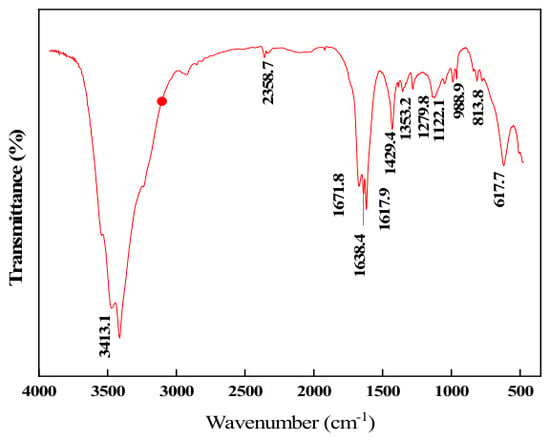
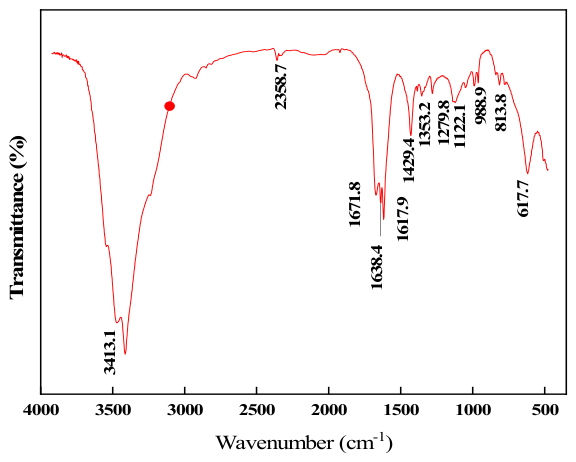
In the FT-IR spectrum (Figure 1), the broad band at 3413 cm−1 is assigned to the overlapping O-H and N-H stretching vibrations from PVA, AM, and 3-APBA, indicating strong hydrogen-bonding interactions. The C=C stretching of the meta-disubstituted benzene ring in 3-APBA appears at 1617 cm−1 and 813 cm−1, confirming its successful incorporation into the copolymer backbone. The amide C=O stretching vibrations are resolved into two components at 1671 cm−1 and 1638 cm−1, corresponding to free and hydrogen-bonded/coordinated carbonyl groups, respectively. Crucially, the absorption at 1353 cm−1 is attributed to the dynamic B-N coordination bond formed between the boronic acid groups of 3-APBA and the amino groups of PEI, which serves as the primary reversible cross-linking site. The characteristic C-O stretching of PVA is observed at 1122 cm−1, while the peak at 1429 cm−1 corresponds to B–O stretching and CH2 bending. The sharp peak at 2358 cm−1 originates from atmospheric CO2 and is not associated with the gel structure. These spectral features collectively confirm the successful construction of the multi-crosslinked network combining dynamic B-N coordination and hydrogen bonding. These assignments are in good agreement with previously reported phenylboronic-acid/amine dynamic systems. In boronic-ester gels and epoxy networks cross-linked through B–N coordination [31,32], the B-N dative bond consistently gives a characteristic absorption in the ~1340–1360 cm−1 region, overlapping with B–O stretching (~1330–1430 cm−1); our observed bands at 1353 and 1429 cm−1 fall squarely within this range and therefore support the formation of B–N coordination rather than mere hydrogen-bonded boronic acid. The split amide C=O (1671 vs. 1638 cm−1) is also consistent with literature self-healing hydrogels, in which higher-frequency bands represent free carbonyls and lower-frequency bands reflect carbonyls engaged in hydrogen bonding or coordination. The principal difference in our spectrum from those reported for single-network boronate gels lies in the strongly broadened O-H/N-H envelope (3413 cm−1) and the superposition of PVA C-O (1122 cm−1), amide, and B-O bands; this reflects the multi-component, multi-cross-link nature of our system (PVA/AM/3-APBA/PEI/DMAEMA), in which hydrogen bonding, ionic association, and B-N coordination coexist rather than a single boronate motif. Collectively, these spectral features confirm the successful construction of the multi-cross-linked network combining dynamic B-N coordination and hydrogen bonding.
Figure 1.
FT-IR spectrum of the as-synthesized gel.
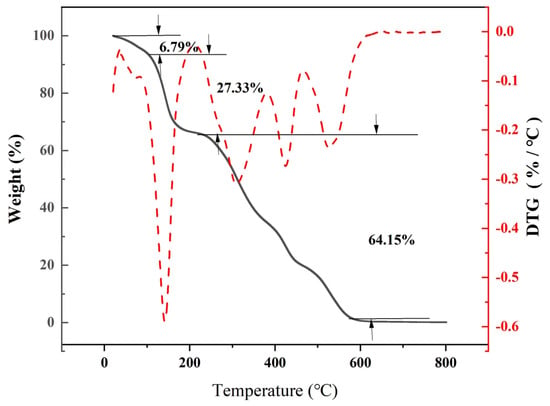
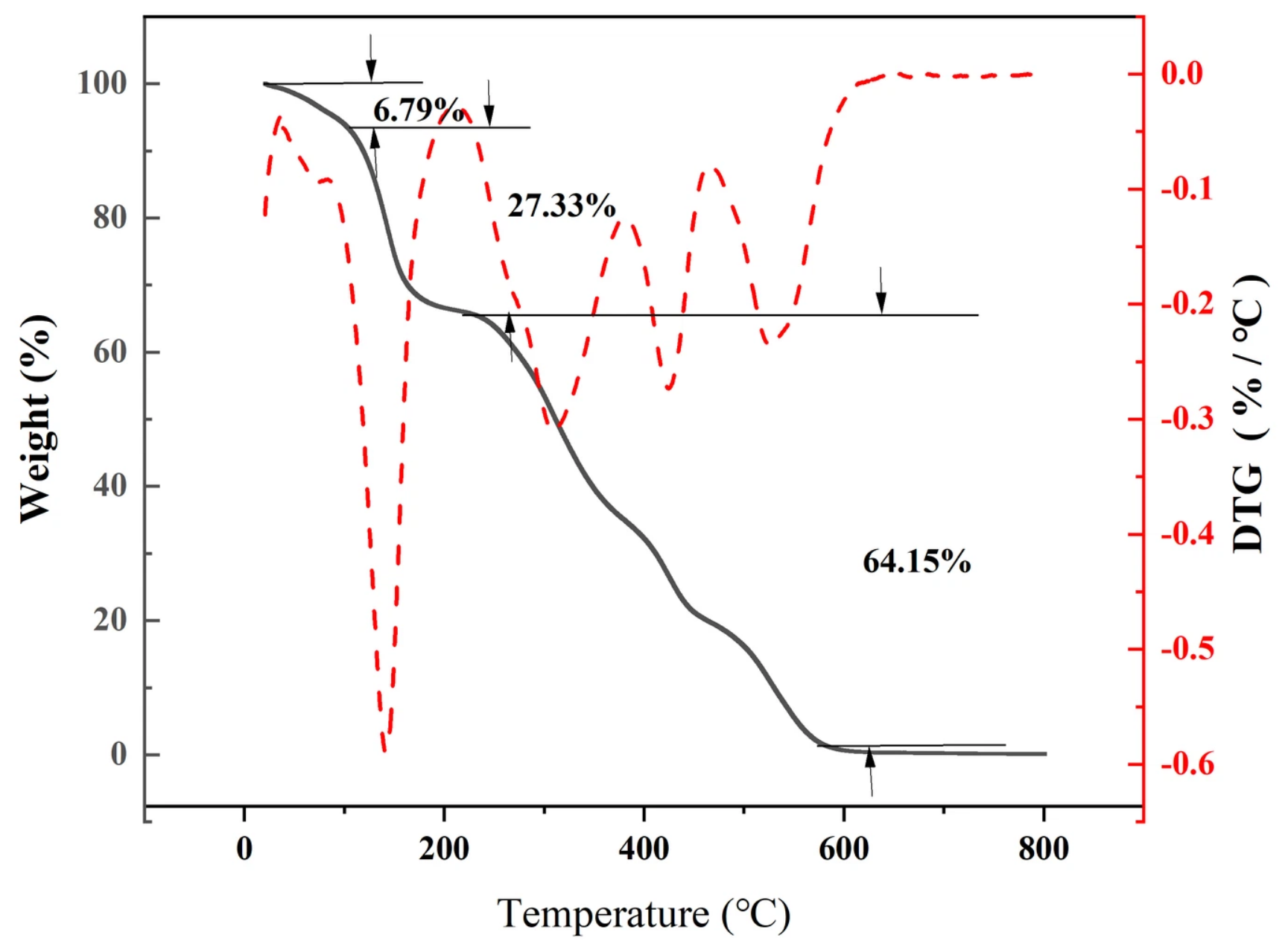
Thermogravimetric analysis (TGA) revealed a multi-stage degradation profile (Figure 2). An initial weight loss of ~19% up to 150 °C is attributed to water removal from the hydrogel network, followed by an additional ~10% loss between 150 and 240 °C from residual monomer volatilization and labile side-group decomposition, bringing the cumulative mass loss to ~30% by 240 °C. The major decomposition event occurs between 240 and 420 °C (~55% mass loss), with the maximum degradation rate centered around 290–320 °C, corresponding to polymer backbone scission. Above 420 °C, the carbonaceous residue undergoes slow pyrolysis, leaving ~10% residual mass at 500 °C and near-complete decomposition beyond 600 °C. Notably, although cumulative mass loss at 205 °C reaches ~25%, this loss arises primarily from dehydration and volatile removal rather than backbone degradation, as the onset of extensive chain scission does not occur until above 240 °C. Thus, the gel maintains structural integrity within the target operating window (≤205 °C), though dehydration effects should be considered when interpreting high-temperature mechanical performance.
Figure 2.
Thermogravimetric (TGA) curve of the gel.
3.2. Temperature-Induced Strengthening Mechanism
Conventional polymer gels typically degrade mechanically at elevated temperatures: accelerated molecular motion promotes network relaxation, chain scission, and structural degradation. In contrast, our dynamically cross-linked gel shows an unusual thermo-induced strengthening—both tensile strength and extensibility increase after high-temperature hydrothermal aging.
To assess the gel’s thermal response under deep coal-measure conditions, we aged samples at 120–205 °C (the anticipated downhole range) for 16.5 h; tensile properties are summarized in Table 1. Strikingly, raising the aging temperature from 120 to 205 °C continuously enhanced mechanical performance. Unlike conventional gels—which lose elongation at elevated temperatures—our system showed substantial gains in both tensile strength and elongation at break. After aging at 205 °C, tensile strength reached 3.68 MPa and elongation at break rose to 720%, marked improvements over the unaged material. We tentatively attribute this anomalous strengthening to thermally activated dynamic reorganization of the B–N network: elevated temperatures likely accelerate reversible B–N bond exchange, driving network reconstruction toward a more thermodynamically favorable, structurally homogeneous state. Simultaneously, continuous dissociation and reformation of hydrogen bonds may enhance energy dissipation during deformation, boosting toughness without compromising integrity. However, the precise mechanism remains unclear. Alternative factors—post-curing of residual reactive species, dehydration-induced network densification, or enhanced PVA crystallization—could also contribute. Disentangling these contributions will require future comparative studies with permanently cross-linked reference networks and advanced characterization. Among these, dehydration-induced network densification is particularly noteworthy given the ~25% mass loss observed at 205 °C (Section 2.1). However, the concurrent increase in both strength and elongation at break—rather than the embrittlement typically associated with dehydration—suggests that dynamic network reorganization plays a dominant role, with dehydration contributing to stiffening without compromising extensibility.
Table 1.
Temperature-dependent tensile properties of the gel after hydrothermal aging.
Pending further mechanistic verification, the observed behavior clearly contrasts with the thermal degradation typical of conventional gels. Instead, our dynamic gel exhibits a distinctive “stronger-after-aging” response—particularly advantageous for deep/ultra-deep drilling, where higher temperatures coincide with more demanding mechanical requirements. Direct spectroscopic confirmation (FT-IR, XPS) of B–N bond retention after 205 °C aging remains the focus of future work.
3.3. Rheological Behavior: Shear Thinning and Thixotropy
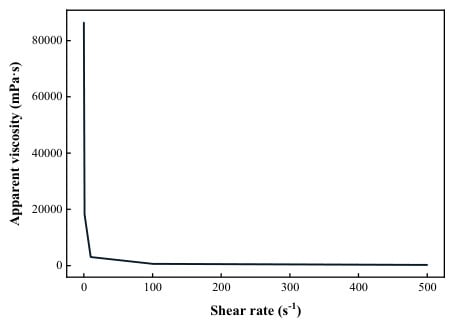
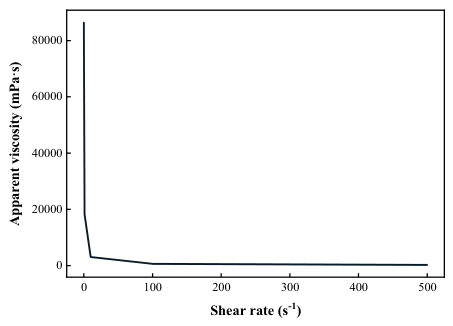
Effective lost-circulation control requires a plugging material that satisfies two seemingly contradictory demands: low viscosity during pumping (for injectability) and high strength after placement (for fracture retention). We therefore systematically evaluated the dynamic gel’s rheology, focusing on shear-thinning and thixotropic recovery. As shown in Figure 3, the gel exhibits pronounced non-Newtonian shear-thinning: as shear rate rose from 0.1 to 1000 s−1, apparent viscosity plummeted from 86,500 to 115 mPa·s—a reduction of over two orders of magnitude. This shear-induced viscosity drop reflects progressive disruption and orientation of the physically associated network, minimizing flow resistance during pumping. This behavior is highly advantageous for field applications, facilitating rapid transport through drilling equipment and fracture channels while avoiding the excessive pressures typical of conventional high-strength gels.
Figure 3.
Steady-state shear-thinning flow curves of the dynamic gel plotted on log–log axes over a shear-rate range of 0.1–1000 s−1.
Beyond pumpability, rapid structural restoration after shear cessation is equally critical. To assess this, we performed a three-stage thixotropic recovery test under alternating low- and high-strain oscillatory conditions (Table 2). Applying large deformation (150% strain) caused a sharp drop in storage modulus (G′), indicating temporary network disruption. Upon returning to the linear viscoelastic regime (1% strain), the gel recovered rapidly: within 120 s, G′ rebounded from 95 to 6880 Pa—83.9% of its initial value. This excellent self-recovery stems from synergistic interactions among multiple reversible cross-linking mechanisms. Dynamic B–N bonds provide adaptable covalent junctions that dissociate and reform under external stimuli. Concurrently, extensive hydrogen bonding among PVA chains and electrostatic interactions from DMAEMA-containing segments add reversible physical cross-links. Together, these interactions create a hierarchical network capable of reversible disassembly under high shear and rapid reconstruction upon stress removal.
Table 2.
Thixotropic recovery time-sweep data of the dynamic gel.
From an engineering standpoint, this rheological response offers clear advantages for lost-circulation control. During high-shear pumping, temporary network disruption lowers viscosity and improves injectability. Once inside fractures—where local shear rate drops sharply—the network rapidly rebuilds, restoring mechanical strength, suppressing gravitational settling, and enhancing retention in the loss zone. This shear-responsive fluid-to-solid transition is a key functional advantage of our dynamic gel system.
3.4. Component Synergistic Effect and Toughening Mechanism
To isolate the role of each functional component, we conducted component-elimination experiments and compared the resulting mechanical and rheological properties (Table 3). The Blank sample—consisting solely of polyacrylamide chains without cross-linkers—failed to form a stable 3D network and remained a highly viscous fluid with very low storage modulus (~0.08 kPa). This confirms that simple chain entanglement cannot provide the mechanical integrity needed for gel formation, highlighting the need for multifunctional cross-linking. The sample without PEI (w/o PEI)—and thus lacking dynamic B–N bonds—relied solely on hydrogen bonding and ionic interactions. Although it formed a weak gel with moderate thixotropic behavior, its storage modulus plummeted to 1.15 kPa—nearly an order of magnitude below the full system. This sharp reduction confirms that dynamic B–N bonds are the primary load-bearing framework, providing the rigidity needed to maintain gel integrity under mechanical and thermal stress.
Table 3.
Mechanical and rheological properties of the component-exclusion control groups.
Removing PVA (w/o PVA), in contrast, yielded a stiff but brittle network: although storage modulus remained relatively high, elongation at break plummeted to just 95%. This indicates that PVA’s hydrogen-bonding network acts as an effective sacrificial energy-dissipation mechanism. During deformation, reversible hydrogen bonds continuously break and reform, relieving stress concentration and delaying crack propagation. Consequently, PVA is critical for imparting toughness and flexibility. The w/o DMAEMA sample showed marked reductions in both storage modulus and overall mechanical performance. Without cationic groups, electrostatic interactions weakened and affinity for negatively charged mineral surfaces diminished. These results indicate that DMAEMA contributes to both network reinforcement (via reversible ionic interactions) and interfacial adhesion—critical for plugging stability under dynamic downhole conditions.
Among all formulations, the full system delivered the best-balanced performance, with the highest storage modulus (9.75 kPa) and greatest elongation at break (690%). This exceptional performance stems from synergistic integration of three complementary mechanisms: dynamic B–N bonds provide the structural backbone for network stability and thermal adaptability; PVA-derived hydrogen bonds act as reversible sacrificial linkages that dissipate energy and boost toughness; and DMAEMA-mediated ionic interactions reinforce interfacial adhesion while adding reversible cross-linking sites. The cooperative action of these interactions creates a hierarchical multi-cross-linked network with a unique combination of rigidity, toughness, and adhesion. This elongation was measured on as-prepared specimens under the component-comparison protocol and is not directly comparable to the aging series in Table 1 (see the note to Table 3).
Overall, no single component is sufficient on its own. Rather, the outstanding properties arise from synergistic coupling of dynamic covalent bonds, hydrogen bonds, and ionic associations, which together establish a robust yet adaptive “rigid–tough–adhesive” network.
3.5. Microstructure and Plugging Performance Correlation Analysis
To understand the structural basis for the exceptional mechanical properties after hydrothermal aging, we examined the gel’s macroscopic morphology and microstructure (Figure 4).
Figure 4.
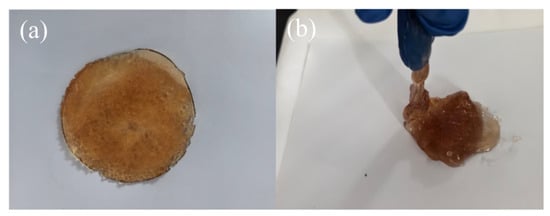
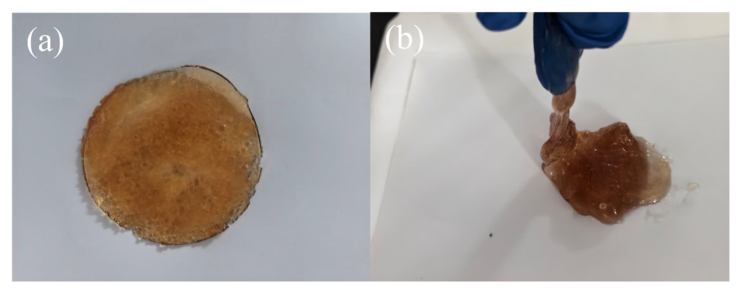
Digital photographs of the dynamic covalent polymer gel: (a) macroscopic appearance of the as-prepared gel disc; (b) manual stretching demonstration confirming the excellent extensibility of the gel after hydrothermal aging at 180 °C.
The as-prepared gel shows a homogeneous, defect-free monolith with smooth surface and no visible cracks (Figure 4a), indicating successful cross-linked network formation. More importantly, after hydrothermal aging at 180 °C, the gel retained remarkable extensibility and could be stretched substantially without macroscopic failure (Figure 4b). This observation agrees with the tensile test results (Section 2.2): aged gel reached 3.15 MPa and 615% elongation at break. Preservation of both strength and deformability after prolonged high-temperature exposure suggests that the network retains its load-bearing functionality throughout aging, despite partial dehydration and measurable mass loss (Section 2.1). Notably, both tensile strength and elongation at break rose with aging temperature—a strength–ductility synergy rarely seen in conventional permanently cross-linked networks, where strength gains typically come at the cost of extensibility. In our system, accelerated B–N bond exchange at elevated temperatures likely drives network rearrangement and defect elimination during aging. This adaptive restructuring may promote more homogeneous cross-linking, enhanced chain entanglement, and optimized hydrogen bonding, collectively boosting both strength and toughness. While direct experimental verification is still needed, the macroscopic behavior strongly supports the proposed thermo-activated dynamic network evolution.
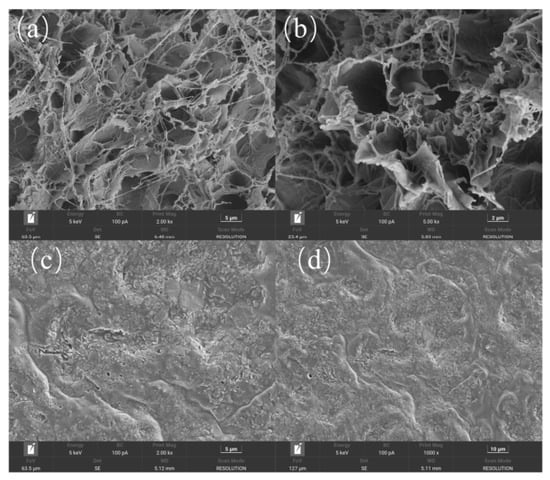
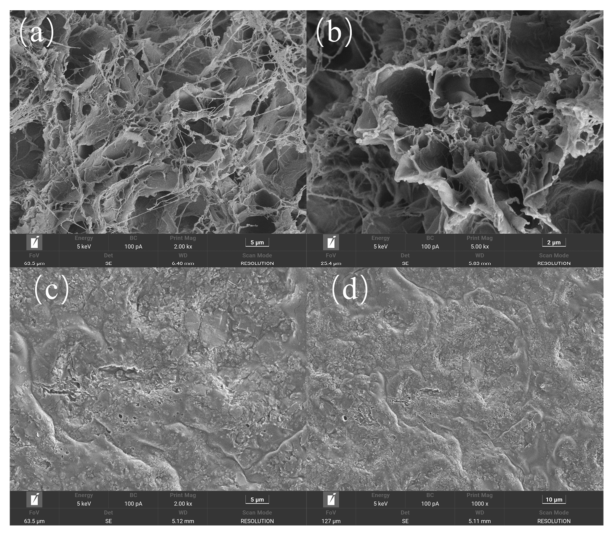
SEM further elucidated the structure–function relationship (Figure 5). Low-magnification images (Figure 5a) reveal a well-developed 3D porous architecture with interconnected, uniformly distributed pores. This porous network accommodates deformation and redistributes stress, contributing to the material’s excellent toughness. At higher magnification (Figure 5b), the network skeleton consists of densely intertwined polymer chains connected via both physical entanglements and dynamic chemical cross-links. This hierarchical architecture underpins the rapid thixotropic recovery and network reconstruction described in Section 2.3.
Figure 5.
SEM images of the dynamic gel and its sealing state: (a) 3D porous network structure at low magnification; (b) high-magnification morphology of the network skeleton; (c) interfacial bonding between the gel and the fracture wall; (d) synergistic sealing structure with rigid particles.
The gel–fracture interface is shown in Figure 5c. The gel conforms intimately to the irregular rock surface, with no visible gaps, forming a tightly integrated contact layer. This close adhesion arises from synergistic mechanical interlocking and electrostatic interactions from DMAEMA-derived cationic groups. Consequently, the sealing layer resists erosion and detachment under high-velocity drilling-fluid flow.
For millimeter-scale fractures typical of the Hannan Block, we added rigid particles for additional reinforcement (Figure 5d). The gel acts as a compliant binder, fully encapsulating the rigid particles and filling interparticle voids to create a continuous, mechanically integrated plug. This cooperative mechanism boosted pressure-bearing capacity: breakthrough pressure rose from 7.3 MPa (gel alone) to 8.8 MPa (gel + particles) in a 3 mm parallel fracture—a 20.5% improvement (Table 4). Mechanistically, rigid particles serve as the load-bearing bridging framework, while the dynamic gel acts as a deformable sealing medium that fills residual voids and accommodates surface irregularities. The resulting composite plug combines rigidity with adaptability, outperforming either component alone.
The composite’s particle-size design followed Abrams’ bridging criterion. The rigid particles (D50 ≈ 800 μm) fall within the optimal bridging range for 1–5 mm fractures, forming the primary load-bearing skeleton. The smaller gel particles (D50 ≈ 250 μm) fill interstitial spaces, creating a continuous size gradation that minimizes flow channels within the plug. This hierarchical filling strategy directly addresses the particle-size mismatch responsible for fluid leakage in the Hannan Block, where conventional solids (~6 μm) could not effectively bridge millimeter-scale fractures.
In summary, macroscopic observations, SEM analyses, and plugging tests all confirm that the excellent sealing performance arises from synergistic interaction between the adaptive dynamic gel network and the mechanically robust particle framework. This multi-scale design enables efficient fracture filling, strong interfacial adhesion, and enhanced pressure-bearing capacity, making the material well-suited for lost-circulation control under high-temperature downhole conditions.
Table 4.
Sealing pressure data of the dynamic gel in different fracture models.
4. Conclusions
In this study, we successfully developed a novel multi-cross-linked polymer gel with dynamic B–N coordination bonds as a high-temperature lost-circulation material for deep coal-measure formations. Structural characterization was consistent with formation of the designed dynamic network, and TGA revealed that the polymer backbone remains intact up to approximately 240 °C, with the onset of major chain scission occurring above this temperature—covering the range relevant to deep and ultra-deep drilling. However, cumulative mass loss due to dehydration and volatile removal reaches approximately 25% at 205 °C, which should be considered when interpreting high-temperature performance.
Hydrothermal aging revealed a distinctive thermo-activated strengthening phenomenon. Unlike conventional gels—which degrade at elevated temperatures—our system showed simultaneous gains in strength and ductility with increasing aging temperature. After aging at 205 °C, tensile strength reached 3.68 MPa and elongation at break rose to 720%. We tentatively attribute this unusual behavior to thermally accelerated dynamic reorganization of the B–N network, though direct mechanistic verification awaits future work.
Rheological tests showed pronounced shear-thinning—viscosity dropped by over two orders of magnitude with increasing shear rate—and rapid thixotropic recovery, with 83.9% storage modulus restoration after severe disruption. These properties allow the gel to meet the dual demands of efficient pumping and effective fracture retention—critical for practical lost-circulation control.
Component-elimination experiments further elucidated the synergistic toughening mechanism. Dynamic B–N bonds serve as the primary load-bearing framework; PVA-derived hydrogen bonds act as reversible energy-dissipation units that boost toughness; and DMAEMA-mediated ionic interactions enhance both network integrity and interfacial adhesion. Their cooperative action creates a hierarchical multi-cross-linked network that combines rigidity, toughness, and adaptability advantageously.
Microstructural observations and plugging tests confirmed that the dynamic gel conforms intimately to fracture surfaces via mechanical interlocking and interfacial interactions. Adding rigid bridging particles created an integrated load-bearing sealing structure with enhanced pressure resistance. At 140 °C, breakthrough pressures reached 7.3–7.9 MPa in 3 mm fractures and exceeded 11 MPa in sand-packed media, confirming strong plugging capability under representative downhole conditions.
Overall, the proposed dynamic B–N-cross-linked gel offers a promising strategy to overcome the longstanding challenge of achieving both mechanical adaptability and backbone stability at elevated temperatures in high-temperature LCMs. Our findings provide a useful structure–property framework for designing next-generation dynamic polymer plugging systems and offer valuable material support for treating severe losses in deep/ultra-deep coal-measure formations. Future work will focus on direct characterization of the dynamic network evolution mechanism and plugging performance at the maximum target temperature (205 °C).
Author Contributions
Conceptualization, L.D. (Liangbin Dou) and F.Z.; methodology, L.D. (Leyao Du) and F.Z.; validation, L.D. (Leyao Du), B.J. and L.Z.; formal analysis, L.D. (Leyao Du); investigation, W.G., B.J., L.Z., X.M. and L.D. (Leyao Du); resources, W.G., B.J., L.Z. and X.M.; data curation, L.D. (Leyao Du); writing—original draft preparation, L.D. (Leyao Du); writing—review and editing, F.Z. and L.D. (Liangbin Dou); visualization, L.D. (Leyao Du); supervision, F.Z. and L.D. (Liangbin Dou); project administration, W.G. and F.Z.; funding acquisition, W.G. and F.Z. All authors have read and agreed to the published version of the manuscript.
Funding
This research was funded by Research and Application of Optimal and Efficient Drilling and Completion Technologies for Atmospheric-Pressure Shale Gas in the Hannan Complex Structural Area, with the grant number SMDZ-ZD2024-1-03; High-Efficiency Leak-Sealing Technology for the Hannan Complex Structural Zone and High-Performance, Collapse-Resistant, Environmentally Friendly Drilling Fluid Technology, with the grant number YQZC-2025033.
Institutional Review Board Statement
Not applicable.
Informed Consent Statement
Not applicable.
Data Availability Statement
The data presented in this study are available on request from the corresponding authors. The data are not publicly available due to confidentiality and privacy restrictions.
Conflicts of Interest
Authors Wenxiang Guo, Bo Jiang, Li Zhang, Xiaoli Ma was employed by the company Shaanxi Coalfield Geology Oil and Gas Drilling and Production Co., Ltd. The remaining authors declare that the research was conducted in the absence of any commercial or financial relationships that could be construed as a potential conflict of interest.
Abbreviations
The following abbreviations are used in this manuscript:
| 3-APBA | 3-acrylamidophenylboronic acid |
| AM | Acrylamide |
| APS | Ammonium persulfate |
| B–N | Boron–nitrogen |
| DMAEMA | N,N-dimethylaminoethyl methacrylate |
| D50 | Median particle diameter (50% cumulative passing diameter) |
| FT-IR | Fourier Transform Infrared Spectroscopy |
| G’ | Storage modulus |
| SEM | Scanning electron microscope |
| TGA | Thermogravimetric analysis |
| HTHP | High-temperature and high-pressure |
| LCMs | Lost-circulation materials |
| Mw | Molecular weight |
| rpm | Revolutions per minute |
| phr | Parts per hundred parts of resin |
References
- Liu, Y.; Rong, K.; Yang, Z.; Gong, J.; Kan, N.; Zhang, H.; An, J. Technologies for Lost Circulation Control in Deep Coalbed Methane Drilling in the East of the Junggar Basin. Drill. Fluid Complet. Fluid. 2025, 42, 764–771. [Google Scholar]
- Zhu, M.; Sun, H.; Qu, Y.; Shi, Q.; Zhang, Q.; Hou, B.; Yang, G. Technology of Lost Circulation Prevention and Control in Deep Coalbed Methane Drilling in Eastern Ordos Basin. Drill. Fluid Complet. Fluid. 2025, 42, 343–349. [Google Scholar]
- Li, J.; Tan, Z.; Jing, Q.; Mei, W.; Shen, W.; Feng, L.; Dong, T.; Hao, Z. Research and Performance Evaluation of Low-Damage Plugging and Anti-Collapse Water-Based Drilling Fluid Gel System Suitable for Coalbed Methane Drilling. Gels 2025, 11, 473. [Google Scholar] [CrossRef] [Scilit] [PubMed]
- Han, Z.; Yang, X.; Ren, N.; Song, J.; Zhao, M.; Xue, M.; Liang, M.; Yan, X.; Jin, C.; Jiang, G.; et al. Dynamic sealing mechanisms of drilling fluid in fractured coalbed methane formations: A coupled CFD-DEM numerical study. Comput. Geotech. 2025, 188, 107560. [Google Scholar] [CrossRef] [Scilit]
- Behzad, E.; Erfan, H. Laboratory study of plugging mechanism and seal integrity in fractured formations using a new blend of lost circulation materials. J. Pet. Explor. Prod. Technol. 2023, 13, 1197–1234. [Google Scholar] [CrossRef] [Scilit]
- Sun, J.; Bai, Y.; Cheng, R.; Lv, K.; Liu, F.; Feng, J.; Lei, S.; Hao, H. Research progress and prospect of plugging technologies for fractured formation with severe lost circulation. Pet. Explor. Dev. 2021, 48, 732–743. [Google Scholar] [CrossRef] [Scilit]
- Zhu, J.; Wang, T.; Zhang, S.; Bai, Y.; Qin, G.; Yang, J. Study on Gel–Resin Composite for Losting Circulation Control to Improve Plugging Effect in Fracture Formation. Gels 2025, 11, 617. [Google Scholar] [CrossRef] [Scilit] [PubMed]
- Sun, J.; Shen, Z.; Bai, Y.; Liu, F.; Lv, K.; Yang, J. Research development and prospects of plugging techniques for drilling fluid severe circulation loss in deep fractured-vuggy formations. J. China Univ. Pet. Ed. Nat. Sci. 2026, 50, 99–111. [Google Scholar]
- Yang, J.; Sun, J.; Bai, Y.; Lv, K.; Zhang, G.; Li, Y. Status and Prospect of Drilling Fluid Loss and Lost Circulation Control Technology in Fractured Formation. Gels 2022, 8, 260. [Google Scholar] [CrossRef] [Scilit]
- Zhang, J.; Feng, Y.; He, B.; Hu, H.; Deng, J. Wellbore strengthening for addressing lost circulation in fractured formations: A comprehensive review. Rock Mech. Rock Eng. 2025, 58, 1–32. [Google Scholar] [CrossRef] [Scilit]
- Sun, J.; Yang, J.; Bai, Y.; Lv, K.; Wang, J.; Wang, R. Review and prospect of bridging plugging technology in fractured formation. Pet. Sci. Bull. 2023, 8, 415–431. [Google Scholar]
- Liu, Y.; Zhang, P.; Zheng, X.; Huang, J.; Wei, S.; Chen, Q.; Ma, T. Experimental study on the updated selection criterion for particle size distribution of lost circulation materials. Geomech. Geophys. Geo-Energy Geo-Resour. 2026, 12, 28. [Google Scholar] [CrossRef] [Scilit]
- Wang, G.; Huang, Y.; Xu, S. Laboratory investigation of the selection criteria for the particle size distribution of granular lost circulation materials in naturally fractured reservoirs. J. Nat. Gas Sci. Eng. 2019, 71, 103000. [Google Scholar] [CrossRef] [Scilit]
- Hui, C.; Ma, C.; Tian, D.; Luo, C.; Zou, L.; Wang, H. An Experimental Study on optimizing the particle size distribution of bridging agents in drilling fluids. IOP Conf. Ser. Earth Environ. Sci. 2021, 61, 012064. [Google Scholar] [CrossRef] [Scilit]
- Abrams, A. Mud Design To Minimize Rock Impairment Due To Particle Invasion. J. Pet. Technol. 1977, 29, 586–592. [Google Scholar] [CrossRef] [Scilit]
- Wang, T.; Huang, W.; Zhu, J.; Li, C.; Qin, G.; Lu, H. Preparation and Physicochemical Properties of High-Temperature-Resistant Polymer Gel Resin Composite Plugging Material. Gels 2025, 11, 310. [Google Scholar] [CrossRef] [Scilit] [PubMed]
- Yang, J.; Bai, Y.; Sun, J.; Lv, K.; Liu, F.; Lang, Y. Thermosensitive adhesive composite bridging system for lost circulation control in fractured formations. Pet. Sci. 2026, 19, 166–181. [Google Scholar] [CrossRef] [Scilit]
- Chen, M.; Murphy, B.B.; Wang, Y.; Flavia, V.; Yang, S. SMART Silly Putty: Stretchable, Malleable, Adherable, Reusable, and Tear-Resistible Hydrogels. Small 2022, 19, 2205854. [Google Scholar] [CrossRef] [Scilit] [PubMed]
- Bai, Y.; Zhang, Q.; Sun, J.; Lv, K.; Shang, X.; Liu, C.; Cheng, R.; Wang, F. Self-healing hydrogels and their action mechanism in oil–gas drilling and development engineering: A systematic review and prospect. J. Nat. Gas Sci. Eng. 2021, 96, 104250. [Google Scholar] [CrossRef] [Scilit]
- Ashoori, S.; Bahari Moghadam, M.; Nazemi, R.; Nooripoor, V.; Ahmadabadi, M. Dynamically Evaluating the Performance of Naturally Occurring Additives to Control Lost Circulation: On the Effect of Lost Circulation Material Type, Particle-Size Distribution, and Fracture Width. SPE J. 2022, 27, 2590–2612. [Google Scholar] [CrossRef] [Scilit]
- Henriques, C.; Taleghani, A.D. An Evaluation of the Combination of Fibers and Granules for Lost Circulation Material Applications. SPE J. 2025, 30, 16. [Google Scholar] [CrossRef] [Scilit]
- Sun, D.; Yang, Y.; Liu, Y.; Wu, Z.; Zhang, H. Strengthening the Hydrogel for Lost Circulation Control through In Situ Self-Assembled Nanocomposite Networks. Energy Fuels 2023, 37, 4320–4330. [Google Scholar] [CrossRef] [Scilit]
- Yang, L.; Xie, C.; Zhang, Y.; Jiang, G.; Wu, Y.; Liu, H.; Dong, T.; Guo, C. Performance of Self-healing microgel incorporating Nano-Silica as plugging material for drilling fluid. J. Mol. Liq. 2023, 386, 122392. [Google Scholar] [CrossRef] [Scilit]
- Zhou, Z.; Fu, Y.; Li, F.; Liu, J.; Li, D. A high-strength hydrogel with tunable gelation time for high-temperature and high-pressure plugging applications. Chem. Pap. 2026, 80, 7539–7549. [Google Scholar] [CrossRef] [Scilit]
- Liu, Y.; Yao, X.; Xi, C.; Liu, K.; Ren, T. Preparation and performance characterization of thixotropic gelling materials with high temperature stability and wellbore sealing properties. Polymers 2025, 17, 3343. [Google Scholar] [CrossRef] [Scilit] [PubMed]
- Sun, J.; Zhao, Z.; Bai, Y.; Lv, K.; Wang, J.; Wang, R.; Wang, C.; Dai, L. Progress in research of intelligent self-healing gel and its application prospects in the field of drilling fluid. Acta Pet. Sin. 2020, 41, 1706–1718. [Google Scholar]
- Huang, S.; Zhang, Z.; Mao, J.; Li, B.; Yuan, R.; Jiang, Z.; Liu, S. Development of a Shear-Responsive Gel for Lost Circulation Control Tailored to Enhance Drilling Rate of Penetration. Processes 2026, 14, 2168. [Google Scholar] [CrossRef] [Scilit]
- Bai, Y.; Yang, J.; Sun, J.; Shang, X.; Han, J. Self-filling and plugging performance of a thixotropic polymer gel for lost circulation control in fractured formation. Geoenergy Sci. Eng. 2023, 225, 211717. [Google Scholar] [CrossRef] [Scilit]
- Lavrov, A. Lost Circulation: Mechanisms and Solutions; Elsevier: Amsterdam, The Netherlands, 2016; Volume 5, pp. 99–162. [Google Scholar]
- Liu, S.; Xu, Y.; Song, M.; Meng, R.; Wang, C. Highly Efficient Degradation Gel System for Drilling and Plugging of Ultra-deepwater Fractured Reservoir. Oilfield Chem. 2023, 40, 198–204. [Google Scholar]
- Hu, J.; Shen, X.; Li, Z.; Teng, J.; Zhang, Y.; Zheng, S. Integration of B-N coordinated boronic ester bonds into epoxy networks through one-step crosslinking. Polymer 2025, 334, 128733. [Google Scholar] [CrossRef] [Scilit]
- Liu, Y.; Liu, Y.; Wang, Q.; Han, Y.; Tan, Y. Boronic ester-based self-healing hydrogels formed by using intermolecular B-N coordination. Polymer 2020, 202, 122624. [Google Scholar] [CrossRef] [Scilit]

Disclaimer/Publisher’s Note: The statements, opinions and data contained in all publications are solely those of the individual author(s) and contributor(s) and not of MDPI and/or the editor(s). MDPI and/or the editor(s) disclaim responsibility for any injury to people or property resulting from any ideas, methods, instructions or products referred to in the content. |
© 2026 by the authors. Licensee MDPI, Basel, Switzerland. This article is an open access article distributed under the terms and conditions of the Creative Commons Attribution (CC BY) license.