


Abstract
Fishery effluents are often characterized by high organic and nutrient loads and require management planning based on a sustainable strategy. This study evaluated the efficiency of algal–fungal biomasses immobilized in a Moving Bed Biofilm Reactor (MBBR) using natural (sardine scales) or synthetic (Kaldnes K3) carriers. Several monocultures and mixed consortia were investigated for the treatment of wastewater generated by the fishery industry. The Gracilaria–Aspergillus niger consortium demonstrated the highest treatment performance. Nearly complete removal of COD and BOD5 within 24 h was recorded, accompanied by significant reductions in total nitrogen, nitrite, cadmium, and lead concentrations. After 72 h on K3 carriers, removal efficiencies for these four parameters reached approximately 90% or higher. The biofilm-bed performance of sardine scales was comparable to that of Kaldnes K3 under the experimental conditions tested, supporting their potential as a waste-derived biofilm carrier within a circular-economy framework. Kinetic modeling described pollutant removal using mono-exponential models, with fitted rate constants varying among treatment configurations and pollutants.
1. Introduction
With approximately 2900 km of Atlantic coastline and nearly 500 km of Mediterranean coastline, Morocco benefits from a strategic geographical position that supports rich marine biodiversity and provides access to abundant fishery and seaweed resources. The frigid currents coming from the Canary Upwelling along the Atlantic coast of Morocco, along with the temperate climate and high solar radiation, give rise to favorable environmental conditions for high marine biological productivity [1]. These environmental conditions also give rise to a high number of pelagic fishes. In 2025, about 910,000 tonnes of pelagic fish was caught, with sardines (Sardina pilchardus) alone constituting two-thirds of Morocco’s marine catch [2]. Morocco is among the top producers of sardines in the world and is the largest exporter of canned sardines globally [3].
The industrial processing of sardine products generates huge amounts of solid by-products and liquid waste. The solid by-products produced are estimated to reach the annual limit of 200,000 tonnes, posing a major environmental challenge.
The discarded parts—heads, tails, bones, and viscera—account for more than 40% of the whole fish weight, while scales represent approximately 2% [4,5]. Liquid effluents generated during fish washing, gutting, and canning are characterized by high concentrations of organic matter, suspended solids, nitrogen and phosphorus compounds, together with trace amounts of heavy metals. These by-products and liquid effluents are therefore a large environmental issue that has not yet been solved, though their potential re-use in circular economy scenarios has led to increased interest over the last few years.
Apart from chemical and physical methods of treatment, biological processes have increasingly been explored for wastewater treatment in recent years due to their simple mode of operation and their ability to treat complex effluent matrices without triggering secondary chemical pollutions. Moving Bed Biofilm Reactor (MBBR) processes in particular have emerged within this category owing to their treatment performance and optimal treatment times, as well as major operational advantages reported in the literature, including excellent resistance to fluctuations in organic and hydraulic loads, simplified settling management, and increased operational flexibility [6]. Furthermore, MBBR demonstrates, in a large proportion of scientific studies, a high efficiency in the biodegradation of organic matter, as well as in nitrogen removal, making it a technology particularly well suited to modern wastewater treatment systems [7,8].
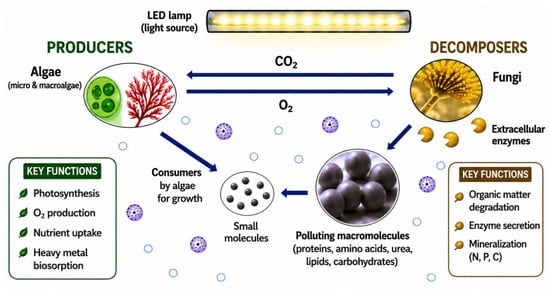
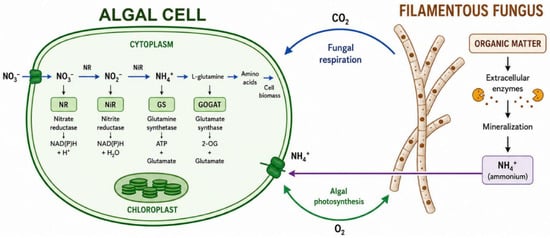
In the field of bioremediation, algae have continuously attracted growing interest in recent decades owing to their strong capacity to assimilate excess nutrients and sequester heavy metals present in contaminated waters [9,10]. Their physiological and biochemical richness also enables the production of high-value compounds such as pigments, proteins, and lipids, thereby reinforcing their economic interest [11,12]. Algae constitute a diverse group of photosynthetic organisms ranging from unicellular microalgae to multicellular macroalgae. Their application in the treatment of agro-industrial effluents is now emerging as a promising approach to achieving the shared goals of bioremediation, biomass valorization, and sustainable development (Figure 1). Their integration into biological processes will contribute to a circular approach to resource management [13].
Figure 1.
Metabolic synergy between algae and fungi during effluent bioremediation. Arrows indicate gas exchange and metabolic interactions.
Fungi and bacteria have also been used extensively in biological wastewater treatment as they can readily degrade organic substances (Figure 1). Yet, their capability to eliminate total nitrogen, especially ammonium and nitrate, tends to be inadequate in nutrient-loaded wastewater [8,13]. To maximize treatment efficiency, some researchers have explored the use of mixed microbial consortia combining algae, bacteria, and fungi. These integrated systems not only enhance the removal of nutrients and organic matter but also improve the stability and reliability of the treatment process [14,15].
This study investigates the Moving Bed Biofilm Reactor (MBBR) process for treating fish-processing effluent with high organic and nutrient contents. An earlier study conducted in our laboratory evaluated treatment using Aspergillus niger alone over 24 h [8], while our previous publication investigated brown and green macroalgae combined with this fungus over the same treatment period [15]. Building on these studies, the present work investigates the red macroalga Gracilaria sp. combined with A. niger, extends treatment monitoring to 72 h, and broadens the range of water-quality parameters evaluated. To assess the performance of this macroalgal–fungal consortium, a microalgal–fungal consortium combining Tetraselmis suecica with A. niger was also evaluated, alongside individual treatments using A. niger, Gracilaria sp., Arthrospira platensis, T. suecica, and Scenedesmus obliquus. Two MBBRs were operated in parallel: one equipped with conventional polyethylene Kaldnes K3 carriers and the other with sardine scale carriers. Sardine scales, primarily composed of hydroxyapatite and collagen [16], were investigated as a means of valorizing a fish-processing by-product within a circular-economy approach. This comparative design examines how biological composition, treatment duration, and carrier type influence overall pollutant removal. The study evaluated non-sterile systems. A non-inoculated control was included to assess background pollutant removal in the presence of the indigenous microbial community. However, the specific contributions of indigenous bacteria and microorganisms associated with the macroalgal inocula were not independently quantified within the inoculated systems.
2. Materials and Methods
2.1. Microalgae Strains
Three species of microalgae were used in this study: Tetraselmis suecica (TS), Scenedesmus obliquus (SO), and Arthrospira platensis (SP). TS and SO were cultured in 0.22 µm filtered seawater and autoclaved tap water [17], respectively, and both culture media were supplemented with F/2 medium. SP was cultured in modified Zarrouk medium [18]. All cultures were maintained at 20 ± 1 °C and 8000 lux. The initial pH values were 8.0 for TS [19], 7.0 for SO [20,21], and 9.5 for SP [22]. TS and SO were maintained under continuous illumination, whereas SP was cultured under a 12 h light/12 h dark photoperiod. Microalgal cultures were grown to a cell density of 2 × 10⁶ cells/mL [23]. The growth of TS and SO was monitored by direct cell counting using a Malassez haemocytometer (BLAUBRAND, BRAND GmbH + Co. KG, Wertheim, Germany). Due to its filamentous morphology, the growth of SP was monitored by measuring the optical density at 680 nm (OD680) using a UV-Vis spectrophotometer (UV-1800, Shimadzu Corporation, Kyoto, Japan) [24].
2.2. Red Macroalga, Gracilaria sp.
The red macroalga Gracilaria (RMA) was collected at low tide along the coast of Mohammedia (Morocco) in March 2024. This alga was chosen due to its high capacity to remove rare earth elements and heavy metals from water within 72 h, with the majority of absorption occurring within the first 24 h [25,26]. After onsite rinsing with seawater and repeated washing with distilled water at the laboratory, the fresh algae were directly introduced into the bioreactor [15]. Gracilaria, still attached to their natural rocky substrate rather than as detached fragments, were used in order to avoid the physiological stress associated with disrupting their natural state of attachment. They were placed in the center of the bioreactor to ensure adequate coverage and exposure to the effluent. Since the algal biomass remained attached to the rocky substrate during the treatment, it could not be measured, so an estimate of the fresh weight was determined by weighing out an equivalent amount of fresh Gracilaria, which had previously been detached from a similar rock sample (112 ± 3 g).
2.3. Fungus, Aspergillus niger
The Aspergillus niger (AN) strain (11G323A) was pre-cultured on potato dextrose agar (PDA) at 30 °C for 72 h. The fungal biomass was produced in a malt broth (3% malt extract, 2% peptone, 1% yeast extract), sterilized by autoclaving (120 °C, 20 min), and then recovered by centrifugation (4800× g, 20 min) before being introduced into the bioreactor.
2.4. Biofilm Supports
Two types of carriers were tested to promote biofilm attachment and growth. On the one hand, sardine scales were used as a natural substrate. Before use, these were carefully prepared by rinsing several times with hot distilled water at 80 °C to remove impurities, followed by drying for 24 h at 60 °C. The scales were then stored at room temperature until required. Sardine scales (2 g/L) were added, following optimized conditions reported in previous studies [8,27].
Commercial polyethylene (PE) K3 carriers were used as the reference support material. Their performance was compared with that of the natural sardine scale carriers in terms of organic matter and nutrient removal efficiencies.
2.5. Effluent Preparation and Characterization
To mimic the organic characteristics of fish-processing effluents, a reconstituted wastewater was prepared ad hoc. This was done by mixing 160 g of fresh sardine (Sardinella sp.) processing waste, including heads, viscera, bones, and tails, with 400 mL of distilled water. This mixture was then homogenized using a grinder and sieved to obtain a concentrated fraction. This fraction was subsequently diluted with distilled water to achieve the desired concentration (see Table 1) [28]. The prepared wastewater was used fresh and maintained under non-sterile conditions to preserve microbial communities and remain representative of real field conditions.
Table 1.
Comparison of the physicochemical characteristics of the reconstituted effluent with the values reported for real fishery effluents in Morocco. TSSs: total suspended solids; TN: total nitrogen; TP: total phosphorus.
2.6. MBBR Bioreactor
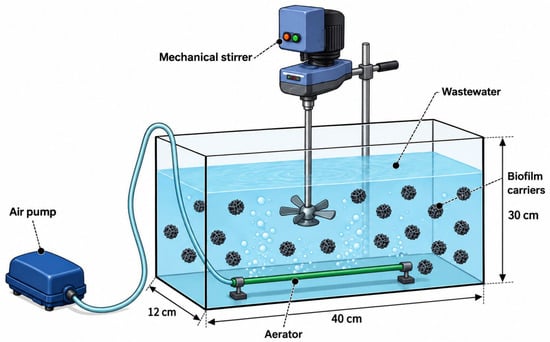
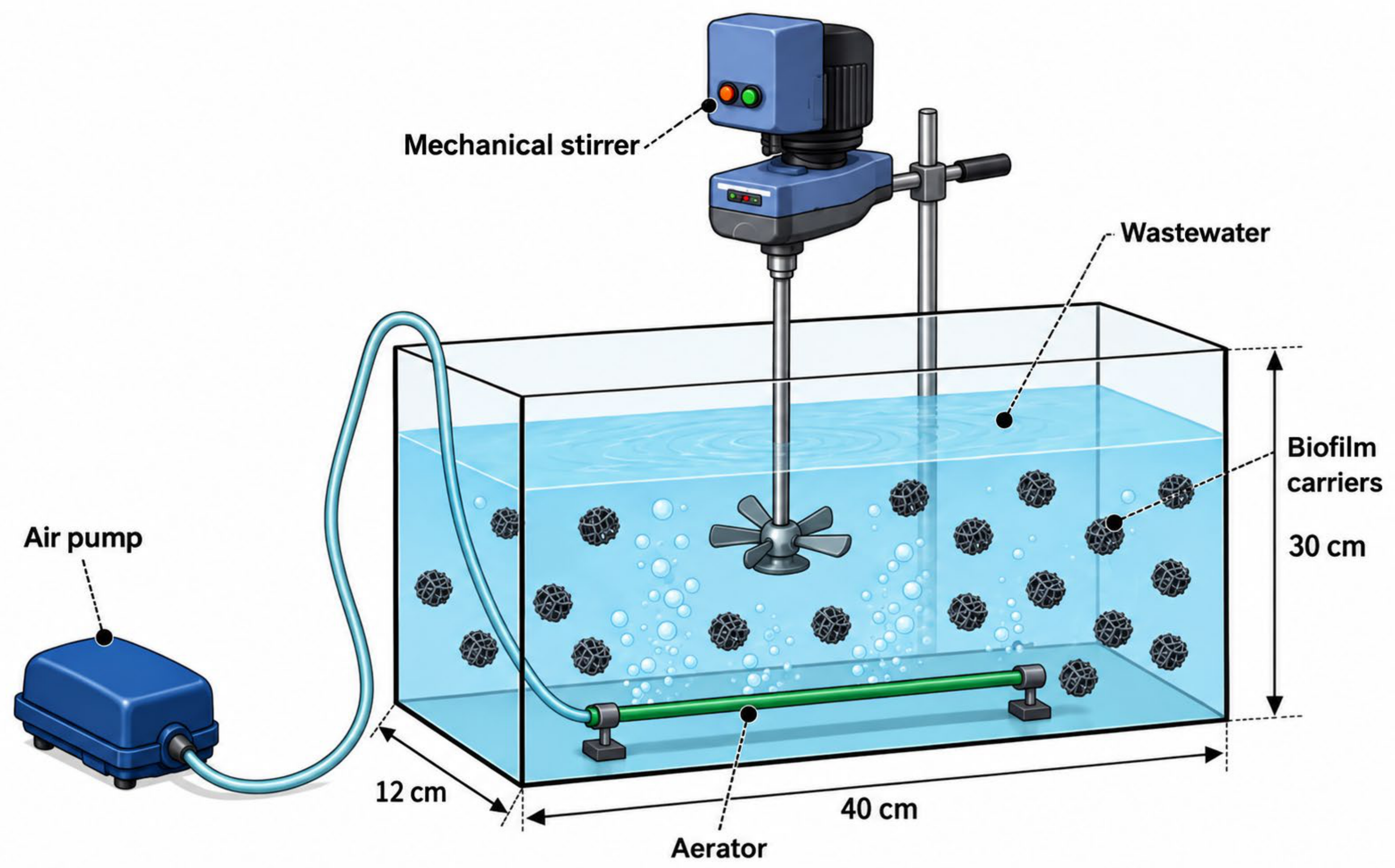
The bioreactor (Figure 2) consists of a 10 L glass tank fitted with a fine-bubble diffuser. A dissolved oxygen concentration of 2 mg/L was maintained throughout the experiments to support the metabolic activity of the mixed biomass. A mechanical stirrer ensures homogenization of the medium and uniform suspension of the biomass.
Figure 2.
Schematic representation of the aerobic Moving Bed Biofilm Reactor (MBBR) used for the treatment of fishery effluents, showing the reactor configuration, the mechanical stirring system, the aeration device, and the biofilm carriers.
2.7. Experimental Design
The study was carried out in 10 L MBBRs containing synthetic effluent. Several treatment trials were conducted to evaluate the efficacy of various microalgal species and one macroalgal species, as well as their combination with a filamentous fungus (Aspergillus niger), using two types of carriers, namely natural sardine scales (SS) and synthetic Kaldnes (K3).
Initially, three distinct treatments were conducted separately using 30% (v/v) microalgal cultures: Arthrospira platensis, Scenedesmus obliquus, and Tetraselmis suecica. For each treatment, the centrifuged and washed algal pellet was resuspended in 3 L under gentle agitation for 30 min to allow for the progressive acclimation of the cells and then combined with 7 L of effluent to constitute the 10 L working volume under gentle agitation and with the light regime specific to each species, as detailed above (continuous light for TS and SO and 12 h light/12 h dark cycle for SP). At the second stage, fungus–microalgae co-inoculation trials were carried out by combining Aspergillus niger with Tetraselmis suecica at a microalgae-to-effluent volume ratio of 30% (v/v). Subsequently, a treatment using the red macroalga Gracilaria in combination with the fungus was set up to examine the behavior of a macroalga–fungal consortium. In parallel, Gracilaria was also tested alone, without fungal inoculation, in order to assess the intrinsic contribution of the macroalga to pollutant removal independently of the fungal partner. Finally, a control treatment using the fungus alone (Aspergillus niger) was carried out to compare the nutrient and organic matter removal performance between the fungal-only systems and the combined systems. All treatments were carried out under the same experimental conditions: temperature of 25 ± 2 °C, agitation at 100 r.p.m., and light intensity of 8000 lux during illuminated periods. Contact time was defined as the elapsed time from inoculation (t = 0), during which the effluent remained in contact with the biomass–carrier system in the batch-operated MBBR. Samples were collected at 6, 24, 48, and 72 h to monitor changes in physicochemical parameters and pollutant removal efficiencies. Sampling was performed under consistent agitation and aeration conditions, and samples were analyzed.
2.8. Analytical Methods for Evaluating Treatment Performance
Sample analyses were immediately performed to prevent any alteration in their physicochemical properties. Chemical oxygen demand (COD) was determined using the dichromate method in a closed-reflux system with an ECO6 thermoreactor (VELP Scientifica Srl, Usmate Velate, Italy) [8]. The five-day biochemical oxygen demand (BOD5) was measured using a BOD Sensor (VELP Scientifica, Usmate, Italy) following a 5-day incubation at 20 °C. Total nitrogen (TN) was determined using the Kjeldahl method described in ISO 5663:1984/APHA 4500-Norg B [32]. Total phosphorus (TP) was measured using the spectrophotometric method with phosphomolybdic acid (blue-molybdate), in accordance with ISO 6878:2004/APHA 4500-P E [32]. Nitrates were determined using a colorimetric method following reduction on a cadmium column, followed by a color reaction with sulfanilamide and N-(1-naphthyl)-ethylenediamine (NED) to produce a pink color. After 30 min, the absorbance was measured at 540 nm in accordance with standard 4500-NO3−E [32]. Nitrites were determined using a direct colorimetric method based on diazotization with sulfanilamide and NED (Griess reaction), without prior cadmium reduction, in accordance with standard 4500-NO2− B [32]. Total suspended solids (TSSs) were quantified by vacuum filtration through a 0.45 µm filter. In addition, heavy metals, notably cadmium (Cd) and lead (Pb), were analyzed by inductively coupled plasma optical emission spectrometry (ICP-OES) using an Ultima Expert spectrometer (HORIBA France SAS, France).
2.9. Data Analysis
All treatment conditions, including the non-inoculated control (IF), were evaluated in three independent experiments (n = 3). Each sample was analyzed in triplicate, and the analytical measurements were averaged to obtain one value per independent experiment. Results are expressed as means ± standard deviation (SD) calculated across the three independent experiments. Pearson correlation coefficients were calculated to assess the linear relationships between variables and visualized as heatmaps, where color intensity reflects the strength of the correlation. Principal component analysis (PCA) was applied to explore the relationships between removal efficiencies and the influence of biomass type and biofilm carriers on overall treatment performance, and the results were visualized using correlation circles and score plots. All statistical analyses were performed using OriginPro v.9.9.0.225 software for Windows (OriginPro 2024).
Kinetic data were modeled using a homemade R code. Pollutant removal kinetics were fitted using an ascending mono-exponential model. The asymptotic removal parameter A and the rate constant k were both estimated during model fitting, with an upper bound of 100% imposed on A. Thus, A was allowed to vary below or reach this limit rather than being fixed at 100%. When no plateau was observed within the experimental duration, A was interpreted as an extrapolated asymptotic removal efficiency rather than an experimentally demonstrated maximum. The single-exponential model is defined by an asymptotic amplitude parameter A and rate constant k according to the following equation:
The fitted kinetic parameters (A and k) for each treatment configuration and water-quality parameter are reported in Table A1.
Interactions between Aspergillus niger (AN) and the algal biomasses were evaluated according to the Bliss independence principle [33]. Four experimental conditions were considered for each parameter: indigenous flora alone (IF), AN alone, algal biomass alone, and their combined treatment (AB).
Because the fish-processing effluent was not sterilized, the removal efficiencies measured under the inoculated conditions could also include contributions from indigenous microorganisms. A non-inoculated control (IF), consisting of effluent without added algal or fungal inocula, was evaluated at the same treatment time and with the same carrier type, working volume, stirring speed, aeration conditions, and illumination regime as the corresponding inoculated treatment. This correction accounts for background removal measured in the IF control but does not experimentally isolate indigenous microbial contributions within the inoculated systems. Accordingly, ΔBliss classifications are interpreted as deviations from background-adjusted Bliss independence under the model assumptions. The individual effects were therefore normalized relative to IF using an adaptation of the Abbott–Schneider–Orelli correction applied when the control exhibits a measurable response [34]:
, , and denote the removal efficiencies obtained with indigenous flora, AN alone, and algal biomass alone, respectively.
Under the Bliss independence assumption, the expected effect of the association was calculated as follows:
The expected effect was subsequently converted back into removal efficiency:
The deviation from Bliss independence was determined as follows:
where is the experimentally observed removal efficiency of the algal–fungal consortium. A positive value indicates that the observed effect exceeded the effect expected under Bliss independence, whereas a negative value indicates an observed effect below the expected response.
Uncertainty in ΔBliss was evaluated using delta-method error propagation, with effective degrees of freedom estimated using the Welch–Satterthwaite approximation [35,36]. A 95% confidence interval (CI) entirely above zero indicates a positive deviation from Bliss independence, an interval entirely below zero indicates a negative deviation, and an interval containing zero is compatible with the model. These classifications are conditional on the model assumptions and the experimental replication structure.
2.10. Use of Generative Artificial Intelligence
ChatGPT (OpenAI) was used to assist in the graphical representation of biological mechanisms and the preparation of schematic illustrations, based on original drawings and scientific concepts provided by the authors. ChatGPT was also used to correct grammatical errors in selected passages of the manuscript. All AI-assisted content was reviewed and validated by the authors.
3. Results and Discussion
3.1. Effect of Contact Time on Treatment Quality
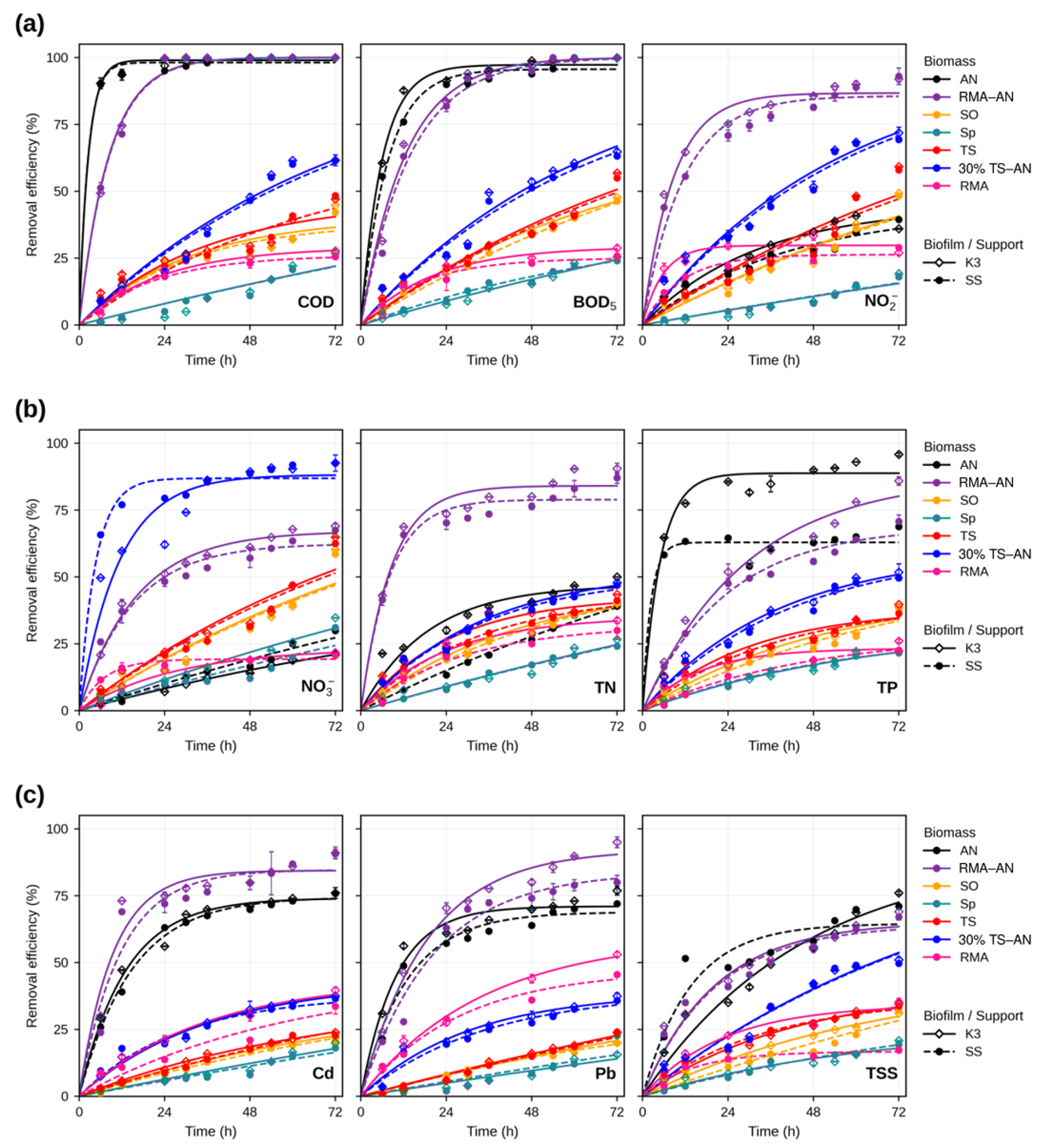
Contact time was defined as the elapsed treatment period during which the wastewater remained in contact with the biomass–carrier system in the batch-operated MBBR. It is one of the most important parameters in biological wastewater treatment, as it represents the average contact time between the wastewater and the microorganisms in the bioreactor [37]. An appropriate contact time allows for sufficient contact between the microbial biofilm and the wastewater, which is required for the effective removal of organic and metallic contaminants [38]. The results clearly show that an increase in contact time had a decisive positive effect on the overall treatment performance of all the biomasses tested (Figure 3). At short contact times (6–24 h), regardless the carrier used (K3 or SS), the most kinetically active systems, A. niger alone and the red macroalgae/A. niger consortia, achieved high removal efficiencies for organic matter, nutrients, suspended solids, and metals. Both systems exhibited single exponential kinetic models for organic matter removal, reflecting the rapid enzymatic activity of the fungal biomass. In comparison, treatments based on microalgae (TS, SP, and SO) proved to be less effective at the start of the experiment, likely because microalgae generally require more time to adapt to wastewater conditions and develop a stable biofilm. As contact time reached 48 to 72 h, the efficiency of all systems improved significantly. However, the overall trend remained the same. Fungal treatments consistently achieved the highest removal efficiencies, mixed cultures showed intermediate performance depending on the proportion of A. niger, and single microalgae biomasses remained the least effective, despite a considerable improvement in their performance over time. These results confirm that, as expected, a longer contact time enhances pollutant removal in all systems. However, the magnitude of this improvement strongly depends on the biological consortium. A. niger played a key role in accelerating and stabilizing the depollution process, both when used alone and in the RMA-AN consortium. Its contribution to the 30% TS-AN consortium was also positive, although more limited, likely reflecting the lower proportion of fungal biomass in this treatment.
For SP, SO, and TS, K3- and SS-supported systems showed closely comparable removal profiles over the experimental period. The corresponding datasets were therefore pooled for descriptive kinetic modeling.
Figure 3.
Time course of the removal efficiencies of (a) COD, BOD5, and NO2−; (b) NO3−, TN, and TP; and (c) Cd, Pb, and TSS obtained using the seven biomasses immobilized on two carriers (K3 and SS). Symbols represent experimental mean ± SD from three independent experiments (n = 3); while solid lines correspond to fitted exponential kinetic models. AN (Aspergillus niger), RMA-AN (Gracilaria sp.–Aspergillus niger), RMA Gracilaria sp., SO (Scenedesmus obliquus), SP (Arthrospira platensis), TS (Tetraselmis suecica), and TS30 + AN (Tetraselmis suecica–Aspergillus niger). K3 and SS symbols denote Kaldnes K3 and sardine scale carriers, respectively. For SP, SO, and TS, K3 and SS datasets were pooled for descriptive kinetic modeling because their removal profiles were closely comparable over the experimental period.
3.2. Chemical Oxygen Demand (COD)
Analysis of COD removal rate data indicates a clear dependency on the nature of the biological consortium (algae/fungus). Indeed, the RMA–AN consortium displayed the best results, reaching up to 100% COD removal in just 24 h on both carriers. The removal kinetics were well described by a single-exponential model with rather high-rate constants (K3: k = 0.120 h−1; SS: k = 0.118 h−1), reflecting rapid and homogeneous enzymatic biodegradation. This performance is likely due to the complementary roles of A. niger, whose extracellular enzymes rapidly catalyze the degradation of complex organic compounds, and the macroalgae, whose photosynthetic oxygen production sustains aerobic biodegradation [39].
A. niger alone also exhibited rapid COD removal, reaching 90% after 6 h and 100% within 24 h on K3, and in SS 95% after 24 h, following a single-exponential kinetic model with the fastest rate constant across all treatments, whatever the biofilm carrier (k ≈ 0.4 h−1). This supports that the sardine scale carrier provides even process efficiencies as the K3 one does.
The 30% TS–AN consortium achieved an experimentally observed COD removal of approximately ≈61% on both K3 and SS at 72 h, following a single-exponential model with identical rate constants on both carriers (A = 100%, k = 0.013 h−1), confirming that the carrier type did not alter the removal kinetics of this consortium, consistent with the limiting effects of the low microalgal inoculum, notably shading and competition for nutrients which constrained overall biodegradation kinetics [40].
Microalgal monocultures exhibited the poorest COD removal performance, reaching only 25–50% after 72 h. SP showed the slowest kinetics among all treatments tested (k = 0.003 h−1), while TS and SO exhibited only limited removal efficiencies, as deduced from their respective maximal amplitudes of 54 and 40% (at t∞), highlighting the rate-limited nature of photosynthetic COD assimilation [41].
Gracilaria alone (RMA) exhibited the lowest COD removal performance among all treatments tested, with maximal amplitudes of only 28.6% on K3 and 27.2% on SS (k = 0.043 and 0.032 h−1, respectively), below even the weakest microalgal monocultures (SO: 40%; TS: 54%). This limited contribution to organic matter removal is consistent with the primary metabolic role of macroalgae, which rely mainly on nutrient assimilation rather than enzymatic degradation of organic compounds. Indeed, no COD removal was detected for a macroalga integrated into an MBBR in a previous study [42], confirming that macroalgae alone lack a direct enzymatic capacity to degrade organic matter. The moderate removal observed here for RMA alone can therefore reasonably be attributed to the activity of the indigenous flora naturally present in the non-sterile effluent used in this study, rather than to the macroalga itself.
3.3. Biochemical Oxygen Demand over 5 Days (BOD5)
The combination of red macroalgae and the fungus A. niger showed the highest removal rates of all the treatments studied. On K3, the reduction rate reached 93% after 24 h and 100% after 72 h, following a single-exponential model (A = 100%, k = 0.081 h−1), reflecting rapid and complete biodegradation. On SS carriers, a similar final performance was observed with a slight initial delay (27% after 6 h; k = 0.073 h−1), indicating closely comparable performances of the two carriers for this consortium under the conditions tested. This performance is attributed to the complementary enzymatic degradation by A. niger and the photosynthetic oxygen supply by the macroalgae, which together sustain rapid aerobic biodegradation of the organic load [39]. A. niger alone exhibited two-fold faster kinetics (K3: k = 0.167 h−1; SS: k = 0.135 h−1), confirming its strong enzymatic capacity even in the absence of an algal partner. Kinetically, the 30%TS–AN consortium offers a slight advantage over microalgae alone, reaching ≈64% on K3 and 63% on SS at 72 h, but lags far behind the red macroalgae and fungi combination. Kinetically, the 30%TS–AN consortium followed markedly slower rate constants (K3: k = 0.0154 h−1; SS: k = 0.0262 h−1) than those observed on the sole AN biomass, reflecting competition for nutrients and/or metabolite-mediated interactions between the algal and fungal partners, mechanisms documented in fungal–microalgal co-culture systems more broadly [40]. Microalgae alone exhibited the lowest BOD removal rates (25–55% after 72 h), with SP showing the slowest kinetics (k = 0.004 h−1). This is consistent with findings showing that BOD5 removal in microalgal systems is strongly dependent on contact time, with approximately 87% removal reported only after 6 days in a microalgae-assisted activated sludge (MAAS) system [43]. Gracilaria alone (RMA) displayed BOD5 removal performances comparable to, or even slightly below, the weakest microalgal monocultures, with maximal amplitudes of 29.3% on K3 and 26.2% on SS (k = 0.079 and 0.048 h−1, respectively), consistent with its limited contribution to organic matter removal already discussed for COD.
3.4. Nitrite (NO2−)
The removal of NO2− varied depending on the biomass system used. The RMA–AN consortium showed the highest efficiency, reaching 75% on Kaldnes carriers and 71% on SS after 24 h, increasing to 92% and 90%, respectively, after 72 h. NO2− removal by the consortium followed intermediate kinetics on both carriers (K3: A = 87%, k = 0.116 h−1; SS: A = 86%, k = 0.088 h−1). In contrast, AN alone removed only 37% of NO2− after 72 h. The enhanced nitrite removal observed with the RMA–AN consortium may result from synergistic interactions between the macroalga and the fungus. The photosynthetic activity of the macroalga may have increased the concentration of dissolved oxygen and altered the pH of the medium, favoring the growth of the fungus and/or its metabolic activity and enhancing the removal of nitrogen [44,45].
The 30%TS–AN system also yielded good performance, reaching approximately 35% after 24 h and 72% after 72 h on both K3 and SS, following identical kinetics on the two carriers (k = 0.018 h−1), suggesting a balanced cooperation between fungal enzymatic activity and microalgal assimilation. Microalgae alone showed the slowest kinetics across all treatments, with TS reaching 16% at 24 h and 59% at 72 h, SO 13% and 49%, respectively, and SP below 5% at 24 h and only 19% at 72 h. All microalgal monocultures followed single-exponential models with very-low-rate constants (SO: k = 0.007 h−1; SP: k = 0.002 h−1; TS: k = 0.009 h−1), confirming their limited capacity for rapid nitrite conversion [46].
Gracilaria alone (RMA) exhibited a comparatively higher rate constant (K3: k = 0.194 h−1; SS: k = 0.089 h−1) but reached only about 29% and 26% removal at 72 h on K3 and SS, respectively, below all other biomass systems except AN alone.
All of these data obtained for the RMA–AN and 30% TS-AN consortia, when compared with those obtained for microalgae alone and AN alone, clearly indicate that fungal nitrite transformation is strongly limited in the absence of a photosynthetic oxygen producer.
A comparison between carriers showed broadly comparable NO2− removal profiles for K3 and sardine scales across the biomass systems tested, supporting the potential of sardine scales as an alternative biofilm carrier for nitrogen removal.
3.5. Nitrate (NO3−)
The removal of nitrate varied markedly across biomass combinations. The 30%TS–AN consortium showed the highest removal across all treatments, reaching approximately 88% on K3 and 87% on SS after 72 h, following markedly different kinetics between carriers (K3: k = 0.089 h−1; SS: k = 0.216 h−1). This suggests the occurrence of a rapid NO3− uptake after inoculation. This behavior may result from the complementary metabolic activities of the two organisms, combining nitrate assimilation by both A. niger and the microalga. As previously mentioned, photosynthetic oxygen production and changes in the physicochemical conditions of the medium may enhance fungal metabolic activity, contributing to the overall nitrate removal efficiency of the consortium [47]. The RMA–AN consortium followed, reaching approximately 66% on K3 and 62% on SS at 72 h (K3: k = 0.063 h−1; SS: k = 0.067 h−1), with a more moderate performance than the 30%TS–AN consortium, reflecting a comparatively lower cooperation between the macroalgae and the fungus for nitrate removal.
In contrast, A. niger alone performed poorly, reaching only approximately 21% on K3 and 25% on SS after 72 h, with very slow kinetics (K3: k = 0.007 h−1; SS: k = 0.004 h−1), confirming that fungal denitrification activity is strongly limited in the absence of a photosynthetic oxygen producer [8]. The very low k constant indicates that A. niger alone is unable to sustain efficient nitrate transformation kinetics over the 72 h experimental period. Gracilaria alone (RMA) exhibited the lowest nitrate removal among all treatments, reaching approximately 21% on K3 and 19% on SS at 72 h (K3: k = 0.038 h−1; SS: k = 0.143 h−1), a performance comparable to that of A. niger alone.
3.6. Total Nitrogen (TN)
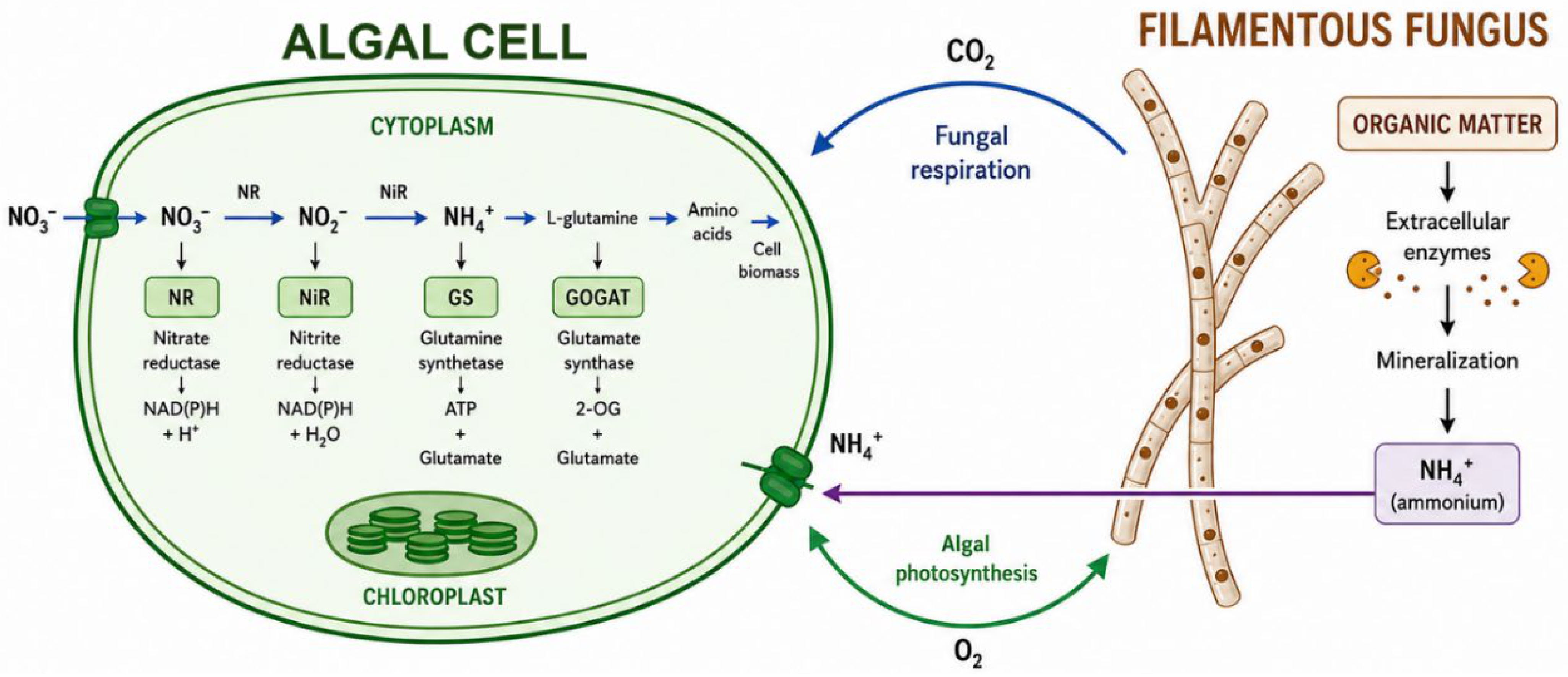
The overall nitrogen removal (TN) shows significantly better performance from the RMA–AN hybrid system, with removal rates reaching 90% on K3 and 87% on SS after 72 h. Kinetically, the system showed closely similar fitted rate constants on the two carriers (K3: k = 0.119 h−1; SS: k = 0.125 h−1), although the fitted asymptotic amplitudes differed slightly (A = 84% and 79%, respectively), in which approximately 60% of total nitrogen removal occurred through a rapid initial phase on both supports, attributed to direct algal assimilation and fungal ammonification, whilst the remaining fraction was eliminated more gradually through secondary enzymatic transformation pathways. These results are consistent with previously reported TN reductions exceeding 85% in fish farm effluent treated with a mixed Laminaria–A. niger biomass in an MBBR reactor, attributed to the synergy between fungal enzymatic degradation and algal assimilation [15].
The 30%TS–AN consortium showed intermediate performance, reaching 47.8% on K3 and 46.9% on SS at 72 h (23.2% and 22.4% at 24 h, respectively), following moderate kinetics on both supports (k = 0.029 and 0.030 h−1), suggesting that nitrogen assimilation in this system relies primarily on slow intracellular uptake rather than rapid enzymatic transformation. This value (47%) is close to the 44% reported in microalgae–fungus co-culture systems under comparable conditions, confirming that the synergistic effect depends heavily on the biomass ratio and operational conditions [48].
A. niger alone reached 50% TN removal on K3 and 39% on SS after 72 h. On K3, the relatively fast kinetics (k = 0.057 h−1) allowed the system to approach its fitted plateau (A = 47%) within the experimental timeframe. On SS, in contrast, the much slower kinetics (k = 0.007 h−1) indicate that the fungus was still far from reaching its fitted asymptotic potential (A = 100%) at 72 h, highlighting a markedly different kinetic behavior of A. niger depending on the carrier used. For microalgal treatments, the fitted asymptotic TN removal efficiencies (A) were 100% for SP, 50% for SO, and 43% for TS. These values represent model-estimated asymptotes rather than experimentally measured removal efficiencies at 72 h. The corresponding rate constants (k) were 0.004, 0.020, and 0.035 h−1, respectively, indicating the slowest fitted TN removal kinetics for SP [49]. Gracilaria alone (RMA) reached 33.7% on K3 and 29.9% on SS at 72 h, showing an intermediate performance among the microalgal monocultures as it was above SP but below TS.
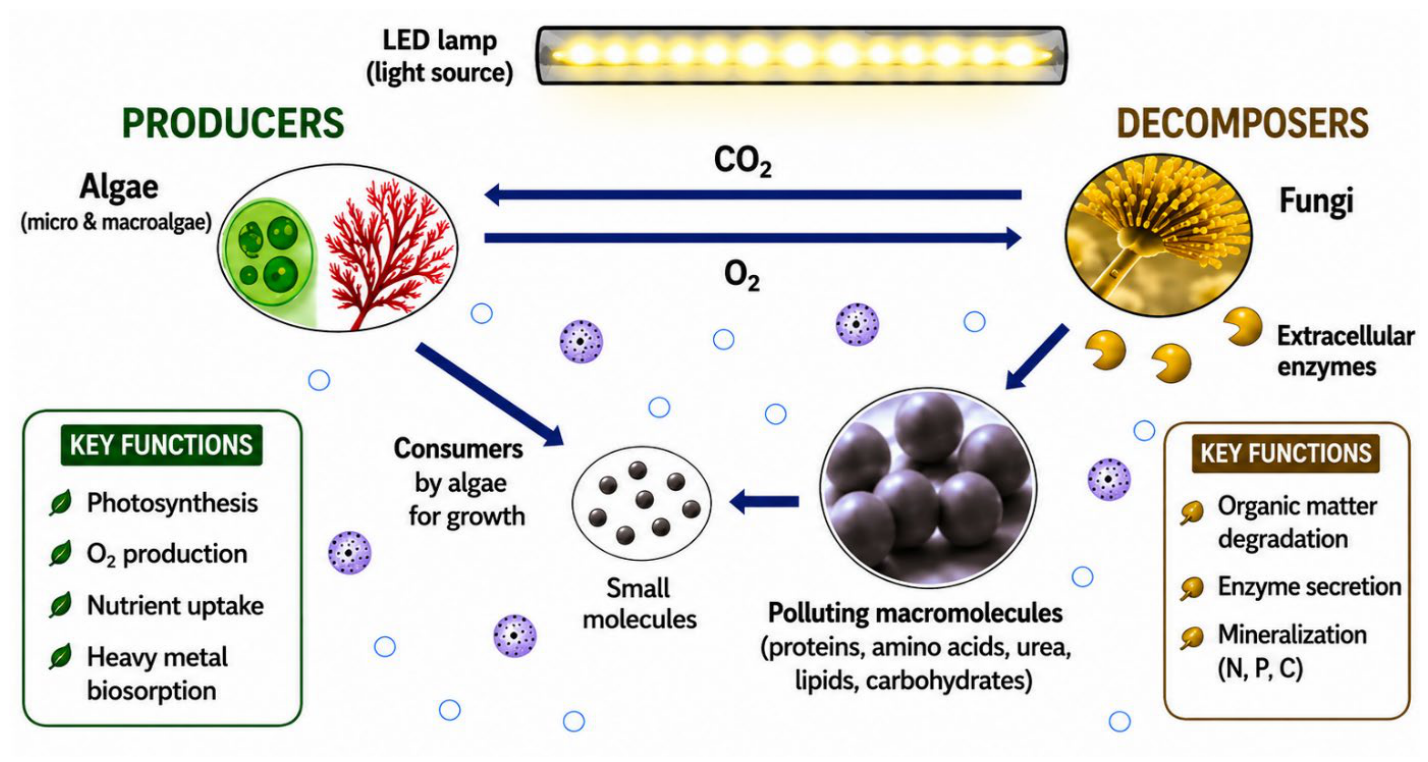
The proposed interactions between algal assimilation, fungal mineralization, and nitrogen transformation pathways within the algal–fungal consortium are illustrated in Figure 4.
Figure 4.
Proposed mechanism of nitrogen removal and organic matter degradation by the algal–fungal consortium.
3.7. Total Phosphorus (TP)
Phosphorus is a crucial macronutrient that plays a central role in the synthesis of ATP, nucleic acids, phospholipids, and proteins [50]. Consequently, its uptake is closely linked to the rate of cell growth. Microalgae alone (Tetraselmis, Scenedesmus, and Arthrospira platensis), characterized in our study by slow initial growth, exhibited modest elimination rates at 24 h (10–20%), consistent with limited uptake when cell division has not yet reached the exponential phase. This is likely compounded by light limitation: the high turbidity and particulate load of the fish-processing effluent (reflected in its elevated TSS content) is expected to substantially reduce light penetration, thereby constraining photosynthetic activity and, consequently, nutrient uptake by the microalgae [51]. Most microalgal monocultures followed slowly, as shown by their low rate constants (0.016 k < 0.030 h−1), with a notable exception of TS, associated or not with AN, reflecting the gradual and growth-dependent nature of phosphorus uptake. Under conditions of low orthophosphate availability (PO43−, HPO42−, H2PO4−) [47], microalgae can mineralize organic phosphorus via external phosphatases [52], a process observed through a gradual improvement in rates between 24 and 72 h (up to 36–40%).
Conversely, the marked improvement in the performance of fungal or mixed systems stems from additional mechanisms that are absent in microalgal systems alone. A. niger alone achieved 69 to 96% phosphorus removal, following high kinetic constants, more with SS carriers (k = 0.437 h−1) compared to K3 ones (k = 0.201 h−1), consistent with its rapid phosphate solubilization capacity via organic acid secretion, making phosphorus more available and facilitating its capture by adsorption onto the phosphate, carboxyl, and amine groups of the fungal cell wall [53]. The RMA–AN consortium showed high and increasing performance between 24 h (52%) and 72 h (86%) for K3, and 47 to 71% for SS whatever the carrier (K3: A = 88%, k = 0.034 h−1; SS: A = 69%, k = 0.043 h−1), suggesting that early phosphorus removal occurred followed by progressive intracellular polyphosphate accumulation by the macroalgae subsequent to initial fungal solubilization [54]. The 30%TS–AN consortium showed intermediate progression, reaching 51.8% on K3 and 49.6% on SS at 72 h, with closely similar fitted rate constants on K3 and SS (k = 0.026 and 0.024 h−1, respectively). This similarity between the two supports, together with rate constants far lower than those of A. niger alone, indicates that the presence of the microalga does not accelerate the fungal-driven phosphorus removal mechanism; unlike most other parameters, phosphorus removal here appears to be dominated by the fungus, with the reduced microalgal fraction (30%) contributing comparatively little additional benefit. Gracilaria alone (RMA) reached 26.0% on K3 and 22.6% on SS at 72 h, among the lowest performances observed, comparable to that of Arthrospira platensis (SP: 22.3%/21.6%).
3.8. Heavy Metals
3.8.1. Cadmium (Cd)
Cadmium reduction by various biomass systems displayed no significantly different trends throughout the experiment. RMA-AN mix reached similar Cd removal efficiencies (A ≈ 85%) on both carriers. This is due to the fact that these two biomasses are fully complementary: the sulfated polysaccharides of red algae are heavily associated with metals [55] and the cell wall of A. niger that is abundant for functional groups with very good metal binding properties. Kinetically, this system exhibited similar rate constants of about k ≈ 0.1 h−1, matching a fast initial biosorption process, followed by a slower intracellular accumulation phase, which reflects the consecutive action of surface binding and progressive metal sequestration inside the biomass.
A. niger, when used alone, also demonstrated high efficiency, removing 76% of Cd from the K3 carrier after 72 h, a figure in line with the 79% previously reported in a similar setup [56]. This confirms that the fungal biofilm retains a strong capacity to adsorb Cd, even in the absence of an alga partner. Its kinetic profile also exhibited large removal efficiencies (A = 74%) and moderate kinetic constants (K3: k = 0.085 h−1; SS: k = 0.068 h−1). This is attributed to the early occupation of the numerous micro-adsorption sites located on the internal and external surfaces of the mycelium’s granular structure, which significantly increases the surface area available for pollutant uptake [57]. The 30%TS–AN consortium reached intermediate removal levels of ≈ 37% on K3 and ≈36% on SS at 72 h, with comparably slow rate constants on both carriers (k = 0.028 and 0.035 h−1), reflecting the dense granular structure formed by algal–fungal interactions, in which electrostatic and hydrophobic contacts between the two cell types govern both mass transfer and the spatial arrangement of active binding sites [58], though the limited algal density constrained the overall Cd-binding capacity. Microalgae exhibited the lowest Cd removal at 72 h among all treatments (18.0–23.8%), reflecting the slowest kinetics observed in this study (k = 0.003–0.011 h−1). This slow kinetic behavior indicates the absence of a fast surface biosorption process, removal relying instead on slow, passive intracellular uptake. However, this low removal at 72 h should not be interpreted as a low intrinsic capacity: the fitted asymptotic potential of these systems remains substantial (TS: A = 45; SO: A = 45; SP: A = 100%), indicating that a considerably longer hydraulic retention time would be required for microalgal monocultures to approach their theoretical maximum Cd removal capacity, well beyond what was achieved within the 72 h experimental window used for the fungal and consortium systems. Gracilaria alone (RMA) reached 39% on K3 and 33% on SS at 72 h (k = 0.023 and 0.016 h−1, respectively), the highest removal among all monocultures tested, exceeding even A. niger’s microalgal partners in the mixed consortia, though remaining below both the RMA–AN and A. niger alone systems.
3.8.2. Lead (Pb)
The RMA-AN system exhibited a strong initial attraction to Pb2+ ions, with a reduction rate of 95% on the K3 carriers and 80% on the SS ones with identical rate constants (k ≈ 0.054 h−1) (A = 92% k3; A = 83%, SS). This comportment is attributed to the rapid occupation of the numerous binding sites provided by the sulfated polysaccharides present in the cell wall of macroalgae [59,60], followed by a slower intracellular accumulation phase within the fungal hyphae.
A. niger alone also showed strong early performance (61% on K3 and 57% on SS at 24 h), reaching 77% and 72%, respectively, at 72 h, through a dual mechanism combining rapid surface biosorption at the hyphal periphery and progressive intracellular accumulation [61], reflected by rather high kinetic constants (K3: A = 71%, k = 0.101 h−1; SS: A = 69%, k = 0.077 h−1).
The 30% TS–AN consortium reached intermediate removal levels of 37.5% on K3 and 35.8% on SS at 72 h, with comparably slow rate constants on both carriers (k = 0.033 and 0.029 h−1), consistent with the moderate performance already observed for this consortium on other parameters, and reflecting the limited contribution of the reduced microalgal fraction to Pb removal. The biomass from microalgae alone was the least productive, with biokinetics demonstrating a very slow trend (k ≈ 0.004 h−1). These results are consistent with their lower ability to withstand metal stress and their rapid decrease in the ability to assimilate the pollutant under high concentrations.
Gracilaria alone (RMA) reached 53.0% on K3 and 45.5% on SS at 72 h (k = 0.038 and 0.033 h−1, respectively), the highest removal among all monocultures tested, again exceeding A. niger microalgal partners in the mixed consortia, and consistent with the same sulfated-polysaccharide-mediated biosorption mechanism already described above for RMA–AN [59,60].
3.9. Total Suspended Solids (TSSs)
Total suspended solids (TSSs) are made up of particles bigger than 2 µm, and most of them are mineral in nature. In fact, from the first time points, A. niger only on SS media displayed the greatest initial TSS removal, resulting in about 22% at 6 h and 50% at 12 h, which indicates that mycelial colonization of the sardine scale surface was very quick. This early dominance is confirmed by its kinetic parameters (SS: k = 0.075 h−1 vs. K3: k = 0.022 h−1), indicating that the natural surface texture of sardine scales facilitated faster and more homogeneously the fungal biofilm establishment [8]. The RMA–AN consortium also showed notable early performance on K3 and SS (~43% at 24 h; A ≈ 65%, k ≈ 0.05 h−1), attributed to the rapid particle-trapping capacity of macroalgal polysaccharides [62]. By 72 h, A. niger alone or supplemented with TS became the best-performing treatments, especially on K3 (AN-K3: A = 91%, k = 0.022 h−1; 30%TS-AN-K3: A = 100%, k = 0.0107 h−1), with this directly reflecting the progressive densification and structural maturation of the mycelial network over time [63], along with uniform and gradual particle capture. Microalgae alone showed the most limited performance (18–35% at 72 h), confirming the inability of microalgal monocultures to generate a sufficient biofilm structure for effective particle capture [64].
3.10. Statistical Analysis
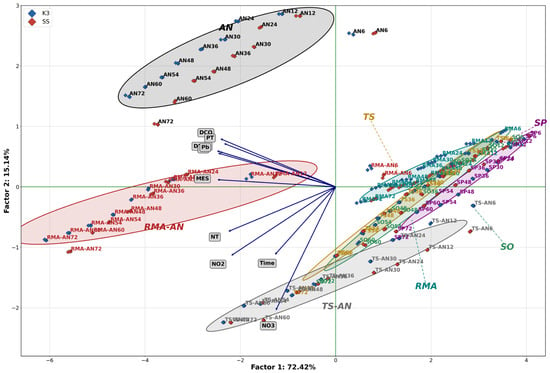
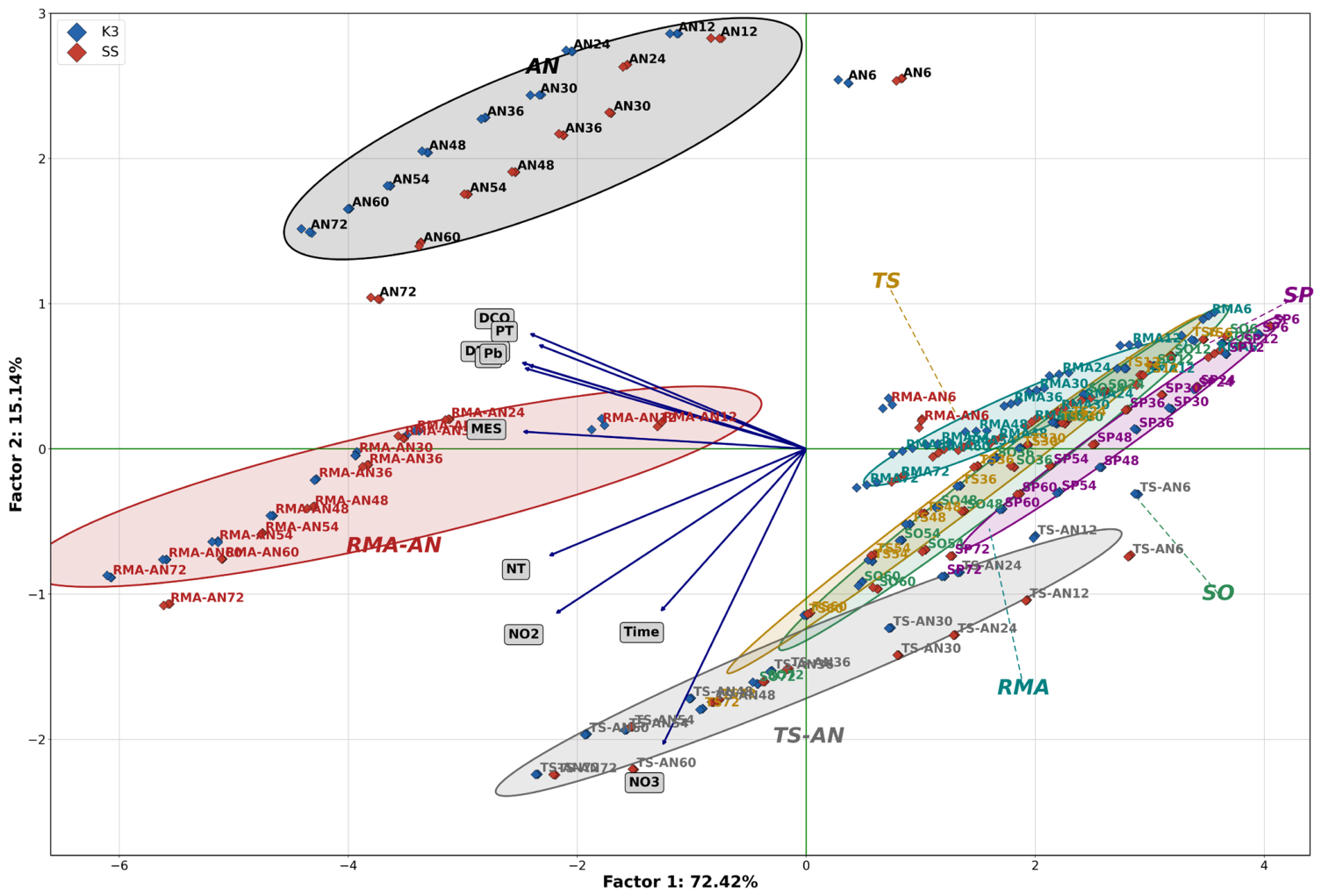
Applying PCA to the entire dataset accounted for 91% of the total variance across the first two principal components (F1 = 77.33%; F2 = 13.53%). F1 contrasts the treatments along an overall gradient of purification performance, with all depollution vectors pointing toward negative values. F2, meanwhile, distinguishes nitrogen transformation pathways from those related to the removal of organic matter and heavy metals, with the nitrate and nitrite vectors projecting downward while TP and COD project upward (Figure 5).
Figure 5.
Principal component analysis (PCA) biplot showing the distribution of algal–fungal treatment systems according to pollutant removal efficiencies and contact time. Variable vectors represent the contribution of BOD5, COD, TP, TN, TSS, NO3−, NO2−, Cd, and Pb. Numerical suffixes indicate contact time (h), whilst marker colours distinguish Kaldnes K3-supported biofilms (dark blue) from sardine scale-supported biofilms (dark red). Elliptical outlines visually delineate the different treatment groups.
The RMA-AN consortium was mainly positioned on the negative side of F1 and projected toward the region associated with several pollutant-removal vectors, particularly those related to organic matter, suspended solids, phosphorus, and metals. This multivariate pattern is consistent with the broad treatment performance observed for the fungal–macroalgal consortium. In contrast, A. niger alone occupied the upper-left region of the PCA, aligned with the direction of the BOD5, COD, TSS, TP, Cd, and Pb vectors, while showing a weaker projection toward the nitrogen-related vectors. This separation is consistent with the high efficiency of the fungus toward organic matter and metals and its comparatively different behavior toward nitrogen compounds. The TS30-AN consortium occupied an intermediate region of the PCA, with several observations extending toward the negative F2 region associated with the nitrogen-related vectors (TN, NO2−, and NO3−). This positioning suggests that the addition of T. suecica to A. niger modified the multivariate treatment profile toward a greater contribution of nitrogen removal compared with the fungus alone. While A. niger was primarily associated with the vectors representing organic matter, phosphorus, suspended solids, and metal removal, the 30%TS-AN system showed a comparatively stronger association with nitrogen-related removal. The microalgal systems were mainly distributed on the positive side of F1 and were comparatively distant from the vectors associated with organic matter, phosphorus, and metal removal. Gracilaria alone (RMA) was also projected on the positive side of F1, in a region relatively close to the algal systems, indicating a removal profile distinct from the fungus-containing treatments and consistent with its more moderate overall treatment performance. Within the different treatment groups, increasing contact time generally produced a progressive displacement of the observations along the PCA space, reflecting changes in the overall removal profile over the 6–72 h treatment period. K3 and SS observations remained relatively close within most treatment groups, indicating broadly comparable multivariate patterns between the two carriers.
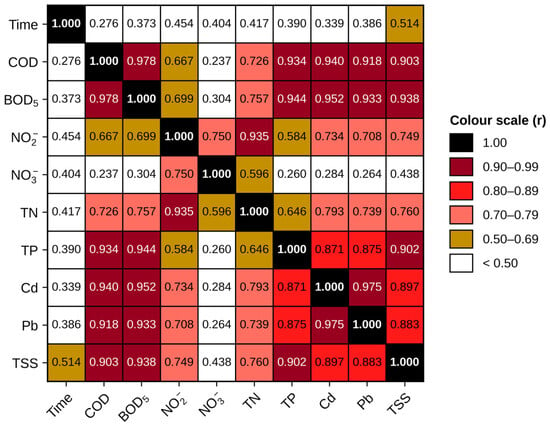
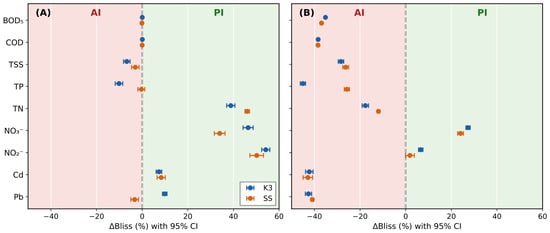
All correlations with contact time were positive, indicating an overall tendency for pollutant removal efficiencies to increase with treatment time (Figure 6). However, the correlations with contact time were generally weak to moderate, with the strongest relationship observed for TSS (r = 0.514), followed by NO2− (r = 0.454), TN (r = 0.417), and NO3− (r = 0.404). This indicates that treatment performance was not governed by contact time alone but also depended strongly on the biomass and treatment configuration.
Figure 6.
Heatmap of Pearson correlation coefficients along contact time for organic matter, nutrient, and heavy metal removal efficiencies. Darker colors indicate stronger positive correlations.
Very strong positive correlations were observed between BOD5 and COD (r = 0.978), BOD5 and Cd (r = 0.952), BOD5 and Pb (r = 0.933), and between Cd and Pb (r = 0.975). These relationships indicate a strong covariation between organic matter removal and metal removal across the investigated treatment systems. Such associations may reflect interconnected biological and physicochemical processes, including organic matter degradation and metal binding to functional groups associated with fungal and algal biomass.
Nitrogen-related parameters also showed marked associations. TN was very strongly correlated with NO2− removal (r = 0.935), while NO3− and NO2− were strongly correlated (r = 0.750). These relationships suggest coordinated changes in nitrogen removal across the investigated systems, potentially reflecting the combined contribution of biological nitrogen transformations and biomass assimilation.
Finally, TP removal was very strongly correlated with both BOD5 (r = 0.944) and COD (r = 0.934). This close association indicates that phosphorus removal varied in parallel with organic matter removal. Rather than demonstrating a direct causal mechanism, these correlations suggest that carbon and phosphorus removal processes were closely coupled under the investigated treatment conditions.
3.11. Bliss Independence Analysis of Algal–Fungal Interactions at 72 h
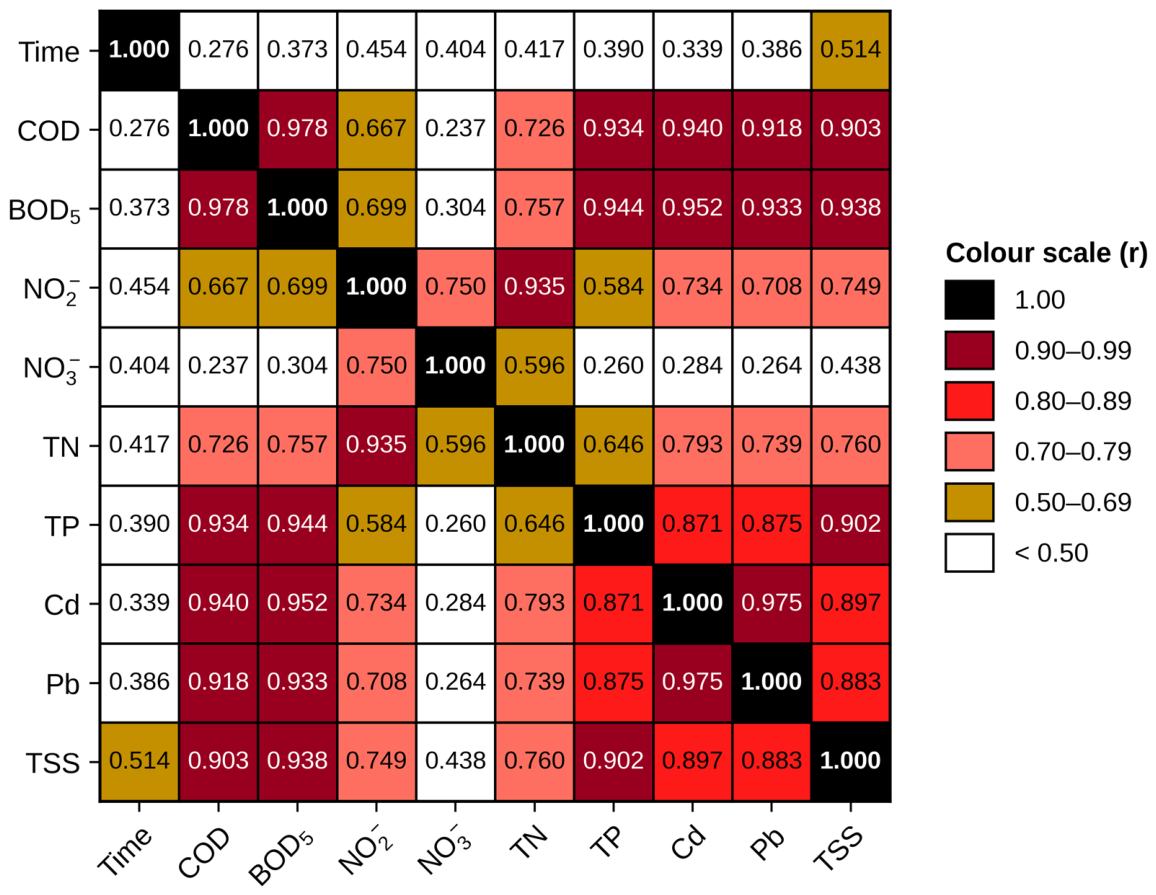
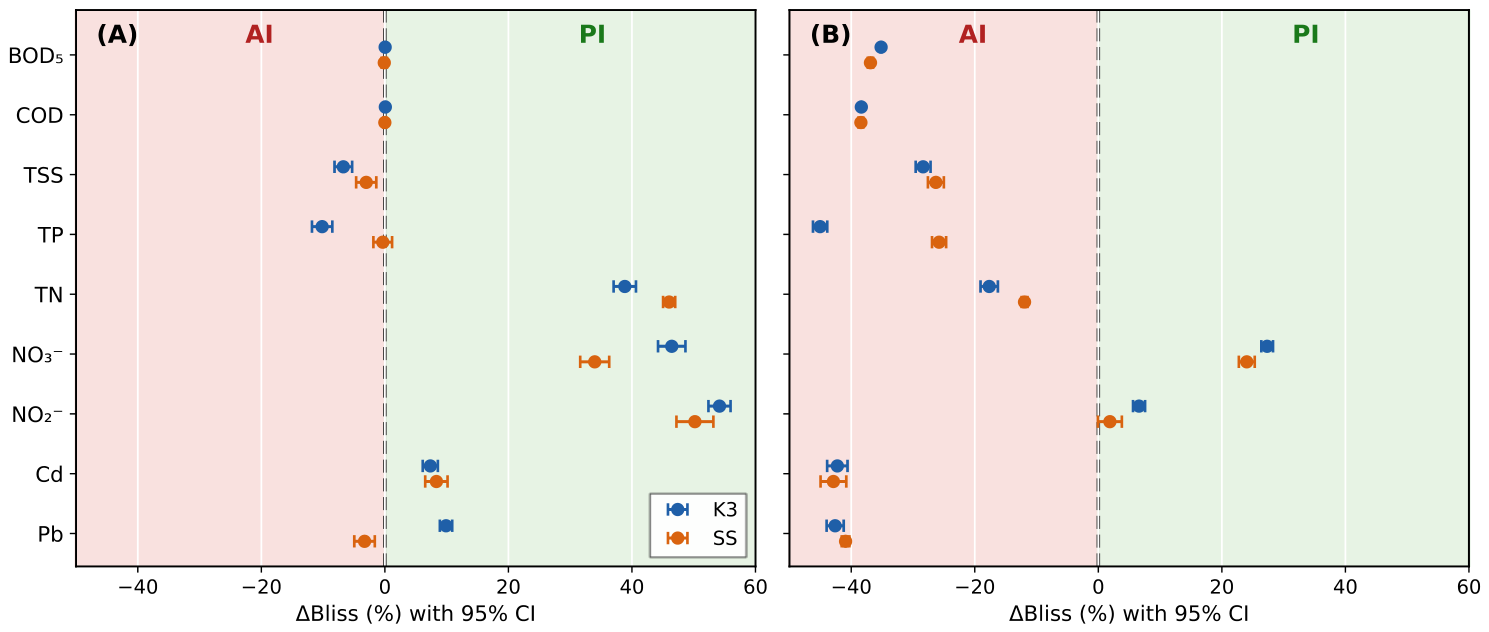
The interactions between the algal biomasses and A. niger were evaluated at 72 h using the Bliss independence model. The calculated ΔBliss values, their 95% CIs, and the resulting interaction classifications are presented in Table 2 and visually summarized in Figure 7.
Table 2.
Bliss interaction analysis of the RMA-AN and 30%TS-AN consortia after 72 h of treatment using K3 and sardine scale (SS) carriers, corrected for indigenous microbial activity. Results are expressed as ΔBliss [95% CI]. An interval entirely above zero indicates a positive interaction (PI), an interval entirely below zero indicates an antagonistic interaction (AI), and an interval including zero indicates a response compatible with Bliss independence (BI).
Figure 7.
Bliss interaction analysis at 72 h for (A) RMA + AN and (B) TS + AN on K3 and sardine scale (SS) carriers, after correction for indigenous microbial activity. Points represent ΔBliss values, and horizontal error bars indicate their 95%CI. Positive and negative values indicate positive and antagonistic interactions, respectively, whereas confidence intervals crossing zero indicate a response compatible with Bliss independence.
As shown in Table 2 and Figure 7, the two consortia exhibited markedly different interaction profiles. RMA + AN showed predominantly positive interactions for nitrogen removal, particularly for TN, nitrate, and nitrite, whereas BOD5 and COD remained compatible with Bliss independence because A. niger alone had already achieved nearly complete removal. In contrast, TS30% + AN displayed a predominantly antagonistic profile for organic matter, suspended solids, phosphorus, and heavy metals. Nitrate was the main exception, showing a positive interaction on both carriers, while the nitrite response depended on the support. Overall, these findings indicate that algal–fungal interactions depend primarily on the algal partner and the targeted pollutant, with a secondary influence of the carrier material.
4. Conclusions
An integrated assessment of all measured parameters (BOD5, COD, TP, TN, NO3−, NO2−, TSS, Cd, and Pb) indicates that the red macroalgae–Aspergillus niger consortium, irrespective of the carrier employed (Kaldnes K3 or sardine scales), was the most efficient treatment system during the initial treatment period (24 h). This consortium achieved substantial reductions in organic load, with near-complete removal of BOD5 and COD, together with marked decreases in total nitrogen (TN > 70%), nitrite (>75%), and heavy metal concentrations (Cd > 78%, Pb > 75%). In comparison, the other biomasses exhibited only moderate or limited treatment efficiencies. After 72 h of operation, a slight change in performance ranking was observed. The use of A. niger exhibited the greatest removal capability for phosphorus and TSS. However, the red macroalgal–A. niger consortium showed the highest removal efficiencies for total nitrogen and nitrite, with nitrite removal reaching approximately 90% or higher on both carriers. However, nitrate removal was highest with the 30% Tetraselmis suecica–A. niger consortium, reaching approximately 88% on K3 and 87% on SS, compared with 66% and 62%, respectively, for the red macroalgal–fungal consortium. The latter, nevertheless, maintained higher removal efficiencies for several other parameters. In contrast, the Tetraselmis, Scenedesmus, and Arthrospira platensis monocultures exhibited substantially lower treatment capabilities. This indicates the significant benefit of fungus participation and mixed biofilm formation in achieving enhanced wastewater purification.
Bliss analysis indicated predominantly positive interactions for nitrogen removal in the RMA–AN consortium, with support-dependent responses for metals. In contrast, 30% TS–AN showed predominantly antagonistic interactions, while nitrate removal remained positive on both carriers. These findings suggest that algal–fungal interactions depend on the algal partner, the targeted pollutant, and, in some cases, the carrier material.
Kinetic modeling revealed that the superior performance of the RMA–AN consortium was driven by a rapid initial biosorption phase complemented by a slower intracellular accumulation phase, an exponential pattern being consistently observed across organic matter, nutrient, and heavy metal removal. Pearson correlation analysis and PCA further confirmed these findings, clearly discriminating the RMA–AN consortium from all other treatments and establishing strong links between organic matter degradation, heavy metal biosorption, and nitrogen transformation within the algal–fungal biofilm.
Overall, despite their distinct physicochemical and geometric properties, sardine scales provided treatment performances broadly comparable to those obtained with Kaldnes K3 under the experimental conditions tested, supporting their potential as a waste-derived alternative biofilm carrier for fish-processing wastewater treatment. Their use offers a route for valorizing fish-processing by-products while potentially reducing reliance on synthetic plastic carriers. Combined with the red macroalgal–Aspergillus niger consortium, which showed strong overall treatment performance, these carriers could be of interest to fish-processing units as a complementary wastewater treatment step, particularly in coastal regions where sardine scales and suitable macroalgal biomass may be locally available.
The use of reconstituted wastewater limits the extrapolation of these findings to variable industrial effluents. The respective roles of biological removal, adsorption, and precipitation were not independently quantified, and biofilm formation and surface colonization were not directly examined by microscopy. Locally available sardine scales may reduce carrier purchasing costs, but overall cost-effectiveness remains unverified and must account for preparation, energy consumption, inoculum production, carrier replacement, and management of metal-containing residual biomass. Future studies should evaluate real fish-processing wastewater, long-term and continuous operation, carrier durability, treatment costs, and environmental impacts. Optimization of microalgal–fungal inoculation ratios and evaluation of additional microalgal species combined with Aspergillus niger are also needed to identify more effective consortia. Biomass characterization and investigation of biofilm formation, attachment, and stability on both carrier types are also needed to clarify treatment mechanisms.
Author Contributions
Conceptualization, I.C., N.B. and B.B.; methodology, I.C., N.B. and B.B.; validation, I.C. and N.B.; formal analysis, I.C., N.B., S.K., R.T., V.L.T. and O.S.; investigation, I.C., D.T. and S.K.; resources, N.B.; data curation, I.C.; writing—original draft preparation, I.C.; writing—review and editing, N.B., R.T., B.B., O.S. and V.L.T.; visualization, N.B., R.T., O.S. and V.L.T.; supervision, N.B.; project administration, N.B. All authors have read and agreed to the published version of the manuscript.
Funding
This research received no external funding.
Data Availability Statement
The data supporting the findings of this study are available from the corresponding author upon reasonable request.
Acknowledgments
The authors are grateful to Hassan II University of Casablanca and the National Center for Scientific and Technical Research (CNRST) for their support, which made this publication possible. During the preparation of this manuscript, the authors used ChatGPT (OpenAI) to assist with the visual refinement of illustrations based on their own original drawings and to correct grammatical errors in selected passages. The authors reviewed and edited the outputs and take full responsibility for the content of this publication.
Conflicts of Interest
The authors declare no competing interests.
Abbreviations
| MBBR | Moving Bed Biofilm Reactor |
| COD | Chemical Oxygen Demand |
| BOD5 | Biochemical Oxygen Demand (5 days) |
| TN | Total Nitrogen |
| TP | Total Phosphorus |
| TSS | Total Suspended Solids |
| PCA | Principal Component Analysis |
| SD | Standard Deviation |
| K3 | Kaldnes K3 (synthetic carrier) |
| SS | Sardine Scales (natural carrier) |
| AN | Aspergillus niger |
| TS | Tetraselmis suecica |
| SO | Scenedesmus obliquus |
| SP | Arthrospira platensis |
| RMA | red macroalgae |
| RMA-AN | red macroalgae–Aspergillus niger |
| TS-AN | Tetraselmis suecica–Aspergillus niger |
| PI | positive interaction |
| BI | compatible with Bliss independence |
| AI | antagonistic interaction |
| IF | indigenous flora |
| ICP-OES | Inductively coupled plasma optical emission spectrometry |
| PE | polyethylene |
| PDA | potato dextrose agar |
| OD | optical density |
| NED | N-(1-naphthyl) ethylenediamine |
| CI | confidence interval |
Appendix A
Table A1.
Kinetic parameters of single exponential growth models fitted to the removal efficiency time courses for COD, BOD5, NO2−, NO3−, TP, TN, Cd, Pb, and TSS across seven biomass systems immobilized on K3 and SS biofilm carriers. AN, Aspergillus niger; RMA–AN, Gracilaria sp.–Aspergillus niger consortium; RMA Gracilaria sp., 30% TS–AN, Tetraselmis suecica–Aspergillus niger consortium; K3, Kaldnes K3 carrier; SS, sardine scale carrier. For SP, Arthrospira platensis, SO, Scenedesmus obliquus; TS, Tetraselmis suecica, K3 and SS datasets were pooled for descriptive kinetic modeling.
References
- Arístegui, J.; Barton, E.D.; Álvarez-Salgado, X.A.; Santos, A.M.P.; Figueiras, F.G.; Kifani, S.; Hernández-León, S.; Mason, E.; Machú, E.; Demarcq, H. Sub-regional ecosystem variability in the Canary Current upwelling. Prog. Oceanogr. 2009, 83, 33–48. [Google Scholar] [CrossRef] [Scilit]
- Office National des Pêches (ONP). Rapport Statistique 2025 de la Pêche Côtière et Artisanale au Maroc; Office National des Pêches: Casablanca, Morocco, 2026; Available online: https://www.onp.ma/wp-content/uploads/2026/01/RAPPORT-STATISTIQUE-2025.pdf (accessed on 16 September 2026).
- Hassan, A.; Chouikh, N. Spatial variability of linear growth of Sardina pilchardus (Walbaum, 1792) from the Moroccan Atlantic coast by using otolithometry. Egypt. J. Aquat. Biol. Fish. 2022, 26, 61–76. [Google Scholar] [CrossRef] [Scilit]
- Shahidi, F.; Varatharajan, V.; Peng, H.; Senadheera, R. Utilization of marine by-products for the recovery of value-added products. J. Food Bioact. 2019, 6, 10–61. [Google Scholar] [CrossRef] [Scilit]
- Aboudamia, F.Z.; Kharroubi, M.; Neffa, M.; Aatab, F.; Hanoune, S.; Bouchdoug, M.; Jaouad, A. Potential of discarded sardine scales (Sardina pilchardus) as chitosan sources. J. Air Waste Manag. Assoc. 2020, 70, 1186–1197. [Google Scholar] [CrossRef] [Scilit]
- Gupta, B.; Gupta, A.K.; Ghosal, P.S.; Lal, S.; Saidulu, D.; Srivastava, A.; Upadhyay, M. Recent advances in application of moving bed biofilm reactor for wastewater treatment: Insights into critical operational parameters, modifications, field-scale performance, and sustainable aspects. J. Environ. Chem. Eng. 2022, 10, 107742. [Google Scholar] [CrossRef] [Scilit]
- Ødegaard, H. Innovations in wastewater treatment: The moving bed biofilm process. Water Sci. Technol. 2006, 53, 17–33. [Google Scholar] [CrossRef] [Scilit]
- Fathi, A.; Boutaleb, N.; Bahlaouan, B.; Bennani, M.; Lazar, S.; El Antri, S. Filamentous fungi and natural supports as a carrier in moving bed biofilm reactors for ecological treatment of halieutic industrial effluent. Desalin. Water Treat. 2021, 237, 37–44. [Google Scholar] [CrossRef] [Scilit]
- Mohsenpour, S.F.; Hennige, S.; Willoughby, N.; Adeloye, A.; Gutierrez, T. Integrating micro-algae into wastewater treatment: A review. Sci. Total Environ. 2021, 752, 142168. [Google Scholar] [CrossRef] [Scilit]
- Mazur, L.P.; Cechinel, M.A.P.; Souza, S.M.A.G.U.; Boaventura, R.A.R.; Vilar, V.J.P. Brown marine macroalgae as natural cation exchangers for toxic metal removal from industrial wastewaters: A review. J. Environ. Manag. 2018, 223, 215–253. [Google Scholar] [CrossRef] [Scilit]
- Jacinto, J.; Tavares, D.; Ferreira, N.; Viana, T.; Pinto, J.; Lapa, N.; Pereira, E.; Henriques, B. Comparing the efficiency of living and non-living macroalgae biomass in removing classical and emergent contaminants from complex multi-element mixtures. Bioprocess Biosyst. Eng. 2026, 49, 877–889. [Google Scholar] [CrossRef] [Scilit]
- Torzillo, G.; Vonshak, A. Environmental stress physiology with reference to mass cultures. In Handbook of Microalgal Culture: Applied Phycology and Biotechnology, 2nd ed.; Richmond, A., Hu, Q., Eds.; Wiley-Blackwell: Chichester, UK, 2013; pp. 90–113. [Google Scholar] [CrossRef] [Scilit]
- Charef, I.; Mahmoudi, M.; Radi Benjelloun, G.; Waddi, K.; Silkina, A.; Bahlaouan, B.; Boutaleb, N. Integrated algal–microbial consortia for wastewater treatment: Mechanisms, performance and future perspectives. Nat. Built Soc. Environ. Health 2026, 2, 112–140. [Google Scholar] [CrossRef] [Scilit]
- Monteiro dos Santos, L.; Barbosa da Silva, J.C.; Silva, C.E.F.; da Gama, B.M.V.; Medeiros, J.A.; Markou, G.; Almeida, R.M.R.G.; Abud, A.K.S. Co-cultivation between the microalga Tetradesmus obliquus and filamentous fungus Cunninghamella echinulata improves tertiary treatment of cheese whey effluent in semicontinuous mode. Processes 2024, 12, 1573. [Google Scholar] [CrossRef] [Scilit]
- Charef, I.; Fathi, A.; Ozi, F.Z.; Asbai, Z.; Radi Benjelloun, G.; Waddi, K.; Bahlaouan, B.; El Antri, S.; Boutaleb, N. The use of mixed bomass alga-fungi in mutualistic relationship and natural marine-origin carrier in MBBR reactor for an ecological treatment of effluents from fish processing industry in Morocco. Desalin. Water Treat. 2024, 317, 100020. [Google Scholar] [CrossRef] [Scilit]
- Chen, L.; Cheng, G.; Meng, S.; Ding, Y. Collagen membrane derived from fish scales for application in bone tissue engineering. Polymers 2022, 14, 2532. [Google Scholar] [CrossRef] [Scilit]
- Oliveira, K.L.; Oliveira, J.L.S.; Moraes, E.A.; Cavalcante, K.M.S.P.; Oliveira, M.L.M.; Alves, C.R. Cultivation of microalgae Chlorella vulgaris, Monoraphidium sp. and Scenedesmus obliquus in wastewater from the household appliance industry for bioremediation and biofuel production. 3 Biotech 2024, 14, 294. [Google Scholar] [CrossRef] [Scilit]
- Baker, M.; Blackman, S.; Cooper, E.; Smartt, K.; Walser, D.; Boland, M.; Kolar, P.; Beck, A.E.; Chinn, M.S. Exploratory analysis of Spirulina platensis LB 2340 growth in varied concentrations of anaerobically digested pig effluent (ADPE). Heliyon 2021, 7, e08065. [Google Scholar] [CrossRef] [Scilit]
- Patrinou, V.; Daskalaki, A.; Kampantais, D.; Kanakis, D.C.; Economou, C.N.; Bokas, D.; Kotzamanis, Y.; Aggelis, G.; Vayenas, D.V.; Tekerlekopoulou, A.G. Optimization of cultivation conditions for Tetraselmis striata and biomass quality evaluation for fish feed production. Water 2022, 14, 3162. [Google Scholar] [CrossRef] [Scilit]
- Hodaifa, G.; Martínez, M.E.; Sánchez, S. Influence of pH on the culture of Scenedesmus obliquus in olive-mill wastewater. Biotechnol. Bioprocess Eng. 2009, 14, 854–860. [Google Scholar] [CrossRef] [Scilit]
- Barbera, E.; Sforza, E.; Kumar, S.; Morosinotto, T.; Bertucco, A. Cultivation of Scenedesmus obliquus in liquid hydrolysate from flash hydrolysis for nutrient recycling. Bioresour. Technol. 2016, 207, 59–66. [Google Scholar] [CrossRef] [Scilit]
- da Rosa, G.M.; Moraes, L.; Cardias, B.B.; de Souza, M.R.A.Z.; Costa, J.A.V. Chemical absorption and CO2 biofixation via the cultivation of Spirulina in semicontinuous mode with nutrient recycle. Bioresour. Technol. 2015, 192, 321–327. [Google Scholar] [CrossRef] [Scilit]
- Gani, P.; Sunar, N.M.; Matias-Peralta, H.; Abdul Latiff, A.A.; Abdul Razak, A.R. Influence of initial cell concentrations on the growth rate and biomass productivity of microalgae in domestic wastewater. Appl. Ecol. Environ. Res. 2016, 14, 399–409. [Google Scholar] [CrossRef] [Scilit]
- El-Sheekh, M.; Morsi, H.; Hassan, L.H.S. Assessment of the optimum growth medium and the effect of different light intensities on growth and photosynthetic pigments of Chlorella vulgaris and Scenedesmus arvernensis. Egypt. J. Bot. 2020, 60, 395–404. [Google Scholar] [CrossRef] [Scilit]
- Fabre, E.; Dias, M.; Henriques, B.; Viana, T.; Ferreira, N.; Soares, J.J.C.; Pinto, J.; Vale, C.; Pinheiro-Torres, J.; Silva, C.M.; et al. Bioaccumulation processes for mercury removal from saline waters by green, brown and red living marine macroalgae. Environ. Sci. Pollut. Res. 2021, 28, 30255–30266. [Google Scholar] [CrossRef] [Scilit]
- Pinto, J.; Henriques, B.; Soares, J.J.C.; Costa, M.; Dias, M.; Fabre, E.; Lopes, C.B.; Vale, C.A.G.; Pinheiro-Torres, J.; Pereira, E. A green method based on living macroalgae for the removal of rare-earth elements from contaminated waters. J. Environ. Manag. 2020, 263, 110376. [Google Scholar] [CrossRef] [Scilit]
- El Jaafari, A.; Boutaleb, N.; Bahlaouan, B.; Taiek, T.; Bennani, M.; Lazar, S.; El Antri, S. Use of Three Types of Fish Scales as Biomass Support in Moving Bed Biofilm Reactor for Biological Treatment of Dairy Wastewater. Int. J. Eng. Res. Technol. 2014, 3, 1636–1639. [Google Scholar]
- Duarte, J.G.; Silva, L.L.S.; Freire, D.M.G.; Cammarota, M.C.; Gutarra, M.L.E. Enzymatic hydrolysis and anaerobic biological treatment of fish industry effluent: Evaluation of mesophilic and thermophilic conditions. Renew. Energy 2015, 83, 455–462. [Google Scholar] [CrossRef] [Scilit]
- Ziani, F.; Salghi, R.; Bendou, A.; Bazzi, L.; Hormatatllah, A.; Chebli, B.; Jalili, A. Physico-chemical characterization of wastewaters from fish industry in Agadir city, Morocco. Fresenius Environ. Bull. 2007, 16, 1588–1592. [Google Scholar]
- Benyakhlef, M.; Naji, S.; Belghyti, D. Caractérisation des rejets liquides d’une conserverie de poissons. Bull. Soc. Pharm. Bordx. 2007, 146, 225–234. [Google Scholar]
- Slimani, N.; Hajji, S.; Hafid, N.; Moukrim, A.; Zerbet, M.; Ait Alla, A. Contribution to the Physico-Chemical Characterization of the Wastewater of Four Industrial Units of Preserve and Semi Fish Preserve of the City of Anza (North of Agadir). Aquat. Sci. Technol. 2020, 8, 17–37. [Google Scholar] [CrossRef] [Scilit]
- APHA; AWWA; WEF. Standard Methods for the Examination of Water and Wastewater, 23rd ed.; American Public Health Association: Washington, DC, USA, 2017. [Google Scholar]
- Bliss, C.I. The toxicity of poisons applied jointly. Ann. Appl. Biol. 1939, 26, 585–615. [Google Scholar] [CrossRef] [Scilit]
- Piepho, H.P.; Malik, W.A.; Bischoff, R.; El-Hasan, A.; Scheer, C.; Sedlmeier, J.E.; Gerhards, R.; Petschenka, G.; Voegele, R.T. Efficacy assessment in crop protection: A tutorial on the use of Abbott’s formula. J. Plant Dis. Prot. 2024, 131, 2139–2160. [Google Scholar] [CrossRef] [Scilit]
- Satterthwaite, F.E. An approximate distribution of estimates of variance components. Biom. Bull. 1946, 2, 110–114. [Google Scholar] [CrossRef] [Scilit]
- Welch, B.L. The generalization of ‘Student’s’ problem when several different population variances are involved. Biometrika 1947, 34, 28–35. [Google Scholar] [CrossRef] [Scilit]
- Liu, J.; Zhou, J.; Xu, N.; He, A.; Xin, F.; Jiang, F.; Fang, Y.; Zhang, W.; Liu, S.; Jiang, M.; et al. Performance evaluation of a lab-scale moving bed biofilm reactor (MBBR) using polyethylene as support material in the treatment of wastewater contaminated with terephthalic acid. Chemosphere 2019, 227, 117–123. [Google Scholar] [CrossRef] [Scilit]
- Rehman, A.; Ayub, N.; Naz, I.; Perveen, I.; Ahmed, S. Effects of hydraulic retention time (HRT) on the performance of a pilot-scale trickling filter system treating low-strength domestic wastewater. Pol. J. Environ. Stud. 2019, 29, 249–259. [Google Scholar] [CrossRef] [Scilit]
- Moondra, N.; Jariwala, N.D.; Christian, R.A. Sustainable treatment of domestic wastewater through microalgae. Int. J. Phytoremediation 2020, 22, 1480–1486. [Google Scholar] [CrossRef] [Scilit]
- Rasheed, R.N.; Pourbakhtiar, A.; Mehdizadeh Allaf, M.; Baharlooeian, M.; Rafiei, N.; Alishah Aratboni, H.; Morones-Ramirez, J.R.; Vischi Winck, F. Microalgal co-cultivation: Recent methods, trends in omic studies, applications, and future challenges. Front. Bioeng. Biotechnol. 2023, 11, 1193424. [Google Scholar] [CrossRef] [Scilit]
- Rani, S.; Chowdhury, R.; Tao, W.; Nedbalová, L. Microalga-mediated tertiary treatment of municipal wastewater: Removal of nutrients and pathogens. Sustainability 2021, 13, 9554. [Google Scholar] [CrossRef] [Scilit]
- Ogwueleka, T.C.; Balogun, S. The effect of hydraulic retention time on microalgae-based activated sludge process for Wupa sewage treatment plant, Nigeria. Environ. Monit. Assess. 2020, 192, 271. [Google Scholar] [CrossRef] [Scilit]
- Sari, D.R.; Adharini, R.I. The utilization of Gracilaria verrucosa as fish processing wastewater biofilter. E3S Web Conf. 2020, 147, 02022. [Google Scholar] [CrossRef] [Scilit]
- Qader, M.; Shekha, Y. Application of two fungal strains Aspergillus niger and Candida albicans in wastewater quality improvement. J. Educ. Sci. 2022, 31, 33–41. [Google Scholar] [CrossRef] [Scilit]
- Ghadamzadeh, M.; Jalilzadeh Yengejeh, R.; Javadzadeh, N.; Koushafar, A.; Attarroshan, S. Investigating the growth rate of Tetraselmis algae and its effect on nitrogen removal from aquaculture wastewater. J. Adv. Environ. Health Res. 2024, 12, 8–15. [Google Scholar] [CrossRef] [Scilit]
- Li, X.; Deng, Y.; Li, X.; Ma, X.; Wang, J.; Li, J. Integration of marine macroalgae (Chaetomorpha maxima) with a moving bed bioreactor for nutrient removal from maricultural wastewater. Archaea 2020, 2020, 8848120. [Google Scholar] [CrossRef] [Scilit]
- Pimentel de Andrade, F.; da Silva Gonçalves, A.H.; De Farias Silva, C.E.; Rodrigues Macário, L.; Oliveira Nascimento da Silva, J.V.; Gama, B.M.V.; Rosas Garcia Almeida, R.M.; Tonholo, J. Treatment of oil-produced water using a fungus–microalga consortium. Energy Ecol. Environ. 2024, 9, 144–158. [Google Scholar] [CrossRef] [Scilit]
- Zhou, K.; Zhang, Y.; Jia, X. Co-cultivation of fungal-microalgal strains in biogas slurry and biogas purification under different initial CO2 concentrations. Sci. Rep. 2018, 8, 7786. [Google Scholar] [CrossRef] [Scilit]
- Jia, H.; Yuan, Q. Removal of nitrogen from wastewater using microalgae and microalgae–bacteria consortia. Cogent Environ. Sci. 2016, 2, 1275089. [Google Scholar] [CrossRef] [Scilit]
- Juneja, A.; Ceballos, R.M.; Murthy, G.S. Effects of environmental factors and nutrient availability on the biochemical composition of algae for biofuels production: A review. Energies 2013, 6, 4607–4638. [Google Scholar] [CrossRef] [Scilit]
- Lu, S.; Li, Y.; Liu, X.; Cheng, G.; Yuan, Z.; Wu, F. Influence of light irradiation on nitrification in microalgal–bacterial systems for treating wastewater. Processes 2023, 11, 3453. [Google Scholar] [CrossRef] [Scilit]
- Zhou, L.; Xiao, P.; Liu, B.; Han, J.; Li, Y.; Zhou, C. Growth and physiological responses of Chrysotila roscoffensis (Coccolithales) to different phosphorus resources. J. Mar. Sci. Eng. 2022, 10, 1860. [Google Scholar] [CrossRef] [Scilit]
- Legorreta-Castañeda, A.J.; Lucho-Constantino, C.A.; Beltrán-Hernández, R.I.; Coronel-Olivares, C.; Vázquez-Rodríguez, G.A. Biosorption of water pollutants by fungal pellets. Water 2020, 12, 1155. [Google Scholar] [CrossRef] [Scilit]
- Whitton, R.; Ometto, F.; Pidou, M.; Jarvis, P.; Villa, R.; Jefferson, B. Microalgae for municipal wastewater nutrient remediation: Mechanisms, reactors and outlook for tertiary treatment. Environ. Technol. Rev. 2015, 4, 133–148. [Google Scholar] [CrossRef] [Scilit]
- El Hassouni, H.; Abdellaoui, D.; El Hani, S.; Bengueddour, R. Biosorption of cadmium(II) and copper(II) from aqueous solution using red alga (Osmundea pinnatifida) biomass. J. Mater. Environ. Sci. 2014, 5, 967–974. [Google Scholar]
- Liu, Y.; Fan, T.; Zeng, G.; Li, X.; Tong, Q.; Ye, F.; Zhou, M.; Xu, W.; Huang, Y. Removal of cadmium and zinc ions from aqueous solution by living Aspergillus niger. Trans. Nonferrous Met. Soc. China 2006, 16, 681–686. [Google Scholar] [CrossRef] [Scilit]
- Lin, W.; Chen, L.; Tan, Z.; Deng, Z.; Liu, H. Application of filamentous fungi in microalgae-based wastewater remediation for biomass harvesting and utilization: From mechanisms to practical application. Algal Res. 2022, 62, 102614. [Google Scholar] [CrossRef] [Scilit]
- Chu, R.; Li, S.; Zhu, L.; Yin, Z.; Hu, D.; Liu, C.; Mo, F. A review on co-cultivation of microalgae with filamentous fungi: Efficient harvesting, wastewater treatment and biofuel production. Renew. Sustain. Energy Rev. 2021, 139, 110689. [Google Scholar] [CrossRef] [Scilit]
- Kang, K.H.; Sui, Z. Removal of eutrophication factors and heavy metal from a closed cultivation system using the macroalgae Gracilaria sp. (Rhodophyta). Chin. J. Oceanol. Limnol. 2010, 28, 1127–1130. [Google Scholar] [CrossRef] [Scilit]
- Shamim, S. Biosorption of heavy metals. In Biosorption; Derco, J., Vrana, B., Eds.; IntechOpen: London, UK, 2018; pp. 21–49. [Google Scholar] [CrossRef] [Scilit]
- Xu, H.; Hao, R.; Yang, S.; Xu, X.; Lu, A.; Li, Y. Removal of lead ions in an aqueous solution by living and modified Aspergillus niger. Water Environ. Res. 2021, 93, 844–853. [Google Scholar] [CrossRef] [Scilit]
- Belattmania, Z.; Bhaby, S.; Nadri, A.; Khaya, K.; Bentiss, F.; Jama, C.; Reani, A.; Vasconcelos, V.; Sabour, B. Gracilaria gracilis (Gracilariales, Rhodophyta) from Dakhla (Southern Moroccan Atlantic Coast) as source of agar: Content, chemical characteristics, and gelling properties. Mar. Drugs 2021, 19, 672. [Google Scholar] [CrossRef] [Scilit]
- Wrede, D.; Taha, M.; Miranda, A.F.; Kadali, K.; Stevenson, T.; Ball, A.; Mouradov, A. Co-cultivation of fungal and microalgal cells as an efficient system for harvesting microalgal cells, lipid production and wastewater treatment. PLoS ONE 2014, 9, e113497. [Google Scholar] [CrossRef] [Scilit]
- Moustafa, A.M.; ElNadi, M.E.-H.; Abdelmomen, M.M.; Nagy, A.M. Impact of microalgae layer thickness on the treatment performance of drain water. Sci. Rep. 2023, 13, 20785. [Google Scholar] [CrossRef] [Scilit]

Disclaimer/Publisher’s Note: The statements, opinions and data contained in all publications are solely those of the individual author(s) and contributor(s) and not of MDPI and/or the editor(s). MDPI and/or the editor(s) disclaim responsibility for any injury to people or property resulting from any ideas, methods, instructions or products referred to in the content. |
© 2026 by the authors. Licensee MDPI, Basel, Switzerland. This article is an open access article distributed under the terms and conditions of the Creative Commons Attribution (CC BY) license.