


Abstract
Chemical process synthesis combines discrete topology choices and continuous operating decisions. This study presents CORAL as a reproducible hybrid topology-search/constrained-NLP architecture and evaluates the contributions of its reef-specific diversity mechanisms. On the classical eight-process benchmark (12 admissible topologies), fixed-topology NLP is decisive for feasibility; a deterministic BARON solution provides a global bound and is preferable for this small algebraic MINLP. A topology-aware stopping rule reduces median CORAL oracle calls by 73.8% without loss of reference-topology recovery in 30 runs. To investigate structural scaling, a separately frozen reactor–separation network benchmark with 64, 256 and 1024 possible topologies is evaluated using 30 matched seeds for each of GA+NLP, CRO-like+NLP and CORAL+NLP under a common 500,000-call oracle budget (270 runs). On the largest network CORAL explores a median 789.5 unique topologies versus 540.5 for GA and 470 for CRO-like and recovers the enumerated reference topology in 30/30 runs versus 28/30 and 29/30. However, GA achieves stricter unpolished feasibility (30/30 versus 22/30 for each reef variant); common fixed-topology SQP polishing restores strict feasibility for all 270 incumbents, with additional evaluations reported separately. The results demonstrate an effect on cumulative structural exploration but do not establish universal superiority in feasible solution quality or computational efficiency.
1. Introduction
Process synthesis requires decisions about both what a process should contain and how the selected process should operate. Superstructure-based formulations address these questions simultaneously by embedding alternative units and interconnections in a common representation and introducing discrete variables for structural choices together with continuous variables for design and operation [1,2,3,4,5,6,7,8,9]. This formulation has made mathematical programming a central tool in process systems engineering, but it also leads naturally to mixed-integer nonlinear programming (MINLP) and generalized disjunctive programming (GDP) models whose solution can become difficult when nonlinearities are nonconvex, process logic is extensive, or individual flowsheet evaluations involve complex simulation models.
Classical optimization-based process synthesis has developed a rich set of methods for such problems. Outer approximation, generalized Benders decomposition, branch-and-bound, logic-based methods and global optimization exploit algebraic structure to search discrete and continuous decision spaces systematically [1,2,3,4,5,6,7,8,9,10]. In particular, logic-based formulations can separate structural decisions from topology-dependent nonlinear subproblems, avoiding some of the numerical difficulties associated with inactive units and zero flows [3,4]. These methods remain the natural first choice when the resulting mathematical model is sufficiently explicit and tractable. The motivation for stochastic structural search is therefore not that deterministic MINLP methods are obsolete, but that some synthesis problems contain discontinuous structural changes, black-box or simulation-based evaluations, failed simulations, or combinatorial design spaces for which alternative search architectures can be useful [5,6,11,12].
Evolutionary and other population-based approaches provide one such alternative. Rather than solving a single algebraic MINLP directly, candidate flowsheets can be generated, modified and evaluated as individual structures. Evolutionary process-synthesis methods have, for example, been used to construct flowsheets from unit-operation building blocks without prescribing one fixed superstructure in advance [6,11,12,13,14,15,16,17,18,19]. More generally, recent reviews distinguish conventional superstructure optimization from generative or evolutionary strategies in which process structures are created dynamically during the search [5]. The attraction of these methods is flexibility with respect to representation and model evaluation; their corresponding disadvantages are the absence of deterministic global-optimality guarantees and, often, a high number of process-model evaluations.
For constrained process design, this distinction between structural exploration and continuous optimization is particularly important. Population methods can move readily between qualitatively different structures, but equality-constrained continuous process models may define narrow feasible manifolds that are difficult to reach by stochastic variation alone. Hybrid or memetic optimization addresses this problem by combining population-based global exploration with problem-specific local search [16,17,20,21]. In process synthesis, a natural decomposition is therefore to let a global method explore process topology while a nonlinear-programming solver optimizes the continuous variables for a fixed topology. Such a decomposition also mirrors the structure of several deterministic logic-based approaches, although the mechanism used to explore the discrete space is different.
Constraint handling is another central issue. Penalty functions are simple and widely applicable, but their performance depends on penalty scaling and they may obscure the distinction between objective quality and feasibility. Feasibility-based comparison rules provide an alternative in which feasible candidates dominate infeasible ones and infeasible candidates are compared through constraint violation [22,23,24,25,26,27]. For process synthesis, explicit treatment of the original equality and inequality constraints during local refinement is especially attractive because it avoids converting physical feasibility into an arbitrarily weighted penalty objective.
Recent process-synthesis studies illustrate a continuum between explicit superstructures and dynamically generated flowsheets. Superstructure formulations remain widely used for rigorous route synthesis, integrated reaction/process design, simulation-based optimization, and models with rigorous unit operations [10,13,14,15,28]. In parallel, superstructure-free and evolutionary approaches generate structural alternatives during the search and frequently combine that upper-level structural exploration with deterministic optimization of the resulting continuous subproblems [11,16,17,18,19]. This literature is particularly relevant to CORAL because it frames hybrid structural–continuous optimization as an established process-synthesis design pattern rather than as a consequence of the reef metaphor.
1.1. From Coral-Reef Optimization to Hybrid Topology Search
The Coral Reefs Optimization (CRO) algorithm introduced by Salcedo-Sanz et al. represents candidate solutions as corals occupying a finite reef [29,30,31,32]. New candidates are generated through biologically inspired reproductive mechanisms, compete for settlement space, and may be removed through depredation; the original method was presented as a cellular evolutionary metaheuristic for continuous and discrete optimization. Subsequent coral-reef variants have expanded this idea by combining multiple search operators or substrate layers. The reef metaphor is potentially useful for process synthesis because alternative flowsheet structures can be interpreted as coexisting structural species rather than as small perturbations of one continuous vector.
The CRO family has subsequently been extended beyond the original single-operator reef. CRO with Substrate Layers (CRO-SL) allows several search operators to coexist within one reef and has also been combined with local search [30]. Later applications adapted this multi-method structure to domains such as medical image registration and facility-layout optimization [31,32]. These developments motivate CORAL’s use of multiple reproductive operators and adaptive operator probabilities, while the process-synthesis formulation introduced here adds explicit topology logic, structural niches, and fixed-topology constrained NLP refinement.
CORAL adapts the reef representation specifically to mixed discrete-continuous process superstructures. A candidate coral contains a binary topology vector and continuous design variables. Structural similarity is measured in topology space, admissible process logic can be enforced through exact topology repair, and several reproductive operators act on topology and continuous variables. Feasibility-first settlement, topology-based niches, adaptive operator probabilities, bleaching and recolonization maintain a population of competing structures. The essential architectural feature, however, is the separation of roles: the population method explores topology, while deterministic constrained nonlinear programming refines the continuous variables at fixed topology. CORAL is therefore treated in this work as a hybrid topology-search/NLP architecture whose structural-search layer happens to use coral-reef-inspired mechanisms, rather than as a claim that the ecological metaphor itself confers superior optimization performance.
This positioning matters because the ecological metaphor is not, by itself, evidence of computational superiority. Nature-inspired algorithms should be assessed by controlled comparisons that isolate the contribution of their mechanisms, use common computational budgets, and distinguish solution quality from evaluation cost. The present work therefore evaluates CORAL against independently enumerated and deterministic-global references and through ablation, local-refinement sensitivity, a reduced CRO-like formulation, a conventional genetic algorithm, a GA coupled to the same fixed-topology NLP solver, and parameter-sensitivity experiments [33,34,35,36,37]. The purpose is both to validate the architecture and to identify which parts of it are actually responsible for successful optimization.
1.2. Research Question and Contribution
The central research question is: can a hybrid architecture that separates stochastic topology exploration from deterministic constrained NLP refinement provide a reproducible framework for mixed discrete-continuous process synthesis? Within CORAL, a secondary question is whether the additional reef-specific diversity mechanisms provide measurable benefit over simpler population-search/NLP hybrids on the benchmark considered.
The methodological contribution is the integration and auditable implementation of: (i) an explicit mixed representation separating process topology from continuous design variables; (ii) exact topology repair and feasibility-first comparison; (iii) fixed-topology SQP refinement using the original nonlinear equality and inequality constraints; (iv) explicit accounting of global and local objective/constraint oracle calls; and (v) a coral-reef-inspired structural-search layer with reproductive operators, Hamming-distance niches, adaptive search, bleaching and recolonization. The experiments are designed to distinguish the value of the hybrid decomposition from the value of these additional reef-specific mechanisms.
The computational contribution comprises three complementary cases: a transparent eight-topology reactor–separator–recycle illustration; the classical eight-process benchmark with 12 legal structures and deterministic-global comparison; and a separately frozen scalable reactor–separation network (SRSN) with 64, 256 and 1024 configurations. The latter tests structural exploration, topology recovery, feasibility and oracle cost using 270 matched stochastic runs.
The results support a deliberately limited claim. Fixed-topology constrained NLP is central to reliable feasibility on the eight-process problem, and deterministic global optimization is preferable for that small algebraic case. In SRSN, CORAL explores more unique topologies and recovers the reference structure more consistently at the largest scale, but does not establish better computational efficiency or unpolished strict feasibility than GA+NLP. The distinction between structural exploration and optimization performance is therefore maintained.
Section 2 defines the hybrid method. Section 3 describes the illustrative case, the eight-process benchmark and SRSN. Section 4 reports deterministic references, ablation, equal-budget comparisons, stopping behavior and the SRSN scalability study. Section 5 presents the limitations and conclusions. Appendix A documents the complete SRSN model and parameters.
2. CORAL Methodology
2.1. Mixed Discrete–Continuous Process-Synthesis Problem
CORAL considers process-superstructure optimization problems containing both structural and continuous decisions. In general form, the problem is written as
minx,Y f(x,y)
subject to gk(x,y) ≤ 0, k ∈ K; hl(x,y) = 0, l ∈ L
xjL ≤ xj ≤ xjU, j ∈ J; y_q ∈ {0,1}, q ∈ Q; y ∈ Y
Here x contains continuous design and operating variables, y represents structural decisions, and Y denotes the admissible set of process topologies. CORAL treats movement between elements of Y as structural exploration and optimization of x for a fixed y as continuous refinement.
Each occupied reef cell contains one coral Ci = (yi, xi, fi, vi), where fi is the objective value and vi ≥ 0 is the scalar constraint-violation measure returned by the process model. A coral is classified as feasible when vi ≤ ε_feas. For the classical eight-process experiments, ε_feas = 10−5; the SRSN independent strict-feasibility audit uses a maximum individual constraint residual of 10−7.
2.2. Reef Representation, Initialization, and Repair
The computational reef contains N_R cells, each vacant or occupied by one coral. The initial number of occupied cells is
N0 = max(2, round(ρ0 N_R)).
The occupied locations are selected randomly. Binary variables are sampled independently with probability 0.5 and continuous variables uniformly within their bounds. A problem-specific topology-repair mapping R(y) may then project the proposed binary vector onto the admissible structural set Y. For the eight-process benchmark, the repair routine maps every proposal onto the same 12 admissible topologies used by the deterministic reference calculation. Repair events are counted explicitly [24].
Continuous bound violations are handled by reflective repair rather than simple clipping. For each variable, the proposed point is folded back into its interval [xjL, xjU], preserving the magnitude of an overshoot while preventing infeasible bound values.
2.3. Reproductive Operators
At iteration t, the mutation amplitude decreases according to
where σ0 is the MutationScale parameter. Each iteration generates N_L = max(4, round(0.85 N_occ)) larvae. One of four reproductive operators is selected according to adaptive probabilities. The nominal weights (0.45, 0.20, 0.15, 0.10) are normalized before use; they are therefore initial operator weights rather than independent population fractions. Budding is treated separately.
σ_t = σ0 (0.03)^(t/T_max),
Broadcast spawning. Two occupied corals a and b are selected. Each structural bit is inherited independently from either parent with equal probability. For each continuous variable,
where αj ~ U(0, 1), Zj ~ N(0, 1), and Δxj = xjU − xjL.
x′j = αj xa,j + (1 − αj) x_b,j + 0.5 σ_t Δxj Zj,
Brooding. One parent is selected and its continuous variables are perturbed as
x′j = xj + σ_t Δxj Zj.
Each structural bit is independently flipped with probability 0.02.
Topology mutation. Each structural bit is independently flipped with probability p_top. If no bit is selected, one randomly selected bit is forcibly flipped. Continuous variables are perturbed according to
x′j = xj + 0.5 σ_t Δxj Zj.
Differential reproduction. Three occupied corals a, b, and c are selected and
x′ = xa + F(x_b − x_c), F ~ U(0.5,0.8).
The offspring initially inherits topology ya. With probability 0.25, one randomly selected structural bit is flipped. After every reproductive operator, topology and continuous bounds are repaired before evaluation.
2.4. Budding and Local Exploitation
After larval settlement, occupied corals are ranked by the feasibility-first rule described below. The best N_B = max(1, round(p_B N_occ)) corals each generate one bud. A bud retains the parent topology and perturbs the continuous variables as
x′ = x + 0.25 σ_t Δx ⊙ Z.
Budding therefore provides local exploitation within an existing structural niche. Buds are evaluated and may undergo the same fixed-topology NLP refinement as larvae.
2.5. Feasibility-First Ranking and Settlement
CORAL-R1 does not combine objective and constraint violation through a global penalty coefficient. Candidate a is preferred over candidate b lexicographically: a feasible solution dominates an infeasible one; between two infeasible solutions the smaller violation v is preferred; and between two feasible solutions the smaller objective f is preferred [22,23,24,25,26,27].
A larva receives up to N_S random settlement attempts. It occupies a vacant cell immediately. If the selected cell is occupied, the larva replaces the resident when it is preferred under the feasibility-first comparison.
2.6. Structural Niches and Diversity
Structural distance is measured using Hamming distance:
d_H(ya,y_b) = Σ_q I(ya,q ≠ y_b,q).
A non-dominating larva may nevertheless replace a resident when d_H exceeds the niche radius and both solutions have similar quality. For two feasible candidates, similarity requires |fa − f_b|/max(1,|f_b|) < 0.03; for two infeasible candidates it requires |va − v_b|/max(1,|v_b|) < 0.10. Such a diversity-preserving replacement occurs with probability w_D (DiversityWeight).
Population-level structural diversity is the mean pairwise normalized Hamming distance:
with 0 ≤ D ≤ 1.
D = [2/(N_occ(N_occ − 1)n_y)] Σ_{i < j} d_H(yi,yj),
2.7. Depredation, Bleaching, and Recolonization
Depredation identifies the worst p_D fraction of the ranked occupied reef and removes each identified coral independently with probability q_D. This creates vacant cells without deterministically deleting the entire low-ranked fraction.
Bleaching is triggered when D < D_bleach. The algorithm protects the highest-ranked part of the reef, forms a candidate pool from approximately the lower half, and randomly removes up to round (p_bleach N_occ) corals from that pool. All vacant reef cells are subsequently recolonized by independently generated random corals. If occupancy falls below four at the start of an iteration, random recolonization first restores a minimum population of four.
2.8. Adaptive Operator Probabilities
Every ten iterations, the algorithm updates the probabilities of the four larval reproductive operators. For operator k, a smoothed settlement-success estimate is
where s_k and n_k are successful settlements and trials since the previous update. The target is
r_k = (s_k + 1)/(n_k + 2),
q_k = r_k/Σ_j r_j.
With learning rate η, the probability is updated as
p_k+ = (1 − η)p_k + ηq_k.
A lower bound of 0.08 is then imposed on every operator probability and the vector is renormalized to unity. Success and trial counters are reset after each update.
2.9. Fixed-Topology Constrained NLP Refinement
With probability p_NLP, an evaluated larva or bud undergoes deterministic continuous refinement while its structural vector y¯ is held fixed:
minx f(x,y¯)
subject to g(x,y¯) ≤ 0, h(x,y¯) = 0, xL ≤ x ≤ xU.
The fixed-topology problem is solved with the SQP algorithm in MATLAB R2025a fmincon. The original nonlinear equality and inequality constraints are supplied explicitly; CORAL-R1 contains no penalty-based local-refinement fallback. The refined point replaces the original coral only when it is preferred under the same feasibility-first comparison. A failed local NLP is ignored rather than terminating the global search [21].
SQP is used because fixing y converts the mixed discrete–continuous problem into a bounded smooth nonlinear program. In the computational experiments, p_NLP = 0.30 was retained after the sensitivity study; this is an experimental setting rather than the class default.
2.10. Computational Accounting
CORAL-R1 records global process-model evaluations, local-NLP objective evaluations, and local-NLP constraint evaluations separately. The primary computational-effort measure is
N_oracle = N_global + N_NLP,obj + N_NLP,con.
Local NLP calls, local NLP iterations, local NLP runtime, and topology-repair events are also recorded. Oracle calls are used as the principal effort metric in the comparative experiments because wall-clock measurements contained external timing variability.
2.11. Termination
Let C* denote the best-so-far coral and C_last the incumbent used for stagnation monitoring. If both are feasible, stagnation is declared for the current iteration when
|f* − f_last|/max(1,|f_last|) ≤ ε_stag.
If both candidates are infeasible, f is replaced by v. A change in feasibility status resets the stagnation counter. The original CORAL-R1 search terminates when the counter reaches the prescribed patience or when T_max iterations are completed. CORAL-R1 uses ε_stag = 10−8. For the revised stopping experiment, an additional topology-aware criterion is activated: once a feasible incumbent exists, the search terminates if its binary topology remains unchanged for N_s = 20 consecutive iterations and the relative objective change over the same interval, Δ_s(k) = |f*_k − f*_(k−N_s)|/max(1, |f*_(k−N_s)|), satisfies Δ_s(k) ≤ ε_s with ε_s = 10−6. The values N_s = 20 and ε_s = 10−6 were fixed before the comparison and were not tuned to individual runs.
2.12. Complete CORAL-R1 Algorithm
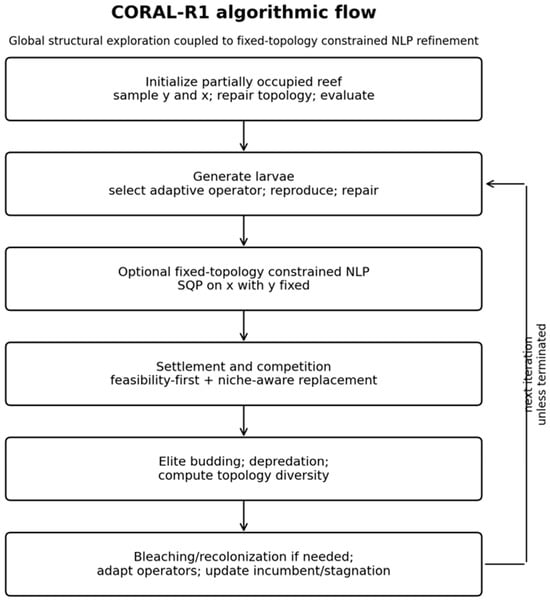
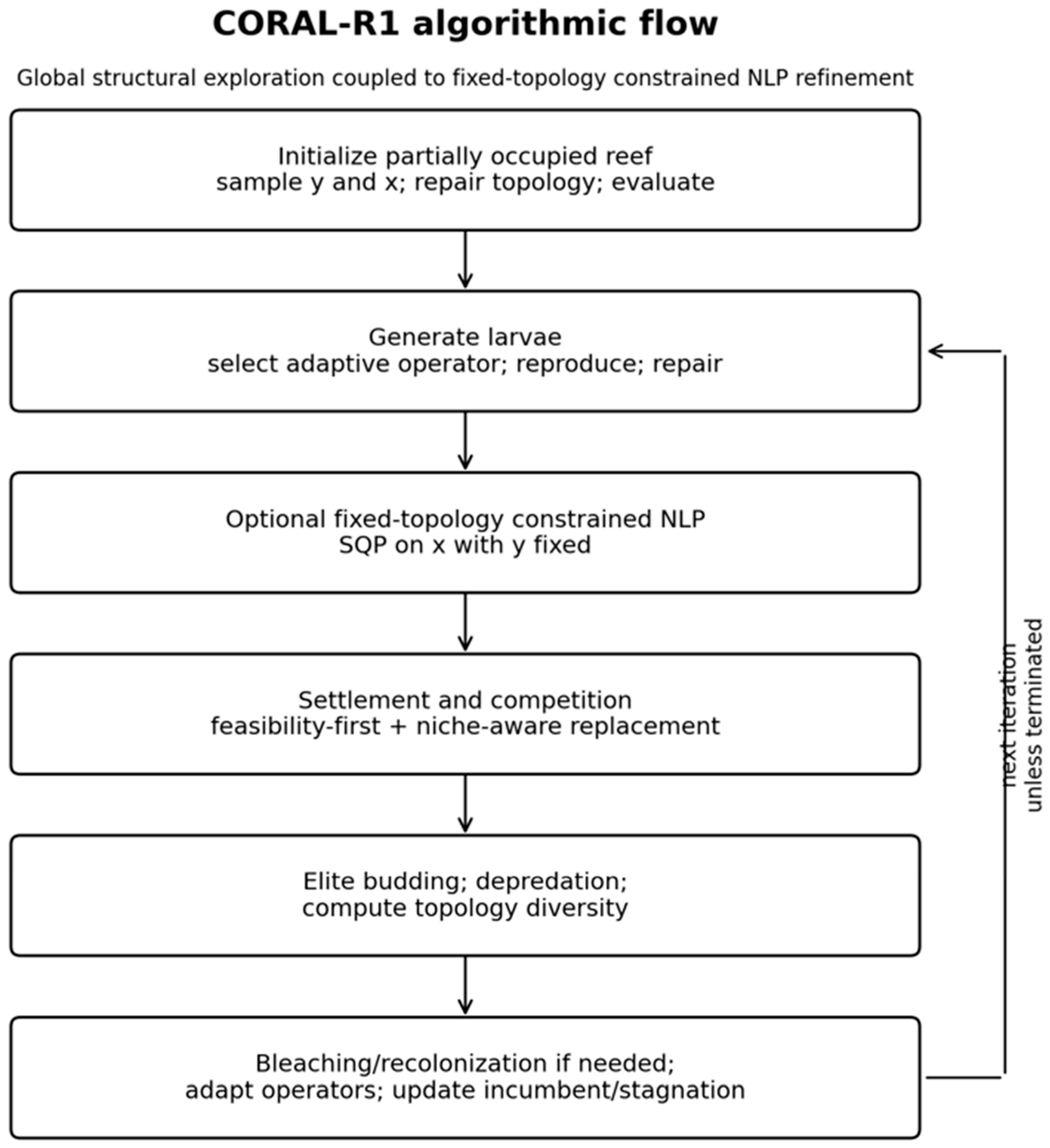
Figure 1 summarizes the implementation sequence: initialize and evaluate the reef; generate larvae using adaptive reproductive operators; repair and optionally refine candidates by fixed-topology constrained NLP; settle candidates using feasibility-first and niche-aware competition; generate elite buds; apply depredation; trigger bleaching and recolonization when structural diversity is low; adapt operator probabilities; and update the best-so-far solution and stagnation counter.
Figure 1.
Algorithmic flow of CORAL-R1.
3. Computational Case Studies
Three case studies serve complementary purposes. The compact reactor–separator–recycle example illustrates formulation and topology logic; the classical eight-process problem supports deterministic and ablation validation; and the frozen SRSN benchmark examines structural exploration at 64, 256 and 1024 configurations.
3.1. Illustrative Reactor–Separator–Recycle Superstructure
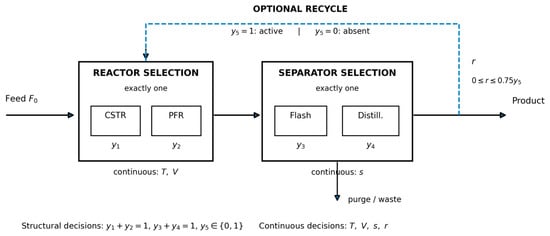
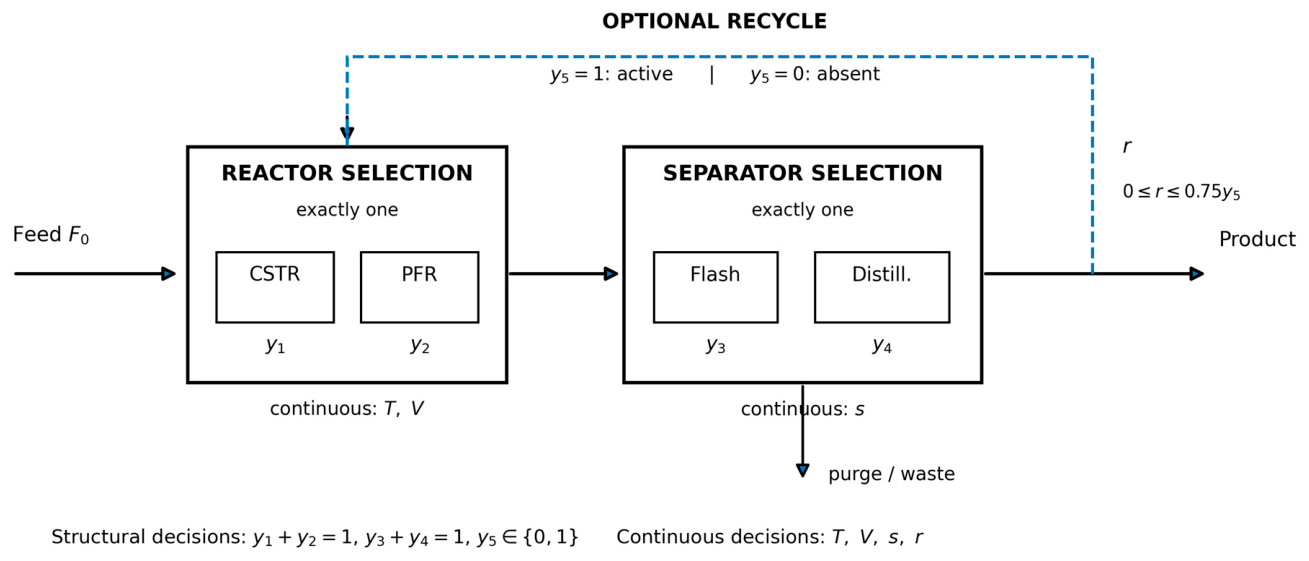
Figure 2 depicts the illustrative network. The illustrative superstructure contains two mutually exclusive reactor alternatives (CSTR and PFR), two mutually exclusive separator alternatives (flash and distillation), and an optional recycle. The binary vector is
with y_CSTR + y_PFR = 1 and y_F + y_D = 1. The continuous vector is x = [T, V, s, r], where T is reactor temperature, V is reactor size, s is separator severity, and r is the nominal recycle fraction. Bounds are 320 ≤ T ≤ 430 K, 0.5 ≤ V ≤ 8, 0 ≤ s ≤ 1, and 0 ≤ r ≤ 0.80. The recycle binary y_R activates this variable through the effective recycle fraction r_eff = y_R r; hence r_eff = 0 when recycle is absent (y_R = 0).
y = [y_CSTR, y_PFR, y_F, y_D, y_R],
Figure 2.
Illustrative reactor-separator-recycle superstructure. Exactly one reactor (y1: CSTR or y2: PFR) and one separator (y3: flash or y4: distillation) are selected; recycle is optional through y5. Continuous decision variables are reactor temperature T, reactor size V, separator severity s, and recycle fraction r, with r_eff = y5 r = 0 when recycle is inactive.
A nominal fresh feed F0 = 100 is used. The temperature-dependent kinetic factor is
k = 0.035 exp [0.012(T − 330)].
The single-pass reactor conversion is
X_CSTR = kV/(1 + kV), X_PFR = 1 − exp(−kV).
For the selected reactor, X_r = y_CSTR X_CSTR + y_PFR X_PFR. With effective recycle r_eff, overall conversion is
X = 1 − (1 − X_r)(1 − r_eff).
Separator recovery is described by
and the selected recovery is R = y_F R_F + y_D R_D. Product rate is therefore
R_F = min [0.92, 0.55 + 0.40 s], R_D = min [0.995, 0.78 + 0.22 s],
P = F0 X R.
The reactor capital and energy terms are
C_R = 1200 V^0.62 y_CSTR + 1450 V^0.60 y_PFR,
E_R = [8 y_CSTR + 9 y_PFR] max(T − 330,0).
Separator capital and energy terms are
C_S = y_F(5500 + 5000 s^1.4) + y_D(10000 + 9000 s^1.5),
E_S = 900 y_F s^1.6 + 1700 y_D s^1.7.
Recycle, raw-material, annualized capital, utility, and product-revenue terms are
C_rec = 2500 y_R + 3500 r_eff^1.3,
C_raw = 12,000 (1 − 0.25 r_eff),
C_cap = 0.18 (C_R + C_S), C_util = 25 (E_R + E_S), R_prod = 220 P.
The objective is the surrogate total annualized cost
TAC = C_cap + C_raw + C_util + C_rec − R_prod.
The process constraints require P ≥ 75, X ≥ 0.80, T ≤ 430 K, and r_eff ≤ 0.75. If flash separation is selected, R_F ≥ 0.90 is additionally imposed. The model is deliberately synthetic: its purpose is to expose the interaction between topology and continuous operating decisions in a fully transparent setting, not to represent a validated industrial process design.
Independent Reference for the Illustrative Problem
The structural choices generate eight admissible topologies. For the independent reference, all eight were enumerated and the continuous subproblem for each topology was solved using multistart SQP with explicit process inequalities and a feasibility tolerance of 10−5. Twenty starts per topology were used in the robust reference implementation. The best feasible topology is PFR–flash–recycle with TAC = 22,160.75. Table 1 shows the reference for the eight -topology structure.
Table 1.
Exhaustive reference for the illustrative eight-topology superstructure.
3.2. Classical Eight-Process Synthesis Benchmark
The second case study is the classical eight-process synthesis problem used in the process-synthesis literature. It contains eight binary process-selection variables y1, …, y8 and 25 nonnegative continuous variables x1, …, x25. In contrast to the illustrative problem, feasibility is defined by a network of material-balance and process equations containing both linear and nonlinear equalities. This makes the problem particularly useful for testing the separation between CORAL’s structural search and its fixed-topology constrained NLP refinement.
The objective implemented in the benchmark is
with fixed-cost coefficients cf = [5, 8, 6, 10, 6, 7, 4, 5]. The nonzero variable-cost coefficients are cv3 = −10, cv5 = −15, cv9 = −40, cv19 = 25, cv21 = 35, cv25 = −35, cv17 = 80, cv14 = 15, cv10 = 15, cv2 = 1, cv4 = 1, cv18 = −65, cv20 = −60, and cv22 = −80; all remaining variable-cost coefficients are zero.
Z = 122 + Σi cfi yi + Σj cvj xj,
The common network equalities are
x13 − x19 − x21 = 0; x17 − x9 − x16 − x25 = 0;
x11 − x12 − x15 = 0; x3 + x5 − x6 − x11 = 0;
x6 − x7 − x8 = 0; x23 − x20 − x22 = 0;
x23 − x14 − x24 = 0; x1 − x2 − x4 = 0.
The four common inequalities are
x10 − 0.8x17 ≤ 0; 0.4x17 − x10 ≤ 0;
x12 − 5x14 ≤ 0; 2x14 − x12 ≤ 0.
When a process is selected, its process-specific equation is activated:
y1 = 1: exp(x3) − 1 − x2 = 0; y2=1: exp(x5/1.2) − 1 − x4 = 0;
y3 = 1: 1.5x9 + x10 − x8 = 0; y4=1: 1.25(x12+x14) − x13 = 0;
y5 = 1: x15 − 2x16 = 0; y6=1: exp(x20/1.5) − 1 − x19 = 0;
y7 = 1: exp(x22) − 1 − x21 = 0; y8=1: exp(x18) − 1 − x10 − x17 = 0.
When a process is absent, the continuous variables associated exclusively with that process are fixed to zero in the benchmark formulation. This preserves a fixed 25-variable representation while enforcing the selected process structure.
All continuous variables are nonnegative. In the canonical LOGMIP3 formulation, explicit upper bounds are imposed only on x3,x5,x9 ≤ 2; x10,x14 ≤ 1; x17,x19,x21 ≤ 2; and x25 ≤ 3. For the fixed-box MATLAB search representation used in the stochastic experiments, the remaining streams were assigned a numerical upper bound of 20. This is an implementation bound rather than a bound stated in LOGMIP3; it is nonrestrictive for the integer-feasible benchmark because tighter valid implied bounds can be derived from the canonical balances, process equations and active/off relations, as used in the BARON comparison in Section 4.2.
3.2.1. Structural Logic and Topology Repair
The binary logic contains the mutually exclusive pairs y1 ⊕ y2, y4 ⊕ y5, and y6 ⊕ y7, together with process implications. In logical notation,
y1 ⇒ (y3 ∨ y4 ∨ y5), y2 ⇒ (y3 ∨ y4 ∨ y5),
y3 ⇒ y8, y3 ⇒ (y1 ∨ y2),
y4 ⇒ (y1 ∨ y2), y4 ⇒ (y6 ∨ y7),
y5 ⇒ (y1 ∨ y2), y5 ⇒ y8,
y6 ⇒ y4, y7 ⇒ y4.
These rules produce 12 admissible structures. CORAL does not search an enlarged or relaxed binary space: every proposed eight-bit vector is projected onto the nearest admissible topology in Hamming distance. If several admissible structures are tied for minimum distance, one is selected randomly. Consequently, CORAL, the baselines, and deterministic enumeration operate on the same structural search space.
3.2.2. Deterministic Reference Protocol
The benchmark reference was obtained by enumerating all 12 admissible topologies and solving the fixed-topology continuous NLP from 20 starts per topology, for 240 SQP solves in total. The feasibility tolerance was 10−5. The reference calculation required 110,981 objective evaluations and 111,221 constraint evaluations, corresponding to 222,202 oracle calls, and 15.7654 s in the recorded run. Of the 240 local solves, 239 terminated successfully. The main findings for the deterministic fixed-topology reference are listed in Table 2.
The best reference solution is
with selected processes 2, 4, 6, and 8, i.e., y* = [0,1,0,1,0,1,0,1]. The topology-wise reference objectives are listed below.
Z* = 68.009744051065,
Table 2.
Deterministic fixed-topology reference values for the 12 admissible structures.
3.3. Role of the Two Case Studies
The two cases deliberately serve different evidentiary roles. The reactor–separator–recycle example provides a compact, fully transparent illustration of the representation and allows exhaustive visualization of all eight structures. It is not used to claim scalability or superiority over deterministic enumeration. The eight-process benchmark is the principal validation problem for CORAL-R1: it introduces nonlinear equality constraints, a recognized process-synthesis structure, 12 admissible topologies, and an independently reproduced deterministic reference. The component, equal-budget baseline, local-refinement sensitivity, and parameter-sensitivity experiments in Section 4 are therefore based on the eight-process problem.
3.4. Scalable Reactor–Separation Network (SRSN v1.0)
A third benchmark comprises m alternating reactor–separator pairs, each with one of two technology choices (A, intensive; B, mild). There are 2m binary decisions, m = 3, 4 or 5, and therefore 64, 256 or 1024 structurally admissible configurations. Continuous reactor and separator severity variables lie in [0,1]. Reactor conversion and impurity removal follow saturating exponential functions, and costs include fixed, throughput and quadratic severity terms. Final product must be at least 90 units with at least 98% purity. The complete balances, objective, inequalities and parameters are specified in Appendix A.
The chemistry, economics and specifications were frozen before comparative optimizer runs. The structural characteristics and enumerated multistart SQP references are shown in Table 3. Exhaustive topology enumeration with ten-start SQP supplied reference solutions, but not certified continuous global optima. The feasible topology counts were 16/64 (S), 160/256 (M) and 832/1024 (L). Reference topology strings were BAAAAA, BABBAAAA and BABABBAAAA, respectively. Near-reference structures (within 1%) numbered 2, 8 and 45, with maximum pairwise Hamming distances 1, 3 and 6.
Table 3.
Frozen SRSN structural characteristics and enumerated multistart-SQP references.
4. Results and Discussion
The computational experiments were designed to separate four questions: whether the hybrid architecture can recover the reference process structure, whether its continuous solutions satisfy the nonlinear process constraints, which component is responsible for that feasibility, and whether the reef-specific structural-search mechanisms provide an advantage over simpler hybrid or deterministic alternatives. The results show a clear distinction between these questions. CORAL-R1 identifies the reference topology reliably when combined with constrained fixed-topology NLP refinement, but local NLP is the decisive component for feasibility; the additional reef-specific mechanisms do not outperform the simpler CRO-like+NLP hybrid on this 12-topology problem; and BARON is clearly preferable when the benchmark is supplied as a small algebraically explicit MINLP. Computational effort for the stochastic methods is therefore reported primarily in oracle calls, with wall-clock time treated as a secondary measure because several timing runs were affected by external variability.
4.1. Deterministic Reference and Interpretation of Raw Objective Values
Exhaustive enumeration of the 12 admissible structures, with 20 SQP starts for every fixed topology, reproduced the reference solution Z* = 68.009744051065 for processes 2, 4, 6 and 8. The calculation comprised 240 local NLP solves, of which 239 terminated successfully, and required 222,202 objective-plus-constraint oracle calls and 15.7654 s. Because the structural space is very small, enumeration is both possible and computationally attractive here; it therefore provides a reference rather than a competitor that CORAL is expected to beat.
Direct Deterministic MINLP Comparison
To address the comparison with a deterministic MINLP solver directly, the eight-process model was also formulated as an algebraic MINLP and solved with BARON 22.7.23 in GAMS 40.1.1 [38]. Table 4 shows the main results for the solver comparison. The reformulation uses the same binary process logic, process equations and fixed costs as the benchmark. Rather than carrying over the MATLAB search box bound of 20, finite stream bounds were derived analytically from the canonical LOGMIP3 equations, explicit bounds and active/off disjunctions; unit-specific big-M constants were then derived from these valid bounds. No integer-feasible solution of the canonical model is excluded by these implied bounds. BARON terminated normally with model status Optimal and selected processes 2, 4, 6 and 8. The reported solution was Z = 68.0097429224943, with a best possible bound of 68.0097428545, an absolute gap of 6.7994 × 10⁻⁸ and a relative optimality gap of 9.998 × 10⁻¹⁰. The solver resource usage was 2.520 s, with no evaluation errors. The small difference from the enumerated reference objective, approximately 1.13 × 10⁻⁶, is within the numerical tolerances of the two solution routes and does not change the selected topology.
This result strengthens the interpretation of the benchmark. For this small, algebraically explicit MINLP, a deterministic global solver is clearly preferable to CORAL: it returns the same process structure with a global bound and requires only a few seconds. Deterministic robustness is also different in character from stochastic robustness: BARON is not assessed through repeated random seeds, whereas CORAL is evaluated through repeated runs because its search trajectory is stochastic. Conversely, BARON requires an explicit algebraic formulation amenable to deterministic global optimization. CORAL is intended as a structural-search architecture that can, in principle, accommodate topology evaluations that are simulation-based, discontinuous, or otherwise inconvenient to express as one factorable algebraic MINLP; such black-box capability is a motivation for the framework, not an advantage demonstrated by the present benchmark. The BARON result therefore does not weaken the main conclusion of this study; rather, it defines the regime in which CORAL should not be preferred and motivates testing on larger or less algebraically explicit structural spaces.
Table 4.
Direct comparison with deterministic solution strategies for the eight-process benchmark. Wall-clock times are reported as recorded and are secondary to solver status or oracle accounting because timing varied across computational sessions.
In the 30-run CORAL-R1 validation, all runs recovered the reference topology and all final polished solutions returned Z* to numerical precision. Some unpolished CORAL points had objective values marginally below Z*. These values do not constitute improved solutions: they arise from accepting equality residuals up to the experimental feasibility tolerance of 10−5. A final high-accuracy fixed-topology SQP polish removes this tolerance effect and returns the deterministic reference value. Consequently, negative raw optimality gaps of this magnitude are treated as numerical residual effects, not as evidence of a better global optimum.
4.2. The Role of Constrained Local NLP Refinement
The strongest result of the ablation study is that fixed-topology constrained NLP refinement is essential on the eight-process benchmark. Without local refinement, the population search rarely identifies the reference topology and does not produce a final point satisfying the equality-constrained process model. With local refinement enabled, both the reduced CRO-like search and full CORAL recover feasible reference-topology solutions in every matched run. Table 5 shows the component comparison on the eight-process benchmark using 10 matched seeds.
Table 5.
Component comparison on the eight-process benchmark using 10 matched seeds.
This comparison changes the interpretation of the algorithm relative to the original manuscript. The reef search alone is not sufficient to solve the thin equality-constrained continuous manifold reliably. Instead, the useful architecture is hierarchical: the stochastic method explores process structures, while SQP solves or refines the continuous problem associated with a fixed structure. This is a hybrid topology-search/NLP framework rather than a purely metaheuristic MINLP solver.
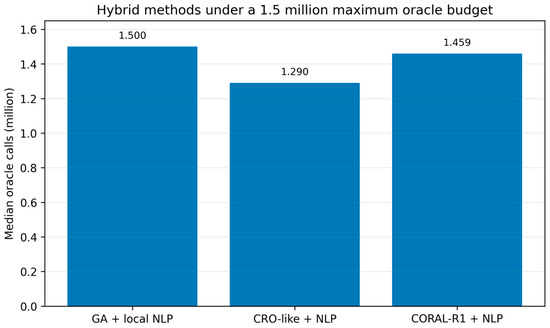
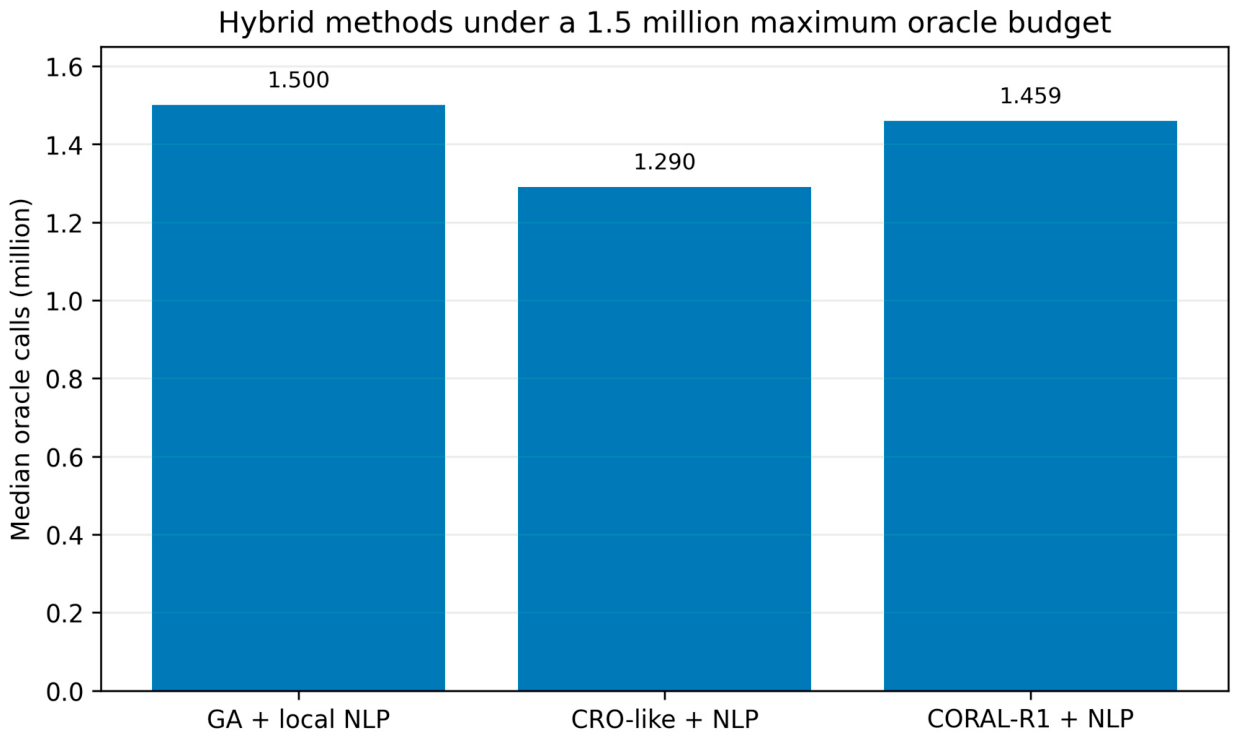
The same experiment also tests whether the topology-aware CORAL mechanisms themselves improve performance. They do not on this benchmark. CRO-like+NLP and CORAL-R1+NLP both achieve 10/10 feasibility and 10/10 reference-topology recovery, whereas the simpler CRO-like hybrid uses about 12% fewer median oracle calls (1.290 vs. 1.459 million). Thus the eight-process case supports the hybrid decomposition but provides no evidence that niches, adaptive operators, bleaching, and recolonization improve solution quality or efficiency when only 12 legal topologies are available.
4.3. Sensitivity to the Local-Refinement Probability
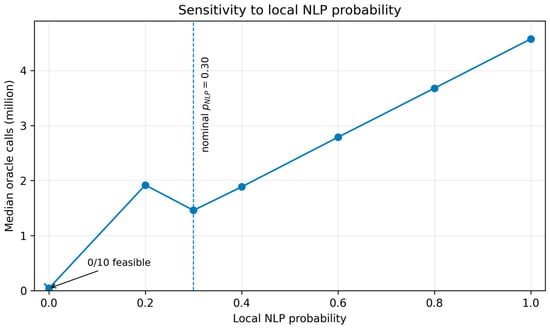
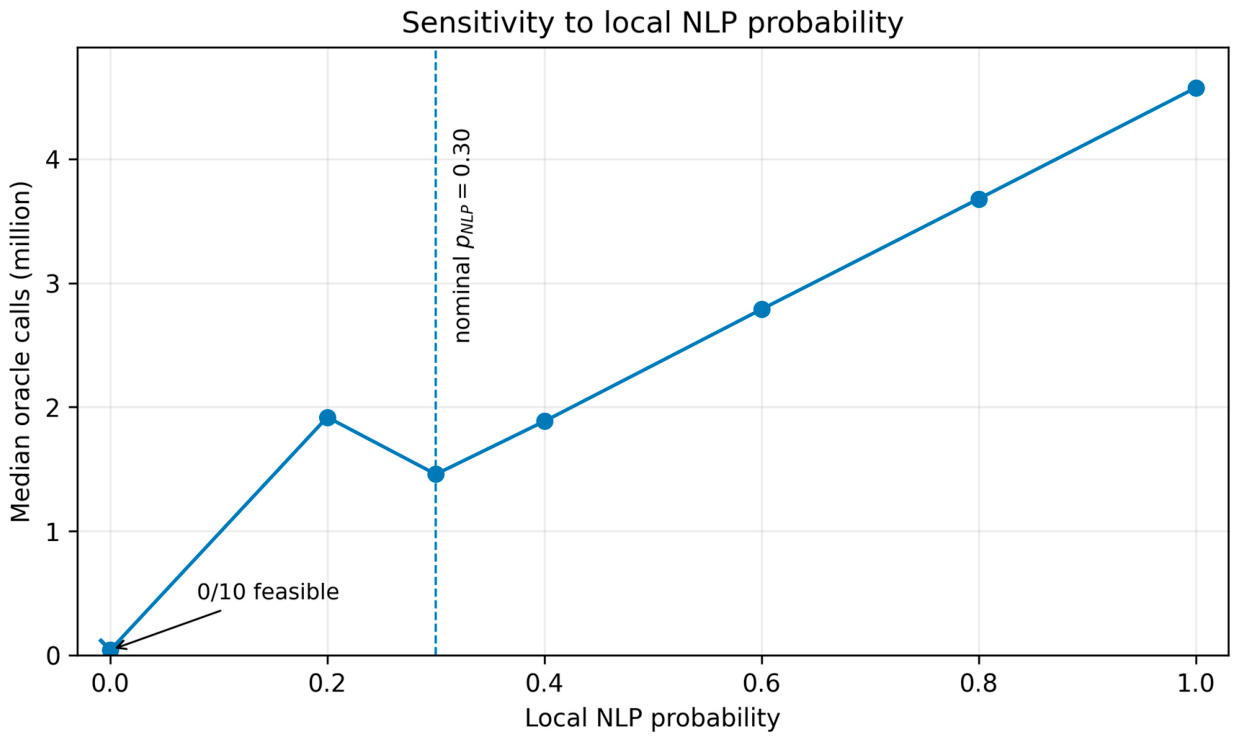
Because local NLP is the dominant feasibility mechanism, its application probability p_NLP was examined explicitly. Ten matched seeds were used at p_NLP = 0, 0.2, 0.3, 0.4, 0.6, 0.8 and 1.0. At p_NLP = 0, none of the ten runs was feasible and only one recovered the reference topology. Every tested nonzero probability yielded 10/10 feasible runs and 10/10 topology recovery after refinement. The sensitivity of CORAL-R1 to the probability of fixed-topology constrained NLP refinement is shown in Table 6 and Table 7.
Table 6.
Sensitivity of CORAL-R1 to the probability of fixed-topology constrained NLP refinement.
Increasing p_NLP beyond 0.30 does not improve structural recovery or final solution quality, but it increases the number of local NLP calls and therefore total oracle effort. The nominal value p_NLP = 0.30 was retained because it gave the lowest median oracle count among the successful settings tested. This should not be interpreted as a universally optimal probability; it is an experimentally supported setting for the present implementation and benchmark.
The intensity of each local SQP refinement was examined separately from its triggering probability. At the retained p_NLP = 0.30, the maximum number of SQP iterations per local-refinement call was set to 50, 100, 300 and 600 using the same ten matched seeds (12,001–12,010), while the maximum number of function evaluations was held fixed at 10,000. All four iteration limits produced identical optimization trajectories for each seed in terms of objective value, raw feasibility, recovered topology, oracle calls, number of local NLP calls and CORAL iterations. In every setting, 7/10 raw solutions satisfied the 10−5 feasibility tolerance and 10/10 recovered the reference topology; after the diagnostic final polish, 10/10 solutions were feasible and returned the reference objective.
Table 7.
Sensitivity of CORAL-R1 to the maximum SQP iterations allowed per local-refinement call.
The median realized number of SQP iterations was only 8.88 per local-refinement call, far below even the smallest tested cap of 50. Consequently, increasing the nominal SQP iteration limit from 50 to 600 had no algorithmic effect. This shows that, for the present benchmark, performance depends on whether and how often constrained local refinement is invoked, rather than on the nominal iteration ceiling once sufficient iterations are available for local convergence. The nominal limit of 300 is retained in CORAL-R1; the sensitivity result is not used for post hoc retuning to 50 iterations. Wall-clock differences are not interpreted because timing in the validation environment contained external anomalies.
4.4. Equal-Budget Comparison with Simpler Hybrid Searches
Table 8 summarizes the Equal-budget comparison of CRO-like+NLP and CORAL-R1+NLP on the eight-process benchmark. To remove differences caused by stopping behavior, CRO-like+NLP and CORAL-R1+NLP were compared under the same maximum budget of 1.5 million useful oracle calls per run. Both methods again produced feasible solutions and recovered the reference topology in all ten matched runs. CRO-like+NLP required a median of approximately 1.290 million calls and reached its normal stopping criterion in 9/10 runs. CORAL-R1 used approximately 1.459 million calls and reached the budget limit in 4/10 runs, i.e., only 6/10 runs satisfied the ordinary stopping criterion before the limit.
Table 8.
Equal-budget comparison of CRO-like+NLP and CORAL-R1+NLP on the eight-process benchmark.
The comparison is intentionally stated as an equal maximum budget rather than equal consumption: an algorithm may terminate earlier when its stopping criterion is met. The result gives no solution-quality advantage to the reef-specific mechanisms on the present benchmark. It also identifies a practical weakness of the original CORAL-R1 termination logic: several runs continue substantially longer after the reference topology has stabilized. Section 4.9 therefore tests a topology-aware stopping rule designed specifically to reduce this redundant refinement, rather than treating the issue only as future work.
4.5. Genetic-Algorithm Baselines: The Importance of Structural–Continuous Decomposition
A conventional constrained GA was included as a recognizable population-based baseline. In the direct formulation, GA searched an eight-gene topology representation together with the 25 continuous variables, while the exact topology repair and the original nonlinear constraints were retained. Under the same 1.5-million-call maximum budget, all ten runs exhausted the budget after approximately 24–32 generations; none produced a feasible final solution and none recovered the reference topology. The planned final fixed-topology polish could therefore not be executed within the remaining budget.
A second GA baseline used the same structural search but evaluated each decoded topology through the same constrained fixed-topology SQP used by CORAL. This GA+NLP architecture recovered the reference topology and a feasible reference solution in all ten runs. Its median local-NLP count was 1801 and its median runtime was 132.81 s; all ten runs consumed the full 1.5-million-call budget. The main findings for the Population-based baselines for GA, CRO and CORAL-R1 can be found in Table 9.
Table 9.
Population-based baselines under the common 1.5-million-call maximum budget.
Taken together, the GA, CRO-like, and CORAL results support a more general conclusion than the original CORAL-only comparison. Direct simultaneous stochastic search over structural variables and a strongly equality-constrained continuous space is ineffective here, whereas three different population-search mechanisms become reliable when coupled to fixed-topology constrained NLP. The evidence therefore supports decomposition and hybridization; it does not establish superiority of a particular population metaphor.
4.6. CORAL-Specific Parameter Sensitivity
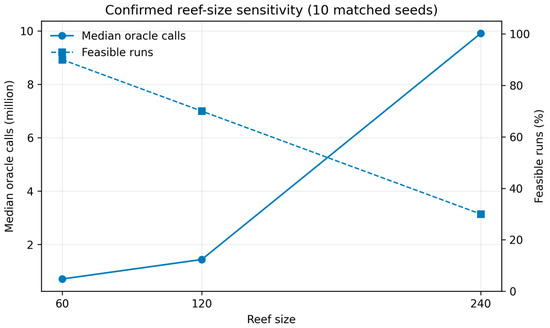
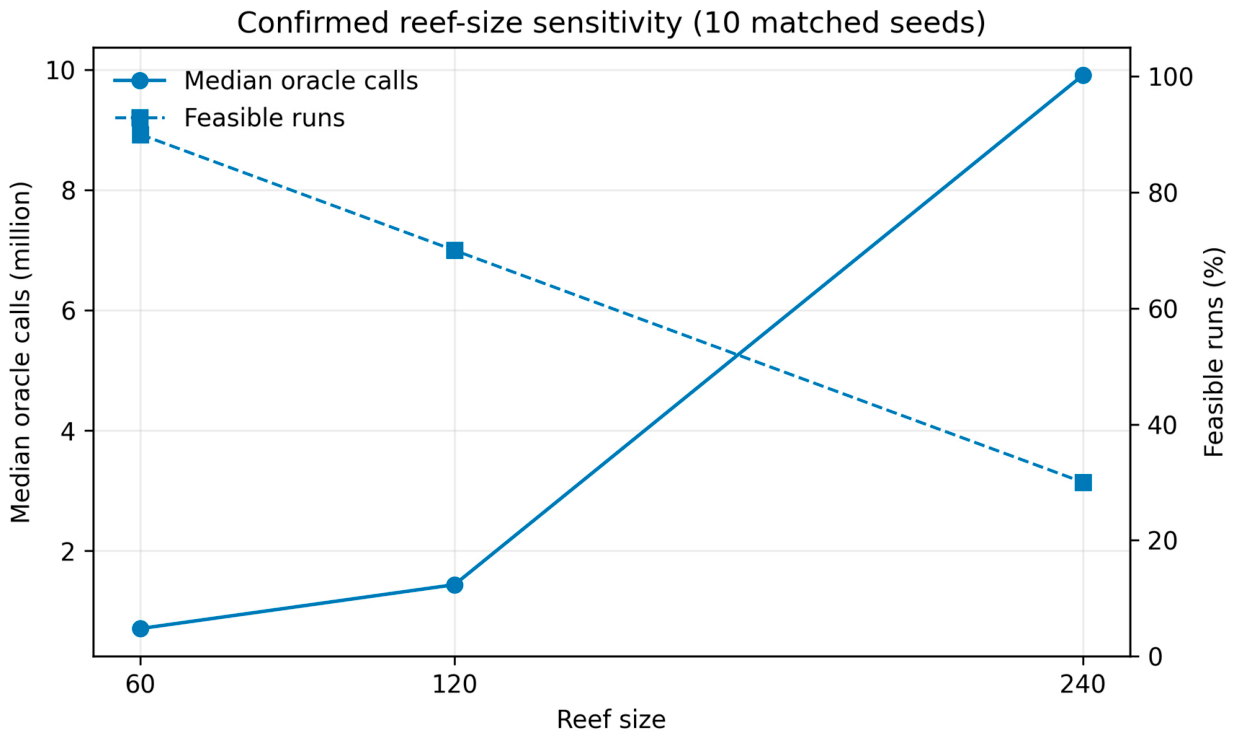
A one-factor-at-a-time screening was performed for reef size, bleaching threshold, and continuous mutation scale while retaining p_NLP = 0.30. Across the initial 35 screening runs, the reference topology was recovered in every run. Variations in bleaching threshold and mutation scale had comparatively limited influence on structural recovery, whereas reef size had a pronounced effect on computational effort and raw feasibility at termination. Because this effect was substantial, the reef-size comparison was extended to ten matched seeds for each of N_R = 60, 120 and 240. These reef-size runs use their own matched seed set; therefore, the 7/10 raw-feasibility result at the nominal reef size of 120 is not the same experiment as the 10/10 feasibility result in the component and equal-budget comparisons (see Table 10 for the main findings).
Table 10.
Confirmed reef-size sensitivity using 10 matched seeds per setting.
Topology recovery is completely insensitive to reef size in this experiment: all 30 runs identify processes 2, 4, 6 and 8. Computational effort, however, rises sharply with population size. The median oracle count at N_R = 240 is approximately fourteen times that at N_R = 60, and the larger reef reaches the maximum iteration count in the median run. Raw feasibility at termination simultaneously decreases from 90% at N_R = 60 to 30% at N_R = 240. Thus a larger population provides no detectable structural-search benefit on this small problem and substantially increases continuous-refinement work.
Although N_R = 60 is more efficient for this benchmark, the nominal N_R = 120 setting is retained in the principal comparison. Changing the nominal parameter after observing the sensitivity results would amount to post hoc tuning to the validation case. The sensitivity study is therefore reported as evidence about algorithm behavior rather than used retrospectively to improve the headline result.
4.7. Computational Cost Relative to Exhaustive Enumeration
Deterministic solution strategies are substantially cheaper than CORAL on the eight-process problem. Enumeration with 20 starts for each of 12 structures requires 222,202 oracle calls and 15.7654 s, while BARON solves the algebraic MINLP directly with 2.520 s of solver resource usage and certifies a relative global optimality gap below 10−9. By comparison, the 30-run CORAL-R1 validation requires a median of approximately 1.447 million oracle calls, and the original 30-run validation shows a substantial long-run tail caused by repeated local NLP calls. For a problem with only 12 admissible topologies, there is therefore no computational argument for replacing enumeration or deterministic global MINLP by CORAL.
This result also clarifies the intended scope of the method. CORAL becomes potentially relevant only when explicit enumeration of all admissible structures is no longer practical, when topology evaluation involves difficult black-box or simulation-based models, or when structural alternatives cannot be handled conveniently by a single deterministic formulation. Those conditions are motivations for future testing, not demonstrated advantages of the present benchmark. The current study establishes correctness of the hybrid architecture and exposes its computational trade-offs; it does not demonstrate large-scale superiority.
4.8. What the Revised Validation Establishes
The revised experiments lead to five conclusions. First, CORAL-R1 recovers the enumerated best eight-process topology reliably when structural search is coupled to constrained fixed-topology NLP refinement. Second, constrained local NLP is not a minor enhancement but the mechanism that enables feasible solutions for the equality-constrained benchmark in the reported population-search experiments. Third, CORAL’s additional reef-specific mechanisms do not improve solution quality or efficiency relative to the simpler CRO-like+NLP baseline on a search space containing only 12 legal structures. Fourth, deterministic solution is preferable for this small algebraically explicit problem: exhaustive enumeration is inexpensive and BARON recovers the same topology while providing a global bound. Fifth, topology-aware termination removes much of CORAL’s redundant refinement work, reducing median oracle calls by 73.8% in the 30-run stopping experiment without loss of feasibility or topology recovery.
These findings define the scientific claim of the paper more precisely. The contribution demonstrated here is a reproducible and auditable hybrid topology-search/NLP framework in which process structures can coexist and evolve while deterministic NLP handles continuous feasibility and refinement. The benchmark validates that architecture, identifies the decisive role of the local NLP layer, and exposes the cost of unnecessary continued search after topology stabilization. It does not establish that coral-inspired structural dynamics are intrinsically superior to alternative topology-search mechanisms or deterministic MINLP. Demonstrating an added value from diversity preservation, structural niches, or recolonization requires substantially larger or less explicit structural spaces in which those mechanisms have room to affect the search.
4.9. Topology-Aware Early Stopping on the Eight-Process Benchmark
The original CORAL-R1 implementation uses a generic stagnation criterion based on incumbent solution quality. Because the discrete topology may stabilize substantially earlier than this criterion is activated, the algorithm can continue to perform unnecessary local NLP refinements after the relevant structural configuration has stabilized. We therefore evaluated the topology-aware stopping criterion defined in Section 2.11 using the same 30 seeds and otherwise unchanged CORAL-R1 settings. The criterion was activated in all 30 runs while preserving 30/30 feasible solutions and 30/30 recovery of the reference topology. The median raw objective was 68.009744051001, compared with the reference value 68.009744051065; after the separately reported final NLP polish, the median objective was 68.009744051065. Figure 3 shows how Median oracle effort of the successful hybrid population methods under the common 1.5 million maximum oracle budget. As where Figure 4 shows that the Median computational effort decreased from 1,447,466 to 378,695 total oracle calls (−73.8%) and from 2797 to 714 local NLP calls (−74.5%). This is substantiated in Figure 5, where the oracle calls and runs were plotted for different reef sizes.The modified runs terminated after a median of 21 iterations. Thus, topology stabilization provides a useful termination signal for this benchmark and substantially reduces redundant continuous refinement without degrading structural recovery or solution quality. Remaining development priorities include adaptive allocation of local refinement and evaluation on larger process-synthesis problems where exhaustive enumeration becomes impractical and topology-aware diversity mechanisms have room to affect the search.
Figure 3.
Median oracle effort of the successful hybrid population methods under the common 1.5 million maximum oracle budget.
Figure 4.
Sensitivity to fixed-topology constrained NLP-refinement probability. The p_NLP = 0 setting produced 0/10 feasible runs.
Figure 5.
Confirmed reef-size sensitivity using 10 matched seeds per setting; topology recovery was 10/10 at all three sizes.
4.10. Scalable SRSN Comparison: Structural Exploration and Feasibility
The SRSN experiment compared GA+NLP, CRO-like+NLP (adaptive operators, diversity weighting and bleaching disabled) and full CORAL+NLP. Main findings are listed in Table 11. Thirty matched seeds (12,001–12,030) were run for each method and scale, yielding 270 runs. The benchmark and a common maximum budget of 500,000 counted objective/constraint oracle calls per run were frozen after an algorithm-independent NLP pilot. No topology-aware early stopping was used. All 270 runs reached the oracle budget. The original search architectures and fixed-topology SQP refinement were retained; topology repair was unnecessary because every binary string was structurally admissible.
Table 11.
Primary SRSN outcomes over 30 seeds per method and scale; strict feasibility threshold 10−7. Diversity is the median of each run’s mean normalized pairwise Hamming distance.
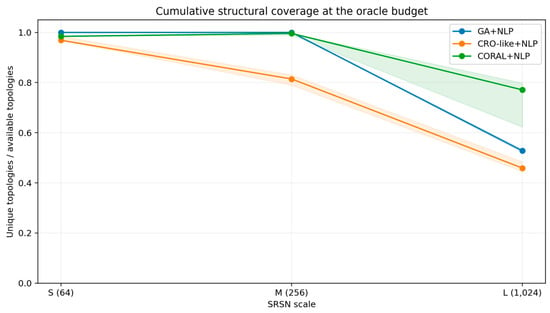
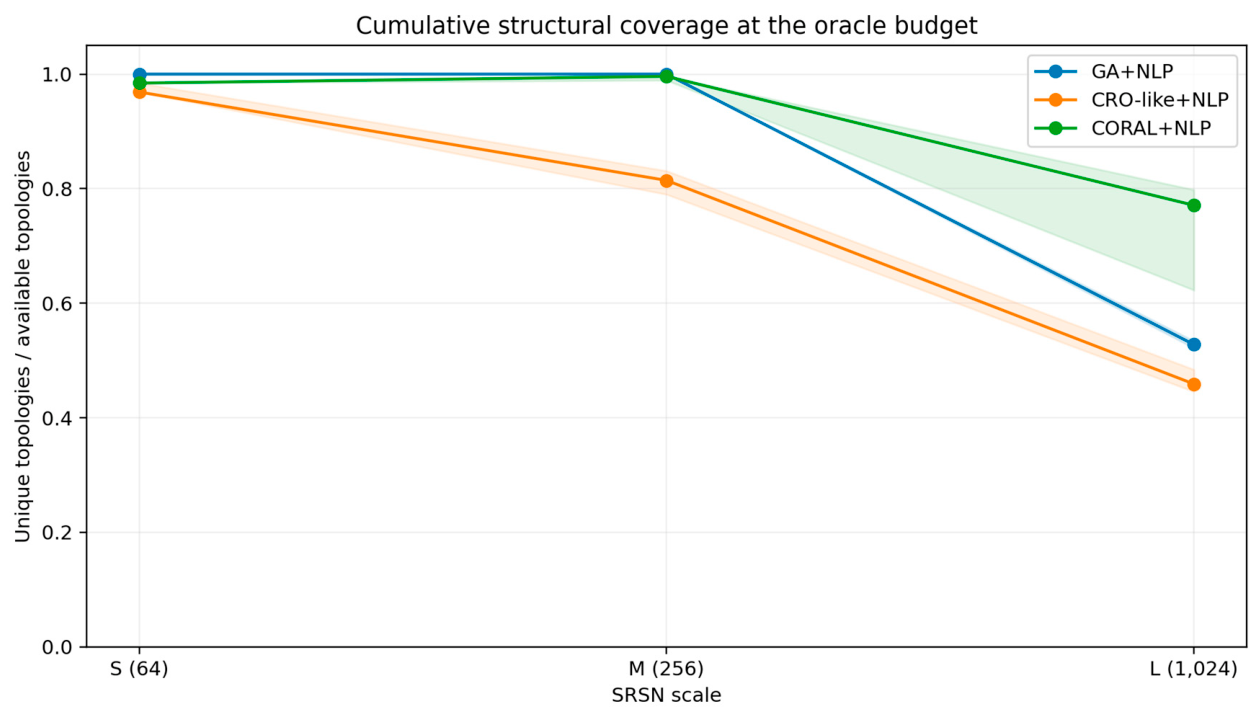
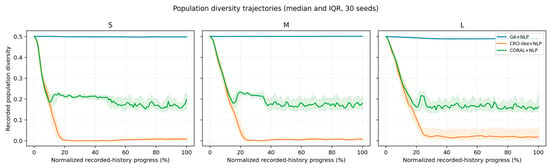
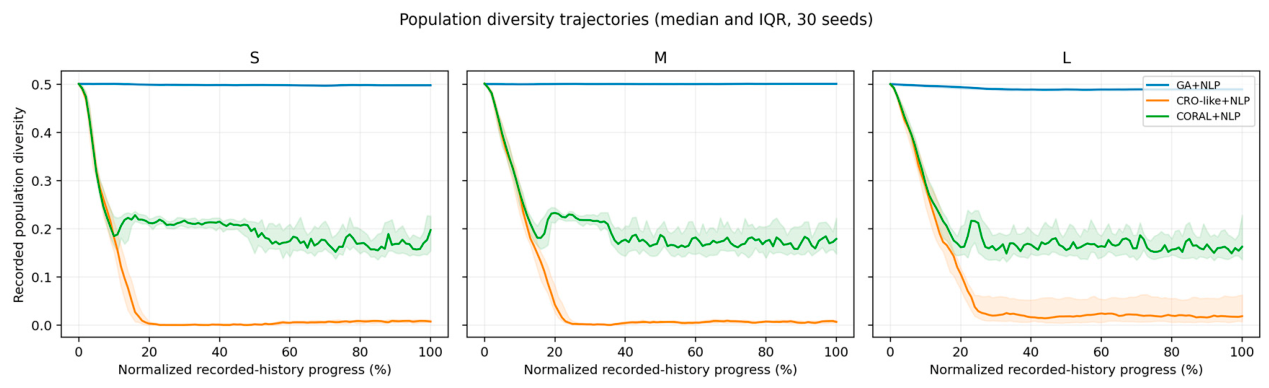
Figure 6 shows how the SRSN affect the cumulative coverage for GA, CRO and CORAL-R1. All methods recovered the reference topology in all S and M runs. On L, reference-topology recovery was 28/30 for GA+NLP, 29/30 for CRO-like+NLP and 30/30 for CORAL+NLP. Median unique-topology coverage on L was 540.5, 470 and 789.5, respectively. CORAL thus demonstrated greater cumulative structural exploration, while GA retained the highest mean population diversity. The two metrics measure distinct properties: diversity of the retained population versus unique structures visited over the entire run. The topology-recovery differences are small and should not be interpreted as statistically established superiority in final solution quality. In addition, Figure 7 shows the Recorded normalized Hamming-diversity trajectories (median and interquartile range).
Figure 6.
Fraction of unique SRSN topologies visited at budget exhaustion; medians and interquartile ranges across 30 seeds.
Figure 7.
Recorded normalized Hamming-diversity trajectories (median and interquartile range). Horizontal position is normalized recorded-history progress, not equal oracle consumption.
4.10.1. Independent Feasibility Audit and Common Polishing
Table 12 shows the main findings of the feasibility assessment. At the strict 10−7 tolerance, unpolished GA+NLP solutions were feasible in 90/90 runs, CRO-like+NLP in 58/90 and CORAL+NLP in 61/90. The maximum violations for the latter two were small (approximately 4.42 × 10⁻⁶ and 2.16 × 10⁻⁶). Every saved incumbent was then independently evaluated and polished by the same fixed-topology SQP procedure, initialized at its saved continuous operating point. All 270 polished solutions satisfied 10−7, with maximum residual violation about 2.2 × 10⁻¹². The polishing evaluations were additional to, and excluded from, the original 500,000-call budget. These results demonstrate numerical recoverability, not strict equal-budget feasibility for the original reef runs.
Table 12.
Independent strict-feasibility assessment and additional fixed-topology SQP polishing (not included in primary budget).
4.10.2. Interpretation and Limits
The new benchmark supports a measurable contribution of topology-aware reef mechanisms to structural coverage, particularly at 1024 configurations, but not a general advantage in strict feasible-solution performance or oracle efficiency. SRSN is synthetic and smooth, with inequality constraints and at most 1024 topologies; it does not establish an advantage for failed simulations, black-box models, equality-constrained larger networks or industrial-scale superstructures. The enumerated multistart-SQP reference is not a certified continuous global optimum.
4.11. Stopping-Rule Sensitivity Across SRSN Scales
To test the topology-aware early-stopping rule independently of the original eight-process case, 360 additional CORAL+NLP runs were performed on the frozen SRSN S, M and L instances (64, 256 and 1024 admissible topologies). Four topology-stability horizons N_s = 10, 20, 40 and 80 and three relative objective-change tolerances ε_s = 10−4, 10−6 and 10−8 were crossed with ten matched seeds (12,001–12,010) for each scale and setting. The same maximum budget of 500,000 counted objective/constraint oracle calls was retained. An eligible stop requires a feasible incumbent under the optimizer’s internal feasibility test, an unchanged incumbent topology over the N_s-iteration window, and a relative objective change not exceeding ε_s.
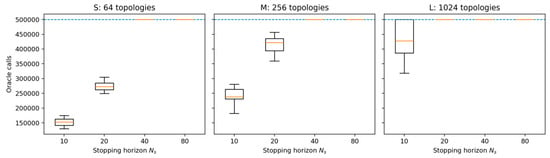
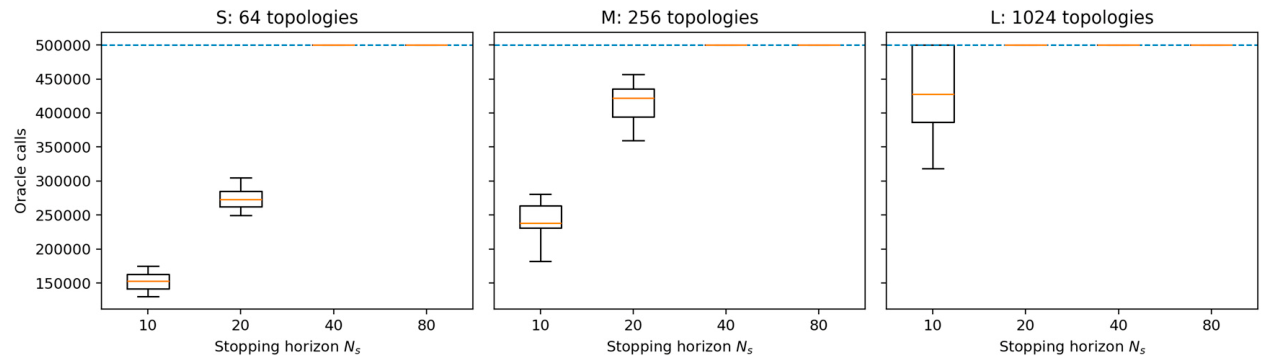
The enumerated multistart-SQP reference topology was recovered in all 360 runs. At N_s = 10, median oracle consumption was 153,040, 237,735 and 427,962 for S, M and L, respectively, corresponding to reductions of approximately 69.4%, 52.5% and 14.4% relative to the 500,000-call cap. At N_s = 20 the corresponding medians were 273,159, 421,690 and 500,000; for N_s = 40 and 80, every scale had a median of 500,000 calls. The stopping horizon therefore dominated observed computational effort, whereas varying ε_s across four orders of magnitude had negligible practical influence. As shown in Figure 8, the oracle-call distributions shift toward the 500,000-call budget as the stability horizon increases, most prominently for the largest network.
Figure 8.
Oracle-call distributions by stopping horizon and SRSN scale. Dashed line: 500,000-call budget. Each box aggregates 30 runs across the three objective-change tolerances.
An audit of termination flags is essential: all 360 records have StopTriggered = 1, but 218 also have BudgetHit = 1. Only the 142 runs with BudgetHit = 0 can unambiguously be classified as terminating before the budget limit; the remaining records cannot support an independent early-stop saving claim. Across S, M and L, respectively, strict final feasibility at the independent 10−7 tolerance was achieved in 72/120, 99/120 and 96/120 runs. The largest recorded constraint violations were 7.66 × 10⁻⁷, 5.15 × 10⁻⁷ and 5.50 × 10⁻⁷. Thus, reliable reference-topology recovery should not be conflated with strict feasibility of the unpolished continuous incumbent.
The sensitivity results as shown in Table 13 support N_s = 10 as an economical setting on these three smooth synthetic networks, but do not establish it as a universally safe horizon or prove that the topology would remain optimal in larger or simulator-based problems. Budget-capped runs, a finite seed set and the absence of controlled NLP-failure injection limit the inference. Diversity-adaptive stopping and tests under deliberately degraded NLP reliability are left for future research.
Table 13.
Stopping-sensitivity summary (30 runs per scale and horizon; three ε_s settings × ten seeds).
5. Conclusions
This work developed and tested CORAL as a reproducible hybrid topology-search/NLP architecture for mixed discrete-continuous process superstructure optimization. The method separates structural exploration from continuous refinement: alternative process structures are represented as competing corals in a finite reef, while deterministic constrained NLP refines the continuous variables at fixed topology. The structural-search layer includes reproduction, feasibility-first settlement, topology-based niches, adaptive operators, depredation, bleaching and recolonization. In CORAL-R1, local refinement uses the original nonlinear equality and inequality constraints rather than a penalty objective, and computational effort is accounted for across both global search and local NLP evaluations.
The revised validation clarifies which part of this architecture is responsible for successful optimization. On the classical eight-process synthesis benchmark, exhaustive enumeration establishes a reference objective of 68.009744051065 for processes 2, 4, 6 and 8. CORAL-R1 recovers this topology reliably and, after final fixed-topology polishing, reproduces the reference solution to numerical precision. However, the ablation experiments show that constrained local NLP is essential for reaching the equality-constrained feasible manifold. Without it, neither CRO-like nor full CORAL search produced feasible final solutions in the reported matched experiments; with it, GA, CRO-like search and CORAL each produced feasible reference-topology solutions in all runs of the reported matched experiments. The topology-aware stopping experiment further shows that redundant refinement can be reduced substantially: median oracle calls fell by 73.8% while feasibility and reference-topology recovery remained 30/30.
The benchmark therefore does not demonstrate superiority of the reef-specific search mechanisms. Under the common 1.5 million maximum oracle-call budget, CRO-like+NLP and CORAL-R1+NLP both recover the reference topology in all ten matched runs, while the simpler CRO-like hybrid requires fewer median oracle calls and reaches its ordinary stopping criterion more often. Direct constrained GA produced no feasible solution in the ten reported runs within the same budget, whereas GA coupled to fixed-topology NLP produced feasible reference-topology solutions in all ten runs. Together, these results support structural-continuous decomposition and hybridization more strongly than they support any particular population metaphor.
Parameter studies reinforce this interpretation. A local-NLP probability of 0.30 gives the lowest median oracle effort among the successful probabilities tested, while more frequent refinement increases cost without improving topology recovery. Likewise, reef sizes of 60, 120 and 240 all recover the reference topology in every matched run, but the largest reef requires roughly an order of magnitude more oracle calls and shows poorer raw feasibility at termination. The nominal reef size of 120 is retained rather than retuned after observing these results. A complementary local-NLP intensity study varied the maximum SQP iterations per call from 50 to 600 at fixed p_NLP = 0.30. All four settings produced identical search outcomes because the realized local solves required only 8.88 SQP iterations per call on median; hence even the 50-iteration cap was non-binding. The frozen CORAL-R1 limit of 300 iterations is retained rather than retuned post hoc.
For a problem containing only 12 admissible structures, deterministic methods are substantially cheaper than CORAL: exhaustive enumeration is already attractive, and the direct BARON comparison recovers the same topology with a global bound using 2.520 s of solver resource time. These methods are therefore the appropriate choice for this algebraically explicit benchmark. The present contribution should be understood as a validated and auditable hybrid topology-search/NLP architecture, not as evidence that coral-inspired search outperforms deterministic MINLP, enumeration, or simpler hybrid methods. The topology-aware stopping experiment shows that one important inefficiency can already be reduced without sacrificing solution quality. The next test for CORAL is consequently application to substantially larger or less explicitly algebraic process-structure spaces in which exhaustive enumeration is impractical and structural diversity, niche preservation and recolonization have sufficient scope to influence the search. Future work should focus on adaptive allocation of local NLP effort and on controlled tests of whether the reef-specific diversity mechanisms provide measurable benefit in such settings.
A further 270-run comparison on the frozen SRSN benchmark extended the study to 64, 256 and 1024 structural configurations. At the largest scale, CORAL visited more distinct topologies (median 789.5) than GA+NLP (540.5) or CRO-like+NLP (470), and recovered the enumerated reference topology in 30/30 runs versus 28/30 and 29/30. Nevertheless, GA+NLP achieved stricter original-budget feasibility, and all methods required the full 500,000-call budget. Independent common SQP polishing recovered strict feasibility for all saved solutions, with additional evaluations disclosed separately. These results support structural exploration effects, not universal computational superiority. A separate 360-run stopping sensitivity study found reference-topology recovery in all runs and showed that the topology-stability horizon, rather than the objective-change threshold, primarily controlled computational effort; strict continuous feasibility still requires independent checking.
Funding
This research received no external funding.
Data Availability Statement
The MATLAB implementations, benchmark models, experimental configurations, and computational results supporting this study are available in the public GitHub repository: https://github.com/zondervanedwin-collab/CORAL-R1 accessed on 12 October 2026. Additional validation materials, including the scalable reactor–separation network benchmark, comparative optimization experiments, and stopping-sensitivity analyses, are provided in the reviewer_response directory.
Acknowledgments
The author thanks the anonymous reviewers for their detailed and constructive comments, which helped improve the clarity and validation of this work.
Conflicts of Interest
The author declares no conflicts of interest.
Appendix A. SRSN Mathematical Model and Frozen Parameters
Appendix A.1. Topology and Reactor Model
For j = 1:…,m, units are ordered [R1,S1,…,Rm,Sm]. Binary yi = 1 selects technology A and yi = 0 selects B; each severity xi lies in [0,1]. Initial flows are A0 = 100, P0 = 0 and I0 = 10. Reactor conversion at severity u = x2j−1 is Xt(u) = Xmaxt[1 − exp(−ktu)]. Reactor outlet flows are Arj = Aj−1(1 − Xt), Prj = Pj−1 + st Aj−1 Xt and Irj = Ij−1 + (1 − st) Aj−1 Xt. Reactor throughput Frj = Aj−1 + Pj−1 + Ij−1 and cost Crj = Cfixt + cFtFrj + cEtFrju2.
Appendix A.2. Separator Model
At separator severity v = x2j, impurity removal is rt(v) = Rmaxt[1 − exp(−ktv)]. Separator outlet flows are Aj = Arj(1 − lossAtv), Pj = Prj(1 − lossPtv) and Ij = Irj(1 − rt). Separator throughput Fsj = Arj + Prj + Irj and cost Csj = Cfixt + cFtFsj + cEtFsjv2.
Appendix A.3. Objective and Constraints
Minimize f(x:y) = Σj(Crj + Csj) − 20Pm + 3Am, subject to 90 − Pm ≤ 0 and 0.98Im − 0.02Pm ≤ 0. The latter is the undivided purity constraint Pm/(Pm + Im) ≥ 0.98. No nonlinear equality constraints are imposed. All coefficients are dimensionless synthetic benchmark quantities.
Appendix A.4. Parameter Tables
Table A1.
Frozen reactor technology parameters.
Table A2.
Frozen separator technology parameters.
The primary experiment used seeds 12,001–12,030, 500,000 counted objective/constraint calls per run, and 30 runs per method and scale. The reference calculation enumerated all topologies with ten SQP starts per topology. Independent polishing used fixed-topology SQP outside the original budget. The saved MATLAB model, run-level CSV data and histories document the experiment.
References
- Duran, M.A.; Grossmann, I.E. A mixed-integer nonlinear programming algorithm for process systems synthesis. AIChE J. 1986, 32, 592–606. [Google Scholar] [CrossRef] [Scilit]
- Türkay, M.; Grossmann, I.E. Logic-based MINLP algorithms for the optimal synthesis of process networks. Comput. Chem. Eng. 1996, 20, 959–978. [Google Scholar] [CrossRef] [Scilit]
- Yeomans, H.; Grossmann, I.E. A systematic modeling framework of superstructure optimization in process synthesis. Comput. Chem. Eng. 1999, 23, 709–731. [Google Scholar] [CrossRef] [Scilit]
- Grossmann, I.E. Review of nonlinear mixed-integer and disjunctive programming techniques. Optim. Eng. 2002, 3, 227–252. [Google Scholar] [CrossRef] [Scilit]
- Chen, Q.; Grossmann, I.E. Recent developments and challenges in optimization-based process synthesis. Annu. Rev. Chem. Biomol. Eng. 2017, 8, 249–283. [Google Scholar] [CrossRef] [Scilit] [PubMed]
- Mencarelli, L.; Chen, Q.; Pagot, A.; Grossmann, I.E. A review on superstructure optimization approaches in process system engineering. Comput. Chem. Eng. 2020, 136, 106808. [Google Scholar] [CrossRef] [Scilit]
- Grossmann, I.E.; Trespalacios, F. Systematic modeling of discrete-continuous optimization models through generalized disjunctive programming. AIChE J. 2013, 59, 3276–3295. [Google Scholar] [CrossRef] [Scilit]
- Adjiman, C.S.; Androulakis, I.P.; Floudas, C.A. Global optimization of mixed-integer nonlinear problems. AIChE J. 2000, 46, 1769–1797. [Google Scholar] [CrossRef] [Scilit]
- Floudas, C.A.; Grossmann, I.E. Automatic synthesis of optimum heat exchanger network configurations. AIChE J. 1986, 32, 276–290. [Google Scholar] [CrossRef] [Scilit]
- Gopinath, S.; Adjiman, C.S. Superstructure optimization with rigorous models via an exact reformulation. Comput. Chem. Eng. 2025, 194, 108972. [Google Scholar] [CrossRef] [Scilit]
- Neveux, T. Ab-initio process synthesis using evolutionary programming. Chem. Eng. Sci. 2018, 185, 209–221. [Google Scholar] [CrossRef] [Scilit]
- Azevedo, A.R.; Nabil, T.; Loubière, V.; Privat, R.; Neveux, T.; Commenge, J.-M. Comparing generative process synthesis approaches with superstructure optimization for the conception of supercritical CO2 Brayton cycles. Comput. Chem. Eng. 2025, 201, 109255. [Google Scholar] [CrossRef] [Scilit]
- Bertran, M.-O.; Frauzem, R.; Sanchez-Arcilla, A.-S.; Zhang, L.; Woodley, J.M.; Gani, R. A generic methodology for processing route synthesis and design based on superstructure optimization. Comput. Chem. Eng. 2017, 106, 892–910. [Google Scholar] [CrossRef] [Scilit]
- Gong, J.; You, F. A new superstructure optimization paradigm for process synthesis with product distribution optimization: Application to an integrated shale gas processing and chemical manufacturing process. AIChE J. 2018, 64, 123–143. [Google Scholar] [CrossRef] [Scilit]
- Al, R.; Behera, C.R.; Gernaey, K.V.; Sin, G. Stochastic simulation-based superstructure optimization framework for process synthesis and design under uncertainty. Comput. Chem. Eng. 2020, 143, 107118. [Google Scholar] [CrossRef] [Scilit]
- Voll, P.; Lampe, M.; Wrobel, G.; Bardow, A. Superstructure-free synthesis and optimization of distributed industrial energy supply systems. Energy 2012, 45, 424–435. [Google Scholar] [CrossRef] [Scilit]
- Wang, L.; Voll, P.; Lampe, M.; Yang, Y.; Bardow, A. Superstructure-free synthesis and optimization of thermal power plants. Energy 2015, 91, 700–711. [Google Scholar] [CrossRef] [Scilit]
- Shafiee, A.; Nomvar, M.; Liu, Z.; Abbas, A. Automated process synthesis for optimal flowsheet design of a hybrid membrane cryogenic carbon capture process. J. Clean. Prod. 2017, 150, 309–323. [Google Scholar] [CrossRef] [Scilit]
- Commenge, J.-M.; Piña-Martinez, A. Data-driven initialization of evolutionary methods for process synthesis considering centrality and diversity criteria. Comput. Chem. Eng. 2026, 204, 109416. [Google Scholar] [CrossRef] [Scilit]
- Neri, F.; Cotta, C. Memetic algorithms and memetic computing optimization: A literature review. Swarm Evol. Comput. 2012, 2, 1–14. [Google Scholar] [CrossRef] [Scilit]
- Nocedal, J.; Wright, S.J. Numerical Optimization, 2nd ed.; Springer: New York, NY, USA, 2006. [Google Scholar] [CrossRef] [Scilit]
- Deb, K. An efficient constraint handling method for genetic algorithms. Comput. Methods Appl. Mech. Eng. 2000, 186, 311–338. [Google Scholar] [CrossRef] [Scilit]
- Coello Coello, C.A. Theoretical and numerical constraint-handling techniques used with evolutionary algorithms: A survey of the state of the art. Comput. Methods Appl. Mech. Eng. 2002, 191, 1245–1287. [Google Scholar] [CrossRef] [Scilit]
- Salcedo-Sanz, S. A survey of repair methods used as constraint handling techniques in evolutionary algorithms. Comput. Sci. Rev. 2009, 3, 175–192. [Google Scholar] [CrossRef] [Scilit]
- Mezura-Montes, E.; Coello Coello, C.A. Constraint-handling in nature-inspired numerical optimization: Past, present and future. Swarm Evol. Comput. 2011, 1, 173–194. [Google Scholar] [CrossRef] [Scilit]
- Rahimi, I.; Gandomi, A.H.; Chen, F.; Mezura-Montes, E. A review on constraint handling techniques for population-based algorithms: From single-objective to multi-objective optimization. Arch. Comput. Methods Eng. 2023, 30, 2181–2209. [Google Scholar] [CrossRef] [Scilit]
- Lagaros, N.D.; Kournoutos, M.; Kallioras, N.A.; Nordas, A.N. Constraint handling techniques for metaheuristics: A state-of-the-art review and new variants. Optim. Eng. 2023, 24, 2251–2298. [Google Scholar] [CrossRef] [Scilit]
- Haghpanah, T.; Sobati, M.A.; Pishvaee, M.S. Process synthesis for the microalgae-based bio-refineries through superstructure optimization: A systematic review. Comput. Chem. Eng. 2023, 176, 108352. [Google Scholar] [CrossRef] [Scilit]
- Salcedo-Sanz, S.; Del Ser, J.; Landa-Torres, I.; Gil-López, S.; Portilla-Figueras, J.A. The Coral Reefs Optimization Algorithm: A Novel Metaheuristic for Efficiently Solving Optimization Problems. Sci. World J. 2014, 2014, 739768. [Google Scholar] [CrossRef] [Scilit] [PubMed]
- Salcedo-Sanz, S.; Camacho-Gómez, C.; Molina, D.; Herrera, F. A coral reefs optimization algorithm with substrate layers and local search for large scale global optimization. In Proceedings of the 2016 IEEE Congress on Evolutionary Computation, Vancouver, BC, Canada, 24–29 July 2016; pp. 3574–3581. [Google Scholar] [CrossRef] [Scilit]
- Bermejo, E.; Chica, M.; Damas, S.; Salcedo-Sanz, S.; Cordón, O. Coral Reef Optimization with substrate layers for medical image registration. Swarm Evol. Comput. 2018, 42, 138–159. [Google Scholar] [CrossRef] [Scilit]
- Garcia-Hernandez, L.; Garcia-Hernandez, J.A.; Salas-Morera, L.; Carmona-Muñoz, C.; Alghamdi, N.S.; Valente de Oliveira, J.; Salcedo-Sanz, S. Addressing Unequal Area Facility Layout Problems with the Coral Reef Optimization algorithm with Substrate Layers. Eng. Appl. Artif. Intell. 2020, 93, 103697. [Google Scholar] [CrossRef] [Scilit]
- Storn, R.; Price, K. Differential Evolution—A Simple and Efficient Heuristic for Global Optimization over Continuous Spaces. J. Glob. Optim. 1997, 11, 341–359. [Google Scholar] [CrossRef] [Scilit]
- Goldberg, D.E. Genetic Algorithms in Search, Optimization, and Machine Learning; Addison-Wesley: Reading, MA, USA, 1989; ISBN 978-0-201-15767-3. [Google Scholar]
- Wolpert, D.H.; Macready, W.G. No Free Lunch Theorems for Optimization. IEEE Trans. Evol. Comput. 1997, 1, 67–82. [Google Scholar] [CrossRef] [Scilit]
- Derrac, J.; García, S.; Molina, D.; Herrera, F. A practical tutorial on the use of nonparametric statistical tests as a methodology for comparing evolutionary and swarm intelligence algorithms. Swarm Evol. Comput. 2011, 1, 3–18. [Google Scholar] [CrossRef] [Scilit]
- Demšar, J. Statistical comparisons of classifiers over multiple data sets. J. Mach. Learn. Res. 2006, 7, 1–30. [Google Scholar]
- Kılınç, M.R.; Sahinidis, N.V. Exploiting integrality in the global optimization of mixed-integer nonlinear programming problems with BARON. Optim. Methods Softw. 2018, 33, 540–562. [Google Scholar] [CrossRef] [Scilit]

Disclaimer/Publisher’s Note: The statements, opinions and data contained in all publications are solely those of the individual author(s) and contributor(s) and not of MDPI and/or the editor(s). MDPI and/or the editor(s) disclaim responsibility for any injury to people or property resulting from any ideas, methods, instructions or products referred to in the content. |
© 2026 by the author. Licensee MDPI, Basel, Switzerland. This article is an open access article distributed under the terms and conditions of the Creative Commons Attribution (CC BY) license.