


Abstract
Chemical pretreatment is widely used to improve waste-derived carbon adsorbents, although its added value is strongly precursor-dependent. Here, spent rabbit litter (RL) was directly carbonized or pretreated with H3PO4 (P) or NaOH (N) before carbonization at 900 °C, and the resulting materials were evaluated for chlorpyrifos (CHP) and dimethoate (DMT) removal. Directly carbonized RL developed the most favorable texture, with a specific surface area of 573 m2 g−1, compared with 419 and 109 m2 g−1 for RL-P and RL-N, respectively. Chemical pretreatment also reduced adsorption performance: Langmuir capacities of RL reached 197 mg g−1 for CHP and 116 mg g−1 for DMT, while both pretreated materials showed lower values. The RL-containing filtration system maintained approximately 87–92% CHP removal over ten regeneration cycles, and CHP removal reduced AChE inhibition from (92 ± 3)% to (3 ± 1)%. Biological assessment further indicated no significant genotoxic or cytotoxic effects of RL under the tested conditions. A preliminary sustainability assessment showed a 90.9% reduction in fresh adsorbent demand during reuse, with direct costs comparable to repeated single use. Approximately 98.3% of retained CHP was recovered during ethanol regeneration, with the recovered CHP showing retention time and PDA spectral characteristics comparable to those of the initial compound. These results show that, under the applied conditions, direct carbonization outperformed additional chemical pretreatment and provided a reusable platform with potential for pollutant recovery.
1. Introduction
The growing generation of agricultural, food-processing, and animal-derived wastes has stimulated considerable interest in their conversion into functional materials for environmental remediation. Carbonization is particularly attractive because it can simultaneously reduce organic-waste volume and generate carbon-rich solids with properties suitable for contaminant removal from water. Such an approach directly links waste valorization with water treatment and therefore fits well within circular-economy strategies aimed at replacing raw materials with secondary resources [1,2,3]. Among the resulting products, waste-derived carbon materials have received particular attention as adsorbents because their pore structure, surface chemistry, and composition can be adjusted through the choice of precursor and processing conditions [4,5,6]. However, the environmental value of this approach depends not only on the performance of the final adsorbent, but also on the complexity and resource demand of the process used to produce it.
Chemical activation and chemical pretreatment are commonly employed to enhance the properties of biomass-derived carbons. Acids, bases, and other activating agents can promote structural rearrangement, modify surface chemistry, and influence the development of micro- and mesoporosity during thermal treatment [7,8]. These effects can substantially improve adsorption performance in many systems, supporting the widespread assumption that additional chemical processing is advantageous when pursuing high-performance carbon adsorbents. The outcome, however, is strongly dependent on the chemical composition and native architecture of the precursor, as well as on numerous process parameters, including the activating agent, reagent loading, carbonization conditions, and subsequent washing procedure [9,10]. If these parameters are not appropriately selected, chemical treatment may instead suppress micropore formation, widen or block existing pores, disrupt precursor-derived structural features, or introduce surface functionalities that do not translate into improved adsorption [11,12]. These process-related factors are particularly important when assessing the sustainability of adsorbent production. Chemical pretreatment introduces additional reagents, drying steps, washing requirements, water consumption, and liquid waste streams, while often also decreasing the mass yield of the final carbon material [13,14]. These additional inputs may be justified when they provide a substantial functional advantage, but their value becomes questionable when direct carbonization can deliver similar or superior adsorption performance. In such cases, process simplification may offer simultaneous benefits in material efficiency, environmental burden, and operational feasibility. Therefore, evaluating an adsorbent only by specific surface area or maximum adsorption capacity may provide an incomplete picture [15]. The relationship between processing intensity and the actual functional gain should also be considered. It is particularly important for waste-derived materials, for which the original environmental advantage of valorizing a low-value residue can be partly offset by excessive chemical and energy inputs during material production.
Animal-associated wastes have recently attracted increasing attention as precursors for carbon materials because their thermochemical conversion can simultaneously contribute to waste valorization and generate functional adsorbents for environmental remediation [16,17,18]. Recent studies on livestock- and manure-derived biochars have demonstrated that their adsorption properties depend strongly on precursor composition, pyrolysis conditions, mineral content, and subsequent chemical modification [17,19]. Spent rabbit litter was selected in the present study as a representative heterogeneous animal-associated waste because it combines a lignocellulosic bedding matrix with urine-derived inorganic and nitrogen-containing species. This combination provides a chemically complex precursor in which the benefit of additional chemical pretreatment cannot be assumed a priori. Moreover, unlike conventional lignocellulosic precursors that are deliberately activated to generate porosity, spent bedding already contains endogenous inorganic constituents that may influence carbonization and pore development.
In our previous study, carbon materials obtained from different rabbit-litter-related precursor fractions at 650 °C exhibited markedly different textural properties and adsorption behavior toward organophosphate pesticides, demonstrating that precursor composition strongly governs pore development, surface accessibility, and contaminant uptake [20]. The specific surface areas of those materials varied from approximately 10 to 487 m2 g−1, illustrating the strong influence of precursor composition on the final carbon structure. These findings raised a further question that was not addressed in that study: once a given rabbit-litter precursor is subjected to more severe carbonization conditions capable of generating substantial porosity, does additional chemical pretreatment still provide a functional advantage? The answer is particularly relevant for adsorption of organophosphate pesticides, which remain important contaminants of aquatic environments [21] and differ considerably in molecular structure and physicochemical behavior. Chlorpyrifos (CHP) is a relatively bulky and hydrophobic aromatic compound, whereas dimethoate (DMT) is smaller, more flexible, and comparatively polar [22]. Their contrasting structures make them useful probe molecules for examining whether pretreatment-induced changes in microporosity, pore accessibility, and surface chemistry produce consistent or adsorbate-dependent effects. In waste-derived carbons, such effects are unlikely to be governed by a single material descriptor. Rather, adsorption performance reflects the interplay between accessible pore volume, pore dimensions, carbon surface chemistry, and the molecular characteristics of the contaminant [23].
Beyond adsorption efficiency and reusability, the biological safety of waste-derived carbon materials is an important consideration for their potential application in water treatment. Although carbonization may reduce or transform many potentially hazardous organic constituents of the original waste, the resulting materials may still contain residual inorganic components, polycyclic aromatic hydrocarbons, volatile organic compounds, or other potentially harmful constituents that may be released under environmental conditions [24]. The potential biological effects of such constituents, including cytotoxicity, genotoxicity, and neurotoxicity, underscore the importance of incorporating biological safety assessment into the evaluation of carbon-based materials intended for environmental applications [25]. Therefore, integrating biological evaluation with physicochemical characterization, adsorption performance, and regeneration studies provides a more comprehensive assessment of the environmental suitability and safety of these materials.
The present study was designed as a controlled comparison of direct carbonization and chemical pretreatment using the same spent rabbit litter precursor. The precursor was either carbonized without chemical modification or impregnated with H3PO4 or NaOH before carbonization at 900 °C, allowing the effect of pretreatment to be distinguished from differences arising from precursor composition. The resulting materials were characterized in terms of morphology, elemental composition, surface chemistry, and textural properties, and their adsorption behavior toward CHP and DMT was investigated through kinetic and equilibrium experiments. Particular attention focused on whether chemical pretreatment produced a measurable structural or functional advantage over direct carbonization. The practical relevance of the best-performing material was further examined through repeated regeneration and reuse, along with biological evaluation of the material and pesticide-containing solutions before and after treatment, to assess changes in biological activity following treatment. This work links processing history, porous structure, adsorption performance, reusability, and environmental relevance. Moreover, it addresses a broader question in waste-derived adsorbent design: whether additional chemical processing is always justified when the precursor itself can generate a highly functional carbon material.
2. Materials and Methods
2.1. Preparation of Carbon Materials
Spent rabbit litter consisting of wood sawdust bedding soaked with rabbit urine was used as the biomass precursor for carbon material preparation. Fecal material was manually removed prior to further processing. The collected precursor was air-dried at room temperature to constant mass and subsequently divided into three portions. For chemical pretreatment, 5 g of the precursor was impregnated with 50 mL of either 1 mol dm−3 H3PO4 (RL-P) or 1 mol dm−3 NaOH (RL-N), corresponding to a solid-to-liquid ratio of 1:10 (g:mL). The third portion was left untreated (RL). The precursor materials were kept in the impregnation solutions for 72 h at room temperature before drying. The impregnated materials were air-dried at room temperature to constant mass.
Carbonization was performed in a tube furnace (Protherm Electrical Tube Furnace, Protherm Furnaces, Ankara, Turkey) under a continuous nitrogen flow of 100 L h−1. The temperature was increased from room temperature to 900 °C at a heating rate of 5 °C min−1 and maintained at the final temperature for 60 min. Following carbonization, the furnace was cooled to room temperature.
Each carbon material (100 mg) was purified by consecutive washing with 50 mL of 0.1 mol dm−3 NaOH, 50 mL of 0.1 mol dm−3 HCl, and finally 50 mL of deionized water in order to eliminate soluble inorganic residues. Carbon yield was calculated as the mass of the final washed and dried carbon material relative to the initial dry precursor mass and expressed as a percentage. The cleaned materials were subsequently dispersed in 50% (v/v) ethanol (J.T. Baker, Phillipsburg, NJ, USA) to obtain stock suspensions (2 mg mL−1). All adsorption experiments were carried out at an adsorbent concentration of 1 mg mL−1 unless stated otherwise. Pesticide working solutions were prepared in the same 50% (v/v) ethanol–water medium.
2.2. Characterization of Carbon Materials
The morphology of the prepared carbon materials was examined by scanning electron microscopy (SEM) using a Phenom ProX microscope (Thermo Fisher Scientific, Waltham, MA, USA). The elemental composition of the samples was determined simultaneously by energy-dispersive X-ray spectroscopy (EDX) integrated within the SEM instrument.
Textural properties were evaluated by nitrogen adsorption–desorption measurements at 77 K using a Sorptomatic 1990 analyzer (Thermo Finnigan, Milan, Italy). Before analysis, all samples were degassed under vacuum at 200 °C for 24 h. The obtained isotherms were analyzed using ADP 5.13 software (Thermo Electron Corp., Waltham, MA, USA). The specific surface area (SBET) was calculated according to the Brunauer–Emmett–Teller (BET) method, with the appropriate relative-pressure range selected according to the Rouquerol criteria [26]. The pore volume at p/p0 = 0.98 was estimated from the amount of nitrogen adsorbed at this relative pressure according to the Gurvich approach [26]. The mesopore volume (Vmes) was determined from the BJH pore-volume distribution obtained from the desorption branch for pores in the 2–50 nm diameter range [27]. The micropore volume (Vmic) and median micropore width (dmic) were determined using the Horváth-Kawazoe (HK) method [27,28].
Surface functional groups were characterized by Fourier-transform infrared spectroscopy (FTIR) using a Nicolet iS20 spectrometer (Thermo Fisher Scientific, Waltham, MA, USA) equipped with an ATR accessory. Spectra were recorded over the range of 4000–400 cm−1 with a resolution of 4 cm−1 by averaging 64 scans for each sample.
2.3. Adsorption Experiments
The adsorption performance of the synthesized carbon materials was evaluated toward chlorpyrifos (CHP) and dimethoate (DMT) (Pestanal®, Sigma-Aldrich, Søborg, Denmark) using batch adsorption experiments. For each batch adsorption experiment, 0.5 mL of the carbon stock suspension (2 mg mL−1) was mixed with 0.5 mL of the corresponding pesticide working solution prepared at twice the desired final pesticide concentration. This resulted in a total sample volume of 1.0 mL and a final adsorbent concentration of 1 mg mL−1. Because both the carbon suspension and pesticide solution were prepared in 50% (v/v) ethanol–water, the final adsorption medium also contained 50% (v/v) ethanol. The samples were incubated at 25 °C in an orbital shaker (ES-20, Grant-Bio, Cambridgeshire, UK). The initial pH values of the adsorption suspensions were 5.79, 4.38, and 7.29 for RL, RL-P, and RL-N, respectively. The pH of the adsorption suspensions was not adjusted. After the designated contact time, the suspensions were centrifuged at 14,500× g for 10 min, and the supernatants were filtered through 0.22 μm nylon syringe filters (KX Syringe Filter, Kinesis, Cole-Parmer, UK) prior to chromatographic analysis. For each pesticide concentration, a corresponding control solution without adsorbent was subjected to the same incubation, centrifugation, and 0.22 μm filtration procedure as the adsorption sample. The pesticide concentration measured chromatographically in the corresponding control after completion of the entire sample-handling procedure was used as C0 in the adsorption calculations. Thus, any pesticide loss associated with incubation, limited solubility, precipitation, or retention by the syringe filter was accounted for by the corresponding control and was not attributed to adsorption onto the carbon material.
Residual pesticide concentrations were quantified using an ACQUITY UPLC system (Waters, Milford, MA, USA) equipped with a PDA detector. Separation was achieved on an ACQUITY UPLC BEH C18 column (100 × 2.1 mm, 1.7 μm) operating under isocratic conditions. The mobile phase consisted of phase A (10% acetonitrile in water, v/v) and phase B (acetonitrile). For DMT, the mobile phase composition was 80:20 (A:B), whereas CHP was analyzed using a 20:80 (A:B) mixture. The flow rate was set to 0.2 mL min−1, the injection volume was 5 μL, and chromatograms were monitored at 200 nm.
The limits of detection were 8 × 10⁻⁸ mol dm−3 for CHP and 1.2 × 10⁻⁷ mol dm−3 for DMT. Respective oxons were evaluated using an authentic standard by comparison of retention time and PDA spectral characteristics.
Adsorption kinetics were investigated using an initial pesticide concentration of 5 × 10⁻⁴ mol dm−3. Samples were collected over a contact time interval ranging from 0 to 1260 min, and the experimental data were analyzed using nonlinear pseudo-first-order (PFO), pseudo-second-order (PSO), Elovich, and intraparticle diffusion models (Supplementary data, Equations (S1)–(S4)).
Adsorption isotherms were conducted over the concentration range of 5 × 10⁻⁶–1 × 10⁻³ mol dm−3 for both CHP and DMT. The equilibrium data were interpreted using nonlinear Langmuir, Freundlich, Temkin, Dubinin–Radushkevich, and Sips isotherm models (Supplementary data, Equations (S5)–(S9)).
All adsorption experiments were performed in triplicate, and the results are reported as mean ± standard deviation. Nonlinear fitting of kinetic and equilibrium models was carried out using OriginPro 2018 64-bit (OriginLab Corporation, Northampton, MA, USA). Model performance was assessed using the coefficient of determination (R2) and reduced chi-square (χ2).
2.4. Regeneration and Reusability
Regeneration and reusability of the best-performing carbon material were evaluated using RL and CHP under dynamic filtration conditions. 1 mL of RL suspension (concentration of 1 mg mL−1) was introduced into the filter unit (KX Syringe Filter, Kinesis, Cole-Parmer, UK), and 1 mL of CHP solution (5 × 10⁻⁵ mol dm−3) was passed through the material over 1 min at 25 °C. The CHP concentration in the filtrate was determined using the analytical procedure described above, the percentage of CHP removed by the RL-containing filtration system was calculated from the difference between the initial and final pesticide concentrations.
Following each adsorption cycle, the material was regenerated directly within the filter by passing 5 mL of 96% ethanol through the filter over 1 min at room temperature. No additional washing or drying step was applied between adsorption and regeneration cycles. Residual liquid was removed from the filter by applying pressure with the syringe before the subsequent adsorption cycle. The nylon syringe filter had a membrane diameter of 13 mm and a pore size of 0.22 μm. According to the manufacturer, the nominal retention volume of this filter is approximately 30 μL [29], corresponding to about 3% of the subsequent 1 mL CHP loading volume. The actual residual volume after pressure-assisted emptying was not measured. Therefore, a small solvent carryover between consecutive cycles cannot be completely excluded. The same adsorbent remained in the filter throughout the experiment, thereby minimizing material loss associated with repeated recovery and handling. After regeneration, a fresh 1 mL aliquot of CHP solution was passed through the filter under the same conditions. The initial adsorption experiment was designated as cycle 0 and was followed by ten consecutive regeneration–reuse cycles. All experiments were performed in triplicate.
A separate filter-only control reproducing the complete ten-cycle adsorption-ethanol regeneration sequence was not performed. However, pesticide controls used in the adsorption experiments were subjected to filtration through the same type of 0.22 μm nylon membrane before UPLC analysis, thereby allowing single-pass losses associated with membrane retention to be identified.
2.5. Biological Evaluation
The potential genotoxic effect of RL was evaluated using the cytokinesis-block micronucleus (CBMN) assay [30], while its cytotoxic/cytostatic effect was assessed via the cytokinesis-block proliferation index (CBPI) [31], in accordance with OECD Guideline 487 [32]. Human peripheral blood lymphocytes were obtained from a healthy donor with informed consent, in accordance with the protocol approved by the Institutional Ethics Committee (approval No. 116-5-5/2023-000). Whole heparinized blood (0.5 mL) was cultured in 4.5 mL of RPMI-1640 medium supplemented with 15% calf serum and 2% phytohemagglutinin. RL was tested at final concentrations of 1 and 10 μg mL−1, while untreated cultures served as controls. Cytochalasin B (Sigma-Aldrich, St. Louis, MO, USA) was added 44 h after culture initiation at a final concentration of 4 μg mL−1, followed by an additional 28 h of incubation. After hypotonic treatment and fixation with methanol/acetic acid (3:1), the cells were stained with Giemsa for micronuclei (MN) scoring and proliferation analysis. For MN evaluation, at least 2000 binucleated cells were scored per sample, and the cytokinesis-block proliferation index (CBPI) was determined from at least 500 cells per sample [31]. Cytotoxicity was measured in accordance with the OECD Guideline 487 [32] using the CBPI, where % cytotoxicity = 100 − 100[(CBPIT − 1)/(CBPIC − 1)], with CBPIT being the CBPI of the test compound, and CBPIC being the CBPI of the untreated control cells. Data from three independent experiments were pooled and expressed as the mean ± standard deviation (SD).
The neurotoxic potential of CHP before and after contact with RL was evaluated by measuring acetylcholinesterase (AChE) inhibition using a modified Ellman assay [33]. Electric eel AChE (1 IU mL−1; Sigma-Aldrich, Taufkirchen, Germany; catalog number C3389) was used, with 10 μL of the enzyme solution added per assay. CHP-containing samples (65 μL) were incubated with AChE in 50 mM phosphate buffer (pH 8.0) at 37 °C for 20 min. Acetylthiocholine iodide (0.075 mol dm−3 stock solution; 10 μL per assay; final concentration 1.15 mmol d−3; Sigma-Aldrich, Taufkirchen, Germany; catalog number 01480) and 5,5′-dithiobis(2-nitrobenzoic acid) (DTNB; 1 × 10⁻⁴ mol dm−3 stock solution; 20 μL per assay; final concentration 3.08 μmol dm−3; Sigma-Aldrich, Taufkirchen, Germany; catalog number D8130) were subsequently added. The final assay volume was 650 μL. The enzymatic reaction was allowed to proceed for 8 min and was terminated with 10% sodium dodecyl sulfate. Absorbance was measured at 412 nm. The enzyme control without inhibitor was used to define 100% AChE activity. A CHP-free filtrate prepared under the same conditions and passed through the RL-containing filtration system was used as a vehicle/matrix control and showed no measurable AChE inhibition. Because 65 μL of sample was added to a final assay volume of 650 μL, the final ethanol content in the assay was 5% (v/v). No separate positive-inhibitor control was included.
For the comparison before and after treatment, the starting CHP solution (5 × 10⁻⁵ mol d−3; Pestanal®, Sigma-Aldrich, Søborg, Denmark, purity ≥ 98.0%) and the corresponding filtrate obtained after passage through RL were tested using the same sample volume and under identical assay conditions. CHP-oxon formation was additionally checked by UPLC-PDA using an authentic CHP-oxon standard. No CHP-oxon was detected under the applied chromatographic conditions. All experiments were performed in triplicate.
2.6. Preliminary Economic, Environmental, and Circularity Assessment
A preliminary screening assessment was performed to compare two laboratory-scale scenarios over eleven treatment operations: repeated single use of fresh RL and reuse of the same RL sample over ten regeneration cycles. The assessment included direct economic cost, climate-change burden, and selected circularity indicators and was not intended as a full lifecycle assessment. Calculations were based on the experimentally determined RL yield of 16%, furnace operation at 1.5 kW for 3.92 h, nitrogen consumption of 100 L h−1, and ethanol consumption during regeneration. Electricity, nitrogen, and ethanol costs were converted to EUR, while literature-derived emission factors were used for the climate-change screening. Resource and environmental burdens were allocated proportionally to the amount of RL used in each scenario. Water, washing reagents, filter costs, and downstream ethanol disposal or recovery were not quantified in the present screening assessment. Circularity indicators included reduction in fresh RL demand, CHP retention, and recovery of retained CHP. Potential reuse of recovered CHP and recycling of ethanol were considered qualitatively and were not assigned economic or environmental credits.
3. Results and Discussion
3.1. Characterization of Carbon Materials
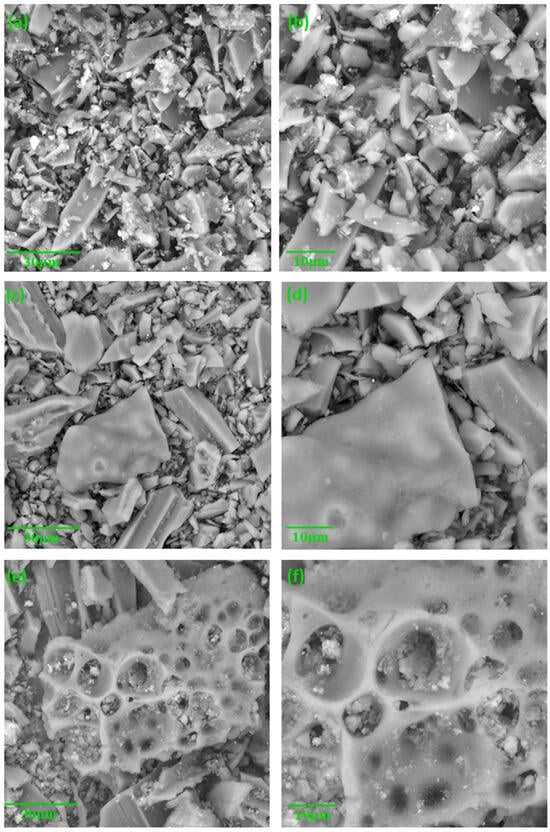
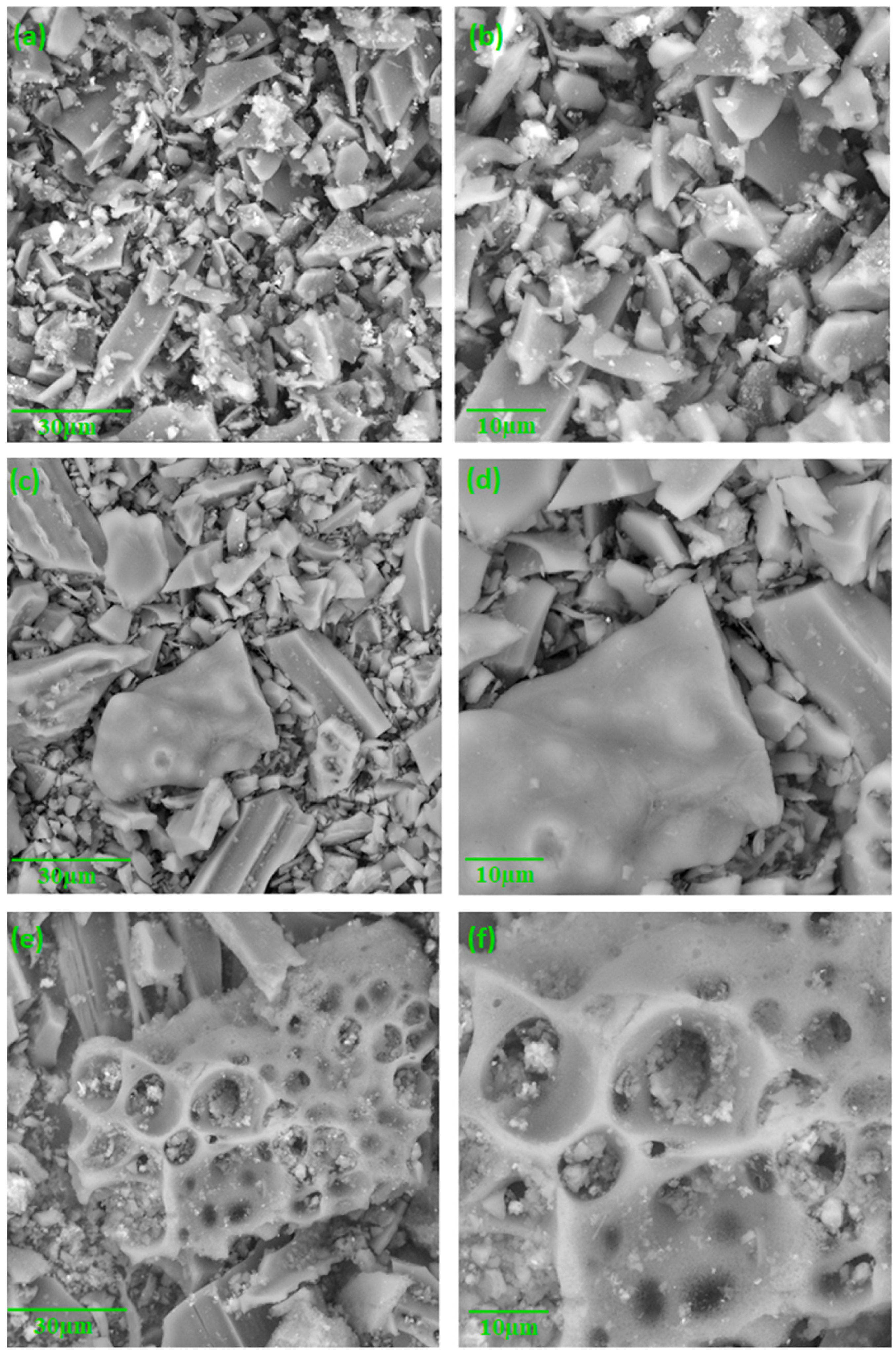
The morphology of the prepared carbon materials was examined by SEM, and representative micrographs are shown in Figure 1. The carbon yields, calculated relative to the initial dry precursor mass, were 16.0% for RL, 14.6% for RL-P, and 11.6% for RL-N. Thus, chemical pretreatment reduced the yield of the final washed and dried carbon material, with the strongest decrease observed for NaOH pretreatment. Clear differences in surface morphology were observed as a function of the pretreatment applied before carbonization. The directly carbonized RL material largely retained the elongated, channel-like architecture of the original wood-derived bedding. Numerous regularly distributed openings and longitudinal structural features remained visible after carbonization, indicating substantial preservation of the precursor morphology during thermal treatment. In contrast, H3PO4-pretreated RL-P showed a more fragmented structure. Although leftovers of the original elongated architecture were still recognizable, the surface contained a greater proportion of fractured and irregular domains, suggesting that acid pretreatment altered the structural organization of the precursor during carbonization. The strongest morphological modification was observed for RL-N. Following NaOH pretreatment, the original elongated architecture was largely lost and replaced by a more irregular, sponge-like structure containing rounded cavities and strongly reorganized surface domains. Therefore, rather than producing a visibly more open version of the original carbon framework, chemical pretreatment progressively disrupted the precursor-derived morphology, with the effect being particularly pronounced after NaOH treatment.
Figure 1.
SEM micrographs of RL (a,b), RL-P (c,d), and RL-N (e,f) recorded at magnifications of 2500× (a,c,e) and 5000× (b,d,f).
The elemental composition of RL, RL-P, and RL-N determined by EDX is summarized in Table 1. Carbon was the predominant element in all three materials, accounting for 82.5–88.7 at.%, confirming the carbon-rich nature of the samples after thermal treatment. The directly carbonized RL material contained 85.1 at.% C and 8.4 at.% O, together with a relatively high nitrogen content of 6.2 at.%. The detected nitrogen most likely originates from urine-derived nitrogen-containing species associated with the spent bedding and retained during carbonization. Chemical pretreatment produced clear changes in the elemental composition. RL-P exhibited the lowest carbon content (82.5 at.%) and the highest oxygen content (15.6 at.%), while 1.3 at.% P remained detectable after carbonization and subsequent washing. The detection of phosphorus in RL-P confirms the retention of phosphorus-containing species after H3PO4 pretreatment, accompanied by an increase in oxygen content relative to untreated RL. In contrast, RL-N contained the highest carbon fraction (88.7 at.%) and an intermediate oxygen content of 10.2 at.%. Only 0.3 at.% Na remained after NaOH pretreatment, carbonization, and the subsequent washing procedure, indicating that most soluble sodium-containing species were removed during purification. The EDX results demonstrate that both pretreatment routes altered the elemental composition of the carbon materials, although in different ways. H3PO4 treatment produced the most pronounced compositional change, particularly through increased oxygen content and retention of phosphorus-containing species, whereas NaOH treatment resulted in a more carbon-rich material with only limited residual sodium. These results confirm that chemical pretreatment modified the elemental composition of the materials.
Table 1.
Elemental composition of RL, RL-P, and RL-N determined by EDX. Values are expressed as atomic percentage (at.%).
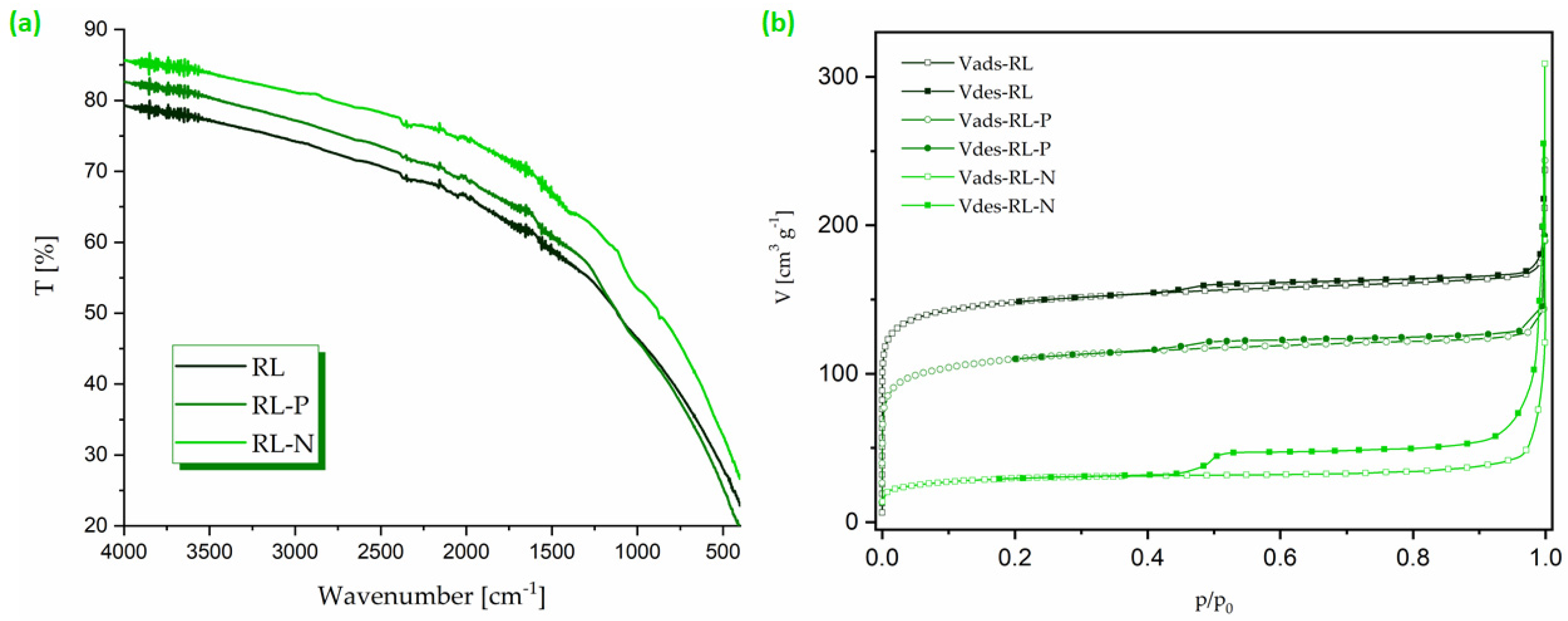
The FTIR spectra of RL, RL-P, and RL-N (Figure 2a) were generally similar and exhibited only weakly defined absorption features, consistent with the highly carbonized nature of the materials obtained at 900 °C [34]. A weak band in the region of approximately 1580–1650 cm−1 can be associated with skeletal vibrations of aromatic C=C structures [35], while the broad features observed in the 1000–1200 cm−1 region may originate from C–O-containing surface functionalities [35]. Some differences in this region were observed following chemical pretreatment. However, no pronounced new vibrations appeared in either RL-P or RL-N. In particular, although EDX analysis confirmed the retention of phosphorus in RL-P and an increased oxygen content, the FTIR spectrum did not show sufficiently resolved features to undoubtedly assign specific phosphorus-containing functional groups. Thus, the FTIR results indicate that all three materials retained a broadly similar carbonaceous surface structure after carbonization, while the chemical pretreatments produced comparatively subtle changes in surface functionality.
Figure 2.
(a) ATR-FTIR spectrum of investigated materials; (b) N2 adsorption–desorption isotherms of RL, RL-P, and RL-N.
Nitrogen adsorption–desorption measurements at 77 K revealed pronounced differences in the textural properties of the investigated carbon materials (Figure 2b and Table 2). The directly carbonized RL material exhibited the most developed porous structure, with a specific surface area of 573 m2 g−1, pore volume determined at p/p0 = 0.98 of 0.263 cm3 g−1, and a micropore volume of 0.227 cm3 g−1. The mesopore volume was comparatively low, amounting to 0.043 cm3 g−1. The adsorption isotherm showed predominantly Type I characteristics, with a steep nitrogen uptake at low relative pressures followed by a comparatively flat region over most of the pressure range, confirming the predominantly microporous nature of the material. A narrow H4-type hysteresis loop was observed at intermediate relative pressures, consistent with a contribution from narrow slit-shaped pores commonly associated with micro-mesoporous carbon materials. The median micropore diameter was 0.56 nm.
Table 2.
Textural properties of prepared carbon materials.
H3PO4 pretreatment did not promote further development of the porous structure. RL-P retained an isotherm shape broadly similar to that of RL and remained predominantly microporous. However, its specific surface area decreased to 419 m2 g−1, while the pore volume determined at p/p0 = 0.98 and the micropore volume decreased to 0.204 and 0.168 cm3 g−1, respectively. The mesopore volume remained low at 0.041 cm3 g−1, very close to that of RL. Compared with direct carbonization, H3PO4 pretreatment resulted in approximately a 27% decrease in specific surface area and a 26% decrease in micropore volume. The isotherm retained predominantly Type I characteristics, accompanied by a narrow H4-type hysteresis loop at intermediate relative pressures. The median micropore diameter remained nearly unchanged at 0.59 nm, indicating that acid pretreatment primarily reduced the extent of accessible microporosity rather than substantially altering the characteristic micropore size.
A considerably stronger effect was observed following NaOH pretreatment. The specific surface area of RL-N decreased to 109 m2 g−1, while the micropore volumes decreased to 0.044 cm3 g−1, corresponding to reductions of approximately 81% relative to RL. The mesopore volume also decreased to 0.027 cm3 g−1, indicating that the more pronounced contribution of wider pores in RL-N reflects not an absolute increase in mesopore volume, but a substantial loss of microporosity. The isotherm exhibited a much more pronounced hysteresis loop with a somewhat different shape compared with those of RL and RL-P. At intermediate relative pressures, the loop retained H4-like characteristics. At higher relative pressures, the strong increase in adsorption above p/p0 = 0.9 showed H3-like behavior, commonly associated with systems containing large pores and interparticle voids, some of which may span a broad range of macropore sizes. This interpretation is also consistent with the large voids observed in the SEM micrographs. The pore volume determined at p/p0 = 0.98 was 0.096 cm3 g−1. However, because adsorption continued to increase markedly above this relative pressure, this value should not be regarded as a reliable estimate of the total pore volume. The median micropore diameter increased only slightly to 0.65 nm, suggesting that NaOH pretreatment primarily suppressed the development and/or accessibility of microporosity rather than substantially changing the characteristic size of the remaining micropores.
The comparison of the three materials therefore shows that neither chemical pretreatment improved the textural properties generated by direct carbonization under the applied conditions. H3PO4 caused a moderate reduction in accessible porosity while largely preserving the original pore architecture, whereas NaOH produced a much more pronounced loss of microporosity accompanied by a greater relative contribution of macropores and large interparticle voids. These findings demonstrate that additional chemical processing is not inherently beneficial for pore development in this precursor. Under the applied carbonization conditions, the untreated biomass was itself capable of generating a highly microporous carbon with a substantially greater N2-accessible surface area than either chemically pretreated material.
3.2. Adsorption Kinetics
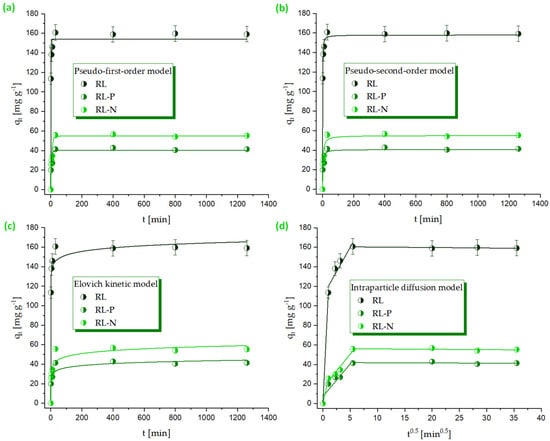
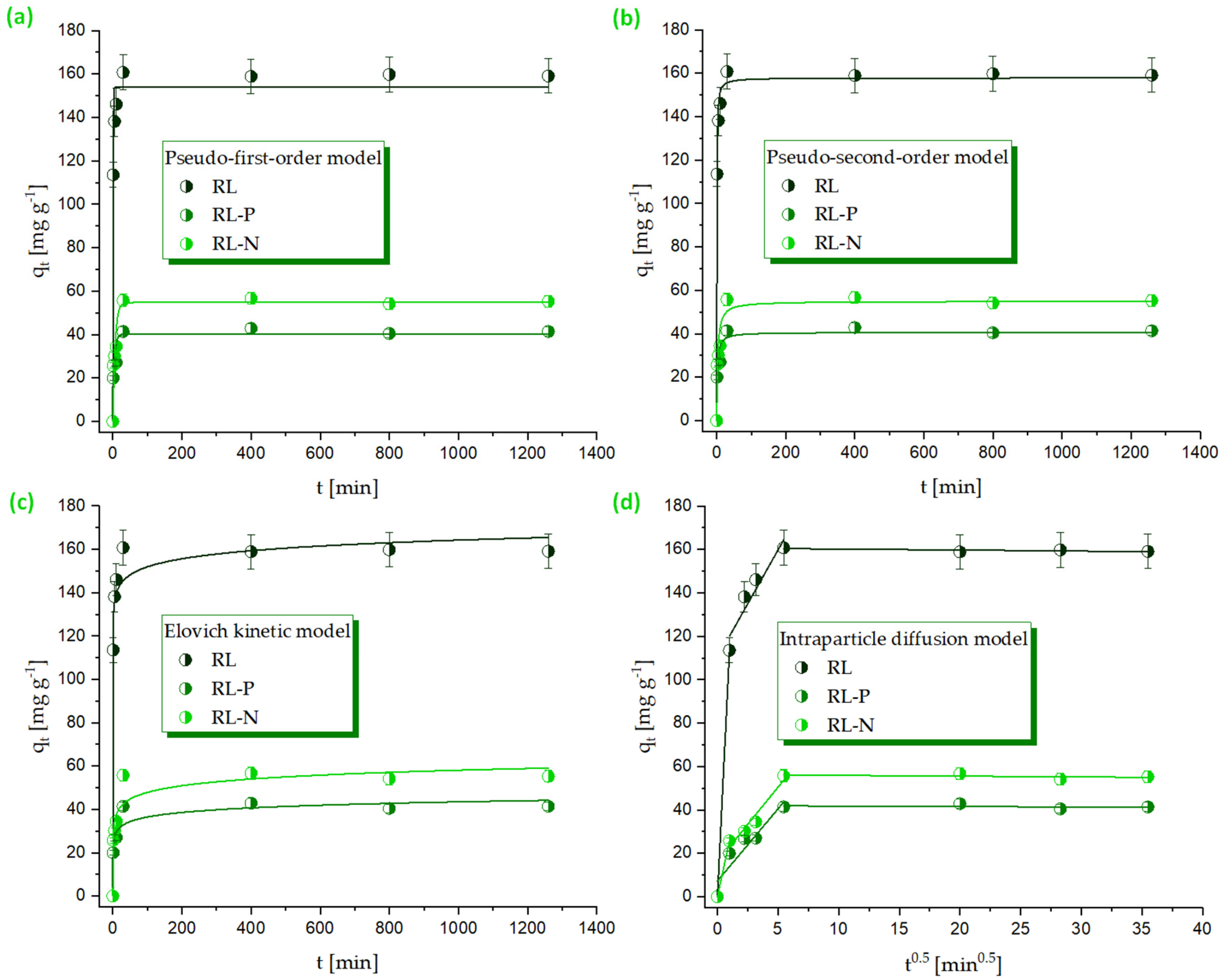
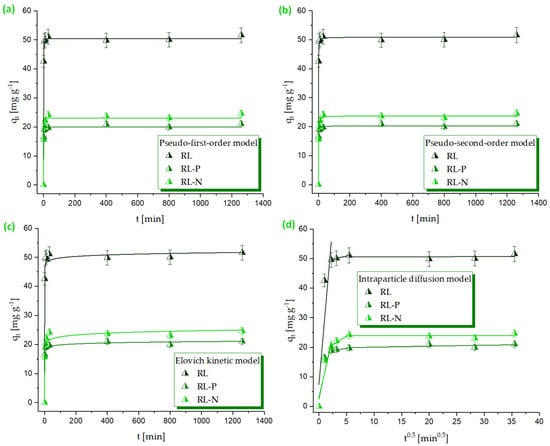
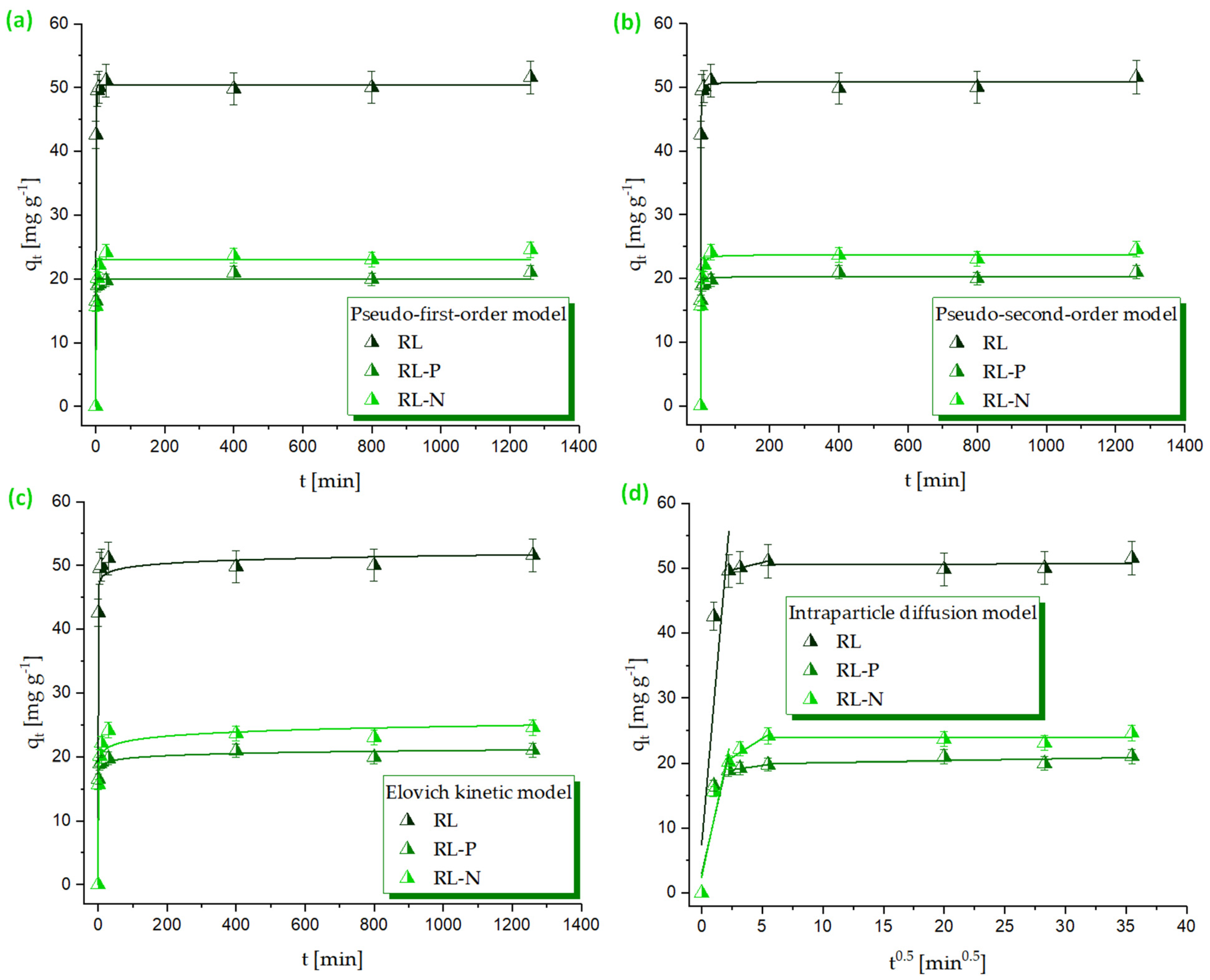
The adsorption kinetics of CHP and DMT onto RL, RL-P, and RL-N at 25 °C are presented in Figure 3 and Figure 4, while the corresponding parameters obtained using PFO, PSO, Elovich, and intraparticle diffusion models are summarized in Table 3. For all investigated systems, adsorption was characterized by a rapid initial uptake followed by an early plateau, with equilibrium being reached within approximately 30 min.
Figure 3.
Kinetic profiles and model fitting for CHP adsorption onto RL, RL-P, and RL-N: (a) pseudo-first-order, (b) pseudo-second-order, (c) Elovich, and (d) intraparticle diffusion model.
Figure 4.
Kinetic profiles and model fitting for DMT adsorption onto RL, RL-P, and RL-N: (a) pseudo-first-order, (b) pseudo-second-order, (c) Elovich, and (d) intraparticle diffusion model.
Table 3.
Kinetic parameters for CHP and DMT adsorption onto RL, RL-P, and RL-N.
Among the investigated kinetic models, the PSO model provided the best overall description of the experimental data, as indicated by the generally higher R2 values and lower χ2 values compared with the PFO model. The PSO rate constants indicate faster adsorption of DMT than CHP for all three materials. Better agreement with the PSO model indicates that this kinetic expression better describes the rapid initial uptake and subsequent approach to equilibrium. However, the PSO model’s superior fit alone should not be interpreted as evidence of a specific adsorption mechanism.
The k2 values for DMT were 0.104, 0.205, and 0.075 g mg−1 min−1 for RL, RL-P, and RL-N, respectively, compared with 0.015, 0.013, and 0.006 g mg−1 min−1 for CHP. This behavior may be associated with the smaller molecular size and greater conformational flexibility of DMT, which can facilitate transport through accessible regions of the porous carbon structure. In contrast, the bulkier and more hydrophobic CHP molecule may experience greater transport limitations within the pore network. The higher k2 value for DMT adsorption on RL-P, despite its lower surface area and micropore volume than RL, suggests that surface chemistry may also contribute to the adsorption kinetics. The higher oxygen content and phosphorus content in RL-P may promote stronger specific interactions with the more polar DMT molecule. Because the PSO rate constant k2 is coupled to the equilibrium adsorption capacity qe, the initial adsorption rate, h = k2qe2, was also considered. For DMT, h decreased in the order RL (269 mg g−1 min−1) > RL-P (84.5 mg g−1 min−1) > RL-N (42.1 mg g−1 min−1), whereas for CHP the corresponding values were 374, 21.4, and 18.2 mg g−1 min−1. Thus, despite the higher k2 value obtained for DMT adsorption on RL-P, the initial adsorption rate was highest for RL. This indicates that direct comparison of k2 values alone may be misleading when the fitted equilibrium capacities differ substantially among the adsorbents.
The Elovich model also provided a satisfactory description of the adsorption kinetics. The model is commonly associated with adsorption on energetically heterogeneous surfaces, which is consistent with the structural and compositional heterogeneity of the investigated biomass-derived carbons [36]. The very high α values obtained, particularly for RL, indicate an extremely rapid initial uptake, in agreement with the steep adsorption profiles observed experimentally. However, given the large variation in the fitted α values among the systems, the Elovich parameters were interpreted qualitatively rather than as direct mechanistic descriptors of the adsorption process.
The intraparticle diffusion plots exhibited changes in slope during the adsorption process, indicating that pesticide uptake cannot be described by a single kinetic regime. The initial steep region corresponds to rapid adsorption at short contact times, whereas the subsequent decrease in slope reflects a slower approach to equilibrium as the readily accessible adsorption sites become progressively occupied. The number and quality of the apparent linear regions differed among the investigated systems. In several cases, the intercepts deviated from zero, indicating that intraparticle diffusion was not the sole rate-controlling step. At longer contact times, the slopes approached zero, and the quality of the linear fits decreased markedly, consistent with the establishment of adsorption equilibrium. Therefore, the intraparticle diffusion analysis was interpreted qualitatively as evidence of a multistep uptake process rather than as proof of distinct transport mechanisms.
3.3. Adsorption Isotherms
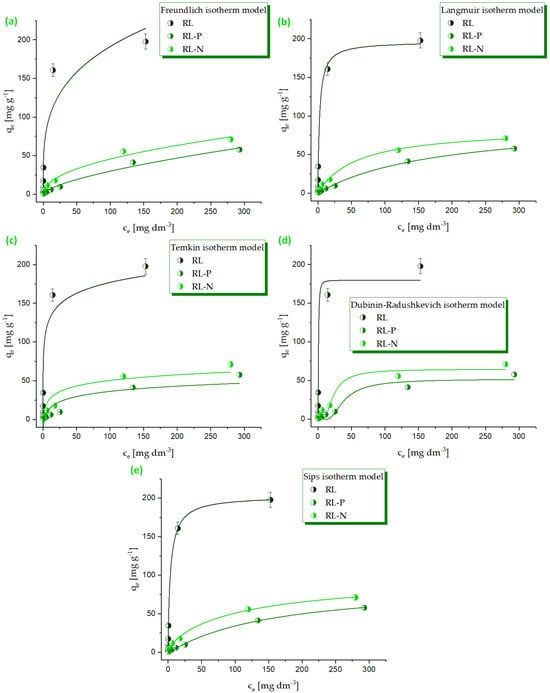
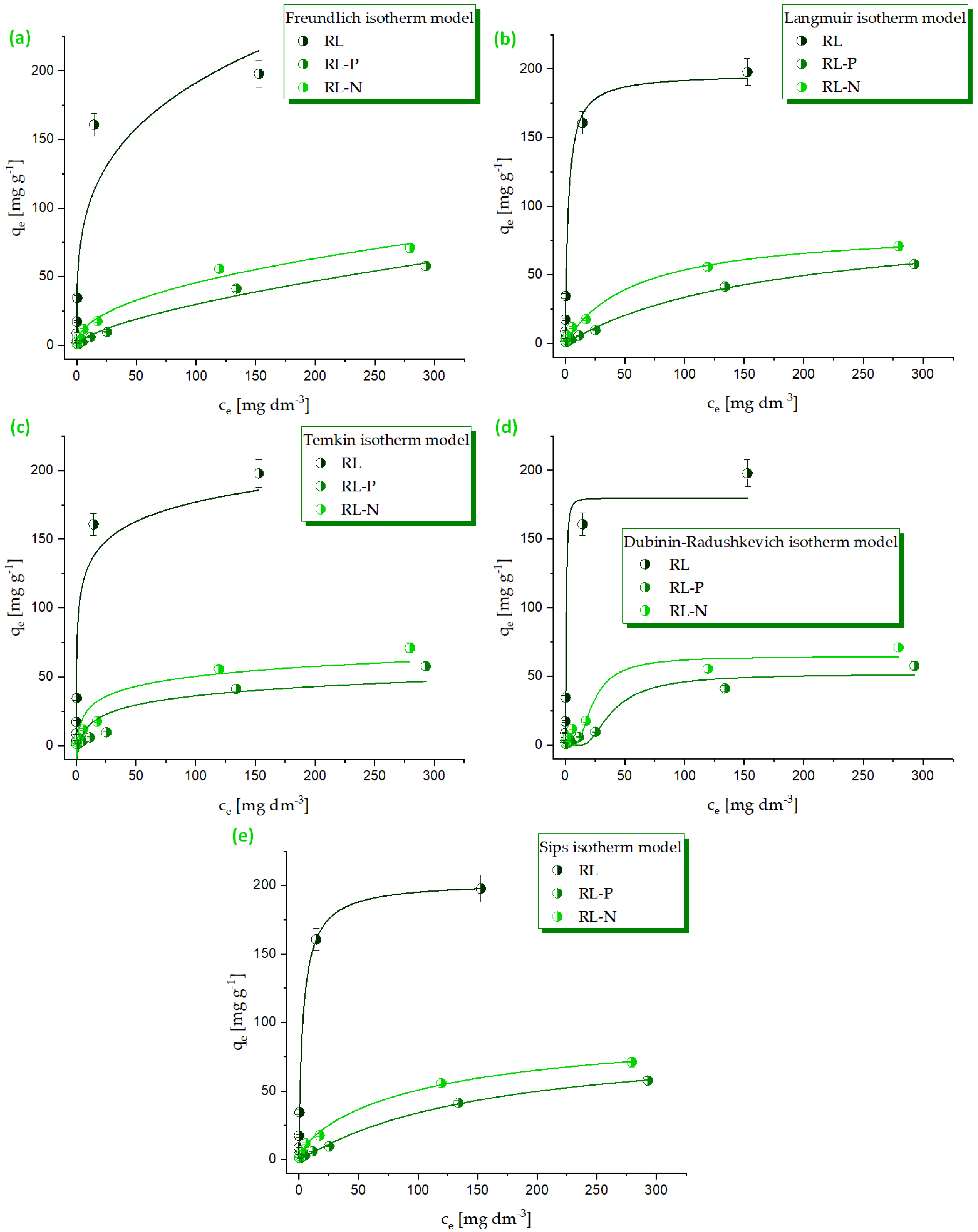
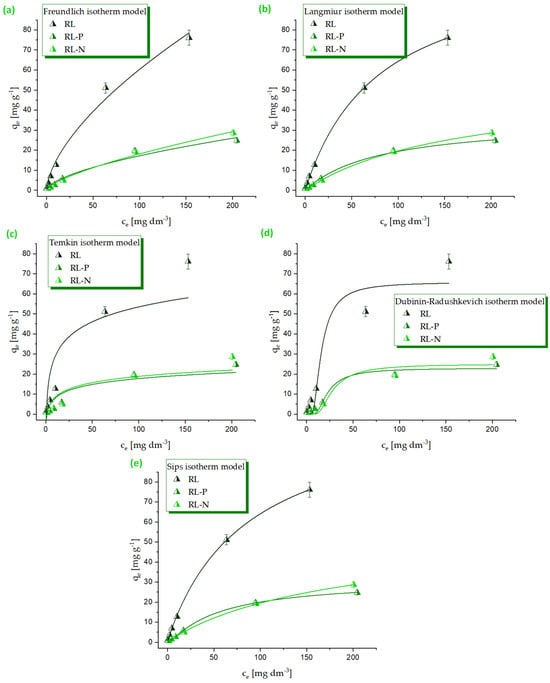
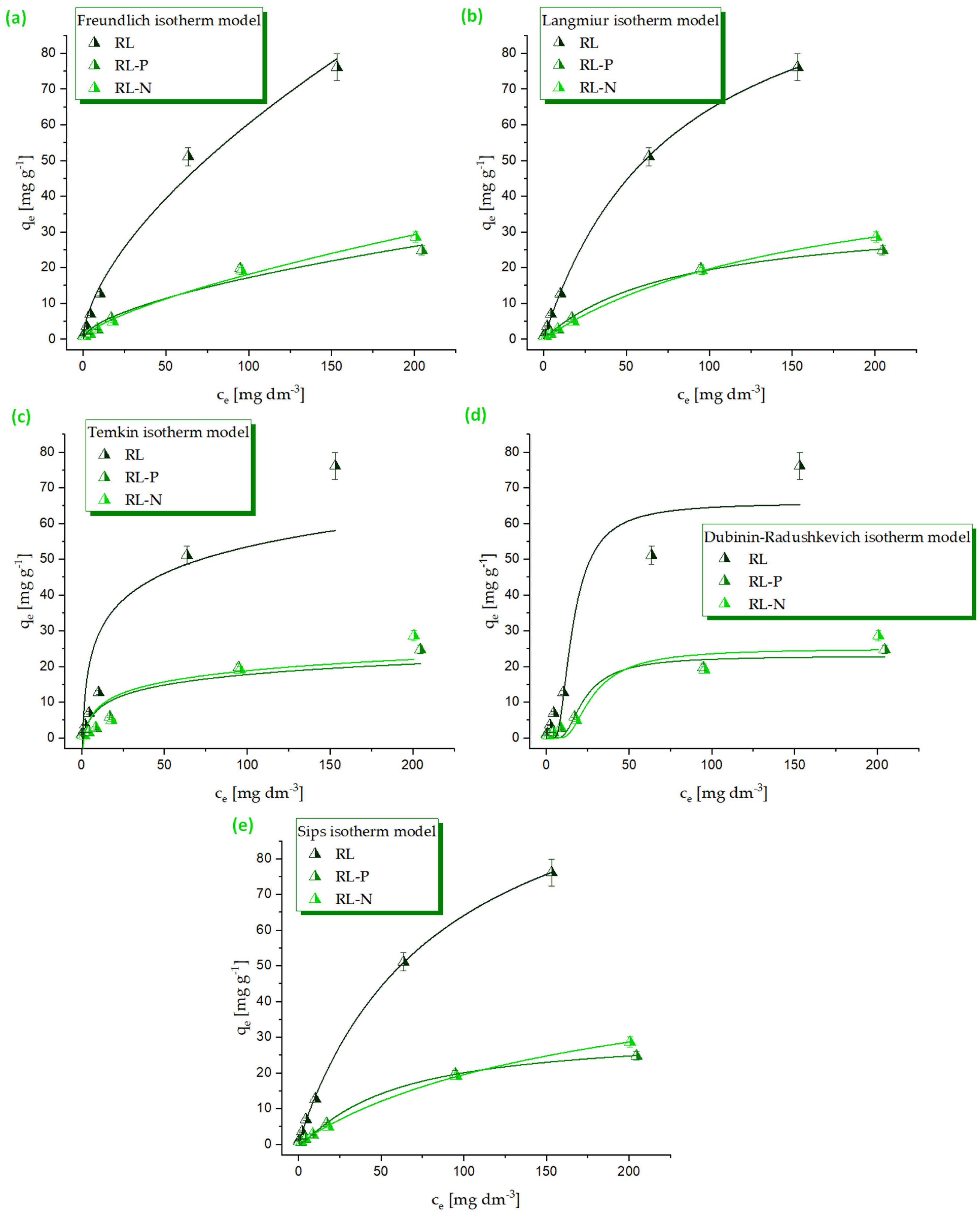
The equilibrium adsorption isotherms of CHP and DMT onto RL, RL-P, and RL-N at 25 °C are presented in Figure 5 and Figure 6, while the corresponding parameters obtained using the nonlinear Freundlich, Langmuir, Temkin, Dubinin–Radushkevich, and Sips models are summarized in Table 4.
Figure 5.
Equilibrium adsorption isotherms and nonlinear model fitting for CHP adsorption onto RL, RL-P, and RL-N: (a) Freundlich, (b) Langmuir, (c) Temkin, (d) Dubinin–Radushkevich, and (e) Sips model.
Figure 6.
Equilibrium adsorption isotherms and nonlinear model fitting for DMT adsorption onto RL, RL-P, and RL-N: (a) Freundlich, (b) Langmuir, (c) Temkin, (d) Dubinin–Radushkevich, and (e) Sips model.
Table 4.
Isotherm parameters for CHP and DMT adsorption onto RL, RL-P, and RL-N at 25 °C obtained using the Freundlich, Langmuir, Temkin, Dubinin–Radushkevich, and Sips models.
The Langmuir and Sips models provided the best overall description of the experimental equilibrium data, while the Freundlich model also showed satisfactory agreement for most systems. In contrast, the Temkin model consistently exhibited the poorest fit, whereas the Dubinin–Radushkevich model provided a less satisfactory but still acceptable description of several adsorption systems. The good performance of the Langmuir model suggests that the equilibrium data can be reasonably approximated by monolayer adsorption on a finite population of adsorption sites, whereas the satisfactory fit of the Freundlich model indicates the presence of surface heterogeneity [37,38]. The best overall agreement obtained with the Sips model further supports the conclusion that the investigated carbon materials do not behave as ideally homogeneous adsorbents, but rather combine features of both homogeneous and heterogeneous adsorption surfaces [38]. The Sips heterogeneity parameter should be regarded as an adsorbate-dependent measure of the effective energetic heterogeneity of the accessible adsorption sites. For DMT adsorption on RL and RL-N, bs values close to unity indicate nearly Langmuir-like behavior, whereas the substantially lower bs values obtained for CHP on the same adsorbents point to a more heterogeneous adsorption environment.
The equilibrium data clearly show that the directly carbonized RL material exhibited the highest adsorption capacity for both pesticides. According to the Langmuir model, the maximum adsorption capacities of RL were 197 ± 1 mg g−1 for CHP and 116 ± 1 mg g−1 for DMT, while the corresponding Sips capacities were 203 ± 1 and 119 ± 1 mg g−1, respectively. In contrast, both chemically pretreated materials exhibited substantially lower capacities. For CHP, the Langmuir capacities of RL-P and RL-N were 93.8 ± 0.1 and 84.7 ± 0.4 mg g−1, respectively, while the Sips model gave 89.1 ± 0.2 and 98.3 ± 0.2 mg g−1. For DMT, the Langmuir capacities of RL-P and RL-N were 35.3 ± 0.1 and 52.2 ± 0.2 mg g−1, respectively, while the Sips capacities were 31.7 ± 0.1 and 55.2 ± 0.2 mg g−1. Thus, irrespective of the model used, direct carbonization produced the most effective adsorbent, whereas both H3PO4 and NaOH pretreatments reduced adsorption performance. The relative performance of RL-P and RL-N depended on the adsorbate and model considered, but neither pretreatment provided an advantage over untreated RL. When the Langmuir adsorption capacities were normalized to the mass of the starting rabbit-litter precursor by taking the corresponding carbon yields into account, the CHP capacities were 31.5, 13.7, and 9.83 mg g−1 precursor for RL, RL-P, and RL-N, respectively. For DMT, the corresponding values were 18.6, 5.15, and 6.06 mg g−1 precursor. Thus, the advantage of direct carbonization became even more pronounced when both carbon yield and adsorption capacity were considered.
The adsorption performance of RL compares favorably with previously reported carbon-based adsorbents for organophosphate pesticides. For chlorpyrifos, cellulose-derived activated carbon fibers with substantially developed porosity showed maximum Sips capacities of approximately 81–132 mg g−1 [39], while activated carbon derived from prickly pear seeds reached approximately 35 mg g−1 [40] and cashew-nut-shell biochar approximately 31 mg g−1 [41]. The Langmuir capacity of 197 mg g−1 obtained for RL in the present study therefore demonstrates that substantial CHP adsorption can be achieved without additional chemical pretreatment. For DMT, reported adsorption capacities vary particularly widely among carbonaceous adsorbents, from only a few mg g−1 for some agricultural-waste-derived biochars [42] to considerably higher values for highly porous or chemically modified carbons [43]. Such comparisons should, however, be interpreted cautiously because reported adsorption capacities depend strongly on adsorbent dose, concentration range, solution composition, and fitting procedure [44].
The adsorption trends presented in this paper are consistent with the textural properties discussed above. RL possessed the highest specific surface area, total pore volume, and micropore volume, reflecting the most extensively developed porous structure among the investigated materials. H3PO4 pretreatment preserved the predominantly microporous character of the material but reduced the overall extent of pore development, which was accompanied by a clear decrease in adsorption capacity. The effect of NaOH pretreatment was even more pronounced, as it substantially suppressed micropore development and shifted the pore structure toward a greater relative contribution of wider pores. The lower adsorption capacities of RL-P and RL-N therefore indicate that the changes in pore architecture induced by chemical pretreatment, despite the accompanying changes in elemental composition, did not provide an adsorption advantage over the directly carbonized material. It should also be noted that adsorption was evaluated at the intrinsic pH of each material suspension rather than at an externally adjusted common pH. Therefore, the initial pH values may have contributed to the observed differences in adsorption behavior together with the pronounced differences in pore structure and surface chemistry. Systematic separation of these effects would require dedicated pH-dependent adsorption experiments and remains a subject for future investigation. The use of unadjusted conditions was intentional, as the present study aimed to evaluate the materials without an additional chemical-conditioning step and thereby maintain consistency with the process-simplification concept underlying the comparison of direct and chemically pretreated carbonization routes.
Comparison of the two pesticides further highlights the important role of molecular structure in determining equilibrium adsorption. Although DMT adsorbed more rapidly, as shown by the kinetic study, CHP consistently exhibited substantially higher equilibrium adsorption capacities on all three materials. This difference indicates that adsorption rate and adsorption capacity are governed by different factors. The smaller and more flexible DMT molecule can reach equilibrium rapidly, whereas the more hydrophobic aromatic CHP molecule appears to establish stronger adsorbate–surface interactions once adsorption equilibrium is achieved. In particular, hydrophobic interactions and possible π-π interactions between the aromatic moieties of CHP and the carbon surface likely contribute to its higher adsorption capacity. The difference between CHP and DMT was especially pronounced for RL and RL-P, while it became smaller for RL-N, suggesting that the substantial changes in pore architecture induced by NaOH pretreatment reduced the availability of adsorption domains accessible to CHP.
Additional support for favorable adsorption is provided by the Freundlich constants, since all n values were greater than 1. The Sips heterogeneity factor, bs, was close to 1 for several systems, indicating adsorption behavior approaching the Langmuir model, whereas deviations from 1 reflect the energetic heterogeneity expected for biomass-derived carbons [45]. The Sips model similarly described the equilibrium data as well as the Langmuir model for most investigated systems. For RL and RL-N, the Sips heterogeneity parameter bs was below or close to unity, indicating different degrees of deviation from ideal Langmuir behavior. In contrast, bs values slightly above unity were obtained for CHP adsorption on RL-P (1.10), while a more pronounced deviation was observed for DMT adsorption on RL-P (bs = 1.44). The latter system also showed a noticeable improvement of the Sips fit compared with the Langmuir model, suggesting that the additional flexibility of the Sips equation better describes the shape of the experimental isotherm. The occurrence of bs > 1 for RL-P should not be interpreted in terms of conventional surface heterogeneity, but may indicate more complex adsorption behavior associated with the altered surface chemistry of the H3PO4-treated material.
The Dubinin–Radushkevich model also provided a satisfactory description of the equilibrium data, although its fit was generally lower than that of the Langmuir and Sips models. The calculated mean adsorption energies, E, ranged from approximately 0.05 to 1.53 kJ mol−1. These values are reported as derived parameters but were not used for mechanistic interpretation. The isotherm analysis indicates that adsorption performance depended on the combined effects of pore architecture and adsorbent heterogeneity rather than on the presence of wider pores or any single textural parameter alone. Most importantly, the equilibrium results confirm the central finding of this study: under the applied carbonization conditions, chemical pretreatment did not improve the adsorption properties of the rabbit-litter-derived carbon, whereas direct carbonization produced the most effective adsorbent for both CHP and DMT.
Comparison of the two pesticides further highlights the role of molecular structure in adsorption. Although the adsorption capacities expressed on a mass basis were consistently higher for CHP, this difference became considerably smaller when the capacities were expressed on a molar basis, owing to the higher molecular mass of CHP. For RL and RL-N, the molar capacities of CHP and DMT were relatively similar, whereas a substantially higher CHP capacity was retained for RL-P. This indicates that differences in adsorption capacity cannot be attributed solely to molecular size or molecular mass and suggests a stronger adsorbate–surface specificity for RL-P.
3.4. Regeneration and Reusability
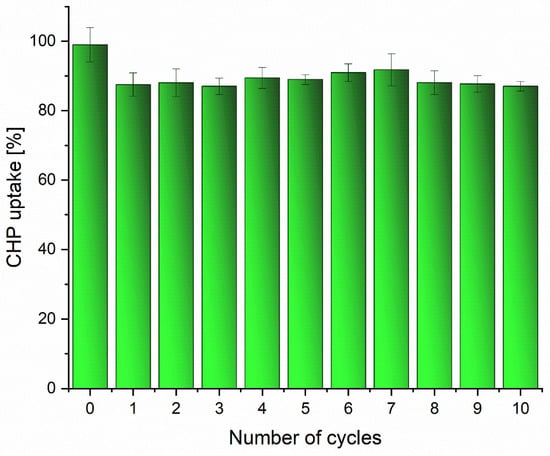
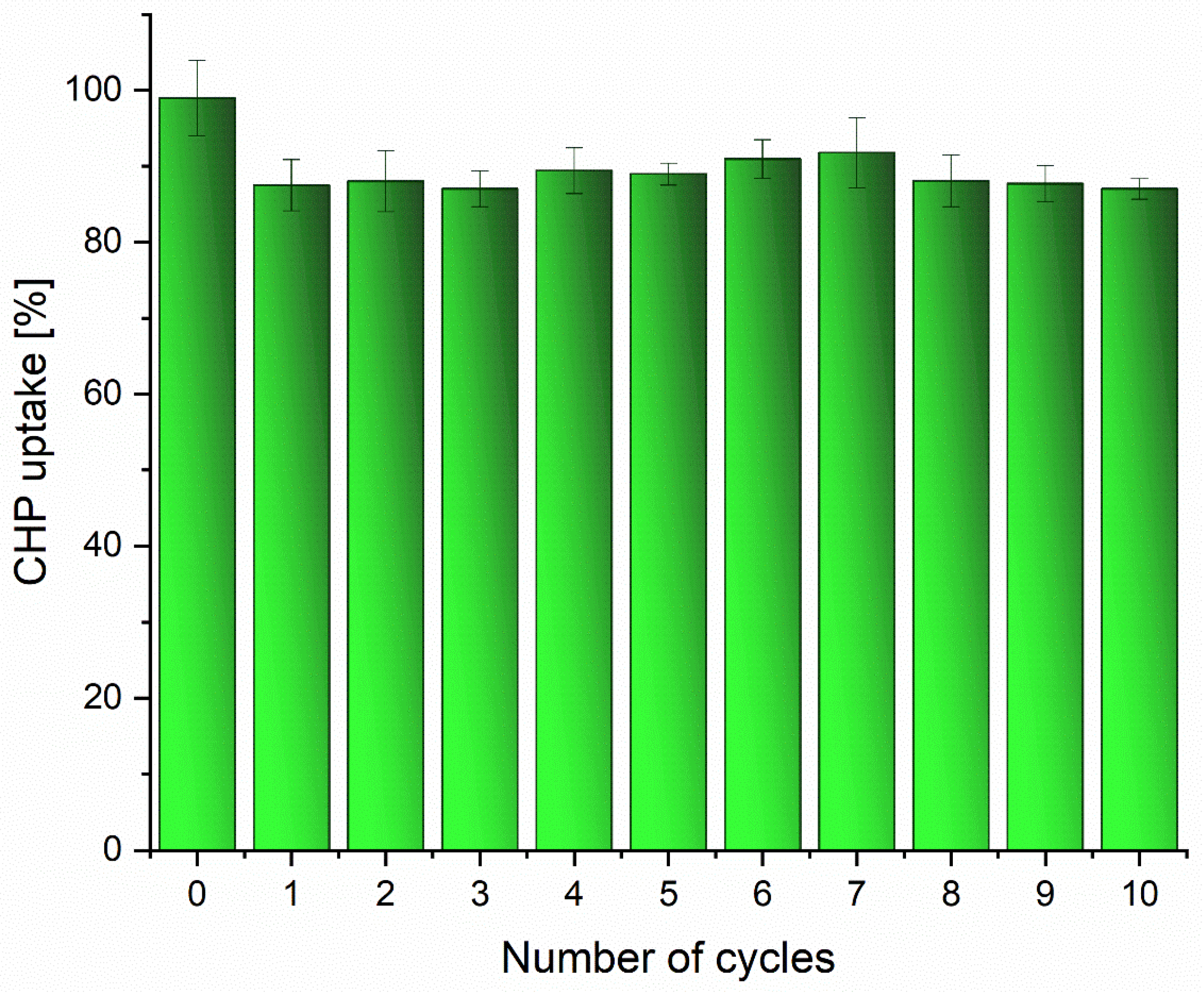
Following the equilibrium and kinetic evaluation, RL was selected for the regeneration study because it exhibited the highest adsorption performance among the investigated materials, while CHP was selected as the target adsorbate because the RL-CHP system showed the highest overall adsorption capacity. The reusability of RL was therefore evaluated over ten consecutive adsorption–regeneration cycles under dynamic filtration conditions (Figure 7).
Figure 7.
CHP removal by the RL-containing filtration system during the initial adsorption experiment (cycle 0) and ten consecutive adsorption–regeneration cycles.
The RL-containing filtration system removed almost the entire amount of CHP during the initial filtration cycle. A moderate decrease in CHP uptake was observed after the first regeneration with 96% ethanol. Importantly, however, no progressive deterioration of adsorption performance occurred during subsequent reuse. From the first to the tenth regeneration cycle, the RL-containing filtration system maintained CHP removal within a relatively narrow range of approximately 87–92%, with only minor cycle-to-cycle variations. Thus, after the initial decrease, the adsorption performance remained essentially stable throughout repeated use. The stability observed over ten cycles indicates that the RL-containing filtration system maintained a high CHP removal performance following repeated ethanol regeneration. Moreover, regeneration was performed directly within the filter without intermediate recovery, washing, or drying of the adsorbent, thereby minimizing handling-related material loss. These results demonstrate that the RL-containing filtration system maintained a high and relatively stable CHP removal performance during repeated dynamic use under the applied regeneration conditions.
3.5. Biological Evaluation
The genotoxic and cytotoxic effects of RL were evaluated in human peripheral blood lymphocytes by monitoring MN incidence and CBPI (Table 5). Control cultures exhibited an MN incidence of 12.64 ± 0.44 MN/1000 binucleated cells and a CBPI of 1.84 ± 0.01. In cultures treated with RL at 1 and 10 μg mL−1, MN incidences were 13.07 ± 0.39 and 13.78 ± 0.67 MN/1000 binucleated cells, respectively, while the corresponding CBPI values were 1.83 ± 0.01 and 1.81 ± 0.01. Statistical analysis showed that neither MN incidence nor CBPI differed significantly between RL-treated cultures and the control (p > 0.05), indicating that RL at the tested concentrations did not significantly increase chromosomal damage or affect lymphocyte proliferation. Further analysis of cytotoxic/cytostatic effects showed that RL-induced cytotoxicity at 1 and 10 μg mL−1 was (1.19 ± 1.19)% and (3.97 ± 1.37)%, respectively, with cell viability remaining above 96%. Overall, these results indicate that RL did not show genotoxic or cytotoxic effects on human peripheral blood lymphocytes under the tested experimental conditions.
Table 5.
Incidence of micronuclei (MN) and cytokinesis-block proliferation index (CBPI) in lymphocyte cultures treated with carbon materials.
The biological relevance of CHP removal by RL was further evaluated by measuring AChE inhibition. The initial CHP solution (5 × 10⁻⁵ mol dm−3) inhibited AChE activity by 92 ± 3%. Following 1 min of contact with RL, the inhibitory effect decreased markedly to only 3 ± 1%. This pronounced reduction demonstrates that the decrease in CHP concentration achieved by adsorption was accompanied by an almost complete loss of its AChE-inhibitory effect in the treated solution. CHP-oxon was not detected in the treated solution by UPLC-PDA analysis using an authentic CHP-oxon standard. The AChE assay was therefore interpreted as a functional measure of the inhibitory activity of the solution before and after treatment, rather than as a method for identifying individual transformation products.
3.6. Preliminary Economic, Environmental, and Circularity Assessment
A preliminary screening assessment was performed to compare repeated single use of freshly prepared RL with the experimentally demonstrated regeneration–reuse strategy over eleven consecutive treatment operations. The analysis was intended to identify major economic, environmental, and circularity trends under laboratory-scale conditions rather than to represent a full lifecycle assessment. Rabbit litter was treated as a waste-derived precursor without upstream environmental burden, while drying before carbonization and after washing was performed at room temperature and therefore required no additional energy input. Production of 0.8 g RL from 5 g of dry precursor corresponded to a carbon yield of 16%. Heating from room temperature to 900 °C at 5 °C min−1, followed by 60 min at 900 °C, required approximately 3.92 h of furnace operation. With a furnace power of 1.5 kW, the electricity consumption was approximately 5.88 kWh per batch. Nitrogen was supplied at 100 L h−1, corresponding to approximately 392 L per batch. Electricity and nitrogen requirements were subsequently allocated proportionally to the amount of RL used in each scenario. This proportional allocation from the experimentally produced 0.8 g laboratory batch represents an accounting assumption for scenario comparison and does not correspond to measured energy or nitrogen consumption for producing 1 or 11 mg of RL individually. Based on an industrial electricity price of approximately 0.102 EUR kWh−1, a nitrogen-cylinder cost of approximately 25.5 EUR per 50 L/200 bar cylinder, and a bulk ethanol price of approximately 0.425 EUR L−1, the principal economic indicators for the two scenarios are summarized in Table 6.
Table 6.
Preliminary economic, environmental, and circularity indicators for single-use and reuse scenarios of RL under laboratory-scale conditions.
Repeated regeneration decreased the requirement for freshly produced RL by approximately 90.9%. The estimated direct cost of producing 11 mg of fresh RL for eleven single-use treatments was approximately 0.0220 EUR, whereas production of 1 mg RL together with 50 mL of 96% ethanol for ten regeneration steps resulted in an estimated cost of approximately 0.0233 EUR. Because CHP removal during the regenerated cycles was slightly lower than during the initial treatment, the scenarios were also compared on the basis of the cumulative mass of CHP actually removed. Assuming that each fresh-RL treatment achieves the removal observed in cycle 0 (98.8%), eleven single-use operations would remove approximately 0.1905 mg CHP. Based on the experimentally measured removal efficiencies for cycles 0–10, the reuse scenario removed approximately 0.1727 mg CHP. The corresponding direct costs were approximately 0.115 and 0.135 EUR mg−1 CHP removed for the single-use and reuse scenarios, respectively.
The assessment included only the principal quantified inputs and should therefore be regarded as a screening-level comparison rather than a complete cost analysis. Water, washing reagents, filter costs, and downstream ethanol disposal or recovery were not quantified. Given the small absolute difference between the estimated direct costs of the two scenarios, inclusion of these terms could alter their relative economic ranking; therefore, no definitive economic advantage is assigned to either scenario. A screening climate-change assessment was also performed. A lifecycle carbon intensity of approximately 0.696 kg CO2-eq kWh−1 was used for Serbian electricity [46]. Furnace operation therefore contributed approximately 4.09 kg CO2-eq per 0.8 g RL batch. The contribution of nitrogen was substantially smaller. Using a reported value of 0.0755 kg CO2-eq kg−1 N2 resulted in approximately 0.037 kg CO2-eq per batch [47]. The resulting laboratory-scale burden of RL production was approximately 5.2 g CO2-eq per mg RL. This relatively high mass-normalized value reflects the small experimental batch and should not be directly extrapolated to larger-scale production. For eleven single-use treatments, production of 11 mg fresh RL corresponds to an estimated climate-change burden of approximately 0.057 kg CO2-eq. In the reuse scenario, production of 1 mg RL contributes approximately 0.005 kg CO2-eq, while ethanol becomes the dominant additional input. Reported JRC values for different ethanol production pathways span a relatively broad range, corresponding approximately to 0.54–1.35 kg CO2-eq kg−1 ethanol [48]. Applying this range to the amount of ethanol used for ten regeneration cycles gives a total estimated burden of approximately 0.026–0.057 kg CO2-eq for the reuse scenario. Depending on the ethanol production pathway, regeneration could therefore reduce the estimated climate-change burden by up to approximately 54%, whereas for ethanol with a comparatively high carbon footprint the two scenarios would be essentially equivalent. The environmental advantage of regeneration is therefore strongly dependent on solvent production and management, identifying ethanol recovery and recycling as a particularly important target for further optimization. When normalized to the cumulative mass of CHP removed, the estimated climate-change burden was approximately 0.299 kg CO2-eq mg−1 CHP for the single-use scenario and 0.151–0.330 kg CO2-eq mg−1 CHP for the reuse scenario, depending on the assumed ethanol production pathway.
An additional circularity benefit was demonstrated by the recovery of adsorbed CHP. During dynamic filtration, approximately 96.0% of the initially introduced CHP was retained by the RL-containing filtration system. Subsequent regeneration with 96% ethanol recovered approximately 98.3% of the retained CHP. The initial CHP solution, the filtrate after adsorption, and the ethanol regeneration eluate were analyzed by UPLC-PDA. The CHP peak detected in the regeneration eluate exhibited the same retention time (2.6 ± 0.1 min) and comparable PDA spectral characteristics as the initial CHP (Supplementary data, Figure S1). No peak corresponding to CHP-oxon was observed based on comparison with an authentic CHP-oxon standard. These results indicate that the regeneration eluate contained predominantly unchanged CHP under the applied experimental and analytical conditions.
The preliminary assessment shows that repeated RL regeneration provides a substantial reduction in fresh adsorbent consumption while maintaining an economic cost very close to that of repeated single use. In contrast to the economic comparison, the environmental outcome is more sensitive to the assumed ethanol production pathway: regeneration can provide a considerable reduction in climate-change impact when lower-impact ethanol is used, whereas the advantage becomes negligible for ethanol with a higher production footprint. Therefore, reduction of solvent volume and eventual ethanol recovery represent the most important opportunities for further improvement.
4. Conclusions
This study demonstrates that chemical pretreatment does not necessarily improve the structural or adsorption properties of waste-derived carbon materials. When the same spent rabbit-litter precursor was carbonized at 900 °C, direct carbonization produced the most developed porous structure, with a specific surface area of 573 m2 g−1 and the highest micropore volume. H3PO4 pretreatment moderately reduced pore development, whereas NaOH pretreatment caused a pronounced loss of microporosity and increased the relative contribution of macropores. These structural changes were accompanied by lower adsorption performance of both chemically pretreated materials. RL consistently exhibited the highest equilibrium adsorption capacities for CHP and DMT, reaching Langmuir capacities of 197 and 116 mg g−1, respectively. The practical performance of the RL-containing filtration system was further supported by CHP removal remaining at approximately 87–92% over ten regeneration cycles following the initial adsorption step. CHP removal was also accompanied by a pronounced reduction in AChE inhibition, from 92 ± 3% before treatment to 3 ± 1% after contact with RL. Biological assessment of RL also showed no significant genotoxic or cytotoxic effects under the tested conditions, supporting its potential environmental applicability. Ethanol regeneration enabled recovery of approximately 98.3% of the adsorbed CHP, with the recovered CHP showing retention time and PDA spectral characteristics comparable to those of the initial compound. The preliminary sustainability assessment further showed that reuse reduced fresh RL demand by approximately 91%, while its direct cost was comparable to repeated single use. The environmental benefit was more dependent on the assumed ethanol production pathway, identifying solvent reduction and recycling as important targets for further optimization. The results indicate that, under the investigated conditions, additional chemical pretreatment was not justified by a corresponding functional advantage. Direct carbonization therefore represents the simpler and more effective processing route for this precursor, while regeneration and pollutant recovery provide additional opportunities for developing a more circular treatment process.
Supplementary Materials
The following supporting information can be downloaded at https://www.mdpi.com/article/10.3390/pr14203359/s1, Figure S1: (a) Chromatogram of CHP before adsorption, (b) PDA spectrum of CHP before adsorption, (c) chromatogram of CHP in the filtrate after regeneration, and (d) PDA spectrum of CHP in the filtrate after regeneration. The CHP concentration was 5 × 10⁻⁵ mol dm−3.
Author Contributions
Conceptualization, T.L.-P.; methodology, T.L.-P., I.P., S.B., J.K., A.L. and S.P.; validation, T.L.-P. and I.P.; formal analysis, all authors; investigation, all authors; resources, T.L.-P., I.P., S.B., J.K., A.L. and S.P.; data curation, T.L.-P. and I.P.; writing—original draft preparation, T.L.-P. and T.T.; writing—review and editing, T.L.-P., I.P., S.B., J.K., A.L. and S.P.; visualization, T.T., V.M., A.J. and I.P.; supervision, T.L.-P. and I.P.; funding acquisition, T.L.-P. and I.P. All authors have read and agreed to the published version of the manuscript.
Funding
This research was funded by the Serbian Ministry of Science, Technological Development and Innovations, grant numbers 451-03-34/2026-03/200146, 451-03-33/2026-03/200017 and 451-03-33/2026-03/200026. The authors also acknowledge support from the Serbian Academy of Sciences and Arts (project no. F-49).
Institutional Review Board Statement
The study was conducted in accordance with the Declaration of Helsinki and approved by the Ethics Committee for Work with Human Material of the Vinča Institute of Nuclear Sciences (Approval No. 116-5-5/2023-000, 5 July 2023).
Informed Consent Statement
Written informed consent was obtained from the healthy volunteer involved in the study.
Data Availability Statement
The original contributions presented in this study are included in the article/Supplementary Materials. Further inquiries can be directed to the corresponding author.
Acknowledgments
The authors gratefully acknowledge Đole, the rabbit whose bedding material provided the waste precursor used in this study. During the preparation of this manuscript, the author used ChatGPT 5.2 for the purposes of language polishing. The authors have reviewed and edited the output and take full responsibility for the content of this publication.
Conflicts of Interest
The authors declare no conflicts of interest.
References
- Olugbenga, O.S.; Adeleye, P.G.; Oladipupo, S.B.; Adeleye, A.T.; John, K.I. Biomass-derived biochar in wastewater treatment- a circular economy approach. Waste Manag. Bull. 2024, 1, 1–14. [Google Scholar] [CrossRef] [Scilit]
- Aladodo, M.A.; Ajimotokan, H.A.; Aladodo, R.A.; Saidu, N.S.; Albuquerque, A.A.; Aliyu, M.; Abdulmumin, A.; Vasconcelos, D.C.A.P.; Proenza, Y.G.; Olohunje, A.A.; et al. Sustainability driven circular biomass valorisation for water treatment through modification and regeneration. Discov. Chem. 2026, 3, 146. [Google Scholar] [CrossRef] [Scilit]
- Laishram, D.; Kim, S.B.; Lee, S.Y.; Park, S.J. Advancements in Biochar as a Sustainable Adsorbent for Water Pollution Mitigation. Adv. Sci. 2025, 12, e2410383. [Google Scholar] [CrossRef] [Scilit]
- Park, J.; Lee, J.; Shim, I.; Nam, S.-H.; Koo, J.-W.; Kim, E.; Hwang, T.-M. Surface chemistry and pore structure effects on per- and polyfluoroalkyl substances (PFAS) adsorption by sustainable activated carbons. Results Eng. 2026, 32, 112527. [Google Scholar] [CrossRef] [Scilit]
- López-Acopa, N.J.; Santolalla-Vargas, C.E.; Torres-Magaña, M.P.; García-Zaleta, D.S.; Arévalo-Pérez, J.C.; Torres-Torres, J.G.; Carrera-Lanestosa, A.; García-Alamilla, P.; Martínez-García, H.; Guerra-Que, Z. Functional Pore Accessibility and Surface Chemistry Govern Adsorption in Biomass-Derived Activated Carbons Under Real Aqueous Conditions. Materials 2026, 19, 2743. [Google Scholar] [CrossRef] [Scilit]
- Tasić, T.; Milanković, V.; Potkonjak, N.; Unterweger, C.; Pašti, I.; Lazarević-Pašti, T. Valorization of viscose textile waste for the adsorptive removal of organophosphate pesticides from water. J. Water Process Eng. 2025, 69, 106793. [Google Scholar] [CrossRef] [Scilit]
- Iswanto, A.; Saepullah, A.; Yosua, A.; Setyawan, H.; Tenaya, I.; Nindhia, T. Engineering Biomass-Based Activated Carbon through Physical and Chemical Activation: A Systematic Review on Pore Structure and Material Performance. IARJSET 2026, 13, 13568. [Google Scholar] [CrossRef] [Scilit]
- Yogamalar, N.R.; Chithambararaj, A.; Mathi, D.B. Advancing sustainability through biomass-derived carbon activation for high porosity and surface area in electrochemical capacitance. J. Power Sources 2025, 647, 237324. [Google Scholar] [CrossRef] [Scilit]
- Bediako, J.K. Effects of carbon precursors and activation agents on the physicochemical characteristics and aurocyanide adsorption patterns of agro waste-based activated carbons. Results Eng. 2026, 29, 108715. [Google Scholar] [CrossRef] [Scilit]
- Alcañiz-Monge, J.; Román-Martínez, M.D.C.; Lillo-Ródenas, M. Chemical Activation of Lignocellulosic Precursors and Residues: What Else to Consider? Molecules 2022, 27, 1630. [Google Scholar] [CrossRef] [Scilit]
- Zakaria, R.; Jamalluddin, N.A.; Abu Bakar, M.Z. Effect of impregnation ratio and activation temperature on the yield and adsorption performance of mangrove based activated carbon for methylene blue removal. Results Mater. 2021, 10, 100183. [Google Scholar] [CrossRef] [Scilit]
- Madhusudhan, A.; Zelenka, T.; Satrapinskyy, L.; Roch, T.; Gregor, M.; Cheng, P.; Monfort, O. A comparative study of different activation methods for hydrochar: Surface properties and removal of pharmaceutical pollutant in water. Environ. Sci. Pollut. Res. 2025, 32, 18107–18120. [Google Scholar] [CrossRef] [Scilit]
- Reza, M.S.; Yun, C.S.; Afroze, S.; Radenahmad, N.; Bakar, M.S.A.; Saidur, R.; Taweekun, J.; Azad, A.K. Preparation of activated carbon from biomass and its’ applications in water and gas purification, a review. Arab. J. Basic Appl. Sci. 2020, 27, 208–238. [Google Scholar] [CrossRef] [Scilit]
- Ukanwa, K.S.; Patchigolla, K.; Sakrabani, R.; Anthony, E.; Mandavgane, S. A Review of Chemicals to Produce Activated Carbon from Agricultural Waste Biomass. Sustainability 2019, 11, 6204. [Google Scholar] [CrossRef] [Scilit]
- Lazarević-Pašti, T.; Milanković, V.; Radivojević, N.; Terzić, T. Porous Carbon Materials for Organophosphate Removal—Implications for Long-Term Neurotoxicity Exposure. C 2026, 12, 25. [Google Scholar] [CrossRef] [Scilit]
- Majumder, S.; Ghosh, S.; Lama, U.; Dey, A.; Das, D.; Das, A.; Thakur, B.K.; Mondal, M.; Roychowdhury, T. Biochar from Animal Waste and Its Applications. In Biochar: A Precious Resource from Biological Waste: Applications for Soil, Plant and Environmental Health; Singh, S., Srivastava, S., Eds.; Springer Nature: Singapore, 2025; pp. 155–190. [Google Scholar]
- Deng, H.; Guan, R.; Zhang, K.; Jiang, N. Cr(vi) adsorption by low-temperature biochar derived from cow manure. New J. Chem. 2026, 50, 13865–13877. [Google Scholar] [CrossRef] [Scilit]
- Alouiz, I.; Benhadj, M.; Dahmane, E.; Sennoune, M.; Amarouch, M.-Y.; Mazouzi, D. Elaboration of fibrous structured activated carbon from olive pomace via chemical activation and low-temperature pyrolysis. Heliyon 2024, 10, e38886. [Google Scholar] [CrossRef] [Scilit]
- Yan, C.; Li, J.; Sun, Z.; Wang, X.; Xia, S. Mechanistic insights into removal of pollutants in adsorption and advanced oxidation processes by livestock manure derived biochar: A review. Sep. Purif. Technol. 2024, 346, 127457. [Google Scholar] [CrossRef] [Scilit]
- Lazarević-Pašti, T.; Terzić, T.; Leskovac, A.; Petrović, S.; Milanković, V.; Radivojević, N.; Krstić, J.; Kokanov Stanković, K.; Jocic, A.; Brković, S.; et al. Rabbit Litter-Derived Carbon Materials for Organophosphate Pesticide Mitigation: Adsorption Performance, Neurotoxicity Reduction, and Genotoxicity Assessment. J. Xenobiot. 2026, 16, 75. [Google Scholar] [CrossRef] [Scilit]
- Mali, H.; Shah, C.; Raghunandan, B.H.; Prajapati, A.S.; Patel, D.H.; Trivedi, U.; Subramanian, R.B. Organophosphate pesticides an emerging environmental contaminant: Pollution, toxicity, bioremediation progress, and remaining challenges. J. Environ. Sci. 2023, 127, 234–250. [Google Scholar] [CrossRef] [Scilit]
- Lee, S.; Ok, S.Y.; Moon, H.B.; Seo, S.C.; Ra, J.S. Developing a Novel Read-Across Concept for Ecotoxicological Risk Assessment of Phosphate Chemicals: A Case Study. Toxics 2024, 12, 96. [Google Scholar] [CrossRef] [Scilit]
- Li, L.; Quinlivan, P.A.; Knappe, D.R.U. Effects of activated carbon surface chemistry and pore structure on the adsorption of organic contaminants from aqueous solution. Carbon 2002, 40, 2085–2100. [Google Scholar] [CrossRef] [Scilit]
- Dong, M.; Jiang, M.; He, L.; Zhang, Z.; Gustave, W.; Vithanage, M.; Niazi, N.K.; Chen, B.; Zhang, X.; Wang, H.; et al. Challenges in safe environmental applications of biochar: Identifying risks and unintended consequence. Biochar 2025, 7, 12. [Google Scholar] [CrossRef] [Scilit]
- Han, H.; Buss, W.; Zheng, Y.; Song, P.; Khalid Rafiq, M.; Liu, P.; Mašek, O.; Li, X. Contaminants in biochar and suggested mitigation measures—A review. Chem. Eng. J. 2022, 429, 132287. [Google Scholar] [CrossRef] [Scilit]
- Rouquerol, F.; Rouquerol, J.; Sing, K.S.; Llewellyn, P.; Maurin, G. Adsorption by Powders and Porous Solids: Principles, Methodology and Applications; Elsevier: Amsterdam, The Netherlands, 2013. [Google Scholar]
- Barrett, E.P.; Joyner, L.G.; Halenda, P. The Determination of Pore Volume and Area Distributions in Porous Substances. I. Computations from Nitrogen Isotherms. J. Am. Chem. Soc. 1951, 73, 373–380. [Google Scholar] [CrossRef] [Scilit]
- Horváth, G.; Kawazoe, K. Method for the calculation of effective pore size distribution in molecular sieve carbon. J. Chem. Eng. Jpn. 1983, 16, 470–475. [Google Scholar] [CrossRef] [Scilit]
- Cole-Parmer. Available online: https://www.coleparmer.com/i/cole-parmer-syringe-filter-nylon-13-mm-dia-0-22-m-1000-pk/1291581?utm_source= (accessed on 8 September 2026).
- Fenech, M. The cytokinesis-block micronucleus technique: A detailed description of the method and its application to genotoxicity studies in human populations. Mutat. Res.-Fundam. Mol. Mech. Mutagen. 1993, 285, 35–44. [Google Scholar] [CrossRef] [Scilit]
- Surrallés, J.; Xamena, N.; Creus, A.; Catalán, J.; Norppa, H.; Marcos, R. Induction of micronuclei by five pyrethroid insecticides in whole-blood and isolated human lymphocyte cultures. Mutat. Res./Genet. Toxicol. 1995, 341, 169–184. [Google Scholar] [CrossRef] [Scilit]
- OECD Guidelines for the Testing of Chemicals, Section 4, Test No. 487: In Vitro Mammalian Cell Micronucleus Test. 2023.
- Ellman, G.L.; Courtney, K.D.; Andres, V., Jr.; Feather-Stone, R.M. A new and rapid colorimetric determination of acetylcholinesterase activity. Biochem. Pharmacol. 1961, 7, 88–95. [Google Scholar] [CrossRef] [Scilit]
- Tzachristas, A.; Natsi, P.D.; Politi, P.E.; Mourgkogiannis, N.; Manariotis, I.D.; Karapanagioti, H.K. Physicochemical Characterization of Biochar Sorbents Produced at Different Temperatures from Malt Spent Rootlets. Processes 2026, 14, 1012. [Google Scholar] [CrossRef] [Scilit]
- Urbancl, D.; Agačević, D.; Gradišnik, E.; Šket, A.; Štajnfelzer, N.; Goričanec, D.; Petrovič, A. The Torrefaction of Agricultural and Industrial Residues: Thermogravimetric Analysis, Characterization of the Products and TG-FTIR Analysis of the Gas Phase. Energies 2025, 18, 4648. [Google Scholar] [CrossRef] [Scilit]
- Vareda, J.P. On validity, physical meaning, mechanism insights and regression of adsorption kinetic models. J. Mol. Liq. 2023, 376, 121416. [Google Scholar] [CrossRef] [Scilit]
- Kalam, S.; Abu-Khamsin, S.A.; Kamal, M.S.; Patil, S. Surfactant Adsorption Isotherms: A Review. ACS Omega 2021, 6, 32342–32348. [Google Scholar] [CrossRef] [Scilit]
- Danat, B.T.; Wuana, R.A.; Chahul, H.F.; Iorungwa, M.S. Review of adsorption isotherms models. Appl. Water Sci. 2026, 16, 72. [Google Scholar] [CrossRef] [Scilit]
- Tasić, T.; Milanković, V.; Unterweger, C.; Fürst, C.; Breitenbach, S.; Pašti, I.A.; Lazarević-Pašti, T. Highly Porous Cellulose-Based Carbon Fibers as Effective Adsorbents for Chlorpyrifos Removal: Insights and Applications. C 2024, 10, 58. [Google Scholar] [CrossRef] [Scilit]
- Zgolli, A.; Fizer, M.; Mariychuk, R.; Dhaouadi, H. Insights into the adsorption mechanism of chlorpyrifos on activated carbon derived from prickly pear seeds waste: An experimental and DFT modeling study. Environ. Res. 2024, 263, 120221. [Google Scholar] [CrossRef] [Scilit]
- Pandey, P.; Kenchannavar, P.; Surenjan, A. Exploring the potential of cashew nut shell biochar for chlorpyrifos pesticide removal. Chem. Eng. Process.-Process Intensif. 2025, 213, 110307. [Google Scholar] [CrossRef] [Scilit]
- Zhang, H.; Zhang, R.; Li, W.; Ling, Z.; Shu, W.; Ma, J.; Yan, Y. Agricultural waste-derived biochars from co-hydrothermal gasification of rice husk and chicken manure and their adsorption performance for dimethoate. J. Hazard. Mater. 2022, 429, 128248. [Google Scholar] [CrossRef] [Scilit]
- Qiu, L.; Zong, X.; Yuan, R.; Zhou, B.; Chen, H.; Zhang, J. Preparation of wavy three-dimensional graphene-like biochar and its adsorption mechanism of embedded separation for dimethoate. J. Hazard. Mater. 2023, 458, 131893. [Google Scholar] [CrossRef] [Scilit]
- Anićijević, V.; Tasić, T.; Milanković, V.; Breitenbach, S.; Unterweger, C.; Fürst, C.; Bajuk-Bogdanović, D.; Pašti, I.A.; Lazarević-Pašti, T. How Well Do Our Adsorbents Actually Perform?-The Case of Dimethoate Removal Using Viscose Fiber-Derived Carbons. Int. J. Environ. Res. Public Health 2023, 20, 4553. [Google Scholar] [CrossRef] [Scilit]
- Ahmad, A.A.; Ahmad, M.A.; Ali, U.F.M.; Khoo, K.-P. Gasification char residues management: Assessing the characteristics for adsorption application. Arab. J. Chem. 2023, 16, 104993. [Google Scholar] [CrossRef] [Scilit]
- Our World in Data. Available online: https://ourworldindata.org/grapher/electricity-mix?tab=line&country=%7ESRB&source=total&metric=carbon_intensity&frequency=annual (accessed on 29 September 2026).
- Data Probas Umwelt Bundesam. Available online: https://data.probas.umweltbundesamt.de/datasetdetail/process.xhtml?uuid=93fbd228-535e-4ead-bda3-a0ece28bac7c&version=02.44.152&utm (accessed on 29 September 2026).
- European Commission. Available online: https://publications.jrc.ec.europa.eu/repository/handle/JRC142012 (accessed on 29 September 2026).

Disclaimer/Publisher’s Note: The statements, opinions and data contained in all publications are solely those of the individual author(s) and contributor(s) and not of MDPI and/or the editor(s). MDPI and/or the editor(s) disclaim responsibility for any injury to people or property resulting from any ideas, methods, instructions or products referred to in the content. |
© 2026 by the authors. Licensee MDPI, Basel, Switzerland. This article is an open access article distributed under the terms and conditions of the Creative Commons Attribution (CC BY) license.