


Abstract
Biflavonoids, or flavonoid dimers, are characteristic phytochemicals of ginkgo associated with various biological activities, yet they remain far less studied than monomeric flavonoids. For their effective industrial application, optimization of extraction conditions is essential. This study investigated the effect of ethanol–water ratio (0, 10, 30, 50, 70, and 96% ethanol) on the extraction efficiency of major ginkgo biflavonoids (amentoflavone, bilobetin, ginkgetin, isoginkgetin, and sciadopitysin). Three ginkgo tissue types, green leaves, yellow leaves, and sarcotesta, previously reported to accumulate biflavonoids, were analyzed. Biflavonoids were quantified by HPLC-DAD, and total polyphenol content and antioxidant activity were also determined. Biflavonoids were most abundant in yellow leaves, with sciadopitysin identified as the dominant compound. No biflavonoids were detected in water or 10% ethanol extracts, while 30% ethanol extracts contained detectable biflavonoids only in yellow leaves at low concentrations. For most biflavonoids, the highest concentrations were obtained using 70% and 96% ethanol. Considering comparable extraction efficiency and lower toxicity, 70% ethanol was identified as the most suitable solvent. These findings highlight the importance of tissue type and solvent composition for efficient biflavonoid extraction from ginkgo.
1. Introduction
In recent years, scientific interest in discovering new natural products has steadily grown, driven by the need for safer, more sustainable solutions in medicine, the food industry, and agronomy [1]. Researchers are increasingly turning to plant-, fungal-, and microbe-derived compounds as sources of novel antioxidants, antimicrobials, and bioactive agents with potential to improve human health and agricultural productivity. While many classes of compounds—such as flavonoids—are already well studied, their structurally related dimers, known as biflavonoids, have received far less attention [2]. Biflavonoids like amentoflavone [3], hinokiflavone [4], and agathisflavone [5] are now emerging as promising candidates for application in pharmacy due to their reported anti-inflammatory, antiviral, anticancer and other properties. In addition to their pharmacological properties, biflavonoids also have potential applications in the food industry. For example, Bajpai et al. [6] evaluated the antioxidant and antimicrobial efficacy of the biflavonoid amentoflavone both in vitro and in food-model systems, including minced chicken meat and apple juice. Their results showed clear antimicrobial activity, with amentoflavone significantly reducing the cell counts of Staphylococcus aureus and Escherichia coli in both tested food matrices.
Biflavonoids are not evenly distributed across the plant kingdom and are not present in all plant species [7,8]. According to He et al. [7], nearly 600 different biflavonoids have been identified in various groups, including angiosperms, ferns, gymnosperms, and bryophytes, although the majority are found in angiosperms. Among gymnosperms, ginkgo (Ginkgo biloba L.) is a well-known species that accumulates a variety of flavonoids, including biflavonoids. In total, according to Liu et al. [9], more than 110 flavonoids have been identified in ginkgo, of which 13 are biflavonoids-10 aglycones and 3 biflavonoid glycosides. This diversity of biflavonoids contributes to the unique pharmacological and biochemical properties of ginkgo [10,11,12,13]. Our previous studies showed that ginkgo leaves and sarcotesta may serve as valuable sources of several biflavonoids, including amentoflavone, bilobetin, ginkgetin, isoginkgetin, and sciadopitysin [11]. In particular, yellow ginkgo leaves tend to accumulate notably higher levels of these compounds, suggesting that leaf maturity and seasonal changes may influence biflavonoid profiles [14]. We also evaluated various assisted-extraction techniques [15], as well as the use of deep eutectic solvents (DES) [16] to improve extraction efficiency. However, all tested approaches produced yields comparable to those obtained with our standard laboratory protocols, which rely on methanol or ethanol as extraction solvents. Different natural molecules vary widely in their polarity and solubility, so choosing an appropriate solvent, along with optimizing its composition, is essential for obtaining extracts that meet the quality standards required in pharmaceuticals, functional foods, and cosmetic or agricultural products [17]. Ethanol is widely favored in industry because it is effective at dissolving a broad range of bioactive compounds, recognized as safe for human consumption, affordable, easy to remove, and suitable for large-scale processes [18]. Furthermore, fine-tuning the water-to-ethanol ratio allows producers to adjust the solvent’s polarity to extract specific classes of compounds more efficiently, maximizing both yield and biological activity [18]. For flavonoids, 60–80% ethanol in water is generally considered the most effective for most phenolic compounds [19]. However, flavonoids vary considerably in their chemical structures, and a single solvent composition is not necessarily optimal for all types [20]. In particular, there is a notable gap in knowledge regarding the most suitable ethanol–water ratio for the extraction of biflavonoids, a unique class of flavonoid dimers. Flavonoid dimers, or biflavonoids, consist of two flavonoid monomer units linked together through carbon–carbon or carbon–oxygen–carbon bonds, whereas flavonoid monomers are single flavonoid units. This dimerization increases the molecular size, polarity, and complexity of biflavonoids compared to their monomeric counterparts [2]. As a result, the solubility, stability, and extractability of biflavonoids can differ significantly from monomers. Given their distinct polarity and solubility characteristics compared to monomeric flavonoids, optimizing solvent conditions specifically for biflavonoids is essential to maximize yield and ensure efficient recovery for both research and industrial applications.
In this study, motivated by the growing potential of biflavonoids for use in pharmaceutical, food, and agronomic applications, we investigated different water-to-ethanol ratios to determine the most effective solvent composition for extracting biflavonoids from green and yellow ginkgo leaves as well as sarcotesta. We examined how total polyphenols, antioxidant activity, and individual biflavonoid levels (amentoflavone, bilobetin, ginkgetin, isoginkgetin and sciadopitysin) depend on solvent composition, allowing us to identify the ratio that maximizes extraction efficiency. By establishing the optimal water–ethanol ratio, we aim to support future industrial applications, where efficient, safe, and scalable extraction processes are essential for producing high-quality natural products.
2. Materials and Methods
2.1. Chemicals, Reagents, and Instruments
Solvent mixtures of water and ethanol were prepared using 96% ethanol (GRAM-MOL, Zagreb, Croatia) and ultrapure water (ELGA LabWater, Wycombe, UK). Total polyphenols were determined using gallic acid (98%, Acros Organics, Geel, Belgium; produced in China), Folin–Ciocalteu reagent (Sigma Aldrich, Buchs, Switzerland), and sodium carbonate (T.T.T., Sveta Nedelja, Croatia). HPLC-grade biflavonoid standards (amentoflavone, ginkgetin, isoginkgetin, bilobetin, and sciadopitysin) were obtained from PhytoLab (Vestenbergsgreuth, Germany). Mobile phases were prepared using acetonitrile, LC gradient grade (LiChrosolv®, Merck, Darmstadt, Germany), formic acid (98–100%, Sigma Aldrich, Darmstadt, Germany), and ultrapure water (ELGA LabWater, Wycombe, UK). Antioxidant activity assays employed 2,2-diphenyl-1-picrylhydrazyl (DPPH; Sigma Aldrich, Steinheim, Germany), methanol, LC gradient grade (LiChrosolv®, Merck, Germany), and (±)-6-hydroxy-2,5,7,8-tetramethylchromane-2-carboxylic acid (97%, Sigma Aldrich, Buchs, Switzerland).
Samples were lyophilized using a freeze dryer (LIO-5PLT, KAMBIČ, Ljubljana, Slovenia) and subsequently ground to a fine powder with a bead mill (Bead Ruptor 12, Omni International, Kennesaw, GA, USA). Powdered samples and reagents were weighed accurately on an analytical balance (Adam Equipment, Maidstone, UK). Extractions were performed sequentially using a vortex mixer (V-1 Plus, Biosan, Riga, Latvia), an ultrasonic bath, and a mechanical rotator (Bio RS-24, Biosan, Riga, Latvia). Supernatants were separated via centrifugation using a Hettich® MIKRO 200R centrifuge (Hettich, Tuttlingen, Germany). Spectrophotometric analyses were conducted using a UV-Vis spectrophotometer (Onda Touch UV-21, Hangzhou, China), and biflavonoid quantification was performed with an Agilent 1260 Infinity II HPLC system equipped with a diode array detector (DAD) (Agilent, Santa Clara, CA, USA).
2.2. Plant Material
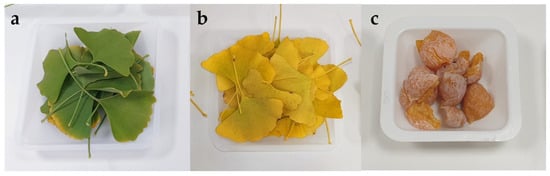
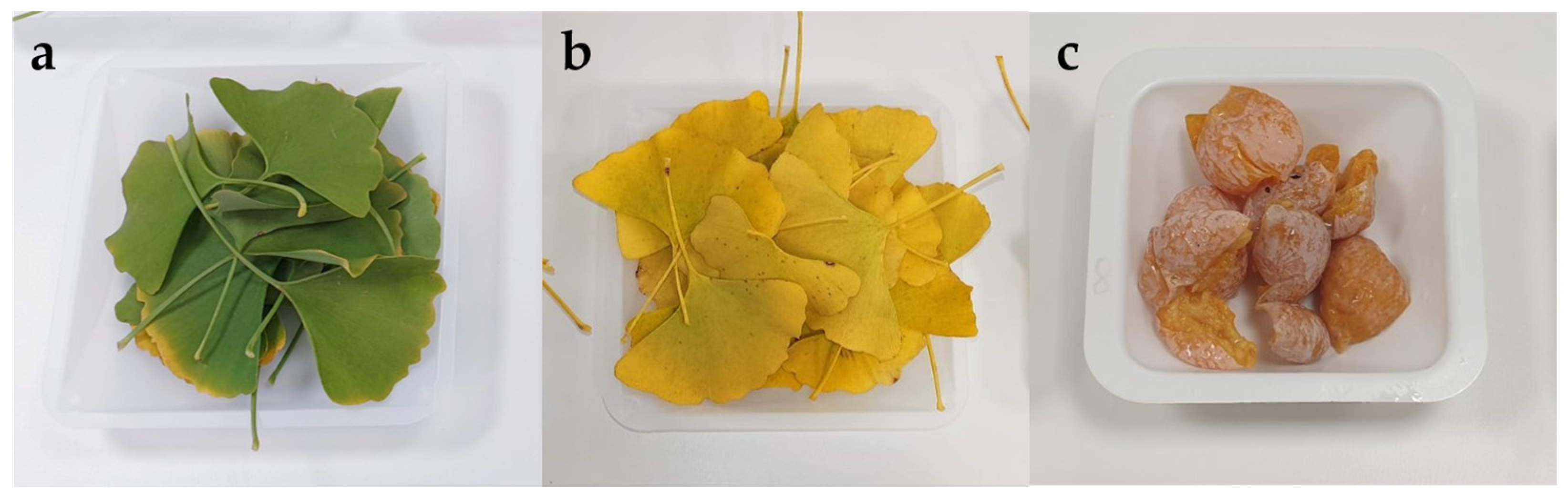
Various tissues of ginkgo (Ginkgo biloba L.) were collected in 2024 from trees in Ivana Mažuranića Street, Koprivnica. Green leaves were sampled on 1 May 2024 (Figure 1a), yellow leaves on 1 November 2024 (Figure 1b), and seeds were collected from the same tree in October. From the seeds, the pits and the fleshy part (sarcotesta) were separated and the sarcotesta was used for analysis (Figure 1c).
Figure 1.
Ginkgo green leaves (a), yellow leaves (b), and sarcotesta (c) used for extraction preparation.
Following collection, all samples were immediately stored at −80 °C until lyophilization. Lyophilization was performed over 48 h using a freeze dryer at approximately −102 °C and under a pressure of up to 0.3303 mbar. After lyophilization, leaves and sarcotesta were ground into a fine powder using a bead mill and used for all further analyses.
2.3. Extraction
For extract preparation, 60 mg of dried and ground plant material was accurately weighed in triplicate, and 2 mL of a ethanol-water mixture (0, 10, 30, 50, 70, or 96% ethanol, v/v) was added to each sample. The mixtures were briefly vortexed to ensure homogenization. Extractions were first facilitated by sonication in an ultrasonic bath for 10 min, followed by gentle rotation on a mechanical rotator for 45 min to promote uniform extraction. The suspensions were then centrifuged at 5000 rpm for 10 min, and the resulting supernatants were collected into microcentrifuge tubes for further analysis. Prior to HPLC injection, all samples were additionally filtered through 13 mm, 0.4 µm hydrophobic PTFE syringe filters.
2.4. Determination of Total Polyphenols
Total polyphenol content was measured in accordance with our prior study using the Folin–Ciocalteu reagent following the standard protocol [21]. Total polyphenol concentrations were calculated using a calibration curve prepared with gallic acid standards and are expressed as mg GAE/g of dry weight (dw).
2.5. Identification and Quantification of Biflavonoids
To identify and quantify biflavonoids in ginkgo leaves and sarcotesta (amentoflavone, bilobetin, ginkgetin, isoginkgetin, and sciadopitysin), an HPLC-DAD method has been used [14] using an Agilent 1260 Infinity II HPLC system (Agilent, Santa Clara, CA, USA) equipped with a diode array detector (DAD). Stock solutions of standards were prepared at 1 mg/mL in pure DMSO and subsequently diluted with methanol to obtain working solutions at 1, 10, 50, and 100 µg/mL, each prepared in triplicate. Separation of compounds was carried out on a Zorbax 300Extend-C18 column (Agilent, Santa Clara, CA, USA) maintained at 40 °C. Mobile phases consisted of 0.1% formic acid in water (phase A) and acetonitrile (phase B), with a flow rate of 1 mL/min over a 45 min run. The gradient elution program was: 0 min 98% A, 10 min 79% A, 15 min 77% A, 20 min 75% A, 25 min 64% A, 30 min 62% A, 35 min 51% A, 40 min 25% A, 43 min 8% A, and 45 min 98% A. Sample and standard injections were 10 µL each. Chromatograms were recorded at 330 nm, and data were processed using Agilent OpenLab CDS software (version 2.6). Biflavones were identified by comparing sample spectra with those of the standards. Concentrations of biflavonoids were calculated from standard calibration curves and expressed as µg/g of dry weight (dw).
2.6. Antioxidant Capacity Using DPPH Method
Antioxidant activity was determined using the modified Brand–Williams method [22] with DPPH (1,1-diphenyl-2-picrylhydrazyl). A volume of 5 µL of each extract—prepared from green leaves, yellow leaves, and sarcotesta across varying water–ethanol ratios—was mixed with 995 µL of 0.1 mM methanolic DPPH solution and vortexed. The mixtures were then incubated in the dark for 30 min, after which absorbance was measured at 515 nm. Results are expressed as micromoles of Trolox Equivalents per gram of dry weight (µmol TE/g dw).
2.7. Statistical Analysis
All measurements were performed in triplicate, and results are presented as the mean value ± standard deviation (SD). Statistical data analysis was conducted using PAST software (version 5.3) [23], employing one-way ANOVA and post hoc Tukey’s test. Differences between samples were considered significant at p < 0.05.
3. Results
3.1. The Effect of the Water-to-Ethanol Ratio on Total Polyphenol Content Across Different Tissue Types
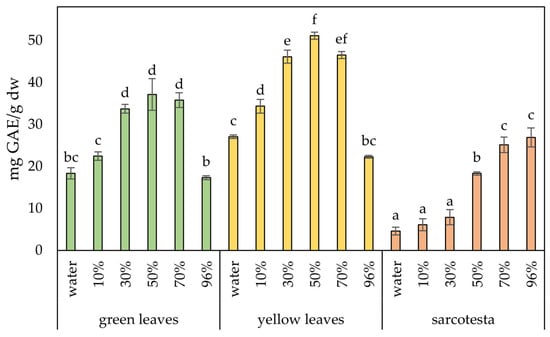
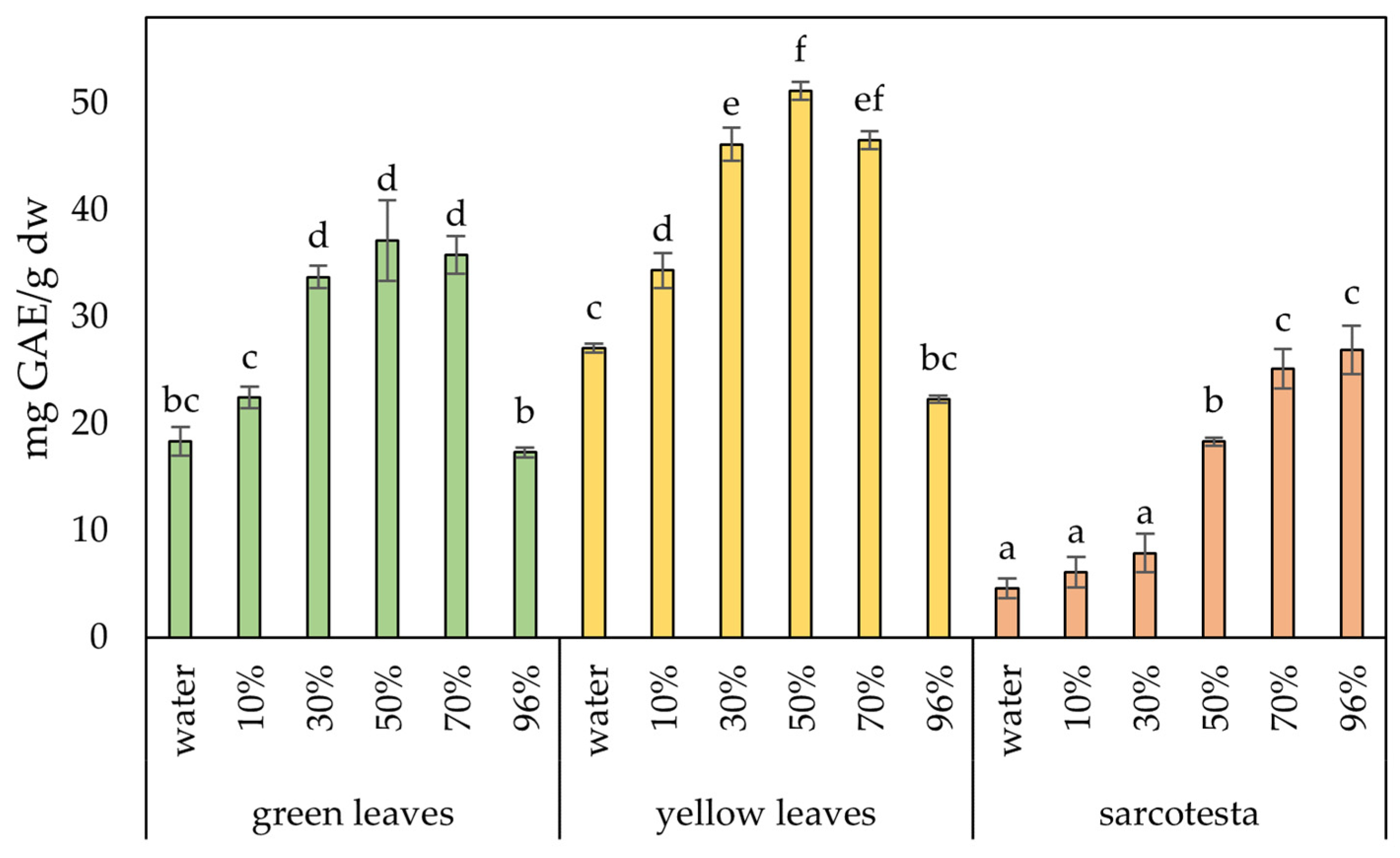
Total polyphenolic content in ginkgo green leaves, yellow leaves and sarcotesta in different water to ethanol ration are shown in Figure 2.
Figure 2.
Total polyphenol content (mg GAE/g dw) in green and yellow leaves and sarcotesta prepared with different ethanol/water ratios. Values labeled with different letters indicate statistically significant differences among all tissue and ethanol ratio combinations (p < 0.05).
In general, the total phenolic content was higher in yellow leaves than in green leaves or sarcotesta, confirming that leaf maturity and coloration strongly influence polyphenol accumulation. The significantly highest phenolic concentration (51.15 ± 0.84 mg GAE/g dw) was detected in yellow leaves extracted with 50% ethanol, indicating that a mid-polarity solvent mixture is optimal for releasing phenolics from senescent tissues. Green leaves showed their highest value (37.15 ± 3.79 mg GAE/g dw) at the same 50% ethanol ratio; however, this result was not significantly different from the extracts obtained with 30% or 70% ethanol, suggesting a broader solvent-tolerance range for phenolic extraction in younger leaf tissues. In contrast, sarcotesta exhibited a different pattern: its total polyphenolic content increased steadily with increasing ethanol concentration, reaching the maximum (26.94 ± 2.25 mg GAE/g dw) at 70% and 96% ethanol. This opposite trend indicates that phenolic compounds in sarcotesta are more efficiently extracted under less polar conditions, likely due to differences in matrix composition and the presence of more hydrophobic phenolics.
3.2. The Effect of the Water-to-Ethanol Ratio on Biflavonoid Content Across Different Tissue Types
3.2.1. Total Biflavonoid Content and Biflavonoid Profile
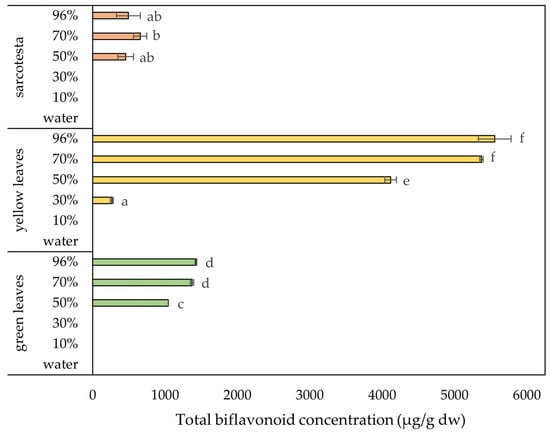
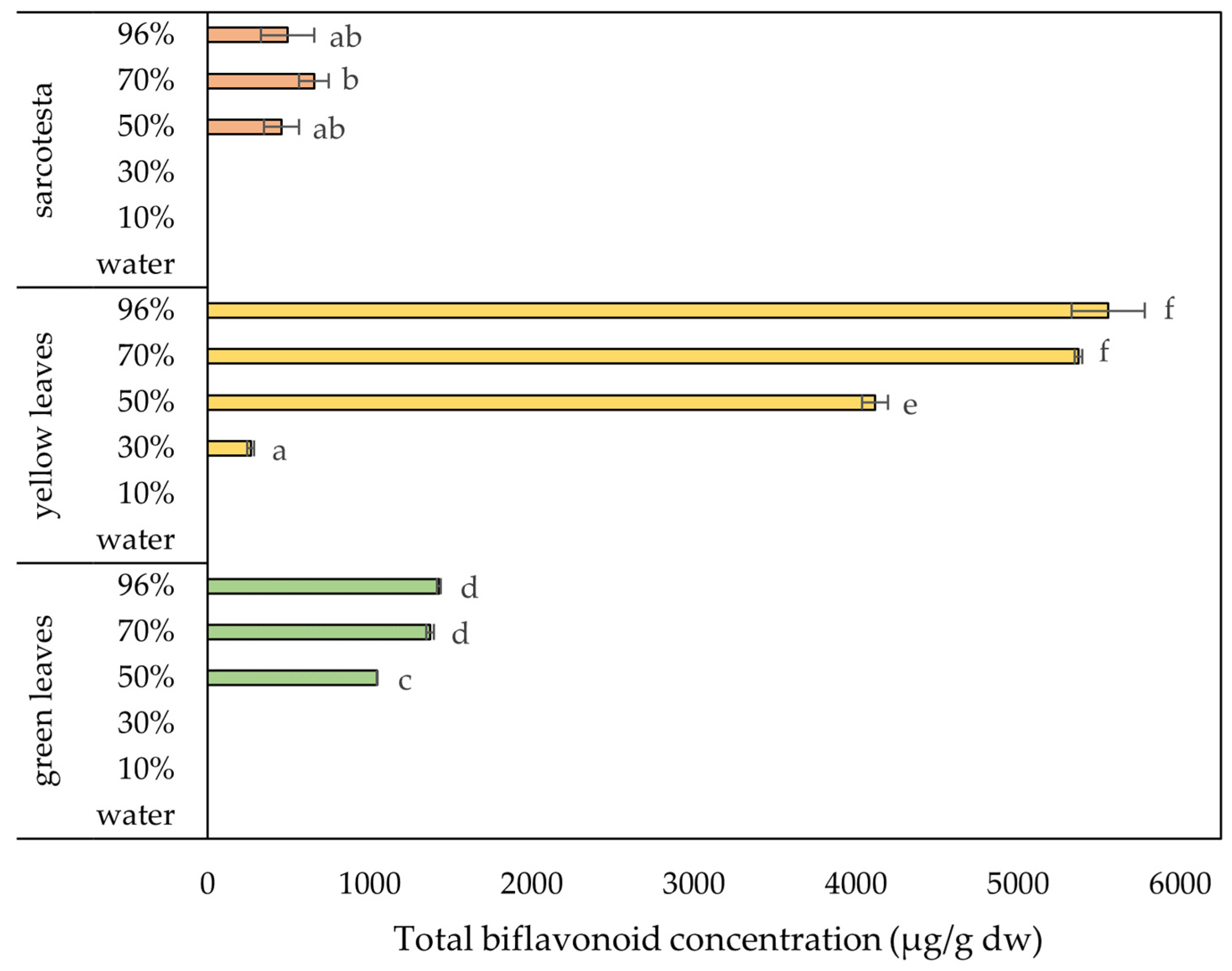
The total biflavonoid content of extracts prepared with different solvents is shown in Figure 3.
Figure 3.
Total biflavonoids in green and yellow leaves and sarcotesta were prepared with different ethanol/water ratios. Values labeled with different letters indicate statistically significant differences among all tissue and ethanol ratio combinations (p < 0.05).
As shown in Figure 3, in extracts prepared with an ethanol ratio below 50%, biflavonoids are not detected. In yellow leaves, the total biflavonoid content is almost 4-fold higher than in green leaves, reaching up to 5556.04 ± 225.07 µg/g dw. In both leaf types, the concentration increases with higher ethanol ratios; however, the concentrations in extracts prepared with 70% and 96% ethanol do not differ significantly. In the sarcotesta, the total biflavonoid content was comparable in extracts prepared with 50%, 70%, and 96% ethanol, ranging from 454.88 to 655.64 µg/g dw.
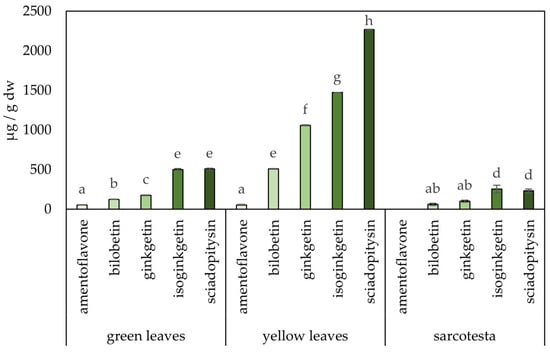
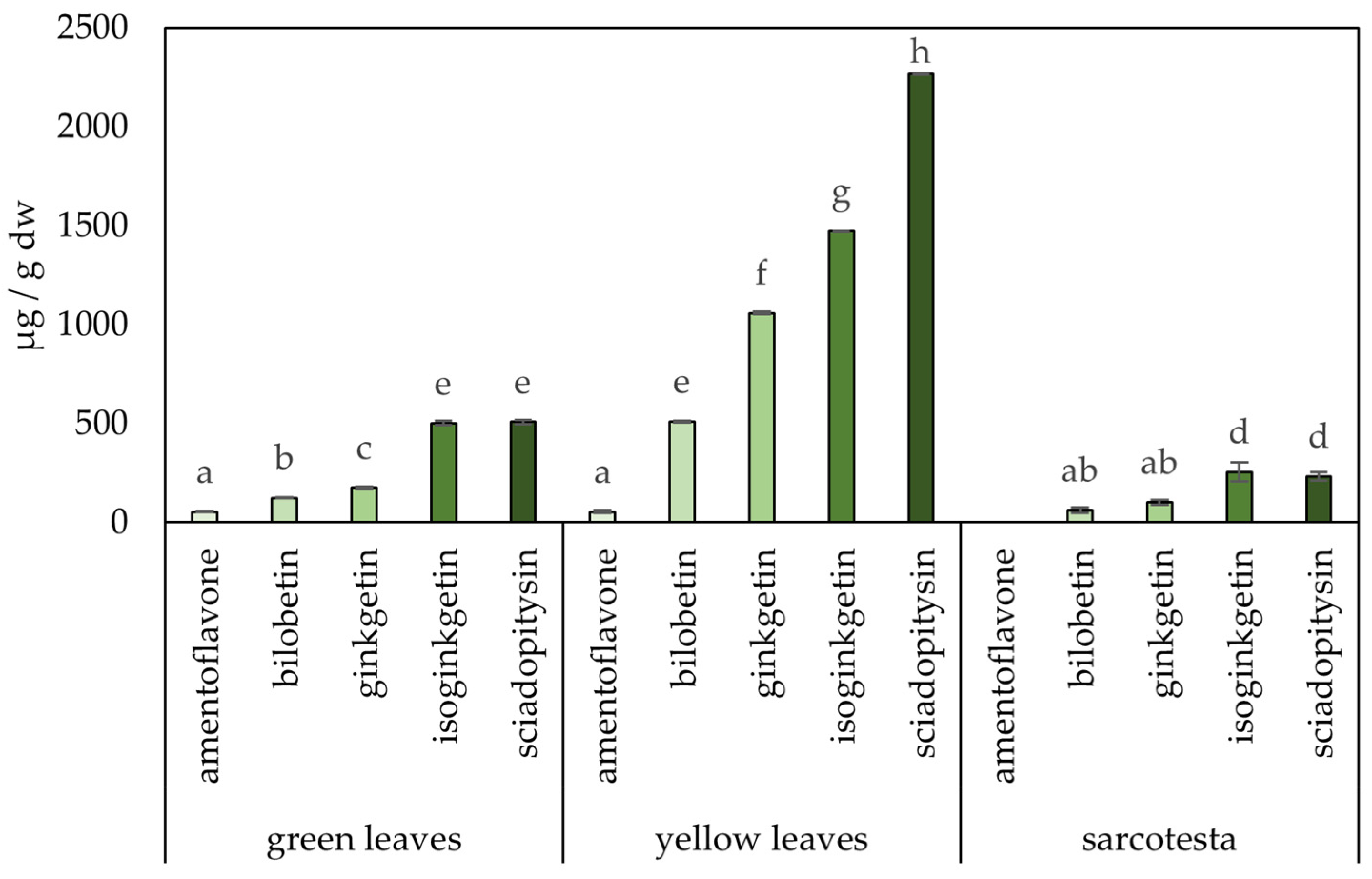
As evident from Figure 3, higher ethanol concentrations (70% and 96%) were the most effective for extracting total biflavonoids. Although extracts obtained with 70% and 96% ethanol showed comparable biflavonoid yields, 70% ethanol may be more suitable for industrial applications due to its lower toxicity, safer handling, and broader regulatory acceptance. Therefore, Figure 4 presents the biflavonoid profiles of all three analyzed ginkgo tissue types extracted with 70% ethanol.
Figure 4.
Biflavonoid profiles of ginkgo green and yellow leaves and sarcotesta extracted with 70% ethanol. Values labeled with different letters indicate statistically significant differences among all tissue and ethanol ratio combinations (p < 0.05).
In green leaves and the sarcotesta, the lowest concentrations were observed for amen-toflavone, followed by bilobetin and ginkgetin, while isoginkgetin and sciadopitysin were present at comparable levels. In contrast, yellow Ginkgo leaves exhibited a biflavonoid profile in the order amentoflavone < bilobetin < ginkgetin < isoginkgetin < sciadopitysin, indicating that both tissue type and leaf developmental stage influence biflavonoid composition.
3.2.2. Individual Biflavonoids
The effects of water-to-ethanol ratio on individual biflavonoid (amentoflavone, bilobetin, ginkgetin, isoginkgetin and sciadopitysin) content across different tissue types are shown in Table 1.
Table 1.
Content of individual biflavonoids in extracts prepared with different ethanol–water (%) ratios. For each compound (individual biflavonoid), different letters indicate statistically significant differences among tissues at p < 0.05. Letters are not comparable between different compounds.
Amentoflavone was detected at approximately 50 µg/g dw in both green and yellow leaves in extracts prepared with ethanol concentrations ≥ 50%, with comparable levels between the two leaf types. In leaf extracts prepared with 96% ethanol, amentoflavone concentration was significantly lower than in those prepared with 70% ethanol, and it was not detected in the sarcotesta.
Bilobetin was absent in water and 10% ethanol extracts, and in 30% ethanol, it was detected only in yellow leaves at concentrations much lower than those in extracts prepared with 50%, 70%, and 96% ethanol. In green leaves and sarcotesta, bilobetin concentrations were comparable across all ethanol concentrations above 50%, whereas in yellow leaves, concentrations were higher, with 70% and 96% ethanol extracts yielding similar levels that exceeded those in 50% ethanol. Overall, bilobetin in yellow leaves was approximately 4–5-fold higher than in green leaves.
Ginkgetin was detected in extracts prepared with ethanol concentrations above 50% (and in 30% ethanol for yellow leaves). The highest levels were observed in yellow leaves extracted with 70% (1059.81 ± 7.64 µg/g dw) and 96% (1056.97 ± 49.64 µg/g dw) ethanol, roughly fivefold higher than in green leaves. In the sarcotesta, ginkgetin content was highest in the 70% ethanol extract (103.07 ± 13.74 µg/g dw) and did not differ significantly from the 50% and 96% ethanol extracts.
Similarly, isoginkgetin content was highest in yellow leaves extracted with 70% (1474.33 ± 1.39 µg/g dw) and 96% (1491.31 ± 55.72 µg/g dw) ethanol, approximately fourfold higher than in green leaves. In the sarcotesta, isoginkgetin concentrations were comparable across extracts prepared with 50%, 70%, and 96% ethanol.
Sciadopitysin content increased with increasing ethanol concentration in both leaf types, reaching maximum levels at 96% ethanol. However, in green leaves, concentrations obtained with 70% and 96% ethanol did not differ significantly. In the sarcotesta, the highest sciadopitysin content was observed in the 70% ethanol extract, but it was not significantly different from that in the 96% ethanol extract.
3.3. The Effect of the Water-to-Ethanol Ratio on Antioxidant Activity Measured by DPPH Across Different Ginkgo Tissue Types
The antioxidant activity measured by the DPPH method is presented in Table 2.
Table 2.
Antioxidant activity (AA) measured by DPPH and expressed in µmol TE/g dw. Values labeled with different letters indicate statistically significant differences among all tissue and ethanol ratio combinations (p < 0.05).
Antioxidant capacity in green and yellow leaves was highest in extracts prepared with 50% and 70% ethanol, whereas in the sarcotesta, variations in the ethanol-to-water ratio did not significantly influence antioxidant capacity.
4. Discussion
The total polyphenol content in both analyzed leaf samples reached the highest levels in extracts prepared with ethanol concentrations between 30% and 70%, with a maximum at 50%. This indicates that ginkgo leaves predominantly contain compounds of medium polarity, such as phenolic acids and flavonoid glycosides, both reported previously in ginkgo leaves [24,25]. This data are in accordance with the literature, where for most of the polyphenols preferable amount of ethanol in an extract is 60–80%, while higher ethanol concentrations may result in lower total polyphenol content (reviewed by [19]). A mixture of ethanol and water provides an optimal polarity for extracting these compounds, allowing better solubility and diffusion from the plant matrix [26]. In contrast, 96% ethanol is less polar, which reduces the solubility of many polyphenols, leading to lower extraction efficiency [27]. Flavonoids are key bioactive constituents in ginkgo, playing a major role in its biological and pharmacological activities [28]. According to the review article by Liu et al. [9] in ginkgo leaves, about 110 different flavonoids have been reported, including flavonol and its glycosides, flavone and its glycosides, flavanone and its glycosides, isoflavone and its glycosides, flavan-3-ols, biflavonoids, and biginkgosides. Herein, we specifically focused on flavonoid dimers or biflavonoids whose content in yellow, green leaves and sarcotesta are shown in Figure 4 and Table 1.
According to the literature and our previous work, biflavonoids in ginkgo are primarily accumulated in plant parts directly exposed to the environment, such as leaves and sarcotesta [11]. Therefore, these tissues were selected for biflavonoid analysis in this study. As evident from Figure 3, leaves—particularly yellow leaves—exhibit high total biflavonoid content, reaching concentrations up to 5556.04 ± 225.07 µg/g dw. Yellow leaves accumulate up to fourfold more biflavonoids than green leaves, which is consistent with our previous study tracking seasonal variation in biflavonoid content, where higher concentrations were reported in yellow leaves [14]. In that study, biflavonoids were extracted using 70% ethanol, with the highest total content detected in leaves collected in November, reaching up to 6 mg/g dw, which aligns well with the results presented here.
Based on our data, if the goal is to extract biflavonoids in general, 70% or 96% ethanol would be the solvent of choice, as these concentrations yielded the highest total biflavonoid content. Previously, we focused on the extraction of biflavonoids using assisted extraction technologies and obtained results comparable to those achieved with conventional methods [15]. We also explored extraction using deep eutectic solvents (DES); although all biflavonoids could be extracted, the yields were lower than with conventional methods [16]. DES are promising green solvents, but they have not yet been widely adopted in commercial applications [29]. Industrial extraction still relies primarily on conventional solvents, with ethanol being the most commonly used due to its availability, cost-effectiveness, and regulatory acceptance. The relatively high cost of DES, challenges in large-scale production, and limited availability of some components continue to hinder their industrial-scale application [30]. For these reasons, optimizing ethanol-based extraction remains important for the efficient recovery of biflavonoids. As is evident from Figure 4, at the concentration of 70% ethanol in green leaves and sarcotesta, the most abundant biflavonoids are isoginkgetin and sciadopitysin, whose amount is comparable, while in yellow leaves the most abundant biflavonoids are sciadopitysin, followed by isoginkgetin, ginkgetin, bilobetin and amentoflavone, which is in accordance with published data [14]. Sarcotesta, as a valuable source of biflavonoids were evaluated by Shen et al. [31] who developed large-scale targeted isolation of biflavonoids with high purity from ginkgo sarcotesta using two-dimensional chromatography coupled with macroporous adsorption resin enrichment. However, in their study, they isolated only bilobetin, ginkgetin, and isoginkgetin, whereas sciadopitysin—according to our data—is also present in sarcotesta. Although the exact factors influencing biflavonoid levels in plant material are not fully understood, the presence of biflavonoids in specific plant species is genetically determined [7]. Differences in reported biflavonoid content between studies may result from variations in extraction and analytical methods, the use of non-commercial or low-purity standards, or difficulties in separating isomers, such as ginkgetin and isoginkgetin [11]. Isolation strategies should be tailored to target specific biflavonoids of interest. The influence of ethanol–water ratio on the extraction of individual biflavonoids is summarized in Table 1. Notably, no biflavonoids were detected in water extracts or in extracts prepared with 10% ethanol. Extracts prepared with 30% ethanol contained biflavonoids only in yellow leaves and at low concentrations, indicating that ginkgo preparations with low ethanol content, such as ginkgo wine [10] or infusions [32], are unlikely to contain biflavonoids. This observation is consistent with our previous work, where biflavonoids were not detected in green or yellow ginkgo leaf infusions [33].
For individual biflavonoids, except sciadopitysin and amentoflavone, there was no significant difference in content between 70% and 96% ethanol extracts. In the case of amentoflavone, yellow leaves extracted with 96% ethanol contained significantly lower levels, whereas sciadopitysin was slightly higher. For green leaves and sarcotesta, individual biflavonoid contents were comparable between these two ethanol concentrations. Similar extraction patterns have been reported in other plant species. Feuereisen et al. [34] optimized biflavonoid extraction from Brazilian pepper (Schinus terebinthifolius Raddi) fruits and found that 60–80% ethanol provided optimal yields, which aligns with our findings. In contrast, Carrillo-Hormaza et al. [35] selected a 50:50 ethanol/water mixture as the most selective solvent for biflavonoid extraction from Garcinia species. These examples highlight that optimal ethanol concentration for biflavonoid extraction may vary between species but generally falls within the 50–80% ethanol concentration range, which is often reported as an optimal for general polyphenols extraction [19].
Antioxidant capacity of the leaves was highest in extracts prepared with 50% and 70% ethanol, which parallels the observed trends in total polyphenol content. This suggests that compounds of medium polarity, such as phenolic acids and flavonoid glycosides, may be the primary contributors to antioxidant activity. Hu et al. [36] identified 30 flavonoids with antioxidant activity in ginkgo leaves, among which flavonoid glycosides—particularly kaempferol glycosides—exhibited the highest antioxidant capacity. Interestingly, the authors also identified several biflavonoids, including bilobetin, isoginkgetin, ginkgetin, amentoflavone, and sciadopitysin; however, these compounds displayed weak or no antioxidant activity when evaluated using the ORAC method, with sciadopitysin showing no detectable activity. According to literature data, biflavonoids exhibit low or negligible antioxidant activity in vitro [37,38,39]; therefore, it is not surprising that the highest antioxidant capacity was not observed in ethanol–water ratios that yielded the highest biflavonoid concentrations. These findings indicate that antioxidant activity in ginkgo leaf extracts is driven mainly by more polar phenolic constituents rather than by biflavonoids [38]. Although biflavonoids exhibit weak or negligible antioxidant activity in in vitro assays [6,36,39], they have demonstrated significant antiviral [40,41], neuroprotective [37], and anticancer effects [42]. Their biological activity goes beyond classical antioxidant effects. The biological potential of biflavonoids is therefore associated with mechanisms other than direct free radical scavenging, including modulation of cell signaling pathways [43], enzyme inhibition [33], gene expression regulation [44], and interactions with key proteins involved in inflammation [45] and apoptosis [46]. These multifaceted mechanisms likely contribute more to their pharmacological effects than their antioxidant capacity, highlighting their complex and significant bioactivity and underscoring the need to optimize their extraction for industrial applications.
5. Conclusions
Although monomeric flavonoids are well studied, their dimeric forms, biflavonoids, have received considerably less attention despite their unique biological activities and potential applications. In the present study, we investigated the effect of ethanol–water ratio (0, 10, 30, 50, 70, and 96% ethanol) on the extraction efficiency of major ginkgo biflavonoids (amentoflavone, bilobetin, ginkgetin, isoginkgetin, and sciadopitysin) to identify optimal extraction conditions. In parallel, three ginkgo tissue types—green leaves, yellow leaves, and sarcotesta—previously reported to accumulate biflavonoids, were analyzed.
Yellow leaves accumulate higher levels of biflavonoids than green leaves, with sciadopitisin being the most abundant, followed by isoginkgetin, ginkgetin, bilobetin, and the less abundant amentoflavone. In the sarcotesta, the contents of sciadopitisin and isoginkgetin were comparable, followed by ginkgetin, bilobetin, and amentoflavone. No biflavonoids were detected in water or 10% ethanol extracts, while 30% ethanol extracts contained detectable biflavonoids only in yellow leaves at low concentrations. For most individual biflavonoids, the highest concentrations were obtained in extracts prepared with 70% and 96% ethanol. Considering the comparable extraction efficiency and the advantages of lower toxicity and safer handling, 70% ethanol was identified as the solvent of choice. Extracts prepared with this concentration also exhibited the highest antioxidant capacity.
Overall, these results underscore the strong influence of both tissue type and solvent composition on biflavonoid recovery and confirm ginkgo leaves, particularly yellow leaves, as a rich source of these compounds. Future studies should aim to optimize selective extraction and purification methods for individual biflavonoids and to investigate their specific biological activities, thereby supporting their potential applications in both pharmaceutical and food industries. Particular emphasis should be placed on green extraction approaches that are less toxic to humans and environmentally friendly. The use of such sustainable extraction methods not only reduces environmental impact but also enhances the safety and regulatory acceptability of the resulting extracts, making them more suitable for pharmaceutical, nutraceutical, and food-related applications.
Author Contributions
Conceptualization, D.Š.; methodology, D.Š.; formal analysis, B.M.; investigation, B.M.; resources, B.M. and D.Š.; writing—original draft preparation, D.Š.; writing—review and editing, D.Š. and B.M.; visualization, B.M.; supervision, D.Š.; project administration, D.Š.; funding acquisition, D.Š. All authors have read and agreed to the published version of the manuscript.
Funding
This work has been supported by Croatian Science Foundation project “Biflavonoids role in plants: Ginkgo biloba L. as a model system” under project no. UIP-2019-04-1018 and by the program “Development of Young Researchers’ Careers—Training of New PhD Scientists” under project no. DOK-NPOO-2023-10-5666.
Data Availability Statement
The data presented in this study are available on request from the corresponding author.
Acknowledgments
We thank I. Jurčević Šangut for assistance with the collection and drying of ginkgo samples.
Conflicts of Interest
The authors declare no conflicts of interest.
References
- Chelliah, R.; Vijayalakshmi, S.; Karuvelan, M.; Barathikannan, K.; Ghimeray, S.; Oh, D.-H. Revitalizing Natural Products for Sustainable Drug Discovery: Innovations Bridging Food Bioscience and Green Therapeutic Development. Sustain. Chem. Pharm. 2025, 46, 102082. [Google Scholar] [CrossRef] [Scilit]
- Zou, P.; Otero, P.; Mejuto, J.C.; Simal-Gandara, J.; Xiao, J.; Cameselle, C.; Chen, S.; Lin, S.; Cao, H. Exploring the Mechanism of Flavonoids Modification by Dimerization Strategies and Their Potential to Enhance Biological Activity. Food Chem. 2025, 467, 142266. [Google Scholar] [CrossRef] [Scilit]
- Xiong, X.; Tang, N.; Lai, X.; Zhang, J.; Wen, W.; Li, X.; Li, A.; Wu, Y.; Liu, Z. Insights into Amentoflavone: A Natural Multifunctional Biflavonoid. Front. Pharmacol. 2021, 12, 768708. [Google Scholar] [CrossRef] [Scilit]
- Patel, D.K. Biological Potential and Therapeutic Effectiveness of Hinokiflavone in Medicine: The Effective Components of Herbal Medicines for Treatment of Cancers and Associated Complications. Curr. Nutr. Food Sci. 2024, 20, 439–449. [Google Scholar] [CrossRef] [Scilit]
- da Silva, K.C.; Lima, I.S.; dos Santos, C.C.; Nonaka, C.K.V.; de Freitas Souza, B.S.; David, J.M.; Ulrich, H.; do Nascimento, R.P.; de Fátima Dias Costa, M.; dos Santos, B.L. Agathisflavone Inhibits Viability and Modulates the Expression of MiR-125b, MiR-155, IL-6, and Arginase in Glioblastoma Cells and Microglia/Macrophage Activation. Molecules 2025, 30, 158. [Google Scholar] [CrossRef] [Scilit]
- Bajpai, V.K.; Park, I.; Lee, J.; Shukla, S.; Nile, S.H.; Chun, H.S.; Khan, I.; Oh, S.Y.; Lee, H.; Huh, Y.S.; et al. Antioxidant and Antimicrobial Efficacy of a Biflavonoid, Amentoflavone from Nandina Domestica in Vitro and in Minced Chicken Meat and Apple Juice Food Models. Food Chem. 2019, 271, 239–247. [Google Scholar] [CrossRef] [Scilit]
- He, X.; Yang, F.; Huang, X. Proceedings of Chemistry, Pharmacology, Pharmacokinetics and Synthesis of Biflavonoids. Molecules 2021, 26, 6088. [Google Scholar] [CrossRef] [Scilit] [PubMed]
- Yue, T.; Sheng, Q.; Luo, Y.; Xiao, Z.; Wang, Y.; Song, W.; Yan, M.; Niu, H.; Zhang, T.; Li, N. Biflavonoids and Oligomeric Flavonoids from Food. In Handbook of Dietary Phytochemicals; Springer: Singapore, 2021; pp. 155–203. [Google Scholar]
- Liu, L.; Wang, Y.; Zhang, J.; Wang, S. Advances in the Chemical Constituents and Chemical Analysis of Ginkgo biloba Leaf, Extract, and Phytopharmaceuticals. J. Pharm. Biomed. Anal. 2021, 193, 113704. [Google Scholar] [CrossRef] [Scilit] [PubMed]
- Su, X.; Shi, R.; Hu, H.; Hu, L.; Wei, Q.; Guan, Y.; Chang, J.; Li, C. Medicinal Values and Potential Risks Evaluation of Ginkgo biloba Leaf Extract (GBE) Drinks Made from the Leaves in Autumn as Dietary Supplements. Molecules 2022, 27, 7479. [Google Scholar] [CrossRef] [Scilit]
- Kovač Tomas, M.; Jurčević, I.; Šamec, D. Tissue-Specific Profiling of Biflavonoids in Ginkgo (Ginkgo biloba L.). Plants 2022, 12, 147. [Google Scholar] [CrossRef] [Scilit] [PubMed]
- Yan, Y.-C.; Xu, Z.-H.; Wang, J.; Yu, W.-B. Uncovering the Pharmacology of Ginkgo Biloba Folium in the Cell-Type-Specific Targets of Parkinson’s Disease. Front. Pharmacol. 2022, 13, 1007556. [Google Scholar] [CrossRef] [Scilit] [PubMed]
- Akaberi, M.; Baharara, H.; Amiri, M.S.; Moghadam, A.T.; Sahebkar, A.; Emami, S.A. Ginkgo biloba: An Updated Review on Pharmacological, Ethnobotanical, and Phytochemical Studies. Pharmacol. Res.-Mod. Chin. Med. 2023, 9, 100331. [Google Scholar] [CrossRef] [Scilit]
- Jurčević Šangut, I.; Šamec, D. Seasonal Variation of Polyphenols and Pigments in Ginkgo (Ginkgo biloba L.) Leaves: Focus on 3′,8″-Biflavones. Plants 2024, 13, 3044. [Google Scholar] [CrossRef] [Scilit]
- Šalić, A.; Šepić, L.; Turkalj, I.; Zelić, B.; Šamec, D. Comparative Analysis of Enzyme-, Ultrasound-, Mechanical-, and Chemical-Assisted Extraction of Biflavonoids from Ginkgo Leaves. Processes 2024, 12, 982. [Google Scholar] [CrossRef] [Scilit]
- Šalić, A.; Bajo, M.; Cvjetko Bubalo, M.; Radović, M.; Jurinjak Tušek, A.; Zelić, B.; Šamec, D. Extraction of Polyphenolic Compounds from Ginkgo Leaves Using Deep Eutectic Solvents: A Potential Solution for the Sustainable and Environmentally Friendly Isolation of Biflavonoids. Ind. Crops Prod. 2024, 219, 119068. [Google Scholar] [CrossRef] [Scilit]
- Ramesh, M.M.; Shankar, N.S.; Venkatappa, A.H. Driving/Critical Factors Considered During Extraction to Obtain Bioactive Enriched Extracts. Pharmacogn. Rev. 2024, 18, 68–81. [Google Scholar] [CrossRef] [Scilit]
- Plaskova, A.; Mlcek, J. New Insights of the Application of Water or Ethanol-Water Plant Extract Rich in Active Compounds in Food. Front. Nutr. 2023, 10, 1118761. [Google Scholar] [CrossRef] [Scilit]
- Oreopoulou, A.; Tsimogiannis, D.; Oreopoulou, V. Extraction of Polyphenols From Aromatic and Medicinal Plants: An Overview of the Methods and the Effect of Extraction Parameters. In Polyphenols in Plants; Elsevier: Amsterdam, The Netherlands, 2019; pp. 243–259. [Google Scholar]
- Dias, M.C.; Pinto, D.C.G.A.; Silva, A.M.S. Plant Flavonoids: Chemical Characteristics and Biological Activity. Molecules 2021, 26, 5377. [Google Scholar] [CrossRef] [Scilit]
- Singleton, V.L.; Rossi, J.A. Colorimetry of Total Phenolics with Phosphomolybdic-Phosphotungstic Acid Reagents. Am. J. Enol. Vitic. 1965, 16, 144–158. [Google Scholar] [CrossRef] [Scilit]
- Brand-Williams, W.; Cuvelier, M.E.; Berset, C. Use of a Free Radical Method to Evaluate Antioxidant Activity. LWT-Food Sci. Technol. 1995, 28, 25–30. [Google Scholar] [CrossRef] [Scilit]
- Hammer, Ø.; Harper, D.A.T.; Ryan, P.D. Past: Paleontological Statistics Software Package for Education and Data Analysis. Palaeontol. Electron. 2001, 4, 4–9. [Google Scholar]
- Liu, X.-G.; Wu, S.-Q.; Li, P.; Yang, H. Advancement in the Chemical Analysis and Quality Control of Flavonoid in Ginkgo biloba. J. Pharm. Biomed. Anal. 2015, 113, 212–225. [Google Scholar] [CrossRef] [Scilit]
- Liu, X.-G.; Lu, X.; Gao, W.; Li, P.; Yang, H. Structure, Synthesis, Biosynthesis, and Activity of the Characteristic Compounds from Ginkgo biloba L. Nat. Prod. Rep. 2022, 39, 474–511. [Google Scholar] [CrossRef] [Scilit]
- Tzanova, M.; Atanasov, V.; Yaneva, Z.; Ivanova, D.; Dinev, T. Selectivity of Current Extraction Techniques for Flavonoids from Plant Materials. Processes 2020, 8, 1222. [Google Scholar] [CrossRef] [Scilit]
- Rodríguez De Luna, S.L.; Ramírez-Garza, R.E.; Serna Saldívar, S.O. Environmentally Friendly Methods for Flavonoid Extraction from Plant Material: Impact of Their Operating Conditions on Yield and Antioxidant Properties. Sci. World J. 2020, 2020, 1–38. [Google Scholar] [CrossRef] [Scilit]
- Guo, J.; Wang, Y.; Li, J.; Zhang, J.; Wu, Y.; Wang, G. Overview and Recent Progress on the Biosynthesis and Regulation of Flavonoids in Ginkgo biloba L. Int. J. Mol. Sci. 2023, 24, 14604. [Google Scholar] [CrossRef] [Scilit] [PubMed]
- Rente, D.; Cvjetko Bubalo, M.; Panić, M.; Paiva, A.; Caprin, B.; Radojčić Redovniković, I.; Duarte, A.R.C. Review of Deep Eutectic Systems from Laboratory to Industry, Taking the Application in the Cosmetics Industry as an Example. J. Clean. Prod. 2022, 380, 135147. [Google Scholar] [CrossRef] [Scilit]
- Ruesgas-Ramón, M.; Figueroa-Espinoza, M.C.; Durand, E. Application of Deep Eutectic Solvents (DES) for Phenolic Compounds Extraction: Overview, Challenges, and Opportunities. J. Agric. Food Chem. 2017, 65, 3591–3601. [Google Scholar] [CrossRef] [Scilit]
- Shen, N.; Liu, Y.; Cui, Y.; Xin, H. Large-Scale Targetedly Isolation of Biflavonoids with High Purity from Industrial Waste Ginkgo biloba Exocarp Using Two-Dimensional Chromatography Coupled with Macroporous Adsorption Resin Enrichment. Ind. Crops Prod. 2022, 175, 114264. [Google Scholar] [CrossRef] [Scilit]
- Biernacka, P.; Felisiak, K.; Adamska, I.; Śnieg, M.; Podsiadło, C. Effect of Brewing Conditions on Antioxidant Properties of Ginkgo biloba Leaves Infusion. Antioxidants 2023, 12, 1455. [Google Scholar] [CrossRef] [Scilit]
- Jurčević Šangut, I.; Šola, I.; Šamec, D. Neuroprotective, Anti-Hyperpigmentation, and Anti-Diabetic Effects and Bioaccessibility of Flavonoids in Ginkgo Leaf Infusions from Green and Yellow Leaves. Appl. Sci. 2024, 14, 10231. [Google Scholar] [CrossRef] [Scilit]
- Feuereisen, M.M.; Gamero Barraza, M.; Zimmermann, B.F.; Schieber, A.; Schulze-Kaysers, N. Pressurized Liquid Extraction of Anthocyanins and Biflavonoids from Schinus Terebinthifolius Raddi: A Multivariate Optimization. Food Chem. 2017, 214, 564–571. [Google Scholar] [CrossRef] [Scilit]
- Carrillo-Hormaza, L.; Duque, L.; López-Parra, S.; Osorio, E. High-Intensity Ultrasound-Assisted Extraction of Garcinia Madruno Biflavonoids: Mechanism, Kinetics, and Productivity. Biochem. Eng. J. 2020, 161, 107676. [Google Scholar] [CrossRef] [Scilit]
- Hu, C.; Wang, Y.; Deng, Y.; Yao, J.; Min, H.; Hu, J.; Fan, X.; Wang, S. Identification and Quantification of the Antioxidants in Ginkgo biloba Leaf. Biomed. Chromatogr. 2024, 38, e5980. [Google Scholar] [CrossRef] [Scilit]
- Kang, S.S.; Lee, J.Y.; Choi, Y.K.; Song, S.S.; Kim, J.S.; Jeon, S.J.; Han, Y.N.; Son, K.H.; Han, B.H. Neuroprotective Effects of Naturally Occurring Biflavonoids. Bioorg. Med. Chem. Lett. 2005, 15, 3588–3591. [Google Scholar] [CrossRef] [Scilit]
- Bedir, E.; Tatli, I.I.; Khan, R.A.; Zhao, J.; Takamatsu, S.; Walker, L.A.; Goldman, P.; Khan, I.A. Biologically Active Secondary Metabolites from Ginkgo biloba. J. Agric. Food Chem. 2002, 50, 3150–3155. [Google Scholar] [CrossRef] [Scilit] [PubMed]
- Jurčević Šangut, I.; Šarkanj, B.; Karalija, E.; Šamec, D. A Comparative Analysis of Radical Scavenging, Antifungal and Enzyme Inhibition Activity of 3′-8″-Biflavones and Their Monomeric Subunits. Antioxidants 2023, 12, 1854. [Google Scholar] [CrossRef] [Scilit]
- Menezes, J.C.J.M.D.S.; Campos, V.R. Natural Biflavonoids as Potential Therapeutic Agents against Microbial Diseases. Sci. Total Environ. 2021, 769, 145168. [Google Scholar] [CrossRef] [Scilit]
- Duman, H.; Karav, S.; Šalić, A.; Šamec, D. Dimerized Power: The Antimicrobial and Antiviral Promise of Biflavonoids. Biomolecules 2026, 16, 24. [Google Scholar] [CrossRef] [Scilit]
- de Lima, C.A.; Maquedano, L.K.; Jaalouk, L.S.; dos Santos, D.C.; Longato, G.B. Biflavonoids: Preliminary Reports on Their Role in Prostate and Breast Cancer Therapy. Pharmaceuticals 2024, 17, 874. [Google Scholar] [CrossRef] [Scilit] [PubMed]
- Pang, X.; Yi, T.; Yi, Z.; Cho, S.G.; Qu, W.; Pinkaew, D.; Fujise, K.; Liu, M. Morelloflavone, a Biflavonoid, Inhibits Tumor Angiogenesis by Targeting Rho GTPases and Extracellular Signal-Regulated Kinase Signaling Pathways. Cancer Res. 2009, 69, 518–525. [Google Scholar] [CrossRef] [Scilit] [PubMed]
- Suh, S.-J.; Chung, T.-W.; Son, M.-J.; Kim, S.-H.; Moon, T.C.; Son, K.H.; Kim, H.P.; Chang, H.W.; Kim, C.-H. The Naturally Occurring Biflavonoid, Ochnaflavone, Inhibits LPS-Induced INOS Expression, Which Is Mediated by ERK1/2 via NF-ΚB Regulation, in RAW264.7 Cells. Arch. Biochem. Biophys. 2006, 447, 136–146. [Google Scholar] [CrossRef] [Scilit] [PubMed]
- Castardo, J.C.; Prudente, A.S.; Ferreira, J.; Guimarães, C.L.; Monache, F.D.; Filho, V.C.; Otuki, M.F.; Cabrini, D.A. Anti-Inflammatory Effects of Hydroalcoholic Extract and Two Biflavonoids from Garcinia Gardneriana Leaves in Mouse Paw Oedema. J. Ethnopharmacol. 2008, 118, 405–411. [Google Scholar] [CrossRef] [Scilit]
- Wan, H.; Ge, L.; Li, J.; Zhang, K.; Wu, W.; Peng, S.; Zou, X.; Zhou, H.; Zhou, B.; Zeng, X. Effects of a Novel Biflavonoid of Lonicera Japonica Flower Buds on Modulating Apoptosis under Different Oxidative Conditions in Hepatoma Cells. Phytomedicine 2019, 57, 282–291. [Google Scholar] [CrossRef] [Scilit] [PubMed]

Disclaimer/Publisher’s Note: The statements, opinions and data contained in all publications are solely those of the individual author(s) and contributor(s) and not of MDPI and/or the editor(s). MDPI and/or the editor(s) disclaim responsibility for any injury to people or property resulting from any ideas, methods, instructions or products referred to in the content. |
© 2026 by the authors. Licensee MDPI, Basel, Switzerland. This article is an open access article distributed under the terms and conditions of the Creative Commons Attribution (CC BY) license.