


Abstract
To clarify the controlling effects of the well deviation angle and azimuth angle on the breakdown pressure, propagation morphology, and fracture-network complexity of hydraulic fractures in tight sandstone, true triaxial hydraulic fracturing physical simulations were systematically conducted on Chang 7 Member sandstone from Yanchuan County, Ordos Basin, under different well deviation and azimuth angles. By combining injection-pressure monitoring, surface fracture-morphology observation, and three-dimensional laser scanning, the breakdown pressure, propagation path, surface roughness, fractal dimension, and overall complexity of the fractures were quantitatively analyzed. The results show that, at an azimuth angle of 90°, the breakdown pressure of the sandstone generally decreases as the well deviation angle increases from 0° to 90°, dropping from 19.125 MPa to 13.569 MPa, indicating that horizontal wells are easier to fracture. At a well deviation of 60°, the fracture is more prone to deflect and communicate with natural weak planes, yielding the highest overall complexity (f = 1.629). For horizontal wells under normal-faulting stress, the breakdown pressure decreases as the azimuth angle increases; the lowest breakdown pressure (12.933 MPa) is obtained when the wellbore is drilled along the maximum horizontal principal stress (σH), and the highest (18.310 MPa) when parallel to the minimum horizontal principal stress (σh). When the azimuth angle is 30°, both the fracture-surface roughness (Sa = 2.037 mm, Sq = 2.691 mm) and the overall complexity (f = 1.679) reach their maxima, which is most favorable for forming tortuous, rough, and complex fracture networks. The fractal dimension of the fractures varies little across the tested conditions (2.0339–2.1379), indicating that it is mainly controlled by the intrinsic heterogeneity of the rock. The research results can provide an experimental basis for the optimization of horizontal-well trajectories and fracturing-parameter design in tight sandstone reservoirs.
1. Introduction
Hydraulic fracturing is a key stimulation technique for exploiting low-permeability and unconventional oil and gas reservoirs such as tight sandstone [1,2]; its essence is to construct a complex fracture network in the reservoir to enlarge the drainage area and improve the single-well productivity [3,4]. Natural fractures in tight sandstone are mostly closed and macroscopically underdeveloped; the initiation and propagation of hydraulic fractures depend not only on the in situ stress field and rock heterogeneity, but are more strongly controlled by the spatial orientation of the wellbore relative to the original principal stress field [4,5]. With the widespread application of directional, highly-deviated, and horizontal wells, constrained by well-site boundaries and platform well patterns, the actual wellbore often cannot be strictly perpendicular to the minimum horizontal principal stress (σh) and thus deviates from the optimal orientation. Under such non-optimal orientations, fractures tend to initiate and propagate near the wellbore in a non-planar and tortuous manner, inducing near-wellbore tortuosity and elevated treatment pressure, and facing the risk of proppant screen-out due to hindered proppant transport, which severely restricts the fracturing stimulation effect [4,6]. Therefore, quantitatively revealing the controlling mechanisms of the well deviation angle and azimuth angle on hydraulic-fracture initiation and propagation is a key issue that urgently needs to be addressed for well-trajectory optimization and fracturing design.
Prediction of hydraulic-fracture geometry began with the classic PKN [7] and KGD [8] models. Based on poroelasticity theory, Haimson and Fairhurst [9] proposed that fracture initiates when the maximum tensile stress on the borehole wall reaches the rock tensile strength, laying the foundation for predicting the breakdown pressure of deviated wells. Daneshy [10] experimentally demonstrated that fractures in deviated wells do not always initiate perpendicular to the maximum tensile stress on the borehole wall. Huanget al. [11] further emphasized that the initiation criterion should compare the maximum principal stress on the borehole wall with the rock tensile strength, and provided an elastic solution for arbitrarily deviated wells. The above models are built on homogeneous and isotropic assumptions and must be systematically verified by experiments across the full parameter space.
Laboratory true triaxial experiments have confirmed that the wellbore azimuth β (the angle between the wellbore axis and the maximum horizontal principal stress σH) strongly affects the fracture geometry. Zeng et al. [12] used X-ray CT three-dimensional reconstruction to study non-cemented horizontal wells and found that fractures are planar at low (0°) and high (90°) azimuth angles but become tortuous at intermediate azimuth angles (30°~60°), and that fracture complexity is positively correlated with a dimensionless net pressure incorporating the stress differential, azimuth, and fluid parameters. Zhang and Chen [13] established and physically verified a near-wellbore three-dimensional turning model, finding that the distance from the wellbore before turning increases with azimuth but is generally kept within about three wellbore diameters. Burghardt et al. [14] reached a similar conclusion for the Niobrara shale, demonstrating that misalignment between the horizontal section and the far-field principal stress direction forces near-wellbore fracture turning and produces non-negligible tortuosity and throat restrictions, which translate into high treatment pressures and uneven proppant placement in the field. Guo et al. [15,16] further proved that the azimuth of radial slim-hole guide holes controls the directional propagation of fractures. At field-relevant scales, Yang et al. [17] varied the horizontal wellbore azimuth from 0° to 90° and observed that fractures first grow along the wellbore axis and then turn at both ends to a direction perpendicular to σh.
For deviated and highly deviated wells, the fracture morphology is jointly determined by the deviation angle, azimuth angle, perforation phase, and horizontal stress differential. Zhu et al. [18,19] conducted true triaxial tests on highly-deviated wells with oriented perforations and found that perforations located in the preferred fracture plane produce planar fractures, a 45° perforation angle causes the fracture to initiate from the upper side of the borehole and then turn toward σH, and a larger deviation angle more readily induces multiple fractures; their later work [19] further showed that a large deviation angle combined with a misaligned perforation angle increases fracture roughness, the number of secondary fractures, and the initiation/propagation pressure. Hou et al. [4] found that an azimuth angle greater than 80° raises the breakdown pressure and promotes the formation of multiple complex fracture surfaces, and recommended adopting a large deviation angle, small phase angle, and small azimuth angle in high-stress-difference formations to suppress screen-out. In coal seams, Tan et al. [20] reported that increasing the relative azimuth angle raises fracture complexity, pump pressure, and propagation pressure because cleats deflect obliquely initiated fractures. Zhu et al. [21] optimized the horizontal wellbore trajectory for hydraulic fracturing in Nong’an oil shale by considering the anisotropic bedding strength. These findings established qualitative trends but are rooted in specific perforation or bedding backgrounds, and rarely vary the azimuth and deviation angles simultaneously under the same stress state.
In layered and heterogeneous unconventional formations, the coupling between the wellbore orientation and geological anisotropy becomes crucial. Huang and Liu [22] performed true triaxial tests with bedding planes and identified three propagation modes when a fracture encounters a bedding interface (propagation along bedding; initiation along bedding followed by penetration; direct penetration), and established a three-dimensional propagation model. For Lushan shale, Zhang et al. [23,24] demonstrated that the wellbore orientation relative to the bedding dip controls the breakdown pressure and fracture-network complexity, with a horizontal wellbore being more favorable for generating complex networks; in layered formations, a larger angle between the wellbore and σH also favors the generation of simple bi-wing fractures [24]. Yang et al. [25] quantified that a higher wellbore azimuth increases the fracture tortuosity of continental shale, while variations in dip angle determine whether the fracture penetrates the bedding interface or merely opens it. Deep-shale tests under high-stress differentials [26] classified four fracture morphologies and noted that a higher breakdown pressure yields more complex geometries. Recently, Zhao et al. [27] systematically varied the wellbore orientation angle (0°~90°) and the axial stress acting on Lushan shale with inclined bedding, and found that the initiation/breakdown pressure and fracture-surface roughness first decrease and then increase with azimuth, with a 45° azimuth minimizing both pressure and roughness; Abdelaziz and Grasselli [28], testing finely laminated Montney shale, pointed out that in transversely isotropic rock the fracture opens along the bedding plane rather than the minimum principal stress direction, overturning the isotropic expectation. Numerical studies [29] on large-angle oblique horizontal wells confirmed that the horizontal-wellbore azimuth (rather than injection rate or cluster spacing) has the most significant effect on the deflection angle and deflection distance. Nevertheless, systematic true triaxial studies that can decouple and quantify the pure geometric effects of azimuth and deviation angles (independent of bedding) remain limited. More recent studies have further confirmed the importance of wellbore orientation in both shale and sandstone reservoirs [2,30].
Despite the above advances, three notable gaps remain in the literature on wellbore-orientation effects in tight sandstone: (i) most existing true-triaxial studies vary either the deviation angle or the azimuth angle within specific perforation or bedding backgrounds, but rarely vary both systematically under a unified stress state, fluid viscosity, and completion configuration; (ii) quantitative characterization has focused mainly on breakdown pressure and two-dimensional fracture traces, whereas a combined evaluation of surface roughness, fractal dimension, and surface-trace complexity is still scarce for non-layered tight sandstone; and (iii) the relative importance of deviation versus azimuth in a massive, macroscopically isotropic sandstone matrix remains unclear. The novelty of the present work is therefore threefold: (a) a one-variable-at-a-time (decoupled) experimental design that isolates the pure geometric effect of the deviation angle at a fixed azimuth and of the azimuth angle at a fixed deviation; (b) a multi-metric quantitative evaluation integrating breakdown pressure, propagation morphology, surface roughness, fractal dimension, and surface-trace complexity; and (c) a systematic comparison under the same rock type, stress state, fluid viscosity, and perforation completion, which reduces confounding factors. The specific objectives are: (1) to reveal the trend of breakdown pressure with deviation and azimuth angles; (2) to quantify the effects of wellbore orientation on fracture-surface roughness and complexity; and (3) to provide an experimental basis for horizontal-well trajectory optimization and fracturing-parameter design in tight sandstone reservoirs.
Table 1 summarizes the representative studies discussed above, listing the rock types, varied parameters (deviation angle, azimuth angle, perforation phase, stress anisotropy, and fracturing-fluid viscosity), and key findings, and highlights the aspects most relevant to the present work.
Table 1.
Summary of representative studies on wellbore-orientation effects in hydraulic fracturing.
Based on this, this paper takes the Chang 7 Member sandstone of Yanchuan County, Ordos Basin as the research object, and adopts the true triaxial hydraulic fracturing physical simulation method to systematically carry out fracturing experiments under different well deviation and azimuth angles. Combined with injection-pressure curves, macroscopic fracture-propagation morphology, and three-dimensional laser scanning results, the variation laws of breakdown pressure, propagation path, surface roughness, fractal dimension, and overall complexity are quantitatively analyzed, thereby revealing the controlling mechanism of wellbore-trajectory parameters on the initiation and propagation behavior of hydraulic fractures. The research results can provide an experimental basis and theoretical reference for the optimization of horizontal-well trajectories and fracturing-parameter design in tight sandstone reservoirs.
2. Materials and Methods
2.1. Experimental Equipment
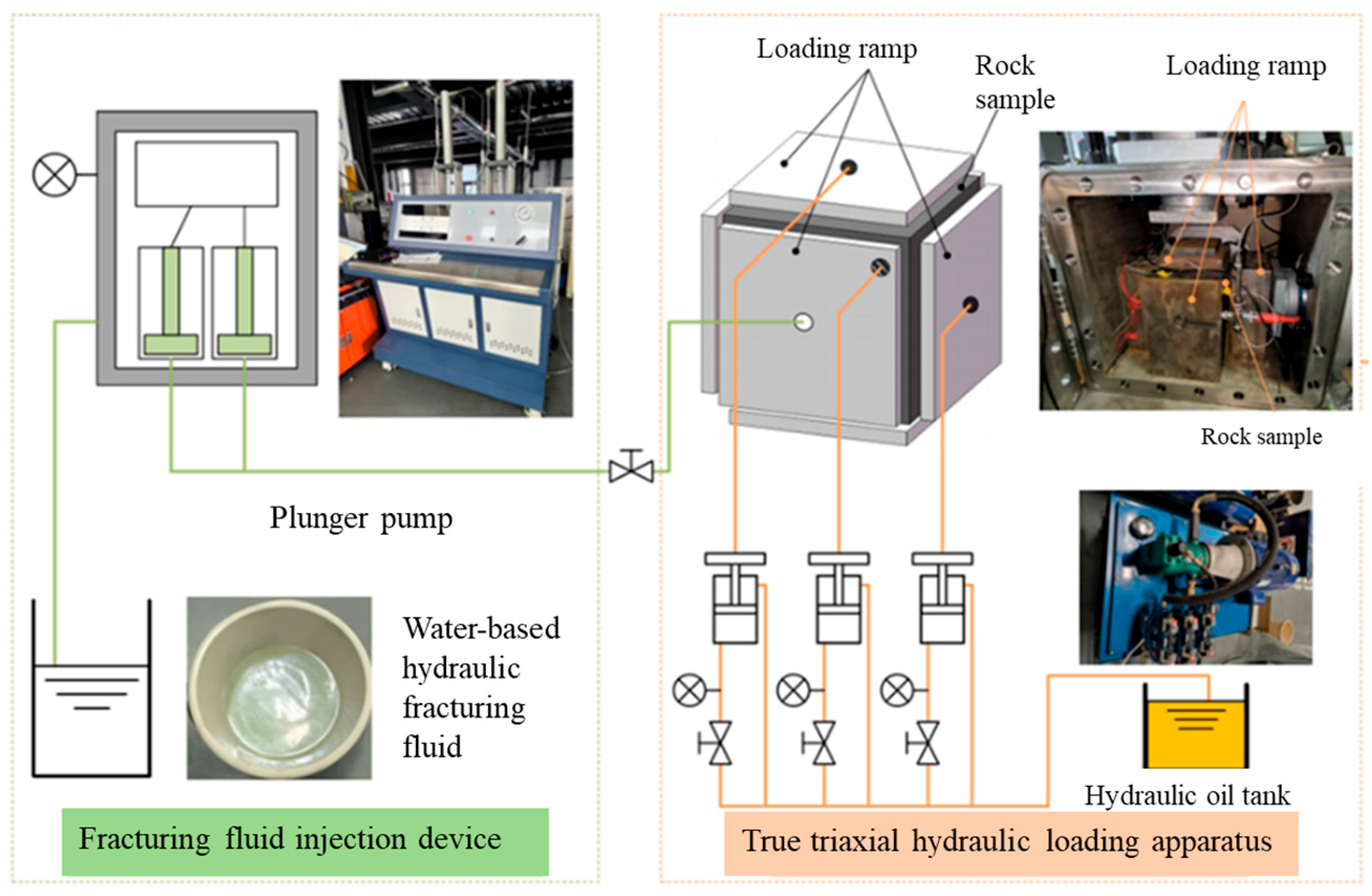
The experiments were performed using a self-developed true triaxial fracturing experimental system at Southwest Petroleum University, Chengdu, China (Figure 1). The system consists of a fracturing-fluid injection device, a true triaxial hydraulic loading device, and a fracturing testing system, and can conduct hydraulic fracturing experiments on rock samples of 300 × 300 × 300 mm3 and smaller. The maximum rated force of the true triaxial hydraulic loading device is 1500 kN. Because the applicable nominal stress is determined by the rated force divided by the loaded surface area, the corresponding maximum nominal principal stresses are 37.5 MPa for a 200 × 200 × 200 mm3 specimen and 16.67 MPa for a 300 × 300 × 300 mm3 specimen. A double-cylinder pump is used to inject fracturing fluid at constant pressure and constant flow rate, with a single-cylinder capacity of 200 mL; the injection pressure range is 0~60 MPa and the injection flow rate range is 0–200 mL/min.
Figure 1.
True Triaxial Fracturing System.
2.2. Specimens and Preparation
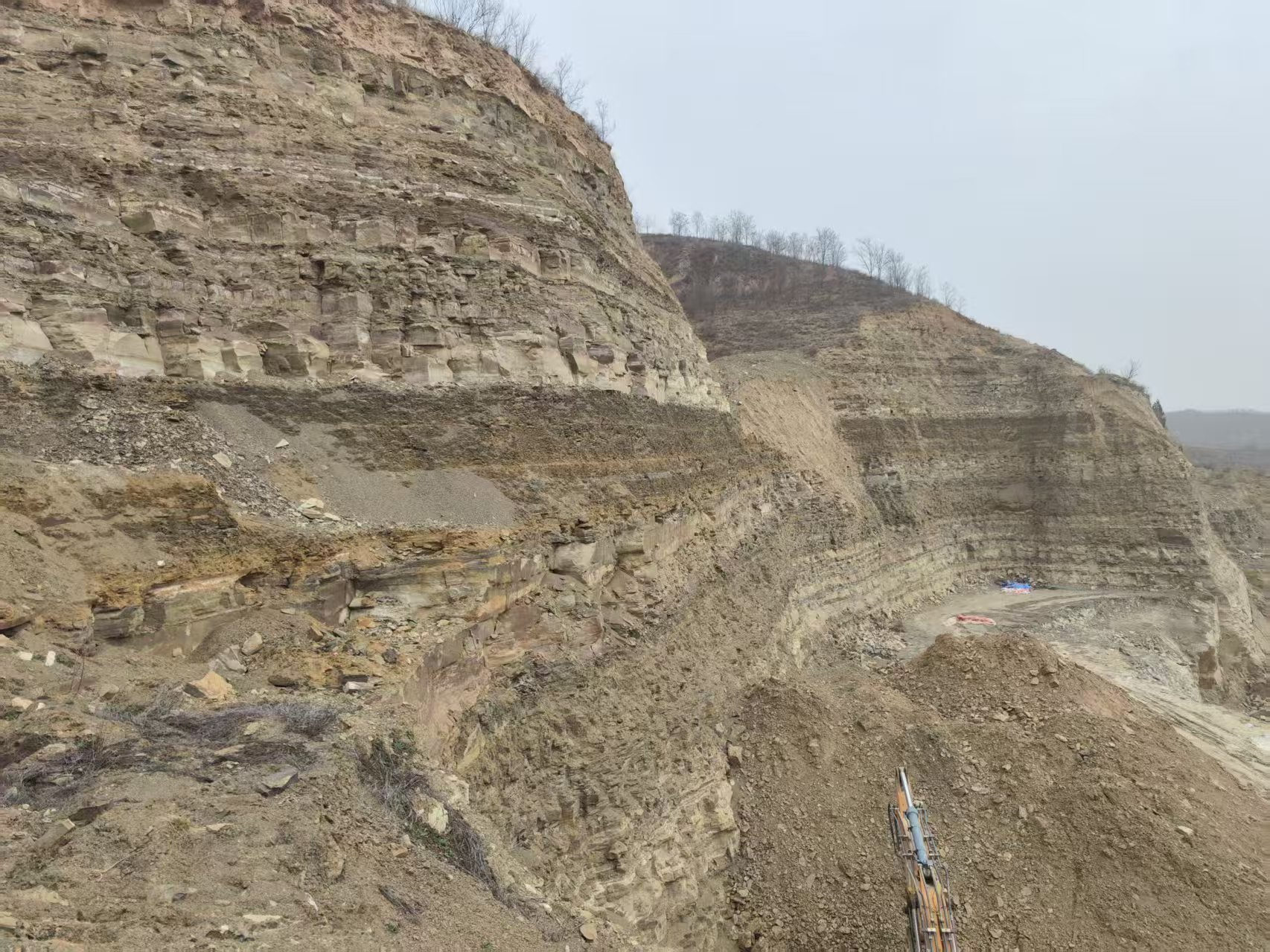
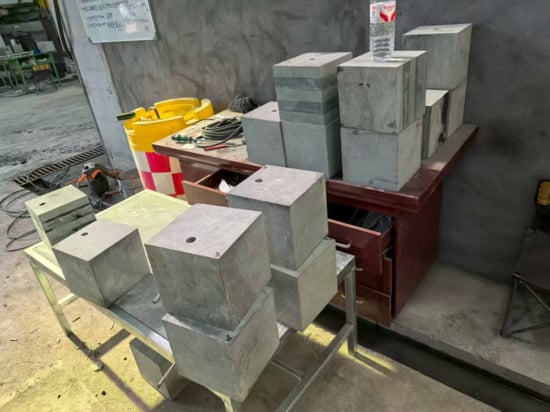
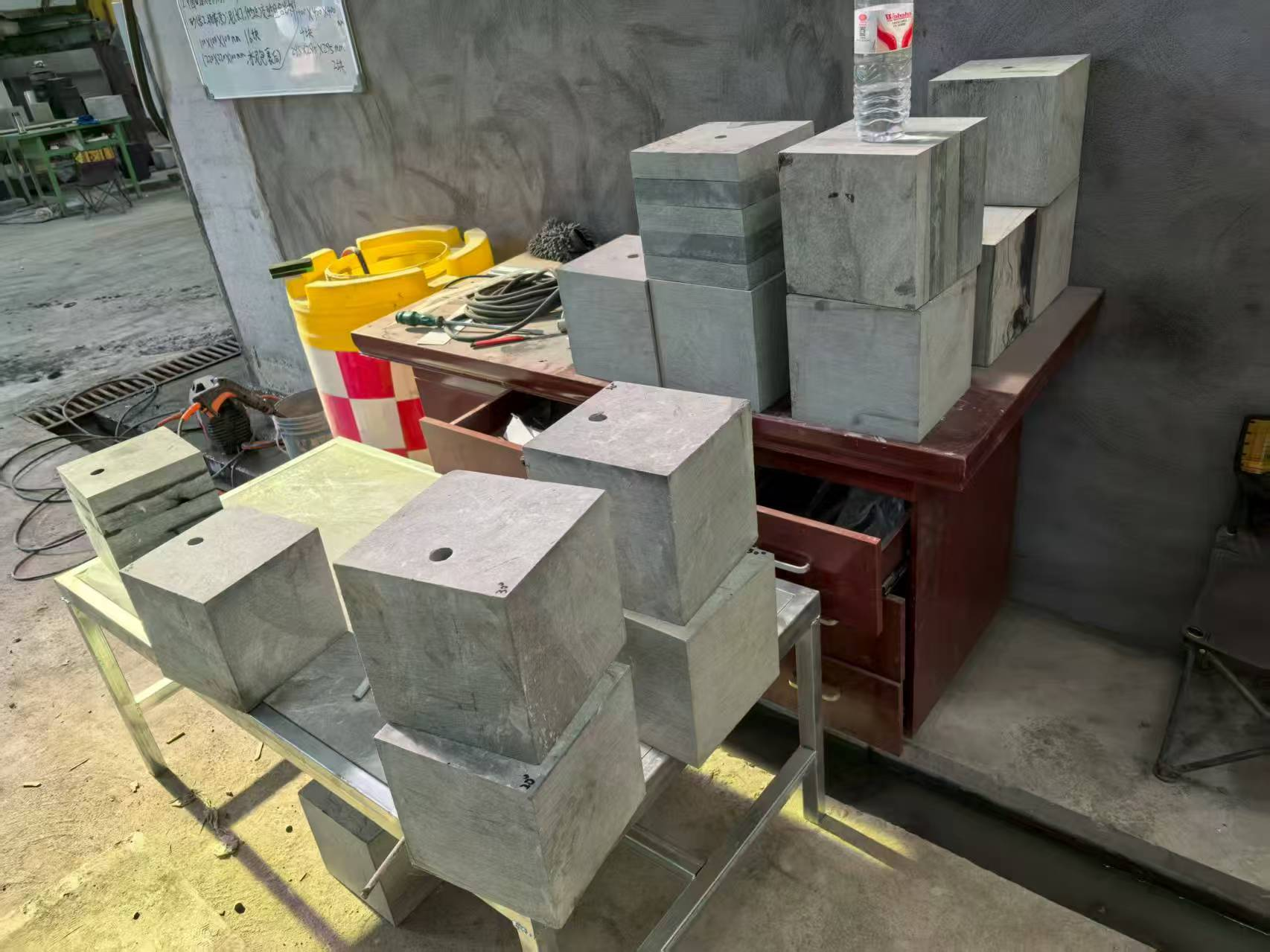
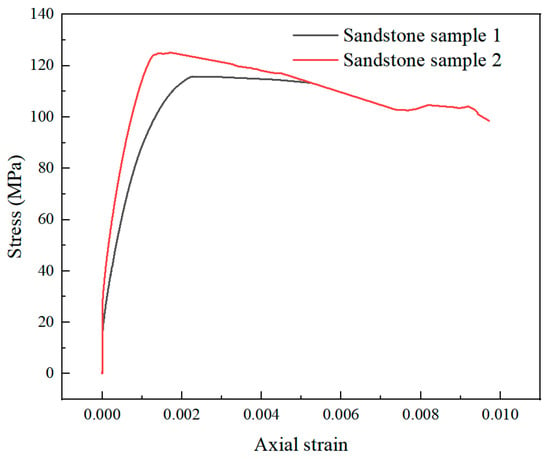
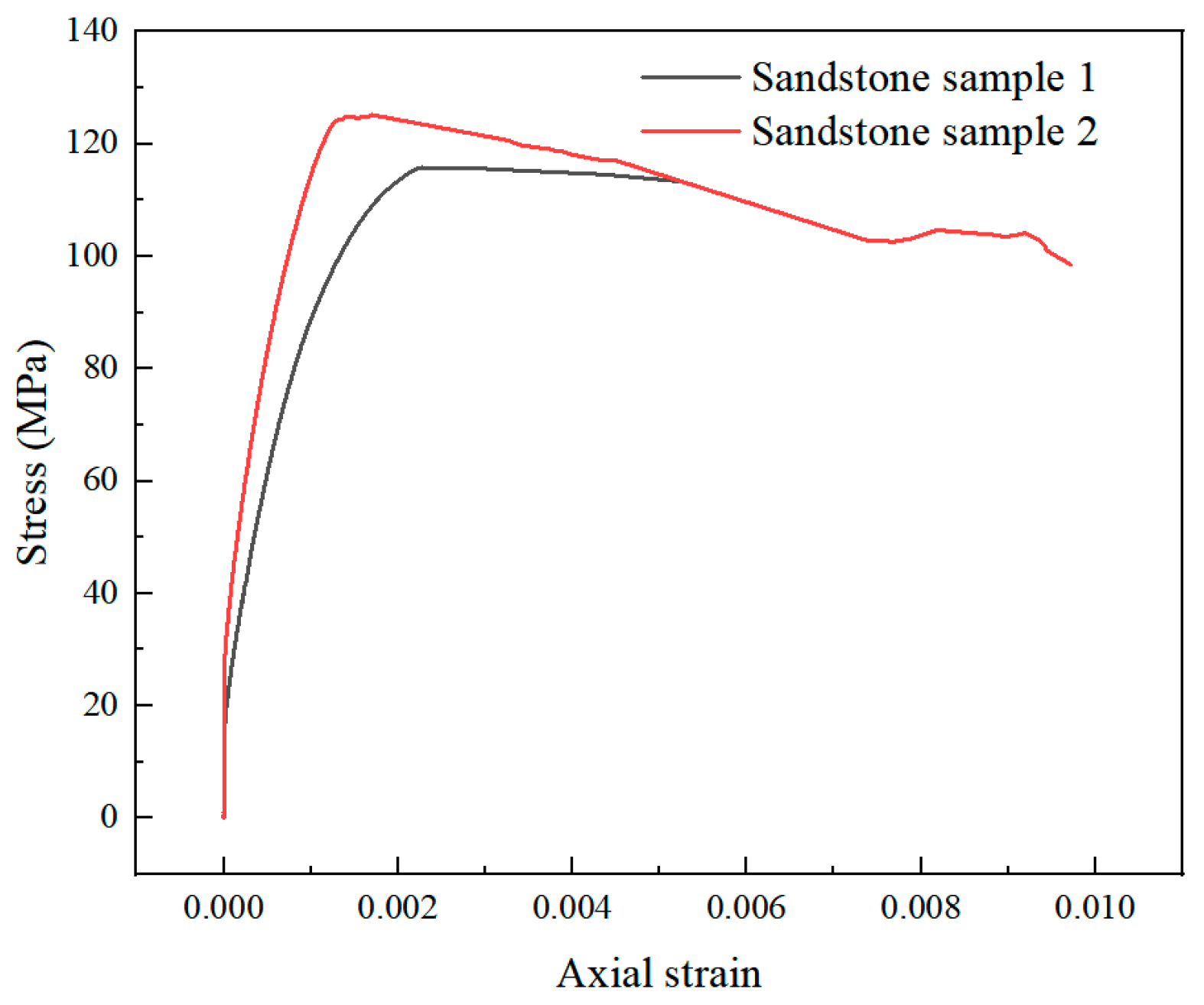
The rock samples were collected from outcrops of the Chang 7 Member sandstone and mudstone in Yanchuan County, Yan’an City (Figure 2). Structurally located in the eastern part of the Shanbei Slope of the Ordos Basin, the Chang 7 Member was deposited in a semi-deep to deep lacustrine facies, dominated by fine- to silt-sandstone intercalated with organic-rich dark mudstone; no obvious natural fractures were observed macroscopically on the outcrop surface. The collected samples were processed into standard cubic sandstone specimens of 200 mm × 200 mm × 200 mm (Figure 3) to ensure a uniform experimental scale. The mechanical parameters of the sandstone were measured by uniaxial compression and Brazilian splitting tests, as listed in Table 2. The mechanical parameters listed in Table 2 are averages of repeated standard tests: the uniaxial compression tests followed ASTM D7012-23, the Brazilian splitting tests followed ASTM D3967-23, and the specimen preparation followed the ISRM suggested methods. Spatial variability of the outcrop sandstone (grain-size variation, local micro-cracks) is acknowledged as an inherent source of experimental scatter, and its influence is discussed in Section 4. Figure 4 shows the axial stress–strain curves of two representative uniaxial compression specimens, which illustrate the typical deformation response and the failure stress of the tested sandstone.
Figure 2.
Outcrops of Chang 7 Member, Yanchuan County, Shaanxi Province.
Figure 3.
Processed samples of Chang 7 Member outcrop.
Table 2.
Sandstone mechanical parameters.
Figure 4.
Axial stress–strain curves of two sandstone specimens under uniaxial compression.
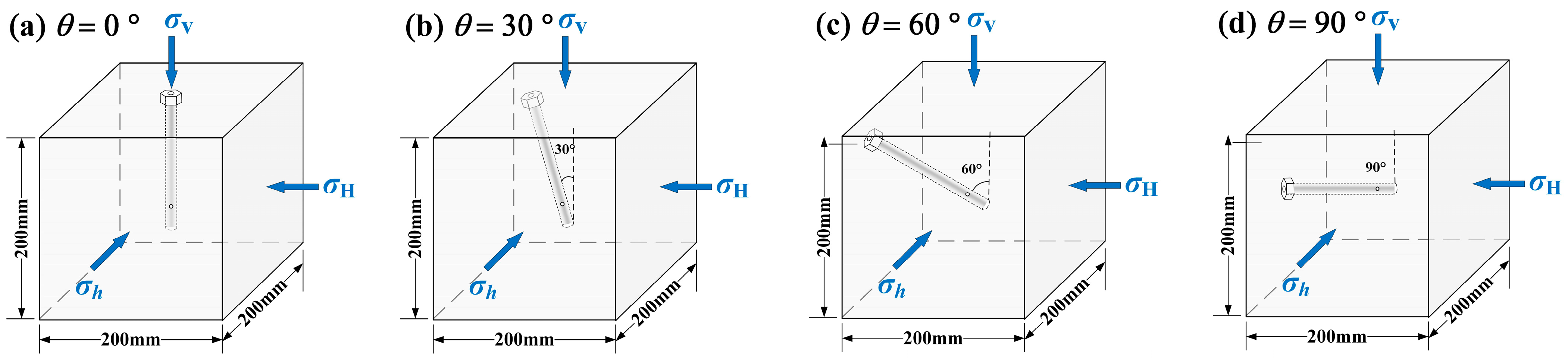
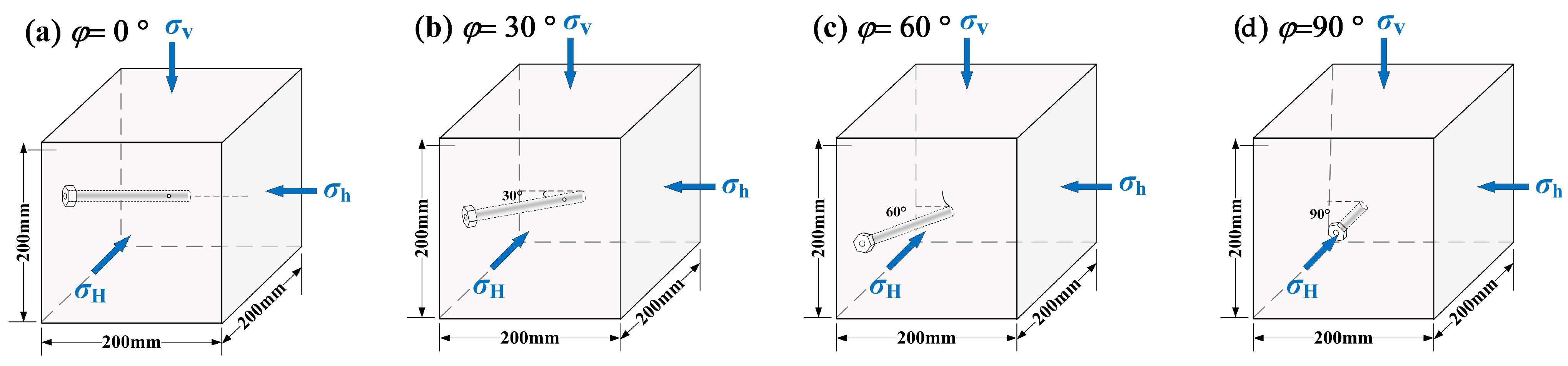
To simulate fracture propagation under different well deviation angles (defined here as the angle between the wellbore axis and the vertical direction) and different azimuth angles (defined as the angle between the wellbore axis and the minimum horizontal principal stress σh under horizontal-well conditions, so that azimuths of 0° and 90° correspond to boreholes parallel to σh and σH, respectively), boreholes with angles of 0°, 30°, 60°, and 90° were drilled in the samples. The angles were chosen to cover the full practical range of well deviation and azimuth with uniform spacing. To ensure that the borehole bottom is located at approximately the same horizontal horizon within the 200 mm cube, the 0° and 90° boreholes are ϕ20 mm × 110 mm, and the 30° and 60° boreholes are ϕ20 mm × 125 mm. The diameter of 20 mm was selected to match the scaled casing outer diameter (10 mm) with a realistic cement annulus, and to be consistent with previous true-triaxial studies on cubic specimens of similar size [18,19]. The relationships between the boreholes and the in situ stresses at different deviation and azimuth angles are shown in Figure 5 and Figure 6.
Figure 5.
Three-dimensional schematic of the borehole orientation for the well deviation-angle series (borehole rotating in the σv–σH plane; θ = 0°, 30°, 60°, 90°).
Figure 6.
Three-dimensional schematic of the borehole orientation for the azimuth-angle series (horizontal borehole rotating in the horizontal plane from σh toward σH; φ = 0°, 30°, 60°, 90°).
To simulate perforated completion, a stainless-steel tube with an outer diameter of 10 mm was used to simulate the casing; three Φ = 3 mm perforations were opened at the bottom with an axial spacing of 1.5 mm and a phase angle of 120°; the perforated interval was cemented to the wellbore with cement mortar, and the upper part of the perforated interval was cemented with epoxy resin to achieve effective annular isolation.
2.3. Experimental Scheme
A total of eight experimental groups were designed. The estimated field principal stresses at the target depth of approximately 2000 m were σv = 49.84 MPa, σH = 40.25 MPa, and σh = 35.60 MPa. Because the maximum applicable nominal stress for the 200 mm cubic specimens was 37.5 MPa, the complete three-dimensional field stress state could not be applied directly. A common prototype-to-model stress ratio Cσ = 4.45, equivalent to a reduction factor λσ = 0.2247, was therefore used, giving laboratory stresses of σv = 11.20 MPa, σH = 9.04 MPa, and σh = 8.00 MPa. The normal-faulting ordering (σv > σH > σh) was retained, and the field ratios σv/σh = 1.400 and σH/σh = 1.131 correspond to laboratory ratios of 1.400 and 1.130, respectively. The stress-shape parameter R = (σH − σh)/(σv − σh) is 0.3265 for the field state and 0.3250 for the reported laboratory values, with the small difference arising from rounding. However, preserving the principal-stress ratios alone does not constitute complete field-scale hydraulic-fracturing similitude, which would additionally require the relevant dimensionless relationships involving elastic deformation, fracture toughness or fracture energy, viscous flow, leak-off, injection time, and confining stress to be satisfied. Therefore, the applied condition is described here as a proportionally reduced, stress-ratio-preserving laboratory stress state. It is used to compare borehole-orientation effects and not to predict absolute field-scale breakdown pressures. The fracturing fluid was a guar gum solution with a viscosity of 50 mPa·s, and the nominal injection flow-rate setting was approximately 64 mL/min in all tests. The stress parameters and injection conditions are summarized in Table 3.
Table 3.
Experimental scheme and breakdown pressure results.
2.4. Testing and Data Processing
To ensure the comparability of results under different well deviation and azimuth conditions, the testing and data processing in this paper were carried out from three aspects: injection-pressure response, macroscopic fracture distribution, and three-dimensional fracture-surface morphology. During fracturing, the wellbore injection pressure was collected in real time through a pressure sensor integrated in the self-developed system arranged at the wellhead, and the pumping time and flow-rate changes were recorded synchronously. For samples with multiple fracture traces, the length of each fracture segment was counted separately and used as the basic data for evaluating fracture complexity. The fracture-surface morphology was tested with a three-dimensional laser scanner (Sermoon S1, Shenzhen Creality 3D Technology Co., Ltd., Shenzhen, China). Before scanning, residual fracturing fluid and loose particles on the fracture surface were removed to reduce the influence of attachments on the height data; after scanning, three-dimensional point-cloud data of the fracture surface were obtained, and the point cloud was subjected to regular grid interpolation and datum-plane correction through Python 3.0. Because the borehole-cemented zone and the specimen boundary are prone to non-fracture morphology errors, this paper uniformly selected the central 50 mm × 100 mm region of the fracture as the statistical area, thereby reducing the interference of boundary effects and borehole cementation on the roughness and fractal results. The calculation formulas for the quantitative data are as follows:
(1) Arithmetic mean height (Sa)
where M and N are the numbers of points in the x and y directions, respectively, zij is the measured height at point (i, j), and is the mean height.
(2) Root-mean-square height (Sq)
where Sq is the root-mean-square height.
(3) Surface fractal dimension D, analyzed by the box-counting method, as shown in the following equation:
where ε is the box size and N(ε) is the minimum number of boxes required to cover the fracture surface at scale ε.
(4) Surface fracture-trace complexity. Because it is difficult to measure the internal fracture propagation within the specimen, the total length of the surface fracture traces is used to quantitatively characterize the overall fracture complexity: f is defined as the ratio of the total length of all visible surface fracture traces (Σli) to the side length d of the specimen (f = Σli/4d), where li is the length of the i-th fracture trace and d is the side length of the specimen. For a single straight trace crossing four faces, f = 1; values greater than 1 indicate branching, turning, or multiple traces. A qualitative classification is adopted: f < 1.2 (relatively simple), 1.2 ≤ f ≤ 1.5 (moderately complex), and f > 1.5 (highly complex). This index does not include the three-dimensional connectivity structure and volumetric distribution of internal fractures, and is mainly applicable to the relative comparison among different working conditions at the scale of this experiment, reflecting the exposed complexity of near-wellbore fractures on the specimen surface.
where li is the length of the i-th fracture trace, d is the side length of the specimen, and f is the surface fracture-trace complexity. This index does not include the three-dimensional connectivity structure and volumetric distribution of internal fractures, and is mainly applicable to the relative comparison among different working conditions at the scale of this experiment, reflecting the exposed complexity of near-wellbore fractures on the specimen surface.
3. Results
3.1. Fracture Initiation and Propagation Under Different Well Deviation Angles
3.1.1. Breakdown Pressure Under Different Well Deviation Angles
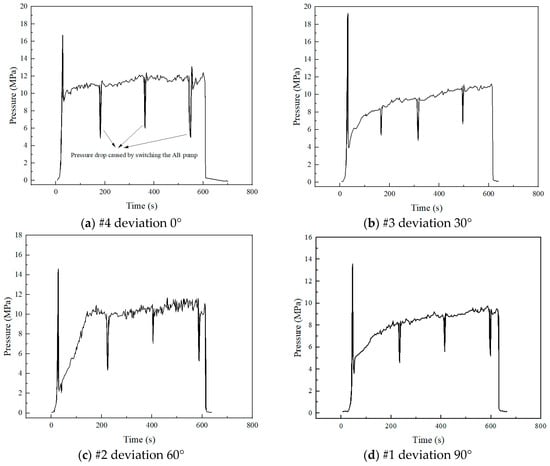
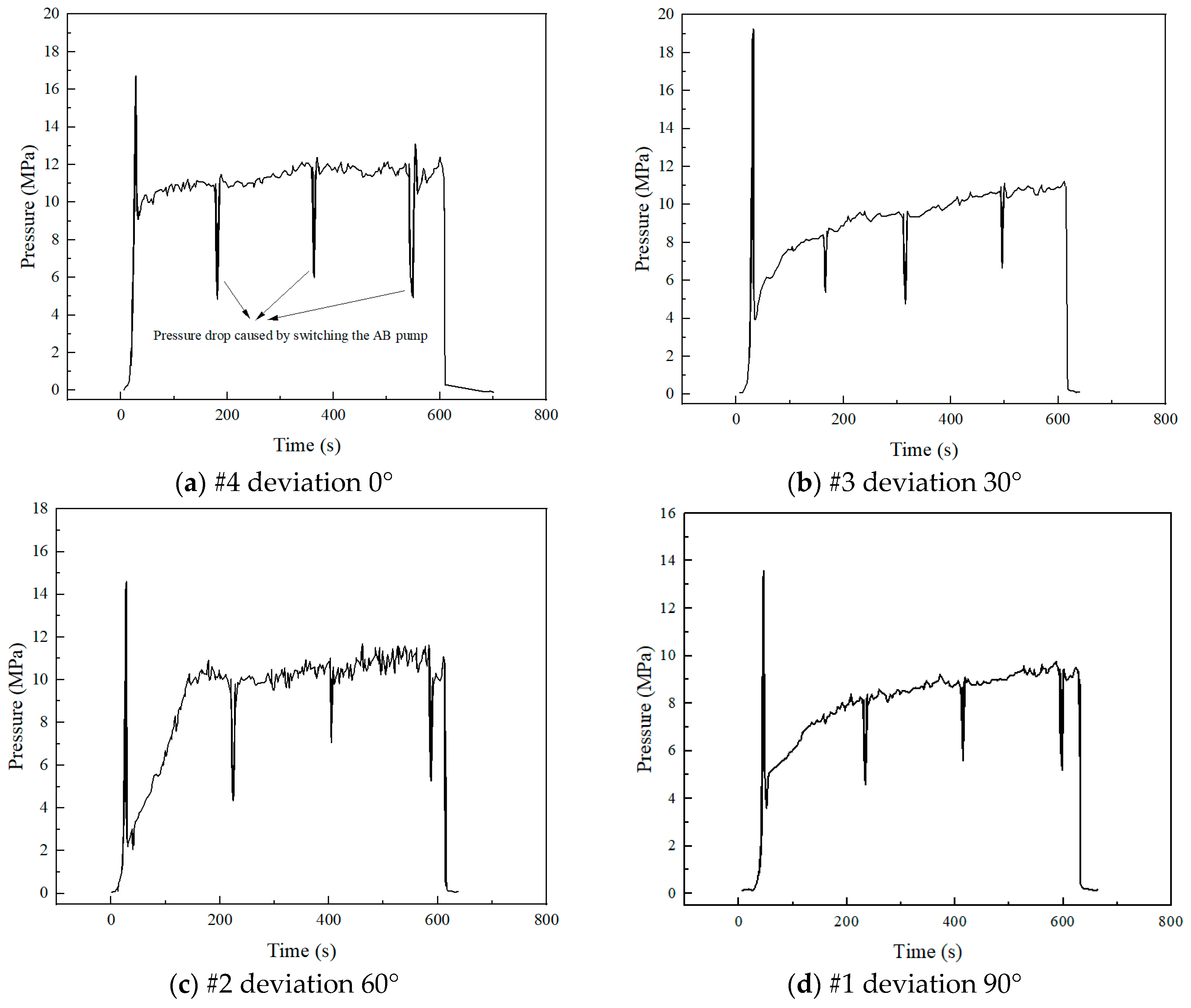
Figure 7 presents the complete fracturing-pressure histories of sandstone specimens at different well deviation angles under an azimuth angle of 90° and a fracturing-fluid viscosity of 50 mPa·s. For each test, pressure initially increases to a first peak and then decreases. In this study, the first peak immediately preceding the first distinct pressure drop is operationally defined as the breakdown pressure. The measured breakdown pressures at well deviation angles of 0°, 30°, 60°, and 90° are 19.125, 19.249, 14.594, and 13.569 MPa, respectively. Overall, as the deviation angle increases from 0° to 90°, the breakdown pressure shows a clear decreasing trend; the difference between the 0° and 30° cases is small, whereas the pressure decreases markedly at 60° and 90°. Only the first-peak values are used in the quantitative comparison; the later portions are retained to disclose the complete raw pressure records and are not used to derive the orientation-related conclusions.
Figure 7.
Sandstone fracturing curves under different well deviation angles.
Based on the classical elastic solution, Huang et al. [11] pointed out that the circumferential, axial, and shear stresses on the wall of an arbitrarily inclined wellbore are jointly controlled by the rotated local stress components, and the initiation criterion should ultimately be that the minimum effective principal stress on the borehole wall reaches the tensile failure condition. For the specific working condition of this test—namely a normal-faulting stress state satisfying σv > σH > σh—assuming a rock tensile strength σt = 0 and an initial pore pressure P0 = 0, the breakdown pressure of the inclined wellbore can be simplified as:
where Pb is the breakdown pressure, γ is the well deviation angle, and σv, σH, and σh are the vertical, maximum horizontal, and minimum horizontal principal stresses, respectively. This equation shows that, under σv > σH > σh, as the deviation angle γ increases, the term continuously increases, thereby gradually reducing Pb.
It can be seen that the theory and experiment are consistent in trend, both reflecting that an increasing deviation angle reduces the difficulty of initiation; however, deviations remain at individual angles, especially the 30° experimental value being slightly higher than that of 0°. The reason may be that the theoretical model is based on homogeneous, isotropic, and linear-elastic assumptions, whereas the heterogeneity of the actual rock sample and the perforation orientation affect the true breakdown pressure; at the same time, related reviews [4] also point out that analytical models purely based on tensile strength are more suitable for explaining trends, and the accurate fitting of experimental or field values is still constrained by factors such as rock anisotropy, fluid flow, and nonlinear damage.
The first breakdown peak in every deviation-angle test occurs within the first 1–2 min of injection. Injection was subsequently continued to allow fracture development before unloading, specimen disassembly, and fracture-surface scanning. The deviation-angle and azimuth-angle series were conducted in two separate batches using the same dual-cylinder injection system. In the deviation-angle batch, the pressure decrease during the cylinder switchover was followed by an immediate recovery. Nevertheless, the complete post-breakdown pressure response may contain superposed contributions from the injection-system transient, hydraulic-system compliance, fluid redistribution and leak-off, and continuing fracture opening or propagation. These contributions cannot be uniquely separated from the available pressure records. Therefore, no quantitative interpretation is assigned to the amplitude or duration of the post-breakdown pressure drops in Figure 7.
3.1.2. Fracture Propagation Morphology
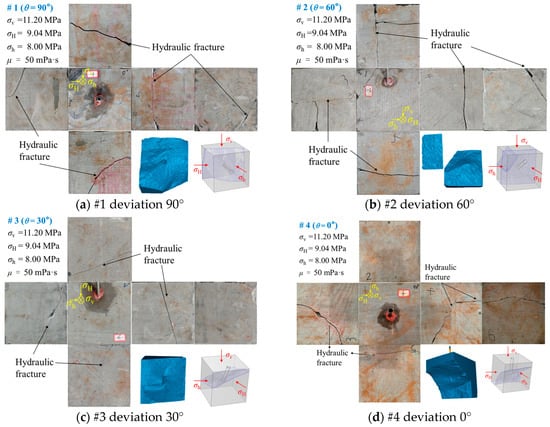
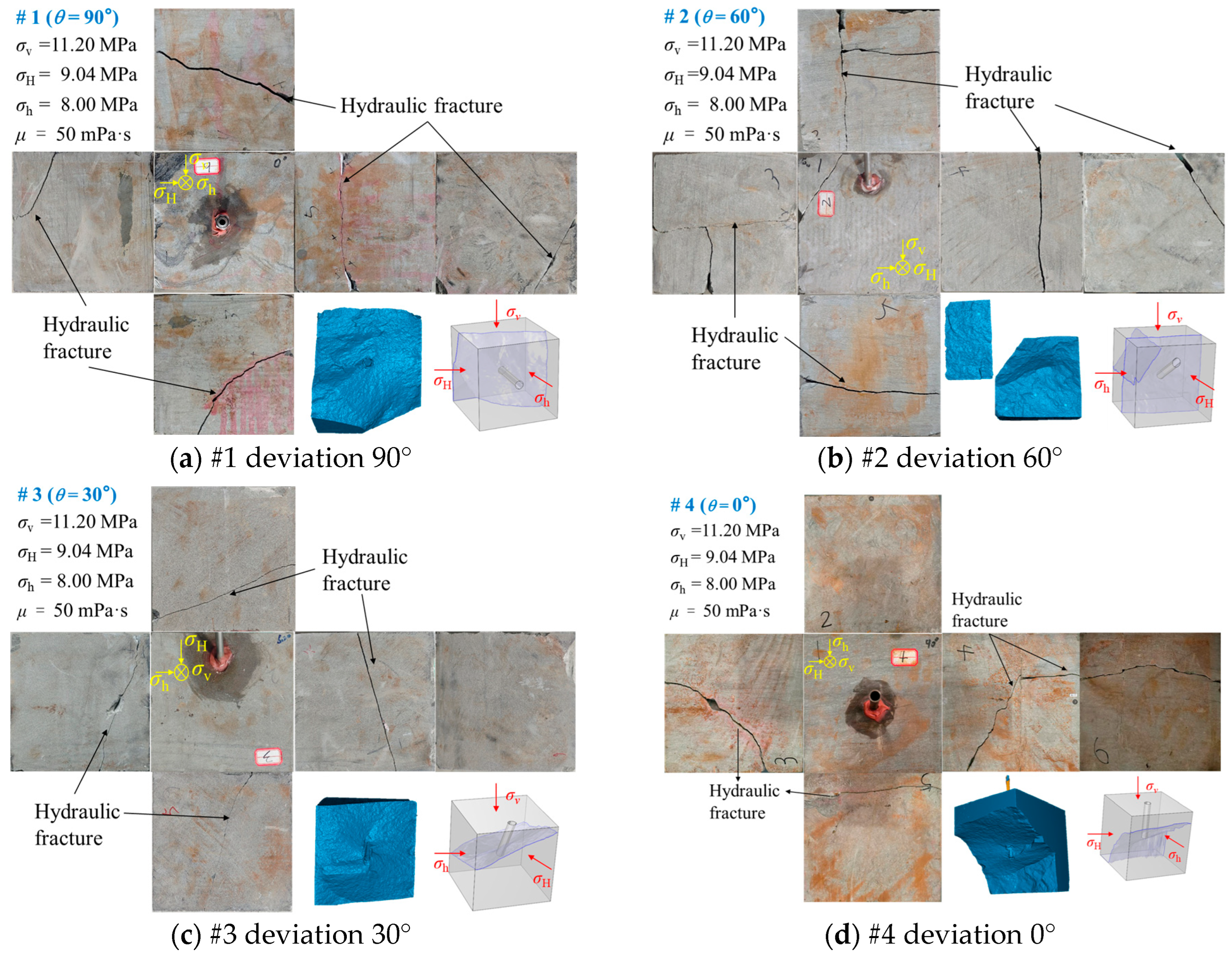
Figure 8 shows the morphology of sandstone hydraulic fractures at different well deviation angles. It can be seen that sample #1 (deviation 90°) forms a vertical through-going fracture roughly perpendicular to the wellbore direction; sample #2 (deviation 60°) forms a vertical fracture at the borehole bottom, and as the lateral fracture propagates it connects with a natural fracture along the wellbore axis, making the fracture morphology more complex. Sample #3 (deviation 30°) also forms a vertical fracture with a simple morphology. Sample #4 (deviation 0°) produces a vertical fracture parallel to the wellbore direction, which deflects at the top and gradually turns toward the horizontal direction.
Figure 8.
Rock fracture distribution with different well deviation angles (corresponding in situ stress parameters in the upper left; 3D scanning images and schematics of fracture surfaces in the lower right).
It can be seen that for the sandstone the fracture propagation morphology is relatively simple. The hydraulic fracture propagates in the σv–σH plane (perpendicular to σh). In the deviation-angle series the wellbore axis also lies in this σv–σH plane, so the propagation plane is coplanar with the wellbore axis; near the perforated wellbore, however, the three-hole (120° phase) perforation scheme induces a locally oblique/transverse initiation segment [18], which is why specimens #2 (60°) and #3 (30°) show a transverse-looking near-wellbore trace before the fracture extends in the σv–σH plane. At a deviation angle of 0° (vertical well), the fracture propagates vertically along the wellbore direction in this same plane.
3.1.3. Fracture Complexity and Roughness
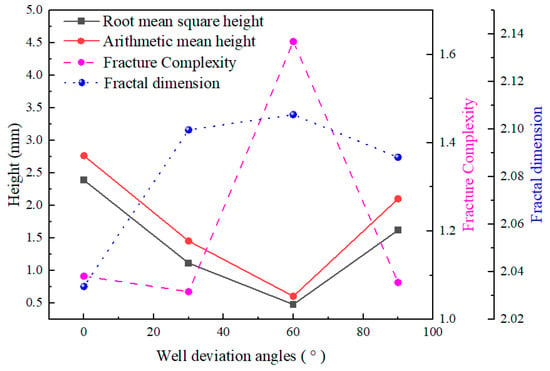
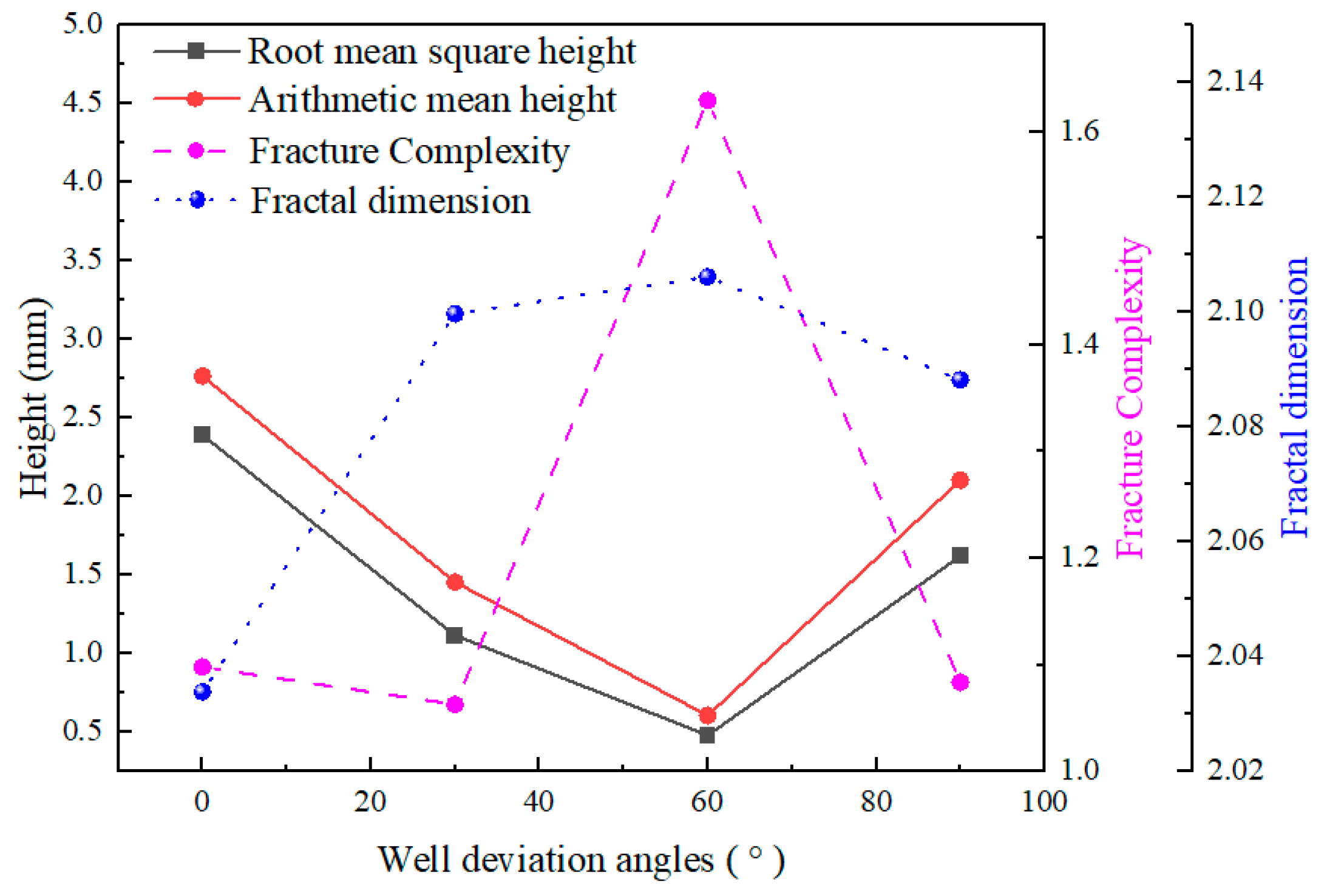
Figure 9 and Table 4 reflect the variation characteristics of the sandstone fracture-surface roughness, fractal dimension, and surface fracture-trace complexity under different well deviation angles. Overall, the deviation angle has a significant effect on both the fracture-surface roughness and the surface fracture-trace complexity, but a relatively weak effect on the fractal dimension. As the deviation angle increases from 0° to 90°, the fracture-surface roughness parameters do not show a monotonic variation: the fracture surface is roughest at 0°, with Sa and Sq reaching 2.391 mm and 2.766 mm, respectively; it is smoothest at 60°, with Sa and Sq dropping to 0.481 mm and 0.607 mm; the 30° and 90° cases are in between. This indicates that the deviation angle mainly affects the undulation amplitude and surface morphology of the fracture plane by changing the propagation path and local turning behavior.
Figure 9.
Roughness, complexity and fractal dimension characteristics at different well deviation angles. The height on the y-axis refers to the elevation of the scanned fracture surface relative to the fitted mean reference plane after datum-plane correction, in mm.
Table 4.
Roughness, complexity and fractal dimension characteristics at different well deviation angles.
In terms of surface fracture-trace complexity, the complexity is highest at a deviation angle of 60°, reaching 1.629, which is significantly higher than the 0°, 30°, and 90° cases, indicating that under this deviation angle the fracture is more prone to turning, branching, or communicating with natural weak planes, thereby forming a more complex fracture distribution. This is consistent with the aforementioned fracture-morphology analysis: after the vertical fracture forms at the borehole bottom in the 60° sample, it further connects with the natural fractures developed along the wellbore axis, significantly complicating the overall fracture geometry. In contrast, the complexities at 0°, 30°, and 90° are 1.098, 1.063, and 1.084, respectively, with small overall differences, indicating that fracture propagation under these conditions is still dominated by a single main fracture with limited branching and deflection.
The fractal dimension results show that the fracture-surface fractal dimension under various deviation angles ranges from 2.0339 to 2.1061, with a small fluctuation. Among them, the fractal dimension is highest at 60° and lowest at 0°. Overall, although the fractal dimension can reflect the self-similar characteristics and geometric irregularity of the fracture surface to some extent, its response to changes in the deviation angle is less sensitive than that of roughness and complexity, indicating that the fractal characteristics of the fracture surface may be more controlled by the intrinsic heterogeneity of the rock rather than merely by the spatial position of the wellbore.
It can be seen that the deviation angle changes the spatial relationship between the wellbore and the principal-stress directions, thereby affecting the propagation path, turning behavior, and communication ability with natural fractures after fracture initiation. For the sandstone samples in this experiment, a deviation angle of 0° more readily forms a fracture surface with large surface undulation, while 60° is more favorable for forming a fracture network with higher overall complexity, and the propagation morphology at 30° and 90° is relatively simple. This indicates that during tight-sandstone fracturing, a moderate deviation angle may be more conducive to increasing the fracture-network complexity and thus enhancing the reservoir stimulation effect.
3.2. Fracture Initiation and Propagation Under Different Azimuth Angles
3.2.1. Breakdown Pressure Under Different Azimuth Angles
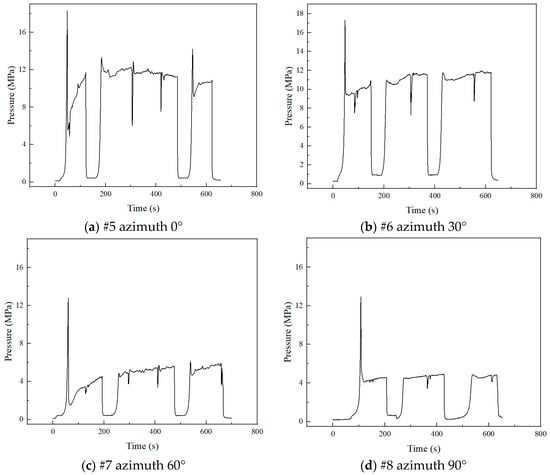
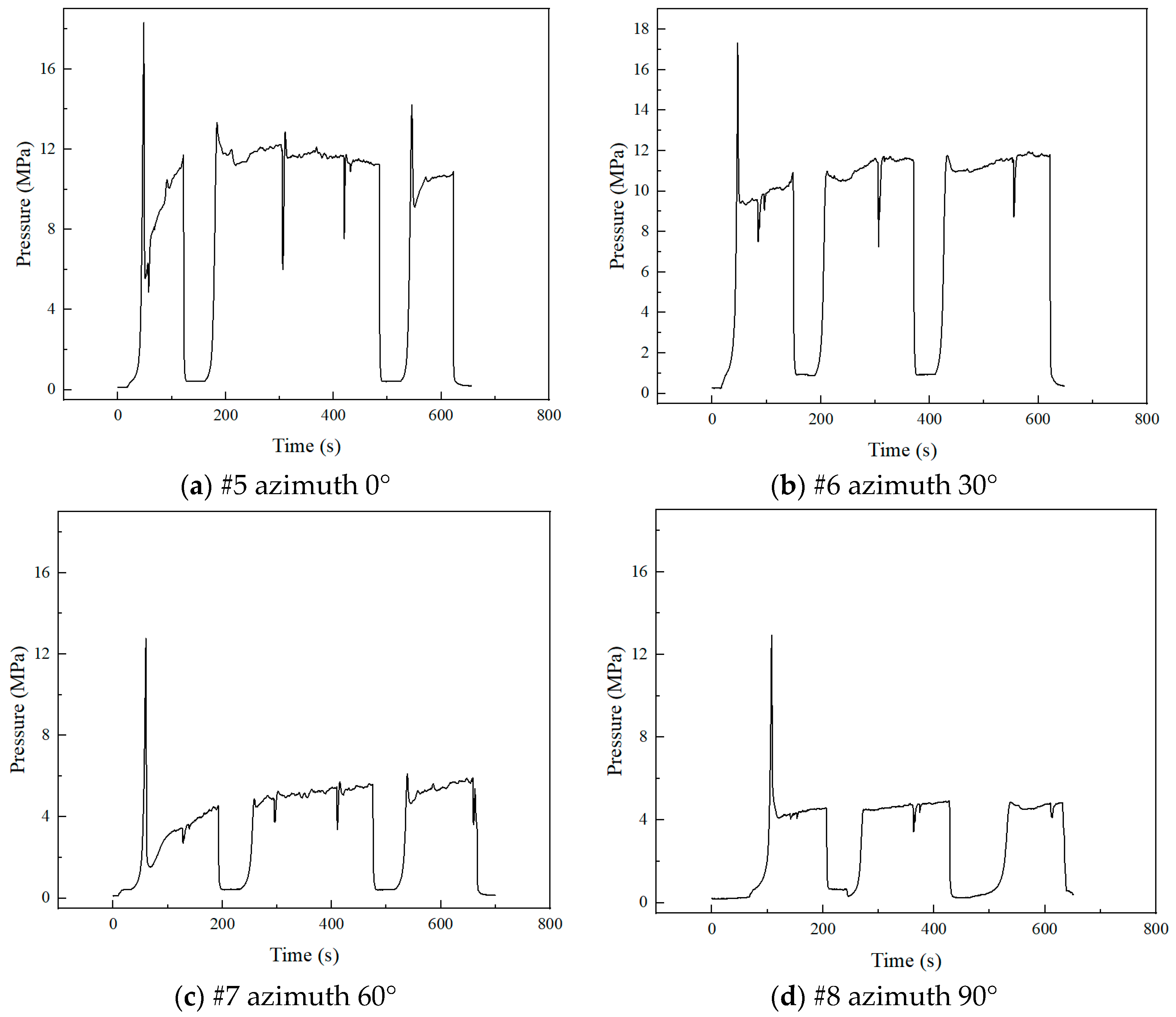
Figure 10 presents the complete fracturing-pressure histories of sandstone specimens at different azimuth angles under a basically horizontal-well condition and a fracturing-fluid viscosity of 50 mPa·s. As in the deviation-angle series, the first pressure peak immediately preceding the first distinct drop is defined as the breakdown pressure. The measured breakdown pressures at azimuth angles of 0°, 30°, 60°, and 90° are 18.310, 17.332, 13.249, and 12.933 MPa, respectively. Overall, the first-peak breakdown pressure decreases as the azimuth angle increases from 0° to 90°. Only these first-peak values are used in the comparative analysis. The breakdown pressure of an arbitrarily inclined wellbore should be determined by rotating the in situ principal-stress tensor into the local wellbore coordinate system and combining the borehole-wall stress distribution with the criterion that the maximum tensile stress on the borehole wall reaches the rock tensile strength. Huang et al. [11] noted that initiation prediction should compare the maximum tensile stress on the borehole wall with the rock tensile strength rather than use a single stress component as the sole criterion. For a horizontal well under normal-faulting conditions, assuming σt = 0 and P0 = 0 for the purpose of comparing the angular trend, the breakdown-pressure relation can be simplified as:
Figure 10.
Sandstone fracturing curves at different azimuth angles.
In the equation, φ is the wellbore azimuth angle. It can be obtained that when φ = 0° (wellbore parallel to σh), Pb = 3σH − σh, which gives the maximum breakdown pressure; when φ = 90° (wellbore parallel to σH), Pb = 3σh − σH, which gives the minimum breakdown pressure. Therefore, theoretically the breakdown pressure decreases as the azimuth angle increases; the breakdown pressure is minimized when the wellbore is parallel to the maximum horizontal principal stress (σH), and increases as the wellbore gradually turns toward the minimum horizontal principal stress (σh). In other words, arranging the wellbore along the maximum horizontal principal stress (σH) is more favorable for reducing the breakdown pressure, which is consistent with the overall trend reflected in Figure 10. It should be noted that this result may appear counterintuitive, because one might expect that aligning the wellbore with the minimum horizontal principal stress (σh) would give the lowest breakdown pressure. In fact, the breakdown pressure of an inclined or horizontal well is governed by the two principal stresses acting in the plane perpendicular to the borehole axis (Haimson and Fairhurst, 1967; Huang et al., 2012, refs. [9,11]); for a horizontal well, orienting the borehole along σH places the smallest stress σh in this critical plane, thereby minimizing the initiation pressure. This is corroborated by field observations in Yanchang oilfield.
It is noted that the measured tensile strength of the sandstone is 6.87 MPa (Table 2) and that the specimens were tested under dry, ambient conditions without applied pore pressure, so P0 ≈ 0 is physically reasonable for the laboratory setup. In the simplified equations above, σt and P0 enter as additive constants that are independent of the deviation angle θ and the azimuth angle φ; omitting them therefore shifts all predicted breakdown pressures by the same offset without changing the monotonic trend or the angle at which the extremum occurs. Because the present study focuses on relative trends and comparative analysis rather than absolute prediction, setting σt = 0 and P0 = 0 is acceptable for the purpose of trend comparison.
It should be noted that the specimens in this experiment used casing–perforation simulated completion; the perforation parameters, cement-sheath cementation differences, and local heterogeneity of the rock samples can all amplify the breakdown-pressure differences among different azimuth angles. This paper adopts a three-hole, 120° phase-angle perforation scheme, and the initiation location may not be at the most easily fractured position, causing the breakdown pressure to rise. Related studies also show that the wellbore trajectory and perforation azimuth have a significant influence on the fracture breakdown pressure, and unreasonable perforation/azimuth configurations can markedly raise the breakdown pressure [18,31].
The first breakdown peak in every azimuth-angle test also occurs within the first 1–2 min of injection. All four tests had the same nominal injection-rate setting of 64 mL/min. During this experimental batch, one cylinder switchover occurred, and several post-peak pressure decreases were followed by broader low-pressure plateaus lasting approximately 20–40 s. Because the nominal flow-rate setting was unchanged, these differences were not caused by intentionally different prescribed injection rates among the four tests. However, the pressure records alone do not permit the plateaus to be attributed uniquely to cylinder-switching dynamics, system compliance, fluid redistribution or leak-off, or continued fracture evolution. We therefore do not interpret the plateau width or depth as a measure of fracture volume, aperture, conductivity, or complexity. The complete post-breakdown histories are retained in Figure 10 only to provide the original unfiltered experimental records.
3.2.2. Fracture Propagation Morphology
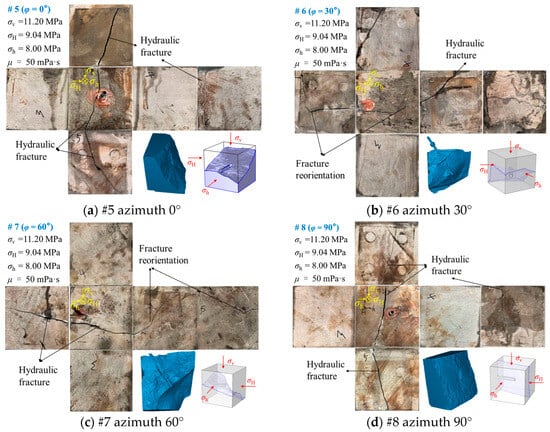
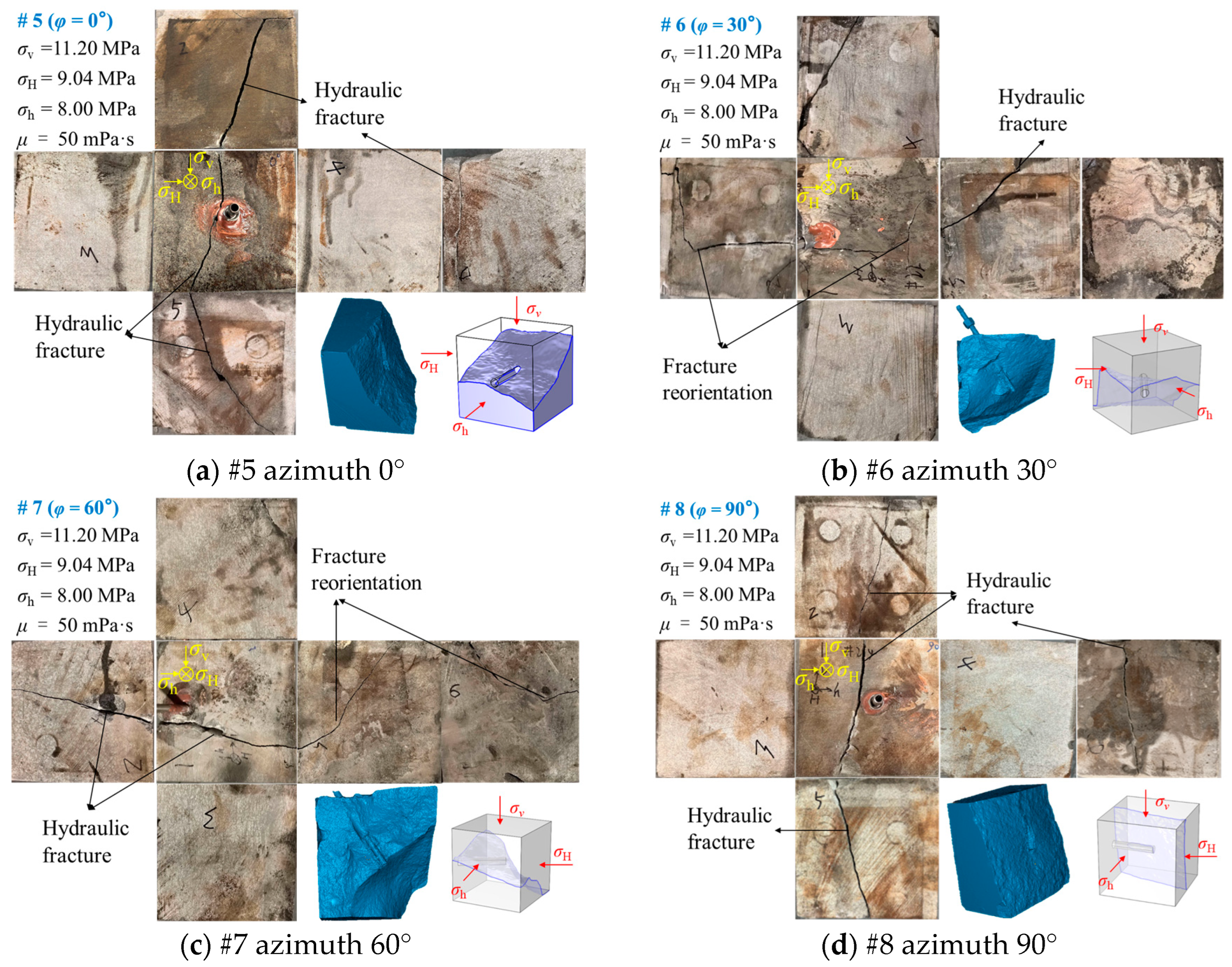
Figure 11 shows the morphology of sandstone hydraulic fractures at different azimuth angles. It can be seen that sample #5 (azimuth 0°) forms a vertical main fracture that tends to extend toward the maximum principal stress direction at the lower end of the wellbore and extends along the wellbore direction at the upper part, indicating that under this stress differential the wellbore plays a dominant role in fracture extension. Sample #6 (azimuth 30°) forms a tortuous fracture that propagates along the direction 30° to the maximum principal stress at the lower end of the wellbore and along the horizontal plane of the wellbore at the upper part. Sample #7 (azimuth 60°) also forms a tortuous fracture that propagates along the direction 60° to the maximum principal stress at the lower end of the wellbore and along the horizontal plane of the wellbore at the upper part. Sample #8 (azimuth 90°) forms a relatively straight single fracture that propagates along the vertical direction and the plane of the maximum principal stress.
Figure 11.
Sandstone surface unfolding maps at different azimuth angles (corresponding in situ stress parameters in the upper left; 3D scanning images and schematics of fracture surfaces in the lower right).
It can be seen that under different azimuth angles, a single fracture was produced in the laboratory, but the fracture morphologies differ greatly; at azimuth angles of 0° and 90°, the fracture propagation plane is relatively flat, whereas when the wellbore is obliquely intersected with the minimum horizontal principal stress direction at 30° or 60°, the fracture propagation behavior exhibits obvious non-coplanarity and turning characteristics.
3.2.3. Fracture Complexity and Roughness
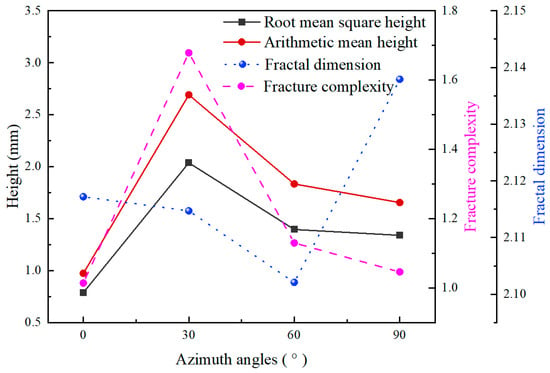
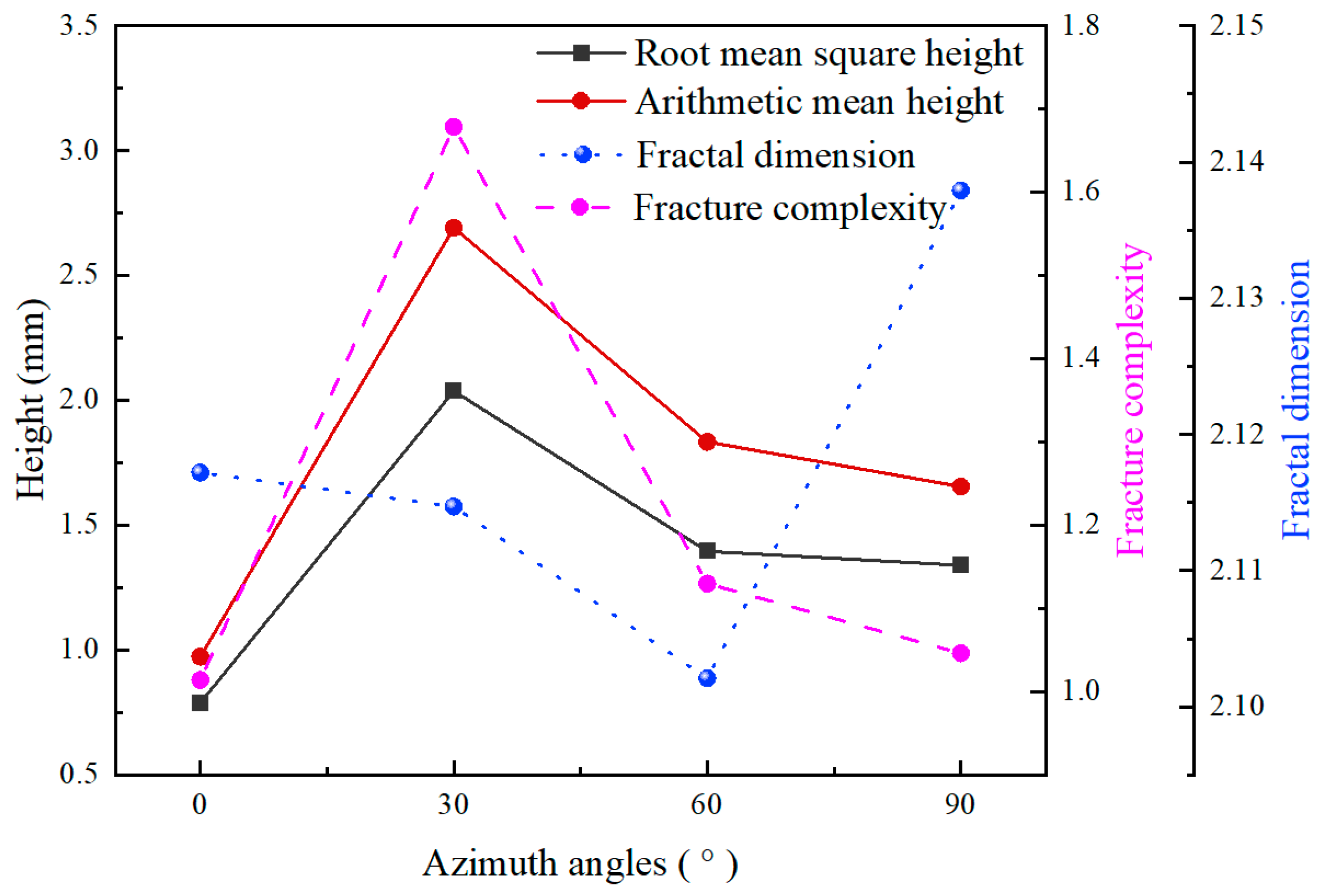
Figure 12 and Table 5 reflect the variation characteristics of the sandstone fracture-surface roughness, fractal dimension, and overall complexity under different azimuth angles. Overall, the azimuth angle has a significant effect on the fracture complexity and surface roughness, but a relatively weak effect on the fractal dimension. As the azimuth angle increases from 0° to 90°, both the fracture complexity and surface roughness first increase and then decrease, reaching the maximum at an azimuth angle of 30°, indicating that a moderate wellbore azimuth is more favorable for inducing fracture deflection, branching, and non-planar propagation, thereby forming a more complex fracture network.
Figure 12.
Fracture surface roughness, fractal dimension and overall fracture complexity at different azimuth angles. The height on the y-axis refers to the elevation of the scanned fracture surface relative to the fitted mean reference plane after datum-plane correction, in mm.
Table 5.
Characteristics of fracture surface roughness, fractal dimension and overall fracture complexity at different azimuth angles.
In terms of fracture complexity, as the azimuth angle increases from 0° to 30°, the fracture complexity significantly increases from 1.014 to 1.679, indicating a marked increase in the total length of fracture traces and a more tortuous and complex propagation path; when the azimuth angle further increases to 60° and 90°, the complexity drops to 1.130 and 1.046, respectively, indicating that the fracture gradually tends toward single and straight propagation. Combined with the aforementioned fracture-morphology analysis, it can be seen that the 30° and 60° azimuth cases exhibit more obvious turning characteristics and non-coplanar propagation behavior, among which the deflection and branching effect is most prominent at 30°, and therefore it is most favorable for forming a complex fracture network; in contrast, the 0° and 90° azimuth cases have relatively straight propagation paths and lower overall complexity.
The variation law of the roughness parameters is basically consistent with that of the fracture complexity. Table 4 shows that at an azimuth angle of 30°, the arithmetic mean height Sa and root-mean-square height Sq of the fracture surface reach 2.037 mm and 2.691 mm, respectively, both being the maximum among all cases; at 0° they are the smallest, only 0.789 mm and 0.974 mm; the 60° and 90° cases are at an intermediate level. This indicates that when the wellbore forms a certain angle with the minimum horizontal principal stress direction, the fracture is more prone to local undulation, deflection, and irregular propagation during extension, leading to a rougher fracture-surface morphology. Conversely, when the wellbore is parallel or nearly perpendicular to the minimum horizontal principal stress direction, the fracture propagation is more strongly controlled by the principal-stress direction, the fracture plane is relatively flat, and the surface undulation amplitude is smaller.
The fractal dimension results show that the fracture-surface fractal dimension under various azimuth angles ranges from 2.1021 to 2.1379, with small overall fluctuation. Among them, the fractal dimension is highest at 90°and lowest at 60°, but the difference among the cases is not significant. This indicates that although changes in the azimuth angle can significantly affect the surface undulation and surface fracture-trace complexity, their influence on the self-similar characteristics of the fracture profile is limited; the fractal dimension reflects more the heterogeneity of the rock material itself rather than the macroscopic propagation differences caused by changes in the wellbore azimuth.
The comprehensive analysis suggests that the azimuth angle affects the stress-induced propagation path and spatial turning behavior of fractures after initiation by changing the relative relationship between the wellbore axis and the horizontal principal-stress directions. Under the experimental conditions of this study, an azimuth angle of 30° is most favorable for forming a fracture network with rough surfaces, tortuous paths, and high surface fracture-trace complexity; whereas azimuth angles of 0° and 90° tend to form relatively flat and single main fractures. This indicates that in the fracturing stimulation of tight sandstone reservoirs, appropriately optimizing the wellbore azimuth angle helps to enhance the fracture complexity and increase the stimulated reservoir volume.
4. Discussion
Comprehensive experimental results [4,32] show that the well deviation angle and azimuth angle jointly control the hydraulic-fracture breakdown pressure and propagation behavior by changing the spatial relationship between the wellbore trajectory and the in-situ stress field. Under normal-faulting conditions (σv > σH > σh), as the deviation angle increases from 0° to 90°, the breakdown pressure decreases significantly, and high-angle and horizontal wells are easier to fracture; at a deviation of 60°, the fracture is more prone to deflect and communicate with natural microfractures, with the most complex surface traces, while the 0° and 90° cases propagate more simply, which is consistent with the understanding of Hou et al. [4] for highly deviated wells in tight reservoirs. Under horizontal-well conditions, the breakdown pressure decreases as the azimuth angle increases, and the lowest breakdown pressure is obtained when drilling along the maximum horizontal principal stress (σH); at an azimuth of 30°, the non-coplanar propagation characteristics are most obvious, and both the surface-trace complexity and roughness are maximal, which is most favorable for forming tortuous and rough fracture networks, whereas an excessively large azimuth suppresses deflection. In contrast, the fractal dimension varies little under different conditions and is insensitive to wellbore-trajectory parameters, mainly controlled by the intrinsic rock heterogeneity, which is consistent with the understanding of Li and Huang [32] regarding the JRC–fractal relationship.
It should be noted that the conclusions of this experiment were obtained under specific conditions, and their applicability and limitations should be considered when extrapolating: the experiment was conducted under normal-faulting conditions with a small horizontal stress differential; if applied to strike-slip or thrust reservoirs, or to cases with a significantly increased stress differential, the influence laws of the deviation and azimuth angles may change (Zhang et al. [33] also suggested that lithology and weak-plane conditions change the fracture-communication behavior); in addition, the completion parameters and the single fracturing fluid also limit the extrapolation of the conclusions—different completion methods or fracturing-fluid properties will change the near-wellbore stress distribution and may affect the breakdown pressure and morphology [34], and in strongly layered anisotropic reservoirs the relative azimuth between the wellbore and bedding will dominate fracture propagation [22]; at the experimental scale, the fracture propagation of the 200 mm cubic sample is constrained by boundaries, and the surface-trace complexity proposed in this paper is based only on visible surface fractures without the internal three-dimensional distribution, mainly used for relative comparison under experimental conditions and should not be directly extrapolated to the reservoir scale; rock-sample heterogeneity may also lead to occasional results, such as the high complexity at a 60° deviation. Therefore, the conclusions mainly reveal trend laws, and further understanding awaits numerical simulation and a large number of repeated experiments. Under the experimental conditions of this study, it is recommended to adopt a deviation angle of 60°~90° to reduce the breakdown pressure, and to control the azimuth at about 30° to improve the fracture-network complexity; other geological and engineering conditions should be optimized in a targeted manner combined with numerical simulation. CT scanning was not performed in this study; therefore, the internal three-dimensional geometry of the fractures remains unknown, and the surface-trace complexity index f may underestimate the true volumetric complexity; future work should combine CT scanning or serial sectioning to validate the internal fracture network. Regarding the joint roughness coefficient (JRC), it is defined for pre-existing natural joints, whereas the fractures in this study are freshly induced hydraulic fractures, so a direct JRC–initiation relationship is not applicable; instead, the post-fracture roughness (Sa, Sq) reflects non-planar propagation and local turning rather than being directly controlled by the breakdown pressure. The applied stress state preserves the normal-faulting ordering and relative principal-stress ratios but does not satisfy every hydraulic-fracturing similitude requirement. Accordingly, the measured breakdown pressures are interpreted comparatively within the laboratory test matrix and are not directly extrapolated to the absolute field scale. The Chang 7 Member sandstone is macroscopically isotropic (no visible bedding or fabric), so the observed differences are primarily attributable to wellbore orientation rather than rock anisotropy; this contrasts with studies on bedded shales (e.g., Zhang et al. [23,24]; Zhao et al. [27]; Long et al. [30]), where bedding anisotropy dominates propagation and shifts the optimal azimuth. Compared with Zeng et al. [12], who observed tortuous fractures at intermediate azimuths in cement specimens, our 30–azimuth result is consistent; Hou et al. [4] reported that large deviation angles reduce breakdown pressure in tight reservoirs, also consistent with our deviation trend; however, Zhao et al. [27] found a minimum breakdown pressure at 45° azimuth in bedded Lushan shale, whereas our massive sandstone shows a monotonic decrease with azimuth, indicating that bedding anisotropy strongly modulates the azimuth effect. Given the limited number of specimens (eight tests without repetition), the results should be regarded as trend observations conditional on the specific experimental settings rather than statistically robust averages.
5. Conclusions
In this paper, the true triaxial hydraulic fracturing physical simulation experimental method was adopted, with the Chang 7 Member sandstone of Yanchuan County, Ordos Basin as the research object, to systematically analyze the influence trends of the well deviation angle and azimuth angle on the fracture breakdown pressure, propagation morphology, surface roughness, and surface fracture-trace complexity. The following conclusions are drawn:
- (1)
- An increasing well deviation angle is beneficial to reducing the fracture breakdown pressure. At an azimuth angle of 90°, as the deviation angle increases from 0° to 90°, the breakdown pressure of the sandstone specimens shows an overall decreasing trend, dropping from 19.125 MPa to 13.569 MPa, indicating that highly deviated wells, especially horizontal wells, are easier to initiate. The fracture-propagation morphologies differ at different deviation angles; among them, the 60° case is more prone to deflection and communication with natural weak planes, exhibiting higher surface fracture-trace complexity (f = 1.629).
- (2)
- An increasing azimuth angle is beneficial to reducing the breakdown pressure of horizontal-well fractures. Under horizontal-well conditions, as the azimuth angle increases from 0° to 90°, the breakdown pressure decreases from 18.310 MPa to 12.933 MPa, showing an overall decreasing trend; the lowest breakdown pressure is obtained when the wellbore is drilled along the maximum horizontal principal stress (σH).
- (3)
- The influence of the azimuth angle on the surface fracture-trace complexity and surface roughness is significantly stronger than its influence on the fractal dimension. At an azimuth of 30°, both the fracture complexity (f = 1.679) and surface roughness (Sa = 2.037 mm, Sq = 2.691 mm) reach their maximum values, which is most favorable for forming tortuous, rough, and non-coplanar complex fractures; whereas at azimuth angles of 0° and 90°, the fracture-propagation paths are relatively straight, and the overall pattern is dominated by a single main fracture. In contrast, the fractal dimension varies little among the cases (2.0339–2.1379), indicating that it is more controlled by the intrinsic heterogeneity of the rock.
- (4)
- The well deviation angle and azimuth angle jointly change the spatial relationship between the wellbore and the in situ principal-stress field, controlling the fracture breakdown pressure and propagation path. For the Chang 7 Member tight sandstone under the experimental conditions of this paper, a larger deviation angle is beneficial to reducing the breakdown pressure, while a moderate azimuth angle is more conducive to improving the fracture complexity. These results are trend observations conditional on a single rock type, stress state, fluid viscosity, and completion configuration; generalization to other reservoirs requires similarity criteria and further validation. The research results can provide an experimental basis for the optimization of horizontal-well trajectories and fracturing-operation parameter design in tight sandstone reservoirs.
Author Contributions
Conceptualization, R.C. and H.C.; methodology, R.C. and H.C.; software, Y.R.; validation, R.C. and K.X.; formal analysis, R.C. and Y.R.; investigation, R.C., K.X., B.F., W.Y. and W.M.; resources, H.C.; data curation, R.C., B.F. and Y.R.; writing—original draft preparation, R.C.; writing—review and editing, H.C., K.X. and W.M.; visualization, R.C. and Y.R.; supervision, H.C.; project administration, H.C.; funding acquisition, H.C. All authors have read and agreed to the published version of the manuscript.
Funding
This research was funded by National major science and technology project for oil and gas, grant number 2025ZD1404800; CNPC major science and technology project, grant number 2023ZZ15YJ03; PetroChina Changqing Oilfield Company major project, grant number 2023DZZ04; and Sichuan Provincial Natural Science Foundation Youth Project, grant number 2025ZNSFSC1367.
Data Availability Statement
The original data presented in this study are available from the corresponding author upon reasonable request.
Conflicts of Interest
Authors Rui Chang, Kai Xu and Yilin Ren were employed by the PetroChina Changqing Oilfield Company. The remaining authors declare that the research was conducted in the absence of any commercial or financial relationships that could be construed as a potential conflict of interest. The PetroChina Changqing Oilfield Company had no role in the design of the study; in the collection, analyses, or interpretation of data; in-the writing of the manuscript or in the decision to publish the results.
References
- Chen, F.; Wei, D.; Shi, B.; Gao, C.; Liu, Y.; Li, B.; Wang, Z. Fracture Initiation and Propagation in Hydraulic Fracturing of Tight Reservoirs. Chem. Technol. Fuels Oils 2025, 61, 952–964. [Google Scholar] [CrossRef] [Scilit]
- Kong, X.; Xu, H.; Shi, X.; Chen, H. Experimental simulation of fracture initiation and morphology in tight sandstone gas reservoirs temporary plugging fracturing. Pet. Reserv. Eval. Dev. 2024, 14, 391–401. [Google Scholar] [CrossRef]
- Liu, N.; Zhang, Z.; Zou, Y.; Ma, X.; Zhang, Y. Propagation law of hydraulic fractures during multi-staged horizontal well fracturing in a tight reservoir. Pet. Explor. Dev. 2018, 45, 1129–1138. [Google Scholar] [CrossRef] [Scilit]
- Hou, B.; Cui, Z.; Zeng, Y. Experimental study on fracture propagation morphology of deviated well in tight reservoir. Chin. J. Rock Mech. Eng. 2023, 42, 4054–4063. [Google Scholar] [CrossRef]
- Zeng, F.; Cheng, X.; Guo, J.; Chen, Z.; Xiang, J. Investigation of the initiation pressure and fracture geometry of fractured deviated wells. J. Pet. Sci. Eng. 2018, 165, 412–427. [Google Scholar] [CrossRef] [Scilit]
- Tan, P.; Pang, H.; Zhang, R.; Jin, Y.; Zhou, Y.; Kao, J.; Fan, M. Experimental investigation into hydraulic fracture geometry and proppant migration characteristics for southeastern sichuan deep shale reservoirs. J. Pet. Sci. Eng. 2020, 184, 106517. [Google Scholar] [CrossRef] [Scilit]
- Perkins, T.K.; Kern, L.R. Widths of hydraulic fractures. J. Pet. Technol. 1961, 13, 937–949. [Google Scholar] [CrossRef] [Scilit]
- Geertsma, J.; de Klerk, F. A rapid method of predicting width and extent of hydraulically induced fractures. J. Pet. Technol. 1969, 21, 1571–1581. [Google Scholar] [CrossRef] [Scilit]
- Haimson, B.; Fairhurst, C. Initiation and extension of hydraulic fractures in rocks. Soc. Pet. Eng. J. 1967, 7, 310–318. [Google Scholar] [CrossRef] [Scilit]
- Daneshy, A.A. A study of inclined hydraulic fractures. Soc. Pet. Eng. J. 1973, 13, 61–68. [Google Scholar] [CrossRef] [Scilit]
- Huang, J.; Griffiths, D.; Wong, S.-W. Initiation pressure, location and orientation of hydraulic fracture. Int. J. Rock Mech. Min. Sci. 2012, 49, 59–67. [Google Scholar] [CrossRef] [Scilit]
- Zeng, F.; Guo, J.; Ma, S.; Chen, Z. 3D observations of the hydraulic fracturing process for a model non-cemented horizontal well under true triaxial conditions using an X-ray CT imaging technique. J. Nat. Gas Sci. Eng. 2018, 52, 128–140. [Google Scholar] [CrossRef] [Scilit]
- Zhang, G.; Chen, M. Non-planar propagation of hydraulic fracture near horizontal wellbore. Acta Pet. Sin. 2005, 26, 95–97. [Google Scholar] [CrossRef]
- Burghardt, J.; Desroches, J.; Lecampion, B.; Stanchits, S.; Surdi, A.; Whitney, N.; Houston, M. Laboratory study of the effect of well orientation, completion design, and rock fabric on near-wellbore hydraulic fracture geometry in shales. In Proceedings of the 13th ISRM International Congress of Rock Mechanics, Montreal, QC, Canada, 10–13 May 2015. [Google Scholar]
- Guo, T.; Rui, Z.; Qu, Z.; Qi, N. Experimental study of directional propagation of hydraulic fracture guided by multi-radial slim holes. J. Pet. Sci. Eng. 2018, 166, 592–601. [Google Scholar] [CrossRef] [Scilit]
- Guo, T.; Gong, F.; Shen, L.; Qu, Z.; Qi, N.; Wang, T. Multi-fractured stimulation technique of hydraulic fracturing assisted by radial slim holes. J. Pet. Sci. Eng. 2019, 174, 572–583. [Google Scholar] [CrossRef] [Scilit]
- Yang, L.; Cao, J.; Tao, Z.; Wang, S.; Yang, J.; Dong, B. Fracture propagation characteristics in horizontal wells. Chem. Technol. Fuels Oils 2020, 56, 405–410. [Google Scholar] [CrossRef] [Scilit]
- Zhu, H.; Deng, J.; Liu, S.; Wen, M.; Peng, C.; Li, J.; Chen, Z.; Hu, L.; Lin, H.; Dong, G. Hydraulic fracturing experiments of highly deviated well with oriented perforation technique. Geomech. Eng. 2014, 6, 153–172. [Google Scholar] [CrossRef] [Scilit]
- Zhu, H.; Deng, J.; Chen, Z.; Guang, D.; Ji-ran, L.; Chen, Z.; Hu, L. Hydraulic fracture initiation and propagation of highly deviated well with oriented perforation completion technique. J. Mines Met. Fuels 2021, 69, 116–126. [Google Scholar] [CrossRef] [Scilit]
- Tan, P.; Jin, Y.; Hou, B.; Han, K.; Zhou, Y.; Meng, S. Experimental investigation on fracture initiation and non-planar propagation of hydraulic fractures in coal seams. Pet. Explor. Dev. 2017, 44, 445–451. [Google Scholar] [CrossRef] [Scilit]
- Zhu, Y.; Zhang, H.; Pan, D.; Zhai, L.; Gao, S.; Zhang, Y.; Chen, C. A case study on the optimal design of the horizontal wellbore trajectory for hydraulic fracturing in Nong’an oil shale. Energies 2020, 13, 286. [Google Scholar] [CrossRef] [Scilit]
- Huang, B.; Liu, J. Experimental investigation of the effect of bedding planes on hydraulic fracturing under true triaxial stress. Rock Mech. Rock Eng. 2017, 50, 2627–2643. [Google Scholar] [CrossRef] [Scilit]
- Zhang, Y.; Long, A.; Zhao, Y.; Zang, A.; Wang, C. Mutual impact of true triaxial stress, borehole orientation and bedding inclination on laboratory hydraulic fracturing of Lushan shale. J. Rock Mech. Geotech. Eng. 2023, 15, 3131–3147. [Google Scholar] [CrossRef] [Scilit]
- Zhang, Y.; Long, A.; Zhao, Y.; Wang, C.; Wu, S.; Huang, H. Impacts of wellbore orientation with respect to bedding inclination and injection rate on laboratory hydraulic fracturing characteristics of Lushan shale. Fuel 2023, 353, 129220. [Google Scholar] [CrossRef] [Scilit]
- Yang, K.; Wang, L.; Ge, J.; He, J.; Sun, T.; Wang, X.; Zhao, Y. Impact of formation dip angle and wellbore azimuth on fracture propagation for shale reservoir. Processes 2023, 11, 2419. [Google Scholar] [CrossRef] [Scilit]
- Kao, J.; Jin, Y.; Fu, W.; Sang, Y.; Zeng, B.; Xiang, J.; Huang, H. Experimental research on the morphology of hydraulic fractures in deep shale under high difference of in-situ horizontal stresses. Chin. J. Rock Mech. Eng. 2018, 37, 1332–1339. [Google Scholar] [CrossRef]
- Zhao, Y.; Wu, S.; Zhang, Y.; Long, A.; Huang, H.; Li, Y. Effect of wellbore orientation and axial stress on hydraulic fracture initiation and propagation in Lushan shale with inclined bedding planes. Rock Mech. Rock Eng. 2024, 57, 10551–10570. [Google Scholar] [CrossRef] [Scilit]
- Abdelaziz, A.; Grasselli, G. Crack opening and slippage signatures during stimulation of bedded Montney rock under laboratory true-triaxial hydraulic fracturing experiments. Rock Mech. Rock Eng. 2024, 57, 9827–9845. [Google Scholar] [CrossRef] [Scilit]
- Wang, X.; Zhang, F.; Tang, M.; Du, X.; Hou, B.; Tang, J. Numerical investigation of hydraulic fracture deflection in large-angle oblique horizontal wells with staged multi-cluster fracturing. Gas Sci. Eng. 2023, 222, 211436. [Google Scholar] [CrossRef] [Scilit]
- Long, A.; Zhang, Y.; Zhao, Y.; Wu, S.; Wang, C.; Bi, J.; Huang, H.; Wang, K. Directional Hydraulic Fracturing in Lushan Shale: Effects of Stress Magnitude and Pre-crack Angle on Fracture Propagation. Rock Mech. Rock Eng. 2026, 59, 9521–9544. [Google Scholar] [CrossRef] [Scilit]
- Zeng, F.; Peng, F.; Zeng, B.; Guo, J.; Pati, S.; Zhang, S.; Chen, Z. Perforation orientation optimization to reduce the fracture initiation pressure of a deviated cased hole. J. Pet. Sci. Eng. 2019, 177, 829–840. [Google Scholar] [CrossRef] [Scilit]
- Li, Y.; Huang, R. Relationship between joint roughness coefficient and fractal dimension of rock fracture surfaces. Int. J. Rock Mech. Min. Sci. 2015, 75, 15–22. [Google Scholar] [CrossRef] [Scilit]
- Zhang, J.; Li, Y.; Pan, Y.; Wang, X.; Yan, M.; Shi, X.; Zhou, X.; Li, H. Experiments and analysis on the influence of multiple closed cemented natural fractures on hydraulic fracture propagation in a tight sandstone reservoir. Eng. Geol. 2021, 281, 105981. [Google Scholar] [CrossRef] [Scilit]
- Zhao, H.-F.; Luo, J.-L.; Li, X.-J.; Yao, W.-J.; Ji, L.; Zhen, H.-B. Experimental investigation into the fracture propagation behavior of horizontal well multi-stage and multi-cluster fracturing within the roof of crushed soft coal seams. Pet. Sci. 2025, 22, 4682–4713. [Google Scholar] [CrossRef] [Scilit]

Disclaimer/Publisher’s Note: The statements, opinions and data contained in all publications are solely those of the individual author(s) and contributor(s) and not of MDPI and/or the editor(s). MDPI and/or the editor(s) disclaim responsibility for any injury to people or property resulting from any ideas, methods, instructions or products referred to in the content. |
© 2026 by the authors. Licensee MDPI, Basel, Switzerland. This article is an open access article distributed under the terms and conditions of the Creative Commons Attribution (CC BY) license.