


Abstract
In the highly dynamic production environment of intelligent logistics centers, autonomous mobile robots (AMRs) serve as the core carriers connecting automated storage systems with assembly lines. Their operational efficiency directly determines the overall production cycle of the entire facility. In actual working conditions, narrow aisles in line-side material stacking zones often lead to local deadlocks. Additionally, the presence of mixed human–machine traffic and numerous dynamic obstacles causes traditional algorithms to struggle with obstacle avoidance or path oscillation during long-distance delivery. This paper investigates the M150 warehouse mobile robot and proposes an improved Dynamic Window Approach (DWA) integrated with adaptive fuzzy control for local path planning. First, the velocity evaluation function is modified for confined spaces by incorporating angular velocity to enhance escape capability and adding a target distance function to optimize sub-goal tracking. Second, a dynamic sampling space based on obstacle distance is constructed to balance computational load. Finally, a two-input, four-output fuzzy controller is designed to adaptively adjust evaluation function weighting factors in real time, enhancing the AMR’s adaptability across diverse scenarios. MATLAB-based simulations demonstrate that compared to traditional algorithms, the improved DWA produces smoother trajectories, effectively resolving jamming and obstacle avoidance issues, thereby meeting enterprises’ stringent requirements for AMR operational stability and safety.
1. Introduction
Local path planning is closely related to, but distinct from, trajectory planning: the former addresses the local navigation problem, whereas the latter refers specifically to the predicted motion paths generated within the velocity sampling window. Unlike static global path planning, it requires real-time acquisition of local environmental data via multi-modal sensors, including LiDAR, IMU, and vision cameras. Consequently, this fulfills the requirements of a dynamic adaptive planning paradigm [1]. Within the context of complex industrial operations in intelligent logistics centers, local planning for AMRs encounters several critical challenges: First, the issue of local deadlock (local-minimum entrapment) is prominent. When executing long-distance delivery missions dispatched by the Robot Control System (RCS), narrow lineside aisles and high-density storage areas frequently cause gradient-based or window-sampling algorithms to converge to local optima, resulting in vehicle oscillation or immobilization. Second, dynamic environmental adaptability remains insufficient. Conventional planning algorithms typically employ fixed weights for evaluation functions. As a result, they struggle to flexibly switch control logic between wide thoroughfares and scenarios involving human–robot co-existence or dynamic obstacle avoidance. This rigidity can potentially trigger delayed responses or path instability. Lastly, there is a fundamental trade-off between computational efficiency and control precision. For heavy-duty transportation, ensuring operational safety is paramount. This requires achieving high-frequency, smooth trajectory sampling under limited onboard computing power while strictly adhering to kinematic constraints.
Current research primarily revolves around aspects such as real-time performance, dynamic obstacle avoidance, environmental adaptability, and path tracking. Zhang et al. [2] addressed the challenges of multiple charging stations and energy constraints for mobile robots in large-scale warehouses. They proposed an improved B-RRT algorithm that significantly reduces path length and computational time through adaptive Gaussian sampling and dynamic goal biasing. To meet autonomous driving requirements, Zhang et al. [3] developed a planning and control framework based on an improved RRT and PSO-LQR, optimizing convergence speed via variable sampling regions and artificial potential field methods, and achieving high-precision path tracking by utilizing PSO to optimize the LQR weight matrix. For complex inspection environments, Zhang et al. [4] introduced environmental information guidance into the A* evaluation function and combined it with a bidirectional optimization strategy, effectively addressing the issues of large search spaces and the lack of path smoothness. Furthermore, regarding local planning in dynamic environments, Ou et al. [5] proposed an enhanced Timed Elastic Band (TEB) algorithm that utilizes Kalman filtering to track dynamic obstacles and predicts future positions through graph optimization, markedly improving the success rate of obstacle avoidance. Although the aforementioned algorithms demonstrate superior performance in global optimization and static obstacle handling, the presence of rapidly changing dynamic obstacles in logistics sites still necessitates reliance on efficient local planners for real-time avoidance.
DWA, originally proposed by Fox, Burgard, and Thrun [6], is a local planning and obstacle avoidance algorithm centered on an objective evaluation function. By sampling the motion state space of a mobile robot and integrating real-time sensor data, the algorithm constructs a dynamic window to simulate potential trajectories, enabling the rapid generation of local paths and collision-avoidance maneuvers. It functions by assessing various combinations of the robot’s prospective motion states for the subsequent sampling interval and selecting the optimal state to facilitate efficient navigation toward the target. Therefore, the algorithm is widely applied in the field of path planning [7,8,9,10]. However, when deployed in complex, unstructured industrial environments, conventional DWA and its derivatives exhibit significant limitations, including the use of fixed weighting parameters within the evaluation function and suboptimal adaptability to narrow aisles.
Current research on the DWA manifests two primary trends: optimization and integration. Zhang et al. [7] incorporated path-smoothing coefficients and local target selection strategies to enhance the safety and stability of the DWA algorithm. Chen et al. [11] proposed a DT-DWA algorithm that utilizes a decision-making classifier based on judgmental factors to achieve adaptive adjustment of the weighting factors within the evaluation function. To address deficiencies in handling complex crowd scenarios within pedestrian flow dynamics, Hu et al. [12] introduced a novel evaluation function and a trajectory-smoothing algorithm. By balancing pedestrian velocity, direction, and spatial distribution, their approach demonstrates significant advantages in reducing trajectory distance, velocity fluctuations, and oscillations. Wang et al. [13] developed a dynamic window method incorporating dual-obstacle evaluation functions, adaptive weights, and the virtual goal method, effectively mitigating collision risks with dynamic obstacles and resolving local optima issues.
To address the aforementioned challenges, the integration of intelligent control algorithms has emerged as a critical research frontier. Fuzzy logic control, by virtue of its robust performance and independence from precise mathematical models, has been extensively applied in industrial automation, power systems, and agricultural environments [14]. In local path planning, where sensor data uncertainty and environmental complexity are prevalent, the core principle of fuzzy algorithms is to utilize sensor data as input and translate expert knowledge into control strategies through fuzzy rules, thereby regulating robot motion and obstacle avoidance states. Guo et al. [15] proposed a local path planning method combining prediction with fuzzy control, integrating standard obstacle avoidance and wall-following behaviors into a single fuzzy controller; through internal rules, it facilitates behavior switching to resolve local deadlock and path redundancy. In research concerning Arctic maritime routes, Wu et al. [16] improved fuzzy control by defining two scaling factors based on holistic and obstacle-avoidance stages and designed two fuzzy controllers focused on stability and collision risk; results showed a 19.52% optimization in performance, significantly reducing the excessive steering angles associated with the DWA. Furthermore, hybrid strategies such as intelligent vehicle path-tracking merging MPC and fuzzy control [17], and the FLC-TEB algorithm combining fuzzy logic with TEB [18], represent significant research directions in intelligent-algorithm-based local path planning. Compared to these approaches, traditional adaptive DWA lacks heuristic reasoning in confined spatial scenarios, while TEB-fuzzy models, though excelling in temporal kinematic tracking and dynamic obstacle handling, incur significantly higher computational overhead. Furthermore, existing fuzzy-DWA methods primarily focus on open-space collision avoidance, often neglecting the bottleneck of narrow-aisle deadlocks. The proposed method aims to balance this by introducing an environment-aware dynamic sampling space and target-tracking optimization, achieving both computational efficiency and robust adaptation in restrictive industrial layouts.
Fuzzy control typically performs reasoning on uncertain and ambiguous events based on expert experience and fuzzy logic, characterized by high flexibility and strong adaptability to complex, dynamic scenarios. Inherently, the DWA is a nonlinear path planning and control methodology governed by a nonlinear kinematic model and subject to complex constraints. Given that the robot’s state space and control inputs present nonlinear challenges, DWA offers superior real-time performance and computational efficiency; however, it remains susceptible to local optima and exhibits limited environmental adaptability [19].
Although numerous studies have incorporated fuzzy control or adaptive weighting strategies into the DWA framework, most existing approaches primarily focus on improving either evaluation functions or parameter adaptation separately. In addition, relatively limited attention has been paid to the coordinated optimization of trajectory evaluation, sampling efficiency, and online weight adjustment under narrow warehouse environments with frequent local deadlocks and dynamic obstacles.
To address these limitations, this study proposes an integrated local path planning strategy featuring three complementary improvements. First, the conventional velocity evaluation function is enhanced by incorporating angular velocity and target-distance information to improve escape capability and trajectory convergence. Second, a distance-aware dynamic sampling strategy is introduced to balance planning accuracy and computational efficiency under different environmental complexities. Third, a two-input four-output fuzzy controller is designed to adaptively tune the evaluation-function weights online according to obstacle and target distances. Rather than proposing an entirely new DWA framework, this work provides an integrated engineering-oriented enhancement specifically designed for industrial warehouse AMR navigation.
Addressing the challenges of local deadlock and dynamic obstacle avoidance within the Weichai South District Logistics Center, this study takes the M150 model AMR as the research subject and proposes a local planning strategy that integrates fuzzy control with an improved DWA. By incorporating actual physical parameters and RCS scheduling characteristics, the proposed method substantially optimizes the issues associated with fixed weighting factors in the evaluation function [20]. The remainder of this paper is organized as follows: Section 2 establishes the kinematic model of the robot and analyzes the principles of the conventional DWA along with its velocity sampling space; Section 3 details the proposed improvement strategies, including the optimization of the evaluation function by introducing angular velocity and target distance, the construction of a dynamic sampling space, and the design of a two-input four-output fuzzy controller; Section 4 presents simulation experiments based on the actual industrial layout to comparatively analyze the algorithm’s performance in scenarios involving narrow-passage deadlocks, human–robot mixed flow, and sudden obstacles; finally, Section 5 concludes the paper.
2. Theoretical Background
2.1. Dynamic Window Approach
The DWA [6] is a method that, while satisfying the kinematic constraints of the AMR, performs velocity sampling within a velocity space composed of linear and angular velocities over a specific sampling interval. It generates multiple two-dimensional velocity combinations and predicts motion trajectories based on the AMR’s kinematic model; subsequently, an objective trajectory evaluation function is utilized to compute the optimal velocity combination to regulate the AMR’s motion.
For the evaluation and selection of the optimal future motion trajectory, the trajectory evaluation function can be expressed as
The heading evaluation function, , represents the angular deviation between the AMR and the target point, where denotes the weighting coefficient for the heading component. For the orientations within the current prediction horizon, the heading function is expressed as
Normalization process
The safety distance evaluation function, , denotes the minimum distance between the AMR and the nearest obstacle, where represents the weighting coefficient for obstacle proximity. Here, refers to the set of distances between the predicted subsequent positions of the AMR and the obstacles. Following the same normalization procedure as in Equation (3), the function is expressed as
In the application scenarios of this study, obstacles encompass not only static elements, such as storage rack columns, but also dynamic factors identified in the field layout, including pedestrian flows and other mobile logistics equipment.
The velocity evaluation function, , represents the translational speed of the AMR, where acts as the velocity weighting coefficient, and denotes the linear velocity of the predicted candidate trajectories. Following the same normalization procedure as in Equation (3), the function is expressed as
2.2. Kinematic Model Construction
The DWA necessitates the generation of predicted motion trajectories based on the current velocity of the AMR. Therefore, it is essential to establish an accurate kinematic model for the AMR. Assuming the current time is , the kinematic model utilized in this study [21] can be expressed as follows:
The pose information is defined as , where represents the position of the AMR in the world coordinate system, and denotes the heading angle. The control information is defined as , where and represent the linear and angular velocities at time , respectively.
In the DWA framework, the pose information of the AMR at the subsequent time step is derived from the current control inputs and the state at the previous moment. Given a sampling interval and a prediction horizon , the control information is updated to the optimal combination evaluated within for each :
By integrating the pose and control matrices for the subsequent time step, the differential kinematic model, denoted as Diff, can be derived:
As indicated by Equation (8), by inputting the current state variables, linear acceleration, and angular acceleration, the velocity sampling space of the AMR is calculated within the prediction horizon. The optimal motion trajectory for the next moment is then predicted through the kinematic model to achieve precise AMR motion control.
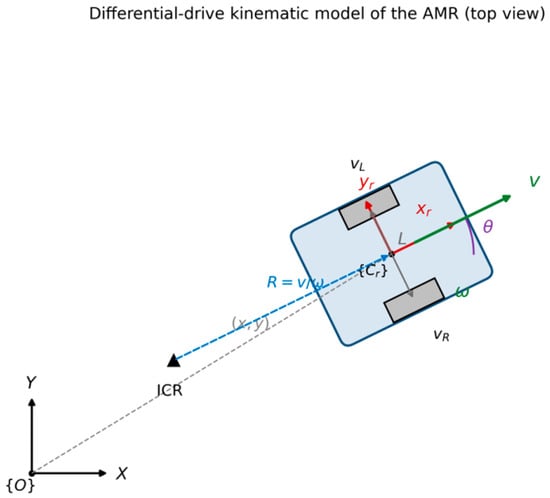
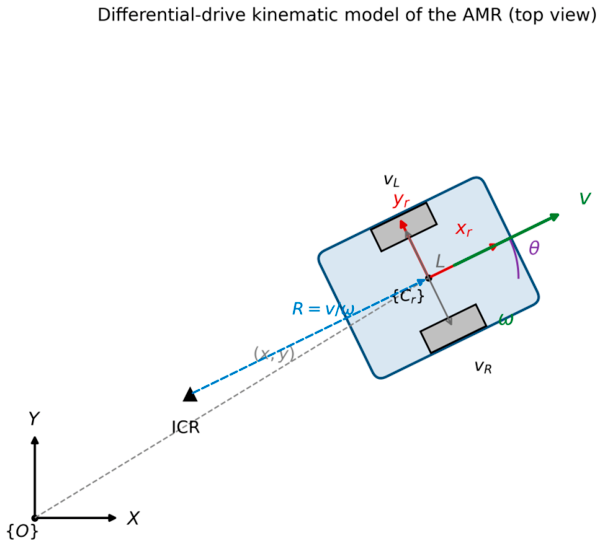
The geometric relationship among the world coordinate frame, the robot body frame, the linear and angular velocities (v, ω), the differential wheel velocities, and the instantaneous center of rotation (ICR) is illustrated schematically in Figure 1.
Figure 1.
Differential-drive kinematic model of the AMR (top view).
As shown in Figure 1, the model defines the world frame {O} and the robot body frame {Cr}, together with the heading angle θ, the linear and angular velocities v and ω, the left/right wheel velocities vL and vR with wheel track L, and the instantaneous center of rotation (ICR) with turning radius R = v/ω.
2.3. Construction of Velocity Sampling Space
Following the completion of the AMR kinematic model, it is necessary to perform sampling within the velocity space to obtain multiple sets of two-dimensional velocity combinations as AMR states for predicting trajectory velocities. Since the AMR is subject to dynamic constraints from onsite hardware and environmental safety constraints set by the RCS, the available sampling velocity combinations are restricted within a specific range, defined as the dynamic window [22]. Consequently, the velocity sampling space of the AMR is influenced by multiple restrictive factors. The following section provides an analysis and the construction process of the velocity sampling space for a warehouse AMR.
- (1)
- Vehicle Physical Limit Constraints
Based on actual operating conditions and the technical parameters of the AMR, there exist upper and lower limits for the velocity. Let denote the velocity set between the maximum and minimum values, which is expressed as
- (2)
- Motor Dynamic Constraints
Due to the influence of the output torque from the motor drive units, the AMR cannot reach the target velocity within the sampling interval under the constraints of acceleration limits. This is particularly critical in heavy-load transportation scenarios, such as moving engine cylinder blocks, where larger buffer zones are required for starting and braking. The velocity set , considering these dynamic constraints, is expressed as
- (3)
- Environmental Safety Constraints
Beyond the internal constraints of the AMR, the motion is affected by lineside equipment in narrow aisles. To ensure the AMR can safely decelerate and avoid obstacles before a potential collision, the safe motion velocity set is defined as
In this equation, represents the distance between the predicted trajectory and the nearest obstacle under the current velocity pair , while and denote the maximum deceleration rates of the AMR.
By integrating the three constraints—(8), (9), and (10)—the velocity sampling space within the dynamic window, after being subjected to these various restrictions, is defined as the intersection of the constrained velocity sets :
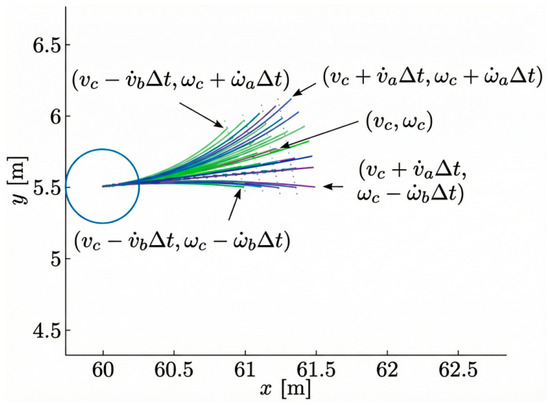
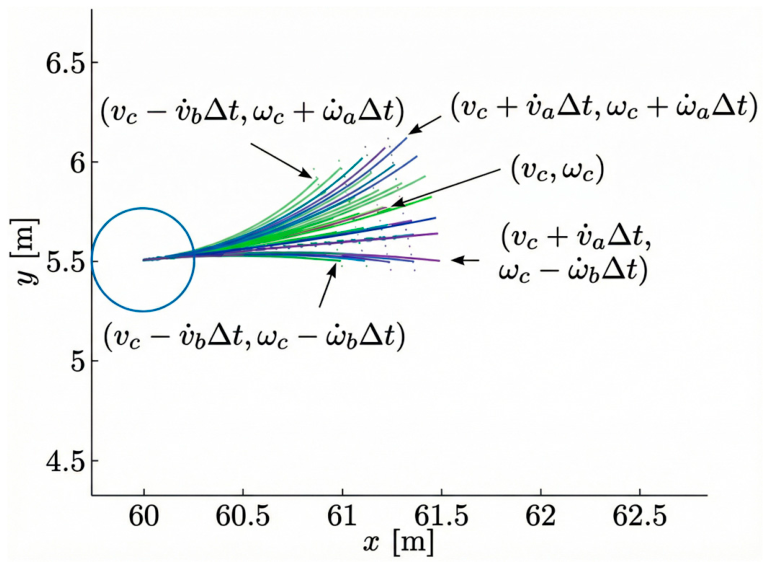
As illustrated in Figure 2, within the continuous velocity space , is converted into discrete points based on the specified number of velocity sampling points. Trajectory prediction is then performed according to the dynamic characteristics of the AMR to generate multiple potential motion trajectories for the subsequent time step [23].
Figure 2.
Multiple sampled trajectories within the velocity space.
3. Integration of Fuzzy Logic Control and Improved DWA
Addressing the challenges of unstructured dynamic obstacles and deadlocks between RCS path nodes within the Weichai South District Logistics Center, this study introduces targeted enhancements to the conventional DWA. The proposed improvement strategy is designed to accommodate the long-body motion characteristics of the M150 model AMR, utilizing fuzzy logic control to facilitate adaptive adjustments under complex operational conditions.
3.1. Improved DWA Algorithm
(1) Velocity Function Improvement
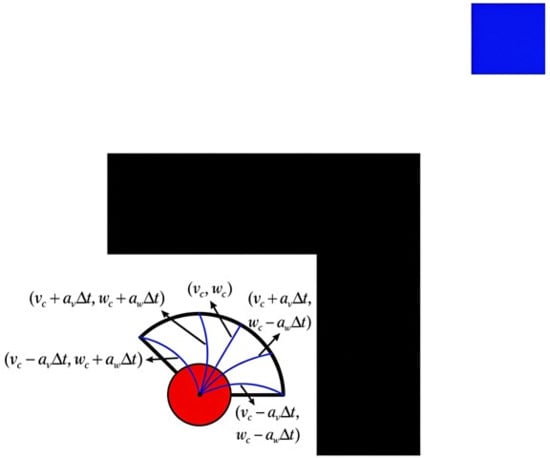
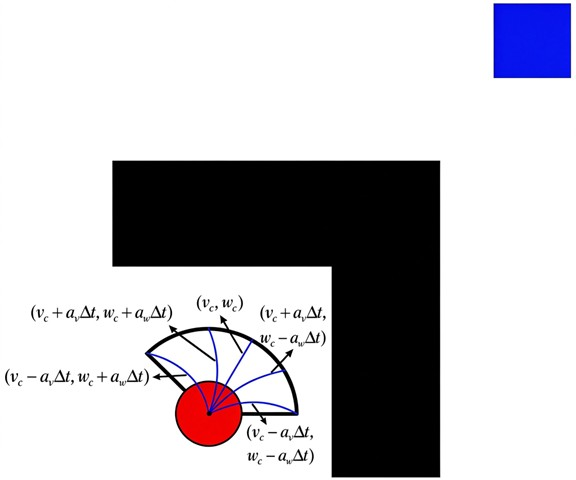
The Velocity function primarily assesses the operational speed of the AMR. However, the traditional DWA focuses exclusively on the selection of linear velocity, often neglecting the influence of angular velocity. As illustrated in Figure 3, assuming the predicted trajectory of the AMR at the next time step consists of five candidate trajectories, the algorithm tends to prioritize the three middle candidate trajectories characterized by higher linear velocities. This bias frequently results in the AMR executing repeated, small-scale movements within a local optimum range, thereby hindering its ability to perform effective escaping behavior.
Figure 3.
Schematic diagram of local deadlock (local-minimum entrapment).
To mitigate this, this study constructs a dynamic angular velocity evaluation mechanism based on the distance to field obstacles. When the AMR detects a close proximity to lineside shelves or columns, the algorithm forcibly increases the weight of angular velocity, guiding the AMR to prioritize posture adjustment to “cut” away from the obstacle rather than attempting a head-on passage. By incorporating angular velocity into the Velocity function, a distance-influenced dynamic evaluation mechanism is established: when the predicted trajectory is close to an obstacle, the influence of the candidate trajectory’s angular velocity is increased, prompting the Velocity function to select trajectories with larger angular velocities. This allows the AMR to quickly rotate out of trap regions when stuck in local optima. Conversely, when the distance to obstacles is large, the influence of angular velocity is attenuated, and linear velocity remains dominant. The dynamic angular velocity evaluation mechanism is defined as
where represents the distance from the current position to the nearest obstacle, and denotes the distance from the predicted trajectory point to the nearest obstacle. The redefined improved Velocity function is expressed as
In this equation, and represent the proportional coefficients between the velocity and angular velocity evaluation mechanisms. The motion behavior of the AMR is optimized by adjusting these proportions, ensuring enhanced escape capabilities within narrow aisles.
(2) Introduction of the Target Distance Function
While existing RCS scheduling systems dispatch global path nodes, the AMR frequently loses track of the subsequent sub-goal after performing local obstacle avoidance maneuvers, resulting in path oscillation on wide logistics corridors. This occurs because the traditional DWA primarily relies on the Heading function to maintain directional consistency, avoid frequent turning, and ensure path smoothness, but fails to account for the actual distance to the target. This lack of spatial correlation may prevent the AMR from effectively approaching the goal.
Consequently, this study introduces the Target function to strengthen the correlation between the AMR and the target distance, reduce ineffective steering maneuvers, and optimize local selection and motion efficiency. This function effectively suppresses unnecessary rotations in open areas, ensuring the time efficiency of material distribution tasks. The target distance function Target is defined as
where represents the distance from the predicted trajectory point to the target point, and denotes the distance from the start point to the end point.
In summary, the improved evaluation function enhances the robustness of the traditional model. The Heading and Target functions balance the trade-off between target proximity and directional consistency, while the inclusion of angular velocity in the Velocity function optimizes local selection and improves trajectory safety and escape capabilities. The synthesized improved evaluation function can be expressed as
(3) Dynamic Sampling Space Based on RCS Computational Resources
As detailed in Section 2.3 regarding the construction of the velocity sampling space, traditional DWA algorithms typically employ fixed sampling frequencies for the predicted . In this study, the baseline sampling frequencies for the AMR model are set as for linear velocity and for angular velocity. The sampling frequency is intrinsically linked to the number of predicted trajectories. In thoroughfare areas far from obstacles, the sampling frequency is reduced to reduce computational overhead for RCS task parsing. Conversely, in workstations or high-density pedestrian areas, the sampling frequency is increased. The mathematical model for the adaptive sampling frequency of the linear and angular velocities based on obstacle distance is expressed as follows:
In these equations, denotes the adjustment parameter for the sampling frequency, where ; represents the distance between the current AMR position and the nearest obstacle; and signifies the maximum safety distance.
Compared to conventional functions, the improved algorithm demonstrates three primary advantages: 1. Optimization of the Velocity function: It refines the selection of AMR velocity commands, enhancing the capability to escape from local deadlock (local-minimum entrapment) situations and avoiding prolonged trajectory computations in deadlock scenarios. 2. Enhanced algorithm robustness: The synergistic guidance of the Target and Heading functions balances target proximity with directional consistency, optimizing the motion efficiency of the AMR in local optimal regions and dynamic obstacle scenarios. 3. Dynamic optimization of the sampling space frequency: By reducing the sampling frequency in low-obstacle or distant-obstacle areas, the overall planning efficiency is improved.
3.2. Fuzzy Control Design Based on Safety Considerations
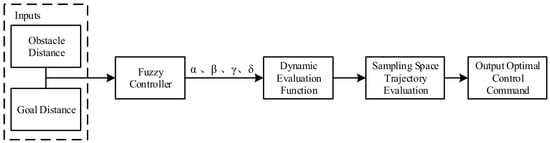
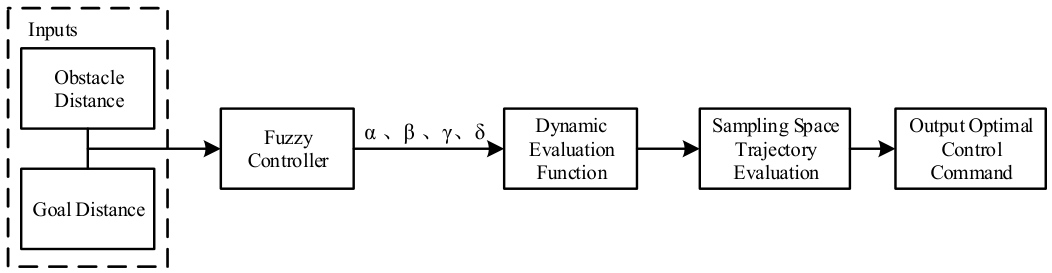
To enable the algorithm to adapt to the volatile logistics scenarios within the Weichai South District, this study defines four weighting coefficients: , , , and . This section primarily focuses on the directivity and safety of the AMR’s motion states and behaviors. As illustrated in Figure 4, two input variables—obstacle distance and target distance—are introduced to design a safety-oriented fuzzy control system. This system dynamically adjusts the four parameters (, , , and ) based on real-time environmental information, thereby enhancing the AMR’s adaptability across diverse scenarios and ensuring safe and stable arrival at designated measurement locations.
Figure 4.
Flowchart of the fuzzy control system based on the improved evaluation function.
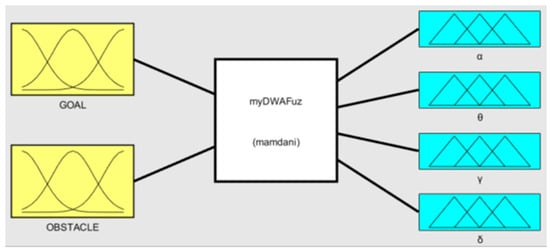
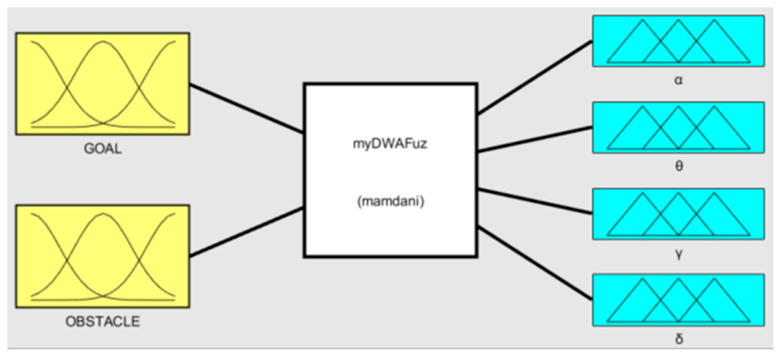
Based on the improved evaluation function, this paper designs a safety-oriented fuzzy controller. The system utilizes the distance from the AMR’s current positional state to the nearest obstacle (OBSTACLE) and the straight-line distance to the target point (GOAL) as inputs. It outputs four weighting factors: , , , and for the improved evaluation function, thereby establishing a two-input, four-output fuzzy controller. The design of this fuzzy controller is illustrated in Figure 5.
Figure 5.
Design diagram of the fuzzy controller.
These two inputs are deemed sufficient for the local planning layer because the global RCS already governs macro-level path optimization and network congestion prevention. Thus, relying solely on OBSTACLE and GOAL allows the local planner to effectively resolve immediate collision threats and maintain sub-node tracking progress without introducing redundant computational overhead.
The fuzzification definitions for the input variables GOAL and OBSTACLE are as follows:
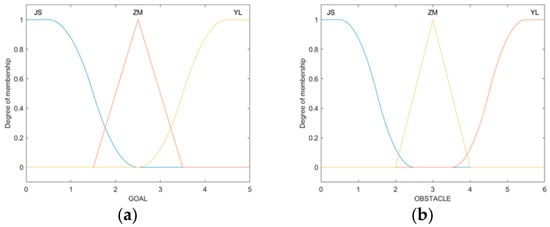
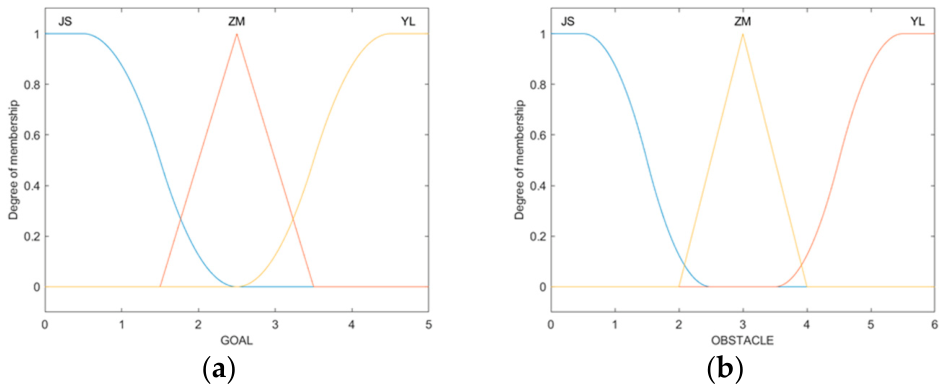
The fuzzy sets for the input variables are defined as , representing the proximity of distances. Considering the safety radius and safety distance of the AMR, the universe of discourse for the input GOAL is established as [0, 5]. Specifically, when , it is fuzzified as Near; when , it is fuzzified as Medium; and when , it is fuzzified as Far. If the current distance to the target exceeds the universe of discourse, it is set to the maximum value of . To ensure operational safety, the universe of discourse for the input OBSTACLE is set to [0, 6]. When , it is fuzzified as Near; when , it is fuzzified as Medium; and when , it is fuzzified as Far. If the distance to the nearest obstacle exceeds the universe of discourse, it is set to the maximum value of . The design of the membership functions for the two input variables is illustrated in Figure 6.
Figure 6.
Membership functions for input variables GOAL and OBSTACLE: (a) membership functions of the input variable GOAL; (b) membership functions of the input variable OBSTACLE.
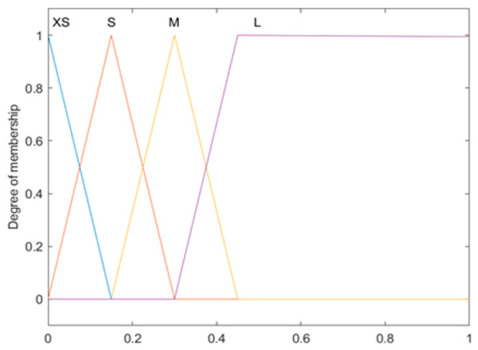
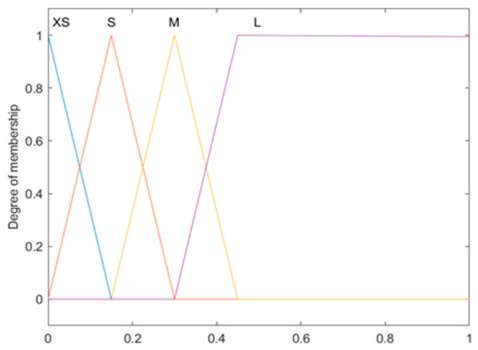
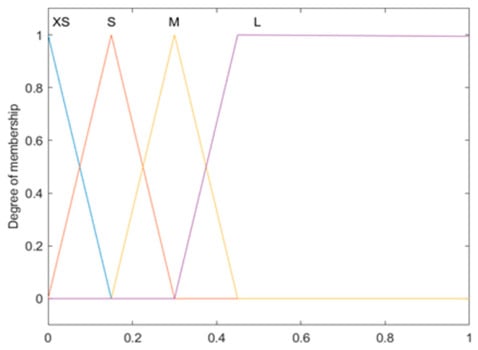
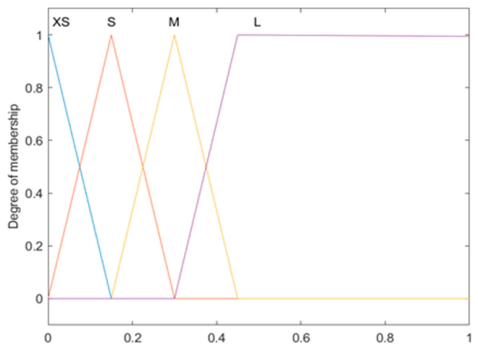
The weighting factors involved in the outputs each have a universe of discourse of [0, 1]. Based on the effectiveness considerations of path planning, the fuzzy set for parameters and is defined as . For path safety considerations, the fuzzy set for output quantities and is defined as . The membership functions for the outputs and are shown in Figure 7 and Figure 8, respectively.
Figure 7.
Membership functions for outputs and .
Figure 8.
Membership functions for outputs and .
The design of fuzzy rules constitutes the core component of the controller. Based on the analysis of the evaluation function, the AMR selects the candidate trajectory with the maximum total evaluation value as its optimal motion command. This study establishes the fuzzy logic rules by considering the safety of the AMR’s motion state and the two input variables, GOAL and OBSTACLE, as detailed below:
(1) When both GOAL and OBSTACLE are large: This state indicates that the AMR currently has a high safety margin. Accordingly, the weighting factors and are set to larger values, while and are set to smaller values. Under the premise of ensuring operational safety, the algorithm prioritizes the distance-related weight of the AMR to expeditiously minimize the distance to the target point.
(2) When GOAL is large and OBSTACLE is small: In this scenario, a larger value is selected to prioritize obstacle avoidance behavior. Simultaneously, the weighting influence of is reduced to prevent the AMR from becoming stagnant within local trap regions.
(3) When OBSTACLE is large and GOAL is small: This indicates that the AMR is in close proximity to the target and possesses a high safety index. At this stage, the weight of the parameter is increased to allow the heading function to guide the AMR’s motion precisely toward the goal.
(4) When both GOAL and OBSTACLE are small: This suggests that the AMR is in a hazardous position but very close to the target. Consequently, the weights of and are increased, while those of and are decreased, ensuring the safety of motion behavior while avoiding target overshoot.
(5) When both GOAL and OBSTACLE are moderate: In this state, the AMR operates within a complex and dynamic environment. When OBSTACLE is relatively small, the parameters and are increased while and are decreased. Conversely, when OBSTACLE is relatively large, the opposite adjustments are made. Overall, the weights of and are attenuated to mitigate the risk of pathfinding failure.
Based on the analysis of the rules described above, the fuzzy control rules established in this study are summarized in Table 1.
Table 1.
Fuzzy control rules for weighting factors.
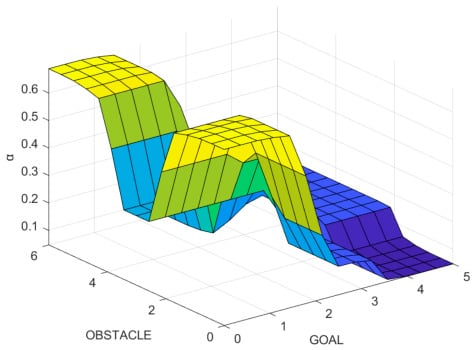
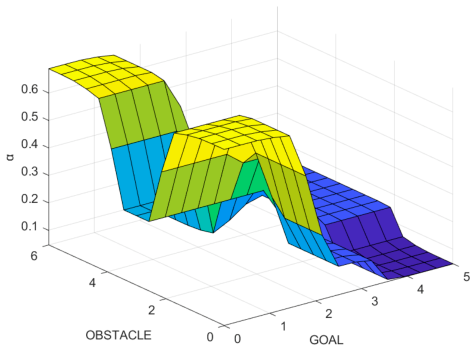
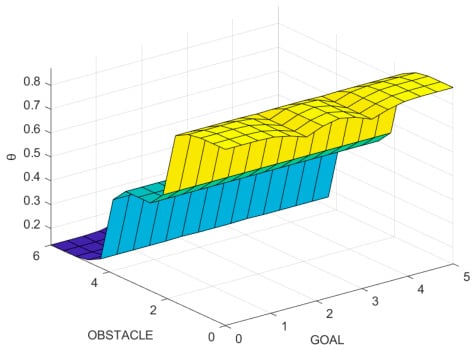
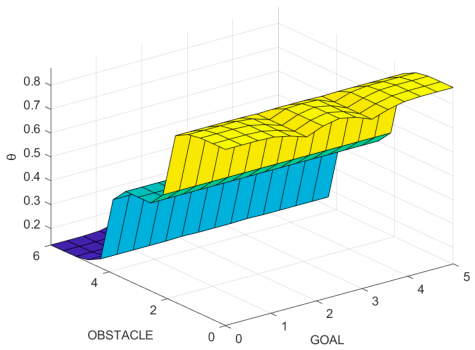
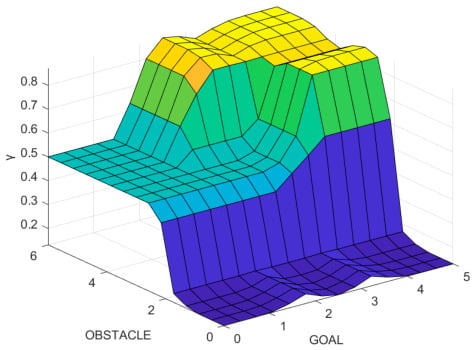
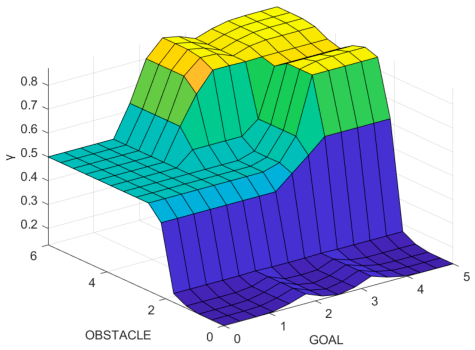
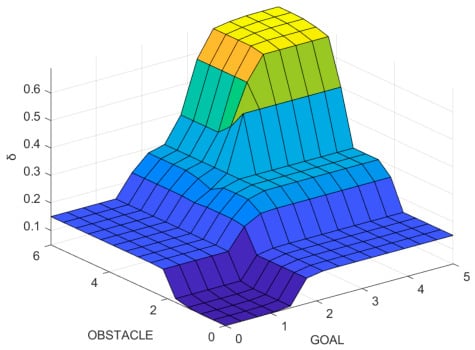
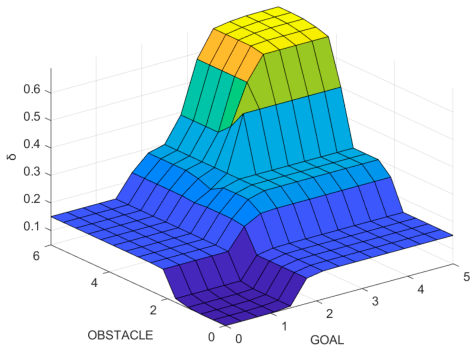
After completing the design of the fuzzy rules, the fuzzy relationship surfaces between the controller inputs (GOAL, OBSTACLE) and the four output weighting factors are illustrated in Figure 9, Figure 10, Figure 11 and Figure 12.
Figure 9.
Relationship surface between inputs and output .
Figure 10.
Relationship surface between inputs and output .
Figure 11.
Relationship surface between inputs and output .
Figure 12.
Relationship surface between inputs and output .
Based on the fuzzy rules designed above, this study utilizes the Mamdani inference method [24,25,26] to perform fuzzy reasoning and solve the fuzzy relational equations. To integrate the fuzzy controller into the real-time navigation system, the fuzzy control quantities derived from the inference engine are converted into precise, explicit control signals using the centroid method (center of gravity). The defuzzified crisp values of are subsequently generated as the final outputs of the system to dynamically regulate the trajectory evaluation function.
3.3. Qualitative Boundedness and Feasibility Discussion
This subsection qualitatively analyzes the stability of the integrated algorithm from input-output boundedness, without strict Lyapunov mathematical proof. Four inherent stability guarantees of the proposed method are summarized:
1. Bounded velocity output constrained by dynamic window: The velocity sampling space is limited by AMR physical speed, motor acceleration/deceleration and safe braking distance. All linear/angular velocity outputs fall within hardware-feasible intervals, which eliminates unbounded control signals.
2. Bounded weight coefficients from fuzzy logic: The input universes of discourse and output weight universe [0, 1] are normalized. The Mamdani fuzzy inference + centroid defuzzification ensures α, β, γ, δ always stay between 0 and 1, avoiding parameter divergence.
3. Persistent target guidance term: The added Target distance function continuously provides a directional cost gradient towards the sub-goal, reducing, though not formally eliminating, the likelihood of sustained limit-cycle oscillation in narrow deadlock zones.
4. Computational stability via dynamic sampling: Adaptive sampling frequency adjusts trajectory prediction density according to obstacle distance. Sparse sampling in open corridors reduces computation load without breaking planning continuity, while dense sampling near obstacles maintains safety constraints steadily. This constitutes computational stability in the sense of bounded per-cycle computation load, which is distinct from control-system stability and is not invoked here as evidence of the latter.
Overall, these four points establish only qualitative input–output boundedness and feasibility under the stated engineering assumptions; they do not constitute a rigorous Lyapunov or input-to-state stability proof, nor a formal convergence or recursive-feasibility guarantee, and such a theoretical treatment is left for future work.
4. Experimental Analysis
4.1. Scenario Description
To ensure that the algorithm can be directly applied to industrial sites, this study moves beyond the generalized point-mass model and establishes a differential drive kinematic model specifically for the M150 latent lifting AMR operating in the Weichai South District, as specified in Table 2.
Table 2.
Specifications of the M150 Warehouse Robot AMR.
In the actual production scenarios of the Weichai Group South District Intelligent Logistics Center, the AMR serves as the core carrier connecting the automated three-dimensional warehouse with the assembly production lines. Its operational efficiency directly impacts the production cycle of the entire plant. Currently, this area primarily relies on global task commands dispatched by the RCS, as shown in Table 3, and performs node-to-node traffic control based on a topological map.
Table 3.
RCS functional requirements list.
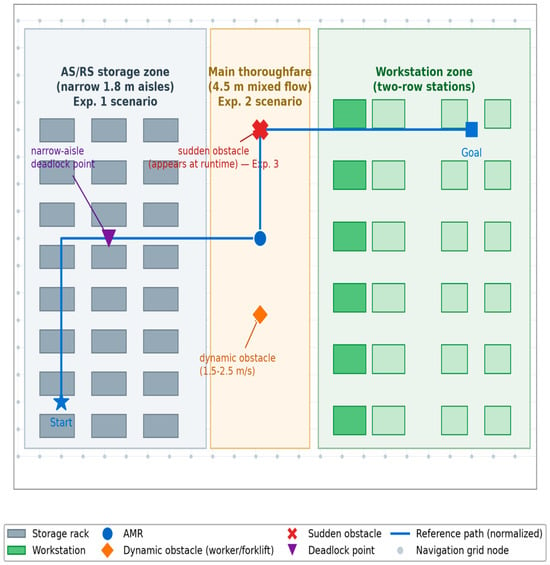
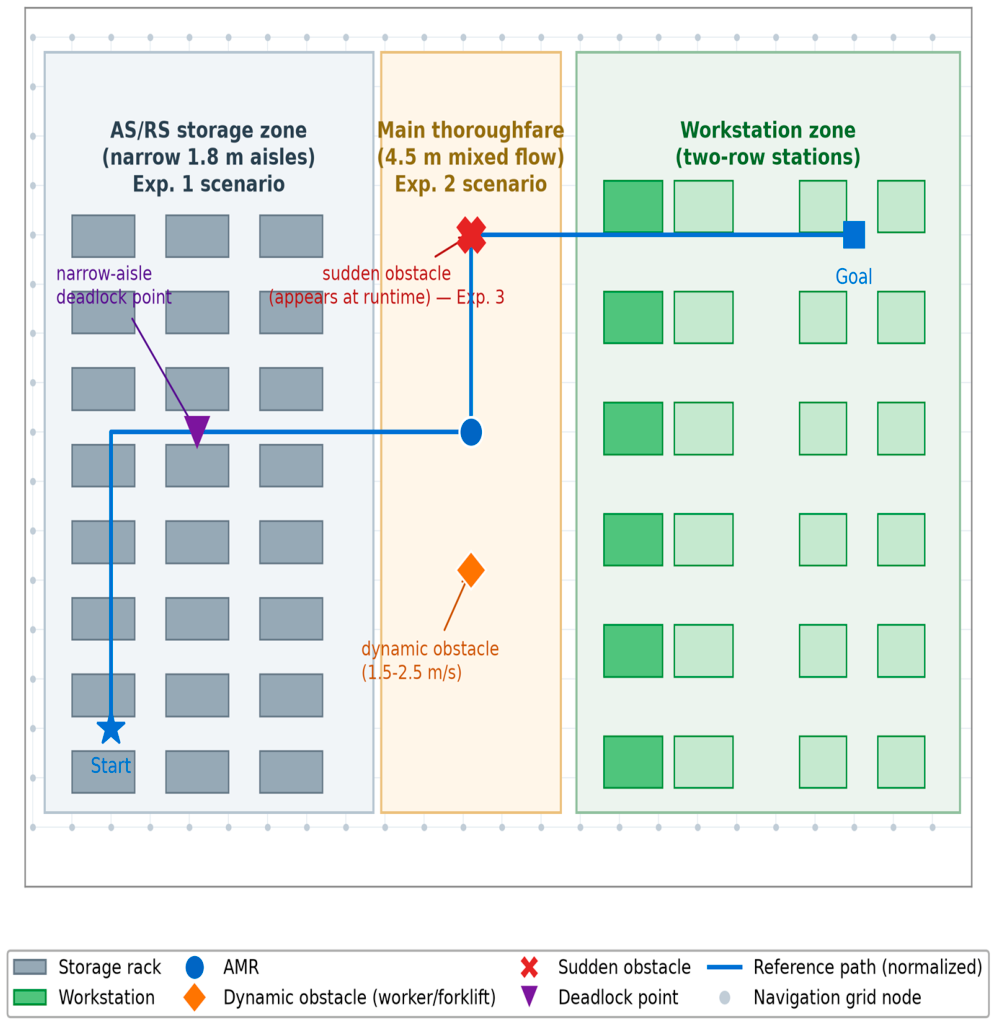
This study utilizes the layout shown in Figure 13 as a prototype to conduct high-fidelity grid-based modeling. The environment exhibits typical high-dynamic and unstructured characteristics, encompassing both wide main distribution thoroughfares and narrow, dense storage areas, accompanied by frequent human–machine mixed-flow phenomena. Such a complex environmental layout provides an ideal scenario for verifying the performance of the improved DWA algorithm in terms of local deadlock escape and emergency obstacle avoidance.
Figure 13.
Generic grid-map abstraction of the warehouse layout.
As shown in Figure 13, the warehouse layout is represented with normalized coordinates: gray blocks denote storage racks, green blocks denote assembly workstations, the blue circle is the AMR, the orange diamond denotes a dynamic obstacle (worker/forklift), the red cross marks a sudden obstacle, and the purple triangle marks a narrow-aisle deadlock point; the blue line is a normalized reference path. These markers respectively correspond to the scenarios of Experiments 1–3.
To preserve confidentiality while retaining academic clarity, the original site screenshot has been replaced by this abstracted generic grid map, and all quantitative metrics in the comparative experiments are reported as normalized or relative values. The narrow-aisle deadlock marker corresponds to Experiment 1, the dynamic obstacle in the shared thoroughfare corresponds to Experiment 2, and the sudden-obstacle marker on the reference path corresponds to Experiment 3.
The layout consists of three core functional areas:
West AS/RS zone: Parallel high storage racks with 1.8 m narrow aisles for AMR inbound and outbound operations; Central north–south main thoroughfare: 4.5 m wide shared channel for AMRs, manual forklifts and walking workers; East assembly workstation zone: 12 two-row stations with material staging areas in front of each workstation.
The M150 AMR receives global node scheduling commands from RCS, navigates from the stereoscopic warehouse to assigned workstations through the main channel, and dynamically avoids static shelf structures and random dynamic obstacles during driving.
The actual Weichai South logistics environment contains multiple types of moving obstacles, including manual forklifts (1.5–2.5 m/s), crossing workshop operators, other collaborative AMRs, and temporary material trolleys parked beside stations. The three groups of simulation experiments are carefully screened to cover typical working conditions, including three core failure modes of traditional fixed-weight DWA: narrow aisle local deadlock, human–machine mixed-flow dynamic avoidance, and emergency response to sudden obstacles, which are the most frequent failure cases encountered in on-site transportation tasks.
A simulation platform is established using MATLAB R2023b (version 23.2) to construct a map model of local optimum scenarios. Three sets of experiments are designed: Experiment 1 focuses on local optimum escape within narrow aisles; Experiment 2 involves dynamic obstacle avoidance in human–machine mixed-flow environments; and Experiment 3 evaluates emergency avoidance for sudden obstacles. These experiments serve to verify the AMR’s adaptability to traps, dynamic environments, and unexpected road conditions.
To establish a fair and rigorous quantitative comparison, three DWA-series algorithms were implemented and evaluated under identical environmental configurations, kinematic models, and velocity sampling constraints:
Baseline algorithms for quantitative comparison:
(1) Conventional DWA: The standard dynamic window approach with fixed evaluation weights [heading = 0.2, clearance = 0.3, velocity = 0.3], without any of the proposed improvements. This serves as the fundamental baseline.
(2) Fuzzy-DWA (without Target function): An ablation variant incorporating the velocity evaluation improvement and fuzzy adaptive weight mechanism, but without the proposed Target distance function. This variant represents the class of traditional fuzzy-DWA approaches, as it shares the core fuzzy-control architecture but lacks the key novelty of the proposed method.
(3) Proposed method: The full method integrating all four components: velocity evaluation improvement, Target distance function, fuzzy adaptive weights, and dynamic sampling space.
The following quantitative metrics are recorded for each trial: (1) Success rate: percentage of trials reaching the goal without collision or timeout. (2) Collision rate: percentage of trials resulting in obstacle collision. (3) Path length: total Euclidean distance of the executed trajectory (m). (4) Number of iterations: total planning cycles to complete the task. (5) Computation time: average and maximum per-iteration planning time (ms). (6) Minimum clearance: minimum distance to any obstacle during execution (m). (7) Velocity smoothness: standard deviation of linear velocity (v_std) and angular velocity (w_std). (8) Average acceleration: mean absolute acceleration (m/s2). (9) Minimum time-to-collision (TTC): minimum predicted time to collision with dynamic obstacles (s), applicable to Experiment 2. (10) Energy consumption: normalized estimate computed as E = Σ(v·dt) + 0.5Σ(a2·dt), where v is linear velocity, a is acceleration, and dt = 0.1 s is the simulation time step.
Statistical methodology: To ensure the reliability and reproducibility of the comparative results, each experimental scenario was repeated for N = 30 independent randomized trials for each algorithm. Randomization was applied to obstacle positions, dynamic obstacle velocities (1.5–2.5 m/s), obstacle appearance times, and initial AMR heading angles. All quantitative metrics are reported as mean +/− standard deviation (mean +/− std) across the 30 trials. Only successful trials are included in the computation of path-dependent metrics (path length, iterations, velocity profiles, energy), while success rate and collision rate are computed over all 30 trials.
4.2. Experiment
Experiment 1: Local Optimum Escape in Narrow Aisles
This experiment simulates the AMR entering a narrow passage, similar to the dense shelf area on-site, while performing raw material outbound tasks. The traditional DWA often oscillates or performs in-place rotations because safety distance constraints lead it to judge the path as “no way forward,” thereby trapping it in a local optimum.
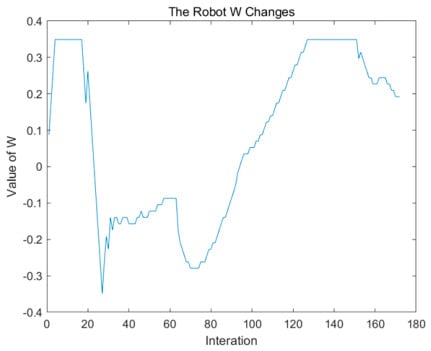
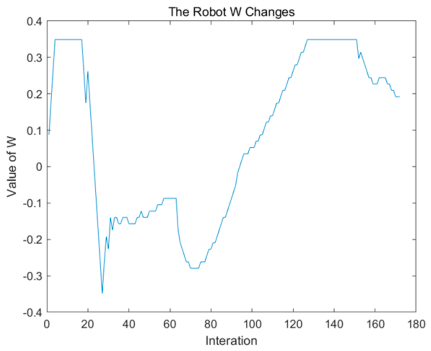
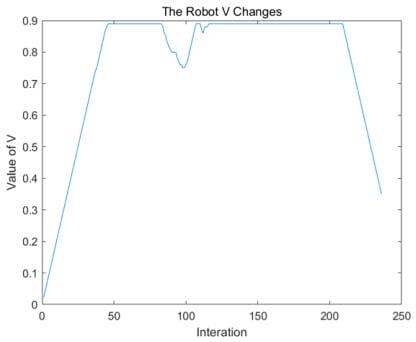
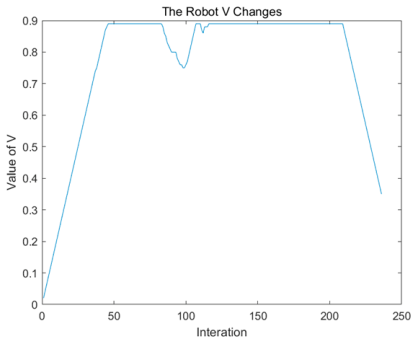
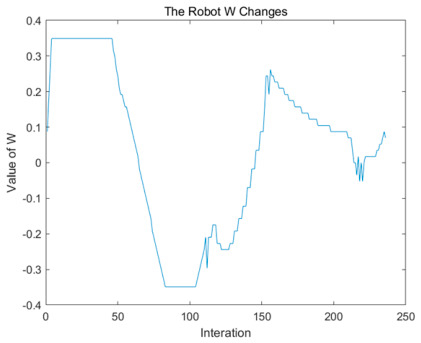
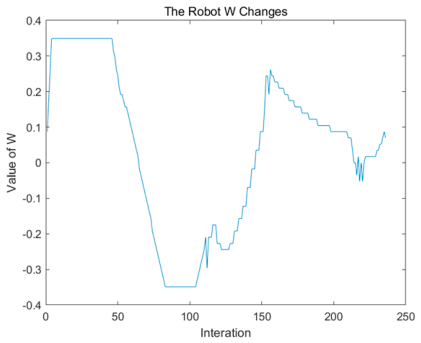
The trajectory planning results, along with the velocity and weighting factor variation curves for the improved DWA algorithm, are illustrated in Figure 14, Figure 15, Figure 16 and Figure 17.
Figure 14.
Simulation experiment of local deadlock escape in a narrow shelf area.
Figure 15.
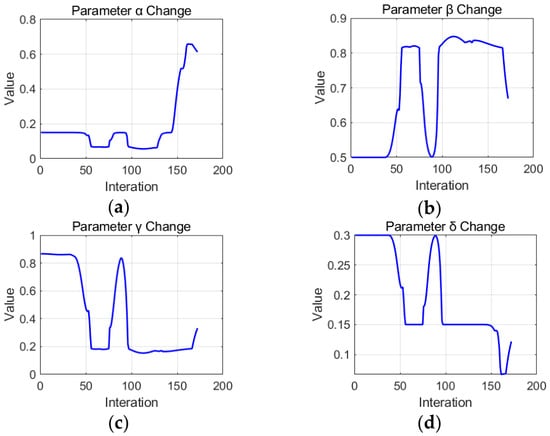
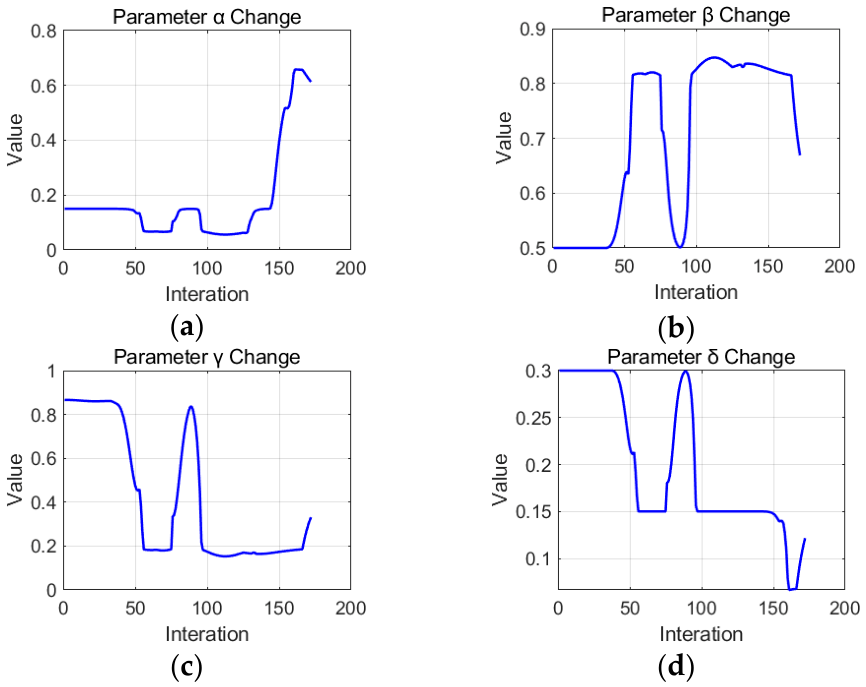
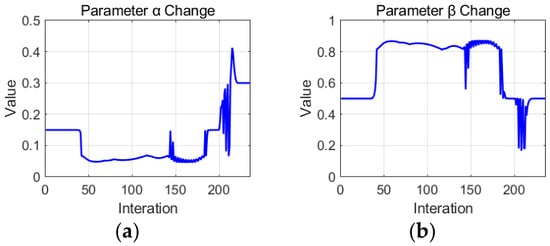
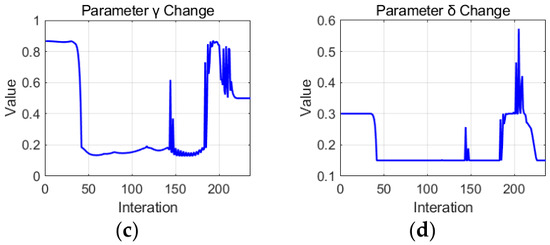
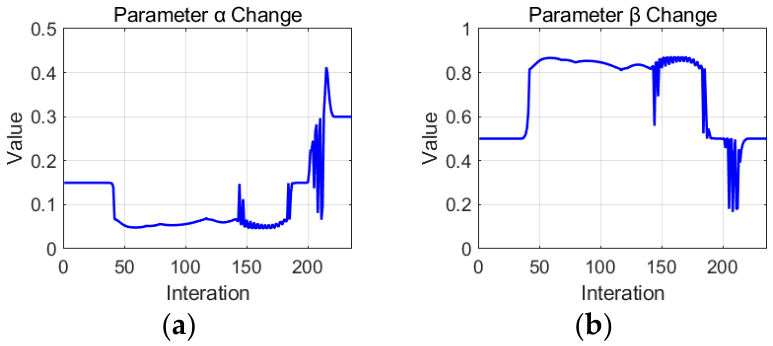
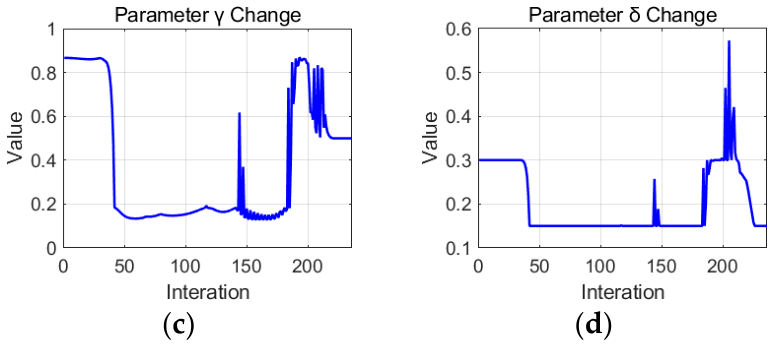
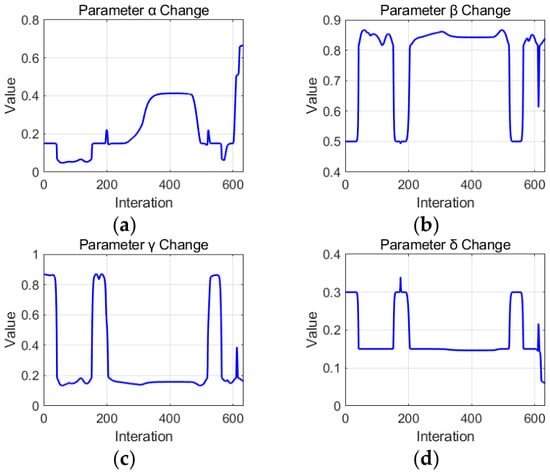
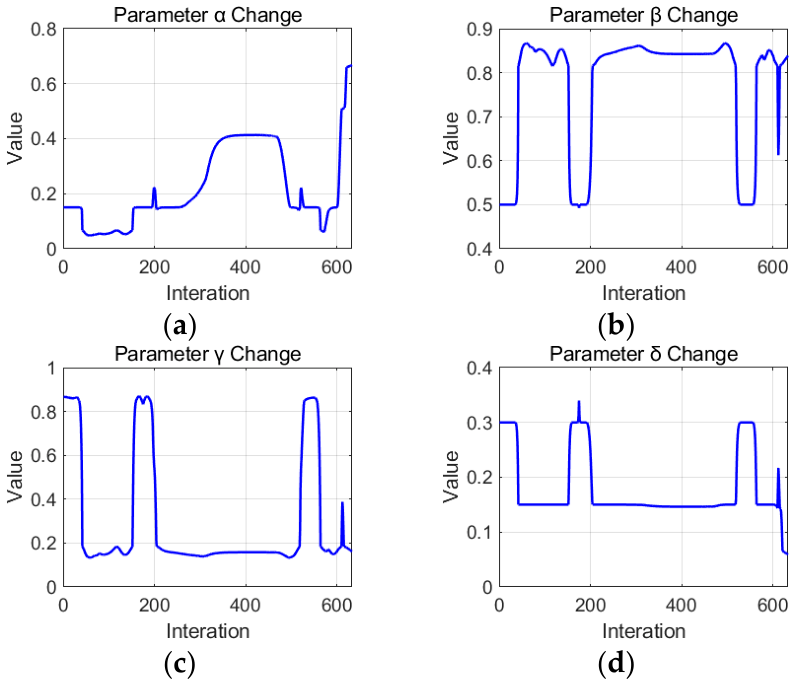
Variations in weighting factors in Experiment 1: (a) variation of the heading weight α over iterations; (b) variation of the weight β; (c) variation of the angular-velocity influence factor γ; (d) variation of the target weight δ.
Figure 16.
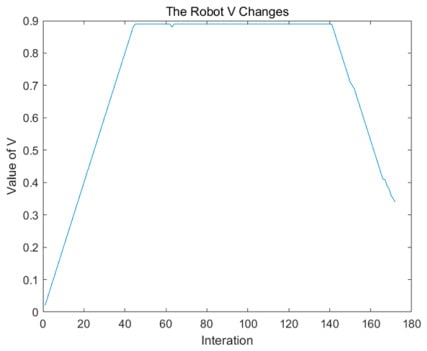
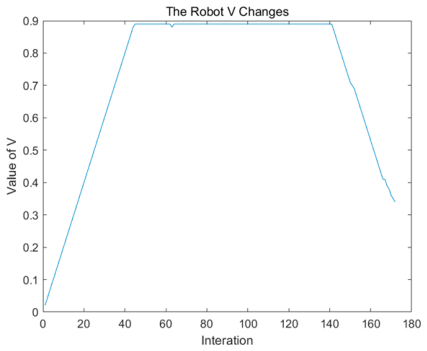
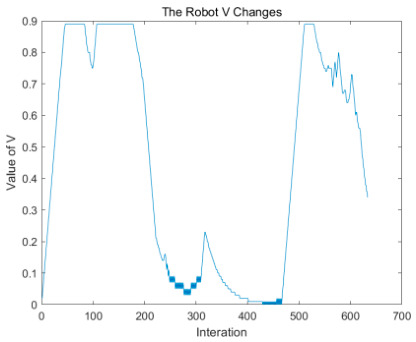
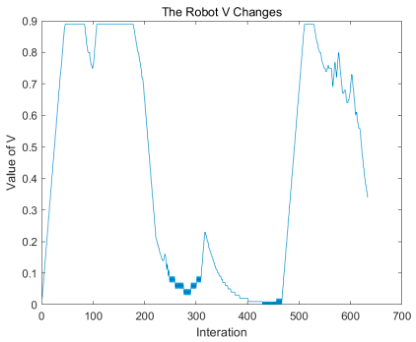
Linear velocity curve in Experiment 1.
Figure 17.
Angular velocity curve in Experiment 1.
As illustrated by the path comparison in Figure 14, the traditional DWA algorithm fails to effectively plan an exit route when encountering a narrow deadlock zone, resulting in AMR stagnation. In contrast, the improved algorithm proposed in this study automatically initiates fuzzy controller intervention upon detecting sustained proximity to obstacles. Specifically, as shown in Figure 15, when the algorithm reaches the 89th iteration at the local optimum critical point, the system automatically reduces the proportions of the heading weight and the target weight , while simultaneously increasing the angular velocity influence factor. This strategy is designed to diminish the persistence toward the target direction, prioritizing obstacle avoidance and rapid escape from the restricted area.
Under the guidance of this control strategy, the AMR actively executes in-place self-rotation adjustments, utilizing the geometric characteristics of the vehicle’s length-to-width ratio to identify the optimal cut-in angle. By proactively altering its motion trajectory while still at a distance from the trap, the AMR successfully navigates out of the confined region, resulting in a smoother overall path.
Further analysis of the motion curves in Figure 16 and Figure 17 reveals that, compared to the high-frequency control fluctuations and the “sudden start/stop” phenomenon prevalent in the traditional DWA algorithm, the improved DWA algorithm maintains a consistently stable acceleration during obstacle avoidance in terms of linear velocity. The oscillation amplitude of the angular velocity is also significantly suppressed, with no instance of the velocity dropping to zero throughout the entire escape process. This characteristic effectively addresses the frequent AMR deadlock issues caused by narrow passages in aging production lines within the Weichai South District, markedly reducing the operation and maintenance costs associated with manual intervention and resetting.
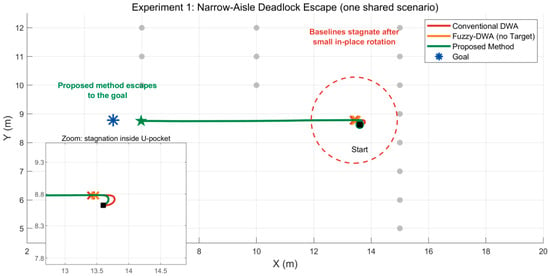
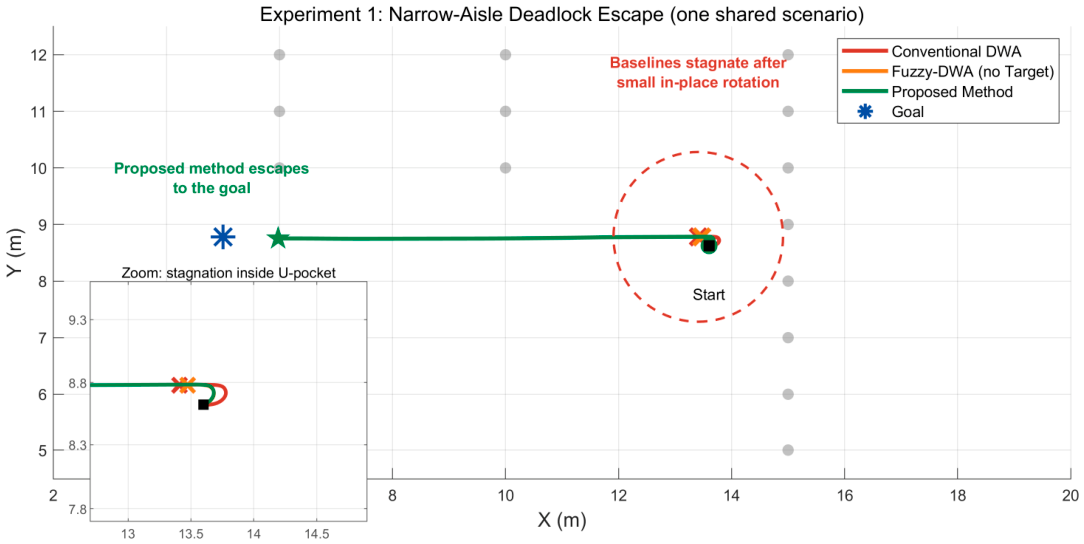
To quantitatively validate the deadlock-escape performance, 30 independent randomized trials were conducted for each of the three algorithms under the same U-shaped narrow-corridor configuration. The corridor width was approximately 3 m (simulating the 1.8 m shelf aisle with the AMR footprint), with a single internal pillar creating a local-optimum zone. Randomization was applied to the AMR initial position (+/−0.5 m), initial heading angle (+/−0.15 rad), goal position (+/−0.3 m), and obstacle wall positions (trial-dependent offset of +/−1 m). For a fair visual comparison, a single shared scenario (with an identical initial pose, goal, and obstacle layout for all three algorithms), in which both baseline methods become trapped while the proposed method succeeds, is selected to plot the trajectories and velocity profiles in Figure 18 and Figure 19.
Figure 18.
Quantitative comparison of trajectories among the three algorithms in the narrow-aisle deadlock scenario.
Figure 19.
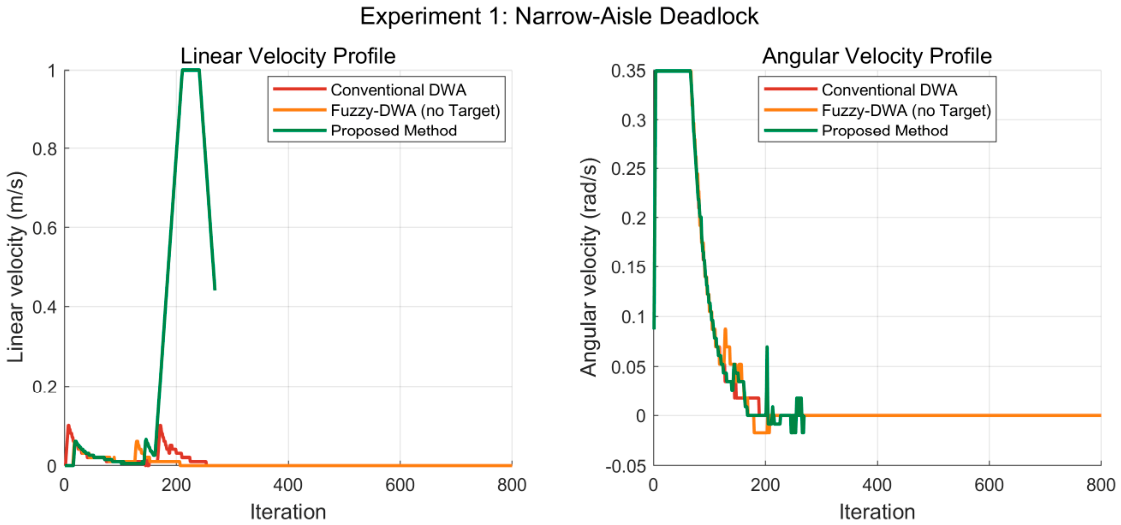
Comparison of linear and angular velocity profiles among the three algorithms.
Quantitative comparison with baseline algorithms:
As shown in Figure 18, all three algorithms are evaluated on one identical shared scenario: Conventional DWA (red), Fuzzy-DWA without the Target function (orange), and the proposed method (green). The gray dots represent obstacles and the blue star indicates the goal. The Conventional and the target-free Fuzzy-DWA trajectories only make a small in-place rotation and stagnate near the start inside the U-shaped zone (magnified in the inset), whereas the proposed method escapes directly and reaches the goal.
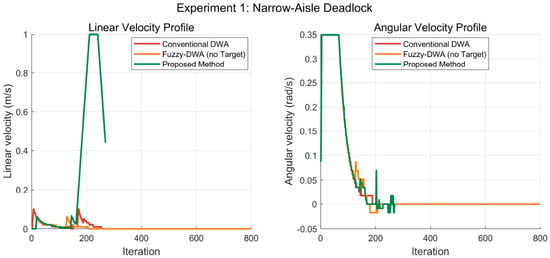
Figure 19 compares the linear velocity (left) and angular velocity (right) profiles of the three algorithms on the same shared scenario during the deadlock-escape maneuver. Both baseline velocities decay toward zero as they stagnate, whereas the proposed method (green) accelerates out of the trap and reaches the goal with smoother angular regulation.
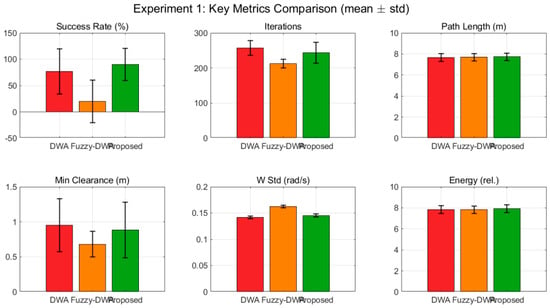
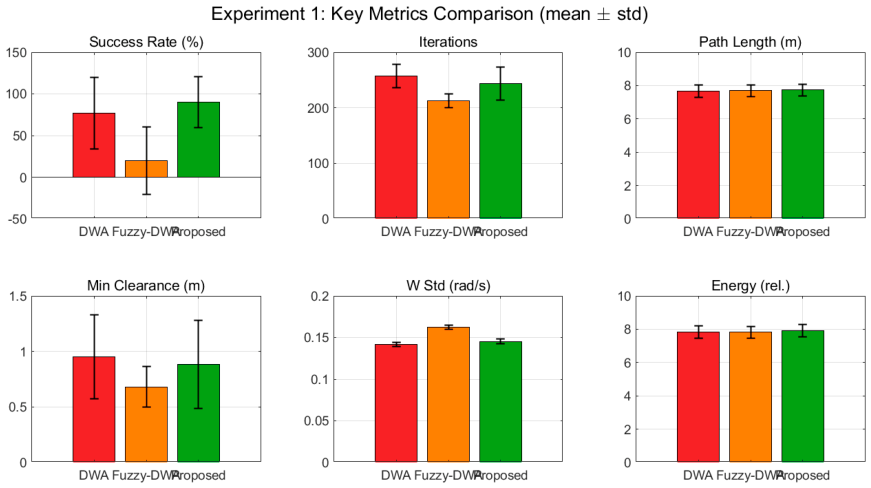
The quantitative results over N = 30 randomized trials reveal significant performance differences among the three algorithms. The proposed method achieved the highest deadlock-escape success rate of 90.0 +/− 30.5%, compared with 76.7 +/− 43.0% for Conventional DWA and only 20.0 +/− 40.7% for the Fuzzy-DWA variant without the Target function. The dramatically lower success rate of the target-free Fuzzy-DWA is a critical finding: when obstacles are in close proximity within the narrow corridor, the fuzzy controller assigns excessive weight to obstacle avoidance (beta) and insufficient weight to goal heading (delta), causing the AMR to become immobilized rather than attempting to escape. The proposed Target distance function compensates for this by maintaining a persistent directional gradient toward the goal, and the integrated deadlock-detection mechanism further ensures escape when stagnation is detected. In terms of planning efficiency, the proposed method required 243.7 +/− 30.2 iterations, fewer than Conventional DWA (257.4 +/− 21.5), despite the additional fuzzy inference overhead. The proposed method also exhibited a lower angular-velocity standard deviation (0.145 +/− 0.003 rad/s) than the target-free Fuzzy-DWA (0.162 +/− 0.002 rad/s), indicating smoother rotational control during the escape maneuver. The minimum obstacle clearance was comparable across algorithms (0.68–0.95 m), confirming that all methods maintain basic safety, while the proposed method achieves this with substantially higher task completion. The average per-iteration computation time for the proposed method was 10.15 +/− 2.26 ms (maximum 20.63 ms), which remains well within the 100 ms real-time control requirement of the M150 AMR platform. These performance differences across all key metrics are visually summarized in Figure 20, which compares success rate, planning iterations, path length, minimum clearance, angular-velocity smoothness, and energy consumption side by side.
Figure 20.
Key metric comparison among the three algorithms in the deadlock-escape scenario.
Figure 20 summarizes six key metrics (N = 30, mean +/− std); from left to right: success rate, planning iterations, path length, minimum obstacle clearance, angular-velocity standard deviation, and normalized energy consumption. The proposed method (green) achieves the highest success rate with competitive path efficiency and motion smoothness.
Experiment 2: Dynamic Obstacle Avoidance in a Human–Machine Mixed-Flow Environment
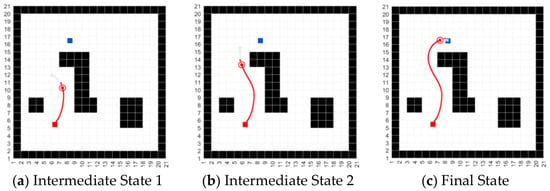
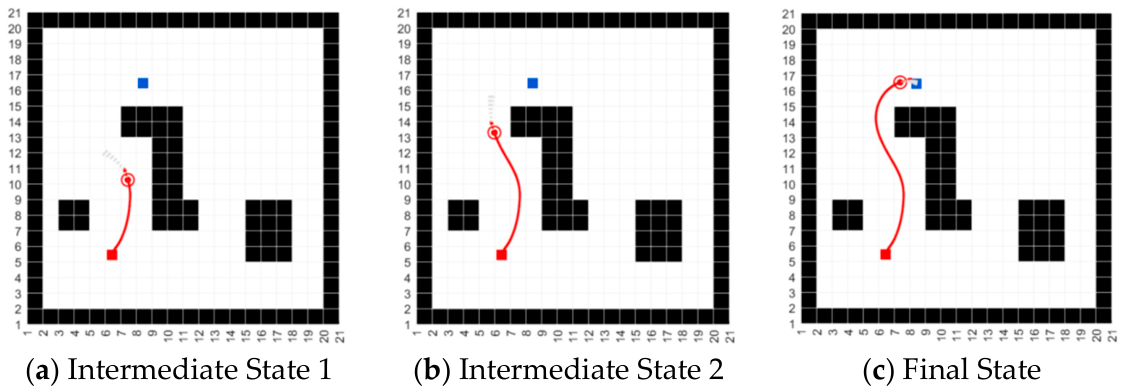
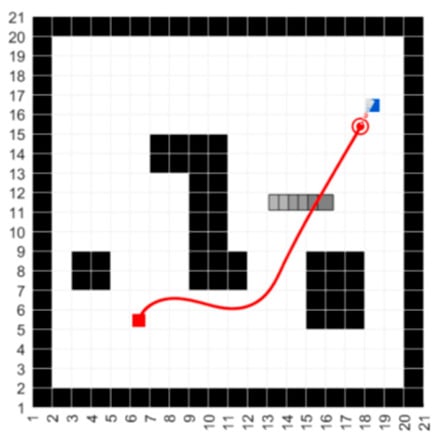
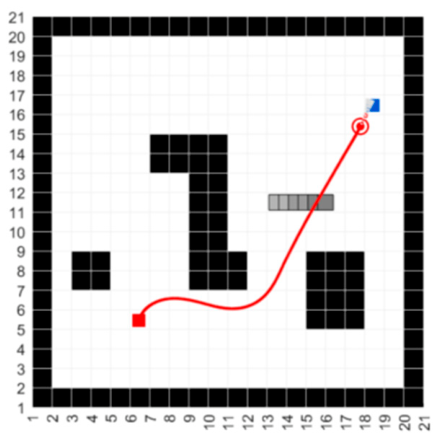
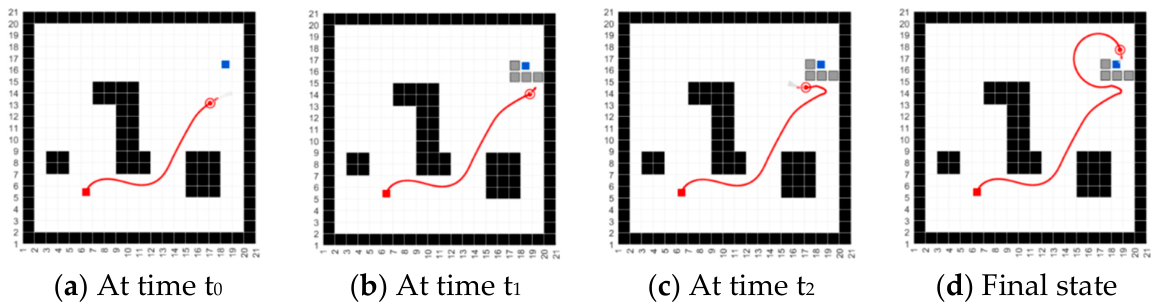
As shown in Figure 21, Experiment 2 simulates the AMR’s start and end state information as and , respectively. The red trajectory represents the schematic of the improved algorithm’s path planning under a static map. A dynamic obstacle, represented by a gray square, moves back and forth between coordinates and at a velocity of to simulate a manual forklift encountered by the AMR.
Figure 21.
Schematic diagram of Experiment 2.
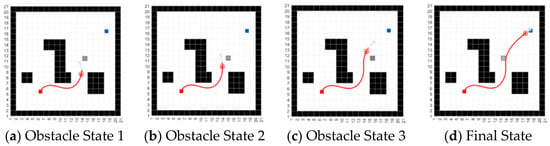
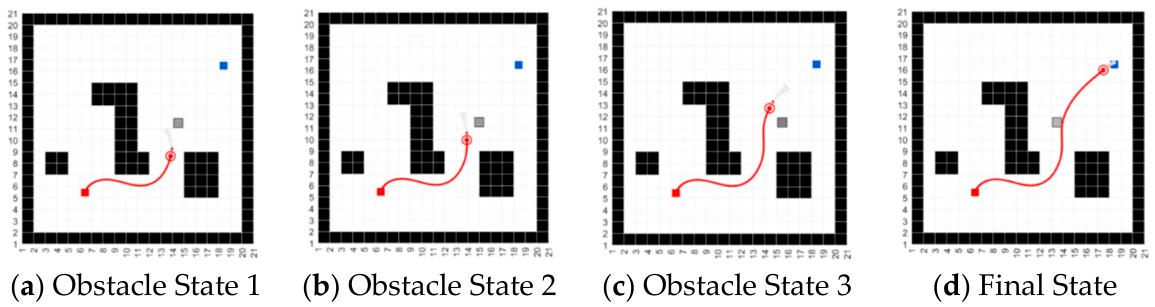
Based on these conditions, the trajectory planning results, velocity curves, and weighting factor variations for Experiment 2 are illustrated in Figure 22, Figure 23, Figure 24 and Figure 25.
Figure 22.
Simulation experiment of dynamic human–machine mixed-flow obstacle avoidance in the main thoroughfare.
Figure 23.
Variations in weighting factors in Experiment 2: (a) variation of the heading weight α over iterations; (b) variation of the weight β; (c) variation of the angular-velocity influence factor γ; (d) variation of the target weight δ.
Figure 24.
Linear velocity curve in Experiment 2.
Figure 25.
Angular velocity curve in Experiment 2.
The results of the dynamic avoidance and parameter variations indicate that the evaluation function parameters fluctuate significantly when obstacles are in a state of dynamic change. When the distance to an obstacle is relatively short, the parameter increases to prioritize obstacle avoidance. In contrast, the traditional DWA algorithm’s path remains biased toward local optima and fails to identify a viable route. Regarding linear and angular velocity, the AMR maintains relatively stable motion commands within the dynamic environment. No emergency stop or reset phenomena triggered by the RCS occurred. This ensures the stability of material transportation in actual production and avoids the risk of cargo tipping caused by sudden braking. Consequently, the improved algorithm better fulfills trajectory planning tasks in dynamic environments.
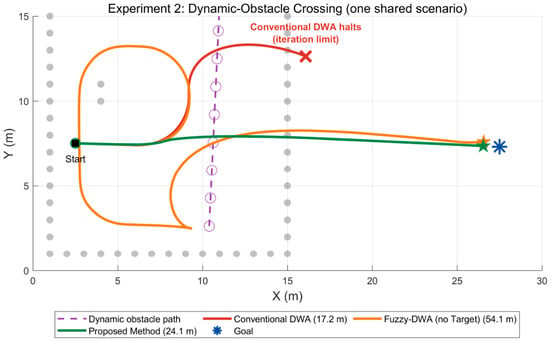
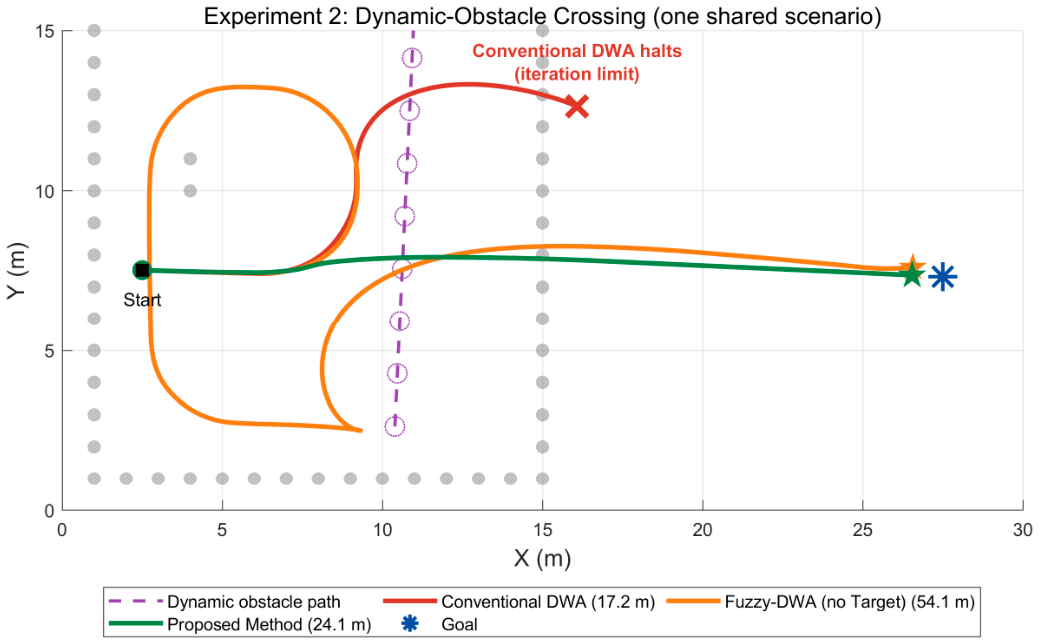
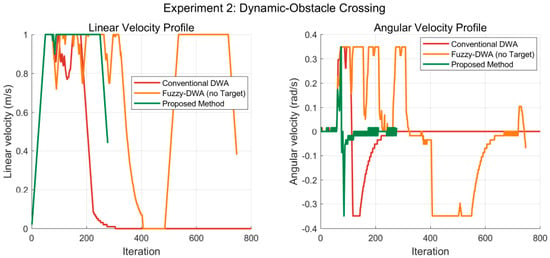
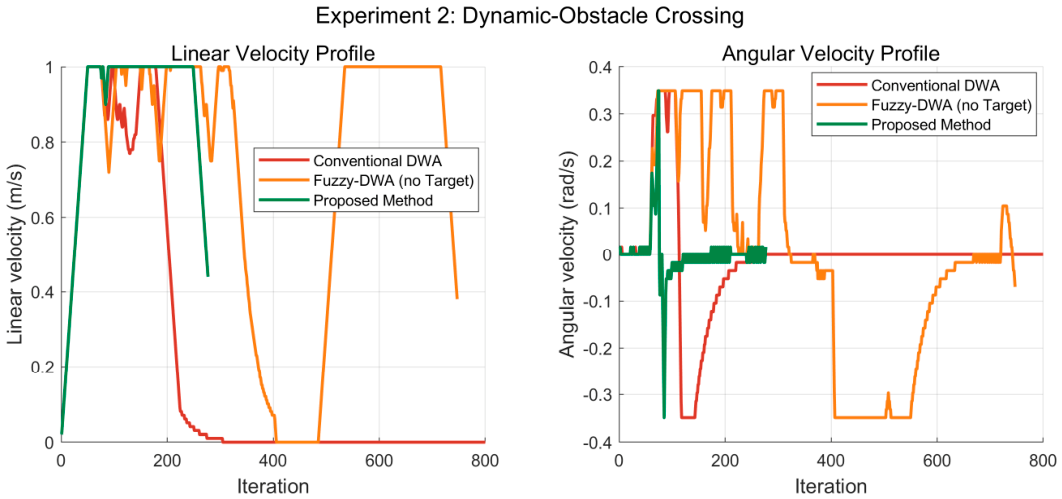
For quantitative evaluation of dynamic-obstacle avoidance, 30 independent randomized trials were conducted for each algorithm in the 4.5 m-wide main thoroughfare configuration. A single dynamic obstacle traversed the channel perpendicular to the AMR direction at a randomized velocity of 1.5–2.5 m/s (simulating manual forklifts and crossing pedestrians). Randomization was applied to the obstacle appearance time (3–8 s after the start), initial position (+/−1.5 m across the channel), and velocity. The minimum time-to-collision (TTC) was computed as an additional safety metric for this scenario. As in Experiment 1, the trajectories and velocity profiles in Figure 26 and Figure 27 are plotted on one identical shared scenario (in which Conventional DWA fails) to allow a direct like-for-like comparison.
Figure 26.
Quantitative comparison of trajectories among the three algorithms in the dynamic-obstacle scenario.
Figure 27.
Comparison of linear and angular velocity profiles among the three algorithms.
Quantitative comparison with baseline algorithms:
As shown in Figure 26, all three algorithms are evaluated on one identical shared scenario. The dashed purple line marks the crossing path of the dynamic obstacle (1.5–2.5 m/s). Conventional DWA (red) maneuvers and then stalls before the crossing obstacle without reaching the goal; the target-free Fuzzy-DWA (orange) eventually passes but follows a long, redundant detour (54.1 m); the proposed method (green) follows a near-direct and smooth path (24.1 m) to the goal.
Figure 27 compares the linear (left) and angular (right) velocity profiles on the same shared dynamic scenario. Conventional DWA (red) decelerates to zero as it stalls; the target-free Fuzzy-DWA (orange) sustains repeated large steering corrections over many more iterations, while the proposed method (green) completes the maneuver earlier with the smallest and briefest velocity adjustments.
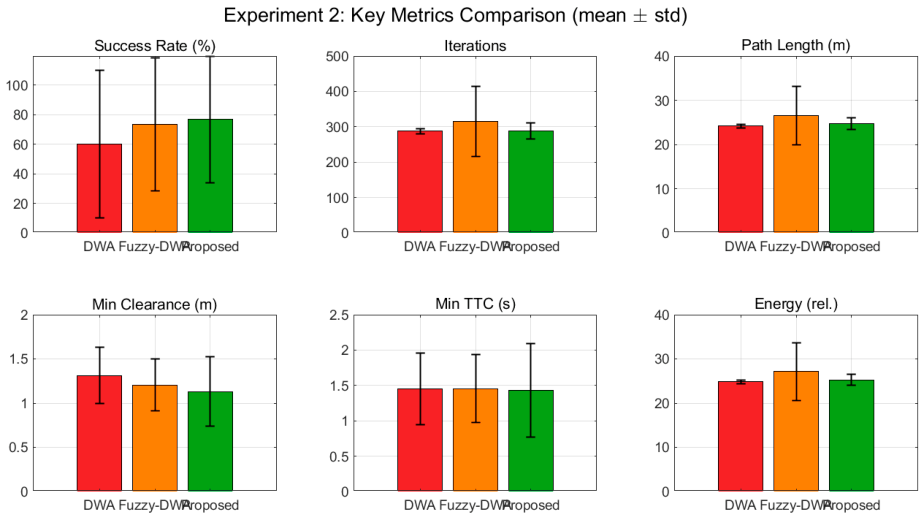
The quantitative results over N = 30 randomized trials demonstrate that the proposed method achieves the highest planning success rate of 76.7 +/− 43.0%, compared with 73.3 +/− 45.0% for the target-free Fuzzy-DWA and 60.0 +/− 49.8% for Conventional DWA. The collision rate was reduced from 30.0% (9/30 trials, Conventional DWA) to 23.3% (7/30 trials, proposed method), while the target-free Fuzzy-DWA achieved the lowest collision rate of 20.0% (6/30 trials) at the cost of lower path efficiency. In terms of path quality, the proposed method produced a significantly shorter path (24.72 +/− 1.35 m) compared with the target-free Fuzzy-DWA (26.48 +/− 6.60 m), representing a 6.7% reduction. The proposed method also required fewer planning iterations (288.0 +/− 22.4 vs. 316.0 +/− 99.1), indicating more consistent and efficient decision-making in dynamic environments. The linear-velocity standard deviation of the proposed method (0.235 +/− 0.017 m/s) was lower than both baselines (0.246 and 0.241 m/s), confirming smoother velocity regulation. The minimum time-to-collision (TTC) remained comparable across all three algorithms (1.43–1.46 s), indicating that all methods maintain a basic safety margin against dynamic obstacles. Notably, the average per-iteration computation time for the proposed method was 3.01 +/− 0.72 ms, which is actually lower than Conventional DWA (4.19 ms) due to the dynamic sampling mechanism reducing the number of predicted trajectories when obstacles are far away. The maximum computation time (14.83 ms) occurs during close-proximity obstacle encounters when full sampling is activated, but still satisfies real-time constraints. The comparative performance across all key metrics is visualized in Figure 28, confirming that the proposed method achieves the best balance among success rate, path efficiency, computation time, and safety.
Figure 28.
Key metrics comparison among the three algorithms in the dynamic-obstacle scenario.
Figure 28 compares the key metrics (N = 30, mean +/− std). The proposed method (green) achieves the highest success rate, a competitive path length (6.7% shorter than the target-free variant), and the lowest average computation time (due to dynamic sampling), while maintaining a low collision rate.
Experiment 3: Emergency Obstacle Avoidance for Sudden Obstacles
This experiment simulates a peak production period where a material box is suddenly placed near a workstation, requiring the AMR to react within an extremely short distance.
As illustrated in Figure 29, no obstacle has appeared at time t0. However, at time t1, just as the AMR is about to reach the destination, a sudden obstacle is introduced, causing the AMR to enter a local deadlock (local-minimum) zone; the corresponding adaptive weighting-factor variations are shown in Figure 30. As shown in Figure 31 and Figure 32, the linear velocity of the AMR decreases briefly, while the angular velocity responds rapidly to assist the AMR in completing close-range emergency avoidance. Subsequently, the AMR quickly resumes tracking the RCS target point and successfully avoids the obstacle to reach the goal at time t2.
Figure 29.
Simulation experiment of emergency obstacle avoidance for sudden obstacles.
Figure 30.
Variations in weighting factors in Experiment 3: (a) variation of the heading weight α over iterations; (b) variation of the weight β; (c) variation of the angular-velocity influence factor γ; (d) variation of the target weight δ.
Figure 31.
Linear velocity curve in Experiment 3.
Figure 32.
Angular velocity curve in Experiment 3.
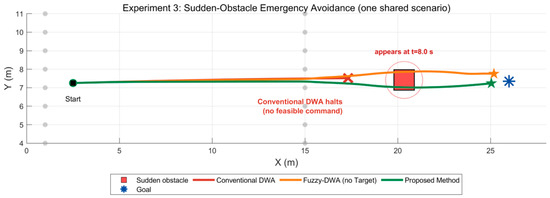
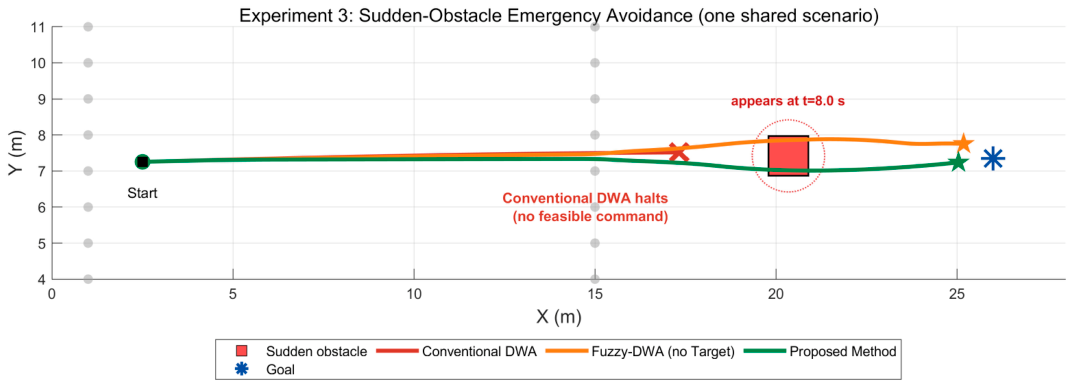
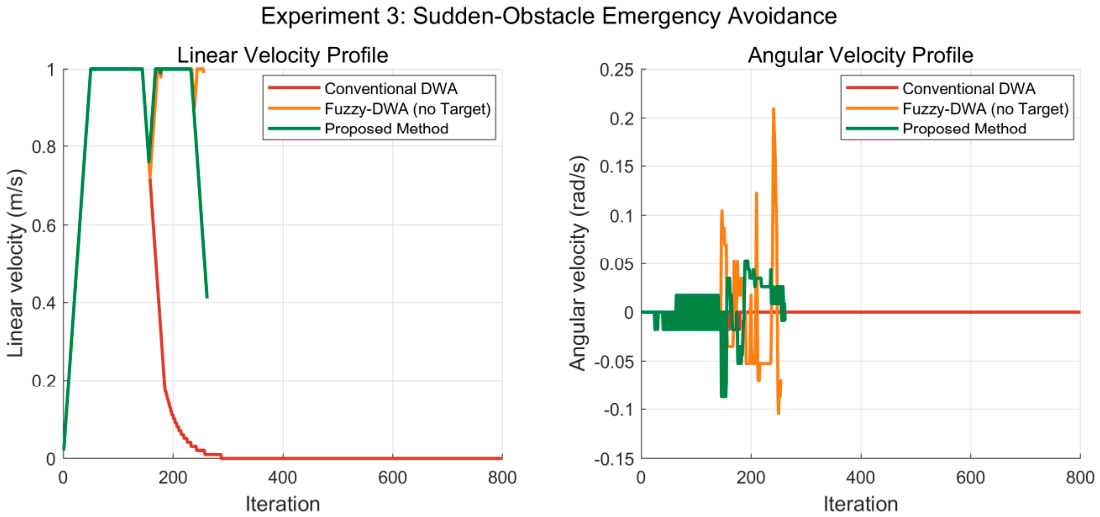
In the sudden-obstacle emergency avoidance scenario, 30 independent randomized trials were conducted for each algorithm. A static obstacle (simulating a suddenly placed material box) was introduced at a randomized time of 5–9 s after the start, when the AMR was within 2–3 m of the goal position. The obstacle position was randomized within a 1 m radius of the goal approach path. The maximum deceleration was recorded as an additional metric specific to this emergency scenario, reflecting the hardware stress during abrupt braking. The trajectories and velocity profiles in Figure 33 and Figure 34 are likewise plotted on one identical shared scenario for a direct like-for-like comparison.
Figure 33.
Quantitative comparison of trajectories among the three algorithms in the sudden-obstacle scenario.
Figure 34.
Comparison of linear and angular velocity profiles among the three algorithms.
Quantitative comparison with baseline algorithms:
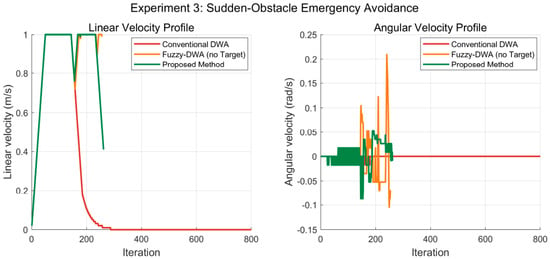
As shown in Figure 33, all three algorithms are evaluated on one identical shared scenario. The red block marks the static obstacle that suddenly appears at t = 5–9 s. Conventional DWA (red) decelerates and comes to a halt before this obstacle without finding a feasible escape command, whereas the target-free Fuzzy-DWA (orange) and the proposed method (green) both deviate around it and reach the goal; the proposed method detours with a smaller lateral deviation.
Figure 34 compares the linear (left) and angular (right) velocity profiles on the same shared sudden-obstacle scenario. After the obstacle appears, Conventional DWA (red) decelerates to a standstill and remains stalled, whereas both fuzzy-based methods (orange and green) briefly slow down, steer around, and resume; the proposed method (green) uses the smallest and briefest steering corrections.
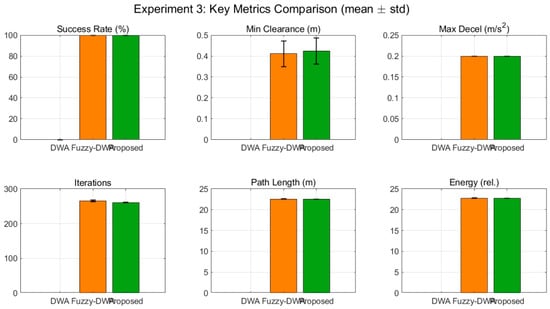
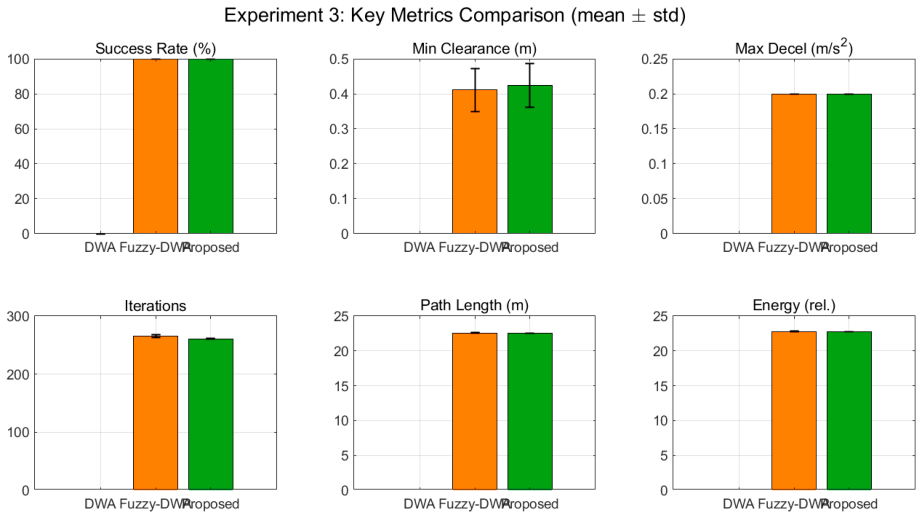
The quantitative results over N = 30 randomized trials reveal a stark contrast in emergency obstacle response capability. Conventional DWA achieved a 0.0% success rate, failing to respond to the suddenly appearing obstacle in all 30 trials. This is because the fixed evaluation weights cannot rapidly reallocate priority when an obstacle appears within the near-field sensing range; after an initial braking action, the controller cannot generate a feasible command that both clears the obstacle and advances toward the goal, so the AMR comes to a standstill and exhausts its iteration budget (the task fails without a physical collision, consistent with the 0% collision rate). In contrast, both the target-free Fuzzy-DWA and the proposed method achieved a 100.0% success rate, demonstrating that the fuzzy-adaptive weight mechanism is essential for emergency obstacle response by rapidly increasing the obstacle-avoidance weight (beta) when the obstacle distance drops below the safety threshold. Among the two successful methods, the proposed method required fewer planning iterations (261.0 +/− 0.7 vs. 265.4 +/− 2.4) and produced a slightly shorter path (22.53 +/− 0.02 m vs. 22.56 +/− 0.04 m). More importantly, the proposed method exhibited substantially lower angular-velocity standard deviation (0.016 +/− 0.007 rad/s vs. 0.028 +/− 0.007 rad/s), indicating more precise and stable rotational control during the emergency avoidance maneuver. The maximum deceleration was 0.20 m/s2 for both methods, consistent with the AMR hardware constraints. No collisions were observed for either fuzzy-based method in this scenario. The average per-iteration computation time for the proposed method was 4.43 +/− 0.31 ms, with a maximum of 17.15 ms during the emergency response phase, both well within real-time requirements. These metrics are graphically compared in Figure 35, which highlights the complete failure of Conventional DWA and the superior control precision of the proposed method among the two successful fuzzy-based approaches.
Figure 35.
Key metrics comparison among the three algorithms in the sudden-obstacle scenario.
Figure 35 compares the key metrics (N = 30, mean +/− std). Conventional DWA (red) achieves a 0% success rate, while both fuzzy-based methods achieve 100%. The proposed method (green) exhibits lower angular-velocity variation and fewer iterations than the target-free Fuzzy-DWA (orange).
Comprehensive analysis of the above experiments demonstrates that the improved DWA algorithm possesses strong adaptability to various environments, resolving issues inherent in the traditional DWA such as local optima, circling, and poor environmental adaptability. Furthermore, the improved DWA algorithm exhibits superior performance in terms of iteration counts, stability of velocity commands, and path smoothness.
4.3. Quantitative Comparative Analysis and Ablation Study
4.3.1. Cross-Scenario Quantitative Summary
The comprehensive quantitative comparison across all three scenarios (Table 4) demonstrates consistent advantages of the proposed method. In the deadlock-escape scenario (Experiment 1), the proposed method achieves the highest success rate (90.0%) while maintaining competitive path length and iteration count. In the dynamic-obstacle scenario (Experiment 2), the proposed method achieves the highest success rate (76.7%), a path length (24.72 m) 6.7% shorter than the target-free Fuzzy-DWA, and the lowest average computation time (3.01 ms, due to dynamic sampling). In the sudden-obstacle scenario (Experiment 3), both fuzzy-based methods achieve 100% success while Conventional DWA completely fails (0.0%), and the proposed method exhibits lower angular-velocity variation (0.016 vs. 0.028 rad/s). Across all scenarios, the proposed method maintains minimum obstacle clearance above 0.4 m and per-iteration computation time below 21 ms, satisfying both safety and real-time requirements for the M150 AMR platform.
Table 4.
Quantitative comparison of three algorithms across three experimental scenarios (N = 30, mean +/− std). Path-dependent metrics are computed only over successful trials.
4.3.2. Ablation Study on Component Contributions
The ablation study was conducted in the narrow-aisle U-shaped deadlock scenario (the same configuration as Experiment 1), as this scenario most clearly differentiates the contributions of individual components, particularly the Target function and fuzzy weight mechanism. Each variant was evaluated over N = 30 independent randomized trials with the same randomization parameters as Experiment 1.
Five algorithm variants were constructed by incrementally adding each proposed component: V1 (Conventional DWA): the standard DWA with fixed weights [heading = 0.2, clearance = 0.3, velocity = 0.3], serving as the baseline; V2 (+Velocity improvement): DWA with the improved velocity evaluation function that penalizes sudden velocity changes; V3 (+Target function): V2 plus the Target distance function that provides persistent directional gradient toward the goal; V4 (+Fuzzy weights, without Target): V2 plus the fuzzy adaptive weight mechanism but without the Target function, representing traditional fuzzy-DWA approaches; V5 (Full proposed method): all four components integrated, including dynamic sampling space.
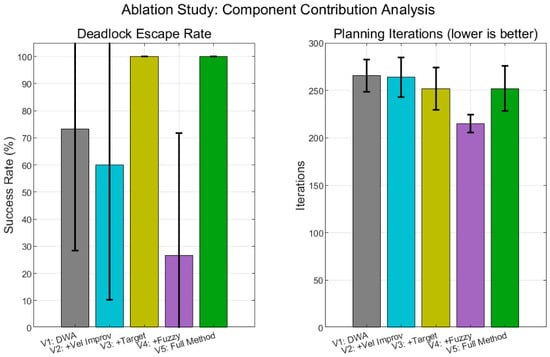
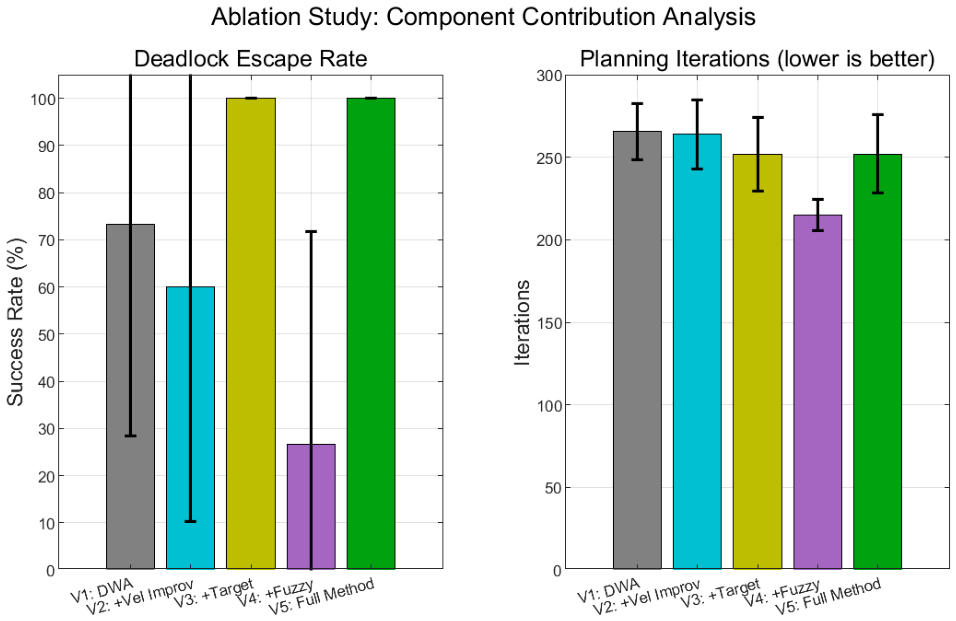
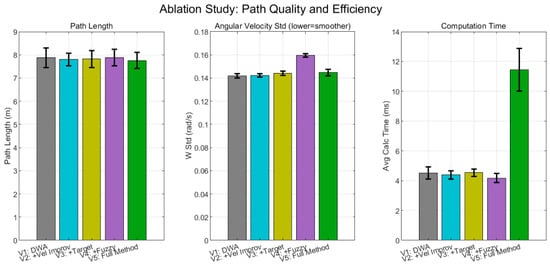
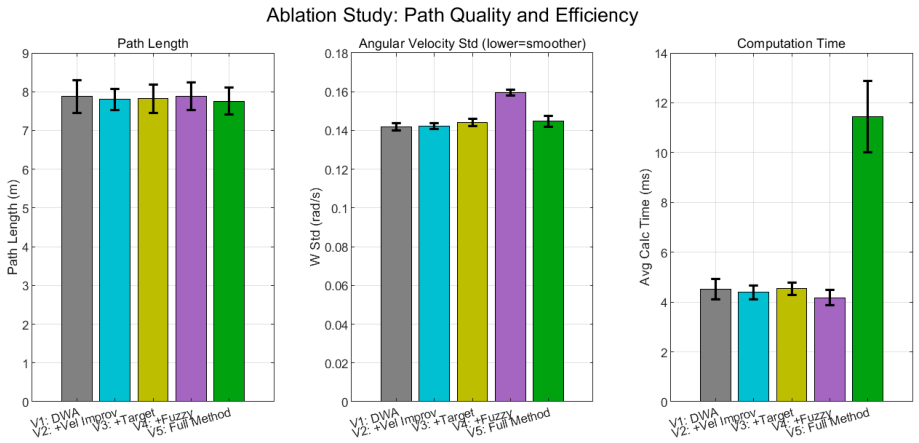
The quantitative ablation results are summarized as follows (mean +/− std, N = 30): V1 (Conventional DWA) achieved 73.3 +/− 45.0% success with 265.5 +/− 17.0 iterations and 7.88 +/− 0.42 m path length; V2 (+Velocity improvement) achieved 60.0 +/− 49.8% success with 263.8 +/− 20.8 iterations and 7.80 +/− 0.28 m path length; V3 (+Target function) achieved 100.0 +/− 0.0% success with 251.7 +/− 22.3 iterations and 7.82 +/− 0.36 m path length; V4 (+Fuzzy weights, without Target) achieved 26.7 +/− 45.0% success with 214.9 +/− 9.3 iterations and 7.88 +/− 0.36 m path length; V5 (Full method) achieved 100.0 +/− 0.0% success with 252.0 +/− 23.7 iterations and 7.76 +/− 0.34 m path length.
Figure 36 shows the deadlock-escape success rate (left) and average planning iterations (right) across the five algorithm variants (V1–V5) in the narrow-aisle scenario (N = 30, mean +/− std). The Target function (V3) is the critical component, raising success from 73.3% to 100.0%, while fuzzy weights alone without Target (V4) reduce success to 26.7%.
Figure 36.
Ablation study on deadlock-escape success rate and planning iterations.
Figure 37 shows the path length, angular-velocity standard deviation, and average computation time across the five variants in the narrow-aisle deadlock scenario (N = 30, mean +/− std). The full method (V5) achieves the shortest path with competitive computation time.
Figure 37.
Ablation study on path length, angular-velocity variation, and computation time.
The ablation results reveal several critical findings regarding the contribution of each proposed component. First, the Target distance function is the decisive component for deadlock escape: adding only the Target function (V3) raises the success rate from 73.3% (V1 baseline) to 100.0%, while adding only the fuzzy weight mechanism without Target (V4) drops the rate to 26.7%. This counterintuitive result for V4 occurs because the fuzzy controller, when obstacles are in close proximity within the narrow corridor, assigns excessive weight to obstacle avoidance (beta) and insufficient weight to goal heading (delta), causing the AMR to become immobilized. The Target function compensates for this by maintaining a persistent directional gradient toward the goal, and the integrated deadlock-detection mechanism further ensures escape when stagnation is detected. Second, the full method (V5) achieves 100.0% success with the shortest path length (7.76 m) and competitive iteration count (252.0), confirming that all components work synergistically: the Target function prevents deadlock, the fuzzy controller adapts to obstacle proximity, the velocity improvement smooths motion profiles, and dynamic sampling reduces computation when obstacles are distant. Third, the velocity-improvement component (V2) alone does not significantly improve success rate (60.0%), but contributes to lower velocity standard deviation and smoother motion when combined with other components. Fourth, the average computation time for the full method (11.44 +/− 1.44 ms) is higher than the baseline (4.52 +/− 0.41 ms) due to the fuzzy inference overhead, but remains well within the 100 ms real-time control requirement. These ablation results provide strong empirical evidence that the proposed method is not merely a reparameterization of existing fuzzy-DWA approaches, but introduces functionally distinct components that address specific failure modes of conventional methods.
5. Conclusions
Addressing the complex and dynamic operational requirements of the Weichai South District Intelligent Logistics Center, this study conducts research on local path planning for AMRs based on an improved DWA algorithm integrated with fuzzy control. By establishing a kinematic model for the M150 vehicle and introducing a dynamic angular velocity gain mechanism and a target distance tracking function, Target, into the conventional evaluation function, coupled with an environment-aware dynamic sampling space, the deadlock and oscillation issues associated with long-body vehicles in narrow aisles are effectively resolved at the algorithmic level. Concurrently, a fuzzy controller with two inputs and four outputs is designed to achieve real-time adaptive online tuning of the weighting factors of the evaluation function. This approach significantly enhances the robustness and planning smoothness of the system under human–machine mixed-flow and emergency scenarios. High-fidelity simulation results, mapped from the actual field layout, demonstrate that the improved algorithm significantly optimizes trajectory performance and operational efficiency while ensuring obstacle avoidance safety. The proposed method effectively resolves velocity control fluctuations and the “sudden start/stop” phenomenon, meeting the stringent requirements for AMR operational stability and production cycle assurance in industrial environments, thereby possessing substantial engineering application value.
Despite these promising findings, several limitations remain. First, the algorithm was validated within a simulated high-fidelity grid map; thus, the effects of real-world physical constraints such as wheel slippage, sensor noise, and communication delays were not fully captured. Second, while the dynamic sampling space reduces computational overhead, the real-time execution of the multi-input fuzzy inference system under extremely dense, chaotic obstacle configurations requires further optimization to ensure strict real-time guarantees on resource-constrained onboard microcontrollers.
Consequently, future work will focus on two major directions. First, we plan to transition from simulations to physical deployment and conduct field experiments using the actual M150 AMR platform in the Weichai South District Logistics Center to assess the algorithm’s robustness under practical operational noise and load variations. Second, we aim to integrate advanced dynamic obstacle intention prediction models into the local planner to further elevate safety and coordination efficiency in collaborative human–robot environments.
Author Contributions
Conceptualization, T.L., B.L. and Y.H.; methodology, T.L., S.W. and F.P.; software, T.L., M.Y. and W.G.; validation, S.W., M.Y. and Q.W.; formal analysis, T.L., B.L. and W.G.; investigation, S.W., F.P. and Q.W.; resources, Y.H., Y.C. and A.N.H.I.; data curation, T.L., W.G. and Q.W.; writing—original draft preparation, T.L.; writing—review and editing, B.L., A.N.H.I. and Y.C.; visualization, T.L., S.W. and M.Y.; supervision, Y.H. and Y.C.; project administration, Y.H.; funding acquisition, Y.H. and Y.C. All authors have read and agreed to the published version of the manuscript.
Funding
This work was supported in part by the Natural Science Foundation of China (No. 52575568. No. 52405541), the Natural Science Foundation of Jiangsu Province of China (BK20241780), Project of Changzhou Applied Basic Research Program (CJ20252022), Research Projects of the China Society of Logistics (2026CSLKT3-449, 2026CSLKT3-476, 2026CSLKT3-514, 2026CSLKT3-515).
Data Availability Statement
Data are contained within the article.
Conflicts of Interest
Author Quan Wen was employed by the company Guangxi Beigang Logistics Co., Ltd. The remaining authors declare that the research was conducted in the absence of any commercial or financial relationships that could be construed as a potential conflict of interest.
References
- Peng, X.Y.; Xie, H.; Huang, J. Research on Local Path Planning Algorithm for Driverless Vehicles. Automot. Eng. 2020, 42, 1–10. [Google Scholar] [CrossRef] [Scilit]
- Zhang, J.; Jin, S.; Li, W.; Li, S.; Guo, J.; Gao, X. Multi-Objective Path Planning for Warehouse Inspection of Mobile Robots Considering Power Limitations and Multiple Charging Points. Processes 2025, 13, 3011. [Google Scholar] [CrossRef] [Scilit]
- Zhang, Y.; Gao, F.; Zhao, F. Research on Path Planning and Tracking Control of Autonomous Vehicles Based on Improved RRT* and PSO-LQR. Processes 2023, 11, 1841. [Google Scholar] [CrossRef] [Scilit]
- Zhang, Y.; Zhao, Q. Complex Environment Based on Improved A* Algorithm Research on Path Planning of Inspection Robots. Processes 2024, 12, 855. [Google Scholar] [CrossRef] [Scilit]
- Ou, X.; You, Z.; He, X. Local Path Planner for Mobile Robot Considering Future Positions of Obstacles. Processes 2024, 12, 984. [Google Scholar] [CrossRef] [Scilit]
- Fox, D.; Burgard, W.; Thrun, S. The dynamic window approach to collision avoidance. IEEE Robot. Autom. Mag. 1997, 4, 23–33. [Google Scholar] [CrossRef] [Scilit]
- Zhang, J.; Ling, H.; Tang, Z.; Song, W.; Lu, A. Path planning of USV in confined waters based on improved A* and DWA fusion algorithm. Ocean Eng. 2025, 322, 120475. [Google Scholar] [CrossRef] [Scilit]
- Su, Y.; Xin, J.; Sun, C. Dynamic Path Planning for Mobile Robots Based on Improved RRT* and DWA Algorithms. IEEE Trans. Ind. Electron. 2025, 72, 10595–10604. [Google Scholar] [CrossRef] [Scilit]
- Zhang, Y.; Cui, C.; Zhao, Q. Path Planning of Mobile Robot Based on A Star Algorithm Combining DQN and DWA in Complex Environment. Appl. Sci. 2025, 15, 4367. [Google Scholar] [CrossRef] [Scilit]
- Gu, C.; Liu, S.; Li, H.; Yuan, K.; Bao, W. Research on hybrid path planning of underground degraded environment inspection robot based on improved A* algorithm and DWA algorithm. Robotica 2025, 43, 887–908. [Google Scholar] [CrossRef] [Scilit]
- Chen, H.; Lin, Z.; Chen, Z.; Jian, J.; Liu, C. Adaptive DWA algorithm with decision tree classifier for dynamic planning in USV navigation. Ocean Eng. 2025, 321, 120328. [Google Scholar] [CrossRef] [Scilit]
- Hu, Y.; Long, H.; Chen, M. The analysis of pedestrian flow in the smart city by improved DWA with robot assistance. Sci. Rep. 2024, 14, 11456. [Google Scholar] [CrossRef] [Scilit] [PubMed]
- Wang, X.H.; Qi, Z.H.; Yang, Z.Y.; Wang, D.; Huang, H.; Lu, M. Local Path Planning of Agricultural Robot Based on DAV_DWA Algorithm. Trans. Chin. Soc. Agric. Mach. 2025, 56, 105–114. [Google Scholar]
- Chen, M.X.; Zhao, J.D.; Zhou, D.D.; Zhang, H. Research on Barrel Temperature Control System of Rubber Extruder Based on Smith-fuzzy Control Algorithm. Mach. Tool Hydraul. 2022, 50, 33–38. [Google Scholar]
- Guo, N.; Li, C.H.; Wang, D.; Zhang, N.; Liu, G. Path Planning of Mobile Robot Combining Prediction and Fuzzy Control. Comput. Eng. Appl. 2020, 56, 104–109. [Google Scholar] [CrossRef] [Scilit]
- Wu, H.; Wang, F.; Mei, X.; Liang, L.; Han, B.; Han, D.; Weng, T.-H.; Li, K.-C. A novel fuzzy control path planning algorithm for intelligent ship based on scale factors. J. Supercomput. 2024, 80, 202–225. [Google Scholar] [CrossRef] [Scilit]
- Shi, Z.X.; Feng, J.B.; Wang, Y.X. Research on Intelligent Vehicle Path Tracking Based on MPC and Fuzzy Control. Veh. Power Technol. 2022, 2, 7–11. [Google Scholar]
- Chen, L.; Liu, R.; Jia, D.; Xian, S.; Ma, G. Improvement of the TEB Algorithm for Local Path Planning of Car-like Mobile Robots Based on Fuzzy Logic Control. Actuators 2025, 14, 12. [Google Scholar] [CrossRef] [Scilit]
- Zhang, Y.J.; Han, Y. Research on Four-wheel Differential Mobile Chassis Model Algorithm Based on Improved DWA. Modul. Mach. Tool Autom. Manuf. Tech. 2024, 9, 98–103, 107. [Google Scholar]
- Wang, Y.; Fu, C.; Huang, R.; Tong, K.; He, Y.; Xu, L. Path planning for mobile robots in greenhouse orchards based on improved A* and fuzzy DWA algorithms. Comput. Electron. Agric. 2024, 227, 109598. [Google Scholar] [CrossRef] [Scilit]
- Wang, H.Q.; Song, G.Z.; Chao, S.; Tan, Q.; Ge, C. Robot Dynamic Path Planning Based on Dung Beetle Optimizer and DWA Algorithm. Manuf. Technol. Mach. Tool 2024, 12, 21–29. [Google Scholar]
- Wang, J.; Wang, J.; Chen, R.; Yang, K.; Wu, B.; Qi, Y. Formation collaborative obstacle avoidance with multiple UGVs in restricted environments based on adaptive DWA. Expert Syst. Appl. 2025, 265, 125870. [Google Scholar] [CrossRef] [Scilit]
- Li, J.P. Research on Path Planning Methods for Robot Autonomous Walking and Space Operation. Master’s Thesis, Xidian University, Xi’an, China, 2021. [Google Scholar] [CrossRef]
- Malik, S.; Mohan, B.M. Nonuniqueness of mathematical models of the simplest three-input Mamdani fuzzy proportional-integral-derivative controllers. Int. J. Syst. Sci. 2025, 56, 4157–4169. [Google Scholar] [CrossRef] [Scilit]
- Xiang, C.S.; Wang, X.; Zhao, H.; Xiao, T.; Gao, Q. Quantitative Analysis of Plate-bridge Damage Based on Mamdani Fuzzy Inference with Fused WM Algorithm. China Saf. Sci. Technol. 2024, 20, 173–180. [Google Scholar]
- Şener, K.T.; Çakmak, G. A specialized multi-model adaptive network-based fuzzy inference system approach for optimizing latent heat storage systems from sparse experimental data. J. Energy Storage 2026, 147, 120311. [Google Scholar] [CrossRef] [Scilit]

Disclaimer/Publisher’s Note: The statements, opinions and data contained in all publications are solely those of the individual author(s) and contributor(s) and not of MDPI and/or the editor(s). MDPI and/or the editor(s) disclaim responsibility for any injury to people or property resulting from any ideas, methods, instructions or products referred to in the content. |
© 2026 by the authors. Licensee MDPI, Basel, Switzerland. This article is an open access article distributed under the terms and conditions of the Creative Commons Attribution (CC BY) license.