


Abstract
Marine environments and UV radiation severely degrade high-density polyethylene (HDPE) aquaculture pipes. This study introduces a novel empirical framework integrating physicochemical data with COMSOL Multiphysics to predict the long-term, heterogeneous degradation of modified HDPE over a 50-year service life. To enhance weatherability, HDPE was compounded with a UV absorber (UV531) and an antioxidant (AO1010). Simulation results show that the optimal formulation (1% UV531) retains a tensile strength of 26.3 MPa after 50 years—a 17% reduction versus 29% for additive-free control. This performance stems from UV531 absorbing 240–340 nm radiation, whereas AO1010’s long-term effect was negligible. Crucially, COMSOL captured a surface-to-core oxidation gradient and non-uniform degradation, providing more realistic structural predictions than conventional homogeneous models. Importantly, by coupling empirical kinetics (G0 and kd) from a 15-year equivalent accelerated exposure (5.0 GJ m−2) with seawater diffusion (1.77 × 10⁻¹³ m2/s) in COMSOL, a comprehensive 50-year time-dependent degradation prediction across the pipe wall was achieved. This simulation-driven strategy establishes a robust, highly efficient approach to optimizing material longevity for sustainable marine applications.
1. Introduction
In recent decades, the marine aquaculture industry has been shifting strongly toward an industrial model with large-scale cage systems. The modernization of marine farming infrastructure represents a key strategy for fostering sustainable aquaculture. This transition is vital for safeguarding food security, catalyzing industrial advancements, and preserving marine ecosystems. Historically, traditional rafts relied heavily on natural materials like bamboo and timber, along with polystyrene floats. However, the use of wooden walkways leads to significant deforestation, while the fragmentation of foam floats over time poses a severe ecological threat to the ocean [1]. Due to inadequate safety standards and limited durability, traditional floating rafts are increasingly being replaced. Within the 10 to 20 m depth range, high-density polyethylene (HDPE) structures have emerged as the standard apparatus for nearshore mariculture [2]. Aquaculture equipment has made widespread use of HDPE, which is recognized for its resilience to corrosion and low cost of raw materials [3].
Compared to circular cages, rectangular HDPE floating rafts provide superior structural stability for deep-sea operations, long-term economic gains via low maintenance and recyclability, and added commercial value by integrating aquaculture with recreational marine activities [4]. However, insufficient rigidity combined with HDPE floating rafts’ extreme flexibility can cause distortion and deformation under windy situations, which can result in structural damage [4]. Conversely, the service life of HDPE-based components is frequently compromised by the synergistic effects of UV-induced photodegradation and thermal oxidation within harsh oceanic settings. To counteract these vulnerabilities and tailor specific material characteristics, various chemical agents—such as phthalates and bisphenol A—are commonly integrated into the polymer matrix [5]. Some additives are designed to stabilize the polymer and make it more resistant to degradation [6]. The additives are usually not covalently bonded to the polymer and therefore can leach out from the plastic as it degrades and enter the marine environment [7].
Incorporating light stabilizers and antioxidants is a widely used method to enhance the material’s operational lifespan. Two commercially functional particles, namely antioxidants and UV absorbers, have been widely applied to improve the UV aging resistance of HDPE. As reported in the literature, antioxidants and UV absorbers both exhibit excellent influence on UV-aging-resistant performance [8,9,10]. To mitigate UV-induced photo-oxidation, various light stabilizers are commonly incorporated into high-density polyethylene (HDPE) matrices. These primarily include benzophenones (e.g., UV531), which absorb harmful 240–340 nm UV radiation and dissipate it as thermal energy; benzotriazoles (e.g., UV326, UV328), offering broad-spectrum absorption and high processing stability; and Hindered Amine Light Stabilizers (HALSs) (e.g., UV783, Tinuvin 622), which function as free-radical scavengers to interrupt degradation propagation [5]. In this work, UV531 was selected as the optimal absorber due to its superior spectral match with damaging solar wavelengths and excellent compatibility with HDPE in marine environments [11]. Under environmental exposure, the degradation of HDPE is governed by a complex competition between polymer chain scission, crosslinking, and molecular rearrangement [12]. Although previous studies have elucidated the mechanisms of polymer chain scission and carbonyl group formation under the influence of UV radiation [13], the procurement of long-term mechanical property data is not straightforward. Accelerated weathering tests are often used to obtain information about degradation behavior [14]. However, quantitatively assessing long-term mechanical strength degradation under real-world conditions remains a challenge.
The finite element method (FEM) has become a standard numerical scheme for evaluating mechanical and physicochemical transformations [15,16]. Nevertheless, current studies primarily focus on simulating static stress or the fluid dynamics of cage frames [17]. Most current lifespan estimates rely on linear extrapolation mathematical models, which assume that the degradation process occurs uniformly throughout the entire material bulk. The aging process is typically limited to a surface layer, creating a distinct oxidation gradient from the surface to the core [12]. Integrating material degradation kinetics into 3D geometric models to observe this heterogeneous property change over long durations remains a significant research gap [18].
Herein, a 3D finite element method (FEM) framework via COMSOL Multiphysics was developed to predict the 50-year tensile strength degradation of aquaculture cage pipe walls. This approach visualizes heterogeneous property spatial evolution and surface-to-core oxidation gradients that conventional macro-scale tensile tests fail to capture, aligned with recent FEM applications in aging gradient studies [12]. The model was calibrated by integrating empirical input parameters G0 and kd obtained from accelerated irradiation tests equivalent to 15 years of outdoor exposure (5.0 GJ m−2 is equivalent to 15 years of outdoor marine exposure), as reported in our previous work [19]. Furthermore, a comparative analysis between the 3D-simulated heterogeneous degradation mechanism and traditional mathematical models was conducted to identify the most cost-effective material formulation for tropical marine conditions.
2. Materials and Methods
2.1. Materials and Empirical Data
The study utilized a high-density polyethylene resin (HDPE; HS 3490LS, Borouge, Singapore), with industrial carbon black (PN 050ANF, 50% purity, China) incorporated to enhance durability and pigmentation. UV stabilization and antioxidation were achieved using UV-531 (C21H26O3, CAS 1843-05-6) and AO-1010 (C73H108O12, CAS 6683-19-8) respectively, with three blending formulations (as described in Table 1) to evaluate the impact of the additive system. The resin pellets and additives were blended and extruded to produce standard test samples in the form of inner pipes with a diameter of D125 and a thickness of 7.4 mm.
Table 1.
Formulations of HDPE modified with various additives (wt.%) [20].
The relationship between the 5.0 GJ m−2 radiation dose and the 15-year service life is established via accelerated weathering standards. Specifically, the accelerated irradiation test was conducted in accordance with TCVN 7699-2-5:2011 (equivalent to IEC 60068-2-5:2010) for simulated solar radiation at ground level. A total cumulative radiant exposure of 5.0 GJ m−2 corresponds to the total solar energy absorbed by HDPE pipes over 15 years of continuous outdoor exposure in tropical marine environments. The empirical mechanical data obtained after this dose served as the baseline parameters (G0 and kd) to calibrate our COMSOL model for the 50-year lifespan prediction [9,19].
The synthesis of HPDE modified with various additives in Table 1 was studied following previous research [20,21]. In this study, 2-hydroxy-4-octyloxybenzophenone (UV531) was selected as the primary ultraviolet absorber due to its high efficiency in absorbing UV radiation in the 240–340 nm wavelength range—which corresponds to the most damaging spectral region for high-density polyethylene (HDPE) backbones—and converting it into harmless thermal energy [11]. Additionally, pentaerythritol tetrakis (3-(3,5-di-tert-butyl-4-hydroxyphenyl) propionate) (AO1010) was incorporated as a high-molecular-weight hindered phenolic antioxidant to act as a primary radical scavenger, offering long-term thermo-oxidative protection during both thermal processing and operational exposure. Additive concentrations (1 wt.% UV531 and 1 wt.% AO1010) were chosen above typical commercial levels (0.1–0.5 wt.%) to provide a functional reservoir against continuous seawater leaching and UV depletion over extended service lifespans. Concentrations > 1 wt.% were avoided to prevent additive blooming, agglomeration, and baseline mechanical degradation [11]. All tensile tests were conducted in triplicate (n = 3).
2.2. Degradation Kinetics Model
Since the degradation of HDPE’s physical–mechanical properties primarily occurs at the surface exposed to the environment, the polymer degradation rate (rd) is determined by the change in mass (m) over time (t) and the surface area (SA) [13]:
For polymer samples subjected to irradiation from both sides, the degradation of tensile strength (Gt) over time t (years) is extrapolated using a mathematical model. This is a simple model, yet it provides reasonably accurate predictions of HDPE material strength over time based on experimental data and laboratory strength measurements [22]:
where B is a dimensionless geometric correction constant and kd is the surface degradation rate coefficient (µm/year), in which the kd coefficient is subjected to a hypothetical relative error (±20%), which is used for sensitivity analysis and error propagation when extrapolating long-term degradation lifetimes (td) [13]. The corresponding adjusted kd values for the model are 28.95 µm/year (M0), 14.75 µm/year (UV531-1%), and 14.58 µm/year (UV531-AO1010-2%), respectively.
2.3. Multiphysics Simulation Configuration
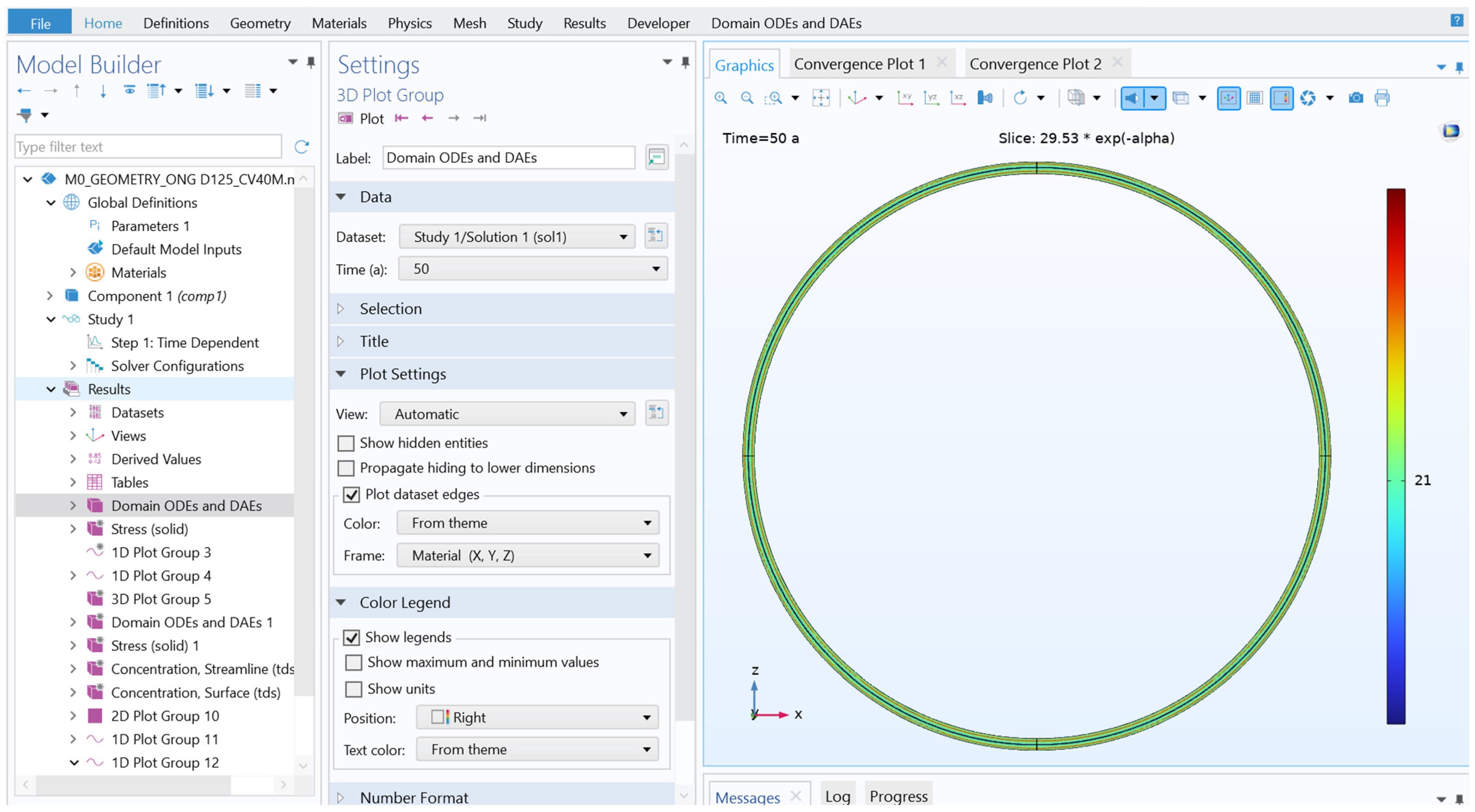
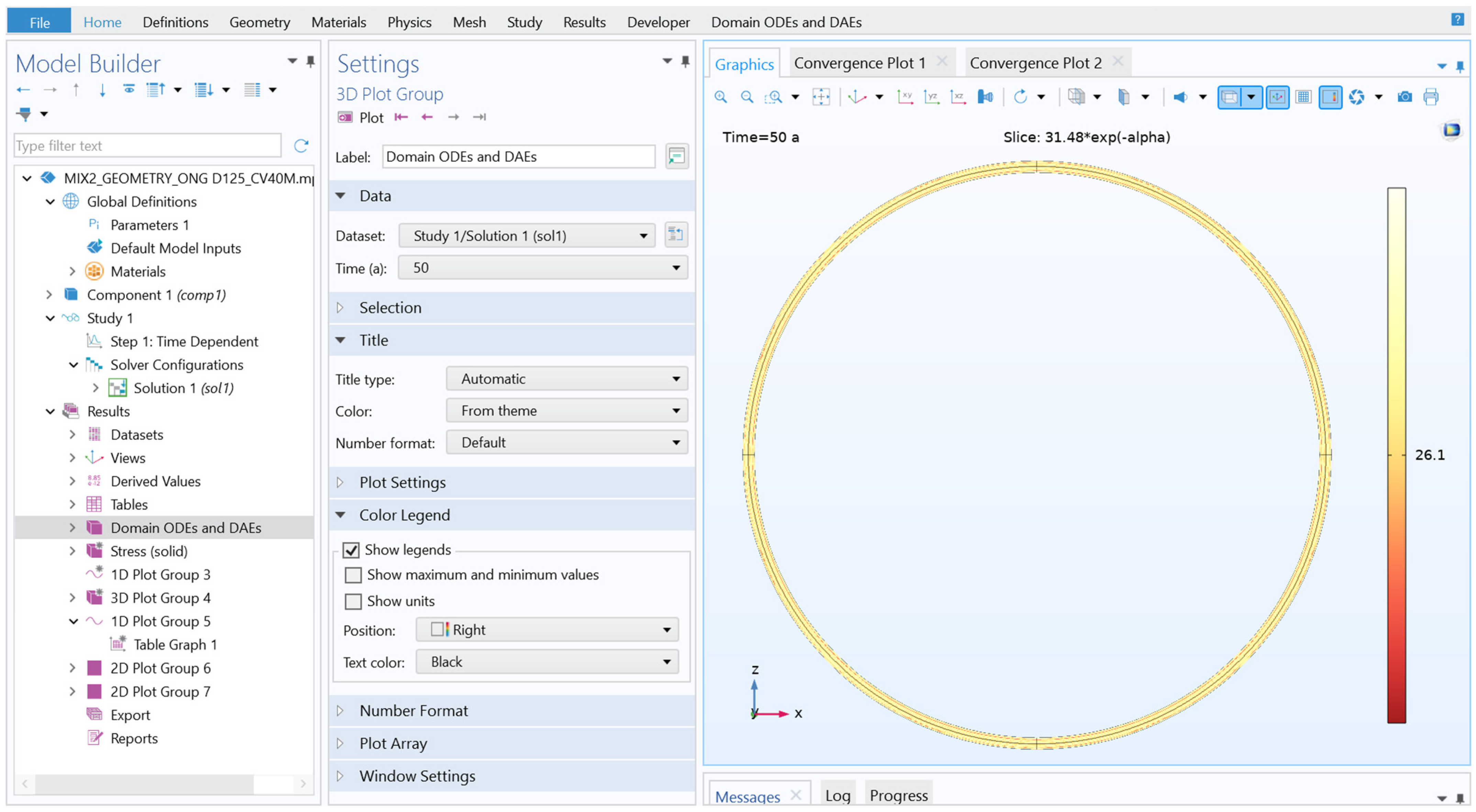
The finite element simulation was conducted on the COMSOL Multiphysics platform, simultaneously integrating two physics fields to accurately replicate the environment–material interaction, as shown in Figure 1.
Figure 1.
Flowchart of the COMSOL Multiphysics simulation process for predicting the long-term degradation of HDPE pipes [20].
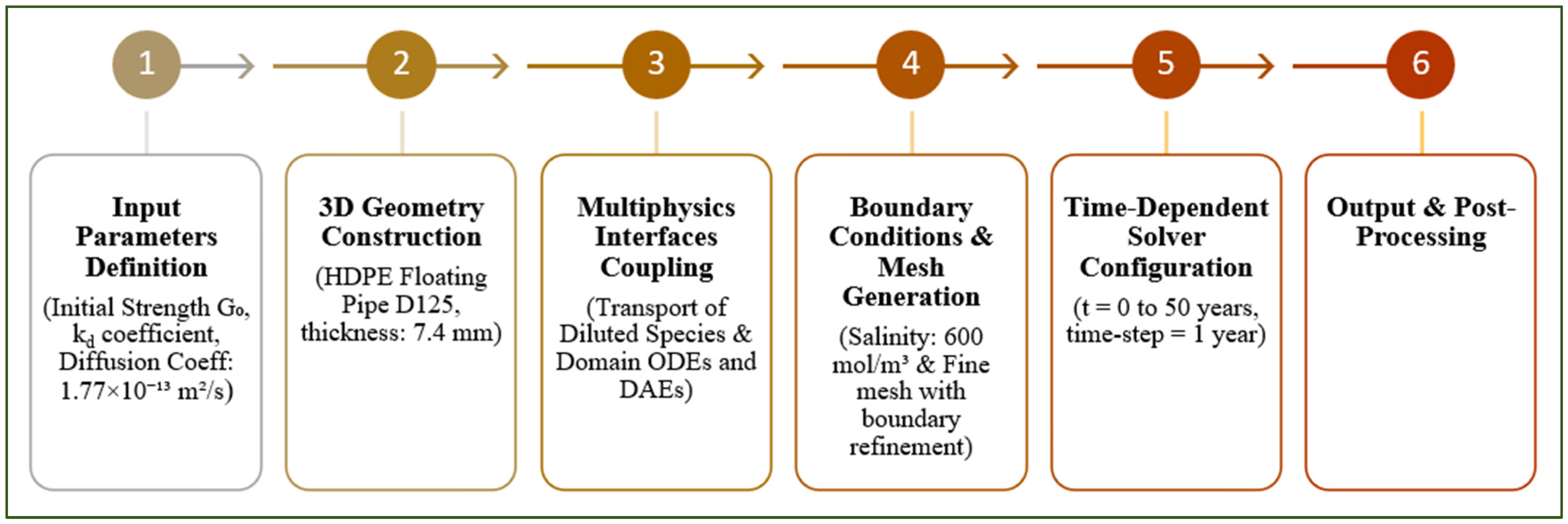
Geometry: A 3D model was constructed for a standard D125 HDPE floating buoyancy pipe (outer diameter 125 mm, wall thickness 7.4 mm), which is the most common dimension used in industrial aquaculture cages [23].
Physics Interfaces: The Domain ODEs and DAEs module was utilized to solve the differential equations describing the linear degradation of mechanical stress within the polymer matrix. Simultaneously, the Transport of Diluted Species module was activated to compute the diffusion of corrosive agents (representing seawater ions) into the core structure [24].
Boundary Conditions: The ion concentration at the contact surfaces was set to 600 mol/m3 (equivalent to a salinity of 35‰). The apparent diffusion coefficient of seawater into the HDPE network was fixed at 1.77 × 10⁻¹³ m2/s under isothermal conditions at 20 °C [25].
Mesh and Solver: The mesh was generated at a Fine level, with specific refinement at the boundary interfaces. The study was configured as Time Dependent, iteratively solving within a time range from t = 0 to t = 50 years with a time-step of Delta t = 1year.
3. Results and Discussion
3.1. Initial Mechanical Properties and Additive Synergy
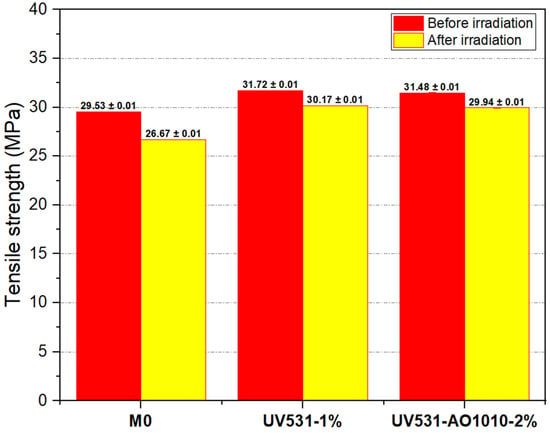
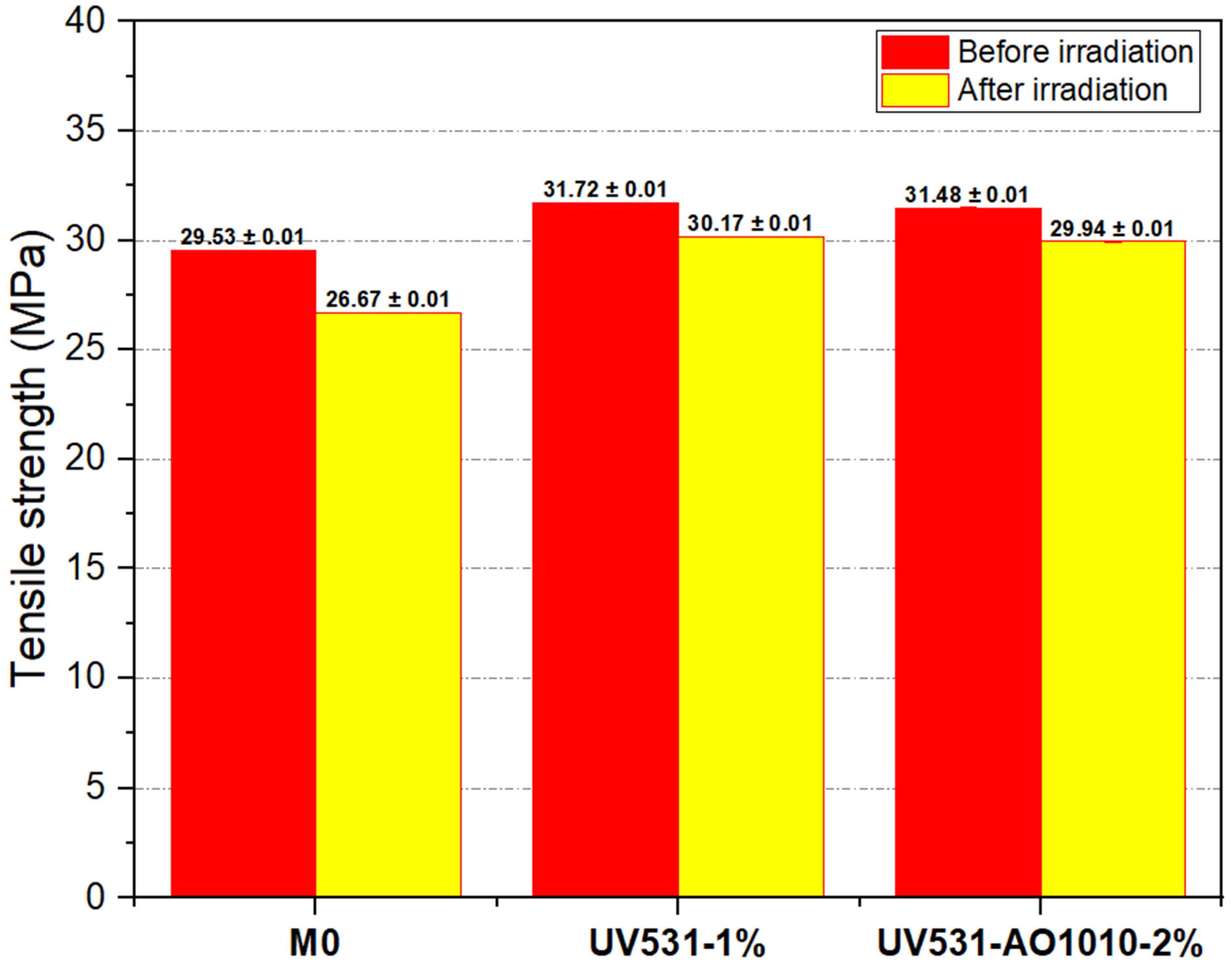
The initial physical–mechanical properties and post-irradiation of the HDPE material systems were characterized to establish the baseline for the predictive model in Figure 2.
Figure 2.
Initial tensile strength and post-irradiation of the three material samples after fabrication.
Accelerated weathering tests were conducted in accordance with TCVN 7699-2-5:2011 (equivalent to IEC 60068-2-5:2010) [19], with a total applied solar energy dose of 5.0 GJ m−2 on the conventional and modified HDPE samples at the initial stage, thus providing the foundational parameters for the predictive model. The tensile strength (G0) of the M0 control sample reached 29.53 MPa. The addition of 1% UV531 increased this value to 31.72 MPa (an increase of ~7.4%), whereas the UV531-AO1010-2% dual-blend sample achieved 31.48 MPa.
The slight increase in mechanical strength in the presence of additives is not merely a result of physical blending. Structurally, UV absorbers (UVAs) such as Benzotriazole can interact with the amorphous regions of the HDPE matrix, increasing bond density and acting as auxiliary nucleating agents that help refine the polymer’s microstructure during the extrusion process [26,27,28]. However, when the additive concentration exceeds the optimal threshold (as seen in the dual-blend sample), the saturation or local agglomeration of additive molecules can create micro-stress concentration points, explaining why the 2% sample did not yield higher results than the 1% sample [29].
However, following irradiation exposure, the tensile strength of the evaluated materials exhibited distinct levels of degradation, clearly highlighting the protective efficacy of the additives. The control sample (M0) experienced the most severe deterioration, dropping to the lowest post-irradiation value of 26.67 MPa, which represents a significant 9.7% loss in mechanical strength. In sharp contrast, the formulations incorporating stabilizers demonstrated superior resistance to radiation-induced aging. The UV531-1% sample retained the highest structural integrity with a post-irradiation tensile strength of 30.17 MPa, closely followed by the UV531-AO1010-2% blend at 29.94 MPa. Both stabilized modifications successfully restricted the strength loss to a minimal 4.9%, indicating that the inclusion of UV531 and the UV531-AO1010 synergistic system effectively mitigates degradation and maintains high mechanical performance after irradiation [29].
3.2. Mathematical Prediction of Degradation Kinetics
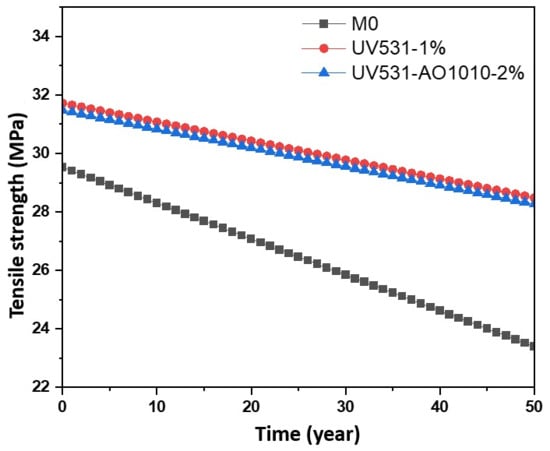
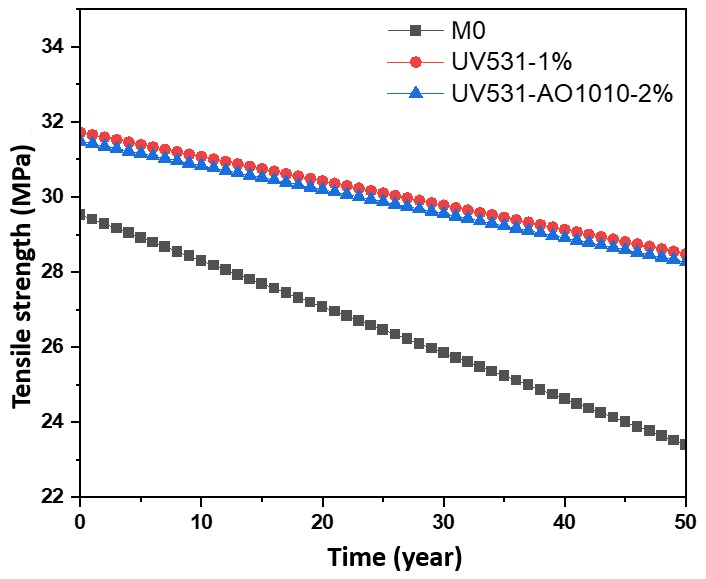
Based on a mathematical model of plastic degradation over time [13] constructed from the 5 GJ/m2 accelerated irradiation data, the degradation of strength over time of the HDPE material was predicted under direct UV exposure. The aging kinetics were quantified via the surface degradation rate (kd). For the M0 sample, the kd coefficient reached its peak (28.95 μm/year), leading to a predicted tensile strength of only 23.4 MPa after 50 years (Figure 3). This degradation follows the chain scission mechanism of polyethylene chains under the influence of free radicals.
Figure 3.
The graph shows the decrease in tensile strength over time of the material samples from 0 to 50 years, based on the mathematical equation of plastic degradation.
Conversely, the UV-stabilized samples exhibit a significantly slower degradation rate (kd~14.75 μm/year). This suggests that utilizing a mathematical model for time-dependent plastic degradation allows for the establishment of a rapid reference framework for service life.
Furthermore, Figure 3 shows that sample M0 exhibits the most rapid decline in strength (after 50 years, the strength is only 23.4 MPa, representing just 79.24% of its initial value). This demonstrates that the absence of protective additives leaves the polymer structure susceptible to chain scission under environmental impacts (thermal or photochemical aging). The two stabilized samples, UV531-1% and UV531-AO1010-2%, show superior aging resistance. Specifically, after 50 years, the UV531-1% sample retains approximately 89.82% of its initial strength, while the UV531-AO1010-2% sample retains 92.96% [8,9,30].
However, a limitation of this model is the assumption that aging is ‘isotropic’ and occurs uniformly throughout the entire cross-section of the pipe wall. In actual marine environments, besides UV exposure, other aggressive factors—such as the diffusion of seawater into the material—will create discrepancies in physical properties when compared to calculations based solely on UV irradiation [31]. Therefore, to enhance the reliability of the 50-year lifespan prediction, this study implemented simulations using COMSOL Multiphysics software (version 6.4). The accelerated solar radiation dose (5.0 GJ m−2, TCVN 7699-2-5:2011 equivalent to IEC 60068-2-5:2010) [19] provided empirical 15-year baseline data to extract the initial strength (G0) and surface degradation rate coefficient (kd). After applying a 20% environmental safety factor to kd, these kinetic parameters were input into COMSOL Multiphysics (Domain ODEs/DAEs) to extrapolate non-uniform structural degradation over a 50-year service life [12]. Experimental and numerical investigation on mechanical properties change of HDPE in various aging conditions. This approach allows for the simultaneous integration of UV-induced degradation and the penetration and diffusion of seawater into the material structure [15,16]. The finite element method (FEM) within the COMSOL Multiphysics platform was applied to model the Multiphysics interaction between oxidation and seawater diffusion. Incorporating the marine environment variable into the simulation is a key basis for accurately forecasting the material’s durability evolution over a 50-year timeline.
3.3. Multiphysics Analysis of Structural Integrity via COMSOL
Multiphysics simulations using COMSOL Multiphysics allow for the observation of variations in physical–mechanical properties under the coupled effects of ion diffusion and polymer aging. By the 50th year, the simulation results reveal a more complex picture of material degradation [32].
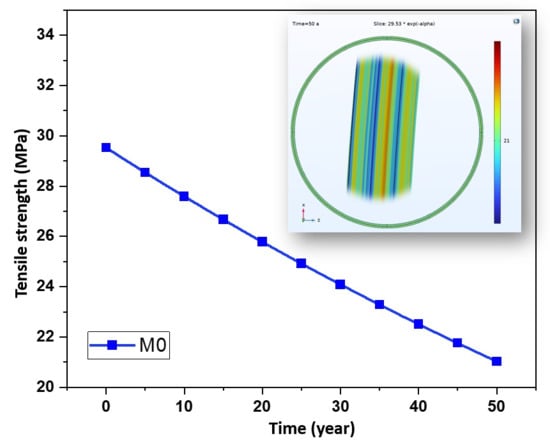
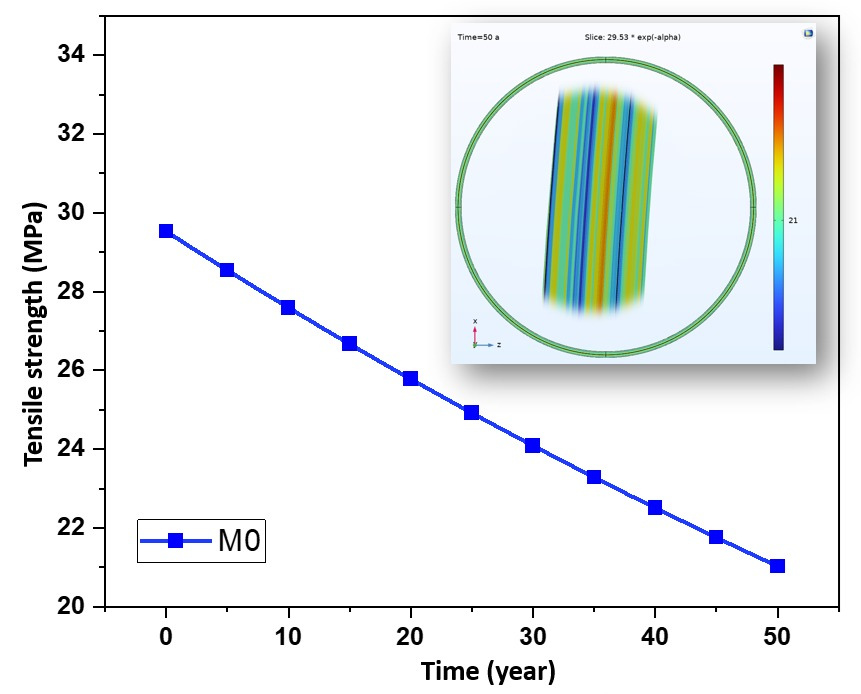
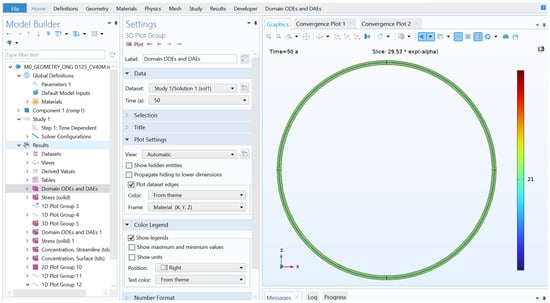
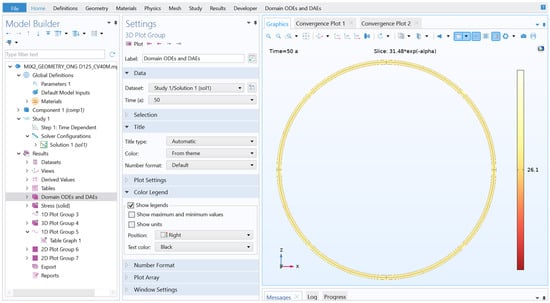
Based on Figure 4, it can be observed that the simulation results illustrate the tensile strength degradation trend of the HDPE control sample (M0) over time in a marine environment, spanning from the initial baseline to the 50th year. Mathematically, the objective function is established as a negative exponential model, Gt = G0 × e−α (where α is the time-dependent degradation coefficient). Specifically, the coefficient α (r,t)—where r denotes the radial position across the pipe cross-section and t represents exposure time—is defined as a dimensionless spatio-temporal degradation factor that quantifies local cumulative damage, including polymer chain scission and bond rupture. This is a classical model reflecting the thermo-oxidative aging process and polymer chain scission under the simultaneous impact of UV irradiation and marine environmental agents, assuming a salinity equivalent to 35 ppt and a diffusion coefficient of 1.77 × 10⁻¹³ m2 s−1 at 20 °C, which are consistent with values reported in previous studies [25,33]. At t = 0, the material exhibits its maximum strength value of 29.53 MPa. Observing the time progression, the plotted curve displays a steady downward slope, indicative of a continuous and irreversible degradation process. By the 50th year, the tensile strength drops to approximately 21 MPa, corresponding to an overall strength loss of roughly 29% relative to the initial value. This degradation rate reflects the physical reality of aging induced by UV exposure and the seawater environment within the HDPE structure, which accelerates molecular bond rupture and compromises the load-bearing capacity of the pipe wall. Technically, the preservation of a smooth exponential curve demonstrates that the aging coefficient α is well calibrated within the COMSOL Multiphysics model, enabling accurate predictions of the material’s long-term behavior. As illustrated in Figure 5, the 50-year simulation data reveal that the model transitions into a heterogeneous aging state, as evidenced by the non-uniform distribution of the color spectrum representing residual strength across the pipe wall. This phenomenon provides a more realistic and accurate representation compared to a simplified linear degradation model. To clarify the relationship between the predicted tensile strength, actual operational stresses, and structural integrity, the residual mechanical performance was cross-referenced against realistic marine hydrodynamic loads. Under typical offshore aquaculture conditions, peak operational stresses () induced by cyclic wave action, current drag, and structural bending generally range from 5 to 10 MPa. Although the residual tensile strength () drops to 26.3 MPa by the 50th year, this value remains well above the operational load requirements. Specifically, comparing this residual strength to a representative design stress of 8.0 MPa yields a safety factor () of approximately 3.29 [34,35]. This structural margin confirms that the pipe maintains its load-bearing capacity well within the safe thresholds specified by current HDPE piping standards. Consequently, improving the material’s initial strength from 29.53 MPa (sample M0) to 31.72 MPa (sample UV531-1%) not only enhances its baseline performance, but also significantly extends the system’s practical operational lifespan in harsh environments [34,35].
Figure 4.
Time-dependent mechanical property declines of sample M0 predicted by COMSOL Multiphysics, with an inset showing the degradation tensile strength at the 50-year mark.
Figure 5.
COMSOL Multiphysics simulation illustrates the heterogeneous oxidation gradient and residual tensile strength across the cross-section of the M0 pipe at 50 years.
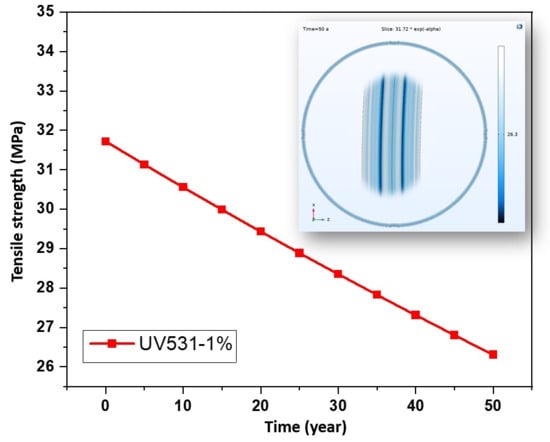
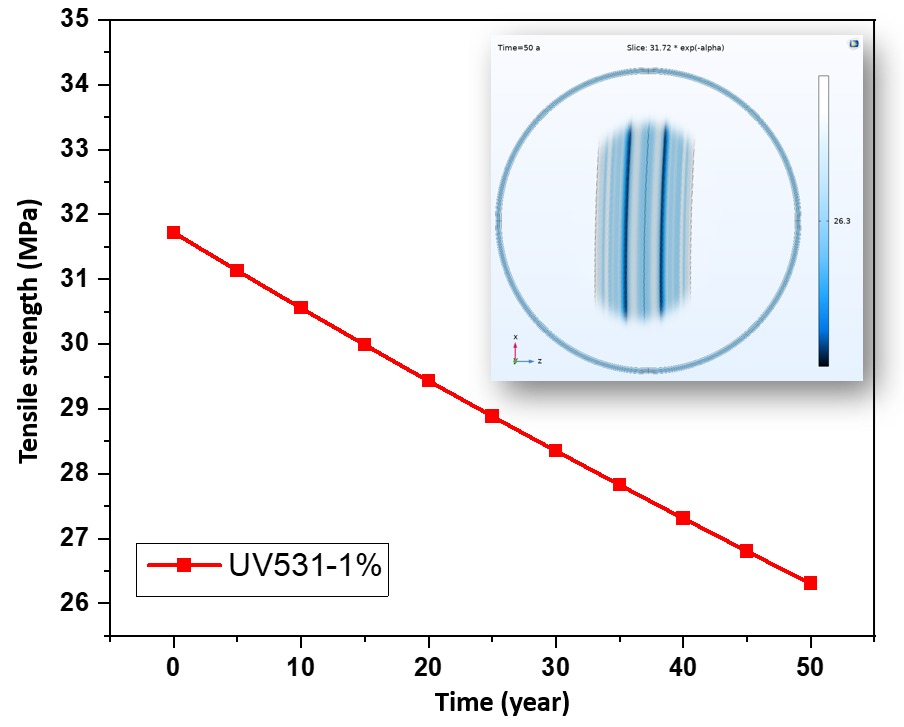
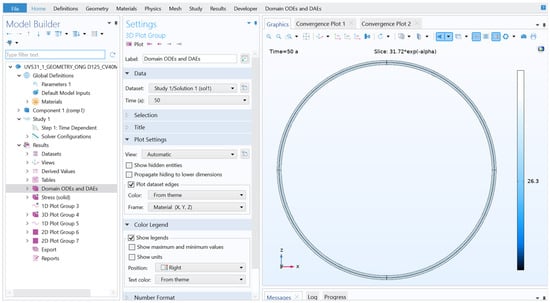
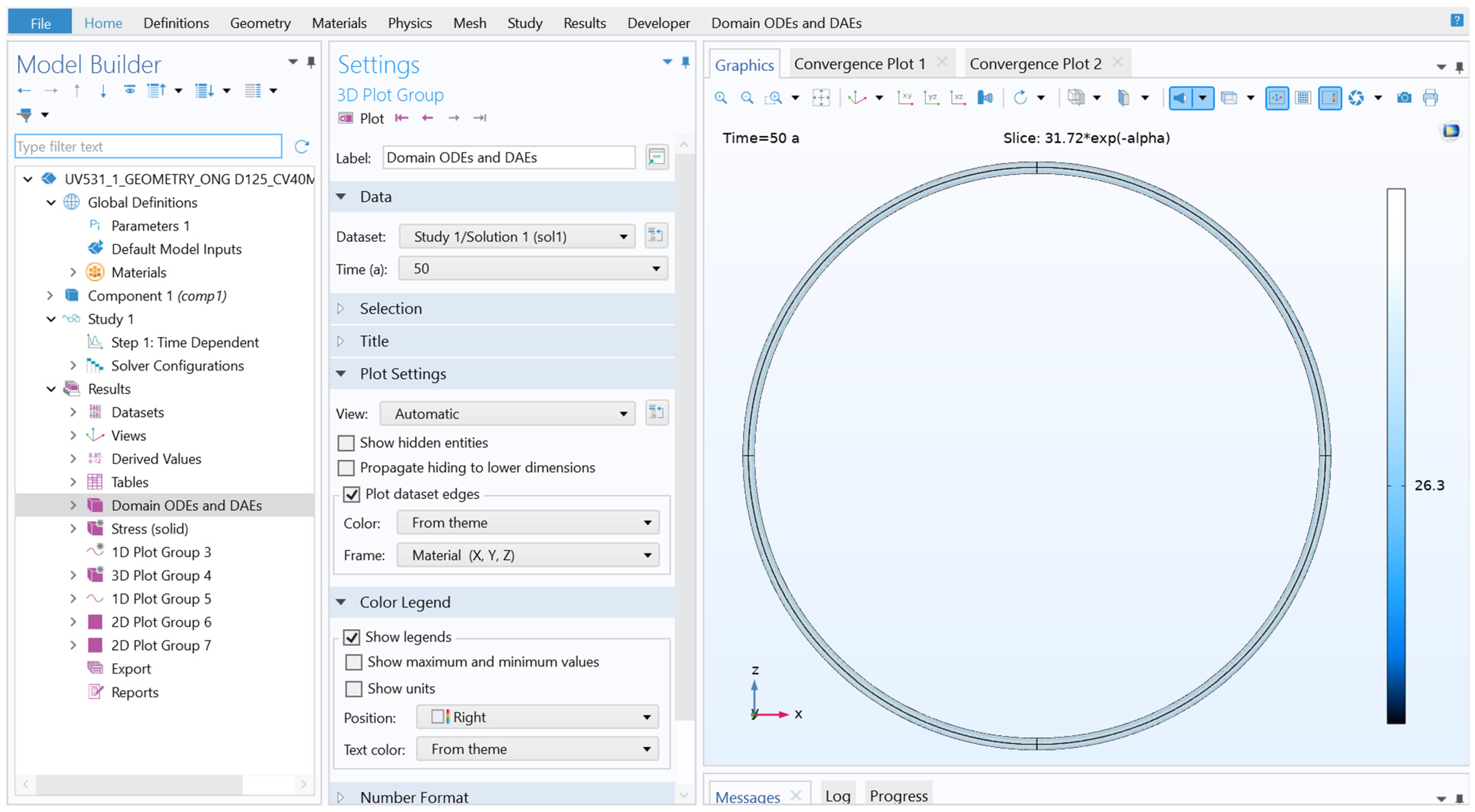
The graphs in Figure 6 and Figure 7 establish a direct quantitative relationship between the simulated states in year 0 and year 50. The curve exhibits a continuous, non-linear downward trend in ultimate strength, starting from an initial value of 31.72 MPa at t = 0. After 50 years of service in a marine environment, the residual strength of the UV531-1% sample is retained at 26.3 MPa. Scientifically, this degradation rate reflects the depletion of UV stabilizers and the gradual chain scission of polymer molecules induced by thermal effects and the seawater environment. The appearance of non-homogeneous color bands is a typical manifestation of material aging, indicating that mechanical strength becomes non-uniform across different positions of the pipe after 50 years of operation. The photochemical aging process under UV exposure, combined with the prolonged impact of seawater over 50 years, has led to the depletion of the UV531 additive. This depletion triggers polymer chain scission and shifts the structure from a stable state to one characterized by weakened molecular bonding. With a strength level of 26.3 MPa, the residual strength of the pipe stands at approximately 83% of its initial value.
Figure 6.
Time-dependent mechanical property decline of sample UV531-1% predicted by COMSOL Multiphysics, with an inset showing the degradation of tensile strength at the 50-year mark.
Figure 7.
COMSOL Multiphysics simulation illustrating the heterogeneous oxidation gradient and residual tensile strength across the cross-section of sample UV531-1% pipe at 50 years.
Although the residual strength drops to 26.3 MPa by the 50th year, this value remains well within the safe load-bearing thresholds of most current HDPE pipe standards. This result provides crucial simulation-based evidence for predicting the material’s lifespan. It confirms that improving the material’s initial strength from 29.53 MPa (sample M0) to 31.72 MPa (sample UV531-1%) not only enhances its baseline performance, but also significantly extends the system’s practical operational lifespan in harsh environments [29].
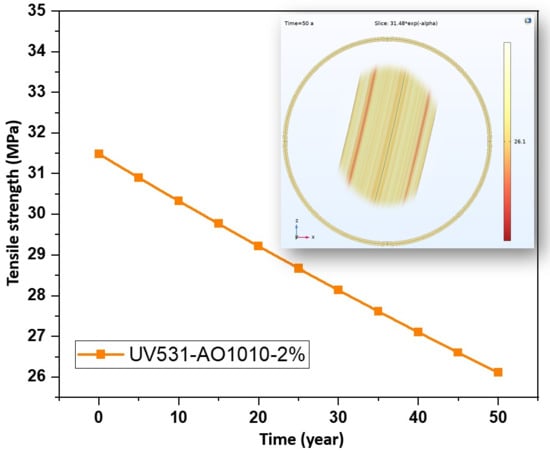
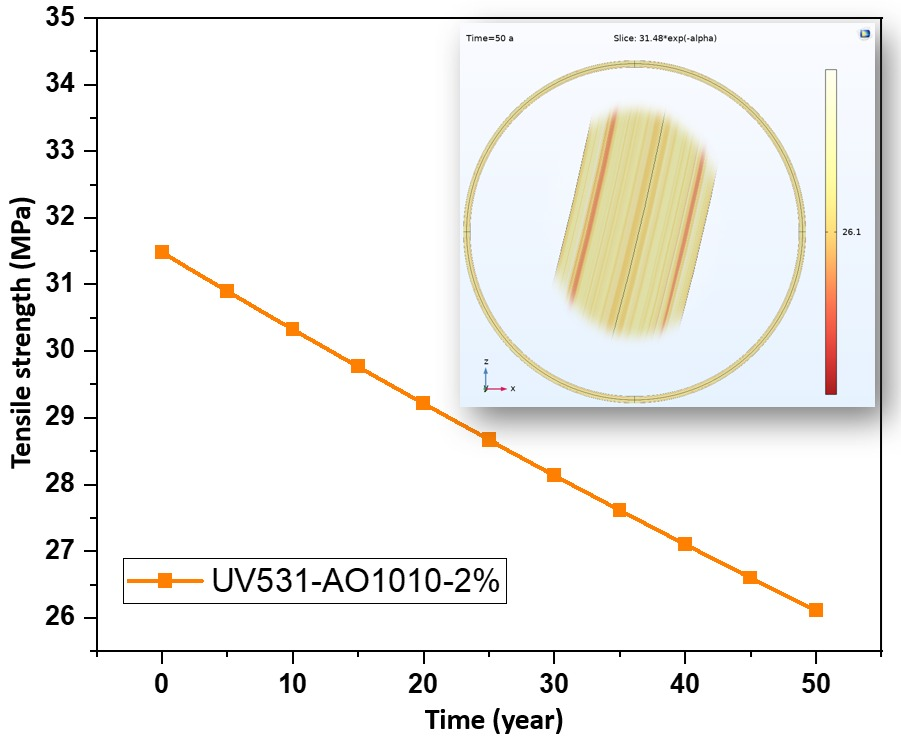
Figure 8 shows that at the 50-year mark, material strength has declined from an initial value of 31.48 MPa to approximately 26.1 MPa, representing a strength loss of roughly 17.1% compared to the baseline. This degradation rate suggests that the HDPE material maintains commendable long-term structural stability; however, the aging process remains unavoidable under environmental stressors. Figure 9 clearly shows the differentiation into various alternating color bands along the pipe wall thickness. This demonstrates that the aging process does not occur simultaneously across the entire material. Layers closest to the outer surface, directly exposed to seawater and UV radiation, typically degrade faster. This color change reflects the diffusion of oxidizing agents and the gradual depletion of UV-resistant additives (UV531) and anti-aging additives (AO1010) from the outside inward. This behavior can be attributed to the attack of environmental free radicals on the polymer backbone, which reduces the average molecular weight and consequently diminishes the material’s bonding and load-bearing capacity. As the polymer chains undergo scission and shorten, they tend to rearrange locally, creating more brittle zones that facilitate the formation of micro-cracks under operational stress [36].
Figure 8.
Time-dependent mechanical property declines of sample UV531-AO1010-2% predicted by COMSOL Multiphysics, with an inset showing the degradation tensile strength at the 50-year mark.
Figure 9.
COMSOL Multiphysics simulation illustrating the heterogeneous oxidation gradient and residual tensile strength across the cross-section of sample UV531-AO1010-2% pipe at 50 years.
The differences between the two forecasting models (Table 2) highlight the practicality of the multi-physics simulation method.
Table 2.
Predicted tensile strength (MPa) at 50-year milestone of the samples.
The COMSOL results consistently yield values approximately 8–10% lower than those predicted by the mathematical model. This discrepancy arises because the mathematical model assumes isotropic aging (uniform mass loss). In contrast, the Multiphysics simulation integrates the seawater diffusion coefficient (1.77 × 10⁻¹³ m2/s) [25], mapping the non-uniform strength degradation caused by the synergistic effect of UV-induced chain scission and salt ion ingress. In COMSOL, seawater diffusion is governed by Fick’s second law: ( [24], with a boundary concentration of 600 mol/m3 (35‰ salinity) and D = 1.77 × 10⁻¹³ m2/s at 20 °C [25,37,38]. The mechanical degradation follows an exponential decay: G(r, t) = G0 × exp(−α(r, t) × t), where the spatial–temporal degradation coefficient α(r, t) is directly coupled to local ion concentration C(r, t). The additional 2.2–2.4 MPa tensile strength reduction in COMSOL is quantitatively obtained because internal ion accumulation accelerates local polymer chain scission, plasticization, and stress concentration across the pipe wall cross-section over 50 years. Comparing the 3D-simulated heterogeneous degradation mechanism with traditional mathematical models clearly highlights the limitations of isotropic assumptions. This confirms that multi-physics simulations provide a much more realistic safety factor, demonstrating the superiority of FEM in evaluating the actual operational limits of materials in open-sea environments [12]. Consequently, the COMSOL simulations offer a scientifically grounded evaluation of strength degradation over time, capturing spatially heterogeneous aging effects and providing a more reliable and conservative prediction of long-term material safety than conventional theoretical approaches. Furthermore, while foundational kinetic models [13] focused on homogeneous mass-loss kinetics, and recent finite element studies [12] successfully captured surface-to-core photo-oxidation gradients under pure atmospheric/weathering exposure, our 3D COMSOL framework introduces a coupled Multiphysics approach tailored for marine environments. By integrating spatio-temporal mechanical decay (Gt = G0 × e−α, where α (r,t) is the time-dependent degradation coefficient and r denotes the radial position across the pipe cross-section) with simultaneous seawater ion diffusion of 1.77 × 10⁻¹³ m2/s, our model accounts for the synergistic embrittlement caused by UV chain scission and liquid ingress across a full-scale 3D pipe geometry. Consequently, it provides a more realistic and conservative 50-year residual strength prediction (26.3 MPa for 1% UV531) than both conventional linear models (28.5 MPa) and dry photo-thermal aging models.
3.4. Optimization of Material Composition
Based on the COMSOL Multiphysics simulation, the formulation containing 1% UV531 was identified as the optimal additive system for enhancing the long-term performance of HDPE. From a physicochemical perspective, UV531 effectively absorbs ultraviolet radiation within the 240–340 nm wavelength range, converting the absorbed energy into heat and thereby suppressing the formation of alkyl free radicals responsible for polymer chain scission and material degradation. The selection of 1% UV531 over the dual-additive system (2% UV531-AO1010) is based on durability efficiency, mechanism, and cost. Quantitatively, 1% UV531 improves residual strength after 50 years by 25.2% over the control sample (26.3 MPa vs. 21.0 MPa), whereas adding AO1010 yields a lower improvement of 24.3% over the control sample (26.1 MPa vs. 21.0 MPa), offering no incremental benefit. Mechanistically, primary UV photodegradation is efficiently blocked by UV531, while AO1010 provides minimal photo-protection at ambient ocean temperatures and risks local agglomeration. Therefore, doubling the additive loading to 2% only increases processing costs without improving 50-year structural longevity. Therefore, the 1% UV531 formulation represents the most cost-effective solution, offering enhanced durability while maintaining a reliable safety margin for aquaculture cage applications over a 50-year operational lifespan, benefits that are comparable to those reported in the literature [39].
4. Conclusions
This study involved the development of an empirical–simulation framework by integrating physicochemical experimental data with COMSOL Multiphysics to predict the long-term degradation of physical–mechanical properties in modified HDPE materials over a 50-year service life. The results identified the 1% UV531 additive system as the optimal formulation, enabling the material to retain a tensile strength of 26.3 MPa, corresponding to 82.9% of its initial strength, under harsh marine environmental conditions. The proposed framework provides a reliable tool for assessing material durability, optimizing lifecycle costs, and supporting safer and more sustainable offshore aquaculture infrastructure. Furthermore, the simulations successfully captured oxidation gradients and heterogeneous property degradation across the material thickness, offering insights that cannot be obtained through conventional tensile testing alone and demonstrating the advantages of FEM-based approaches for long-term aging assessment. More importantly, empirical parameters G0 and kd, obtained from 15-year equivalent accelerated solar exposure (5.0 GJ m−2), were coupled into COMSOL via a Domain ODE and DAE module and the apparent diffusion coefficient of seawater into the HDPE network at 1.77 × 10⁻¹³ m2/s to execute a 50-year time-dependent degradation prediction across the 7.4 mm pipe wall. This simulation-assisted approach offers a reliable, cost-effective strategy for material optimization in sustainable marine applications. The simulation results of this work corresponded well with the equivalent 15-year experimental data and previous studies on additive-modified HDPE durability, supporting the reliability of the proposed predictive model. These results could be used to inform future work incorporating additional environmental and operational factors, including cyclic mechanical loading, wave-induced stresses, biofouling, temperature fluctuations, salinity variations, and synergistic aging mechanisms to further improve prediction accuracy under real service conditions for developing next-generation predictive maintenance and lifetime management systems for marine polymer structures.
Author Contributions
Conceptualization, T.-S.T. and V.T.T.H.; Methodology, T.T.P.; Software, T.T.P.; Validation, T.T.A.H. and V.T.T.H.; Investigation, T.T.A.H.; Resources, T.M.B.; Data curation, T.T.P. and T.M.B.; Writing—original draft, T.T.P.; Writing—review and editing, T.T.A.H. and V.T.T.H.; Supervision, V.T.T.H.; Project administration, T.-S.T.; Funding acquisition, T.-S.T. All authors have read and agreed to the published version of the manuscript.
Funding
This research was supported by Ministry of Natural Resources and Environment project, Project Number: TNMT.2024.05.02.
Data Availability Statement
The original contributions presented in this study are included in the article. Further inquiries can be directed to the corresponding author.
Acknowledgments
The authors acknowledge the support of Nguyen Tat Thanh University, Ho Chi Minh City, Vietnam for this study.
Conflicts of Interest
The authors declare no conflicts of interest.
References
- Tian, Y.; Yang, Z.; Yu, X.; Jia, Z.; Rosso, M.; Dedman, S.; Zhu, J.; Xia, Y.; Zhang, G.; Yang, J.; et al. Can we quantify the aquatic environmental plastic load from aquaculture? Water Res. 2022, 219, 118551. [Google Scholar] [CrossRef] [Scilit] [PubMed]
- Hou, T.; Sun, W.; Chen, C.; Yang, G.; Meng, X.; Peng, J. Marine Floating raft aquaculture extraction of hyperspectral remote sensing images based decision tree algorithm. Int. J. Appl. Earth Obs. Geoinf. 2022, 111, 102846. [Google Scholar] [CrossRef] [Scilit]
- Fredriksson, D.W.; DeCew, J.C.; Tsukrov, I. Development of structural modeling techniques for evaluating HDPE plastic net pens used in marine aquaculture. Ocean Eng. 2007, 34, 2124–2137. [Google Scholar] [CrossRef] [Scilit]
- Chu, B.; Chen, Y.; Zhang, Y.; Zhang, G.; Xiang, X.; Zhang, X. Numerical study on wave-induced hydro-elastic responses of a floating raft for aquaculture. Ocean Eng. 2021, 240, 109869. [Google Scholar] [CrossRef] [Scilit]
- Murphy, J. Additives for Plastics Handbooks, 2nd ed.; Elsevier Science Ltd.: Oxford, UK; New York, NY, USA, 2001. [Google Scholar]
- Gewert, B.; Plassmann, M.M.; MacLeod, M. Pathways for degradation of plastic polymers floating in the marine environment. Environ. Sci. Process. Impacts 2015, 17, 1513–1521. [Google Scholar] [CrossRef] [Scilit] [PubMed]
- Stringer, R.; Johnston, P. Chlorine and the environment: An overview of the chlorine industry. Environ. Sci. Pollut. Res. 2001, 8, 146. [Google Scholar] [CrossRef] [Scilit]
- Rowe, R.K.; Ewais, A. Ageing of exposed geomembranes at locations with different climatological conditions. Can. Geotech. J. 2015, 52, 326–343. [Google Scholar] [CrossRef] [Scilit]
- Ewais, A.M.R.; Rowe, R.K.; Rimal, S.; Sangam, H.P. 17-year elevated temperature study of HDPE geomembrane longevity in air, water and leachate. Geosynth. Int. 2018, 25, 525–544. [Google Scholar] [CrossRef] [Scilit]
- Nguyen, V.D.; Hao, J.; Wang, W. Ultraviolet Weathering Performance of High-Density Polyethylene/Wood-Flour Composites with a Basalt-Fiber-Included Shell. Polymers 2018, 10, 831. [Google Scholar] [CrossRef] [Scilit] [PubMed]
- Nguyen, K.Q.; Mwiseneza, C.; Mohamed, K.; Cousin, P.; Robert, M.; Benmokrane, B. Long-term testing methods for HDPE pipe-advantages and disadvantages: A review. Eng. Fract. Mech. 2021, 246, 107629. [Google Scholar] [CrossRef] [Scilit]
- Wang, L.; Qi, Z.; Yang, C.; Ding, X.; Deng, Q.; Yang, B.; Hu, N. Experimental and numerical investigation on mechanical properties change of HDPE in various aging conditions. npj Mater. Degrad. 2025, 9, 54. [Google Scholar] [CrossRef] [Scilit]
- Chamas, A.; Moon, H.; Zheng, J.; Qiu, Y.; Tabassum, T.; Jang, J.H.; Abu-Omar, M.; Scott, S.L.; Suh, S. Degradation rates of plastics in the environment. ACS Sustain. Chem. Eng. 2020, 8, 3494–3511. [Google Scholar] [CrossRef] [Scilit]
- Kim, S.; Lee, Y.; Kim, C.; Choi, S. Analysis of Mechanical Property Degradation of Outdoor Weather-Exposed Polymers. Polymers 2022, 14, 357. [Google Scholar] [CrossRef] [Scilit] [PubMed]
- Baccouch, M. (Ed.) Finite Element Methods and Their Applications; BoD–Books on Demand; IntechOpen: London, UK, 2021. [Google Scholar]
- Baccouch, M. (Ed.) Overview of the Finite Element Method for a Class of Partial Differential Equations; IntechOpen: London, UK, 2026. [Google Scholar] [CrossRef] [Scilit]
- Moe, H.; Fredheim, A.; Hopperstad, O. Structural analysis of aquaculture net cages in current. J. Fluids Struct. 2010, 26, 503–516. [Google Scholar] [CrossRef] [Scilit]
- Cruz-Pinto, J.J.C.; Carvalho, M.E.S.; Ferreira, J.F.A. The kinetics and mechanism of polyethylene photo-oxidation. Die Angew. Makromol. Chem. Appl. Macromol. Chem. Phys. 1994, 216, 113–133. [Google Scholar] [CrossRef]
- TCVN 7699-2-5: 2011; Environmental Testing—Part 2–5: Tests—Test Sa: Simulated Solar Radiation at Ground Level and Guidance for Solar Radiation Testing 2011. Directorate for Standards, Metrology and Quality (STAMEQ)/Ministry of Science and Technology: Hanoi, Vietnam, 2011.
- Ho, T.T.A.; Pham, T.T.; Nguyen, D.H.M.; Tran, H.N.; Tran, K.T.D.; Tran, S.T.; Vu, P.T.; Luu, T.T.M.; Do, N.T.; Do, B.T.H.; et al. Synergistic additives approach for enhanced HDPE durability in marine aquaculture applications. Next Mater. 2026, 10, 101538. [Google Scholar] [CrossRef] [Scilit]
- Ho, T.T.A.; Nguyen, D.H.M.; Pham, T.T.; Tran, K.T.D.; Tran, S.T.; Do, B.T.H.; Truong, S.N.; Ho, V.T.T. Improving the Durability and Oxidative Stability of High-Density Polyethylene (HDPE) Using UV-531 and UV-783 Additives. Jokull J. 2025, 75, 10–24. [Google Scholar] [CrossRef]
- Amjadi, M.; Fatemi, A. Tensile behavior of high-density polyethylene including the effects of processing technique, thickness, temperature, and strain rate. Polymers 2020, 12, 1857. [Google Scholar] [CrossRef] [Scilit] [PubMed]
- ISO 16488:2015; Marine Finfish Farms—Open Net Cage-Design And Operation. International Organization for Standardization: Geneva, Switzerland, 2015.
- COMSOL. A. M. U. Guide, COMSOL Multiphysics®; v. 6.4; COMSOL AB: Stockholm, Sweden, 2025; pp. 75–84. [Google Scholar]
- Coniglio, N.; Nguyen, K.; Kurji, R.; Gamboa, E. Characterizing water sorption in 100% solids epoxy coatings. Prog. Org. Coat. 2013, 76, 1168–1177. [Google Scholar] [CrossRef] [Scilit]
- Yao, P.; Cao, J. Photochemical process of wood-thermoplastic composites. In Photochemical Behavior of Multicomponent Polymeric-Based Materials; Springer International Publishing: Cham, Switzerland, 2016; pp. 291–346. [Google Scholar]
- Douminge, L.; Mallarino, S.; Cohendoz, S.; Feaugas, X.; Bernard, J. Extrinsic fluorescence as a sensitive method for studying photo-degradation of high density polyethylene part I. Curr. Appl. Phys. 2010, 10, 1211–1215. [Google Scholar] [CrossRef] [Scilit]
- Wang, S.; Zhang, J.; Liu, L.; Yang, F.; Zhang, Y. Evaluation of cooling property of high density polyethylene (HDPE)/titanium dioxide (TiO2) composites after accelerated ultraviolet (UV) irradiation. Sol. Energy Mater. Sol. Cells 2015, 143, 120–127. [Google Scholar] [CrossRef] [Scilit]
- Jiang, T.; Qi, Y.; Wu, Y.; Zhang, J. Application of antioxidant and ultraviolet absorber into HDPE: Enhanced resistance to UV irradiation. e-Polymers 2019, 19, 499–510. [Google Scholar] [CrossRef] [Scilit]
- Tocháček, J.; Vrátníčková, Z. Polymer life-time prediction: The role of temperature in UV accelerated ageing of polypropylene and its copolymers. Polym. Test. 2014, 36, 82–87. [Google Scholar] [CrossRef] [Scilit]
- Yousif, E.; Haddad, R. Photodegradation and photostabilization of polymers, especially polystyrene. SpringerPlus 2013, 2, 398. [Google Scholar] [CrossRef] [Scilit] [PubMed]
- Omairey, E.; Zhang, Y. Multiphysics Simulation and Validation of Field Aging of Asphalt Pavements. In RILEM International Symposium on Bituminous Materials; Springer International Publishing: Cham, Switzerland, 2020. [Google Scholar]
- Jiang, X.; Lu, K.; Liu, Z. Tracking the photooxidation products of primary plastic pellets (nurdles) in seawater. Mar. Pollut. Bull. 2026, 227, 119505. [Google Scholar] [CrossRef] [Scilit] [PubMed]
- Chu, Y.I.; Wang, C.M.; Zhang, H.; Abdussamie, N.; Karampour, H.; Jeng, D.S.; Baumeister, J.; Aland, P.A. Offshore fish farms: A review of standards and guidelines for design and analysis. J. Mar. Sci. Eng. 2023, 11, 762. [Google Scholar] [CrossRef] [Scilit]
- Tang, H.-J.; Yang, R.-Y.; Yao, H.-C. Experimental and numerical investigations of a mooring line failure of an aquaculture net cage subjected to currents. Ocean Eng. 2021, 238, 109707. [Google Scholar] [CrossRef] [Scilit]
- Erdmann, M.; Niebergall, U.; Wachtendorf, V.; Böhning, M. Evaluation of UV-induced embrittlement of PE-HD by Charpy impact test. J. Appl. Polym. Sci. 2020, 137, 49069. [Google Scholar] [CrossRef] [Scilit]
- Crank, J. The Mathematics of Diffusion; Oxford University Press: Oxford, UK, 1979. [Google Scholar]
- Celina, M.C. Review of polymer oxidation and its relationship with materials performance and lifetime prediction. Polym. Degrad. Stab. 2013, 98, 2419–2429. [Google Scholar] [CrossRef] [Scilit]
- Liu, L.; Liu, Z.; Hong, L.; Huang, Y. Effect of ultraviolet absorber (UV-531) on the properties of SBS-modified asphalt with different block ratios. Constr. Build. Mater. 2020, 234, 117388. [Google Scholar] [CrossRef] [Scilit]

Disclaimer/Publisher’s Note: The statements, opinions and data contained in all publications are solely those of the individual author(s) and contributor(s) and not of MDPI and/or the editor(s). MDPI and/or the editor(s) disclaim responsibility for any injury to people or property resulting from any ideas, methods, instructions or products referred to in the content. |
© 2026 by the authors. Licensee MDPI, Basel, Switzerland. This article is an open access article distributed under the terms and conditions of the Creative Commons Attribution (CC BY) license.