


Abstract
As the core equipment integrating primary electrical devices with secondary intelligent control units, the control cabinet plays a vital role in smart substations, and its operating reliability is crucial to the security and stability of the entire power grid. In order to solve the problems of low accuracy and insufficient generalization ability of traditional control cabinet fault diagnosis schemes, this paper proposes a fault diagnosis method based on QPSO-KELM. Firstly, the structure of the control cabinet and the current characteristics of the switching coil are introduced. Then, by combining the global optimization capability of the QPSO with the nonlinear feature extraction advantages of the KELM, a fault diagnosis method for the control cabinet is proposed. Finally, the coil current signals collected by the operating mechanism of the integrated primary and secondary switches in the control cabinet are extracted for experimental analysis to validate the proposed model. Compared with the existing techniques, the proposed approach not only raises the diagnostic accuracy but also shortens the convergence time considerably in the fault-diagnosis task of the primary–secondary integrated switch housed in the control cabinet. It achieves a diagnostic accuracy of 97.5% and saves 13.55 ms in a single training time compared with PSO-KELM, providing a new approach for the intelligent operation and upkeep of substation assets.
1. Introduction
The control cabinet is a core device in substations that enables the collaborative operation of primary equipment and secondary control units. It contains complex components such as circuit breaker operating mechanisms, protection relays, and intelligent terminals [1]. The control cabinet integrates primary equipment (circuit breakers, disconnectors) with secondary intelligent control units (PLCs, communication modules), and its fault types are complex with strong correlations, such as aging of primary-side insulation and abnormal secondary control signals [2]. Traditional diagnostic methods rely on threshold judgment and manual experience, which are inadequate for handling high-dimensional nonlinear feature data, necessitating an intelligent diagnostic model.
Traditional fault diagnosis for control cabinets mainly employs signal processing techniques [3,4]. Widely adopted tools include enhanced singular spectrum decomposition, empirical wavelet transform, variational mode decomposition, and sparse signal decomposition [5,6,7,8,9,10], to name a few. The effectiveness of these techniques in detecting faults and extracting time-frequency features from fault signals is well recognized. Nevertheless, their ability to detect weak fault signals under strong noise backgrounds is limited [11,12,13].
Among the machine learning, deep learning, and optimization techniques that have recently been explored for power equipment fault diagnosis [14,15,16,17,18], the Extreme Learning Machine (ELM) stands out in particular for its rapid training and robust generalization performance, but its randomly initialized weights can lead to model instability [19]. The Kernel Extreme Learning Machine (KELM) enhances nonlinear classification capability through kernel function mapping, yet the selection of kernel parameters and regularization coefficients relies on experience. Reference [20] optimizes ELM parameters such as input weights to improve fault diagnosis accuracy, but does not consider time consumption.
The classical Particle Swarm Optimization (PSO) algorithm [21] is a swarm intelligence random search method with relatively few parameters to adjust and good optimization performance. The position and velocity vectors together govern the movement of each particle throughout the PSO search process, and the position is continuously updated during evolution [22]. Due to velocity limitations, the search for feasible solutions cannot cover the entire task space. The Quantum-behaved Particle Swarm Optimization (QPSO) algorithm aims to improve particle randomness and global search performance [23]. Based on principles of quantum mechanics, it enhances global optimization capability through a probabilistic search mechanism, making it suitable for high-dimensional parameter optimization problems. However, like other evolutionary algorithms, slow convergence speed and local optima traps still exist [24]. To address these issues, QPSO updates particle positions based on the average best position without considering particle velocity, increasing the randomness of particle motion and avoiding local optima. Furthermore, performance is adjusted by tuning the contraction–expansion factor that controls particle position updates, thereby enhancing global convergence capability. Compared with adaptive PSO and standard PSO, QPSO has lower computational cost and faster convergence speed. Benefiting from its stronger global convergence ability, it can obtain the optimal initial weights and thresholds for KELM [25,26].
Although PSO has been applied to ELM parameter optimization with some success, it is susceptible to local optima and often exhibits instability, particularly in high-dimensional spaces. Unlike PSO, QPSO abandons the velocity–displacement framework in favor of a quantum probability distribution, allowing particles to explore the entire domain more thoroughly. This global search capability is inherently aligned with the multimodal characteristics of the KELM parameter space, facilitating more robust identification of the global optimum.
Informed by the preceding research efforts, this paper proposes a QPSO-KELM-based fault diagnosis approach for control cabinets. The main contributions are as follows:
- (1)
- Application-domain novelty: For the first time, the QPSO-KELM method is introduced into the field of coil current fault diagnosis for the primary–secondary integrated switch in the control cabinet of intelligent substations, filling the gap of this method in this specific application scenario.
- (2)
- Benchmark-system novelty: For the first time, the QPSO-KELM method is systematically compared with four representative algorithms, namely RF, XGBoost, CNN, and LSTM, and the superiority of the proposed method is demonstrated through significance testing.
- (3)
- Validation-method novelty: Through 30 independent repeated experiments and rigorous statistical validation via the Wilcoxon signed-rank test, the reliability and reproducibility of the results are ensured, providing a trustworthy benchmark for future research and offering new insights for the operation and maintenance of intelligent substations.
2. Control Cabinet Overview
2.1. Secondary System Structure
Traditional distributed switch systems are generally composed of independent primary switches (high-voltage main equipment) and secondary switches (intelligent control units). The two components work together through physical connections and communication, jointly undertaking complete functions of distribution network protection, metering, and control. Among them, the primary equipment is directly connected to the main circuit of the distribution network, while the secondary equipment is responsible for realizing the aforementioned intelligent functions.
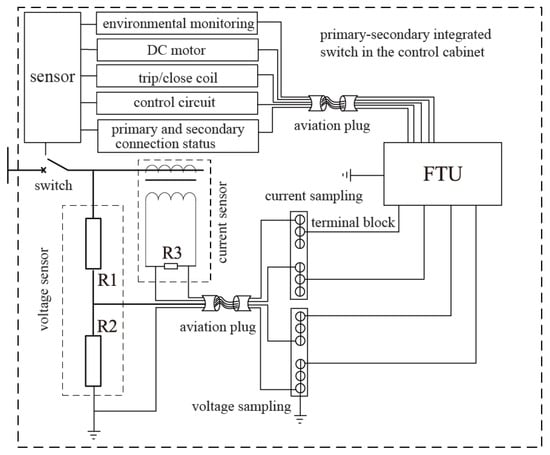
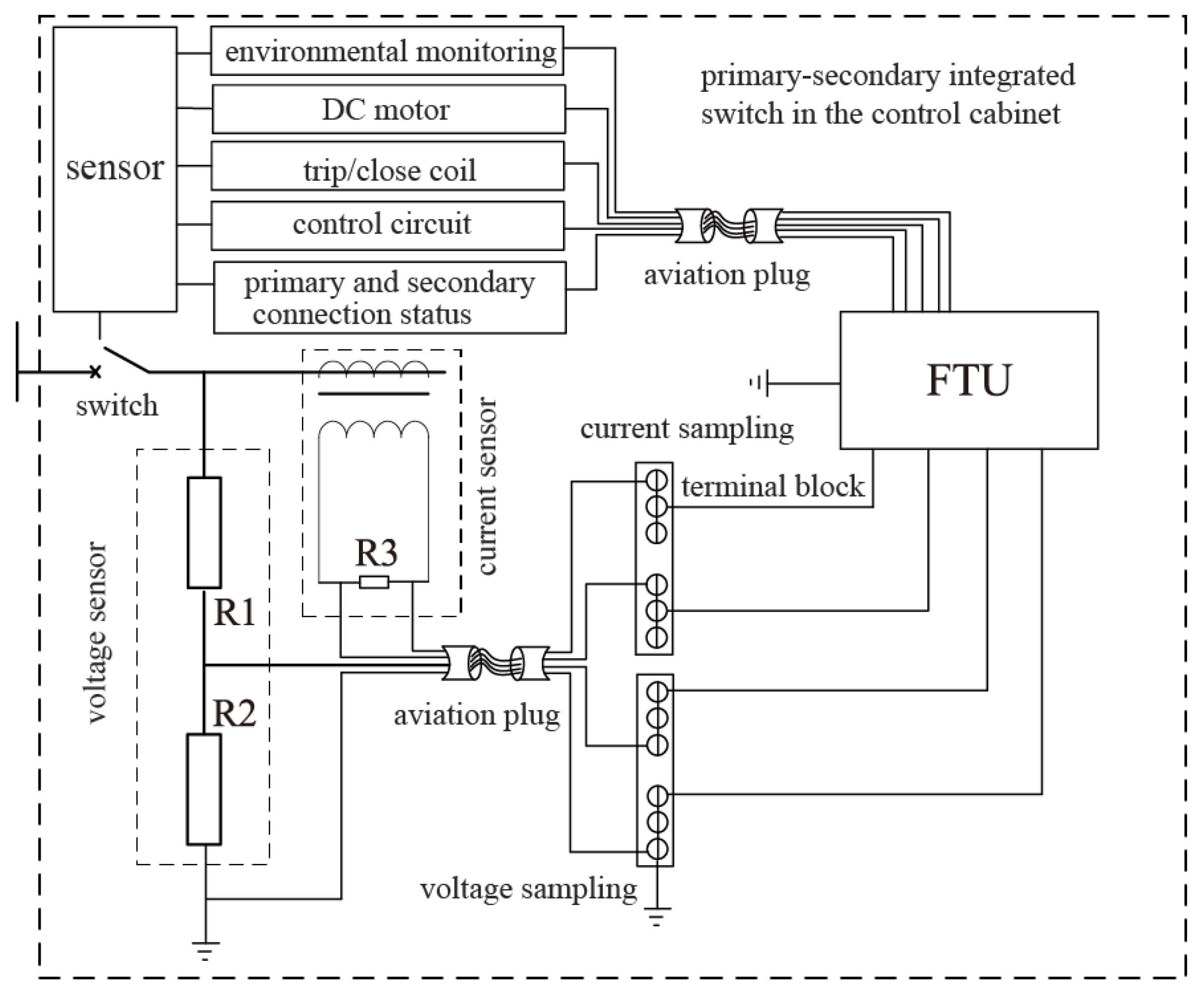
The innovation of the primary–secondary integrated intelligent fusion switch control cabinet lies in breaking away from the traditional mode of physically separating primary and secondary equipment, integrating them within the same cabinet. Standardized aviation connectors are used between the control unit (secondary) and the high-voltage main body (primary). Figure 1 shows the typical design scheme of the intelligent integrated switch, achieving deep integration at both the equipment and functional levels of primary and secondary systems.
Figure 1.
Structure of the fusion switch.
2.2. Current Characteristics of Opening/Closing Coils of the Integrated Switch in the Control Cabinet
Common faults of the control cabinet include normal state, increased coil voltage, decreased coil voltage, increased core gap, increased auxiliary circuit resistance, and slight jamming of the trigger mechanism. The current curve of the opening/closing coil can effectively reflect its operating condition. The normal state is taken as an example.
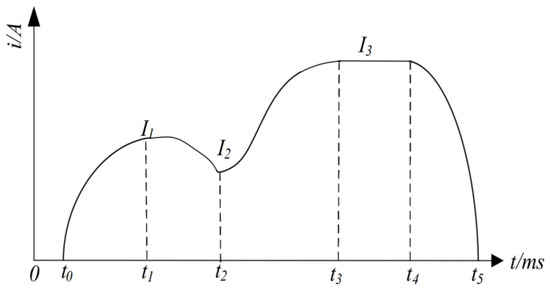
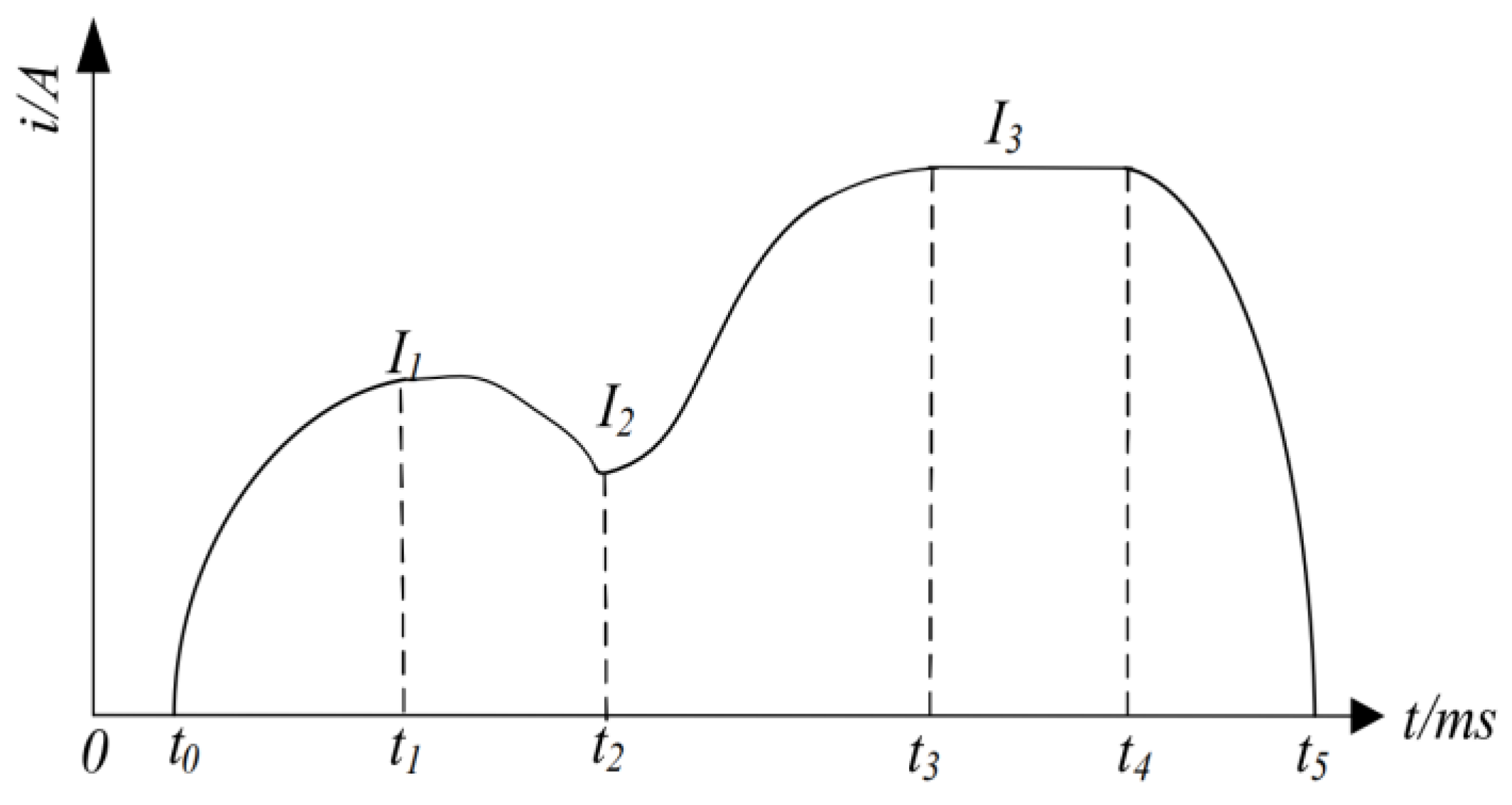
When an opening/closing command is issued, the opening/closing coil is excited by a voltage source. The current flowing through the coil then generates an electromagnetic force that drives the core inside the coil to move, thereby releasing the latch of the operating mechanism, and finally causing the high-voltage circuit breaker to complete the mechanical opening or closing operation. Therefore, studying the current waveform of the coil is an effective method to identify the working state of the operating mechanism and potential faults. Figure 2 illustrates a representative current waveform of the closing coil during normal operation.
Figure 2.
Representative current waveform of the coil under normal operation.
According to practical experience, key time points () and important current points () are used to create a fault diagnosis model for the control cabinet.
3. Methodology
3.1. Principle of KELM Algorithm
ELM is a type of feedforward neural network [14].
The model of ELM is described as Equation (1):
where x denotes the input sample, and is the hidden-layer feature mapping matrix.
By employing the kernel function to replace the explicit feature mapping, the input–output relationship is given by Equation (2):
where the kernel matrix is given by Equation (3):
The radial basis function is selected as the kernel function, which is given by Equation (4):
3.2. Principle of QPSO
QPSO builds upon the traditional PSO algorithm, overcomes the limitations of the conventional velocity-displacement model, localizes particles via the Monte Carlo method, and increases the global optimization proficiency of the algorithm. The wave function is used to represent the state of a particle, and the probability density function is given by Equations (5) and (6):
where is the characteristic length of the particle swarm potential well, m represents the particle mass, and h stands for Planck’s constant.
The probability distribution function of the particle is given by Equation (7):
Under the action of the potential well, the particle moves around point P. During the evolution process, the particle position is given as Equation (8):
where is a uniformly distributed random number in (0,1).
In an N-dimensional space, the total number of particles is M, and the coordinates of the i-th particle are:
Among them, when , is a random number uniformly distributed on (0,1), is the best position, and is the global optimal position.
A potential well for the particle is constructed and centered at . The wave function is given in Equation (10):
The j-th dimension of particle i is as shown in Equation (11):
According to Equation (11), to enable the particle swarm to converge to the local optimum, it is necessary to control so that it converges to 0, which is given by Equation (12):
is the mean best position of the particles. The introduction of aims to make the QPSO algorithm converge better to the global optimal solution.
3.3. QPSO for Optimizing KELM Parameters
The settings of the KELM parameters greatly affect KELM’s generalization performance. The KELM parameters (C and kernel parameters) are optimized by QPSO. Particle states are described by the wave function. Evolution is given by Equation (13).
where a is a coefficient, whose value determines the convergence speed of the algorithm. Its value range linearly decreases from 1.0 to 0.5.
3.4. Computational Complexity Analysis
Let N denote the number of training samples, D the feature dimensionality, L the number of hidden-layer nodes in KELM, T the number of optimization iterations, and M the swarm size of particles.
The core computational operation of KELM is the inversion of the kernel matrix. Since KELM is trained only once without iterative optimization, its computational complexity is .
For PSO-KELM, the optimization process iteratively searches for the optimal regularization coefficient and kernel parameter. In each generation, every particle requires a complete KELM training procedure. Therefore, the overall computational complexity of PSO-KELM is .
Compared with PSO, QPSO differs only in the particle position update rule, while the computational cost of a single optimization step remains nearly unchanged. Consequently, the total complexity of QPSO-KELM is of the same order of magnitude as that of PSO-KELM. However, QPSO exhibits faster convergence than PSO under the same number of iterations, which translates into a lower actual computational cost in practice.
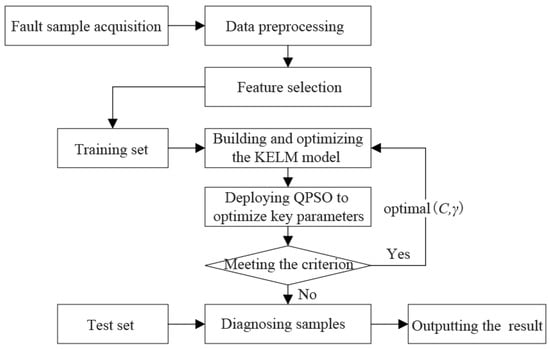
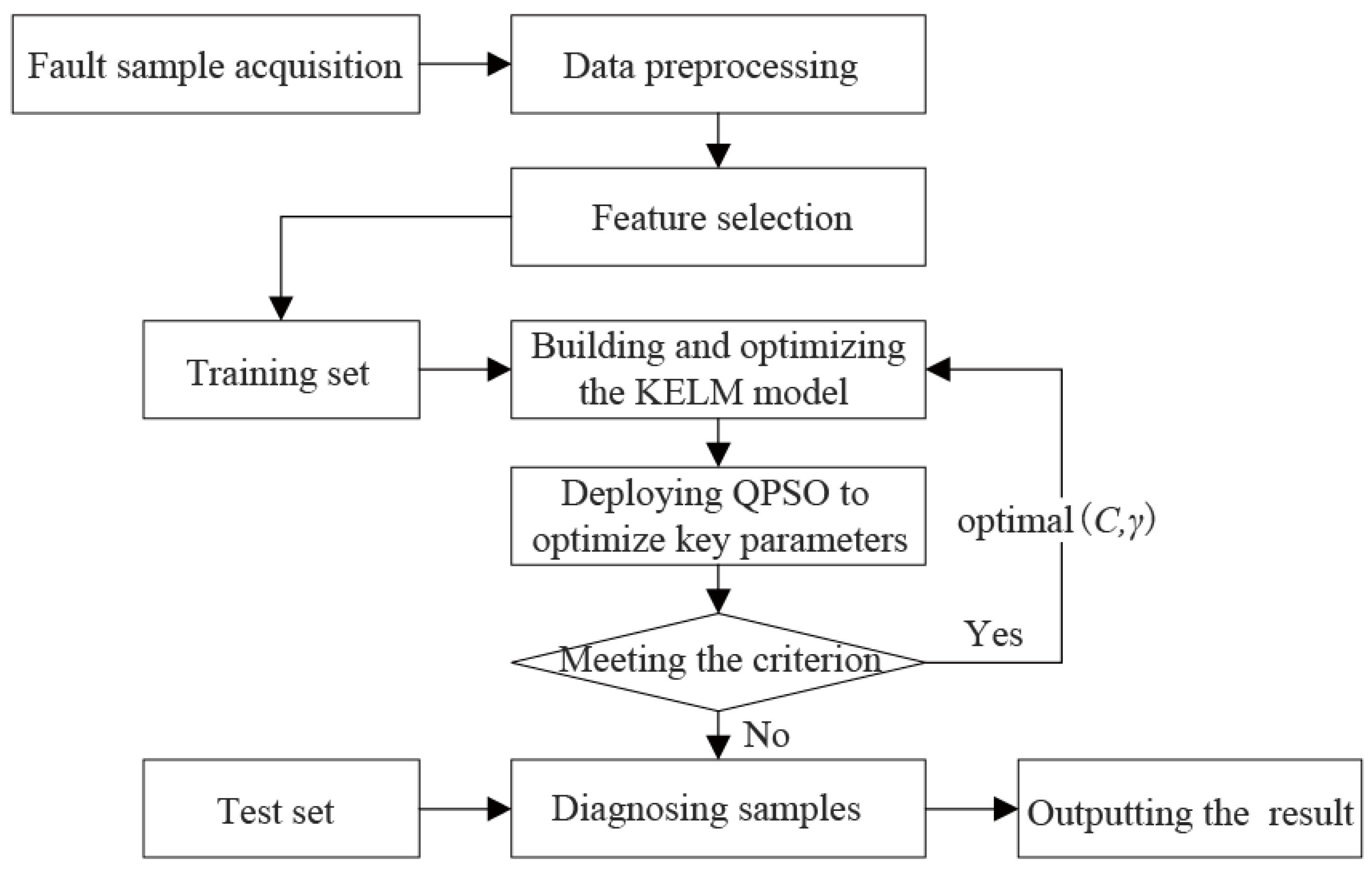
3.5. Fault Diagnosis Process of Control Cabinet Based on QPSO-KELM
The safety and reliability of the power grid hinge on an accurate and stable fault diagnosis model for the control cabinet. A novel fault analysis model based on QPSO-KELM is established. Initially, key features are extracted from the opening/closing coil current. These features then serve as inputs to the model. To increase diagnostic effectiveness, the QPSO algorithm is introduced to optimize the key parameters of KELM. Finally, fault samples are used to verify the effectiveness and validity of the proposed method. The process of the proposed scheme is as follows.
Step 1: Collect the feature set of the opening/closing coil current of the fusion switch. Normalize the original dataset.
Step 2: Initialize the iteration counter k = 1. Each particle is initialized with its position, personal best, and global best.
Step 3: The evaluation of the fitness value is performed, and both the personal best and the global best positions are updated. The fitness function adopted by the QPSO algorithm is the recognition accuracy of Q-fold (Q = 5) cross-validation.
Step 4: Update the position of the particle iteratively.
Step 5: Update the iteration counter k = k + 1. Upon reaching the maximum iteration count, the algorithm advances to Step 6; otherwise, it loops back to Step 3.
Upon reaching the maximum number of iterations, the optimized KELM classifier is output for identifying samples. Otherwise, the process reverts to Step 3.
Step 6: Upon termination of the iterative optimization process, the well-trained KELM classifier is obtained and subsequently employed for fault diagnosis on newly collected samples.
The specific implementation process for this procedure is given in Figure 3.
Figure 3.
Implementation process for fault diagnosis.
4. Test and Verification Analysis
4.1. Experimental Dataset and Acquisition System
This experiment takes a 10 kV control cabinet as the research object and monitors the opening/closing coil current signals of its circuit breaker. The coil current signals are acquired using a Hall closed-loop current sensor (model: LEM LA 55-P). The sampling frequency for all signals is uniformly set to 20 kHz, with a sampling duration of 100 ms, corresponding to 5 power frequency cycles. Each triggered record contains a complete waveform, including 20 ms before the operation and 80 ms after the operation. The selection of the sampling frequency follows the Nyquist sampling theorem. The model parameters are as follows: the number of particles in QPSO is 50, the maximum number of iterations is , and the inertia weight is set to 0.7.
In this study, six different experimental operating conditions are simulated through tests. Among them, F1 represents the normal state, in which the operating mechanism performs opening/closing operations under the rated DC voltage of 220 V, standard iron-core clearance, and normal circuit resistance, serving as the baseline reference group. F2 and F3 correspond to increased and decreased coil voltage conditions, respectively, where the operating voltage is adjusted to 110% (242 V) and 80% (176 V) of the rated value using an adjustable DC regulated power supply, simulating voltage fluctuations of the substation DC bus. F4 denotes the increased iron-core clearance condition, in which a 0.5 mm thick shim is added at the end of the iron-core stroke to simulate the clearance change caused by mechanical wear after long-term operation. F5 represents the increased auxiliary circuit resistance condition, in which a 5 Ω power resistor is connected in series in the opening/closing control circuit to simulate the increase in circuit resistance caused by contact oxidation or loose connections. F6 indicates the slight jamming condition of the tripping mechanism, in which damping grease is uniformly applied to the moving parts of the tripping mechanism to increase the action resistance. The original coil current dataset contains 3000 samples covering the 6 operating conditions, with 500 samples for each condition. The sample consists of 8 feature parameters, shown in Table 1, and the typical sample features are presented in Table 2.
Table 1.
Features of the fault diagnosis method.
Table 2.
Typical samples.
4.2. Feature Selection
The feature values derived from the coil current waveform of the switch mechanism are described in Table 1.
The working process of the opening/closing coil can be divided into four stages:
Stage 1: Coil excitation process . The coil receives an action command at time , and the coil current starts to rise, reaching the first peak current at time . When the electromagnetic force is large enough to overcome the spring reaction force, the core starts to move.
Stage 2: Coil core movement process . Due to the increasing electromagnetic force, the core begins to move. The back electromotive force causes the coil current to decrease, reaching the valley current at time .
Stage 3: Mechanism action process . In this stage, the core completes its movement, and the operating mechanism starts to act. The coil current rises to the second peak current at time . Subsequently, the coil current remains near this peak with slight fluctuations.
Stage 4: Current decay process . At this juncture, actuation of the auxiliary contact acts at , after which the coil current decreases precipitously to zero at .
Table 2 gives the representative feature samples for each operating condition.
Prior to model construction, all fault features are normalized using the max–min method, as defined in Equation (14), to eliminate dimensional disparities among features and enhance the diagnostic accuracy of the subsequent classifier.
where and represent pre-normalization and post-normalization sample values, respectively, and and represent the upper and lower bounds of the k-th feature, respectively.
4.3. Training and Test Set Partitioning
The original dataset contains 3000 samples across 6 conditions (F1–F6), with 500 per condition. A stratified random sampling strategy is applied to split the dataset into training and test sets at an 8:2 ratio, yielding 2400 and 600 samples, respectively. This ensures consistent class proportions in both subsets and avoids bias. The split is performed with a fixed random seed = 42, and samples from the same physical operation are strictly prevented from appearing in both subsets to eliminate temporal data leakage.
For QPSO-based KELM parameter optimization, the fitness function is the five-fold cross-validation average accuracy on the training set. The 2400 training samples are evenly partitioned into 5 folds (480 each). In each fold, one fold is used for validation and the remaining four for training. The KELM is trained with candidate parameters and evaluated on the validation fold. After 5 rounds, the average accuracy serves as the fitness value, guiding QPSO to search for the optimal parameter combination.
4.4. Analysis of Different Models
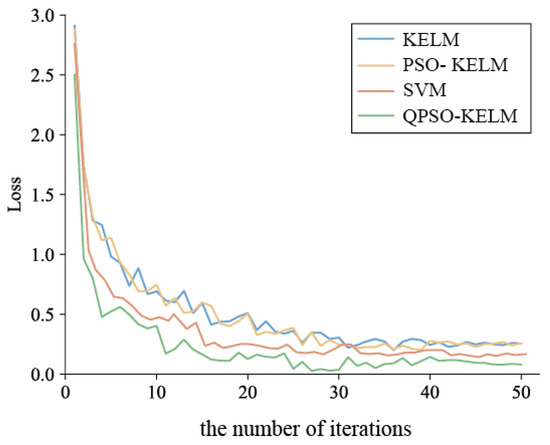
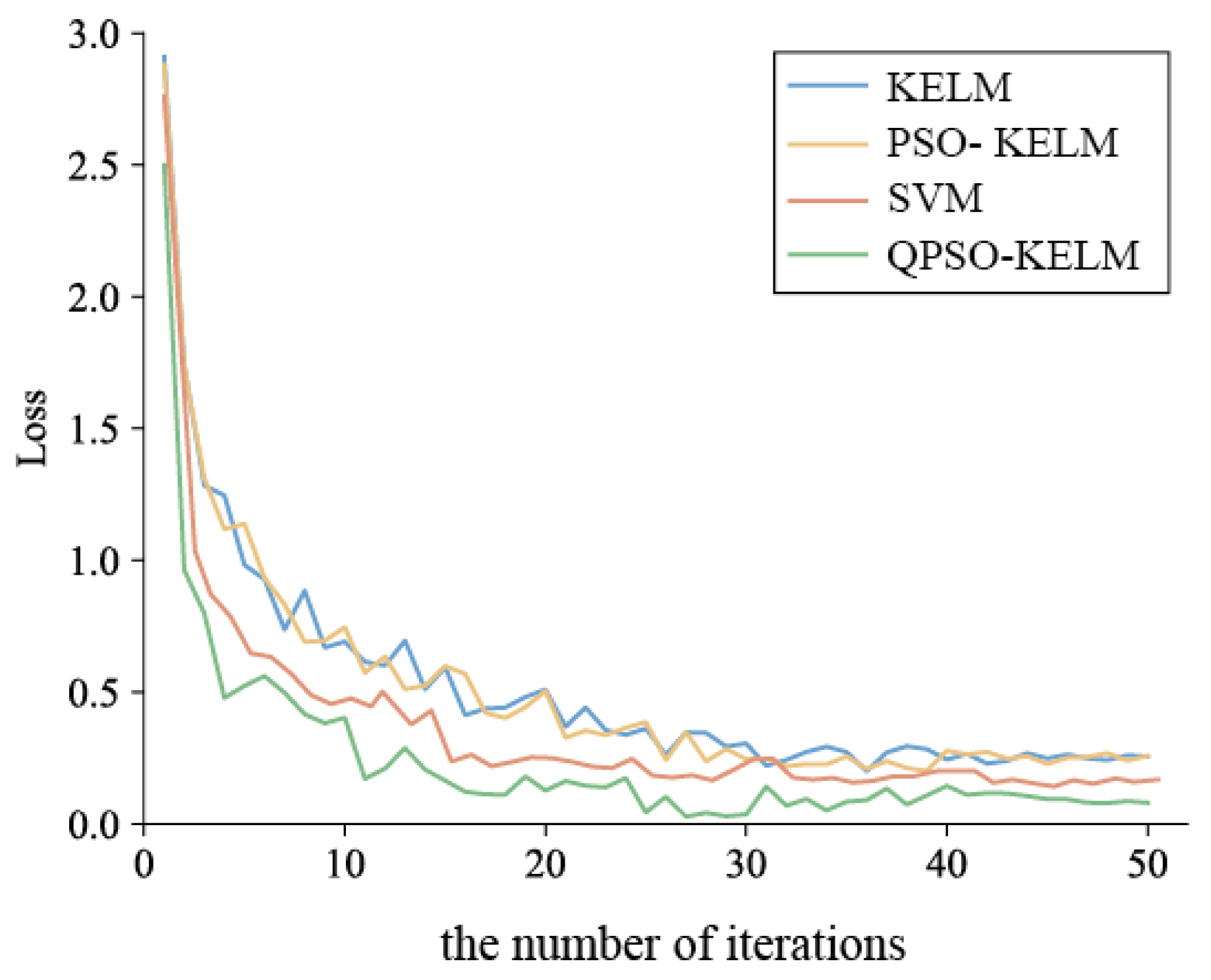
Figure 4 presents the accuracy results of the four different fault diagnosis methods: KELM, PSO-KELM, SVM, and QPSO-KELM. The loss curves of the four methods decline sharply during the initial 10 iterations, after which the decrease slows down and the curves gradually level off after the 25th iteration. Notably, QPSO-KELM and PSO-KELM consistently achieve lower loss values than KELM, demonstrating the effectiveness of the optimization algorithms in refining the initial weights and thresholds of KELM.
Figure 4.
Loss curves of different fault diagnosis methods.
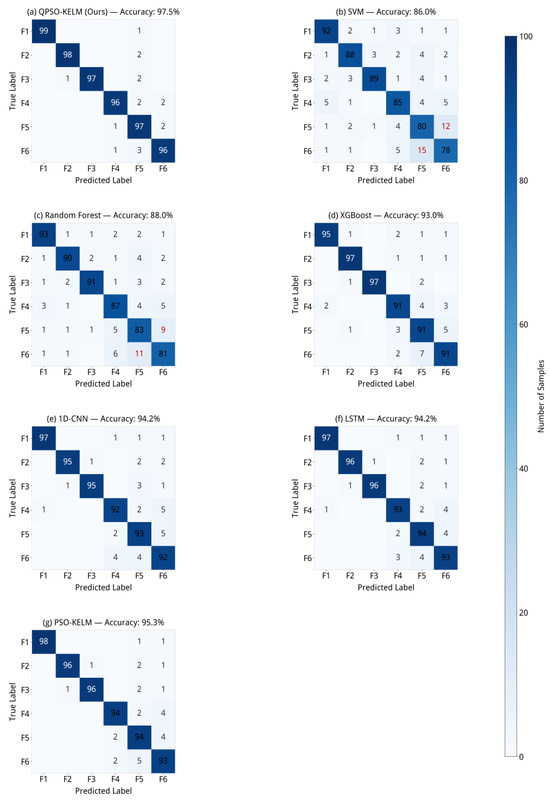
Figure 5 presents the confusion matrix of the proposed QPSO-KELM method on the test set (600 samples), along with comparisons against KELM, PSO-KELM, SVM, Random Forest, XGBoost, CNN, and LSTM algorithms.
Figure 5.
The confusion matrix of different methods.
It can be observed that the number of correctly classified samples on the diagonal reaches or exceeds 95 in all cases (with 100 test samples per class), and the recognition accuracy for each class exceeds 95%. Among them, F1 achieves the highest recognition rate (99/100), indicating that the coil current features under normal operating conditions exhibit good intra-class compactness. Between F5 and F6, there are 2 and 3 mutual misclassifications, respectively. This originates from the fact that both conditions lead to current amplitude attenuation and similar waveform shapes, resulting in partial overlap in the feature space.
In contrast, the confusion matrices of the comparative algorithms exhibit more pronounced classification errors. Specifically:
SVM and Random Forest: There are 15 and 12 misclassifications between F5 and F6, respectively, and F4 is misclassified as the normal state (F1) in 8 cases, indicating that traditional shallow models have limited feature extraction capability for mechanical faults.
XGBoost: Misclassifications are mainly concentrated between F5 and F6, but it demonstrates strong discrimination between F2 and F3, with zero misclassifications between these two classes.
CNN and LSTM: The overall misclassification rates are lower than those of traditional methods; however, there remain 5 and 6 misclassifications between F4 and F6, respectively, and the recall of F1 is marginally lower than that of the proposed scheme.
PSO-KELM: There are 6 misclassifications between F5 and F6 and 4 misclassifications for F4, both higher than those of the proposed method. This indicates that QPSO can find a better global parameter combination compared with PSO in parameter optimization, effectively improving the classification decision boundary for boundary samples.
The above comparison demonstrates that QPSO-KELM achieves the lowest misclassification rate among all operating conditions, with the most significant advantages in distinguishing mechanical faults (F4, F5, and F6), validating the effectiveness of the global search capability of QPSO in KELM parameter optimization.
Table 3 presents the comprehensive performance comparison between QPSO-KELM and all benchmark algorithms on the test set, including overall accuracy, F1-score, standard deviation, and 95% confidence interval. The following results are derived from 30 independent runs performed by each fault diagnosis model.
Table 3.
Performance of different methods.
From Table 3, it can be observed that QPSO-KELM achieves an accuracy of 97.5%, which is 11.5%, 9.5%, and 4.5% higher than those of the traditional machine learning methods SVM, RF, and XGBoost, respectively. The F1-score of QPSO-KELM reaches 97.3%, which is the highest among all compared methods, indicating its superior comprehensive performance. In terms of stability, the standard deviation is only 0.42, which is the smallest among all benchmark algorithms, demonstrating that the proposed scheme exhibits the smallest fluctuation and the strongest robustness. Moreover, the confidence interval is narrow and well separated: the 95% confidence interval of [97.4, 97.6] does not overlap with that of the suboptimal algorithm CNN ([93.9, 94.5]), indicating that the performance improvement is statistically reliable.
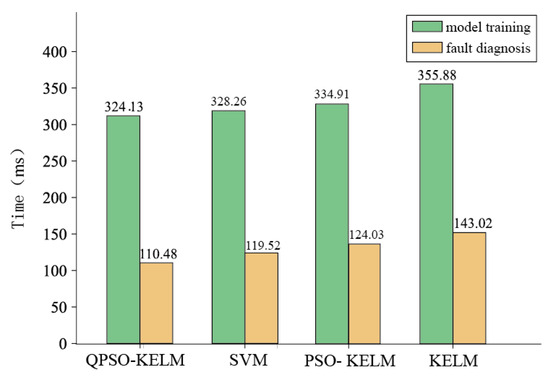
To verify the actual model training and fault diagnosis performance of the proposed method on the dataset, the KELM, PSO-KELM, SVM, and QPSO-KELM models were used for training and test on three datasets of different sizes. The time consumed for training and fault diagnosis is given by Figure 6. For the proposed QPSO-KELM method, the total time is defined as the training time, which consists of the QPSO optimization time and the KELM model training time (both of which belong to the offline stage). The testing time is reported separately and clearly indicated. The results indicate that the proposed QPSO-KELM model saves testing time of 32.54 ms, 13.55 ms, and 9.04 ms compared with KELM, PSO-KELM, and SVM, respectively.
Figure 6.
Comparison of training and diagnostic time across different methods.
4.5. Statistical Significance Test
To verify whether the above performance differences are statistically significant rather than caused by random factors, the Wilcoxon signed-rank test is employed to conduct pairwise comparisons between QPSO-KELM and each benchmark algorithm based on 30 independent runs. The null hypothesis is that the median performance of the two algorithms is identical, while the alternative hypothesis is that they are clearly distinguishable from each other. The significance level is α = 0.05.
As shown in Table 4, all p-values are less than 0.05 across all comparisons, indicating that the performance improvements of QPSO-KELM over each benchmark algorithm are statistically significant, which fully demonstrates that the superiority of the proposed scheme is not coincidental.
Table 4.
The results of the statistical significance test.
4.6. Experimental Environment and Computational Time Reporting
All experiments were conducted on a single hardware platform with the following specifications: CPU Intel® Xeon® Gold 6248 @ 2.50 GHz; RAM 128 GB DDR4; and GPU NVIDIA GeForce RTX 3080 (used only for accelerating the training of deep learning baselines, i.e., CNN and LSTM). For the software environment, all algorithms were implemented in Python 3.9, with key libraries and their versions as follows: NumPy 1.21, SciPy 1.7, scikit-learn 1.0, TensorFlow 2.8 (for CNN and LSTM), and PyTorch 1.12 (for auxiliary validation).
5. Conclusions
This paper proposes a fault diagnosis method for the control cabinet based on QPSO- KELM. The QPSO algorithm is employed to adaptively tune the kernel parameters and the regularization coefficient of KELM, which enhances fault identification accuracy while accelerating model convergence. To validate the effectiveness and superiority of the proposed method, this paper compares it with four typical machine learning algorithms, RF, XGBoost, CNN and LSTM. Experimental results on the coil current dataset collected from the primary–secondary integrated switch in the control cabinet show that the proposed method achieves a fault diagnosis accuracy of 97.5%, outperforming all four benchmarks. To further confirm the reliability of the results, a statistical significance test is conducted on the classification accuracies of all compared algorithms. The results reveal that the differences between the proposed method and each of the comparison methods are statistically significant (p < 0.05), demonstrating that the diagnostic superiority of our approach is not coincidental. In summary, the proposed method can effectively handle the fault diagnosis of control cabinets, enabling fast and accurate fault discrimination. It provides new technical support and a reference for operation and maintenance decision-making in intelligent substations.
6. Limitations and Future Work
Although the proposed QPSO-KELM method has achieved satisfactory diagnostic performance, there are still several limitations. First, the experimental data were collected from a single type of 10 kV control cabinet under laboratory conditions; therefore, the generalization capability of the proposed method to other voltage levels or field-deployed cabinets requires further validation. Second, the current feature set relies solely on coil current signals, which may not be sufficient to fully capture all potential fault patterns, particularly those involving mechanical performance degradation over prolonged operation.
Future work will focus on the following aspects: (1) extending the experimental platform to encompass a wider variety of cabinet types and actual operating conditions; (2) integrating multi-source sensing data, such as vibration and temperature signals, to enrich the feature space and improve diagnostic coverage; (3) exploring lightweight deep learning models to enable real-time fault diagnosis at the edge side of smart substations; and (4) investigating transfer learning techniques to reduce the dependency on large-scale labeled datasets.
Author Contributions
Conceptualization, Y.L., M.W., Y.Z. and N.C.; Methodology, Y.L., M.W., Y.Z. and N.C.; Writing—original draft. Y.L., M.W., Y.Z. and N.C.; Investigation, Y.L., M.W., Y.Z. and N.C.; Data curation, Y.L., M.W., Y.Z. and N.C.; Writing—review and editing, Y.L., M.W., Y.Z. and N.C. All authors have read and agreed to the published version of the manuscript.
Funding
This research was jointly supported by the National Natural Science Foundation of China under Grant No. U22B20118 (Multi-parameter Fusion Perception, Defect Identification and Risk Degree Evaluation of GIS Partial Discharge Based on Acoustic-Optic-Electromagnetic Signals) and Project No. 030500KC23110011 (Research and Pilot Application for Primary-secondary Intelligent Integration Improvement of High-voltage Switchgear Equipment in Substations).
Data Availability Statement
The original contributions presented in this study are included in the article. Further inquiries can be directed to the corresponding author.
Conflicts of Interest
Authors Yiqing Lin, Ming Wei and Yini Zhang were employed by the company Shantou Power Supply Bureau of Guangdong Power Grid Co., Ltd. The remaining authors declare that the research was conducted in the absence of any commercial or financial relationships that could be construed as a potential conflict of interest.
Abbreviations
| Abbreviation | Full Form |
| QPSO | Quantum-behaved Particle Swarm Optimization |
| KELM | Kernel Extreme Learning Machine |
| RF | Random Forest |
| XGBoost | eXtreme Gradient Boosting |
| CNN | Convolutional Neural Network |
| LSTM | Long Short-Term Memory |
References
- Guo, N.; Xu, X.; Wu, H.; Feng, C.; Wang, Q.; Li, Y. Application of Intelligent Control Based on Soft Computing in the Safety Control of Switch Cabinet Maintenance. In Proceedings of the 2024 International Conference on Advances in Electrical Engineering and Computer Applications (AEECA), Dalian, China, 16–18 August 2024; pp. 372–379. [Google Scholar]
- Yang, Y.; Ma, S.; Wu, J.; Jia, B.; Li, W.; Luo, X. Fault Diagnosis in Gas Insulated Switchgear Based on Genetic Algorithm and Density-Based Spatial Clustering of Applications with Noise. IEEE Syst. J. 2021, 21, 965–973. [Google Scholar] [CrossRef] [Scilit]
- Mishra, M.; Panigrahi, R.R. Advanced signal processing and machine learning techniques for voltage sag causes detection in an electric power system. Int. Trans. Electr. Energy Syst. 2020, 30, e12167. [Google Scholar] [CrossRef] [Scilit]
- Mishra, M.; Rout, P.K. Detection and classification of micro-grid faults based on HHT and machine learning techniques. IET Gener. Transm. Dis. 2018, 12, 388–397. [Google Scholar] [CrossRef] [Scilit]
- Pang, B.; Tang, G.; Tian, T. Enhanced Singular Spectrum Decomposition and Its Application to Rolling Bearing Fault Diagnosis. IEEE Access 2019, 7, 87769–87782. [Google Scholar] [CrossRef] [Scilit]
- Zhao, B.; Li, Q.; Lv, Q.; Si, X. A Spectrum Adaptive Segmentation Empirical Wavelet Transform for Noisy and Nonstationary Signal Processing. IEEE Access 2021, 9, 106375–106386. [Google Scholar] [CrossRef] [Scilit]
- Chen, P.; Ma, R.; Bai, H.; Song, S.; Chen, Z. Adaptive-Filter-Based Position Estimation Accuracy Improvement for Sensorless Control of SPMSM at Zero- and Low-Speed Regions. IEEE J. Emerg. Sel. Top. Power Electron. 2025, 13, 3529–3540. [Google Scholar] [CrossRef] [Scilit]
- Mishra, K.K.; Pachori, R.B. FMCW Radar-Based Human Activity Recognition Based on Higher Order Synchrosqueezing Transform. IEEE Syst. J. 2025, 25, 28934–28941. [Google Scholar] [CrossRef] [Scilit]
- Cui, H.; Guan, Y.; Chen, H. Rolling Element Fault Diagnosis Based on VMD and Sensitivity MCKD. IEEE Access 2021, 9, 120297–120308. [Google Scholar] [CrossRef] [Scilit]
- Chao, Y.; Tao, T. Masked Time–Frequency Representation and Enhanced Priors Enabled Weak Electromechanical Signal Decomposition Algorithm. IEEE Trans. Instrum. Meas. 2025, 74, 1–16. [Google Scholar] [CrossRef] [Scilit]
- Hou, F.; Chen, J.; Dong, G. Weak fault feature extraction of rolling bearings based on globally optimized sparse coding and approximate SVD. Mech. Syst. Signal Process. 2018, 111, 234–250. [Google Scholar] [CrossRef] [Scilit]
- Liu, D.; Xiao, Z.; Hu, X.; Zhang, C.; Malik, O.P. Feature extraction of rotor fault based on EEMD and curve code. Measurement 2019, 135, 712–724. [Google Scholar] [CrossRef] [Scilit]
- Zheng, H.; Cheng, G.; Li, Y.; Liu, C. A new fault diagnosis method for planetary gear based on image feature extraction and bag-of-words model. Measurement 2019, 145, 1–13. [Google Scholar] [CrossRef] [Scilit]
- Kuncan, M.; Kaplan, K.; Minaz, M.R.; Kaya, Y.; Ertunç, H.M. A novel feature extraction method for bearing fault classification with one dimensional ternary patterns. ISA Trans. 2020, 100, 346–357. [Google Scholar] [CrossRef] [Scilit] [PubMed]
- Yan, X.; Yan, X.; Jia, L.; Cao, H.; Yu, Y.; Wang, T.; Zhang, F.; Guan, Q. Multitargets Joint Training Lightweight Model for Object Detection of Substation. IEEE Trans. Neural Netw. Learn. Syst. 2024, 35, 2413–2424. [Google Scholar] [CrossRef] [Scilit] [PubMed]
- Baghaee, H.R.; Mlakić, D.; Nikolovski, S.; Dragicević, T. Support Vector Machine-Based Islanding and Grid Fault Detection in Active Distribution Networks. IEEE Trans. Emerg. Sel. Top. Power Electron. 2020, 8, 2385–2403. [Google Scholar] [CrossRef] [Scilit]
- Guo, W.; Wang, F.; Long, L. Intelligent Substation Relay Protection Condition Monitoring Based on Support Vector Machine Algorithm. In Proceedings of the 2nd International Conference on Networking, Communications and Information Technology (NetCIT), Manchester, UK, 26–27 December 2022; pp. 638–642. [Google Scholar]
- Meira de Andrade, P.H.; Villanueva, J.M.M.; Macedo Braz, H.D.D. An Outliers Processing Module Based on Artificial Intelligence for Substations Metering System. IEEE Trans. Power Syst. 2020, 35, 3400–3409. [Google Scholar] [CrossRef] [Scilit]
- Li, Y.; Guo, Z. Power Transformer Fault Diagnosis Method Based on ARIMA-ELM Algorithm. In Proceedings of the 2025 IEEE 4th World Conference on Applied Intelligence and Computing (AIC), New Delhi, India, 26–27 July 2025; pp. 859–863. [Google Scholar]
- Chai, Y.; Liu, Q.; Wang, Y.; Yan, J.; Wang, Y.; Qing, X. A Novel Method Using UGW-Based FAA-ELM for Wind Turbine Gearbox Health Monitoring and Fault Diagnosis Under Variable Working Conditions. IEEE Trans. Instrum. Meas. 2025, 74, 1–11. [Google Scholar] [CrossRef] [Scilit]
- Venter, G.; Sobieszczanski-Sobieski, J. Particle swarm optimization. AIAA J. 2003, 41, 1583–1589. [Google Scholar] [CrossRef] [Scilit] [PubMed]
- Zhan, Z.-H.; Zhang, J.; Li, Y.; Chung, H.S.-H. Adaptive particle swarm optimization. IEEE Trans. Syst. Man. Cybern. B Cybern. 2009, 39, 1362–1381. [Google Scholar] [CrossRef] [Scilit] [PubMed]
- Khalil, T.M.; Gorpinich, A.V. Selective particle swarm optimization. Int. J. Multidiscip. Sci. Eng. 2012, 3, 1–4. [Google Scholar]
- Zhang, Y.; Wang, S.; Ji, G. A comprehensive survey on particle swarm optimization algorithm and its applications. In Mathematical Problems in Engineering; Wiley: Hoboken, NJ, USA, 2015; p. 931256. [Google Scholar]
- Tian, Y.; Zhang, J.; Chen, L.; Geng, Y.; Wang, X. Single Wearable Accelerometer-Based Human Activity Recognition via Kernel Discriminant Analysis and QPSO-KELM Classifier. IEEE Access 2019, 7, 109216–109227. [Google Scholar] [CrossRef] [Scilit]
- Nikmehr, N.; Zhang, P.; Bragin, M.A. Quantum Distributed Unit Commitment: An Application in Microgrids. IEEE Trans. Power Syst. 2022, 37, 3592–3603. [Google Scholar] [CrossRef] [Scilit]

Disclaimer/Publisher’s Note: The statements, opinions and data contained in all publications are solely those of the individual author(s) and contributor(s) and not of MDPI and/or the editor(s). MDPI and/or the editor(s) disclaim responsibility for any injury to people or property resulting from any ideas, methods, instructions or products referred to in the content. |
© 2026 by the authors. Licensee MDPI, Basel, Switzerland. This article is an open access article distributed under the terms and conditions of the Creative Commons Attribution (CC BY) license.