


Abstract
Coffee husks (Coffea arabica) are abundant agro-industrial by-products with potential for value-added applications, making the optimization of drying conditions essential for preserving their quality. This study evaluated the effects of drying temperature on the drying kinetics, thermodynamic properties, and volatile profile of coffee husks from organic and conventional production systems. Samples were dried in a convective fixed-bed dryer at 30, 40, and 50 °C. Drying kinetics were described using fifteen mathematical models, while thermodynamic parameters (ΔH, ΔS, and ΔG), volatile compounds (HS-SPME/GC–MS), water activity (Aw), and texture were evaluated. The Modified Henderson and Pabis model provided the best fit to the drying data (R2 > 0.99). A total of 505 volatile compounds were identified, and samples dried at 40 °C retained the highest number of sensory-relevant compounds. Organic coffee husks exhibited a distinct volatile profile compared with conventional husks, possibly due to differences in postharvest processing. Drying reduced water activity to values below 0.60, which are generally considered unfavorable for the growth of most microorganisms during storage. Overall, the results suggest that drying at 40 °C provides a suitable balance between drying performance and volatile compound preservation in coffee husks.
1. Introduction
Coffee-derived beverages are among the most widely consumed worldwide, making coffee one of the most economically and socially important agricultural commodities [1,2]. However, coffee processing generates large amounts of by-products, with approximately 95% of the fresh fruit mass remaining as residues after postharvest processing [3,4,5]. Within the framework of a circular bioeconomy, these by-products are increasingly recognized as valuable raw materials rather than waste due to their potential applications in the food, nutraceutical, and pharmaceutical sectors [6,7].
Among these by-products, coffee husk has attracted considerable attention because of its abundance and chemical composition. It contains high levels of carbohydrates (57.8%), soluble dietary fiber (31.9%), and several bioactive compounds, including chlorogenic acids, anthocyanins, and caffeine, which have been associated with antioxidant, antimicrobial, and prebiotic properties [8,9,10]. These characteristics make coffee husk a promising ingredient for value-added products, particularly cascara beverages [5]. To preserve its quality and extend its shelf life, drying is an essential postharvest operation because it reduces moisture content, decreases product volume, and facilitates storage and transportation [11,12,13,14].
Drying, however, is more than a moisture removal process. Heat and mass transfer conditions directly influence the physicochemical characteristics of plant materials and may affect the retention of volatile compounds and other quality attributes [15]. Previous studies on horticultural products, including pequi pulp, taioba leaves, and salep, have shown that drying temperature influences the preservation of thermosensitive compounds, although the magnitude of these effects depends on the characteristics of the raw material and the drying conditions [16,17,18]. For example, higher drying temperatures improved phenolic retention in pequi pulp, whereas lower temperatures better preserved volatile compounds [18]. Likewise, heat-pump drying reduced the degradation of vitamin C in taioba leaves compared with conventional drying systems [16]. These findings highlight the importance of selecting appropriate drying conditions according to the characteristics of each plant material.
For coffee husks intended for cascara production, aroma and flavor are key quality attributes that strongly influence consumer acceptance [19]. These characteristics may also vary according to cultivation practices and postharvest processing. In particular, organic and conventional production systems generally employ different depulping methods. Manual depulping, commonly used in organic production, tends to preserve a thicker mucilage layer, whereas water-assisted depulping, commonly used in conventional systems, removes a larger proportion of this tissue [20,21]. Because the mucilage accounts for approximately 22% of the fruit mass, these differences may influence moisture removal during drying and, consequently, the retention of volatile compounds. Although gas chromatography coupled with mass spectrometry (GC–MS) is widely used to characterize volatile compounds [18], limited information is available on how drying temperature influences the drying behavior, thermodynamic properties, and volatile profile of coffee husks obtained from different production systems.
Previous studies have primarily focused on drying kinetics or the physicochemical properties of coffee by-products, whereas information integrating drying behavior, thermodynamic analysis, and volatile profile in coffee husks from different production systems remains limited. Therefore, this study evaluated the drying kinetics, thermodynamic properties, and volatile profile of coffee husks from organic and conventional production systems dried at 30, 40, and 50 °C [22]. The objective was to identify drying conditions that promote efficient moisture removal while preserving volatile compounds relevant to the sensory quality of coffee husks, thereby contributing to the valorization of this agro-industrial by-product.
2. Materials and Methods
The experiments were carried out at the Laboratory of Drying and Storage of Agricultural Products, Department of Agricultural Engineering, Federal University of Viçosa (UFV), Viçosa, Minas Gerais, Brazil.
2.1. Raw Materials
Coffee husks were obtained from coffee producers located in the municipality of Viçosa, Minas Gerais, Brazil. Husks from Coffea arabica L. cv. Catuaí Vermelho cultivated under both organic and conventional production systems were used throughout the study.
Only fully ripe fruits (cherry stage) were manually harvested to ensure uniform maturity and minimize the presence of immature, damaged, or overripe fruits. After harvesting, the fruits were washed to remove impurities and floating fruits, which are generally associated with defects or poor physiological quality. Depulping was carried out immediately after harvesting at each production site. In the organic production system, the fruits were manually depulped because mechanical equipment was not available at the farm. In the conventional production system, a commercial water-assisted depulper was used. As a result, different amounts of mucilage remained attached to the husks after processing.
The fresh coffee husks were packed in polypropylene bags and immediately transported to the Laboratory of Drying and Storage of Agricultural Products, where the drying experiments and the initial moisture content determination were performed. The coffee beans and the remaining processing residues remained at the farms to follow the postharvest practices adopted by each producer.
2.2. Drying of Coffee Husks
Drying experiments were carried out in an upward-flow fixed-bed dryer at air temperatures of 30, 40, and 50 °C. Approximately 1.5 kg of fresh coffee husks was used in each drying run and uniformly distributed inside the drying chamber, forming a bed approximately 2 cm thick. For each production system and drying temperature, the experiments were performed in triplicate.
The drying air temperature was monitored using a portable thermohygrometer equipped with a temperature probe (AKSO, São Leopoldo, RS, Brazil). Air temperature and relative humidity of both the drying and ambient air were continuously monitored using a digital data logger (HOBO, Onset Computer Corporation, Bourne, MA, USA), whereas the relative humidity of the drying air was estimated using GRAPSI® 7.0 software. The drying air velocity was maintained at 1.5 m s−1, as measured with a vane anemometer (AVM-07), and the electrical energy consumption during drying was monitored using a digital wattmeter and expressed in kilowatt-hours (kWh).
During drying, the samples were periodically weighed using a precision electronic balance (LS1, Marte Científica, São Paulo, SP, Brazil; 1010 g capacity). Measurements were performed every 5 min during the first hour, every 10 min during the following 2 h, every 15 min for the subsequent 1 h 45 min, every 20 min during the next hour, and every 30 min thereafter until hygroscopic equilibrium was reached. Equilibrium was considered when the difference between two consecutive mass measurements did not exceed 0.01 g. After drying, representative subsamples were collected to determine the equilibrium moisture content, and the remaining dried husks were packed in sealed polypropylene bags until further analyses.
Mathematical Modeling of Coffee Husk Drying
The drying kinetics of coffee husks were described using fifteen empirical and semi-empirical mathematical models that are commonly applied to agricultural products and food materials (Table 1) [22,23,24,25,26]. The moisture ratio (MR) was calculated from the experimental moisture content data, and the models were fitted by nonlinear regression to identify the equation that best described the drying behaviour of coffee husks under each drying condition.
Table 1.
Mathematical models used to describe the drying kinetics.
Where (MR) is the moisture ratio of the product (dimensionless); (k, k_1) and (k_2) are drying constants; (a, b, c, n) are model coefficients; and (t) is the drying time (min). The calculation of the moisture ratio (MR) during the drying process was performed using Equation (16), as described in the literature [27,28].
where MR is the moisture ratio (dimensionless); X is the moisture content of the coffee husk; Xe is the equilibrium moisture content; and Xi is the initial moisture content of the husks, all expressed as kg of water per kg of dry matter.
To describe the drying process, the experimental data were fitted to fifteen empirical and semi-empirical mathematical models (Table 1). Model parameters were estimated by nonlinear regression, and the Arrhenius relationship was used to determine the activation energy associated with the drying process [22,23,29]. The thermodynamic parameters of drying were calculated from the Arrhenius parameters using Equations (18)–(20), allowing the evaluation of the energetic behaviour of the process.
where A is the pre-exponential factor (h−1), Ea is the activation energy (J mol−1), R is the universal gas constant (8.314 J mol−1 K−1), T is the absolute temperature (K), ΔH is the enthalpy (J mol−1), ΔS is the entropy (J mol−1 K−1), ΔG is the Gibbs free energy (J mol−1), kb is the Boltzmann constant (1.38 × 10⁻²³ J K−1), and hp is the Planck constant (6.626 × 10⁻³⁴ J s).
2.3. Physical Characterization of Dried Coffee Husks
2.3.1. Moisture Content (Oven Method)
The moisture content of coffee husks was determined before and after drying according to the Rules for Seed Analysis established by the Brazilian Ministry of Agriculture, Livestock and Food Supply (MAPA). Samples were dried in a forced-air oven at 105 ± 3 °C for 24 h, following the official methodology [30,31].
2.3.2. Water Activity (Aw)
Water activity (Aw) was measured using an AQUALAB® 4TE instrument (Meter Group, Pullman, WA, USA) at 25 °C [32]. Aw was determined to evaluate the availability of free water in the dried coffee husks, providing information related to product stability during storage and the potential occurrence of microbiological, enzymatic, and chemical reactions [33].
2.4. Determination of Volatile Compounds by HS-SPME/GC–MS
The dried coffee husks were ground before analysis to improve the release of volatile compounds. The aqueous extracts were prepared by infusing 1.2 g of ground coffee husk in 100 mL of water at 95 °C for 5 min. The extracts were then filtered through a stainless-steel filter to remove solid particles and standardize the samples.
The extracts were grouped according to drying temperature (30, 40, and 50 °C) and production system (organic and conventional). Volatile compounds were extracted using headspace solid-phase microextraction (HS-SPME), employing a fused-silica fibre coated with an appropriate polymeric stationary phase [34].
Aliquots of 20 mL were transferred to headspace glass vials and hermetically sealed with magnetic screw caps fitted with silicone septa. The samples were equilibrated at 60 °C for 20 min, after which the SPME fibre was exposed to the headspace for 40 min. Subsequently, the fibre was transferred to the GC injector for thermal desorption for 5 min. The total chromatographic run time was 83 min.
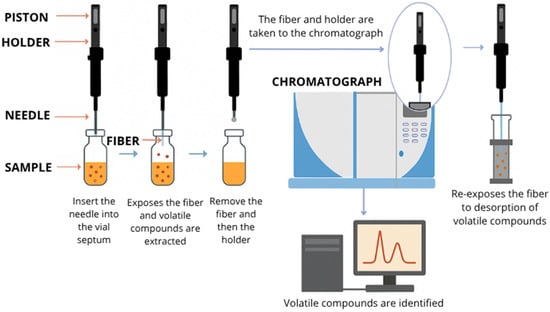
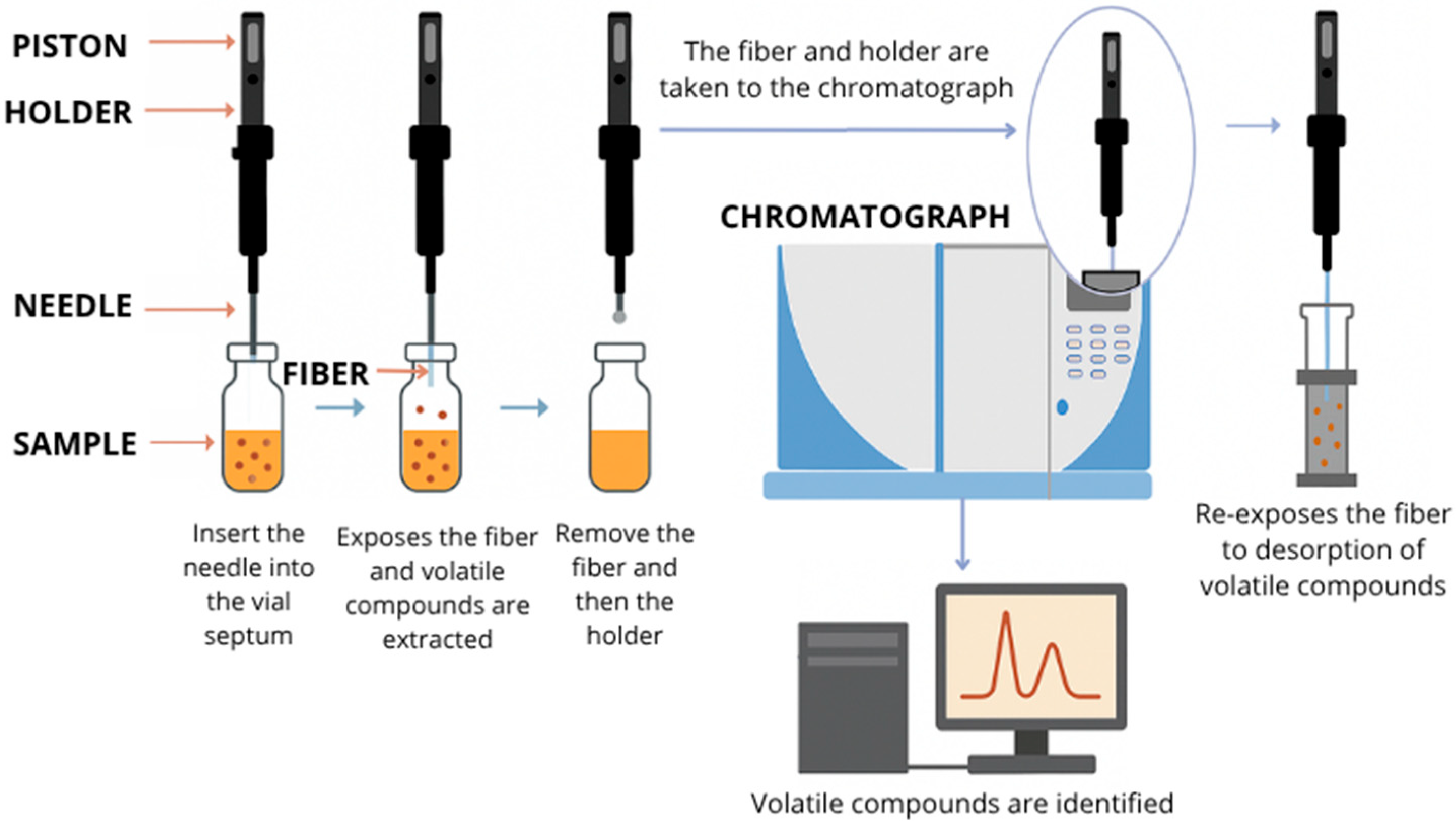
The analyses were performed in headspace mode, preventing direct contact between the fibre and the liquid extract and allowing selective adsorption of volatile compounds present in the gas phase. After extraction, the fibre was inserted into the chromatographic injector, where the adsorbed compounds were thermally desorbed and transferred to the analytical column for separation and detection (Figure 1).
Figure 1.
Schematic of the gas chromatography analysis of organic and conventional coffee husk tea samples. Source: the author.
Analyses were performed using a gas chromatograph (GC 7820, Agilent Technologies, Palo Alto, CA, USA) coupled to a quadrupole mass spectrometer (MSD 5973 Network, Agilent Technologies, Palo Alto, CA, USA). Helium (99.9992% purity) was used as the carrier gas at a constant flow rate of 1.5 mL min−1. Volatile compounds were separated on a DB-Wax capillary column (30 m × 0.25 mm i.d. × 0.25 μm film thickness; polyethylene glycol stationary phase; J&W Scientific, Agilent Technologies, Palo Alto, CA, USA).
Samples were injected at 220 °C using a split ratio of 1:20 and an injection volume of 1.0 μL. The mass spectrometer operated with an ion source temperature of 230 °C, an interface temperature of 250 °C, and a quadrupole temperature of 200 °C. Electron ionization was performed at 70 eV, and data were acquired in full-scan mode over a mass-to-charge ratio (m/z) range of 50–500. Instrument control, data acquisition, and chromatographic processing were performed using MassHunter GC/MS Acquisition software (version B.07.04.2260, Agilent Technologies, Palo Alto, CA, USA). Volatile compounds were identified by comparing the acquired mass spectra with the NIST/EPA/NIH Mass Spectral Library [35], using a minimum similarity index of 85%. Whenever available, compound identification was further supported by comparison of retention indices with literature data.
Compounds with relative peak areas ≥0.5% were selected as relevant variables to minimize analytical noise and focus on compounds contributing substantially to the volatile profile. Among these compounds, the 50 variables with the highest variability across treatments, determined by standard deviation, were selected for multivariate analysis. The dataset was standardized using Z-score normalization and analyzed by hierarchical cluster analysis (HCA) based on Euclidean distance and Ward’s linkage method. The clustering patterns were visualized through heatmaps combined with dendrograms to assess similarities among drying temperatures and production systems. Data processing, selection of volatile variables, and hierarchical cluster analysis were performed using Python (version 3.12.13) in Google Colaboratory (Google LLC, Mountain View, CA, USA), using pandas (version 2.2.2) for data handling, SciPy (version 1.16.3) for clustering analysis, and seaborn (version 0.13.2) for heatmap visualization [36].
2.5. Statistical Analysis
2.5.1. Statistical Analysis of Drying Kinetics
The performance of the drying kinetics models was evaluated using the mean relative error (MRE), standard deviation of the estimate (SDE), and coefficient of determination (R2), according to Equations (21)–(23). The model parameters were estimated by nonlinear regression using the Gauss–Newton algorithm [22,37]. The best-fitting model was selected based on the highest R2 value and the lowest MRE and SDE values.
where is the number of observed data points; is the experimental value (%, d.b.); is the model-estimated value (%, d.b.); and is the residual degrees of freedom. All statistical analyses and experimental designs were performed using Statistics version 6 (SAS Institute Inc., Cary, NC, USA).
2.5.2. Statistical Analysis of Physical Parameters and Volatile Compounds
Data obtained from physical analyses and volatile compound profiling were subjected to analysis of variance (ANOVA), followed by Tukey’s test for mean comparison, using Statistica version 6 (StatSoft Inc., Tulsa, OK, USA). Differences among treatments were considered statistically significant when p ≤ 0.05.
3. Results and Discussion
Coffee husks from the organic cultivation system were hand-processed, preserving the pulp and mucilage layers. Mucilage is a water-rich fraction containing soluble solids and sugars, and it may represent approximately 22% of the mass of depulped coffee cherries [20,21]. Therefore, the presence of this additional fraction may contribute to increased moisture retention and greater complexity during drying. The removal of water from coffee husks is influenced by both material composition and drying conditions, requiring efficient heat and mass transfer throughout the process.
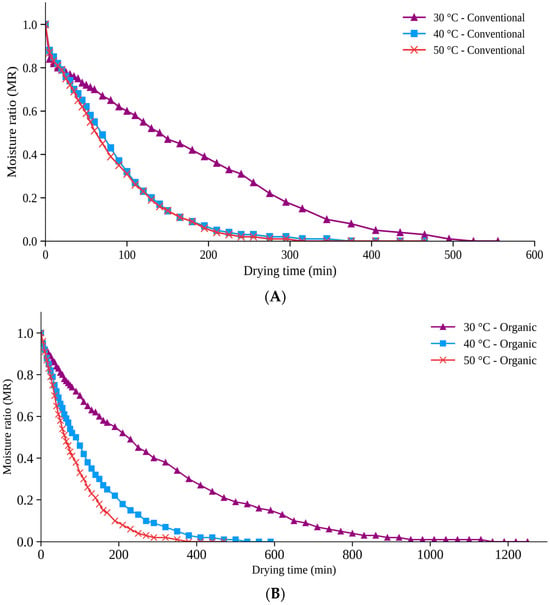
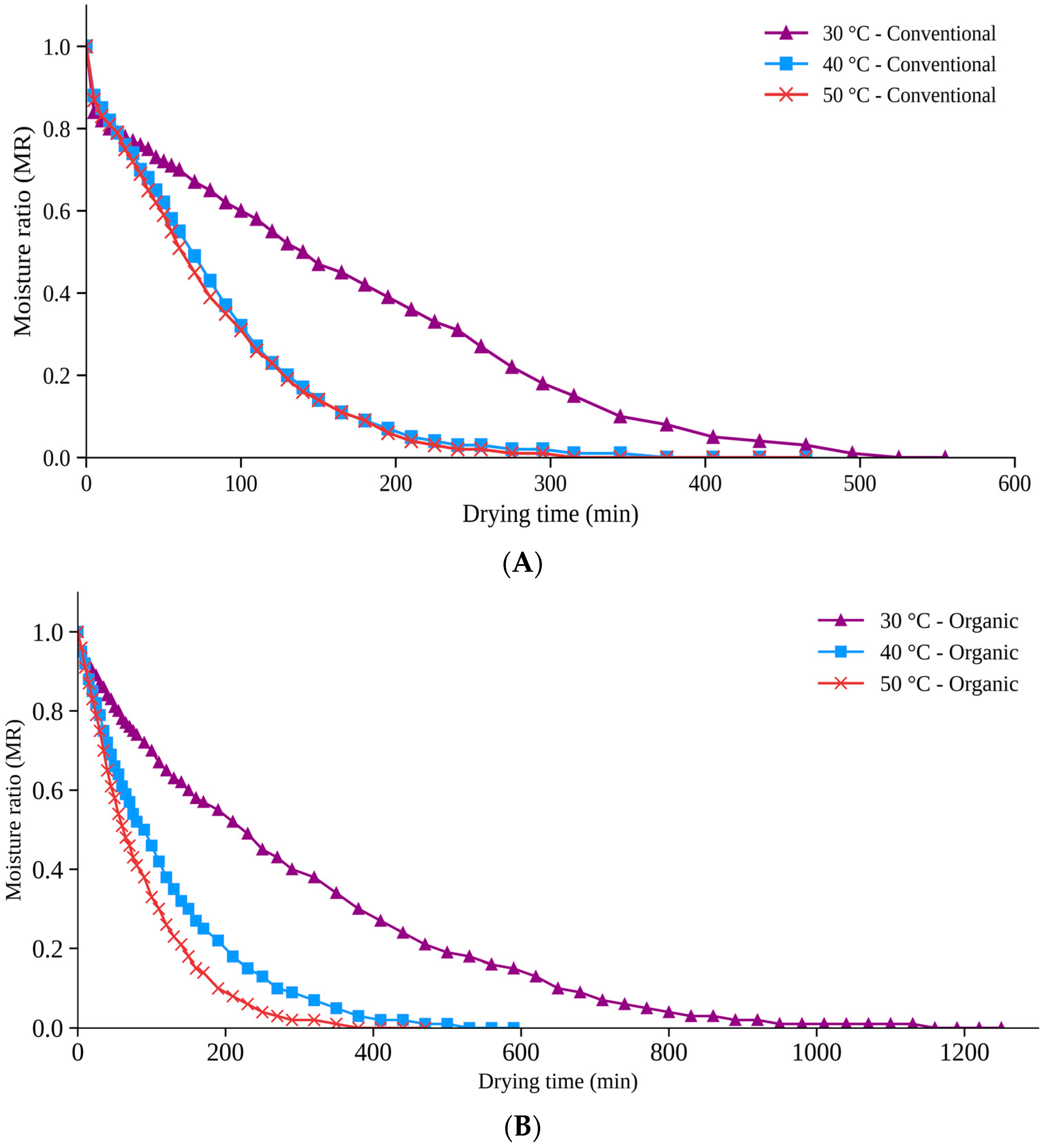
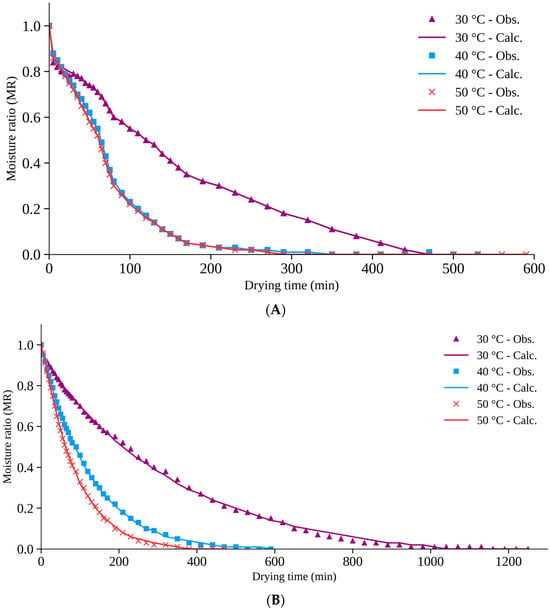
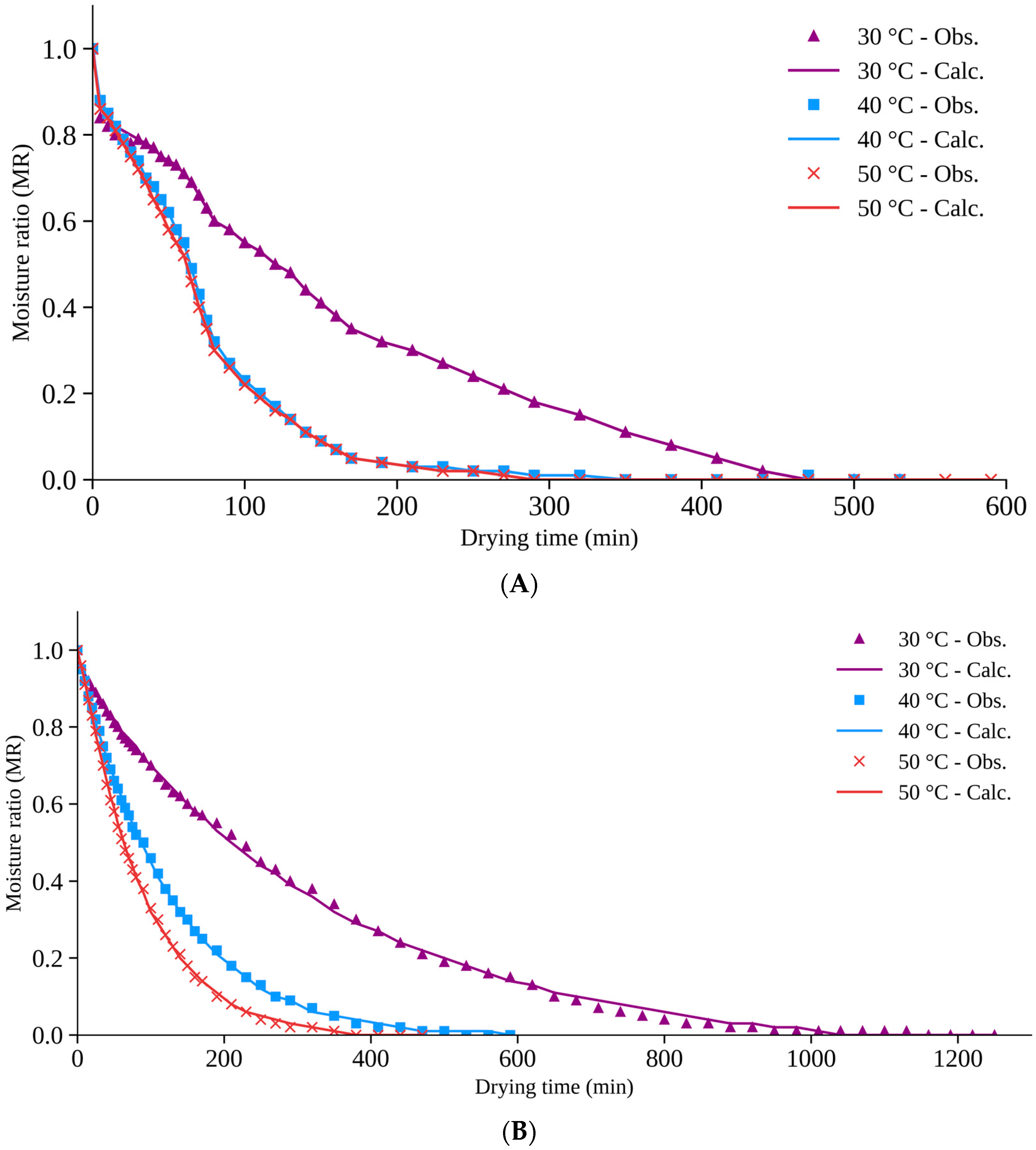
Drying time and moisture ratio (MR) evolution (Figure 2) were evaluated for different combinations of coffee type and drying temperature. Like previous studies involving coffee-derived materials [15,38,39], increasing drying temperature reduced the time required to reach lower moisture ratios in both conventional and organic coffee husks.
Figure 2.
Moisture ratio (MR) of coffee husks from conventional (A) and organic (B) cultivation systems at different drying temperatures over time (min). Source: the author.
The drying behaviour of coffee husks showed the typical reduction pattern observed in agricultural materials, with a faster moisture decrease at the beginning of the process followed by a slower drying stage. The initial reduction in moisture ratio is related to the greater availability of water at the surface of the material, whereas the subsequent decrease in drying rate suggests increased resistance to moisture removal as drying progressed [40,41,42].
Drying temperature had a significant influence on moisture removal. The increase from 30 to 50 °C accelerated the reduction in moisture ratio in both conventional and organic coffee husks, reducing the time required to reach low moisture levels. At 50 °C, moisture ratio values approached zero after approximately 440 min, while drying at 30 °C required approximately 590 min, particularly for organic husks, which maintained higher moisture ratios (>0.161). This behaviour agrees with previous reports for coffee-derived materials and agricultural residues, where higher temperatures generally increase the driving force for water removal and shorten drying time [39,40].
Differences between the two coffee husk systems were observed at all evaluated temperatures. Organic husks showed slower drying kinetics and higher residual moisture compared with conventional samples. This behaviour may be associated with differences in post-harvest processing, particularly the preservation of the mucilage fraction in organic husks. Since mucilage contains soluble compounds and has a high capacity for water retention, its presence may contribute to slower dehydration. In contrast, conventional processing involves water-assisted depulping, which may remove part of this fraction and facilitate moisture removal during drying [12,20,43].
Drying at 40 °C resulted in an intermediate response between the evaluated temperatures, suggesting a balance between drying rate and preservation of the physical characteristics observed in the samples. However, further analyses, such as microscopic or structural characterization, would be necessary to confirm possible changes occurring during dehydration.
The differences in drying behaviour were also reflected in the appearance of the dried husks. Conventional samples exhibited greater brittleness and fragmentation, whereas organic husks maintained greater apparent structural integrity but showed more pronounced wrinkling. These differences may be related to variations in composition and the presence of mucilage, which can influence shrinkage behaviour during drying [20,22,44].
Overall, the results indicate that the cultivation system and post-harvest processing influenced the drying performance of coffee husks. The preservation of mucilage in organic samples appears to contribute to greater moisture retention and slower drying, highlighting the importance of processing conditions when defining drying strategies for coffee by-products.
The moisture content analysis of conventional and organic coffee husks under different drying temperatures is presented in Table 2. Data variability was assessed using the coefficient of variation (CV%).
Table 2.
Moisture content (%, d.b.), coefficients of variation (CV%), and Tukey’s test results (p ≤ 0.05) for conventional and organic coffee husks dried at different temperatures.
CV values ranged from 2.46% to 12.56%, indicating moderate variability among treatments. Fresh husks showed the highest variability in both systems, which is expected for biological materials due to natural differences in moisture distribution and composition. After drying, lower CV values were observed, suggesting a more uniform moisture distribution after thermal processing [40,41].
Conventional husks presented the lowest variability at 40 °C (CV = 2.46%), indicating greater uniformity under this condition. Organic husks showed higher CV values, with the lowest variability observed at 50 °C (CV = 9.23%). This behaviour may be related to differences in post-harvest processing, particularly the preservation of mucilage in organic samples, which may contribute to greater moisture retention due to its soluble compounds and water-holding capacity [20,43].
Despite these differences, both systems showed reduced moisture content with increasing temperature, although conventional husks reached lower final moisture values under all conditions. These results suggest that drying performance was influenced by both temperature and the characteristics of each coffee husk system. Further structural analyses would be required to confirm the mechanisms associated with these differences.
Based on the differences observed in moisture removal, thin-layer drying models were evaluated to describe the drying kinetics. Model performance was assessed using R2, SDE, and MRE, which provide complementary information regarding model fitting and prediction accuracy. The results are presented in Table 3.
Table 3.
Fit indicators of the models applied to the drying curves of coffee husks cultivated under conventional and organic systems at different temperatures.
The drying kinetics of coffee husks were adequately described by the evaluated thin-layer models, although their performance varied according to drying temperature and cultivation system (Table 3). Model selection was based on the combination of statistical indicators, including the coefficient of determination (R2), standard deviation of the estimate (SDE), and mean relative error (MRE), rather than on R2 alone. In general, the models showed satisfactory fitting performance, with higher R2 values and lower error indicators under most drying conditions, confirming their ability to represent the experimental moisture ratio curves. Similar behaviour has been reported for biological materials, where mathematical models are commonly used to describe the nonlinear reduction in moisture content during drying processes [24,42,45].
At 30 °C, the Cavalcanti Mata model provided the best fit for both conventional and organic coffee husks, showing high R2 values (0.99) and low error values. The satisfactory performance of this model under the lowest temperature condition suggests that its mathematical structure was suitable for describing the slower moisture reduction observed during drying. Similar results have been reported for agricultural materials, where models containing empirical correction terms can adequately represent drying behaviour under conditions with lower moisture removal rates [12,46].
Although both systems showed good agreement between experimental and predicted values, conventional husks presented faster moisture reduction compared with organic samples. This difference may be associated with variations in post-harvest processing, particularly the preservation of mucilage in organic husks. The presence of this fraction may contribute to greater moisture retention due to its composition and water-holding characteristics, resulting in slower drying behaviour [20,43].
At 40 °C, different models provided the best statistical performance depending on the cultivation system. For conventional husks, the Midilli model showed the best fitting indicators, whereas the Modified Henderson and Pabis model provided the best representation for organic husks. The better performance of these models suggests that their mathematical formulations were able to describe the changes in drying rate observed at this temperature, where differences between materials became more evident. The distinct responses between systems may reflect differences in composition and physical characteristics caused by post-harvest processing.
At 50 °C, the Modified Henderson and Pabis model showed the best performance for both cultivation systems, presenting high R2 values and low error indicators. This result indicates that the model was able to adequately represent the faster moisture reduction observed at the highest temperature evaluated. Modified exponential models have been successfully applied to describe drying kinetics of agricultural products because they provide flexibility for representing nonlinear moisture reduction patterns during dehydration [47].
In contrast, the Thompson model showed lower fitting performance under most conditions, with reduced R2 values and higher MRE values, indicating lower accuracy in representing the experimental drying curves. The Two-term model also showed inconsistent performance among treatments, suggesting lower adaptability to the drying behaviour of coffee husks.
Considering all drying conditions, the Modified Henderson and Pabis model showed good overall performance and was selected as the most suitable model for describing the drying kinetics of coffee husks. Its performance was supported by the combination of high determination coefficients and low deviation indicators, demonstrating good agreement between experimental and estimated moisture ratio values. The model parameters obtained from the nonlinear regression are presented in Table 4.
Table 4.
Parameters obtained for the modified Henderson and Pabis model fitted to the drying kinetics curves of coffee husk at temperatures of 30 °C, 40 °C, and 50 °C.
The parameter k, presented in Table 4, is commonly associated with the drying rate constant and reflects the influence of drying conditions on moisture reduction according to the applied model [37,48]. However, no consistent trend was observed for this parameter with increasing drying temperature. Similar variability in the drying rate constant has been reported during the drying of natural and pulped coffee, indicating that variations in this parameter may depend on material characteristics and drying conditions [38].
Figure 3 presents the relationship between experimental and predicted moisture ratio values obtained from the drying kinetics models for conventional and organic coffee husks at 30, 40, and 50 °C. This comparison provides additional evidence of the agreement between model predictions and experimental data, complementing the statistical indicators presented in Table 3.
Figure 3.
Agreement between experimental and predicted moisture ratio values for conventional (A) and organic (B) coffee husks under different drying temperatures.
The fitted model showed good agreement with the experimental drying kinetics of conventional coffee husks at all evaluated temperatures. The reduction in moisture ratio (MR) increased with drying temperature, resulting in shorter drying times. At 30 °C, moisture removal occurred more slowly; however, the predicted values remained close to the experimental data. At 40 °C, a faster reduction in MR was observed, while drying at 50 °C resulted in the shortest drying time, with MR values approaching zero more rapidly. In all cases, the model adequately represented the experimental behaviour.
Organic coffee husks showed a similar temperature-dependent trend, with faster moisture reduction at higher temperatures and longer drying times at 30 °C. Despite the slower drying behaviour under this condition, the model maintained good agreement between predicted and experimental values. At 40 °C, the drying behaviour was intermediate, whereas at 50 °C, moisture removal occurred more rapidly while maintaining satisfactory model performance. These results indicate that the applied model was suitable for describing the drying kinetics of organic coffee husks under the evaluated conditions.
The longer drying time observed for organic coffee husks, particularly at 30 °C, may be associated with differences in post-harvest processing and material composition. The preservation of the mucilage fraction in organic samples may contribute to greater moisture retention, affecting the drying behaviour compared with conventional husks. Nevertheless, the fitted model provided an adequate description of both systems, highlighting the importance of considering material characteristics when evaluating drying processes.
To further evaluate the thermodynamic aspects associated with coffee husk drying (Table 5), the enthalpy change (ΔH), entropy change (ΔS), and Gibbs free energy change (ΔG) were calculated. These parameters provide information regarding the energy requirements, molecular organization, and thermodynamic feasibility of the drying process [40].
Table 5.
Thermodynamic parameters (enthalpy, entropy, and Gibbs free energy) of the coffee husk samples dried at different temperatures.
The thermodynamic parameters associated with moisture removal showed similar behaviour between conventional and organic coffee husks, with only slight variations among drying temperatures. At 30 °C, both systems presented the same enthalpy value (ΔH = 2.5204 kJ mol−1), while a small increase was observed at 50 °C (2.6867 kJ mol−1). This variation suggests that temperature influenced the energy requirements associated with moisture removal, which may be related to differences in water availability and interactions between moisture and the solid matrix. Similar behaviour has been reported for hygroscopic plant materials subjected to dehydration processes [42,45].
Entropy (ΔS) values were negative for all treatments, indicating changes in molecular organization during dehydration. The greatest reduction was observed at 40 °C, suggesting differences in moisture removal behaviour under this condition. Gibbs free energy (ΔG) remained positive, indicating that continuous energy input was required for drying. The lower ΔG values observed at 40 °C suggest a more favourable thermodynamic condition among the evaluated temperatures, whereas the higher value at 50 °C (77.2417 kJ mol−1) indicates greater energy requirements. Similar variations in thermodynamic parameters have been reported for agricultural materials, where temperature influences the energy balance of water removal.
Considering these results together with the drying kinetics, 40 °C showed a favourable balance between moisture reduction and thermodynamic behaviour. This condition resulted in intermediate drying performance compared with 30 and 50 °C, suggesting that moderate temperatures may be suitable for processing coffee husks while maintaining material quality characteristics.
Water activity (Aw) ranged from 0.4566 to 0.8154, indicating differences in water availability after drying. Conventional husks generally presented slightly higher Aw values than organic samples, which may be related to differences in moisture distribution and post-harvest processing. Drying at 40 and 50 °C reduced Aw compared with 30 °C; however, some treatments remained above 0.60, indicating that storage stability may depend on additional factors such as packaging and environmental conditions. Therefore, Aw should be considered an indicator of water availability rather than direct evidence of microbiological safety. Differences in water availability may also influence physicochemical changes during storage, including Maillard reactions, lipid hydrolysis, and pigment oxidation [22,45].
GC-MS analysis identified 505 volatile compounds, of which 265 were selected based on the relative peak area threshold (≥0.5%). Conventional husks showed a greater number of detected compounds (167) compared with organic husks (98), suggesting differences in volatile composition related to cultivation and post-harvest processing systems. The preservation of mucilage in organic husks may contribute to differences in compound release during drying.
Drying temperature affected volatile detection in a non-linear manner. Conventional husks showed an increase from 54 compounds at 30 °C to 59 at 40 °C, followed by a reduction at 50 °C. Organic husks showed a similar trend (29, 41, and 28 compounds at 30, 40, and 50 °C, respectively). The higher number of compounds detected at 40 °C suggests that moderate temperatures may favour volatile compound preservation, whereas higher temperatures may increase losses of thermally sensitive constituents. Similar behaviour has been reported for plant materials, where excessive temperatures can reduce volatile diversity [18].
The higher volatile richness observed in conventional husks may be associated with differences in post-harvest processing. Wet depulping may modify the matrix and influence compound accessibility, whereas the greater preservation of mucilage in organic husks may affect volatile release during drying. Similar effects have been reported for polysaccharide-rich plant matrices, where composition and structure influence mass transfer behaviour [44]. Temperature-dependent changes in volatile composition may also involve alterations in aldehydes, ketones, and other aroma-related compounds, with hexanal and (E)-2-hexenal being associated with lipid oxidation and green or oxidized attributes at elevated concentrations [19,49].
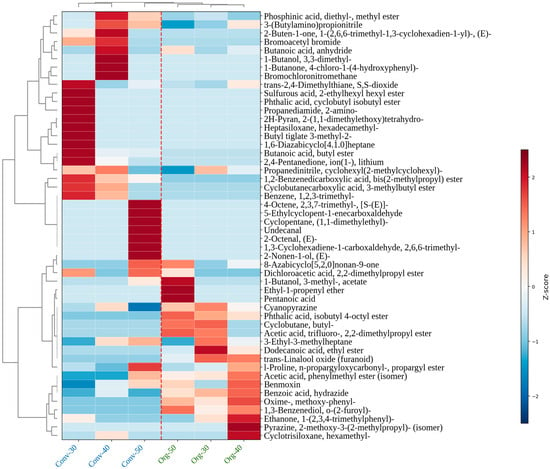
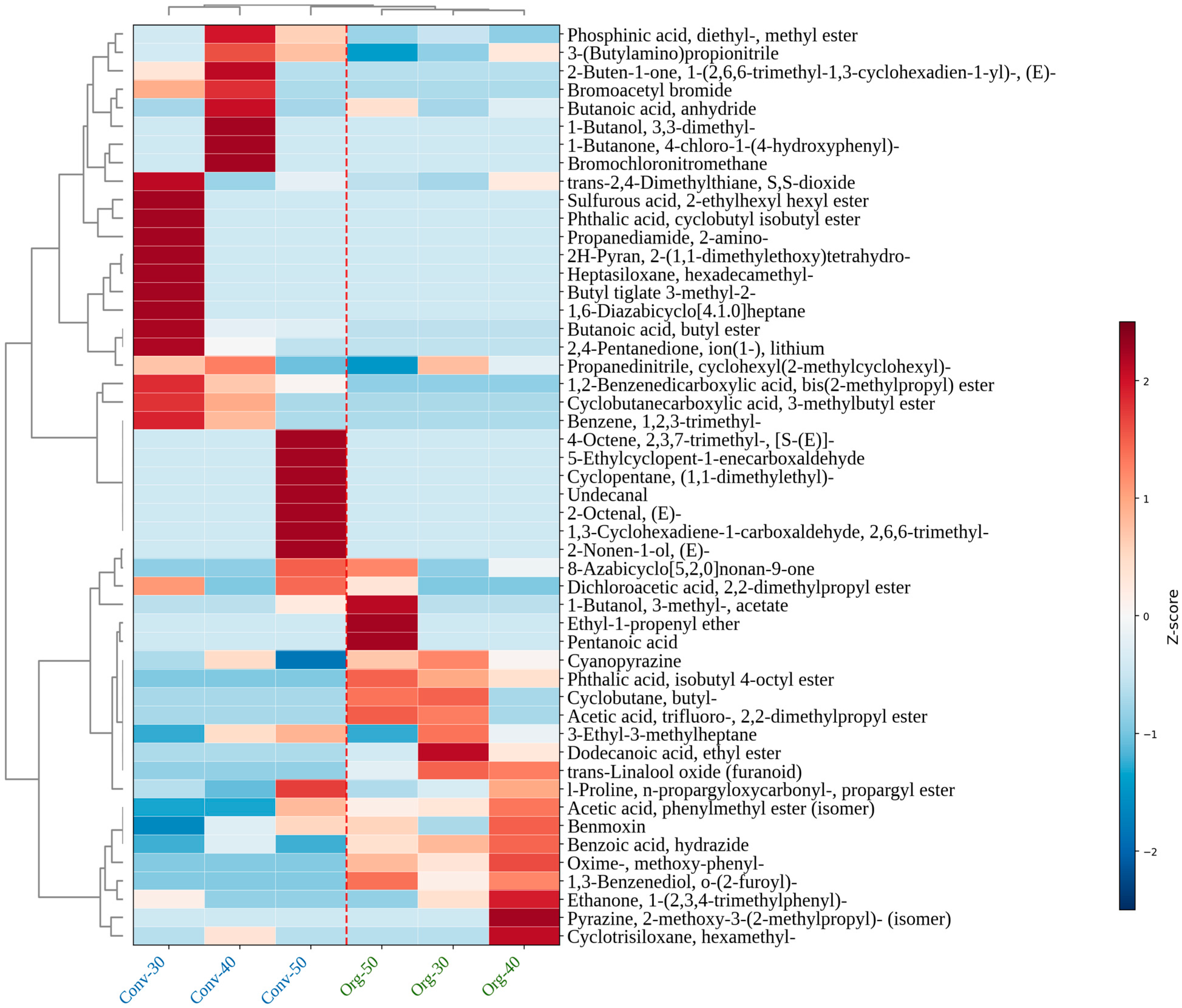
Hierarchical cluster analysis of the 50 most variable volatile compounds (Figure 4), based on Z-score normalization, Euclidean distance, and Ward’s linkage method, revealed distinct patterns among samples, indicating that both cultivation system and drying temperature influenced the volatile profiles of coffee husks.
Figure 4.
Multivariate clustering of volatile compounds in coffee husks revealing effects of production system and drying temperature. Source: author.
Hierarchical cluster analysis showed a clear separation between coffee husks from organic and conventional systems, suggesting that the production system had a strong influence on the volatile profile. This separation indicates that differences originating from cultivation and post-harvest processing may persist after drying, affecting the chemical fingerprint of the final material. Previous studies have shown that volatile compounds can discriminate coffee origin, processing conditions, and storage history [50,51], supporting the interpretation that variations in the initial matrix composition may remain detectable after thermal treatment. Similar separation patterns have been reported for cascara and coffee husk tea samples using multivariate approaches, demonstrating the potential of volatile profiles to characterize coffee-derived by-products [52]. Additionally, changes in coffee volatile compounds according to processing and storage conditions have been reported, reinforcing the importance of matrix characteristics in determining the final chemical composition [53].
Within each production system, samples dried at 30 and 40 °C showed greater similarity compared with those dried at 50 °C, suggesting that the highest drying temperature promoted more pronounced changes in the volatile profile. Drying conditions may influence both the retention and release of volatile compounds depending on the composition of the material and the intensity of thermal exposure [54]. In coffee husk materials, higher drying temperatures have been associated with reductions in aroma-related compounds and polyphenols [10]. Similar effects have also been observed in other plant matrices, where thermal treatments resulted in distinct volatile profiles identified through multivariate analysis [37,51].
The clustering pattern suggests that drying at 40 °C provided a balance between volatile compound preservation and release, maintaining a profile closer to the lower-temperature treatments while improving drying performance. This behaviour is consistent with reports for agricultural products, where intermediate temperatures may favour the retention of volatile compounds, although the optimal condition remains dependent on the characteristics of each matrix [51,54]. In coffee-derived materials, drying temperature has been shown to influence the formation, retention, and distribution of aroma-related compounds, including alcohols, aldehydes, and ketones, ultimately affecting the chemical profile of the processed material [5,10]. Therefore, the results indicate that both the production system and drying conditions should be considered when optimizing coffee husk processing for potential valorization applications.
4. Conclusions
The drying behaviour of coffee husks was influenced by both drying temperature and production system. The Modified Henderson and Pabis model provided a satisfactory description of moisture removal, showing high fitting accuracy under the evaluated conditions. Organic husks exhibited slower drying kinetics and higher moisture retention, which may be related to the preservation of the mucilage fraction after post-harvest processing.
Drying temperature also affected the final properties of the material. The results of water activity indicated differences in water availability among treatments, with 40 °C showing a favourable balance between moisture reduction and drying conditions. Volatile compound analysis and hierarchical clustering demonstrated that the production system was the main factor influencing the volatile profile, while drying temperature contributed to changes in compound distribution.
Overall, drying at 40 °C showed the most balanced performance among the evaluated conditions, combining adequate drying behaviour with greater preservation of volatile composition. These findings contribute to the optimization of coffee husk drying and support its potential use as a value-added by-product.
Author Contributions
W.d.O.A.d.S. and R.C.C.; methodology, W.d.O.A.d.S. and F.J.M.N.; validation, W.d.O.A.d.S. and F.J.M.N.; formal analysis, W.d.O.A.d.S.; investigation, W.d.O.A.d.S.; resources, R.C.C.; data curation, W.d.O.A.d.S.; writing—original draft preparation, W.d.O.A.d.S.; writing—review and editing, W.d.O.A.d.S., F.J.M.N., P.H.C.F., E.M., E.d.C.M. and R.C.C.; visualization, W.d.O.A.d.S., P.H.C.F. and E.M.; supervision, R.C.C. and E.d.C.M.; project administration, R.C.C.; funding acquisition, R.C.C. All authors have read and agreed to the published version of the manuscript.
Funding
This research was funded in part by the Coordination for the Improvement of Higher Education Personnel—Brazil (CAPES)—Finance Code 001.
Data Availability Statement
The data presented in this study are available on request from the corresponding author.
Acknowledgments
The authors thank the Federal University of Viçosa (UFV) for the infrastructure and opportunity to pursue graduate studies.
Conflicts of Interest
The authors declare no conflicts of interest.
Nomenclature
| Abbreviation | Description | |
| ANOVA | Analysis of variance | |
| Aw | Water activity | |
| CAS | Chemical Abstracts Service registry number | |
| CV | Coefficient of variation | |
| d.b. | Dry basis | |
| DF | Degrees of freedom | |
| GC-MS | Gas chromatography coupled with mass spectrometry | |
| MRE | Mean relative error | |
| MS | Mean square | |
| p-value | Statistical significance level | |
| R2 | Coefficient of determination | |
| SD | Standard deviation | |
| SDE | Standard deviation of the estimate | |
| SPME | Solid-phase microextraction | |
| SS | Sum of squares | |
| w.b. | Wet basis | |
| Roman Symbol | Description | Unit |
| a, b, c | Model coefficients | Dimensionless |
| A | Pre-exponential factor | h −1 |
| Ea | Activation energy | Jmol−1 |
| F | F-statistic | Dimensionless |
| g, h | Model coefficients (Modified Henderson and Pabis) | Dimensionless |
| hp | Planck constant (6.626 × 10⁻³⁴) | Js |
| k, k1, k2 | Drying constants | min−1 |
| kb | Boltzmann constant (1.38 × 10⁻²³) | JK−1 |
| N | Number of observed data points | Dimensionless |
| R | Universal gas constant (8.314) | Jmol−1K−1 |
| RU | Moisture ratio | Dimensionless |
| T | Drying time | Min |
| T | Temperature | K |
| X | Moisture content at time t | kg water kg−1 dry mass |
| Xe | Equilibrium moisture content | kg water kg−1 dry mass |
| Xi | Initial moisture content | kg water kg−1 dry mass |
| Yi | Experimental value | % |
| Y^i | Model-estimated value | % |
| Greek Symbol | Description | Unit |
| ΔG | Gibbs free energy | Jmol −1 |
| ΔH | Enthalpy | Jmol −1 |
| ΔS | Entropy | Jmol −1 K−1 |
References
- Nicikava, A.C.; Ferrarezi Junior, E. História e consumo do café no brasil e no mundo. Rev. Interface Tecnol. 2022, 19, 713–722. [Google Scholar] [CrossRef] [Scilit]
- Arsenoaia, V.N.; Roșca, G.R.; Cârlescu, P.; Băetu, M.; Rațu, R.; Veleșcu, I.; Țenu, I. Drying Process Modeling and Quality Assessments Regarding an Innovative Seed Dryer. Agriculture 2023, 13, 328. [Google Scholar] [CrossRef] [Scilit]
- Fernández-Cortés, Y.; Sotto-Rodríguez, K.D.; Vargas-Marín, L.A. Impactos ambientales de la producción del café, y el aprovechamiento sustentable de los residuos generados. Prod. Limpia 2020, 15, 93–110. [Google Scholar] [CrossRef] [Scilit]
- Campos, R.C.; Pinto, V.R.A.; Melo, L.F.; Rocha, S.J.S.S.D.; Coimbra, J.S. New sustainable perspectives for “coffee wastewater” and other by-products: A critical review. Future Foods 2021, 4, 100058. [Google Scholar] [CrossRef] [Scilit]
- Silva, W.O.A.; Amorim, G.T.S.; Melo, E.C.; Campos, R.C. Coffee husks as a raw material for tea production: Potential and challenges. J. Food Meas. Charact. 2026, 20, 9855–9869. [Google Scholar] [CrossRef] [Scilit]
- Hoseini, M.; Cocco, S.; Casucci, C.; Cardelli, V.; Corti, G. Coffee by-products derived resources. A review. Biomass Bioenergy 2021, 148, 106009. [Google Scholar] [CrossRef] [Scilit]
- Gebreeyessus, G.D. Towards the sustainable and circular bioeconomy: Insights on spent coffee grounds valorization. Sci. Total Environ. 2022, 833, 155113. [Google Scholar] [CrossRef] [Scilit] [PubMed]
- De Paula, J.; Farah, A. Phenolic compounds in coffee and by-products. In Coffee Science: Biotechnological Advances, Economics, and Health Benefits, 1st ed.; Ramakrishna, A., Parvatam, G., Jeszka-Skowron, M., Eds.; CRC Press: Boca Raton, FL, USA; pp. 119–134.
- Marques, J.P.; Santos PCd Odos Silva ABd Rezende, T.T.; Neves, R.C.; Matos, N.M.S.d. Processamento de pós-colheita e atributos químicos e sensoriais de cafés de três locais de Minas Gerais. Cad. Pedagógico 2024, 21, e6174. [Google Scholar] [CrossRef] [Scilit]
- Hu, S.; Gil-Ramírez, A.; Martín-Turueba, M.; Benítez, V.; Aguilera, Y.; Martín-Cabrejas, M.A. Valorization of coffee pulp as bioactive food ingredient by sustainable extraction methodologies. Curr. Res. Food Sci. 2023, 6, 100475. [Google Scholar] [CrossRef] [Scilit] [PubMed]
- Jiménez, M.J.; Fernández Valdez, Y.C.; Jacobi, J.; Yeretzian, C. Coffee Cherry Flavour; Publikationen Life Sciences und Facility Management: Wädenswil, Switzerland, 2021; Available online: https://digitalcollection.zhAw.ch/handle/11475/21771 (accessed on 10 August 2026).
- Arpi, N.; Muzaifa, M.; Sulaiman, M.I.; Andini, R.; Kesuma, S.I. Chemical Characteristics of Cascara, Coffee Cherry Tea, Made of Various Coffee Pulp Treatments. In Proceedings of the 7th International Conference on Sustainable Agriculture, Food and Energy, Phuket, Thailand, 18–21 October 2019; IOP Publishing: Bristol, UK, 2021; Volume 709, p. 012030. [Google Scholar] [CrossRef] [Scilit]
- Cabral Filha, M.C.S.; Canuto, M.F.C.S.; Sousa, J.H.S.; Silva, D.R.S.; Farias, F.P.M. Secagem em camada de espuma da polpa da goiaba (Psidium guajava L.). Revista Semiárido De Visu 2021, 12, 178–193. [Google Scholar] [CrossRef] [Scilit]
- Esmero, J.A.D.; Figueirêdo, R.M.F.d.; Queiroz, A.J.d.M.; Paiva, Y.F.; Moura, H.V.; Santos, F.S.d.; Silva, L.P.F.R.d.; Matos, J.D.P.d.; Moraes, M.S.d.; Gondim, C.d.M.; et al. Drying kinetics and thermodynamic properties of trapiá pulp. Rev. Bras. Eng. Agríc. Ambient. 2025, 29, e279382. [Google Scholar] [CrossRef] [Scilit]
- Lopes, M.A.; Fernandes, J.A.; Perazzini, H.; Borel, L.D.M.S.; Lima-Corrêa, R.A.B. Foam mat drying of coffee aqueous extract: Foam process optimization, drying kinetics, energy consumption, and energy efficiency analysis. Chem. Eng. Process. Process Intensif. 2024, 201, 109795. [Google Scholar] [CrossRef] [Scilit]
- Jordan, R.A.; Sanjinez-Argandoña, E.J.; Ferreira, O.M.; Quequeto, W.D.; Siqueira, V.C.; Mendoza, V.S.; Flozino, G.K.M.; Sanches, I.S.; Sanches, É.S.; Antunes, B.M. Efeito de sistemas e condições de secagem sobre o consumo específico de energia e os compostos bioativos da taioba (Xanthosoma sagittifolium Schott). Res. Soc. Dev. 2021, 10, e21610716512. [Google Scholar] [CrossRef] [Scilit]
- Şavşatli, Y. Identification of volatile compounds in salep (Serapias vomeracea) tubers and effects of harvest time and drying method on composition variation. Ciência Agrotecnolog. 2023, 47, e002223. [Google Scholar] [CrossRef] [Scilit]
- Souza, S.L.; Briceno, J.C.C.; Cabral, D.V.; Silva Filho, R.B.; Machado, S.S.; Lima, R.R.D.; Oliveira, T.F.; Silva, F.A. Aproveitamento sustentável de frutos de pequi, na obtenção de ingredientes desidratados. In Aspectos Plurais em Alimentação e Nutrição; Editora Cientifica: Guarujá, Brazil, 2024. [Google Scholar] [CrossRef] [Scilit]
- Sales, P.F.; Lima, L.M.Z. Análise comparativa do perfil de compostos voláteis pela técnica de HS-SPME em amostras comerciais de chá verde e avaliação do efeito da infusão e da adição de sal. ForScience 2021, 9, e00769. [Google Scholar] [CrossRef] [Scilit]
- Machado, D.B.; Oliveira, R.A.D. Functional and technological properties of coffee mucilage (Coffea arabica) and its application in edible films. Química Nova 2023, 46, 778–784. [Google Scholar] [CrossRef] [Scilit]
- Mota, D.A.; Silva, A.P.R.e; Balieiro, A.L.; Krause, L.C.; Soares, C.M.F. Caracterização e valorização de resíduos do processamento do café visando aplicação industrial. In Anais do IV Congresso Internacional das Ciências Agrárias—CIAGRO, Online; Instituto IDV: Recife, Brazil, 2023. [Google Scholar]
- Silva, L.C.d.M.; Souza, D.G.; Mesquita, A.A.; Medeiros, E.C.N.; Romani, V.P.; Caliari, M.; Plácido, G.R.; Resende, O.; Oliveira, D.E.C.d; Silva, M.A.P.d. Drying kinetics and thermodynamic properties of guava peel. Ciênc. Rural. 2024, 54, e20230318. [Google Scholar] [CrossRef] [Scilit]
- de Macedo Albuquerque Junior, N.; da Silva, W.P.; Lima, D.A.; Silva, R.d.S.; Moura, H.V.; Silva, A.P.d.F.; Carvalho, R.d.O.; Andrade, F.S.; Amadeu, L.T.S. Thermodynamic, bioactive, and antioxidant potential of green acerola residue as influenced by convective drying. J. Therm. Anal. Calorim. 2025, 150, 5213–5226. [Google Scholar] [CrossRef] [Scilit]
- Cabral, F.S.; Ferreira dos Santos, S.G.; Cruz, D.R.C.; Almeida, V.G.; Rodovalho, R.S.; de Melo, M.F. Cinética de secagem de raspas de abóbora. Científica 2021, 49, 1–8. [Google Scholar] [CrossRef] [Scilit]
- Cavalcante, A.D.M.; Almeida, R.D.; Melo, A.D.; Morais, B.D.; Silva, I.D.; Ribeiro, N.L.; Silva, O.D. Modelos de predição da cinética de secagem dos grãos da algaroba/Models of prediction of drying kinetics of algaroba grains. Braz. J. Dev. 2020, 6, 11192–11209. [Google Scholar] [CrossRef] [Scilit]
- Sousa, A.P.M.d.; Campos, A.R.N.; Gomes, J.P.; Costa, J.D.; Macedo, A.D.B.d.; Santana, R.A.C.d. Drying kinetics of jackfruit residues (Artocarpus heterophyllus Lam.). Res. Soc. Dev. 2021, 10, e31510212610. [Google Scholar] [CrossRef] [Scilit]
- Maciel, K.S.; Teixeira, L.J.Q.; Lucia, S.M.D.; Saraiva, S.H. Optimization of foam mat drying for instant coffee processing and its effect on drying kinetics and quality characteristics. Dry. Technol. 2022, 40, 1866–1880. [Google Scholar] [CrossRef] [Scilit]
- Santos, S.G.F.d.; Paula, D.F.d.; Souza, A.M.B.d.; Silva, Í.J.; Coelho APd, F.; Silva, L.J.d.; Dias, D.C.F.d.S.; Araujo, E.F. Drying kinetics and physiological quality of Solanum aethiopicum seeds. Rev. Bras. Eng. Agríc. Ambient. 2024, 28, e282010. [Google Scholar] [CrossRef] [Scilit]
- Souza, T.T.C.; Monteiro, E.R.; Ribeiro, C.T.; Souza, D.S.; Santos, T.T. Modelling and thermodynamic properties of the drying of epicarp, mesocarp and endocarp of tucumã (Astrocaryum aculeatum). Braz. J. Food Technol. 2021, 24, e2020032. [Google Scholar] [CrossRef] [Scilit]
- BRASIL. Regras para Análise de Sementes; MAPA—Ministério da Agricultura, Pecuária e Abastecimento. Secretaria de Defesa Agropecuária: Brasília, Brazil, 2009; p. 399. [Google Scholar]
- Felipe, A.T.d.M.; Carvalho, A.C.d.A.; Matsui, K.N. Aproveitamento da Película Prateada de Café: Extração Alternativa de Compostos Bioativos e Potencial Antioxidante para uma Economia Circular; Anais New Science Publishers|Editora Impacto: São José dos Pinhais, Brazil, 2024; Volume 1. [Google Scholar] [CrossRef] [Scilit]
- Da Silva, A.R.A. Caracterização físico-química do fruto (Buchenavia tomentosa Eichler) em bioma do Cerrado Matogrossense. In Ciência e Tecnologia de Alimentos: Pesquisa e Práticas Contemporâneas; Editora Científica Digital: São Paulo, Brazil, 2021; pp. 180–191. [Google Scholar]
- Hautrive, T.P. Ciência e Tecnologia de Alimentos; Editora Insular: Florianópolis, Brazil, 2021. [Google Scholar]
- Mahmoud, M.A.; Kılıç-Büyükkurt, Ö.; Fotouh, M.M.A.; Selli, S. Aroma active compounds of honey: Analysis with GC-MS, GC-O, and molecular sensory techniques. J. Food Compos. Anal. 2024, 134, 106545. [Google Scholar] [CrossRef] [Scilit]
- Min, C.; Mai, B.; Lu, J.; Li, Y.; Liu, Y.; Cheng, L. Characterization of the volatile organic compounds produced from green coffee in different years by gas chromatography ion mobility spectrometry. RSC Adv. 2022, 12, 15534–15542. [Google Scholar] [CrossRef] [Scilit] [PubMed]
- Waskom, M.L. Seaborn: Statistical data visualization. J. Open Source Softw. 2021, 6, 3021. [Google Scholar] [CrossRef] [Scilit]
- Zeymer, J.S.; Corrêa, P.C.; Oliveira, G.H.H.D.; Araujo, M.E.V.D.; Guzzo, F.; Baptestini, F.M. Moisture sorption isotherms and hysteresis of soybean grains. Acta Scientiarum. Agron. 2023, 45, e56615. [Google Scholar] [CrossRef] [Scilit]
- Jordan, R.A.; Siqueira, V.C.; Cavalcanti-Mata, M.E.R.M.; Hoscher, R.H.; Mabasso, G.A.; Motomiya, A.V.d.A.; Oliveira, F.C.d.; Martins, E.A.S.; Santos, R.C.; Quequeto, W.D. Drying kinetics of natural and parchment coffee at low temperature and relative humidity using a heat pump. Res. Soc. Dev. 2020, 9, e421985528. [Google Scholar] [CrossRef] [Scilit]
- Corrêa, P.C.; Oliveira, G.H.H.; Botelho, F.M.; Goneli, A.L.D.; Carvalho, F.M. Modelagem matemática e determinação das propriedades termodinâmicas do café (Coffea arabica L.) durante o processo de secagem. Rev. Ceres 2010, 57, 595–601. [Google Scholar] [CrossRef] [Scilit]
- Donato, M.V.L.C.; Silva, S.R.d.S.; Tavares, M.É.d.S.; Silva, E.R.d.; Silva, S.P.d. Caracterização físico-química de cascas de café: Um estudo comparativo entre o processamento via seca e fermentado. Int. J. Agrar. Sci. 2024, 3, e510. [Google Scholar] [CrossRef] [Scilit]
- Antoniolli, L.R.; Alves Filho, E.G.; Rodrigues, T.H.S.; Garuti, D.S.; Canuto, K.M. Volatile profile and potential predictors of astringency loss in fresh, whole ‘Rama Forte’persimmon fruit. Food Chem. 2025, 464, 141797. [Google Scholar] [CrossRef] [Scilit] [PubMed]
- Zhang, M.; Chen, H.; Mujumdar, A.S.; Tang, J.; Miao, S.; Wang, Y. Recent developments in high-quality drying of vegetables, fruits, and aquatic products. Crit. Rev. Food Sci. Nutr. 2017, 57, 1239–1255. [Google Scholar] [CrossRef] [Scilit] [PubMed]
- Pina, P.C.R.; Morais, D.d.P.; Ribeiro, T.d.L.; Oliveira, A.R.; Gomes Filho, R.M.; Devilla, I.A. Modelagem matemática e cinética de secagem de chips de abóbora (Curcubita máxima Duch). Cad. Pedagógico 2024, 21, e10636. [Google Scholar] [CrossRef] [Scilit]
- de Sousa, J.H.S.; Canuto, M.F.C.S.; Macêdo, F.P. Cinética de secagem aplicada a casca do umbu (Spondias tuberosa). Rev. Biol. Ciências Terra 2023, 23, 24–32. [Google Scholar]
- Zhou, S.; Wang, X.; Yang, Y.; Wang, R.; Liao, J.; Zhang, P.; Liu, L.; Zhao, Y.; Deng, Y. Distribution and source identification of polycyclic aromatic hydrocarbons (PAHs) with PCA-MLR and PMF methods in the topsoil of Chengdu at SW, China. Sci. Total Environ. 2024, 908, 168263. [Google Scholar] [CrossRef] [Scilit] [PubMed]
- Rodrigues, L.C.; Matuda, K.A.; Guinoza, T. Estudo do processo de secagem do resíduo de café em leito fluidizado. In Revista Engenharia Tecnologia; Instituto Mauá de Tecnologia: São Paulo, Brazil, 2023; Available online: https://maua.br/files/rodrigues-matuda-1734112991.pdf (accessed on 10 August 2026).
- Calín-Sánchez, Á.; Lipan, L.; Cano-Lamadrid, M.; Kharaghani, A.; Masztalerz, K.; Carbonell-Barrachina, Á.; Figiel, A. Comparison of traditional and novel drying techniques and its effect on quality of fruits, vegetables and aromatic herbs. Foods 2020, 9, 1261. [Google Scholar] [CrossRef] [Scilit] [PubMed]
- Elgamal, R.; Song, C.-Z.; Rayan, A.M.; Liu, C.; Al-Rejaie, S.; Elmasry, G. Thermal degradation of bioactive compounds during drying process of horticultural and agronomic products: A comprehensive overview. Agronomy 2023, 13, 1580. [Google Scholar] [CrossRef] [Scilit]
- Bordiga, M.; Disca, V.; Manfredi, M.; Barberis, E.; Carrà, F.; Navarini, L.; Lonzarich, V.; Arlorio, M. Fingerprinting of green Arabica coffee volatile organic compounds (VOCs): HS-GC-IMS versus GC × GC-MS. Int. J. Food Sci. 2025, 2025, 1302823. [Google Scholar] [CrossRef] [Scilit] [PubMed]
- Taiti, C.; Vivaldo, G.; Mancuso, S.; Comparini, D.; Pandolfi, C. Volatile organic compounds (VOCs) fingerprinting combined with complex network analysis as a forecasting tool for tracing the origin and genetic lineage of Arabica specialty coffees. Sci. Rep. 2025, 15, 13709. [Google Scholar] [CrossRef] [Scilit] [PubMed]
- Huang, Y.; Sun, Y.; Mehmood, A.; Lu, T.; Chen, X. Unraveling the temporal changes of Maillard reaction products and aroma profile in coffee leaves during hot-air drying. J. Food Compos. Anal. 2024, 126, 106055. [Google Scholar] [CrossRef] [Scilit]
- dos Santos, É.M.; de Macedo, L.M.; Tundisi, L.L.; Ataide, J.A.; Camargo, G.A.; Alves, R.C.; Oliveira, M.B.P.P.; Mazzola, P.G. Coffee by-products in topical formulations: A review. Trends Food Sci. Technol. 2021, 111, 280–291. [Google Scholar] [CrossRef] [Scilit]
- Wang, J.; Wang, H.; Xiao, H.; Fang, X.-M.; Zhang, W.; Ma, C. Effects of drying temperature on the drying characteristics and volatile profiles of Citrus reticulata Blanco peels under two stages of maturity. Dry. Technol. 2021, 40, 2456–2469. [Google Scholar] [CrossRef] [Scilit]
- Tampubolon, S.D.R.; Seleleubajak, M.B.; Nurhayati, N. Effect of drying method and temperature on the quality of cascara tea. Agro Bali Agric. J. 2024, 7, 435–448. [Google Scholar] [CrossRef] [Scilit]

Disclaimer/Publisher’s Note: The statements, opinions and data contained in all publications are solely those of the individual author(s) and contributor(s) and not of MDPI and/or the editor(s). MDPI and/or the editor(s) disclaim responsibility for any injury to people or property resulting from any ideas, methods, instructions or products referred to in the content. |
© 2026 by the authors. Licensee MDPI, Basel, Switzerland. This article is an open access article distributed under the terms and conditions of the Creative Commons Attribution (CC BY) license.