


Abstract
CO2-enhanced coalbed methane recovery and storage (CO2-ECBM) is a promising approach for improving methane recovery and increasing CO2 storage in low-permeability coal seams. However, limited injectivity and insufficient criteria for injection parameter optimization remain major constraints. Taking the No. 11-2 coal seam of the Zhangji Coal Mine in the Huainan mining area as the study object, this study established a thermo–hydro–mechanical coupled model that considers CO2/CH4 competitive adsorption, matrix diffusion, fracture seepage, gas–water two-phase flow, coal deformation, and porosity–permeability evolution. A 10-year numerical simulation was conducted to evaluate the effects of initial porosity, initial permeability, elastic modulus, CO2 injection pressure, and injection scheme on CO2-ECBM performance. The comprehensive sensitivity results show that initial porosity, CO2 injection pressure, and initial permeability are the dominant controlling factors, whereas elastic modulus has a relatively weak influence. Initial porosity mainly determines reservoir storage space and CO2 sequestration potential; permeability controls pressure propagation and gas migration; and injection pressure directly affects CH4 displacement intensity, CO2 storage capacity, and reservoir safety margin. Multi-objective evaluation indicates that the injection pressure should be controlled within 8.0–9.0 MPa, with 8.0–8.5 MPa recommended for long-term stable operation. When the engineering objective prioritizes CO2 storage or CH4 recovery and sufficient safety margin is confirmed, the injection pressure may be increased to approximately 9.0 MPa. Continuous constant-pressure injection favors cumulative CH4 production and CO2 storage, whereas stepwise pressurization reduces early pressure disturbance and improves later-stage injectivity. Therefore, an injection strategy combining early-stage stepwise pressurization with middle- and late-stage constant-pressure injection is recommended. These results provide a reference for injection parameter optimization in similar low-permeability coal reservoirs.
1. Introduction
Under the background of carbon-emission reduction and low-carbon coal utilization, CO2-enhanced coalbed methane recovery and storage technology (CO2-ECBM) has received increasing attention as a pathway that links geological CO2 storage with coalbed methane recovery [1,2,3]. Compared with storage in deep saline aquifers and depleted oil and gas reservoirs [4,5], CO2 storage in coal seams is unique in that it involves not only CO2 injection and retention but also CH4 desorption, diffusion, seepage, and production [6,7]. As a result, coal seams exhibit more complex reservoir responses and require more intensive engineering regulation. In particular, typical coal reservoirs in China, represented by those in the Huainan mining area, are commonly characterized by “three high, three soft, and one low” [8,9]. These characteristics significantly restrict CO2 injectivity and the enhancement of coalbed methane production in low-permeability coal seams, making them a major bottleneck for the large-scale application of CO2-ECBM [10]. Accordingly, optimizing CO2 injection parameters to overcome the engineering constraints of low-permeability coal reservoirs and thereby improve CO2-ECBM performance has become a key research focus.
Previous studies on injection parameter optimization for CO2-ECBM have extensively investigated injection pressure, reservoir properties, gas composition, and injection schemes. For injection pressure, Yin et al. [11] examined the effects of different CO2 injection pressures on CH4 production and CO2 breakthrough through coal sample displacement experiments and a dual-porosity numerical model. Their results indicated that higher injection pressure could enhance the early-stage CH4 flow rate and production rate, but may also lead to earlier CO2 breakthrough, thereby affecting cumulative gas production at later stages. Ma et al. [12] developed a thermal–hydrological–mechanical coupled model for CO2-ECBM and validated its reliability by comparing TOUGH-FLAC and COMSOL 6.2 simulations, demonstrating that coal deformation, permeability evolution, and injection pressure jointly control the engineering response of CO2-ECBM. Hou et al. [13] further constructed a THM coupled model using COMSOL Multiphysics to analyze the effects of CO2 injection temperature and pressure on CO2-ECBM, showing that variations in injection pressure significantly affect the CH4 displacement process and CO2 sequestration performance. Field pilot tests in the Allison Unit and Fruitland Coal Fairway of the San Juan Basin, USA, also showed that CO2 injection can enhance coalbed methane production, although injectivity is often constrained by coal matrix swelling, pressure limitations, and permeability reduction [14]. Records from NETL further indicated that the actual amount of injected CO2 was lower than expected and that production enhancement was limited [15], suggesting that simply increasing injection pressure at the field scale cannot guarantee satisfactory engineering performance.
Regarding injection schemes and multi-parameter optimization, recent studies have begun to focus on unconventional injection strategies and the synergistic effects of multiple factors. Bai et al. [16] proposed a stepwise CO2 injection pressure method and compared it with constant-pressure CO2 injection, showing that stepwise pressure-increasing injection could improve CH4 recovery to some extent and reduce the amount of CO2 injected per unit coal mass. Fan et al. [17] optimized CO2-ECBM from the perspectives of injection timing and gas mixture proportion, indicating that both CO2 geological sequestration and CH4 recovery are controlled by injection timing and injected gas composition. In addition, reservoir permeability and its heterogeneity have also been recognized as important factors affecting CO2-ECBM performance. Kumar et al. [18] demonstrated that initial permeability heterogeneity influences CO2 migration, CH4 production, and permeability evolution, while Li et al. [19] revealed that coal adsorption swelling, effective stress variation, and fracture structure adjustment during CO2 injection jointly lead to dynamic permeability changes. Furthermore, Fan et al. [20] established a THM model for ECBM using CO2/N2 mixtures and optimized the injected gas composition and injection scheme, suggesting that an appropriate CO2/N2 ratio could help mitigate coal matrix swelling and injectivity decline caused by pure CO2 injection. Sayyafzadeh et al. [21] employed a parallel genetic algorithm to optimize gas mixture injection schemes, providing a methodological reference for intelligent optimization of ECBM parameters.
Overall, existing studies have identified the key controlling factors of CO2-ECBM from the perspectives of injection pressure, gas composition, injection timing, permeability evolution, and injection schemes. Nevertheless, several limitations remain. On the one hand, many studies have focused mainly on a single parameter or a single mechanism, while systematic comparisons of the relative importance of geological and engineering parameters remain insufficient. On the other hand, most existing optimization studies have primarily used cumulative CH4 production or cumulative CO2 sequestration as the main evaluation indicators, with limited consideration of engineering efficiency, stable injection capacity, and reservoir safety risk. Li et al. [22] pointed out that low injectivity and CO2 injection-induced injectivity decline are major technical challenges facing the engineering application of CO2-ECBM. This further indicates the necessity of establishing a comprehensive evaluation framework that integrates geological adaptability, engineering feasibility, and safety controllability.
Based on the above considerations, this study takes the No. 11-2 coal seam of the Zhangji Coal Mine in the Huainan mining area as the research object and establishes a coupled numerical model for CO2-ECBM. The effects of initial porosity, initial permeability, elastic modulus, CO2 injection pressure, and injection scheme on CH4 production, CO2 storage, injection capacity, and reservoir safety are systematically investigated. Different from studies that mainly evaluate CO2-ECBM performance using single indicators, such as cumulative CH4 production or cumulative CO2 storage, this study further introduces stable injection capacity and reservoir safety risk into the engineering evaluation framework. On this basis, the relative importance of geological and engineering parameters is identified, and the injection pressure range and injection strategy suitable for the target low-permeability coal seam are proposed. The results can provide a reference for reservoir screening, injection parameter selection, and injection scheme optimization in similar low-permeability coal reservoirs.
2. Mathematical Model of Multiphysical Field Coupling for CO2-ECBM
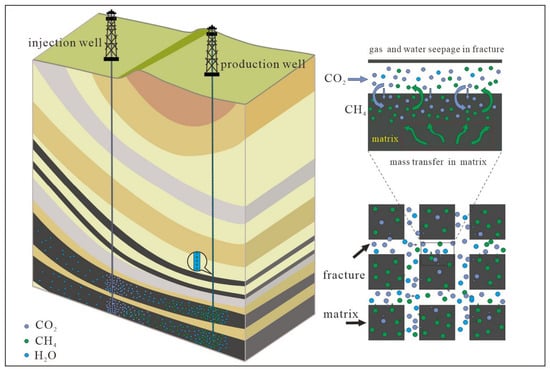
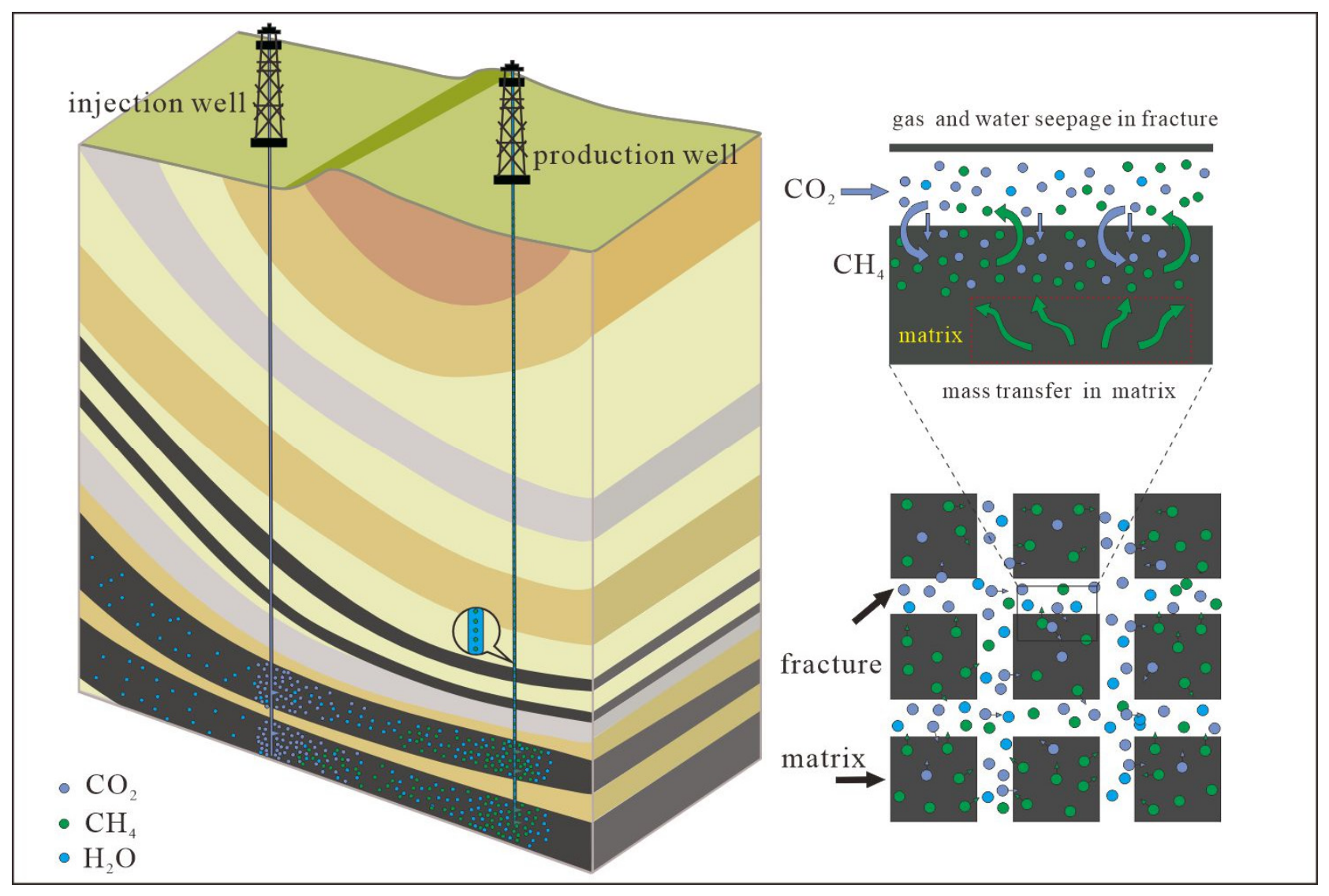
Based on the gas–water migration, gas competitive adsorption, coal structure evolution, and energy transfer in the reservoir, the following assumptions are made [23,24]: (1) the coal reservoir is represented by a single-permeability, dual-porosity elastic medium comprising matrix and fracture systems, and both media are assumed to be isotropic and homogeneous; (2) CH4/CO2 competitive adsorption–desorption in the matrix is described by the extended Langmuir model, and component diffusion from matrix to fractures follows Fick’s first law; (3) gas and water mainly flow in fractures and their flow satisfies Darcy’s law; and (4) coal deformation follows the small deformation assumption, and variations in gas pressure and adsorption–desorption cause volumetric strain changes in the reservoir. Figure 1 shows the gas–water migration process during CO2-ECBM.
Figure 1.
Schematic illustration of the gas–water migration process during CO2-ECBM [23].
2.1. Seepage Field Equations
(1) Gas transport equation in the matrix
During CO2-ECBM, CH4 adsorbed in the coal matrix is released and diffuses toward fractures driven by the concentration difference, while injected CO2 moves from fractures into matrix pores and becomes adsorbed on matrix surfaces. The matrix component-balance equation includes gas storage, adsorption/desorption variation, and matrix–fracture mass exchange [23,24,25]:
where the subscript i identifies the gas species, in which i = 1 corresponds to CH4 and i = 2 corresponds to CO2. Mgi denotes the molar mass of species i (g/mol); R is the universal gas constant (J/(mol·K)); and T is the gas temperature (K). The matrix porosity is represented by φm. ρi and ρs refer to the density of gas component i and the coal skeleton, respectively (kg/m3), while ρsi is the density of component i under standard conditions (kg/m3). VLi and PLi are the Langmuir volume and Langmuir pressure constants of component i, respectively, with units of m3/t and MPa. d1 and d2 denote the pressure-related and temperature-related coefficients, respectively. Pmi is the partial pressure of component i in the coal matrix, and Pfi is the corresponding gas pressure in the fracture system. Pm represents the total gas pressure in the matrix, defined as the sum of all gas component partial pressures. Tref is the reference temperature used for adsorption measurement (K). Di is the diffusion coefficient of gas species i (m2/s), and n denotes the cleat spacing (m).
(2) Fluid transport equations in fractures
In fractures, gas and water coexist and migrate as a two-phase gas–water system. Desorbed CH4 from the matrix acts as a source term for fracture CH4 transport, whereas CO2 transferred from fractures into the matrix provides a sink term associated with adsorption. Accordingly, the fracture mass-balance equations for gas and water are expressed as [25,26,27]:
where Sg and Sw denote the gas saturation and water saturation, respectively, with Sg + Sw = 1. φf represents the fracture porosity. ρfi and ρw are the densities of the gas component i and water in the fracture system, respectively (kg/m3). qgi and qw denote the flow velocities of the gas component i and water, respectively (m/s). ρdgi is the density of the gas component i dissolved in water (kg/m3), and Hgi is Henry’s law coefficient of component i; in the present model, only CO2 dissolution is considered. Qgi and Qw represent the source–sink terms of the gas component i and water, respectively. Gases and water are coupled through capillary pressure in fracture, and the change in relative permeability is determined based on saturation [25]:
where Pc denotes the capillary pressure (MPa) and Pe represents the entry capillary pressure (MPa). Sgr and Swr correspond to the residual gas saturation and irreducible water saturation, respectively. krg and krw are the relative permeabilities of the gas phase and water phase, respectively.
2.2. Stress Field Equation
Coal reservoir deformation during the CO2-ECBM process is jointly controlled by effective stress, pore-fluid pressure, gas adsorption/desorption, and temperature. Based on the elastic theory of porous media, the governing equation for the stress field of the coal reservoir can be expressed as follows [26,27,28]:
where i and j denote the x-, y-, and z-directions in the three-dimensional coordinate system. u represents the displacement component (m), and F denotes the body-force term. G and D are the shear modulus and effective elastic modulus, respectively (MPa), while ν is Poisson’s ratio. Kn represents the normal stiffness of the fracture (GPa/m), and E is the elastic modulus (MPa). K and Ks denote the bulk modulus and skeletal bulk modulus, respectively (MPa), whereas Es is the skeletal elastic modulus (MPa). αm and αf are the Biot effective stress coefficients for the coal matrix and fracture system, respectively. Pf represents the gas–water mixture pressure within the fracture (MPa), αT is the thermal expansion coefficient (K−1), and εs denotes the volumetric strain caused by matrix swelling or shrinkage induced by gas adsorption and desorption.
2.3. Temperature Field Equation
During CO2-ECBM, changes in reservoir energy are mainly governed by adsorption/desorption heat, elastic deformation of the coal rock, heat conduction, convective heat transfer, and gas dissolution. According to the principle of energy conservation, the governing equation for the temperature field can be written as follows [26,27,28]:
where (ρCP)eff denotes the effective volumetric heat capacity of the coal reservoir containing gas and water (J/(m3·K)). ηeff represents the effective convective heat-transfer coefficient (J/(m2·s)), and εv is the volumetric strain of coal. λeff denotes the effective thermal conductivity of the reservoir (W/(m·K)). qsti is the heat released or absorbed during adsorption of component i (J/mol), whereas egi represents the heat associated with dissolution of component i in water (J/mol). (ρCP)eff, ηeff, and λeff can be written as [29]:
where Cs, Cgi, and Cw denote the specific heat capacities of coal, the gas component i, and water, respectively (J/(kg·K)). λs, λmgm, λfgm, and λfw represent the thermal conductivity coefficients of coal, mixed gas in the matrix, mixed gas in the fracture network, and water, respectively (W/(m·K)).
2.4. Porosity and Permeability Equations
Matrix and fracture porosities are calculated using the following expressions [23,26]:
Based on the cubic relationship between porosity and permeability in coal fractures, the matrix and fracture permeabilities are updated as [23,26]:
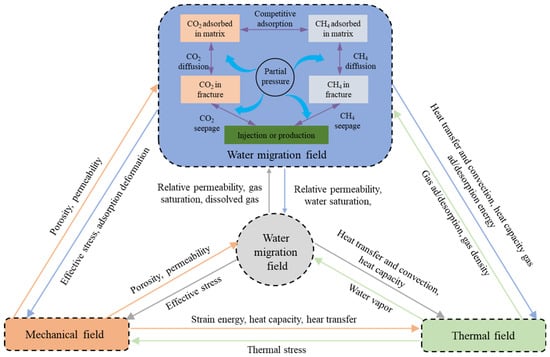
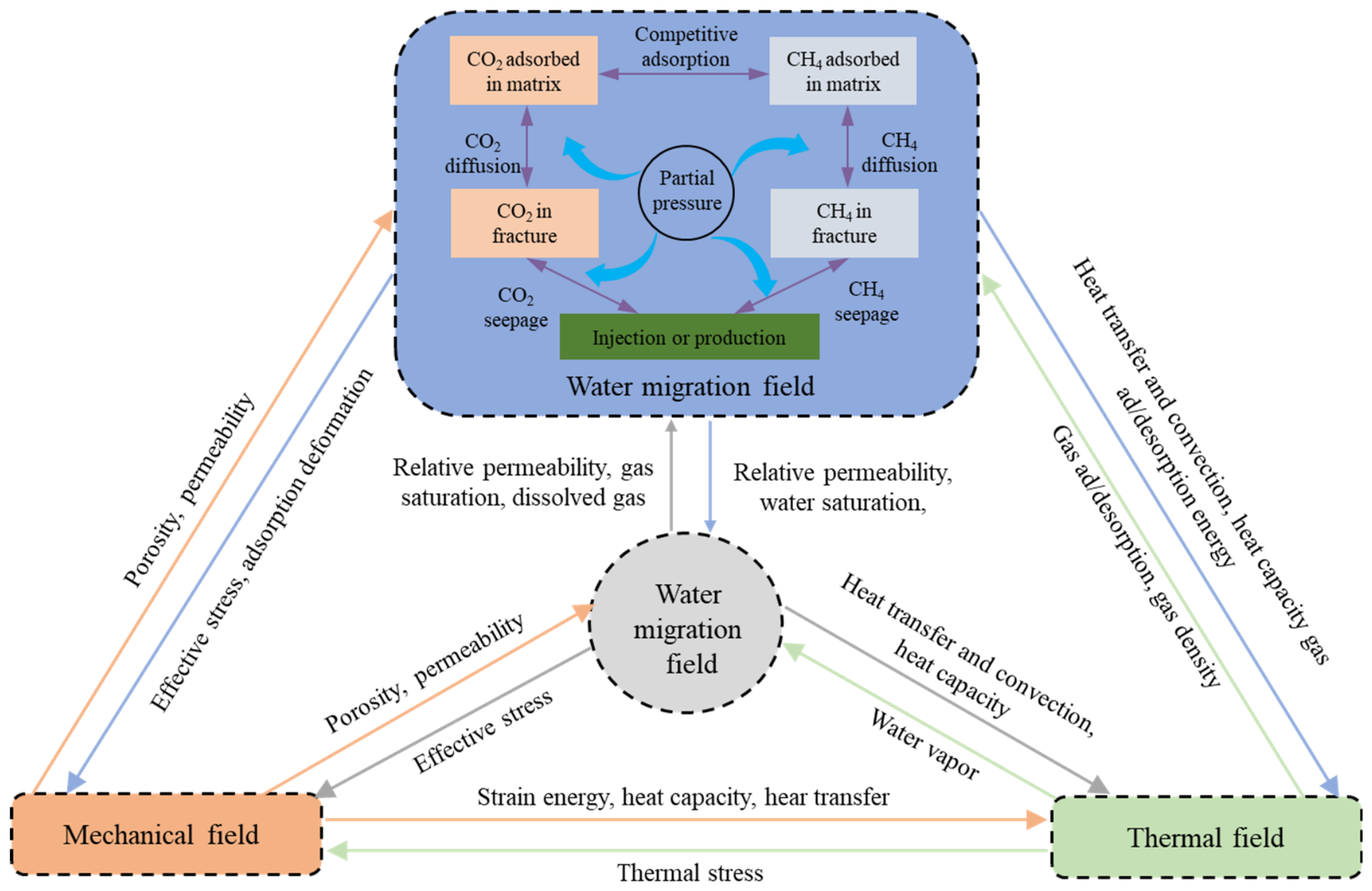
In summary, Equations (1)–(8) form the thermo–hydro–mechanical (THM) coupled mathematical model used for CO2-ECBM simulation in coal seams. The interactions among the physical fields are summarized in Figure 2.
Figure 2.
Schematic diagram of the thermo–hydro–mechanical (THM) coupling relationships in CO2-ECBM multiphysical fields.
2.5. Model Validation
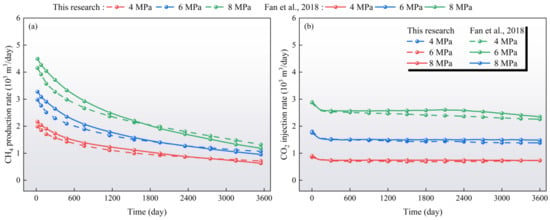
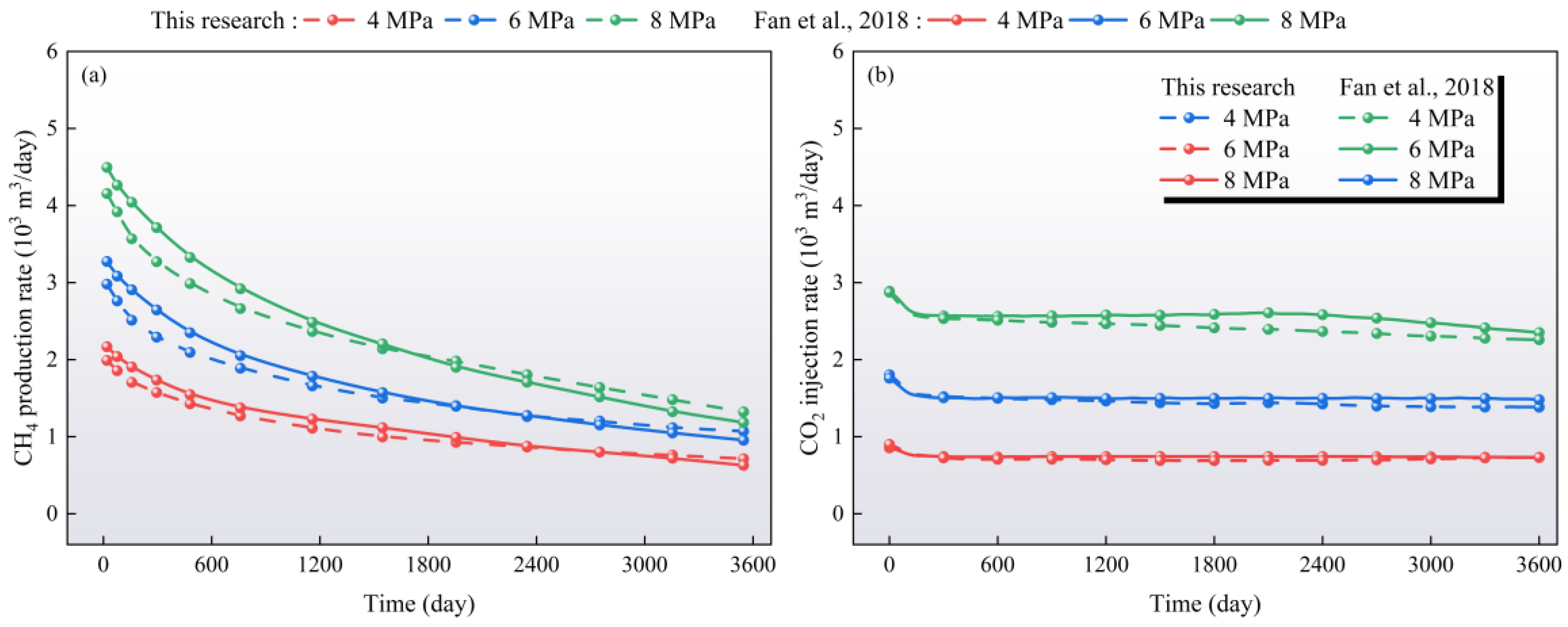
Model validation was conducted by reproducing the simulation settings reported in Ref. [30] using the governing equations of Equations (1)–(8). It should be noted that the purpose of this comparison was to perform a benchmark validation of the numerical implementation and reliability of the governing equations rather than to directly validate the geological and engineering conditions of the Zhangji Coal Mine. Therefore, the simulation parameters, operational scheme, boundary conditions, and simulation period in the validation case were kept consistent with those reported in Ref. [30]. CH4 production rate and CO2 injection rate under different injection pressures were selected as validation indicators, and the simulation period was 3650 days.
As shown in Figure 3, the simulation results obtained in this study are generally consistent with those reported by Fan et al. [30]. To further quantify the validation accuracy, representative data points were extracted from the published curves in Ref. [30], and the relative errors between the present simulation results and the reference results were calculated. The mean relative error of the CH4 production rate is approximately 6–8%, while that of the CO2 injection rate is approximately 3–5%. In addition, the simulated curves exhibit consistent temporal variation trends with the reference results. Both the CH4 production rate and CO2 injection rate decrease rapidly during the early stage and then gradually approach a stable state, and their magnitudes remain at the same order of 103 m3/day. The small deviations are mainly related to the additional consideration of temperature effects and CO2 dissolution in the present model. Therefore, the benchmark comparison indicates that the present model can reasonably capture the main dynamic characteristics of CO2-ECBM.
Figure 3.
Comparison between the simulation results of this study and those reported in Ref. [30]. (a) CH4 production rate; (b) CO2 injection rate.
3. Numerical Simulation Study of CO2-ECBM in Coal Seams
3.1. Physical Model and Key Parameters
3.1.1. Physical Model
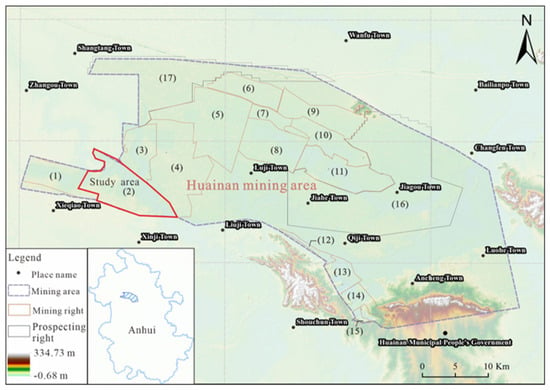
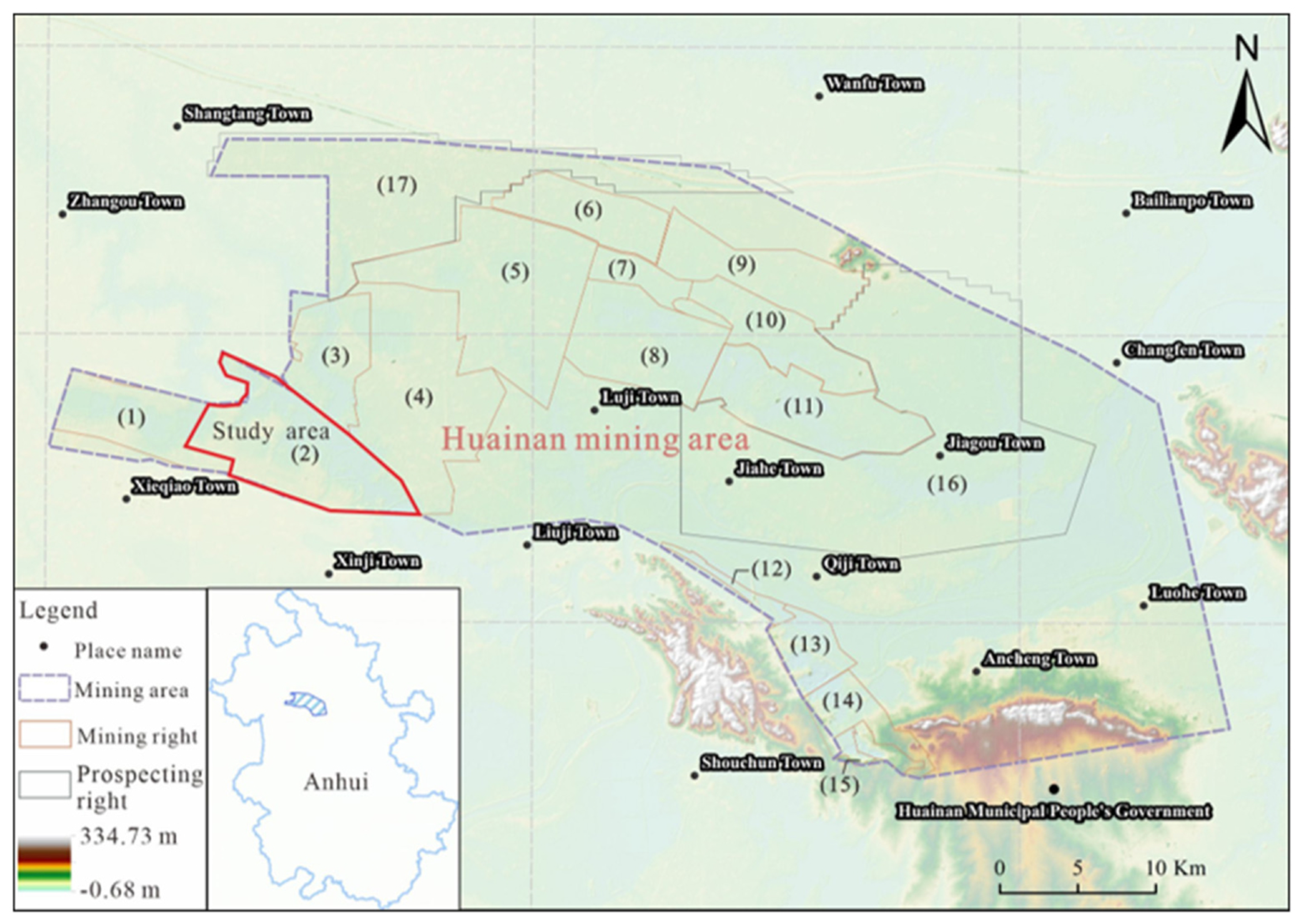
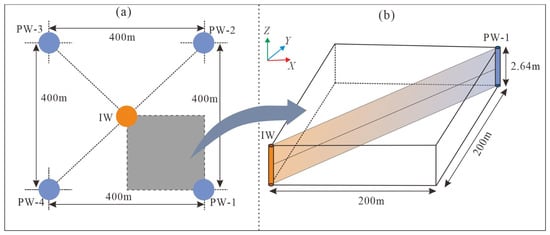
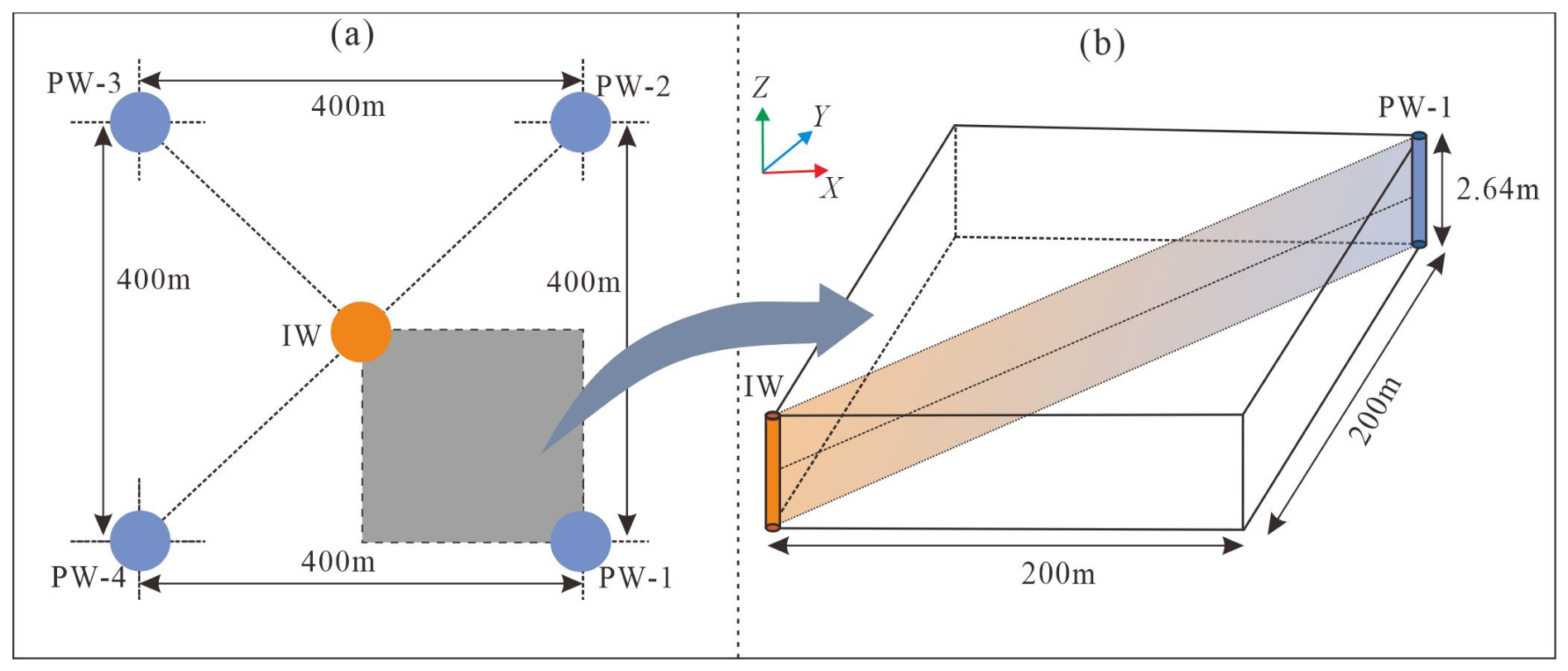
By taking the No. 11-2 coal seam, the main mining coal seam of the Zhangji Coal Mine in the Huainan Coalfield, as the research object (Figure 4) and drawing on domestic CO2-ECBM pilot test projects, a single-well gas injection and multi-well gas production mode is adopted [23,24], with four CH4 production wells arranged around the CO2 injection well within a range of approximately 400 m for coalbed methane extraction. Considering the limitations of computational speed and memory, a quarter region (the lower-right corner of the CO2-ECBM layout) is selected for numerical simulation based on the symmetry principle. The actual simulated dimensions are approximately 200 m × 200 m × 2.64 m (Figure 5). In the model, the injection well (IW) is located in the lower-left corner, and the production well (PW-2) is located in the upper-right corner. The average coal seam thickness is 2.64 m, and the wellbore radius is 0.01 m. The simulation duration is set to 3650 days (approximately 10 years).
Figure 4.
Location of the study area.
Figure 5.
Schematic of the injection–production well pattern in the CO2-ECBM simulation. (a) Planar layout; (b) 3D model of numerical simulation.
3.1.2. Key Parameters
The core parameters for this numerical simulation (Table 1) are derived from three main sources: (1) actual engineering data from the No. 11-2 coal seam and coalbed methane well development at the Zhangji Coal Mine, such as reservoir pressure and temperature; (2) experimental test data from coal rock samples of the No. 11-2 coal seam, including porosity, permeability, and elastic modulus; and (3) relevant references [23,24,25,26,27,28,29], providing parameter values such as gas dynamic viscosity and the Klinkenberg factor.
Table 1.
Core parameters for numerical simulation.
3.2. Boundary Conditions
Seepage field: The initial reservoir pressure was set to 5.79 MPa and was assumed to be uniformly distributed in the simulated domain. A constant-pressure boundary was applied at the injection well, and the production well pressure was set to 0.1 MPa. The remaining external boundaries were treated as no-flow boundaries. This setting was adopted because the simulated domain represents a quarter symmetric region of the injection–production well pattern. Therefore, the no-flow boundaries were used to represent the symmetry condition and to focus on pressure propagation and gas migration between the injection well and the production well within the local drainage area.
Stress field: The initial stress state was simplified as a geostatic stress condition mainly controlled by the overburden load. A vertical downward load was applied on the upper boundary to represent the mechanical effect of the overlying strata. The lower boundary was fixed to represent the support from the underlying strata, and the lateral boundaries were set as roller-supported boundaries to provide lateral constraints while allowing vertical deformation. This mechanical boundary condition can reasonably describe the deformation response of a local coal seam section under reservoir-scale stress constraints.
Temperature field: The initial reservoir temperature was set to 308 K and was assumed to be uniformly distributed. The upper, lower, and lateral boundaries were treated as thermally insulated boundaries. The injection and production wells were assigned the initial reservoir temperature.
These boundary conditions are simplified representations of the actual reservoir conditions and are suitable for comparing the relative effects of different geological and engineering parameters under the same numerical framework. However, if strong regional hydraulic communication, spatial heterogeneity, or external heat exchange exists in the actual reservoir, the no-flow and thermal insulation assumptions may influence the predicted CO2 migration range, pressure propagation, and production response.
4. Sensitivity Analysis of Geological and Engineering Parameters for CO2-ECBM
4.1. Influence of Geological Parameters on CO2-ECBM
4.1.1. Influence of Initial Reservoir Porosity on CO2-ECBM
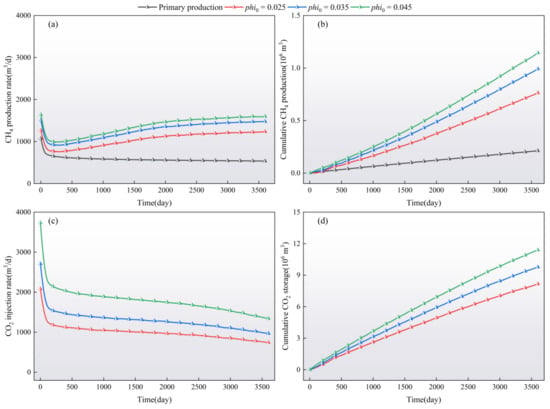
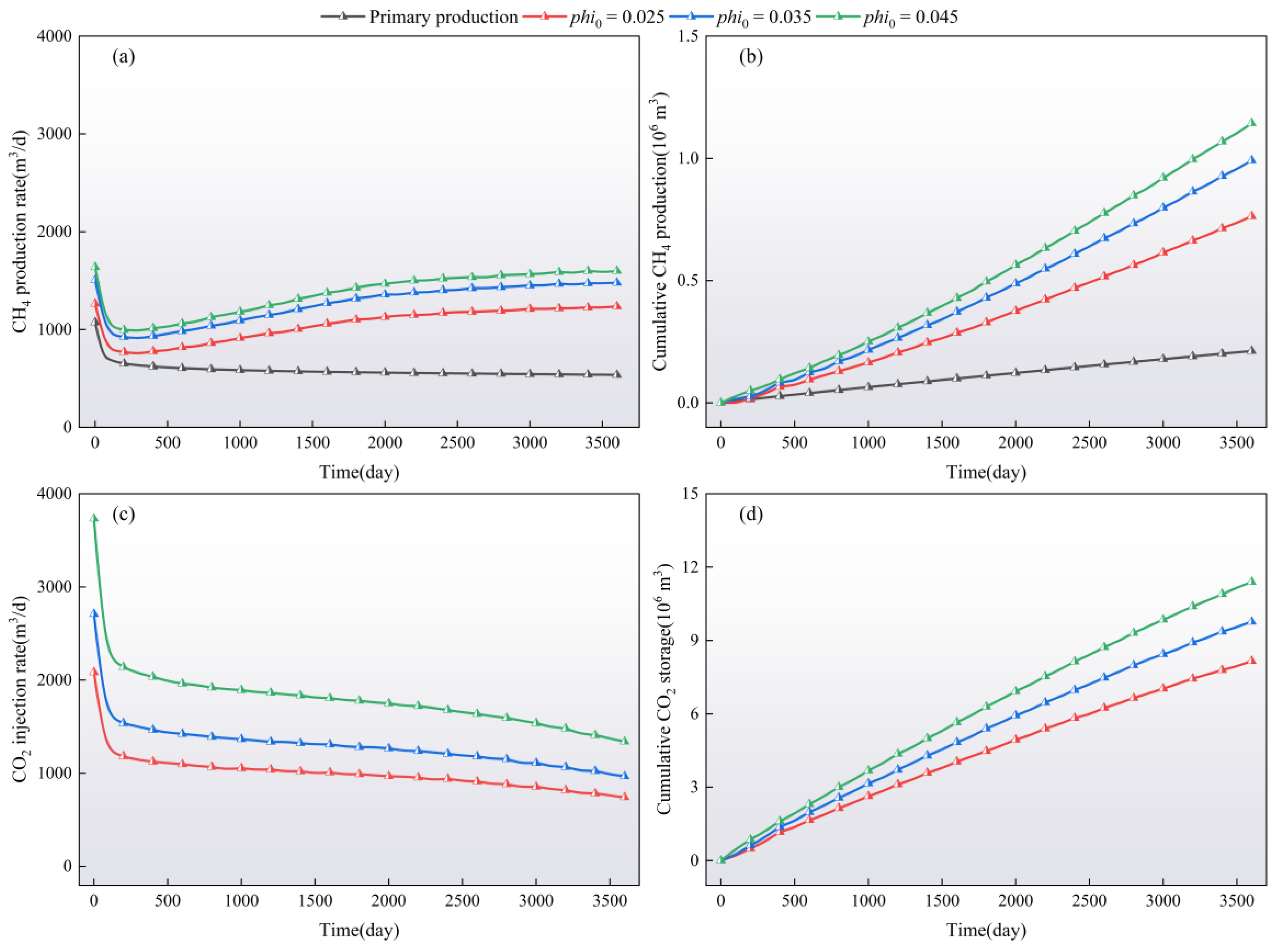
Figure 6 presents the variation trends of CH4 production rate, cumulative CH4 production, CO2 injection rate, and cumulative CO2 storage under natural production and different initial porosity conditions. Initial porosity has a significant effect on both CH4 enhancement and CO2 storage. After CO2 injection, the CH4 production rate under all porosity conditions is markedly higher than that under natural production (536 m3/d), indicating that CO2 injection effectively promotes CH4 desorption and production. When the initial porosity is 0.025, 0.035, and 0.045, the stable CH4 production rates are 1232, 1478, and 1601 m3/d, respectively, which are 129%, 175%, and 198% higher than those of natural production. The cumulative CH4 production reaches 773,899 m3, 1,006,069 m3, and 1,160,849 m3, showing a continuous increase with increasing porosity. This indicates that a higher porosity provides greater storage space and more favorable gas migration conditions, thereby enhancing the displacement effect of CO2 on CH4.
Figure 6.
Under different initial porosities: (a) CH4 production rate; (b) cumulative CH4 production; (c) CO2 injection rate; (d) cumulative CO2 storage.
4.1.2. Influence of Initial Reservoir Permeability on CO2-ECBM
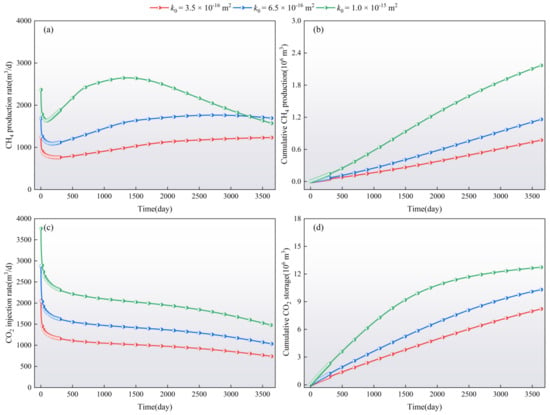
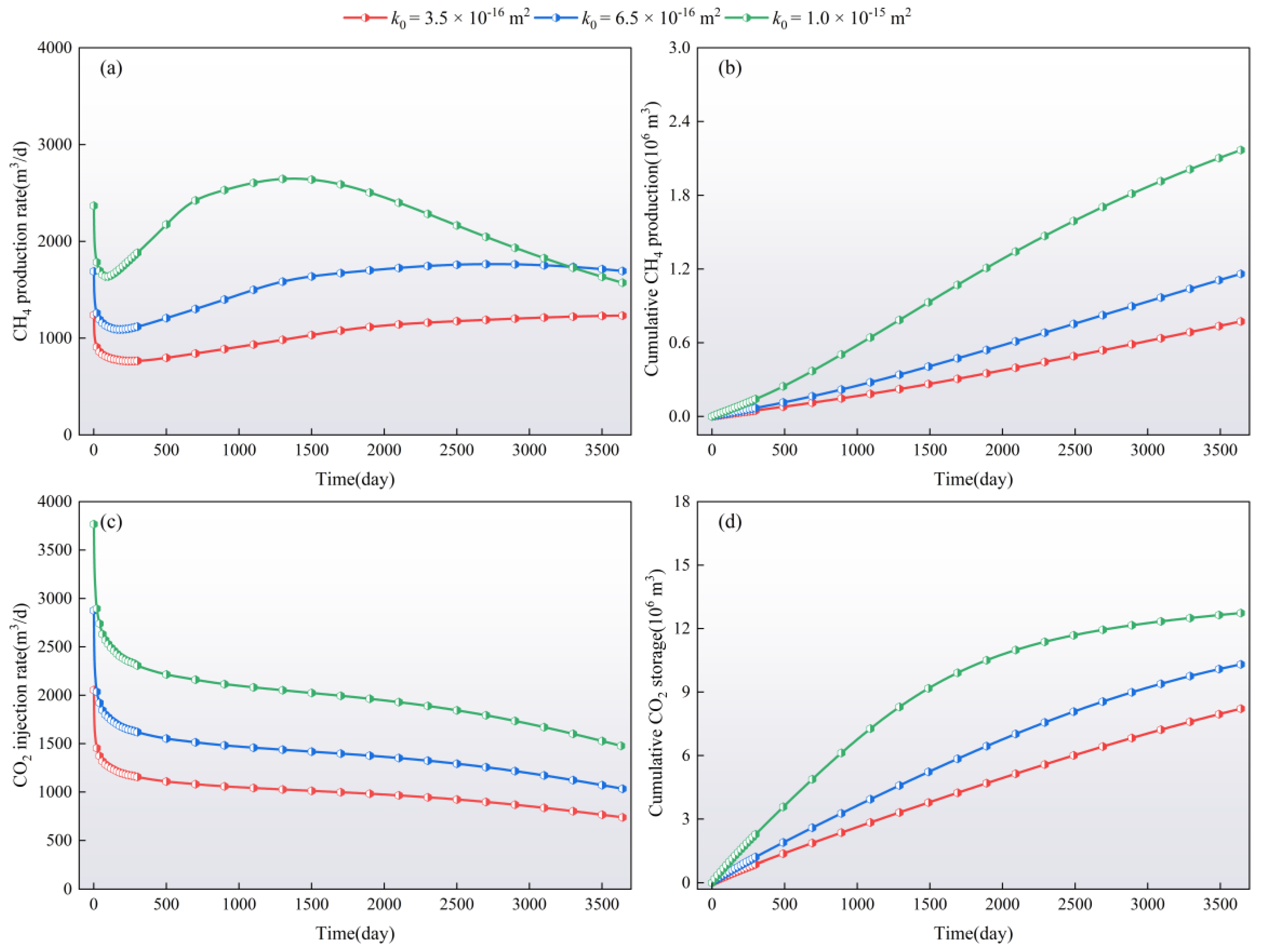
Initial permeability has a significant effect on CO2 injectability, CH4 enhancement, and CO2 storage (Figure 7). When the initial permeability is 3.5 × 10⁻¹⁶, 6.5 × 10⁻¹⁶, and 10.0 × 10⁻¹⁶ m2, the stable CH4 production rates are 1232, 1694, and 1572 m3/d, respectively, which are 129%, 216%, and 193% higher than those under natural production. The cumulative CH4 production reaches 773,899 m3, 1,161,094 m3, and 2,168,075 m3, increasing significantly with permeability, which indicates that a higher permeability favors higher pressure transmission efficiency and gas migration capacity, thereby enhancing the displacement effect of CO2 on CH4. However, the stable CH4 production rate is higher at k0 = 6.5 × 10⁻¹⁶ m2 than at k0 = 10.0 × 10⁻¹⁶ m2, indicating that the influence of permeability on the instantaneous gas production rate is not simply linear. The CO2 injection rate under different initial permeabilities generally exhibits a trend of first decreasing and then stabilizing, which is attributed to the swelling deformation of the coal matrix induced by CO2 adsorption, leading to a gradual deterioration of reservoir porosity and permeability conditions and inhibiting the later-stage injection capacity. When the initial permeability is 3.5 × 10⁻¹⁶, 6.5 × 10⁻¹⁶, and 10.0 × 10⁻¹⁶ m2, the stable CO2 injection rates are 738, 1034, and 1477 m3/d, respectively, and the cumulative CO2 storage amounts are 8,216,442 m3, 10,311,634 m3, and 12,733,369 m3, respectively, indicating that a higher initial permeability results in a stronger CO2 injection capacity and a larger cumulative storage amount.
Figure 7.
Under different initial permeabilities: (a) CH4 production rate; (b) cumulative CH4 production; (c) CO2 injection rate; (d) cumulative CO2 storage.
4.1.3. Influence of Initial Reservoir Elastic Modulus on CO2-ECBM
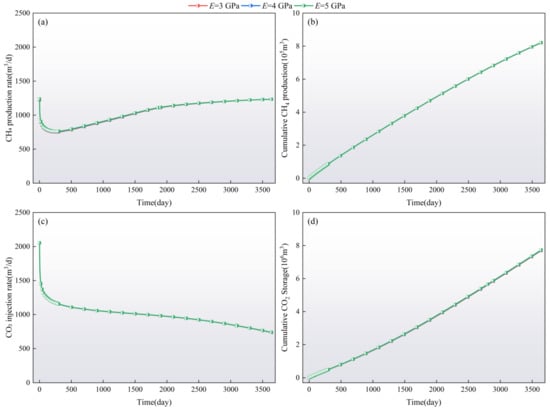
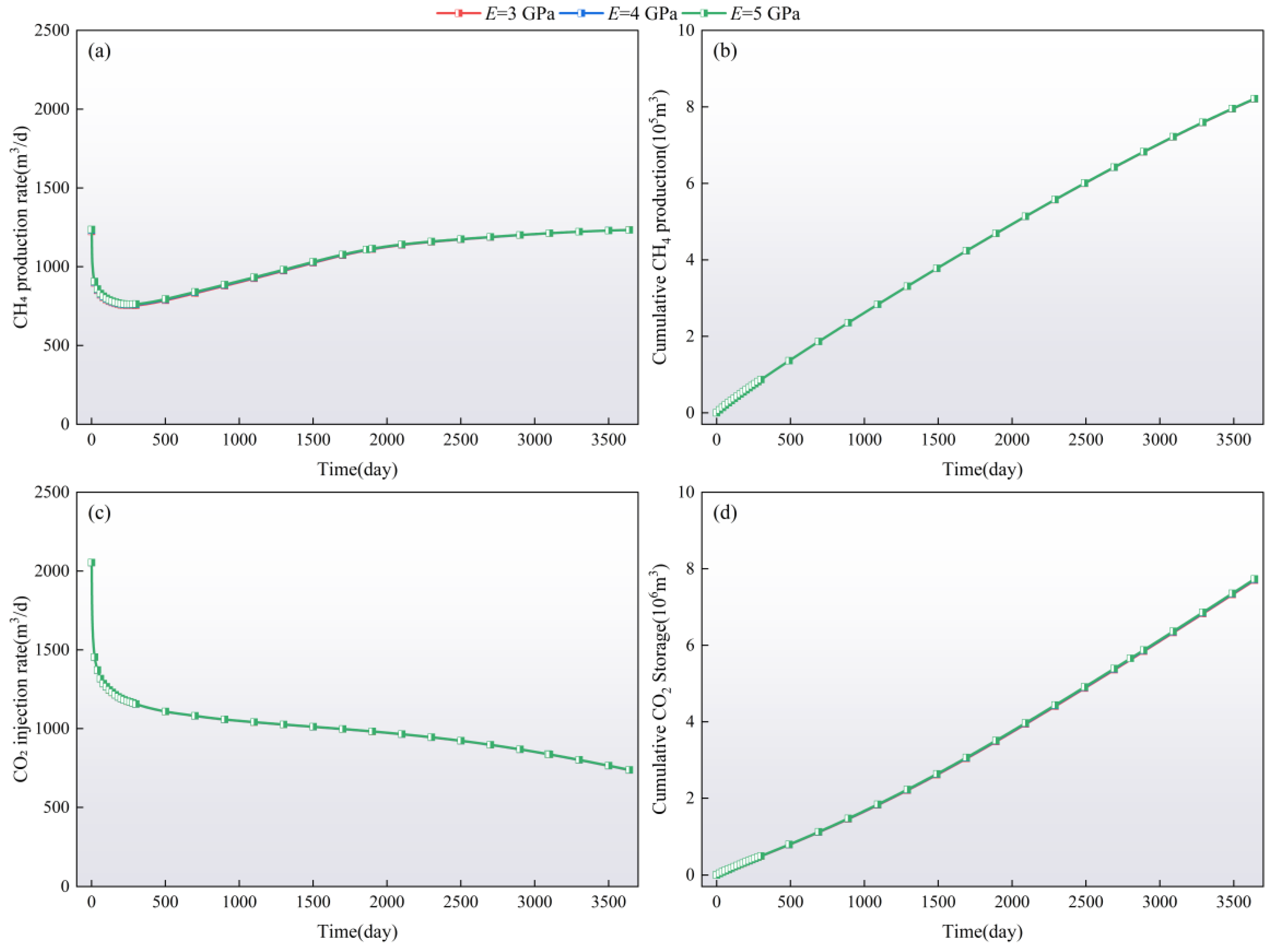
With increasing elastic modulus, the CH4 production rate and cumulative production decrease slightly (Figure 8). When the elastic modulus E is 3 GPa, 4 GPa, and 5 GPa, the stable CH4 production rates are 1273, 1252, and 1232 m3/d, respectively, which are 137%, 133%, and 129% higher than those under natural production. The cumulative CH4 production amounts are 801,198 m3, 787,441 m3, and 773,899 m3, representing increases of 273%, 267%, and 260% compared with natural production (214,436 m3). This indicates that, within the simulated range, a lower mechanical strength is more favorable for CH4 enhancement. The differences in CO2 injection rate and cumulative CO2 storage under different elastic modulus conditions are very small. When E is 3 GPa, 4 GPa, and 5 GPa, the stable CO2 injection rates are 736, 737, and 738 m3/d, respectively, and the cumulative CO2 storage amounts are 7,699,870 m3, 7,720,622 m3, and 7,732,819 m3, respectively, indicating that the mechanical strength of the reservoir has a minor effect on CO2 injection capacity and storage amount.
Figure 8.
Under different initial elastic modulus: (a) CH4 production rate; (b) cumulative CH4 production; (c) CO2 injection rate; (d) cumulative CO2 storage.
4.2. Influence of Engineering Parameters on CO2-ECBM
4.2.1. Influence of Injection Pressure on CO2-ECBM
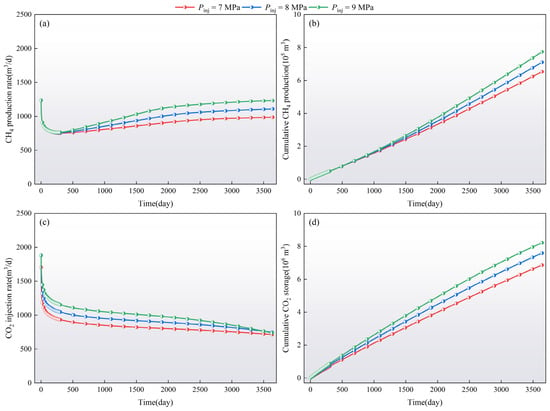
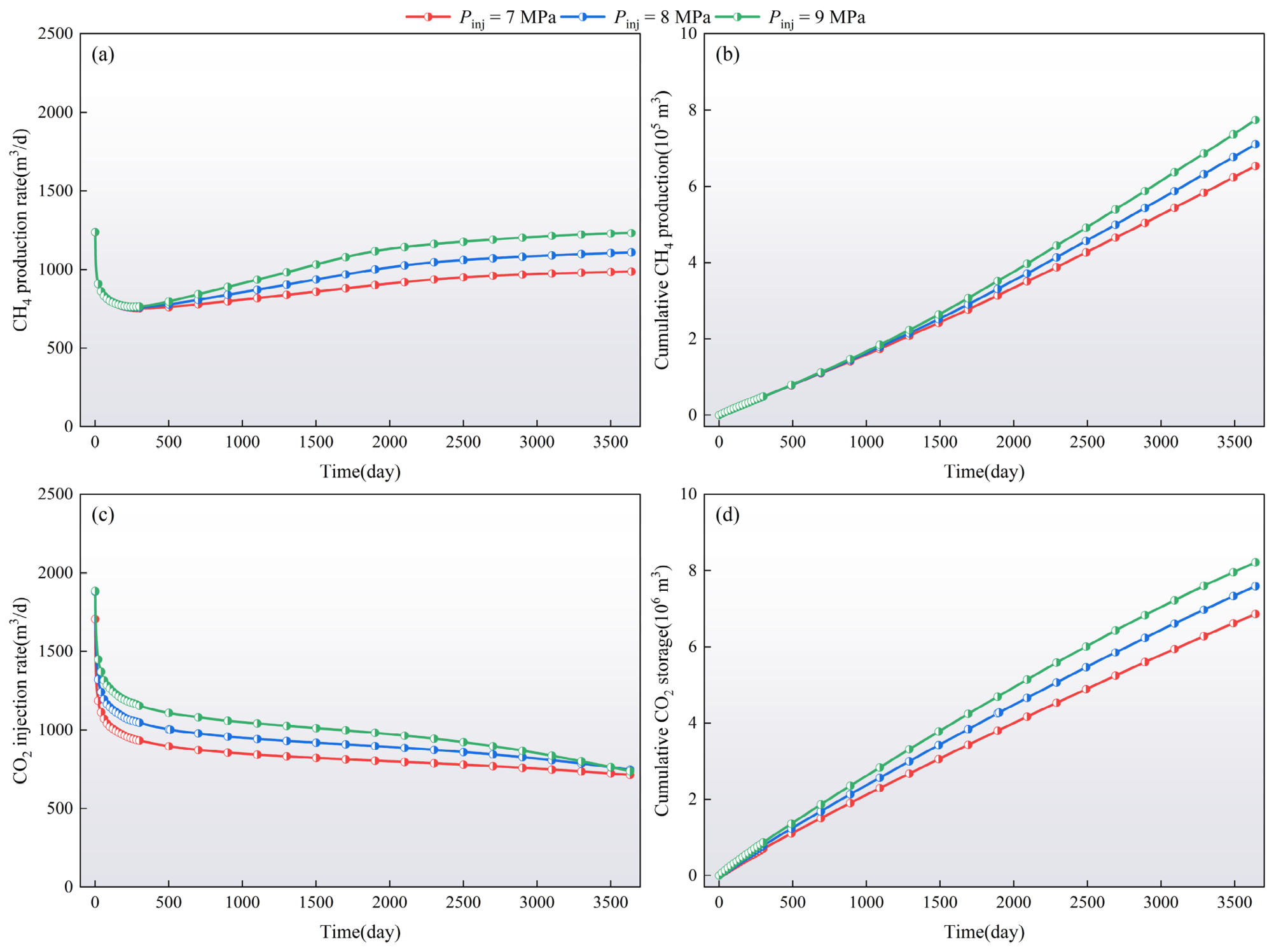
Overall, CO2 injection significantly enhances CH4 production, and a higher injection pressure leads to a more pronounced enhancement effect (Figure 9). After CO2 injection, the CH4 production rate is significantly higher than that under natural production and increases with increasing injection pressure, because a higher injection pressure strengthens the pressure gradient around the wellbore and the CH4 migration capacity, thereby enhancing the competitive adsorption and displacement of CH4 by CO2. At injection pressures of 7 MPa, 8 MPa, and 9 MPa, the stable CH4 production rates are 987, 1108, and 1232 m3/d, respectively, which are 84%, 106%, and 129% higher than that under natural production (536 m3/d). The cumulative CH4 production amounts are 655,370 m3, 710,619 m3, and 773,899 m3, representing increases of 204%, 231%, and 260% compared with natural production (214,436 m3). These results indicate that increasing the CO2 injection pressure is beneficial for CH4 enhancement.
Figure 9.
Under different injection pressures: (a) CH4 production rate; (b) cumulative CH4 production; (c) CO2 injection rate; (d) cumulative CO2 storage.
Under different injection pressures, the CO2 injection rate generally exhibits a pattern of being high in the initial stage, followed by a rapid decline and then stabilization. This is because the pressure gradient is large in the early injection stage, resulting in a strong injection capacity. As time progresses, continuous CO2 adsorption induces coal swelling and reduces porosity and permeability; meanwhile, the water saturation near the gas migration front increases and the gas relative permeability decreases, leading to a gradual stabilization of the injection rate. At injection pressures of 7 MPa, 8 MPa, and 9 MPa, the stable CO2 injection rates are 714, 747, and 738 m3/d, respectively, indicating that a higher injection pressure can enhance the injection capacity, but the later-stage stable injection rate does not increase strictly linearly with pressure. This is because a higher pressure, on the one hand, enhances the driving effect, while on the other hand, it exacerbates the permeability inhibition caused by adsorption-induced swelling. Regarding cumulative CO2 storage, under the conditions of 7 MPa, 8 MPa, and 9 MPa, the values are 6,862,021 m3, 7,588,879 m3, and 8,216,442 m3, respectively, indicating that increasing the injection pressure can significantly increase the scale of CO2 storage.
4.2.2. Influence of Injection Mode on CO2-ECBM
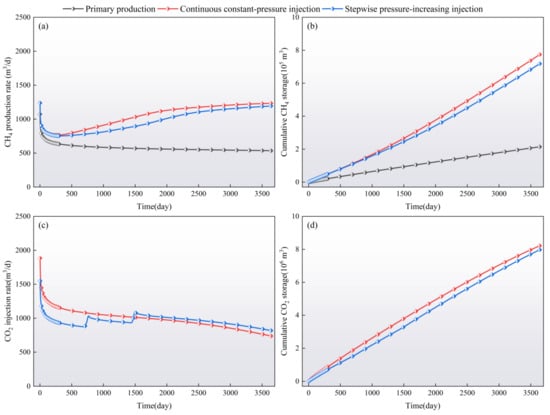
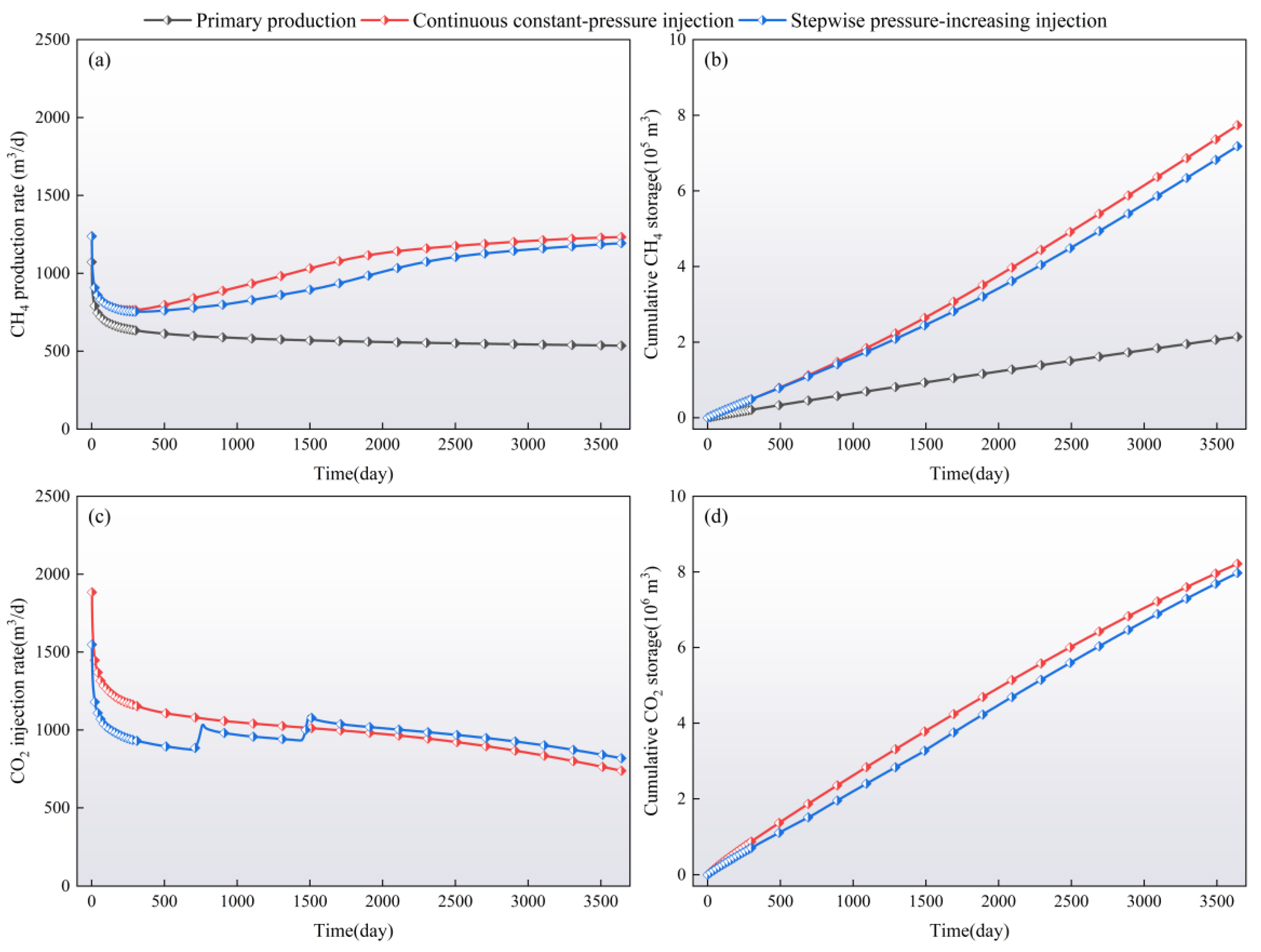
In terms of CH4 production performance (Figure 10a,b), the CH4 production rate under continuous constant-pressure injection is generally higher than that under stepwise pressurization injection. Within the simulated time scale, the stable CH4 production rates under continuous constant-pressure injection and stepwise pressurization injection are 1232 m3/d and 1193 m3/d, respectively, which are 129% and 122% higher than that under natural production (536 m3/d). The cumulative CH4 production amounts are 773,899 m3 and 718,272 m3, representing increases of 260% and 234% compared with natural production (214,436 m3). This indicates that continuous constant-pressure injection is more favorable for CH4 enhancement. In terms of CO2 injection and storage performance (Figure 10c,d), the stable CO2 injection rate under continuous constant-pressure injection is 738 m3/d, which is lower than the 818 m3/d under stepwise pressurization injection, indicating that stepwise pressurization injection has a higher stable injection capacity in the later stage. However, the cumulative CO2 storage under continuous constant-pressure injection is 8,216,442 m3, which is approximately 3% higher than that under stepwise pressurization injection (7,973,020 m3), indicating that continuous constant-pressure injection is more beneficial for increasing cumulative CO2 storage.
Figure 10.
Under different injection methods: (a) CH4 production rate; (b) cumulative CH4 production; (c) CO2 injection rate; (d) cumulative CO2 storage.
4.3. Sensitivity Analysis of Geological and Engineering Parameters for CO2-ECBM
To quantitatively compare the influence of different geological and engineering parameters on CO2-ECBM, cumulative CH4 production, cumulative CO2 storage, and stable CO2 injection rate are selected as sensitivity evaluation indicators [31,32,33]. The injection mode, being a discrete variable, is treated separately as an engineering scheme for comparative evaluation. To avoid the influence of different parameter dimensions and ranges on the evaluation results, a normalized sensitivity coefficient is used to evaluate each parameter:
where Sij is the sensitivity coefficient of the i-th parameter with respect to the j-th evaluation indicator; Yij,max, Yij,min, and are the maximum, minimum, and average values of the j-th evaluation indicator as the i-th parameter varies, respectively; and Xij,max, Xij,min, and are the maximum, minimum, and average values of the i-th parameter, respectively. A larger Sij indicates a more significant influence of the parameter on the corresponding evaluation indicator.
Based on the single-indicator sensitivity evaluation, a comprehensive sensitivity index is further constructed as [31]:
where Si is the comprehensive sensitivity index of the i-th parameter; , , , and are the sensitivity coefficients of this parameter with respect to the stable CH4 production rate, cumulative CH4 production, cumulative CO2 storage, and stable CO2 injection rate, respectively; and w1, w2, w3, and w4 are the weight coefficients of the corresponding evaluation indicators. In this study, the weight coefficients were determined based on engineering experience and the relative importance of different indicators for CO2-ECBM operation in low-permeability coal seams. Because the evaluation emphasizes CO2 storage while also considering CH4 recovery and injection stability, cumulative CO2 storage was assigned the highest weight of 0.40, followed by cumulative CH4 production with a weight of 0.25, and then stable CO2 injection rate with a weight of 0.20. Stable CH4 production rate was assigned a weight of 0.15. Therefore, the weight coefficients were set as w1 = 0.15, w2 = 0.25, w3 = 0.40, and w4 = 0.20. It should be noted that this weighting scheme reflects a storage-oriented engineering judgment and has a certain degree of subjectivity; for projects with different priorities, the weights can be adjusted accordingly.
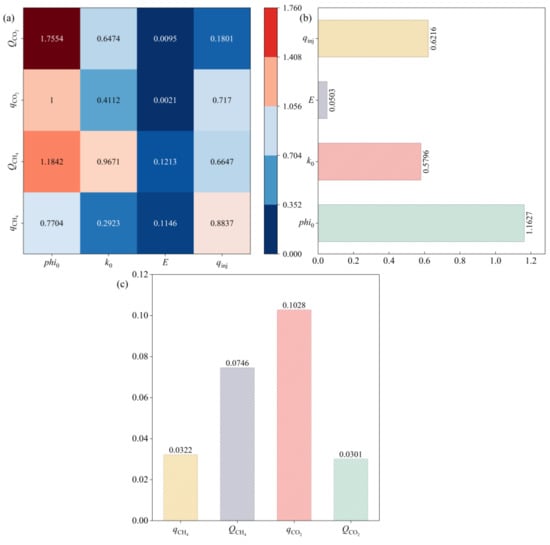
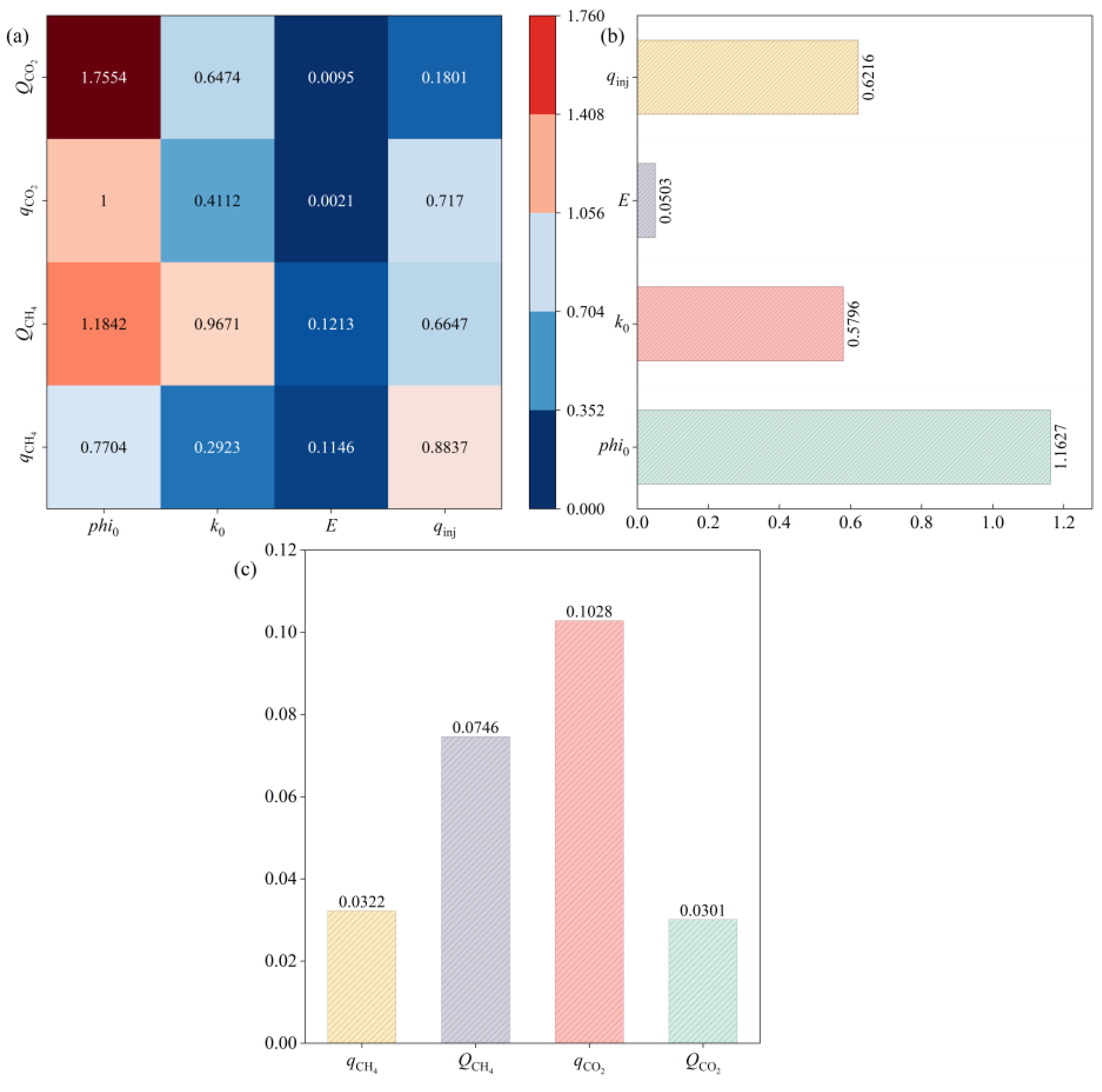
The comprehensive sensitivity results for each indicator (Table 2 and Figure 11) show that initial porosity, CO2 injection pressure, and initial permeability are the main factors affecting CO2-ECBM performance in the study area (Figure 11a,b). According to the comprehensive sensitivity index, the ranking of the influencing factors is initial porosity > CO2 injection pressure > initial permeability > elastic modulus. Among these, initial permeability and initial porosity primarily determine the CO2 injectability and storage potential of the coal reservoir; thus, these are key geological parameters in reservoir screening. CO2 injection pressure is the most important adjustable parameter in field engineering, directly influencing the CH4 displacement intensity and cumulative CO2 storage. In contrast, the elastic modulus of the reservoir has a relatively weak effect on the stable CO2 injection rate and cumulative CO2 storage, indirectly affecting CH4 production mainly through coal deformation and permeability evolution. The injection mode exerts a certain regulatory effect on engineering performance (Figure 11c), but its overall influence is weaker than that of reservoir flow capacity and injection pressure.
Table 2.
Sensitivity coefficients of different indicators for geological–engineering parameters.
Figure 11.
Sensitivity of different geological–engineering parameters to CO2-ECBM performance. (a) Sensitivity coefficients of parameters to each indicator; (b) comprehensive sensitivity coefficients of parameters to indicators; (c) sensitivity coefficients of injection methods to each indicator.
5. CO2 Injection Optimization
The engineering performance of CO2-ECBM is difficult to evaluate using a single indicator. Although an excessively high injection pressure can enhance the ability of CO2 to enter the coal reservoir and improve the CH4 displacement effect, it may also increase the risks of local reservoir fracturing, the formation of preferential flow pathways, and early CO2 breakthrough. Conversely, an excessively low injection pressure makes it difficult to achieve the desired storage and enhancement effects. Meanwhile, as injection time increases, the CO2 injection rate gradually decreases and stabilizes, and the marginal increments of CH4 enhancement and CO2 storage decline, so the engineering benefits of continued injection will gradually diminish. Therefore, injection optimization requires a comprehensive trade-off among CH4 enhancement, CO2 storage, engineering efficiency, and reservoir safety.
5.1. Optimization Method and Evaluation Indicators for CO2 Injection
Cumulative CH4 production, cumulative CO2 storage, engineering efficiency, and reservoir safety risk are selected as the evaluation indicators for CO2 injection optimization. Among these, the engineering efficiency indicator is primarily characterized by the stable CO2 injection rate, which reflects the ability of the coal reservoir to maintain continuous CO2 entry during the later injection stage. A higher value of this indicator indicates better injectability and operational stability of the reservoir during the long-term injection phase. Reservoir safety risk mainly characterizes the risk of reservoir fracturing and the formation of preferential flow pathways that may occur when the injection pressure approaches the minimum principal stress [34].
To eliminate dimensional differences among the various indicators, a linear normalization method is used to perform dimensionless processing on each evaluation indicator [35]. For positive indicators, such as cumulative CH4 production, cumulative CO2 storage, and stable CO2 injection rate, the normalization formula is:
For negative indicators, such as reservoir safety risk, the normalization formula is:
where Crisk,N is the reservoir safety risk index; and σmin is the minimum principal stress of the reservoir in the study area, in MPa, with a value of 11.48 MPa. On this basis, a comprehensive engineering performance evaluation function for CO2-ECBM is constructed as [36,37]:
where V is the comprehensive engineering performance value for CO2-ECBM; QCH4,N is the normalized indicator of cumulative CH4 production; QCO2,N is the normalized indicator of cumulative CO2 storage; EN is the normalized indicator of engineering efficiency; and β1, β2, β3, and β4 are the weight coefficients of the corresponding evaluation indicators. Under the same engineering objective, a larger V value indicates a better overall performance of the injection scheme.
Based on the different emphases of CO2-ECBM engineering on CH4 enhancement, CO2 storage, engineering efficiency, and reservoir safety, four CO2 injection optimization objectives are established: (1) comprehensive consideration of CH4 enhancement, CO2 storage, engineering efficiency, and reservoir safety; (2) CO2 storage priority; (3) CH4 enhancement priority; and (4) engineering efficiency priority, which focuses on diminishing returns in the later injection stage and operational benefits. The weight coefficients for each parameter corresponding to these objectives are listed in Table 3.
Table 3.
Weight coefficients of objective functions.
5.2. Optimization Analysis Under Different Injection Pressures and Injection Schemes
5.2.1. Injection Pressure
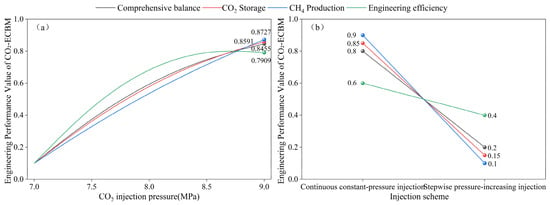
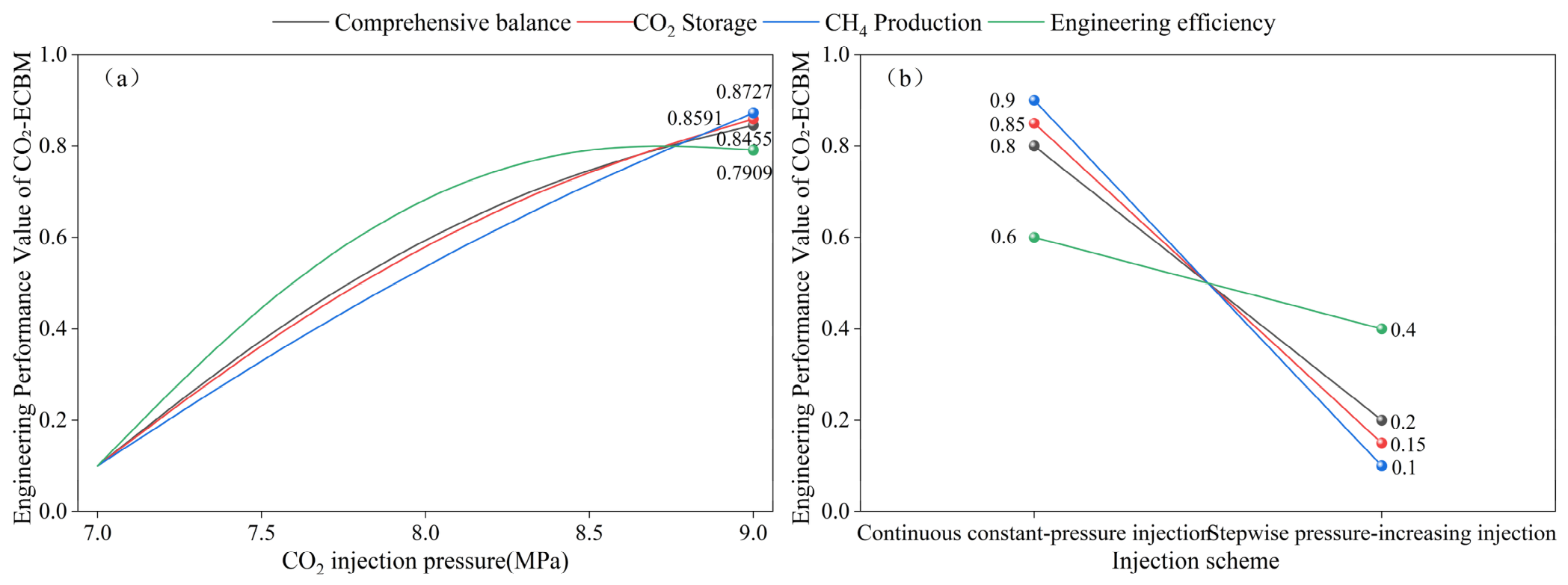
From the engineering performance (Figure 12a), under the CH4 enhancement-priority and CO2 storage-priority objectives, the engineering effect value generally increases with injection pressure. Particularly under the condition of 9 MPa, the enhancement and storage effects are especially significant. In contrast, for the engineering efficiency-priority objective, 8 MPa is more advantageous, especially because the stable CO2 injection rate is relatively high while the reservoir safety risk is lower than that at 9 MPa, making 8 MPa the optimal choice for long-term stable operation. Under the comprehensive multi-objective scenario, the performance within the range of 8–9 MPa is considered satisfactory. However, considering the minimum principal stress constraint of the study area and the potential risks associated with long-term high-pressure injection, it is recommended to control the injection pressure within the range of 8.0–9.0 MPa rather than selecting the maximum value.
Figure 12.
Performance of CO2-ECBM under varying injection pressures and injection modes. (a) Injection pressure; (b) injection scheme.
5.2.2. Injection Scheme
Beyond the effect of injection pressure, the injection method also influences the pressure disturbance caused by CO2 entering the coal reservoir and the subsequent stable displacement performance (Figure 12b). Continuous constant-pressure injection helps maintain a high pressure gradient and is suitable for CH4 enhancement-priority and CO2 storage-priority objectives, favoring the increase in cumulative CH4 production and CO2 storage. Stepwise pressurization injection can effectively reduce the pressure impact at the initial injection stage and gradually establish the reservoir pressure field, making it suitable for engineering efficiency-priority objectives and conditions with strong reservoir safety constraints. Considering factors such as the stabilization of the CO2 injection rate and the recovery of the CH4 production rate after a trough, a reasonable injection method should be the combination of “stepwise pressure ramping in the early stage followed by constant pressure injection in the middle and late stages”. This method can not only reduce reservoir pressure disturbance and the risk of localized fracturing but also enhance CO2 storage and CH4 displacement performance. If the cumulative CH4 production and CO2 storage show a gradual slowdown in the later stage, this can serve as a reference for adjusting the injection scheme or terminating injection.
5.3. Optimization Scheme for CO2 Injection in the Study Area
Integrating the sensitivity analysis and multi-objective comprehensive evaluation results, this study proposes that the optimization of CO2-ECBM injection in the study area should follow the principles of: screening reservoirs based on geological parameters, optimizing injection schemes based on engineering parameters, controlling risks under safety constraints, and dynamically adjusting injection timing through performance evaluation. Specifically, initial porosity and initial permeability are key intrinsic factors determining the CO2 injectability and storage potential of the coal reservoir, and should serve as important criteria for target coal seam selection. CO2 injection pressure and injection scheme are the core variables for engineering optimization, directly affecting CH4 displacement efficiency and CO2 storage capacity.
Based on the simulation results and the reservoir safety conditions of the study area, the CO2 injection pressure should be controlled within the range of 8.0–9.0 MPa. Within this range, 8.0–8.5 MPa is recommended as the preferred pressure interval for long-term stable injection. When the engineering objective is to maximize CO2 storage or CH4 production, and the minimum principal stress and pressure monitoring results indicate a sufficient safety margin, the injection pressure can be increased to approximately 9.0 MPa. When the engineering objective emphasizes long-term stable operation and engineering efficiency, an injection pressure in the range of 8.0–8.5 MPa is recommended. Regarding the injection scheme, a combined strategy of “stepwise pressure ramping in the early stage followed by constant pressure injection in the middle and late stages” is advised. In the early stage, a relatively low pressure with a gradual increase can be adopted to reduce reservoir pressure disturbance and the risk of localized fracturing. After the reservoir pressure field and CO2 migration pathways have stabilized, the injection pressure is maintained within 8.0–9.0 MPa to enhance the cumulative CO2 storage and CH4 displacement performance. Meanwhile, the injection scheme should be dynamically adjusted based on indicators such as the stabilization time of the CO2 injection rate, the trough time of the CH4 production rate, and the marginal increments of cumulative production and storage metrics.
It should be noted that the initial reservoir pressure, temperature, and water saturation were assumed to be uniformly distributed in the present model. This simplification was adopted to isolate the effects of key geological and engineering parameters under the same numerical framework. However, actual coal reservoirs usually exhibit spatial heterogeneity in pressure, temperature, saturation, permeability, and fracture development. Such heterogeneity may influence CO2 migration pathways, CH4 desorption and production behavior, local pressure propagation, and CO2 breakthrough risk. Therefore, the simulation results in this study should be regarded as the average response of the target coal seam under representative conditions. Future studies should further incorporate spatial heterogeneity of reservoir properties and initial conditions to improve the predictive reliability of CO2-ECBM simulations. In addition, this study focused on deterministic sensitivity analysis and did not conduct probabilistic uncertainty analysis. Parameters such as permeability, adsorption coefficients, and mechanical properties may contain spatial variability and measurement uncertainty, which may affect the predicted CH4 production, CO2 storage, injection capacity, and reservoir safety risk. Future studies should combine Monte Carlo simulation, Latin hypercube sampling, or other probabilistic methods with the coupled model to further evaluate the uncertainty and robustness of the simulation results.
6. Conclusions
- (1)
- A coupled numerical model for CO2-ECBM in low-permeability coal seams was established by considering CO2/CH4 competitive adsorption, matrix diffusion, fracture seepage, gas–water two-phase flow, coal deformation, and porosity–permeability evolution. The benchmark validation indicates that the model can reasonably reproduce the main dynamic characteristics of CH4 production and CO2 injection reported in previous studies, providing a basis for analyzing the coupled response of low-permeability coal reservoirs under CO2 injection.
- (2)
- The comprehensive sensitivity analysis shows that initial porosity, CO2 injection pressure, and initial permeability are the dominant factors controlling CO2-ECBM performance in the study area. Initial porosity mainly determines reservoir storage space and CO2 sequestration potential, while initial permeability controls pressure transmission and gas migration capacity. Therefore, porosity and permeability should be regarded as key geological indicators for target reservoir screening. CO2 injection pressure is the most important adjustable engineering parameter, directly affecting CH4 displacement intensity, CO2 storage scale, and reservoir safety risk.
- (3)
- The multi-objective evaluation results indicate that the CO2 injection pressure in the study area should be controlled within 8.0–9.0 MPa. For long-term stable operation, 8.0–8.5 MPa is recommended as the preferred pressure range because it can balance CO2 storage, CH4 enhancement, injection stability, and reservoir safety. When the engineering objective prioritizes CO2 storage or CH4 production and a sufficient safety margin is confirmed, the injection pressure may be increased to approximately 9.0 MPa.
- (4)
- In terms of injection strategy, continuous constant-pressure injection is favorable for increasing cumulative CH4 production and CO2 storage, whereas stepwise pressurization can reduce early-stage pressure disturbance and improve later-stage injection stability. Therefore, a combined injection scheme involving early-stage stepwise pressure ramping followed by middle- and late-stage constant-pressure injection is recommended. Overall, this study provides an engineering-oriented reference for reservoir screening, injection pressure design, and injection scheme optimization in similar low-permeability coal seams.
Author Contributions
Conceptualization, H.W., Y.L., Z.H., S.S., Y.F., X.S. and Q.L.; Methodology, H.W., L.S., S.S., Y.F., X.S. and Q.L.; Software, H.W. and X.S.; Validation, L.S., Y.L., S.S. and Y.F.; Formal analysis, H.W., Y.L. and X.S.; Resources, H.W., L.S., Z.H. and Q.L.; Data curation, Z.H.; Writing—original draft preparation, H.W., Y.L. and Y.F.; Writing—review and editing, H.W., L.S., Z.H. and X.S.; Visualization, Y.L.; Supervision, L.S., Z.H. and Q.L.; Project administration, L.S., Y.L., Y.F., X.S. and Q.L.; Funding acquisition, L.S., Y.L., Z.H., Y.F. and X.S. All authors have read and agreed to the published version of the manuscript.
Funding
This research was funded by the China Postdoctoral Science Foundation (grant number 2025T050ZGMK) and the National Natural Science Foundation of China (grant numbers 52304225 and 52304224).
Data Availability Statement
The data presented in this study are available on request from the corresponding author.
Acknowledgments
The authors gratefully acknowledge the financial support from the China Postdoctoral Science Foundation—CCTEG Joint Support Program (2025T050ZGMK) and the National Natural Science Foundation of China (52304225 and 52304224).
Conflicts of Interest
The authors declare no conflicts of interest.
References
- Wang, J.; Zheng, X. Legal regulation of environmental risks associated with offshore carbon capture, utilization and storage in China. Clim. Policy 2025, 1–16. [Google Scholar] [CrossRef] [Scilit]
- Jinadu, S.O.; Akinleye, K.E.; Ijiga, O.M. Deployment of geological CO2 sequestration with proprietary injection techniques for oil yield optimization and energy independence. Int. J. Sci. Res. Sci. Eng. Technol. 2024, 11, 503–525. [Google Scholar]
- Wang, F.; Niu, Q.; Wang, W.; Yuan, W.; Cui, G.; Wang, Q.; Liu, D.; Zheng, Y.; Shang, S.; Wang, M. Gas–liquid–solid coordinated transport behavior and pore clogging mechanisms during CO2 + O2 in situ leaching of sandstone-type uranium deposits. Phys. Fluids 2026, 38, 026607. [Google Scholar] [CrossRef] [Scilit]
- Stevens, S.H.; Kuuskraa, V.A.; Gale, J.; Beecy, D. CO2 injection and sequestration in depleted oil and gas fields and deep coal seams: Worldwide potential and costs. Environ. Geosci. 2001, 8, 200–209. [Google Scholar] [CrossRef] [Scilit]
- Worden, R.H. Carbon dioxide capture and storage (CCS) in saline aquifers versus depleted gas fields. Geosciences 2024, 14, 146. [Google Scholar] [CrossRef] [Scilit]
- Fang, Z.; Yang, C.; Wang, R. Monitoring technologies for CO2 storage in coal seams and enhanced coalbed methane recovery: A review of field applications. Fuel Process. Technol. 2025, 276, 108274. [Google Scholar] [CrossRef] [Scilit]
- Niu, Q.; Li, S.; Wang, W.; Sang, S.; Liu, S.; Liu, D.; Han, S.; Liu, T.; Zheng, S. Dynamic fracture behavior and permeability response mechanism of coal reservoirs treated by supercritical CO2 and water: Implications for safety evaluation of CO2 geological sequestration in coal seams. Eng. Fail. Anal. 2026, 191, 110774. [Google Scholar] [CrossRef] [Scilit]
- Peng, Y.M.; Ding, H.Z.; Ding, T.F.; Su, L.; Tong, B.; Jia, S.F.; Chen, B.L.; Tang, Y.G.; Liu, C.; Yuan, G.; et al. Research and application of surface gas control technology for soft and low-permeability coal seams in Huainan mining area. Pet. Reserv. Eval. Dev. 2025, 15, 1061–1069. [Google Scholar] [CrossRef] [Scilit]
- Kong, X.X.; Tang, Y.Z.; Li, P.; Wang, C.B.; Chen, J.; Li, Y.Q.; Yuan, B.Q.; Chen, B.L.; Ye, M. Thinking and utilization technology of coalbed methane in soft and low permeability coal seams in Huainan Mining Area. Coal Sci. Technol. 2022, 50, 26–35. [Google Scholar]
- Fang, H.H.; Sang, S.X.; Liu, S.Q. Numerical simulation of enhancing coalbed methane recovery by injecting CO2 with heat injection. Pet. Sci. 2019, 16, 32–43. [Google Scholar] [CrossRef] [Scilit]
- Yin, G.Z.; Deng, B.Z.; Li, M.H.; Zhang, D.M.; Wang, W.Z.; Li, W.P.; Shang, D.L. Impact of injection pressure on CO2-enhanced coalbed methane recovery considering mass transfer between coal fracture and matrix. Fuel 2017, 196, 288–297. [Google Scholar]
- Ma, T.; Rutqvist, J.; Oldenburg, C.M.; Liu, W.Q. Coupled thermal–hydrological–mechanical modeling of CO2-enhanced coalbed methane recovery. Int. J. Coal Geol. 2017, 179, 81–91. [Google Scholar] [CrossRef] [Scilit]
- Hou, Y.D.; Huang, S.P.; Han, J.; Liu, X.B.; Han, L.F.; Fu, C.F. Numerical simulation of the effect of injected CO2 temperature and pressure on CO2-enhanced coalbed methane. Appl. Sci. 2020, 10, 1385. [Google Scholar] [CrossRef] [Scilit]
- Reeves, S.; Taillefert, A.; Pekot, L.; Clarkson, C. The Allison Unit CO2–ECBM Pilot: A Reservoir Modeling Study. In International Coalbed Methane Symposium; Topical Report; Advanced Resources International: Houston, TX, USA, 2003; pp. 16–20. Available online: https://www.osti.gov/servlets/purl/825083 (accessed on 18 May 2026).
- Oudinot, A.Y.; Koperna, G.J.; Philip, Z.G.; Liu, N.; Heath, J.E.; Wells, A.; Young, G.B.; Wilson, T. CO2 injection performance in the Fruitland Coal Fairway, San Juan Basin: Results of a field pilot. SPE J. 2011, 16, 864–879. [Google Scholar] [CrossRef] [Scilit]
- Bai, G.; Su, J.; Li, X.M.; Guo, C.S.; Han, M.X.; Zhou, X.H.; Fan, C.J. Step-by-step CO2 injection pressure for enhanced coal seam gas recovery: A laboratory study. Energy 2022, 260, 125197. [Google Scholar] [CrossRef] [Scilit]
- Fan, Z.L.; Fan, G.W.; Zhang, D.S.; Zhang, L.; Zhang, S.; Liang, S.S.; Yu, W. Optimal injection timing and gas mixture proportion for enhancing coalbed methane recovery. Energy 2021, 222, 119880. [Google Scholar] [CrossRef] [Scilit]
- Kumar, H.; Elsworth, D.; Mathews, J.P.; Liu, J.S.; Pone, D. Effect of CO2 injection on heterogeneously permeable coalbed reservoirs. Fuel 2014, 135, 509–521. [Google Scholar] [CrossRef] [Scilit]
- Li, Y.; Wang, Y.B.; Wang, J.; Pan, Z.J. Variation in permeability during CO2–CH4 displacement in coal seams: Part 1—Experimental insights. Fuel 2020, 263, 116666. [Google Scholar]
- Fan, C.J.; Elsworth, D.; Li, S.; Chen, Z.; Luo, M.K.; Song, Y.; Zhang, H.H. Modelling and optimization of enhanced coalbed methane recovery using CO2/N2 mixtures. Fuel 2019, 253, 1114–1129. [Google Scholar] [CrossRef] [Scilit]
- Sayyafzadeh, M.; Keshavarz, A. Optimisation of gas mixture injection for enhanced coalbed methane recovery using a parallel genetic algorithm. J. Nat. Gas Sci. Eng. 2016, 33, 942–953. [Google Scholar] [CrossRef] [Scilit]
- Li, X.C.; Fang, Z.M. Current status and technical challenges of CO2 storage in coal seams and enhanced coalbed methane recovery: An overview. Int. J. Coal Sci. Technol. 2014, 1, 93–102. [Google Scholar] [CrossRef] [Scilit]
- Zhang, H.L.; Liu, S.Q.; Tian, Y.C.; Wang, W.K.; Sang, S.X.; Zheng, S.J.; Li, B.; Chen, Y.C. Impact of CO2-water-coal on enhanced coalbed methane recovery by CO2 injection in Huainan coalfield. Coal Sci. Technol. 2025, 53, 272–288. [Google Scholar]
- Liu, S.Q.; Fang, H.H.; Sang, S.X.; Ashutosh, T.; Wu, J.G.; Zhang, S.R.; Zhang, B. CO2 injectability and CH4 recovery of the engineering test in Qinshui Basin, China based on numerical simulation. Int. J. Greenh. Gas Control 2020, 95, 102980. [Google Scholar] [CrossRef] [Scilit]
- Liu, X.D.; Sang, S.X.; Zhou, X.Z.; Wang, Z.L. Coupled adsorption-hydro-thermo-mechanical-chemical modeling for CO2 sequestration and well production during CO2-ECBM. Energy 2023, 262, 125306. [Google Scholar]
- Fan, C.J.; Elsworth, D.; Li, S.; Zhou, L.J.; Yang, Z.H.; Song, Y. Thermo-hydro-mechanical-chemical couplings controlling CH4 production and CO2 sequestration in enhanced coalbed methane recovery. Energy 2019, 173, 1054–1077. [Google Scholar]
- Fang, H.H.; Li, A.; Sang, S.X.; Gu, C.C.; Yang, J.; Li, W.; Liu, H.H.; Xu, H.J.; Huang, Y.H. Numerical analysis of permeability rebound and recovery evolution with THM multi-physical field models during CBM extraction in crushed soft coal with low permeability and its indicative significance to CO2 geological sequestration. Energy 2023, 262, 125395. [Google Scholar]
- Wang, W.K.; Liu, S.Q.; Liang, Y.; Du, R.B. Numerical simulation and development effect evaluation of coal-measure gas co-production in Dahebian block of Guizhou province. Int. J. Min. Sci. Technol. 2025, 54, 98–114. [Google Scholar]
- Liu, T.; Shi, Y.; Liu, T.; Lin, B.Q. Dynamic response of gas recovery enhancement efficiency in coalbed methane displacement by hot flue gas: From the perspective of thermo–hydro–mechanical–chemical coupling. Energy Fuel 2024, 38, 6962–6981. [Google Scholar]
- Fan, Y.P.; Deng, C.B.; Zhang, X.; Li, F.Q.; Wang, X.Y.; Qiao, L. Numerical study of CO2-enhanced coalbed methane recovery. Int. J. Greenh. Gas Control 2018, 76, 12–23. [Google Scholar] [CrossRef] [Scilit]
- Hamby, D.M. A review of techniques for parameter sensitivity analysis of environmental models. Environ. Monit. Assess. 1994, 32, 135–154. [Google Scholar] [CrossRef] [Scilit] [PubMed]
- Li, Z.W.; Yu, H.J.; Bai, Y.S.; Wang, Y.J.; Hu, H.Q.; Gao, Y.B.; Yan, F.Z. Analysis of reservoir permeability evolution and influencing factors during CO2-enhanced coalbed methane recovery. Energy 2024, 304, 132045. [Google Scholar] [CrossRef] [Scilit]
- Gong, S.L.; Zhang, L.; Zhang, T.Y.; He, W.; Hu, W.; Yin, H.; Ma, L.; Hong, X.; Zhang, W.; Zhang, B. Numerical simulation of CO2-ECBM for deep coal reservoir with strong stress sensitivity. Heliyon 2024, 10, e34818. [Google Scholar] [CrossRef] [Scilit] [PubMed]
- Jung, S.; Lee, K. Effects of aquifer size and formation fracture pressure on CO2 geological storage capacity. Front. Energy Res. 2024, 12, 1381402. [Google Scholar] [CrossRef] [Scilit]
- Trung, D.D. Development of data normalization methods for multi-criteria decision making: Applying for MARCOS method. Manuf. Rev. 2022, 9, 22. [Google Scholar] [CrossRef] [Scilit]
- Marler, R.T.; Arora, J.S. The weighted sum method for multi-objective optimization: New insights. Struct. Multidiscip. Optim. 2010, 41, 853–862. [Google Scholar]
- Davarpanah, A. Comparative evaluation of carbon capture, utilization, and storage (CCUS) technologies using multi-criteria decision-making approaches. ACS Sustain. Chem. Eng. 2024, 12, 9498–9510. [Google Scholar]

Disclaimer/Publisher’s Note: The statements, opinions and data contained in all publications are solely those of the individual author(s) and contributor(s) and not of MDPI and/or the editor(s). MDPI and/or the editor(s) disclaim responsibility for any injury to people or property resulting from any ideas, methods, instructions or products referred to in the content. |
© 2026 by the authors. Licensee MDPI, Basel, Switzerland. This article is an open access article distributed under the terms and conditions of the Creative Commons Attribution (CC BY) license.