


Abstract
Emissivity is a parameter allowing the assessment of thermal/optical properties of active pharmaceutical ingredients (APIs). ε reflects radiative properties, changes with product aging, and correlates with surface characteristics. This study analyzed the thermal emissivity of commercial tablets—extended-release tablets with metformin hydrochloride (from two manufacturers: XR I and XR II), coated (Co) tablets with ibuprofen, and chewable (Ch) tablets with sodium aluminum dihydroxycarbonate—and compared unexpired vs. expired products. We used the ET 100 emissometer (Surface Optics Corporation, USA; IR range 1.5–21 µm) to measure directional–hemispherical reflectance (DHR) at 300 K, and on the basis of these values, directional thermal emissivity at 20° (DTE20) and 60° (DTE60) and hemispherical thermal emissivity (HTE) were calculated. Then, emissivity parameters were evaluated at 500 K, 800 K, and 1200 K. The DHR values at a 60° angle differed between unexpired and expired XR II tablets across all spectral bands and for XR I tablets, except in the 3.0–4.0 micron range. In turn, for DHR at 20°, high effect sizes were demonstrated between unexpired and expired Ch tablets for 1.5–2.0, 2.0–3.5, 4.0–5.0, and 5.0–10.5 microns. For the DHR at 60°, the high effect size between unexpired and expired Ch tablets was found at 1.5–2.0, 2.0–3.5, and 4.0–5.0 microns. At 300 K, XR I and XR II tablets showed comparable DTE20, DTE60, and HTE. The Ch tablets had higher DTE20 than XR I and XR II (0.968 vs. 0.954 and 0.958, respectively; p < 0.001) and Co tablets (0.968 vs. 0.930; p < 0.001). The Co tablets had the highest DTE60 mean values (0.941 vs. 0.926 for Ch, p < 0.001; 0.926 for XR I, p < 0.001; 0.932 for XR II, p = 0.001). The HTE value was the highest for Ch tablets (p < 0.001 vs. others). During thermal modeling of the emissivity parameters, all DTE20, DTE60, and HTE values decreased with temperature, reaching their lowest values at 1200 K. The largest relative decrease in HTE values (over 15%) between the standard measurement temperature of 300 K and the modeled temperature of 1200 K was found for Ch tablets. Tablets with different release profiles show distinct DTE20, DTE60, and HTE values, suggesting that emissivity may serve as a rapid, non-destructive screening tool that could support further pharmaceutical evaluation during storage. However, emissivity alone does not establish pharmaceutical quality, and the present findings should be interpreted as proof-of-concept rather than as validation of a stand-alone quality-control method.
1. Introduction
The durability of a medicinal product is shaped at the stage of active substance synthesis, then during technological processes such as granulation or tableting, packaging (placing in primary packaging), and distribution (wholesalers and pharmacies), up to the moment of administration to the patient. At each of these stages, potential changes in procedures can impact the final quality and stability of the dosage form. Current methods for monitoring solid oral dosage forms include advanced chemical analysis techniques that require complex, expensive instrumentation (e.g., gas chromatography–mass spectrometry) and can degrade the tested samples. However, continuous technological developments create opportunities for a range of innovative analytical techniques for the analysis of pharmaceutical products, which are rapid, precise, and enable the identification of numerous drug parameters [1,2,3,4].
Environmental conditions can alter the physical and chemical properties of drug substances. Elevated temperature (which can break chemical bonds during thermolysis, resulting in degradation of the stored substance) and exposure of preparations to sunlight are particularly significant [5]. Sunlight reaching the Earth’s surface creates a continuous spectrum of electromagnetic radiation, encompassing wavelengths from approximately 290 nm to approximately 3000 nm (or even 4000 nm), encompassing ultraviolet, visible, and infrared radiation. Active substances or compounds are sensitive to different wavelengths of light. Its interaction with drugs can cause degradation and oxidation, leading to changes in the drug’s color, taste, or odor, and the formation of substances that may be toxic to the human body [6].
Emissivity is a dimensionless physical parameter that describes the ability of a material surface to emit thermal radiation relative to a perfect black body. It depends on wavelength, temperature, and physicochemical surface properties, including roughness, porosity, and chemical composition [7]. In thermodynamic equilibrium, emissivity is related to absorptivity by Kirchhoff’s law, which states that materials that absorb radiation efficiently also emit it effectively [8]. This relationship makes emissivity a fundamental descriptor of radiation–matter interactions and a key parameter in surface characterization across materials science [7,9].
Conducting stability testing is a fundamental requirement for medicinal product registration. Stability testing must be conducted at several key stages of a pharmaceutical product’s life cycle in accordance with International Council for Harmonization (ICH) guidelines. These tests are crucial for determining and defining optimal storage conditions during the development phase. When it is necessary to assess the impact of light exposure on a pharmaceutical product, photostability studies must be conducted, according to the ICH Q1B guidelines. In pharmaceutical analyses, emissivity is not a standard quality parameter but is closely related to optical properties such as reflectance, absorbance, and transmittance, which are known to influence drug durability [10]. Surface characteristics—including coating composition, pigment distribution, and mechanical integrity—govern how tablets interact with electromagnetic radiation, thereby affecting both thermal and photochemical processes. As a result, emissivity can be considered an indirect, surface-sensitive indicator of the physical state and integrity of a dosage form.
This study aimed to evaluate and compare the thermal emissivity parameters of selected commercial tablets. We assumed that the emissivity technique is a rapid, non-destructive screening tool that may support pharmaceutical evaluation during storage. The selection of pharmaceutical preparations in the study was deliberate and based primarily on the aim of capturing the technological and physicochemical diversity of solid oral dosage forms. Extended-release, coated, and chewable tablets with different active ingredients were selected to ensure distinct active ingredient release mechanisms and structural properties.
2. Materials and Methods
2.1. Tested Pharmaceutical Formulations
In the study, extended-release (XR) tablets containing metformin hydrochloride (from two manufacturers), coated (Co) tablets containing ibuprofen, and chewable (Ch) tablets containing sodium aluminum dihydroxycarbonate were tested (Table 1).
Table 1.
A summary of the types of tablets used in the study, including their composition.
These pharmaceutical formulations are available in the Polish market and differ in their active ingredient release pattern, the type and proportion of excipients used, the degree of compression, and the structure of the matrix and/or coating, which influences their resistance to external factors (light, temperature, moisture) and internal factors (pH, enzymes, peristaltic movements).
For each preparation, we used randomly selected tablets, both unexpired and expired, stored in a locked cabinet in our laboratory (at 20–22 °C) in their original outer packaging (cardboard box). The tablets were not exposed to sunlight. The manufacturer’s requirements for the analyzed tablets, taken from the Polish summaries of product characteristics, were as follows:
- (a)
- XR I—“There are no special storage recommendations for this medicinal product”.
- (b)
- XR II—“There are no special storage recommendations for this medicinal product”.
- (c)
- Co—“Do not store above 25 °C. Store in the original packaging”.
- (d)
- Ch—“Store below 25 °C. Store in the original packaging to protect from moisture”.
The tablets used in this study, both unexpired and expired, were purchased from a community pharmacy and then stored in a closed laboratory cabinet under conditions that met the manufacturer’s recommendations, at 20–22 °C, in their original packaging, and away from sunlight. However, the expired tablets differed in the time since their expiration, i.e., XR I, XR II, and Ch had comparable expiration dates (2022 or 2023), whereas Co tablets expired earlier (2016).
2.2. Analysis of Emissivity
The emissivity of the tablets was measured using an ET 100 emissometer (Surface Optics Corporation, San Diego, CA, USA) compliant with the E408 and E1980 standards, meaning the material’s thermal emission and solar reflectance properties were measured and reported in accordance with these recognized ASTM methods. The infrared source in the emissometer is a Kanthal filament operating at approximately 1000 °C. Before measurements, calibration was performed using a calibration golden coupon.
The device evaluates directional–hemispherical reflectance (DHR) across the thermal infrared spectrum from 1.5 microns to 21 microns within six wavelength bands, i.e., 1.5–2.0, 2.0–3.5, 3.0–4.0, 4.0–5.0, 5.0–10.5, and 10.5–21 microns. DHR measurements are possible at two angles of incidence, i.e., 20° and 60°, established by the manufacturer.
Based on the reflectance values, the device calculates emissivity parameters, i.e., directional thermal emissivity (DTE) at beam angles of 20° (DTE20) and 60° (DTE60), and hemispherical thermal emissivity (HTE).
Measurements were performed at 300 K (i.e., 26,85 °C) with an accuracy of ±3% of full scale for non-gray samples. Such a measurement temperature represents an assessment of emissivity at low temperatures. To assess radiative properties under varying thermal stress conditions, emissivity parameters were evaluated at four simulated temperatures: 300 K, 500 K, 800 K, and 1200 K as part of a temperature-dependent modeling approach, without heating the tablets. It should be noted that 800 K and 1200 K are temperatures not used in pharmaceutical storage, manufacturing, or patient-use conditions. For each sample, measurements were performed in triplicate. The entire measurement process was repeated twice.
The study was conducted under the BNW-1-037/N/5/F and BNW-1-072/K/6/F projects.
2.3. Statistical Analyses
Statistical analyses of the obtained data were performed using Statistica 13 (StatSoft, Tulsa, OK, USA) and Microsoft Excel 2019 (Office 365, Microsoft Corporation, Redmond, WA, USA). The DHR and emissivity parameters (DTE20, DTE60, HTE) were presented as mean ± standard deviation (M ± SD). The Shapiro–Wilk W test was used to assess the normality of the data. The comparison of the variables between the two groups (i.e., unexpired tablets vs. expired tablets) was performed with parametric tests (Student’s t-test) or non-parametric tests (Mann–Whitney U test) based on the distribution. For significant comparisons, eta squared (η2), and dCohen coefficient were assessed to estimate the effect size (η2 is rated as low, medium, or high for values of 0.01, 0.06, and 0.14, respectively, while dCohen is rated as low, medium, or high for values of 0.20, 0.50, and 0.80, respectively). More than two groups of tablets (comparison of emissivity parameters between all analyzed tablet types, i.e., XR, Co, Ch) were compared using ANOVA or the Kruskal–Wallis test. In cases of significant results from the comparisons, post hoc analyses were performed (Tukey’s or Dunn’s test). p-values were adjusted for multiple testing using the Benjamini–Hochberg false discovery rate (FDR) procedure. Statistical significance was considered when a p-value was less than 0.05.
For Co tablets, which had fewer expired tablets than the other formulations, a post hoc power analysis showed that even a small sample size (n = 4) would be sufficient to detect the observed difference in emissivity parameters with approximately 80% power. However, in the DHR analyses, the expired Co tablet group was underpowered for these comparisons (app. 20% power under the observed conditions). Sample size was estimated using Statistica 13 with a two-sided alpha value of 0.05 and the actual Co group size.
3. Results
3.1. Analysis of Directional–Hemispherical Reflectance Within the Range 1.5–21 Microns
3.1.1. Extended-Release Tablets Containing Metformin Hydrochloride
Table 2 and Table 3 show the average reflectance values at 20° and 60° for unexpired and expired XR I and XR II tablets containing metformin hydrochloride. Unexpired XR I tablets had higher DHR values than expired ones across 1.5–2.0, 2.0–3.5, and 4.0–5.0 microns at both 20° and 60°, whereas expired tablets had higher DHR values at 60° within ranges of 5.0–10.5 and 10.5–21 microns (Table 2). DHR at 60° showed higher values than at 20°. The effect sizes were demonstrated to be high for each significant difference.
Table 2.
The juxtaposition of mean DHR values for unexpired and expired XR I tablets at 20° and 60°.
Table 3.
The juxtaposition of mean directional reflectance values for unexpired and expired XR II tablets at 20° and 60°.
The results for XR II tablets were published previously [11]; however, without showing effect sizes for DHR. In general, the highest DHR values were observed for expired XR II tablets across all ranges at 60° with high effect sizes for three ranges of 1.5–2.0, 2.0–3.5 and 4.0–5.0 microns (Table 3). In contrast to DHR results for XR I tablets, DHR values for XR II preparation measured at 60° differed between unexpired and expired tablets across all infrared ranges. Values of DHR at 20° showed high effect size in the ranges of 2.0–3.5 and 4.0–5.0 microns.
When the mean values of DHR at 20° were compared between unexpired XR I and XR II tablets, significant differences were found in all spectral ranges except 10.5–21.0 microns. In contrast, DHR values at 60° differentiated these tablets only in the ranges of 1.5–2.0, 2.0–3.5, and 4.0–5.0 microns.
3.1.2. Coated Tablets Containing Ibuprofen
For Co tablets, DHR values differed significantly between unexpired and expired tablets only at 20° for the 1.5–2.0 micron range, with higher DHR values for unexpired tablets and a medium effect size. For the remaining DHR values, no significant differences were found between unexpired and expired Co tablets; however, these results should be interpreted with caution because the group with expired Co tablets had limited statistical power for this parameter (Table 4).
Table 4.
The juxtaposition of mean directional reflectance values for unexpired and expired Co tablets at 20° and 60°.
3.1.3. Chewable Tablets Containing Sodium Aluminum Dihydroxycarbonate
For the Ch preparation, in general, expired tablets showed higher DHR values than unexpired tablets for both 20° and 60° at almost all the spectral ranges. Significant differences were found for all ranges at 20° except 10.5–21.0 microns, with a high effect size for 1.5–2.0, 2.0–3.5, 4.0–5.0, and 5.0–10.5 microns. For the DHR at 60°, the high effect size between unexpired and expired Ch tablets was found at 1.5–2.0, 2.0–3.5, and 4.0–5.0 microns (Table 5).
Table 5.
The juxtaposition of mean directional reflectance values for unexpired and expired Ch tablets at 20° and 60°.
3.2. Analysis of Emissivity Parameters (DTE20, DTE60 and HTE) Between the Tested Tablets
At 300 K, both analyzed XR preparations containing metformin hydrochloride exhibited comparable DTE20, DTE60, and HTE values.
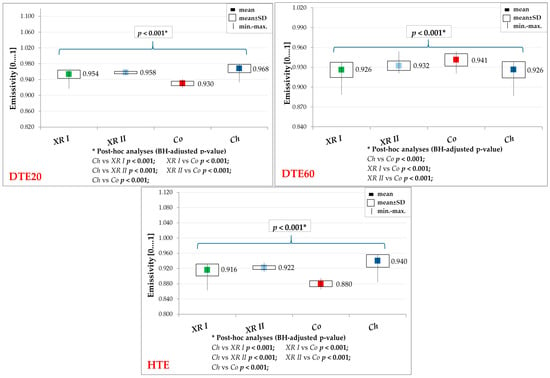
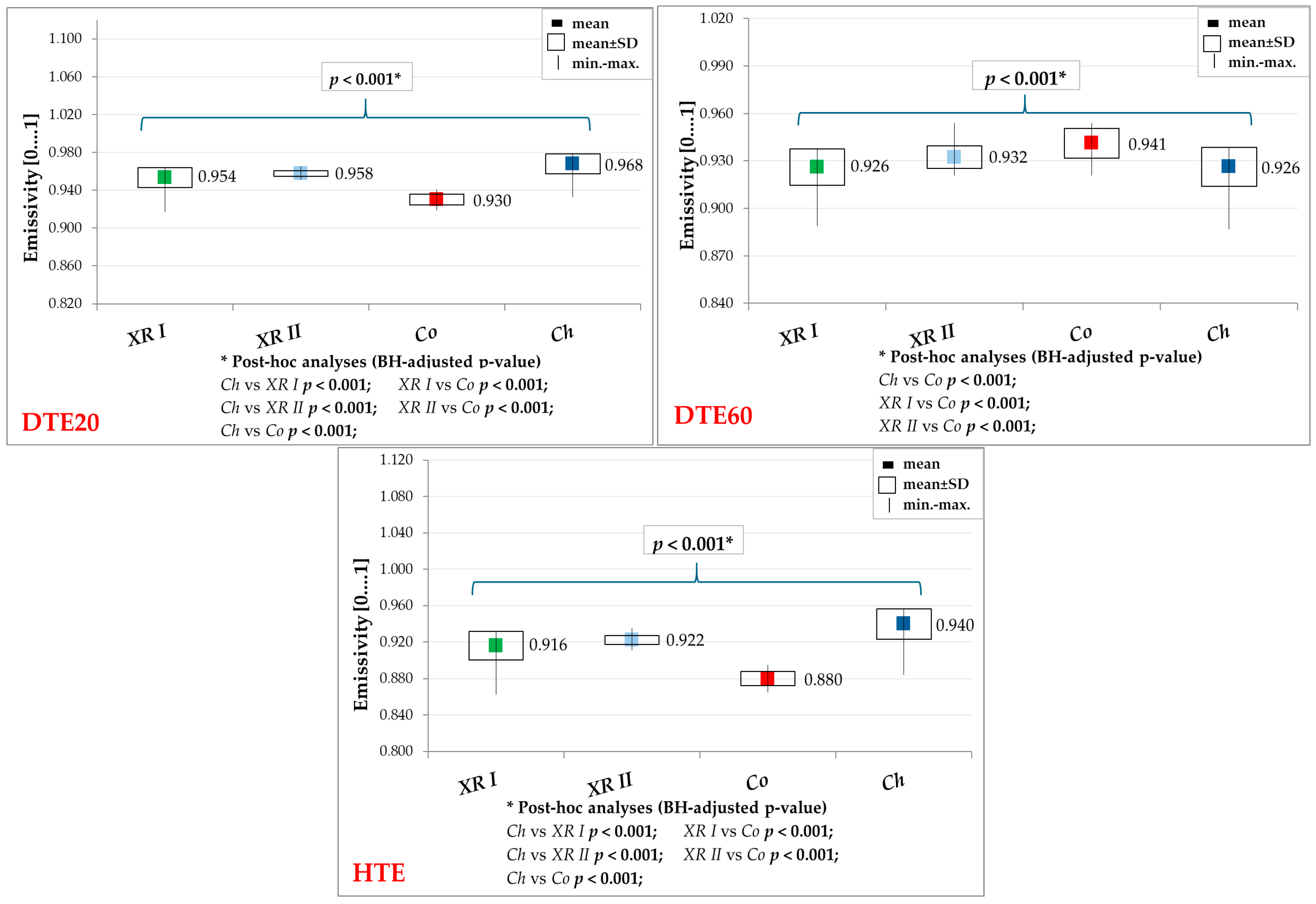
On the other hand, the DTE20 values for the Ch preparation with sodium aluminum dihydroxycarbonate were significantly higher than those for the XR I and XR II preparations (0.968 vs. 0.954 and 0.968 vs. 0.958, respectively; p < 0.001 for both) and for the Co tablets with ibuprofen (0.968 vs. 0.930; p < 0.001). In turn, the Co tablets showed the highest DTE60 values compared to other preparations (0.941 vs. 0.926 for the Ch tablets, p < 0.001; 0.941 vs. 0.926 for XR I tablets, p < 0.001; and 0.941 vs. 0.932 for XR II preparation, p = 0.001, respectively). The HTE parameter was again significantly higher for Ch tablets (p < 0.001 for comparisons with other preparations) (Figure 1).
Figure 1.
Comparison of mean DTE20, DTE60, and HTE values between tested tablets (XR I, XR II, Co, Ch). The standard deviation bars are presented in the chart. DTE20—directional thermal emissivity at an angle of 20°; DTE60—directional thermal emissivity at an angle of 60°; HTE—hemispherical thermal emissivity; XR I—extended-release I preparation (green); XR II—extended-release II preparation (blue); Co—coated preparation (red); Ch—chewable preparation (navy); SD—standard deviation; BH—Benjamini–Hochberg correction method.
3.3. Analysis of Emissivity Parameters (DTE20, DTE60 and HTE) Between Unexpired and Expired Tablets
Comparison of emissivity between expired and unexpired XR I tablets showed a significant difference only for DTE60 (p = 0.005, η2 = 0.081, dCohen = 0.592). In the case of XR II preparation, all emissivity parameters differed significantly between expired and unexpired tablets (DTE20: p = 0.012, η2 = 0.066, dCohen = 0.531; DTE60: p = 0.009, η2 = 0.073, dCohen = 0.562; HTE: p = 0.014, η2 = 0.064, dCohen = 0.524). In turn, mean values of emissivity parameters showed no differences between expired and unexpired Co and Ch tablets.
3.4. Analysis of Emissivity Parameters (DTE20, DTE60 and HTE) in the Function of Temperature
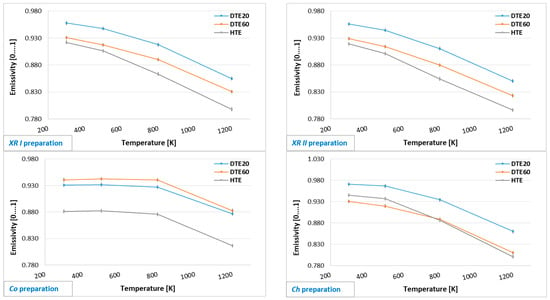
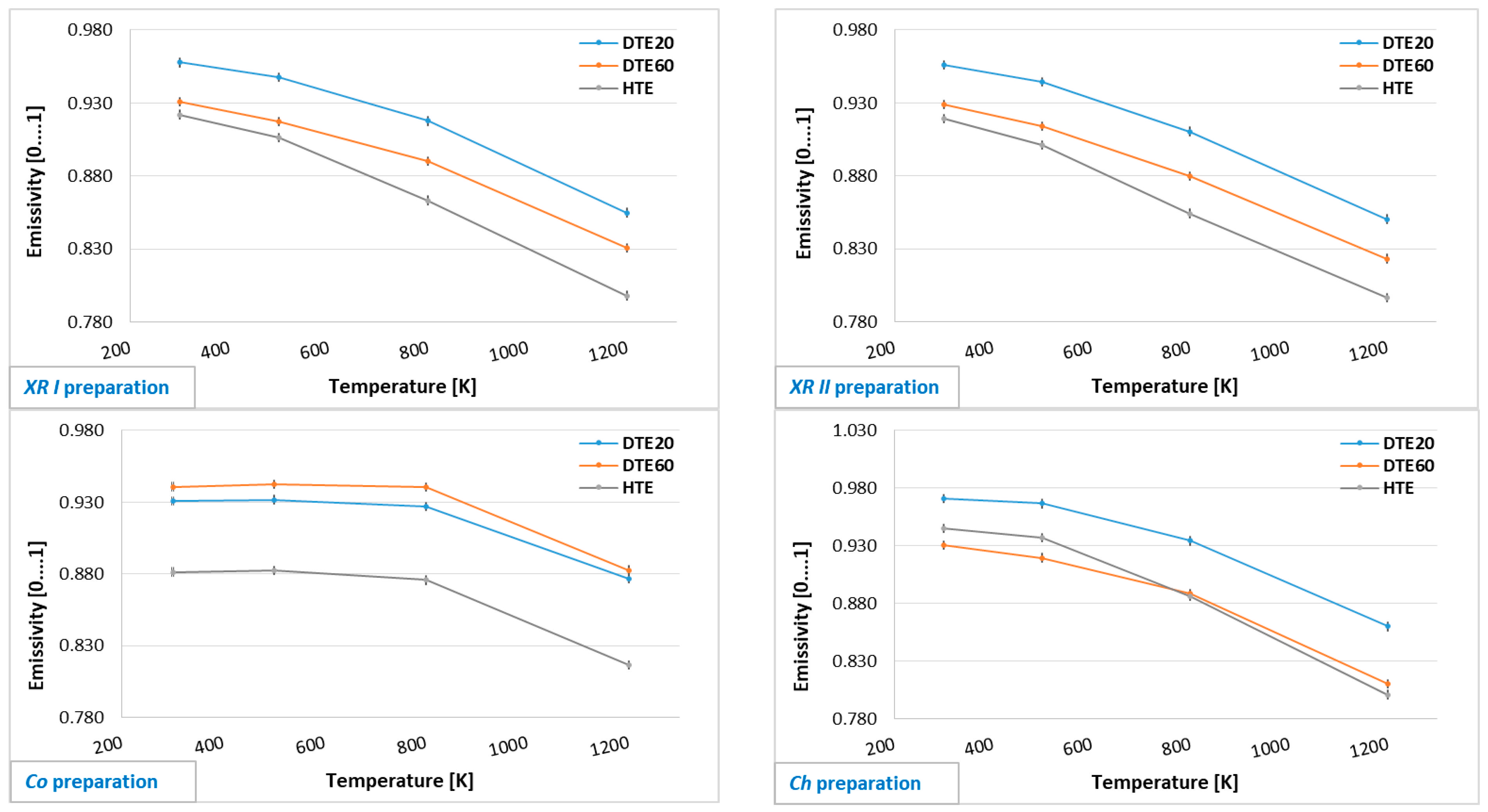
The values of DTE20, DTE60, and HTE decreased as temperature increased across all preparations, reaching their lowest values at 1200 K. Figure 2 shows the changes in DTE20, DTE60, and HTE with increasing modeling temperature.
Figure 2.
Mean values along with the standard deviation bars of DTE20, DTE60, and HTE of the tested tablets (XR I, XR II, Co, Ch) at increasing temperatures. DTE20—directional thermal emissivity at an angle of 20°; DTE60—directional thermal emissivity at an angle of 60°; HTE—hemispherical thermal emissivity; XR I—extended-release I preparation; XR II—extended-release II preparation; Co—coated preparation; Ch—chewable preparation.
Table 6 demonstrates a relative and absolute decrease in emissivity parameter values between the standard measurement temperature of 300 K and the temperature set in the apparatus during thermal modeling at 1200 K. The HTE parameter showed the largest relative decrease for the Ch tablets (over 15%) compared to the initial value. The XR I and XR II tablets exhibited similar decreases in emissivity across all parameters (DTE20 and DTE60 by almost 11%, and HTE by 13%). The smallest decreases in emissivity were observed for the Co tablets (DTE20 and DTE60 by almost 6%, and HTE by almost 7.5%).
Table 6.
Absolute and relative decrease in emissivity parameters between 300 K (standard measurement temperature) and 1200 K (simulated temperature) for all tested tablets.
4. Discussion
This study analyzed thermal emissivity parameters of four commercially available preparations that are technologically and physicochemically diverse. Extended-release tablets, coated tablets, and chewable tablets were selected due to their various active substance release mechanisms and distinct structural properties. Emissivity measurements were performed using a method that is currently not widely used in pharmacy, and only limited data are available on its application to the physicochemical assessment of solid oral dosage forms. However, interest in this area has increased in recent years.
On the other hand, examples of the use of less conventional methods for analyzing medicinal products, such as continuous wavelet transform, near-infrared spectroscopy, and photoacoustic spectroscopy, can be found in the literature [12,13,14,15]. These methods enable the analysis of sample parameters from a given batch in a non-destructive, non-invasive, rapid, and time-saving manner. A significant advantage of the discussed methods is the portable nature of the measuring devices, suggesting that this approach could potentially be explored in future studies across different stages of the pharmaceutical distribution chain, from production through storage and transport to delivery to healthcare facilities or individual patients [16].
In our study, for each commercial pharmaceutical preparation, directional–hemispherical reflectance values in the range of 1.5–21.0 microns were compared between unexpired and expired tablets. We observed that unexpired XR I tablets showed higher DHR in several mid-IR ranges, and DHR values measured at a 60° angle differed between unexpired and expired XR I tablets in all spectral bands except the 3.0–4.0 micron range. At 60°, the XR II tablets differed in all bands, with the highest values for expired tablets. In turn, coated tablets differed significantly only at 20° in the 1.5–2.0 μm range, with DHR higher for unexpired tablets. Chewable expired tablets had higher DHR in most bands at both angles, except for 3.0–4.0 microns at 60° and 10.5–21.0 microns at 20°. At 300 K, XR I and XR II tablets containing metformin hydrochloride showed comparable DTE20, DTE60, and HTE values. The Ch tablets had higher DTE20 than XR I, XR II, and the coated tablets. In turn, coated tablets exhibited the highest DTE60 values. HTE was highest for the Ch tablets. All DTE20, DTE60, and HTE values decreased with temperature, reaching their lowest values at 1200 K. The lowest relative decreases in emissivity were observed for the Co tablets (DTE20 and DTE60, by almost 6%, and HTE by almost 7.5%). However, the smaller decrease in emissivity observed for Co tablets should be interpreted within the temperature-modeling framework as reflecting coating-related surface optical properties, rather than as evidence of superior thermal stability under real pharmaceutical exposure conditions.
Recently, the study by Babczyńska et al. [17] analyzed the influence of tablet color (white tablets from 15 preparations or yellow-orange tablets from 10 preparations) and form (intact or crushed) on reflectance and emissivity. It has been shown that, from a durability and stability perspective, the optimal solid dosage formulation is a white tablet with an extremely smooth surface, as this structure minimizes emissivity while maximizing reflectance. The authors observed that HTE values were higher for crushed tablets, regardless of tablet color (white/yellow), and that the lowest HTE values were observed in white intact tablets [17]. A perfect black body has an emissivity of 1, while real materials always have lower values. For widely used industrial powders, understanding radiation properties—especially effective emissivity—is key to selecting optimal thermal conditions. Albouchi et al. [18] found that emissivity varies among metallic powder mixtures: glass powder had higher values (0.950–0.957) than bronze powder (0.435–0.485). They also showed that increasing the glass powder content in a mixture raises its effective emissivity [18]. Our previous analyses demonstrated that effervescent commercial tablets exposed to seven days of stress conditions (UV irradiation and a temperature of 26 °C) exhibited the highest emissivity in the 1.5–21.0 μm range [10]. The reflectance of the tablets varied depending on the angle of incidence of the radiation beam, indicating low surface dispersion [10].
It is assumed that most finished pharmaceutical preparations can be stored at room temperature and should be protected from sunlight. Solar radiation can lead to changes in the active ingredient or to the degradation of excipient polymers [19]. Data indicate that exposure of paracetamol to light leads to accelerated oxidation, resulting in the breakdown of the drug molecule into quinoimines and related compounds [20,21]. The visual effect of this degradation is a gradual color change from pink to brown.
In our study, despite the same tablet form (extended-release) and the same amount of active substance (750 mg metformin hydrochloride), XR I and XR II tablets partially differed in excipients (both contained magnesium stearate and hypromellose), which was reflected in significant differences in DHR values at 20° and 60° angles between the preparations in some spectral ranges. One of the excipients most commonly used in the production of swellable and soluble matrices is hypromellose (HPMC) [22]. HPMC matrices are therapeutically important and widely used to achieve extended drug release [23]. Once swallowed, they hydrate, swell, and form a HPMC “gel” layer that controls the drug’s release rate in the gastrointestinal tract. In a study by Maggi et al. [24] on nitrendipine tablets, differences in drug-release control were observed after UV radiation exposure. The coating of these tablets contained hypromellose. The authors suggested that these changes may result in a loss of the desired therapeutic effect [24].
In our study, no differences were observed in the 3.0–4.0 micron range for most comparisons between unexpired and expired XR I and XR II tablets, except for DHR at a 60° angle in XR II which had a low effect size (η2 = 0.029). Because polymers like HPMC, starch, and other organic excipients are heavily composed of hydroxyl groups and aliphatic C–H bonds, their fundamental IR absorption bands dominate this exact spectral region [25]. The 3.0–4.0 µm spectral window nominally overlaps with CH and OH stretching vibrations present in these polymers; however, emissivity/reflectance measured with an emissometer is sensitive to surface optical properties (roughness, porosity, coating thickness, and scattering) and to the effective absorptivity at the instrument geometry and spectral resolution. On complex, heterogeneous tablet surfaces, the CH/OH fundamental vibrational bands can be broadened, masked by scattering, or exhibit low apparent absorptivity in directional–hemispherical reflectance measurements, reducing the statistical power to detect differences between unexpired and expired tablets. Surface and coating morphology differ among tablet types (coated, matrix, chewable) and strongly affect mid-IR reflectance/emissivity. That is why the consistent non-significance of emissivity parameters between unexpired and expired tablets at 3.0–4.0 µm is most likely an optical/measurement effect rather than definitive evidence that CH/OH chemistry is unchanged.
The study has certain limitations. First, in the case of DHR and emissivity analyses, the source of the change cannot be observed, regardless of whether it occurs in the active ingredient, the excipient, or the physical properties of the dosage form. As the present study was designed as a proof-of-concept use of emissivity as a rapid, non-destructive screening method rather than a fully validated stand-alone quality control assay, chemical characterization using other established methods would be necessary to obtain a complete picture, since chemical degradation may affect the tablets’ physical structure. The lack of direct IR transmission measurements is also a limitation of the study. Another limitation is the longer storage of Co tablets beyond their expiration dates compared to other tablets analyzed and the lack of full historical storage conditions, including humidity and distribution conditions. Since the Co tablets have been stored for 10 years, we may assume that the coating composition might undergo aging-related changes during this prolonged storage beyond expiry. In the present case, the film coat containing carmellose sodium, talc, sucrose, spray-dried gum arabic, titanium dioxide, and macrogol 6000 may have undergone moisture-related changes, plasticizer redistribution, recrystallization, or microstructural damage, all of which may influence surface optical behavior and, therefore, emissivity. Accordingly, the observed emissivity differences should be interpreted as reflecting formulation-specific surface properties together with possible cumulative aging effects, rather than as evidence of a uniform post-expiry change applicable to all products. However, these differences in Co tablets should be interpreted with caution because they were underpowered for DHR comparisons.
Despite these limitations, the proposed methodology offers some advantages, including the lack of prior sample preparation, reduced reagent consumption, and a short measurement time. Furthermore, the equipment used in this work does not require specialized laboratory equipment; it may be suitable for evaluation in various settings (e.g., a pharmacy or even the patient’s home) to obtain emissivity data. Defects and errors during drug preformulation and development are among the most common causes of product recalls. This could be addressed in future work by exploring new parameters for pharmaceutical products and assessing whether automated vision inspection devices on the production line that analyze, for example, the spectral characteristics of tablets or utilize image comparison technology, could be used. The methodology proposed in our study, based on emissivity and/or reflectance measurements of solid dosage forms, appears promising as a potential research approach in this regard, as the spectral characteristics of tablets serve as a “fingerprint” for the specific dosage form being tested.
5. Conclusions
In conclusion, the thermal emissivity parameters (DTE20, DTE60, and HTE) were able to differentiate the commercial pharmaceutical solid formulations examined in this study, which varied in active substance release mechanisms and structural properties. The differences observed between unexpired and expired XR tablets suggest that emissivity may be sensitive to changes in the tablet surface and its physicochemical properties resulting from long-term storage. However, emissivity alone cannot determine whether these changes involve the API, excipients, or broader physical alterations of the dosage form. Therefore, emissivity should be regarded as a promising screening parameter that warrants further investigation, not as a validated method for routine quality control.
Author Contributions
Conceptualization, B.S.-H.; methodology, M.M., N.S., and B.S.-H.; software, B.S.-H.; formal analysis, B.S.-H.; investigation, M.M., N.S., B.S.-M. and B.S.-H.; resources, M.M., N.S., B.S.-M. and B.S.-H.; data curation, M.M. and N.S.; writing—original draft preparation, M.M., N.S., B.S.-M. and B.S.-H.; writing—review and editing, B.S.-H.; visualization, B.S.-H.; supervision, B.S.-H.; project administration, B.S.-H.; funding acquisition, B.S.-H. All authors have read and agreed to the published version of the manuscript.
Funding
This research was funded by the Medical University of Silesia in Katowice, Poland, within the projects BNW-1-037/N/5/F and BNW-1-072/K/6/F.
Data Availability Statement
The original contributions presented in this study are included in the article. Further inquiries can be directed to the corresponding author.
Conflicts of Interest
The authors declare no conflicts of interest.
References
- Wilczyński, S.; Koprowski, R.; Duda, P.; Banyś, A.; Błońska-Fajfrowska, B. Microtomographic studies of subdivision of modified-release tablets. Int. J. Pharm. 2016, 511, 899. [Google Scholar] [CrossRef] [Scilit]
- Klang, V.; Valenta, C.; Matsko, N.B. Electron microscopy of pharmaceutical systems. Micron 2013, 44, 45. [Google Scholar] [CrossRef] [Scilit] [PubMed]
- Sarecka-Hujar, B.; Balwierz, R.; Ostróżka-Cieślik, A.; Dyja, R.; Łukowiec, D.; Jankowski, A. Scanning electron microscopy and X-ray energy dispersive spectroscopy—Useful tools in the analysis of pharmaceutical products. J. Phys. Conf. Ser. 2017, 931, 012008. [Google Scholar]
- Meisner, M.; Duda, P.; Szulc-Musioł, B.; Sarecka-Hujar, B. Characteristics of Commercial Effervescent Tablets Using Selected Pharmacopeial and Novel Analytical Methods. Appl. Sci. 2023, 13, 3171. [Google Scholar] [CrossRef] [Scilit]
- Blessy, M.; Patel, R.D.; Prajapati, P.N.; Agrawal, Y.K. Development of forced degradation and stability indicating studies of drugs—A review. J. Pharm. Anal. 2014, 4, 159–165. [Google Scholar] [CrossRef] [Scilit] [PubMed]
- Klelemen, H.; Hancu, G.; Kacsó, E.; Papp, L.A. Photosensitivity Reactions Induced by Photochemical Degradation of Drugs. Adv. Pharm. Bull. 2022, 12, 77–85. [Google Scholar] [PubMed]
- Mineo, S.; Pappalardo, G. Rock Emissivity Measurement for Infrared Thermography Engineering Geological Applications. Appl. Sci. 2021, 11, 3773. [Google Scholar] [CrossRef] [Scilit]
- Jafari Ghalekohneh, S.; Du, C.; Zhao, B. Controlling the contrast between absorptivity and emissivity in nonreciprocal thermal emitters. Appl. Phys. Lett. 2024, 124, 101104. [Google Scholar] [CrossRef] [Scilit]
- Jones, J.M.; Mason, P.E.; Williams, A. A compilation of data on the radiant emissivity of some materials at high temperatures. J. Energy Inst. 2019, 92, 523–534. [Google Scholar] [CrossRef] [Scilit]
- Meisner, M.; Szulc-Musioł, B.; Sarecka-Hujar, B. Novel spectral data for effervescent tablets according to shelf life. Acta Pol. Pharm. 2024, 81, 675–684. [Google Scholar] [CrossRef] [Scilit]
- Sarecka-Hujar, B.; Meisner, M. Comparison of Total Hemispherical Reflectance and Emittance Values Between Metformin Extended-Release Tablets Stored Under Ambient and Stress Conditions. Sensors 2025, 25, 743. [Google Scholar] [CrossRef] [Scilit]
- Dinc, E.; Baleanu, D. Ratio spectra-continuous wavelet transform and ratio spectra-derivative spectrophotometry for the quantitative analysis of effervescent tablets of vitamin C and aspirin. Rev. Chim. 2008, 59, 499–504. [Google Scholar] [CrossRef] [Scilit]
- Fountain, W.; Dumstorf, K.; Lowell, A.E.; Lodder, R.A.; Mumper, R.J. Near-infrared spectroscopy for the determination of testosterone in thin-film composites. J. Pharm. Biomed. Anal. 2003, 33, 181–189. [Google Scholar] [CrossRef] [Scilit] [PubMed]
- Ottó, D.; Bicanic, D.; Ajtony, Z.; Koehorst, R. Determination of sunset yellow in multi-vitamin tablets by photoacoustic spectroscopy and a comparison with alternative methods. Food Addit. Contam. 2005, 22, 503–507. [Google Scholar] [CrossRef] [Scilit] [PubMed]
- Smith, M.R.; Jee, R.D.; Moffat, A.C. The transfer between instruments of a reflectance near-infrared assay for paracetamol in intact tablets. Analyst 2002, 127, 1682–1692. [Google Scholar] [CrossRef] [Scilit] [PubMed]
- Chavda, H. In-use stability studies: Guidelines and challenges. Drug Dev. Ind. Pharm. 2021, 47, 1373–1391. [Google Scholar] [CrossRef] [Scilit] [PubMed]
- Babczyńska, P.; Bożek, M.; Szebesczyk, A.; Ostróżka-Cieślik, A.; Adamczyk, J.; Lebiedowska, A.; Koprowski, R.; Wiernek, B.; Wilczyński, S. An Analysis of Emissivity and Reflectance Changes in Tablets as a Function of Their Physical Form. Processes 2025, 13, 444. [Google Scholar] [CrossRef] [Scilit]
- Albouchi, F.; Mzali, F.; Rigollet, F.; Nasrallah, S.B. Effective Emissivity Measurements of Powders and Their Mixtures. J. Porous Media 2007, 10, 189–200. [Google Scholar] [CrossRef] [Scilit]
- Janga, K.Y.; King, T.; Ji, N.; Sarabu, S.; Shadambikar, G.; Sawant, S.; Xu, P.; Repka, M.A.; Murthy, S.N. Photostability Issues in Pharmaceutical Dosage Forms and Photostabilization. AAPS PharmSciTech 2018, 19, 48–59. [Google Scholar] [PubMed]
- Feng, X.; Zhang, Q.; Cong, P.; Zhu, Z. Determination of the paracetamol degradation process with online UV spectroscopic and multivariate curve resolution-alternating least squares methods: Comparative validation by HPLC. Anal. Methods 2013, 5, 5286–5293. [Google Scholar] [CrossRef] [Scilit]
- Daescu, M.; Matea, A.; Negrila, C.; Serbschi, C.; Ion, A.C.; Baibarac, M. Photoluminescence as a valuable tool in the optical characterization of acetaminophen and the monitoring of its photodegradation reactions. Molecules 2020, 25, 4571. [Google Scholar] [CrossRef] [Scilit] [PubMed]
- Li, C.L.; Martini, L.G.; Ford, J.L.; Roberts, M. The use of hypromellose in oral drug delivery. J. Pharm. Pharmacol. 2005, 57, 533–546. [Google Scholar] [CrossRef] [Scilit] [PubMed]
- Ojsteršek, T.; Hudovornik, G.; Vrečer, F. Comparative Study of Selected Excipients’ Influence on Carvedilol Release from Hypromellose Matrix Tablets. Pharmaceutics 2023, 15, 1525. [Google Scholar] [CrossRef] [Scilit] [PubMed]
- Maggi, L.; Ochoa Machiste, E.; Fasani, E.; Albini, A.; Segale, L.; Conte, U. Photostability of extended-release matrix formulations. Eur. J. Pharm. Biopharm. 2003, 55, 99–105. [Google Scholar] [PubMed]
- Gieroba, B.; Kalisz, G.; Krysa, M.; Khalavka, M.; Przekora, A. Application of Vibrational Spectroscopic Techniques in the Study of the Natural Polysaccharides and Their Cross-Linking Process. Int. J. Mol. Sci. 2023, 24, 2630. [Google Scholar] [CrossRef] [Scilit] [PubMed]

Disclaimer/Publisher’s Note: The statements, opinions and data contained in all publications are solely those of the individual author(s) and contributor(s) and not of MDPI and/or the editor(s). MDPI and/or the editor(s) disclaim responsibility for any injury to people or property resulting from any ideas, methods, instructions or products referred to in the content. |
© 2026 by the authors. Licensee MDPI, Basel, Switzerland. This article is an open access article distributed under the terms and conditions of the Creative Commons Attribution (CC BY) license.