


Abstract
The valorization of agri-food by-products represents a key strategy for improving sustainability and promoting circular economy principles in food systems. Pumpkin seed press cake is a protein-rich by-product with potential application in bakery products. The aim of this study was to evaluate the feasibility of using defatted pumpkin seed press cake flour (PPSF) as a major ingredient in cookie formulations and to optimize its incorporation in order to maximize nutritional quality and sensory acceptability. Chemical characterization showed that PPSF has a superior nutritional profile compared to wheat flour, containing 55.75% protein, 8.78% minerals, and 6.15% total dietary fiber, along with significantly higher levels of total phenolics, total carotenoids, and β-carotene (0.26 mg/100 g). Formulation optimization using response surface methodology (RSM) enabled a high inclusion level of 69.61% PPSF, with 41.32% sugar and a baking time of 9 min and 29 s. The developed predictive models for diameter, thickness, overall acceptability, and bending stiffness were highly significant (p < 0.05) with a non-significant lack of fit (p > 0.05), confirming their statistical reliability for exploring the design space. The optimized C-PPSF (defatted pumpkin seed press cake flour) cookies showed a significant nutritional improvement, with protein content increasing from 13.05% to 30.17% and antioxidant capacity (DPPH) rising from 2.90% to 7.10%. While the enriched cookies had a darker color (L* 51.98) and reduced snapping force (39.7 N) due to gluten dilution, they maintained stable geometric parameters and achieved higher sensory scores for aroma, taste, and overall acceptability compared to the control. The main finding of this study is that PPSF can replace a substantial proportion of wheat flour in cookies while maintaining consumer acceptability and significantly improving nutritional quality. The optimized formulation with approximately 70% PPSF shows that this by-product has the potential to serve as a major ingredient in bakery products rather than only as a nutritional supplement. These results confirm that PPSF is a powerful functional ingredient that supports zero-waste manufacturing and provides a foundation for its broader use in bakery formulations within circular economy approaches. Future research should focus on shelf-life stability, bioaccessibility of bioactive compounds, volatile aroma profiling (e.g., GC–MS analysis), and industrial-scale validation of PPSF-based formulations.
1. Introduction
The transition to circular economy models has become a central approach for improving sustainability in the agri-food sector. Valorization of agri-food by-products and processing residues contributes to waste minimization, resource recovery, and the development of value-added compounds with applications in the food, pharmaceutical, cosmetic, and environmental sectors [1,2]. Among these by-products, residues generated during cold-pressed oil production have attracted considerable scientific and industrial interest. In particular, pumpkin seed press cake from Cucurbita pepo seeds represents a promising raw material for food applications. After oil extraction, the remaining press cake retains substantial amounts of proteins, dietary fiber, minerals, residual lipids, and bioactive compounds, making it suitable for incorporation into functional food products [3,4].
World production of pumpkin seeds (4–6% of the total pumpkin weight) is estimated at around 0.92–1.38 million tons [5]. The production of pumpkin seed oil generates a significant amount of food waste, especially the pressed cake (defatted seed meal) and seed husks. These by-products are often thrown away or underutilized, despite being rich in nutrients and phytochemicals [6]. Pumpkin oil cakes, obtained as by-products during pumpkin seed oil extraction, are valuable sources of essential fatty acids, proteins, minerals, and bioactive constituents, including tocopherols and sterols, which contribute to their high nutritional potential [7].
Pumpkin seed press cake may contain approximately 44% protein, 37.8% carbohydrates, and 3.5% minerals, along with phenolic compounds, tocopherols, and phytosterols exhibiting significant antioxidant potential [8]. Its dietary fiber fraction also contributes to improved nutritional and functional properties of food products [9]. Due to these characteristics, defatted pumpkin seed press cake flour (PPSF) has considerable potential as a sustainable ingredient for developing nutritionally enriched bakery products [10]. Their application in functional food formulations has gained increasing attention in recent years. Since the chemical composition of pumpkin seeds is predominantly lipid-based, the oil extraction process generates nutrient- and energy-rich by-products that may significantly affect the sensory characteristics, quality, and shelf life of fortified food products [11,12]. Although pumpkin seed flour and pumpkin seed press cake have previously been incorporated into bakery products, most studies have focused on relatively low substitution levels and have not systematically evaluated the feasibility of high PPSF incorporation while simultaneously optimizing nutritional, technological, and sensory quality. Therefore, the potential of PPSF as a major ingredient in cookie formulations remains insufficiently explored.
Several studies have investigated the partial replacement of wheat flour with pumpkin seed flour in bakery applications. Jeevitha et al. [13] reported improved bread volume and reduced baking losses with increasing levels of pumpkin seed flour, while moderate substitution levels resulted in favorable sensory properties. Similarly, Litvynchuk et al. [14] demonstrated significant structural and protein-related changes in dough systems enriched with pumpkin seed flour, particularly at substitution levels above 10%. More recently, Tomić et al. [15] reported enhanced antioxidant activity in gluten-free crackers enriched with flour derived from cold-pressed pumpkin seed oil by-products, confirming the importance of processing conditions for retaining bioactive compounds.
Although previous studies have primarily focused on bread and cracker formulations, limited information is available regarding the optimization of cookie formulations enriched with defatted pumpkin seed press cake flour, particularly from the perspective of sustainable by-product valorization and product quality optimization. Despite the known benefits of pumpkin seeds, there is a significant knowledge gap regarding the systematic optimization of defatted press cake in high-inclusion cookies formulations (up to 70%). This research addresses this gap by providing a scalable model for by-product valorization that uses existing biomass without requiring additional land or water resources.
The novelty of this study lies in the integrated assessment of defatted pumpkin seed press cake flour as a sustainable value-added ingredient for cookies production, combining circular economy principles with product quality optimization and consumer acceptability. In the context of this study, sustainable valorization refers to the transformation of pumpkin seed press cake, a by-product of oil production, into a value-added food ingredient with improved nutritional functionality. Such utilization may contribute to waste reduction and enhanced resource efficiency within food production systems.
Therefore, the main objective of this study was to evaluate the feasibility of using defatted pumpkin seed press cake flour as a major ingredient in cookie production and to determine the optimal formulation capable of maximizing nutritional quality and consumer acceptability. Specifically, the study investigated whether high levels of PPSF incorporation could be achieved without compromising the technological and sensory characteristics of the final product.
2. Materials and Methods
2.1. Materials
The ingredients used for cookie production, including wheat flour, sugar, fat, and other standard formulation components, were purchased from local retail stores in Osijek, Republic of Croatia. Defatted pumpkin seed press cake flour (PPSF) was produced under laboratory conditions at the Technical University of Sofia, College—Sliven, Republic of Bulgaria. Cold-pressed oil extraction from pumpkin seeds (Cucurbita pepo) was performed using a laboratory cold-press oil extractor (Camry CR 4011, Camry Electronic Co., Ltd., Zhongshan, China). The resulting press cake was dried at 45 °C for 48 h and then milled into flour using a laboratory mill (IKA MF10, IKA®-Werke GmbH & Co. KG, Staufen, Germany), equipped with a 0.8 mm screen, and the resulting flour fraction was used in all subsequent analyses and cookie formulations. The flour was stored in hermetically sealed containers at room temperature until further analysis and cookie production.
2.2. Methods
2.2.1. Optimization of Cookies Production Using Response Surface Methodology
A three-factor, three-level Box–Behnken design (BBD) was used to optimize the cookie formulation and evaluate the effects of independent variables on product quality. The independent variables and their levels were PPSF proportion (A, 0–80%), sugar content (B, 26.67–57.78%), and baking time (C, 8–12 min), as shown in Table 1. The experimental design included 17 runs, with five replicates at the center point to estimate experimental error and ensure model reproducibility. The relationships between the independent variables and the physical, textural, and sensory attributes were modeled using second-order polynomial equations:
where represents the predicted response variable, is the intercept, and , , and are the linear, quadratic, and interaction coefficients, respectively.
Table 1.
Experimental design levels used in the Box–Behnken design.
The specific mathematical models in terms of coded factors (Equations (S1)–(S4)) and the corresponding analysis of variance (ANOVA) results (Tables S1–S4) are detailed in the Supplementary Material.
Model adequacy was rigorously evaluated based on the significance of the regression models (p < 0.05), coefficients of determination (R2, Adjusted R2), and lack-of-fit tests. Numerical optimization was performed using the desirability function approach. Numerical multi-response optimization was conducted using Derringer’s desirability function approach with Design-Expert® software (version 12.0.3.0). This method involves transforming each individual response (Yi) into a dimensionless desirability value (di) ranging from 0 (unacceptable) to 1 (completely desirable), depending on whether the goal is to maximize, minimize, or target a specific value. The individual desirability scores are then combined into a single global desirability (D) using a geometric mean, which was used to identify the optimal levels of PPSF, sugar, and baking time that simultaneously satisfy all established quality criteria.
Following the benchmarking methodology established in our preliminary research, the optimization targets for physical and textural parameters were defined based on the characteristics of the control (Ctrl) sample and preliminary experimental trials. The criteria for diameter (7.0 cm) and thickness (1.3 cm) were set to match the geometric profile of traditional wheat cookies (Ctrl), ensuring visual familiarity for consumers. The target for bending stiffness (30 N/mm) was selected based on preliminary assessments to achieve an optimal ‘tender’ and ‘crunchy’ texture, specifically considering the gluten dilution effect caused by high levels of PPSF incorporation. Therefore, the final optimization criteria were set to maximize PPSF incorporation and overall sensory acceptability while achieving these targeted technological benchmarks. Statistical design, data analysis, and multi-response optimization were conducted using Design-Expert® software (version 12.0.3.0, Stat-Ease Inc., Minneapolis, MN, USA). The levels of the independent variables used in the Box–Behnken design are shown in Table 1.
2.2.2. Cookie Production
Cookies were produced under laboratory conditions at the Faculty of Food Technology, Osijek, according to AACC Method 10-50.05 [16], with minor modifications. Based on the Box–Behnken experimental design, 17 formulations were prepared. PPSF and sugar were added according to the data given in Table 1. Wheat flour was added in the amount of 100%—PPSF. Other ingredients were shortening (28.4%), NaCl (0.9%), sodium hydrogen carbonate (1.1%), and water (21.8%). The ingredients were mixed using an electronic mixer until a homogeneous dough was obtained. The dough was refrigerated at 8 °C for 30 min, rolled to a thickness of 7 mm, and cut using a circular cutter with a diameter of 60 mm. The cookies were baked at 205 °C, cooled at room temperature for at least 1 h before further analyses. Based on the Box–Behnken experimental design, 17 formulations were prepared. Following the optimization procedure, the formulation with the optimal level of PPSF (C-PPSF) was selected for further characterization and compared with the control sample (Ctrl), prepared without PPSF. All baking trials were performed in three independent batches.
2.2.3. Determination of Physical and Textural Properties
The diameter, thickness, and spread ratio of the cookies were determined according to the method described by Jukić et al. [17]. Volume and specific volume were measured using laser topography (Volscan Profiler, Stable Micro Systems, Godalming, UK). Color parameters of cookie surfaces and ground cookie samples were determined in the CIEL*a*b* color space using an LS175 colorimeter (Hangzhou Lohand, Hangzhou, China) as described in Lukinac et al. [18]. Textural properties, including snapping force (N), distance to break (mm), and bending stiffness (N/mm), were determined by a three-point bending test using a Shimadzu EZ-LX texture analyzer (Shimadzu Corp., Kyoto, Japan) equipped with a 1000 N load cell, following the procedure described by Jukić et al. [19].
2.2.4. Determination of Chemical Properties of Flour and Cookies
Sample preparation for chemical analysis was performed according to AACC Method 62-20A [20]. The chemical composition of flour and cookies was determined using standard analytical methods: moisture content—AACC Method 44-19 [21], ash content—AACC [22], fat content—ISO 6492 [23], and protein content—modified Lowry method according to Mæhre et al. [24]. Dietary fiber (soluble, insoluble, and total) was determined using the gravimetric–enzymatic method according to AACC Method 32-07 [25]. The determination of individual and grouped fatty acids was performed according to ISO 12966-4:2015 using capillary gas chromatography (GC-FID) [26].
2.2.5. Content of Bioactive Compounds
Total carotenoids were determined according to Nakov et al. [27]: 100 mg of sample was extracted with 10 mL of 80% acetone, stirred for 10 min, and centrifuged for 10 min at 3000 rpm (Multifuge 3 L-R, Heraeus, Germany). The absorbance of the supernatant was measured at 480 nm using a UV-VIS spectrophotometer (LLG-uni SPEK 1 UV/VIS, Germany). Total carotenoids were expressed as mg/kg dry matter. The β-carotene content in flour and cookie samples was determined according to Cangussu et al. [28]: 0.5 g of sample was extracted with 5 mL of cooled acetone and left in the dark for 30 min. The mixture was filtered, and the residue was washed twice with 2.5 mL of acetone; the filtrates were combined and made up to 10 mL. Absorbance was measured at 450 nm (β-carotene) using a UV-VIS spectrophotometer (LLG-uni SPEK 1 UV/VIS, Germany). Total phenolic content and antioxidant capacity (DPPH radical scavenging capacity) were determined according to Wang et al. [29]. Ground cookie (1 g) was extracted with 10 mL methanol (80:20 v/v) for 2 h at room temperature and filtered (Whatman No. 1). Then, 0.3 mL extract was reacted with 1.5 mL Folin–Ciocalteu reagent (1:10) and 1.5 mL 6% Na2CO3, and incubated in the dark for 90 min. Absorbance was measured at 725 nm (LLG-uni SPEK 1 UV/VIS, Germany) against a methanol blank. Total polyphenols were expressed as mg GAE/100 g dry matter. For antioxidant capacity, 200 μL of phenolic extract was mixed with 3.9 mL of 0.1 mM DPPH methanolic solution, vortexed, and incubated at room temperature for 30 min. Absorbance was measured at 517 nm (LLG-uni SPEK 1 UV/VIS, Germany) using methanol as the control. Radical scavenging capacity was expressed as % DPPH inhibition.
The ABTS radical cation (ABTS•+) was generated by mixing 7 mM ABTS stock solution with 2.45 mM potassium persulfate solution (1:1, v/v) and allowing the mixture to react in the dark at room temperature for 12–16 h. Prior to analysis, the ABTS•+ solution was diluted with methanol to obtain an absorbance of 0.70 ± 0.02 at 734 nm. Then, 200 μL of phenolic extract was added to 3.0 mL of diluted ABTS•+ solution, vortexed, and incubated at room temperature for 6 min. Absorbance was measured at 734 nm (LLG-uni SPEK 1 UV/VIS., Germany) using methanol as a blank. Radical scavenging capacity was expressed as % ABTS inhibition.
Ferric reducing antioxidant power (FRAP) was determined according to a spectrophotometric method based on reduction of the Fe3+-TPTZ complex. The FRAP reagent was freshly prepared by mixing 300 mM acetate buffer (pH 3.6), 10 mM TPTZ solution in 40 mM HCl, and 20 mM FeCl3·6H2O in a ratio of 10:1:1 (v/v/v). Then, 200 μL of phenolic extract was mixed with 3.0 mL of FRAP reagent, vortexed, and incubated at 37 °C for 30 min. Absorbance was measured at 593 nm (LLG-uni SPEK 1 UV/VIS., Germany). A calibration curve was prepared using ascorbic acid, and results were expressed as mg ascorbic acid equivalents (AAE) per gram of sample.
2.2.6. Sensory Analysis of Cookies
Sensory evaluation was conducted at the Technical University of Sofia, College—Sliven, Republic of Bulgaria. Twenty trained panelists (12 females and 8 males, aged 19–50 years) participated in the evaluation after providing informed consent. A 9-point hedonic scale (1 = dislike extremely; 9 = like extremely) was used to assess appearance, color, texture, aroma, taste, and overall acceptability. Appearance was defined as the visual perception of the sample, including shape, surface characteristics, and visual attractiveness, which are key determinants of consumer perception of food quality and acceptance [30]. Color referred to the intensity and uniformity of visual color attributes, which strongly influence first-impression liking and product acceptance in sensory studies [31]. Texture was evaluated as the mouthfeel properties of the product, including crispness, hardness, and structural consistency, which are critical determinants of consumer preference in baked and fried foods [32]. Aroma represented the olfactory perception of volatile compounds released from the sample during consumption, playing a key role in overall sensory perception and product acceptability [33]. Taste describes the gustatory perception of basic flavor characteristics, including sweetness, saltiness, bitterness, sourness, and umami, which are fundamental drivers of food liking [34]. Overall acceptability was defined as the integrated sensory judgment combining all evaluated attributes and representing the global consumer preference for the product [35]. The study was approved by the Ethics Committee of the Technical University of Sofia (No. 2/1 April 2026).
2.2.7. Statistical Analysis of the Results
All measurements were performed in triplicate, and results are presented as mean ± standard deviation (n = 3). For the comparison between the control (Ctrl) and optimized (C-PPSF) samples, data were analyzed using one-way analysis of variance (ANOVA), followed by Fisher’s least significant difference (LSD) test to determine statistically significant differences at p < 0.05. These analyses were performed using XLSTAT 2019 (Addinsoft, France) and Microsoft Excel 2019. Additionally, the experimental design, modeling, and multi-response optimization (Response Surface Methodology) were conducted using Design-Expert® software (version 12.0.3.0, Stat-Ease Inc., Minneapolis, MN, USA), as detailed in Section 2.2.1.
3. Results and Discussion
3.1. Optimization of Cookie Formulation
The adequacy of the fitted models was rigorously assessed using analysis of variance (ANOVA), coefficients of determination (R2), and lack-of-fit tests. ANOVA confirmed the statistical significance of the regression models (p < 0.05) for the four analyzed responses presented in the Supplementary Material (Tables S1–S4). A critical evaluation of the models showed that the lack of fit was non-significant (p > 0.05) for all four parameters: diameter (p = 0.1476), thickness (p = 0.48), overall acceptability (p = 0.5626), and bending stiffness (p = 0.0032). This indicates a high degree of model adequacy and confirms that the quadratic and linear equations (Equations (S1)–(S4)) accurately describe the experimental data. The Adequate Precision values, which measure the signal-to-noise ratio, ranged from 6.20 to 51.75, substantially exceeding the minimum threshold of 4.0, confirming the models’ reliability for navigating the design space. The coefficients of determination (R2) demonstrated an excellent fit for physical geometry, with values for diameter (R2 = 0.9798) and thickness (R2 = 0.9879) indicating that the models explain over 97% of the variability. Overall acceptability also showed a strong fit (R2 = 0.8539). The model for bending stiffness exhibited a reliable fit (R2 = 0.6422) and was statistically significant (p = 0.0032), confirming its adequacy for optimization. The visual representation of these interactions is provided through three-dimensional response surface plots (Figures S1–S4).
3.2. Chemical Characteristics of the Used Flours
The chemical composition of wheat flour and defatted pumpkin seed press cake flour (PPSF) is presented in Table 2. The results clearly show that PPSF has markedly superior nutritional characteristics compared to wheat flour, particularly in protein, ash, and bioactive compound content.
Table 2.
Chemical composition and bioactive properties of wheat flour and defatted pumpkin seed press cake flour (PPSF).
Moisture content was significantly lower in PPSF (3.97%) than in wheat flour (8.44%), suggesting improved storage stability and reduced susceptibility to microbial spoilage. In contrast, ash content was substantially higher in PPSF (8.78%), indicating a rich mineral profile and strong potential as a micronutrient source.
The most pronounced difference was observed in protein content, with PPSF (55.75%) greatly exceeding wheat flour (13.12%), confirming its value as a high-protein plant-based ingredient suitable for nutritional enhancement of bakery products.
Although oil was partially removed during defatting, PPSF still contained a notable fat fraction (17.30%), which may contribute to flavor development and techno-functional properties in dough systems.
Dietary fiber content was also higher in PPSF (6.15%) compared to wheat flour (3.85%), supporting its functional role in improving digestive health and modulating texture in baked products. In addition, PPSF showed significantly higher levels of β-carotene, total carotenoids, total phenolics, and antioxidant capacity, confirming its strong bioactive potential. These results are consistent with previous reports highlighting pumpkin seed by-products as valuable functional ingredients [8,9]. Overall, PPSF is a nutritionally dense ingredient with strong potential for wheat flour substitution in bakery formulations. Compared with previous studies reporting protein contents of 40–50% in pumpkin seed press cake flours, the protein level observed in the present study (55.75%) was at the upper end of the reported range, indicating that the applied cold-pressing and drying conditions effectively concentrated protein-rich fractions. Furthermore, the simultaneous presence of elevated phenolic compounds, carotenoids, and dietary fiber highlights the multifunctional nature of PPSF as both a nutritional and functional ingredient. Unlike conventional wheat flour fortification strategies that typically focus on a single nutritional attribute, PPSF provides both protein enrichment and antioxidant enhancement, which may offer additional technological and health-related benefits in bakery products.
The bioactive potential of PPSF was further confirmed by its significantly higher antioxidant capacity compared to wheat flour in all three evaluated assays (Table 2). PPSF showed nearly double the radical scavenging capacity (% DPPH and % ABTS) of wheat flour, while its Ferric Reducing Antioxidant Power (FRAP) was approximately 2.5 times higher (0.35 vs. 0.14 mg AAE/g). These results directly correlate with the significantly higher levels of total phenolics and carotenoids found in PPSF. The concentration of these bioactive compounds during the oil extraction process effectively transforms the press cake into a potent functional ingredient for sustainable food applications.
PPSF displayed a distinctly different fatty acid profile compared to wheat flour, with a higher total saturated fatty acid content (2.49 ± 0.02 g/100 g vs. 0.92 ± 0.02 g/100 g). The predominant fatty acids in PPSF were linoleic (39.75 ± 0.35 g/100 g) and oleic acid (38.20 ± 0.28 g/100 g), indicating a strong presence of unsaturated lipids. Overall, PPSF contained higher levels of both monounsaturated and polyunsaturated fatty acids than wheat flour, suggesting improved nutritional lipid quality. According to Apostol et al. [36], total unsaturated fatty acids in PPSF are about 80%, making this flour a valuable raw material for food enrichment. PPSF is also rich in polyunsaturated fatty acids, which enhance its nutritional value, and their intake is associated with a reduced risk of coronary heart disease [37]. Processing pumpkin seeds affects fatty acid composition; roasting increases total saturated and polyunsaturated fatty acids, while fermentation results in the highest monounsaturated fatty acid content [38]. According to Polyzos et al. [39], PPSF contains 21.048% saturated, 36.69% monounsaturated, and 42.262% polyunsaturated fatty acids.
Compared with other plant-based flours used for nutritional enrichment of bakery products, PPSF exhibited a particularly favorable composition. Previous studies reported protein contents of approximately 51.4% for soybean press cake, 31.7% for sunflower press cake, and 32.2% for hempseed press cake, whereas pumpkin seed press cake may reach protein levels close to 60% depending on processing conditions [40]. Similarly, a recent comparative study showed that pumpkin seed flour contained 65.2% protein, substantially exceeding sunflower seed flour (34.8%) and conventional wheat flours (9.4–10.6%) [41]. In addition to its high protein concentration, PPSF also provides a rich mineral profile and valuable bioactive compounds, supporting its use as a multifunctional ingredient for the development of nutritionally enhanced bakery products and the sustainable valorization of oil-industry by-products.
3.3. Formulation Optimization of Cookies Enriched with PPSF
The cookie formulation was developed by partially replacing wheat flour with defatted pumpkin seed press cake flour (PPSF), while varying sugar content and baking time using a structured experimental design. The optimization process aimed to maximize PPSF incorporation while maintaining superior sensory appeal and structural integrity. The target criteria and optimized formulation parameters are summarized in Table 3.
Table 3.
Target and optimized formulation parameters for cookies enriched with defatted pumpkin seed press cake flour (C-PPSF).
Statistical analysis (ANOVA) confirmed that the quadratic models for diameter (R2 = 0.9798) and thickness (R2 = 0.9879) were highly significant (p < 0.0001), demonstrating excellent agreement between experimental and predicted values (Tables S1 and S2). Additionally, the models for overall acceptability (R2 = 0.8539) and bending stiffness (R2 = 0.6422) provided critical insights into consumer preference and textural stability (Tables S3 and S4).
PPSF proportion (A) and sugar content (B) were identified as the most influential linear factors affecting cookie geometry (p < 0.0001), while the significant quadratic terms (A2, B2, C2) in Equations (S1) and (S2) confirmed the non-linear, curvature-based nature of the response surfaces. For overall acceptability, both PPSF and sugar levels played a decisive role (p < 0.005), as shown in the linear relationship in Equation (S3). Regarding bending stiffness, baking time (C) was the only significant linear factor (p = 0.0012), indicating that the duration of thermal treatment is the primary driver of the cookie’s structural resistance to breaking (Table S4, Equation (S4)).
These robust predictive capabilities enabled the selection of an optimized formulation containing 69.61% PPSF, 41.32% sugar, and a baking time of 9 min and 29 s, as presented in Table 3. Multi-response optimization was performed using the desirability function approach (D = 0.774), targeting a cookie diameter of 7.0 cm, a thickness of 1.3 cm, and a bending stiffness value of 30 N/mm.
Experimental Validation of the Optimized Formulation
To verify the reliability of the predictive models, cookies were prepared using the optimized conditions identified in Table 3 (69.61% PPSF, 41.32% sugar, and ~9 min baking time). The experimental values obtained for the physical and sensory parameters closely matched the predicted values, with deviations within an acceptable range of less than 5%. This strong correlation confirms the adequacy of the RSM models—specifically, the quadratic models for diameter and thickness (Equations (S1) and (S2)) and the models for overall acceptability and bending stiffness (Equations (S3) and (S4))—for addressing the complex interactions within the composite flour system. The statistical reliability of these models is further supported by the ANOVA results in Tables S1–S4, which showed significant model F-values (p < 0.05) and non-significant lack of fit (p > 0.05) for all four optimized responses: diameter (p = 0.1476), thickness (p = 0.48), overall acceptability (p = 0.5626), and bending stiffness (p = 0.103).
Consequently, this optimized formulation (C-PPSF) was further subjected to comprehensive physical, chemical, and sensory characterization compared to the control sample to evaluate the impact of high-level wheat flour substitution.
3.4. Physical and Textural Characteristics of Cookies
The physical and textural properties of the control cookies and the optimized C-PPSF formulation (69.61% PPSF) are summarized in Table 4. Both samples showed comparable geometric dimensions, with no statistically significant differences (p > 0.05) in height (1.36 cm vs. 1.21 cm) or diameter (7.25 cm vs. 7.12 cm). This stability indicates that the high substitution level of wheat flour with PPSF did not compromise the basic structural integrity of the cookies, confirming that PPSF incorporation can maintain geometric stability.
Table 4.
Physical and textural characteristics of cookies.
A slight increase in the spread factor was observed in C-PPSF cookies (59.09) compared to the control (53.30). This trend suggests a reduction in dough viscosity, likely due to gluten dilution and the presence of non-gluten proteins and dietary fiber, which is consistent with findings in similar composite flour systems [42]. However, the enriched cookies showed a significant reduction in volume (from 37.69 cm3 to 33.70 cm3) and specific volume (from 1.80 cm3/g to 1.36 cm3/g). This decrease is primarily attributed to the weakening of the gluten network and increased water competition from dietary fiber [14].
Textural analysis revealed a substantial decrease in snapping force (from 84.82 N to 39.7 N) and bending stiffness (from 48.02 N/mm to 25.3 N/mm) in the C-PPSF cookies. This softening effect is associated with the interference of dietary fiber with protein network development, resulting in a final product with reduced hardness [17,43]. These results align with the statistical data in the Supplementary Material, where Table S4 and Equation (S4) confirm that the cookie’s structural resistance is significantly influenced by processing conditions. The observed reduction in hardness and bending stiffness in C-PPSF cookies aligns with previous findings in bakery products enriched with pumpkin seed flour and other oilseed press cakes. Apostol et al. [36] reported that incorporating pumpkin seed flour into cookie formulations significantly decreases hardness and structural resistance due to gluten network dilution and increased water competition from dietary fibers. Similarly, Karaś et al. [44] demonstrated that adding oilseed press cake reduces specific volume and increases product fragility as a result of weakened dough structure and reduced gas retention capacity. Notably, in the present study, these structural changes occurred at a very high substitution level (69.61% PPSF), which is considerably higher than levels typically reported in the literature (<30%), while still maintaining acceptable geometric stability and sensory properties.
Significant color modifications were observed, with surface L* values decreasing from 78.10 to 51.98. The darker color may be partially attributed to enhanced Maillard reactions resulting from the higher protein content of PPSF (55.75%) [45]. Furthermore, the increase in a* values (from 2.17 to 8.61) is linked to the presence of natural pigments, specifically carotenoids and β-carotene (0.26 mg/100 g in PPSF), which enhance the visual identity of the cookies [46].
Nutritionally, the optimized C-PPSF formulation demonstrated a vastly superior profile. Protein content increased more than twofold (from 13.05% to 30.17%), while total dietary fiber rose to 4.92% and ash content nearly doubled to 2.80%. These findings confirm that the valorization of defatted pumpkin seed press cake is a highly effective strategy for producing nutrient-dense, functional bakery products [47,48].
3.5. Chemical Composition and Bioactive Properties of Cookies
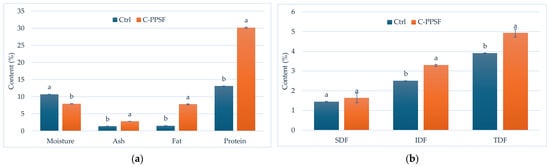
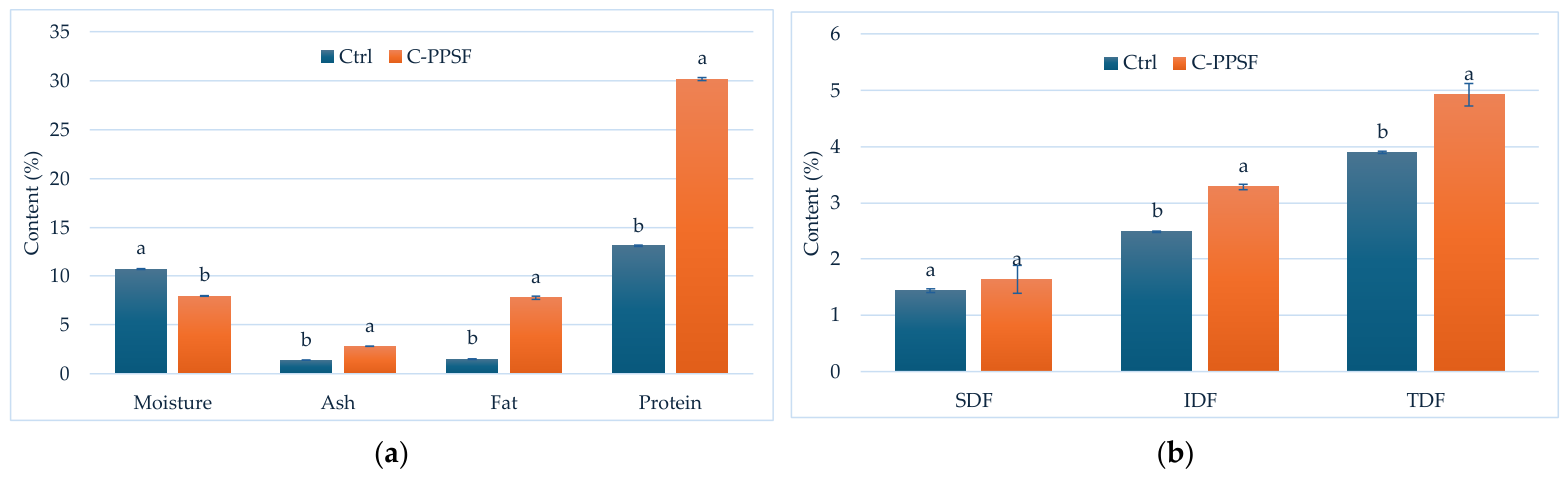
The chemical composition of the control cookies (Ctrl) and the cookies enriched with the optimized proportion of defatted pumpkin seed press cake flour (C-PPSF) is shown in Figure 1, while the content of bioactive compounds and antioxidant capacity is detailed in Table 4.
Figure 1.
Proximate composition and dietary fiber content of control cookies (Ctrl) and cookies enriched with defatted pumpkin seed press cake flour (C-PPSF): (a) moisture, ash, fat, and protein content; (b) soluble dietary fiber (SDF), insoluble dietary fiber (IDF), and total dietary fiber (TDF) content. Values are expressed as mean ± standard deviation (n = 3). Different letters indicate statistically significant differences between samples within each parameter (p < 0.05).
A statistically significant difference (p < 0.05) was observed in moisture content between the control sample (10.68%) and C-PPSF (7.93%). The lower moisture content in C-PPSF may be attributed to changes in dough water-binding capacity following PPSF incorporation, as previously reported by Apostol et al. [36] and Litvynchuk et al. [14]. The ash content was significantly higher in C-PPSF (2.80%) compared to the control (1.38%), consistent with findings by Kaur et al. [49] and Kumari and Sindhu [47], confirming the mineral enrichment potential of PPSF.
Fat content increased from 1.48% to 7.75% in C-PPSF (p < 0.05). Although PPSF is defatted, residual lipids contribute to the final lipid profile, following trends observed in cookies and muffins enriched with pumpkin seed flour [50,51,52]. Protein content was significantly higher in C-PPSF (30.17%) compared to the control (13.05%), confirming the high protein concentration of PPSF reported in previous studies [53,54]. Dietary fiber analysis (Figure 1b) showed higher total levels (4.92%) in C-PPSF, consistent with reports by Floyd and Brako [55] and Ferreira et al. [56].
The bioactive profile was also significantly improved (Table 5). C-PPSF cookies had a higher total phenolic content (17.23 mg GAE/100 g) compared to the control (8.88 mg GAE/100 g). Similar findings were reported by Yadav et al. [57] and Karaś et al. [44]. The retention of these compounds depends on processing methods and baking conditions [45,58]. β-carotene (0.14 mg/100 g) and total carotenoids (5.05 mg/kg) were notably higher in C-PPSF, as PPSF is a valuable source of provitamin A compounds [46,59].
Table 5.
Bioactive compounds and antioxidant capacity of control cookies (Ctrl) and cookies enriched with defatted pumpkin seed press cake flour (C-PPSF).
Finally, radical scavenging capacity (DPPH) increased from 2.90% to 7.10% in C-PPSF cookies, which is attributed to the synergistic effect of phenolics and carotenoids, as well as the formation of antioxidant Maillard reaction products during baking [60,61,62,63]. Factors such as particle size and lipid stability also influence the final antioxidant capacity [64,65].
Table 5 shows the content of bioactive compounds, including total phenolic compounds, β-carotene, total carotenoids, and antioxidant capacity, in cookies with and without PPSF.
The results indicate that C-PPSF cookies had a statistically significantly higher (p < 0.05) total phenolic content (17.23 ± 0.91 mg GAE/100 g) compared to the control sample (8.88 ± 1.02 mg GAE/100 g). Similar findings have been reported in previous studies; for example, increasing the proportion of PPSF in bread formulations was found to significantly raise the total phenolic content [57]. Likewise, a proportional increase in total phenolic compounds was observed following higher PPSF incorporation in other baked systems, such as wafers [44]. The total phenolic content in bakery products enriched with PPSF may vary depending on the intrinsic phenolic composition of pumpkin seeds, which is largely retained after oil extraction [44,58], processing methods such as cold pressing and milling [58], interactions within the dough matrix [44], and baking conditions (temperature and time) that influence phenolic stability [45].
β-carotene is a critical pigment with pronounced provitamin A activity [59]. The β-carotene content was statistically significantly higher (p < 0.05) in C-PPSF compared to the control sample. Since β-carotene is one of the dominant carotenoids in most pumpkin species, PPSF serves as a valuable ingredient for enhancing cookies with provitamin A compounds [46]. A similar significant trend was observed for total carotenoid content, with C-PPSF (5.05 mg/kg) substantially exceeding the control (1.30 mg/kg). The final carotenoid levels in enriched products are governed by the raw material composition, flour processing, and applied thermal parameters [56,66,67].
The incorporation of 69.61% PPSF resulted in a significant enhancement of the antioxidant profile in the finished cookies (Table 5). The radical scavenging capacity (% DPPH) increased from 2.90% in the control to 7.10% in the optimized C-PPSF cookies, while the ABTS capacity more than doubled, reaching 11.44%. Furthermore, the Ferric Reducing Antioxidant Power (FRAP) showed a nearly threefold increase, from 0.08 mg AAE/g to 0.22 mg AAE/g, confirming a substantial boost in the product’s ability to reduce metallic ions.
This comprehensive increase in antioxidant capacity is attributed to the synergistic effect of the high concentrations of phenolics and carotenoids retained in the PPSF matrix after baking. Additionally, the formation of Maillard reaction products during thermal treatment at 205 °C—evidenced by the darker color and increased protein-sugar interactions—likely contributes to the overall antioxidant capacity. These results demonstrate that, despite the high baking temperature, the optimized C-PPSF formulation successfully preserves and enhances the functional value of the cookies, supporting the sustainable valorization of this oil industry by-product. Comparable improvements in antioxidant capacity after PPSF incorporation have been reported in other bakery formulations, such as sponge cakes [60]. The antioxidant capacity of PPSF-enriched products is influenced by several factors: the concentration and stability of phenolic compounds [56]; processing conditions that may degrade antioxidants or promote the formation of antioxidant Maillard reaction products [61,62]; the presence of other bioactive compounds such as tocopherols [68]; and interactions with food matrix components like proteins and lipids [63]. Additionally, flour particle size may influence the release of antioxidants, while the oxidative stability of residual lipids in PPSF can affect the final antioxidant capacity during thermal processing [64]. Overall, these results confirm that incorporating PPSF significantly enhances the functional properties of cookies, supporting the sustainable valorization of oil industry by-products.
The magnitude of nutritional improvement observed in the optimized formulation exceeds that reported in many previous studies using lower substitution levels of pumpkin seed flour or press cake. In particular, the increase in protein content to over 30% and the substantial enhancement of antioxidant capacity demonstrate that PPSF can serve as a primary formulation ingredient rather than just a supplementary fortification component. These findings provide new evidence supporting the feasibility of developing high-protein bakery products through large-scale valorization of oil industry by-products. Table 6 shows the fatty acid content in cookies with and without PPSF.
Table 6.
Fatty acid profile (g/100 g) of control and C-PPSF samples.
Compared to the control, the C-PPSF sample shows a clearly improved fatty acid profile. Most saturated fatty acids were significantly reduced in C-PPSF, including caprylic acid (0.50 ± 0.01 vs. 0.62 ± 0.00 g/100 g), lauric acid (6.28 ± 0.01 vs. 7.71 ± 0.01 g/100 g), myristic acid (2.75 ± 0.07 vs. 3.25 ± 0.07 g/100 g), and palmitic acid (26.90 ± 0.14 vs. 30.90 ± 0.14 g/100 g), all with statistically significant differences (p < 0.05). Stearic acid remained unchanged between the samples (4.55 ± 0.07 vs. 4.45 ± 0.07 g/100 g). In contrast, C-PPSF showed a significant increase in key unsaturated fatty acids. Linoleic acid almost doubled (13.25 ± 0.35 vs. 6.64 ± 0.06 g/100 g), while linolenic acid also increased (1.64 ± 0.01 vs. 0.99 ± 0.01 g/100 g), both with statistically significant differences (p < 0.05). This resulted in higher total monounsaturated fatty acids (8.14 ± 0.02 vs. 7.45 ± 0.07 g/100 g) and polyunsaturated fatty acids (2.99 ± 0.02 vs. 1.31 ± 0.01 g/100 g), confirming a more favorable lipid profile in C-PPSF compared to the control. An increase in fat content in bakery products where wheat flour was replaced with defatted pumpkin seed cake flour has also been reported by other authors. For example, muffin fat content increased from 13.4% to 14.8% with 50% substitution [50]. Alshehry [69] also reported higher fat levels (4.35–7.14%) in baked goods with 5–15% substitution. Similar trends were found by Kumari et al. [51], where fat content rose from 12.38% to 28.00% at 30% replacement, and by Das et al. [52], who reported an increase from 3.55% to 9.76% with 30% substitution.
3.6. Sensory Characteristics of Cookies
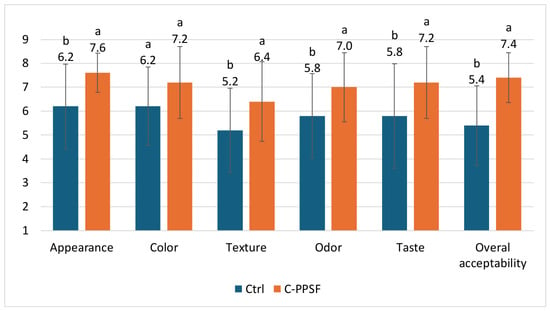
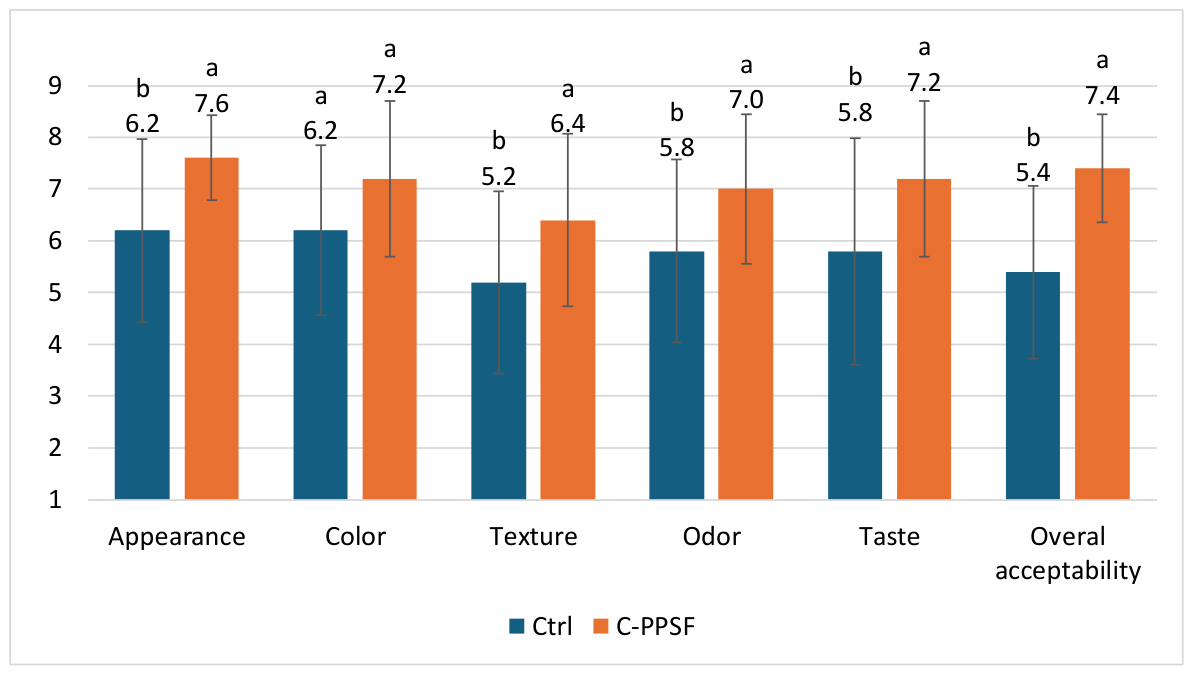
Figure 2 shows the comparative sensory profile between the control sample (Ctrl) and the optimized cookies enriched with defatted pumpkin seed press cake flour (C-PPSF).
Figure 2.
Sensory analysis of control cookies and cookies with the addition of PPSF. Values are expressed as mean ± standard deviation (n = 20). Different letters indicate statistically significant differences between samples within each parameter (p < 0.05).
Sensory evaluation was conducted using a 9-point hedonic scale, where scores above 5 indicate a generally acceptable level of consumer liking, and scores below 5 indicate neutrality or disliking. The control sample showed moderate acceptability across most attributes, with overall acceptability slightly above the neutral point of the scale. In contrast, the C-PPSF sample received significantly higher scores for all evaluated sensory attributes, including appearance, texture, odor, taste, and overall acceptability (p < 0.05), as confirmed by Fisher’s LSD test.
The improved sensory performance of the PPSF-enriched cookies suggests that partially replacing wheat flour with defatted pumpkin seed press cake flour positively influenced consumer perception, especially regarding texture and flavor development. All sensory scores for the C-PPSF (69.61%) formulation remained well above the neutral midpoint of the 9-point hedonic scale, indicating strong consumer acceptability despite substantial formulation changes.
These findings demonstrate that the optimized formulation effectively balances nutritional enrichment with sensory appeal. The statistical validity of this overall acceptability is further confirmed by the linear regression model (Equation (S3)) and the corresponding ANOVA results in Table S3, which show that both PPSF proportion and sugar content are critical determinants of the final sensory score.
Similar improvements in the sensory quality of bakery products enriched with pumpkin seed-derived ingredients have been reported in the literature. For example, Atuonwu and Akobundu [70] found that partially substituting wheat flour with 10% pumpkin seed press cake flour produced baked products with improved sensory characteristics compared to the control. Similarly, Litvynchuk et al. [14] reported that incorporating 5–15% PPSF into bread formulations affects dough functional properties, including reduced water absorption capacity and increased dough stability, which ultimately influence the texture and overall sensory quality of the final product. In this study, the successful incorporation of nearly 70% PPSF without compromising sensory scores marks a significant advancement in the sustainable valorization of this by-product. Most previously published studies reported acceptable sensory quality only at much lower levels of pumpkin seed flour incorporation, generally between 5% and 20%. Therefore, maintaining high consumer acceptability at a PPSF level near 70% represents a substantial technological achievement. These results suggest that consumer perception may be positively influenced by the characteristic nutty aroma and flavor compounds naturally present in pumpkin seed-derived ingredients, which partially compensate for structural changes caused by gluten dilution.
The present findings strongly align with previous studies that report successful incorporation of pumpkin seed-derived ingredients into bakery systems; however, the substitution level achieved in this study (up to 69.61% PPSF) is notably higher than typically reported in the literature. For example, Jeevitha et al. [13] and Litvynchuk et al. [14] observed technological and sensory limitations at substitution levels generally below 10–15%, mainly due to gluten dilution and weakened dough structure. In contrast, this study demonstrates that, through systematic response surface optimization, it is possible to substantially increase PPSF incorporation while maintaining acceptable cookie geometry and sensory quality.
Compared with previous studies that focused primarily on bread and cracker formulations [14,49], this work extends the application of PPSF to high-inclusion cookie systems, where a more flexible dough matrix allows higher substitution levels without compromising consumer acceptability. Additionally, the observed improvements in protein content (from 13.05% to 30.17%) and antioxidant capacity exceed those reported in earlier bakery applications of pumpkin seed press cake, confirming the strong nutritional enhancement potential of PPSF.
The main advancement of this study is demonstrating that PPSF can serve not only as a minor functional additive but also as a major structural ingredient in bakery formulations, significantly advancing current knowledge on circular economy-based food product development and high-value upcycling of oil industry by-products.
3.7. Limitations and Future Perspective
Despite the comprehensive evaluation of the physicochemical, nutritional, and sensory properties of PPSF-enriched cookies, several limitations should be acknowledged. First, although the Lowry method was used for protein determination, potential interference from phenolic compounds present in defatted pumpkin seed press cake flour may have affected the results. This limitation has been recognized and should be considered when interpreting the protein content data.
Second, while the optimized PPSF cookies showed significantly improved aroma and overall sensory acceptance, the volatile compounds responsible for these sensory differences were not characterized in this study. Future investigations using gas chromatography–mass spectrometry (GC–MS) or electronic nose (E-nose) analysis would provide valuable insight into the aroma profile and key odor-active compounds contributing to consumer perception.
In addition, although color differences observed between formulations were attributed to processing-induced reactions, including Maillard reactions, specific markers such as hydroxymethylfurfural (HMF) were not quantified. Therefore, future studies focusing on the determination of HMF and other Maillard reaction products would help to more precisely elucidate the chemical mechanisms underlying color development in PPSF-based bakery products.
Overall, future research should further explore the chemical drivers of sensory attributes in PPSF-enriched systems, particularly in relation to flavor-active volatiles and Maillard reaction products, to better link compositional changes with consumer perception.
4. Conclusions
This study demonstrates that defatted pumpkin seed press cake flour (PPSF), a nutrient-dense by-product of cold-pressed oil production, can be successfully valorized as a sustainable ingredient in cookie formulations. The primary novelty of this research is the successful systematic optimization of a high-inclusion formulation (69.61% PPSF), which significantly exceeds the substitution levels typically reported in the literature while maintaining superior sensory appeal. Chemical characterization confirmed PPSF as a potent source for nutritional enhancement, with protein content exceeding 55% and significant concentrations of total dietary fiber and minerals. Incorporating PPSF more than doubled the protein content of the final cookies (from 13.05% to 30.17%) and significantly improved the bioactive profile, specifically increasing radical scavenging capacity and the concentrations of carotenoids and phenolics. The strengths of this study include the identification of a scalable model for by-product upcycling that promotes circular economy principles. Although the raw material was prepared in the laboratory, its characteristics mimic industrial residues, providing a viable valorization pathway for large-scale biomass. Future research should address current limitations by utilizing GC-MS or electronic nose technology to identify the specific volatile compounds responsible for flavor enhancement and by evaluating the stability and bioaccessibility of bioactive compounds during long-term storage and gastrointestinal digestion. Such efforts will further confirm the industrial and nutritional functionality of PPSF-enriched products in sustainable food systems.
Supplementary Materials
The following supporting information can be downloaded at https://www.mdpi.com/article/10.3390/pr14122021/s1. Equation (S1). Diameter (cm) of cookies (Quadratic model). Equation (S2). Thickness (cm) of cookies (Quadratic model). Equation (S3). Overall acceptability of cookies (Linear model). Equation (S4). Distance to break (mm) of cookies (Quadratic model). Figure S1. Three-dimensional response surface plots showing the effects of PPSF proportion (A), sugar content (B), and baking time (C) on the diameter of cookies enriched with defatted pumpkin seed press cake flour (C-PPSF): (a) interaction between A and B at the centre level of C; (b) interaction between A and C at the centre level of B; (c) interaction between B and C at the centre level of A. Figure S2. Three-dimensional response surface plots showing the effects of PPSF proportion (A), sugar content (B), and baking time (C) on the thickness of cookies enriched with defatted pumpkin seed press cake flour (C-PPSF): (a) interaction between A and B at the centre level of C; (b) interaction between A and C at the centre level of B; (c) interaction between B and C at the centre level of A. Figure S3. Three-dimensional response surface plots showing the effects of PPSF proportion (A), sugar content (B), and baking time (C) on the overall acceptability of cookies enriched with defatted pumpkin seed press cake flour (C-PPSF): (a) interaction between A and B at the centre level of C; (b) interaction between A and C at the centre level of B; (c) interaction between B and C at the centre level of A. Figure S4. Three-dimensional response surface plots showing the effects of PPSF proportion (A), sugar content (B), and baking time (C) on the bending stiffness of cookies enriched with defatted pumpkin seed press cake flour (C-PPSF): (a) interaction between A and B at the centre level of C; (b) interaction between A and C at the centre level of B; (c) interaction between B and C at the centre level of A. Table S1. Analysis of variance (ANOVA) for the quadratic model describing the effects of PPSF proportion, sugar content, and baking time on the diameter (cm) of cookies enriched with defatted pumpkin seed press cake flour (C-PPSF). Table S2. Analysis of variance (ANOVA) for the quadratic model describing the effects of PPSF proportion, sugar content, and baking time on the thickness (cm) of cookies enriched with defatted pumpkin seed press cake flour (C-PPSF). Table S3. Analysis of variance (ANOVA) for the linear model describing the effects of PPSF proportion, sugar content, and baking time on the overall acceptability of cookies enriched with defatted pumpkin seed press cake flour (C-PPSF). Table S4. Analysis of variance (ANOVA) for the linear model describing the effects of PPSF proportion, sugar content, and baking time on the bending stiffness (N/mm) of cookies enriched with defatted pumpkin seed press cake flour (C-PPSF).
Author Contributions
Conceptualization, G.N., M.J., and J.L.; methodology, V.S., F.B., and M.J.; software, G.N., and J.L.; validation, G.N., M.J., and J.L.; formal analysis, P.R., G.N., M.J., J.L., and F.B.; investigation, J.L., M.J., and G.N.; resources, G.N., M.J., and J.L.; data curation, V.S., M.J., and J.L.; writing—original draft preparation, P.R., G.N., V.S., M.J., and J.L.; writing—review and editing, J.L., and M.J.; visualization, G.N., and J.L.; supervision, M.J.; project administration, G.N. All authors have read and agreed to the published version of the manuscript.
Funding
This research received no external funding.
Institutional Review Board Statement
The study was conducted in accordance with the Declaration of Helsinki and approved by the Ethics Committee of the Technical University of Sofia (protocol code No. 2 on 1 April 2026).
Informed Consent Statement
Informed consent was obtained from all subjects involved in the study.
Data Availability Statement
The original contributions presented in this study are included in the article and Supplementary Materials. Further inquiries can be directed to the corresponding author.
Acknowledgments
This work was supported by the Bulgarian Ministry of Education and Science, National Research Fund, under contract number KП-06-KOCT/18.
Conflicts of Interest
The authors declare no conflicts of interest.
Abbreviations
The following abbreviations are used in this manuscript:
| 2FI | Two-factor interaction |
| ANOVA | Analysis of variance |
| BBD | Box–Behnken design |
| C-PPSF | Optimized cookies formulation (with PPSF) |
| CIE | International Commission on Illumination (Commission Internationale de l’Éclairage) |
| Ctrl | Control sample |
| CV % | Coefficient of variation |
| df | Degrees of freedom |
| DPPH | 2,2-diphenyl-1-picrylhydrazyl (radical scavenging capacity) |
| GAE | Gallic acid equivalents |
| LSD | Least significant difference |
| MS | Mean square |
| PPSF | Defatted pumpkin seed press cake flour |
| R2 | Coefficient of determination |
| RSM | Response surface methodology |
| SDGs | Sustainable Development Goals |
| SS | Sum of squares |
References
- Gavril, R.N.; Cârlescu, P.M.; Veleșcu, I.D.; Arsenoaia, V.N.; Stoica, F.; Stănciuc, N.; Aprodu, I.; Constantin, O.E.; Râpeanu, G. The development of value-added yogurt based on pumpkin peel powder as a bioactive powder. J. Agric. Food Res. 2024, 16, 101098. [Google Scholar] [CrossRef] [Scilit]
- Sharma, M.; Usmani, Z.; Gupta, V.K.; Bhat, R. Valorization of fruits and vegetable wastes and by-products to produce natural pigments. Crit. Rev. Biotechnol. 2021, 41, 535–563. [Google Scholar] [CrossRef] [Scilit] [PubMed]
- Hromiš, N.; Popović, S.; Šuput, D.; Bulut, S.; Lazić, V.; Vitas, J.; Malbaša, R.; Šumić, Z.; Horecki, T.A.; Vakula, A. Antioksidative activity of pumpking oil cake based biopolymer films obtained by different filtration process. J. Process. Energy Agric. 2019, 23, 14–18. [Google Scholar] [CrossRef] [Scilit]
- Lorenc, F.; Jarošová, M.; Bedrníček, J.; Smetana, P.; Bárta, J. Structural Characterization and Functional Properties of Flaxseed Hydrocolloids and Their Application. Foods 2022, 11, 2304. [Google Scholar] [CrossRef] [Scilit] [PubMed]
- Trajkovska, B.; Djurovic, V.; Radovanović, M.; Nakov, G. Effect of semi-defatted walnut and pumpkin flour fortification on the physicochemical, microbiological, and sensory properties of yogurt. LWT 2025, 228, 118114. [Google Scholar] [CrossRef] [Scilit]
- Sarinho, A.; Costa, M.E.; Lima, J.; Batista, L.; Andrade, R.; Gonçalves, J.; Silva, C.; Lisboa, H.M. Valorization of pumpkin-seed press-cake and hulls from agri-food waste streams. Food Chem. Adv. 2025, 9, 101147. [Google Scholar] [CrossRef] [Scilit]
- Sinkovič, L.; Sinkovič, L.; Kolmanič, A. Elemental composition and nutritional characteristics of Cucurbita pepo subsp. Pepo seeds, oil cake and pumpkin oil. J. Elem. 2021, 26, 97–107. [Google Scholar] [CrossRef] [Scilit]
- Dotto, J.M.; Chacha, J.S. The potential of pumpkin seeds as a functional food ingredient: A review. Sci. Afr. 2020, 10, e00575. [Google Scholar] [CrossRef] [Scilit]
- Pandey, V.K.; Singh, K.; Suthar, T.; Srivastava, S.; Rustagi, S.; Ungai, D.; Kovács, B.; Shaikh, A.M. Current Strategies to Modify the Functional Properties of Proteins Extracted from Pumpkin Seeds: A Comprehensive Review. Horticulturae 2024, 10, 1194. [Google Scholar] [CrossRef] [Scilit]
- Singh, R.; Langyan, S.; Sangwan, S.; Rohtagi, B.; Khandelwal, A.; Shrivastava, M. Protein for Human Consumption From Oilseed Cakes: A Review. Front. Sustain. Food Syst. 2022, 6, 856401. [Google Scholar] [CrossRef] [Scilit]
- Rakita, S.; Kokić, B.; Manoni, M.; Mazzoleni, S.; Lin, P.; Luciano, A.; Ottoboni, M.; Cheli, F.; Pinotti, L. Cold-Pressed Oilseed Cakes as Alternative and Sustainable Feed Ingredients: A Review. Foods 2023, 12, 432. [Google Scholar] [CrossRef] [Scilit] [PubMed]
- Đurović, V.; Radovanović, M.; Tomić, D.; Marjanović, M.; Marković, D.; Mandić, L. Characteristics of cold-pressed walnut (Juglans regia L.) oil from Western and Central Serbia. J. Cent. Eur. Agric. 2024, 25, 234–242. [Google Scholar] [CrossRef] [Scilit]
- Jeevitha, G.R.; Bhuvana, S. Study on the impact of pumpkin seed flour on whole wheat bread characteristics. Int. J. Chem. Stud. 2019, 7, 273–277. [Google Scholar]
- Litvynchuk, S.; Galenko, O.; Cavicchi, A.; Ceccanti, C.; Mignani, C.; Guidi, L.; Shevchenko, A. Conformational Changes in the Structure of Dough and Bread Enriched with Pumpkin Seed Flour. Plants 2022, 11, 2762. [Google Scholar] [CrossRef] [Scilit] [PubMed]
- Tomić, J.; Popović, L.; Maravić, N.; Stupar, A.; Sedlar, T.; Plavšić, D. Gluten-free crackers using chickpea and pumpkin seed press cake blend: Effects of gastrointestinal digestion. Food Biosci. 2024, 60, 104534. [Google Scholar] [CrossRef] [Scilit]
- AACC Method, 1.0.-5.0.D; Baking Quality of Cookie Flour-American Association of Cereal Chemists. AACC: São Paulo, Brazil, 2000.
- Jukić, M.; Lukinac, J.; Čuljak, J.; Pavlović, M.; Šubarić, D.; Koceva Komlenić, D. Quality evaluation of biscuits produced from composite blends of pumpkin seed oil press cake and wheat flour. Int. J. Food Sci. Technol. 2019, 54, 602–609. [Google Scholar] [CrossRef] [Scilit]
- Lukinac, J.; Medaković, D.; Koceva Komlenić, D.; Šušak, A.; Jukić, M. Application of Quercus pubescens Acorn Flour and Xanthan Gum in Gluten-Free Cookies: RSM Optimization and Quality Evaluation. Foods 2026, 15, 966. [Google Scholar] [CrossRef] [Scilit] [PubMed]
- Jukić, M.; Komlenić, D.K.; Nakov, G.; Begić, M.; Keresturi, S.; Lukinac, J. Effects of the addition of xanthan gum and rice flour to maize starch on quality of gluten-free biscuit. Ukr. Food J. 2024, 13, 124–142. [Google Scholar] [CrossRef] [Scilit]
- AACC62-20A Preparation of Sample: Semolina and Feedstuffs. AACC International Approved Methods 2000. Available online: https://www.cerealsgrains.org/resources/methods/Pages/default.aspx (accessed on 6 April 2026).
- AACC Method 44-19; Moisture—Air-Oven Method, Drying at 135°. AACC: São Paulo, Brazil, 2000.
- AACC Method 08-01; Ash-Basic Method. AACC: São Paulo, Brazil, 2000.
- ISO 6492; Animal Feeding Stuffs—Determination of fat Content. ISO: Geneva, Switzerland, 1999.
- Mæhre, H.K.; Dalheim, L.; Edvinsen, G.K.; Elvevoll, E.O.; Jensen, I.J. Protein Determination—Method Matters. Foods 2018, 7, 5. [Google Scholar] [CrossRef] [Scilit] [PubMed]
- AACC Method 32-07; Soluble, Insoluble, and Total Dietary Fiber in Foods and Food Products. AACC: São Paulo, Brazil, 2000.
- International Standards ISO:12966-4; Animal and Vegetable Fats and Oils—Gas Chromatography of Fatty Acid Methyl Esters—Part 4: Determination by Capillary Gas Chromatography. ISO: Geneva, Switzerland, 2015.
- Nakov, G.; Brandolini, A.; Ivanova, N.; Dimov, I.; Stamatovska, V. The effect of einkorn (Triticum monococcum L.) whole meal flour addition on physico-chemical characteristics, biological active compounds and in vitro starch digestion of cookies. J. Cereal Sci. 2018, 83, 116–122. [Google Scholar] [CrossRef] [Scilit]
- Cangussu, L.B.; Costa, A.L.R.; Franca, A.S.; de Oliveira, L.S. Chemical characterization and the bioaccessibility of bioactive compounds from seriguela (Spondias purpurea L.) pulp and by-products flours. Bioact. Carbohydr. Diet. Fibre 2024, 31, 100404. [Google Scholar] [CrossRef] [Scilit]
- Wang, Y.Y.; Ryu, G.H. Physicochemical and antioxidant properties of extruded corn grits with corn fiber by CO2 injection extrusion process. J. Cereal Sci. 2013, 58, 110. [Google Scholar] [CrossRef] [Scilit]
- Rodrigues, S.S.Q.; Dias, L.G.; Teixeira, A. Emerging Methods for the Evaluation of Sensory Quality of Food: Technology at Service. Curr. Food Sci. Technol. Rep. 2024, 2, 77–90. [Google Scholar] [CrossRef] [Scilit]
- Wang, X.; McClements, D.J.; Xu, Z.; Meng, M.; Qiu, C.; Long, J.; Jin, Z.; Chen, L. Recent advances in the optimization of the sensory attributes of fried foods: Appearance, flavor, and texture. Trends Food Sci. Technol. 2023, 138, 297–309. [Google Scholar] [CrossRef] [Scilit]
- Jang, J.; Lee, D.-W. Advancements in plant based meat analogs enhancing sensory and nutritional attributes. npj Sci. Food 2024, 8, 50. [Google Scholar] [CrossRef] [Scilit] [PubMed]
- Martinez-Velasco, J.D.; Filomena-Ambrosio, A.; Garzón-Castro, C.L. Technological tools for the measurement of sensory characteristics in food: A review. F1000Research 2024, 12, 340. [Google Scholar] [CrossRef] [Scilit] [PubMed]
- Gunning, M.; Tagkopoulos, I. A systematic review of data and models for predicting food flavor and texture. Curr. Res. Food Sci. 2025, 11, 101127. [Google Scholar] [CrossRef] [Scilit] [PubMed]
- Flint, M.; Leroy, F.; Bowles, S.; Lynn, A.; Paxman, J.R. The acceptability and sensory attributes of plant-based burger products under open and closed label conditions. Proc. Nutr. Soc. 2023, 82, E278. [Google Scholar] [CrossRef] [Scilit]
- Apostol, L.; Moșoiu, C.; Martínez, S.Á. Effect of the addition of pumpkin powder on the physicochemical qualities and rheological properties of wheat flour. Rom. Biotechnol. Lett. 2020, 25, 1594–1600. [Google Scholar] [CrossRef] [Scilit]
- Hu, Z.; Hu, C.; Li, Y.; Jiang, Q.; Li, Q.; Fang, C. Pumpkin seed oil: A comprehensive review of extraction methods, nutritional constituents, and health benefits. J. Sci. Food Agric. 2024, 104, 572–582. [Google Scholar] [CrossRef] [Scilit] [PubMed]
- Ahmed, I.A.M.; AlJuhaimi, F.; Karrar, E.; Uslu, N.; Özcan, M.M. The Effect of Roasting on Bioactive Properties, Phenolic Compounds and Fatty Acid Profiles of Pumpkin (Cucurbita spp.) Seeds. J. Oleo Sci. 2024, 73, ess24153. [Google Scholar] [CrossRef] [Scilit] [PubMed]
- Polyzos, N.; Fernandes, Â.; Calhelha, R.C.; Petrović, J.; Soković, M.; Ferreira, I.C.; Barros, L.; Petropoulos, S.A. Biochemical Composition of Pumpkin Seeds and Seed By-Products. Plants 2024, 13, 2395. [Google Scholar] [CrossRef] [Scilit] [PubMed]
- Sert, D.; Rohm, H.; Struck, S. High-pressure-assisted protein isolation from pumpkin seed press cake. Int. J. Food Sci. Technol. 2024, 59, 368–379. [Google Scholar] [CrossRef] [Scilit]
- Dudasova Petrovicova, O.; Dabetic, N.; Zrnic Ciric, M.; Djordjevic, B.; Todorovic, V. Nutritional and Antioxidant Comparison of Oil Press Cakes and Wheat Flours. Molecules 2025, 30, 4781. [Google Scholar] [CrossRef] [Scilit] [PubMed]
- Martínez, E.; García-Martínez, R.; Álvarez-Ortí, M.; Rabadán, A.; Pardo-Giménez, A.; Pardo, J.E. Elaboration of Gluten-Free Cookies with Defatted Seed Flours: Effects on Technological, Nutritional, and Consumer Aspects. Foods 2021, 10, 1213. [Google Scholar] [CrossRef] [Scilit] [PubMed]
- Giami, S.Y.; Achinewhu, S.C.; Ibaakee, C. The quality and sensory attributes of cookies supplemented with fluted pumpkin (Telfairia occidentalis Hook) seed flour. Int. J. Food Sci. Technol. 2005, 40, 613–620. [Google Scholar] [CrossRef] [Scilit]
- Karaś, M.; Szymanowska, U.; Borecka, M.; Jakubczyk, A.; Kowalczyk, D. Antioxidant Properties of Wafers with Added Pumpkin Seed Flour Subjected to In Vitro Digestion. Appl. Sci. 2024, 14, 5129. [Google Scholar] [CrossRef] [Scilit]
- Alfeo, V.; Bravi, E.; Ceccaroni, D.; Sileoni, V.; Perretti, G.; Marconi, O. Effect of Baking Time and Temperature on Nutrients and Phenolic Compounds Content of Fresh Sprouts Breadlike Product. Foods 2020, 9, 1447. [Google Scholar] [CrossRef] [Scilit] [PubMed]
- Ninčević Grassino, A.; Rimac Brnčić, S.; Badanjak Sabolović, M.; Šic Žlabur, J.; Marović, R.; Brnčić, M. Carotenoid Content and Profiles of Pumpkin Products and By-Products. Molecules 2023, 28, 858. [Google Scholar] [CrossRef] [Scilit] [PubMed]
- Kumari, N.; Sindhu, S.C. Nutrient and mineral composition of developed value added cookies incorporating germinated pumpkin seed powder. Int. J. Chem. Stud. 2019, 7, 4583–4586. [Google Scholar] [CrossRef] [Scilit]
- Kaur, M.; Sharma, S. Development and nutritional evaluation of pumpkin seed (Cucurbita moschata) supplemented products. Food Sci. Res. J. 2017, 8, 310–318. [Google Scholar] [CrossRef] [Scilit]
- Kaur, P.; Sharma, P.; Kumar, V.; Panghal, A.; Kaur, J.; Gat, Y. Effect of addition of flaxseed flour on phytochemical, physicochemical, nutritional, and textural properties of cookies. J. Saudi Soc. Agric. Sci. 2019, 18, 372–377. [Google Scholar] [CrossRef] [Scilit]
- Białek, M.; Rutkowska, J.; Adamska, A.; Bajdalow, E. Partial replacement of wheat flour with pumpkin seed flour in muffins offered to children. CYTA—J. Food 2016, 14, 391–398. [Google Scholar] [CrossRef] [Scilit]
- Kumari, N.; Rani, V.; Sindhu, S.C.; Kumari, V. Nutritional evaluation of developed value added biscuits incorporating germinated pumpkin seed flour. J. Pharmacogn. Phytochem. 2020, 9, 2802–2806. [Google Scholar] [CrossRef] [Scilit]
- Das, S.; Ghosh, M.; Chakraborty, P. Study of the utilization of “Pumpkin seed” for the production of nutritionally enriched biscuits. Int. J. Food Sci. Nutr. 2021, 6, 63–67. [Google Scholar]
- Lazos, E.S. Certain functional properties of defatted pumpkin seed flour. Plant Foods Hum. Nutr. 1992, 42, 257–273. [Google Scholar] [CrossRef] [Scilit] [PubMed]
- Wang, X.; Shi, X.; Zhang, R.; Zhang, K.; Shao, L.; Xu, T.; Li, D.; Zhang, D.; Zhang, J.; Xia, Y. Impact of summer heat stress inducing physiological and biochemical responses in herbaceous peony cultivars (Paeonia lactiflora Pall.) from different latitudes. Ind. Crops Prod. 2022, 184, 115000. [Google Scholar] [CrossRef] [Scilit]
- McArthur-Floyd, M.; Brako, M. Valorization of Pumpkin Flour in Cookie Formulations: Effects on Nutritional Composition and Mineral Content. EAS J. Nutr. Food Sci. 2024, 6, 90–100. [Google Scholar] [CrossRef] [Scilit]
- Ferreira, D.M.; Machado, S.; Espírito Santo, L.; Nunes, M.A.; Costa, A.S.; Álvarez-Ortí, M.; Pardo, J.E.; Alves, R.C.; Oliveira, M.B. Defatted Flaxseed Flour as a New Ingredient for Foodstuffs: Comparative Analysis with Whole Flaxseeds and Updated Composition of Cold-Pressed Oil. Nutrients 2024, 16, 3482. [Google Scholar] [CrossRef] [Scilit] [PubMed]
- Yadav, M.; Khatak, A.; Singhania, N.; Bishnoi, S. Comparative analysis of various processing on total phenolic content and antioxidant activity of flaxseed. Int. J. Chem. Stud. 2020, 8, 3738–3744. [Google Scholar] [CrossRef] [Scilit]
- Kajla, P.; Sharma, A.; Sood, D.R. Flaxseed—A potential functional food source. J. Food Sci. Technol. 2015, 52, 1857–1871. [Google Scholar] [CrossRef] [Scilit] [PubMed]
- Yonekura, L.; Nagao, A. Intestinal absorption of dietary carotenoids. Mol. Nutr. Food Res. 2007, 51, 107–115. [Google Scholar] [CrossRef] [Scilit] [PubMed]
- Kaur, M.; Sharma, S. Development and nutritional evaluation of cake supplemented with pumpkin seed flour. Asian J. Dairy Food Res. 2018, 37, 232–236. [Google Scholar] [CrossRef] [Scilit]
- Choe, E.; Min, D.B. Mechanisms of Antioxidants in the Oxidation of Foods. Compr. Rev. Food Sci. Food Saf. 2009, 8, 345–358. [Google Scholar] [CrossRef] [Scilit]
- Anese, M.; Nicoli, M.C. Antioxidant Properties of Ready-to-Drink Coffee Brews. J. Agric. Food Chem. 2003, 51, 942–946. [Google Scholar] [CrossRef] [Scilit] [PubMed]
- Žilić, S.; Kocadağli, T.; Vančetović, J.; Gökmen, V. Effects of baking conditions and dough formulations on phenolic compound stability, antioxidant capacity and color of cookies made from anthocyanin-rich corn flour. LWT—Food Sci. Technol. 2016, 65, 597–603. [Google Scholar] [CrossRef] [Scilit]
- Oroian, M.; Escriche, I. Antioxidants: Characterization, natural sources, extraction and analysis. Food Res. Int. 2015, 74, 10–36. [Google Scholar] [CrossRef] [Scilit] [PubMed]
- Osorio-Valencia, A.I.; de Jesús Franco-Mejía, J.; Hoyos-Arbeláez, J.A.; Blandón-Naranjo, L.; Vega-Castro, O.A.; del Carmen Contreras-Calderón, J. Evaluation of antioxidant capacity in different food matrices through differential pulse voltammetry and its correlation with spectrophotometric methods. J. Appl. Electrochem. 2023, 53, 2495–2505. [Google Scholar] [CrossRef] [Scilit]
- Song, J.; Wang, X.; Li, D.; Meng, L.; Liu, C. Degradation of carotenoids in pumpkin (Cucurbita maxima L.) slices as influenced by microwave vacuum drying. Int. J. Food Prop. 2017, 20, 1479–1487. [Google Scholar] [CrossRef] [Scilit]
- Ordóñez-Santos, L.E.; Esparza-Estrada, J.; Vanegas-Mahecha, P. Effect of Baking Temperature on Carotenoids and Provitamin A in Bread made with Mandarin (Citrus reticulata) Epicarp Extract. TecnoLógicas 2023, 26, e2755. [Google Scholar] [CrossRef] [Scilit]
- Yamsaengsung, R.; Berghofer, E.; Schoenlechner, R. Physical properties and sensory acceptability of cookies made from chickpea addition to white wheat or whole wheat flour compared to gluten-free amaranth or buckwheat flour. Int. J. Food Sci. Technol. 2012, 47, 2221–2227. [Google Scholar] [CrossRef] [Scilit]
- Alshehry, G.A. Preparation and Nutritional Properties of Cookies from the Partial Replacement of Wheat Flour Using Pumpkin Seeds Powder. World J. Environ. Biosci. 2020, 9, 48–56. [Google Scholar] [CrossRef] [Scilit] [PubMed]
- Atuonwu, A.C.; Akobundu, E.N.T. Nutritional and sensory quality of cookies supplemented with defatted pumpkin (Cucurbita pepo) seed flour. Pak. J. Nutr. 2010, 9, 672–677. [Google Scholar] [CrossRef] [Scilit]

Disclaimer/Publisher’s Note: The statements, opinions and data contained in all publications are solely those of the individual author(s) and contributor(s) and not of MDPI and/or the editor(s). MDPI and/or the editor(s) disclaim responsibility for any injury to people or property resulting from any ideas, methods, instructions or products referred to in the content. |
© 2026 by the authors. Licensee MDPI, Basel, Switzerland. This article is an open access article distributed under the terms and conditions of the Creative Commons Attribution (CC BY) license.