


Abstract
The long-term operational reliability of underground gas storage (UGS) facilities in depleted reservoirs is significantly challenged by reservoir damage during multi-cycle injection and production (I&P). While the impact of cycle numbers has been extensively studied, the influence of variable pressure depletion rates remains insufficiently quantified. This study investigates the reservoir damage mechanisms of sandstone cores from the Sichuan Basin under different depletion rates (0.5 and 2.5 MPa/min) over 20 I&P cycles. Experimental results indicate that the pressure depletion rate is a decisive factor in permeability impairment. For the sample subjected to a fast depletion rate (2.5 MPa/min), the total permeability loss reached 18.2%, which is 2.16 times higher than that of the slow-rate sample (8.4% at 0.5 MPa/min). Notably, the high-rate sample sustained nearly 60% of its total damage within the initial three cycles, highlighting a critical window of vulnerability during early UGS operations. Theoretical hydrodynamic analysis suggests that at 2.5 MPa/min, the instantaneous shear force (6.42 nN) exceeds the representative adhesion force of clay minerals (~5.0 nN), which may increase the likelihood of clay mobilization under the present experimental conditions. Combined with the XRD-identified clay content and the observed permeability evolution, the damage is interpreted as being likely associated with fines migration and pore-throat plugging. Based on these findings, a “Slow-Start” operational protocol—maintaining depletion rates below 1.0 MPa/min during the initial cycles—is preliminarily recommended under the present experimental conditions to help preserve reservoir conductivity and extend facility longevity.
1. Introduction
The global drive toward carbon neutrality and the strategic optimization of energy structures have accelerated the large-scale deployment of underground gas storage (UGS) facilities. Among various storage options, depleted oil and gas reservoirs represent the most pragmatic candidates due to their proven seal integrity and well-defined geological boundaries. These facilities have now transcended their traditional role in natural gas peak-shaving, evolving instead into multi-functional platforms for underground hydrogen storage (UHS) [1,2,3] and carbon capture and storage (CCS) [4,5,6]. This shift is particularly significant as recent research underscores the transition of UGS into versatile energy hubs [7,8]. However, the transition from unidirectional primary depletion to high-intensity, multi-cycle injection and production (I&P) operation introduces intricate reservoir damage mechanisms. These geomechanical and petrophysical alterations pose significant threats to the long-term operational reliability and the effective working capacity of these critical energy assets.
The core challenge in UGS operation lies in the reservoir rock’s sensitivity to cyclic effective stress. During the operational lifespan, the formation undergoes periodic loading–unloading cycles, which trigger mechanical fatigue and stress-induced permeability impairment [9,10]. This phenomenon is particularly pronounced in deep, high-pressure reservoirs where the stress sensitivity of the pore structure is inherently high [11,12]. Furthermore, the selection of cushion gas (e.g., CO2 or N2) significantly alters the pressure–volume–temperature (PVT) behavior and the subsequent poromechanical stability of the reservoir matrix [13,14]. In addition to these factors, the cumulative effect of numerous injection–production cycles may lead to a non-linear decline in deliverability, even in reservoirs traditionally classified as “clean” [15,16].
When UGS is implemented in condensate or oil-rim reservoirs, the damage mechanisms involve intricate phase transitions and fluid–rock interactions. Investigations into the seepage characteristics of oil-based storage facilities indicate that gas–oil interactions and the mobilization of residual oil significantly influence overall storage efficiency [17,18]. Furthermore, multi-cycle operations in these complex environments lead to dynamic shifts in fluid-flow boundaries [19,20]. This complexity is compounded by the hysteresis of relative permeability, where drainage and imbibition cycles exhibit significant irreversibility, particularly under fluctuating production rates [21,22].
The repurposing of depleted reservoirs for underground hydrogen storage (UHS) introduces distinct biochemical and geochemical risks. Specifically, microbial activity and intricate gas–water–rock interactions can compromise storage integrity over time [23,24]. Due to hydrogen’s low viscosity and high diffusivity, there is an exacerbated risk of gas leakage and the development of preferential flow paths [25,26,27]. Similarly, in the context of carbon capture and storage (CCS), CO2 injection is known to trigger mineral dissolution. While this process may locally increase porosity, it often results in the mechanical weakening of the rock matrix, potentially leading to premature structural failure.
Despite these advancements, a critical knowledge gap remains regarding the impact of variable pressure depletion rates on reservoir integrity. While previous studies have primarily focused on the influence of cycle numbers [28,29], the velocity of pressure fluctuation—driven by stringent peak-shaving requirements—is a decisive yet under-investigated factor. High drawdown rates have been proven to trigger significant sediment instability [30]. In unconventional reservoirs, effective depletion management is considered essential to mitigate the risk of formation collapse [31,32]. This “rate-dependent” damage is inherently cumulative; the evolution of seepage impairment is a coupled result of the drilling, completion, and subsequent multi-cycle I&P stages [33,34]. Furthermore, high-rate depletion can induce “stress shocks” within the rock matrix, which accelerate fines migration and catastrophic pore-throat bridging [35,36].
To elucidate the underlying physics of these phenomena, microscopic evaluation is paramount. The use of microetching models to visualize displacement processes has demonstrated that structural failure at the pore scale significantly constrains macroscopic flow capacity [37,38]. Analogous insights from coal-bed methane (CBM) studies further suggest that stress-sensitive fractures predominantly govern reservoir behavior under fluctuating pressures [39,40]. Such degradations are increasingly categorized as coupled physical–chemical–mechanical damages [41,42]. Furthermore, the heterogeneity of the rock matrix plays a vital role in the propagation of damage under cyclic loading, as evidenced by a broad range of petrophysical investigations [43,44,45,46,47,48,49]. Ultimately, reinforcing the necessity of coupling rock mechanics with fluid dynamics is essential for the accurate prediction of UGS performance in complex geological settings [50,51].
Despite extensive literature, the synergy between variable-pressure depletion rates and multi-cycle fatigue remains insufficiently quantified. To clarify the current state of research, a comparative summary of representative studies is presented in Table 1. This research aims to fill this gap by conducting a series of multi-cycle experiments on depleted gas reservoir cores at depletion rates of 0.5 MPa/min and 2.5 MPa/min. By integrating macroscopic measurements with SEM and XRD analysis and mechanistic interpretation, we seek to: (1) quantify the non-linear relationship between depletion rates and permeability impairment over 20 cycles; (2) evaluate the critical hydrodynamic conditions for fines detachment by comparing shear forces with mineral adhesion forces; and (3) elucidate the likely mechanisms of fines migration and pore-throat plugging and their implications for reservoir longevity.
Table 1.
Summary of previous studies on reservoir damage during underground gas storage operations and identified research gaps.
2. Experimental Materials and Methods
2.1. Sample Preparation
The sandstone core samples utilized in this study were collected from a typical depleted gas reservoir in the Sichuan Basin, China. To minimize the influence of reservoir heterogeneity on the experimental results, all cylindrical samples were drilled from the same large rock block along the bedding planes. The samples were processed into standard plugs with a diameter of 25 mm and a length of 50 mm. To remove residual salts and hydrocarbons, the cores were cleaned using a Soxhlet extractor with a mixture of toluene and methanol for 72 h, then dried in a vacuum oven at 80 °C until the weight change was less than 0.01 g.
The mineral composition of the samples was determined by X-ray diffraction (XRD) analysis. As shown in Table 2, the sandstone is primarily composed of quartz (68.5%) and feldspar (16.2%). Notably, the samples contain a significant amount of clay minerals (9.3%), including illite, kaolinite, and chlorite. These clay minerals are sensitive to fluid shear forces, which may lead to fines migration and pore-throat plugging during high-velocity gas production.
Table 2.
Mineralogical composition of the sandstone samples.
The initial porosity () and gas permeability () were measured using a helium porosimeter and a pulse-decay permeameter, respectively. As shown in Table 3, two representative samples with similar initial properties (S-1 and S-2) were selected for comparative testing under different depletion rates. To ensure comparability, the two samples were selected from the same parent rock and exhibit nearly identical porosity and permeability. This approach minimizes the influence of intrinsic heterogeneity and allows the observed differences to be primarily attributed to depletion rate effects. It is acknowledged that the limited number of samples restricts statistical generalization; however, the focus of this study is on mechanistic interpretation rather than statistical analysis. This selection ensures that the observed differences in damage mechanisms are primarily attributable to the variable pressure depletion rates rather than the intrinsic heterogeneity of the rock.
Table 3.
Basic physical properties and experimental conditions of the selected cores.
2.2. Experimental Apparatus
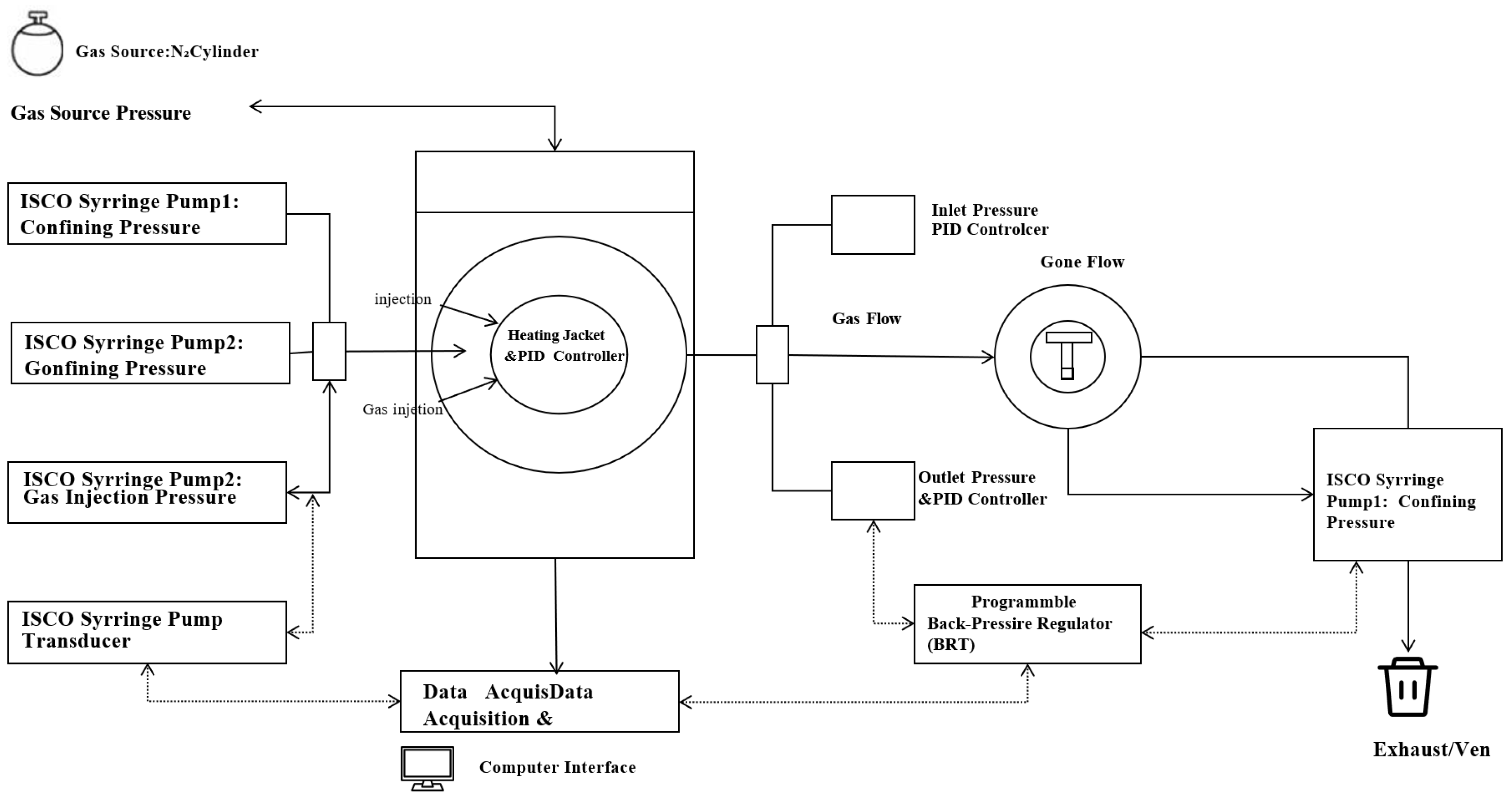
The multi-cycle injection and production simulation system used in this study is schematically illustrated in Figure 1. The apparatus is designed to operate under high-pressure and high-temperature (HPHT) conditions, with a maximum working pressure of 60 MPa and a temperature limit of 150 °C. The system primarily consists of the following four functional units:
(1) Injection and Confining System: Two high-precision ISCO syringe pumps (model 260D) are employed to provide constant gas injection pressure and steady confining pressure. Nitrogen (N2) is utilized as the experimental fluid to simulate the natural gas stored in the reservoir.
(2) Core Holder and Temperature Control: A hydrostatic core holder is used to accommodate the sandstone samples. A heating jacket and a PID temperature controller are equipped to maintain a constant reservoir temperature of 60 °C throughout the experiment.
(3) Programmable Pressure Depletion System: This is the core component of the apparatus. A computer-controlled Back-Pressure Regulator (BPR) is installed at the outlet of the core holder. By utilizing specialized software, the BPR can precisely regulate the pressure release valve to achieve different linear pressure depletion rates, ranging from 0.1 to 10.0 MPa/min.
(4) Data Acquisition Unit: High-accuracy pressure transducers (accuracy of ±0.05% FS) are mounted at both the inlet and outlet of the core holder. The transient pressure and gas flow rate are continuously recorded by a digital data acquisition system, which allows for the real-time calculation of gas permeability.
Figure 1.
Schematic diagram of the experimental apparatus for multi-cycle injection and production simulation.
It should be noted that nitrogen (N2) was used as the experimental fluid under dry conditions, which represents a simplified system compared to actual reservoir environments. In real underground gas storage operations, the gas composition may include multiple components (e.g., CH4, CO2) and may coexist with formation water, leading to multiphase flow and physicochemical interactions.
In this study, N2 was intentionally selected to isolate the hydrodynamic effect of pressure depletion rate and to avoid additional complexities associated with phase behavior and chemical reactions. Therefore, the results primarily reflect rate-dependent mechanical and hydrodynamic effects, while multiphase and geochemical influences remain to be investigated in future work.
2.3. Experimental Procedures
The experimental workflow was designed to replicate the cyclic “injection–storage–production” process of an underground gas storage reservoir. The specific steps are as follows:
(1) System Preparation: The core sample was loaded into the hydrostatic holder. The confining pressure was maintained at 35 MPa to represent a typical in situ stress condition and to isolate the effect of pressure depletion rate on permeability evolution. The heating system was activated to maintain a reservoir temperature of 60 °C.
(2) Initial State Measurement: High-purity nitrogen was injected into the core. Once the flow became stable, the initial gas permeability () was measured and recorded as the baseline for subsequent cycles.
(3) Cyclic Simulation Phase: For each sample, 20 injection–production cycles were performed. Each cycle consisted of three stages:
Stage I: Pressurization (Injection): Nitrogen was injected into the core until the pore pressure reached 25 MPa.
Stage II: Equilibrium (Soaking): The system was sealed for 30 min to allow the gas to distribute uniformly throughout the pore space.
Stage III: Controlled Depletion (Production): The BPR was programmed to reduce the pore pressure from 25 MPa to 10 MPa. For sample S-1, a slow depletion rate of 0.5 MPa/min was applied; for sample S-2, a fast depletion rate of 2.5 MPa/min was implemented. The selected depletion rates (0.5 MPa/min and 2.5 MPa/min) were designed to represent two typical operational scenarios in underground gas storage (UGS): a conservative depletion strategy and an aggressive peak-shaving condition. The lower rate (0.5 MPa/min) reflects controlled production to minimize reservoir disturbance, while the higher rate (2.5 MPa/min) simulates rapid withdrawal required during high-demand periods.
It should be noted that only two representative depletion rates were investigated in this study. The primary objective is to identify the mechanistic differences between slow and fast depletion conditions rather than to establish a complete rate–damage relationship. A more comprehensive investigation covering a wider range of depletion rates will be addressed in future work.
(4) Data Recording: After the completion of each depletion stage, the gas permeability () was remeasured. The normalized permeability ratio () was calculated to quantify the reservoir damage.
(5) Repetition: The above process was repeated until all 20 cycles were completed, ensuring that the cumulative effect of the depletion rate on rock properties was captured.
3. Results and Discussion
3.1. Evolution of Gas Permeability During Cyclic Operations
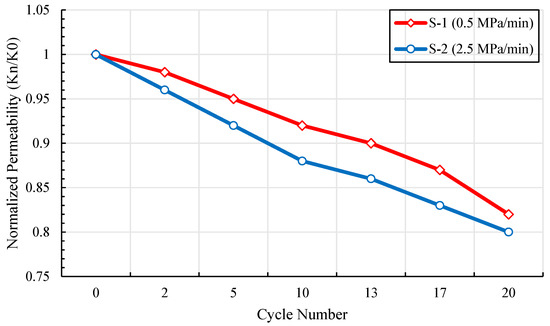
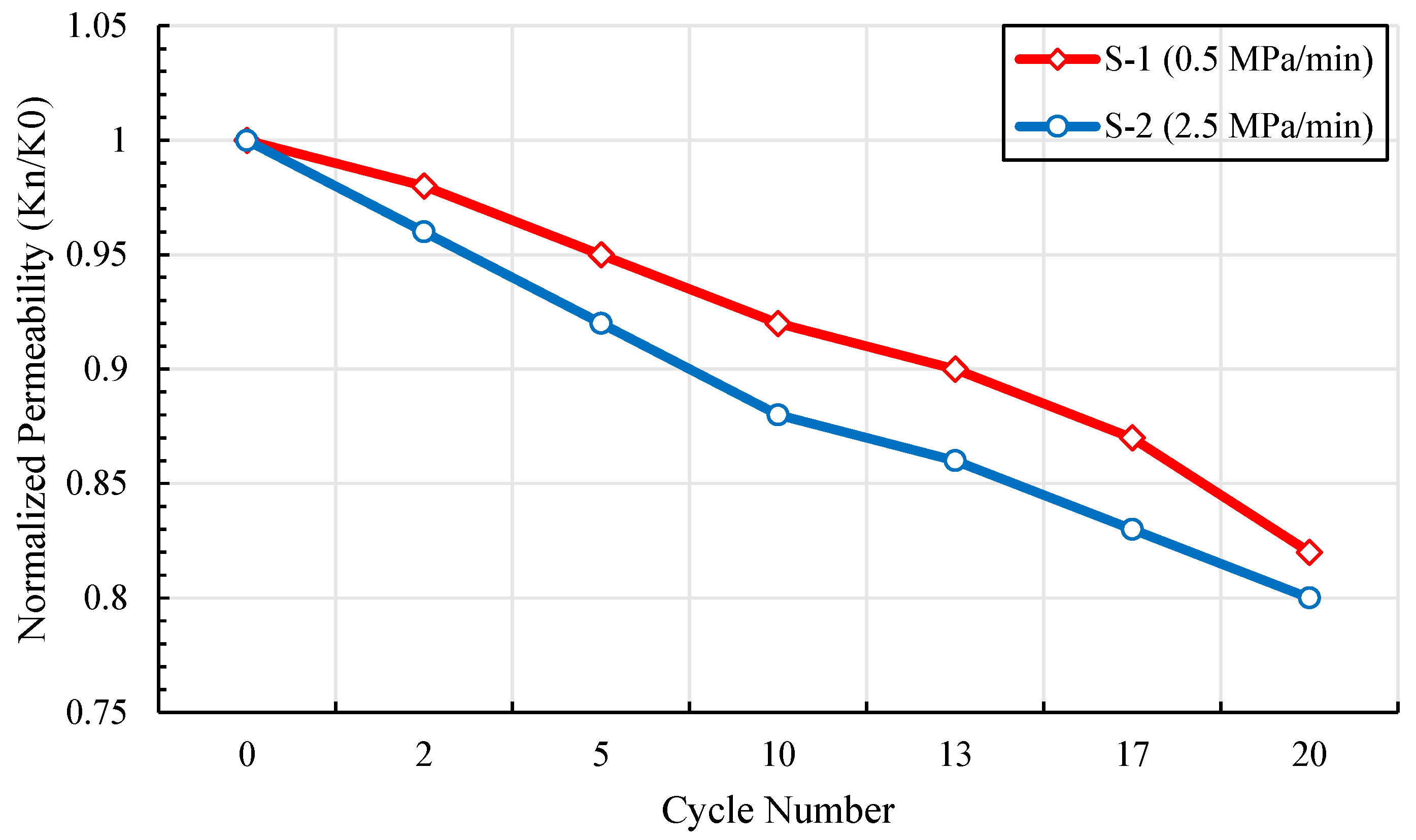
The variation in normalized gas permeability () as a function of the number of injection–production cycles for samples S-1 and S-2 is shown in Figure 2. It can be observed that both samples exhibit a continuous decline in permeability as the cycle number increases, particularly during the initial 5 to 8 cycles.
Figure 2.
Evolution of normalized gas permeability as a function of injection–production cycle number under different pressure depletion rates.
For sample S-1, which was subjected to a slow depletion rate (0.5 MPa/min), the permeability decreased by approximately 8.4% after 20 cycles. The decline curve is relatively smooth, suggesting a gradual compaction of the rock matrix and minor rearrangement of fines. In contrast, sample S-2, under a fast depletion rate (2.5 MPa/min), showed a much more significant reduction in permeability, with a total loss of 18.2% by the end of the experiment.
Notably, the permeability of S-2 dropped sharply during the first 3 cycles, accounting for nearly 60% of the total damage. This phenomenon indicates that a higher-pressure depletion rate exerts a stronger hydrodynamic shear force on the pore walls, which likely triggers more intense detachment and migration of clay minerals. The comparative results demonstrate that the pressure depletion rate is a critical factor influencing reservoir stability in underground gas storage.
A notable observation in Figure 2 is that a significant proportion of the total permeability loss occurs during the initial injection–production cycles, particularly for the high depletion rate case (S-2), where nearly 60% of the total damage is accumulated within the first three cycles. This behavior suggests that the early stage of cyclic operation represents a critical period for reservoir damage development.
Considering the XRD results, the sandstone contains 9.3% clay minerals, including illite and kaolinite, which are generally more sensitive to hydrodynamic disturbance than framework minerals. Under elevated hydrodynamic forces induced by rapid pressure depletion, some weakly attached fines may become mobilized. Once mobilized, these fines may be transported through the pore network and accumulate at constricted pore throats, thereby contributing to permeability reduction. As the cycles progress, the population of easily mobilized particles may decrease, while some particles may already be trapped in relatively stable positions, leading to a gradual reduction in the damage rate.
This two-stage damage behavior has also been reported in previous studies on stress-sensitive and fines migration-dominated reservoirs. For example, Li et al. observed that permeability reduction is most pronounced during the early cycles due to rapid structural adjustment [52]. Similarly, Yin et al. reported that high drawdown rates can trigger early-stage instability and accelerated production-related damage [53].
Although the present study is based on a limited number of samples, the consistent trend observed between the two depletion conditions suggests that the early-stage damage dominance is a robust feature associated with rate-dependent fines migration and pore-throat plugging mechanisms, rather than random experimental variation.
3.2. Quantitative Characterization of Damage Rate and Cumulative Effect
The experimental results in Figure 2 illustrate a clear correlation between the pressure depletion rate and the kinetics of permeability decline. To further reveal the evolution of reservoir impairment, a quantitative analysis of the damage rate was conducted.
3.2.1. Two-Stage Kinetic Characteristics
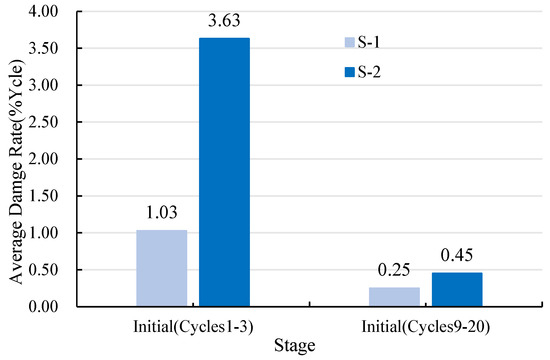
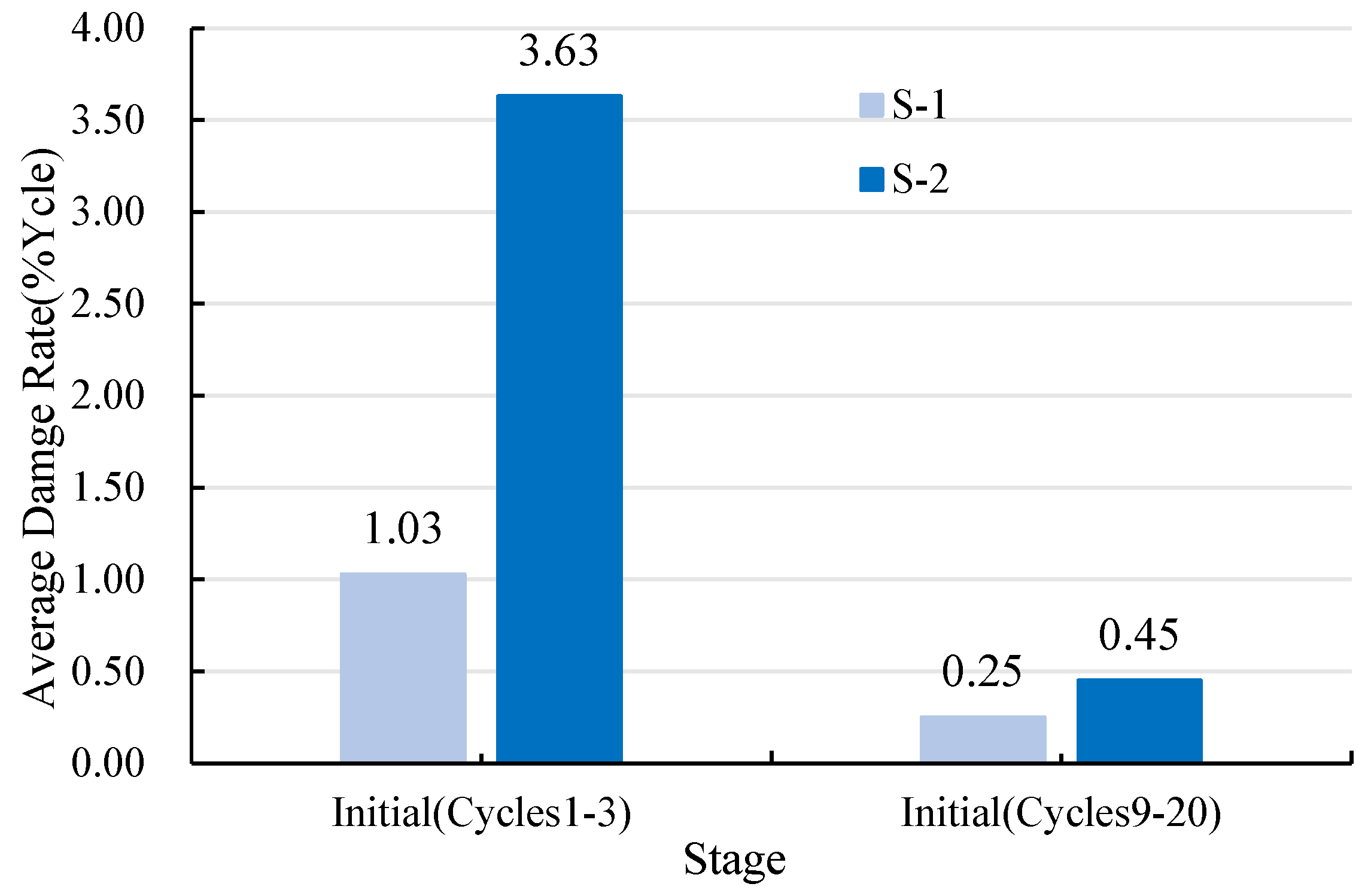
As shown in Figure 3, the damage process can be mathematically divided into two distinct phases based on the slope of the permeability curve:
Figure 3.
Comparison of average permeability damage rates between S-1 and S-2 samples at different production stages.
Initial Accelerated Damage Phase (Cycles 1–8): Sample S-2 (2.5 MPa/min) exhibited an extremely high initial damage rate. The normalized permeability dropped by 10.9% in the first 3 cycles, which means that 60% of the total impairment occurred within only 15% of the total experimental duration.
Long-term Decelerated Stage (Cycles 9–20): The decline rate for S-2 decreased from 3.63%/cycle (initial) to 0.45%/cycle (late stage). This deceleration indicates that the fines migration reached a capacity limit as the easily detachable particles were gradually depleted or trapped in stable bridge structures at pore throats.
The observed transition from an accelerated to a decelerated damage stage reflects the progressive depletion of mobile fines within the pore system. During the initial cycles, loosely attached particles are readily detached and transported, resulting in a high damage rate. As the cycles continue, the remaining particles are either more strongly bonded to the pore surfaces or already trapped in stable bridging structures, leading to a gradual reduction in the damage rate. This interpretation is consistent with the mechanism discussed in Section 3.1.
3.2.2. Quantitative Comparison of Cumulative Impairment
The cumulative damage shows a significant non-linear response to the depletion rate (Table 4 & Figure 2):
Table 4.
Quantitative comparison of permeability damage at different stages.
For S-1 (Slow rate), the total permeability loss was 8.4%. The damage increments per cycle were relatively uniform, suggesting that the primary mechanism was quasi-static matrix compaction.
For S-2 (Fast rate), the cumulative loss (18.2%) was 2.16 times higher than that of S-1. The drastic gap (9.8%) confirms that increasing the depletion rate from 0.5 to 2.5 MPa/min triggers a transition from simple compaction to intense hydrodynamic-driven fines migration.
3.2.3. Damage Intensity Index (DII)
We define the Damage Intensity Index (DII) as the permeability loss per unit of pressure drawdown. Under high-speed depletion, the DII of the reservoir is significantly amplified. This quantification provides a theoretical basis for Section 4, which focuses on the hydrodynamic shear force calculation.
3.3. Correlation Between Depletion Rate and Permeability Loss
The experimental data reveal a strong positive correlation between the pressure depletion rate and the degree of reservoir damage. As the depletion rate increased from 0.5 MPa/min to 2.5 MPa/min, the total permeability loss more than doubled, escalating from 8.4% to 18.2% (as shown in Table 5). This relationship indicates that the sandstone reservoir is highly sensitive to the kinetics of pressure drawdown during the production phase.
Table 5.
Sensitivity of total permeability loss to pressure depletion rates.
Non-Linear Damage Response
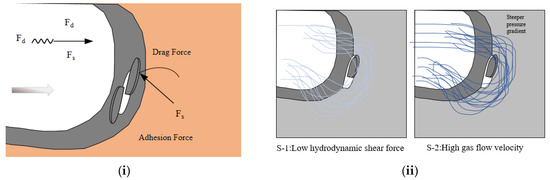
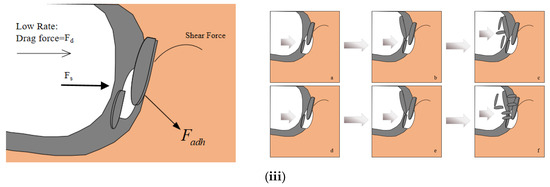
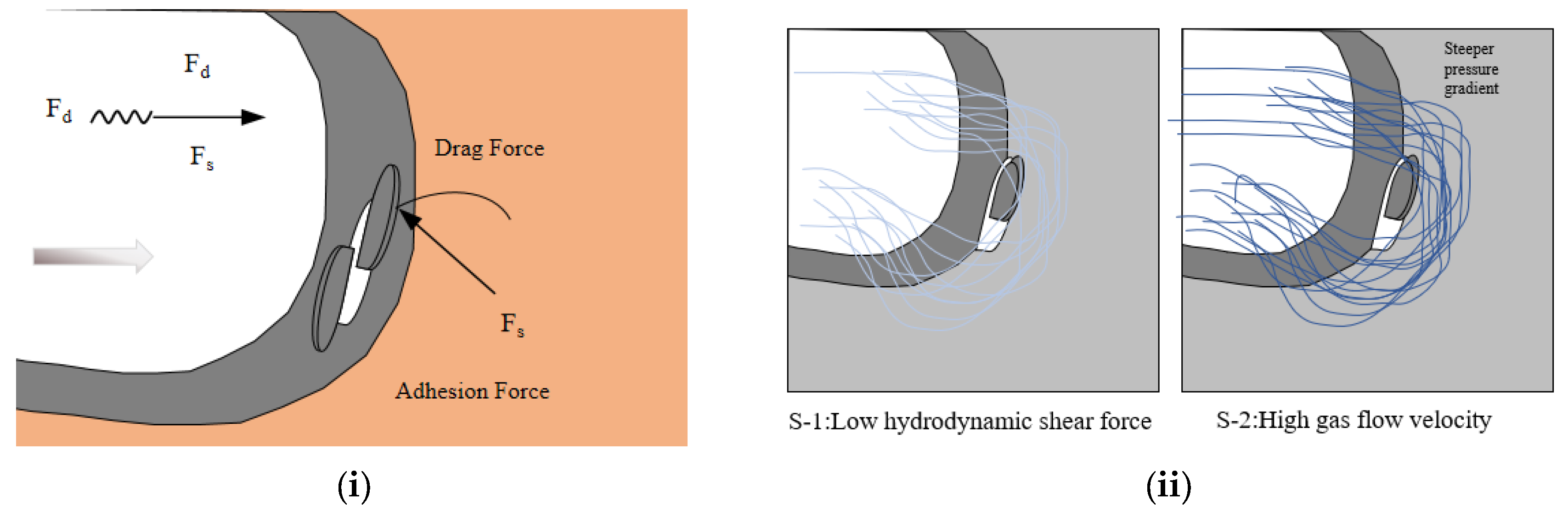
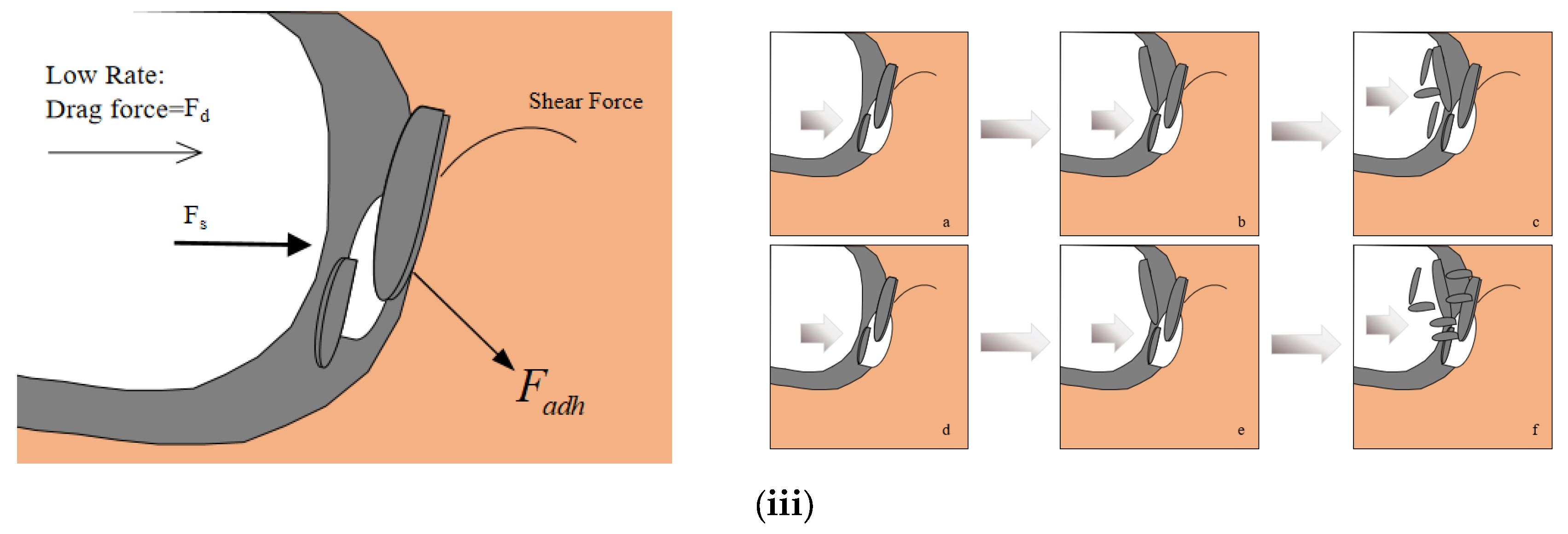
The impact of the depletion rate on permeability is non-linear. A fivefold increase in the depletion rate (from 0.5 to 2.5 MPa/min) resulted in a 2.16-fold increase in cumulative damage. As illustrated in the conceptual model of Figure 4, this behavior suggests the presence of a rate-sensitive transition in permeability damage.
Figure 4.
Comprehensive microscopic mechanism of reservoir impairment during multi-cycle injection and production. (i) Detailed schematic of hydrodynamic force balance (, , and ) acting on clay mineral particles; (ii) Simulated comparison of gas flow velocity and pressure gradients; (iii) Systematic evolution of fines detachment, migration, and pore-throat bridging: (a) initial state, (b) shear-induced detachment, (c) stable transport, (d) onset of accumulation, (e) bridge formation, and (f) irreversible pore-throat plugging leading to permeability loss.
Below this transition range, permeability reduction is primarily associated with rock matrix compaction, whereas at higher depletion rates, hydrodynamic effects may become increasingly important, increasing the likelihood of fines-related pore-throat restriction in the clay-bearing sandstone (9.3% clay content identified by XRD). However, due to the limited number of tested depletion rates, it is not possible to rigorously define a critical threshold or establish a precise upper limit.
3.4. Mechanism Analysis: Why Depletion Rate Matters
The experimental results demonstrate that the pressure depletion rate is a decisive factor in reservoir damage. The following analysis provides a theoretical explanation for these observations by focusing on hydrodynamic forces and the stability of clay minerals.
3.4.1. Hydrodynamic Shear Force and Fines Detachment
The migration of fines within the porous media is primarily governed by the balance of forces acting on individual particles attached to the pore walls. For the sandstone samples from the Sichuan Basin, which contain 9.3% clay minerals (predominantly 6.1% Illite and 1.9% Kaolinite), the mechanical stability of these minerals is highly sensitive to the surrounding flow field.
3.4.2. Theoretical Quantification of Hydrodynamic Forces
The primary forces acting on a clay particle include the Adhesion Force () (comprising Van der Waals and electrostatic forces) and the Hydrodynamic Shear Force (). To quantify the “Variable Rates” effect, the shear force exerted by the flowing nitrogen (N2) at 60 °C is defined as:
The shear force exerted by the flowing gas can be simplified as:
where is the gas viscosity, is the particle diameter, and is the velocity gradient near the wall, the coefficient is a dimensionless parameter that reflects geometric and flow conditions in porous media. In this study, is treated as an empirical coefficient for order-of-magnitude estimation rather than a strictly defined constant.
It should be noted that the velocity gradient () is not directly measured but is estimated from the macroscopic pressure gradient and flow conditions within the core sample. Therefore, this formulation provides a simplified approximation that links macroscopic flow behavior to pore-scale hydrodynamic effects.
Using the experimental pressure gradients and core dimensions (d = 25 mm, L = 50 mm), the comparative parameters are summarized in Table 6. In this analysis, an adhesion force of ~5.0 nN was adopted as a representative reference value for comparative interpretation rather than as a universal constant.
Table 6.
Quantitative comparison of hydrodynamic parameters for S-1 and S-2.
3.4.3. Interpretation of Force-Balance Results
The calculated data in Table 6 explains the non-linear damage response observed in Figure 2. In sample S-2, the instantaneous shear force () exceeds the critical adhesion strength, which may be sufficient to destabilize weakly attached clay-related fines on pore surfaces under the present experimental conditions. This force imbalance plausibly explains why S-2 suffered its most severe impairment (nearly 60% of total damage) during the initial 3 cycles. In contrast, S-1 remained closer to a quasi-static condition in which matrix compaction likely played a more important role. Together, these results support the interpretation that high-rate depletion promotes more intense fines migration and a higher final permeability loss (18.2% versus 8.4%).
3.5. Pore-Throat Plugging and Cumulative Clogging Mechanism
If fines are mobilized during depletion, they may not immediately exit the core but may instead be transported through the pore network. Their subsequent accumulation and entrapment at pore throats could contribute to the permeability decline observed in Figure 2.
3.5.1. Size Exclusion and Bridging Effects
If clay-related fines such as those associated with illite and kaolinite are mobilized, they may encounter pore throats with diameters comparable to their effective transport size, they encounter pore throats with diameters smaller than or comparable to their own size ( ≈ 2–10 μm).
Individual Plugging: Single large particles can directly block narrow throats, leading to an immediate local reduction in flow area.
Bridging (Log-jam Effect): Multiple smaller particles can arrive at a throat simultaneously, forming a “bridge” or “log-jam”. This explains why S-2, with its 5.2× higher pore velocity (Table 6), exhibited 18.2% damage compared with 8.4% in S-1. The higher velocity increases the particle flux, making the bridging effect more efficient and rapid.
3.5.2. Multi-Cycle Cumulative Impact
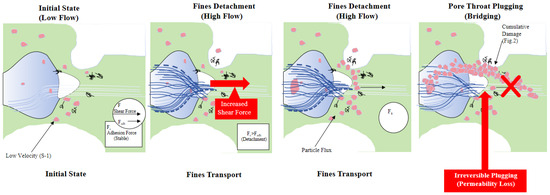
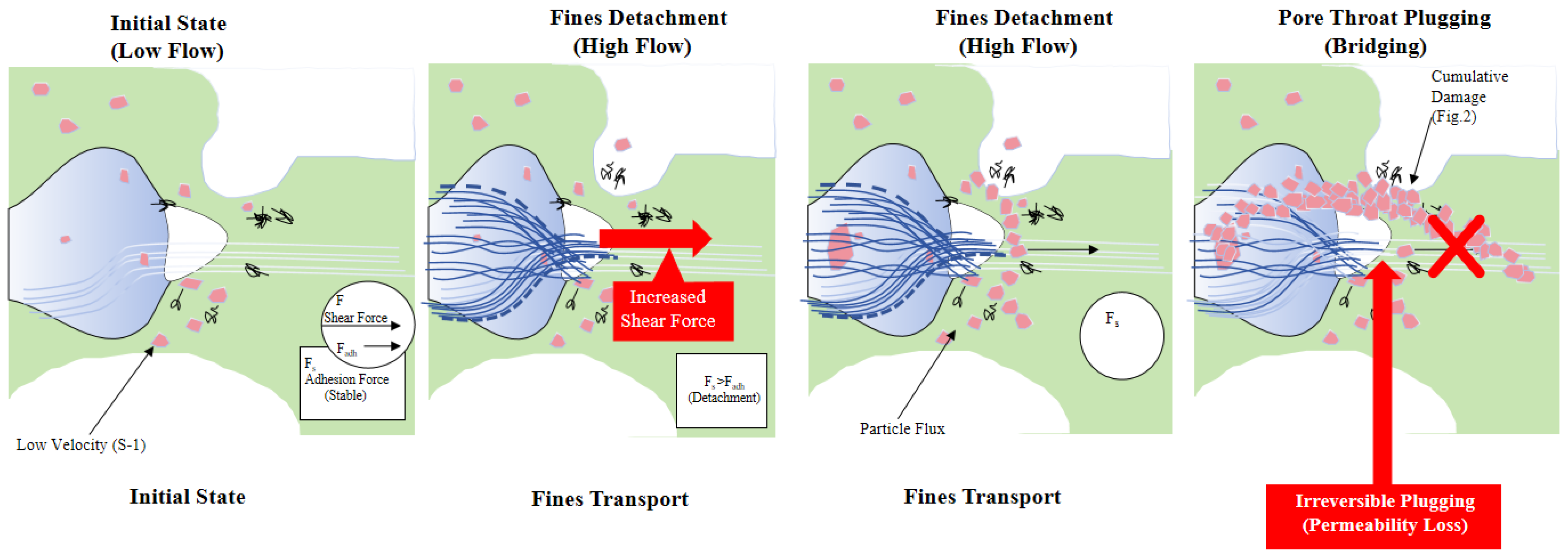
The repetitive nature of the 20 injection–production cycles further exacerbates the damage. During each cycle, the reversing flow direction promotes the redistribution of trapped fines. Particles that were loosely trapped in one cycle may be pushed deeper into critical flow paths in the next, leading to a “cumulative clogging” effect. Once a stable bridge is formed at a pore throat (as shown in Figure 5), the damage becomes largely irreversible. This is reflected in the plateauing of the curves in Figure 2 after the initial 10 cycles, where the most mobile particles have already been trapped or reorganized into stable blockages.
Figure 5.
Conceptual illustration of fines migration and pore-throat plugging.
3.6. Collective Mechanism of Hydrodynamic-Driven Damage
The experimental observations and theoretical calculations collectively suggest that reservoir impairment in UGS operations is not a simple linear process but a complex coupling of mechanical and hydrodynamic factors. The higher sensitivity to depletion rates observed in sample S-2 underscores the significant operational risks associated with aggressive peak-shaving (high-rate withdrawal).
3.6.1. Coupling of Pressure Gradient and Gas Velocity
According to the fluid dynamics in porous media, a higher pressure depletion rate () directly results in a steeper instantaneous pressure gradient () near the pore throats, which significantly elevates the gas flow velocity (). As summarized in Table 6, the five-fold increase in depletion rate led to a 5.2-fold increase in pore velocity, fundamentally altering the kinetic environment of the clay minerals.
3.6.2. Synergistic Effect of Shear Stripping and Bridging
When the gas velocity exceeds the critical threshold, the hydrodynamic drag and lift forces exerted on the pore walls can surpass the electrostatic and van der Waals forces () that anchor the minerals. Consequently, clay-related fines associated with the XRD-identified clay minerals may become more susceptible to mobilization under high-rate depletion. Once mobilized, these fines may be transported by the gas flow and may accumulate at narrow pore throats, thereby reducing the effective flow area. For sample S-2 (2.5 MPa/min), the stronger hydrodynamic disturbance likely increased the probability of such fines-related plugging compared with the quasi-static depletion condition in S-1 (0.5 MPa/min).
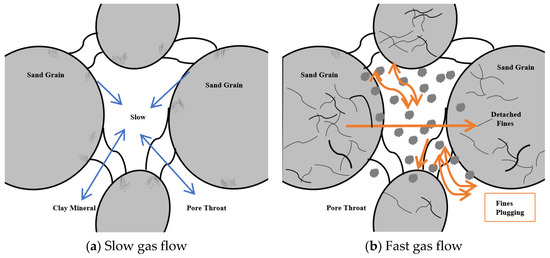
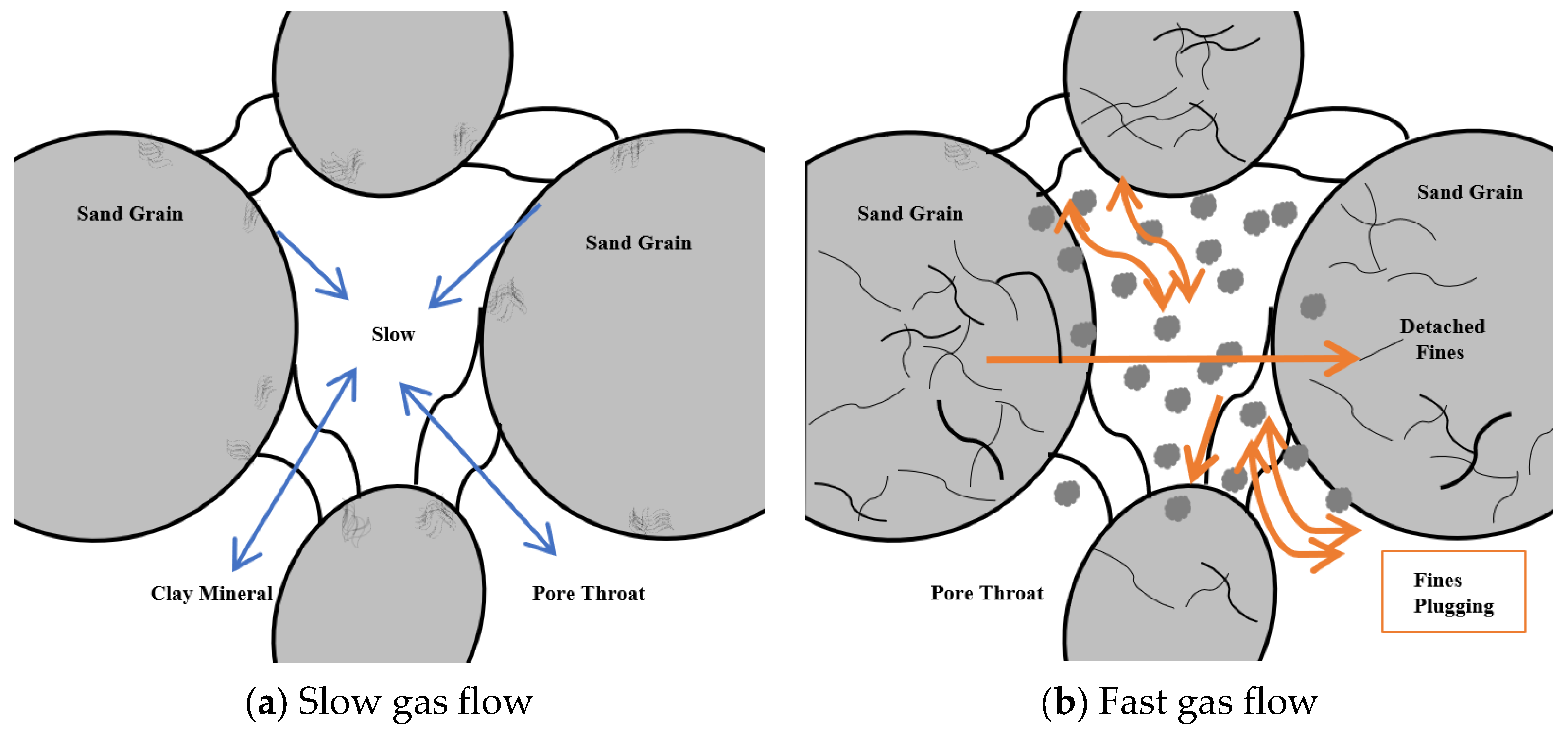
These released fines are subsequently transported by the high-velocity gas stream and eventually trapped at narrow pore throats, forming “bridge plugs” that drastically reduce the effective flow area (as illustrated in Figure 6). For sample S-2 (2.5 MPa/min), the frequent and violent pressure fluctuations promote more intense particle detachment compared to the quasi-static depletion in S-1 (0.5 MPa/min). This synergistic effect of mechanical compaction and fines plugging explains why the “fast depletion” group exhibited a permeability loss (18.2%) nearly double that of the “slow depletion” group (8.4%).
Figure 6.
Schematic of the formation damage mechanism under different depletion rates: (a) stable transport of gas under low depletion rate; (b) fines migration and pore-throat plugging induced by high hydrodynamic shear force under high depletion rate. Blue arrows indicate relatively stable gas flow pathways, whereas orange arrows represent intensified hydrodynamic disturbance and fines migration under high depletion rate conditions.
It should be emphasized that the detachment, migration, and pore-throat bridging of clay-related fines proposed in this study are inferred from permeability evolution, XRD-identified mineral composition, and semi-quantitative force analysis, rather than directly observed. Therefore, these processes should be regarded as plausible mechanistic interpretations that require further validation through pore-scale visualization or post-test microstructural characterization.
4. Engineering Implications for UGS Operations
The experimental findings regarding the impact of pressure depletion rates on permeability impairment offer critical insights for the optimization of underground gas storage (UGS) operations, particularly in reservoirs with significant clay content.
4.1. Optimization of Peak-Shaving Withdrawal Rates
Our study reveals a threshold-type response where increasing the depletion rate from 0.5 MPa/min to 2.5 MPa/min results in a 2.16-fold increase in permeability loss (from 8.4% to 18.2%). To maintain long-term reservoir conductivity, a preliminary “safe operational window” may be established based on the mineralogical sensitivity observed under the present experimental conditions (Table 7).
Table 7.
Recommended operational limits based on reservoir sensitivity and hydrodynamic analysis.
As suggested by the force-balance analysis in Table 7, maintaining the depletion rate below approximately 1.0 MPa/min may help keep the hydrodynamic shear force within a range comparable to representative adhesion forces under the present experimental conditions, thereby reducing the likelihood of severe fines-related pore-throat restriction. However, this value should be regarded as a preliminary estimation rather than a definitive threshold.
4.2. “Slow-Start” Protocol for Initial Cycles
The observation that sample S-2 sustained nearly 60% of its total damage within the first 3 cycles highlights the sensitivity of the reservoir during the early stages of UGS conversion. From this perspective, it is reasonable to hypothesize that adopting a relatively lower depletion rate during the initial injection–production cycles may help mitigate early-stage permeability impairment.
By limiting the drawdown rate during these cycles, the probability of severe early-stage fines mobilization and associated pore-throat restriction may be reduced (as conceptually illustrated in Figure 6). However, it should be noted that significant permeability impairment still occurs in later cycles, and the present study does not include controlled experiments with variable rate sequences.
Therefore, this strategy should be regarded as a qualitative interpretation rather than a validated operational guideline, and its effectiveness requires further experimental verification.
4.3. Mineralogical-Based Risk Assessment
The high sensitivity to fines migration in these samples is primarily due to the 9.3% clay content, dominated by fibrous illite (6.1%). Before converting a depleted reservoir into a UGS, detailed mineralogical screening (e.g., XRD) is essential. Reservoirs with high illite or kaolinite content should be categorized as “Rate-Sensitive” zones, requiring more conservative drawdown management than clean sandstone reservoirs.
5. Conclusions
This study investigated the impact of pressure depletion rates on the permeability evolution of sandstone reservoirs during multi-cycle injection and production. Based on the experimental results and mechanistic interpretation, the following conclusions are drawn:
- Rate-Dependent Impairment: The pressure depletion rate is a decisive factor in reservoir stability. Increasing the rate from 0.5 MPa/min to 2.5 MPa/min led to a 2.16-fold increase in damage intensity, from 8.4% to 18.2%.
- Initial Cycle Sensitivity: For the high-rate depletion sample (S-2), nearly 60% of the cumulative impairment occurred within the first 3 cycles. This suggests that the early stages of UGS conversion are the most critical window for protection of the formation.
- Critical Hydrodynamic Mechanism: Theoretical calculations suggest that at 2.5 MPa/min, the hydrodynamic shear force (≈6.42 nN) may exceed a representative adhesion force of clay-related fines (≈5.0 nN). This force imbalance may increase the likelihood of fines mobilization, which is interpreted as a possible contributor to pore-throat restriction and permeability impairment.
- Operational Recommendations: To mitigate fines-driven damage, a “Slow-Start” protocol is recommended for UGS operations. Maintaining the depletion rate below 1.0 MPa/min, especially during the initial 5 cycles, can effectively preserve reservoir conductivity and extend the service life of gas storage facilities.
Author Contributions
Conceptualization, J.G. and C.D.; Methodology, Y.M.; Validation, F.X.; Formal analysis, S.Z.; Investigation, X.S.; Data curation, Y.S.; Writing—original draft, Y.M.; Writing—review & editing, F.C. All authors have read and agreed to the published version of the manuscript.
Funding
This research received no external funding.
Data Availability Statement
The original contributions presented in this study are included in the article. Further inquiries can be directed to the corresponding authors.
Conflicts of Interest
Authors Feng Xu, Fan Cheng, Yuxia Shi, Xiaojian Su, Siyuan Zhang were employed by the company PipeChina Energy Storage Technology Co., Ltd. The remaining authors declare that the research was conducted in the absence of any commercial or financial relationships that could be construed as a potential conflict of interest. The PipeChina Energy Storage Technology Co., Ltd. had no role in the design of the study; in the collection, analyses, or interpretation of data; in the writing of the manuscript, or in the decision to publish the results.
References
- Huang, T.; Moridis, G.J.; Blasingame, T.A.; Abdulkader, A.M.; Yan, B. Compositional reservoir simulation of underground hydrogen storage in depleted gas reservoirs. Int. J. Hydrogen Energy 2023, 48, 36035–36050. [Google Scholar] [CrossRef] [Scilit]
- Song, R.; Feng, D.; Liu, J.; Yang, C.; Zou, S. A review of underground hydrogen storage in depleted oil and gas reservoirs. Int. J. Energy Res. 2025, 2025, 9246074. [Google Scholar] [CrossRef] [Scilit]
- Zamehrian, M.; Sedaee, B. Underground hydrogen storage in a partially depleted gas condensate reservoir: Influence of cushion gas. J. Pet. Sci. Eng. 2022, 212, 110304. [Google Scholar] [CrossRef] [Scilit]
- Akono, A.-T.; Druhan, J.L.; Dávila, G.; Tsotsis, T.; Jessen, K.; Fuchs, S.; Crandall, D.; Shi, Z.; Dalton, L.; Tkach, M.K.; et al. A review of geochemical–mechanical impacts in geological carbon storage reservoirs. Greenh. Gases Sci. Technol. 2019, 9, 474–504. [Google Scholar] [CrossRef] [Scilit]
- Li, J.; Chen, Z.-Y.; Feng, Y.-C.; Qu, L.-S.; Liu, J.-G.; Li, W.-Y.; Dai, M.-Y. Damage of reservoir rock induced by CO2 injection. Pet. Sci. 2022, 19, 1674–1681. [Google Scholar] [CrossRef] [Scilit]
- Mu, Y.; Zou, C.; Wang, S.; Hu, Z.; Duan, X.; Pan, S.; Jing, Z.; Guo, Q.; Liu, H.; Yuan, M.; et al. Screening depleted oil and gas reservoirs suitable for underground hydrogen storage: Insights from gas flow. J. Energy Storage 2025, 132, 117810. [Google Scholar] [CrossRef] [Scilit]
- Kanaani, M.; Sedaee, B.; Asadian-Pakfar, M. Role of cushion gas on underground hydrogen storage in depleted oil reservoirs. J. Energy Storage 2022, 45, 103783. [Google Scholar] [CrossRef] [Scilit]
- Ren, Z.-X.; Wang, H.-F.; Chang, D.-W.; Liu, Y.-H.; He, H.; Yuan, H.-F. Evaluation of reserves and injection-production capacity of underground gas storage under multi-cycle operation. Pet. Sci. Technol. 2025, 43, 3739–3756. [Google Scholar] [CrossRef] [Scilit]
- Zheng, D.; Xu, H.; Wang, J.; Sun, J.; Zhao, K.; Li, C.; Shi, L.; Tang, L. Key evaluation techniques in the process of gas reservoir being converted into underground gas storage. Pet. Explor. Dev. 2017, 44, 840–849. [Google Scholar] [CrossRef] [Scilit]
- Wang, Q.; Zhang, M.; Zhou, F.; Fei, H.; Yu, S.; Su, H.; Liang, T.; Chen, Z. Experiment and prediction of enhanced gas storage capacity in depleted gas reservoirs for clean energy applications. Renew. Energy 2024, 237, 121894. [Google Scholar] [CrossRef] [Scilit]
- Song, X.; Peng, C.; Li, G.; Wen, K. A probabilistic model to evaluate the operation reliability of the underground system in underground gas storage transformed from depleted gas reservoir. In Proceedings of the International Petroleum Technology Conference, Bangkok, Thailand, 14–16 November 2016. [Google Scholar] [CrossRef] [Scilit]
- Wang, Q.; Shen, J.; Lorinczi, P.; Glover, P.; Yang, S.; Chen, H. Oil production performance and reservoir damage distribution of miscible CO2 soaking-alternating-gas (CO2-SAG) flooding in low permeability heterogeneous sandstone reservoirs. J. Pet. Sci. Eng. 2021, 204, 108741. [Google Scholar] [CrossRef] [Scilit]
- He, Y.; Xie, Y.; Qiao, Y.; Qin, J.; Tang, Y. Estimation of underground hydrogen storage capacity in depleted gas reservoirs using CO2 as cushion gas. Appl. Energy 2024, 375, 124093. [Google Scholar] [CrossRef] [Scilit]
- Liao, W.; Liu, G.; Chen, R.; Sun, J.; Zhang, S.; Wang, Y.; Liu, X. Evaluation on the dynamic sealing capacity of underground gas storages rebuilt from gas reservoirs: A case study of Xinjiang H underground gas storage. Nat. Gas Ind. B 2021, 8, 334–343. [Google Scholar] [CrossRef] [Scilit]
- Liu, T.; Li, Y.; Ding, G.; Wang, Z.; Shi, L.; Liu, Z.; Tang, X.; Cao, H.; Cao, J.; Huang, Y. Simulation of pore space production law and capacity expansion mechanism of underground gas storage. Pet. Explor. Dev. 2022, 49, 1423–1429. [Google Scholar] [CrossRef] [Scilit]
- Zhang, G.; Yang, S.; Mo, C.; Zhang, Z. Experimental research on capacity expansion simulation of multi-cycle injection-production in reconstruction of oil reservoir to underground gas storage. J. Energy Storage 2022, 54, 105222. [Google Scholar] [CrossRef] [Scilit]
- Tang, Y.; Tang, Z.; Qin, J.; He, Y.; Luo, Y.; Cheng, M.; Wang, Z. Research on seepage and phase change characteristics during multi-cycle injection–production in oil reservoir-based underground gas storage. Energies 2025, 18, 2550. [Google Scholar] [CrossRef] [Scilit]
- Tang, Y.; Zheng, P.; Tang, Z.; Cheng, M.; Wang, Y. Research on multi-cycle injection–production displacement characteristics and factors influencing storage capacity in oil reservoir-based underground gas storage. Energies 2025, 18, 3330. [Google Scholar] [CrossRef] [Scilit]
- Zhang, J.; Fang, F.; Lin, W.; Gao, S.; Li, Y.; Li, Q.; Yang, Y. Research on injection-production capability and seepage characteristics of multi-cycle operation of underground gas storage in gas field—Case study of the Wen 23 gas storage. Energies 2020, 13, 3829. [Google Scholar] [CrossRef] [Scilit]
- Wei, H.; Zhong, Z.; Cheng, J.; Zhao, R.; Lv, R. The underground gas storage capacity evaluation-A case study from depleted oil reservoirs to underground gas storage. Fuel 2026, 406, 137079. [Google Scholar] [CrossRef] [Scilit]
- Chang, H.; Duo, T.; Li, B.; Wen, K.; Meng, T.; Bai, C.; Zhang, H. Optimization of the injection-production process of underground gas storage in depleted gas reservoir. Gas Sci. Eng. 2025, 138, 205605. [Google Scholar] [CrossRef] [Scilit]
- Zhu, S.; Sun, J.; Wei, G.; Zheng, D.; Wang, J.; Shi, L.; Liu, X. Numerical simulation-based correction of relative permeability hysteresis in water-invaded underground gas storage during multi-cycle injection and production. Pet. Explor. Dev. 2021, 48, 190–200. [Google Scholar] [CrossRef] [Scilit]
- Perera, M.S.A. A review of underground hydrogen storage in depleted gas reservoirs: Insights into various rock-fluid interaction mechanisms and their impact on the process integrity. Fuel 2023, 334, 126677. [Google Scholar] [CrossRef] [Scilit]
- Jahanbani Veshareh, M.; Thaysen, E.M.; Nick, H.M. Feasibility of hydrogen storage in depleted hydrocarbon chalk reservoirs: Assessment of biochemical and chemical effects. Appl. Energy 2022, 323, 119575. [Google Scholar] [CrossRef] [Scilit]
- Hoteit, H.; Fahs, M.; Soltanian, M.R. Assessment of CO2 injectivity during sequestration in depleted gas reservoirs. Geosciences 2019, 9, 199. [Google Scholar] [CrossRef] [Scilit]
- Liu, T.; Liu, S.; Lin, B.; Fu, X.; Zhu, C.; Yang, W.; Zhao, Y. Stress response during in-situ gas depletion and its impact on permeability and stability of CBM reservoir. Fuel 2020, 266, 117083. [Google Scholar] [CrossRef] [Scilit]
- Liu, S.; Zhao, E.; Ma, B.; Liu, H.; Yang, J.; Sui, G.; Yuan, X.; Ma, X.; Wang, L. Analysis of the influence of alternating stress in the multi-cycle injection production process. Processes 2025, 13, 1158. [Google Scholar] [CrossRef] [Scilit]
- Sun, J.; Xu, H.; Wang, J.; Shi, L.; Li, C.; Tang, L.; Zhong, R. Injection–production mechanisms and key evaluation technologies for underground gas storages rebuilt from gas reservoirs. Nat. Gas Ind. B 2018, 5, 616–622. [Google Scholar] [CrossRef] [Scilit]
- Wan, J.; Sun, Y.; He, Y.; Ji, W.; Li, J.; Jiang, L.; Jurado, M.J. Development and technology status of energy storage in depleted gas reservoirs. Int. J. Coal Sci. Technol. 2024, 11, 29. [Google Scholar] [CrossRef] [Scilit]
- Assef, Y.; Kantzas, A.; Pereira Almao, P. Numerical modelling of cyclic CO2 injection in unconventional tight oil resources; trivial effects of heterogeneity and hysteresis in Bakken formation. Fuel 2019, 236, 1512–1528. [Google Scholar] [CrossRef] [Scilit]
- Xu, Y.; Liu, X.; Hu, Z.; Duan, X.; Chang, J. Pressure drawdown management strategies for multifractured horizontal wells in shale gas reservoirs: A review. ACS Omega 2022, 7, 14516–14526. [Google Scholar] [CrossRef] [Scilit]
- Tang, Y.; Long, K.; Wang, J.; Xu, H.; Wang, Y.; He, Y.; Shi, L.; Zhu, H. Change of phase state during multi-cycle injection and production process of condensate gas reservoir based underground gas storage. Pet. Explor. Dev. 2021, 48, 395–406. [Google Scholar] [CrossRef] [Scilit]
- Zhao, X.; Qiu, Z.; Sun, B.; Liu, S.; Xing, X.; Wang, M. Formation damage mechanisms associated with drilling and completion fluids for deepwater reservoirs. J. Pet. Sci. Eng. 2019, 173, 112–121. [Google Scholar] [CrossRef] [Scilit]
- Xu, P.; Wang, B.; Yang, H.; Pu, L.; Liu, J.; Peng, T. Mechanisms of seepage damage evolution in gas storage under the coupling effects of drilling–completion–injection/production full cycle. Phys. Fluids 2025, 37, 043362. [Google Scholar] [CrossRef] [Scilit]
- Ozowe, W.; Daramola, G.; Ekemezie, I. Petroleum engineering innovations: Evaluating the impact of advanced gas injection techniques on reservoir management. Magna Sci. Adv. Res. Rev. 2024, 11, 299–310. [Google Scholar] [CrossRef] [Scilit]
- Wu, J.; Ansari, U. From CO2 sequestration to hydrogen storage: Further utilization of depleted gas reservoirs. Reserv. Sci. 2025, 1, 19–35. [Google Scholar] [CrossRef] [Scilit]
- Wu, F.; Dai, J.; Shi, L.; Fan, L.; Guan, Y.; Li, Y.; Wang, Q.; Chen, C. An experiment-based study of formation damage using a microetching model displacement method. Micromachines 2022, 13, 270. [Google Scholar] [CrossRef] [Scilit]
- Zhang, X.; Su, Y.; Li, L.; Da, Q.; Hao, Y.; Wang, W.; Liu, J.; Gao, X.; Zhao, A.; Wang, K. Microscopic remaining oil initiation mechanism and formation damage of CO2 injection after waterflooding in deep reservoirs. Energy 2022, 248, 123649. [Google Scholar] [CrossRef] [Scilit]
- Okere, C.J.; Su, G.; Zheng, L.; Cai, Y.; Li, Z.; Liu, H. Experimental, algorithmic, and theoretical analyses for selecting an optimal laboratory method to evaluate working fluid damage in coal bed methane reservoirs. Fuel 2020, 282, 118513. [Google Scholar] [CrossRef] [Scilit]
- Burrows, L.C.; Haeri, F.; Cvetic, P.; Sanguinito, S.; Shi, F.; Tapriyal, D.; Goodman, A.; Enick, R.M. A literature review of CO2, natural gas, and water-based fluids for enhanced oil recovery in unconventional reservoirs. Energy Fuels 2020, 34, 5331–5380. [Google Scholar] [CrossRef] [Scilit]
- Xu, C.; Yan, X.; Kang, Y.; You, L.; Zhang, J. Structural failure mechanism and strengthening method of fracture plugging zone for lost circulation control in deep naturally fractured reservoirs. Pet. Explor. Dev. 2020, 47, 430–440. [Google Scholar] [CrossRef] [Scilit]
- Civan, F. Reservoir Formation Damage: Fundamentals, Modeling, Assessment, and Mitigation; Gulf Professional Publishing: Houston, TX, USA, 2007. [Google Scholar]
- Du, F.; Nojabaei, B. A review of gas injection in shale reservoirs: Enhanced oil/gas recovery approaches and greenhouse gas control. Energies 2019, 12, 2355. [Google Scholar] [CrossRef] [Scilit]
- Zhang, K.; Cheng, Y.; Wang, H.; Wu, Z.; Zheng, S.; Zhang, C. Experimental study on the cyclic injection-production performance of the underground gas storage with trans-critical carbon dioxide as cushion gas. Energy 2026, 342, 139696. [Google Scholar] [CrossRef] [Scilit]
- Gao, J.; Kong, D.; Peng, Y.; Zhou, Y.; Liu, Y.; Zhu, W. Pore-scale mechanisms and hysteresis effect during multi-cycle injection and production process in underground hydrogen storage reservoir. Energy 2023, 283, 129007. [Google Scholar] [CrossRef] [Scilit]
- Gao, T.; Wang, H.; Wang, S.; Lu, J.; Gu, C.; Wang, X. Performance evaluation of multi-cycle injection-production of Sizhan gas storage. In Proceedings of the International Field Exploration and Development Conference 2023; Lin, J., Ed.; Springer: Singapore, 2024; pp. 942–953. [Google Scholar] [CrossRef] [Scilit]
- Rezaei, A.; Abdollahi, H.; Imanivarnosfaderani, M. Formation damage in gas injection methods. In Gas Injection Methods; Elsevier: Amsterdam, The Netherlands, 2023; pp. 339–358. [Google Scholar] [CrossRef] [Scilit]
- Priolo, E.; Zinno, I.; Guidarelli, M.; Romanelli, M.; Lanari, R.; Sandron, D.; Garbin, M.; Peruzza, L.; Romano, M.A.; Zuliani, D.; et al. The birth of an underground gas storage in a depleted gas reservoir—Results from integrated seismic and ground deformation monitoring. Earth Space Sci. 2024, 11, e2023EA003275. [Google Scholar] [CrossRef] [Scilit]
- Chen, H.; Liu, X.; Zhang, C.; Tan, X.; Yang, R.; Yang, S.; Yang, J. Effects of miscible degree and pore scale on seepage characteristics of unconventional reservoirs fluids due to supercritical CO2 injection. Energy 2022, 239, 122287. [Google Scholar] [CrossRef] [Scilit]
- Zhang, H.; Zheng, P.; Wang, Z.; Song, J.; Liu, J.; Xu, K.; Wang, H.; Liu, L.; Lai, S.; Wang, X.; et al. Evaluation of rock mechanical properties and production pressure differential in underground gas storage under multi-cycle injection/production conditions. Processes 2025, 13, 3967. [Google Scholar] [CrossRef] [Scilit]
- Mohagheghian, E.; Hassanzadeh, H.; Chen, Z. CO2 sequestration coupled with enhanced gas recovery in shale gas reservoirs. J. CO2 Util. 2019, 34, 646–655. [Google Scholar] [CrossRef] [Scilit]
- Li, J.; Zhao, G.; Qi, Z.; Yin, B.; Xu, X.; Fang, F.; Yang, S.; Qi, G. Stress sensitivity of formation during multi-cycle gas injection and production in an underground gas storage rebuilt from gas reservoirs. Pet. Explor. Dev. 2021, 48, 968–977. [Google Scholar] [CrossRef] [Scilit]
- Yin, Z.; Wan, Q.-C.; Gao, Q.; Linga, P. Effect of pressure drawdown rate on the fluid production behaviour from methane hydrate-bearing sediments. Appl. Energy 2020, 271, 115195. [Google Scholar] [CrossRef] [Scilit]

Disclaimer/Publisher’s Note: The statements, opinions and data contained in all publications are solely those of the individual author(s) and contributor(s) and not of MDPI and/or the editor(s). MDPI and/or the editor(s) disclaim responsibility for any injury to people or property resulting from any ideas, methods, instructions or products referred to in the content. |
© 2026 by the authors. Licensee MDPI, Basel, Switzerland. This article is an open access article distributed under the terms and conditions of the Creative Commons Attribution (CC BY) license.