


Abstract
Emulsion explosives have become a hot topic in various studies due to their explosive combustion characteristics and detonation performance under different environmental pressures. The thermal safety of an emulsified matrix was studied with ignition energy as the characterization. A minimum ignition energy test experimental system for emulsion matrices was established in this research. The system simulated the occurrence of hot spots inside emulsion matrices using an electric heating wire. The effect of bubbles on the thermal safety of the emulsified matrix was studied by adding expanded perlite additive to the emulsified matrix. This study investigated the variation trend in the minimum ignition energy of the emulsion matrix under the coupled effect of bubbles and ambient pressure using the orthogonal experimental method. The impacts of two factors on the thermal safety of the emulsion matrix were studied at different hot-spot temperatures. Coupled analysis experiments were conducted on emulsion matrices containing 0%, 1.5%, and 3% expanded perlite under pressure environments of 1 atm, 2 atm, and 3 atm. The critical hot-spot temperature of the emulsion matrix significantly decreases with increasing bubble content at 1 atm and 2 atm pressures, as revealed by intuitive analysis and analysis of variance. However, at 3 atm of pressure, the bubble content in the emulsion matrix has no significant effect on its critical hot-spot temperature. The results show that the thermal safety of the emulsified matrix decreases with the increase in the content of expanded perlite and environmental pressure, and the influence of environmental pressure is more significant than that of the bubble content. This paper’s research content serves as a reference for a safe emulsified matrix and as an experimental basis for establishing a production line for developing new equipment.
1. Introduction
Emulsion explosives are widely utilized globally for their high safety, non-trinitrotoluene content, waterproof nature, and explosion-proof characteristics. The emulsion matrix in emulsion explosives is essential for ensuring high efficiency, safety, and controllability. It contributes to stability, explosion control, energy release, safety enhancement, and as a fuel and sensitizer [1]. However, the primary safety concern with emulsion explosives during production is the thermal safety of the matrix. The production equipment’s structure, technical parameters, and process flow impact the matrix’s environment and thermal safety [2]. An emulsion matrix is the intermediate form of an emulsion explosive. Its basic composition is an oil phase, water phase, and emulsifier, which mainly refers to the emulsion explosive package without sensitization. The emulsion matrix is generally considered safe and harmless during production, storage, and use. However, accidental explosions may lead to serious casualties and significant property losses. An emulsified matrix can be ignited by a continuous heat source and most accidents in the production process of emulsion explosives are caused by internal heat sources. At present, most of the research [3,4,5,6] focuses on the safety of the emulsified matrix itself, but less is found on the external factors which lead to ignition of the emulsified matrix. According to the hot-spot theory of explosives, bubbles in an emulsion matrix will form hot spots under adiabatic compression conditions [7]. Therefore, many scholars have studied the process of bubbles and voids in emulsion matrices transforming into hot spots under adiabatic compression conditions. Bourne N.K. and Field J.E. [8] studied the formation of hot spots in emulsion matrices under pressure conditions. They examined the processes of bubble rupture and pore collapse in emulsion matrices. Their study revealed that bubbles in emulsion matrices only form hot spots under high-speed compression. Lasheas et al. [9] created a model to analyze the impact of ambient pressure on the vaporization and combustion of emulsified fuel droplets. The pressure difference between superheated vapor and liquid, as well as the inertia imparted to the liquid by the motion of the bubble surface, govern the formation of vapor bubbles in emulsion explosives [10]. Yoshikazu Hirosaki, Kenji Murata, and Yukio Kato [3,4,11,12] used plastic foam instead of bubbles in emulsion explosives and studied the effects of bubble size and ambient pressure on the ignition characteristics of emulsion explosives. Five groups of plastic foam balls with different diameters were selected in this study. The larger the bubble diameter, the lower the sensitivity of the emulsion explosive. P.K. Ghosh, Hirosaki Y., and T. Kzdota [4,5,12] studied the mechanism of hot-spot formation in emulsion explosives under shock wave conditions. The results indicate that the sensitivity of emulsion explosives is directly influenced by the size of pores and bubbles, with smaller pore and bubble sizes leading to easier hot-spot formation. Generally, the critical ignition temperature of an emulsified matrix is determined by the formula in [13]. The change in ambient environment can only affect the ignition delay time but not the critical ignition temperature [14]. Therefore, when the formulation of an emulsifying matrix is determined, external factors are crucial to the safety of the emulsifying matrix [15]. Usually, the heat source inside the emulsified matrix is the direct reason for ignition of this emulsified matrix.
The primary focus of researching the minimum ignition energy of emulsion explosives lies in understanding the impact of environmental pressure, bubble content, and hot-spot temperature on this property. Among various experimental approaches, orthogonal experimentation is the most common and mature method. It not only reduces the experimental workload and costs but also features a simple design and easy operation. Since the minimum ignition energy of emulsion matrices can be directly calculated based on experimental data without considering calculation errors caused by heat loss, the key lies in understanding how the three factors of environmental pressure, bubble content, and hot- spot temperature influence this property. The conventional thermal critical parameter is the critical parameter obtained by theoretical calculation when the ignition probability of the emulsified matrix is 100%. What is needed is to reduce the probability of ignition of the emulsified matrix in actual production. However, few researchers use mathematical statistics to analyze the experimental data to obtain the hot-spot temperature with a low ignition probability of the emulsified matrix. In order to study the parameters of the minimum ignition energy, this paper designed and established an experimental system independently. An experiment was carried out using the Langley method and orthogonal method, and the experimental data were processed by mathematical statistics to obtain the minimum ignition energy. Meanwhile, based on ignition energy, the effects of ambient pressure and bubble content on the safety of an emulsified matrix were studied when hot spots appeared in the emulsified matrix. The emulsion matrix with the classical formula was taken as the research object, and the hot wire was used as the internal continuous heat source. A non-contact infrared thermometer was used to record the heating process of the emulsified matrix by the internal heat source. Usually, in the production process of an emulsified matrix, if hot spots are found in the emulsified matrix, emergency treatment is needed during the ignition delay time. In order to have sufficient emergency treatment time, 10 min was taken as the limit value in the present paper. When the ignition delay was less than 10 min, the significance of the influence of ambient pressure and bubble content on ignition energy was studied. In addition, an orthogonal experiment was carried out to analyze the significance of different influencing factors. Moreover, the experimental data were dealt with both intuitive analysis and variance analysis to ensure accurate and precise analysis.
2. Experiment
2.1. Experimental Method
The focus of minimum ignition energy research lies in understanding how environmental pressure, bubble content, and hot-spot temperature affect the minimum ignition energy of emulsion matrices. The minimal ignition energy experiment employed an orthogonal experimental design to investigate the minimum ignition energy of emulsified matrix within 10 min, considering the factors of bubble content, ambient pressure, and hot-spot temperature. This study also examined the influence of these factors on the minimum ignition energy. To avoid invalid data in data processing, this study followed the principles of orthogonal experiments to select valid data from comprehensive experiments. During the preparation of emulsion systems, the presence of air bubbles is common and can increase the sensitivity of the emulsion matrix, impacting the thermal safety of the emulsification process. The presence of sensitizer materials like perlite can impact the detonation performance of emulsion explosives, with optimal performance observed at specific sensitizer contents [16]. In order to obtain the relationship governing the effect of ambient pressure and bubble content on ignition energy, expanded perlite was used as the carrier of bubbles in this study. Generally, the content of the sensitizer that was added in the emulsion explosive should not exceed 3% of the total weight. Therefore, the amount of expanded perlite added was 0%, 1%, 1.5%, 2%, 2.5%, and 3%. At the same time, considering the effects of ambient pressure on the critical hot-spot temperature of emulsified matrix, 1 atm, 2 atm, and 3 atm were selected as the experimental environments.
The iron plate heating method from the MT/T 982-2006 explosive thermal sensitivity test was applied [17]. Monitoring the temperature rise process of the emulsion matrix using a non-contact temperature sensor allows for the determination of the ignition delay time of the emulsion matrix. By adjusting the current intensity of the input heating wire and measuring its resistance, the heat released by the heating wire during the ignition delay period of the emulsion matrix can be calculated as the minimum ignition energy of the emulsion matrix. The ignition delay time of the emulsified matrix is obtained when the inflection points of the time–temperature curve appear. When the emulsified matrix is ignited by electric heating wire, the energy relationship satisfies Equation (1).
where is the net energy for heating the emulsified matrix, J; is the total heating energy from the hot wire, J; is the heat loss caused by the vaporization of water and the heat dissipation of the emulsified matrix, J; and is the heat released by the chemical reaction of the emulsified matrix, J. Because the experiment is carried out in a sealed container, when the electric heating wire is fully immersed in the emulsified matrix, the heat released by the hot wire is the ignition energy of the emulsified matrix. The heat released by hot wire can be calculated by Equation (2).
where is the current intensity, A; is the resistance of the hot wire, Ω; and is the ignition delay time of the emulsified matrix, S. Current intensity was controlled by a direct current (DC) power supply. The resistance of the hot wire for each test was 2.1 Ω. The ignition delay time was obtained by an infrared temperature sensor. The schedule time for each test was 10 min. If the sample did not ignite within 10 min, the ignition delay time was recorded as ∞ and the test data were regarded as invalid.
2.2. Experimental System and Emulsion Matrix Formula
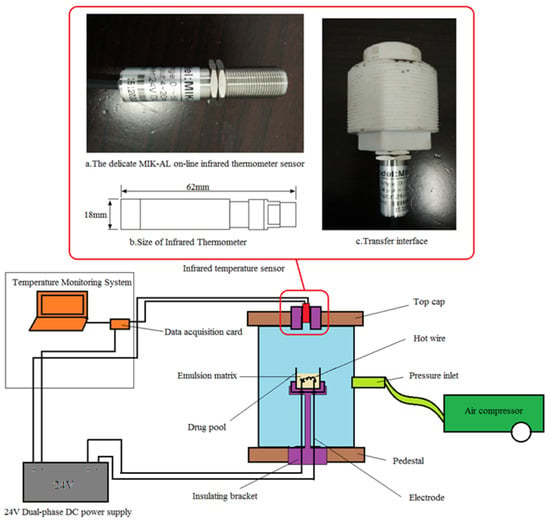
The schematic diagram of the experimental system is shown in Figure 1. The experimental device comprises three parts: an ignition system, a temperature monitoring system, and a pressure control system. The pressure vessel is a cylindrical steel tank with a removable top and bottom, capable of withstanding a maximum pressure of 177.6 atm and a volume of approximately 12.5 L. The base of the pressure vessel can secure the electrode, while the interior is sealed with sealing glue to ensure air-tightness of the tank. The top cover is sealed with a silicone sealing strip for easy disassembly. After debugging, the pressure retention capacity can be maintained at 3.5 atm for 10 min. The air compressor can provide more than 10 atm of pressure for the system. The barometer has a range of 0~24.67 atm with an accuracy of 0.1974 atm. The ignition system provides a controllable and stable heat source for experiments. It consists of a power supply unit and a medicament container. The power supply unit includes a 24 V DC power supply with an accuracy of 0.01 A, which can provide stable 6 A DC for the experimental system connected to two fixed long electrodes at the output end and to the medicament container. The medicament container comprises a sample cell, a sample cell holder, and separate electrodes. This experiment employed an aluminum semi-enclosed cylindrical container with a sample pool size of φ38 × 24 mm. A 25 g dose of the experimental substance was used to ensure both sufficient heat generation for the heat transfer process within the emulsion matrix and the safety of the experimental procedure. Due to the high susceptibility of the iron–chromium–aluminum heating wire to oxidation in the preliminary experiment, a nichrome wire with a diameter of 0.5 mm and a resistance of 2.1 Ω was selected.
Figure 1.
Schematic diagram of critical ignition energy measurement system for emulsion matrix.
The sophisticated MIK-AL online infrared temperature sensor is installed at the central position of the pressure vessel’s top cover, directly above the sample chamber. Temperature data collected by the sensor are uploaded to the computer monitoring software via a data acquisition card to record temperature variations in the emulsion matrix sample throughout the combustion process. To prevent short circuits resulting from contact between the metal sensor and the metal cover, a polytetrafluoroethylene adapter interface is installed at the interface. Polytetrafluoroethylene (PTFE) is used as the insulating support material [18]. On the one hand, PTFE is used to place the dispensing device. On the other hand, it is used to increase the stability of the fixed electrode. Two fixed electrodes pass through the pedestal of the insulating bracket. One tip is connected with the DC power supply outside the pressure vessel, and the other is connected with the split electrodes in the sample holding device.
In this study, an electronic balance was used to weigh the expanded perlite. The expanded perlite was weighed at 1%, 2%, and 3% of the mass of the emulsified matrix sample for each individual experiment. After weighing, the expanded perlite was stirred into the emulsified matrix sample for each experiment to ensure uniform mixing, thereby avoiding a potential uneven distribution of the expanded perlite during large-scale mixing. The main parameters of the infrared temperature sensor are shown in Table 1 and the formulation of the emulsion matrix for the experiment is demonstrated in Table 2.
Table 1.
Performance parameters of MIK-AL infrared thermometer.
Table 2.
Formula of emulsion matrix.
3. Results and Discussion
3.1. Experimental Results
The ignition delay time is presented in Table 3 and the conversion of ignition delay time into ignition energy is summarized in Table 4.
Table 3.
Comprehensive experimental data of ignition delay time.
Table 4.
Comprehensive experimental data of ignition energy.
3.2. Analysis and Discussion
No invalid data were found when the contents of expanded perlite were 1%, 2%, and 3% in the emulsion matrix, and, therefore, three-factor and three-level orthogonal experiments were carried out. The selection criteria of experimental points according to “uniform dispersion, neatness, and comparability” is suitable for the orthogonal experiment [19]. Three levels of environmental pressure factors were selected as 1 atm, 2 atm, and 3 atm and three levels of expanded perlite content factors were selected as 1%, 2%, and 3%. In addition, three levels of current intensity factors were selected as 2 A, 2.25 A, and 2.5 A. A three-factor and three-level L9 (34) orthogonal table is summarized in Table 5.
Table 5.
Ignition energy L9 (34) orthogonal table.
Three-factor and three-level orthogonal analysis is first carried out by the intuitive analysis method. The sum of the first-level results, second-level results, and third-level results of each factor in each experiment is recorded as I, II, and III, respectively. The average of the results is calculated for each factor at each level, as well as the difference (range) between each factor and the average value. Finally, the average value of each factor and the range of each factor are separately derived, as shown in Table 6.
Table 6.
The mean and extreme of each level and factor.
In general, the larger the range, the more significant the influence of the corresponding factor. It can be seen that the value of the range for environmental pressure is largest and the value of the range for the expanded perlite content factor is smallest. Therefore, the influence of ambient pressure on the critical ignition energy is more significant than that of the expanded perlite content. In addition, it can also be seen from Table 4 that the minimum ignition energy appears when the current intensity is 2.25 A, the ambient pressure is 2 atm, and the expanded perlite content is 3%. This means that the emulsified matrix is easiest to ignite and has the lowest thermal safety under these conditions. In actual production, the temperature of the heat source is random. The accuracy of the intuitive analysis method is low. Because of the above two reasons, the current intensity is no longer considered, and the significance of environmental pressure and expanded perlite content is studied separately by non-repetitive two-factor variance analysis with the current intensity of electric hot wires being 2 A, 2.25 A, and 2.5 A. Table 7, Table 8 and Table 9 are obtained by setting the ambient pressure as the A factor and expanded perlite content as the B factor.
Table 7.
Three-level and double-factor table without repetition (I = 2 A).
Table 8.
Three-level and double-factor table without repetition (I = 2.25 A).
Table 9.
Three-level and double-factor table without repetition (I = 2.5 A).
Each experimental value in Table 7, Table 8 and Table 9 can be described by a linear statistical model as follows:
where is the mean value; ( = 1, 2, 3) is the treatment effect of level for ambient pressure; (j = 1, 2, 3) is the treatment effect of level for bubble content; is the random error; and is an independent random variable which obeys normal distribution N (0, σ2).
Assume the sample is independent of each other, ~N (, σ2), is independent of each other, ~N (0, σ2), , and . Then, determine whether the ambient pressure and bubble content have a significant influence on the ignition energy to test the following hypotheses. : = = = 0 and : = = = 0.
Let the total sum of squares of deviations be , which can be calculated by Equation (4); let the sum of squares of the deviation in the environmental pressure factor (factor A) be , which can be calculated by Equation (5); and let the sum of squares of the deviation in the expanded perlite content factor (factor B) be , which can be calculated by Equation (6). Then, the total sum of squares of the total deviations can be decomposed into = .
The degree of freedom of each factor is the level number minus 1. Then, the degree of freedom of is 2, the degree of freedom of is 2, and the degree of freedom of is 4. The mean squares of are recorded as MSA, is recorded as MSB, and is recorded as MSE. So, MSA = /2, MSB = /2, and MSE = /4.
The variance ~F (2,4) is used to test whether the ambient pressure has a significant effect on the ignition energy. The variance ~F (2,4) is used to test whether the expanded perlite content has a significant effect on the ignition energy. A significant level of α is chosen and P{FA > Fα (2,4)} = α. According to the small probability event principle, it is considered that ambient pressure has a significant effect on ignition energy if FA > Fα (2,4). Similarly, it can also be concluded that the expanded perlite content has a significant effect on ignition energy if FB > Fα (2,4). Usually, the value of α is 0.1, 0.05, and 0.01, and the smaller the value of α, the larger the rejection domain. Therefore, the relative equilibrium value of α in this study is chosen as 0.05.
The results of the variance calculation are listed in Table 10 and the results of the test are shown in Table 11 when I is equal to 2 A.
Table 10.
Three-level and double-factor variance table (I = 2 A).
Table 11.
ANOVA with double factors and three levels without repetition (I = 2 A).
The results of the variance calculation are presented in Table 12 and the results of the test are demonstrated in Table 13 when I is equal to 2.25 A.
Table 12.
Three-level and double-factor variance table (I = 2.25 A).
Table 13.
ANOVA with double factors and three levels without repetition (I = 2.25 A).
The results of the variance calculation are shown in Table 14 and the results of the test are displayed in Table 15 when I is equal to 2.5 A.
Table 14.
Three-level and double-factor variance table (I = 2.5 A).
Table 15.
ANOVA with double factors and three levels without repetition (I = 2.5 A).
The p-value value of the influence factor is higher than 0.05, indicating that the effect of the factor on the minimum ignition energy is not significant, because the α value is 0.05. It can be seen from Table 13 and Table 15 that the p-values of the rows (bubble content) and columns (environmental pressure) are higher than 0.05, where I = 2 A and I = 2.5 A. The analysis and comparison with the two groups of data are not accurate enough. Therefore, the data are selected for analysis and comparison with I = 2.25 A.
As displayed in Table 14, the p-value of the row (bubble content) is 0.247, which is greater than 0.05, and FB = 2.202, Fα (2,4) = 6.944, and FB < Fα (2,4). Therefore, the presence of expanded perlite has no significant effect on the ignition energy of the emulsion matrix in this experimental condition. The p-value of the column (ambient pressure) is 0.025, which is less than 0.05, and FA = 10.571, Fα (2,4) = 6.944, and FA > Fα (2,4), so the influence of ambient pressure on the ignition energy of the emulsified matrix is apparently significant. The analysis suggests that under the condition I = 2.25 A, the results from intuitive analysis and variance analysis are generally consistent. Increasing environmental pressure can accelerate the decomposition reaction rate of the emulsion matrix, affecting the minimum ignition energy of the emulsion matrix. Additionally, heightened pressure may expel bubbles present in expanded perlite, thereby reducing the sensitivity of the emulsion explosive matrix. This also explains why the ignition energy of the emulsified matrix sample containing 3% expanded perlite at an ambient pressure of 2 atm is less than that at an ambient pressure of 3 atm in the orthogonal experiment. Due to the dual effect of environmental pressure, it has a more pronounced impact on the ignition energy than the content of expanded perlite.
This study examines the potential disturbance factors that could impact the experimental outcomes, such as the environmental temperature within the pressure vessel, the placement of the heating wire in the emulsifying matrix, and the consistency of the expanded perlite distribution in the emulsifying matrix. The temperature inside the pressure vessel can influence the temperature of the emulsion matrix, leading to changes in the system’s initial temperature which could impact the ignition delay time and affect the calculation of the final ignition energy. However, due to the rapid heating rate of the heating wire, changes in the initial temperature of the emulsion matrix surrounding the heating wire may have minimal impact on the ignition delay time. The position of the heating wire determines the thickness of the emulsifying matrix around it, which in turn affects the wire’s heat dissipation and can consequently impact the ignition delay period. The above two disturbance factors will be redesigned for experimental equipment in the future. The uniformity of expanded perlite in the emulsified matrix cannot be accurately measured, and its influence can only be ignored in this study.
4. Conclusions
This work studies the significance of the effect of ambient pressure and bubble content on the ignition energy of an emulsified matrix by two analysis methods. The same conclusion has been drawn from the analysis of the experimental data by two methods of intuitive analysis and variance analysis. When a continuous heat source appears in the emulsified matrix, the influence of ambient pressure on ignition energy is more significant than that of bubble content. It is considered that ambient pressure can affect the decomposition reaction rate of the emulsified matrix. It can also cause the bubbles to overflow, which is carried by expanded perlite. Under the dual effects of these two factors, the influence of ambient pressure on the safety of emulsified matrix is more significant than that of bubble content. In addition, the minimum ignition energy of the emulsion matrix was obtained through orthogonal experiments, with the lowest value observed at an environmental pressure of 2 atm and an expanded perlite content of 3%. Under these conditions, the safety of the emulsion matrix was at its lowest. However, the equipment basically works under constant pressure in actual normal production. Therefore, more attention should be paid to the influence of bubbles on production safety, and bubbles should be avoided in production as much as possible.
Author Contributions
Conceptualization, X.-C.S.; methodology, Y.-B.Z.; validation, Q.L. All authors have read and agreed to the published version of the manuscript.
Funding
This research received no external funding.
Data Availability Statement
All data are presented within the article.
Acknowledgments
Special thanks are given to Nafeng Wang from the Institute of Process Engineering, Chinese Academy of Sciences, for her generous help when completing this paper.
Conflicts of Interest
The authors declare no conflict of interest.
References
- Zhang, K.-M.; Zhao, H.-R. Perspectives in the stability of emulsion explosive. Adv. Colloid Interface Sci. 2022, 307, 102745. [Google Scholar] [CrossRef] [Scilit] [PubMed]
- Zhang, K.; Ni, O. Rheological Properties and Stability of Emulsion Explosive Matrix. J. Dispers. Sci. Technol. 2014, 36, 932–937. [Google Scholar] [CrossRef] [Scilit]
- Hirosaki, Y.; Suzuki, S.; Takahashi, Y.; Kato, Y. Burning characteristics of emulsion explosives (I) pressurized vessel test. J. Explos. Soc. 2000, 61, 35–42. [Google Scholar]
- Kadota, T.; Yamasaki, H. Recent advances in the combustion of water fuel emulsion. Prog. Energy Combust. Sci. 2002, 28, 385–404. [Google Scholar] [CrossRef] [Scilit]
- Rao, V.M.; Ghosh, P.K.; Vijayaraghavan, V.; Chandrakumar, N. Void Size Measurement in Emulsion Explosives: A Noninvasive Approach Using NMR Imaging. Langmuir 2000, 16, 2985–2986. [Google Scholar] [CrossRef] [Scilit]
- Turcotte, R.; Badeen, C.M.; Goldthorp, S. Minimum burning pressures of water-based emulsion explosives. J. Vis. Exp. 2017, 128, e56167. [Google Scholar]
- Bassett, W.P.; Johnson, B.P.; Neelakantan, N.K.; Suslick, K.S.; Dlott, D.D. Shock initiation of explosives: High temperature hot spots explained. Appl. Phys. Lett. 2017, 111, 061902. [Google Scholar] [CrossRef] [Scilit]
- Bourne, N.K.; Field, J.E. Bubble collapse and the initiation of explosion. Proc. R. Soc. London. Ser. A Math. Phys. Sci. 1991, 435, 423–435. [Google Scholar]
- Lasheas, J.; Yap, L.; Dryer, F. Effect of the ambient pressure on the explosive burning of emulsified and multicomponent fuel droplets. Symp. (Int.) Combust. 1985, 20, 1761–1772. [Google Scholar] [CrossRef] [Scilit]
- Chen, C.-K.; Lin, T.-H. Micro-explosion of compound drops. In Proceedings of the International Conference on Optical Particle Characterization (OPC 2014), Tokyo, Japan, 10–14 March 2014; pp. 78–83. [Google Scholar]
- Hirosaki, Y.; Murata, K.; Kato, Y.; Itoh, S. Effect of void size on the detonation pressure of emulsion explosives. In AIP Conference Proceedings; American Institute of Physics: College Park, MD, USA, 2002; pp. 930–933. [Google Scholar]
- Hirosaki, Y.; Murata, K.; Kato, Y.; Itoh, S. Detonation characteristics of emulsion explosive as function of void size and volume. In Proceedings of the 12th International Detonation Symposium, San Diego, CA, USA, 11–16 August 2002. [Google Scholar]
- Wang, X. Emulsion Explosives; Metallurgical Industry Press: Beijing, China, 1994. [Google Scholar]
- Feng, C. Hot Spot Fire Theory; Jilin Science and Technology Publishing Company: Jilin, China, 1991. [Google Scholar]
- Xu, Z. Research on Thermal Safety of Emulsion Explosive of Pumping Process. Ph.D. Thesis, Nanjing University of Science & Technology, Nanjing, China, 2014. [Google Scholar]
- Liu, L.; Qi, H.; Zhang, H.; Qi, J. Effect of Perlite Content on Performance of Emulsion Explosive in Under-Water Environment. J. Phys. Conf. Ser. 2022, 2381, 012102. [Google Scholar] [CrossRef] [Scilit]
- MT/T 982-2006; Explosive Thermal Sensitivity Test-Iron Plate Heating Method. The National Development and Reform Commission of the People’s Republic of China: Beijing, China, 2006.
- Yibo, Z.; Xinyue, L. Research on the thermal safety of emulsified explosive matrix pumping process based on numerical simulation. Technol. Mark. 2021, 28, 52–53. [Google Scholar]
- Gang, L.; Na, Y.; Jibo, W.; Feng, S. Analysis of variance and design of two-factor non-repetitive experiment based on interaction. J. Liaoning Norm. Univ. Nat. Sci. Ed. 2009, 32, 284–288. [Google Scholar]

Disclaimer/Publisher’s Note: The statements, opinions and data contained in all publications are solely those of the individual author(s) and contributor(s) and not of MDPI and/or the editor(s). MDPI and/or the editor(s) disclaim responsibility for any injury to people or property resulting from any ideas, methods, instructions or products referred to in the content. |
© 2024 by the authors. Licensee MDPI, Basel, Switzerland. This article is an open access article distributed under the terms and conditions of the Creative Commons Attribution (CC BY) license (https://creativecommons.org/licenses/by/4.0/).