


Abstract
The increasing aging population in Australia necessitates innovative caregiving solutions to address the growing needs of elderly residents. Humanoid robots, with their physical embodiment and human-like attributes, offer a promising technological intervention. This exploratory study investigates the integration of Pepper, a humanoid robot, into aged care facilities, focusing on its potential to meet the needs of older adults and serve as a daily companion, thereby reducing staff workload. The research explores the anthropomorphic features of Pepper, their role in fostering connection and engagement, and the perception and acceptance of the robot as a companion among elderly residents. Findings highlight Pepper’s potential to enhance the quality of care and support in aged care settings while identifying areas for improvement to ensure its successful adoption.
1. Introduction
The inevitable demographic shift in Australia, marked by a growing proportion of older adults and a steady decline in fertility rates, is becoming more significant than ever. According to the Australian Bureau of Statistics [1], 17.1% of Australia’s 25.6 million population in 2022 were aged 65 years and older, representing a 52% increase in the number of older adults between 2009 and 2022. Complementing this trend, Statista [2] reports that Australia’s fertility rate has dropped to an all-time low of less than 1.63 children per woman of childbearing age. This growing disparity—fewer births alongside increased longevity—underscores the urgent need for innovative solutions to support an aging population [2].
One such solution is the advancement of social human–robot interaction studies, which are gaining momentum as researchers and developers explore ways to enhance the quality of life for older adults through robots. Robotics companies are increasingly focusing on designing robots that are both entertaining and practical, capable of assisting with daily tasks even in complex environments [3]. Entertainment robotics, such as robotic pets like Tombot and Sony’s AIBO, are growing in popularity, offering companionship and therapeutic benefits to older adults. However, ethicist Sparrow [4] raises concerns, arguing that robotic pets may represent a misguided and potentially unethical approach to addressing human needs. These concerns are mitigated by the focus of Social Human–Robot Interaction (SHRI) studies on enhancing the human-likeness of robots, both in their external design and behavioral attributes [5]. This emphasis on creating robots that closely mimic human traits has further led to studies on the “uncanny valley” phenomenon, which explores the complex emotional responses evoked by human-like artificial entities [6].
2. Background
2.1. Human–Robot Interactions
According to Japanese roboticist Mori [6], the “uncanny valley” concept explains how increasing the resemblance of artificial objects to humans enhances feelings of pleasantness—up to a certain point. When the artificial object’s resemblance to a human becomes very close but is still not perfect, a dip in the valley occurs, creating a sense of uneasiness or discomfort. However, if these imperfections are reduced so much that people can barely tell the difference between an artificial object and a human being, the unsettling feeling fades, and comfort is restored [7]. Here, artificial objects can be virtual reality avatars, computer graphics, robots, etc. In the context of social humanoid robots (SHR), a robot that closely resembles and behaves like a human can increase feelings of pleasantness among people [7]. However, any unnatural movements or strange facial expressions in the robot may lead to feelings of discomfort, creating a dip in the pleasantness curve known as the uncanny valley [6]. This dip can be minimized by addressing these imperfections, thereby restoring a sense of comfort for observers.
2.2. History of Pepper
In her book, ref. [8] provides an intriguing account of the development of Pepper, a widely recognized SHR. Pepper was developed in Japan following the 2011 tsunami and the subsequent Fukushima Dai-ichi reactor explosions. After these tragic events, Softbank’s CEO, Masayoshi Son, visualized the concept of humanoid robots to provide companionship to the victims [8]. This vision led to the acquisition of Aldebaran Robotics and the eventual invention of Pepper. By 2018, Pepper had become one of the best-selling social robots in the market, with total sales reaching 12,000 units. Pepper found applications in various sectors, serving as a friendly greeter in cafés, a helpful guide in airports, and an interactive companion in shopping centers [8]. However, despite its initial success and widespread adoption, the demand for Pepper reportedly declined in recent years.
2.3. Humanoid Robots in Aged Care
Humanoid robots are driving a technological revolution, transforming industries with advanced and innovative solutions. Existing literature highlights the growing interest in the application of robots within aged care, with research spanning several disciplines, including Human–Computer Interaction (HCI), Human–Robot Interaction (HRI), philosophy, and nursing [9]. With elderly populations increasing globally and aged care practitioner numbers declining, there is increasing pressure to resolve these gaps technologically [9]. Social robots are one dimension, which is being discussed with more frequency as a supplement to the care of older adults in care settings, as they can provide valuable supplements to care practices [9,10]. The literature on social robot use in aged care is broad, including its use in improving exercise regimes, pharmacology distribution, companionship, and quality of life concerns. According to Khosla et al. [11], interactions between social robots and older people in residential care found significant improvements in observed states of well-being among residents. Similarly, Ge and Schleimer [12], found older adults’ use of social robots demonstrated a marked improvement in general well-being. How social robots benefit older adults’ quality of life in care transcends social interactions and companionship. Consistent with Fasola and Mataric [13] and Kyong et al. [14] deploying a Socially Assistive Robot (SAR) to assist in exercise routines has been shown to provide positive motivation and outcomes to older adults in care settings. SARs can also motivate older people to engage in physical activities. According to Macis et al. [15], the deployment of a SAR into a residential aged care facility motivated residents to try to maintain a daily stretching and tai chi routine. Pharmacological disbursement is another area where SARs have been deployed with effectiveness. According to Smarr et al. [16], reminders to take medications and management systems for medications by SARs in care facilities have produced positive outcomes and a greater level of compliance.
To summarize the literature, a recent scoping review categorizes four primary domains in which humanoid robots can offer significant benefits: entertainment, assistance with daily tasks, and the facilitation of cognitive and physical training [17]. Additionally, Bradwell et al. [18] assert that social robots can play a crucial role in narrowing the technological divide among older adults by encouraging their engagement in social activities, thus enhancing their comfort and interaction with emerging technologies. Additionally, SHRs can be a valuable asset for aged care facilities, offering support in health tracking, resident monitoring, and remote medical consultations [17].
2.4. Impact of Anthropomorphism on Acceptance of Social Robots
Existing literature highlights that robots can serve as more engaging companions compared to screen-based virtual characters [19]. One key metric for measuring engagement is eye contact during social interactions [20]. Supporting this, Khosla et al. [9] found that participants demonstrated high levels of visual engagement when interacting with a social robot.
Pepper, a widely recognized social humanoid robot, has been noted for its verbal communication abilities, which are often positively received and enhance its perceived sociability. Interactions with Pepper frequently lead to humorous exchanges, laughter, and empathetic behavior [18]. Additionally, Pepper’s use of humor has proven effective in conveying health-related messages, as humor can elevate mood and improve receptiveness [21,22].
This level of acceptance among elderly individuals highlights the potential for robots like Pepper to play a vital role in promoting well-being and fostering meaningful connections, making them valuable tools for enhancing social interaction and emotional health [23,24].
2.5. Literature Gaps and Research Objectives
While there exist several emerging studies that look at social robot acceptance in aged care, the role of anthropomorphism or human-like characteristics specifically in social robot design and its role in adoption is thoroughly lacking. Therefore, it is the objective of this study to better investigate this phenomenon.
Research Objective 1: To investigate what role anthropomorphism plays in social robot adoption among aged care practitioners and older adults.
Research Objective 2: To make contributions to the extensive social robot acceptance literature, specifically in aged care.
This research uses Pepper as the specific social humanoid robot and studies its anthropomorphic behavior and its acceptability among clinicians and residents in an aged care facility in Australia. The current study presents the results of two experiments investigating users’ perceptions of Pepper’s anthropomorphic behavior or human likeness, alongside its gender identity, and acceptability as a companion or entity. The first study involved 14 clinicians from an aged care facility, Uniting Care, Australia, who participated in a group interview setting. An interactive application was developed for Pepper’s tablet interface, which initiated interactions by greeting the users and introducing itself through both on-screen text, verbal communication and gestures. Pepper then invited participants to engage in interactive activities, such as playing games (e.g., Tic-Tac-Toe or a Quiz) or practicing a guided breathing exercise. After the activities, participants provided feedback through a structured questionnaire. Participants took part in a researcher-administered semi-structured interview using an interview guide developed by the research team. The interview explored participants’ perceptions of Pepper, including its appearance, perceived gender, usability, and acceptance as a social companion (See Appendix A).
The same application and experimental setup were subsequently used in individual sessions with 11 residents of the facility. These experiments aimed to evaluate Pepper’s esthetic properties, its perceived gender, and its acceptance as a social companion, with a focus on the influence of its design and behavior within a social context.
3. Methodology
The study employed a qualitative research design, utilizing interviews as the primary method of data collection. Ethical approval for the study was obtained from the Western Sydney Human Research Ethics Committee. The research was conducted in collaboration with Uniting Care, Australia. Participants were provided with a plain language statement detailing the objectives and procedures of the study. Those who agreed to participate signed an informed consent form prior to their involvement. The following subsections highlight, for the reader, the recruitment processes, participant selections, research activities, and data analysis methods.
3.1. Participants
This research recruited 25 total participants from a single Uniting Care facility. Of these, 14 (9 females and 5 males) were clinicians and 11 (9 females and 2 males) were residents. The residents were above 65 years of age. Additionally, eight were English natives, while three were non-English natives (Table A1). On the other hand, the clinician group consisted of 14 members, including seven registered nurses, two activities coordinators, two home support officers, one service manager, one administrative manager, and one homemaker (Table A2). Participant sample size was not predetermined; rather a saturration method was employed, which concluded when all willing participants had been afforded an opportunity to join the study.
The specifications for the recruitment process were as follows: Clinicians were required to be a full-time staff member of the UnitingCare facility. The older adults were required to be residents of the UnitingCare Facility, above 65 years of age, have a comprehension of the English language sufficient to adequately engage with the activity and understand the research parameters, as well as have no physical or cognitive impairments which may limit their ability to engage with the research activities. Recruitment was facilitated by the facility management staff, who identified suitable and willing, clinicians and residents interested in participating. Participant demographics are provided in the Appendix A (Table A1 and Table A2).
3.2. Pepper Application Development
The second author developed a custom interactive application that was developed using HTML v2.x, JavaScript v 2.x, Python v2.7, Choregraphe v 2.8, and the NAOqi v2.0 Software Development Kit. The application integrated Pepper’s speech, gestures, and tablet interface to deliver a consistent interaction sequence. First, Pepper greeted the participants and invited them to choose from three given activities: a quiz, Tic-Tac-Toe, or a guided breathing exercise. With the help of the application, the authors ensured that all the participants experienced the same interaction protocol before engaging in the face-to-face semi-structured interviews.
3.3. Data Collection and Interviews
Researchers conducted 11 semi-structured interviews with residents of an older people’s care facility and a group interview with 14 clinicians. Each individual interview lasted approximately 40 min, while the focus group with clinicians lasted about 2 h. The rationale for the focus group setting for clinicians was due to time constraints. As each clinician was effectively on duty, this precluded individual interviews.
At the outset, participants were asked to introduce themselves by providing brief sociodemographic information, including their name, age, gender, and language background. Clinicians were additionally asked to provide their occupation (Table A4).
Following this, participants were introduced to Pepper and provided with instructions on how to interact with the social robot. This introductory phase and training on the Pepper robotic system took approximately 5–10 min, to ensure each participant could familiarize themselves with the program and what was required of them (Table A3 and Table A4). For the focus group with clinicians, this introduction and training were completed in a group setting, with 2 clinicians volunteering to demonstrate with researchers (Table A3 and Table A4). They were briefed on the importance of making eye contact, maintaining an appropriate distance from Pepper, speaking clearly, and engaging with Pepper’s tablet interface. With their consent, they engaged in activities of their choice with the robot. The available options included playing two games—a quiz or a tic-tac-toe game—or participating in a guided breathing exercise. Participants had the option to select all, either, or neither, of these activities (Figure A1 and Figure A2). The activity pool consisted of four activity choices: a 50-50 split simple quiz, tic-tac-toe, a guided meditative breathing exercise or a conversation with the robot (Figure A1). Each activity was designed to take no more than 5 min each. Researchers observed that the predominance of the participants from both the focus group (Clinicians) and the interview group (Older Adults), selected the quiz or tic-tac-toe. Every participant from both sample sets completed the breathing exercise after the game activity. All questions asked during both the focus group and interviews can be found in the Appendix A (Table A3 and Table A4).
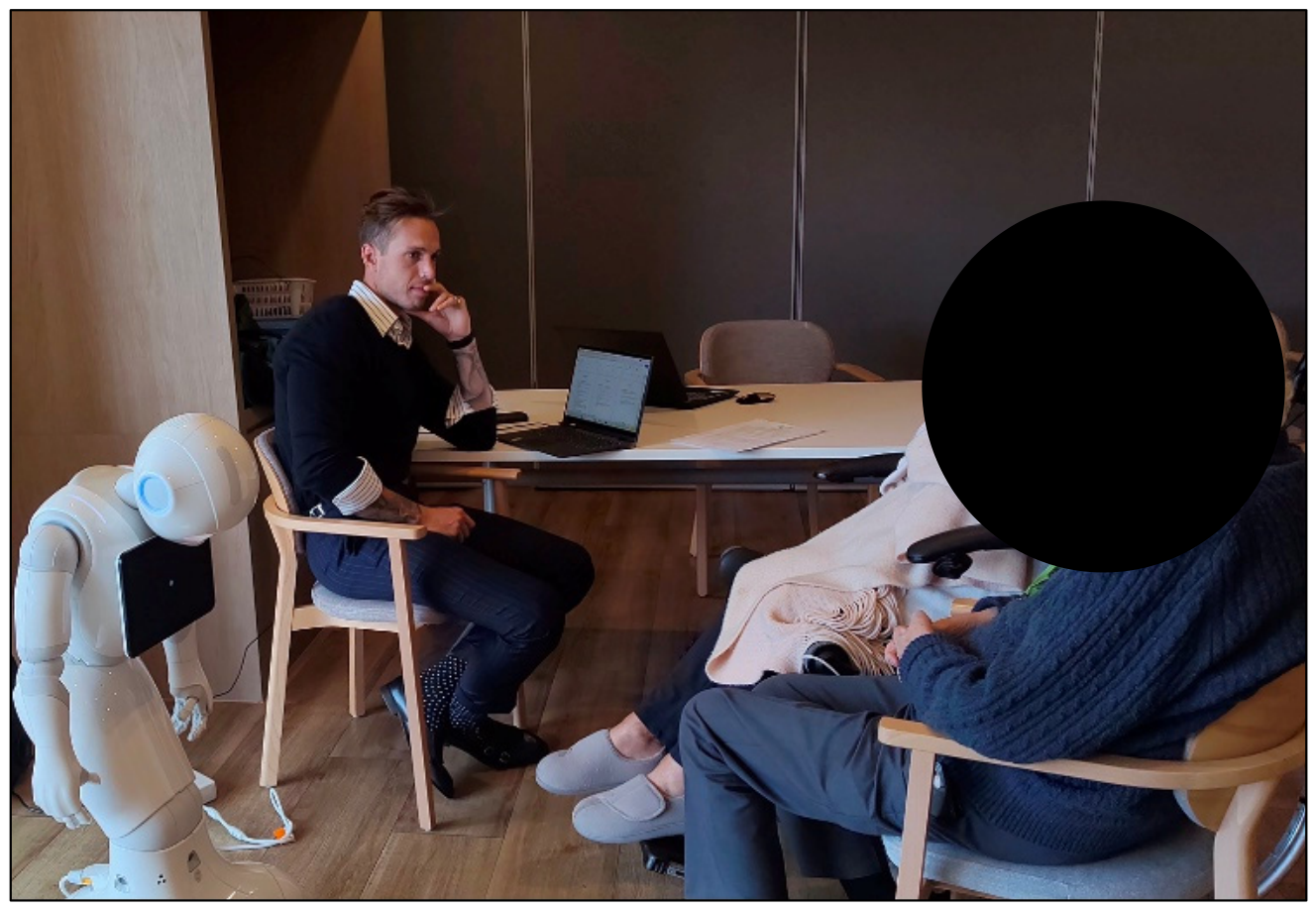
After their interaction with Pepper, participants were asked a series of questions regarding their experience. These questions focused on their initial impressions of Pepper, including their thoughts on its appearance, voice, friendliness, perceived scariness, and human-likeness. In cases where elderly residents had difficulty articulating their responses, researchers repeated their answers for clarification and asked follow-up questions to ensure accurate understanding. We have included images from the interview to provide visual context for the readers. All images were taken by researchers and have their consent to be published. Furthermore, consent was received from the participants, about the use of their images in published work. Participants have been de-identified. Accompanying theme descriptions, exemplars, and accompanying field notes from researchers have been included in the Appendix A (Table A3).
3.4. Data Analysis
All interviews were recorded in their entirety using Zoom audio recordings and a phone recorder. The audio files were transcribed using Notta AI software, v2.3 with phone recordings utilized in cases of unclear or ambiguous responses. This research utilized the thematic analysis approach of Braun and Clarke [25] for its data analysis. Manual content analysis was decided as the most suitable approach for data analysis, as it provided the researchers with the opportunity to familiarize themselves with the interview and focus group transcripts [26,27]. The interviews and focus group sessions were transcribed using Notta AI software. This was because Notta AI is a simplistic and free-of-charge transcription program. In total, the transcription yielded 432 pages from all interviews and focus groups. Adopting a deductive approach, with themes predefined, the researchers sought specific key words within the data sets. Following the 6-step approach of Braun and Clarke [25], the researcher ensured that the transcripts were read and re-read carefully. After multiple readings of the transcripts and connecting patterns across responses, initial codes were generated inductively. These codes were subsequently grouped and categorized into relevant themes, allowing for the construction of broader overarching themes. All authors contributed to the review and refinement of the codes and themes, reaching a consensus on the results. Two primary themes emerged from the analysis, which are discussed in the Section 4, Findings below.
4. Findings
4.1. The Importance of Anthropomorphism in Pepper Within Aged Care Facilities
In this theme, we discuss how residents of an older people’s care facility perceived the robot for the first time, their interaction with it, and how their perception changed after the interaction. We also explored the narrative they created regarding the presence of Pepper in their day-to-day lives.
Our conversations with the interviewees were marked by enthusiasm, curiosity, and interest. We began with warm-up questions, such as whether they had heard of or used robots before. Almost all respondents indicated that they had heard of robots, primarily in industrial or factory settings, and had seen them online. However, none had anticipated that robots would enter their lives and have an impact on them. A collection of themes, exemplars and researchers accompanying field notes can be found in the Appendix A (Table A3).
Describing one resident’s interest and curiosity, she said:
“I like these hands. I would like to know what the hands can do. Are they going to touch people or do physical things for people? I like her eyes. It has beautiful eyes.”
Another resident’s initial reaction to the robot was particularly intriguing. She expressed an interest in movies like Star Wars and referred to Pepper as Fred from Star Wars. However, when the activities began, she chose not to participate, stating:
“It’s not my cup of tea. You’re boring (looking towards Pepper).”
A couple of interviewees, one of whom had a wife with hearing difficulties, displayed contrasting reactions to Pepper. When asked whether she found Pepper friendly, the wife responded:
“No. It doesn’t look friendly. It looks a bit scary. If I see it, it looks scary.”
When asked whether she could think of Pepper as a girl or a boy, she answered:
“It doesn’t look like anything, not at all human. It looks odd or queer.”
In contrast, her husband had a very positive perception of Pepper. A religious person and once a pastor, he suggested using Pepper for educational purposes, particularly for children. When asked for suggestions on how to make Pepper more functional and usable for older adults, he said:
“Obviously, the eyes are important mechanically. I think it looks good. Right. You could try putting hair on it.”
Reflecting on the clinicians’ experience with Pepper, they discussed the potential benefits it could offer to the residents, particularly those with mild dementia, who might find the interaction with Pepper challenging. They also shared their views on how to make Pepper more acceptable to older residents.
Starting with a brief introduction, we proceeded with warm-up questions. For most participants, it was their first interaction with a robot. One registered nurse remarked on Pepper’s voice:
“It’s like a kid’s voice, and elderly residents normally catch really good because they love kids, you know.”
In contrast, another nurse felt that Pepper’s voice did not sound human and suggested:
“It sounds like a speaker. Make it a normal voice, like a human’s.”
The clinicians collectively agreed that Pepper should be able to speak multiple languages, as many of their residents do not speak English fluently and prefer to communicate in their native language. They believed that Pepper could help bridge this communication barrier between residents and clinicians. They also expressed concerns that residents with dementia might find interacting with Pepper challenging. One service manager noted:
“Because our residents do have dementia, not the high end but mild, completely affected by dementia, the way they see it could be scary for them as well when they see a roadblock.”
Another clinician pointed out the difficulty for residents in bed to engage with Pepper, particularly regarding eye contact:
“As eye contact is mandatory. The residents who are staying in their bed, maybe they cannot see by themselves. I don’t think making eye contact is possible for those residents the way they are lying in bed.”
4.2. Perception of Pepper’s Identity in an Aged Care Facility
In this theme, we explored participants’ perceptions of Pepper’s identity and the symbolism they associated with it. Participants varied in how they identified Pepper; some viewed it as a companion and expressed a willingness to integrate it into their daily lives. They showed interest in having Pepper perform tasks such as reminding them to hydrate, take medication, and assist with their day-to-day activities. Most participants agreed that Pepper could be a valuable addition to their group, serving as a helper in dining halls, providing entertainment through music, and guiding them in assistive exercises.
However, a few participants perceived Pepper as an entity or a scary creature, emphasizing its mechanical and non-human nature.
The symbolism of Pepper elicited both positive and negative interpretations. Many participants were initially hesitant but felt more confident and positive after interacting with it.
A key question posed to each participant was whether they found Pepper frightening. All residents, except for one, responded that they did not find Pepper scary. Similarly, clinicians did not perceive Pepper as intimidating, but voiced concerns about how residents with dementia might react. One nurse commented:
“They might see Pepper as a scary creature.”
One resident described it:
“I think it’s an entity.”
However, when asked about their perception of Pepper after interacting with it, participants shared many positive responses, such as:
“I feel a bit more positive about robots now. I think that will grow.” “I believe in progress, of course.”
“I found it challenging because it’s been a long time since I was challenged, anyway. It’s making me think.”
5. Discussion
This study revealed several interesting and thought-provoking findings. Within aged care facilities, Pepper shows significant potential to benefit both elderly residents and staff. However, there are areas where Pepper requires improvements to become an ideal fit in this sector.
We found that Pepper’s appearance significantly influenced users’ acceptance of robots. Participants frequently commented on Pepper’s hands and movements, with some even touching its fingers out of curiosity. This underscores the importance of gestures and body language for older adults, as these features can enhance engagement and make Pepper appear more approachable. Gestures such as open-handed greetings or guiding users could foster a sense of connection, making Pepper more relatable and interactive. These findings are consistent with those of Robinson and Nejat [28]. Additionally, several participants found Pepper’s child-like voice appealing, associating it with their love for children and longing for their grandchildren. Pepper’s voice was seen as a way to fill that emotional gap, aligning with the findings of Seaborn and Frank [29], who noted that Pepper’s colloquial tone fosters a cheerful and empathetic personality [15]. However, some users perceived Pepper’s voice as overly robotic and machine-like, which could potentially scare elderly residents, particularly those with dementia. This concern aligns with Thunberg [8], who emphasized the importance of a human-like voice for robots interacting with older adults, especially those with dementia.
In some cases, participants discontinued their interaction with Pepper or perceived it as an odd, non-human entity. This reaction was particularly noted among participants with hearing or speech impairments, which finds similarities in studies conducted by Liao et al. [30]. The lack of acceptance may stem from technological barriers, as identified by Holthe et al. [31]. Conversely, some participants displayed a positive attitude toward technology, particularly when engaging in quiz games. These activities challenged them intellectually by expanding their knowledge and encouraged interaction with Pepper’s tablet, motivating them to explore and adapt to the technology. This observation is supported by the findings of Manca et al. [32] and Kang et al. [9] whose studies found similarity in residents and practitioners in studies with SARs.
Limitations and Future Research Directions
Our study has several limitations due to its exploratory nature. First, our findings are based on interviews conducted with a specific demographic from a single aged care facility in Sydney, Australia, involving both residents and clinicians. As such, the results may not be generalizable to the broader global population of older adults or to other aged care facilities. Different demographics and cultural contexts could influence the outcomes. Furthermore, trends observed by researchers during this study could be part of the ‘Hawthorne Effect’, i.e. pure novelty. This further highlights the necessity to broaden the sample size to observe if these trends translate to a larger sample size.
Second, the study focused on only one type of social robot, Pepper. Future studies that involve multiple types of social robots could yield different results. Furthermore, participants interacted with Pepper for a relatively short period and primarily engaged in games and guided breathing exercises. This limited interaction may not have fully captured Pepper’s broader capabilities in supporting daily activities and could have influenced participants’ perceptions. Third, the sample size could be expanded to enhance the robustness and generalizability of the findings.
In future research, scholars could explore how more advanced robots with improved communication and decision-making capabilities might further enhance the quality of care for older adults. Additionally, studies could examine factors influencing the acceptance or rejection of social robots among various groups of older residents, particularly those with varying degrees of cognitive impairment. Longitudinal studies involving repeated interactions and a wider range of activities may provide a more comprehensive understanding of users’ perceptions and acceptance of social robots over time.
6. Conclusions
This paper presents the findings of a study conducted with elderly residents and staff at an aged care facility in Sydney, Australia. Participants engaged in interactive activities with Pepper, followed by interviews to gather their perceptions. The study explored how older adults perceive a humanoid robot, the significance of anthropomorphic features in fostering acceptance, and the potential for Pepper to be considered a companion.
The results revealed mixed perspectives. Our findings suggest that Pepper has the potential to contribute meaningfully to the care practices of aged care practitioners and the lives of elderly residents’ lives. However, the limitations of this study must be recognized, as it is limited to primarily perceptions of individuals, in a select aged care facility setting. This is a barrier to understanding and instituting a new technology like a social robot into a care setting. Ultimately, the objective of Pepper as an aged care companion for the elderly and the importance of modifying its anthropomorphic design warrants further investigation.
Author Contributions
Conceptualization, S.A., J.R.S. and A.K.; validation, S.A., J.R.S. and A.K.; writing—original draft preparation, S.A. and J.R.S.; writing—review and editing, A.K.; visualization, A.K.; supervision, A.K., O.M. and M.L. All authors have read and agreed to the published version of the manuscript.
Funding
This research received no external funding.
Institutional Review Board Statement
The study was conducted by the Declaration of Helsinki, and approved by the Human Research Ethics Committee of Western Sydney University reference number: H15666 on 14 December 2023 for studies involving humans.
Informed Consent Statement
Informed consent was obtained from all subjects involved in the study. This included their deidentified appearance in images.
Data Availability Statement
Data are contained within the article.
Acknowledgments
The authors would like to extend their thanks to the Uniting Care, Australia for their assistance in the design of this study in combination with Western Sydney University.
Conflicts of Interest
The authors declare no conflicts of interest.
Appendix A
Table A1.
Participants (Residents) demographic information.
Table A2.
Participants (Clinicians) demographic information.
Table A3.
Content Analysis Exemplar Summary Tables.
Table A4.
Focus Group Questionnaire Guide–UnitingCare Clinicians.
Table A5.
Interview Group Questionnaire Guide–UnitingCare Residents.
Figure A1.
PEPPER Demo Activity Pool.
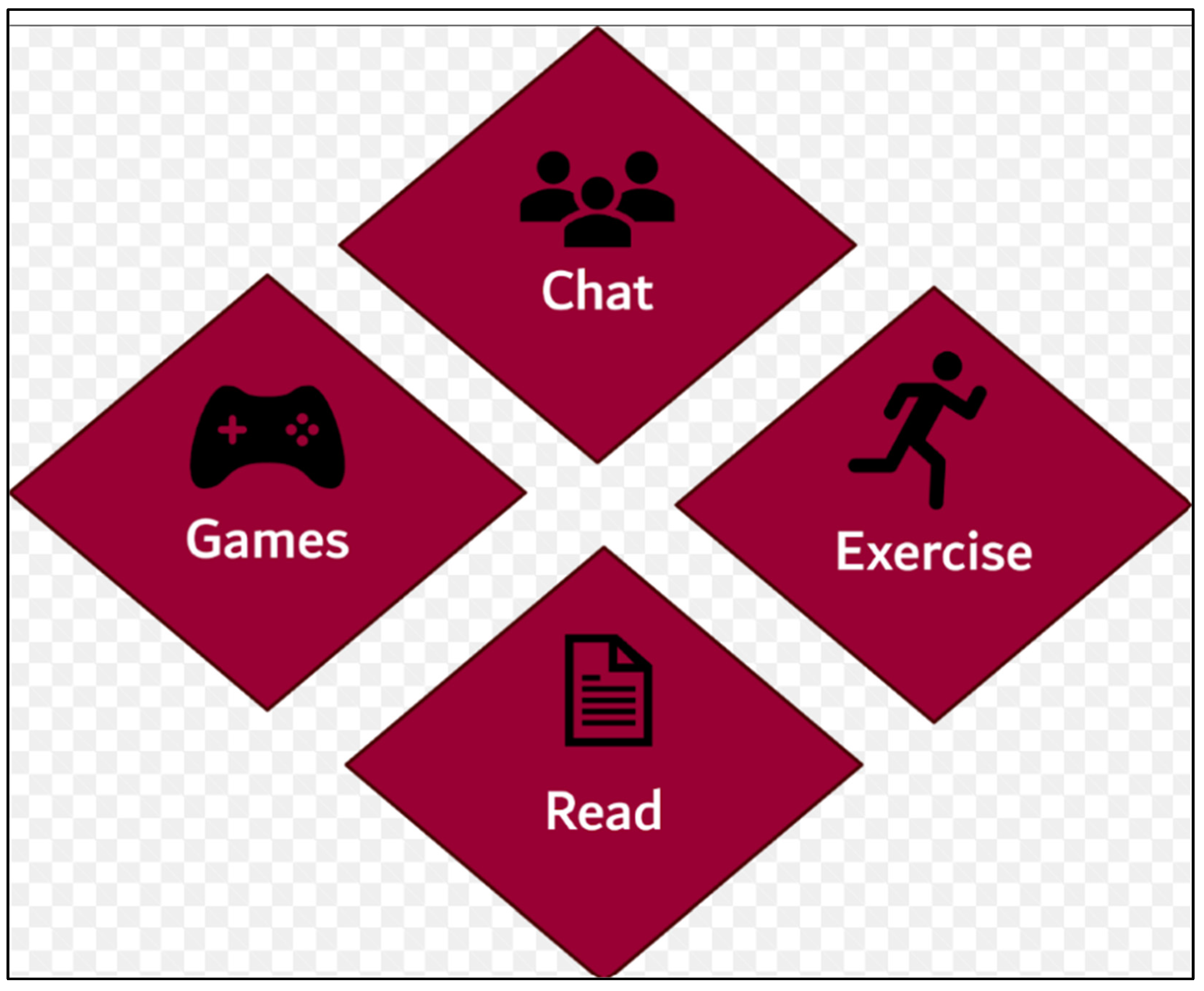
Figure A2.
PEPPER Demo Activity Selection.

Figure A3.
UnitingCare Clinician Demo (Credit: Images Provided by Authors).
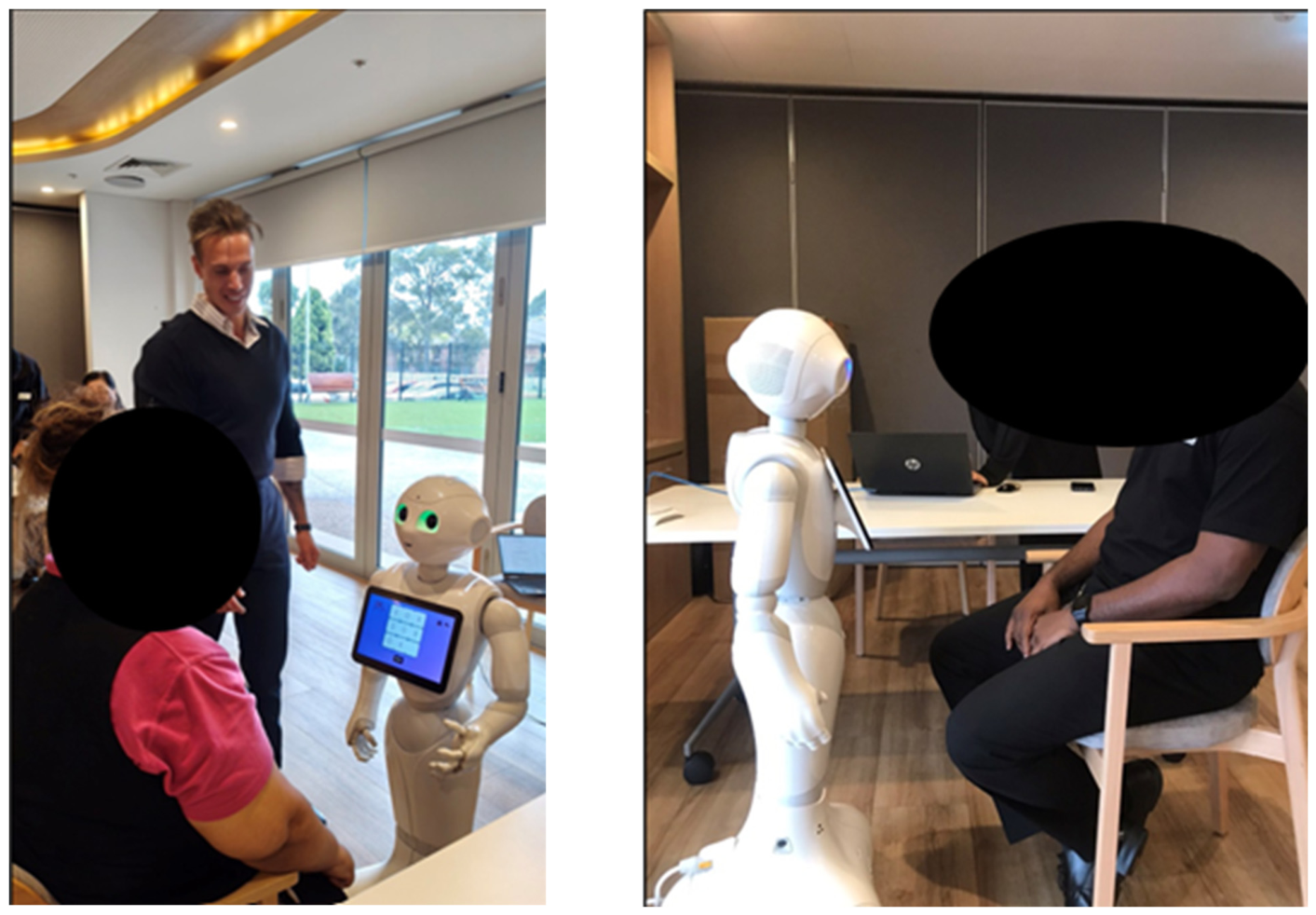
Figure A4.
UnitingCare Resident Demo (Credit: Images Provided by Authors).
References
- Australian Bureau of Statistics. Disability, Ageing and Carers, Australia: Summary of Findings; ABS: Belconnen, Australian, 2022. Available online: https://www.abs.gov.au/statistics/health/disability/disability-ageing-and-carers-australia-summary-findings/latest-release (accessed on 5 March 2026).
- Statista. Fertility Rate in Australia from 1960 to 2022. Available online: https://www.statista.com/statistics/260477/fertility-rate-in-australia/ (accessed on 1 March 2026).
- Lim, V.; Rooksby, M.; Cross, E.S. Social robots on a global stage: Establishing a role for culture during human–robot interaction. Int. J. Soc. Robot. 2021, 13, 1307–1333. [Google Scholar]
- Sparrow, R. The march of the robot dogs. Ethics Inf. Technol. 2002, 4, 305–318. [Google Scholar] [CrossRef] [Scilit]
- Berns, K.; Ashok, A. “You Scare Me”: The Effects of Humanoid Robot Appearance, Emotion, and Interaction Skills on Uncanny Valley Phenomenon. Actuators 2024, 13, 419. [Google Scholar] [CrossRef] [Scilit]
- Mori, M. The Uncanny Valley: The Original Essay by Masahiro Mori. IEEE Spectrum, 12 June 2012.
- Seyama, J.I.; Nagayama, R.S. The uncanny valley: Effect of realism on the impression of artificial human faces. Presence 2007, 16, 337–351. [Google Scholar] [CrossRef] [Scilit]
- Thunberg, S. Companion Robots for Older Adults: A Mixed-Methods Approach to Deployments in Care Homes; Linköping University Electronic Press: Linköping, Sweden, 2024; Volume 878. [Google Scholar]
- Kang, H.S.; Koh, I.S.; Makimoto, K.; Yamakawa, M. Nurses’ perception towards care robots and their work experience with socially assistive technology during COVID-19: A qualitative study. Geriatr. Nurs. 2023, 50, 234–239. [Google Scholar] [CrossRef] [Scilit] [PubMed]
- Sangster, K. Warning: Australia’s Skills Shortage Will Continue into 2023. 2022. Available online: https://au.news.yahoo.com/australias-skills-shortage-2023-215600981.html?guccounter=1 (accessed on 25 March 2025).
- Khosla, R.; Nguyen, K.; Chu, M.T. Human robot engagement and acceptability in residential aged care. Int. J. Hum.—Comput. Interact. 2017, 33, 510–522. [Google Scholar]
- Ge, G.; Schleimer, S.C. Robotic Technologies and Well-being for Older Adults Living at Home. Acad. Manag. Proc. 2022, 37, 340–350. [Google Scholar] [CrossRef] [Scilit]
- Fasola, J.; Mataric, M. A socially assistive robot exercise coach for the elderly. J. Hum.-Robot Interact. 2013, 2, 3–32. [Google Scholar] [CrossRef] [Scilit]
- Kyong, K.; Freedman, S.; Mataric, M.; Lopez, B.; Cunningham, M. A hands-off physical therapy assistance robot for cardiac patients. In Proceedings of the 9th International Conference on Rehabilitation Robotics (ICORR 2005), Chicago, IL, USA, 28 June–1 July 2005; pp. 337–340. [Google Scholar]
- Macis, D.; Perilli, S.; Gena, C. Employing socially assistive robots in elderly care. In Proceedings of the 30th ACM Conference on User Modeling, Adaptation and Personalization, Barcelona, Spain, 4–7 July 2022. [Google Scholar]
- Smarr, C.-A.; Prakash, A.; Beer, J.M.; Mitzner, T.L.; Kemp, C.C.; Rogers, W.A. Older Adults’ Preferences for and Acceptance of Robot Assistance for Everyday Living Tasks. Proc. Hum. Factors Ergon. Soc. Annu. Meet. 2012, 56, 153–157. [Google Scholar] [CrossRef] [Scilit] [PubMed]
- Yuan, S.; Coghlan, S.; Lederman, R.; Waycott, J. Social robots in aged care: Care staff experiences and perspectives on robot benefits and challenges. Proc. ACM Hum.-Comput. Interact. 2022, 6, 1–23. [Google Scholar] [CrossRef] [Scilit]
- Bradwell, H.L.; Winnington, R.; Thill, S.; Jones, R.B. Morphology of socially assistive robots for health and social care: A reflection on 24 months of research with anthropomorphic, zoomorphic and mechanomorphic devices. In 2021 30th IEEE International Conference on Robot & Human Interactive Communication (RO-MAN); IEEE: Piscataway, NJ, USA, 2021; pp. 376–383. [Google Scholar]
- Cassell, J. Embodied conversational agents: Representation and intelligence in user interfaces. AI Mag. 2001, 22, 67. [Google Scholar]
- Ahmad, M.I.; Mubin, O.; Orlando, J. Adaptive social robot for sustaining social engagement during long-term children–robot interaction. Int. J. Hum—Comput. Interact. 2017, 33, 943–962. [Google Scholar] [CrossRef] [Scilit]
- Kharub, I.; Lwin, M.; Khan, A.; Mubin, O.; Shahid, S. The effectiveness of robot-enacted messages to reduce the consumption of high-sugar energy drinks. Informatics 2022, 9, 49. [Google Scholar] [CrossRef] [Scilit]
- Sadler, J.R.; Khan, A.; Lwin, M.; Mubin, O. Social Robots for Meaningful Seated Activities: Acceptance & Use by Older Adults. Healthcare 2024, 12, 13. [Google Scholar] [CrossRef] [Scilit] [PubMed]
- Sadler, J.R.; Khan, A.; Lwin, M.; Mubin, O. Will Older Adults Accept Social Robots? AI for Sustainable Marketing: Bridging Innovation and Responsibility. In Proceedings of the ANZMAC 2024 Conference, Tasmania, Australia, 2–4 December 2024. [Google Scholar]
- Sadler, J.R.; Khan, A.; Lwin, M.; Mubin, O. What’s in a Face? Exploring the Aesthetic Qualities of Social Robots Among Older Adults. Convergence of Business Research, Innovation, and Sustainable Development. In Proceedings of the IDBRC 2024 Conference, Sydney, Australia, 7–8 November 2024. [Google Scholar]
- Braun, V.; Clarke, V. Using thematic analysis in psychology. Qual. Res. Psychol. 2006, 3, 77–101. [Google Scholar] [CrossRef] [Scilit]
- Elo, S.; Kääriäinen, M.; Kanste, O.; Pölkki, T.; Utriainen, K.; Kyngäs, H. Qualitative Content Analysis; Sage Open: Thousand Oaks, CA, USA, 2014; Volume 4, p. 1. [Google Scholar]
- Johannesson, P.; Perjons, E. ‘Research Paradigms’, An Introduction to Design Science; Springer: Kista, Sweden, 2021; pp. 171–183. [Google Scholar]
- Robinson, F.; Nejat, G. An analysis of design recommendations for socially assistive robot helpers for effective human-robot interactions in senior care. J. Rehabil. Assist. Technol. Eng. 2022, 9, 20556683221101389. [Google Scholar] [CrossRef] [Scilit] [PubMed]
- Seaborn, K.; Frank, A. What pronouns for pepper? A critical review of gender/ing in research. In Proceedings of the 2022 CHI Conference on Human Factors in Computing Systems, New Orleans, LA, USA, 30 April–5 May 2022; pp. 1–15. [Google Scholar]
- Liao, Y.J.; Jao, Y.L.; Boltz, M.; Adekeye, O.T.; Berish, D.; Yuan, F.; Zhao, X. Use of a Humanoid Robot in supporting Dementia Care: A qualitative analysis. SAGE Open Nurs. 2023, 9, 23779608231179528. [Google Scholar] [CrossRef] [Scilit] [PubMed]
- Holthe, T.; Halvorsrud, L.; Karterud, D.; Hoel, K.A.; Lund, A. Usability and acceptability of technology for community-dwelling older adults with mild cognitive impairment and dementia: A systematic literature review. Clin. Interv. Aging 2018, 13, 863–886. [Google Scholar] [CrossRef] [Scilit] [PubMed]
- Manca, M.; Paternò, F.; Santoro, C.; Zedda, E.; Braschi, C.; Franco, R.; Sale, A. The impact of serious games with humanoid robots on mild cognitive impairment older adults. Int. J. Hum.-Comput. Stud. 2021, 145, 102509. [Google Scholar] [CrossRef] [Scilit]
Disclaimer/Publisher’s Note: The statements, opinions and data contained in all publications are solely those of the individual author(s) and contributor(s) and not of MDPI and/or the editor(s). MDPI and/or the editor(s) disclaim responsibility for any injury to people or property resulting from any ideas, methods, instructions or products referred to in the content. |
© 2026 by the authors. Licensee MDPI, Basel, Switzerland. This article is an open access article distributed under the terms and conditions of the Creative Commons Attribution (CC BY) license.