


Abstract
Assessing digital health inclusion requires distinguishing recent internet use from engagement in specific online health activities. This study examined associations between self-reported long-term health-related activity limitations and digital health participation among adults in Türkiye using the 2026 Turkish Statistical Institute household ICT survey (24,409 adults aged 18–74 years; 21,866 recent internet users). Activity-limitation status was classified as no reported activity limitation, non-severe long-term activity limitation, or severe long-term activity limitation. Survey-weighted logistic regression models were adjusted for sociodemographic characteristics, and Holm correction was applied to eight primary contrasts across four digital health activities. Recent internet use was 94.3% among adults without limitations, 77.1% among those with non-severe limitations, and 64.1% among those with severe limitations. Severe limitations were associated with lower adjusted odds of recent internet use (adjusted odds ratio [aOR] 0.42, 95% confidence interval [CI] 0.35–0.52). Among recent internet users, online health information seeking was less common in the non-severe group before adjustment (59.9% vs. 69.4%), whereas non-severe limitations were associated with higher adjusted odds of this activity (aOR 1.34, 95% CI 1.16–1.54; covariate-standardized probability difference +4.94 percentage points). This was the only primary contrast that remained statistically significant after Holm correction. The results indicate that substantial differences in overall internet participation do not correspond to uniformly lower adjusted engagement with specific online health activities among recent internet users.
1. Introduction
Digital health broadly encompasses the use of digital technologies to improve health, including eHealth, which refers to the application of information and communication technologies to health and healthcare. The World Health Organization (WHO) emphasizes the importance of inclusive and person-centered approaches to digital health implementation [1]. Digital technologies can facilitate access to health information, medical appointments, personal health records, and self-monitoring services; however, their availability does not necessarily ensure equitable participation. Previous reviews have documented sociodemographic inequalities in access to and use of digital health technologies and highlighted the risk that their implementation may reinforce existing disparities [2,3]. Furthermore, a recent systematic review of digital health equity frameworks highlighted the importance of considering digital determinants of health, equitable access to technology, and indicators of digital health service use when assessing health equity [4].
Digital inequality can be understood through a multidimensional model of internet access that distinguishes motivational, material, skills, and usage dimensions [5]. These interrelated dimensions suggest that internet use alone does not adequately characterize the opportunities for subsequent online engagement. In digital health, this perspective is consistent with equity frameworks that consider socioeconomic and digital determinants alongside indicators of health service use [4].
Digital health participation is relevant to individuals and healthcare systems because online services can support health-related decision-making, healthcare navigation, communication, and condition management. Reviews of online health information, appointment scheduling, patient portals, and remote monitoring have reported potential benefits, although the evidence varies across applications [6,7,8,9]. These intervention-specific findings should not be equated with the consequences of self-reported digital health participation. Nevertheless, differences in participation may indicate unequal opportunities to engage with potentially beneficial digital health functions.
The WHO has documented structural and accessibility-related barriers to healthcare participation among people with disabilities [10]. In European population surveys, the Global Activity Limitation Indicator (GALI) captures the severity of self-reported limitations in usual activities due to health problems lasting at least six months [11].
Previous research involving people with disabilities has documented heterogeneous digital health participation, reported accessibility challenges, and the importance of inclusive digital health design [12,13,14,15]. Sociodemographic differences in online health information seeking have also been observed in the general population [16]. Telehealth refers to healthcare delivered when patients and providers are separated by distance using information and communication technologies; the WHO–International Telecommunication Union (ITU) standard provides guidance on the accessibility of these services [17].
Türkiye provides a relevant context for investigating inequalities in digital health participation. The national e-Nabız system enables individuals to access personal health information and manage selected healthcare-related processes electronically [18]. Research conducted among existing e-Nabız users has highlighted the importance of digital health literacy, trust, and enabling conditions in continued engagement with electronic health records [19]. Additionally, a systematic review of digital patient portals identified socioeconomic and sociodemographic differences in their use, emphasizing the potential for digital healthcare services to reproduce existing inequalities [20]. Studies of existing platform users provide limited insight into participation across the broader adult population. In Türkiye, it remains unclear whether the association between long-term activity-limitation severity and internet use in the general adult population is also evident for specific online health activities among adults who already use the internet.
2. Materials and Methods
2.1. Study Design and Data Source
This population-based, cross-sectional study used data from the 2026 Survey on Information and Communication Technology (ICT) Usage in Households and by Individuals, administered by the Turkish Statistical Institute (TurkStat) [21]. The primary objective was to examine associations between the severity of self-reported long-term health-related activity limitations and participation in four digital health activities among recent internet users. A secondary objective was to examine the association between limitation severity and recent internet use in the broader adult sample. TurkStat released the 2026 household ICT survey results on 5 August 2026 [22].
The survey targeted individuals aged 16–74 years residing in private households across Türkiye. Institutional residents and certain small settlements were excluded from the sampling frame. Data were collected through computer-assisted personal and telephone interviews (CAPI and CATI), using a questionnaire based on the Eurostat model and adapted to national requirements. According to TurkStat documentation, fieldwork is conducted annually in April.
The survey employed a two-stage stratified cluster sampling design, with NUTS-1 regions identified as a stratification criterion. In the first stage, blocks containing approximately 100 households were selected with probability proportional to size. In the second stage, household addresses were selected systematically within the sampled blocks. Individual ICT-use questions were administered to household members aged 16–74 years. TurkStat provided the final survey weights, with details of the weighting procedure presented in Supplementary Methods S1.
The 2026 documentation reports 14,430 sampled households, 12,178 responding in-scope households, and 26,143 responding individuals. Responding in-scope households accounted for 84.4% of the gross household sample. This percentage represents a gross-sample completion proportion rather than an eligibility-adjusted household response rate, as the number of ineligible addresses required for the latter calculation was not available in the documentation. The present study focused on adults aged 18–74 years. Study reporting was informed by the Strengthening the Reporting of Observational Studies in Epidemiology (STROBE) statement [23].
2.2. Analytical Population and Data Linkage
Individual-level records were linked to the corresponding household-level records using anonymized linkage identifiers provided in the TurkStat microdata. The original data-processing checks indicated complete linkage between individual and household records, with no duplicate composite individual identifiers.
After excluding 1022 respondents aged 16–17 years, the analytical sample comprised 25,121 adults aged 18–74 years. A further 712 respondents reporting activity limitations lasting less than six months were excluded from the primary three-group comparison according to the study-specific, GALI-informed classification described in Section 2.3. The final comparative sample comprised 24,409 adults.
Analyses of the four digital health outcomes were restricted to 21,866 respondents who reported using the internet within the preceding three months, consistent with the questionnaire routing structure. Responses to digital health questions that were not administered to individuals outside this population were treated as structurally unobserved rather than as negative responses or conventional missing data.
Sensitivity analyses retained individuals reporting short-duration activity limitations as a separate fourth category, yielding 25,121 adults in the broader sample and 22,451 recent internet users. Additional information on data linkage, sample construction, and variable coding is provided in Supplementary Table S1 and Supplementary Methods S1.
2.3. Main Explanatory Variable: Long-Term Health-Related Activity Limitation
The main explanatory variable was self-reported long-term health-related activity limitation status, derived from two items in the 2026 TurkStat survey: severity of restriction in usual activities due to health problems (G10) and duration of the reported limitation (G11). These items reflect the severity and duration dimensions of the Global Activity Limitation Indicator (GALI), which considers limitations in usual activities persisting for at least six months [11]. The released item descriptions, response codes, and study-specific classification are documented in Supplementary Table S1, with the corresponding Eurostat 2026 framework described in Supplementary Note S1 [24]. The verbatim wording of the nationally administered questionnaire was not available for independent verification.
The primary analysis used three mutually exclusive categories: (1) no reported activity limitation (reference group), (2) non-severe activity limitation lasting at least six months, and (3) severe activity limitation lasting at least six months. Respondents reporting limitations lasting less than six months were excluded from the primary comparison and retained as a separate category in sensitivity analyses. This study-specific classification differs from the harmonized GALI coding, in which short-duration limitations are included in the “not limited” category. Accordingly, the measure was characterized as GALI-informed rather than as a direct reproduction of the harmonized indicator. No independent validation of this operational classification was conducted. The measure reflects perceived restrictions in usual activities and should not be interpreted as a clinical disability diagnosis, an assessment of specific impairment types, or a measure of digital accessibility needs.
2.4. Digital Health Outcomes
Digital health participation was assessed using four binary indicators: (1) online health information seeking; (2) booking medical appointments through websites or mobile applications; (3) accessing personal health records online, including appointments, prescriptions, medical reports, or examination information; and (4) using internet-connected devices for health and medical-care purposes, including devices that monitor blood pressure, blood glucose, or body weight. The fourth indicator also covered other internet-connected devices for health and medical care and was therefore not restricted to physiological monitoring. The survey did not identify the platforms used for the reported online health activities or ascertain whether internet-connected devices were used as part of a remote clinical consultation. The released item descriptions, response categories, reference periods, and corresponding Eurostat 2026 variable definitions are documented in Supplementary Table S1 and Supplementary Note S1 [24].
The first three indicators referred to activities undertaken within the preceding three months. The fourth indicator was obtained from the separate connected-device module (M4.2). The preceding-three-month reference period for M4.2 was confirmed through correspondence with TurkStat and is consistent with the corresponding Eurostat 2026 technical definition. However, the verbatim wording of the nationally administered 2026 questionnaire item was not available for independent verification. Smartwatches, fitness bands, and related wearable accessories were assessed through a separate survey item (M4.1) and were not combined with M4.2.
All four outcomes were analyzed among respondents who had used the internet within the preceding three months. Valid binary responses were available for all 21,866 participants in this analytical sample. Questions not administered to respondents because of questionnaire routing were treated as structurally unobserved rather than negative responses.
2.5. Covariates
Multivariable models were adjusted for age, sex, educational attainment, monthly net household income, settlement density, and geographical region. Age in years was centered at 45 and scaled in 10-year units, giving A = (age − 45)/10. Each primary regression model included both A and A2 as covariates to allow the association between age and the log odds of the outcome to vary nonlinearly. The coefficients for the two terms were estimated jointly. The same age specification was used in the secondary model for recent internet use and in the exploratory models for joint participation. Sex was categorized as male or female according to the survey coding. Educational attainment was classified into five categories: no formal schooling completed, primary education, secondary education, high school, and tertiary education or above. Monthly net household income was included using the five categories defined in the survey.
Settlement density was categorized as rural areas, towns and suburbs, or cities. Geographical variation was accounted for using 12 regional indicators corresponding to the Nomenclature of Territorial Units for Statistics, Level 1 (NUTS-1). Relevant household characteristics were obtained from the linked household-level records.
According to the original data-processing checks, the covariates included in the primary models contained no missing or invalid values among eligible participants. Employment status and internet-use frequency were not included in the primary adjustment models. Internet-use frequency was examined separately in sensitivity analyses. Additional information on variable definitions and coding is provided in Supplementary Table S1.
2.6. Survey Weighting and Statistical Analysis
Descriptive estimates and regression analyses used the final individual survey weights (fert_faktor) provided by TurkStat, reflecting the agency’s weighting procedure [21]. Variance estimation was based on Taylor-linearized, cluster-robust standard errors under an operational survey design using NUTS-1 regions (IBBS_1) as strata and region-specific blocks (BLOKNO) as primary sampling units. Although TurkStat confirmed the suitability of these design variables, the complete 2026 stratification and calibration-adjusted variance procedure could not be reconstructed. Accordingly, standard errors, confidence intervals, and statistical tests remain approximate under the operational specification. Details of the survey design, weighting procedure, variance estimation, and associated limitations are provided in Supplementary Methods S1 and S2.
Survey-weighted multivariable logistic regression models were fitted to examine associations between long-term activity limitation and each of the four digital health outcomes among recent internet users. Adults without activity limitations served as the reference group. All models were adjusted for age, sex, educational attainment, household income, settlement density, and geographical region. Adjusted odds ratios (aORs) and 95% confidence intervals (CIs) were calculated using the fitted regression coefficients and approximate design-based standard errors. Statistical inference was based on the operational survey-design specification described above.
The four digital health outcomes were selected before model fitting. The Holm step-down procedure was applied to the eight primary contrasts comparing non-severe and severe long-term activity limitation with no limitation across the four outcomes. The Holm correction was introduced during analysis rather than specified a priori. Holm-adjusted p-values were used to interpret primary comparisons; the reported 95% confidence intervals were not multiplicity-adjusted.
A separate secondary logistic regression model examined recent internet use in the broader comparative sample of 24,409 adults. Covariate-standardized predicted probabilities were calculated to complement the odds ratios. For each calculation, all participants were assigned the same activity-limitation category in turn, while their observed adjustment covariates and survey weights were retained. Adjusted probability differences were expressed in percentage points, with approximate 95% confidence intervals estimated using the delta method. These intervals account for regression-coefficient uncertainty conditional on the observed covariate distribution and were not adjusted for multiple comparisons.
Survey-weighted regression models were implemented in Python (version 3.13; Python Software Foundation, Beaverton, OR, USA) using NumPy 2.3.5, SciPy 1.17.0, and statsmodels 0.14.6 under the operational survey-design specification described above. Model estimates and confidence intervals were checked under this specification, with point estimates additionally confirmed using a separate implementation. Complete regression results for the four primary digital health models, the secondary recent-internet-use model, and the exploratory joint participation models are presented in Supplementary Tables S7–S9.
ChatGPT (GPT-6; OpenAI, San Francisco, CA, USA; accessed October 2026) assisted with methodological review and the development of Python verification code. Prompts focused on survey-weighted statistical procedures and code for checking model estimates and confidence intervals. AI-generated suggestions and code were reviewed and modified as needed by the author, who remains responsible for the analyses and reported results.
2.7. Additional and Sensitivity Analyses
Three sensitivity analyses were conducted to evaluate the robustness of the primary findings to alternative analytical specifications. First, each primary model was refitted with the linear age term retained and only the squared term omitted. This sensitivity analysis assessed whether the estimated associations between activity limitation and digital health participation depended on the functional form used to adjust for age. Second, internet-use frequency was included as a four-category covariate in models restricted to recent internet users: several times daily (reference category), once or almost daily, at least weekly, and less than weekly. Third, participants reporting activity limitations lasting less than six months were retained as a separate fourth activity-limitation category rather than excluded from the comparative sample. These models retained the sociodemographic adjustment variables used in the primary analyses, with both linear and quadratic age terms retained in the latter two sensitivity analyses.
To further examine the contrast between crude and adjusted associations for internet-connected health device use, four exploratory sequential survey-weighted logistic regression models were fitted among the same 21,866 recent internet users. Model 1 included activity-limitation status only. Model 2 additionally included centered age, its squared term, and sex. Model 3 further included educational attainment and household income, while Model 4 additionally included settlement density and geographical region, corresponding to the fully adjusted primary device-use model. All models used the same analytical sample, survey weights, and operational survey-design variance specification. Supplementary Table S10 reports nominal p-values for the sequential models.
In a separate exploratory analysis, population-level joint participation indicators were constructed by combining recent internet use with each of the three online health activities: health information seeking, medical appointment booking, and access to personal health records. These analyses were conducted in the broader comparative sample of 24,409 adults. Participants who had not used the internet within the preceding three months were classified as not meeting the combined participation criterion. This classification did not imply that they had provided negative responses to health-related questions that were not administered to them.
The exploratory joint-outcome analyses included the three online service activities (information seeking, appointment booking, and record access); no corresponding joint indicator was derived for internet-connected health device use (M4.2). These exploratory analyses did not alter the eight-contrast primary multiplicity family. Covariate-standardized results for these exploratory joint participation indicators are presented in Supplementary Table S2.
2.8. Ethical and Data Governance Considerations
This study used anonymized microdata from the 2026 TurkStat household ICT survey, obtained through authorized research-access procedures. No participants were contacted or recruited, and no new participant-level data were collected. The analyses complied with TurkStat’s data-use and confidentiality requirements. Ethical review and consent considerations are summarized in the declarations below.
3. Results
3.1. Participants and Sociodemographic Characteristics
The primary comparative sample comprised 24,409 adults aged 18–74 years, including 20,610 (84.4%) without activity limitations, 2264 (9.3%) with non-severe long-term activity limitations, and 1535 (6.3%) with severe long-term activity limitations. Compared with adults without limitations, those reporting long-term activity limitations were generally older and had lower educational attainment. The survey-weighted mean age was 40.8 years in the no-limitation group, compared with 53.8 and 56.1 years in the non-severe and severe limitation groups, respectively. The corresponding survey-weighted proportions of participants with tertiary education were 27.9%, 10.9%, and 6.6%.
Recent internet participation also differed substantially across the groups. Internet use within the preceding three months was reported by 94.3% of adults without activity limitations, compared with 77.1% of those with non-severe limitations and 64.1% of those with severe limitations. Key sociodemographic characteristics and recent internet participation are summarized in Table 1. Detailed descriptive characteristics, including working status, household income, residential area, and approximate 95% confidence intervals, are presented in Supplementary Table S6.
Table 1.
Sociodemographic characteristics by long-term activity-limitation status.
3.2. Digital Health Participation Among Recent Internet Users
Among the 21,866 adults who reported using the internet within the preceding three months, survey-weighted participation in all four digital health activities was lower among individuals with long-term activity limitations than among those without limitations (Table 2).
Table 2.
Digital health participation among recent internet users by activity-limitation status.
Online health information seeking was reported by 69.38% of adults without activity limitations, compared with 59.88% of those with non-severe limitations and 54.94% of those with severe limitations. The corresponding proportions were 62.91%, 52.47%, and 48.43% for online medical appointment booking, and 59.69%, 46.44%, and 42.11% for accessing personal health records.
Internet-connected health device use was considerably less common, with survey-weighted proportions of 5.96%, 3.61%, and 2.67% across the three groups, respectively. In the severe-limitation group, only 21 of 959 recent internet users reported using these devices, indicating limited information for estimating associations involving this outcome.
3.3. Adjusted Associations Among Recent Internet Users
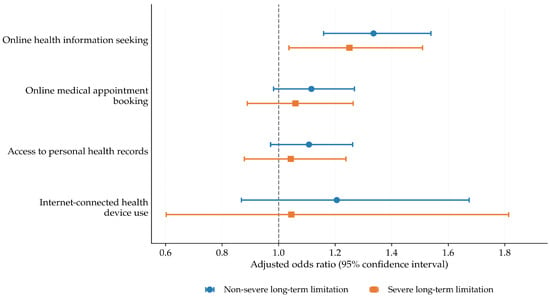
Complete multivariable regression results, including activity-limitation status and all adjustment covariates, are presented in Table 3. The corresponding regression coefficients, approximate design-based standard errors, and nominal p-values are reported in Supplementary Table S7. Among recent internet users, non-severe long-term activity limitation was associated with higher adjusted odds of online health information seeking compared with no reported limitation (aOR 1.34, 95% CI 1.16–1.54; Holm-adjusted p = 0.0005), despite lower crude participation in this group.
Table 3.
Complete adjusted associations between study covariates and digital health participation among recent internet users.
Covariate-standardized predicted probabilities were 67.53% among adults without activity limitations and 72.47% among those with non-severe limitations, corresponding to an adjusted difference of +4.94 percentage points (approximate 95% CI +2.62 to +7.27). These model-based estimates were standardized to the observed covariate distribution, and their confidence intervals were not adjusted for multiple comparisons.
For severe long-term activity limitation, the association with online health information seeking was nominally significant (aOR 1.25, 95% CI 1.04–1.51) but did not remain statistically significant after Holm correction (adjusted p = 0.1370). Neither non-severe nor severe long-term activity limitation showed evidence of an association surviving multiplicity correction for online medical appointment booking, access to personal health records, or internet-connected health device use (Table 3 and Figure 1).
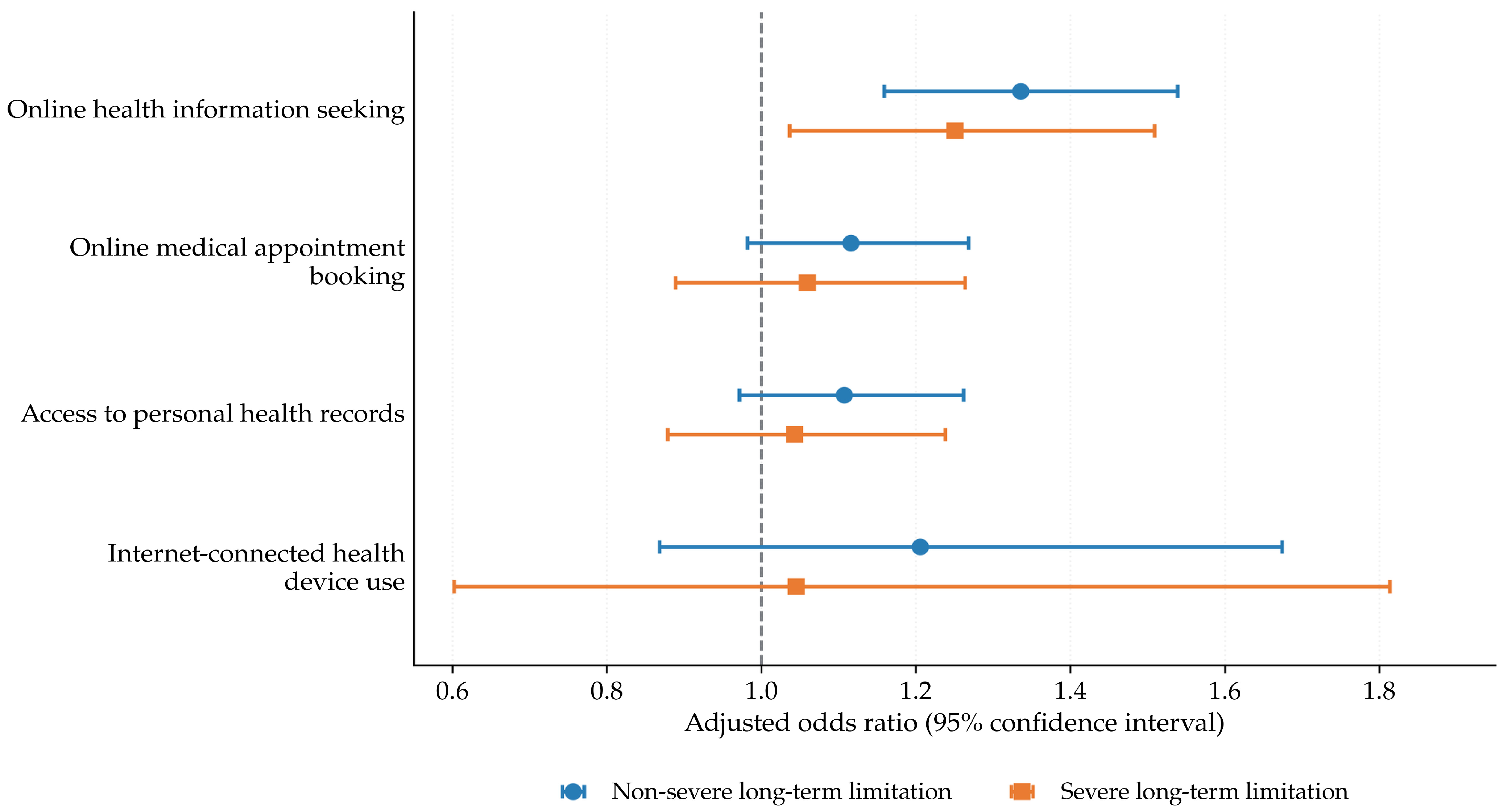
Figure 1.
Adjusted associations between long-term activity-limitation severity and digital health participation among recent internet users. Points represent adjusted odds ratios (aORs), and horizontal bars indicate approximate 95% confidence intervals (CIs) from survey-weighted logistic regression models (n = 21,866). Blue circles represent non-severe long-term activity limitation, and orange squares represent severe long-term activity limitation, both compared with no reported activity limitation (reference category). Models were adjusted for age (linear and quadratic terms), sex, educational attainment, household income, settlement density, and geographical region. The dashed vertical line indicates an aOR of 1.0. Confidence intervals were not adjusted for multiple comparisons. Holm correction was applied to the eight primary activity-limitation contrasts. Full regression results are presented in Table 3 and Supplementary Table S7.
3.4. Recent Internet Use in the Full Comparative Sample
In a separate survey-weighted multivariable logistic regression model, both non-severe (adjusted odds ratio [aOR] 0.74, 95% confidence interval [CI] 0.62–0.89) and severe long-term activity limitation (aOR 0.42, 95% CI 0.35–0.52) were associated with lower adjusted odds of recent internet use compared with no activity limitation. Complete regression results, including all adjustment covariates, are presented in Supplementary Table S8.
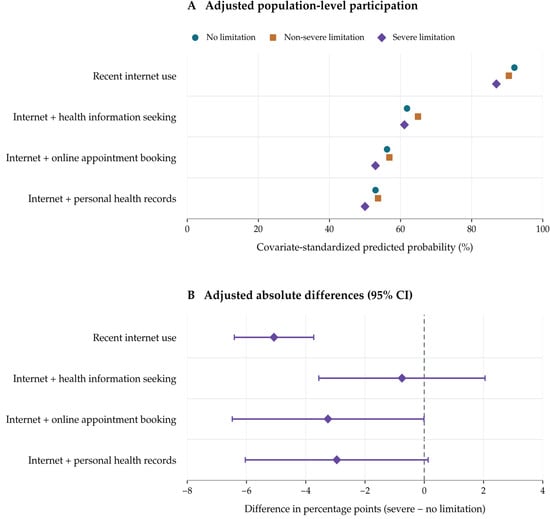
Covariate-standardized predicted probabilities were 92.02%, 90.47%, and 86.95% for adults without limitations, with non-severe limitations, and with severe limitations, respectively. The adjusted probability difference between the severe-limitation and no-limitation groups was −5.07 percentage points (approximate 95% CI −6.41 to −3.73; Supplementary Table S2).
3.5. Sensitivity Analyses
The association between non-severe long-term activity limitation and online health information seeking remained consistent across the three sensitivity analyses. The adjusted odds ratio (aOR) was 1.28 (95% confidence interval [CI] 1.12–1.47) when the quadratic age term was omitted, 1.34 (95% CI 1.16–1.54) after additional adjustment for internet-use frequency, and 1.35 (95% CI 1.17–1.56) when participants with short-duration activity limitations were retained as a separate activity-limitation category. Detailed results for all four digital health outcomes are presented in Supplementary Table S3.
For severe long-term activity limitation, the association with online health information seeking reached nominal statistical significance in the two sensitivity analyses that retained both age terms. In the sensitivity analysis that retained only the linear age term, the adjusted odds ratio was 1.16 (95% CI 0.97–1.39). The sensitivity analyses did not provide consistent evidence of additional associations for online medical appointment booking, personal health record access, or internet-connected health device use.
Sequential models for internet-connected health device use showed lower unadjusted odds among adults with non-severe (OR 0.59, 95% CI 0.44–0.80) and severe long-term activity limitations (OR 0.43, 95% CI 0.26–0.74). These associations were attenuated after adjustment for age, age squared, and sex (aOR 0.85, 95% CI 0.61–1.17; aOR 0.66, 95% CI 0.38–1.13, respectively), with neither remaining statistically significant at the nominal level. Further adjustment for educational attainment and household income yielded aORs of 1.19 (95% CI 0.86–1.65) and 1.05 (95% CI 0.61–1.82), respectively. Additional adjustment for settlement density and geographical region produced similar estimates (aOR 1.21, 95% CI 0.87–1.67; aOR 1.05, 95% CI 0.60–1.81; Supplementary Table S10).
Additional exploratory checks examined the stability of the estimated statistical uncertainty. An alternative variance specification that treated the same region-by-block sampling units without stratification produced confidence intervals similar to those obtained under the primary operational specification. For the association between non-severe limitation and online health information seeking, the Holm-adjusted p-values were 0.0005 and 0.0006 under the stratified and unstratified specifications, respectively (Supplementary Table S4).
A stratified cluster bootstrap with 180 replications was also performed for selected associations. The bootstrap percentile 95% CI for the association between non-severe limitation and online health information seeking was 1.161–1.524, compared with the primary Taylor-linearized interval of 1.159–1.539. For severe limitation and recent internet use, the corresponding intervals were 0.350–0.504 and 0.349–0.516, respectively (Supplementary Table S5). These checks assess numerical stability under the stated operational survey-design specification; they do not verify the official survey specification.
3.6. Exploratory Population-Level Joint Digital Participation
In an exploratory analysis of the full comparative sample of 24,409 adults, joint digital participation outcomes were defined as both having used the internet within the preceding three months and having undertaken a specific online health activity during that period. Three activities were evaluated: online health information seeking, medical appointment booking, and access to personal health records.
Compared with adults without activity limitations, those with severe long-term limitations had lower adjusted odds of joint participation in online medical appointment booking (adjusted odds ratio [aOR] 0.851, 95% confidence interval [CI] 0.726–0.997; nominal p = 0.046). The corresponding associations for joint personal health record access (aOR 0.86, 95% CI 0.73–1.01) and online health information seeking (aOR 0.96, 95% CI 0.81–1.13) were less conclusive. The p-values for these exploratory comparisons were not adjusted for multiplicity. Full adjusted regression results, including all covariates, are presented in Supplementary Table S9.
Covariate-standardized probabilities derived from the adjusted regression models further illustrated these differences. For joint online medical appointment booking, the predicted probabilities were 56.20% among adults without activity limitations and 52.95% among those with severe limitations, corresponding to an adjusted difference of −3.25 percentage points. For joint personal health record access, the corresponding probabilities were 52.94% and 49.99%, respectively, with an adjusted difference of −2.95 percentage points (Figure 2; Supplementary Table S2).
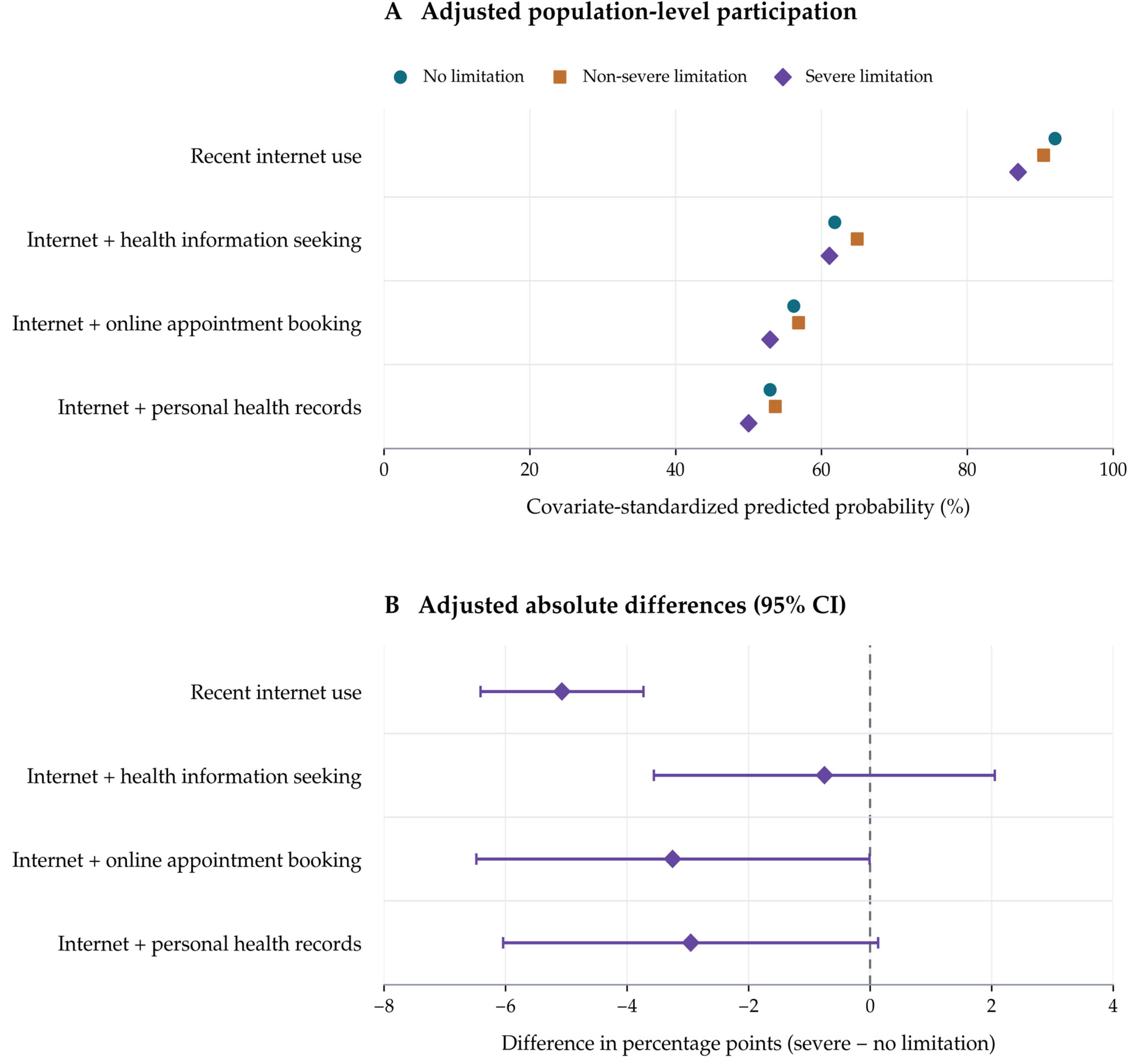
Figure 2.
Model-based, covariate-standardized population-level estimates of internet and digital health participation by long-term activity-limitation status. (A) Adjusted predicted probabilities (%) for adults with no, non-severe, or severe long-term activity limitations (n = 24,409). (B) Adjusted differences in percentage points between adults with severe limitations and those without limitations (severe minus no limitation), with approximate 95% confidence intervals (CIs). The dashed vertical line indicates no difference. Each joint indicator represents both recent internet use and participation in the specified digital health activity: online health information seeking, medical appointment booking, or access to personal health records. Models were adjusted for age (linear and quadratic terms), sex, education, household income, settlement density, and geographical region. Recent internet use was a secondary outcome; joint digital health participation indicators were exploratory. CIs were estimated using the delta method and were not adjusted for multiple comparisons; see Section 2.6 for variance estimation. Additional results are provided in Supplementary Table S2.
These exploratory outcomes represent participation in the broader comparative sample rather than engagement conditional on recent internet use. Respondents who had not used the internet recently were classified as not meeting the joint participation criterion, without treating unadministered health-related survey items as negative responses. Internet-connected health device use was not included in the exploratory joint-outcome set.
4. Discussion
The principal finding of this study was that non-severe long-term activity limitation was associated with higher adjusted odds of online health information seeking among recent internet users, despite lower crude participation. This was the only primary association that remained statistically significant after Holm correction. In contrast, adults with severe long-term activity limitations had substantially lower adjusted odds of recent internet use in the broader adult population. Associations with online medical appointment booking, personal health record access, and internet-connected health device use did not survive multiplicity correction among recent internet users. Exploratory population-level analyses suggested lower joint participation in online appointment booking among adults with severe limitations, although the other joint-outcome associations were less conclusive. Together, these findings indicate that inequalities in overall internet participation do not necessarily correspond to uniformly lower adjusted engagement in specific digital health activities among individuals already using the internet.
Recent internet use showed a clear gradient across activity-limitation groups, with survey-weighted participation rates of 94.3%, 77.1%, and 64.1% among adults without limitations, with non-severe limitations, and with severe limitations, respectively. The association remained evident after sociodemographic adjustment, particularly for severe limitations (aOR 0.42, 95% CI 0.35–0.52). This finding is consistent with previous research on disability-related digital inequalities. Dobransky and Hargittai [25] showed that differences in online activities may change after sociodemographic adjustment, whereas Duplaga [26] identified age, education, and income as important correlates of internet use among people with disabilities. Yang and Lee [27] reported associations involving digital skills, motivation, and attitudes toward technology, while Pettersson et al. [12,28] documented difficulties in accessing and using eHealth services among people with impairments.
After standardization to the sociodemographic distribution of the adult sample, the estimated probability of recent internet use was 92.02% among adults without activity limitations and 86.95% among those with severe limitations, a difference of 5.07 percentage points.
Online health information seeking revealed a particularly noteworthy pattern. Among recent internet users, the crude survey-weighted prevalence of online health information seeking was lower in the non-severe limitation group than in the no-limitation group (59.88% versus 69.38%). After adjustment for sociodemographic characteristics, however, non-severe limitation was associated with higher odds of online health information seeking (aOR 1.34, 95% CI 1.16–1.54; Holm-adjusted p = 0.0005). Covariate-standardized predicted probabilities similarly indicated higher adjusted participation in the non-severe limitation group (72.47% versus 67.53%), corresponding to a difference of +4.94 percentage points.
Adults with long-term activity limitations were generally older and had lower educational attainment than those without limitations (Table 1). These differences in sociodemographic composition may partly account for the contrasting directions of the crude and adjusted associations. Nevertheless, crude proportions, adjusted odds ratios, and covariate-standardized probabilities represent distinct statistical estimands, and the contribution of individual covariates to the observed reversal cannot be determined from the available analyses.
Previous research provides context for interpreting health information seeking as a distinct dimension of digital participation. French-Lawyer et al. [13], in a scoping review, documented substantial heterogeneity in the information-seeking practices, sources, and accessibility experiences of people with disabilities. Robinson-Whelen et al. [29], in a national survey of 508 internet-using women with physical disabilities, similarly reported diverse online health information needs alongside difficulties related to information accessibility, perceived usefulness, and quality. These findings suggest that engagement in online health information seeking should not be equated with successful or equitable access to useful health information. However, these studies examined populations with different disability characteristics, whereas the present study assessed the severity of self-reported long-term health-related activity limitations without distinguishing specific impairment types. Differences in digital health participation across sensory, mobility-related, and cognitive impairments therefore cannot be evaluated from the present data, limiting direct comparisons with impairment-specific findings.
Among recent internet users, adults with non-severe long-term activity limitations had higher adjusted odds of reporting an online search for health information than those without limitations. Differences in health information needs among users may partly explain this pattern. The lower proportion of adults with activity limitations who used the internet may also have shaped the composition of the groups being compared.
In contrast to online health information seeking, neither online medical appointment booking nor personal health record access showed an association with long-term activity limitation that survived correction for multiple comparisons among recent internet users. Although crude participation was lower in both limitation groups, the adjusted associations were closer to the null. These estimates describe reported appointment booking and record access. Whether respondents needed assistance to complete either activity was not recorded.
Previous research has documented socioeconomic differences in patient portal use [20] and associations involving digital health literacy, trust, educational attainment, and perceived usability [19,30,31]. In Türkiye, the e-Nabız system provides an established infrastructure for accessing personal health information [18]. However, these studies examined different populations, outcomes, or determinants of technology use and cannot establish the mechanisms underlying the present findings. Moreover, the ICT survey did not identify the platforms respondents used. The observed associations therefore describe activity-specific participation rather than the accessibility or performance of e-Nabız or another particular service.
The use of internet-connected health devices was relatively uncommon across all activity-limitation groups. The corresponding survey-weighted proportions were 5.96% among recent internet users without limitations, 3.61% among those with non-severe limitations, and 2.67% among those with severe limitations. Although the crude proportions suggested lower use among individuals with long-term activity limitations, adjusted associations did not provide evidence of differences surviving correction for multiple comparisons. Notably, only 21 of the 959 recent internet users with severe limitations reported using these devices, resulting in considerable statistical uncertainty (aOR 1.05, 95% CI 0.60–1.81).
The contrast between crude and adjusted device-use associations was further examined using sequential regression models (Supplementary Table S10). The initially lower odds of device use in both activity-limitation groups were attenuated after adjustment for age, age squared, and sex, with neither association remaining statistically significant at the nominal level. Additional adjustment for education and household income shifted the estimates toward or above the null, whereas subsequent adjustment for settlement density and geographical region produced little further change. In the fully adjusted model, tertiary education (aOR 6.06, 95% CI 2.15–17.10), the highest household-income category (aOR 1.88, 95% CI 1.29–2.75), and urban residence (aOR 2.42, 95% CI 1.64–3.57) were associated with higher odds of reported device use. In both limitation groups, the point estimates for device use moved from below 1 before adjustment to slightly above 1 after adjustment for age, sex, education, and household income. These shifts reflect adjustment for sets of characteristics, and the contribution of any single characteristic cannot be isolated.
The exploratory population-level analyses provide an additional perspective on differences in digital health participation across analytical populations. Among recent internet users, severe long-term activity limitation was not associated with a statistically significant difference in online medical appointment booking or personal health record access after sociodemographic adjustment and multiplicity correction. In the broader adult sample, the exploratory joint outcomes required both recent internet use and participation in the corresponding online health activity. Adults with severe long-term activity limitations had lower adjusted odds of joint online appointment booking (aOR 0.851, 95% CI 0.726–0.997), although this exploratory association was borderline at the nominal significance level. The corresponding associations for joint personal health record access (aOR 0.86, 95% CI 0.73–1.01) and online health information seeking (aOR 0.96, 95% CI 0.81–1.13) were not statistically significant.
The population-level appointment estimate includes adults who had not recently used the internet, whereas the user-only estimate describes appointment booking among those already online. Recent internet use was less common among adults with severe limitations, so restricting the analysis to internet users may also change the composition of the groups being compared [32].
International research provides a useful comparative context for interpreting these findings. In Poland, Duplaga [26] identified age, education, and income as correlates of internet use among people with disabilities and examined factors associated with specific online activities. In Sweden, Pettersson et al. [28] reported differences in the use of and perceived difficulty with selected eHealth services between respondents with and without impairments. In the United Kingdom, Barker et al. [33] reported sociodemographic and socioeconomic inequalities in patient portal activation among outpatients at two London hospital trusts. Although these studies examined different populations, measures, and digital services, their findings illustrate the relevance of assessing multiple dimensions of digital participation. Distinguishing general internet participation from engagement in specific digital health activities is consistent with digital health equity frameworks that consider both digital determinants and indicators of service use [4]. However, differences in study populations and measurements preclude direct comparison of effect estimates or claims of international replication.
The present study extends earlier digital-divide research [25] by demonstrating that patterns of digital health participation differ according to the activity examined and the analytical population considered. The contrast between lower overall internet participation among adults with severe limitations and the absence of uniformly lower adjusted engagement in specific online health activities among recent internet users illustrates why general internet use alone cannot fully characterize digital health inclusion. Furthermore, the reversal between crude and adjusted associations for online health information seeking highlights the importance of accounting for sociodemographic differences when interpreting participation patterns.
Existing evidence and international guidance emphasize accessible digital interfaces, participatory co-design with people with disabilities, support for digital skills, and equity-sensitive implementation and evaluation [3,15,17,34]. The WHO–ITU accessibility standard provides technical guidance for telehealth services, while the 2026 WHO European review highlights the importance of equity throughout the digital health life cycle. These frameworks may inform subsequent evaluations of accessible and inclusive digital health services.
Several limitations should be considered. First, the cross-sectional design and reliance on self-reported information preclude conclusions regarding causality or the temporal direction of associations. The activity-limitation measure captured self-reported restrictions in usual activities but did not identify specific impairment types or individual accessibility requirements. Consequently, differences in digital health participation across sensory, mobility-related, and cognitive impairments could not be examined. Second, the survey did not directly assess digital health literacy, technological accessibility, device affordability, assistance from family members or caregivers, or preferences for offline healthcare services. Residual confounding by these and other unmeasured factors therefore remains possible. Third, analyses of digital health activities were restricted to recent internet users. Such conditioning may introduce selection-related differences between groups and does not permit the identification of causal pathways linking activity limitations, internet participation, and digital health engagement. Moreover, the survey measured recent internet use rather than the availability, quality, or accessibility of internet connections. Furthermore, the survey did not measure downstream clinical outcomes, the quality or effectiveness of digital health services, or whether participation translated into improved healthcare access or disease management.
Additional limitations concern measurement and inferential precision. Internet-connected health device use was uncommon, with only 21 affirmative responses among recent internet users with severe limitations, limiting precision for this outcome. The survey item encompassed internet-connected devices used for health monitoring and other health or medical-care purposes, whereas smartwatches and fitness bands were assessed separately. Previous reviews of telehealth interventions among people with disabilities [14] and health technology adoption among older adults with chronic diseases [35] are therefore not directly comparable with this population-based measure. Moreover, reported device use does not establish usability, measurement accuracy, sustained engagement, or clinical integration.
The three-month reference period for M4.2 was confirmed through correspondence with TurkStat, although the verbatim questionnaire wording was not available for independent review. Although TurkStat confirmed the suitability of BLOKNO as a first-stage sampling-unit identifier and NUTS-1 as a stratification criterion, the completeness of the operational stratification and the information required for calibration-adjusted variance estimation remained unresolved. Eurostat’s 2025 metadata describe additional NUTS-1 × urban–rural stratification and calibration-aware variance estimation [36], but the corresponding 2026 specification could not be fully reconstructed.
Consequently, the reported confidence intervals and p-values depend on the operational survey-design specification described in Section 2.6. Although alternative variance specifications and selected bootstrap checks yielded similar intervals for the associations examined (Supplementary Tables S4 and S5), these checks do not verify the official survey-design specification. The estimated precision and conclusions regarding statistical significance could therefore differ under the complete official variance procedure.
Finally, the findings apply to adults aged 18–74 years residing in the private-household population covered by the survey. The available data also do not support conclusions about individual impairment categories, platform-specific accessibility, or the effectiveness of particular digital health interventions.
Future research should investigate whether the observed differences in digital health participation persist when digital health literacy, specific functional impairments, accessibility requirements, healthcare needs, and socioeconomic barriers are measured directly. Longitudinal and mixed-methods studies involving both internet users and nonusers could help distinguish barriers to entering the online environment from those encountered when accessing specific digital health services. Participatory research involving adults reporting different severities of long-term activity limitation may further clarify the roles of accessible interface design, assisted technology use, affordability, and preferences for digital versus conventional healthcare pathways.
5. Conclusions
Among adults in Türkiye, those with severe long-term activity limitations had lower adjusted odds of recent internet use than those without limitations. Among recent internet users, adults with non-severe limitations were less likely to report seeking health information online before adjustment. After standardization for sociodemographic characteristics, their estimated probability of seeking health information online was 4.94 percentage points higher than that of users without limitations. Of the four online health activities examined, only information seeking showed an association with activity-limitation severity that remained statistically significant after correction for multiple comparisons. Digital health equity monitoring in Türkiye could therefore report two complementary indicators by limitation severity: the proportion of adults who use the internet and, among recent internet users, the proportion who engage in each online health activity. Reporting both would show where participation gaps occur and help identify groups and services for closer assessment.
Supplementary Materials
The following supporting information can be downloaded at https://www.mdpi.com/article/10.3390/informatics13120207/s1. Table S1: TurkStat variable definitions, response codes, and analytical roles; Supplementary Note S1: Correspondence between TurkStat 2026 study measures and Eurostat 2026 technical definitions; Table S2: Covariate-standardized digital participation probabilities (linear and quadratic age adjusted); Table S3: Sensitivity analyses with linear-age alternatives and additional covariates; Table S4: Alternative variance-specification checks under the quadratic-age model; Table S5: Exploratory within-region cluster bootstrap for selected associations (quadratic-age models); Table S6: Detailed sociodemographic characteristics by long-term activity limitation status; Supplementary Methods S1: Operational analysis specification and reported audit findings; Supplementary Methods S2: Independent replication status; Table S7: Complete log-odds coefficients for four primary digital health models (quadratic age); Table S8: Complete regression results for recent internet use (secondary analysis; quadratic age); Table S9: Complete adjusted associations for exploratory joint digital participation indicators (quadratic age); Table S10: Sequential sociodemographic adjustment for internet-connected health device use among recent internet users.
Funding
This research received no external funding.
Institutional Review Board Statement
This study involved secondary analysis of previously collected, anonymized TurkStat microdata without participant contact or intervention. No separate ethics committee approval was sought for this analysis.
Informed Consent Statement
No additional informed consent was sought for this secondary analysis of anonymized data.
Data Availability Statement
The data supporting the findings of this study were obtained from the Turkish Statistical Institute (TurkStat) under authorized and restricted-access conditions. In accordance with Article 14 of Turkish Statistical Law No. 5429 and TurkStat’s microdata-access regulations, the author is not permitted to publicly share, transfer, or redistribute the individual-level microdata. Eligible researchers may independently apply for access through TurkStat’s official microdata application procedures (https://www.tuik.gov.tr/Kurumsal/Mikro_Veri, accessed on 12 November 2026), subject to institutional approval and applicable data-use restrictions. Non-disclosive aggregate results and additional methodological information supporting the findings are provided within the article and its Supplementary Materials.
Acknowledgments
The author thanks the Turkish Statistical Institute (TurkStat) for conducting the 2026 Survey on Information and Communication Technology (ICT) Usage in Households and by Individuals and granting authorized access to anonymized microdata. The findings and interpretations are those of the author, not official TurkStat estimates. Generative AI assistance (ChatGPT, GPT-6; OpenAI, San Francisco, CA, USA; accessed October 2026) was used for English-language editing of the manuscript and its declarations, methodological review, and assistance in developing Python verification code. Prompts focused on language refinement, methodological review, and code verification. The author reviewed the AI-assisted content and remains responsible for the analyses, interpretations, and accuracy of the manuscript.
Conflicts of Interest
The author declares no conflicts of interest.
References
- World Health Organization. Global Strategy on Digital Health 2020–2027; World Health Organization: Geneva, Switzerland, 2025; ISBN 978-92-4-011687-0. [Google Scholar]
- Badr, J.; Motulsky, A.; Denis, J.-L. Digital Health Technologies and Inequalities: A Scoping Review of Potential Impacts and Policy Recommendations. Health Policy 2024, 146, 105122. [Google Scholar] [CrossRef] [Scilit] [PubMed]
- Wilson, S.; Tolley, C.; Mc Ardle, R.; Lawson, L.; Beswick, E.; Hassan, N.; Slight, R.; Slight, S. Recommendations to Advance Digital Health Equity: A Systematic Review of Qualitative Studies. npj Digit Med. 2024, 7, 173. [Google Scholar] [CrossRef] [Scilit] [PubMed]
- Wang, S.; Killedar, A.; Von Huben, A.; Norris, S.; Wilson, A. Evaluation of Health Equity Frameworks in Telehealth and Digital Health: A Systematic Review and Narrative Synthesis. Front. Public Health 2026, 13, 1690117. [Google Scholar] [CrossRef] [Scilit] [PubMed]
- van Deursen, A.J.A.M.; van Dijk, J.A.G.M. Toward a Multifaceted Model of Internet Access for Understanding Digital Divides: An Empirical Investigation. Inf. Soc. 2015, 31, 379–391. [Google Scholar] [CrossRef] [Scilit]
- Thapa, D.K.; Visentin, D.C.; Kornhaber, R.; West, S.; Cleary, M. The Influence of Online Health Information on Health Decisions: A Systematic Review. Patient Educ. Couns. 2021, 104, 770–784. [Google Scholar] [CrossRef] [Scilit] [PubMed]
- Woodcock, E.W. Barriers to and Facilitators of Automated Patient Self-Scheduling for Health Care Organizations: Scoping Review. J. Med. Internet Res. 2022, 24, e28323. [Google Scholar] [CrossRef] [Scilit] [PubMed]
- Carini, E.; Villani, L.; Pezzullo, A.M.; Gentili, A.; Barbara, A.; Ricciardi, W.; Boccia, S. The Impact of Digital Patient Portals on Health Outcomes, System Efficiency, and Patient Attitudes: Updated Systematic Literature Review. J. Med. Internet Res. 2021, 23, e26189. [Google Scholar] [CrossRef] [Scilit] [PubMed]
- Smedslund, G.; Østerås, N.; Hestevik, C.H. Effects of Remote Patient Monitoring on Health Care Utilization in Patients With Noncommunicable Diseases: Systematic Review and Meta-Analysis. JMIR Mhealth Uhealth 2025, 13, e68464. [Google Scholar] [CrossRef] [Scilit] [PubMed]
- World Health Organization. Global Report on Health Equity for Persons with Disabilities; World Health Organization: Geneva, Switzerland, 2022; ISBN 978-92-4-006360-0. [Google Scholar]
- Eurostat. Disability—Methodology. Available online: https://ec.europa.eu/eurostat/web/disability/methodology (accessed on 10 November 2026).
- Pettersson, L.; Johansson, S.; Demmelmaier, I.; Gustavsson, C. Disability Digital Divide: Survey of Accessibility of eHealth Services as Perceived by People with and without Impairment. BMC Public Health 2023, 23, 181. [Google Scholar] [CrossRef] [Scilit] [PubMed]
- French-Lawyer, J.; Siano, S.; Ioerger, M.; Young, V.; Turk, M.A. Health Information Seeking and People with Disability: A Systematic Search and Scoping Review. Disabil. Health J. 2021, 14, 100983. [Google Scholar] [CrossRef] [Scilit] [PubMed]
- Park, H.N.; Kang, G.; Nam, H.J.; Lee, S.; Kim, B.; Lee, H.; Yoon, J.Y. The Use of Telehealth for People With Disabilities: A Systematic Literature Review and Narrative Synthesis. J. Adv. Nurs. 2025, 81, 1241–1258. [Google Scholar] [CrossRef] [Scilit] [PubMed]
- Umucu, E.; Lee, B.; Vernon, A.; Rfat, M.; Kamenov, K.; Gréaux, M. Inclusive Digital Health Strategies for Persons With Disabilities: A Scoping Review. JAMA Netw. Open 2026, 9, e2633867. [Google Scholar] [CrossRef] [Scilit] [PubMed]
- Vazquez, C.E.; Mauldin, R.L.; Mitchell, D.N.; Ohri, F. Sociodemographic Factors Associated With Using eHealth for Information Seeking in the United States: Cross-Sectional Population-Based Study With 3 Time Points Using Health Information National Trends Survey Data. J. Med. Internet Res. 2024, 26, e54745. [Google Scholar] [CrossRef] [Scilit] [PubMed]
- World Health Organization; International Telecommunication Union. WHO–ITU Global Standard for Accessibility of Telehealth Services; World Health Organization: Geneva, Switzerland, 2022; ISBN 978-92-4-005046-4. [Google Scholar]
- Birinci, Ş. A Digital Opportunity for Patients to Manage Their Health: Turkey National Personal Health Record System (The e-Nabız). Balk. Med. J. 2023, 40, 215–221. [Google Scholar] [CrossRef] [Scilit] [PubMed]
- Aydin, G.; Kumru, S.; Balin, H. Digital Health Literacy as a Driver of Continued Electronic Health Record Use: Insights from Necessity and Sufficiency Analyses. Inf. Health Soc. Care 2026, 1–21. [Google Scholar] [CrossRef] [Scilit] [PubMed]
- Goldberg, N.; Herrmann, C.; Di Gion, P.; Hautsch, V.; Hefter, K.; Langebartels, G.; Pfaff, H.; Ansmann, L.; Karbach, U.; Wurster, F. Sociodemographic and Socioeconomic Determinants for the Usage of Digital Patient Portals in Hospitals: Systematic Review and Meta-Analysis on the Digital Divide. J. Med. Internet Res. 2025, 27, e68091. [Google Scholar] [CrossRef] [Scilit] [PubMed]
- Turkish Statistical Institute (TurkStat). Information and Communication Technology (ICT) Usage Survey in Households and by Individuals: Micro Data Set, 2026; Turkish Statistical Institute: Ankara, Türkiye, 2026; Publication No. 4833; ISBN 978-625-5591-52-4.
- Turkish Statistical Institute (TurkStat). Survey on Information and Communication Technology (ICT) Usage in Households and by Individuals. 2026. Available online: https://veriportali.tuik.gov.tr/en/press/58006 (accessed on 12 November 2026).
- von Elm, E.; Altman, D.G.; Egger, M.; Pocock, S.J.; Gøtzsche, P.C.; Vandenbroucke, J.P. Strengthening the Reporting of Observational Studies in Epidemiology (STROBE) Statement: Guidelines for Reporting Observational Studies. BMJ 2007, 335, 806–808. [Google Scholar] [CrossRef] [Scilit] [PubMed]
- European Commission. Commission Implementing Regulation (EU) 2025/1322 of 4 July 2025 Specifying the Technical Items of the Data Set, Establishing the Technical Formats for Transmission of Information and Specifying the Arrangements and Content of the Quality Reports on the Organisation of a Sample Survey in the Use of Information and Communication Technologies Domain for Reference Year 2026 Pursuant to Regulation (EU) 2019/1700 of the European Parliament and of the Council. Off. J. Eur. Union 2025, 2025, L2025/1322. [Google Scholar]
- Dobransky, K.; Hargittai, E. Unrealized Potential: Exploring the Digital Disability Divide. Poetics 2016, 58, 18–28. [Google Scholar] [CrossRef] [Scilit]
- Duplaga, M. Digital Divide among People with Disabilities: Analysis of Data from a Nationwide Study for Determinants of Internet Use and Activities Performed Online. PLoS ONE 2017, 12, e0179825. [Google Scholar] [CrossRef] [Scilit] [PubMed]
- Yang, E.; Lee, K.H. The Moderating Effects of Disability on Mobile Internet Use Among Older Adults: Population-Based Cross-Sectional Study. J. Med. Internet Res. 2022, 24, e37127. [Google Scholar] [CrossRef] [Scilit] [PubMed]
- Pettersson, L.; Johansson, S.; Demmelmaier, I.; von Koch, L.; Gulliksen, J.; Hedvall, P.-O.; Gummesson, K.; Gustavsson, C. Accessibility of eHealth Before and During the COVID-19 Pandemic Among People With and People Without Impairment: Repeated Cross-Sectional Survey. JMIR Public Health Surveill. 2025, 11, e64707. [Google Scholar] [CrossRef] [Scilit] [PubMed]
- Robinson-Whelen, S.; Hughes, R.B.; Alhusen, J.L.; Beers, L.; Minard, C.G.; Davidson, D. Health Information Seeking in the Digital Age: A National Survey of Women with Disabilities. Disabil. Rehabil. 2023, 45, 2751–2760. [Google Scholar] [CrossRef] [Scilit] [PubMed]
- Ökem, Z.G.; Özel, B.A.; Günaydın, G.P.; Dilek, F.E. Factors Influencing eHealth Adoption among Healthcare Users in Türkiye: A Stepwise Logistic Regression Analysis. Health Policy 2026, 165, 105539. [Google Scholar] [CrossRef] [Scilit] [PubMed]
- Kim, J.-H.; Kim, J.; Youn, B.-Y. Using a Technology Acceptance Model to Explore the Intention to Use Digital Health Technologies Among People With Disabilities: Cross-Sectional Survey Study. J. Med. Internet Res. 2025, 27, e79595. [Google Scholar] [CrossRef] [Scilit] [PubMed]
- Hernán, M.A.; Hernández-Díaz, S.; Robins, J.M. A Structural Approach to Selection Bias. Epidemiology 2004, 15, 615–625. [Google Scholar] [CrossRef] [Scilit] [PubMed]
- Barker, R.D.; Gökmen, R.; Naylor, D.; Teo, J.T. Unlocking Digital Health: Inequalities in the Adoption of a Patient Portal. BMJ Health Care Inf. 2026, 33, e101587. [Google Scholar] [CrossRef] [Scilit] [PubMed]
- World Health Organization Regional Office for Europe. Equity Across the Regulation, Implementation and Evaluation of Digital Health: Scoping Review; Report No. WHO/EURO:2026-13153-52927-82472; WHO Regional Office for Europe: Copenhagen, Denmark, 2026; Available online: https://www.who.int/europe/publications/i/item/WHO-EURO-2026-13153-52927-82472 (accessed on 12 November 2026).
- Bertolazzi, A.; Quaglia, V.; Bongelli, R. Barriers and Facilitators to Health Technology Adoption by Older Adults with Chronic Diseases: An Integrative Systematic Review. BMC Public Health 2024, 24, 506. [Google Scholar] [CrossRef] [Scilit] [PubMed]
- Eurostat. ICT Usage in Households and by Individuals (isoc_i): National Reference Metadata—Türkiye, Reference Year. 2025. Available online: https://ec.europa.eu/eurostat/cache/metadata/EN/isoc_i_simsih2_tr.htm (accessed on 12 November 2026).

Disclaimer/Publisher’s Note: The statements, opinions and data contained in all publications are solely those of the individual author(s) and contributor(s) and not of MDPI and/or the editor(s). MDPI and/or the editor(s) disclaim responsibility for any injury to people or property resulting from any ideas, methods, instructions or products referred to in the content. |
© 2026 by the author. Licensee MDPI, Basel, Switzerland. This article is an open access article distributed under the terms and conditions of the Creative Commons Attribution (CC BY) license.