


Abstract
Machine learning (ML) has revolutionised data analysis over the past decade. Like innumerous other industries heavily reliant on accurate information, banking supervision stands to benefit greatly from this technological advance. The objective of this review is to provide a comprehensive walk-through of how the most common ML techniques have been applied to risk assessment in banking, focusing on a supervisory perspective. We searched Google Scholar, Springer Link, and ScienceDirect databases for articles including the search terms “machine learning” and (“bank” or “banking” or “supervision”). No language, date, or Journal filter was applied. Papers were then screened and selected according to their relevance. The final article base consisted of 41 papers and 2 book chapters, 53% of which were published in the top quartile journals in their field. Results are presented in a timeline according to the publication date and categorised by time slots. Credit risk assessment and stress testing are highlighted topics as well as other risk perspectives, with some references to ML application surveys. The most relevant ML techniques encompass k-nearest neighbours (KNN), support vector machines (SVM), tree-based models, ensembles, boosting techniques, and artificial neural networks (ANN). Recent trends include developing early warning systems (EWS) for bankruptcy and refining stress testing. One limitation of this study is the paucity of contributions using supervisory data, which justifies the need for additional investigation in this field. However, there is increasing evidence that ML techniques can enhance data analysis and decision making in the banking industry.
1. Introduction
Decision support systems had their genesis in the 1960s (Burstein et al. 2008). Perhaps because of the exposure risk and magnitude of revenues generated, the financial sector has been a particularly avid driver for developing these technologies.
Predicting how financial institutions will perform and whether they will create value is key for every contender in this field—financial institutions, central banks, consultancy companies, and academia. Consequently, the use of new technology and methods to support risk assessment tasks (fin-tech) is a rising trend in this sector (Milian et al. 2019). In recent years, machine learning (ML) methods and, to some extent, deep learning (DL), have been used for the assessment of credit risk, and more broadly, predicting bank failures. Currently, traditional statistical methods are still commonly used for this purpose. Nevertheless, machine learning techniques are overcoming traditional approaches by allowing practitioners to module past decisions, exploit them for other scenarios, and predict future chaotic phenomena.
This review intends to provide a comprehensive picture of how machine learning techniques have been used so far in risk assessment from a central bank’s perspective. Thus, the scope of this work encompasses credit institutions and investment firms since those are the ones the European Banking Authority (EBA) regulation focuses on (European Banking Authority 2013). Henceforth, the term institutions will be used to refer to both.
The above-mentioned regulation establishes the standardisation of reporting requirements under the Single Supervisory Mechanism (SSM) (European Commission 2015). As a consequence, this study focuses on the European banking sector. Although we are aware of the importance of insurance, pension funds, securities, and markets in the financial sector, these are subject to different regulations and would benefit from a dedicated study. This work intends to contribute to several stakeholders in the supervisory landscape:
- Institutions can have a comprehensive perspective on which risk assessment approaches are available and how they can evaluate their own exposures.
- Central banks can acquire an integrated view of several validated methodologies for risk assessment. These can be the pillars of their next decision support systems by laying down the technologies supporting risk assessment processes. Furthermore, this work can also incite surveys and case studies on the use and adoption of ML at central banks.
- Consultancy companies will benefit from a compendium of ML techniques and risk measures, to better support their clients.
- Academia receives an important contribution that gathers an extensive number of papers on risk assessment and collates the identified methodologies from a supervisory perspective. This will hopefully serve as a stepping stone for future developments in this area, and provide a baseline for testing new methodologies.
This paper is organised as follows: it starts by justifying the methodology and describing how the references were selected. The results section gathers similarities among published scientific knowledge and presents the most relevant works that influence this field. The last section provides a space for discussing lessons learned and future work.
2. Methodology
This research was conducted through a series of exploratory steps on the topics of machine learning, banking, risk assessment, and banking supervision. The initial objective was to evaluate how machine learning techniques were being used at central banks. Additionally, we intended to analyse how these methods were informing the analytical capabilities of supervisors. We then refined a search query broad enough to return a set of articles we could work on. The following subsections describe a step-by-step guide for the reference search and selection.
2.1. Engines
This literature review relies on three search engines: Springer Link, ScienceDirect, and Google Scholar, queried until June 2021. The first and second search engines are extensively renowned for their trustworthiness and for selecting top journals for their results. The last one provides an extensive overview of all articles published in English (Gusenbauer 2019).
2.2. Query
Through extensive addition and diversification of search terms, we refined the search query to the following: “machine learning” and (“bank” or “banking” or “supervision”).
The underlying reasoning is that machine learning techniques are the focal point of this review article. The added value comes from analysing their potential applications to the banking sector, specifically banking supervision. No limitation concerning the year of publication was applied. Overlapping results are addressed in our secondary analysis. Furthermore, no filter regarding type or place of publication was applied, since the included papers’ journals of publication were evaluated and classified after screening. Additionally, to keep up with new publications, we defined an alert in Google Scholar with this query. Finally, we pay close attention to Mendeley’s alerts for articles related to the set gathered in this review.
2.3. Steps
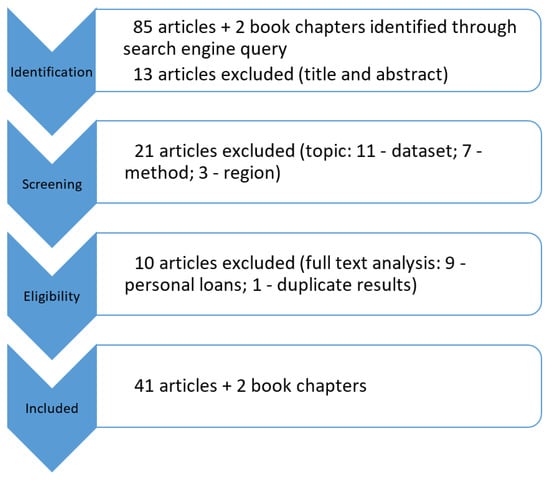
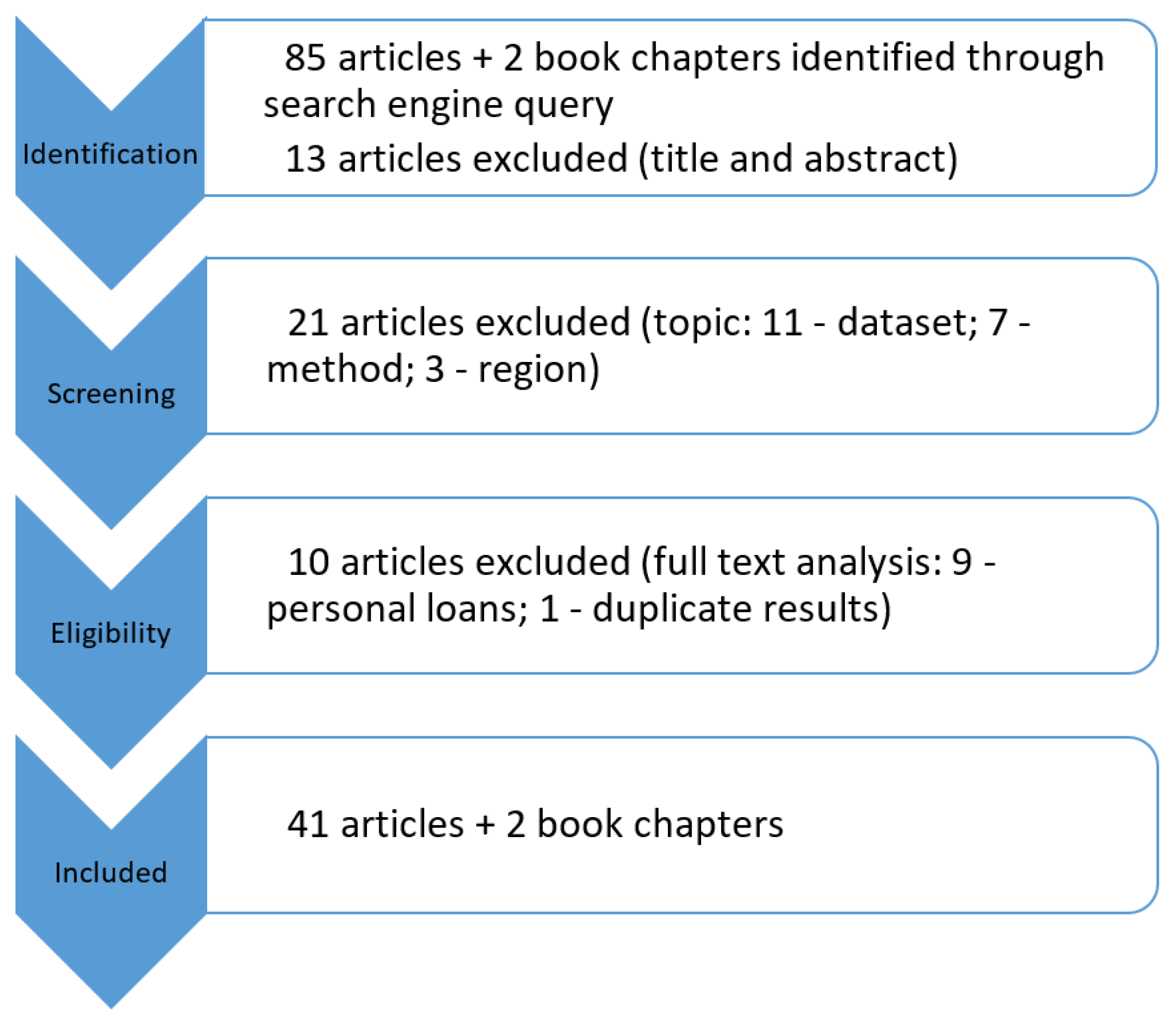
The following subsections detail every step of the selection process summarise in the following PRISMA diagram Figure 1.
Figure 1.
PRISMA diagram detailing the selection process of the identified articles.
2.3.1. Identification
The research query identified 85 articles and two books, from the three search engines. All the papers were published in English, in several different journals, and spanned from 2000 to 2021. This first step involved title and abstract analysis, and excluded 14 articles for lack of relevance.
2.3.2. Screening
In this phase, the main topics of each article were analysed, resulting in the exclusion of 21 papers, based on the following criteria:
- Dataset: when the analysed paper used data other than the banking sector, it was discarded. We are aware that applications of ML to the stock market are a trendy topic in the literature, and that the insurance and pension funds sector is of great importance in the Eurozone. Nevertheless, the regulation is substantially different, and they would merit from a different study and approach;
- Methodology: risk assessment exercises are historically based on quantitative data, combined with expert judgment. Furthermore, it is the quantitative data that holds the largest amount of information regarding risk exposure practices. Therefore, we focus our analysis on quantitative methods, for which a risk assessment classification has already been assigned (leveraging on previous knowledge through supervised learning). We thus excluded works concerning unsupervised learning methods, or sentiment analysis (qualitative);
- Region: this criterion is closely related to the first, since regulation changes according to geography. We chose to focus mainly on works based upon institutions operating in the Eurozone. Nonetheless, relevant works by other central banks were considered eligible.
2.3.3. Eligibility
The next step required a thorough analysis of each paper, to verify its sources and classify the journal it was published in (quartile of impact). Papers were analysed from 2021 backward to identify any overlapping results or new or improved methodologies, resulting in the exclusion of ten more articles: nine being personal loans related and one duplicate result.
The scope of this review is the application of ML techniques to risk assessment from a supervisory perspective, which includes at best how institutions are addressing their risk assessment exercises. The data and predictors used to evaluate an individual credit application (personal loan) differ substantially from the data used by banks from a corporate perspective, and even more from the data collected in the regulatory context. As such, works regarding credit risk for individual applicants were also excluded.
2.3.4. Considered Papers
The final article base consists of 41 papers and two books, published from 2000 until 2021, selected through the steps mentioned. In the next section, we will describe the similarities among the papers, as well as the methods applied and respective banking areas.
Table 1 lists the selected papers, providing a single-sentence summary of their content.
Table 1.
Short summary of each analysed paper, referenced by authors and year.
3. Results
3.1. Distribution
Based on the reviewed works from the previous section, the following paragraphs describe how machine learning techniques have been used in the banking sector. Our research intends to provide a future reference on how these technologies address and support the risk assessment process, in particular from a central bank’s perspective. These results solely reflect the analysis of the papers selected for this review. They represent neither the total of publications throughout these years nor the distribution of topics for all publications.
Table 2 summarises the selected articles, referenced by author, year of publication, affiliation and number of citations. Additionally, Table 3 lists the journals from the selected articles.
Table 2.
List of papers collected through the research query, referenced by author, year of publication, affiliation, and number of citations.
Table 3.
Journals of the selected articles and their quartile. Where the journal is not indexed, the entity responsible for the publishing was included.
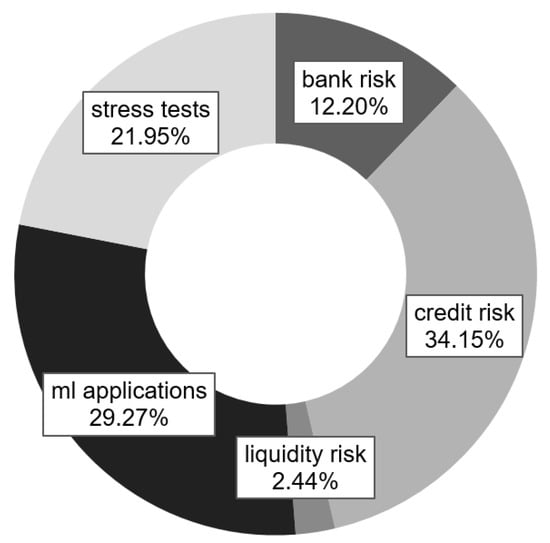
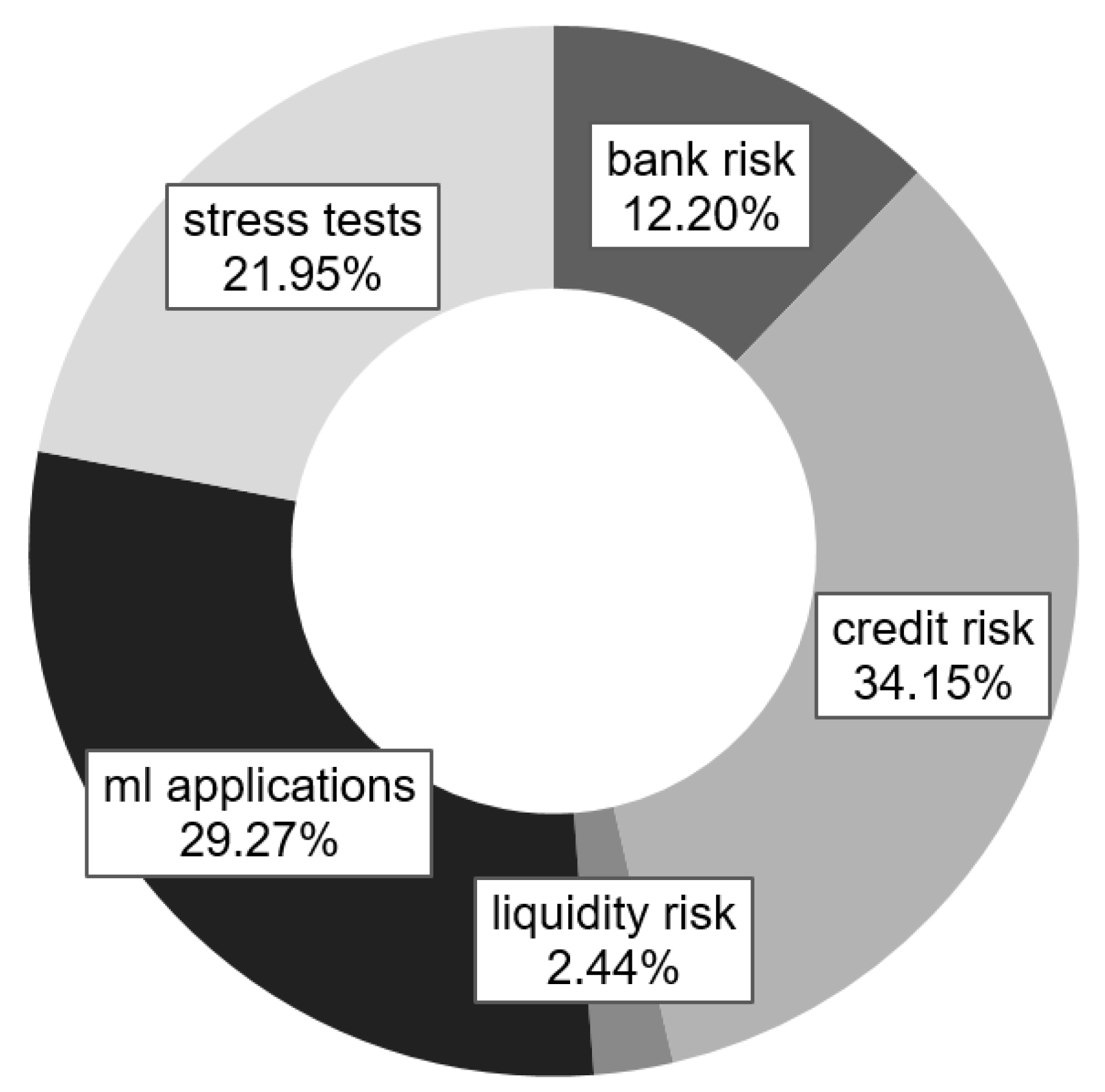
The most common topic on these papers is credit risk related (nearly 34% of references), as shown in Figure 2.
Figure 2.
Distribution of articles according to main topic.
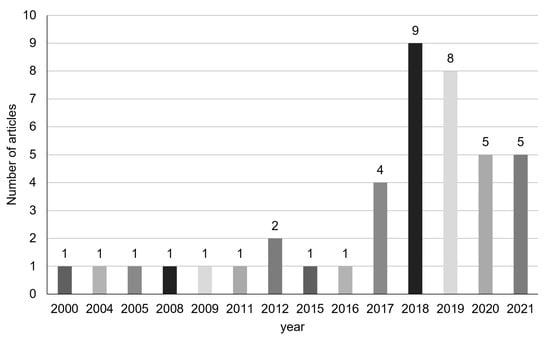
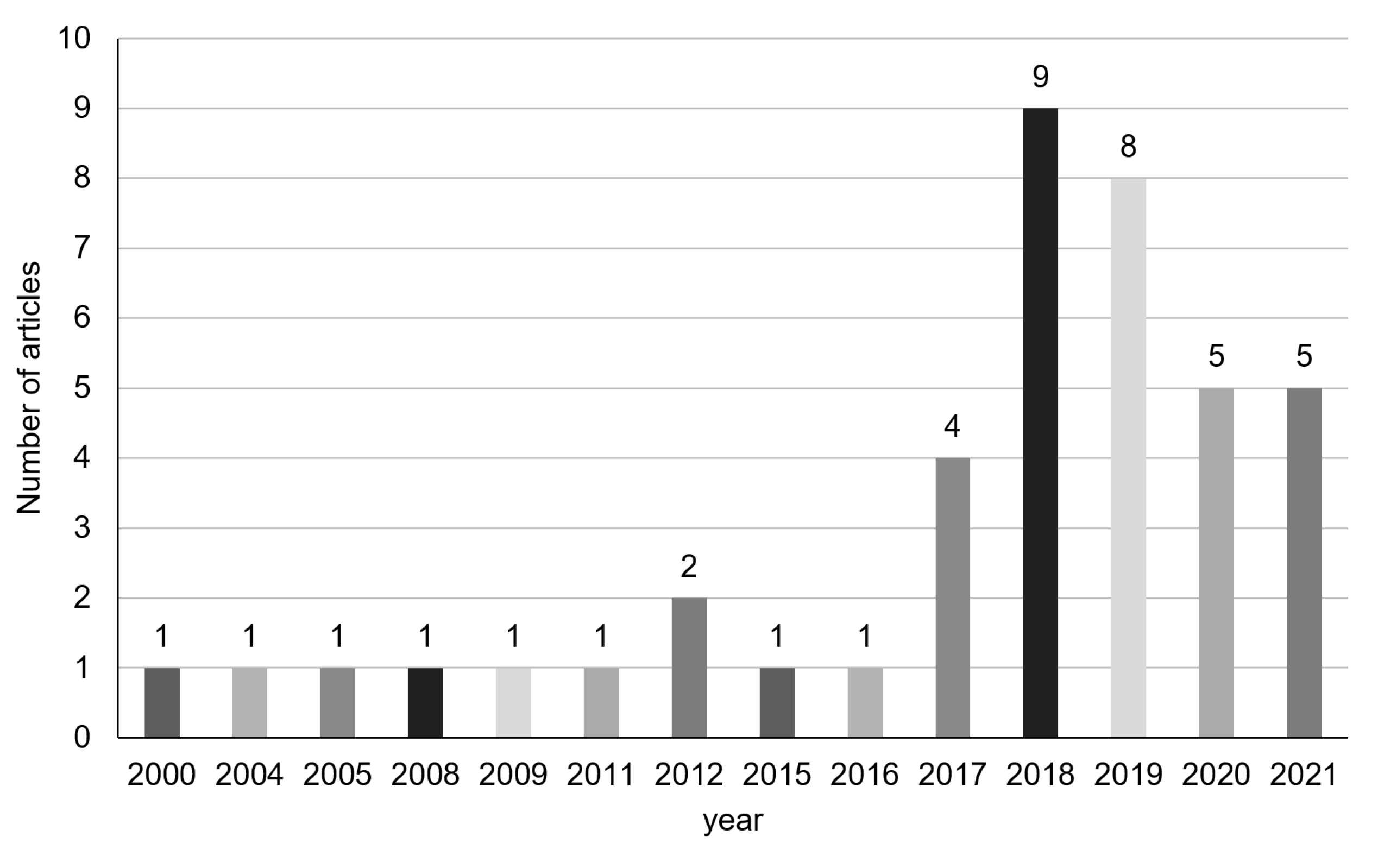
The second major category relates to “ML application” (surveys, fin-tech and sup-tech, as per the division suggested by Broeders and Prenio (2018), the use of innovative technologies by supervisory agencies to support their processes) along with “stress tests”. The remainder of the results focuses either on "bank risk" more broadly, or on specific topics for supervision such as liquidity risk and other banking risk perspectives. Another relevant aspect is the publication date of these articles, ranging from 2000 to 2021 and distributed as shown in Figure 3.
Figure 3.
References according to year of publication.
Importantly, although ML applied to the financial sector has been present since 2000, by 2015 the intersection of these knowledge areas gained a huge interest. This translated to increasing numbers of publications in this field, with the majority of relevant articles in this study being published from 2017 onward. Table 4 lists the machine learning methods applied by each author as well as the datasets that supported each research.
Table 4.
Machine learning methods applied in each paper and the respective dataset, referenced by authors.
3.2. Evolution
The selected papers were organised by date of publication. Publication intervals were defined based on relevant events in the banking sector, technological evolution, and the number of papers per interval. The first slot ranging from 2000 to 2011 encompasses the effects of the financial crisis of 1999 and 2008. The second range (from 2012 to 2016) still reflects several studies based on the 2008 crisis, but with a more mature insight. In this period there is also a trending increase of ANN models. The third slot encompasses the years of 2017–2018, which show a significant increase in publications intersecting ML and the banking sector.
The final interval (2019 to the current date) depicts important ML applications to the financial market in general. Studies in this period reveal an increased ponderation of the uses and impacts of machine learning in banking supervision, with several publications from banking authorities.
3.2.1. 2000–2011
Six papers were identified from this period. They mostly focus on stress tests although three of them engage on the topic of credit risk and default risk.
Early in this period, Galindo and Tamayo (2000) identified the risk assessment task as crucial for an efficient use of resources. They used an error curve methodology to compare model precision and concluded that tree-based models outperform ANNs, KNN and probit. This sets forward the finding that tree-based models are more appropriate to structured data, as opposed to ANNs.
Hillegeist et al. (2004) proposed a new method for assessing bankruptcy probability. Based on the Black–Scholes–Merton option-pricing model, this method was compared to the well-known Z-score (Altman 1968) and O-score (Ohlson 1980), obtaining superior results. These authors stressed the need for a standardised risk assessment measure mainly for comparability purposes.
Min and Lee (2005) presented a paper that compares statistical and artificial intelligence methods, with the latter outperforming the former in the classification of bankruptcy. Although this study focuses on credit risk assessment for heavy industry firms in Korea, we included it in our sample for a compelling reason. It is a clear example of machine learning methods outperforming conventional statistics and it uses a set of predictors (financial ratios) easily mapped to regulatory financial reporting since they are based on balance sheet entries. Angelini et al. (2008) based their work on the Basel II capital requirements and the need for a system to assess credit risk. The main objective of this work is to evaluate the possibility of using neural networks to estimate the probability of default of a borrower (Italian small companies). In spite of some ANNs being used, the comparison of classic machine learning models to conventional statistical methods was the more recurrent approach. Furthermore, the risk definition used to evaluate the data sets was based on the probability of default. This is explained by the fact that the datasets are mostly from loan applications, either from small and medium enterprises or personal loans (housing included). These findings contradict Galindo and Tamayo (2000) as well as more recent developments in this area. ANNs have been proved to excel in time-series, image, and voice recognition, as opposed to their performance using structured data.
Additionally, some articles used financial ratios and CAMELS rating model (an international rating system used by regulatory banking authorities to rate financial institutions) to assess an institution’s performance (stress testing and bankruptcy prediction). Assessing the health of a bank is crucial to prevent its failure and contain the systemic risk its failure or losses represent. The work of Boyacioglu et al. (2009) identifies this assessment as an original classification problem. The authors use the CAMELS method to select the most relevant predictors. Using this method, neural networks were shown to outperform multivariate statistical methods for a Turkish banking sector use case.
Chaudhuri and De (2011) considers Basel II definition of risk to select features for the models. In this case, ANNs are not as frequently used as other conventional ML techniques, such as support vector machines and k-nearest neighbours. As a consequence, the authors focus on the optimisation of those models to the problem at hand (i.e. nature of the dataset).
3.2.2. 2012–2016
In this period, articles mostly reflect the first insights gained from the 2008 financial crisis.
Having identified the lack of a comprehensive method to incorporate circumstantial aspects into the banking default risk predictive models, Ribeiro et al. (2012) reported that SVM+ outperformed other methods that did not include non-financial information. Hammer et al. (2012) showed that Logical Analysis of Data (LAD) is an accurate method by reverse-engineering Fitch risk ratings. The authors stated that LAD can be used as an internal rating system that is Basel compliant.
López Iturriaga and Sanz (2015) took a different approach to this matter. First, they used self-organising maps (SOM) to profile distressed banks. This unsupervised learning method is competitive so it thrives to reach the right pattern, the representation of bankruptcy for a bank. Afterward, the authors applied multi-layer perceptrons to assess a bank’s risk in several time frames, obtaining very promising results predicting bankruptcy for commercial banks. This two-step approach is the first in this selection of papers to recognise the benefits of a pre-processing phase to map the bankruptcy layout of a bank. Although previous research has shown better results using conventional ML, the success shown by this perceptron model suggests it is adequate to model the time evolution of quantitative data.
A new approach to credit scoring using an ensemble model was proposed by Ala’raj and Abbod (2016). These authors combine several data filtering and feature selection methods before evaluating model performance, and compare the most traditional classifiers with their method. The results are validated on several public datasets and their accuracy assessed under several measures: average accuracy, area under the curve (AUC), H-measure, and Brier Score. This is the first paper in our sample showing that ensembles outperform single models for classification problems.
3.2.3. 2017–2018
These two years showed a more than 60% increase in publications in the intersection of ML and banking sector. As highlighted by Strydom and Buckley (2019), the technological evolution allowed for the development of deep learning (DL) models, as well as new ensemble methods like extreme gradient boosting (XGBoost). Although the DL’s first reappearance happened in 2012 (Zhang et al. 2020), its application to financial risk only came to light in 2016–2017.
Traditional ML and classical statistical approaches are still the cornerstones of most of these articles. However, an increasing trend is noticeable in the use of ANN-based models mainly due to bigger datasets and enhanced computing power.
Abellán and Castellano (2017) build on their previous work showing how ensembles achieve better results in credit risk assessment than single models, validating the findings of Ala’raj and Abbod (2016). The authors stress the importance of individual model performance as a criterion for ensemble selection. Although the authors emphasize their own tree-based model (Credal Decision Tree, CDT), the main finding of their work is the corroboration of the hypothesis that ensembles outperform single classifiers.
Prompted by the 2008 Global Financial Crisis and the need to foresee signals of financial instability, Italian authors Pompella and Dicanio (2017) developed an Early Warning System (EWS) to help uncover distress signs for banks. This credit risk model allows users to discriminate stable from likely-to-fail banks and might be useful in adjusting rating assignments by Rating Agencies. The authors suggest its implementation in regulators to support the supervisory process.
Xia et al. (2017) present an extreme gradient boosting model (XGBoost by Chen and Guestrin (2016)) that consistently outperforms baseline models. The authors stress the importance of model-based feature selection as well as the use of Bayesian hyper-parameter optimisation to achieve better predictive results. Although personal credit risk is not the main topic of interest in this review, this study shows the advantages of boosting techniques and the importance of an interpretable model for decision making. This type of models have won several Kaggle competitions and are consistently showing excellent results with structured data.
Chakraborty and Joseph (2017) from the Bank of England introduce a central bank perspective on machine learning and its applications. The authors provide an overview of machine learning models and model validation to support the presentation of three case studies. As a final note, this work acknowledges the amount of available data as an important vector in decision support systems based on machine learning at central banks and other offices. As previously stated, agency papers as this one are paramount in understanding the use of machine learning in these contexts, providing use cases and areas of interest for future work.
Alessi and Detken (2018) contribute with another EWS to detect excessive credit growth. This phenomenon is usually at the root of systemic risk to financial stability and its early detection can help avoid cases of bankruptcy. The authors use Random Forest classifier model with credit and real estate predictors. Their work pioneers in the domain of risk assessment from the perspective of central banks, thus setting peer practitioners in their future path. Moreover, the work reinforces that ensembles consistently outperform single models. Other authors successfully use extreme gradient boosting to develop a credit risk model for financial institutions (Chang et al. 2018). Those tools promise significant support (i.e. low error rate) for risk assessment in loans.
The Central Bank of Greece also provides a thorough analysis based on post-2008 crisis loan data from Greek banks, by Petropoulos et al. (2018). This study sets a milestone for the use of advanced ML techniques from a supervisory perspective. Furthermore, it leverages the resulting model to create an EWS that will support subsequent decisions in loan approval. Similar to what López Iturriaga and Sanz (2015) have shown, modeling a timeline evolution is where neural networks (in this case deep neural networks, DNN’s) excel. Another important result is that DNNs can perform just as well as XGBoost, showcasing how precisely deep learning models adapt to structured data.
Tavana et al. (2018) present a study that directly addresses liquidity risk, which is the most rapidly devastating risk a bank is exposed to. In this paper, the authors present an artificial neural network model combined with a Bayesian network (BN) to assess liquidity risk using solvency as a proxy. This combined approach models the liquidity risk indicator through the ANN and the probability of occurrence through the BN. The results show this approach distinguishes the most critical factors for liquidity in this dataset.
Broeders and Prenio (2018) conduct a study that compiles the experience of early users of innovative technology in financial supervision (sup-tech). The authors structure a definition of sup-tech and show how it is used for data collection and analytics. These two applications have different initiators in supervisory agencies. Data collection tends to be initiated by management decisions and projects whereas analytics usually start out as research questions or analysis queries from supervision units. A conductive thread of all use cases is the sharing of the experience of some early adopters and the impact those technologies are having on the organisation. Similar studies, such as the one conducted by Chakraborty and Joseph (2017) are essential for compiling, sharing, contrasting the several approaches throughout central banks and other agencies.
The Federal Reserve provides a broader perspective, analysing how the use of machine learning and big data will impact compliance aspects (Jagtiani et al. 2018). The authors also stress the need to identify the risks that these technologies carry when applied to the financial market.
Gogas et al. (2018) propose a methodology that separates solvent and failed banks, using machine learning models. The authors present an alternative tool for stress-testing that outperforms the O-score. Their approach is based on a support vector machine model that helps to define a boundary between solvent and insolvent banks, converting this issue into a classification problem. Kupiec (2018) presents a related study that stresses the need for new methodologies to validate conventional bank stress tests.
As a final reference for this period, Le and Viviani (2018) also tackle the problem of bank failure prediction using machine learning and classical financial ratios. One important aspect of this work is that the authors use ratios from 5 different risk perspectives: Loan quality, Capital quality, Operations efficiency, Profitability, and Liquidity. This work validates yet again that machine learning methods outperform traditional statistics. However, these authors do not explore the possibility of using ensembles, which have already been proven to be top performers in classification problems.
3.2.4. 2019–2021
Credit and banking risks are essential for a balanced economy; trying to prevent systemic repercussions stemming from them is considered of the utmost importance. Similarly to earlier periods, these risks maintain a privileged spot in research. Still, it was on ML application we saw the most significant increase in publications. This suggests the demand for coordination and a global perspective on the developments conquered so far in this area.
Leo et al. (2019) produce a thorough review on how machine learning has been used at banks for risk assessment. This paper offsets the industrial and academic claim for ML application versus real-life practices, highlighting a series of perspectives where risk management has been poorly applied. Climent et al. (2019) develop an insightful study that aims to identify a set of financial predictors that best model a bank’s financial distress. To this end, the authors apply an XGBoost based model to a set of indicators that might predict a bank failure in the Eurozone. The set of selected indicators (Total assets, Loan loss provisions/net interest revenue, Equity/net loans and Interbank ratio) are shown to best help regulators monitor financial distress for those banks. From a technical perspective, this work reinforces the choice of XGBoost for classification problems using structured data. A recent study by Wang et al. (2021) deconstructs the use of logit as the base classifier for EWS developed to predict banking crisis. In fact, the authors use random forest classifier to simulate expert decision, obtaining a generalisation capability above 80% area under the curve (AUC).
Kou et al. (2019) compare several ongoing researches concerning the applications of machine learning methods to the detection of systemic risk events, that is, financial distress phenomena that affect several markets or geographic regions. They also propose the use of big-data analysis to assess systemic risk.
Soui et al. (2019) address the issue of comprehensibility of machine learning models for credit risk assessment. Interestingly, in this study, interpretability was mentioned as one of the barriers for adopting ML models in day-to-day decision making. In an attempt to circumvent this problem, the authors proceeded to develop an evolutionary algorithm to approach credit risk assessment as an optimisation problem: minimising complexity while maximising accuracy.
A recent review by Dastile et al. (2020) comparing statistical and ML learning models for credit scoring showed that ensembles outperform single classifiers, confirming the results of previously mentioned works. The authors identify model explainability and the ability to deal with imbalanced datasets, as the main issues to deal with when modelling credit risk. Deep learning models also show promising results, although they have not been extensively explored for credit risk assessment. The authors identify the lack of interpretability as the main barrier for adopting deep learning for credit risk assessment.
Banco de España (Alonso and Carbo 2021) published a comparison of several well-known machine learning algorithms for credit default prediction, showing significant improvements over logit. The authors estimate that implementing XGBoost-mediated assessment could lead to savings of up to 17% of capital requirements under current ECB regulation. Antunes (2021) from the Central Bank of Brazil presents a solid argument to maintain supervisory on-site inspections. The author compares two machine learning models, one trained with portfolio ratings assessed by the banks themselves, and the other based on past ratings obtained through on-site inspections. The results show that the overall performance is consistently higher when using data retrieved through inspections.
This is the period with the most ML applications papers identified (with a total of 9 out of 13). They span from insights on how AI will continue to revolutionise industries and change social behaviour (Dwivedi et al. 2021), to more practical approaches on how to incorporate ML in financial services (Lee and Shin 2020). Milian et al. (2019) also provide a list comparing fin-tech definitions, how it is supported by digital transformation, and the financial risks associated with the use of ML.
A comprehensive study from 2019 by di Castri et al. (2019) focuses on the definition of sup-tech and highlights the need for a more precise notion of what to include as “innovative technology” at the service of a financial authority. It presents several use cases and classifies the technologies onto maturity levels (named in the paper as “generations”), concluding that the identified initiatives (applications of innovative technologies to support the activities carried out by financial regulators and authorities) are mostly experimental. The authors suggest an international coordination effort and alignment to create synergies that leverage sup-tech development.
The Bank of Italy presented a use case for a classification problem (deducing the institutional sector code of a company based on its characteristics) (Massaro et al. 2020). Although this work is not related to risk assessment, it provides an excellent example of a production-ready application of ML to supervisory tasks.
Alonso and Carbo (2020) from Banco de España stress the need for a joint strategy to assess ML models to increase transparency and promote adherence to this technology. The authors conclude ML models increase the predictive capability of a credit default classifier by 20%. The study also identifies factors in credit risk management that might increase supervisory costs.
Driven by the recent progress in financial technology, Huang et al. (2021) acknowledge the complex and hierarchical nature of financial data and the technological barriers found when using statistics and classic ML. The authors then proceed to apply advanced deep learning methods and make use of several graphic processors to improve computation.
As a final remark regarding ML applications, Doerr et al. (2021), from the Bank of International Settlements, presented a policy briefing on the European Money and Finance Forum, evaluating to what extent central banks are making use of ML and big data. The authors conclude that although central banks are acquainted with big data, there exists a persistent need for specialised knowledge on how to use ML throughout these organisations.
Stress tests are also referenced in these years. In a 2019 study, Kolari et al. (2019) hypothesise that stress tests themselves are more of an assessment of a bank’s ability to deal with the risks it is exposed to. This statement challenges the common conception of stress tests as a marker of a bank’s resilience to adverse alternative macroeconomic scenarios. For this purpose, the authors develop an early warning system to assess how European banks will perform on stress tests. These authors suggest surviving stress tests depends largely on the underlying risk dimensions of individual banks. Moreover, this paper reaffirms boosting techniques as winning solutions, not only for this sort of classification problems but also when applied to structured data. As a future work, the authors recommend a similar approach using regulatory data.
In the same line of investigation, an EWS was developed by Filippopoulou et al. (2020) to predict bank systemic risks in the Eurozone. This study starts by analysing the importance of the indicators that are usually applied and presents a model that detects a systemic crisis one to four years beforehand. In spite of using a classic multivariate binary logistic regression model, the methodology adopted for this EWS shows promising results and can be a reference for future developments in this area.
3.3. Datasets
Most central banks and supervisory agencies do not make their datasets available for confidentiality reasons. This is true for several types of data, such as credit responsibilities and supervisory data (European Banking Authority 2013).
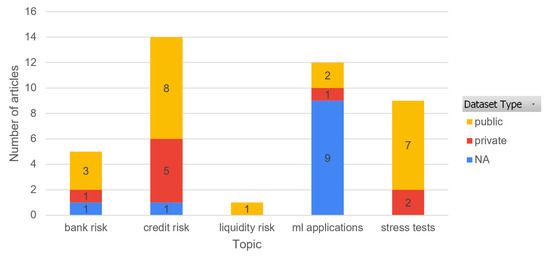
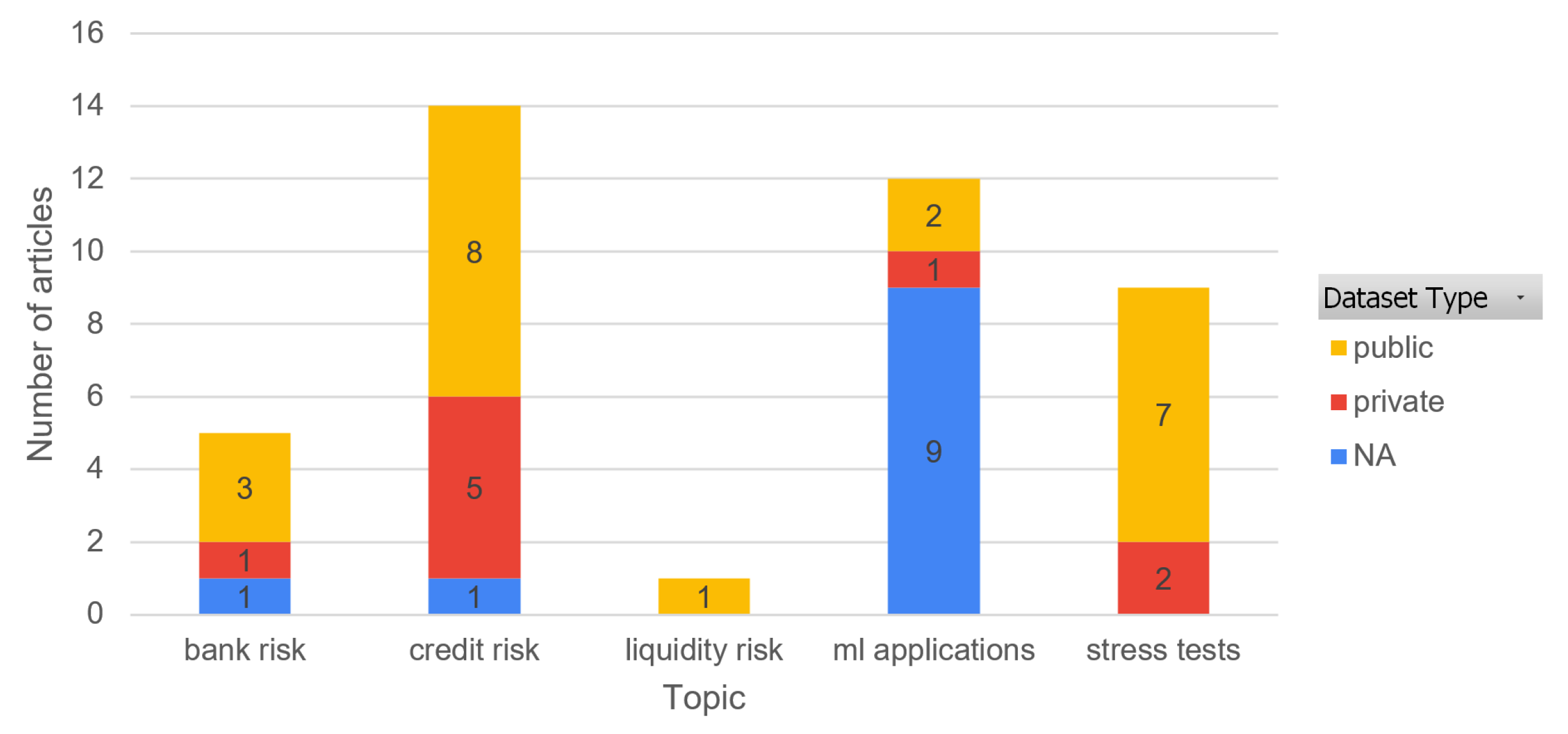
As depicted in Figure 4, regardless of the research topic, most datasets used in these papers are public. The main reason for this is that most researchers cannot gain access to validated supervisory data. Another relevant aspect is that central banks and supervisory agencies have just begun to engage in programs where ML development strategies were in place. These developments are starting to appear, as can be seen by the growing number of titles under the “ML applications” topic. Table 4 lists the datasets used in each paper.
Figure 4.
Dataset types by research topic (NA—not applicable).
Some rating agencies, central banks and other institutions provide datasets to support research projects. A good example is Banco de Portugal BPLIM (de Portugal 2021), a micro-data research laboratory that provides up-to-date anonymised datasets available for national and international researchers. Another example is Moody’s DataHub (Moody’s 2021), that provides a cloud-based platform containing eligible data alongside affiliated third-party participants.
3.4. Related Work
In this research, we have found few papers strictly addressing the use of machine learning techniques for supervisory risk assessment. As a consequence, we have broadened our research question to include banking risk assessment and machine learning in the financial sector. This reasoning is thoroughly presented in Section 2.2.
Nonetheless, we found some works that support the purpose of this review. di Castri et al. (2019) is a survey that summarises the activities that can be considered as an application of innovative technology to supervisory purposes. The authors also present a series of use cases, mostly experimental and originated by supervisory agencies. Kou et al. (2019) list the most common methodologies—ML, big data analysis and sentiment analysis—to address systemic risk in the banking sector. Last, and closest to this research, Leo et al. (2019) contribute with a literature review that brings to light how machine learning is currently being used in the banking sector. The authors stress that contrarily to what might be expected due to the magnitude of financial consequences involved, the real-life use of these sophisticated technologies is in fact under-used and poorly developed.
The authors’ specific knowledge of banking context, namely projects within Banco de Portugal and European Central Bank, allowed them to propose a reliable proxy for the scarcity of published works on this topic. To establish the ideal perspective, we evaluated how risk assessment is carried out in the banking industry, and central banks in the SSM. On the other hand, we investigated how ML is being used for risk assessment in banks. Additionally, we referenced various surveys from central banks to depict and support our statements regarding the use of innovative technologies for supervisory purposes.
In this sense, although this review is sustained by a proxy and there is a paucity of related works from a central bank perspective, the authors propose this review as a starting point for researchers and industry stakeholders. We aggregate relevant contributions to support and ignite the use of ML in risk assessment exercises, from a central bank or supervisory agency perspective.
3.5. Global Analysis
The set of papers identified in this review includes diverse approaches to risk assessment. We have selected some works that use a specific bankruptcy indicator (such as the Altman score or the O-score). However, most of the authors set forth from a set of financial ratios and, knowing the final result, try to model that knowledge through supervised learning. Most of these approaches convert the problem at hand to a classification task, for example, “failure” or “no failure” of a bank.
Another interesting aspect is how the datasets are designed. Most of these works use public datasets to validate a certain approach, even though some of these datasets are specifically collected to depict financial crises. The set of features available in these datasets often reflect a certain industry perspective of risk assessment. For instance, many datasets focus on credit and profitability ratios, since both are two crucial vectors for the industry: how a bank performs and how it is exposed to its main business model.
As a final remark, although most of the selected works come from the academia, we would like to mention the five papers published from 2017 until now by central banks. Alessi and Detken (2018), from the European Central Bank (ECB) and European Commission, have a significant number of citations (135 by the end of 2020) and present an important EWS that can support everyday processes. Also, Chakraborty and Joseph (2017) from the Bank of England give a great contribution with a broad view of what is being done with ML in this context. By presenting some use cases, they also turn the spotlight on the successes of these approaches. The Bank of Greece presents an insightful use case by Petropoulos et al. (2018) for credit risk analysis.
From a more strategic point of view, Jagtiani et al. (2018) from Federal Reserve Banks depict the impacts, roles and possible risks of using ML at central banks.
Although not related to risk assessment, a recent study Massaro et al. (2020) from Bank of Italy presents a production-ready solution of the application of ML techniques to everyday central bank tasks. This is one of the most recently works, showing how ML can make a difference in day to day tasks.
4. Conclusions
This review provides a comprehensive picture of how machine learning techniques have been used so far in risk assessment from a central bank’s perspective. It is organised by timeline and topic. All of the presented topics relate to some extent to the supervisory activity and to dimensions of analysis that are part of the day-to-day processes. As a consequence of the SSM legislation and the EBA reporting requirements, this work focused on the European banking sector.
The majority of the selected papers reflect upon the credit scoring problem. This stems largely from the fact that granting loans is the core business of most of the commercial banking sector. Stress testing in the form of bankruptcy prediction is also in the spotlight since it is strongly connected with regulators’ compliance. There are several other risks a bank is exposed to that require their own studies, such as liquidity or operational risk. However, focusing on those risks is more of a compliance issue, rather than a business model perspective.
Some studies benefited from more structure and clarity, which is useful for comparability purposes. The more structured studies answer the questions of which problem they are addressing (a measure of risk and its perspective, a stock index, portfolio pricing, etc.), ML techniques that were applied, and variables considered. They also offer insight into the datasets they were based upon, and clarify the methods used to assess the models’ precision and prediction capability. The lack of this organised approach evidenced in some articles made it more difficult to review and condense the information published across the broad spectrum of expertise found. As a consequence, interpreting data originating in different geographies and diverse banks’ business models proves to be a challenging task. International consensus must be established regarding terminology, analysis methods and result reporting, as pertaining to this field. The authors advocate for a universal risk assessment methodology, classifying bank risk according to preset parameters and based on the same data, regardless of their location or business model. To this end and taking advantage of the central bank’s perspective, the authors suggest the use of the Supervisory Review and Evaluation Process (SREP), namely, one of its pillars, the Risk Assessment System (RAS). This methodology is used by the ECB and applied, to some extent, to every institution in the SSM. Through the application of such a broad methodology, results of analysis and ML application are more comparable to an already established practice.
Another relevant aspect is the paucity of data published from a supervisory perspective. The reviewed papers mainly focus on credit risk and stress tests using public data. Despite being useful in assessing the financial health of a credit institution, they seldom use data collected through supervisory directives. Scenario testing, sometimes used as a synonym for stress testing, is another decision support system that greatly increases the analytical capabilities of supervisors. The authors emphasise the importance of landmark publications such as the EWS proposed by Filippopoulou et al. (2020), using data gathered in the aftermath of the 2008 economic collapse (European Central Bank Macroprudential Database). These systems are especially relevant since they function as a daily tool for analysts, and strongly benefit from supervisory data. The EWS developed by Alessi and Detken (2018) has also had an enormous impact in the literature by presenting a solution for anticipating banking crisis, using random forests.
As a final remark, we point out that many of these studies rely on public datasets. This often implies they are not as recent as desired since the data might not include the more recent events. For instance, a dataset from 2005 to 2011 captures the market behaviour before the crisis, the crisis itself, and a fraction of the decline of the market. It would be useful to model the behaviour of the institutions with the new regulation as well as the economic recovery seen later until 2019.
Limitations and Future Work
This study proposed to select and review the literature regarding the applications of machine learning to banking supervision. However, since this is a rather specific topic and the regulation has suffered a thorough revision after the 2008 financial crisis, our review falls short on papers that address solely this issue. There is some literature published by central banks and other agencies, but these works are mostly surveys, assessments of adoption, or definition of new concepts. As a consequence, the research query was broadened to include works from other perspectives:
- Assessment of credit defaults (the topic most explored in the reviewed literature);
- New stress test methodologies;
- Systemic risk detection;
- Other surveys regarding fin-tech and sup-tech.
All these topics are pillars of financial analysis and as such, they relate in a direct and crucial manner to proper supervision. Nevertheless, they are all collateral aspects and do not correspond to the core of the supervisory process itself.
Another aspect worth mentioning is the fact that our work is not a detailed review of the literature cited within it. Due to the heterogeneous structure of the included literature, we opted for a broader approach when comparing them. Each topic would merit an individual in-depth analysis and review, which was not warranted in the scope of this article. The authors believe this review will provide a stepping stone for supervisors, analysts, consultants, or academics that desire to further explore machine learning as a tool for banking risk assessment.
Author Contributions
Conceptualization, P.G. and M.C.; methodology, P.G.; validation, P.G. and M.C.; investigation, P.G. and M.C.; writing—original draft preparation, P.G.; writing—review and editing, P.G and M.C.; visualization, P.G.; supervision, M.C. Both authors have read and agreed to the published version of the manuscript.
Funding
This research received no external funding.
Institutional Review Board Statement
Not applicable.
Informed Consent Statement
Not applicable.
Conflicts of Interest
The authors declare no conflict of interest.
References
- Abellán, Joaquín, and Javier G. Castellano. 2017. A comparative study on base classifiers in ensemble methods for credit scoring. Expert Systems with Applications 73: 1–10. [Google Scholar] [CrossRef] [Scilit]
- Ala’raj, Maher, and Maysam F. Abbod. 2016. A new hybrid ensemble credit scoring model based on classifiers consensus system approach. Expert Systems with Applications 64: 36–55. [Google Scholar] [CrossRef] [Scilit]
- Alessi, Lucia, and Carsten Detken. 2018. Identifying excessive credit growth and leverage. Journal of Financial Stability 35: 215–25. [Google Scholar] [CrossRef] [Scilit]
- Alonso, Andrés, and Jose Manuel Carbo. 2020. Machine Learning in Credit Risk: Measuring the Dilemma Between Prediction and Supervisory Cost. SSRN Electronic Journal. [Google Scholar] [CrossRef] [Scilit]
- Alonso, Andrés, and Jose Manuel Carbo. 2021. Understanding the Performance of Machine Learning Models to Predict Credit Default: A Novel Approach for Supervisory Evaluation. SSRN Electronic Journal. [Google Scholar] [CrossRef] [Scilit]
- Altman, Edward. 1968. Financial Ratios, Discriminant Analysis and The Prediction of Corpporate Bankruptcy. The Journal of Finance XXIII: 589–609. [Google Scholar]
- Angelini, Eliana, Giacomo di Tollo, and Andrea Roli. 2008. A neural network approach for credit risk evaluation. Quarterly Review of Economics and Finance 48: 733–55. [Google Scholar] [CrossRef] [Scilit]
- Antunes, José Américo Pereira. 2021. To supervise or to self-supervise: A machine learning based comparison on credit supervision. Financial Innovation 7. [Google Scholar] [CrossRef] [Scilit]
- Boyacioglu, Melek Acar, Yakup Kara, and Ömer Kaan Baykan. 2009. Predicting bank financial failures using neural networks, support vector machines and multivariate statistical methods: A comparative analysis in the sample of savings deposit insurance fund (SDIF) transferred banks in Turkey. Expert Systems with Applications 36, Pt 2: 3355–66. [Google Scholar] [CrossRef] [Scilit]
- Broeders, Dirk, and Jeremy Prenio. 2018. FSI Insights Innovative technology in financial supervision. FSI Insights on Policy Implementation 2018: 29. [Google Scholar]
- Burstein, Frada, Clyde W. Holsapple, and Daniel J. Power. 2008. Decision Support Systems: A Historical Overview. Berlin/Heidelberg: Springer. [Google Scholar] [CrossRef] [Scilit]
- Chakraborty, Chiranjit, and Andreas Joseph. 2017. Machine Learning at Central Banks. SSRN Electronic Journal. [Google Scholar] [CrossRef] [Scilit]
- Chang, Yung Chia, Kuei Hu Chang, and Guan Jhih Wu. 2018. Application of eXtreme gradient boosting trees in the construction of credit risk assessment models for financial institutions. Applied Soft Computing Journal 73: 914–20. [Google Scholar] [CrossRef] [Scilit]
- Chaudhuri, Arindam, and Kajal De. 2011. Fuzzy Support Vector Machine for bankruptcy prediction. Applied Soft Computing Journal 11: 2472–86. [Google Scholar] [CrossRef] [Scilit]
- Chen, Tianqi, and Carlos Guestrin. 2016. XGBoost: A scalable tree boosting system. Paper presented at ACM SIGKDD International Conference on Knowledge Discovery and Data Mining, San Francisco, CA, USA, August 13–17; pp. 785–94. [Google Scholar] [CrossRef] [Scilit]
- Climent, Francisco, Alexandre Momparler, and Pedro Carmona. 2019. Anticipating bank distress in the Eurozone: An Extreme Gradient Boosting approach. Journal of Business Research 101: 885–96. [Google Scholar] [CrossRef] [Scilit]
- Dastile, Xolani, Turgay Celik, and Moshe Potsane. 2020. Statistical and machine learning models in credit scoring: A systematic literature survey. Applied Soft Computing Journal 91: 106263. [Google Scholar] [CrossRef] [Scilit]
- de Portugal, Banco. 2021. Banco de Portugal Microdata Research Laboratory. Available online: https://bplim.bportugal.pt (accessed on 4 May 2021).
- di Castri, Simone, Stefan Hohl, and Arend Kulenkampff. 2019. FSI Insights on policy implementation No. 19: The suptech generations. Financial Stability Institute 19: 19. [Google Scholar]
- Doerr, By Sebastian, Leonardo Gambacorta, and Jose Maria Serena. 2021. How do central banks use big data and machine learning? The European Money and Finance Forum 67: 1–6. Available online: https://www.bis.org/publ/work930.pdf (accessed on 20 May 2021).
- Dwivedi, Yogesh K., Laurie Hughes, Elvira Ismagilova, Gert Aarts, Crispin Coombs, Tom Crick, Yanqing Duan, Rohita Dwivedi, John Edwards, Aled Eirug, and et al. 2021. Artificial Intelligence (AI): Multidisciplinary perspectives on emerging challenges, opportunities, and agenda for research, practice and policy. International Journal of Information Management 57. [Google Scholar] [CrossRef] [Scilit]
- European Banking Authority. 2013. EBA Implementing Technical Standards (ITS). Available online: http://www.eba.europa.eu/documents/10180/532570/EBA-ITS-2013-12+(Final+draft+ITS+on+Hypothetical+Capital+of+a+CCP).pdf (accessed on 20 May 2021).
- European Commission. 2015. Single Supervisory Mechanism. Brussels: European Commission. [Google Scholar]
- Filippopoulou, Chryssanthi, Emilios Galariotis, and Spyros Spyrou. 2020. An early warning system for predicting systemic banking crises in the Eurozone: A logit regression approach. Journal of Economic Behavior and Organization 172: 344–63. [Google Scholar] [CrossRef] [Scilit]
- Galindo, Juan, and Pablo Tamayo. 2000. Credit risk assessment using statistical and machine learning: Basic methodology and risk modeling applications. Computational Economics 15: 107–43. [Google Scholar] [CrossRef] [Scilit]
- Gogas, Periklis, Theophilos Papadimitriou, and Anna Agrapetidou. 2018. Forecasting bank failures and stress testing: A machine learning approach. International Journal of Forecasting 34: 440–55. [Google Scholar] [CrossRef] [Scilit]
- Gusenbauer, Michael. 2019. Google Scholar to overshadow them all? Comparing the sizes of 12 academic search engines and bibliographic databases. Scientometrics 118: 177–214. [Google Scholar] [CrossRef] [Scilit]
- Hammer, Peter L., Alexander Kogan, and Miguel A. Lejeune. 2012. A logical analysis of banks’ financial strength ratings. Expert Systems with Applications 39: 7808–21. [Google Scholar] [CrossRef] [Scilit]
- Hillegeist, Stephen A., Elizabeth K. Keating, Donald P. Cram, and Kyle G. Lundstedt. 2004. Assessing the probability of bankruptcy. Review of Accounting Studies 9: 5–34. [Google Scholar] [CrossRef] [Scilit]
- Huang, Shian Chang, Cheng Feng Wu, Chei Chang Chiou, and Meng Chen Lin. 2021. Intelligent FinTech Data Mining by Advanced Deep Learning Approaches. Computational Economics. [Google Scholar] [CrossRef] [Scilit]
- Jagtiani, Julapa, Larry Wall, and Todd Vermilyea. 2018. The Roles of Big Data and Machine Learning in Bank Supervision. Banking Perspectives, Forthcoming, 1–11. [Google Scholar]
- Kolari, James W., Félix J. López-Iturriaga, and Ivan Pastor Sanz. 2019. Predicting European bank stress tests: Survival of the fittest. Global Finance Journal 39: 44–57. [Google Scholar] [CrossRef] [Scilit]
- Kou, Gang, Xiangrui Chao, Yi Peng, Fawaz E. Alsaadi, and Enrique Herrera-Viedma. 2019. Machine learning methods for systemic risk analysis in financial sectors. Technological and Economic Development of Economy 25: 716–42. [Google Scholar] [CrossRef] [Scilit]
- Kupiec, Paul H. 2018. On the accuracy of alternative approaches for calibrating bank stress test models. Journal of Financial Stability 38: 132–46. [Google Scholar] [CrossRef] [Scilit]
- Le, Hong Hanh, and Jean Laurent Viviani. 2018. Predicting bank failure: An improvement by implementing a machine-learning approach to classical financial ratios. Research in International Business and Finance 44: 16–25. [Google Scholar] [CrossRef] [Scilit]
- Lee, In, and Yong Jae Shin. 2020. Machine learning for enterprises: Applications, algorithm selection, and challenges. Business Horizons 63: 157–70. [Google Scholar] [CrossRef] [Scilit]
- Leo, Martin, Suneel Sharma, and Koilakuntla Maddulety. 2019. Machine learning in banking risk management: A literature review. Risks 7. [Google Scholar] [CrossRef] [Scilit]
- López Iturriaga, Félix J., and Iván Pastor Sanz. 2015. Bankruptcy visualization and prediction using neural networks: A study of U.S. commercial banks. Expert Systems with Applications 42: 2857–69. [Google Scholar] [CrossRef] [Scilit]
- Massaro, Paolo, Ilaria Vannini, and Oliver Giudice. 2020. Institutional Sector Cassifier, a Machine Learning Approach. SSRN Electronic Journal 548. [Google Scholar] [CrossRef] [Scilit]
- Milian, Eduardo Z., Mauro de M. Spinola, and Marly M. de Carvalho. 2019. Fintechs: A literature review and research agenda. Electronic Commerce Research and Applications 34. [Google Scholar] [CrossRef] [Scilit]
- Min, Jae H., and Young Chan Lee. 2005. Bankruptcy prediction using support vector machine with optimal choice of kernel function parameters. Expert Systems with Applications 28: 603–14. [Google Scholar] [CrossRef] [Scilit]
- Moody’s. 2021. Moody’s DataHub. Available online: https://datahub.moodys.io/ (accessed on 21 June 2021).
- Ohlson, James A. 1980. Financial Ratios and the Probabilistic Prediction of Bankruptcy. Journal of Accounting Research 18: 109. [Google Scholar] [CrossRef] [Scilit]
- Petropoulos, Anastasios, Vasilis Siakoulis, Evaggelos Stavroulakis, and Aristotelis Klamargias. 2018. A robust machine learning approach for credit risk analysis of large loan level datasets using deep learning and extreme gradient boosting. The Use of Big Data Analytics and Artificial Intelligence in Central Banking 50: 30–31. [Google Scholar]
- Pompella, Maurizio, and Antonio Dicanio. 2017. Ratings based Inference and Credit Risk: Detecting likely-to-fail Banks with the PC-Mahalanobis Method. Economic Modelling 67: 34–44. [Google Scholar] [CrossRef] [Scilit]
- Ribeiro, Bernardete, Catarina Silva, Ning Chen, Armando Vieira, and João Carvalho Das Neves. 2012. Enhanced default risk models with SVM+. Expert Systems with Applications 39: 10140–52. [Google Scholar] [CrossRef] [Scilit]
- Soui, Makram, Ines Gasmi, Salima Smiti, and Khaled Ghédira. 2019. Rule-based credit risk assessment model using multi-objective evolutionary algorithms. Expert Systems with Applications 126: 144–57. [Google Scholar] [CrossRef] [Scilit]
- Strydom, Moses, and Sheryl Buckley. 2019. Hershey: IGI Global. In AI and Big Data’s Potential for Disruptive Innovation, 1st ed. Engineering Science Reference. Hershey: IGI Global. [Google Scholar] [CrossRef] [Scilit]
- Tavana, Madjid, Amir Reza Abtahi, Debora Di Caprio, and Maryam Poortarigh. 2018. An Artificial Neural Network and Bayesian Network model for liquidity risk assessment in banking. Neurocomputing 275: 2525–54. [Google Scholar] [CrossRef] [Scilit]
- Wang, Tongyu, Shangmei Zhao, Guangxiang Zhu, and Haitao Zheng. 2021. A machine learning-based early warning system for systemic banking crises. Applied Economics 53: 1–19. [Google Scholar] [CrossRef] [Scilit]
- Xia, Yufei, Chuanzhe Liu, Yu Ying Li, and Nana Liu. 2017. A boosted decision tree approach using Bayesian hyper-parameter optimization for credit scoring. Expert Systems with Applications 78: 225–41. [Google Scholar] [CrossRef] [Scilit]
- Zhang, Yicheng, Jipeng Gao, and Haolin Zhou. 2020. ImageNet Classification with Deep Convolutional Neural Networks. In ACM International Conference Proceeding Series. New York: Association for Computing Machinery, vol. 2, pp. 145–151. [Google Scholar] [CrossRef] [Scilit]

Publisher’s Note: MDPI stays neutral with regard to jurisdictional claims in published maps and institutional affiliations. |
© 2021 by the authors. Licensee MDPI, Basel, Switzerland. This article is an open access article distributed under the terms and conditions of the Creative Commons Attribution (CC BY) license (https://creativecommons.org/licenses/by/4.0/).