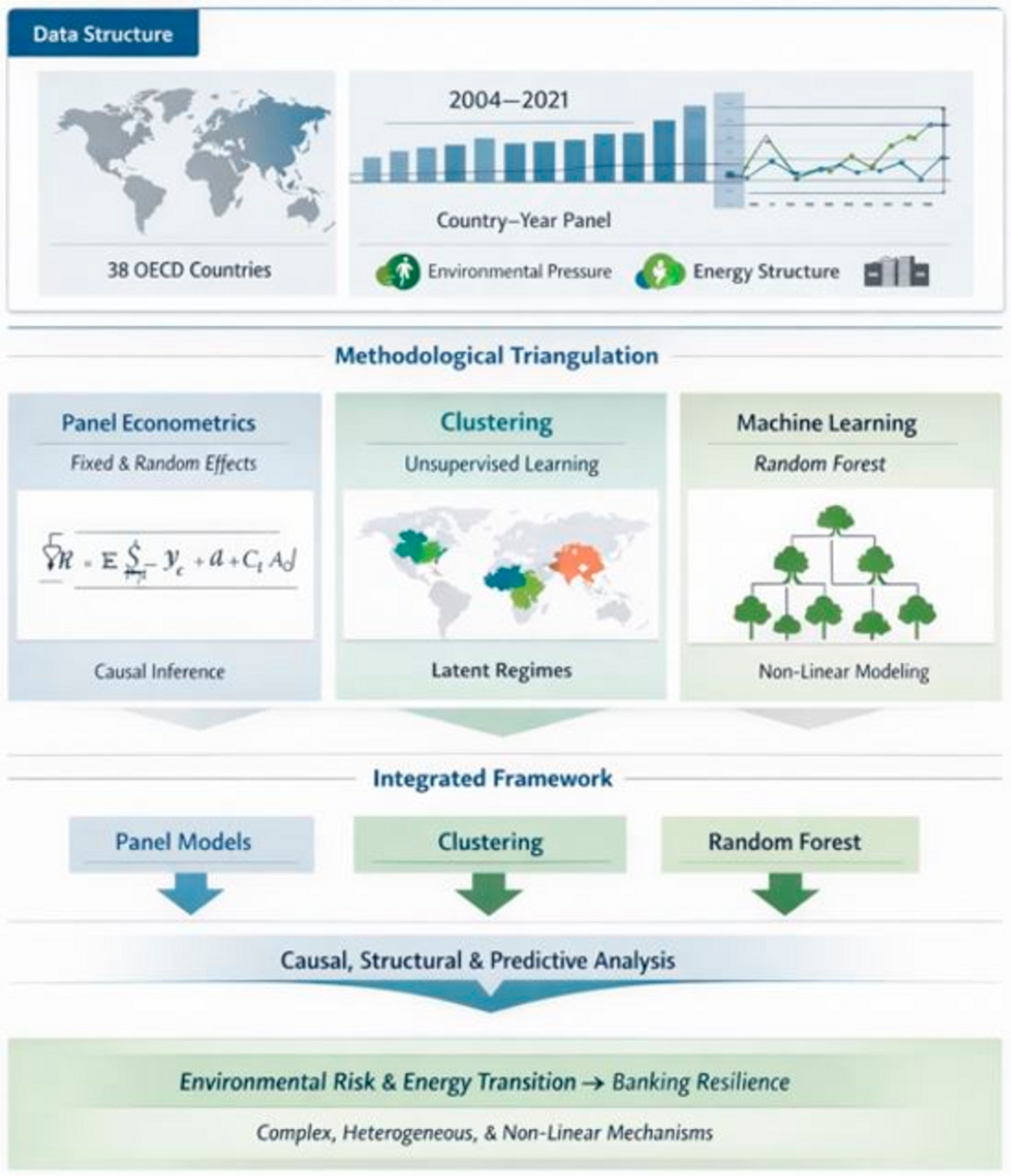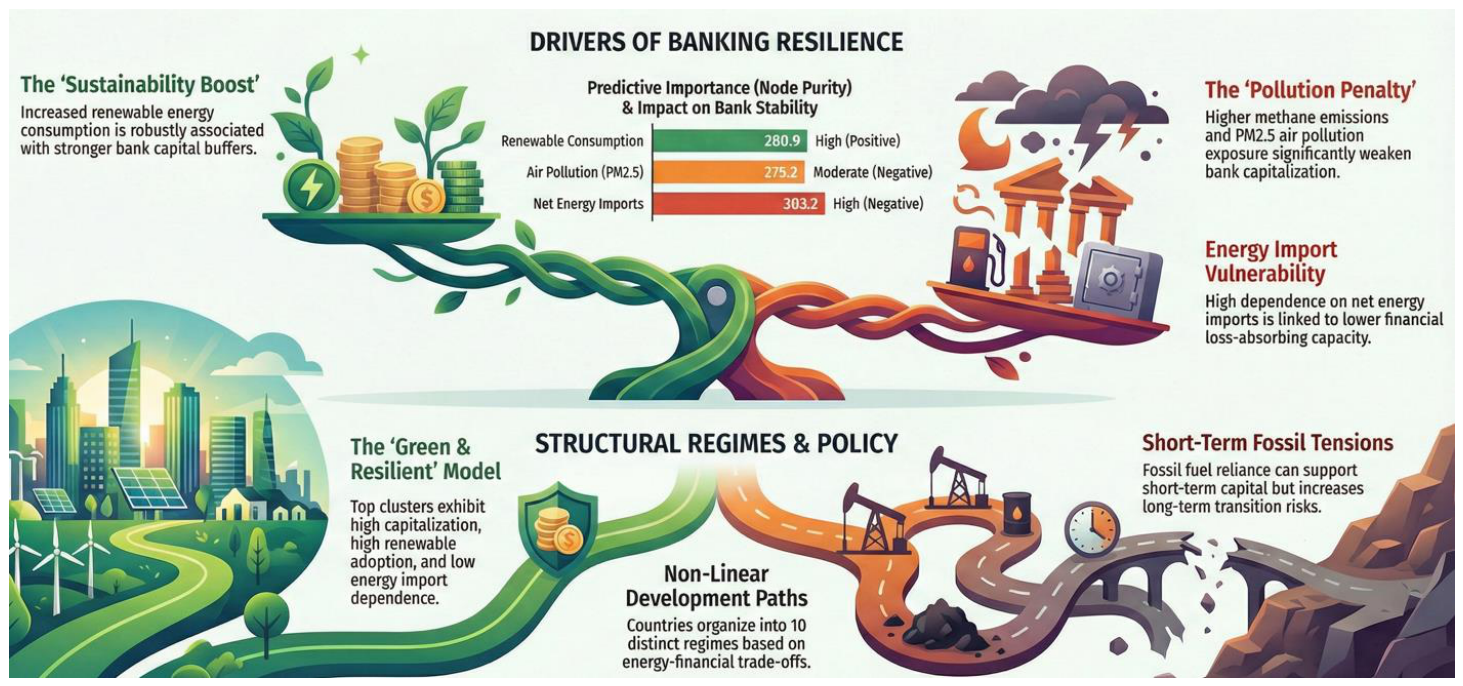

Energy Dependence, Environmental Quality and Banking Sector Capital: New Evidence from OECD Countries

 , , , and
Abstract
1. Introduction
2. Literature Review
3. Data Sources, Variable Selection, and Methodological Framework
4. Empirical Model Specification and Panel Regression Results
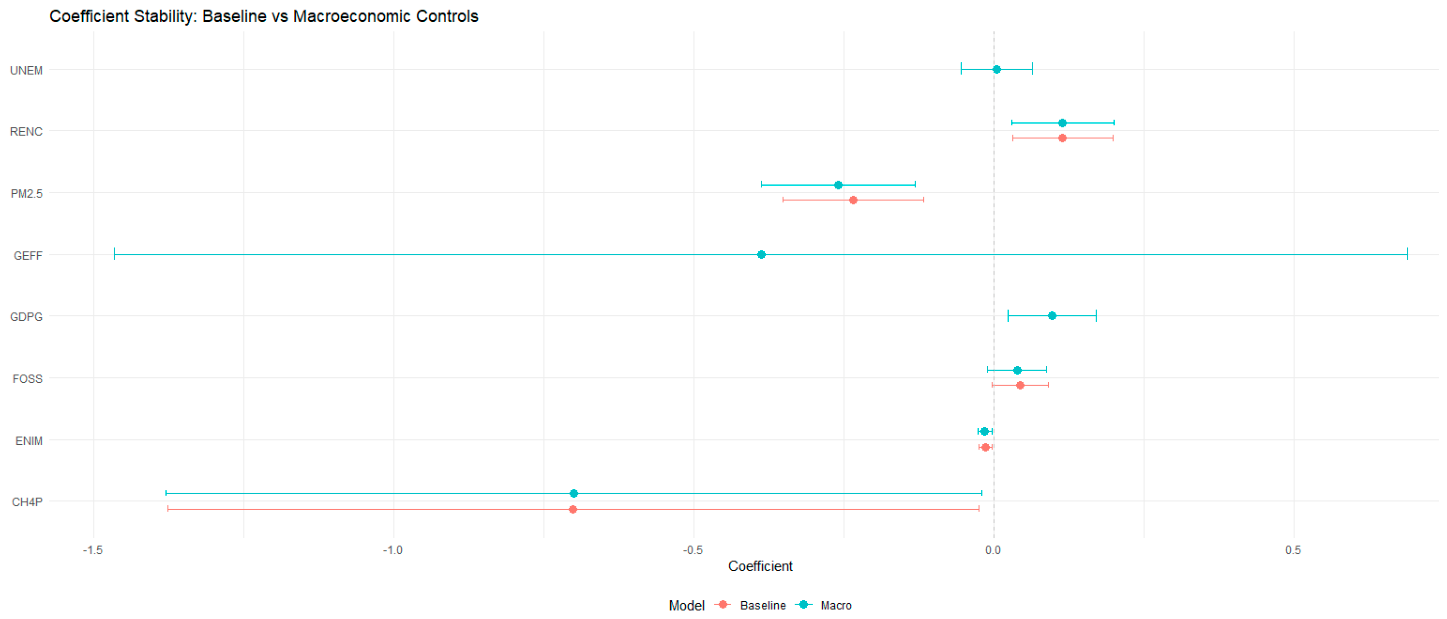
4.1. Robustness Analysis Excluding Large Economies: Evidence of Coefficient Stability
4.2. Testing for Omitted Variable Bias: The Role of Macroeconomic Controls
4.3. Lagged Specification Analysis: Addressing Endogeneity and Temporal Dynamics
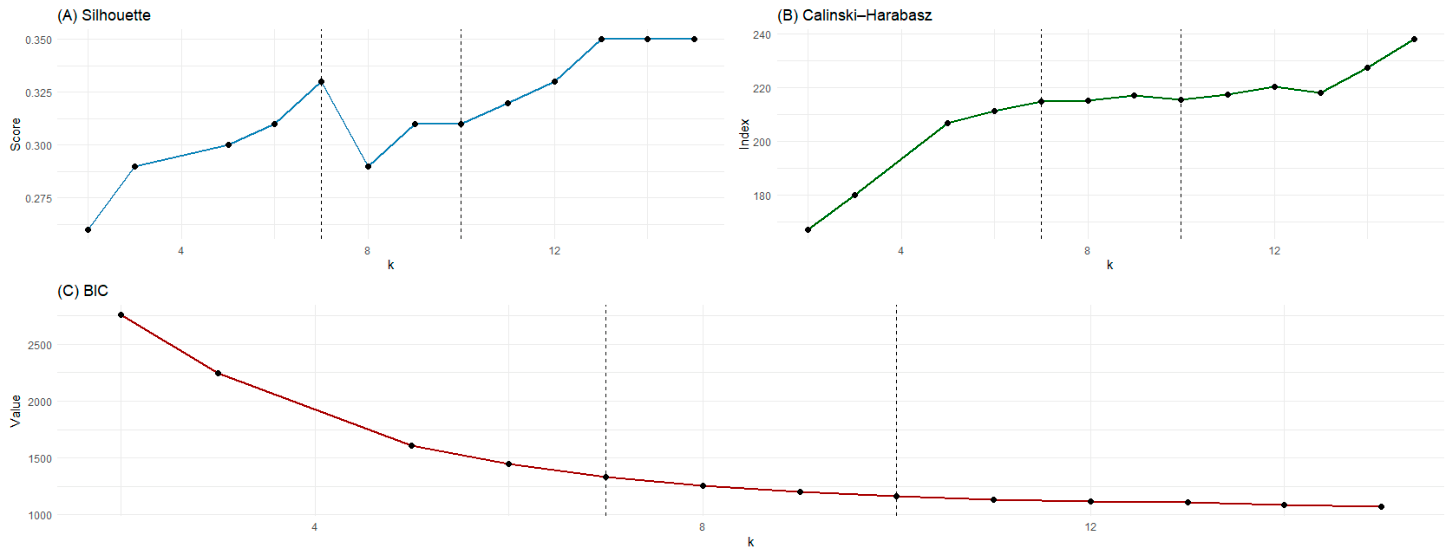
5. Clustering Method Comparison and K-Means-Based Regime Identification
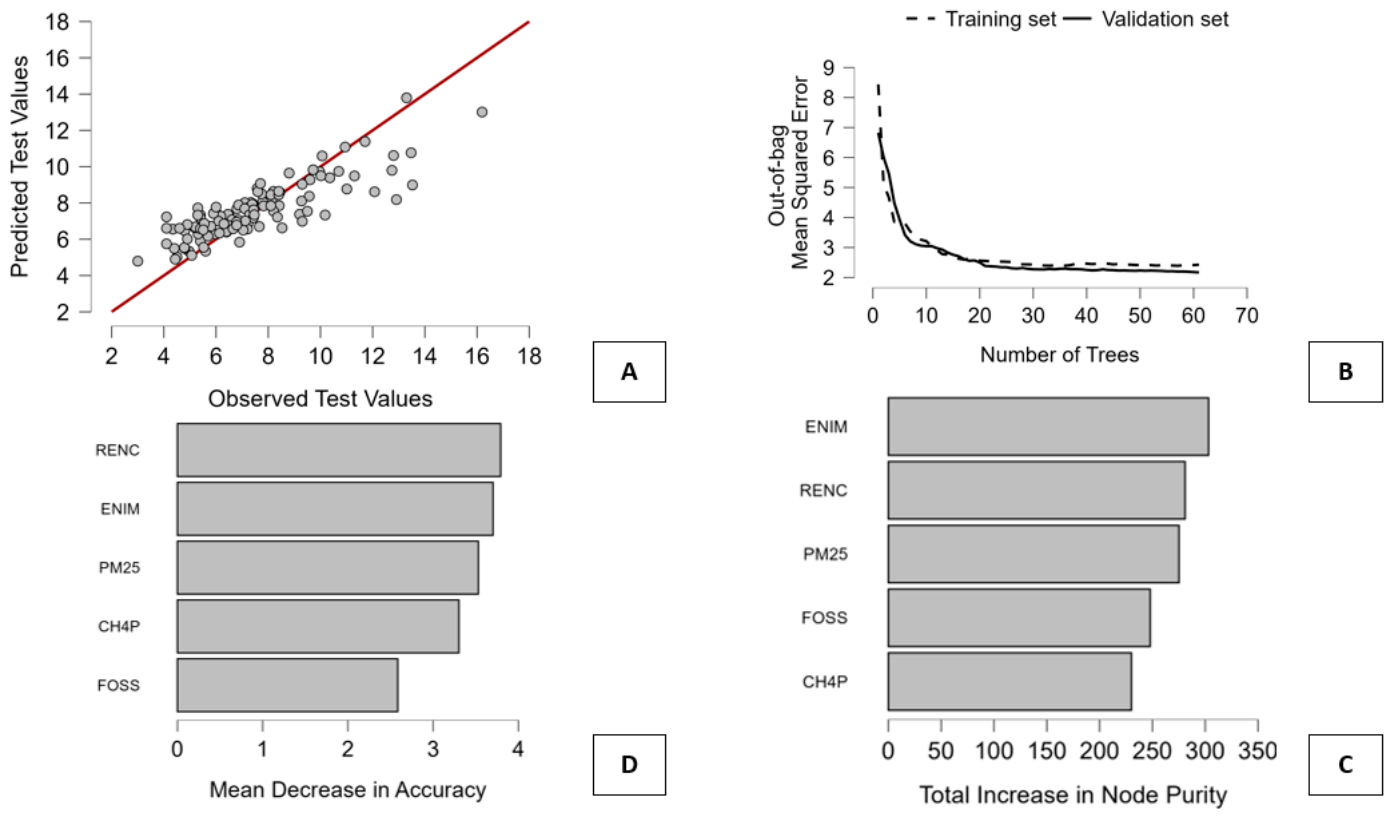
6. Machine Learning Performance Comparison and Random Forest Variable Importance Analysis
7. Integrated Evidence: Econometric, Clustering and Machine Learning Results
8. Integrated Empirical Evidence on Environmental Risk, Energy Transition, and Banking Sector Resilience
Operational Policy Implications for Macroprudential Regulation
9. Integrating Climate, Energy, and Financial Stability Policies: Implications for Banking Sector Resilience
10. Limitations
11. Conclusions
Author Contributions
Funding
Data Availability Statement
Conflicts of Interest
References
- Abdelsalam, Omneya, Wajahat Azmi, Mustafa Disli, and V. Kowsalya. 2023. Bank Lending Cyclicality and ESG Activities: Global Evidence. Finance Research Letters 58: 104541. [Google Scholar] [CrossRef]
- Abd Hishamuddin, Mohd Razuan, Imbarine Bujang, Filicia Rimin, Jamaliah Said, and Dwi Astuti Rosmianingrum Nainggolan. 2023. The Impact of Climate Change and Green Financing on Bank Stability in Malaysia. Journal of Emerging Economies & Islamic Research 11: 109–22. [Google Scholar]
- Acharya, Viral V., Richard Berner, Robert Engle, Hyeyoon Jung, Johannes Stroebel, Xuran Zeng, and Yihao Zhao. 2023. Climate Stress Testing. Annual Review of Financial Economics 15: 291–326. [Google Scholar] [CrossRef]
- Addoum, Jawad M., David T. Ng, and Ariel Ortiz-Bobea. 2020. Temperature Shocks and Establishment Sales. The Review of Financial Studies 33: 1331–66. [Google Scholar] [CrossRef]
- Adebayo, Tomiwa Sunday, Ganiyu David Akinsola, Jacob Ademola Odugbesan, and Victoria O. Olanrewaju. 2021. Determinants of Environmental Degradation in Thailand: Empirical Evidence from ARDL and Wavelet Coherence Approaches. Pollution 7: 181–96. [Google Scholar] [CrossRef]
- Ahmad, Furkan, Ameni Boumaiza, Antonio Sanfilippo, and Luluwah Al-Fagih. 2026. Towards Net-Zero Energy Transition: A Detailed Climate Change Integrated Green Finance Policy Investment Framework for Qatar. Sustainable Development. [Google Scholar] [CrossRef]
- Akyüz, İlker, Kinyas Polat, Selahattin Bardak, and Nadir Ersen. 2024. Prediction of Values of Borsa Istanbul Forest, Paper, and Printing Index Using Machine Learning Methods. BioResources 19: 5141–57. [Google Scholar] [CrossRef]
- Alessi, Lucia, Erica Francesca Di Girolamo, Andrea Pagano, and Marco Petracco Giudici. 2024. Accounting for Climate Transition Risk in Banks’ Capital Requirements. Journal of Financial Stability 73: 101269. [Google Scholar] [CrossRef]
- Algieri, Bernardina, Lukas Kornher, and Joachim von Braun. 2025. The Changing Drivers of Inflation—The Case of Food: Macroeconomics, Speculation, Climate Change and War. Structural Change and Economic Dynamics 75: 782–800. [Google Scholar] [CrossRef]
- Almulla, Saeed, Mohamed Albaity, and Hussein A. Hassan Al-Tamimi. 2025. The Effects of ESG and Institutional Quality on Financial Stability: Evidence from GCC Banks. International Journal of Economics and Financial Issues 15: 309–26. [Google Scholar] [CrossRef]
- Antonakakis, Nikolaos, Ioannis Chatziantoniou, and George Filis. 2017. Energy Consumption, CO2 Emissions, and Economic Growth: An Ethical Dilemma. Renewable and Sustainable Energy Reviews 68: 808–24. [Google Scholar] [CrossRef]
- Anwer, Zaheer, Zakaria Boulanouar, Saqib Farid, and Milena Migliavacca. 2025. Does Climate Policy Uncertainty Affect the Top Financiers of the Energy Sector? International Review of Economics & Finance 102: 104276. [Google Scholar] [CrossRef]
- Apergis, Nicholas, and James E. Payne. 2010. Renewable Energy Consumption and Economic Growth: Evidence from a Panel of OECD Countries. Energy Policy 38: 656–60. [Google Scholar] [CrossRef]
- Arbelaitz, Olatz, Ibai Gurrutxaga, Javier Muguerza, Jesús M. Pérez, and Iñigo Perona. 2013. An Extensive Comparative Study of Cluster Validity Indices. Pattern Recognition 46: 243–56. [Google Scholar] [CrossRef]
- Arnone, Massimo, Alberto Costantiello, Angelo Leogrande, Syed Kafait Hussain Naqvi, and Cosimo Magazzino. 2024. Financial Stability and Innovation: The Role of Non-Performing Loans. FinTech 3: 496–536. [Google Scholar] [CrossRef]
- Aslan, Alper, Baki Ozsolak, and Nihat Doğanlar. 2021. Environmental Quality and Renewable Energy Consumption with Different Quality Indicators: Evidence from Robust Result with Panel Quantile Approach. Environmental Science and Pollution Research 28: 62398–406. [Google Scholar] [CrossRef]
- As-sya’bani, Jihan Ahmad, Muhammad Zubair Abbas, Arzobaer Alshaeki, and Herena Torio. 2025. Assessing Global Responsibility: Comparative Analysis of Fairness in Energy Transition Between Developing and Developed Countries. Sustainability 17: 7470. [Google Scholar] [CrossRef]
- Azad, Shivam, and S. L. Tulasi Devi. 2026. Green Bonds in Sustainable Finance: A Bibliometric and Meta-Analysis of Research Trends, Challenges, and Emerging Market Dynamics (2014–2023). Business Strategy and the Environment 35: 2143–66. [Google Scholar] [CrossRef]
- Bakhsh, Satar, Wei Zhang, and Muhammad Anas. 2024. Can Digital Financial Inclusion Facilitate Renewable Energy Consumption? Evidence from Nonlinear Analysis. Energy & Environment 36: 2049–79. [Google Scholar] [CrossRef]
- Balsalobre-Lorente, Daniel, Muhammad Shahbaz, David Roubaud, and Sahbi Farhani. 2018. How Economic Growth, Renewable Electricity and Natural Resources Contribute to CO2 Emissions. Energy Policy 113: 356–67. [Google Scholar] [CrossRef]
- Bandyopadhyay, Arindam, and Ashutosh Kashyap. 2024. Understanding the Effect of Climate Risk on Banking Business—A Panel Data Analysis of Indian Firms. The Indian Economic Journal 73: 657–69. [Google Scholar] [CrossRef]
- Battiston, Stefano, Antoine Mandel, Irene Monasterolo, Franziska Schütze, and Gabriele Visentin. 2017. A Climate Stress-Test of the Financial System. Nature Climate Change 7: 283–88. [Google Scholar] [CrossRef]
- Battiston, Stefano, Irene Monasterolo, Keywan Riahi, and Bas J. van Ruijven. 2021. Accounting for Finance Is Key for Climate Mitigation Pathways. Science 372: 918–20. [Google Scholar] [CrossRef]
- Bătae, Oana-Marina, Voicu D. Dragomir, and Liliana Feleaga. 2020. Environmental, Social, Governance (ESG), and Financial Performance of European Banks. Accounting and Management Information Systems 19: 480–501. [Google Scholar] [CrossRef]
- Berger, Allen N., Stephen A. Karolyi, and Hugh Hoikwang Kim. 2025. Banks and Climate Risks. Asia-Pacific Journal of Financial Studies 54: 537–69. [Google Scholar] [CrossRef]
- Bernadelli, Michał, Zbigniew Korzeb, and Paweł Niedziółka. 2022. Does Fossil Fuel Financing Affect Banks’ ESG Ratings? Energies 15: 1495. [Google Scholar] [CrossRef]
- Bolton, Patrick, and Marcin Kacperczyk. 2021. Do Investors Care about Carbon Risk? Journal of Financial Economics 142: 517–49. [Google Scholar] [CrossRef]
- Brinkman, David M. 2024. Climate-Related Risks and Banking Supervision: From Climate Change Risk Mitigation to Double Materiality. Maastricht Journal of European and Comparative Law 30: 396–413. [Google Scholar] [CrossRef]
- Bruno, Brunella, and Sara Lombini. 2023. Climate Transition Risk and Bank Lending. The Journal of Financial Research 46: S59–S106. [Google Scholar] [CrossRef]
- Calice, Pietro, and Faruk Miguel Liriano. 2022. Climate-Related and Environmental Risks for the Banking Sector in Latin America and the Caribbean: A Preliminary Assessment. Policy Research Working Paper No. 9694. Washington: World Bank Group. [Google Scholar]
- Campiglio, Emanuele, Yannis Dafermos, Pierre Monnin, Josh Ryan-Collins, Guido Schotten, and Misa Tanaka. 2018. Climate Change Challenges for Central Banks and Financial Regulators. Nature Climate Change 8: 462–68. [Google Scholar] [CrossRef]
- Charrad, Malika, Nadia Ghazzali, Véronique Boiteau, and Azam Niknafs. 2014. NbClust: An R Package for Determining the Relevant Number of Clusters in a Data Set. Journal of Statistical Software 61: 1–36. [Google Scholar] [CrossRef]
- Chenet, Hugues, Josh Ryan-Collins, and Frank van Lerven. 2021. Finance, Climate-Change and Radical Uncertainty: Towards a Precautionary Approach to Financial Policy. Ecological Economics 183: 106957. [Google Scholar] [CrossRef]
- Chiang, Thomas C., Chu-Shiu Li, Run-Chuan Qin, and Min-Teh Yu. 2026. Climate Risk and Stock Performance: Evidence from UK Climate-Sensitive Sectors. Asia-Pacific Journal of Accounting & Economics. [Google Scholar] [CrossRef]
- Chiaramonte, Laura, Alberto Dreassi, Claudia Girardone, and Stefano Piserà. 2022. Do ESG Strategies Enhance Bank Stability during Financial Turmoil? Evidence from Europe. The European Journal of Finance 28: 1173–211. [Google Scholar] [CrossRef]
- Choi, Seo Yun, Doojin Ryu, and Wonhee You. 2024. ESG Activities and Financial Stability: The Case of Korean Financial Firms. Borsa Istanbul Review 24: 945–51. [Google Scholar] [CrossRef]
- Cianforlini, Matteo. 2025. Shaping Sustainable Finance? European Engagement With the Asian Infrastructure Investment Bank’s Energy Strategy. Global Policy 16: 852–61. [Google Scholar] [CrossRef]
- Coldrey, Olivia, Philip LaRocco, Paul Lant, and David Allan. 2026. What Women Want: Financing a Gender-Responsive Clean Cooking Transition. Energy Research & Social Science 132: 104538. [Google Scholar] [CrossRef]
- Conlon, Thomas, Rong Ding, Xing Huan, and Zhifang Zhang. 2024. Climate Risk and Financial Stability: Evidence from Syndicated Lending. The European Journal of Finance 30: 2001–31. [Google Scholar] [CrossRef]
- Costantiello, Alberto, Lucio Laureti, Angelo Quarto, and Angelo Leogrande. 2025. Methane Emissions in the ESG Framework at the World Level. Methane 4: 3. [Google Scholar] [CrossRef]
- Cucinelli, Doriana, Laura Nieri, and Stefano Piserà. 2024. Climate and Environment Risks and Opportunities in the Banking Industry: The Role of Risk Management. International Journal of Finance & Economics 31: 1169–85. [Google Scholar] [CrossRef]
- Cullen, Jay. 2023. Central Banks and Climate Change: Mission Impossible? Journal of Financial Regulation 9: 174–209. [Google Scholar] [CrossRef]
- Çoban, Serap, and Mert Topcu. 2013. The Nexus between Financial Development and Energy Consumption in the EU: A Dynamic Panel Data Analysis. Energy Economics 39: 81–88. [Google Scholar] [CrossRef]
- Dafermos, Yannis, Maria Nikolaidi, and Giorgos Galanis. 2018. Climate Change, Financial Stability and Monetary Policy. Ecological Economics 152: 219–34. [Google Scholar] [CrossRef]
- Danish, Recep Ulucak, and Salah Ud-Din Khan. 2020. Determinants of the Ecological Footprint: Role of Renewable Energy, Natural Resources, and Urbanization. Sustainable Cities and Society 54: 101996. [Google Scholar] [CrossRef]
- Delis, Manthos D., Kathrin de Greiff, Maria Iosifidi, and Steven Ongena. 2024. Being Stranded with Fossil Fuel Reserves? Climate Policy Risk and the Pricing of Bank Loans. Financial Markets, Institutions & Instruments 33: 239–65. [Google Scholar] [CrossRef]
- Dhar, Bablu Kumar, Md. Mustaqim Roshid, Sulochana Dissanayake, Udit Chawla, and Muhammad Faheem. 2026. Leveraging FinTech and GreenTech for Long-Term Sustainability in South Asia: Strategic Pathways toward Agenda 2050. Green Technologies and Sustainability 4: 100263. [Google Scholar] [CrossRef]
- Dikau, Simon, and Ulrich Volz. 2021. Central Bank Mandates, Sustainability Objectives and the Promotion of Green Finance. Ecological Economics 184: 107022. [Google Scholar] [CrossRef]
- D’Orazio, Paola, and Lilit Popoyan. 2019. Fostering Green Investments and Tackling Climate-Related Financial Risks: Which Role for Macroprudential Policies? Ecological Economics 160: 25–37. [Google Scholar] [CrossRef]
- Drago, Carlo, Alberto Costantillo, Massimo Arnone, and Angelo Leogrande. 2025a. Bridging Sustainability and Inclusion: Financial Access in the Environmental, Social, and Governance Landscape. Journal of Risk and Financial Management 18: 375. [Google Scholar] [CrossRef]
- Drago, Carlo, Alberto Costantillo, Massimo Arnone, Fabio Anobile, and Angelo Leogrande. 2026. Mapping the Association Between Energy Use and ESG Dimensions: Evidence from Panel Econometrics, Clustering, and Machine Learning. Energies 19: 828. [Google Scholar] [CrossRef]
- Drago, Carlo, Massimo Arnone, and Angelo Leogrande. 2025b. A Machine Learning and Panel Data Analysis of N2O Emissions in an ESG Framework. Sustainability 17: 4433. [Google Scholar] [CrossRef]
- Eberhardt, Markus, and Andrea F. Presbitero. 2015. Public Debt and Growth: Heterogeneity and Non-Linearity. Journal of International Economics 97: 45–58. [Google Scholar] [CrossRef]
- Einav, Liran, and Jonathan Levin. 2014. Economics in the Age of Big Data. Science 346: 1243089. [Google Scholar] [CrossRef]
- Ezugwu, Absalom E., Amit K. Shukla, Moyinoluwa B. Agbaje, Olaide N. Oyelade, Adán José-García, and Jeffery O. Agushaka. 2021. Automatic Clustering Algorithms: A Systematic Review and Bibliometric Analysis of Relevant Literature. Neural Computing and Applications 33: 6247–306. [Google Scholar] [CrossRef]
- Flammer, Caroline. 2021. Corporate Green Bonds. Journal of Financial Economics 142: 499–516. [Google Scholar] [CrossRef]
- Fraccalvieri, Ilenia, Nicola Raimo, Filippo Vitolla, and Candida Busoli. 2025. Steering the Energy Transition: Governance and Renewable Energy in Global Banking. Research in International Business and Finance 80: 103107. [Google Scholar] [CrossRef]
- Fränti, Pasi, and Sami Sieranoja. 2018. K-means Properties on Six Clustering Benchmark Datasets. Applied Intelligence 49: 4743–59. [Google Scholar] [CrossRef]
- Galletta, Simona, and Sebastiano Mazzù. 2023. ESG Controversies and Bank Risk Taking. Business Strategy and the Environment 32: 274–88. [Google Scholar] [CrossRef]
- Gattone, Tulia, Alberto Costantielio, Angelo Leogrande, and Angelo Quarto. 2025. Modelling CO2 Emissions Through Econometric and Machine Learning Approaches: The Role of Renewable Energy and Resource Use in Climate Action. Geological Journal 60: 2867–89. [Google Scholar] [CrossRef]
- Gigauri, Iza, Mirela Panait, Laeeq Razzak Janjua, and Simona Andreea Apostu. 2026. Achieving Energy Transition Through Economic Prosperity and Financial Development: An OECD Countries Perspective. In Aligning ESG Goals with the UNs Sustainable Development Goals Planning. Cham: Springer Nature, pp. 399–416. [Google Scholar]
- Giglio, Stefano, Bryan Kelly, and Johannes Stroebel. 2021. Climate Finance. Annual Review of Financial Economics 13: 15–36. [Google Scholar] [CrossRef]
- Hao, Yu, Ling-Ou Wang, and Chien-Chiang Lee. 2020. Financial Development, Energy Consumption and China’s Economic Growth: New Evidence from Provincial Panel Data. International Review of Economics & Finance 69: 1132–51. [Google Scholar] [CrossRef]
- Hämäläinen, Joonas, Susanne Jauhiainen, and Tommi Kärkkäinen. 2017. Comparison of Internal Clustering Validation Indices for Prototype-Based Clustering. Algorithms 10: 105. [Google Scholar] [CrossRef]
- Ilhan, Emirhan, Zacharias Sautner, and Grigory Vilkov. 2021. Carbon Tail Risk. The Review of Financial Studies 34: 1540–71. [Google Scholar] [CrossRef]
- Kennard, Amanda. 2020. The Enemy of My Enemy: When Firms Support Climate Change Regulation. International Organization 74: 187–221. [Google Scholar] [CrossRef]
- Khan, Imran, and Muhammad Sadiq Shahid. 2026. The Nexus between Fintech and Green Finance in Advancing Sustainable Performance across Countries. Discover Sustainability 7: 49. [Google Scholar] [CrossRef]
- Khennifi, Ali Mohamed, and Makram Nouaïli. 2025. Non-performing Loans in the MENA Region: How Green Growth Mitigates the Impact of Climate Risk. Asian Economic and Financial Review 15: 1928–43. [Google Scholar] [CrossRef]
- Kodinariya, Trupti M., and Prashant R. Makwana. 2013. Review on Determining Number of Cluster in K-Means Clustering. International Journal of Advance Research in Computer Science and Management Studies 1: 90–95. [Google Scholar]
- Kölbel, Julian F., Florian Heeb, and Timo Busch. 2020. Can Sustainable Investing Save the World? Reviewing the Mechanisms of Investor Impact. Organization & Environment 33: 554–74. [Google Scholar] [CrossRef]
- Kpadonou, Gbedehoue Esaïe, Komla K. Ganyo, Marsanne Gloriose B. Alakonon, Amadou Ngaido, Yacouba Diallo, Niéyidouba Lamin, and Pierre B. Irenikatché Akponikpe. 2026. An Overview and Lessons Learned from the Implementation of Climate-Smart Agriculture (CSA) Initiatives in West and Central Africa. Sustainability 18: 1351. [Google Scholar] [CrossRef]
- Kumar, Sanjiv. 2025. Impact of Climate Change on Inflation and Output in an Emerging Economy: Empirical Evidence from India. Journal of Asian Economics 101: 102080. [Google Scholar] [CrossRef]
- Labonté, Ronald, Deborah Gleeson, Taufique Joarder, Lauren Paremoer, Katerini Storeng, and Remco van de Pas. 2026. Globalization and Health in an Emerging New World Order. Globalization and Health 22: 4. [Google Scholar] [CrossRef]
- Laureti, Lucio, Alberto Costantiello, Alessandro Massaro, and Angelo Leogrande. 2023a. The role of renewable energy consumption in promoting sustainability and circular economy: A data-driven analysis. In Data Driven Intelligent Business Sustainability. Hershey: IGI Global, pp. 360–86. [Google Scholar]
- Laureti, Lucio, Alessandro Massaro, Alberto Costantiello, and Angelo Leogrande. 2023b. The impact of renewable electricity output on sustainability in the context of circular economy: A global perspective. Sustainability 15: 2160. [Google Scholar] [CrossRef]
- Levin, Andrew, Chien-Fu Lin, and Chia-Shang James Chu. 2002. Unit root tests in panel data: Asymptotic and finite-sample properties. Journal of Econometrics 108: 1–24. [Google Scholar] [CrossRef]
- Liu, Yanchi, Zhongmou Li, Hui Xiong, Xuedong Gao, Junjie Wu, and Sen Wu. 2013. Understanding and Enhancement of Internal Clustering Validation Measures. IEEE Transactions on Cybernetics 43: 982–94. [Google Scholar] [CrossRef]
- Lu, Hengzhen, and Xinran Wang. 2025. Stranded Asset Risk and Corporate Capital Structure: Evidence from China’s Low-Carbon Transition. Research in International Business and Finance 80: 103144. [Google Scholar] [CrossRef]
- Lyons, Michelle, and Lee Victoria White. 2025. How Green Banks Can Create Multiple Types of Value in the Transition to Net Zero Emissions. Australian Journal of Public Administration 84: 320–38. [Google Scholar] [CrossRef]
- Magazzino, Cosimo, and Angelo Leogrande. 2024. The role of air pollution in the ESG model at the world level. In Intersecting Environmental Social Governance and AI for Business Sustainability. Hershey: IGI Global, pp. 93–122. [Google Scholar]
- Magazzino, Cosimo, Mara Madaleno, Muhammad Waqas, and Angelo Leogrande. 2024. Exploring the Determinants of Methane Emissions from a Worldwide Perspective Using Panel Data and Machine Learning Analyses. Environmental Pollution 348: 123807. [Google Scholar] [CrossRef]
- Magazzino, Cosimo, Massimo Arnone, Angelo Leogrande, and TuliaGattone. 2025. Determinants of capital adequacy in global banking: Key environmental, social, and governance indicators across countries. Eurasian Economic Review. Advance online publication. [Google Scholar] [CrossRef]
- Majeed, Abdul, Mahmood Ahmad, Muhammad Faisal Rasheed, Muhammad Kaleem Khan, József Popp, and Judit Oláh. 2022. The Dynamic Impact of Financial Globalization, Environmental Innovations and Energy Productivity on Renewable Energy Consumption: Evidence From Advanced Panel Techniques. Frontiers in Environmental Science 10: 894857. [Google Scholar] [CrossRef]
- Maket, Isaiah. 2026. The Road Towards the Net-Zero Emissions Agenda Through Synergistic Roles of Financial Inclusion and Renewable Energy Consumption in Africa. International Economics and Economic Policy 23: 37. [Google Scholar] [CrossRef]
- Manaf, Marwa, Zulfiqar Ali, and Miklas Scholz. 2026. Integrating Random Forest-Based Regression Kriging for Analyzing Spatial Variability of Rainfall in Arid and Semi-Arid Regions. Scientific Reports 16: 5298. [Google Scholar] [CrossRef]
- Monasterolo, Irene. 2020. Climate Change and the Financial System. Annual Review of Resource Economics 12: 299–320. [Google Scholar] [CrossRef]
- Nguyen, Duc Khuong, Toan Luu Duc Huynh, and Muhammad Ali Nasir. 2021. Carbon Emissions Determinants and Forecasting: Evidence from G6 Countries. Journal of Environmental Management 285: 111988. [Google Scholar] [CrossRef]
- Nguyen, Thong Trung, Thu Anh Thi Pham, and Huong Thi Xuan Tram. 2020. Role of Information and Communication Technologies and Innovation in Driving Carbon Emissions and Economic Growth in Selected G-20 Countries. Journal of Environmental Management 261: 110162. [Google Scholar] [CrossRef]
- Niedziółka, Pawel. 2026. Bank Performance Measures: Navigating AI, Climate and Geopolitical Risks. Abingdon: Routledge. [Google Scholar]
- Omar, Sami Mustafa, Wagdi M. S. Khalifa, and Tolga Oz. 2025. From Fossil Dependence on Sustainability: The Effects of Energy Transition, Green Growth, and Financial Inclusion on Environmental Degradation in the MENA Region. Energies 18: 3668. [Google Scholar] [CrossRef]
- Pata, Ugur Korkut. 2021. Renewable and Non-renewable Energy Consumption, Economic Complexity, CO2 Emissions, and Ecological Footprint in the USA: Testing the EKC Hypothesis with a Structural Break. Environmental Science and Pollution Research 28: 846–61. [Google Scholar] [CrossRef]
- Rakshit, Saswati, and Anal Ranjan Sengupta. 2025. Comparison of Machine Learning and Deep Learning Models Performance in Predicting Wind Energy. EAI Endorsed Transactions on Energy Web 12: 1–9. [Google Scholar] [CrossRef]
- Raman, Raghu, Suparna Ray, Dayana Das, and Prema Nedungadi. 2024. Innovations and Barriers in Sustainable and Green Finance for Advancing Sustainable Development Goals. Frontiers in Environmental Science 12: 1513204. [Google Scholar] [CrossRef]
- Ramlall, Indranarain. 2025. The Financial Footprint: How Banking Activities in the World Shape Carbon Emissions? Measuring Business Excellence 29: 761–76. [Google Scholar] [CrossRef]
- Ranger, Nicola Ann, Olivier Mahul, and Irene Monasterolo. 2022. Assessing Financial Risks from Physical Climate Shocks. Washington: World Bank, p. 2. [Google Scholar]
- Roncoroni, Alan, Stefano Battiston, Luis O. L. Escobar-Farfán, and Serafin Martinez-Jaramillo. 2021. Climate Risk and Financial Stability in the Network of Banks and Investment Funds. Journal of Financial Stability 54: 100870. [Google Scholar] [CrossRef]
- Santiago, Renato, José Alberto Fuinhas, António CardosoMarques, and MatheusKoengkan. 2022. What effect does public and private capital have on income inequality? The case of the Latin America and Caribbean region. Latin American Economic Review 31: 1–30. [Google Scholar] [CrossRef]
- Scherrer, Christoph. 2025. Theoretical perspectives on mission drift of public sector banks: The German case. Competition & Change 29: 615–31. [Google Scholar]
- Schumacher, Jesse. 2024. The Relationship Between Cost of Capital and Sustainability: Evidence on Equity, Debt, and Green Asset Performance. July 1. Available online: https://ssrn.com/abstract=5546179 (accessed on 15 January 2026).
- Segovia, Jenny Aracely, Jonathan Fernando Toaquiza, Jaqueline Rosario Llanos, and David Raimundo Rivas. 2023. Meteorological Variables Forecasting System Using Machine Learning and Open-Source Software. Electronics 12: 1007. [Google Scholar] [CrossRef]
- Seidpisheh, Mohammad, and Adel Mohammadpour. 2018. Hierarchical Clustering of Heavy-Tailed Data Using a New Similarity Measure. Intelligent Data Analysis 22: 569–79. [Google Scholar] [CrossRef]
- Shahbaz, Muhammad, Daniel Balsalobre-Lorente, and Avik Sinha. 2019. Foreign Direct Investment–CO2 Emissions Nexus in Middle East and North African Countries: Importance of Biomass Energy Consumption. Journal of Cleaner Production 217: 603–14. [Google Scholar] [CrossRef]
- Shahzad, Umer. 2020. Environmental taxes, energy consumption, and environmental quality: Theoretical survey with policy implications. Environmental Science and Pollution Research 27: 24848–62. [Google Scholar] [CrossRef] [PubMed]
- Shanta, Nabil Abdalla Alhadi, and Muri Wole Adedokun. 2025. Assessing the influence of economic and environmental transformation drivers on social sustainability in ten major coal-consuming economies. Sustainability 17: 7849. [Google Scholar] [CrossRef]
- Sinaga, Kristina P., and Miin-Shen Yang. 2020. Unsupervised K-means clustering algorithm. IEEE Access 8: 80716–27. [Google Scholar] [CrossRef]
- Singh, Khujanand, and Khushbu Dhariwal. 2025. Impact of Distinct Uncertainty Types on the Returns of G20 Stock Indices Across Different Market Conditions: Evidence from Two-step Panel QARDL Approach. Journal of International Commerce, Economics and Policy, 2550032. [Google Scholar] [CrossRef]
- Stöckl, Michael. 2025. Digital but Not Crypto: Possible Design Pitfalls and Rebound Effects for Green Monetary Policy Using Central Bank Digital Currency. Eurasian Economic Review 15: 503–16. [Google Scholar] [CrossRef]
- Tachny, Marcelo Martins, Gláucia Fernandes Vasconcelos, and Layla dos Santos Mendes. 2026. A Global Assessment of Banks’ Capacity to Support the Energy Transition: Evidence from Developed and Emerging Markets. Journal of International Money and Finance 160: 103468. [Google Scholar] [CrossRef]
- Tang, Qirui, and Yi Fang. 2025. How Do Extreme Climate Risks Affect Banking Active Risk-Taking? Empirical Evidence from 107 Countries. Research in International Business and Finance 82: 103247. [Google Scholar] [CrossRef]
- Tekin, Zeliha. 2025. Green Banking Strategies: Evidence from Turkish Banks. Borsa Istanbul Review 25: 930–38. [Google Scholar] [CrossRef]
- Tóth, Balázs, Edit Ippai-Makra, Dániel Szládek, and Gábor Dávid Kiss. 2021. The Contribution of ESG Information to the Financial Stability of European Banks. Public Finance Quarterly 2021: 337–52. [Google Scholar] [CrossRef]
- Umar, Muhammad, Xiangfeng Ji, Dervis Kirikkaleli, and Qinghui Xu. 2020. COP21 Roadmap: Do Innovation, Financial Development, and Transportation Infrastructure Matter for Environmental Sustainability in China? Journal of Environmental Management 271: 111026. [Google Scholar] [CrossRef] [PubMed]
- Waidelich, Paul, Joscha Krug, and Bjarne Steffen. 2025. Mobilizing Credit for Clean Energy: De-risking and Public Loan Provision under Learning Spillovers. Journal of Environmental Economics and Management 133: 103222. [Google Scholar] [CrossRef]
- Wang, Kaixuan, Shuo Sun, Youbang Guan, Chong Huang, Pei Xiao, Ming Xu, and Lirong Liu. 2026. Beyond Connectivity: How Smart 5G Technologies Affect Carbon Emissions across Industries. Resources, Conservation and Recycling 227: 108700. [Google Scholar] [CrossRef]
- Wang, Peng, Bing Xue, Jing Liang, and Mengjie Zhang. 2025. A Survey on Evolutionary Multimodal Optimization-Driven Machine Learning. IEEE Transactions on Evolutionary Computation. (Early Access). [Google Scholar] [CrossRef]
- Wang, Zhaohan, Zijie Zhao, and Chengxin Wang. 2021. Random Forest Analysis of Factors Affecting Urban Carbon Emissions in Cities within the Yangtze River Economic Belt. PLoS ONE 16: e0252337. [Google Scholar] [CrossRef]
- Wan Zahari, Wan Mohd Zulhafiz. 2025. Operationalising Green Sukuk within the World Bank Environmental and Social Framework. Discover Environment 3: 288. [Google Scholar] [CrossRef]
- Xu, Dongkuan, and Yingjie Tian. 2015. A Comprehensive Survey of Clustering Algorithms. Annals of Data Science 2: 165–93. [Google Scholar] [CrossRef]
- Yang, Min-Shen, and Kristina P. Sinaga. 2019. A Feature-Reduction Multi-View k-Means Clustering Algorithm. IEEE Access 7: 114472–86. [Google Scholar] [CrossRef]
- Yang, Sitong, Shouwei Li, and Zhilei Pan. 2023. Climate Transition Risk of Financial Institutions: Measurement and Response. Applied Economics Letters 30: 2439–49. [Google Scholar] [CrossRef]
- Yuen, Mui Kuen, Thanh Ngo, Tu D. Q. Le, and Tin H. Ho. 2022. The Environment, Social and Governance (ESG) Activities and Profitability under COVID-19: Evidence from the Global Banking Sector. Journal of Economics and Development 24: 345–64. [Google Scholar] [CrossRef]
- Zhan, Jianming, Jiajia Wang, Weiping Ding, and Yiyu Yao. 2023. Three-Way Behavioral Decision Making With Hesitant Fuzzy Information Systems: Survey and Challenges. IEEE/CAA Journal of Automatica Sinica 10: 330–50. [Google Scholar] [CrossRef]
- Zhao, Yanxia, Qing Sun, Yi Zhang, Sining Chen, Li Liu, Muyuan Li, and Yifang Ren. 2026. Weather and Climate Services for Finance—The Development of Financial Meteorology in China. Advances in Atmospheric Sciences 43: 1300–9. [Google Scholar] [CrossRef]
- Zhou, Fujin, Thijs Endendijk, and W. J. Wouter Botzen. 2023. A Review of the Financial Sector Impacts of Risks Associated with Climate Change. Annual Review of Resource Economics 15: 235–56. [Google Scholar] [CrossRef]
- Zhou, Sheng, Hongjia Xu, Zhuonan Zheng, Jiawei Chen, Zhao Li, Jiajun Bu, Jia Wu, Xin Wang, Wenwu Zhu, and Martin Ester. 2024. A Comprehensive Survey on Deep Clustering: Taxonomy, Challenges, and Future Directions. ACM Computing Surveys 57: 1–38. [Google Scholar] [CrossRef]
- Zuo, Qiang, Jie He, Atif Iqbal, AnPing Wan, Khalil Al-Bukhaiti, Xiaomin Cheng, Xiaosheng Ji, and Muhammad Rafiq. 2026. Renewable Energy and the Path to Carbon Neutrality: A Data-Driven Study on Sustainability Impact. International Journal of Energy Sector Management 20: 578–94. [Google Scholar] [CrossRef]






| Macro-Theme | Key References | Main Focus | Main Findings | Methods |
|---|---|---|---|---|
| Sustainable Finance, Green Instruments and Banking Strategies | Khan and Shahid (2026); Azad and Tulasi Devi (2026); Wan Zahari (2025); Tekin (2025); Lyons and White (2025); Scherrer (2025); Cianforlini (2025); Fraccalvieri et al. (2025); Ahmad et al. (2026); Gigauri et al. (2026) | Role of finance, green instruments, governance and banking strategies in the energy transition | Finance and fintech can support sustainability; green bonds, sukuk and green banks are expanding; governance and institutional settings shape banks’ involvement; tensions may arise between sustainability goals and traditional banking objectives | Bibliometric analysis, qualitative institutional analysis, policy frameworks, cross-country comparative analysis, case studies, descriptive and conceptual approaches |
| Climate Risk, Energy Transition and Financial/Banking Risk | Tang and Fang (2025); Tachy et al. (2026); Ramlall (2025); Anwer et al. (2025); Lu and Wang (2025); Waidelich et al. (2025); Onar et al. (2025) | Associations between climate risks, energy transition, policy uncertainty, and banks, firms, and financial systems | Climate risks are associated with banks’ risk-taking; banks differ in their capacity to finance the transition; financial activities are linked to emissions; policy uncertainty and stranded assets are associated with financial risk; public de-risking is relevant for clean energy finance | Panel data econometrics, cross-country regressions, firm-level empirical analysis, policy evaluation models, applied micro- and macro-finance methods |
| Macroeconomic, Environmental and Social Dimensions of the Transition | Labonté et al. (2026); Kumar (2025); Algieri et al. (2025); Shanta and Adedokun (2025); As-sya’bani et al. (2025); Coldrey et al. (2026); Kpadonou et al. (2026); Wang et al. (2026) | Broader macroeconomic, social, technological and sectoral impacts of climate change and sustainability policies | Climate change affects inflation, output and food prices; sustainability transitions have strong social and distributional effects; technological change and sectoral policies shape emissions; large cross-country heterogeneity emerges | Macroeconometric analysis, sectoral and policy evaluation, comparative analysis, case studies, interdisciplinary empirical and qualitative approaches |
| Digitalization, Innovation and New Risk Measurement in Sustainable Finance | Dhar et al. (2026); Bakhsh et al. (2024); Stöckel (2025); Niedziółka (2026); Zhao et al. (2026) | Role of digital finance, fintech, AI and climate data in sustainability and financial risk management | FinTech and digital inclusion can support renewable energy; digital tools may also create new policy risks; bank performance must account for climate and geopolitical risks; climate data increasingly enters financial decision-making | Non-linear econometrics, conceptual and framework-based analysis, risk measurement approaches, applied financial analytics, policy-oriented empirical studies |
| Acronym | Variable Name | Description |
|---|---|---|
| CAP | Bank capital to total assets (%) | Measures the capitalization of the banking sector and its ability to absorb losses. Higher values indicate stronger buffers, greater resilience to shocks, and improved financial stability, making it a key indicator of banking system soundness. |
| CH4P | Methane emissions (per capita) | Captures per capita methane emissions, a major greenhouse gas linked to agriculture and energy activities. It proxies environmental pressure and climate-related transition risk that can affect macroeconomic conditions and the stability of the financial and banking system. |
| PM25 | PM2.5 air pollution exposure | Measures population exposure to fine particulate matter, reflecting air quality and physical environmental risk. Higher exposure is associated with health costs, productivity losses, and economic stress, which may indirectly weaken banking sector performance and capital buffers. |
| FOSS | Fossil fuel energy consumption | Indicates the share or intensity of energy consumption based on fossil fuels. It reflects the structure of the energy mix and potential transition risk, as economies more dependent on fossil fuels may face higher adjustment costs in decarbonization processes. |
| RENC | Renewable energy consumption | Measures the use of renewable energy sources in total energy consumption. It proxies progress in the energy transition toward cleaner production, often associated with lower environmental risk, improved sustainability, and potentially stronger long-term financial and banking sector resilience. |
| ENIM | Energy imports, net | Captures a country’s dependence on external energy supplies. Higher values indicate greater exposure to energy price and supply shocks, which can increase macroeconomic volatility and uncertainty, potentially affecting financial stability and banks’ capitalization decisions. |
| Statistic | CAP | ENIM | FOSS | CH4P | PM25 | RENC |
|---|---|---|---|---|---|---|
| Valid | 590 | 667 | 684 | 646 | 646 | 684 |
| Missing | 94 | 17 | 0 | 38 | 38 | 0 |
| Mode | 4.800 * | −726.181 * | 61.410 * | 0.232 * | 4.895 * | 7.300 * |
| Median | 7.153 | 55.443 | 75.640 | 0.966 | 13.517 | 16.300 |
| Mean | 7.827 | 21.485 | 72.459 | 1.406 | 14.402 | 20.692 |
| Std. Error of Mean | 0.120 | 4.946 | 0.697 | 0.057 | 0.231 | 0.616 |
| 95% CI Mean Upper | 8.062 | 31.197 | 73.827 | 1.519 | 14.856 | 21.901 |
| 95% CI Mean Lower | 7.593 | 11.773 | 71.092 | 1.293 | 13.948 | 19.483 |
| Std. Deviation | 2.905 | 127.740 | 18.218 | 1.458 | 5.873 | 16.105 |
| 95% CI Std. Dev. Upper | 3.080 | 134.990 | 19.238 | 1.542 | 6.212 | 17.007 |
| 95% CI Std. Dev. Lower | 2.748 | 121.233 | 17.301 | 1.383 | 5.569 | 15.294 |
| Coefficient of variation | 0.371 | 5.946 | 0.251 | 1.037 | 0.408 | 0.778 |
| MAD | 1.670 | 24.507 | 11.690 | 0.208 | 4.654 | 8.950 |
| MAD robust | 2.475 | 36.334 | 17.332 | 0.308 | 6.900 | 13.269 |
| IQR | 3.876 | 48.854 | 23.952 | 0.437 | 9.499 | 20.175 |
| Variance | 8.436 | 16,317.485 | 331.885 | 2.126 | 34.487 | 259.370 |
| 95% CI Variance Upper | 9.489 | 18,222.326 | 370.102 | 2.379 | 38.583 | 289.237 |
| 95% CI Variance Lower | 7.550 | 14,697.513 | 299.317 | 1.912 | 31.012 | 233.918 |
| Skewness | 1.239 | −3.949 | −1.125 | 3.218 | 0.343 | 1.448 |
| Std. Error of Skewness | 0.101 | 0.095 | 0.093 | 0.096 | 0.096 | 0.093 |
| Kurtosis | 1.995 | 16.932 | 1.370 | 10.200 | −0.954 | 2.318 |
| Std. Error of Kurtosis | 0.201 | 0.189 | 0.187 | 0.192 | 0.192 | 0.187 |
| Shapiro–Wilk | 0.915 | 0.503 | 0.920 | 0.545 | 0.956 | 0.873 |
| p-value of Shapiro–Wilk | <0.001 | <0.001 | <0.001 | <0.001 | <0.001 | <0.001 |
| Range | 18.357 | 836.369 | 89.750 | 8.076 | 23.481 | 82.100 |
| Minimum | 2.700 | −726.181 | 10.250 | 0.204 | 4.895 | 0.800 |
| Maximum | 21.057 | 110.188 | 100.000 | 8.280 | 28.376 | 82.900 |
| 25th percentile | 5.624 | 28.708 | 62.447 | 0.789 | 9.409 | 8.900 |
| 50th percentile | 7.153 | 55.443 | 75.640 | 0.966 | 13.517 | 16.300 |
| 75th percentile | 9.500 | 77.561 | 86.400 | 1.225 | 18.907 | 29.075 |
| Sum | 4618.203 | 14,330.448 | 49,562.150 | 908.293 | 9303.655 | 14,153.300 |
| Dependent variable: CAP | ||
| Sample: 38 countries, 578 observations | ||
| Variable | Fixed Effects (FE) | Random Effects (RE) |
| Constant | 7.105 *** (1.885) | 7.201 *** (1.878) |
| CH4P (Methane emissions per capita) | −0.701 ** (0.323) | −0.795 *** (0.253) |
| PM25 (Air pollution exposure) | −0.234 *** (0.033) | −0.218 *** (0.031) |
| FOSS (Fossil fuel energy consumption) | 0.044 ** (0.020) | 0.040 ** (0.019) |
| RENC (Renewable energy consumption) | 0.115 *** (0.024) | 0.105 *** (0.022) |
| ENIM (Net energy imports) | −0.013 *** (0.004) | −0.007 ** (0.003) |
| Model statistics | ||
| FE | RE | |
| Observations | 578 | 578 |
| Countries | 38 | 38 |
| Mean CAP | 7.686 | 7.686 |
| Within R2 | 0.299 | — |
| LSDV R2 | 0.823 | — |
| Log-likelihood | −885.36 | −1477.99 |
| Durbin–Watson | 0.547 | 0.547 |
| Tests and diagnostics | ||
| Joint significance of regressors (FE) | F(5,535) = 45.72, p < 0.0001 | |
| Joint significance of regressors (RE) | χ2(5) = 218.31, p < 0.0001 | |
| Test for individual effects (FE) | F(37,535) = 53.61, p < 0.0001 | |
| Breusch–Pagan test (RE) | χ2(1) = 1868.13, p = 0 | |
| Hausman test | χ2(5) = 19.09, p = 0.00185 → FE preferred | χ2(5) = 19.09, p = 0.00185 |
| Heteroskedasticity (FE) | Chi-square(37) = 6205.8, p = 0 | |
| Normality of residuals (FE) | Chi-square(2) = 111.677, p = 5.62 × 10⁻²⁵ | |
| Normality of residuals (RE) | Chi-square(2) = 8.64021, p = 0.0133 | |
| Cross-sectional dependence (Pesaran CD, FE) | z = 13.3695, p = 9.11 × 10−41 | |
| Cross-sectional dependence (Pesaran CD, RE) | z = 13.9259, p = 4.41 × 10−44 | |
| Autocorrelation (Wooldridge) | F(1,35) = 75.8792, p = 2.76 × 10⁻¹⁰ | F(1,35) = 75.8792, p = 2.76 × 10⁻¹⁰ |
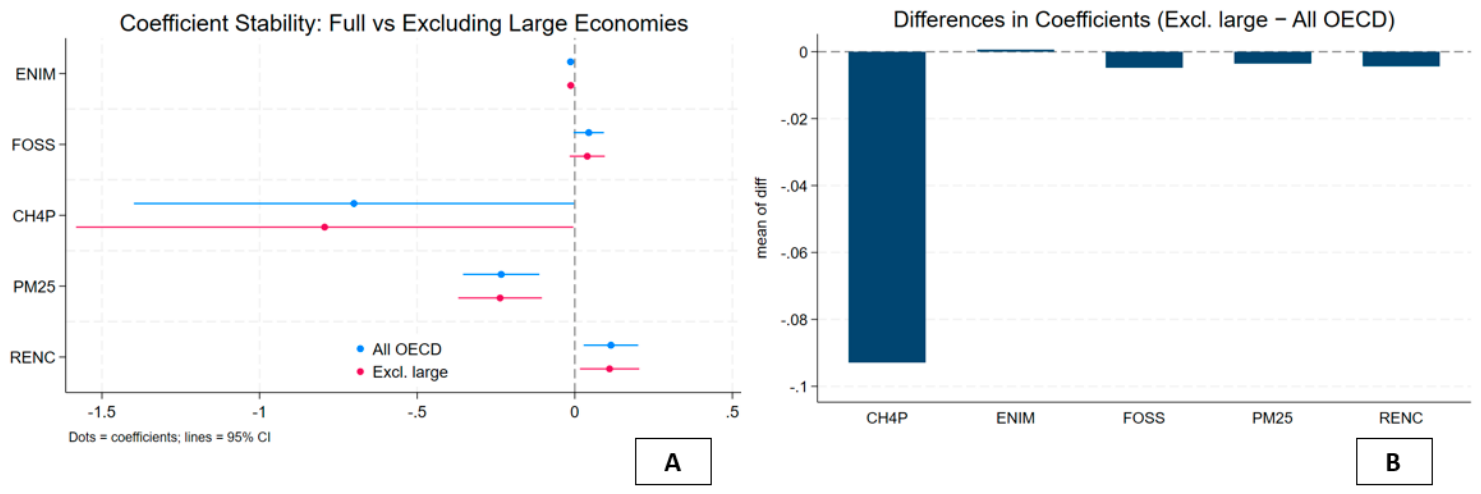
| Variable | All OECD | Excluding Large Economies |
|---|---|---|
| ENIM | −0.0134 ** (0.00556) | −0.0128 ** (0.00577) |
| FOSS | 0.0443 * (0.0237) | 0.0395 (0.0273) |
| CH4P | −0.701 ** (0.345) | −0.793 ** (0.387) |
| PM2.5 | −0.234 *** (0.0597) | −0.237 *** (0.0651) |
| RENC | 0.115 ** (0.0428) | 0.110 ** (0.0463) |
| Observations | 578 | 497 |
| Variable | Baseline | With Macroeconomic Controls |
|---|---|---|
| ENIM | −0.0134 ** (0.00556) | −0.0147 ** (0.00588) |
| FOSS | 0.0443 * (0.0237) | 0.0389 (0.0249) |
| CH4P | −0.701 ** (0.345) | −0.700 * (0.347) |
| PM2.5 | −0.234 *** (0.0597) | −0.259 *** (0.0655) |
| RENC | 0.115 ** (0.0428) | 0.115 ** (0.0432) |
| GDPG | — | 0.0968 ** (0.0374) |
| GEFF | — | −0.388 (0.550) |
| UNEM | — | 0.00439 (0.0302) |
| Observations | 578 | 578 |
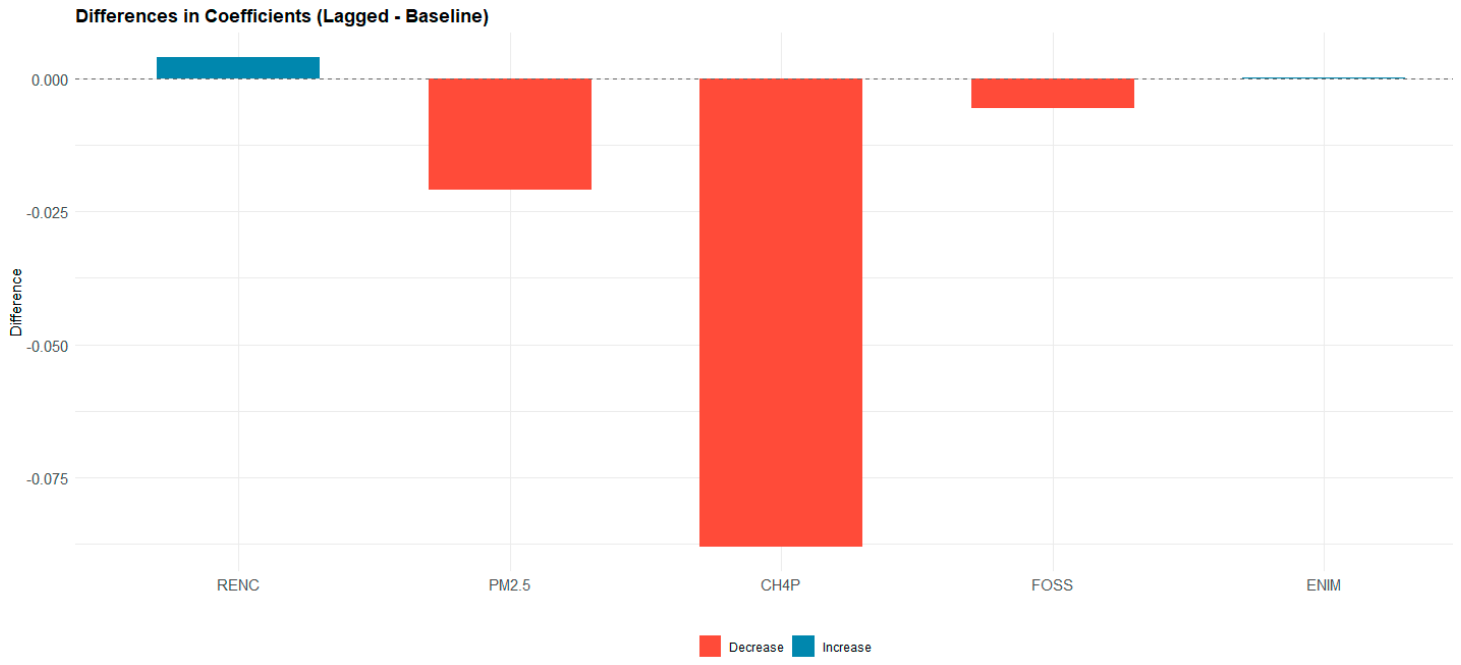
| Variable | Baseline | Lagged Regressors |
|---|---|---|
| ENIM | −0.0134 ** (0.00556) | |
| FOSS | 0.0443 * (0.0237) | |
| CH4P | −0.701 ** (0.345) | |
| PM2.5 | −0.234 *** (0.0597) | |
| RENC | 0.115 ** (0.0428) | |
| L.ENIM | −0.0132 ** (0.00513) | |
| L.FOSS | 0.0388 ** (0.0191) | |
| L.CH4P | −0.789 (0.517) | |
| L.PM2.5 | −0.255 *** (0.0656) | |
| L.RENC | 0.119 *** (0.0401) | |
| Observations | 578 | 541 |
| Robustness Check | Purpose | Main Result |
|---|---|---|
| Excluding large OECD economies | Tests whether results are driven by dominant countries | Main signs remain stable |
| Macroeconomic controls | Addresses omitted variable bias | RENC, ENIM, PM2.5 remain robust |
| Lagged regressors | Mitigates reverse causality | Main relationships persist over time |
| Metric | Density Based | Fuzzy C-Means | Hierarchical | Model Based | K-Means Clustering | Random Forest |
|---|---|---|---|---|---|---|
| Maximum diameter | 0.538 | 0.963 | 0.000 | 0.787 | 0.196 | 1.000 |
| Minimum separation | 1.000 | 0.000 | 0.124 | 0.046 | 0.031 | 0.062 |
| Pearson’s γ | 1.000 | 0.000 | 0.544 | 0.173 | 0.471 | 0.292 |
| Dunn index | 1.000 | 0.000 | 0.216 | 0.041 | 0.057 | 0.048 |
| Entropy | 0.000 | 1.000 | 0.764 | 0.915 | 0.970 | 0.880 |
| Calinski–Harabasz index | 0.051 | 0.000 | 0.704 | 0.277 | 1.000 | 0.165 |
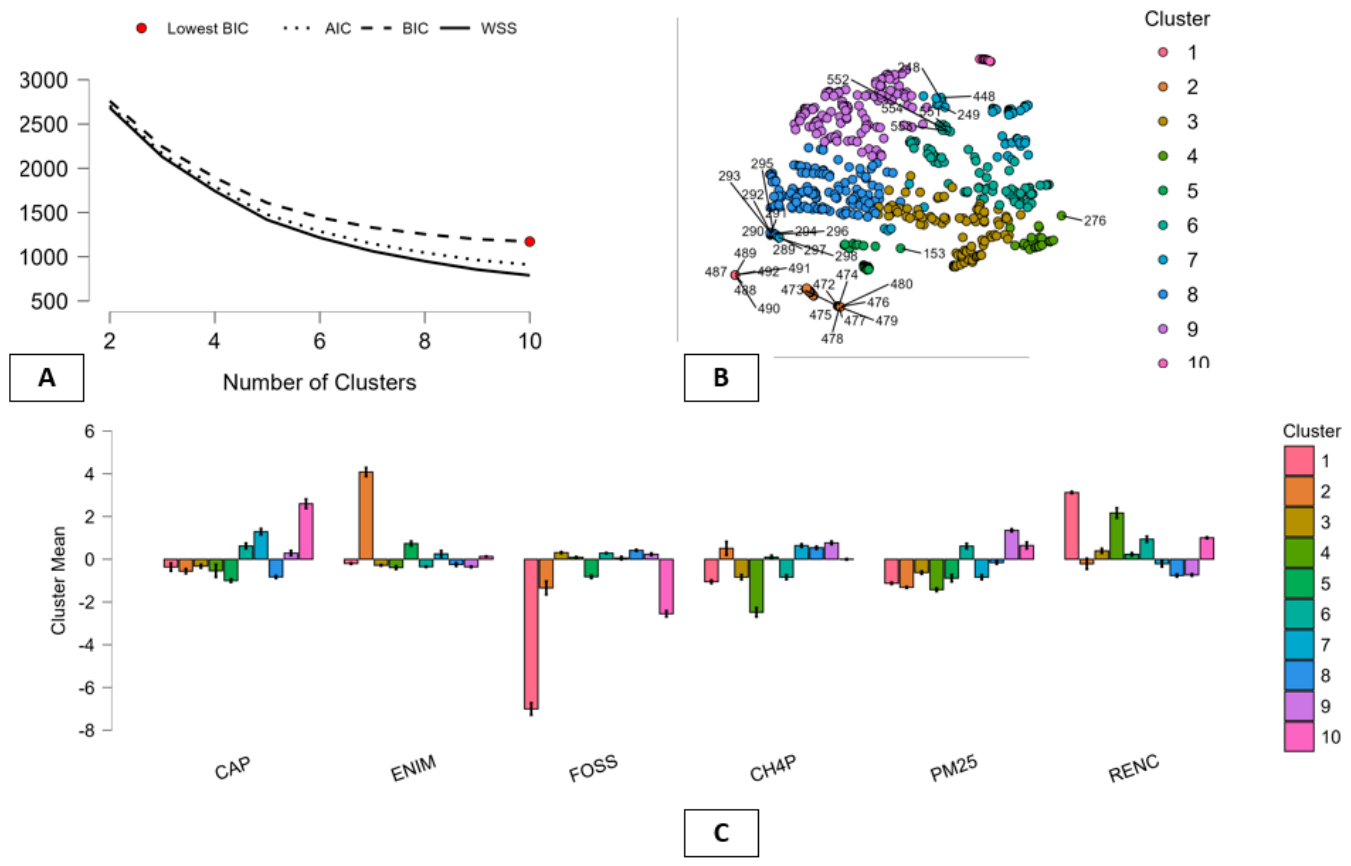
| k | Silhouette | Calinski–Harabasz | BIC | k | Silhouette | Calinski–Harabasz | BIC |
|---|---|---|---|---|---|---|---|
| 2 | 0.26 | 167.059 | 2759.97 | 10 | 0.31 | 215.477 | 1165.85 |
| 3 | 0.29 | 180.051 | 2243.28 | 11 | 0.32 | 217.538 | 1135.52 |
| 5 | 0.3 | 206.727 | 1607.83 | 12 | 0.33 | 220.288 | 1113.42 |
| 6 | 0.31 | 211.471 | 1444.31 | 13 | 0.35 | 217.992 | 1110.98 |
| 7 | 0.33 | 214.744 | 1330.21 | 14 | 0.35 | 227.396 | 1088.89 |
| 8 | 0.29 | 215.289 | 1255.34 | 15 | 0.35 | 238.043 | 1072.7 |
| 9 | 0.31 | 217.267 | 1197.24 |
| Cluster | 1 | 2 | 3 | 4 | 5 | 6 | 7 | 8 | 9 | 10 |
| Size | 6 | 26 | 98 | 23 | 26 | 79 | 52 | 131 | 120 | 17 |
| Explained proportion within-cluster heterogeneity | 0.002 | 0.096 | 0.167 | 0.048 | 0.018 | 0.175 | 0.103 | 0.183 | 0.195 | 0.012 |
| Within sum of squares | 1.356 | 75.423 | 130.843 | 37.830 | 14.145 | 137.094 | 80.853 | 143.415 | 152.195 | 9.160 |
| Silhouette score | 0.891 | 0.467 | 0.221 | 0.472 | 0.559 | 0.189 | 0.327 | 0.344 | 0.318 | 0.740 |
| Center CAP | −0.364 | −0.558 | −0.322 | −0.541 | −1.001 | 0.625 | 1.293 | −0.832 | 0.291 | 2.599 |
| Center ENIM | −7.009 | −1.341 | 0.312 | 0.094 | −0.821 | 0.290 | 0.057 | 0.419 | 0.234 | −2.553 |
| Center FOSS | −1.051 | 0.511 | −0.841 | −2.482 | 0.101 | −0.841 | 0.642 | 0.541 | 0.767 | −0.002 |
| Center CH4P | −0.199 | 4.085 | −0.283 | −0.391 | 0.735 | −0.352 | 0.255 | −0.247 | −0.356 | 0.134 |
| Center PM25 | −1.127 | −1.315 | −0.625 | −1.428 | −0.887 | 0.619 | −0.841 | −0.158 | 1.356 | 0.646 |
| Center RENC | 3.124 | −0.213 | 0.394 | 2.167 | 0.232 | 0.943 | −0.211 | −0.764 | −0.734 | 1.004 |
| Cluster | CAP | ENIM | FOSS | CH4P | PM25 | RENC |
|---|---|---|---|---|---|---|
| 1 | −0.364 | −0.199 | −7.009 | −1.051 | −1.127 | 3.124 |
| 2 | −0.558 | 4.085 | −1.341 | 0.511 | −1.315 | −0.213 |
| 3 | −0.322 | −0.283 | 0.312 | −0.841 | −0.625 | 0.394 |
| 4 | −0.541 | −0.391 | 0.094 | −2.482 | −1.428 | 2.167 |
| 5 | −1.001 | 0.735 | −0.821 | 0.101 | −0.887 | 0.232 |
| 6 | 0.625 | −0.352 | 0.290 | −0.841 | 0.619 | 0.943 |
| 7 | 1.293 | 0.255 | 0.057 | 0.642 | −0.841 | −0.211 |
| 8 | −0.832 | −0.247 | 0.419 | 0.541 | −0.158 | −0.764 |
| 9 | 0.291 | −0.356 | 0.234 | 0.767 | 1.356 | −0.734 |
| 10 | 2.599 | 0.134 | −2.553 | −0.002 | 0.646 | 1.004 |
| Metric | Boosting | Decision Tree | KNN | Linear Reg. | Neural Net | Random Forest | LASSO | SVM |
|---|---|---|---|---|---|---|---|---|
| MSE | 5.952 (0.744) | 3.715 (0.403) | 1.062 (0.000) | 7.281 (0.946) | 5.502 (0.675) | 1.830 (0.117) | 5.543 (0.681) | 7.638 (1.000) |
| MSE (scaled) | 0.912 (0.560) | 0.461 (0.209) | 0.198 (0.004) | 0.925 (0.570) | — (—) | 0.193 (0.000) | 1.478 (1.000) | 1.429 (0.962) |
| RMSE | 2.440 (0.813) | 1.927 (0.517) | 1.031 (0.000) | 2.698 (0.962) | 2.346 (0.759) | 1.353 (0.186) | 2.354 (0.763) | 2.764 (1.000) |
| MAE/MAD | 1.915 (0.847) | 1.250 (0.385) | 0.696 (0.000) | 2.136 (1.000) | 1.954 (0.874) | 0.940 (0.169) | 1.837 (0.792) | 2.114 (0.985) |
| MAPE | 27.41% (0.877) | 16.09% (0.310) | 9.91% (0.000) | 28.73% (0.943) | 29.86% (1.000) | 12.05% (0.107) | 25.33% (0.773) | 26.95% (0.854) |
| R2 | 0.292 (0.303) | 0.589 (0.699) | 0.810 (0.993) | 0.285 (0.293) | — (—) | 0.815 (1.000) | 0.065 (0.000) | 0.078 (0.017) |
| Mean Decrease in Accuracy | Total Increase in Node Purity | Mean Dropout Loss | |
|---|---|---|---|
| ENIM | 3.703 | 303.219 | 1.858 |
| RENC | 3.791 | 280.948 | 1.888 |
| PM25 | 3.530 | 275.180 | 1.840 |
| FOSS | 2.584 | 247.927 | 1.642 |
| CH4P | 3.302 | 230.137 | 1.703 |
| Case | Predicted | Base | ENIM | FOSS | CH4P | PM25 | RENC |
|---|---|---|---|---|---|---|---|
| 1 | 5.839 | 7.766 | 0.582 | −0.599 | −0.347 | −0.672 | −0.892 |
| 2 | 5.898 | 7.766 | −0.274 | −0.482 | 0.321 | −0.543 | −0.890 |
| 3 | 6.294 | 7.766 | 0.790 | −0.684 | −0.331 | −0.396 | −0.852 |
| 4 | 7.337 | 7.766 | 1.184 | −0.387 | −0.660 | −0.655 | 0.089 |
| 5 | 7.333 | 7.766 | 1.419 | −0.278 | −0.783 | −0.764 | −0.028 |
| Method | Focus | Key Variables/Patterns | Main Findings | Interpretation |
|---|---|---|---|---|
| Panel Regression (FE preferred) | Associations with CAP | CH4P, PM25, ENIM, FOSS, RENC | CH4P, PM25, and ENIM are negatively and significantly associated with CAP; RENC is positively and significantly associated with CAP; FOSS shows a positive short-run association; Hausman test favors FE | Environmental pressure and energy dependence are associated with lower bank capitalization, while renewable energy is associated with greater financial resilience; fossil fuels show a positive short-run association but may also reflect transition risks |
| Clustering (K-Means, k = 10) | Identification of structural regimes | CAP, ENIM, FOSS, CH4P, PM25, RENC | Countries group into distinct clusters with heterogeneous profiles; some clusters combine high CAP and high RENC, others show low CAP with high pollution and fossil reliance; large intermediate clusters reflect mixed regimes | The relationship between sustainability and financial resilience is non-linear; countries follow different development paths with specific trade-offs between environmental quality, energy structure, and banking stability |
| Machine Learning (KNN, Random Forest) | Prediction and non-linear relationships | ENIM, RENC, PM25, FOSS, CH4P | KNN minimizes prediction errors; Random Forest achieves highest R2; Variable importance ranks ENIM and RENC as most influential, followed by PM25 | Energy dependence and energy transition variables are the strongest predictors of bank capitalization; environmental and energy factors play a central role beyond traditional linear effects |
Disclaimer/Publisher’s Note: The statements, opinions and data contained in all publications are solely those of the individual author(s) and contributor(s) and not of MDPI and/or the editor(s). MDPI and/or the editor(s) disclaim responsibility for any injury to people or property resulting from any ideas, methods, instructions or products referred to in the content. |
© 2026 by the authors. Licensee MDPI, Basel, Switzerland. This article is an open access article distributed under the terms and conditions of the Creative Commons Attribution (CC BY) license.
Share and Cite
Leogrande, A.; Anobile, F.; Costantiello, A.; Drago, C.; Arnone, M. Energy Dependence, Environmental Quality and Banking Sector Capital: New Evidence from OECD Countries. Risks 2026, 14, 121. https://doi.org/10.3390/risks14060121
Leogrande A, Anobile F, Costantiello A, Drago C, Arnone M. Energy Dependence, Environmental Quality and Banking Sector Capital: New Evidence from OECD Countries. Risks. 2026; 14(6):121. https://doi.org/10.3390/risks14060121
Chicago/Turabian StyleLeogrande, Angelo, Fabio Anobile, Alberto Costantiello, Carlo Drago, and Massimo Arnone. 2026. "Energy Dependence, Environmental Quality and Banking Sector Capital: New Evidence from OECD Countries" Risks 14, no. 6: 121. https://doi.org/10.3390/risks14060121
APA StyleLeogrande, A., Anobile, F., Costantiello, A., Drago, C., & Arnone, M. (2026). Energy Dependence, Environmental Quality and Banking Sector Capital: New Evidence from OECD Countries. Risks, 14(6), 121. https://doi.org/10.3390/risks14060121