


Abstract
The main purpose of this study was to analyze the dynamics of the conditional correlation between Bitcoin and BOVA11 (a Brazilian stock market ETF that has seen a significant increase in foreign investors) across the pre-, during, and post-COVID-19 pandemic periods. This analysis allowed us to investigate the Bitcoin characteristics as a diversifier, hedge, or safe haven relative to the ETF. The study employed a DCC-GARCH model using daily closing prices from 2 January 2015 to 26 September 2025. A robustness check was conducted using Large Language Models (LLMs). Results indicated that in the pre- and post-pandemic periods, Bitcoin showed no significant correlation with the ETF, potentially acting as a weak hedge. Conversely, during the pandemic, Bitcoin behaved as a diversifier for the ETF rather than a safe haven. This finding may surprise market participants, particularly given the widespread narrative of Bitcoin as “digital gold” and, therefore, a natural protection in scenarios of high uncertainty. The results suggest that, during the pandemic, Bitcoin’s behavior aligned more closely with risk assets than with safe havens, underscoring the need for cautious, context-specific empirical assessments of its protective properties.
1. Introduction
Globally, cryptocurrencies have shown significant growth and are attracting the attention of investors, due to their performance and the diversification potential they offer (K.-S. Chen 2024). In this scenario, Bitcoin stands out as the most traded cryptocurrency, representing more than half of the total market capitalization, consolidating its central position in the digital currency ecosystem (K.-S. Chen 2024).
This transition of Bitcoin and other cryptocurrencies from a “speculative experiment” to a conventional financial asset raises fundamental questions regarding risk transmission effects and the behavior of volatility correlation between cryptocurrencies and other assets (Z. Chen 2025). Research involving the dynamics of conditional correlation between assets is important for market participants in asset management, protection against risks, and increasing investment efficiency (Lamine et al. 2024).
The behavior of assets, whether as a hedge, diversification instrument, or safe haven, directly influences strategic allocation and risk mitigation; therefore, the analysis of conditional correlation between different assets has relevant implications for portfolio management (Bouri et al. 2017).
In this context, studying the role of Bitcoin in a portfolio becomes particularly relevant, since, as the authors point out, its behavior can contribute to reducing exposure to shocks in stock markets and offer protection during periods of high volatility (Bouri et al. 2017). Furthermore, the authors highlighted that Bitcoin can perform differentiated functions depending on the market scenario, offering potential for diversification or hedge in portfolios, and acting as a safe haven during periods of financial crisis.
Recent literature has highlighted that the relationship between Bitcoin and traditional assets, such as stock indices and ETFs, presents weak, unstable correlations that are sensitive to the market context (Bouri et al. 2017; Ghabri et al. 2021). This behavior suggests that Bitcoin may play a relevant role as a diversifying asset, especially because its price dynamics do not consistently follow the movement of major stock markets (Bouri et al. 2017; Ghabri et al. 2021).
Consequently, market risk, associated with abrupt changes in the market price of assets and the potential for losses due to these changes (Wu 2024), can be mitigated when the portfolio incorporates assets with return patterns that are less correlated with each other (Bouri et al. 2017; Ghabri et al. 2021). Empirical evidence reinforces that, depending on economic circumstances, Bitcoin can contribute to reducing exposure to systemic risk in ETF-based portfolios, acting as a diversification element and potential buffer during periods of greater turbulence in traditional markets (Bouri et al. 2017; Ghabri et al. 2021).
In the last 10 years, the world has gone through periods of great uncertainty. Some examples include the COVID-19 pandemic (Lamine et al. 2024), the war between Russia and Ukraine (Ullah et al. 2025), among others. During these periods, investors tend to seek new investment strategies with the potential to offer diversification, act as a hedge, or safe haven (Lamine et al. 2024). In this context, Bitcoin can be a useful instrument in portfolio management (Z. Chen 2025; Lamine et al. 2024).
Recently, a significant increase in the flow of investors, especially foreign ones, has been observed in BOVA11, the ETF that replicates the Ibovespa, which is the main performance indicator of stocks traded on B3, the Brazilian stock exchange (B3 2025a, 2025b). This growth reflects the greater participation of non-residents in the Brazilian variable income market and the interest in more sophisticated and accessible financial products, such as the ETFs listed on B3 (B3 2025a, 2025b). Among these products, BOVA11 stands out as the ETF most traded by foreign funds, evidencing its central role in international capital allocation on the Brazilian stock exchange (B3 2025a, 2025b).
Considering: (i) that the dynamics of the conditional relationship may vary according to the time horizon (Bouri et al. 2017; Lamine et al. 2024); (ii) that periods of economic uncertainty can change the dynamics of the correlation between cryptocurrencies and traditional assets (Lamine et al. 2024; Ullah et al. 2025); and (iii) that interest in investment, mainly foreign, in BOVA11 has recently grown (B3 2025a), the main purpose of this study was to analyze the dynamics of the conditional correlation between Bitcoin and BOVA11 (a Brazilian stock market ETF) across the pre-, during, and post-COVID-19 pandemic periods.
Despite the growing academic interest in understanding Bitcoin’s role as a diversification, hedge, or safe haven asset, a relevant gap persists in the literature regarding its specific relationship with representative assets of the Brazilian stock market, such as BOVA11, especially when analyzing different market regimes. Most studies focus on developed markets, leaving in the background the assessment of how Bitcoin interacts with financial instruments widely used by individual, institutional, and foreign investors on the B3 (Yae and Tian 2024; Lamine et al. 2024; Hsu et al. 2024). Furthermore, results from previous studies present heterogeneous evidence on Bitcoin’s behavior during periods of stress, which reinforces the need for contextualized empirical analyses. Thus, this study contributes by filling this research gap, investigating the role of Bitcoin in relation to BOVA11 before, during, and after the pandemic, revealing how its functions as a diversifier, hedge, or safe haven may vary according to the market environment.
Thus, the present study offers relevant contributions by evidencing Bitcoin’s potential as a hedge and diversification instrument in portfolios that include BOVA11, according to the market scenario, especially in periods of crisis. Furthermore, the results indicate that Bitcoin does not exclusively perform one of these functions, and its role may vary according to the market context, which constitutes important information for defining the strategic allocation and relative weight of this asset in investment portfolios. In the next section, the work will present the theoretical framework of the study. Next, the methodology used and the analysis of the results will be presented. Finally, the concluding remarks.
2. Literature Review
Recent evidence in the literature indicates that the role of Bitcoin and other cryptocurrencies as diversification, hedge, or safe haven instruments is not static but varies according to the market regime and prevailing financial conditions (Yae and Tian 2024; Hsu et al. 2024; Sharma 2025).
The study by Yae and Tian (2024) investigated Bitcoin’s role as a diversification asset and safe haven in relation to global stock markets, with a focus on the S&P 500, using an approach that captures the temporal variation in correlation. The authors suggested that the potential benefits of Bitcoin as a hedge or diversification instrument are not permanent but vary according to market conditions and the level of financial stress.
Hsu et al. (2024) analyzed the diversification, hedge, and safe haven properties of cryptocurrencies through an approach that incorporates structural changes in financial markets, recognizing that major economic and geopolitical events can significantly alter the dependence dynamics between assets. According to the authors, in periods of greater stability, cryptocurrencies tend to exhibit weak diversification or hedge characteristics relative to traditional assets, whereas, during moments of systemic stress (such as COVID-19 or geopolitical conflicts), these properties may weaken or change substantially (Hsu et al. 2024).
In equivalent line, Bossman et al. (2024) investigated the effectiveness of cryptocurrencies as hedge and safe haven instruments across different phases of the market cycle, with an emphasis on bearish market periods. The authors demonstrate that, in contexts of strong deterioration of market conditions, the hedging capabilities of cryptocurrencies tend to weaken significantly or even disappear, potentially amplifying portfolio risk in some cases (Bossman et al. 2024). This evidence suggests that Bitcoin and other crypto-assets should not be interpreted as absolute safe havens, especially in systemic stress scenarios where risk aversion increases and investors tend to liquidate positions in assets considered riskier (Bossman et al. 2024).
Sharma’s (2025) study investigated Bitcoin’s role in the diversification of alternative investment portfolios by applying the DCC-GARCH model, aiming to capture the temporal dynamics of conditional correlation and volatility transmission between Bitcoin and different financial indices. The results evidence that the correlation between Bitcoin and traditional assets varies according to the period, presenting periods of low dependence followed by episodes of greater synchronization (Sharma 2025).
The study of Manzli et al. (2025) investigated whether Bitcoin and gold can function as a safe haven, hedge, or diversifier in relation to Blue Economy and Green Finance ETFs from 2017 to 2023, encompassing crises such as the COVID-19 pandemic and the Russia-Ukraine conflict.
Blue Economy assets are those linked to the sustainable use of ocean resources, including offshore clean energy, sustainable aquaculture, marine biotechnology, and environmentally responsible maritime transport, and are represented in ETFs such as BJLE and OCEN (Manzli et al. 2025). The analysis considered the dynamic correlation (DCC-GARCH) between Bitcoin, gold, and these ETFs, in addition to calculating hedge ratios to assess protection effectiveness (Manzli et al. 2025).
During crisis periods, such as the COVID-19 pandemic and the Russia-Ukraine conflict, the results showed that Bitcoin exhibited safe haven behavior for some Blue Economy ETFs, primarily BJLE and OCEN, offering partial protection against market volatility (Manzli et al. 2025). Gold, however, remained a more stable and reliable safe haven for the majority of the analyzed ETFs, including both Blue Economy and Green Finance assets, reinforcing its traditional role as a safe haven during moments of turmoil (Manzli et al. 2025).
Given this body of evidence, the recent literature highlights the importance of explicitly considering the economic context and market regime when assessing Bitcoin’s role as a diversification, hedge, or safe haven instrument, since the correlation between Bitcoin and other financial assets presents essentially dynamic behavior dependent on market conditions (Yae and Tian 2024; Hsu et al. 2024; Sharma 2025).
In this context, analyzing Bitcoin’s behavior in the period preceding the COVID-19 pandemic is relevant to assess its characteristics in environments of lower relative volatility. This analysis also allows for comparisons with other periods, contributing to a more precise understanding of its dynamic correlation with different financial assets.
3. Results
For all periods, after the estimation of DCC-GARCH (1,1), the Ljung–Box test was applied to both standardized residuals and squared standardized residuals, with the objective of evaluating the presence of serial autocorrelation and remaining ARCH effects. The results did not indicate significant autocorrelation, suggesting that the model satisfactorily captured the mean and variance dynamics of the series (p > 0.05), and that the standardized residuals behaved like white noise, corroborating the good specification of the models.
The models are in accordance with econometric precepts, according to which the absence of autocorrelation in the residuals and squared residuals indicates that the model adequately captures both the mean dynamic and the conditional volatility of the series, as well as the preference for parsimonious and symmetric models to ensure stability and facilitate multivariate estimation (Engle 2002; Tsay 2010).
After defining the final model, it was identified that the best fit for the relationship between the variables was obtained through the DCC-GARCH(1,1) model, for the three periods. Table 1 shows the final result of the comparison of the conditional correlation dynamics between Bitcoin and BOVA11 in the periods before, during, and after the pandemic.
Table 1.
Results for the overall period.
Regarding the estimated coefficients, the ARCH and GARCH parameters for both Bitcoin and the BOVA11 ETF are statistically significant, confirming the presence of volatility clustering and a high degree of persistence in conditional variances. In particular, the GARCH(1) coefficients are relatively high (0.8499 for Bitcoin and 0.9069 for the ETF), indicating that volatility shocks tend to decay slowly over time. Concerning the dependence structure, the DCC adjustment parameters (λ1 = 0.0149 and λ2 = 0.9714) are statistically significant, suggesting a highly persistent dynamic correlation process.
However, the average estimated correlation between Bitcoin and the ETF is positive but very close to zero (0.0153) and not statistically significant. This small magnitude indicates that any co-movement between the assets is weak, warranting caution when interpreting the strength of their relationship.
For the pre-pandemic period, the ARCH and GARCH coefficients for both Bitcoin and the BOVA11 ETF remain statistically significant, indicating volatility clustering and persistent conditional variances. The estimated GARCH(1) parameters are again relatively high (0.8042 for Bitcoin and 0.8618 for the ETF), suggesting that volatility shocks exhibit slow decay in both markets during this subperiod. Regarding the dependence structure, the DCC adjustment parameters (λ1 = 0.0135 and λ2 = 0.9753) are statistically significant, pointing to a highly persistent dynamic correlation process.
However, the average estimated correlation between Bitcoin and the ETF is negative but very close to zero (−0.0336) and not statistically significant, indicating a weak and unstable co-movement whose economic relevance is limited, thus warranting caution when interpreting the strength and direction of the relationship between these assets.
During the pandemic period, the ARCH and GARCH coefficients for both Bitcoin and the BOVA11 ETF remain statistically significant, indicating persistent volatility dynamics under heightened market uncertainty. The estimated GARCH(1) parameters (0.9176 for Bitcoin and 0.8703 for the ETF) suggest a strong persistence of volatility shocks in both markets during this exceptional period.
With respect to the dependence structure, the estimated correlation between Bitcoin and the ETF is positive and statistically significant at the 5% level (0.1501), indicating an increase in co-movement between the assets. This positive correlation suggests that Bitcoin did not provide protection against extreme market stress in relation to BOVA11, instead, it exhibited behavior closer to that of a risk asset, indicating a role as a diversifier rather than a safe haven during the pandemic period (Conlon and McGee 2020). It is important to note that the economic magnitude of the coefficient was found to be relatively low.
In the post-pandemic period, the ARCH and GARCH coefficients for both Bitcoin and the BOVA11 ETF remain statistically significant, indicating the persistence of volatility clustering in both markets after the exceptional shock period. The estimated GARCH(1) parameters are again relatively high (0.8867 for Bitcoin and 0.9650 for the ETF), suggesting that volatility shocks continue to display strong persistence, particularly for the ETF.
Regarding the dependence structure, the DCC adjustment parameter λ2 remains statistically significant, indicating a highly persistent correlation process over time. However, the average estimated correlation between Bitcoin and the ETF is negative but very close to zero (−0.0140) and not statistically significant, suggesting a weak co-movement, thus warranting caution when interpreting the strength and direction of the relationship between these assets in the post-pandemic period.
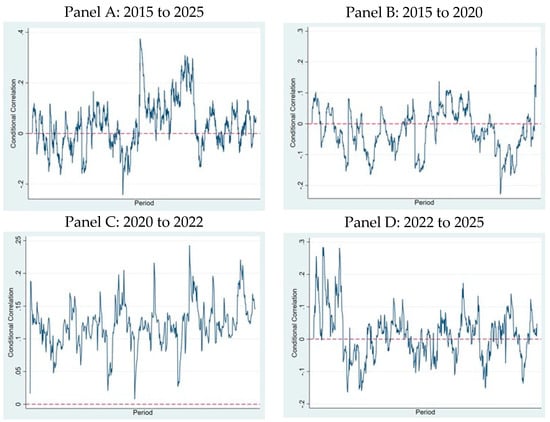
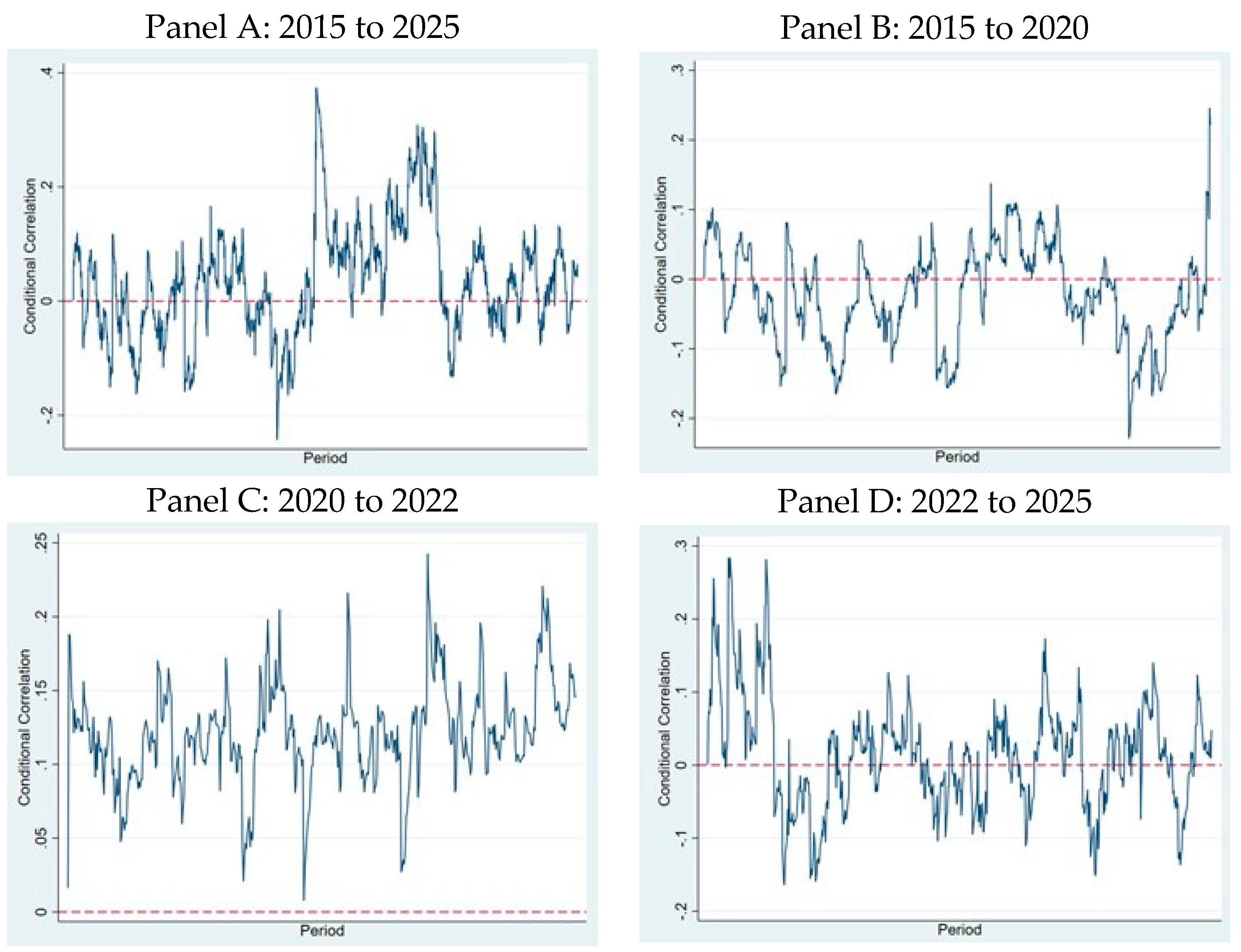
According to the results shown in Table 1, Table 2, Table 3 and Table 4, the behavior of the correlation between the assets suggests a change in the role of Bitcoin over the period. Figure 1 illustrates the evolution of the dynamic conditional correlation between BOVA11 and Bitcoin during the considered intervals.
Table 2.
Results before the pandemic.
Table 3.
Results during the pandemic.
Table 4.
Results after the pandemic.
Figure 1.
Evolution of the conditional correlation between BOVA11 and Bitcoin.
The present article used the definition by Bouri et al. (2017), in which they state that a diversifier asset is an asset that, on average, has a weak and positive correlation with another asset, and a hedge is one that, on average, is uncorrelated (weak hedge) or is negatively correlated (strong hedge) with another asset. Given this, in the period prior to the pandemic, Bitcoin did not have a significant correlation with BOVA11, acting as a weak hedge in the period.
Moreover, there was support for the statement that after the pandemic, Bitcoin started to act as a weak hedge for BOVA11, as the assets proved to be uncorrelated in this period (Baur and McDermott 2010; Bouri et al. 2017; Baur and Lucey 2010; Conlon and McGee 2020).
In the period during the pandemic, Bitcoin showed a positive and significant relationship at 5% with BOVA11. According to the theoretical framework used by the work, this cryptocurrency behaved as a diversifier asset for BOVA11, and not as a safe haven (Baur and McDermott 2010; Bouri et al. 2017; Baur and Lucey 2010), which contradicts that during the pandemic period (stress/exception), Bitcoin had the role of a safe haven in relation to BOVA11.
Using LLMs, particularly Google-Gemini, we conducted a robustness analysis by implementing the estimation within the model’s integrated Python sandbox environment (Python 3.10.16). Specifically, we estimated the conditional variance by implementing a custom Maximum Likelihood Estimation (MLE) procedure using the scipy.optimize library, combined with the statsmodels library for the mean equation (ARMA). We ran an ARMA(1,1)-GARCH(1,1) model for each asset to estimate the conditional variance; then, we evaluated the Pearson correlation between these conditional variances. The results indicated that before the pandemic, the correlation was close to zero; during the pandemic, the correlation was positive; and after the pandemic, the correlation was lower than during the pandemic period but remained positive. These results reinforce the time-varying behavior of the relationship between the assets, highlighting that during the pandemic the correlation was higher between them.
4. Discussion
The main results of the paper may surprise part of the market, especially given the widely disseminated narrative that Bitcoin would function as “digital gold” and, therefore, as natural protection in scenarios of high uncertainty (Baur and McDermott 2010; Bouri et al. 2017; Baur and Lucey 2010). However, the results of the present study indicated that, during the pandemic, Bitcoin’s behavior approached the pattern of risk assets more than the role of a safe haven. This result reinforces the need for cautious and contextual empirical evaluations regarding its protection properties (Bouri et al. 2017; Rudolf et al. 2021).
Previous studies identified that the pandemic altered the volatility dynamics between cryptocurrencies (Kayal and Dutta 2024) and also between cryptocurrencies and other assets such as exchange rates, gold, and stocks (Maghyereh and Abdoh 2022). Along this line, the present study identified that before the pandemic, Bitcoin had a weak hedge relationship with BOVA11; in the pandemic period, it started to act as a diversifier asset, and after the pandemic, it returned to being a hedge asset.
Moreover, previous studies indicated that Bitcoin does not present uniform behavior over time, being able to act at times as a hedge instrument, and at others as a diversification vehicle (Rudolf et al. 2021; Ullah et al. 2025). Furthermore, its function within a portfolio may vary according to the analyzed context, especially when considering periods of high turbulence, such as the COVID-19 pandemic (Lamine et al. 2024). The results of the present study corroborate this evidence, considering, however, specificities related to the context of the Brazilian market.
Consistent with Yae and Tian (2024), it was observed that during periods of greater stability (before and after the pandemic), Bitcoin exhibited a non-significant correlation with the Brazilian stock market, functioning as a weak hedge. Conversely, during the COVID-19 pandemic, the positive and statistically significant correlation between the assets suggests that Bitcoin behaved more like a risk asset than a safe haven. This result reinforces the evidence that its role in portfolios is regime-dependent and sensitive to global systemic shocks (Bossman et al. 2024; Yae and Tian 2024).
This study aligns with the approach proposed by Hsu et al. (2024), showing that Bitcoin alternates between the roles of a weak hedge and a diversifier depending on the economic context. In particular, the positive correlation observed during the pandemic period reinforces the notion that, in scenarios of systemic crisis, Bitcoin tends to behave more similarly to risk assets; in periods of normality, it may contribute to portfolio risk reduction through its low correlation with traditional assets (Hsu et al. 2024; Yae and Tian 2024).
These results have practical implications for individual, institutional, and foreign investors investing in the B3. In periods characterized by the absence of significant turbulence in the markets, Bitcoin tends to play a potential hedge role within the portfolio. Thus, for investors who maintain exposure to assets such as BOVA11, this characteristic shows strategic importance in the portfolio construction stage, especially regarding the definition of the allocation and relative weight of each asset. Moreover, the possibility of the asset performing hedge or diversification functions constitutes a decisive factor in the evaluation regarding its eventual inclusion in the portfolio.
A central aspect of this study is the analysis of distinct market regimes, covering the full period from 2015 to 2025, as well as specific sub-periods: pre-pandemic, during the pandemic, and post-COVID-19 pandemic. This approach enables the identification of changes in Bitcoin’s behavior with greater precision than analyses relying solely on the aggregate time series. By comparing these different regimes, it was observed that Bitcoin alternates between the roles of a weak hedge and a diversifier depending on the economic and market context, demonstrating that its correlation with BOVA11 is not uniform over time. This temporal breakdown provides additional insights into Bitcoin’s dynamics within the Brazilian market, contributing to a better understanding of its role in investment portfolios during periods of both stability and systemic stress.
5. Data and Methods
Considering that the dynamics of conditional correlation can vary between different time horizons (Bouri et al. 2017), the present work analyzed four distinct time windows.
The first analysis was the general period, from 2 January 2015 to 26 September 2025. The analysis begins in 2015 because this period was already used in previous works (Z. Chen 2025).
The second analysis was the pre-pandemic period, from 2015 to 2020. The start date of the pandemic, as considered by the work, was 11 March 2020, the day on which the World Health Organization (WHO) declared a pandemic due to COVID-19 (Governo do Brasil 2020). Therefore, this analysis period was from 2 January 2015 until 11 March 2020.
The third analysis was the pandemic period, from 2020 to 2022. The end date of the pandemic set in this work was 22 April 2022, as it was the date on which the Ministry of Health of the Federal Government of Brazil declared the end of the pandemic in the country (Governo do Brasil 2022). Therefore, the time horizon of this analysis was from 11 March 2020 until 22 April 2022. Finally, the analysis of the post-pandemic period was from 23 April 2022 until 26 September 2025.
For the comparison between Bitcoin and the traditional Brazilian market, BOVA11 was used, which is the ETF referenced to the IBOVESPA with the highest liquidity on the B3 (Rochman and Eid 2024). According to data from B3, foreign investors have been significantly increasing their participation in the Brazilian variable income market. Between August 2024 and August 2025, non-residents moved approximately R$ 3.82 trillion in stocks, ETFs, BDRs, and other assets, representing about 58.2% of the volume traded on the stock exchange (B3 Bora Investir 2025).
Also according to B3’s disclosure, in the first half of 2025 the volume traded by foreigners reached R$ 1.4 trillion, representing 62% of the total traded in the period, this being the highest percentage ever recorded.
Specifically regarding ETFs listed on the B3, “accessible sophistication” stands out (a name used by B3 itself to refer to financial product innovations on the stock exchange), which according to the 2025 Annual ETF Report, registered an aggregate equity exceeding R$ 75 billion and more than 850 thousand investors in custody (B3 2025a). Furthermore, among the products preferred by foreign funds, BOVA11 is the local ETF most traded by non-resident investors (B3 Bora Investir 2025).
The present study used daily data of the closing prices of Bitcoin and BOVA11. Bitcoin data were collected from the CoinMarketCap website, in line with previous works (Sahu et al. 2024; Zhang et al. 2024), while BOVA11 data were collected from the Economática database. The coefficients were estimated using the statistical software Stata 16.1.
The conditional correlation was estimated using daily data captures co-movement relationships relevant to investors with longer time horizons (daily or beyond), facilitating the analysis of hedge, diversification, or safe haven properties, which aligns with the focus of this study (Anas et al. 2024).
Furthermore, recent empirical studies highlight that differences in sampling intervals (daily vs. intraday) have a limited impact on aggregate return and volume metrics, particularly when aiming to understand correlations and patterns over broader horizons, such as weeks or months, as opposed to more volatile intraday variations (Anas et al. 2024). These results indicate that while intraday data provide greater detail, conclusions regarding broader co-movements tend to remain robust when using daily data, especially in the context of diversification and hedge analysis (Anas et al. 2024).
Moreover, unlike highly liquid markets such as U.S. equities, the cryptocurrency market is fragmented across multiple exchanges with varying liquidity, trading hours, and data quality (Zhang and Hua 2025). This introduces challenges related to synchronization and market microstructure, such as transaction noise and price recording mismatches, which complicate the analysis and may bias econometric estimates if not addressed with specific advanced methods (Zhang and Hua 2025).
Thus, the use of daily closing prices is a practical and widely adopted choice in studies aiming to measure correlation and volatility over longer periods. These data are uniformly collected across different markets and assets, providing consistency for calculating comparable daily return series while avoiding many issues associated with microstructure and intraday noise (Zhang and Hua 2025).
Finally, from the perspective of investors and portfolio managers, strategic decisions regarding diversification, hedging, and asset allocation are generally made based on daily or long-term returns, rather than high-frequency intraday movements (Anas et al. 2024). This renders the use of daily data more representative and applicable to risk management, capital allocation, and hedging policies, making it a methodological choice that is better aligned with the objective of this study (Anas et al. 2024).
For the analysis performed, the log-return of the assets was used. ARMA-GARCH and DCC-GARCH models were employed to hypothesis test. Next, the procedures adopted in the treatment of the data of the analyzed time series will be shown.
Initially, for both the Bitcoin and BOVA11 data series, the Jarque–Bera (JB) test was performed on the data, which indicated the rejection of the normality of residuals (p < 0.01), evidencing that the residuals of both data distributions do not possess a normal distribution (Gujarati and Porter 2011), a result convergent with the skewness and kurtosis coefficients of the two assets.
Next, the Augmented Dickey–Fuller (ADF) test was performed. The null of unit root was rejected (p < 0.01), evidencing the test statistic below the critical value, indicating stationarity (Gujarati and Porter 2011).
Subsequently, the correlogram analysis evidenced significant lags (among the 40 analyzed), evidencing the need for adjustment in the series, for both assets. Furthermore, the work tested whether the squared log-returns were normally distributed through the JB test (De Blasis et al. 2023), and this test rejected the normality of the data distribution.
With the objective of modeling the time series in question, various combinations of models were tested, and the selection was based on the lowest value of the Akaike Information Criterion (AIC) (AlMadany et al. 2024). Thus, the ARMA(1,2) model was the one that presented the best initial fit for Bitcoin, and ARMA(2,2) for BOVA11.
After this, the work added ARCH and GARCH terms for better model fit. Thus, different univariate GARCH models (Bollerslev 1986) were tested for better modeling of the series. After testing different models, the one that showed the best fit for Bitcoin was ARMA(1,1)GARCH(1,1), and for BOVA11 it was ARMA(1,0)GARCH(1,1).
After identifying this, the work performed the Ljung–Box test for the standardized residuals to verify the presence of autocorrelation in the data (De Blasis et al. 2023). The results indicated that the standardized residuals of this model did not evidence autocorrelation (p > 0.05), suggesting that the model was well fitted.
To model the time-varying volatility and dependence structure of asset returns, this study employs the Dynamic Conditional Correlation GARCH (DCC-GARCH) model originally proposed by Engle (2002). This specification allows for flexible univariate volatility dynamics while capturing the evolution of conditional correlations over time in a parsimonious manner.
The model that showed the lowest AIC was selected (AlMadany et al. 2024). Therefore, in the case of the analysis of these variables for this period, the best model was the DCC-GARCH(1,1).
This procedure is in line with the area’s literature (Engle 2002), which recommends parsimonious and symmetric models in the variance equations to ensure stability and facilitate multivariate estimation.
According to Engle (2002) and Engle and Sheppard (2001), the estimation of the DCC-GARCH model is performed in two stages, such that the quality of the fit depends more on the joint behavior of the standardized residuals than on the optimal fit of each individual series. Thus, small differences in the orders of the univariate models do not compromise the consistency of the multivariate model.
The same procedure was followed to model the series within the sub-periods from 2015 to 2020, from 2020 to 2022, and from 2022 to 2025; in each of these cases, the model with the best fit was the DCC-GARCH(1,1). For a robustness check, we also conducted the analysis of sub-periods using Large Language Models (LLMs). Integrating LLMs into studies that use classical econometric frameworks, such as GARCH or DCC-GARCH models, represents a methodological ‘stress test’ strategy (Delgadillo et al. 2024; Song et al. 2025; Dias and Malaquias, 2026).
6. Conclusions
This paper analyzed the conditional correlation dynamics between Bitcoin and BOVA11 across different market periods, employing the DCC-GARCH model and considering three sub-periods: pre-pandemic, during the pandemic, and post-COVID-19 pandemic, as well as the aggregate period from 2015 to 2025. The results indicated that, in the period prior to the pandemic, Bitcoin did not possess significant correlation with BOVA11, acting as a weak hedge in the period. Furthermore, the hypothesis that Bitcoin acted as a weak hedge for BOVA11 after the pandemic was not rejected, as the assets proved to be uncorrelated in this period.
During the pandemic, Bitcoin showed a positive and significant relationship with BOVA11. While the economic magnitude of the coefficient was low, this behavior characterizes the cryptocurrency as a diversifier rather than a safe haven. These findings contrast with the narrative of Bitcoin as “digital gold” during periods of high uncertainty, suggesting instead that, under systemic stress, its behavior may align more closely with risk assets. This result reinforces the importance of rigorous and context-sensitive empirical analyses when evaluating its potential protection properties (Baur and McDermott 2010; Bouri et al. 2017; Baur and Lucey 2010).
The results found have relevant implications for different profiles of investors operating on the B3. For the individual investor, the importance of recognizing that, in contexts of lower volatility, Bitcoin can exercise a hedge function within the portfolio stands out, which reinforces its strategic utility in asset allocation, especially for those exposed to BOVA11. In the case of institutional investors, especially foreign ones, who have expanded their participation in this ETF, the identification of Bitcoin as a potential diversification or protection instrument assumes a central role in management and decision-making processes, in a scenario marked by growing international interest.
In broader terms, the study adds value both to portfolio management practice and to the academic field by demonstrating that the role played by Bitcoin, whether as a hedge or as a diversifier asset, varies according to the market context. This alternation between functions reinforces the need for careful and contextual analyses when defining the asset’s weight in portfolios, especially in periods of crisis, evidencing that its behavior is not static, but varies according to the economic context (Bouri et al. 2017; Rudolf et al. 2021; Ullah et al. 2025).
Despite the contributions presented, this study has limitations that must be recognized. The analysis focused exclusively on the relationship between Bitcoin and BOVA11, and was also based on daily closing prices, which may omit relevant intraday variations. Thus, future studies could expand the scope of analyzed assets, include other dependence metrics, and consider shorter time windows or high-frequency data. Investigations exploring the influence of global macroeconomic events, monetary policies, and international capital flows could also deepen the understanding of Bitcoin’s role in different market regimes.
Author Contributions
Conceptualization, V.F.M.B.D. and R.F.M.; Methodology, V.F.M.B.D.; Validation, V.F.M.B.D.; Formal analysis, V.F.M.B.D.; Data curation, V.F.M.B.D.; Writing—original draft, V.F.M.B.D.; Writing—review and editing, V.F.M.B.D. and R.F.M.; Visualization, V.F.M.B.D. and R.F.M.; Supervision, V.F.M.B.D. and R.F.M. All authors have read and agreed to the published version of the manuscript.
Funding
Prof. Rodrigo F. Malaquias would like to thank The Minas Gerais State Research Support Foundation (FAPEMIG—APQ-02071-22) for the support in developing part of this research. Prof. Rodrigo also thanks The National Council for Scientific and Technological Development (CNPq) for the support in developing part of this research. Dr. Vitor Fonseca Machado Beling Dias is grateful for the scholarship from FAPEMIG. The APC was funded by MDPI.
Data Availability Statement
The raw data supporting the conclusions of this article will be made available by the authors on request.
Acknowledgments
During the preparation of this manuscript, the authors employed the AI tools Google Gemini (accessed in November 2025) and DeepL (free version) to enhance readability and language, and to translate sections initially written by the authors in Portuguese. After using these tools, the authors reviewed and edited the content as needed and take full responsibility for the content of the publication.
Conflicts of Interest
The authors declare no conflicts of interest.
Abbreviations
The following abbreviations are used in this manuscript:
| ADF | Augmented Dickey–Fuller |
| AIC | Akaike Information Criterion |
| ARCH | Autoregressive Conditional Heteroskedasticity |
| ARMA | Autoregressive Moving Average |
| B3 | Brasil, Bolsa, Balcão |
| BDR | Brazilian Depositary Receipts |
| COVID-19 | Coronavirus Disease 2019 |
| DCC-GARCH | Dynamic Conditional Correlation—Generalized Autoregressive Conditional Heteroskedasticity |
| ETF | Exchange Traded Fund |
| GARCH | Generalized Autoregressive Conditional Heteroskedasticity |
| IBOVESPA | Índice Bovespa |
| JB | Jarque–Bera |
| VaR | Value-at-Risk |
| WHO | World Health Organization |
References
- AlMadany, Nehal N., Omar Hujran, Ghazi Al Naymat, and Aktham Maghyereh. Forecasting cryptocurrency returns using classical statistical and deep learning techniques. International Journal of Information Management Data Insights 4: 100251. [CrossRef] [Scilit]
- Anas, Muhammad, Shahzad J. H. Syed, and Larisa Yarovaya. 2024. The use of high-frequency data in cryptocurrency research: A meta-review of literature with bibliometric analysis. Financial Innovation 10: 90. [Google Scholar] [CrossRef] [Scilit]
- B3. 2025a. Investidor Estrangeiro Movimenta R$ 1,4 Trilhão na B3 no 1º Semestre. DataWise+/Neoway. July 31. Available online: https://www.b3.com.br/pt_br/noticias/neoway-8AA8D0CC9851DC300198669D5D5B2F4A.htm (accessed on 5 November 2025).
- B3. 2025b. Relatório Anual de ETFs 2025 Aponta Nova Era de Inovação e Amadurecimento dos Investidores. B3. Available online: https://www.b3.com.br/pt_br/noticias/relatorio-anual-de-etfs-2025-da-b3-aponta-nova-era-de-inovacao-e-amadurecimento-dos-investidores.htm (accessed on 5 November 2025).
- B3 Bora Investir. 2025. Como os Investidores Estrangeiros Operam na B3? Veja 9 Curiosidades. Available online: https://borainvestir.b3.com.br/objetivos-financeiros/investir-melhor/como-os-investidores-estrangeiros-operam-na-b3-veja-9-curiosidades/ (accessed on 6 November 2025).
- Baur, Dirk G., and Brian M. Lucey. 2010. Is gold a hedge or a safe haven? An analysis of stocks, bonds and gold. The Financial Review 45: 217–29. [Google Scholar] [CrossRef] [Scilit]
- Baur, Dirk G., and Thomas K. McDermott. 2010. Is gold a safe haven? International evidence. Journal of Banking & Finance 34: 1886–98. [Google Scholar] [CrossRef] [Scilit]
- Bollerslev, Tim. 1986. Generalized autoregressive conditional heteroskedasticity. Journal of Econometrics 31: 307–27. [Google Scholar] [CrossRef] [Scilit]
- Bossman, Ahmed, Mariya Gubareva, Samuel Kwaku Agyei, and Xuan Vinh Vo. 2024. When you need them, they are not there: Hedge capacities of cryptocurrencies disappear in downtrend markets. Financial Innovation 10: 112. [Google Scholar] [CrossRef] [Scilit]
- Bouri, Elie, Peter Molnár, Georges Azzi, David Roubaud, and Lars Ivar Hagfors. 2017. On the hedge and safe haven properties of Bitcoin: Is it really more than a diversifier? Finance Research Letters 20: 192–98. [Google Scholar] [CrossRef] [Scilit]
- Chen, Kuo-Shing. 2024. Interlinkages between Bitcoin, green financial assets, oil, and emerging stock markets. Data Science in Finance Economics 4: 160–87. [Google Scholar] [CrossRef] [Scilit]
- Chen, Zhengyang. 2025. From Disruption to Integration: Cryptocurrency Prices, Financial Fluctuations, and Macroeconomy. Journal of Risk and Financial Management 18: 360. [Google Scholar] [CrossRef] [Scilit]
- Conlon, Thomas, and Richard McGee. 2020. Safe haven or risky hazard? Bitcoin during the COVID-19 bear market. Finance Research Letters 35: 101607. [Google Scholar] [CrossRef] [Scilit]
- De Blasis, Riccardo, Luca Galati, Alexander Webb, and Robert I. Webb. 2023. Intelligent design: Stablecoins (in) stability and collateral during market turbulence. Financial Innovation 9: 85. [Google Scholar] [CrossRef] [Scilit]
- Delgadillo, Josiel, Johnson Kinyua, and Charles Mutigwe. 2024. FinSoSent: Advancing financial market sentiment analysis through pretrained large language models. Big Data and Cognitive Computing 8: 87. [Google Scholar] [CrossRef] [Scilit]
- Dias, Vitor Fonseca Machado, and Rodrigo Fernandes Malaquias. 2026. Is It a Case of Safe Haven? Analyzing Stablecoin Returns Considering Cryptocurrency Dynamics. Journal of Risk and Financial Management 19: 81. [Google Scholar] [CrossRef] [Scilit]
- Engle, Robert F. 2002. Dynamic Conditional Correlation—A Simple Class of Multivariate GARCH Models. Journal of Business & Economic Statistics 20: 339–50. [Google Scholar] [CrossRef] [Scilit]
- Engle, Robert F., and Kevin Sheppard. 2001. Theoretical and Empirical Properties of Dynamic Conditional Correlation Multivariate GARCH. NBER Working Paper No. 8554. Cambridge: National Bureau of Economic Research. [Google Scholar]
- Ghabri, Yosra, Khaled Guesmi, and Ahlem Zantour. 2021. Bitcoin and liquidity risk diversification. Finance Research Letters 40: 101679. [Google Scholar] [CrossRef] [Scilit]
- Governo do Brasil. 2020. OMS Classifica Coronavírus Como Pandemia. March 11. Available online: https://www.gov.br/pt-br/noticias/saude-e-vigilancia-sanitaria/2020/03/oms-classifica-coronavirus-como-pandemia (accessed on 4 November 2025).
- Governo do Brasil, Ministério da Saúde. 2022. Ministério da Saúde Declara Fim da Emergência em Saúde Pública de Importância Nacional pela COVID-19. April 22. Available online: https://www.gov.br/saude/pt-br/assuntos/noticias/2022/abril/ministerio-da-saude-declara-fim-da-emergencia-em-saude-publica-de-importancia-nacional-pela-covid-19 (accessed on 4 November 2025).
- Gujarati, Damodar N., and Dawn C. Porter. 2011. Econometria Básica, 5th ed. Porto Alegre: AMGH. [Google Scholar]
- Hsu, Shu-Han, Po-Keng Cheng, and Yiwen Yang. 2024. Diversification, hedging, and safe-haven characteristics of cryptocurrencies: A structural change approach. International Review of Financial Analysis 93: 103211. [Google Scholar] [CrossRef] [Scilit]
- Kayal, Parthajit, and Sumanjay Dutta. 2024. Regime switching and causal network analysis of cryptocurrency volatility: Evidence from pre-COVID and post-COVID analysis. Digital Finance 6: 319–40. [Google Scholar] [CrossRef] [Scilit]
- Lamine, Ahlem, Ahmed Jeribi, and Tarek Fakhfakh. 2024. Spillovers between cryptocurrencies, gold and stock markets: Implication for hedging strategies and portfolio diversification under the COVID-19 pandemic. Journal of Economics, Finance and Administrative Science 29: 21–41. [Google Scholar] [CrossRef] [Scilit]
- Maghyereh, Aktham, and Hussein Abdoh. 2022. COVID-19 and the volatility interlinkage between bitcoin and financial assets. Empirical Economics 63: 2875–901. [Google Scholar] [CrossRef] [Scilit] [PubMed]
- Manzli, Yasmine Snene, Mohamed Fakhfekh, Azza Béjaoui, Hind Alnafisah, and Ahmed Jeribi. 2025. On the hedge and safe-haven abilities of bitcoin and gold against blue economy and green finance assets during global crises: Evidence from the DCC, ADCC and GO-GARCH models. PLoS ONE 20: e0317735. [Google Scholar] [CrossRef] [Scilit]
- Rochman, Ricardo, and William Eid, Jr. 2024. Performance of Funds of Funds (FOFs) in Brazil. SSRN. Available online: https://papers.ssrn.com/sol3/papers.cfm?abstract_id=4740923 (accessed on 4 November 2025).
- Rudolf, Karl Oton, Samer Ajour El Zein, and Nicola Jackman Lansdowne. 2021. Bitcoin as an investment and hedge alternative: A DCC MGARCH model analysis. Risks 9: 154. [Google Scholar] [CrossRef] [Scilit]
- Sahu, Sonal, Alejandro Fonseca Ramírez, and Jong-Min Kim. 2024. A Forecasting Model Approach: Investigating Calendar Anomalies and Volatility Patterns in the Cryptocurrency Market. Preprints, 2024050905. [Google Scholar] [CrossRef] [Scilit]
- Sharma, Manu. 2025. Does Bitcoin Add to Risk Diversification of Alternative Investment Fund Portfolio? International Journal of Financial Studies 13: 197. [Google Scholar] [CrossRef] [Scilit]
- Song, Yuping, Yilun Zhang, Jiefei Huang, and Aijun Yang. 2025. Volatility and value-at-risk forecasting using BERT and transformer models incorporating investors’ textual sentiments. Finance Research Letters 85: 108210. [Google Scholar] [CrossRef] [Scilit]
- Tsay, Ruey S. 2010. Analysis of Financial Time Series, 3rd ed. Hoboken: John Wiley & Sons. [Google Scholar] [CrossRef] [Scilit]
- Ullah, Mirzat, Kazi Sohag, Svetlana Doroshenko, and Oleg Mariev. 2025. Examination of Bitcoin Hedging, diversification and safe-haven ability during financial crisis: Evidence from equity, bonds, precious metals and exchange rate markets. Computational Economics 66: 835–67. [Google Scholar] [CrossRef] [Scilit]
- Wu, Di. 2024. Bitcoin ETF: Opportunities and risk. arXiv arXiv:2409.00270. [Google Scholar] [CrossRef] [Scilit]
- Yae, James, and George Zhe Tian. 2024. Volatile safe-haven asset: Evidence from Bitcoin. Journal of Financial Stability 73: 101285. [Google Scholar] [CrossRef] [Scilit]
- Zhang, Lu, and Lei Hua. 2025. Major issues in high-frequency financial data analysis: A survey of solutions. Mathematics 13: 347. [Google Scholar] [CrossRef] [Scilit]
- Zhang, Pengcheng, Kunpeng Xu, Jian Huang, and Jiayin Qi. 2024. Investor sentiment and the holiday effect in the cryptocurrency market: Evidence from China. Financial Innovation 10: 113. [Google Scholar] [CrossRef] [Scilit]

Disclaimer/Publisher’s Note: The statements, opinions and data contained in all publications are solely those of the individual author(s) and contributor(s) and not of MDPI and/or the editor(s). MDPI and/or the editor(s) disclaim responsibility for any injury to people or property resulting from any ideas, methods, instructions or products referred to in the content. |
© 2026 by the authors. Licensee MDPI, Basel, Switzerland. This article is an open access article distributed under the terms and conditions of the Creative Commons Attribution (CC BY) license.