


Highlights
What are the main findings?
- Communication about illness severity in the NICU was most often clinician-led and focused on providing biomedical information rather than supporting interactive discussion or shared decision-making.
- Few studies examined how communication changed across periods of clinical stability, deterioration, or recovery. The studies inconsistently described prognostic framing and parental engagement.
What are the implications of the main findings?
- Greater attention to illness trajectory and parental information needs may help improve communication practices in the NICU.
- Future research should better distinguish between informational communication and communication intended to support parental decision-making, particularly during changes in illness severity.
Abstract
Background/Objectives: Communication about illness severity in the neonatal intensive care unit (NICU) occurs in settings of uncertainty and changing clinical status. Reviewing how the literature describes this communication may clarify current practices and identify gaps in how parents receive severity-related information. This scoping review aimed to describe how illness severity is communicated to parents in the NICU, including parental engagement, communication goals, informational content, framing, and communication across periods of clinical stability and deterioration. Methods: We conducted a scoping review using the Joanna Briggs Institute method and reported it according to PRISMA-ScR guidelines. MEDLINE (Ovid) was searched from 2010 to 2025. We included studies that reported empirical data on communication about infant clinical status or illness severity and included parental perspectives. A framework, informed by parental information behaviour and prognostic communication models, guided the data extraction. Results: We included 25 studies. Communication was most often clinician-led and often combined active and passive approaches. Communication primarily focused on information sharing rather than decision-making. Discussions were largely biomedical; however, several studies also included treatment- and care-related information. Studies inconsistently described prognostic communication and did not emphasize optimistic or pessimistic framing. Few studies examined communication across distinct phases of illness trajectory, such as clinical stability or deterioration. Conclusions: Illness severity communication in the NICU remains largely clinician-led, with limited attention to parental engagement and changes across the infant’s clinical course. Greater consideration of parental information needs, prognostic communication, and illness trajectory may support more responsive communication practices in NICU care.
1. Introduction
The neonatal intensive care unit (NICU) is a setting of clinical uncertainty, changing illness trajectories, and emotionally difficult decision-making [1,2]. Parents of critically ill infants must interpret complex medical information while coping with stress, fear, and prolonged hospitalization [3,4]. Communication about illness severity is therefore not limited to isolated conversations but occurs throughout the infant’s clinical course [1]. How information is communicated can influence parental understanding, trust, engagement, and involvement in care and decision-making [1,5,6,7].
Communication about illness severity includes discussion of the infant’s current condition, changes in clinical status, treatment plans, prognosis, and uncertainty [1,2]. These conversations may occur during bedside updates, family meetings, rounds, or urgent clinical events [3]. They may involve an explanation of physiologic parameters, treatment plans, and prognosis, and acknowledgement of uncertainty [8,9]. Presenting information optimistically, pessimistically, or in a balanced manner can shape parents’ interpretation of prognosis and expectations [10]. Communication may also serve different purposes, ranging from providing clinical updates to supporting shared decision-making [1,2].
Existing literature on NICU communication has largely focused on family-centred care, shared decision-making, parental experiences, and prognostic discussions in neonatal and pediatric critical care settings [1,2,3,4,5,6,7,8]. However, studies often examine communication broadly. They do not distinguish between information sharing and decision support, nor do they consider how communication changes across the infant’s clinical course [4]. Important aspects of illness severity communication, including parental engagement, framing, timing, communication modality, and informational content, remain poorly characterized and inconsistently reported in the existing literature [1].
Little information exists on how illness severity communication differs across NICU care phases, such as when a patient is stable or their condition worsens [2,4]. It is also unclear how parents participate in these discussions or how informational communication differs from communication intended to support decision-making. Examining these patterns may help identify gaps in current communication practices and areas for improvement in NICU care.
The aim of this scoping review was to describe how illness severity is communicated to parents of infants in the NICU, including parental engagement, communication goals, informational content, framing, and communication across periods of clinical stability and deterioration.
Research Question
How is illness severity communicated to parents of infants in the NICU, with respect to parental engagement, communicative purpose, informational content, framing style, and the temporal context (including periods of stability and deterioration)?
2. Materials and Methods
2.1. Study Design
This scoping review followed the Joanna Briggs Institute (JBI) methodology for scoping reviews and used the PRISMA-ScR (Preferred Reporting Items for Systematic Reviews and Meta-Analyses extension for Scoping Reviews) checklist for reporting [11,12] (Supplementary Table S1). We chose a scoping review approach because the literature on illness severity communication in the NICU includes qualitative, quantitative, and mixed-method studies, as well as studies examining digital communication tools and physiologic displays [12,13]. This review describes how the literature represents illness severity communication and identifies key patterns and gaps in current communication practices. We did not prospectively publish a protocol for this scoping review.
2.2. Research Question Development
The review was initially focused on communication strategies involving real-time physiologic data and digital tools in the NICU. The original research question examined how these approaches influenced parental understanding, preferences, and satisfaction compared with standard communication methods. A PICO framework was used to guide question development [14].
During screening and data extraction, few studies directly compared digital or physiologic data-based communication tools with standard communication approaches. We therefore broadened the review’s scope to examine illness severity communication more generally, including parental engagement, communication goals, informational content, framing, and communication across the infant’s clinical course.
2.3. Search Strategy
We developed a search strategy in collaboration with a research librarian (PG) to identify literature on illness severity communication in the NICU. The search combined controlled vocabulary and keywords related to NICU parents and caregivers, illness severity and clinical status, and communication.
On 6 May 2025, we searched MEDLINE (Ovid) for studies published between 2010 and 2025. Search terms included concepts related to illness severity, prognosis, clinical deterioration, and provider–family communication. Supplementary Table S2 provides the full search strategy.
We selected MEDLINE because it broadly covers neonatal and clinical literature. Records were imported into Covidence (Veritas Health Innovation, Melbourne, Australia) for screening and data management. Reference lists of included studies were also reviewed to identify additional articles [13].
2.4. Eligibility Criteria
We included studies that reported empirical data on communication concerning infant clinical status, illness severity, physiologic stability, or medical complexity during NICU hospitalization and that also incorporated parental perspectives (e.g., preferences, understanding, satisfaction, or experiences). Qualitative, quantitative, and mixed-method studies were eligible. We also included studies that examined verbal, written, or digital communication approaches.
Studies were excluded if they focused exclusively on long-term prognosis or discharge counselling, included only clinician perspectives, were non-empirical (e.g., editorials or commentaries), or were not published in English.
2.5. Study Selection
We imported all retrieved citations into Covidence and removed duplicates before screening. Study selection was conducted in two stages: title and abstract screening, followed by full-text review.
Before screening began, reviewers completed a pilot calibration exercise to ensure consistent application of eligibility criteria. Four reviewers (YT, KM, JH, AM) took part in the screening process. Two reviewers independently assessed each citation at both stages. We resolved discrepancies through discussion and consensus.
We documented the reasons for exclusion at the full-text stage. The PRISMA-ScR flow diagram [11] presents the study selection process.
2.6. Data Charting and Extraction
Data were extracted using a structured charting form developed iteratively in accordance with JBI guidance. The extraction framework was informed by the parental information behaviour and illness trajectory model described by De Rouck and Leys [4,8], and by observational studies of prognostic communication in the NICU [8].
Extracted study characteristics included authorship, publication year, country, study design, population, sample size, and key findings.
Communication-related data included communication modality (verbal, written, or digital), interaction style (active, passive, individual, or collective), communication goals (information sharing or decision-making), informational content, prognostic focus, framing, and source of information. We also categorized communication based on the reported illness trajectory, which included periods of stability, gradual change, or clinical deterioration [4,15].
Prognosis in this study refers to the anticipated course or trajectory of a disease or health condition and the likelihood of future health outcomes over time, including deterioration, improvement or recovery, complications, functional outcomes, recurrence, and survival [16,17]. We synthesized communication characteristics on prognosis in the included studies using a structured framework [8]. The framework examined when prognoses were given, what outcomes clinicians discussed, how they focused and framed prognostic information, how explicit they were about prognoses, and whether they assured families of continued support.
2.7. Data Analysis
Data were synthesized using descriptive and thematic approaches. We organized the extracted findings according to illness trajectory, communication modality, interaction style, informational content, and parent-reported outcomes.
Thematic analysis allowed us to identify recurring patterns and gaps in descriptions of illness severity communication across studies. Analysis focused on parental engagement, communication goals, informational content, framing, and differences across the infant’s clinical course. Our review team discussion iteratively refined the themes [3].
3. Results
3.1. Study Selection and Characteristics
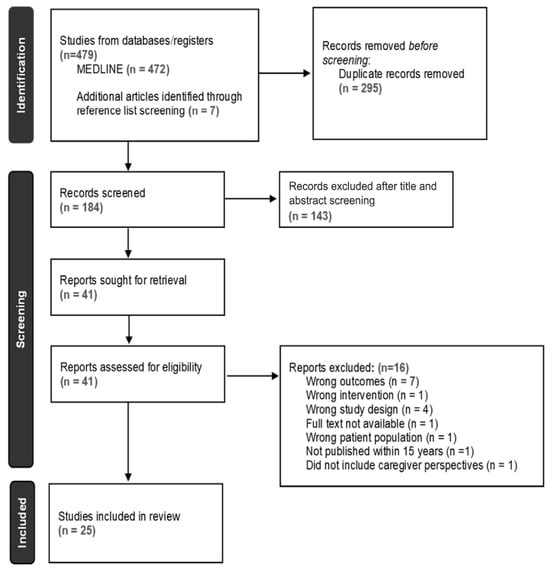
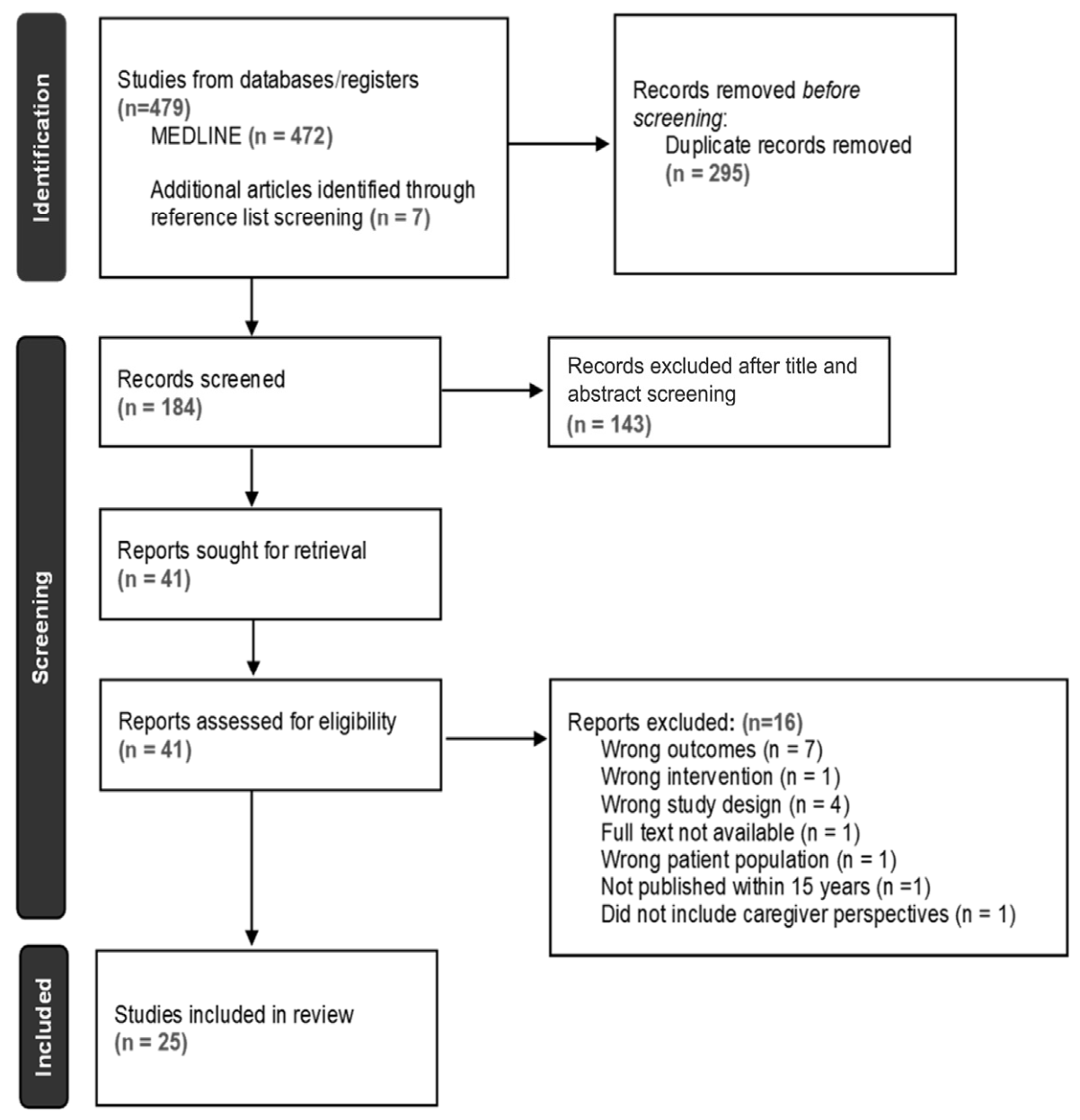
A total of 479 records were identified (472 through database searching, and 7 through reference list screening). After removing duplicates (n = 184), we excluded 143 studies after title and abstract screening because they did not meet the inclusion criteria (n = 143). We then assessed 41 full-text articles for eligibility. A total of 25 studies met inclusion criteria and were included in the final synthesis (Figure 1).
Figure 1.
PRISMA-ScR flow diagram of study selection.
Included studies were published between 2010 and 2025 and were conducted primarily in the United States (n = 14) [8,18,19,20,21,22,23,24,25,26,27,28,29,30] alongside studies from Canada [31], Australia [32], New Zealand [33], Brazil [34], South Korea [35], Israel [36], and several European and African countries [9,10,37,38,39] (Table 1). Study designs included qualitative (n = 10) [19,24,25,26,27,32,34,37,38,39], mixed-method (n = 9) [8,9,20,21,23,28,30,31,33], and quantitative approaches (n = 6) [10,18,22,29,35,36]. Sample sizes ranged from 10 to 729 participants. Most studies involved parents of infants currently admitted to the NICU (n = 14) [9,18,20,21,22,24,29,30,33,34,35,36,37,39], a smaller number examined caregivers retrospectively following NICU discharge (n = 6) [10,23,25,31,32,38], and a few examined caregivers both during NICU admission and after discharge (n = 5) [8,19,26,27,28].
Table 1.
Characteristics of included studies examining illness severity communication in the neonatal intensive care unit (NICU).
3.2. Communication Context and Illness Trajectory
Two articles addressed both gradually evolving trajectories and acute deterioration [10,29] while the remaining studies focused exclusively on gradually evolving conditions, with limited explicit attention to crisis situations [18,20,21,22,23,26,27,30,31,32,33,34,35,36]. Multiple studies did not report prognostic context, or it was unclear (n = 12) [18,20,21,22,24,28,29,30,32,35,36,37]. Table 2 provides references to specific studies. Although all included studies addressed aspects of illness severity communication, few studies examined how communication differed across phases of the infant’s clinical course.
Table 2.
Communication characteristics of studies examining illness severity communication in the neonatal intensive care unit (NICU).
3.3. Communication Modalities and Interaction Structures
Table 2 summarizes information on communication, including various approaches, channels, purposes, and locations, as well as interaction styles and informational content across the included studies.
Communication was predominantly clinician-led (n = 16) [8,10,20,21,22,23,24,25,26,27,28,30,33,35,37,39] and often characterized by a combination of passive and active information sharing from healthcare professionals to parents (n = 11) [8,19,24,25,28,33,34,35,37,38,39]. Eight studies reported a passive communication approach where clinicians relayed information to parents without having an interactive component [18,23,27,29,30,31,32,36] while an additional six studies described active parental engagement, involving questioning or participation [9,10,20,21,22,26].
Communication interactions were primarily collective, occurring during multidisciplinary family meetings or rounds involving multiple providers and family members (n = 11) [8,24,25,27,28,33,34,35,37,38,39], or individual, occurring between a parent and a clinician (n = 10) [9,10,18,20,21,26,29,30,31,36]. Combined interaction structures were less frequently described (n = 2) [22,23], and the two studies did not clearly specify the interaction format [19,32].
Communication primarily focused on providing updates about the infant’s condition (n = 12) [10,18,20,21,22,26,28,29,30,34,36,39], with fewer studies explicitly centred on decision-making (n = 2) [9,38]. Several studies described both information and decisional elements without clearly distinguishing between them (n = 11) [8,19,23,24,25,27,31,32,33,35,37].
Most communication occurred through face-to-face verbal interactions (n = 15) [8,9,19,22,23,24,25,28,30,33,34,35,37,38], with communication typically taking place within the NICU (n = 18) [8,9,19,20,22,24,25,27,28,29,30,31,33,34,35,36,37,38]. However, few studies described the context of these interactions. They did not specify if communication happened at the, bedside, or in a private meeting room. The studies also failed to mention whether discussions were formal, scheduled meetings or informal bedside updates. Some studies described supplementary formats such as written materials, including educational handouts and printed summaries (n = 3) [18,29,38], electronic tools (n = 4) [31,33,36,38], or audiovisual displays (n = 4) [10,18,21,22], though these approaches were inconsistently evaluated. Four studies did not report the use of a specific communication channel (n = 4) [20,26,27,32].
3.4. Content of Information Communicated
A total of 10 studies reported communication that integrated all three domains (biomedical, treatment-related, and care-related information) [19,21,23,24,25,26,31,32,35,39], while others described more limited content, including biomedical information alone (n = 7) [8,10,18,27,28,29,34], biomedical combined with treatment (n = 3) [20,30,32], or biomedical combined with care-related information (n = 3) [9,22,37]. Few studies focused exclusively on care-related information (n = 1) [36] or treatment and care without explicit biomedical context (n = 1) [38].
3.5. Decision-Making Approaches
No studies explicitly reported the use of established frameworks such as the SHARE approach (Seek patient participation, Help explore options, Assess values, Reach a decision, Evaluate the decision) or other named decision-making models [40]. Four studies described locally developed or unspecified approaches [9,19,31,38], while the majority (n = 14) did not report any structured framework guiding communication or decision-making processes [10,18,20,21,22,23,26,27,29,30,32,36,37,39].
3.6. Prognostic Communication in the NICU
Thirteen studies addressed prognostic communication in the NICU [8,9,10,19,23,25,26,27,31,33,34,38,39], while 12 studies either did not report or were unclear about reporting prognostic context [18,20,21,22,24,28,29,30,32,35,36,37]. Table 3 summarizes these findings, and Section 3.9 discusses them further. Seven studies described prognostic discussions addressing survival, functional outcomes (e.g., neurodevelopmental status or long-term disability), and quality of life [8,9,19,25,26,27,38]. In contrast, six studies presented more limited prognostic information, focusing on one or two of these domains [10,23,32,33,34,39].
Table 3.
Communication characteristics of studies examining prognostic communication in the NICU.
Framing of prognostic information was most described as neutral (n = 3) [9,25,26]. Two studies reported the use of a balanced approach, using both optimistic and pessimistic framing [19,39]. Two other studies reported a pessimistic approach [23,27], and two studies presented mixed findings where participants held differing views on the framing used within the same study [8,10]. One study reported exclusively optimistic framing [34], while three studies did not specify framing [32,33,38].
3.7. Representation of Illness Severity
Researchers used a variety of constructs to communicate illness severity, rather than a standardized severity scale, in the included studies. The most common approach relied on clinicians’ overall assessment of the infant’s clinical status, described using qualitative terms such as stable, improving, worsening, or critically ill [24,33,37,39]. Six studies also used quantitative measures to describe illness severity [8,20,28,29,30,31]. Among these six, four used Likert scales ranging from not sick to sick (3–5 point Likert scales) [8,20,28,30]. Several studies communicated illness severity through disease-specific diagnoses or complications, including patent ductus arteriosus, cerebral palsy, brain injury, and extreme prematurity, rather than by using an overall measure of illness severity [18,24,27].
Prognostic information made up another common representation of illness severity. Studies described prognosis in terms of expected neurological outcomes based on brain imaging, neurodevelopmental impairment, survival probability, disability, and anticipated quality of life [8,9,10,23,27,39]. Illness severity was also communicated through descriptions of acute clinical deterioration requiring escalation of treatment or end-of-life discussions [9,19,25]. Less commonly, clinicians represented severity using continuous physiologic information such as bedside vital signs [29,36], explicit discussion of prognostic uncertainty [8,9,26], or the severity thresholds that prompted treatment decisions such as surgery, resuscitation, or limitation of care [31,35,38].
Overall, no study reported the use of a standardized illness severity scale specifically designed for communication with parents. Instead, clinicians used a diverse set of descriptions to represent illness severity. These included clinical status, diagnosis-specific information, physiological findings, prognostic estimates, uncertainty, and treatment decision thresholds, with the specific representation varying based on the clinical context.
3.8. Evidence-Derived Strategies to Improve Illness Severity Communication
We identified several evidence-derived strategies across the included studies to improve the communication of illness severity between clinicians and parents. The included studies identified specific strategies, and Supplementary Table S3 lists their references. These strategies emphasized delivering information using multiple complementary communication modalities, including written, electronic, audiovisual, and remote communication tools, to supplement rather than replace face-to-face clinician discussions. Studies also highlighted the importance of using plain language, confirming parental understanding, and actively involving parents in communication by encouraging questions and participation. Communication became more effective when clinicians explicitly acknowledged prognostic uncertainty, presented both favourable and unfavourable potential outcomes, and combined biomedical information with treatment plans and caregiving guidance. Several studies further emphasized the importance of tailoring communication to the infant’s clinical circumstances and family values, distinguishing routine information sharing from decision-making conversations, delivering serious news with empathy, maintaining consistency across members of the healthcare team, and supporting parents throughout the communication process (Supplementary Table S3).
3.9. Evidence-Derived Strategies to Improve Prognostic Communication
Studies examining prognostic communication identified several strategies that may improve discussions about anticipated outcomes between clinicians and parents. We provide references to specific strategies from included studies in Supplementary Table S4. Effective prognostic communication involved an individualized and iterative process that evolved throughout the infant’s clinical course, rather than a single disclosure. Recommended approaches included tailoring discussions with parents’ informational needs, balancing honesty with realistic hope, communicating the full range of potential outcomes, distinguishing population-based estimates from individualized prognosis, and explicitly discussing uncertainty. Studies also emphasized revisiting prognosis as new clinical information became available, using treatment trials with predefined goals and reassessment plans when uncertainty remained high, and clearly distinguishing prognostic discussions from shared decision-making conversations. Additional strategies included using understandable language, maintaining continuity across clinicians, responding to parents’ emotional needs, providing reassurance of continued care irrespective of prognosis, and using written or visual materials to support, but not replace, clinician–parent discussions (Supplementary Table S4).
3.10. Training Clinicians to Improve Parent Communication in the NICU
The included studies suggest that clinician training should focus on developing specific, observable communication skills across the continuum of illness severity. Core competencies include eliciting parents’ informational preferences and desired level of involvement [26,38,39], explaining the infant’s current clinical status and changes over time using plain language [20,30,39], communicating prognosis and uncertainty without creating false precision [8,9,26], using balanced and hope-preserving framing [8,10,19], responding appropriately to parents’ emotional needs [8,25,34], distinguishing information sharing from decision support [9,31,38], and establishing explicit plans for reassessment when prognosis remains uncertain [9,19]. Collectively, these findings support the development of educational programmes that emphasize experiential learning and opportunities for feedback to strengthen these communication competencies, while promoting the appropriate use of written, visual, and digital communication tools to complement, rather than replace, direct clinician–parent interactions [18,21,22,29,36].
3.11. Gaps in Reporting Across Studies
Studies inconsistently described several aspects of illness severity communication, such as parental participation, prognostic framing, illness trajectory, and communication goals. Most studies focused on clinician-led verbal communication, with limited attention to digital communication tools, parent-centred outcomes, or contextual factors that may influence communication experiences.
4. Discussion
4.1. Overall Interpretation
This review found that illness severity communication in the NICU is predominantly clinician-led, biomedical in focus, and centred on information delivery rather than interactive discussion or shared decision-making. Researchers seldom analyzed communication across phases of the infant’s clinical course, and few studies clearly differentiated between communication intended to provide clinical updates and communication intended to support decision-making. The studies also inconsistently described prognostic framing, parental engagement, and communication modalities. Together, these findings suggest that, although NICU communication is a widely studied topic, inconsistent definitions and poor integration across clinical contexts prevent effective approaches to illness severity communication.
4.2. Parental Information Behaviour
Parents were most often described as recipients of information rather than active participants in communication. Although some studies reported parental questioning or participation in discussions, few examined how parents seek, interpret, or use information throughout their stay in the NICU while their infant experiences changing severity of illness.
The framework by De Rouck and Leys may help address this gap by situating parental information needs within the infant’s illness trajectory [4]. This approach recognizes that informational needs and engagement may change across periods of stability, deterioration, and recovery, and may support more responsive communication practices in the NICU.
4.3. Information Sharing vs. Decision Support
Many studies described communication that combined information sharing and decision-making without clearly distinguishing between the two. This lack of clarity may obscure important differences between communication intended to provide clinical understanding and communication intended to support shared decision-making.
Observational work by Boss et al. highlights communication practices that may support prognostic discussions, including clarity, balanced framing, and responsiveness to parental cues [1]. Greater distinction between informational and decisional communication may help align communication strategies with parental needs and clinical context.
4.4. Temporal Context and Illness Trajectory
Few studies examined how communication changed across the infant’s clinical trajectory, such as during stabilization, deterioration, recovery, or end-of-life care. Researchers often presented communication of illness severity as static, and not responsive to changes in illness severity or prognosis.
Although De Rouck and Leys’ [4] and Boss et al.’s [1] conceptual frameworks implicitly highlight the significance of context and timing, the literature has not systematically applied them. An illness trajectory perspective may help situate communication within evolving clinical contexts and better reflect changes in parental informational and emotional needs over time.
4.5. Content and Framing
Communication about illness severity focused primarily on biomedical information, while treatment-related and care-related discussions were less consistently included. Prognostic communication also varied substantially across studies. Researchers commonly discussed survival, but they addressed long-term functional outcomes and quality of life less consistently.
Communication of uncertainty was often inconsistent, and unclear timeframes frequently marked prognostic discussions. These inconsistencies may affect how parents interpret the prognosis and understand the infant’s clinical course.
Despite evidence that framing may influence parental understanding, expectations, and decision-making, researchers rarely examined prognostic information framing in depth [8,10]. Few studies have evaluated how different communication approaches affect parent-centred outcomes such as comprehension, emotional impact, or decision-making.
4.6. Toward an Integrated Framework
Existing literature lacks a consistent framework for illness severity communication in the NICU. De Rouck and Leys [4] emphasize parental information behaviour across the illness trajectory, while Boss et al. [1] describe communication practices relevant to prognostic discussions. Several other studies offer insight into parental preferences in prognosis communication [8,19,23,41]. Integrating these approaches may support a more structured understanding of illness severity communication across changing clinical contexts.
A trajectory-based model may also help align communication strategies with periods of stabilization, deterioration, recovery, or end-of-life care, recognizing that parental informational and emotional needs may change over time.
4.7. Comparison with Existing Reviews
Previous reviews of NICU communication have focused primarily on parental experiences, emotional support, and shared decision-making [42,43]. While these studies emphasize the importance of family-centred communication, they rarely examine how communication differs across illness trajectories or distinguish between structural aspects of communication such as framing, informational content, and communication goals.
In contrast, this review synthesizes illness severity communication across multiple dimensions, including parental engagement, framing, informational content, and illness trajectory.
4.8. Strengths
A major strength of this review is that it moves beyond describing individual communication interventions to examine the conceptual structure of illness severity communication in the NICU. Previous studies have largely focused on evaluating communication modalities, such as verbal discussions, telemedicine, text messaging, audiovisual education, electronic medical record summaries, and decision-support tools. In contrast, this review synthesizes the content of illness severity communication itself and demonstrates that there is no consistent framework for organizing information communicated to parents.
This review provides a structured synthesis of illness severity communication in the NICU across domains, including parental engagement, informational content, framing, and illness trajectory. Using conceptual frameworks helped identify recurring patterns and gaps across studies. Including qualitative, quantitative, and mixed-method studies also allowed for a broad overview of communication practices.
4.9. Limitations
There are several limitations. Heterogeneity across studies limited direct comparison of findings, and many studies lacked detailed reporting on communication timing, framing, and modality. Most studies took place in high-income settings, potentially limiting generalizability. In addition, we limited the search primarily to MEDLINE and English-language studies, which may have excluded relevant literature indexed elsewhere and limited the validity and credibility of the review findings. We did not perform an updated literature search prior to manuscript submission.
4.10. Implications
These findings highlight the need for clearer approaches to illness severity communication in the NICU, particularly across different phases of the infant’s clinical course. Greater attention to parental engagement, prognostic framing, and distinctions between informational and decisional communication may help improve communication practices and better support families during NICU care. By integrating findings across diverse study designs, this review proposes a structured conceptual model that distinguishes four complementary domains of illness severity communication: current clinical status, change from prior status (clinical trajectory), forecasting of anticipated clinical course and prognosis, and decision support when treatment choices arise. This framework, unlike existing approaches that primarily address how information is delivered, focuses on what information to communicate and when to communicate it across the infant’s clinical course. This distinction addresses an important conceptual gap in the literature and provides a foundation for future research, communication tool development, and the evaluation of parent-centred communication strategies.
Although the included studies identify several promising strategies, we should approach their widespread adoption cautiously. Most evidence came from small, single-centre, observational, qualitative, preference, or feasibility studies, which limited their assessment of comprehension, recall, emotional impact, decision quality, equity, or clinical outcomes. Digital, written, and structured communication approaches should therefore complement rather than replace relational clinician–parent communication and should undergo further evaluation across diverse populations, clinical phases, and levels of illness severity before routine implementation.
5. Conclusions
Clinicians predominantly lead NICU illness severity communication, which is heterogeneous and lacks a consistent framework for guiding information dissemination as an infant’s condition changes. This review synthesizes the existing literature into key domains of communication, including parental engagement, communicative purpose, informational content, prognostic framing, and illness trajectory, providing a structured foundation for future research and practice. Greater standardization of illness severity communication, together with approaches that better support parental understanding, engagement, and shared decision-making, may improve family-centred care in the NICU.
Supplementary Materials
The following supporting information can be downloaded at https://www.mdpi.com/article/10.3390/children13081006/s1, Supplementary Table S1: Preferred Reporting Items for Systematic reviews and Meta-Analyses extension for Scoping Reviews (PRISMA-ScR) Checklist [44,45]. Supplementary Table S2: MEDLINE (Ovid) search strategy. Supplementary Table S3: Evidence-derived strategies for improving illness-severity communication in the NICU. Supplementary Table S4: Evidence-derived strategies for improving prognosis communication with parents in the NICU.
Author Contributions
Conceptualization, S.S. and J.D.; methodology, S.S., J.D., Y.T. and K.M.; formal analysis, Y.T. and K.M.; curation, S.S., J.D., Y.T. and K.M.; writing—original draft preparation, Y.T. and K.M.; writing—review and editing, S.S. and J.D.; visualization, S.S. and Y.T.; supervision, S.S.; project administration, S.S.; funding acquisition, S.S. All authors have read and agreed to the published version of the manuscript.
Funding
This research was funded by the BC Children’s Hospital Foundation and issued by BC Children’s Hospital’s Research Institute, 2022, (PUPX GR 026535) for the project “Vital Signs Integration System to Improve Outcomes in Neonates—a feasibility study”.
Institutional Review Board Statement
Not applicable.
Informed Consent Statement
Not applicable.
Data Availability Statement
No new data were created or analyzed in this study. Data sharing is not applicable to this article.
Acknowledgments
We would like to thank Matthias Goerges, Jonathan Wong, and Tamara Munzner for their support during funding acquisition, Jonath Sujan, and Beth Payne for project management; Harpreet Singh for health technology support; Prubjot Gill for literature review support; Alice Mei and Jama Huseynova for supporting literature review; Lisa Candeias for scheduling assistance. Graphical summary generated using ChatGPT (GPT-4o), OpenAI, accessed 28 July 2026, using the prompt: This graphical abstract was developed with assistance from ChatGPT (OpenAI, GPT-5.5). The following prompt was used to generate the initial design concept: “Create a simple, journal-style graphical summary for a scoping review on communication of illness severity to parents in the NICU, highlighting the key findings and a proposed four-domain communication framework suitable for publication in MDPI Children.” The generated layouts were subsequently edited by the authors to ensure scientific accuracy, appropriate terminology, and consistency with the manuscript. All final content and design decisions were made by the authors.
Conflicts of Interest
The authors declare no conflicts of interest.
Abbreviations
The following abbreviations are used in this manuscript:
| NICU | Neonatal Intensive Care Unit |
| JBI | Joanna Briggs Institute |
| PRISMA-ScR | Preferred Reporting Items for Systematic Reviews and Meta-Analyses Extension for Scoping Reviews |
| PICO | Population, Intervention, Comparison, Outcome |
| Ovid | Ovid database platform |
| SMS | Short Message Services |
| SHARE | Seek patient participation, Help explore options, Assess values, Reach a decision, Evaluate the decision |
| MEDLINE | Medical Literature Analysis and Retrieval System Online |
References
- Boss, R.D.; Hutton, N.; Sulpar, L.J.; West, A.M.; Donohue, P.K. Values Parents Apply to Decision-Making Regarding Delivery Room Resuscitation for High-Risk Newborns. Pediatrics 2008, 122, 583–589. [Google Scholar] [CrossRef] [Scilit] [PubMed]
- Janvier, A.; Barrington, K.; Farlow, B. Communication with Parents Concerning Withholding or Withdrawing of Life-Sustaining Interventions in Neonatology. Semin. Perinatol. 2014, 38, 38–46. [Google Scholar] [CrossRef] [Scilit]
- Caeymaex, L.; Speranza, M.; Vasilescu, C.; Danan, C.; Bourrat, M.-M.; Garel, M.; Jousselme, C. Living with a Crucial Decision: A Qualitative Study of Parental Narratives Three Years after the Loss of Their Newborn in the NICU. PLoS ONE 2011, 6, e28633. [Google Scholar] [CrossRef] [Scilit] [PubMed]
- De Rouck, S.; Leys, M. Information Behaviour of Parents of Children Admitted to a Neonatal Intensive Care Unit: Constructing a Conceptual Framework. Health 2011, 15, 54–77. [Google Scholar] [CrossRef] [Scilit] [PubMed]
- Elwyn, G.; Frosch, D.; Thomson, R.; Joseph-Williams, N.; Lloyd, A.; Kinnersley, P.; Cording, E.; Tomson, D.; Dodd, C.; Rollnick, S.; et al. Shared Decision Making: A Model for Clinical Practice. J. Gen. Intern. Med. 2012, 27, 1361–1367. [Google Scholar] [CrossRef] [Scilit]
- Committee on Hospital Care and Institute for Patient- and Family-Centered Care. Patient and Family-Centered Care and the Pediatrician’s Role. Pediatrics 2012, 129, 394–404. [Google Scholar] [CrossRef] [Scilit] [PubMed]
- Griffin, T. Family-Centered Care in the NICU. J. Périnat. Neonatal Nurs. 2006, 20, 98–102. [Google Scholar] [CrossRef] [Scilit] [PubMed]
- Boss, R.D.; Lemmon, M.E.; Arnold, R.M.; Donohue, P.K. Communicating Prognosis with Parents of Critically Ill Infants: Direct Observation of Clinician Behaviors. J. Perinatol. 2017, 37, 1224–1229. [Google Scholar] [CrossRef] [Scilit] [PubMed]
- Limacher, R.; Fauchère, J.-C.; Gubler, D.; Hendriks, M.J. Uncertainty and Probability in Neonatal End-of-Life Decision-Making: Analysing Real-Time Conversations between Healthcare Professionals and Families of Critically Ill Newborns. BMC Palliat. Care 2023, 22, 53. [Google Scholar] [CrossRef] [Scilit] [PubMed]
- Forth, F.A.; Hammerle, F.; König, J.; Urschitz, M.S.; Neuweiler, P.; Mildenberger, E.; Kidszun, A. Optimistic vs Pessimistic Message Framing in Communicating Prognosis to Parents of Very Preterm Infants. JAMA Netw. Open 2024, 7, e240105. [Google Scholar] [CrossRef] [Scilit] [PubMed]
- Tricco, A.C.; Lillie, E.; Zarin, W.; O’Brien, K.K.; Colquhoun, H.; Levac, D.; Moher, D.; Peters, M.D.J.; Horsley, T.; Weeks, L.; et al. PRISMA Extension for Scoping Reviews (PRISMA-ScR): Checklist and Explanation. Ann. Intern. Med. 2018, 169, 467–473. [Google Scholar] [CrossRef] [Scilit] [PubMed]
- Peters, M.D.J.; Marnie, C.; Tricco, A.C.; Pollock, D.; Munn, Z.; Alexander, L.; McInerney, P.; Godfrey, C.M.; Khalil, H. Updated Methodological Guidance for the Conduct of Scoping Reviews. JBI Évid. Synth. 2020, 18, 2119–2126. [Google Scholar] [CrossRef] [Scilit] [PubMed]
- Wreesmann, W.W.; Lorié, E.S.; van Veenendaal, N.R.; van Kempen, A.A.M.W.; Ket, J.C.F.; Labrie, N.H.M. The Functions of Adequate Communication in the Neonatal Care Unit: A Systematic Review and Meta-Synthesis of Qualitative Research. Patient Educ. Couns. 2021, 104, 1505–1517. [Google Scholar] [CrossRef] [Scilit] [PubMed]
- Eriksen, M.B.; Frandsen, T.F. The Impact of Patient, Intervention, Comparison, Outcome (PICO) as a Search Strategy Tool on Literature Search Quality: A Systematic Review. J. Méd. Libr. Assoc. 2018, 106, 420–431. [Google Scholar] [CrossRef] [Scilit] [PubMed]
- Corbin, J.M.; Strauss, A.L. Unending Work and Care: Managing Chronic Illness at Home, 1st ed.; Jossey-Bass Publishers: San Francisco, CA, USA, 1988. [Google Scholar]
- Thomas, J.M.; Cooney, L.M.; Fried, T.R. Prognosis as Health Trajectory: Educating Patients and Informing the Plan of Care. J. Gen. Intern. Med. 2021, 36, 2125–2126. [Google Scholar] [CrossRef] [Scilit] [PubMed]
- Hemingway, H.; Croft, P.; Perel, P.; Hayden, J.A.; Abrams, K.; Timmis, A.; Briggs, A.; Udumyan, R.; Moons, K.G.M.; Steyerberg, E.W.; et al. Prognosis Research Strategy (PROGRESS) 1: A Framework for Researching Clinical Outcomes. BMJ Br. Méd. J. 2013, 346, e5595. [Google Scholar] [CrossRef] [Scilit] [PubMed]
- Alur, P.; Cirelli, J.; Goodstein, M.; Bell, T.; Liss, J. Audiovisual Presentations on a Handheld PC Are Preferred As an Educational Tool by NICU Parents. Appl. Clin. Inform. 2010, 1, 142–148. [Google Scholar] [CrossRef] [Scilit] [PubMed]
- Arnolds, M.; Xu, L.; Hughes, P.; McCoy, J.; Meadow, W. Worth a Try? Describing the Experiences of Families during the Course of Care in the Neonatal Intensive Care Unit When the Prognosis Is Poor. J. Pediatr. 2018, 196, 116–122.e3. [Google Scholar] [CrossRef] [Scilit] [PubMed]
- de Wit, S.; Donohue, P.K.; Shepard, J.; Boss, R.D. Mother–Clinician Discussions in the Neonatal Intensive Care Unit: Agree to Disagree? J. Perinatol. 2013, 33, 278–281. [Google Scholar] [CrossRef] [Scilit] [PubMed]
- Epstein, E.G.; Sherman, J.; Blackman, A.; Sinkin, R.A. Testing the Feasibility of Skype and FaceTime Updates With Parents in the Neonatal Intensive Care Unit. Am. J. Crit. Care 2015, 24, 290–296. [Google Scholar] [CrossRef] [Scilit] [PubMed]
- Garingo, A.; Friedlich, P.; Chavez, T.; Tesoriero, L.; Patil, S.; Jackson, P.; Seri, I. “Tele-Rounding” with a Remotely Controlled Mobile Robot in the Neonatal Intensive Care Unit. J. Telemed. Telecare 2015, 22, 132–138. [Google Scholar] [CrossRef] [Scilit] [PubMed]
- Guttmann, K.; Flibotte, J.; DeMauro, S.B.; Seitz, H. A Mixed Methods Analysis of Parental Perspectives on Diagnosis and Prognosis of Neonatal Intensive Care Unit Graduates With Cerebral Palsy. J. Child. Neurol. 2020, 35, 336–343. [Google Scholar] [CrossRef] [Scilit] [PubMed]
- Guttmann, K.F.; Raviv, G.N.; Fortney, C.A.; Ramirez, M.; Smith, C.B. Parent Perspectives on Communication Quality in the Neonatal Intensive Care Unit. Adv. Neonatal Care 2024, 24, 382–388. [Google Scholar] [CrossRef] [Scilit]
- Kukora, S.; Krenz, C.; Vries, R.D.; Spector-Bagdady, K. Serious News Communication between Clinicians and Parents Impacts Parents’ Experiences, Decision-making, and Clinical Care for Critically Ill Neonates. Acta Paediatr. 2024, 113, 449–452. [Google Scholar] [CrossRef] [Scilit] [PubMed]
- Krick, J.; Weiss, E.; Snyder, A.; Haldar, S.; Campelia, G.; Opel, D. Living with the Unknown: A Qualitative Study of Parental Experience of Prognostic Uncertainty in the Neonatal Intensive Care Unit. Am. J. Perinatol. 2020, 38, 821–827. [Google Scholar] [CrossRef] [Scilit] [PubMed]
- Lemmon, M.E.; Huffstetler, H.; Barks, M.C.; Kirby, C.; Katz, M.; Ubel, P.A.; Docherty, S.L.; Brandon, D. Neurologic Outcome After Prematurity: Perspectives of Parents and Clinicians. Pediatrics 2019, 144, e20183819. [Google Scholar] [CrossRef] [Scilit] [PubMed]
- Malin, K.J.; Johnson, T.S.; McAndrew, S.; Westerdahl, J.; Leuthner, J.; Lagatta, J. Infant Illness Severity and Perinatal Post-Traumatic Stress Disorder after Discharge from the Neonatal Intensive Care Unit. Early Hum. Dev. 2020, 140, 104930. [Google Scholar] [CrossRef] [Scilit]
- Palma, J.P.; Keller, H.; Godin, M.; Wayman, K.; Cohen, R.S.; Rhine, W.D.; Longhurst, C.A. Impact of an EMR-Based Daily Patient Update Letter on Communication and Parent Engagement in a Neonatal Intensive Care Unit. J. Particip. Med. 2012, 4, e33. [Google Scholar] [PubMed]
- Boss, R.D.; Donohue, P.K.; Arnold, R.M. Adolescent Mothers in the NICU: How Much Do They Understand? J. Perinatol. 2010, 30, 286–290. [Google Scholar] [CrossRef] [Scilit] [PubMed]
- Frize, M.; Bariciak, E.; Gilchrist, J. PPADS: Physician-PArent Decision-Support for Neonatal Intensive Care. Stud. Health Technol. Inform. 2013, 192, 23–27. [Google Scholar] [PubMed]
- Fowler, C.; Green, J.; Elliott, D.; Petty, J.; Whiting, L. The Forgotten Mothers of Extremely Preterm Babies: A Qualitative Study. J. Clin. Nurs. 2019, 28, 2124–2134. [Google Scholar] [CrossRef] [Scilit] [PubMed]
- Williams, L.; I’Anson, J.; Malarkey, M.; Purcell, A.; de Vries, N.; McKinlay, C. Information Sharing in Neonatal Intensive Care: Parental Perceptions and Preferences. J. Paediatr. Child. Health 2020, 56, 1121–1125. [Google Scholar] [CrossRef] [Scilit] [PubMed]
- Marçola, L.; Zoboli, I.; Polastrini, R.T.V.; de Barbosa, S.M.M. Breaking bad news in a neonatal intensive care: The parent’s evaluation. Rev. Paul. Pediatr. 2020, 38, e2019092. [Google Scholar] [CrossRef] [Scilit]
- Choi, D.; Shin, H. The Effect of Illness Uncertainty and Self-efficacy on the Perception of Shared Decision-making among Parents of Infants in the Neonatal Intensive Care Unit. Nurs. Crit. Care 2025, 30, e13154. [Google Scholar] [CrossRef] [Scilit] [PubMed]
- Globus, O.; Leibovitch, L.; Maayan-Metzger, A.; Schushan-Eisen, I.; Morag, I.; Mazkereth, R.; Glasser, S.; Kaplan, G.; Strauss, T. The Use of Short Message Services (SMS) to Provide Medical Updating to Parents in the NICU. J. Perinatol. 2016, 36, 739–743. [Google Scholar] [CrossRef] [Scilit] [PubMed]
- Boadu, M.; Efua, S.-D.V.; Akorfa, O.L.; Deborah, A.; Darkwa, I.O. Caregivers’ Experiences on Preterm Infants’ Management in a Tertiary Care Facility in Ghana: A Qualitative Exploratory Study. BMC Pediatr. 2024, 24, 586. [Google Scholar] [CrossRef] [Scilit] [PubMed]
- De Proost, L.; de Boer, A.; Verhagen, E.; Hogeveen, M.; Geurtzen, R.; Verweij, E.J.T.J. Voices of Experience: Insights from Dutch Parents on Periviability Guidelines and Personalisation. Arch. Dis. Child. Fetal Neonatal Ed. 2025, 110, 165–170. [Google Scholar] [CrossRef] [Scilit] [PubMed]
- Harvey, M.E.; Nongena, P.; Gonzalez-Cinca, N.; Edwards, A.D.; Redshaw, M.E.; ePRIME Research Team. Parents’ Experiences of Information and Communication in the Neonatal Unit about Brain Imaging and Neurological Prognosis: A Qualitative Study. Acta Paediatr. 2013, 102, 360–365. [Google Scholar] [CrossRef] [Scilit] [PubMed]
- Quality, Agency for Health Research and Quality and The SHARE Approach. Available online: https://www.ahrq.gov/sdm/share-approach/index.html (accessed on 27 April 2026).
- Alderson, P.; Hawthorne, J.; Killen, M. Parents’ Experiences of Sharing Neonatal Information and Decisions: Consent, Cost and Risk. Soc. Sci. Med. 2006, 62, 1319–1329. [Google Scholar] [CrossRef] [Scilit] [PubMed]
- Haward, M.F.; Payot, A.; Feudtner, C.; Janvier, A. Personalized Communication with Parents of Children Born at Less than 25 Weeks: Moving from Doctor-Driven to Parent-Personalized Discussions. Semin. Perinatol. 2022, 46, 151551. [Google Scholar] [CrossRef] [Scilit] [PubMed]
- Lantos, J.D. Ethical Problems in Decision Making in the Neonatal ICU. N. Engl. J. Med. 2018, 379, 1851–1860. [Google Scholar] [CrossRef] [Scilit] [PubMed]
- Arksey, H.; O’Malley, L. Scoping studies: Towards a methodological framework. Int. J. Soc. Res. Methodol. 2005, 8, 19–32. [Google Scholar] [CrossRef] [Scilit]
- Levac, D.; Colquhoun, H.; O’Brien, K.K. Scoping studies: Advancing the methodology. Implement Sci. 2010, 5, 69. [Google Scholar] [CrossRef] [Scilit] [PubMed]

Disclaimer/Publisher’s Note: The statements, opinions and data contained in all publications are solely those of the individual author(s) and contributor(s) and not of MDPI and/or the editor(s). MDPI and/or the editor(s) disclaim responsibility for any injury to people or property resulting from any ideas, methods, instructions or products referred to in the content. |
© 2026 by the authors. Licensee MDPI, Basel, Switzerland. This article is an open access article distributed under the terms and conditions of the Creative Commons Attribution (CC BY) license.