Positive Mental Well-Being in Children: A Preliminary Structural Validation of the Factor Structure of the Warwick-Edinburgh Mental Wellbeing Scale


Highlights
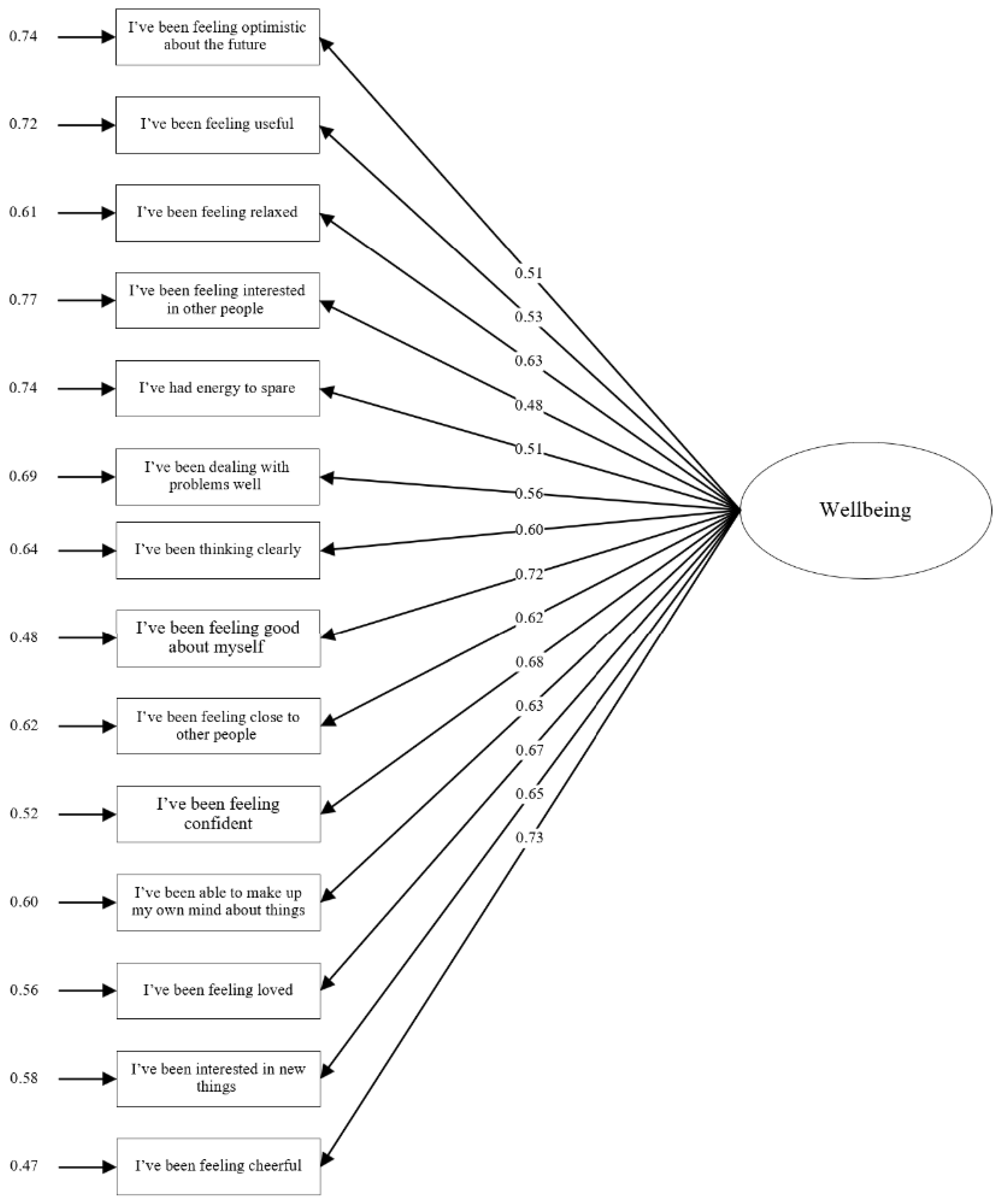
- The Warwick-Edinburgh Mental Well-being Scale demonstrated unidimensionality satisfactory model fit, along with satisfactory internal consistency when used with children.
- Invariance testing revealed a satisfactory fit for gender but not school year levels.
- The Warwick-Edinburgh Mental Well-being Scale shows potential for school-based screening or monitoring of mental well-being in real-world ecologically valid settings like schools.
- This enhances the potential to generate quality data that identifies trends and determines the effectiveness of interventions to improve children’s mental well-being.
Abstract
1. Introduction
2. Materials and Methods
2.1. Participants and Settings
2.2. Instrumentation
2.3. Procedure
2.4. Statistical Analysis
3. Results
3.1. Exploratory Factor Analysis of the WEMWBS
3.2. Confirmatory Factor Analysis of the WEMWBS
4. Discussion
5. Limitations and Future Research
Author Contributions
Funding
Institutional Review Board Statement
Informed Consent Statement
Data Availability Statement
Acknowledgments
Conflicts of Interest
References
- Clarke, T.; Hoskin, S. Teaching children and adolescents about mental wellbeing: An exploratory multi-site case study in England. Educ. Psychol. Pract. 2022, 38, 317–340. [Google Scholar] [CrossRef] [Scilit]
- Paton, K.; Darling, S.; Nowell, C.; Gandhi, S.; Jorm, A.; Hart, L.M.; Oberklaid, F. Development of the children’s wellbeing continuum: Fostering conversation in child mental health. Ment. Health Prev. 2025, 37, 200385. [Google Scholar] [CrossRef] [Scilit]
- Jullien, S.; Borisova, I.; Breda, J.; Carai, S.; Fontana, G.; Jovic, A.; Weber, M.M.; Bivol, O.; Muscat, N.A. Refocusing on the foundations: Strategy for child and adolescent health in Europe and Central Asia 2026–2030—A healthy start for a healthy life. J. Glob. Health 2025, 15, 03046. [Google Scholar] [CrossRef] [Scilit] [PubMed]
- Kearney, C.A. The perniciousness and promise of school-based mental health service delivery for youth. Res. Child. Adolesc. Psychopathol. 2025, 53, 609–624. [Google Scholar] [PubMed]
- Demuid, D.; Singh, B.; Brinsley, J.; Virgara, R.; Curtis, R.G.; Brinkman, S.; Maher, C.A. Trends in well-being among youth in Australia, 2017 to 2022. JAMA Netw. Open 2023, 6, e2324553. [Google Scholar] [CrossRef] [Scilit] [PubMed]
- Houghton, S.; Kyron, M.; Hunter, S.C.; Lawrence, D.; Hattie, J.; Carroll, A.; Zadow, C. Adolescents’ longitudinal trajectories of mental health and loneliness: The impact of COVID-19 school closures. J. Adolesc. 2022, 94, 191–205. [Google Scholar] [CrossRef] [Scilit] [PubMed]
- Benton, T.D.; Boyd, R.C.; Njoroge, W.F. Addressing the global crisis of child and adolescent mental health. JAMA Pediatr. 2021, 175, 1108–1110. [Google Scholar] [CrossRef] [Scilit] [PubMed]
- Racine, N.; McArthur, B.A.; Cooke, J.E.; Eirich, R.; Zhu, J.; Madigan, S. Global prevalence of depressive and anxiety symptoms in children and adolescents during COVID-19: A meta-analysis. JAMA Pediatr. 2021, 175, 1142–1150. [Google Scholar] [CrossRef] [Scilit] [PubMed]
- Baird, S.; Choonara, S.; Azzopardi, P.S.; Patton, G.C.; Sawyer, S.M.; Ambresin, A.E.; Banati, P.; Bessant, J.; Biermann, O.; Viner, R.M.; et al. A call to action: The Second Lancet Commission on adolescent health and wellbeing. Lancet Comm. 2025, 405, 1945–2022. [Google Scholar] [CrossRef] [Scilit] [PubMed]
- Iasiello, M.; Van Agteren, J. Mental health and/or mental illness: A scoping review of the evidence and implications of the dual-continua model of mental health. Evid. Base A J. Evid. Rev. Key Policy Areas 2020, 2020, 1–45. [Google Scholar] [CrossRef] [Scilit]
- Stephens, J.; Iasiello, M.; Ali, K.; van Agteren, J.; Fassnacht, D.B. The importance of measuring mental wellbeing in the context of psychological distress: Using a theoretical framework to test the dual-continua model of mental health. Behav. Sci. 2023, 13, 436. [Google Scholar] [CrossRef] [Scilit]
- Keyes, C. Selecting outcomes for the sociology of mental health: Issues of measurement and dimensionality. J. Health Soc. Behav. 2002, 43, 207–222. [Google Scholar] [CrossRef] [Scilit]
- Franken, K.; Lamers, S.M.; Ten Klooster, P.M.; Bohlmeijer, E.T.; Westerhof, G.J. Validation of the Mental Health Continuum-Short Form and the dual continua model of well-being and psychopathology in an adult mental health setting. J. Clin. Psychol. 2018, 74, 2187–2202. [Google Scholar] [CrossRef] [Scilit] [PubMed]
- Bjørnsen, H.N.; Espnes, G.A.; Eilertsen, M.E.B.; Ringdal, R.; Moksnes, U.K. The relationship between positive mental health literacy and mental well-being among adolescents: Implications for school health services. J. Sch. Nurs. 2019, 35, 107–116. [Google Scholar] [PubMed]
- Söderqvist, F.; Larm, P. Psychometric evaluation of the mental health continuum–short form in Swedish adolescents. Curr. Psychol. 2023, 42, 2136–2144. [Google Scholar]
- Klemp, G.; Urton, K.; Krull, J.; Bosch, J.; Wilbert, J. What does well-being at school mean to primary school students? Children’s understanding of basic psychological needs. Int. J. Educ. Res. Open 2025, 8, 100442. [Google Scholar] [CrossRef] [Scilit]
- Buerger, S.; Holzer, J.; Yanagida, T.; Schober, B.; Spiel, C. Measuring adolescents’ well-being in schools: The adaptation and translation of the EPOCH measure of adolescent well-being—A validation study. Sch. Ment. Health 2023, 15, 611–626. [Google Scholar] [CrossRef] [Scilit]
- Humphrey, N.; Hennessey, A.; Lendrum, A.; Wigelsworth, M.; Turner, A.; Panayiotou, M.; Joyce, C.; Pert, K.; Stephens, E.; Wo, L.; et al. The PATHS Curriculum for Promoting Social and Emotional Well-Being Among Children Aged 7–9 Years: A Cluster RCT; NIHR Journals Library: Southampton, UK, 2018; Public Health Research No. 6. 10. Available online: https://www.ncbi.nlm.nih.gov/books/NBK519672/ (accessed on 17 April 2024).
- Black, L.; Humphrey, N.; Panayiotou, M.; Marquez, J. Mental health and well-being measures for mean comparison and screening in adolescents: An assessment of unidimensionality and sex and age measurement invariance. Assessment 2024, 31, 219–236. [Google Scholar] [CrossRef] [Scilit] [PubMed]
- Park, C.L.; Kubzansky, L.D.; Chafouleas, S.M.; Davidson, R.J.; Keltner, D.; Parsafar, P.; Conwell, Y.; Martin, M.Y.; Hanmer, J.; Wang, K.H. Emotional well-being: What it is and why it matters. Affect. Sci. 2023, 4, 10–20. [Google Scholar] [PubMed]
- Podsakoff, P.M.; MacKenzie, S.B.; Lee, J.Y.; Podsakoff, N.P. Common method biases in behavioral research: A critical review of the literature and recommended remedies. J. Appl. Psychol. 2003, 88, 879–903. [Google Scholar] [CrossRef] [Scilit] [PubMed]
- Deighton, J.; Humphrey, N.; Belsky, J.; Boehnke, J.R.; Vostanis, P.; Wolpert, M. Longitudinal pathways between mental health difficulties and academic performance during middle childhood and early adolescence: Evidence from the UK Millennium Cohort Study. Br. J. Dev. Psychol. 2018, 36, 110–126. [Google Scholar] [CrossRef] [Scilit] [PubMed]
- Houghton, S.; Hattie, J.; Wood, L.; Carroll, A.; Martin, K.; Tan, C. Conceptualising loneliness in adolescents: Development and validation of a self-report instrument. Child Psychiatry Hum. Dev. 2014, 45, 604–616. [Google Scholar] [CrossRef] [Scilit] [PubMed]
- Waters, A.; McGregor, A.; Hughes, D. Children’s wellbeing narratives: An open-ended approach. J. Dev. Psychol. 2021, 45, 130–142. [Google Scholar] [CrossRef] [Scilit] [PubMed]
- Black, L.; Panayiotou, M.; Humphrey, N. Measuring general mental health in early-mid adolescence: A systematic meta-review of content and psychometrics. JCPP Adv. 2023, 3, e12125. [Google Scholar] [PubMed]
- Arslan, G.; Yıldırım, M.; Allen, K.A. School satisfaction and happiness in children and adolescents: The role of positive and negative affect. Child. Youth Serv. Rev. 2022, 132, 106303. [Google Scholar] [CrossRef] [Scilit]
- Liddle, B.; Carter, A.J. The dynamic nature of positive mental wellbeing: Insights from qualitative research. J. Appl. Dev. Psychol. 2015, 36, 34–45. [Google Scholar]
- Cho, T.T.P.; Shevlin, M.; Grennan, S.; McKenna, N.; O’Dowd, A.; Nearchou, F.; Murphy, E.; Carr, A. Validation of the Stirling Children’s Well-being Scale in an Irish Sample. Int. J. Appl. Posit. Psychol. 2026, 11, 27. [Google Scholar] [CrossRef] [Scilit]
- Lam, J.R.; Park, H.R.P.; Gatt, J.M. Measuring mental wellbeing in clinical and non-clinical adolescents using the COMPAS-W Wellbeing Scale. Front. Psychiatry 2024, 15, 1333828. [Google Scholar] [CrossRef] [Scilit] [PubMed]
- Tennant, R.; Hiller, L.; Fishwick, R.; Platt, S.; Joseph, S.; Weich, S.; Parkinson, J.; Secker, J.; Stewart-Brown, S. The Warwick-Edinburgh Mental Well-being Scale (WEMWBS): Development and UK validation. Health Qual. Life Outcomes 2007, 5, 63. [Google Scholar] [CrossRef] [Scilit] [PubMed]
- Yadav, P.; De La Torre, J.A.; Bakolis, I.; Bartoll, X.; Kogel, C.; Farran, J.C.; Vilagut, G. Internal structure, reliability and cross-cultural validity of the Warwick-Edinburgh Mental Well-being Scale in three European populations. BMJ Ment. Health 2025, 28, e301433. [Google Scholar] [CrossRef] [Scilit] [PubMed]
- Stewart, S. Embedding a Therapeutic Approach into 3-D Animated Serious Games to Reduce Worry, Anxiety, and Loneliness in Early Aged Adolescents with Neurodevelopmental Disorders. Ph.D. Thesis, The University of Western Australia, Perth, Australia, 2024. [Google Scholar]
- Blodgett, J.M.; Birch, J.M.; Musella, M.; Harkness, F.; Kaushal, A. What works to improve wellbeing? A rapid systematic review of 223 interventions evaluated with the Warwick-Edinburgh Mental Well-Being Scales. Int. J. Env. Res. Pub Health 2022, 19, 15845. [Google Scholar] [CrossRef] [Scilit]
- Miller, A. Children’s Electronic Screen Use, Screen Use Activities and Positive Mental Wellbeing. Doctoral Dissertation, University of Western Australia, Perth, Australia, 2017. [Google Scholar]
- Hunter, S.C.; Houghton, S.; Wood, L. Positive mental well-being in Australian adolescents: Evaluating the Warwick-Edinburgh Menta; Well-being Scale. Aust. Educ. Dev. Psychol. 2015, 5, 98–107. [Google Scholar] [CrossRef] [Scilit]
- Hoover, S.; Bostic, J. Schools as a vital component of the child and adolescent mental health system. Psychiatr. Serv. 2021, 72, 37–48. [Google Scholar] [CrossRef] [Scilit] [PubMed]
- Norwich, B.; Moore, D.; Stentiford, L.; Hall, D. A critical consideration of ‘mental health and wellbeing’ in education: Thinking about school aims in terms of wellbeing. Br. Ed. Res. J. 2022, 48, 803–820. [Google Scholar] [CrossRef] [Scilit]
- Lekamge, R.B.; Jain, R.; Sheen, J.; Solanki, P.; Zhou, Y.; Romero, L.; Barry, M.M.; Chen, L.; Karim, N.; Ilic, D. Systematic review and meta-analysis of the effectiveness of whole-school interventions promoting mental health and preventing risk behaviours in adolescence. J. Youth Adolesc. 2025, 54, 271–289. [Google Scholar] [CrossRef] [Scilit] [PubMed]
- O’Reilly, M.; Svirydzenka, N.; Adams, S.; Dogra, N. Review of mental health promotion interventions in schools. Soc. Psychiatry Psychiatr. Epidemiol. 2018, 53, 647–662. [Google Scholar] [CrossRef] [Scilit] [PubMed]
- Tomé, G.; Almeida, A.; Ramiro, L.; Gaspar, T.; de Matos, M.G. Intervention in schools promoting mental health and well-being: A systematic review. Glob. J. Comm. Psychol. Pract. 2021, 12, 1–21. [Google Scholar] [CrossRef] [Scilit]
- Australian Curriculum, Assessment and Reporting Authority (ACARA). National Report on Schooling in Australia 2020; ACARA Publishing: Sydney, Australia, 2020.
- Perera, B.P.R.; Wickremasinghe, A.R.; De Za, T.A.P. Psychometric properties of the Warwick Edinburgh Mental Well-being Scale: A systematic review. Syst. Rev. 2025, 14, 149. [Google Scholar] [CrossRef] [Scilit] [PubMed]
- Anthony, R.; Moore, G.; Page, N.; Hewitt, G.; Murphy, S.; Melendez-Torres, G.J. Measurement invariance of the short Warwick-Edinburgh Mental Wellbeing Scale and latent mean differences (SWEMWBS) in young people by current care status. Qual. Life Res. 2022, 31, 205–213. [Google Scholar] [PubMed]
- Stewart-Brown, S.; Tennant, A.; Tennant, R.; Platt, S.; Parkinson, J.; Weich, S. Internal construct validity of the Warwick-Edinburgh Mental Well-being Scale (WEMWBS): A Rasch analysis using data from the Scottish Health Education Population Survey. Health Qual. Life Outcomes 2009, 7, 15. [Google Scholar] [CrossRef] [Scilit] [PubMed]
- McKay, M.T.; Andretta, J.R. Evidence for the psychometric validity, internal consistency and measurement invariance of Warwick Edinburgh Mental Well-being Scale scores in Scottish and Irish adolescents. Psychiatry Res. 2017, 255, 382–386. [Google Scholar] [CrossRef] [Scilit] [PubMed]
- Microsoft Corporation. Microsoft Office Word 2003; Microsoft Corporation: Redmond, WA, USA, 2003. [Google Scholar]
- IBM SPSS Statistics for Windows, version 27; IBM Corp.: Armonk, NY, USA, 2020.
- Jöreskog, K.G.; Sörbom, D. LISREL, version 11. Computer software. Scientific Software International: Chapel Hill, NC, USA, 2021. Available online: https://ssicentral.com (accessed on 2 July 2026).
- MacCullum, R.C.; Austin, J.T. Applications of structural equation modeling in psychological research. Ann. Rev. Psychol. 2000, 51, 201–226. [Google Scholar] [CrossRef] [Scilit]
- Stewart, S.; Houghton, S.J.; Glasgow, K.; Macqueen, L. Worry and depressive symptoms in adolescents with neurodevelopmental disorders. Int. J. Envir Res. Public Health 2025, 22, 185. [Google Scholar] [CrossRef] [Scilit] [PubMed]
- Bartlett, M.S. A note on the multiplying factors for various chi-square approximations. J. R. Stat. Soc. Ser. B (Methodol.) 1954, 16, 296–298. [Google Scholar] [CrossRef] [Scilit]
- Kaiser, H.F. A second-generation little jiffy. Psychometrika 1970, 35, 401–415. [Google Scholar] [CrossRef] [Scilit]
- Kaiser, H.F. An index of factorial simplicity. Psychometrika 1974, 39, 31–36. [Google Scholar] [CrossRef] [Scilit]
- Horn, J.L. A rationale and test for the number of factors in factor analysis. Psychometrika 1965, 30, 179–185. [Google Scholar] [CrossRef] [Scilit] [PubMed]
- Hair, J.; Black, W.; Babin, B.; Anderson, R.; Tatham, R. Multivariate Data Analysis, 6th ed.; Pearson Prentice Hall: Upper Saddle River, NJ, USA, 2006. [Google Scholar]
- McDonald, R.P. Test Theory: A Unified Treatment; Routlege: Oxford, UK, 2011. [Google Scholar]
- Hauch, D.; Fjorback, L.O.; Juul, L. Psychometric properties of the Short Warwick-Edinburgh mental well-being scale in a sample of Danish schoolchildren. Scand. J. Public Health 2023, 51, 1214–1221. [Google Scholar] [PubMed]
- Deighton, J.; Argent, R.; De Francesco, D.; Edbrooke-Childs, J.; Jacob, J.; Fleming, I.; Ford, T.; Wolpert, M. Associations between evidence-based practice and mental health outcomes in child and adolescent mental health services. Clin. Child Psychol. Psychiatry 2016, 21, 287–296. [Google Scholar] [PubMed]
- Clarke, A.; Friede, T.; Putz, R.; Ashdown, J.; Martin, S.; Blake, A.; Adi, Y.; Parkinson, J.; Flynn, P.; Platt, S.; et al. Warwick-Edinburgh Mental Well-being Scale (WEMWBS): Validated for teenage school students in England and Scotland. A mixed methods assessment. BMC Public Health 2011, 11, 487. [Google Scholar] [CrossRef] [Scilit] [PubMed]
- Tompkins, V.; Bengochea, A.; Nicol, S.; Justice, L.M. Maternal inferential input and children’s language skills. Read. Res. Q. 2017, 52, 397–416. [Google Scholar] [CrossRef] [Scilit]
- Oakhill, J.; Cain, K.; Elbro, C. Reading comprehension and reading comprehension difficulties. In Reading Development and Difficulties: Bridging the Gap Between Research and Practice; Springer International Publishing: Cham, Switzerland, 2019; pp. 83–115. [Google Scholar]
- Nagy, W.E.; Scott, J. Vocabulary processes. In Handbook of Reading Research; Kamil, M., Mosenthal, P., Pearson, P.D., Barr, R., Eds.; Erlbaum: Mahwah, NJ, USA, 2000; Volume III, pp. 269–284. [Google Scholar]
- Pakpour, A.H.; Eriksson, M.; Erixon, I.; Broström, A.; Bengtsson, S.; Jakobsson, M.; Huus, K. The Short Warwick-Edinburgh Mental Well-being Scale (SWEMWBS)—A psychometric evaluation of adolescents in Sweden during the COVID-19 pandemic. Heliyon 2024, 10, e27620. [Google Scholar] [CrossRef] [Scilit] [PubMed]
- Ime, Y. Adaptation of the short Warwick-Edinburgh Mental Well-being scale: Its relationship with loneliness, emotional flexibility and resilience among adolescents. Pol. Psychol. Bull. 2023, 54, 201–206. [Google Scholar]
- Hanzlová, R.; Lynn, P. Item response theory-based psychometric analysis of the Short Warwick-Edinburgh Mental Well-Being Scale (SWEMWBS) among adolescents in the UK. Health Qual. Life Outcomes 2023, 21, 108. [Google Scholar] [CrossRef] [Scilit] [PubMed]
- Melendez-Torres, G.J.; Allen, E.; Viner, R.; Bonell, C. Effects of a whole-school health intervention on clustered adolescent health risks: Latent transition analysis of data from the INCLUSIVE trial. Prev. Sci. 2022, 23, 1–9. [Google Scholar] [CrossRef] [Scilit] [PubMed]
- Sarasjärvi, K.K.; Elovainio, M.; Appelqvist-Schmidlechner, K.; Solin, P.; Tamminen, N.; Therman, S. Factor structure and measurement invariance of the Short Warwick-Edinburgh Mental Well-Being Scale (SWEMWBS) among adolescents and youths. BMC Psychol. 2025, 13, 1239. [Google Scholar] [CrossRef] [Scilit] [PubMed]
- Hayhoe, R.; Rechel, B.; Clark, A.B.; Gummerson, C.; Smith, S.L.; Welch, A.A. Cross-sectional associations of schoolchildren’s fruit and vegetable consumption, and meal choices, with their mental well-being: A cross-sectional study. BMJ Nutr. Prev. Health 2021, 4, 447. [Google Scholar] [CrossRef] [Scilit] [PubMed]
- Campbell-Jack, D.; Hinchcliffe, S.; Rutherford, L. (Eds.) The Scottish Health Survey: A National Statistics Publication for Scotland; Scottish Government: Edinburgh, UK, 2015.
- Yoon, Y.; Eisenstadt, M.; Lereya, S.T.; Deighton, J. Gender difference in the change of adolescents’ mental health and subjective wellbeing trajectories. Eur. Child Adolesc. Psychiatry 2023, 32, 1569–1578. [Google Scholar] [PubMed]
- Heubner, E.S. Understanding children’s subjective well-being: Implications for research and practice. J. Child Fam. Stud. 2004, 13, 107–118. [Google Scholar]
- Miller, P.H.; Baxter, S.D.; Royer, J.A.; Hitchcock, D.B.; Smith, A.F.; Collins, K.L.; Guinn, C.H.; Smith, A.L.; Puryear, M.P.; Vaadi, K.K.; et al. Children’s social desirability: Effects of test assessment mode. Personal. Individ. Differ. 2015, 83, 85–90. [Google Scholar] [CrossRef] [Scilit]
- Renwick, L.; Smith, A.; Johnson, R. Measuring positive mental wellbeing among children: The WEMWBS perspective. J. Child Psychol. Psychiatry 2021, 62, 800–815. [Google Scholar] [CrossRef] [Scilit] [PubMed]


| 1 | 2 | 3 | 4 | 5 | 6 | 7 | 8 | 9 | 10 | 11 | 12 | 13 | 14 | |
|---|---|---|---|---|---|---|---|---|---|---|---|---|---|---|
| 1-I’ve been feeling optimistic about the future | 1 | |||||||||||||
| 2-I’ve been feeling useful | 0.41 ** | 1 | ||||||||||||
| 3-I’ve been feeling relaxed | 0.26 ** | 0.34 ** | 1 | |||||||||||
| 4-I’ve been feeling interested in other people | 0.34 ** | 0.31 ** | 0.18 ** | 1 | ||||||||||
| 5-I’ve had energy to spare | 0.22 ** | 0.24 ** | 0.29 ** | 0.19 * | 1 | |||||||||
| 6-I’ve been dealing with problems well | 0.22 ** | 0.25 ** | 0.28 ** | 0.11 | 0.13 * | 1 | ||||||||
| 7-I’ve been thinking clearly | 0.28 ** | 0.36 ** | 0.38 ** | 0.19 ** | 0.28 ** | 0.47 ** | 1 | |||||||
| 8-I’ve been feeling good about myself | 0.39 ** | 0.36 ** | 0.39 ** | 0.21 ** | 0.26 ** | 0.40 ** | 0.50 ** | 1 | ||||||
| 9-I’ve been feeling close to other people | 0.35 ** | 0.32 ** | 0.19 ** | 0.42 ** | 0.15 * | 0.31 ** | 0.38 ** | 0.40 ** | 1 | |||||
| 10-I’ve been feeling confident | 0.37 ** | 0.37 ** | 0.35 ** | 0.16 ** | 0.29 ** | 0.39 ** | 0.53 ** | 0.60 ** | 0.38 ** | 1 | ||||
| 11-I’ve been able to make up my own mind about things | 0.37 ** | 0.26 ** | 0.30 ** | 0.14 * | 0.26 ** | 0.48 ** | 0.47 ** | 0.49 ** | 0.22 ** | 0.47 ** | 1 | |||
| 12-I’ve been feeling loved | 0.33 ** | 0.30 ** | 0.28 ** | 0.19 ** | 0.17 ** | 0.29 ** | 0.43 ** | 0.47 ** | 0.43 ** | 0.37 ** | 0.28 ** | 1 | ||
| 13-I’ve been interested in new things | 0.31 ** | 0.27 ** | 0.24 ** | 0.28 ** | 0.24 ** | 0.32 ** | 0.47 ** | 0.39 ** | 0.24 ** | 0.41 ** | 0.47 ** | 0.27 ** | 1 | |
| 14-I’ve been feeling cheerful | 0.41 ** | 0.40 ** | 0.38 ** | 0.26 ** | 0.26 ** | 0.43 ** | 0.57 ** | 0.59 ** | 0.40 ** | 0.57 ** | 0.50 ** | 0.42 ** | 0.47 ** | 1 |
| Item | n | M | SD |
|---|---|---|---|
| I’ve been feeling optimistic about the future | 281 | 3.46 | 1.17 |
| I’ve been feeling useful | 281 | 3.32 | 1.13 |
| I’ve been feeling relaxed | 280 | 3.59 | 1.04 |
| I’ve been feeling interested in other people | 278 | 3.08 | 1.24 |
| I’ve had energy to spare | 280 | 3.58 | 1.24 |
| I’ve been dealing with problems well | 281 | 3.38 | 1.10 |
| I’ve been thinking clearly | 281 | 3.74 | 1.04 |
| I’ve been feeling good about myself | 281 | 3.96 | 1.04 |
| I’ve been feeling close to other people | 281 | 3.48 | 1.18 |
| I’ve been feeling confident | 281 | 3.87 | 1.01 |
| I’ve been able to make up my own mind about things | 281 | 3.72 | 1.04 |
| I’ve been feeling loved | 281 | 4.08 | 1.16 |
| I’ve been interested in new things | 281 | 4.00 | 1.08 |
| I’ve been feeling cheerful | 280 | 3.90 | 1.03 |
| Item | Factor Loading |
|---|---|
| I’ve been feeling cheerful | 0.77 |
| I’ve been feeling good about myself | 0.75 |
| I’ve been feeling confident | 0.73 |
| I’ve been thinking clearly | 0.73 |
| I’ve been able to make up my own mind about things | 0.63 |
| I’ve been interested in new things | 0.59 |
| I’ve been feeling loved | 0.56 |
| I’ve been dealing with problems well | 0.56 |
| I’ve been feeling optimistic about the future | 0.53 |
| I’ve been feeling close to other people | 0.53 |
| I’ve been feeling useful | 0.52 |
| I’ve been feeling relaxed | 0.50 |
| I’ve had energy to spare | 0.38 |
| I’ve been feeling interested in other people | 0.33 |
Disclaimer/Publisher’s Note: The statements, opinions and data contained in all publications are solely those of the individual author(s) and contributor(s) and not of MDPI and/or the editor(s). MDPI and/or the editor(s) disclaim responsibility for any injury to people or property resulting from any ideas, methods, instructions or products referred to in the content. |
© 2026 by the authors. Licensee MDPI, Basel, Switzerland. This article is an open access article distributed under the terms and conditions of the Creative Commons Attribution (CC BY) license.
Share and Cite
Lituri, J.; Houghton, S.; Zhao, J. Positive Mental Well-Being in Children: A Preliminary Structural Validation of the Factor Structure of the Warwick-Edinburgh Mental Wellbeing Scale. Children 2026, 13, 941. https://doi.org/10.3390/children13070941
Lituri J, Houghton S, Zhao J. Positive Mental Well-Being in Children: A Preliminary Structural Validation of the Factor Structure of the Warwick-Edinburgh Mental Wellbeing Scale. Children. 2026; 13(7):941. https://doi.org/10.3390/children13070941
Chicago/Turabian StyleLituri, Jon, Stephen Houghton, and Jian Zhao. 2026. "Positive Mental Well-Being in Children: A Preliminary Structural Validation of the Factor Structure of the Warwick-Edinburgh Mental Wellbeing Scale" Children 13, no. 7: 941. https://doi.org/10.3390/children13070941
APA StyleLituri, J., Houghton, S., & Zhao, J. (2026). Positive Mental Well-Being in Children: A Preliminary Structural Validation of the Factor Structure of the Warwick-Edinburgh Mental Wellbeing Scale. Children, 13(7), 941. https://doi.org/10.3390/children13070941