


Highlights
What are the main findings?
- Abnormal preschool oscillometry, particularly elevated resistance at 5 Hz (R5), was consistently associated with later asthma-related outcomes across longitudinal studies.
- Early oscillometric abnormalities were also linked to lower later lung function, including reduced FEV1 and FEV1/FVC, suggesting persistent airflow limitation into later childhood and adolescence.
What are the implications of the main findings?
- Preschool oscillometry may provide useful complementary prognostic information for identifying children at higher risk of persistent asthma and later lung function impairment.
- Current evidence is too limited and heterogeneous to support a single validated cutoff or routine stand-alone clinical use, underscoring the need for larger standardized prospective studies.
Abstract
Background: Preschool wheezing is common, but distinguishing transient wheezing from early persistent asthma remains difficult. Oscillometric techniques, including impulse oscillometry (IOS), may provide objective prognostic information. Objective: To systematically review longitudinal studies assessing whether oscillometric measurements obtained at preschool age are associated with later asthma-related outcomes or lung function impairment. Methods: PubMed, Scopus, and MEDLINE (via EBSCOhost) were searched from inception to 28 February 2026. Eligible studies included preschool-aged children or closely related early-childhood populations assessed with IOS or forced oscillation technique (FOT), longitudinal follow-up, and later asthma-related or spirometric outcomes. Two reviewers independently screened studies, extracted data, and assessed risk of bias with QUIPS. Owing to substantial heterogeneity, findings were synthesized qualitatively. Results: Seven longitudinal cohort studies, encompassing 1077 children, met the eligibility criteria; baseline oscillometry was performed between ages 2 and 7 years, and follow-up ranged from 1 to 10 years. Short-term classification and longer-term prognostic studies were interpreted separately. Resistance-based indices, particularly R5, showed the most consistent associations with later asthma-related outcomes and lower subsequent spirometric indices, including FEV1 and FEV1/FVC. Most studies were at moderate risk of bias, and some reports came from related cohorts. Conclusions: Preschool oscillometry may provide complementary physiological information to assess asthma risk in symptomatic or high-risk preschool-aged children, particularly through resistance-based measures. However, evidence remains limited, heterogeneous, and insufficient to support a single validated cutoff, routine screening of apparently healthy children, or routine stand-alone prognostic use.
1. Introduction
Asthma is one of the most prevalent chronic respiratory diseases in childhood and represents a major global health burden [1]. Epidemiological data indicate that a substantial proportion of all asthma cases begin before the age of six [2,3]. Wheezing is common in preschool-aged children and is often transient, particularly when associated with viral respiratory infections [4,5]. However, some children develop persistent asthma, characterized by chronic airway inflammation, bronchial hyperresponsiveness, and variable airflow obstruction [6,7,8]. Distinguishing transient wheezing from early persistent asthma remains a major challenge in pediatric respiratory medicine [5,9].
Early identification of children at increased risk of persistent asthma is clinically important, as delayed diagnosis and treatment are associated with greater symptom burden, more frequent exacerbations, reduced lung function, and increased healthcare utilization [10,11]. Clinical predictors such as recurrent wheezing, atopy, eczema, and family history are informative, but prediction models have shown only moderate performance and limited external generalizability [12,13,14]. Objective assessment of lung function may, therefore, improve early risk stratification [15]. In preschool-aged children, however, spirometry is often limited by the need for cooperation and forced expiratory maneuvers [16,17,18,19,20].
Oscillometry assesses respiratory mechanics by applying small pressure oscillations at the mouth during quiet tidal breathing and analyzing the pressure–flow relationship [21,22]. Forced oscillation technique (FOT) refers to the original methodological principle, whereas impulse oscillometry (IOS) is a commercially developed form of FOT that uses brief pressure impulses containing a range of frequencies [21,22,23]. Thus, IOS is an implementation of the broader forced oscillation approach. Both methods estimate respiratory system impedance, although values may vary according to device, signal type, quality-control procedures, reference equations, and reporting conventions [21,22].
Respiratory impedance includes resistance and reactance. Resistance reflects the frictional opposition to airflow within the airways, whereas reactance reflects the elastic and inertial properties of the respiratory system [21]. This makes oscillometry attractive in preschool-aged children as it is non-invasive, effort-independent, and can often be performed with minimal active cooperation [16,21].
The most commonly reported resistance parameters are R5 and R20. R5, resistance at 5 Hz, reflects total respiratory system resistance, including central and peripheral airway contributions. R20, resistance at 20 Hz, is relatively more influenced by central or proximal airway resistance, although neither measure is anatomically specific. Higher R5 or R20 generally indicates increased airway narrowing or obstruction. R5-20, the difference between R5 and R20, summarizes the frequency dependence of resistance and is often used as an indirect, nonspecific signal of ventilation heterogeneity or possible peripheral airway involvement. Increased R5-20 values are generally considered unfavorable [23,24,25,26]. The slope of resistance across frequency, dRrs/df, is less routinely used and describes how resistance changes with oscillation frequency. A steeper negative slope, or a lower dRrs/df, depending on the reporting convention, may reflect heterogeneous respiratory mechanics, but it is less standardized and less clinically established than R5 or R5-20 [21,24].
Reactance parameters provide complementary information. X5, reactance at 5 Hz, is usually negative in young children, and more negative values may suggest reduced compliance, altered elastic properties, ventilation heterogeneity, or possible peripheral airway obstruction [21,22,23,24]. AX, the area of reactance, summarizes the cumulative reactance abnormality between 5 Hz and the resonant frequency, while Fres is the frequency at which reactance crosses zero. Higher AX and Fres generally indicate greater mechanical abnormality, but these indices are not anatomically specific and should be interpreted in a clinical context, with attention to age, lung volume, technical quality, reference equations, and reporting conventions [21,23,27]. A practical summary of commonly reported oscillometry indices and their clinical interpretation is provided in Table 1.
Table 1.
Practical interpretation of commonly reported oscillometry indices.
Among oscillometric parameters, R5 is the most widely reported and currently the best-established individual marker in pediatric clinical and research settings. R5-20, X5, AX, Fres, and dRrs/df may provide additional information on frequency-dependent or reactance-related mechanics, but their thresholds and prognostic interpretation are less uniform across studies [23,24,25,26,27]. Over the past two decades, longitudinal studies have examined whether abnormal oscillometry in early childhood predicts later asthma and impaired lung function [28,29,30,31,32,33,34]. However, interpretation remains difficult because studies differ in populations, oscillometric indices, bronchodilator status, thresholds, follow-up duration, outcome definitions, technical quality, and cohort independence.
Accordingly, this study systematically reviews longitudinal evidence on whether preschool-age or closely related early-childhood oscillometric measurements are associated with later asthma-related outcomes and long-term lung function impairment.
2. Materials and Methods
2.1. Literature Search Strategy
This systematic review followed the Preferred Reporting Items for Systematic Reviews and Meta-Analyses (PRISMA) 2020 guidelines [35] and was prospectively registered in the International Prospective Register of Systematic Reviews (PROSPERO) (CRD420261296620). The registered protocol was initially specified as a systematic review and meta-analysis. After study selection and data extraction, quantitative synthesis was judged inappropriate because the eligible studies were few in number and showed substantial clinical and methodological heterogeneity, including differences in study populations, potential overlap between some cohorts, oscillometric indices and their expression, bronchodilator status, follow-up duration, and outcome definitions. Accordingly, the review was completed as a qualitative systematic review of prognostic longitudinal evidence rather than a meta-analysis (Supplementary Table S1).
The review question was structured according to the PICOTS framework shown in Table 2. PubMed, Scopus, and MEDLINE (via EBSCOhost) were searched from inception to 28 February 2026. The search strategy combined controlled vocabulary terms and free-text keywords related to preschool children, oscillometry, wheezing, and asthma outcomes. Searches were limited to studies published in English. Reference lists of relevant articles and reviews were also manually screened to identify additional eligible studies. The detailed database-specific search strategies are provided in Appendix A.
Table 2.
PICOTS framework for the review question and eligibility concept.
2.2. Inclusion and Exclusion Criteria
Eligibility criteria were defined a priori according to the PICOTS framework presented in Table 2. Studies were eligible if they included children undergoing oscillometric assessment during preschool or closely related early-childhood ages and reported longitudinal asthma-related outcomes or subsequent lung function impairment. To avoid excluding otherwise relevant cohorts, studies in which measurements were obtained slightly beyond 6 years of age were also considered eligible, provided that the population and clinical question remained focused on preschool wheezing and the risk of later asthma. Future asthma was defined as physician-diagnosed asthma, active asthma at follow-up based on symptoms and/or medication use, or asthma diagnosis according to validated criteria. Secondary outcomes included long-term impairment in lung function, such as reduced forced expiratory volume in one second (FEV1), reduced ratio of forced expiratory volume in one second to forced vital capacity (FEV1/FVC), or persistent airflow obstruction.
Studies were excluded if they were cross-sectional and lacked longitudinal follow-up, focused solely on asthma control or exacerbations without assessing subsequent asthma-related outcomes, did not include oscillometric assessment during the preschool period, or were non-original research articles, including case reports, narrative reviews, editorials, or conference abstracts without full data.
2.3. Study Selection and Data Extraction
Two reviewers independently screened titles and abstracts and subsequently assessed the full texts of potentially eligible studies. Disagreements were resolved through discussion or consultation with a third reviewer. Where multiple publications arose from overlapping cohorts, all relevant reports were retained for outcome-specific qualitative synthesis, but overlap was explicitly considered when interpreting the apparent consistency of findings. The study selection process was documented using a PRISMA flow diagram.
Data extraction was also performed independently by two reviewers using a standardized form. Extracted data included study characteristics (author, year, country, design, and sample size), participant characteristics, oscillometry methods and reported parameters, outcome definitions, follow-up duration, and effect estimates. Adjusted estimates were preferentially extracted where available.
2.4. Risk of Bias Assessment
Risk of bias was assessed using the Quality In Prognosis Studies (QUIPS) tool, which assesses six domains: study participation, study attrition, prognostic factor measurement, outcome measurement, study confounding, and statistical analysis and reporting. All assessments were performed independently by two reviewers, and disagreements were resolved through discussion.
2.5. Data Synthesis
A qualitative synthesis was conducted for all included studies and structured according to the main outcomes of interest, namely later asthma-related outcomes and longitudinal lung function impairment. Oscillometric parameters were categorized by physiological domain, including resistance-based measures (R5, R20), frequency-dependent resistance indices (R5-20 and dRrs/df), reactance-based measures (X5), and reactance-derived indices (AX and Fres). These categories were used descriptively and were not assumed to represent anatomically specific airway compartments. Effect estimates were extracted as reported by each study, including odds ratios (ORs), regression coefficients, correlation coefficients, sensitivity/specificity values, and area-under-the-curve (AUC) metrics, and adjusted estimates were preferentially summarized when available. Due to heterogeneity in oscillometric parameter expression (absolute values, percent predicted, or z-scores), bronchodilator status, outcome definitions, follow-up duration, threshold definitions, and partial cohort overlap, results were summarized descriptively rather than pooled quantitatively. Because there were too few studies for meaningful small-study-effect analyses and no meta-analysis was performed, no formal reporting-bias assessment was undertaken.
2.6. Certainty of Evidence Assessment
Because the included evidence was limited and heterogeneous, and no meta-analysis was performed, certainty of evidence was assessed narratively for the two main outcome domains (later asthma-related outcomes and later lung function impairment). Judgments were based on study limitations/risk of bias, consistency of direction of findings, precision of estimates, heterogeneity of methods and outcomes, and the presence of overlapping cohorts. In keeping with the prognostic and predominantly observational nature of the evidence base, and because a pooled estimate was not generated, certainty was expressed qualitatively rather than with a formal GRADE profile.
3. Results
3.1. Study Selection
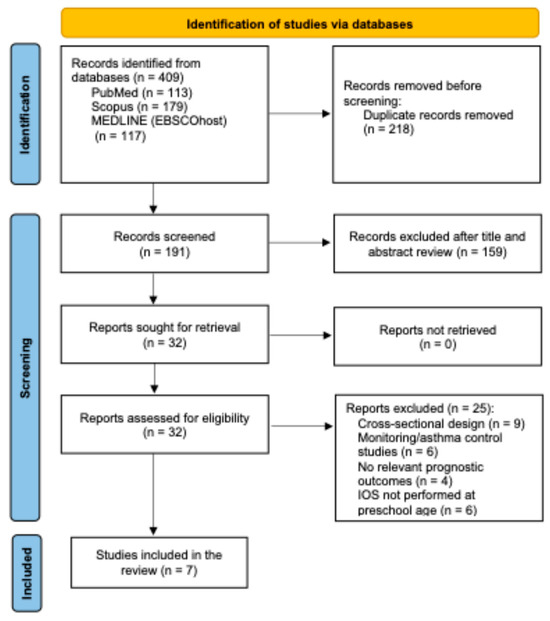
The database search yielded 409 records. After removal of duplicates, 191 records were screened by title and abstract, of which 32 underwent full-text review. Seven longitudinal studies met the predefined criteria and were included in the qualitative synthesis. The study selection process is summarized in Figure 1.
Figure 1.
PRISMA 2020 flow diagram of the study selection process.
3.2. Study Characteristics
The qualitative synthesis included seven longitudinal cohort studies involving 1077 children. Baseline oscillometry was performed between 2 and 7 years of age. Specifically, children were assessed at ages 2–7 years in Knihtilä 2015 [33], 3–6 years in Chen 2024 [31], 3–5 years in Grell 2023 [29], 3–7 years in Lajunen 2020 [32], 4–7 years in Lajunen 2018 [30], 5–7 years in Lauhkonen 2018 [34], and serially at ages 4, 5, and 6 years in Knihtilä 2024 [28]. Follow-up duration ranged from 1 to 10 years, with final sample sizes ranging from 64 to 219 participants across studies, reflecting variable attrition. Outcome assessment ranged from early school age, approximately 4–7 years after short-term follow-up, to adolescence at 12–18 years of age. Study populations included children with recurrent wheezing, asthma-like symptoms, persistent asthma, or children from high-risk cohorts. Therefore, the available evidence mainly reflects clinically symptomatic or high-risk preschool-aged children, rather than apparently healthy, unselected populations. Later asthma-related outcomes were assessed in four studies [28,30,31,32], while longitudinal spirometric outcomes were assessed in six studies [28,29,30,32,33,34]. All studies used IOS. Potential cohort overlap was considered explicitly: Lajunen 2018 [30] and Lajunen 2020 [32] appear to derive from the same Helsinki longitudinal asthma cohort, Knihtilä 2015 [33] was considered institutionally related without clearly documented overlap, and Lauhkonen 2018 [34] was separate. The characteristics of the included studies are presented in Table 3.
Table 3.
Characteristics of the included studies.
3.3. Risk of Bias Results
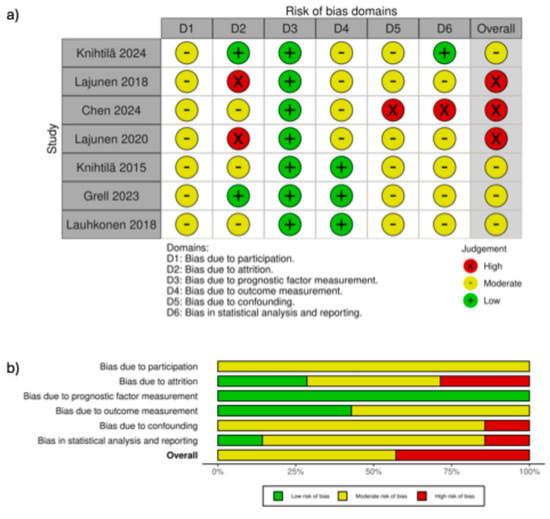
Using QUIPS, no study was judged to be at low risk of bias across all domains. The most common concerns were related to study attrition, prognostic factor measurement, outcome measurement, and incomplete control for confounding. Overall, most studies were judged to be at moderate risk of bias, with greater concerns in studies affected by substantial attrition, selected analytic samples, or less robust outcome definitions. Detailed results are presented in Figure 2.
Figure 2.
QUIPS risk of bias assessment of included studies. (a) shows domain-specific and overall risk of bias judgments for each included study [28,29,30,31,32,33,34]. (b) shows the percentage of studies judged to be at low, moderate, or high risk of bias for each QUIPS domain and overall.
3.4. Preschool Oscillometry and Later Asthma-Related Outcomes
Across the included cohorts, abnormal oscillometric measurements obtained between 2 and 7 years of age were associated with later asthma-related outcomes, including subsequent asthma diagnosis, persistent symptoms, and medication use (Table 4). However, the studies were not interpreted as a single, uniform evidence base. Instead, they were considered according to follow-up horizon and clinical purpose, because a 1-year diagnostic or classification study addresses a different question from studies evaluating asthma persistence or lung function trajectories over several years. Accordingly, Chen et al. [31], which enrolled children aged 3–6 years, is presented as short-term diagnostic/classification evidence. In contrast, Knihtilä et al. [28], Lajunen et al. [30], and Lajunen et al. [32], with baseline oscillometry performed at ages 4, 4–7, and 3–7 years, respectively, are interpreted as longer-term prognostic evidence. Therefore, high AUC values from short-term studies were not treated as evidence of strong long-term predictive performance.
Table 4.
Preschool oscillometry and later asthma-related outcomes, separated by evidence type.
3.4.1. Resistance at 5 Hz (R5)
R5 was the most consistently reported parameter. In the prospective multicenter study by Knihtilä et al. [28], higher R5 at age 4 was independently associated with active asthma at age 8 (β = 2.0; 95% CI 0.2–3.8; p = 0.029), with moderate discriminative ability (AUC 0.713). In the Finnish longitudinal cohort by Lajunen et al. [30], which included children aged 4–7 years with asthma-like symptoms, abnormal baseline R5 (z-score ≥ 1.645) was associated with asthma persistence into adolescence at ages 12–16 years, including higher odds of asthma symptoms (OR 9.9; 95% CI 2.9–34.4) and medication use (OR 9.2; 95% CI 2.7–31.7). In a subsequent analysis of asthmatic children aged 3–7 years from a related Finnish cohort [32], abnormal baseline R5 remained associated with asthma symptoms at 10-year follow-up, when participants were aged 12–16 years (OR 4.4; 95% CI 1.1–17.4). Separately, the short-term classification study by Chen et al. [31], which enrolled wheezing children aged 3–6 years, reported higher apparent classification accuracy for R5 after only 1 year of follow-up (AUC 0.91, sensitivity 0.89, specificity 0.84). Because of the short interval between baseline assessment and outcome ascertainment, this finding was interpreted as diagnostic/classification evidence rather than as evidence of strong long-term prognostic performance.
3.4.2. Reactance at 5 Hz (X5)
Reactance parameters also showed potential longitudinal relevance. In the Finnish cohort of asthmatic children aged 3–7 years [32], abnormal baseline X5 (z-score ≤ −1.645) was associated with asthma symptoms at 10-year follow-up, when participants were aged 12–16 years (OR 12.1; 95% CI 1.3–111.1). This finding suggests that early impairment in reactance-related respiratory mechanics may help identify children at increased risk of persistent disease.
In other cohorts, however, X5 was less consistently associated with later asthma-related outcomes than resistance-based measures [28,31]. Overall, these findings suggest that, although R5 provided the clearest and most recurrent individual signal across studies, reactance measures may offer complementary information on respiratory mechanics, ventilation heterogeneity, and asthma persistence, while not being specific for peripheral airway disease.
3.4.3. Frequency-Dependent Resistance and Related Oscillometric Indices
Indices reflecting the frequency dependence of resistance, particularly R5-20, also showed potential prognostic relevance for later asthma-related outcomes. In the study by Knihtilä et al. [28], R5-20 demonstrated slightly higher discriminative performance than R5 alone (AUC 0.726 vs. 0.713), suggesting that altered frequency-dependent respiratory mechanics may contribute to later asthma risk. Similarly, the Finnish cohort by Lajunen et al. [30] reported associations between several oscillometric indices, including R5-20 and other measures of frequency-dependent resistance, and later airflow limitation.
However, thresholds, parameter expression, covariate adjustment, and study populations differed across studies. Therefore, the available evidence does not currently support recommending any single frequency-dependent or reactance-derived metric for routine clinical use.
3.4.4. Overall Interpretation
Overall certainty for later asthma-related outcomes was judged to be low. Although the direction of association was generally consistent, confidence in the evidence was limited by the small number of studies, moderate-to-high risk of bias in several cohorts, imprecision of some estimates, heterogeneity in oscillometric metrics and outcome definitions, and potential non-independence of some Finnish asthma reports, particularly the apparent overlap between Lajunen 2018 [30] and Lajunen 2020 [32]. Nevertheless, abnormal preschool oscillometric parameters were directionally associated with later asthma-related outcomes, with resistance-based measures showing the clearest recurring signal. Frequency-dependent resistance and reactance indices may provide complementary information, but current evidence is insufficient to identify a preferred metric or clinically applicable threshold.
The longer-term prognostic interpretation is based mainly on cohorts with 4- to 10-year follow-up. The 1-year study was retained because it was relevant to preschool oscillometry and subsequent asthma classification; however, its high AUC values were interpreted separately and were not considered evidence of equivalent long-term predictive accuracy.
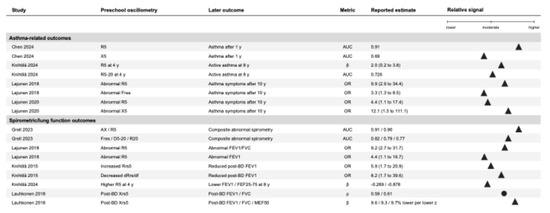
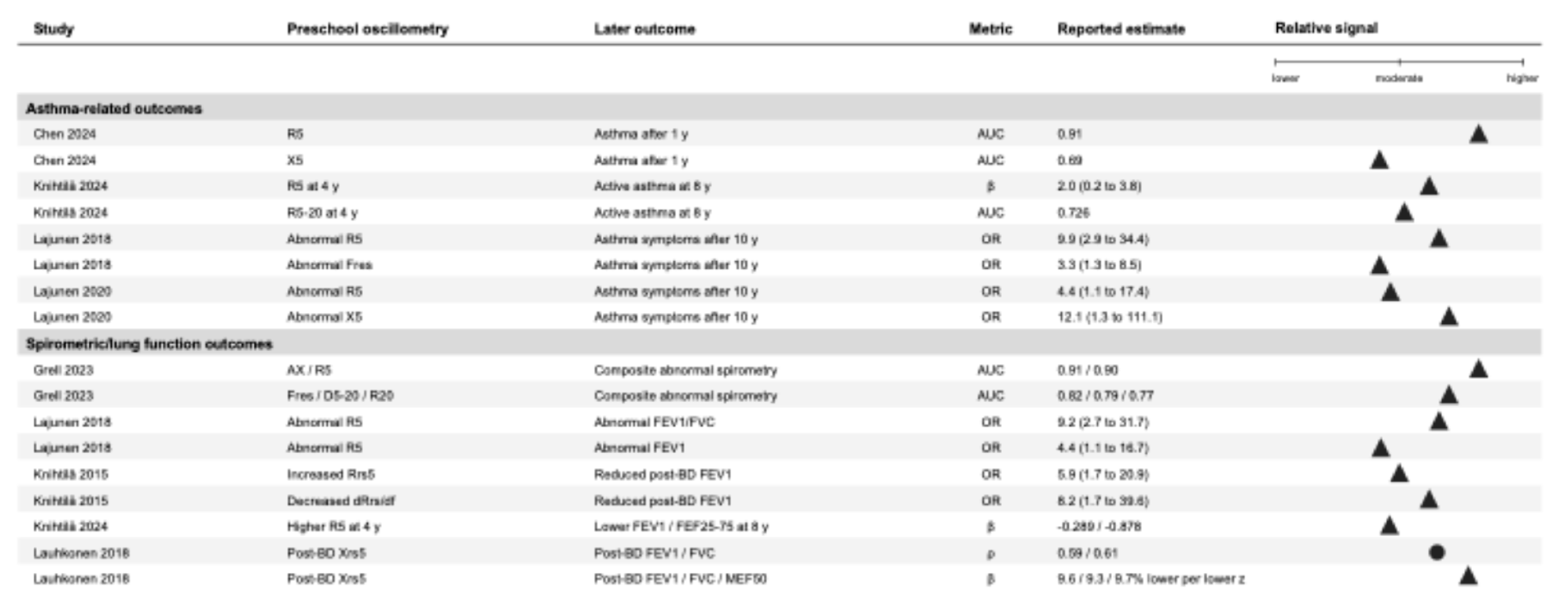
To address heterogeneity in reported estimates, Figure 3 presents a semi-quantitative harvest/effect-size evidence map rather than a formal forest plot. The figure separates asthma-related outcomes from spirometric/lung function outcomes and specifies the oscillometric parameter, later outcome, metric, and reported estimate for each association. This format clarifies whether the outcome was asthma diagnosis, symptoms, active asthma, or a specific spirometric measure, such as FEV1, FVC, FEV1/FVC, or FEF25–75. Because studies differed in populations, indices, thresholds, follow-up periods, and effect measures, estimates were not pooled; marker position provides an approximate visual summary of relative signal strength on the native reported scale.
Figure 3.
Semi-quantitative evidence map of preschool oscillometry associations with later asthma-related and spirometric/lung function outcomes. The upper section summarizes asthma-related outcomes, and the lower section summarizes spirometric/lung function outcomes, including FEV1, FEV1/FVC, FEF25–75, FVC, and MEF50, where reported. Each row identifies the study, oscillometric parameter, later outcome, metric, reported estimate, and approximate relative signal strength. Because studies differed in populations, oscillometric indices, thresholds, follow-up periods, and effect measures, estimates were not pooled. Marker position provides an approximate visual summary of relative signal strength on the native reported scale. Triangles indicate adverse-direction associations, in which higher resistance, frequency dependence, reactance area, or more negative reactance was linked with worse outcomes. Circles indicate favorable-direction reactance associations, where higher or less negative Xrs5 was associated with better spirometric values. AUC, OR, β, and ρ are displayed on their native reported scales; heterogeneity precluded meta-analysis [28,29,30,31,32,33,34].
3.5. Preschool Oscillometry and Long-Term Lung Function
In most longitudinal cohorts (Table 5), oscillometric abnormalities measured between 2 and 7 years of age were associated with reduced spirometric indices at school age or adolescence. Although studies differed in population characteristics, the overall direction of association was generally consistent. Higher airway resistance and impaired reactance during baseline testing at ages 2–7 years were linked to later airflow limitation.
Table 5.
Preschool oscillometry and later lung function impairment.
R5/Rrs5 was the most consistently evaluated parameter. In the multicenter cohort by Knihtilä et al. [28], higher R5 at age 4 years was associated with lower FEV1 and FEF25–75 between ages 5 and 8 years, suggesting that early resistance abnormalities may track with subsequent airflow limitation. The Chilean cohort of children with persistent asthma [29] was interpreted separately as a shorter, 3-year school-age classification study. In this study, IOS performed at ages 3–5 years was followed by spirometry at ages 6–8 years, and preschool R5, R20, AX, and D5-20 were associated with abnormal spirometry at school age, with moderate discriminative accuracy (AUC >0.7). R5 and AX showed the highest apparent predictive performance within that cohort. These findings suggest that increased total airway resistance at ages 3–5 years may reflect functional abnormalities that persist into later childhood.
Longer follow-up studies extending into adolescence further support this pattern. In a Finnish cohort of asthmatic children with IOS performed at ages 2–7 years and spirometry at ages 12–18 years [33], increased baseline Rrs5 and decreased dRrs/df were associated with reduced post-bronchodilator FEV1 in adolescence, with ORs of 5.9 and 8.2, respectively. The persistence of reduced lung function after bronchodilator administration suggests that early oscillometric abnormalities may reflect more persistent airway dysfunction rather than purely reversible bronchoconstriction.
Reactance measures also showed longitudinal relevance. In children with a history of severe bronchiolitis [34], IOS performed at ages 5–7 years showed that Xrs5 correlated with spirometric outcomes at ages 11–13 years. Post-bronchodilator Xrs5 demonstrated moderate-to-strong correlations with post-bronchodilator FEV1 and FVC (ρ = 0.59 and 0.61, respectively). In addition, each unit decrease in baseline post-bronchodilator Xrs5 z-score was associated with approximately 9–10% lower spirometric indices in adolescence. These findings suggest that reactance-related mechanics and elastic properties may be relevant to long-term lung function trajectories, although they should not be interpreted as anatomically specific evidence of peripheral airway disease.
In children aged 4–7 years with asthma-like symptoms, abnormal baseline R5 was also associated with a reduced FEV1/FVC ratio at ages 12–16 years (OR 9.2; 95% CI 2.7–31.7) [30], reinforcing the association between early resistance abnormalities and later airflow obstruction. In contrast, analyses focusing primarily on airway hyperresponsiveness did not consistently demonstrate independent associations between preschool oscillometric parameters and adolescent spirometry [32], suggesting that the predictive value of oscillometry may vary according to cohort characteristics, outcome definition, and statistical modeling approach.
Overall certainty for later lung function impairment was judged to be low. Although the direction of association was generally consistent across most cohorts, confidence in the evidence was limited by heterogeneity in study populations, spirometric endpoints, oscillometric expression, and follow-up duration, as well as by moderate risk of bias, limited sample sizes, partial cohort overlap, and the observational design of the included studies. Within these limitations, resistance-based measures showed the clearest recurring association with later airflow limitation, whereas reactance and frequency-dependent indices appeared to provide complementary information on respiratory mechanics, including ventilation heterogeneity, elastic properties, or possible peripheral airway involvement. These relationships are summarized in Figure 3, which visually separates asthma-related outcomes from spirometric/lung function outcomes and displays the reported estimates on their native scales. Overall, the available evidence suggests that early oscillometric abnormalities may track longitudinally and may be associated with later lung function impairment in childhood and adolescence.
4. Discussion
This systematic review evaluated whether oscillometric measurements obtained between 2 and 7 years of age are associated with later asthma-related outcomes and long-term lung function impairment. Across the included longitudinal cohorts, abnormal oscillometry, particularly elevated resistance-based indices such as R5, was generally associated with later asthma-related outcomes and lower subsequent lung function. However, the included cohorts mainly comprised children with wheezing, asthma-like symptoms, persistent asthma, prior hospitalization for bronchiolitis, or other high-risk asthma backgrounds, rather than unselected apparently healthy children. Therefore, these findings suggest that preschool oscillometry may provide useful complementary physiological information for risk assessment in symptomatic or high-risk preschool-aged children and should not be extrapolated to routine screening of apparently healthy populations.
R5 was the most consistent individual parameter across studies. Longer-term cohorts reported higher odds of later asthma symptoms or medication use among children with abnormal R5 measured between ages 3 and 7 years [30,32], and the multicenter VDAART cohort linked higher age-4 R5 with active asthma and lower spirometric indices at school age [28]. These findings support the use of resistance-based oscillometric information as an adjunct to clinical assessment, while also recognizing that some Finnish asthma reports were related and should not be interpreted as fully independent replications.
The reviewed studies also differed in clinical purpose and follow-up interval. The 1-year study by Chen et al. [31] is best interpreted as short-term diagnostic/classification evidence, whereas studies with 4- to 10-year follow-up more directly address asthma persistence and lung-function trajectories. This distinction is clinically important because high AUC values from short-term classification studies should not be extrapolated to long-term prediction of persistent asthma.
Beyond asthma-related outcomes, oscillometric abnormalities measured between ages 2 and 7 years were also associated with later lung function impairment, including lower FEV1, FEV1/FVC, FEF25–75, FVC, or MEF50 in some cohorts [28,30,33,34]. Reactance and frequency-dependent resistance indices appeared to provide complementary information on respiratory mechanics, but these parameters were less consistently reported, physiologically nonspecific, and expressed using non-uniform metrics. Therefore, current evidence does not support a universal oscillometric threshold or a single preferred reactance-derived or frequency-dependent index for clinical implementation.
From a clinical perspective, oscillometry may be most useful when integrated into a broader risk-assessment framework for symptomatic or high-risk preschool-aged children. Abnormal or persistently elevated R5, and potentially abnormalities in R5-20, X5, AX, or Fres should be interpreted alongside clinical features such as wheezing pattern, exacerbation frequency, interval symptoms, bronchodilator response, atopy, eczema, family history, environmental exposures, fractional exhaled nitric oxide (FeNO) or other available biomarkers, and treatment response. Within this context, abnormal oscillometry may support closer follow-up, repeat objective assessment, optimization of adherence and trigger control, or referral to pediatric pulmonology or allergy services. However, it should not be used as a stand-alone screening test or as the sole basis for diagnosis or treatment escalation.
This review has several limitations. The number of eligible longitudinal studies was small, and most were judged to be at moderate or high risk of bias, mainly because of attrition and incomplete control for confounding. In addition, some Finnish asthma reports were not fully independent, which limits their interpretation as separate replications. Although major databases were searched, the final evidence base remained limited, and the restriction to English-language publications may have led to the exclusion of relevant studies. Most included cohorts consisted of symptomatic or high-risk children, limiting the generalizability of the findings to broader preschool populations. Methodological heterogeneity was also substantial, reflecting differences in baseline phenotypes, devices, signal type, bronchodilator conditions, reference equations, parameter expression, outcome definitions, follow-up duration, and reporting approaches. These differences limit direct comparability and may partly explain why no single transferable threshold can currently be recommended. Moreover, several cohorts were also conducted before publication of the 2020 European Respiratory Society (ERS) Technical Standards for Respiratory Oscillometry, which provide recommendations on equipment performance, calibration and verification, patient preparation, acceptability and repeatability criteria, quality control, and reporting [21]. More recent pediatric standardization initiatives, including the STAN PNEUMO oscillometry statement, further emphasize the need for harmonized methodology, interpretation, and local implementation based on ERS recommendations [36].
Standardization is therefore essential before preschool oscillometry can be translated into prognostic practice. Future studies should apply harmonized IOS/FOT protocols aligned with ERS technical standards, and should transparently report device type, calibration and verification procedures, patient posture, cheek support, nose clip use, recording duration, number of acceptable trials, artifact rejection procedures, within-session repeatability, and bronchodilator status [21]. These details are particularly important in preschool children, in whom cooperation, tidal breathing variability, upper airway shunting, and quality control decisions can substantially influence resistance and reactance measurements. Reference values and thresholds also require harmonization. Ideally, oscillometric results should be reported as z-scores derived from appropriate age-, height-, sex-, and population-adjusted reference equations, with absolute values and percent-predicted values provided when helpful for clinical interpretation. Prespecified age-adjusted thresholds should be externally validated rather than derived post hoc within small cohorts. Until such standardization is achieved, R5 appears to be the most reproducible individual marker across longitudinal studies, whereas R5-20, X5, AX, Fres, and dRrs/df should be regarded as complementary, physiologically non-specific indices rather than interchangeable or universally applicable prognostic thresholds.
Future studies should move beyond associations and assess whether oscillometry improves risk prediction beyond established clinical predictors and biomarkers. Large multicenter cohorts should use ERS-aligned protocols, prespecified thresholds, harmonized asthma and lung-function outcomes, and transparent reporting of device type, quality-control criteria, bronchodilator status, reference equations, and parameter expression. Clinical-impact studies are also needed to determine whether oscillometry-guided monitoring or management improves asthma control, exacerbation risk, treatment decisions, or long-term lung-function trajectories.
Overall, the evidence supports oscillometry as a feasible adjunctive tool that may add objective physiological information to asthma-risk assessment in selected preschool-aged children. The most consistent signal relates to resistance-based measures, particularly R5, while reactance and frequency-dependent indices may provide additional context but require further standardization before routine prognostic use.
5. Conclusions
This systematic review found that oscillometric abnormalities measured during the preschool-age range, particularly elevated R5, were associated with later asthma-related outcomes and subsequent lung function impairment. These associations were observed mainly in children with wheezing, asthma-like symptoms, prior hospitalization for bronchiolitis, or other high-risk respiratory phenotypes. Resistance-based indices showed the most consistent longitudinal signal, whereas reactance and frequency-dependent resistance measures appeared to provide complementary but less standardized information.
Overall, preschool oscillometry may add objective physiological information to clinical assessment and risk stratification in symptomatic or clinically high-risk preschool-aged children, particularly when elevated R5 is present. These findings support the use of oscillometry as an adjunctive tool within a broader clinical framework, while further standardized prospective studies are needed before routine stand-alone prognostic use can be recommended.
Supplementary Materials
The following supporting information can be downloaded at: https://www.mdpi.com/article/10.3390/children13060756/s1, Table S1: PRISMA 2020 Checklist.
Author Contributions
Conceptualization, D.M. (Dafni Moriki) and K.D.; methodology D.M. (Dafni Moriki), E.A.K. and K.D.; validation, D.M. (Dafni Moriki), D.M. (Dimosthenis Maris), A.M., P.D. and K.D.; formal analysis, D.M. (Dafni Moriki), D.M. (Dimosthenis Maris) and A.M.; investigation, D.M. (Dafni Moriki), D.M. (Dimosthenis Maris), A.M., P.D., D.K. and M.T.; data curation, D.M. (Dafni Moriki), D.M. (Dimosthenis Maris) and M.T.; writing—original draft preparation, D.M. (Dafni Moriki); writing—review and editing, D.M. (Dafni Moriki), D.M. (Dimosthenis Maris), A.M., P.D., D.K., M.T., V.G., M.K., A.G., E.A.K. and K.D.; visualization, D.M. (Dafni Moriki), V.G. and. M.K.; supervision, K.D. All authors have read and agreed to the published version of the manuscript.
Funding
This research received no external funding.
Institutional Review Board Statement
Not applicable.
Informed Consent Statement
Not applicable.
Data Availability Statement
No new data were created in this study. Data supporting the findings of this systematic review were derived from previously published articles, which are cited in the reference list of this manuscript.
Conflicts of Interest
The authors declare no conflicts of interest.
Abbreviations
The following abbreviations are used in this manuscript:
| R5 | Resistance at 5 Hz |
| FEV1 | Forced expiratory volume in one second |
| FVC | Forced vital capacity |
| FEV1/FVC | Ratio of forced expiratory volume in one second to forced vital capacity |
| IOS | Impulse Oscillometry |
| FOT | Forced Oscillation Technique |
| R20 | Resistance at 20 Hz |
| R5-20 | Difference between resistance at 5 Hz and 20 Hz |
| dRrs/df | slope of resistance versus frequency |
| X5 | Reactance at 5 Hz |
| AX | Area of reactance |
| Fres | Resonant frequency |
| PRISMA | Preferred Reporting Items for Systematic Reviews and Meta-Analyses |
| PROSPERO | International Prospective Register of Systematic Reviews |
| PICOTS | Population, Intervention/Exposure, Comparison, Outcome, Timing, and Study design |
| QUIPS | Quality In Prognosis Studies |
| OR | Odds ratio |
| AUC | Area under the curve |
| CI | Confidence interval |
| VDAART | Vitamin D Antenatal Asthma Reduction Trial |
| D5-20 | Difference between resistance at 5 Hz and 20 Hz |
| mAPI | Modified Asthma Predictive Index |
| dR/df | Slope of resistance versus frequency |
| X10 | Reactance at 10 Hz |
| Rrs5 | Respiratory system resistance at 5 Hz |
| Rrs20 | Respiratory system resistance at 20 Hz |
| Xrs5 | Respiratory system reactance at 5 Hz |
| Xrs10 | Respiratory system reactance at 10 Hz |
| MEF50 | Maximal expiratory flow at 50% of forced vital capacity |
| ROC | Receiver operating characteristics |
| FEF25–75 | Forced expiratory flow at 25–75% of vital capacity |
| β | Beta coefficient |
| ρ | Correlation coefficient |
| BD | Bronchodilator |
| LR+ | Positive likelihood ratio |
| AHR | Airway hyper-responsiveness |
| FVS | Flow-volume spirometry |
| FeNO | Fractional exhaled nitric oxide |
| ERS | European Respiratory Society |
| STAN PNEUMO | Pediatric pulmonology oscillometry standardization statement |
Appendix A
Table A1.
Search concepts, free-text keywords, and controlled vocabulary used across databases.
Table A2.
Detailed search strategy for each database.
References
- Asher, M.I.; Rutter, C.E.; Bissell, K.; Chiang, C.Y.; El Sony, A.; Ellwood, E.; Ellwood, P.; García-Marcos, L.; Marks, G.B.; Morales, E.; et al. Worldwide trends in the burden of asthma symptoms in school-aged children: Global Asthma Network Phase I cross-sectional study. Lancet 2021, 398, 1569–1580. [Google Scholar] [CrossRef] [Scilit]
- Trivedi, M.; Denton, E. Asthma in Children and Adults-What Are the Differences and What Can They Tell us About Asthma? Front. Pediatr. 2019, 7, 256. [Google Scholar] [CrossRef] [Scilit]
- Guilbert, T.; Krawiec, M. Natural history of asthma. Pediatr. Clin. N. Am. 2003, 50, 523–538. [Google Scholar] [CrossRef] [Scilit]
- Doss, A.M.A.; Stokes, J.R. Viral Infections and Wheezing in Preschool Children. Immunol. Allergy Clin. N. Am. 2022, 42, 727–741. [Google Scholar] [CrossRef] [Scilit] [PubMed]
- Makrinioti, H.; Fainardi, V.; Bonnelykke, K.; Custovic, A.; Cicutto, L.; Coleman, C.; Eiwegger, T.; Kuehni, C.; Moeller, A.; Pedersen, E.; et al. European Respiratory Society statement on preschool wheezing disorders: Updated definitions, knowledge gaps and proposed future research directions. Eur. Respir. J. 2024, 64, 2400624. [Google Scholar] [CrossRef] [Scilit]
- Castro-Rodriguez, J.A.; Wolters, A.A.B.; Rodriguez-Martinez, C.E.; Biagini, J.M.; Celedón, J.C.; Custovic, A.; Koppelman, G.H.; Phipatanakal, W.; Saglani, S.; Forno, E. Risk Factors and Mechanisms Leading to Preschool Recurrent Wheeze and Asthma. J. Allergy Clin. Immunol. Pract. 2025, 13, 2537–2551. [Google Scholar] [CrossRef] [Scilit]
- Tan, D.J.; Lodge, C.J.; Walters, E.H.; Lowe, A.J.; Bui, D.S.; Bowatte, G.; Pham, J.; Erbas, B.; Hui, J.; Hamilton, G.S.; et al. Longitudinal Asthma Phenotypes from Childhood to Middle-Age: A Population-based Cohort Study. Am. J. Respir. Crit. Care Med. 2023, 208, 132–141. [Google Scholar] [CrossRef] [Scilit] [PubMed]
- Tai, A.; Tran, H.; Roberts, M.; Clarke, N.; Gibson, A.M.; Vidmar, S.; Wilson, J.; Robertson, C.F. Outcomes of childhood asthma to the age of 50 years. J. Allergy Clin. Immunol. 2014, 133, 1572–1578.e3. [Google Scholar] [CrossRef] [Scilit]
- Saglani, S.; Fitzpatrick, A.M.; Papadopoulos, N.G.; Reznik, M.; Stokes, J. Phenotype-Based Management of Recurrent Preschool Wheezing and Asthma. J. Allergy Clin. Immunol. Pract. 2025, 13, 2563–2571. [Google Scholar] [CrossRef] [Scilit] [PubMed]
- Lynch, B.A.; Van Norman, C.A.; Jacobson, R.M.; Weaver, A.L.; Juhn, Y.J. Impact of delay in asthma diagnosis on health care service use. Allergy Asthma Proc. 2010, 31, e48–e52. [Google Scholar] [CrossRef] [Scilit]
- Wei, X.; Xue, M.; Yan, J.; Han, Y.; Liu, Y.; Liu, M.; Sun, J.; Zhang, Y.; Cheng, L.; Ma, X.; et al. Effect of diagnosis delay on pulmonary function in children with asthma. Allergy Asthma Clin. Immunol. 2022, 18, 92. [Google Scholar] [CrossRef] [Scilit]
- Kothalawala, D.M.; Kadalayil, L.; Weiss, V.B.N.; Kyyaly, M.A.; Arshad, S.H.; Holloway, J.W.; Rezwan, F.I. Prediction models for childhood asthma: A systematic review. Pediatr. Allergy Immunol. 2020, 31, 616–627. [Google Scholar] [CrossRef] [Scilit]
- Karramass, T.; Mancino, E.; Balemans, W.; Brouwer, M.; De Groot, E.; Landstra, A.M.; Merkus, P.; Niers, L.E.M.; Vaessen-Verberne, A.; van Klaveren, D.; et al. Early-life prediction of school-age asthma among recurrent Wheezers in preschoolers: The WHEEP study. Pediatr. Allergy Immunol. 2025, 36, e70219. [Google Scholar] [CrossRef] [Scilit] [PubMed]
- Burbank, A.J.; Szefler, S.J. Current and future management of the young child with early onset wheezing. Curr. Opin. Allergy Clin. Immunol. 2017, 17, 146–152. [Google Scholar] [CrossRef] [Scilit] [PubMed]
- Sánchez-Solís, M. Early Lung Function and Future Asthma. Front. Pediatr. 2019, 7, 253. [Google Scholar] [CrossRef] [Scilit] [PubMed]
- Beydon, N.; Davis, S.D.; Lombardi, E.; Allen, J.L.; Arets, H.G.; Aurora, P.; Bisgaard, H.; Davis, G.M.; Ducharme, F.M.; Eigen, H.; et al. An official American Thoracic Society/European Respiratory Society statement: Pulmonary function testing in preschool children. Am. J. Respir. Crit. Care Med. 2007, 175, 1304–1345. [Google Scholar] [CrossRef] [Scilit]
- Fenu, G.; Calogero, C.; Lombardi, E. Lung Function Tests in Preschool Children. Turk. Thorac. J. 2015, 16, 185–188. [Google Scholar] [CrossRef] [Scilit]
- Stocks, J. Clinical implications of pulmonary function testing in preschool children. Paediatr. Respir. Rev. 2006, 7, S26–S29. [Google Scholar] [CrossRef] [Scilit]
- Elenius, V.; Chawes, B.; Malmberg, P.L.; Adamiec, A.; Ruszczyński, M.; Feleszko, W.; Jartti, T. Lung function testing and inflammation markers for wheezing preschool children: A systematic review for the EAACI Clinical Practice Recommendations on Diagnostics of Preschool Wheeze. Pediatr. Allergy Immunol. 2021, 32, 501–513. [Google Scholar] [CrossRef] [Scilit]
- Chawes, B.; Elenius, V. Pulmonary function testing for the diagnosis of asthma in preschool children. Curr. Opin. Allergy Clin. Immunol. 2022, 22, 101–106. [Google Scholar] [CrossRef] [Scilit]
- King, G.G.; Bates, J.; Berger, K.I.; Calverley, P.; de Melo, P.L.; Dellacà, R.L.; Farré, R.; Hall, G.L.; Ioan, I.; Irvin, C.G.; et al. Technical standards for respiratory oscillometry. Eur. Respir. J. 2020, 55, 1900753. [Google Scholar] [CrossRef] [Scilit]
- Allen, J.L. Input oscillometry and the forced oscillation technique for assessing lung function in preschool children with asthma. Pediatr. Investig. 2018, 2, 37–43. [Google Scholar] [CrossRef] [Scilit]
- de Oliveira Jorge, P.P.; de Lima, J.H.P.; Chong, E.S.D.C.; Medeiros, D.; Solé, D.; Wandalsen, G.F. Impulse oscillometry in the assessment of children’s lung function. Allergol. Immunopathol. 2019, 47, 295–302. [Google Scholar] [CrossRef] [Scilit]
- Bokov, P.; Jallouli-Masmoudi, D.; Amat, F.; Houdouin, V.; Delclaux, C. Small airway dysfunction is an independent dimension of wheezing disease in preschool children. Pediatr. Allergy Immunol. 2022, 33, e13647. [Google Scholar] [CrossRef] [Scilit]
- Shi, Y.; Aledia, A.S.; Tatavoosian, A.V.; Vijayalakshmi, S.; Galant, S.P.; George, S.C. Relating small airways to asthma control by using impulse oscillometry in children. J. Allergy Clin. Immunol. 2012, 129, 671–678. [Google Scholar] [CrossRef] [Scilit]
- Medeiros, D.; Castro, P.; Bianca, A.C.D.; Sarinho, E.; Araújo, J.F.; Correia Junior, M.; Rizzo, J.A. Impulse oscillometry: Pulmonary function assessment in preschool children. Expert Rev. Respir. Med. 2020, 14, 1261–1266. [Google Scholar] [CrossRef] [Scilit]
- Comberiati, P.; Cottini, M.; Landi, M.; Berti, A.; Lombardi, C.; Peroni, D. Impulse oscillometry for the evaluation and management of pediatric asthma. Explor. Asthma Allergy 2023, 1, 219–229. [Google Scholar] [CrossRef] [Scilit]
- Knihtilä, H.M.; Stubbs, B.J.; Carey, V.J.; Laranjo, N.; Zeiger, R.S.; Bacharier, L.B.; O’Connor, G.T.; Weiss, S.T.; Litonjua, A.A. Preschool impulse oscillometry predicts active asthma and impaired lung function at school age. J. Allergy Clin. Immunol. 2024, 154, 94–100.e113. [Google Scholar] [CrossRef] [Scilit] [PubMed]
- Grell, A.V.; Vera, R.G.; Yarur, A.M.; Castro-Rodriguez, J.A.; Montenegro, M.A.P.; Colodro, O.F.; Elías, S.A.; Bentjerodt, M.S.; Poblete, J.M. Impulse oscillometry in preschool children with persistent asthma can predict spirometry at school age. Pediatr. Pulmonol. 2023, 58, 1411–1416. [Google Scholar] [CrossRef] [Scilit] [PubMed]
- Lajunen, K.; Kalliola, S.; Kotaniemi-Syrjänen, A.; Sarna, S.; Malmberg, L.P.; Pelkonen, A.S.; Mäkelä, M.J. Abnormal lung function at preschool age asthma in adolescence? Ann. Allergy Asthma Immunol. 2018, 120, 520–526. [Google Scholar] [CrossRef] [Scilit]
- Chen, J.; Xiao, J.; Liu, L.; Ali, K.; Wu, S. Predictive Value of Impulse Oscillometry Combined with Fractional Expiratory Nitric Oxide Test for Asthma in Preschool Children. J. Asthma Allergy 2024, 17, 421–430. [Google Scholar] [CrossRef] [Scilit]
- Lajunen, K.T.; Malmberg, L.P.; Kalliola, S.; Kotaniemi-Syrjänen, A.; Pelkonen, A.S.; Mäkelä, M.J. Predictive value of childhood airway hyper-responsiveness to indirect stimuli: 10-year longitudinal study. Pediatr. Allergy Immunol. 2020, 31, 767–773. [Google Scholar] [CrossRef] [Scilit] [PubMed]
- Knihtilä, H.; Kotaniemi-Syrjänen, A.; Mäkelä, M.J.; Bondestam, J.; Pelkonen, A.S.; Malmberg, L.P. Preschool oscillometry and lung function at adolescence in asthmatic children. Pediatr. Pulmonol. 2015, 50, 1205–1213. [Google Scholar] [CrossRef] [Scilit] [PubMed]
- Lauhkonen, E.; Riikonen, R.; Törmänen, S.; Koponen, P.; Nuolivirta, K.; Helminen, M.; Toikka, J.; Korppi, M. Impulse oscillometry at preschool age is a strong predictor of lung function by flow-volume spirometry in adolescence. Pediatr. Pulmonol. 2018, 53, 552–558. [Google Scholar] [CrossRef] [Scilit]
- Page, M.J.; McKenzie, J.E.; Bossuyt, P.M.; Boutron, I.; Hoffmann, T.C.; Mulrow, C.D.; Shamseer, L.; Tetzlaff, J.M.; Akl, E.A.; Brennan, S.E.; et al. The PRISMA 2020 statement: An updated guideline for reporting systematic reviews. BMJ 2021, 372, n71. [Google Scholar] [CrossRef] [Scilit]
- Wasilewska, E.; Peradzyńska, J.; Walicka-Serzysko, K.; Krenke, K.; Doniec, Z.; Mazurek, H.; Wojsyk-Banaszak, I. Lung function testing in children: Oscillometry. Expert position statement of the Polish Society of Pediatric Pulmonology (STAN PNEUMO: OSCILLOMETRY). Fam. Med. Prim. Care Rev. 2025, 27, 377–385. [Google Scholar] [CrossRef] [Scilit]

Disclaimer/Publisher’s Note: The statements, opinions and data contained in all publications are solely those of the individual author(s) and contributor(s) and not of MDPI and/or the editor(s). MDPI and/or the editor(s) disclaim responsibility for any injury to people or property resulting from any ideas, methods, instructions or products referred to in the content. |
© 2026 by the authors. Licensee MDPI, Basel, Switzerland. This article is an open access article distributed under the terms and conditions of the Creative Commons Attribution (CC BY) license.