


Abstract
Background/Objectives: Socio-cultural adversities and health disparities across Asian American origin groups remain understudied, particularly in early childhood. This limits the development of culturally responsive prevention and intervention strategies. A family-based Asian American epidemiologic study is essential to address these gaps and to inform tailored solutions. As an initial pilot effort, this pilot study was designed primarily to assess feasibility and generate preliminary data to inform future hypothesis-driven, large-scale epidemiologic research. The study objectives were to evaluate the feasibility of a remote study protocol and to collect preliminary data on child development and parental factors among Asian Indian, Filipino, and Korean American families with young children. Methods: A remote pilot study was conducted in 2024–25 among 48 mother–father–child (age 1–4 years) triads residing in Illinois, including 18 Asian Indian, 12 Filipino, and 18 Korean American mothers. Parents completed an online survey, and children wore an ActiGraph accelerometer on their hips. Analyses were conducted to describe child development, parental experiences, and parenting practices among the three ethnic groups. Results: Of the 48 mothers, 29 (60%) were US-born, and all but 1 had at least a bachelor’s degree. All parent pairs completed the survey, whereas only 34 children (71%) provided valid accelerometer data. Disaggregated data showed that, compared to children of Asian Indian mothers, children of Filipino mothers had higher daily screen time (p < 0.10) and higher sleep problem scores (p < 0.05), and children of Korean mothers had higher child–caregiver interaction scores (p < 0.05). Across all three groups, more favorable parenting practices were associated with lower sleep problem scores, higher wellbeing scores, and higher child–caregiver interaction scores (p < 0.01). Conclusions: The remote study protocol was generally feasible; however, child compliance with hip accelerometer wear was suboptimal. Preliminary data revealed differences in children’s physical behaviors and social-emotional development across Asian ethnic groups. A full-scale study should enhance the engagement of socioeconomically diverse families and refine wearable data collection methods to improve data representativeness and completeness.
1. Introduction
Asian Americans represent the fastest-growing racial group in the United States (US), with a 35.5% population increase between 2010 and 2020 [1]. Despite this rapid growth, little attention has been given to the socio-cultural stressors experienced by this population, including acculturative stress and racial discrimination, which are linked to elevated risks for mental health problems and chronic conditions including diabetes and cardiovascular disease [2,3]. Moreover, Asian Americans are a highly heterogeneous group, yet health data are often reported in aggregated form under a single pan-ethnic category. This practice masks critical differences in risk profiles across origin-specific groups [4,5,6,7,8,9,10]. For instance, while Asian Americans overall appear to have a lower cardiovascular risk than their non-Hispanic White counterparts, this pattern is largely driven by East Asian groups (e.g., Korean), whereas South Asian groups (e.g., Asian Indian) face a substantially higher cardiovascular risk [5,6]. Such data aggregation obscures origin group-specific vulnerabilities and undermines efforts to develop culturally responsive prevention and intervention strategies [11,12,13].
Recent initiatives underscore the importance of collecting and reporting disaggregated health data for Asian American populations [14]. One notable initiative is the Multiethnic Observational Study in American Asian and Pacific Islander Communities (MOSAAIC), a large-scale national cohort study designed to collect epidemiologic data from adults across diverse Asian origin groups [15]. While MOSAAIC will provide valuable data into adult health, it does not capture childhood development and health. Understanding the developmental trajectories in early childhood and intergenerational (parent–child) influences is essential for informing tailored strategies to promote positive childhood experiences (PCEs) and foster well-being in the next generation of Asian Americans. Data from the National Survey of Children’s Health (NSCH) show that the prevalence of flourishing, an indicator of positive psychological wellbeing, was the lowest among Asian American children under 5 years (72.6%) compared to Hispanic (76.7%), non-Hispanic Black (79.5%), and non-Hispanic White (87.2%) children [16]. Asian American children in this age group were also less likely to have regular bedtime and more likely to have excessive screen time than their non-Hispanic White peers [17]. However, the absence of Asian origin information limits the ability to identify which origin groups are most at risk.
To address these knowledge gaps, family-based epidemiologic studies that include multiple Asian origin groups are needed. As a foundational step toward launching such an epidemiologic study, this pilot study was designed primarily to assess feasibility and generate preliminary data on child physical behaviors (physical activity [PA], screen time, and sleep) and social-emotional development, and parental experience and parenting practices among Asian Indian, Filipino, and Korean American families with children aged 1–4 years. We selected these three origin groups to represent the regional (South, Southeast, and East Asia) and cultural heterogeneity of the Asian diaspora based on their distinct physical behaviors reported in the literature [18,19,20,21,22,23] and the research team’s established community partnerships that support recruitment feasibility. These groups were also chosen among the six largest Asian origin populations in the Chicago area (Asian Indian, Chinese, Filipino, Korean, Vietnamese, and Japanese, in order). This study was guided by a socioecological framework that emphasizes how individual, family, and broader sociocultural contexts jointly shape early childhood behavioral and social-emotional development. The objectives of this pilot study were to evaluate the feasibility of a remote study protocol and to collect preliminary data on child development and parental factors among Asian Indian, Filipino, and Korean American families with young children.
2. Materials and Methods
2.1. Study Design and Sample
We conducted a cross-sectional pilot study. Participants were mother–father–child triads. Eligibility criteria for mothers included (1) self-identifying as Asian Indian, Filipino, or Korean origin, (2) 18 years or older, (3) having lived in the US for at least 10 years, (4) having a child aged 1–4 years old, (5) living with the child at least 50% of the time, (6) residing in Illinois, and (7) speaking English, Hindi, Korean, Telugu, or Urdu. Language eligibility reflected the linguistic capacity of the research team. To guide future planning, we recorded the number of otherwise eligible families excluded due to language eligibility. Eligibility criteria for children included being 1–4 years of age and having no medical conditions that make it difficult or impossible to move around (e.g., impairments in walking). Only one child per family was eligible. Eligibility criteria for fathers were living with the child at least 50% of the time and speaking English, Hindi, Korean, Telugu, or Urdu. Families were enrolled if all three members met their respective eligibility criteria. The study protocol was approved by the Ann & Robert H Lurie Children’s Hospital Institutional Review Board (IRB#2024-6829). Parental permission and informed consent were obtained from parent participants.
2.2. Study Setting and Recruitment
Participant recruitment was conducted between May 2024 and February 2025 using multiple recruitment strategies, including community outreach, collaboration with a community consultant, and use of a healthcare patient database. Leveraging municipal demographic data and the research team’s community networks, we identified and engaged with organizations and community areas serving Asian Indian, Filipino, and Korean populations. Recruitment flyers were distributed in multiple languages across diverse community-based settings (e.g., South Asian, Filipino, and Korean community organizations, pediatric offices, schools, churches, childcare centers, public libraries, grocery stores). We also hired a community liaison to South Asian families in a local school district to serve as a community consultant. In addition, we identified potentially eligible children (aged 1–4 years) and mothers (self-identified as Asian) from a single healthcare patient database and sent a recruitment email containing study details and a link to a REDCap-based online screening form.
2.3. Outcomes
Health Behaviors: Guided by the World Health Organization’s (WHO) 24 h movement framework for young children [24], we assessed PA, sedentary behavior, and sleep. Mothers were instructed to assist their child in wearing an ActiGragh wGT3X-BT accelerometer (Pensacola, FL, USA) for 24 h over 6 days and record a wear log. To generate physical activity (PA) metrics, we extracted data collected between 6 a.m. and 10 p.m. [25,26,27]. After excluding non-wear periods [28,29,30,31], a valid wear day was defined as ≥480 wear minutes during the 16 h window [28,32,33]. At least 3 valid wear days were required to represent regular PA levels [34]. Daily minutes spent in moderate- and vigorous-intensity PA (MVPA) was calculated as minutes accumulated in epochs exceeding 417 vertical counts per 15 s [30,35]. Average acceleration (mg) was derived from Euclidian norm minus one gravitational unit (ENMO) data [36] using the GGIR R package (version 4.4) [37].
Parents completed the Patient-Reported Outcome Measurement Information System (PROMIS®) Early Childhood (EC) 8-item Sleep Problem scale [38] from which standardized T-scores for sleep problem were calculated. Parents also reported the child’s screen time with two items: “on average, how many minutes per day did your child… spend watching things on a TV (including TV, DVD/Blu-ray or videos on apps like YouTube or Netflix through the TV; spend watching videos on a tablet or smartphone?” [16,39] Responses were summed to estimate daily screen time (minutes/day) [40].
Social-Emotional Development: Social-emotional development was assessed using 5 PROMIS EC wellbeing scales (i.e., 8-item Positive Affect, 6-item Curiosity, 6-item Persistence, 5-item Flexibility, 6-item Frustration Tolerance) [41] and a social relationship scale (i.e., 5-item Child–Caregiver Interactions) [42]. Standardized T-scores were derived for each scale.
2.4. Exposures
The primary exposure of interest was maternal Asian origin group, determined based on self-identified Asian origin: Asian Indian, Filipino, or Korean. Other exposures included parents’ acculturation, discrimination experiences, adverse childhood experiences (ACEs), PCEs, and parenting practices.
Acculturation, which refers to a multidimensional process involving psychological, behavioral, and cultural adaptation to a new environment [43], was assessed using the 21-item Suinn-Lew Asian Self-Identity Acculturation (SL-ASIA) scale [44,45], producing a score from 1 (low acculturation [high Asian identification]) to 5 (high acculturation [high western identification]). Discrimination experience was assessed using the 5-item Everyday Discrimination Score (EDS)-short version [46,47].
ACEs refer to traumatic or stressful events that occur before age 18 years, whereas PCEs are characterized as safe, stable, and nurturing relationships and environments before 18 years of age [48]. ACEs and PCEs were measured using the standard 10-item ACE scale [49] and 7-item PCE scale [50], respectively.
Parenting practices were assessed using the 21-item Parenting Young children (PARYC) questionnaire, which asks about the frequency of three domains of parenting during the past month (i.e., support positive behavior, setting limits, and proactive parenting). Responses were recorded on a 7-point scale (1 = not at all to 7 = most of the time). Domain-specific and overall PARYC parenting scores were calculated, in which higher scores indicated more favorable parenting practices. In addition, three NSCH positive parenting items were asked: “during the past week, (1) how many days did you or other family members read to this child”? [reading]; (2) “how many days did you or other family members tell stories or sing songs to this child?” [storytelling/singing]; and (3) “on how many days did all family members who live in the household eat a meal together?” [family meals] [51]. Response options included 0 days, 1–3 days, 4–6 days, and every day.
2.5. Sociodemographic and Neighborhood Characteristics
Child age and sex, as well as maternal education attainment, were reported. To describe the participants’ neighborhood resources, we used the metropolitan Child Opportunity Index (COI; very low, low, moderate, high and very high), a composite index that captures neighborhood resources and conditions that matter for children’s healthy development at a census tract level [52].
2.6. Study Procedures
Eligibility screeners and parent surveys were administered online using the REDCap platform. Two part-time research staff were hired: one Asian Indian individual fluent in English, Hindi, Telugu, and Urdu, and one Korean individual fluent in English and Korean. Research staff reviewed screener submissions on a daily basis. The online screener incorporated an in-built CAPTCHA (Google’s Completely Automated Public Turing test to tell Computers and Humans Apart) feature to help block bots and reduce fraudulent submissions. As the study progressed, fraudulent responses were detected [53]. To address this issue, we implemented multi-layered strategies to identify fraudulent or suspicious responses. Daily screener traffic was monitored, and days with an unusually high number of completions were flagged for closer inspection. Indicators of suspicious screeners included atypical completion timestamps, extremely short completion times (i.e., <1 min), and suspicious name, email, and phone number entries. Suspicious cases underwent further verification, including video verification and address confirmation (required for mailing accelerometer packages). Questionable cases were reviewed in team discussions, and individuals determined to be fraudulent were excluded from participation.
Eligible participants identified through the screening process were contacted by email to schedule a phone or Zoom meeting. Following electronic written consent, study staff collected demographic information and provided instructions for accelerometer wear. Each parent then received an online REDcap survey link via email. The survey was only available in English due to limited research resources for translation; however, verbal translation assistance was provided upon request. An accelerometer package, including a prepaid return envelope, was mailed to participants. Upon completion of their respective study activities, each child, mother, and father received a $20 gift card in appreciation of their time and participation.
2.7. Statistical Analysis
All analyses were conducted in SAS 9.4 (Cary, NC, USA). A significance level was set at p < 0.10 (two-sided), considering the exploratory nature of this pilot study. We performed descriptive analyses and assessed normality. Bivariate analyses (i.e., t-tests and Analysis of Variance) were conducted to compare child outcome variables and parent exposure variables among three Asian origin groups.
Multivariable mixed-effects linear regression models were used to compare child outcomes reported by both mothers and fathers among the three Asian origin groups. Due to the relatively small sample size (n = 96) for this analysis, models included only a few key demographic and parental predictors: child age in years, child sex, parenting practice scores, and respondent identification (mother vs. father).
3. Results
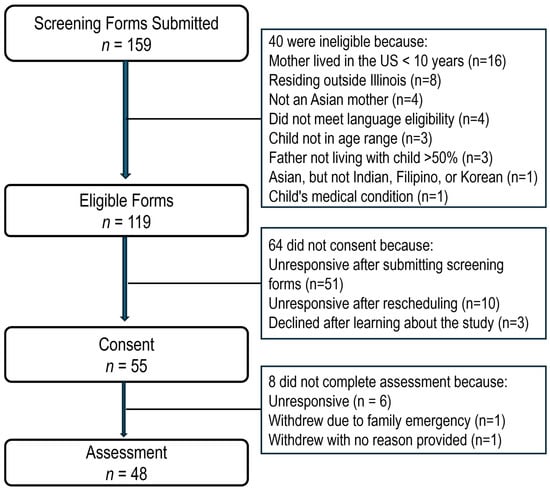
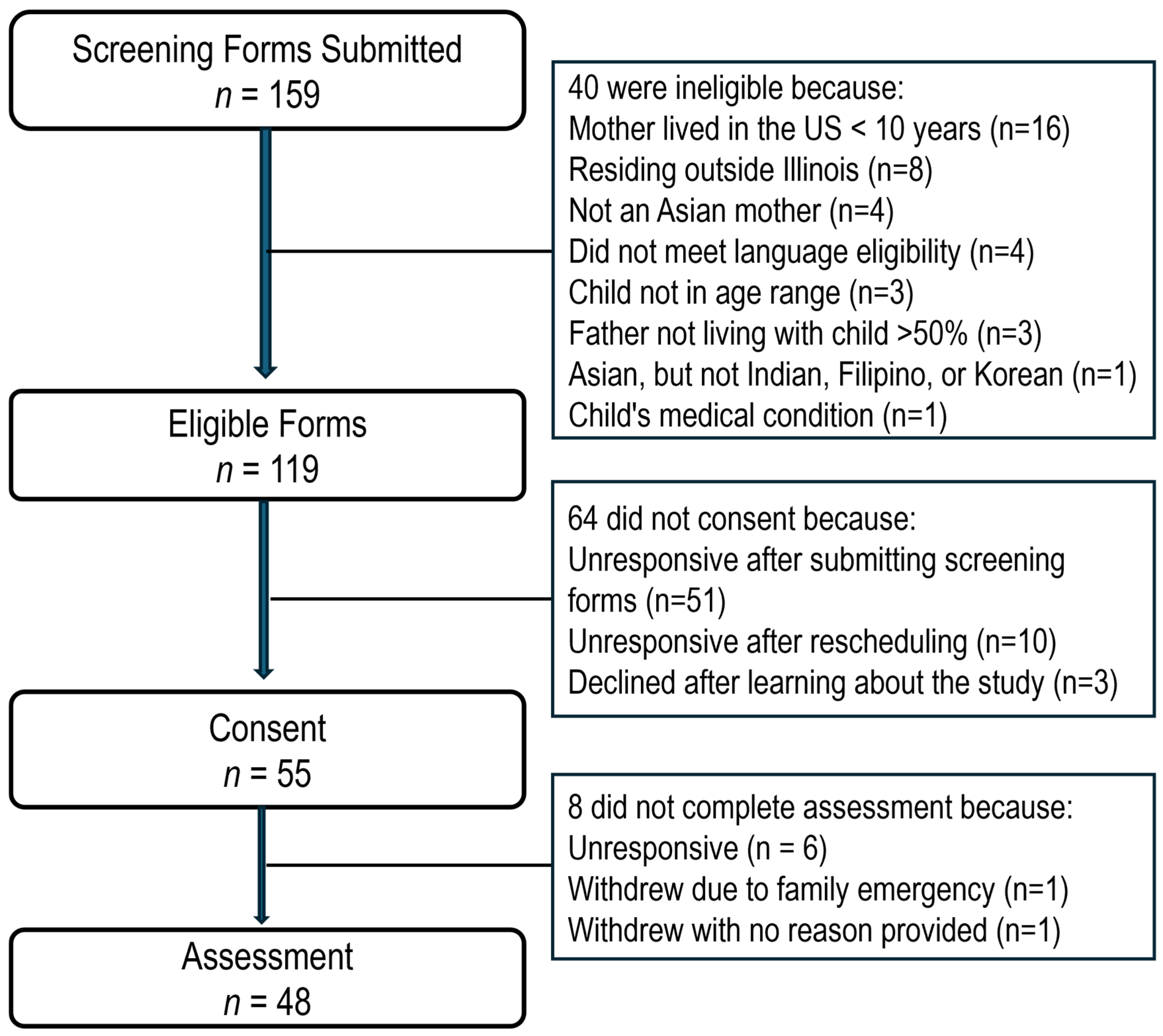
A total of 453 screeners were filled, of which 294 (64.9%) were determined to be fraudulent during the study process. As shown in Figure 1, of the 159 valid screeners, 119 respondents were deemed eligible and 56 consented to participate. Excluding the six individuals who became unresponsive after consenting, one who withdrew due to a family emergency, and one who withdrew without providing a specific reason, 48 families participated in this study.
Figure 1.
Participant flowchart.
Among the forty-eight families, thirty-one were recruited through healthcare patient database emails, five through the community consultant, five through word of mouth, four through pediatric clinics, two through community partners’ social media, and one through a childcare center. By maternal Asian origin, 18 were Asian Indian, 12 were Filipino, and 18 were Korean. Table 1 presents participant characteristics by the three Asian origin groups. Nearly all mothers (n = 47; 98%) had a bachelor’s degree or higher and 39 (81%) resided in neighborhoods with high or very high COI.
Table 1.
Participant characteristics.
All 48 mother–father pairs completed the parent survey, whereas 34 children (71%) provided valid accelerometer data. Among the 14 children without sufficient accelerometer data, the primary reasons were maternal refusal of accelerometer wear (n = 7), child noncompliance or insufficient wear time (n = 6), and daycare restrictions (n = 1). As shown in Table 2, when the three groups were aggregated, an average PROMIS EC Sleep T-score (mean ± standard deviation [SD] = 50 ± 9) was the same as the mean of a reference population (50 ± 10) [38]. However, disaggregated analyses showed that an average PROMIS EC Sleep T-score was lower in the Filipino group than the Asian Indian group (p < 0.10).
Table 2.
Descriptive statistics of child outcomes.
As shown in Table 3, average ACEs were higher among Filipino mothers compared to Korean mothers (p < 0.10). Average PCEs were lower among Filipino mothers compared to Asian Indian or Korean mothers (p < 0.05). The distribution of ACE and PCE items is presented in Supplementary Figure S1. PARYC parenting scores or positive parenting practices were not significantly different across the three groups. Higher parental PCE scores were associated with higher PARYC parenting scores (p < 0.05; Supplementary Table S1).
Table 3.
Descriptive statistics of mothers’ experiences and parenting.
Multivariable mixed-effects models showed that children in the Filipino group had higher screen time and sleep problem T-scores (p < 0.10), compared with children in the Asian Indian group (Table 4). Children in the Korean group had higher child–caregiver Interaction T-scores, compared with children in the Asian Indian group (p < 0.01). PARYC parenting practice scores were negatively associated with sleep problem T-scores and positively associated with wellbeing T-scores and the child–caregiver interaction T-scores (p < 0.01).
Table 4.
Multivariable mixed-effects models for child development outcomes.
4. Discussion
4.1. Main Findings
This pilot study assessed the feasibility of a remote study protocol and collected preliminary data on child development and parental factors among Asian Indian, Filipino, and Korean families with young children. While a remote study protocol was generally feasible, compliance with hip accelerometer wear among young children was suboptimal. Preliminary data demonstrated variations in early childhood physical behaviors and social-emotional development across Asian origin groups.
4.2. Feasibility of Recruitment and Data Collection Protocols
Prior research suggests that Asian Americans are less willing than other racial and ethnic groups to participate in health research [54], partly due to mistrust and language barriers [54,55,56]. Findings from this pilot study indicate that recruiting Asian American families with young children is feasible, but requires multifaceted outreach efforts. Of the 56 families who consented, 48 ultimately participated in the study. The majority (65%) were recruited through healthcare system outreach, suggesting that leveraging electronic health record (EHR)-based patient communication is a promising strategy for engaging Asian American parents. However, community-based methods, including engagement through a community consultant and word of mouth, also contributed to recruitment. Community engagement may be especially important to reach families underrepresented in healthcare systems [57]. A 10-year residency requirement for mothers excluded a notable proportion of interested individuals (16 out of 40 excluded individuals), suggesting that eligibility criteria such as residency duration and language requirements should be reconsidered in a full-scale study to best align with study goals and to enhance inclusivity.
This study’s remote design expanded its geographical reach and reduced participation burden for families with young children (e.g., travel time, work absences). However, the online recruitment screener encountered a large number of fraudulent or suspicious responses, with nearly two-thirds (65%) of submissions being excluded. Future remote recruitment efforts should incorporate multi-layered fraud prevention strategies (e.g., IP tracking, video verification) and adapt them over time as fraud tactics evolve [58,59,60].
Remote data collection through online surveys was largely successful: all 48 mother–father pairs successfully completed the surveys. However, child compliance with hip accelerometer wear was limited; only 34 of 48 children (71%) provided sufficient accelerometer data. Among those without accelerometer data, parental refusal (n = 7) and child noncompliance (n = 6) were the primary reasons. This suboptimal engagement in wearables’ data collection in Asian American families has been documented [61]. Our findings indicate that although mailed device protocols are logistically feasible, optimizing participation and compliance in wearable-based research among Asian American families requires intentional community trust-building and the exploration of alternative wearable implementation strategies (e.g., an alternative device).
4.3. Asian Mothers’ Lived Experiences
When data were aggregated across the three Asian origin groups, ACEs and PCEs reported in mother participants were lower than those reported by non-Hispanic White adults in US national datasets [48,62]. These findings align with prior national research showing that Asian adults reported lower ACEs [62] and lower PCEs [48] compared to non-Hispanic White adults. In this sample, the PCE item, “I was able to talk with my family about feelings” had the lowest endorsement, consistent with national data indicating similar low endorsement for “I was able to talk with family about feelings” and “I had at least two non-parent adults who genuinely cared” [48].
The lower ACEs observed could reflect genuinely lower exposure to adversity due to protective cultural, familial or community factors, such as strong family cohesion and extended family support [63]. Lower PCEs may reflect cultural norms emphasizing emotional restraint, indirect communication, and less explicit verbal expression of feelings rather than the overt expressive praise typical of Western cultures [64,65]. PCE constructs emphasize emotional support, open communication, and positive reinforcement, whereas for Asian families, positive experiences may be conveyed through instrumental support, high parental involvement, and relational commitment, even when emotional expression is more restrained [66,67]. These results may also reflect reporting bias, as cultural norms can discourage disclosure of family conflict, emotional abuse, or psychological distress, thereby limiting the recognition or reporting of certain adversities [68,69]. Overall, these findings underscore the importance of culturally sensitive interpretations of ACE and PCE measures.
Prior studies [48,62] were not disaggregated ACE and PCE data by Asian origin groups. In this pilot study, maternal ACEs and PCEs did vary across Asian origin groups. Disaggregated data revealed that Filipino mothers reported higher ACEs and lower PCEs than Asian Indian and Korean mothers. Extremely limited data are available to explain and contextualize the differences in childhood adversity and protective experiences across these origin groups, highlighting a critical need for disaggregated, culturally grounded studies in this area.
4.4. Asian Mothers’ Parenting Practices
This pilot study found no significant differences in the maternal parenting practices investigated among the three Asian origin groups. Notably, a higher proportion of mothers in this sample reported frequent positive parenting practices (i.e., reading to the child, telling stories/singing songs, and eating meals together), compared to findings from a national sample of US Asian parents [17]. This may be partly explained by relatively high socioeconomic status of our participants (i.e., high education attainment), as maternal socioeconomic advantage is associated with positive parenting practices [70,71].
Prior research has linked greater parental ACEs to higher parenting stress, harsher discipline, and poorer parent–child interactions, which elevate the risk of the offspring’s developmental delays and internalizing or externalizing problems [72,73,74,75,76]. In contrast, greater parental PCEs have been associated with more nurturing parenting attitudes and lower harsh parenting beliefs, potentially buffering the negative effects of ACEs on parenting behaviors [77,78]. Consistent with these previous studies [77,78], the present study found that PCE scores were positively associated with parenting practice scores among Asian mothers, suggesting the potential protective role of mothers’ PCEs in fostering nurturing parenting behaviors among Asian American families. Although PCE measures may not fully capture culturally specific forms of positive experiences emphasized in Asian families [66,67], maternal PCE scores still emerged as an important correlate of favorable parenting behaviors in this study. This suggests that foundational positive relational experiences in childhood may exert a protective influence on parenting across cultural groups, even if their manifestations vary in form. In Asian American families, maternal PCEs may support nurturing parenting through culturally meaningful pathways, such as sustained parental involvement, commitment to children’s well-being, and relational responsibility, rather than solely through overt emotional expressiveness [66,79]. Thus, despite potential limitations in culturally specific measurement [79], our findings indicate that mothers’ positive early life experiences remain salient in shaping supportive parenting practices.
4.5. Child Physical Behaviors and Social-Emotional Development in Asian American Families
This pilot study found no significant differences in children’s MVPA across the three Asian ethnic groups. However, their average MVPA levels (69 min/day on average; 95% CI = 62, 76) were lower than the previously reported average of 79 min/day observed in a predominantly non-Hispanic White sample of 2-year-olds from the same geographic region [40]. Mean average acceleration metrics indicate lower PA volume among children of Indian Asian mothers than children of Filipino mothers (15.2 vs. 20.5 mg; effect size Cohen’s d = 0.73); however, the difference did not reach statistical significance, likely due to a small sample size.
Notable differences among the three groups emerged in screen time, sleep, and social-relationship development. Disaggregated data revealed that children of Filipino mothers exhibited greater challenges related to screen time and sleep. These differences may reflect variations in parental norms around technology use and daily routines, as well as broader sociocultural influences such as parental work schedules, household structure, and acculturation-related stress [80]. It is also possible that relatively higher ACEs and lower PCEs among Filipino mothers in this study may have contributed to greater perceived stress, which could influence parenting practices, including reliance on children’s screen media use as a coping strategy [81]. This, in turn, could affect sleep problems [82]. However, available data are extremely limited to support these potential mechanisms.
Across all three groups, average child–caregiver interaction T scores were above the reference norm. In particular, the children of Korean mothers demonstrated stronger child–caregiver interactions. While collectivistic values like interdependence and family cohesion are shared across Asian cultures, these stronger child–caregiver interactions in Korean families may stem from culturally rooted parenting practices that emphasize parental involvement and relational responsibility. For example, Korean mothers are reported to prioritize prosocial skills (e.g., sharing and helping), and often model these behaviors directly to their young children [83]. This proactive, example-driven approach may nurture strong relational bonds. These preliminary findings suggest the need for further explorations of protective relational factors that contribute to healthy socio-emotional development among Asian American children in future research. A full-scale study should replicate these findings and identify the underlying mechanisms.
4.6. Limitations and Future Directions
The use of a small, convenience-based sample and limited covariate adjustment warrant caution in interpreting the results. In particular, our findings are constrained by the inclusion of mothers with at least a decade of residence in the U.S., high education attainment, and living in high-resource neighborhoods, which may limit generalizability to more socioeconomically diverse or recently immigrated Asian American families. Nevertheless, these pilot data provide a critical foundation for generating hypotheses and refining the conceptual models that can be rigorously tested using robust causal inference methods in a future full-scale investigation. Importantly, the present study also offers preliminary theoretical and practical guidance for future large-scale epidemiologic surveys examining parenting and early life experiences among Asian American families. Future large-scale research should aim to include Asian American families from a broader range of immigration histories and socioeconomic backgrounds to enhance representativeness and capture heterogeneity.
The use of proxy-reported child development data could have introduced reporting bias. For example, mothers generally reported more favorable child outcomes than fathers, i.e., lower screen time, higher wellbeing, and more positive child–caregiver interactions. Moreover, many widely used developmental assessment tools have not been validated in Asian American populations. Future research should incorporate measurement validation to ensure the cultural relevance and accurate assessment of developmental outcomes. Lastly, as we observed challenges with wearable adherence, future research should integrate proactive engagement approaches and alternative wearable strategies to enhance compliance.
5. Conclusions
A remote study protocol was overall feasible; however, child compliance with hip accelerometer wear was suboptimal. Preliminary data revealed differences in child physical behaviors and social-emotional development across Asian ethnic groups. Future full-scale studies should enhance the engagement of socioeconomically diverse families and refine wearable data collection methods to improve data representativeness and completeness.
Supplementary Materials
The following supporting information can be downloaded at https://www.mdpi.com/article/10.3390/children13020256/s1. Figure S1. (a). Maternal adverse childhood experiences (ACEs) and (b). Maternal positive childhood experiences (PCEs). Table S1. Child age-adjusted association between adverse childhood experiences (ACEs) and positive childhood experiences (PCEs) and parenting practices among Asian mothers.
Author Contributions
Conceptualization, S.K.; methodology, S.K. and M.V.; formal analysis, S.K.; data curation, S.K. and N.S.G.; writing—original draft preparation, S.K.; writing—review and editing, M.V., N.S.G. and L.B.; supervision, S.K.; project administration, N.S.G.; funding acquisition, S.K. All authors have read and agreed to the published version of the manuscript.
Funding
This research was funded by Ann & Robert H Lurie Children’s Hospital Schreiber Family Center for Early Childhood Health and Wellness (A24-0161).
Institutional Review Board Statement
This study was conducted in accordance with the Declaration of Helsinki and approved by the Institutional Review Board of Ann & Robert H Lurie Children’s Hospital Institutional Review Board (protocol code #2024-6829 and date of approval: 22 March 2024).
Informed Consent Statement
Informed consent was obtained from all subjects involved in the study.
Data Availability Statement
The datasets used during the current study are available from the corresponding author on reasonable request.
Acknowledgments
REDCap is supported at FSM by the Northwestern University Clinical and Translational Science (NUCATS) Institute. Protocol development reported in this publication was supported, in part, by the National Institutes of Health’s National Center for Advancing Translational Sciences, Grant Number UL1TR001422. The content is solely the responsibility of the authors and does not necessarily represent the official views of the National Institutes of Health.
Conflicts of Interest
The authors declare no conflicts of interest.
Abbreviations
The following abbreviations are used in this manuscript:
| ACE | adverse childhood experience |
| COI | Child Opportunity Index |
| MVPA | moderate- and vigorous-intensity physical activity |
| PA | physical activity |
| PARYC | parenting young children scale |
| PCE | positive childhood experience |
| PROMIS EC | Patient-Reported Outcome Measurement Information System Early Childhood |
References
- United States Census Bureau. 2018 American Community Survey; United States Census Bureau: Suitland, MD, USA, 2019. [Google Scholar]
- Nadimpalli, S.B.; Kanaya, A.M.; McDade, T.W.; Kandula, N.R. Self-Reported Discrimination and Mental Health Among Asian Indians: Cultural Beliefs and Coping Style as Moderators. Asian Am. J. Psychol. 2016, 7, 185–194. [Google Scholar] [CrossRef] [Scilit] [PubMed]
- Miller, M.J.; Yang, M.; Farrell, J.A.; Lin, L.-L. Racial and Cultural Factors Affecting the Mental Health of Asian Americans. Am. J. Orthopsychiatry 2011, 81, 489–497. [Google Scholar] [CrossRef] [Scilit] [PubMed]
- Forum APIAH. Obesity and Overweight Among Asian American Children and Adolescents; Forum APIAH: Washington, DC, USA, 2016. [Google Scholar]
- Hastings, K.G.; Jose, P.O.; Kapphahn, K.I.; Frank, A.T.; Goldstein, B.A.; Thompson, C.A.; Eggleston, K.; Cullen, M.R.; Palaniappan, L.P. Leading Causes of Death among Asian American Subgroups (2003–2011). PLoS ONE 2015, 10, e0124341. [Google Scholar] [CrossRef] [Scilit]
- Volgman, A.S.; Palaniappan, L.S.; Aggarwal, N.T.; Gupta, M.; Khandelwal, A.; Krishnan, A.V.; Lichtman, J.H.; Mehta, L.S.; Patel, H.N.; Shah, K.S. Atherosclerotic cardiovascular disease in south Asians in the United States: Epidemiology, risk factors, and treatments: A Scientific statement from the American heart association. Circulation 2018, 138, e1–e34. [Google Scholar] [CrossRef] [Scilit]
- Shah, N.S.; Khan, S.S.; Carnethon, M.R.; Bacong, A.M.; Palaniappan, L.P. Diabetes-Related Cardiovascular and All-Cause Mortality in Asian American Subgroups. JACC Asia 2023, 3, 365–372. [Google Scholar] [CrossRef] [Scilit]
- Shah, N.S.; Luncheon, C.; Kandula, N.R.; Khan, S.S.; Pan, L.; Gillespie, C.; Loustalot, F.; Fang, J. Heterogeneity in Obesity Prevalence Among Asian American Adults. Ann. Intern. Med. 2022, 175, 1493–1500. [Google Scholar] [CrossRef] [Scilit]
- Shah, N.S.; Luncheon, C.; Kandula, N.R.; Cho, P.; Loustalot, F.; Fang, J. Self-Reported Diabetes Prevalence in Asian American Subgroups: Behavioral Risk Factor Surveillance System, 2013–2019. J. Gen. Intern. Med. 2022, 37, 1902–1909. [Google Scholar] [CrossRef] [Scilit]
- Shah, N.S.; Xi, K.; Kapphahn, K.I.; Srinivasan, M.; Au, T.; Sathye, V.; Vishal, V.; Zhang, H.; Palaniappan, L.P. Cardiovascular and Cerebrovascular Disease Mortality in Asian American Subgroups. Circ. Cardiovasc. Qual. Outcomes 2022, 15, e008651. [Google Scholar] [CrossRef] [Scilit]
- Palaniappan, L.P.; Araneta, M.R.; Assimes, T.L.; Barrett-Connor, E.L.; Carnethon, M.R.; Criqui, M.H.; Fung, G.L.; Narayan, K.M.; Patel, H.; Taylor-Piliae, R.E.; et al. Call to action: Cardiovascular disease in Asian Americans: A science advisory from the American Heart Association. Circulation 2010, 122, 1242–1252. [Google Scholar]
- Holland, A.T.B.A.; Palaniappan, L.P.M.D.M.S. Problems With the Collection and Interpretation of Asian-American Health Data: Omission, Aggregation, and Extrapolation. Ann. Epidemiol. 2012, 22, 397–405. [Google Scholar] [CrossRef] [Scilit]
- Kwan, T.W.; Wong, S.S.; Hong, Y.; Kanaya, A.M.; Khan, S.S.; Hayman, L.L.; Shah, S.H.; Welty, F.K.; Deedwania, P.C.; Khaliq, A.; et al. Epidemiology of Diabetes and Atherosclerotic Cardiovascular Disease Among Asian American Adults: Implications, Management, and Future Directions: A Scientific Statement from the American Heart Association. Circulation 2023, 148, 74–94. [Google Scholar] [CrossRef] [Scilit] [PubMed]
- Nguyen, K.H.; Lew, K.P.; Trivedi, A.N. Trends in Collection of Disaggregated Asian American, Native Hawaiian, and Pacific Islander Data: Opportunities in Federal Health Surveys. Am. J. Public Health 2022, 112, 1429–1435. [Google Scholar] [CrossRef] [Scilit] [PubMed]
- National Heart, Lung, and Blood Institute. New NHLBI Study Focuses on Asian Americans, Native Hawaiians, and Pacific Islanders. 2024. Available online: https://www.nhlbi.nih.gov/news/2024/new-nhlbi-study-focuses-asian-americans-native-hawaiians-and-pacific-islanders (accessed on 24 June 2025).
- Kwon, S.; Armstrong, B.; Wetoska, N.; Capan, S. Screen Time, Sociodemographic Factors, and Psychological Well-Being Among Young Children. JAMA Netw. Open 2024, 7, e2354488. [Google Scholar] [CrossRef] [Scilit]
- Kwon, S.; Shin, E.D.; Bartell, T.R.; Capan, S. Parenting Practices and Well-Being and Health Behaviors Among Young Asian American Children. JAMA Netw. Open 2025, 8, e2454516. [Google Scholar] [CrossRef] [Scilit]
- Gadgil, M.D.; Kandula, N.R.; Kanaya, A.M. Acculturation is Associated with Dietary Patterns in South Asians in America. J. Immigr. Minor. Health 2020, 22, 1135–1140. [Google Scholar] [CrossRef] [Scilit]
- Vargas, P.; Jurado, L.F. Dietary Acculturation among Filipino Americans. Int. J. Environ. Res. Public Health 2015, 13, 16. [Google Scholar] [CrossRef] [Scilit]
- Guerrero, A.D.; Ponce, N.A.; Chung, P.J. Obesogenic Dietary Practices of Latino and Asian Subgroups of Children in California: An Analysis of the California Health Interview Survey, 2007–2012. Am. J. Public Health 2015, 105, e105–e112. [Google Scholar] [CrossRef] [Scilit]
- Yi, S.S.; Roberts, C.; Lightstone, A.S.; Shih, M.; Trinh-Shevrin, C. Disparities in meeting physical activity guidelines for Asian-Americans in two metropolitan areas in the United States. Ann. Epidemiol. 2015, 25, 656–660.e2. [Google Scholar] [CrossRef] [Scilit]
- Gadgil, M.D.; Anderson, C.A.M.; Kandula, N.R.; Kanaya, A.M. Dietary Patterns in Asian Indians in the United States: An Analysis of the Metabolic Syndrome and Atherosclerosis in South Asians Living in America Study. J. Acad. Nutr. Diet. 2014, 114, 238–243. [Google Scholar] [CrossRef] [Scilit]
- Johnson-Kozlow, M.; Matt, G.E.; Rock, C.L.; de la Rosa, R.; Conway, T.L.; Romero, R.A. Assessment of Dietary Intakes of Filipino-Americans: Implications for Food Frequency Questionnaire Design. J. Nutr. Educ. Behav. 2011, 43, 505–510. [Google Scholar] [CrossRef] [Scilit]
- World Health Organization. Guidelines on Physical Activity, Sedentary Behaviour and Sleep for Children Under 5 Years of Age; World Health Organization: Geneva, Switzerland, 2019. [Google Scholar]
- Kwon, S.; Honegger, K.; Mason, M. Daily physical activity among toddlers: Hip and wrist accelerometer assessments. Int. J. Environ. Res. Public Health 2019, 16, 4244. [Google Scholar] [CrossRef] [Scilit]
- Dias, K.I.; White, J.; Jago, R.; Cardon, G.; Davey, R.; Janz, K.F.; Pate, R.R.; Puder, J.J.; Reilly, J.J.; Kipping, R. International Comparison of the Levels and Potential Correlates of Objectively Measured Sedentary Time and Physical Activity among Three-to-Four-Year-Old Children. Int. J. Environ. Res. Public Health 2019, 16, 1929. [Google Scholar] [CrossRef] [Scilit]
- Kwon, S.; Tandon, P.; O’Neill, M.; Becker, A. Cross-sectional association of light sensor-measured time outdoors with physical activity and gross motor competency among U.S. preschool-aged children: The 2012 NHANES National Youth Fitness Survey. BMC Public Health 2022, 22, 833. [Google Scholar] [CrossRef] [Scilit]
- Vanderloo, L.M.; Tucker, P. An objective assessment of toddlers’ physical activity and sedentary levels: A cross-sectional study. BMC Public Health 2015, 15, 969. [Google Scholar] [CrossRef] [Scilit]
- Carson, V.; Kuzik, N. Demographic correlates of screen time and objectively measured sedentary time and physical activity among toddlers: A cross-sectional study. BMC Public Health 2017, 17, 187. [Google Scholar] [CrossRef] [Scilit]
- D’Cruz, A.F.L.; Downing, K.L.; Sciberras, E.; Hesketh, K.D. Are physical activity and sleep associated with emotional self-regulation in toddlers? a cross-sectional study. BMC Public Health 2024, 24, 61. [Google Scholar] [CrossRef] [Scilit]
- Hnatiuk, J.A.; Ridgers, N.D.; Salmon, J.; Hesketh, K.D. Maternal correlates of young children’s physical activity across periods of the day. J. Sci. Med. Sport 2017, 20, 178–183. [Google Scholar] [CrossRef] [Scilit] [PubMed]
- Shull, E.R.; Dowda, M.; McIver, K.L.; McLain, A.C.; Benjamin-Neelon, S.E.; Ulrich, B.; Pate, R.R. Behavioral, Environmental, and Demographic Factors Associated with Objectively Measured Physical Activity in Infants. Child. Obes. 2022, 18, 466–475. [Google Scholar] [CrossRef] [Scilit]
- Hnatiuk, J.; Ridgers, N.D.; Salmon, J.; Campbell, K.; McCallum, Z.; Hesketh, K. Physical activity levels and patterns of 19-month-old children. Med. Sci. Sports Exerc. 2012, 44, 1715–1720. [Google Scholar] [CrossRef] [Scilit] [PubMed]
- Hinkley, T.; O’Connell, E.; Okely, A.D.; Crawford, D.; Hesketh, K.; Salmon, J. Assessing volume of accelerometry data for reliability in preschool children. Med. Sci. Sports Exerc. 2012, 44, 2436–2441. [Google Scholar] [CrossRef] [Scilit] [PubMed]
- Trost, S.G.; Fees, B.S.; Haar, S.J.; Murray, A.D.; Crowe, L.K. Identification and validity of accelerometer cut-points for toddlers. Obesity 2012, 20, 2317–2319. [Google Scholar] [CrossRef] [Scilit] [PubMed]
- van Hees, V.T.; Gorzelniak, L.; Dean León, E.C.; Eder, M.; Pias, M.; Taherian, S.; Ekelund, U.; Renström, F.; Franks, P.W.; Horsch, A.; et al. Separating movement and gravity components in an acceleration signal and implications for the assessment of human daily physical activity. PLoS ONE 2013, 8, e61691. [Google Scholar] [CrossRef] [Scilit]
- Migueles, J.H.; Rowlands, A.V.; Huber, F.; Sabia, S.V.; van Hees, V.T. GGIR: A Research Community? Driven Open Source R Package for Generating Physical Activity and Sleep Outcomes from Multi-Day Raw Accelerometer Data. J. Meas. Phys. Behav. 2019, 2, 188–196. [Google Scholar] [CrossRef] [Scilit]
- Lai, J.-S.; Blackwell, C.K.; Tucker, C.A.; Jensen, S.E.; Cella, D. Measuring PROMIS® Physical Activity and Sleep Problems in Early Childhood. J. Pediatr. Psychol. 2022, 47, 534–546. [Google Scholar] [CrossRef] [Scilit]
- Ahluwalia, N.; Frenk, S.M.; Quan, S.F. Screen time behaviours and caffeine intake in US children: Findings from the cross-sectional National Health and Nutrition Examination Survey (NHANES). BMJ Paediatr. Open 2018, 2, e000258. [Google Scholar] [CrossRef] [Scilit]
- Kwon, S.; Capan, S.; Gopagani, N.; Welch, S. Physical Activity and Screen Media Use in Toddlers and Related Parenting Practices. In Proceedings of the Pediatric Academy Societies, Honolulu, HI, USA, 24–28 April 2025. [Google Scholar]
- Blackwell, C.K.; Kallen, M.A.; Lai, J.-S.; Bevans, K.B.; Wakschlag, L.S.; Cella, D. Measuring PROMIS® Well-Being in Early Childhood. J. Pediatr. Psychol. 2022, 47, 559–572. [Google Scholar] [CrossRef] [Scilit]
- Blackwell, C.K.; Lai, J.-S.; Kallen, M.; Bevans, K.B.; Davis, M.M.; Wakschlag, L.S.; Cella, D. Measuring PROMIS® Social Relationships in Early Childhood. J. Pediatr. Psychol. 2022, 47, 573–584. [Google Scholar] [CrossRef] [Scilit]
- Berry, J.W. Immigration, Acculturation, and Adaptation. Appl. Psychol. 1997, 46, 5–34. [Google Scholar] [CrossRef] [Scilit]
- Suinn, R.M.; Khoo, G.; Ahuna, C. The Suinn-Lew Asian Self-Identity Acculturation Scale: Cross-Cultural Information. J. Multicult. Couns. Dev. 1995, 23, 139–148. [Google Scholar] [CrossRef] [Scilit]
- Gim Chung, R.H.; Kim, B.S.K.; Abreu, J.M. Asian American Multidimensional Acculturation Scale: Development, Factor Analysis, Reliability, and Validity. Cult. Divers. Ethn. Minor. Psychol. 2004, 10, 66–80. [Google Scholar] [CrossRef] [Scilit]
- Shariff-Marco, S.; Breen, N.; Landrine, H.; Reeve, B.B.; Krieger, N.; Gee, G.C.; Williams, D.R.; Mays, V.M.; Ponce, N.A.; Alegría, M.; et al. Measuring Everyday Racial/Ethnic Discrimination in Health Surveys: How Best to Ask the Questions, in One or Two Stages, Across Multiple Racial/Ethnic Groups? Du Bois Rev. 2011, 8, 159–177. [Google Scholar] [CrossRef] [Scilit]
- Lewis, T.T.; Yang, F.M.; Jacobs, E.A.; Fitchett, G. Racial/Ethnic Differences in Responses to the Everyday Discrimination Scale: A Differential Item Functioning Analysis. Am. J. Epidemiol. 2012, 175, 391–401. [Google Scholar] [CrossRef] [Scilit] [PubMed]
- Sege, R.; Swedo, E.A.; Burstein, D.; Aslam, M.V.; Jones, J.; Bethell, C.; Niolon, P.H. Prevalence of Positive Childhood Experiences Among Adults—Behavioral Risk Factor Surveillance System, Four States, 2015–2021. Morb. Mortal. Wkly. Rep. 2024, 73, 399–404. [Google Scholar] [CrossRef] [Scilit]
- Felitti, V.J.; Anda, R.F.; Nordenberg, D.; Williamson, D.F.; Spitz, A.M.; Edwards, V.; Koss, M.P.; Marks, J.S. Relationship of Childhood Abuse and Household Dysfunction to Many of the Leading Causes of Death in Adults: The Adverse Childhood Experiences (ACE) Study. Am. J. Prev. Med. 1998, 14, 245–258. [Google Scholar] [CrossRef] [Scilit] [PubMed]
- Bethell, C.; Jones, J.; Gombojav, N.; Linkenbach, J.; Sege, R. Positive Childhood Experiences and Adult Mental and Relational Health in a Statewide Sample: Associations Across Adverse Childhood Experiences Levels. JAMA Pediatr. 2019, 173, e193007. [Google Scholar] [CrossRef] [Scilit]
- Cprek, S.E.; Williams, C.M.; Asaolu, I.; Alexander, L.A.; Vanderpool, R.C. Three Positive Parenting Practices and Their Correlation with Risk of Childhood Developmental, Social, or Behavioral Delays: An Analysis of the National Survey of Children’s Health. Matern. Child Health J. 2015, 19, 2403–2411. [Google Scholar] [CrossRef] [Scilit]
- Noelke, C.; McArdle, N.; DeVoe, B.; Leonardos, M.; Lu, Y.; Ressler, R.W.; Acevedo-Garcia, D. Child Opportunity Index 3.0 Technical Documentation; Brandeis University: Waltham, MA, USA, 2024. [Google Scholar]
- Comachio, J.; Poulsen, A.; Bamgboje-Ayodele, A.; Tan, A.; Ayre, J.; Raeside, R.; Roy, R.; O’Hagan, E. Identifying and counteracting fraudulent responses in online recruitment for health research: A scoping review. BMJ Evid.-Based Med. 2025, 30, 173–182. [Google Scholar] [CrossRef] [Scilit]
- Liu, Y.; Elliott, A.; Strelnick, H.; Aguilar-Gaxiola, S.; Cottler, L.B. Asian Americans are less willing than other racial groups to participate in health research. J. Clin. Transl. Sci. 2019, 3, 90–96. [Google Scholar] [CrossRef] [Scilit]
- Holzer, J.K.; Ellis, L.; Merritt, M.W. Why We Need Community Engagement in Medical Research. J. Investig. Med. 2014, 62, 851–855. [Google Scholar] [CrossRef] [Scilit]
- Slegers, C.; Zion, D.; Glass, D.; Kelsall, H.; Fritschi, L.; Brown, N.; Loff, B. Why Do People Participate in Epidemiological Research? J. Bioethical Inq. 2015, 12, 227–237. [Google Scholar] [CrossRef] [Scilit]
- Bekteshi, V.; Sifat, M.; Kendzor, D.E. Reaching the unheard: Overcoming challenges in health research with hard-to-reach populations. Int. J. Equity Health 2024, 23, 61. [Google Scholar] [CrossRef] [Scilit] [PubMed]
- Zhang, Z.; Zhu, S.; Mink, J.; Xiong, A.; Song, L.; Wang, G.; Troncy, R.; Herman, I.; Simperl, E.; Laforest, F.; et al. (Eds.) Beyond Bot Detection: Combating Fraudulent Online Survey Takers. In Proceedings of the ACM Web Conference 2022, Lyon, France, 25–29 April 2022; ACM Digital Library: New York, NY, USA, 2022; pp. 699–709. [Google Scholar]
- Sharma, P.; McPhail, S.M.; Kularatna, S.; Senanayake, S.; Abell, B. Navigating the challenges of imposter participants in online qualitative research: Lessons learned from a paediatric health services study. BMC Health Serv. Res. 2024, 24, 724–729. [Google Scholar] [CrossRef] [Scilit] [PubMed]
- Meem, F.N.; Smith, J.; Johnson, B. (Eds.) Challenges and Opportunities for Survey Research in the Age of Generative AI: An Experience Report; IEEE: Piscataway, NJ, USA, 2024; pp. 423–428. [Google Scholar]
- Kim, E.H.; Jenness, J.L.; Miller, A.B.; Halabi, R.; de Zambotti, M.; Bagot, K.S.; Baker, F.C.; Pratap, A. Association of Demographic and Socioeconomic Indicators with the Use of Wearable Devices Among Children. JAMA Netw. Open 2023, 6, e235681. [Google Scholar] [CrossRef] [Scilit] [PubMed]
- Swedo, E.A.; Aslam, M.V.; Dahlberg, L.L.; Niolon, P.H.; Guinn, A.S.; Simon, T.R.; Mercy, J.A. Prevalence of Adverse Childhood Experiences Among U.S. Adults—Behavioral Risk Factor Surveillance System, 2011–2020. Morb. Mortal. Wkly. Rep. 2023, 72, 707–715. [Google Scholar] [CrossRef] [Scilit]
- Ta, V.M.; Holck, P.; Gee, G.C. Generational Status and Family Cohesion Effects on the Receipt of Mental Health Services Among Asian Americans: Findings from the National Latino and Asian American Study. Am. J. Public Health 2010, 100, 115–121. [Google Scholar] [CrossRef] [Scilit]
- Kim, P.Y.; Kendall, D.L.; Chang, E.S. Emotional Self-Control, Interpersonal Shame, and Racism as Predictors of Help-Seeking Attitudes Among Asian Americans: An Application of the Intrapersonal-Interpersonal-Sociocultural Framework. Asian Am. J. Psychol. 2016, 7, 15–24. [Google Scholar] [CrossRef] [Scilit]
- Tsong, Y.; Tai, A.L.; Chopra, S.B. The Emotional, Cultural, and Relational Impact of Growing Up as Parachute/Satellite Kids in Asian American Transnational Families. Asian Am. J. Psychol. 2021, 12, 147–157. [Google Scholar] [CrossRef] [Scilit]
- Choi, Y.; Kim, Y.S.; Kim, S.Y.; Park, I.J.K. Is Asian American Parenting Controlling and Harsh? Empirical Testing of Relationships Between Korean American and Western Parenting Measures. Asian Am. J. Psychol. 2013, 4, 19–29. [Google Scholar] [CrossRef] [Scilit]
- Kim, H.S.; Sherman, D.K.; Taylor, S.E. Culture and Social Support. Am. Psychol. 2008, 63, 518–526. [Google Scholar] [CrossRef] [Scilit]
- Hall, G.C.N.; Hong, J.J.; Zane, N.W.S.; Meyer, O.L. Culturally Competent Treatments for Asian Americans: The Relevance of Mindfulness and Acceptance-Based Psychotherapies. Clin. Psychol. 2011, 18, 215–231. [Google Scholar] [CrossRef] [Scilit]
- Chan, H.C. How Culture Impacts Mental Health Help-Seeking Behaviors in College-Aged Chinese Americans. Master’s Thesis, University of Nevada, Las Vegas, NV, USA, 2024. [Google Scholar]
- Ayoub, M.; Bachir, M. A Meta-analysis of the Relations Between Socioeconomic Status and Parenting Practices. Psychol. Rep. 2023, 128, 4470–4494. [Google Scholar] [CrossRef] [Scilit] [PubMed]
- Azad, G.; Blacher, J.; Marcoulides, G. Longitudinal models of socio-economic status: Impact on positive parenting behaviors. Int. J. Behav. Dev. 2014, 38, 509–517. [Google Scholar] [CrossRef] [Scilit]
- Lange, B.C.L.; Callinan, L.S.; Smith, M.V. Adverse Childhood Experiences and Their Relation to Parenting Stress and Parenting Practices. Community Ment. Health J. 2019, 55, 651–662. [Google Scholar] [CrossRef] [Scilit] [PubMed]
- Folger, A.T.; Eismann, E.A.; Stephenson, N.B.; Shapiro, R.A.; Macaluso, M.; Brownrigg, M.E.; Gillespie, R.J. Parental Adverse Childhood Experiences and Offspring Development at 2 Years of Age. Pediatrics 2018, 141, 1. [Google Scholar] [CrossRef] [Scilit]
- Arnold, R.; Ahmed, F.; Clarke, A.; Quinn, N.; Beenstock, J.; Holland, P. The relationship between parental adverse childhood experiences and the health, well-being and development outcomes of their children: A systematic review. Public Health 2023, 219, 146–153. [Google Scholar] [CrossRef] [Scilit]
- Weistra, S.R.; van Bakel, H.J.A.; Mathijssen, J.J.P. Adverse Childhood Experiences in Parental History and how they Relate to Subsequent Observed Parent–Child Interaction: A Systematic Review. Child Youth Care Forum 2025, 54, 755–785. [Google Scholar] [CrossRef] [Scilit]
- Zhu, J.; Racine, N.; Tough, S.; Madigan, S. Pathways of Intergenerational Risk: Examining the Association Between Maternal Adverse Childhood Experiences and Child Socio-Emotional and Behavioral Concerns at 8 Years of Age. Child Maltreatment 2025, 30, 208–220. [Google Scholar] [CrossRef] [Scilit]
- Morris, A.S.; Hays-Grudo, J.; Zapata, M.I.; Treat, A.; Kerr, K.L. Adverse and Protective Childhood Experiences and Parenting Attitudes: The Role of Cumulative Protection in Understanding Resilience. Advers. Resil. Sci. 2021, 2, 181–192. [Google Scholar] [CrossRef] [Scilit]
- Han, D.; Dieujuste, N.; Doom, J.R.; Narayan, A.J. A systematic review of positive childhood experiences and adult outcomes: Promotive and protective processes for resilience in the context of childhood adversity. Child Abus. Negl. 2023, 144, 106346. [Google Scholar] [CrossRef] [Scilit]
- Wu, C.; Chao, R.K. Parent-Adolescent Relationships Among Chinese Immigrant Families: An Indigenous Concept of Qin. Asian Am. J. Psychol. 2017, 8, 323–338. [Google Scholar] [CrossRef] [Scilit]
- Craft, A.L.; Perry-Jenkins, M.; Herman, R.; Spencer, R.M.C. Parents’ Nonstandard Work and Children’s Sleep: The Mediating Role of Bedtime Routines. J. Pediatr. Psychol. 2021, 46, 719–728. [Google Scholar] [CrossRef] [Scilit]
- Kracht, C.L.; Tate, A.; de Brito, J.N.; Trofholz, A.; Berge, J.M. Association between parental stress, coping, mood, and subsequent child physical activity and screen-time: An ecological momentary assessment study. BMC Public Health 2025, 25, 729. [Google Scholar] [CrossRef] [Scilit]
- Janssen, X.; Martin, A.; Hughes, A.R.; Hill, C.M.; Kotronoulas, G.; Hesketh, K.R. Associations of screen time, sedentary time and physical activity with sleep in under 5s: A systematic review and meta-analysis. Sleep Med. Rev. 2020, 49, 101226. [Google Scholar] [CrossRef] [Scilit]
- Park, S.-Y.; Cheah, C.S.L. Korean mothers’ proactive socialisation beliefs regarding preschoolers’ social skills. Int. J. Behav. Dev. 2005, 29, 24–34. [Google Scholar] [CrossRef] [Scilit]

Disclaimer/Publisher’s Note: The statements, opinions and data contained in all publications are solely those of the individual author(s) and contributor(s) and not of MDPI and/or the editor(s). MDPI and/or the editor(s) disclaim responsibility for any injury to people or property resulting from any ideas, methods, instructions or products referred to in the content. |
© 2026 by the authors. Licensee MDPI, Basel, Switzerland. This article is an open access article distributed under the terms and conditions of the Creative Commons Attribution (CC BY) license.