


Highlights
What are the main findings?
- Vigorous-exercise participation declined across seven annual surveys: the proportion reporting no vigorous exercise in the preceding week increased from 8.7% (2018) to 30.0% (2024).
- Higher physical-activity categories were associated with higher conflict-resolution competence and more positive peer relationships at the next survey in adjusted pooled models, although within/between-person decompositions revealed opposing patterns.
What is the implication of the main finding?
- Longitudinal physical-activity–social-adjustment associations cannot be assumed to be causal or uniform across within- and between-person comparisons.
- Movement opportunities warrant attention within holistic child development, alongside family and social contexts.
Abstract
Background/Objectives: Physical activity may support children’s social development, but longitudinal links with conflict resolution and peer relationships remain uncertain. Methods: Seven annual waves (2018–2024) of the Korean Children and Youth Panel Survey 2018 were analyzed (baseline N = 2607). Self-reported sweat-inducing exercise during the preceding week was coded into five ordered categories. Adjusted one-year lagged regressions included 13,437 pairs from 2523 adolescents, accounting for prior social outcomes, six parenting dimensions, sex, survey waves, and participant clustering. Longitudinal measurement invariance was evaluated using ordinal confirmatory factor analysis in 1824 complete cases per construct. Within/between-person decomposition and exploratory indirect models were also conducted. Results: The percentage reporting no vigorous exercise increased from 8.7% (2018) to 30.0% (2024). Higher exercise categories were associated with greater next-wave conflict-resolution competence (B = 0.0160, q < 0.001) and positive peer relationships (B = 0.0128, q < 0.001), but not negative peer relationships (q = 0.143). Measurement invariance analyses showed small changes in approximate fit indices despite significant chi-square difference tests. Between-person exercise means showed favorable associations, whereas within-person deviations showed opposite directions. Two small three-wave indirect products had bootstrap confidence intervals excluding zero. Conclusions: Exercise participation and interpersonal functioning were associated, but the contrasting within-person and between-person estimates caution against causal interpretations. The quality of movement and interpersonal experiences deserves attention alongside exercise quantity. Longitudinal measurement invariance analyses provided qualified support for measurement comparability, although exact invariance was not established. Age and calendar period could not be separated in this single cohort.
1. Introduction
Physical activity is integral to child and adolescent development, yet participation and opportunities vary across age and social context. World Health Organization guidelines recommend an average of at least 60 min per day of moderate-to-vigorous physical activity across the week for school-aged children and adolescents [1,2]. Global surveillance identifies widespread insufficient adolescent activity [3], and research emphasizes that participation changes with the developmental and school environment [4,5]. Physical activity is associated with indicators of health and development, although associations depend on the dimension and method of measurement [6,7].
Potential psychosocial benefits extend beyond physical fitness. Evidence syntheses have connected physical activity with mental health, self-esteem, and developmental adjustment, but most have stressed heterogeneity in study design and underlying mechanisms [8,9]. A review of possible mechanisms emphasized psychosocial and behavioral pathways without establishing a single universal explanation [10]. The present study focuses specifically on adolescents’ cooperative conflict-resolution competence and friendship experiences rather than treating all psychosocial outcomes as interchangeable.
Physical-activity programs may provide settings for shared goals, peer negotiation, and cooperation, but social gains are not automatic. A systematic review of school-based interventions reported promising changes in selected social-competence dimensions while questioning transfer to settings beyond the intervention [11]. A later meta-analysis of primary-school interventions found improved social-emotional competence, with effects varying across intervention characteristics [12]. Broad sport-participation syntheses have described potential social and psychological benefits [13], but these studies mainly concern organized sports rather than the present survey’s broad self-reported exercise measure.
Social context may matter as much as the amount of activity. A systematic review described associations between sports participation and prosocial behavior [14], while qualitative synthesis distinguished supportive sport environments, intentional life-skills instruction, and development outside sport [15]. A systematic review and meta-analysis of prospective sport-participation studies found benefits for some health and wellbeing outcomes, but did not identify a statistically significant overall effect on the social outcomes examined [16]. Such mixed evidence cautions against interpreting physical-activity participation as sufficient to produce interpersonal gains.
The educational significance of physical activity can be further understood through pedagogical frameworks emphasizing intentional social learning. Hellison’s Teaching Personal and Social Responsibility (TPSR) model conceptualizes physical activity as an educational context in which respect for others, effort, self-direction, interpersonal support, and the transfer of responsible behavior beyond activity settings can be deliberately cultivated [17]. From this perspective, social development depends not merely on participation in physical activity but also on instructional practices that promote reflection, responsibility, and constructive interpersonal engagement. Similarly, achievement goal theory, particularly Ames’s framework of classroom goal structures, emphasizes how learning environments shape motivation through task design, opportunities for decision-making, recognition, grouping, evaluation, and time allocation [18]. Applied to physical education, mastery-oriented environments that emphasize personal improvement, cooperation, and mutual support may provide different social experiences from performance-oriented environments dominated by interpersonal comparison and competitive evaluation. Together, these frameworks suggest that the interpersonal implications of physical activity depend partly on its pedagogical organization and motivational climate rather than exercise quantity or intensity alone. Importantly, the Korean Children and Youth Panel Survey (KCYPS) exercise measure does not directly assess these educational characteristics; therefore, the frameworks provide theoretical context rather than mechanisms empirically tested in the present study.
A Korean panel study linked physical activity during physical education with developmental changes in perceived peer acceptance [19]. Yet school physical education, organized sport, and free-time exercise differ substantially in their social demands. Research on peer relationships in physical-activity settings has highlighted how peers shape motivation, emotions, self-perceptions, and experiences of belonging [20]. Research on youth sports programs likewise underscores the importance of intentionally supportive environments rather than assuming that participation alone confers positive developmental outcomes [21].
Structured extracurricular involvement may offer additional developmental opportunities, including social identity formation and sustained peer contact, but selection into activities can complicate observed associations [22,23]. More generally, theories of intrinsic motivation highlight the role of autonomy, competence, and relatedness in meaningful activity [24]. These perspectives suggest plausible ways in which socially supported physical activity could accompany interpersonal competence, without implying that the level of sweat-inducing exercise in a survey directly indexes teamwork or social interaction.
Conflict-resolution competence may be one interpersonal process linking activity participation with friendship quality. Children’s negotiation goals and strategies are related to experiences within friendships [25], and friendship quality is distinguishable from general peer-group acceptance [26]. Adolescent disagreement is a normal interpersonal-developmental task [27], and conflict-management styles have been observed to span family and friendship relationships longitudinally [28]. Peer relationships themselves have implications for adjustment and motivation [29]. Nevertheless, the present cooperation items capture self-perceived collaborative problem solving, not directly observed conflict resolution during exercise.
The selection of conflict-resolution competence and positive and negative peer relationships as distinct outcomes reflects the multidimensional nature of adolescent interpersonal functioning [25,26,27,28,29]. In this study, conflict-resolution competence refers to adolescents’ self-perceived capacity for collaborative discussion, information exchange, and constructive problem solving in interpersonal situations, a concept informed by research on conflict negotiation and management in friendship relationships [25,27,28]. Positive peer relationships represent perceived support, satisfaction, and connection within friendships [26,29]. Negative peer relationships represent unfavorable interpersonal experiences, including relational tension and disagreement, which are conceptually related to but not necessarily the simple inverse of positive friendship experiences [25,26,27,28]. Thus, supportive friendships and interpersonal difficulties may coexist, and assessing the two domains separately allows a more differentiated description of adolescents’ peer adjustment [26,27,28]. Distinguishing conflict-resolution competence from peer relationship quality further makes it possible to examine whether self-perceived collaborative competencies and friendship experiences show similar or contrasting longitudinal associations with physical activity [20,25,26,27,28,29].
These interpersonal outcomes were selected because physical-activity contexts can involve cooperation, shared goals, communication, and peer negotiation, although the extent to which such experiences occur depends on the organization and social climate of the activity [11,14,15,17,20,21]. Conflict-resolution competence was therefore examined as a potentially relevant interpersonal correlate of exercise participation, without assuming that the KCYPS exercise item directly measures cooperation or conflict-management experiences [11,17,20]. Positive peer relationships were assessed because supportive friendship experiences and a sense of belonging are important aspects of adolescents’ social adjustment [20,26,29]. Negative peer relationships were assessed separately because research on friendship conflict and friendship quality indicates that interpersonal difficulties should not automatically be treated as the absence of supportive ties [25,26,27,28]. Reviews of physical-activity interventions and youth sport have documented variation in social and psychosocial outcomes across contexts [11,12,13,14,15,16]. Accordingly, examining the three outcomes separately allows the present study to assess whether their prospective associations with exercise participation differ rather than presuming a uniform pattern of social benefit.
Family context is relevant both to exercise opportunities and to adolescent adjustment. Reviews have identified parental encouragement, logistical help, and support as correlates of youth physical activity [30,31], with variation across activity type and intensity [32]. The motivational framework of parenting distinguishes warmth, rejection, autonomy support, coercion, structure, and inconsistency [33], with a Korean adaptation providing a basis for these observed constructs [34]. Consequently, the present models adjust for six earlier-wave perceived parenting dimensions, although covariate adjustment alone does not establish exchangeability or eliminate unmeasured social selection.
The COVID-19 pandemic offers historical context for changing opportunities to be active and to interact with peers. Systematic reviews reported decreases in youth physical activity across periods of substantial restrictions [35,36]. However, an individual participant’s exposure to school closure, social restrictions, or organized sport interruption is not measured here. Because all participants were followed in a single grade cohort, changes associated with survey year also coincide with maturation and school progression; historical-period interactions therefore cannot isolate causal pandemic effects.
Although youth physical activity has been associated with psychosocial and social-developmental outcomes, several questions remain unresolved in the literature examined here. First, much of the evidence concerns organized youth sport, school-based interventions, or physical education [11,12,13,14,15,16,19,20,21]; these settings do not directly correspond to a survey indicator of self-reported sweat-inducing exercise that provides no information about instructional or peer-interaction conditions. Second, intervention reviews have often examined selected social competence or psychosocial outcomes [11,12,13,16], while developmental studies distinguish conflict negotiation, friendship quality, and broader peer adjustment [25,26,27,28,29]. It therefore remains useful to consider conflict-resolution competence, positive peer relationships, and negative peer relationships within one longitudinal analytical framework. Third, longitudinal findings on extracurricular involvement highlight the relevance of selection into activities [22,23], suggesting caution when interpreting pooled associations that may combine relatively stable differences between adolescents with fluctuations in individuals’ own exercise participation. The present analysis explicitly examines these two sources of variation. Finally, reviews documenting changes in youth physical activity during the COVID-19 pandemic [35,36] motivate attention to historical timing, but the present single-cohort design cannot distinguish calendar-period differences from concurrent age-related development and school progression. Period-specific associations are therefore evaluated descriptively rather than interpreted as causal pandemic effects.
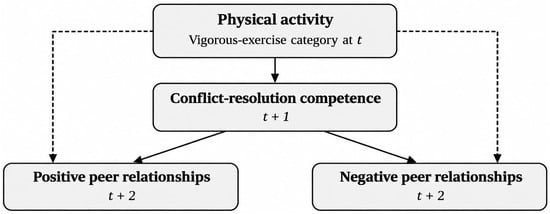
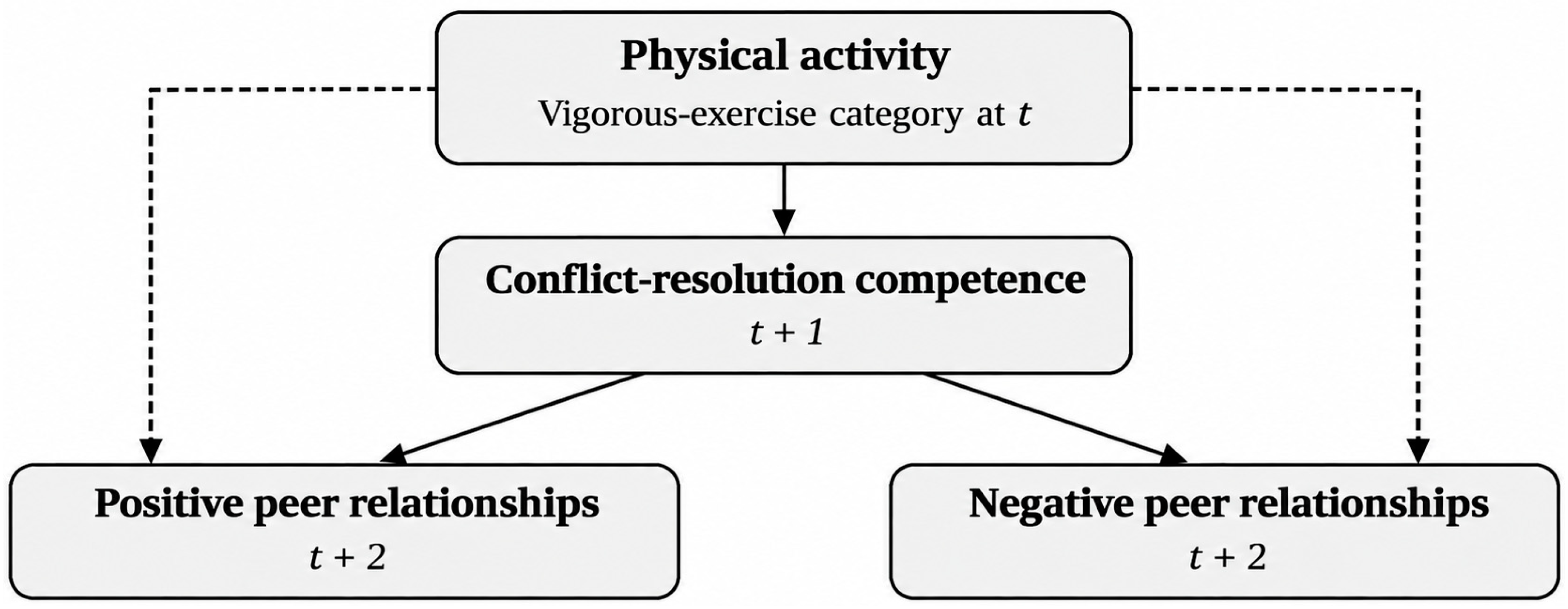
The Korean Children and Youth Panel Survey 2018 (KCYPS 2018) provides repeated observations of the same adolescents from fourth grade into high school [37]. Using seven annual waves (2018–2024), the present study addresses these gaps through four research questions: (1) How did self-reported sweat-inducing exercise and weekday/weekend leisure-time physical activity change as the cohort progressed from late childhood into adolescence? (2) To what extent were prior physical-activity categories associated with subsequent conflict-resolution competence and positive and negative peer relationships after accounting for earlier interpersonal functioning and family characteristics? (3) Did associations differ between adolescents and within the same adolescent over time, and did they vary across historical observation periods? (4) Were there exploratory, temporally ordered three-wave indirect associations linking physical activity to subsequent peer relationships through conflict-resolution competence? These questions were examined as observational associations rather than causal effects. Because the survey did not distinguish school physical education, organized sport, and independent recreational activity, the study does not directly test the pedagogical mechanisms proposed by responsibility-based or motivational-climate frameworks. Figure 1 presents the conceptual framework for the exploratory three-wave analysis.
Figure 1.
Conceptual framework for the exploratory three-wave indirect association analysis. Vigorous exercise at t was specified as the primary predictor, conflict-resolution competence at t + 1 as the intermediate variable, and positive and negative peer relationships at t + 2 as the outcomes. Solid arrows indicate component associations of the proposed indirect pathways, whereas dashed arrows represent direct exposure–outcome associations. Covariates are omitted for clarity. All pathways represent hypothesized statistical associations rather than established causal effects.
2. Materials and Methods
2.1. Design and Participants
This non-interventional secondary analysis used seven annual waves (2018–2024) of the KCYPS 2018 fourth-grade cohort, initially comprising 2607 students. By the 2024 survey (generally the first year of high school), 2123 adolescents provided valid survey information, representing 81.4% of the original baseline cohort. This percentage reflects participation in the 2024 wave rather than a cumulative retention rate, because intermittent nonresponse and subsequent re-entry were possible across survey waves. Consequently, differences in annual sample sizes should not be interpreted solely as permanent study attrition. Survey identifiers permitted record linkage across waves. Primary pooled analyses retained 13,437 adjacent-wave pairs from 2523 adolescents, rather than restricting all analyses to seven-wave completers. The analyses were unweighted, and year-specific participation varied because of attrition and intermittent nonresponse.
2.2. Physical Activity Measures
The primary exposure was the respondent-reported amount of exercise sufficient to induce sweating during the previous week (KCYPS item YPHY1B00), hereafter described as self-reported sweat-inducing or vigorous exercise. This wording does not objectively establish physiological vigorous-intensity activity. The source variable contains five ordered responses: none, 1 h, 2 h, 3 h, and 4 h or more. Responses were recoded as ordinal-category scores 0–4. The highest response is top-coded, so this is not an exact continuous measure of hours. One-unit regression coefficients refer to a one-category increase, not a literal extra hour for every respondent. For descriptive reporting, no vigorous exercise corresponded to category 0.
Two additional activity indicators were analyzed in separate models: time spent exercising or participating in physical activity outside of school hours on weekdays (YTIM1J01) and on weekends (YTIM1J02). Each has seven ordered categories: none, less than 30 min, 30 min to less than 1 h, 1 to less than 2 h, 2 to less than 3 h, 3 to less than 4 h, and 4 h or more. We coded them 0–6. Because interval widths differ and both upper categories are open-ended, they were treated as ordinal-category scores rather than converted into exact weekly minutes. These survey responses do not identify specific sports, participation setting, exercise frequency, objectively measured intensity, or opportunities for structured motor play. Detailed item descriptions, response categories, coding procedures, and source variable identifiers for the three physical-activity indicators are provided in Supplementary Table S2.
2.3. Conflict-Resolution Competence and Peer Relationships
Conflict-resolution competence was assessed using five KCYPS cooperation items (YPSY5A10–YPSY5A14) covering information exchange, collaborative discussion, and constructive problem solving. Positive peer relationships were assessed using eight friendship items (YEDU2A01–YEDU2A08), and negative peer relationships using five items (YEDU2A09–YEDU2A13). All responses used four-point agreement scales; separate means were formed for each dimension using respondents with valid item responses. Higher scores indicate stronger self-perceived collaborative conflict resolution, more favorable friendships, and more interpersonal difficulties, respectively. Internal-consistency coefficients for the three outcome measures across the seven waves ranged from 0.819 to 0.875 (conflict resolution), 0.844 to 0.874 (positive peer relationships), and 0.604 to 0.827 (negative peer relationships); detailed results appear in Supplementary Table S1. The relatively low baseline consistency of negative peer relationships (α = 0.604) warrants caution.
Although the internal consistency of the negative peer relationship measure was higher in subsequent waves (Cronbach’s α = 0.780–0.827), its relatively low baseline reliability indicates greater potential for measurement error in the initial assessment. Furthermore, acceptable internal consistency within individual waves does not establish that the same latent constructs were measured equivalently across developmental stages. Longitudinal measurement invariance was examined across seven annual waves (2018–2024) for conflict resolution, positive peer relationships, and negative peer relationships. Given the ordinal nature of the four-point response scales, confirmatory factor analyses were conducted using the weighted least squares mean- and variance-adjusted (WLSMV) estimator in R (version 4.6.2) within RStudio (version 2026.11.1), using the lavaan. For each construct, configural, threshold, and threshold-plus-factor-loading invariance models were evaluated sequentially, using the identification approach for ordinal indicators proposed by Wu and Estabrook [38]. Residual correlations between identical items measured at adjacent waves were specified to account for longitudinal item-specific dependencies. Analyses were conducted using 1824 respondents with complete item-level data across all seven waves for each construct. Measurement invariance was evaluated using scaled fit indices (CFI and RMSEA), SRMR, changes in model fit, and robust chi-square difference tests. Given the sensitivity of chi-square difference tests to sample size and model constraints, both statistical significance and the magnitude of changes in approximate fit indices were considered when interpreting longitudinal measurement invariance. Therefore, comparisons of interpersonal outcomes over time should be interpreted with appropriate caution.
2.4. Covariates and Historical Observation Periods
Six perceived parenting dimensions—warmth, rejection, autonomy support, coercion, structure, and inconsistency—were formed from their four respective KCYPS items and included as prior-wave adjustment variables. Baseline sex was also included. The adjacent-wave models adjusted for prior measurements of all three interpersonal outcomes and fixed survey-wave indicators. For descriptive interaction tests, transition periods were classified by follow-up year: pre-pandemic (2019, corresponding to the 2018–2019 transition), pandemic (2020–2022), and subsequent (2023–2024). These categories serve only as labels for historical time and cannot isolate pandemic exposure from maturation.
2.5. Data Preparation and Missingness
The publicly accessible, de-identified KCYPS youth CSV files were merged using participant identifiers. The official KCYPS English codebook was used to verify item meanings, valid category values, and open-ended upper response categories. Blank entries and values outside documented response ranges were coded as missing. Each construct mean required valid responses on all constituent items. Adjacent-wave models included pairs with valid exposure, outcome, and all adjustment variables; the three-wave models analogously required complete relevant sequences. Because participation was intermittent across survey waves, adolescents could contribute valid observations to the analyses without completing all seven annual surveys. Accordingly, the primary analytical sample consisted of 13,437 adjacent-wave observation pairs contributed by 2523 unique adolescents, rather than 13,437 independent participants. The resulting estimates are based on observed complete pairs or three-wave sequences. Unlike full-information likelihood approaches to incomplete longitudinal data, these regressions did not directly model incomplete observations [39]. No missing-at-random assumption can be empirically verified from these data. All models were unweighted, and attrition may affect generalizability.
To further assess potential selection bias, baseline characteristics were compared between adolescents who contributed at least one complete adjacent-wave observation pair to the primary analyses and those who contributed none. Continuous baseline measures were compared using Welch’s independent-samples t-tests, and baseline sex distributions were compared using a chi-square test. The comparison was descriptive and exploratory, and p-values were not adjusted for multiple testing. We also examined the distribution of complete observation pairs across the six annual transitions. These analyses were intended to characterize patterns of analytical sample inclusion rather than to correct for missing-data bias.
2.6. Statistical Analysis
Statistical analyses for the new physical-activity models were performed using Python (version 3.15.2) with the NumPy (2.5.0), SciPy (1.18.0), and statsmodels (0.15.0) packages. Descriptive statistical analyses were conducted using IBM SPSS Statistics (version 23.0; IBM Corp., Armonk, NY, USA). The annual distribution of vigorous exercise, the proportion reporting no vigorous exercise, ordinal activity-category means, and outcome means were described by year. An exploratory individual-demeaned, piecewise linear model estimated change in vigorous-exercise category scores for 2018–2022 and 2022–2024; 2022 served as the shared knot. These linear approximations summarize trends in ordered-response scores and do not imply equal underlying durations between categories.
For the primary prospective analyses, pooled ordinary least-squares models regressed each next-wave interpersonal outcome on the prior-wave vigorous-exercise category score, controlling for prior levels of all three interpersonal outcomes, the six prior-wave parenting dimensions, baseline sex, and follow-up-wave fixed effects. Inference used cluster-robust standard errors grouped by participant ID. The Benjamini–Hochberg procedure adjusted the three primary p-values [40]. Secondary analyses substituted the weekday activity score, weekend activity score, or a binary indicator of any vigorous exercise, each in a separate regression; nine secondary estimates were jointly adjusted for false discovery rate.
To assess the robustness of the primary findings to the linear coding of physical activity, an additional sensitivity analysis treated the five vigorous-exercise response categories as a categorical predictor, with no exercise as the reference category. Separate indicator variables represented 1, 2, 3, and 4 or more hours of reported sweat-inducing exercise. These models retained the same analytical sample, interpersonal outcome adjustments, six parenting dimensions, baseline sex, survey-wave fixed effects, and participant-clustered robust standard errors as the primary models. Joint four-degrees-of-freedom Wald tests assessed the overall association of the categorical exercise predictor with each outcome. Additional three-degrees-of-freedom Wald tests examined departures from the linear category-score specification.
Exploratory period heterogeneity was estimated by interacting the vigorous-exercise predictor with pandemic and subsequent-period indicators; baseline reference was the 2018–2019 transition, and follow-up-year main effects were already included. Two-degrees-of-freedom cluster-robust Wald tests evaluated each outcome’s joint interaction terms, with false-discovery-rate adjustment across three tests. As a diagnostic between/within decomposition, the participant-specific mean of observed prior-wave vigorous-exercise scores and each observation’s deviation from that mean were simultaneously entered. Distinguishing within-person deviations from between-person differences is recommended for longitudinal observational data [41]. Nevertheless, this diagnostic decomposition does not eliminate time-varying confounding or establish individual-level causal effects; conventional lagged associations can still obscure dynamic pathways [42].
Finally, exploratory three-wave product-of-coefficients analyses examined vigorous exercise at t, conflict-resolution competence at t + 1, and each peer outcome at t + 2. The first-stage model predicted conflict-resolution competence at t + 1 from vigorous exercise at t, adjusting for all three interpersonal outcomes at t, six parenting dimensions at t, sex, and year indicators. The second-stage model predicted each peer outcome at t + 2 from conflict-resolution competence at t + 1 and vigorous exercise at t, additionally adjusting for both peer outcomes at t + 1 and the baseline covariates. Percentile confidence intervals were generated from 4000 participant-level bootstrap resamples with fixed random seeds, and empirical two-sided sign-based p-values were adjusted across the two indirect associations. These indirect products should not be interpreted as identified causal mediation without stronger assumptions and designs [43,44]. Significance was evaluated at two-sided α = 0.05.
3. Results
3.1. Annual Activity Patterns and Interpersonal Outcomes
Annual valid respondent counts decreased from 2607 (2018) to 2123 (2024). The proportion reporting no vigorous exercise in the preceding week was 8.7% in 2018, 23.6% in 2020, 33.8% in 2023, and 30.0% in 2024. Correspondingly, the mean five-category vigorous-exercise score declined from 2.51 in 2018 to 1.33 in 2024. Descriptive outcome patterns replicated previously documented trends in the source cohort: conflict-resolution competence fell from 2.96 to 2.77, and positive peer relationships from 2.98 to 2.91 (Table 1). Because the survey followed a single cohort, none of these changes can be attributed specifically to COVID-19 restrictions.
Table 1.
Annual descriptive statistics for physical activity and interpersonal outcomes, 2018–2024.
The individual-demeaned piecewise trend model estimated an annual change of −0.260 (SE = 0.008, p < 0.001) in the vigorous-exercise ordinal score during 2018–2022 and −0.027 (SE = 0.015, p = 0.072) during 2022–2024; the slope difference was +0.233 (SE = 0.021, p < 0.001). These are model-based category-score slopes, not changes in objectively measured exercise duration.
3.2. Longitudinal Measurement Invariance
Longitudinal measurement invariance was evaluated across seven annual waves (2018–2024) for conflict-resolution competence, positive peer relationships, and negative peer relationships using 1824 complete cases for each construct. The configural models demonstrated satisfactory fit for conflict-resolution competence (CFI = 0.989, RMSEA = 0.028, SRMR = 0.022), positive peer relationships (CFI = 0.954, RMSEA = 0.039, SRMR = 0.039), and negative peer relationships (CFI = 0.990, RMSEA = 0.023, SRMR = 0.025).
Imposing equality constraints on item thresholds and factor loadings resulted in relatively small changes in model fit. The threshold-plus-loading invariance models yielded CFI = 0.987, RMSEA = 0.029, and SRMR = 0.022 for conflict-resolution competence; CFI = 0.950, RMSEA = 0.040, and SRMR = 0.039 for positive peer relationships; and CFI = 0.984, RMSEA = 0.027, and SRMR = 0.027 for negative peer relationships.
Although all robust chi-square difference tests were statistically significant (p < 0.001), changes in approximate fit indices remained within commonly applied practical criteria (absolute ΔCFI < 0.010, ΔRMSEA < 0.015, and ΔSRMR < 0.030). These findings were consistent with approximate longitudinal invariance of item thresholds and factor loadings under fit-index change criteria, although exact invariance was not supported by the chi-square difference tests. Detailed results are presented in Supplementary Table S5.
3.3. Prospective Associations with Subsequent Social Functioning
The primary pooled lagged regressions included 13,437 consecutive-wave pairs from 2523 respondents. After adjustment for all prior social outcomes, six parenting dimensions, sex, and year indicators, vigorous-exercise category scores were positively related to conflict-resolution competence (B = 0.0160, SE = 0.0035, q < 0.001) and positive peer relationships (B = 0.0128, SE = 0.0031, q < 0.001) at the next annual observation. The negative peer relationship coefficient was not statistically significant after multiple-testing adjustment (B = −0.0053, q = 0.143). Table 2 gives 95% confidence intervals and adjusted p-values. These are small population-average conditional associations, not treatment effects.
Table 2.
Adjusted one-year lagged associations of vigorous exercise with social outcomes.
3.4. Secondary Physical-Activity Indicators
Secondary exposure models were generally consistent with the favorable pooled association for exercise participation, although not all continuous ordinal activity indicators remained significant after correction (Table 3). For weekend activity, next-wave conflict-resolution competence (B = 0.0075, q = 0.033) and positive peer relationships (B = 0.0071, q = 0.030) were positively associated with higher activity categories. Weekday activity estimates did not survive false-discovery-rate correction across nine tests. Reporting any vigorous exercise rather than none was associated with higher conflict resolution (B = 0.0499, q < 0.001), more positive peer relationships (B = 0.0383, q < 0.001), and fewer negative peer difficulties (B = −0.0290, q = 0.035). The latter binary result should be weighed against the nonsignificant primary ordinal exposure for negative peer relationships.
Table 3.
Secondary one-year lagged models using alternative activity indicators.
3.5. Heterogeneity Across Historical Observation Periods
The association between prior vigorous-exercise category score and next-wave conflict resolution differed across the three descriptive periods (Wald χ2(2) = 9.28, q = 0.014), as did the association with subsequent positive peer relationships (χ2(2) = 16.35, q < 0.001). Associations were strongest during transitions ending in 2023–2024. For negative peer relationships, no significant period interaction was observed (χ2(2) = 0.60, q = 0.742; Table 4). Estimates for the pre-pandemic period are based on one annual transition and are accordingly less precise. These associations are not causal effects of the pandemic.
Table 4.
Period differences in lagged vigorous-exercise associations.
3.6. Divergent Within-Person and Between-Person Associations
To assess whether the pooled associations were driven by differences across adolescents or changes in an adolescent’s own reported activity, vigorous-exercise scores were decomposed into each adolescent’s mean across available prior waves and a wave-specific deviation from this mean. Mean vigorous-exercise levels between adolescents showed stronger positive associations with later conflict resolution (B = 0.0609, q < 0.001) and positive peer relationships (B = 0.0544, q < 0.001), and a negative association with later negative peer relationships (B = −0.0381, q < 0.001). In contrast, within-person deviations were negatively associated with next-wave conflict resolution (B = −0.0093, q = 0.025) and positive peer relationships (B = −0.0107, q = 0.004), and positively associated with negative peer relationships (B = 0.0132, q = 0.003; Table 5).
Table 5.
Within/between-participant decomposition of vigorous exercise.
These opposing patterns indicate that favorable pooled associations cannot automatically be interpreted as benefits of increasing the same adolescent’s exercise category. The deviation estimates may reflect time-varying selection, measurement noise, reciprocal social influences, or unobserved common determinants, and should be understood as a diagnostic decomposition rather than a causal fixed-effects intervention estimate.
3.7. Exploratory Three-Wave Indirect Associations
Among 10,724 complete three-wave sequences from 2446 adolescents, the path from vigorous exercise at t to conflict-resolution competence at t + 1 was positive (a = 0.0134, SE = 0.0039, p < 0.001). Subsequent conflict resolution was positively associated with positive peer relationships at t + 2 (b = 0.0550, p < 0.001) and negatively associated with negative peer relationships at t + 2 (b = −0.0394, p = 0.002), conditional on the specified covariates. The indirect product for positive peer relationships was 0.000736 (95% percentile bootstrap CI: 0.000286–0.001267, q = 0.001), whereas the indirect product for negative peer relationships was −0.000527 (95% CI: −0.001009 to −0.000151, q = 0.001). Both bootstrap confidence intervals excluded zero, and both indirect associations remained statistically significant after false-discovery-rate correction (Table 6).
Table 6.
Exploratory three-wave indirect associations via conflict-resolution competence.
4. Discussion
4.1. Changing Patterns of Vigorous Exercise Across Development
The first notable finding is the substantial descriptive increase in adolescents reporting no vigorous exercise during the preceding week, from 8.7% at the beginning of fourth grade to 30.0% in the first high-school year. Declines were greatest on an ordered-score scale during 2018–2022, although the coding should not be interpreted as exact changes in hours. Previous systematic reviews described reduced youth activity surrounding the COVID-19 pandemic [35,36], and the present panel is compatible with that broad pattern. However, its design cannot determine whether the decrease arose from pandemic restrictions, normal age-related changes, academic demands, sport availability, survey interpretation, or their combination. Accordingly, these findings highlight potential concern about activity opportunities rather than quantifying a specific pandemic effect.
4.2. Activity, Conflict Resolution, and Peer Adjustment
In pooled prospective models, higher prior vigorous-exercise categories were associated with slightly greater conflict-resolution competence and more positive peer relationships at the next annual wave. This is compatible with theoretical accounts in which movement and social participation offer shared challenges, coordination, informal communication, and opportunities to resolve disagreements. School-based intervention reviews reported improvements in selected social competence measures, although generalization across settings was uncertain [11,12]. Prior Korean longitudinal work linked physical education participation with peer acceptance [19]. These prior results support the plausibility of the proposed relationships, but the present survey did not directly capture joint sporting activities, conflict episodes, or a structured social-skill mechanism. It is therefore inappropriate to infer that physical activity taught conflict-management skills or produced improvements in friendships.
The literature similarly indicates that the social characteristics of activity matter. Reviews of organized youth sport and social development stress the roles of teammates, adult support, and program design [13,14,15]. In contrast, the present exposure measures how much sweat-inducing exercise was reported, without recording whether it occurred alone, with friends, or as part of a structured program. The favorable pooled associations therefore should not be translated into claims about team-based learning mechanisms that were not observed. Recent longitudinal synthesis found more consistent results for health and wellbeing than for social outcomes [16], reinforcing the need for outcome-specific interpretation.
Moreover, peer acceptance and friendship quality do not represent a single interchangeable social outcome [26,29]. School and sport participation may offer social contexts [20,21], but the presence and quality of those opportunities likely vary with family resources, activity preferences, and peer networks [5,30,31]. This complexity may explain why the strongest pooled associations do not necessarily describe improvement within an individual adolescent.
The negative peer relationship outcome showed a more heterogeneous pattern. The principal ordinal vigorous-exercise predictor was nonsignificant, whereas the any-versus-none specification was associated with fewer later negative peer difficulties. Differences in exposure parameterization and baseline reliability of the negative peer measure (α = 0.604) limit the strength of conclusions. The small coefficients also underscore that physical activity alone cannot account for the complex social ecology of adolescent friendships.
The longitudinal measurement invariance analyses provided further evidence concerning the comparability of interpersonal outcome measures across the seven annual waves. Configural models demonstrated satisfactory fit for all three constructs, while equality constraints on item thresholds and factor loadings resulted in relatively small changes in approximate fit indices. However, the robust chi-square difference tests were statistically significant for all model comparisons, indicating departures from exact longitudinal measurement invariance. Accordingly, these results offer qualified support for approximate measurement invariance rather than establishing complete measurement equivalence. This distinction is particularly relevant to the interpretation of developmental changes in conflict-resolution competence and peer relationships, as modest longitudinal variations in item functioning cannot be entirely excluded [45].
4.3. Why Within-Person and Between-Person Findings Differ
The most methodologically consequential finding is that favorable between-adolescent associations were accompanied by opposite-signed within-adolescent deviation estimates. Adolescents with higher average levels of vigorous exercise tended to report more favorable interpersonal functioning at subsequent waves. In contrast, occasions when an adolescent’s exercise score exceeded their own observed average were associated with slightly lower subsequent conflict-resolution competence and positive peer-relationship scores, as well as higher negative peer-relationship scores, after adjustment for the specified covariates. Such divergence can arise if activity participation partly indexes stable access to sport, social resources, friendship networks, or individual preferences, while short-term deviations also reflect changing schedules, reciprocal social dynamics, or other time-varying experiences. Disaggregating within-person and between-person variation is essential when interpreting time-varying predictors [41]. Conventional longitudinal cross-lagged estimates can conflate stable between-person differences and dynamic processes [42].
A person-mean and deviation specification provides a descriptive means of separating two statistical contrasts [41], but it is not sufficient to identify the effect of changing activity for any particular adolescent. Reciprocal links between friendship opportunities and activity participation remain plausible, and panel measures obtained annually may miss shorter interpersonal dynamics. Caution is therefore appropriate when considering the direction of associations reported for within-person deviations [42].
From a pedagogical perspective, the opposite-signed within-person associations may also reflect differences in the social conditions under which physical activity takes place. An occasional increase in exercise participation does not necessarily indicate greater exposure to supportive or cooperative interpersonal experiences. Increased participation in highly competitive or poorly supervised activities could plausibly involve performance pressure, interpersonal comparison, disagreements, or relational tension. Similarly, additional time devoted to physical activity might coincide with reduced opportunities for informal peer communication or other social interactions. Conversely, activities structured around cooperation, mutual responsibility, constructive feedback, and guided conflict resolution may offer different interpersonal experiences, even at comparable levels of physical exertion. These explanations remain hypothetical because the KCYPS exercise indicator did not distinguish school physical education from organized sports or independent recreational activity, nor did it measure competitive stress, instructional practices, or the quality of peer interactions during exercise. Therefore, the negative within-person coefficients should not be interpreted as evidence that increased physical activity itself causes poorer interpersonal functioning. Rather, they underscore the need for future studies to examine how the educational and relational contexts of physical activity may shape its association with adolescent social development.
These diagnostic results argue against a simple prescriptive conclusion that increasing a child’s activity category will necessarily improve conflict-resolution skills or peer experiences. They also strengthen the rationale for future measurement of actual social exposure during activity, repeated assessment of friendship networks, and analytic designs capable of addressing reciprocal selection and unmeasured confounding. The within-person estimates should not be overinterpreted as evidence that exercise is harmful, because the design does not identify the consequences of manipulating physical activity.
4.4. Historical Heterogeneity and Exploratory Indirect Links
The associations of vigorous exercise with subsequent conflict-resolution competence and positive peer relationships varied across the predefined observation periods, with the largest positive adjusted coefficients observed for transitions ending in 2023–2024. However, the pre-pandemic reference period comprised only the 2018–2019 transition, providing a relatively limited basis for comparison with subsequent periods. Because calendar year, age, and school progression changed concurrently in this single cohort, these interaction findings describe temporal heterogeneity rather than causal effects attributable to the COVID-19 pandemic. Similarly, the exploratory three-wave indirect associations were statistically significant after correction for multiple testing, with bootstrap confidence intervals excluding zero. However, their estimated magnitudes were extremely small, limiting their practical significance. Moreover, the observational design cannot adequately eliminate unmeasured confounding, reciprocal influences, measurement error, or assumptions concerning the temporal ordering required for causal mediation [43,44]. Therefore, these findings should be interpreted as exploratory statistical associations rather than evidence of a causal developmental mechanism. The proposed role of conflict-resolution competence remains a theoretically plausible pathway that requires further examination using more rigorous longitudinal and intervention designs.
4.5. Implications for Child Development and Activity Promotion
The findings highlight the importance of examining interpersonal development alongside physical-activity participation during childhood and adolescence. Future evaluations of physical-activity programs should consider not only the amount of activity but also the quality of social interactions, opportunities for cooperation, collaborative problem solving, and constructive conflict resolution. Because the present survey did not directly measure interpersonal experiences within physical-activity settings, these potential developmental processes require further empirical investigation. Family and school contexts also warrant attention because physical activity and peer participation depend on access, perceived safety, facilities, expectations, and social support. The current findings cannot be used to recommend a specific exercise dosage or an intervention program, nor do they estimate the effect of a school-based physical-activity intervention. Organized sport reviews suggest that contextual support and intentional program features warrant evaluation [13,15,21], whereas general recommendations about physical activity address broad health outcomes rather than proof of a specific conflict-resolution mechanism [1,2].
From an educational perspective, the findings suggest that physical education teachers and sport coaches should consider the social organization of movement experiences rather than focusing exclusively on the amount or intensity of physical activity. Cooperative motor-learning activities, shared problem-solving tasks, structured opportunities for peer communication, and guided reflection on interpersonal disagreements may provide contexts in which social competencies can be intentionally practiced. Teachers and coaches may also promote a mastery-oriented motivational climate by emphasizing individual improvement, mutual support, collective participation, and constructive feedback rather than interpersonal comparison or competitive outcomes alone. In addition, competitive activities may benefit from explicit expectations regarding respectful communication, equitable participation, and constructive conflict management. These approaches are consistent with educational perspectives emphasizing personal and social responsibility and supportive motivational environments. However, because the present study did not directly assess pedagogical practices, motivational climate, or the social characteristics of physical-activity settings, these implications should be regarded as theoretically informed recommendations for future intervention development rather than educational effects demonstrated by the present data.
4.6. Strengths and Limitations
Strengths include seven annual observations spanning elementary through early high school, use of official survey item definitions, separate positive and negative friendship measures, adjustment for six parenting dimensions, clustered inference for repeated observations, and multiple complementary checks. The primary estimates used a reproducible person-wave design with false-discovery-rate control, and the between/within decomposition exposed important inferential complexity that would be concealed by reporting pooled coefficients alone.
Important limitations remain. First, physical activity was self-reported using coarse ordinal categories with an open-ended highest category, not accelerometer-based activity or exact weekly duration. Recall and survey interpretation may change across development. Furthermore, treating ordered physical-activity categories as linear predictors assumes a constant difference in the conditional outcome mean between adjacent categories. Although the categorical sensitivity analysis supported the overall direction of the primary associations for conflict resolution and positive peer relationships, the estimated contrasts were not strictly monotonic. The coarse response categories, particularly the open-ended category of 4 h or more, prevented the estimation of a precise dose–response relationship in actual exercise duration. Second, the analysis is observational and potentially affected by unobserved time-varying confounding, reverse causation, selection into sports and friendship groups, and shared self-report bias. Third, the single-cohort design confounds age, school grade, and calendar period, so pandemic-specific effects are not identified. Fourth, the primary models were unweighted and relied on available complete observation pairs. Baseline comparisons revealed that adolescents who contributed no complete observation pairs had higher initial conflict-resolution competence and more positive peer relationships than adolescents included in the analytical sample (Supplementary Table S4). Although the excluded group was relatively small, these differences indicate that analytical sample inclusion may not have been entirely independent of baseline interpersonal functioning. Furthermore, intermittent nonresponse among included adolescents could have introduced additional selection bias that was not addressed by the baseline comparison. Consequently, the estimated associations may not fully generalize to the original cohort, and neither the magnitude nor the direction of potential missing-data bias can be determined from the present analyses. Fifth, the negative peer relationship measure demonstrated comparatively low internal consistency at baseline (Cronbach’s α = 0.604). Although longitudinal measurement invariance was examined across seven annual waves, robust chi-square difference tests rejected exact equality constraints on item thresholds and factor loadings. Changes in approximate fit indices were relatively small, providing qualified support for approximate longitudinal invariance, but item-specific measurement noninvariance cannot be ruled out. Moreover, the invariance analyses were based on 1824 respondents with complete item-level data, whereas the primary longitudinal regression analyses included 2523 adolescents. Consequently, the measurement invariance findings may not fully generalize to participants with incomplete longitudinal responses. Future research should investigate partial measurement invariance and assess the robustness of longitudinal associations to alternative measurement and missing-data specifications. Sixth, person-specific exposure means were calculated from observed prior-wave exposure values across the available panel record, so the diagnostic decomposition is not a strictly prospective estimation of within-person treatment effects. Seventh, the between/within decomposition is conditional on observed exposures and covariates and is not a causal fixed-effects intervention analysis. Finally, some covariates and indirect-path models may be affected by measurement timing and statistical model misspecification; bootstrap precision does not substitute for substantive causal identification.
5. Conclusions
Seven annual waves of the KCYPS 2018 revealed a substantial increase in the proportion of adolescents reporting no sweat-inducing exercise during the preceding week as the cohort progressed from late childhood into adolescence. In adjusted one-year lagged models, higher exercise categories were associated with slightly greater subsequent conflict-resolution competence and more positive peer relationships, whereas the association with negative peer relationships was not statistically significant after multiple-testing correction.
However, favorable between-person associations contrasted with opposite-signed within-person associations, indicating that pooled longitudinal estimates should not be interpreted as evidence that increasing an individual adolescent’s physical activity necessarily improves interpersonal functioning. Although exploratory three-wave indirect associations through conflict-resolution competence were statistically significant, their magnitudes were very small and did not establish causal mediation.
These findings highlight the importance of examining physical activity and interpersonal development together while distinguishing between-person differences from within-person variation. Future research should incorporate more precise and context-sensitive measures of physical activity, repeated assessments of interpersonal experiences, and longitudinal or intervention designs capable of addressing reciprocal relationships, selection effects, and age–period confounding.
From an educational perspective, the findings caution against assuming that increasing the quantity or intensity of physical activity alone will necessarily improve adolescents’ social-emotional competencies. Greater attention should be directed toward the quality of movement experiences and the interpersonal environments in which physical activity occurs. Physical education teachers and sport coaches may consider incorporating cooperative motor-learning tasks, shared responsibility, constructive peer communication, and guided conflict-resolution opportunities into activity settings. However, these practices were not directly measured in the present study, and their potential benefits should be evaluated through appropriately designed intervention research. Future studies should therefore investigate not only how much physical activity adolescents undertake, but also how pedagogical guidance, motivational climate, cooperation, and the quality of peer interactions shape their social development.
Supplementary Materials
The following supporting information can be downloaded at https://www.mdpi.com/article/10.3390/children13121676/s1. The following supplementary tables accompany this manuscript: Table S1, Internal consistency reliability of the study measures across seven annual waves; Table S2, KCYPS physical-activity variables and coding; Table S3, Sensitivity analysis treating vigorous exercise as a categorical predictor of subsequent interpersonal outcomes; Table S4, Comparison of baseline characteristics between adolescents included in and excluded from the primary analytical sample; and Table S5, Longitudinal measurement invariance of interpersonal outcome measures across seven annual waves (2018–2024). All five tables are provided in a separate supplementary document.
Funding
This research received no external funding.
Institutional Review Board Statement
This study was a secondary analysis of existing, de-identified data from the Korean Children and Youth Panel Survey 2018 (KCYPS 2018) and involved no new participant recruitment, contact, or intervention. No additional Institutional Review Board (IRB) review was obtained for the present secondary analysis. Article 13(1)(3) of the Enforcement Rule of the Bioethics and Safety Act of the Republic of Korea provides for possible exemption from IRB review for research using existing data or documents. No formal IRB exemption determination was obtained for this secondary analysis.
Informed Consent Statement
This study involved a secondary analysis of existing, de-identified data from the KCYPS 2018. No new participants were recruited or contacted, and no additional informed consent was obtained for the present secondary analysis. The study did not involve any new collection of identifiable personal information.
Data Availability Statement
The data analyzed in this study were obtained from the Korean Children and Youth Panel Survey 2018 (KCYPS 2018), administered by the National Youth Policy Institute (NYPI), Republic of Korea. The seven annual waves (2018–2024) of the fourth-grade cohort dataset and the corresponding documentation are available through the Korean Children and Youth Data Archive (https://www.nypi.re.kr/archive/mps/program/examinDataCode/view?firstCategory=1&menuId=MENU00226&secondCategory=3&titleId=25, accessed on 19 October 2026), subject to the data provider’s access and use conditions. Individual-level survey records are not redistributed with this article.
Acknowledgments
The author thanks the National Youth Policy Institute for making the KCYPS 2018 data accessible. OpenAI ChatGPT (GPT-6) was used solely to assist with English-language editing, grammatical refinement, and improving the clarity and readability of the manuscript. All statistical analyses, interpretation of findings, and final scholarly decisions were independently conducted and verified by the author.
Conflicts of Interest
The author declares no conflicts of interest.
References
- World Health Organization. WHO Guidelines on Physical Activity and Sedentary Behaviour; World Health Organization: Geneva, Switzerland, 2020; Available online: https://www.who.int/publications/i/item/9789240015128 (accessed on 19 October 2026).
- Chaput, J.-P.; Willumsen, J.; Bull, F.; Chou, R.; Ekelund, U.; Firth, J.; Jago, R.; Ortega, F.B.; Katzmarzyk, P.T. 2020 WHO guidelines on physical activity and sedentary behaviour for children and adolescents aged 5–17 years: Summary of the evidence. Int. J. Behav. Nutr. Phys. Act. 2020, 17, 141. [Google Scholar] [CrossRef] [Scilit] [PubMed]
- Guthold, R.; Stevens, G.A.; Riley, L.M.; Bull, F.C. Global trends in insufficient physical activity among adolescents: A pooled analysis of 298 population-based surveys with 1.6 million participants. Lancet Child Adolesc. Health 2020, 4, 23–35. [Google Scholar] [CrossRef] [Scilit] [PubMed]
- van Sluijs, E.M.F.; Ekelund, U.; Crochemore-Silva, I.; Guthold, R.; Ha, A.; Lubans, D.; Oyeyemi, A.L.; Ding, D.; Katzmarzyk, P.T. Physical activity behaviours in adolescence: Current evidence and opportunities for intervention. Lancet 2021, 398, 429–442. [Google Scholar] [CrossRef] [Scilit] [PubMed]
- Sallis, J.F.; Prochaska, J.J.; Taylor, W.C. A review of correlates of physical activity of children and adolescents. Med. Sci. Sports Exerc. 2000, 32, 963–975. [Google Scholar] [CrossRef] [Scilit] [PubMed]
- Janssen, I.; LeBlanc, A.G. Systematic review of the health benefits of physical activity and fitness in school-aged children and youth. Int. J. Behav. Nutr. Phys. Act. 2010, 7, 40. [Google Scholar] [CrossRef] [Scilit] [PubMed]
- Poitras, V.J.; Gray, C.E.; Borghese, M.M.; Carson, V.; Chaput, J.-P.; Janssen, I.; Katzmarzyk, P.T.; Pate, R.R.; Connor Gorber, S.; Kho, M.E.; et al. Systematic review of the relationships between objectively measured physical activity and health indicators in school-aged children and youth. Appl. Physiol. Nutr. Metab. 2016, 41, S197–S239. [Google Scholar] [CrossRef] [Scilit] [PubMed]
- Biddle, S.J.H.; Asare, M. Physical activity and mental health in children and adolescents: A review of reviews. Br. J. Sports Med. 2011, 45, 886–895. [Google Scholar] [CrossRef] [Scilit] [PubMed]
- Rodriguez-Ayllon, M.; Cadenas-Sánchez, C.; Estévez-López, F.; Muñoz, N.E.; Mora-Gonzalez, J.; Migueles, J.H.; Molina-García, P.; Henriksson, H.; Mena-Molina, A.; Martínez-Vizcaíno, V.; et al. Role of physical activity and sedentary behavior in the mental health of preschoolers, children and adolescents: A systematic review and meta-analysis. Sports Med. 2019, 49, 1383–1410. [Google Scholar] [CrossRef] [Scilit] [PubMed]
- Lubans, D.; Richards, J.; Hillman, C.; Faulkner, G.; Beauchamp, M.; Nilsson, M.; Kelly, P.; Smith, J.; Raine, L.; Biddle, S. Physical activity for cognitive and mental health in youth: A systematic review of mechanisms. Pediatrics 2016, 138, e20161642. [Google Scholar] [CrossRef] [Scilit] [PubMed]
- Schüller, I.; Demetriou, Y. Physical activity interventions promoting social competence at school: A systematic review. Educ. Res. Rev. 2018, 25, 39–55. [Google Scholar] [CrossRef] [Scilit]
- Fu, S.; Wen, P.; Wu, J.; Li, Z.; Zheng, Y. The effects of physical activity on social-emotional competence in primary school students: A meta-analysis. Front. Psychol. 2025, 16, 1657165. [Google Scholar] [CrossRef] [Scilit] [PubMed]
- Eime, R.M.; Young, J.A.; Harvey, J.T.; Charity, M.J.; Payne, W.R. A systematic review of the psychological and social benefits of participation in sport for children and adolescents: Informing development of a conceptual model of health through sport. Int. J. Behav. Nutr. Phys. Act. 2013, 10, 98. [Google Scholar] [CrossRef] [Scilit] [PubMed]
- Li, J.; Shao, W. Influence of sports activities on prosocial behavior of children and adolescents: A systematic literature review. Int. J. Environ. Res. Public Health 2022, 19, 6484. [Google Scholar] [CrossRef] [Scilit] [PubMed]
- Holt, N.L.; Neely, K.C.; Slater, L.G.; Camiré, M.; Côté, J.; Fraser-Thomas, J.; MacDonald, D.; Strachan, L.; Tamminen, K.A. A grounded theory of positive youth development through sport based on results from a qualitative meta-study. Int. Rev. Sport Exerc. Psychol. 2017, 10, 1–49. [Google Scholar] [CrossRef] [Scilit] [PubMed]
- Bengtsson, D.; Svensson, J.; Wiman, V.; Stenling, A.; Lundkvist, E.; Ivarsson, A. Health-related outcomes of youth sport participation: A systematic review and meta-analysis. Int. J. Behav. Nutr. Phys. Act. 2025, 22, 89. [Google Scholar] [CrossRef] [Scilit] [PubMed]
- Hellison, D. Teaching Personal and Social Responsibility through Physical Activity, 3rd ed.; Human Kinetics: Champaign, IL, USA, 2011. [Google Scholar]
- Ames, C. Classrooms: Goals, structures, and student motivation. J. Educ. Psychol. 1992, 84, 261–271. [Google Scholar] [CrossRef]
- Lee, S.; Shin, M.; Smith, A.L. The relationship of physical activity from physical education with perceived peer acceptance across childhood and adolescence. J. Sch. Health 2019, 89, 452–459. [Google Scholar] [CrossRef] [Scilit] [PubMed]
- Smith, A.L. Peer relationships in physical activity contexts: A road less traveled in youth sport and exercise psychology research. Psychol. Sport Exerc. 2003, 4, 25–39. [Google Scholar] [CrossRef] [Scilit]
- Fraser-Thomas, J.L.; Côté, J.; Deakin, J. Youth sport programs: An avenue to foster positive youth development. Phys. Educ. Sport Pedagog. 2005, 10, 19–40. [Google Scholar] [CrossRef] [Scilit]
- Eccles, J.S.; Barber, B.L.; Stone, M.; Hunt, J. Extracurricular activities and adolescent development. J. Soc. Issues 2003, 59, 865–889. [Google Scholar] [CrossRef] [Scilit]
- Fredricks, J.A.; Eccles, J.S. Is extracurricular participation associated with beneficial outcomes? Concurrent and longitudinal relations. Dev. Psychol. 2006, 42, 698–713. [Google Scholar] [CrossRef] [Scilit] [PubMed]
- Ryan, R.M.; Deci, E.L. Self-determination theory and the facilitation of intrinsic motivation, social development, and well-being. Am. Psychol. 2000, 55, 68–78. [Google Scholar] [CrossRef] [PubMed]
- Rose, A.J.; Asher, S.R. Children’s goals and strategies in response to conflicts within a friendship. Dev. Psychol. 1999, 35, 69–79. [Google Scholar] [CrossRef] [PubMed]
- Parker, J.G.; Asher, S.R. Friendship and friendship quality in middle childhood: Links with peer group acceptance and feelings of loneliness and social dissatisfaction. Dev. Psychol. 1993, 29, 611–621. [Google Scholar] [CrossRef]
- Laursen, B.; Collins, W.A. Interpersonal conflict during adolescence. Psychol. Bull. 1994, 115, 197–209. [Google Scholar] [CrossRef] [Scilit] [PubMed]
- Van Doorn, M.D.; Branje, S.J.T.; Van der Valk, I.E.; De Goede, I.H.A.; Meeus, W.H.J. Longitudinal spillover effects of conflict resolution styles between adolescent–parent relationships and adolescent friendships. J. Fam. Psychol. 2011, 25, 157–161. [Google Scholar] [CrossRef] [Scilit] [PubMed]
- Wentzel, K.R. Social relationships and motivation in middle school: The role of parents, teachers, and peers. J. Educ. Psychol. 1998, 90, 202–209. [Google Scholar] [CrossRef]
- Beets, M.W.; Cardinal, B.J.; Alderman, B.L. Parental social support and the physical activity-related behaviors of youth: A review. Health Educ. Behav. 2010, 37, 621–644. [Google Scholar] [CrossRef] [Scilit] [PubMed]
- Yao, C.A.; Rhodes, R.E. Parental correlates in child and adolescent physical activity: A meta-analysis. Int. J. Behav. Nutr. Phys. Act. 2015, 12, 10. [Google Scholar] [CrossRef] [Scilit] [PubMed]
- Edwardson, C.L.; Gorely, T. Parental influences on different types and intensities of physical activity in youth: A systematic review. Psychol. Sport Exerc. 2010, 11, 522–535. [Google Scholar] [CrossRef] [Scilit]
- Skinner, E.; Johnson, S.; Snyder, T. Six dimensions of parenting: A motivational model. Parent. Sci. Pract. 2005, 5, 175–235. [Google Scholar] [CrossRef] [Scilit] [PubMed]
- Kim, T.M.; Lee, E.J. Validation of the Korean version of Parents as Social Context Questionnaire for Adolescents: PSCQ_KA. Korean J. Youth Stud. 2017, 24, 313–333. [Google Scholar] [CrossRef] [Scilit]
- Do, B.; Kirkland, C.; Besenyi, G.M.; Smock, C.; Lanza, K. Youth physical activity and the COVID-19 pandemic: A systematic review. Prev. Med. Rep. 2022, 29, 101959. [Google Scholar] [CrossRef] [Scilit] [PubMed]
- Neville, R.D.; Lakes, K.D.; Hopkins, W.G.; Tarantino, G.; Draper, C.E.; Beck, R.; Madigan, S. Global changes in child and adolescent physical activity during the COVID-19 pandemic: A systematic review and meta-analysis. JAMA Pediatr. 2022, 176, 886–894. [Google Scholar] [CrossRef] [Scilit] [PubMed]
- Ha, H.; Kim, K.; Choi, I.; Han, J. 2024 The Korean Children and Youth Panel Survey: Overall Report; National Youth Policy Institute: Sejong, Republic of Korea, 2024; Available online: https://nypi.re.kr/repository/handle/2022.oak/6398 (accessed on 19 October 2026).
- Wu, H.; Estabrook, R. Identification of confirmatory factor analysis models of different levels of invariance for ordered categorical outcomes. Psychometrika 2016, 81, 1014–1045. [Google Scholar] [CrossRef] [Scilit] [PubMed]
- Enders, C.K.; Bandalos, D.L. The relative performance of full information maximum likelihood estimation for missing data in structural equation models. Struct. Equ. Model. 2001, 8, 430–457. [Google Scholar] [CrossRef] [Scilit] [PubMed]
- Benjamini, Y.; Hochberg, Y. Controlling the false discovery rate: A practical and powerful approach to multiple testing. J. R. Stat. Soc. Ser. B 1995, 57, 289–300. [Google Scholar] [CrossRef] [Scilit]
- Curran, P.J.; Bauer, D.J. The disaggregation of within-person and between-person effects in longitudinal models of change. Annu. Rev. Psychol. 2011, 62, 583–619. [Google Scholar] [CrossRef] [Scilit] [PubMed]
- Hamaker, E.L.; Kuiper, R.M.; Grasman, R.P.P.P. A critique of the cross-lagged panel model. Psychol. Methods 2015, 20, 102–116. [Google Scholar] [CrossRef] [Scilit] [PubMed]
- Cole, D.A.; Maxwell, S.E. Testing mediational models with longitudinal data: Questions and tips in the use of structural equation modeling. J. Abnorm. Psychol. 2003, 112, 558–577. [Google Scholar] [CrossRef] [Scilit] [PubMed]
- Preacher, K.J.; Hayes, A.F. Asymptotic and resampling strategies for assessing and comparing indirect effects in multiple mediator models. Behav. Res. Methods 2008, 40, 879–891. [Google Scholar] [CrossRef] [Scilit] [PubMed]
- Meredith, W. Measurement invariance, factor analysis and factorial invariance. Psychometrika 1993, 58, 525–543. [Google Scholar] [CrossRef] [Scilit]

Disclaimer/Publisher’s Note: The statements, opinions and data contained in all publications are solely those of the individual author(s) and contributor(s) and not of MDPI and/or the editor(s). MDPI and/or the editor(s) disclaim responsibility for any injury to people or property resulting from any ideas, methods, instructions or products referred to in the content. |
© 2026 by the author. Licensee MDPI, Basel, Switzerland. This article is an open access article distributed under the terms and conditions of the Creative Commons Attribution (CC BY) license.