


Highlights
What are the main findings?
- M2BPGi showed a moderate association with ventricular filling pressure but not with time since Fontan completion.
- Total bile acids showed a different pattern of associations involving oxygen saturation, venous pressure, and NT-proBNP.
What is the implication of the main finding?
- These exploratory findings suggest that liver-related blood biomarkers may reflect different aspects of Fontan circulatory burden but cannot independently establish a diagnosis of Fontan-associated liver disease.
Abstract
Background/Objectives: Fontan-associated liver disease is a major late complication of the Fontan circulation, but the hemodynamic significance of routinely available liver-related blood biomarkers remains uncertain. We examined their associations with invasive Fontan hemodynamic parameters. Methods: This single-center, retrospective, cross-sectional study included 36 patients after Fontan completion. Mac-2 binding protein glycosylation isomer (M2BPGi), total bile acids, and other laboratory indices were analyzed as continuous variables. Associations with systemic ventricular end-diastolic pressure, central venous pressure, arterial oxygen saturation, and time since Fontan completion were assessed using two-sided Spearman rank correlations with 10,000-replicate bootstrap confidence intervals. Results: M2BPGi correlated moderately well with systemic ventricular end-diastolic pressure (ρ = 0.467, 95% confidence interval 0.150–0.704; p = 0.004) and central venous pressure (ρ = 0.379, 95% confidence interval 0.020–0.662; p = 0.023), but not with time since Fontan completion. In a supportive regression analysis, each 1-mmHg higher end-diastolic pressure was associated with an estimated 8.1% higher M2BPGi. Total bile acids correlated with lower arterial oxygen saturation (ρ = −0.557; p < 0.001) and higher central venous pressure (ρ = 0.400; p = 0.023) and N-terminal pro-B-type natriuretic peptide concentrations (ρ = 0.453; p = 0.009). Conclusions: These exploratory findings suggest that liver-related blood biomarkers may reflect different components of Fontan circulatory burden. They should not be used alone to diagnose Fontan-associated liver disease.
1. Introduction
The Fontan operation is the final stage of palliation for congenital heart disease with a functionally univentricular circulation. It directs systemic venous return to the pulmonary arteries without a subpulmonary ventricle. This circulation depends on chronically elevated systemic venous pressure and is often accompanied by reduced cardiac output, hypoxemia, and lymphatic dysfunction, which can lead to progressive multiorgan complications [1].
Fontan-associated liver disease (FALD) encompasses hepatic congestion, fibrosis, portal hypertension, hepatic nodules, and impaired liver function [2,3,4]. Its assessment may involve blood tests, imaging, elastography, and liver biopsy. However, no single test reliably defines its presence or severity, making longitudinal assessment difficult in routine clinical practice [2,3,4].
Blood-based indices such as the fibrosis-4 index, platelet count, total bile acids, and Mac-2 binding protein glycosylation isomer (M2BPGi) are attractive because they are readily available during routine follow-up. The fibrosis-4 index has been associated with Fontan pressures and clinical outcomes, although its agreement with histological fibrosis is limited [5]. A recent study of 426 patients also showed that M2BPGi was associated with Fontan hemodynamic burden, total bile acids, FALD-related findings, hospitalization, and mortality [6]. However, the association between M2BPGi and systemic ventricular end-diastolic pressure remains insufficiently characterized.
We therefore examined the associations between liver-related blood biomarkers and invasive hemodynamics in patients after the Fontan operation. Rather than using blood tests to diagnose FALD, we aimed to determine whether M2BPGi, total bile acids, and other routinely available markers showed associations with systemic ventricular end-diastolic pressure, central venous pressure, arterial oxygen saturation, and time since Fontan completion.
2. Materials and Methods
2.1. Study Design and Participants
This single-center, retrospective, cross-sectional study included patients who underwent Fontan completion and cardiac catheterization at Hirosaki University Hospital between January 1998 and June 2026. Patients were eligible if clinical background information, invasive hemodynamic data, and liver-related laboratory data obtained before or after catheterization were available. For patients with multiple eligible examinations, the catheterization and laboratory assessment with the shortest interval between assessments were selected.
Patients were excluded if the Fontan circulation had been taken down or if essential hemodynamic or laboratory data were unavailable. All 36 eligible patients were included in the analysis. No formal sample size calculation was performed because this was a hypothesis-generating study using all available cases.
2.2. Data Collection
Clinical variables included sex, age at catheterization, Fontan type, dominant ventricular morphology, time since Fontan completion, and body mass index. Hemodynamic variables included central venous pressure, systemic ventricular end-diastolic pressure, and arterial oxygen saturation. All catheterizations were performed under intravenous anesthesia using fentanyl, midazolam, and/or thiopental, with spontaneous breathing. Hemodynamic measurement methods remained unchanged throughout the study period.
Laboratory variables included platelet count, total bilirubin, creatinine, aspartate aminotransferase, alanine aminotransferase, γ-glutamyl transferase, albumin, M2BPGi, total bile acids, hyaluronic acid, type IV collagen 7S, procollagen type III peptide, B-type natriuretic peptide (BNP), and N-terminal pro-B-type natriuretic peptide (NT-proBNP). The ALBI score, FIB-4 index, and MELD-XI were calculated using standard formulas [7,8,9]. For MELD-XI, bilirubin and creatinine values below 1.0 mg/dL were assigned a value of 1.0 mg/dL. The absolute interval between laboratory sampling and catheterization was recorded.
Laboratory abnormalities alone were not used to establish the presence or severity of Fontan-associated liver disease. Each liver-related biomarker was analyzed as a continuous variable.
2.3. Statistical Analysis
Continuous variables are presented as medians with interquartile ranges, and categorical variables as numbers and percentages. Associations between continuous variables were assessed using two-sided Spearman rank correlation coefficients. Percentile-based 95% confidence intervals for Spearman’s ρ were estimated using a nonparametric case-resampling bootstrap with 10,000 replicates. All biomarker–hemodynamic associations were exploratory, and no confirmatory primary endpoint was prespecified. As a supportive analysis, natural log-transformed M2BPGi was analyzed using linear regression with systemic ventricular end-diastolic pressure and time since Fontan completion as predictors. A case-resampling bootstrap with 10,000 replicates was used to estimate the 95% confidence interval for the coefficient of systemic ventricular end-diastolic pressure. The coefficient was back-transformed and expressed as the percentage difference in M2BPGi per 1-mmHg increase in end-diastolic pressure.
Sensitivity analyses excluded the patient with an arterial oxygen saturation of 71% from the analysis of total bile acids and arterial oxygen saturation and excluded patients assessed within 2 years after Fontan completion from the analysis of platelet count and time since Fontan completion. Selected associations were also reanalyzed using laboratory measurements obtained within 30 days of catheterization. Complete-case analysis was used, and missing values were not imputed. Additional Spearman correlations were assessed for M2BPGi–PAWP and PAWP–EDP in 34 patients.
In the supportive regression model, three potentially influential observations identified using Cook’s distance or leverage were excluded in a sensitivity analysis. No adjustment for multiple comparisons was made because all analyses were considered exploratory. A two-sided p value < 0.05 was considered statistically significant. All statistical analyses and graphical presentations were performed using R version 4.5.1 (R Foundation for Statistical Computing, Vienna, Austria). The statistical methods and results were independently reviewed by Satista Co., Ltd. (Kyoto, Japan). ChatGPT (GPT-5.6 and GPT-6; OpenAI, San Francisco, CA, USA) was used to assist with manuscript drafting, language editing, and preliminary R code development.
3. Results
3.1. Patient Characteristics
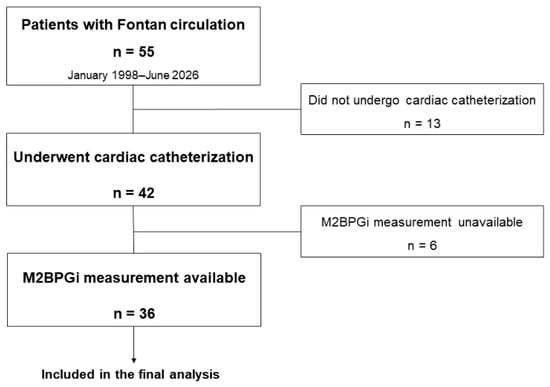
During the study period, 55 patients with Fontan circulation were identified. Of these, 42 underwent cardiac catheterization, and 36 had available M2BPGi measurements and were included in the final analysis. Thirteen patients had not undergone cardiac catheterization, and M2BPGi was not measured in six patients (Figure 1).
Figure 1.
Patient selection flowchart. Of 55 patients with Fontan circulation identified between January 1998 and June 2026, 42 underwent cardiac catheterization. Among these, 36 had available M2BPGi measurements and were included in the final analysis.
The study included 36 patients, of whom 24 (66.7%) were male and 34 (94.4%) had a total cavopulmonary connection. The median age at cardiac catheterization was 16.9 years [interquartile range, 12.2–23.1], and the median time since Fontan completion was 13.2 years [8.8–15.4]. Median central venous pressure was 10.0 mmHg [8.8–13.0], systemic ventricular end-diastolic pressure was 8.0 mmHg [6.0–10.0], and arterial oxygen saturation was 95.0% [93.0–96.0]. The median M2BPGi was 0.39 [0.29–0.58], the median total bile acid concentration was 7.8 μmol/L [4.6–14.4], and the median platelet count was 183 × 109/L [151–227] (Table 1). The median absolute interval between laboratory sampling and cardiac catheterization was 1 day, and 30 of 36 patients (83.3%) had laboratory measurements within 30 days of catheterization. Sensitivity analyses restricted to this interval showed generally consistent directions of association (Supplementary Table S2).
Table 1.
Patient characteristics.
3.2. Associations of M2BPGi with Hemodynamic Variables
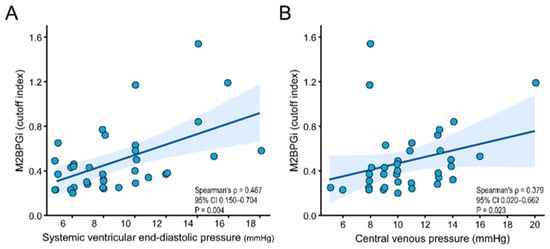
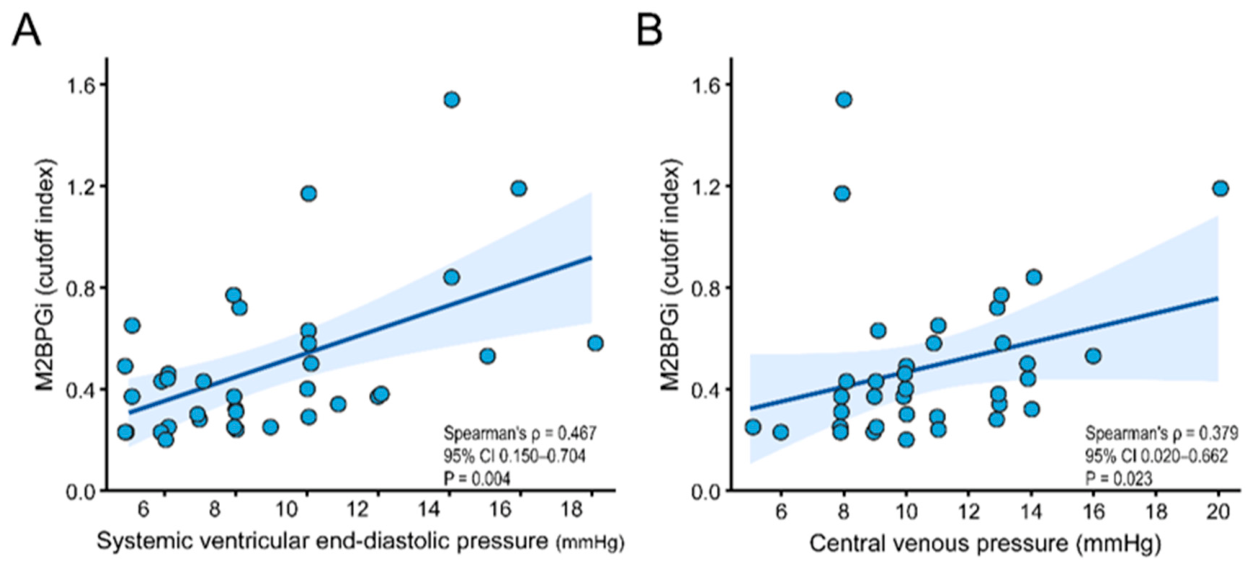
M2BPGi was correlated moderately well with systemic ventricular end-diastolic pressure (ρ = 0.467, bootstrap 95% CI 0.150–0.704; p = 0.004) (Figure 2A) and central venous pressure (ρ = 0.379, bootstrap 95% CI 0.020–0.662; p = 0.023) (Figure 2B). In contrast, M2BPGi was not significantly correlated with arterial oxygen saturation (ρ = −0.112; p = 0.515) or time since Fontan completion (ρ = 0.129; p = 0.455). M2BPGi was also positively correlated with total bile acids (ρ = 0.420, bootstrap 95% CI 0.057–0.706; p = 0.017) (Table 2).
Figure 2.
Associations of Mac-2 binding protein glycosylation isomer (M2BPGi) with invasive Fontan hemodynamics. (A) Systemic ventricular end-diastolic pressure and (B) central venous pressure. Each circle represents one patient. Solid lines and shaded areas indicate linear fits and their 95% confidence intervals for visualization. Spearman’s rank correlations were (A) ρ = 0.467, bootstrap 95% CI 0.150–0.704, p = 0.004; and (B) ρ = 0.379, bootstrap 95% CI 0.020–0.662, p = 0.023.
Table 2.
Selected Spearman correlations.
In the supportive linear regression analysis, systemic ventricular end-diastolic pressure remained associated with M2BPGi after accounting for time since Fontan completion. Each 1-mmHg increase in end-diastolic pressure was associated with an estimated 8.1% higher M2BPGi (bootstrap 95% CI 3.9–14.6%; p = 0.003). After excluding these three observations, the estimated increase in M2BPGi per 1-mmHg increase in end-diastolic pressure was 8.8%. M2BPGi was not significantly correlated with PAWP (ρ = 0.306, p = 0.079), whereas PAWP was correlated with EDP (ρ = 0.690, p < 0.001) (Supplementary Table S3 and Figure S1).
3.3. Total Bile Acids and Other Liver-Related Biomarkers
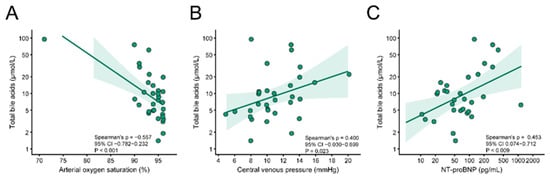
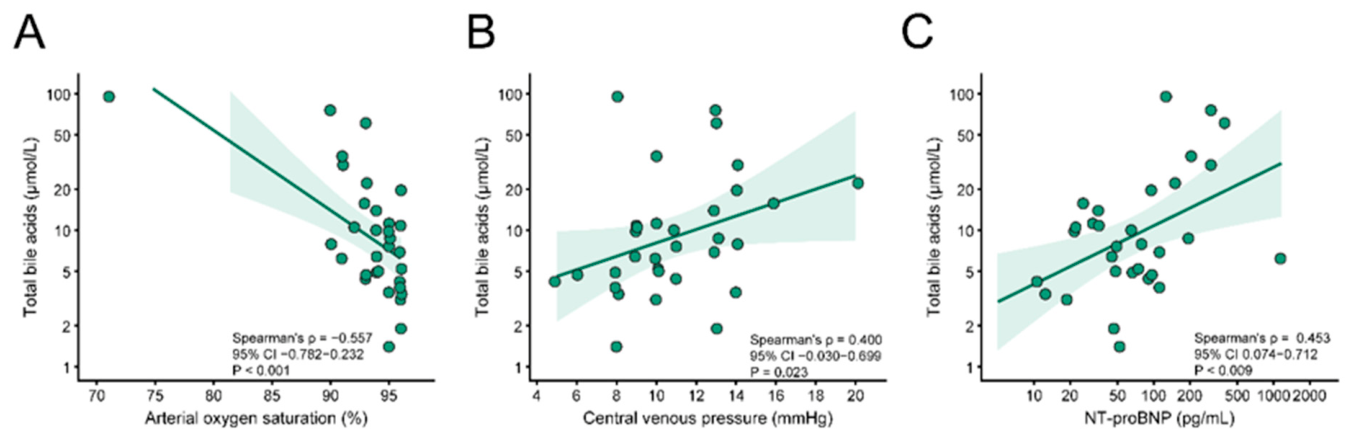
Total bile acids were negatively correlated with arterial oxygen saturation (ρ = −0.557, bootstrap 95% CI −0.782 to −0.232; p < 0.001) (Figure 3A). This association remained after exclusion of the patient with an arterial oxygen saturation of 71% (ρ = −0.512; p = 0.003). Total bile acids were also positively correlated with central venous pressure (ρ = 0.400, bootstrap 95% CI 0.030–0.699; p = 0.023) (Figure 3B) and NT-proBNP (ρ = 0.453, bootstrap 95% CI 0.074–0.712; p = 0.009) (Figure 3C).
Figure 3.
Associations of total bile acids with Fontan circulatory parameters. (A) Arterial oxygen saturation, (B) central venous pressure, and (C) N-terminal pro-B-type natriuretic peptide (NT-proBNP). Each circle represents one patient. Solid lines and shaded areas indicate linear fits and their 95% confidence intervals for visualization. Spearman’s rank correlations were (A) ρ = −0.557, bootstrap 95% CI −0.782 to −0.232, p < 0.001; (B) ρ = 0.400, bootstrap 95% CI 0.030–0.699, p = 0.023; and (C) ρ = 0.453, bootstrap 95% CI 0.074–0.712, p = 0.009. Total bile acids are shown on a logarithmic scale in all panels, and NT-proBNP is shown on a logarithmic scale in panel (C).
Platelet count was negatively correlated with time since Fontan completion (ρ = −0.393, bootstrap 95% CI −0.641 to −0.077; p = 0.018) (Table 2). The association was attenuated after exclusion of three patients assessed within 2 years after Fontan completion (ρ = −0.297; p = 0.093). The ALBI score was positively correlated with systemic ventricular end-diastolic pressure (ρ = 0.540, bootstrap 95% CI 0.287–0.723; p < 0.001) (Table 2 and Supplementary Table S1).
4. Discussion
The principal finding of this study was that M2BPGi was associated with systemic ventricular end-diastolic pressure and central venous pressure, but not with time since Fontan completion. Total bile acids showed a different pattern. They were associated with lower arterial oxygen saturation and higher central venous pressure and NT-proBNP. Lower platelet counts were associated with longer Fontan duration, although this association weakened after exclusion of patients assessed within 2 years after Fontan completion. These findings suggest that liver-related blood biomarkers are not interchangeable and may reflect different components of Fontan circulatory burden, including ventricular filling pressure, systemic venous congestion, hypoxemia, and cumulative exposure to the Fontan circulation.
M2BPGi is widely used as a fibrosis-related biomarker in chronic liver disease [10]. In a recent study of 426 patients with Fontan circulation, M2BPGi was associated with Fontan hemodynamics, hypoxemia, total bile acids, liver-related findings, and clinical outcomes [6]. Our findings were consistent with that study, particularly regarding the associations of M2BPGi with central venous pressure and total bile acids. In addition, M2BPGi was associated with systemic ventricular end-diastolic pressure. Elevated ventricular filling pressure may contribute to increased downstream pressure within the Fontan circuit and systemic venous congestion [1,11,12]. M2BPGi may therefore reflect broader Fontan hemodynamic burden in addition to liver-related pathophysiology. However, noninvasive surrogates should not be assumed to directly quantify histological fibrosis in this population [13].
Total bile acids showed the strongest association with arterial oxygen saturation. This relationship remained after exclusion of the patient with severe hypoxemia. Total bile acids were also associated with central venous pressure and NT-proBNP. These findings are consistent with recent studies linking higher bile acid concentrations to impaired Fontan hemodynamics and multisystem dysfunction [6,14]. Total bile acids may therefore more closely reflect current hypoxemia, congestion, and cardiac load than chronic fibrosis alone.
Platelet count was negatively associated with time since Fontan completion. Biopsy studies have shown that hepatic fibrosis is common after Fontan completion and may become more advanced with longer time since surgery [15,16,17]. Lower platelet counts and longitudinal platelet decline have also been associated with advanced fibrosis [18]. Thrombocytopenia may reflect portal hypertension or hypersplenism, although imaging evidence of splenomegaly or varices was not available in the present study. Features of portal hypertension are clinically relevant because they have been associated with major adverse events after the Fontan operation [19].
Although clinical outcomes were not assessed in the present study, advanced FALD and portal hypertensive phenotypes have been associated with increased mortality in larger cohorts [19,20,21]. The ALBI score was associated with systemic ventricular end-diastolic pressure, but it was strongly influenced by serum albumin in this cohort. This finding should therefore be considered exploratory. FIB-4 also requires cautious interpretation because age is directly incorporated into its formula [9]. Moreover, multimodality studies have demonstrated substantial discordance among blood biomarkers, elastography, imaging findings, and histological fibrosis in patients with Fontan circulation [2,4,13,22].
FIB-4 may provide prognostic or hemodynamic information, but its ability to identify histological fibrosis has been modest and inconsistent [5,18,22]. An elevated M2BPGi value should not be interpreted as evidence of advanced FALD or severe hepatic fibrosis. Rather, it may prompt further assessment of Fontan circulatory burden, including systemic ventricular filling pressure and central venous pressure [1,2,6]. Similarly, elevated total bile acids may support evaluation for hypoxemia and potentially reversible causes of an inefficient Fontan circulation [6,14]. These biomarkers should be viewed as complementary signals rather than diagnostic substitutes for imaging, elastography, or histological assessment [2,4,13,22].
Limitations
This study was limited by its single-center, retrospective, cross-sectional design, small sample size and potential selection bias, which may limit the precision and generalizability of the findings. The influence of individual observations cannot be excluded. Intervening clinical events or treatment changes between laboratory sampling and catheterization could not be systematically assessed. Laboratory sampling was not always contemporaneous with cardiac catheterization, and residual confounding by unmeasured clinical factors cannot be excluded. Total bile acid levels may be influenced by hepatic congestion, altered perfusion, cholestasis, and sampling conditions, and their association with NT-proBNP does not establish causality. Cardiac index, pulmonary vascular resistance, and pulmonary artery pressure were not included in the study dataset, limiting a more comprehensive assessment of Fontan hemodynamics. Because imaging, elastography, and histological findings were not used as reference standards, the diagnostic performance of these biomarkers for FALD or hepatic fibrosis could not be assessed. Finally, the analyses were exploratory, involved multiple comparisons without adjustment for multiplicity, and included age-dependent markers and some missing laboratory data.
5. Conclusions
In patients after the Fontan operation, M2BPGi was correlated moderately well with systemic ventricular end-diastolic pressure and central venous pressure, whereas total bile acids were associated with lower arterial oxygen saturation and higher central venous pressure and NT-proBNP concentrations. M2BPGi was not associated with time since Fontan completion. These findings suggest that liver-related blood biomarkers are not interchangeable and may reflect different components of Fontan circulatory burden. They should not be used alone to diagnose FALD but may help generate hypotheses for integrating routinely available biomarkers with invasive Fontan hemodynamic assessment.
Supplementary Materials
The following supporting information can be downloaded at: https://www.mdpi.com/article/10.3390/children13121646/s1, Table S1: Correlation matrix of liver-related blood biomarkers with hemodynamic and clinical variables. Table S2: Sensitivity analyses restricted to laboratory measurements within 30 days of cardiac catheterization. Table S3: Paired systemic ventricular end-diastolic and pulmonary artery wedge pressures. Figure S1: Associations of pulmonary artery wedge pressure with M2BPGi and systemic ventricular end-diastolic pressure.
Author Contributions
Conceptualization, Y.K. and K.K.; methodology, Y.K. and K.K.; formal analysis, Y.K. and K.K.; investigation, Y.K., J.S., A.H., S.K. and F.M.; data curation, Y.K., J.S., A.H., S.K., and F.M.; visualization, K.K.; writing—original draft preparation, Y.K. and K.K.; writing—review and editing, all authors; supervision, K.T. All authors have read and agreed to the published version of the manuscript.
Funding
This study was supported by research donations to the Department of Pediatrics, Hirosaki University.
Institutional Review Board Statement
The study was approved by the Institutional Review Board of Hirosaki University Graduate School of Medicine (approval no. 2026-099; 9 September 2026).
Informed Consent Statement
The requirement for written informed consent was waived by the Institutional Review Board because of the retrospective observational design of the study. All patients or their guardians were given the opportunity to opt out of participation.
Data Availability Statement
The data presented in this study are available on request from the corresponding author due to privacy and ethical restrictions.
Acknowledgments
We thank the patients and their families for their cooperation and the physicians involved in cardiac catheterization at Hirosaki University Hospital for their clinical support. We also thank Satista Co., Ltd. for its independent statistical review.
Conflicts of Interest
The authors declare no conflicts of interest.
References
- Rychik, J.; Atz, A.M.; Celermajer, D.S.; Deal, B.J.; Gatzoulis, M.A.; Gewillig, M.H.; Hsia, T.-Y.; Hsu, D.T.; Kovacs, A.H.; McCrindle, B.W.; et al. Evaluation and management of the child and adult with Fontan circulation: A scientific statement from the American Heart Association. Circulation 2019, 140, e234–e284. [Google Scholar] [CrossRef] [Scilit] [PubMed]
- Téllez, L.; Payancé, A.; Tjwa, E.T.T.L.; del Cerro, M.J.; Idorn, L.; Ovroutski, S.; De Bruyne, R.; Verkade, H.J.; De Rita, F.; de Lange, C.; et al. EASL-ERN position paper on liver involvement in patients with Fontan-type circulation. J. Hepatol. 2023, 79, 1270–1301. [Google Scholar] [CrossRef] [Scilit] [PubMed]
- Rychik, J.; Veldtman, G.; Rand, E.; Russo, P.; Rome, J.J.; Krok, K.; Goldberg, D.J.; Cahill, A.M.; Wells, R.G. The precarious state of the liver after a Fontan operation: Summary of a multidisciplinary symposium. Pediatr. Cardiol. 2012, 33, 1001–1012. [Google Scholar] [CrossRef] [Scilit] [PubMed]
- Emamaullee, J.; Zaidi, A.N.; Schiano, T.; Kahn, J.; Valentino, P.L.; Hofer, R.E.; Taner, T.; Wald, J.W.; Olthoff, K.M.; Bucuvalas, J.; et al. Fontan-associated liver disease: Screening, management, and transplant considerations. Circulation 2020, 142, 591–604. [Google Scholar] [CrossRef] [Scilit] [PubMed]
- Martín de Miguel, I.; Kamath, P.S.; Egbe, A.C.; Jain, C.C.; Cetta, F.; Connolly, H.M.; Miranda, W.R. Haemodynamic and prognostic associations of liver fibrosis scores in Fontan-associated liver disease. Heart 2023, 109, 619–625. [Google Scholar] [CrossRef] [Scilit] [PubMed]
- Ohuchi, H.; Mori, A.; Morimoto, Y.; Kato, Y.; Fujimoto, K.; Iwasa, T.; Shiraishi, I.; Kurosaki, K.; Nakai, M. Mac-2 binding protein glycosylation isomer (M2BPGi) reflects global pathophysiology and predicts all-cause morbidity and mortality in patients with Fontan circulation. Circ. J. 2026, 90, 661–670. [Google Scholar] [CrossRef] [Scilit] [PubMed]
- Johnson, P.J.; Berhane, S.; Kagebayashi, C.; Satomura, S.; Teng, M.; Reeves, H.L.; O’Beirne, J.; Fox, R.; Skowronska, A.; Palmer, D.; et al. Assessment of liver function in patients with hepatocellular carcinoma: A new evidence-based approach—The ALBI grade. J. Clin. Oncol. 2015, 33, 550–558. [Google Scholar] [CrossRef] [Scilit] [PubMed]
- Sterling, R.K.; Lissen, E.; Clumeck, N.; Sola, R.; Correa, M.C.; Montaner, J.; Sulkowski, M.S.; Torriani, F.J.; Dieterich, D.T.; Thomas, D.L.; et al. Development of a simple noninvasive index to predict significant fibrosis in patients with HIV/HCV coinfection. Hepatology 2006, 43, 1317–1325. [Google Scholar] [CrossRef] [Scilit] [PubMed]
- Heuman, D.M.; Mihas, A.A.; Habib, A.; Gilles, H.S.; Stravitz, R.T.; Sanyal, A.J.; Fisher, R.A. MELD-XI: A rational approach to “sickest first” liver transplantation in cirrhotic patients requiring anticoagulant therapy. Liver Transpl. 2007, 13, 30–37. [Google Scholar] [CrossRef] [Scilit] [PubMed]
- Kuno, A.; Ikehara, Y.; Tanaka, Y.; Ito, K.; Matsuda, A.; Sekiya, S.; Hige, S.; Sakamoto, M.; Kage, M.; Mizokami, M.; et al. A serum “sweet-doughnut” protein facilitates fibrosis evaluation and therapy assessment in patients with viral hepatitis. Sci. Rep. 2013, 3, 1065. [Google Scholar] [CrossRef] [Scilit] [PubMed]
- Simonetto, D.A.; Yang, H.Y.; Yin, M.; de Assuncao, T.M.; Kwon, J.H.; Hilscher, M.; Pan, S.; Yang, L.; Bi, Y.; Beyder, A.; et al. Chronic passive venous congestion drives hepatic fibrogenesis via sinusoidal thrombosis and mechanical forces. Hepatology 2015, 61, 648–659. [Google Scholar] [CrossRef] [Scilit] [PubMed]
- Kutty, S.S.; Peng, Q.; Danford, D.A.; Fletcher, S.E.; Perry, D.; Talmon, G.A.; Scott, C.; Kugler, J.D.; Duncan, K.F.; Quiros-Tejeira, R.E.; et al. Increased hepatic stiffness as consequence of high hepatic afterload in the Fontan circulation: A vascular Doppler and elastography study. Hepatology 2014, 59, 251–260. [Google Scholar] [CrossRef] [Scilit] [PubMed]
- Shin, Y.R.; Kim, S.U.; Lee, S.; Choi, J.Y.; Park, H.K.; Yoo, J.E.; Park, Y.N. Noninvasive surrogates are poor predictors of liver fibrosis in patients with Fontan circulation. J. Thorac. Cardiovasc. Surg. 2022, 164, 1176–1185.e3. [Google Scholar] [CrossRef] [Scilit] [PubMed]
- Shah, A.H.; Surendran, A.; Hassan-Tash, P.; Turnbull, C.N.; Johnston, N.; Goodlett, D.; Han, J.; Ducas, R.A.; Tam, J.W.; Renner, E.; et al. Association of Fontan pathophysiology with plasma bile acids. JACC Adv. 2025, 4, 101563. [Google Scholar] [CrossRef] [Scilit] [PubMed]
- Schwartz, M.C.; Sullivan, L.M.; Glatz, A.C.; Rand, E.; Russo, P.; Goldberg, D.J.; Rome, J.J.; Cohen, M.S. Portal and sinusoidal fibrosis are common on liver biopsy after Fontan surgery. Pediatr. Cardiol. 2013, 34, 135–142. [Google Scholar] [CrossRef] [Scilit] [PubMed]
- Goldberg, D.J.; Surrey, L.F.; Glatz, A.C.; Dodds, K.; O’BYrne, M.L.; Lin, H.C.; Fogel, M.; Rome, J.J.; Rand, E.B.; Russo, P.; et al. Hepatic fibrosis is universal following Fontan operation, and severity is associated with time from surgery: A liver biopsy and hemodynamic study. J. Am. Heart Assoc. 2017, 6, e004809. [Google Scholar] [CrossRef] [Scilit] [PubMed]
- Surrey, L.F.; Russo, P.; Rychik, J.; Goldberg, D.J.; Dodds, K.; O’BYrne, M.L.; Glatz, A.C.; Rand, E.B.; Lin, H.C. Prevalence and characterization of fibrosis in surveillance liver biopsies of patients with Fontan circulation. Hum. Pathol. 2016, 57, 106–115. [Google Scholar] [CrossRef] [Scilit] [PubMed]
- Emamaullee, J.; Khan, S.; Weaver, C.; Goldbeck, C.; Yanni, G.; Kohli, R.; Genyk, Y.; Zhou, S.; Shillingford, N.; Sullivan, P.M.; et al. Non-invasive biomarkers of Fontan-associated liver disease. JHEP Rep. 2021, 3, 100362. [Google Scholar] [CrossRef] [Scilit] [PubMed]
- Elder, R.W.; McCabe, N.M.; Hebson, C.; Veledar, E.; Romero, R.; Ford, R.M.; Mahle, W.T.; Kogon, B.E.; Sahu, A.; Jokhadar, M.; et al. Features of portal hypertension are associated with major adverse events in Fontan patients: The VAST study. Int. J. Cardiol. 2013, 168, 3764–3769. [Google Scholar] [CrossRef] [Scilit] [PubMed]
- Guerrero-Chalela, C.E.; Therrien, J.; Grossman, Y.; Guo, L.; Liu, A.; Marelli, A. Severe Fontan-associated liver disease and its association with mortality. J. Am. Heart Assoc. 2023, 12, e024034. [Google Scholar] [CrossRef] [Scilit] [PubMed]
- Cao, J.Y.; Wales, K.M.; d’Udekem, Y.; Celermajer, D.S.; Cordina, R.; Majumdar, A. Prevalence, risk factors, and prognosis for Fontan-associated liver disease: A systematic review and exploratory meta-analysis. JACC Adv. 2025, 4, 101694. [Google Scholar] [CrossRef] [Scilit] [PubMed]
- Munsterman, I.D.; Duijnhouwer, A.L.; Kendall, T.J.; Bronkhorst, C.M.; Ronot, M.; van Wettere, M.; van Dijk, A.P.J.; Drenth, J.P.H.; Tjwa, E.T.T.L.; Initiative, N.F.; et al. The clinical spectrum of Fontan-associated liver disease: Results from a prospective multimodality screening cohort. Eur. Heart J. 2019, 40, 1057–1068. [Google Scholar] [CrossRef] [Scilit] [PubMed]

Disclaimer/Publisher’s Note: The statements, opinions and data contained in all publications are solely those of the individual author(s) and contributor(s) and not of MDPI and/or the editor(s). MDPI and/or the editor(s) disclaim responsibility for any injury to people or property resulting from any ideas, methods, instructions or products referred to in the content. |
© 2026 by the authors. Licensee MDPI, Basel, Switzerland. This article is an open access article distributed under the terms and conditions of the Creative Commons Attribution (CC BY) license.