


Highlights
What are the main findings?
- After accounting for clustering of hips within families and for disease severity, closed reduction failure did not differ significantly between infants with no, improper, or proper Pavlik harness use, although it was numerically highest after improper use (20.0%).
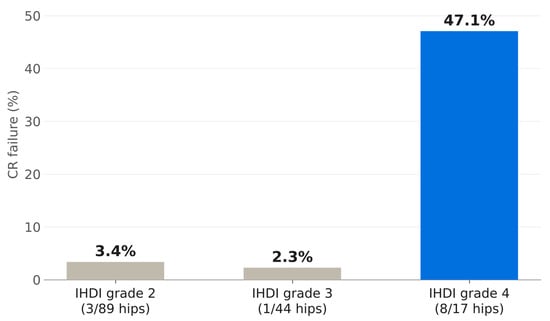
- IHDI grade 4 was strongly associated with closed reduction failure (47.1%; adjusted odds ratio 15.6).
What are the implications of the main findings?
- More than one in four harness-treated families in this cohort were non-compliant, which supports structured parental training and early monitoring of compliance.
- Disease severity should be accounted for when comparing closed reduction outcomes after harness treatment; larger prospective studies are needed to clarify the role of compliance.
Abstract
Background/Objectives: Parental compliance with the Pavlik harness has rarely been analyzed as a separate variable in studies of closed reduction (CR) after harness treatment. This study evaluated whether Pavlik harness use and compliance before CR are associated with CR success, avascular necrosis (AVN), and residual acetabular dysplasia (RAD) in developmental dysplasia of the hip (DDH). Methods: We retrospectively analyzed 150 hips in 87 patients who underwent CR and hip spica casting before 12 months of age between January 2020 and June 2021. Hips were grouped by pre-CR harness use: no harness (n = 66), improper use (n = 25), and proper use (n = 59). Improper use was defined as insufficient daily wear, incorrect application despite training, premature discontinuation, or continuation of the harness despite a recommendation for CR. Loss of reduction requiring further surgery was defined as failure. Clustering of hips within families was accounted for with generalized estimating equations (GEE). Results: At a mean follow-up of 38.6 ± 4.9 months, CR succeeded in 92.0% of hips. Failure rates were 20.0% with improper use, 6.1% with no harness, and 5.1% with proper use (p = 0.076). In GEE, the odds ratio (OR) for improper versus proper use was 4.48 (95% CI 0.67–29.95) and 3.28 (95% CI 0.49–22.04) after adjustment for International Hip Dysplasia Institute (IHDI) grade 4, which was strongly associated with failure (OR 15.61; 95% CI 3.92–62.23). Among successfully reduced hips, AVN (10.1%) and RAD (6.5%) did not differ significantly between groups (p = 0.128 and p = 0.121). The mean acetabular index decreased from 37.1° to 18.7° (p < 0.001). Conclusions: In this cohort, CR failure was numerically more frequent after improper Pavlik harness use, but the difference was not statistically significant and was partly explained by disease severity. No significant differences in AVN or RAD were detected. Given the small number of events, these findings should be considered hypothesis-generating, and larger studies with prospectively documented compliance are needed.
1. Introduction
Developmental dysplasia of the hip (DDH) is the most common hip pathology of the neonatal period [1]. Delays in diagnosis and treatment complicate disease management and may lead to more aggressive surgical interventions [2]. With the widespread adoption of screening programs, less invasive methods are increasingly used for patients with DDH, and rates of closed reduction (CR) are increasing [3].
The Pavlik harness is one of the standard treatments for hip dislocation or instability diagnosed within the first six months of life, although other abduction orthoses are also widely used [4,5,6,7]. The success rate is high when the harness is used properly; however, success depends largely on parental adherence to treatment [8,9,10,11]. Therefore, it is recommended that parents be educated on the use of the harness and that compliance be monitored through early follow-up visits [9,12]. A significant proportion of treatment failures with the Pavlik harness has been associated with improper use and with persisting with the harness without achieving reduction [13,14]. Recent studies have identified older age at treatment initiation, a lower initial α angle, Graf type III–IV hips, a positive Galeazzi sign, and femoral nerve palsy as independent predictors of harness failure [15,16], and a positive family history and female sex have been associated with more severe presentation and may predispose to harness failure [17].
For patients who do not benefit from the Pavlik harness, the second-line treatment is CR and a hip spica cast [18]. Disease severity, soft-tissue contracture, and age at CR are established risk factors for CR failure [19]. Data on the outcomes of CR performed after failed Pavlik treatment are limited and contradictory [20,21,22,23,24]. Furthermore, failed Pavlik treatment has rarely been compared with direct CR without prior harness use, and parental compliance has rarely been analyzed as a separate variable in such comparisons.
The outcome of CR is determined not only by maintenance of the reduction but also by complications such as avascular necrosis (AVN) and residual acetabular dysplasia (RAD) [19,25]. The aim of this study was to evaluate the association of Pavlik harness use and compliance before CR with CR success, AVN, RAD, and acetabular development at a mean follow-up of three years. Our hypothesis was that improper use of the harness would be associated with lower CR success.
2. Materials and Methods
2.1. Study Design and Patients
This retrospective cohort study was approved by the Harran University Clinical Research Ethics Committee (decision no. HRÜ/22.08.26; date: 18 April 2022) and was conducted in accordance with the Declaration of Helsinki. The records of patients who underwent CR for DDH at the Department of Orthopedics and Traumatology, Harran University Faculty of Medicine, between January 2020 and June 2021 were retrospectively reviewed. A total of 106 patients were identified who underwent CR before 12 months of age, either as primary treatment or because reduction could not be achieved with a Pavlik harness.
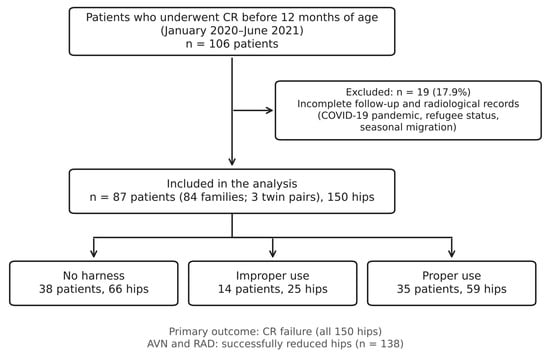
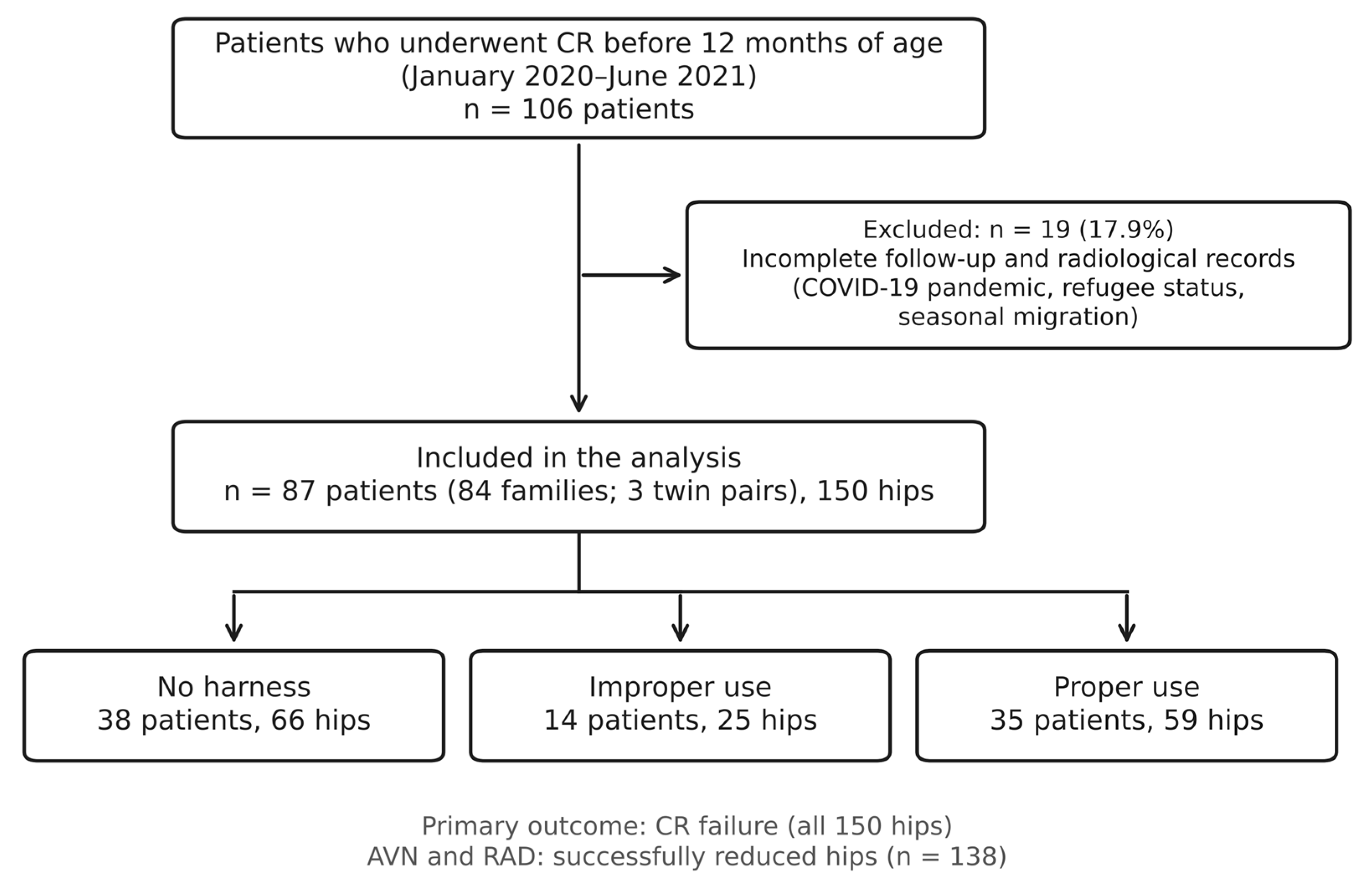
Patients with teratologic dislocation, neuromuscular disease (meningomyelocele, arthrogryposis, cerebral palsy, muscular dystrophy, spinal muscular atrophy, etc.), or metabolic disease were not included. Nineteen of the 106 patients (17.9%) who did not attend regular follow-up and had incomplete radiological records were excluded; these patients were lost to follow-up owing to the COVID-19 pandemic, the refugee patient population, and seasonal worker migration. All 19 excluded patients underwent CR at our institution; however, their baseline data were not entered into the study dataset at the time of data collection and could not be retrieved retrospectively for a formal comparison with the included cohort. Finally, 150 hips in 87 patients (84 families, including three twin pairs) were included in the study (Figure 1).
Figure 1.
Flow diagram of patient selection. CR, closed reduction; AVN, avascular necrosis; RAD, residual acetabular dysplasia.
2.2. Definition of Groups and Harness Compliance
Although the Pavlik harness is one of the standard conservative treatments for DDH in infants younger than six months, it is difficult to use and presents challenges regarding treatment compliance. In harness-treated infants, Pavlik harness treatment was started at the time of diagnosis. The families of infants undergoing harness treatment were instructed in its use. After the appropriate position was set, the straps were marked so that the same settings were maintained during removal and reapplication. Patients treated with the Pavlik harness were closely monitored: parental proficiency in using the harness, adherence to the recommended wearing time, and the suitability of the harness size were verified at follow-up examinations and recorded in the patients’ files. We recommended that the harness not be removed at all during the first week of treatment and that, in subsequent weeks, it be removed for half an hour daily for bathing and then reapplied. Therefore, parents had to acquire adequate proficiency in reapplying the harness. A follow-up ultrasonographic examination was performed three weeks after harness initiation. If the Graf assessment showed improvement, harness treatment was continued; if no benefit was observed, a decision was made to proceed to CR.
Patients were divided into three groups according to pre-CR Pavlik harness use: those who did not use the harness at all (direct CR), those who did not use it properly as recommended (improper use), and those who used it properly as recommended (proper use). Because harness use was recorded per patient, both hips of patients with bilateral involvement were always assigned to the same group. Direct CR without a harness trial was chosen in three situations: (1) hips that were stiff and irreducible on physical examination, (2) patients for whom close follow-up during harness treatment could not be ensured, and (3) infants diagnosed late, at approximately six months of age or older, for whom the Pavlik harness is usually no longer indicated. The study period coincided with the COVID-19 pandemic, during which curfews were in force and official permission was required for hospital visits. Because our hospital is a tertiary referral center, many patients were referred from rural areas and neighboring provinces, and for some of them, a decision was made to proceed directly to CR because regular harness follow-up was not feasible. The three groups did not differ significantly in initial IHDI grade or age at CR; however, infants in the no-harness group were diagnosed significantly later (Section 3.2). Non-compliance was defined as any of the following:
- Failure to wear the harness for the recommended daily duration for any reason;
- Incorrect application of the harness at follow-up despite training in its application;
- Premature discontinuation of Pavlik harness treatment;
- The family’s decision to continue harness treatment, resulting in prolonged use, despite a recommendation for CR owing to a lack of improvement on follow-up imaging.
Compliance was assessed at each follow-up visit and documented in the patient files during treatment. For this study, harness use was classified retrospectively from these records, and the classification was not blinded to CR outcome. In the improper-use group, criterion 1 applied to 3 patients (5 hips), criterion 2 to 3 patients (5 hips), criterion 3 to 6 patients (11 hips), and criterion 4 to 2 patients (4 hips). Of the three improper-use patients whose CR failed (five hips), two met criterion 2 and one met criterion 3; none met criterion 4.
2.3. Treatment Protocol
All CR procedures were performed under general anesthesia or deep sedation. The reduction status of the hip was first assessed with the Ortolani and Barlow maneuvers, and an anteroposterior pelvic radiograph in the frog-leg position was obtained to confirm concentric reduction. If the hip was reduced, stability was assessed: with the hip flexed to 90° and the greater trochanter gently lifted, the hip was abducted until the angle of reduction was felt and then adducted until the angle at which subluxation occurred was determined. The arc between these two angles was defined as the “safe zone”.
In hips with a narrow safe zone, adductor contracture was assessed and, if present, adductor tenotomy was performed to widen the safe zone. Hips whose safe zone did not widen despite adductor tenotomy and that remained reduced only in extreme abduction and internal rotation were considered unstable. In unstable hips, intraoperative arthrography was performed: 1 mL of contrast medium was injected into the joint, and its distribution was evaluated under fluoroscopy. If a tight iliopsoas tendon was identified as an obstacle to reduction, iliopsoas tenotomy was performed without proceeding to open reduction, and the reduction and safe zone were reassessed. If concentric reduction still could not be achieved, or if another obstacle such as an inverted labrum or a hypertrophic ligamentum teres was identified, open reduction was performed.
Hips in which concentric and stable reduction was achieved were immobilized in a hip spica cast, which was checked under fluoroscopy. The hip was held in 90° of flexion, with abduction set 20° below the measured maximum abduction to remain within the safe zone and internal rotation not exceeding 15°, to reduce the risk of AVN associated with excessive abduction and internal rotation. The cast was changed at six weeks, and the second cast remained in place for another six weeks. Subsequently, a Denis Browne abduction orthosis was used full-time for six weeks and then only during sleep for a further six weeks.
2.4. Radiological Evaluation and Outcome Criteria
On pre-CR anteroposterior pelvic radiographs, hips were graded according to the International Hip Dysplasia Institute (IHDI) classification, which was preferred because it can be applied to hips without a femoral head ossification center [26]. The acetabular index (AI) was measured before CR, at cast removal (3 months), at orthosis discontinuation (6 months), and at final follow-up. All radiographic measurements were performed by a single experienced orthopedic surgeon who was not blinded to group or outcome.
Hips requiring additional surgery owing to loss of reduction during post-CR follow-up were considered failures. No hip required conversion to open reduction during the index procedure. Of the 8 patients with failed CR, 4 underwent medial open reduction, 1 underwent open reduction with Dega pelvic osteotomy, and 1 underwent open reduction with Pemberton pelvic osteotomy at our institution; 2 patients continued treatment at other centers. AVN was evaluated on final follow-up radiographs according to the Kalamchi–MacEwen classification [27]. This classification was used because it is based on the involvement of the femoral epiphysis and physis and can be applied in the early post-reduction period, whereas the Severin classification requires the child to be at least 5–6 years of age, which exceeded our follow-up period. RAD was defined as an AI > 25° at final assessment, in accordance with Li et al. [25]. This threshold was applied strictly: four successfully reduced hips with a final AI between 24° and 25° were followed closely as borderline cases but were not classified as RAD.
2.5. Statistical Analysis
IBM SPSS Statistics 30 (IBM Corp., Armonk, NY, USA) was used for data analysis. Normality was assessed using the Shapiro–Wilk test. Continuous variables are presented as mean ± standard deviation (SD) and median (interquartile range, IQR); categorical variables are presented as numbers and percentages.
Because some cells had expected counts below 5, categorical variables were compared using Fisher’s exact test or the Fisher–Freeman–Halton exact test. When an overall comparison was significant, pairwise comparisons were performed with Bonferroni correction, and Bonferroni-adjusted p-values are reported. Continuous variables were compared using the Mann–Whitney U and Kruskal–Wallis tests; when the Kruskal–Wallis test was significant, pairwise comparisons were performed with Dunn’s test with Bonferroni correction.
The primary outcome was CR failure at the hip level. Because most patients had bilateral involvement and the cohort included three twin pairs, the dependence between hips of the same family was accounted for using generalized estimating equations (GEE; binary logistic model, logit link, exchangeable working correlation). Model 1 included Pavlik group; Model 2 additionally included IHDI grade 4. Results are presented as odds ratios (ORs) with 95% confidence intervals (CIs). In a patient-level sensitivity analysis, a patient was classified as a failure if at least one hip failed.
Because the final radiographs of failed hips reflected the subsequent open reduction, AVN and RAD were analyzed in the 138 successfully reduced hips; results for all hips are also reported. Risk differences with Newcombe hybrid score 95% CIs were calculated for AVN and RAD relative to the proper-use group.
Changes in AI over time were evaluated using repeated-measures ANOVA, and differences between groups using mixed-design ANOVA. The Greenhouse–Geisser correction was applied when the assumption of sphericity was not met, pairwise comparisons were Bonferroni-corrected, and effect sizes are reported as partial eta squared (ηp2). A p-value < 0.05 was considered statistically significant.
3. Results
3.1. Baseline Characteristics of the Cohort
Of the 106 patients who underwent CR before 12 months of age, 19 (17.9%) were excluded because of incomplete follow-up and radiological records, and 150 hips in 87 patients (84 families, including three twin pairs) were analyzed (Figure 1). Of the patients, 90.8% were female, and 72.4% had bilateral involvement. CR was performed at a mean age of 29.2 ± 8.9 weeks, and the mean follow-up period was 38.6 ± 4.9 months (range, 31–48 months). CR was successful in 138 hips (92.0%) and in 79 patients (90.8%) (Table 1). Swaddling, a risk factor for DDH, was present in 74.7% of patients; it remains a common practice in our region owing to the belief that it ensures proper skeletal development.
Table 1.
Patient and hip characteristics.
3.2. Comparability of Groups
The three groups did not differ significantly in age at CR (p = 0.205), follow-up duration (p = 0.261), swaddling (p = 0.679), or initial IHDI grade (p = 0.440) (Table 2). However, IHDI grade 4 hips were more frequent in the improper-use group (20.0%) than in the no-harness (12.1%) and proper-use (6.8%) groups. Although this imbalance was not statistically significant, it is relevant because IHDI grade was the strongest factor associated with failure (Section 3.5). Age at diagnosis differed significantly between groups (Kruskal–Wallis H = 47.95, df = 2, p < 0.001): infants in the no-harness group were diagnosed later (median 27.5 weeks) than those in the improper-use (13.0 weeks) and proper-use (14.0 weeks) groups (both p < 0.001), whereas the two harness groups did not differ (p = 1.000) (Table 2).
Table 2.
Baseline characteristics by Pavlik group.
3.3. Age at Initiation and Duration of Pavlik Harness Use
Patients with improper use wore the harness for a significantly longer period than those with proper use (median 12 vs. 6 weeks; p = 0.003). The age at harness initiation was similar in the two groups (p = 0.885) (Table 3).
Table 3.
Age at initiation and duration of Pavlik harness use (patient level).
3.4. CR Outcome by Pavlik Group
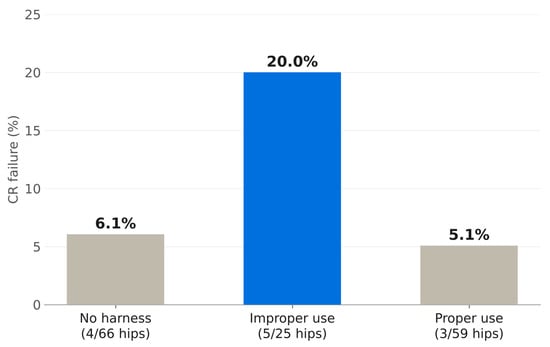
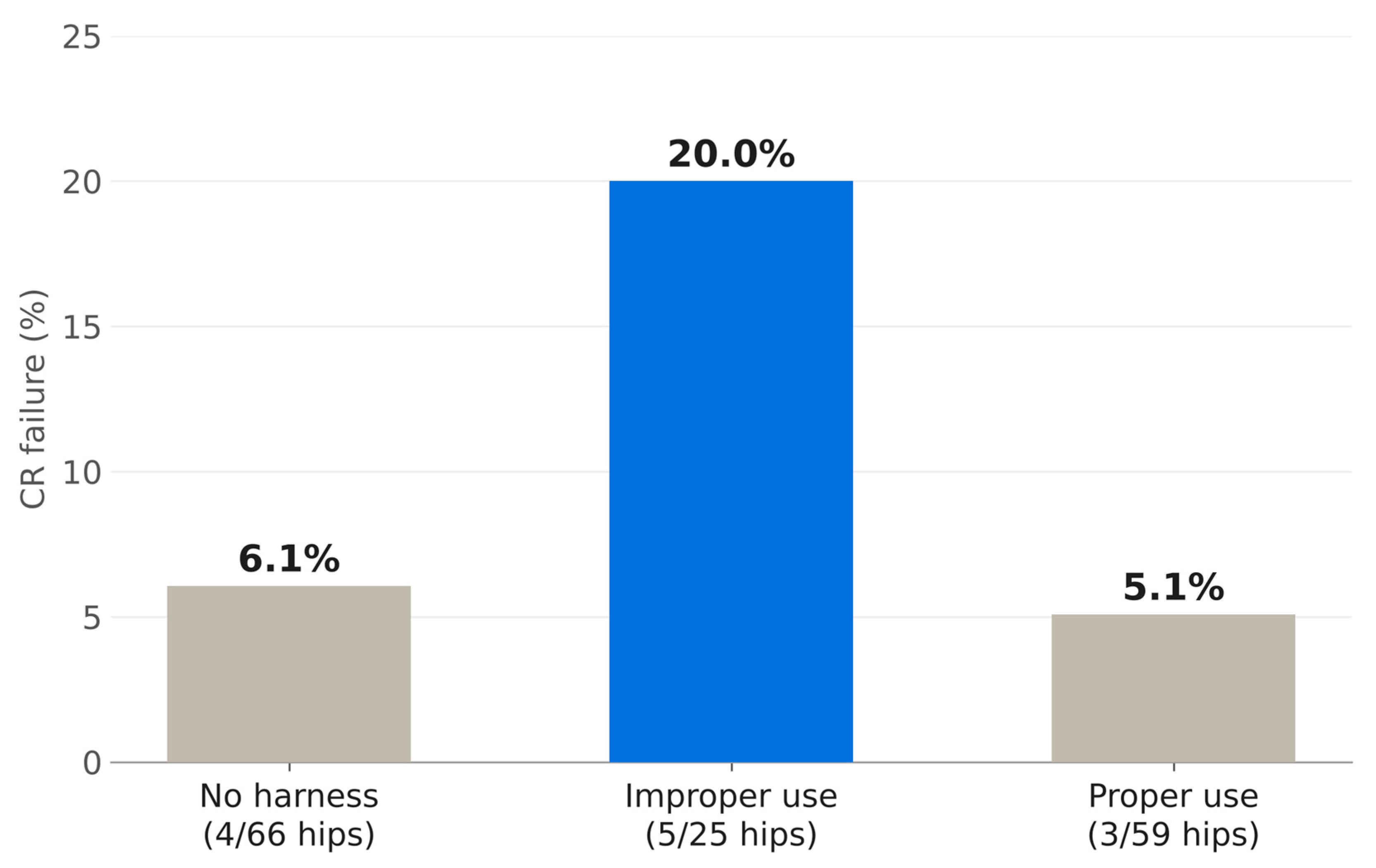
The CR failure rate was 20.0% in the improper-use group, 6.1% in the no-harness group, and 5.1% in the proper-use group; the difference between groups was not statistically significant (p = 0.076) (Table 4, Figure 2).
Table 4.
CR outcome by Pavlik harness group (hip level, n = 150).
Figure 2.
CR failure rate by Pavlik group (hip level, n = 150). The difference between groups was not significant (Fisher–Freeman–Halton exact test, p = 0.076). CR, closed reduction.
When clustering of hips within families was taken into account, the OR for CR failure relative to proper use was 4.48 (95% CI 0.67–29.95; p = 0.122) for improper use and 1.16 (95% CI 0.21–6.54; p = 0.868) for no harness; the overall association of Pavlik group with failure was not significant (p = 0.218). After adjustment for IHDI grade 4, the OR for improper use decreased to 3.28 (95% CI 0.49–22.04; p = 0.221), whereas IHDI grade 4 was strongly associated with failure (OR 15.61; 95% CI 3.92–62.23; p < 0.001) (Table 5).
Table 5.
Generalized estimating equation models for CR failure (150 hips, 84 families).
The 12 failed hips belonged to 8 patients, all with bilateral involvement: 5 failed hips in 3 patients in the improper-use group, 4 in 3 patients in the no-harness group, and 3 in 2 patients in the proper-use group. In the patient-level sensitivity analysis, failure in at least one hip occurred in 3 of 38 patients (7.9%) with no harness, 3 of 14 (21.4%) with improper use, and 2 of 35 (5.7%) with proper use (p = 0.271). Loss of reduction was detected at a median of 1.75 months (range, 1–4 months) after CR: at 1 month in three patients, at 1.5 months in one, at 2 months in two, and at 4 months in two. Thus, six of the eight patients (75%) lost reduction during spica cast immobilization (the first 3 months), whereas two lost reduction during the subsequent full-time abduction orthosis period.
3.5. CR Outcome by Initial IHDI Grade
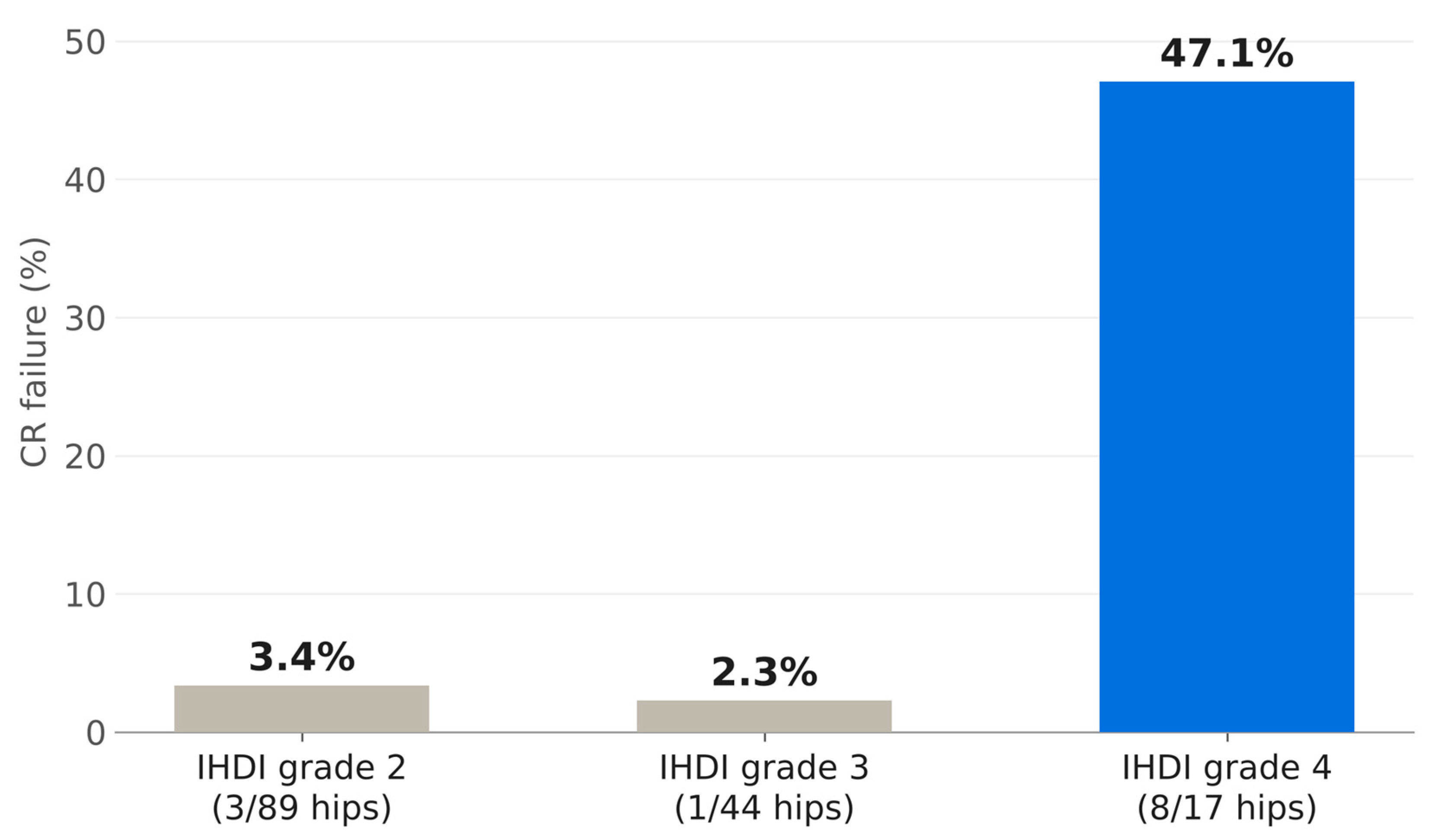
The failure rate was 47.1% in IHDI grade 4 hips, compared with 3.4% and 2.3% in IHDI grade 2 and grade 3 hips, respectively (p < 0.001; Figure 3). Failure was more frequent in IHDI grade 4 hips than in both grade 2 and grade 3 hips (Bonferroni-adjusted p < 0.001 for both), with no difference between grades 2 and 3 (p = 1.000). Eight (66.7%) of the 12 failed hips were IHDI grade 4. Within each Pavlik group, failure was more frequent in IHDI grade 4 hips (p = 0.005, 0.036, and 0.010). Among hips of the same IHDI grade, failure rates did not differ significantly between Pavlik groups (IHDI 2–3: 1.7%, 10.0%, and 1.8%, p = 0.211; IHDI 4: 37.5%, 60.0%, and 50.0%, p = 0.827) (Table 6). Three of the five failures in the improper-use group occurred in IHDI grade 4 hips.
Figure 3.
CR failure rate by initial IHDI grade (hip level, n = 150; Fisher–Freeman–Halton exact test, p < 0.001). CR, closed reduction; IHDI, International Hip Dysplasia Institute.
Table 6.
CR failure by initial IHDI grade and Pavlik group, n/N (%).
3.6. Avascular Necrosis and Residual Acetabular Dysplasia
Among the 138 successfully reduced hips, AVN developed in 14 (10.1%) and RAD in 9 (6.5%); of the 19 hips with AVN and the 12 hips with RAD in the whole cohort, the remaining 5 and 3, respectively, were failed hips. AVN occurred in 16.1% of hips in the no-harness group, 5.0% in the improper-use group, and 5.4% in the proper-use group; the corresponding RAD rates were 9.7%, 10.0%, and 1.8%. No significant differences were detected between groups in AVN (p = 0.128) or RAD (p = 0.121) (Table 7), and the 95% CIs of the risk differences were wide. Clinically significant AVN (grades II–IV) occurred in 12 hips (8.7%). When all 150 hips were included, the results were similar: AVN rates in the no-harness, improper-use, and proper-use groups were 16.7%, 16.0%, and 6.8% (p = 0.208), and RAD rates were 10.6%, 12.0%, and 3.4% (p = 0.223). Given the small number of events, these analyses had limited power to detect differences.
Table 7.
AVN and RAD by Pavlik group in successfully reduced hips (n = 138).
3.7. Change in Acetabular Index
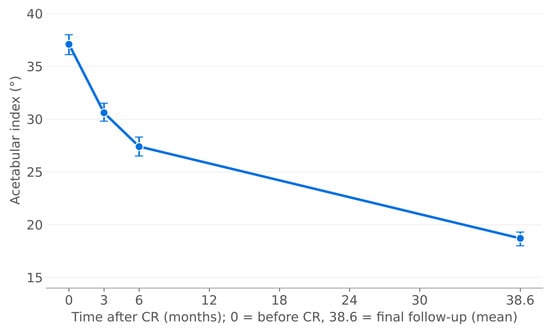
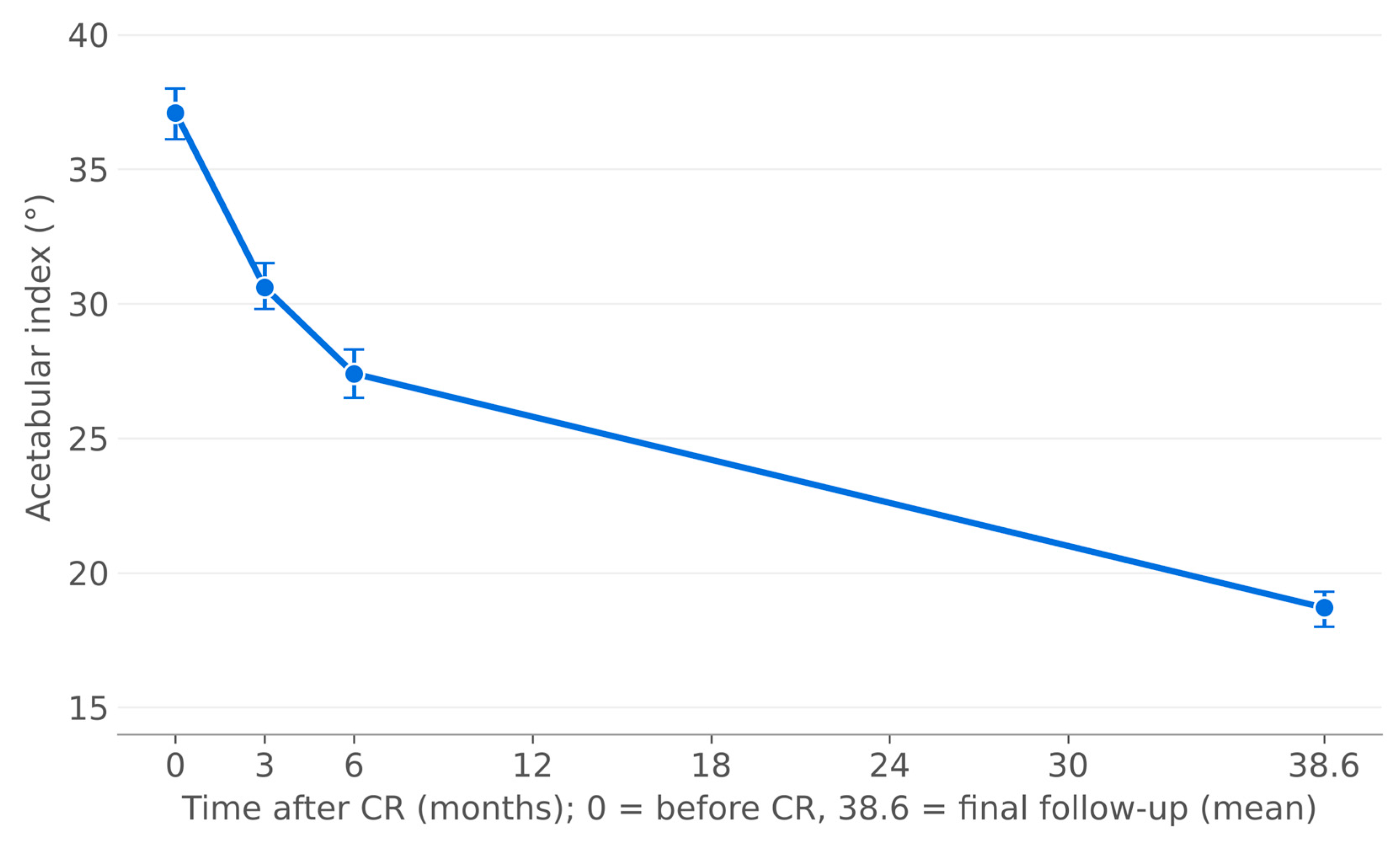
Across all hips, the mean AI decreased from 37.1 ± 5.9° before CR to 30.6 ± 5.3° at 3 months, 27.4 ± 5.4° at 6 months, and 18.7 ± 3.8° at final follow-up (p < 0.001; Table 8, Figure 4). Each time point differed significantly from all others (Bonferroni-adjusted p < 0.001 for all). The mean reduction from before CR to final follow-up was 18.4° (Bonferroni-adjusted 95% CI 17.1–19.8).
Table 8.
Acetabular index (°) at each time point across all hips (n = 150).
Figure 4.
Change in the acetabular index over time across all hips (mean and 95% confidence interval; n = 150). The time axis is scaled to actual time; final follow-up is plotted at the mean of 38.6 months. CR, closed reduction.
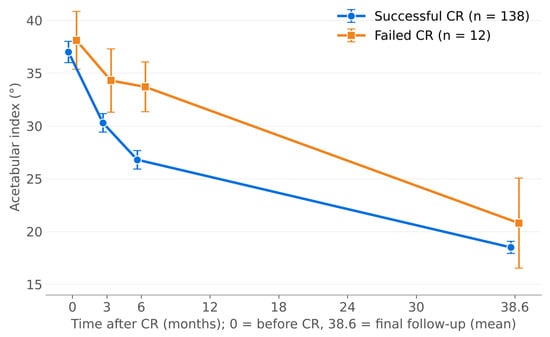
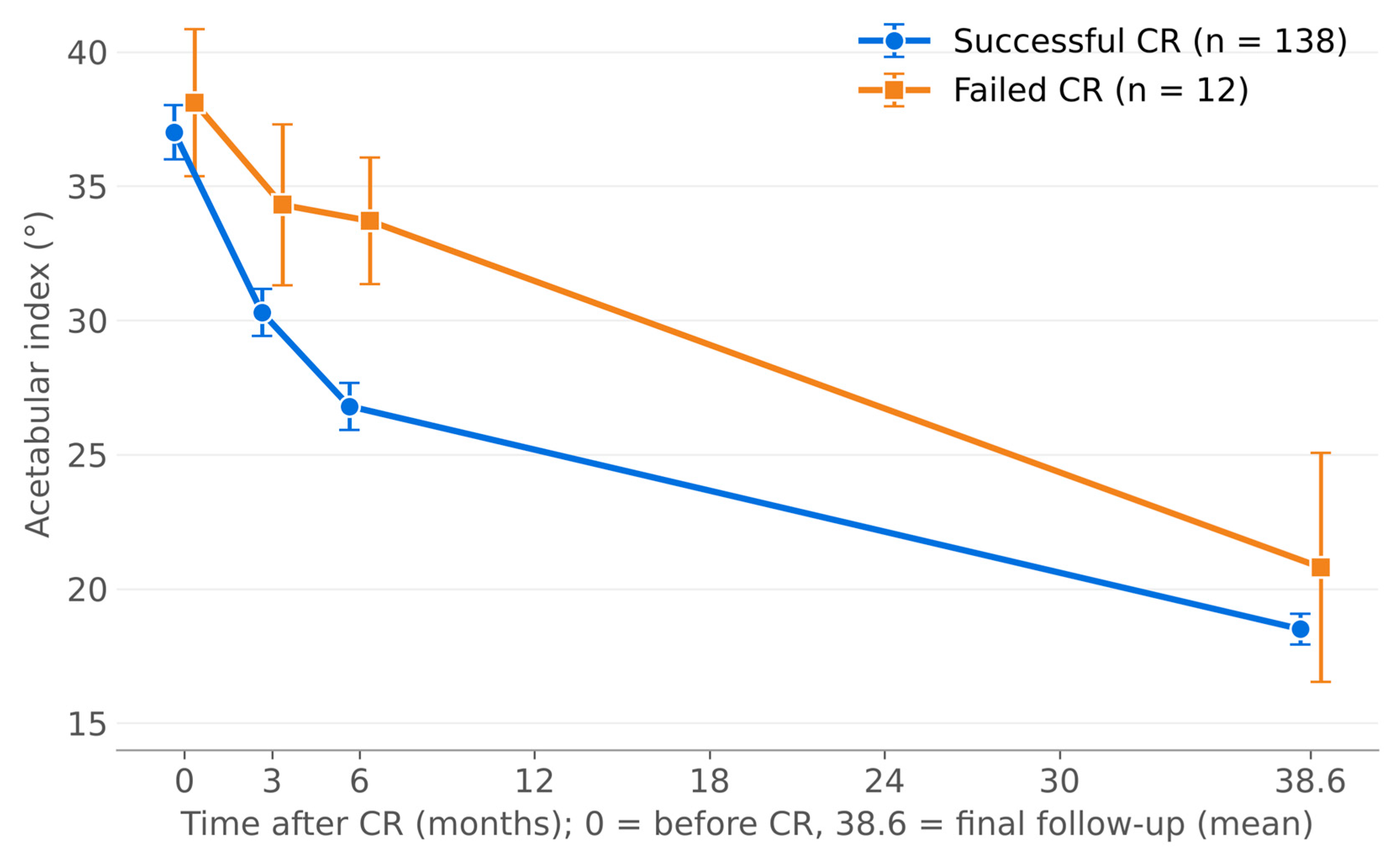
Pre-CR AI was similar in successful and failed hips (p = 0.438). During the first 6 months, the AI decreased by a mean of 10.2° in successful hips and 4.5° in failed hips; the AI was significantly higher in failed hips at 3 months (p = 0.008) and 6 months (p < 0.001). No significant difference was detected at final follow-up (p = 0.357); however, the final values of failed hips were obtained after open reduction. The course of the AI differed between the two groups (time × CR outcome interaction, p = 0.005) (Table 9, Figure 5).
Table 9.
Acetabular index (°) in hips with successful and failed CR.
Figure 5.
Change in the acetabular index in hips with successful (n = 138) and failed (n = 12) CR (mean and 95% confidence interval). Final values of failed hips were obtained after open reduction. CR, closed reduction.
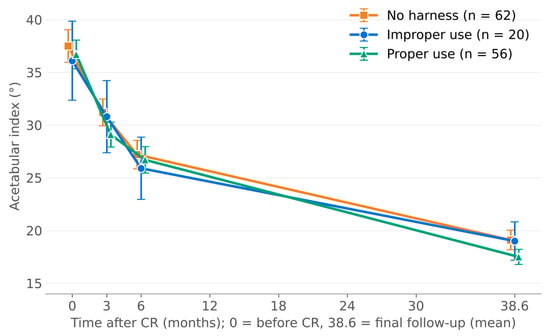
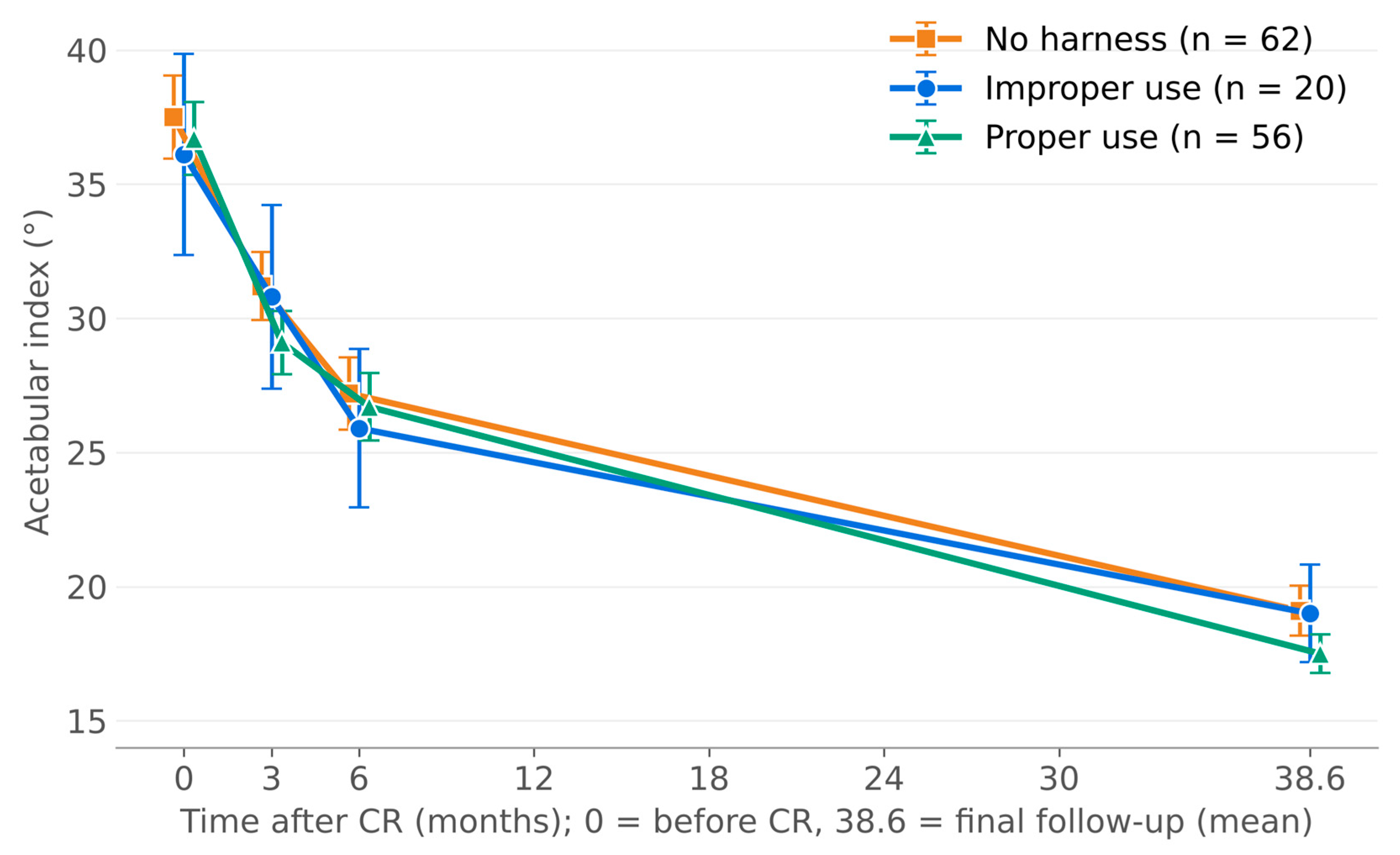
In successfully reduced hips, the course of the AI did not differ between Pavlik groups (time × group interaction, p = 0.315), and overall AI levels were similar (p = 0.204). At final follow-up, the mean AI was 19.1 ± 3.7° in the no-harness group, 19.0 ± 3.9° in the improper-use group, and 17.5 ± 2.7° in the proper-use group (Table 10, Figure 6).
Table 10.
Acetabular index (°) by Pavlik group in successfully reduced hips (n = 138), mean ± SD.
Figure 6.
Change in the acetabular index by Pavlik group in successfully reduced hips (mean and 95% confidence interval; n = 138). Time × group interaction, p = 0.315 (mixed ANOVA).
4. Discussion
In this cohort, CR failure was numerically more frequent in hips with improper Pavlik harness use (20.0%) than in hips with proper use (5.1%) or without harness use (6.1%). However, the difference was not statistically significant, and the estimate decreased after accounting for clustering and adjusting for IHDI grade 4. Disease severity was the factor most strongly associated with failure. No significant differences in AVN, RAD, or acetabular development were detected between groups at early-to-mid-term follow-up.
Although Pavlik harness treatment is one of the standard therapies for infants younger than six months, there is no consensus—even among orthopedic surgeons—regarding the daily wearing time, the specific hours of wear, and the continuation of treatment [12,28]. Pavlik harness treatment is a challenging method that requires compliance [4,12]. Satisfactory results are obtained when the mother participates in treatment under the supervision of an orthopedic surgeon [8]. With a standardized comprehensive nonoperative protocol, Bradley et al. recently reported successful bracing in 95% of 212 infants with ultrasound-confirmed DDH [10]. Following structured training, Hassan reported that 94% of parents fully adhered to treatment in a series of 160 patients [8]. Importantly, after the harness is applied, the position must be verified by the clinician, including radiologically. Prolonged use of the harness in an improper position is cited as one of the most common causes of failure [13]. Virtual clinics for harness training and patient monitoring have been increasingly discussed, particularly since the COVID-19 pandemic. Gargan et al. demonstrated that simulation-based training increases parental confidence and skill, but that clinician supervision remains necessary for effective treatment [9]. Among harness-treated patients in our series, the non-compliance rate was 28.6% (14/49). This rate cannot be compared directly with the 6% reported by Hassan [8], because our cohort included only children who subsequently required CR, a population in which non-compliance is likely to be over-represented. Among non-compliant families, we identified several underlying reasons:
- Some parents removed the harness during the day and did not apply it for the recommended time because their children were uncomfortable and cried;
- Despite repeated training, some parents applied the harness incorrectly at follow-up examinations and did not maintain the correct position for reduction;
- In some families, elderly relatives in particular distrusted harness treatment and influenced the parents, so that treatment was abandoned or alternative methods, such as double diapering, were attempted.
These reasons are consistent with a large caregiver survey in which discomfort, skin irritation, and difficulty cuddling the infant were among the main concerns about orthotic treatment [11]. The duration of harness use was also significantly longer in the improper-use group (median 12 vs. 6 weeks). Ramsey et al. recommended discontinuing the harness if reduction does not progress after four weeks of use [29]. The IHDI expert consensus also recommends discontinuing treatment of dislocated hips if no improvement is observed on ultrasonographic follow-up at 3–4 weeks [12]. Jones et al. defined “Pavlik harness disease”, reporting that a significant proportion of hips could not be stabilized by CR after failed Pavlik treatment lasting longer than eight weeks and that erosion developed in the posterolateral acetabulum [14]. Gornitzky et al., however, did not observe a regression in the alpha angle with prolonged bracing and questioned this concept [30]. In a recent cohort of 158 decentred hips, Bavan et al. reported a median time to sonographic correction of 6 weeks from harness initiation, with a lower presenting α angle predicting slower correction [31]. In our cohort, one of the non-compliance criteria (continuing the harness despite a recommendation for CR) implies prolonged use; therefore, compliance and harness duration overlap by definition, and their separate associations with CR outcome could not be assessed. Whether prolonged harness use is detrimental only in combination with improper use remains a hypothesis to be tested in larger studies.
The overlap of the study period with the COVID-19 pandemic may have contributed to the high level of non-compliance. Less frequent follow-up may have prolonged harness use, while concerns about transmission may have limited hands-on training for parents. In such circumstances, virtual clinics can be used to assess parents’ harness skills. Merchant et al. demonstrated that patients treated with the Pavlik harness and monitored through a virtual clinic could be treated with a safety profile comparable to that of patients monitored in person [32]. Virtual training models may enable earlier detection of non-compliance by increasing the frequency of monitoring.
The literature on CR outcomes after failed Pavlik treatment is contradictory. Viere et al. reported that CR also failed in 17 of 30 hips that could not be reduced with the Pavlik harness [20]. Arneill et al. reported a 52% success rate for CR and a 7% AVN rate in 67 hips after failed Pavlik harness treatment and argued that CR should remain the first-line treatment for these patients [21]. Murray et al., however, reported that Pavlik use before CR had no significant association with CR success or AVN [22]. Zhou et al. also demonstrated that CR and casting are effective alternatives after failed Pavlik treatment [18]. More recently, Liu et al. reported a higher CR success rate after failed Pavlik treatment than in late-diagnosed infants without prior harness treatment [23], and Imerci et al. found that only 3 of 51 hips required open reduction after index CR following failed harness treatment [24].
In our study, the CR success rate in hips with proper harness use was 94.9%, and no significant difference was detected compared with hips treated with direct CR (OR 1.16; 95% CI 0.21–6.54 for no harness vs. proper use). However, the absence of a significant difference does not demonstrate equivalence, and the wide confidence interval is compatible with clinically relevant differences in either direction. Some of the conflicting results in the literature may stem from not considering harness compliance as a separate variable; this possibility requires confirmation in larger cohorts.
Pre-CR disease severity is a proven risk factor for CR failure [19,33,34]. As the degree of dislocation increases, soft-tissue obstruction within the joint increases, and concentric reduction becomes more difficult [33]. In our series, the failure rate for IHDI grade 4 hips was 47.1%, and two-thirds of the failed hips were IHDI grade 4. IHDI grade 4 hips were more frequent in the improper-use group (20.0%) than in the proper-use (6.8%) and no-harness (12.1%) groups. Within the same IHDI strata, failure rates did not differ significantly between Pavlik groups, and after adjustment for IHDI grade 4, the OR for improper use decreased from 4.48 to 3.28. Thus, part of the crude difference appears to be attributable to case mix. Furthermore, because the IHDI grade at harness initiation was not available, we could not determine whether the higher proportion of grade 4 hips in the improper-use group was itself a consequence of improper harness use.
Age at CR is another important factor affecting success [19,34,35,36]. Zhang et al. reported that an age above 12.5 months and an AI of 38.7° or greater were predictors of CR failure [35]. All of our patients underwent CR before one year of age (mean, 29 weeks), and age at CR did not differ significantly between the groups (p = 0.205).
AVN is the most significant complication of both the Pavlik harness and CR [4,19]. In our series, AVN developed in 10.1% of successfully reduced hips, and clinically significant AVN (grades II–IV) in 8.7%; across all hips, the grade II–IV rate was 11.3% (17/150), which is higher than the 7% AVN rate reported by Arneill et al. after failed Pavlik harness treatment [21]. AVN was numerically less frequent in the proper-use (5.4%) and improper-use (5.0%) groups than in the no-harness group (16.1%), but the difference was not significant. Because of the small number of hips with AVN, this finding should not be interpreted as evidence that harness use does not influence the risk of AVN.
In our series, the mean AI decreased from 37.1° to 18.7°, with significant improvement at each time point. In successfully reduced hips, the course of the AI did not differ between Pavlik groups, and RAD developed in 6.5% of these hips, with no significant difference between groups. The AI is the best predictor of late RAD after CR, and in satisfactorily reduced hips, it continues to improve for up to seven years [25]. Balta et al. showed that the need for pelvic osteotomy owing to RAD increased in patients who underwent CR at a later age [36]. While our mean follow-up of 38.6 months provides an early-to-mid-term assessment of RAD, follow-up until skeletal maturity is required for definitive results.
In our study, the mean age at Pavlik harness initiation was 14.4 weeks, and 43.7% of patients proceeded directly to CR without using a harness. Infants who proceeded directly to CR were diagnosed at a median age of 27.5 weeks, significantly later than harness-treated infants (median, 13–14 weeks), that is, close to or beyond the age range in which the Pavlik harness is usually indicated. Because early intervention is important for the successful treatment of DDH, screening programs have been implemented worldwide. Four months of age has been identified as the threshold beyond which Pavlik harness success decreases [37]. The IHDI expert consensus also emphasizes that diagnosis and treatment should be initiated as early as possible [12]. Based on these reports, rather than on data from the present study, which was not designed to evaluate screening, earlier diagnosis and referral in our region may help increase the proportion of infants who can be treated effectively with a harness.
Limitations
This study has several limitations. First, it is a retrospective, single-center study. Harness compliance was classified retrospectively from clinical records, and the classification was not blinded to outcome. Because one criterion (continuing the harness despite a recommendation for CR) implies prolonged use, compliance and harness duration overlap by definition, and their independent associations could not be separated.
Second, the number of failed hips was small (n = 12). Consequently, the confidence intervals are wide, adjustment was limited to disease severity (IHDI grade 4), and comparisons between Pavlik groups should be considered hypothesis-generating. The absence of a statistically significant difference in CR failure, AVN, or RAD does not demonstrate equivalence between groups.
Third, IHDI grade 4 hips were more frequent in the improper-use group (20.0% vs. 6.8% with proper use) and strongly predicted failure. After adjustment for IHDI grade 4, the estimate for improper use decreased, suggesting that part of the crude difference reflects case mix. The IHDI grade or Graf type at harness initiation was not available; therefore, we could not determine whether the pre-CR grade was influenced by improper harness use. In addition, infants in the no-harness group were diagnosed significantly later than harness-treated infants; because age at diagnosis was closely related to treatment allocation, comparisons between the no-harness and harness groups may be confounded by this difference.
Fourth, although the dependence between hips of the same patient and between twins was accounted for with GEE, the number of clusters was limited, and the number of events in the patient-level sensitivity analysis was even smaller.
Fifth, 19 of the 106 patients (17.9%) were excluded because of incomplete follow-up related to the COVID-19 pandemic, refugee status, and seasonal worker migration. Although all of these patients underwent CR at our institution, their baseline data (Pavlik group, age at CR, and IHDI grade) were not entered into the study dataset and could not be retrieved for comparison with the included cohort. Because these reasons may be associated with low compliance, attrition bias cannot be excluded, and its direction cannot be determined.
Sixth, AVN and RAD were analyzed in successfully reduced hips. Excluding failed hips, which were most frequent in the improper-use group, may have underestimated the frequency of these complications in that group; however, the results including all hips were similar.
Seventh, all radiographic measurements were performed by a single observer who was not blinded to group or outcome; therefore, inter-observer reliability could not be assessed, and intra-observer reliability of IHDI grading, AI measurement, and Kalamchi–MacEwen classification was not evaluated, which may have introduced measurement bias. Finally, rates of late AVN and RAD may be higher because follow-up ended before skeletal maturity, and final radiological assessments such as the Severin classification are unreliable at this age. The long-term outcomes of these patients will be reported.
5. Conclusions
In this retrospective cohort, CR failure was numerically more frequent after improper Pavlik harness use, but the difference was not statistically significant after accounting for clustering and was partly explained by the higher proportion of IHDI grade 4 hips in that group. IHDI grade 4 was strongly associated with CR failure. No significant differences in AVN, RAD, or acetabular development were detected between groups; however, the small number of events limits these comparisons, and they should be considered hypothesis-generating.
Families whose children start Pavlik treatment should receive practical training in harness use, and compliance should be monitored through early follow-up examinations. In line with published recommendations [9,21], rather than findings of the present study, harness treatment of a dislocated hip should not be continued when reduction is not achieved after 3–4 weeks of proper use, and CR should be considered. Families should be informed in advance that CR success is lower in IHDI grade 4 hips. Larger prospective studies with documented compliance are needed to clarify whether improper harness use influences CR outcomes.
Author Contributions
Conceptualization, İ.T. and A.Y.K.; methodology, İ.T. and A.Y.K.; formal analysis, N.Ş. and Ö.S.; investigation, İ.T. and A.Y.K.; data curation, B.B., H.M.T., Ö.S., R.A. and İ.T.; writing—original draft preparation, İ.T.; writing—review and editing, İ.T. and A.Y.K.; supervision, İ.T., A.Y.K., Ö.S. All authors have read and agreed to the published version of the manuscript.
Funding
This research received no external funding.
Institutional Review Board Statement
The study was conducted in accordance with the Declaration of Helsinki and approved by the Clinical Research Ethics Committee of Harran University (protocol code HRÜ/22.08.26; date of approval: 18 April 2022).
Informed Consent Statement
Patient consent was waived by the ethics committee owing to the retrospective design of the study.
Data Availability Statement
The data presented in this study are available on request from the corresponding author owing to patient privacy restrictions.
Conflicts of Interest
The authors declare no conflicts of interest.
Abbreviations
The following abbreviations are used in this manuscript: AI, acetabular index; AVN, avascular necrosis; CI, confidence interval; CR, closed reduction; DDH, developmental dysplasia of the hip; GEE, generalized estimating equations; IHDI, International Hip Dysplasia Institute; IQR, interquartile range; OR, odds ratio; RAD, residual acetabular dysplasia; SD, standard deviation.
References
- Loder, R.T.; Skopelja, E.N. The epidemiology and demographics of hip dysplasia. ISRN Orthop. 2011, 2011, 238607. [Google Scholar] [CrossRef] [Scilit] [PubMed]
- Ertürk, C.; Altay, M.A.; Yarimpapuç, R.; Koruk, I.; Işikan, U.E. One-stage treatment of developmental dysplasia of the hip in untreated children from two to five years old. A comparative study. Acta Orthop. Belg. 2011, 77, 464–471. [Google Scholar] [PubMed]
- Bozkurt, C.; Sarıkaya, B.; Sipahioğlu, S.; Altay, M.A.; Çetin, B.V.; Bekin Sarıkaya, P.Z. Effects of developmental dysplasia of the hip screening program on the treatment strategies: A retrospective study from a tertiary care hospital in the southeast region of Turkey. Acta Orthop. Traumatol. Turc. 2021, 55, 396–401. [Google Scholar] [CrossRef] [Scilit] [PubMed]
- Ömeroğlu, H. Treatment of developmental dysplasia of the hip with the Pavlik harness in children under six months of age: Indications, results and failures. J. Child. Orthop. 2018, 12, 308–316. [Google Scholar] [CrossRef] [Scilit] [PubMed]
- Pavlik, A. The functional method of treatment using a harness with stirrups as the primary method of conservative therapy for infants with congenital dislocation of the hip. 1957. Clin. Orthop. Relat. Res. 1992, 281, 4–10. [Google Scholar]
- Swarup, I.; Penny, C.L.; Dodwell, E.R. Developmental dysplasia of the hip: An update on diagnosis and management from birth to 6 months. Curr. Opin. Pediatr. 2018, 30, 84–92. [Google Scholar] [CrossRef] [Scilit] [PubMed]
- American Academy of Orthopaedic Surgeons. Detection and Nonoperative Management of Pediatric Developmental Dysplasia of the Hip in Infants up to Six Months of Age: Evidence-Based Clinical Practice Guideline; American Academy of Orthopaedic Surgeons: Rosemont, IL, USA, 2022; Available online: https://www.aaos.org/quality/quality-programs/pediatric-developmental-dysplasia-of-the-hip (accessed on 18 November 2026).
- Hassan, F.A. Compliance of parents with regard to Pavlik harness treatment in developmental dysplasia of the hip. J. Pediatr. Orthop. B 2009, 18, 111–115. [Google Scholar] [CrossRef] [Scilit] [PubMed]
- Gargan, K.E.; Bradley, C.S.; Maxwell, A.; Moktar, J.; Wedge, J.H.; Murnaghan, M.L.; Kelley, S.P. Education of parents in Pavlik harness application for developmental dysplasia of the hip using a validated simulated learning module. J. Child. Orthop. 2016, 10, 289–293. [Google Scholar] [CrossRef] [Scilit] [PubMed]
- Bradley, C.S.; Verma, Y.; Maddock, C.L.; Wedge, J.H.; Gargan, M.F.; Kelley, S.P. A comprehensive nonoperative treatment protocol for developmental dysplasia of the hip in infants: A prospective longitudinal cohort study. Bone Jt. J. 2023, 105-B, 935–942. [Google Scholar] [CrossRef] [Scilit] [PubMed]
- Grzybowski, G.; Bliven, E.; Wu, L.; Schaeffer, E.K.; Gibbard, M.; Zomar, B.O.; Casagrande Cesconetto, A.; Mundy, C.; Mulpuri, K.; International Hip Dysplasia Registry Knowledge Translation Advisory Board. Caregiver experiences using orthotic treatment options for developmental dysplasia of the hip in children. J. Pediatr. Orthop. 2023, 43, 105–110. [Google Scholar] [CrossRef] [Scilit] [PubMed]
- Kelley, S.P.; Feeney, M.M.; Maddock, C.L.; Murnaghan, M.L.; Bradley, C.S. Expert-based consensus on the principles of Pavlik harness management of developmental dysplasia of the hip. JBJS Open Access 2019, 4, e0054. [Google Scholar] [CrossRef] [Scilit] [PubMed]
- Mubarak, S.; Garfin, S.; Vance, R.; McKinnon, B.; Sutherland, D. Pitfalls in the use of the Pavlik harness for treatment of congenital dysplasia, subluxation, and dislocation of the hip. J. Bone Jt. Surg. Am. 1981, 63, 1239–1248. [Google Scholar] [CrossRef] [Scilit]
- Jones, G.T.; Schoenecker, P.L.; Dias, L.S. Developmental hip dysplasia potentiated by inappropriate use of the Pavlik harness. J. Pediatr. Orthop. 1992, 12, 722–726. [Google Scholar] [CrossRef] [Scilit] [PubMed]
- Gou, P.; Gao, K.; Wang, X.; Liu, X. The nomogram predicting the early failure rate of the Pavlik harness for developmental dysplasia of the hip in infants under 6 months of age. Front. Pediatr. 2022, 10, 1018641. [Google Scholar] [CrossRef] [Scilit] [PubMed]
- Abdulla, N.; Ashoor, M.; Heinz, N.; Alexopoulos, V.; Majid, I.; Morakis, E.; Khamis, A.H.; Alshryda, S. Prognostic factors for failed Pavlik harness treatment in infants with developmental dysplasia of the hip: A retrospective cohort study. Int. Orthop. 2023, 47, 2337–2345. [Google Scholar] [CrossRef] [Scilit] [PubMed]
- Lankinen, V.; Helminen, M.; Bakti, K.; Välipakka, J.; Laivuori, H.; Hyvärinen, A. Known risk factors of the developmental dysplasia of the hip predicting more severe clinical presentation and failure of Pavlik harness treatment. BMC Pediatr. 2023, 23, 148. [Google Scholar] [CrossRef] [Scilit] [PubMed]
- Zhou, P.; Zhang, J.; Dan, T.; Xu, T.; Kang, X.; Hang, Y.; Zhou, Y. Closed reduction and plaster immobilization: An alternative solution for patients with developmental dysplasia of the hip who failed Pavlik harness treatment. ANZ J. Surg. 2023, 93, 663–668. [Google Scholar] [CrossRef] [Scilit] [PubMed]
- Zhang, G.; Li, M.; Qu, X.; Cao, Y.; Liu, X.; Luo, C.; Zhang, Y. Efficacy of closed reduction for developmental dysplasia of the hip: Midterm outcomes and risk factors associated with treatment failure and avascular necrosis. J. Orthop. Surg. Res. 2020, 15, 579. [Google Scholar] [CrossRef] [Scilit] [PubMed]
- Viere, R.G.; Birch, J.G.; Herring, J.A.; Roach, J.W.; Johnston, C.E. Use of the Pavlik harness in congenital dislocation of the hip. An analysis of failures of treatment. J. Bone Jt. Surg. Am. 1990, 72, 238–244. [Google Scholar] [CrossRef] [Scilit]
- Arneill, M.; Cosgrove, A.; Robinson, E. Should closed reduction of the dislocated hip be attempted after failed Pavlik harness treatment in developmental dysplasia of the hip? Bone Jt. Open 2021, 2, 594–598. [Google Scholar] [CrossRef] [Scilit] [PubMed]
- Murray, T.; Cooperman, D.R.; Thompson, G.H.; Ballock, T. Closed reduction for treatment of development dysplasia of the hip in children. Am. J. Orthop. 2007, 36, 82–84. [Google Scholar] [PubMed]
- Liu, Y.; Kan, L.; Sun, J.; Zhang, Y. Impact of failed Pavlik harness treatment on the outcomes following closed or open reduction in developmental dysplasia of the hip. Indian J. Orthop. 2022, 56, 1634–1639. [Google Scholar] [CrossRef] [Scilit] [PubMed]
- Imerci, A.; Thacker, M.M.; Bowen, J.R. Failure of Pavlik harness treatment in infants under 6 months old with dislocated hips: Short- and intermediate-term results of subsequent treatment modalities. Indian J. Orthop. 2024, 58, 1288–1296. [Google Scholar] [CrossRef] [Scilit] [PubMed]
- Li, Y.; Guo, Y.; Li, M.; Zhou, Q.; Liu, Y.; Chen, W.; Li, J.; Canavese, F.; Xu, H.; Multi-center Pediatric Orthopedic Study Group of China. Acetabular index is the best predictor of late residual acetabular dysplasia after closed reduction in developmental dysplasia of the hip. Int. Orthop. 2018, 42, 631–640. [Google Scholar] [CrossRef] [Scilit] [PubMed]
- Narayanan, U.; Mulpuri, K.; Sankar, W.N.; Clarke, N.M.; Hosalkar, H.; Price, C.T.; International Hip Dysplasia Institute. Reliability of a new radiographic classification for developmental dysplasia of the hip. J. Pediatr. Orthop. 2015, 35, 478–484. [Google Scholar] [CrossRef] [Scilit] [PubMed]
- Kalamchi, A.; MacEwen, G.D. Avascular necrosis following treatment of congenital dislocation of the hip. J. Bone Jt. Surg. Am. 1980, 62, 876–888. [Google Scholar] [CrossRef] [Scilit]
- Westacott, D.J.; Perry, D.C. The treatment of neonatal hip dysplasia with splints in the United Kingdom: Time for consensus? J. Child. Orthop. 2020, 14, 112–117. [Google Scholar] [CrossRef] [Scilit] [PubMed]
- Ramsey, P.L.; Lasser, S.; MacEwen, G.D. Congenital dislocation of the hip. Use of the Pavlik harness in the child during the first six months of life. J. Bone Jt. Surg. Am. 1976, 58, 1000–1004. [Google Scholar] [CrossRef] [Scilit]
- Gornitzky, A.L.; Schaeffer, E.K.; Price, C.T.; Sankar, W.N.; International Hip Dysplasia Institute. Pavlik harness disease revisited: Does prolonged treatment of a dislocated hip in a harness adversely affect the α angle? J. Pediatr. Orthop. 2018, 38, 297–304. [Google Scholar] [CrossRef] [Scilit] [PubMed]
- Bavan, L.; Bradley, C.S.; Verma, Y.; Kelley, S.P. Optimizing time in harness: Factors associated with sonographic resolution of developmental dysplasia of the hip during Pavlik treatment. Bone Jt. J. 2025, 107-B, 118–123. [Google Scholar] [CrossRef] [Scilit] [PubMed]
- Merchant, R.M.; Khan, S.A.; Douglas, C.; Edel, P.; Khan, T.; Eastwood, D.M. A virtual clinic for DDH Pavlik harness monitoring. J. Pediatr. Orthop. 2022, 42, e149–e153. [Google Scholar] [CrossRef] [Scilit] [PubMed]
- Ramo, B.A.; De La Rocha, A.; Sucato, D.J.; Jo, C.H. A new radiographic classification system for developmental hip dysplasia is reliable and predictive of successful closed reduction and late pelvic osteotomy. J. Pediatr. Orthop. 2018, 38, 16–21. [Google Scholar] [CrossRef] [Scilit] [PubMed]
- Ömeroğlu, H.; Yüksel, S.; Demir, P.; Alexiev, V.; Alsiddiky, A.; Anticevic, D.; Bozinovski, Z.; Bytyqi, C.; Cosma, D.; Dučić, S.; et al. An Eastern Europe and Middle East multinational expert Delphi consensus study on the prevention, diagnosis, and treatment of developmental dysplasia of the hip before walking age. Int. Orthop. 2024, 48, 1373–1380. [Google Scholar] [CrossRef] [Scilit] [PubMed]
- Zhang, Z.; Li, H.; Li, H.; Zhang, Z. Timing for closed reduction procedure for developmental dysplasia of the hip and its failure analysis. BMC Musculoskelet. Disord. 2020, 21, 613. [Google Scholar] [CrossRef] [Scilit] [PubMed]
- Balta, O.; Bilgiç, E.; Bostan, B.; Kurnaz, R.; Güneş, T.; Aytekin, K. Effect of age during reduction on developmental hip dysplasia closed reduction treatment. J. Contemp. Med. 2015, 5, 173–179. [Google Scholar] [CrossRef] [Scilit]
- Ömeroğlu, H.; Köse, N.; Akceylan, A. Success of Pavlik harness treatment decreases in patients ≥ 4 months and in ultrasonographically dislocated hips in developmental dysplasia of the hip. Clin. Orthop. Relat. Res. 2016, 474, 1146–1152. [Google Scholar] [CrossRef] [Scilit] [PubMed]

Disclaimer/Publisher’s Note: The statements, opinions and data contained in all publications are solely those of the individual author(s) and contributor(s) and not of MDPI and/or the editor(s). MDPI and/or the editor(s) disclaim responsibility for any injury to people or property resulting from any ideas, methods, instructions or products referred to in the content. |
© 2026 by the authors. Licensee MDPI, Basel, Switzerland. This article is an open access article distributed under the terms and conditions of the Creative Commons Attribution (CC BY) license.