


Highlights
What are the main findings?
- Sleep disturbance showed a favorable numerical trend with microcurrent stimulation, although the adjusted between-group effect did not reach statistical significance.
- Superficial microcurrent neuromodulation (NESA) showed a favorable baseline-adjusted between-group difference in ABC-C scores (nominal p = 0.025), suggesting a potentially relevant but exploratory behavioral effect.
What are the implications of the main findings?
- Although statistically significant between-group improvements were not demonstrated for the prespecified sleep outcomes, the numerical reduction in sleep disturbances and the favorable exploratory behavioral findings suggest potentially relevant clinical signals.
- These encouraging preliminary observations support further research through larger randomized controlled trials, using age-appropriate assessment instruments and longer follow-up, to determine whether the observed changes translate into sustained and clinically meaningful benefits for children with ASD.
Abstract
Background/Objectives: Sleep disturbances and behavioral dysregulation are common in children with autism spectrum disorder (ASD). This trial evaluated superficial microcurrent neuromodulation (NESA) for prespecified sleep outcomes and explored behavioral effects. Methods: Thirty-four children with ASD were randomized to active NESA (n = 16) or sham treatment (n = 18), alongside usual care, for 20 sessions (NCT06417450). Sleep disturbances (SDSC), sleep habits (CSHQ), behavioral dysregulation (ABC-C), and parental stress (PSI-SF) were assessed before and after treatment. Baseline-adjusted ANCOVA estimated between-group differences; a sensitivity analysis included children aged ≥5 years. Parental PSQI responses were excluded because questionnaire completion was unreliable. Results: No significant adjusted between-group effects were observed for sleep disturbances (SDSC, p = 0.274), sleep habits (CSHQ, p = 0.630), or parental stress (PSI-SF, p = 0.355). The secondary ABC-C outcome favored active treatment (adjusted difference, −12.03 points; 95% CI, −22.45 to −1.62; nominal p = 0.025). This finding would not withstand a four-outcome Bonferroni correction and was attenuated in the age-restricted analysis (n = 23; p = 0.283). Conclusions: No between-group benefit was demonstrated on analyzable sleep outcomes. The favorable behavioral signal remains exploratory and requires confirmation in larger, age-appropriate trials.
1. Introduction
Autism spectrum disorder (ASD) is a neurodevelopmental condition characterized by persistent difficulties in social communication and interaction together with restricted and repetitive patterns of behavior. Beyond core features, medical and behavioral comorbidities are common and may substantially affect daily functioning and family life [1]. Current pediatric guidance emphasizes the need for evidence-based, multimodal approaches that address clinically relevant associated symptoms as well as core developmental needs [2].
Sleep disturbances are among the most frequent associated problems in children with ASD, affecting a substantial proportion of the pediatric population [3,4]. Their origin is multifactorial and includes biological, behavioral, and environmental influences [5]. Sleep problems in ASD have also been associated with irritability, emotional dysregulation, and disruptive daytime behavior, supporting a close relationship between sleep regulation and behavioral stability [3,6].
Non-pharmacological management of sleep problems in ASD includes behavioral strategies, sleep-hygiene interventions, and, in selected cases, melatonin-based approaches [7,8]. However, treatment response is variable, and there remains interest in complementary non-invasive strategies capable of influencing broader regulatory processes.
Alterations in autonomic regulation have been reported in children with ASD, including reduced parasympathetic activity and differences in heart-rate variability [9,10,11]. Low-intensity electrical stimulation has been investigated as a potential means of influencing regulatory neural circuits, although evidence in pediatric populations remains limited and mechanistic interpretations require caution [12]. Superficial neuromodulation using low-intensity microcurrents (NESA) applies imperceptible electrical stimulation through multiple peripheral electrodes. The present study represents a separate trial conducted in a different cohort of children with ASD in Gran Canaria, building on the preliminary findings and experience gained from the earlier pilot study [13]. The present trial represents an independent investigation involving a different pediatric population in Gran Canaria. Unlike the previous pilot study, it employed a randomized, triple-blind, placebo-controlled design, allowing a more rigorous assessment of between-group treatment effects [13].
Given the bidirectional relationship between sleep and behavioral regulation, evaluating these domains together may provide a broader understanding of the clinical response to non-invasive stimulation. The primary objective of this study was to evaluate the effects of superficial microcurrent neuromodulation on prespecified sleep-related outcomes in children with ASD. Secondary objectives included exploring potential changes in behavioral dysregulation, parental stress, and parental satisfaction with the intervention.
2. Materials and Methods
2.1. Study Design and Participants
A randomized, quadruple-blind, placebo-controlled clinical trial was conducted between May 2024 and July 2025 at a center specializing in the care and education of children with ASD. Participants were recruited from a specialized educational center affiliated with San Juan de Dios Hospital. All children had a pre-existing medical diagnosis of autism spectrum disorder (ASD), established by healthcare professionals before enrollment in the trial. The research team did not perform additional diagnostic assessments. ASD diagnosis in routine Spanish clinical practice is based on established diagnostic criteria and comprehensive clinical evaluation, with standardized instruments used when clinically appropriate. The specific diagnostic tools previously administered to each participant were not systematically recorded in the trial database. The center remained operational throughout July, whereas no treatment sessions were conducted during August. Each participant completed the 20-session intervention over approximately seven consecutive weeks, with PRE and POST assessments scheduled immediately before and after their individual intervention period. Treatment periods were organized to avoid interruptions associated with the August holiday period. No participant discontinued the intervention because of scheduling interruptions.
The trial was prospectively registered at ClinicalTrials.gov (NCT06417450), and approved by the Las Palmas Drug Research Ethics Committee (CEIm code: 2023-536-1). Reporting followed CONSORT principles.
The initial recruitment target was established at 40 participants (20 per group) using the GRANMO sample size calculator. To assess the adequacy of this target, a sample size calculation based on the Sleep Disturbance Scale for Children (SDSC) was analyzed, assuming a between-group difference of 12 points, a common standard deviation of 13 points, a two-sided significance level of 0.05, and a statistical power of 80%. These assumptions correspond to a standardized effect size (Cohen’s d) of 0.923 and yield approximately 20 participants per group. Recruitment was restricted to a single specialized educational center, which limited the pool of potentially eligible children with ASD. Although the planned target was 40 randomized participants, 40 children were assessed for eligibility and six were excluded because they did not meet the inclusion criteria. Therefore, 34 participants were randomized, with no subsequent withdrawals or losses to follow-up. Under the original sample-size assumptions, the final allocation of 16 and 18 participants provided an estimated power of approximately 74% to detect the anticipated effect, compared with approximately 81% for the planned sample.
Forty children were assessed for eligibility. Thirty-four met the eligibility criteria and were randomized to active superficial microcurrent neuromodulation (n = 16) or placebo (n = 18). Inclusion criteria were a clinical diagnosis of ASD, age ≤18 years, presence of sleep disturbances and episodes of disruptive behavior, and written informed consent from a parent or legal guardian. Exclusion criteria were contraindications to electrical stimulation (including pacemakers, internal bleeding, active skin lesions, acute febrile processes, acute thrombophlebitis, or uncontrolled seizures), phobia of electricity, or absence of informed consent. All participants continued their usual educational and therapeutic care during the study.
2.2. Randomization and Blinding
The allocation sequence was generated using computerized block randomization (block size 4) by an external investigator who was not involved in treatment delivery or statistical analysis. Allocation remained concealed until completion of the planned analysis. Participants, practitioners, and the statistician were unaware of group assignment. The placebo device reproduced the external appearance and light signals of the active device but did not deliver the therapeutic current, following established principles for sham electrical stimulation [14]. Parents and legal guardians, who completed the outcome questionnaires, remained unaware of treatment allocation during the intervention period. To maintain practitioner blinding, active and sham devices were externally indistinguishable and displayed identical activation signals. Furthermore, the microcurrent stimulation was imperceptible, minimizing the possibility of identifying group allocation through sensory feedback during treatment. The effectiveness of blinding was not formally assessed through post-intervention allocation guesses by parents or practitioners; therefore, a Bang blinding index was not calculated.
The study followed a quadruple-blind design, consistent with the terminology reported in the clinical trial registration. Participants and their parents or legal guardians, treating physiotherapists, investigators, and outcome assessors remained unaware of treatment allocation. Educational staff involved in the study and the statistician were also blinded to group assignment. The active and sham devices were externally indistinguishable, ensuring that treatment allocation could not be identified during intervention delivery or outcome assessment.
2.3. Intervention
Non-invasive superficial neuromodulation NESA (Spanish name: Neurmodulacion superficial aplicada) [13] was delivered using low-intensity microcurrents (nesa microcurrents) (0.1–0.9 mA) through peripheral electrodes integrated into gloves and ankle bands, together with a cervical directional electrode. Electrical parameters were standardized according to the study protocol. The intervention comprised 20 sessions. During the first five familiarization sessions, program 1 (3.85–7.69 Hz) and program 7 (1.92–14.29 Hz) were applied for 15 min each. During the subsequent 15 sessions, programs 7 and 8 (program 8: stable frequency 7.69 Hz) were applied for 15 min each, for a total treatment duration of 30 min per session, three sessions per week [13,15].
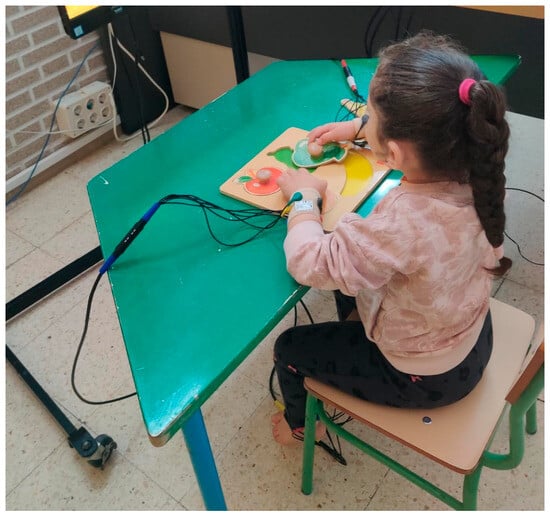
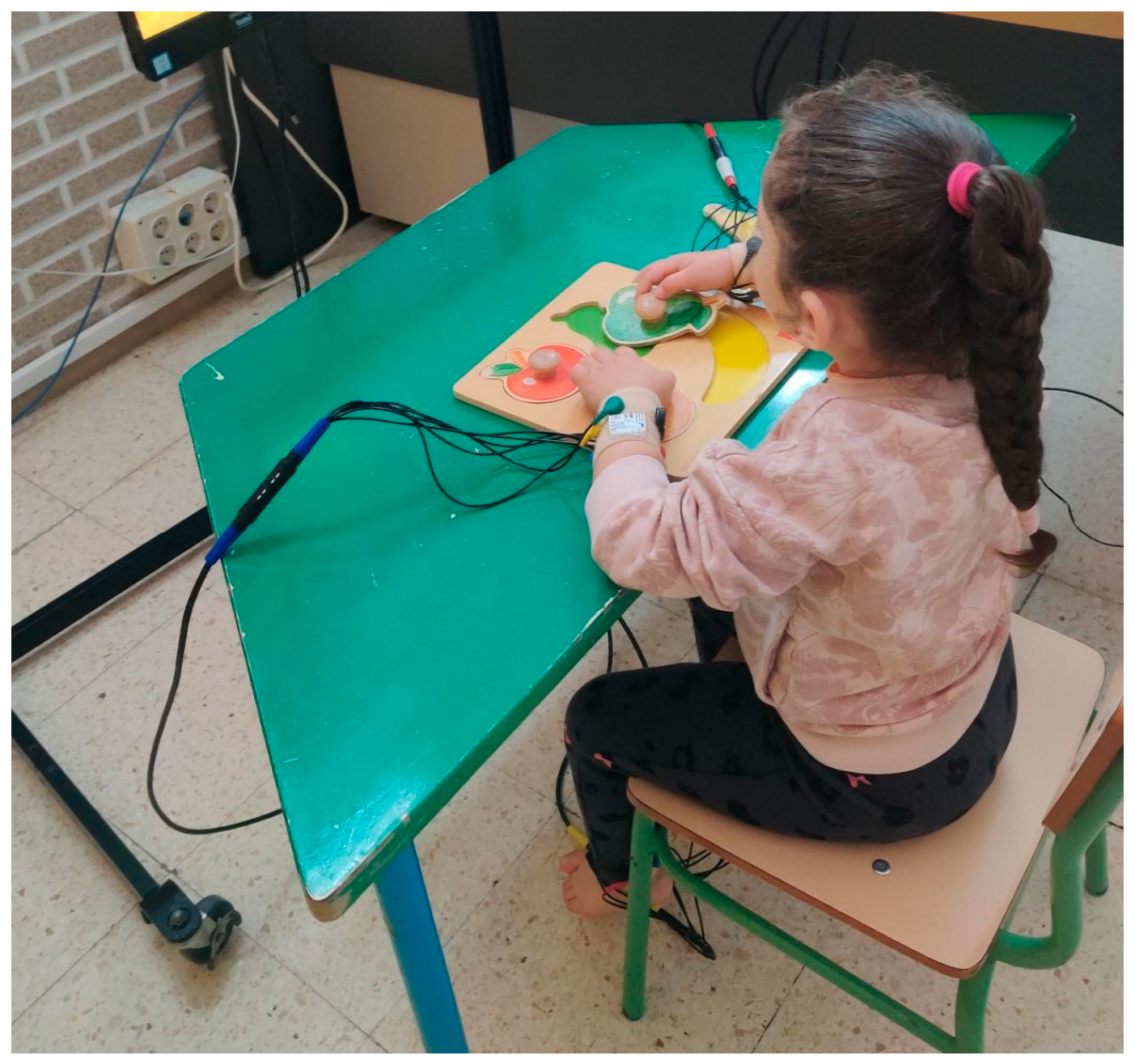
An initial familiarization phase was used to facilitate adaptation to the procedure and minimize sensory rejection without altering the standardized stimulation protocol. Each child was treated by a familiar reference professional at the center to reduce situational stress. Stimulation was imperceptible, did not interfere with usual activities, and was well tolerated (Figure 1).
Figure 1.
Patient anonymized during the intervention while playing at school and using NESA microcurrents with kids’ sizes electrodes.
Adverse events were defined as any new or worsening undesirable symptom, discomfort, or physical reaction occurring during the intervention, regardless of its presumed relationship to the treatment. Treating professionals supervised each session and monitored participants for potential adverse events, documenting any incidents observed or reported during treatment.
After completion of the trial and disclosure of allocation, families assigned to placebo were offered deferred access to the active intervention if desired.
2.4. Outcomes and Instruments
Assessments were performed at baseline (PRE) and immediately after completion of the intervention (POST). According to the trial registration (ClinicalTrials.gov, NCT06417450), the prespecified primary outcomes were sleep disturbances and sleep-related characteristics, assessed using the Sleep Disturbance Scale for Children (SDSC), the Children’s Sleep Habits Questionnaire (CSHQ), and parental sleep quality, assessed using the Pittsburgh Sleep Quality Index (PSQI).
Secondary outcomes included behavioral dysregulation, assessed using the Aberrant Behavior Checklist–Community (ABC-C), parental stress, assessed using the Parenting Stress Index–Short Form (PSI-SF), and parental satisfaction with the intervention.
Parental satisfaction was assessed using a study-specific questionnaire addressing the information provided before treatment, interactions with the clinical team, perceived treatment effects, willingness to recommend or repeat the intervention, and overall satisfaction with study participation. Six items were rated on numerical scales ranging from 1 (least favorable) to 10 (most favorable), and additional open-ended questions allowed parents to describe their experiences and any perceived changes. As this questionnaire was not a validated clinical outcome measure, the responses were analyzed descriptively. Although parental satisfaction was included as a secondary outcome in the trial registration, the questionnaire administered at the participating center differed from the originally registered PSQ-FS instrument. Satisfaction was assessed using a brief, study-specific six-item questionnaire. This difference from the registered measurement instrument is acknowledged as a protocol deviation. Given the exploratory nature of this outcome and the absence of prior validation of the questionnaire, the responses were analyzed exclusively using descriptive statistics and were not included in the inferential analyses of treatment efficacy.
Although the PSQI was administered, substantial inconsistencies were identified during questionnaire verification. Several parents had interpreted the questionnaire as referring to their children’s sleep rather than their own sleep, potentially due to insufficient clarification during administration. Consequently, the collected PSQI responses could not be considered sufficiently reliable for evaluating parental sleep quality and were excluded from the quantitative analysis. This exclusion of a prespecified primary outcome is acknowledged as a protocol deviation resulting from unreliable questionnaire completion.
Behavioral dysregulation was assessed using the Aberrant Behavior Checklist–Community (ABC-C), the behavioral instrument routinely used at the recruitment center to monitor problematic behaviors in individuals with neurodevelopmental disorders. It is completed by parents or caregivers and evaluates domains including irritability, social withdrawal, stereotypic behavior, hyperactivity, and inappropriate speech; higher scores indicate greater behavioral dysregulation [16,17].
Sleep disturbance was assessed using the Sleep Disturbance Scale for Children (SDSC), a 26-item parent-reported questionnaire covering disorders of initiating and maintaining sleep, sleep-breathing disorders, arousal disorders, sleep–wake transition disorders, excessive somnolence, and sleep hyperhidrosis [18].
Sleep habits were assessed using the Spanish validated Children’s Sleep Habits Questionnaire (CSHQ), a caregiver-completed measure addressing bedtime resistance, sleep onset, sleep duration, sleep anxiety, night waking, parasomnias, sleep-disordered breathing, and daytime sleepiness [19,20]. For the present study, CSHQ data were recorded according to the five sections of the administered questionnaire: bedtime, sleep behavior, night wakings, morning awakening, and daytime sleep. These sections were examined in exploratory analyses and were not considered equivalent to the eight conventional CSHQ subscales.
The SDSC assesses sleep disturbances over a six-month reference period, whereas the CSHQ evaluates habitual sleep behaviors over a recent one-week period. These differences were considered when interpreting changes following the intervention, particularly because the SDSC reference period exceeded the treatment duration.
Parental stress was assessed using the Spanish validated Parenting Stress Index–Short Form (PSI-SF), a 36-item instrument covering parental distress, parent–child dysfunctional interaction, and difficult-child dimensions. Higher scores indicate greater parenting-related stress [21]. All questionnaires were administered in the versions routinely used by the participating center.
The age-related applicability of the outcome measures was considered when interpreting the results. The conventional reference age ranges are ≥5 years for the ABC-C, 6–16 years for the Spanish validation of the SDSC, 4–10 years for the original CSHQ, and up to 12 years for the PSI-SF. In the present cohort, 11 participants (32.4%) were younger than 5 years, 22 (64.7%) were outside the 6–16-year SDSC range, 11 (32.4%) were outside the 4–10-year CSHQ range, and 4 (11.8%) were older than 12 years. Although previous studies have examined the applicability of the ABC-C, SDSC, and CSHQ in younger children, these findings do not establish equivalent psychometric validity across the entire age range included in our study [22,23,24,25].
2.5. Statistical Analysis
Analyses were performed using Jamovi (version 2.6.44) and independently checked from the individual participant dataset. Continuous variables are presented as mean ± standard deviation (SD), together with mean PRE–POST change where clinically informative. Categorical variables are reported as n (%). Normality of within-participant change scores was assessed before selecting paired tests.
Within-group PRE–POST changes were examined using paired Student’s t-tests when change scores were approximately normally distributed and Wilcoxon signed-rank tests otherwise. These analyses were used to describe the magnitude and direction of change within each group and were not interpreted in isolation as evidence of a treatment effect.
Between-group treatment effects were evaluated using analysis of covariance (ANCOVA), with the POST score as the dependent variable, treatment group as the fixed factor, and the corresponding PRE score as a covariate. Adjusted mean differences (intervention minus placebo), 95% confidence intervals (CI), exact p-values, and partial eta squared (η2p) are reported. ANCOVA assumptions were evaluated using Shapiro–Wilk tests of model residuals and treatment-by-baseline interactions to assess homogeneity of regression slopes. Additional post hoc analyses included ANCOVA models adjusted for continuous age and sex, together with treatment-by-age interactions. Robustness was examined using heteroscedasticity-consistent HC3 standard errors and two-sided Freedman–Lane residual permutation tests (20,000 permutations).
Statistical significance was set at p < 0.05.
Because the ABC-C had been routinely administered by the recruitment center to the entire cohort, including some children younger than the age range with established psychometric support, a post hoc sensitivity analysis was conducted in participants aged ≥5 years. The same baseline-adjusted ANCOVA models were repeated for ABC-C, SDSC, CSHQ, and PSI-SF in this restricted sample to evaluate the robustness of the overall pattern. Age-stratified efficacy claims were not made.
Exploratory subscale analyses were conducted using ANCOVA models, with post-intervention scores as the dependent variable, treatment group as the fixed factor, and the corresponding baseline score as a covariate. Adjusted between-group differences, 95% confidence intervals, and nominal p-values were calculated. These analyses were considered exploratory, and their interpretation accounted for the absence of multiplicity adjustment.
As no multiplicity adjustment was prespecified, p-values are reported as nominal values. Findings from secondary outcomes are therefore interpreted as exploratory, with emphasis on effect estimates and their 95% confidence intervals.
3. Results
3.1. Participant Flow and Baseline Characteristics
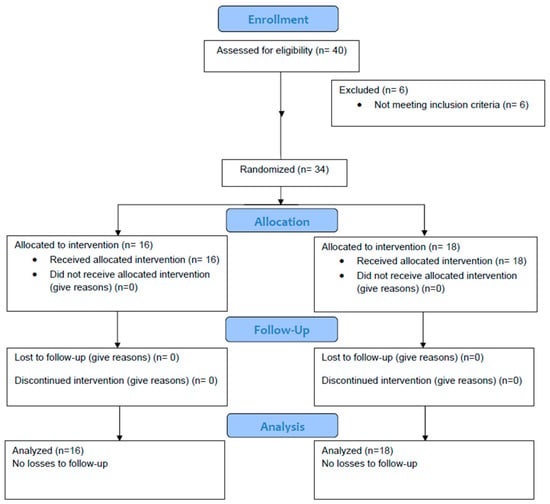
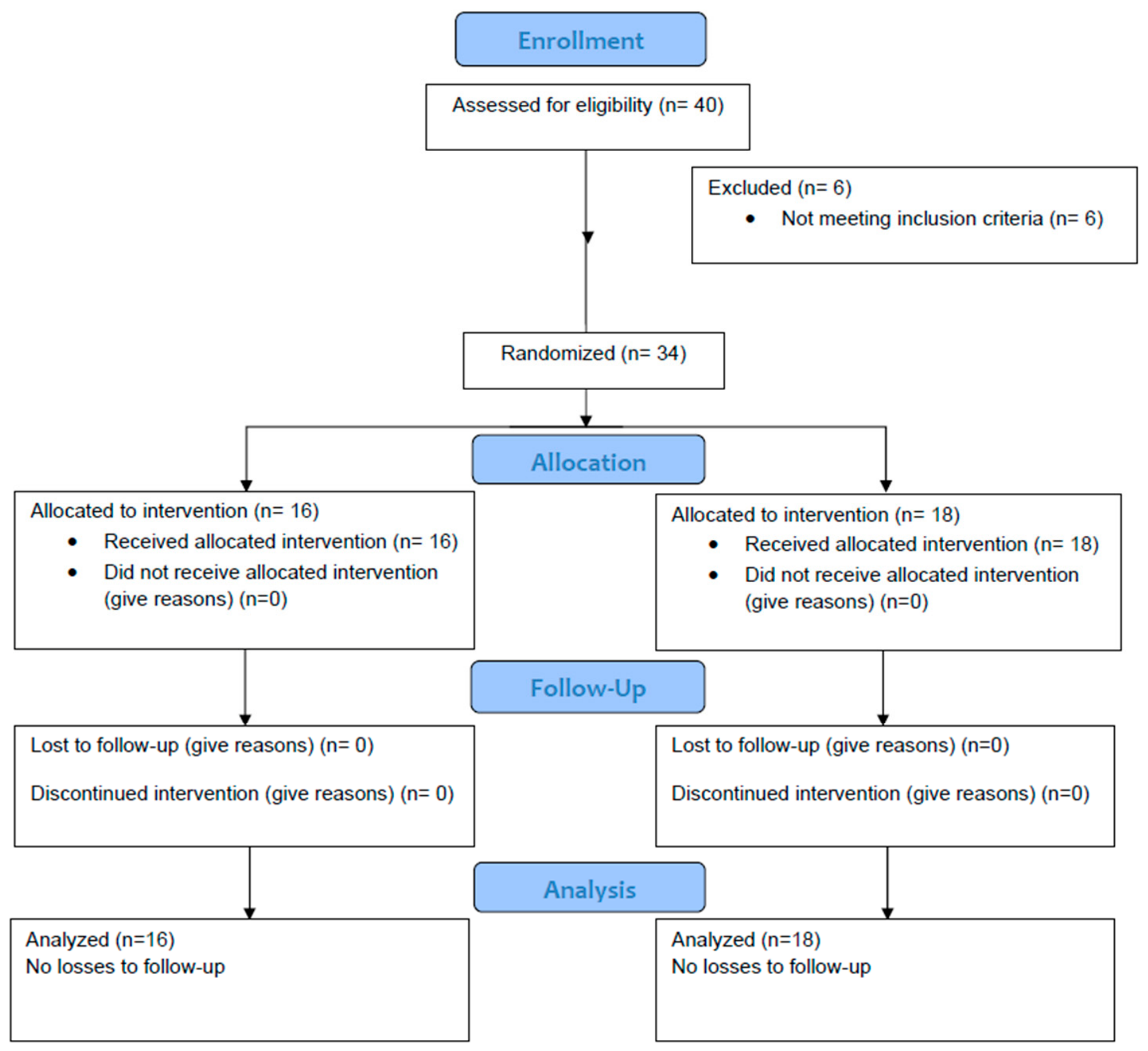
Of 40 children assessed for eligibility, six did not meet the inclusion criteria. Thirty-four participants were randomized (intervention, n = 16; placebo, n = 18), all received the allocated intervention, and no participant was lost to follow-up. The complete randomized sample was therefore available for analysis (Figure 2).
Figure 2.
Consort diagram.
All participants completed the 20 scheduled treatment sessions (20/20 sessions per child), representing 320 completed sessions in the intervention group and 360 in the placebo group. No adverse events were observed or reported in either group.
The intervention group had a mean age of 6.44 ± 3.58 years (range 3–15) and included 11 males and 5 females. The placebo group had a mean age of 6.72 ± 4.07 years (range 3–18) and included 15 males and 3 females. Baseline clinical scores were broadly comparable between groups (Table 1).
Table 1.
Baseline characteristics of the randomized sample.
3.2. Behavioral Dysregulation (ABC-C)
ABC-C scores decreased from 52.31 ± 25.56 to 38.19 ± 20.52 in the intervention group, corresponding to a mean PRE–POST reduction of 14.13 points. This within-group change was statistically significant (paired t-test, p = 0.010; Cohen’s d = 0.737). In the placebo group, scores changed from 53.94 ± 23.83 to 51.39 ± 24.85, corresponding to a smaller mean reduction of 2.56 points; the within-group change was not significant (p = 0.418; d = 0.196).
In the baseline-adjusted ANCOVA, post-intervention ABC-C scores were significantly lower in the intervention group than in the placebo group (adjusted mean difference, −12.03 points; 95% CI, −22.45 to −1.62; F(1,31) = 5.55; p = 0.025; η2p = 0.152). Thus, behavioral dysregulation showed the clearest between-group separation among the evaluated outcomes.
Exploratory analyses of the ABC-C subscales revealed favorable baseline-adjusted between-group differences in irritability (−4.65; 95% CI: −8.17 to −1.13; p = 0.011), lethargy/social withdrawal (−3.22; 95% CI: −6.05 to −0.39; p = 0.027), and stereotypic behavior (−2.48; 95% CI: −4.03 to −0.93; p = 0.003). No statistically significant between-group differences were observed for hyperactivity/noncompliance or inappropriate speech (Detailed results are presented in Supplementary Table S1).
3.3. Sleep Disturbance (SDSC)
SDSC scores decreased from 46.81 ± 10.93 to 41.88 ± 7.67 in the intervention group, a mean reduction of 4.94 points. The within-group change approached but did not reach statistical significance (paired t-test, p = 0.057; d = 0.516). In the placebo group, scores changed from 46.39 ± 15.87 to 45.44 ± 10.73, a mean reduction of 0.94 points; this change was not significant (Wilcoxon signed-rank test, p = 0.756; rank-biserial r = −0.088).
Although the numerical reduction was greater in the intervention group, the baseline-adjusted between-group effect was not statistically significant (adjusted mean difference, −3.62 points; 95% CI, −10.24 to 3.01; F(1,31) = 1.24; p = 0.274; η2p = 0.038). The direction of change therefore suggests a possible sleep-related signal, but the uncertainty around the estimate precludes a definitive treatment effect.
3.4. Sleep Habits (CSHQ)
CSHQ scores increased from 73.38 ± 8.16 to 77.38 ± 9.49 in the intervention group (mean PRE–POST change, +4.00 points; paired t-test, p = 0.230; d = −0.313 when improvement is coded as PRE–POST) and from 73.61 ± 6.45 to 78.78 ± 7.31 in the placebo group (mean increase, +5.17 points; p = 0.049; d = −0.499). Because higher CSHQ scores indicate greater sleep difficulties, neither pattern supports improvement in sleep habits.
The adjusted between-group difference was not significant (intervention minus placebo, −1.42 points; 95% CI, −7.39 to 4.54; F(1,31) = 0.24; p = 0.630; η2p = 0.008).
Exploratory analyses of the five recorded CSHQ sections revealed no statistically significant baseline-adjusted between-group differences. Detailed results are presented in Supplementary Table S1.
3.5. Parental Stress (PSI-SF)
PSI-SF scores changed from 125.44 ± 26.11 to 131.50 ± 30.32 in the intervention group (mean change, +6.06 points; Wilcoxon signed-rank test, p = 0.410; rank-biserial r = −0.242) and from 122.61 ± 27.02 to 122.39 ± 30.83 in the placebo group (mean change, −0.22 points; paired t-test, p = 0.961; d = 0.012). No within-group evidence of reduced parental stress was observed.
The baseline-adjusted between-group difference was also not significant (intervention minus placebo, +6.68 points; 95% CI, −7.84 to 21.21; F(1,31) = 0.88; p = 0.355; η2p = 0.028) (Table 2).
Table 2.
Within-group changes and baseline-adjusted between-group effects.
3.6. Sensitivity Analysis Restricted to Participants Aged ≥5 Years
To address the age-related psychometric applicability of the ABC-C, the baseline-adjusted between-group analysis of ABC-C was repeated after excluding participants younger than 5 years. The restricted sample comprised 23 participants, while preserving the original randomized treatment groups: 11 participants in the superficial microcurrent intervention group and 12 participants in the placebo group. The same baseline-adjusted ANCOVA approach used in the full randomized sample was applied, comparing intervention versus placebo while adjusting for the corresponding baseline score.
For ABC-C, the adjusted between-group difference remained in the direction favoring intervention but was attenuated and no longer statistically significant (adjusted mean difference, −7.00; 95% CI, −20.22 to 6.23; p = 0.283). SDSC also retained a numerically favorable between-group difference (−4.43; 95% CI, −11.38 to 2.53; p = 0.200), whereas no evidence of a between-group effect was observed for CSHQ (−0.36; 95% CI, −7.72 to 7.00; p = 0.920) or PSI-SF (+8.40; 95% CI, −9.27 to 26.06; p = 0.333).
Thus, restricting the analysis to participants aged ≥5 years reduced the sample from 34 to 23 participants and resulted in wider confidence intervals. Although the adjusted ABC-C estimate remained in the same direction as in the full randomized sample, the confidence interval was wider and crossed the null. The sensitivity analysis therefore did not confirm the statistically significant behavioral effect observed in the complete randomized cohort (Table 3).
Table 3.
Baseline-adjusted between-group sensitivity analysis restricted to participants aged ≥5 years.
3.7. Robustness and Additional Covariate-Adjusted Analyses
Additional analyses confirmed that the favorable ABC-C difference was maintained after adjustment for continuous age and sex (adjusted mean difference: −12.94; 95% CI: −23.75 to −2.13; nominal p = 0.021), with consistent results from HC3 robust estimation and permutation testing. No significant treatment-by-age interaction was observed. The remaining outcomes showed no significant adjusted between-group effects. he remaining outcomes showed no significant adjusted between-group effects. Following correction of the CSHQ data, the treatment-by-baseline interaction was no longer significant (p = 0.747). Although PSI-SF residuals showed a departure from normality (Shapiro–Wilk p = 0.038), HC3 robust estimation (p = 0.358) and permutation testing (p = 0.328) yielded results consistent with the conventional ANCOVA, supporting the interpretation of no significant between-group differences. Model diagnostics and robustness analyses are summarized in Table 4.
Table 4.
ANCOVA Assumption Diagnostics and Robustness Analyses.
3.8. Parental Satisfaction
Parental satisfaction was evaluated descriptively using responses collected during the randomized phase of the trial. Satisfaction data were available for all 34 participants (100%). The mean overall satisfaction score was 8.15 ± 2.05 out of 10, with 73.5% of parents rating their overall experience at least 8/10. High satisfaction ratings were also observed regarding interactions with the clinical team (82.4%), willingness to recommend the intervention (73.5%), and willingness to repeat treatment (73.5%). Regarding perceived treatment effects, 64.7% of parents assigned a score of at least 8/10. Open-ended responses reflected heterogeneous experiences, including favorable perceptions of behavioral changes and occasional reports of irritability or behavioral worsening. These subjective observations cannot establish a causal relationship with the intervention.
4. Discussion
This triple-blind randomized placebo-controlled trial evaluated superficial microcurrent neuromodulation in children with ASD, with particular attention to sleep-related outcomes and behavioral dysregulation. Although statistically significant between-group differences were not demonstrated for the prespecified sleep outcomes, clinically interesting changes were observed in the intervention group. Specifically, SDSC scores decreased by 4.94 points compared with 0.94 points in the placebo group, while ABC-C scores decreased by 14.13 points compared with 2.56 points in the placebo group. These changes may be of clinical relevance, particularly considering the substantial impact of sleep disturbances and behavioral dysregulation on the daily functioning and quality of life of children with ASD and their families. Importantly, conducting randomized controlled trials in this population presents considerable challenges, including recruitment difficulties, clinical and developmental heterogeneity, and the practical demands of repeated treatment sessions. These factors, together with the relatively small sample size, may have limited the statistical power and precision of the analyses. Nevertheless, the favorable behavioral findings, although exploratory and not confirmed in the age-restricted sensitivity analysis, provide a valuable preliminary signal that warrants further investigation in larger and more clinically homogeneous populations.
The behavioral finding is clinically interesting because disruptive behavior can contribute substantially to functional impairment, participation restrictions, educational difficulties, and family burden in ASD [1,2]. The adjusted ABC-C difference was accompanied by a moderate-to-large partial eta-squared estimate, suggesting a potentially meaningful signal worthy of confirmation. Nevertheless, the total ABC-C score does not have a universally established minimum clinically important difference applicable to this sample. Estimates of clinically important change have been developed for specific ABC subscales, particularly irritability, and should not be directly extrapolated to the total score [26]. Accordingly, the present study supports a behavioral signal but does not establish a definitive clinically important threshold effect.
The sleep findings provide a complementary perspective. Sleep disturbances are highly prevalent in ASD and are associated with irritability, externalizing behavior, and difficulties in emotional regulation [3,4,5,6]. In the present study, SDSC scores decreased by approximately 4.9 points in the intervention group compared with approximately 0.9 points in placebo. The intervention-group within-participant effect was of moderate magnitude, but the adjusted between-group estimate remained imprecise and crossed the null. The appropriate interpretation is therefore not that an effect on sleep was demonstrated, but that the direction and magnitude of change provide a potential signal for future adequately powered studies.
The absence of improvement in CSHQ and PSI-SF is also informative. The CSHQ captures sleep-related habits and routines that may be strongly influenced by environmental and family factors, whereas parental stress is a complex construct shaped by multiple clinical and contextual determinants. A short intervention period directed at the child would not necessarily be expected to produce parallel changes across these domains. The divergence between SDSC and CSHQ further supports the value of distinguishing global sleep disturbance from behavioral sleep routines rather than treating all sleep questionnaires as interchangeable outcomes.
Parental satisfaction was generally favorable, with 73.5% of families rating their overall experience at least 8/10, suggesting good perceived acceptability of the intervention. However, these findings should be interpreted cautiously, as subjective parental perceptions, including reported improvements or occasional behavioral worsening, cannot be directly attributed to the treatment and require further investigation. Although blinding was maintained throughout the intervention, its effectiveness was not formally assessed. Therefore, parental expectations may have influenced the ABC-C ratings, particularly considering the favorable satisfaction scores and willingness to repeat treatment. However, these perceptions do not necessarily indicate that blinding was compromised.
From a physiological perspective, autonomic differences have been repeatedly described in ASD, including reduced parasympathetic activity and altered heart-rate variability [9,10,11]. These observations provide a plausible rationale for investigating peripheral low-intensity electrical stimulation. However, the present trial did not measure autonomic, electrophysiological, actigraphy, or neuroimaging outcomes. Consequently, autonomic modulation, central regulatory-network effects, or neuroplastic mechanisms cannot be inferred from these clinical data and should remain hypotheses for future mechanistic studies.
The sensitivity analysis is important for interpreting the behavioral result. The ABC-C was the behavioral instrument routinely used at the recruitment center and was administered to the complete randomized cohort. However, some participants were younger than the age range with established psychometric support for the instrument. When the ANCOVA was repeated in participants aged ≥5 years, the adjusted ABC-C estimate remained in the same favorable direction but was smaller and no longer statistically significant. This attenuation may reflect both the reduced sample size and differences in the age composition of the cohort; the present data cannot distinguish these explanations. The full-sample behavioral result should therefore be interpreted cautiously and independently replicated using behavioral instruments validated across the entire enrolled age range.
The study has several strengths. It used a randomized, placebo-controlled, triple-blind design, concealed allocation, a standardized stimulation protocol, complete follow-up, and baseline-adjusted between-group analyses. Presenting both within-group changes and adjusted treatment estimates also allows the magnitude of observed clinical change to be distinguished from formal evidence of a between-group effect. The intervention was well tolerated and could be integrated into the participants’ usual educational and therapeutic routines.
Several limitations should be considered. The sample was small and recruited from a single center, limiting precision and external validity. Multiple clinical outcomes were evaluated without formal multiplicity correction, increasing the possibility of chance findings. Although all participants had a pre-existing medical diagnosis of ASD, detailed information regarding diagnostic instruments, clinical severity, cognitive and language functioning, comorbidities, and concomitant treatments was not systematically collected for the trial. This limits the clinical characterization of the sample and the assessment of potential confounding factors.
The ABC-C age-range issue limits interpretation of the complete-sample behavioral analysis, as demonstrated by the sensitivity analysis. Outcomes were parent- or caregiver-reported, and no objective physiological or sleep measurements were included. Finally, follow-up was limited to the immediate post-intervention period, so persistence of any behavioral or sleep-related changes is unknown. Conducting randomized placebo-controlled trials in children with autism spectrum disorder (ASD) presents considerable methodological and practical challenges. The substantial clinical heterogeneity of ASD, together with the difficulties associated with recruitment, family engagement, and treatment adherence, may limit the feasibility of achieving large and clinically homogeneous samples. In the present study, the decision to analyze the entire randomized cohort (n = 34) allowed us to preserve the study population and avoid further reductions in statistical power. Although an exploratory age-restricted sensitivity analysis was performed, its smaller sample size (n = 23) warrants cautious interpretation. Importantly, the behavioral effect observed on the ABC-C remained directionally favorable in this subgroup, although its magnitude was attenuated and statistical significance was no longer observed. These findings highlight both the challenges inherent in pediatric ASD research and the need for larger, adequately powered trials.
An additional limitation concerns the broad age range of the participants and the psychometric applicability of the outcome measures. Recruitment was conducted within a specialized educational setting, where eligibility and participation were influenced by family availability, school organization, and the practical requirements of delivering a randomized placebo-controlled intervention. Given these constraints and the considerable clinical heterogeneity of ASD, no restrictive age criterion was established. Although this approach facilitated recruitment across a clinically diverse population, several participants fell outside the conventional validation ranges of the assessment instruments. Consequently, potential age-related differences in questionnaire performance and interpretation cannot be excluded. This limitation is particularly relevant for the sleep-related outcomes and reinforces the exploratory nature of the findings. Future studies should consider narrower age ranges or age-specific validated instruments while maintaining feasible recruitment strategies. Finally, the exclusion of parental PSQI data, a prespecified primary outcome, represents an additional limitation and protocol deviation. Misinterpretation of the questionnaire by some parents, potentially related to insufficient clarification during administration, prevented a reliable assessment of parental sleep quality.
Future trials should recruit larger samples, prespecify outcome hierarchies, use behavioral instruments validated across the full age range, include longer follow-up, and incorporate objective measures such as actigraphy and heart-rate variability. Such studies could determine whether the behavioral signal observed here is reproducible and clarify whether changes in sleep or autonomic regulation accompany clinical response.
5. Conclusions
This triple-blind randomized placebo-controlled trial identified encouraging but exploratory clinical signals of superficial microcurrent neuromodulation in children with ASD. Although statistically significant between-group effects were not demonstrated for the prespecified sleep outcomes, the magnitude and direction of the observed changes suggest clinically interesting signals that merit further investigation. A favorable between-group difference was observed in behavioral dysregulation, with a nominally significant reduction in ABC-C scores (p = 0.025), while sleep disturbances also showed a greater numerical improvement in the intervention group. The relatively small sample size and the considerable clinical and developmental heterogeneity inherent to ASD may have limited the precision and statistical power of the analyses. Importantly, the randomized, triple-blind, placebo-controlled design, together with extensive covariate-adjusted, sensitivity, and robustness analyses, strengthens the methodological rigor and transparency of the findings. Nevertheless, the behavioral result remains exploratory, as it did not withstand correction for multiple comparisons and was attenuated in the age-restricted analysis. Overall, these findings support the need for larger, adequately powered clinical trials to determine whether the favorable changes observed can be confirmed and translated into meaningful clinical benefits for children with ASD and their families.
Supplementary Materials
The following supporting information can be downloaded at https://www.mdpi.com/article/10.3390/children13111603/s1, Table S1: Exploratory baseline-adjusted analyses of ABC-C and SDSC subscales and five recorded CSHQ questionnaire sections.
Author Contributions
Conceptualization, M.V.-B. and R.M.-R.; methodology, M.V.-B. and R.M.-R.; software, E.D.G.-G.; validation, M.V.-B., R.M.-R. and A.B.-S.; formal analysis, R.M.-R.; investigation, D.M.-R. and I.P.-R.; resources, D.L.-C.; data curation, I.P.-R. and K.C.Á.-R.; writing—original draft preparation, D.M.-R.; writing—review and editing, R.M.-R. and A.B.-S.; visualization, M.V.-B.; supervision, R.M.-R. and A.B.-S.; project administration, D.L.-C.; funding acquisition, D.L.-C. and E.D.G.-G. All authors have read and agreed to the published version of the manuscript.
Funding
This research received no external funding. Publication costs may be supported by the University of Las Palmas de Gran Canaria (ULPGC), subject to the applicable institutional publication agreement.
Institutional Review Board Statement
The study was approved by the Ethics Committee for Research with Medicinal Products of Las Palmas (CEIm code: 2023-536-1), approved on 14 December 2023 and conducted in accordance with the Declaration of Helsinki and applicable national regulations for biomedical research involving minors.
Informed Consent Statement
Written informed consent was obtained from all parents or legal guardians before participation. Specific consent for publication of potentially identifiable clinical images was obtained where applicable.
Data Availability Statement
The original study protocol, submitted in Spanish to the Research Ethics Committee, is available through the Zenodo repository. The trial design and prespecified outcomes are also publicly accessible at ClinicalTrials.gov (NCT06417450). The statistical methods, including the additional exploratory and sensitivity analyses performed during manuscript revision, are described in the Methods section. (DOI: 10.5281/zenodo.23889313).
Acknowledgments
We acknowledge the support provided by the Hospital Ciudad San Juan de Dios in Las Palmas. Artificial intelligence tools were used exclusively to assist in refining the English text, including aspects related to grammar and readability. All scientific content, statistical interpretation, and conclusions were developed, reviewed, and approved by the authors.
Conflicts of Interest
The authors declare no conflicts of interest and any financial conflict. University of Las Palmas de Gran Canaria (ULPGC) maintains a collaboration agreement through the Fundación Canaria Parque Científico Tecnológico (FCPT-ULPGC) for the loan of NESA technology equipment for they use in the Hospital San Juan de Dios of Las Palmas. NESAWORLD had no role in the design of the study, the data collection, its analysis or interpretation, or the decision to publish the results.
Abbreviations
The following abbreviations are used in this manuscript:
| ABC-C | Aberrant Behavior Checklist–Community |
| ANCOVA | Analysis of Covariance |
| ASD | Autism Spectrum Disorder |
| CI | Confidence Interval |
| CSHQ | Children’s Sleep Habits Questionnaire |
| HRV | Heart Rate Variability |
| PSI-SF | Parenting Stress Index–Short Form |
| RCT | Randomized Controlled Trial |
| SD | Standard Deviation |
| SDSC | Sleep Disturbance Scale for Children |
References
- Simonoff, E.; Pickles, A.; Charman, T.; Chandler, S.; Loucas, T.; Baird, G. Psychiatric disorders in children with autism spectrum disorders: Prevalence, comorbidity, and associated factors. J. Am. Acad. Child Adolesc. Psychiatry 2008, 47, 921–929. [Google Scholar] [CrossRef] [Scilit] [PubMed]
- Hyman, S.L.; Levy, S.E.; Myers, S.M. Identification, evaluation, and management of children with autism spectrum disorder. Pediatrics 2020, 145, e20193447. [Google Scholar] [CrossRef] [Scilit] [PubMed]
- Devnani, P.A.; Hegde, A.U. Autism and sleep disorders. J. Pediatr. Neurosci. 2015, 10, 304–307. [Google Scholar] [CrossRef] [Scilit] [PubMed]
- Souders, M.C.; Mason, T.B.A.; Valladares, O.; Bucan, M.; Levy, S.E.; Mandell, D.S.; Weaver, T.E.; Pinto-Martin, J. Sleep behaviors and sleep quality in children with autism spectrum disorders. Sleep 2009, 32, 1566–1578. [Google Scholar] [CrossRef] [Scilit] [PubMed]
- Richdale, A.L.; Schreck, K.A. Sleep problems in autism spectrum disorders: Prevalence, nature, and possible biopsychosocial aetiologies. Sleep Med. Rev. 2009, 13, 403–411. [Google Scholar] [CrossRef] [Scilit] [PubMed]
- Reynolds, A.M.; Soke, G.N.; Sabourin, K.R.; Hepburn, S.; Katz, T.; Wiggins, L.D.; Schieve, L.A.; Levy, S.E. Sleep problems in 2- to 5-year-olds with autism spectrum disorder and other developmental delays. Pediatrics 2019, 143, e20180492. [Google Scholar] [CrossRef] [Scilit] [PubMed]
- Bruni, O.; Alonso-Alconada, D.; Besag, F.; Biran, V.; Braam, W.; Cortese, S.; Moavero, R.; Parisi, P.; Smits, M.; Van der Heijden, K.; et al. Current role of melatonin in pediatric neurology: Clinical recommendations. Eur. J. Paediatr. Neurol. 2015, 19, 122–133. [Google Scholar] [CrossRef] [Scilit] [PubMed]
- Cortesi, F.; Giannotti, F.; Sebastiani, T.; Panunzi, S.; Valente, D. Controlled-release melatonin, singly and combined with cognitive behavioural therapy, for persistent insomnia in children with autism spectrum disorders: A randomized placebo-controlled trial. J. Sleep Res. 2012, 21, 700–709. [Google Scholar] [CrossRef] [Scilit] [PubMed]
- Ming, X.; Julu, P.O.O.; Brimacombe, M.; Connor, S.; Daniels, M.L. Reduced cardiac parasympathetic activity in children with autism. Brain Dev. 2005, 27, 509–516. [Google Scholar] [CrossRef] [Scilit] [PubMed]
- Benevides, T.W.; Lane, S.J. A review of cardiac autonomic measures: Considerations for examination of physiological response in children with autism spectrum disorder. J. Autism Dev. Disord. 2015, 45, 560–575. [Google Scholar] [CrossRef] [Scilit] [PubMed]
- Cheng, Y.-C.; Huang, Y.-C.; Huang, W.-L. Heart rate variability in individuals with autism spectrum disorders: A meta-analysis. Neurosci. Biobehav. Rev. 2020, 118, 463–471. [Google Scholar] [CrossRef] [Scilit] [PubMed]
- Krause, B.; Cohen Kadosh, R. Not all brains are created equal: The relevance of individual differences in responsiveness to transcranial electrical stimulation. Front. Syst. Neurosci. 2014, 8, 25. [Google Scholar] [CrossRef] [Scilit] [PubMed]
- Molina-Cedrés, F.; Medina-Ramírez, R.; Báez-Suárez, A.; Vílchez-Barrera, M.; García-Quintana, M.; Hernandez-Pérez, A.; García-Rodríguez, I.; Álamo-Arce, D.; Etopa-Bitata, M.d.P. Impact of NESA non-invasive neuromodulation on sleep, behavior, and sensory profile in children with autism spectrum disorder. Children 2025, 12, 1599. [Google Scholar] [CrossRef] [Scilit] [PubMed]
- Ambrus, G.G.; Antal, A.; Paulus, W. Cutaneous perception thresholds of electrical stimulation methods: Comparison of tDCS and tRNS. Clin. Neurophysiol. 2010, 121, 1908–1914. [Google Scholar] [CrossRef] [Scilit] [PubMed]
- Báez-Suárez, A.; Padrón-Rodríguez, I.; Castellano-Moreno, E.; González-González, E.; Quintana-Montesdeoca, M.P.; Medina-Ramirez, R.I. Application of non-invasive neuromodulation in children with neurodevelopmental disorders to improve their sleep quality and constipation. BMC Pediatr. 2023, 23, 465. [Google Scholar] [CrossRef] [Scilit] [PubMed]
- Kaat, A.J.; Lecavalier, L.; Aman, M.G. Validity of the Aberrant Behavior Checklist in children with autism spectrum disorder. J. Autism Dev. Disord. 2014, 44, 1103–1116. [Google Scholar] [CrossRef] [Scilit] [PubMed]
- López, C.S.I.A.; Hernández, R.H.G.; Navarro, C.F.; Gómez Navarro, M.E.; Gómez Elías, C.L.; González, G.G.; Bravo, O.A. Validación de la versión en español de la Aberrant Behavior Checklist-Community en pacientes autistas mexicanos. Rev. Mex. Neuroci. 2018, 19, 49–61. [Google Scholar]
- Bruni, O.; Ottaviano, S.; Guidetti, V.; Romoli, M.; Innocenzi, M.; Cortesi, F.; Giannotti, F. The Sleep Disturbance Scale for Children (SDSC): Construction and validation of an instrument to evaluate sleep disturbances in childhood and adolescence. J. Sleep Res. 1996, 5, 251–261. [Google Scholar] [CrossRef] [Scilit] [PubMed]
- Owens, J.A.; Spirito, A.; McGuinn, M. The Children’s Sleep Habits Questionnaire (CSHQ): Psychometric properties of a survey instrument for school-aged children. Sleep 2000, 23, 1043–1051. [Google Scholar] [CrossRef] [Scilit]
- Lucas-de la Cruz, L.; Martínez-Vizcaino, V.; Álvarez-Bueno, C.; Arias-Palencia, N.; Sánchez-López, M.; Notario-Pacheco, B. Reliability and validity of the Spanish version of the Children’s Sleep Habits Questionnaire (CSHQ-SP) in school-age children. Child Care Health Dev. 2016, 42, 675–682. [Google Scholar] [CrossRef] [Scilit] [PubMed]
- Rivas, G.R.; Arruabarrena, I.; de Paúl, J. Parenting Stress Index-Short Form: Psychometric properties of the Spanish version in mothers of children aged 0 to 8 years. Psychosoc. Interv. 2021, 30, 27–34. [Google Scholar] [CrossRef] [Scilit]
- Schmidt, J.D.; Huete, J.M.; Fodstad, J.C.; Chin, M.D.; Kurtz, P.F. An evaluation of the Aberrant Behavior Checklist for children under age 5. Res. Dev. Disabil. 2013, 34, 1190–1197. [Google Scholar] [CrossRef] [Scilit] [PubMed]
- Romeo, D.M.; Bruni, O.; Brogna, C.; Ferri, R.; Galluccio, C.; De Clemente, V.; Di Jorio, M.; Quintiliani, M.; Ricci, D.; Mercuri, E. Application of the sleep disturbance scale for children (SDSC) in preschool age. Eur. J. Paediatr. Neurol. 2013, 17, 374–382. [Google Scholar] [CrossRef] [Scilit] [PubMed]
- Goodlin-Jones, B.L.; Sitnick, S.L.; Tang, K.; Liu, J.; Anders, T.F. The Children’s Sleep Habits Questionnaire in toddlers and preschool children. J. Dev. Behav. Pediatr. 2008, 29, 82–88. [Google Scholar] [CrossRef] [Scilit] [PubMed]
- Pagerols, M.; Bosch, R.; Prat, R.; Pagespetit, E.; Cilveti, R.; Chaparro, N.; Esteve, A.; Casas, M. The Sleep Disturbance Scale for Children: Psychometric properties and prevalence of sleep disorders in Spanish children aged 6–16 years. J. Sleep Res. 2023, 32, e13871. [Google Scholar] [CrossRef] [Scilit] [PubMed]
- Hassiotis, A.; Melville, C.; Jahoda, A.; Strydom, A.; Cooper, S.-A.; Taggart, L.; Cooper, V.; Steed, E.; Ali, A.; Hunter, R.; et al. Estimation of the minimal clinically important difference on the Aberrant Behaviour Checklist-Irritability. Res. Dev. Disabil. 2022, 124, 104202. [Google Scholar] [CrossRef] [Scilit] [PubMed]

Disclaimer/Publisher’s Note: The statements, opinions and data contained in all publications are solely those of the individual author(s) and contributor(s) and not of MDPI and/or the editor(s). MDPI and/or the editor(s) disclaim responsibility for any injury to people or property resulting from any ideas, methods, instructions or products referred to in the content. |
© 2026 by the authors. Licensee MDPI, Basel, Switzerland. This article is an open access article distributed under the terms and conditions of the Creative Commons Attribution (CC BY) license.