


Highlights
What are the main findings?
- Six of the seven studies reviewed reported findings related to emotional well-being, social interaction, and communication. All seven studies also identified opportunities for student participation, engagement, and attention through music education.
- Musical activities adapted to students’ needs, including multisensory approaches and accessible resources, provided opportunities for emotional expression, autonomy, musical learning, and creativity.
What is the implication of the main finding?
- Music education in special education schools should incorporate inclusive teaching strategies, accessible resources, and Universal Design for Learning principles to respond to students’ different needs and promote meaningful participation.
- Although the findings suggest that music education may provide a supportive context for emotional and psychosocial well-being, further research with more robust methodological designs and standardized assessment tools is needed to better understand its contributions.
Abstract
Background/Objectives: Music education can provide a meaningful educational context for promoting the well-being, participation, and development of students enrolled in special education schools. This study analyzes the available evidence on the contributions of music education to the emotional well-being, social participation, autonomy, communication, and personal development of adolescents enrolled in these schools. Methods: A systematic review was conducted following the PRISMA-ScR method through searches in Web of Science, Scopus, ERIC, and Dialnet. Results: After selection, seven studies were included. The results were organized into five dimensions: emotional well-being and social interaction; participation, interactive engagement, and attention; autonomy, agency, and leadership; communication and accessibility; and the development of musical skills and creativity. The studies identified contributions related to emotional expression and regulation, social interaction, participation, communication, and autonomy, as well as opportunities for musical and creative learning. Activity adaptations, multisensory approaches, technological resources, communication systems, and Universal Design for Learning principles played a significant role in student accessibility and participation. Conclusions: The findings suggested that accessible music education could provide an educational context conducive to psychosocial well-being.
1. Introduction
Students’ neurological and functional diversity requires educational approaches that address different ways of learning, communicating, and participating. The neurodiversity paradigm recognizes neurological variations as part of human diversity and includes conditions such as autism spectrum disorder (ASD), attention-deficit/hyperactivity disorder (ADHD), and other neurodevelopmental and learning differences [1,2,3]. From an inclusive educational perspective, this approach has shifted the focus from individual characteristics to the interaction between students and the barriers in educational contexts [4,5,6].
Educational support for students with disabilities and specific educational needs has gradually shifted toward approaches centered on inclusion, equity, and participation [7,8]. This process gained particular international significance after the Salamanca Declaration, which promoted the development of educational systems capable of responding to student diversity and established the adaptation of educational environments as a fundamental principle of inclusive education. In Spain, this evolution has also been reflected in the progressive development of educational policies and models aimed at ensuring a response tailored to students’ needs [9,10,11].
Special Education Centers (CEE) provide specialized support for students with high-intensity educational support needs. Their work requires flexible methodologies, specific resources, and accessibility strategies that enable them to address different learning profiles and needs. Beyond access to curricular content, these educational settings emphasize developing students’ communication skills, independence, participation, and personal and social competencies [12]. The diversity of needs in these centers requires exploring pedagogical approaches that expand how students participate, express themselves, and learn.
Music Education in Special Education Schools
Music education is of particular interest in these contexts because of its active, multimodal, and participatory nature. Music learning involves cognitive, motor, sensory, emotional, and social processes, and various studies have linked musical training to neuroplasticity and to functional and structural changes [13,14,15,16]. This evidence provides a general framework for understanding the complexity of the processes involved in music learning; however, it does not allow us to assume equivalent neurobiological effects in children and adolescents enrolled in special education schools, nor is this the focus of analysis in this review.
Singing, performing, improvising, composing, or engaging in music and movement activities enables students to acquire musical knowledge while stimulating processes related to participation, creativity, communication, and social interaction. Active music methodologies have been linked to social–emotional learning, the expression and recognition of emotions, and social cognition [17], while composition and music-production experiences can foster creativity, planning, engagement, and commitment among students [18,19]. Associations have also been described between music education and various cognitive, sensory, and motor processes [20,21].
These possibilities are particularly relevant for students with complex educational needs. Musical activities contribute significantly to verbal and nonverbal communication in students with ASD, to certain learning processes in students with specific learning difficulties, and to attention, motivation, self-esteem, and self-confidence in students with ADHD [22,23,24]. Likewise, activities that develop musical skills benefit children and youth with severe, profound, or multiple learning disabilities [25].
Access to these experiences depends on their design and the supports provided. The principles of Universal Design for Learning (UDL), inclusive pedagogies, technological resources, and augmentative and alternative communication systems can expand students’ opportunities for access, participation, and expression in musical experiences [26,27,28,29,30,31].
For this review, it is necessary to distinguish between music education and music therapy. Although both use music as a means of intervention, music education pursues didactic and curricular objectives focused on learning and the development of musical skills, while music therapy primarily addresses therapeutic objectives [32,33,34,35,36]. This distinction is particularly important in special education centers (CEEs), where music-based educational and therapeutic practices may coexist.
Adolescents enrolled in special education schools have diverse support needs that are often high in intensity [37]. Their well-being depends not only on factors related to their health or disability but also on the opportunities they encounter in their everyday environments to participate, communicate, form social relationships, develop autonomy, and express and regulate their emotions [38]. From this perspective, educational settings are important spaces for promoting psychosocial well-being [39]. Music education can offer opportunities to foster some of these dimensions, without implying a therapeutic purpose [40]. Analyzing its contributions broadens understanding of how accessible educational practices can support the well-being and meaningful participation of children and adolescents with disabilities [41].
Despite these possibilities, evidence on music education in special education remains scattered across student profiles, methodologies, contexts, and outcomes, making it difficult to form a comprehensive view of its educational contributions. Therefore, this scoping review aims to analyze the available evidence on the contributions of music education to the emotional well-being, social participation, autonomy, communication, and personal development of children and adolescents enrolled in special education schools, and to identify educational and accessibility strategies that can promote these outcomes. Based on this general objective, the following specific objectives have been developed:
OE1. Analyze the contributions of music education to the emotional well-being, participation, and personal development of children and adolescents enrolled in special education schools.
OE2. Examine its relationship to students’ social interaction, communication, autonomy, and agency.
OE3. Identify the educational and accessibility strategies used to promote student participation and well-being through music education.
2. Materials and Methods
A scoping review was conducted in accordance with the PRISMA extension for scoping reviews (PRISMA-ScR) [42]. The review protocol was registered in the PROSPERO database (registration number: CRD420261400688).
2.1. Search Strategy and Databases
To identify studies, we designed a search strategy based on the PCC (Population, Concept, and Context) model, using terms related to adolescent students, music education, and special education. The terms were combined using the Boolean operators AND and OR, employing exact-phrase searches and truncations to incorporate variations in terminology.
The search was conducted in Web of Science (WoS), Scopus, ERIC, and Dialnet, which are accessible through Punto Q. The search terms used in the international databases combined terms related to the population (adolescent*, “young adult*”, youth, teen*, student*, “high school*”, “secondary school*”), the concept (music*, “music education”, “music programs*”, “music classroom”, “music class*”, “music teaching”, “music-based intervention”, “rhythmic intervention”, “musical activities*”, “rhythm-based intervention”, “active music-making”) and the context (“special education”, “special education school”, “special schools*”, “special needs”, “special needs education”, disabilit*, disabled*, neurodiver*, “multiple and complex needs*”, disorder*, autism*). For Dialnet, we adapted the terms into Spanish.
The final literature search was conducted on 18 March 2026. We adapted the search strategy to the specific syntax and search functions of each database. Supplementary Table S1 provides the complete search strings used in Web of Science, Scopus, ERIC, and Dialnet, including Boolean operators, field specifications, and applied filters, to ensure transparency and reproducibility.
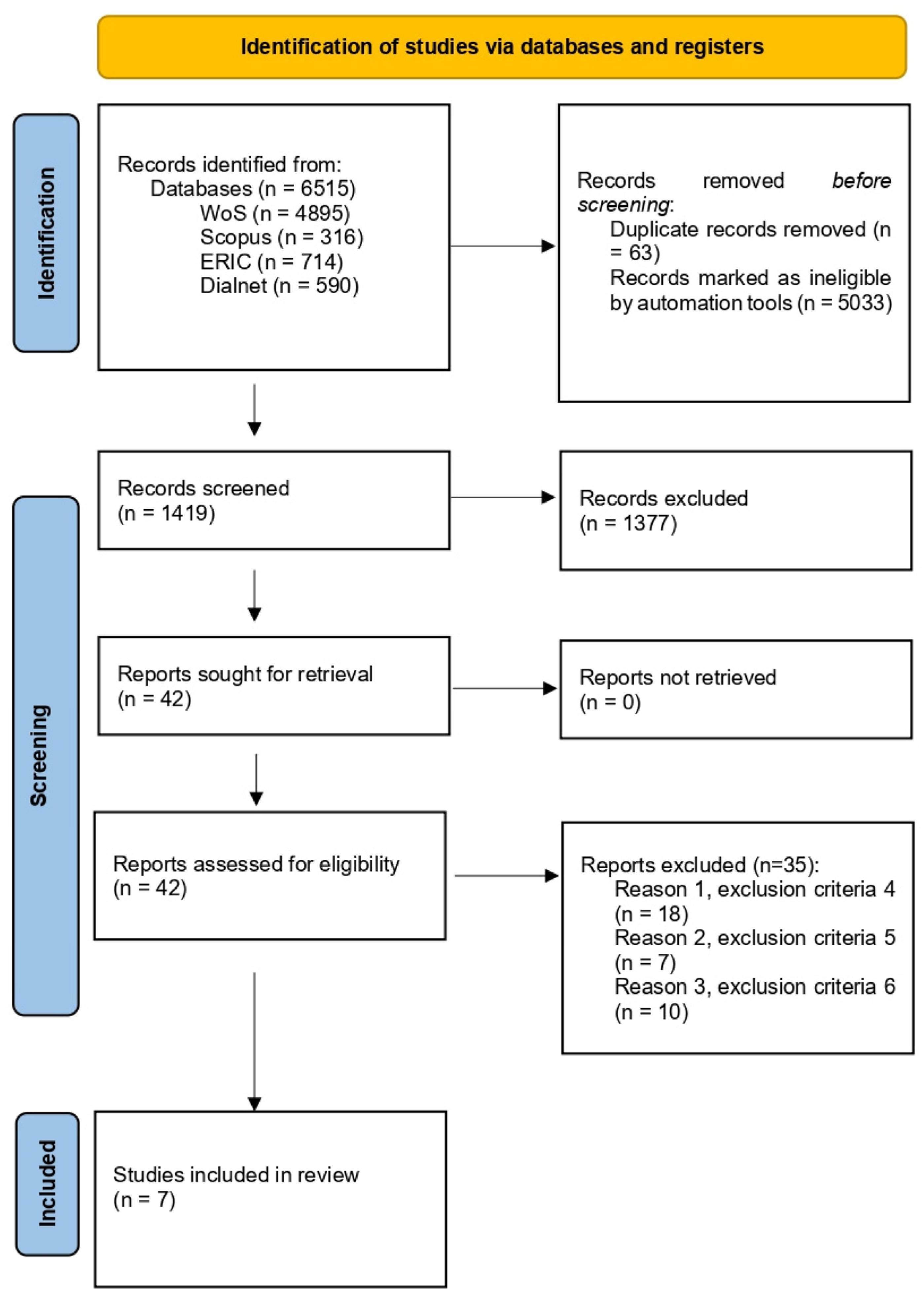
The search identified 6515 records: 4895 in WoS, 316 in Scopus, 714 in ERIC, and 590 in Dialnet. After applying the initial filters for publication year, language, and publication type, 1482 records remained. After removing 63 duplicates, 1419 documents were screened by title and abstract, of which 42 proceeded to full-text evaluation. After excluding 35 documents that did not meet the established criteria, 7 studies were ultimately included in the review.
2.2. Procedure
After identifying records in the selected databases and removing duplicates (n = 63), the remaining records (n = 1419) underwent a two-stage screening process conducted independently by two reviewers.
In the first stage, both reviewers independently assessed the titles and abstracts of the retrieved records against the predefined inclusion and exclusion criteria. This process resulted in the selection of 42 potentially eligible studies for full-text assessment.
In the second stage, the same two reviewers independently assessed the full texts of these 42 studies to determine eligibility. Studies were excluded when they did not meet the established inclusion criteria, particularly regarding the educational context or the nature of the intervention, including studies focused on music therapy rather than music education. Following this process, seven studies were included in the final review. The two reviewers resolved eligibility disagreements through discussion until they reached consensus.
Figure 1 illustrates the entire selection process using the PRISMA 2020 flowchart, which details the number of records identified, screened, and excluded at each stage, as well as the final number of studies included in the review.
Figure 1.
PRISMA-ScR flow diagram of the study selection process..
2.3. Inclusion and Exclusion Criteria
To ensure the consistency and relevance of the studies included in the review, we established explicit inclusion and exclusion criteria aligned with the study’s objective and the approach typical of a scoping review. We systematically applied these criteria during title and abstract screening and in the subsequent full-text review. This procedure narrowed the final selection to studies that specifically addressed music education for students enrolled in special education schools, distinguishing between music education practices and music therapy interventions. Table 1 summarizes the study selection criteria.
Table 1.
Study Selection Criteria.
We excluded studies involving only participants younger than 12 years. However, studies with mixed-age samples were eligible when they included participants aged 12–21 years. This approach allowed inclusion of relevant evidence involving adolescents while acknowledging that some findings came from broader age groups.
2.4. Data Extraction and Analytical Framework
After the final selection of studies, two reviewers independently extracted data using a standardized extraction matrix developed for this scoping review. For each study, the following information was recorded: authors and year of publication, country, research objective, methodological design, sample characteristics and size, data collection techniques, characteristics of music education practices or interventions, and main findings. The independently extracted data were subsequently compared to identify potential discrepancies and ensure consistency and accuracy in the information included in the synthesis.
We recorded the authors and year of publication, country, research objective, methodological design, sample characteristics and size, data collection techniques, characteristics of music education practices or interventions, and main results. The findings were organized using a deductive approach, guided by the specific objectives of the review, which led to the identification of five dimensions of analysis: emotional well-being and social interaction; participation, interactive engagement, and attention; autonomy, agency, and leadership; communication and accessibility; and the development of musical skills and creativity. A single study could contribute to several dimensions by addressing different effects or areas of development associated with music practice. This approach made it possible to integrate and compare findings from studies with different methodological designs, student profiles, and music education approaches, without assuming methodological equivalence.
3. Results
Table 2 summarizes the characteristics, methodological designs, samples, data collection techniques, and main findings of the seven studies included in the review.
Based on the reviewed articles, the following dimensions emerged: emotional well-being and social interaction; participation, interactive engagement, and attention; autonomy, agency, and leadership; communication and accessibility; and the development of musical skills and creativity.
Six of the seven included studies (85.71%) reported findings related to communication, social interaction, and emotional well-being, including self-esteem, emotional regulation, joy, and enthusiasm.
Music learning through movement and body expression was associated with opportunities for social interaction among peers, was associated with the development of emotional self-regulation techniques and motivation to learn, reduced anxiety levels and promoted self-confidence. However, we acknowledged the difficulty of accurately identifying emotions in preverbal students based on body language, highlighting the need to use alternative communication systems appropriately and to understand students’ own communication characteristics.
Regarding the assessment of emotional well-being, the included studies primarily relied on qualitative data collection techniques, including interviews, participant or non-participant observations, video recordings, and research journals [43,44,45,46,47]. Although some studies used questionnaires or Likert-type scales, these were mainly directed at other outcomes, such as interactive engagement or autonomy [48,49]. The information reported in the included studies did not identify a common standardized instrument specifically designed to assess emotional well-being. Consequently, findings related to emotional expression, self-confidence, self-esteem, and emotional regulation should be interpreted cautiously, as they were largely derived from qualitative observations and participants’ or educators’ accounts.
All studies (100%, n = 7) reported the use of music-based strategies and their effects on student participation, interactive engagement, or attention. Musical pieces were selected according to the interest of the students to encourage their participation, while significant increases in interactive participation were observed following the implementation of multisensory musical drama and through music and movement activities based on the Dalcroze method. It was noted that all students were able to actively participate using haptic music players. However, although this dimension was present in all studies, it was pointed out that the results were less clear for one of their three participants.
A total of 42.86% of the articles (n = 3) reported findings related to autonomy, agency, or leadership. The included studies described associations between musical creation and practice and students’ opportunities to make decisions, solve problems, and engage in planning activities.
It was reported that, after implementing classes based on the Dalcroze method, participants showed notable behaviors related to agency, leadership, and initiative. Using tablets to record sounds gave deaf students greater autonomy and accessibility in carrying out activities, as they perceived these devices as an extension of their bodies. We reported, however, the need to improve the technical aspects of the devices used because they were not adaptable to students’ circumstances.
A total of 57.14% of the articles (n = 4) agreed that approaching musical activities through strategies targeting different sensory levels and resources designed to facilitate communication expanded students’ opportunities for access and participation. For students with multiple disabilities and deafness, using vibrosensory and visual senses and communicating through sign language supported opportunities for participation in musical and kinesthetic activities such as dance. Sound education for students with cochlear implants was associated with increased conscious perception of environmental sounds. Structured visual aids and digital media were used to support the instruction of students with autism. Likewise, body maps facilitated the identification and communication of perceived sound waves. However, students may need prior training to use this communication method, and the map could be improved to more accurately represent body schema.
Finally, 71.43% of the articles (n = 5) reported favorable outcomes in learning and the development of musical skills through instrumental practice, dance and movement, and improvisation and composition exercises. Students with deafness, physical disabilities, intellectual disabilities, and autism effectively engaged in multiple UDL-based activities, including original and complex musical compositions—an essentially creative activity. Similarly, classes based on the Dalcroze method supported the development of physical skills, while practices focused on vibrosensory perception were associated with active listening experiences.
Table 2.
Findings of the Included Studies in the Review.
4. Discussion
The included studies showed that music education experiences in special education settings were primarily associated with students’ emotional well-being, social interaction, participation, communication, and autonomy. These findings suggest that music education can potentially be a supportive educational context for the psychosocial well-being of children and adolescents with disabilities. However, the small number of included studies and their methodological heterogeneity require cautious interpretation. Furthermore, the results showed that these possibilities depended closely on the accessibility of the activities, the appropriateness of the support, and the adaptation of resources to students’ characteristics and needs.
Emotional well-being and social interaction were among the most frequently cited dimensions in the studies reviewed. Musical experiences were associated with opportunities for emotional expression, peer interaction, self-esteem, self-confidence, and emotional regulation. These results are consistent with previous research linking group musical participation to social–emotional learning and the development of psychosocial skills [17]. However, caution is warranted when interpreting these findings, especially among students with limited or no verbal communication. Frid et al. [44] noted the difficulty of inferring emotional states based solely on behavioral indicators, highlighting the need for accessible communication systems and appropriate assessment procedures before attributing specific emotional changes to musical activity.
Participation and engagement were also a cross-cutting theme in the included studies. Active teaching methods, activities tailored to students’ interests, and accessible resources were associated with different forms of engagement in musical experiences [43,44,47,48]. These findings align with the principles of the UDL and approaches that emphasize offering multiple forms of participation and expression in music education [26,31]. However, participation did not increase uniformly across all participants, as Johnels et al. [48] show, reinforcing the need to interpret participation as an outcome shaped by individual characteristics, available supports, and activity design.
Autonomy and agency emerged as another relevant dimension, though they appeared in fewer studies. Moller et al. [49] identified improvements in decision-making and problem-solving, while Sutela et al. [47] described the progressive development of behaviors related to initiative, leadership, and active participation. Likewise, Imada [45] demonstrated how certain technological resources could expand students’ opportunities for autonomous action. These findings suggest that musical experiences can provide opportunities to make decisions, take initiative, and exercise greater control over one’s own participation. However, given the small number of studies that explicitly addressed this dimension and the diversity of their designs, the available evidence does not allow generalizable conclusions.
Communication and accessibility played a cross-cutting role in students’ opportunities for participation. Accessibility, as an indispensable pillar of education at both the practical and legislative levels [50], involved the use of multisensory strategies, accessible virtual tools, and alternative and augmentative communication systems for populations likely to benefit from them [26,28,29,31]. However, Frid et al. [44] highlighted the need for training and adaptability regarding the devices used. According to teachers’ perceptions, the established systems were not yet properly optimized to achieve fully fluid and assertive communication [30]. These findings suggest that the potential usefulness of these tools may depend on their design and adaptation to the educational context, rather than solely on their implementation.
Finally, studies showed that participation in activities involving performance, movement, improvisation, and composition provided opportunities to develop specifically musical and creative skills. Engaging in diverse musical activities and developing complex skills as a result of learning reinforced the benefits of music education in the areas of cognition, executive function, motor skills, and creativity [18,21,46] among students who meet the entry criteria for CEE [50] (Art. 73.1). These results also show that the accessibility and adaptation of musical experiences can coexist with the development of specifically musical and creative learning, broadening the ways in which students participate in processes of performance, movement, and creation.
5. Conclusions
Music education in special education schools is a pedagogical practice whose significance may extend beyond acquiring specifically musical knowledge. The findings of this review suggest that accessible music education can provide a supportive educational environment for emotional expression and regulation, social interaction, communication, autonomy, and meaningful participation among children and adolescents with disabilities. These aspects are particularly important for their psychosocial well-being and personal development.
The findings suggest that the opportunities associated with these practices may be influenced by their pedagogical design.
Adapting activities, diversifying forms of participation and expression, using multisensory approaches, and incorporating accessible resources expanded students’ opportunities for participation. Accessibility emerged as a relevant factor in facilitating meaningful musical experiences adapted to different educational and communicative needs.
Furthermore, the experiences analyzed provided opportunities for musical and creative learning, along with processes related to autonomy, communication, and social participation. In this way, music education can be conceived as an educational space in which musical learning, personal expression, and participation develop complementarily.
However, these findings do not allow us to attribute therapeutic effects to music education or to establish its effectiveness in health outcomes. The limited number of available studies and their methodological heterogeneity prevent us from drawing firm conclusions about its effects on emotional and psychosocial well-being. The results should therefore be interpreted as evidence of the contributions and opportunities identified in the analyzed studies, and not as proof of causal relationships.
Limitations
One main limitation of the review was the small number of included studies, reflecting the scarcity of scientific evidence on music education for students enrolled in special education schools. In addition, the considerable heterogeneity in methodological designs, sample characteristics, musical practices, and assessment procedures limited the comparability and generalizability of the findings.
Heterogeneity in study populations is another limitation. The included studies addressed students with different disability profiles, including autism spectrum disorder, intellectual and multiple disabilities, and sensory disabilities such as deafness. These populations may differ substantially in their communication needs, sensory experiences, and requirements for educational support. Consequently, the accessibility strategies and participation opportunities described in one group may not be directly transferable to another. Given the small number of studies and the diversity of their designs, it was not possible to draw reliable conclusions about differences in outcomes between disability groups.
Some included studies also involved mixed-age samples comprising both adolescents and younger children. Because findings were not consistently disaggregated by age, it was not possible to determine whether outcomes differed between age groups, limiting the extent to which conclusions can be attributed specifically to adolescents.
Furthermore, studies did not assess emotional and psychosocial well-being consistently or with standardized instruments; therefore, the results should be interpreted as insights from the literature rather than conclusive evidence of effectiveness. Future research should incorporate larger samples, more robust designs, and comparable measures of emotional well-being, social participation, communication, and autonomy.
Another limitation is that the review did not conduct a formal methodological quality assessment or risk-of-bias appraisal of the included studies. Although such assessments are not mandatory in scoping reviews, their absence limits the ability to evaluate the methodological robustness of the available evidence. Consequently, the findings should be interpreted as a descriptive synthesis of the existing literature rather than as evidence of the effectiveness of music education interventions.
Supplementary Materials
The following supporting information can be downloaded at: https://www.mdpi.com/article/10.3390/children13111591/s1, Table S1: Search strategies and equations used in Web of Science, Scopus, ERIC, and Dialnet; Table S2: PRISMA Extension for Scoping Reviews (PRISMA-ScR) Checklist.
Author Contributions
Conceptualization, P.D.-R., P.H.-D., D.P.-J. and M.C.G.-A.; methodology, P.D.-R. and P.H.-D.; formal analysis, P.D.-R.; investigation, P.D.-R.; data curation, P.D.-R.; writing—original draft preparation, P.D.-R., P.H.-D., D.P.-J. and M.C.G.-A.; writing—review and editing, P.D.-R., P.H.-D., D.P.-J. and M.C.G.-A.; visualization, P.H.-D. and P.D.-R.; supervision, D.P.-J.; project administration, P.D.-R. and D.P.-J. All authors have read and agreed to the published version of the manuscript.
Funding
This research received no external funding.
Institutional Review Board Statement
Not applicable.
Informed Consent Statement
Not applicable.
Data Availability Statement
No new data were created or analyzed in this study. Data sharing is not applicable to this article.
Acknowledgments
During the preparation of this manuscript, generative artificial intelligence (AI) tools, including ChatGPT (GPT-5.5 Thinking model), were used exclusively to support language editing, grammar checking, stylistic refinement, and text clarity. All scientific content, study design, data analysis, interpretation of results, and final decisions regarding the manuscript were performed and verified by the authors. The authors take full responsibility for the accuracy, integrity, and originality of the content presented.
Conflicts of Interest
The authors declare no conflicts of interest.
Abbreviations
| ASD | Autism spectrum disorder |
| ADHD | Attention-deficit/hyperactivity disorder |
| CEE | Special Education Centers |
| UDL | Universal Design for Learning |
| WoS | Web of Science |
| MSMD | Multisensory Musical Drama |
References
- Armstrong, T. Neurodiversity: The Future of Special Education? Educ. Leadersh. 2017, 74, 10–16. [Google Scholar]
- Haney, J.L. Reconceptualizing Autism: An Alternative Paradigm for Social Work Practice. J. Progress. Hum. Serv. 2018, 29, 61–80. [Google Scholar] [CrossRef] [Scilit]
- Isacoff, N.M.; Imanova, S.; Kis-Herczegh, P.; Toner, S.; Urosevic, T.; Varma, V.; Le Cunff, A.L. Neurodiversity: Integrating Evolutionary, Philosophical, and Sociocultural Perspectives. Res. Autism 2026, 131, 202783. [Google Scholar] [CrossRef] [Scilit]
- Arboleda Sánchez, V.A.; Betancur Gómez, M.Y.; Carmona Ruiz, V.; Pinilla Restrepo, L.M. Modelo Médico-Clínico y Paradigma de La Neurodiversidad: La Importancia de Una Mirada Integradora Para Comprender El Autismo. Cienc. Lat. Rev. Cient. Multidiscip. 2024, 8, 3468–3484. [Google Scholar] [CrossRef] [Scilit]
- Norman, J.B.; Viole, E.; Bird, A. University Climate and Neurodiversity Accommodations: Associations with Academic and Social-Psychological Student Outcomes. Res. Neurodiversity 2026, 2, 100032. [Google Scholar] [CrossRef] [Scilit]
- Roberts, J.; Simpson, K. A Review of Research into Stakeholder Perspectives on Inclusion of Students with Autism in Mainstream Schools. Int. J. Incl. Educ. 2016, 20, 1084–1096. [Google Scholar] [CrossRef] [Scilit]
- United Nations. Convention on the Rights of Persons with Disabilities; United Nations: New York, NY, USA, 2006. [Google Scholar]
- UNESCO. The Salamanca Statement and Framework for Action on Special Needs Education; UNESCO: Paris, France, 1994. [Google Scholar]
- Giani, C.; García Gómez, T. La Ralentización de Los Procesos de Inclusión Educativa Del Alumnado Con Necesidades Educativas Especiales. Aula Encuentro 2026, 28, 1–23. [Google Scholar] [CrossRef] [Scilit]
- Negrín Medina, M.Á.; Marrero Galván, J.J. Evolución En La Escolarización Del Alumnado Con Necesidades Educativas Especiales En El Sistema Educativo Español: Conceptualización, Síntesis Histórica y Papel de La Inspección Educativa. Av. Superv. Educ. 2018, 29, 1–34. [Google Scholar] [CrossRef] [Scilit]
- Santana, G.R.; Moral Mora, A.M.; Chiva Sanchís, I. Más Allá de La Norma: Revisión de La Legislación Educativa Española y Prácticas Innovadoras Para El Desarrollo Del Talento Del Alumnado. Autoct. Rev. Cienc. Soc. Hist. 2025, 9, 1896–1936. [Google Scholar] [CrossRef] [Scilit]
- Sandoval Mena, M.; Darretxe Urrutxi, L.; Álvarez-Rementería, M.Á. La Evolución de La Escolarización Del Alumnado En Educación Especial En España: A 25 Años de La Declaración de Salamanca. Aula Abierta 2022, 51, 385–394. [Google Scholar] [CrossRef] [Scilit]
- Gaser, C.; Schlaug, G. Brain Structures Differ between Musicians and Non-Musicians. J. Neurosci. 2003, 23, 9240–9245. [Google Scholar] [CrossRef] [Scilit] [PubMed]
- Leipold, S.; Klein, C.; Jäncke, L. Musical Expertise Shapes Functional and Structural Brain Networks Independent of Absolute Pitch Ability. J. Neurosci. 2021, 41, 2496–2511. [Google Scholar] [CrossRef] [Scilit] [PubMed]
- Moore, E.; Schaefer, R.S.; Bastin, M.E.; Roberts, N.; Overy, K. Can Musical Training Influence Brain Connectivity? Evidence from Diffusion Tensor MRI. Brain Sci. 2014, 4, 405–427. [Google Scholar] [CrossRef] [Scilit] [PubMed]
- Schmithorst, V.J.; Wilke, M. Differences in White Matter Architecture between Musicians and Non-Musicians: A Diffusion Tensor Imaging Study. Neurosci. Lett. 2002, 321, 57–60. [Google Scholar] [CrossRef] [Scilit] [PubMed]
- Küpana, M.N. Social Emotional Learning and Music Education. Sanat Eğitimi Derg. 2015, 3, 75–88. [Google Scholar] [CrossRef] [Scilit]
- Hogenes, M.; Van Oers, B.; Diekstra, R.F.W. Music Composition in the Music Curriculum. US-China Educ. Rev. A 2014, 4, 149–162. [Google Scholar] [CrossRef] [Scilit]
- Hogenes, M.; Van Oers, B.; Diekstra, R.F.W.; Sklad, M. The Effects of Music Composition as a Classroom Activity on Engagement in Music Education and Academic and Music Achievement: A Quasi-Experimental Study. Int. J. Music Educ. 2016, 34, 32–48. [Google Scholar] [CrossRef] [Scilit]
- George, E.M.; Coch, D. Music Training and Working Memory: An ERP Study. Neuropsychologia 2011, 49, 1083–1094. [Google Scholar] [CrossRef] [Scilit] [PubMed]
- Rosero, M.A.M.; Tapia, E.L.T.; Haro, V.J.V.; Carrillo, J.A.M. La Música Como Herramienta Efectiva Para Potenciar El Desarrollo Cognitivo En Los Niños. Rev. Investig. Educ. Niveles 2024, 1, 31–41. [Google Scholar] [CrossRef] [Scilit]
- Fong, C.E.; Jelas, Z.M. Music Education for Children with Autism in Malaysia. Procedia Soc. Behav. Sci. 2010, 9, 70–75. [Google Scholar] [CrossRef] [Scilit]
- Gower, L.; McDowall, J. Interactive Music Video Games and Children’s Musical Development. Br. J. Music Educ. 2012, 29, 91–105. [Google Scholar] [CrossRef] [Scilit]
- Martín Gálvez, S.; Rosa Pereira, E.P. Influencia de La Música En Alumnos Con TDAH: Un Estudio de Revisión En Contexto Español. Per Musi 2024, 25, e242522. [Google Scholar] [CrossRef] [Scilit]
- Ockelford, A.; Welch, G.; Jewell-Gore, L.; Cheng, E.; Vogiatzoglou, A.; Himonides, E. Sounds of Intent, Phase 2: Gauging the Music Development of Children with Complex Needs. Eur. J. Spec. Needs Educ. 2011, 26, 177–199. [Google Scholar] [CrossRef] [Scilit]
- Bremmer, M. Encountering Disability in Music: Exploring Perceptions on Inclusive Music Education in Higher Music Education. Res. Stud. Music Educ. 2023, 45, 512–524. [Google Scholar] [CrossRef] [Scilit]
- Calculator, S.N. Augmentative and Alternative Communication (AAC) and Inclusive Education for Students with the Most Severe Disabilities. Int. J. Incl. Educ. 2009, 13, 93–113. [Google Scholar] [CrossRef] [Scilit]
- Candela Ramírez, R. Comunicación Aumentativa y Alternativa e Inclusión Educativa: Una Revisión Narrativa. Rev. Educ. Incl. 2025, 129–150. [Google Scholar] [CrossRef] [Scilit]
- Frid, E. Accessible Digital Musical Instruments—A Review of Musical Interfaces in Inclusive Music Practice. Multimodal Technol. Interact. 2019, 3, 57. [Google Scholar] [CrossRef] [Scilit]
- Kent-Walsh, J.E.; Light, J.C. General Education Teachers’ Experiences with Inclusion of Students Who Use Augmentative and Alternative Communication. Augment. Altern. Commun. 2003, 19, 104–124. [Google Scholar] [CrossRef] [Scilit]
- Salvador, K.; Culp, M.E. Intersections in Music Education: Implications of Universal Design for Learning, Culturally Responsive Education, and Trauma-Informed Education for P–12 Praxis. Music Educ. J. 2022, 108, 19–29. [Google Scholar] [CrossRef] [Scilit]
- Carrasco, G.P. La Formación de Los Educadores Musicales En México: Retos y Propuestas. Rev. Panam. Pedagog. 2011, 18, 17–39. [Google Scholar] [CrossRef] [Scilit]
- Llamas Rodríguez, J.C. La Imbricación Entre Educación Musical y Musicoterapia: Breves Apuntes Sobre El Uso de La Armonía En El Ámbito de La Discapacidad Psicosocial. Artseduca 2012, 1, 12–23. [Google Scholar]
- Sabbatella, P.L.; del Barrio Aranda, L. La Música En La Educación Del Alumnado Con Necesidades Educativas Especiales En España. Rev. Electrón. Complut. Investig. Educ. Music. 2021, 18, 251–263. [Google Scholar] [CrossRef] [Scilit]
- Tóth-Bakos, A. Music Education and Music Therapy. In Proceedings of the INTED2016 Proceedings; IATED: Valencia, Spain, 2016; Volume 1, pp. 1643–1652. [Google Scholar]
- Yáñez Amorós, B. Musicoterapia En El Paciente Oncológico. Cult. Cuid. 2011, 15, 57–73. [Google Scholar] [CrossRef] [Scilit]
- Boström, P.; Broberg, M. Protection and Restriction: A Mixed-Methods Study of Self-Reported Well-Being among Youth with Intellectual Disabilities. J. Appl. Res. Intellect. Disabil. 2018, 31, e164–e176. [Google Scholar] [CrossRef] [Scilit] [PubMed]
- Maciver, D.; Rutherford, M.; Arakelyan, S.; Kramer, J.M.; Richmond, J.; Todorova, L.; Romero-Ayuso, D.; Nakamura-Thomas, H.; Velden, M.T.; Finlayson, I.; et al. Participation of Children with Disabilities in School: A Realist Systematic Review of Psychosocial and Environmental Factors. PLoS ONE 2019, 14, e0210511. [Google Scholar] [CrossRef] [Scilit] [PubMed]
- Galarce Muñoz, M.I.; Pérez-Salas, C.P.; Sirlopú, D. Análisis Comparativo de La Participación Escolar y Bienestar Subjetivo En Estudiantes Con y Sin Discapacidad En Chile. Psykhe 2020, 29, 1–16. [Google Scholar] [CrossRef] [Scilit]
- Levstek, M.; Banerjee, R. A Model of Psychological Mechanisms of Inclusive Music-Making: Empowerment of Marginalized Young People. Music Sci. 2021, 4, 20592043211059752. [Google Scholar] [CrossRef] [Scilit]
- De Bruin, L.R.; Skinner, A. Inclusive Music Practices for Students with a Disability: Fore-Fronting Participatory and Agentic Teacher Practices. Br. J. Music Educ. 2026, 43, 64–78. [Google Scholar] [CrossRef] [Scilit]
- Tricco, A.C.; Lillie, E.; Zarin, W.; O’Brien, K.K.; Colquhoun, H.; Levac, D.; Moher, D.; Peters, M.D.J.; Horsley, T.; Weeks, L.; et al. PRISMA Extension for Scoping Reviews (PRISMA-ScR): Checklist and Explanation. Ann. Intern. Med. 2018, 169, 467–473. [Google Scholar] [CrossRef] [Scilit] [PubMed]
- Du, R.; Khositditsayanan, N.; Kengkaew, C. The Development of Music Teaching Model for Autism Spectrum Disorder Students at the Xing Yu School, Fuzhou City, Fujian Province, China. J. Educ. Learn. 2025, 14, 168–179. [Google Scholar] [CrossRef] [Scilit]
- Frid, E.; Panariello, C.; Núñez-Pacheco, C. Customizing and Evaluating Accessible Multisensory Music Experiences with Pre-Verbal Children—A Case Study on the Perception of Musical Haptics Using Participatory Design with Proxies. Multimodal Technol. Interact. 2022, 6, 55. [Google Scholar] [CrossRef] [Scilit]
- Imada, T. Toward a Sustainable Music Education for Inclusion and Equity. Aust. J. Music Educ. 2023, 55, 22–30. [Google Scholar]
- Silvestri, J.A.; Falk, J.L. And the Beat Goes on: Using Music to Transform Classes for Deaf Students with Multiple Disabilities through Universal Design. Odyssey New Dir. Deaf Educ. 2022, 22, 76–81. [Google Scholar]
- Sutela, K.; Juntunen, M.L.; Ojala, J. Applying Music-and-Movement to Promote Agency Development in Music Education: A Case Study in a Special School. Br. J. Music Educ. 2020, 37, 71–85. [Google Scholar] [CrossRef] [Scilit]
- Johnels, L.; Wandin, H.; Dada, S.; Wilder, J. The Effect of Multisensory Music Drama on the Interactive Engagement of Students with Severe/Profound Intellectual and Multiple Disabilities. Br. J. Learn. Disabil. 2024, 52, 150–165. [Google Scholar] [CrossRef] [Scilit]
- Moller, F.; Zenteno Silva, C.J.; Bassa, C. Autonomía e Inclusión: Implementación de Un Programa Piloto de Educación Musical Para Estudiantes Con Discapacidad Visual. Rev. Int. Educ. Music. 2025, 13, 3–13. [Google Scholar] [CrossRef] [Scilit]
- Jefatura del Estado. Ley Orgánica 3/2020, de 29 de Diciembre, por la que se Modifica la Ley Orgánica 2/2006, de 3 de Mayo, de Educación; [Organic Law 3/2020, of December 29, Amending Organic Law 2/2006, of May 3, on Education]; Jefatura del Estado: Madrid, Spain, 2020; pp. 122868–122953. [Google Scholar]

Disclaimer/Publisher’s Note: The statements, opinions and data contained in all publications are solely those of the individual author(s) and contributor(s) and not of MDPI and/or the editor(s). MDPI and/or the editor(s) disclaim responsibility for any injury to people or property resulting from any ideas, methods, instructions or products referred to in the content. |
© 2026 by the authors. Licensee MDPI, Basel, Switzerland. This article is an open access article distributed under the terms and conditions of the Creative Commons Attribution (CC BY) license.