


Highlights
What are the main findings?
- Progressive functional pulmonary artery band restriction before definitive repair was associated with postoperative EDFF-defined restrictive right ventricular physiology.
- Pre-repair pulmonary artery band gradient remained associated with EDFF-defined restrictive right ventricular physiology after adjustment for Down syndrome and interstage duration (adjusted odds ratio, 5.14 per 10 mmHg increase).
What are the implications of the main findings?
- A pulmonary artery band that is acceptable at implantation may become progressively restrictive during somatic growth.
- Serial assessment of band gradient may support timely reassessment for definitive repair; the exploratory thresholds require external validation.
Abstract
Background/Objectives: Pulmonary artery banding (PAB) is used in selected high-risk infants with complete atrioventricular septal defect (AVSD). We examined whether progressive functional band restriction was associated with postoperative restrictive right ventricular (RV) physiology after staged repair. Methods: This retrospective single-centre cohort included 53 patients who underwent definitive biventricular repair between October 2022 and November 2025 after previous PAB. Postoperative restrictive RV physiology was operationally defined by pulmonary arterial end-diastolic forward flow (EDFF) explicitly documented as present or absent in contemporaneous written postoperative echocardiography reports within 6 h of intensive care admission. Early post-banding and final pre-repair Doppler gradients were compared within patients. Logistic regression assessed associations with EDFF. The primary clinical outcome was a composite major adverse event (MAE), comprising 30-day or in-hospital mortality, postoperative extracorporeal membrane oxygenation, or unplanned cardiac reoperation. Results: EDFF-defined restrictive RV physiology was identified in 21 patients (39.6%) on the initial postoperative assessment. Pre-repair PAB gradient was higher in EDFF-positive than EDFF-negative patients (93 vs. 72 mmHg; p < 0.001). Median patient-level gradient increase was 45 vs. 29.5 mmHg (p < 0.001). EDFF-positive patients had higher rates of low cardiac output syndrome (71.4% vs. 21.9%) and extracorporeal membrane oxygenation (33.3% vs. 3.1%). MAE occurred in 33.3% versus 12.5% of patients, respectively, without a statistically significant between-group difference (p = 0.090). In the primary adjusted model, pre-repair gradient was associated with EDFF (adjusted odds ratio per 10 mmHg, 5.14; 95% confidence interval, 1.82–14.48; p = 0.002). The association for patient-level gradient increase persisted after adjustment for interstage duration and weight gain (adjusted odds ratio per 10 mmHg, 3.51; 95% confidence interval, 1.65–7.50; p = 0.001). Conclusions: Greater functional PAB restriction and longitudinal gradient increase were associated with early postoperative EDFF-defined restrictive RV physiology and greater early postoperative morbidity. Findings are exploratory and do not establish causality or a validated intervention threshold.
1. Introduction
Complete atrioventricular septal defect is associated with early pulmonary overcirculation, congestive heart failure, and a risk of progressive pulmonary vascular disease when excessive pulmonary blood flow is not adequately controlled [1,2]. Although primary repair during early infancy is the preferred strategy for most patients, pulmonary artery banding remains a relevant palliative option in selected infants with very low body weight, prematurity, severe heart failure, respiratory failure, active infection, major extracardiac comorbidity, or poor overall clinical condition. The principal goal of pulmonary artery banding is to reduce pulmonary blood flow and pulmonary arterial pressure while allowing clinical stabilisation and somatic growth before definitive repair. Contemporary multicentre data suggest that pulmonary artery banding can successfully bridge selected patients with complete atrioventricular septal defect to subsequent biventricular repair; however, the interstage course and the evolution of atrioventricular valve regurgitation remain heterogeneous [3,4].
Restrictive right ventricular physiology is commonly identified by end-diastolic forward flow (EDFF) in the main pulmonary artery during atrial contraction [5,6]. This Doppler finding has traditionally been interpreted as reflecting impaired right ventricular compliance and elevated right ventricular end-diastolic pressure. More recent studies, however, suggest that EDFF may reflect a complex interaction among right ventricular diastolic properties, loading conditions, pulmonary arterial capacitance, pulmonary regurgitation, atrial contraction, and left-sided filling pressures [5,6,7,8,9].
The relationship between functional pulmonary artery band restriction before definitive repair and postoperative restrictive right ventricular physiology has not been well defined in patients undergoing staged repair of complete atrioventricular septal defect. We therefore investigated whether a more restrictive pre-repair pulmonary artery band profile, assessed by Doppler band gradient and indexed band diameter, was associated with postoperative restrictive RV physiology, operationally defined by pulmonary arterial EDFF, and adverse early outcomes after definitive repair. We hypothesised that progressive functional band restriction during the interstage period would be associated with postoperative EDFF-defined restrictive RV physiology and a more complicated postoperative course.
2. Materials and Methods
2.1. Study Design and Population
This retrospective, single-centre, definitive-repair-based cohort study identified all consecutive patients with complete atrioventricular septal defect (AVSD) who underwent definitive biventricular repair after previous pulmonary artery banding (PAB) at our institution between 1 October 2022 and 30 November 2025. Institutional surgical records were screened using the date of definitive repair, rather than the date of PAB, as the eligibility window. All 53 patients fulfilling these criteria were included in the analytic cohort. The principal physiological endpoint was postoperative end-diastolic forward flow (EDFF) documented after definitive repair; the primary clinical outcome is defined in Section 2.3. Separately, a review of institutional PAB follow-up records for patients with complete AVSD who underwent PAB between January 2018 and 30 November 2025 identified a broader group of 67 patients, including 14 who did not meet the centre-specific definitive-repair criterion during the study period. This broader group provides clinical context and was not the sampling frame used to identify the 53 consecutive definitive repairs. Six PAB procedures performed after 30 November 2025 were outside the stated cutoff and were not counted in this contextual group. The ventricular septal component was described as anatomically large in clinical records; anatomical size was not considered proof of a haemodynamically nonrestrictive ventricular communication, because patient-level VSD Doppler pressure-gradient criteria were not systematically available.
Patients with partial or intermediate AVSD, major associated cardiac anomalies requiring separate surgical intervention, or univentricular physiology were ineligible for the repair-based cohort. Among the 14 patients in the broader PAB follow-up group who were not analysed, six died before repair, two were lost to follow-up before repair, three underwent definitive repair at another institution, and three were awaiting definitive repair at the study cutoff. The three awaiting repair had interstage follow-up information but had not reached the postoperative endpoint; those repaired elsewhere did not meet the institutional repair criterion. Thus, inference is conditional on reaching definitive repair at our centre and is susceptible to survivor selection. Migrant background was defined according to demographic and administrative records documenting migration to Türkiye from another country, including families registered under temporary protection or other migrant status. The study was conducted in accordance with the Declaration of Helsinki and is reported in accordance with STROBE guidelines. The study was approved by the the Ankara Etlik City Hospital No. 2 Scientific Research Evaluation and Ethics Committee (protocol code AESH-BADEK2-2025-748; approval date: 30 December 2025).
2.2. Pulmonary Artery Banding and Interstage Assessment
Pulmonary artery banding was considered when early definitive repair was deemed clinically unfavourable because of very young age or low body weight, severe congestive heart failure, uncontrolled pulmonary overcirculation, inability to wean from mechanical ventilation or severe respiratory failure, prematurity, active infection or sepsis, severe extracardiac anomalies, or poor general clinical condition.
The intraoperative target following pulmonary artery banding was a distal pulmonary artery systolic pressure-to-systemic systolic pressure ratio of 0.30–0.50 (usually approximately 0.40). Band diameter, indexed band diameter, and peak instantaneous Doppler-derived band gradient were recorded. Both early post-banding and final pre-repair band gradients represented peak instantaneous rather than mean gradients. Early post-banding gradients were measured after extubation and discontinuation of inotropic support, once haemodynamic stability was achieved; loading conditions differed from those of the final pre-repair assessment.
Patients underwent serial clinical and echocardiographic surveillance during the interstage period. The echocardiographic examination closest to definitive repair was used for pre-repair measurements. Indexed band diameter was expressed as measured band diameter divided by body surface area to describe relative band size during somatic growth; this ratio is descriptive rather than a validated anatomical measure of restriction. Recorded pre-repair variables included Doppler-derived band gradient, band diameter, indexed band diameter, left ventricular ejection fraction, right ventricular tricuspid annular plane systolic excursion z score, and atrioventricular valve regurgitation grade.
Final pre-repair Doppler measurements were obtained under sedation while patients were breathing spontaneously, immediately before admission for definitive repair. For longitudinal comparison, the patient-level change in Doppler band gradient was calculated by subtracting the early post-banding gradient from the final pre-repair gradient. Preoperative pulmonary arterial EDFF was not assessed; therefore, baseline EDFF status could not be established. Pediatric echocardiography recommendations informed interpretation of Doppler measurements [10,11], without implying a prospectively standardised acquisition protocol.
Band-related complications before definitive repair were categorised as branch pulmonary artery distortion, band migration, valvular damage, or subannular hypertrophy. For regression analyses, band-related complications were additionally analysed as a binary variable indicating the presence of any band-related complication.
2.3. Definitive Repair and Postoperative Assessment
Definitive repair was performed using either a two-patch or modified single-patch technique according to anatomical characteristics and operative judgment. Atrioventricular valve intervention was classified as cleft closure alone, cleft closure and annuloplasty, or complex atrioventricular valve repair. Following removal of the pulmonary artery band, the main pulmonary artery was reconstructed with a xenopericardial patch in all patients. In 13 patients, marked subpulmonary muscular hypertrophy developed during the interstage period following PAB and required additional subpulmonary muscle bundle resection at definitive repair; the resulting limited ventriculotomy was reconstructed with a xenopericardial patch. No intervention was performed on the pulmonary valve or pulmonary annulus, and no transannular patch was used. Additional subpulmonary muscle resection with limited RVOT patch reconstruction, cardiopulmonary bypass time, and aortic cross-clamp time were recorded.
The first postoperative transthoracic echocardiogram was performed within 6 h of admission to the paediatric cardiac intensive care unit after definitive repair. Postoperative pulmonary arterial end-diastolic forward flow (EDFF) was classified from explicit positive or negative findings in contemporaneous written echocardiography reports and clinical records for all 53 patients (21 EDFF-positive and 32 EDFF-negative); absence of a mention of EDFF was not used as evidence of EDFF negativity; no initial examination was excluded as non-diagnostic for EDFF assessment. EDFF was documented clinically on pulmonary arterial Doppler assessment; original Doppler tracings were unavailable to verify acquisition details. Junctional rhythm and temporary cardiac pacing occurred in the cohort, and rhythm-specific acquisition conditions, including the presence of three consecutive sinus-rhythm cycles and atrioventricular synchrony at each examination, could not be reconstructed uniformly. EDFF was therefore treated as a clinically documented echocardiographic finding, rather than a retrospectively rhythm-standardised endpoint. According to the clinical assessment sequence, echocardiography preceded the subsequent recognition of low cardiac output syndrome (LCOS) and initiation of ECMO; however, patient-level echocardiography-to-event timestamps were unavailable, precluding formal verification of temporal ordering or lead-time analysis. The EDFF classification was based on the initial postoperative examination and was not contingent on persistence in later examinations.
The primary clinical outcome was a composite major adverse event (MAE), defined as the occurrence of any of the following during the index postoperative hospitalisation: 30-day or in-hospital mortality, postoperative extracorporeal membrane oxygenation requirement, or unplanned cardiac reoperation for residual ventricular septal defect, clinically significant atrioventricular valve regurgitation, left ventricular outflow tract obstruction, right ventricular outflow tract obstruction, or another haemodynamically significant residual lesion. Patients experiencing more than one component of the composite outcome were counted only once in the overall MAE analysis.
Secondary outcomes included LCOS, maximum vasoactive–inotropic score, duration of mechanical ventilation, intensive care unit length of stay, hospital length of stay, junctional ectopic tachycardia, postoperative atrioventricular block, pacemaker requirement, infection, renal complications, hepatic congestion, postoperative ventricular function, and postoperative atrioventricular valve regurgitation. LCOS was analysed separately from the major adverse event composite because it may lie on the clinical pathway between restrictive right ventricular physiology and adverse postoperative recovery.
LCOS, infection, renal complications, and hepatic congestion were ascertained retrospectively through review of documented clinical diagnoses and detailed clinical and laboratory records. LCOS assessment incorporated inotropic support requirements and echocardiographic ventricular systolic function, including ejection fraction, as part of the overall clinical assessment. Infection assessment incorporated documented fever and microbiological culture results, interpreted in the clinical context. Renal complications were assessed using recorded hourly urine output and serum urea and creatinine measurements. Hepatic congestion assessment incorporated documented hepatomegaly and serum aspartate aminotransferase (AST) and alanine aminotransferase (ALT) elevations, interpreted alongside the recorded clinical findings. These indicators supported retrospective clinical classification rather than serving as isolated diagnostic criteria.
Atrioventricular valve regurgitation was graded as none/trivial, mild, moderate, or severe. Moderate-or-greater regurgitation was defined as grade ≥ 2. Early mortality was defined as death within 30 days after definitive repair or during the index hospitalisation. Available follow-up echocardiograms in patients with postoperative EDFF were reviewed to describe whether EDFF remained detectable at subsequent assessments. These observations were descriptive and did not establish the exact time of EDFF resolution.
2.4. Statistical Analysis
Continuous variables were examined for distributional characteristics and are presented as the median and interquartile range. Categorical variables are presented as frequency and percentage. Patients were categorised according to the presence or absence of postoperative EDFF-defined restrictive RV physiology on the initial postoperative echocardiogram.
Between-group comparisons were performed using the Mann–Whitney U test for continuous variables and Fisher exact test for categorical variables, as appropriate. All tests were two-sided, and a p value < 0.05 was considered statistically significant.
Additional exploratory comparisons evaluated prematurity, Down syndrome, PAB-to-definitive repair interval, early post-PAB and final pre-repair peak Doppler band gradients, and patient-level gradient change according to whether subpulmonary muscle resection with limited RVOT patch reconstruction was performed. Comparisons used Fisher’s exact test for categorical variables and the Mann–Whitney U test for continuous variables. These analyses were unadjusted, with no correction for multiple comparisons.
Exploratory secondary models evaluated the patient-level change in Doppler band gradient (per 10 mmHg), adjusted for interstage duration (per 30 days) and weight gain (per kilogram). Two sensitivity models each included a single band-related exposure (final pre-repair gradient in Model A and gradient change in Model B) together with additional subpulmonary muscle resection with limited RVOT patch reconstruction; Down syndrome and interstage duration were not included in these two-variable models. All regression analyses were complete-case analyses; all 53 patients had complete data for every variable included in the models, and no imputation was performed. Coefficients were estimated by conventional maximum likelihood, and 95% confidence intervals are Wald intervals. Multicollinearity was assessed using variance inflation factors, influential observations were screened using Cook’s distance, and the stability of exposure estimates was examined by leave-one-out refitting. The sample size, number of events, estimates for all covariates, and diagnostics for each model are reported in Supplementary Table S3. Given 21 EDFF events, all adjusted models were interpreted as exploratory.
Spearman rank correlation assessed associations between gradient change, interstage duration, and weight gain. Univariable logistic regression provided odds ratios with 95% confidence intervals. Within-patient gradient changes (final pre-repair minus early post-banding) were assessed using the Wilcoxon signed-rank test; between-group differences in change were assessed using the Mann–Whitney U test.
To reduce the risk of overfitting, multivariable logistic regression was restricted to a prespecified parsimonious model including pre-repair pulmonary artery band gradient, Down syndrome, and the interval from pulmonary artery banding to definitive repair. Pre-repair indexed band diameter was considered an alternative marker of functional band restriction and was not entered simultaneously with Doppler-derived band gradient.
Exploratory receiver operating characteristic analysis was performed to assess the discriminatory performance of post-banding indexed band diameter, pre-repair indexed band diameter, and pre-repair Doppler band gradient for postoperative restrictive right ventricular physiology. Exploratory thresholds were identified using the maximum Youden index. Exact binomial 95% confidence intervals for sensitivity and specificity were calculated using the Clopper–Pearson method. Because these thresholds were derived and evaluated in the same cohort, they were interpreted as exploratory and were not considered validated clinical cut-off values. Statistical analyses were performed using IBM SPSS Statistics for Windows, version 30.0 (IBM Corp., Armonk, NY, USA).
3. Results
3.1. Study Population
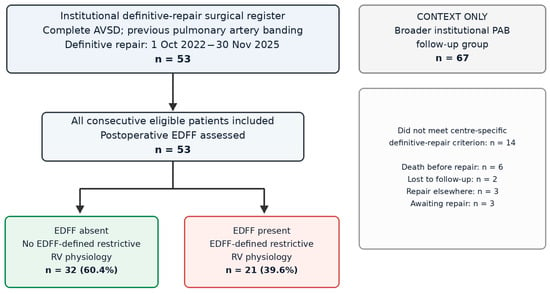
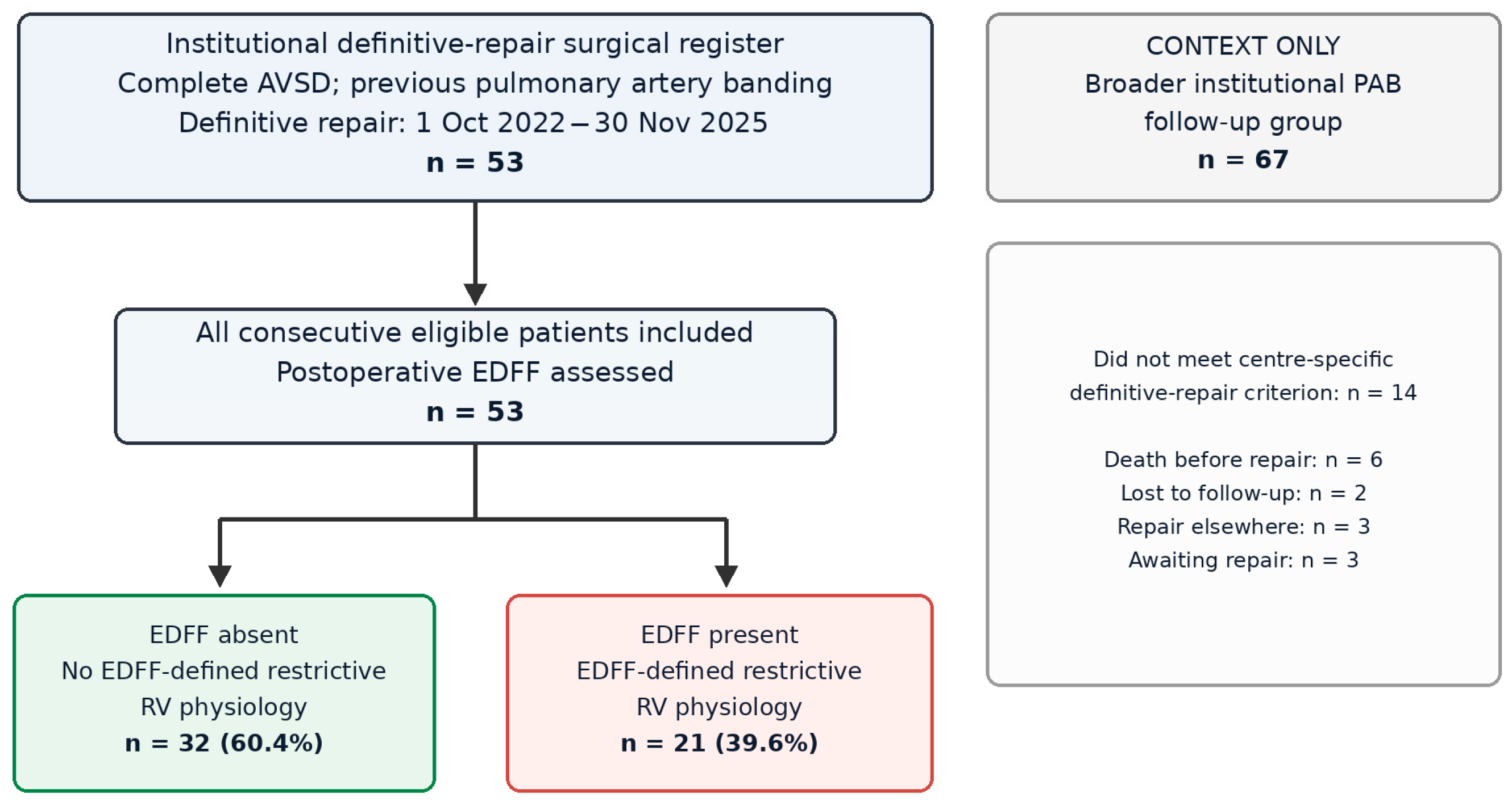
Screening of institutional definitive-repair surgical records identified 53 consecutive patients with complete AVSD who underwent definitive biventricular repair after previous PAB between 1 October 2022 and 30 November 2025; all 53 were included in the analysis. Of these, 21 (39.6%) had clinically documented postoperative EDFF and 32 (60.4%) did not. For context, the broader institutional PAB follow-up group comprised 67 patients, of whom 14 did not undergo definitive repair at our institution within the study window (six died before repair, two were lost to follow-up, three underwent repair elsewhere and three were awaiting repair). These 14 patients were not excluded from an otherwise eligible definitive-repair cohort; they did not meet the study’s repair-based inclusion criterion (Figure 1).
Figure 1.
Patient selection and contextual PAB follow-up. The analytic cohort comprised all 53 consecutive patients undergoing definitive biventricular repair at our institution between 1 October 2022 and 30 November 2025 after previous PAB (EDFF-positive, n = 21; EDFF-negative, n = 32). The broader institutional PAB follow-up group (n = 67) is shown for context only; 14 patients did not fulfil the institutional definitive-repair eligibility criterion (death before repair, n = 6; loss to follow-up, n = 2; repair elsewhere, n = 3; awaiting repair, n = 3). Eligibility and the study period were defined by definitive repair, not the date of PAB. Green and red boxes indicate patients without and with postoperative EDFF-defined restrictive right ventricular physiology, respectively. Grey boxes represent cohort selection and contextual follow-up information.
The median age at pulmonary artery banding was 24 days (interquartile range [IQR], 17–40 days), and the median body weight was 3.15 kg (IQR, 2.90–3.65 kg). Down syndrome was present in 19 patients (35.8%), low birth weight in 15 (28.3%), prematurity in 6 (11.3%), and migrant background in 20 (37.7%). Before pulmonary artery banding, 12 patients (22.6%) required mechanical ventilation and 12 (22.6%) received inotropic support. Moderate-or-greater left atrioventricular valve regurgitation was present in 35 patients (66.0%) before pulmonary artery banding.
Compared with patients without restrictive right ventricular physiology, patients with restrictive physiology had a higher prevalence of Down syndrome (57.1% versus 21.9%; p = 0.018), low birth weight (47.6% versus 15.6%; p = 0.015), and migrant background (66.7% versus 18.8%; p = 0.001). Pre-pulmonary artery banding left ventricular ejection fraction was lower in the restrictive physiology group (58% [IQR, 50–60] versus 60% [IQR, 55–65]; p = 0.033). Other baseline characteristics are presented in Table 1.
Table 1.
Baseline demographic and pre–pulmonary artery banding clinical characteristics according to postoperative restrictive right ventricular physiology.
3.2. Interstage Course and Pre-Repair Physiology
Immediate post-pulmonary artery banding characteristics were comparable between groups. Post-banding band diameter, indexed band diameter, Doppler-derived band gradient, incidence of LCOS, and intensive care unit and hospital lengths of stay after pulmonary artery banding did not differ significantly between patients with and without EDFF on postoperative assessment after definitive repair.
The interval between pulmonary artery banding and definitive repair was significantly longer in patients with EDFF on postoperative assessment. The median pulmonary artery banding-to-definitive repair interval was 260 days (IQR, 210–350 days) in the restrictive physiology group, compared with 240 days (IQR, 168–280 days) in the non-restrictive group (p = 0.023). Patients with restrictive right ventricular physiology therefore underwent definitive repair at an older age (302 days [IQR, 251–374] versus 256 days [IQR, 203–306]; p = 0.016) and with a greater body surface area (0.44 m2 [IQR, 0.39–0.46] versus 0.40 m2 [IQR, 0.37–0.43]; p = 0.040). A prolonged interstage interval was not an intentional institutional policy. Interrupted access to follow-up and delayed presentation occurred among some families displaced by the Syrian conflict; patient-specific reasons for delay were not systematically documented.
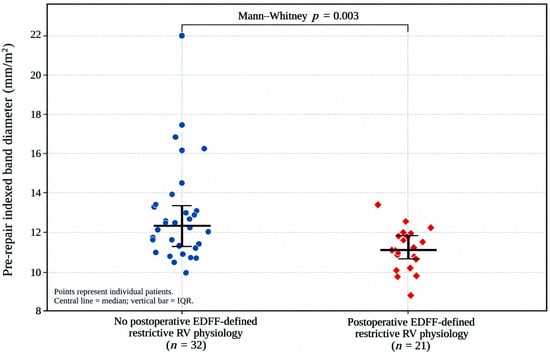
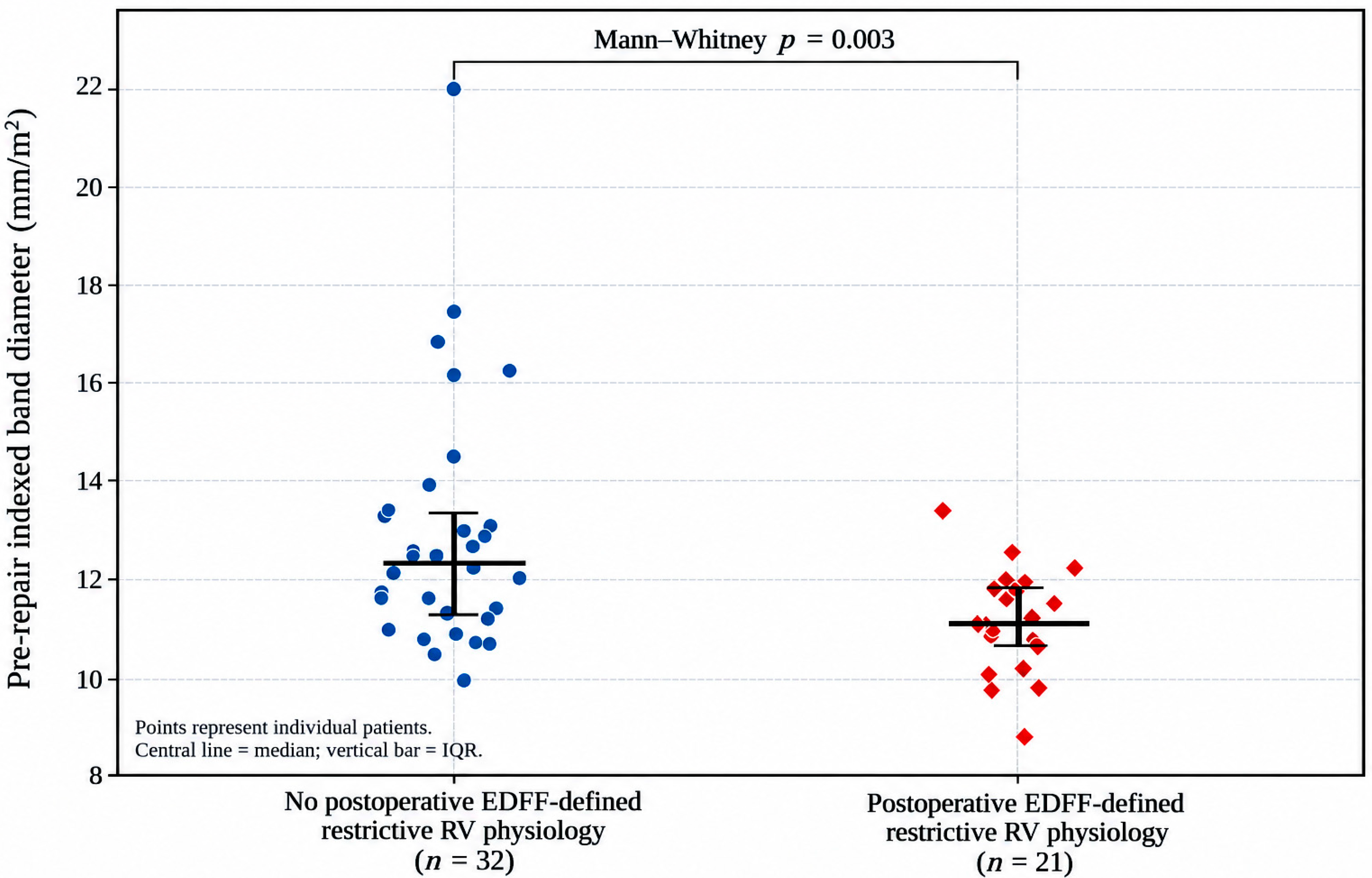
At pre-repair assessment, patients with EDFF on postoperative assessment had a higher Doppler band gradient and a smaller indexed band diameter than patients without postoperative EDFF. The pre-repair Doppler band gradient was higher in the restrictive physiology group than in the non-restrictive group (93 mmHg [IQR, 80–98] versus 72 mmHg [IQR, 65–84]; p < 0.001). In contrast, indexed band diameter before definitive repair was smaller in patients with restrictive physiology (11.10 mm/m2 [IQR, 10.70–11.80] versus 12.30 mm/m2 [IQR, 11.28–13.22]; p = 0.003).
Patient-level paired early post-banding and final pre-repair Doppler gradients were available for all 53 patients. The median within-patient gradient increase was 45 mmHg (IQR, 39–58) in the EDFF-positive group versus 29.5 mmHg (IQR, 22.75–35.75) in the EDFF-negative group (Mann–Whitney U p < 0.001). Within-group changes were significant in both groups (Wilcoxon signed-rank p < 0.001 for each). Gradient change correlated positively with interstage duration (Spearman rho = 0.337, p = 0.014) and weight gain (rho = 0.420, p = 0.002). Detailed paired comparisons are presented in Supplementary Table S1.
Band-related complications before definitive repair were also more frequent in the restrictive physiology group (47.6% versus 12.5%; p = 0.009) (Table 2).
Table 2.
Pulmonary artery banding characteristics and pre-repair haemodynamic status according to postoperative EDFF-defined restrictive right ventricular physiology.
3.3. Definitive Repair and Early Outcomes
The distribution of two-patch and modified single-patch repair techniques did not differ between groups. However, additional subpulmonary muscle resection with limited RVOT patch reconstruction was more frequent in patients with restrictive right ventricular physiology (52.4% versus 6.2%; p < 0.001). Cardiopulmonary bypass time (125 min [IQR, 112–139] versus 110 min [IQR, 105–119]; p = 0.004) and aortic cross-clamp time (99 min [IQR, 87–105] versus 86 min [IQR, 79–90]; p < 0.001) were longer in the restrictive physiology group. The 13 RVOT procedures consisted of subpulmonary muscle bundle resection and limited ventriculotomy patch reconstruction; the pulmonary valve and annulus were preserved in all 53 patients.
In exploratory comparisons, patients undergoing additional subpulmonary muscle resection with limited RVOT patch reconstruction had a higher final pre-repair peak Doppler band gradient than those not undergoing this procedure (93 [86–102] versus 75.5 [65–85.5] mmHg; p < 0.001) and a greater patient-level gradient increase (45 [39–51] versus 30.5 [22.75–41] mmHg; p = 0.001). Early post-PAB gradient, prematurity, Down syndrome, and PAB-to-definitive repair interval did not differ significantly between groups (Supplementary Table S4).
In the early postoperative period, restrictive right ventricular physiology was associated with a substantially more complicated clinical course. LCOS occurred in 15 of 21 patients (71.4%) with restrictive physiology, compared with 7 of 32 patients (21.9%) without restrictive physiology (p < 0.001). Postoperative extracorporeal membrane oxygenation was required in 7 patients (33.3%) in the restrictive physiology group and in 1 patient (3.1%) in the non-restrictive group (p = 0.004). The maximum vasoactive–inotropic score was significantly higher in patients with restrictive physiology (40 [IQR, 30–45] versus 20 [IQR, 15–25]; p < 0.001).
Patients with restrictive physiology required prolonged mechanical ventilation (9 days [IQR, 5–11] versus 2 days [IQR, 1–4]; p < 0.001), had a longer intensive care unit stay (13 days [IQR, 10–18] versus 4.5 days [IQR, 3–6.2]; p < 0.001), and had a longer total hospital stay (20 days [IQR, 16–25] versus 9 days [IQR, 7.8–11]; p < 0.001). Restrictive right ventricular physiology was also associated with lower postoperative right ventricular TAPSE z scores (−3.10 [IQR, −3.40 to −2.50] versus −2.50 [IQR, −3.03 to −2.00]; p = 0.006) and a higher postoperative RVOT gradient (26 mmHg [IQR, 21–30] versus 20 mmHg [IQR, 15–22]; p = 0.002).
The composite major adverse event rate was numerically higher among patients with restrictive right ventricular physiology (7/21 [33.3%] versus 4/32 [12.5%]; unadjusted odds ratio, 3.50; 95% confidence interval, 0.88–13.99; p = 0.090). Postoperative junctional ectopic tachycardia (66.7% versus 28.1%; p = 0.010), infection (57.1% versus 21.9%; p = 0.018), and hepatic congestion (71.4% versus 21.9%; p < 0.001) were more frequent in the restrictive physiology group. Unplanned cardiac reoperation and 30-day mortality did not differ significantly between groups (Table 3).
Table 3.
Definitive repair characteristics and early postoperative outcomes according to postoperative EDFF-defined restrictive right ventricular physiology.
In all 21 EDFF-positive patients, pulmonary regurgitation was absent or mild (grade 0–1); no EDFF-positive patient had moderate or severe pulmonary regurgitation. In the EDFF-positive subgroup, 15 patients developed LCOS and seven required VA-ECMO. The reported clinical sequence placed the initial echocardiographic assessment before LCOS recognition or ECMO initiation, but patient-level timestamps were unavailable to verify this sequence or quantify lead time. These subgroups overlap and should not be summed. Of 21 EDFF-positive patients, one died during the index admission after successful VA-ECMO decannulation, and two were lost to post-discharge follow-up. Among 18 with available longitudinal echocardiography, EDFF was no longer detected in 11 at the 1-month assessment, four at the 2-month assessment, and three at the 3-month assessment. This documents absence at follow-up assessments, not the exact time of resolution.
3.4. Factors Associated with Postoperative EDFF-Defined Restrictive RV Physiology
In univariable logistic regression analysis, higher pre-repair pulmonary artery band gradient, smaller pre-repair indexed band diameter, longer pulmonary artery banding-to-definitive repair interval, Down syndrome, and low birth weight were associated with postoperative restrictive right ventricular physiology. Additional subpulmonary muscle resection with limited RVOT patch reconstruction and the presence of any band-related complication were also associated with this outcome. In exploratory analyses, each 10-mmHg increase in patient-level Doppler band gradient change was associated with EDFF (unadjusted OR, 3.13; 95% CI, 1.63–6.03; p < 0.001). After adjustment for interstage duration and weight gain, the corresponding OR was 3.51 (95% CI, 1.65–7.50; p = 0.001). In a separate sensitivity model including additional subpulmonary muscle resection with limited RVOT patch reconstruction, the final pre-repair Doppler gradient remained associated with EDFF (adjusted OR per 10 mmHg, 2.69; 95% CI, 1.35–5.36; p = 0.005). A parallel sensitivity model using gradient change instead of the final gradient yielded an adjusted OR of 2.49 per 10 mmHg (95% CI, 1.28–4.84; p = 0.007). These estimates should be interpreted cautiously, owing to the small number of events, potential correlation among physiological variables, and confounding by indication for RVOT reconstruction. Corresponding adjusted ORs for additional RVOT intervention were 6.03 (95% CI, 0.96–37.74; p = 0.055) in Model A and 7.76 (95% CI, 1.31–46.03; p = 0.024) in Model B. In leave-one-out analyses, the adjusted OR for pre-repair gradient in the primary model ranged from 4.64 to 13.41, indicating substantial sensitivity to individual observations (Supplementary Table S3). The reported clinical sequence suggested that the initial postoperative echocardiogram preceded recognition of LCOS or ECMO initiation, but patient-level timestamps were unavailable to verify temporal ordering. Accordingly, EDFF should not be interpreted as an independently validated predictor or cause of these complications.
In the parsimonious multivariable logistic regression model, a higher pre-repair pulmonary artery band gradient remained associated with postoperative EDFF after adjustment for Down syndrome and the PAB-to-definitive repair interval. For every 10-mmHg increase in pre-repair Doppler band gradient, the odds of postoperative restrictive right ventricular physiology increased more than five-fold (adjusted odds ratio, 5.14; 95% confidence interval, 1.82–14.48; p = 0.002). Down syndrome (adjusted odds ratio, 13.73; 95% confidence interval, 1.93–97.59; p = 0.009) and a longer pulmonary artery banding-to-definitive repair interval (adjusted odds ratio per 30-day increase, 1.47; 95% confidence interval, 1.01–2.15; p = 0.044) were also associated with postoperative restrictive right ventricular physiology (Table 4).
Table 4.
Logistic regression analyses for postoperative EDFF-defined restrictive RV physiology.
3.5. Exploratory Threshold Analysis
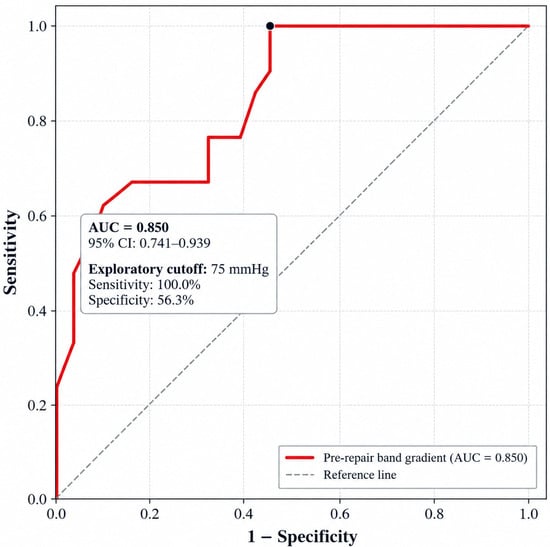
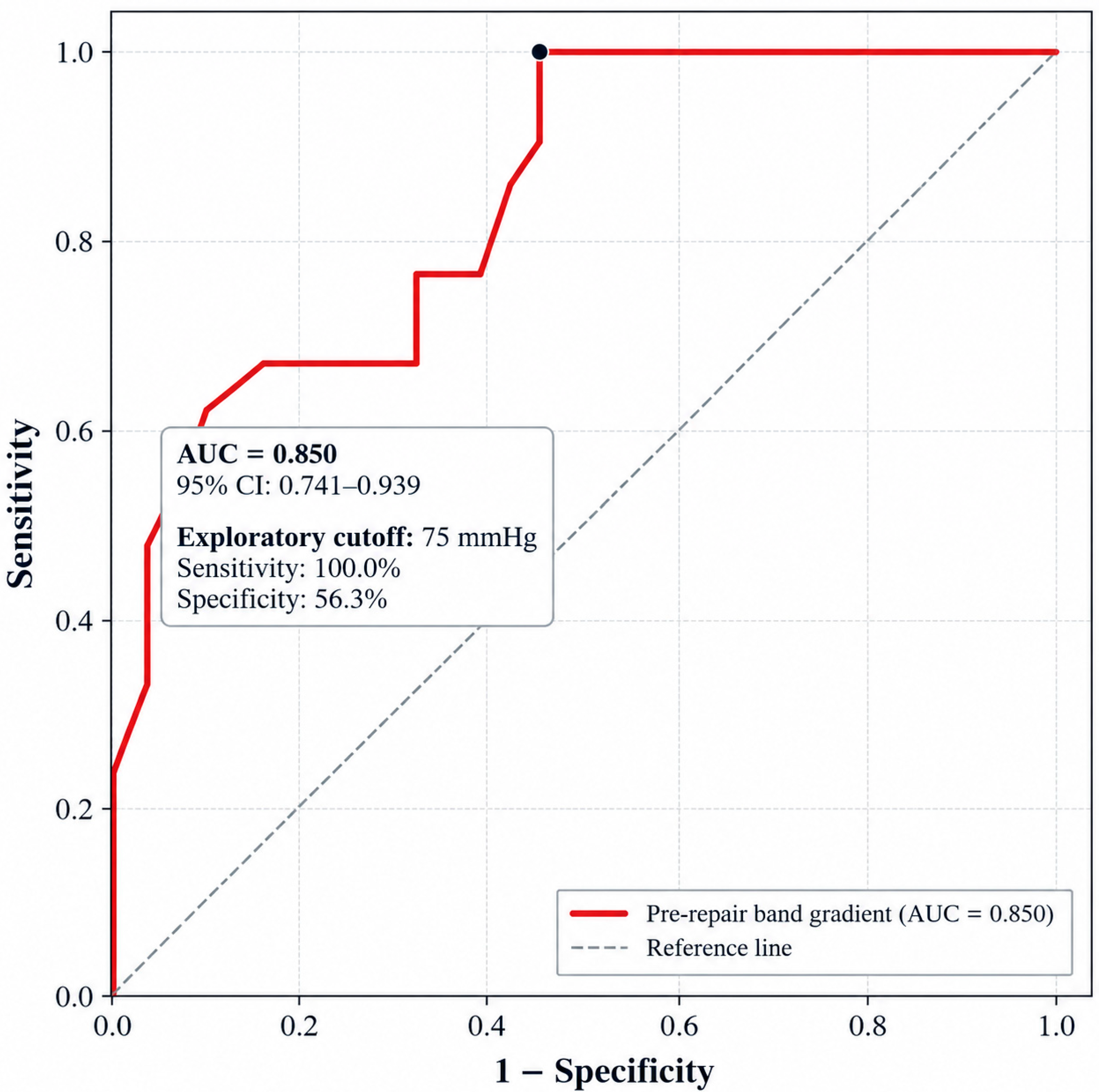
In exploratory receiver operating characteristic analysis, the pre-repair pulmonary artery band gradient showed good discriminatory performance for postoperative restrictive right ventricular physiology (area under the curve [AUC], 0.850; 95% confidence interval, 0.741–0.939; Figure 2). A pre-repair Doppler gradient of 75 mmHg yielded the maximum Youden index, with a sensitivity of 100.0% and specificity of 56.3%. At this threshold, 39 of 53 patients were correctly classified (21 true positives and 18 true negatives), corresponding to an accuracy of 73.6%; there were 14 false positives and no false negatives. The full comparison of exploratory ROC measures is provided in Supplementary Table S2.
Figure 2.
Receiver operating characteristic curve of pre-repair pulmonary artery band gradient for postoperative EDFF-defined restrictive RV physiology. The pre-repair Doppler-derived pulmonary artery band gradient showed good discrimination for postoperative EDFF-defined restrictive RV physiology (AUC, 0.850; 95% confidence interval, 0.741–0.939). The exploratory threshold of 75 mmHg, identified using the maximum Youden index, yielded a sensitivity of 100.0% and specificity of 56.3%. The threshold requires external validation.
Pre-repair indexed band diameter was lower in patients with postoperative EDFF than in those without postoperative EDFF (Figure 3). However, the substantial overlap between groups limits the clinical utility of indexed band diameter as a standalone discriminator of postoperative EDFF. The indexed band diameter showed moderate discriminatory performance (AUC, 0.741; 95% confidence interval, 0.600–0.864). An indexed band diameter of ≤11.95 mm/m2 yielded a sensitivity of 85.7% and specificity of 59.4% for postoperative restrictive right ventricular physiology. In contrast, indexed band diameter immediately after pulmonary artery banding had limited discriminatory performance, with an area under the curve of 0.634 and an exploratory threshold of ≤20.80 mm/m2 (Supplementary Table S2). These exploratory analyses describe within-cohort discrimination and do not establish thresholds for clinical intervention.
Figure 3.
Pre-repair indexed pulmonary artery band diameter according to postoperative EDFF-defined restrictive RV physiology. Each point represents one patient. The central horizontal line denotes the median, and the vertical bar denotes the interquartile range. Patients with postoperative EDFF had a smaller pre-repair indexed band diameter than those without postoperative EDFF (11.10 [10.70–11.80] vs. 12.30 [11.28–13.22] mm/m2; Mann–Whitney U test, p = 0.003).
4. Discussion
The principal finding of this study is that a higher peak Doppler pulmonary artery band gradient before definitive repair was associated with postoperative EDFF-defined restrictive RV physiology in patients undergoing staged repair of complete atrioventricular septal defect. Although immediate post-banding diameter, indexed diameter, and Doppler gradient were comparable between groups, patients with postoperative EDFF had a substantially higher pre-repair band gradient and a smaller pre-repair indexed band diameter. These findings are consistent with a possible longitudinal increase in functional pulmonary artery band restriction during somatic growth. However, the observed increase in Doppler-derived gradients cannot establish progressive anatomical narrowing of the band or a causal relationship with postoperative EDFF. Postoperative EDFF was associated with higher rates of LCOS and ECMO requirement, higher vasoactive–inotropic support, and markedly prolonged mechanical ventilation, intensive care unit stay, and hospital stay. The main findings and their proposed clinical implications are summarized in the Central Figure.
4.1. Main Findings
Although primary repair during early infancy is preferred for most patients with complete AVSD, PAB remains an important option for selected high-risk infants [12,13,14,15,16,17,18,19]. Contemporary studies indicate that PAB can provide an effective bridge to biventricular repair, but comparative data also suggest a survival advantage with primary repair in infants requiring early intervention [3,18,20,21]. In the present cohort, selection for PAB reflected the overall clinical suitability for early definitive repair rather than body weight alone. The median weight of 3.15 kg should therefore be interpreted in the context of the clinical indications described in the Methods, rather than as an isolated criterion for palliation. This study does not compare PAB with primary repair or establish a preferred initial treatment strategy. Its findings apply to selected patients who underwent staged management and reached definitive biventricular repair, and should not be generalised to all infants with complete AVSD.
Our study extends previous PAB literature by focusing on the functional evolution of the band during the interstage period. Kim et al. reported that initial indexed band diameter was associated with early outcomes after PAB, suggesting that initial band tightness may influence subsequent haemodynamics [22]. In contrast, immediate post-banding measurements were similar between groups in our cohort, whereas pre-repair indexed band diameter was smaller and Doppler gradient substantially higher in patients with postoperative EDFF. The contribution of the present study is not the general observation that a fixed band may become relatively restrictive during growth, but the quantification of patient-level changes in Doppler band gradient and their association with postoperative EDFF-defined restrictive RV physiology in a selected staged AVSD cohort. The paired measurements extend the cross-sectional pre-repair comparisons, although they do not establish progressive anatomical narrowing or a causal effect on RV diastolic properties.
This distinction is important. A relatively tight band may confer short-term physiological benefit by controlling pulmonary overcirculation, reducing distal pulmonary arterial pressure, and decreasing ventricular volume loading. Balanced restriction should be understood as a clinical balance between control of pulmonary overcirculation and concern about excessive ventricular pressure loading, rather than as a single target Doppler gradient. Serial assessment may inform this balance by considering changes in band gradient together with clinical status, somatic growth, ventricular function, and atrioventricular valve regurgitation. An increasing gradient may prompt reassessment of readiness for definitive repair, but the present study does not establish a gradient-based intervention rule or demonstrate that earlier repair prevents postoperative EDFF. Moreover, band adequacy cannot be defined reliably by a single intraoperative measurement because loading conditions and pulmonary vascular resistance may substantially influence pressure and flow measurements at the time of PAB [3,4,22,23].
The longer interstage interval among patients with postoperative restrictive RV physiology may be clinically relevant. In the primary multivariable model, a longer interstage interval was associated with higher odds of restrictive physiology (adjusted OR per 30 days, 1.47; 95% CI, 1.01–2.15); however, the lower confidence limit approached unity, and the association was not statistically significant in the longitudinal model including gradient change and weight gain (adjusted OR, 1.43; 95% CI, 0.98–2.09). As a child grows, a fixed band may become relatively more restrictive, although residual confounding precludes causal interpretation [3].
These findings may be particularly relevant in socially vulnerable populations with limited access to continuous specialist follow-up [24]. Notably, 14 of the 21 patients (66.7%) with postoperative EDFF were children from families displaced by regional armed conflict. In our clinical experience, migrant families and patients from socioeconomically disadvantaged backgrounds frequently encountered difficulties maintaining regular follow-up, resulting in missed appointments and delayed clinical reassessment. Such interruptions may have contributed to prolonged interstage intervals and delayed recognition of increasing functional pulmonary artery band restriction. However, socioeconomic status, adherence to scheduled follow-up, and the specific reasons for delayed definitive repair were not systematically quantified in this retrospective cohort. Therefore, these observations should be considered a plausible explanation for delayed reassessment rather than evidence of a causal relationship between migration, socioeconomic disadvantage, and postoperative EDFF. Importantly, prolonged interstage management was not an intentional institutional strategy; definitive repair was planned according to clinical readiness and individual patient circumstances. Alternatively, closure of the atrial and ventricular communications and atrioventricular valve repair may unmask limited pre-existing RV diastolic reserve through abrupt changes in loading, while myocardial injury and postoperative treatment conditions may contribute to EDFF. Neither a chronic band-related mechanism nor this perioperative explanation can be established by the present data. The lower postoperative RV TAPSE z scores further support clinically relevant postoperative RV dysfunction.
Although MAE was the prespecified primary clinical endpoint, its incidence was numerically higher in EDFF-positive patients without reaching statistical significance, and the confidence interval was wide. The composite combined mortality, ECMO requirement, and unplanned cardiac reoperation, with each patient counted only once. ECMO requirement differed between groups, whereas mortality and reoperation did not. The small number of composite events and the inclusion of components that may have different relationships with postoperative EDFF limit interpretation of the composite result. Some reoperations for residual structural lesions may not reflect the same processes associated with EDFF; however, their relationship to band restriction cannot be established from the present analysis. Associations with LCOS, ECMO requirement, vasoactive–inotropic support, and postoperative resource use remain secondary, exploratory observations rather than evidence of prognostic independence.
4.2. Hypothesis-Generating Findings
Several findings require careful interpretation. Down syndrome was associated with postoperative EDFF-defined restrictive RV physiology in the specified multivariable model, despite previous multicentre AVSD data suggesting that Down syndrome is not necessarily associated with worse overall early outcomes after primary AVSD repair [15,16]. This discrepancy may reflect differences between primary repair cohorts and our highly selected PAB population, in which pulmonary vascular reactivity, respiratory comorbidity, airway vulnerability, and the duration of exposure to altered loading conditions may be particularly relevant. Alternatively, the association may reflect residual confounding or instability of estimates in a small cohort, as indicated by the wide confidence interval. It should therefore be interpreted as a hypothesis-generating finding rather than evidence of a direct causal effect.
Additional subpulmonary muscle resection with limited RVOT patch reconstruction was more frequent among patients with postoperative EDFF. In additional exploratory analyses, patients requiring this procedure had higher final pre-repair peak Doppler band gradients and greater patient-level gradient increases, whereas prematurity, Down syndrome, and interstage duration did not differ significantly between groups (Supplementary Table S4). These findings indicate an association between the Doppler band gradient profile and the need for muscle resection, but do not establish the cause of muscular hypertrophy. The marked subpulmonary muscular hypertrophy prompting this intervention was clinically observed to develop during the interstage period following PAB and may reflect remodelling under chronic PAB-related pressure loading, although causality cannot be established. Although exploratory sensitivity analyses incorporating RVOT reconstruction showed persistent associations between Doppler band gradients and postoperative EDFF, residual confounding by indication cannot be excluded. The independent contribution of RVOT reconstruction to postoperative EDFF cannot be established from these observational data. No pulmonary valve, annular, or transannular intervention was undertaken.
Our exploratory ROC findings should also be interpreted conservatively. A pre-repair Doppler gradient of 75 mmHg demonstrated good discrimination for postoperative restrictive RV physiology, while a pre-repair indexed band diameter of 11.95 mm/m2 showed moderate discriminatory performance. Because these values were derived and evaluated in the same cohort, they describe within-cohort discrimination and should be considered hypothesis-generating rather than validated thresholds for surveillance intensity, timing of definitive repair, or PAB management. In particular, the apparently perfect sensitivity of the 75-mmHg threshold must be viewed in the context of the small sample size and potential optimism inherent to internally derived cutoffs.
4.3. Limitations
- -
- This retrospective, single-centre study included 53 patients and 21 EDFF events, limiting causal inference and multivariable precision.
- -
- Because only patients reaching definitive repair at our centre were analysed, selection and survivor bias are possible. Findings should not be extrapolated to all patients undergoing PAB, including those who died during the interstage period or had not yet undergone definitive repair.
- -
- Doppler gradients were measured under differing loading and sedation conditions.
- -
- EDFF alone does not establish reduced RV compliance, while TAPSE assesses longitudinal systolic rather than diastolic function. Thus, the EDFF-defined phenotype should not be equated with independently confirmed RV diastolic restriction.
- -
- Preoperative pulmonary arterial EDFF was not assessed. Consequently, we could not determine whether postoperative EDFF reflected pre-existing RV diastolic abnormalities, perioperative changes, or a combination of both, and the findings cannot be classified as newly developed restrictive RV physiology.
- -
- Pulmonary regurgitation grades in EDFF-negative patients were unavailable.
- -
- EDFF classification was supported by explicit positive or negative findings in contemporaneous written echocardiography reports and clinical records for all 53 patients; absence of a mention of EDFF was not considered evidence of EDFF negativity. However, original Doppler recordings were unavailable for independent re-evaluation, precluding blinded re-reading or assessment of interobserver agreement.
- -
- EDFF classification was based on the initial postoperative examination and did not require confirmation in subsequent examinations.
- -
- Junctional rhythm and temporary pacing occurred in the cohort. Three consecutive sinus-rhythm cycles, atrioventricular synchrony, and rhythm-specific Doppler acquisition conditions could not be confirmed uniformly; therefore, EDFF misclassification cannot be excluded.
- -
- Contemporaneous haemodynamic support and central venous pressure could not be reliably reconstructed.
- -
- Migrant background was recorded, but socioeconomic circumstances, follow-up adherence, and patient-specific reasons for delayed reassessment were not systematically quantified; their contribution to prolonged interstage intervals or EDFF cannot be established.
- -
- Unmeasured anatomy, selection for RVOT reconstruction, and other perioperative factors may confound associations with postoperative outcomes.
- -
- The reported clinical sequence could not be verified against patient-specific echocardiography-to-event timestamps, limiting temporal inference.
- -
- We did not establish whether subpulmonary muscular hypertrophy or peak pulmonary artery band gradient was a stronger predictor of postoperative EDFF.
4.4. Future Directions
All patients in our cohort had large ventricular components of their atrioventricular septal defects, as demonstrated by preoperative echocardiography. In the absence of pressure restriction at the ventricular component, right ventricular systolic pressure would be expected to approximate, but not exceed, left ventricular and systemic arterial systolic pressures. Nevertheless, the mechanisms underlying the variable development of subpulmonary muscular hypertrophy and restrictive right ventricular physiology remain incompletely understood. Future prospective studies should investigate these mechanisms through serial quantitative imaging, Doppler-derived pulmonary artery band gradients, and, when clinically indicated, simultaneous invasive measurements of peak instantaneous right ventricular and systemic arterial pressures. Potential contributions from genetic variants, prematurity, inflammation, and other unidentified factors also warrant investigation. Paired preoperative and postoperative assessments of EDFF are needed to distinguish pre-existing physiological abnormalities from perioperative changes. Prospective studies should investigate the relationship of EDFF to RV relaxation and diastolic stiffness by integrating serial right atrioventricular inflow and annular tissue Doppler measurements with documented rhythm and loading conditions. Where clinically justified and technically feasible, invasive pressure–volume analysis could further characterise these diastolic mechanisms. Finally, longitudinal studies should determine whether the persistence or resolution of EDFF is associated with clinical recovery and whether targeted management strategies improve postoperative outcomes.
5. Conclusions
In patients with complete AVSD undergoing staged repair, greater functional PAB restriction before definitive repair was associated with postoperative EDFF-defined restrictive RV physiology and a more complicated early postoperative course. These findings may support serial assessment of band gradient and timely reassessment of readiness for definitive repair when increasing Doppler gradients are observed, while recognising the influence of flow and loading conditions. The exploratory thresholds identified in this study require external validation before they can be used to guide clinical decision-making.
Supplementary Materials
The following supporting information can be downloaded at: https://www.mdpi.com/article/10.3390/children13111551/s1, Table S1: Paired patient-level Doppler pulmonary artery band gradients according to postoperative end-diastolic forward flow status. Table S2: Exploratory receiver operating characteristic analysis for discrimination of postoperative EDFF-defined restrictive right ventricular physiology. Table S3: Regression models and diagnostic checks. Table S4: Exploratory comparisons according to additional subpulmonary muscle resection with limited RVOT patch reconstruction.
Author Contributions
İ.M.: Conceptualization, Methodology, Investigation, Data Curation, Formal Analysis, Writing—Original Draft, Writing—Review & Editing, Project Administration. M.E.Ö.: Investigation, Data Curation, Writing—Review & Editing. Ö.N.A.: Investigation, Data Curation, Writing—Review & Editing. İ.E.Ö.: Investigation, Data Curation, Writing—Review & Editing. Ö.D.: Investigation, Validation, Writing—Review & Editing. Ö.K. (Özge Korkmaz): Methodology, Validation, Formal Analysis, Writing—Review & Editing. H.F.B.: Investigation, Data Curation, Writing—Review & Editing. Ö.K. (Özkan Kaya): Investigation, Validation, Writing—Review & Editing. U.A.Ö.: Supervision, Validation, Interpretation of Data, Writing—Review & Editing. M.T.: Supervision, Methodology, Interpretation of Data, Writing—Review & Editing. All authors have read and agreed to the published version of the manuscript.
Funding
This research received no specific grant from any funding agency in the public, commercial, or not-for-profit sectors.
Institutional Review Board Statement
The study was conducted in accordance with the Declaration of Helsinki and was approved by the Ankara Etlik City Hospital No. 2 Scientific Research Evaluation and Ethics Committee (protocol code AESH-BADEK2-2025-748; approval date: 30 December 2025).
Informed Consent Statement
Patient consent was waived due to the retrospective nature of the study, which involved analysis of previously collected clinical data without study-specific intervention or patient contact.
Data Availability Statement
The de-identified analysis dataset and the statistical output underlying the reported analyses are retained by the corresponding author and are available upon reasonable request.
Acknowledgments
During the preparation of this work, the authors used ChatGPT (GPT-5, OpenAI) for visual refinement of figures. The authors reviewed and edited the content as necessary and assume full responsibility for the article’s content.
Conflicts of Interest
The authors declare no conflicts of interest.
References
- Atik, E.; Barreto, A.C.; Binotto, M.A. Case 2/2019—Complete Atrioventricular Septal Defect, with Down Syndrome, without Pulmonary Hypertension and Natural History at 33 Years of Age. Arq. Bras. Cardiol. 2019, 112, 319–320. [Google Scholar] [CrossRef] [Scilit] [PubMed]
- Pedra, S.R.F.F.; Zielinsky, P.; Binotto, C.N.; Martins, C.N.; da Fonseca, E.S.V.B.; Guimarães, I.C.B.; Corrêa, I.V.d.S.; Pedrosa, K.L.M.; Lopes, L.M.; Nicoloso, L.H.S.; et al. Brazilian Fetal Cardiology Guidelines—2019. Arq. Bras. Cardiol. 2019, 112, 600–648. [Google Scholar] [CrossRef] [Scilit] [PubMed]
- Devlin, P.J.; Jegatheeswaran, A.; McCrindle, B.W.; Karamlou, T.; Blackstone, E.H.; Williams, W.G.; DeCampli, W.M.; Mertens, L.; Fackoury, C.T.; Eghtesady, P.; et al. Pulmonary artery banding in complete atrioventricular septal defect. J. Thorac. Cardiovasc. Surg. 2020, 159, 1493–1503.e3. [Google Scholar] [CrossRef] [Scilit] [PubMed]
- Dhannapuneni, R.R.V.; Gladman, G.; Kerr, S.; Venugopal, P.; Alphonso, N.; Corno, A.F. Complete atrioventricular septal defect: Outcome of pulmonary artery banding improved by adjustable device. J. Thorac. Cardiovasc. Surg. 2011, 141, 179–182. [Google Scholar] [CrossRef] [Scilit] [PubMed]
- Sandeep, B.; Huang, X.; Xu, F.; Su, P.; Wang, T.; Sun, X. Etiology of right ventricular restrictive physiology early after repair of tetralogy of Fallot in pediatric patients. J. Cardiothorac. Surg. 2019, 14, 84. [Google Scholar] [CrossRef] [Scilit] [PubMed]
- Baneu, P.; van Dijk, A.P.; Duijnhouwer, A.L.; Ten Cate, T.; Helbing, W.A.; Nijveldt, R.; Zelis, J.M. End-diastolic forward flow (EDFF) after tetralogy of Fallot repair: Evolution of its role in management and prognosis. Int. J. Cardiol. Congenit. Heart Dis. 2026, 24, 100667. [Google Scholar] [CrossRef] [Scilit] [PubMed]
- Van den Eynde, J.; Derdeyn, E.; Schuermans, A.; Shivaram, P.; Budts, W.; Danford, D.A.; Kutty, S. End-Diastolic Forward Flow and Restrictive Physiology in Repaired Tetralogy of Fallot: A Systematic Review and Meta-Analysis. J. Am. Heart Assoc. 2022, 11, e024036. [Google Scholar] [CrossRef] [Scilit] [PubMed]
- Takahashi, T.; Saiki, H.; Sato, A.; Kuwata, S.; Nakano, S.; Sato, Y.; Akasaka, M.; Koizumi, J.; Senzaki, H.; Oyama, K. Significance of End-Diastolic Forward Flow in Patients with Repaired Tetralogy of Fallot—Its Interaction with the Left Ventricular Property and End Organ Damage. Circ. J. 2023, 88, 73–80. [Google Scholar] [CrossRef] [Scilit] [PubMed]
- Mercer-Rosa, L.; Fogel, M.A.; Paridon, S.M.; Rychik, J.; Yang, W.; Goldmuntz, E. Revisiting the End-Diastolic Forward Flow (Restrictive Physiology) in Tetralogy of Fallot: An Exercise, Echocardiographic, and Magnetic Resonance Study. JACC Cardiovasc. Imaging 2018, 11, 1547–1548. [Google Scholar] [CrossRef] [Scilit] [PubMed]
- Lopez, L.; Saurers, D.L.; Barker, P.C.A.; Cohen, M.S.; Colan, S.D.; Dwyer, J.; Forsha, D.; Friedberg, M.K.; Lai, W.W.; Printz, B.F.; et al. Guidelines for Performing a Comprehensive Pediatric Transthoracic Echocardiogram: Recommendations From the American Society of Echocardiography. J. Am. Soc. Echocardiogr. 2024, 37, 119–170. [Google Scholar] [CrossRef] [Scilit] [PubMed]
- Cantinotti, M.; Di Salvo, G.; Voges, I.; Raimondi, F.; Greil, G.; Ortiz Garrido, A.; Bharucha, T.; Grotenhuis, H.B.; Köstenberger, M.; Bonnello, B.; et al. Standardization in paediatric echocardiographic reporting and critical interpretation of measurements, functional parameters, and prediction scores: A clinical consensus statement of the European Association of Cardiovascular Imaging of the European Society of Cardiology and the Association for European Paediatric and Congenital Cardiology. Eur. Heart J. Cardiovasc. Imaging 2024, 25, 1029–1050. [Google Scholar] [CrossRef] [Scilit] [PubMed]
- Anderson, R.H.; Wessels, A.; Vettukattil, J.J. Morphology and morphogenesis of atrioventricular septal defect with common atrioventricular junction. World J. Pediatr. Congenit. Heart Surg. 2010, 1, 59–67. [Google Scholar] [CrossRef] [Scilit] [PubMed]
- Bando, K.; Turrentine, M.W.; Sun, K.; Sharp, T.G.; Ensing, G.J.; Miller, A.P.; Kesler, K.A.; Binford, R.S.; Carlos, G.N.; Hurwitz, R.A.; et al. Surgical management of complete atrioventricular septal defects. A twenty-year experience. J. Thorac. Cardiovasc. Surg. 1995, 110, 1543–1554. [Google Scholar] [CrossRef] [Scilit] [PubMed]
- Crawford, F.A.; Stroud, M.R. Surgical repair of complete atrioventricular septal defect. Ann. Thorac. Surg. 2001, 72, 1621–1629. [Google Scholar] [CrossRef] [Scilit] [PubMed]
- St Louis, J.D.; Jodhka, U.; Jacobs, J.P.; He, X.; Hill, K.D.; Pasquali, S.K.; Jacobs, M.L. Contemporary outcomes of complete atrioventricular septal defect repair: Analysis of the Society of Thoracic Surgeons Congenital Heart Surgery Database. J. Thorac. Cardiovasc. Surg. 2014, 148, 2526–2531. [Google Scholar] [CrossRef] [Scilit] [PubMed]
- Atz, A.M.; Hawkins, J.A.; Lu, M.; Cohen, M.S.; Colan, S.D.; Jaggers, J.; Lacro, R.V.; McCrindle, B.W.; Margossian, R.; Mosca, R.S.; et al. Surgical management of complete atrioventricular septal defect: Associations with surgical technique, age, and trisomy 21. J. Thorac. Cardiovasc. Surg. 2011, 141, 1371–1379. [Google Scholar] [CrossRef] [Scilit] [PubMed]
- Suzuki, T.; Bove, E.L.; Devaney, E.J.; Ishizaka, T.; Goldberg, C.S.; Hirsch, J.C.; Ohye, R.G. Results of definitive repair of complete atrioventricular septal defect in neonates and infants. Ann. Thorac. Surg. 2008, 86, 596–602. [Google Scholar] [CrossRef] [Scilit] [PubMed]
- Sena, A.; Sheytanov, V.; Liebrich, M.; Narr, A.; Schweigmann, U.; Uhlemann, F.; Doll, N.; Tzanavaros, I. Twelve Years of Complete Atrioventricular Septal Defect Repair. Rev. Port. Cir. Cardio-Torac. E Vasc. Orgao Soc. Port. Cir. Cardio-Torac. E Vasc. 2019, 26, 187–193. [Google Scholar]
- Yoshimura, N.; Yamaguchi, M.; Oka, S.; Yoshida, M.; Murakami, H. Pulmonary artery banding still has an important role in the treatment of congenital heart disease. Ann. Thorac. Surg. 2005, 79, 1463, Reply on Ann. Thorac. Surg. 2005, 79, 1463–1464. [Google Scholar] [CrossRef] [Scilit] [PubMed]
- Buratto, E.; Khoo, B.; Ye, X.T.; Daley, M.; Brizard, C.P.; d’Udekem, Y.; Konstantinov, I.E. Long-Term Outcome After Pulmonary Artery Banding in Children With Atrioventricular Septal Defects. Ann. Thorac. Surg. 2018, 106, 138–144. [Google Scholar] [CrossRef] [Scilit] [PubMed]
- Buratto, E.; Hu, T.; Lui, A.; Wu, D.M.; d’Udekem, Y.; Brizard, C.P.; Konstantinov, I.E. Early repair of complete atrioventricular septal defect has better survival than staged repair after pulmonary artery banding: A propensity score-matched study. J. Thorac. Cardiovasc. Surg. 2021, 161, 1594–1601. [Google Scholar] [CrossRef] [Scilit] [PubMed]
- Kim, M.J.; Cha, S.; Baek, J.S.; Yu, J.J.; Kim, D.H.; Choi, E.S.; Kwon, B.S.; Yun, T.-J.; Park, C.S. Contemporary Outcomes After Pulmonary Artery Banding in Complete Atrioventricular Septal Defect. Ann. Thorac. Surg. 2022, 114, 2356–2362. [Google Scholar] [CrossRef] [Scilit] [PubMed]
- Pinho, P.; Von Oppell, U.O.; Brink, J.; Hewitson, J. Pulmonary artery banding: Adequacy and long-term outcome. Eur. J. Cardiothorac. Surg. 1997, 11, 105–111. [Google Scholar] [CrossRef] [Scilit] [PubMed]
- Cheng, S.P.S.; Heo, K.; Joos, E.; Vervoort, D.; Joharifard, S. Barriers to Accessing Congenital Heart Surgery in Low- and Middle-Income Countries: A Systematic Review. World J. Pediatr. Congenit. Heart Surg. 2024, 15, 94–103. [Google Scholar] [CrossRef] [Scilit] [PubMed]

Disclaimer/Publisher’s Note: The statements, opinions and data contained in all publications are solely those of the individual author(s) and contributor(s) and not of MDPI and/or the editor(s). MDPI and/or the editor(s) disclaim responsibility for any injury to people or property resulting from any ideas, methods, instructions or products referred to in the content. |
© 2026 by the authors. Licensee MDPI, Basel, Switzerland. This article is an open access article distributed under the terms and conditions of the Creative Commons Attribution (CC BY) license.