


Highlights
What are the main findings?
- Physicians described family understanding, acceptable benefits and risks, and manageable trial demands as key considerations for children’s participation in clinical trials.
- Parental concerns, limited time for consent discussions, restrictive eligibility criteria, and procedural and administrative burdens were identified as barriers to trial participation and conduct.
What are the implications of the main findings?
- Providing sufficient time for consent discussions may help physicians address parents’ concerns and support informed decisions about trial participation.
- Physicians’ recommendations suggest prioritizing simpler protocols, flexible visit schedules, and administrative support when designing pediatric clinical trials.
Abstract
Background/Objectives: Pediatric clinical trials require decisions that balance the need for evidence with treatment safety, informed participation, and the burden of trial procedures. This study aimed to explore physicians’ perspectives on the ethical and practical challenges of pediatric clinical trials and on opportunities for improvement, with particular attention to informed family decision-making, ethical acceptability, and practical feasibility. Methods: Semi-structured, in-person interviews were conducted with 13 physicians involved in pediatric care. Responses were typed by the interviewer during each interview and subsequently confirmed by participants. Open-ended questions addressed recruitment, informed consent, children’s participation in decisions, ethical concerns, and trial procedures. The responses were analyzed using reflexive thematic analysis to identify recurring themes and divergent points of view. Results: Three overarching themes were identified: (1) building an informed family decision; (2) judging whether a trial is acceptable for a child; and (3) making pediatric trials feasible in practice. Physicians reported parental concerns about investigational treatments, difficulty explaining complex information, and limited time for consent discussions. They supported involving children according to their ability to understand, although views differed on when children should take a more active role. Assessments of trial acceptability focused on potential benefit, adverse effects, placebo use when established treatment is available, and additional procedures. Recruitment challenges, restrictive eligibility criteria, frequent visits, and administrative workload affected feasibility. Suggested improvements included clearer information for families, simpler protocols, flexible visit schedules, and administrative support. Conclusions: Physicians viewed informed family decisions, careful assessment of benefit and risk, and manageable trial procedures as interrelated considerations for pediatric trial participation. These findings identify practical priorities for trial design and communication with families.
1. Introduction
Therapeutic tragedies involving children helped shape legal requirements for the evaluation of new medicines before marketing approval [1]. In 1937, more than 100 deaths, most of them in children, were attributed to a liquid sulfanilamide formulation dissolved in the toxic solvent diethylene glycol [2]. Later, chloramphenicol caused fatal circulatory collapse in newborns (“gray baby syndrome”), whose immature drug metabolism could not eliminate doses derived from older patients [3]. These events illustrate the consequences of inadequately characterized pharmacology in children.
Despite subsequent improvements in regulatory safeguards, evidence regarding the safety and efficacy of many medicines used in children remains limited. These gaps in knowledge mean that children may receive treatments that are ineffective or associated with adverse effects that have not been adequately characterized [4]. In the context of off-label use, this uncertainty may be compounded by a lack of standardized approaches to monitoring adverse events, drug interactions, and treatment effectiveness [5]. These challenges highlight the need for clinical studies that account for growth and development and provide reliable evidence on the safety, efficacy, and appropriate dosing of medicines in pediatric populations [1,4].
Off-label prescribing remains widespread in pediatric practice, largely because many medicines lack pediatric authorization or age-appropriate formulations [6]. Healthcare professionals may also differ in how they identify and perceive off-label use. In pediatric palliative care, clinical pharmacists classified a higher proportion of prescriptions as off-label than physicians did [7], while in a survey of pediatricians, general physicians, and pharmacists, about two-thirds of respondents considered that such medicines should be tested in pediatric clinical trials [8]. This variation underlines the need for pediatric trial evidence to inform both prescribing decisions and professional consensus.
Meeting this need for evidence requires pediatric clinical trials to be both scientifically sound and ethically acceptable [9,10]. Recruitment across pediatric age groups and the limited blood volume of neonates pose important challenges to trial design. Approaches such as integrating research procedures into routine care, using sparse blood sampling, and applying assays that require very small sample volumes can help reduce procedural burden [9]. Beyond these practical considerations, the limited ability of children to provide independent informed consent creates a need for additional protection. Researchers, parents, and those responsible for ethical and regulatory oversight must therefore assess whether the anticipated risks and potential benefits justify children’s participation in research [10]. Parental permission and developmentally appropriate child assent provide additional safeguards. Both involve sharing information, supporting understanding, and ensuring voluntariness, but the information provided to children and the level of understanding expected should reflect their age and maturity [11]. In placebo-controlled trials, this decision-making process is further complicated by the need to support parents’ understanding of placebo and randomization. The ethical acceptability of such trials also depends on methodological justification, limits on risk, and safeguards such as rescue therapy, early withdrawal from the assigned treatment when necessary, and close monitoring [12].
Putting these ethical principles into practice requires attention to how parents and children understand trial information and discuss participation with clinicians. Qualitative research suggests that parents’ priorities may differ from those emphasized by researchers and may remain unspoken during recruitment discussions [13]. Children’s decisions also develop within the family context, where parents play an important supporting role, but differences between parental and child perspectives may leave children struggling to make their views heard [14]. In a small study of pediatric oncology trial participants, adolescents and parents reported feeling informed despite gaps in their measured understanding, illustrating the importance of distinguishing perceived understanding from actual comprehension [15]. These findings support communication approaches that address families’ concerns and help children understand and discuss participation. Interactive multimedia has shown promise in improving children’s understanding of clinical trial concepts compared with paper information [16].
Beyond understanding trial information, families must consider whether participation is acceptable and manageable within their daily lives. An overview of four systematic reviews identified minority ethnic background and lower parental socioeconomic status as potential barriers to pediatric trial enrollment, whereas higher parental education and older parental age were associated with greater participation. Other factors that could facilitate or hinder enrollment included parental expectations, previous treatment experiences and preferences, study duration, the type of control group, children’s attitudes toward participation, and physicians’ views of the treatments being investigated [17]. A systematic review identified treatment preferences as a reason why some families declined participation in pediatric randomized controlled trials [18], while a study of parents of children with neuromuscular disorders found that the possibility of receiving placebo was a prominent perceived barrier to participation [19]. Practical and organizational conditions also influence participation. A scoping review of United States pediatric studies in rural and community settings identified inadequate staffing and resources as barriers to recruitment and retention, while accommodating participants’ logistical needs was reported as a facilitating factor [20]. These findings suggest that trial planning should consider both families’ preferences and the support needed to make participation feasible [18,20]. The importance of such planning is underscored by an analysis of pediatric randomized trials, which identified recruitment difficulties and problems with trial conduct among the most commonly reported reasons for discontinuation [21].
Physicians’ perspectives are important for understanding the challenges of pediatric clinical trials, given their role in facilitating participation and communicating with families about research [22,23]. Previous studies have identified perceived barriers related to parental concerns and logistical challenges [22], as well as staff preparedness and resource constraints [24]. More broadly, research among pediatricians has highlighted difficulties in balancing clinical and research responsibilities and obtaining adequate funding and organizational support [25]. These findings provide a rationale for exploring how physicians with clinical trial experience understand and navigate these challenges in their own clinical settings.
The present qualitative study therefore aimed to explore the perspectives of physicians at a university hospital in Bulgaria on the ethical and practical challenges of pediatric clinical trials and on opportunities for improvement, with particular attention to informed family decision-making, ethical acceptability, and practical feasibility.
2. Materials and Methods
2.1. Study Design and Setting
A qualitative study using semi-structured interviews and reflexive thematic analysis was conducted to explore physicians’ perspectives on the ethical and practical challenges of pediatric clinical trials and on opportunities for improvement, with particular attention to informed family decision-making, ethical acceptability, and practical feasibility. The study was conducted at the Clinic of Pediatrics, University Hospital “St. George,” Plovdiv, Bulgaria. The clinic provides tertiary-level pediatric care across multiple subspecialties. Its inpatient units comprise 101 beds, with an additional four short-stay beds in the transfusion center. The clinic was selected because its range of pediatric specialties and physicians’ experience in clinical trials provided an appropriate setting for exploring ethical and practical challenges across different areas of pediatric care. Individual, in-person interviews were conducted between 1 June and 15 September 2026.
2.2. Participants and Recruitment
Physicians were recruited using purposive sampling based on their involvement in pediatric care and previous experience as investigators in pediatric clinical trials. Invitations to participate, outlining the purpose of the study, were sent to physicians at the Clinic of Pediatrics, University Hospital “St. George,” Plovdiv, Bulgaria, who met these criteria. The interviews were conducted by H.S., who is employed as a feasibility manager at CLINECA AD, a site management organization that works alongside investigators at clinical trial sites, rather than on behalf of sponsors or contract research organizations, and that has supported trials in which some participating physicians served as investigators. All 15 physicians invited were directly involved in pediatric care at the clinic. Of the 15 physicians invited, 13 agreed to participate and completed an interview. The two physicians who declined cited lack of time owing to their clinical workload. Participation was voluntary, and participant codes were used to protect physicians’ identities when reporting the findings. The sample included physicians from pediatrics and several pediatric subspecialties.
Demographic and professional information collected from participants included age, gender, medical specialty, years of professional experience, and clinical trial experience. Participants were also asked about the indications and phases of clinical trials in which they had previously participated.
Sample adequacy was considered using the concept of information power [26]. The study had a focused aim, all participants had direct experience as investigators in pediatric clinical trials, and the interviews allowed in-depth discussion of each topic, which together were considered sufficient for an exploratory single-site study.
2.3. Interview Guide and Data Collection
Data were collected using a semi-structured interview guide developed for the study. The guide consisted of two sections. The first collected demographic and professional characteristics, including gender, age, medical specialty, professional experience, and previous clinical trial experience.
The second section comprised eight open-ended questions exploring:
- difficulties encountered in conducting pediatric clinical trials;
- challenges associated with obtaining informed consent from parents or guardians and children;
- physicians’ views on children’s involvement in decisions about trial participation according to age and level of understanding;
- ethical challenges in pediatric clinical trials;
- factors influencing physicians’ willingness to participate as investigators and perceptions of trials considered ethically problematic or unsuitable for pediatric populations;
- potential improvements that could facilitate physicians’ work and increase patient participation;
- strategies for strengthening parents’ and patients’ trust in clinical trials;
- requirements considered important for the successful conduct of clinical trials in pediatric practice.
The interview guide covered the same core topics across participants. Individual, in-person interviews lasted approximately 30–45 min. During each interview, H.S. typed participants’ responses on a laptop, aiming to capture their wording as closely as possible. No audio recordings were made. Each participant subsequently reviewed the typed record of their interview and confirmed its accuracy. These confirmed records constituted the dataset for qualitative analysis. The interview guide was developed by the research team on the basis of the literature, reviewed by the co-authors (R.S. and D.K.), and approved by the Scientific Ethics Committee; it was not formally piloted. The Bulgarian original and an English translation of the interview guide are provided in Supplementary Material S1.
The researchers reported methods, study design, analysis, and results according to the Standards for Reporting Qualitative Research (SRQR) checklist [27] (Supplementary Material S2).
2.4. Qualitative Data Analysis
The interview records were analyzed using reflexive thematic analysis [28,29]. H.S. first familiarized herself with the data by repeatedly reading all records. Codes were then generated inductively, without predetermined coding categories, to capture recurring ideas, similarities, and differences across participants’ accounts. No qualitative data analysis software was used; a coding matrix in Microsoft Excel (Microsoft Corp., Redmond, WA, USA) recorded, for each code, the participants whose accounts supported it. Related codes were grouped into candidate subthemes, which were reviewed against the coded data and the complete records, refined, and organized into three overarching themes. Although the interview guide established the topics discussed, responses were grouped according to their content rather than the question under which they had been recorded; Supplementary Table S1 maps each subtheme to the interview questions from which supporting data were drawn. Divergent perspectives were retained, and views expressed by a single participant are identified as such in the Results.
For example, accounts concerning complex consent information and insufficient discussion time were grouped under “Making information understandable and allowing time for deliberation,” within the theme “Building an informed family decision.” Accounts concerning travel, missed school or work, and visit scheduling were grouped under “Accommodating trial participation within family life,” within the theme “Making pediatric trials feasible in practice”.
Illustrative excerpts were selected to support the themes and subthemes. H.S. translated the selected excerpts from Bulgarian into English, and R.S. compared all translated excerpts with the Bulgarian records. Excerpts were attributed to participants using codes P01–P13.
To support the credibility of the analysis, R.S. verified the data and analysis by reviewing the interview records and the coding matrix and checking the codes, subthemes, and themes against the records. Consistent with reflexive thematic analysis, this step aimed to challenge and refine the interpretation rather than to establish agreement between independent coders [30].
2.5. Descriptive Analysis of Participant Characteristics
Descriptive statistical analyses were performed using Microsoft Excel (Microsoft Corp., Redmond, WA, USA). Continuous variables are presented as medians and interquartile ranges (IQRs), while categorical variables are reported as numbers and percentages. Percentages were calculated using the total number of participants (n = 13).
Where participants reported separate durations of experience in pediatrics and a pediatric subspecialty, the duration reported for pediatrics was used to summarize overall professional experience. The duration of clinical trial experience was grouped into categories because exact durations were not available for all participants. Self-reported clinical trial indications and phases were summarized descriptively. Participants could report experience in more than one indication or trial phase.
2.6. Ethical Considerations
The study was approved by the Scientific Ethics Committee of the Medical University of Plovdiv, Bulgaria (Protocol No. 9/23 October 2025; Opinion No. R-KNE-54/10 November 2025). The Committee determined that the research complied with the ethical principles of the Declaration of Helsinki, the principles of Good Clinical Practice, and applicable Bulgarian legislation governing clinical and scientific research involving human participants.
Participation was voluntary, and participants’ identities were protected through the use of participant codes in reporting the findings. Before the interview, participants were informed about the purpose of the study and the intended scientific use of the collected information. Responses were analyzed and reported using participant codes (P01–P13) to protect participants’ identities. Written informed consent was obtained from all participants prior to participation.
3. Results
3.1. Participant Characteristics and Overview of Findings
Thirteen of the 15 physicians invited to participate completed the study. Participants represented pediatrics and several pediatric subspecialties, including cardiology, endocrinology, gastroenterology, nephrology, rheumatology, and other subspecialties. Their professional experience and experience with clinical trials varied. Participant characteristics are summarized in Table 1.
Table 1.
Demographic and professional characteristics of the participants.
Participants reported clinical trial experience involving cardiovascular, gastrointestinal, endocrine and growth-related, rheumatologic, infectious, and other conditions. Reported indications included heart failure, constipation, Crohn’s disease, ulcerative colitis, chronic hepatitis B, growth hormone deficiency, short stature associated with rare diseases, familial hypercholesterolemia, systemic-onset juvenile idiopathic arthritis, psoriatic arthritis, respiratory infections, urinary tract infections, among others. The reported experience in clinical trials phases included phases II, III, and IV, predominantly in phase III.
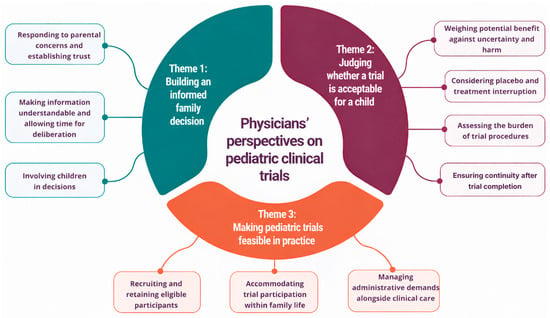
Analysis identified three overarching themes and associated subthemes: (1) building an informed family decision; (2) judging whether a trial is acceptable for a child; and (3) making pediatric trials feasible in practice. These themes encompassed physicians’ accounts of communication with families, children’s involvement in decisions, assessment of potential benefits and risks, and the practical demands of conducting pediatric trials. Figure 1 provides an overview of these themes and their associated subthemes.
Figure 1.
Overview of the three overarching themes and associated subthemes identified through qualitative analysis of interviews with 13 physicians regarding pediatric clinical trials.
3.2. Building an Informed Family Decision
Physicians described family decision-making as a process shaped by parental concerns about investigational treatment, the accessibility of trial information, and opportunities for discussion. Children’s involvement formed a further part of this process, although participants differed in their views on when children should take an active role and how much influence they should have. Three subthemes were identified: responding to parental concerns and establishing trust; making information understandable and allowing time for deliberation; and involving children in decisions. Illustrative quotations are presented in Table 2.
Table 2.
Subthemes and illustrative quotations for “Building an informed family decision.”.
3.2.1. Responding to Parental Concerns and Establishing Trust
Parental uncertainty about the safety of investigational medicines was a recurring concern in physicians’ accounts. Participants reported that parents could interpret trial participation as experimentation on their child, with the terms “trial” or “study” themselves provoking fear. One physician described this concern as particularly apparent when other approved treatments were available.
Physicians’ experiences of these discussions were not uniform. While several described parental anxiety and difficulties obtaining consent, one reported no difficulties when the potential therapeutic benefit was clearly justified (P10). This participant linked willingness to participate to access to treatment unavailable in Bulgaria and to its anticipated advantage over the accepted standard of care.
Suggested approaches to building trust included clear communication about trial objectives, expected benefits, and possible risks, together with information from previous studies. Some participants also emphasized access to results and continued communication after trial completion. These responses linked trust both to the evidence supporting the proposed treatment and to how that evidence was communicated to families.
3.2.2. Making Information Understandable and Allowing Time for Deliberation
Participants identified the volume and complexity of consent information as barriers to understanding. Medical terminology could be difficult for families to interpret, and one physician described the amount of information as discouraging for parents or guardians (P02). Language difficulties were also reported, although their prominence varied: one participant encountered them frequently, whereas another described them as uncommon in their own practice.
Time was a further constraint. Physicians described a need for detailed explanations of treatment options and trial procedures, alongside opportunities for families to consider participation. One participant emphasized that parents sometimes needed to return home and discuss the information before making a decision (P07). Another identified limited clinician time as the principal difficulty in obtaining informed consent.
Proposed improvements included simpler consent materials, explanatory brochures, and visual resources such as presentations and videos. Participants also called for more time to discuss individual concerns. Their accounts therefore addressed both the form of the information provided and the opportunity for families to work through it with the clinical team.
3.2.3. Involving Children in Decisions
Participants supported children’s involvement based on their age and understanding but described different thresholds and levels of participation. Some emphasized the individual child’s capacity to understand without specifying an age. Others proposed age thresholds of 12 or 14 years, while one referred to adolescents aged 16–17 years. These thresholds reflect participants’ personal views on appropriate involvement rather than legal or regulatory requirements, which are considered in the Discussion.
The role envisaged for children also varied. Suggestions ranged from providing understandable explanations in the presence of parents to involving older children on an equal basis with their parents or allowing them a leading role in the decision. One participant expressed a more tentative view, suggesting that children older than 14 years might be able to participate in decision-making.
Physicians described explaining treatment effects and trial procedures in language children could understand. One specifically emphasized preparing children for invasive procedures. A further concern was the possibility that a child might refuse participation while the parents wished to proceed (P07). This response highlighted that reaching a family decision could involve disagreement as well as shared understanding.
3.3. Judging Whether a Trial Is Acceptable for a Child
Physicians assessed trial acceptability in relation to anticipated therapeutic benefit, the evidence supporting the investigational treatment, and possible harm to the child. Their accounts also addressed the use of placebo, the burden of additional procedures, and access to treatment after trial completion. Four subthemes were identified: weighing potential benefit against uncertainty and harm; considering placebo and treatment interruption; assessing the burden of trial procedures; and ensuring continuity after trial completion. Illustrative quotations are presented in Table 3.
Table 3.
Subthemes and illustrative quotations for “Judging whether a trial is acceptable for a child.”
3.3.1. Weighing Potential Benefit Against Uncertainty and Harm
Expected benefit and treatment safety were recurring considerations in physicians’ decisions about involvement in a trial. Participants referred to evidence from previous studies, including studies in adults or children with related conditions, as a basis for assessing whether an investigational treatment was appropriate. Some also considered whether medicine could improve daily life through easier or less frequent administration.
Concerns extended beyond immediate adverse effects to possible consequences for growth and development. One participant emphasized that the developing child could be vulnerable to harm affecting future development, while another highlighted uncertainty about the long-term effects of a new treatment (P05). Physicians cited serious adverse reactions, insufficient evidence of effectiveness, and unjustified risk as reasons for concern or for declining involvement.
The emphasis placed on these considerations varied. Some participants foregrounded therapeutic benefit, whereas others explicitly described the challenge of balancing benefit, risk, and the need to obtain reliable scientific evidence. Their accounts indicated that expected benefit was considered alongside the strength of existing evidence and uncertainty about possible harm. These considerations were also the main factors participants described as influencing their own willingness to act as investigators.
3.3.2. Considering Placebo and Treatment Interruption
Views on placebo differed in scope. One participant identified placebo use as inappropriate when established treatment was available (P11). Another expressed a broader objection to placebo-controlled pediatric trials and considered phase I trials unsuitable for children (P10). A further participant emphasized that a child should not receive placebo alone (P01).
Treatment interruption was raised as a separate concern by the same participant, who identified medication washout periods as an ethical challenge (P01). These responses reflected different reservations about trial designs that could involve withholding or interrupting treatment. They reflected participants’ general perceptions of such designs rather than assessments of specific trial protocols and did not represent a uniform position across the group.
3.3.3. Assessing the Burden of Trial Procedures
Physicians also evaluated acceptability through the additional procedures required by a trial. One participant described blood sampling as occurring more frequently than would be necessary during routine clinical follow-up (P07). Others referred to invasive procedures, repeated hospital visits, and the need to minimize stress and discomfort.
The duration and complexity of procedures were also relevant. One participant specifically called for echocardiography protocols to be adapted to children’s needs, including the time required to complete them. Suggested improvements included simpler procedural guidance and fewer visits or investigations. These accounts extended the assessment of acceptability beyond the medicine itself to the child’s experience of participating in the trial.
3.3.4. Ensuring Continuity After Trial Completion
Three participants considered what happens to children and families after a trial ends (P03, P07, P11). Their accounts emphasized long-term follow-up, feedback on trial results, and continued care by the treating physician. One participant raised a more specific ethical concern: the inability to continue an effective medicine after trial completion, particularly when no equivalent treatment was available (P07). Although expressed by a single participant, this view is reported as a divergent case because it identifies continuity of access as a distinct ethical issue.
3.4. Making Pediatric Trials Feasible in Practice
Physicians described practical constraints affecting the recruitment of eligible children, families’ ability to meet trial requirements, and clinical teams’ capacity to carry out trial activities. Three subthemes were identified: recruiting and retaining eligible participants; accommodating trial participation within family life; and managing administrative demands alongside clinical care. Suggested improvements addressed each of these areas. Illustrative quotations are presented in Table 4.
Table 4.
Subthemes and illustrative quotations for “Making pediatric trials feasible in practice”.
3.4.1. Recruiting and Retaining Eligible Participants
Finding sufficient numbers of suitable patients was a recurring difficulty. Participants referred to small patient populations, rare conditions, and limited numbers of children within individual age groups. One physician identified both recruitment and retention as challenges (P08).
Eligibility criteria further shaped the available participant pool. One participant explained that numerous, highly restrictive criteria could make recruitment difficult (P05), while another identified finding patients who met the inclusion and exclusion criteria as the main obstacle. Proposed improvements included refining participation criteria. At the same time, another physician emphasized that clearly defined criteria were important for safety and the collection of objective clinical data. These accounts reflected the need for criteria that supported the scientific purpose of a trial while remaining workable in clinical practice.
3.4.2. Accommodating Trial Participation Within Family Life
Trial requirements placed demands on families beyond the decision to participate. Physicians described frequent visits, repeated investigations, and tasks such as completing diaries and documenting medication doses, administration times, and other events. One participant identified adherence to these requirements as particularly challenging when families were asked to complete numerous tasks.
Travel to the trial site was another concern. One physician linked hospital-based blood sampling to missed school days for children and time away from work for parents, particularly for families living farther from the hospital (P07). This participant suggested arranging blood tests closer to the child’s home.
Other proposals included reducing the number of visits and offering more flexible schedules. Participants also suggested optimizing the timing of visits and procedures to reduce the burden on families. These recommendations addressed how trial activities could be accommodated within children’s schooling and parents’ work commitments.
3.4.3. Managing Administrative Demands Alongside Clinical Care
Physicians described administrative work as a further constraint on trial delivery. Complex protocols and documentation requirements competed with routine clinical responsibilities and time for communication with families. One participant described the difficulty of simultaneously caring for seriously ill inpatients, completing trial documentation, and remaining sufficiently available to participating children and their parents (P04).
Suggested improvements included dedicated administrative support, simpler protocols, and easier data entry. One physician proposed involving staff specifically responsible for administrative and documentation tasks. Others recommended simplifying electronic data entry (P02) or introducing a unified system. Participants did not discuss financial compensation, career development, or institutional incentives as factors influencing their involvement in trials.
These accounts linked operational support with physicians’ ability to devote time to participants. Administrative assistance was presented as a way to make trial responsibilities more manageable alongside clinical care, and the additional discussions required by families.
4. Discussion
This qualitative study explored physicians’ perspectives on pediatric clinical trials at a tertiary-level university pediatric clinic in Plovdiv, Bulgaria. This setting allowed physicians with clinical trial experience to reflect on the ethical and practical challenges encountered in trial conduct. Their accounts connected informed family decision-making, ethical acceptability, and practical feasibility. Limited time-constrained opportunities for discussion, while additional procedures created discomfort for children and logistical demands for families. Differences in views on children’s roles and acceptable trial designs further indicated variation in professional judgments. These findings suggest that communication, assessment of benefit and risk, and organizational support should be considered together when planning pediatric trials.
Physicians described understandable information and sufficient discussion time as important conditions for informed participation. Drury et al. [31], studying parental decisions in pediatric cardiac surgical research, similarly identified information timing and trust as important influences, while observing that trust could coexist with misunderstandings. Blake et al. [32] reported that multimedia consent supported caregivers’ retention of information, but its noninferiority to conventional consent was not established for adolescents. These findings qualify participants’ suggestions to introduce visual resources: materials that assist parents may not meet children’s needs equally well. Paquette et al. [33] also found that parents and children reported greater parental involvement in research decisions than they preferred. These studies suggest that accessible materials should be accompanied by dialogue that addresses parental concerns and directly engages children. The present accounts highlight the clinician time required to support this process.
Differences in the ages and roles proposed for children warrant distinguishing decision-making capacity from opportunities to influence decisions. Hein et al. [34] found that age predicted competence assessed using the MacArthur Competence Assessment Tool for Clinical Research (MacCAT-CR), with competence probable above 11.2 years in their study population. This finding provides context for participants’ proposed age thresholds, although it establishes neither a universal cutoff nor a legal entitlement to consent. Frost et al. [35], studying a Human Papillomavirus vaccine trial in Tanzania, found that girls wanted greater involvement while generally supporting continued parental participation. Despite contextual differences, these findings suggest that increasing children’s involvement need not imply independent decision-making. In the present study, the possibility of parent–child disagreement further indicates the importance of eliciting children’s preferences and considering how these are addressed within family discussions.
Pediatric clinical trials in Bulgaria, as in other EU Member States, are conducted within a regulatory framework that includes the Paediatric Regulation (EC) No 1901/2006, which requires paediatric investigation plans for new medicines [36], and the Clinical Trials Regulation (EU) No 536/2014 [37]. Their proposed age thresholds should be distinguished from this regulatory framework. Under Regulation (EU) No 536/2014, minors may take part in clinical trials only with the informed consent of their legally designated representative; they must receive information in a way adapted to their age and mental maturity, and the explicit wish of a minor who is capable of forming an opinion to refuse participation or to withdraw must be respected by the investigator (Article 32) [37]. ICH E11(R1) similarly calls for developmentally appropriate assent and attention to a child’s dissent [38]. Against this framework, the scenario of a child refusing while the parents wish to proceed (P07) leaves limited room for discretion: the refusal of a child able to form an opinion should be respected. The variation in participants’ views therefore suggests a need for training on how requirements for assent and dissent apply in practice.
Trial acceptability also depended on anticipated benefit, existing evidence, and uncertainty about harm. Van Hoof et al. [39] found close agreement between pediatric researchers’ risk–benefit assessments and the authors’ protocol assessments, whereas judgments of burden were more subjective. This distinction is relevant to participants’ concerns about both adverse effects and additional procedures. Family perspectives add further complexity. Cousino et al. [40] found substantial understanding of the scientific purpose of pediatric phase I oncology trials in only 32% of interviewed parents. Wakefield et al. [41], examining a different outcome, reported high satisfaction and little regret in a childhood cancer precision medicine trial, even when outcomes did not fulfil participants’ hopes. These oncology findings cannot be directly generalized to the present setting, but they distinguish understanding research from valuing participation. Accordingly, access to promising treatment should be discussed alongside uncertainty about individual benefit, alternatives, and procedural burden.
The view that parents’ willingness depended on access to treatment unavailable in Bulgaria (P10) highlights a context-specific concern. In Central and Eastern Europe, patients frequently cite the hope of health benefit and access to modern therapies as reasons for trial participation [42]. When a trial is the only route to a promising treatment, families’ decisions may be shaped more by the hope of therapeutic benefit than by an understanding of the research purpose, increasing the risk of therapeutic misconception [43] and potentially constraining voluntariness. This concern is linked to the issue of post-trial access raised by another participant (P07); the Declaration of Helsinki requires that provisions for post-trial access be made in advance of a trial [44]. In such settings, consent discussions should explicitly address uncertainty about individual benefit, the possibility of allocation to a control arm, and what will happen when the trial ends.
Reservations about placebo and washout periods illustrate the importance of considering specific design features. Di Pietro et al. [45] questioned placebo use involving withdrawal of treatment effective for the individual child, including off-label treatment. Momper et al. [46], however, documented risk-reduction strategies in pediatric placebo-controlled trials, including continued established therapy and rescue treatment. Millum and Grady [47] likewise argued that methodological justification must be considered alongside the risks of withholding treatment. Taken together, these sources indicate that the acceptability of a placebo-controlled pediatric design depends on whether an effective treatment exists, the scientific justification for the comparator, the expected risks of withholding or delaying treatment, and protocol safeguards such as add-on designs, rescue medication, and early escape [12,46,47]. These perspectives contextualize participants’ differing objections: placebo-controlled participation does not necessarily entail receiving no effective treatment, and acceptability depends on the treatment maintained, exposure duration, and safeguards. Because complete protocols were not examined, the present accounts identify concerns requiring discussion rather than establish the ethical status of particular trials.
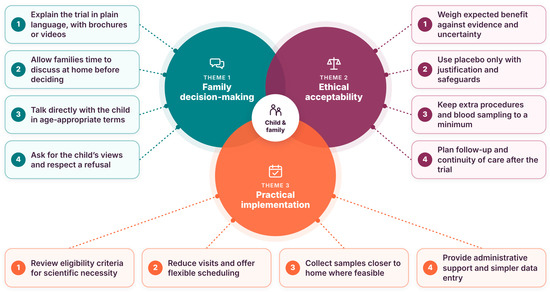
Practical constraints extended these considerations into everyday trial delivery. Participants described limited eligible populations, restrictive criteria, repeated visits, and documentation requirements competing with clinical responsibilities. Greenberg et al. [22] similarly identified barriers involving distance and time for discussions, although their sample also included clinicians without investigator experience. In contrast, Smith et al. [24] reported time constraints less frequently than previous studies, suggesting that organizational priorities may vary between settings. Recruitment difficulties have wider consequences: Pica and Bourgeois [21] identified insufficient patient recruitment as the most frequently reported reason for discontinuation in their sample of pediatric trials. The present findings suggest two groups of measures (Figure 2). Measures to improve families’ understanding include simplified consent materials, visual resources, adequate time for deliberation, and direct discussion with children. Measures to reduce operational burden include reviewing eligibility criteria for scientific necessity, coordinating visits with routine care, collecting samples closer to home where feasible, and providing administrative support and simpler data entry. Such changes should preserve essential safety monitoring. The concern raised by one participant about losing access to beneficial treatment also identifies continuity after trial completion as an issue to address during planning. These proposals require evaluation rather than being assumed to improve recruitment or safety.
Figure 2.
Practical recommendations emerging from the three overarching themes, presented as actionable strategies to support family decision-making, the ethical acceptability of pediatric trials, and their practical implementation.
5. Strengths and Limitations
A strength of this study is its inclusion of physicians with clinical trial experience across several pediatric specialties and its retention of divergent perspectives. The sample was small, drawn from a single university hospital with established trial activity; the findings may therefore not transfer directly to settings with different organizational or regulatory conditions. Sample adequacy was considered in terms of information power rather than data saturation (Section 2.2). Most participants had five years or less of clinical trial experience, and the analysis was led by a single researcher, although the data and interpretation were verified by a second author (Section 2.4). Responses were typed during the interviews and confirmed by participants, but without audio recordings the quotations may not reproduce spoken language exactly. The interview guide was not formally piloted. Parents’ and children’s perspectives were deliberately not included in this study, and actual consent discussions and recruitment outcomes were not assessed. Family perspectives will be examined in a separate study, which may help to establish whether the proposed changes improve understanding and reduce participation burden without compromising scientific validity or participant protection.
6. Conclusions
Physicians’ perspectives highlighted informed family decision-making, benefit–risk assessment, and practical feasibility as interconnected considerations in pediatric clinical trials. Their accounts identified accessible information, developmentally appropriate child involvement, manageable procedural demands, and organizational support as priorities for trial design and delivery. Further research incorporating family perspectives should evaluate approaches addressing these priorities while preserving scientific validity and participant protection.
Supplementary Materials
The following supporting information can be downloaded at: https://www.mdpi.com/article/10.3390/children13111540/s1, Supplementary Material S1: Semi-structured interview guide for physicians (Bulgarian original and English translation); Supplementary Material S2: Standards for Reporting Qualitative Research (SRQR) checklist; Table S1: Mapping of subthemes to the interview questions from which supporting data were drawn.
Author Contributions
Conceptualization, H.S. and R.S.; methodology, H.S., R.S. and D.K.; formal analysis, H.S.; validation, H.S. and R.S.; investigation, H.S.; writing—original draft preparation, H.S.; writing—review and editing, R.S. and D.K.; visualization, H.S.; supervision, R.S. and D.K. All authors have read and agreed to the published version of the manuscript.
Funding
This research received no external funding.
Institutional Review Board Statement
The study was conducted in accordance with the Declaration of Helsinki and approved by the Scientific Ethics Committee of the Medical University of Plovdiv, Bulgaria (Protocol No. 9 dated 23 October 2025; Opinion No. R-KNE-54 dated 10 November 2025).
Informed Consent Statement
Written informed consent was obtained from all participants involved in the study.
Data Availability Statement
The interview data are not publicly available to protect participant confidentiality. Selected anonymized quotations supporting the findings are included in the article.
Acknowledgments
The authors thank the physicians who participated in the interviews for sharing their experiences and perspectives.
Conflicts of Interest
H.S. is employed by CLINECA AD, a site management organization that has supported clinical trials involving some of the study participants. The study was conducted as part of H.S.’s doctoral research at the Medical University of Plovdiv; CLINECA AD did not fund the study and had no role in its design, data collection, analysis, interpretation, or the decision to publish. The remaining authors (R.S. and D. K) declare no conflicts of interest.
Abbreviations
The following abbreviations are used in this manuscript:
| MacCAT-CR | MacArthur Competence Assessment Tool for Clinical Research |
References
- Ward, R.M.; Benjamin, D.K.; Davis, J.M.; Gorman, R.L.; Kauffman, R.; Kearns, G.L.; Murphy, M.D.; Sherwin, C.M.T. The Need for Pediatric Drug Development. J. Pediatr. 2018, 192, 13–21. [Google Scholar] [CrossRef] [Scilit] [PubMed]
- Ward, R.M. Improving Drug Therapy for Pediatric Patients: Unfinished History of Pediatric Drug Development. J. Pediatr. Pharmacol. Ther. 2023, 28, 4–9. [Google Scholar] [CrossRef] [Scilit] [PubMed]
- Sutherland, J.M. Fatal Cardiovascular Collapse of Infants Receiving Large Amounts of Chloramphenicol. Arch. Pediatr. Adolesc. Med. 1959, 97, 761. [Google Scholar] [CrossRef] [Scilit] [PubMed]
- Joseph, P.D.; Craig, J.C.; Caldwell, P.H.Y. Clinical Trials in Children. Br. J. Clin. Pharmacol. 2015, 79, 357–369. [Google Scholar] [CrossRef] [Scilit] [PubMed]
- Thompson, E.J.; Wood, C.T.; Hornik, C.P. Pediatric Pharmacology for the Primary Care Provider: Advances and Limitations. Pediatrics 2024, 154, e2023064158. [Google Scholar] [CrossRef] [Scilit] [PubMed]
- Petkova, V.; Georgieva, D.; Dimitrov, M.; Nikolova, I. Off-Label Prescribing in Pediatric Population—Literature Review for 2012–2022. Pharmaceutics 2023, 15, 2652. [Google Scholar] [CrossRef] [Scilit] [PubMed]
- Mengato, D.; Zanin, A.; Baratiri, F.; Pivato, L.; Camuffo, L.; Benini, F.; Venturini, F. Polypharmacy in Pediatric Palliative Care: Exploring Discrepancies Between Physicians and Pharmacists. Children 2025, 12, 124. [Google Scholar] [CrossRef] [Scilit] [PubMed]
- Almintakh, L.S.; Al Dossary, M.F.; Altesha, A.M.; Alqahtani, R.F.; Alsomali, S.M.; Banu, N.; Ali, M.D.; Ahmed, A. Awareness, Practice and Views of Pediatricians, General Physicians, and Pharmacists about Prescribing Off-Label Medication in Pediatric Patients in Eastern Province, Saudi Arabia. Curr. Pediatr. Rev. 2025, 21, 392–402. [Google Scholar] [CrossRef] [Scilit] [PubMed]
- Carpenter, D.; Gonzalez, D.; Retsch-Bogart, G.; Sleath, B.; Wilfond, B. Methodological and Ethical Issues in Pediatric Medication Safety Research. Pediatrics 2017, 140, e20170195. [Google Scholar] [CrossRef] [Scilit] [PubMed]
- Laventhal, N.; Tarini, B.A.; Lantos, J. Ethical Issues in Neonatal and Pediatric Clinical Trials. Pediatr. Clin. N. Am. 2012, 59, 1205–1220. [Google Scholar] [CrossRef] [Scilit] [PubMed]
- Roth-Cline, M.; Nelson, R.M. Parental Permission and Child Assent in Research on Children. Yale J. Biol. Med. 2013, 86, 291–301. [Google Scholar] [PubMed]
- Parry, G.; Abelian, A.; Williams, C.C.E.; Roberts, L.E.; Athersmith, M.; Oni, L. Placebo in Paediatric Clinical Trials: Systematic Literature Review and Framework-Based Synthesis. J. Paediatr. Child Health 2026, 62, 916–923. [Google Scholar] [CrossRef] [Scilit] [PubMed]
- Woolfall, K.; Shilling, V.; Hickey, H.; Smyth, R.L.; Sowden, E.; Williamson, P.R.; Young, B. Parents’ Agendas in Paediatric Clinical Trial Recruitment Are Different from Researchers’ and Often Remain Unvoiced: A Qualitative Study. PLoS ONE 2013, 8, e67352. [Google Scholar] [CrossRef] [Scilit] [PubMed]
- Madden, L.; Shilling, V.; Woolfall, K.; Sowden, E.; Smyth, R.L.; Williamson, P.R.; Young, B. Questioning Assent: How Are Children’s Views Included as Families Make Decisions about Clinical Trials? Child Care Health Dev. 2016, 42, 900–908. [Google Scholar] [CrossRef] [Scilit] [PubMed]
- Poston, R.D. Assent Described: Exploring Perspectives From the Inside. J. Pediatr. Nurs. 2016, 31, e353–e365. [Google Scholar] [CrossRef] [Scilit] [PubMed]
- Tait, A.R.; Voepel-Lewis, T.; Levine, R. Using Digital Multimedia to Improve Parents’ and Children’s Understanding of Clinical Trials. Arch. Dis. Child. 2015, 100, 589–593. [Google Scholar] [CrossRef] [Scilit] [PubMed]
- Bencheva, V.; Mann, N.-K.; Rombey, T.; Pieper, D.; Schmiedl, S. Barriers and Facilitators to Enrollment in Pediatric Clinical Trials: An Overview of Systematic Reviews. Syst. Rev. 2024, 13, 283. [Google Scholar] [CrossRef] [Scilit] [PubMed]
- Beasant, L.; Brigden, A.; Parslow, R.M.; Apperley, H.; Keep, T.; Northam, A.; Wray, C.; King, H.; Langdon, R.; Mills, N.; et al. Treatment Preference and Recruitment to Pediatric RCTs: A Systematic Review. Contemp. Clin. Trials Commun. 2019, 14, 100335. [Google Scholar] [CrossRef] [Scilit] [PubMed]
- Peay, H.L.; Biesecker, B.B.; Wilfond, B.S.; Jarecki, J.; Umstead, K.L.; Escolar, D.M.; Tibben, A. Barriers and Facilitators to Clinical Trial Participation among Parents of Children with Pediatric Neuromuscular Disorders. Clin. Trials 2018, 15, 139–148. [Google Scholar] [CrossRef] [Scilit] [PubMed]
- Watson, S.E.; Smith, P.; Snowden, J.; Vaughn, V.; Cottrell, L.; Madden, C.A.; Kong, A.S.; McCulloh, R.; Stack Lim, C.; Bledsoe, M.; et al. Facilitators and Barriers to Pediatric Clinical Trial Recruitment and Retention in Rural and Community Settings: A Scoping Review of the Literature. Clin. Transl. Sci. 2022, 15, 838–853. [Google Scholar] [CrossRef] [Scilit] [PubMed]
- Pica, N.; Bourgeois, F. Discontinuation and Nonpublication of Randomized Clinical Trials Conducted in Children. Pediatrics 2016, 138, e20160223. [Google Scholar] [CrossRef] [Scilit] [PubMed]
- Greenberg, R.G.; Corneli, A.; Bradley, J.; Farley, J.; Jafri, H.S.; Lin, L.; Nambiar, S.; Noel, G.J.; Wheeler, C.; Tiernan, R.; et al. Perceived Barriers to Pediatrician and Family Practitioner Participation in Pediatric Clinical Trials: Findings from the Clinical Trials Transformation Initiative. Contemp. Clin. Trials Commun. 2018, 9, 7–12. [Google Scholar] [CrossRef] [Scilit] [PubMed]
- Yap, T.Y.; Yamokoski, A.D.; Hizlan, S.; Zyzanski, S.J.; Angiolillo, A.L.; Rheingold, S.R.; Baker, J.N.; Kodish, E.D. Informed Consent for Pediatric Phase 1 Cancer Trials: Physicians’ Perspectives. Cancer 2010, 116, 3244–3250. [Google Scholar] [CrossRef] [Scilit] [PubMed]
- Smith, T.R.; McCulloh, R.; Bui, M.-T.; Sollo, N.; Ahlers-Schmidt, C.; Dedeaux, J.; Davis, A. Perceived Barriers to Pediatric Clinical Trials Implementation: A Survey of Health Care Staff. Kans. J. Med. 2022, 15, 189–193. [Google Scholar] [CrossRef] [Scilit] [PubMed]
- Tozzi, A.E.; Croci, I.; Pignata, C.; Agostiniani, R.; Moschese, V.; the Italian Society of Pediatric Research (SIRP) Council. Perceptions of Challenges in Clinical Pediatric Research: A Survey of Italian Pediatricians. Ital. J. Pediatr. 2026, 52, 129. [Google Scholar] [CrossRef] [Scilit] [PubMed]
- Malterud, K.; Siersma, V.D.; Guassora, A.D. Sample Size in Qualitative Interview Studies: Guided by Information Power. Qual. Health Res. 2016, 26, 1753–1760. [Google Scholar] [CrossRef] [Scilit] [PubMed]
- O’Brien, B.C.; Harris, I.B.; Beckman, T.J.; Reed, D.A.; Cook, D.A. Standards for Reporting Qualitative Research: A Synthesis of Recommendations. Acad. Med. 2014, 89, 1245–1251. [Google Scholar] [CrossRef] [Scilit] [PubMed]
- Braun, V.; Clarke, V. Reflecting on Reflexive Thematic Analysis. Qual. Res. Sport Exerc. Health 2019, 11, 589–597. [Google Scholar] [CrossRef] [Scilit]
- Braun, V.; Clarke, V. Using Thematic Analysis in Psychology. Qual. Res. Psychol. 2006, 3, 77–101. [Google Scholar] [CrossRef] [Scilit]
- Braun, V.; Clarke, V. To Saturate or Not to Saturate? Questioning Data Saturation as a Useful Concept for Thematic Analysis and Sample-Size Rationales. Qual. Res. Sport Exerc. Health 2021, 13, 201–216. [Google Scholar] [CrossRef] [Scilit]
- Drury, N.E.; Menzies, J.C.; Taylor, C.J.; Jones, T.J.; Lavis, A.C. Understanding Parents’ Decision-Making on Participation in Clinical Trials in Children’s Heart Surgery: A Qualitative Study. BMJ Open 2021, 11, e044896. [Google Scholar] [CrossRef] [Scilit] [PubMed]
- Blake, K.V.; Antal, H.; Bunnell, H.T.; He, J.; Henderson, R.; Holbrook, J.T.; McCahan, S.M.; Pennington, C.; Rogers, L.; Shade, D.; et al. Comprehension by Caregivers and Adolescents of Clinical Trial Information Delivered via Multimedia Video Versus Conventional Practice: Nonrandomized Controlled Trial. JMIR Pediatr. Parent. 2023, 6, e44252. [Google Scholar] [CrossRef] [Scilit] [PubMed]
- Paquette, E.T.; Palac, H.; Bair, E.; Schultz, B.; Stenquist, N.; Joffe, S.; Shukla, A. The Importance of Engaging Children in Research Decision-Making: A Preliminary Mixed-Methods Study. Ethics Hum. Res. 2020, 42, 12–20. [Google Scholar] [CrossRef] [Scilit] [PubMed]
- Hein, I.M.; Troost, P.W.; Lindeboom, R.; Benninga, M.A.; Zwaan, C.M.; Van Goudoever, J.B.; Lindauer, R.J.L. Accuracy of the MacArthur Competence Assessment Tool for Clinical Research (MacCAT-CR) for Measuring Children’s Competence to Consent to Clinical Research. JAMA Pediatr. 2014, 168, 1147. [Google Scholar] [CrossRef] [Scilit] [PubMed]
- Frost, L.; Erio, M.T.; Whitworth, H.; Marwerwe, M.G.; Hayes, R.; Baisley, K.; De SanJosé, S.; Watson-Jones, D.; Mitchell, K. Ethical Issues in Vaccine Trial Participation by Adolescents: Qualitative Insights on Family Decision Making from a Human Papillomavirus Vaccine Trial in Tanzania. BMC Med. Ethics 2024, 25, 134. [Google Scholar] [CrossRef] [Scilit] [PubMed]
- European Parliament and Council of the European Union. Regulation (EC) No 1901/2006 of the European Parliament and of the Council of 12 December 2006 on Medicinal Products for Paediatric Use and Amending Regulation (EEC) No 1768/92, Directive 2001/20/EC, Directive 2001/83/EC and Regulation (EC) No 726/2004. Off. J. Eur. Union 2006, L378, 1–19. [Google Scholar]
- European Parliament and Council of the European Union. Regulation (EU) No 536/2014 of the European Parliament and of the Council of 16 April 2014 on Clinical Trials on Medicinal Products for Human Use, and Repealing Directive 2001/20/EC. Off. J. Eur. Union 2014, L158, 1–76. [Google Scholar]
- ICH E11(R1); Guideline on Clinical Investigation of Medicinal Products in the Pediatric Population. International Council for Harmonisation: Geneva, Switzerland, 2017.
- Van Hoof, W.; Meesters, K.; Dossche, L.; Christiaens, D.; De Bruyne, P.; Vande Walle, J. Ethical Considerations of Researchers Conducting Pediatric Clinical Drug Trials: A Qualitative Survey in Two Belgian University Children’s Hospitals. Eur. J. Pediatr. 2018, 177, 1003–1008. [Google Scholar] [CrossRef] [Scilit] [PubMed]
- Cousino, M.K.; Zyzanski, S.J.; Yamokoski, A.D.; Hazen, R.A.; Baker, J.N.; Noll, R.B.; Rheingold, S.R.; Geyer, J.R.; Alexander, S.C.; Drotar, D.; et al. Communicating and Understanding the Purpose of Pediatric Phase I Cancer Trials. J. Clin. Oncol. 2012, 30, 4367–4372. [Google Scholar] [CrossRef] [Scilit] [PubMed][Green Version]
- Wakefield, C.E.; Hetherington, K.; Robertson, E.G.; Donoghoe, M.W.; Hunter, J.D.; Vetsch, J.; Marron, J.M.; Tucker, K.M.; Marshall, G.M.; Broom, A.; et al. Hopes, Concerns, Satisfaction and Regret in a Precision Medicine Trial for Childhood Cancer: A Mixed-Methods Study of Parent and Patient Perspectives. Br. J. Cancer 2023, 129, 1634–1644. [Google Scholar] [CrossRef] [Scilit] [PubMed]
- Kozakiewicz, A.; Mazur, J.; Szkultecka-Dębek, M.; Białorudzki, M.; Izdebski, Z. Public Perception of Clinical Trials and Its Predictors Among Polish Adults. J. Clin. Med. 2025, 14, 3279. [Google Scholar] [CrossRef] [Scilit] [PubMed]
- Appelbaum, P.S.; Roth, L.H.; Lidz, C. The Therapeutic Misconception: Informed Consent in Psychiatric Research. Int. J. Law Psychiatry 1982, 5, 319–329. [Google Scholar] [CrossRef] [Scilit] [PubMed]
- World Medical Association. World Medical Association Declaration of Helsinki: Ethical Principles for Medical Research Involving Human Participants. JAMA 2025, 333, 71. [Google Scholar] [CrossRef] [Scilit] [PubMed]
- Di Pietro, M.L.; Cutrera, R.; Teleman, A.A.; Barbaccia, M.L. Placebo-Controlled Trials in Pediatrics and the Child’s Best Interest. Ital. J. Pediatr. 2015, 41, 11. [Google Scholar] [CrossRef] [Scilit] [PubMed]
- Momper, J.D.; Green, D.J.; Park, K.; Burckart, G.J.; Snyder, D.L. Ethical Considerations for Pediatric Placebo-Controlled Trials: FDA Outcomes and Perspectives. Ther. Innov. Regul. Sci. 2021, 55, 282–303. [Google Scholar] [CrossRef] [Scilit] [PubMed]
- Millum, J.; Grady, C. The Ethics of Placebo-Controlled Trials: Methodological Justifications. Contemp. Clin. Trials 2013, 36, 510–514. [Google Scholar] [CrossRef] [Scilit] [PubMed]

Disclaimer/Publisher’s Note: The statements, opinions and data contained in all publications are solely those of the individual author(s) and contributor(s) and not of MDPI and/or the editor(s). MDPI and/or the editor(s) disclaim responsibility for any injury to people or property resulting from any ideas, methods, instructions or products referred to in the content. |
© 2026 by the authors. Licensee MDPI, Basel, Switzerland. This article is an open access article distributed under the terms and conditions of the Creative Commons Attribution (CC BY) license.