


Highlights
What are the main findings?
- Emotion recognition moderates the association between self-esteem and indirect aggression in girls.
- Higher self-esteem was associated with greater indirect aggression only among girls with lower emotion recognition skills.
What are the implications of the main findings?
- The interaction was specific to indirect aggression; no significant effects were found for physical or verbal aggression.
- Assessing self-esteem alongside emotion recognition may help identify socioemotional patterns associated with indirect aggression in school settings.
Abstract
Background/Objectives: Indirect aggression is a common yet often difficult-to-detect form of maladjustment in elementary school settings, particularly among girls. The present study examined whether self-esteem and emotion recognition jointly predict indirect aggression in middle childhood. Methods: Participants were 139 third-grade students (59 girls, 80 boys) from four elementary schools in Spain. Aggressive behavior was assessed using a peer-estimated rating scale, self-esteem was measured through a standardized self-report instrument, and emotion decoding was evaluated using a child version of the Eyes Test. Results: Regression analyses, conducted separately by sex, revealed a significant interaction between self-esteem and emotion decoding in girls. Specifically, high self-esteem was associated with higher levels of indirect aggression when emotion decoding was low. No significant interaction effects were found for boys or for physical and verbal aggression. Conclusions: Findings suggest that positive self-views may not uniformly function as protective factors, and that limited socioemotional decoding skills may increase vulnerability to relationally aggressive behavior. Results underscore the importance of multidimensional social–emotional assessment in school settings and highlight the need to consider both self-evaluative and emotion decoding competencies when identifying students at risk for indirect aggression.
1. Introduction
Aggressive behavior has been studied from various perspectives, including the evolutionary perspective [1,2]. From this viewpoint, aggressive behavior is considered adaptive or a result of adaptive strategies shaped by natural selection [1], as it serves as a tool for ensuring individual survival and promoting biological effectiveness [3]. However, when expressed in an inappropriate context, this behavior can become maladaptive, potentially leading to serious physical and social problems [4].
In this sense, aggression is a very important phenomenon in both animal and human life that has been difficult to define. One of the most significant definitions suggests that aggressive behavior can aim to hurt or harm another person [5], or it can be an instrument to obtain resources [6], and it can vary in its mode of expression. Thus, we can define aggression as physical, verbal, or indirect. Indeed, most definitions emphasize that it is a multidimensional and heterogeneous behavior, involving many physical, emotional, cognitive, and social factors [7,8].
At the cognitive-emotional level, empathy and self-esteem have been two constructs extensively studied in relation to aggressive behavior. On the one hand, empathy is a multidimensional mental process composed of cognitive and affective aspects [9]. In this sense, Goleman [10] defines cognitive empathy as the ability to understand how a person feels and what they may be thinking. This mental process is related to the theory of mind and the ability to process social information [11]. Affective empathy refers to the ability to take on board the emotional states of others. The proper functioning of both aspects would lead a person to act adequately and appropriately, resulting in what has been defined as compassionate empathy.
Empathic ability is one of the neurocognitive processes most closely related to aggression. Much research has examined the inhibitory role of empathy on maladaptive aggressive behavior. In a recent review, Blair [12] argues that there are three empathic processes that reduce the likelihood of aggression: (a) Empathic reactions to the suffering of others inhibit aggression; (b) Empathic learning about actions that harm others leads to these actions acquiring a negative value and being avoided; and (c) Empathy involves making decisions about actions that have a negative value due to their association with the suffering of others. Moreover, empathic individuals are known to engage in more prosocial behavior [13] and significantly high levels of empathy protect against bullying behaviors [14].
Within cognitive empathy, social information processing skills, particularly information decoding (such as facial emotion decoding), have been linked to the development of antisocial behavior [15]. In this regard, the study of psychopathy offers substantial evidence. Young people and adults with psychopathic traits tend to engage in aggressive or violent acts and show deficits in recognizing emotional expressions, particularly those of fear, sadness, and anger [12,16]. These findings suggest that a deficit in empathy, especially related to the ability to recognize another person’s emotions, may be associated with an increase in aggressive behavior.
Furthermore, it is important to note that empathy shows significant sex differences in favor of females [17], with girls demonstrating a stronger tendency to identify emotions and understand others’ thoughts, as well as to respond more appropriately [18,19].
On the other hand, self-esteem is defined as one’s subjective appraisal of oneself [20], and until recently, developing high self-esteem has traditionally been viewed as desirable, positive, and correct. That is something to encourage. It has been considered an important indicator of proper psychological functioning [21], which is not differentiated by sex [22]. However, the theoretical review concludes that the relationship between self-esteem and aggressive behavior is ambiguous, as there are controversial data that yield inconsistent results [22].
There is evidence to support the idea that low self-esteem may be related to various problem behaviors, such as aggressive behavior [22], particularly direct aggressive behavior [23] and maladaptive behavior [24]. Nonetheless, there is growing empirical evidence showing that high self-esteem is associated with higher levels of aggression and problem behavior [22]. This duality of self-esteem may be due to the type of aggression analyzed. In the study by Castro-Sánchez et al. [23], they found that self-esteem was negatively related to explicit aggressive behavior, while a positive relationship was observed with more relational or indirect aggression.
Regarding the possible relationship between empathy and self-esteem in explaining aggressive behavior, it is true that although previous research has separately examined the links between self-esteem, emotion recognition, and behavioral problems [25], the potential interactive effects of these variables on specific subtypes of aggression have not been previously investigated. Therefore, very little is known about the relationship between self-esteem and empathy, and even less in relation to explaining aggressive behavior. However, existing research suggests that the relationship between these two cognitive-emotional variables may be asymmetrical [26]. In relation to aggressive behavior, Wells et al. [25] found that children’s behavioral problems are associated with low self-esteem and a reduced ability to recognize emotions. It is important to emphasize that they did not address the potential interactive effects that these variables may have on aggressive behavior. Furthermore, given the documented sex differences in aggressive behavior, it is important to investigate whether the interplay between self-esteem and emotion recognition in relation to specific aggression subtypes also varies by sex.
In light of the above, the present study aims to investigate the possible interactive effects of self-esteem and emotion decoding in explaining aggressive behavior in 8-year-old boys and girls. Based on the existing literature, we expect to find an asymmetrical interaction between self-esteem and emotion decoding that explains aggressive behavior. Special attention will be paid to the possible influence of sex on these relationships.
2. Materials and Methods
2.1. Participants
A convenience sample of third-grade students was recruited from four elementary schools in San Sebastián, Spain. A total of 158 students (70 girls and 88 boys), all aged 8 years, participated in the study. The selection of this specific age group (8 years old/third grade) is methodologically and developmentally justified for two main reasons. First, children at this developmental stage have acquired the necessary reading proficiency, linguistic competence, and cognitive maturity required to accurately comprehend and respond to standardized self-report instruments (such as the self-esteem questionnaire). Second, from a developmental prevention perspective, middle childhood represents a critical window of opportunity. As highlighted by foundational longitudinal research [27], identifying early cognitive-emotional precursors of maladaptive behaviors prior to the onset of early adolescence is vital, as early intervention during middle childhood is significantly more effective for disrupting the stabilization of relational and indirect aggression patterns before they solidify into persistent life-course trajectories.
Participation required both parental informed consent and student assent, which were obtained for all included participants. Inclusion criteria required children to be enrolled in the third grade, aged approximately eight years, and to have provided both parental informed consent and personal assent. Exclusion criteria included incomplete questionnaire data across the main study measures. Of the initial sample, 139 participants provided complete data for aggressive behavior, self-esteem and emotion decoding; therefore, 19 were excluded due to missing data across variables.
Of the participating schools, three were public, and one was semi-private. Although individual family socioeconomic status (SES) was not directly assessed through questionnaires, the schools are located in districts characterized by a predominantly medium to medium-high socioeconomic level, based on community and school demographic profiles. The study protocol was approved by the Ethics Committee of the University of the Basque Country and was conducted in accordance with applicable national regulations.
2.2. Measurements
Aggressive behavior was assessed using the Spanish version of the Direct and Indirect Aggression Scale (DIAS) [28]. This instrument is a peer-estimated scale and consists of 24 items on a 5-point Likert scale (“never,” “seldom,” “sometimes,” “quite often,” and “very often”), measuring physical, verbal, and indirect aggression. This paired-comparison task involved children evaluating only classmates of their own sex, reflecting the sex-segregated peer interactions typical of middle childhood.
A total of 9 classrooms across 4 participating schools were included: School 1 (1 classroom; 6 female and 8 male raters), School 2 (2 classrooms: A with 7 female and 11 male raters; B with 8 female and 9 male raters), School 3 (2 classrooms: A with 4 female and 8 male raters; B with 4 female and 6 male raters), and School 4 (4 classrooms: A with 8 female and 13 male raters; B with 11 female and 8 male raters; C with 5 female and 10 male raters; D with 9 female and 8 male raters). Individual scores for physical, verbal, and indirect aggression were calculated as the mean score received from all participating same-sex classmates, naturally adjusting for variations in class size.
The reliability coefficients obtained in our sample were α = 0.896 for physical aggression, α = 0.831 for verbal aggression, and α = 0.937 for indirect aggression.
Self-esteem was measured using the Assessment of Self-Esteem in Primary Education Questionnaire (A-EP), developed by Ramos et al. [29] for Spanish primary schoolers and published in 2006 by TEA Ediciones (Madrid, Spain). The test consists of 17 questions accompanied by color illustrations, with three response options (“Yes,” “No,” and “Sometimes,”) to obtain a total score reflecting the children’s global self-esteem level (total range between 0 and 34). The reliability coefficient for our sample was α = 0.70, which is considered an acceptable score according to different authors [30,31].
The Eyes Test—Child Version [32] was used to measure children’s ability to recognize emotions. The test consists of 28 photographs showing the eye region of various individuals, each accompanied by four emotional word options (one target emotion and three foil mental states). The standard four-option response choices were translated into Spanish following the standardized glossary guidelines. A trained researcher showed the image and read the words aloud. Children selected the word that best describes the emotional state of the person in each photograph. Correct responses were scored as 1 and incorrect ones as 0, yielding a total score ranging from 0 to 28.
2.3. Procedure
Prior to data collection, families were required to complete an informed consent form granting permission for their children to participate in the study and complete the specified questionnaires. The study also received formal approval from the ethics committee (CEISH/19/2010/SanchezMartin) to ensure adherence to ethical research standards.
Once consent was obtained, data collection sessions were scheduled in coordination with the academic calendars of the participating schools which was done in 2010. Every test was administered on separate days. All assessments were administered at 9:00 AM by qualified researchers to maintain consistency and reliability across testing conditions. Both the DIAS and the A-EP were administered collectively in children’s classrooms. The Eyes Test—Child Version was performed individually, ensuring understanding of the terms.
2.4. Data Analyses
First, one-way analyses of variance (ANOVAs) were conducted to examine sex differences in the study variables. Pearson’s correlation analyses were then performed separately for boys and girls to examine associations among the variables. These analyses were conducted using the original, untransformed scores.
Prior to the regression analyses, the variables included in the models were standardized using Z-scores to place them on a common metric. Subsequently, to address non-normality, these standardized variables were transformed using Blom’s rank-based inverse normal transformation. Consequently, all regression coefficients and interaction terms should be interpreted in terms of standard deviation units of a normal-scores distribution, reflecting relative standing rather than raw measurement units. Regression analyses were conducted separately for boys and girls to examine the associations of self-esteem and emotion decoding with physical, verbal, and indirect aggression. Although statistically significant sex differences in the present sample were limited to physical aggression, the analyses were stratified by sex based on previous research highlighting potential sex differences in the psychosocial and relational correlates of aggressive behavior [33,34] given that it has been stated that it could be explained by different underlying mechanisms [35]. All variables included in the regression models were continuous. Interaction terms were calculated as the product of the final transformed self-esteem and emotion-decoding variables entered into each model, and Bonferroni correction was applied.
Moderation analyses were conducted for all regression models using PROCESS macro Model 1, as described by Hayes [36], to examine whether emotion decoding moderated the association between self-esteem and each type of aggressive behavior. When a statistically significant interaction was identified, the Johnson–Neyman technique was used to determine the values of emotion decoding at which the conditional association between self-esteem and aggressive behavior became statistically significant. These values were interpreted on the transformed scale. All analyses were performed using IBM SPSS Statistics, version 25.0 (Armonk, NY, USA).
3. Results
3.1. Preliminary Analyses
3.1.1. Descriptive Statistics and Sex Differences
Means and standard deviations for all study variables are presented in Table 1. Independent-samples one-way ANOVAs were conducted to examine sex differences. Boys reported significantly higher levels of physical aggression than girls, F(1, 137) = 7.84, p = 0.006, d = 0.49. No significant sex differences were found for verbal aggression, indirect aggression, self-esteem, or emotion decoding.
Table 1.
Descriptive statistics and analyses of variance.
Given prior evidence indicating sex differences in relational aggression [33,34], subsequent analyses were conducted separately for boys and girls.
3.1.2. Correlations
Pearson correlations among study variables are shown in Table 2. All aggression dimensions were significantly intercorrelated in both boys and girls. Among boys, physical aggression was negatively correlated with both self-esteem and emotion decoding, whereas self-esteem and emotion decoding were positively correlated. In contrast, among girls, no significant bivariate correlations were found between any aggression dimension and either self-esteem or emotion decoding.
Table 2.
Correlations between study variables (boys below and girls above).
3.2. Primary Analyses
3.2.1. Regression Models Predicting Aggressive Behavior
To test the primary hypothesis, regression analyses were conducted separately by sex to examine the effects of self-esteem, emotion decoding, and their interaction on physical, verbal, and indirect aggression (Table 3). All predictors were standardized prior to analysis.
Table 3.
Moderating role of emotion decoding in the association between self-esteem and types of aggression (physical, verbal, and indirect) by sex.
For boys, none of the interaction terms reached statistical significance across the three types of aggression. For girls, the interaction between self-esteem and emotion decoding significantly predicted indirect aggression, B = −0.36, SE = 0.13, t = −2.76, p = 0.008, accounting for an additional 12.1% of the variance (R2 = 0.121). Although the overall regression model did not reach statistical significance, R2 = 0.127, F(3, 55) = 2.66, p = 0.057, the interaction effect remained significant after applying a Bonferroni correction for the three aggression outcomes (adjusted α = 0.0167). Neither self-esteem nor emotion decoding showed a significant main effect in this model (both ps > 0.43). The interaction was also significant in the model predicting physical aggression, B = −0.28, SE = 0.13, t = −2.15, p = 0.036, but did not remain significant after Bonferroni correction. For verbal aggression, the interaction did not reach statistical significance, B = −0.27, SE = 0.14, t = −1.96, p = 0.055. Thus, after correction for multiple testing, the interaction effect was statistically significant only for indirect aggression in girls.
3.2.2. Interaction Effects
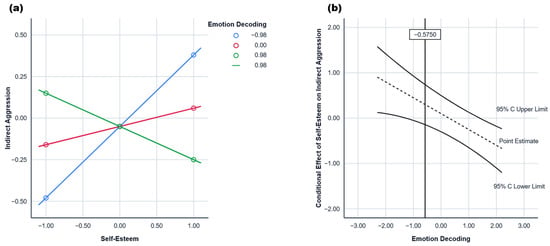
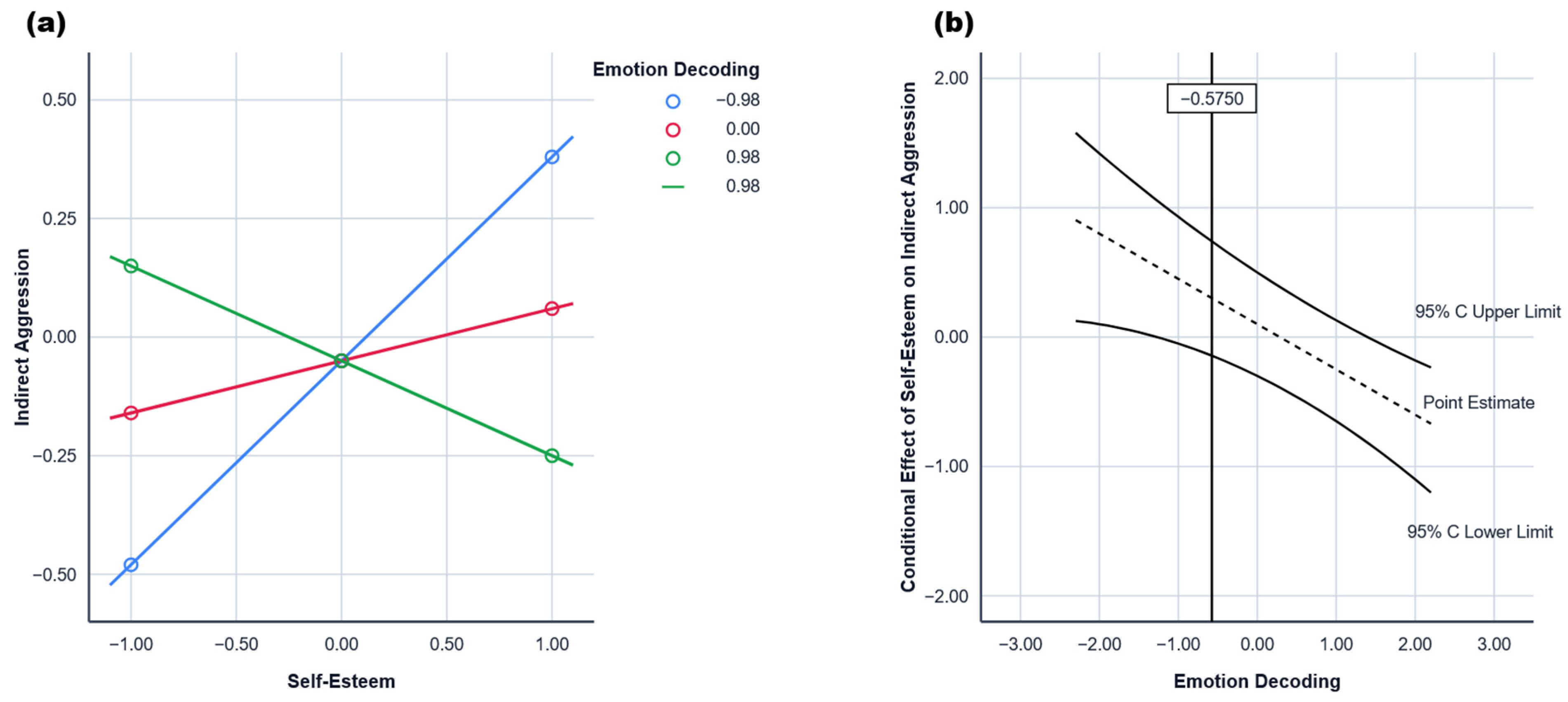
To probe the significant interaction for girls’ indirect aggression, simple slope analyses were conducted using the Johnson–Neyman technique. Results indicated that the conditional effect of self-esteem on indirect aggression was statistically significant at low levels of emotion decoding (values below −0.58 SD from the mean). Specifically, among girls with relatively low emotion decoding abilities, higher self-esteem was associated with higher levels of indirect aggression.
At average and high levels of emotion decoding, self-esteem was not significantly associated with indirect aggression. Figure 1 illustrates the interaction pattern and conditional effects.
Figure 1.
(a) Simple moderation plot showing predicted indirect aggression across levels of self-esteem and emotion decoding were blue line represents low levels of emotion decoding, red line medium levels of emotional decoding and green line high emotional deoding. (b) Johnson–Neyman floodlight plot showing the conditional effect of self-esteem on indirect aggression across levels of emotion decoding.
4. Discussion
The main objective of this paper was to examine the potential interactive effects of emotion decoding and self-esteem in explaining different types of aggressive behavior in boys and girls. Our findings indicate that, in girls, high levels of self-esteem coupled with low levels of emotion decoding corresponded to higher levels of indirect aggression. This result is particularly intriguing, as it reveals a conditional interaction between self-esteem and emotion decoding, demonstrating that high self-esteem acts as a risk factor for indirect aggression specifically when emotion decoding abilities are low. While Talaifar et al. [26] focused on interpersonal asymmetries in mutual understanding, noting that individuals with lower perceived status or self-evaluation often understand others differently than they are understood, our findings align with the broader premise that discrepancies or imbalances in social-cognitive processing can shape interpersonal behavior.
The significance of this result lies in the fact that, to date, this study is the only one to consider the interactive nature of these two psychological variables in explaining aggressive behavior. As discussed in the introduction, the negative relationship between empathy and aggressive behavior is well established [12,14]. However, a theoretical review reveals that the relationship between self-esteem and aggressive behavior is ambiguous, with conflicting data producing inconsistent findings [22]. Studies have shown that both low and high self-esteem can be associated with high levels of aggressive behavior. This ambiguity may arise because the self-esteem–aggression relationship could depend on the type of aggression measured and may be influenced by other variables or psychological processes, such as the ability to recognize emotions in others.
Regarding the type of aggression, our findings align with studies that have identified a positive relationship between self-esteem and relational (or indirect) aggression [23]. However, as Ostrowsky [22] suggests, a more nuanced understanding of the self-esteem–aggression relationship would benefit from differentiating between proactive and reactive aggression. In our study, we observed that the high self-esteem–low emotional decoding interaction predicted higher levels of indirect aggression in girls. As indirect aggression is characterized by being covert and socially mediated, requiring socioemotional planning and strategic planning of social information [25], it shares characteristics with instrumental or strategic behaviors which is the definition of instrumental aggression [7]. Therefore, although our study did not measure this functional classification of aggression and indirect aggression cannot be used as a proxy, this result may be the closest measure in this research to proactive aggression.
Some studies have found a direct relationship between low self-esteem and aggression [22,25], supporting the idea that individuals who feel inferior or undervalued may be more prone to attacking or hurting others. Yet, as Ostrowsky [22] proposes, understanding the link between high self-esteem and aggressive behavior might require considering other related psychological processes. Emotion decoding could be a critical factor. High self-esteem, particularly when it involves a narcissistic component, may lead to aggressive behavior when the individual’s self-image is threatened [37]. Thus, low emotional decoding appears essential for understanding the connection between high self-esteem and aggression. Recognizing emotions through facial expressions is crucial for social functioning; indeed, a reduced capacity for emotion decoding has been linked to aggressive behavior [38] and antisocial behavior in children [15,35]. Similarly, Bohnert et al. [39] found that children who struggled to discern and understand others’ emotions, as well as their own, scored higher in aggressive behavior.
An important finding of this paper is that the results were observed only in girls. This is particularly interesting given that previous studies have indicated that girls tend to use relational or indirect aggression more than other types of aggression [33,34], and that they are generally more empathetic than boys [17] and even better at decoding emotions [40]. Thus, this result warrants attention.
Emotion decoding is a crucial aspect of emotional development and socialization [41], and this may be even more pronounced in girls, as socialization agents often promote traditionally feminine behaviors such as shyness, empathy, and prosocial behavior [42]. It follows that girls who struggle to decode facial expressions may encounter socialization challenges. When combined with high self-esteem, difficulties in emotion decoding may lead to misinterpretations of social situations and interactions, threatening their social image and, consequently, their social inclusion. This could make them more likely to engage in indirect aggression, which allows them to maintain their reputation while avoiding the risks associated with direct aggression.
This study is the first to analyze the interactive effect of self-esteem and emotion decoding in explaining aggressive behavior among 8-year-old boys and girls. The findings underscore the importance of considering these variables together to better address aggressive behavior in children. Additionally, the data illuminate the ambiguous relationship found in the literature between self-esteem and aggression, suggesting that high self-esteem may lead to behavioral problems when coupled with difficulties in emotion decoding, which can be interpreted as low cognitive empathy. This impairment in facial emotion decoding can be interpreted as a core limitation in cognitive empathy, as it has been stated that the ability to identify mental and emotional states is a fundamental prerequisite for the theory of mind mechanism and social perspective-taking [10].
Thus, the findings from this research open new avenues for studying aggression by contemplating the interactive nature of various cognitive-emotional processes such as emotion decoding and self-esteem, an aspect that has not been previously addressed in the literature.
However, our study has certain limitations that are important to acknowledge. First, given the cross-sectional design of the study, causality or directionality cannot be inferred. Second, the sample is moderately sized and not representative of the broader population, given that it was very homogeneous in terms of socioeconomic status, age, and other demographic factors that could influence the study variables, and that possible confounding variables have not been considered. Related to this, individual socioeconomic status was not directly measured at the family level; rather, it was inferred from the demographic and community characteristics of the participating schools, restricting our ability to control for individual-level economic variance. Third, the aggression scores are relatively low since the sample was drawn from a normative population rather than a clinical one. Increasing the sample size and its heterogeneity would allow us to examine potential sex differences, while also addressing these limitations and yielding more stable and precise estimates. This would help determine whether the observed findings are specific to girls and reflect genuine sex differences, or whether the lack of significant findings among boys may be attributable to the characteristics and limitations of the present study. This is important considering that the variance explained in aggressive behavior is not excessively high. Aggressive behavior is multifactorial, and the fact that only psychological variables were considered may explain the modest variance explained in this study. Future research would benefit from including social and biological factors [43]. Furthermore, as Kirkpatrick and Ellis [44] highlighted, different domains of self-esteem should be assessed to better understand the inconsistent and sometimes contradictory results reported in prior research. Finally, although the response options of the Children’s Eyes Test were read aloud to try to minimize reading and comprehension demands, vocabulary and cognitive skills were not assessed. Additionally, sample-specific reliability estimates for the Children’s Eyes Test were unavailable; therefore, the lack of sample-specific internal consistency metrics should be acknowledged when interpreting the precision of these scores. Future studies should incorporate measures to control potential confoundings and prioritize longitudinal, prospective replication.
5. Conclusions
This study contributes to the literature by identifying an interactive socioemotional pattern associated with indirect aggression in elementary school girls. Findings suggest that high self-esteem may not uniformly protect against relational aggression, and that emotion decoding abilities play a moderating role in shaping behavioral outcomes. Future research adopting multidimensional and prospective frameworks will be essential to further clarify how self-perceptions and socioemotional competencies jointly shape relational dynamics in middle childhood. Considering both self-perceptions and socioemotional skills, school psychologists may be better equipped to identify and address subtle forms of relational aggression within classroom settings.
Author Contributions
Conceptualization, E.P.-S. and A.A.; Methodology, N.d.P.-G.; Formal analysis, E.P.-S.; Investigation, E.P.-S., A.A., and N.d.P.-G.; Resources, E.P.-S., A.A., and N.d.P.-G.; Data curation, E.P.-S. and A.D.; Writing—original draft preparation, E.P.-S.; writing—review and editing, N.d.P.-G. and A.D.; Project administration, A.A.; Funding acquisition, A.A. All authors have read and agreed to the published version of the manuscript.
Funding
This research was funded by the Ministry of Science and Innovation (PSI2010-1750), by Basque Country Government (GIC07/19-IT-238-07; BFI 08.11); and, by IT1905-26.
Institutional Review Board Statement
The study was conducted in accordance with the Declaration of Helsinki, and approved by Ethics Committee of the University of the Basque Country (CEISH/19/2010/SanchezMartin, Date: 25 March 2010).
Informed Consent Statement
Informed consent was obtained from all subjects involved in the study.
Data Availability Statement
The data presented in this study are not publicly available due to privacy and ethical restrictions established by the Ethics Committee of the University of the Basque Country.
Conflicts of Interest
The authors declare no conflicts of interest.
References
- Archer, J. The nature of human aggression. Int. J. Law Psychiatry 2009, 32, 202–208. [Google Scholar] [CrossRef] [Scilit] [PubMed]
- De Almeida, R.M.M.; Cabral, J.C.C.; Narvaes, R. Behavioral, hormonal and neurobiological mechanisms of aggressive behaviour in human and nonhuman primates. Physiol. Behav. 2015, 143, 121–135. [Google Scholar] [CrossRef] [Scilit] [PubMed]
- Hawley, P.H.; Little, T.D.; Rodkin, P.C. (Eds.) Aggression and Adaptation. The Bright Side to Bad Behavior; Lawrence Erlbaum Associates: Mahwah, NJ, USA, 2007. [Google Scholar]
- Fernández-Castillo, N.; Cormand, B. Aggressive behavior in humans: Genes and pathways identified through association studies. Am. J. Med. Genet. Part B Neuropsychiatr. Genet. 2016, 171, 676–696. [Google Scholar] [CrossRef] [Scilit] [PubMed]
- Archer, J.; Browne, K. Concepts and approaches to the study of aggression. In Human Aggression: Naturalistic Approaches; Archer, J., Browne, K., Eds.; Routledge: London, UK, 1989; pp. 4–24. [Google Scholar]
- Hawley, P.H. The ontogenesis of social dominance: A strategy-based evolutionary perspective. Dev. Rev. 1999, 19, 97–132. [Google Scholar] [CrossRef] [Scilit]
- Dodge, K.A.; Coie, J.D. Social-information-processing factors in reactive and proactive aggression in children’s peer groups. J. Pers. Soc. Psychol. 1987, 53, 1146–1158. [Google Scholar] [CrossRef] [Scilit] [PubMed]
- Raine, A.; Dodge, K.; Loeber, R.; Gatzke-Kopp, L.; Lynam, D.; Reynolds, C.; Stouthamer-Loeber, M.; Liu, J. The Reactive-Proactive Aggression Questionnaire: Differential correlates of reactive and proactive aggression in Adolescent Boys. Aggress. Behav. 2006, 32, 159–171. [Google Scholar] [CrossRef] [Scilit] [PubMed]
- Mehrabian, A.; Epstein, N. A measure of emotional empathy. J. Pers. 1972, 40, 525–543. [Google Scholar] [CrossRef] [Scilit] [PubMed]
- Goleman, D. The Brain and Emotional Intelligence: New Insights; More Than Sound: Florence, MA, USA, 2011. [Google Scholar]
- Hein, G.; Singer, T. I feel how you feel but not always: The empathic brain and its modulation. Curr. Opin. Neurobiol. 2008, 18, 153–158. [Google Scholar] [CrossRef] [Scilit] [PubMed]
- Blair, R.J.R. Traits of empathy and anger: Implications for psychopathy and other disorders associated with aggression. Philos. Trans. R. Soc. Lond. B Biol. Sci. 2018, 373, 20170155. [Google Scholar] [CrossRef] [Scilit] [PubMed]
- Yin, Y.; Wang, Y. Is empathy associated with more prosocial behaviour? A meta-analysis. Asian J. Soc. Psychol. 2023, 26, 3–22. [Google Scholar] [CrossRef] [Scilit]
- Hikmat, R.; Suryani, S.; Yosep, I.; Jeharsae, R. Empathy’s crucial role: Unraveling impact on students bullying behavior—A scoping review. J. Multidiscip. Healthc. 2024, 17, 3483–3495. [Google Scholar] [CrossRef] [Scilit] [PubMed]
- Bowen, E.; Dixon, L. Concurrent and prospective associations between facial affect recognition accuracy and childhood antisocial behavior. Aggress. Behav. 2010, 36, 305–314. [Google Scholar] [CrossRef] [Scilit] [PubMed]
- Blair, R.J.R.; Coles, M. Expression recognition and behavioural problems in early adolescence. Cogn. Dev. 2000, 15, 421–434. [Google Scholar] [CrossRef] [Scilit]
- Rochat, M.J. Sex and gender differences in the development of empathy. J. Neurosci. Res. 2023, 101, 718–729. [Google Scholar] [CrossRef] [Scilit] [PubMed]
- Baron-Cohen, S. The Essential Difference: Men, Women and the Extreme Male Brain; Penguin Books: London, UK, 2003. [Google Scholar]
- Baron-Cohen, S.; Knickmeyer, R.C.; Belmonte, M.K. Sex differences in the brain: Implications for explaining autism. Science 2005, 310, 819–823. [Google Scholar] [CrossRef] [Scilit] [PubMed]
- Goñi, A. El Autoconcepto Físico: Psicología y Educación; Editorial Pirámide: Madrid, Spain, 2009. [Google Scholar]
- McCauley, J.B.; Harris, M.A.; Zajic, M.C.; Swain-Lerro, L.E.; Oswald, T.; McIntyre, N.; Trzesniewski, K.; Mundy, P.; Solomon, M. Self-esteem, internalizing symptoms, and theory of mind in youth with autism spectrum disorder. J. Clin. Child Adolesc. Psychol. 2017, 48, 400–411. [Google Scholar] [CrossRef] [Scilit] [PubMed]
- Ostrowsky, M.K. Are violent people more likely to have low self-esteem or high self-esteem? Aggress. Violent Behav. 2010, 15, 69–75. [Google Scholar] [CrossRef] [Scilit]
- Castro-Sánchez, M.; Zurita-Ortega, F.; Ruiz, R.G.R.; Chacón-Cuberos, R. Explanatory model of violent behaviours, self-concept and empathy in schoolchildren. Structural equations analysis. PLoS ONE 2019, 14, e0217899. [Google Scholar] [CrossRef] [Scilit] [PubMed]
- Liu, Q.; Xiao, Y.; Xiang, Y. The Primordial Role of Self-Esteem in Social-Emotional Development and Maladaptive Behavior Formation—A Cross-Lagged Panel Network Analysis. J. Early Adolesc. 2026, 46, 445–478. [Google Scholar] [CrossRef] [Scilit]
- Wells, A.E.; Hunnikin, L.M.; Ash, D.P.; van Goozen, S.H.M. Low self-esteem and impairments in emotion recognition predict behavioural problems in children. J. Psychopathol. Behav. Assess. 2020, 42, 693–701. [Google Scholar] [CrossRef] [Scilit]
- Talaifar, S.; Buhrmester, M.D.; Ayduk, Ö.; Swann, W.B. Asymmetries in mutual understanding: People with low status, power, and self-esteem understand better than they are understood. Perspect. Psychol. Sci. 2020, 16, 338–357. [Google Scholar] [CrossRef] [Scilit] [PubMed]
- Tremblay, R.E. The development of aggressive behaviour during childhood: What have we learned in the past century? Int. J. Behav. Dev. 2000, 24, 129–141. [Google Scholar] [CrossRef] [Scilit]
- Björkqvist, K.; Österman, K. Scales for Research on Interpersonal Relations; Åbo Akademi University: Vasa, Finland, 1998. [Google Scholar]
- Ramos, A.I.; Giménez, M.A.; Muñoz-Adell, A.; Lapaz, E. A-EP. Cuestionario para la Evaluación de la Autoestima en Educación Primaria; TEA Ediciones: Madrid, Spain, 2006. [Google Scholar]
- Barrios, M.; Cosculluela, A. Fiabilidad. In Psicometría; Meneses, J., Ed.; FUOC: Barcelona, Spain, 2013; pp. 75–140. [Google Scholar]
- Nunnally, J.C. Psychometric Theory; McGraw-Hill: New York, NY, USA, 1978. [Google Scholar]
- Baron-Cohen, S.; Wheelwright, S.; Spong, A.; Scahill, V.; Lawson, J. Are intuitive physics and intuitive psychology independent? A test with children with Asperger syndrome. J. Dev. Learn. Disord. 2001, 5, 47–78. [Google Scholar]
- Archer, J. Sex differences in aggression in real-world settings: A meta-analytic review. Rev. Gen. Psychol. 2004, 8, 291–322. [Google Scholar] [CrossRef] [Scilit]
- Card, N.A.; Stucky, B.D.; Sawalani, G.M.; Little, T.D. Direct and indirect aggression during childhood and adolescence: A meta-analytic review of gender differences, intercorrelations, and relations to maladjustment. Child Dev. 2008, 79, 1185–1229. [Google Scholar] [CrossRef] [Scilit] [PubMed]
- Dodge, K.A.; Lansford, J.E.; Burks, V.S.; Bates, J.E.; Pettit, G.S.; Fontaine, R.; Price, J.M. Peer rejection and social information-processing factors in the development of aggressive behavior problems in children. Child Dev. 2003, 74, 374–393. [Google Scholar] [CrossRef] [Scilit] [PubMed]
- Hayes, A.F. Introduction to Mediation, Moderation, and Conditional Process Analysis: A Regression-Based Approach; Guilford Press: New York, NY, USA, 2017. [Google Scholar]
- Salmivalli, C. Feeling good about oneself, being bad to others? Remarks on self-esteem, hostility, and aggressive behavior. Aggress. Violent Behav. 2001, 6, 375–393. [Google Scholar] [CrossRef] [Scilit]
- Acland, E.L.; Peplak, J.; Suri, A.; Malti, T. Emotion recognition links to reactive and proactive aggression across childhood: A multi-study design. Dev. Psychopathol. 2024, 36, 1122–1133. [Google Scholar] [CrossRef] [Scilit] [PubMed]
- Bohnert, A.M.; Crnic, K.A.; Lim, K.G. Emotional competence and aggressive behavior in school-age children. J. Abnorm. Child Psychol. 2003, 31, 79–91. [Google Scholar] [CrossRef] [Scilit] [PubMed]
- Rafiee, Y.; Schacht, A. Sex differences in emotion recognition: Investigating the moderating effects of stimulus features. Cogn. Emot. 2023, 37, 863–873. [Google Scholar] [CrossRef] [Scilit] [PubMed]
- Zeng, Y.; Liu, X.; Cheng, L. Facial emotion perceptual tendency in violent and non-violent offenders. J. Interpers. Violence 2022, 37, NP15058–NP15074. [Google Scholar] [CrossRef] [Scilit] [PubMed]
- Keenan, K.; Shaw, D. Developmental and social influences on young girls’ early problem behavior. Psychol. Bull. 1997, 121, 95–113. [Google Scholar] [CrossRef] [Scilit] [PubMed]
- Palmer, L.; Farrar, A.R.; Ghahary, N. A bio-psychosocial approach to play therapy with maltreated children: The prescriptive elements in Erik Erikson’s theory. In Comprehensive Handbook of Psychotherapy: Vol. 3. Interpersonal, Humanistic, Existential; Massey, R.R., Massey, S.D., Eds.; John Wiley & Sons: Hoboken, NJ, USA, 2002; pp. 109–130. [Google Scholar]
- Kirkpatrick, L.A.; Ellis, B.J. An evolutionary-psychological approach to self-esteem: Multiple domains and multiple functions. In Self-Esteem Issues and Answers: A Sourcebook of Current Perspectives; Kernis, M.H., Ed.; Psychology Press: New York, NY, USA, 2001; pp. 411–436. [Google Scholar]

Disclaimer/Publisher’s Note: The statements, opinions and data contained in all publications are solely those of the individual author(s) and contributor(s) and not of MDPI and/or the editor(s). MDPI and/or the editor(s) disclaim responsibility for any injury to people or property resulting from any ideas, methods, instructions or products referred to in the content. |
© 2026 by the authors. Licensee MDPI, Basel, Switzerland. This article is an open access article distributed under the terms and conditions of the Creative Commons Attribution (CC BY) license.