


Highlights
What are the main findings?
- This study is the first investigation from Brazil to examine, in relation to infant care at home after hospital discharge, the influence of neonatal and maternal factors on maternal perceived self-efficacy.
- On average, mothers perceived their self-efficacy for home care as high.
- Maternal sociodemographic factors, specifically educational level and number of children, were associated with maternal self-efficacy in home care.
- More severe neonatal conditions, specifically low 1-min Apgar scores and the use of intubation, was positively associated with increased maternal confidence and perceived task importance, although the associations were less consistent.
What are the implications of the main findings?
- The findings suggest that professional support and discharge preparation need to be considered for all newborns and relative caregivers to further increase maternal self-efficacy in infant care after hospital discharge.
- Future research should compare the effectiveness of different discharge preparation interventions for caregivers of newborns and examine the association between perceived self-efficacy and long-term clinical and caregiving outcomes across Brazilian and international settings.
Abstract
Background/Objectives: Studies reporting mothers’ perceived self-efficacy for newborn home care and analyzing which maternal sociodemographic factors and newborn clinical characteristics are associated with it remain very limited. This study aims to analyze the association between maternal sociodemographic characteristics, neonatal factor, and maternal self-perceived efficacy in newborn home-based infant care during the infant’s first year of life in Brazil. Methods: This cross-sectional study used a patient list from a research project conducted in 2020–2022. Sixty-two mothers whose children were hospitalized in six neonatal intensive care units (NICUs) during this period were included. Data was collected using an electronic questionnaire developed on Google Forms, containing questions about the post-hospitalization period and care provided to the newborn after hospital discharge, in addition to items from the scales used to assess maternal self-efficacy. Statistical analysis was performed using a generalized linear model, in which factors were associated with total self-efficacy and its three domains: Perceived Self-Efficacy Score, Task Importance Score, and Perceived Parental Competence Score. Results: On average, mothers perceived their self-efficacy for newborn home care as high (β = 171.76; 95% CI: 160.12; 183.39). Multiparity (three or more children) was associated with higher maternal self-efficacy scores across all dimensions, particularly for total self-efficacy (β = 35.18; 95% CI: 22.51–47.85). Additionally, a low Apgar score (0–3), neonatal intubation, and lower maternal education attainment were associated with specific dimensions of maternal self-efficacy. Conclusions: The findings support strengthening discharge preparation and post-discharge follow-up, with structured guidance and family-centered support to enhance mothers’ confidence in infant care during the first year of life.
1. Introduction
The newborn at risk is defined as one who requires specialized care when exposed to unfavorable conditions before or after birth, increasing the likelihood of early or late neonatal mortality or even mortality during the first years of life [1]. In 2020, approximately 13.2 million preterm infants were born worldwide, of whom about 900,000 died as a result of complications related to prematurity [2].
A cohort study conducted in 2021 on 17,646,115 live births in Brazil demonstrated a marked risk of neonatal mortality among preterm newborns who were small for gestational age and had low birth weight, with 12% dying before completing 28 days of life and 16% dying before five years of age. It was also observed that preterm infants with appropriate weight for gestational age likewise present a high probability of death, reaching 6% throughout the entire neonatal period and 7% of mortality by five years of age [3].
Existing evidence demonstrates that low birth weight and prematurity are major determinants that substantially increase the risk of neonatal mortality [3,4]. These neonatal outcomes frequently stem from high-risk pregnancies associated with maternal vulnerability and social inequities, such as limited access to healthcare, adverse sociodemographic conditions, extremes of maternal age, low educational level, and lack of a social support network [3,4]. Furthermore, these risk factors are closely linked to severe complications requiring hospitalization in Neonatal Intensive Care Units (NICUs), including perinatal asphyxia, respiratory distress syndrome, and the need for neonatal resuscitation or intubation [4,5]. To mitigate these impacts, the World Health Organization recommends providing comprehensive support to parents of preterm and low-birth-weight infants from birth onward and extending this care after hospital discharge to ensure continuity of care, support shared decision-making, and promote family-centered care [2,4].
All family members of newborns discharged from NICUs need to understand the necessary post-discharge care, through early and education delivery that includes guidance on hygiene, skin care, feeding (breastfeeding [BF] and/or the safe preparation and proper use of infant formula), handling, recommended sleep positioning to prevent sudden infant death syndrome (SIDS), use of car safety seats, among other care measures [6]. A concept analysis conducted in Canada showed that, for the transition from the hospital environment to the home to occur safely, it is necessary to promote parental knowledge in order to empower caregivers of at-risk newborns, mainly through health education, thereby enhancing greater confidence and safety in performing this role [7]. A safe and well-informed discharge should be planned jointly with parents, as it helps reduce negative feelings. Providing adequate and patient-centered information increases parental confidence, in addition to reducing the risk of stress or hospital readmissions. Thus, discharge preparation should begin immediately after admission and occur in stages, in a progressive and qualified manner. This process should continue until parents feel safe, confident, and comfortable taking their children home [8].
The arrival of an at-risk newborn in the home environment may be considered a critical period of adaptation, particularly for parents, as it is at this moment that the family becomes responsible for all aspects of care. Thus, assessing parental confidence in caring for their child has an important impact within this new family context. It is during this period that the assessment of self-efficacy may be useful to identify, among parents, the competencies necessary for the performance of caregiving [9].
Parental self-efficacy can be defined as the development of parents’ confidence and competence in caring for their children [10]. Evidence indicates that greater parental self-efficacy is closely associated with lower anxiety levels and a stronger parent–child bond [11,12]. In this context, an adequate transition from hospital to home care supports emotional adjustment, reinforces parental confidence, and encourages the adoption of adaptive coping strategies [13]. Thus, to assess parents’ ability to promote safe care for their children after hospital discharge, Pennell et al. [10] developed in Australia an instrument based on the self-efficacy theory of psychologist Albert Bandura, the Preterm Parenting & Self-Efficacy Checklist, as a way to assess parental competencies in home care. The instrument consists of three subscales that assess: parental self-efficacy, task importance, and self-perceived parental competence. Other scales designed to assess maternal self-efficacy have been developed over time; however, the Preterm Parenting & Self-Efficacy Checklist was specifically developed for infants born prematurely or with medical conditions. Therefore, its application can be easily carried out in outpatient units and/or follow-up programs [12].
To the best of our knowledge, no previous Brazilian studies have evaluated mothers’ perceived self-efficacy regarding home-based infant care. Furthermore, evidence remains scarce worldwide regarding how maternal and neonatal clinical factors may influence or modify mothers’ perceived self-efficacy. Accordingly, this study aims to analyze the association between hospitalization-related factors of at-risk newborns and maternal sociodemographic characteristics with maternal self-efficacy in home care during the infant’s first year of life.
2. Materials and Methods
2.1. Study Design
This is a cross-sectional study conducted through telephone interviews addressing maternal self-efficacy, carried out between July and October 2023. The study followed the recommendations of the STROBE Statement (Strengthening the Reporting of Observational Studies in Epidemiology) [14]. The STROBE Checklist is provided as Supplementary Files (Supplementary Table S1).
2.2. Sample and Setting
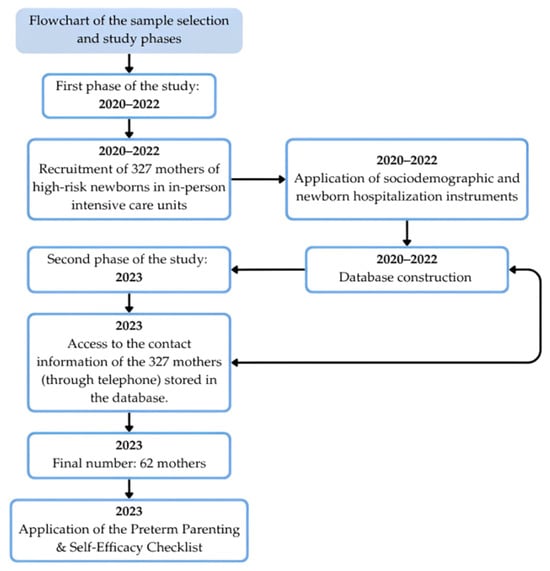
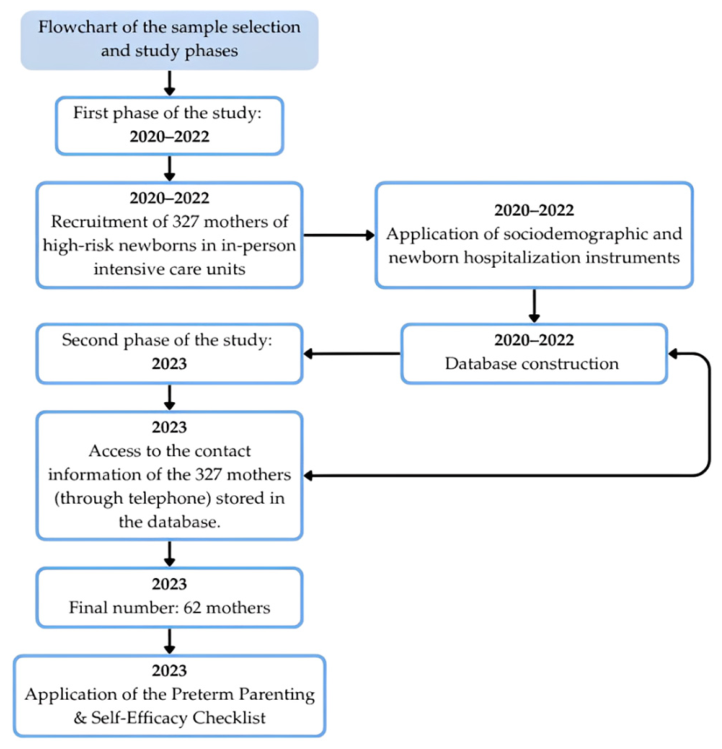
The sample of the present study was based on patients’ list from a multicenter study [14] (Figure 1). In the original research, participants included mothers, fathers, and other caregivers accompanying hospitalized newborns in NICUs or semi-intensive care units for at least 24 h across six high-complexity hospitals: Hospital das Clínicas, Centro Integrado de Saúde Amaury de Medeiros, Instituto de Medicina Integral Professor Fernando Figueira, Hospital Barão de Lucena, Hospital Agamenon Magalhães, and Hospital Maria Lucinda, all located in Recife, Pernambuco, Northeastern Brazil. The participating institutions followed the principles of the Kangaroo Method in their care protocols, which encourage parental involvement in neonatal care throughout hospitalization. Parents routinely received guidance on how to initiate and continue providing care to their newborn after hospital discharge.
Figure 1.
Flowchart of the study sample stages.
In the first phase of the study, data were collected in the hospital setting between 2020 and 2022, and have been described elsewhere [15]. In the second phase of the study reported here, the researchers contacted all 327 mothers who had participated in the study between 2020 and 2022, using the telephone numbers registered in the database. Participants were invited to take part in the present study (second phase), in which the self-efficacy instrument was administered, in addition to maternal self-report on sociodemographic characteristics and clinical conditions of the newborns. A minimum of three attempts were made for each number until the process was completed. Interviews (July–October 2023) evaluated maternal self-efficacy during the infant’s first year of life post-discharge, yielding a final analyzed sample of 62 mothers (Figure 1).
2.3. Data Collection Procedures
A telephone script was developed to ensure consistency between the researchers responsible for the calls (E.D.F.S.D.C. and E.G.C.D.M.). This script outlined the study’s objectives and procedures while optimizing the data collection process (Supplementary Figure S1). Participants were contacted by telephone, invited to participate, and provided with information about the study objectives and procedures. The Informed Consent Form was then read in full, and only after the necessary clarifications and the participants’ agreement to participate was verbal informed consent obtained through an audio recording. Parents’ sociodemographic data and newborns’ clinical data were extracted from an electronic database developed in 2022, containing information from six hospitals and established to support data collection for the present study, and were subsequently used for statistical analysis. Data collection was conducted using an electronic questionnaire developed on Google Forms.
The questionnaire included sociodemographic and obstetric variables of the mothers, neonatal and clinical characteristics of the infants, questions regarding the post-hospitalization period and care provided to the newborn at home after hospital discharge, and the items of the Preterm Parenting & Self-Efficacy Checklist (PPSE Checklist), using the Brazilian Portuguese adapted version. The PPSE Checklist was used to assess maternal perceived self-efficacy in providing care to the preterm newborn at home and comprises three measures: Perceived Self-Efficacy, Task Importance, and Perceived Parental Competence. Maternal self-efficacy was analyzed using the total score and the scores of the three domains. The participants’ responses were recorded using ApowerREC software (Version 1.6.8.9), with their consent, and the collected data were subsequently organized and stored on Google platforms. The collected data were maintained under the custody of the researcher responsible for the study and used exclusively for research purposes.
During the interview, participants were asked to confirm previously collected sociodemographic data and to provide additional details regarding the children’s past and current clinical conditions, as well as information on perceived self efficacy measured by an instrument developed in Australia in 2012 by Pennell [10] and validated in Brazil in 2019 by Mendes was applied [16] (Supplementary Table S2). This instrument consists of 36 items aimed at measuring parental self-efficacy in practical caregiving tasks for preterm and term infants, distributed across three domains: perceived Maternal self-efficacy in home-based infant care was classified according to score ranges adopted in a previous Brazilian study using the Preterm Parenting & Self-Efficacy Checklist (PPSE). Total scores were categorized as low (36–84 points), moderate (85–168 points), and high (169–252 points) [17].
2.4. Ethical Aspects
Ethical approval was obtained from the Research Ethics Committee of Hospital Oswaldo Cruz/Procape (number 6.177.569; CAAE 68413523.2.0000.5192) on 12 July 2023, as well as from the research ethics committees of all participating institutions.
2.5. Data Analysis
The data were compiled in a Microsoft Excel spreadsheet and subsequently exported and analyzed using the Statistical Package for the Social Sciences (SPSS), version 18 (IBM Corporation, Armonk, NY, USA). To descriptively characterize the socioeconomic and obstetric profiles of the evaluated mothers, as well as newborn hospitalization characteristics, absolute and percentage frequencies were calculated. Additionally, means and standard deviations were calculated for the total self-efficacy scores and for each assessed domain according to the participants’ personal and clinical characteristics, as the normality of the self-efficacy scores was confirmed using the Shapiro–Wilk test.
To assess the factors that influenced self-efficacy scores, a generalized linear model was fitted for the total self-efficacy score and for each domain score, with an identity link function and assuming a normal distribution for the outcome variable. Bivariate analyses screened maternal sociodemographic factors and neonatal severity markers (Table 1). Variables with p < 0.20 entered multivariable models (p < 0.05 retained), prioritizing intubation as the main marker of invasive clinical severity to avoid multicollinearity. Theoretically relevant factors were retained regardless of significance. Estimates are reported as β coefficients with 95% confidence intervals.
Table 1.
Sociodemographic and obstetric characteristics of the mothers. Pernambuco, Brazil, 2023.
All the tests were two-tailed; a p-value of less than 0.05 was considered statistically significant.
3. Results
The study included 62 mothers (Figure 1), with heterogeneous characteristics. Specifically, mothers n = 40 (64.5%) were aged 18 to 30 years; n = 25 (40.3%) resided in the Metropolitan Region of Recife (RMR); n = 23 (41.1%) were single; n = 29 (52.7%) reported having only one person as a support network; n = 41 (66.1%) had 9–11 years of education (High School); n = 30 (60.0%) were unemployed/housewives; and n = 30 (50.0%) had a family income of one minimum wage.
Regarding the characterization of gestational age and parity, n = 24 (38.7%) of the participants were between 32 and 36 weeks of gestation at the time of hospital admission for birth; n = 27 (43.6%) of infants were extremely or very preterm infants (<32 weeks of gestation), n = 24 (38.7%)were moderate-to-late preterm (32–36 weeks), and n = 11 (17.7%) were born at term (37–41 weeks); and n = 27 (49.1%) had only one child. Regarding parity, 51.8% (n = 29) reported having had only one pregnancy (Table 1).
Regarding the clinical characteristics and hospitalization of the newborns, it was observed that 44 (72.1%) of the infants were admitted to Neonatal Intensive Care Units (NICUs); 39 (65.0%) were subsequently admitted to Kangaroo Care Unit; 26 (41.9%) remained hospitalized for more than 30 days; 26 (42.0%) had low birth weight (1501 g to 2500 g); 40 (80.0%) had Apgar scores between 7 and 10 at the first minute; 45 (97.8%) had Apgar scores between 7 and 10 at the fifth minute; and among newborns with a recorded 10-min Apgar score 31 (50%), all had scores between 7 and 10. Additionally, 44 (74.6%) had low weight at hospital discharge; 34 (55.7%) did not undergo resuscitation; 32 (52.5%) were not diagnosed with respiratory distress syndrome; 46 (75.4%) were not intubated; 55 (88.7%) did not present severe congenital malformations; 49 (80.3%) did not develop sepsis; 60 (96.8%) did not present severe birth trauma; 50 (80.6%) had no suspected COVID-19; and 58 (95.1%) had no diagnosis of COVID-19 (Table 2).
Table 2.
Clinical and hospitalization characteristics of the newborns, Pernambuco, Brazil, 2023.
Table 3 presents the means and standard deviations of the Self-Efficacy score and its domains according to the newborn’s socioeconomic and clinical characteristics, as well as hospitalization factors.
Table 3.
Analysis of mean and standard deviation of self-efficacy scores and its domains according to sociodemographic, clinical, and neonatal characteristics, Pernambuco, Brazil, 2023.
In the bivariate analysis, the number of children was significantly associated with maternal self-efficacy, with mothers who had three or more children presenting higher mean scores for overall self-efficacy and for all three PPSE measures: Perceived Self-Efficacy, Task Importance, and Perceived Parental Competence. Maternal education was significantly associated only with the Task Importance measure, with higher mean scores among mothers with no formal education or with primary education. The other sociodemographic variables analyzed did not show statistically significant associations with maternal self-efficacy.
In the linear models, having three or more children was associated with higher self-efficacy compared with having one child, both for the total self-efficacy score (β = 35.18; 95% CI = 22.51–47.85; p < 0.001) and for the Perceived Self-Efficacy domain (β = 12.76; 95% CI = 5.75–19.78; p < 0.001). Maternal education (no formal education/primary compared with higher education/postgraduate) showed a statistically significant estimate (β = 16.46; 95% CI = 0.85; 32.06; p = 0.039). Regarding the 1-min Apgar score, an Apgar of 0–3 compared with 7–10 yielded a statistically significant estimate (β = 12.14; 95% CI = 0.76; 23.52; p = 0.037) (Table 4).
Table 4.
Generalized linear model analysis to estimate the predictive effect of independent variables on total self-efficacy and its domains. Pernambuco, Brazil, 2023.
In the task importance domain score, having three or more children was positively associated when compared with women who had only one child (β = 13.54; 95% CI = 10.49; 16.60; p < 0.001). Regarding maternal education, mothers with no formal education or only primary education showed a positive association when compared with women who had higher education/postgraduate education (β = 5.87; 95% CI = 2.05; 9.68; p = 0.003). Intubation was associated with a statistically significant increase in task importance scores compared with no intubation (β = 3.02; 95% CI = 0.32; 5.72; p = 0.029) (Table 4).
In the perceived parental competence domain, having three or more children was positively associated when compared with women who had only one child (β = 13.00; 95% CI = 7.44; 20.30; p < 0.001) (Table 4).
4. Discussion
To the best of our knowledge, this is the first study conducted in Brazil to analyze the association between maternal sociodemographic characteristics and neonatal clinical factors and maternal self-efficacy for home-based infant care after hospital discharge. The findings indicated that maternal self-efficacy in home-based infant care was overall high, and it was significantly associated with the number of children, maternal education, and neonatal clinical conditions, including Apgar score and intubation.
Multiparity was consistently associated with higher maternal self-efficacy across all evaluated dimensions, including overall self-efficacy, perceived self-efficacy, task importance, and perceived competence, compared with primiparous mothers. The results of this study align with previous studies conducted in public maternity hospitals in Goiânia, Goiás—which showed that having more children increases maternal self-efficacy during breastfeeding [18]. This finding is consistent with Bandura’s self-efficacy theory, suggesting that previous caregiving experience with older children may represent an important source of mastery experiences, thereby strengthening maternal confidence in managing infant care after hospital discharge.
Highlighting that domain experiences are notably favorable to the maintenance of self-efficacy, another study conducted in Turkey [19] observed that maternal self-efficacy increased in approximately 75% of mothers who had previously breastfed their children. This finding reinforces that going through this process contributed to increasing these mothers’ confidence in breastfeeding their subsequent children [20,21]. Mastery experiences thus represent a relevant factor in strengthening maternal competence in home-based infant care [21].
Although it may seem counterintuitive, a positive relationship was observed between lower maternal education level and higher perceived maternal self-efficacy. These results partially align with the literature. Similarly, a study conducted in China in 2021 revealed that mothers with lower levels of education reported higher maternal self-efficacy scores during the postpartum period compared with mothers with higher educational attainment [22]. A Portuguese study conducted in 2023 with approximately 340 women showed that mothers with lower levels of education reported higher self-efficacy, thereby enhancing their perceived competence and confidence in caregiving [23]. Overall, results of these studies may be explained by mothers with higher levels of education tending to have a more in-depth understanding of the challenges inherent to childrearing, which may raise their expectations and generate greater insecurity regarding their ability to adequately meet maternal responsibilities. Some studies [24,25,26,27] demonstrate that mothers with higher educational levels show greater concern in seeking reliable information in order to strengthen their confidence in caring for their children.
In the present study, the need for advanced respiratory support through neonatal intubation was positively associated with a higher perceived importance of caregiving tasks. Exposure to the critical experience of mechanical ventilation may increase maternal vigilance and heighten the perceived importance of strictly adhering to home care routines following hospital discharge [28,29,30,31]. A qualitative study conducted in Fortaleza in 2014 with 10 mothers found that mothers of newborns connected to medical devices actively participated in their infants’ care, learned to manage risks and difficulties, supported other mothers, and felt useful, thereby enhancing their maternal self-efficacy [32,33]. Neonatal intubation served as a key proxy for severe illness and invasive support. Caring for an infant requiring mechanical ventilation exposes mothers to high-tech environments and intensive clinical guidance, heightening their perceived task importance. Confronting their child’s prematurity and the experience of caring for an infant connected to tubes and equipment appear to contribute to the strengthening of maternal confidence.
Another relevant finding of this study was that higher neonatal clinical severity at birth specifically, a low 1-min Apgar score (0–3) was positively associated with higher maternal perceived self-efficacy compared with infants born with good vitality (Apgar 7–10). Notably, this positive direction contrasts with a previous study conducted in Paraná, Brazil, which reported that mothers of preterm infants with lower Apgar scores exhibited lower self-efficacy scores. In our sample, prolonged exposure to the hospital environment and intensive nursing interaction for critically ill infants may have strengthened maternal confidence through vicarious learning and verbal persuasion [27,28,29].
In this context, prolonged exposure to the hospital environment contributes to greater interaction between mothers and healthcare professionals, as well as with other mothers experiencing similar situations. This coexistence favors the strengthening of vicarious experiences and verbal persuasion—elements that enhance and reinforce these mothers’ self-efficacy. Observing situations similar to one’s own, combined with encouragement from others, increases the belief in the success of an action or activity, leading to better outcomes [34]. Based on the findings of this study, the participating mothers demonstrated high perceived self-efficacy. This may be partly explained by the discharge preparation routinely provided by the participating institutions. The Kangaroo Method emphasizes the principles of family-centered care, an approach that has been widely adopted worldwide as an effective philosophy for promoting family inclusion and participation during hospitalization and after discharge, particularly in preparing caregivers for the transition to home care. In accordance with the findings of this study, it is observed that a NICU guided by the precepts of the Family-Centered Care philosophy strengthens maternal self-efficacy [35,36].
This approach, in addition to fostering a collaborative relationship between healthcare professionals and caregivers, encourages the active participation of these mothers in the direct care of their newborn infants, contributing to individualized guidance and continuous support. This approach introduces elements that directly contribute to the determinants of self-efficacy, as proposed by Bandura [34], as it enables mastery experiences (performing assisted hands-on care), vicarious experiences (by observing other mothers in similar situations), and verbal persuasion (through encouragement from professionals). Thus, the Family-Centered Care philosophy not only improves and qualifies assistance and care but also promotes and supports maternal empowerment, strengthening mothers’ confidence and competencies for caring for their child at home after hospital discharge.
5. Limitations and Implications for Practice
This study has limitations related to its reduced sample size due to a high rate of loss to follow-up associated with telephone-based data collection. Specifically, 256 of the 327 participants of the original study were lost to follow-up, raising the possibility of non-response bias inherent to telephone surveys in vulnerable populations with high phone turnover, although the final cohort retained broad sociodemographic and clinical diversity. Clinically, these findings highlight the need for early discharge preparation, structured educational guidance, and emotional support to foster maternal confidence and self-efficacy during hospitalization and the transition to home care.
Despite these limitations, the findings point to important implications for clinical practice, highlighting the need for continuous support, early discharge preparation and follow-up care for and follow-up care for all newborns, with structured guidance that fosters maternal self-efficacy during the first year of life. In this context, healthcare professionals play important roles in supporting this strengthening, such as incorporating educational strategies and emotional support aimed at enhancing maternal self-efficacy throughout the hospitalization process. This approach fosters maternal confidence, preparing mothers for the transition of care and the post-discharge period.
Although gestational age categories were reported descriptively, the overall sample size (n = 62) limited the execution of stratified multivariate subgroup analysis by degrees of prematurity (e.g., <32 weeks vs. moderate/late preterm) without compromising statistical power. Future studies with larger cohorts are encouraged to evaluate potential differences in maternal self-efficacy across specific gestational age strata. Furthermore, while clinical severity markers (e.g., length of stay, sepsis, respiratory distress) were reported descriptively (as presented in Table 2), sample size constraints (n = 62) precluded their joint multivariate modeling to avoid multicollinearity and overfitting, prioritizing intubation as the main invasive marker. Additionally, variations in post-discharge intervals (2020–2022 cohort interviewed in 2023) may introduce recall bias; however, sample size (n = 62) precluded adding time-since-discharge as a multivariable covariate.
Future research is recommended with larger samples, diverse methodological designs, including qualitative methods, and the inclusion of fathers and adolescent parents. Inclusive of the analysis of post-neonatal factors potentially associated with perceived self-efficacy in home care during the first year of life. Future studies should also evaluate the comparative effectiveness of different types of intervention for discharge preparation, and the link between perceived self-efficacy and long term outcomes in the Brazilian setting, as well as in other settings.
6. Conclusions
The findings of this study suggest that lower maternal education levels and a higher number of children were positively associated with greater maternal self-efficacy in the home environment. A low 1-min Apgar score and neonatal intubation were positively associated with higher perceived self-efficacy and greater perceived task importance, respectively, although these clinical associations were less consistent across the different domain scores. These relationships may reflect prior caregiving experiences, a greater sense of mastery, and increased maternal engagement in complex care situations—factors that warrant further exploration in future qualitative studies. Structured discharge education provided during hospitalization remains an essential component of preparing mothers and other caregivers for the fundamental principles of home-based newborn care. This preparation may support safe discharge planning, facilitate a safe transition from hospital to home, and promote competent, autonomous, and continuous care throughout the first year of life.
Supplementary Materials
The following supporting information can be downloaded at: https://www.mdpi.com/article/10.3390/children13111510/s1, Table S1: Strengthening the Reporting of Observational Studies in Epidemiology guideline (STROBE); Figure S1: Standardized Telephone Call Script; Table S2: Key characteristics of questionnaire used for data collection.
Author Contributions
Conceptualization of study, funding acquisition, supervision: W.B.N. and M.L.; data collection: W.B.N., E.d.F.S.d.C. and E.G.C.d.M.; data analysis: W.B.N. and E.d.F.S.d.C.; writing—original draft preparation: W.B.N., E.d.F.S.d.C., E.G.C.d.M. and S.P.d.S.C.; critical revision of the article and final approval of the article: W.B.N., E.d.F.S.d.C., E.P.V., D.B.G., E.G.C.d.M., S.P.d.S.C., E.M.L.M.M., M.S.A., I.M. and M.L. All authors have read and agreed to the published version of the manuscript.
Funding
This study was supported by Chiesi Foundation research grant 2019 in Neonatology (prot. IRCCS n. 8142/2019—Registro Contratti n.1091) to the Institute for Maternal and Child Health IRCCS Burlo Garofolo, Trieste, Italy.
Institutional Review Board Statement
The research was conducted in accordance with the Declaration of Helsinki and approved by the Ethical Committee in Brazil (Comissão Nacional de Ética em Pesquisa [CONEP]) number 6.177.569, 12 July 2023. Anonymity in data collection was ensured by not collecting information that could disclose participants’ identity.
Informed Consent Statement
Before data collection, participants were informed of the objectives and methods of the study, including their rights in declining participation. An informed verbal informed consent was obtained and documented.
Data Availability Statement
Data transmission and storage were secured by encryption. Data supporting the conclusions of this article are available in REDCap and are available from the authors upon reasonable request to the corresponding author.
Acknowledgments
We would like to thank all parents who gave their precious time to answer the questionnaires. We thank Carolina Queiroz de Souza Mendes (UNIFESP, Brazil) for granting authorization and sharing the Portuguese-adapted version of the Preterm Parenting & Self-Efficacy Checklist for use with mothers. We thank all the collaborators to the EPINICU Study Group and all professionals who collaborated with the research. EPINICU Study Group: for Italy, Egidio Barbi, Laura Travan, Jenny Bua, Sabrina Plet, Maddalena Ermacora, Stefano Bembich, Livia Bicego, Emily Esposito, Silvia Nider; for Tanzania, Gaetano Azzimonti, Luca Brasili, Michele D’Alessandro, Emmanuel Abraham Ndile, Giovanni Putoto, Giovanni Torelli; for Sri Lanka, Nimesha Gamhewage, Mohamed Rishard, Nalin Gamaathige, Hemantha Senanayake; for Brazil, Dafne Barcala Gomez, Waldemar Neto, Juliana Barradas de Souza, Geisy Maria de Souza Lima, Walkyria Campos, Lorena Freitas, Renata Araújo, Núbia Dantas, Maria Eduarda Fraga, Carolina Ramos, Eunice Cunha, Ester Macedo, Thaylane Gomes and Stephany Canejo.
Conflicts of Interest
The authors declare that they have no competing interests. The funders had no role in the design of the study; in the collection, analyses, or interpretation of data; in the writing of the manuscript; or in the decision to publish the results.
References
- Hendy, A.; El-Sayed, S.; Bakry, S.; Mohammed, S.M.; Mohamed, H.; Abdelkawy, A.; Hassani, R.; Abouelela, M.A.; Sayed, S. The stress levels of premature infants’ parents and related factors in NICU. SAGE Open Nurs. 2024, 10, 23779608241231172. [Google Scholar] [CrossRef] [Scilit] [PubMed]
- World Health Organization. Preterm Birth; World Health Organization (WHO): Geneva, Switzerland, 2023; Available online: https://www.who.int/news-room/fact-sheets/detail/preterm-birth/ (accessed on 28 January 2025).
- Paixao, E.S.; Blencowe, H.; Falcao, I.R.; Ohuma, E.O.; Rocha, A.S.; Alves, F.J.O.; Costa, M.C.N.; Suárez-Idueta, L.; Ortelan, N.; Smeeth, L.; et al. Risk of mortality for small newborns in Brazil, 2011–2018: A national birth cohort study of 17.6 million records from routine register-based linked data. Lancet Reg. Health Am. 2021, 3, 100045. [Google Scholar] [CrossRef] [Scilit] [PubMed]
- Kale, P.L.; Fonseca, S.C. Intrauterine growth restriction, prematurity, and low birth weight: Risk phenotypes of neonatal death, Rio de Janeiro State, Brazil. Cad. Saude Publica 2023, 39, e00231022. [Google Scholar] [CrossRef] [Scilit]
- World Health Organization. WHO Recommendations for Care of the Preterm or Low-Birth-Weight Infant; World Health Organization (WHO): Geneva, Switzerland, 2022; Available online: https://iris.who.int/server/api/core/bitstreams/707c8feb-e4e4-4e5c-b029-b78202c67cc7/content (accessed on 28 January 2025).
- Conceição, T.E.; Souza, M.H.N.; Esteves, R.B.; Peres, P.L.P.; Valente, D.; Nespoli, A. Maternal concerns in home care for the premature newborn: An integrative review. Rev. Bras. Enferm. 2023, 76, e20220769. [Google Scholar] [CrossRef] [Scilit] [PubMed]
- Shillington, J.; McNeil, D. Transition from the Neonatal Intensive Care Unit to home. Adv. Neonatal Care 2021, 21, 399–406. [Google Scholar] [CrossRef] [Scilit] [PubMed]
- Landsem, I.P.; Handegård, B.H. Parental reports of hospital- and community-based follow-up services, self-efficacy, and symptoms of depression a few months after discharge of a prematurely born child. BMC Public Health 2024, 24, 1630. [Google Scholar] [CrossRef] [Scilit]
- Colaceci, S.; Chapin, E.M.; Zambri, F.; Reali, L.; Cedrone, L.; Del Brocco, A.; Masi, M.; Mohamed, A.; Dellafiore, F.; Nichinonni, S.; et al. Verba volant, scripta manent: Breastfeeding information and health messages provided to parents in the neonatal discharge summary in the Lazio Region, Italy. Ann. Ist. Super. Sanita 2020, 56, 142–149. [Google Scholar] [CrossRef] [Scilit] [PubMed]
- Pennell, C.; Whittingham, K.; Boyd, R.; Sanders, M.; Colditz, P. Prematurity and parental self-efficacy: The Preterm Parenting & Self-Efficacy Checklist. Infant Behav. Dev. 2012, 35, 678–688. [Google Scholar] [CrossRef] [Scilit] [PubMed]
- Grunberg, V.A.; Vitcov, G.G.; Belkin, E.; Davis, J.O.; Van, E.; Lerou, P.H.; Vranceanu, A.M. Resiliency factors relevant to NICU parents’ emotional and relational health. J. Perinatol. 2026, 46, 1451–1458. [Google Scholar] [CrossRef] [Scilit]
- Seetharaman, M.; Benjamin, A.; McGrath, J.M.; Vance, A.J. Parenting self-efficacy instruments for parents of infants and toddlers: A review. Int. J. Nurs. Stud. Adv. 2022, 4, 100082. [Google Scholar] [CrossRef] [Scilit] [PubMed]
- Gómez-Cantarino, S.; García-Valdivieso, I.; Moncunill-Martínez, E.; Yáñez-Araque, B.; Ugarte Gurrutxaga, M.I. Developing a Family-Centered Care Model in the Neonatal Intensive Care Unit (NICU): A New Vision to Manage Healthcare. Int. J. Environ. Res. Public Health 2020, 17, 7197. [Google Scholar] [CrossRef] [Scilit] [PubMed]
- Von Elm, E.; Altman, D.G.; Egger, M.; Pocock, S.J.; Gøtzsche, P.C.; Vandenbroucke, J.P. The Strengthening the Reporting of Observational Studies in Epidemiology (STROBE) statement: Guidelines for reporting observational studies. J. Clin. Epidemiol. 2008, 61, 344–349. [Google Scholar] [CrossRef] [Scilit] [PubMed]
- Lazzerini, M.; Gomez, D.B.C.A.; Azzimonti, G.; Bua, J.; Brandão Neto, W.; Brasili, L.; Travan, L.; Souza, J.B.; D’Alessandro, M.; Plet, S.; et al. Parental stress, depression, anxiety and participation to care in neonatal intensive care units: Results of a prospective study in Italy, Brazil and Tanzania. BMJ Paediatr. Open 2024, 8, e002539. [Google Scholar] [CrossRef] [Scilit]
- Mendes, C.Q.S.; Mandetta, M.A.; Tsunemi, M.H.; Balieiro, M.M.F.G. Cross-cultural adaptation of the Preterm Parenting & Self-efficacy Checklist. Rev. Bras. Enferm. 2019, 72, 274–281. [Google Scholar] [CrossRef] [Scilit]
- Squizato, L.; Silva, A.D.; Martinelle, E.; Machineski, G.G.; Toso, B.R.G.O.; Viera, C.S. Maternal self-efficacy for premature newborn care and breastfeeding maintenance. Cogitare Enferm. 2023, 28, e87287. [Google Scholar] [CrossRef] [Scilit]
- Pinto, S.L.; Barruffini, A.C.C.; Silva, V.O.; Ramos, J.E.P.; Borges, L.L.; Cordeiro, J.A.B.L.; Silva, A.M.T.C.; Almeida, R.J.; Junqueira, I.C. Evaluation of breastfeeding self-effectiveness and its associated factors in puerperal women assisted at a public health system in Brazil. Rev. Bras. Saúde Mater. Infant. 2021, 21, 89–96. [Google Scholar] [CrossRef] [Scilit]
- Yesil, Y.; Eksioglu, A.; Turfan, E.C. The effect of hospital-based breastfeeding group education given early perinatal period on breastfeeding self-efficacy and breastfeeding status. J. Neonatal Nurs. 2022, 29, 81–90. [Google Scholar] [CrossRef] [Scilit]
- Ribeiro, N.A.; Kase, J.S. The evolution of parental self-efficacy in knowledge and skill in the home care of preterm infants. J. Pediatr. Neonat. Indiv. Med. 2017, 6, e060118. [Google Scholar]
- Spence, C.M.; Stuyvenberg, C.L.; Kane, A.E.; Burnsed, J.; Dusing, S.C. Parent Experiences in the NICU and Transition to Home. Int. J. Environ. Res. Public Health 2023, 20, 6050. [Google Scholar] [CrossRef] [Scilit] [PubMed]
- Wang, Q.; Zhang, Y.; Li, X.; Ye, Z.; Huang, L.; Zhang, Y.; Zheng, X. Exploring Maternal Self-Efficacy of First-Time Mothers among Rural-to-Urban Floating Women: A Quantitative Longitudinal Study in China. Int. J. Environ. Res. Public Health 2021, 18, 2793. [Google Scholar] [CrossRef] [Scilit] [PubMed]
- Silva, C.S.; Brandão, S.; Azevedo, A.R.; Prata, A.P. Maternal self-efficacy in newborn care: Influence of maternal variables. Cent. Eur. J. Nurs. Midw. 2023, 14, 907–914. [Google Scholar] [CrossRef] [Scilit]
- Rover, M.M.S.; Rugolo, L.M.S.S.; Viera, C.S. Factors influencing the growth of preterm infants in the first two years of life. Rev. Paul. Pediatr. 2025, 43, e2024297. [Google Scholar] [CrossRef] [Scilit] [PubMed]
- Vance, A.J.; Pan, W.; Malcolm, W.H.; Brandon, D.H. Development of parenting self-efficacy in mothers of high-risk infants. Early Hum. Dev. 2020, 141, 104946. [Google Scholar] [CrossRef] [Scilit] [PubMed]
- Mohammadi, F.; Basiri, B.; Barati, M.; Khazaei, S.; Zahra-Masoumi, S.; Sadeghian, E.; Gillespie, M.; Oshvandi, K. Effectiveness of kangaroo mother care on maternal resilience and breastfeeding self-efficacy using the role-play method in a neonatal intensive care unit. Bol. Med. Hosp. Infant. Mex. 2022, 79, 228–236. [Google Scholar] [CrossRef] [Scilit] [PubMed]
- Gebeyehu, N.A.; Tegegne, K.D.; Shewangashaw, N.E.; Biset, G.; Abebaw, N.; Tilahun, L. Knowledge, attitude, practice and determinants of exclusive breastfeeding among women in Ethiopia: Systematic review and meta-analysis. Public Health Pract. 2023, 5, 100373. [Google Scholar] [CrossRef] [Scilit]
- Mehri, K.; Mansoureh, Y.; Masoumeh, S.; Hajian, S.; Kiani, Z.; Khorsandi, B.; Sattari, M.; Ezadi, Z.; Nazem, H.; Jafari, M. Predictors of exclusive breastfeeding: A systematic review and meta-analysis. Int. Breastfeed. J. 2025, 20, 52. [Google Scholar] [CrossRef] [Scilit] [PubMed]
- Abuhammad, S. Predictors of maternal parenting self-efficacy for infants and toddlers: A Jordanian study. PLoS ONE 2020, 15, e0241585. [Google Scholar] [CrossRef] [Scilit] [PubMed]
- Santos, M.L.; Silva, G.S.; Santana, L.D.S.; Christoffel, M.M.; Carmona, E.V.; Passos, S.D.S. Experiências durante a internação de um recém-nascido prematuro em terapia intensiva. Enferm. Actual Costa Rica 2021, 40, 1–17. [Google Scholar]
- Pinheiro, S.R.C.S.; Gubert, F.A.; Martins, M.C.; Beserra, E.P.; Gomes, C.C.; Feitosa, M.R. Self-efficacy and social support of mothers of preterms in neonatal unit. Rev. Bras. Saúde Mater. Infant. 2023, 23, e20210289. [Google Scholar] [CrossRef] [Scilit]
- Barraza, P.C.G.; Jofré, A.V.E.; Ramírez, O.J.A. Percepciones asociadas al método madre canguro de madres con recién nacidos prematuros. Cienc. Enferm. 2020, 26, 32. [Google Scholar] [CrossRef] [Scilit]
- Toso, B.R.G.O.; Viera, C.S.; Machineski, G.G. Determinação Social da Saúde Perinatal e Neonatal e Políticas Públicas para Redução da Prematuridade. In Cuidado Integral ao Recém-Nascido Pré-Termo e à Família [Livro Eletrônico]; Sociedade Brasileira dos Enfermeiros Pediatras: São Paulo, SP, Brazil, 2021; pp. 314–330. [Google Scholar]
- Bandura, A. Self-Efficacy: The Exercise of Control; W. H. Freeman: New York, NY, USA, 1997. [Google Scholar]
- Beyazit Yalçın, N.; Bay Özçalık, H. The Perception of Family-Centered Care of Mothers with a Baby in NICU, and Their Attachment, Maternal Self-Efficacy, and Stress Levels. Adv. Neonatal Care 2025, 25, 626–639. [Google Scholar] [CrossRef] [Scilit] [PubMed]
- Santos, A.C.S.; Carmona, E.V.; Sanfelice, C.F.O.; Mafetoni, R.R.; Lopes, M.H.B.M.; Balaminut, T. Breastfeeding at discharge and in the third stage of the Kangaroo Mother Care among hospitalized preterm infants. Rev. Esc. Enferm. USP 2024, 58, e20230383. [Google Scholar] [CrossRef] [Scilit] [PubMed]

Disclaimer/Publisher’s Note: The statements, opinions and data contained in all publications are solely those of the individual author(s) and contributor(s) and not of MDPI and/or the editor(s). MDPI and/or the editor(s) disclaim responsibility for any injury to people or property resulting from any ideas, methods, instructions or products referred to in the content. |
© 2026 by the authors. Licensee MDPI, Basel, Switzerland. This article is an open access article distributed under the terms and conditions of the Creative Commons Attribution (CC BY) license.