


Abstract
Background/Objectives: Bronchopulmonary dysplasia (BPD) remains a major complication of prematurity, particularly among infants requiring prolonged respiratory support. Despite its clinical relevance, data on BPD epidemiology and risk factors in Kazakhstan are limited. This study aimed to assess the incidence of BPD and identify significant antenatal, intranatal, and neonatal risk factors associated with its development among preterm infants in Almaty. Methods: A retrospective analysis was conducted using medical records of preterm infants born at the City Perinatal Center in Almaty between 2013 and 2017. Clinical, obstetric, and neonatal data were collected for 111 infants diagnosed with BPD and 109 matched controls without BPD. Statistical analyses included χ2 tests, Student’s t-tests, and multiple logistic regression to determine independent predictors of BPD. Results: Among 39,255 live births over a five-year period, 6271 were preterm, and bronchopulmonary dysplasia (BPD) was diagnosed in 111 preterm infants (1.8%). Mortality among BPD infants was 31.9%, with a declining trend over time. Significant maternal factors associated with BPD included edema during pregnancy, polyhydramnios, acute respiratory viral infection (ARVI) during the second trimester, low placentation, vaginal bleeding, chronic bronchitis, and a history of preterm birth. Logistic regression identified edema (p = 0.009) and antenatal steroid prophylaxis (p < 0.001). Neonatal risk factors significantly associated with BPD included neonatal respiratory distress syndrome (p = 0.002), reintubation (p = 0.046), high FiO2 requirements, prolonged mechanical ventilation, and HFOV use. Regression analysis confirmed neonatal RDS (p = 0.006) and higher FiO2 (p < 0.001). Conclusions: BPD in Almaty is driven by a combination of maternal complications and severe neonatal respiratory pathology. Early identification and targeted perinatal management of these parameters may help reduce BPD incidence and improve outcomes for preterm infants.
1. Introduction
According to the World Health Organization (WHO), approximately 15 million children are born prematurely each year worldwide, accounting for 11% of all newborns. The incidence of preterm births is increasing in almost all countries [1,2]. In the United States, the preterm birth rate has averaged 10.1% over the past 10 years; in the United Kingdom, it is 7.8%; in France, 7.2%; in Germany, 9–10%; in Norway, 7.9%; and in Hungary, 10% [2]. According to the statistical yearbook of the Republic of Kazakhstan, in 2022, 6.6% of pregnancies ended prematurely, and there has been a trend toward an increase in this rate over the last decade [3]. Preterm infants are at a higher risk of morbidity, disability, and mortality compared to their full-term peers. One condition that poses a significant risk to the health of preterm infants in both the short and long term is BPD.
Currently, BPD is considered a multifactorial disease [4,5]. According to the National Institute of Child Health and Human Development (NICHD), bronchopulmonary dysplasia (BPD) is a chronic, multifactorial lung disease that develops in newborns, particularly very preterm infants, with immature lungs and is associated with respiratory distress syndrome, pneumonia, and the respiratory support required to manage these conditions.
Various researchers have repeatedly conducted studies on the epidemiology and risk factors of this disease. Data on the incidence of BPD vary across different studies. BPD predominantly develops in infants with a gestational age of less than 32 weeks and extremely low birth weight. In the United States alone, approximately 50,000 preterm infants are affected by BPD each year [6]. According to German authors, the incidence of BPD in their country exceeds that of congenital pneumonia, affecting around 1300 children annually [7]. In Sweden, the disease occurs in 73% of infants with a gestational age of less than 27 weeks [8], while in Japan, it affects 28–33% of children with very low birth weight [9].
If initially the condition was considered a result of the damaging effects of oxygen and mechanical ventilation, it is now believed that prematurity, chorioamnionitis, and postnatal lung underdevelopment play a significant role in the development of BPD. In modern contexts, BPD is regarded as a multifactorial disease. Research aimed at identifying new risk factors and reassessing the significance of known factors for the development of BPD has been actively conducted in recent years [10,11,12,13,14,15,16,17,18,19,20,21,22,23]. However, despite the increasing number of patients with this condition, the issue of BPD in Kazakhstan has not been thoroughly investigated. This has provided a basis for planning and conducting our study. Our study is one of the first to explore the frequency and risk factors of BPD in domestic medicine.
2. Materials and Methods
2.1. Study Population
The study was conducted among children born between 2013 and 2017 at the City Perinatal Center in Almaty. During this period, BPD developed in 111 newborns. All children with BPD were preterm, and BPD was not diagnosed in full-term newborns. Thus, within the framework of the retrospective study design, we analyzed the medical documentation of 111 children with a diagnosis of BPD (main group) and 109 children (control group) matched by gestational age and birth weight who did not have BPD.
The control group was selected using frequency matching based on gestational age and birth weight. To account for the matching design and control for confounding, all matching variables were included as independent covariates in the multivariable logistic regression analysis. The baseline characteristics of the groups in terms of gestational age and birth weight are presented in Table 1.
Table 1.
Baseline characteristics of the study groups by gestational age and birth weight.
2.2. Definitions and Outcome Measures
Bronchopulmonary dysplasia (BPD) was diagnosed according to the classification proposed by Jobe and Bancalari (2001) [24]. BPD was defined as a requirement for supplemental oxygen at 28 days of life. Disease severity was assessed according to the same classification at 36 weeks’ postmenstrual age (PMA) for infants born at a gestational age of less than 32 weeks, or at 56 days of life or hospital discharge, whichever occurred first, for infants born at a gestational age of 32 weeks or more. BPD was classified as mild if the infant was breathing room air at the time of assessment, moderate if supplemental oxygen requirements were less than 30%, and severe if supplemental oxygen requirements were greater than 30% or the infant required positive-pressure ventilation (PPV) or nasal continuous positive airway pressure (NCPAP). Among the 111 infants diagnosed with BPD in this study, 54.1% (n = 60) had mild BPD, 12.6% (n = 14) had moderate BPD, and 33.3% (n = 37) had severe BPD.
2.3. Data Collection
Data collection was carried out by sampling clinical, functional, and laboratory data into a structured questionnaire from medical documentation.
2.4. Statistical Analysis
Data entry was performed using a database management system (DBMS) program based on MS Access. The materials entered into the database were processed using modern methods of variance statistics and SPSS software (version 21.0). Initial statistical processing of the data was conducted to determine the frequency (in percentage) of the suspected risk factors for BPD. The Student’s t-test was used for comparing quantitative data between subgroups, while Pearson’s χ2 test was used for qualitative data. Multiple logistic regression was applied to identify risk factors associated with BPD development. Differences were considered statistically significant at p < 0.05.
Candidate variables were selected for inclusion in the multivariable model based on the results of univariable analysis (p < 0.05) and their clinical relevance. To minimize the risk of overfitting, the number of predictors in the model was limited in accordance with the events-per-variable (EPV) principle. Gestational age and birth weight, the main matching variables, were also included as covariates in the model. The analysis was restricted to cases with complete data. Differences were considered statistically significant at p < 0.05.
3. Results
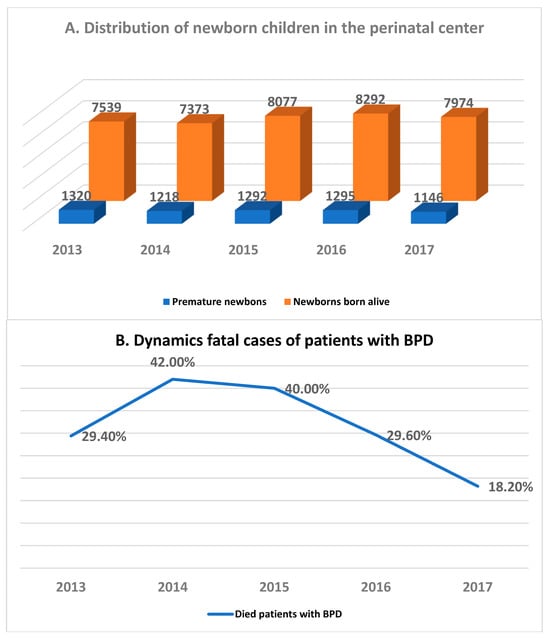
During the period 2013–2017, in the City Perinatal Center of Almaty, the number of newborns born alive was 39,255 children; among them, 6271 were premature. Figure 1A shows the number of newborns born in the perinatal center by year. The incidence of bronchopulmonary dysplasia (BPD) was also assessed among infants according to birth weight category: extremely low birth weight (ELBW), very low birth weight (VLBW), and low birth weight (LBW). During the study period, 590 infants with ELBW were born at the City Perinatal Center in Almaty, of whom 77 (13.1%) were diagnosed with BPD. Among 887 infants with VLBW and 4710 infants with LBW, BPD was diagnosed in 24 (2.7%) and 10 (0.2%) infants, respectively. The results remained high regarding the mortality rate of children with BPD and amounted to 31.9% over five years, but, over the years, there has been a downward trend of 11.2% (Figure 1B). All deaths occurred after BPD had been diagnosed on the 28th day of life.
Figure 1.
Trends in newborn demographics and outcomes in the perinatal center from 2013 to 2017. (A) Number of newborns and preterm infants by year. (B) Annual mortality rate (%) among infants diagnosed with bronchopulmonary dysplasia (BPD).
Next, risk factors associated with the development of BPD in preterm infants were analyzed. For clarity, the clinical variables were grouped into categories.
3.1. Antenatal and Intrapartum Risk Factors Associated with the Development of BPD
A comparative analysis of the medical histories of the study group and the control group showed that in preterm infants, severe respiratory disorders and the development of BPD occurred under the influence of various adverse maternal factors.
According to the results of this study, a complicated obstetric history, such as infertility and previous pregnancies resulting in stillbirths, was almost twice as common among mothers of preterm infants who developed BPD. The incidence of previous pregnancies resulting in preterm birth in the main group was 17.1% (n = 19) compared to 7.3% (n = 8) in the control group, with these data being statistically significant (p = 0.027). The obstetric and gynecological history of the mothers of preterm infants is presented in Table 2.
Table 2.
Obstetric and gynecological history of mothers of preterm infants with and without the development of BPD.
The course of this pregnancy was characterized by numerous pathological conditions in the mothers. Although these conditions occurred with high frequency in the control group, the following conditions were significantly more common among mothers of children who developed BPD. Anemia was found in more than half of the mothers, occurring in 58.6% (n = 65) of the main group and 55.0% (n = 60) of the control group. Chronic pyelonephritis was identified in approximately half of the mothers, with 41.4% (n = 46) in the main group and 33.9% (n = 37) in the control group. The risk of pregnancy termination was more frequent in the main group, at 27.0% (n = 30), compared to 19.3% (n = 21) in the control group. Oligohydramnios was nearly twice as common among mothers in the main group at 18.0% (n = 20), versus 10.1% (n = 11) in the control group. Multiple pregnancies were also more frequently identified in the main group, at 17.1% (n = 19), compared to 11.9% (n = 13) in the control group.
According to this study, ARVI (acute respiratory viral infection) in the second trimester was 2.5 times more common among mothers of children with BPD (13.5% (n = 15) vs. 5.5% (n = 6)), while polyhydramnios was found nine times more frequently (9.0% (n = 10) vs. 0.9% (n = 1)). ARVI in the third trimester was identified in the main group at 3.6% (n = 4) and in the control group at 2.8% (n = 3); ARVI in the first trimester was found in the main group in only one case and in two cases in the control group.
Edema in pregnant women was observed four times more frequently among mothers of preterm infants who developed BPD (11.7% (n = 13) vs. 2.8% (n = 3)). Intrauterine infections (TORCH) and complications from acute and chronic genital infections occurred almost equally between the groups, at 11.7% (n = 13) in the main group and 11.0% (n = 12) in the control group. The data are presented in Table 3.
Table 3.
Course of pregnancy among mothers of preterm infants with and without BPD.
Mothers of the studied children exhibited a range of chronic diseases and disorders. Drug allergies were found in 13.5% (n = 15) of children in the main group and 17.4% in the control group. Endocrine disorders (gestational diabetes, hyperthyroidism, hypothyroidism) were diagnosed in 9.0% of women in the main group (n = 10) and 17.4% of women in the control group (n = 19). Among cardiovascular diseases, only chronic arterial hypertension was noted, occurring in 6.3% (n = 7) of the main group and 11.9% (n = 13) of the control group. According to this study, chronic bronchitis was found in 6.3% (n = 7) of mothers of preterm infants who developed BPD, while in the control group, chronic bronchitis was diagnosed in only one woman (p = 0.033; χ2 = 4.558; df = 1). Additionally, only the mothers of these children had documented nicotine dependence in 3.6% (n = 4), bronchial asthma in 1.8% (n = 2), and seasonal allergic rhinitis in 1.8% (n = 2).
Among gastrointestinal diseases, chronic gastritis was identified in 3.6% (n = 4) of the main group and 4.6% (n = 5) of the control group; chronic cholecystitis was present in 4.5% (n = 5) of the main group and 6.4% (n = 7) of the control group; chronic hepatitis occurred in 3.6% (n = 4) only in the main group. Dyscirculatory encephalopathy was found almost equally in both groups, at 3.6% (n = 4) and 3.7% (n = 4), respectively. Obesity was reported in 5.4% (n = 6) of the main group and 8.3% (n = 9) of the control group; varicose veins of the lower extremities occurred in 7.2% (n = 8) of the main group and 5.5% (n = 6) in the control group; mild myopia was present in 8.1% (n = 9) of the main group and 6.4% (n = 7) of the control group, while osteochondrosis of the spine was found in 3.6% (n = 4) only in the main group.
Among the diseases of the reproductive system in mothers of preterm infants, cervical erosion was identified in 5.4% (n = 6) only among mothers of children with BPD. Uterine fibroids were noted in 4.5% (n = 5) of the main group and 3.7% (n = 4) of the control group; adhesive disease was present in 2.7% (n = 3) of the main group and 2.8% (n = 3) of the control group; ovarian cysts occurred in 1.8% (n = 2) of the main group and 0.9% (n = 1) of the control group (Table 4).
Table 4.
Diseases of the reproductive system in mothers of preterm infants with and without the development of BPD.
In addition to a complicated obstetric and gynecological history and the course of this pregnancy with complications, the majority of mothers of the studied children also exhibited pathological conditions during labor (Table 5).
Table 5.
Labor and delivery characteristics of preterm infants with and without BPD.
As seen in Table 5, the frequency of complications during labor in preterm infants is high. Specifically, 46.8% (n = 52) of children who developed BPD and 52.3% (n = 57) of children without this condition were delivered by cesarean section. Spontaneous vaginal delivery occurred in 48.7% (n = 54) of children in the main group and 42.2% (n = 49) in the control group; induced labor was reported in 4.5% (n = 5) of the main group and 2.8% (n = 3) of the control group. In the main group, 87.4% (n = 97) of preterm infants were assessed as being in a very critical condition at birth, compared to 78.0% (n = 85) in the control group. In the main group, 12.6% (n = 14) of infants were born in a critical condition, while this was 22.9% (n = 24) in the control group. Most of the studied children exhibited acute asphyxia at birth. Severe asphyxia (Apgar score 0–3 points at 1 min after birth) occurred in 39.6% (n = 44) of the main group and 42.2% (n = 46) of the control group; moderate asphyxia (Apgar score 4–7 points at 1 min after birth) was present in 54.5% (n = 61) of the main group and 45.5% (n = 51) of the control group. The mean Apgar score at 1 min was 3.6 ± 1.4 in the main group (median 4 [1;10]) and 3.7 ± 1.4 in the control group (median 3 [1;6]). At 5 min, the mean Apgar score was 5.2 ± 1.4 (median 5 [1;10]) in the main group and 5.4 ± 1.2 (median 5 [2;10]) in the control group. There were no differences between the groups for these parameters. It is known that the Apgar score lacks diagnostic significance in preterm infants, unlike those born at term.
Antenatal steroid prophylaxis for respiratory distress syndrome (RDS) was significantly more common in the main group, at 53.2% (n = 59), compared to 29.4% (n = 32) in the control group (χ2 = 12.839, p < 0.001). Despite the high risk of preterm labor among women in both groups, not all received antenatal steroid prophylaxis for RDS. This was due to some women being transported by ambulance, and, in some cases, there was no documentation regarding the administration of antenatal steroid prophylaxis for RDS. The duration of the dry period after the rupture of membranes was 20.7% (n = 23) in the main group and 21.1% (n = 23) in the control group; premature separation of a normally positioned placenta occurred in 17.1% (n = 19) of the main group and 19.3% (n = 21) of the control group; premature separation of a low-lying placenta was found in 4.6% (n = 5) only in the control group; chorioamnionitis was present in 3.6% (n = 4) of the main group and 10.1% (n = 11) of the control group (n = 11); bleeding was reported in 16.2% (n = 18) of the main group and 29.4% (n = 32) of the control group (p = 0.020); placental defects (retained placental parts and membranes) were found in 11.7% (n = 13) of the main group and 13.8% (n = 15) of the control group.
Thus, statistically significant associations with BPD were identified for the following maternal clinical factors: a history of preterm birth, maternal edema during pregnancy, acute respiratory viral infection (ARVI) in the second trimester, polyhydramnios, antenatal corticosteroid prophylaxis for respiratory distress syndrome (RDS), and chronic bronchitis. Polyhydramnios was not included in the multivariable logistic regression model because of the low frequency of events, which could have compromised the stability and reliability of the model estimates.
After identifying strong associations, a multifactorial regression analysis was conducted. Due to the study of the relationship between several quantitative and qualitative features and a binary outcome (two possible case outcomes: with or without the development of BPD), the method of multiple logistic regression was employed. The analysis produced a regression equation to predict the impact of various factors on the development of BPD (Table 6, RMcF2 = 0.172, p < 0.001).
Table 6.
Multivariable logistic regression analysis of maternal clinical factors associated with BPD.
The results indicate that the following maternal clinical factors were significantly associated with the development of BPD in preterm infants: maternal edema during pregnancy and antenatal corticosteroid prophylaxis for respiratory distress syndrome (RDS).
3.2. Neonatal Risk Factors Associated with BPD Development
Neonatologists often have to use oxygen and mechanical ventilation (MV) to save the life of the infant. According to this study, all children who developed BPD received respiratory treatment during the neonatal period. In the control group, one child did not require respiratory treatment. After birth, 23.4% (n = 26) of infants in the main group and 22.0% (n = 24) in the control group received non-invasive therapy with nasal continuous positive airway pressure (NCPAP). The remaining newborns were on invasive MV. However, subsequently, depending on the condition of the infants, some children from both the main and control groups were switched from NCPAP to invasive MV. Thus, the number of infants receiving NCPAP as the sole mode of respiratory support decreased. The respiratory treatment provided to the children is shown in Table 7. Infants in the main group were more likely to be on high-frequency oscillatory ventilation (HFOV), at 30.6% (n = 34), compared to 17.4% (n = 19) in the control group. However, the result was not statistically significant (p = 0.053).
Table 7.
Respiratory therapy in preterm infants with and without the development of BPD.
The average duration of mechanical ventilation was 26.3 ± 16.5 days in the main group and 9.7 ± 6.8 days in the control group (p < 0.001).
Reintubation was required for 24.3% (n = 27) of children in the main group and 13.8% (n = 15) in the control group (p = 0.046; χ2 = 3.373; df = 1).
The parameters of respiratory therapy were also analyzed. Among these, the concentration of oxygen in the inhaled mixture (FiO2) differed between groups. In the presented results, FiO2 represents the maximum fraction of inspired oxygen recorded during the first 28 days of life in the BPD group, up to the time of diagnosis. In the control group, FiO2 represents the maximum value recorded during the period of respiratory and oxygen therapy. Specifically, FiO2 < 40% was found in 15.3% (n = 17) of the main group and 50.5% (n = 55) of the control group; FiO2 between 40% and 70% was 40.5% (n = 45) in the main group and 33.0% (n = 36) in the control group; FiO2 > 70–100% was observed in 44.1% (n = 49) of the main group and 16.5% (n = 18) of the control group. The control group had more children receiving respiratory treatment with FiO2 < 40%, while the main group had more with FiO2 40–70% and FiO2 70–100% (p = 0.001; χ2 = 35.384; df = 2).
No significant changes were observed in other respiratory therapy parameters. PIP < 20 was 91.0% (n = 101) in the main group and 91.7% (n = 100) in the control group. The peak end-expiratory pressure (PEEP) was ≤4–5 in 99.1% (n = 110; n = 108), and the inspiratory time (Ti) was consistently between 0.25 and 0.35 s.
Thus, this study reaffirms the toxic effects of oxygen on the lungs of infants. Approximately half of the children who developed BPD were exposed to oxygen concentrations of 70–100%, which was three times more common than in children without BPD.
The results of this study show that preterm infants who developed BPD had a high frequency of comorbidities (Table 8).
Table 8.
Comorbidities in preterm infants with and without the development of BPD.
As can be seen, children who developed BPD were frequently diagnosed with multiple comorbidities. Neonatal respiratory distress syndrome was identified in 96.4% (n = 107) of BPD patients, compared to 84.4% (n = 92) of the control group (p = 0.002). Cerebral ischemia was found in 71.2% (n = 79) of newborns in the main group and 71.6% (n = 78) in the control group. Grade I intraventricular hemorrhage was found in 4.5% (n = 5) of the main group and 1.8% (n = 2) of the control group; the incidence of Grade II was almost equal in both groups, at 44.1% (n = 49) in the main group and 48.6% (n = 53) in the control group; Grade III was more common in the main group, at 17.1% (n = 19), compared to 9.2% (n = 10) in the control group; and Grade IV was found in 3.6% (n = 4) of the main group and 1.8% (n = 2) of the control group. Intrauterine pneumonia was identified in 64.0% (n = 71) of children with BPD and 78.9% (n = 86) of children in the control group (p = 0.014). Congenital pneumonia was defined based on a combination of clinical and radiological findings indicative of infectious and inflammatory lung involvement, identified during the early neonatal period and considered to be of intrauterine origin. Anemia of prematurity developed in half of the children with BPD, at 51.4% (n = 57), while in the control group it was found in 39.4% (n = 43) of cases. One condition frequently encountered in premature infants, which poses significant challenges for their socialization, is retinopathy of prematurity. This condition was detected in nearly half of the studied children, with an equal incidence in both groups at 48.6% (n = 54). Pulmonary atelectasis was diagnosed in 48.6% (n = 54) of children in the main group and 59.6% (n = 65) in the control group. Numerous studies have shown a link between patent ductus arteriosus and BPD [23]. However, according to the results of this study, patent ductus arteriosus was found almost equally in both groups, at 28.8% (n = 32) and 25.7% (n = 28), respectively. Additionally, the following conditions were diagnosed with low frequency. Notably, these conditions were identified only in children with BPD. Among them, protein-energy malnutrition was found in 6.3% (n = 7), secondary internal progressive hydrocephalus in 5.4% (n = 6) (p = 0.014), internal hydrocephalus in 4.5% (n = 5) (p = 0.025), and iliac-scrotal hernia in 3.6% (n = 4), which were present only in the main group. Furthermore, carriers of intrauterine infections were also found only in newborns from the main group. Among children with BPD, three were carriers of cytomegalovirus and herpes simplex virus, and one child was a carrier of toxoplasmosis.
Statistically significant associations with BPD were identified for the following neonatal factors: neonatal respiratory distress syndrome, FiO2, reintubation, and mechanical ventilation. After identifying strong associations, a multifactorial regression analysis was conducted. To examine the relationship between several quantitative and qualitative variables and a binary outcome (two possible case outcomes: development of BPD or no BPD), multiple logistic regression was employed. The analysis produced a regression equation to predict the influence of various factors on the development of BPD (Table 9, RMcF2 = 0.158, p < 0.001).
Table 9.
Multivariable logistic regression analysis of factors associated with BPD development (based on neonatal clinical parameters).
Based on the results obtained, it can be stated that the following neonatal risk factors have a statistically significant association with the development of BPD in preterm infants: neonatal respiratory distress syndrome and the concentration of oxygen in the inhaled mixture.
4. Discussion
Data on the epidemiology of BPD show that it varies significantly across different countries and medical centers worldwide. The incidence rate is affected by the diagnostic criteria used (such as “28 days” or “36 weeks” of oxygen dependency), the mortality rate of premature newborns, the studied population, the level of technical equipment, and the intensity of hospital care [19]. In our study, the incidence of BPD at the City Perinatal Center in Almaty was lower compared to other international studies conducted during the analyzed period. Specifically, the incidence of BPD among all live births was 0.3%, while among preterm infants it was 1.8%. Comparable results were obtained in a study conducted in 2005 by R.R. Wauer, where the incidence of BPD among all live births was 0.17% [23].
From 2016 to 2017, the incidence of BPD increased compared to previous years. This may be related to the fact that during the analyzed period, the survival rate of infants with extremely low birth weight (ELBW) increased from 36.8% in 2013 to 53.2% in 2017. On average, over 5 years, BPD developed in 1.8% of newborns. Additionally, during the study period, the mortality rate among infants diagnosed with BPD showed a downward trend, with an overall mortality rate of 31.9%.
The development of bronchopulmonary dysplasia, as shown in this and previous studies [25,26], is associated with antenatal and intrapartum risk factors that vary in prevalence. Obstetric history factors such as spontaneous miscarriages, missed abortions, antenatal fetal demise, preterm labor, and a history of medical abortions are risk factors for premature birth, which can subsequently lead to the development of BPD in preterm infants. In a study conducted in 2015 in China involving 47 preterm infants, obstetric history was identified as an independent risk factor for the severity of BPD [8]. Our research results also indicated that obstetric history factors such as infertility and previous pregnancies ending in stillbirth were almost twice as common among mothers of preterm infants with BPD.
According to Xiong et al., pregnancy pathology is a common antenatal risk factor for the development of bronchopulmonary dysplasia (BPD) in preterm infants [25]. In their meta-analysis based on the assessment of relative risk (OR), antenatal risk factors for BPD include inflammatory conditions such as chorioamnionitis (OR = 1.52), premature rupture of membranes (OR = 1.42), and hypertensive disorders of pregnancy (OR = 2.73). As can be seen, certain pregnancy pathologies not only contribute to the development of BPD in preterm infants but also influence the severity of the condition.
To identify antenatal diagnostic factors associated with the development of BPD, a study conducted in the United States (USA) evaluated various prenatal exposures in preterm infants with a gestational age of less than 32 weeks. The analysis demonstrated that intrauterine growth restriction was among the most significant predictors of BPD, while prenatal inflammatory conditions were also identified as important contributing factors. Additionally, polyhydramnios emerged as a relevant antenatal factor associated with an increased risk of BPD. Comparable results were obtained in the current study, where ARVI in the second trimester was found to be 2.5 times more common, and polyhydramnios was nine times more frequent in preterm infants with BPD [26].
In this study, cervical ectropion was observed only among mothers of infants with BPD and was identified as one of the major antenatal risk factors associated with BPD. In a comparable study conducted in China, maternal genital infections were identified as significant risk factors for the development of BPD, with a notable proportion observed among mothers of affected infants [9]. In particular, intrauterine inflammatory conditions were reported to contribute substantially to the pathogenesis of BPD.
The presence of edema during pregnancy (except for severe or rapidly occurring edema of the face or lower back) should not be considered a sign of a pathological condition, as edema in the lower extremities occurs in 50–80% of pregnant women in the absence of proteinuria and hypertension and is of a physiological nature. However, in our study, edema was observed four times more frequently in mothers of preterm infants who developed BPD, and it was also identified as an antenatal risk factor associated with BPD development in preterm infants. We did not find comparable results in the studies conducted by researchers from both distant and nearby countries.
An analysis of antenatal risk factors demonstrated that maternal smoking prior to preterm birth was associated with an approximately twofold increase in the likelihood of bronchopulmonary dysplasia in extremely preterm infants. Furthermore, maternal hypertensive disorders have also been identified as significant factors associated with the development of BPD [27].
In our study, mothers of preterm infants who developed BPD more frequently had chronic bronchitis, and nicotine dependence and bronchial asthma were found only in the mothers of these children. These findings are of great interest and suggest the need for more in-depth research on BPD in our republic, particularly regarding potential genetic predispositions, which have been receiving increasing attention worldwide in recent years.
A meta-analysis conducted by Crowley demonstrated that antenatal glucocorticoids reduce the incidence of RDS in preterm infants by 50%, without significantly affecting the incidence of BPD [28]. Results from other studies also showed that the use of antenatal glucocorticoids decreases the frequency and severity of RDS, increases infant survival, and reduces the risk of developing bronchopulmonary dysplasia; however, it does not decrease the incidence of BPD [3,29,30].
Animal studies have shown that glucocorticoids significantly increase lung gas volume but may adversely affect subsequent alveolarization and lung growth [31,32]. In our study, antenatal glucocorticoids were administered 1.5 times more frequently to mothers of preterm infants who developed BPD than to mothers of infants without BPD, a finding consistent with the aforementioned studies. However, according to updated World Health Organization (WHO) recommendations and current evidence, antenatal corticosteroids (ACS) administered to women at risk of preterm birth between 24 and 34 weeks of gestation reduce neonatal mortality and the incidence of severe respiratory distress in the early neonatal period, provided that appropriate conditions for care are met, including access to skilled healthcare professionals and adequate neonatal support systems [29]. Therefore, antenatal corticosteroid administration should not be interpreted as an independent risk factor for BPD based on the findings of the present study. A more plausible explanation is that corticosteroids are more frequently administered to women whose pregnancies are already at high risk of very preterm delivery, while infants born very preterm are themselves at increased risk of developing BPD. This potential confounding should be further evaluated by adjusting for birth weight, gestational age, indications and reasons for early delivery, degree of prematurity, and the completeness and timing of the antenatal corticosteroid course relative to delivery.
To preserve the life of the newborn, neonatologists often have to use oxygen and mechanical ventilation; however, the choice of respiratory support method is currently a topic of discussion [32,33,34]. Some researchers believe that early and “aggressive” use of NCPAP can reduce the need for mechanical ventilation and exogenous surfactant or facilitate weaning from ventilation [35,36]. Other researchers recommend brief intubation for the administration of surfactant (the INSURE strategy: Intubation—Surfactant—Extubation) followed by transitioning to nasal NCPAP [37].
Furthermore, many different modes and strategies of mechanical ventilation have been studied in the prevention and treatment of BPD. A meta-analysis of 11 randomized controlled trials comparing the effects of high-frequency oscillatory ventilation (HFOV) and conventional mechanical ventilation in the first 24 h after birth showed that HFOV moderately reduced the incidence of BPD in the group of surviving infants [38]. According to S.E. Courtney et al., HFOV reduced mortality and the incidence of BPD compared to infants receiving synchronized, intermittent, mandatory ventilation [39]. However, other studies found no short- or long-term advantages or disadvantages of HFOV compared to conventional mechanical ventilation and synchronized intermittent mandatory ventilation [40,41]. In our study, almost one-third of the children with BPD received HFOV using the SLE 5000 ventilator, which was twice as common compared to children without BPD. This may be related to the timing of HFOV application; international data suggest that high-frequency ventilation is more beneficial in the first hours or days of a child’s life. In our center, HFOV was applied in cases of extremely severe conditions in children at later stages.
The high frequency of reintubation and the use of high-frequency oscillatory ventilation (HFOV) at later stages in our cohort suggest the development of a severe airway and pulmonary parenchymal phenotype. These findings underscore the importance of early, non-invasive respiratory support strategies, such as nasal continuous positive airway pressure (NCPAP) and high-flow nasal cannula (HFNC), while minimizing exposure to potentially injurious mechanical ventilation to reduce the risk of pulmonary vascular remodeling.
It is known that mechanical ventilation parameters such as the inspiratory-to-expiratory time ratio (Tin/Texp), the concentration of oxygen in the inhaled mixture (FIO2), and the mean airway pressure (MAP) are significantly higher in children who subsequently develop BPD [34,42]. Our study further confirmed the toxicity of oxygen to the lungs of children, as nearly half of the children who developed BPD were exposed to oxygen concentrations of 70–100%, which was three times more frequent compared to children without BPD.
Although the study cohort (2013–2017) predates the introduction of the contemporary BPD severity classification proposed by Jensen et al. [31] and the emergence of phenotype-based approaches, including pulmonary vascular and inflammatory phenotypes, our findings regarding the frequent use of invasive mechanical ventilation and high FiO2 levels may reflect substantial pulmonary parenchymal injury and an inflammatory component of BPD. In contemporary clinical practice, phenotypic characterization may help guide individualized respiratory and pharmacological management, highlighting the value of re-evaluating historical cohorts in light of emerging phenotype-based and targeted therapeutic approaches.
In the present study, children with BPD had almost twice as many re-intubations, which are considered one of the signs of BPD and can also exacerbate airway damage. An analysis of outcomes in very-low-birth-weight infants requiring mechanical ventilation showed that re-intubation after initial extubation occurred in 38.1% of cases, with significantly higher rates observed among infants with moderate-to-severe BPD or death compared to controls. Multivariate analysis further demonstrated that early re-intubation within 48 h was independently associated with an increased risk of the combined outcome of moderate-to-severe BPD or death, underscoring the prognostic significance of re-intubation timing in extremely preterm infants [22].
Thus, BPD is a multidisciplinary issue in modern medicine and is considered a multi-organ disease. Several studies from both near and far abroad support this [6,18,24,43].
Multivariable analysis showed that respiratory distress syndrome (RDS) was strongly associated with the development of BPD in preterm infants (OR = 5.778), consistent with the established understanding of BPD pathogenesis.
Conversely, the lower recorded frequencies of maternal hypertension and congenital pneumonia among infants with BPD warrant further interpretation. Maternal hypertension, particularly preeclampsia, is a major indication for medically indicated preterm delivery. Women with these conditions are often managed in tertiary-level healthcare facilities and may be more likely to receive timely and complete courses of antenatal corticosteroids (ACS), which promote fetal lung maturation and may reduce the risk of neonatal respiratory complications.
The lower recorded frequency of congenital pneumonia in the BPD group may, in turn, reflect diagnostic overlap between pneumonia and severe RDS, as well as differences in diagnostic coding in routine clinical practice, rather than a genuine protective biological effect. These potential explanations remain speculative and require validation in prospective studies using standardized criteria for neonatal diagnosis.
Study Limitations
This study has several limitations that should be considered when interpreting the findings. First, it was a single-center, retrospective study based on a cohort of infants born between 2013 and 2017. This study period was determined by the original research design, initiated in 2019, which primarily aimed to investigate the long-term developmental outcomes of children with BPD rather than exclusively to identify neonatal risk factors.
Second, retrospective data collection from medical records inevitably carries a risk of incomplete or inaccurate documentation. Respiratory management protocols and standards of care for preterm infants have evolved over the years, which may limit the direct applicability of our findings to contemporary clinical practice. Furthermore, the relatively small sample size and the performance of multiple comparisons warrant caution when generalizing the results. Finally, the retrospective observational design allows the identification of statistical associations between the factors investigated and BPD but does not establish direct causal relationships.
In addition, analyzing numerous clinical variables without a formal adjustment for multiple comparisons increases the risk of false-positive findings (Type I errors). Therefore, associations with p-values close to 0.05 should be interpreted cautiously and considered for validation in future studies.
5. Conclusions
The analysis of the main factors associated with the development of bronchopulmonary dysplasia (BPD) in preterm infants in Almaty revealed that between 2013 and 2017, the average incidence of BPD at the City Perinatal Center in Almaty was 1.8% among preterm infants. Over the five-year study period, the mortality rate among infants diagnosed with BPD was 31.9%. The main factors associated with BPD in preterm infants included maternal and perinatal factors, such as maternal edema during pregnancy and antenatal corticosteroid prophylaxis for respiratory distress syndrome (RDS), as well as neonatal clinical factors, including RDS and the fraction of inspired oxygen (FiO2).
BPD arises from the interaction of numerous factors that can injure the immature lung. Therefore, prevention should be developed based on all factors related to the pathogenesis of BPD. The more severe the disease, the worse the prognosis. Thus, in clinical practice, we can actively implement preventive measures to control the progression of the disease.
Author Contributions
Conceptualization, R.S. and G.A.; methodology, Z.N.; software, R.S.; validation, G.A., R.S. and N.S.; formal analysis, S.S.; investigation, Z.N.; resources, A.G.; data curation, G.A.; writing—original draft preparation, Z.N.; writing—review and editing, Z.N.; visualization, A.G.; supervision, S.S.; project administration, A.Z.; funding acquisition, S.S. All authors have read and agreed to the published version of the manuscript.
Funding
This research was supported by S. D. Asfendiyarov Kazakh National Medical University.
Institutional Review Board Statement
This study was conducted in accordance with the Declaration of Helsinki. The study period (2013–2017) was determined during the planning phase in 2019, with the aim of conducting subsequent follow-up of children with bronchopulmonary dysplasia (BPD), taking into account the need for long-term monitoring until the age of two years. Initial approval of the study protocol was obtained from the Local Ethics Committee of Kazakhstan’s Medical University “KSPH” in 2019 (IRB-A101, 18 November 2019, KSPH). The relevant ethics documentation was subsequently updated in 2022 (IRB-A171, 14 April 2022, KSPH). Written informed consent was obtained from the parents or legal guardians for their children’s participation in the subsequent study and follow-up, in accordance with the approved protocol.
Informed Consent Statement
Informed consent was obtained from the parents involved in this study.
Data Availability Statement
The data are available from the corresponding author upon request, the data are not publicly available due to participant privacy restrictions.
Conflicts of Interest
The authors declare no conflicts of interest.
References
- World Health Organization. Born Too Soon: The Global Action Report on Preterm Birth; World Health Organization: Geneva, Switzerland, 2014; Available online: https://iris.who.int/bitstream/handle/10665/44864/9;jsessionid=122FB4BCBAA07E8888F8E93F03459119?sequence=8 (accessed on 10 April 2024).
- Principi, N.; Di Pietro, G.M.; Esposito, S. Bronchopulmonary dysplasia: Clinical aspects and preventive and therapeutic strategies. J. Transl. Med. 2018, 16, 36. [Google Scholar] [CrossRef] [Scilit] [PubMed]
- Ministry of Health of the Republic of Kazakhstan. Health of the Population of the Republic of Kazakhstan and Activities of Healthcare Organizations in 2022: Statistical Compendium; Ministry of Health of the Republic of Kazakhstan: Astana, Kazakhstan, 2022; pp. 284–285. [Google Scholar]
- Bancalari, E. The Lungs of the Newborn: Problems and Controversies in Neonatology; Polin, R., Ed.; Ovsyannikov, D.Y., Translator; Elsevier: Amsterdam, The Netherlands, 2015; p. 672. [Google Scholar]
- Tarazona, S.P.; Galán, P.S.; Alguacil, E.B.; Diego, J.A. Bronchopulmonary dysplasia as a risk factor for asthma in school children and adolescents: A systematic review. Allergol. Immunopathol. 2018, 46, 87–98. [Google Scholar] [CrossRef] [Scilit] [PubMed]
- Collaco, J.M.; McGrath-Morrow, S.A. Bronchopulmonary dysplasia as a determinant of respiratory outcomes in adult life. Pediatr. Pulmonol. 2021, 56, 3464–3471. [Google Scholar] [CrossRef] [Scilit] [PubMed] [PubMed Central]
- Bührer, C.; Heller, G.; Thome, U.H. Population-based outcome data of extremely preterm infants in Germany during 2010–2017. Neonatology 2022, 119, 370–376. [Google Scholar] [CrossRef] [Scilit] [PubMed]
- Li, Y.; Cui, Y.; Wang, C.; Liu, X.; Han, J. A risk factor analysis on disease severity in 47 premature infants with bronchopulmonary dysplasia. Intractable Rare Dis. Res. 2015, 4, 82–86. [Google Scholar] [CrossRef] [Scilit] [PubMed][Green Version]
- Xu, Y.P.; Hu, J.M.; Huang, Y.Q.; Shi, L.P. Maternal Ureaplasma exposure during pregnancy and the risk of preterm birth and BPD: A meta-analysis. Arch. Gynecol. Obstet. 2022, 306, 1863–1872. [Google Scholar] [CrossRef] [Scilit] [PubMed]
- Geetha, O.; Rajadurai, V.S.; Anand, A.J.; Dela Puerta, R.; Huey Quek, B.; Khoo, P.C.; Chua, M.C.; Agarwal, P. New BPD-prevalence and risk factors for bronchopulmonary dysplasia/mortality in extremely low gestational age infants ≤28 weeks. J. Perinatol. 2021, 41, 1943–1950. [Google Scholar] [CrossRef] [Scilit] [PubMed]
- Wang, S.H.; Tsao, P.N. Phenotypes of bronchopulmonary dysplasia. Int. J. Mol. Sci. 2020, 21, 6112. [Google Scholar] [CrossRef] [Scilit] [PubMed] [PubMed Central]
- Gao, Y.; Liu, D.; Guo, Y.; Cao, M. Risk prediction of bronchopulmonary dysplasia in preterm infants by the nomogram model. Front. Pediatr. 2023, 11, 1117142. [Google Scholar] [CrossRef] [Scilit] [PubMed] [PubMed Central]
- Ding, L.; Wang, H.; Geng, H.; Cui, N.; Huang, F.; Zhu, X.; Zhu, X. Prediction of bronchopulmonary dysplasia in preterm infants using postnatal risk factors. Front. Pediatr. 2020, 8, 349. [Google Scholar] [CrossRef] [Scilit] [PubMed] [PubMed Central]
- Yang, T.; Shen, Q.; Wang, S.; Dong, T.; Liang, L.; Xu, F.; He, Y.; Li, C.; Luo, F.; Liang, J.; et al. Risk factors that affect the degree of bronchopulmonary dysplasia in very preterm infants: A 5-year retrospective study. BMC Pediatr. 2022, 22, 200. [Google Scholar] [CrossRef] [Scilit] [PubMed] [PubMed Central]
- Huang, L.-Y.; Lin, T.-I.; Lin, C.-H.; Yang, S.-N.; Chen, W.-J.; Wu, C.-Y.; Liu, H.-K.; Wu, P.-L.; Suen, J.-L.; Chen, J.-S.; et al. Comprehensive analysis of risk factors for bronchopulmonary dysplasia in preterm infants in Taiwan: A four-year study. Children 2023, 10, 1822. [Google Scholar] [CrossRef] [Scilit] [PubMed] [PubMed Central]
- Shen, X.; Patel, N.; Zhu, W.; Chen, X.; Lu, K.; Cheng, R.; Mo, X. A nomogram for predicting the risk of bronchopulmonary dysplasia in premature infants. Heliyon 2023, 9, e18964. [Google Scholar] [CrossRef] [Scilit] [PubMed] [PubMed Central]
- Sahni, M.; Bhandari, V. Patho-mechanisms of the origins of bronchopulmonary dysplasia. Mol. Cell. Pediatr. 2021, 8, 21. [Google Scholar] [CrossRef] [Scilit] [PubMed] [PubMed Central]
- Ramos-Navarro, C.; Maderuelo-Rodríguez, E.; Concheiro-Guisán, A.; Pérez-Tarazona, S.; Rueda-Esteban, S.; Sánchez-Torres, A.; Sánchez-Solís, M.; Sanz-López, E.; Sánchez-Luna, M. Risk factors and bronchopulmonary dysplasia severity: Data from the Spanish Bronchopulmonary Dysplasia Research Network. Eur. J. Pediatr. 2022, 181, 789–799. [Google Scholar] [CrossRef] [Scilit] [PubMed]
- Zhang, R.; Xu, F.L.; Li, W.L.; Qin, F.; Jin, X.; Zhang, Y.; Zhang, C.; Zhu, C. Construction of early risk prediction models for bronchopulmonary dysplasia in preterm infants. Zhongguo Dang Dai Er Ke Za Zhi 2021, 23, 994–1001. [Google Scholar] [CrossRef] [Scilit] [PubMed] [PubMed Central]
- Xu, Y.-P.; Chen, Z.; Dorazio, R.M.; Bai, G.-N.; Du, L.-Z.; Shi, L.-P. Risk factors for bronchopulmonary dysplasia in infants with respiratory score greater than four: A multi-center, prospective, longitudinal cohort study in China. Sci. Rep. 2023, 13, 17868. [Google Scholar] [CrossRef] [Scilit] [PubMed] [PubMed Central]
- Garcia, M.R.; Comstock, B.A.; Patel, R.M.; Tolia, V.N.; Josephson, C.D.; Georgieff, M.K.; Rao, R.; Monsell, S.E.; Juul, S.E.; Ahmad, K.A. Iron supplementation and the risk of bronchopulmonary dysplasia in extremely low gestational age newborns. Pediatr. Res. 2023, 93, 701–707. [Google Scholar] [CrossRef] [Scilit] [PubMed] [PubMed Central]
- Li, J.; Zhang, J.; Hao, Q.; Shen, Z.; Du, Y.; Chen, H.; Cheng, X. The Impact of Time Interval Between First Extubation and Reintubation on Bronchopulmonary Dysplasia or Death in Very Low Birth Weight Infants. Front. Pediatr. 2022, 10, 867767. [Google Scholar] [CrossRef] [Scilit] [PubMed]
- Ito, M.; Kato, S.; Saito, M.; Miyahara, N.; Arai, H.; Namba, F.; Ota, E.; Nakanishi, H. Bronchopulmonary dysplasia in extremely premature infants: A scoping review for identifying risk factors. Biomedicines 2023, 11, 553. [Google Scholar] [CrossRef] [Scilit] [PubMed] [PubMed Central]
- Jobe, A.H.; Bancalari, E. Bronchopulmonary dysplasia. Am. J. Respir. Crit. Care Med. 2001, 163, 1723–1729. [Google Scholar] [CrossRef] [Scilit] [PubMed]
- Campbell, M.S.; Bastarache, L.A.; Van Driest, S.L.; Adgent, M.A.; Goldstein, J.A.; Weitkamp, J.H.; Ransom, M.A.; Lister, R.L.; Shelton, E.L.; Sucre, J.M.S. Bronchopulmonary dysplasia is associated with polyhydramnios in a scan for novel perinatal risk factors. Pediatr. Res. 2023, 93, 154–159. [Google Scholar] [CrossRef] [Scilit] [PubMed] [PubMed Central]
- Morrow, L.A.; Wagner, B.D.; Ingram, D.A.; Poindexter, B.B.; Schibler, K.; Cotten, C.M.; Dagle, J.; Sontag, M.K.; Mourani, P.M.; Abman, S.H. Antenatal Determinants of Bronchopulmonary Dysplasia and Late Respiratory Disease in Preterm Infants. Am. J. Respir. Crit. Care Med. 2017, 196, 364–374. [Google Scholar] [CrossRef] [Scilit] [PubMed] [PubMed Central]
- Kim, J.K.; Chang, Y.S.; Sung, S.; Ahn, S.Y.; Yoo, H.S.; Park, W.S. Trends in Survival and Incidence of Bronchopulmonary Dysplasia in Extremely Preterm Infants at 23–26 Weeks Gestation. J. Korean Med. Sci. 2016, 31, 423–429. [Google Scholar] [CrossRef] [Scilit] [PubMed] [PubMed Central]
- Xiong, P.; Li, L.; Yu, Z.; Pu, Y.; Tang, H. Risk factors for bronchopulmonary dysplasia in preterm infants: A systematic review and meta-analysis. PeerJ 2025, 13, e20202. [Google Scholar] [CrossRef] [Scilit] [PubMed]
- Soliman, N.; Chaput, K.; Alshaikh, B.; Yusuf, K. Preeclampsia and the risk of bronchopulmonary dysplasia in preterm infants less than 32 weeks’ gestation. Am. J. Perinatol. 2017, 34, 585–592. [Google Scholar] [CrossRef] [Scilit] [PubMed]
- Stoll, B.J.; Hansen, N.I.; Bell, E.F.; Shankaran, S.; Laptook, A.R.; Walsh, M.C.; Hale, E.C.; Newman, N.S.; Schibler, K.; Carlo, W.A.; et al. Neonatal outcomes of extremely preterm infants from the NICHD Neonatal Research Network. Pediatrics 2010, 126, 443–456. [Google Scholar] [CrossRef] [Scilit] [PubMed]
- Jensen, E.A.; Schmidt, B. Epidemiology of bronchopulmonary dysplasia. Birth Defects Res. A Clin. Mol. Teratol. 2014, 100, 145–157. [Google Scholar] [CrossRef] [Scilit] [PubMed]
- Bozhbanbayeva, N.; Suleimenova, I.; Sairankyzy, S.; Aidarova, A.; Narmukhambet, M. Survival of preterm infants and their long-term outcomes: A literature review. Reprod. Med. 2025, 3, 124–136. [Google Scholar] [CrossRef] [Scilit]
- Jobe, A. Influence of surfactant replacement on development of BPD. In Chronic Lung Disease in Early Infancy; Bland, R.D., Coalson, J.J., Eds.; Marcel Dekker: New York, NY, USA, 2000; pp. 237–256. [Google Scholar]
- Furman, E.G.; Ovsyannikov, D.Y.; Davydova, I.V.; Pavlinova, E.B.; Boytsova, E.B.; Kozhevnikova, O.V.; Petrova, N.A. Functional Diagnostics and Respiratory Pathophysiology of Bronchopulmonary Dysplasia: From Infants to Adults; Perm National Research Polytechnic University: Perm, Russia, 2020; p. 167. [Google Scholar]
- Altit, G.; Dancea, A.; Renaud, C.; Perreault, T.; Lands, L.C.; Sant’Anna, G. Pathophysiology, screening and diagnosis of pulmonary hypertension in children with bronchopulmonary dysplasia (literature review). Paediatr. Respir. Rev. 2017, 23, 16–26. [Google Scholar] [CrossRef] [Scilit] [PubMed]
- Gien, J.; Kinsella, J.P. Pathogenesis and treatment of bronchopulmonary dysplasia. Curr. Opin. Pediatr. 2011, 23, 305–313. [Google Scholar] [CrossRef] [Scilit] [PubMed]
- Fortas, F.; Loi, B.; Centorrino, R.; Regiroli, G.; Ben-Ammar, R.; Shankar-Aguilera, S.; Yousef, N.; De Luca, D. Enhanced INSURE (ENSURE): An updated and standardised reference for surfactant administration. Eur. J. Pediatr. 2022, 181, 1269–1275. [Google Scholar] [CrossRef] [Scilit] [PubMed]
- Popova, A.P. Mechanisms of bronchopulmonary dysplasia. J. Cell Commun. Signal. 2013, 7, 119–127. [Google Scholar] [CrossRef] [Scilit] [PubMed]
- Chen, L.G.R.; Cheung, P.Y.; Law, B.H.Y. Lung Recruitment Using High-Frequency Oscillation Volume Guarantee in Preterm Infants with Evolving Bronchopulmonary Dysplasia. Neonatology 2022, 119, 119–123. [Google Scholar] [CrossRef] [Scilit] [PubMed]
- Werther, T.; Kueng, E.; Aichhorn, L.; Pummer, L.; Goeral, K.; Berger, A.; Hermon, M.; Klebermass-Schrehof, K. Regular lung recruitment maneuvers during high-frequency oscillatory ventilation in extremely preterm infants: A randomized controlled trial. BMC Pediatr. 2022, 22, 710. [Google Scholar] [CrossRef] [Scilit] [PubMed]
- Unal, S.; Ergenekon, E.; Aktas, S.; Altuntas, N.; Beken, S.; Kazanci, E.; Kulali, F.; Gulbahar, O.; Hirfanoglu, I.M.; Onal, E.; et al. Effects of Volume Guaranteed Ventilation Combined with Two Different Modes in Preterm Infants. Respir. Care 2017, 62, 1525–1532. [Google Scholar] [CrossRef] [Scilit] [PubMed]
- Sairankyzy, S.; Kinayatova, I.; Amangeldi, D.; Zhumatova, A.; Bozhbanbayeva, N.; Ismailova, A.; Akhtayeva, N.; An, O. Comparative analysis on the efficacy of antenatal corticosteroids in preterm newborns in a Kazakhstani Tertiary Care Hospital setting. World J. Clin. Pediatr. 2025, 14, 103873. [Google Scholar] [CrossRef] [Scilit] [PubMed]
- Bozhbanbayeva, N.; An, O.; Sairankyzy, S.; Suleimenova, I.; Bazarbayeva, A.; Adilbekova, I. A Retrospective Multicenter Stratified Study on Perinatal Factors Influencing Neonatal Mortality in Preterm Infants in Kazakhstan. Int. J. Pediatr. 2025, 23, 8678975. [Google Scholar] [CrossRef] [Scilit] [PubMed]

Disclaimer/Publisher’s Note: The statements, opinions and data contained in all publications are solely those of the individual author(s) and contributor(s) and not of MDPI and/or the editor(s). MDPI and/or the editor(s) disclaim responsibility for any injury to people or property resulting from any ideas, methods, instructions or products referred to in the content. |
© 2026 by the authors. Licensee MDPI, Basel, Switzerland. This article is an open access article distributed under the terms and conditions of the Creative Commons Attribution (CC BY) license.